Hydrogen Fuel Cell Trucks And H2 Infrastructure Could Benefit From New Legislation
The title of this post, is the same as that of this article on Hydrogen Fuel News.
Politicians from both main parties in the United States are promoting a Hydrogen for Trucks Act, to support the conversion of domestic trucking from diesel to hydrogen.
These are the three main parts of the Act
- Provide incentives for adopting hydrogen fuel cell trucks by covering the difference in cost between them and conventional diesel-powered vehicles.
- Encourage tandem fueling station and vehicle deployment, to ensure that one doesn’t need to exist before the other is in place, solidifying the overall fueling infrastructure.
- Collect data and establish benchmarks for various forms of fleet operation, helping to accelerate deployment by incentivizing private investment.
We could do with an Act like this in the UK.
But whereas the United States would start with hydrogen for trucks, we would probably start with hydrogen for buses.
Shell And ScottishPower Win Bids To Develop 5 GW Of Floating Wind Power In The UK
The title of this post, is the same as that of this press release from Shell.
This is three paragraphs from the press release.
Shell and ScottishPower have secured joint offers for seabed rights to develop large-scale floating wind farms as part of Crown Estate Scotland’s ScotWind leasing. The partners have won two sites representing a total of 5 gigawatts (GW) off the east and north-east coast of Scotland.
The new wind farms will be delivered through two joint ventures called MarramWind and CampionWind. They bring together ScottishPower’s and Shell’s decades of experience working offshore and significant presence in Scotland, as well as their strong innovation capabilities for delivering world-class offshore energy projects.
The development, construction and operation of ScotWind projects is set to bring new skilled jobs and manufacturing opportunities and boost local supply chains.
ScottishPower are actually involved in three large ScotWind projects; one by themselves and two in partnership with Shell.
MacHairWind
MachairWind is a project that Scottish Power is developing alone.
- It has its own page on the ScottishPower Renewables web site.
- It will be a 2 GW wind farm to the North-West of Islay.
- The turbines will be on fixed foundations.
I wrote about this project in MacHairWind Wind Farm.
MarramWind And CampionWind
These two wind farms are being developed in partnership with Shell.
They both have their own web sites.
MarramWind’s web site has this introduction.
ScottishPower and Shell have joined forces to develop the MarramWind offshore windfarm following success in the recent ScotWind auction process by Crown Estate Scotland.
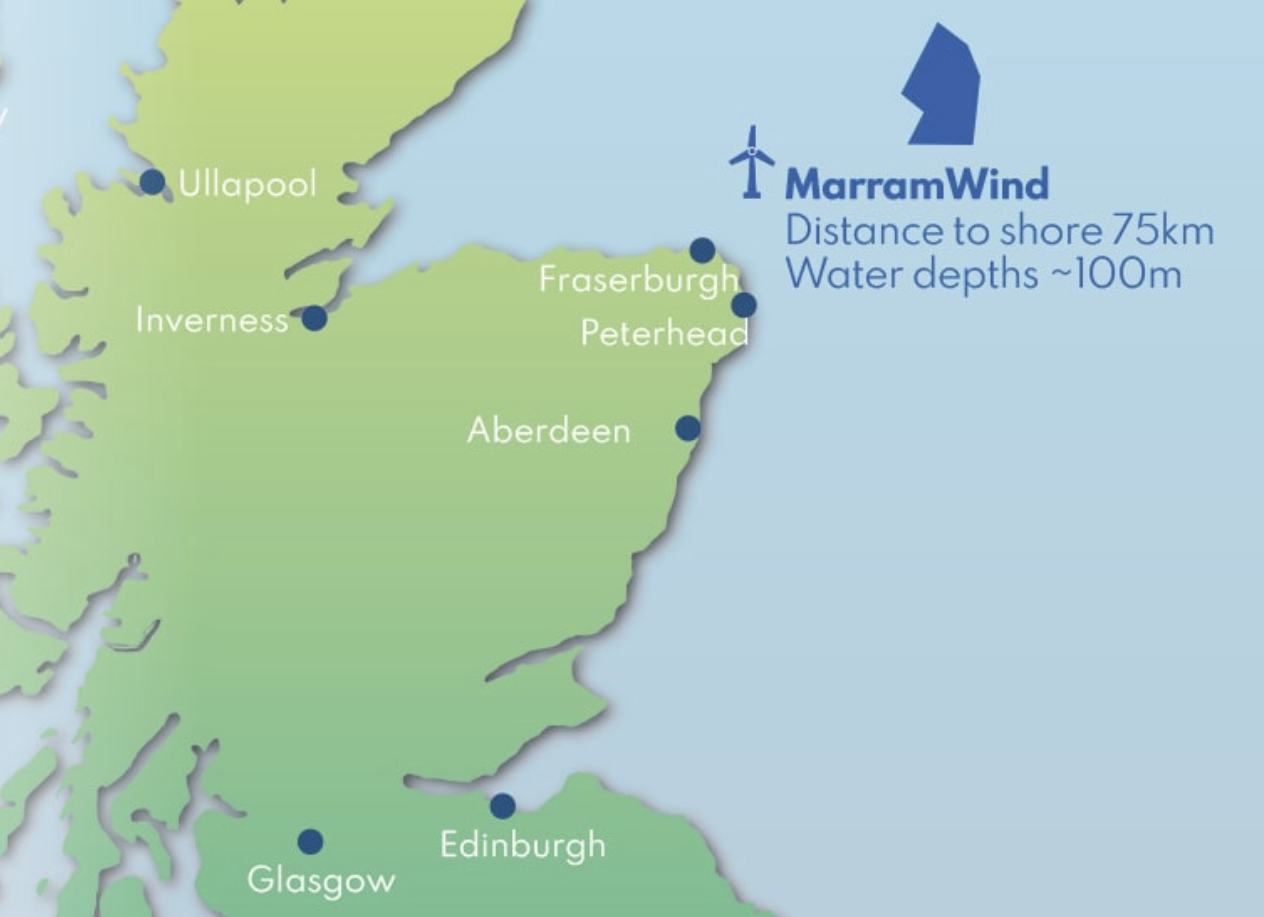
Located 75 kilometres off the North East coast of Scotland in water depths averaging 100 metres, the proposed MarramWind floating offshore windfarm could deliver up to 3 gigawatts (GW) of cleaner renewable energy.
This map clipped from the MarramWind web site, shows the location of the wind farm.
CampionWind’s web site has this introduction.
ScottishPower and Shell have joined forces to develop the CampionWind offshore windfarm following success in the recent ScotWind auction process by Crown Estate Scotland.
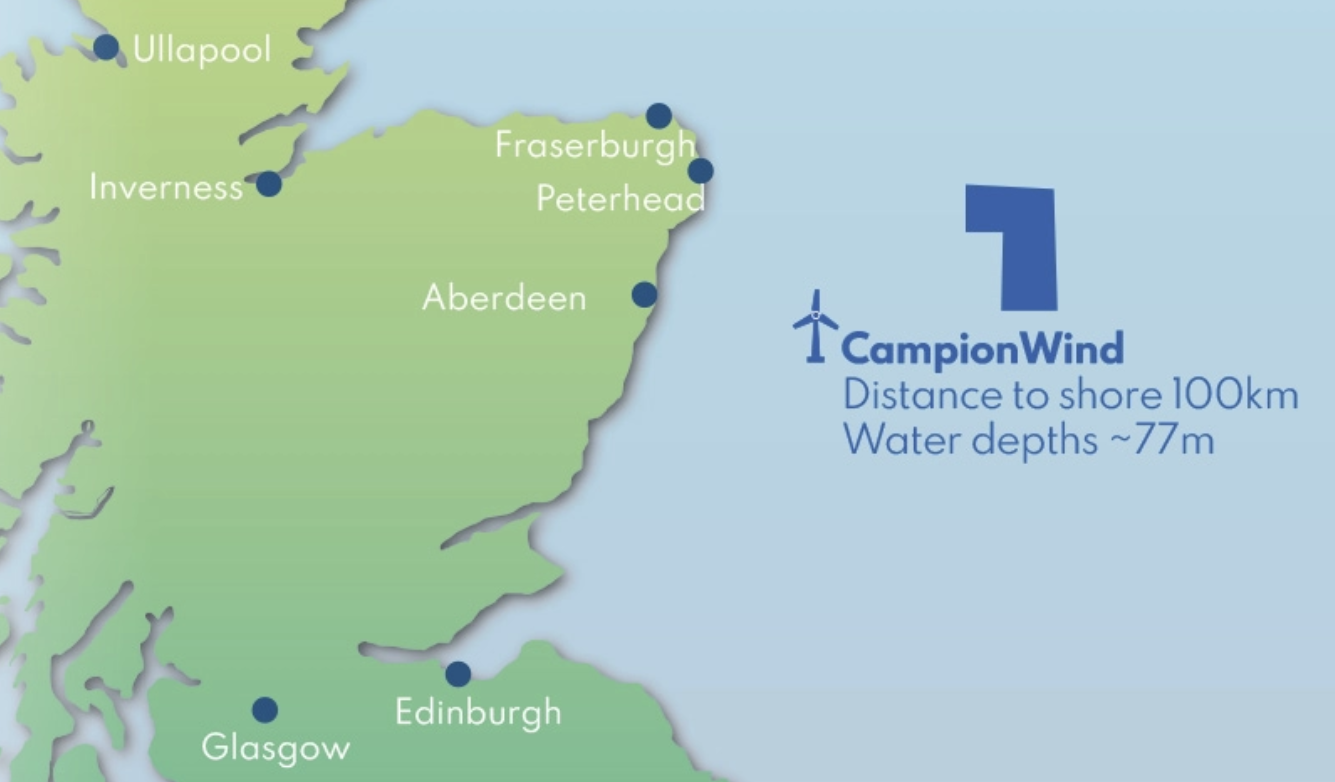
Located 100 kilometres from the east coast of Scotland, in water depths averaging 77 metres, the proposed CampionWind floating offshore windfarm could deliver up to 2 gigawatts (GW) of cleaner renewable energy.
This map clipped from the CampionWind web site, shows the location of the wind farm.
Note.
- The two wind farms will be within a few miles of each other.
- Both wind farms will use floating wind turbines.
- The water is a bit deeper at MarramWind, but this surely doesn’t bother a floating turbine.
- MarramWind and CampionWind will have a total capacity of 5 GW.
- Hywind Scotland is the world’s first commercial wind farm using floating wind turbines, situated 29 kilometres off Peterhead. This wind farm is only 30 MW, but in its first years of operation has achieved a capacity factor of over 50 %.
- The proposed turbines at Northern Horizons‘ 10 GW wind farm, which is 130 kilometres to the North-East of Shetland will be 20 MW giants and nearly as tall as The Shard in London.
So will Scottish Power and Shell design and build a combined field, similar in concept to Northern Horizons’ wind farm, using an armada of 250 floating wind turbines?
- The wind turbines might be moored around a fixed or floating mother platform or structure, that will collect the electricity and deliver it to the shore.
- Turbines could be serviced in situ or moved into port, as needed.
- Extending the wind farm could just be a matter of mooring the extra turbines in position and then connecting them to the mother platform.
- Is there a convenient disused oil or gas platform, that could be repurposed as the mother platform?
It certainly would appear to be a way of building large offshore fields in deep waters.
Where Would The Combined MarramWind And CampionWind Rank In Terms of UK Wind Farms?
Consider.
- MarramWind and CampionWind will have a total capacity of 5 GW.
- Phase one of the Hornsea Wind Farm is the largest offshore wind farm in the world, with a capacity of just over 1.2 GW and when complete it will have a capacity of 6 GW.
- Northern Horizons is planned to be 10 GW.
- The East Anglian Array could be as large as 7.2 GW.
- The Dogger Bank Wind Farm is planned to be as large as 4.8 MW.
- Norfolk Vanguard and Norfolk Boreas are a pair of 1.8 GW wind farms.
- MacHairWind will be a 2 GW wind farm.
Note.
- This is not a complete list of large wind farms in the development pipeline.
- BP have obtained leases, but have not published their plans.
- Most farms under development are at least one GW.
- These farms are a total of 38.6 GW.
The Combined MarramWind and CampionWind would be one of several large wind farms around 5 GW.
There Is A Desperate Need For Energy Storage
If we are generating upwards of 40 GW of wind and solar energy in the UK, there will be a desperate need for energy storage to cover for the times, when the wind doesn’t blow and the sun doesn’t shine.
Scotland should be OK, as there are various energy storage projects in development.
- The 1.5 GW/ 30 GWh Coire Glas project is according to SSE shovel-ready and has planning permission.
- The 450 MW/2.8 GWh Red John project is being constructed.
- Drax, ILI Group and SSE have several other projects under development.
So what would happen in the South?
The government appears to be on the case as I wrote in Ministerial Roundtable Seeks To Unlock Investment In UK Energy Storage.
But there is also the possibility of using hydrogen.
- Hydrogen could be created by a series of giant electrolysers.
- It could be blended with natural gas to eke out our natural gas and save carbon. According to HyDeploy, it appears that up to 20 % can be added, without needing to change boilers and appliances.
- It can be stored in depleted offshore gas fields.
- It can be used to power heavy transport like buses, trucks, trains and ships.
- It can be burned in gas-fired power stations to generate electricity.
Hydrogen can also be used as a feedstock or green energy source for the making of chemicals, concrete and steel.
Conclusion
We are approaching the end of the first phase of the development of renewable energy in the UK.
Massive floating wind farms using armadas of floating wind farms, a large expansion of pumped storage hydro and a huge expansion of the use of hydrogen will see us through to a carbon-free future.
Germany Weighs Norway Hydrogen Pipeline To Avoid Russian Energy
The title of this post, is the same as that of this article on Hydrogen Central.
This the introductory paragraphs.
Germany and Norway are considering building a hydrogen pipeline linking the two nations to reduce Europe’s dependence on Russian energy supplies.
The countries plan to soon conduct a feasibility study on the project that would eventually transport green hydrogen from Norway to Germany, they said after a meeting between German Economy Minister Robert Habeck and Norwegian Prime Minister Jonas Gahr Store.
There is a joint statement that gives more details.
Developments like this and lots of wind power in the North Sea and around the UK, are the sort of actions, that could seriously reduce the size of Russia’s oil and gas industry and the money it pays to that group of war criminals like Vlad the Mad and his friends.
Shell Resurrects Plans For Rejected North Sea Gasfield
The title of this post, is the same as that of this article on The Times.
This is the first two paragraphs.
Shell has submitted a revised plan for a North Sea gasfield that was rejected by regulators on environmental grounds last year.
The oil and gas major is seeking to develop the Jackdaw field, about 155 miles east of Aberdeen, which it says could produce 6.5 per cent of UK domestic gas output at peak — enough to heat 1.4 million homes. It hopes to start production in 2025 at the field, which would keep producing until 2033.
Other points in the article include.
- The platform would be unmanned.
- One of the problems with the field is that the gas naturally contains a lot of carbon dioxide.
- Shell plans to capture and store this carbon dioxide.
- The gas would be brought to shore using a nineteen mile pipeline to the Shearwater platform.
Surprisingly, the Shearwater platform is connected by the 295 mile SEAL pipeline to the Bacton terminal in Norfolk. But then Bacton is connected by the BBL pipeline to the Netherlands.
- There are depleted gas fields connected to Bacton, that can be used to store the carbon dioxide from the Jackdaw gas field.
- Shell manage the BBL pipeline.
- Shell are sitting in the middle with gas, that can be sold to the highest bidder.
It could be good for Shell without a great deal of expenditure on infrastructure.
In the short term, Jackdaw could make up our gas shortage, but as we start to blend wind-produced hydrogen into the gas network, we can export the surplus gas to the Continent. Shell might have plans for other gas fields to participate in the export of British gas to Germany, that has been replaced by wind-produced hydrogen.
It would be an interesting point, as to who would be responsible for the carbon dioxide produced by Jackdaw’s gas, that is burned in Germany. I suspect it will be the Germans.
In the long-term, when Shearwater and Jackdaw have given up all their gas, I wonder if Shell’s plans could be.
- Surround the platforms serving these fields with floating wind farms.
- Put a giant electrolyser on the Shearwater platform and bring hydrogen to the shore in the SEAL pipeline.
- Distribute the hydrogen from Bacton to the UK or through the BBL pipeline to the Continent.
I feel that Shell could do very nicely thank you out of the Jackdaw gas-field.
But it is also a plan, that produces a lot of energy, without emitting vast amounts of carbon dioxide.
The Neighbourhood Leading A Green Energy Revolution
The title of this post, is the same as that of this article on the BBC.
These are the first two paragraphs.
An ambitious target of using hydrogen to partly power homes in the UK within three years has been set by the National Grid, the BBC has learned. On the east coast of Scotland, a small neighbourhood is playing a key role in this energy revolution.
From next year, about 300 homes in Buckhaven, and Methil, in the area of Levenmouth, will be powered by green hydrogen gas in a project called H100. Customers will be offered free hydrogen-ready boilers and cookers in the scheme, which will initially last five and a half years.
I described the H100 Project in ‘World First’: SGN Launches Bid For 300 Green Hydrogen Homes Project In Fife.
This is the home page of the H100 Fife project web site.
This Google Map shows part of Buckhaven.
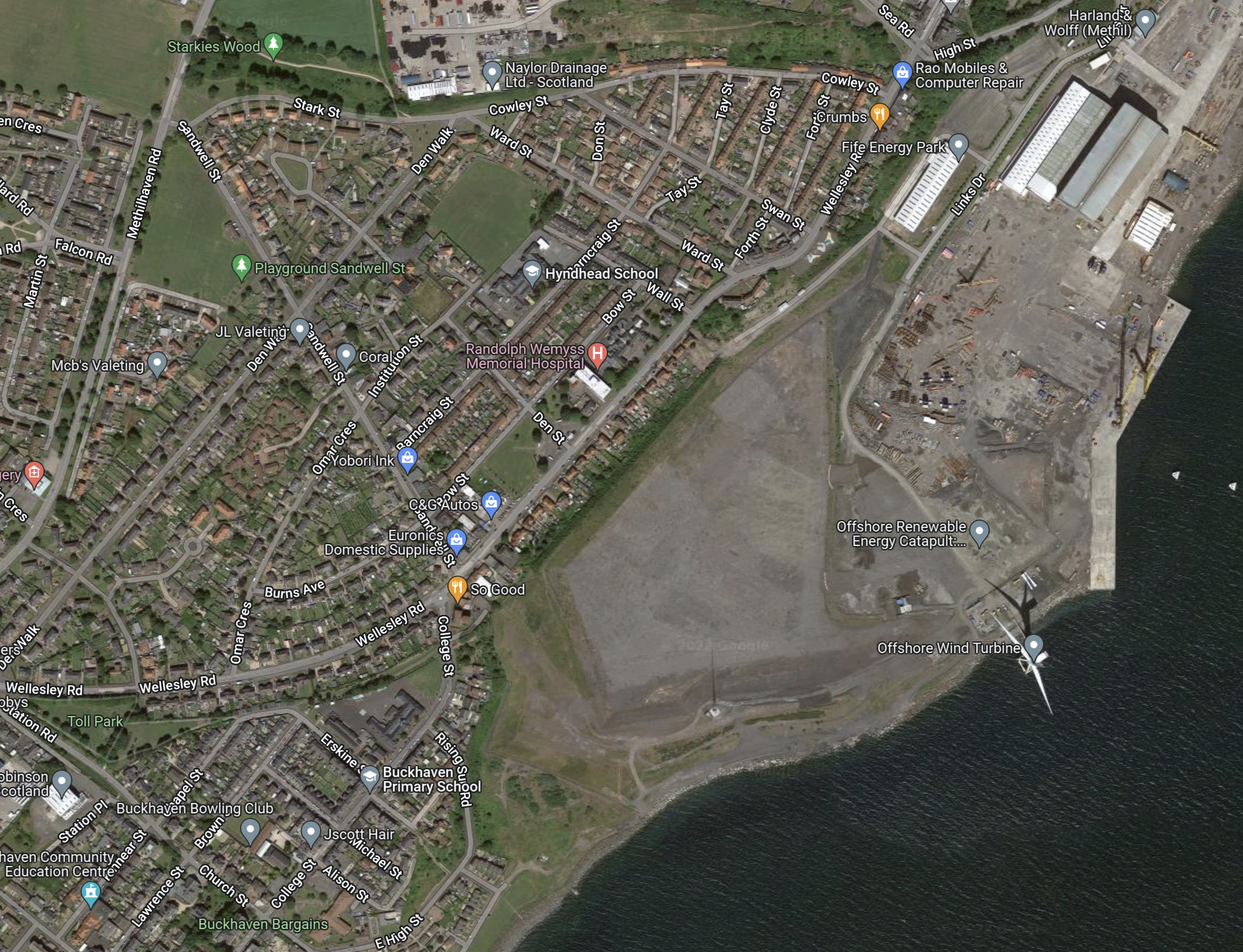
Note the wind turbine, that will produce the hydrogen is in the South-East corner of the map.
EDF Renewables Eyes 50MW Solar Farm To Power Green Hydrogen Development In Teesside
The title of this post, is the same as that of this article on Solar Power Portal.
These are the first two paragraphs.
EDF Renewables is looking to develop a 49.9MW solar farm to power a new green hydrogen production facility in Teesside.
Working together with Hynamics, a subsidiary of the EDF Group specialising in hydrogen, the companies are planning to develop a 30-50MW electrolyser, which will subsequently be scaled to over 500MW in line with emerging demand.
They are working with PD Ports and British Steel.
Teesside is certainly getting the green hydrogen it needs, as there is also a 400 MW hydrogen project on Teesside, that I wrote about in BP Plans To Turn Teesside Into First Green Hydrogen Hub.
Battery And Hydrogen Trains For ScotRail ‘Could Make Scotland A Global Leader’ In Zero-Emission Transport
The title of this post is the same as that of this article in the Scotsman.
This is the first paragraph.
New fleets of cutting-edge trains expected to include battery and hydrogen power are to be ordered for ScotRail which the rail industry believes will put Scotland at the forefront of zero-emission transport.
Other points from the article.
- Talgo appear to have passed the story to Scotland on Sunday.
- Three routes are mentioned; Borders Railway, Fife Circle and Glasgow-East Kilbride.
- The new trains could help phase out diesel trains by 2035, which is Scottish Government policy.
- The Inter7City trains might be replaced by 2030.
- Talgo hopes to win an order for its factory in Fife.
Talgo’s Managing Director is quoted as saying, they are starting testing of a hydrogen and electric train with a range of 311 miles.
Consider.
- I wrote about this train in Talgo To Begin Fuel Cell Loco Trials.
- Talgo’s hydrogen and electric train would be ideal for Scotland’s railways of which only forty percent are electrified.
- A four or five-car high specification hydrogen and electric train would be ideal for the Inter7City routes, if it were built specifically for the routes.
- The range would cover all of Scotland.
- Hydrogen hubs are being planned all over Scotland.
- Scotland have 26 Inter7City trainsets.
This could be a rather nice order to fund the factory and test all the trains close to the factory.
Is there a better place to show off your new train to a prospective buyer than the Highlands of Scotland?
In A Class 319 Train, But Not As We Know It!, I told this tale.
I am reminded of a tale, that I heard from a former GEC manager.
He was involved in selling one of GEC’s Air Traffic Control radars to a Middle Eastern country.
The only working installation of the radar was at Prestwick in Scotland, so he arranged that the dignitaries and the sales team would be flown to Prestwick in GEC’s HS 125 business jet.
As they disembarked at Prestwick and walked to the terminal, the pilot called the GEC Manager over.
The pilot told him “The Scottish Highlands at this time of the year, are one of the most beautiful places in the world! Would you and your guests like a low-level tour on the way back? I can arrange it, if you say so!”
Despite knowing GEC’s draconian attitude to cost control he said yes.
The sale was clinched!
I’m sure that Talgo will exploit the scenery and the local produce.
Talgo’s Hydrogen Trains
This page on the Talgo web site, is entitled Talgo’s Hydrogen Train Will Be Ready In 2023.
This paragraph gives an overview of Talgo’s hydrogen power system.
This system is configured as a modular solution that can be installed on all types of trains, as well as in upgrades from diesel to hydrogen. However, it has been specifically designed for the Vittal platform for Commuter and Regional trains, which Talgo has presented in the bidding process for various tenders in Spain and other countries.
And these two paragraphs describe Talgo’s hydrogen trains in more detail.
This innovative system uses hydrogen batteries that provide the energy for the train’s electric motors. It is powered by renewable energy sources, such as solar photovoltaic or wind, which produce hydrogen that is stored and then used to power fuel cell-based propulsion systems, such as the one designed by Talgo. The system is complemented by batteries that increase the speed of the train when it starts, taking advantage of the braking system to recharge it.
Unlike the extended battery systems in the automotive industry, hydrogen (H2) technology is the logical answer to the needs of heavy transport and, in particular, of those railway lines that do not have catenary electrification systems, and which today depend on trains powered by diesel engines. The hydrogen system designed by Talgo enables conventional network lines to be “electrified” without the need for costly and lengthy adaptation operations, and without the use of fossil fuels.
What do they mean by hydrogen batteries? Looking at the German and the Spanish on the page, I think Talgo means hydrogen fuel cells.
The Rebuilding Of Ukraine
It should be noted that Talgo have sold trains in the past to Russia, which has a gauge of 1.520 metres, which lies between Iberian gauge of 1.668 metres and our standard gauge of 1.435 metres.
- Talgo have also sold trains to Germany, who use standard gauge.
- Talgo have built Strizh trains for Russia, that are both standard gauge and Russian gauge for running between Berlin and Moscow.
- According to the BBC and The Times, Ukraine’s railways have been an important lifeline during the Russian invasion, but pictures show they are in need of modernisation and more electrification.
- The Strizh trains or a development would surely be ideal for running between Kviv and Berlin, Budapest, Prague and Warsaw.
- There would also appear to be a need for a hydrogen and electric regional train to reconnect the country back together.
- Other countries using Russian gauge include Mongolia, Kazakhstan, Kyrgyzstan, Tajikistan, Turkmenistan, Uzbekistan, Armenia, Azerbaijan, Georgia, Belarus, Moldova, Estonia, Latvia, Lithuania, and Finland.
So are Talgo positioning themselves to take part in the modernisation of Ukraine’s railways, once the war is over?
- Development and testing is done in Spain and Scotland.
- Manufacturing could be done in Spain and Scotland.
- Delivery from Scotland could either be by ship or if they were dual-gauge trains, they could be hauled through the Channel Tunnel and then through Germany and Poland.
As Talgo has the technology, I can certainly see them exploiting the Russian gauge market once Vlad the Mad has gone.
Aberdeen City Council And BP Sign Joint Venture Agreement To Develop City Hydrogen Hub
The title of this post, is the same as this article on Renewable Energy Magazine.
The title is a good description of the project and these are a few details.
- Production will start in 2024.
- The hub will produce 800 kilograms of green hydrogen per day.
- That will be enough for 25 buses and 25 other vehicles.
- Further investment would provide hydrogen for rail, freight and marine uses.
I don’t think this is a small project, as they are talking about potentially exporting the hydrogen.
These are a few thoughts.
Electricity Supply
In Can The UK Have A Capacity To Create Five GW Of Green Hydrogen?, I said the following.
Ryze Hydrogen are building the Herne Bay electrolyser.
- It will consume 23 MW of solar and wind power.
- It will produce ten tonnes of hydrogen per day.
The electrolyser will consume 552 MWh to produce ten tonnes of hydrogen, so creating one tonne of hydrogen needs 55.2 MWh of electricity.
Scaling those figures mean that to create 800 kilograms of hydrogen will need 44.16 MWh of electricity or if it is a 24/7 operation, the electrolyser will need a feed of 1.84 MW.
Currently, there are two offshore wind farms close to Aberdeen.
- European Offshore Wind Development Centre – 93 MW
- Hywind Scotland – 30 MW
That would provide enough electricity to provide a starter of under 2 MW.
I can see a lot more wind farms off the coasts around Aberdeen, as on all my visits to the city it has been windy and there is a lot of empty sea.
I don’t think providing enough renewable electricity for a very large electrolyser in Aberdeen will be a problem.
Hydrogen Exports
I would expect, that the hydrogen would go to Germany, as the Germans are backing BP in their wind farm ambitions and they are building a large hydrogen import terminal at Wilhelmshaven on the North-West German coast. The distance for a ship is under 500 miles.
BP’s Future Hydrogen Plans
This is a quote from Louise Kingham CBE, BP’s UK head of country and senior vice president for Europe.
Partnering with cities and corporates as they shape their paths to net zero is a core part of BP’s strategy. BP expects to partner with 10-15 cities globally by 2030 to provide innovative, integrated, and decarbonized energy solutions at scale to help them achieve their goals of net zero emissions. BP also aims to capture 10% of the low carbon hydrogen market in key geographies by 2030.
BP is investing across all the energy transition growth areas in the UK. In fact, we have committed to spend £2 in the UK for every £1 generated here out to the middle of this decade.
“Today’s announcement is evidence of that commitment in action and is supported by other ambitious plans to produce clean energy from UK offshore wind, develop carbon capture in Teesside and grow the country’s electric vehicle charging network.
BP would be in part using their expertise in providing oil and gas to the production and delivery of hydrogen to end users, be they large or small.
I can also see BP repurposing a few gas and oil production platforms into offshore hydrogen production hubs, as this could be a better financial route, rather than demolishing the platforms.
Conclusion
Birmingham is building a hydrogen hub at Tyseley Energy Park to fuel hydrogen buses and other vehicles.
Where is the plan for London’s hydrogen hubs?
Highland Council Forges Green Hydrogen Pact
The title of this post, is the same as that of this article on renews.biz.
These are the first two paragraphs.
Getech subsidiary H2 Green has signed a memorandum of understanding (MoU) with the Highland Council in Scotland aimed at creating a regional network of green hydrogen hubs across the Scottish Highlands.
Under the terms of the MoU, H2 Green and the Highland Council will produce a regional plan to develop a network of green hydrogen hubs at optimal locations across the region.
The first hub appears to be in Inverness, as I wrote in Hydrogen Hub Plan Will Cut Transport Sector Emissions In The Highlands.
But that is only the start.
- Green hydrogen will be used in transport in the Highlands.
- By-products like oxygen and heat will be distributed.
- Delivery of Highland decarbonisation will be planned.
- SGN Commercial Services will service large-volume customers.
- Agreements are in place for Eversholt Rail to deploy their hydrogen-powered trains on the Far North and West Highland Lines of Scotland.
This statement from Jonathan Copus of Getech, sums up the objectives of the hydrogen project.
These activities combined with the Highland Council initiative are set to establish the Highlands as the leading UK-centre for decarbonisation and innovation; they will also support job creation, deliver energy security and provide a sustainable path for the region’s net zero transition.
I believe that a similar approach could be taken in other parts of the UK. Cornwall, East Anglia, Lincolnshire, much of Wales and the Borderlands between England and Scotland come to mind.
Each region will probably, decarbonise slightly differently and each will develop more and more innovative ways to use the hydrogen.
Conclusion
Hydrogen will play a large part in the decarbonisation of the UK.
Plan For New Nuclear Reactors At Wylfa And Trawsfynydd A Step Closer As Natural Resource Wales Looks At Designs
The title of this post, is the same as that of this article on nation.cymru.
These are the first two paragraphs.
Plans for new nuclear power stations at Trawsfynydd and Wylfa have taken a step closer after the UK Government asked government regulators to assess designs for the reactors.
Natural Resources Wales will be among those assessing the designs by Rolls-Royce, with both Wylfa and Trawsfynydd have been named as potential sites for housing them within the UK.
These are points about the reactors.
- They will cost £1.8 billion each.
- They are capable of powering a city the size of Cardiff, which has a population of about half-a-million.
- I’ve read elsewhere that the reactors are planned to have a nameplate capacity of 470 MW.
The article did mention, that the Nimbys were lining up.
The Wylfa Site
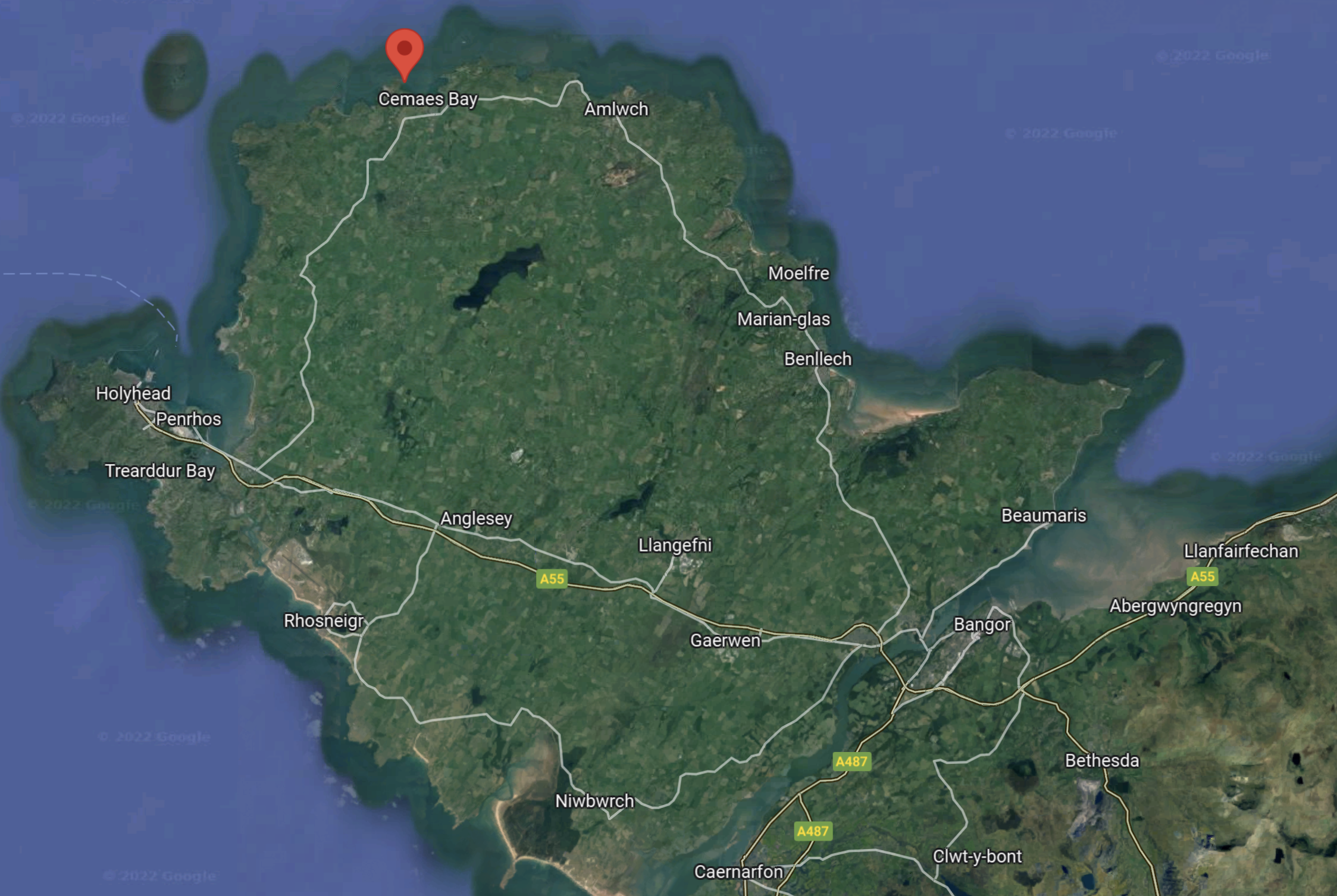
The original Wylfa power station was a Magnox nuclear station generating 980 MW, that was decommissioned in 2015.
This Google Map shows the location of the site on Anglesey.
This second Google Map shows the site in more detail.
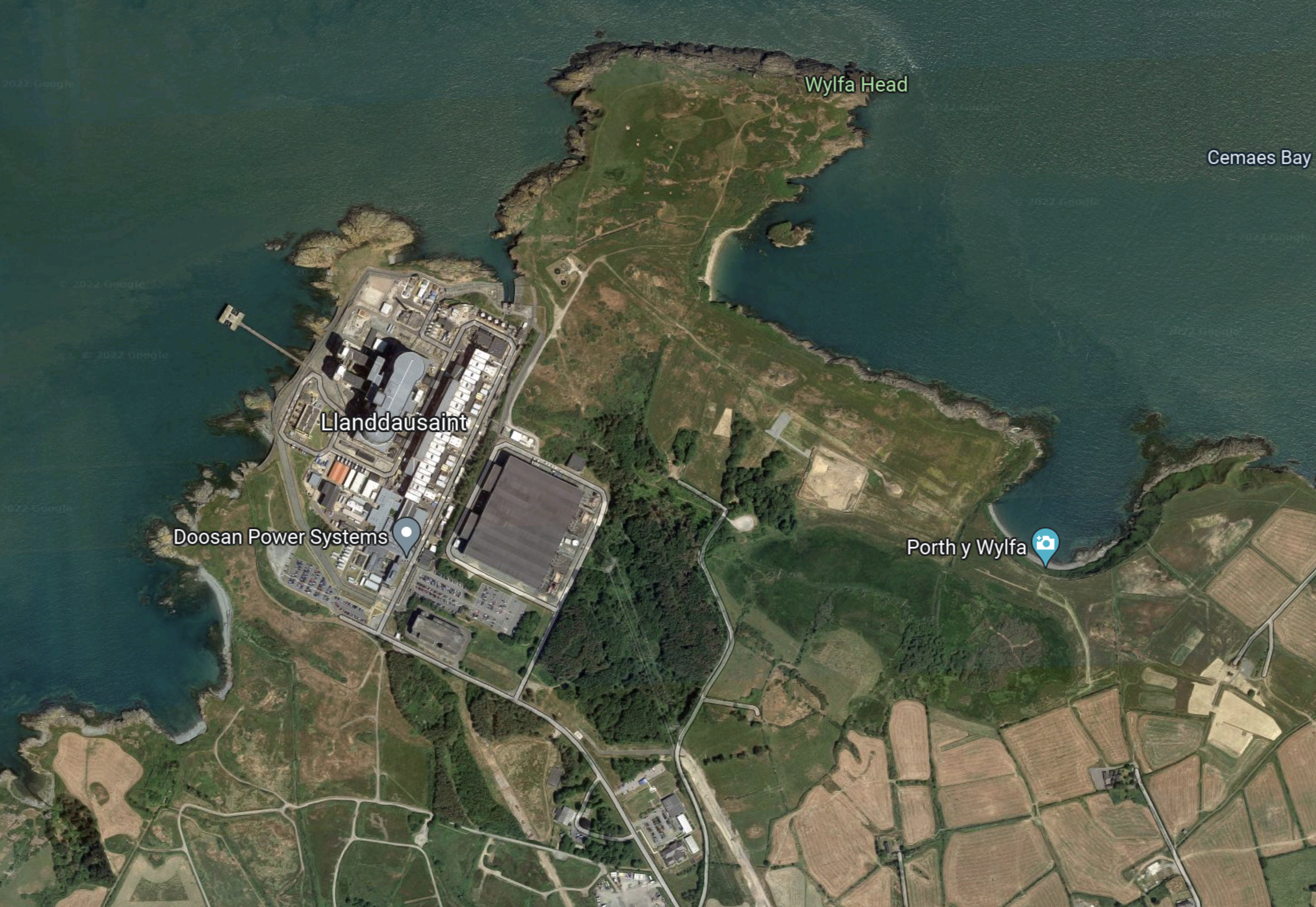
The power station doesn’t appear to have had a rail link, but there is a railway line a few miles away, with sidings that might have been used to handle fuel flasks.
There has been a proposal for a hybrid plant consisting of a wind farm and small modular nuclear reactors, which is described in this Wikipedia section, where this is said.
In January 2021, Shearwater Energy presented plans for a hybrid plant, to consist of a wind farm and small modular reactors (SMRs), to be installed adjacent to the existing Wylfa power station but separate from the proposed Wylfa Newydd site. Shearwater has signed a memorandum of understanding with NuScale Power for the SMRs. The plant could start generation as early as 2027 and would ultimately produce up to 3 GW of electricity and power a hydrogen generation unit producing up to 3 million kg of hydrogen per year.
Note.
- Wylfa Newydd was a proposal by Hitachi to build a nuclear station on the site.
- Shearwater Energy is a UK developer of energy opportunities.
- NuScale Power is an American company with its own design of small modular nuclear reactor.
In Holyhead Hydrogen Hub Planned For Wales, I talked about hydrogen and the port of Holyhead.
The Trawsfynydd Site
The original Trawsfynydd power station was a Magnox nuclear station generating 470 MW, that was decommissioned in 1991.
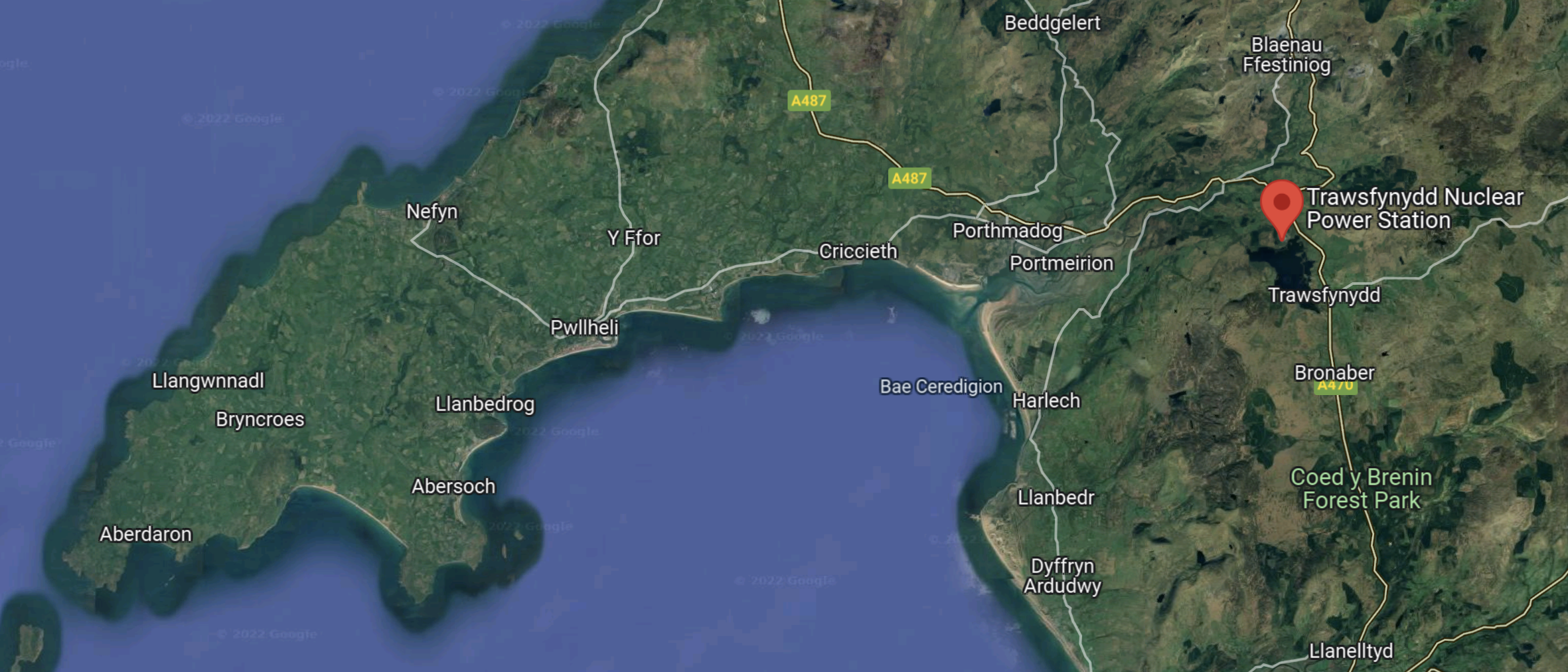
This Google Map shows the location of the site in North Wales.
This second Google Map shows the site in more detail.
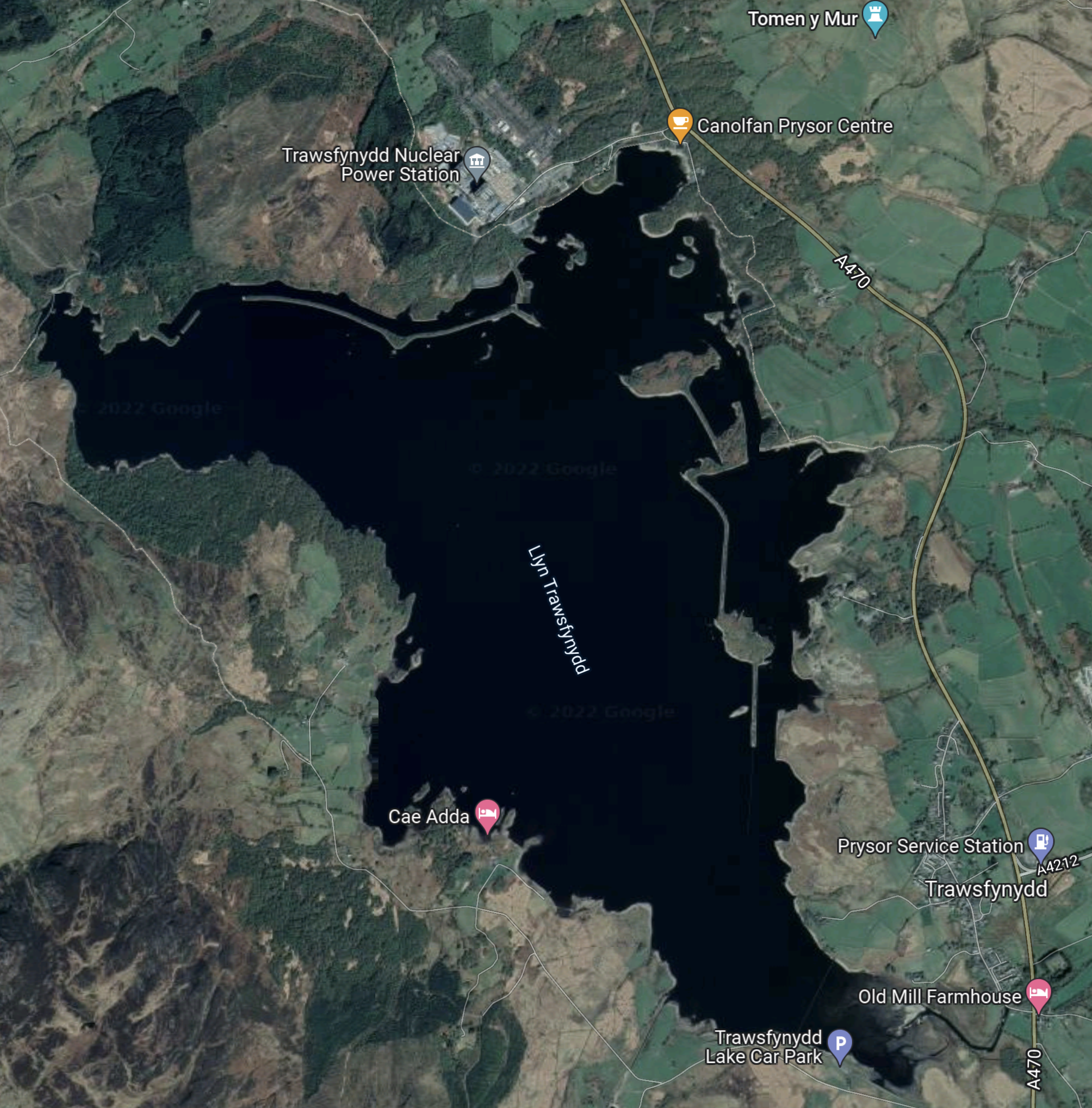
Note.
- The power station was built on the Northern shore of Llyn Trawsfynydd.
- Llyn Trawsfynydd is a man-made lake, that was built in the 1920s to supply water to the 24 MW Maentwrog hydro electric power station.
- There is a railway from near the site, that connects to the Conwy Valley Line at Blaenau Ffestiniog.
The Trawsfynydd site is a lot more than just a decommissioned Magnox power station.
Pumped Energy Storage In Snowdonia
Currently, there are two existing pumped storage in Snowdonia.
- Dinorwig power station, which is often called Electric Mountain, which has a capacity of 9.1 GWh.
- Ffestiniog power station, which has a capacity of around 1 GWh. If anybody has a better figure let me know!
A third scheme is under development at Glyn Rhonwy, which could have a capacity of 700 MWh.
Looking at the size of Llyn Trawsfynydd, I do wonder, if it could be the top lake of a future pumped storage scheme.
- Llyn Trawsfynydd, contains 40 million tonnes of water.
- There is a head of 190 metres.
That could give energy storage of 20 GWh. That sounds a lot of GWhs! But with two possible small modular nuclear reactors at possibly 500 MW each nearby and some help from windfarms, it could be filled within a day, if there is a suitable low-level reservoir.
Rolls-Royce And The Duisburg Container Terminal
In Rolls-Royce Makes Duisburg Container Terminal Climate Neutral With MTU Hydrogen Technology, I showed how Rolls-Royce and its subsidiary were providing an innovative climate neutral solution for Duisburg Container Terminal in Germany.
A North West Wales Powerhouse
Could Rolls-Royce be planning a Duisburg-style solution for North West Wales.
- Small modular nuclear reactors at Wylfa and Trawsfynydd.
- Hydrogen electrolysers to create hydrogen for the Port of Holyhead and heavy transport.
- Adequate pumped hydro storage for surplus energy.
But there could be little serious above-ground construction.
Conclusion
Something is awakening in North West Wales.

