World’s Tallest Wooden Wind Turbine Starts Turning
The title of this post, is the same as that of this article on the BBC.
This is the sub-heading.
What is made from the same wood as a Christmas tree, held together by glue and manufactured in a Swedish factory for assembly later?
These three paragraphs outline the design of a revolutionary wind turbine tower.
If that calls to mind flat-pack furniture and meatballs, you’re wrong.
If you answered “a wooden wind turbine”, you could be a visionary.
According to Modvion, the Swedish start-up that has just built the world’s tallest wooden turbine tower, using wood for wind power is the future.
I feel that it is not as revolutionary as some people might think.
Forty years ago, I built an extension on my house that included a swimming pool and a barn. The swimming pool roof was based on laminated wood beams and the barn was constructed using traditional wooden beams, that were bolted together.
But surely the most amazing wooden structure of the last century is the DH 98 Mosquito.
This paragraph introduces the Wikipedia entry for this amazing aeroplane.
The de Havilland DH.98 Mosquito is a British twin-engined, multirole combat aircraft, introduced during the Second World War. Unusual in that its airframe was constructed mostly of wood, it was nicknamed the “Wooden Wonder”, or “Mossie”. Lord Beaverbrook, Minister of Aircraft Production, nicknamed it “Freeman’s Folly”, alluding to Air Chief Marshal Sir Wilfrid Freeman, who defended Geoffrey de Havilland and his design concept against orders to scrap the project. In 1941, it was one of the fastest operational aircraft in the world.
One of my friends from the twentieth century, had been an RAF Mosquito pilot in the 1950s and felt it was an unequalled design of aircraft.
The airframe of the Mosquito was built using similar materials and methods as Modvion’s turbine tower.
I have just found out, that the de Havilland Aircraft Museum, where the prototype Mosquito is displayed, is open at least until the 7th of January.
I shall be going by public transport and if anybody would like to accompany me, use the Contact Page to get in touch.
The Weather And My INR
I measure my own INR and adjust my levels of Warfarin accordingly.
I typically take 4 mg of Warfarin one say and 3.5 mg the next, as this average dose of 3.75 mg, seems to keep my INR around the required 2.5.
Recent readings have been as follows.
- 18th December – 2.5
- 21st December – 2.5
- 25th December – 2.7
- 28th December – 1.9
Note.
- I test on Mondays and Thursdays.
- Today’s test was a bit low at 1.9.
- I should also say my left humerus was uncomfortable. Was it because bone was unhappy being in a dry body?
Today I took 5 mg of Warfarin to kick the INR the right way. I shall also test my INR tomorrow, just to be sure.
So why did my IRN drop by an unusual amount between Monday and Thursday?
We have just had storm Gerrit (Who thinks up these names? Donald, Nigel or Vladimir would be better, as they’re Low-life!)
So does the the low pressure suck the water out of my body, thus lowering the INR? And bring pain to my injured arm?
UK Transmission-Connected 100MW BESS Online At Former Coal Plant Site
The title of this post, is the same as that of this article on Energy Storage News.
These are the first three paragraphs.
A 100MW battery storage project in the UK connected to National Grid’s transmission network has gone online, developed by Pacific Green on the former site of a coal plant.
UK transmission system operator (TSO) National Grid has plugged in the 100MW/100MWh battery energy storage system (BESS) project to its 400kV Richborough substation.
The project, dubbed the Richborough Energy Park battery, is owned by asset manager Sosteneo Infrastructure Partners which acquired it from developer Pacific Green in July 2023.
A Transmission-Connected Battery
Thye Energy Storage News article says this about transmission-connected batteries.
Most BESS projects in the UK connect into the lower-voltage networks run by distribution network operators (DNOs) rather than National Grid’s high-voltage network. Benefits of the latter include a more reliable connection and better visibility in National Grid control rooms.
This would look to be a better way to connect a battery to the grid, but the battery must be able to supply electricity at 400 kV.
This Google Map shows the location of Richborough Energy Park.

Note.
- Richborough Energy Park is marked by the red arrow.
- The coast is the East Coast of Kent.
- The Prince’s Golf Club lies between the Energy Park and the sea.
This second Google Map shows the energy park in more detail.

Note.
- Richborough Energy Park is marked by the red arrow.
- The 336 MW coal-fired Richborough power station used to occupy the site.
- To its West is Richborough 400kV substation.
- There is a large solar park to the North.
- The 1 GW Nemo Link connects to the grid at the energy park.
- The 300 MW Thanet Wind Farm connects to the grid here.
It looks like an ideal place to put a 100MW/100MWh battery energy storage system, so that it can balance the wind and solar farms.
Sheaf Energy Park
This page on the Pacific Green web site is entitled Delivering Grid-Scale Energy Storage With A Global Reach.
Four battery projects are shown.
- Richborough Energy Park – In Operation
- Sheaf Energy Park – In Construction
- Limestone Coast Energy Park – In Origination
- Portland Energy Park – In Origination
The first two projects are in Kent and the others are in Australia. That is certainly global reach by Pacific Green.
I then found this page on the Pacific Green web site, that is entitled Pacific Green Acquires Sheaf Energy Limited – 249 MW / 373.5 MWh Battery Energy Storage Development In The UK.
These two paragraphs describe the acquisition and development of Sheaf Energy Park.
Pacific Green Battery Energy Parks 2 Limited, a wholly-owned subsidiary of Pacific Green Technologies, Inc. has acquired 100% of the shares in Sheaf Energy Limited (“Sheaf Energy Park”) for £7.5 million (US$9.1 million) from UK-based energy originator, Tupa Energy (Holdings) Limited.
Sheaf Energy Park will be a 249 MW / 373.5 MWh battery energy storage system (“BESS”) located next to the Richborough Energy Park in Kent, England. Design and construction will begin in the first half of 2023, with the energy park commencing its 35-year operating life in April 2025.
It looks to me that Pacific Green have found the figures for the construction and operation to their liking at Richborough Energy Park and have decided that to more than triple their investment in energy storage at the site will be very much to their advantage.
Conclusion
I suspect we’ll see other locations in the UK and around the world, with wind, solar, interconnectors and batteries working in harmony to make the most of the electricity available.
Wood Burning At Home
The title of this post, is the same as that of the title on the home page of this web site.
I actually accessed the page as it appeared as an advert on something I was looking at on the Internet.
This is the sub-heading.
How do you feel about open fires, wood burners and even wood smoke?
These four paragraphs make up the home page.
It has long been known that the small particles released by solid fuel burning can stay in the air and even travel long distances. These small particles, when inhaled, can increase your risk of stroke, asthma, lung cancer, heart disease and dementia.
It is estimated that around 4,000 premature deaths occur each year in London due to long-term exposure to air pollution, of which about 284 are attributable to domestic wood burning. Every one of those 284 deaths is completely avoidable.
Domestic wood burning has a health and economic cost of about £187 million per year in London. That’s a cost of £24 for every London resident, whether you burn solid fuels or not.
The most effective way of reducing pollution and protecting everyone’s health is simply to avoid burning any wood, coal, or other solid fuels at home.
As I don’t have naked flames at all in my house, this doesn’t apply to me.
When I helped to fund two guys, who were developing a metered dose inhaler for asthma drugs, I did my due diligence before I invested.
I found some research, that said that naked flames and the oxides of nitrogen they produce, were one of the main causes of asthma.
So I avoid them and don’t do barbecues, bonfires, gas cookers or gas fires.
Incidentally, the two guys did develop the metered dose inhaler for asthma drugs and it is now prescribed as Respimat. It is totally mechanical, with no compressed gases or batteries.
Firm Develops Jet Fuel Made Entirely From Human Poo
The title of this post, is the same as that of this article on the BBC.
This is the sub-heading.
A new aviation company has developed a type of jet fuel made entirely from human sewage.
These are the first three paragraphs.
Chemists at a lab in Gloucestershire have turned the waste into kerosene.
James Hygate, Firefly Green Fuels CEO, said: “We wanted to find a really low-value feedstock that was highly abundant. And of course poo is abundant.”
Independent tests by international aviation regulators found it was nearly identical to standard fossil jet fuel.
It certainly seems to have a lot going for it.
I have some other thoughts.
What About Disposable Nappies?
I wrote Are Disposable Nappies A Wasted Resource?, about making hydrocarbon fuels from disposable nappies.
Should Disposable Nappies Be Collected Separately?
My food waste is collected separately in a special bin. Hackney Council say this is what happens to food waste.
Food waste from households in Hackney is sent to an anaerobic digestion facility in south east England, where it’s turned into renewable energy to power homes and biofertiliser to be spread on local farmland to grow crops.
Surely, a similar or appropriate process could be used for disposable nappies.
Biomethane From Sewage Works
In Centrica Signs UK Biomethane Agreement With Yorkshire Water And SGN Commercial Services, I wrote about how Centrica have found a way to distribute biomethane from sewage works using the UK’s gas grid.
Could Firefly take the solids and Centrica the biomethane?
Given that water companies are regularly blamed for spilling sewage could there be an opportunity for a large sewage works to be a major producer of green fuels for agriculture, aviation, industry and road transport.
BP And EnBW To Run Suction Bucket Trials At UK Offshore Wind Farm Sites
The title of this post, is the same as that of this article on offshoreWIND.biz.
This is the sub-heading.
On 30 December, the vessel North Sea Giant is expected to start suction bucket trials within the array areas of the Mona and Morgan offshore wind farm sites, located off North West England and North Wales.
These are the first three paragraphs.
The trials will run for an estimated 32 days, during which time the vessel will be lifting a suction bucket and setting it down on the seabed, and using subsea pumps to drive the suction bucket into the seabed and back out.
The campaign is expected to consist of around 20 suction bucket trials, subject to weather conditions.
In their environmental impact assessment (EIA) scoping reports, issued last year, BP and EnBW state that a number of foundation types are being considered for the two proposed offshore wind farms and that the type(s) to be used will not be confirmed until the final design, after the projects are granted consent.
It sounds sensible to try out different types of foundations, but what is a suction bucket?
This page on the Ørsted web site is entitled Our Experience With Suction Bucket Jackets, explains how they work and are installed.
This is the first paragraph.
Monopiles (MPs) are currently the most commonly used foundation solution for offshore wind turbines with 81% of offshore wind turbines in European waters founded on MPs at the end of 2019 (Wind Europe, 2020). Where site conditions do not allow for an efficient or practical MP design, a number of alternative foundation solutions are available, including the suction bucket jacket (SBJ), piled jacket, gravity base or even a floating solution.
These two paragraphs, indicate when Ørsted has used SBJs.
Ørsted installed the world’s first SBJ for an offshore WTG at the Borkum Riffgrund 1 offshore windfarm in Germany in 2014.
Since the installation of the Borkum Riffgrund 1 SBJ, Ørsted has been involved in the design and installation of SBJs at the Borkum Riffgrund 2 and the design for Hornsea 1 offshore wind farms. At Hornsea 1, overall project timeline considerations and limitations of serial production capacities precluded the use of SBJs, and therefore the project chose an alternative foundation type.
It will be interesting to see how BP and EnBW’s trial gets on.
Enabling The UK To Become The Saudi Arabia Of Wind?
The title of this post, is the same as that of a paper from Imperial College.
The paper can be downloaded from this page of the Imperial College web site.
This is a paragraph from the Introduction of the paper.
In December 2020, the then Prime Minister outlined the government’s ten-point plan for a green industrial revolution, expressing an ambition “to turn the UK into the Saudi Arabia of wind power generation, enough wind power by 2030 to supply every single one of our homes with electricity”.
The reference to Saudi Arabia, one of the world’s largest oil producers for many decades, hints at the significant role the UK’s energy ambitions hoped to play in the global economy.
Boris Johnson was the UK Prime Minister at the time, so was his statement just his usual bluster or a simple deduction from the facts.
The paper I have indicated is a must-read and I do wonder if one of Boris’s advisors had read the paper before Boris’s speech. But as the paper appears to have been published in September 2023, that is not a valid scenario.
The paper though is full of important information.
The Intermittency Of Wind And Solar Power
The paper says this about the intermittency of wind and solar power.
One of the main issues is the intermittency of solar and wind electricity generation, which means it cannot be relied upon without some form of backup or sufficient storage.
Solar PV production varies strongly along both the day-night and seasonal cycles. While output is higher during the daytime (when demand is
higher than overnight), it is close to zero when it is needed most, during the times of peak electricity demand (winter evenings from 5-6 PM).At present, when wind output is low, the UK can fall back to fossil fuels to make up for the shortfall in electricity supply. Homes stay warm, and cars keep moving.
If all sectors were to run on variable renewables, either the country needs to curb energy usage during shortfalls (unlikely to be popular with consumers), accept continued use of fossil fuels across all sectors (incompatible with climate targets), or develop a large source of flexibility such as energy storage (likely to be prohibitively expensive at present).
The intermittency of wind and solar power means we have a difficult choice to make.
The Demand In Winter
The paper says this about the demand in winter.
There are issues around the high peaks in heating demand during winter, with all-electric heating very expensive to serve (as
the generators built to serve that load are only
needed for a few days a year).Converting all the UK’s vehicles to EVs would increase total electricity demand from 279 TWh to 395 TWh. Switching all homes across the country to heat pumps would increase demand by a further 30% to 506 TWh.
This implies that the full electrification of the heating and transport sectors would increase the annual power needs in the country by 81%.
This will require the expansion of the electricity system (transmission capacity, distribution grids, transformers,
substations, etc.), which would pose serious social, economic and technical challenges.Various paths, policies and technologies for the decarbonisation of heating, transport, and industrial emissions must be considered in order for the UK to meet its zero-emission targets.
It appears that electrification alone will not keep us warm, power our transport and keep our industry operating.
The Role Of Hydrogen
The paper says this about the role of hydrogen.
Electrifying all forms of transport might prove difficult (e.g., long-distance heavy goods) or nigh impossible (e.g., aviation) due to the high energy density requirements, which current batteries cannot meet.
Hydrogen has therefore been widely suggested as a low-carbon energy source for these sectors, benefiting from high energy density (by weight), ease of storage (relative to electricity) and its versatility to be used in many ways.
Hydrogen is also one of the few technologies capable of
providing very long-duration energy storage (e.g., moving energy between seasons), which is critical to supporting the decarbonisation of the whole energy system with high shares of renewables because it allows times of supply and demand mismatch to be managed over both short and long timescales.It is a clean alternative to fossil fuels as its use (e.g., combustion) does not emit any CO2.
Hydrogen appears to be ideal for difficult to decarbonise sectors and for storing energy for long durations.
The Problems With Hydrogen
The paper says this about the problems with hydrogen.
The growth of green hydrogen technology has been held back by the high cost, lack of existing infrastructure, and its lower efficiency
of conversion.Providing services with hydrogen requires two to three times more primary energy than direct use of electricity.
There is a lot of development to be done before hydrogen is as convenient and affordable as electricity and natural gas.
Offshore Wind
The paper says this about offshore wind.
Offshore wind is one of the fastest-growing forms of renewable energy, with the UK taking a strong lead on the global stage.
Deploying wind turbines offshore typically leads to a higher electricity output per turbine, as there are typically higher wind speeds and fewer obstacles to obstruct wind flow (such as trees and buildings).
The productivity of the UK’s offshore wind farms is nearly 50% higher than that of onshore wind farms.
Offshore wind generation also typically has higher social acceptability as it avoids land usage conflicts and has a lower visual impact.
To get the most out of this resource, very large structures (more than twice the height of Big Ben) must be connected to the ocean floor and operate in the harshest conditions for decades.
Offshore wind turbines are taller and have larger rotor diameters than onshore wind turbines, which produces a more consistent and higher output.
Offshore wind would appear to be more efficient and better value than onshore.
The Scale Of Offshore Wind
The paper says this about the scale of offshore wind.
The geographical distribution of offshore wind is heavily skewed towards Europe, which hosts over 80% of the total global offshore wind capacity.
This can be attributed to the good wind conditions and the shallow water depths of the North Sea.
The UK is ideally located to take advantage of offshore wind due to its extensive resource.
The UK could produce over 6000 TWh of electricity if the offshore wind resources in all the feasible area of the exclusive economic zone (EEZ) is exploited.
Note.
- 6000 TWh of electricity per annum would need 2740 GW of wind farms if the average capacity factor was a typical 25 %.
- At a price of 37.35 £/MWh, 6000 TWh would be worth $224.1 billion.
Typically, most domestic users seem to pay about 30 pence per KWh.
The Cost Of Offshore Wind
The paper says this about the cost of offshore wind.
The cost of UK offshore wind has fallen because of the reductions in capital expenditure (CapEx), operational expenditure (OpEx), and financing costs.
This has been supported by the global roll-out of bigger offshore wind turbines, hence, causing an increase in offshore wind energy capacity.
This increase in installed capacity has been fuelled by several low-carbon support schemes from the UK government.
The effect of these schemes can be seen in the UK 2017 Contracts for Difference (CfD) auctions where offshore wind reached strike prices as low as 57.50 £/MWh and an even lower strike price of 37.35 £/MWh in 2022.
Costs and prices appear to be going the right way.
The UK’s Offshore Wind Targets
The paper says this about the UK’s offshore wind targets.
The offshore wind capacity in the UK has grown over the past decade.
Currently, the UK has a total offshore wind capacity of 13.8GW, which is sufficient to power more than 10 million homes.
This represents a more than fourfold increase compared to the capacity installed in 2012.
The UK government has set ambitious targets for offshore wind development.
In 2019, the target was to install a total of 40 GW of offshore wind capacity by 2030, and this was later raised to 50 GW, with up to 5 GW of floating offshore wind.
This will play a pivotal role in decarbonising the UK’s power system by the government’s deadline of 2035.
As I write this, the UK’s total electricity production is 31.8 GW. So 50 GW of wind will go a good way to providing the UK with zero-carbon energy. But it will need a certain amount of reliable alternative power sources for when the wind isn’t blowing.
The UK’s Hydrogen Targets
The paper says this about the UK’s hydrogen targets.
The UK has a target of 10 GW of low-carbon hydrogen production to be deployed by 2030, as set out in the British Energy Security Strategy.
Within this target, there is an ambition for at least half of the 10 GW of production capacity to be met through green hydrogen production technologies (as opposed to hydrogen produced from steam methane reforming using carbon capture).
Modelling conducted by the Committee on Climate Change in its Sixth Carbon Budget estimated that demand for low-carbon hydrogen across the whole country could reach 161–376 TWh annually by 2050, comparable in scale to the total electricity demand.
We’re going to need a lot of electrolyser capacity.
Pairing Hydrogen And Offshore Wind
The paper says this about pairing hydrogen and offshore wind.
Green hydrogen holds strong potential in addressing the intermittent nature of renewable generation sources, particularly wind and solar energy, which naturally fluctuate due to weather conditions.
Offshore wind in particular is viewed as being a complementary technology to pair with green hydrogen production, due to three main factors: a) the high wind energy capacity factors offshore, b) the potential for large-scale deployment and c) hydrogen as a supporting technology for offshore wind energy integration.
It looks like a match made in the waters around the UK.
The Cost Of Green Hydrogen
The paper says this about the cost of green hydrogen.
The cost of green hydrogen is strongly influenced by the price of the electrolyser unit itself.
If the electrolyser is run more intensively over the course of the lifetime of the plant, a larger volume of hydrogen will be produced and so the cost of the electrolyser will be spread out more, decreasing the cost per unit of produced hydrogen.
If the variable renewable electricity source powering the electrolyser has a higher capacity factor, this will contribute towards a
lower cost of hydrogen produced.Offshore wind in the UK typically has a higher capacity factor than onshore wind energy (up to 20%), and is around five times higher than solar, so pairing
offshore wind with green hydrogen production is of interest.
It would appear that any improvements in wind turbine and electrolyser efficiency would be welcomed.
The Size Of Wind Farms
The paper says this about the size of wind farms.
Offshore wind farms can also be larger scale, due to increased availability of space and reduced restrictions on tip heights due to planning permissions.
The average offshore wind turbine in the UK had a capacity of 3.6 MW in 2022, compared to just 2.5-3 MW for onshore turbines.
As there are fewer competing uses for space, offshore wind can not only have larger turbines but the wind farms can comprise many more turbines.
Due to the specialist infrastructure requirements for hydrogen transport and storage, and the need for economies of scale to reduce the costs of
production, pairing large-scale offshore wind electricity generation with green hydrogen
production could hold significant benefits.
I am not surprised that economies of scale give benefits.
The Versatility Of Hydrogen
The paper says this about the versatility of hydrogen.
Hydrogen is a highly adaptable energy carrier with numerous potential applications and has been anticipated by some as playing a key role in the future energy system, especially when produced through electrolysis.
It could support the full decarbonisation of “hard to decarbonise” processes within the UK industrial sector, offering a solution for areas which may be difficult to electrify or are heavily reliant on fossil fuels for high-temperature heat.
When produced through electrolysis, it could be paired effectively as an energy storage technology with offshore wind, with the potential to store energy across seasons with little to no energy degradation and transport low-carbon energy internationally.
The UK – with its significant offshore wind energy resources and targets – could play a potentially leading role in producing green hydrogen to both help its pathway to net zero, and potentially create a valuable export industry.
In RWE Acquires 4.2-Gigawatt UK Offshore Wind Development Portfolio From Vattenfall, I postulated that RWE may have purchased Vattenfall’s 4.2 GW Norfolk Zone of windfarms to create a giant hydrogen production facility on the Norfolk coast. I said this.
Consider.
- Vattenfall’s Norfolk Zone is a 4.2 GW group of wind farms, which have all the requisite permissions and are shovel ready.
- Bacton Gas terminal has gas pipelines to Europe.
- Sizewell’s nuclear power stations will add security of supply.
- Extra wind farms could be added to the Norfolk Zone.
- Europe and especially Germany has a massive need for zero-carbon energy.
The only extra infrastructure needing to be built is the giant electrolyser.
I wouldn’t be surprised if RWE built a large electrolyser to supply Europe with hydrogen.
The big irony of this plan is that the BBL Pipeline between Bacton and the Netherlands was built, so that the UK could import Russian gas.
Could it in future be used to send the UK’s green hydrogen to Europe, so that some of that Russian gas can be replaced with a zero-carbon fuel?
Mathematical Modelling
There is a lot of graphs, maps and reasoning, which is used to detail how the authors obtained their conclusions.
Conclusion
This is the last paragraph of the paper.
Creating a hydrogen production industry is a transition story for UK’s oil and gas sector.
The UK is one of the few countries that could produce more hydrogen than it consumes in hydrocarbons today.
It is located in the centre of a vast resource, which premediates positioning itself at the centre of the European hydrogen supply chains.
Investing now to reduce costs and benefit from the generated value of exported hydrogen would make a reality out of the ambition to become the “Saudi Arabia of Wind”.
Boris may or may not have realised that what he said was possible.
But certainly make sure you read the paper from Imperial College.
I’ve Often Worked On Christmas Day!
My father was a workaholic and would often go down his print works in Wood Green on Christmas morning.
When I became about seven, I would go with him and I would do small jobs.
In those days of the 1950s, it was a bit of a tradition that Spurs used to play at home on Christmas Day in the morning.
So probably for at least three years, we saw Spurs play and then went home to a late Christmas Lunch.
In the ten years or so, that I was writing and supporting Artemis, I would often use the Christmas holidays to develop the software or fix bugs, as I was unlikely to be phoned up to answer a query.
Today, I’m going to lunch with my son and his partner.
Before that though, I am pleased to see that The Times has published a full set of Monday puzzles. So I’ll be busy.
A Merry Christmas and a Happy New Year to all.
‘Rollercoasters In My Back Yard’: Welcome To Universal Studios Bedford
The title of this post, is the same as that of this article on The Times.
This is the sub-heading.
Britain’s answer to Orlando could be a 480-acre world boasting big rides, bigger films and 7m visitors a year. Some locals are far from enchanted
These three paragraphs introduce the story.
Picture the scene: It’s a snowy Christmas Eve, 2030, at King’s Cross station. Dozens of families from across the UK and Europe gather as the station speakers announce: “The train now leaving platform 9¾ is the Hogwarts Express, calling at the Wizarding World of Harry Potter. And Bedford.”
The stuff of JK Rowling’s fiction? Perhaps not.
For, if all goes to plan, a featureless 480 acres of industrial and agricultural land a short broomstick’s ride from downtown Bedford will, by the end of the decade, become one of the world’s most spectacular theme parks.
I have a few thoughts.
Eden Project Morecambe
Eden Project Morecambe will be the first of a new generation of theme parks in the UK.
The new Eden Project is to be developed at Morecambe, which is close to Lancaster. As Lancaster will be an High Speed Two terminus, Eden Project North could be connected to HS2 by a high tech shuttle like the Luton DART. So the Eden Project North will also attract day trippers from a large proportion of England and the South of Scotland.
I believe increasingly we will see theme parks, bringing in their visitors on futuristic public transport systems.
The Location Of Universal Studios Bedford
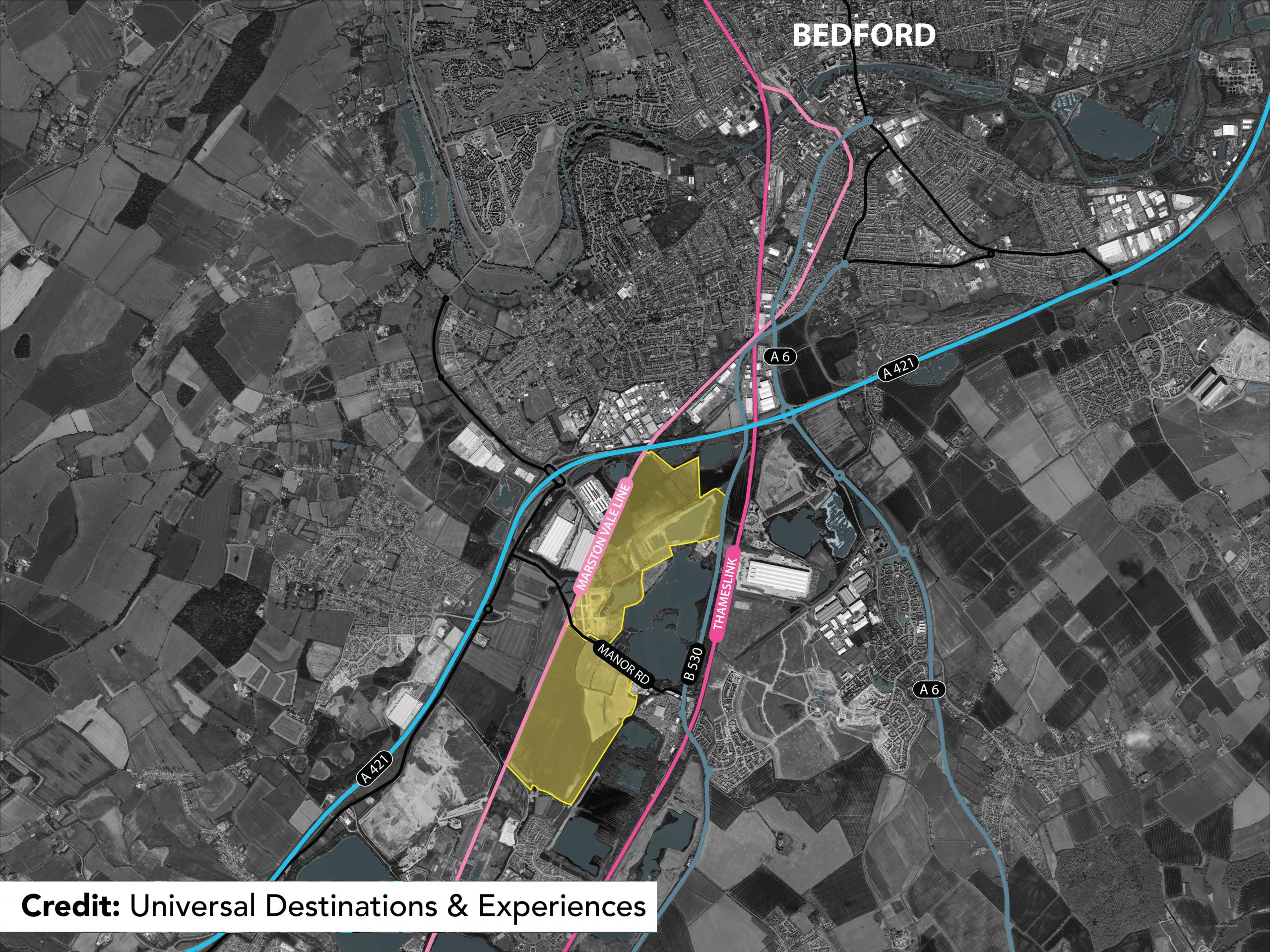
This map from Universal Destinations & Experiences shows the location of the site of the proposed Universal Studios Bedford.
Note.
- The site is shown by yellow shading.
- The blue lines are major roads.
- The pink lines are railways.
- The rail link running to the West of the site is currently the Marston Vale Line, which is being developed into the East West Railway between Oxford and Cambridge via Milton Keynes.
- The East West Railway will also connect to Ipswich, Norwich and Reading.
- The rail link running to the East of the site is the Midland Main Line, which links St. Pancras station with Derby, Nottingham and Sheffield.
The site certainly has excellent transport connections.
Expanding Rail Connections At Universal Studios Bedford
I believe that in these days of climate change, that theme parks and other attractions like sports stadia and shopping centres will develop their rail connections.
Universal Studios Bedford could have two stations.
- Kempston Hardwick on the East West Railway.
- Their own station on the Midland Main Line.
Note.
- Both stations could be connected by a futuristic people mover transporting visitors around the site.
- Using current train times, trains would take thirty minutes between the theme park and St. Pancras for Eurostar to and from Europe.
- Thameslink’s trains could shuttle visitors to and from Luton Airport.
It should also be noted that several of Southern England’s most visited sites are just a train ride away.
Easy Places To Visit
These attractions would be easy to visit.
- Bicester Village – Direct train from Kempston Hardwick after 2024.
- Cambridge – Direct train from Kempston Hardwick after 2030.
- London – Direct train from the new station after it’s built.
- Oxford – Direct train from Kempston Hardwick after 2024.
- Woburn Safari Park – Direct train from Kempston Hardwick after 2024.
Note.
All trains would be electric or battery-electric powered.
I have assumed that rail services between Oxford and Bedford open in 2024.
I have assumed that rail services between Oxford and Cambridge open in 2030.
Conclusion
This is an interesting idea, which is at an excellent location. But will the locals like it?
Extra Capacity On The Elizabeth Line At Tottenham Court Road Station
When I go to Oxford Street, I generally use the Elizabeth Line from Moorgate.
- If I need the Western end of Oxford Street, I use the Western entrance of Bond Street station.
- If I need John Lewis or Leon in Hanover Square, I use the Eastern entrance of Bond Street station.
- If I need the Eastern end of Oxford Street or Marks & Spencer at the Pantheon, I use the Western entrance of Tottenham Court Road station.
- If I need Tottenham Court Road or the British Museum, I use the Eastern entrance of Tottenham Court Road station.
Today, as I was going to Marks & Spencer at the Pantheon, I used the Western entrance of Tottenham Court Road station.
It wasn’t very busy and the tunnels and escalators were easily coping with Christmas shoppers.
But if Crossrail 2 ever gets built, Tottenham Court Road station could be the only interchange between the Elizabeth Line and Crossrail 2.
So I was pleased to see that someone had had the foresight to leave space for a fourth escalator at the Western entrance of Tottenham Court Road station.
I took these pictures as I returned.








A fourth escalator could easily be fitted on the right of the escalator on which I descended.
 The Anonymous Widower