Are Hitachi Designing the Ultimate Battery Train?
In Sparking A Revolution, a post based on an article of the same name in Issue 898 of Rail Magazine, I repeated this about the specification of Hitachi UK Battery Train Specification.
- Range – 55-65 miles
- Performance – 90-100 mph
- Recharge – 10 minutes when static
- Routes – Suburban near electrified lines
- Battery Life – 8-10 years
Does this mean that the train can do 55-65 miles cruising at 90-100 mph?
How Much Energy Is Needed To Accelerate A Five-Car Class 800 Train To Operating Speed?
I will do my standard calculation.
- Empty train weight – 243 tonnes (Wikipedia for Class 800 train!)
- Passenger weight – 302 x 90 Kg (Includes baggage, bikes and buggies!)
- Train weight – 270.18 tonnes
Using Omni’s Kinetic Energy Calculator, the kinetic energy at various speeds are.
- 60 mph – 27 kWh
- 80 mph – 48 kWh
- 90 mph – 61 kWh
- 100 mph – 75 kWh
- 125 mph – 117 kWh – Normal cruise on electrified lines.
- 140 mph – 147 kWh – Maximum cruise on electrified lines.
Because the kinetic energy of a train is only proportional to the weight of the train, but proportional to the square of the speed, note how the energy of the train increases markedly after 100 mph.
Are these kinetic energy figures a reason, why Hitachi have stated their battery train will have an operating speed of between 90 and 100 mph?
A 100 mph cruise would also be very convenient for a lot of main lines, that don’t have electrification in the UK.
What Battery Size Would Be Needed?
In How Much Power Is Needed To Run A Train At 125 mph?, I calculated that a five-car Class 801 electric train, needed 3.42 kWh per vehicle-mile to maintain 125 mph.
For comparison, an InterCity 125 train, had a figure of 2.83 kWh per vehicle-mile.
Hitachi are redesigning the nose of the train for the new Class 810 train and I suspect that these trains can achieve somewhere between 1.5 and 3 kWh per vehicle-mile, if they are cruising at 100 mph.
Doing the calculation for various consumption levels gives the following battery capacity for a five-car train to cruise 65 miles at 100 mph
- 1.5 kWh per vehicle-mile – 487 kWh
- 2 kWh per vehicle-mile – 650 kWh
- 2.5 kWh per vehicle-mile – 812.5 kWh
- 3 kWh per vehicle-mile – 975 kWh
These figures don’t include any energy for acceleration to line speed from the previous stop or station, but they would cope with a deceleration and subsequent acceleration, after say a delay caused by a slow train or other operational delay, by using regenerative braking to the battery.
The energy needed to accelerate to operating speed, will be as I calculated earlier.
- 90 mph – 61 kWh
- 100 mph – 75 kWh
As the battery must have space to store the regenerative braking energy and it would probably be prudent to have a ten percent range reserve, I can see a battery size for a train with an energy consumption of 2 kWh per vehicle-mile, that needed to cruise at 100 mph being calculated as follows.
- Energy for the cruise – 650 kWh
- 10% reserve for cruise – 65 kWh
- Braking energy from 100 mph – 75 kWh
This gives a total battery size of 790 kWh, which could mean that 800 kWh would be convenient.
Note that each of the three MTU 12V 1600 diesel engines, fitted to a Class 800 train, each weigh around two tonnes.
In Innolith Claims It’s On Path To 1,000 Wh/kg Battery Energy Density, I came to these conclusions.
- Tesla already has an energy density of 250 Wh/Kg.
- Tesla will increase this figure.
- By 2025, the energy density of lithium-ion batteries will be much closer to 1 KWh/Kg.
- Innolith might achieve this figure. But they are only one of several companies aiming to meet this magic figure.
Suppose two of the MTU 12V 1600 diesel engines were each to be replaced by a two tonne battery, using Tesla’s current energy density, this would mean the following.
- Each battery would have a capacity of 500 kWh.
- The train would have one MWh of installed battery power.
- This is more than my rough estimate of power required for a 65 mile trip.
- The train would have little or no weight increase.
- I also wouldn’t be surprised to find that the exchange of a diesel engine for a battery was Plug-and-Play.
Hitachi would have an electric/battery/diesel tri-mode train capable of the following.
- Range – 55-65 miles
- Out and Back Range – about 20-30 miles
- Performance – 90-100 mph
- Recharge – 10 minutes when static
- Emergency diesel engine.
I feel it would be a very useful train.
Trains That Could Be Fitted With Batteries
The original article in Rail Magazine says this.
For the battery project, positive discussions are taking place with a number of interested parties for a trial, with both Class 385s and Class 800s being candidates for conversion.
So this means that the following operators will be able to use Hitachi’s battery technology o their trains.
- Avanti West Coast – Class 80x trains
- First East Coast Trains – Class 80x trains
- East Midlands Railway – Class 80x trains
- GWR – Class 80x trains
- Hull Trains – Class 80x trains
- LNER – Class 80x trains
- ScotRail – Class 385 trains
- TransPennine Express – Class 80x trains
Although, I based my calculations on Class 80x trains, I suspect that the methods can be applied to the smaller Class 385 trains.
Possible Out-And-Back Journeys
These are possible Out-And-Back journeys, that I believe Hitachi’s proposed battery-electric trains could handle.
- Edinburgh and Tweedbank – 30 miles from Newcraighall
- London Paddington and Bedwyn – 30 miles from Reading
- London Euston and Blackburn – 12 miles from Preston
- London Kings Cross and Bradford – < 27 miles from Leeds
- London Euston and Chester – 21 miles from Crewe
- London Kings Cross and Harrogate – <18 miles from Leeds
- London Kings Cross and Huddersfield – 17 miles from Leeds
- London St. Pancras and Leicester – 16 miles from Market Harborough
- London Kings Cross and Lincoln – 17 miles from Newark
- London St. Pancras and Melton Mowbray – 26 miles from Corby
- London Kings Cross and Middlesbrough – 20 miles from Northallerton
- London Kings Cross and Nottingham – 20 miles from Newark
- London Paddington and Oxford – 10 miles from Didcot
- London Kings Cross and Redcar – 29 miles from Northallerton
- London Kings Cross and Rotherham- 14 miles from Doncaster
- London Kings Cross and Sheffield – 20 miles from Doncaster
- London and Weston-super-Mare – 19 miles from Bristol
Note.
- Provided that the Out-And-Back journey is less than about sixty miles, I would hope that these stations are comfortably in range.
- Leicester is the interesting destination, which would be reachable in an Out-And-Back journey. But trains from the North stopping at Leicester would probably need to charge at Leicester.
- I have included Blackburn as it could be a destination for Avanti West Coast.
- I have included Melton Mowbray as it could be a destination for East Midlands Railway.
- I have included Nottingham, Rotherham and Sheffield as they could be destinations for LNER. These services could prove useful if the Midland Main Line needed to be closed for construction works.
- I’m also fairly certain, that no new electrification would be needed, although every extra mile would help.
- No charging stations would be needed.
I suspect, I’ve missed a few possible routes.
Possible Journeys Between Two Electrified Lines
These are possible journeys between two electrified lines, that I believe Hitachi’s proposed battery-electric trains could handle.
- London St. Pancras and Eastbourne via Hastings – 25 miles between Ashford and Ore.
- Leeds and York via Garforth – 20 miles between Neville Hall and Colton Junction
- London Kings Cross and Norwich via Cambridge – 54 miles between Ely and Norwich.
- Manchester Victoria and Leeds via Huddersfield – 43 miles between Manchester Victoria and Leeds.
- Preston and Leeds via Hebden Bridge – 62 miles between Preston and Leeds.
- Newcastle and Edinburgh – Would battery-electric trains get round the well-publicised power supply problems on this route?
Note.
- I am assuming that a range of 65 miles is possible.
- If the trains have a diesel-generator set, then this could be used to partially-charge the battery in places on the journey.
- Leeds and York via Garforth has been scheduled for electrification for years.
- Preston and Leeds via Hebden Bridge would probably need some diesel assistance.
- London Kings Cross and Norwich via Cambridge is a cheeky one, that Greater Anglia wouldn’t like, unless they ran it.
- As before no new electrification or a charging station would be needed.
I suspect, I’ve missed a few possible routes.
Possible Out-And-Back Journeys With A Charge At The Destination
These are possible Out-And-Back journeys, that I believe Hitachi’s proposed battery-electric trains could handle, if the batteries were fully charged at the destination.
- Doncaster and Cleethorpes – 52 miles from Doncaster.
- London Paddington and Cheltenham – 42 miles from Swindon
- London Kings Cross and Cleethorpes via Lincoln – 64 miles from Newark
- London Euston and Gobowen – 46 miles from Crewe
- London Euston and Wrexham – 33 miles from Crewe
- London Kings Cross and Hull – 45 miles from Selby
- London Kings Cross and Shrewsbury – 30 miles from Wolverhampton
- London Kings Cross and Sunderland 41 miles from Northallerton
- London Paddington and Swansea – 46 miles from Cardiff
- London Paddington and Worcester – 67 miles from Didcot Parkway
- London St. Pancras and Derby – 46 miles from Market Harborough
- London St. Pancras and Nottingham – 43 miles from Market Harborough
Note.
- I am assuming that a range of 65 miles is possible.
- If the trains have a diesel-generator set, then this could be used to partially-charge the battery in places on the journey.
- I am assuming some form of charging is provided at the destination station.
- As before no new electrification would be needed.
I suspect, I’ve missed a few possible routes.
Midland Main Line
The Midland Main Line could possibly be run between London St. Pancras and Derby, Nottingham and Sheffield without the use of diesel.
Consider.
- The route will be electrified between London St. Pancras and Market Harborough.
- In connection with High Speed Two, the Midland Main Line and High Seed Two will share an electrified route between Sheffield and Clay Cross North Junction.
- London St. Pancras and Derby can be run with a charging station at Derby, as Market Harborough and Derby is only 46 miles.
- London St. Pancras and Nottingham can be run with a charging station at Nottingham, as Market Harborough and Nottingham is only 43 miles.
- The distance between Clay Cross North Junction and Market Harborough is 67 miles.
- The distance between Sheffield and Leeds is 38 miles.
It looks to me that the range of East Midlands Railway’s new Class 810 trains, will be a few miles short to bridge the gap on batteries, between Clay Cross North Junction and Market Harborough station, but Leeds and Sheffield appears possible, once Sheffield has been electrified.
There are several possible solutions to the Clay Cross North and Market Harborough electrification gap.
- Fit higher capacity batteries to the trains.
- Extend the electrification for a few miles North of Market Harborough station.
- Extend the electrification for a few miles South of Clay Cross North Junction.
- Stop at Derby for a few minutes to charge the batteries.
The route between Market Harborough and Leicester appears to have been gauge-cleared for electrification, but will be difficult to electrify close to Leicester station. However, it looks like a few miles can be taken off the electrification gap.
Between Chesterfield and Alfriston, the route appears difficult to electrify with tunnels and passig through a World Heritage Site.
So perhaps options 1 and 2 together will give the trains sufficient range to bridge the electrification gap.
Conclusion On The Midland Main Line
I think that Hitachi, who know their trains well, must have a solution for diesel-free operation of all Midland Main Line services.
It also looks like little extra electrification is needed, other than that currently planned for the Midland Main Line and High Speed Two.
North Wales Coast Line
If you look at distance along the North Wales Coast Line, from the electrification at Crewe, you get these values.
- Chester – 21 miles
- Rhyl – 51 miles
- Colwyn Bay – 61 miles
- Llandudno Junction – 65 miles
- Bangor – 80 miles
- Holyhead – 106 miles
It would appear that Avanti West Coast’s new AT-300 trains, if fitted with batteries could reach Llandudno Junction station, without using diesel.
Electrification Between Crewe And Chester
It seems to me that the sensible thing to do for a start is to electrify the twenty-one miles between Crewe and Chester, which has been given a high priority for this work.
With this electrification, distances from Chester are as follows.
- Rhyl – 30 miles
- Colwyn Bay – 40 miles
- Llandudno Junction – 44 miles
- Bangor – 59 miles
- Holyhead – 85 miles
Electrification between Crewe and Chester may also open up possibilities for more electric and battery-electric train services.
But some way will be needed to charge the trains to the West of Chester.
Chagring The Batteries At Llandudno Junction Station
This Google Map shows Llandudno Junction station.
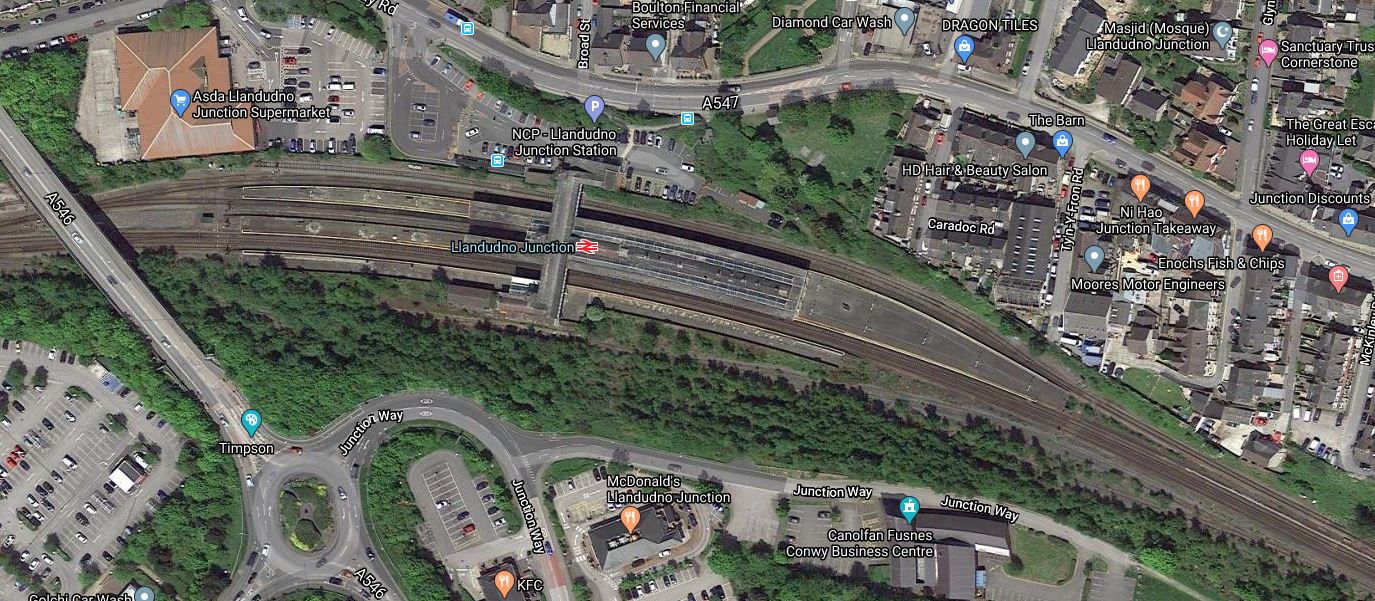
Note.
- It is a large station site.
- The Conwy Valley Line, which will be run by battery Class 230 trains in the future connects at this station.
- The Class 230 train will probably use some of Vivarail’s Fast Charging systems, which use third-rail technology, either at the ends of the branch or in Llandudno Junction station.
The simplest way to charge the London Euston and Holyhead train, would be to build a charging station at Llandudno Junction, which could be based on Vivarail’s Fast Charging technology or a short length of 25 KVAC overhead wire.
But this would add ten minutes to the timetable.
Could 25 KVAC overhead electrification be erected for a certain distance through the station, so that the train has ten minutes in contact with the wires?
Looking at the timetable of a train between London Euston and Holyhead, it arrives at Colwyn Bay station at 1152 and leaves Llandudno Junction station at 1200.
So would it be possible to electrify between the two stations and perhaps a bit further?
This Google Map shows Colwyn Bay Station,
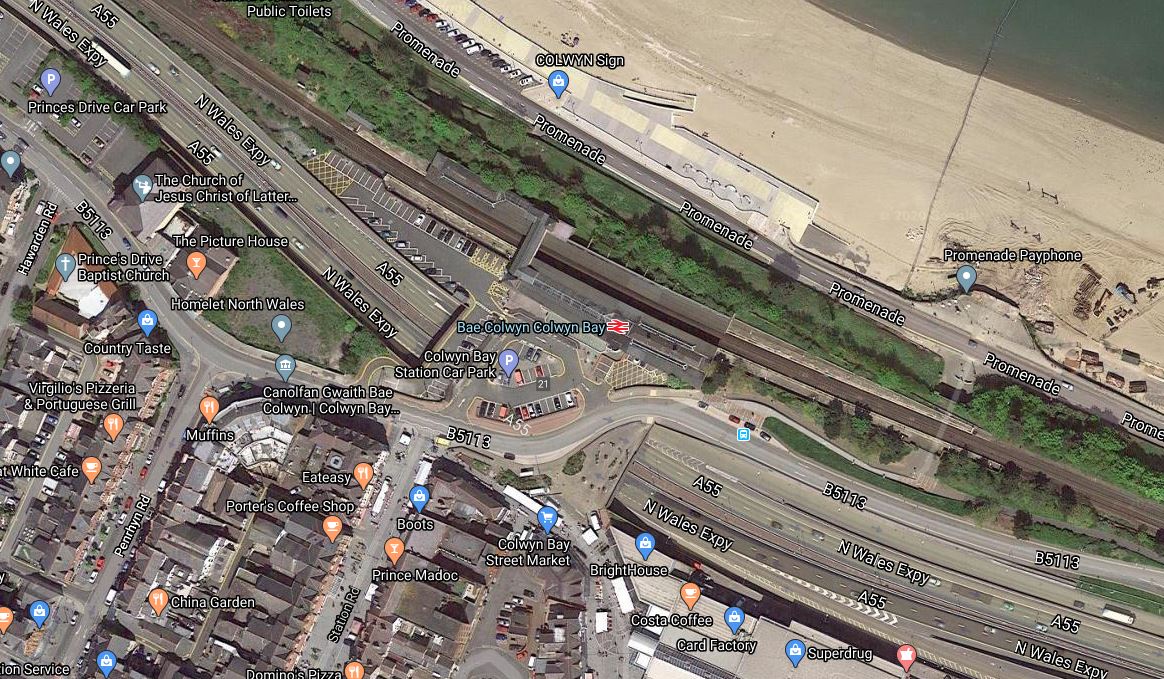
Note how the double-track railway is squeezed between the dual-carriageway of the A55 North Wales Expressway and the sea.
The two routes follow each other close to the sea, as far as Abegele & Pensarn station, where the Expressway moves further from the sea.
Further on, after passing through more caravans than I’ve ever seen, there is Rhyl station.
- The time between arriving at Rhyl station and leaving Llandudno Junction station is nineteen minutes.
- The distance between the two stations is fourteen miles.
- Rhyl and Crewe is fifty-one miles.
- Llandudno Junction and Holyhead is forty-one miles.
It would appear that if the North Wales Coast Line between Rhyl and Llandudno Junction is electrified, that Hitachi’s proposed battery trains can reach Holyhead.
The trains could even changeover between electrification and battery power in Rhyl and Llandudno Junction stations.
I am sure that electrifying this section would not be the most difficult in the world, although the severe weather sometimes encountered, may need some very resilient or innovative engineering.
It may be heretical to say so, but would it be better if this section were to be electrified using proven third-rail technology.
West of Llandudno Junction station, the electrification would be very difficult, as this Google Map of the crossing of the River Conwy shows.
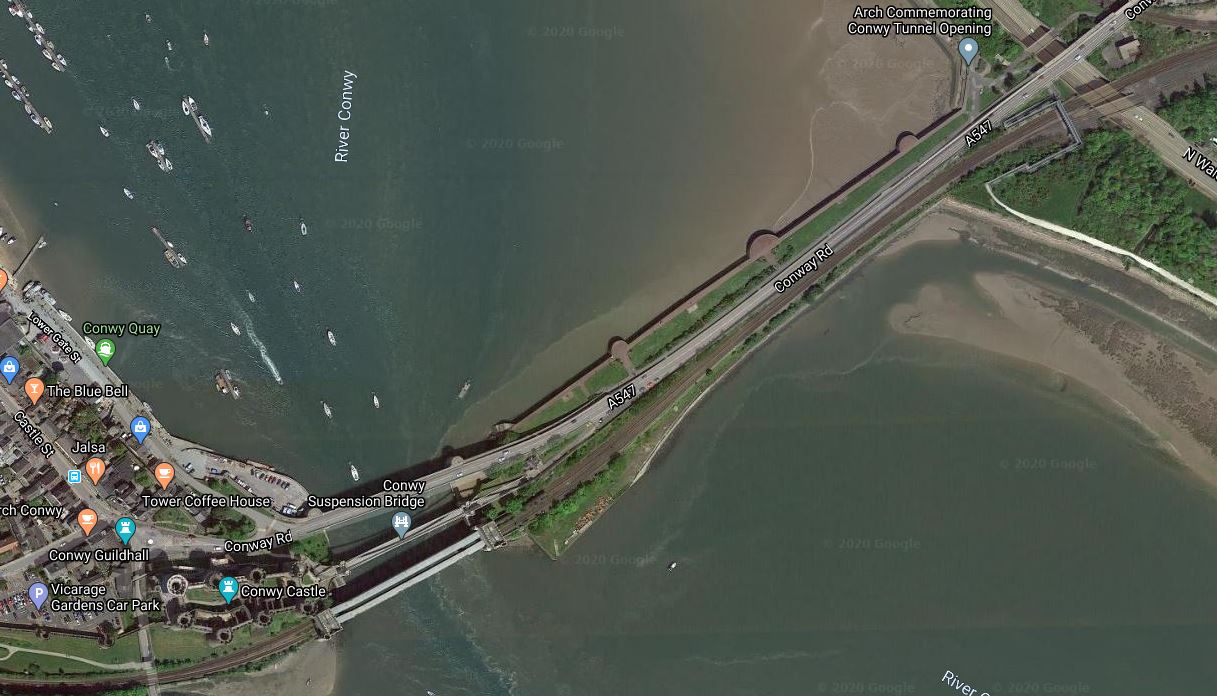
I don’t think anybody would want to see electrification around the famous castle.
Electrification Across Anglesey
Llanfairpwll station marks the divide between the single-track section of the North Wales Coast Line over the Britannia Bridge and the double-track section across Anglesey.
From my virtual helicopter, the route looks as if, it could be fairly easy to electrify, but would it be necessary?
- Llandudno Junction and Holyhead is forty-one miles, which is well within battery range.
- There is surely space at Holyhead station to install some form of fast-charging system.
One problem is that trains seem to turn round in only a few minutes, which may not be enough to charge the trains.
So perhaps some of the twenty-one miles between Llanfairpwll and Holyhead should be electrified.
London Euston And Holyhead Journey Times
Currently, trains take three hours and forty-three minutes to go between London Euston and Holyhead, with these sectional timings.
- London Euston and Crewe – One hour and thirty-nine minutes.
- Crewe and Holyhead – Two hours and four minutes.
The big change would come, if the London Euston and Crewe leg, were to be run on High Speed Two, which will take just fifty-five m,inutes.
This should reduce the London Euston and Holyhead time to just under three hours.
Freight On The North Wales Coast Line
Will more freight be seen on the North Wales Coast Line in the future?
The new tri-mode freight locomotives like the Class 93 locomotive, will be able to take advantage of any electrification to charge their batteries, but they would probably be on diesel for much of the route.
Conclusion On The North Wales Coast Line
Short lengths of electrification, will enable Avanti West Coast’s AT-300 trains, after retrofitting with batteries, to run between Crewe and Holyhead, without using any diesel.
I would electrify.
- Crewe and Chester – 21 miles
- Rhyl and Llandudno Junction – 14 miles
- Llanfairpwll and Holyhead – 21 miles
But to run battery-electric trains between London Euston and Holyhead, only Rhyl and Llandudno Junction needs to be electrified.
All gaps in the electrification will be handled on battery power.
A Selection Of Possible Battery-Electric Services
In this section, I’ll look at routes, where battery-electric services would be very appropriate and could easily be run by Hitachi’s proposed battery-electric trains.
London Paddington And Swansea
Many were disappointed when Chris Grayling cancelled the electrification between Cardiff and Swansea.
I went along with what was done, as by the time of the cancellation, I’d already ridden in a battery train and believed in their potential.
The distance between Cardiff and Swansea is 46 miles without electrification.
Swansea has these services to the West.
- Carmarthen – 32 miles
- Fishguard – 73 miles
- Milford Haven 71 miles
- Pembroke Dock – 73 miles
It looks like, three services could be too long for perhaps a three car battery-electric version of a Hitachi Class 385 train, assuming it has a maximum range of 65 miles.
But these three services all reverse in Carmarthen station.
So perhaps, whilst the driver walks between the cabs, the train can connect automatically to a fast charging system and give the batteries perhaps a four minute top-up.
Vivarail’s Fast Charging system based on third-rail technology would be ideal, as it connects automatically and it can charge a train in only a few minutes.
I would also electrify the branch between Swansea and the South Wales Main Line.
This would form part of a fast-charging system for battery-trains at Swansea, where turnround times can be quite short.
I can see a network of battery-electric services developing around Swansea, that would boost tourism to the area.
Edinburgh And Tweedbank
The Borders Railway is electrified as far as Newcraighall station and the section between there and Tweedbank is thirty miles long.
I think that a four-car battery-electric Class 385 train could work this route.
It may or may not need a top up at Tweedbank.
The Fife Circle
The Fife Circle service from Edinburgh will always be difficult to electrify, as it goes over the Forth Rail Bridge.
- The Fife Circle is about sixty miles long.
- Plans exist for a short branch to Leven.
- The line between Edinburgh and the Forth Rail Bridge is partly electrified.
I believe that battery-electric Class 385 train could work this route.
London Kings Cross and Grimsby/Cleethorpes via Lincoln
The Cleethorpes/Grimsby area is becoming something of a renewable energy powerhouse and I feel that battery trains to the area, might be a significant and ultimately profitable statement.
LNER recently opened a six trains per day service to Lincoln.
Distances from Newark are as follows.
- Lincoln – 17 miles
- Grimsby – 61 miles
- Cleethorpes – 64 miles
A round trip to Lincoln can probably be achieved on battery alone with a degree of ease, but Cleethorpes and Grimsby would need a recharge at the coast.
Note that to get to the Cleethorpes/Grimsby area, travellers usually need to change at Doncaster.
But LNER are ambitious and I wouldn’t be surprised to see them dip a toe in the Cleethorpes/Grimsby market.
The LNER service would also be complimented by a TransPennine Express service from Manchester Airport via Sheffield and Doncaster, which could in the future be another service run by a Hitachi battery train.
There is also a local service to Barton-on-Humber, which could be up for improvement.
London Waterloo And Exeter
This service needs to go electric, if South Western Railway is going to fully decarbonise.
But third-rail electrification is only installed between Waterloo and Basingstoke.
Could battery-electric trains be used on this nearly two hundred mile route to avoid the need for electrification.
A possible strategy could be.
- Use existing electrification, as far as Basingstoke – 48 miles
- Use battery power to Salisbury – 83 miles
- Trains can take several minutes at Salisbury as they often split and join and change train crew, so the train could be fast-charged.
- Use battery power to the Tisbury/Gillingham/Yeovil/Crewkerne area, where trains would be charged – 130 miles
- Use battery power to Exeter- 172 miles
Note.
- The miles are the distance from London.
- The charging at Salisbury could be based on Vivarail’s Fast-Charging technology.
- The charging around Yrovil could be based on perhaps twenty miles of third-rail electrification, that would only be switched on, when a train is present.
I estimate that there could be time savings of up to fifteen minutes on the route.
To Be Continued…
Innolith Claims It’s On Path To 1,000 Wh/kg Battery Energy Density
The title of this post is the same as that of this article on InsideEVS.
This is the introductory paragraph.
Innolith, the Switzerland-based company with labs in Germany, announced that it is developing the world’s first rechargeable battery with an energy density of 1,000 Wh/kg (or simply 1 kWh per kg of weight). Such high energy would easily enable the production of electric cars with a range of 1,000 km (620 miles).
If they achieve their aim, a one MWh battery will weigh a tonne.
I am sceptical but read this second article on CleanTechnica, which is entitled Swiss Startup Innolith Claims 1000 Wh/kg Battery.
Innolith has a working battery at Haggerstown, Virginia, but say full production is probably 3 to 5 years away.
The CleanTechnica article, also says this about Tesla’s batteries.
Let’s put that into perspective. It is widely believed that Tesla’s latest 2170 lithium ion battery cells produced at its factory in Nevada can store about 250 Wh/kg. The company plans to increase that to 330 Wh/kg as it pursues its goal of being a world leader in battery technology. 1000 Wh/kg batteries would theoretically allow an electric car to travel 600 miles or more on a single charge.
So it would appear that Tesla already has an power density of 250 Wh/Kg.
Conclusion
I am led to believe these statements are true.
- Tesla already has an energy density of 250 Wh/Kg.
- Tesla will increase this figure.
- By 2025, the energy density of lithium-ion batteries will be much closer to 1 KWh/Kg.
- Innolith might achieve this figure. But they are only one of several companies aiming to meet this magic figure.
These figures will revolutionise the use of lithium-ion batteries.
A Fixed Link To Northern Ireland
The title of this post is the same as an article in Issue 898 of Rail Magazine, that has been written by Jim Steer, who is a well-known rail engineer.
It is very much a must-read and he is in favour of the link.
- It’s all about reducing carbon footprint of travel between the UK and Ireland.
- The bridge would be rail-only.
- Goods currently sent by truck, would go by rail.
- There would be a 125 mph rail link across Galloway between the bridge and HS2/West Coast Main Line.
- A London and Belfast time of three-and-a-half hours would be possible.
- A frequent Edinburgh and Belfast via Glasgow service would be provided.
- He believes the Northern Ireland rail network should be converted to standard gauge and expanded, so that large areas of Northern Ireland will benefit.
Increasingly, serious people are coming behind this project.
Cambridge To Ipswich In A Class 755 Train
Because of the usual buses on the Great Eastern Main Line, to get to the football at Ipswich, I went via Cambridge and had a drink with a friend in the City.
The journey is timetabled to take seventy five minutes with seven or eight intermediate stops.
These were my observations.
- We arrived in Ipswich a couple of minutes late.
- At times the train was travelling at 75 mph.
- The operating speed is given in Wikipedia as 40-75 mph.
- Some stops were executed from brakes on to brakes off in around thirty seconds.
- I wasn’t sure, but the pantograph may go up and down at Stowmarket, depending if the train is going East or West.
- Cambridge to Stowmarket averaged 43 mph, whereas Stowmarket to Ipswich averaged 48 mph, which would seem to indicate use of the electrification.
I suspect that there isn’t much room to speed up the service, especially as the current 75 minutes gives a convenient turnround with a round trip of three hours.
Which means three trains are needed for the hourly service.
Surprise
What surprised me was the timing of the station stops.
As I said, some were around thirty seconds, with the longest at Stowmarket, where I assume the train picked up the electrification.
It certainly shows how modern trains can do station stops fast.
Sparking A Revolution
The title of this post is the same as that of an article in Issue 898 of Rail Magazine.
The sub-title is.
When it comes to powering a zero-enissions train with no overhead line infrastructure, battery power is clearly the answer, according to Hitachi.
These are the first three paragraphs.
Over the next decade around 1,000 diesel-powered vehicles will need to be replaced with vehicles that meet emissions standards.
Hitachi, which has been building bi-mode trains for the UK since 2012, and electric trains since 2006, says that retro-fitting old vehicles alone will not be good enough to improve capacity, reliability or passenger satisfaction.
Battery power is the future – not only as a business opportunity for the company, but more importantly for the opportunities it offers the rail industry.
Speaking is Andrew Barr of Hitachi Rail.
Some important points are made.
- Hitachi has identified various towns and cities, where battery trains would be useful including Bristol, Edinburgh, Glasgow, Hastings, Leeds and Manchester.
- Andrew Barr says he gets a lot of questions about battery power.
- Battery power can be used as parts of electrification schemes to bridge gaps, where rebuilding costs of bridges and other infrastructure would be too high.
- Battery trains are ideal for decarbonising branch lines.
- Batteries could be fitted to Class 385, 800, 802 and 810 trains.
Hitachi would like to run a battery train with passengers, within the next twelve months.
The article also gives the specification of a Hitachi battery train.
- Range – 55-65 miles
- Performance – 90-100 mph
- Recharge – 10 minutes when static
- Routes – Suburban near electrified lines
- Battery Life – 8-10 years
These figures are credited to Hitachi.
Hitachi are also thinking about tri-mode trains.
- Batteries could be installed on Class 800-802/810 trains.
- Battery-only power for stations and urban areas.
- 20% performance improvements or 30% fuel savings.
These is also credited to Hitachi.
Costs And Power
This is an insert in the article, which will apply to all applications with traction batteries.
This is said.
The costs of batteries are expected to halve in the next five years, before dropping further again by 2030.
Hitachi cites research by Bloomberg New Energy Finance (BNEF) which expects costs to fall from £135/kWh at the pack level today to £67/kWh in 2025 and £47/kWh in 2030.
United Kingdom Research and Innovation (UKRI) is also predicting that battery energy density will double in the next 15 years, from 700 Wh/l to 1,400 Wh/l in 2035, while power density (fast charging) is likely to increase four times in the same period from 3 kW/kg now to 12 kW/kg in 2035.
In Batteries On Class 777 Trains, I quoted a source that said that Class 777 trains are built to handle a five tonne battery.
I estimated the capacity as follows.
Energy densities of 60 Wh/Kg or 135 Wh/litre are claimed by Swiss battery manufacturer; Leclanche.
This means that a five tonne battery would hold 300 kWh.
Hitachi’s figures are much higher as it looks like a five tonne battery can hold 15 MWh.
Batteries will be going places on Hitachi trains.
Ready To Charge
The title of this post is the same as that of this article in Issue 898 of Rail Magazine.
This is the sub-title of the article.
Vivarail could be about to revolutionise rail traction with its latest innovation
The article details their plans to bring zero-carbon trains to the UK.
These are a few important more general points.
- The diesel gensets in the trains can be eco-fenced to avoid unning on diesel in built-up areas.
- The Transport for Wales trains could be the last Vivarail diesel trains.
- A 100 kWh battery pack is the same size as a diesel generator. I would assume they are almost interchangeable.
- Various routes are proposed.
- In future battery trains will be Vivarail’s focus.
- At the end of 2020, a battery demonstration train will be dispatched to the United States.
- Two-car trains will have a forty-mile range with three-cars managing sixty.
- Trains could be delivered in nine to twelve months.
The company also sees Brexit as an opportunity and New Zealand as a possible market.
Modifying Other Trains
The article also states that Vivarail are looking at off-lease electric multiple units for conversion to battery operation.
Vivarail do not say, which trains are involved.
Vivarail’s Unique Selling Point
This is the last two paragraphs of the article.
“Our unique selling point is our Fast Charge system. It’s a really compelling offer.” Alice Gillman of Vivarail says.
Vivarail has come a long way in the past five years and with this innobvative system it is poised to bring about a revolution in rail traction in the 2020s.
Conclusion
Could the train, that Vivarail refused to name be the Class 379 trains?
- There are thirty trainsets of four-cars.
- They are 100 mph trains.
- They are under ten years old.
- They meet all the Persons of Reduced Mobility regulations.
- They currently work Stansted Airport and Cambridge services for Greater Anglia.
- They are owned by Macquarie European Rail.
I rode in one yesterday and they are comfortable with everything passengers could want.

The train shown was used for the BEMU Trial conducted by Bombardier, Network Rail and Greater Anglia.
The only things missing, for these trains to run a large number of suitable routes under battery power are.
- A suitable fast charging system.
- Third rail equipment that would allow the train to run on lines with third-rail electrification.
- Third rail equipment would also connect to Vivarail’s Fast Charge system
As I have looked in detail at Vivarail’s engineering and talked to their engineers, I feel that with the right advice and assistance, they should be able to play a large part in the conversion of the Class 379 fleet to battery operation.
These trains would be ideal for the Uckfield Branch and the Marshlink Line.
If not the Class 379 trains, perhaps some Class 377 trains, that are already leased to Southern, could be converted.
I could see a nice little earner developing for Vivarail, where train operating companies and their respective leasing companies employ them to create battery sub-fleets to improve and extend their networks.
Rail Research At Birmingham University
In Issue 898 of Rail Magazine, there is an article entitled Full Steam Ahead, which discusses the the work at the Birmingham Centre for Railway Research an Education (BCRRE).
Amongst many subjects three are mentioned where I have a big interest.
Aerodynamics
The article says this.
Aerodynamics is also an important area for research, as any reduction in drag and air resistance due to structures will improve the energy efficiency of rail vehicles.
I very much agree with this approach.
I also feel that due to their low noise profiles as they pass by, that Bombardier have applied aerodynamic knowledge, perhaps from their aircraft engineers, to the design of the new Aventra.
Hydrogen Supplies For Hydrogen-Powered Trains
The article says this.
Funding has also been secured from Innovate UK to create a company that can provide the necessary infrastructure needed to support hydrogen trains, including fuelling stations and hydrogen generation facilities.
This sounds very similar to the systems that ITM Power ae deploying for Shell to fuel hydrogen buses, cars and other vehicles.
I hope that there is not too much duplication going on.
Working With Michigan State University And Stadler To Bring Hydrogen Trains To California
Co-operation is always good and especially in rail projects, where the number of trains involved is fairly small.
A Quote From Dr. Stuart Hillmansen of BCRRE
This quote is in the article.
Is is possible to completely decarbonise, by using electrolysis that is powered using renewable energy to create the fuel.
I completely agree with that!
Conclusion
I would hope that the BCRRE develops into a one step shop for the solution of rail related problems.
It does seem that by putting various areas of expertise together, they could be a go-to institution for those that want to built a hydrogen-powered rail service.
Why Are Liverpool Good At Transfers?
This question was asked on BBC Radio 5, about Liverpool Football Club.
As an alumni, I raise money for cancer research at Liverpool University.
I get the impression, the University has no problem getting the best researchers to come to the Second City of England!
Everybody in the World has heard of Liverpool!
Is There An Interaction Between Bisacodyl And Warfarin Or INR Self-Testing?
I am on long term Warfarin and since 2012, I have self-tested my INR using a Roche Coaguchek device.
I have had no problems and for perhaps the last five years, I have been on a regular daily dose of four mg.
I should say, I’m a trained Control Engineer and if you can keep any inputs, like drug dose, constant, you should get a stable system.
Recently, I have been suffering from severe constipation and my GP has prescribed bisacodyl. I have taken it perhaps five time before bed and it works well
On Friday, I was feeling constipated, so I took one of the bisacodyl tablets before bed.
On Saturday, I tested my INR using a strip from a newly-arrived box direct from Roche and found it was a rather extraordinary 5.2.
I had never seen a result higher than 3.2 before and put it down to one of the following reasons.
- The box of new strips was faulty. I have had dodgy ones before in the past, but not recently.
- There is an interaction between bisocodyl and warfarin. There are no reports on respected sites on the Internet.
- There is an interaction between bisocodyl and the Coaguchek testing process. There are no reports on respected sites on the Internet.
- I inadvertently took the wrong dose of warfarin.
I took a dose of two mg. yesterday and this morning I tested myself again twice.
- With a strip from the new box, found a reading of 5.3.
- With a strip from an old box, I found a reading of 5.
I shall test myself daily until I sort this out.
Thoughts On Southeastern’s Metro Services
It is regularly proposed that Southeastern‘s Metro services should be taken over by Transport for London (TfL)
What Are The Metro Services?
According to Wikipedia, these are Metro services. I have added a quick thought of my own.
London Cannon Street And London Cannon Street via Greenwich And Bexleyheath
- This service runs along the North Kent and Bexleyheath Lines at a frequency of two trains per hour (tph).
- Stations served are London Bridge, Deptford, Greenwich, Maze Hill, Westcombe Park, Charlton, Woolwich Dockyard, Woolwich Arsenal, Plumstead, Abbey Wood, Belvedere, Erith, Slade Green, Barnehurst, Bexleyheath, Welling, Falconwood, Eltham, Kidbrooke, Blackheath, Lewisham, St. Johns, New Cross and London Bridge.
- The round trip takes around 100 minutes.
This route would surely be ideal for operation by TfL, as it runs totally in Greater London.
London Cannon Street And London Cannon Street via Greenwich And Sidcup
- This service runs along the North Kent and Sidcup Lines at a frequency of two tph.
- Stations served are London Bridge, Deptford, Greenwich, Maze Hill, Westcombe Park, Charlton, Woolwich Dockyard, Woolwich Arsenal, Plumstead, Abbey Wood, Belvedere, Erith, Slade Green, Crayford, Bexley, Albany Park, Sidcup, New Eltham, Mottingham, Lee, Hither Green, Lewsisham, St. Johns, New Cross and London Bridge.
- The round trip takes around 100 minutes.
This route would surely be ideal for operation by TfL, as it runs totally in Greater London.
London Charing Cross And Dartford via Blackheath And Abbey Wood
- This service runs along the North Kent Line at a frequency of two tph.
- Stations served are Waterloo East, London Bridge, Woolwich Arsenal, Abbey Wood, Belvedere, Erith, Slade Green, Dartford, Gillingham
Because it is more of an Outer Suburban service, this service would probably stay with Southeastern.
London Charing Cross And Dartford via Bexleyheath
- This service runs on the Bexleyheath Line at a frequency of two tph.
- Stations served are Waterloo East, London Bridge,Lewisham, Blackheath, Kidbrooke, Eltham, Falconwood, Welling, Bexleyheath and Barnehurst
- London Charing Cross and Dartford takes around 60 minutes with a round trip of around 120 minutes.
This route would surely be ideal for operation by TfL, as it runs totally in Greater London except for Dartford.
London Victoria And Gravesend via Bexleyheath
- This service runs along the Bexleyheath Line at a frequency of two tph.
- Stations served are Denmark Hill, Peckham Rye, Nunhead, Lewisham, Blackheath, Kidbrooke, Eltham, Falconwood, Welling, Bexleyheath, Barnehurst, Dartford, Greenhithe
Because it is more of an Outer Suburban service, this service would probably stay with Southeastern.
London Charing Cross And Dartford via Sidcup
- This service runs along the Sidcup Line at a frequency of two tph
- Stations served are Waterloo East, London Bridge, Hither Green, Lee, Mottingham, New Eltham, Sidcup, Albany Park, Bexley and Crayford
- London Charing Cross and Dartford takes around 45 minutes with a round trip of around 100 minutes.
This route would surely be ideal for operation by TfL, as it runs totally in Greater London except for Dartford.
London Charing Cross And Gravesend via Sidcup
- This service runs along the Sidcup Line at a frequency of two tph
- Stations served are Waterloo East, London Bridge, New Eltham, Sidcup, Bexley, Crayford, Dartford, Stone Crossing, Greenhithe, Swanscombe and Northfleet
Because it is more of an Outer Suburban service, this service would probably stay with Southeastern.
London Cannon Street And Orpington via Grove Park
- This service runs along the South Eastern Main Line at a frequency of two tph.
- Stations served are London Bridge, New Cross, St Johns, Lewisham, Hither Green, Grove Park, Elmstead Woods, Chislehurst, Petts Wood
- London Cannon Street and Orpington takes around 40 minutes with a round trip of around 120 minutes.
This route would surely be ideal for operation by TfL, as it runs totally in Greater London.
London Charing Cross And Sevenoaks via Grove Park
- This service runs along the South Eastern Main Line at a frequency of two tph.
- Stations served are Waterloo East, London Bridge, Hither Green, Grove Park, Elmstead Woods, Chislehurst, Petts Wood, Orpington, Chelsfield, Knockholt, Dunton Green
Because it is more of an Outer Suburban service, this service would probably stay with Southeastern.
London Cannon Street And Hayes
- This service runs along the Hayes Line at a frequency of two tph.
- Stations served are London Bridge, New Cross, St Johns, Lewisham, Ladywell, Catford Bridge, Lower Sydenham, New Beckenham, Clock House, Elmers End, Eden Park, West Wickham
- The Hayes Line could be on the Bakerloo Line Extension.
- London Cannon Street and Hayes takes around 40 minutes with a round trip of just under 90 minutes.
This route would surely be ideal for operation by TfL, as it runs totally in Greater London.
London Charing Cross And Hayes
- This service runs along the Hayes Line at a frequency of two tph.
- Stations served are Waterloo East, London Bridge, Ladywell, Catford Bridge, Lower Sydenham, New Beckenham, Clock House, Elmers End, Eden Park, West Wickham
- The Hayes Line could be on the Bakerloo Line Extension.
- London Charing Cross and Hayes takes around 40 minutes with a round trip of just over 90 minutes.
This route would surely be ideal for operation by TfL, as it runs totally in Greater London.
London Victoria And Orpington via Beckenham Junction
- This service runs along the Chatham Main Line at a frequency of two tph.
- Stations served are Brixton, Herne Hill, West Dulwich, Sydenham Hill, Penge East, Kent House, Beckenham Junction, Shortlands, Bromley South, Bickley and Petts Wood.
- London Victoria and Orpington takes around 40 minutes with a round trip of around 95 minutes.
This route would surely be ideal for operation by TfL, as it runs totally in Greater London.
London Victoria And Bromley South via Beckenham Junction
- This service runs along the Chatham Main Line at a frequency of two tph
- Stations served are Brixton, Herne Hill, West Dulwich, Sydenham Hill, Penge East, Kent House, Beckenham Junction, Shortlands
- London Victoria and Bromley South takes around 30 minutes with a round trip of around 67 minutes.
This route would surely be ideal for operation by TfL, as it runs totally in Greater London.
Some General Observations
These are some general observations on all the routes.
- Lewisham will be on the Bakerloo Line Extension.
- There are interchanges with TfL services at Abbey Wood, Elmers End, Greenwich, Lewisham, London Bridge, New Cross, Peckham Rye, Waterloo East, Woolwich Arsenal
- All of the routes appear to be capable of handling 90 mph trains.
- It is possible that an interchange would be built at Penge between the Chathan Main Line and the East London Line of the London Overground.
A Trip Between London Cannon Street And London Cannon Street via Greenwich And Sidcup
I took this trip on a Class 465 formation.
- The service is more of a suburban trundler, than a brisk commuter train.
- I timed the train around 60-65 mph in places, but at times in was running at around 30 mph.
- Stops always weren’t always performed in the most urgent manner.
I got the impression, that the service could be run faster.
The Current Metro Trains
Currently, the Metro fleet appears to be formed these trains.
- Class 376 trains – Five cars – Built in 2004-5 – 75 mph maximum – 228 seats
- Class 465 trains – Four cars – Built in 1994 – 75 mph maximum – 334 seats
- Class 466 trains – Two cars – Built in 1994 – 75 mph maximum – 168 seats.
Note.
- All can run as ten car trains, either as five+five or four+four+two.
- All have First Class seating.
- None of the trains don’t gangways.
- A ten-car Class 376 formation has 456 seats and is just over 200 metres long.
- A ten-car Class 465/466 formation has 836 seats and is 205 metres long.
- I think there are enough trains to form 99 ten-car trains and 15 twelve-car trains.
But what is the affect on timetables in that all are 75 mph trains?
Possible Replacement Trains
The trains could be replaced by other two hundred metre long trains, as anything longer would probably need platform lengthening.
Various examples of Bombardier Aventras with different interiors must be in the frame, if they can sort their software problems, but other manufacturers could also produce trains.
Performance
Trains must be able to make full use of the track, which appears to be good for 90 mph.
- Greater Anglia’s Class 720 trains have a 100 mph operating speed.
- South Western Railway’s Class 701 trains have a 100 mph operating speed.
- TfL Rail’s Class 345 trains have a 90 mph operating speed.
- London Overground’s Class 710 trains have a 75 mph operating speed.
As the new trains will share tracks with Thameslink’s 100 mph Class 700 trains and Southeastern’s 100 mph Class 377 trains, I wouldn’t be surprised to see the new fleet of trains have a 100 mph operating speed and the appropriate acceleration, that this brings.
Length
The current trains are just over 200 metres long, as are the nine-car Class 345 trains.
The new trains will be the same length to avoid large amounts of expensive platform lengthening.
Interior Layout And Capacity
These styles could be used.
- Class 710-style with longitudinal seating, no toilets – Capacity estimate -482 seated and 1282 standing passengers.
- Class 345-style with longitudinal/transverse seating, no toilets – Capacity – 450 seated, 4 wheelchair, 1,500 people total[passengers.
- Class 701-style with transverse seating toilets – Capacity – 556 seats, 740 standing.
This will be a big increase in capacity.
Other Features
Trains will probably have these other features.
- Full digital signalling, either fitted or future-proofed.
- Ability to walk through the train.
- Step-free access between platform and train.
- Wi-fi, power sockets and 5G boosting.
First Class and toilets would be at the discretion of the operator, but TfL Rail and the London Overground see no point in fitting them.
Transfer To The London Overground
As I said earlier there is more than a chance, than some or all of the Metro routes will be transferred to the London Overground.
As Kent County Council doesn’t like the idea of London having control of their train services, I would suspect that a compromise would be reached, whereby any service wholly within Greater London or terminating at Dartford would be transferred to the London Overground.
This would mean that these services would be transferred.
- London Cannon Street And London Cannon Street via Greenwich And Bexleyheath
- London Cannon Street And London Cannon Street via Greenwich And Sidcup
- London Charing Cross And Dartford via Bexleyheath
- London Charing Cross And Dartford via Sidcup
- London Cannon Street And Orpington via Grove Park
- London Cannon Street And Hayes
- London Charing Cross And Hayes
- London Victoria And Orpington via Beckenham Junction
- London Victoria And Bromley South via Beckenham Junction
All services would be run by high capacity 200 metre long trains.
- The frequency would be two tph, with many doubling up to give four tph.
- There would be no First Class seating.
- Seating could be longitudinal, with no on-train toilets.
- Step-free access between platform and train.
As the train will have better performance, services could be faster with shorter journey times.
Will Passengers Accept The Spartan Trains?
Some passengers might not like the lack of First Class, the longitudinal seating and no toilets.
But consider.
- In the next few months, London Overground will be replacing conventional Class 315 trains between Liverpool Street and Chingford, Cheshunt and Enfield Town. Currently, these trains don’t have First Class or toilets and it will be interesting to see how the new Class 710 trains on these routes are received.
- When Crossrail extends to Ebbsfleet and/or Gravesend, they’ll get more of this type of train.
- Trains with longitudinal seating have a much increased capacity at all times and especially in the Peak, where it is needed.
- If you look at passenger numbers on the London Overground there is a very steady climb. So London Overground must be doing something right.
- Toilets are being removed on several Metro services from London to Heathrow, Hertford North, Reading, Shenfield and Stevenage.
- It may be better and more affordable to build more toilets in stations.
I think there is more than a chance, that if TfL take over these Southeastern Metro routes, that a less austere train could be used.
Perhaps for compatibility with Crossrail, Class 345 trains with their mixture of longitudinal and conventional seating would be used.
Penge Interchange
I wrote about TfL’s plans for Penge Interchange in this post called Penge Interchange.
This new station, should be one of the conditions of TfL taking over Southeastern’s Metro services.
The new station could be fully step-free and would seriously improve connections to and from South East London.
 The Anonymous Widower