Offshore Vessel Charging Tech Developer Plans Commercial Rollout In UK
The title of this post, is the same as that of this article on offshoreWIND.biz.
This is the sub-heading.
Stillstrom, part of A.P. Moller – Maersk and based in Denmark, has established a dedicated entity in Aberdeen, Scotland, with plans to roll out its offshore vessel charging solution commercially in the UK.
These three paragraphs add more details.
The solution is transitioning from development to commercial deployment, and, according to a press release issued by Stillstrom on 16 March, the company is targeting one of the world’s most active offshore wind markets for the commercial rollout.
Stillstrom has been developing offshore charging solutions for service operations vessels (SOVs) since 2019, with testing and collaboration carried out with shipowners and developers in Aberdeen. SOVs are amongst the most energy-intensive ships operating at offshore wind farms, according to Stillstrom.
The company says that this has now translated into tangible momentum, with significant discussions underway with major wind farms, as well as partnership and compatibility agreements signed with leading SOV owners and operators.
Scotch Whisky Is In A Unique Position
Scotland has so much zero-carbon energy now, let alone in a few years, that Scotch whisky would not be the most difficult of industries to make completely zero-carbon, which could marketing-wise completely trump any tariffs, that Trummkopf might impose.
- Already some small distilleries are using hydrogen to distill the whisky.
- Some glass bottles are already made using hydrogen instead of natural gas to make zero-carbon malt whiskies.
- I’m sure Cummins in Darlington, JCB in Rocester and Ricardo in Sussex will be pleased to help make farm machinery, mechanical handling and road transport zero carbon.
- Soft fruit like raspberries are already used to absorb the carbon dioxide from the distillation process in some areas of Scotland. I’m sure dealing with more quality raspberries would not be a problem.
- A large electrolyser is planned for Kintore in the North of Scotland. Think of the good publicity for say Centrica or SSE, if they built the world’s largest hydrogen plant to help make zero-carbon whisky.
These are some more thoughts.
Taste Is Everything
As only the method of providing heat and electricity will have been changed, I can’t see there will be any change to the taste.
It’s Already Happening
This page on the Annandale Distillery web site is entitled Annandale Distillery Pioneers Zero-Carbon Whisky Production with EXERGY 3 Project.
The Kintore Electrolyser
These figures summarise the Kintore Electrolyser.
- Total Electrolyser Capacity – 3 GW
- First Phase – 500 MW
- Hydrogen – 200 kTonnes per year
Explore the Kintore Hydrogen web site.
Marketing Advantage
Scotland, is probably, the only country, where the main ingredients for whisky come together in abundance ; barley, energy, tradition and water.
It also is all produced in a single country in many different brands and types, which could all be produced in a zero-carbon manner.
Conclusion
Let’s give Trump a beating and the planet a kiss.
Donald Trump To Open Second Aberdeenshire Golf Course In 2025
The title of this post, is the same as that of this article on the BBC.
These opening two paragraphs introduce the course.
The 18-hole links MacLeod Course – named after the former US president’s Lewis-born mother, Mary – will welcome players at the Trump International resort in Menie from the Summer of 2025.
The resort claimed the course would feature the “largest sand dunes in Scotland” and form “the greatest 36 holes in golf” alongside the original course, completed in 2012.
It sounds to me that the environmental aspects could be rather detrimental. But then Trump has form for a poor record in this area, as I wrote in Trump Forgot The Ace Of Clubs!
SeaTwirl And Verlume Join Forces To Drive Decarbonisation Of Offshore Assets
The title of this post, is the same as that of this article on offshoreWIND.biz.
This is the sub-heading.
Swedish energy-tech company SeaTwirl and UK-based energy management and energy storage firm Verlume have signed a memorandum of understanding (MoU) to collaborate on the electrification of offshore assets and decarbonisation of the oil and gas industry.
This is the first two paragraphs.
The MoU will see the two companies identify and pursue potential opportunities for decarbonisation of offshore oil and gas and other associated offshore electrification opportunities using renewable energy, seabed-based energy storage, and intelligent energy management.
SeaTwirl and Verlume plan to develop systems for commercial sale, using combined technologies.
Note.
- This YouTube video introduces SeaTwirl.
- This YouTube video introduces Verlume.
This could be an MoU made in engineering heaven.
Verlume And Wave Power
The last two paragraphs of the article describe another project involving Verlume.
Aberdeen’s intelligent energy management specialists Verlume has developed a GBP 2 million (approximately USD 2.5 million) project linking the Blue X wave energy converter constructed by Mocean Energy with a Halo underwater battery storage system.
The industry-supported project, situated five kilometres east of Orkney Mainland, demonstrates the integration of green technologies to deliver consistent and sustainable low-carbon power and communication to subsea equipment.
Could Verlume, be the missing link that wave power needs?
Are LNER Going To Take On The Airlines?
Nine years ago, I wrote Edinburgh – Plane Or Train?, after a trip to Scotland, where I took easyJet up and came back in First Class by train.
- Both trips were about five hours door-to-door.
- The flight was about six quid more,
- But I got free food and drink on the train.
- Security on the plane was a pain.
- I had to take my passport for identification at Stansted.
I haven’t flown internally in Great Britain since, although, I have flown to Belfast.
For shorter flights the market is going towards rail, as these posts seem to suggest.
- 2.7M Tonnes Of Co2 Could Be Saved Per Year If UK Domestic Flights Went Electric
- Air Travellers To Be Hit By Carbon Charge On All Tickets
- Climate Change ‘May Curb Growth In UK Flying’
- France Bans Short-Haul Flights To Cut Carbon Emissions
- KLM Replaces Plane With High Speed Train
- Lumo Carbon Data Shows Its Trains Are 22 Times Greener Than Flying
- Next Time I’ll Go By Train
- Ryanair One Of Europe’s Top Polluters, EU Data Suggests
- Stop Taking Internal Flights And Go Green, Says Lib Dem Contender Davey
The climate seems to be turning against flying short-haul.
This is a paragraph, in this press release from LNER, which is entitled First Tri-Mode Long Distance Trains For The East Coast Main Line.
This new fleet of trains will keep LNER on track to reduce its emissions by 67 per cent by 2035 and be net zero by 2045. LNER has already reduced carbon emissions by 50 per cent compared with 2018/19. Per mile, LNER trains produce 15 times less carbon emissions than a domestic flight.
Are LNER building a number of climate-based sticks, with which to beat the airlines on the routes, where they compete?
These are my thoughts on the various routes, where LNER compete with airlines.
Newcastle
Newcastle is an interesting one.
- Newcastle station is in the city centre and is on the Tyne and Wear Metro.
- London King’s Cross is one of London’s major Underground hubs.
- There are lots of buses and local trains within walking distance of both stations.
- There are three trains every two hours and an additional eight trains per day (tpd) between the two London King’s Cross and Newcastle stations.
- Lumo also run five tpd on the route.
- There are generally no security delays at rail stations.
- London King’s Cross is laid out to maximise passenger flows. If it gets busy, everybody just walks out into King’s Cross Square.
- I’ve never had a problem at Newcastle station with overcrowding.
Perhaps, if you live near one of the airports, flying is more convenient.
LNER’s weapons against the airlines between London King’s Cross and Newcastle will be convenience and journey times.
Convenience is all about the location of the stations, their excellent local transport networks and good walking routes around the station.
Journey times will only get better, as the magic of digital in-cab signalling, allows the Azumas, the new CAF tri-mode long distance trains and the few remaining InterCity 225s to show what they were designed to do.
Dalton-on-Tees, where the first phase of the digitally signalling will end, is 39.8 miles South of Newcastle, so once the Newcastle train is passes Dalton-on-Tees on the East Coast Main Line, it will be a digital-signalled electrified railway all the way to Woolmer Green.
- Dalton-on-Tees is 39.8 miles South of Newcastle
- Woolmer Green is 244.8 miles South of Newcastle.
- Dalton-on-Tees and Woolmer Green is 205 miles.
- Newcastle and Dalton-on-Tees takes 37 minutes.
- Woolmer Green and King’s Cross takes 18 minutes
- Trains take typically an average three hours and nine minutes between London and Newcastle.
- A typical train time by LNER between Dalton-on-Tees and Woolmer Green is two hours and 14 minutes.
- This is an average speed of 91.8 mph between Dalton-on-Tees and Woolmer Green.
- Between London King’s Cross and Newcastle is fully-electrified.
I can build a table of timings and savings at various average speeds.
- 120 mph – 103 minutes – two hours and 38 minutes – 31 minutes
- 125 mph – 98 minutes – two hours and 33 minutes – 36 minutes
- 130 mph – 95 minutes – two hours and 30 minutes – 39 minutes
- 135 mph – 91 minutes – two hours and 26 minutes – 43 minutes
- 140 mph – 88 minutes – two hours and 23 minutes – 46 minutes
Note.
- The first field is the average speed between Dalton-on-Tees and Woolmer Green.
- The second field is the time between Dalton-on-Tees and Woolmer Green.
- The third field is the time between London and Newcastle.
- The fourth field is the saving over current timings.
- The London and Newcastle time is calculated by adding the times for the three sections together.
I have regularly timed trains at a very constant 125 mph, so with digital signalling, I suspect an average of 130 mph is possible.
This would mean, times of a few minutes under two hours and thirty minutes could be possible between London and Newcastle.
Edinburgh
Edinburgh builds on the improvements South of Newcastle.
Edinburgh station Waverley is a well-connected station.
- There are lots of buses, local trains and the Edinburgh Tram within walking distance of Edinburgh Waverley station.
- There are three trains every two hours and an additional seven tpd between the London King’s Cross and Edinburgh Waverley stations.
- Lumo also run five tpd on the route.
- Trains take typically an average four hours and thirty minutes between London and Edinburgh Waverley.
- Any savings because of the digital in-cab signalling between London and Newcastle can be applied to London and Edinburgh Waverley services.
As my calculations showed that averaging 130 mph between Dalton-on-Tees and Woolmer Green could save 39 minutes on journey times, I am fairly sure than a sub-four hour journey time will be possible between London and Edinburgh Waverley.
It should also be noted that that the power supply has been improved between Newcastle and Edinburgh Waverley.
- The distance between Newcastle and Edinburgh Waverley is 124.2 miles
- Newcastle and Edinburgh Waverley takes around one hour and 30 minutes.
- This is an average speed of 82.8 mph between Newcastle and Edinburgh Waverley.
- Between London King’s Cross and Edinburgh Waverley is fully-electrified.
As the record time for between London King’s Cross and Edinburgh Waverley was set by an InterCity225 train in 1993 at three hours and twenty-nine minutes, I suspect that with more digital signalling and some track improvements, that there are more journey time improvements to be squeezed out.
I certainly believe that a time of three hours and fifty minutes between London and Edinburgh Waverley will be regularly achieved. This is a journey time saving of around forty minutes.
Dundee
Dundee has an airport and a station on the East Coast Main Line.
Trains between London King’s Cross and Dundee take around five hours and 45 minutes.
LNER run three trains per day to and from London King’s Cross and one tpd to and from Leeds.
CrossCountry also run services.
Loganair has two flights per day to Heathrow.
Aberdeen
Aberdeen builds on the improvements South of Edinburgh.
The four direct tpd between London and Aberdeen take around seven hours and ten minutes.
This should come down to around six hours and thirty minutes with the journey time savings between London King’s Cross and Edinburgh Waverley.
Will this tempt travellers from the airlines?
Battery-Electric Trains To Dundee And Aberdeen
One thing that will help, is that Edinburgh and Aberdeen is to be partially electrified.
InPiling Work To Get Underway To Electrify Line To Fife, I included this Network Rail map of the electrification.
This map has been downloaded from the Network Rail web site.
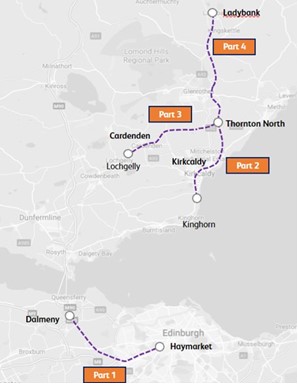
The electrification is split into four phases.
- Haymarket and Dalmeny – 25 km
- Kirkcaldy and Thornton North – 25 km.
- Lochgelly and Thornton North – 20 km.
- Thornton North and Ladybank – 34 km.
Note.
- The last three phases of electrification connect to Thornton North.
- The new rail link to Leven will also be electrified. and connected to Thornton North.
- The Forth Bridge is not to be electrified.
As Ladybank station is just 91.4 miles from Aberdeen, I suspect LNER will use Hitachi Intercity Battery Hybrid Trains to serve Aberdeen.
If these trains haven’t got the range, then I suspect LNER’s new CAF Tri-Mode Trains could handle the route.
Inverness
Inverness has a problem.
Zero-carbon trains will be unlikely to get to the city without full electrification of the Highland Main Line.
- Dunblane is the nearest electrified station to Inverness, but it is 146.2 miles away over a route with lots of steep climbs.
- I doubt that a battery-electric train could handle that route.
One solution would be for LNER to run the new CAF Tri-Mode Trains to Inverness using HVO or biodiesel.
Glasgow
Glasgow is the only other Scottish city with an airport and good rail connections to the South.
I am sure that Avanti West Coast will target airline passengers, if LNER prove it is a successful policy.
Other Factors
These are other factors, that will come into a traveller’s choice.
First Class
Some travellers like a bit more comfort and service.
Ability To Work
Some travellers like to work on a train.
You Don’t Get Tables On a Plane
I like to open a paper or magazine flat, which is difficult on a plane.
Views Tend To Be Better On a Train
Providing you get a window!
Parking Tends To Be Better At An Airport
But it may be more expensive!
Security Is Less Hassle On A Train
At the moment!
You Don’t Need To Prove Your Identity On A Train
Not in the UK! Yet!
Conclusion
It looks like LNER can offer the airlines to four of our major Northern cities serious zero-carbon competition.
SSE Becomes First Utility To Trial First Hydrogen Fuel Cell EV Van
hydrThe title of this post, is the same as that of this article on Hydrogen Central.
This is the first two paragraphs.
The low-carbon energy infrastructure company will be the first utility to trial the hydrogen-powered vehicle – and the first to put it to the test in real-life fleet operations by deploying the vehicle with SSE engineers.
The project will enable First Hydrogen’s team to gather data on fuel consumption, usage, and efficiency. The trials are being used to inform development of First Hydrogen’s Generation II series, currently in development, and will help enhance Total Cost of Ownership (TCO) data.
The deployment will take place in Aberdeen, as the city has some of the UK’s best hydrogen infrastructure.
The Mayor of London please note how being a hydrogen denier causes London to have more pollution.
Did I See The UK’s Hydrogen-Powered Future In Hull Today?
I went from London to Hull today on Hull Trains for £50.80 return (with my Senior Railcard) to see SSE’s presentation for their Aldbrough Pathfinder Hydrogen project, which will feature a 35 MW green hydrogen electrolyser and 320 GWh of hydrogen storage in the thick layers of salt under East Yorkshire.
- Green electricity would come mainly from the part-SSE owned 8 GW Dogger Bank wind farm complex.
- According to their web site, Meld Energy are planning a 100 MW electrolyser, which would produce 13,400 tonnes of hydrogen per year.
Every large helps!
- It should be noted that the thick layers of salt stretch all the way to Germany, and as drilling and storage technology improves, the amount of hydrogen storage available will increase.
- I was also impressed by the ambition, competence and enthusiasm, of the SSE engineers that I met.
- As has been pointed out, HiiROC, who have backing from Centrica, Hyundai, Kia and others, are also in Hull!
I believe, that I saw our hydrogen-powered future in Hull today!
We need more hydrogen mega-projects like these! Perhaps in Aberdeen, Clydeside, Freeport East, Isle of Grain, Merseyside, Milford Haven and Teesside?
Aberdeen City Council And BP Sign Joint Venture Agreement To Develop City Hydrogen Hub
The title of this post, is the same as this article on Renewable Energy Magazine.
The title is a good description of the project and these are a few details.
- Production will start in 2024.
- The hub will produce 800 kilograms of green hydrogen per day.
- That will be enough for 25 buses and 25 other vehicles.
- Further investment would provide hydrogen for rail, freight and marine uses.
I don’t think this is a small project, as they are talking about potentially exporting the hydrogen.
These are a few thoughts.
Electricity Supply
In Can The UK Have A Capacity To Create Five GW Of Green Hydrogen?, I said the following.
Ryze Hydrogen are building the Herne Bay electrolyser.
- It will consume 23 MW of solar and wind power.
- It will produce ten tonnes of hydrogen per day.
The electrolyser will consume 552 MWh to produce ten tonnes of hydrogen, so creating one tonne of hydrogen needs 55.2 MWh of electricity.
Scaling those figures mean that to create 800 kilograms of hydrogen will need 44.16 MWh of electricity or if it is a 24/7 operation, the electrolyser will need a feed of 1.84 MW.
Currently, there are two offshore wind farms close to Aberdeen.
- European Offshore Wind Development Centre – 93 MW
- Hywind Scotland – 30 MW
That would provide enough electricity to provide a starter of under 2 MW.
I can see a lot more wind farms off the coasts around Aberdeen, as on all my visits to the city it has been windy and there is a lot of empty sea.
I don’t think providing enough renewable electricity for a very large electrolyser in Aberdeen will be a problem.
Hydrogen Exports
I would expect, that the hydrogen would go to Germany, as the Germans are backing BP in their wind farm ambitions and they are building a large hydrogen import terminal at Wilhelmshaven on the North-West German coast. The distance for a ship is under 500 miles.
BP’s Future Hydrogen Plans
This is a quote from Louise Kingham CBE, BP’s UK head of country and senior vice president for Europe.
Partnering with cities and corporates as they shape their paths to net zero is a core part of BP’s strategy. BP expects to partner with 10-15 cities globally by 2030 to provide innovative, integrated, and decarbonized energy solutions at scale to help them achieve their goals of net zero emissions. BP also aims to capture 10% of the low carbon hydrogen market in key geographies by 2030.
BP is investing across all the energy transition growth areas in the UK. In fact, we have committed to spend £2 in the UK for every £1 generated here out to the middle of this decade.
“Today’s announcement is evidence of that commitment in action and is supported by other ambitious plans to produce clean energy from UK offshore wind, develop carbon capture in Teesside and grow the country’s electric vehicle charging network.
BP would be in part using their expertise in providing oil and gas to the production and delivery of hydrogen to end users, be they large or small.
I can also see BP repurposing a few gas and oil production platforms into offshore hydrogen production hubs, as this could be a better financial route, rather than demolishing the platforms.
Conclusion
Birmingham is building a hydrogen hub at Tyseley Energy Park to fuel hydrogen buses and other vehicles.
Where is the plan for London’s hydrogen hubs?
Aberdeen Unveils UK’s First Green Hydrogen Waste Truck
The title of this post, is the same as that of this article on renews.biz.
These are the first three paragraphs.
The UK’s first green hydrogen-fuelled waste collection vehicle has been unveiled in Aberdeen.
While typical waste trucks are powered by diesel and petrol, the new vehicle will use green hydrogen from existing refuelling infrastructure in Aberdeen.
The truck will start collecting waste and recycling around the city from early March and will be the first hydrogen-powered waste truck to become operational in the UK.
I feel, that this is one of the obvious applications for hydrogen trucks.
- They return to the same depot at the end of the day and if the hydrogen refuelling station is nearby or at the depot, refuelling would be no more hassle than with diesel.
- The trucks are probably too large for battery power.
- They tend to work a lot in areas, where there are a lot of people about, like residential streets and shopping centres.
- Workers will be exposed to less pollution, as they bring bins to the trucks.
Aberdeen Council have provided this video.
I can see lots of Councils at least thinking of following Aberdeen’s example, when they renew their refuse trucks.
Incidentally, I may be only 74, but I can still remember the horse-drawn waste carts that Wood Green Council used to use in the 1950s. They were used around Wood Green town centre, where trailers were parked to receive rubbish from shops and businesses. Horses were used to move them about and to the depot. In the end they horses were replaced by Scammel Mechanical Horses.
Aberdeen’s Hydrogen Buses Taken Off The Road Due To Technical Issue
The title of this post, is the same as that of this article on the BBC.
This is the introductory paragraph.
Aberdeen’s fleet of hydrogen buses has been taken off the road due to a “technical issue”.
The technical issue appears not to be hydrogen-related, but with a mounting bracket.
Strange coming after CAF had bracket trouble with their trams and Hitachi had a similar problem with their trains.
Wrightbus, CAF and Hitachi haven’t been using the save dodgy Chinese supplier called El Cheapo Brackets have they?
 The Anonymous Widower