Electrification Between Exeter And Plymouth
Eventually, there will be electric passenger trains between Exeter and Plymouth! Great Western Railway’s objective must be for passengers to board their Hitachi AT-300 train at Paddington and be powered all the way to Penzance by electricity, without using a drop of diesel. The added ingredient will be battery power.
In Sparking A Revolution, I gave Hitachi’s specification for a proposed battery-electric train.
- Range – 55-65 miles
- Performance – 90-100 mph
- Recharge – 10 minutes when static
- Routes – Suburban near electrified lines
- Battery Life – 8-10 years
As the distance between Exeter and Plymouth is 52 miles, the Hitachi specification could have been designed around this route, which as these pictures show is in places, very close to the sea, where the line runs along the South Devon Railway Sea Wall.

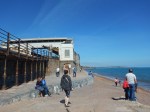

Global warming will probably mean, we’ll see a repeat of the major sea wall breach that happened at Dawlish in 2014.
I would suspect that the Network Rail’s solution to the problems of efficient low or zero-carbon traction between Exeter and Plymouth includes the following.
- A very robust railway.
- Extreme protection from almost everything the sea and the weather can produce.
- Could we see some concrete tunnels, like the Swiss and others use in mountainous areas to protect from snow? Rail Magazine says yes! At Horse Cove.
- No electrification as water and electricity are not a good mix, except in an electrolyser to produce hydrogen, oxygen and/or chlorine.
- Battery or hydrogen-powered passenger trains or freight locomotives.
- Digital in-cab signalling. Traditional signalling is even more expensive equipment to be swept away.
From media reports, this looks like the way Network Rail are thinking.
Charging The Trains
Battery-electric trains will need to be charged. There are three convenient stations; Exeter St. Davids, Newton Abbott and Plymouth.
- All have multiple platforms.
- The stations could be given the ability to charge battery-electric trains, either using 25 KVAC overhead electrification or a specialist charging system, like the one designed by Vivarail, that I wrote about in Vivarail Unveils Fast Charging System For Class 230 Battery Trains.
- Newton Abbot station would also charge any trains running on the eight mile branch to Paignton station.
As far as passenger services are concerned, it could be a very efficient zero-carbon railway.
Electrification At Exeter St. Davids
Exeter St. Davids is an important hub for services between Devon and Cornwall and the rest of Great Britain.
- GWR services run to London Paddington via Newbury.
- GWR services run to London Paddington via Bristol
- GWR services run to Plymouth and Penzance via Newton Abbott.
- GWR local services run to Barnstaple, Exmouth and Paignton.
- CrossCountry services run to the Midlands, North and Scotland via Bristol.
- South Western Railway services run to London Waterloo via Basingstoke.
In future, there could be services running to Plymouth on the reopened route via Okehampton and Tavistock.
All these services could be run by battery-electric trains for sixty miles from Exeter, if they could be fully-charged at the station.
Note.
- Trains to London Paddington and Bristol could easily reach Taunton, which is thirty miles away.
- Trains to London Waterloo could reach Yeovil Junction, which is fifty miles away.
- Trains to the West could reach Plymouth, which is fifty-two miles away.
- Barnstaple is forty miles away, so would probably need some help to get back.
- Exmouth is eleven miles away, so a return journey is probably possible.
- Paignton is twenty-eight miles away, so a return journey is probably possible, with a top-up at Newton Abbot if required.
Exeter is going to be very busy charging trains.
It should be noted, that trains to and from London Paddington and Bristol, all share the same route as far as Cogload Junction, where the London Paddington and Bristol routes divide.
- Cogload Junction is thirty-six miles from Exeter.
- Cogload Junction and Newbury, where the electrification to London Paddington starts are eighty-five miles apart.
- Cogload Junction and Bristol Temple Meads, where the electrification to London Paddington starts are forty miles apart.
I wonder if it would be sensible to electrify between Exeter St. David station and Cogload Junction.
- From my virtual helicopter, the line doesn’t look to be in the most difficult category to electrify.
- There is only one tunnel and a few old bridges and a couple of level crossings.
- Some of the route is alongside the M5.
- Trains would arrive in Exeter with full batteries and could do a quick stop before continuing their journeys.
- Trains would arrive at Cogload Junction and could reach Bristol Temple Meads without stopping for a recharge.
- Bristol services that are extended to Taunton and Exeter could be run by battery-electric trains.
I also feel, that with upwards of twenty-five miles of extra electrification between Cogload Junction and Newbury, that battery-electric trains could run between London Paddington and Exeter via the Reading-Taunton Line.
Electrification At Plymouth
As with Exeter St. Davis, Plymouth is an important hub for services between Devon and Cornwall and the rest of Great Britain.
- Most services run to Penzance in the West and Exeter in the East.
- There is a local service to Gunnislake, which is fifteen miles away.
Lots of charging capacity, will enable battery-electric trains to reach their destinations, except for Penzance
Trains Between Plymouth And Penzance
Hitachi must have despaired, when it was pointed out that the distance between Penzance and Plymouth is eighty miles! This is fifteen miles longer than the range of their proposed battery-electric train.
The simplest solution would be to build a battery-electric train with an eighty mile range, that could travel between Plymouth and Penzance on a single charge. With charging at Penzance it could return to Plymouth.
The longer range, would also mean that, with perhaps ten extra miles of electrification, that battery-electric trains could bridge the electrification gap between Cogload Junction and Newbury.
Other solutions range from selective electrification, all the way up to full electrification of the Cornish Main Line.
It should be noted that there are the following branches on the Cornish Main Line.
- The Looe Valley Line at Liskeard station – 8.75 miles – Uses a separate platform at Lskeard
- The Fowey Branch At Lostwithiel station – 4.75 miles – Possible reopening
- The Atlantic Coast Line at Par station – 20.75 miles – Uses a separate platform at Par
- The Maritime Line at Truro station – 11.75 miles – Uses a separate platform at Truro
- The St. Ives Bay Line at St. Erth station – 4.25 miles- Uses a separate platform at St. Erth
If these branches are going to be served by battery-electric trains, arrangements will have to be made for their charging. This could either be on the main line, at the remote terminal or at both.
Would it be easier to run the branches using battery-electric trains, if the Cornish Main Line was fully electrified?
The Cornish Main Line also carries a number of heavy freight trains, most of which seem to be going to or from Burngullow, so I suspect they are in connection with the movement of china clay.
Currently, these heavy freight trains appear to be hauled by diesel locomotives, but if the Cornish Main Line were to be fully electrified, could they be run by electric locomotives?
Electrification Of A Reopened Northern Route
In the May 2020 Edition of Modern Railways, there is an article, which is entitled Beeching Reversal Fund Bids.
This is the introductory paragraph.
Bids have been submitted to Government for a share of the £500 million ‘Restoring your railway’ fund launched by the Department for Transport in January. The fund is to be used to support proposals to reinstate axed local services, to accelerate schemes already being considered for restoration and also to promote new and restored stations.
One of the bids is for the Tavistock-Okrhampton Reopening scheme (TORs), which would reopen the former Exeter to Plymouth railway of the LSWR, as a new route between Exeter and Taunton in the East and Plymouth in the West.
- The original railway was double-track.
- Most of the infrastructure is intact.
- The route would totally avoid Dawlish.
This is also said in the Modern Railways article.
It proposes journey times could be as little as six minutes longer than via the existing route between Exeter and Plymouth and that there could be opportunities for freight trains to avoid the steep gradients over the Devon banks between Newton Abbott and Plymouth. Provision of electrification for TORs as part of a wider programme for main lines in the region is also advocated.
Could an electrified route via Tavistock and Okehampton be connected to an electrified Cornish Main Line, to create an electrified route across Devon and Cornwall?
Connecting At The Royal Albert Bridge
This Google Map shows the Royal Albert Bridge and the Tamar Bridge over the River Tamar.
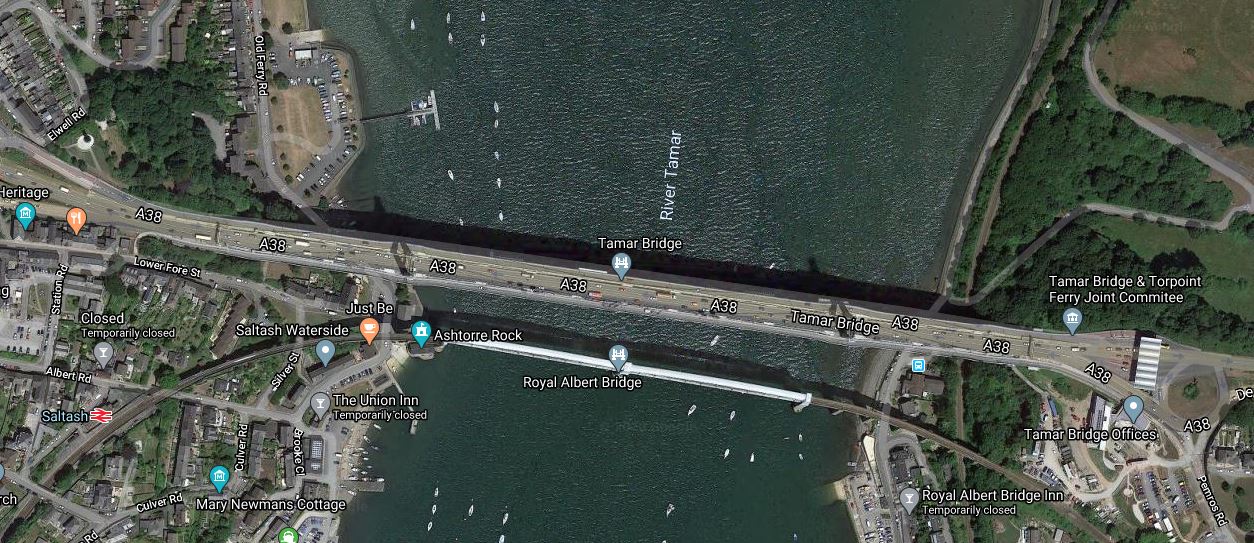
Note.
- The Royal Albert Bridge to the South of the modern Tamar Bridge.
- The Great Western Main Line running East to Plymouth and West to Penzance.
- The Tamar Valley Line running up the Eastern bank of the River Tamar and under the Eastern approaches to both bridges.
- Going North on the Tamar Valley Line leads to the TORs and going South leads to Plymouth station.
I can see a difficult design problem at the Eastern end of the Royal Albert Bridge, as a very complicated junction will be needed to allow all trains go the way they need.
Trains wanting to call at Plymouth station and use TORs will need to reverse in the station.
Connecting At The East Of Exeter
This Google Map shows The Tarka Line and the Bristol-Exeter Line join at Cowley Bridge Junction.
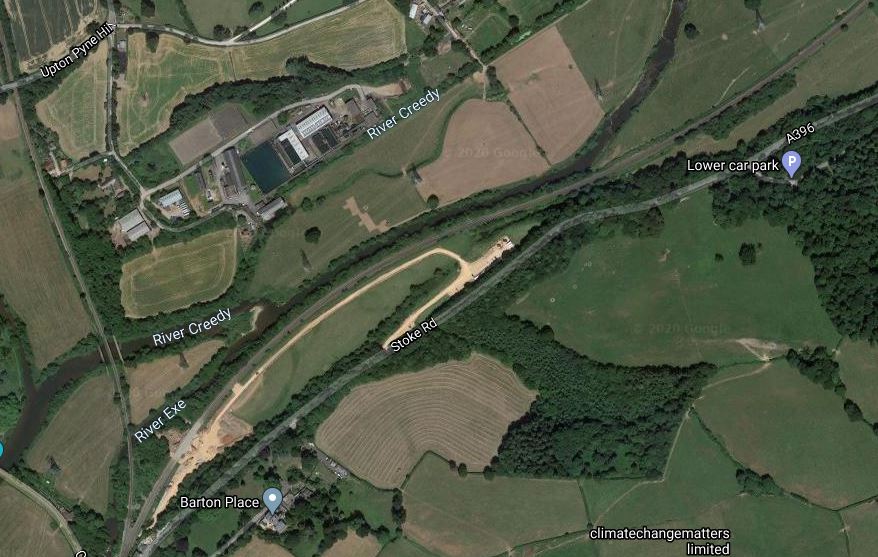
Note.
- The Tarka Line to Barnstaple and TORs leaves the map in the North West corner.
- The Bristol-Exeter Line to Taunton, Bristol and London Paddington leaves the map in the North East corner.
- Cowley Bridge Junction is in the South West corner of the map.
- Cntinuing South West leads to Exeter St. David’s station.
It looks to me, that Cowley Bridge Junction will need to be made into a full triangular junction, so that trains can go directly between the Bristol-Exeter Line and the Tarka Line.
Trains wanting to call at Exeter St. David’s station and use TORs will need to reverse in the station.
The Reversal Problem
If you wanted to run a passenger service between Taunton and Penzance using TORs with stops at Exeter, Okehampton, Tavistock, Plymouth and Truro, the train would need to reverse twice at Exeter and Plymouth.
These days with modern fast bi-mode multiple units, it’s not a problem, but in the days of Beeching, when the Tavistock and Okehampton route was originally closed in 1968, there probably wasn’t a suitable train other than a slow two-car diesel multiple unit.
I think, that fast expresses to and from Penzance will still take the current route.
- Battery-electric trains can handle the route at 100 mph.
- No reversals will be needed.
- There is a call at Newton Abbott for connections to Torquay and Paignton.
- Passengers wanting Okehampton, Tavistock and other stations on the TORs route can change at Exeter or Plymouth.
The Modern Railways article says this about services on the TORs route.
The case suggests that services could operate as an extension of the SWR Waterloo to Exeter service, or potentially as an extension of CrossCountry services beyond Exeter. During periods when the coastal route is blocked, additional services could use the TORs route, potentially running non-stop.
Note.
- As the extension of the SWR service would run the other way through Exeter St. David’s station, there would be no need to reverse.
- But I suspect the CrossCountry service would need the reverse.
- I feel for efficiency, that diverted freight services would need the efficient junctions at each end of TORs.
It probably would have helped if the Great Western and the London and South Western Railways had had a better crystal ball.
Fast Electric Freight Services To And From Devon And Cornwall
If the following lines are electrified.
- Cogload Junction and Exeter
- TORs
- Cornish Main Line
I feel that electric freight services will be able to run between Taunton and Penzance.
All it would need to complete the electrified route would be to electrify the following.
- Cogload Junction and Bristol
- Cogload Junction and Newbury
What would a high-speed freight route do for the economy of the two South Western counties?
Passing Loop Hope For Windermere
The title of this post is the same as that of a small story in Issue 903 of Rail Magazine.
This is the opening sentence.
The local priority for the Windermere branch is for a passing loop to enable two trains an hour to operate.
These are the distances from Oxenholme Lake District station of the stations on the Windermere branch line.
- Kendal – 2.05
- Burneside – 4.02
- Staveley – 6.52
- Windermere – 10.15
Note.
- Distances are in miles.chains.
- The return distance of 20.30 miles should be within the capability of a battery-electric train, that left Oxenholme Lake District station with full batteries.
Halfway would surely be a convenient place for a passing loop, which would be a mile towards Windermere from Burneside.
This Google Map shows Burneside and Staveley stations and the countryside in between.
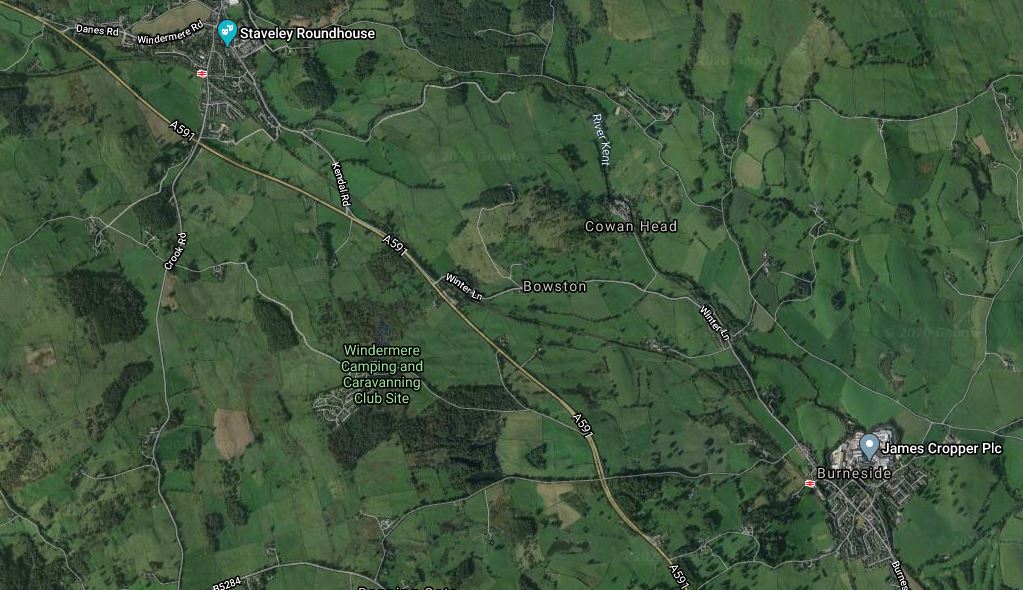
Note.
- Burneside station is in the South-East corner
- Staveley station is in the North-West corner.
- The North-East side of the route is mainly agricultural land.
It looks like a passing loop could be built in the region of Bowston.
- It would be approximately halfway.
- It would be on the North-East side of the existing track.
- It would need to be long enough to take the longest train likely to use the route.
- ,It would allow a doubling in frequency.
I don’t think it would be the most expensive of projects.
Operational Considerations
A half-hourly service could be run as follows.
- It seems likely that the trains will be four-car Class 331 trains, as I wrote about in Northern’s Battery Plans.
- Two trains would probably be timed to leave Oxenholme Lake District and Windermere stations at the same time.
- Trains currently take twenty minutes to travel along the branch and do the round trip in an hour.
- ,This twenty minute timing would give ten minutes to turn back the train at Oxenholme Lake District and Windermere.
- Ten minutes at each terminal station, should be enough time to fully charge the batteries for the next trip.
It should be noted that trains going to and from Manchester Airport would be able to charge their batteries on the electrified route between Oxenholme Lake District and Manchester Airport stations.
I think it would be likely, that there would be two services
- An hourly service between Windermere and Manchester Airport stations, which is the current service on the branch.
- An hourly shuttle service between Windermere and Oxenholme Lake District, which would be run by a single train.
The two services would alternate to provide the half-hourly service.
One of the advantages of a half-hourly service run by two trains, is that it may open the possibility of one train rescuing the other train if it fails.
If a train arrives at Windermere station with flat batteries, I suspect that as Windermere and Oxenholme have similar altitudes, that the second train could drag it back to Oxenholme station. Possibly without passengers.
First Of Five FirstGroup Class 803s Arrives In UK
The title of this post is the same as that of this article on Rail Magazine.
The Class 803 trains will be used by East Coast Trains for their low-cost, one-class, open-access service between London Kings Cross and Edinburgh.
The trains would appear to be being delivered in time for services to start in Autumn 2021.
The article says the trains are the first to have a new feature.
They will be fitted with batteries, although these will not provide traction performance – instead, they can power on-board services should the train fail.
The Class 803 trains are electric trains and are these batteries a replacement for the single diesel-engine on the electric Class 801 trains? This diesel-engine has two main purposes.
- Provide emergency power for on-board services.
- Move the train to a safe place foe evacuation of passengers.
The article also says that Hitachi could fit traction batteries to existing bi-mode fleets.
Ipswich And Peterborough In A Battery Train
Greater Anglia have a fleet of bi-mode electro-diesel Class 755 trains, that could be converted into tri-mode electro-diesel-battery trains. I reported on this in Battery Power Lined Up For ‘755s’.
If when fitted with batteries these trains had a range of say 55-65 miles on battery power, these Greater Anglia routes could be handled using battery and electric power.
- Ipswich and Cambridge
- Ipswich and Felixstowe
- Ipswich and Lowestoft
- London and Lowestoft
- Marks Tey and Sudbury
- Norwich and Cambridge
- Norwich and Great Yarmouth
- Norwich and Lowestoft
- Norwich and Sheringham
Note.
- Marks Tey and Sudbury is planned to be extended to Colchester Town. Is this to allow a Class 755 train with a battery capability to charge the batteries on the Great Eastern Main Line? No charging facilities would then be needed on the branch.
- I have left out the current Ipswich and Peterborough service.
- There is speculation that Greater Anglia want to run a Cambridge and Wisbech service via Ely and March.
It is also reported that some or all Peterborough and Ipswich services will continue to Colchester.
- There is a convenient bay platform at Colchester to reverse the trains.
- A Colchester and Peterborough service, would give travellers in North Essex easier access to LNER services at Peterborough.
- Frequencies from Colchester and Ipswich across Suffolk would be improved.
If the trains were to run on battery power between Stowmarket and Ely, the batteries could be charged between Colchester and Stowmarket. Note that Stowmarket and Ely is about forty miles, which should be within battery range.
Ely and Peterborough is thirty miles, which again is within battery range. So would the train top up the batteries at Ely in perhaps a five minute stop?
Extra Electrification At Ely
There could be three battery-electric services needing to charge batteries as they pass through Ely.
- Colchester/Ipswich and Peterborough
- Norwich and Stansted Airport
- Cambridge and Wisbech
So would it be sensible to extend the electrification for a few miles towards Peterborough and Norwich to give the battery a quick top-up? It should be noted that the notorious Ely Junction is to be remodelled.
First Passenger Train In 80 Years Runs On Camp Hill Line
The title of this post is the same as that of this article on Rail Technology Magazine.
These two paragraphs described the route, that the train took on the Camp Hill Line.
On Monday morning a train carrying the Mayor, West Midlands Railway’s customer experience director Jonny Wiseman and other representatives from across the rail industry, travelled along the line.
The train followed the route of what would be the re-opened line, stopping at the Moseley, Kings Heath and Hazelwell sites before arriving into Kings Norton, and later returning to Birmingham New Street.
The article has a picture showing the VIPs showing boards indicating the stations at Moseley, Kings Heath and Hazelwell, that will be reopened.
Wikipedia says this under Future for all three stations.
In 2019, the project to re-open the stations at Moseley, Kings Heath and Hazelwell received £15 million in Government funding, with construction due to start in 2020 and aimed for completion in time for the 2022 Commonwealth Games.
£15million seems good value to reopen three stations.
Let’s hope the world has solved the COVID-19 crisis before the 2022 Commonwealth Games.
Trains For The Service
The picture in the article, shows the test service was run by a two-car Class 170 train. This is an ideal train to do the testing, but as the Camp Hill Line is not electrified, self-powered trains will be needed for the passenger service.
West Midlands Trains will have a good selection of self-powered trains with which to run the service.
- They already have a selection of Class 170 and Class 172 Turbostar diesel multiple units in very good condition, which total thirty-seven two-cars and twenty-one three-cars.
- I’m sure Vivarail will pitch diesel-electric or battery-electric versions of their Class 230 trains.
- Alstom will probably pitch the Breeze hydrogen-powered train.
- Porterbrook will probably pitch their proposed Battery/FLEX conversion of Class 350 trains.
I don’t think there will be a problem finding a suitable fleet for this route.
I suspect some form of battery-electric train will be used, as there is lots of 25 KVAC overhead electrification in the Birmingham area, that can be used to charge the batteries.
Battery-electric trains with a range of perhaps forty miles would also open up the possibilities for other electric services for West Midlands Trains.
A Thought On Construction
Because of COVID-19, there will probably be numbers of unemployed in this part of Birmingham, who have skills that could be useful to do the building work.
So should the non-railway related parts of the reopening be accelerated to put money in the pockets of the local unemployed.
A Site For Battery Train Sceptics
I meet and get messages from a lot of people, who are sceptical, that battery-powered trains will ever be a viable alternative to diesel-powered ones.
I have just read this post on Vivarail’s web site, which is entitled Battery Train Update.
It is very open and informative and is very much a must read for anybody interested in the future of railways worldwide or the application of battery-powered trains.
The introductory sentence of the update is very heartening.
Our first production train is in its final build stage and is due to go out on the network – fully approved for passenger service – by the summer.
Provided of course, the COVID-19 situation will allow everybody to travel.
First Order For Mireo Plus B Battery EMUs
The title of this post is the same as that of this article on Railway Gazette.
This is the introductory paragraph.
The Land of Baden-Württemberg’s rolling stock body SFBW has ordered 20 battery-equipped Mireo Plus B electric multiple-units from Siemens Mobility, which will then be responsible for their availability over a 29½-year operating life.
The Siemens Mireo Plus B Battery EMUs appear to have the following specification.
- Ability to use overhead electrification.
- Ability to use battery power for a range of eighty kilometres.
- Two underfloor lithium-ion battery packs.
- Batteries handle regenerative braking.
- 160 kph operating speed.
Delivery is by December 2023.
Northern’s Battery Plans
The title of this post, is half of the title of an article in the March 2020 Edition of Modern Railways.
It appears that CAF will convert some three-car Class 331 trains into four-car battery-electric trains.
- A three-car Class 331 train has a formation of DMSOL+PTS+DMSO.
- A fourth car with batteries will be inserted into the train.
- Batteries will also be added to the PTS car.
- The battery-electric trains would be used between Manchester and Windermere.
It looks like a round trip would take three hours including turnarounds, thus meaning three trains would be needed to run the service.
The article says this.
The branch was due to be electrified, but this was cancelled in 2017, and as a result 3×3-car Class 195 trains were ordered. As well as the environmental benefits, introduction of the battery ‘331s’ on Windermere services would free-up ‘195s’ for cascade elsewhere on the Northern network.
Note that the total length or the route is 98 miles of which only the ten miles of the Windermere Branch Line are not electrified.
What Battery Capacity Would Be Needed?
I reckon it will be fine to use a figure of 3 kWh per vehicle-mile to give a rough estimate of the power needed for a return trip from Oxenholme to indermere.
- Two x Ten Miles x Four Cars x 3 kWh would give 240 kWh.
- There would also be losses due to the seven stops, although the trains have regenerative braking, to limit losses.
Remember though that CAF have been running battery trams for several years, so I suspect that they have the experience to size the batteries appropriately.
In Thoughts On The Actual Battery Size In Class 756 Trains And Class 398 Tram-Trains, I say that four-car Class 756 trains will have 600 kWh of batteries and a range of 40 miles. I wouldn’t be surprised to find that a four-car Class 331 train had similar battery size and range on batteries, as the two trains are competing in the same market, with similar weights and passenger capacities.
Charging The Batteries
The Modern Railways article says this about charging the train’s batteries.
Northern believes battery power would be sufficient for one return trip along the branch without recharging, but as most diagrams currently involve two trips, provision of a recharge facility is likely, with the possibility that this could be located at Windermere or that recharging could take place while the units are in the platform at Oxenholme.
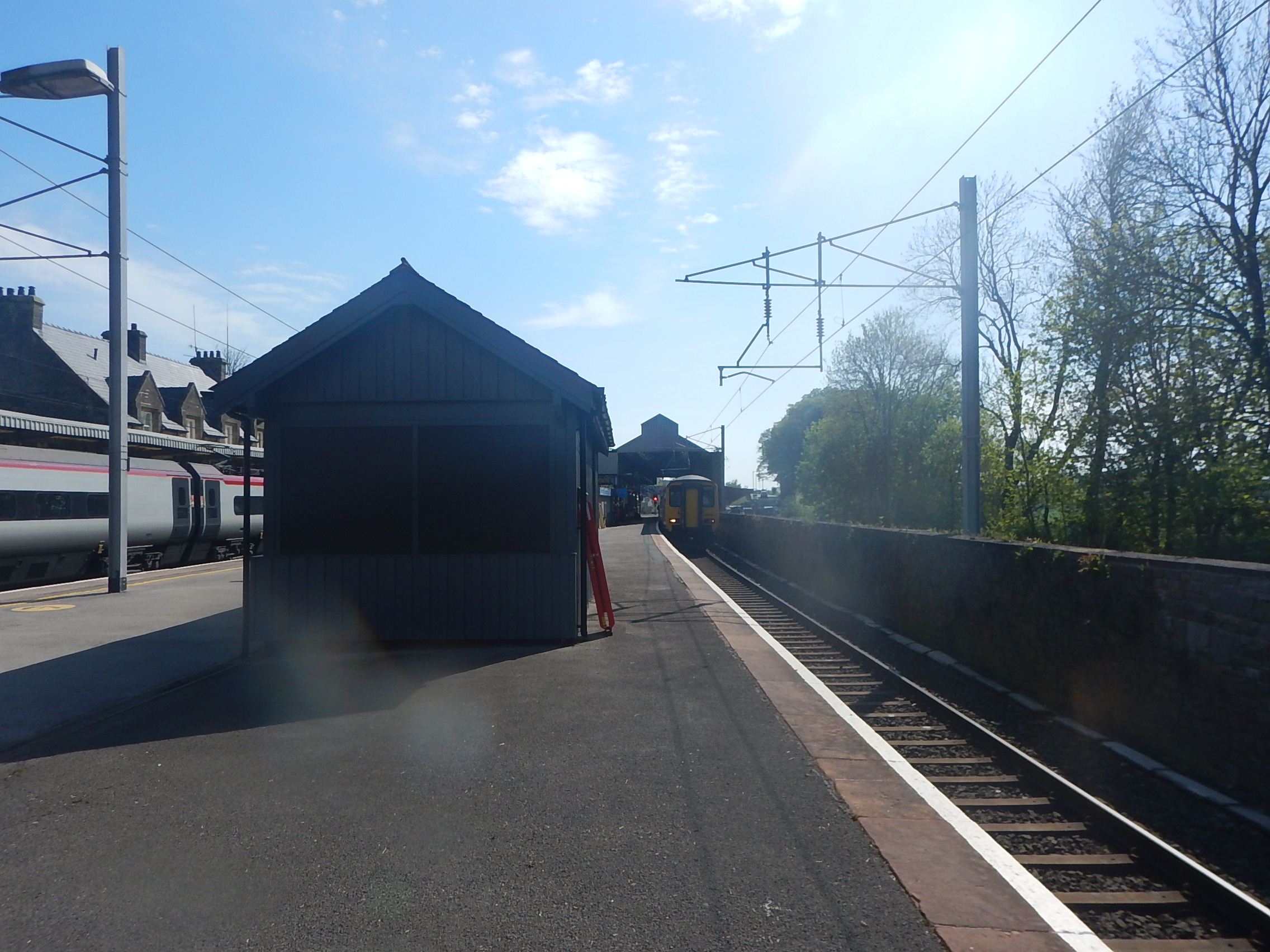
The bay platform 3 at Oxenholme station is already electrified, as this picture shows.
I particularly like Vivarail’s Fast Charge system based on third-rail technology.
A battery bank is connected to the third-rail and switched on, when the train is in contact, so that battery-to-battery transfer can take place.
It’s just like jump-starting a car, but with more power.
This form of charging would be ideal in a terminal station like Windermere.
- The driver would stop the train in Windermere station in the correct place, for passengers to exit and enter the train.
- In this position, the contact shoe on the train makes contact with the third-rail, which is not energised..
- The Fast Charge system detects a train is connected and connects the battery bank to the third-rail.
- Energy flows between the Fast Charge system’s battery bank and the train’s batteries.
- When the train’s batteries are full, the Fast Charge system switches itself off and disconnects the third-rail.
- The third-rail is made electrically dead, when the train has left, so that there is no electrical risk, if someone should fall from the platform.
Note that the only time, the third-rail used to transfer energy is live, there is a four-car train parked on top of it.
When I was eighteen, I was designing and building electronic systems using similar principles to control heavy rolling mills, used to process non-ferrous metals.
Changing Between Overhead Electrification And Battery Power
All trains running between Manchester Airport and Windermere, stop in Platform 3 at Oxenholme station to pick up and put down passengers.
- Trains going towards Windermere would lower the pantograph and switch to battery power.
- Trains going towards Mabchester Airport would raise the pantograph and switch to overhead electrification power.
Both changes would take place, whilst the train is stopped in Platform 3 at Oxenholme station.
First Hydrogen Train Arrives In The Netherlands
The title of this post is the same as that on this article of Railway News.
This is the introductory paragraph.
On 26 February the first hydrogen train arrived in the Netherlands. The Dutch rail infrastructure manager ProRail led the train into the country from Germany via Oldenzaal and then ran it on track to its provisional parking facility in Leeuwarden.
The article also says this.
The public will also have the chance to view the hydrogen train on 7 March, when it will be at Groningen Station between noon and 4pm.
I won’t be going, as I’ve ridden the train in Germany as I reported in My First Ride In An Alstom Coradia iLint.

These trains are technology demonstrators at best and greenwash at worst.
Hydrogen power needs a radical new design of train and not a quick rehash of an existing design.
The problem is that the Coradia iLint is based on a diesel mechanical train and it has a lot of transmission noise.
You get less noise and vibration in the average British-Rail era diesel multiple unit like a Class 156 train. But then these are diesel hydraulic, have steel-bodies and built thirty years ago.
When I first saw the iLint, I looked for the pantograph, as these trains run on partially-electrified lines and hydrogen-powered trains are effectively electric trains with a different source of electricity.
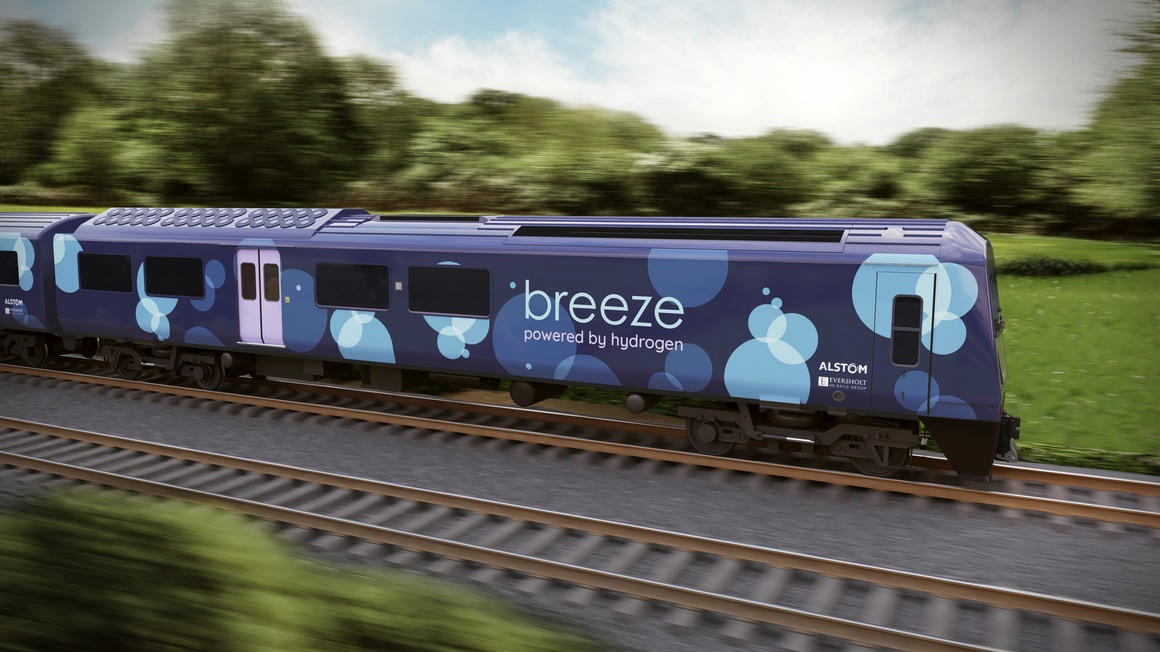
To be fair to Alstom, their development of the hydrogen-powered Class 321 Breeze, will also be able to use a pantograph, but as this visualisation shows, the hydrogen tanks take up a lot of space.
Hydrogen might find itself a place on the railways, but I suspect that battery-electric will always be better for passenger trains.
- Battery technology will improve faster than hydrogen technology.
- Innovators will find better ways of fast-charging trains.
- A battery-electric train will match the daily range of a hydrogen-powered train, using innovative dynamic charging.
- Many modern electric trains can be converted into battery-electric ones.
- As the Class 379 BEMU trial, this conversion can be relatively easy, quick and successful.
I suspect though, the mathematics will be different for freight locomotives.
Could Battery-Electric Hitachi Trains Work Chiltern Railways’s Services?
Before I answer this question, I will lay out a few specifications and the current status.
Hitachi’s Proposed Battery Electric Train
Based on information in an article in Issue 898 of Rail Magazine, which is entitled Sparking A Revolution, the specification of Hitachi’s proposed battery-electric train is given as follows.
- Based on Class 800-802/804 trains or Class 385 trains.
- Range of 55-65 miles.
- Operating speed of 90-100 mph
- Recharge in ten minutes when static.
- A battery life of 8-10 years.
- Battery-only power for stations and urban areas.
For this post, I will assume that the train is four or five cars long.
Chiltern Railways’ Main Line Services
These are Chiltern Railways services that run on the Chiltern Main Line.
London Marylebone And Gerrards Cross
- The service runs at a frequency of one train per hour (tph)
- Intermediate stations are Wembley Stadium, Sudbury & Harrow Road, Sudbury Hill Harrow, Northolt Park, West Ruislip, Denham and Denham Golf Club
The service is nineteen miles long and takes thirty minutes.
It should be possible to run this service with trains charged at one end of the route.
London Marylebone And High Wycombe
- The service runs at a frequency of one tph
- Intermediate stations are Wembley Stadium, South Ruislip, Gerrards Cross and Beaconsfield
- Some services terminate in a bay platform 1 at High Wycombe station.
The service is twenty-eight miles long and takes forty-two minutes.
It should be possible to run this service with trains charged at one end of the route.
London Marylebone And Aylesbury Via High Wycombe
- The service runs at a frequency of one tph
- Intermediate stations are Gerrards Cross, Seer Green and Jordans, Beaconsfield, High Wycombe, Saunderton, Princes Risborough, Monks Risborough and Little Kimble
- This service usually terminates in Platform 1 at Aylesbury station.
The service is 43.5 miles long and takes sixty-six minutes.
It should be possible to run this service with trains charged at both ends of the route.
London Marylebone And Banbury (And Stratford-upon-Avon)
- The service runs at a frequency of one tph
- Intermediate stations for the Banbury service are Denham Golf Club, Gerrards Cross, Beaconsfield, High Wycombe, Princes Risborough, Haddenham & Thame Parkway, Bicester North and Kings Sutton.
- Intermediate stations for the Stratford-upon-Avon service are Denham Golf Club, Gerrards Cross, Beaconsfield, High Wycombe, Princes Risborough, Haddenham & Thame Parkway, Bicester North and Kings Sutton, Banbury, Leamington Spa, Warwick, Hatton, Claverdon, Bearley, Wilmcote and Stratford-upon-Avon Parkway.
The Banbury service is 69 miles long and takes one hour and forty-five minutes.
The Stratford-upon-Avon service is 104 miles long and takes two hours and twenty-two minutes.
Running these two services will need a bit of ingenuity.
Leamington Spa And Birmingham Moor Street
- The service runs at a frequency of one train per two hours (tp2h)
- Intermediate stations for the service are Warwick, Hatton, Lapworth, Dorridge and Solihull.
The service is 23 miles long and takes forty-one minutes.
It should be possible to run this service with trains charged at one end of the route.
London Marylebone And Birmingham Moor Street
- The service runs at a frequency of one tph
- Intermediate stations for the service are High Wycombe, Banbury, Leamington Spa, Warwick Parkway and Solihull.
The service is 112 miles long and takes one hour and forty-four minutes.
It should be possible to run this service with trains charged at both ends of the route and also fully charged somewhere in the middle.
Distances from London Marylebone of the various stations are.
- High Wycombe – 28 miles
- Bicester North – 55 miles
- Banbury – 69 miles
- Leamington Spa – 89 miles
- Warwick – 91 miles
- Warwick Parkway – 92 miles
- Solihull – 105 miles
Consider.
- It looks like a fully-charged train from London Marylebone could reach Bicester North, but not Banbury, with a 55-65 mile battery range.
- Travelling South, Bicester North could be reached with a fully-charged train from Birmingham Moor Street.
But it would appear to be too marginal to run a reliable service.
London Marylebone And Birmingham Snow Hill
- The service runs at a frequency of one tph
- Intermediate stations for the service are Bicester North, Banbury, Leamington Spa, Warwick, Warwick Parkway, Dorridge, Solihull and Birmingham Moor Street
The service is 112 miles long and takes two hours and a minute.
It should be possible to run this service with trains charged at both ends of the route and also fully charged somewhere in the middle.
London Marylebone And Kidderminster
Some services between London Marylebone and Birmingham Snow Hill are extended to Kidderminster.
The distance between Kidderminster and Birmingham Snow Hill is twenty miles and the service takes forty-two minutes.
London Marylebone And Oxford
- The service runs at a frequency of two tph
- Intermediate stations for the service are High Wycombe, Haddenham & Thame Parkway, Bicester Village, Islip and, Oxford Parkway.
- The service runs into dedicated platforms at Oxford station.
The service is 67 miles long and takes one hour and nine minutes.
It should be possible to run this service with trains charged at both ends of the route and some supplementary charging somewhere in the middle.
Chiltern’s Aylesbury Line Services
These are Chiltern Railway‘s services that run on the London And Aylesbury Line (Amersham Line).
London Marylebone And Aylesbury (And Aylesbury Vale Parkway) via Amersham
- The service runs at a frequency of two tph
- Intermediate stations are Harrow-on-the-Hill, Rickmansworth, Chorleywood, Chalfont & Latimer, Amersham, Great Missenden, Wendover and Stoke Mandeville.
- It appears that there is sufficient time at Aylesbury Vale Parkway in the turnround to charge the train using a Fast Charge system.
The Aylesbury service is 39 miles long and takes one hour.
The Aylesbury Vale Parkway service is 41 miles long and takes one hour and twelve minutes.
It should be possible to run both services with trains charged at both ends of the route.
Chiltern Railways’ Future Train Needs
Chiltern Railways will need to add to or replace some or all of their fleet in the near future for various reasons.
Decarbonisation
Chiltern are probably the passenger train operating company, with the lowest proportion of zero-carbon trains. It scores zero for zero-carbon!
Government policy of an extinction date of 2040 was first mentioned by Jo Johnson, when he was Rail Minister in February 2018.
As new trains generally last between thirty and forty years and take about five years to design and deliver, trains ordered tomorrow, will probably still be running in 2055, which is fifteen years after Jo Johnson’s diesel extinction date.
I feel that, all trains we order now, should be one of the following.
- All-electric
- Battery-electric
- Hydrogen-electric
- Diesel electric trains, that can be converted to zero-carbon, by the replacement of the diesel power, with an appropriate zero-carbon source.
Hitachi seem to be designing an AT-300 diesel-electric train for Avanti West Coast, where the diesel engines can be replaced with batteries, according to an article in the January 2020 Edition of Modern Railways.
Pollution And Noise In And Around Marylebone Station
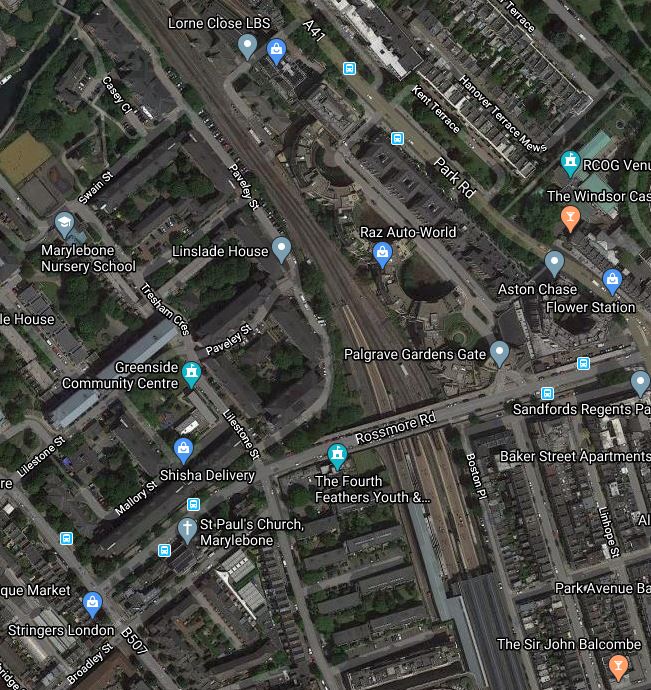
This Google Map shows the area around Marylebone station.
Cinsider.
- Marylebone station is in the South-East corner of the map.
- The station is surrounded by some of the most expensive real estate in London.
- A lot of Chiltern’s trains do not meet the latest regulations for diesel trains.
- Blackfriars, Cannon Street, Charing Cross, Euston, Fenchurch Street, Kings Cross, Liverpool Street, London Bridge, Paddington, St. Pancras, Victoria and Waterloo stations are diesel-free or have plans to do so.
Will the residents, the Greater London Council and the Government do something about improving Chiltern’s pollution and noise?
New trains would be a necessary part of the solution.
New And Extended Services
Consider.
- Chiltern plan to extend the Aylesbury Parkway service to Milton Keynes in connection with East West Rail. This service would appear to be planned to run via High Wycombe and Princes Risborough.
- There has also been proposals for a new Chiltern terminus at Old Oak Common in West London to connect to Crossrail, High Speed Two and the London Overground.
- Chiltern could run a service between Oxford and Birmingham Moor Street.
- With the demise of the Croxley Rail Link around Watford, Chiltern could be part of a revived solution.
- In Issue 899 of Rail Magazine in an article entitled Calls For Major Enhancement To Oxford And Didcot Route, it states that there will be three tph between Oxford and Marylebone, two of which will start from a new station at Cowley.
Chiltern certainly have been an expansionist railway in the past.
I wouldn’t be surprised to see Chiltern ordering new trains.
As I said earlier, I suspect they wouldn’t want to order some new short-life diesel trains.
125 mph Running
Consider.
- The West Coast Main Line has an operating speed of 125 mph.
- East West Rail is being built for an operating speed of 125 mph.
- Some parts of the Chiltern Main Line could be electrified and upgraded to 125 mph operation.
For these reasons, some of Chiltern’s new fleet must be capable of modification, so it can run at 125 mph, where it is possible.
100 mph Trains
Around half of Chiltern’s fleet are 100 mph trains, but the other half, made up of Class 165 trains only have a 75 mph operating speed.
Running a fleet, where all trains have a similar performance, must give operational and capacity improvements.
Increasing Capacity
Chiltern’s Main Line service to Birmingham is run using six Mark 3 carriages between a Class 68 locomotive and a driving van trailer.
These trains are 177.3 metres long and hold 444 passengers.
These trains are equivalent in length to a seven-car Hitachi Class AT-300 train, which I estimate would hold just over 500 passengers.
Changing some trains for a more modern design, could increase the passenger capacity, but without increasing the train length.
Aventi West Coast And High Speed Two
Chiltern’s services to Birmingham will come under increasing pressure from Avanti West Coast‘s revamped all-electric fleet, which within ten years should be augmented by High Speed Two.
It will be difficult selling the joys of comfortable diesel trains against the environmental benefits of all-electric zero-carbon faster trains.
Great Western Railway And Possible Electrification To Oxford
Chiltern’s services to Oxford will also come under increasing pressure from Great Western Railway’s services to Oxford.
- When Crossrail opens, Paddington will be a much better terminal than Marylebone.
- Crossrail will offer lots of new connections from Reading.
- Great Western Railway could run their own battery-electric trains to Oxford.
- Great Western Railway will be faster between London and Oxford at 38 minutes to Chiltern’s 65 minutes.
Will new trains be needed on the route to retain passengers?
Will Chiltern Have Two Separate Fleets?
Currently, Chiltern Railways have what is effectively two separate fleets.
- A Chiltern Main Line fleet comprised of five sets of six Mark 3 coaches, a Class 68 locomotive and a driving van trailer.
- A secondary fleet of thirty-four assorted diesel multiple units of various ages and lengths, which do everything else.
But would this be their fleet, if they went for a full renewal to fully-decarbonise?
Would they acquire more Main Line sets to work the services to Birmingham, Kidderminster and perhaps some other Midlands destinations?
Do the Oxford services require more capacity for both Oxford and Bicester Village and would more Main Line sets be a solution?
What destinations will be served and what trains will be needed to work services from new destinations like Milton Keynes and Old Oak Common?
I can see Chiltern acquiring two fleets of battery-electric trains.
- Chiltern Main Line trains based on Hitachi AT-300 trains with between five and seven cars.
- Suburban trains for shorter journeys, based on Hitachi Class 385 trains with perhaps four cars.
Both would be fairly similar under the skin.
Conclusion On Chiltern Railways’ Future Trains
I am very much drawn to the conclusion, that Chiltern will have to introduce a new fleet of zero-carbon trains.
Electrification would be a possibility, but have we got enough resources to carry out the work, at the same time as High Speed Two is being built?
Hydrogen might be a possibility, but it would probably lead to a loss of capacity on the trains.
Battery-electric trains might not be a solution, but I suspect they could be the best way to increase Chiltern’s fleet and decarbonise at the same time.
- Hitachi’s basic train design is used by several train operating companies and appears to be well received, by Train operating companies, staff and passengers.
- Hitachi appear to be well-advanced with a battery-electric version.
- Hitachi seem to have sold the concept of battery-electric AT-300 trains to Avanti West Coast to replace their diesel-electric Class 221 trains.
The sale of trains to Avanti West Coast appears to be very significant, in that Hitachi will be delivering a diesel-electric fleet, that will then be converted to battery-electric.
I like this approach.
- Routes can be converted gradually and the trains fully tested as diesel-electric.
- Electrification and/or charging stations can be added, to the rail network.
- As routes are ready, the trains can be converted to battery-electric.
It would appear to be a low-risk approach, that could ensure conversion of the fleet does not involve too much disruption to passengers.
Possible Electrification That Might Help Chiltern Railways
These lines are or could be electrified in the near future.
Amersham Line Between Harrow-on-the-Hill and Amersham Stations
The only electrified line on the Chiltern Railways network is the section of the Amersham Line between Harrow-on-the-Hill and Amersham stations.
- It is electrified using London Underground’s system.
- It is fourteen miles long and trains take twenty-two minutes.
- London Marylebone and Harrow-on-the-Hill is a distance of only nine miles
- Aylesbury and Amersham is a distance of only fifteen miles.
Could this be of use in powering Children Railways’ trains?
The maths certainly look promising, as if nothing else it means the maximum range of one of Hitachi’s proposed battery-electric trains is fourteen miles further, which may enable Chiltern’s proposed service between London Marylebone and Milton Keynes to reach the 25 KVAC electrification at Bletchley.
But if the new trains were to use the London Underground electrification, they would have to be dual-voltage units.
As Hitachi have already built dual-voltage Class 395 trains for the UK, I don’t think, that this will be a problem.
Dorridge/Whitlock’s End And Worcestershire via Birmingham Snow Hill
In the February 2020 Edition of Modern Railways, there is a feature, which is entitled West Midlands Builds For The Future.
This is said about electrification on the Snow Hill Lines.
Remodelling Leamington is just one of the aspirations WMRE has for upgrading the Great Western’s Southern approach to Birmingham, which serves a number of affluent suburbs, with growing passenger numbers. “Electrification of the Snow Hill Lines commuter network is something which we are keen to explore.’ says Mr. Rackliff.
As well as reducing global carbon emissions, yhis would also help reduce air pollution in central Birmingham and local population centres. ‘From a local perspective, we’d initially want to see electrification of the core network between Dorridge/Whitlock’s End and Worcestershire via Birmingham Snow Hill as a minimum, but from a national perspective it would make sense to electrify the Chiltern Main Line all the way to Marylebone.’
Note the following distances from Dorridge.
- Leamington Spa – 13 miles
- Banbury – 33 miles
- Bicester North – 47 miles
- High Wycombe – 74 miles
It looks as if, electrification of the Snow Hill Lines would allow trains to travel from Bicester or Banbury to Birmingham Moor Street, Birmingham Snow Hill or Kidderminster.
Reading And Nuneaton via Didcot, Oxford, Banbury, Leamington Spa And Coventry
This route, which is used by CrossCountry services and freight trains, has been mentioned in the past, as a route that may be electrified.
Note the following distances from Didcot.
- Oxford – 10 miles
- Ayhno Junction – 27 miles
- Banbury 32 miles
- Leamington Spa – 52 miles
- Coventry – 62 miles
- Nuneaton – 72 miles
Electrifying this route would link together the following lines.
- Trent Valley Line through Nuneaton
- West Coast Main Line through Coventry
- Chiltern Main Line through Banbury and Leamington Spa.
- Great Western Main Line through Didcot.
Note that Aynho Junction is only 36 miles from High Wycombe and 64 miles from London Marylebone.
Fast Charging At Terminal Stations
Chiltern Railways use the following terminal stations.
- Aylesbury station, where a bay platform is used.
- Aylesbury Parkway station
- Banbury station, where a bay platform is used.
- Birmingham Moor Street station, where all bay platforms are used.
- Birmingham Show Hill station
- High Wycombe station, where a bay platform is used.
- Kidderminster station
- London Marylebone station, where all platforms are used.
- Oxford station, where two North-facing bay platforms are used.
- Stratford-upon-Avon station
I suspect that something like Viviarail’s Fast-Charge system, based on well-proven third-rail technology could be used.
- This system uses a bank of batteries to transfer power to the train’s batteries.
- The transfer is performed using modified high-quality third-rail electrification technology.
- Battery-to-battery transfer is fast, due to the low-impedance of batteries.
- The system will be able to connect automatically, without driver action.
- The third-rail is only switched on, when a train is present.
- The battery bank will be trickle-charged from any convenient power source.
Could the battery bank be installed under the track in the platform to save space?
If Network Rail and Chiltern Railways would prefer a solution based on 25 KVAC technology, I’m sure that Furrer + Frey or another electrification company have a solution.
Installing charging in a platform at a station, would obviously close the platform for a couple of months, but even converting all six platforms at Marylebone station wouldn’t be an impossible task.
Possible Electrification Between London Marylebone And Harrow-on-the-Hill
Consider.
- All trains to Aylesbury have to travel between London Marylebone and Harrow-on-the-Hill stations, which is nine miles of track without electrification. It takes about twelve minutes.
- Trains via High Wycombe use this section of track as far as Neasden South Junction, which is give miles and typically takes seven minutes.
- Leaving Marylebone, these trains are accelerating, so will need more power.
This map from carto.metro.free.fr shows the lines around Neasden.
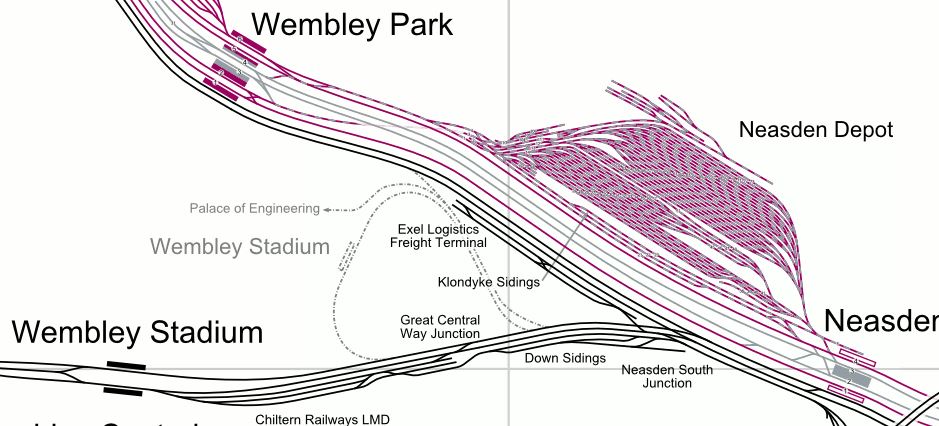
Note.
- The Chiltern Railways tracks are shown in black.
- Two tracks continue to the North-West to Harrow-on-the-Hill and Aylesbury.
- Two tracks continue to the West to Wembley Stdium station and High Wycombe.
- Two tracks continue South-East into Marylebone station, running non-stop.
- The Jubilee Line tracks in the middle are shown in silver,
- The Metropolitan Line tracks are shown in mauve.
These pictures were taken of the two Chiltern tracks from a Jubilee Line train running between West Hampstead and Wembley Park stations.

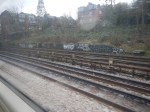

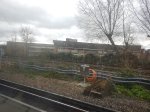
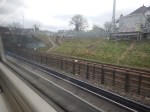

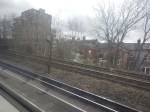
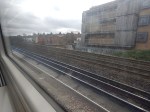
Note, that the tracks have no electrification and there is plenty of space.
I feel that to accelerate the trains out of Marylebone and make sure that the batteries are fully charged, that these tracks should be electrified.
There is space on this section for 25 KVAC overhead, but would it be better to use an electrified rail system?
- As you approach Marylebone there are several tunnels, which might make installation of overhead wires difficult and disruptive.
- There are London Underground tracks and their third and fourth rail electrification everywhere.
- Between Harrow-on-the Hill and Amersham stations, Chiltern and Metropolitan Line trains share the same track, which is electrified to London Underground standards and used for traction power by the Metropolitan Line trains.
- Trains connect and disconnect to third-rail electrification, without any complication and have been doing it for over a hundred years.
On the other hand, there are arguments against third-rail systems like safety and electrical inefficiency.
Running Chiltern’s Routes Using A Battery-Electric Train
I will now take each route in order and look at how battery-electric trains could run the route.
London Marylebone And Oxford
Consider.
- This route is 67 miles.
- An out and back trip is 134 miles.
- The route is probably too long for the proposed Hitachi battery-electric train, without some intermediate charging.
- Trains currently wait in the bay platforms at Oxford for up to thirty minutes, which is more than enough time to fully-charge the train for return to Marylebone.
When I outlined this route, I said this.
It should be possible to run this service with trains charged at both ends of the route and some supplementary charging somewhere in the middle.
I’m discussing this route first, as it has the complication of needing some form of intermediate charging.
The obvious place for some intermediate charging would be High Wycombe station.
- It is 28 miles from Marylebone
- It is 38 miles from Oxford
- Trains seem to stop for a couple of minutes at High Wycombe.
As trains would only need to pick up a half-charge at the station, would it be possible for a train passing through High Wycombe to be able to use a Fast-Charge system, to give the battery a boost?
As a Control and Electrical Engineer by training, I think that this is more than possible.
It leads me to believe that with Fast Charging systems at Marylebone, Oxford and High Wycombe, Hitachi’s proposed battery-electric trains can run a reliable service between Marylebone and Oxford.
London Marylebone And Gerrards Cross
Consider.
- This route is just nineteen miles.
- An out and back trip is thirty-eight miles.
- Trains appear to use a reversing siding to change tracks to return to London. They wait in the siding for up to thirty minutes, which is more than enough time to fully-charge the train for return to Marylebone.
I am fairly sure, that this route could be run by trains charged at Marylebone station only.
However, if charging is needed at Gerrards Cross, there is plenty of time, for this to be performed in the reversing siding.
It might even be reversed with all charging taking place at Gerrards Cross, so that fast turnrounds can be performed in Marylebone station.
London Marylebone And High Wycombe
Consider.
- This route is just twenty-eight miles.
- An out and back trip is fifty-six miles.
- Trains wait in the bay platform for up to thirty minutes, which is more than enough time to fully-charge the train for return to Marylebone.
Everything said for the Gerrards Cross service would apply to the High Wycombe service.
London Marylebone And Banbury
Consider.
- This route is 69 miles.
- An out and back trip is 138 miles.
- The route is probably too long for the proposed Hitachi battery-electric train, without some intermediate charging.
- Trains wait in platform 4 at Banbury for around thirty minutes, which is more than enough time to fully-charge the train for return to Marylebone.
- Trains call at High Wycombe station.
As with the Marylebone and Oxford route, this route will need some intermediate charging and as with the Oxford service, High Wycombe is the obvious choice,
High Wycombe is only 41 miles from Banbury, which is well within range of Hitachi’s proposed battery-electric train.
London Marylebone And Stratford-upon-Avon
Consider.
- This route is 104 miles.
- An out and back trip is 208 miles.
- The distance between Stratford-upon-Avon and Banbury is 35 miles.
- The route is probably too long for the proposed Hitachi battery-electric train, without some intermediate charging.
- Trains wait in Platform 1 at Stratford-upon-Avon for over thirty minutes, which is more than enough time to fully-charge the train for return to Marylebone.
- Trains call at Banbury station, where they wait for several minutes.
- Trains call at High Wycombe station.
As with the Marylebone and Oxford and Marylebone and Banbury routes, this route will need some intermediate charging and as with the Oxford and Banbury services, High Wycombe is the obvious choice,
But this route could also use the Fast Charging system at Banbury.
London Marylebone And Birmingham Moor Street
Consider.
- This route is 112 miles.
- An out and back trip is 224 miles.
- The distance between Birmingham Moor Street and Banbury is 43 miles.
- The route is probably too long for the proposed Hitachi battery-electric train, without some intermediate charging.
- Trains wait in the bay platform at Birmingham Moor Street for thirteen minutes, which is more than enough time to fully-charge the train for return to Marylebone.
- Trains call at Banbury and High Wycombe stations.
As with the Marylebone and Stratford-upon-Avon route, this route will need some intermediate charging and as with the Stratford-upon-Avon service, High Wycombe and Banbury are the obvious choice,
London Marylebone And Birmingham Snow Hill
Consider.
- This route is 112 miles.
- An out and back trip is 224 miles.
- The distance between Birmingham Snow Hill and Banbury is 43 miles.
- The route is probably too long for the proposed Hitachi battery-electric train, without some intermediate charging.
- Trains wait in the bay platform at Birmingham Snow Hill for ten minutes, which is more than enough time to fully-charge the train for return to Marylebone.
- Trains call at Banbury and High Wycombe stations.
As with the Marylebone and Stratford-upon-Avon route, this route will need some intermediate charging and as with the Stratford-upon-Avon service, High Wycombe and Banbury are the obvious choice,
London Marylebone And Kidderminster
Consider.
- This route is 132 miles.
- An out and back trip is 264 miles.
- The distance between Kidderminster and Banbury is 63 miles.
- The route is probably too long for the proposed Hitachi battery-electric train, without some intermediate charging.
- Trains call at Banbury and High Wycombe stations.
As with the Marylebone and Stratford-upon-Avon and Birmingham routes, this route will need some intermediate charging and as with the Stratford-upon-Avon and Birmingham services, High Wycombe and Banbury are the obvious choice,
London Marylebone And Aylesbury Via High Wycombe
Consider.
- The route is 43.5 miles
- An out and back trip is 87 miles.
- The route is probably short enough for the proposed Hitachi battery-electric train, to run the route without intermediate charging.
- This service usually terminates in Platform 1 at Aylesbury station, where trains wait for up to thirteen minutes, which is more than enough time to fully-charge the train for return to Marylebone.
- The train will also be fully-charged at Marylebone.
It looks that this route could be easily handled with charging at both ends of the route, but if there has been a charging error, the train can obviously make a pit-stop at High Wycombe to give the battery a top-up.
London Marylebone And Aylesbury Via Amersham
Consider.
- The route is 39 miles
- An out and back trip is 78 miles.
- The route is probably short enough for the proposed Hitachi battery-electric train, to run the route without intermediate charging.
- This service usually terminates in Platform 3 at Aylesbury station, where trains wait for up to twenty minutes, which is more than enough time to fully-charge the train for return to Marylebone.
- The train will also be fully-charged at Marylebone.
It looks that this route could be easily handled with charging at both ends of the route, but if there has been a charging error, the train can obviously make a pit-stop at High Wycombe to give the battery a top-up.
London Marylebone And Aylesbury Vale Parkway Via Amersham
Consider.
- The route is 41 miles
- An out and back trip is 82 miles.
- The route is probably short enough for the proposed Hitachi battery-electric train, to run the route without intermediate charging.
- This service usually terminates in Platform 1 at Aylesbury Vale Parkway station, where trains wait for up to nine minutes, which is more than enough time to fully-charge the train for return to Marylebone.
- The train will also be fully-charged at Marylebone.
It looks that this route could be easily handled with charging at both ends of the route, but if there has been a charging error, the train can obviously make a pit-stop at Aylesbury to give the battery a top-up.
Leamington Spa And Birmingham Moor Street
Consider.
- The route is 23 miles
- An out and back trip is 46 miles.
- This service usually terminates in a bay platform at Birmingham Moor Street station, where trains wait for up to twenty minutes, which is more than enough time to fully-charge the train for return to Leamington Spa.
I am fairly sure, that this route could be run by trains charged at Bitmingham Moor Street station only.
New And Extended Services
These services are planned or have been mentioned as possibilities.
London Marylebone And Milton Keynes Via High Wycombe, Princes Risborough, Aylesbury And Aylesbury Vale Parkway
This is the new service that Chiltern will start running in the next few years.
Consider.
- I estimate the distance between Aylesbury Vale Parkway and Bletchley, where 25 KVAC overhead electrification starts is 18 miles, with Milton Keynes a further three miles.
- The distance between Marylebone and Bletchley via High Wycombe would be 63.5 miles.
- The route is probably short enough for the proposed Hitachi battery-electric train, to run the route without intermediate charging.
- Charging would normally be in Milton Keynes and Marylebone, with a certain amount of charging from the 25 KVAC between Bletchley and Milton Keynes.
It looks that this route could be handled with charging at both ends of the route, but if there has been a charging error, the train can obviously make a pit-stop at High Wycombe or Aylesbury to give the battery a top-up.
Birmingham Moor Street And Oxford
Consider.
- Birmingham Moor Street station could have more South-facing bay platforms.
- Birmingham Moor Street station is only a short walk from the new High Speed Two station at Birmingham Curzon Street.
- Oxford station has two North-facing bay platforms.
- Oxford station and Aynho Junction is only twenty miles and well within battery range, if High Wycombe and Banbury is electrified.
- Banbury and Oxford currently takes 23 minutes.
- Banbury and Birmingham Moor Street currently takes 44 minutes
It looks like a Birmingham Moor Street and Oxford service would take one hour and seven minutes.
London Marylebone And The Cowley Branch
This proposed service is probably about four to five miles further on from Oxford station.
There may be problems with how the track is laid out, but with a charging station at the end of the branch, I doubt that distance would be a problem.
Croxley Rail Link Proposal
I said this earlier.
With the demise of the Croxley Rail Link around Watford, Chiltern could be part of a revived solution.
The original plan died a long time ago, but could there be a simpler Chiltern-based solution?
- Rebuild the railway between Croxley and Watford High Street stations.
- Build new stations at Watford Vicarage Road and Cassiobridge.
- A single track link would be more affordable could certainly handle two tph and possibly four.
- Chiltern would run a two tph service between Watford Junction and Aylesbury stations.
- The service would call at Watford High Street, Watford Vicarage Road, Cassiobridge, Croxley, Rickmansworth, Chorleywood, Chalfont & Latimer, Amersham, Great Missenden, Wendover and Stoke Mandeville.
I’m sure a more comprehensive scheme than the original one can be devised.
Important Stations
These are some of the more important stations and a few notes.
Aylesbury
As Chiltern develops the network in the next few years, these services could run to and/or through Aylesbury station.
- One tph – London Marylebone and Aylesbury via High Wycombe
- One tph – London Marylebone and Aylesbury via Amersham
- One tph – London Marylebone and Aylesbury Vale Parkway via Amersham
- One tph – London Marylebone and Milton Keynes via High Wycombe and Aylesbury Vale Parkway (new service)
I could also see a two tph service between Watford Junction and Aylesbury via Amersham.
Summing all this up means that two tph go via High Wycombe and four tph go via Amersham.
This Google Map shows Aylesbury station.
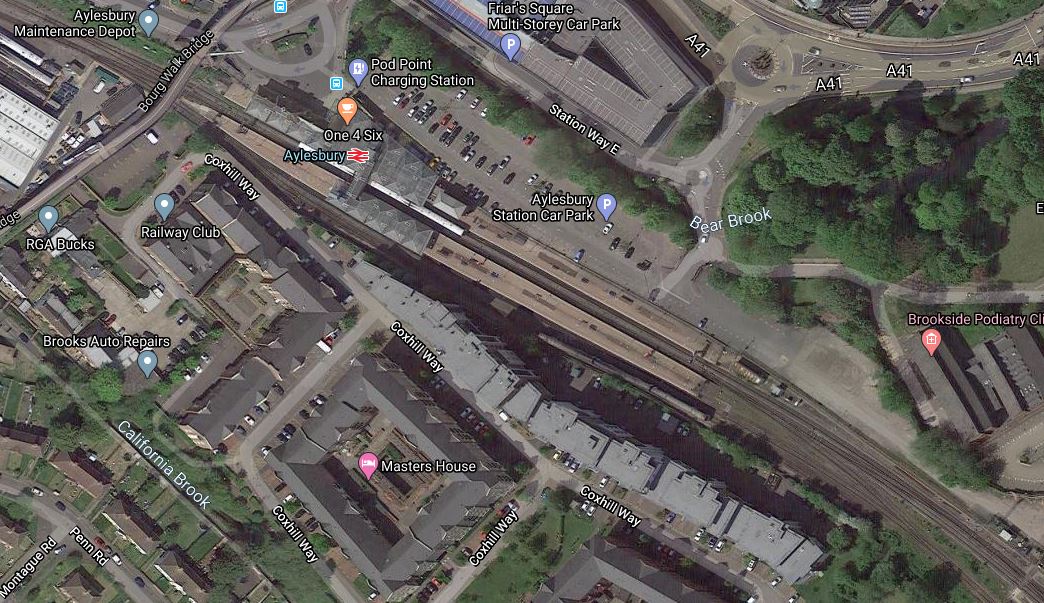
Note.
- Platforms are numbered 1 to 3 from South to North.
- Trains going South via High Wycombe call in Platforms 1 or 2.
- Trains going South via Amersham call in Platforms 2 and 3
- Trains going North call in Platforms 2 and 3.
These pictures show the station.

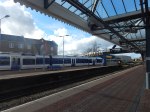
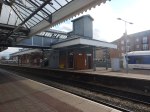
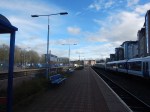
It is a spacious station, with step-free access and I feel that it could handle more services.
Banbury
I am sure that Banbury station, will be an important charging point for Chiltern’s battery-electric trains going North of Banbury.
This Google Map shows the layout of the recently-refurbished Banbury station.
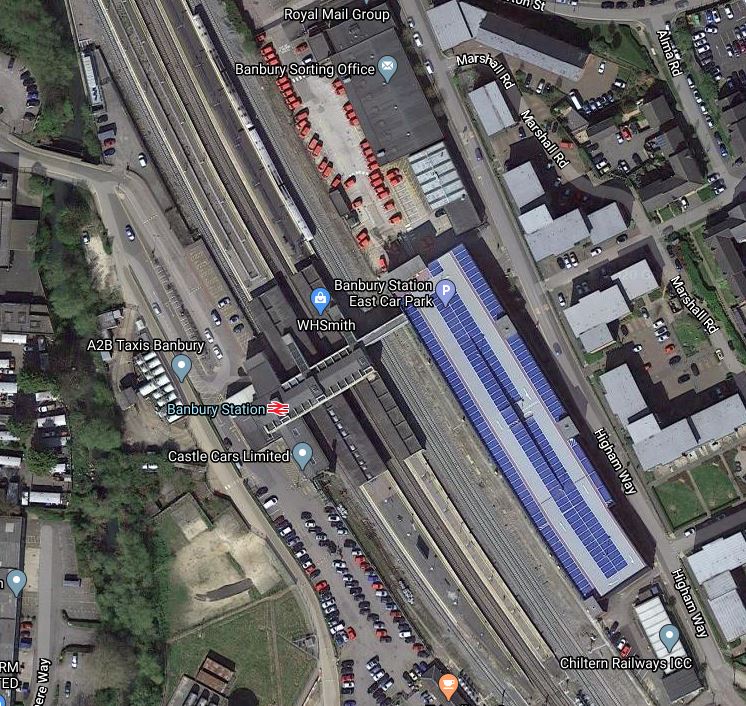
Note.
- Platforms are numbered 1 to 4 from West to East.
- Trains going North call in Platforms 1 or 2.
- Trains going South call in Platforms 3 or 4.
- The Marylebone and London service usually turns back in Platform 4 after waiting there for over half-an-hour.
- Northbound Stratford-upon-Avon services generally use Platform 1, but most others generally use Playform 2.
- Southbound Stratford-upon-Avon services generally use Platform 4, but most others generally use Playform 3.
It looks to me, that Banbury station could handle the charging of trains as they pass through, as all of Chiltern’s services that serve destinations to the North of Banbury, stop at the station.
Hitachi are saying, that one of their proposed battery-electric trains needs ten minutes to be fully-charged.
So there may need to be some adjustment to the time-table to lengthen the stops at Banbury, to give ten minutes of charging time.
Alternatively, a few miles of electrification could be centred on Banbury, perhaps between Aynho Junction and Leamington Spa, which is a distance of twenty-six miles, which takes one of Chiltern’s trains around twenty-three minutes.
This would surely give enough time to fully-charge the batteries, but would also benefit CrossCountry, if they should go the battery-electric route.
I have followed the route between Aynho Junction and Leamington Spa in my helicopter and it would appear to be a fairly straight and uncomplicated route. I would say, it is about as difficult to electrify, as the Midland Main Line between Bedford and Kettering/Corby, which appears to have been one of Hetwork Rail’s better electrification projects, which should be delivered on time and has been installed without too much disruption to trains and passengers.
High Wycombe
It looks to me, that High Wycombe station will be an important charging point for Chiltern’s battery-electric trains going North to Oxford and Banbury.
Unlike Banbury, High Wycombe has not seen many changes over the years.
This Google Map shows High Wycombe station.
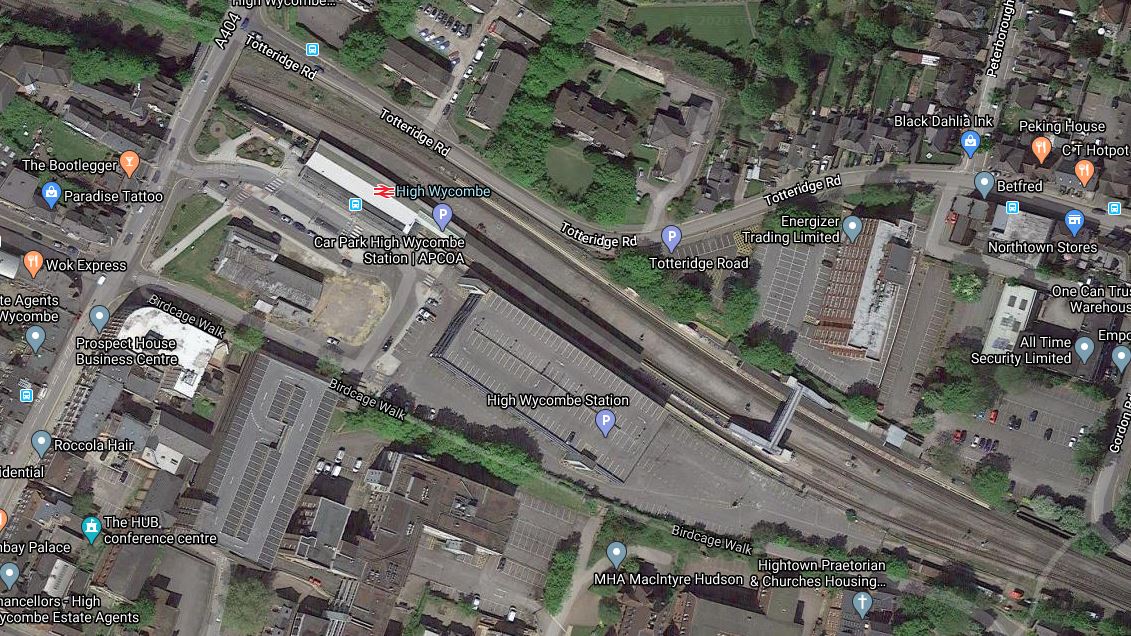
Note.
- Platforms are numbered 1 to 3 from South to North.
- Platform 1 is a bay platform that faces London.
- Platform 2 is the Westbound platform.
- Platform 3 is the Eastbound platform.
- High Wycombe has five tph in both directions, with an upgrade to six tph possible, after two tph run to the Cowley Branch.
The frequency of the trains through High Wycombe station could probably be handled by a Fast Charging system, but it would be tight to fit all current five services into an hour. It would appear to preclude any extra services going through High Wycombe, as there just isn’t enough time in an hour.
For this reason, I think that High Wycombe station needs full electrification, so that all passing trains can top up their batteries.
This gives the interesting possibility, that a train leaving High Wycombe for London with a full battery, would probably have enough charge in the battery to travel the 28 miles to London Marylebone and return. The train could always have a top-up at Marylebone.
So how far would the electrfication, through High Wycombe run?
Given that for operational reasons, it is probably best that pantographs are raised and lowered in stations, it is probably best if the various routes were electrified to the next station.
- The Chiltern Main Line route would be electrified as far as Banbury station, where all trains stop. The distance would be 41 miles.
- The Oxford route would be electrified as far as Bicester Village station, where all trains stop. The distance would be less than two miles from the Chiltern Main Line
- The Aylesbury route would be electrified as far as Princes Risborough station, where all trains stop. This would be included in the Chiltern Main Line electrification.
It looks to me, that just 43 miles of double-track electrification would enable Hitachi’s proposed battery-electric trains to reach all parts of the Chiltern network.
Distances of the various destinations from the electrification are as follows.
- Birmingham Moor Street – 43 miles
- Birmingham Snow Hill – 43 miles
- Kidderminster – 63 miles
- Marylebone – 28 miles
- Milton Keynes – 27 miles
- Oxford – 38 miles
- Oxford – Cowley – 43 miles
- Stratford-upon-Avon 35 miles
Only Kidderminster could be tricky, but not if the Snow Hill Lines are electrified through Birmingham.
Electrification of the Chiltern Main Line between High Wycombe and Banbury with a number of Fast Charging systems in selected stations, would be my preferred option of enabling Hitachi’s proposed battery-electric trains to work the Chiltern network.
These pictures show High Wycombe station.

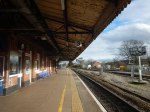


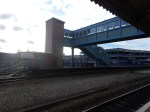
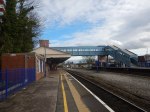
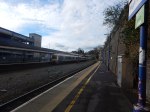
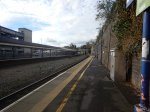
It does appear that the bridge at the Western end of the station my need to be modified, so that overhead wires can be threaded underneath.
Conclusion
Quite unexpectedly, I am pleasantly surprised.
Chiltern Railways’ current network can be run by Hitachi’s proposed battery-electric AT-300 trains.
- Fast charging systems will be needed at Aylesbury, Aylesbury Vale Parkway, Banbury, Birmingham Moor Street, Birmingham Snow Hill, Gerrards Cross, High Wycombe, Kidderminster, Marylebone, Milton Keynes and Oxford.
- Banbury and High Wycombe will need to be able to top-up trains as they pass through.
- No large scale electrification will be needed. Although any new electrification will be greatly accepted!
As I indicated earlier, I would electrify the core part of the Chiltern Main Line route between High Wycombe and Banbury.
It would probably be a good idea to electrify a few miles at the Southern end of the line, where it runs into Marylebone station.
- Marylebone and Harrow-on-the-Hill.
- Marylebone and West Ruislip
- Old Oak Common and West Ruislip.
I would use third-rail electrification to be compatible with London Underground and because of the automatic connection and disconnection.
But most surprisingly, there are already generous turnround times at most terminal stations, which give enough time to charge the trains.
It’s almost, as if Chiltern are preparing for battery-electric trains.
 The Anonymous Widower