Alstom Coradia iLint Passes Tests
The title of this post is the same as that of this article on Railway Age.
This is the first paragraph.
Alstom has performed 10 days of tests of the Coradia iLint hydrogen fuel cell train—the world’s first passenger train powered by hydrogen fuel cells—on the 65-kilometer line between Groningen and Leeuwarden to the north of the Netherlands.
These details of the tests were given.
- No passengers were carried.
- The tests were done at night.
- A mobile filling station was used.
- The train ran up to a speed of 140 kph.
As green hydrogen was used, the tests were zero carbon.
The Test Route
This map clipped from Wikipedia, shows the Groningen and Leeuwarden route, used for the tests.
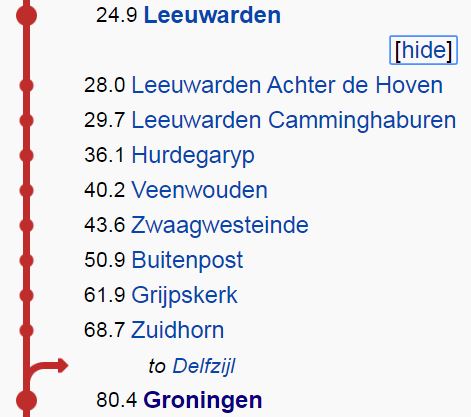
Note.
- It appears to be only single-track.
- It is roughly 65 kilometres long.
- There are eight intermediate stops.
Checking the timetable, the service seems to be two or three trains per hour (tph)
Hydrogen Trains Could Go All The Way To Germany
In From Groningen To Leer By Train, I took a train and a bus from Groningen in The Netherlands to Leer in Germany and eventually on to Bremen Hbf. The route is not complete at the moment, as a freighter demolished the rail bridge.
Once the bridge is rebuilt, a hydrogen-powered train, which could also use the catenary in the area could travel from West of Leeuwarden to possibly as far as Bremen and Hamburg.
It is interesting to note, that Alstom’s hydrogen-powered trains for the UK, which are called Breeze and are currently being converted from British Rail-era Class 321 electric trains, will not lose their ability to use the overhead electrification.
A train with that dual capability would be ideal for the Dutch and German rail network in this area, which is partially electrified.l
Northern’s Hydrogen Plans
The title of this post, is half of the title of an article in the March 2020 Edition of Modern Railways.
I discussed Northern’s possible hydrogen trains in Fuelling The Change On Teesside Rails.
This new article gives a lot more detail in this paragraph.
Northern has submitted planning documents, with the preferred site for a maintenance and fuelling facility understood to be at Lackenby. As hydrogen units would have a more limited operating range than DMUs (around 600 miles), they would likely need to return to the depot every night. Northern believes the routes radiating from Middlesbrough to Nunthorpe, Bishop Auckland and Saltburn are ideal candidates for the operation, as they are unlikely to be electrified and can be operated as a self contained network using hydrogen trains. A fleet of around a dozen Breeze units is planned, with the possibility they could also operate services to Whitby and on the Durham Coast Line to Newcastle. Planning documentation suggested the first hydrogen train would be ready for testing in June 2021, but this was based on construction of the depot facility beginning in January this year.
It all sounds very comprehensive.
Capacity Comparison With The iLint
The Modern Railways article says this about the capacity of the Breeze.
A three-car Breeze is expected to have a similar passenger capacity to a two-car DMU.
A two-car Class 156 train, which currently work the lines around Middlesbrough, was built with 163 seats and the Lint 54, on which the iLint is based, has between 150 and 180 seats.
It will be interesting to see how actual seat numbers compare between the Breeze and iLint.
First Hydrogen Train Arrives In The Netherlands
The title of this post is the same as that on this article of Railway News.
This is the introductory paragraph.
On 26 February the first hydrogen train arrived in the Netherlands. The Dutch rail infrastructure manager ProRail led the train into the country from Germany via Oldenzaal and then ran it on track to its provisional parking facility in Leeuwarden.
The article also says this.
The public will also have the chance to view the hydrogen train on 7 March, when it will be at Groningen Station between noon and 4pm.
I won’t be going, as I’ve ridden the train in Germany as I reported in My First Ride In An Alstom Coradia iLint.

These trains are technology demonstrators at best and greenwash at worst.
Hydrogen power needs a radical new design of train and not a quick rehash of an existing design.
The problem is that the Coradia iLint is based on a diesel mechanical train and it has a lot of transmission noise.
You get less noise and vibration in the average British-Rail era diesel multiple unit like a Class 156 train. But then these are diesel hydraulic, have steel-bodies and built thirty years ago.
When I first saw the iLint, I looked for the pantograph, as these trains run on partially-electrified lines and hydrogen-powered trains are effectively electric trains with a different source of electricity.
To be fair to Alstom, their development of the hydrogen-powered Class 321 Breeze, will also be able to use a pantograph, but as this visualisation shows, the hydrogen tanks take up a lot of space.
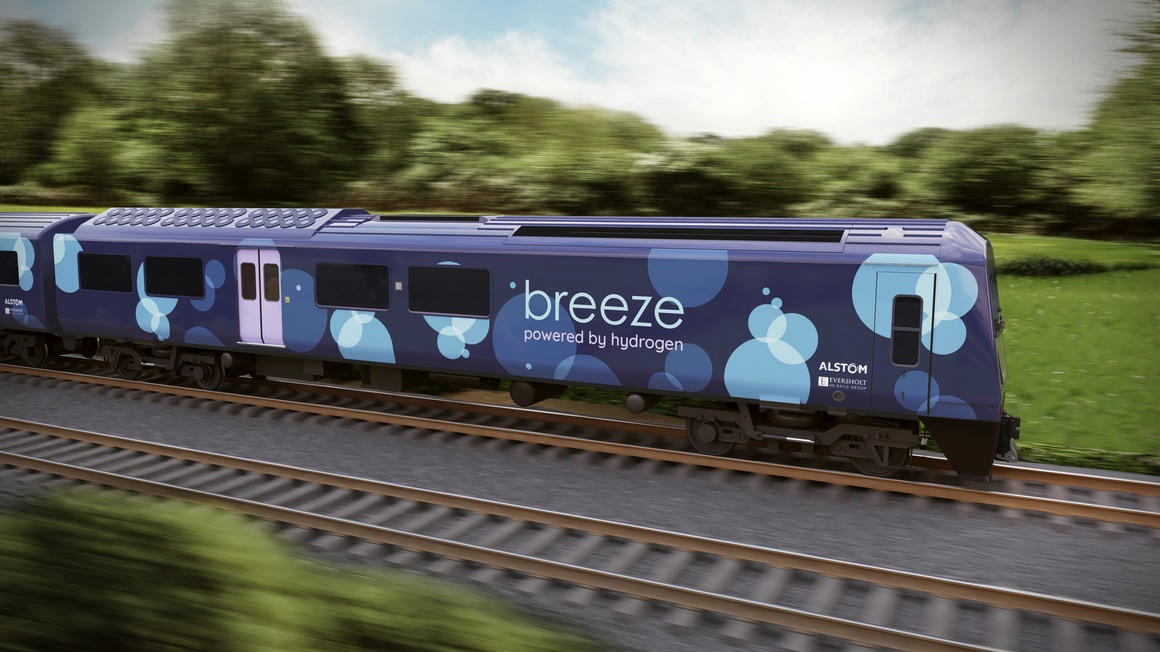
Hydrogen might find itself a place on the railways, but I suspect that battery-electric will always be better for passenger trains.
- Battery technology will improve faster than hydrogen technology.
- Innovators will find better ways of fast-charging trains.
- A battery-electric train will match the daily range of a hydrogen-powered train, using innovative dynamic charging.
- Many modern electric trains can be converted into battery-electric ones.
- As the Class 379 BEMU trial, this conversion can be relatively easy, quick and successful.
I suspect though, the mathematics will be different for freight locomotives.
Mule Trains Between Liverpool And Norwich
I have done two trips to Liverpool in the last week.
On Saturday, I saw this collection of one-car Class 153 trains with a two-car Class 156 train thrown in.

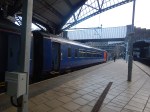
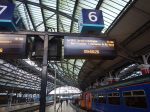
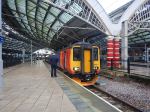


They were forming one of East Midlands Railway‘s Liverpool and Norwich services.
And then yesterday, I had to travel between Liverpool and Sheffield and this was the collection of trains that took me.
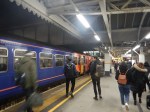
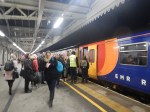


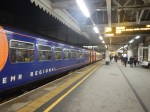
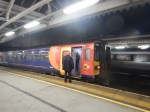
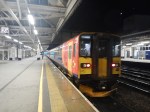
So what was it like?
It started badly, with the driver announcing that because of the late arrival due to an undisclosed problem with the incoming train, that we would be leaving ten minutes after the planned departure time of 1551. He also indicated that our late departure meant that we would be stuck behind one of Northern’s services.
In the end, despite the gloomy faces of passengers we left twelve minutes late at 1603.
It was a bit like one of those classic films, where an ancient train escapes in the nick of time, with a lot of important and assorted passengers.
The asthmatic Cummins diesels under the train could be heard straining.
- But the driver was at the top of his game and the train was running smoothly towards Manchester at close to 75 mph, which is the maximum speed of a Class 153 train.
- At Manchester Piccadilly, the driver had pulled back two minutes.
- There were obviously, no problems on the Dove Valley Line and the driver pulled back another minute before Sheffield, to arrive nine minutes late.
Looking at Real Time Trains, the train ran well until March (The place, not the month!), but there was some form of delay there and sadly it was thirty-four minutes late into Norwich.
The Train Was Clean
I should say there was nothing wrong with the train except for its design and age. It was also as clean as you can get one of these trains. The toilet, that I used was better than many I’ve used on trains and worked as it should.
Customer Service
East Midlands Railway had loaded a trolley and a steward and in the two hours I was on the train, he came through twice. The only problem for me, that he had no card machine, but I did find a fiver in my briefcase.
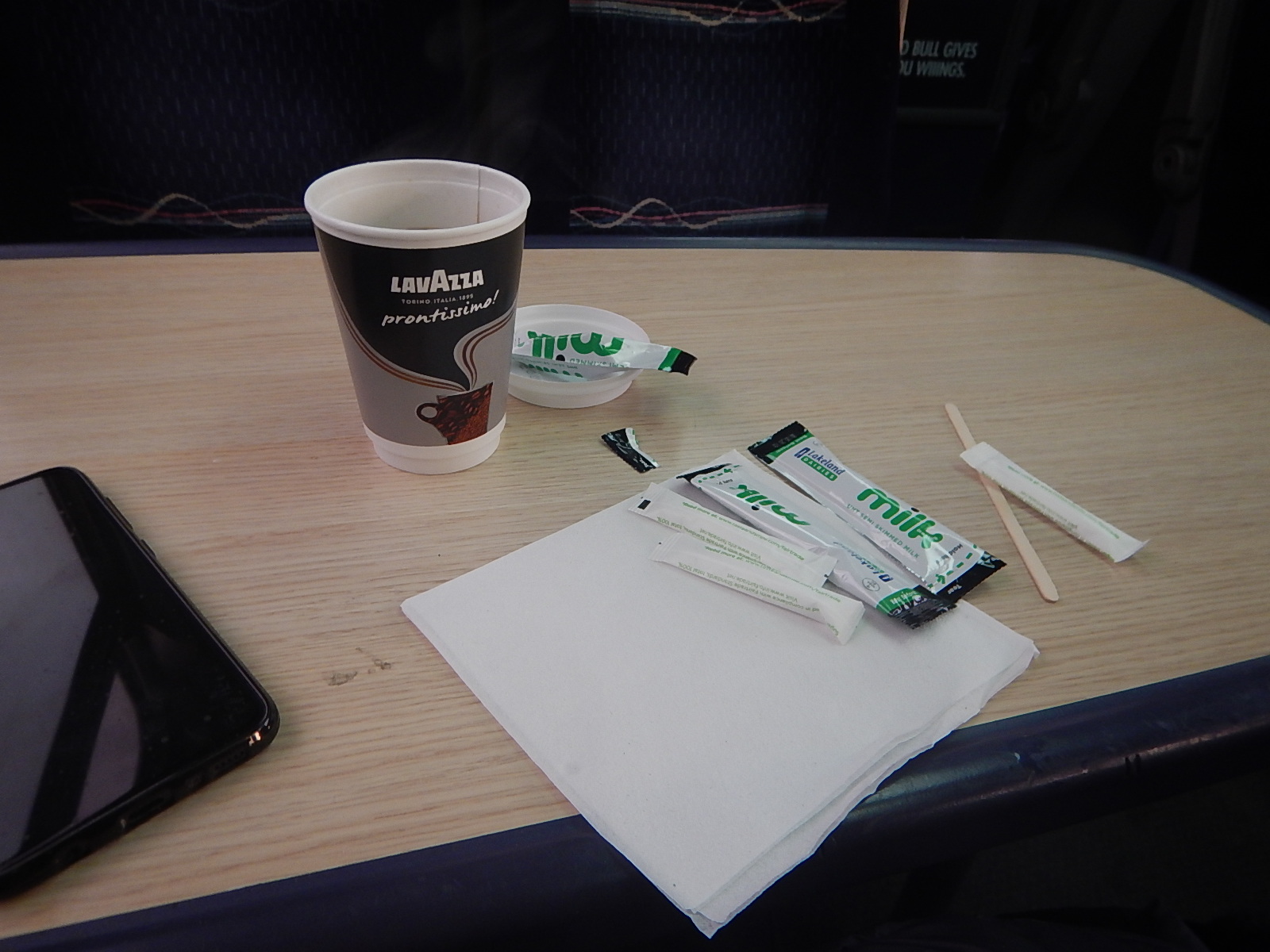
At least it was very drinkable. Even, if I hate those plastic tubs of milk, as they are difficult to open with one good hand.
Where Did Two Cars Go?
I had been fairly certain, that we had started with six cars, but we only arrived in Sheffield with four Class 153 trains.
I suspect that the trouble that delayed the train, concerned two cars and these were left on the naughty step or the end of Platform 6 in Liverpool Lime Street station.
Being Fair To East Midlands Railway
This service used to be run by a four-car formation of two-car Class 158 trains, but these have been causing trouble lately and they will be replaced by Class 170 trains cascaded from other operators.
But because of late arrivals of new trains the much better Class 170 trains haven’t arrived yet.
The driver, steward and other staff did a good job and I feel that the steward enjoyed it. No-one was abusive and stories were just exchanged, as we climbed across the Pennines in what by Sheffield was a very crowded train.
Class 153 trains may have been built as a stop-gap for short branch lines, but you couldn’t fault their performance.
Unless of course, one caused the delay at March, by expiring in a cloud of blue smoke.
Other Observations
These are other observations.
Scheduled Journey Times
On my journey the scheduled times were
- Liverpool and Manchester Oxford Road – forty-seven minutes.
- Liverpool and Sheffield – one hour and forty-eight minutes.
- Liverpool and Nottingham – two hour and forty minutes.
- Liverpool and Norwich – Five hours and twenty-seven minutes
The train considering the configuration, nearly achieved them.
It’s probably the motoring equivalent of doing the journey in a Morris Minor!
The Nine Stops Were Executed Perfectly
There were nine stops on my journey and eight took less than a minute, with Sheffield taking four, as the driver and crew changed.
A modern train like a Class 755 train, with fast acceleration and level boarding could probably save up to three minutes a time on each stop.
The Route Is A Genuine 75 mph Railway In Good Condition
I was checking the speed of the train on parts of the route and the driver had his motley crew at a steady 75 mph for long periods.
- The train was riding well, indicating to me, that both trains and track were in reasonably good condition.
- Note that 75 mph is the maximum speed of a Class 153 train.
- The train recovered three minutes on the late departure from Liverpool.
I can see a faster train and improvements to the route, some of which are underway, could reduce the journey time by a few minutes.
Could Merseyrail’s New Class 777 Trains Work To The Bay Platform At Oxford Road?
Merseyrail’s new Class 777 trains will have the following performance.
- A possible range of perhaps 40-50 miles on battery power.
- An operating speed of 75 mph.
- An acceleration rate of 1.1 m/sec², which is faster than a Class 153 or Class 170 train.
- Fast stops due to regenerative braking, fast acceleration and level boarding.
As Liverpool Lime Street to Oxford Road is thirty four miles of which nine is electrified, I suspect that these new trains could extend Merseyrail’s Northern Line service from Hunts Cross to Manchester Oxford Road.
- Two trains per hour (tph), but I’m sure four tph would transform the area.
- I doubt any track modifications would be needed.
But would Liverpool and Manchester be able to sort out the local politics?
The Future Of The Liverpool And Norwich Service
This service will probably be spilt into two services.
- Liverpool Lime Street and Derby, which could be run by TransPennine Express or Northern Trains.
- Derby and Norwich, which would be run by East Midlands Railway.
As to the trains to be used, consider the following.
The Liverpool and Derby leg would probably need six trains, with the same number needed for Derby and Norwich, or twelve in total.
Currently, eleven or twelve is needed for the longer service.
Sections of the route like through Manchester and between Grantham and Peterborough are electrified.
There are even sections of route, where 125 mph running is possible.
Run reliably to an hourly frequency, I think that this service could attract passengers, especially, as it would serve Derby and extra stops like Ilkeston and Warrington West could be added.
This leads to the following trains being possibilities.
Class 802 trains – 125 mph bi-mode train of which TransPennine Express have 19 trains.
Class 185 trains – 100 mph diesel train of which TransPennine Express have 51 trains.
Class 810 trains – 125 mph bi-mode train of which East Midlands Railway have ordered 33 trains.
Class 755 trains – 100 mph diesel train of which Greater Anglia have 38 trains, which are based at Norwich.
Alstom Breeze hydrogen trains could be ideal for Liverpool and Derby.
Note.
- Greater Anglia and East Midlands Railway are both subsidiaries of Abellio.
- Developments of Class 755 trains could include battery and hydrogen versions.
- I suspect that 125 mph trains may be required for both legs, to maximise capacity on the East Coast Main Line and Midland Main Line.
The trains will certainly get better.
Fuelling The Change On Teesside Rails
The title of this post, is the same as that of an article in Edition 895 of RAIL Magazine.
The article is based on an interview with Ben Houchen, who is the Tees Valley Mayor.
Various topics are covered.
Hydrogen-Powered Local Trains
According to the article, the Tees Valley produces fifty percent of UK hydrogen and the area is already secured investment for fuelling road vehicles with hydrogen.
So the Tees Valley Combined Authority (TVCA) is planning to convert some routes to hydrogen.
The Trains
Ten hydrogen-powered trains will be purchased or more likely leased, as the trains will probably be converted from redundant electrical multiple units, owned by leasing companies like Eversholt Rail and Porterbrook.
- Eversholt Rail and Alstom are developing the Breeze from Class 321 trains.
- Porterbrook and Birmingham University are developing the HydroFLEX from Class 319 trains.
The RAIL article says that the first train could be under test in 2021 and service could be started in 2022.
That would certainly fit the development timetables for the trains.
Lackenby Depot
A depot Will Be Created At Lackenby.
- The site is between Middlesbrough and Redcar.
- It already has rail and hydrogen connections.
This Google Map shows the area.
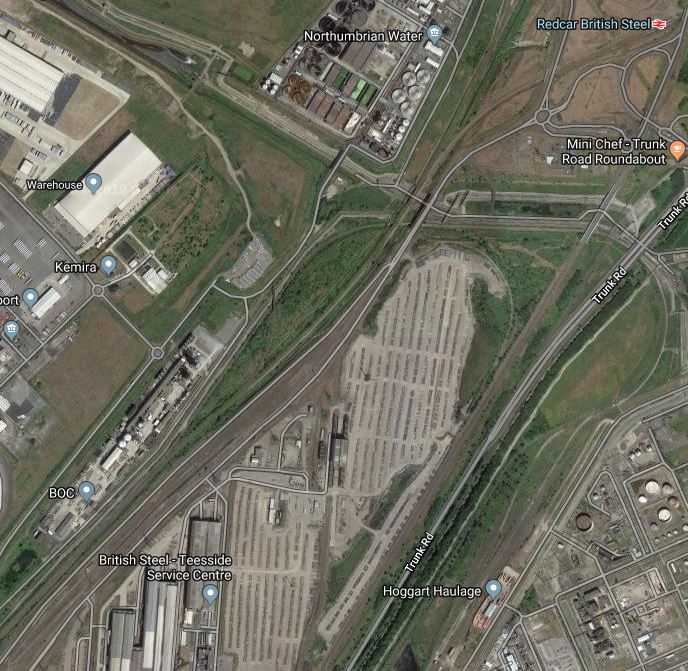
Note the disused Redcar British Steel station, which is still shown on the map.
I remember the area from the around 1970, when I used to catch the train at the now-closed Grangetown station, after visits to ICI’s Wilton site. It was all fire, smoke, smells and pollution.
Darlington Station
Darlington station will also be remodelled to allow more services to operate without conflicting with the East Coast Main Line.
Wikipedia says this under Future for Darlington station.
As part of the Tees Valley Metro, two new platforms were to be built on the eastern edge of the main station. There were to be a total of four trains per hour, to Middlesbrough and Saltburn via the Tees Valley Line, and trains would not have to cross the East Coast Main Line when the new platforms would have been built. The Tees Valley Metro project was, however, cancelled.
It does sound from reading the RAIL article, that this plan is being reinstated.
Would services between Bishop Auckland and Saltburn, use these new platforms?
Saltburn And Bishops Auckland Via Middlesbrough and Darlington
Currently, the service is two trains per hour (tph) between Saltburn and Darlington, with one tph extending to Bishop Auckland.
- I estimate that the current service needs five trains.
- If a two tph service were to be run on the whole route, an extra train would be needed.
- I suspect, the limitations at Darlington station, stop more trains being run all the way to Bishops Auckland.
I could also see extra stations being added to this route.
The Mayor is talking of running a service as frequent as six or eight tph.
These numbers of trains, will be needed for services of different frequencies between Saltburn and Darlington.
- 2 tph – 6 trains
- 4 tph – 12 trains
- 6 tph – 18 trains
- 8 tph – 24 trains
As the London Overground, Merseyrail and Birmingham’s Cross-City Line, find four tph a more than adequate service, I suspect that should be provided.
After updating, Darlington station, should be able to handle the following.
- Up to six tph terminating in one of the new Eastern platforms, without having to cross the East Coast Main Line.
- Two tph between Saltburn and Bishops Auckland could use the other platform in both directions.
I would suspect that the design would see the two platforms sharing an island platform.
Alternatively, trains could continue as now.
- Terminating trains could continue to use Platform 2!
- Two tph between Saltburn and Bishops Auckland stopping in Platforms 1 (Eastbound) and 4 (Westbound)
This would avoid any infrastructure changes at Darlington station, but terminating trains at Darlington would still have to cross the Southbound East Coast Main Line.
If the frequencies were as follows.
- 4 tph – Saltburn and Darlington
- 2 tph – Saltburn and Bishop Auckland
This would require fourteen trains and give a six tph service between Saltburn and Darlington.
Ten trains would allow a two tph service on both routes.
There would be other services using parts of the same route, which would increase the frequency.
Hartlepool And The Esk Valley Line Via Middlesbrough
This is the other route through the area and was part of the cancelled Tees Valley Metro.
- Service is basically one tph, with six trains per day (tpd) extending to Whitby.
- A second platform is needed at Hartlepool station.
- There is a proposal to add a Park-and-Ride station between Nunthorpe and Great Ayton stations.
- One proposal from Modern Railways commentator; Alan Williams, was to simplify the track at Battersby station to avoid the reverse.
- Currently, trains between Whitby and Middlesbrough are timetabled for around 80-100 minutes.
- Hartlepool and Middlesbrough takes around twenty minutes.
Substantial track improvements are probably needed to increase the number of trains and reduce the journey times between Middlesbrough and Whitby.
But I believe that an hourly service between Hartlepool and Whitby, that would take under two hours or four hours for a round trip, could be possible.
This would mean that the hourly Hartlepool and Whitby service would need four trains.
Providing the track between Nunthorpe and |Whitby could be improved to handle the traffic, this would appear to be a very feasible proposition.
Nunthorpe And Hexham Via Newcastle
There is also an hourly service between Nunthorpe and Hexham, via Middlesbrough, Stockton, Hartlepool, Sunderland and Newcastle, there would be two tph.
- It takes around two hours and twenty minutes.
- I estimate that five trains would be needed for the service.
- I travelled once between Newcastle and James Cook Hospital in the Peak and the service was busy.
- A new station is being built at Horden, which is eight minutes North of Hartlepool.
- The service could easily access the proposed fuelling station at Lackenby.
- It would reduce carbon emissions in Newcastle and Sunderland stations..
Surely, if hydrogen power is good enough for the other routes, then it is good enough for this route.
Hartlepool Station
Hartlepool Station could become a problem, as although it is on a double track railway, it only has one through platform, as these pictures from 2011 show.

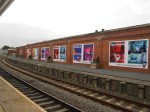
Consider.
- There is no footbridge, although Grand Central could pay for one
- There is a rarely-used bay platform to turn trains from Middlesbrough, Nunthorpe and Whitby.
This Google Map shows the cramped site.
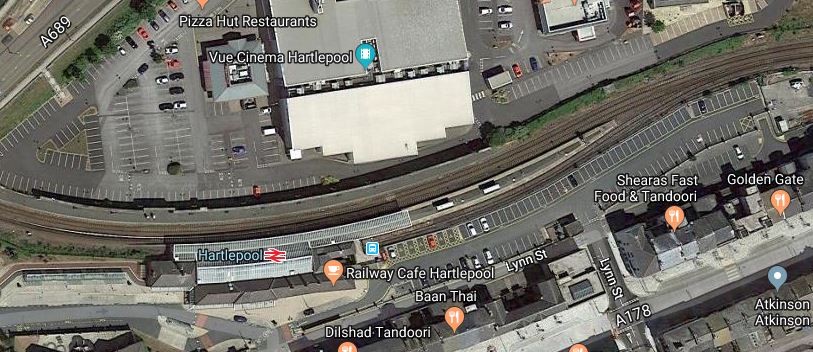
The final solution could mean a new station.
Nunthorpe Park-And-Ride
This Google Map shows Nunthorpe with thje bEsk Valley Line running through it.
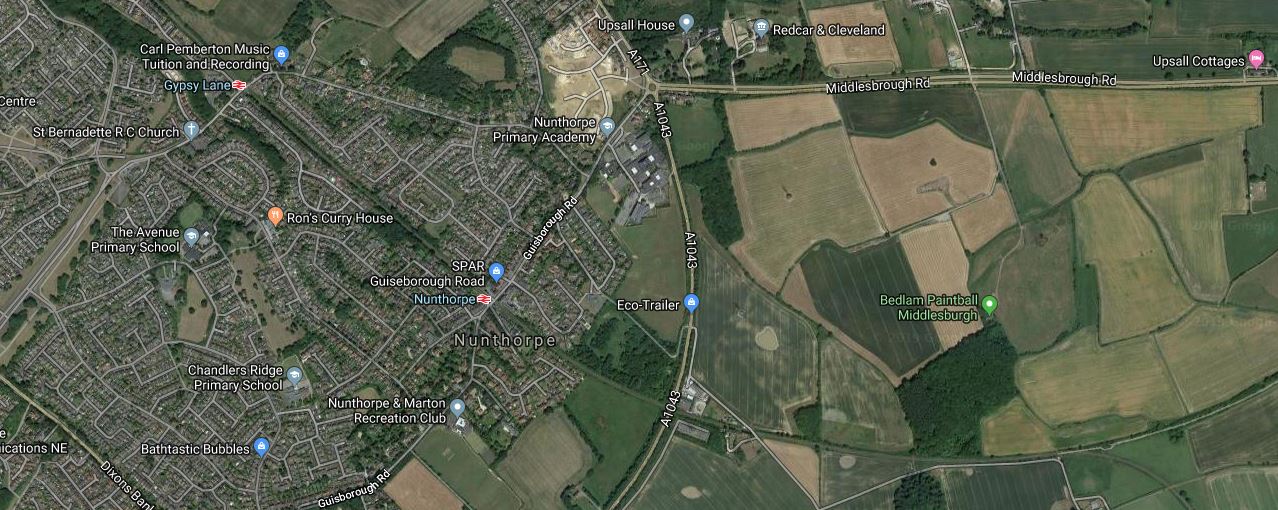
Note.
- Gypsy Lane and Nunthorpe stations.
- The dual-carriageway A171 Guisborough by-pass running East-West, that connects in the East to Whitby and Scarborough.
- The A1043 Nunthorpe by-pass that connects to roads to the South.
Would where the A1043 crosses the Esk Valley Line be the place for the Park-and-Ride station?
The new station could have a passing loop, that could also be used to turn back trains.
Battersby Station
Alan Williams, who is Chairman of the Esk Valley Railway Development Company, is quoted in the RAIL article as saying.
If you’re going to spend that sort of money we’d much rather you spent it on building a curve at Battersby to cut out the reversal there.
Williams gives further reasons.
- Battersby is the least used station on the line.
- It’s in the middle of nowhere.
- The curve would save five minutes on the overall journey.
This Google Map shows Battersby station and the current track layout.

Note.
- The line to Middlesbrough goes through the North-West corner of the map.
- The line to Whitby goes through the North-East corner of the map.
There would appear to be plenty of space for a curve that would cut out the station.
LNER To Teesside
LNER, the Government and the TVCA are aiming to meet a target date of the Second Quarter of 2021 for a direct London and Middlesbrough service.
Middlesbrough Station
Middlesbrough Station will need to be updated and according to the RAIL article, the following work will be done.
- A new Northern entrance with a glass frontage.
- A third platform.
- Lengthening of existing platforms to take LNER’s Class 800 trains.
This Google Map shows the current layout of the station.
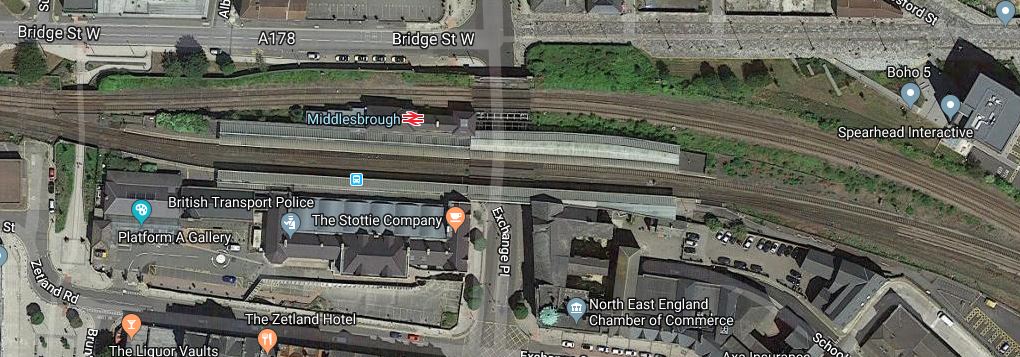
From this map it doesn’t look to be the most difficult of stations, on which to fit in the extra platform and the extensions.
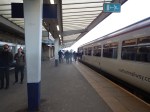
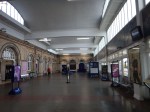
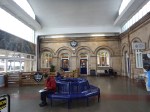



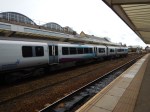
It should also be noted that the station is Grade II Listed, was in good condition on my last visit and has a step-free subway between the two sides of the station.
Journey Times
I estimate that a Kings Cross and Middlesbrough time via Northallerton would take aroud two hours and fifty minutes.
This compares with other journey times in the area to London.
- LNER – Kings Cross and Darlington – two hours and twenty-two minutes
- Grand Central – Kings Cross and Eaglescliffe – two hours and thirty-seven minutes.
I also estimate that timings to Redcar and Saltburn would be another 14 and 28 minutes respectively.
Frequencies
Currently, LNER run between three and four tph between Kings Cross and Darlington, with the competing Grand Central service between Kings Cross and Eaglescliffe having a frequency of five trains per day (tpd).
LNER have also started serving secondary destinations in the last month or so.
- Harrogate, which has a population of 75.000, is served with a frequency of six tpd.
- Lincoln, which has a population of 130,000 is now served with a frequency of six tpd.
Note that the RAIL article, states that the Tees Valley has a population of 750,000.
I feel that Middlesbrough will be served by a frequency of at least five tpd and probably six to match LNER’s new Harrogate and Lincoln services.
Will LNER’s Kings Cross and York Service Be Extended To Middlesbrough?
Cirrently , trains that leave Kings Cross at six minutes past the hour end up in Lincoln or York
- 0806 – Lincoln
- 0906 – York
- 1006 – Lincoln
- 1106 – York
- 1206 -Lincoln
- 1306 – York
- 1406 – Lincoln
- 1506 – York
- 1606 – Lincoln
- 1906 -Lincoln
It looks to me that a pattern is being developed.
- Could it be that the York services will be extended to Middlesbrough in 2021?
- Could six Middlesbrough trains leave Kings Cross at 0706, 0906, 1106, 1306, 1506 and 1706 or 1806?
- York would still have the same number of trains as it does now!
LNER certainly seem to be putting together a comprehensive timetable.
Could Middlesbrough Trains Split At Doncaster Or York?
I was in Kings Cross station, this afternoon and saw the 1506 service to York, go on its way.
The train was formed of two five-car trains, running as a ten-car train.
If LNER employ spitting and joining,, as some of their staff believe, there are surely, places, where this can be done to serve more destinations, without requiring more paths on the East Coast Main Line.
- Splitting at Doncaster could serve Hull, Middlesborough and York.
- Splitting at York could serve Scarborough, Middlesborough and Sunderland.
Scarborough might be a viable destination, as the town has a population of over 100,000.
Onward To Redcar And Saltburn
One of the changes in the December 2019 timetable change, was the extension of TransPennine Express’s Manchester Airport and Middlesbrough service to Redcar Central station.
The RAIL article quotes the Mayor as being pleased with this, although he would have preferred the service to have gone as far as Saltburn, which is a regional growth point for housing and employment.
But the extra six miles would have meant the purchase of another train.
Redcar Central Station
This Google Map shows Redcar Central station and its position in the town.
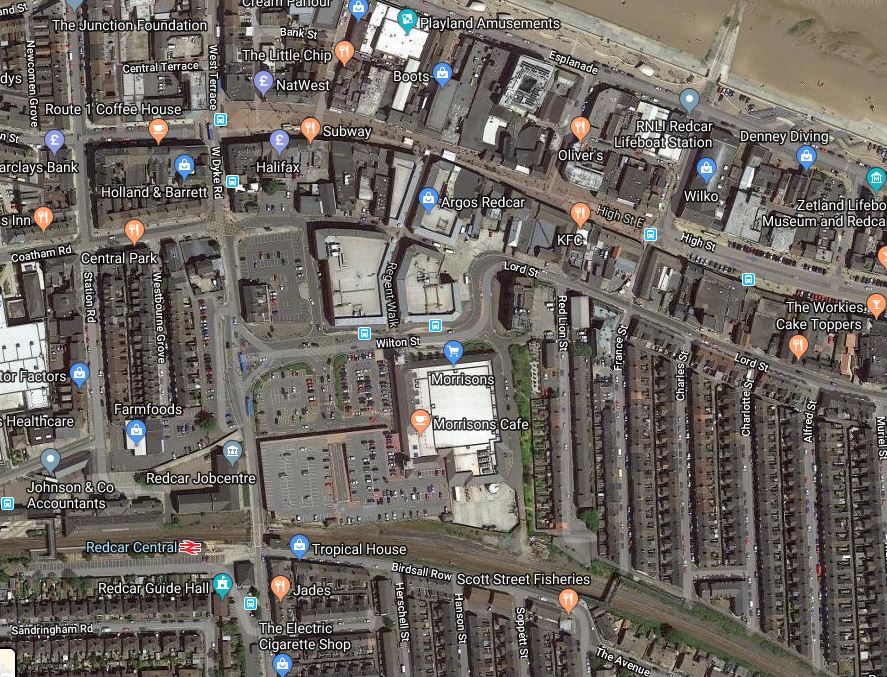
It is close to the sea front and the High Street and there appears to be space for the stabling of long-distance trains to Manchester Airport and perhaps, London.
TransPennine seem to be using their rakes of Mark 5A coaches on Redcar services, rather than their Class 802 trains, which are similar to LNER’s Azumas.
Surely, there will be operational advantages, if both train operating companies ran similar trains to Teesside.
Saltburn Station
Saltburn station is the end of the line.
This Google Map shows its position in the town.
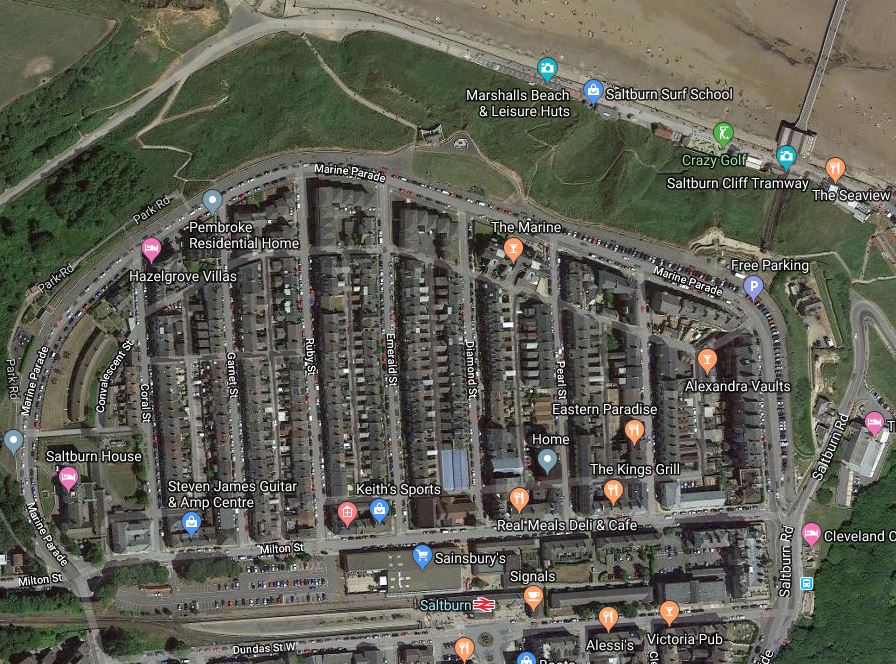
Unlike Redcar Central station, there appears to be very little space along the railway and turning back trains might be difficult.
There may be good economic reasons to use Saltburn as a terminal, but operationally, it could be difficult.
Will Redcar And Saltburn See Services To and From London?
Given that both towns will likely see much improved services to Middlesbrough, with at least a service of four tph, I think it will be unlikely.
But we might see the following.
- LNER using Redcar as a terminus, as TransPennine Express do, as it might ease operations.
- An early morning train to London and an evening train back from the capital, which is stabled overnight at Redcar.
- TransPennine Express using Class 802 trains on their Redcar service for operational efficiency, as these trains are similar to LNER’s Azumas.
It would all depend on the passenger numbers.
A High-Frequency Service Between York And Teesside
After all the changes the service between York and Teesside will be as follows.
- LNER will be offering a train virtually every two hours between York and Middlesbrough.
- Grand Central will be offering a train virtually every two hours between York and Eaglescliffe, which is six miles from Middlesbrough.
- TransPennine Express will have an hourly service between York and Redcar via Middlesbrough.
- There will be between three and four tph between York and Darlington.
All services would connect to the hydrogen-powdered local services to take you all over Teesside.
Could this open up tourism without cars in the area?
Expansion Of The Hydrogen-Powered Train Network
Could some form of Hydrogen Hub be developed at Lackenby.
Alstom are talking of the hydrogen-powered Breeze trains having a range of over six hundred miles and possibly an operating speed of 100 mph, when using overhead electrification, where it is available.
In Breeze Hydrogen Multiple-Unit Order Expected Soon, I put together information from various articles and said this.
I am fairly certain, that Alstom can create a five-car Class 321 Breeze with the following characteristics.
- A capacity of about three hundred seats.
- A smaller three-car train would have 140 seats.
- A near-100 mph top speed on hydrogen-power.
- A 100 mph top speed on electrification.
- A 1000 km range on hydrogen.
- Regenerative braking to an on-board battery.
- The ability to use 25 KVAC overhead and/or 750 VDC third rail electrification.
The trains could have the ability to run as pairs to increase capacity.
The distance without electrification to a selection of main stations in the North East from Lackenby is as follows.
- Newcastle via Middlesbrough and Darlington – 21 miles
- Newcastle via Middlesbrough and Durham Coast Line – 53 miles.
- York via Northallerton – 27 miles
- Doncaster via Northallerton and York – 27 miles
- Leeds via Northallerton and York – 52 miles
- Sheffield via Northallerton, York and Doncaster – 45 miles
I am assuming that the trains can use the electrification on the East Coast Main Line.
From these figures it would appear that hydrogen-powered trains stabled and refuelled at Lackenby could travel to Doncaster, Newcastle, Leeds, Sheffield or York before putting in a days work and still have enough hydrogen in the tank to return to Lackenby.
Several things would help.
- As hydrogen-powered trains have a battery, with a battery range of thirty miles all these main stations could be reached on battery power, charging on the East Coast Main Line and at Lackenby.
- Electrification between Darlington and Lackenby.
- Electrification between Northallerton and Eaglescliffe.
I am fairly certain that a large proportion of the intensive network of diesel services in the North East of |England from Doncaster and Sheffield in the South to Newcastle in the North, can be replaced with hydrogen-powered trains.
- Trains could go as far West as Blackpool North, Carlisle, Manchester Victoria, Preston and Southport.
- Refueling could be all at Lackenby, although other refuelling points could increase the coverage and efficieny of the trains.
- Green hydrogen could be produced by electrolysis from the massive offshore wind farms off the Lincolnshire Coast.
- Hydrogen-powered trains would be ideal for re-opened routes like the proposed services from Newcastle to Blyth and Ashington.
The hydrogen-powered trains on Teesside could be the start of a large zero-carbon railway network.
The Alstom Breeze And The HydroFlex Would Only Be The Start
As I said earlier, the initial trains would be conversions of redundant British Rail-era electrical multiple units.
Thirty-year-old British Rail designs like the Class 319 and Class 321 trains based on the legendary Mark 3 carriages with its structural integrity and superb ride, may have been state-of-the-art in their day, but engineers can do better now.
- Traction and regenerative braking systems are much more energy efficient.
- Train aerodynamics and rolling resistance have improved, which means less energy is needed to maintain a speed.
- Interior design and walk-through trains have increased capacity.
- Crashworthiness has been improved.
Current Bombardier Aventras, Stadler Flirts or Siemens Desiros and CAF Civities are far removed from 1980s designs.
I can see a design for a hydrogen-powered train based on a modern design, tailored to the needs of operators being developed.
A place to start could be an electric CAF Class 331 train. or any one of a number of Aventras.
- From the visualisation that Alstom have released of their Breeze conversion of a Class 321 train, I feel that to store enough hydrogen, a large tank will be needed and perhaps the easiest thing to do at the present time would be to add an extra car containing the hydrogen tank, the fuel cells and the batteries.
- Alstom have stated they’re putting the fuel cells on the roof and the batteries underneath the train.
Although, it is not a hydrogen train, Stadler have developed the Class 755 train, with a power car in the middle of the train.
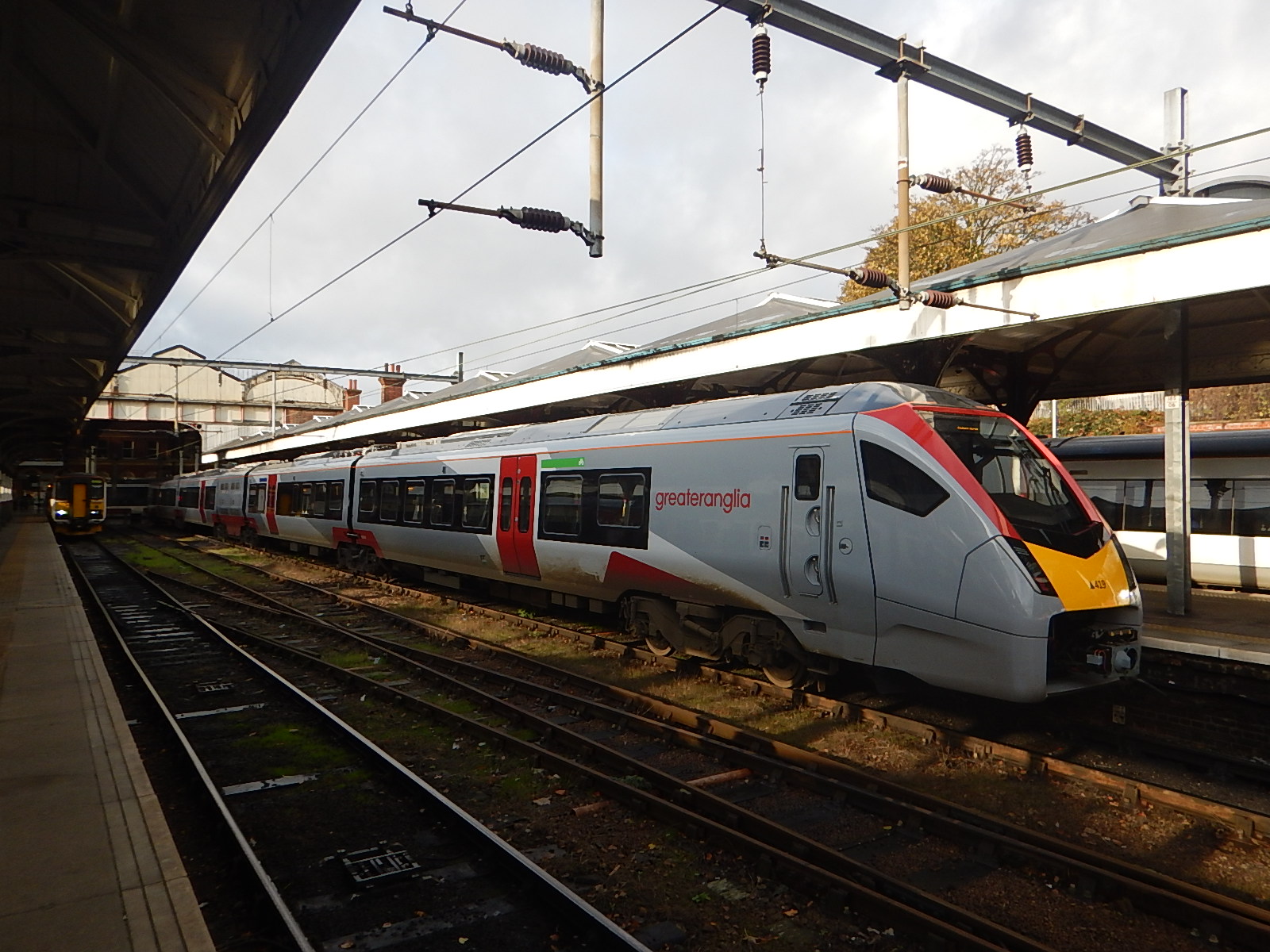
Stadler’s approach of a power car, must be working as they have received an order for a hydrogen-powered version of their popular Flirts, which I wrote about in MSU Research Leads To North America’s First Commercial Hydrogen-Powered Train.
I think we can be certain, that because of the UK loading gauge, that a hydrogen-powered train will be longer by about a car, than the equivalent electric train.
I can see a certain amount of platform lengthening being required. But this is probably easier and less costly than electrification to achieve zero-carbon on a route.
Batteries can be distributed under all cars of the train, anywhere there is space., But I would suspect that fuel cells must be in the same car as the hydrogen tank, as I doubt having hydrogen pipes between cars would be a good idea.
Alstom have resorted to putting hydrogen tanks and fuel cells in both driving cars and they must have sound reasons for this.
Perhaps, it is the only way, they can get the required power and range.
As I understand it, the Alstom Breeze draws power from three sources.
- The electrification if the route is electrified.
- The electricity generated by regenerative braking.
- The hydrogen system produces electricity on demand, at the required level.
Energy is stored in the batteries, which power the train’s traction motors and internal systems.
The electrical components needed for the train are getting smaller and lighter and I feel that it should be possible to put all the power generation and collection into a power car, that is somewhere near the middle of the train. Stadler’s power car is short at under seven metres, but there is probably no reason, why it couldn’t be the twenty metres, that are typical of UK trains.
Suppose you took a four-car version of CAF’s Class 331 train, which has two driver cars either side of a pantograph car and a trailer car.
This has 284 seats and by comparison with the three-car version the trailer car has eighty. As the pantograph car is also a trailer, I’ll assume that has eighty seats too! Until I know better!
Replacing the pantograph car with a hydrogen car, which would be unlikely to have seats, would cut the seats to 204 seats, but a second trailer would bring it back up to 284 seats.
I actually, think the concept of a hydrogen car in the middle of a four-car electric train could work.
- The five-car hydrogen train would have the same capacity as the four-car electric version.
- The train would need an updated software system and some rewiring. Bombardier achieved this quickly and easily with the train for the Class 379 BEMU trial.
- There are several types of four-car electrical multiple units, that could possibly be converted to five-car hydrogen-powered multiple units.
- Some five-car electrical multiple units might also be possible to be converted.
Obviously, if an existing train can be adapted for hydrogen, this will be a more cost effective approach.
Conclusion
Overall, the plans for rail improvements on Teesside seem to be good ones.
I’m looking forward to riding LNER to Teesside and then using the network of hydrogen-powered trains to explore the area in 2022.
My only worry, is that, if the network is successful, the many tourists visiting York will surely increase the numbers of day visitors to Whitby.
This is a paragraph from the RAIL article.
Alan Williams says that the EVRDC’s long-term objective is to see the Esk Valley served at intervals of roughly every two hours, equating to eight return trains per day, but with Northern and NYMR services sharing the single line between Grosmont and Whitby, introducing further Middlesbrough trains during the middle of the day, brings the conversation back to infrastructure.
He goes on to detail what is needed.
RTRI Tests Fuel Cell Multiple Unit
The title of this post is the same as that of this article on Railway Gazette.
This is the first two paragraphs.
JAPAN: Railway Technical Research Institute has started test running with a prototype multiple-unit which can work as a conventional or battery EMU or using a fuel cell powerpack.
Converted from an older 1·5 kV DC EMU, the test train comprises a 34 tonne motor car and 29 tonne trailer vehicle. Each car is 19 760 mm long and 2 950 mm wide. It is able to operate as a conventional EMU when running under overhead catenary, or as a battery unit off-wire, with or without the fuel cell in use to trickle-charge the batteries.
These are my thoughts.
The Hydrogen Fuel Cells.
The article says this about the hydrogen fuel cells.
Two polymer electrolyte fuel cells are contained in an underfloor module 2 600 mm long, 2 655 mm wide and 720 mm high, which weighs 1·9 tonnes.
The fuel cells are stated to have a rating of 90 kW at 200 to 350 V.
To get a handle on how powerful the hydrogen fuel cells are, these are some characteristics of a British Rail Class 456 train.
- It is a two-car electric multiple unit.
- It weighs 72.5 tonnes.
- It has an operating speed of 75 mph.
- It is a 750 VDC train.
- It has a power output of 373 kW
I wouldn’t think that the two trains are that far apart in performance and capacity.
The Japanese train has a total power output from the fuel cells of 180 kW, but it can also use power from the battery.
I wouldn’t be surprised to find out that the Japanese fuel cell and battery combination was powerful enough to power the British train.
I also think, they would fit underneath a typical British train like the Class 456 train, which has a width of 2800 mm.
The Hydrogen Tanks
The article says this about the hydrogen tanks and the range.
Hydrogen is stored in four high pressure cylinders at 35 MPa, with a capacity of 180 litres, giving a range of 72 km.
The mass of the hydrogen in the tank according to this calculator on the Internet is around 4.3 Kg.
In How Much Energy Can Extracted From a Kilogram Of Hydrogen?, I showed that a typical fuel cell can produce 16 kWh from a kilogram of hydrogen.
So the hydrogen tank can be considered a battery holding 4.3 * 16 = 68.8 kWh.
That doesn’t sound much, so perhaps the capacity figure is for a single tank. In that case the total for the train would be 275.2 kWh, which seems more in line with the battery size of Vivarail’s two-car battery prototype, which has 424 kWh.
Each tank would be something like 2500 mm long and 300 mm in diameter, if they were cylindrical. Double the diameter to 600 mm and the capacity would be over 700 litres.
The Battery
The article says the train has a 540 kW battery, which I think could be a misprint, as it would more likely be 540 kWh.
Performance
The article says this about the performance.
The four 95 kW traction motors provide a maximum acceleration of 0·7 m/s2, and an electric braking rate of 0·86 m/s2
It also says that the range is 72 km.
My observations on the performance and traction system are.
- The traction power of the two-car Japanese train at 380 kW is very similar to the 373 kW of the similar-sized British Class 456 train
- The acceleration rate is very typical of an electric multiple unit.
- Braking is regenerative and used to charge the batteries. As it should!
This leads me to conclude, that this is a train, that could run a short public service, just as the Class 379 BEMU demonstrator did in 2015.
Thoughts About Range
The range is quoted at 72 kilometres (forty five miles.) This figure is unusual in that it is very precise, so perhaps it’s the Japanese way to give an exact figure, whereas we might say around or over seventy kilometres.
Applying my trusty formula of three kWh per vehicle-mile for cruising gives a energy requirement of 270 kWh for the full range, which is close to the four-tank energy capacity of 275.2 kWh.
Comparison With Alstom’s Breeze
Alstom are building a hydsrogen-powered version of a Class 321 train, which they have named Breeze.
Like the Japanese train, this is a effectively two-car train with respect to capacity as large hydrogen tanks to give a thousand kilometre range are installed.
So do the developers of both trains feel that a hydrogen-powered train to replace two- and three-car diesel multiple units is the highest priority?
Conclusion
If nothing else, it seems the Japanese have designed a two-car electric multiple unit, that has the following characteristics.
- Practical size of two-cars.
- Most equipment underneath the train.
- Useful range.
- Acceleration and braking in line with modern units.
- Regenerative braking.
- Ability to work on overhead, battery and hydrogen power.
I am led to the conclusion, that once their research is finished, the Japanese could design a very practical hydrogen-powered train for production in the required numbers.
Could A Battery- Or Hydrogen-Powered Freight Locomotive Borrow A Feature Of A Steam Locomotive?
Look at these pictures of the steam locomotive; Oliver Cromwell at Kings Cross station.
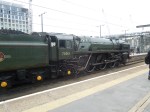
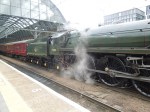
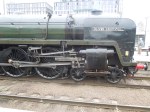

Unlike a diesel or electric locomotive, most powerful steam locomotives have a tender behind, to carry all the coal and water.
The Hydrogen Tank Problem
One of the problems with hydrogen trains for the UK’s small loading gauge is that it is difficult to find a place for the hydrogen tank.
The picture is a visualisation of the proposed Alstom Breeze conversion of a Class 321 train.
- There is a large hydrogen tank between the driving compartment and the passengers.
- The passenger capacity has been substantially reduced.
- The train will have a range of several hundred miles on a full load of hydrogen.
The Alstom Breeze may or may not be a success, but it does illustrate the problem of where to put the large hydrogen tank needed.
In fact the problem is worse than the location and size of the hydrogen tank, as the hydrogen fuel cells and the batteries are also sizeable components.
An Ideal Freight Locomotive
The Class 88 locomotive, which has recently been introduced into the UK, is a successful modern locomotive with these power sources.
- 4 MW using overhead 25 KVAC overhead electrication.
- 0.7 MW using an onboard diesel engine.
Stadler are now developing the Class 93 locomotive, which adds batteries to the power mix.
The ubiquitous Class 66 locomotive has a power of nearly 2.5 MW.
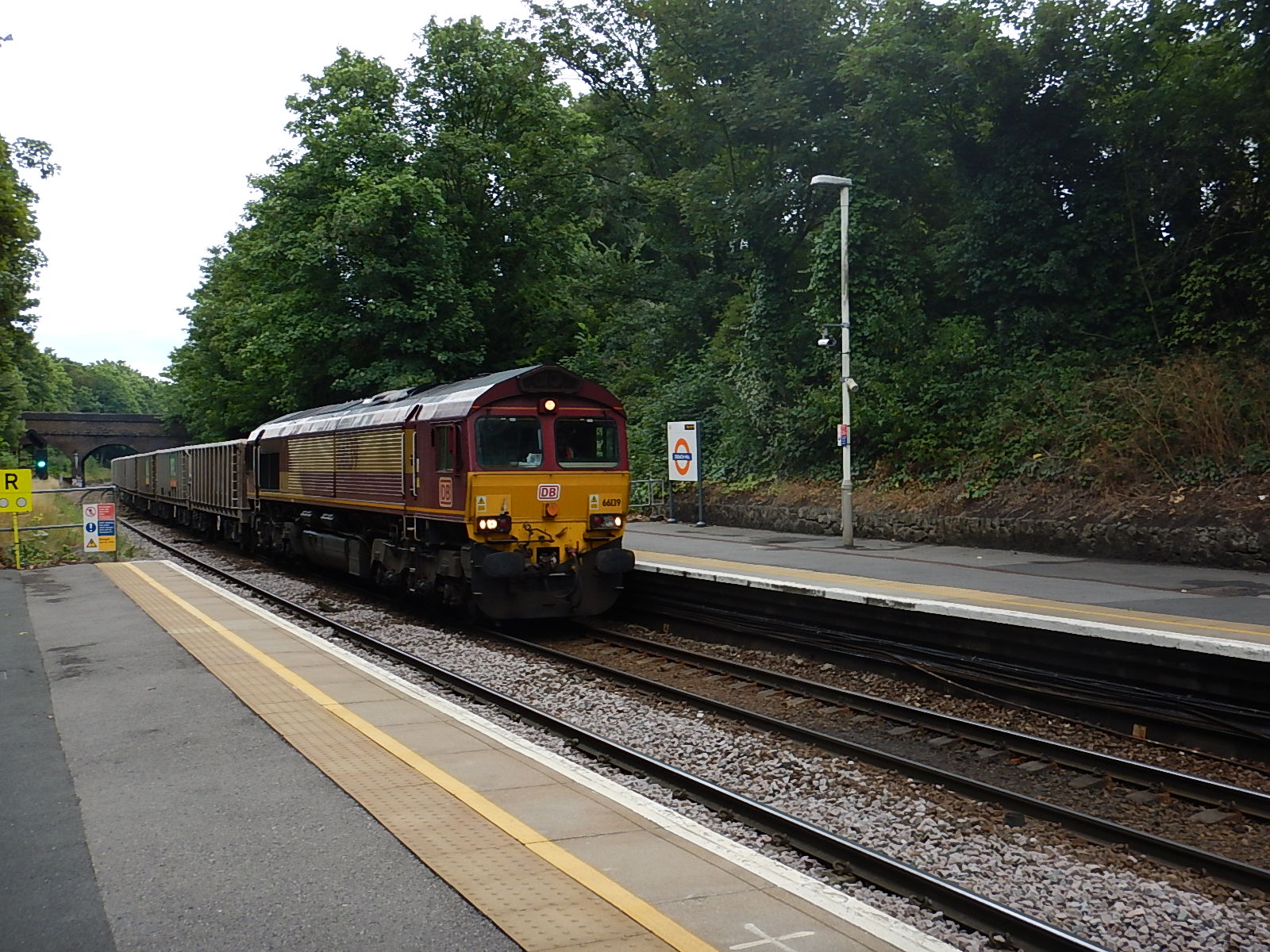
But as everybody knows, Class 66 locomotives come with a lot of noise, pollution, smell and a substantial carbon footprint.
To my mind, an ideal locomotive must be able to handle these freight tasks.
- An intermodal freight train between Felixstowe and Manchester.
- An intermodal freight train between Southampton and Leeds.
- A work train for Network Rail
- A stone train between the Mendips and London.
The latter is probably the most challenging, as West of Newbury, there is no electrification.
I also think, that locomotives must be able to run for two hours or perhaps three, on an independent power source.
- Independent power sources could be battery, diesel, hydrogen, or a hybrid design
- This would enable bridging the many significant electrification gaps on major freight routes.
I feel that an ideal locomotive would need to meet the following.
- 4 MW when running on a line electrified with either 25 KVAC overhead or 750 VDC third-rail.
- 4 MW for two hours, when running on an independent power source.
- Ability to change from electric to independent power source at speed.
- 110 mph operating speed.
This would preferably be without diesel.
Electric-Only Version
Even running without the independent power source, this locomotive should be able to haul a heavy intermodal freight train between London and Glasgow on the fully-electrified West Coast Main Line.
I regularly see freight trains pass along the North London Line, that could be electric-hauled, but there is a polluting Class 66 on the front.
Is this because there is a shortage of quality electric locomotives? Or electric locomotives with a Last Mile capability, that can handle the routes that need it?
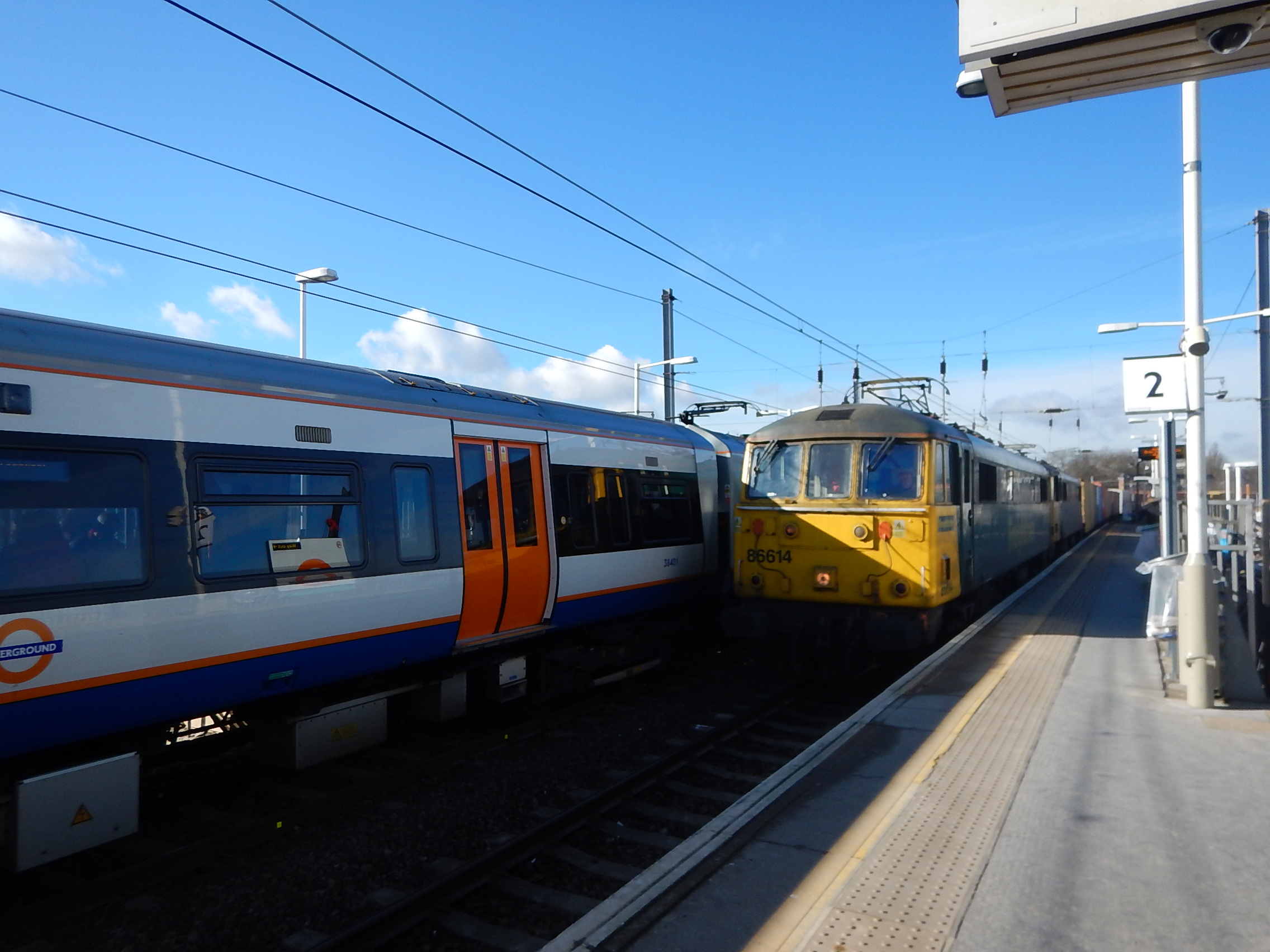
If we have to use pairs of fifty-year-old Class 86 locomotives, then I suspect there are not enough electric freight locomotives.
Batteries For Last Mile Operation
Stadler have shown, in the design of the Class 88 locomotive, that in a 4 MW electric locomotive, there is still space to fit a heavy diesel engine.
I wonder how much battery capacity could be installed in a UK-sized 4 MW electric locomotive, based on Stadler’s UK Light design.
Would it be enough to give the locomotive a useful Last Mile capability?
In Thoughts On A Battery Electric Class 88 Locomotive On TransPennine Routes, I estimated that a Class 88 locomotive could replace the diesel engine with a battery with a battery capacity of between 700 kWh and 1 MWh.
This would give about fifteen minutes at full power.
Would this be a useful range?
Probably not for heavy freight services, if you consider that a freight train leaving the Port of Felixstowe takes half-an-hour to reach the electrification at Ipswich.
But it would certainly be enough power to bring the heaviest freight train out of Felixstowe Port to Trimley.
If the Felixstowe Branch Line were to be at least partially electrified, then I’m sure a Class 88 locomotive with a battery instead of the diesel engine could bring the heaviest train to the Great Eastern Main Line.
- Electrifying between Trimley and the Great Eastern Main Line should be reasonably easy, as much of the route has recently been rebuilt.
- Electrifying Felixstowe Port would be very disruptive to the operation of the port.
- Cranes and overhead wires don’t mix!
I wonder how many services to and from Felixstowe could be handled by an electric locomotive with a Last Five Miles-capability, if the Great Eastern Main Line electrification was extended a few miles along the Felixstowe Branch Line.
As an aside here, how many of the ports and freight interchanges are accessible to within perhaps five miles by electric haulage?
I believe that if we are going to decarbonise UK railways by 2040, then we should create electrified routes to within a few miles of all ports and freight interchanges.
Batteries For Traction
If batteries are to provide 4 MW power for two hours, they will need to have a capacity of 8 MWh.
In Thoughts On A Battery Electric Class 88 Locomotive On TransPennine Routes, I said this.
Traction batteries seem to have an energy/weight ratio of about 0.1kWh/Kg, which is increasing with time, as battery technology improves.
This means that a one tonne battery holds about 100 kWh.
So to hold 8 MWh or 8,000 kWh, there would be a need to be an 80 tonne battery using today’s technology.
A Stadler Class 88 locomotive weighs 86 tonnes and has a 21.5 tonne axle load, so the battery would almost double the weight of the locomotive.
So to carry this amount of battery power, the batteries must be carried in a second vehicle, just like some steam locomotives have a tender.
But suppose Stadler developed another version of their UK Light locomotive, which was a four-axle locomotive that held the largest battery possible in the standard body.
- It would effectively be a large battery locomotive.
- It would share a lot of components with the Class 88 locomotive or preferably the faster Class 93 locomotive, which is capable of 110 mph.
- It would have cabs on both ends.
- It might have a traction power of perhaps 2-2.5 MW on the battery.
- It would have a pantograph for charging the battery if required and running under electrification.
- It might be fitted with third rail equipment.
It could work independently or electrically-connected to the proposed 4 MW electric locomotive.
I obviously don’t know all the practicalities and economics of designing such a pair of locomotives, but I do believe that the mathematics say that a 4 MW electric locomotive can be paired with a locomotive that has a large battery.
- It would have 4 MW, when running on electrified lines.
- It would have up to 4 MW, when running on battery power for at least an hour.
- ,It could use battery-power to bridge the gaps in the UK’s electrification network and for Last Mile operation.
A very formidable zero-carbon locomotive-pair could be possible.
The battery locomotive could also work independently as a 2 MW battery-electric locomotive.
Hydrogen Power
I don’t see why a 4 MW electric locomotive , probably with up to 1,000 kWh of batteries couldn’t be paired with a second vehicle, that contained a hydrogen tank, a hydrogen fuel-cell.and some more batteries.
It’s all a question of design and mathematics.
It should also be noted, that over time the following will happen.
- Hydrogen tanks will be able to store hydrogen at a greater pressure.
- Fuel cells will have a higher power to weight ratio.
- Batteries will have a higher power storage density.
These improvements will all help to make a viable hydrogen-powered generator or locomotive possible.
I also feel that the same hydrogen technology could be used to create a hydrogen-powered locomotive with this specfication.
- Ability to use 25 KVAC overhead or 750 VDC third-rail electrification.
- 2 MW on electrification.
- 1.5 MW on hydrogen/battery power.
- 100 mph capability.
- Regenerative braking to batteries.
- Ability to pull a rake of five or six coaches.
This could be a very useful lower-powered locomotive.
What About The Extra Length?
A Class 66 locomotive is 21.4 metres long and a Class 68 locomotive is 20.3 metres long. Network Rail is moving towards a maximum freight train length of 775 metres, so it would appear that another twenty metre long vehicle wouldn’t be large in the grand scheme of things.
Conclusion
My instinct says to be that it would be possible to design a family of locomotives or an electric locomotive with a second vehicle containing batteries or a hydrogen-powered electricity generator, that could haul freight trains on some of the partially-electrified routes in the UK.
Is There Nothing A Class 319 Train Can’t Do?
If a train every goes into orbit round the world, it will be highly-likely that it will be a Class 319 train!
Electric Trains In North-West England
The fleet of eighty-six trains entered service in 1987 on Thameslink and now twenty-seven are plying their trade on the electrified routes around the North-West of England.
- You don’t hear many complaints about them being called London’s cast-offs.
- Passengers fill them up in Blackpool, Liverpool, Manchester and Preston.
- They still do 100 mph where possible.
- They seem to be reliable.
- They are not the most attractive of trains.
But handsome is as handsome does!
Drivers have told me, that although the suspension may be a bit soft for the bumpy route across Chat Moss, the trains do have superb brakes.
Bi-Mode Class 769 Trains
Nearly thirty of the trains are being converted into bi-mode Class 769 trains for working partially-electrifired routes and although these are running late, they should be in service this year.
Rail Operations Group
Two Class 769 trains have been ordered to be fast logistics trains by Rail Operations Group.
Wikipedia says the trains will be used to transport mail.
But if you read the history of the Rail Operations Group, they make the assets sweat and I’ve read the trains will still have seats, so they might do some other rail operations.
The Hydrogen-Powered Class 799 Train
And now comes the Class 799 train!
This is a demonstrator to prove the concept of conversion to hydrogen power.
The fact that the train now has it’s own number must be of some significance.
Alstom are converting Class 321 trains into Class 321 Breeze trains.
- The conversion will reduce passenger capacity, due to the large hydrogen tank
- It will have a 1,000 km range.
- It will have regenerative breaking.
- It will have a new AC traction package
- It will probably have the interior of a Class 321 Renatus train.
The conversion will obviously build on Alstom’s experience with the Alstom Coradia iLint train and Eversholt’s experience with the Renatus.
When it comes to the Class 799 train, the following will apply.
- Porterbrook have all the experience of creating the bi-mode and dual-voltage Class 769 train.
- Birmingham University’s Birmingham Centre For Railway Research And Education (BCRRE) are providing the expertise to design and convert the Class 319 train to hydrogen power.
- I also wouldn’t be surprised to find out, that the BCRRE has applied some very extensive mathematical modelling to find out the performance of a hydrogen-powered Class 319 train or HydroFLEX train.
- The conversion could be based closely on Class 769 experience and sub-systems,
Could the main purpose be to demonstrate the technology and ascertain the views of train operators and passengers on hydrogen power?
The most important question, is whether the Class 799 train, will have the same passenger capacity as the original Class 319 train?
If it does, then BCRRE must have found a way to store the hydrogen in the roof or under the floor.
It should be noted, that it was only in September 2018, that the contract to develop the Class 799 train was signed and yet less than a year later BCRRE and Porterbrook will be demonstrating the train at a trade show.
This short development time, must mean that there is not enough time to modify the structure of the train to fit a large hydrphen tank inside, as Alstom are proposing.
A smaller hydrogen tank could be placed in one of three places.
- Underneath the train.
- On the roof.
- Inside the train, if it is small enough to fit through the train’s doors.
Note.
- I doubt that anybody would put the tank inside the train for perceived safety reasons from passengers.
- On the roof, would require substantial structural modifications. Is there enough time?
So how do you reduce the size of the hydrogen tank and still store enough hydrogen in it to give the train a useful range?
In Better Storage Might Give Hydrogen The Edge As Renewable Car Fuel, I indicated technology from Lancaster University, that could store four times as much hydrogen in a given size of tank.
This reduced tank size would make the following possible.
- The hydrogen tank, the fuel cell and the batteries could be located underneath the four-cars of the Class 319 train.
- The seating capacity of the Class 799 train could be the same as that of a Class 319 train.
Clever electronics would link everything together.
If BCRRE succeed in their development and produce a working hydrogen-powered Class 799 train, how would the technology be used?
Personally, I don’t think we’ll see too many hydrogen-powered Class 799 trains, running passengers on the UK network.
- The trains are based on a thirty-year-old train.
- The interiors are rather utilitarian and would need a lot of improvement, to satisfy what passengers expect.
- Their market can probably be filled in the short-term by more Class 769 trains.
But I do believe that the technology could be applied to more modern trains.
A Hydrogen-Powered Electrostar
Porterbrook own at least twenty four-car Electrostar trains, which have been built in recent years.
Six Class 387 trains, currently used by c2c, may come off lease in the next few years.
Could these trains be converted into a train with the following specification?
- Modern train interior, with lots of tables and everything passengers want.
- No reduction in passenger capacity.
- 110 mph operating speed using electrification.
- Useful speed and range on hydrogen power.
- ERTMS capability, which Porterbrook are fitting to the Class 387 trains to be used by Heathrow Express.
It should be born in mind, that a closely-related Class 379 train proved the concept of a UK battery train.
- The train was converted by Bombardier.
- It ran successfully for three months between Manningtree and Harwich.
- The interior of the train was untouched.
But what was impressive was that the train was converted to battery operation and back to normal operation in a very short time.
This leads me to think, that adding new power sources to an Electrostar, is not a complicated rebuild of the train’s electrical system.
If the smaller hydrogen tank, fuel cell and batteries can be fitted under a Class 319 train, I suspect that fitting them under an Electrostar will be no more difficult.
I believe that once the technology is proven with the Class 799 train, then there is no reason, why later Electrostars couldn’t be converted to hydrogen power.
- Class 387 trains from c2c, Great Northern and Great Western Railway.
- Class 379 trains, that will be released from Greater Anglia by new Class 745 trains.
- Class 377 trains from Southeastern could be released by the new franchise holder.
In addition, some Class 378 trains on the London Overground could be converted for service on the proposed West London Orbital Railway.
A Hydrogen-Powered Aventra
If the Electrostar can be converted, I don’t see why an Aventra couldn’t be fitted with a similar system.
Conclusion
A smaller hydrogen tank, holding hydrogen at a high-density would enable trains to be converted without major structural modifications or reducing the passenger capacity.
The development of a more efficient method of hydrogen storage, would open up the possibilities for the conversion of trains to electric-hydrogen hybrid trains.
Chester To Liverpool Via Runcorn
This new service between Chester and Liverpool Lime Street stations via Runcorn station and the Halton Curve, started a couple of weeks ago.
I took these pictures of the journey.
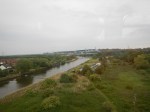

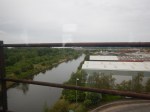




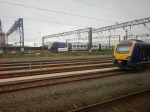
Note.
- The service was busy, as everybody seemed to be going to Liverpool to prepare for the evening’s match.
- The Class 150 train kept up a good speed, which indicates that Network Rail didn’t cut quality on the link.
- Runcorn is about the halfway point of the journey.
- The route is electrified between Runcorn and Liverpool Lime Street stations.
- The Class 150 train was a bit tired.
I wouldn’t be surprised to see a hybrid train working this route.
- Transport for Wales have ordered some electro-diesel Class 769 trains.
- Alstom are converting Class 321 trains into hydrogen-powered Class 321 Breeze trains at nearby Widnes.
- Porterbrook are converting Class 350 trains into Battery/FLEX trains.
- Hitachi are talking to ScotRail about Class 385 trains with batteries.
- I’m also sure Bombardier have a battery-electric Aventra.
Operation would be as follows.
- All these trains work be capable of 100 mph using 25 KVAC overhead electrification between Liverpool Lime Street and Runcorn stations.
- Power changeover would be at Runcorn station.
- Between Runcorn to Chester stations is only about fourteen miles.. This will be well within battery range in a few years.
Transport for Wales will be obtaining trains from a crowded market.
More Halton Curve Services
Under Planned Improvements in the Wikipedia entry for Transport for Wales, this is said.
Introduction of a new hourly Liverpool to Llandudno and Shrewsbury service, and a new two-hourly Liverpool to Cardiff Central service from December 2022.
Adding these to the current hourly service, this would mean that two trains per hour (tph) would normally run between Liverpool Lime Street and Chester stations, with three trains in every alternate hour.
I think that, there would be a marketing advantage in running hybrid trains on these routes. Hydrogen would be ideal, as these would not need recharging like battery trains after a long trip.
To go through the single-track Halton Curve appears to take trains about five minutes, so up to eight tph could probably be feasible, which would mean four tph between Liverpool and Chester via Runcorn in both directions.
If Trains for Wales are going to compete with the Merseyrail electric services, they need a four tph frequency in both directions.
Flexible Ticketing
Currently, if you want to buy a ticket between the Chester and Liverpool Lime Street, you have to buy an appropriate ticket for your chosen route.
Surely, tourists and others might like to do the out and back journeys by a different route.
If London Underground and some train companies can share ticketing, then surely Merseyrail and other train companies can do the same.
Conclusion
This new service will be surprisingly well-used and needs an iconic hybrid train.
- Diesel is not appropriate for the long term, although in Northern Connect Between Chester And Leeds To Start In May, I did report a rumour that Class 769 trains might be running between Chester and Leeds.
- Hydrogen is non-polluting and has a longer range, that could make services between Liverpool and Holyhead possible.
- Battery will probably need a charging infrastructure.
My money is on hydrogen power.
Breeze Hydrogen Multiple-Unit Order Expected Soon
The title of this post is the same as that of this article on Railway Gazette.
This is the first paragraph.
Alstom Transport is hopeful of confirming an order before the end of this year for its Breeze hydrogen multiple-unit trains being developed in partnership with leasing company Eversholt Rail, suggesting that the first trains could enter service ‘as early as 2022’.
It then goes out to fill out some of the thinking behind the Alstom Breeze hydrogen-powered train.
The Breeze Is A Stop-Gap
Alstom are quoted as indicating the Breeze is an interim solution, until the next generation of train is available.
But after a ride to Southend recently in a Class 321 Renatus, I’m sure that the ride and passenger acceptance will be of a high standard.
And that’s what counts. Hydrogen is only the train’s personal power supply.
Alstom Are Not Building A Suburban Trundler
The Alstom Coradia iLint is not an exciting train.
- It has a cruising speed of 87 mph.
- It has a range of 370-500 miles.
- It has a noisy mechanical transmission.
- It always runs on hydrogen-power.
- The prototypes have covered 100,000 km.
In my view, it is very much a first generation compromise design.
The article says more about the Alstom Breeze.
- It has a slightly faster cruising speed of 90 mph
- The Breeze will have 50% more power than the iLint. Does this mean better acceleration and/or a longer and heavier train?
- It will have a 1,000 km range.
- It will have regenerative braking to the train’s batteries.
- It will have a new AC traction package, as does a Class 321 Renatus. So will the two systems be the same? Or at least similar?
I am also fairly sure, the train will be able to use electrification of both 25 KVAC overhead and 750 VDC third-rail, as Class 321 trains can now!
Train Capacity
This is said about train capacity.
Despite the loss of some seating space, each set of three 20 m vehicles would provide slightly more capacity than a two-car DMU with 23 m cars which it would typically replace.
The Class 172/0 trains, that are two-car 23 metre diesel multiple units, have 124 seats.
In Hydrogen Trains Ready To Steam Ahead, I estimated that a three-car Alstom Breeze would have a seating capacity of around 140 seats, with the ability to perhaps take an additional 160 standees.
So was my seat estimate fairly good? I also think, that as the Breeze has been designed with bags of grunt, I suspect that the basic train could be increased in size by adding extra trailer cars.
After all, the legendary Class 442 train is a five-car train, with a power-car in the middle. South Western Railway, think they are worth pulling out of the scrapyard and refurbishing to run expresses between Waterloo and Portsmouth.
I am fairly certain, that Alstom can create a five-car Class 321 Breeze with the following characteristics.
- A capacity of about three hundred seats
- A smaller three-car train would have 140 seats.
- A near-100 mph top speed on hydrogen-power.
- A 100 mph top speed on electrification.
- A 1000 km range on hydrogen.
- Regenerative braking to an on-board battery.
- The ability to use 25 KVAC overhead and/or 750 VDC third rail electrification.
The trains could have the ability to run as pairs to increase capacity.
The train would be ideal for the following routes.
- Liverpool and North Wales via Chester
- Norwich and Derby
- Newcastle and Carlisle
- Preston and Carlisle via Barrow
- Cardiff and the South Coast of England
- Borders Railway
- Southampton and Ashford
- Waterloo and Exeter
All of these routes have partial electrification, which would reduce the amount of hydrogen needed to be carried around.
Now that is an interesting multi-variable calculation!
Hydrogen Infrastructure
Alstom seem to be developing infrastructure solutions to supply hydrogen for fleets of ten or more trains, which could be shared with other applications. The obvious one could be where a train depot and a fleet of buses share a facility in say a large city like Exeter, which has an extensive diesel train network.
The article also says this about the source of hydrogen.
Ideally, the trains would use ‘green’ hydrogen manufactured by electrolysis using surplus renewable energy rather than ‘brown’ hydrogen from steam methane reforming.
I agree wholeheartedly with that!
Delivery In 2022?
Consider what has already been achieved in other projects.
- Alstom have proved they can generate enough electricity to power a practical train.
- Eversholt have proved that you can turn Class 321 trains into comfortable and efficient 100 mph Class 321 Renatus trains for routes up to a hundred miles.
- Several classes of Mark 3-based electrical multiple units have been re-engined with AC traction, including the Class 321 Renatus.
- Engineers all over the UK have modified Mark 3-based coaches and multiple units to create better and more-efficient trains.
Helping delivery of the project, is a legacy of drawings and philosophy from British Rail Engineering.
If Alstom say 2022, I believe that that could be a feasible date.
Conclusion
The ghost of British Rail Engineering is certainly a benign one allowing all sorts of worthwhile development paths.
 The Anonymous Widower