Rail Operator Crosses Line For First Time In Years
The title of this post, is the same as that of this article on the BBC.
This is the sub-heading.
An operator’s first passenger train has crossed a historical and scenic route for the first time in more than a decade.
These three paragraphs give more details about the reason for the trip.
Avanti West Coast’s 07:54 GMT from Wigan was the first to run on the Settle to Carlisle route earlier.
The 73-mile line is renowned for its picturesque views across the Yorkshire Dales and the North Pennines via the Ribblehead viaduct.
The route is usually only used by Northern trains operating between Leeds and Carlisle, but Avanti is using it as a diversion while work to replace the Clifton Bridge take place over the M6 near Penrith.
I’ve only ridden the Route once and that was on a day in 2014, when the weather wasn’t at its best.
Afterwards I wrote Long Live The Settle And Carlisle, so the trip couldn’t have been that bad!
These paragraphs give the reason for and details of the diversion.
The Settle to Carlisle line does not have overhead power lines, meaning Avanti is using bi-mode Class 805 Evero trains which operate on diesel.
Several timetable changes have been made during the engineering works, with disruption expected until 15 January.
Until 5 January, the railway will also be blocked south of Preston, meaning on these days the diverted services are running between Wigan North Western and Carlisle.
But if Great British Railways could get their act together and convert a sufficient number of their Hitachi diesel bi-modes to battery-electric bi-modes and do some testing and a few calculations, the problem would be solved.
In 2021, I wrote Through Settle And Carlisle Service Under Consideration, after Modern Railways wrote an article of the same name.
Could Lumo Run A Lincoln And Glasgow Service Via Doncaster, Leeds And Settle?
In South Yorkshire Now Has Better North-South Connections, I calculated that Doncaster station now has 173 express trains per day, that stop at the station.
So why not add five or six express trains per day to Doncaster, Lincoln, Leeds, Settle, Carlisle and Glasgow?
And why not ask Lumo to run it, as they’d know how to run such a service?
FIRST TO THE FUTURE: Lumo Owner Bids To Turbo-Charge UK Rail With New Routes
The title of this post, is the same as that of this press release from First Group.
These first three paragraphs introduce FirstGroup’s application for the first phase of three separate applications to the Office of Rail and Road (ORR) for new and extended open access rail services.
FirstGroup plc plans to expand its open access rail operations through its successful Lumo business, boosting connectivity, improving UK productivity and passenger choice across the UK.
The expansion aims to replicate the success of Lumo’s Edinburgh to London service in driving material growth on the East Coast Main Line. Lumo operates without government subsidy and contributes more per train mile to infrastructure investment than any other long-distance operator – delivering growth on the railway and connectivity to local communities, at a substantial benefit to the taxpayer.
FirstGroup has submitted the first phase of three separate applications to the Office of Rail and Road (ORR) for new and extended open access rail services, which are described in these bullet points.
- A revised application to run new services between Rochdale and London Euston via Manchester Victoria from December 2028;
- An extension to Lumo’s current Stirling to London Euston track access agreement to operate services beyond 2030;
- A new route between Cardiff and York via Birmingham, Derby, and Sheffield from December 2028; and
- Purchase of new trains meaning continued investment in UK manufacturing of c.£300 million, and long-term jobs.
This paragraph from the press release describes the philosophy of the rolling stock.
Should these applications be successful, FirstGroup will make use of its option to commit further investment in new Hitachi trains built in County Durham. This investment will include five battery electric trains for the Stirling route and three battery electric trains for Rochdale, supporting jobs at Hitachi’s Newton Aycliffe plant. For the services between Cardiff and York, it will deploy refurbished Class 222s.
Note.
- The Class 222 trains will run the Euston and Stirling service until the future Hitachi trains are delivered in 2028.
- The Class 222 trains will run the Cardiff and York service from 2028.
- The Class 222 trains have a maximum speed of 125 mph
- Avanti West Coast’s Class 390 trains have a maximum speed of 125 mph.
- Avanti West Coast’s Class 805 trains have a maximum speed of 125 mph on electrification.
- Avanti West Coast’s Class 807 trains have a maximum speed of 125 mph.
- Grand Central Trains’s future Hitachi trains have a maximum speed of 125 mph.
- Hull Trains’s Class 802 trains have a maximum speed of 125 mph.
- Lumo’s current Class 803 trains have a maximum speed of 125 mph.
- LNER’s current Class 800 and 801 trains have a maximum speed of 125 mph.
- LNER’s current InterCity 225 trains have a maximum speed of 125 mph.
- LNER’s future Class 897 trains have a maximum speed of 125 mph.
- All of the trains, with the exception of the Class 222 trains are electric and have been designed for 140 mph running and can do this if there is appropriate 140 mph signalling.
If the Class 222 trains don’t run on the East and West Coast Main Lines, then these lines could introduce 140 mph running in stages to speed up rail travel between London and the North of England and Scotland.
Rochdale And London
These three paragraphs from the press release describe the proposed Rochdale and London service.
The new Lumo service will operate the first direct service since 2000 between Rochdale and London. Services will call at Manchester Victoria, Eccles, Newton-le-Willows and Warrington Bank Quay. Eccles station connects other parts of the city of Salford, including the fast-growing MediaCity area, via the nearby interchange with Metrolink. Services to Newton-le-Willows will deliver greater rail connectivity for St Helens.
There will be three new return services on weekdays and Sundays, and four return services on Saturdays, which will provide 1.6 million people in the north-west with a convenient and competitively priced direct rail service to London, encouraging people to switch from cars to train as well as providing additional rail capacity. It will also deliver material economic benefits for the communities along the route, including regeneration areas such as Atom Valley and the Liverpool City Region Freeport scheme.
The application has been revised to address the ORR’s concerns about network capacity set out in its letter of July 2025 rejecting FirstGroup’s original application. Supported by extensive modelling, the company has identified sufficient space on the network to accommodate the proposed services. Services will also make use of the Government’s recent investment in power supply for the West Coast Mainline (WCML).
In FirstGroup’s Lumo Seeks To Launch Rochdale – London Open Access Service, I gave my thoughts for Lumo’s application last year.
Differences between the two applications include.
- The service will be run by Lumo’s standard battery-electric Hitachi trains.
- The original application was for six return journeys per day, whereas the new application is for three return services on weekdays and Sundays, and four return services on Saturdays.
Note.
- The battery-electric trains will be able bridge the 10.4 mile gap between Manchester Victoria and Rochdale, and return after charging on the West Coast Main Line.
- The battery-electric trains could be useful during engineering works or other disruptions.
- The trains would be ready for 140 mph running on the West Coast Main Line, when the digital signalling is installed.
- Is the extra return service on a Saturday to cater for football and rugby fans?
I still feel, that with Lumo’s battery-electric trains one or more services could extend across the Pennines to Hebden Bridge, Bradford Interchange or Leeds. Trains would be recharged for return at Leeds.
Stirling And London
This paragraph from the press release describes the proposed Stirling and London service.
Stirling has a wide catchment area, with an estimated three million people living within an hour’s drive. Extending the current track access agreement for the Stirling route from May 2030 will support the shift from car to rail, and investment in the city, as well as in the service’s intermediate stations which include Larbert, Greenfaulds and Whifflet, thanks to greater connectivity to London. The four return services weekdays and Saturdays, and three on Sundays, on the new route are expected to start early in the company’s 2027 financial year.
In Lumo To Expand Scotland’s Rail Network With New London-Stirling Rail Route From Spring 2026, I gave my thoughts for Lumo’s application in June 2025.
Differences between the two applications include.
- The service will only be run initially by Class 222 trains.
- The service will be run by Lumo’s standard battery-electric Hitachi trains after 2028.
- The original application was for five return journeys per day, whereas the new application is for four return services on weekdays and Saturdays, and three return services on Sundays.
- In the original application, Lumo’s new route was to link London Euston directly to Stirling, also calling at Milton Keynes, Nuneaton, Crewe, Preston, Carlisle, Lockerbie, Motherwell, Whifflet (serving Coatbridge), Greenfaulds (serving Cumbernauld) and Larbert.
Note.
- The battery-electric trains could be useful during engineering works or other disruptions.
- The trains would be ready for 140 mph running on the West Coast Main Line, when the digital signalling is installed.
- Is the extra return service on a Saturday to cater for football and rugby fans?
It should be noted that there are always more return services per day going to Stirling, than Rochdale.
Could The Rochdale and Stirling Services Share A Path?
Consider.
- The two services use the West Coast Main Line South of Warrington Bank Quay station.
- Pairs of Class 803 trains can split and join.
- A pair of Class 803 trains are shorter than an 11-car Class 390 train.
- An 11-car Class 390 train can call in Warrington Bank Quay or Crewe stations.
I believe that the Rochdale and Stiring services could share a path.
- One Weekday service per day would be a single train.
- Going South, the trains would join at Warrington Bank Quay or Crewe stations.
- Going North, the trains would split at Warrington Bank Quay or Crewe stations.
- The pair of trains would share a platform at Euston station.
Operating like this would increase the connectivity and attractiveness of the services, and probably increase the ridership and profitability.
Cardiff And York via Birmingham, Derby And Sheffield
These four paragraphs from the press release describe the proposed Cardiff and York service.
Lumo’s new route between Cardiff and York will join up the entire Great British Railway network, connecting all four main lines from the Great Western Main Line to the East Coast Main Line. The plans will also deliver more capacity and drive passenger demand on a previously underserved corridor.
The application proposes six return services each weekday – a significant increase from the current single weekly service.
Bringing Lumo’s popular low-cost model to the corridor will support local communities between Cardiff, Birmingham, Derby, Sheffield, and York. These cities alone have a combined population of more than 2.5 million people. The new services will give local communities access to jobs and services along the route, in support of significant investment that has already been committed by the Government and private sector. This investment includes the Cardiff Capital Regional Investment Zone, the £140million proposed refurbishment at Cardiff Central station, the West Midlands Investment Zone which is expected to create £5.5 billion of growth and 30,000 new jobs, as well as investment plans in Derby, Sheffield and York.
The ORR will now carry out a consultation exercise as well as discuss the applications with Network Rail to secure the required approvals.
Note.
- Only minimal details are given of the route.
- The TransPennine Upgrade will create a new electrified route across the Pennines between York and Huddersfield via Church Fenton, Leeds and Dewsbury.
- The Penistone Line is being upgraded, so that it will handle two trains per hour.
- In the 1980s, the Penistone Line took InterCity 125s to Barnsley.
- The connection with the Penistone Line at Huddersfield has been upgraded.
I am reasonably certain, that FirstGroup intend to route the York and Cardiff service over this partially electrified route.
Sections of the route will be as follows.
- Cardiff and Westerleigh junction – 38 miles – Electrified
- Westerleigh junction and Bromsgrove – 65.2 miles – Not Electrified
- Bromsgrove and Proof House junction – 15 miles – Electrified
- Proof House junction and Derby – 40.6 miles – Not Electrified
- Derby and Sheffield – 36.4 miles – Not Electrified
- Sheffield and Huddersfield – 36.4 miles – Not Electrified
- Huddersfield and York – 41.9 miles – Electrified
There are only two sections of track, that is not electrified.
- Westerleigh junction and Bromsgrove – 65.2 miles
- Proof House junction and Huddersfield – 113.4 miles
Out of a total of 273.5 miles, I believe in a few years, with a small amount of extra electrification or more powerful batteries, Hitachi’s battery-electric high-speed trains will have this route cracked and the Class 222 trains can be sent elsewhere to develop another route.
A Taste Of The Future
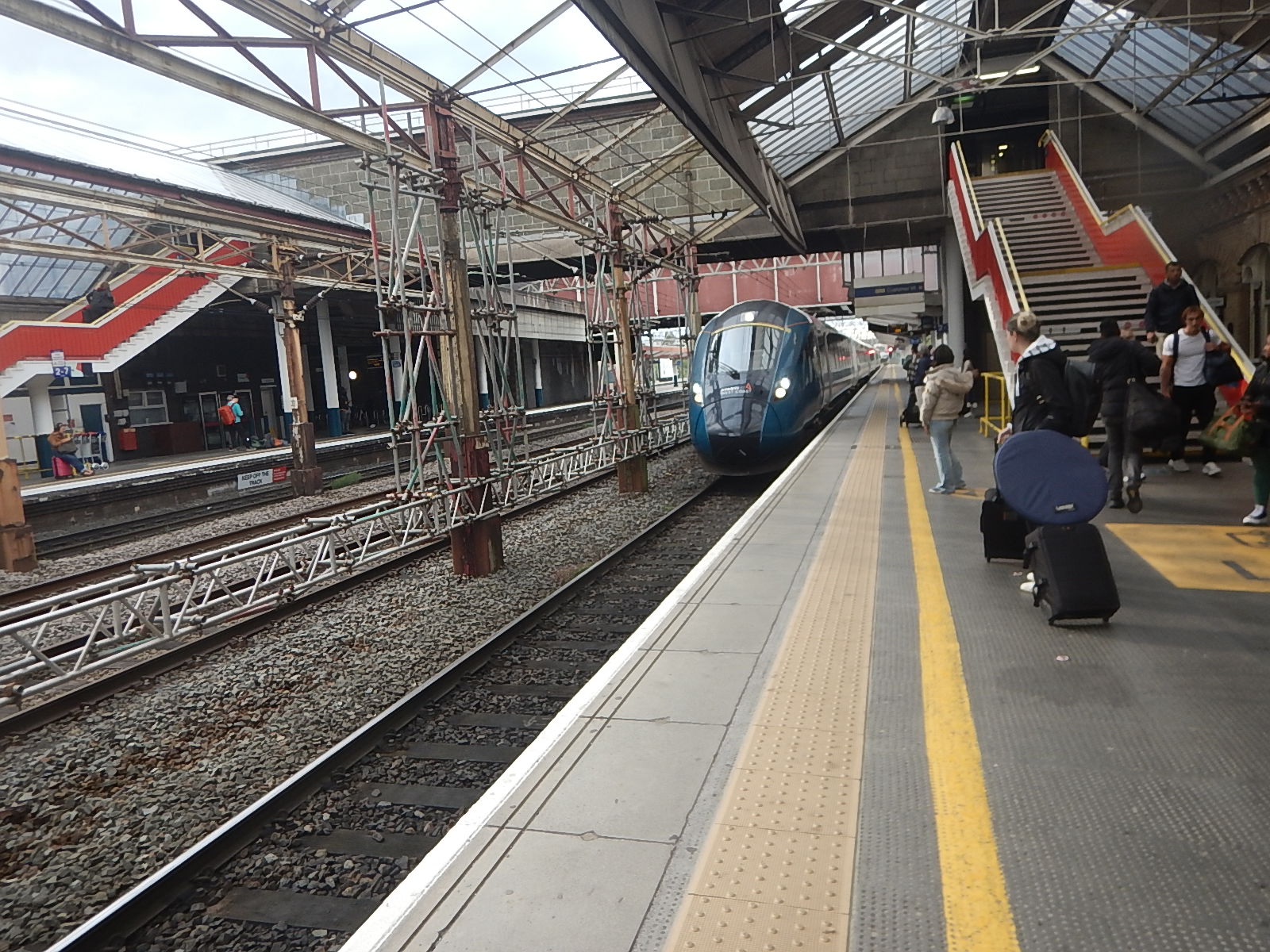
On Friday, I went to Chester and took a train home from Crewe to Euston.
It was a new Hitachi Class 805, that sped me to London, with just a stop at Milton Keynes.
This picture shows the train arriving at Crewe.
Note.
- High Speed Two it is not, but it went most of the way to Euston at 125 mph in an hour and 50 minutes.
- High Speed Two will take 56 minutes, although that is not cast in stone and steel yet.
- Crewe is one of the towns and cities, that will benefit most from High Speed Two.
But whether High Speed Two is delivered or or not, Crewe’s train service should improve in Spring 2026, as the first Lumo service on the West Coast Main Line service will be starting.
I describe the service in Lumo To Expand Scotland’s Rail Network With New London-Stirling Rail Route From Spring 2026.
This paragraph from the linked post, describes the route.
Lumo’s new route will link London Euston directly to Stirling, also calling at Milton Keynes, Nuneaton, Crewe, Preston, Carlisle, Lockerbie, Motherwell, Whifflet (serving Coatbridge), Greenfaulds (serving Cumbernauld) and Larbert.
It is fully-electrified and can support 125 mph running most, if not all, of the way.
It will certainly give knowledgeable travellers options on how they travel on the West Coast Main Line.
Lumo are also proposing another open access service on the West Coast Main Line to Rochdale, which will increase travel options.
My only worry is that Heidi Alexander will cancel it, on the grounds that open access services abstract the revenue of Great British Railways.
But then after announcing the service in a reception in Holyrood, she surely couldn’t cancel it now.
On the other hand, it could be that this Labour Government has discovered that open access trains are a more affordable way of developing rail services to and from London and over longer distances.
Consider.
- Recently, Lumo has proposed open access services from London to Carmarthen, Paignton, Rochdale and Stirling.
- Recently, Arriva has proposed open access services from London to Cleethorpes, Grimsby and Scunthorpe and between Newcastle and Brighton.
- Recently, Alsthom has proposed open access services from London to Shewsbury and Wrexham.
Not one of these services will cost the government a lot of money, but Network Rail will pick up access charges.
So has Heidi Alexander seen sense and feels that it is better to allow more open access services?
Could Any Other Open Access Services Be Opened On The West Coast Main Line?
London Euston and Rochdale is planned by Lumo and I wrote about it in FirstGroup’s Lumo Seeks To Launch Rochdale – London Open Access Service.
This sentence from the linked post, gives the route.
The trains would call at Warrington Bank Quay, Newton-le-Willows, Eccles and Manchester Victoria.
Other possibilities would surely be Blackpool and Barrow-in-Furness, but Blackpool gets a three trains per day (tpd) service from Euston and frequent trains from Preston.
Barrow-in-Furness could be a very useful destination.
With increased defence spending, the shipyards will be busy.
It could be another gateway to the Lake District.
Services could be extended to Sellafield, Whitehaven and Workington.
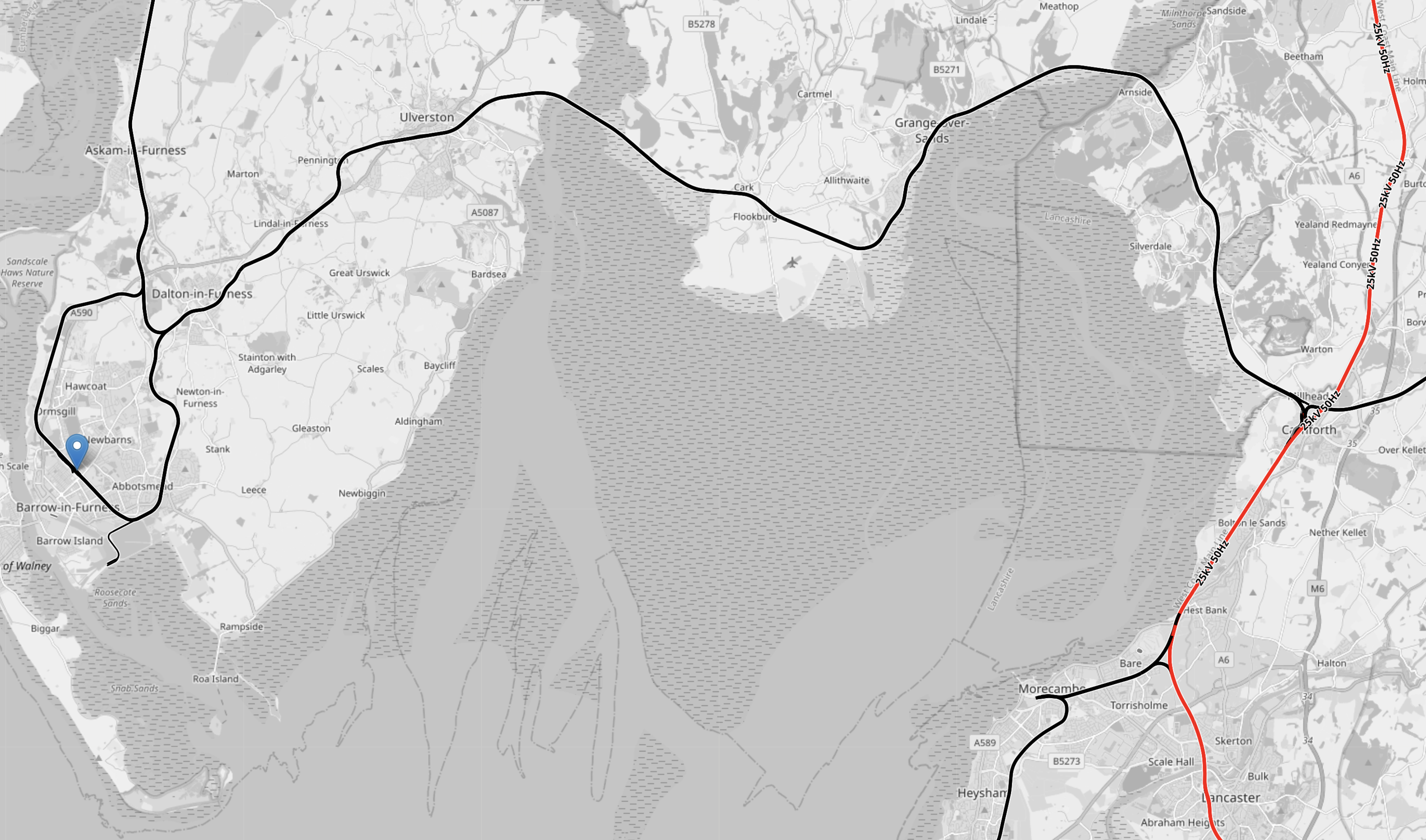
This OpenRailwayMap shows the Cumbrian Coast Line between the West Coast Main Line and Barrow-in-Furness.
Note.
- The red tracks on the Eastern side of the map is the electrified West Coast Main Line.
- At the bottom of the map on the West Coast Main Line is Lancaster, with its station.
- The black track going West from Lancaster is the Morecambe and Heysham branch.
- The black track going West across the top of the map is the Cumbrian Coast Line.
- Barrow-in-Furness station is indicated by the blue arrow.
- The length of track without electrification on the route is less than thirty miles.
One of Lumo’s battery-electric trains would easily handle a London Euston and Barrow-in-Furness route.
Conclusion
There is obviously scope for new railway routes in the UK and some will be suitable for open access operators.
Perhaps, we need the Office of Road and Rail to be more proactive in deciding, when a route is to be served and then select an operator.
It would need to be an unbiased apolitical process, to stop an incumbent political party running trains to marginal seats, they hoped to win.
FirstGroup Applies To Run Rail Services Between Hereford And London via Cwmbran
The title of this post, is the same as that of this news item from FirstGroup.
These first two paragraphs, add more detail to the title.
FirstGroup plc has submitted the first phase of an application for a new open access rail service between Hereford and London to the Office of Rail and Road (ORR).
FirstGroup plans to expand its open access rail operations as part of its successful Lumo business, building on Lumo’s existing service which has transformed long-distance connectivity between London and Edinburgh. This has helped materially grow rail demand on the East Coast Mainline in recent years, through a new and enhanced choice for customers and providing more trains to more destinations.
These are some more points from the press release.
Route and Frequency
The news item says this about route and frequency.
FirstGroup’s proposal is for two return journeys a day (one on Sundays) between London Paddington and Hereford, calling at Bristol Parkway and Severn Tunnel Junction as well as providing direct London services at Cwmbran, Pontypool & New Inn and Abergavenny.
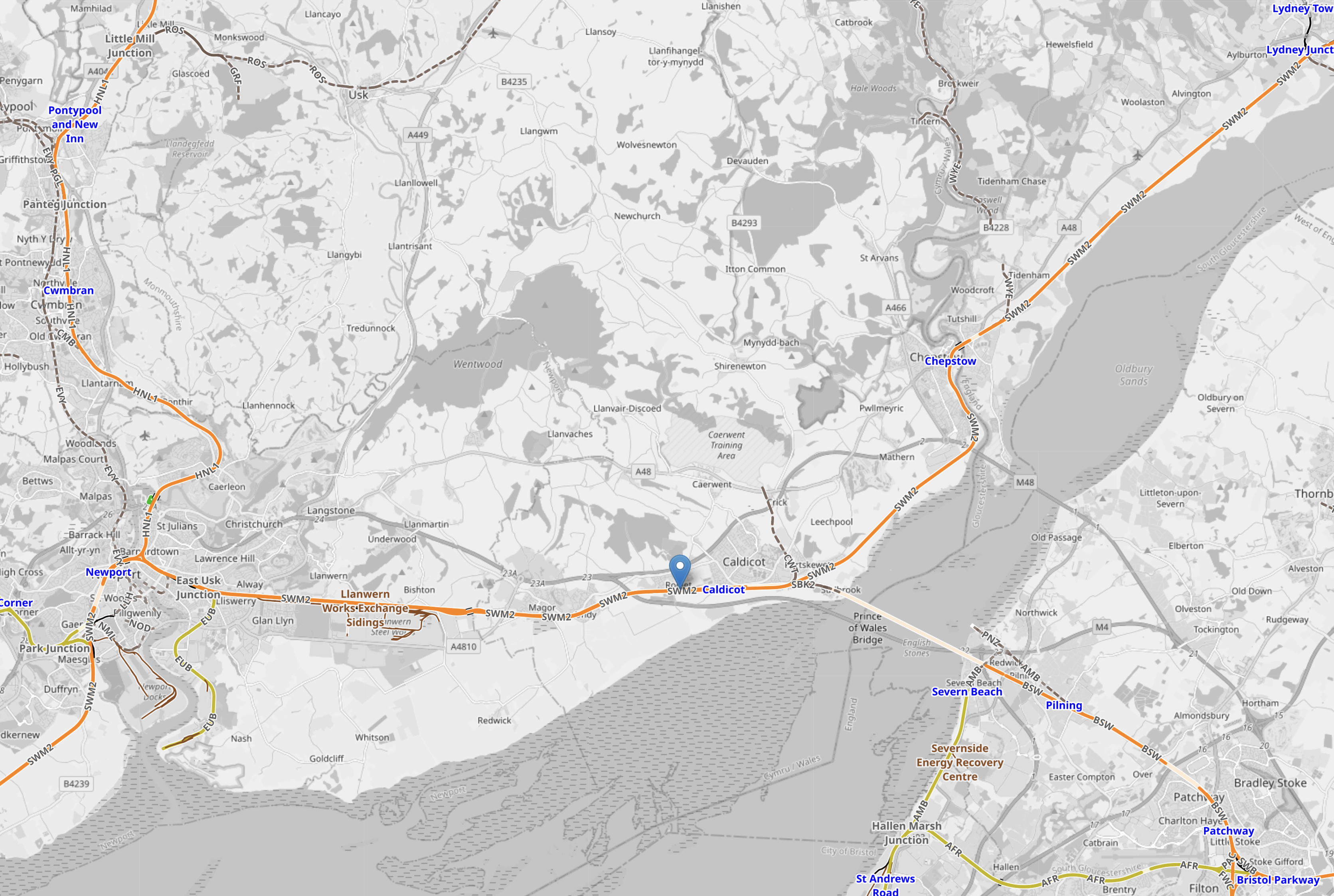
This OpenRailwayMap shows the route between Bristol Parkway and Pontypool & New Inn stations.
Note.
- Bristol Parkway station is in the South-East corner of the map.
- Severn Tunnel Junction station is marked by the blue arrow in the middle of the map.
- The electrified South Wales Main Line connects Bristol Parkway and Severn Tunnel Junction stations.
- From Bristol Parkway, the electrified Great Western Main Line goes to London Paddington via Swindon and Reading.
- From Severn Tunnel Junction station the South Wales Main Line goes West to Newport, which is on this map and then to Cardiff, Swansea and West Wales.
- Pontypool & New Inn station is in the North-West corner of the map on the Welsh Marches Line between Newport and Crewe stations.
- Welsh Marches Line is connected to the South Wales Main Line at Maindee triangular junction, which is a few miles East of Newport station.
- Cwmbran station is on the Welsh Marches Line between Newport and Pontypool & New Inn stations.
After a quick look on Wikipedia and Real Time Trains, it appears that few if any trains run in either direction between Cwmbran and Severn Tunnel Junction stations using the North-East side of Maindee junction.
Lumo’s trains would use this route to go between Bristol Park and Pontypool & New Inn stations via Severn Tunnel Junction, and Cwmbran.
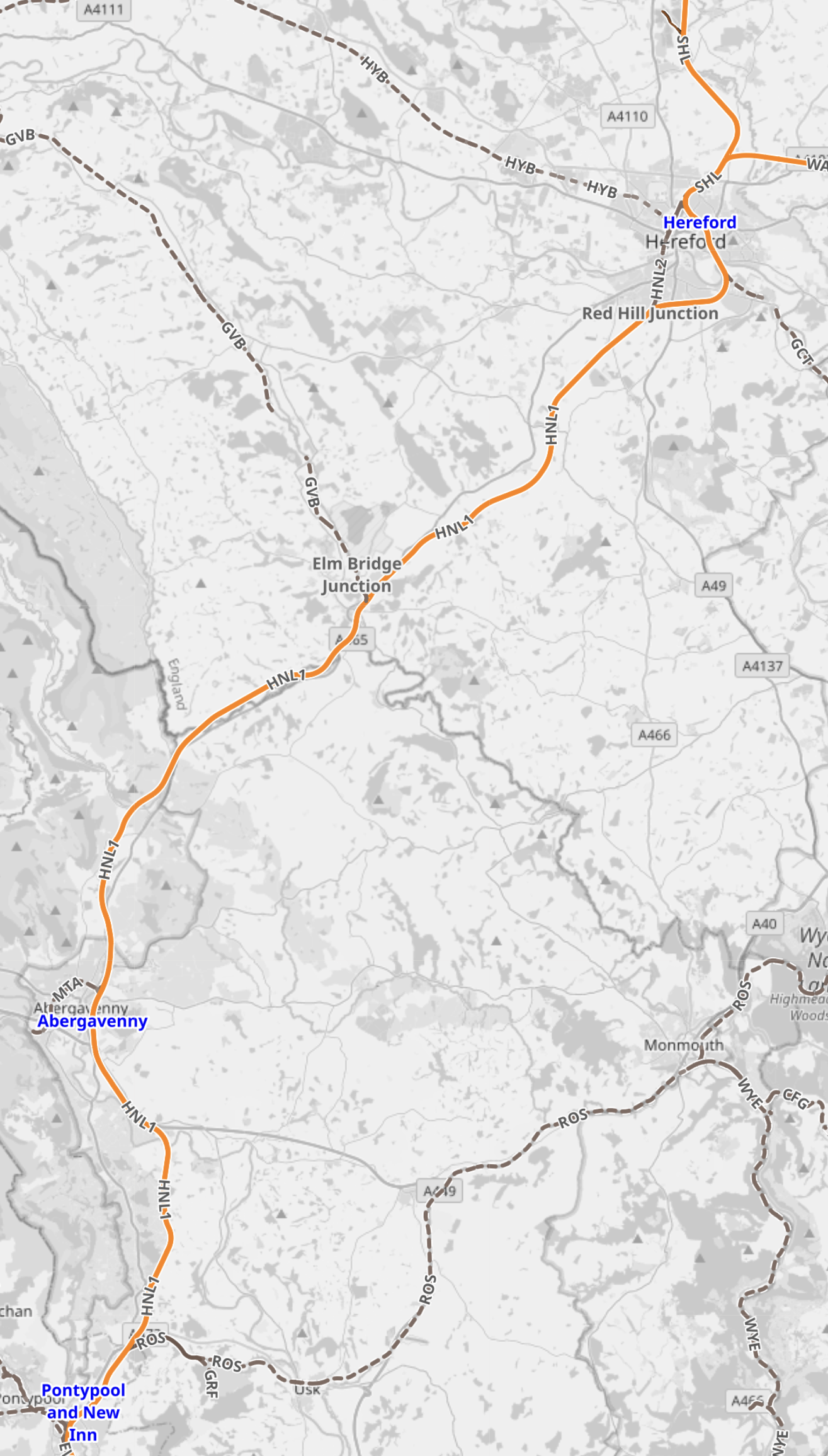
This second OpenRailwayMap shows the Northern part of the route between Pontypool & New Inn and Hereford stations.
Note.
- The orange track is the Welsh Marshes Line between Newport and Crewe.
- Pontypool & New Inn station is in the South-West corner of the map.
- Abergavenny station is on the West side of the map.
- Hereford station is in the North-East corner of the map.
Looking at the route as a whole, it is a very simple route.
- Trains go as fast as traffic allows, non-stop to Bristol Parkway station.
- Trains then take the South Wales Main Line with a single stop at Severn Tunnel Junction station to Maindee Junction, just to the East of Newport.
- Trains then take the Welsh Marches Line to Hereford stopping at Cwmbran, Pontypool & New Inn and Abergavenny stations.
It is an innovative route, that has these advantages.
- It uses a little-used leg of Maindee Junction.
- London Paddington and Maindee Junction is electrified.
- The fastest Hitachi trains seem to take about one hour and forty minutes between London Paddington and Maindee Junction.
As direct trains between Newport and Hereford take around fifty minutes, a time of two-and-a-half hours between London Paddington and Hereford could be possible.
This would compare with current Great Western Railway services, which take upwards of two hour and forty-five minutes, which often have a change of train.
Lumo Trains Should Be Faster Between London Paddington And Bristol Parkway
This may seem surprising, but most if not all current services stop between London Paddington and Bristol Parkway, stop at Swindon and Reading.
Cutting out a stop saves a few minutes on the journey.
New Trains
The news item says this about new trains.
The new Hereford service would support further investment in new trains. In December 2024 FirstGroup placed a £500m order for 14 trains from Hitachi Rail in County Durham. The Group has an option for a potential second order of similar size and the Hereford fleet would form part of this option.
Yesterday, I went to North Wales and used Avanti West Coast from Euston. The trains both ways were new Class 805 trains, which are bi-mode versions of Lumo’s Class 803 trains. These Class 805 trains travel all the way between Crewe and Holyhead on their diesel engines, so the much shorter leg between Maindee Junction and Hereford will definitely be in range.
But Hitachi are developing battery-electric versions of these trains and as there-and-back between Maindee Junction and Hereford is only 88 miles, I wouldn’t be surprised in a couple of years that Cwmbran, Pontypool & New Inn, Abergavenny and Hereford stations have a direct electric service from London.
Services At Hereford
The news item says this about services at Hereford station.
For Hereford, the two direct London paths each weekday would increase services on this flow from four today, to six. The new services would help mitigate the current large gaps in the timetable with additional daytime and evening arrivals into London, giving Hereford more regular connectivity. The new services would also provide the stations on the route with new direct journey opportunities to Bristol Parkway.
I also believe it would be a faster, fully electric service.
Services At Abergavenny
The Wikipedia entry for Abergavenny station says this about services at the station.
With a few exceptions, the weekday daytime service pattern typically sees one train per hour in each direction between Manchester Piccadilly and Cardiff Central, with most trains continuing beyond Cardiff to Swansea and West Wales. There is also a two-hourly service between Cardiff and the North Wales Coast Line to Holyhead via Wrexham General. These services are all operated by Transport for Wales. The northbound Premier service from Cardiff to Holyhead calls here on Monday to Fridays but the southbound service does not call here.
Note.
- The station has partial step-free access
- The station has 74 parking spaces.
Two trains in each direction would improve the services at Abergavenny station.
Services At Pontypool & New Inn
The Wikipedia entry for Pontypool & New Inn station says this about services at the station.
On weekdays and Saturdays, there is generally a two hourly service between Holyhead and Cardiff in the middle of the day, with additional peak time services southbound in the mornings and northbound in the evenings for commuters to Newport and Cardiff. These include services between Manchester Piccadilly and West Wales via Crewe and Swansea. From December 2013 the evening northbound Arriva “Premier” service train began to call at Pontypool for the first time. The southbound service in the morning does not call here. On Sundays, an irregular service operates, with 8 trains calling southbound and 10 northbound. These mainly run between Manchester and Cardiff.
Note.
- The station is step-free with lifts.
- The station has 150 parking spaces.
Two trains in each direction would improve the services at Pontypool and New Inn station.
Services At Cwmbran
The Wikipedia entry for Cwmbran station says this about services at the station.
Services that stop at Cwmbran in both directions are all operated by Transport for Wales and include the hourly service between Manchester Piccadilly, Cardiff Central and West Wales and the two hourly service between Holyhead and Cardiff Central. Most Sunday services only run on the former route (there are only two services each way to/from Holyhead).
Note.
- The station is being made step-free with lifts.
- The station has 76 parking spaces.
Two trains in each direction would improve the services at Pontypool and New Inn station.
The Heads Of The Valleys Road
The A465 or Heads of the Valleys Road could be considered the South Wlaes equivalent of the North of England’s M62 Motorway.
This description is from the first paragraph of the Wikipedia entry.
Approximately following the southern boundary of the Bannau Brycheiniog National Park, the Ordnance Survey Pathfinder guide describes it as the unofficial border between rural and industrial South Wales. The A465 provides an alternative route between England and the counties in South West Wales and to the ferries to Ireland.
This Google Map shows its route between Merthyr Tydfil and Abergavenny.
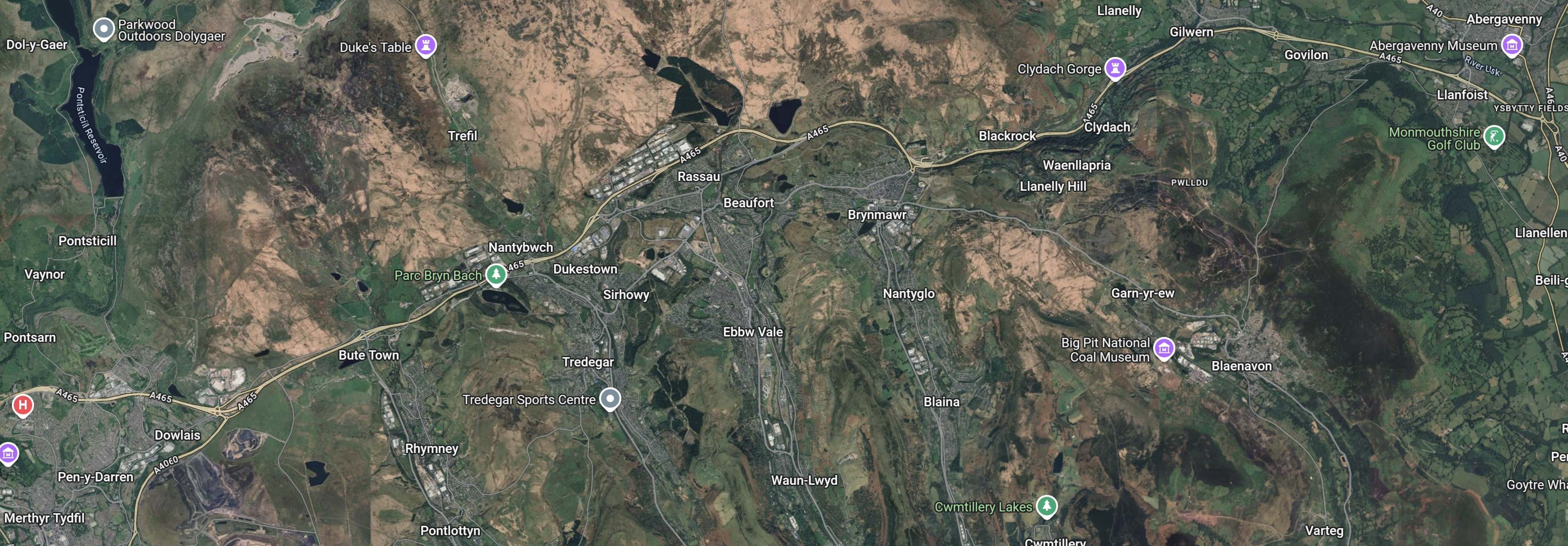
Note.
- Merthyr Tydfil is in the South-West corner of the map.
- Abergavenny is in the North-East corner of the map.
- The full length of the road is just under seventy miles.
- The Heads of the Valleys Road connects to all the towns, that are the Northern termini of the South Wales Metro.
- At it’s Western end, the A 465 connects to the M4 near Swansea.
The news item says this about the tourism benefits of the service.
The new service is expected to have positive economic and social benefits for the communities it serves. Both of FirstGroup’s open access services Lumo and Hull Trains are on track to deliver more than £1.4bn in economic benefits along their routes and FirstGroup hopes to have a similar positive effect for the South Wales and Herefordshire communities.
The service should also provide a convenient link for visitors travelling to the Brecon Beacons/ Bannau Brycheiniog National Park; Blaenavon World Heritage Site and cathedral city of Hereford, driving growth and supporting jobs in the area’s tourism sector.
I do wonder if other tourism related services will be developed at Pontypool & New Inn, Abergavenny and Hereford?
Monmouthshire
This paragraph from the Wikipedia entry for Monmouthshire gives a flavour of the Welsh county.
The county is rural, although adjacent to the city of Newport and the urbanised South Wales Valleys; it has an area of 330 square miles (850 km2) and a population of 93,000. After Abergavenny (population, 12,515), the largest towns are Chepstow (12,350), Monmouth (10,508), and Caldicot (9,813).
I was surprised that the population of the county, was as high as 93,000.
This second paragraph, lists the railway stations.
Monmouthshire is served by four railway stations: in the south are the Severn Tunnel Junction railway station at Rogiet on the South Wales Main Line, which connects South Wales to London; and Chepstow railway station and Caldicot railway station on the Gloucester–Newport line; and in the north, Abergavenny railway station on the Welsh Marches line.
Severn Tunnel Junction and Abergavenny stations will be served by Lumo’s new service.
From my experience of using parkway stations in East Anglia with connections to London, I suspect residents of several towns outside of Monmouthshire will use these two stations for trips to the capital.
Are plans in place for extra parking and bus services?
Travelling To And From Heathrow Airport
I wouldn’t be surprised if Lumo picks up quite a few passengers, who are going to and from Heathrow.
Consider.
- I suspect Severn Tunnel Junction to London Paddington will take about one hour and forty minutes, with just the single stop at Bristol Parkway.
- The Elizabeth Line to the Airport will take 28 minutes and cost £13.90, according to Transport for London.
- The Elizabeth Line is an easy step-free change from National Rail at Paddington.
- Elizabeth Line trains between Paddington and Heathrow are every six minutes.
- It’s not a very long walk at Heathrow between the Elizabeth Line and the terminals.
- Driving from say Monmouth to Heathrow will take about two-and-a-quarter hours and cost you to cross the Severn Bridge and for parking.
If your local Great Western Main Line station is between say Chippenham and Cardiff, you might be surprised at how fast and affordable it can be to go to and from Heathrow by Great Western Railway and Elizabeth Line.
When Lumo starts running to Heathrow, I am sure it will be faster, as the trains will not stop East of Bristol Parkway station.
Running In Conjunction With Services Between London Paddington And Carmarthen
The news item says this about running services in conjunction with Lumo’s services to Carmarthen.
The service would operate in conjunction with the planned service from London to Carmarthen which is due to launch in December 2027, and it is anticipated it could begin at the same time.
Consider.
- Both routes are identical between London Paddington and Maindee Junction.
- Both routes could share depots.
- Hitachi’s trains can split and join with alacrity.
- Class 800, 801, 802 and 803 trains have twenty-six metre cars, which mean a five-car train is 130 metres long.
- Bristol Parkway station has 280 metre long platforms. Pairs of trains could split and join here.
- Seven Tunnel Junction has three 171 metre long platforms. Pairs of trains could not use this station, unless the platforms were lengthened.
- Newport station has three platforms longer than 278 metres. Pairs of trains could split and join here, if the Hereford trains reversed direction.
I suspect if trains split and joined, it would be at Bristol Parkway station.
Note that Bristol Parkway station has 1,800 car park spaces, so Lumo could target passengers wanting to park and take the train to London, Cardiff, Newport and other Welsh destinations.
Co-operation With Great Western Railway
In Does Innovation Get Mr. Ed Miliband Better Prices To Doncaster?, I talked about the ticketing on the East Coast Main Line.
It appears to me, that if you put more seats on a popular route, like King’s Cross and Doncaster, then the availability drives down prices.
I also believe that if the tickets are all available through a common walk-up system, then this fills the seats.
The system has now been applied to the West Coast Main Line and I believe that if Great Western Railway and Lumo collaborated on ticketing, this would improve competition between London Paddington, Bristol Parkway and Cardiff.
There is also the issue of train rescue.
Supposing a pair of five-car Hitachi trains broke down with a fault, that allowed the train to be towed to the nearest station, so that passengers could be disembarked.
Hitachi trains are designed, so that up to twenty-four trains can be joined together in rescue mode.
That would certainly be an impressive sight.
Times Of Avanti West Coast Trains Between London Euston And Crewe
This table shows the first few Avanti West Coast trains between London Euston and Crewe on the 17th March 2025.
- 390119 – IS37 – Glasgow – 11 cars – 05:31 – 07:29 – 2 stops – 118 mins – 80.3 mph.
- 390155 – IH61 – Manchester Piccadilly – 11 cars – 06:29 – 08:08 – 2 stops – 99 mins – 95.7 mph.
- 807007 – IF11 – Liverpool Lime Street – 7 cars – 06:36 – 08:23 – 2 stops – 107 mins – 88.6 mph.
- 390104 – IS42 – Glasgow – 11 cars – 07:29 – 08:59 – 0 stops – 90 mins – 105.3 mph
- 390010 – IH62 – Manchester Piccadilly – 9 cars – 07:33 – 09:10 – 1 stop – 97 mins – 97.7 mph.
- 390044 – IF12 – Liverpool Lime Street – 9 cars – 07:43 – 09:18 – 2 stops – 95 mins – 99.7 mph.
- 390118 – IS45 – Glasgow – 11 cars – 08:30 – 10:01 – 0 stops – 91 mins – 104.2 mph
- 390040 – IH63 – Manchester Piccadilly – 11 cars – 08:33 – 10:19 – 1 stop – 106 mins – 89.4 mph.
- 807001 – IF14 – Liverpool Lime Street – 7 cars – 08:43 – 10:28 – 1 stop – 95 mins – 99.7 mph.
- 805001/805011 – ID83 – Holyhead – 10 cars – 09:02 – 10:51 – 1 stop – 109 mins – 86.9 mph.
- 390136 – IS48 – Glasgow – 11 cars – 09:30 – 11:02 – 0 stops – 92 mins – 103.0 mph
- 390040 – IH64 – Manchester Piccadilly – 9 cars – 09:33 – 11:08 – 1 stop – 95 mins – 99.7 mph.
- 390154 – IF16 – Liverpool Lime Street – 11 cars – 09:43 – 11:31 – 1 stop – 108 mins – 87.7 mph.
- 805012/805003 – ID84 – Chester – 10 cars – 10:10 – 11:53 – 1 stop – 103 mins – 92.0 mph.
- 390130 – IS52 – Glasgow – 11 cars – 10:30 – 12:00 – 0 stops – 90 mins – 105.3 mph
- 390151 – IH65 – Manchester Piccadilly – 11 cars – 10:35 – 12:09 – 1 stop – 94 mins – 100.8 mph.
- 807008 – IF18 – Liverpool Lime Street – 7 cars – 10:43 – 12:30 – 1 stop – 107 mins – 88.6 mph.
- 805009 – ID85 – Chester – 5 cars – 11:00 – 11:46 – 1 stop – 106 mins – 89.4 mph.
Note.
- All trains shown, go through Crewe.
- Some trains were delayed, hence their slow average speed.
- The Glasgow trains, which run non-stop from Euston to Warrington Bank Quay were the fastest, with four trains over 100 mph.
I have a few other thoughts.
The Class 805 Trains Are Crying Out For Batteries
In The Data Sheet For Hitachi Battery Electric Trains, I said this on how the Hitachi Class 80x trains will perform on batteries.
These are my conclusions about Hitachi’s battery packs for Class 80x trains.
- The battery pack has a capacity of 750 kWh.
- A five-car train needs three battery-packs to travel 100 miles.
- A nine-car train needs five battery-packs to travel 100 miles.
- The maximum range of a five-car train with three batteries is 117 miles.
- The maximum range of a nine-car train with five batteries is 121 miles.
Holyhead and Crewe is only 105.5 miles.
As battery technology gets better, these distances will increase.
The Fast Glasgow Train Appears To Be Leading A Convoy
The non-stop to Warrington Bank Quay Glasgow trains, also appear to be leading one Manchester Piccadilly, a Liverpool Lime Street and a Chester/North Wales train in a convoy, through Milton Keynes Central and the Trent Valley.
This convoy could grow as other services are added to the West Coast Main Line.
The Open Access Services Might Have Their Own Convoy
It would seem to me, that it might be possible to run a second convoy every hour, out of phase with the current one following the Glasgow service.
It also might be more virtual than real and under the control of the digital signalling, that will be installed on the line.
‘UK-First’ Intercity Battery Trial Exceeds Expectations
The title of this post, is the same as that of this press release from Hitachi.
These three bullet points, act as sub-headings.
- Intercity battery train completes testing in the north of England, demonstrating superior performance and cost-effectiveness compared to diesel engines.
- Trial confirms single battery technology can reduce fuels costs between 35%-50% and enter and leave stations in zero-emission mode.
- Ahead of Railway 200 celebration, this new UK rail innovation is ready to reduce cost and emissions on the railways.
These are the first two paragraphs.
Today, Angel Trains, Hitachi Rail and TransPennine Express are celebrating the successful completion of the UK’s first intercity battery trial in the North of England.
The powerful 700kw battery technology met, and in some cases even surpassed, the key objectives of the trial, including:
- Fuel costs savings between 35%-50%, surpassing previous predictions of up to 30%.
- Just one battery has managed to power the train to speeds greater than 75mph, clearly demonstrating this technology can enter, alight and exit stations solely in zero-emission battery-mode to improve air quality and reduce noise pollution.
- Able to achieve all journey times and performance requirements so can meet operators timetable requirements.
- The battery matches the weight of a diesel engine and is installed in the same undercarriage space, ensuring no risk of track degradation and no impact on the passenger environment.
Note.
- I would expect, that most of the fuel cost savings are due to the use of regenerative braking to the battery.
- 75 mph might seem slow, but Hull Trains average slower speeds than this on their diesel sections.
- Running in a non-polluting mode in stations and sensitive areas, is not going to be disliked by anyone.
- The most powerful diesel engines in Class 800 and Class 802 trains are rated at 700 kW. So with the same weight and power, it is not surprising that the performance is the same.
It looks to me, that Hitachi have designed an efficient battery-electric electric train, that can extend services from electrified main lines onto branch lines without electrification.
The One Battery Test Train And Hull Trains
Hull Trains currently run one service to Hull and Beverley and have applied for another service to serve Worksop, Woodhouse and Sheffield, where the trains would leave the East Coast Main Line at Retford.
Hitachi’s current test train has two diesel engines and one battery pack.
An Electric Service Between London and Hull/Beverley
Distances for the Hull and Beverley service are.
- ECML and Hull – 58.1 km. – 3 stops
- Hull and Beverley – 13.2 km or 26.4 km both ways. – 1 stop
Note.
- Trains will be fully-charged, when they leave the ECML.
- Trains could be fully-charged, when they leave Hull station, if the platform they use has a charging system.
- All Hull Trains call in Platform 7 at Hull station.
- The Hitachi press release said “During a trial run, the battery’s impressive power enabled the train to operate solely in battery mode for 70km.” A speed of 75 mph is indicated.
- I would assume the Hitachi train used regenerative braking to help recharge the batteries, at the intermediate stops.
- Trains average around 57 mph between the ECML and Hull and 38 mph between Hull and Beverley.
- Much of the track between the ECML and Hull has a speed limit of 75 mph.
- Much of the track between Beverley and Hull has a speed limit of 70 mph or less.
Because of these figures and what Hitachi have said of the train’s performance on batteries, I am convinced that Hull Trains will use an electrified Platform 7 at Hull station to charge the trains.
These pictures show a Hull Trains’s Class 802 train in Platform 7 at Hull station.




Note.
- The blue Hull Train is in Platform 7 in the pictures.
- Hull station has a classic Victorian cast-iron roof.
- Many other similar platforms have been electrified in the UK.
I believe that this platform can be electrified relatively easily with 25 KVAC overhead wires.
An Electric Service Between London and Worksop/Sheffield
Distances for the Worksop and Sheffield service are.
- ECML and Worksop – 12.2 km. – 1 stop
- Worksop and Sheffield- 25.3 km or 50.6 km both ways. – 1 stop
Note.
1. A train from London will leave Retford with a full battery.
2. Retford and Sheffield is only 37.5 km. So the round trip is only 75 km.
3. A full battery will power the train at 75 mph for 70 km – According to Hitachi.
4. Much of the track between Retford and Sheffield is only 60 mph. So going slower will give an energy saving.
5. Slowing at Worksop, Woodhouse and Sheffield will give the batteries a small charge.
6. There are no bridges in the Workshop station area, so a mile or so of electrification could be easy.
7. It’s an easy level route.
8. I’ve read somewhere that Hitachi have a full route simulator.
I calculate, that a two minute charge at Worksop would probably be all the train would need to travel the 75 km. on batteries.
We don’t know if Hitachi have licenced some of Vivarail’s FastCharge technology from FirstGroup. This could enable them to extract the maximum value from each stop at Worksop.
The One Battery Test Train And Lumo
Hitachi’s current test train has two diesel engines and one battery pack.
It is likely that a train with this configuration could be used on Lumo’s new service to Rochdale.
As London Euston and Manchester Victoria is fully electrified, the only unelectrified section is the 16.7 km. between Manchester Victoria and Rochdale. This would mean, that to complete the trip, Lumo’s train would need the ability to do 33.4 km on battery power.
As Hitachi’s test train can do 70 km on a full charge, Lumo could use trains with the standard two diesel engine and one battery pack configuration. The battery would be charged on the electrified sections of the route, between London Euston and Manchester Victoria stations.
It looks to me, to be a superb demonstration of the capabilities of a battery-electric InterCity train with two diesel engines and one battery pack.
The One Battery Test Train And LNER
Hitachi’s current test train has two diesel engines and one battery pack.
It is likely that a train with this configuration could be used on several LNER services from King’s Cross.
- Bradford Forster Square – 21.9 km. from Leeds
- Cleethorpes – 102.5 km. from Newark
- Grimsby Town – 97.9 km. from Newark
- Harrogate – 29.4 km from Leeds
- Lincoln – 26.9 km. from Newark
- Middlesbrough – 35.2 km. from ECML
- Cleethorpes – 102.5 km. from ECML
- Scarborough – 67.8 km. from York
Note.
- Some services like those to Bradford Forster Square, Harrogate and Lincoln could be run by only charging on the East Coast Main Line.
- Some services like those to Middlesbrough and Scarborough could be run by charging at the destination.
- Other services would need more batteries and/or charging at the destination.
I haven’t put in the Scottish services as running them may be more complicated.
Running Longer Distances On Battery Power
This paragraph is from the original Hitachi press release.
This success demonstrates that Hitachi Rail is ready to deliver the next stage of a full intercity battery-electric train. Based on real-world data, such a train would have a range between 100-150km. These ranges can cover significant sections of non-electrified routes, eliminating the need for wires in tunnels or stations, and potentially saving hundreds of millions of pounds on electrification projects.
Note.
- I would assume that as many diesel engines as possible would be replaced with battery packs.
- On a typical three-battery Class 800 train, 802 train or Class 805 train, this could be up to three batteries.
- But on a four-battery Class 810 train, this could be up to four batteries.
A strategy would need to be developed for all routes and trains would be configured and allocated to the routes accordingly.
Observing Trains At Stafford Station
I’m fairly certain, that I’ve only been to Stafford once in my life, in the past. That would be in 1968, when I went to English Electric in the town, when I was looking for a job on leaving Liverpool University.
In the end, my first job on leaving was at ICI in Runcorn.
As Stafford station, is on the West Coast Main Line, I’ve been through the station many times, on my way to Liverpool, Manchester, Preston, Scotland and other places in the North West of England.
I travelled North to Stafford in one of London Northwestern’s Class 350 trains, which definitely had ironing board seats. Some of these trains are being replaced with new Class 730 trains.
Stafford Station
This OpenRailwayMap shows the layout of platforms at the station.
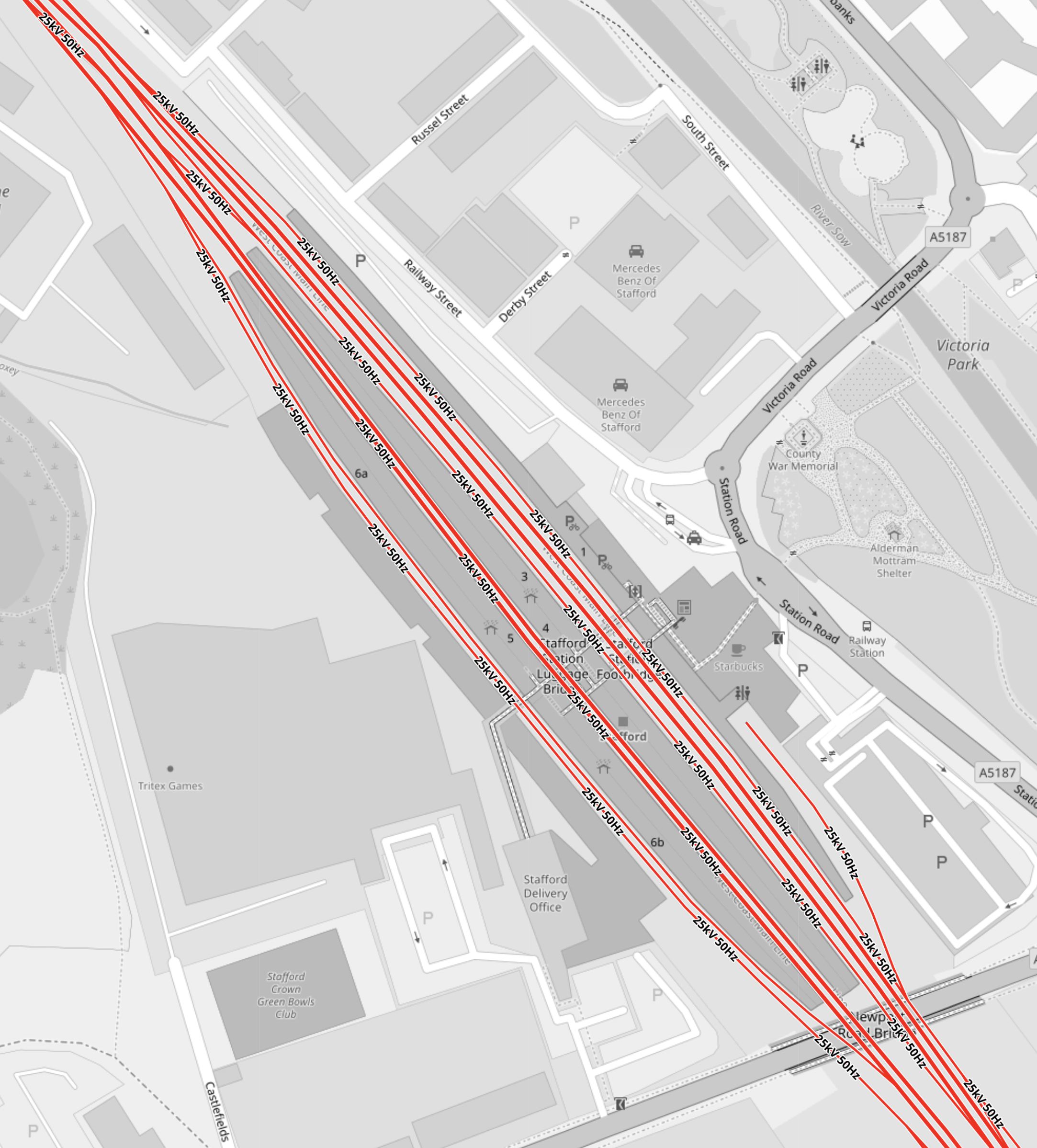
Note.
- Platforms are numbered starting with Platform 1 in the East.
- There are five through tracks for passenger trains and a double-track goods loop.
- All tracks are electrified and bi-directional.
- The platforms are three hundred metres long, but I feel they could be lengthened to take the 400 metre long High Speed Two trains.
- The platforms are certainly long enough for pairs of 200 metre long High Speed Two trains, to split and join at the station.
These pictures show Stafford station.
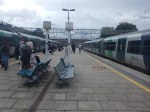
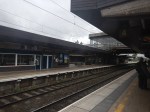
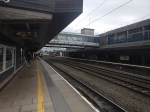
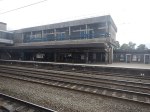
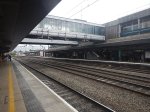
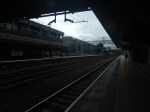
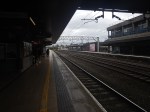
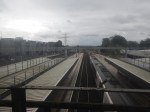
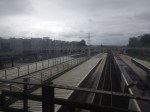
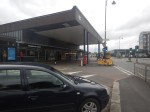
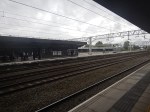
Note.
- The station was built of concrete in the early 1960s.
- It has a unique feature, in that there is a waiting area above the tracks, so kids of all ages can watch the trains speed through.
- It has been improved several times in recent years.
- It is step-free with several lifts.
I feel, the station could be converted into a major High Speed Two hub station.
High Speed Two Services
This graphic shows High Speed Two services after Phase 2b is completed.
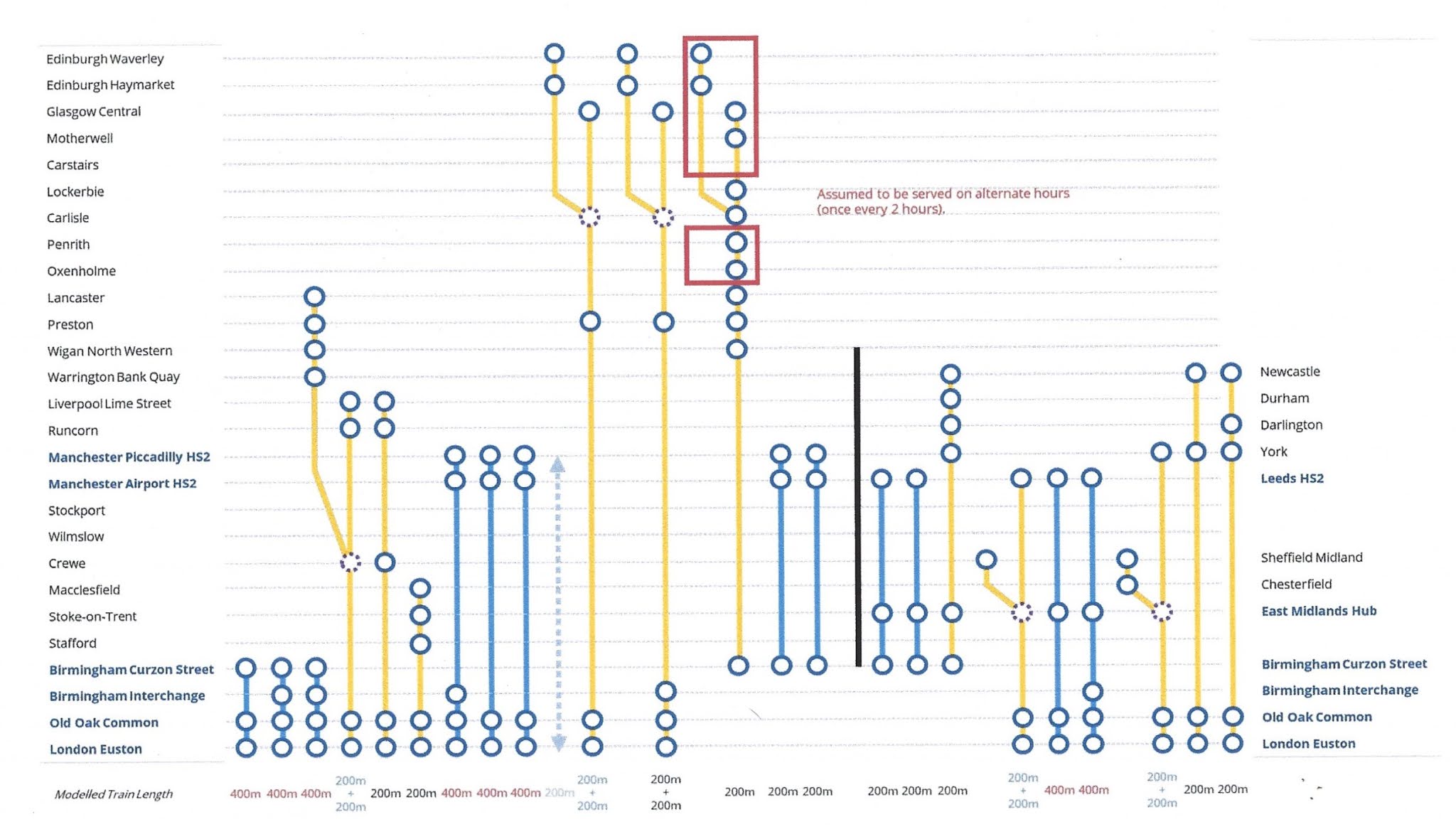
Note.
- Everything to the right of the vertical black line has now been cancelled
- Services shown in blue are run by High Speed Two Full Size trains.
- Services shown in yellow are run by High Speed Two Classic-Compatible trains.
- Each of these trains will have a frequency of one train per hour (tph).
These High Speed Two trains pass through Stafford.
- London and Lancaster/Liverpool Lime Street – Split/Join at Crewe
- London and Crewe/Runcorn/Liverpool Lime Street
- London and Stafford/Stoke-on-Trent/Macclesfield
- London and Manchester Airport/Piccadilly
- London and Manchester Airport/Piccadilly
- London and Manchester Airport/Piccadilly
- London and Edinburgh/Glasgow – Split/Join at Carlisle
- London and Edinburgh/Glasgow – Split/Join at Carlisle
- Birmingham and Edinburgh/Glasgow
- Birmingham and Manchester Airport/Piccadilly
- Birmingham and Manchester Airport/Piccadilly
In addition space will need to be found for these other services.
- Avanti – London and Chester/North Wales
- Avanti – London and Blackpool
- Freight – London and Liverpool/Manchester and Scotland
That gives a total of at least fourteen tph through Stafford station or one every 257 seconds.
Between Stafford and Crewe, with the completion of the flyover at Norton Bridge, there is effectively four tracks all the way, so this should give enough capacity to allow fourteen tph between Stafford and Crewe.
Between Stafford and Handsacre junction, where High Speed Two will join the Trent Valley Line about half the route is four-track with the rest being just two-track.
Will the two-track section be able to handle fourteen tph? I suspect it will, especially, as it is sandwiched between two four-track sections.
These are my thoughts about making the most of capacity through Stafford station.
Could Pairs Of High Speed Two Trains, Split And Join At Stafford?
Stafford station has 300 metre long platforms and pairs of High Speed Two Trains are 400 metres long.
Looking at maps and pictures of Stafford station, I suspect that lengthening the platforms at Stafford would be possible.
In the provisional High Speed Two service diagram, that I displayed earlier, these are two services.
- London and Crewe/Runcorn/Liverpool Lime Street
- London and Stafford/Stoke-on-Trent/Macclesfield
These could be run as a pair of trains between London and Stafford.
One advantage of running the two services as a pair, is that it would reduce the number of trains between Stafford and Handsacre junction by one, which might help the scheduling of trains through the double-track section, of the Trent Valley Line.
Fitting In The London and Chester/North Wales Services
Consider.
- These important services will soon be run by five-car Class 805 trains.
- The trains are diesel-electric.
- A pair would be 260 m long.
- There are ten trains per day (tpd) on the route.
The service has a few problems.
- It takes up a path between Crewe and Handsacre junction via Stafford, where train paths are at a premium.
- It is not zero-carbon.
- If London and Holyhead times were reduced, it would probably attract more passengers to the route.
As there are plenty of spare paths on High Speed Two, due to the cancellation of the Eastern leg, the easiest way to speed up the service would be to use High Speed Two between Handsacre junction and London.
200 metre long High Speed Two Classic-Compatible trains could be used, but this would need one of the following.
Electrification between Crewe and Holyhead. Although this was promised by the last government, I suspect the antis will stop it.
Partial electrification between Crewe and Holyhead. As Crewe and Holyhead is only 105.5 miles, I suspect a creditable scheme to use battery-electric trains could be developed. These trains could be useful in opening up High Speed Two to other destinations.
Could Other Services Piggy-Back On London and Chester/North Wales Services?
The London and Chester/North Wales services would all be run by 200 metre long High Speed Two trains.
There would be no reason, why on the London end of the journey, they could be paired with another High Speed Two train to and from another destination.
- They could split and join with a Blackpool service at Crewe.
- They could split and join with a Barrow service at Crewe.
- They could split and join with a second Stoke-on-Trent/Macclesfield service at Stafford.
Services like these, would improve the coverage of High Speed Two.
As with the joining of the Liverpool Lime Street and Macclesfield services, the pairing of trains reduces the number of paths needed on the double-track section of the Trent Valley Line to the South of Stafford.
Other Splitting And Joining At Stafford
It may be possible to arrange other splitting and joining at Stafford.
By rearranging the Manchester and/or the Scottish services, it might be possible to reduce the number of trains, through the double-track section of the Trent Valley Line.
There are certainly several possibilities.
Conclusion
Stafford station could be crucial, in making High Speed Two Lite feasible.
Do Rolls-Royce mtu Have A Plan To Decarbonise Their Diesel Engines For Rail Applications?
Data Sheets For Rolls-Royce mtu Diesel Engines For Trains
These are data sheets for various Rolls-Royce mtu diesel engines that can be used in rail applications.
Rolls-Royce Releases mtu Rail Engines For Sustainable Fuels
The title of this section, is the same as that of this press release from Rolls-Royce.
These four bullet points, act as sub-headings.
- mtu Series 1300, 1500 and 1800 engines already released; Series 1600 and 4000 to follow shortly
- Up to 90% CO2 savings by operating existing engines with Hydrotreated Vegetable Oil (HVO/renewable diesel)
- Locally emission-free operation possible in combination with mtu Hybrid PowerPack
- Field tests with DB Cargo and RDC Autozug Sylt
This is the first paragraph.
Rolls-Royce is taking a significant step towards even more climate-friendly rail transport with the release of mtu rail engines for use with sustainable fuels. With synthetic diesel fuels of the EN15940 standard, CO2 emissions can be reduced by up to 100 percent compared to fossil diesel. Hydrotreated Vegetable Oil (HVO or renewable diesel), which is already commercially available today, reduces CO2 emissions by up to 90 percent. If the fuels are produced with the help of renewable energy and green hydrogen – through what is termed a Power-to-X process – existing rail vehicles can be operated in a completely CO2-neutral manner. The mtu Series 1800 engines which are used in mtu PowerPacks, as well as Series 1300 and 1500 for locomotives and multi-purpose vehicles, are already approved for use with synthetic fuels such as HVO. Series 1600 and versions of Series 4000 engines will follow in the near future. The release of engines for climate-friendly fuels requires a series of tests and trials and Rolls-Royce has found strong partners for this activity. DB Cargo and RDC Autozug Sylt have already tested or are currently testing mtu Series 4000 engines with HVO in their locomotives.
How Does That Fit With The UK’s Population Of Rolls-Royce mtu Diesel Engines?
These classes of train have Rolls-Royce mtu engines.
- Class 43 power cars – 6V 4000 R41R
- Class 168 train – 6R 183 TD 13H
- Class 170 train – 6R 183 TD 13H
- Class 172 train – 12V 1800 R83
- Class 195 train – 12V 1800 R85L
- Class 196 train – 12V 1600 R85L
- Class 197 train – 12V 1600 R85L
- Class 800 train – 12V 1600 R80L
- Class 801 train – 12V 1600 R80L
- Class 802 train – 12V 1600 R80L
- Class 805 train – 12V 1600 R80L
- Class 810 train – 12V 1600 R80L
Note.
- Class 168 and 170 trains seem to be powered by older model Rolls Royce mtu engines.
- Class 180, 220,221 and 222 trains are powered by Cummins engines.
- I can’t find what engines power Class 805 and 810 trains, but it is reasonable to assume they have the same engines as the other Hitachi trains.
- As CAF are building LNER’s new tri-mode trains, I suspect these trains will also have Rolls Royce mtu engines.
It would appear that all the Rolls-Royce mtu rolling stock in the UK, with the possible exception of the Class 168 and 170 trains will be able to run on sustainable fuels.
Rolls Royce mtu And Hydrogen
This press release from Rolls-Royce is entitled Rolls-Royce Successfully Tests mtu Engines With Pure Hydrogen.
This is the first paragraph.
Rolls-Royce today announces that it has conducted successful tests of a 12-cylinder gas variant of the mtu Series 4000 L64 engine running on 100% hydrogen fuel. The tests, carried out by the Power Systems business unit, showed very good characteristics in terms of efficiency, performance, emissions and combustion. These tests mark another important step towards the commercial introduction of hydrogen solutions to meet the demand of customers for more sustainable energy.
Engines of mtu’s 4000 family are used in Class 43 power cars, so surely these developments could lead to hydrogen-powered freight locomotives.
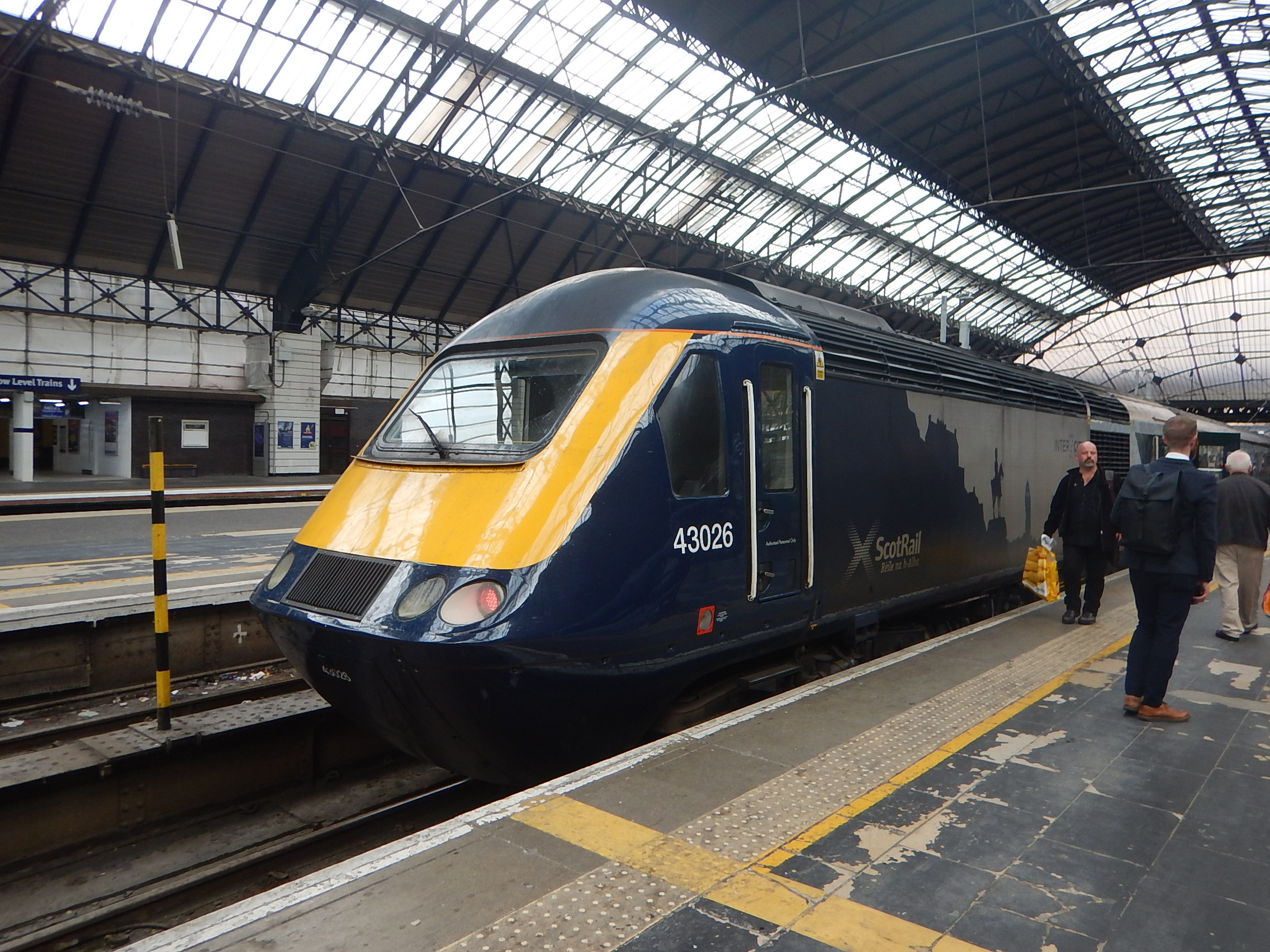
The picture shows a Class 43 power car at Glasgow Queen Street station.
Could Rolls-Royce mtu hydrogen power keep these iconic trains running for a few more years?
In ‘Spirit of Innovation’ Stakes Claim To Be The World’s Fastest All-Electric Vehicle, I look at Rolls-Royce’s Spirit of Innovation, which set the record for an electric vehicle at 555.9 km/hour.
As the InterCity125 already holds the record for the fastest diesel train, perhaps Rolls-Royce will attempt to set a record for the fastest hydrogen-powered train?
Decarbarbonising The CAF Class 195, 196 And 197 Trains
If Rolls-Royce mtu develop a hydrogen version of the 1800 diesel engine, then this could be used to fully decarbonise the CAF trains.
The operators may consider it’s not worth it and continue with using sustainable fuels.
But the possibility is surely there.
There must also be the possibility of developing a fuel cell replacement for the 1800 diesel, that can be slotted into the train.
Decarbarbonising The Hitachi Class 80x Trains
Hitachi are developing battery packs and the data sheet can be downloaded from this page on the Hitachi web site.
Decarbarbonising The CAF Tri-Mode Trains
I feel that as CAF usually use Rolls-Royce mtu engines, I suspect these trains will be designed, so they can be converted to hydrogen.
Conclusion
Rolls-Royce mtu appear to be on a path to decarbonise all their diesel engines.
Lumo Carbon Data Shows Its Trains Are 22 Times Greener Than Flying
The title of this post, is the same as that of this article on Rail Advent.
These paragraphs detail how the figures were obtained.
To mark the second anniversary of its branding as ‘Lumo’, the operator commissioned consultancy firm Arup to provide an independent report about all direct emissions from its operations; emissions from the grid-supplied energy it uses; and other emissions in its supply chain.
Scope 1: Direct emissions from operations that are owned and controlled by Lumo;
Scope 2: Emissions from the use of grid-supplied electricity, heat, steam and/or cooling by Lumo;
Scope 3: All other emissions that occur in the value chain of Lumo.In the last two years, Lumo has carried over two million passengers. The figures reveal that, per passenger, emissions from a London-to-Edinburgh journey are twenty-two times the level for flying (149 kgCO2e) than for using Lumo (6.8kgCO2e).
I have a few thoughts.
Carbon Savings With LNER
LNER’s Class 801 trains are similar to Lumo’s Class 803 trains.
The main difference, is that the LNER have emergency diesel engines, whereas Lumo have emergency batteries to run the trains systems, if the catenary goes down.
So LNER on balance will generate a bit more carbon than Lumo.
But the difference will be marginal.
Carbon Savings With Avanti West Coast
Avanti’s Class 390 trains to Scotland, are all-electric, so there will be a carbon-saving.
Probably about the same as with LNER.
Avanti West Coast’s New Class 807 Trains
If the Class 807 trains were cars, they would be Lotuses.
- They are electric only and have no heavy diesel engines or traction batteries.
- They don’t even have emergency batteries for when the catenary fails.
- They have a redesigned nose. Is it more aerodynamic?
- The heavy tilt mechanism is history.
- As with all the other Hitachi high speed trains, they are capable of 125 mph, or 140 mph if the signalling permits.
These trains will undoubtedly have faster acceleration and deceleration and could probably knock minutes off the timings at all the stops.
Tucked away beside the Grand Union Sets Out Stirling Ambitions article in the December 2022 Edition of Modern Railways is a report on Avanti West Coast’s application for a second service between Euston and Liverpool.
This is said.
Avanti West Coast has applied for access rights for its second hourly Euston to Liverpool service, starting from December 2023, although a phased introduction of the new service is likely. This would make use of Avanti’s new fleet of 10×7-car Class 807 Hitachi EMUs, which are expected to enter service from Autumn 2023. The ‘807s’ would be deployed on the current hourly Liverpool service, on which a call at Liverpool South Parkway would be added. (provision is made for this in the December 2022 timetable.).
Pendolinos would then operate the second service each hour, calling at Lichfield Trent Valley and Tamworth.
A linespeed project is in progress to raise the permissible speed for non-tilting trains on the West Coast Main Line, and Avanti’s new Hitachi trains will take advantage of this.
I can’t wait to go to Liverpool in one of these trains.
Their carbon emissions should be in line with Lumo.
Avanti West Coast’s New Class 805 Trains
These are equivalent to the Class 802 trains, but with probably Class 807 train interiors and looks.
I wonder how long these trains will keep their diesel engines before battery power is the most affordable option.
Once they go battery-electric, their carbon emissions should be in line with Lumo.
Conclusion
I can’t see any other mantra than.
Electric good, diesel bad
Especially, if like most computers, it’s just plug and play.
High Speed Two To Crewe
There has been a lot of speculation about the Northern end of High Speed Two, so I might as well add sort out a few facts and add a bit of speculation of my own.
Sample Times Between London And Crewe
These are selected times from the 27th September 2023.
- 07:30 – Glasgow Non-Stop – 1:29
- 07:33 – Manchester Piccadilly – 1:37 – Stops at Stafford
- 07:43 – Liverpool Lime Street – 1:40 – Stops at Milton Keynes
- 08:30 – Glasgow Non-Stop – 1:29
- 08:33 – Manchester Piccadilly – 1:37 – Stops at Stafford
- 08:43 – Liverpool Lime Street – 1:40 – Stops at Milton Keynes
- 09:02 – Holyhead – 1:40 – Stop at Stafford
- 15:02 – Chester – 1:40 – Stops at Tamworth, Lichfield Trent Valley and Stafford
Note.
- The 07:30 and 08:30 Glasgow services appears to be pathed for one of the Class 390 Pendolino electric trains and were run by Pendolinos.
- The 07:33 and 08:33 Manchester services appears to be pathed for one of the Pendolino electric trains and were run by Pendolinos.
- The 07:43 and 08:43 Liverpool services appears to be pathed for one of the new Class 807 electric trains, but were run by Pendolinos.
- The 15:02 Chester service appears to be pathed for one of the new Class 805 bi-mode trains.
- All services except the Glasgow services stop at Crewe.
- As London Euston and Crewe is 158 miles, the non-stop Glasgow services average 107 mph, the one-stop Manchester service averages 98 mph and the one-stop Liverpool service averages 95 mph.
I have some further thoughts.
How Long Does A Stop Take?
I’ve looked at some stops of Glasgow, Liverpool and Manchester services
Crewe
Looking at timings between Weaver Junction and Norton Bridge, I have found the following times.
- Glasgow-Euston – 23 minutes
- Liverpool-Euston – 28 minutes
Note.
- Manchester services don’t go through Weaver Junction.
- Weaver Junction and Norton Bridge are respectively North and South of Crewe.
- The Liverpool service stops at Crewe, where it has a dwell time of two minutes.
- The Glasgow service goes straight through Crewe.
The Crewe stop takes a total of 5 minutes of which 3 minutes are deceleration and acceleration to and from linespeed.
Stafford
Looking at timings between Norton Bridge and Colwich, I have found the following times.
- Glasgow-Euston – 7½ minutes
- Liverpool-Euston – 7½ minutes
- Manchester -Euston – 14 minutes
Note.
- Norton Bridge and Colwich are respectively North and South of Stafford.
- The Manchester service stops at Stafford, where it has a dwell time of two minutes.
- The Glasgow and Liverpool services go straight through Stafford.
The Stafford stop takes a total of 6½ minutes of which 4½ minutes are deceleration and acceleration to and from linespeed.
Milton Keynes
Looking at timings between Weedon and Bletchley, I have found the following times.
- Glasgow-Euston – 11½ minutes
- Liverpool-Euston – 16 minutes
- Manchester -Euston – 12½ minutes
Note.
- Weedon and Bletchley are respectively North and South of Milton Keynes.
- The Liverpool service stops at Milton Keynes, where it has a dwell time of one minute.
- The Glasgow and Manchester services go straight through Milton Keynes.
The Milton Keynes stop takes a total of 4 minutes of which 3 minutes are deceleration and acceleration to and from linespeed.
Average Speeds Between Crewe And London
London Ruston and Crewe is 158 miles according to Real Time Trains.
So what would times would various average speeds deliver?
- 100 mph – 95 minutes
- 110 mph – 86 minutes
- 120 mph – 79 minutes
- 125 mph – 76 minutes
- 130 mph – 73 minutes
- 140 mph – 68 minutes
Obviously, any average speed with over 125 mph running, will need full digital signalling.
Liverpool And London In Two Hours
Tucked away beside the Grand Union Sets Out Stirling Ambitions article in the December 2022 Edition of Modern Railways is a report on Avanti West Coast’s application for a second service between Euston and Liverpool.
This is said.
Avanti West Coast has applied for access rights for its second hourly Euston to Liverpool service, starting from December 2023, although a phased introduction of the new service is likely. This would make use of Avanti’s new fleet of 10×7-car Class 807 Hitachi EMUs, which are expected to enter service from Autumn 2023. The ‘807s’ would be deployed on the current hourly Liverpool service, on which a call at Liverpool South Parkway would be added. (provision is made for this in the December 2022 timetable.).
Pendolinos would then operate the second service each hour, calling at Lichfield Trent Valley and Tamworth.
A linespeed project is in progress to raise the permissible speed for non-tilting trains on the West Coast Main Line, and Avanti’s new Hitachi trains will take advantage of this.
I’ll take a quick look at the Crewe and Runcorn section.
- It is 22.5 miles.
- It takes 19 minutes.
- That is an average speed of 71 mph.
- Crewe and Weaver Junction has a speed limit of at least 110 mph
- Runcorn and Weaver Junction has a speed limit of at least 90 mph for most of the way.
- If with their superior performance, the new Class 807 trains could average 90 mph between Crewe and Runcorn, they would take 15 minutes.
- Achieving the 90 mph average may need a bit of track realignment and some signaling changes.
The four minutes saved would be enough to handle the extra stop at Liverpool South Parkway.
Consider.
- Currently, Pendolino trains do Liverpool and Crewe in 38 minutes, which includes the stop at Runcorn.
- My calculation with the Class 807 trains, shows that with a bit of extra signalling, the new trains could do Liverpool and Crewe in 38 minutes with the two stops.
- The stop at Crewe will subtract 5 minutes from the base journey time.
- The stop at Milton Keynes will subtract 4 minutes from the base journey time.
This means the base journey time between Crewe and London will be 73 minutes.
This would indicate that the trains would be running at 130 mph to achieve the two hours.
But there are five accelerations and five decelerations on a journey between London and Liverpool and the new Class 807 trains are the Lotuses of Hitachi’s family of AT-300 trains; lightweight and powerful.
Suppose they could save thirty seconds for each acceleration and deceleration.
The base journey time between Crewe and London will be 78 minutes.
This would indicate that the trains would be running at over 120 mph to achieve the two hours.
I certainly feel, that Liverpool and London in two hours is certainly possible using the new Class 807 trains.
London and Crewe with two stops would be times at one hour and twelve minutes.
But what about the Pendolinos?
- My last return trip from Liverpool did a practice call at Liverpool South Parkway and still arrived in London a few minutes early.
- The Pendolinos will still benefit from any improvements, between Crewe and Runcorn, which could reduce the Liverpool and Crewe time from 38 minutes to 34 minutes.
- The stop at Crewe will subtract 5 minutes from the base journey time.
- The stops at Lichfield Trent Valley and Tamworth will both subtract 4 minutes from the base journey time.
This means the base journey time between Crewe and London will be 73 minutes, which is the same as for the Class 807 trains.
This would indicate that the trains would be running at 130 mph to achieve the two hours.
Could this average speed be achieved by the selective application of full digital signalling, perhaps on the Trent Valley Line?
But it does appear to me, that the Pendolinos can get very close to two hours between London and Liverpool.
London and Crewe with three stops would be times at one hour and sixteen minutes.
Crewe And London Non-Stop
Consider.
- Pendolinos between London and Glasgow, go non-stop between London and Crewe.
- I have calculated that Pendolinos between London and Liverpool, will take one hour and sixteen minutes with three stops between London and Crewe.
- The three stops take a total of thirteen minutes.
I wouldn’t be surprised to see London and Glasgow Pendolinos take one hour and three minutes between London and Crewe.
This would knock twenty-six minutes off journey times between London and Glasgow.
Conclusion
I believe that with relatively minor improvements on the West Coast Main Line and the Liverpool branch, the following can be achieved.
- Liverpool and London can be around two hours with new Class 807 trains or Pendolinos.
- Liverpool and London services can increase their calls in the Midlands.
- London and Glasgow services can be nearly half-an-hour faster.
- The fastest London and Crewe services could be just over an hour using Pendolinos.
I also believe that the only serious infrastructure needed is some track realignment and some updated signalling.
See Also
Could High Speed Two Finish At Lichfield?
 The Anonymous Widower