Ecojet: Dale Vince Launches An Aviation Revolution
The title of this post is the same as that as this news story from Ecotricity.
This is the sub-heading.
The world’s first electric airline powered by renewable energy
These three paragraphs outline the project.
Ecotricity founder, Dale Vince, has announced the launch of Ecojet, the world’s first Electric Airline, powered by renewable energy. The move marks the beginning of an aviation revolution by making net-zero, emission-free air travel possible for the first time.
Ecojet’s fleet will comprise conventional planes retrofitted with hydrogen-electric powertrains. Once converted, the aircraft will operate with the same power output as before, but with a one-hundred percent reduction in CO2 emissions.
The decision to repurpose old planes rather than build new models from scratch will save 90,000 tonnes of carbon per year. The only byproduct will be water, which can be captured and released into the lower atmosphere to avoid the harmful effects of contrails.
These ae my thoughts.
The Aircraft
The news story contains pictures of two aircraft; a de Havilland Canada Twin Otter and a 737 or A320 variant.
- It also says that hydrogen-electric powertrains will be used.
- ZeroAvia in partnership with Cranfield Aerospace are developing such a powertrain and I suspect they could have one certified by 2025.
This would be used in the Twin Otter.
But what about 737 or A320 variant?
Airbus are already proposing the ZEROe Turbofan, which appears to be based on an improved A320 neo.
But the image on the news story looks more like a Boeing 737 from the wing-tips.
This article on the IET web site, which is entitled Airbus And Boeing To Embrace Hydrogen From Mid-2030s, indicates that it will be the mid-2030s before hydrogen twinjets of this size are in service.
This paragraph from the news story indicates his philosophy about the aircraft.
Short-term, to secure routes and a license from the Civil Aviation Authority, Ecojet will initially launch using conventionally fuelled planes. Ecojet will launch with two different sizes of turboprop aircraft (a 19-seat aircraft and a 70-seat aircraft). These aircraft will be retrofitted with the hydrogen-electric powertrains as they become approved for service by the CAA – the first retrofits will take place in 2025, one year after the commencement of flights.
Note.
- The news story clearly states that two types of aircraft will be used; a 19-seat turboprop and 70-seat turboprop.
- So the second picture of a Boeing 737 had nothing to do with the news story.
- They will be retrofitted with hydrogen-electric powertrains, when they have been certified.
- Flights are planned to start next year.
It looks a very canny philosophy, as Ecojet will be able to prove the route with aircraft running on traditional fuels or sustainable aviation fuel (SAF) and only switch to hydrogen, when the hydrogen-electric powertrains are proven, certified and installed, and the hydrogen infrastructure is in place.
The Smaller Aircraft
The first picture in the news story is of a de Havilland Canada Twin Otter.
- This aircraft accommodates 19-20 passengers.
- It has two turboprop engines.
- Production started in 1966 and it is still ongoing.
- Nearly a thousand have been built, so plenty of nearly-new examples will be available for refurbishment and conversion.
- Loganair operate three aircraft in Scotland.
It looks fairly certain, that Ecojet’s 19-seat aircraft will be a Twin Otter.
The Larger Aircraft
Possibilities would include these aircraft.
- ATR-72 – 72 seats
- de Havilland Canada Dash 8 – > 50 seats
Note.
- Both aircraft are still in production.
- In ZeroAvia To Bring Zero-Emissions Flight To Sweden, I talk about how ZeroAvia have sold their hydrogen-electric powertrains to Swedish ATR-72 operator; Braathens and are targeting Dash 8 operators.
- In Universal Hydrogen Successfully Completes First Flight Of Hydrogen Regional Airliner, I talk about Universal Hydrogen’s successful progress in selling hydrogen-electric powertrains for ATR-72s and Dash 8s. The first flight of their system was in an ATR-72.
It looks to me, that Dale Vince has a choice of two 70-seat aircraft and hydrogen-electric powertrains from two manufacturers; ZeroAvia and Universal Hydrogen.
In Monte To Purchase 100 FC Aircraft Drives From ZeroAvia, I talk about how Monte Aircraft Leasing have done a deal with ZeroAvia to lease ZeroAvia’s hydrogen-electric powertrains to regional airlines.
Has Dale Vince done a deal with Monte Aircraft Leasing for his aircraft?
- Monte Aircraft Leasing and ZeroAvia would get an eco-celebrity customer, who could even be the launch customer.
- Ecojet’s aircraft would all have similar ZeroAvia hydrogen-electric powertrains, although the size might be different.
- Dale Vince would only be sharing the risk, if the technology was a dog.
- De Havilland Canada and/or ATR will see how the passengers like zero-carbon flight.
There is also, one of aviation’s most powerful companies close to the deal, as Airbus own half of ATR.
Airbus are developing the hydrogen-powered ZEROe Turboprop, which is shown in this Airbus image.
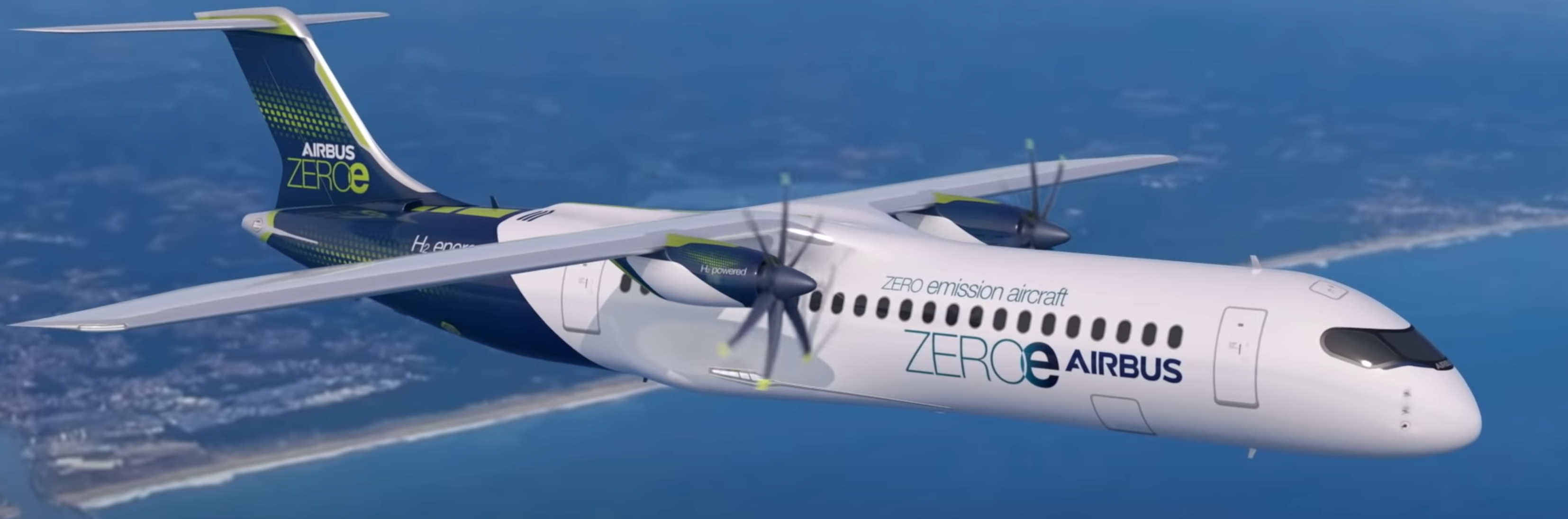
Note.
- It looks very much like an improved ATR-72.
- It has more extreme propellers and probably better aerodynamics.
- Airbus might like to persuade Ecojet to use ATR-72s as their 70-seat airliner.
- Information from an operator of hydrogen-powered airliners would be very valuable to Airbus.
I wouldn’t be surprised to see Ecojet lease some nearly new ATR-72s.
Would Airbus Fit ZeroAvia Hydrogen-Electric Powertrains In The ZEROe Turboprop?
This page on the Airbus website is entitled ZEROe.
In a section, which is entitled Hydrogen Propulsion To Power Future Aircraft, this is said.
All three ZEROe concepts are hybrid-hydrogen aircraft. They are powered by hydrogen combustion through modified gas turbine engines. Liquid hydrogen is used as fuel for combustion with oxygen.
In addition, hydrogen fuel cells create electrical power that complements the gas turbine, resulting in a highly efficient hybrid-electric propulsion system. All of these technologies are complementary, and the benefits are additive.
In 2022, we launched our ZEROe demonstrator with the aim to test hydrogen combustion technology on an A380 multimodal platform. Through future ground and flight testing, we expect to achieve a mature technology readiness level for a hydrogen-combustion propulsion system by 2025.
Note.
- Airbus state they are using modified gas turbine engines.
- Airbus also talk about using fuel cells to create electrical power that complements the gas turbines.
- Could the hydrogen fuel cells be used to power the aircraft’s systems, like avionics, control systems, air-conditioning and the hydrogen system for the main engine?
- This concept of effectively a hydrogen auxiliary power unit, might be a more efficient way of using the hydrogen, which either gives longer range or a smaller fuel tank.
- In The ZEROe Demonstrator Has Arrived, I talk about the ZEROe Demonstrator, which is a modified Airbus A 380.
Did the adding of hydrogen fuel cells to the ZEROe aircraft, lead to the concept of a hydrogen-powered auxiliary power unit, that I talked about in Airbus To Trial In-flight Auxiliary Power Entirely Generated By Hydrogen?
It looks to me, that Airbus have developed their own simple concept of powering the aircraft.
I doubt they will need ZeroAvia’s technology.
But.
- Aircraft manufacturers like Airbus generally fit the best and most suited engines they can find in their aircraft.
- The Wikipedia entry for ZeroAvia says that the prototype hydrogen-electric powertrain is in the cabin, consisting of two fuel cells and a lithium-ion battery for peak power.
- ZeroAvia have powerful shareholders like Amazon, Bill Gates and Royal Dutch Shell.
- ZeroAvia have also received grants from the UK Government.
I wouldn’t be surprised to learn, that Airbus have taken a long hard look at ZeroAvia’s technology.
After all, ZeroAvia could probably build a hydrogen fuel cell power pack, that would meet Airbus’s needs for a hydrogen-powered auxiliary power unit.
Remember too, that many fleets of aircraft have been updated with new engines for decades and I don’t think Airbus would mind ZeroAvia giving a new zero-carbon lease of life to the hundreds of ATR-72s in service around the world.
Surely, a successful hydrogen-powered ATR-72 is only going to create more interest in airlines buying ZEROe Turboprops.
All the converted aircraft will still need support from ATR.
Both the converted and new aircraft will need hydrogen refuelling services, so could the two aircraft use a common standard.
Airbus and ZeroAvia would appear to have several common interests.
Ecojet’s Core Route
This is a paragraph from the news story on the Ecotricity web site.
Dale has partnered with experienced pilot Brent Smith and a team of aviation specialists to set up Ecojet. Flights across the UK will commence in early 2024, starting with the Edinburgh to Southampton route, and expanding to mainland Europe shortly after, with long-haul flights planned for the future.
Note.
- The ATR-72 has a range of 949 miles, which is more than adequate for Southampton and Edinburgh, which is just over 350 miles.
- Diagonal journeys in the UK are often the most passenger-unfriendly by rail and tend to use diesel trains.
- Southampton Airport has good road and rail connections, with the terminal less than a minute from the station.
- Edinburgh Airport has good road and tram connections, with rail connections needing a short journey on the tram.
- Southampton Airport has flights to the Channel Islands, Ireland and Schiphol.
- Edinburgh Airport has a comprehensive service from major airlines and low-cost carriers, and several flights to destinations in the North of Scotland and on the Islands.
I think that it is a well-chosen core route for their 70-seat aircraft.
Which Routes Will Ecojet Fly With The Twin Otters?
Consider.
- My Scottish friends tell me that flying to the Scottish Islands, like the Hebrides, Orkney and Shetland is expensive.
- The growth of the Scottish wind power industry will mean, that more capacity is needed to serve the North of Scotland and the Islands.
- Tourism to the North of Scotland and the Islands is on the up.
- There will not be a shortage of green electricity to produce green hydrogen.
- The North of Scotland isn’t short of airports.
- The Twin Otter has a surprisingly long range on aviation fuel and I suspect, that a hydrogen version would be designed to have a similar range.
- The longest flight needed would probably be Edinburgh and Sumburgh, which is about 280 miles, which should be well within the range of a Twin Otter.
- I suspect that hydrogen refuelling could be easily provided at enough airports, to support hydrogen-powered airliners.
- I am sure, that the Twin Otters could be used on a network of zero-carbon flights from Edinburgh to the North of Scotland and the Islands.
- A zero-carbon airline would help Scotland’s net-zero ambitions.
There is certainly a need for another airline to connect Edinburgh to the North of Scotland and the Islands and the infrastructure could be upgraded to support a hydrogen-based zero-carbon airline.
Could Ecojet build a similar network at Southampton, that served the Channel Islands, Southern Ireland and Northern France?
Conclusion
There’s a lot more to this venture, than there appears at first sight.
O wish Vince and his partners well, but as a coeliac, I’ll skip the food.
Lloyd’s Register Issues World’s First Rules For Hydrogen Fuel
The title of this post, is the same as that of this article on Hydrogen Central.
These are the first two paragraphs.
Lloyd’s Register issues world’s first rules for hydrogen fuel.
Liam Blackmore, Lead Specialist at Lloyd’s Register, is a busy man. He has led the technical policy writing of many of the class society’s decarbonisation rules. Horizons spoke to him in late April 2023, just a few weeks after LR had published the world’s first maritime rules covering hydrogen as a fuel.
This would appear to be a very sensible move by Lloyds Register, which sets down the rules for using hydrogen fuel on ships.
But surely, if you follow these rules, then you will able to get insurance for your ship.
Riveting Television
I’ve just watched an episode of Fred Dibnah’s Made In Britain, which was entitled Mechanics and Riveters.
It was fascinating stuff, but how do you decarbonise an industry like the making of rivets without using hydrogen?
Can ‘Enhanced Rock Weathering’ Help Combat Climate Change?
The title of this post, is the same as that of this article on the BBC.
This is the sub-heading.
In a quarry surrounded by the din of heavy machinery Jim Mann crouches down and picks up a handful of tiny black rocks.
These three sentences introduce Jim and his magic dust.
“This is my magic dust,” he says with a smile, gently rubbing them between his fingers.
He’s holding pieces of basalt. It’s a hard volcanic rock that is neither rare nor particularly remarkable.
But through a process known as ‘enhanced rock weathering’ it could help to cool our overheating planet.
This Google Map shows Orrock Quarry, where the basalt is mined.
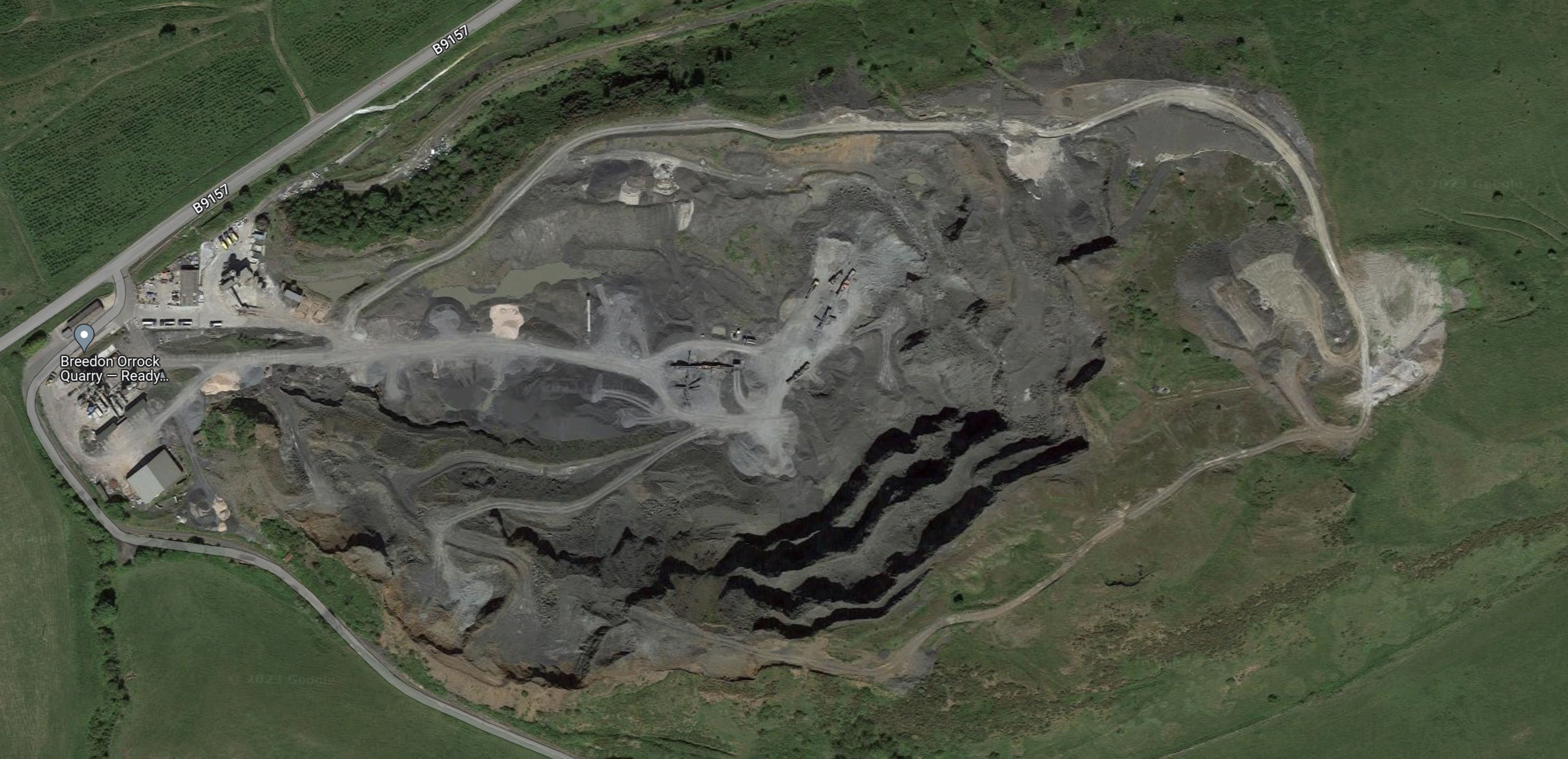
The article then gives a simple explanation of enhanced rock weathering.
When one of the companies, I’d backed won a green design award it was presented by David Bellamy. I remember having a very radical conversation with him, about some of the projects, where he’d been an advisor.
Some might have dismissive views about Jim Mann’s work as being too good to be true, but when I see the chemistry, I suspect,I’ll find it to be sound.
It would be a very interesting process to mathematically model!
ULEZ: Impact Of Mayor’s Expansion Questioned
The title of this post, is the same as that of this article on the BBC.
This is the sub-heading.
One in six cars registered in outer London did not meet Ultra Low Emission Zone (ULEZ) standards last year, according to figures from the Society of Motor Manufacturers and Traders
These paragraphs outline the analysis.
The data was released following a Freedom of Information request by the BBC to Transport for London (TfL).
It comes amid a dispute over whether existing data used by City Hall and TfL is accurate.
However, London Mayor Sadiq Khan said the newly released data was unreliable.
From the end of August, all those driving vehicles within Greater London that do not meet ULEZ pollutant limits will face a £12.50 daily charge or a £180 fine.
I’m sure that any Professor of Statistics from London’s universities or an expert from the Royal Statistical Society, could give a definitive answer on the statistics.
But then Khan is a lawyer and will hide behind the law in this case, by claiming he is both judge and jury.
If Khan really cared about London’s air, he would have a hydrogen policy, which would enable London’s local cement, construction and refuse trucks to be replaced or converted to hydrogen, so that the city’s air improved.
It would also make it easier to introduce more hydrogen-powered buses.
Companies like Tesco and Marks & Spencer, who regularly run trucks into London, should be encouraged to convert their delivery trucks to zero-carbon, by adjustment of the ULEZ charges.
The ULEZ has been badly thought out and needs to be realigned with what is practical and reduces the pollution.
SSE Renewables Announces Construction Of Second Utility-Scale Battery Storage System
The title of this post, is the same as that of this news item from SSE Renewables.
These three paragraphs outline the project and its current status.
SSE Renewables has taken a Final Investment Decision to proceed with, and entered into contracts to deliver, its second battery energy storage system (BESS). The 150MW project is located at the site of SSE’s former Ferrybridge coal-fired power station in West Yorkshire, England.
The investment is part of SSE’s £12.5bn Net Zero Acceleration Programme and means construction will now commence later this month at the iconic site.
For decades the Ferrybridge coal-fired power station was a prominent feature of the West Yorkshire landscape, before being decommissioned by SSE in 2016. Now SSE Renewables’ plans to build a new 150MW battery storage project at Ferrybridge will provide flexible generation for Britain’s national grid and a new era for the site.
This Google Map shows the site.
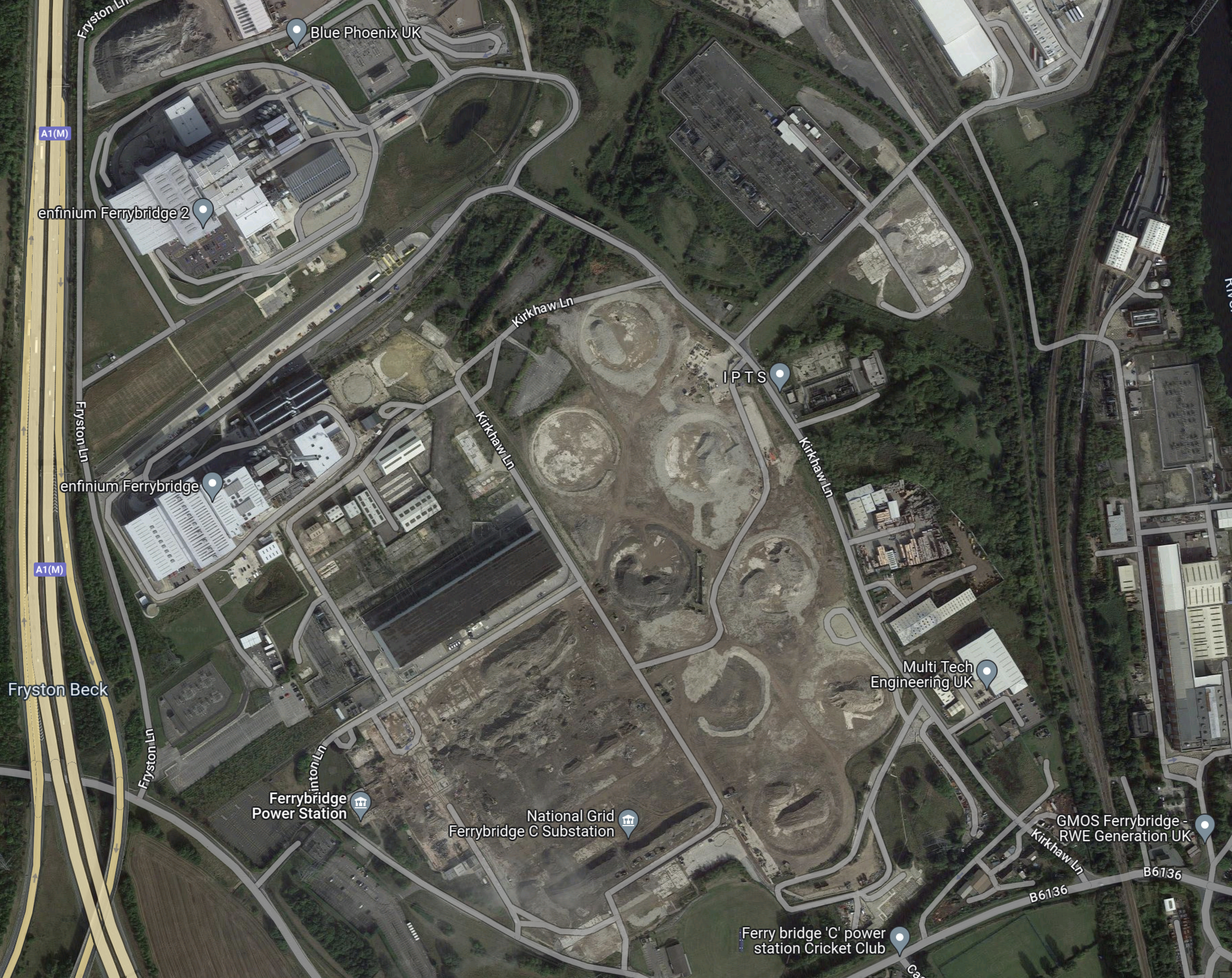
Note.
- The A1(M) runs up the West side of the map, with the East Coast Main Line going up the East.
- The circular structures in the middle of the map appear to be the bases and remains of the eight cooling towers.
- There are a lot of labels saying Ferrybridge power station.
- One existing and one demolished sub-stations can be located.
- The last Ferrybridge power station; C had a capacity of just over 2 GW.
The Wikipedia entry for Ferrybridge C, is worth a read, as it details the struggles of various owners and their engineers to generate electricity efficiently and with regard to the regulations.
The site’s use since 2016 seems to have been varied with two multi-fuel power stations, that were designed to burn mixed fuel including biomass, general waste and waste wood, a carbon capture experiment for Chris Huhne and now the 150 MW battery, which other sources give as having a storage capacity of 300 MWh.
It looks to me that SSE still own the large site and I wonder what their plans envisage for the site.
- A large electrolyser to produce hydrogen could be invaluable for decarbonising the heavy industry in the area.
- According to Wikipedia, there was a plan to build the gas-fired Ferrybridge D and a gas pipeline to connect it to the gas transmission system, but neither were built.
- So could the gas pipeline be built to distribute the hydrogen?
- Or could a large hydrogen store and a small hydrogen-powered power-station be built at Ferrybridge to back up the renewables
- Alternatively, more batteries could be added to the site.
The size of the site, gives lots of possibilities.
Have Your Say About Potential New Hydrogen Facility In Aldbrough
The title of this post, is the same as that of this article on HullLive.
This is the first paragraph.
SSE Thermal is looking for input from the local community regarding its first-of-a-kind low-carbon hydrogen facility.
They are holding meetings in the Hull area as follows to discuss the project with anybody who is interested.
- Tuesday, June 6, 2:30pm – 7pm: Hedon Town Hall, 36 St Augustine’s Gate, Hedon, HU12 8EX
- Wednesday, June 7, 2:30pm – 7pm: East Village Meadows, Northfield Farm, Garton, HU11 4QB
- Thursday, June 8, 2:30pm – 7pm: Aldbrough Village Hall, Garton Rd, Aldbrough, HU11 4QA
I shall be going on the Tuesday. There are buses from Hull station, which take about 35 minutes.
This section is copied from the HullLive article.
What is the Pathfinder Project?
The Aldbrough Hydrogen Pathfinder project is an important building block in the development of a thriving Humber hydrogen economy, underpinning the region’s decarbonisation and supporting economic growth locally and nationally.
The project is proposed to be developed within its existing site at Aldbrough Gas Storage, and all visible infrastructure will be within the site boundary.
The project intends to use one of the current storage caverns and repurpose it to develop a project in the Humber that would unite hydrogen production, storage and power generation in one.
As someone, who feels strongly about the benefits of hydrogen, I feel this is a very worthwhile project.
SSE To Help Decarbonise 5000 Homes In Major London Retrofit Project
The title of this post, is the same as that of this news item on SSE.
These three paragraphs outline the work.
SSE Energy Solutions has agreed a deal with Berkeley Homes that will help to decarbonise a heat network for up to 5,000 homes in London, thought to be one of the largest retrofits of its kind in the country.
An Air Source Heat Pump (ASHP) system will be installed to supply the homes on an existing district heating network at the Woolwich Arsenal site after several options were considered, including the use of waste heat and ground and river source solutions. An ASHP was chosen as the best low carbon, low tariff option over the length of the supply contract.
The system will be installed in nearby Wellington Park where a new landscape will be created through a unique planting scheme that broadens the biodiversity of the area by responding to the microclimate. The ASHP will connect directly to the existing district heating network pipes, reducing the carbon content of the heat provided by the network.
It strikes me, that no new housing estates or blocks of flats, should be built without a district heating system.
In this example, SSE are able to decarbonise a large number of houses and flats, by just replacing a boiler with an air source heat pump.
Just imagine the hassle if five-thousand individual boilers had to be replaced.
Siemens Completes Study To Decarbonise Major UK Industrial Estate By 2038
The title of this post, is the same as that of this news item on Siemens UK web site.
This is the sub-heading.
Siemens has proposed a road-map for decarbonising Trafford Park, one of Europe’s largest industrial estates, to support Trafford Council’s aims for the Greater Manchester borough to achieve net zero by 2038.
This three paragraphs outline the proposal.
The Low Carbon Trafford Park 2038 study, proposed by Siemens, aims to identify, cost and measure the impacts of low carbon technologies at the industrial estate. It covers a broad range of solutions, from waste to energy and heat recovery from energy intensive industrial players, to the potential for solar photovoltaics across the park to generate 147 GWh of clean energy.
The study acts as a blueprint for the council to consider as it works to eliminate the 714,000 tonnes of carbon emitted from Trafford Park each year. The estate is home to 1,330 businesses employing more than 35,000 people, with a dense population of industrial and commercial occupiers over an area of 4.6 sq miles.
The Council aims to use the roadmap to facilitate stakeholder engagement and collaboration across the industrial park, aligning business and environmental goals to different commercial segments across recommended technological and behavioural measures. It will then consider its broader recommendations as part of a long-term plan in partnership with occupiers.
This is decarbonisation on a grand scale!
- Siemens expects the decarbonisation of Trafford Park to attract new business to the Park and maintain and enhance its standing as a commercial and industrial hub in the region.
- The measures recommended would require £1.2 billion of private and public investment to achieve a 94% reduction in emissions.
- The study provided Trafford Council with modelling of an extensive range of measures for conserving gas and electricity and for generating clean energy on-site.
This page on the Siemens web site is entitled Smart Infrastructure For A Sustainable Future, outlines some of the company’s solutions.
Conclusion
It will be interesting to see how Trafford Park decarbonises.
Could The Bombardier Voyagers Be Converted To Hydrogen Power?
Avanti West Coast, CrossCountry and East Midlands Trains all run versions of Bombardier Voyager trains.
- There are 103 sets in service.
- Lengths are four, five and seven cars.
- They are 125 mph trains.
- They are powered by one Cummins QSK19 diesel engine in each car.
Given Cummins’s enthusiasm for hydrogen could these diesel engines be converted to hydrogen power, so the trains could run long distance routes on zero-carbon power?
If there is no need for them in the UK, there are probably lots of places in the world that would like them!
 The Anonymous Widower