Birmingham Airport Connectivity
On the Midlands Connect web site, they have a page, which is entitled Birmingham Airport Connectivity.
This is the introductory paragraph.
By using capacity released by HS2 and investing in new track south of Birmingham Airport, we can improve connections from the south of England, East Midlands, Yorkshire and the North East.
The page contains this helpful map.
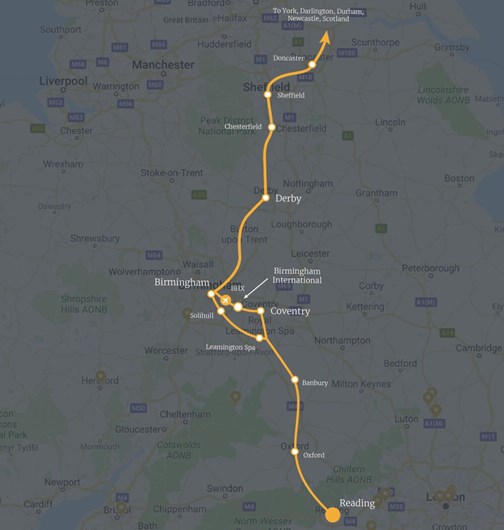
It looks like Midlands Connect are thinking about improving the Reading and Newcastle service.
Points made on the page and related articles, like this one on Rail News include.
- Birmingham Airport has plans to increase passenger numbers to 18 million by 2033.
- Coventry and Leamington Spa via Kenilworth will be double-tracked.
- High Speed Two will release capacity in the area.
- It will open up rail capacity between Birmingham and Solihull.
- There will be a new service between Birmingham Moor Street and Oxford via Solihull and Warwick Parkway.
- It will improve local connections to Birmingham Airport.
- Birmingham and Reading services will be increased to two trains per hour (tph)
- The Government is being asked to chip in £20 million.
These are my thoughts.
Birmingham Airport
Birmingham Airport can become a true Heart of England Airport.
I feel that the future of aviation will be very different to the past.
- COVID-19 and the future pandemics, that we will endure from the East and the Americas, will mean that flying will be a very different experience with hygiene and social distancing to the fore.
- Smaller aircraft, for flights up to 500 miles, will be odd-looking zero-carbon machines with exotic power systems.
- Larger aircraft will be energy efficient planes powered by aviation biofuels produced from household and industrial waste, and biomass.
- Boeing 747s and Airbus A380s will only be talked about in tales from older people to the young.
- Airports will be important rail hubs to more than just the local area.
Wikipedia also says this about expansion of Birmingham Airport.
Plans for a second runway (a third when demand requires) on the other side of the M42 and a new terminal complex and business park have been published, and they could help to create around 250,000 jobs. It has been estimated that if these plans went ahead, the airport could handle around 70,000,000 passengers annually, and around 500,000 aircraft movements.
This Google Map shows the Airport.
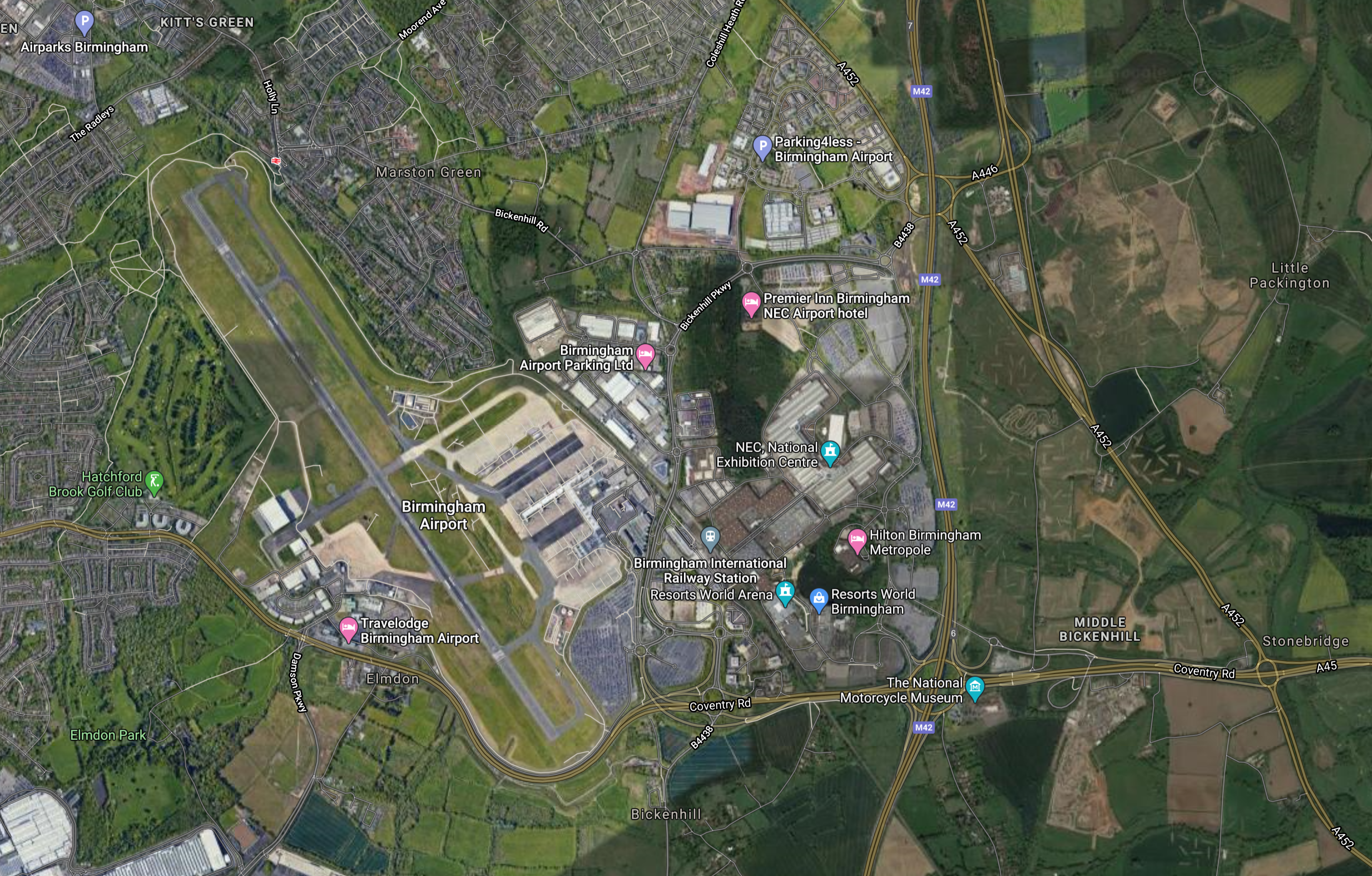
Note the M42 motorway passing North-South to the East of the Airport.
Could Birmingham Airport develop towards Birmingham Interchange and High Speed Two?
It is worth looking at the distance to other airports.
- Aberdeen – 328 miles
- Amsterdam – 280 miles
- Dublin – 199 miles
- Frankfurt – 478 miles
- Geneva – 558 miles
- Paris – 304 miles
All could be within range of an electric aircraft like the under-development Eviation Alice.
I believe that large airports will develop low-noise zero-carbon secondary runways.
Birmingham Airport is well-situated to take advantage.
Adding A Second Track Between Leamington Spa And Coventry
This section of track is about ten miles long, with probably under half only single-track.
This Google Map shows the single-track through the new Kenilworth station.

And these are pictures I took soon after the station opened.



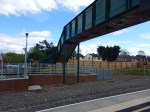
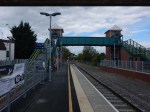
It is certainly one of the best of the current crop of new small stations.
I don’t think that adding a second track will be the most challenging of projects.
It should be noted that the Leamington Spa and Nuneaton service could be a candidate for a battery electric train.
- The route is twenty miles long
- Nuneaton and Coventry stations are fully electrified.
- There might be possibilities to extend this service at either or both ends.
- Nuneaton and Leicester are nineteen miles apart and a new Nuneaton Parkway station is proposed for the route. I wrote about this station in New Railway Station Between Hinckley And Nuneaton Receives Backing.
- Leamington Spa and Stratford-upon-Avon are fifteen miles apart and would need a reverse at Leamington Spa.
A battery electric train might give a faster and more passenger-friendly service, if the passenger numbers and forecasts would support an extended service.
A Birmingham Moor Street And Oxford Service
This Google Map shows Birmingham Moor Street station.
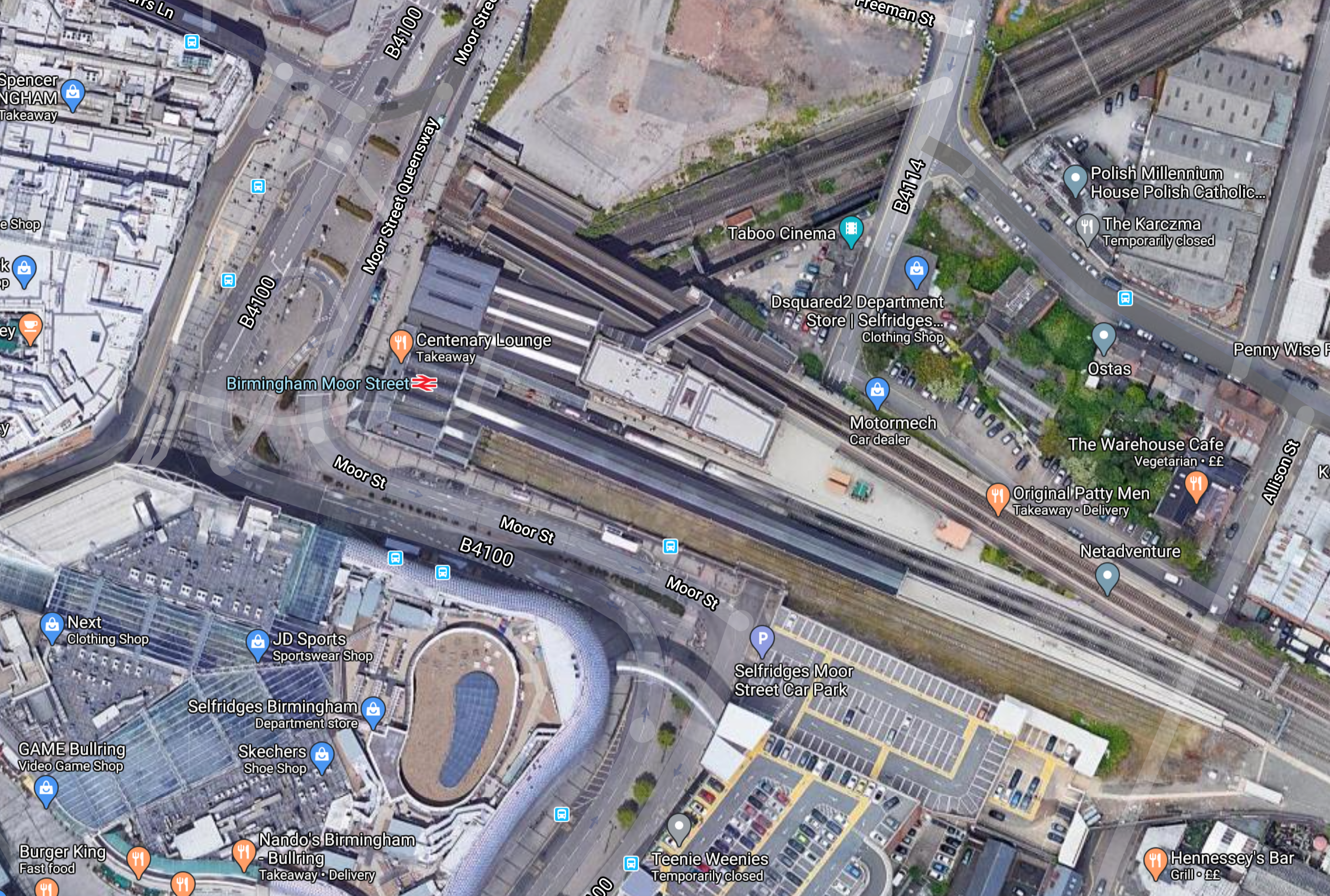
Note.
- The two Northern through platforms on the Snow Hill Lines, that continue under Birmingham to Birmingham Snow Hill station.
- At least two, but possibly three bay platforms, that can take Chiltern Railway’s longest trains.
- There is more space for possibly another two bay platforms to be reinstated or built.
Birmingham Moor Street station will also be a short walk from High Speed Two’s Birmingham Curzon Street station.
This Google Map shows Oxford station.
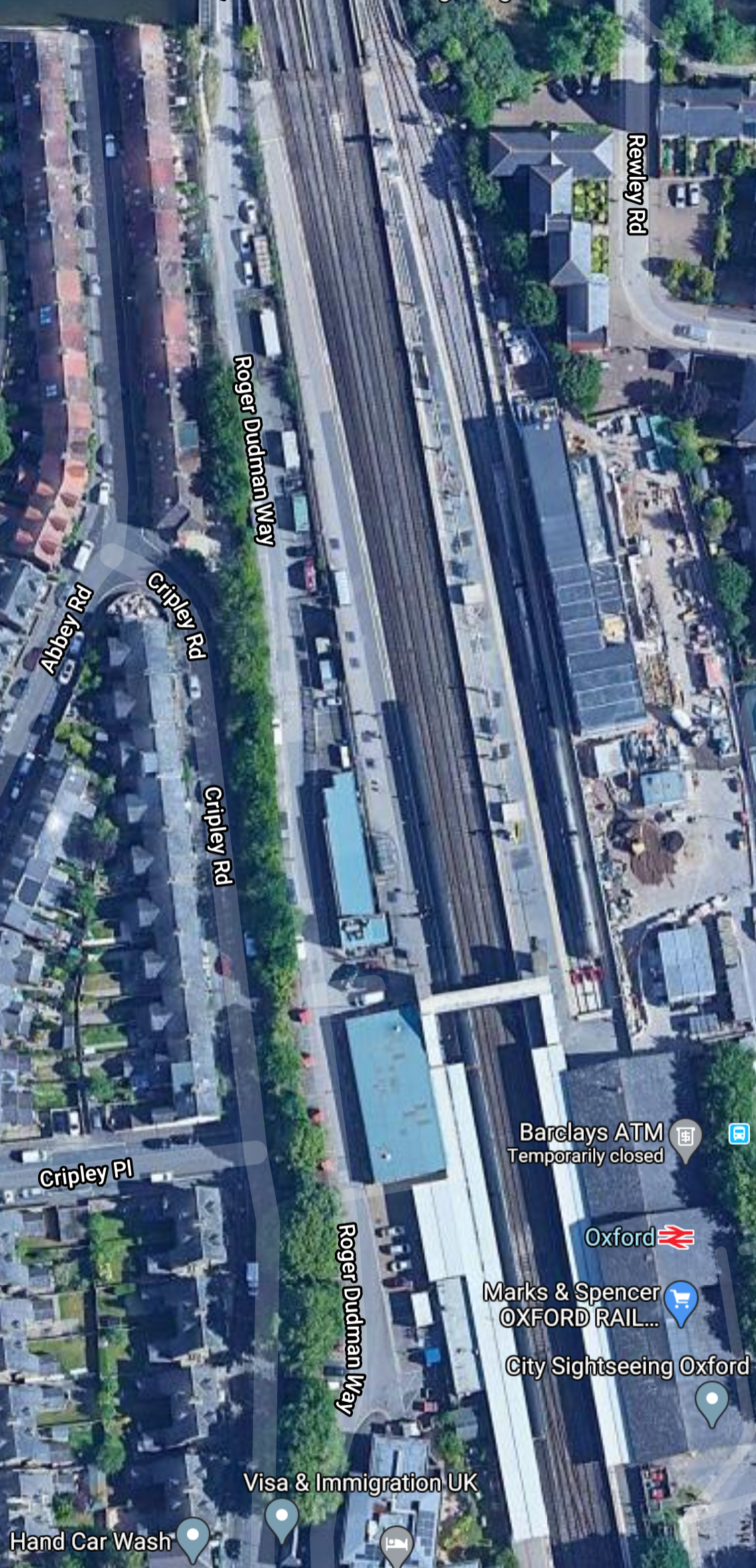
Note.
- Birmingham Moor Street station is to the North via Banbury and Warwick Parkway stations.
- The two long through platforms capable of taking a nine-car train.
- There are two bay platforms to the East of the two through platforms, at the Northern end of the station.
- The bay platforms handle Chiltern’s services from London Marylebone and could also handle the proposed service to Birmingham Moor Street.
Consider this about the proposed Birmingham Moor Street and Oxford service.
- The service could stop at Solihull, Warwick Parkway, Warwick, Leamington Spar and Banbury, as was thought necessary.
- I estimate that Birmingham Moor Street and Oxford are 66 miles apart and that a 100 mph train would take around 66 minutes.
- Birmingham Moor Street and Banbury are 43 miles apart.
- Oxford and Banbury are 23 miles apart.
With these timings and a few minutes to reverse at each end of the route, I would estimate that a 2.5 hour round trip would be possible.
But, I also think, that with charging facilities or short lengths of electrification at Birmingham Moor Street, Banbury and Oxford stations, this service could be run by battery electric trains.
- A three hour round trip should be possible.
- Three trains would be needed to provide an hourly service.
- Oxford, Banbury, Leamington Spa and Warwick would have a direct connection to High Speed Two.
It should also be noted
- Birmingham Moor Street and Stratford-upon-Avon stations are only 25 miles apart and the journey rakes 46 minutes
- Banbury and Stratford-upon-Avon are 35 miles apart. and the journey takes 57 minutes.
- Leamington Spa and Nuneaton are 20 miles apart and the journey takes 36 minutes.
There would appear to be tremendous potential for battery electric services between Birmingham and Oxford.
How many tourists would a Birmingham and Oxford service via Stratford-upon-Avon attract?
Improving The Reading And Newcastle Service
Currently, this is a one tph service between Reading and Newcastle stations.
- It is run by CrossCountry.
- Intermediate stops include Oxford, Banbury, Leamington Spa, Birmingham New Street, Derby, Sheffield, Doncaster, York, Darlington and Durham.
- It appears that the full journey takes four-and-a-half hours.
It looks like to run a two tph service would need as many as twenty trains.
There is an alternative route after High Speed Two opens.
- High Speed Two – Newcastle and Birmingham Curzon Street – 118 minutes
- Walk – Curzon Street and New Street – 10 minutes
- CrossCountry – Birmingham New Street and Reading – 90 minutes
This saves about forty-five minutes.
You could even do a double change.
- High Speed Two – Newcastle and East Midlands Hub – 96 minutes
- High Speed Two – East Midlands Hub and Birmingham Interchange – 17 minutes
- Walk – Birmingham Interchange and Birmingham International – 10 minutes
- CrossCountry – Birmingham International and Reading – 78 minutes
This gives a time of around three hours and twenty minutes.
High Speed Two certainly saves time.
But look at this map clipped from the High Speed Two web site.
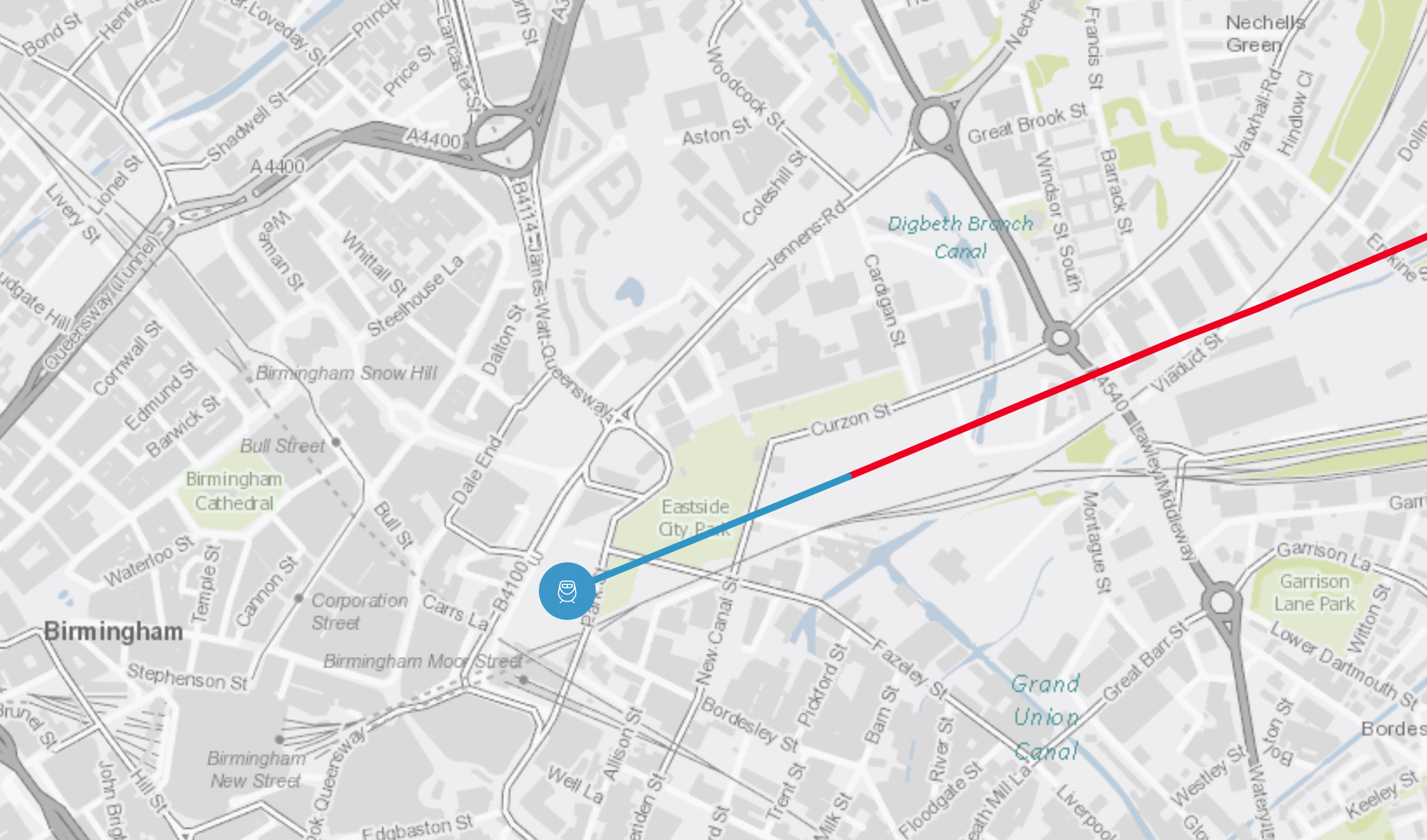
Note.
- The blue dot shows the location of Curzon Street station.
The West Coast Main Line running into New Street station, is just to the South of Curzon Street station.
New Street station can be picked out to the West of Curzon Street station.
This Google Map shows a close-up of the current Curzon Street station site.
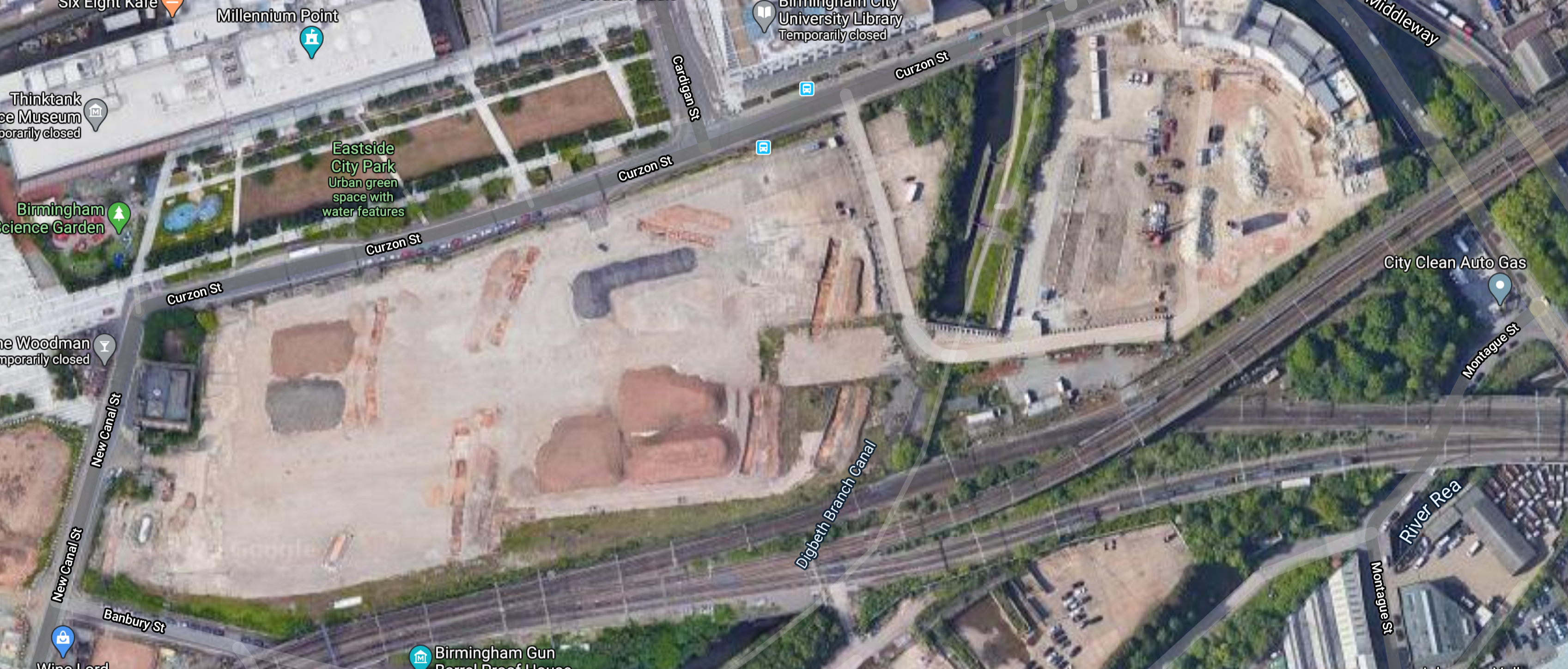
The same pattern of rail lines going past the Curzon Street site into New Street station can be picked out.
Surely, a connection could be made to allow trains from a couple of platforms in Curzon Street station to terminate trains from the West Coast Main Line.
To improve services between Newcastle and Reading, trains would do the following.
- Run on the current East Coast Main Line infrastructure between Newcastle and York. Station stops could be Durham, Darlington and York.
- Switch to new High Speed Two infrastructure South of York.
- Run on High Speed Two infrastructure to Birmingham Curzon Street station. Station stops could be Sheffield, Chesterfield and East Midlands Hub.
- The train would reverse at Birmingham Curzon Street station.
- Switch to the West Coast Main Line outside Birmingham Curzon Street station.
- Run on the West Coast Main Line to Birmingham International station.
- Take the route currently used by CrossCountry between Birmingham International and Reading. Station stops could be Leamington Spa, Warwick Parkway, Banbury and Oxford stations.
Timings would be as follows.
- Newcastle and Birmingham Curzon Street – 118 minutes – From High Speed Two web site.
- Birmingham Curzon Street and Reading – 90 minutes – Current CrossCountry timing.
Note.
- This saves about an hour over the current CrossCountry timings.
- It could use classic-compatible High Speed Two trains.
- Between Birmingham Curzon Street and Newcastle, it follows the same route as one of the current proposed High Speed Two services.
- The service could be extended to Edinburgh from Newcastle.
- The service could be extended to Southampton from Reading
- As there are only twelve tph planned to be running on the Eastern leg of High Speed Two, against a total capacity of eighteen tph, it should be possible to accommodate the extra service or services.
This would surely be a very useful High Speed Two service.
Conclusion
It is a comprehensive package of measures, some of which could have a high cost benefit ratio.
Should High Speed Two’s Macclesfield And London Service Call At Birmingham Interchange?
Connecting Manchester City Centre to the High Speed Two network will be a major undertaking.
- It looks increasingly likely that High Speed Two and Northern Powerhouse Rail will have a shared line running from the main High Speed Two route through Crewe to Manchester Piccadilly via Manchester Airport.
- Between Manchester Airport and Manchester Piccadilly will be in a high speed tunnel.
- Northern Powerhouse Rail will connect Liverpool Lime Street and Warrington to Manchester Airport and Manchester Piccadilly.
- There will be a major problem keeping train services running between Manchester and Birmingham, London and the South.
But just at Project Rio kept Manchester connected during the rebuilding of the West Coast Main Line in the early years of this century, I believe that a similar creditable alternative route may be starting to evolve.
Avanti’s Additional Class 807 Trains Will Be Delivered
These trains will allow additional services and release some Class 390 trains to reinforce other services.
Avanti West Coast’s Future West Coast Main Line Service
The small fleet of Class 807 trains are needed to provide extra services on the West Coast Main Line.
- But if these trains are successful, will more be used as replacements for the nearly twenty-years-old Class 390 trains?
- Will they also be given more traction power to double as the classic-compatible trains for High Speed Two.
- Other operators might also like to purchase a high capacity 200 metre long high speed train, which would share routes used by High Speed Two.
In Thoughts On Class 807 Trains And High Speed Two’s Classic-Compatible Trains, I discuss the design of extra trains for High Speed Two and the West Coast Main Line.
Surely, though having similar trains handling both roles on the West Coast Main Line and High Speed Two, would be an advantage to Avanti West Coast?
London And Manchester Services
Currently, there are these services between London Euston and Manchester Piccadilly stations.
- Via Milton Keynes Central, Stoke-on-Trent and Stockport
- Via Stoke-on-Trent, Macclesfield and Stockport
- Via Stafford, Crewe, Wilmslow and Stockport
All services have a frequency of one train per hour (tph)
High Speed Two plans to run these services between the South and the Manchester area.
- 1 tph – 200 metres – London Euston and Wigan North Western via Old Oak Common, Crewe and Warrington Bank Quay
- 1 tph – 200 metres – London Euston and Macclesfield via Old Oak Common, Stafford and Stoke.
- 1 tph – 400 metres – London Euston and Manchester Piccadilly via Old Oak Common, Birmingham Interchange and Manchester Airport
- 2 tph – 400 metres – London Euston and Manchester Piccadilly via Old Oak Common and Manchester Airport
- 2 tph – 200 metres – Birmingham Curzon Street and Manchester Piccadilly via Manchester Airport
- 1 tph – 200 metres – Birmingham Curzon Street and Wigan North |Western
Note.
- I have included Wigan North Western, as it has good connections to North Manchester.
- Services can’t go via Manchester Airport until the tunnel is completed.
- The 400 metre services will need to use dedicated High Speed Two tracks, so will need to use the tunnel via Manchester Airport.
Wigan and Macclesfield stations will not be requiring major rebuilding, during the construction of High Speed Two. That should mean the stations will not need to be closed for long periods.
- Macclesfield station could probably handle up to three tph from the South.
- Wigan North Western station could probably handle two tph from the South.
- Work in the Manchester Piccadilly area, may well close the station at times.
I suspect Macclesfield and Wigan North Western could be very useful alternative stations for travelling to and from the South.
Manchester And Birmingham Via Macclesfield
I can see that there could be difficulties for some passengers, if they found themselves at Macclesfield wanting to go to the Birmingham area.
A solution would be for the Macclesfield and London service to stop at Birmingham Interchange, which will be extremely well-connected.
Birmingham Interchange
This map from High Speed Two, shows Birmingham Interchange and Birmingham International stations.
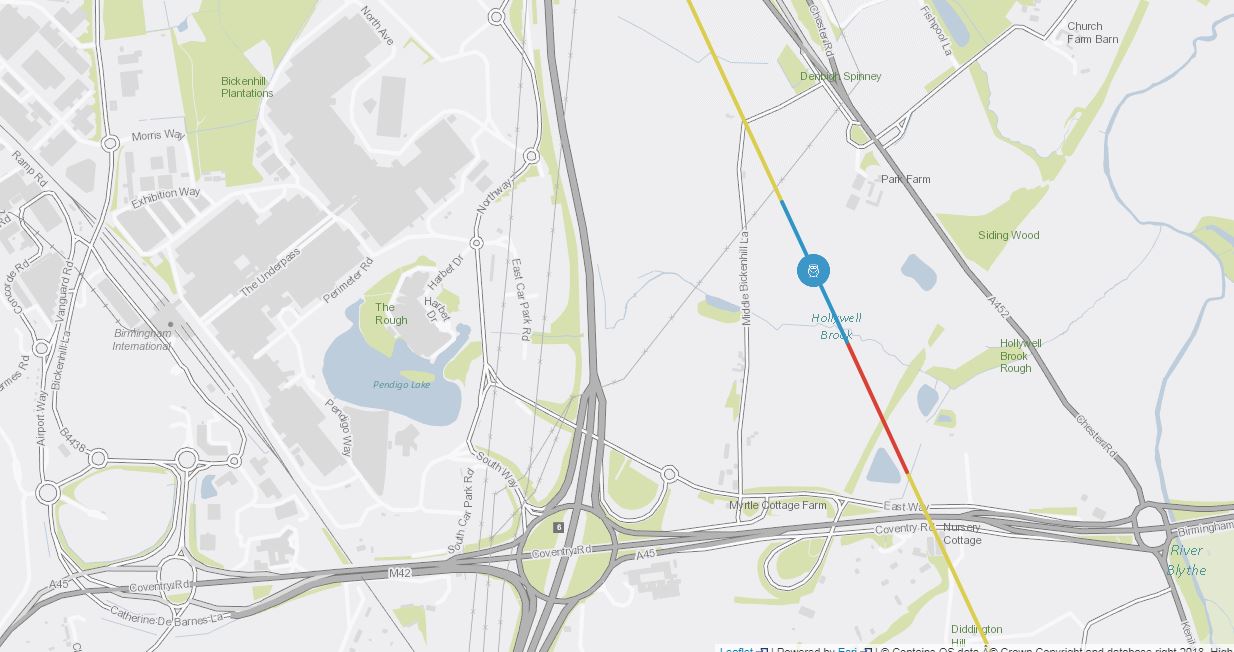
Note.
- Birmingham Interchange station is marked by the blue dot.
- Birmingham International station is to the West of the M42.
The two stations will be connected by an automatic people mover.
Destinations and their frequencies available from Birmingham Interchange, when High Speed Two is complete will include.
- 2 tph – Birmingham Curzon Street
- 1 tph – Carlisle
- 1 tph – East Midlands Hub
- 1 tph – Edinburgh Haymarket
- 1 tph – Edinburgh Waverley
- 1 tph – Glasgow Central
- 1 tph – Leeds
- 5 tph – London Euston
- 1 tph – Manchester Airport
- 1 tph – Manchester Piccadilly
- 5 tph – Old Oak Common
- 1 tph – Preston
It looks like if you miss your train to many important cities at Birmingham Interchange, it will be an hour to wait for the next train.
Destinations and their frequencies available from Birmingham International are currently.
- 8 tph – Birmingham New Street
- 1 tph – Bournemouth
- 1 tph – Crewe
- 0.5 tph to Edinburgh Waverley
- 0.5 tph to Glasgow Central
- 7 tph – London Euston
- 1 tph – Macclesfield
- 1 tph – Manchester Piccadilly
- 1 tph – Reading
- 1 tph – Shrewsbury
- 1 tph – Southampton
- 1 tph – Stafford
- 1 tph – Stoke-on-Trent
- 2 tph – Wolverhampton
Note that 0.5 tph is one train per two hours.
These two lists can be combined.
- 10 tph – Birmingham Curzon Street/New Street
- 1 tph – Bournemouth
- 2 tph – Carlisle
- 1 tph – Crewe
- 1 tph – East Midlands Hub
- 1.5 tph – Edinburgh Haymarket
- 1.5 tph – Edinburgh Waverley
- 1.5 tph – Glasgow Central
- 1 tph – Leeds
- 12 tph – London Euston
- 1 tph – Macclesfield
- 1 tph – Manchester Airport
- 2 tph – Manchester Piccadilly
- 5 tph – Old Oak Common
- 1 tph – Preston
- 1 tph – Reading
- 1 tph – Shrewsbury
- 1 tph – Southampton
- 1 tph – Stafford
- 1 tph – Stoke-on-Trent
- 2 tph – Wolverhampton
This list is surely missing Bristol, Cardiff, Liverpool, Sheffield and Newcastle.
Conclusion
We should not underestimate the importance of Macclesfield and Wigan North Western stations in getting to and from Manchester during the building of High Speed Two.
Thoughts On Class 807 Trains And High Speed Two’s Classic-Compatible Trains
Avanti West Coast’s New Class 807 Trains
Avanti West Coast have ordered a small fleet of Class 807 trains.
This article on Railnews, gives this short description.
There will be more seats, because a seven-car train will have 453 and five-car sets will have 301. First said the seven-car version will have about the same number of seats as a nine-car Pendolino, because each IET vehicle is longer, at 26m.
Adding standard details of other Hitachi trains in the family, the following seems to be known.
- They are seven-car trains.
- The cars are the standard twenty-six metres, so a seven-car train will be 182 metres.
- Ten trains have been ordered.
- I suspect that like all the other trains in the family, they will be 125 mph trains, that are capable of 140 mph, when the signalling and track allows.
- They are pencilled in for services between London Euston and Birmingham New Street, Blackpool North and Liverpool Lime Street stations
- They will not have batteries or diesel engines for emergency or hotel power. Could this mean, that the trains have been designed for high performance, by removing excess weight?
- The trains don’t have a tilting capability. Does this save weight and increase acceleration?
- The trains have 453 seats, as opposed to the nine-car Class 390 trains, which have 469 seats.
Could these trains be designed, to be able to better the Class 390 train schedules on the West Coast Main Line?
- They have no tilting capability.
- They can only work on electric power, like the Class 390 trains.
- They could have very fast acceleration, due to the weight loss.
- They only reduce capacity by 3.5 %, when compared to a nine-car Class 390 train.
In Will Avanti West Coast’s New Trains Be Able To Achieve London Euston and Liverpool Lime Street In Two Hours?, this was my conclusion.
I believe the following will be possible.
-
- A two hour service between London Euston and Liverpool Lime Street will be possible with Avanti West Coast’s new Class 807 trains.
- The current Class 390 trains could go a bit faster.
- I estimate that a Class 807 train could save as much as two-and-a-half-minutes at each stop.
- Blackpool North and London times will be comfortably under three hours.
- Coventry and London times will be comfortably under an hour.
The performance of these Class 807 trains will improve the West Coast Main Line.
What will London in two hours, do for Liverpool?
Class 807 Trains With Different Car Lengths
It is possible to create a table showing car length, train length and capacity for Class 807 trains
- 26 metres – 182 metres – 453 seats
- 26.5 metres – 185.5 metres – 462 seats
- 27 metres – 189 metres – 470 seats
- 27.5 metres – 192.5 metres – 479 seats
- 28 metres – 196 metres – 488 seats
- 28.5 metres – 199.5 metres – 497 seats
It seems that by lengthening all cars by half a metre, just adds nine seats.
Does this point to the fact, that twenty-six metres was a carefully-chosen optimal car length?
Class 807 Trains With Different Numbers Of Cars
A similar table can also be created for different numbers of twenty-six metre cars.
- 7 cars – 182 metres – 453 seats
- 8 cars – 208 metres – 518 seats
- 9 cars – 234 metres – 582 seats
- 10 cars – 260 metres – 647 seats
Note that as an eleven-car Class 390 train is 265.3 metres, a ten-car Class 807 train will fit all platforms, currently used by eleven-car Class 390 trains.
Replacement Of Eleven-Car Class 390 Trains With Class 807 Trains
The eleven-car Class 390 trains are 265.3 metres long and seat 589 passengers.
Looking at the two tables, nine-car Class 807 trains would be almost direct replacements for an eleven-car Class 390 trains.
- The performance of the Class 807 trains would be as good if not better.
- The passenger capacity of both trains would be similar, with just seven seats less in the new trains.
- The Class 807 trains would also be shorter and could fit any platform currently served by an eleven-car Class 390 train.
It should also be noted, that the Class 807 trains would have to run as singles, as platforms on the West Coast Main Line can’t handle a four hundred metre train.
I believe it is highly likely that the classic-compatible trains for High Speed Two and the trains that replace the Class 390 trains will be the same and based on the Class 807 trains, that are now being assembled at Hitachi’s factory at Newton Aycliffe.
Could A Class 807 Train Be Stretched To Become A High Speed Two Classic-Compatible Train?
The Classic-Compatible trains are described in this section in Wikipedia, by this sentence.
The classic-compatible trains, capable of high speed but built to a British loading gauge, permitting them to leave the high speed track to join conventional routes such as the West Coast Main Line, Midland Main Line and East Coast Main Line. Such trains would allow running of HS2 services to the north of England and Scotland, although these non-tilting trains would run slower than existing tilting trains on conventional track. HS2 Ltd has stated that, because these trains must be specifically designed for the British network and cannot be bought “off-the-shelf”, these conventional trains were expected to be around 50% more expensive, costing around £40 million per train rather than £27 million for the captive stock.
The trains will have the same characteristics as the full-size trains.
- Maximum speed of 225 mph.
- Cruising speed of 205 mph on High Speed Two.
- Length of 200 metres.
- Ability to work in pairs.
- A passenger capacity around 500-600 passengers.
A seven-car Class 807 train with twenty-six metre long cars would appear to be a partial match and tick all the boxes, except for the following.
- The train’s maximum and cruising speeds are well below what is needed.
- The train is only 182 metres long.
- The train has a passenger capacity of 453.
Would a train with eight twenty-five metre long cars be a better fit?
- The train length would be 200 metres.
- I doubt twenty-five metre cars would cause a problem!
- I estimate the passenger capacity would be 498 seats.
The trains or members of the same family have already shown.
- They can run on the East Coast, Great Western, Midland and West Coast Main Lines.
- They can run on High Speed One.
- They can split and join automatically.
- When needed they can run on local lines.
If I was Avanti West Coast’s train-Czar, I would be seriously interested in a Classic-Compatible High Speed Two train, that was very similar to one, that I already had in service. Provided, of course it did what it promised in the specification.
In Wikipedia, the car lengths for Class 800, Class 801, Class 802, Class 805 and Class 810 trains are all given and have been reported in the media.
But the car lengths of the Class 803 and Class 807 trains are not given. Is it just an omission or is it deliberate?
Both these trains are designed for demanding routes.
- The Class 803 trains are designed for London and Edinburgh in four hours.
- I believe that the Class 807 trains are designed for London and Liverpool in two hours.
To get these demanding times, have Hitachi changed the car lengths?
- Trains with shorter cars might accelerate better.
- A redesigned interior might get more passengers in the shorter length.
I shall await the launch of both these lightweight speedsters with interest!
Conclusion
I wouldn’t be surprised that Hitachi’s offering for more trains on the West Coast Main Line and the Classic-Compatible trains for High Speed Two are very similar to the Class 807 trains.
- The classic-compatible trains for High Speed Two could be eight-car trains with twenty-five metre cars.
- The replacements for the eleven-car Class 390 trains could be nine-car trains with twenty-six metre cars.
Both would be based on the Class 807 train.
Macclesfield Station And High Speed Two
Today, I went to Macclesfield station.
In the latest iteration of High Speed Two, two new destinations were added to the High Speed Two Network; Macclesfield and Lancaster.
These pictures show Macclesfield station.
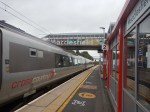

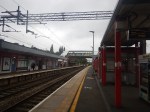
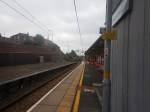
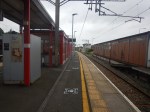
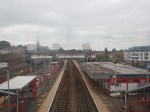
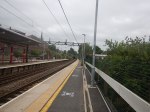
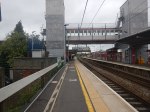
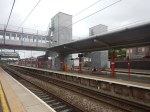
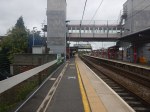
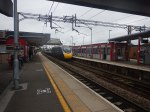
It is a modern station, with three through platforms, two bridges and some Modernist architecture from the 1970s, that could be improved.
This Google Map shows the layout of the station.
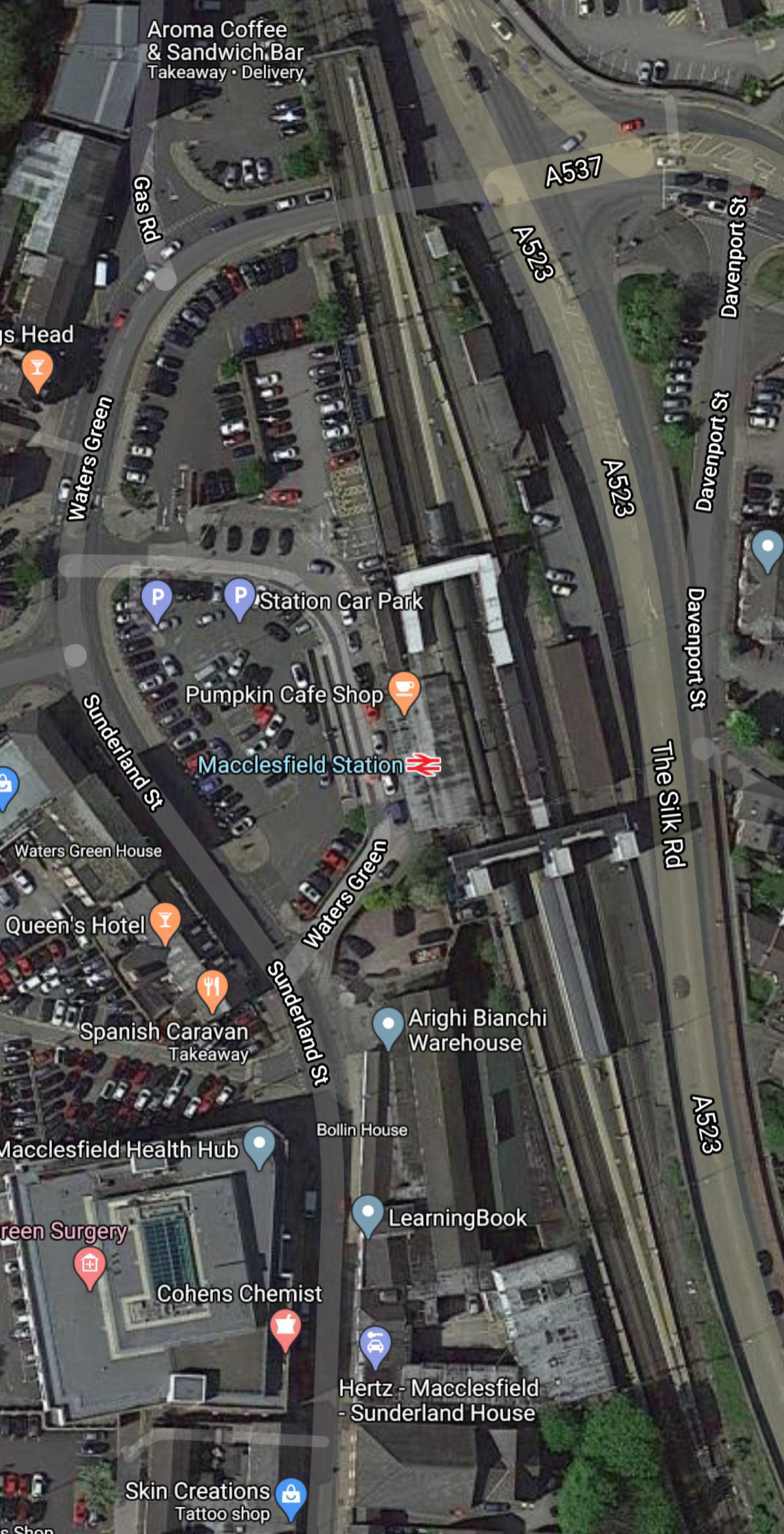
Note.
- Platform 1 is in the West and is used by trains to Stockport and Manchester Piccadilly.
- Platform 2 is in the middle and is used by trains going to Stoke, London and the South.
- Platform 3 is in the East and appears to be used a couple of times per day.
- It also appears there might have been a fourth platform.
All platforms appear capable of handling an eleven-car Class 390 train, which are over two hundred and sixty metres in length.
Is the plan to use Macclesfield as a High Speed Two terminal feasible?
Which Trains Will High Speed Two Use On Macclesfield Services?
It appears that High Speed Two will have two types of trains.
- Trains built to the European loading gauge, that will only be able to work on high lines like High Speed One and High Speed Two. Examples would be Eurostar’s Class 373 and Class 374 trains.
- Trains built to the UK loading gauge, that could also work on existing UK 125 mph routes like the East Coast, Great Western, Midland and West Coast Main Lines. Examples would be Class 800. Class 801, Class 802, Class 390 and Class 745 trains.
The second type, which are referred to, as class-compatible trains will be used to Macclesfield, as these services will share track with Class 390 and other trains, that have been or will be built to the smaller UK loading gauge.
Will Classic-Compatible High Speed Two Trains Fit Into Macclesfield Station?
Currently, every hour, one eleven-car Class 390 train calls in Macclesfield station in both directions, as they provide one of Avanti \west Coast’s three trains per hour (tph) between London Euston and Manchester Piccadilly stations.
The current trains are sixty metres longer than the proposed classic-compatible High Speed Two trains, that could be terminating in Macclesfield station.
How Would Passengers Who Started And Finished Their Journeys In Macclesfield, Connect to Manchester?
Currently, these hourly services connect Manchester Piccadilly and Stoke stations.
- Avanti West Cost – Manchester Piccadilly and London Euston.
- CrossCountry – Manchester Piccadilly and Bournemouth
- CrossCountry – Manchester Piccadilly and Bristol
- Northern – Manchester Piccadilly and Stoke, which stops at all stations.
The characteristics would be common to all these four trains.
- Services call at Stockport, Macclesfield and Stoke stations.
- As services share tracks with a High Speed Two service, they must be reasonably fast.
- All except the Northern service are 125 mph trains.
- The Northern service is run by a 90 mph Class 323 electric train.
- As Manchester Piccadilly and Stoke via Stockport is a fully-electrified route, the trains should probably be able to take advantage.
In an ideal world should the frequency be six tph or one train every ten minutes in each direction?
Which Platforms Would Be Used To Terminate High Speed Two Services?
Trains built to the UK loading gauge could probably terminate in any of the three platforms.
But it might be advantageous to terminate all services in the same platform.
Platform 3 would be the obvious choice.
- It shares an island platform with classic services going South between Manchester Piccadilly and Stoke.
- Passengers starting their journeys in Manchester Piccadilly or Stockport could just walk across from their connecting train to the High Speed Two train.
It must surely be a possibility to make Platform 2 able to operate bi-directionally, so that all trains between Manchester Piccadilly and Stoke stations in both directions, stop in Platform 2, alongside the High Speed Two train for London and the South, that is waiting in Platform 3. The combined frequency would be eight tph. All passengers would just walk across the island platform to change trains.
Could A North-Facing Bay Platform Be Fitted Into The Northern End Of The Island Platform 2/3?
If you are going to provide a High Speed Two service to and from Macclesfield station, it needs to have superb and comprehensive connections to as many places as possible.
The station currently has four tph to Manchester Piccadilly, Stockport and Stoke, but would a North-facing bay platform with level access to the High Speed Two platform make any of the following feasible?
- Run a second local stopping service between Manchester Piccadilly and Macclesfield to give all intermediate stations two tph to High Speed Two.
- Run hourly services to places that don’t have good connections to high speed services to London and the South.
- The Stockport and Stalybridge Line could be used to connect Stalybridge and Huddersfield to High Speed Two.
- There might even be a way of creating a link between Macclesfield and Manchester Airport.
Note.
- Looking at the platform layout at Macclesfield station, fitting in a bay platform would appear to be feasible.
- The important Stockport station, which seems to have been forgotten by High Speed Two would probably have at least six tph to High Speed Two at Macclesfield station.
- The local train could be timed to arrive at Macclesfield station, a convenient time before the High Speed Two train is scheduled to depart.
The bay platform could even be part of Platform 3, if it was decided that trains stopping in Platform 3, never used the platform as a through platform. It would be Macclesfield’s version of the Clapham Kiss.
I suspect more space could be found, by moving the signal box at the end of the station.
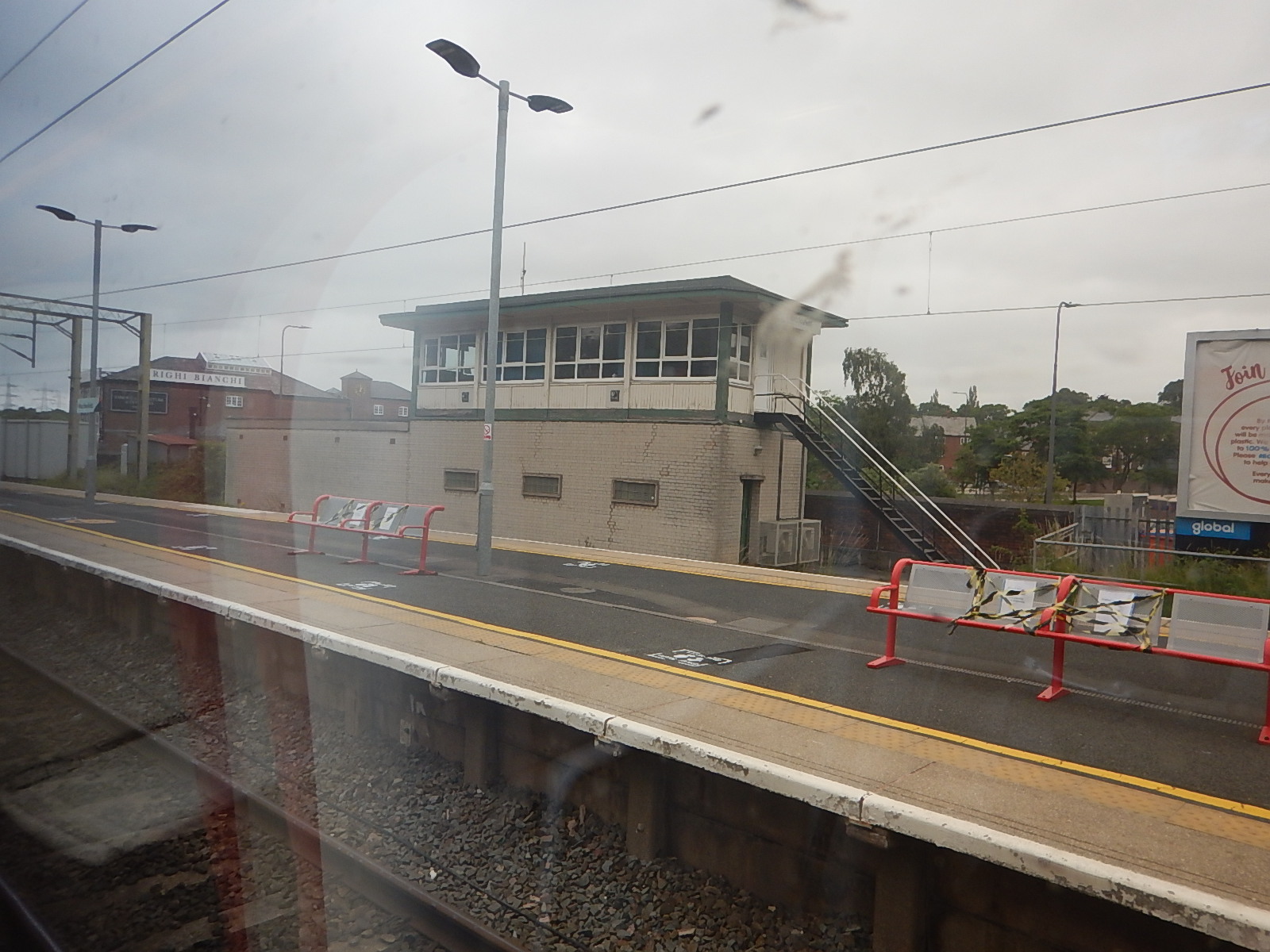
\remember that these days most signalling is controlled from centralised Rail Operation Centres.
Could High Speed Two Trains Run Between Macclesfield And Manchester Piccadilly?
As I said earlier, High Speed Two’s classic-compatible trains will be the same cross-section and shorter, than an eleven-car Class 390 train.
So the answer to my question must be yes!
- This would enable a stop at Stockport station.
- No platform lengthening would be required at Manchester Piccadilly and Stockport stations.
High Speed Two must have good reasons for using Macclesfield as a terminal.
- There are capacity issues between Macclesfield and Manchester Piccadilly stations.
- Macclesfield offers opportunities to connect to places, that are difficult to reach from Manchester Piccadilly station.
But these problems could probably be overcome by digital signalling or extension of the Manchester Metrolink.
Could More High Speed Two Services Run Between Macclesfield Station and The South?
Consider.
- I believe that Macclesfield station could handle more than an hourly High Speed Two train.
- It is a general principle, that on a metro like the London Overground or Merseyrail, that a single platform can handle up to four or even six tph.
- Four tph would surely be too high, but Macclesfield could easily handle a second classic-compatible train to and from Birmingham Curzon Street via Stoke and Stafford.
- During the inevitable works at Manchester Piccadilly station to sccomodate High Speed Two, Macclesfield could offer an alternative route, between London and Manchester.
Using Macclesfield station, as an alternative terminal for Manchester Piccadilly, builds in extra capacity for the future and offers a valuable alternative route during construction and upgrade works.
Rationalisation Between Cross Country And High Speed Two
Consider.
- In a lot of locations North of Birmingham, CrossCountry and High Speed Two seem to provide similar services between the same stations.
- Using currently proposed connections between High Speed Two and the classic network, CrossCountry’s services could run faster.
- CrossCountry’s new fleet of trains will probably be multi-mode trains, that will be very similar to the classic-compatible High Speed Two trains.
- Some of the routes used by CrossCountry’s services will have a substantial upgrade to allow higher speeds and more trains, to speed up High Speed Two services.
There must be a case for rationalisation of services.
Conclusion
The more I look at High Speed Two terminating at Macclesfield station, the more I like it.
I can see these services running from the station in the future.
- High Speed Two – Macclesfield and London Euston – One tph – This service would additionally call at Birmingham Interchange to link up with CrossCountry to the South.
- High Speed Two – Macclesfield and Birmingham Curzon Street – One tph
- CrossCountry – Macclesfield and Bournemouth, Plymouth or Reading – One tph.
- Northern and others – Macclesfield and Manchester Piccadilly via Stockport – Four-six tph
- Northern – Macclesfield and Huddersfield via Stockport and Stalybridge – Two tph
- Northern – Macclesfield and Manchester Airport – Two tph.
Obviously, this is all speculation, but Macclesfield will develop into an important rail hub to the South-East of Manchester.
The Rival Plans For Piccadilly Station, That Architects Say Will ‘Save Millions’
The title of this post, is the same as that of this article on the Manchester Evening News.
This subtitle introduces the idea.
The speculative proposal includes a new underground HS2 station and an ‘s-shaped tunnel’ under the city centre.
The architects are Weston Williamson and I have felt for years that this was the best way and I put my ideas and some fragments from the press and Northern Powerhouse Rail in Manchester Piccadilly ‘Super Hub’ Proposed.
This picture from Weston Williamson, shows their proposed station.

Note.
- In the visualisation, you are observing the station from the East.
- The existing railway lines into Piccadilly station are shown in red.
- Stockport and Manchester Airport are to the left, which is to the South.
- Note the dreaded Castlefield Corridor in red going off into the distance to Oxford Road and Deansgate stations.
- The new high speed lines are shown in blue.
- To the left they go to Manchester Airport and then on to London, Birmingham and the South, Warrington and Liverpool and Wigan, Preston, Blackpool, Barroe-in-Furness, the North and Scotland.
- To the right, they go to Huddersfield, Bradford, Leeds, Hull and the North East, and Sheffield, Doncaster and the East.
- Between it looks like a low-level High Speed station with at least four tracks and six platforms.
- The Manchester Mretrolink is shown in yellow.
- The potential for over-site development is immense. If the Station Square Tower was residential, the penthouses would be some of the most desirable places to live in the North.
This Google Map shows the current station.
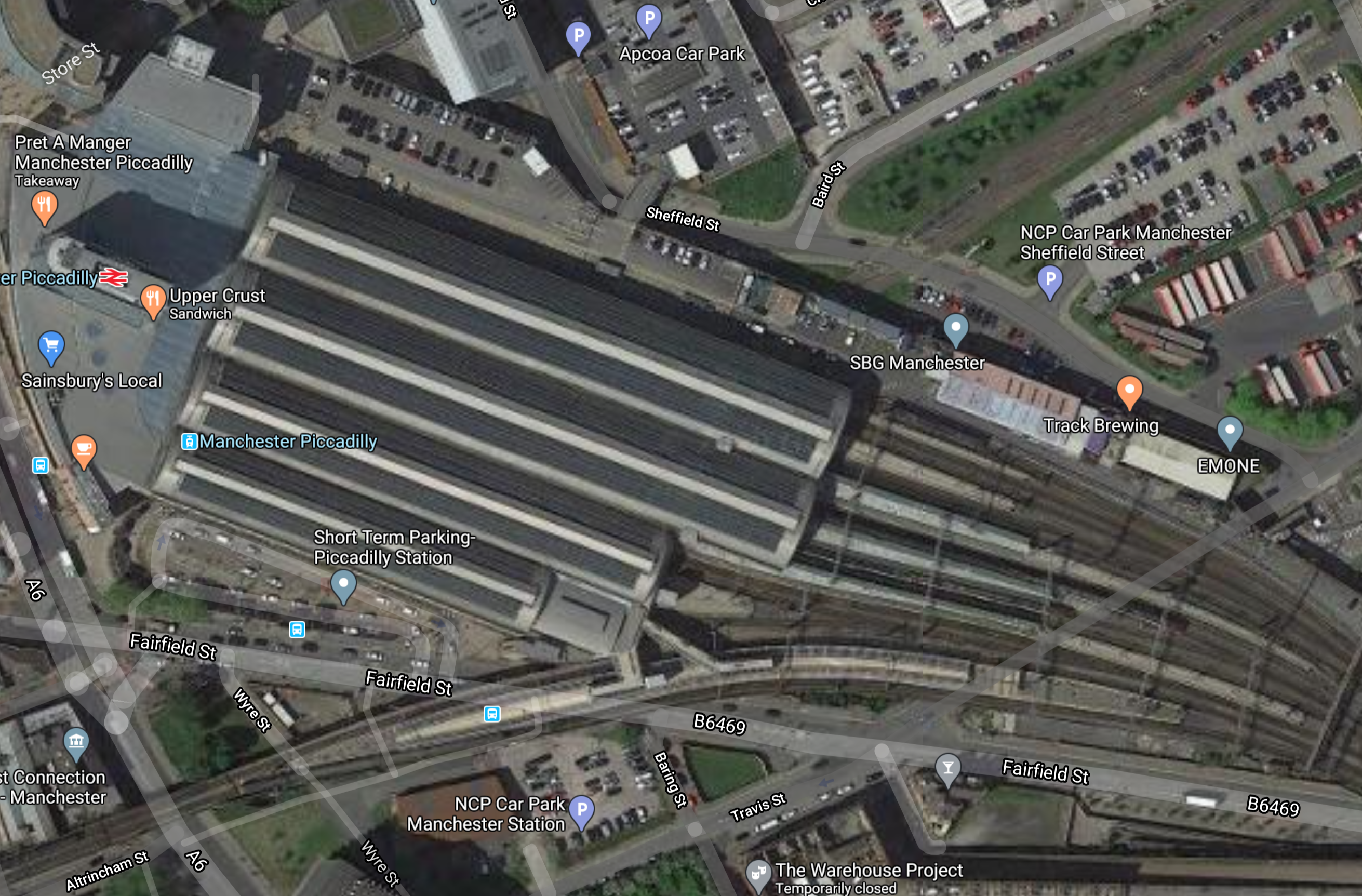
Unfortunately, the map is round the other way to the visualisation, but I hope you can see how the shape of the current station is intact and can be picked out in both.
If you’ve ever used London Paddington station in the last few years, you will know that Crossrail is being built underneath. But the massive construction project of building the Crossrail platforms has not inconvenienced the normal business of the station.
Weston Williamson’s proposed station can be built in the same way.
It could be truly transformational
- Manchester Piccadilly station would have at least 43 percent more platforms.
- Classic-compatible High Speed commuter trains would run to Barrow, Blackpool, Chester, Derby, Nottingham and Shrewsbury from the low-level High Speed station.
- The Northern Powerhouse Rail for all TransPennine Express services would use the low-level High Speed station.
- Glasgow services would use the low-level High Speed station.
- Manchester Piccadilly and Manchester Airport would have up to 18 high speed trains per hour and would be the finest airport service in the world.
- Some or all of the low-level High Speed platforms, would be able to take 400 metre long trains.
- 400 metre long platforms could handle one 200 metre long train from Manchester Airport and one 200 metre long train from Yorkshire.
- The Castlefield Corridor would only have local trains, limited to a number, with which it could cope.
- The use of the existing platforms would be reorganised.
It would be a massive increase in the capacity of the station and as been shown at Paddington with Crossrail, I am sure, that it could be built without massive disruption to existing services.
The Ultimate Train To The North
Imagine a pair of 200 metre long classic-compatible trains running between London Euston and Leeds.
- They would travel via Birmingham Interchange, Manchester Airport, Manchester Piccadilly, Huddersfield and Bradford.
- The trains would divide at Leeds.
- One train would go to Hull.
- The second train would go to York, Darlington, Durham and Newcastle. It could be extended to Edinburgh.
- It could even run with a Turn-Up-And-Go frequency of four tph.
Why not?
Classic-Compatible High Speed Two Trains At East Midlands Hub Station
This article on Rail News, is entitled £2.7bn East Midlands Plan Unveiled For HS2 Links.
This is the first two paragraphs.
A bold plan costed at £2.7 billion for the area around the HS2 hub in the East Midlands has been published by a group of councils, transport bodies and East Midlands Airport.
The core of the scheme is the future East Midlands Hub at Toton, and the plan proposes direct access to the Hub from more than 20 cities, towns and villages in the East Midlands.
If you want to read the original report by Midlands Connect, there’s a download link on this page of their web site.
The original report has a section entitled Midlands Engine Rail, where this is said.
This project is fully integrated with Midlands Engine Rail, a rail improvement plan developed by Midlands Connect to revolutionise connectivity, mobility and productivity across the region. Midlands Engine Rail includes plans for two new HS2 classic-compatible services on an electrified Midland Main Line that will run direct from:
- Bedford and Leeds via Leicester and East Midlands Hub
- Nottingham and Birmingham Curzon Street via East Midlands Hub
These services can run on both electrified and high speed tracks, and would join the HS2 network at Toton, the HS2 East Midlands Hub, meaning that Nottingham and Leicester city centres are directly linked to HS2 without the need to change trains.
These improved connections will more than halve current journey times, with Leicester to Leeds dropping from 120 minutes to 46 minutes and Nottingham to Birmingham falling from 72 minutes to 33 minutes.
Note.
- Between Bedford and East Midland Hub stations, the Midland Main Line is or soon will be an almost a complete 125 mph rail line.
- It is likely, that with digital in-cab signalling, that faster running up to 140 mph may be permitted in places.
- Between Birmingham Curzon Street and East Midlands Hub stations, trains will use High Speed Two at up to 205 mph.
- Between Leeds and East Midlands Hub stations, trains will use High Speed Two at up to 205 mph.
- Leeds and Birmingham Curzon Street station will be new stations for High Speed Two.
The Classic-Compatible Trains
These are described in this section in Wikipedia, by this sentence.
The classic-compatible trains, capable of high speed but built to a British loading gauge, permitting them to leave the high speed track to join conventional routes such as the West Coast Main Line, Midland Main Line and East Coast Main Line. Such trains would allow running of HS2 services to the north of England and Scotland, although these non-tilting trains would run slower than existing tilting trains on conventional track. HS2 Ltd has stated that, because these trains must be specifically designed for the British network and cannot be bought “off-the-shelf”, these conventional trains were expected to be around 50% more expensive, costing around £40 million per train rather than £27 million for the captive stock.
The trains will have the same characteristics as the full-size trains.
- Maximum speed of 225 mph.
- Cruising speed of 205 mph on High Speed Two.
- Length of 200 metres.
- Ability to work in pairs.
- A passenger capacity around 500-600 passengers.
It should be noted that one of these trains will be shorter than a pair of East Midlands Railway’s five-car Class 810 trains, which should avoid any serious platform lengthening on existing lines.
Bedford and Leeds via Leicester and East Midlands Hub
A few facts and thoughts.
- The service is shown as stopping at Wellingborough, Kettering, Market Harborough, Leicester, Loughborough and East Midlands Hub.
- The service frequency could be hourly, but two trains per hour (tph) would be better.
- This service could be more important, than it appears, as by the time High Speed Two opens to Leeds, the East West Railway will be open through Bedford.
- Would a terminal platform need to be added at Bedford station? As the station could be rebuilt for the East West Railway, this shouldn’t be a problem.
- Leeds will have a new High Speed Two station or at least new platforms in the existing station.
- The Bedford and Leeds service would join High Speed Two at East Midlands Hub and go North.
- The Leeds and Bedford service would leave High Speed Two at East Midlands Hub and go South.
Leeds and Leicester will take 46 minutes, with High Speed Two’s journey time calculator, indicating twenty-seven minutes between East Midlands Hub and Leeds stations.
According to an article in the June 2020 Edition of Modern Railways High Speed Two is planning to run the following services on the Eastern leg of High Speed Two between East Midlands Hub and Leeds.
- Two tph – Birmingham Curzon Street and Leeds
- Three tph – London Euston and Leeds
There will be a Turn-Up-And-Go six tph service between East Midlands Hub and Leeds stations.
If the Bedford and Leeds service was an hourly service, when added to the current East Midlands Railway Inter-City services, it would give the following calling frequencies.
- Wellingborough – 2 tph
- Kettering – 2 tph
- Market Harborough – 3 tph
- Leicester – 5 tph
- Loughborough – 3 tph
- East Midlands Parkway – 2 tph
The calling pattern can be adjusted to the number of passengers.
Nottingham and Birmingham Curzon Street via East Midlands Hub
A few facts and thoughts.
- The service is shown as only stopping at East Midlands Hub.
- The service frequency could be hourly.
- The service would go between East Midlands Hub and Nottingham using the Trowell Curve route, which I discussed in Access To Toton – Scheme 6 – Trowell Curve.
- Nottingham station has long terminal platforms that take a full-length Inter-City 125.
- Birmingham Curzon Street will be a new High Speed Two station.
- The Nottingham and Birmingham Curzon Street service would join High Speed Two at East Midlands Hub and go South.
- The Birmingham Curzon Street and Nottingham service would leave High Speed Two at East Midlands Hub and go North.
Nottingham and Birmingham Curzon Street will take 33 minutes, with High Speed Two’s journey time calculator, indicating twenty minutes, between Birmingham Curzon Street and East Midlands Hub stations.
According to an article in the June 2020 Edition of Modern Railways High Speed Two is planning to run the following services on the Eastern leg of High Speed Two from Birmingham Curzon Street.
- Two tph – East Midlands Hub and Leeds
- One tph – East Midlands Hub, York, Darlington, Durham and Newcastle.
There will be a Turn-Up-And-Go four tph service between East Midlands Hub and Birmingham Curzon Street stations.
Midland Main Line Electrification
Midlands Connect is calling for full electrification of the Midland Main Line.
The problem is electrification through Leicester station, where there is a low bridge over the track.
In Discontinuous Electrification Through Leicester Station, I showed how the problem might be solved by discontinuous electrification and battery-equipped trains.
The Shared High Speed Two Path
If you look at the two previous sections you’ll see the following.
- The Birmingham Curzon Street and Nottingham service would leave High Speed Two at East Midlands Hub and go North.
- The Bedford and Leeds service would join High Speed Two at East Midlands Hub and go North.
- The Leeds and Bedford service would leave High Speed Two at East Midlands Hub and go South.
- The Nottingham and Birmingham Curzon Street service would join High Speed Two at East Midlands Hub and go South.
The two services are using the same path on High Speed Two.
I would design the East Midlands Hub, so that High Speed Two and classic services going in the same direction shared an island platform.
Southbound services would behave like this.
- The Nottingham to Birmingham Curzon Street train would arrive in the High Speed Two face of the platform.
- The Leeds to Bedford train would arrive in the classic face of the platform.
- Passengers who needed to change would walk across the platform.
- When ready both trains would go on their way.
Northbound services would do something similar.
It would be an efficient way to organise interchange between services.
- Train design would have to ensure, that all trains using the island platform had similar and preferably step-free access.
- If Greater Anglia and Merseyrail, can do step-free access, then no train designer has an excuse not to.
- Surely every High Speed Two train that arrives at East Midlands Hub, should be paired with a Midland Main Line service, if the timetable allows it.
The money being spent on High Speed Two means that the British public, won’t accept anything less than perfect.
Are There Any Other Possible Destinations For Classic-Compatible High Speed Two Trains From East Midlands Hub Station?
I will put these in alphabetical order.
Bedford
Consider.
- Bedford is already planned to have one classic-compatible service to and from Leeds.
- One of East Midlands Railway’s St. Pancras services calls at Bedford.
- Bedford has a four tph Thameslink service to a large proportion of Central London and the South East of England.
- Bedford has direct services to Gatwick Airport.
- Bedford station will be expanded to accommodate the East West Railway.
- In a few years, Bedford will be connected to Milton Keynes, Oxford and Reading by the East West Railway.
- When the East Midlands Hub station opens, Bedford will be connected to Cambridge, Ipswich and Norwich by the East West Railway.
I feel there is a need for a Turn-Up-And-Go four tph service between Bedford and East Midlands Hub stations.
I estimate that between Bedford and East Midlands Parkway stations will have a journey time of around 60 minutes.
Cambridge
I believe that the East West Railway should be built to the same standard as the East Coast, Great Western, Midland and West Coast Main Lines.
- Digitally signalled
- 125 mph-capable
- Electrified
This would enable classic-compatible services to be extended from Bedford to the UK’s Technology Powerhouse; Cambridge.
As Bedford and East Midlands Parkway could be 60 minutes, timings depend on the times of the East West Railway, between Bedford and Cambridge.
Edinburgh
Consider.
- Edinburgh is an important city; financially and politically.
- Edinburgh is planned to have a classic-compatible service from London via the West Coast Main Line.
- Newcastle is planned to have a classic-compatible service from East Midlands Hub
The city must be a possibility for a classic compatible service from East Midlands Hub.
I estimate that Edinburgh and East Midlands Parkway will have a journey time of a few minutes over two hours
Hull
This clip of a map from the Transport for the North report shows a schematic of the rail links in Yorkshire.
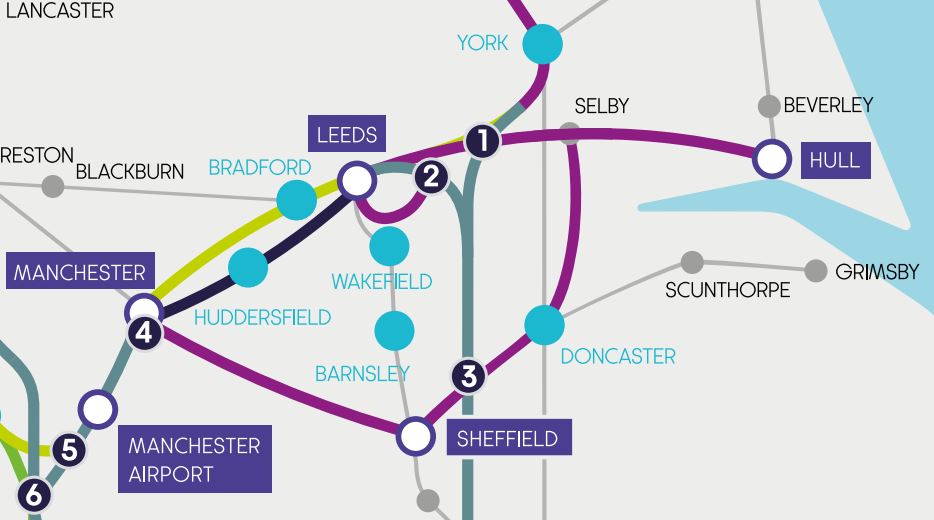
Hull is important for various reasons.
- It is large city.
- It is the Eastern terminus of an increasing number of routes.
- It is becoming a manufacturing centre for North Sea wind.
- The city will be the terminus of Northern Powerhouse Rail across the Pennines from Liverpool, Manchester and Leeds.
- Some reports have shown the city as a terminus of the Western leg of High Speed Two.
For these reasons, I will add Hull to the list.
I estimate that Hull and East Midlands Parkway will have a journey time of under an hour.
Lincoln
Looking forward to 2040, I wouldn’t bet against Lincoln being a very important city in the UK.
- It has history.
- It is becoming an important higher education centre.
- It has lots of space.
- Train operating companies like LNER and East Midlands Railway are improving services to the city.
But most importantly, as Aberdeen became Scotland’s centre for North Sea Oil and Gas, I believe that Lincoln could become England’s centre for North Sea renewable electricity and hydrogen.
I estimate that Lincoln and East Midlands Parkway will have a journey time of around an hour.
Milton Keynes
As I said for Cambridge, I believe that the East West Railway should be built to the same standard as the East Coast, Great Western, Midland and West Coast Main Lines.
This would enable classic-compatible services to be extended from Bedford to Milton Keynes.
As Bedford and East Midlands Parkway could be 60 minutes, timings depend on the times of the East West Railway, between Bedford and Milton Keynes.
Newcastle
As Newcastle already has a direct High Speed Two classic-compatible connection to and from East Midlands Hub station, this must be a possibility.
According to High Speed Two’s journey time calculator<, trains between Newcastle and East Midland Hub stations will take 96 minutes.
Northern Powerhouse Rail
The map I showed with Hull could indicate that a train could take High Speed Two to Leeds and then power its way across the Pennines calling at Leeds, Huddersfield, Manchester Piccadilly, Manchester Airport and Liverpool.
East Midlands Railway would have found a replacement for the Western part of their Liverpool and Norwich service, which is one of the worst railway services in the UK.
Oxford And Reading
As I said for Cambridge, I believe that the East West Railway should be built to the same standard as the East Coast, Great Western, Midland and West Coast Main Lines.
This would enable classic-compatible services to be extended from Bedford to Oxford and Reading.
As Bedford and East Midlands Parkway could be 60 minutes, timings depend on the times of the East West Railway, between Bedford and Oxford and Reading.
Peterborough
I think Peterborough could be an interesting possibility.
- It is the gateway to the East of England.
- It is a fully-electrified station.
- It has seven platforms with space for more.
- Most platforms could take a two hundred metre long train.
East Midlands Railway’s Liverpool and Norwich service, links Peterborough with Nottingham.
- That section of the route is 52 miles long.
- 29 miles of the route on the East Coast Main Line are electrified.
- The 100 mph Class 158 trains take 67 minutes and 30 minutes to travel between the two stops at Grantham and Peterborough.
- Some of LNER’s 125 mph electric Class 800 trains are timetabled to travel between the two stops at Grantham and Peterborough as fast as 18 minutes.
What time will be achievable on this short length of electrified track, when digital signalling is fully-deployed and 140 mph running is possible?
I can certainly see a bi-mode Class 801 train going between Peterborough and Nottingham in under an hour.
I also think that they could equal East Midlands Railway’s times to Nottingham going from Kings Cross via Grantham.
In Access To Toton – Scheme 6 – Trowell Curve, I advocated the following electrification, to allow battery-electric trains to work the Nottingham and Skegness service.
- The Allington Chord between Bottesford and Ancaster stations.
- The line linking the chord to Grantham station.
As Nottingham station will surely be electrified to allow classic-compatible High Speed Two trains to run between the station and Birmingham using High Speed Two, there will only be sixteen miles of double-track between Bottesford and Nottingham station without electrification.
I have just flown my helicopter along the route and there are one or two bridges and Netherfield station, that will need a rebuild, but it wouldn’t be the most challenging of electrifications.
Especially, as there is High Speed Two and the East Coast Main Line to provide power at both ends of the route.
But as it is only sixteen miles would they use battery-electric high-speed trains.
Surely, that is a crazy idea?
In Will High Speed Two’s Classic-Compatible Trains Have Battery Operation?, I explain why you would use such a concept to create an efficient train.
- The batteries drive the train and they are charged from the electrification and regenerative braking.
- Batteries would give a train recovery capability in case of overhead catenary failure.
- Batteries would be used for depot movements.
In Will The Trains On High Speed Two Have Batteries For Regenerative Braking?, I do a calculation for the battery size needed for a 250 mph Spanish high speed train and the batteries are surprisingly small, at 100 kWh per carriage.
I firmly believe, that the mathematics say it is possible for a high speed train to use on-board battery power to perhaps do thirty miles at say 90 mph on a line without electrification.
Sheffield
As Sheffield station will have a direct High Speed Two connection to and from East Midlands Hub station, this must be a possibility.
According to High Speed Two’s journey time calculator, trains between Sheffield and East Midland Hub stations will take 27 minutes.
Note.
- An article in the June 2020 Edition of Modern Railways shows that the Eastern leg of High Speed Two is planned to have nine tph, against a theoretical limit of 18 tph.
- The Leeds-Bedford and Nottingham-Birmingham Curzon Street will use another path.
- Not all services would need to be hourly.
- Could some CrossCountry services be replaced with classic-compatible services?
I feel there is plenty of scope to develop more classic-compatible services along the Eastern leg of High Speed Two.
Will High Speed Two’s Classic-Compatible Trains Have Battery Operation?
I believe it is very likely, that High Speed Two’s new classic-compatible trains will have battery capabilities.
- Batteries would handle energy generated by regenerative braking.
- Batteries would give a train recovery capability in case of overhead catenary failure.
- Batteries would be used for depot movements.
- Batteries would probably improve the energy efficiency of the trains.
Effectively, the batteries would power the train and would be topped-up by the electrification and the regenerative braking.
But would they be able to give the trains a route extension capability on lines without electrification?
Consider.
- Battery technology is getting better with energy capacity per kilogram increasing.
- Batteries will be full, when the train leaves the electrification.
- These trains will be as light as possible.
- Trains will not be running at speeds in excess of perhaps 100 mph without electrification.
- Fast charging can be provided at station stops.
I think, that trains could be able to do at least 40 to 50 miles on a full charge.
Fast Charging Technology
The most promising fast-charging technology is Vivarail’s system of using a length of conventional third-rail connected to a bank of batteries. When the train connects with the third-rail, electricity flows to the batteries on the train.
There are also others working on systems that use short lengths of overhead electrification.
Both systems can be totally automatic and safe.
Example Routes
These are three possible example routes.
Aberdeen And Edinburgh
These are the distances between stops on the route between Aberdeen and Edinburgh.
- Aberdeen and Stonehaven – 12 miles
- Stonehaven and Montrose – 24 miles
- Montrose and Arbroath – 14 miles
- Arbroath and Dundee – 17 miles
- Dundee and Leuchars – 8 miles
- Leuchars and Kirkaldy – 25 miles
- Kirkcaldy and Inverkeithing – 13 miles
- Inverkeithing and Edinburgh – 13 miles
It is a total of 130 miles without electrification.
The route is also generally flat and mainly along the coast.
Inverness And Edinburgh
These are the distances between stops on the route between Inverness and Strirling.
- Inverness and Aciemore- 35 miles
- Aviemore and Kingussie – 12 miles
- Kingussie and Pitlochry – 43 miles
- Pitlochry and Perth – 30 miles
- Perth and Gleneagles – 15 miles
- Gleneagles and Stirling – 17 miles
It is a total of 152 miles without electrification.
As there are some steep gradients, there may be a need for some electrification in certain sections of the route.
Holyhead And Crewe
These are the distances between stops on the route between Holyhead and Crewe
- Holyhead and Bangor – 25 miles.
- Bangor and Llandudno Junction – 16 miles
- Llandudno Junction and Colwyn Bay – 4 miles
- Colwyn Bay and Rhyl – 10 miles
- Rhyl and Prestatyn – 4 miles
- Prestatyn and Flint – 14 miles
- Flint and Chester – 13 miles
- Chester and Crewe – 21 miles
It is a total of 105 miles without electrification.
The route is also generally flat and mainly along the coast.
A Stepping-Stone Approach
I believe there is a design of fast charger, that in say a three minute stop can charge the battery sufficient to get to the next station. The electrification might continue for perhaps a couple of hundred metres from the station on the tracks where the trains are accelerating.
A train making a stop at a station would do the following.
- As it approaches the stop, the train’s kinetic energy is turned into electricity by the regenerative braking.
- This energy is stored in the batteries.
- In the station, the batteries are charged from the fast charger or electrification.
- Whilst stopped, the batteries provide the power for the train’s systems.
- Accelerating away would use the batteries or electrification if it is installed.
The train’s computer would monitor the batteries and control the various power systems and sources to run the train in the most efficient manner.
This sequence would be repeated at each stop as the train progressed to its destination.
Extra Electrification
In the section on the challenging Edinburgh and Inverness route, I said that some gradients would probably need to be electrified to maintain progress.
But there are other sections, where electrification has been suggested.
- Stirling and Perth
- Crewe and Chester
So could we be seeing a mixture of electrification and charging stations on routes to allow electric trains to serve routes, where full electrification is impossible for practical, scenic, heritage or cost reasons?
The South Wales Metro is to use discontinuous electrification to save the cost of rebuilding innumerable bridges.
Conclusion
I believe that engineers can design high speed trains, that will be able to run on existing lines using battery power to serve the remoter parts of Great Britain.
Could High Speed Two Trains Serve Chester And North Wales?
This may seem a slightly outrageous proposal to run High Speed Two trains to Chester.
- The city is a major tourist destination.
- Despite its closeness to Crewe it is a major rail hub, with services across Wales to Cardiff, Holyhead and Llandudno and along the border between England and Wales to Shrewsbury and Newport.
- Merseyrail serves the city and the station can be considered to be part of Liverpool’s extensive commuting area. This service is likely to be more reliable and faster with the delivery of new Class 777 trains.
- For parts of Merseyside, travelling to London or Manchester Airport, is easier via Chester than Liverpool Lime Street or Liverpool South Parkway.
If the promoters of High Speed Two are serious about creating a railway for the whole country, then I feel that running trains direct to and from Chester could be very beneficial for the towns and cities, that can be served by the current network at Chester.
Current And Possible Timings
Currently, trains take two minutes over two hours between Euston and Chester.
When Avanti West Coast introduces the new Hitachi AT-300 trains on the route, the following times will be possible.
- Euston and Crewe via West Coast Main Line – 90 minutes – Fastest Pendelino
- Crewe and Chester – 24 minutes – Current timing
This would give a time of one hour and 54 minutes, which is a saving of 8 minutes. But a lot of carbon would not be emitted between Euston and Crewe.
I estimate, that with High Speed Two Phase 2a completed, the following timings will be possible.
- Euston to Crewe via HS2 – 55 minutes – HS2 website
- Crewe and Chester – 24 minutes – Current timing
This would give a time of one hour and 19 minutes, which is a saving of 43 minutes.
Infrastructure Needed
There will need to be some infrastructure changes.
Platform Lengthening At Chester Station
The station would probably be served by two-hundred metre long High Speed Two Classic-Compatible trains, which might need some platform lengthening.
This Google Map shows the station.
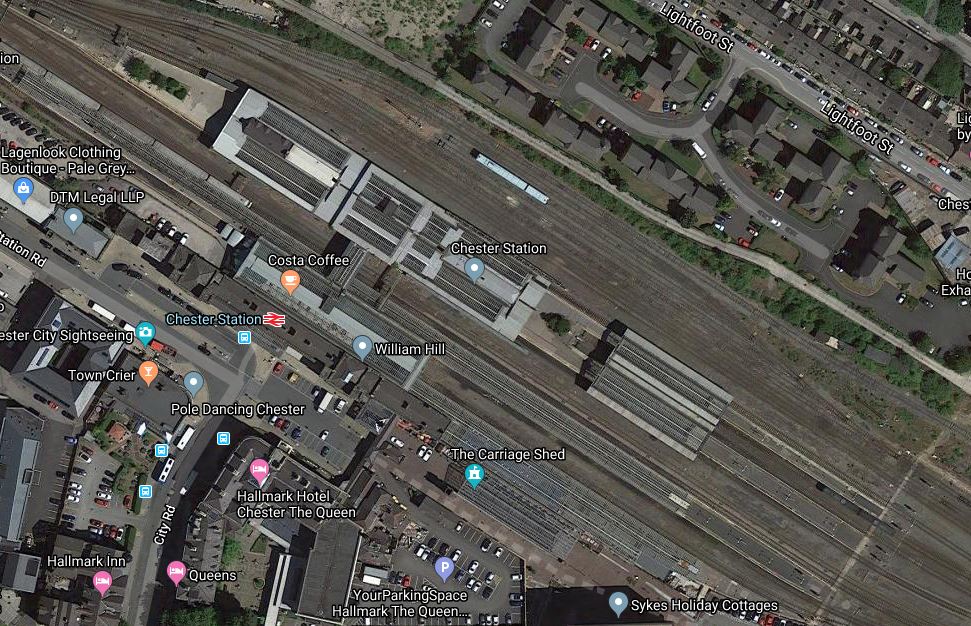
It looks to me, that there is plenty of space.
Will Chester And Crewe Be Electrified?
We know little about the capabilities of the trains proposed by the various manufacturers.
But, I wouldn’t be surprised that one or more of the proposals use batteries for one of the following purposes.
- Regenerate braking.
- Emergency power.
- Range extension for up to perhaps sixty miles.
As Chester and Crewe stations are only twenty-one miles apart with no intermediate stations, which will be run at an average speed of only 52 mph I don’t think it will be impossible to extend the service to Chester on battery power.
If electrification is required I wrote about it in Hitachi Trains For Avanti.
As it is only just over twenty miles, I don’t think it will be the most challenging of projects, although there does seem to be a lot of bridges.
Electrification would also allow Avanti West Coast’s Hitachi trains to run on electricity to Chester.
What About Holyhead?
Holyhead could become a more important destination in the next few years.
It is probably the best alternative to avoid flying and driving between Great Britain and the Island of Ireland.
And who can accurately predict, what effect Brexit and thinking about global warming will have?
I have a feeling that after electrification to Chester, using on-board energy storage could be used West of Chester.
It is very difficult to predict battery ranges in the future, but I can see a two hundred metre long High Speed Two Classic-Compatible train being able to reach Holyhead on battery power, with or without some limited extra electrification.
Alternatively, the UK and Welsh governments, might bite the bullet and just electrify the whole route between Crewe and Holyhead.
I have found a train on Real Time Trains, that covered the 105.5 miles between Holyhead and Crewe in two hours and 11 minutes at an average speed of 48 mph. The train took then a total of three hours and forty-five minutes to get to Euston
I estimate that with electrification and some track improvements, that it will be possible to travel between Euston and Holyhead in under three hours before High Speed Two.
Conclusion
It looks to me, that when High Speed Two, think about adding extra destinations, Chester and Holyhead could be on the list.
I also suspect that even without electrification and High Speed Two services, but with the new Class 805 trains, the route could be a valuable one for Avanti West Coast.
Thoughts On A Classic-Compatible Train For High Speed Two
Trains on High Speed Two will start at Euston and some will then lever the high speed line and continue to their destination on the classic lines.
Trains for Liverpool, Preston and Glasgow will leave High Speed Two at Crewe and the continue to their destinations using the electrified West Coast Main Line. These destinations will be reached in 96, 84 and 218 minutes respectively.
A train is needed with these abilities.
- Cruise at 400 kph on High Speed Two.
- Cruise at 225 kph on the West Coast Main Line.
- Share platforms with existing trains like Class 390 Pendelinos.
In Will The Trains On High Speed Two Have Batteries For Regenerative Braking?, I showed that the kinetic energy in each car of a train for High Speed Two will be about 100 kWh, when running at a full speed of 400 kph.
Imagine a train going from London to Glasgow using High Speed Two and the West Coast Main Line.
At Crewe station, the only change that will be needed to be made is move from a line with a 400 kph speed limit to one with a lower limit of 200 kph, as both lines will use the same 25 KVAC overhead electrification and complimentary signalling systems.
It would be a bit like a car leaving a motorway and then continuing on ordinary roads.
Could The Classic-Compatible Trains Be Bi-Mode Trains?
I don’t see why not!
But probably instead of using diesel engines, advances in battery technology would probably mean that to reach places like Barrow or Burnley from the West Coast Main Line could be done using battery power.

