Are Hitachi’s Tri-Mode Trains Exceeding Expectations?
I asked Google AI, the question in the title of this post and received this answer.
Yes, Hitachi’s tri-mode (battery-hybrid) trains are exceeding expectations, particularly following successful trials in the UK in late 2024. Trials of the battery-equipped Class 802/2 demonstrated superior performance to initial forecasts, leading to a £300 million order for a new fleet to be delivered in 2028.
Key findings from trials and operational expectations:
Performance Exceeded: The trial, conducted with TransPennine Express and Angel Trains, showed fuel cost savings of 35%–50%, surpassing initial predictions of up to 30%.
Operational Capability: The battery technology enabled trains to reach speeds greater than 75 mph and provided enough range for zero-emission, silent running in and out of stations, significantly reducing noise and improving air quality.
Energy Efficiency: The battery matched the weight of a diesel engine, meaning no extra track degradation.
Future Impact: The success of the trial led to an order from Arriva Group for a new fleet for Grand Central services, which will increase seating capacity by 20% and are expected to significantly reduce carbon emissions.
These trains, designed to run on electric, battery, or diesel power, are part of a push to modernize rail services, with the technology allowing for the gradual elimination of diesel-only operation on certain routes.
That is certainly good performance and Hitachi received a £300 million order, which I wrote about in Arriva Group Invests In New Battery Hybrid Train Fleet In Boost To UK Rail Industry
But I don’t think it’s all down to Hitachi, as Hitachi linked up with Sunderland-based Hyperdrive Innovation, who are JCB’s battery supplier. Hyperdrive were taken over by Turntide Technologies in 2021.
In Batteries Ordered For Grand Central Inter-City Trains, I said this.
Hitachi Rail has selected Turntide Technologies to supply lithium iron phosphate batteries for use on electric-diesel-battery hybrid inter-city trainsets it is to build for Arriva’s open access operator Grand Central.
I am coming to the conclusion, that Turntide Technologies use and/or make some very special batteries.
I asked Google AI, “Which make of battery cells does Turntide use?” and received this reply.
Based on recent announcements (2023–2025), Turntide Technologies utilizes advanced Lithium Iron Phosphate (LFP) cells for its next-generation battery systems, particularly for its partnership with Hitachi Rail.
Key details regarding Turntide’s battery cell usage include:
Chemistry Shift:
While previously associated with Nickel-Manganese-Cobalt (NMC) in some applications, Turntide has focused its recent rail projects with Hitachi on LFP technology to enhance safety and allow for more compact, powerful, and lighter battery packs.
Application:
These LFP batteries are used in high-performance, rugged, and space-limited environments, such as Hitachi’s UK battery-operated trains.
Modular Design:
Turntide’s Gen 5 battery systems are designed to be flexible for various applications including construction, agriculture, and mining, using modular, high-energy-density cells.
Previous Technology:
Previously, Turntide (which acquired Hyperdrive Innovation) used Lithium-ion NMC cells for its battery packs.
The search results do not explicitly identify a specific, named manufacturer (e.g., CATL, LG, Samsung) for the cells, but focus on the LFP chemistry utilized by Turntide.
I am also coming to the conclusion, that they took over Hyperdrive Innovation to get control of these compact, powerful, and lighter battery packs.
Mayors Head To Parliament With Plan For Northern Arc To Deliver Green Growth
The title of this post, is the same as that of this news item from Liverpool City Region.
These four bullet points act as sub-headings.
- Steve Rotheram and Andy Burnham take case for backing Northern Arc to Treasury – as new data shows North can drive green growth and unlock £90bn for UK economy
- Liverpool City Region and Greater Manchester Mayors will meet with ministers and MPs today, and Andy Burnham will give evidence at Business and Trade Select Committee on the UK’s industrial strategy
- Economic analysis shows that investing in transport infrastructure and a pipeline of projects across the North would benefit the whole UK economy, improving living standards and closing the North-South productivity gap
- Mayors will also address Innovation Zero World Congress in London, showing how city-regions can create high quality jobs by pioneering low-carbon innovation
These two paragraphs add a bit more detail.
The right investment would create a growth corridor, stretching from the Mersey to the Pennines and connecting into West and South Yorkshire, underpinned by transport networks that would include a new railway linking Liverpool and Manchester.
The Northern Arc area spans regions with close economic ties to Lancashire, North Wales, Hull and the North East. With international connections through the Port of Liverpool and Manchester Airport, it’s well positioned for global trade.
If I have a problem with the mayors’ thoughts, the plan outlined in the news item is rather Liverpool/Manchester-based with Hull being the only city outside that area getting a mention. Do Blackburn, Blackpool, Bradford, Burnley, Doncaster, Huddersfield, Leeds, Preston, Rotherham, Scunthorpe, Stockport, Wigan and York exist?
For instance you would expert a report from Liverpool and Manchester’s Mayors to call for a new railway between their two cities. And of course they do!
The current TransPennine Lines has two main routes across the Pennines between East and West.
If ever there was a rail route, designed by Topsy, it is the North TransPennine Route.
- There are six separate services, if you ignore Newcastle and Edinburgh Waverley, which is a shuttle to fill a gap in rail services.
- In the West trains terminate at Huddersfield, Liverpool Lime Street, Manchester Airport, Manchester Piccadilly and Manchester Victoria
- In the East trains terminate at Edinburgh Waverley, Hull, Leeds, Newcastle, Redcar Central, Scarborough and York.
- Terminals like Huddersfield, Hull, Liverpool Lime Street, Newcastle and York are some of the best terminal stations in the UK, but others are very second rate.
I suspect, this North TransPennine Route structure brought about the demise of TransPennine Express.
The South TransPennine Route on the other hand, although it was built by several different railway companies, they were all intent on the same thing. An East-West route across the Pennines through Doncaster, Manchester and Sheffield.
- The Western terminal is Liverpool Lime Street, which in my view is the finest grand terminus in the UK, in terms of architecture, onward connections and operation. It is also the oldest still-operating grand terminus mainline station in the world, in that it dates from 1836.
- The Eastern terminal is Cleethorpes, which is an efficient four-platform recently-refurbished station, that is within a hundred metres of some of the best gluten-free fish and chips, I’ve ever tasted on the pier.
- Intermediate stations include Liverpool South Parkway, Warrington Central, Birchwood, Irlam, Urmston, Manchester Oxford Road, Manchester Piccadilly, Stockport, Sheffield, Meadowhall, Doncaster, Scunthorpe, Barnetby, Habrough and Grimsby Town.
- Liverpool South Parkway has a bus connection to Liverpool Airport
- Liverpool Lime Street, Manchester Oxford Road, Manchester Piccadilly, Stockport, Sheffield and Doncaster are stations with comprehensive onward connections.
- The route is electrified between Liverpool Lime Street and Manchester Piccadilly and at Doncaster.Liverpool Lime Street and Cleethorpes is 148.2 miles
- Hazel Grove and Doncaster is without electrification and is 52.3 miles long.
- Cleethorpes and Doncaster is without electrification and is 52.1 miles long.
- I believe that Hitachi, Siemens and Stadler could supply battery-electric trains, that would be able to work the route, with the addition of a short length of overhead wires at Cleethorpes, so that trains could return to Doncaster.
- Trains go straight through all the intermediate stations, so there are no time-wasting reverses.
- Journey time is just over three and a half hours.
I believe that a mouse-quiet battery-electric train would pack in the punters, if only for the novelty.
But.
A battery-electric train would probably knock perhaps thirty minutes off the journey.
The timetable would be an hourly train at all stations.
The service would pass the mother’s birthday test, in that you could easily visit any station from any other and buy your mother lunch before returning on a convenient train.
There are connections to and from London at Liverpool Lime Street, Manchester Piccadilly, Stockport, Sheffield and Doncaster.
It could be a very useful East-West train service.
FirstGroup Applies To Run New London To Sheffield Rail Service
The title of this post, is the same as that of this press release from First Group.
These four paragraphs outline FirstGroup’s initial plans.
FirstGroup plc, the leading private sector transport operator, has today submitted the first phase of an application for a new open access rail service between London and Sheffield to the Office of Rail and Road (ORR).
FirstGroup plans to expand its open access rail operations as part of its award-winning Hull Trains business, building on their successful existing service which has transformed long-distance connectivity between Hull and London.
FirstGroup’s new proposals comprise two return journeys a day from London King’s Cross, calling at Retford, Worksop, Woodhouse and Sheffield, and the company aims to provide a faster link between London and Sheffield than alternative services. Almost three quarters of trips between London and Sheffield are currently made by car, with a further 9% of trips made by coach, and a competitively priced new rail offering will help stimulate a shift in transport mode of choice from road to rail.
The new proposed route will give Sheffield the first regular service from London King’s Cross since 1968 and will also give Worksop in Nottinghamshire the first regular direct London trains in decades. FirstGroup estimates there are 350,000 people in the Worksop and Woodhouse catchment areas who will have direct rail access to London because of these proposals. A sizeable number of rail users in these areas currently drive to Doncaster station to pick up faster services to London rather than travelling via Sheffield, and a convenient rail offering from local stations will also help to reduce the number of these car journeys.
Note.
- The press release says this is only the first phase.
- It appears to be an extension of Hull Trains.
- Comments on a news story based on the press release in The Times, have been generally positive.
These are my thoughts.
The Two Routes Are Similar
Consider.
- Beverley is 44.3 miles from the electrified East Coast Main Line at Temple Hirst Junction.
- Hull is 36.1 miles from the electrified East Coast Main Line at Temple Hirst Junction.
- Sheffield is 23.5 miles from the electrified East Coast Main Line at Retford station.
- There is no electrification at Beverley, Hull or Sheffield.
Note.
- Trains must be capable of having a range sufficient to go from the East Coast Main Line to the destination and back again.
- It is slightly surprising that Sheffield station is closest to the electrification of the East Coast Main Line.
- Hull Train’s electro-diesel Class 802 trains regularly handle the 88.6 miles to Beverley and back.
It does look like an appropriate number of Class 802 trains could handle Hull Trains current and future services to Beverley, Hull and Sheffield.
Hull Trains Need Ten-Car Trains
Consider.
- In Ten-Car Hull Trains, I show some details of Hull Trains using a pair of five-car trains.
- I’ve since seen ten-car Hull Trains regularly.
- There were two ten-car services on the 29th December 2023 between London King’s Cross and Hull.
Hull Trains must procure enough trains for all possible scenarios.
Intermediate Stations Of The Two Routes
Intermediate stations are.
- Going North from London King’s Cross to Hull, trains call at Stevenage (limited), Grantham, Retford, Doncaster, Selby, Howden and Brough.
- Going North from London King’s Cross to Sheffield, trains call at Retford, Worksop and Woodhouse.
There are only a small number of stops on the Sheffield service. Is this to reduce the journey time as much as possible?
What Will Be The Time Of The London King’s Cross And Sheffield Service?
Consider.
- Non-stop trains take 82 minutes between London King’s Cross and Retford, which is 138.6 miles, so it’s an average speed of 101.4 mph.
- Woolmer Green and Retford are 111.7 miles and will in a couple of years, be digitally signalled.
- Non-stop trains take 66 minutes between Woolmer Green and Retford, which is an average speed of 112 mph.
- I have found a direct Retford and Sheffield train, that takes 31 minutes for the 23.5 miles with six stops, which is an average speed of 45 mph.
- The Retford and Sheffield section has a mostly 60 mph maximum speed.
I can now build a table of times between King’s Cross and Retford based on the average speed North of Woolmer Green.
- 125 mph – 72 minutes
- 130 mph – 70 minutes
- 135 mph – 68 minutes
- 140 mph – 66 minutes
Note.
- Getting a high average speed using the power of digital signalling can save several minutes.
- I have measured an InterCity 125 averaging 125 mph on that section.
I can now build a table of times between Retford and Sheffield based on the average speed.
- 45 mph – 31 minutes
- 50 mph – 28 minutes
- 60 mph – 24 minutes
- 70 mph – 20 minutes
- 80 mph – 18 minutes
Note.
- The planned service is expected to stop only twice after Retford, so if we take off two minutes for each of the four stops not taken, this could reduce the time between Retford and Sheffield by 8 minutes.
- There will be a couple of minutes to add for the stop at Retford.
- I feel a typical journey with 125 mph to Retford, 50 mph to Sheffield, could take 94 minutes
- Currently, the fastest London St. Pancras to Sheffield take around 116-118 minutes.
Hull Trains new service could save 22-24 minutes on the current service.
I also feel a fast journey could involve 130 mph to Retford, 60 mph to Sheffield, could take 88 minutes.
Hull Trains new service could save a few minutes over half-an-hour.
Could The Time Of The London King’s Cross And Sheffield Service Be Under 90 Minutes?
I reckon the following is possible.
- After the digital signalling is completed between King’s Cross and Retford, I suspect that a 135 mph average speed can be maintained between Woolmer Green and Retford. This would mean that a King’s Cross and Retford time of 68 minutes would be possible.
- If Network Rail improve the track between Retford and Sheffield, I believe that a 70 mph average could be achieved on the Retford and Sheffield section. This would mean that a Retford and Sheffield time of 20 minutes would be possible.
- I would expect at least six minutes would be saved by missing stops.
This gives a time of 82 minutes between London King’s Cross and Sheffield.
In Anxiety Over HS2 Eastern Leg Future, I said that High Speed Two’s promised London and Sheffield time via a dedicated track would be 87 minutes.
It looks to me that running under full digital signalling on the East Coast Main Line, Hull Trains can beat the HS2 time.
Could Hitachi’s Battery-Electric Trains Handle The Routes?
This page on the Hitachi web site is entitled Intercity Battery Trains.
This is the sub-heading
Accelerate the decarbonisation of intercity rail with batteries.
These paragraphs outline the philosophy of the design of the trains.
A quick and easy application of battery technology is to install it on existing or future Hitachi intercity trains. Hitachi Rail’s modular design means this can be done without the need to re-engineer or rebuild the train and return them to service as quickly as possible for passengers.
Replacing one diesel engine with just one battery reduces emissions by more than 20% and offers cost savings of 20-30%. Our intercity battery powered trains can cover 70km on non-electrified routes, operating at intercity speeds at the same or increased performance.
Wouldn’t it be great, if we could take the diesel engine out of our cars and replace it with an electric power pack?
Paul Daniels would’ve classed it as engineering magic.
But it’s an old engineer’s trick.
As a fifteen year old, I spent time in a rolling mill, building and fitting replacement control systems on large machines. Transistors were used to replace electronic valves and relays.
It’s certainly possible to create a battery pack, that is plug-compatible with an existing diesel generator, that responds to the same control inputs and gives the same outputs.
At the extreme end of this technology, there would be no need to change any of the train’s software.
In The Data Sheet For Hitachi Battery Electric Trains, these were my conclusions for the performance.
- The battery pack has a capacity of 750 kWh.
- A five-car train needs three battery-packs to travel 100 miles.
- A nine-car train needs five battery-packs to travel 100 miles.
- The maximum range of a five-car train with three batteries is 117 miles.
- The maximum range of a nine-car train with five batteries is 121 miles.
As the East Coast Main Line to Beverley is a round trip is 88.6 miles, I suspect that Hull Trains’s five-car Class 802 trains will need to be fitted with a full-complement of three batteries.
Will Hull Trains Have An Identical Fleet Of Trains?
An identical fleet must have advantages for train staff, maintenance staff and above all passengers.
I believe FirstGroup have two choices.
- They buy an appropriately-sized batch of identical Class 802 trains.
- They convert their current fleet to battery-electric operation and buy an appropriately-sized batch of identical new trains.
Note.
- The second option means that they fully-decarbonise Hull Trains.
- Neither option would need any new infrastructure.
- I feel this means that this order is more likely to go to Hitachi.
It’ll probably all come down to the accountants.
Retford Station
This OpenRailwayMap shows the tracks around Retford station.
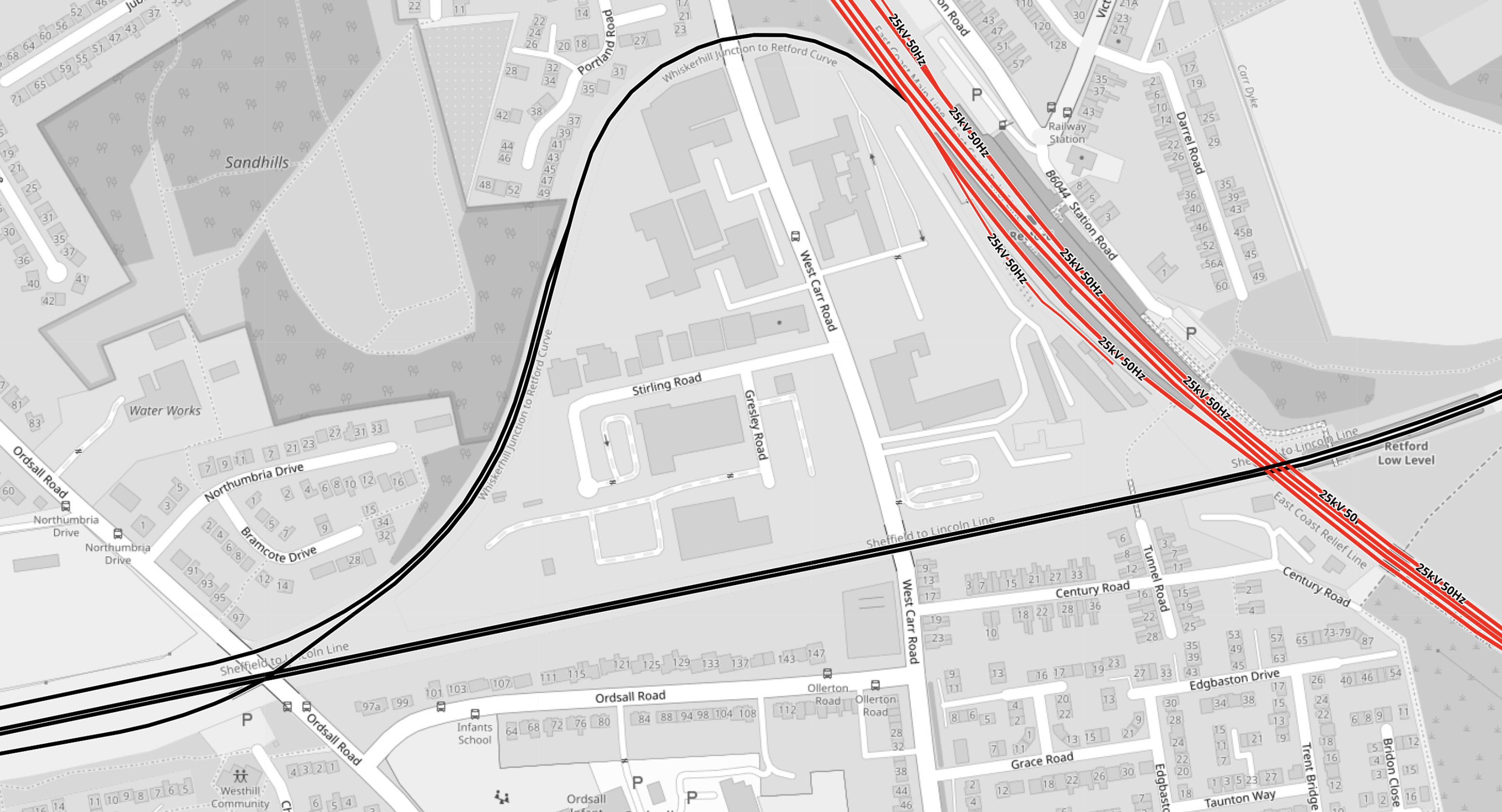
Note.
- The red tracks are electrified and are the East Coast Main Line.
- The black ones aren’t electrified.
- Doncaster is to the North.
- The black line to the East goes to Lincoln
- The black line to the West goes to Sheffield
- The red line going South-East goes to Peterborough and London.
The unusual loop allows trains to connect from one direction to another.
This second OpenRailwayMap shows the tracks in more detail.
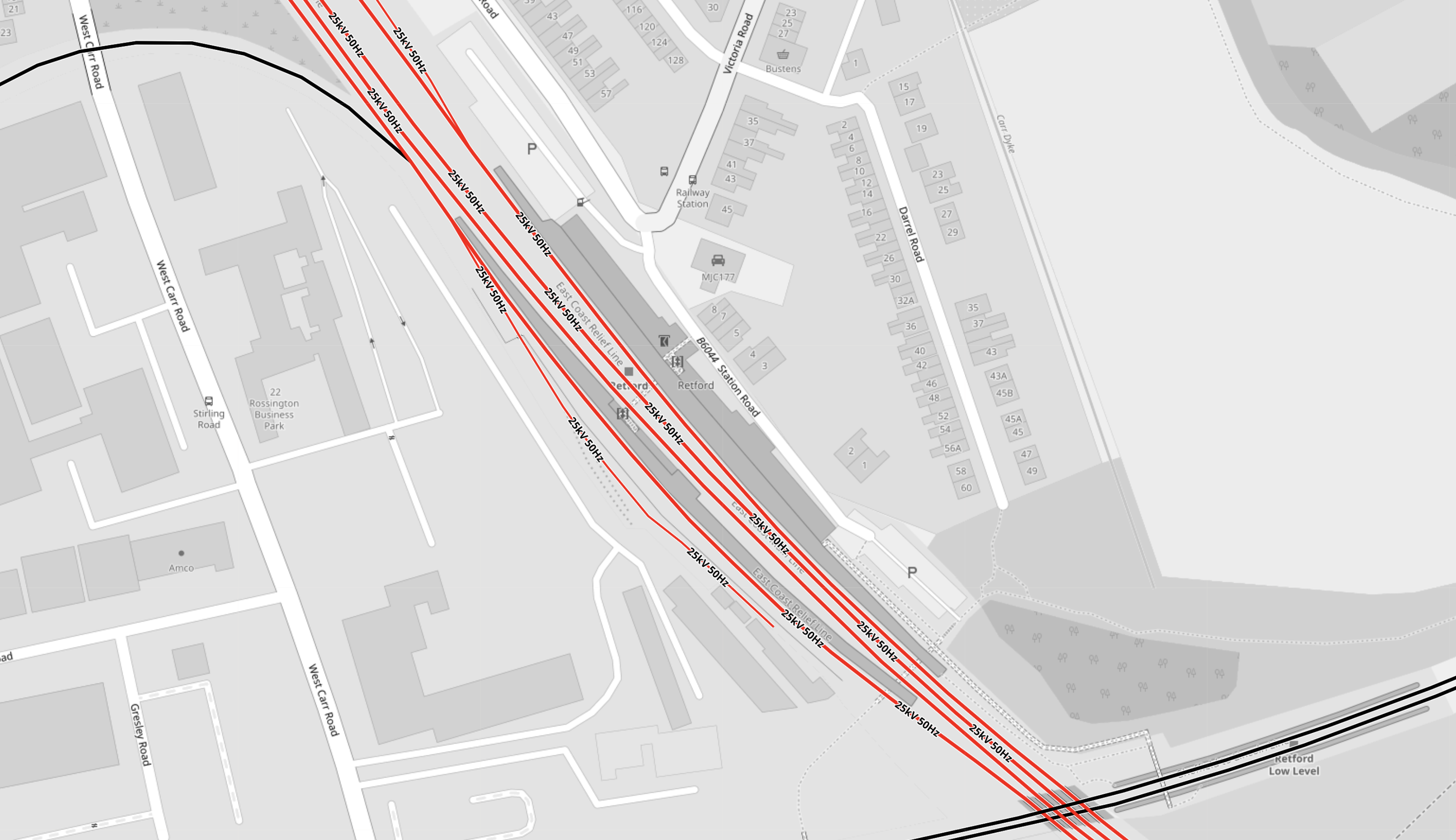
Note.
- As before red lines are electrified and black ones aren’t
- Platforms 1 and 2 are on the East Coast Main Line.
- Platforms 3 and 4 are on the Sheffield and Lincoln Line.
This third OpenRailwayMap shows the platforms in more detail.

Note.
- The yellow tracks are the 125 mph fast lines of the East Coast Main Line.
- The light blue tracks are the 40 mph relief lines of the East Coast Main Line.
- Northbound tracks are to the left of each pair of lines.
- The dark blue track is the 10 mph chord that connects the Northbound relief line of the East Coast Main Line to the Sheffield and Lincoln Line.
- Platform 1 is on the Southbound relief line.
- Platform 2 is on the Northbound relief line.
- Unusually, both platforms are on the same side of the line.
- In The Lengths Of Hitachi Class 800/801/802 Trains, I state that the full length of an InterCity 225 train is 245.2 metres.
- I suspect that both platforms can accommodate a full length InterCity 225, as the trains have been calling at Retford since the 1980s.
I doubt Retford station has any problem accommodating a pair of Class 802 trains, which it does regularly.
How Do Northbound Trains Go To Sheffield From Retford Station?
This OpenRailwayMap shows the tracks to the South of Retford station in detail.
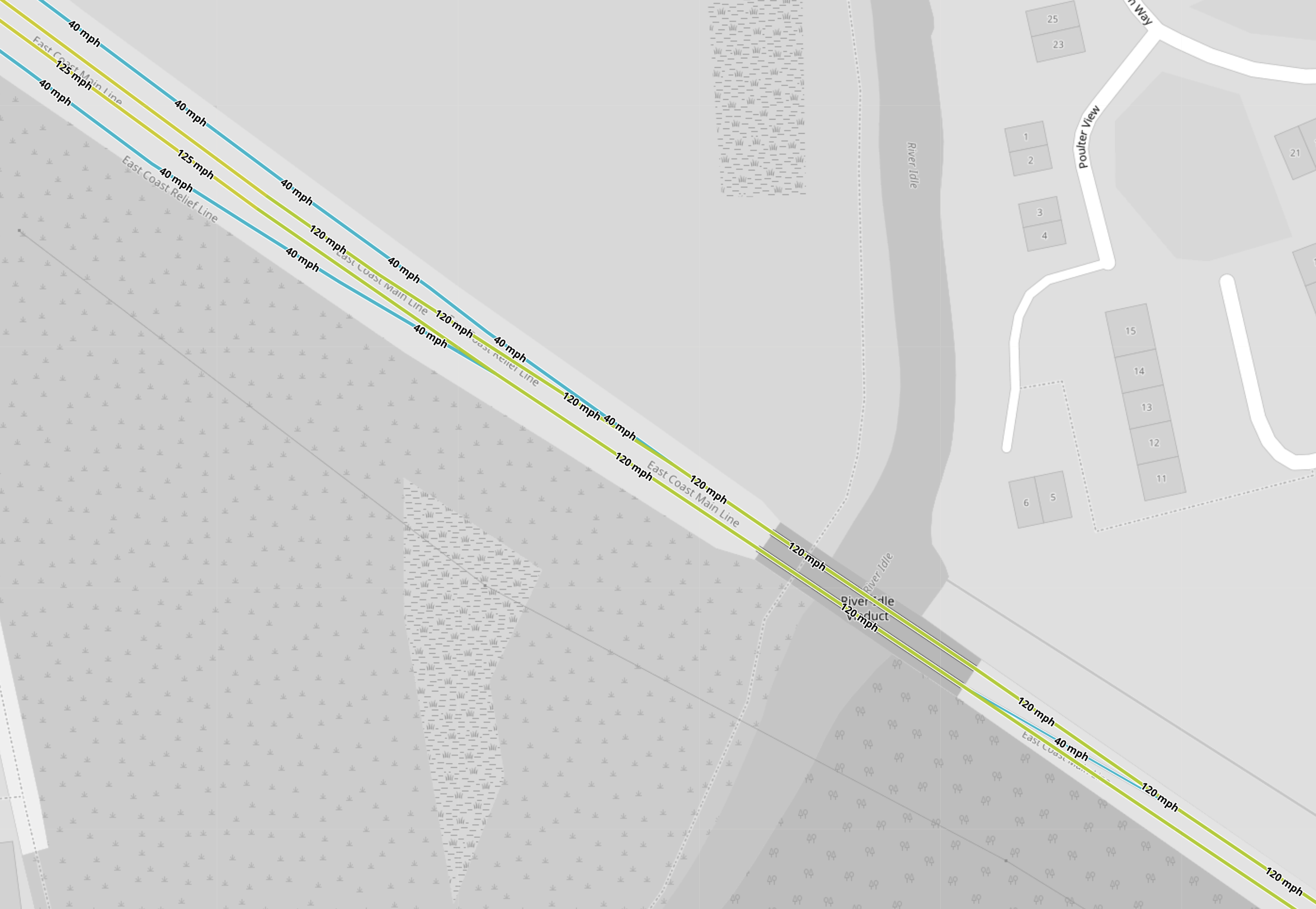
Note.
- The yellow tracks are the 125 mph fast lines of the East Coast Main Line.
- The light blue tracks are the 40 mph relief lines of the East Coast Main Line.
- Northbound tracks are to the left of each pair of lines.
Trains needing to stop in Retford station will need to cross to the Northbound relief line to enter Platform 2 at Retford station.
This OpenRailwayMap shows the curve that connects Platform 2 at Retford station to the Sheffield and Lincoln Line to Sheffield.

Note.
- The green tracks are the 60 mph Sheffield and Lincoln Line.
- Sheffield is to the West.
- The blue tracks are the curve that connects Platform 2 in Retford station to the Sheffield and Lincoln Line.
- There appears to be a grade-separated junction, where the two lines join to the West of Retford station.
A Northbound train to Sheffield will take curve and then join the line to Sheffield.
How Do Southbound Trains Go From Sheffield Through Retford Station?
I suspect trains do the opposite from a train going to Sheffield.
The train takes the curve and then stops in Platform 2 facing South.
This OpenRailwayMap shows the tracks to the South of Retford station in detail.
When the train is cleared by the signals to go South, it will leave Retford station going South on the Northbound relief line.
Note that on the map there are two crossovers, which the train will take to get on the Southbound fast line for Newark and London.
As a Control Engineer, I suspect this is the sort of manoeuvre, that modern digital signalling will make slicker and safer.
How Do Northbound Trains Go To Hull From Retford Station?
On leaving the station, the train will continue along the relief line until it merges with the Northbound fast line for Doncaster.
This is exactly as any Northbound train stopping at Retford does now.
How Do Southbound Trains Go From Hull Through Retford Station?
Currently, trains from Hull stop in Platform 1 on their way to London.
- Trains needing to stop in Retford station will need to cross to the Southbound relief line to enter Platform 1 at Retford station.
- When the train is cleared by the signals to go South, it will leave Retford station going South on the Southbound relief line.
- The Southbound relief line joins the Southbound fast line to the South of the station.
This is exactly as any Southbound train stopping at Retford does now.
Could A Hull And A Sheffield Service Run As A Pair And Split And Join At Retford Station?
Consider.
- Class 802 trains, as used by Hull Trains are designed to be run as a pair of trains, with easy coupling and uncoupling between the two trains.
- Hull Trains regularly run services as a pair of Class 802 trains.
- A pair of trains could leave King’s Cross. They would then split at a convenient station, after which the two trains go to different destinations.
- There are advantages with respect to infrastructure charges.
I feel that Hull Trains two services to Sheffield and Hull/Beverley could work as a pair.
- A pair of trains could leave King’s Cross.
- At Retford station they would split, with one train going to Hull and the other to Sheffield.
Coming South they would join at Retford.
How Would Splitting Of A Hull And Sheffield Service Be Performed At Retford Station?
The procedure would be something like this.
- As the pair of train is stopping in Retford station, it would use the relief line to enter Platform 2.
- It would stop in Platform 2.
- The trains would be uncoupled.
- The front train would go to its destination.
- The rear train would go to its destination.
Note.
- As the track to Doncaster and Hull is faster, the front train should probably be for Hull.
- Platform 2 is electrified, so the Sheffield train could top up its batteries .
- The Sheffield train could lower its pantograph.
Uncoupling takes about two minutes.
How Would Joining Of A Hull And Sheffield Service Be Performed At Retford Station?
Consider.
- Joining would have to be performed in Platform 2, as there is no route for a train from Sheffield to access Platform 1.
- North of Retford station there are two convenient crossovers, to allow a train to cross to the Northbound relief line. There are also a couple of loops, where trains could wait.
- As this is coal-mining country, perhaps, they were part of a freight route between Sheffield and Doncaster?
But this infrastructure would allow, a train from Hull to access Platform 2 at Retford station.
As the Sheffield train can easily access Platform 2, the two trains could meet in Platform 2 and then be joined together for a run to London.
Is There A Problem With Splitting And Joining Of the Hull And Sheffield Services?
Earlier, I said these were the stops of the two services.
- Going North from London King’s Cross to Hull, trains call at Stevenage (limited), Grantham, Retford, Doncaster, Selby, Howden and Brough.
- Going North from London King’s Cross to Sheffield, trains call at Retford, Worksop and Woodhouse.
Surely, if the trains were travelling as a pair, they would need to stop at the same stations to the South of Retford.
But modern digital signalling will allow trains to run closer together, so perhaps this would be the procedure going North.
- The two trains start in the same platform at King’s Cross, with the Sheffield train in front of the Hull train.
- The two trains leave King’s Cross a safe number of minutes apart.
- At its Stevenage and Grantham stops, the Hull train will tend to increase the distance between the two trains.
- The Sheffield train would stop in Platform 2 at Retford station, so that space is left for the Hull train.
- The Hull train will stop behind the Sheffield train in Platform 2 at Retford station.
- The Sheffield train will leave when ready.
- The Hull train will leave when ready.
And this would be the procedure going South.
- The train from Sheffield would line up in Platform 2 at Retford station.
- The train from Hull would line up in Platform 1 at Retford station.
- The train from Sheffield would leave when everything is ready and the train is cleared by the signalling system.
- The train from Hull would leave a safe number of minutes behind the train from Sheffield.
- At its Grantham and Stevenage stops, the Hull train will tend to increase the distance between the two trains.
- The trains could share a platform at King’s Cross.
The digital signalling and the driver’s Mark 1 eyeballs will keep the Hull train, a safe distance behind the faster Sheffield train.
The Capacity Of The Lincoln And Sheffield Line
Looking at the Sheffield and Lincoln Line, it has only an hourly train, that calls at Darnall, Woodhouse, Kiverton Park, Kiverton Bridge, Shireoaks and Worksop between Retford and Sheffield.
- I would suspect that there is enough spare capacity for Hull Trains to run a one train per two hours (tp2h) service between London King’s Cross and Sheffield.
- If LNER feel that a 1 tp2h frequency is viable for Harrogate, Lincoln and other places, surely Hull and East Sheffield could support a similar service from King’s Cross.
If the services could be run by battery-electric trains, capable of running at 140 mph on the East Coast Main Line and giving times of ninety minutes to Sheffield, this could be a success.
Could Woodhouse Station Become A Transport Hub?
This Google Map shows Woodhouse station.
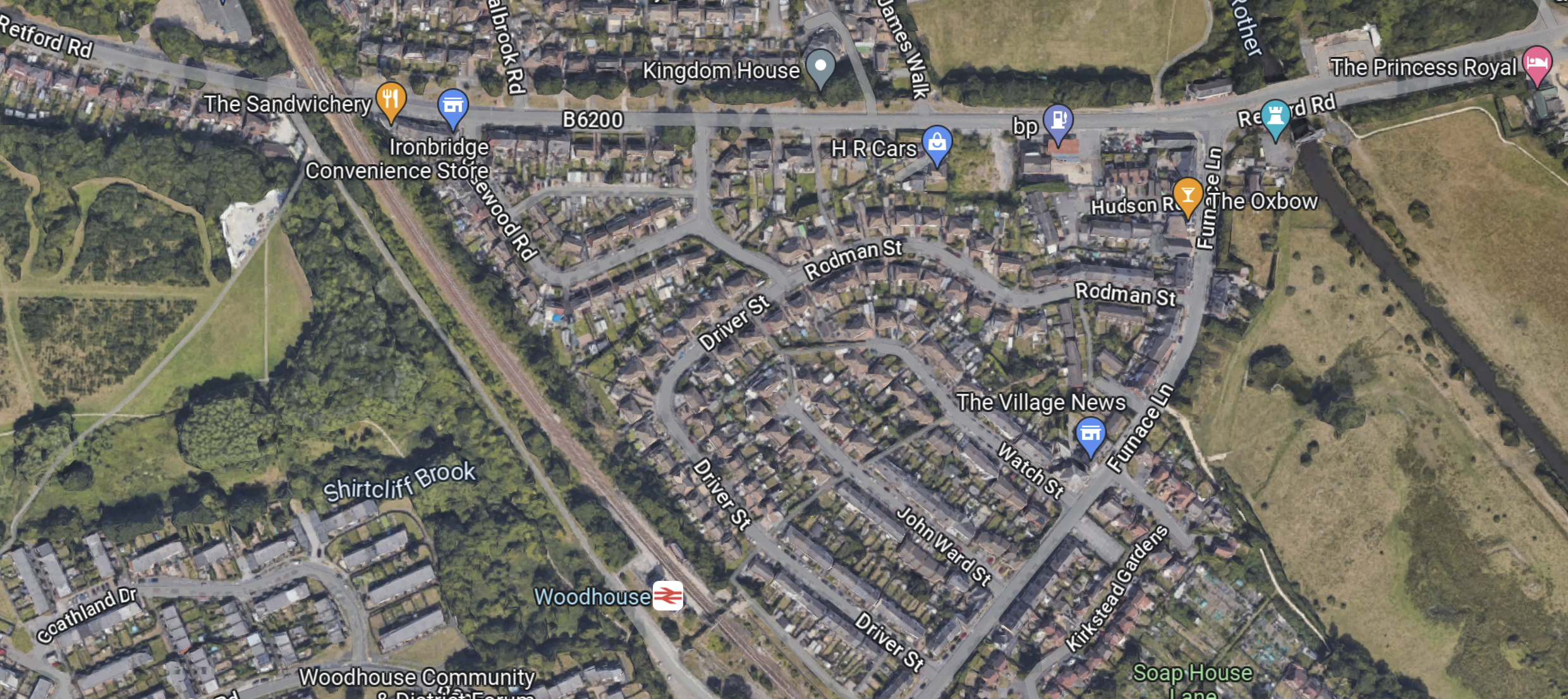
Note.
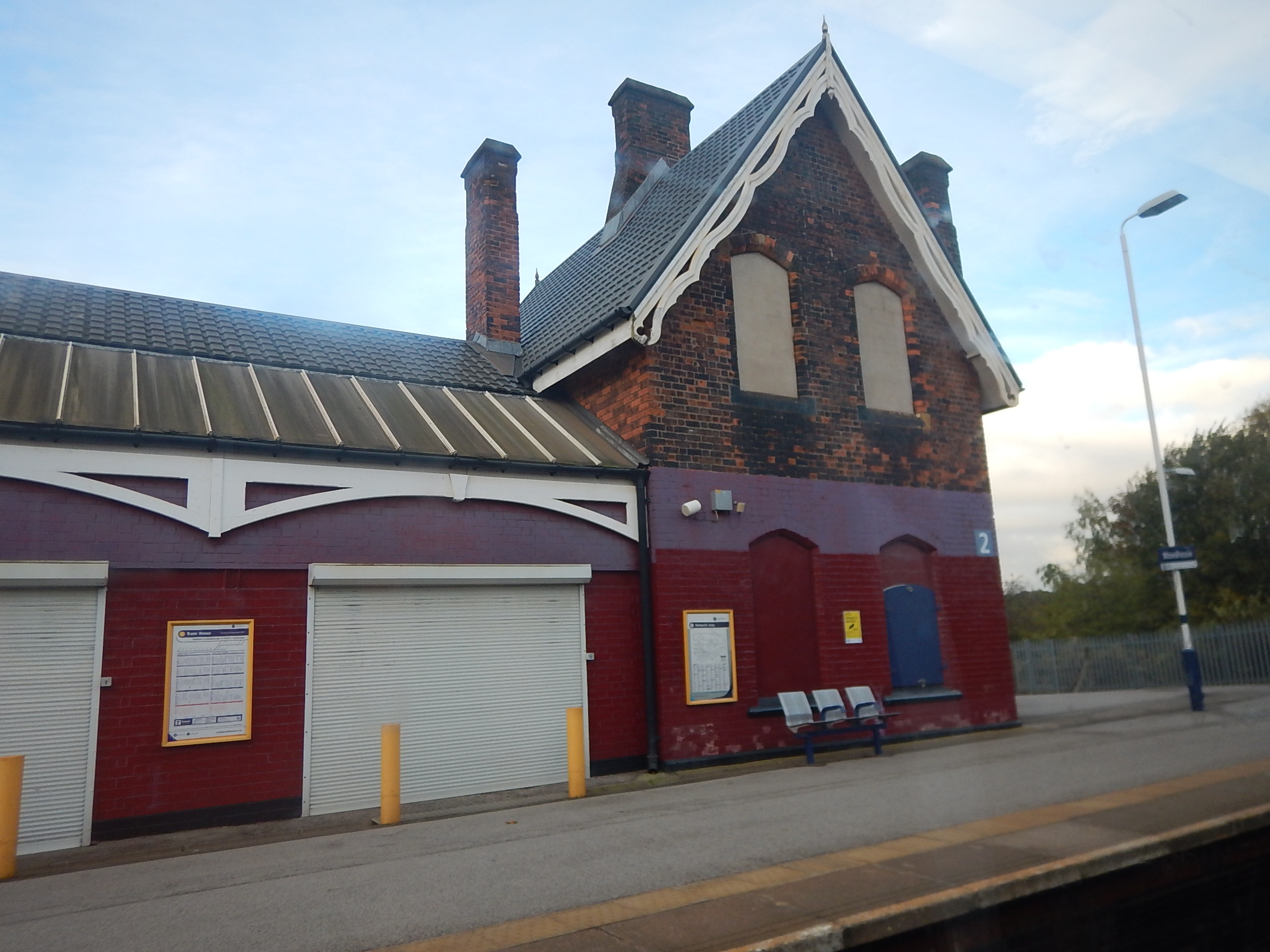
- It is certainly surrounded by a lot of houses.
- Could it be provided with car-parking?
Although, as this picture shows it is not blessed with lots of facilities.
But.
- The station is in an area, which Sheffield want to develop.
- The Advanced Manufacturing Centre is nearby.
- There are aspirations to run a tram-train between Sheffield and Chesterfield via Darnall, Woodhouse and Barrow Hill stations.
- The station could be on the tram-train route to Stocksbridge, that I wrote about in Reopening The Don Valley Section Of The Former Woodhead Line Between Stocksbridge and Sheffield Victoria To Passenger Services.
Woodhouse station could be an interchange or it could become something bigger like a hub station.
How Many Sheffield Services Per Day Could Be Run?
If the Hull and Sheffield trains run as a flight under control of the digital signalling, this will mean that every Hull train can be paired with a Sheffield train.
- There are five trains per day (tpd) to and from Hull and two to and from Beverley.
- It seems a maximum of one tpd in both directions can be a ten-car train.
- Two five-car trains could fit in a platform at King’s Cross.
I suspect that the maximum number of trains per day to and from Sheffield is the same as for Hull. i.e. seven tpd.
But there is no reason, if they have enough trains and paths are available, that Hull Trains couldn’t add extra services to both destinations.
Onward From Sheffield
Several of those, who have commented on the new service have suggested that the service could go further than Sheffield, with Manchester and Leeds being given specific mentions.
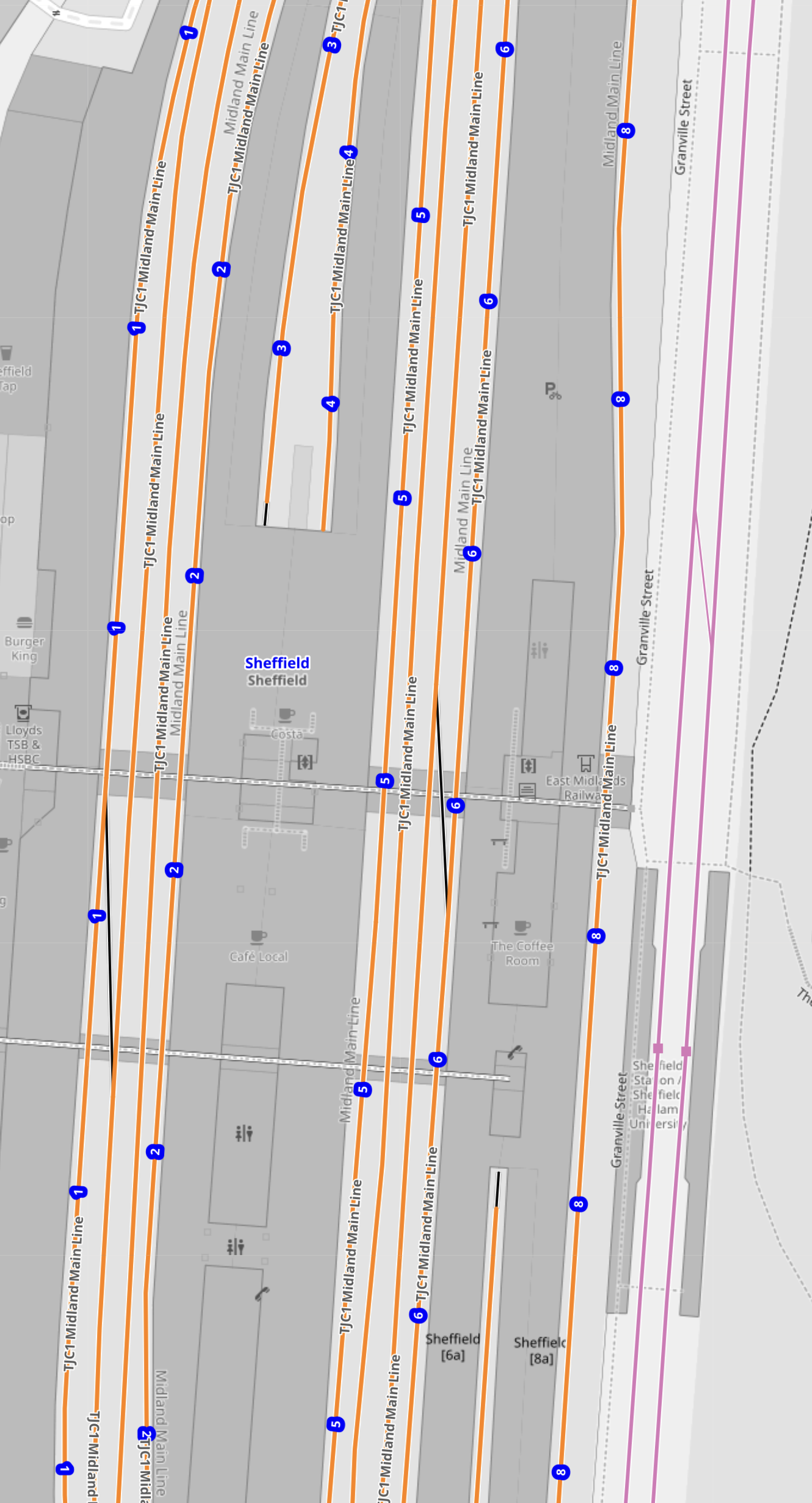
This OpenRailwayMap shows the platforms at the Northern end of Sheffield station.
Note.
- The pink tracks at the East are the Sheffield Supertram.
- Trains to and from Barnsley, Huddersfield, Hull, Leeds, Lincoln and Retford access the station from the Northern end.
- Trains to and from Chesterfield, Derby, London, Manchester and Stockport access the station from the Southern end.
- The tracks in Sheffield station are numbered 1 to 8 from the West.
- There are five through platforms. 1, 2, 5, 6 and 8 and two bay platforms at either end.
- An extension of the service to Manchester via the Hope Valley Line, could go straight through the station.
- An extension of the service to Barnsley, Huddersfield or Leeds, would mean the train reversing at Sheffield.
It looks like an extension to Manchester Piccadilly over the recently upgraded Hope Valley Line would be the easiest extension. But would Avanti West Coast, who have FirstGroup as a shareholder want the competition?
Recently, it has been announced that the Penistone Line to Barnsley and Huddersfield will be upgraded to accept two trains per hour (tph) and allow faster running.
Because Sheffield could be around eighty minutes from London, there could be some smart times to and from the capital.
- Meadowhall in 90 minutes
- Barnsley in 112 minutes.
- Huddersfield in 140 minutes.
Huddersfield could be almost twenty minutes faster than the route via Leeds.
Comments From The Times
These are some readers comments from The Times.
- Hope the prices are competitive with LNER. I rarely go to London from Chesterfield with EMR as they’re so expensive. LNER from Newark is much cheaper but a service from Worksop for me would be perfect.
- Excellent News in so many ways. I hope it really takes off which could help ease the congestion on the M1 and also thin out overcrowding on busy LNER services. It really does deserve to succeed.
- This is excellent news. The Lumo service has been a game changer for me and those living in the north east.
The public seem in favour.
Conclusion
I really like this proposal from FirstGroup.
- It has the possibility to provide Sheffield with a fast train link to London.
- It could run about six trains per day.
- It will be faster than High Speed Two was proposed.
It could be the first service of High Speed Yorkshire.
Are LNER Going To Take On The Airlines?
Nine years ago, I wrote Edinburgh – Plane Or Train?, after a trip to Scotland, where I took easyJet up and came back in First Class by train.
- Both trips were about five hours door-to-door.
- The flight was about six quid more,
- But I got free food and drink on the train.
- Security on the plane was a pain.
- I had to take my passport for identification at Stansted.
I haven’t flown internally in Great Britain since, although, I have flown to Belfast.
For shorter flights the market is going towards rail, as these posts seem to suggest.
- 2.7M Tonnes Of Co2 Could Be Saved Per Year If UK Domestic Flights Went Electric
- Air Travellers To Be Hit By Carbon Charge On All Tickets
- Climate Change ‘May Curb Growth In UK Flying’
- France Bans Short-Haul Flights To Cut Carbon Emissions
- KLM Replaces Plane With High Speed Train
- Lumo Carbon Data Shows Its Trains Are 22 Times Greener Than Flying
- Next Time I’ll Go By Train
- Ryanair One Of Europe’s Top Polluters, EU Data Suggests
- Stop Taking Internal Flights And Go Green, Says Lib Dem Contender Davey
The climate seems to be turning against flying short-haul.
This is a paragraph, in this press release from LNER, which is entitled First Tri-Mode Long Distance Trains For The East Coast Main Line.
This new fleet of trains will keep LNER on track to reduce its emissions by 67 per cent by 2035 and be net zero by 2045. LNER has already reduced carbon emissions by 50 per cent compared with 2018/19. Per mile, LNER trains produce 15 times less carbon emissions than a domestic flight.
Are LNER building a number of climate-based sticks, with which to beat the airlines on the routes, where they compete?
These are my thoughts on the various routes, where LNER compete with airlines.
Newcastle
Newcastle is an interesting one.
- Newcastle station is in the city centre and is on the Tyne and Wear Metro.
- London King’s Cross is one of London’s major Underground hubs.
- There are lots of buses and local trains within walking distance of both stations.
- There are three trains every two hours and an additional eight trains per day (tpd) between the two London King’s Cross and Newcastle stations.
- Lumo also run five tpd on the route.
- There are generally no security delays at rail stations.
- London King’s Cross is laid out to maximise passenger flows. If it gets busy, everybody just walks out into King’s Cross Square.
- I’ve never had a problem at Newcastle station with overcrowding.
Perhaps, if you live near one of the airports, flying is more convenient.
LNER’s weapons against the airlines between London King’s Cross and Newcastle will be convenience and journey times.
Convenience is all about the location of the stations, their excellent local transport networks and good walking routes around the station.
Journey times will only get better, as the magic of digital in-cab signalling, allows the Azumas, the new CAF tri-mode long distance trains and the few remaining InterCity 225s to show what they were designed to do.
Dalton-on-Tees, where the first phase of the digitally signalling will end, is 39.8 miles South of Newcastle, so once the Newcastle train is passes Dalton-on-Tees on the East Coast Main Line, it will be a digital-signalled electrified railway all the way to Woolmer Green.
- Dalton-on-Tees is 39.8 miles South of Newcastle
- Woolmer Green is 244.8 miles South of Newcastle.
- Dalton-on-Tees and Woolmer Green is 205 miles.
- Newcastle and Dalton-on-Tees takes 37 minutes.
- Woolmer Green and King’s Cross takes 18 minutes
- Trains take typically an average three hours and nine minutes between London and Newcastle.
- A typical train time by LNER between Dalton-on-Tees and Woolmer Green is two hours and 14 minutes.
- This is an average speed of 91.8 mph between Dalton-on-Tees and Woolmer Green.
- Between London King’s Cross and Newcastle is fully-electrified.
I can build a table of timings and savings at various average speeds.
- 120 mph – 103 minutes – two hours and 38 minutes – 31 minutes
- 125 mph – 98 minutes – two hours and 33 minutes – 36 minutes
- 130 mph – 95 minutes – two hours and 30 minutes – 39 minutes
- 135 mph – 91 minutes – two hours and 26 minutes – 43 minutes
- 140 mph – 88 minutes – two hours and 23 minutes – 46 minutes
Note.
- The first field is the average speed between Dalton-on-Tees and Woolmer Green.
- The second field is the time between Dalton-on-Tees and Woolmer Green.
- The third field is the time between London and Newcastle.
- The fourth field is the saving over current timings.
- The London and Newcastle time is calculated by adding the times for the three sections together.
I have regularly timed trains at a very constant 125 mph, so with digital signalling, I suspect an average of 130 mph is possible.
This would mean, times of a few minutes under two hours and thirty minutes could be possible between London and Newcastle.
Edinburgh
Edinburgh builds on the improvements South of Newcastle.
Edinburgh station Waverley is a well-connected station.
- There are lots of buses, local trains and the Edinburgh Tram within walking distance of Edinburgh Waverley station.
- There are three trains every two hours and an additional seven tpd between the London King’s Cross and Edinburgh Waverley stations.
- Lumo also run five tpd on the route.
- Trains take typically an average four hours and thirty minutes between London and Edinburgh Waverley.
- Any savings because of the digital in-cab signalling between London and Newcastle can be applied to London and Edinburgh Waverley services.
As my calculations showed that averaging 130 mph between Dalton-on-Tees and Woolmer Green could save 39 minutes on journey times, I am fairly sure than a sub-four hour journey time will be possible between London and Edinburgh Waverley.
It should also be noted that that the power supply has been improved between Newcastle and Edinburgh Waverley.
- The distance between Newcastle and Edinburgh Waverley is 124.2 miles
- Newcastle and Edinburgh Waverley takes around one hour and 30 minutes.
- This is an average speed of 82.8 mph between Newcastle and Edinburgh Waverley.
- Between London King’s Cross and Edinburgh Waverley is fully-electrified.
As the record time for between London King’s Cross and Edinburgh Waverley was set by an InterCity225 train in 1993 at three hours and twenty-nine minutes, I suspect that with more digital signalling and some track improvements, that there are more journey time improvements to be squeezed out.
I certainly believe that a time of three hours and fifty minutes between London and Edinburgh Waverley will be regularly achieved. This is a journey time saving of around forty minutes.
Dundee
Dundee has an airport and a station on the East Coast Main Line.
Trains between London King’s Cross and Dundee take around five hours and 45 minutes.
LNER run three trains per day to and from London King’s Cross and one tpd to and from Leeds.
CrossCountry also run services.
Loganair has two flights per day to Heathrow.
Aberdeen
Aberdeen builds on the improvements South of Edinburgh.
The four direct tpd between London and Aberdeen take around seven hours and ten minutes.
This should come down to around six hours and thirty minutes with the journey time savings between London King’s Cross and Edinburgh Waverley.
Will this tempt travellers from the airlines?
Battery-Electric Trains To Dundee And Aberdeen
One thing that will help, is that Edinburgh and Aberdeen is to be partially electrified.
InPiling Work To Get Underway To Electrify Line To Fife, I included this Network Rail map of the electrification.
This map has been downloaded from the Network Rail web site.
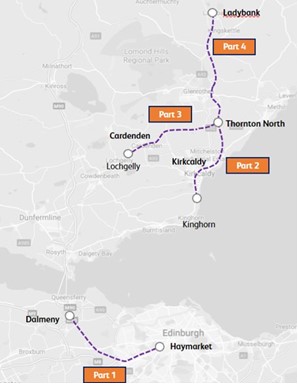
The electrification is split into four phases.
- Haymarket and Dalmeny – 25 km
- Kirkcaldy and Thornton North – 25 km.
- Lochgelly and Thornton North – 20 km.
- Thornton North and Ladybank – 34 km.
Note.
- The last three phases of electrification connect to Thornton North.
- The new rail link to Leven will also be electrified. and connected to Thornton North.
- The Forth Bridge is not to be electrified.
As Ladybank station is just 91.4 miles from Aberdeen, I suspect LNER will use Hitachi Intercity Battery Hybrid Trains to serve Aberdeen.
If these trains haven’t got the range, then I suspect LNER’s new CAF Tri-Mode Trains could handle the route.
Inverness
Inverness has a problem.
Zero-carbon trains will be unlikely to get to the city without full electrification of the Highland Main Line.
- Dunblane is the nearest electrified station to Inverness, but it is 146.2 miles away over a route with lots of steep climbs.
- I doubt that a battery-electric train could handle that route.
One solution would be for LNER to run the new CAF Tri-Mode Trains to Inverness using HVO or biodiesel.
Glasgow
Glasgow is the only other Scottish city with an airport and good rail connections to the South.
I am sure that Avanti West Coast will target airline passengers, if LNER prove it is a successful policy.
Other Factors
These are other factors, that will come into a traveller’s choice.
First Class
Some travellers like a bit more comfort and service.
Ability To Work
Some travellers like to work on a train.
You Don’t Get Tables On a Plane
I like to open a paper or magazine flat, which is difficult on a plane.
Views Tend To Be Better On a Train
Providing you get a window!
Parking Tends To Be Better At An Airport
But it may be more expensive!
Security Is Less Hassle On A Train
At the moment!
You Don’t Need To Prove Your Identity On A Train
Not in the UK! Yet!
Conclusion
It looks like LNER can offer the airlines to four of our major Northern cities serious zero-carbon competition.
Hitachi Rail Names Preferred Supplier For Battery System Development For UK Trial
The title of this post is the same as that of this article on Rail Technology Magazine.
These are the first two paragraphs.
Hitachi Rail UK is continuing its commitment to electrification and sustainability as it has teamed with a UK based Technology firm to design and supply its traction and battery systems for its intercity battery train trial which it hopes to run in the future.
Working with the North East England Partnership and Turntide Technologies, Hitachi UK Rail are working towards a UK trial for its battery technology which is engineered to reduce emissions and fuel costs. It is hoped, that if successful, it’ll advance the UK’s position as a global leader in battery train technology.
Note.
- Turntide Technologies took over Hyperdrive Innovation.
- Turntide Technologies have designed and built systems for JCB.
Up until now, we have been told very little about the batteries.
I have the following questions.
Is The Battery System In The Class 803 Trains For Lumo By Turntide Technologies/Hyperdrive Innovation?
The Wikipedia entry for Lumo, says this about the design of the Class 803 train.
Services are operated by a fleet of 125 mph (200 km/h) Class 803 electric multiple unit trains, ordered in March 2019 at a cost of £100 million, financed by the rail leasing company Beacon Rail.[15] While based on the same Hitachi AT300 design as the Class 801 Azuma trains operated on the East Coast Main Line by franchised operator London North Eastern Railway (LNER), they are not fitted with an auxiliary diesel engine, but instead feature batteries intended solely to power onboard facilities in case of overhead line equipment failure.
The maker of the batteries has not been disclosed.
If they have been made by Turntide, then they would certainly have had a good vibration testing.
Is The Battery System In The Class 803 Trains Similar To That Proposed For Class 800/802/805/810 Trains?
It would seem sensible, as this would mean that Hitachi would only be introducing one type of battery into the various fleets.
Supporting structures and wiring harnesses would then be identical in all trains, whether diesel engines or batteries were to be fitted.
Are The Batteries Plug Compatible With Similar Performance To The Diesel Engines?
I have never driven a train, but I have ridden in the cab of an InterCity 125, as I wrote about in Edinburgh to Inverness in the Cab of an HST.
The driver controls the two locomotives individually, just like I controlled the two engines in my Cessna 340 with two separate throttles.
So how does a driver control all the three engines in a five-car Class 800 train or the five engines in a nine-car?
Put simply, the driver just tells the computer, what speed or power is required and the train’s computer adjusts al the engines accordingly.
I believe it would be possible to design battery packs that are plug-compatible with similar performance to the diesel engines.
Hitachi could be playing an old Electrical/Electronic Engineer’s trick.
As a sixteen-year-old, I spent a Summer in a rolling mills, building replacement transistorised control units for the old electronic valve units. They had been designed, so they were plug-compatible and performed identically.
The great advantage of this approach, is that no changes were needed to the rolling mill.
So if Hitachi are using a similar approach, there should be very few or even no changes to the train.
What Range Will A Class 800 Train Have On Batteries?
This article on Focus Transport is entitled 224-kilometre Battery Range For FLIRT Akku – Stadler Sets World Record For Guinness Book Of Records.
I would be very surprised if Hitachi don’t break that record of 224 kilometres or 139 miles.
Conclusion
I belive we’re going to see a real revolution in rail transport.
Could A Battery-Electric High Speed Two Classic-Compatible Train Be Developed?
A Battery-Electric High Speed Two Classic-Compatible Train, would not be needed for High Speed Two, as it is currently envisaged, as all lines will be electrified.
But Hitachi have already said that they are developing the Hitachi Intercity Battery Hybrid Train, which is described in this infographic.
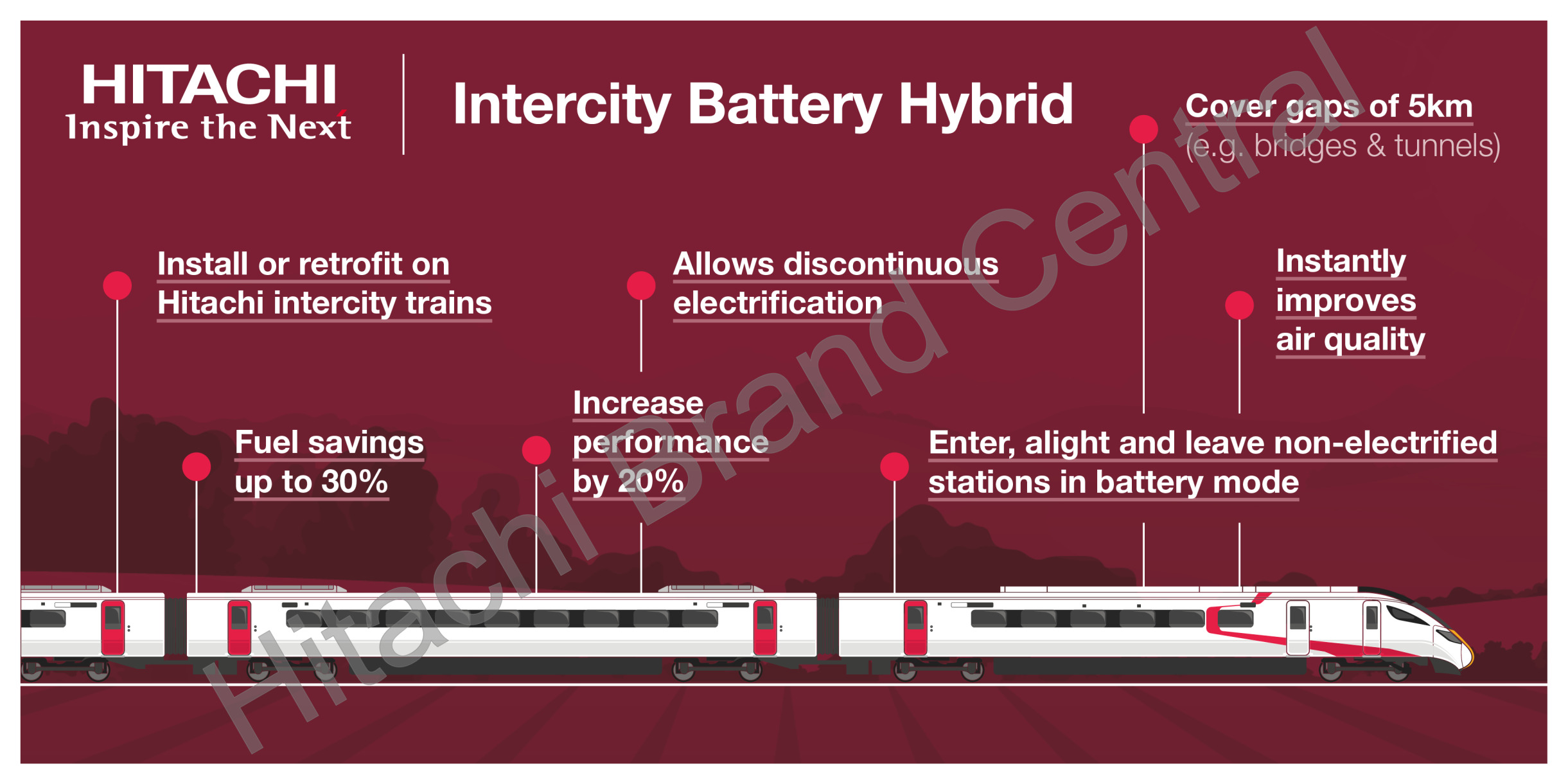
This page on the Hitachi Rail web site gives this description of the Hybrid Battery Train.
A quick and easy application of battery technology is to install it on existing or future Hitachi intercity trains. A retrofit programme would involve removing diesel engines and replace with batteries.
Hitachi Rail’s modular design means this can be done without the need to re-engineer or rebuild the train, this ensures trains can be returned to service as quickly as possible for passengers. Adding a battery reduces fuel costs up to 30% or increase performance.
These trains will be able to enter, alight and leave non–electrified stations in battery mode reducing diesel emissions and minimising noise – helping to improve air quality and make train stations a cleaner environment for passengers.
Our battery solution complements electrification, connecting gaps and minimising potential infrastructure costs and disruption to service.
It looks to me, that Hitachi are playing an old Electrical/Electronic Engineer’s trick.
As a sixteen-year-old, I spent a Summer in a rolling mills, building replacement transistorised control units for the old electronic valve units. They had been designed, so they were plug-compatible and performed identically.
It appears, that Hitachi’s battery supplier; Hyperdrive Innovation of Sunderland has just designed a battery pack, that appears to the train to be a diesel engine.
In the Technical Outline, this is said.
- Train Configuration: 5 – 12 car
- Nominal Vehicle Length: 26m
- Power Supply: Battery
The AT-300 trains generally have twenty-six metre cars.
In How Much Power Is Needed To Run A Train At 125 Or 100 mph?, I calculated that a Class 801 train uses 3.42 kWh per vehicle mile, at 125 mph.
- This means that a five-car train will use 1710 kWh to do 100 miles at 125 mph.
- The train has three diesel engines, so three batteries of 570 kWh would be needed.
- Alternatively, if a battery was put in each car, 342 kWh batteries would be needed.
- In the Wikipedia entry for battery-electric multiple unit, there are two examples of trains with 360 kWh batteries.
I believe building 570 kWh batteries for fitting under the train is possible.
What would be the maximum range for this train at 100 mph?
- I will assume that five batteries are fitted.
- As drag is proportional to the square of the speed, I’ll use a figure of 2.07 kWh per vehicle mile, at 100 mph.
This is a table of ranges with different size batteries in all cars.
- 50 kWh – 24.1 miles
- 100 kWh – 48.3 miles
- 200 kWh – 96.6 miles
- 300 kWh – 145 miles
- 400 kWh – 193.2 miles
- 500 kWh – 241.5 miles
They are certainly useful ranges.
LNER Will Be Ordering Ten New Bi-Mode Trains
In LNER Seeks 10 More Bi-Modes, I discussed LNER’s need for ten new bi-mode trains, which started like this.
The title of this post, is the same as that of an article in the December 2020 Edition of Modern Railways.
This is the opening paragraph.
LNER has launched the procurement of at least 10 new trains to supplement its Azuma fleet on East Coast Main Line services.
Some other points from the article.
- It appears that LNER would like to eliminate diesel traction if possible.
- On-board energy storage is mentioned.
- No form of power appears to be ruled out, including hydrogen.
- LNER have all 65 of their Azumas in service.
I believe that ten trains would be enough to handle LNER’s services on lines without electrification to the North of Scotland.
- London and Aberdeen has 130 miles without wires.
- London and Inverness has 146 miles without wires.
- Electrification plans are progressing North to Perth and to Thornton Junction.
I suspect both routes could be upgraded to under a hundred miles without wires.
I believe, that if Hyperdrive Innovation pull out every trick in the book to save power in their batteries that a five-car Azuma with a 300 kWh battery in each car, will have sufficient range with reserves to go between Edinburgh and Inverness or Aberdeen at 100 mph.
A Battery-Electric High Speed Two Classic-Compatible Train
Consider.
- I am a great believer in regenerative breaking to batteries on the train, as my experience says it the most efficient and also gives advantages, when the catenary fails.
- Stadler’s approach with the Class 777 train, where all trains have a small battery for depot movements, is likely to be increasingly copied by other train manufacturers.
- Hitachi have also designed the Class 803 trains for Lumo with emergency batteries for hotel power.
I could envisage provision for batteries being designed into a High Speed Two Classic-Compatible Train.
Suppose it was wanted to run High Speed Two Classic-Compatible Trains between Crewe and Holyhead.
- The train has eight cars.
- The route is 105.5 miles.
- I will assume an average speed of 100 mph.
- A Class 801 train uses 3.42 kWh per vehicle mile, at 125 mph.
- As drag is proportional to the square of the speed, I’ll use a figure of 2.07 kWh per vehicle mile, at 100 mph.
- This means that an eight-car train will use 1747.08 kWh to do 105.5 miles at 100 mph.
- I would put a traction battery in each car, to distribute the weight easily.
Each battery would need to be 218.4 kWh, which is totally feasible.
How far would the train travel on 300 kWh batteries at 100 mph?
- Total battery capacity is 2400 kWh.
- One mile will use 16.56 kWh.
- I am assuming the train is using regenerative braking to the battery at each stop.
The train will travel 145 miles before needing a recharge.
On the Crewe and Holyhead route, there would be a reserve of around 40 miles or nearly 500 kWh.
Conclusion
I am convinced that Hitachi and their highly regarded partner; Hyperdrive Innovation, have developed a battery pack, that gives enough power to match the performance of Class 800/802/805/810 trains on diesel and give a range of upwards of a hundred miles on battery power at 100 mph, if you put a 300 kWh battery pack in all cars.
- But then Stadler have run an Akku for 115 miles and a Class 777 for 84 miles on battery power alone.
- I think the key is to put a battery in each car and harvest all the electricity you can from braking.
- Remember too that Hitachi can raise and lower their pantographs with all the alacrity of a whore’s drawers, so strategic lengths of overhead electrification can also be erected.
Hitachi and Hyperdrive Innovation appear to have invented the High Speed Battery Train.
We’ll know soon, when the order for the LNER bi-modes is announced.
Whatever works on LNER, should work on High Speed Two.
We’re Increasing Capacity At Oxford Station To Accommodate Additional Services From 2024
The title of this post, is the same as that of this news item on the Network Rail web site.
This is the sub-heading.
The rail infrastructure in the Oxford Station area is close to full capacity and currently wouldn’t support the start of East West Rail services from the end of 2024. Through Oxfordshire Connect, the station is being expanded and the wider area upgraded, bringing a range of benefits to passengers and residents alike.
I have a few thoughts,
East West Rail Services
East West Rail is aiming to get these services up and running. for Phase 2 of the project.
- Oxford and Milton Keynes Central via Oxford Parkway, Bicester Village, Winslow and Bletchley – two trains per hour (tph)
- Oxford and Bedford via Oxford Parkway, Bicester Village, Winslow, Bletchley, Woburn Sands and Ridgmont – one tph
- Aylesbury and Milton Keynes Central via Aylesbury Vale Parkway, Winslow and Bletchley – one tph.
I suspect not all services will be delivered by the end of 2024. But extra platforms may be needed at Oxford station to accommodate services on East West Rail.
Direct Services Between Oxford And London
There are two direct services in each hour, between Oxford and London Paddington.
- One service terminates at Oxford and the other service terminates at either Great Malvern, Hereford or Worcester.
- Both services stop at Slough and Reading.
- Both services are run by Class 800 electro-diesel trains.
Distances without electrification are as follows.
- Hereford – 96.9 miles
- Great Malvern – 76.1 miles
- Worcester Shrub Hill – 67.6 miles
- Oxford – 10.5 miles
Hitachi are developing a series of battery-electric Intercity trains, which I described in Hitachi Rail And Angel Trains To Create Intercity Battery Hybrid Train On TransPennine Express.
This Hitachi infographic shows the Hitachi Intercity Battery Hybrid Train.
And this Hitachi infographic shows the Hitachi Intercity Battery Hybrid Train.

It looks to me, that one or both of these trains could work some or all of the the four routes to and through Oxford.
A battery train with a range of 21 miles would certainly be able to go between Paddington and Oxford, with battery charging to the East of Didcot.
These trains could be running services by the end of 2024.
Discontinuous Electrification Through Derwent Valley Mills
One big problem area of electrification on the Midland Main Line could be North of Derby, where the railway runs through the World Heritage Site of the Derwent Valley Mills. There might be serious objections to electrification in this area.
But if electrification were to be installed between Leicester and Derby stations, the following would be possible.
- The Midland Main Line would be electrified at East Midlands Hub station.
- Power could be taken from High Speed Two’s supply at East Midland Hub station, even if High Speed Two is not built in full.
- Battery-electric trains could do a return trip to Nottingham from an electrified East Midlands Parkway station, as it’s only sixteen miles in total.
I am sure, that Hitachi’s Class 810 trains could be upgraded to have a of perhaps twenty-five miles on battery power, as this fits with Hitachi’s statements.
North of Derby, there would be electrification on the following sections.
- Derby station and South of the heritage-sensitive section at Belper station.
- Sheffield station and North of the heritage-sensitive section at Duffield station.
Milford Tunnel, which has Grade II Listed portals and is part of the World Heritage Site would not be electrified.
Belper and Duffield stations are 2.6 miles or 4.8 kilometres apart.
I believe it could be arranged that there would be no electrification in the sensitive section, where the Heritage Taliban might object.
The Hitachi Intercity Battery Hybrid Train
Hitachi will start testing their Intercity Battery Hybrid Train next year.
The train is described in this Hitachi infographic.
Note that is has a gap-jumping range of 5 km, which would handle the gap between Belper and Duffield stations.
CrossCountry Services Between Derby And Sheffield
CrossCountry operate the following services between Derby and Sheffield through Milford Tunnel and the World Heritage Site.
- Plymouth and Edinburgh Waverley/Glasgow Central
- Southampton/Reading and Newcastle
CrossCountry would need new trains and one of the current Hitachi Class 802 trains could handle this route and use electrification where it exists.
A five kilometre gap will be no big obstacle to designing a battery-electric train for these CrossCountry services.
Freight Trains
In Will Zero-Carbon Freight Trains Be Powered By Battery, Electric Or Hydrogen Locomotives?, I came to this conclusion.
In the title of this post, I asked if freight locomotives of the future would be battery, electric or hydrogen.
I am sure of one thing, which is that all freight locomotives must be able to use electrification and if possible, that means both 25 KVAC overhead and 750 VDC third rail. Electrification will only increase in the future, making it necessary for most if not all locomotives in the future to be able to use it.
I feel there will be both battery-electric and hydrogen-electric locomotives, with the battery-electric locomotives towards the less powerful end.
Hydrogen-electric will certainly dominate at the heavy end.
These locomotives would be able to handle the section of the Midland Main Line through Derwent Valley Mills.
More On Batteries On Class 802 Trains
In the December 2021 Edition of Modern Railways, there’s an article called Battery Trial For TPE ‘802’.
Class 802 trains are now involved in two battery trials.
- One involves Great Western Railway (GWR) trains, which I wrote about in Hitachi And Eversholt Rail To Develop GWR Intercity Battery Hybrid Train – Offering Fuel Savings Of More Than 20%.
- A second involves TransPennine Express (TPE), which I wrote about in Hitachi Rail And Angel Trains To Create Intercity Battery Hybrid Train On TransPennine Express.
This article puts some flesh of the bones of the two trials.
It is hoped that replacing one diesel engine (generator unit) with a battery pack will enable the following.
- Reduction of carbon emissions by at least 20 %.
- Reduction of fuel consumption.
- The ability to rely on battery power when entering and leaving stations to reduce noise pollution and emissions.
This paragraph explains a possible way the trains will be operated.
Another option is to use the battery to provide ‘classic’ hybridisation efficiency, allowing most diesel running to be done fuel-efficiently under two engines rather than three. In this case, the battery module would provide top-up power for peak demand and give regenerative braking capability when operating in diesel mode, which the trains currently do not have.
This is one of the aims of the GWR trial and I suspect anybody, who has owned and/or driven a hybrid car will understand Hitachi’s thinking.
The next paragraph is very revealing.
To fully test the 6m-long, 2.2m-wide battery module, the intention is for it to be flexibly programmable in order for different approaches to charging, including from the overhead line power supply, diesel engines and during braking , to be evaluated.
It looks to me that Hyperdrive Innovation will earn their fees for the battery design and manufacture.
This picture shows the underneath of a Class 802 train.
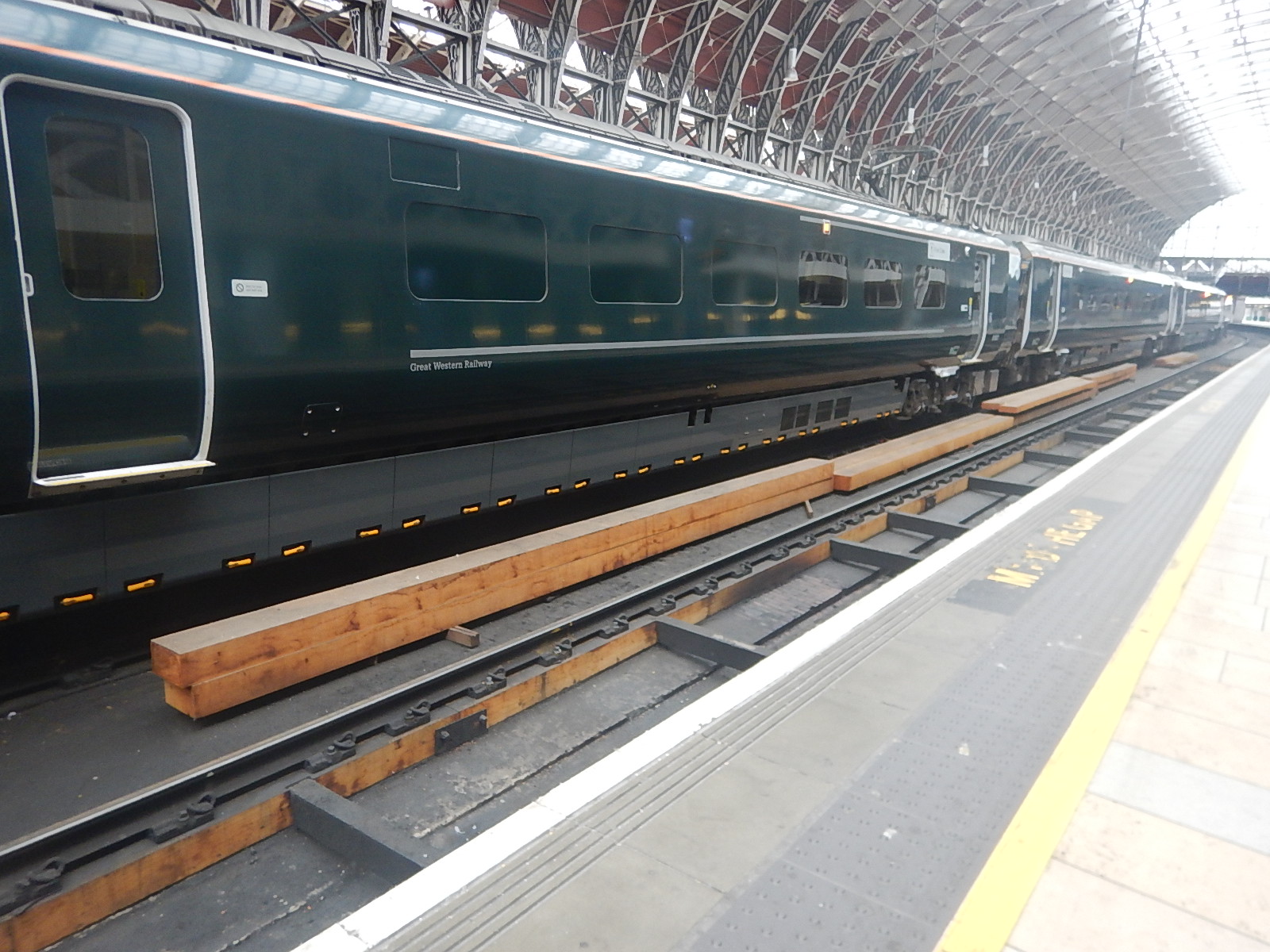
Note.
- The car is 26 metres long
- The car is 2.75 metres wide.
- The MTU 12V 1600 diesel engines, fitted to a Class 802 train, each weigh around two tonnes.
- The engines have a power output of 700 kW
I would think that the 6 x 2.2 m battery would fit under the car easily.
As an engineer, who has evaluated all sorts of weight and balance problems, I would make the battery similar in weight to the diesel engine. This would mean that the existing mountings for the diesel engine should be able to support the battery pack. It would also probably mean that the handling of a car with a diesel engine and one with a battery pack should be nearer to being identical.
Tesla claim an energy density of 250 Wh/Kg for their batteries, which would mean a battery with the weight of one of the diesel engines could have a capacity of around 500 kWh.
As a Control Engineer, I believe that Hitachi and Hyperdrive Innovation have a tricky problem to get the algorithm right, so that the trains perform equally well under all conditions. But with a good simulation and lots of physical testing, getting the algorithm right is very much a solvable problem.
The article says this about the reliability of the diesel engines or generator units (GU) as Hitachi call them.
Whilst reliability of the generator units (GU) has improved, operators of the bi-mode sets still report frequent issues which see sets ending their daily diagram with one out of use.
I wonder, if battery packs will improve reliability.
From statements in the article, it looks like Hitachi, MTU and the train operating companies are being cautious.
The article also says this about the design of the battery packs.
The battery pack has been designed so it is a like-for-like replacement for a GU, which can maintain or improve performance, without compromising on seats or capacity.
I have always said it would be plug-and-play and this would appear to confirm it.
How Will The Batteries Be Charged?
I showed this paragraph earlier.
To fully test the 6m-long, 2.2m-wide battery module, the intention is for it to be flexibly programmable in order for different approaches to charging, including from the overhead line power supply, diesel engines and during braking , to be evaluated.
GWR and TPE run their Class 802 trains to several stations without electrification. and they will probably need some method of charging the battery before leaving the station.
This is Hitachi’s infographic for the Hitachi Intercity Tri-Mode Battery Train.
Note.
- This infographic was published with the Hitachi press release announcing the development of the tri-mode train for GWR.
- One diesel engine has been replaced by a battery pack.
- Charging the battery can be under wires or 10-15 minutes whilst static.
- At some stations like Exeter St. Davids, Penzance, Plymouth or Swansea, heavily-laden services might need the assistance of batteries to get up to operating speed.
The infographic released with the Hitachi press release announcing the trials for TPE.
It is similar, but it says nothing about charging.
So how will these trains be charged in stations like Hull, Middlesbrough. Penzance, Scarborough and Swansea, so they leave on their return journey with a full battery?
Consider.
- The formation of a five-car Class 802 train is DPTS-MS-MS-MC-DPTF.
- Pantographs appear to be on both driver cars.
- The middle three cars have diesel engines.
- Only the middle three cars have traction motors.
- There is probably a high-capacity electrical bus running the length of the train, to enable electricity to power all the cars from either or both paragraphs, when running on an electrified line.
The simplest way to charge the batteries would probably be to install a short lengthy of 25 KVAC overhead electrification in the station and then to charge the batteries the driver would just raise the pantograph and energise the electrical bus, which would then feed electricity to the batteries.
I wrote about Furrer + Frey’s Voltap charging system in Battery Train Fast Charging Station Tested. This charging system would surely work with Hitachi’s designs as batteries can be charged from overhead electrification.
Conclusion
I suspect that Hitachi will achieve their objectives of saving fuel and cutting emissions.
But there is more than this project to just replacing one diesel engine with a battery pack and seeing what the savings are.
It appears that the battery packs could have an effect on train reliability.
If the battery packs are truly like-for-like with the diesel engines, then what will be effect of replacing two and three diesel engines in a five-car Class 802 train with battery packs.
Will it be possible to develop an ability to setup the train according to the route? It’s only similar to the way Mercedes probably set up Lewis Hamilton’s car for each circuit.
But then the speed Formula One cars lap Silverstone is not that different to the maximum speed of a Hitachi Class 802 train.
Could The Standedge Tunnels Be Part Of A High Speed Line?
This article on Rail Technology Magazine is entitled Warrington Borough Council React To Integrated Rail Plan, where this is said about improvements between Liverpool and Manchester via Warrington.
One such promise is the delivery of a new high-speed line between Warrington, Manchester and Marsden as part of NPR.
The IRP will also introduce a fully electrified upgraded line between Liverpool and Warrington as part of NPR.
Note NPR is Northern Powerhouse Rail.
Where Is Marsden?
This Google Map shows the rail line between the Standedge Tunnels and Marsden station.
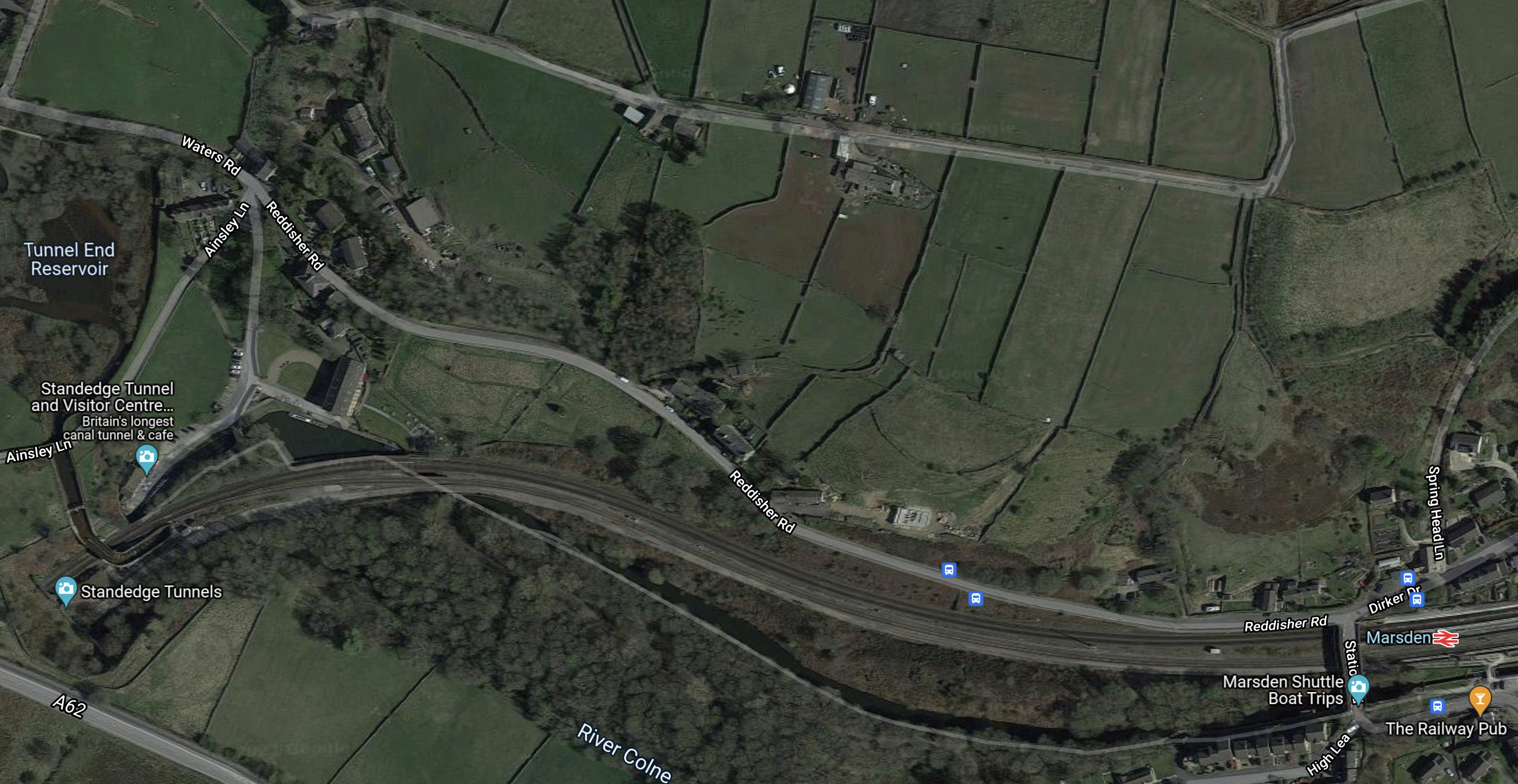
Note.
- Standedge Tunnels and the Visitor Centre in the West.
- Marsden station in the South-East corner of the map.
- The railway between them is the Huddersfield Line.
- The distance between Marsden station and the Eastern Portals of the Standedge Tunnels is about a mile.
Huddersfield station is seven miles to the East of Marsden station.
The Eastern End Of The Standedge Tunnels
This Google Map shows the Eastern end of the Standedge tunnels.
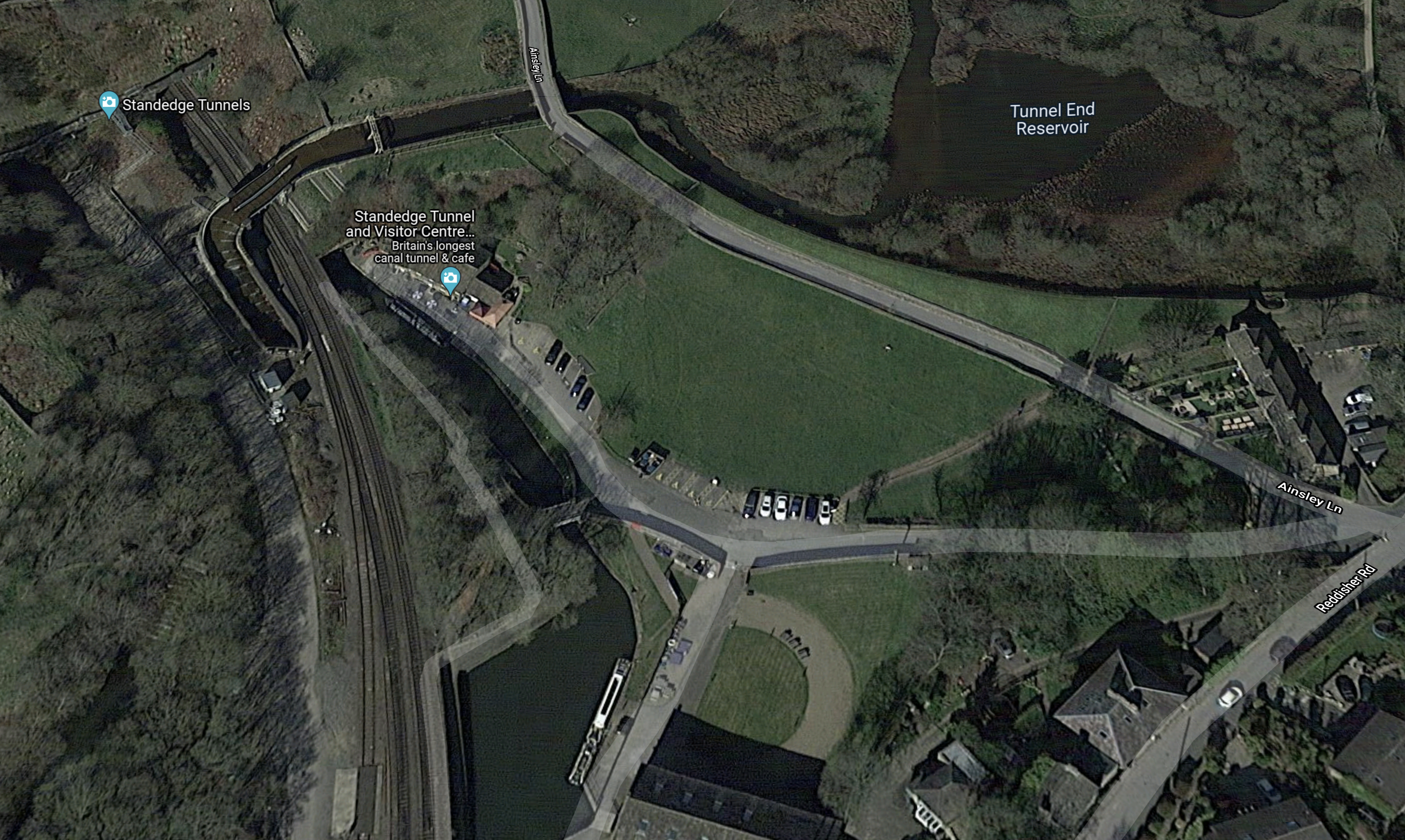
Note.
- This is a 3D image tilted to give a possibly better view.
- Only a double-track railway and a canal tunnel are in daily use.
- There are two other disused but intact single-track rail tunnels.
- I suspect that the Tunnel End Reservoir keeps the canal water at the right level.
It looks to me that the Standedge Tunnels will be part of the proposed high speed route.
Greenfield Station
Greenfield station is to the West of the Western portal of the Standedge tunnels.
The distance between Greenfield and Marsden stations is six miles.
The Standedge Tunnels
Wikipedia has a very comprehensive description of the canal tunnel and the three rail tunnels that form the Standedge tunnels complex.
These are points from the entry.
- The canal tunnel is the oldest and was opened in 1811.
- The two single-track rail tunnels were opened in 1848 and 1871
- The double-track rail tunnel opened in 1894.
- The rail tunnels were all built using the canal tunnel for access.
- All the tunnels are parallel to each other.
- The tunnels are level.
- All tunnels appear to be connected together with cross passages.
- For safety reasons some diesel-powered boats are towed through the canal tunnel using electric tugs.
- The railway tunnels were the only level section of the route and were fitted with water troughs for steam engines.
- Drainage of the rail tunnels appears to be good, with water draining into the canal.
- Only the 1894 tunnel is in use by trains, but all three rail tunnels are maintained.
- The 1848 tunnel can be used for emergency access and is accessible to fire engines and ambulances.
The complex appears to be a masterpiece of nineteenth century engineering.
There are several factors that could enable the conversion of the rail tunnels into a high-capacity modern railway with speeds up to at least 100 mph.
- The tunnels are level.
- The tunnels are well-drained.
- The access to the tunnels is good.
- Slab track, which allows higher speeds could be installed in the tunnels, as it was in the Bowshank Tunnel on the Borders Railway.
But the biggest factor could be the possibility of using battery-electric trains to avoid electrification of the main lines, which as now would probably be in the double-track tunnel.
This Hitachi infographic describes their Intercity Battery Hybrid Train, which is based on a Class 802 train and they are developing in partnership with TransPennine Express.
Note.
- Greenfield and Marsden stations are only six miles apart.
- The tunnels are only a few metres longer than 5000 metres.
- The train may only be able to cover 5 km now, but I believe this could be increased.
I also wonder, if the electrification on either side could get as close to the tunnel as possible.
This would enable trains to drop pantograph at speed and switch to battery power a few metres from the tunnel and get to the other side using a mix of battery-power and kinetic energy. Once under the wires at the other side of the tunnel and they had slowed to a safe speed at which they could raise the pantograph, it would be raised and trains would continue using the electrification.
The operating speed would probably be determined by any curves at the ends of the straight and level tunnel.
This method of operation may be OK for expresses, but what about other passenger and freight trains?
I wonder, if it would be possible to put a third track in one of the other rail tunnels.
- Slab-track would probably be installed.
- This third track could be electrified.
- It would be signalled to allow bi-directional running.
This by-pass tunnel could keep the main lines free for the expresses.
Conclusion
I am fairly sure that the Standedge Tunnels could be incorporated in a high speed line.
 The Anonymous Widower