LNER Services To Double Between Bradford And London
The title of this post is the same as that as this press release from LNER.
This is the introductory paragraph.
London North Eastern Railway (LNER) is pleased to confirm it will be doubling the number of Azuma weekday services between Bradford Forster Square and London King’s Cross from Monday 18 May 2020.
The timetable is as follows.
Southbound
- Leave Bradford Forster Square at 06:30 and arrive London Kings Cross at 08:59
- Leave Bradford Forster Square at 08:43 and arrive London Kings Cross at 11:31
Northbound
- Leave London Kings Cross at 16:33 and arrive Bradford Forster Square at 19:29
- Leave London Kings Cross at 18:33 and arrive Bradford Forster Square at 21:29
All services appear to call at Shipley between Leeds and Bradford Forster Square.
The press release doesn’t say if the trains split and join at Leeds station, but the timings are generous enough, if it is needed.
I wonder, if there will be more services between London and Bradford Forster Square in a few months. It probably depends on the level of success.
LNER Expands To Huddersfield
This press release from LNER is entitled LNER Announces Direct Services Between Huddersfield And London.
These are the introductory paragraphs.
LNER is proud to announce new Azuma services will be introduced between Huddersfield and London King’s Cross from Monday 18 May 2020.
The daily weekday service in each direction will be LNER’s first direct link between the West Yorkshire market town and the capital.
They will also connect nearby Dewsbury directly with London King’s Cross, after more than a generation of no direct services between Huddersfield and London.
The timetable will be as follows.
The new southbound service will depart from Huddersfield at 05:50 and Dewsbury at 06:01. The Azuma service will arrive in Leeds at 06:16, where it will couple to another five-car Azuma to form the 06:40 Leeds to London King’s Cross service, which will arrive in the capital at 08:51 on weekdays.
The evening northbound service will depart from London King’s Cross at 18:03 and will be formed of two five-car Azuma trains, which will split in Leeds, with one train continuing to Skipton and the other to Dewsbury, arriving at 20:45 and then Huddersfield at 20:58.
Joining and splitting is definitely being brought to Yorkshire by LNER.
I wonder, if there will be a London to Huddersfield service in the reverse direction in a few months.
Could Battery-Electric Hitachi Trains Work LNER’s Services?
Before I answer this question, I will lay out the battery-electric train’s specification.
Hitachi’s Proposed Battery Electric Train
Based on information in an article in Issue 898 of Rail Magazine, which is entitled Sparking A Revolution, the specification of Hitachi’s proposed battery-electric train is given as follows.
- Based on Class 800-802/804 trains or Class 385 trains.
- Range of 55-65 miles.
- Operating speed of 90-100 mph
- Recharge in ten minutes when static.
- A battery life of 8-10 years.
- Battery-only power for stations and urban areas.
- Trains are designed to be created by conversion of existing Class 80x trains
For this post, I will assume that the train is five or nine-cars long. This is the length of LNER‘s Class 800 and 801 trains.
LNER’s Services
These are LNER services that run from London to the North of England and Scotland.
I shall go through all the services and see how they would be affected by Hitachi’s proposed battery-electric Class AT-300 train.
London Kings Cross And Edinburgh
- The service runs at a frequency of two trains per hour (tph)
- Some services extend to Aberdeen, Stirling and Inverness and are discussed in the following sections.
This service can be run totally using the existing electrification.
London Kings Cross And Aberdeen
- The service runs at a frequency of four trains per day (tpd)
- Intermediate stations are York, Darlington, Newcastle, Berwick-upon-Tweed, Edinburgh, Haymarket, Inverkeithing, Kirkaldy, Leuchars, Dundee, Arbroath, Montrose and Stonehaven.
- Currently, the electrification goes 394 miles to Haymarket.
The service is 524 miles long and takes seven hours and four minutes.
To ascertain, if the Hitachi’s proposed battery-electric Class AT-300 train, could run this route, I’ll display the various sections of the route.
- London Kings Cross and Haymarket – 394 miles – Electrified
- Haymarket and Inverkeithing – 12 miles – Not Electrified
- Inverkeithing and Kirkcaldy – 13 miles – Not Electrified
- Kirkaldy and Leuchars – 25 miles – Not Electrified
- Leuchars and Dundee – 8 miles – Not Electrified
- Dundee and Arbroath – 17 miles – Not Electrified
- Arbroath and Montrose – 14 miles – Not Electrified
- Montrose and Stonehaven – 24 miles – Not Electrified
- Stonehaven and Aberdeen – 16 miles – Not Electrified
Note.
- Haymarket and Dundee is a distance of 58 miles
- Dundee and Stonehaven is a distance of 55 miles
So could the service be run with Fast Charge systems at Dundee, Stonehaven and Aberdeen?
I think it could, but the problem would be charging time at Dundee and Stonehaven, as it could add twenty minutes to the journey time and make timetabling difficult on the route.
Perhaps, an alternative would be to electrify a section in the middle of the route to create an electrification island, that could be reached from both Haymarket and Aberdeen.
The obvious section to electrify would be between Dundee and Montrose.
- It is a distance of 31 miles to electrify.
- I have flown my virtual helicopter along the route and it could be already gauge-cleared for electrification,
- Dundee station has been recently rebuilt.
- Haymarket and Dundee is a distance of 58 miles.
- Montrose and Aberdeen is a distance of 40 miles.
- Pantographs could be raised and lowered at Dundee and Montrose stations.
With this electrification and a Fast Charge system at Aberdeen, I believe that Hitachi’s proposed battery-electric Class AT-300 train could run between London Kings Cross and Aberdeen.
As an alternative to the Fast Charge system at Aberdeen, the route of Aberdeen Crossrail between Aberdeen and Inverurie could be electrified.
- This would enable battery-electric Class 385 trains to run between Inverurie and Montrose.
- The route through Aberdeen is newly-built, so should be gauge-cleared and reasonably easy to electrify.
It should also be noted that if battery-electric trains can run between Edinburgh and Aberdeen, then these services are also possible, using the same trains.
- Glasgow and Aberdeen
- Stirling and Aberdeen
All passenger services between Scotland’s Cenreal Belt and Aberdeen appear to be possible using battery-electric trains
London Kings Cross And Stirling
- The service runs at a frequency of one tpd
- Intermediate stations are York, Darlington, Newcastle, Berwick-upon-Tweed, Edinburgh, Haymarket, Falkirk Grahamstown
This service can be run totally using the existing electrification.
London Kings Cross And Inverness
- The service runs at a frequency of one tpd
- Intermediate stations are York, Darlington, Newcastle, Berwick-upon-Tweed, Edinburgh, Haymarket, Falkirk Grahamstown, Stirling, Gleneagles, Perth, Pitlochry, Kingussie and Aviemore.
- Currently, the electrification goes 429 miles to Stirling, but I have read that the Scottish government would like to see it extended to Perth, which is 462 miles from London.
The service is 581 miles long and takes eight hours and six minutes.
To ascertain, if the Hitachi’s proposed battery-electric Class AT-300 train, could run this route, I’ll display the various sections of the route.
- London Kings Cross and Haymarket – 394 miles – Electrified
- Haymarket and Falkirk Grahamsrown – 23 miles – Electrified
- Falkirk Grahamsrown and Stirling – 11 miles – Electrified.
- Stirling and Gleneagles – 17 miles – Not Electrified
- Gleneagles and Perth – 16 miles – Not Electrified
- Perth and Pitlochry – 28 miles – – Not Electrified
- Pitlochry and Kingussie – 44 miles – Not Rlectrified.
- Kingussie and Aviemore – 12 miles – Not Rlectrified.
- Aviemore and Inverness – 34 miles – Not Electrified
Note.
- The distance between Dunblane, where the electrification actually finishes and Perth is only 28 miles, which shouldn’t be too challenging.
- All the sections North of Perth are well within range of a fully charged train.
- Some sections of the route are challenging. Look at the video I published in Edinburgh to Inverness in the Cab of an HST.
- Hitachi run diesel Class 800 trains to Inverness, so they must know the power required and the battery size to run between Perth and Inverness.
I also believe that the Scottish Government, ScotRail, the Highland tourist industry and Hitachi, would all put their endeavours behind a project to get battery-electric trains between Perth and Inverness.
It would send a powerful message, that if battery-electric trains can run on one of the most scenic rail lines in the world without electrification, then nowhere is out of reach of battery trains.
Looking at the figures, I am convinced that a series of Fast Charge systems at stations like Pitlochry, Kingussie and Aviemore could supply enough power to allow a nine-car version of Hitachi’s proposed battery-electric Class AT-300 train to work the route.
This battery-electrification, would also enable battery-electric Class 385 trains to work the route.
If all this sounds a bit fanciful and over ambitious, read the history of the North of Scotland Hydro-Electric Board, which brought electricity to the area in the 1940s and 1950s.
This battery-electrification is a small project compared to what the Hydro-Electric Board achieved.
I can see a time, when similar techniques allow battery-electric trains to run these lines from Inverness.
- Far North Line – 174 miles
- Inverness and Kyle of Lochalsh – 82 miles
- Inverness and Aberdeen – 108 miles
The Far North Line would probably need two or three Fast Charge systems at intermediate stations, but the other lines would probably only need one system, somewhere in the middle.
I think that this analysis for London and Inverness shows that all parts of England, Scotland and Wales can be served by modern battery-electric trains.
It would also appear that the cost of the necessary Fast Charging systems, would be much more affordable than full electrification, North of Perth.
I estimate that less than a dozen Fast Charging systems would be needed, North of Perth.
- Some electrification might be needed in Inverness station.
- Electrification between Inverurie and Aberdeen could help.
- There’s no shortage of zero-carbon electricity from wind and hydro-electric power.
A couple of years ago, I speculated in a post called London To Thurso Direct.
Could it happen on a regular basis in the summer months?
London Kings Cross And Leeds
- The service runs at a frequency of two tph
- Intermediate stations are Stevenage, Peterborough, Grantham, Doncaster and Wakefield Westgate
This service can be run totally using the existing electrification.
London Kings Cross And Harrogate
- The service runs at a frequency of six tpd
- Intermediate stations are Stevenage, Grantham, Doncaster and Wakefield Westgate
- Leeds and Harrogate is a distance of nineteen miles and is not electrified.
- Hitachi’s proposed battery-electric Class AT-300 train should be able to go from Leeds to Harrogate and back, using battery power alone.
- Batteries will be charged using the electrification at and around Leeds.
This service can be run totally using the existing electrification.
London Kings Cross And Bradford Foster Square
- The service runs at a frequency of one tpd
- Intermediate stations are Stevenage, Peterborough, Grantham, Doncaster and Wakefield Westgate
- Leeds and Bradford Forster Square is a distance of fourteen miles and electrified.
This service can be run totally using the existing electrification.
London Kings Cross And Skipton
- The service runs at a frequency of one tpd
- Intermediate stations are Stevenage, Peterborough, Grantham, Doncaster and Wakefield Westgate
- Leeds and Skipton is a distance of twenty-six miles and electrified.
This service can be run totally using the existing electrification.
London Kings Cross And Lincoln
- The service runs at a frequency of one train per two hours (1tp2h)
- Intermediate stations are Stevenage, Peterborough, Grantham and Newark North Gate
- Newark North Gate and Lincoln is a distance of sixteen miles and not electrified.
- Hitachi’s proposed battery-electric Class AT-300 train should be able to go from Newark North Gate to Lincoln and back, using battery power alone.
- Batteries will be charged using the electrification between Newark North Gate and London Kings Cross.
This service can be run totally using the existing electrification.
London Kings Cross And York
- The service runs at a frequency of 1tp2h
- Intermediate stations are Stevenage, Peterborough, Grantham and Newark North Gate, Retford and Doncaster
This service can be run totally using the existing electrification.
London Kings Cross And Hull
- The service runs at a frequency of one tpd
- Intermediate stations are Stevenage, Peterborough, Grantham and Newark North Gate, Retford and Doncaster
- Temple Hirst Junction and Hull is a distance of thirty-six miles and not electrified.
- Hitachi’s proposed battery-electric Class AT-300 train should be able to go from Temple Hirst Junction and Hull and back, using battery power and a Fast Charge system at Hull.
- Batteries will also be charged using the electrification between Temple Hirst Junction and London Kings Cross.
This service can be run totally using the existing electrification.
Consider.
- The train runs seventy-two miles to get to Hull and back on lines without electrification..
- Hitachi state that the trains maximum range on battery power is sixty-five miles.
- Hull Trains and TransPennine Express also run similar trains on this route, that will need charging at Hull.
So rather than installing a Fast Charge system at Hull, would it be better to do one of the following.
- Create a battery-electric AT-300 train with a bigger battery and a longer range. A One-Size-Fits-All could be better.
- However, the larger battery would be an ideal solution for Hull Trains, who also have to reverse and go on to Beverley.
- Electrify the last few miles of track into Hull. I don’t like this as electrifying stations can be tricky and getting power might be difficult!
- Electrify between Temple Hirst Junction and Selby station and whilst this is done, build a solution to the problem of the swing bridge. Power for the electrification can be taken from the East Coast Main Line.
I’m sure a compromise between train battery size and electrification can be found, that creates a solution, that is acceptable to the accountants.
Conclusion
I think it could be possible, that LNER could use a fleet of all-electric and battery-electric AT-300 trains.
Are Hitachi Designing the Ultimate Battery Train?
In Sparking A Revolution, a post based on an article of the same name in Issue 898 of Rail Magazine, I repeated this about the specification of Hitachi UK Battery Train Specification.
- Range – 55-65 miles
- Performance – 90-100 mph
- Recharge – 10 minutes when static
- Routes – Suburban near electrified lines
- Battery Life – 8-10 years
Does this mean that the train can do 55-65 miles cruising at 90-100 mph?
How Much Energy Is Needed To Accelerate A Five-Car Class 800 Train To Operating Speed?
I will do my standard calculation.
- Empty train weight – 243 tonnes (Wikipedia for Class 800 train!)
- Passenger weight – 302 x 90 Kg (Includes baggage, bikes and buggies!)
- Train weight – 270.18 tonnes
Using Omni’s Kinetic Energy Calculator, the kinetic energy at various speeds are.
- 60 mph – 27 kWh
- 80 mph – 48 kWh
- 90 mph – 61 kWh
- 100 mph – 75 kWh
- 125 mph – 117 kWh – Normal cruise on electrified lines.
- 140 mph – 147 kWh – Maximum cruise on electrified lines.
Because the kinetic energy of a train is only proportional to the weight of the train, but proportional to the square of the speed, note how the energy of the train increases markedly after 100 mph.
Are these kinetic energy figures a reason, why Hitachi have stated their battery train will have an operating speed of between 90 and 100 mph?
A 100 mph cruise would also be very convenient for a lot of main lines, that don’t have electrification in the UK.
What Battery Size Would Be Needed?
In How Much Power Is Needed To Run A Train At 125 mph?, I calculated that a five-car Class 801 electric train, needed 3.42 kWh per vehicle-mile to maintain 125 mph.
For comparison, an InterCity 125 train, had a figure of 2.83 kWh per vehicle-mile.
Hitachi are redesigning the nose of the train for the new Class 810 train and I suspect that these trains can achieve somewhere between 1.5 and 3 kWh per vehicle-mile, if they are cruising at 100 mph.
Doing the calculation for various consumption levels gives the following battery capacity for a five-car train to cruise 65 miles at 100 mph
- 1.5 kWh per vehicle-mile – 487 kWh
- 2 kWh per vehicle-mile – 650 kWh
- 2.5 kWh per vehicle-mile – 812.5 kWh
- 3 kWh per vehicle-mile – 975 kWh
These figures don’t include any energy for acceleration to line speed from the previous stop or station, but they would cope with a deceleration and subsequent acceleration, after say a delay caused by a slow train or other operational delay, by using regenerative braking to the battery.
The energy needed to accelerate to operating speed, will be as I calculated earlier.
- 90 mph – 61 kWh
- 100 mph – 75 kWh
As the battery must have space to store the regenerative braking energy and it would probably be prudent to have a ten percent range reserve, I can see a battery size for a train with an energy consumption of 2 kWh per vehicle-mile, that needed to cruise at 100 mph being calculated as follows.
- Energy for the cruise – 650 kWh
- 10% reserve for cruise – 65 kWh
- Braking energy from 100 mph – 75 kWh
This gives a total battery size of 790 kWh, which could mean that 800 kWh would be convenient.
Note that each of the three MTU 12V 1600 diesel engines, fitted to a Class 800 train, each weigh around two tonnes.
In Innolith Claims It’s On Path To 1,000 Wh/kg Battery Energy Density, I came to these conclusions.
- Tesla already has an energy density of 250 Wh/Kg.
- Tesla will increase this figure.
- By 2025, the energy density of lithium-ion batteries will be much closer to 1 KWh/Kg.
- Innolith might achieve this figure. But they are only one of several companies aiming to meet this magic figure.
Suppose two of the MTU 12V 1600 diesel engines were each to be replaced by a two tonne battery, using Tesla’s current energy density, this would mean the following.
- Each battery would have a capacity of 500 kWh.
- The train would have one MWh of installed battery power.
- This is more than my rough estimate of power required for a 65 mile trip.
- The train would have little or no weight increase.
- I also wouldn’t be surprised to find that the exchange of a diesel engine for a battery was Plug-and-Play.
Hitachi would have an electric/battery/diesel tri-mode train capable of the following.
- Range – 55-65 miles
- Out and Back Range – about 20-30 miles
- Performance – 90-100 mph
- Recharge – 10 minutes when static
- Emergency diesel engine.
I feel it would be a very useful train.
Trains That Could Be Fitted With Batteries
The original article in Rail Magazine says this.
For the battery project, positive discussions are taking place with a number of interested parties for a trial, with both Class 385s and Class 800s being candidates for conversion.
So this means that the following operators will be able to use Hitachi’s battery technology o their trains.
- Avanti West Coast – Class 80x trains
- First East Coast Trains – Class 80x trains
- East Midlands Railway – Class 80x trains
- GWR – Class 80x trains
- Hull Trains – Class 80x trains
- LNER – Class 80x trains
- ScotRail – Class 385 trains
- TransPennine Express – Class 80x trains
Although, I based my calculations on Class 80x trains, I suspect that the methods can be applied to the smaller Class 385 trains.
Possible Out-And-Back Journeys
These are possible Out-And-Back journeys, that I believe Hitachi’s proposed battery-electric trains could handle.
- Edinburgh and Tweedbank – 30 miles from Newcraighall
- London Paddington and Bedwyn – 30 miles from Reading
- London Euston and Blackburn – 12 miles from Preston
- London Kings Cross and Bradford – < 27 miles from Leeds
- London Euston and Chester – 21 miles from Crewe
- London Kings Cross and Harrogate – <18 miles from Leeds
- London Kings Cross and Huddersfield – 17 miles from Leeds
- London St. Pancras and Leicester – 16 miles from Market Harborough
- London Kings Cross and Lincoln – 17 miles from Newark
- London St. Pancras and Melton Mowbray – 26 miles from Corby
- London Kings Cross and Middlesbrough – 20 miles from Northallerton
- London Kings Cross and Nottingham – 20 miles from Newark
- London Paddington and Oxford – 10 miles from Didcot
- London Kings Cross and Redcar – 29 miles from Northallerton
- London Kings Cross and Rotherham- 14 miles from Doncaster
- London Kings Cross and Sheffield – 20 miles from Doncaster
- London and Weston-super-Mare – 19 miles from Bristol
Note.
- Provided that the Out-And-Back journey is less than about sixty miles, I would hope that these stations are comfortably in range.
- Leicester is the interesting destination, which would be reachable in an Out-And-Back journey. But trains from the North stopping at Leicester would probably need to charge at Leicester.
- I have included Blackburn as it could be a destination for Avanti West Coast.
- I have included Melton Mowbray as it could be a destination for East Midlands Railway.
- I have included Nottingham, Rotherham and Sheffield as they could be destinations for LNER. These services could prove useful if the Midland Main Line needed to be closed for construction works.
- I’m also fairly certain, that no new electrification would be needed, although every extra mile would help.
- No charging stations would be needed.
I suspect, I’ve missed a few possible routes.
Possible Journeys Between Two Electrified Lines
These are possible journeys between two electrified lines, that I believe Hitachi’s proposed battery-electric trains could handle.
- London St. Pancras and Eastbourne via Hastings – 25 miles between Ashford and Ore.
- Leeds and York via Garforth – 20 miles between Neville Hall and Colton Junction
- London Kings Cross and Norwich via Cambridge – 54 miles between Ely and Norwich.
- Manchester Victoria and Leeds via Huddersfield – 43 miles between Manchester Victoria and Leeds.
- Preston and Leeds via Hebden Bridge – 62 miles between Preston and Leeds.
- Newcastle and Edinburgh – Would battery-electric trains get round the well-publicised power supply problems on this route?
Note.
- I am assuming that a range of 65 miles is possible.
- If the trains have a diesel-generator set, then this could be used to partially-charge the battery in places on the journey.
- Leeds and York via Garforth has been scheduled for electrification for years.
- Preston and Leeds via Hebden Bridge would probably need some diesel assistance.
- London Kings Cross and Norwich via Cambridge is a cheeky one, that Greater Anglia wouldn’t like, unless they ran it.
- As before no new electrification or a charging station would be needed.
I suspect, I’ve missed a few possible routes.
Possible Out-And-Back Journeys With A Charge At The Destination
These are possible Out-And-Back journeys, that I believe Hitachi’s proposed battery-electric trains could handle, if the batteries were fully charged at the destination.
- Doncaster and Cleethorpes – 52 miles from Doncaster.
- London Paddington and Cheltenham – 42 miles from Swindon
- London Kings Cross and Cleethorpes via Lincoln – 64 miles from Newark
- London Euston and Gobowen – 46 miles from Crewe
- London Euston and Wrexham – 33 miles from Crewe
- London Kings Cross and Hull – 45 miles from Selby
- London Kings Cross and Shrewsbury – 30 miles from Wolverhampton
- London Kings Cross and Sunderland 41 miles from Northallerton
- London Paddington and Swansea – 46 miles from Cardiff
- London Paddington and Worcester – 67 miles from Didcot Parkway
- London St. Pancras and Derby – 46 miles from Market Harborough
- London St. Pancras and Nottingham – 43 miles from Market Harborough
Note.
- I am assuming that a range of 65 miles is possible.
- If the trains have a diesel-generator set, then this could be used to partially-charge the battery in places on the journey.
- I am assuming some form of charging is provided at the destination station.
- As before no new electrification would be needed.
I suspect, I’ve missed a few possible routes.
Midland Main Line
The Midland Main Line could possibly be run between London St. Pancras and Derby, Nottingham and Sheffield without the use of diesel.
Consider.
- The route will be electrified between London St. Pancras and Market Harborough.
- In connection with High Speed Two, the Midland Main Line and High Seed Two will share an electrified route between Sheffield and Clay Cross North Junction.
- London St. Pancras and Derby can be run with a charging station at Derby, as Market Harborough and Derby is only 46 miles.
- London St. Pancras and Nottingham can be run with a charging station at Nottingham, as Market Harborough and Nottingham is only 43 miles.
- The distance between Clay Cross North Junction and Market Harborough is 67 miles.
- The distance between Sheffield and Leeds is 38 miles.
It looks to me that the range of East Midlands Railway’s new Class 810 trains, will be a few miles short to bridge the gap on batteries, between Clay Cross North Junction and Market Harborough station, but Leeds and Sheffield appears possible, once Sheffield has been electrified.
There are several possible solutions to the Clay Cross North and Market Harborough electrification gap.
- Fit higher capacity batteries to the trains.
- Extend the electrification for a few miles North of Market Harborough station.
- Extend the electrification for a few miles South of Clay Cross North Junction.
- Stop at Derby for a few minutes to charge the batteries.
The route between Market Harborough and Leicester appears to have been gauge-cleared for electrification, but will be difficult to electrify close to Leicester station. However, it looks like a few miles can be taken off the electrification gap.
Between Chesterfield and Alfriston, the route appears difficult to electrify with tunnels and passig through a World Heritage Site.
So perhaps options 1 and 2 together will give the trains sufficient range to bridge the electrification gap.
Conclusion On The Midland Main Line
I think that Hitachi, who know their trains well, must have a solution for diesel-free operation of all Midland Main Line services.
It also looks like little extra electrification is needed, other than that currently planned for the Midland Main Line and High Speed Two.
North Wales Coast Line
If you look at distance along the North Wales Coast Line, from the electrification at Crewe, you get these values.
- Chester – 21 miles
- Rhyl – 51 miles
- Colwyn Bay – 61 miles
- Llandudno Junction – 65 miles
- Bangor – 80 miles
- Holyhead – 106 miles
It would appear that Avanti West Coast’s new AT-300 trains, if fitted with batteries could reach Llandudno Junction station, without using diesel.
Electrification Between Crewe And Chester
It seems to me that the sensible thing to do for a start is to electrify the twenty-one miles between Crewe and Chester, which has been given a high priority for this work.
With this electrification, distances from Chester are as follows.
- Rhyl – 30 miles
- Colwyn Bay – 40 miles
- Llandudno Junction – 44 miles
- Bangor – 59 miles
- Holyhead – 85 miles
Electrification between Crewe and Chester may also open up possibilities for more electric and battery-electric train services.
But some way will be needed to charge the trains to the West of Chester.
Chagring The Batteries At Llandudno Junction Station
This Google Map shows Llandudno Junction station.
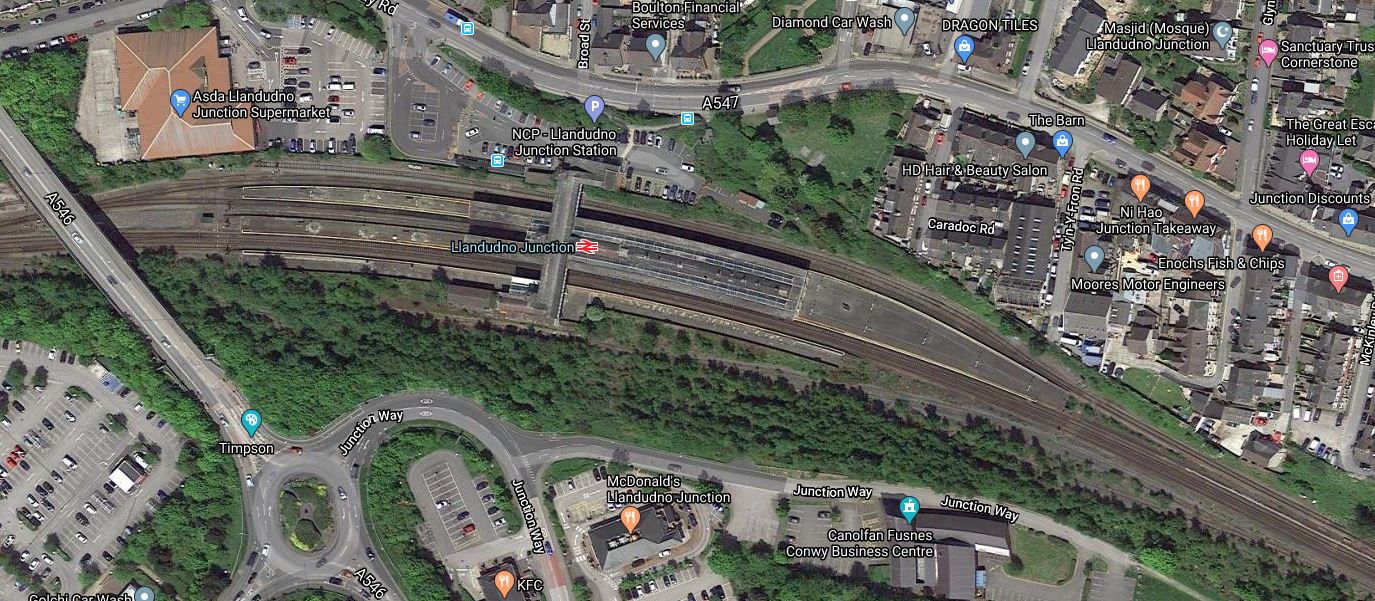
Note.
- It is a large station site.
- The Conwy Valley Line, which will be run by battery Class 230 trains in the future connects at this station.
- The Class 230 train will probably use some of Vivarail’s Fast Charging systems, which use third-rail technology, either at the ends of the branch or in Llandudno Junction station.
The simplest way to charge the London Euston and Holyhead train, would be to build a charging station at Llandudno Junction, which could be based on Vivarail’s Fast Charging technology or a short length of 25 KVAC overhead wire.
But this would add ten minutes to the timetable.
Could 25 KVAC overhead electrification be erected for a certain distance through the station, so that the train has ten minutes in contact with the wires?
Looking at the timetable of a train between London Euston and Holyhead, it arrives at Colwyn Bay station at 1152 and leaves Llandudno Junction station at 1200.
So would it be possible to electrify between the two stations and perhaps a bit further?
This Google Map shows Colwyn Bay Station,
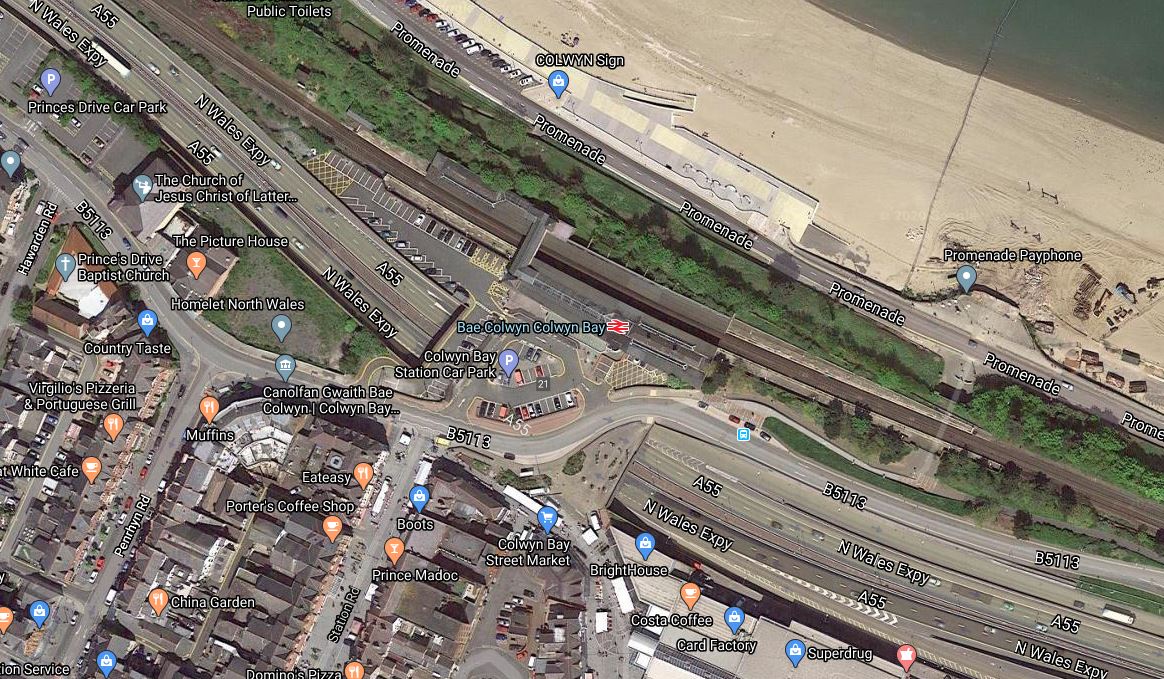
Note how the double-track railway is squeezed between the dual-carriageway of the A55 North Wales Expressway and the sea.
The two routes follow each other close to the sea, as far as Abegele & Pensarn station, where the Expressway moves further from the sea.
Further on, after passing through more caravans than I’ve ever seen, there is Rhyl station.
- The time between arriving at Rhyl station and leaving Llandudno Junction station is nineteen minutes.
- The distance between the two stations is fourteen miles.
- Rhyl and Crewe is fifty-one miles.
- Llandudno Junction and Holyhead is forty-one miles.
It would appear that if the North Wales Coast Line between Rhyl and Llandudno Junction is electrified, that Hitachi’s proposed battery trains can reach Holyhead.
The trains could even changeover between electrification and battery power in Rhyl and Llandudno Junction stations.
I am sure that electrifying this section would not be the most difficult in the world, although the severe weather sometimes encountered, may need some very resilient or innovative engineering.
It may be heretical to say so, but would it be better if this section were to be electrified using proven third-rail technology.
West of Llandudno Junction station, the electrification would be very difficult, as this Google Map of the crossing of the River Conwy shows.
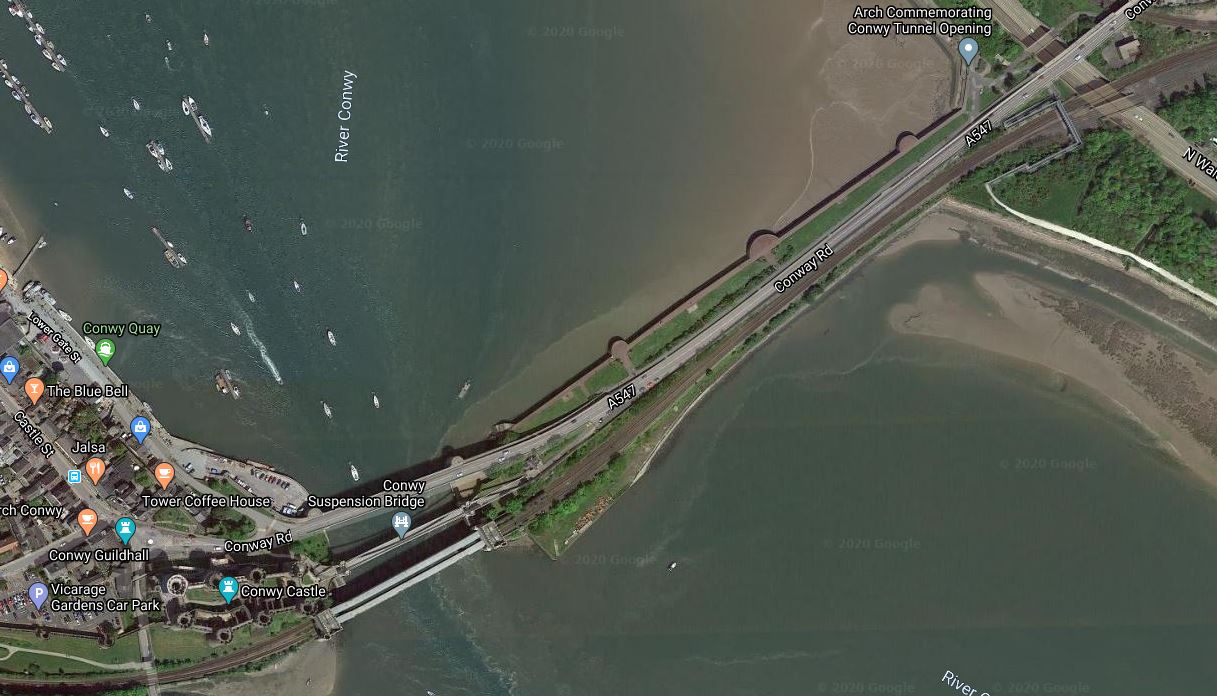
I don’t think anybody would want to see electrification around the famous castle.
Electrification Across Anglesey
Llanfairpwll station marks the divide between the single-track section of the North Wales Coast Line over the Britannia Bridge and the double-track section across Anglesey.
From my virtual helicopter, the route looks as if, it could be fairly easy to electrify, but would it be necessary?
- Llandudno Junction and Holyhead is forty-one miles, which is well within battery range.
- There is surely space at Holyhead station to install some form of fast-charging system.
One problem is that trains seem to turn round in only a few minutes, which may not be enough to charge the trains.
So perhaps some of the twenty-one miles between Llanfairpwll and Holyhead should be electrified.
London Euston And Holyhead Journey Times
Currently, trains take three hours and forty-three minutes to go between London Euston and Holyhead, with these sectional timings.
- London Euston and Crewe – One hour and thirty-nine minutes.
- Crewe and Holyhead – Two hours and four minutes.
The big change would come, if the London Euston and Crewe leg, were to be run on High Speed Two, which will take just fifty-five m,inutes.
This should reduce the London Euston and Holyhead time to just under three hours.
Freight On The North Wales Coast Line
Will more freight be seen on the North Wales Coast Line in the future?
The new tri-mode freight locomotives like the Class 93 locomotive, will be able to take advantage of any electrification to charge their batteries, but they would probably be on diesel for much of the route.
Conclusion On The North Wales Coast Line
Short lengths of electrification, will enable Avanti West Coast’s AT-300 trains, after retrofitting with batteries, to run between Crewe and Holyhead, without using any diesel.
I would electrify.
- Crewe and Chester – 21 miles
- Rhyl and Llandudno Junction – 14 miles
- Llanfairpwll and Holyhead – 21 miles
But to run battery-electric trains between London Euston and Holyhead, only Rhyl and Llandudno Junction needs to be electrified.
All gaps in the electrification will be handled on battery power.
A Selection Of Possible Battery-Electric Services
In this section, I’ll look at routes, where battery-electric services would be very appropriate and could easily be run by Hitachi’s proposed battery-electric trains.
London Paddington And Swansea
Many were disappointed when Chris Grayling cancelled the electrification between Cardiff and Swansea.
I went along with what was done, as by the time of the cancellation, I’d already ridden in a battery train and believed in their potential.
The distance between Cardiff and Swansea is 46 miles without electrification.
Swansea has these services to the West.
- Carmarthen – 32 miles
- Fishguard – 73 miles
- Milford Haven 71 miles
- Pembroke Dock – 73 miles
It looks like, three services could be too long for perhaps a three car battery-electric version of a Hitachi Class 385 train, assuming it has a maximum range of 65 miles.
But these three services all reverse in Carmarthen station.
So perhaps, whilst the driver walks between the cabs, the train can connect automatically to a fast charging system and give the batteries perhaps a four minute top-up.
Vivarail’s Fast Charging system based on third-rail technology would be ideal, as it connects automatically and it can charge a train in only a few minutes.
I would also electrify the branch between Swansea and the South Wales Main Line.
This would form part of a fast-charging system for battery-trains at Swansea, where turnround times can be quite short.
I can see a network of battery-electric services developing around Swansea, that would boost tourism to the area.
Edinburgh And Tweedbank
The Borders Railway is electrified as far as Newcraighall station and the section between there and Tweedbank is thirty miles long.
I think that a four-car battery-electric Class 385 train could work this route.
It may or may not need a top up at Tweedbank.
The Fife Circle
The Fife Circle service from Edinburgh will always be difficult to electrify, as it goes over the Forth Rail Bridge.
- The Fife Circle is about sixty miles long.
- Plans exist for a short branch to Leven.
- The line between Edinburgh and the Forth Rail Bridge is partly electrified.
I believe that battery-electric Class 385 train could work this route.
London Kings Cross and Grimsby/Cleethorpes via Lincoln
The Cleethorpes/Grimsby area is becoming something of a renewable energy powerhouse and I feel that battery trains to the area, might be a significant and ultimately profitable statement.
LNER recently opened a six trains per day service to Lincoln.
Distances from Newark are as follows.
- Lincoln – 17 miles
- Grimsby – 61 miles
- Cleethorpes – 64 miles
A round trip to Lincoln can probably be achieved on battery alone with a degree of ease, but Cleethorpes and Grimsby would need a recharge at the coast.
Note that to get to the Cleethorpes/Grimsby area, travellers usually need to change at Doncaster.
But LNER are ambitious and I wouldn’t be surprised to see them dip a toe in the Cleethorpes/Grimsby market.
The LNER service would also be complimented by a TransPennine Express service from Manchester Airport via Sheffield and Doncaster, which could in the future be another service run by a Hitachi battery train.
There is also a local service to Barton-on-Humber, which could be up for improvement.
London Waterloo And Exeter
This service needs to go electric, if South Western Railway is going to fully decarbonise.
But third-rail electrification is only installed between Waterloo and Basingstoke.
Could battery-electric trains be used on this nearly two hundred mile route to avoid the need for electrification.
A possible strategy could be.
- Use existing electrification, as far as Basingstoke – 48 miles
- Use battery power to Salisbury – 83 miles
- Trains can take several minutes at Salisbury as they often split and join and change train crew, so the train could be fast-charged.
- Use battery power to the Tisbury/Gillingham/Yeovil/Crewkerne area, where trains would be charged – 130 miles
- Use battery power to Exeter- 172 miles
Note.
- The miles are the distance from London.
- The charging at Salisbury could be based on Vivarail’s Fast-Charging technology.
- The charging around Yrovil could be based on perhaps twenty miles of third-rail electrification, that would only be switched on, when a train is present.
I estimate that there could be time savings of up to fifteen minutes on the route.
To Be Continued…
Fuelling The Change On Teesside Rails
The title of this post, is the same as that of an article in Edition 895 of RAIL Magazine.
The article is based on an interview with Ben Houchen, who is the Tees Valley Mayor.
Various topics are covered.
Hydrogen-Powered Local Trains
According to the article, the Tees Valley produces fifty percent of UK hydrogen and the area is already secured investment for fuelling road vehicles with hydrogen.
So the Tees Valley Combined Authority (TVCA) is planning to convert some routes to hydrogen.
The Trains
Ten hydrogen-powered trains will be purchased or more likely leased, as the trains will probably be converted from redundant electrical multiple units, owned by leasing companies like Eversholt Rail and Porterbrook.
- Eversholt Rail and Alstom are developing the Breeze from Class 321 trains.
- Porterbrook and Birmingham University are developing the HydroFLEX from Class 319 trains.
The RAIL article says that the first train could be under test in 2021 and service could be started in 2022.
That would certainly fit the development timetables for the trains.
Lackenby Depot
A depot Will Be Created At Lackenby.
- The site is between Middlesbrough and Redcar.
- It already has rail and hydrogen connections.
This Google Map shows the area.
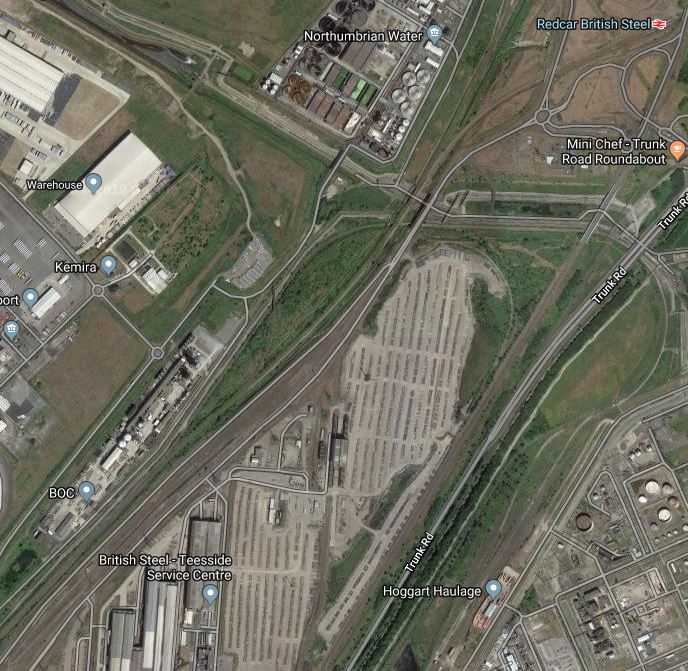
Note the disused Redcar British Steel station, which is still shown on the map.
I remember the area from the around 1970, when I used to catch the train at the now-closed Grangetown station, after visits to ICI’s Wilton site. It was all fire, smoke, smells and pollution.
Darlington Station
Darlington station will also be remodelled to allow more services to operate without conflicting with the East Coast Main Line.
Wikipedia says this under Future for Darlington station.
As part of the Tees Valley Metro, two new platforms were to be built on the eastern edge of the main station. There were to be a total of four trains per hour, to Middlesbrough and Saltburn via the Tees Valley Line, and trains would not have to cross the East Coast Main Line when the new platforms would have been built. The Tees Valley Metro project was, however, cancelled.
It does sound from reading the RAIL article, that this plan is being reinstated.
Would services between Bishop Auckland and Saltburn, use these new platforms?
Saltburn And Bishops Auckland Via Middlesbrough and Darlington
Currently, the service is two trains per hour (tph) between Saltburn and Darlington, with one tph extending to Bishop Auckland.
- I estimate that the current service needs five trains.
- If a two tph service were to be run on the whole route, an extra train would be needed.
- I suspect, the limitations at Darlington station, stop more trains being run all the way to Bishops Auckland.
I could also see extra stations being added to this route.
The Mayor is talking of running a service as frequent as six or eight tph.
These numbers of trains, will be needed for services of different frequencies between Saltburn and Darlington.
- 2 tph – 6 trains
- 4 tph – 12 trains
- 6 tph – 18 trains
- 8 tph – 24 trains
As the London Overground, Merseyrail and Birmingham’s Cross-City Line, find four tph a more than adequate service, I suspect that should be provided.
After updating, Darlington station, should be able to handle the following.
- Up to six tph terminating in one of the new Eastern platforms, without having to cross the East Coast Main Line.
- Two tph between Saltburn and Bishops Auckland could use the other platform in both directions.
I would suspect that the design would see the two platforms sharing an island platform.
Alternatively, trains could continue as now.
- Terminating trains could continue to use Platform 2!
- Two tph between Saltburn and Bishops Auckland stopping in Platforms 1 (Eastbound) and 4 (Westbound)
This would avoid any infrastructure changes at Darlington station, but terminating trains at Darlington would still have to cross the Southbound East Coast Main Line.
If the frequencies were as follows.
- 4 tph – Saltburn and Darlington
- 2 tph – Saltburn and Bishop Auckland
This would require fourteen trains and give a six tph service between Saltburn and Darlington.
Ten trains would allow a two tph service on both routes.
There would be other services using parts of the same route, which would increase the frequency.
Hartlepool And The Esk Valley Line Via Middlesbrough
This is the other route through the area and was part of the cancelled Tees Valley Metro.
- Service is basically one tph, with six trains per day (tpd) extending to Whitby.
- A second platform is needed at Hartlepool station.
- There is a proposal to add a Park-and-Ride station between Nunthorpe and Great Ayton stations.
- One proposal from Modern Railways commentator; Alan Williams, was to simplify the track at Battersby station to avoid the reverse.
- Currently, trains between Whitby and Middlesbrough are timetabled for around 80-100 minutes.
- Hartlepool and Middlesbrough takes around twenty minutes.
Substantial track improvements are probably needed to increase the number of trains and reduce the journey times between Middlesbrough and Whitby.
But I believe that an hourly service between Hartlepool and Whitby, that would take under two hours or four hours for a round trip, could be possible.
This would mean that the hourly Hartlepool and Whitby service would need four trains.
Providing the track between Nunthorpe and |Whitby could be improved to handle the traffic, this would appear to be a very feasible proposition.
Nunthorpe And Hexham Via Newcastle
There is also an hourly service between Nunthorpe and Hexham, via Middlesbrough, Stockton, Hartlepool, Sunderland and Newcastle, there would be two tph.
- It takes around two hours and twenty minutes.
- I estimate that five trains would be needed for the service.
- I travelled once between Newcastle and James Cook Hospital in the Peak and the service was busy.
- A new station is being built at Horden, which is eight minutes North of Hartlepool.
- The service could easily access the proposed fuelling station at Lackenby.
- It would reduce carbon emissions in Newcastle and Sunderland stations..
Surely, if hydrogen power is good enough for the other routes, then it is good enough for this route.
Hartlepool Station
Hartlepool Station could become a problem, as although it is on a double track railway, it only has one through platform, as these pictures from 2011 show.
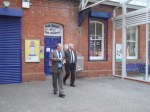
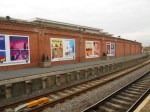
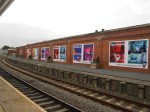
Consider.
- There is no footbridge, although Grand Central could pay for one
- There is a rarely-used bay platform to turn trains from Middlesbrough, Nunthorpe and Whitby.
This Google Map shows the cramped site.
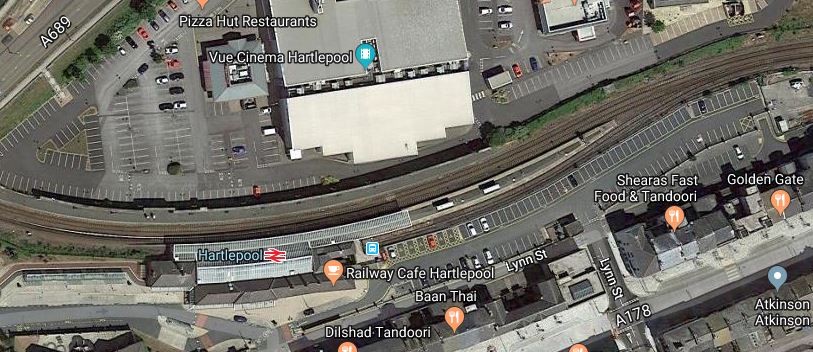
The final solution could mean a new station.
Nunthorpe Park-And-Ride
This Google Map shows Nunthorpe with thje bEsk Valley Line running through it.
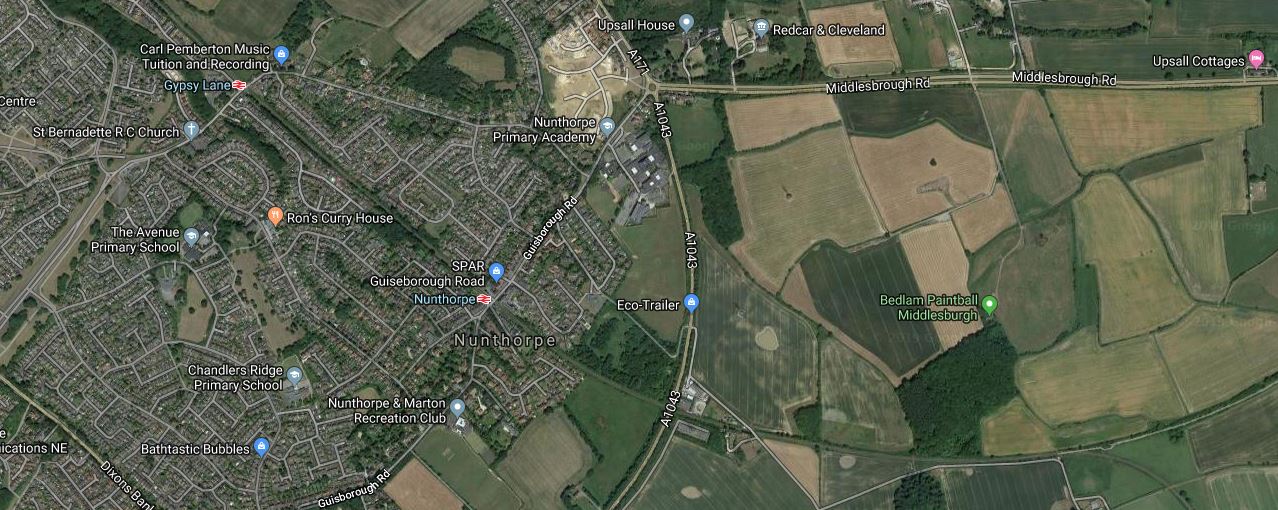
Note.
- Gypsy Lane and Nunthorpe stations.
- The dual-carriageway A171 Guisborough by-pass running East-West, that connects in the East to Whitby and Scarborough.
- The A1043 Nunthorpe by-pass that connects to roads to the South.
Would where the A1043 crosses the Esk Valley Line be the place for the Park-and-Ride station?
The new station could have a passing loop, that could also be used to turn back trains.
Battersby Station
Alan Williams, who is Chairman of the Esk Valley Railway Development Company, is quoted in the RAIL article as saying.
If you’re going to spend that sort of money we’d much rather you spent it on building a curve at Battersby to cut out the reversal there.
Williams gives further reasons.
- Battersby is the least used station on the line.
- It’s in the middle of nowhere.
- The curve would save five minutes on the overall journey.
This Google Map shows Battersby station and the current track layout.

Note.
- The line to Middlesbrough goes through the North-West corner of the map.
- The line to Whitby goes through the North-East corner of the map.
There would appear to be plenty of space for a curve that would cut out the station.
LNER To Teesside
LNER, the Government and the TVCA are aiming to meet a target date of the Second Quarter of 2021 for a direct London and Middlesbrough service.
Middlesbrough Station
Middlesbrough Station will need to be updated and according to the RAIL article, the following work will be done.
- A new Northern entrance with a glass frontage.
- A third platform.
- Lengthening of existing platforms to take LNER’s Class 800 trains.
This Google Map shows the current layout of the station.
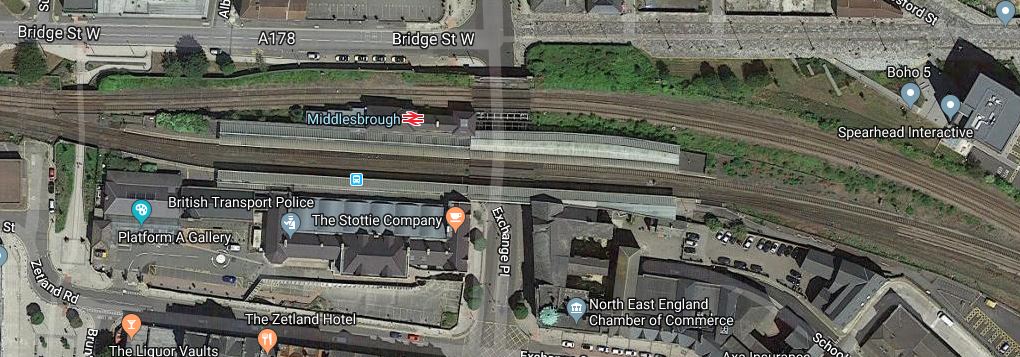
From this map it doesn’t look to be the most difficult of stations, on which to fit in the extra platform and the extensions.
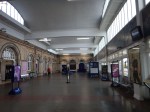
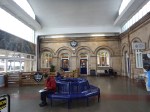



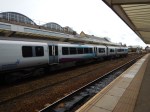
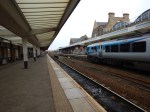
It should also be noted that the station is Grade II Listed, was in good condition on my last visit and has a step-free subway between the two sides of the station.
Journey Times
I estimate that a Kings Cross and Middlesbrough time via Northallerton would take aroud two hours and fifty minutes.
This compares with other journey times in the area to London.
- LNER – Kings Cross and Darlington – two hours and twenty-two minutes
- Grand Central – Kings Cross and Eaglescliffe – two hours and thirty-seven minutes.
I also estimate that timings to Redcar and Saltburn would be another 14 and 28 minutes respectively.
Frequencies
Currently, LNER run between three and four tph between Kings Cross and Darlington, with the competing Grand Central service between Kings Cross and Eaglescliffe having a frequency of five trains per day (tpd).
LNER have also started serving secondary destinations in the last month or so.
- Harrogate, which has a population of 75.000, is served with a frequency of six tpd.
- Lincoln, which has a population of 130,000 is now served with a frequency of six tpd.
Note that the RAIL article, states that the Tees Valley has a population of 750,000.
I feel that Middlesbrough will be served by a frequency of at least five tpd and probably six to match LNER’s new Harrogate and Lincoln services.
Will LNER’s Kings Cross and York Service Be Extended To Middlesbrough?
Cirrently , trains that leave Kings Cross at six minutes past the hour end up in Lincoln or York
- 0806 – Lincoln
- 0906 – York
- 1006 – Lincoln
- 1106 – York
- 1206 -Lincoln
- 1306 – York
- 1406 – Lincoln
- 1506 – York
- 1606 – Lincoln
- 1906 -Lincoln
It looks to me that a pattern is being developed.
- Could it be that the York services will be extended to Middlesbrough in 2021?
- Could six Middlesbrough trains leave Kings Cross at 0706, 0906, 1106, 1306, 1506 and 1706 or 1806?
- York would still have the same number of trains as it does now!
LNER certainly seem to be putting together a comprehensive timetable.
Could Middlesbrough Trains Split At Doncaster Or York?
I was in Kings Cross station, this afternoon and saw the 1506 service to York, go on its way.
The train was formed of two five-car trains, running as a ten-car train.
If LNER employ spitting and joining,, as some of their staff believe, there are surely, places, where this can be done to serve more destinations, without requiring more paths on the East Coast Main Line.
- Splitting at Doncaster could serve Hull, Middlesborough and York.
- Splitting at York could serve Scarborough, Middlesborough and Sunderland.
Scarborough might be a viable destination, as the town has a population of over 100,000.
Onward To Redcar And Saltburn
One of the changes in the December 2019 timetable change, was the extension of TransPennine Express’s Manchester Airport and Middlesbrough service to Redcar Central station.
The RAIL article quotes the Mayor as being pleased with this, although he would have preferred the service to have gone as far as Saltburn, which is a regional growth point for housing and employment.
But the extra six miles would have meant the purchase of another train.
Redcar Central Station
This Google Map shows Redcar Central station and its position in the town.
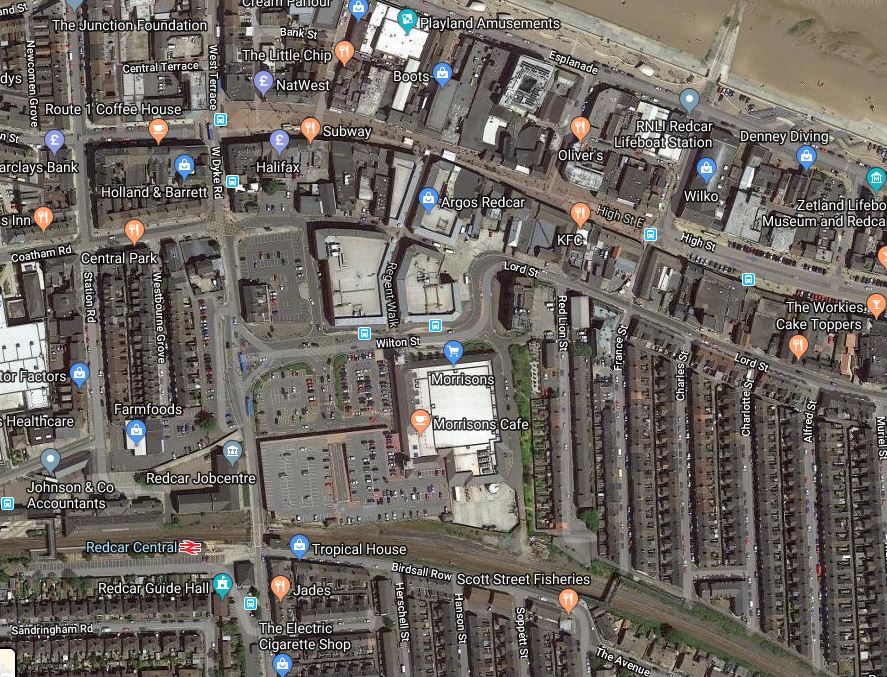
It is close to the sea front and the High Street and there appears to be space for the stabling of long-distance trains to Manchester Airport and perhaps, London.
TransPennine seem to be using their rakes of Mark 5A coaches on Redcar services, rather than their Class 802 trains, which are similar to LNER’s Azumas.
Surely, there will be operational advantages, if both train operating companies ran similar trains to Teesside.
Saltburn Station
Saltburn station is the end of the line.
This Google Map shows its position in the town.
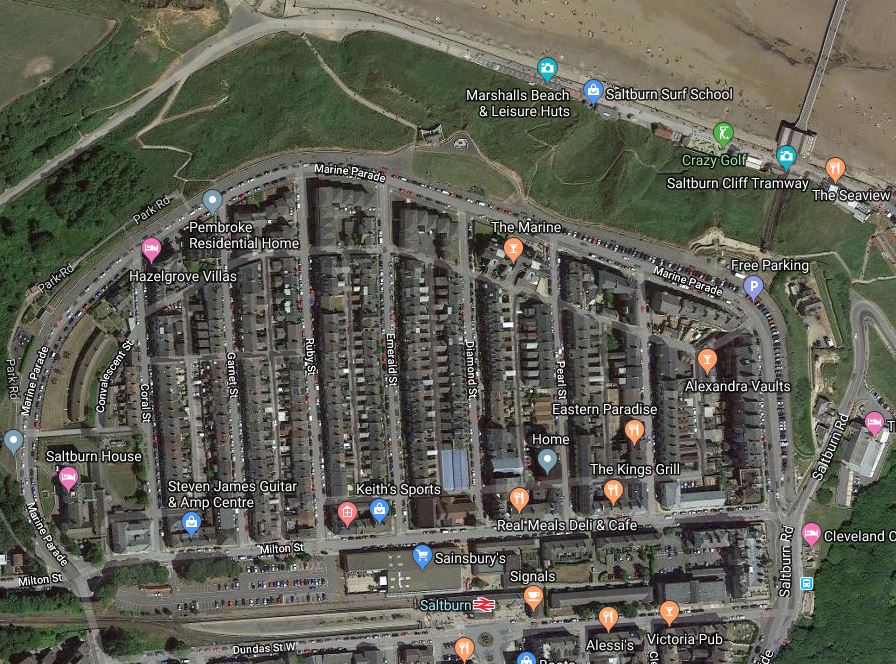
Unlike Redcar Central station, there appears to be very little space along the railway and turning back trains might be difficult.
There may be good economic reasons to use Saltburn as a terminal, but operationally, it could be difficult.
Will Redcar And Saltburn See Services To and From London?
Given that both towns will likely see much improved services to Middlesbrough, with at least a service of four tph, I think it will be unlikely.
But we might see the following.
- LNER using Redcar as a terminus, as TransPennine Express do, as it might ease operations.
- An early morning train to London and an evening train back from the capital, which is stabled overnight at Redcar.
- TransPennine Express using Class 802 trains on their Redcar service for operational efficiency, as these trains are similar to LNER’s Azumas.
It would all depend on the passenger numbers.
A High-Frequency Service Between York And Teesside
After all the changes the service between York and Teesside will be as follows.
- LNER will be offering a train virtually every two hours between York and Middlesbrough.
- Grand Central will be offering a train virtually every two hours between York and Eaglescliffe, which is six miles from Middlesbrough.
- TransPennine Express will have an hourly service between York and Redcar via Middlesbrough.
- There will be between three and four tph between York and Darlington.
All services would connect to the hydrogen-powdered local services to take you all over Teesside.
Could this open up tourism without cars in the area?
Expansion Of The Hydrogen-Powered Train Network
Could some form of Hydrogen Hub be developed at Lackenby.
Alstom are talking of the hydrogen-powered Breeze trains having a range of over six hundred miles and possibly an operating speed of 100 mph, when using overhead electrification, where it is available.
In Breeze Hydrogen Multiple-Unit Order Expected Soon, I put together information from various articles and said this.
I am fairly certain, that Alstom can create a five-car Class 321 Breeze with the following characteristics.
- A capacity of about three hundred seats.
- A smaller three-car train would have 140 seats.
- A near-100 mph top speed on hydrogen-power.
- A 100 mph top speed on electrification.
- A 1000 km range on hydrogen.
- Regenerative braking to an on-board battery.
- The ability to use 25 KVAC overhead and/or 750 VDC third rail electrification.
The trains could have the ability to run as pairs to increase capacity.
The distance without electrification to a selection of main stations in the North East from Lackenby is as follows.
- Newcastle via Middlesbrough and Darlington – 21 miles
- Newcastle via Middlesbrough and Durham Coast Line – 53 miles.
- York via Northallerton – 27 miles
- Doncaster via Northallerton and York – 27 miles
- Leeds via Northallerton and York – 52 miles
- Sheffield via Northallerton, York and Doncaster – 45 miles
I am assuming that the trains can use the electrification on the East Coast Main Line.
From these figures it would appear that hydrogen-powered trains stabled and refuelled at Lackenby could travel to Doncaster, Newcastle, Leeds, Sheffield or York before putting in a days work and still have enough hydrogen in the tank to return to Lackenby.
Several things would help.
- As hydrogen-powered trains have a battery, with a battery range of thirty miles all these main stations could be reached on battery power, charging on the East Coast Main Line and at Lackenby.
- Electrification between Darlington and Lackenby.
- Electrification between Northallerton and Eaglescliffe.
I am fairly certain that a large proportion of the intensive network of diesel services in the North East of |England from Doncaster and Sheffield in the South to Newcastle in the North, can be replaced with hydrogen-powered trains.
- Trains could go as far West as Blackpool North, Carlisle, Manchester Victoria, Preston and Southport.
- Refueling could be all at Lackenby, although other refuelling points could increase the coverage and efficieny of the trains.
- Green hydrogen could be produced by electrolysis from the massive offshore wind farms off the Lincolnshire Coast.
- Hydrogen-powered trains would be ideal for re-opened routes like the proposed services from Newcastle to Blyth and Ashington.
The hydrogen-powered trains on Teesside could be the start of a large zero-carbon railway network.
The Alstom Breeze And The HydroFlex Would Only Be The Start
As I said earlier, the initial trains would be conversions of redundant British Rail-era electrical multiple units.
Thirty-year-old British Rail designs like the Class 319 and Class 321 trains based on the legendary Mark 3 carriages with its structural integrity and superb ride, may have been state-of-the-art in their day, but engineers can do better now.
- Traction and regenerative braking systems are much more energy efficient.
- Train aerodynamics and rolling resistance have improved, which means less energy is needed to maintain a speed.
- Interior design and walk-through trains have increased capacity.
- Crashworthiness has been improved.
Current Bombardier Aventras, Stadler Flirts or Siemens Desiros and CAF Civities are far removed from 1980s designs.
I can see a design for a hydrogen-powered train based on a modern design, tailored to the needs of operators being developed.
A place to start could be an electric CAF Class 331 train. or any one of a number of Aventras.
- From the visualisation that Alstom have released of their Breeze conversion of a Class 321 train, I feel that to store enough hydrogen, a large tank will be needed and perhaps the easiest thing to do at the present time would be to add an extra car containing the hydrogen tank, the fuel cells and the batteries.
- Alstom have stated they’re putting the fuel cells on the roof and the batteries underneath the train.
Although, it is not a hydrogen train, Stadler have developed the Class 755 train, with a power car in the middle of the train.
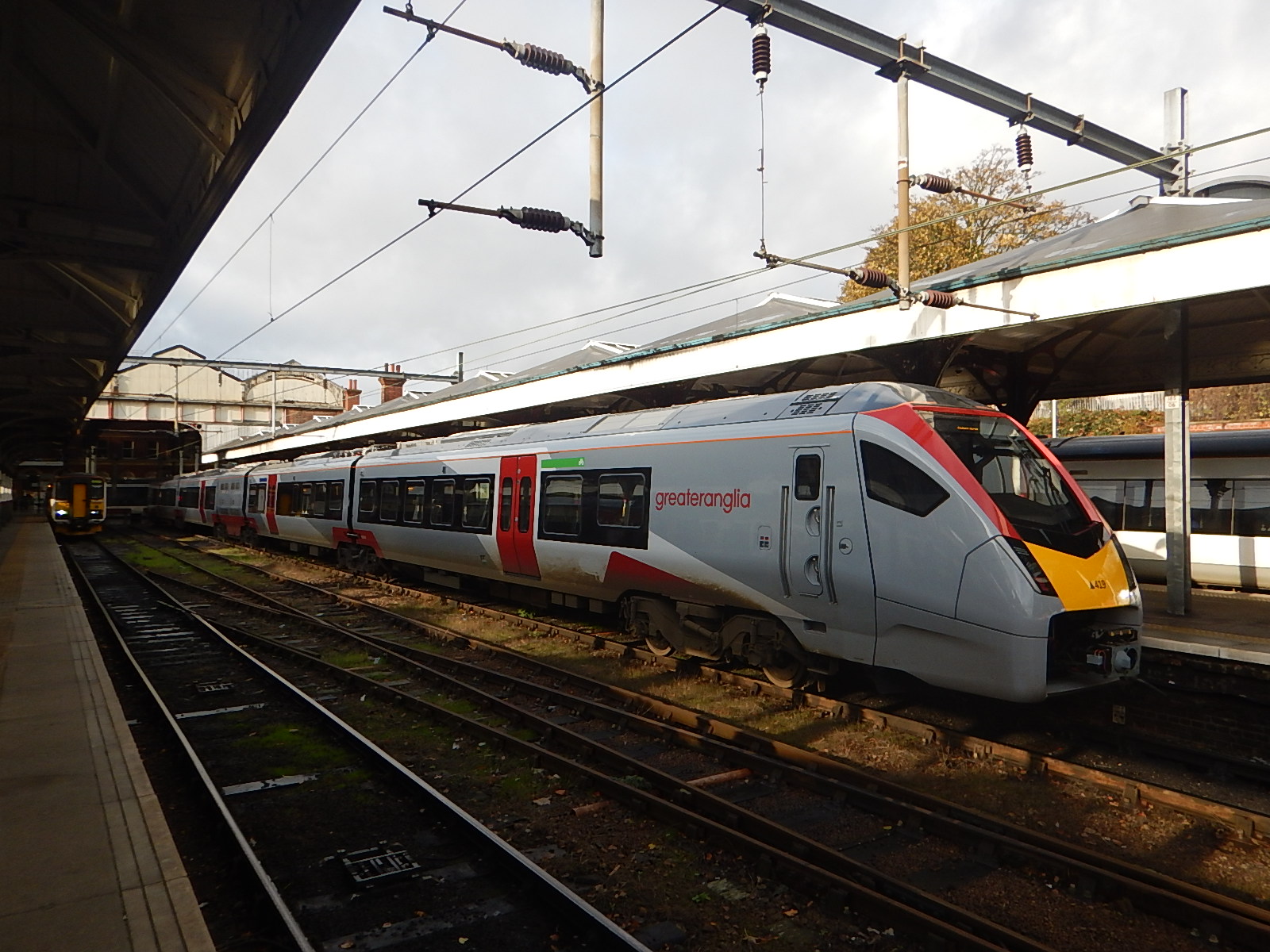
Stadler’s approach of a power car, must be working as they have received an order for a hydrogen-powered version of their popular Flirts, which I wrote about in MSU Research Leads To North America’s First Commercial Hydrogen-Powered Train.
I think we can be certain, that because of the UK loading gauge, that a hydrogen-powered train will be longer by about a car, than the equivalent electric train.
I can see a certain amount of platform lengthening being required. But this is probably easier and less costly than electrification to achieve zero-carbon on a route.
Batteries can be distributed under all cars of the train, anywhere there is space., But I would suspect that fuel cells must be in the same car as the hydrogen tank, as I doubt having hydrogen pipes between cars would be a good idea.
Alstom have resorted to putting hydrogen tanks and fuel cells in both driving cars and they must have sound reasons for this.
Perhaps, it is the only way, they can get the required power and range.
As I understand it, the Alstom Breeze draws power from three sources.
- The electrification if the route is electrified.
- The electricity generated by regenerative braking.
- The hydrogen system produces electricity on demand, at the required level.
Energy is stored in the batteries, which power the train’s traction motors and internal systems.
The electrical components needed for the train are getting smaller and lighter and I feel that it should be possible to put all the power generation and collection into a power car, that is somewhere near the middle of the train. Stadler’s power car is short at under seven metres, but there is probably no reason, why it couldn’t be the twenty metres, that are typical of UK trains.
Suppose you took a four-car version of CAF’s Class 331 train, which has two driver cars either side of a pantograph car and a trailer car.
This has 284 seats and by comparison with the three-car version the trailer car has eighty. As the pantograph car is also a trailer, I’ll assume that has eighty seats too! Until I know better!
Replacing the pantograph car with a hydrogen car, which would be unlikely to have seats, would cut the seats to 204 seats, but a second trailer would bring it back up to 284 seats.
I actually, think the concept of a hydrogen car in the middle of a four-car electric train could work.
- The five-car hydrogen train would have the same capacity as the four-car electric version.
- The train would need an updated software system and some rewiring. Bombardier achieved this quickly and easily with the train for the Class 379 BEMU trial.
- There are several types of four-car electrical multiple units, that could possibly be converted to five-car hydrogen-powered multiple units.
- Some five-car electrical multiple units might also be possible to be converted.
Obviously, if an existing train can be adapted for hydrogen, this will be a more cost effective approach.
Conclusion
Overall, the plans for rail improvements on Teesside seem to be good ones.
I’m looking forward to riding LNER to Teesside and then using the network of hydrogen-powered trains to explore the area in 2022.
My only worry, is that, if the network is successful, the many tourists visiting York will surely increase the numbers of day visitors to Whitby.
This is a paragraph from the RAIL article.
Alan Williams says that the EVRDC’s long-term objective is to see the Esk Valley served at intervals of roughly every two hours, equating to eight return trains per day, but with Northern and NYMR services sharing the single line between Grosmont and Whitby, introducing further Middlesbrough trains during the middle of the day, brings the conversation back to infrastructure.
He goes on to detail what is needed.
Dancing Azumas At Leeds
This picture shows the 1749 arrival at Leeds from London Kings Cross.
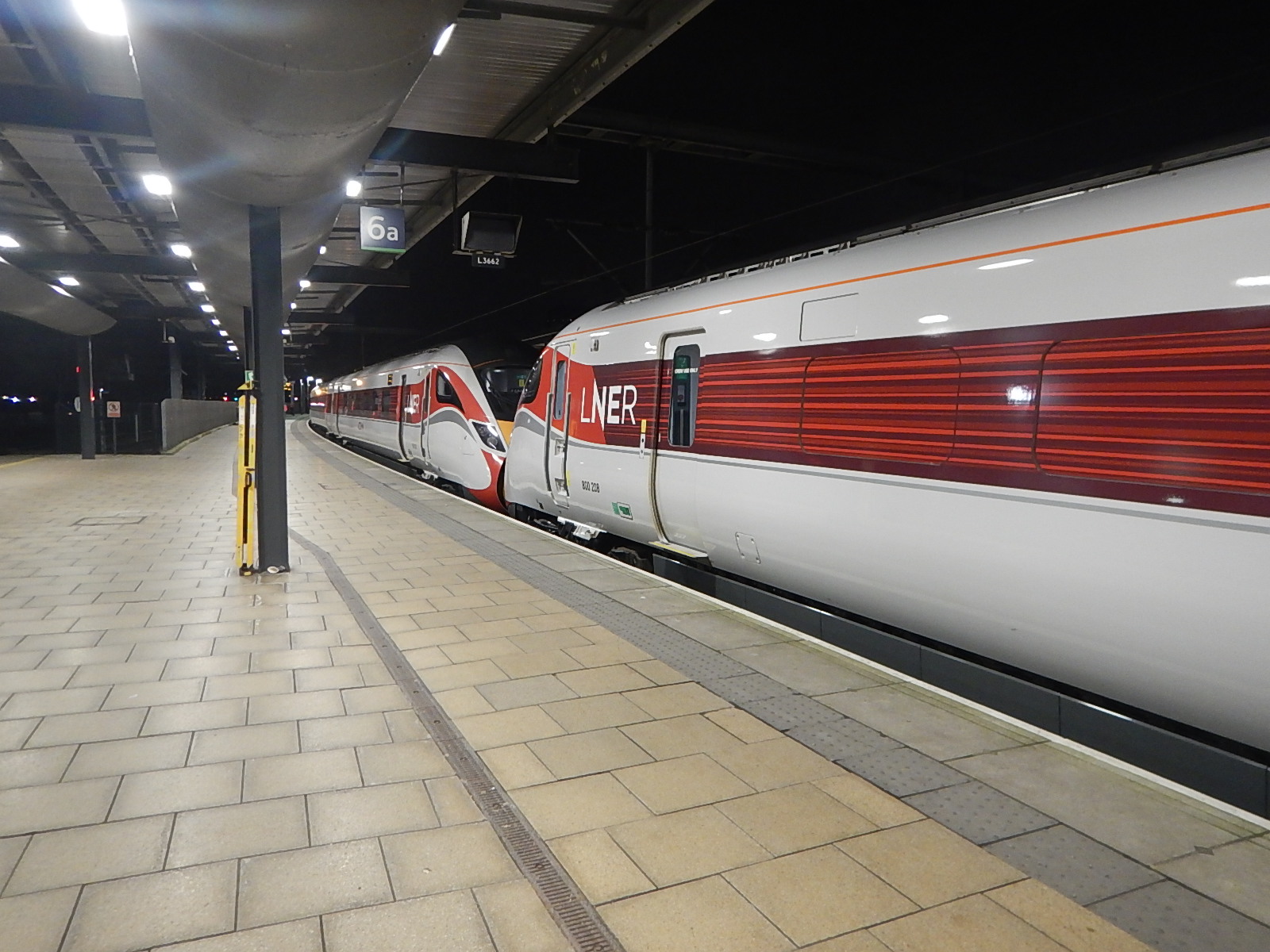
Train details were as follows.
- The train had left Kings Cross at 1533.
- It was formed of two five-car trains working as a pair.
- The train was perhaps a couple of minutes late, arriving in Leeds.
- The train arrives in Platform 6.
- The complete ten-car formation left for Harrogate at 1800.
My train for London, which was another pair of five-car trains arrived in Platform 8 at Leeds at 1806 from Harrogate. The train left on time at 1815.
At present there is no joining and splitting, but if this is used by LNER, the following timings are possible.
- 1533 – Two five-car trains working as a pair leave Kings Cross.
- 1749 – The train arrives in Platform 6 at Leeds and the two trains are uncoupled.
- 1800 – A second driver gets into the rear train and he drives it towards Harrogate.
- 1800 – The front train stays in the platform.
- 1806 – The Harrogate to London service arrives from Harrogate and couples to the train in Platform 6.
- 1815 – The pair of five-car trains leave for London.
I think it is all rather elegant.
- Harrogate gets a five-car Azuma service, which is probably sufficient for the town’s need.
- Five-car trains probably fit all platforms easily on the Harrogate Line, where stops are planned.
- Will platforms at Headingley station be extended, so that London trains can stop during Test matches?
- The inbound and outbound services to and from Harrogate pass each other on the double track.
- The rear train from London reverses and goes to Harrogate..
- The front train just fills up with new passengers and after coupling with the train from Harrogate goes back to London.
- As Class 800 trains are supposed to be able to couple and uncouple in under two minutes, there should be only a small delay.
- LNER are running two trains per hour between London and Leeds, but they could be running four separate services per hour Between London and Yorkshire.
But the biggest advantage is that the front train from London can go somewhere else! Bradford? Huddersfield?
Possible Destinations
These are possible destinations, distances and times.
- Bradford – 13 miles – 25 minutes
- Harrogate – 18 miles – 30 minutes
- Huddersfield – 17 miles – 35 minutes
- Hull – 20 miles – 60 minutes
- Ilkley – 16 miles – 26 minutes
- Middlesbrough – – 76 miles – 84 minutes
- Scarborough – 67 miles – 75 minutes
- Skipton – 26 miles – 43 minutes
- York – 25 miles – 30 minutes
Harrogate would probably pair well with Bradford, Huddersfield, Skipton or York
Note.
- I have added Ilkley although it doesn’t have a service to London.
- Bradford Forster Square and Skipton already have one train per day (tpd) from London via Leeds.
- Routes to Bradford Forster Square, Ilkley and Skipton are electrified.
- Network Rail has plans to electrify the routes to Huddersfield and York.
- There are at least thirty tpd between London and Leeds in both directions run by LNER.
Six tpd, as are now running to Harrogate and Lincoln to all six destinations would need just eighteen tpd to split and join at Leeds.
Stations That Could Be Served
All these stations could be given a direct service to and from London.
- Apperley Bridge – On the route to Bradford Forster Square – This is a new Park-and-Ride station.
- Batley – On the route to Huddersfield
- Ben Rhydding – On the route to Ilkley
- Bingley – On the route to Skipton
- Bradford Forster Square
- Burley-in-Wharfedale – On the route to Ilkley
- Burley Park – On the Harrogate Line
- Church Fenton – On the route to York
- Cononley – On the route to Skipton
- Cottingley – On the route to Huddersfield – Could be replaced by White Rose.
- Crossflats – On the route to Skipton
- Cross Gates – On the route to York
- Deighton– On the route to Huddersfield
- Dewsbury – On the route to Huddersfield
- East Garforth – On the route to York
- Frizinghall On the route to Bradford Forster Square
- Garforth – OLn the route to York
- Guiseley – On the route to Ilkley
- Harrogate – Terminus
- Headingley – On the Harrogate Line
- Hornbeam Park – On the Harrogate Line
- Horsforth – On the Harrogate Line
- Huddersfield – Terminus
- Ilkley – Terminus
- Keithley – On the route to Skipton
- Kirkstall Forge – On the route to Bradford Forster Square – This is a new Park-and-Ride station.
- Menston – On the route to Ilkley
- Micklefield – On the route to York
- Mirfield – On the route to Huddersfield
- Morley – On the route to Huddersfield
- Pannal – On the Harrogate Line
- Ravensthorpe – On the route to Huddersfield
- Saltaire – On the route to Skipton
- Shipley – On the route to Bradford Forster Square
- Skipton – Terminus
- Steeton & Silsden – On the route to Skipton
- Weeton – On The Harrogate Line
- York – Terminus
I have included every station, which the LNER trains pass, in this list.
But why not?
- These modern trains can make a station stop much quicker than older trains.
- They would improve the local service to Leeds.
- Some stations might be too small for five-car Azumas, that are 130 metres long.
- No electrification would be needed, but it could be added.
Leeds could become an even more important rail hub for North Yorkshire.
Azumas Now Have A Virtuous Sister
As I arrived in Kings Cross tonight from Leeds, one of Hull Trains’s new Paragons was in the next platform to the LNER Azuma, that I arrived in.
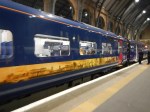

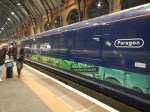
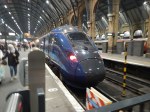
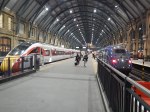
The Azuma is a Class 800 train and the Paragon is a Class 802 train.
I wouldn’t be surprised to see a strong commercial battle, between the two train companies on the route between London and Hull
- Both companies are running new, modern trains.
- At present LNER run just one train per day to and from Hull, with Hull trains running around half-a-dozen trains per day.
- Hull Trains are the only company that runs on Sunday to Hull.
- It should be noted that the Hitachi trains seem to be fairly agile and I wouldn’t be surprised that they could reach Scarborough via Beverley, Driffield and Bridlington.
I don’t think passengers to and from East Yorkshire will be losing out!
RENFE To Launch Avlo Low-Cost High Speed Rail For Everyone
The title of this post is the same as that of this article on Railway Gazette.
The title says it all and it looks like the Spanish are going the way of the French.
As High Speed Rail networks get larger,and able to handle more trains, it appears that the train operators, run out of premium passengers and turn to other markets.
SNCF have already launched a low-cost service called Ouigo, so it looks like the Spanish are following along similar lines.
In some ways is rail following air travel with low-cost companies offering a more affordable service.
On the whole, the UK, will find it more difficult to offer these services, as we don’t have the rail capacity. In part, this is due to the late development of high speed lines like High Speed Two.
But competitive services using a low-cost model are running or in development.
- Grand Central between London and Bradford and London and Sunderland.
- Hull Trains between London and Hull
- First East Coast Trains between London and Edinburgh.
- Grand Union between London and Wales and London and Stirling.
It should be noted that First East Coast Trains and Hull Trains will be running similar new Hitachi trains to the dominant operator on the route; LNER.
But then Ryanair and easyJet fly similar planes to British Airways and Air France!
Conclusion
It does appear that low-cost operators are providing competition, just as they have done with the airlines.
Gluten-Free Afternoon Tea In Bettys
Bettys of Harrogate is one of the best-known traditional tea rooms in Yorkshire, if not the whole of the North of England.
As today was the first weekday of LNER’s new Harrogate service, with six trains per day in both directions, I emailed an old friend and we agreed to meet up for an early afternoon tea, which is actually served from eleven in the morning.
These pictures show my tea, which was gluten-free.





It was certainly some of the best gluten-free sandwiches, cakes and scones, I’ve ever had.
Sadly,, my friend only had time for a coffee, as she was running late, due to a horse problem. But she did show me around Harrogate.











I have been before with C, but I didn’t remember anything except that we had a coffee in Bettys.
The Outward Journey To Harrogate
I took the 09:33 from Kings Cross and we arrived in Harrogate station a minute early at 12:16.
- The journey took two hours and 43 minutes.
- The train reversed direction at Leeds
- The only problem appeared to be that the seat allocation system on the train wasn’t working. Could this be becuae, the service appeared to be timetabled for two five-car trains working as a pair and a nine-car turned up?
- As it was only the second day of the service, I would expect some teething troubles.
These pictures show the Azuma train at Harrogate station.




On the train, I met a lady who was going to see her son and his family near Thirsk. She was saying that Harrogate has better bus connections than Thirsk, so it is a more convenient station.
Train Length And Horsforth Station
As you can see from the pictures a nine-car train is a tight fit in Harrogate station.
Two trains call at Horsforth station, where a Google Map appesrs to show a platform only long enough for a five-car train.
The Return Journey From Harrogate
My return train was a five-car Azuma train.
- It left Harrogate at 15:36
- It arrived at Kings Cross at 18:32, which was a couple of minutes late.
- The journey time was two hours and 56 minutes.
I was also in Furst, so I got a delicious snack meal.



These Deli-Boxes certainly work as a snack for me.
As Adnams now do the 0.5% version of their Ghost Ship in cans, I would love to see trains carrying these beers or something similar.
Splitting And Joining At Leeds
My train didn’t split at Leeds on the way up, but according to one of the staff at Leeds, this is part of the final plan.
Consider.
- Nine-car trains are a tight fit at Harrogate.
- Nine-car trains don’t fit into Horsforth.
- Nine-car trains are needed for capacity reasons to and from Leeds.
So two five-car trains, running as a pair to Leeds, would be ideal. One train would serve Harrogate and the other perhaps Bradford or Huddersfield.
As I was tired and in a hurry, when we arrived in Kings Cross, I forgot to check if we were five- or ten-cars.
Ticket Costs
I have just looked up prices for the 14th of January 2020 for going North on the 0933 and South on the 17:36.
- Outbound in Standard costs £15.50
- Return in Standard costs £12.20
- First Class is £35 both ways.
All prices are with a Railcard.
Conclusion
The new Harrogate service is more than just a second destination in the Leeds Area.
- As the lady told me, Harrogate has good connections to a large part of Yorkshire.
- A difficult change, that can be slow is avoided at Leeds station.
- Another lady told me, that her husband used to commute to London from Harrogate three days a week and often missed the connection at Leeds.
- If you needed to go for say a business meeting in Harrogate or take your mother for lunch at Bettys on her birthday, the train service is ideal.
- The Azumas add style to a route that will also appreciate it.
I am certain that LNER have a winner.
Bettys
I would certainly recommend, their gluten-free afternoon tea.
I wonder how many will come up from London to have lunch or a meeting in Bettys and the other cafes and restaurants in Harrogate?
Note that Bettys and several other cafes and restaurants are an easy walk from Harrogate station.
My friend and I said that we’ll meet up again in the Spring. It will be interesting to see how the service is behaving.
Welcome To The LNER Stadium… Train Operator Sponsors Lincoln City Football Club Stadium
The title of this post, is the same as that of this article on Rail Advent.
Sincil Bank willnow be the LNER Stadium.
In LNER To Put Lincoln On The Rail Map, I detailed LNER’s plans to run five trains per day in each direction and also to increase weekend services.
I also speculated that LNER might extend the service to Grimsby and Cleethorpes.
Conclusion
It does appear that the extra services between London and Lincoln and the sponsorship of the stadium are part of a larger plan.
This might fit in with an extension of the service to Grimsby and Cleethorpes.

