How Britannia With Help From Her Friends Can Rule The Waves And The Wind
The Government doesn’t seem to have published its future energy plans yet, but that hasn’t stopped the BBC speculating in this article on their web site, which is entitled Energy Strategy: UK Plans Eight New Nuclear Reactors To Boost Production.
These are the first two paragraphs.
Up to eight more nuclear reactors could be delivered on existing sites as part of the UK’s new energy strategy.
The plan, which aims to boost UK energy independence and tackle rising prices, also includes plans to increase wind, hydrogen and solar production.
Other points include.
- Up to 95% of the UK’s electricity could come from low-carbon sources by 2030.
- 50 gigawatts (GW) of energy through offshore wind farms, which would be more than enough to power every home in the UK.
- One of the big points of contention is thought to have been the construction of onshore wind turbines.
- Targets for hydrogen production are being doubled to help provide cleaner energy for industry as well as for power, transport and potentially heating.
- A new licensing round for North Sea oil and gas projects.
- A heat pump accelerator program.
In this post I shall only be looking at one technology – offshore wind and in particular offshore floating wind.
Who Are Our Friends?
I will start with explaining, who I see as our friends, in the title of this post.
The Seas Around Us
If we are talking about offshore winds around the the UK, then the seas around the UK are surely our biggest and most-needed friend.
The Island Of Ireland
The seas are shared with the island of Ireland and the UK and the Republic must work together to maximise our joint opportunities.
As some of the largest offshore wind farm proposals, between Wales and Ireland involve a Welsh company called Blue Gem Wind, who are a partnership between Irish company; Simply Blue Energy, and French company; TotalEnergies, we already seem to be working with the Irish and the French.
The City Of London
Large insurance and pension companies, based in the City of London like, abrdn, Aviva, L & G and others are always looking for investments with which to provide income to back their insurance business and our pensions.
In World’s Largest Wind Farm Attracts Huge Backing From Insurance Giant, I describe why and how, Aviva back wind farms.
Germany
Germany are certainly on our side, despite being in a mess of Mutti Merkel’s making, because she got the country too deeply dependant on Vlad the Mad’s tainted gas.
- German utilities are providing finance to build wind farms in British waters.
- German company; Siemens is manufacturing turbine blades in Hull.
- Germany wouldn’t mind buying any electricity and hydrogen we have spare. Especially, as we haven’t invaded them since 1944.
I suspect a mutually-beneficial relationship can be negotiated.
Norway
I have customised software for a number of countries, including Iran, Saudi Arabia, South Korea and the United States and despite selling large numbers of systems to Norway, the Norwegians never requested any modifications.
They are generally easy-going people and they are great friends of the UK. They were certainly a fertile country for the sale of Artemis systems.
Just as the UK worked together with the Norwegians to deliver North Sea Oil, we are now starting to work together to develop renewable energy in the North Sea.
In UK To Norway Sub-Sea Green Power Cable Operational, I describe how we have built the North Sea Link with the Norwegians, which will link the British and Norwegian energy networks to our mutual benefit.
In Is This The World’s Most Ambitious Green Energy Solution?, I describe an ambitious plan called Northern Horizons, proposed by Norwegian company; Aker Solutions to build a 10 GW floating wind farm, which will be 120 km to the North-East of the Shetlands.
Floating Wind Turbines
This is the introduction of the Wikipedia entry for floating wind turbines.
A floating wind turbine is an offshore wind turbine mounted on a floating structure that allows the turbine to generate electricity in water depths where fixed-foundation turbines are not feasible. Floating wind farms have the potential to significantly increase the sea area available for offshore wind farms, especially in countries with limited shallow waters, such as Japan, France and US West coast. Locating wind farms further offshore can also reduce visual pollution, provide better accommodation for fishing and shipping lanes, and reach stronger and more consistent winds.
At its simplest a floating wind farm consists of a semi-submersible platform, which is securely anchored to the sea-bed to provide a firm platform on which to erect a standard wind turbine.
There are currently two operational floating wind farms off the East Coast of Scotland and one in the Atlantic off the Portuguese coast.
- These wind farms are fairly small and use between three and five turbines to generate between 25-50 MW.
- The largest current floating turbines are the 9.5 MW turbines in the Kincardine Wind Farm in Scotland, but already engineers are talking of 14 MW and 20 MW floating turbines.
- Experience of the operation of floating wind turbines, indicates that they can have capacity factors in excess of 50 %.
- Floating wind turbines can be erected on their floats in the safety of a port using a dockside crane and then towed into position.
- Floating wind turbines can be towed into a suitable port for servicing and upgrading.
Many serious engineers and economists, think that floating wind farms are the future.
The Energy Density of Fixed Foundation And Floating Wind Farms
In ScotWind Offshore Wind Leasing Delivers Major Boost To Scotland’s Net Zero Aspirations, I summarised the latest round of Scotwind offshore wind leases.
- Six new fixed foundation wind farms will give a capacity of 9.7 GW in 3042 km² or about 3.2 MW per km².
- Ten new floating wind farms will give a capacity of 14.6 GW in 4193 km² or about 3.5 MW per km².
Note.
- Floating wind farms have a small advantage in terms of energy density over those with fixed foundations.
- Suppose these energy densities are achieved using 14 MW turbines.
- Engineers are talking of 20 MW turbines.
- Using large turbines could increase the energy density by 20/14 or 43 %
We could see in a few years with 20 MW turbines, fixed foundation turbines having an energy density of 4.6 MW per km², with floating turbines having 5 MW per km².
The Potential Of A Ten-Mile Square In The Seas Around Us
I will assume.
- It is at least 100 km from land.
- The water would be at least 100 metres deep.
- There are no structures in the area.
And calculate.
- The area will be a hundred square miles, which is smaller than the county of Rutland.
- This will be 259 square kilometres.
If it were to be filled with floating wind turbines at a density of 5 MW per km², the capacity would be 1300 MW or 1.3 GW.
There must be hundreds of empty ten-mile squares in the seas around us.
Offshore Hydrogen Production And Storage
I believe in the near future, that a lot of offshore wind energy will be converted to hydrogen offshore.
- Electrolysers could be combined with wind turbines.
- Larger electrolysers could be combined with sub-stations collecting the electricity.
- In Torvex Energy, I discuss a method to create hydrogen from seawater, without having to desalinate the water. Surely, this technology would be ideal for offshore electrolysis.
Hydrogen would be brought to shore using pipelines, some of which could be repurposed from existing gas pipelines, that are now redundant, as the gas-fields they served have no gas left.
I also suspect that hydrogen could be stored in a handy depleted gas field or perhaps some form of specialist storage infrastructure.
Combining Wind And Wave Power In A Single Device
Marine Power Systems are a Welsh company, that has developed a semi-submersible structure, that can support a large wind turbine and/or a wave-power generator.
This is the mission statement on their home page.
Marine Power Systems is revolutionising the way in which we harvest energy from the world’s oceans.
Our flexible technology is the only solution of its type that can be configured to harness wind and wave energy, either as a combined solution or on their own, in deep water. Built on common platform our devices deliver both cost efficiency and performance throughout the entire product lifecycle.
Our structurally efficient floating platform, PelaFlex, brings excellent stability and straightforward deployment and maintenance. The PelaGen wave energy converter represents market-leading technology and generates energy at an extremely competitive cost of energy.
Through optimised farm layout and the combination of wind and wave energy, project developers can best exploit the energy resource for any given area of seabed.
We are unlocking the power of oceans.
There is a link on the page to more pages, that explain the technology.
It looks to me, that it is well-designed technology, that has a high-chance of being successful.
It should also be noted that according to this news page on the Marine Power Systems web site, which is entitled MPS Lands £3.5M Of Funding From UK Government, the UK government feel the technology is worth backing.
I certainly believe that if Marine Power Systems are not successful, then someone else will build on their original work.
If wind and wave power can successfully be paired in a single float, then this must surely increase the energy production at each float/turbine in the floating wind farm.
Energy Storage In Wind Turbines
The output of wind farms can be very variable, as the wind huffs and puffs, but I believe we will see energy storage in wind turbines to moderate the electricity and deliver a steadier output.
Using lithium-ion or other batteries may be possible, but with floating offshore turbines, there might be scope to use the deep sea beneath the float and the turbine.
Hybrid Wind Farms
In the latest round of Scotwind offshore wind leases, one wind farm stands out as different. Magnora ASA’s ScotWind N3 Offshore Wind Farm is described as a floating offshore wind farm with a concrete floater.
I can see more wind farms built using this model, where there is another fixed or floating platform acts as control centre, sub-station, energy store or hydrogen electrolyser.
How Much Electricity Could Be Produced In UK And Irish Waters?
I will use the following assumptions.
- Much of the new capacity will be floating wind turbines in deep water.
- The floating wind turbines are at a density of around 5 MW per km²
This Google Map shows the British Isles.
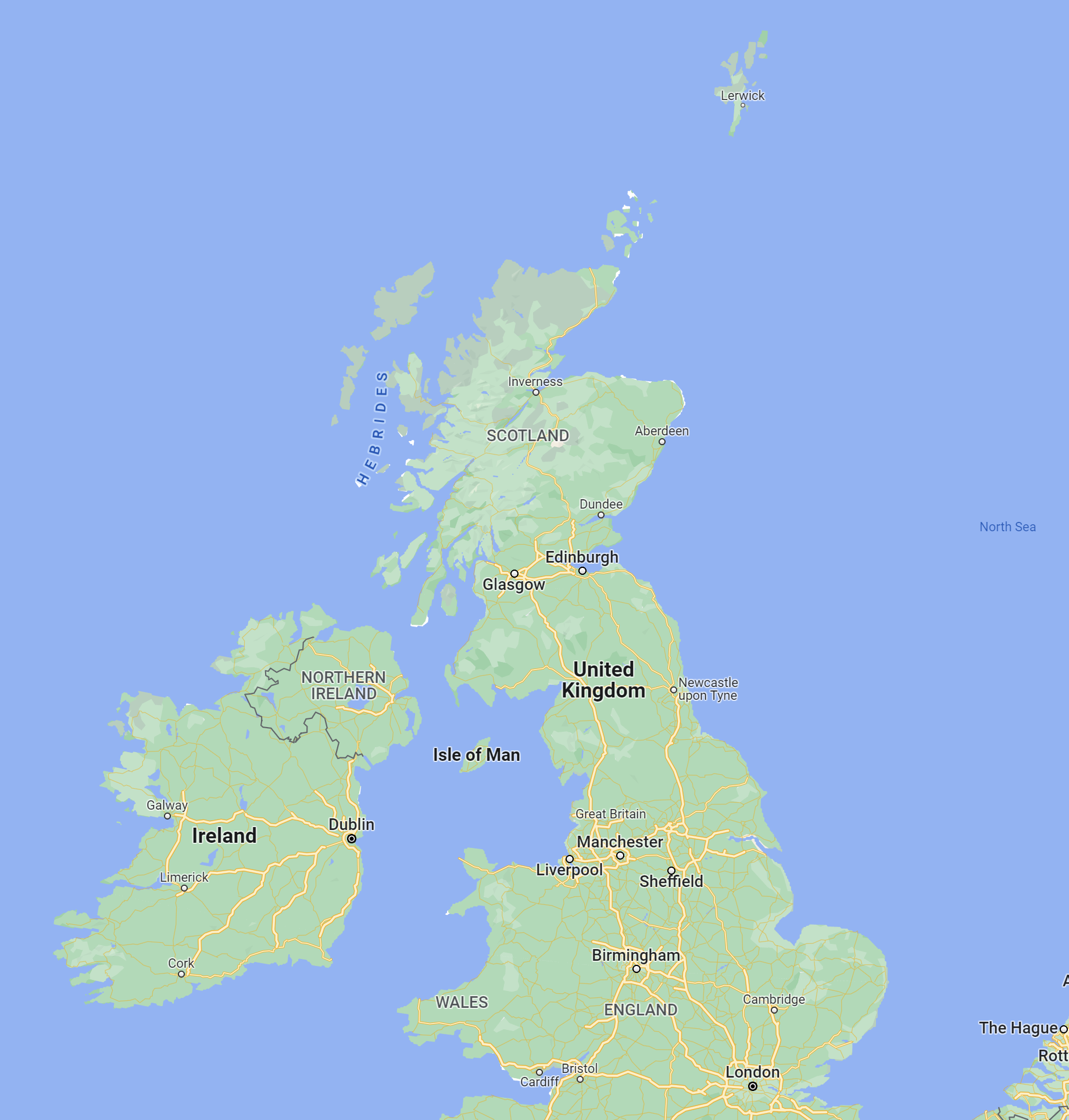
I will look at various seas.
The Celtic Sea
The Celtic Sea is to the South-West of Wales and the South of Ireland.
In Blue Gem Wind, I posted this extract from the The Our Projects page of the Blue Gem Wind web site.
Floating wind is set to become a key technology in the fight against climate change with over 80% of the worlds wind resource in water deeper than 60 metres. Independent studies have suggested there could be as much as 50GW of electricity capacity available in the Celtic Sea waters of the UK and Ireland. This renewable energy resource could play a key role in the UK meeting the 2050 Net-Zero target required to mitigate climate change. Floating wind will provide new low carbon supply chain opportunities, support coastal communities and create long-term benefits for the region.
Consider.
- The key figure would appear 50 GW of electricity capacity available in the Celtic Sea waters of the UK and Ireland.
- Earlier I said that floating turbines can have a wind turbine density of 5 MW per km².
- According to Wikipedia, the surface area of the Celtic Sea is 300,000 km².
To accommodate enough floating turbines to generate 50 GW would need 10000 km², which is a 100 km. square, or 3.33 % of the area of the Celtic Sea.
This wind generation capacity of 50 GW would appear to be feasible in the Celtic Sea and still leave plenty of space for the shipping.
The Irish Sea
According to Wikipedia, the surface area of the Irish Sea is 46,000 km².
Currently, there are ten wind farms in the Irish Sea.
- Six are in English waters, three are in Welsh and one is in Irish.
- None are more than sixteen kilometres from the coast.
The total power is 2.7 GW.
I feel that the maximum number of wind farms in the Irish Sea would not cover more than the 3.33 % proposed for the Celtic Sea.
3.33 % of the Irish Sea would be 1532 km², which could support 7.6 GW of wind-generated electricity.
I can’t leave the Irish Sea without talking about two wind farms Mona and Morgan, that are being developed by an enBW and BP joint venture, which I discussed in Mona, Morgan And Morven. This infographic from the joint venture describes Mona and Morgan.

That would appear to be a 3 GW development underway in the Irish Sea.
Off The Coast Of South-East England, East Anglia, Lincolnshire And Yorkshire
These wind farms are proposed in these areas.
- Hornsea – 6 GW
- Triton Knoll – 900 MW
- Dogger Bank – 3.6 GW
- Norfolk Boreas – 1.8 GW
- Norfolk Vanguard – 1.8 GW
- East Anglia Array – 7.2 GW
- Rampion Extension – 1.2 GW
Note.
All wind farms have comprehensive web sites or Wikipedia entries.
The total capacity of these wind farms is 22.5 GW
The North Sea
According to Wikipedia, the surface area of the North Sea is 570,000 km².
Would it is reasonable to assume, that perhaps a tenth of this area would be available for new wind farms in UK waters?
3.33 % of the available North Sea would be 1898 km², which could support 9.5 GW of wind-generated electricity.
On The East Coast Of Scotland
In Wind Farms On The East Coast Of Scotland, I summarised the wind farms off the East coast of Scotland, that are being built in a cluster in the First of Forth.
This map shows the proposed wind farms in this area.
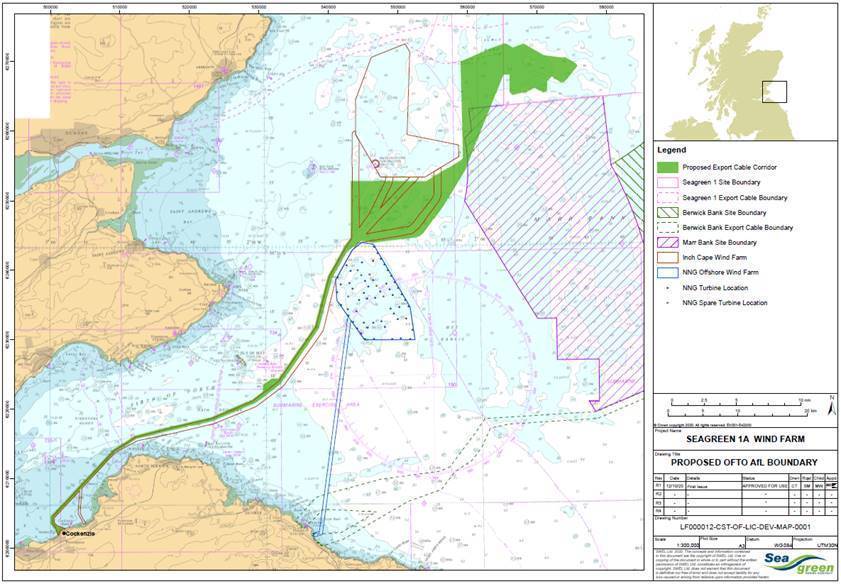
There are five wind farms in the map.
- The green area is the cable corridor for Seagreen 1a
- Inch Cape is the odd-shaped wind farm to the North and West of the green area
- Seagreen at the top of the map, to the North of Inch Cape.
- Marr Bank with the pink NE-SW hatching
- Berwick Bank with the green NW-SE hatching
- Neart Na Gaoithe is edged in blue to the South of the green area.
Berwick Bank and Marr Bank are both owned by SSE and appear to have been combined.
The capacity of the wind farms can be summarised as follows.
- Seagreen – 1075 MW
- Neart Na Gaoithe – 450 MW
- Inch Cape – 1000 MW
- Berwick Bank and Marr Bank – 4100 MW
This gives a total of 6625 MW or just over 6.6 GW.
Around The North Of Scotland
This map shows the latest successful ScotWind leases.

Note.
- Several of these proposed wind farms have detailed web sites.
These seventeen leases total up to 24.3 GW.
An Interim Total
I believe these figures are realisable.
- Celtic Sea – 50 GW
- Irish Sea – 7.6 GW – 3 GW already underway
- South East England, East Anglia, Lincolnshire And Yorkshire – 22.5 GW
- North Sea – 9.5 GW
- On The East Coast Of Scotland – 6.6 GW
- Around The North Of Scotland – 24.3 GW
Note.
- I have tried to be as pessimistic as possible.
- Irish and North Sea estimates are based on Blue Gem Wind’s professional estimate for the Celtic Sea.
- I have used published figures where possible.
My estimates total up to 120.1 GW of extra wind-power capacity. As I write this, current UK electricity production is around 33 GW.
Vikings Will Invade
This Google Map shows the Faroe Islands, the North of Scotland, Norway and Denmark.
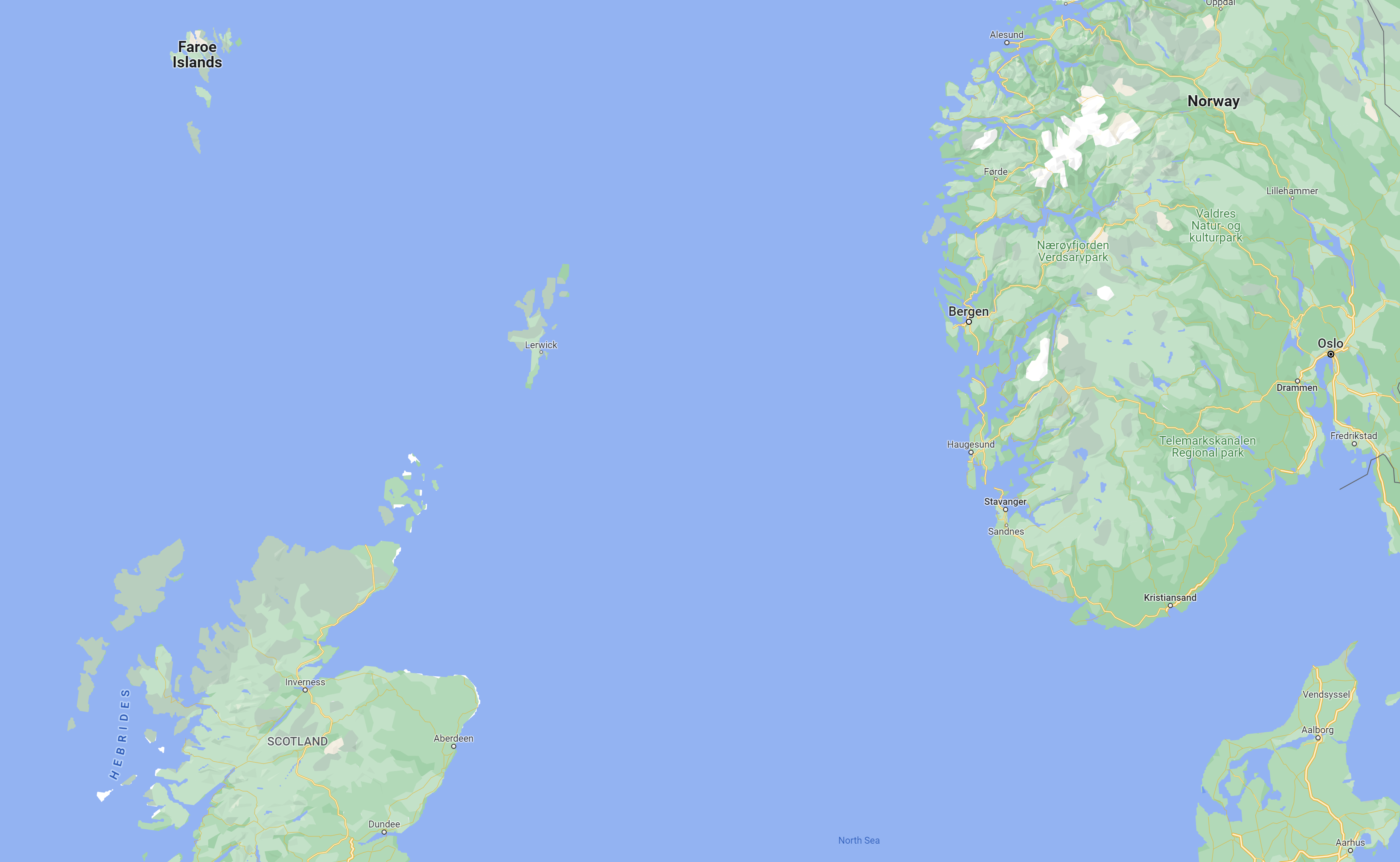
To get an idea of scale, the Shetland Isles are around 70 miles or 113 km. from North to South.
In Is This The World’s Most Ambitious Green Energy Solution?, I talked about Norwegian company; Aker Solutions’s plan for Northern Horizons.
- It would be a 10 GW offshore floating wind farm 136 km to the North-East of the Shetlands.
- This position would probably place it about halfway between the Faroes and the Norwegian coast.
- The project is best described in this article on the Engineer, which is entitled Northern Horizons Plans Clean Energy Exports For Scotland.
- In the article, there is a good graphic and a video.
This will be offshore engineering of the highest class, but then I first came across Norwegian offshore engineering like this in the 1970s, where nothing was too difficult for Norwegian engineers.
There are two major points to remember about the Norwegians.
- They have the Sovereign Wealth Fund to pay for the massive investment in Northern Horizons.
- They need to replace their oil and gas income, with a zero-carbon investment stream.
I feel that Northern Horizons will not be a one-off and the virgin sea in the map above will be liberally carpeted with more floating wind farms.
- On Shetland, electricity can be fed into the UK grid.
- On Norway, electricity can be fed into the Norwegian grid or stored in Norwegian pumped storage systems.
- On Scotland, more pumped storage systems can be built to store energy.
- Hydrogen can be piped to where it is needed to decarbonise heavy industry and transport.
- Norwegian fjords, Shetland harbours, Scottish lochs and possibly Scapa Flow would be ideal places to assemble and service the giant floating turbines and build the other needed floating infrastructure.
- I can also see Denmark getting in on the act, as they will probably want to decarbonise the Faroe Islands.
I estimate that between the Faroes, Scotland and Norway, there are 510,000 km² of virgin sea.
With a potential of 5 MW per km², that area has the potential to create an amazing amount of both electricity and hydrogen.
Exporting Power To Europe
There will need to be more interconnectors from the UK to Europe.
These are already working.
- BritNed – 1 GW – Isle of Grain and Rotterdam
- ElecLink – 1 GW – Through the Channel Tunnel
- HVDC Cross-Channel – 2 GW – England and France
- IFA-2 – 1 GW – England and France
- NemoLink – 1 GW – Kent and Belgium
- North Sea Link – 1.4 GW – Blyth and Norway
- Viking Link – 1.4 GW – Lincolnshire and Denmark
These are proposed.
- GridLink – 1.4 GW – Kent and Dunkirk
- NeuConnect – 1.4 GW – Isle of Grain and Germany
- North Connect – 1.4 GW – Scotland and Norway
There are also gas interconnectors, that could be converted to hydrogen.
This press release from National Grid, which is entitled Undersea Electricity Superhighways That Will Help Deliver Net Zero Move A Step Closer, has these bullet points.
- Positive progress on plans for £3.4bn electricity super-highway projects – Scotland to England Green Links.
- Ofgem opens consultation that recognises the “clear case” and “consumer benefit” of two subsea high voltage cables to transport clean between Scotland and England.
- The cables form part of a planned 16 project £10 billion investment from National Grid to deliver on the government’s target of 40GW of offshore wind generation by 2030.
This paragraph expands on the work by National Grid to meet the third point.
These projects are part of National Grid’s work upgrading the electricity transmission system to deliver the UK government’s target of 40GW of offshore wind generation by 2030. In addition to the Eastern Links, it is developing 14 major projects across its network to facilitate the target representing a £10 billion investment. This includes two further Scotland to England high voltage links (also in partnership with the Scottish transmission network owners) and proposals in the Humber, Lincolnshire, East Midlands, North of England, Yorkshire, North Kent, as well as four in East Anglia (one of which is a proposed offshore link between Suffolk and Kent).
I think we can assume, that National Grid will do their part to allow the UK government’s target of 40GW of offshore wind generation by 2030 to be met.
Will The UK Have 40 GW Of Offshore Wind Generation By 2030?
In the Wikipedia entry for Windpower In The UK, this is the opening sentence.
The United Kingdom is one of the best locations for wind power in the world and is considered to be the best in Europe. By the beginning of March 2022, the UK had 11,091 wind turbines with a total installed capacity of over 24.6 gigawatts (GW): 14.1 GW of onshore capacity and 10.4 GW of offshore capacity.
It would appear an extra 30 GW of wind power is needed.
In An Interim Total earlier, I gave these figures.
- Celtic Sea – 50 GW
- Irish Sea – 7.6 GW – 3 GW already underway
- South East England, East Anglia, Lincolnshire And Yorkshire – 22.5 GW
- North Sea – 9.5 GW
- On The East Coast Of Scotland – 6.6 GW
- ScotWind – 24.3 GW
The wind farms in South East England, East Anglia, Lincolnshire And Yorkshire and ScotWind and Mona and Morgan are either being planned or under construction, and in many cases leases to construct wind farms are being paid.
I would feel, that at least 30 GW of these 56.4 GW of wind farms will be completed by 2030.
Conclusion
Boris’s vision of the UK becoming a Saudi Arabia of wind is no fantasy of a man with massive dreams.
Standard floating wind turbines, with the possibility of also harvesting wave power could be assembled in ports along the coasts, towed into position and then connected up.
Several GW of wind-power capacity could probably be added each year to what would become the largest zero-carbon power station in the world.
By harvesting the power of the winds and waves in the seas around the British Isles it is an engineering and mathematical possibility, that could have been developed by any of those great visionary Victorian engineers like Armstrong, Bazalgette, Brunel and Reynolds, if they had had access to our modern technology.
Up Yours! Putin!
Is This The World’s Most Ambitious Green Energy Solution?
In the 1970s and 1980s, when I was developing Artemis, which was the first desk-sized project management system, we were heavily involved in North Sea Oil, with dozens of systems in Aberdeen. As Norway developed the oil business on the other side of the North Sea, the number of systems there grew to at least twenty.
Increasingly, I became aware of a Norwegian company called Kværner, which seemed to have large numbers of Artemis systems.
In 2002, Kværner merged with Aker Maritime and this eventually led to the formation of Aker Solutions in 2008, which is a company that is headquartered in Oslo and employs nearly 14,000.
According to Wikipedia, the Kværner name was dropped somewhere along the way, as non-Scandinavians have difficulty pronouncing Kværner.
Aker Solutions appears to be wholly Scandinavian-owned, with Aker ASA owning a third of the company.
They are a very respected company, when it comes to offshore engineering for oil and gas and wind projects.
Aker ASA also have a subsidiary called Aker Horizons, which has this web site, where they call themselves a planet-positive company.
This page on the Aker Horizons is entitled Northern Horizons: A Pathway for Scotland to Become a Clean Energy Exporter.
These first two paragraphs outline the project.
A vision to utilise Scottish offshore wind resources in the North Sea to make the country an exporter of clean energy has been unveiled at the COP 26 climate change conference in Glasgow.
The Northern Horizons Project has been unveiled by Aker Horizons’ portfolio companies Aker Offshore Wind and Aker Clean Hydrogen, who have the technical know-how and expertise to realise the project, and DNV, the independent energy expert and assurance provider.
Various targets and ambitions are listed.
- 10 GW of renewable energy in the North Sea.
- 5 GW of green hydrogen.
- Giant turbines nearly as tall as the London Shard on floating platforms more than 130km from Shetland.
- Enough liquid hydrogen will be produced to power 40 percent of the total mileage of local UK buses.
- Enough synthetic fuel to make 750 round trips from the UK to New York.
A completion date of 2030 for this project is mentioned.
This article on The Engineer is entitled Northern Horizons Plans Clean Energy Exports For Scotland.
The article is dated the 4th of November 2021 and starts with this sub-heading and an informative video.
Aker Horizons’ new initiative, Northern Horizons, aims to make Scotland a clean energy exporter by utilising offshore wind resources in the North Sea.
There is an explanatory graphic of the project which shows the following.
- Floating wind turbines.
- A floating DC substation.
- A floating hydrogen electrolyser.
- An onshore net-zero refinery to produce synthetic aviation fuel and diesel.
- A hydrogen pipeline to mainland Scotland.
- Zero-carbon energy for Shetland.
It is all very comprehensive.
These are some other thoughts.
Project Orion
Project Orion how has its own web site and the project that seems to have similar objectives to Northern Horizons.
The title on the home page is Building A World-Leading Clean Energy Island.
There is this statement on the home page.
Orion is a bold, ambitious project that aims to transform Shetland into the home of secure and affordable clean energy.
We will fuel a cleaner future and protect the environment by harnessing the islands’ renewables potential, using onshore and offshore wind, tidal and wave energy.
The graphic has similar features to that Northern Horizons in the article on The Engineer, with the addition of providing an oxygen feed to Skyrora for rocket fuel.
German Finance
I feel very much, that the Germans could be providing finance for developments around Shetland, as the area could be a major source of hydrogen to replace Vlad the Mad’s tainted gas.
In Do BP And The Germans Have A Cunning Plan For European Energy Domination?, I described how BP is working with German utilities and finance to give Germany the hydrogen it needs.
NorthConnect
The NorthConnect (also known as Scotland–Norway interconnector) is a proposed 650 km (400-mile) 1,400 MW HVDC interconnector over the floor of the North Sea.
- It will run between Peterhead in North-East Scotland and Norway.
This project appears to be stalled, but with the harvesting of more renewable energy on Shetland, I can see this link being progressed, so that surplus energy can be stored in Norway’s pumped storage hydro.
Icelink
Icelink is a proposed electricity interconnector between Iceland and Great Britain.
- It would be the longest undersea interconnector in the world, with a length of 620 to 750 miles.
- It would be a 800–1,200 MW high-voltage direct current (HVDC) link.
- National Grid is part of the consortium planning to build the link.
- Iceland has a surplus of renewable energy and the UK, is the only place close enough for a connection.
I believe that if Icelink were to be built in conjunction with energy developments on and around Shetland, a more powerful and efficient interconnector could emerge.
Conclusion
This ambitious project will transform the Shetlands and the energy industry in wider Scotland.
This project is to the North-East of Shetland, but the islands are surrounded by sea, so how many other Northern Horizons can be built in a ring around the islands?
Germany Weighs Norway Hydrogen Pipeline To Avoid Russian Energy
The title of this post, is the same as that of this article on Hydrogen Central.
This the introductory paragraphs.
Germany and Norway are considering building a hydrogen pipeline linking the two nations to reduce Europe’s dependence on Russian energy supplies.
The countries plan to soon conduct a feasibility study on the project that would eventually transport green hydrogen from Norway to Germany, they said after a meeting between German Economy Minister Robert Habeck and Norwegian Prime Minister Jonas Gahr Store.
There is a joint statement that gives more details.
Developments like this and lots of wind power in the North Sea and around the UK, are the sort of actions, that could seriously reduce the size of Russia’s oil and gas industry and the money it pays to that group of war criminals like Vlad the Mad and his friends.
ITM Power’s 24MW Electrolyser Sale to Yara
The title of this post, is the similar to that of this press release from ITM Power. I just added a few words.
These are the first three paragraphs.
ITM Power (AIM: ITM), the energy storage and clean fuel company, is pleased to provide details of the sale of a 24MW electrolyser to Linde Engineering contained in the Company’s Half Year Report issued yesterday. The electrolyser is to be installed at a site operated by Yara Norge AS (“Yara”) located at Herøya outside Porsgrunn, about 140 km southwest of Oslo. The site covers an area of approximately 1.5 square kilometres and is the largest industrial site in Norway. The Porsgrunn site produces 3 million tons of fertiliser per year.
The hydrogen required for ammonia production is currently produced from SMR. Yara intends to start replacing this grey hydrogen with green hydrogen produced from renewable energy and electrolysis. The 24MW system supplying 10,368 kg/day of hydrogen will account for approximately 5% of the plant’s consumption and serve as a feasibility study for future upscaling. Yara has received a grant of up to NOK 283m (£23.6m,pending ESA approval) from Enova SF, a Government funding body, to invest in green solutions for hydrogen used for industrial purposes in Norway.
The electrolyser equipment is due to be ready for shipment from ITM Power in Q4 2022 with revenue realised in the Company’s 2022/2023 financial year.
These are my thoughts.
The Size Of The Electrolyser
A 24 MW electrolyser, that produces 10,368 Kg of hydrogen/day may sound a large device.
This is an extract from the press release.
In January 2021, the Company received an order for the world’s then largest PEM electrolyser of 24MW from Linde. In October 2021, the Company, with Linde, announced the deployment of a 100MW electrolyser at Shell’s Rhineland refinery, following the start-up of an initial 10MW facility at the site.
It appears that ITM Power have built one before and one four times the size has been ordered.
What Size Of Electrolyser Would Yara Need To Fully Decarbonise Ammonia Production?
According to the press release, a 24 MW electrolyser will produce five percent of the plant’s consumption, which means that a 480 MW electrolyser will be needed, if Yara use an ITM electrolyser to produce all their hydrogen.
Will manufacture of an electrolyser of this size be a problem for ITM Power?
The press release says this about electrolyser production.
ITM Power operates from the world’s largest electrolyser factory in Sheffield with a capacity of 1GW (1,000MW) per annum, with the announced intention to build a second UK Gigafactory in Sheffield with a capacity of 1.5GW expected to be fully operational by the end of 2023. The Group’s first international facility, expected to have a capacity of 2.5GW per annum, is intended to be operational by the end of 2024, bringing total Group capacity to 5GW per annum.
It also says that the company has raised £250m to accelerate expansion.
The Delivery Date
The delivery date of the electrolyser is stated as Q4 2022.
I find this rather quick, which makes me believe that one of the reasons for the success of ITM Power is their production process.
How Much Ammonia Is Produced Worldwide?
This is an extract from this publication from the Royal Society, which is entitled Ammonia: Zero-Carbon Fertiliser, Fuel And Energy Store.
Current global ammonia production is about 176 million tonnes per year and is predominantly achieved through the steam reforming of methane to produce hydrogen to feed into ammonia synthesis via the Haber Bosch process.
Ammonia production is a highly energy intensive process consuming around 1.8% of global energy output each year (steam methane reforming accounts for over 80% of the energy required) and producing as a result about 500 million tonnes of carbon dioxide (about 1.8% of global carbon dioxide emissions)2,3,4. Ammonia synthesis is significantly the largest carbon dioxide emitting chemical industry process. Along with cement, steel and ethylene production, it is one of the ‘big four’ industrial processes where a decarbonisation plan must be developed and implemented to meet the netzero carbon emissions target by 2050.
It looks like Linde and ITM Power have a fairly simple plan to decarbonise world ammonia production. And they have started with one of the easier targets; Yara in the very environmentally-correct Norway.
I estimate that to produce 176 million tonnes of green ammonia will need over 28 GW of electrolyser capacity.
Conclusion
If Linde and ITM Power can persuade the world, that their technology is the way to go, then they’ve got it made.
UK National Grid In Talks To Build An Energy Island In The North Sea
The title of this post, is the same as that of this article on the New Scientist.
This is the first paragraph.
UK company National Grid has revealed it is in talks with two other parties about building an “energy island” in the North Sea that would use wind farms to supply clean electricity to millions of homes in north-west Europe.
These are my thoughts.
An Artificial Island on the Dogger Bank
The idea of the North Sea Wind Power Hub in the area of the Dogger Bank has been around for a few years and has a comprehensive Wikipedia entry.
Wikipedia says that it would be an artificial island on the Dutch section of the Dogger Bank and the surrounding sea could eventually host up to 110 GW of wind turbines.
North Sea Wind Power Hub Programme
The Dutch and the Danes seems to have moved on and there is now a web site for the North Sea Wind Power Hub Programme.
The home page is split into two, with the upper half entitled Beyond The Waves and saying.
The incredible story of how the Netherlands went beyond technical engineering as it had ever been seen before. Beyond water management. To secure the lives of millions of inhabitants.
I have met Dutch engineers, who designed and built the Delta Works after the North Sea Floods of 1953 and I have seen the works all over the country and it is an impressive legacy.
And the lower half of the home page is entitled North Sea Wind Power Hub and saying.
Today, climate policy is largely national, decoupled and incremental. We need a new approach to effectively realise the potential of the North Sea and reach the goals of the Paris Agreement. We take a different perspective: harnessing the power of the North Sea requires a transnational and cross-sector approach to take the step-change we need.
Behind each half are two videos, which explain the concept of the programme.
It is a strange web site in a way.
- It is written totally in English with English not American spelling.
- The project is backed by Energinet, Gasunie and TenneT, who are Danish and Dutch companies, that are responsible for gas and electricity distribution networks in Denmark, Ger,many and The Netherlands.
- There are four sections to the web site; Netherlands, Germany, Denmark and North Sea.
It is almost as if the web site has been designed for a British company to join the party.
Hubs And Spokes In North Sea Wind Power Hub Programme
If you watch the videos on the site, they will explain their concept of hubs and spokes, where not one but several energy islands or hubs will be connected by spokes or electricity cables and/or hydrogen pipelines to each other and the shore.
Many electrical networks on land are designed in a similar way, including in the UK, where we have clusters of power stations connected by the electricity grid.
The Dogger Bank
The Dogger Bank is a large sandbank in a shallow area of the North Sea about 100 kilometres off the east coast of England.
Wikipedia says this about the geography of the Dogger Bank.
The bank extends over about 17,600 square kilometres (6,800 sq mi), and is about 260 by 100 kilometres (160 by 60 mi) in extent. The water depth ranges from 15 to 36 metres (50 to 120 ft), about 20 metres (65 ft) shallower than the surrounding sea.
As there are Gunfleet Sands Wind Farm and Scroby Sands Wind Farm and others, on sandbanks in the North Sea, it would appear that the engineering of building wind farms on sandbanks in the North Sea is well understood.
The Dogger Bank Wind Farm
We are already developing the four section Dogger Bank Wind Farm in our portion of the Dogger Bank and these could generate up to 4.8 GW by 2025.
The Dogger Bank Wind Farm has its own web site, which greets you with this statement.
Building the World’s Largest Offshore Wind Farm
At 4.8 GW, it will be 45 % larger than Hinckley Point C nuclear power station, which is only 3.3 GW. So it is not small.
The three wind farms; Dogger Bank A, B and C will occupy 1670 square kilometres and generate a total of 3.6 GW or 0.0021 GW per square kilometre.
If this density of wind turbines could be erected all over the Dogger Bank, we could be looking at nearly 40 GW of capacity in the middle of the North Sea.
Interconnectors Across The North Sea
This Google Map shows the onshore route of the cable from the Dogger Bank Wind Farm.
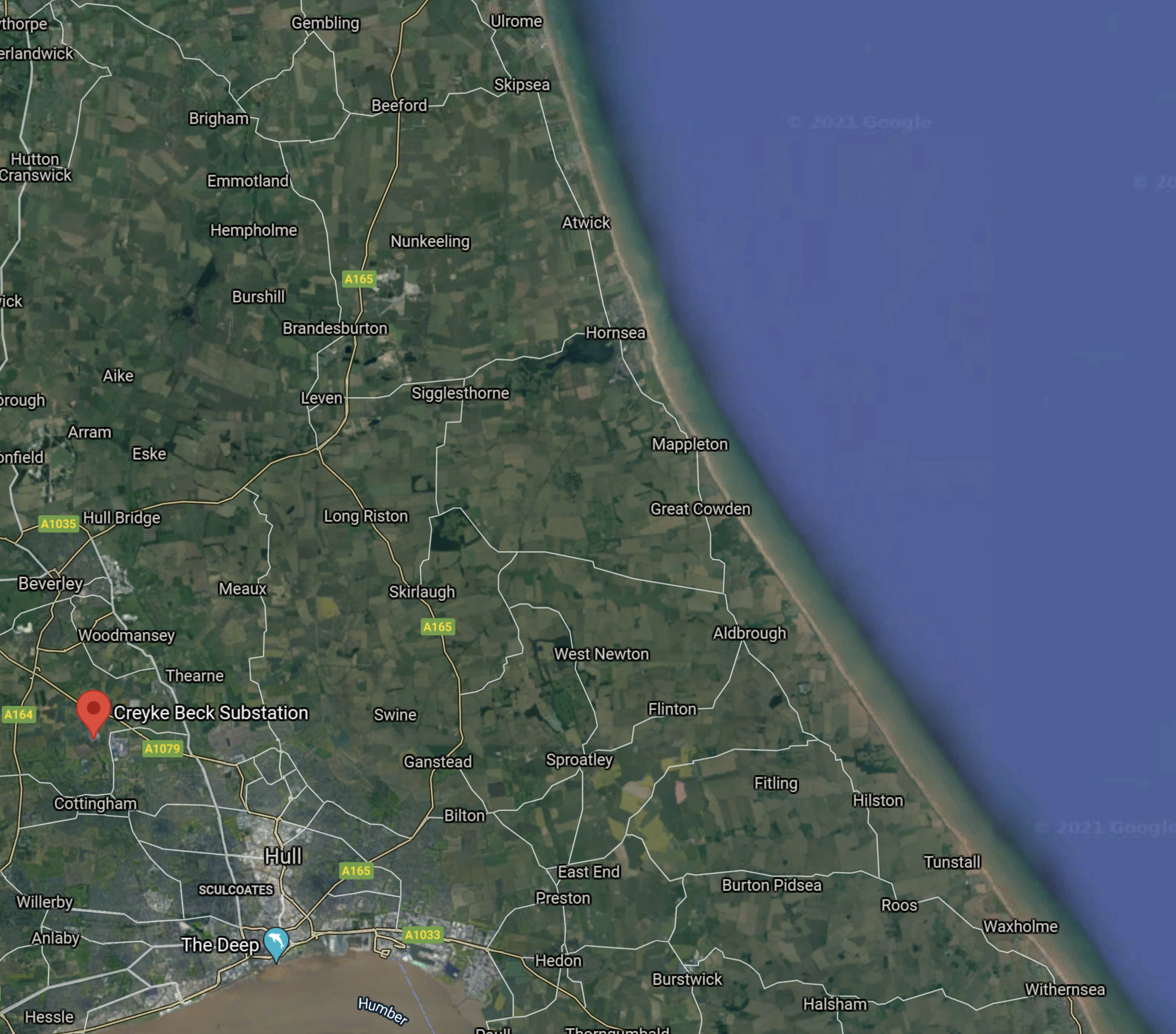
Note.
- Hull and the River Humber at the bottom of the map.
- The red arrow which marks Creyke Beck sub station, where the cable from the Dogger Bank Wind Farm connects to the UK electricity grid.
- At the top of the map on the coast is the village of Ulrome, where the cable comes ashore.
The sub station is also close to the Hull and Scarborough Line, so would be ideal to feed any electrification erected.
I would assume that cables from the Dogger Bank Wind Farm could also link the Wind Farm to the proposed Dutch/Danish North Sea Wind Power Hub.
Given that the cables between the wind farms and Creyke Beck could in future handle at least 4.8 GW and the cables from the North Sea Wind Power Hub to mainland Europe would probably be larger, it looks like there could be a very high capacity interconnector between Yorkshire and Denmark, Germany and The Netherlands.
It almost makes the recently-opened North Sea Link to Norway, which is rated at 1.4 GW seem a bit small.
The North Sea Link
The North Sea Link is a joint project between Statnett and National Grid, which cost €2 billion and appears to have been delivered as planned, when it started operating in October 2021.
So it would appear that National Grid have shown themselves capable of delivering their end of a complex interconnector project.
Project Orion And The Shetlands
In Do BP And The Germans Have A Cunning Plan For European Energy Domination?, I introduced Project Orion, which is an electrification and hydrogen hub and clean energy project in the Shetland Islands.
The project’s scope is described in this graphic.
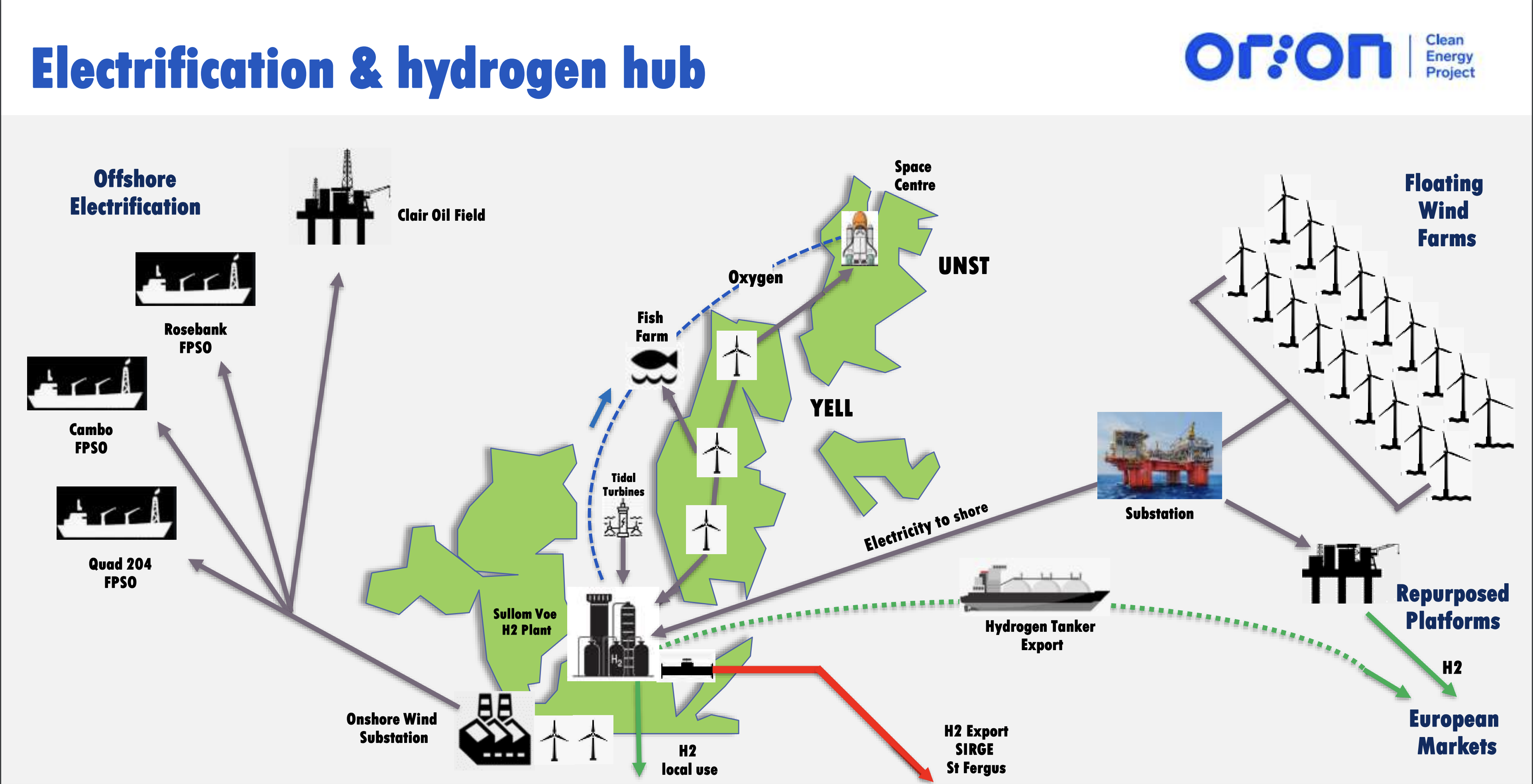
Note that Project Orion now has its own web site.
- Could the Shetlands become an onshore hub for the North Sea Power Hub Programme?
- Could Icelink, which is an interconnector to Iceland be incorporated?
With all this renewable energy and hydrogen, I believe that the Shetlands could become one of the most prosperous areas in Europe.
Funding The Wind Farms And Other Infrastructure In The North Sea
In World’s Largest Wind Farm Attracts Huge Backing From Insurance Giant, I described how Aviva were funding the Hornsea wind farm.
I very much believe that City of London financial institutions will be able to finance a lot of the developments in the North Sea.
After all National Grid managed to find a billion euros in a sock drawer to fund their half of the North Sea Link.
Electrifying The North Sea: A Gamechanger For Wind Power Production?
The title of this section, is the same as that of this article on Engineering and Technology Magazine.
This article in the magazine of the IET is a serious read and puts forward some useful facts and interesting ideas.
- The EU is targeting offshore wind at 60 GW by 2030 and 300 GW by 2050.
- The UK is targeting offshore wind at 40 GW by 2030.
- The article explains why HVDC electricity links should be used.
- The major players in European offshore wind are the UK, Belgium, the Netherlands, Germany, and Denmark.
- The foundations for a North Sea grid, which could also support the wider ambitions for a European super-grid, are already forming.
- A North Sea grid needs co-operation between governments and technology vendors. as well as technological innovation.
- National Grid are thinking hard about HVDC electrical networks.
- By combining HVDC links it can be possible to save a lot of development capital.
- The Danes are already building artificial islands eighty kilometres offshore.
- Electrical sub-stations could be built on the sea-bed.
I can see that by 2050, the North Sea, South of a line between Hull and Esbjerg in Denmark will be full of wind turbines, which could generate around 300 GW.
Further Reading
There are various articles and web pages that cover the possibility of a grid in the North Sea.
- National Grid – Interconnectors
- The Guardian – National Grid In Talks Over Plan For Energy Island In North Sea
- The Times – National Grid Planning ‘Energy Island’ In North Sea
I shall add to these as required.
Conclusion
I am coming to the conclusion that National Grid will be joining the North Sea Wind Power Hub Programme.
- They certainly have the expertise and access to funding to build long cable links.
- The Dogger Bank wind farm would even be one of the hubs in the planned hub and spoke network covering the North Sea.
- Only a short connection would be needed to connect the Dogger Bank wind farm, to where the Dutch and Danes originally planned to build the first energy island.
- There may be other possibilities for wind farm hubs in the UK section of the North Sea. Hornsea Wind Farm, which could be well upwards of 5 GW is surely a possibility.
- Would it also give access to the massive amounts of energy storage in the Norwegian mountains, through the North Sea Link or Nord.Link between Norway and Germany.
Without doubt, I know as a Control Engineer, that the more hubs and spokes in a network, the more stable it will be.
So is National Grid’s main reason to join is to stabilise the UK electricity grid? And in turn, this will stabilise the Danish and Dutch grids.
UK To Norway Sub-Sea Green Power Cable Operational
The title of this post is the same as that of this article on the BBC.
This is the first two paragraphs.
The world’s longest under-sea electricity cable, transferring green power between Norway and the UK, has begun operation.
The 450-mile (725km) cable connects Blyth in Northumberland with the Norwegian village of Kvilldal.
The BBC article is based on this press release from National Grid.
The link has been called the North Sea Link (NSL).
These are some thoughts.
What Is The Capacity Of The North Sea Link?
The National Grid press release says this.
[The link] will start with a maximum capacity of 700 megawatts (MW) and gradually increase to the link’s full capacity of 1400MW over a three-month period.
It also says this.
Once at full capacity, NSL will provide enough clean electricity to power 1.4 million homes.
It is more or less equivalent to two or three gas-fired power stations.
What Is The Operating Philosophy Of The North Sea Link?
The National Grid press release says this.
The Norwegian power generation is sourced from hydropower plants connected to large reservoirs, which can respond faster to fluctuations in demand compared to other major generation technologies. However, as the water level in reservoirs is subject to weather conditions, production varies throughout seasons and years.
When wind generation is high and electricity demand low in Britain, NSL will enable renewable power to be exported from the UK, conserving water in Norway’s reservoirs. When demand is high in Britain and there is low wind generation, hydro power can be imported from Norway, helping to ensure secure, affordable and sustainable electricity supplies for UK consumers.
It almost seems to me, that the North Sea Link is part of a massive pumped-storage system, where we can bank some of our wind-generated electricity in Norway and draw it out when we need it.
I would suspect that the rate and direction of electricity transfer is driven by a very sophisticated algorithm, that uses detailed demand and weather forecasting.
As an example, if we are generating a lot of wind power at night, any excess that the Norwegians can accept will be used to fill their reservoirs.
The Blyth Connection
This page on the North Sea Link web site, describes the location of the UK end of the North Sea Link.
These three paragraphs describe the connection.
The convertor station will be located just off Brock Lane in East Sleekburn. The site forms part of the wider Blyth Estuary Renewable Energy Zone and falls within the Cambois Zone of Economic Opportunity.
The converter station will involve construction of a series of buildings within a securely fenced compound. The buildings will be constructed with a steel frame and clad with grey insulated metal panels. Some additional outdoor electrical equipment may also be required, but most of the equipment will be indoors.
Onshore underground cables will be required to connect the subsea cables to the converter station. Underground electricity cables will then connect the converter station to a new 400kV substation at Blyth (located next to the existing substation) which will be owned and operated by National Grid Electricity Transmission PLC.
This Google Map shows the area.

Note.
- The light grey buildings in the North-West corner of the map are labelled as the NSL Converter Station.
- Underground cables appear to have been dug between the converter station and the River Blyth.
- Is the long silver building to the West of the triangular jetty, the 400 KV substation, where connection is made to the grid?
The cables appear to enter the river from the Southern point of the triangular jetty. Is the next stop Norway?
Britishvolt And The North Sea Link
Britishvolt are are building a factory at Blyth and this Google Map shows are to the North and East of the NSL Converter Station.
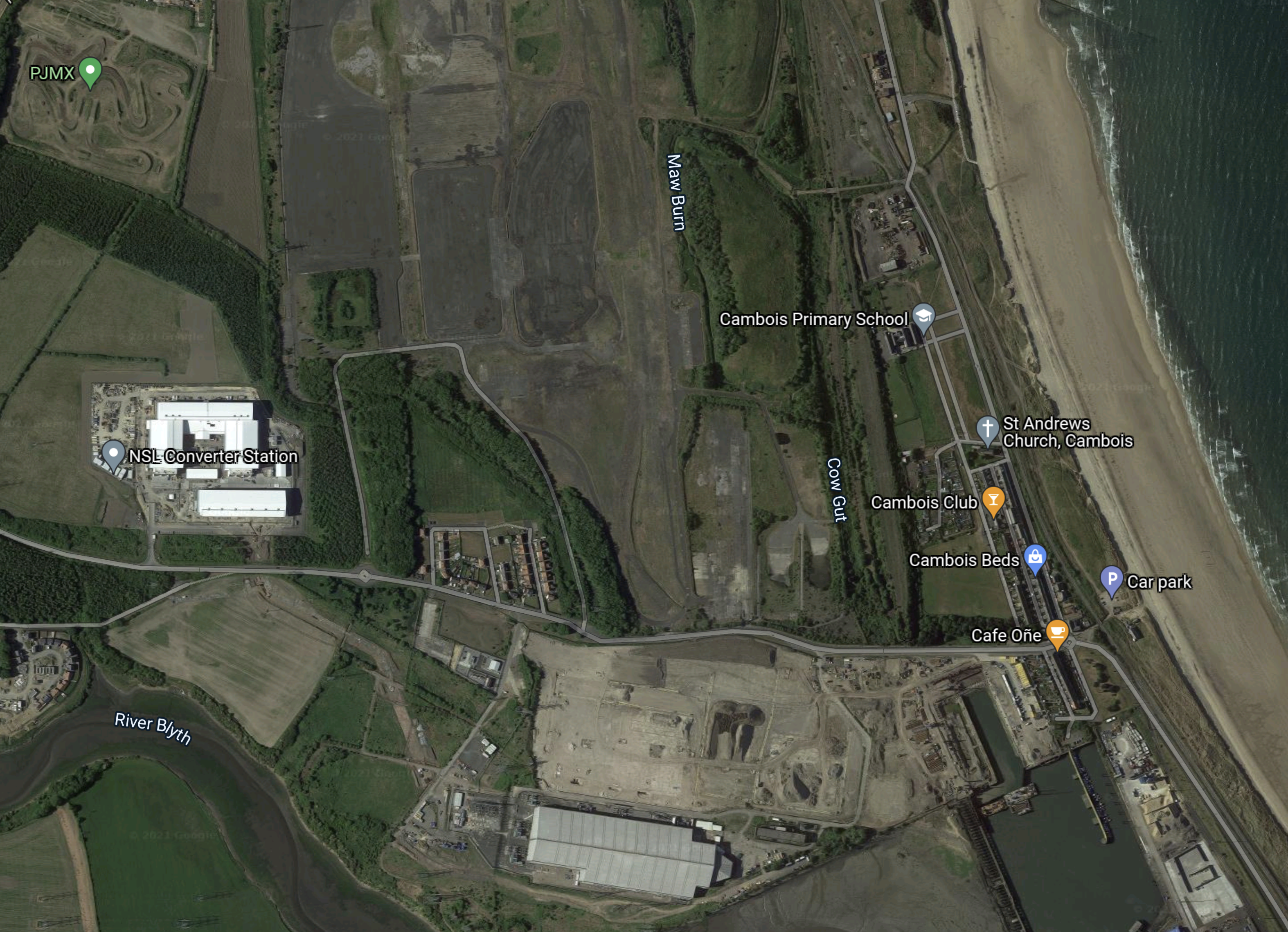
Note the light-coloured buildings of the NSL Converter Station.
I suspect there’s plenty of space to put Britishvolt’s gigafactory between the converter station and the coast.
As the gigafactory will need a lot of electricity and preferably green, I would assume this location gives Britishvolt all they need.
Where Is Kvilldal?
This Google Map shows the area of Norway between Bergen and Oslo.
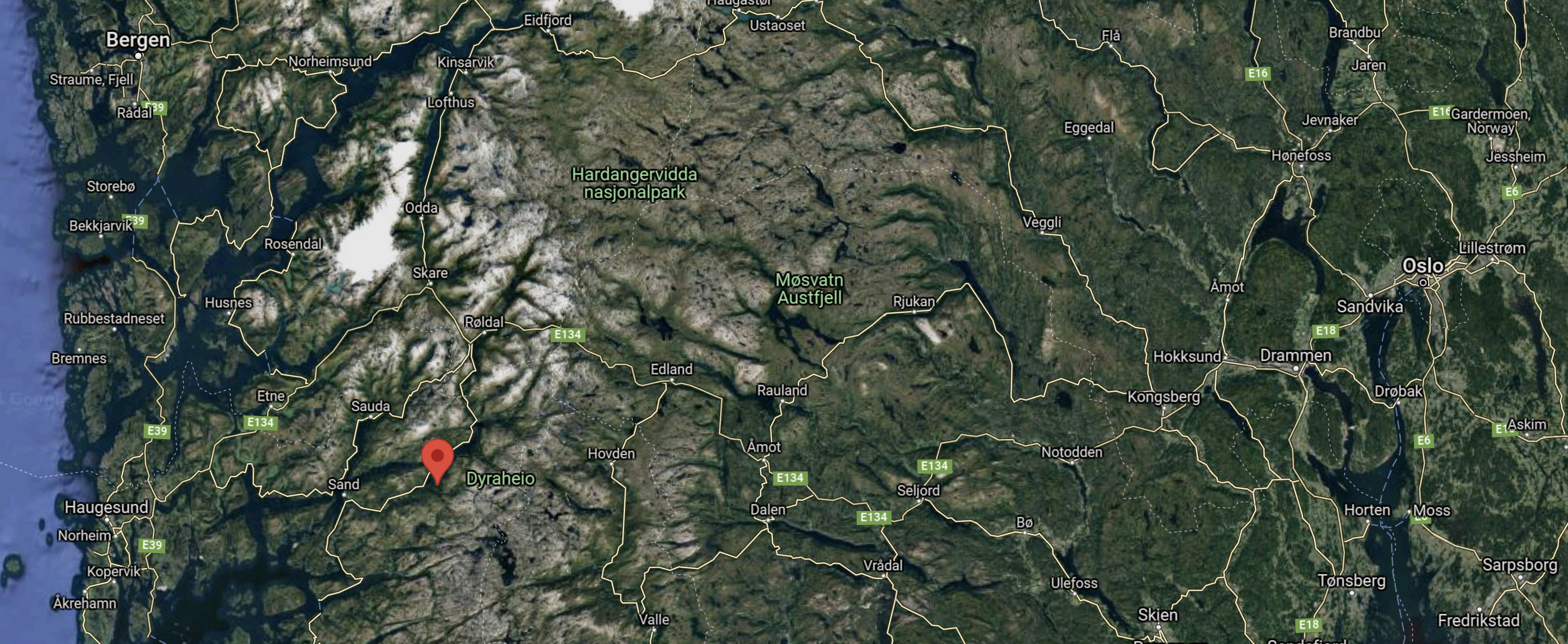
Note.
- Bergen is in the North-West corner of the map.
- Oslo is at the Eastern edge of the map about a third of the way down.
- Kvilldal is marked by the red arrow.
This second Google Map shows the lake to the North of Kvilldal.
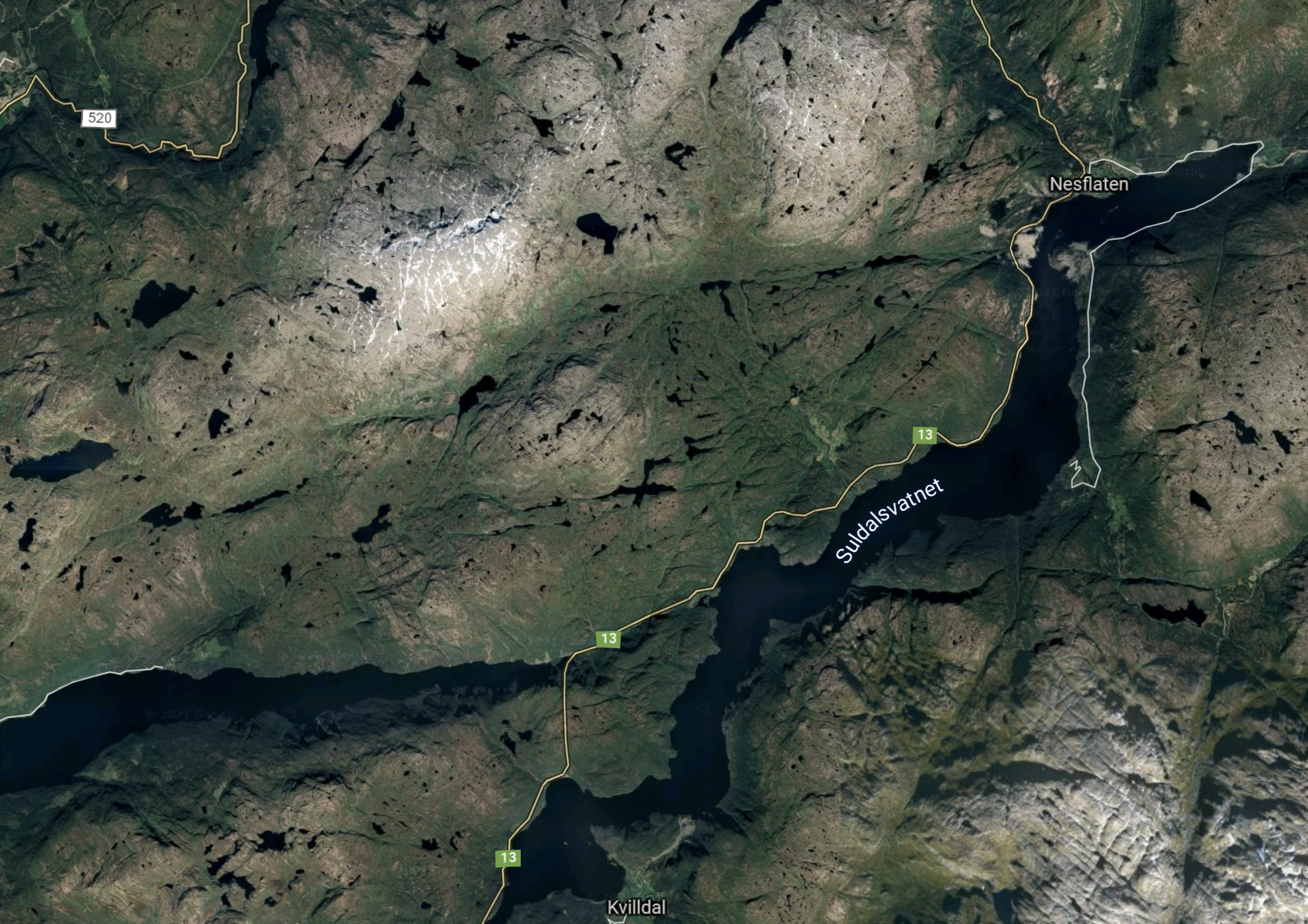
Note.
- Suldalsvatnet is the sixth deepest lake in Norway and has a volume of 4.49 cubic kilometres.
- Kvilldal is at the South of the map in the middle.
This third Google Map shows Kvilldal.
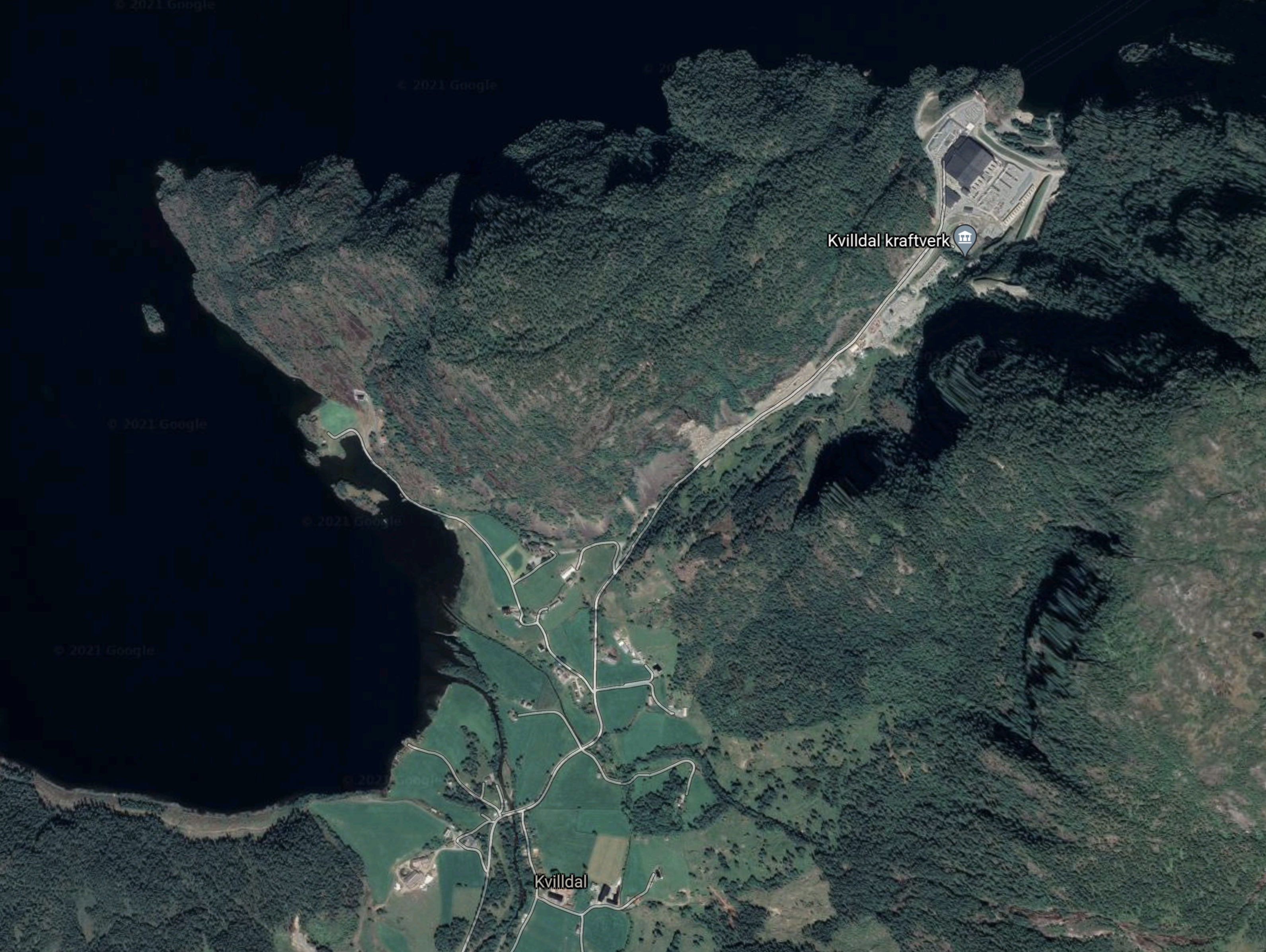
Note.
- Suldalsvatnet is the dark area across the top of the map.
- The Kvilldal hydro-electric power station on the shore of the lake.
- Kvilldal is to the South-West of the power station.
Kvilldal doesn’t seem to be the biggest and most populous of villages. But they shouldn’t have electricity supply problems.
Kvilldal Power Station And The North Sea Link
The Wikipedia entry for Kvilldal power station gives this information.
The Kvilldal Power Station is a located in the municipality of Suldal. The facility operates at an installed capacity of 1,240 megawatts (1,660,000 hp), making it the largest power station in Norway in terms of capacity. Statnett plans to upgrade the western grid from 300 kV to 420 kV at a cost of 8 billion kr, partly to accommodate the NSN Link cable] from Kvilldal to England.
This power station is almost large enough to power the North Sea Link on its own.
The Kvilldal power station is part of the Ulla-Førre complex of power stations and lakes, which include the artificial Lake Blåsjø.
Lake Blåsjø
Lake Blåsjø would appear to be a lake designed to be the upper reservoir for a pumped-storage scheme.
- The lake can contain 3,105,000,000 cubic metres of water at its fullest.
- The surface is between 930 and 1055 metres above sea level.
- It has a shoreline of about 200 kilometres.
This Google Map shows the Lake.
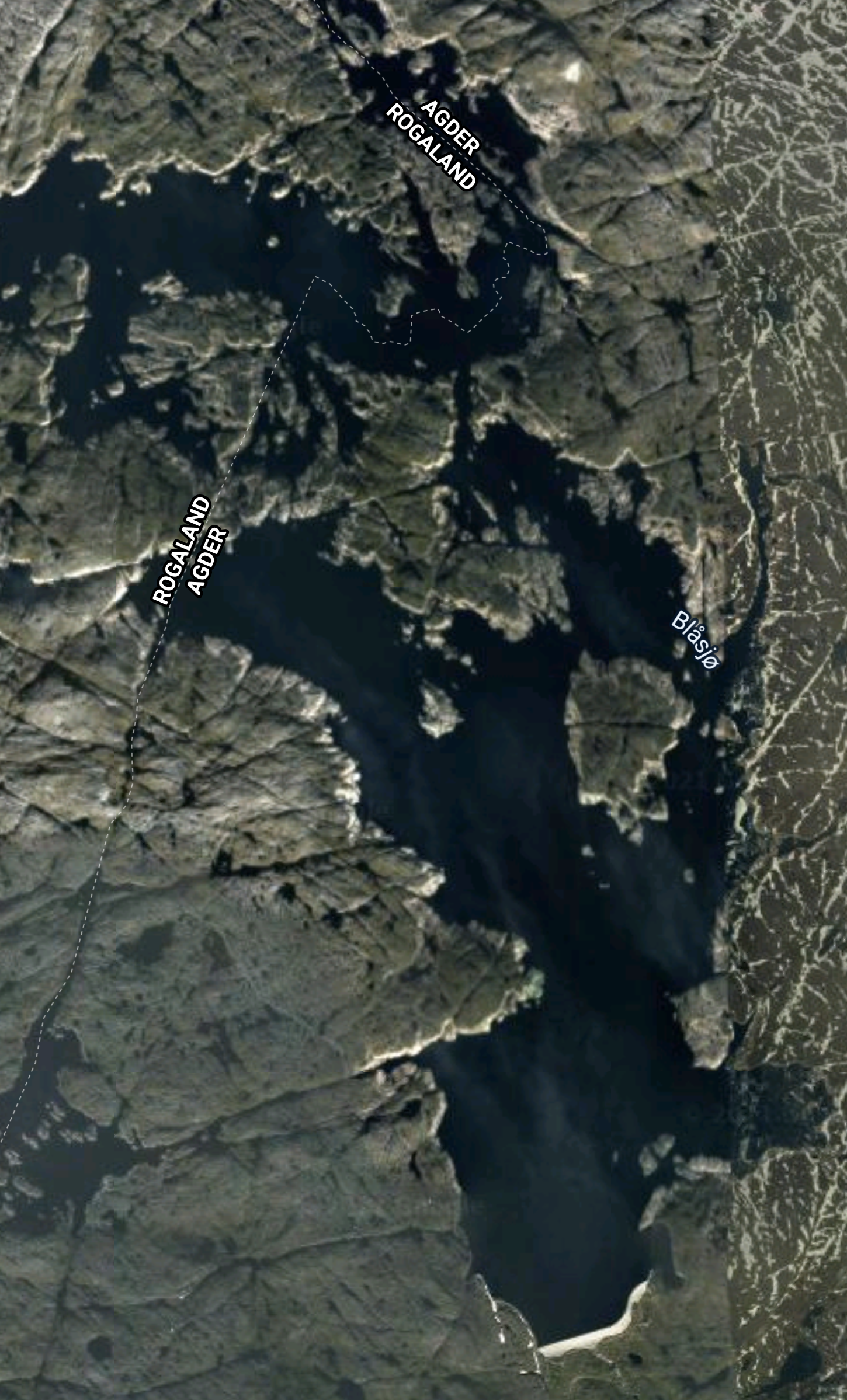
Note the dam at the South end of the lake.
Using Omni’s Potential Energy Calculator, it appears that the lake can hold around 8 TWh of electricity.
A rough calculation indicates that this could supply the UK with 1400 MW for over eight months.
The Wikipedia entry for Saurdal power station gives this information.
The Saurdal Power Station is a hydroelectric and pumped-storage power station located in the municipality of Suldal. The facility operates at an installed capacity of 674 megawatts (904,000 hp) (in 2015). The average energy absorbed by pumps per year is 1,189 GWh (4,280 TJ) (in 2009 to 2012). The average annual production is 1,335 GWh (4,810 TJ) (up to 2012)
This Google Map shows the area between Kvilldal and Lake Blåsjø.
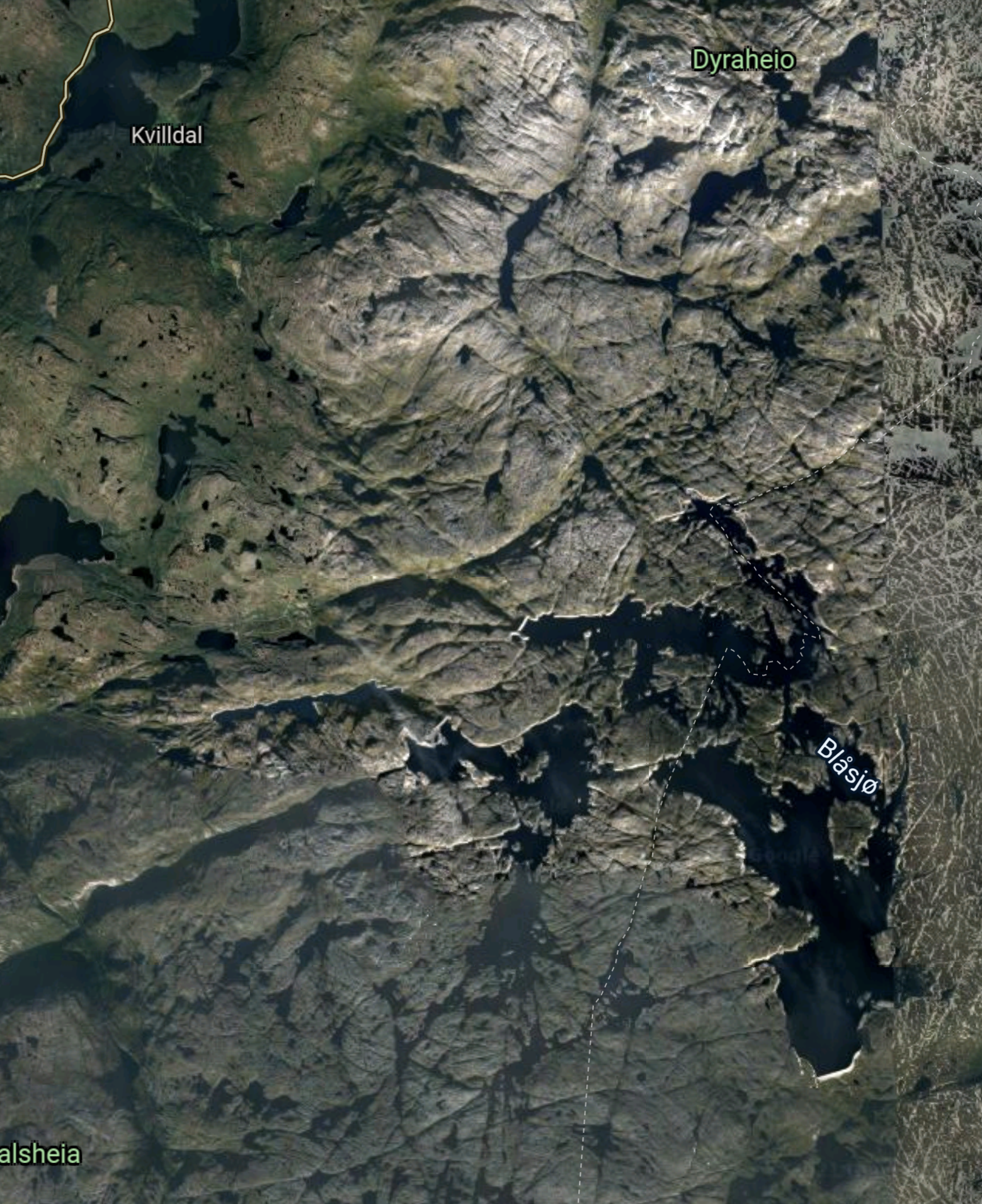
Note
- Kvilldal is in the North West of the map.
- Lake Blåsjø is in South East of the map.
This second Google Map shows the area to the South-East of Kvilldal.
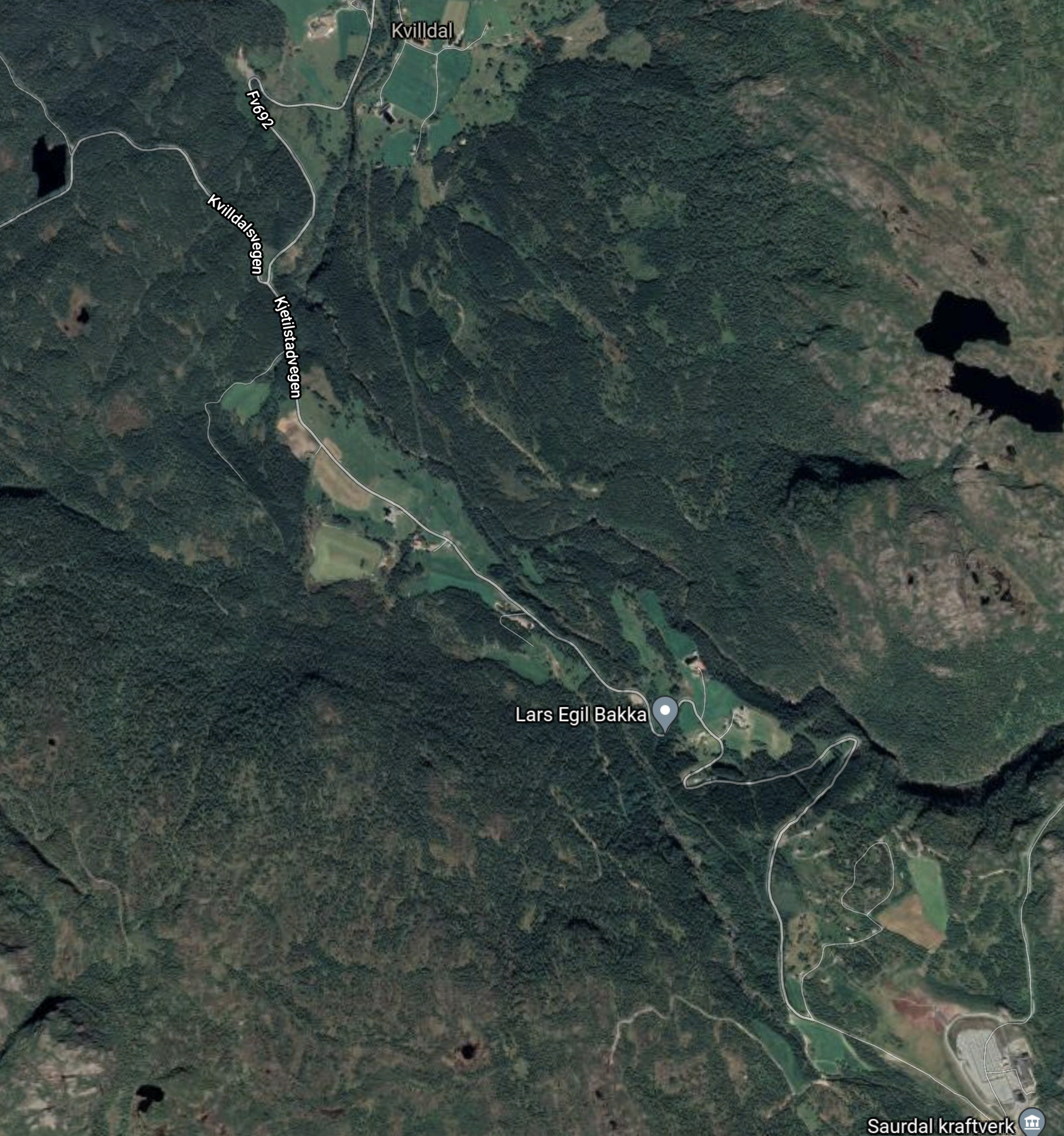
Note.
- Kvilldal is in the North-West of the map.
- The Saurdal power station is tight in the South-East corner of the map.
This third Google Map shows a close-up of Saurdal power station.

Saurdal power station is no ordinary power station.
This page on the Statkraft web site, gives a brief description of the station.
The power plant was commissioned during 1985-1986 and uses water resources and the height of fall from Lake Blåsjø, Norway’s largest reservoir.
The power plant has four generating units, two of which can be reversed to pump water back up into the reservoir instead of producing electricity.
The reversible generating units can thus be used to store surplus energy in Lake Blåsjø.
Is Lake Blåsjø and all the power stations just a giant battery?
Economic Effect
The economic effect of the North Sea Link to both the UK and Norway is laid out in a section called Economic Effect in the Wikipedia entry for the North Sea Link.
Some points from the section.
- According to analysis by the United Kingdom market regulator Ofgem, in the base case scenario the cable would contribute around £490 million to the welfare of the United Kingdom and around £330 million to the welfare of Norway.
- This could reduce the average domestic consumer bill in the United Kingdom by around £2 per year.
- A 2016 study expects the two cables to increase price in South Norway by 2 øre/kWh, less than other factors.
This Economic Effect section also talks of a similar cable between Norway and Germany called NorGer.
It should be noted, that whereas the UK has opportunities for wind farms in areas to the North, South, East and West of the islands, Germany doesn’t have the space in the South to build enough wind power for the area.
There is also talk elsewhere of an interconnector between Scotland and Norway called NorthConnect.
It certainly looks like Norway is positioning itself as Northern Europe’s battery, that will be charged from the country’s extensive hydropower and surplus wind energy from the UK and Germany.
Could The Engineering Be Repeated?
I mentioned NorthConnect earlier.
- The cable will run between Peterhead in Scotland and Samnanger in Norway.
- The HVDC cable will be approximately 665 km long.
- The cable will be the same capacity as the North Sea Link at 1400 MW.
- According to Wikipedia construction started in 2019.
- The cable is planned to be operational in 2022.
- The budget is €1.7 billion.
Note.
- Samnager is close to Bergen.
- NorthConnect is a Scandinavian company.
- The project is supported by the European Union, despite Scotland and Norway not being members.
- National Grid is not involved in the project, although, they will be providing the connection in Scotland.
The project appears to be paused at the moment, awaiting how North Sea Link and NordLink between Norway and Germany are received.
There is an English web site, where this is the mission statement on the home page.
NorthConnect will provide an electrical link between Scotland and Norway, allowing the two nations to exchange power and increase the use of renewable energy.
This sounds very much like North Sea Link 2.
And then there is Icelink.
- This would be a 1000-1200 km link between Iceland and the UK.
- It would have a capacity of 1200 MW.
- National Grid are a shareholder in the venture.
- It would be the longest interconnector in the world.
The project appears to have stalled.
Conclusion
I can see these three interconnectors coming together to help the UK’s electricity generation become carbon-free by 2035.
Railway To Hell To Be Electrified
This is the title of a serious article on Railway Gazette.
Hell is a village near to Trondheim in Norway and the railways around Trondheim are being electrified.
Vivarail Targets Overseas Markets
The title of this post, is the same as that of this article on Rail Magazine.
This is an extract from the article.
Shooter told RAIL: “We are at the moment putting together a bid for an operator – not in this country – where the routes would be up to 500 miles long, to be provided totally with battery trains using this device.
“This bid we are putting together contemplates trains that are running for several hours – 60 to 70 miles between charging stations, but possibly going twice that far in emergency if the charging station should go down.”
By this device I suspect they mean their Fast Charge device, which is described in this press release from Vivarail.
This extract describes how it works.
The concept is simple – at the terminus 4 short sections of 3rd and 4th rail are installed and connected to the electronic control unit and the battery bank. Whilst the train is in service the battery bank trickle charges itself from the national grid – the benefit of this is that there is a continuous low-level draw such as an EMU would use rather than a one-off huge demand for power.
The train pulls into the station as normal and the shoegear connects with the sections of charging rail. The driver need do nothing other than stop in the correct place as per normal and the rail is not live until the train is in place.
That’s it!
That sounds simple to me.
Where Would This Possible Order Be From?
I have ridden in a Vivarail battery train, as I wrote in Battery Class 230 Train Demonstration At Bo’ness And Kinneil Railway.
I have also ridden the diesel variant, as I wrote in A First Ride In A Revenue-Earning Class 230 Train.
I very much feel, I can list a few of the good qualities of the trains.
Big Windows
The big windows give a good view, so I wonder if the trains would work well on a railway noted for its scenery.
Quietness
I have ridden in two battery trains.
The other was Bombardier’s Class 379 BEMU, that I wrote about in Is The Battery Electric Multiple Unit (BEMU) A Big Innovation In Train Design?.
Both were extremely quiet.
No Infrastructure Required
Except for the charging stations, no infrastructure is required.
Sturdy Engineering
Although the trains were only originally built for the London Underground, they are sturdily-built trains, as they used to share tracks with full-size trains.
I suspect, they are certified to share tracks with freight trains, as they do on the Marston Vale Line.
A Range Of Interiors And Customer Facilities
Although the trains tend to use the old London Underground seat frames, they have a range of interiors, which seem to be well-designed and comfortable.
I have been on Class 230 trains, with tables, a single toilet, onboard Wi-Fi, and electrical charging points.
Zero-Carbon
The trains are probably as near to zero-carbon, as any! Especially, if all the Fast Charge stations are powered by renewable electricity.
Remote Servicing
The trains have been designed for remote servicing.
Conclusion
All of these qualities lead me to think, that an ideal line in the UK could be the Far North Line, between Inverness and Wick and Thurso.
Although the train ticks a lot of boxes, it could well be too slow, It is also only a 160 mile route and not five-hundred
But there must be quite a few long, scenic lines in countries, where a passenger service needs to be added to a freight line, that perhaps serves a remote mining town.
Sweden and Norway are surely possibilities, but Finland is ruled out because it is Russian gauge.
Could the trains end up in parts of Africa, Canada and the United States?
Who knows?
Financing Secured To ‘Enable Rapid Development’ Of Norway’s First Lithium Battery Cell Gigafactory
The title of this post, is the same as that of this article on Energy Storage News.
The article says that the gigafactory’s biggest competitor will be in Sweden.
With companies in the UK, like Hyperdrive Innovation, Gore Street Energy Fund and others developing massive demand for batteries, perhaps we should build our own gigafactory?
This article on Energy Storage News is entitled More Money For Lithium Exploration In Cornwall.
This is the introductory paragraph.
Cornish Lithium has successfully raised over £826,000 from shareholders to continue exploration for lithium in Cornwall, in both geothermal waters and in hard rock, and will build on the successful drilling programmes that concluded earlier this year.
I wrote about Cornish Lithium in How To Go Mining In A Museum.
Could an unusual tale becoming to a successful conclusion?
Conclusion
I think we can trust the Cornish, Norwegians and Swedes to ensure, we have enough lithium-ion batteries.
Norway Announces $384.5m Clean Energy Fund To Aid In Covid-19 Recovery
The title of this post, is the same as that of this article on Power Technology.
These are the first one-and-a-half paragraphs.
Last week, Norway announced plans to fund a “green transition package”, investing $384.5m into sustainable power and infrastructure to help the country’s economy and productivity post-Covid-19.
The fund will be used to support a range of initiatives, including investments in hydrogen power and battery storage technology, building offshore wind infrastructure, and renovations to new and existing buildings, as Norway looks to reach the Paris Climate Agreement target of limiting global temperature rise to less than two degrees by 2050.
Perhaps we should follow Norway’s lead.
 The Anonymous Widower