Highland Council Greenlights West Of Orkney Windfarm Onshore Plans
The title of this post, is the same as that of this article on offshoreWIND.biz.
This is the sub-heading.
The Highland Council has approved the onshore plans of the 2 GW West of Orkney Windfarm project, being developed by TotalEnergies, Corio Generation, and Renewable Infrastructure Development Group (RIDG) in Scotland.
These are the first three paragraphs.
The onshore application for planning permission in principle was approved on 4 June and outlines the underground cables and electrical infrastructure required to connect the offshore wind farm to the national transmission network.
Last year, the project became the first ScotWind proposal to submit both its offshore consent application to Scottish Ministers and its onshore planning application to The Highland Council.
The onshore application provides information on proposed cable landfalls on the north Caithness coast, the project’s substation at Spittal in Caithness, and the underground cables which will extend around 25 kilometres and connect to the substation.
According to the project page of the West of Orkney wind farm web site, the target for commissioning of the wind farm is 2029.
This wind farm appears to be making a play to be the first of the ScotWind Leasing developments to be commissioned.
I have some thoughts.
Converting The Flotta Oil Terminal To The Flotta Hydrogen Hub
This first paragraph of the Wikipedia entry for the Flotta Oil Terminal, describes it like this.
The Flotta oil terminal is a major crude oil reception, processing, storage and export facility on the island of Flotta, in the south of Scapa Flow in the Orkney Islands. It receives and processes crude oil delivered by a subsea pipeline from the Piper, Claymore, Tartan and Golden Eagle platforms and associated fields. The terminal includes facilities for exporting stabilised crude oil (and formerly liquefied petroleum gases) by tanker.
It is now proposed to add the Flotta Hydrogen Hub to the Flotta Oil Terminal.
This document on the Repsol web site, describes the Flotta Oil Terminal.
- This page is the Flotta Hydrogen Hub web site.
- This page discusses, what will be done with the green hydrogen produced by electrolysis.
- The green hydrogen page, has an excellent map of the hydrogen and electricity flows to and from the Flotta Hydrogen Hub.
The Flotta Oil Terminal will be developed into a major hydrogen production and distribution facility.
Redevelopment Of Scottish Port Begins As Owner Secures GBP 400 Million For Offshore Wind Upgrade
The title of this post, is the same as that of this article on offshoreWIND.biz.
This is the sub-heading.
Haventus, the owner of the Ardersier Port in the Moray Firth, Scotland, has taken a final investment decision and kicked off construction work on redeveloping the port to serve both fixed-bottom and floating offshore wind projects. The revamped port is expected to open in the second half of 2025.
These are the first two paragraphs.
This month, Haventus was granted a GBP 100 million (approximately 117 million) joint credit facility from the Scottish National Investment Bank and UK Infrastructure Bank with GBP 50 million (approx. EUR 58.5 million) investment from each.
This follows a GBP 300 million (approx. 351 million) investment commitment by the energy investment firm Quantum Capital Group in 2023 when Haventus began the redevelopment of Ardersier Port.
This page on the Haventus web site, gives more details of the Port of Ardersier.
Included are.
- Access channel width – 160 m.
- Access channel depth – 12.4 m.
- Landside area – 350 acres.
- 420m main quay.
- 80 m Ro/Ro capable berth.
- People-friendly midges
- Green Freeport tax site designation
- More space is available if required.
There is also an informative video.
Haventus say they are delivering a world-leading energy transition facility. I can go along with that!
These are my thoughts.
The Location Of The Port of Ardersier
This Google Map shows the location of the Port of Ardersier.
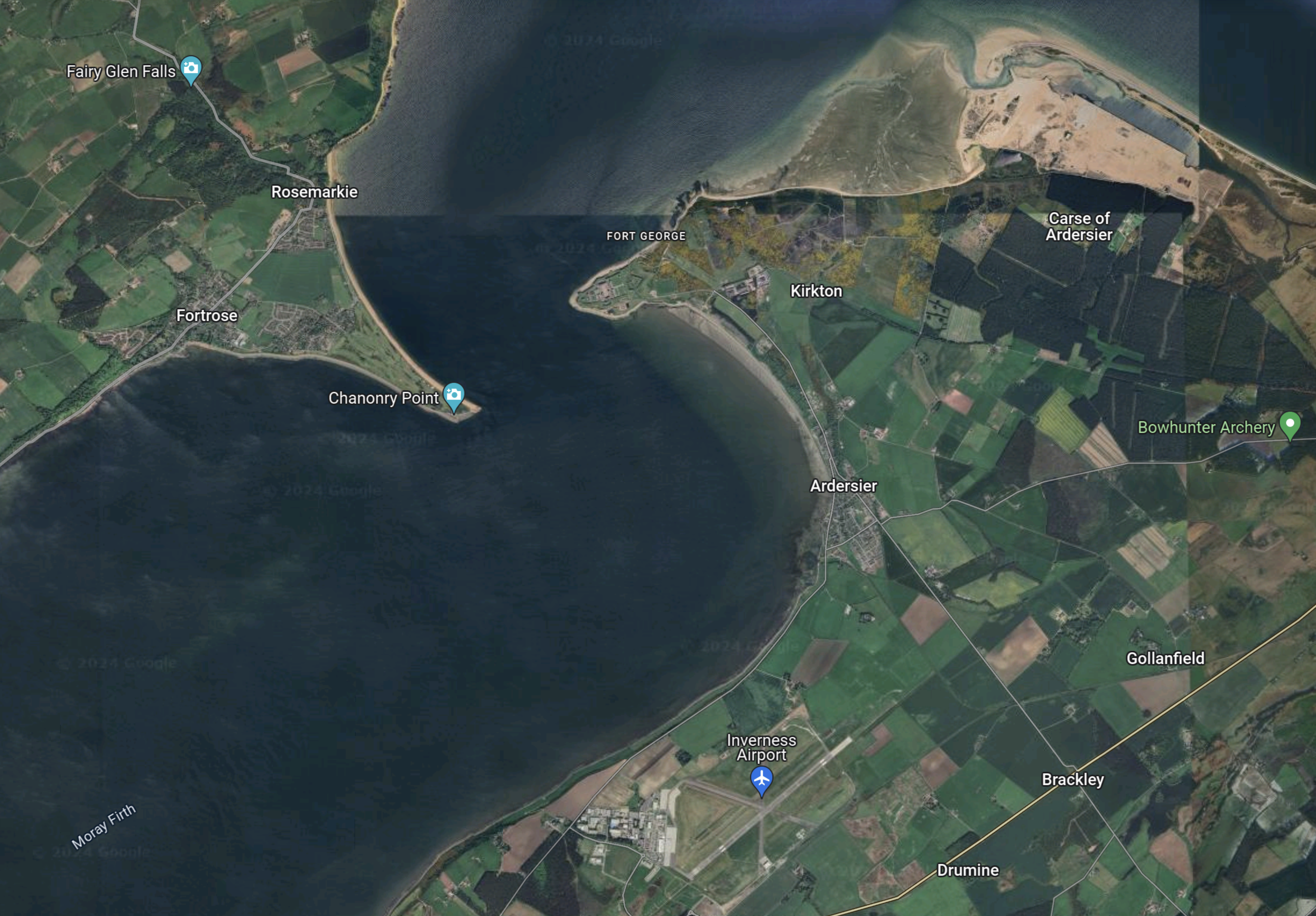
Note.
- The large expanse of water in the middle of the map is Moray Firth.
- The blue arrow at the bottom of the map indicates Inverness Airport.
- Inverness Airport, has a railway station on the Aberdeen and Inverness Line.
- The village of Ardersier is on the the Eastern bank of the Moray Firth
- The Port of Ardersier is in the North-East corner of the map.
The city of Inverness, with a population of around 48,000, is a few miles South-West of the South-West corner of the map.
Which Windfarms Will Be Built And Serviced From The Port Of Ardersier?
This map shows the various ScotWind leases, around the North of Scotland.

The numbers are Scotwind’s lease number in their documents.
These are the Scotwind wind farms to the North-East of Scotland, that could reasonably be assumed to be built and served from the Port of Ardersier.
- 7 – DEME Concessions Wind – 200 km² – 1.0 GW – Floating
- 8 – Falck Renewables Wind – 256 km² – 1.0 GW – Floating
- 9 – Ocean Winds – 429 km² – 1.0 GW – Fixed
- 10 – Falck Renewables Wind – 134 km² – 0.5 GW – Floating
- 11 – Scottish Power Renewables – 684 km² – 3.0 GW – Floating
- 12 – BayWa r.e. UK – 330 km² – 1.0 GW – Floating
These are the Scotwind wind farms to the North-West of Scotland, that could reasonably be assumed to be built and served from the Port of Ardersier.
- 13 – Offshore Wind Power – 657 km² – 2.0 GW – Fixed or Floating
- 14 – Northland Power – 390 km² – 1.5 GW – Floating
- 15 – Magnora – 103 km² – 0.5 GW – Floating
- 16 – Northland Power – 161 km² – 0.8 GW – Floating
These ten wind farms add up to 12.3 GW.
Transport
Consider.
- Obviously, heavy components will be brought in by sea, using the Ro/Ro capable berth or using a crane to unload a barge.
- Personnel will be able to fly in for the day.
- Will some visitors rom London use the Caledonian Sleeper to and from Inverness station to get a full day on site and a good night’s sleep, whilst travelling.
But I do see a problem with local traffic to and from the site.
Hydrogen Buses
This page on the Sizewell C web site, discusses how they will use hydrogen buses.
I could see the Port of Ardersier taking a leaf out of Sizewell C’s book and run hydrogen buses to Inverness, Inverness Airport and other nearby towns.
The North of Scotland certainly won’t be short of green hydrogen to power the buses.
Hydrogen
Conclusion
If you thought that the only useful wind-driven thing to come out of Scotland was bagpipes, you had better think again.
The Port of Ardersier will be the factory and operation and maintenance port for one of the largest offshore wind industries in the world.
Ørsted, Simply Blue, Subsea7 Submit Application For 100 MW Scottish Floating Wind Farm
The title of this post, is the same as that of this article on offshoreWIND.biz.
This is the sub-heading.
Ørsted, Simply Blue Group and Subsea7, through their joint venture partnership in Scotland, have submitted an offshore consent application for the proposed 100 MW Salamander floating offshore wind farm, one of the 13 projects selected in Scotland’s Innovation and Targeted Oil and Gas (INTOG) leasing round.
The article starts with a map that shows the location of the Salamander floating offshore wind farm and it shows how the sea is getting very crowded 35 kilometres off Peterhead.
This map shows the various ScotWind leases, around the North of Scotland.
The numbers are Scotwind’s lease number in their documents.
These are the Scotwind wind farms to the North-East of Scotland.
- 1 – BP Alternative Energy Investments – 859 km² – 2.9 GW – Fixed
- 2 – SSE Renewables – 859 km² – 2.6 GW – Floating
- 3 – Falck Renewables Wind – 280 km² – 1.2 GW – Floating
- 4 – Shell – 860 km² – 2.0 GW – Floating
- 5 – Vattenfall – 200 km² – 0.8 GW – Floating
- 6 – DEME – 187 km² – 1.0 GW – Fixed
- 9 – Ocean Winds – 429 km² – 1.0 GW – Fixed
- 10 – Falck Renewables Wind – 134 km² – 0.5 GW – Floating
- 11 – Scottish Power Renewables – 684 km² – 3.0 GW – Floating
- 12 – BayWa r.e. UK – 330 km² – 1.0 GW – Floating
Note.
- Salamander is located to the South of wind farms 10, 11 and 12 and to the North-West of wind farm 5.
- These windfarms total up to 16 GW.
- 4.9 GW are fixed foundation wind farms.
- 11.1 GW are floating wind farms.
These are my thoughts.
The Salamander Project
In the big scheme of things, the 100 MW Salamander wind farm, is rather a tiddler of a wind farm.
On the Salamander wind farm web site, a section gives the Project Goals.
- Our innovative pre-commercial stepping-stone concept will use novel floating foundations to (i) maximise Scottish content, (ii) enable the Scottish supply chain to gear up for the future floating offshore wind commercial opportunities in ScotWind and (iii) reduce the financial, environmental and technology risks of floating offshore wind.
- The Salamander project will contribute to the Scottish Government and UK Government net-zero targets. The project can contribute to the Scottish government’s target of 11 GW of installed offshore wind by 2030, as well as the UK government’s target of 5 GW of operational floating offshore wind by the same date.
- We are dedicated to developing a sustainable and transformative project, working with the oceans, and enabling communities to benefit from Project Salamander. Therefore, we commit to having a continuous and strong stakeholder and community engagement.
It appears to me, that the Salamander project will be a pathfinder for the 11.1 GW of floating wind farms to be built off Peterhead.
Bringing The Electricity South
National Grid are building four interconnectors between Eastern Scotland and Eastern England.
- Eastern Green Link 1 – Torness and Hawthorn Pit
- Eastern Green Link 2 – Peterhead and Drax
- Eastern Green Link 3 – Westfield and Lincolnshire
- Eastern Green Link 4 – Peterhead and Lincolnshire
Note.
- All interconnectors are 2 GW.
- All interconnectors are offshore for a long part of their route.
- It also appears that National Grid are burying much of the onshore sections.
But the 4 GW of interconnectors will only be able to bring a quarter of the offshore electricity generated in the Peterhead area to the South.
What Will Happen To The Excess Electricity?
Consider.
- There could be 16 GW of planned offshore wind power around Peterhead and North-East Scotland.
- There is only 4 GW of interconnector capacity between Peterhead and Eastern England.
- There is another 6.8 GW of electricity around North-West Scotland.
- There is 2.8 GW of electricity being developed to the East of Shetland.
- The Crown Estate is thinking of increasing the size of some offshore wind farms.
It is likely, that other wind farms will be built in the seas around the North of Scotland.
It appears that the North of Scotland could have at least 20 GW of excess electricity.
Possible solutions would include.
- Developing energy intensive industries like metal refining.
- More interconnectors to Denmark, England, Ireland and Norway.
- Storage of the electricity in giant pumped storage hydroelectric power stations.
- Creation of green hydrogen for export.
Note.
- Aluminium refining has been developed in the North of Scotland before.
- More interconnectors are a possibility, especially as Scotland is developing cable manufacturing capacity.
- Some maps show extra interconnectors between West Scotland and Merseyside.
- At least 70 GWh of pumped storage hydroelectric power stations are being developed along the Great Glen.
- I suspect that the pumped storage hydroelectric power stations could be connected to the wind farms, by cables under the waters of Loch Ness.
But surely, production of green hydrogen for export would be a very good way to go.
- Extra electrolysers could be added as required.
- Because of the interconnectors down both East and West Coasts, electrolysers could be built in England, where there is a large need for hydrogen.
- Hydrogen would be exported initially by tanker ships.
- At some point in the future, it might be viable to build a hydrogen pipeline to connect to the growing European hydrogen network.
The giant pumped storage hydroelectric power stations and the hydrogen electrolysers would be sized to make sure, that no wind power is never wasted.
Conclusion
The 100 MW Salamander floating wind farm may only be small, but it will prove the technology, the manufacturing and the supply chains, so that Scotland can have a second energy boom from the North Sea.
But this boom will certainly last longer than a hundred years.
Are Scotrail Going To Replace The Inter7City Trains With Hydrogen-Powered Trains?
This article in The Times is entitled The Caley Is Ready To Roll With New Venture Building Trains.
I feel that this is one of the most significant paragraphs in the article.
ScotRail has indicated that it wants to replace nearly two thirds of its fleet with new, low-carbon rolling stock between 2027 and 2035, comprising about 675 carriages in total, with an initial core order of 64 four and five-car units. A spokesman confirmed: “We are working on a business case that will go to the Scottish government for the procurement of a new suburban train fleet.”
The current Scotrail fleet includes.
- 25 Inter7City trains which comprise 52 Class 43 power cars and 120 Mark 3 carriages – Diesel – 120 cars – 1975
- 5 Class 153 trains – Diesel – 5 cars – 1987
- 42 Class 156 trains – Diesel – 84 cars – 1987
- 40 Class 158 trains – Diesel – 80 cars – 1987
- 30 Class 170 trains – Diesel – 90 cars – 1998
- 21 Class 318 trains – Electric – 63 cars – 1985
- 34 Class 320 trains – Electric – 66 cars – 1990
- 40 Class 334 trains – Electric – 120 cars – 1999
- 38 Class 380 trains – Electric – 140 cars – 2009
- 70 Class 385 trains – Electric – 234 cars – 2015
Note the last three fields are the traction type, total number of cars and the build year of the first train.
I will split these trains into four groups.
- Inter7City – Diesel – 25 trains – 120 cars
- BR Diesel – Diesel – 117 trains – 259 cars
- BR Electric – Electric – 55 trains – 129 cars
- Modern Electric – Electric – 148 trains – 494 cars
Note.
- This is a grand total of 345 trains and 1002 cars.
- Ignoring the modern electric trains and the total is 197 trains and 508 cars.
- The total for diesel trains is 142 trains and 359 cars.
- As Great Western Railway have withdrawn their similar GWR Castles, there must be reasons for Scotrail to do the same.
I will now look at replacement strategies, based on this statement from Scotrail.
ScotRail has indicated that it wants to replace nearly two thirds of its fleet with new, low-carbon rolling stock between 2027 and 2035, comprising about 675 carriages in total, with an initial core order of 64 four and five-car units.
I would expect 675 carriages would be about 232 trains, if the current average train length of just under three cars is carried over.
The Effect Of 675 New Carriages
Assuming that no modern electric trains were replaced, this would create a fleet size of at least 1169 carriages.
This would be a sixteen percent increase in carriages, which would be welcome news for some rail users.
The Initial Core Order Of 64 Four And Five-Car Units
All we know of this order, is the number of trains and that they will be new and low-carbon, according to indications from Scotrail.
Low-carbon would mean one of these traction options.
- Electric trains with full electrification.
- Battery-electric trains with partial-electrification.
- Hydrogen-powered trains.
Note.
- The heritage Taliban would object violently to full electrification of some historic routes.
- UNESCO would probably remove the World Heritable Site status to the Forth Bridge if it were to be electrified.
- Scotland is developing a hydrogen infrastructure.
- Hydrogen-powered trains have long ranges in the order of a thousand kilometres.
- Hydrogen-powered trains are essentially electric trains with a hydrogen fuel-cell to provide electricity as needed.
- Hydrogen-powered trains would need very little new infrastructure, except for a network of refuelling points across Scotland.
- Well-designed battery-electric and hydrogen-electric trains, should be very quiet and comfortable for passengers.
As an engineer, I would choose hydrogen-power for the initial core order.
Where would the initial core order be deployed?
Twenty-five would be used to replace the carbon-emitting elderly Inter7City trains.
These routes could probably handle the other forty.
- Aberdeen and Inverness
- Edinburgh/Glasgow and Aberdeen.
- Edinburgh/Glasgow and Inverness.
- Glasgow and South Western Line
- West Highland Line.
Note.
- A lot of diesel trains would be retired.
- Trains could be designed, for tourists with proper cycle spaces.
- The West Highland Line would get the five-car trains it needs.
This would be a good start.
Conclusion
It looks to me, that the Inter7City trains will be going and will be replaced by new trains.
But will Scotland take the great leap forward and power the new trains by Scottish hydrogen?
National Grid Shares Proposals For Green Electricity Projects In Lincolnshire And West Norfolk, Needed To Boost Home-Grown Energy Supplies And Progress Towards Net Zero
The title of this post, is the same as that of this press release from National Grid.
These four bullet points, act as sub-headings.
- National Grid is inviting communities in East Lindsey, Boston and South Holland in Lincolnshire, and King’s Lynn and West Norfolk, to view proposals for two new primarily offshore electricity infrastructure projects.
- National Grid will consult communities from 23 April – 17 June to introduce the proposed project and ask for local peoples’ opinions.
- Eastern Green Link 3 (EGL 3) and Eastern Green Link 4 (EGL 4) will be able to transport enough clean energy generated in Scotland to power up to four million homes in the Midlands and South of England.
- The projects form part of The Great Grid Upgrade, the largest overhaul of the grid in generations, with new infrastructure across England and Wales helping the UK to meet its net zero ambitions, reduce its reliance on fossil fuels and contribute to lower energy bills over the long-term.
These five paragraphs outline the two projects.
National Grid is inviting communities to comment on early proposals for two green electricity infrastructure projects which will help deliver the UK’s energy security strategy and net zero targets.
The eight-week initial consultation, which begins on 23 April, shares proposals for Eastern Green Link 3 (EGL 3) and Eastern Green Link 4 (EGL 4) projects – two new, primarily subsea high voltage direct current (HVDC) electricity links, with associated infrastructure, between Scotland and England.
National Grid Electricity Transmission (NGET) is jointly developing EGL 3 with SSEN Transmission (SSEN) and EGL 4 with SP Energy Networks (SPEN).
EGL 3 would run from Peterhead, Aberdeenshire, under the North Sea via marine cables to a potential landfall location on the Lincolnshire coastline, either at Theddlethorpe or Anderby Creek. EGL 4 would run from Westfield, Fife, also via marine cables under the North Sea to the same landfall location as EGL 3.
After making landfall, both projects’ cables will run underground for approximately 100km to two proposed converter stations in the Walpole, King’s Lynn and West Norfolk, area. Underground cables would then connect the converter stations to the transmission network via a new proposed substation, also within the Walpole area.
Note.
- These would appear to be early proposals.
- National Grid appear to be planning and consulting on two interconnectors at once.
- There would appear to be a lot of underground cable on land. But then the cables will be dug into good Fenland soil.
- All the electrical gubbins seem to be in the Walpole area.
These paragraphs invite people to comment.
Throughout our initial consultation, we are holding a series of face-to-face events to consult on the electrical infrastructure required in England.
Our consultation events are being held across the project area. Information about our proposals will be on display and copies of maps and technical documents will be available to view. Members of the project team will be available to talk through our proposals and answer any questions.
National Grid have also announced dates of when public information events are being held.
- Tuesday 30 April 2024 – 2pm-7pm – Dunes Complex, Central Promenade, Mablethorpe, LN12 1RG
- Wednesday 1 May 2024 – 2pm-7pm – Anderby Village Hall, Sea Road, Anderby, Skegness, PE24 5YD
- Thursday 9 May 2024 – 12:30pm – 6pm – Alford Corn Exchange, 9 Market Place, Alford, LN13 9EB
- Monday 13 May 2024 – 2pm-7pm – Leverington Village Hall, Gorefield Rd, Leverington, Wisbech, PE13 5AT
- Wednesday 15 May 2024 – 2pm-7pm – Eastville, Midville and New Leake Village Hall, Station Rd, Eastville, PE22 8LS
- Thursday 16 May 2024 – 2pm-7pm – Poachers Country Hotel, Swineshead Road, Kirton Holme, PE20 1SQ
- Monday 20 May 2024 – 2pm-7pm – Walpole Community Centre, Summer Close, Walpole St Andrew, PE14 7JW
- Wednesday 29 May 2024 – 2pm-7pm – The Holbeach Hub, Boston Rd South, Holbeach, PE12 7LR
- Wednesday 5 June 2024 – 2pm-7pm – Burgh le Marsh Village Hall, Jacksons Lane, Burgh le Marsh, Skegness, PE24 5LA
I would have hoped, that some of the venues would have been easier to get to by public transport.
I have some thoughts and observations.
What Will Be The Capacity Of Green Link 3 And Green Link 4?
I can find references to the capacity of Eastern Green Links 1-4 and it appears that all four have a capacity of 2 GW.
A Map Of Green Link 3 And Green Link 4
I have found this map of Green Link 3 and Green Link 4.

National Grid are going to be busy, as they’re also building Green Link 1 and Green Link 2.
Will Green Link 3 And Green Link 4 Share A Route Between The Coast And Walpole?
There is only one green HVDC onshore cable on the map. But surely laying two 2 GW cables in the same trench will cost less, than digging two cable routes.
Looking at the three converter stations would appear to confirm that Green Link 3 and Green Link 4 share a route.
Will Landfall Be At Theddlethorpe Or Anderby Creek?
This Google Map shows the coast between Theddlethorpe and Anderby Creek.
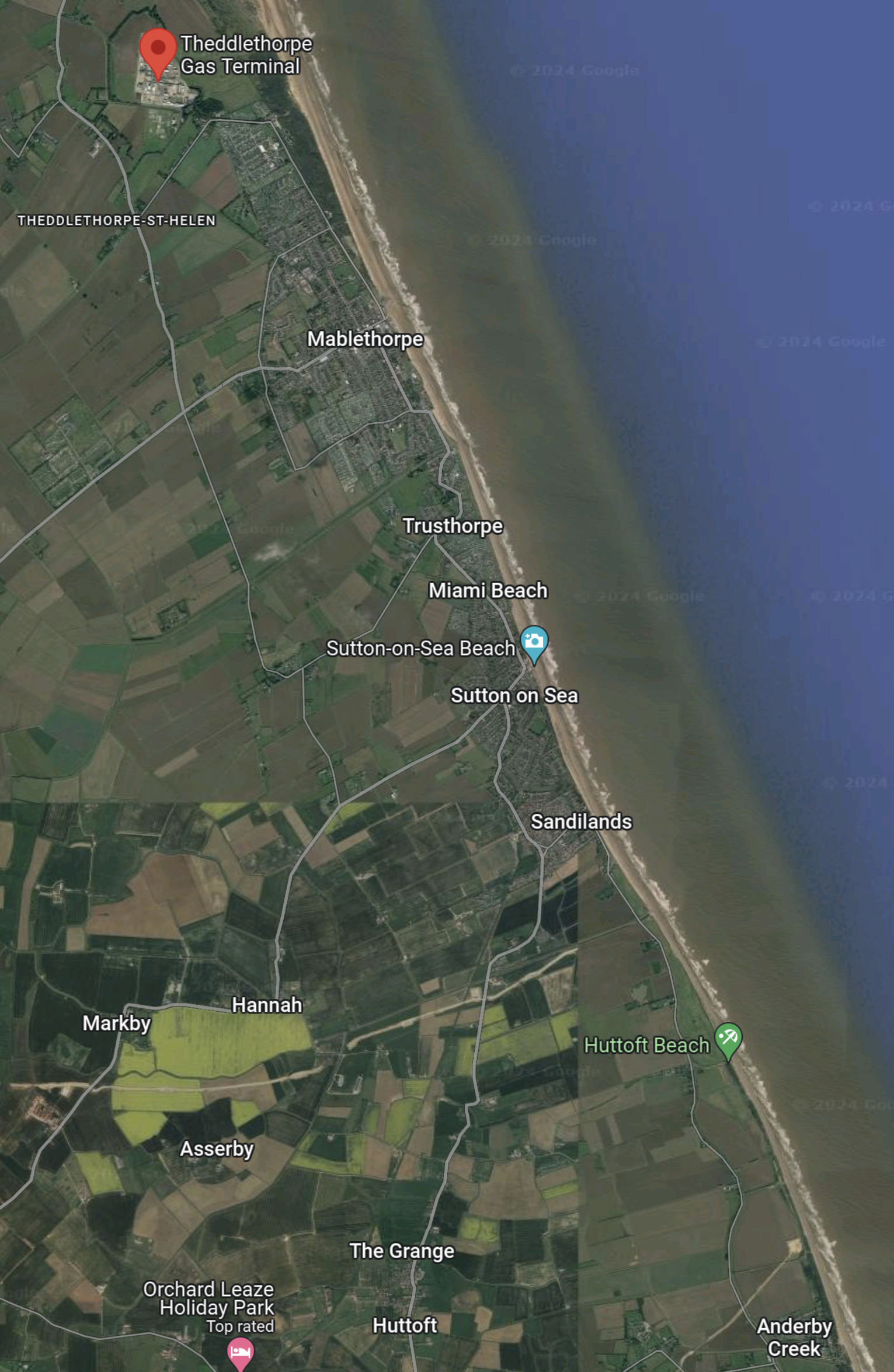
Note.
- The decommissioned Theddlethorpe gas terminal is indicated by the red arrow.
- The seaside resort of Mablethorpe lies between the two possible landing sites.
- Anderby Creek is in the South-East corner of the map.
This second Google Map shows the Theddlethorpe Gas Terminal and the North of Mablethorpe.
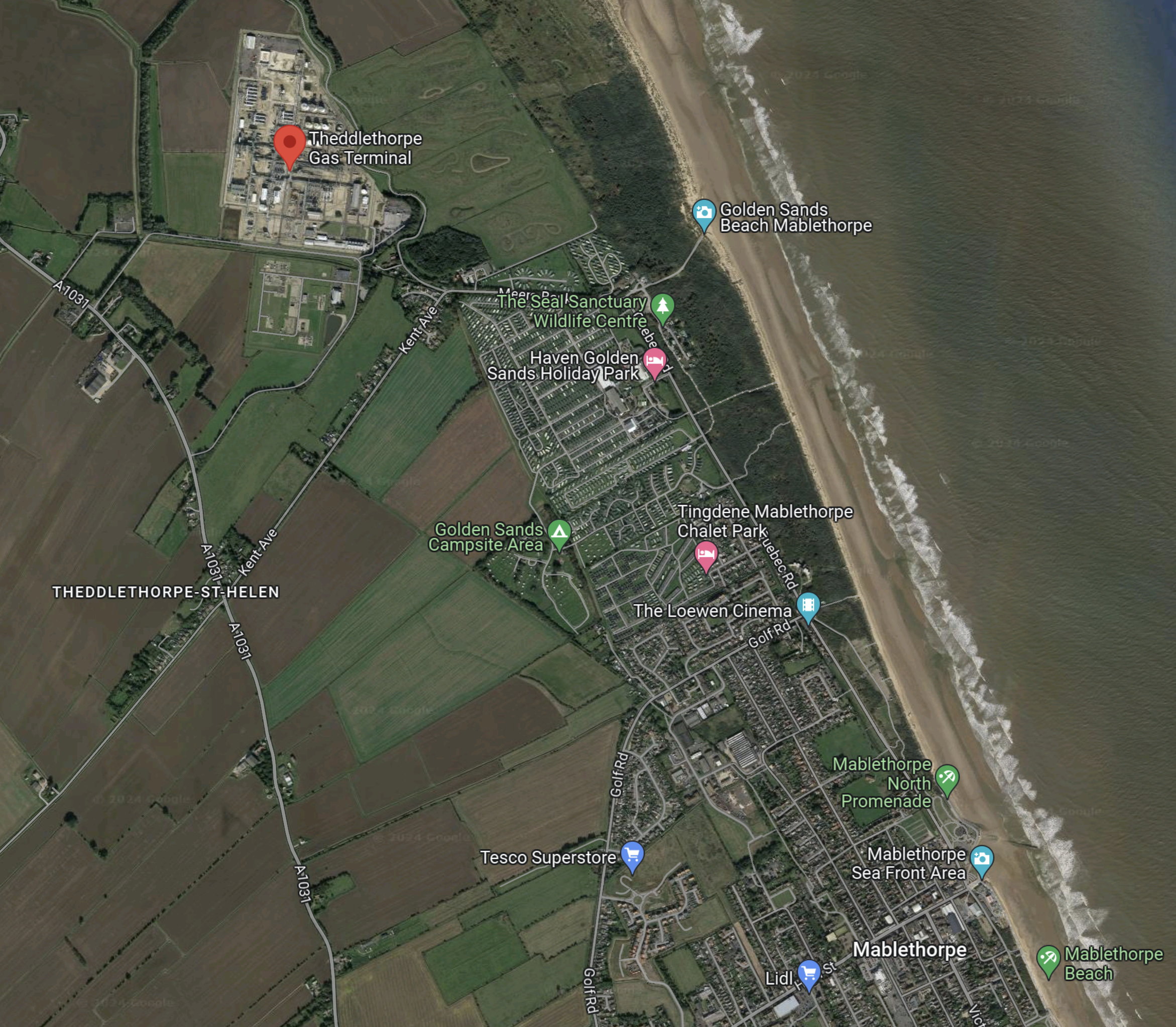
Note.
- The decommissioned Theddlethorpe gas terminal is indicated by the red arrow.
- Mablethorpe beach appears to be on a high quality.
Both sites would appear to be strong possibilities.
Both sites have plenty of space, but the Theddlethorpe gas terminal is a large brownfield site.
The Anderby Creek site would probably be a shorter underground cable across Lincolnshire.
The Triton Knoll Wind Farm
The Wikipedia entry for the Triton Knoll wind farm starts with these two paragraphs.
Triton Knoll Wind Farm is an 857 MW round 2 offshore wind farm 33 kilometres (21 mi) off the coast of Lincolnshire, in the North Sea, England.
RWE Npower Renewables were awarded the lease to the development area in 2003. The offshore elements of the wind farm of up to 1200MW power gained planning consent in 2013; RWE reduced the scope of the wind farm to 900MW or under in 2014, to reduce cost per MW.
Note.
- The wind farm was commissioned in January 2022.
- The wind farm cables make landfall at Anderby Creek.
- They then travel underground to Bicker Fen substation.
This Google Map shows Bicker Fen and Anderby Creek.
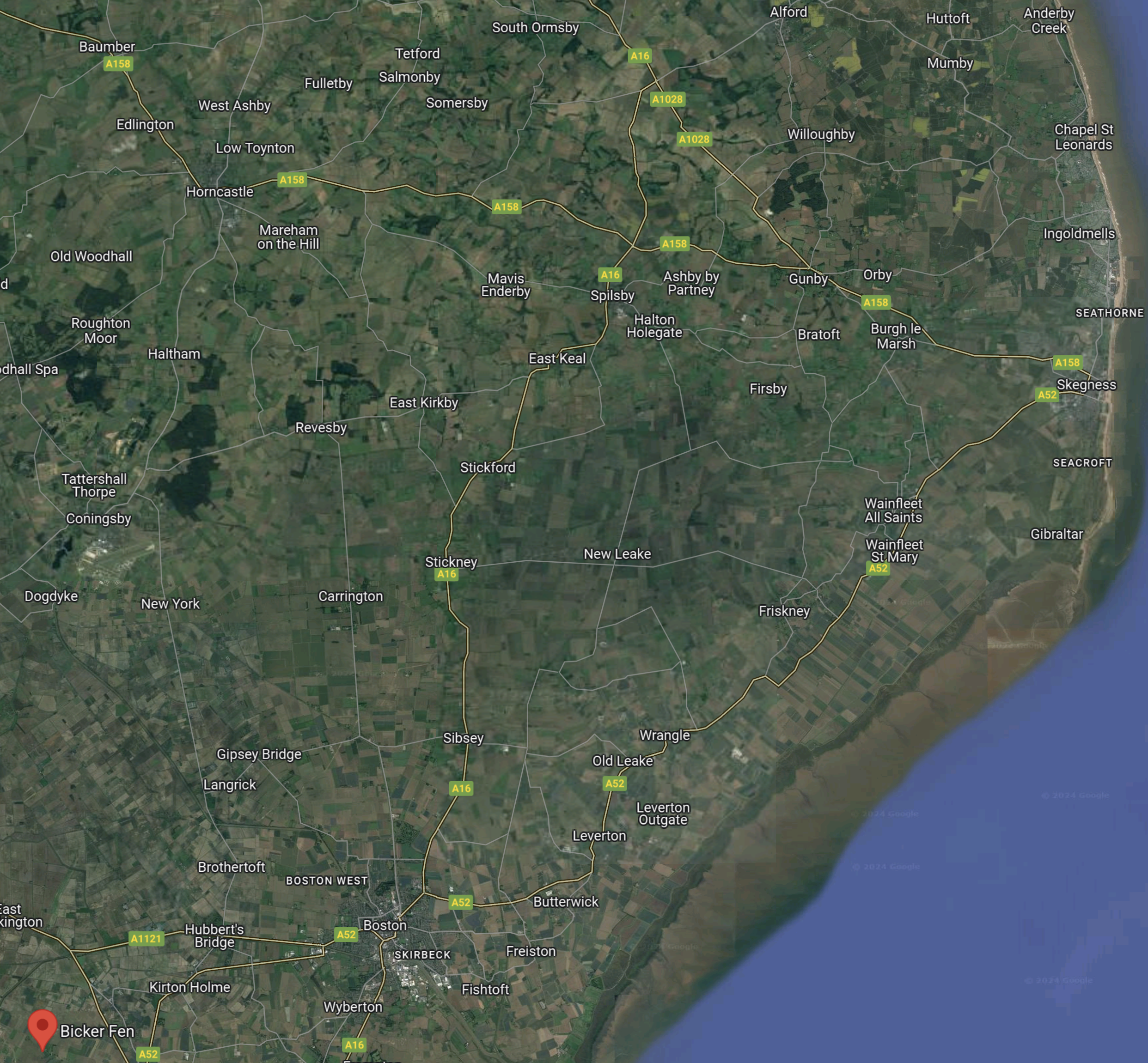
Note.
- Bicker Fen substation is in the South-West corner of the map and is indicated by a red arrow.
- Anderby Creek is in the North-East corner of the map.
- The cable is underground.
- This page on the Murphy Group website, describes the work the company did to install the cables.
- It appears from the Murphy document, that there are six cables between Anderby Creek and Bicker Fen.
This Google Map shows Anderby Creek.
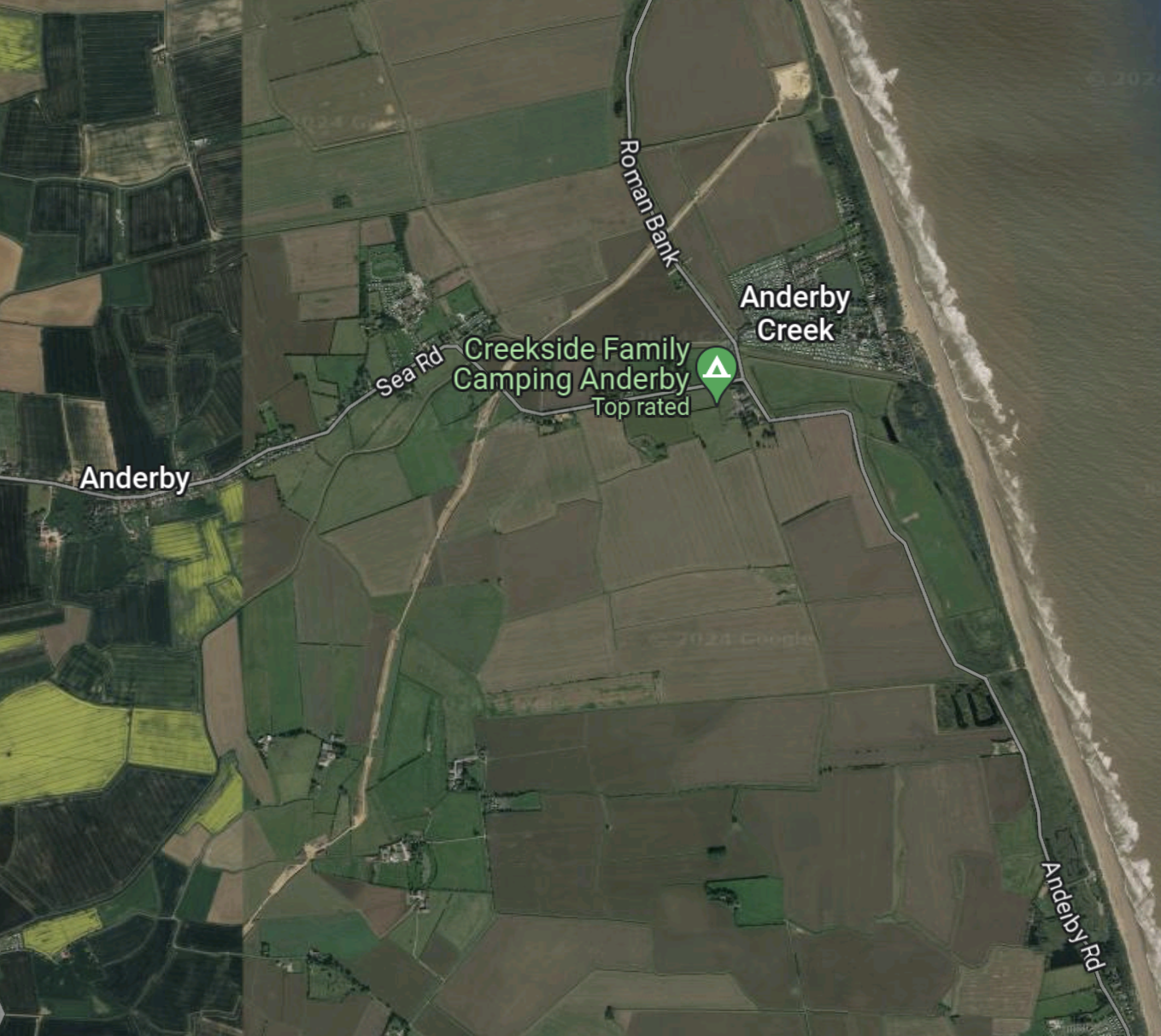
Could the scar across the land to the West of Anderby Creek, be the connection to the offshore Triton Knoll wind farm?
I think it is! And I also think that it can carry more than just the 857 MW Triton Knoll wind farm!
I am suspicious, that one of Baldrick’s ancestors has been at work and the Triton Knoll export cable system could be used to connect Green Link 3 and Green Link 4 to Bicker Fen and Walpole substations.
This would surely allow Scottish wind power to be sold to Denmark and then sold onward to Germany.
The VikingCCS Project
The VikingCCS project is a carbon capture and storage project, that is proposed to be based at the decommissioned Theddlethorpe gas terminal.
The VikingCCS project has a web site.
Would the use of the Theddlethorpe gas terminal mean that it is more likely that Green Link 3 and Green Link 4 will make a Southern landfall at Anderby Creek?
Will There Be A Connection To Viking Link?
The Viking Link is a 1400 MW at 525 KV electricity interconnector between Bicker Fen in Lincolnshire and Revsing in Jutland, Denmark.
This Google Map, shows the location of Bicker Fen, about halfway between Boston and Sleaford.

This second map shows the position of the current Walpole substation with respect to the Wash.
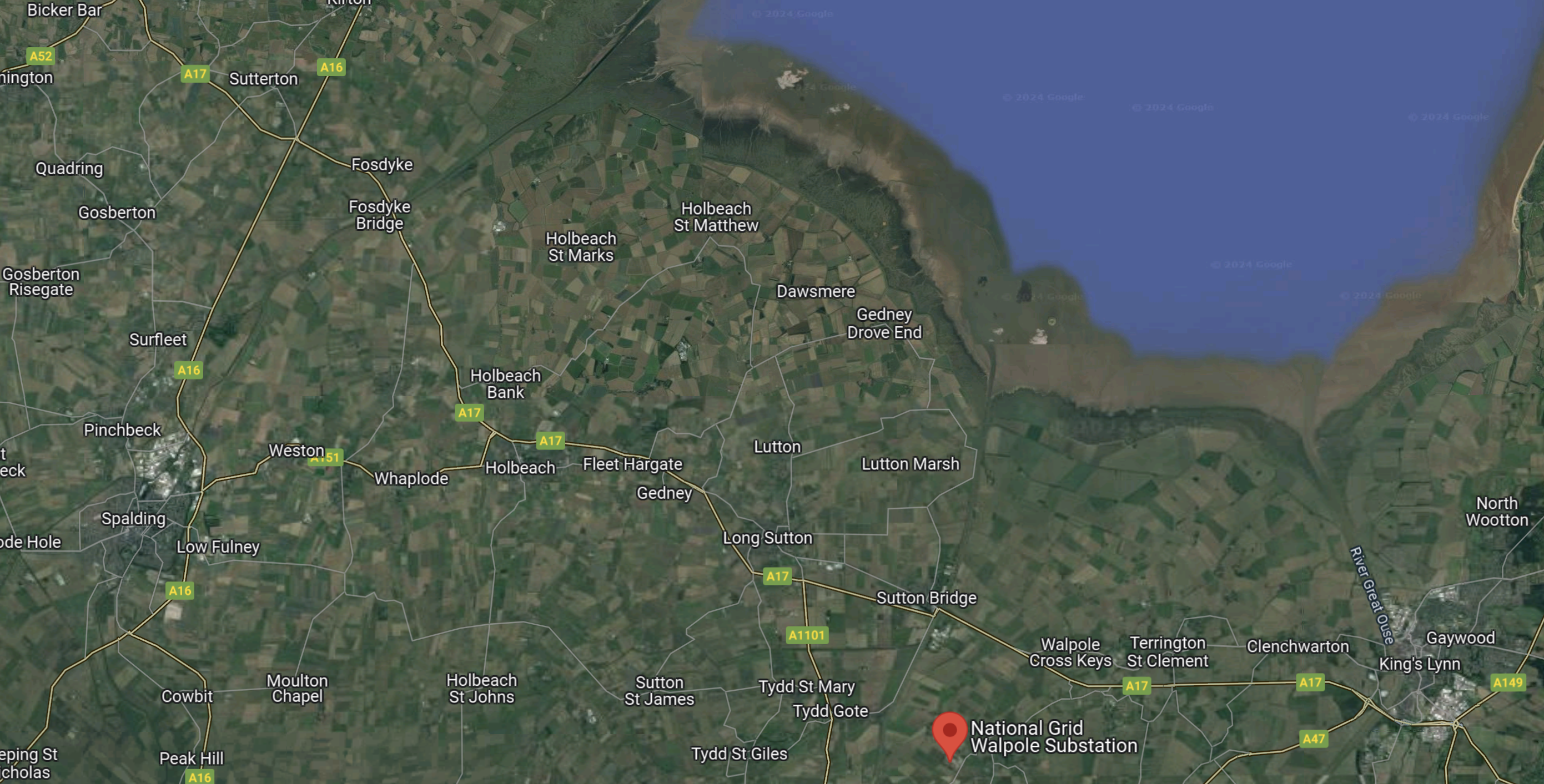
Note.
- Bicker Fen is in the North-West corner of the map.
- The current Walpole substation is marked by the red arrow.
- King’s Lynn is in the South-East corner of the map.
I suspect, if National Grid wanted to connect Green Link 3 and Green Link 4 to the Viking Link, then this would be possible.
If the Viking Link were to be connected to Green Link 3 and Green Link 4, this would allow surplus Scottish renewable energy to be sent to Denmark and on to Germany.
Green Link 3, Green Link 4 And Viking Link Appear To Be Underground In Lincolnshire
I can’t find any trace of overhead cables for the Viking Line in Lincolnshire and the press release says this about Green Link 3 and Green Link 4.
After making landfall, both projects’ cables will run underground for approximately 100km to two proposed converter stations in the Walpole, King’s Lynn and West Norfolk, area.
The connection to the Triton Knoll wuind farm is also underground.
It does appear that National Grid, are going for a Nimby-friendly approach for cables between Walpole and the coast.
Hopefully putting the cables underground will save money in legal arguments and fees.
BW Ideol And Holcim To Explore Use of Low-Carbon Concrete In Floating Offshore Wind
The title of this post, is the same as that of this article on offshoreWIND.biz.
This is the sub-heading.
BW Ideol and Holcim have signed a Memorandum of Understanding (MoU) for a feasibility study on supplying beneficial low-carbon concrete for the floating offshore wind industry, with particular reference to Scotland.
These are the first three paragraphs.
BW Ideol and Holcim aim to collaborate on optimising the supply of the innovative concrete needed for the intended mass production of BW Ideol’s floaters in the Port of Ardersier.
Low-carbon concrete’s advantages as a building material for offshore wind farms include its durability in marine environments, its local availability and its comparatively lower carbon emissions, the companies said.
The collaboration includes developing specific durable maritime low-carbon concrete mixes with enhanced mechanical performance perfectly suited to slipform application.
This is surely a good development.
Coire Glas Exploratory Tunnel 70% Complete
The title of this post, is the same as that of this article in Ground Engineering.
This is the sub-heading.
A tunnel to investigate ground conditions at SSE Renewables’ Coire Glas project to build a pumped hydro scheme in the Scottish Highlands is 70% complete, as wider ground investigations come to an end.
These are the first three paragraphs.
Coire Glas on the shores of Loch Lochy in Great Glen is the first large scale pumped hydro storage scheme to be developed in the UK for more than 40 years.
It would take excess energy from the grid and use it to pump water 500m up a hill from Loch Lochy to a vast reservoir where it would be stored. This will be done through a tailrace tunnel, underground cavern power station, high pressure tunnel and low-pressure headrace tunnel.
SSE Renewables has started exploratory works on the scheme. This has involved building an up to 1km long and 4m wide tunnel to investigate the ground conditions in which the powerhouse will be built.
All the information gathered will be used in the detailed design of the 1,5GW/30 GWh pumped storage system, which is expected to be a £1.5 billion capital investment.
The Wikipedia entry for Coire Glas power station, says this about the current status and completion.
In December 2023, the exploratory tunnel had reached 720m in length.
A final investment decision will depend on UK government assurances about how the regulated electricity market would reward storage schemes. SSE hope to make that £1.5Bn decision in 2024, in which case the scheme could be completed in 2031.
I suspect that as this is one of the largest green energy projects in the UK, that there’ll be a lot of media coverage of the construction of this power station.
Bidders Circle ‘Elvis Airport’ A Decade After The SNP Bought It For £1
The title of this post, is the same as that of this article in The Times.
This is the sub-heading.
Prestwick has cost taxpayers millions since it was nationalised by the SNP in 2013. A consortium plans a bid, but can the Nats let go of Sturgeon-era stateism?
These are the first two paragraphs.
It was always going to be difficult keeping a lid on the arrival of Elvis Presley at a US military base in Prestwick, Ayrshire. “Where am I?” he asked as he stepped off the plane and into the biting wind that whipped off the Firth of Clyde.
March 3, 1960 was a momentous day for the screaming youngsters who engulfed the American singer as he set foot on British soil for the first and only time. For Presley, it was his last stop on his return from Germany after two years of military service. For Prestwick, it meant being immortalised in British trivia for its brief flirtation with The King.
But now it appears that a consortium has a plan for the airport and has made a bid.
These are my thoughts.
Prestwick Airport
Prestwick Airport, which is 32 miles SouthWest of Glasgow, is an airport that has seen busier times.
This OpenRailwayMap shows the Airport.

Note.
- The airport has two runways at right angles.
- The longer runway is 3,000 metres long.
- The red line is the electrified Ayrshire Coast Line, which runs between Glasgow Central and Ayr.
- There is a station at the airport.
- The black line going across the map is an unelectrified railway line, which eventually leads to the West Coast Main Line.
The airport does have four very useful assets.
- A very long runway capable of handling the largest and heaviest aircraft.
- A railway station.
- Plenty of space.
- The airport has plenty of available landing and take-off slots.
I also suspect that a rail connection could be developed to the West Coast Main Line.
Prestwick As A Cargo Airport
Someone commenting in The Times, suggested that Prestwick could become a cargo airport.
- The main runway could accommodate the largest and heaviest cargo aircraft.
- There is space for stands for large aircraft and warehouses.
- A rail link to the electrified West Coast Main Line could be built.
The airport could have a very high capacity.
A Rail Connection To The West Coast Main Line
This could be very beneficial for air-cargo at Prestwick.
- It would be less than ninety miles to the West Coast Main Line.
- It is only single-track as British Rail removed the second track.
- Cargo Services could be run all over the UK mainland.
- There could even be an airport service from Carlisle.
A zero-carbon rail service for freight, passengers and staff from both Glasgow and Carlisle would enhance the green credentials of the airport.
Where Would Planes Fly?
It looks like a modern freighter aircraft like a Boeing 747-8F could fly at maximum weight to nearly all the USA.
But because Prestwick Airport is further North, It does possibly have a wider range of airports, it can reach.
What Is The Closest Airport In North America?
The two airports on Newfoundland; Gander and St. John’s are probably the two closest being about 2,000 miles from Prestwick.
- Both airports have long runways.
- I suspect a rail terminal could be arranged at the airport to take cargo through the Chunnel to Europe.
- Could USAF Galaxies even be used to bring over American tanks and guns for Ukraine? The range of a Galaxy at maximum weight is 2,600 miles.
- They could be delivered by rail to Ukraine.
I suspect there will be times, where the shorter routes could be useful.
Could Cargo Change Planes At Prestwick?
On some routes like perhaps New York and India, might it be more efficient to change planes at Prestwick.
Could Cargo Planes Refuel At Prestwick?
Planes can only fly so far and is Prestwick in the right place to refuel a long flight?
Prestwick Could Be A Viable Cargo Airport For North America?
I am convinced that Prestwick and North American could be a viable air cargo route.
Zero-Carbon Air Cargo
In the next few years, Scotland will have much more electricity, than it needs, due to all the wind farms in the seas around the country and much of the spare electricity could be converted into hydrogen.
So does a cargo operator plan to run zero-carbon aircraft powered by hydrogen between North America and Prestwick?
- Remember it’s only 2,000 miles between St. John’s or Gander and Prestwick.
- The ideal aircraft to convert to hydrogen, must surely be an Airbus A 380, as there’s a lot of space in the fuselage for a hydrogen tank.
- Cargo could be brought to Prestwick in zero-carbon trains from all over the UK.
Amazon might like the idea of zero-carbon parcels across the pond!
Could An Airbus A380 Be Converted To Hydrogen?
This article on Simple Flying is entitled Airbus Plans A380 Hydrogen Flights In 2026 After Successful Power On Of ZEROe Engine.
The header picture shows a visualisation of an Airbus A 380, with a fifth engine with a propeller mounted on the top of the fuselage. The A 380 will be testing this electric engine, so that it can be fitted in the ZEROe Turboprop sometime around 2030.
This is a visualisation of the ZEROe Turboprop.

Note,
- The hydrogen tank will probably be behind the passenger compartment.
- The A 380, that will be testing the engine is no ordinary A 380. It is the very first and Airbus use it as a flying laboratory for new technology.
- I wouldn’t bet against one of its next jobs, is to test turbofan engines running on hydrogen.
I wouldn’t be surprised that in a few years, Airbus demonstrate an A 380 flying between Europe and North America on hydrogen.
A Zero-Carbon Air Bridge Between Europe And North America
Or does Westjet fancy a zero-carbon shuttle service, which would appeal to the Gretas of this world?
It has been rumoured, that the possible buyers of Prestwick are linked to Westjet.
As soon, as someone announces, a flight like this across the Atlantic, I’ll be signing up!
If the worse should happen, which I think would be unlikely, it would surely be a less painful death, than that of my wife’s from a rare cancer.
Conclusion
There are certainly, possibilities at Prestwick.
ORR: Open Access Services Given Green Light Between London And Stirling
The title of this post is the same as that of this press release from the Office of Rail and Road.
This is the sub-heading.
The latest access decision by the Office of Rail and Road (ORR) provides more services for rail passengers travelling between London and central Scotland.
These five paragraphs detail the ORR’s decision.
ORR has today (7 March) given the go-ahead for Grand Union Trains, an open access operator, to start a new train service between London and the city of Stirling, from June 2025. ORR’s decision will offer more choice to passengers, bring private sector investment to the railway and increase competition.
Grand Union Trains will introduce four new return services per day between London Euston and Stirling stations. These services will also call at Milton Keynes Central, Nuneaton, Crewe (subject to agreement between Grand Union Trains and Network Rail), Preston, Carlisle, Lockerbie, Motherwell, Whifflet, Greenfaulds and Larbert. Larbert, Greenfaulds and Whifflet will receive their first direct services to London.
ORR found that the proposed services would increase choice for passengers, significantly increasing direct journey opportunities to and from London and central and southern Scotland, while making use of existing capacity on the network.
The new services will be the first run by an open access operator on the West Coast Mainline. Open access operators run services independently of government funding as they do not have a franchise agreement with government.
Following ORR’s decision to approve new Grand Union Trains services between Carmarthen in south Wales and London Paddington in 2022, ORR has now approved open access services on three of Britain’s major routes.
Note.
- The Grand Union service appears to be running into London Euston. Earlier plans had it terminating at Queen’s Park station.
- Larbert, Greenfaulds and Whifflet will receive their first direct services to London.
- London Euston and Stirling is electrified all the way.
- The third open access service, that the ORR has approved is the Lumo service between King’s Cross and Edinburgh via the East Coast Main Line.
I have a few thoughts.
Stirling Is An Ideal Place To Explore Central Scotland By Train
In Stirling, I give the reasons, why I spent a couple of days in Stirling, when I wanted to visit several places in Central Scotland.
Note.
- Stirling has direct services to Aberdeen, Dundee, Edinburgh, Glasgow, Inverness and Perth.
- Aberdeen is one hour and 15 minutes away.
- Dundee is just 63 minutes away.
- Edinburgh is just 48 minutes away.
- Glasgow is just 39 minutes away.
- Inverness is two hours and 46 minutes away.
Stirling has about a dozen affordable hotels and guest houses within walking distance of the station, as this map shows.
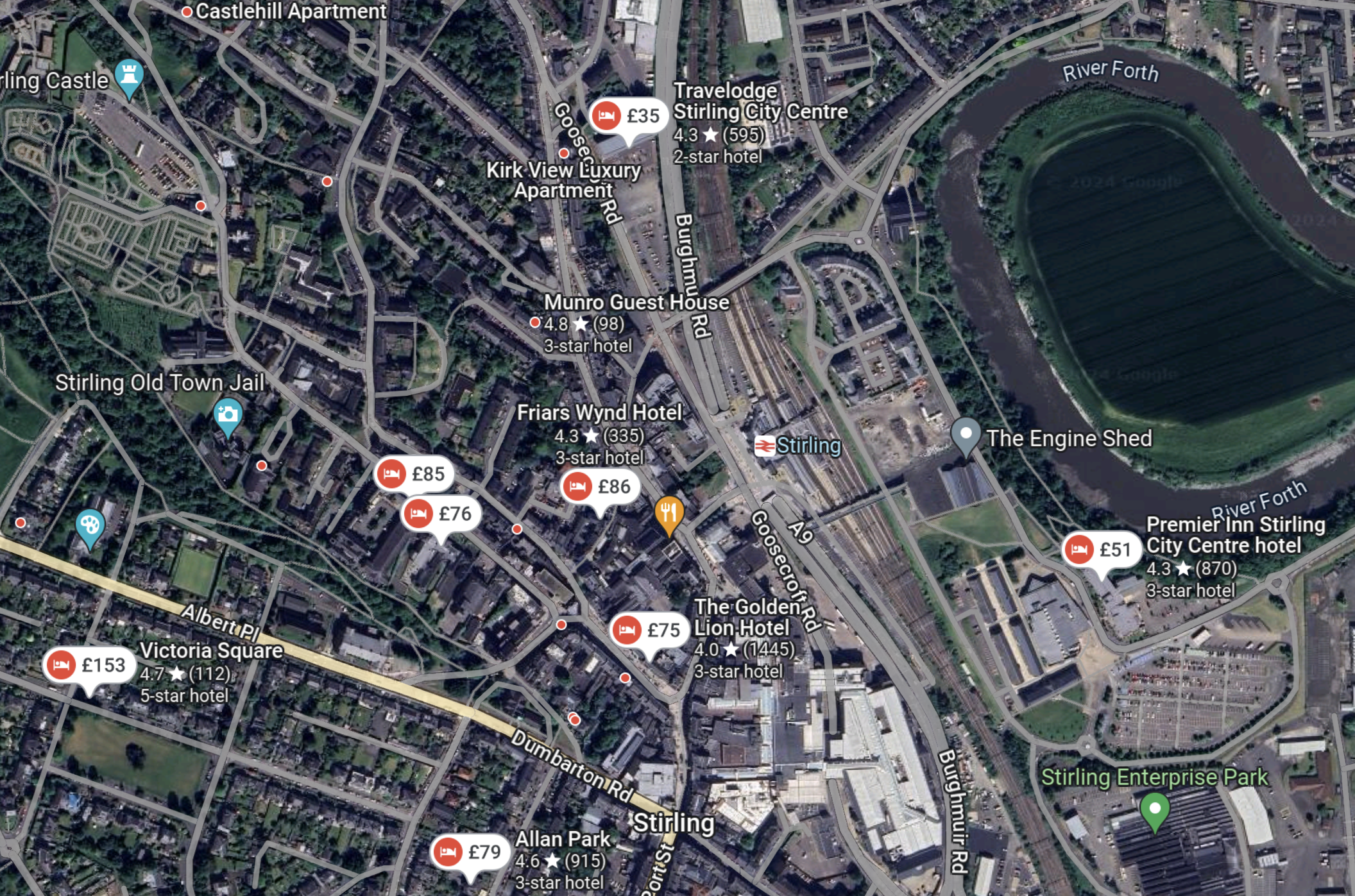
Stirling would appear to have got Central Scotland covered.
Could The Train Serve Gleneagles?
Gleneagles is about twenty minutes North of Stirling and is served by the Caledonian Sleeper from London.
This Google Map shows the area around Gleneagles station.
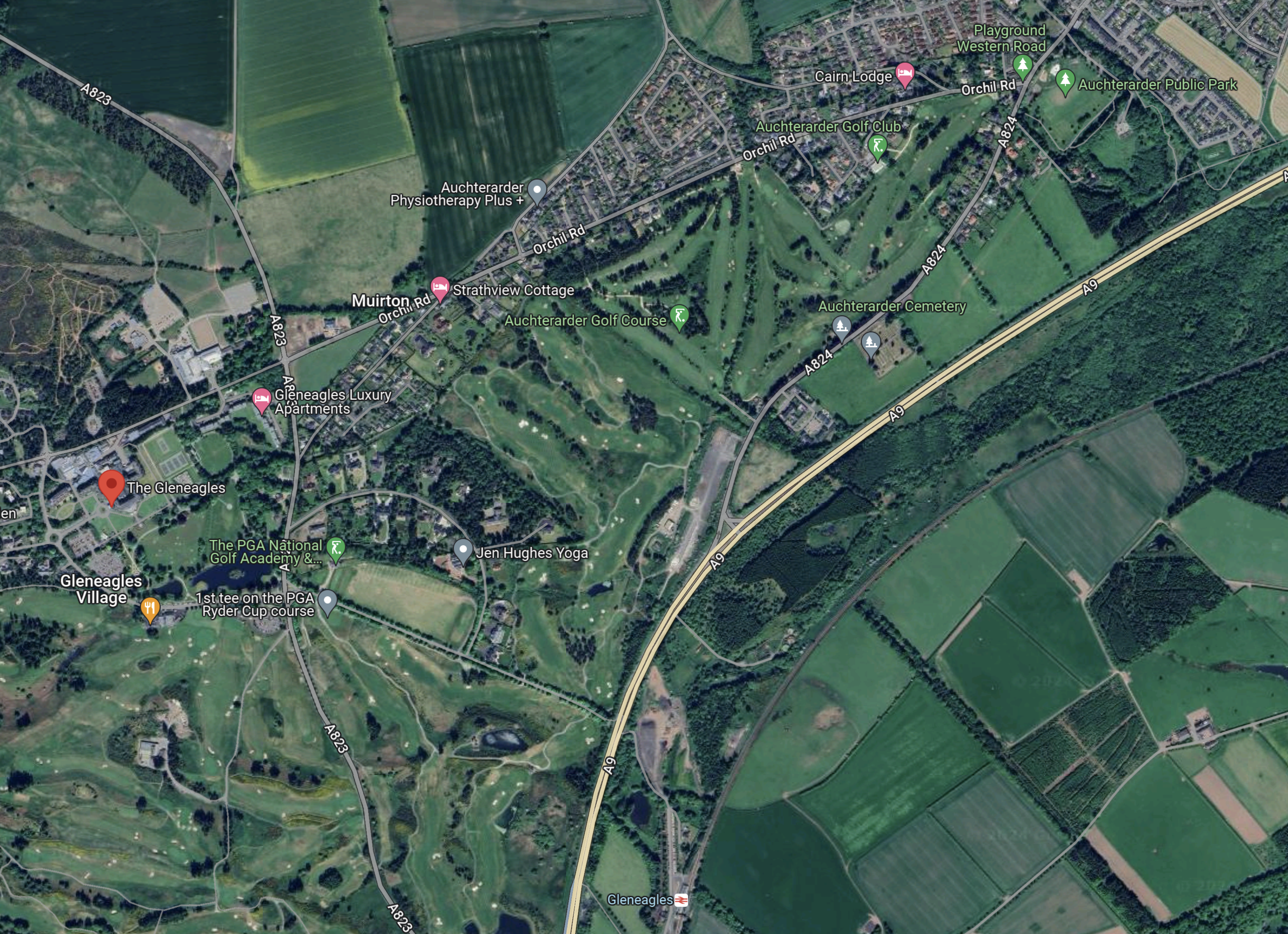
Note.
- Gleneagles station is at the bottom of the map.
- The red arrow indicates the famous Gleneagles hotel.
- The pink dots are other hotels.
- Airbnb lists several very splendid properties in the varea.
Not everybody, who goes to the Gleneagles area will be exceedingly rich and I could see the Gleneagles area generating substantial business for Grand Union Trains. I suspect the best way to serve Gleneagles would be a zero-emission coach from Stirling.
Along The Motherwell And Cumbernauld Line
Between Motherwell and Stirling, a lot of the route used is on the Motherwell and Cumbernauld Line.
- The line is fully-electrified.
- It is only 28.9 miles between Motherwell and Stirling.
- \cumbernaukd and Motherwell takes 20 minutes.
I do wonder, if extra stops might be worthwhile.
Motherwell Has Good Connections To Edinburgh And Glasgow
As well as Stirling, Motherwell has good connections to both Edinburgh and Glasgow, so some passengers might find their most convenient route involves a change at Motherwell.
Nuneaton And Scotland Would Get A New Service
Nuneaton has been named by Avanti West Coast, as a place that needs more trains, as it connects with the service between Birmingham and Stansted Airport, via Coleshill Parkway, Leicester, Peterborough, March, Ely and Cambridge.
I suspect that, Nuneaton will become an interchange, between East Anglia and, the North West and West Scotland.
Milton Keynes And Scotland Should Get An Improved Service
Consider.
- It appears that all Avanti West Coast services between Milton Keynes and Scotland, go via Birmingham.
- I suspect that Grand Union’s route using the Trent Valley Line could be faster with similar trains.
- Creating a new route between Milton Keynes and Stirling could be a good move, as it gives one-change access to much of Central Scotland.
- Milton Keynes has good local connections to places like Northampton, Rugby, Tring and Watford Junction.
- Milton Keynes will be a stop on the new East-West Railway.
- From many stations, it will be quicker to go via Milton Keynes rather than Euston.
I suspect Milton Keynes could be a nice little earner.
Will Grand Union’s Trains Be Fitted With Digital Signalling?
Consider.
- At some point in the next ten years the West Coast Main Line will be fitted with digital signalling, to enable trains to run at 140 mph on selected parts of the route.
- Digital signalling will allow extra services between London Euston and Motherwell.
- Motherwell and London Euston is 388 miles.
I suspect, that Grand Union’s Trains will need to be fitted with digital signalling, so they can save time on services and possibly add in a few more.
It will add costs, although the faster speed will surely attract passengers.
Will Grand Union’s Trains Be Electric?
There are these train services going between England and Scotland.
- Avanti West Coast – London Euston to Edinburgh Waverley via Birmingham New Street – 7 tpd – Class 390 – Electric
- Avanti West Coast – London Euston to Glasgow Central via Birmingham New Street – 5 tpd – Class 390 – Electric
- Avanti West Coast – London Euston to Glasgow Central via Trent Valley – 1 tph – Class 390 – Electric
- CrossCountry – Plymouth to Edinburgh Waverley – 1 tph – Class 220/221 – Diesel – Uses diesel all the time
- LNER – London King’s Cross/Leeds to Aberdeen – 4 tpd – Class 800 – Bi-mode – Uses diesel North of Edinburgh
- LNER – London King’s Cross to Inverness – 1 tpd – Class 800 – Bi-mode – Uses diesel North of Stirling
- LNER – London King’s Cross to Edinburgh Waverley – 3p2h – Class 800 – Bi-mode or Class 801 – Electric
- LNER – London King’s Cross to Glasgow Central – 1 tpd – Class 801 – Electric
- LNER – London King’s Cross to Stirling – 1 tpd – Class 801 – Electric
- Lumo – London King’s Cross to Edinburgh – 5 tpd – Class 803 – Electric
- TransPennine Express – Newcastle to Edinburgh Waverley – 7 tpd – Class 802 – Bi-mode
- TransPennine Express – Liverpool Lime Street to Glasgow Central – 2 tpd – Class 397 – Electric
- TransPennine Express – Manchester Airport to Edinburgh Waverly – 1 tp2h – Class 397 – Electric
- TransPennine Express – Manchester Airport to Glasgow Central – 1 tp2h – Class 397 – Electric
Note.
- tpd is trains per day.
- tph is trains per hour.
- tp2h is trains per two hours.
- LNER services to Glasgow and Stirling are likely to be dropped.
- Some Lumo services are likely to be extended from Edinburgh to Glasgow.
- Many services South from Stirling to Edinburgh Waverley and Glasgow Queen Street are electric.
The current two tpd direct trains to Stirling are electric and if you change at Edinburgh Waverley or Glasgow, it is likely to be an all-electric service.
For marketing reasons, I would recommend, that Grand Union Trains ran electric trains between London Euston and Stirling, as they are competing against an all-electric service.
Although to meet service dates it might be necessary to run something like a diesel Class 222 train to get the service started.
What Trains Will Grand Union Use?
The Wikipedia entry for Grand Union Trains, says this for their London Euston and Stirling service.
In 2023 Grand Union revised its proposal changing its planned rolling stock to Class 22x units, at the same time the start date for this service was changed to June 2025.
I would suspect they will put in the order for new electric trains fairly sharpish.
The new trains could be.
- A variant of Hitachi’s Class 800 trains.
- A variant of CAF’s Class 397 trains.
Would they have an emergency battery un case of overhead line failure?
How Long Will A Service Take?
The service can be divided into two sections.
- London Euston and Motherwell – 388 miles.
- Motherwell and Stirling – 28.9 miles.
Note.
- The 08:30 train from Euston to Motherwell takes 4 hours and 17 minutes with six stops via Nuneaton.
- The Grand Union Trains service will also have six stops and go via Nuneaton.
I would expect with today’s signalling and electric trains, that Euston and Motherwell would take a maximum of 4 hours and 17 minutes.
- The twenty minute time to Cumbernauld could be added.
- The twenty-five minute time between Cumbernauld and Stirling could be added.
It looks the time would be just over five hours.
I doubt there would be much scope for increasing speed North of Motherwell, but could there be savings made to the South of Motherwell?
Consider.
- London Euston and Motherwell is 388 miles.
- Four hours and 17 minutes is 257 minutes.
- Motherwell is on the main London Euston and Glasgow Central route.
This is an average speed between London Euston and Motherwell of 90.6 mph.
By comparison.
- London King’s Cross and Edinburgh is 392.6 miles.
- Journeys can take four hours and 20 minutes or 260 minutes.
This is an average speed between London King’s Cross and Edinburgh of 90.6 mph.
In the next decade, there will be improvements on both the East and West Coast Main Lines.
- King’s Cross and Edinburgh is currently being digitally signalled.
- London Euston and Glasgow Central is likely to be an early priority for digital signalling after London King’s Cross and Edinburgh is completed.
- When High Speed Two opens to Birmingham and Lichfield, High Speed Two trains between London Euston and Glasgow Central will use the West Coast Main Line to the North of Lichfield.
- I wouldn’t be surprised to see some track realignment and modifications to improve speeds on the West Coast Main Line to the North of Lichfield.
I can build a table of times between London Euston and Motherwell against average speed.
- 90 mph – 4 hours 19 minutes
- 100 mph – 3 hours 53 minutes
- 110 mph – 3 hours 32 minutes
- 120 mph – 3 hours 14 minutes
- 125 mph – 3 hours 6 minutes
- 130 mph – 2 hours 59 minutes
Note.
- Adding 15 minutes gives a London Euston and Glasgow Central time.
- Adding 45 minutes gives a London Euston and Stirling time.
- Averaging 120 mph would give London Euston and Glasgow Central or Stirling times of under four hours.
It strikes me, that to improve Anglo-Scottish relations and to make rail a better alternative to flying, a priority for all West Coast services is to improve the West Coast Main Line and install digital signalling, so that a 120 mph average is possible between London Euston and Motherwell.
What Difference Will High Speed Two Make?
High Speed Two is claiming it will knock thirty minutes off times between London Euston and Glasgow Central, when it opens to Birmingham and Lichfield.
But Grand Union Trains are not expected to use the new line between London Euston and Lichfield, as High Speed Two will, as it will make calling at Milton Keynes and Nuneaton impossible, as they are bypassed by High Speed Two.
Conclusion
This train service is going to be good for Milton Keynes, Nuneaton and Stirling and all the towns in Central Scotland.
But they must make full use of the available electrification.
UK Onshore Wind Capacity Hits 15GW
The title of this post, is the same as that of this article on reNEWS.BIZ.
This is the sub-heading.
Milestone reached after 30MW West Benhar project entered operations.
These are the first three paragraphs.
RenewableUK has revealed the UK has installed 15,000MW of operational onshore wind capacity.
The project which enabled the UK to cross the threshold was EDF Renewables UK’s 30.1MW West Benhar onshore wind farm in North Lanarkshire, consisting of seven turbines.
The UK now has 2631 operating onshore wind schemes.
These are my thoughts.
I Am Surprised At The Total Of Onshore Wind
The title says it all.
But 15 GW is almost the same power as five big nuclear power stations, the size of the running-late Hinckley Point C.
Should Some Strategically-Placed Battery Energy Storage Systems (BESS) Be Added?
Some wind farms have been built with wind farms and I very much feel, that with some mathematical modelling some excellent BESS sites could be found.
We should also use batteries, so that no wind farm is ever shut down, because too much wind is being generated.
Where Is West Benhar?
West Benhar wind farm has a web site, where this is the sub-heading.
West Benhar is a 7 turbine wind farm capable of powering up to 18,000 homes located near Shotts in North Lanarkshire.
It was opened on 28 February 2024.
This Google Map shows the location of West Benhar between Edinburgh and Glasgow.
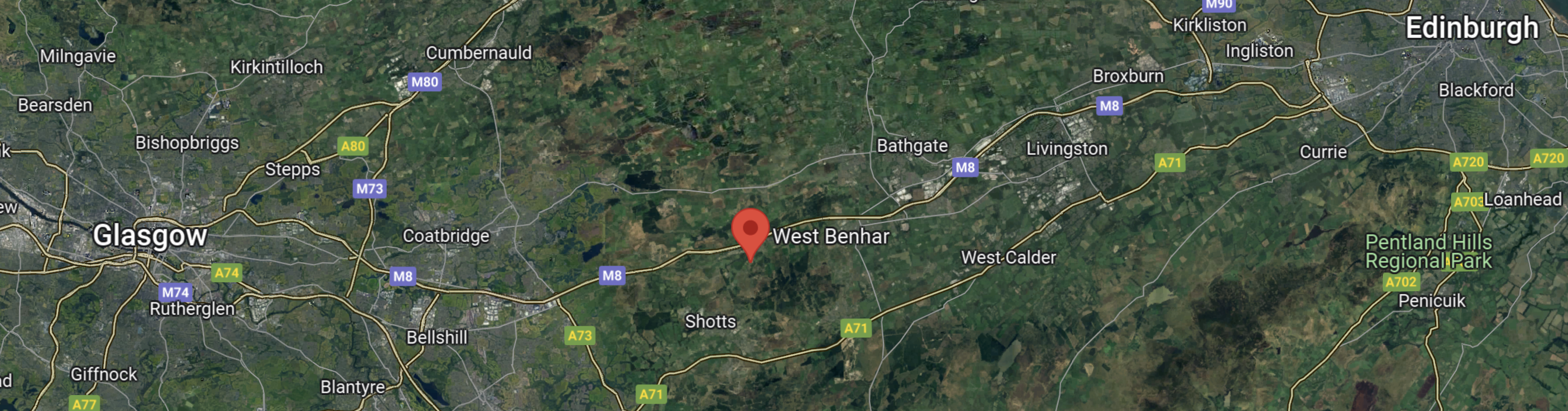
West Benhar is North-East of Shotts and just South of the M8.
There’s More Onshore Wind To Come
These onshore wind farms appear to have Contracts for Difference, but have not been completed.
- Arecleoch Wind Farm Extension – 72.8 MW – Completion 2024/25
- Broken Cross – 48 MW – Completion 2024/25
- Chirmorie – 81.6 MW – Completion 2024/25
- Cumberhead West – 126 MW – + 40 MW BESS – Completion 2024/25
- Douglas West Extension – 78 MW – Completion 2024/25
- High Constellation – 50 MW – Completion 2024/25
- Kilgallioch Windfarm Extension – 51.3 MW – Completion 2024/25
- North Kyle – 206 MW – Completion 2024/25
- Stornoway – 200 MW – Completion 2024/25
- Stranoch – 84 MW – Completion 2024/25
- Viking – 443 MW – Completion 2024
All of these are in Scotland.
But that’s another 1,440.7 MW of onshore wind.
Community Wind Funds
Scotland seems to be continuing to build onshore wind farms.
Could it be that communities have seen the benefits of Community Wind Funds?
This is said about the fund at Stronach.
When operational, EDF Renewables will provide a community benefit fund in line with the Scottish Government Good Practice Principles for Community Benefits from Onshore Renewable Energy Developments. The fund value for the community benefit fund would be £5,000 per megawatt for the lifetime of the wind farm. In the coming months we will begin to form a Community Liaison Group with local interested parties to decide how the funds will be disseminated once the wind farm becomes operational.
If the fund is yearly, then £420,000 is not money to be sneezed at!
Conclusion
It looks like in Scotland that Community Wind Funds promote the building of onshore wind.
 The Anonymous Widower