Shell To Start Building Europe’s Largest Renewable Hydrogen Plant
The title of this post, is the same as that of this press release from Shell.
This is the first paragraph.
Shell Nederland B.V. and Shell Overseas Investments B.V., subsidiaries of Shell plc, have taken the final investment decision to build Holland Hydrogen I, which will be Europe’s largest renewable hydrogen plant once operational in 2025.
Theconstruction timeline for Holland Hydrogen 1 is not a long one.
The next paragraph describes the size and hydrogen production capacity.
The 200MW electrolyser will be constructed on the Tweede Maasvlakte in the port of Rotterdam and will produce up to 60,000 kilograms of renewable hydrogen per day.
200 MW is large!
The next paragraph details the source of the power.
The renewable power for the electrolyser will come from the offshore wind farm Hollandse Kust (noord), which is partly owned by Shell.
These are my thoughts.
Refhyne
Refhyne is a joint project between Shell and ITM Power, with backing from the European Commission, that has created a 10 MW electrolyser in Cologne.
The 1300 tonnes of hydrogen produced by this plant will be integrated into refinery processes.
Refhyne seems to have been very much a prototype for Holland Hydrogen 1.
World’s Largest Green Hydrogen Project – With 100MW Electrolyser – Set To Be Built In Egypt
The sub-title is the title, of this article on Recharge.
It looks like Holland Hydrogen 1, is double the current largest plant under construction.
Shell is certainly going large!
Will ITM Power Be Working Again With Shell?
Refhyne has probably given Shell a large knowledge base about ITM Power’s electrolysers.
But Refhyne is only 10 MW and Holland Hydrogen 1 is twenty times that size.
This press release from ITM Power is entitled UK Government Award £9.3 m For Gigastack Testing.
This is the first paragraph.
ITM Power (AIM: ITM), the energy storage and clean fuel company, announces that the Company has been awarded a contract by The Department for Business, Energy and Industrial Strategy (BEIS), under its Net Zero Innovation Portfolio Low Carbon Hydrogen Supply 2 Competition, to accelerate the commercial deployment of ITM Power’s 5 MW Gigastack platform and its manufacture. The award for the Gigatest project is for £9.3m and follows initial designs developed through previous BEIS funding competitions.
Note.
- The Gigastack is 2.5 times bigger, than ITM Power’s previously largest electrolyser.
- Forty working in parallel, in much the same way that the ancient Egyptians built the pyramids, will be needed for Holland Hydrogen 1.
- ITM Power have the world’s largest electrolyser factory, with a capacity of one GW. They have plans to create a second factory.
ITM Power would probably be Shell’s low-risk choice.
My company dealt with Shell a lot in the 1970s, with respect to project management software and we felt, that if Shell liked you, they kept giving you orders.
The Hollandse Kust Noord Wind Farm
This wind farm is well described on its web site, where this is the introduction on the home page.
CrossWind, a joint-venture between Shell and Eneco, develops and will operate the Hollandse Kust Noord subsidy-free offshore wind project.
Hollandse Kust Noord is located 18.5 kilometers off the west coast of the Netherlands near the town of Egmond aan Zee.
CrossWind plans to have Hollandse Kust Noord operational in 2023 with an installed capacity of 759 MW, generating at least 3.3 TWh per year.
This Google Map shows the location of Egmond aan Zee.

Note that the red arrow points to Egmond aan Zee.
Will The Electrolyser Be Operational In 2025?
If Shell choose ITM Power to deliver the electrolysers, I don’t think Shell are being that ambitious.
I would suspect that connecting up an electrolyser is not the most complicated of construction tasks.
- Build the foundations.
- Fix the electrolyser in place.
- Connect power to one end.
- Connect gas pipes to the other.
- Switch on and test.
Note.
- If ITM Power deliver electrolysers that work, then the installation is the sort of task performed on chemical plants all over the world.
- ITM Power appear to have tapped the UK Government for money to fund thorough testing of the 5 MW Gigastack electrolyser.
- Enough wind power from Hollandse Kust Noord, should be generated by 2025.
I feel it is very much a low risk project.
Shell’s Offshore Electrolyser Feasibility Study
This is mentioned in this article in The Times, which describes Holland Hydrogen 1, where this is said.
Shell is also still involved in a feasibility study to deploy electrolysers offshore alongside the offshore wind farm. It has suggested this could enable more efficient use of cabling infrastructure.
I very much feel this is the way to go.
Postscript
I found this article on the Dutch Government web site, which is entitled Speech By Prime Minister Mark Rutte At An Event Announcing The Construction Of Holland Hydrogen 1.
This is an extract.
By building Holland Hydrogen 1, Shell will give the Dutch hydrogen market a real boost.
So congratulations are in order.
And this is only the beginning.
Because countless companies and knowledge institutions are working now to generate the hydrogen economy of tomorrow.
The government is supporting this process by investing in infrastructure, and by granting subsidies.
Because we want to achieve our climate goals, though the war in Ukraine won’t make it any easier.
We want to reduce our dependence on Russian gas.
We want the Netherlands to lead the way in the European energy transition.
And all these ambitions are combined in the Holland Hydrogen 1 project.
Mark Rutte seems to believe in hydrogen.
Conclusion
This is a very good example of the sort of large electrolyser, we’ll be seeing all over the world.
In fact, if this one works well, how many 200 MW electrolysers will Shell need all over the world?
Will they all be identical?
SSE Thermal And Equinor To Acquire Triton Power In Acceleration Of Low-Carbon Ambitions
The title of this post, is the same as that as this press release from SSE.
These are the first three paragraphs.
SSE Thermal and Equinor have entered into an agreement to acquire Triton Power Holdings Ltd from Energy Capital Partners for a total consideration of £341m shared equally between the partners.
The transaction represents another step forward for the two companies’ existing collaboration, supporting the long-term decarbonisation of the UK’s power system whilst contributing to security of supply and grid stability through flexible power generation in the shorter term.
Triton Power operates Saltend Power Station which is 1.2GW CCGT (Combined Cycle Gas Turbine) and CHP (Combined Heat & Power) power station located on the north of the Humber Estuary in East Yorkshire.
This deal is more complicated than it looks and these are my thoughts.
What About The Triton Power Workers?
The press release says this.
The 82 existing employees will continue to be employed by Triton Power. In line with just transition principles, the joint venture is committed to transitioning the assets for the net zero world through responsible ownership and operation, and in consultation with the local workforce and representatives.
It does sound that they are following the right principles.
Saltend Power Station
Saltend power station is no tired ancient asset and is described like this in Wikipedia.
The station is run on gas using single shaft 3 × Mitsubishi 701F gas Turbines machines with Alstom 400 MWe generators. The station has a total output of 1,200 MW; of that 100 MW is allocated to supply BP Chemicals. Each gas turbine has a Babcock Borsig Power (BBP) heat recovery steam generator, which all lead to one steam turbine per unit (single shaft machine means Gas turbine and Steam Turbine are on the same shaft). The waste product of electricity generation is steam at the rate of about 120 tonnes/h which is sold to BP Chemicals to use in their process. This makes Salt End one of the most efficient[clarification needed] power stations in the UK. The plant is scheduled to use hydrogen from steam reformed natural gas for 30% of its power.
Note.
- It was commissioned in 2000.
- It appears there are seven CCGT power stations in England that are larger than Saltend.
- The power station seems to have had at least four owners.
The press release says this about SSE and Equinor’s plans for Saltend power station.
The transaction underscores SSE Thermal and Equinor’s shared ambition to decarbonise the Humber, which is the UK’s most carbon-intensive industrial region, as well as the UK more widely. Initial steps to decarbonise Saltend Power Station are already underway, targeting partial abatement by 2027 through blending up to 30% of low-carbon hydrogen. In addition, carbon capture provides an additional valuable option for the site. SSE Thermal and Equinor will continue to work towards 100% abatement.
Note.
- It appears that initially, Saltend power station will move to running on a mixture of 30 % hydrogen and 70 % natural gas.
- Carbon capture will also be applied.
- It looks like that in the future all carbon-dioxide emitted by the power station will be captured and either stored or used.
The press release says this about the source of the hydrogen.
Saltend Power Station is a potential primary offtaker to Equinor’s H2H Saltend hydrogen production project. H2H Saltend is expected to kick-start the wider decarbonisation of the Humber region as part of the East Coast Cluster, one of the UK’s first carbon capture, usage and storage clusters.
H2H Saltend is described in this page on the Equinor web site, which has a title of The First Step To A Zero Carbon Humber, where this is said.
This project represents a bold but practical first step towards delivering the world’s first net zero industrial cluster by 2040. This unparalleled project can play a leading role in the UK’s journey to net zero by 2050, renew the UK’s largest industrial cluster, and unlock technology that will put the UK at the forefront of a global hydrogen economy.
There is also a video.
SSE Thermal And Equinor Low-Carbon Thermal Partnership
This is a section in the press release, where after giving their policy about the workers, it says this about the acquisition of Triton Power.
This acquisition strengthens SSE Thermal and Equinor’s portfolio of joint projects, which bring together expertise in power, natural gas, hydrogen and carbon capture and storage. This portfolio includes three development projects within the Humber region:
- Keadby 3 Carbon Capture Power Station, which could be the UK’s first flexible power station equipped with carbon capture.
- Keadby Hydrogen Power Station, which could be one of the world’s first 100% hydrogen-fuelled power stations.
- Aldbrough Hydrogen Storage, located in East Yorkshire, which could be one of the world’s largest hydrogen storage facilities.
The two companies are also developing Peterhead Carbon Capture Power Station, situated on the Aberdeenshire coast in Scotland and there are further opportunities for hydrogen blending across SSE’s generation portfolio, including at Keadby 2.
Note.
- There is no mention of the three Dogger Bank Wind Farms, each of which will be 1200 MW, that are owned by SSE Renewables and Equinor.
- I wrote about Aldbrough Gas Storage in The Massive Hydrogen Project, That Appears To Be Under The Radar.
- According to this press release from Equinor, which is entitled SSE Thermal And Equinor Join Forces On Plans For First-Of-A-Kind Hydrogen And Carbon Capture Projects In The Humber, Keadby Hydrogen power station will have a capacity of 1800 MW.
The Complete System
The system has the following power sources.
- Dogger Bank A – 1200 MW – Expected commissioning in 2023/24
- Dogger Bank B – 1200 MW – Expected commissioning in 2024/25
- Dogger Bank C – 1200 MW – Expected commissioning in 2024/25
- Keadby power station – 735 MW
- Keadby 2 power station – 893 MW – Could be Part-Hydrogen
- Keadby 3 power station – 910 MW – Carbon Capture
- Keadby Hydrogen power station – 1800 MW – Hydrogen
- Saltend power station – 1200 MW – Part-Hydrogen
That totals up to 9138 MW.
Fuel will come from three sources.
- The God of the winds.
- Natural gas
- Hydrogen
Hydrogen will be sourced from.
- Blue hydrogen from H2H Saltend
- Green Hydrogen could come from electrolysers driven by wind power.
Hydrogen would be stored in Aldbrough Gas Storage.
I am by training a Control Engineer and controlling these power sources is either a wonderful dream or your most entwined and complicated nightmare.
Conclusion
I suspect on an average day, this cluster of power stations and sources could reliably supply as much zero-carbon power as two large nuclear stations.
Octopus Energy On Xlinks
Today, Octopus Energy published a web page, which is entitled Backing Cheaper, Greener Energy Globally, giving more details of the Xlinks project.
I first wrote about the tie-up between Octopus Energy and Xlinks in Xlinks Welcomes New Investor Octopus Energy In Providing Cheap Green Power To Over 7 Million Homes.
Points made in the page on the Octopus web page include.
- The project will cover over 570 square miles in Morocco with 7GW of solar and 3.5GW of wind generation alongside a 20GWh battery storage facility.
- This green energy powerhouse will be connected to the UK via 2,361 miles of HVDC subsea cables.
- The cables will be built with British steel in a new factory in Hunterton, Scotland.
- It also appears that the site of the project has been chosen to optimise energy collection.
This project appears to be excellently-thought out to bring large benefits to all stakeholders.
Could Rolls-Royce SMRs Be The Solution To Europe’s Gas Shortage?
Of all the offshore wind farms, that I’ve looked at recently, I find Magnora’s ScotWind N3 wind farm the most interesting.
I wrote about it in ScotWind N3 Offshore Wind Farm.
I said this.
In any design competition, there is usually at least one design, that is not look like any of the others.
In the successful bids for the ScotWind leases, the bid from Magnora ASA stands out.
- The company has an unusual home page on its offshore wind web site.
- This page on their web site outlines their project.
- It will be technology agnostic, with 15MW turbines and a total capacity of 500MW
- It will use floating offshore wind with a concrete floater
- It is estimated, that it will have a capacity factor of 56 %.
- The water depth will be an astonishing 106-125m
- The construction and operation will use local facilities at Stornoway and Kishorn Ports.
- The floater will have local and Scottish content.
- The project will use UK operated vessels.
- Hydrogen is mentioned.
- Consent is planned for 2026, with construction starting in 2028 and completion in 2030.
This project could serve as a model for wind farms all round the world with a 500 MW power station, hydrogen production and local involvement and construction.
I very much like the idea of a concrete floater, which contains a huge electrolyser and gas storage, that is surrounded by an armada of giant floating wind turbines.
These are my thoughts.
Floating Concrete Structures
To many, they may have appear to have all the buoyancy of a lead balloon, but semi-submersible platforms made from concrete have been used in the oil and gas industry for several decades.
Kishorn Yard in Scotland was used to build the 600,000-tonne concrete Ninian Central Platform,in 1978. The Ninian Central Platform still holds the record as the largest movable object ever created by man.
The Ninian Central Platform sits on the sea floor, but there is no reason why a semi-submersible structure can’t be used.
Electrolysers
There is no reason, why a large electrolyser, such as those made by Cummins, ITM Power or others can’t be used, but others are on the way.
- Bloom Energy are working on high temperature electrolysis, which promises to be more efficient.
- Torvex Energy are developing electrolysis technology that used sea water, rather than more expensive purified water.
High Temperature Electrolysis
High temperature electrolysis needs a heat source to work efficiently and in Westinghouse And Bloom Energy To Team Up For Pink Hydrogen, I described how Bloom Energy propose to use steam from a large nuclear power station.
Offshore Nuclear Power
I’ve never heard of offshore nuclear power, but it is not a new idea.
In 1970, a company called Offshore Power Systems was created and it is introduced in its Wikipedia entry like this.
Offshore Power Systems (OPS) was a 1970 joint venture between Westinghouse Electric Company, which constructed nuclear generating plants, and Newport News Shipbuilding and Drydock, which had recently merged with Tenneco, to create floating nuclear power plants at Jacksonville, Florida.
Westinghouse’s reactor was a 1.150 MW unit, which was typical of the time, and is very similar in size to Sizewell B.
The project was cancelled before the reactors were towed into position.
Nuclear Knowledge Has Improved
Consider.
- In the fifty years since Offshore Power Systems dabbed their toes in the water of offshore nuclear power, our knowledge of nuclear systems and engineering has improved greatly.
- The offshore oil and gas industry has also shown what works impeccably.
- The floating offshore wind industry looks like it might push the envelop further.
- There has been only one nuclear accident at Fukushima, where the sea was part of the problem and that disaster taught us a lot.
- There have been a large number of nuclear submarines built and most reached the planned end of their lives.
- Would a small modular nuclear reactor, be safer than a large nuclear power plant of several GW?
I would suggest we now have the knowledge to safely build and operate a nuclear reactor on a proven semi-submersible platform, built from non-rusting concrete.
An Offshore Wind Farm/Small Modular Reactor Combination Producing Hydrogen
Consider.
- A typical floating offshore wind farm is between one and two gigawatts.
- A Rolls-Royce small modular reactor is sized to produce nearly 0.5 GW.
- The high temperature electrolyser will need some heat to achieve an optimum working temperature.
- Spare electricity can be used to produce hydrogen.
- Hydrogen can be stored platform.
- Hydrogen can be sent ashore using existing gas pipes.
- Hydrogen could even be blended with natural gas produced offshore to create a lower-carbon fuel.
- It would also be possible to decarbonise nearby offshore infrastructure.
A balance between wind and nuclear power can be obtained, which would provide a steady output of energy.
Conclusion
There are a large numbers of possibilities, to locate a Rolls-Royce small modular reactor close to a wind farm to use high temperature electrolysis to create green hydrogen, which can be used in the UK or exported through the gas network.
Cost Of Turning Off UK Wind Farms Reached Record High In 2021
The title of this post, is the same as that of this press release from Drax.
This is the first paragraph.
The cost of turning off wind farms in the UK has reached record levels, according to a new report.
The press release makes these points.
- Investing in more long duration electricity storage, such as expanding Drax’s Cruachan pumped storage hydro plant in Scotland, would mean more excess renewable power could be stored and made available when required, cutting costs and carbon emissions.
- The cost of turning off UK wind farms to manage the electricity system rose from almost £300m during 2020 to over £500m in 2021, contributing to higher energy bills and carbon emissions, according to a new report.
- Costs increased substantially because the system relied on expensive gas power to manage periods when wind power was curtailed, as not enough electricity storage was available to prevent the excess renewable power from wind farms going to waste.
Drax give these reasons for the problems.
This happened as a result of constraints in the transmission system and a lack of long-duration storage capacity, which is needed to manage periods when renewable power generation outstrips demand.
The problem is going to get worse as we increase the amount of wind power in the UK.
Penny Small, Drax’s Group Generation Director sums everything up.
This report underlines the need for a new regulatory framework to encourage private investment in long-duration storage technologies.
The UK is a world-leader in offshore wind, but for the country’s green energy ambitions to be realised we need the right energy storage infrastructure to support this vital technology, make the system secure and reduce costs.
Drax’s plan to expand Cruachan will strengthen UK energy security, by enabling more homegrown renewable electricity to power British homes and businesses, reducing system costs and cutting carbon emissions.
A good framework has been created for wind farms and many more are being proposed and developed.
Frameworks are needed for both transmission systems and long-duration energy storage capacity.
Namibia Proposes Green Hydrogen Supply To EU To Replace Russian Oil And Gas
The title of this post, is the same as that of this article on H2 Fuel News.
These paragraphs explain the plan.
The African country has considerable wind and sunshine resources available, providing the opportunity to use renewable energy for the production of H2. Namibia is located along the African South Atlantic coastline and is among the world’s driest countries. Its 3,500 hours of sunshine per year mean that solar panels will be able to absorb a tremendous amount of energy, without much unexpected downtime.
That energy will be used for producing yellow H2, a form of green (renewable) H2 made using electrolysers powered by solar electricity. The electrolyser will split seawater, another abundant resource for the country due to its position on the map. As a result, it has the potential to offer the European Union a clean fuel source that can help it to simultaneously combat the energy crisis and the climate crisis.
Note.
- Liquid hydrogen will be shipped to Europe by tanker.
- I don’t think Vlad the Mad will like the plan!
- How many other countries have the resources like Namibia to become hydrogen exporters?
This plan was proposed at the World Economic Forum at Davos.
Will Coire Glas Start A Pumped Storage Boom In Scotland?
This article on Renewables Now is entitled SSE Gets Tenders For Construction Of 1.5-GW Pumped Hydro Scheme.
This is the first paragraph.
SSE Renewables said on Wednesday it has received tenders for the main construction works for the Coire Glas hydro pumped storage project with a capacity of up to 1.5 GW in the Scottish Highlands.
It then lists, the companies who have tendered for the project.
SE Renewables said the ITT has drawn global interest. The tenderers shortlisted for mechanical and electrical plant scope are a partnership between ANDRITZ HYDRO GmbH and Voith Hydro GmbH & Co KG, and GE Hydro France. The parties shortlisted for the civil engineering scope include three consortia and STRABAG UK Ltd. The consortia are made up of Bechtel Ltd, Acciona Construccion SA and Webuild SpA; BAM Nuttall Ltd, Eiffage Genie Civil SA and Marti Tunnel AG; and Dragados SA and BeMo Tunnelling UK Ltd.
It is an impressive list.
The article says that construction is to start in 2024. Other sources say the pumped storage project will have a storage capacity of 30 GWh, which will make it the largest pumped storage plant in the UK.
This press release from SSE Renewables is entitled Tenders Submitted For The Coire Glas Pumped Storage Scheme.
The press release contains this quote from the Project Director for Coire Glas; Ian Innes.
Receiving the tenders on schedule from the six short-listed tenderers is another significant milestone for the Coire Glas project and we are grateful for their continued interest in the project.
We are encouraged by the content of the tenders which now provides the Coire Glas project team with several options on how construction of the project could be undertaken. It is going to take some time to carefully consider and scrutinise the tenders thoroughly and we look forward to working with the tenderers as we endeavour to make our selection decision.
It appears that not only were the tenders received from quality companies, but that they contained options and ideas that could improve the project.
Coire Glas would appear to me to be a project, that is attracting the best companies and they could be putting their best workers on the project.
These are my thoughts.
The Potential For Pumped Storage Schemes In Scotland
There are at least six schemes under development or proposed in Scotland.
- Balliemeanoch – 45 GWh
- Coire Glas – 30 GWh
- Corrievarkie – 14.5 GWh
- Loch Earba – 33 GWh
- Loch Sloy – 14 GWh
- Red John – 2.8 GWh
This page on the Strathclyde University web site, gives these figures for the possible amounts of pumped-storage that can be added to existing hydro schemes.
- Errochty – 16
- Glasgarnock – 23
- Luichart – 38
- Clunie – 40
- Fannich – 70
- Rannoch – 41
- Fasnakyle – 78
- Tummel – 38
- Ben Lawers – 12
- Nant – 48
- Invermoriston – 22
- Invergarry – 41
- Quoich – 27
- Sloy – 20
That is a total of 547 GWh or 653.3 GWh if you include the new storage, I listed above.
Scotland would appear to be land overflowing with large pumped storage possibilities and could provide the modern equivalent of milk and honey.
The Potential For Offshore Wind Power Schemes In Scotland
This is the first two paragraphs of this press release on the Crown Estate Scotland web site.
Crown Estate Scotland has today announced the outcome of its application process for ScotWind Leasing, the first Scottish offshore wind leasing round in over a decade and the first ever since the management of offshore wind rights were devolved to Scotland.
The results coming just months after Glasgow hosted the global COP26 climate conference show the huge opportunity that Scotland has to transform its energy market and move towards a net zero economy.
Some highlights are then listed.
- 17 projects have been selected out of a total of 74 applications.
- A total of just under £700m will be paid by the successful applicants in option fees and passed to the Scottish Government for public spending.
- The area of seabed covered by the 17 projects is just over 7,000km2.
- Initial indications suggest a multi-billion pound supply chain investment in Scotland
- The potential power generated will move Scotland towards net-zero.
This map shows the location of each wind farm.

Note, that the numbers are Scotwind’s lease number in their documents.
Fixed Foundation Wind Farms
These are the six fixed foundation wind farms.
- 1 – BP Alternative Energy Investments – 859 km² – 2.9 GW
- 6 – DEME – 187 km² – 1.0 GW
- 9 – Ocean Winds – 429 km² – 1.0 GW
- 13 – Offshore Wind Power – 657 km² – 2.0 GW
- 16 – Northland Power – 161 km² – 0.8 GW
- 17 – Scottish Power Renewables – 754 km² – 2.0 GW
Adding up these fixed foundation wind farms gives a capacity of 9.7 GW in 3042 km² or about 3.2 MW per km².
Floating Wind Farms
These are the ten floating wind farms.
- 2- SSE Renewables – 859 km² – 2.6 GW
- 3 – Falck Renewables Wind – 280 km² – 1.2 GW
- 4 – Shell – 860 km² – 2.0 GW
- 5 – Vattenfall – 200 km² – 0.8 GW
- 7 – DEME Concessions Wind – 200 km² – 1.0 GW
- 8 – Falck Renewables Wind – 256 km² – 1.0 GW
- 10 – Falck Renewables Wind – 134 km² – 0.5 GW
- 11 – Scottish Power Renewables – 684 km² – 3.0 GW
- 12 – BayWa r.e. UK – 330 km² – 1.0 GW
- 14 – Northland Power – 390 km² – 1.5 GW
Adding up the floating wind farms gives a capacity of 14.6 GW in 4193 km² or about 3.5 MW per km².
Mixed Wind Farms
This is the single wind farm, that has mixed foundations.
15 – Magnora – 103 km² – 0.5 GW
This wind farm appears to be using floating wind turbines.
These wind farms total up to 24.8 GW
I would expect that this is only a phase in the development of Scottish wind power, which will grow substantially over the next decade.
As I write this the UK is generating a total of 26.2 GW of electricity.
Backing Up The Wind Power
This wind power, which could grow up to well over 50 GW in Scotland alone.
But what do you do, when there is no wind?
Energy will need to come from batteries, which in Scotland’s case could be over 500 GWh of pumped storage.
Europe’s Powerhouse
It is not an unreasonable prediction, that we will continue to expand our wind farms to supply Europe with thousands of GWh of electricity and/or millions of tonnes of green hydrogen.
Conclusion
It is likely that we’ll see an upward increase of wind power in Scotland closely matched by a similar increase in pumped storage.
It is no wonder that the world’s largest and most experienced contractors were so keen to get the first big contract in Scotland’s new pumped storage boom.
They know a good thing, when they see it and after their experience with the Scotland’s oil boom in the last century, I doubt they are delaying their return.
Will It Be Third-Time Lucky For Grand Union Trains In Wales?
It is three years since I wrote Grand Union Seeks ’91s’ To Cardiff and their proposal has not been accepted and the third iteration has been announced.
This article on Wales Online is entitled Independent Rail Firm Bids To Launch As Rival To Great Western On The Mainline From South Wales To London.
These are the introductory paragraphs.
An independent rail firm is hoping to launch a rival train service in Wales which they say will slash journey times between Carmarthen and London. Grand Union Trains is making a fresh bid to introduce an initial service in both directions between Cardiff and London on the existing Great Western line.
The company believes the move will “create passenger choice” and increase the number of trains available, with the hope that the service can be extended west in South Wales towards Carmarthen.
Other points in the article include.
- Swansea will be by-passed, which will speed up services to and from Llanelli and Carmarthen.
- A new Park-and-Ride station will be built by Grand Union at Felindre, which is to the North of Swansea.
- Services will stop at Llanelli, Cardiff Central, Newport, Severn Tunnel Junction and Bristol Parkway.
- When Cardiff Parkway opens, this will be an extra stop.
An article in the June 2022 Edition of Modern Railways, which is entitled Grand Union Bids For London To Carmarthen, gives extra details.
- Three classes.
- 2023 start for the service.
- Five return trains per day.
- Cycle provision.
- Vanload freight will be carried.
- Electric trains could start between London and Cardiff by 2023.
- In 2025, trains could be nine-car bi-modes.
- South Wales-based operation and maintenance.
- 125 full-time jobs created.
It certainly seems to be a comprehensive and well-thought out plan.
These are my thoughts and observations.
Felindre Station
Felindre station is named in Wikipedia as the West Wales Parkway station, where it is introduced like this.
West Wales Parkway is a proposed railway station north of Swansea, near to the boundaries of the neighbouring principal area of Carmarthenshire, and the villages of Felindre and Llangyfelach. The station is proposed to be situated at the former Felindre steelworks, near Junction 46 of the M4 and A48, and near Felindre Business Park and Penllergaer Business Park. The project is in the planning stages, as part of a wider Department for Transport proposal to re-open the Swansea District line to passenger traffic.
This Google Map shows where, it appears the Felindre station will be built.
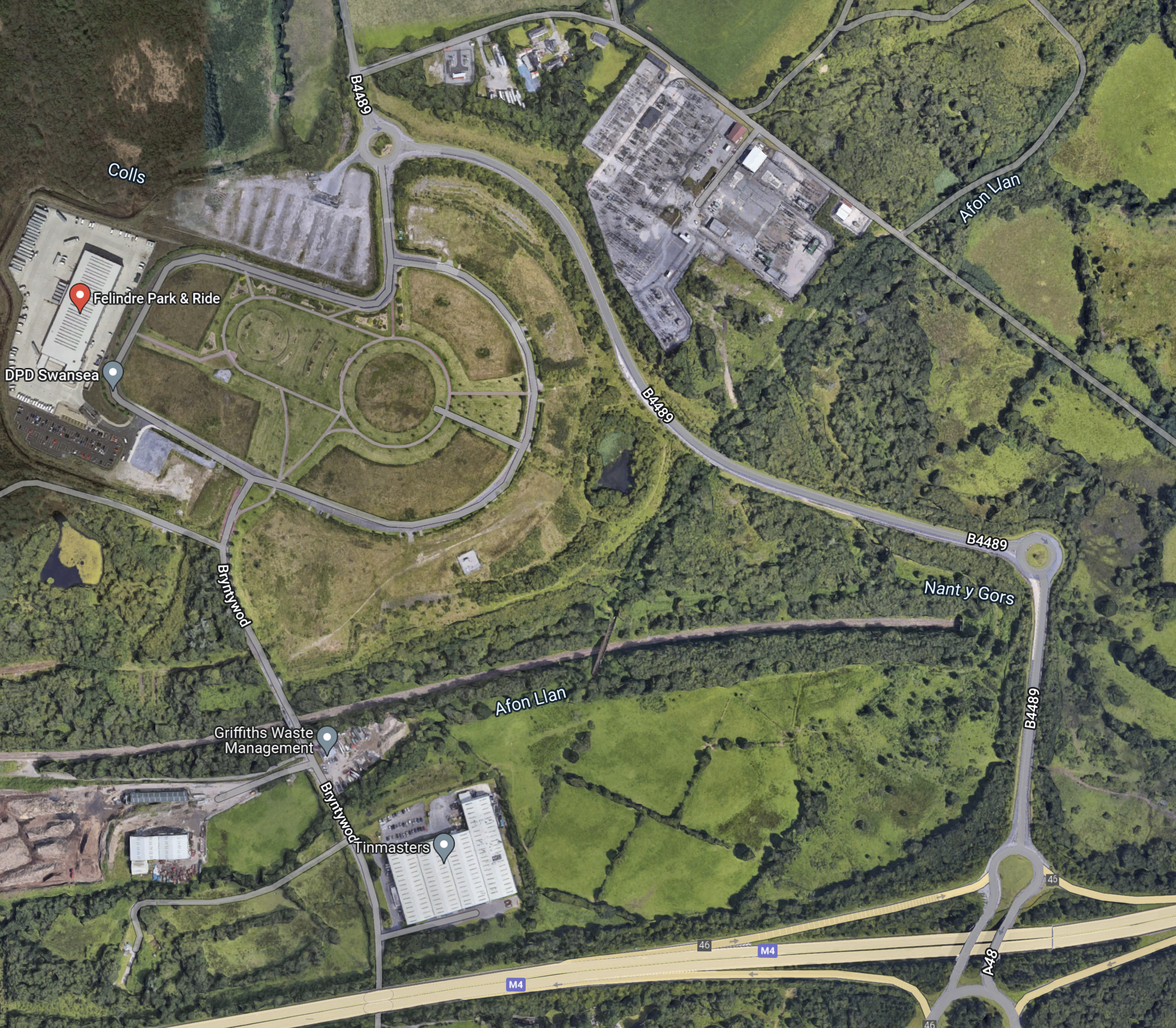
Note.
- The Felindre Business Park in the North-West corner of the map, with a Park-and-Ride.
- The M4 running across the bottom of the map.
- The Swansea District Line runs East-West between the motorway and the Business Park.
It looks that the new station could be located on the South side of the Business Park.
According to Wikipedia, the station would cost £20 million to build.
- It would need a comprehensive rethinking of transport improvements in the Swansea area.
- But it could result in time savings on services between Carmarthen and Cardiff.
The Modern Railways article says this.
GU proposes to build the Felindre station near Swansea and invest in Severn Tunnel Junction station, where it says it will increase parking, provide direct access from the M4 motorway and improve passenger and staff facilities, backing up plans being evaluated by the Welsh Government for the station.
Grand Union is not a charity and does this indicate that a bank or infrastructure company is prepared to fund parking and the extra passengers pay the charges.
Rolling Stock
Wikipedia says that the rolling stock could be nine-car InterCity 225s hauled by Class 91 or Class 93 locomotives.
As the Class 93 locomotives are bi-modes, these would handle the Carmarthen and Cardiff leg.
The Modern Railways article says this.
Trains could start between Cardiff and London Paddington as early as May 2023 if electric only, with services extended west around two years later with new bi-mode trains in up to nine-car formations.
Would a new Class 93 locomotive count as a new bi-mode train?
I suspect the new locomotive would be more affordable, than a new bi-mode train.
Vanload Freight
This is an interesting idea and it follows similar thinking to Royal Mail’s latest ideas, that I wrote about in Royal Mail Rolling Back The Years To Put More Post On Trains.
One coach could be a nice little earner, if it were modified to carry roller cages, that were loaded and unloaded at the end of the route.
One advantage of the InterCity 225s is that they are 125 mph trains, so that this will be high speed freight.
Timings
Consider.
- A GWR Carmarthen and London service takes three hours and 47 minutes.
- This includes a nine-minute reverse at Swansea.
- GWR makes seven more stops than Grand Union will.
- GWR does seven diesel stops, whereas Grand Union will only do two.
I would estimate that Grand Union will be under three hours and thirty minutes.
Carmarthen Station
This Google Map shows Carmarthen station.
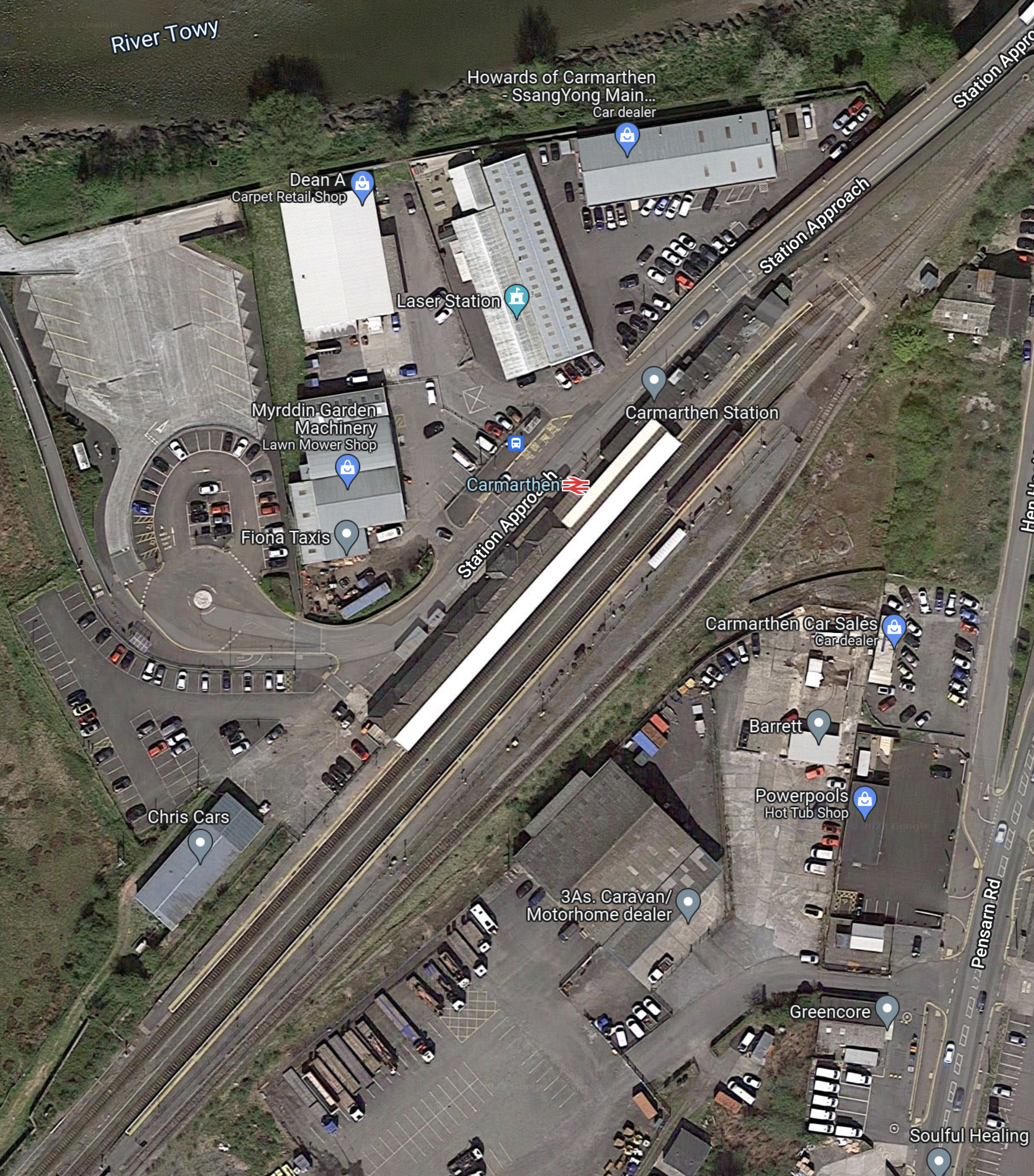
Note.
- The station has two platforms.
- There are certainly pictures of the station with an InterCity 125 in the station.
These pictures show the station.






I suspect that the station will be upgraded to accommodate Grand Union.
Rrenewable Energy Developments In South West Wales
In Enter The Dragon, I talked about renewable energy developments in South West Wales.
I used information from this article on the Engineer, which is entitled Unlocking The Renewables Potential Of The Celtic Sea.
The article on the Engineer finishes with this conclusion.
For now, Wales may be lagging slightly behind its Celtic cousin to the north, but if the true potential of the Celtic Sea can be unleashed – FLOW, tidal stream, lagoon and wave – it looks set to play an even more prominent role in the net zero pursuit.
The Red Dragon is entering the battle to replace Vlad the Mad’s tainted energy.
South West Wales could see a massive renewable energy boom.
The Railways To The West Of Carmarthen
This map from OpenRailwayMap shows the rail lines to the West of Carmarthen.
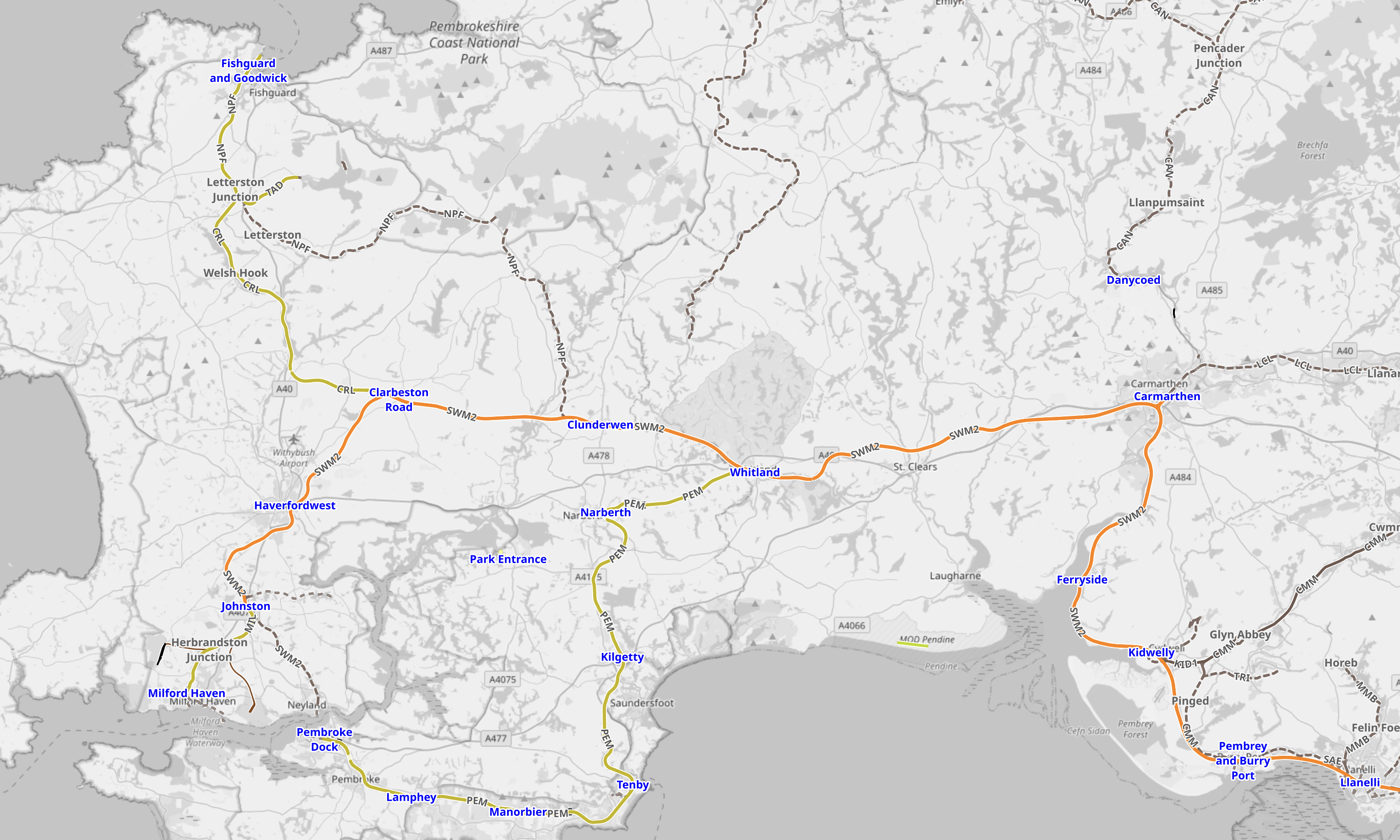
There are three main branches to Fishguard, Milford Haven and Pembroke Dock.
I can see the railways becoming increasingly important in supporting the growing renewable energy in the area.
- There would be more frequent services.
- Services would tie in with London and Cardiff trains at Carmarthen.
- Closed stations could be reopened and new ones built.
It may also be possible to bring in large components needed by the renewable energy industry.
Conclusion
I feel that Grand Union have seen the opportunities presented to a frequent Carmarthen and London service and have grabbed them with both hands.
Xlinks Welcomes New Investor Octopus Energy In Providing Cheap Green Power To Over 7 Million Homes
The title of this post, is the same as that of this press release from Xlinks.
These are the first three paragraphs.
Xlinks is pleased to announce a financial and strategic partnership with energy tech pioneer Octopus Energy Group.
The Morocco – UK Power Project will speed up the UK’s transition to net zero by laying four 3,800km-long subsea cables to connect a huge renewable energy farm in the Moroccan desert with Devon in South West England. Morocco is setting its sights on becoming a world leader in solar energy, already boasting some of the world’s largest solar arrays, and meeting two-fifths of its electricity demand with renewables. There will be huge economic benefits to both countries involved, with Xlinks bringing green energy and engineering jobs to both the UK and Morocco.
The project will diversify UK supply routes and boost energy security through the supply of 3.6 GW of reliable, clean power to the UK for an average of 20 hours a day, enough green energy to power about 7 million homes.
Note.
- The cables will be nearly 2,400 miles
- It is scheduled to be operational in 2027.
- Xlinks is expected to deliver power at £48/MWh, which is comparable with offshore wind.
- Wikipedia talks of a Hinkley Point C strike price of £92.50/MWh (in 2012 prices).
- Greg Jackson, founder of Octopus Energy Group, is also a personal investor in the project.
- Greg Jackson is interviewed in this article in today’s Sunday Times.
I wrote more about this project in Moroccan Solar-Plus-Wind To Be Linked To GB In ‘Ground-Breaking’ Xlinks Project.
Conclusion
This mega-project could be approaching the point, where the starting gun is fired.
Poland May Become A Green Hydrogen Tycoon
The title of this post, is the same as that of this article on Hydrogen Central.
This is the first two paragraphs.
In 2050, Poland may become one of the most competitive producers of green hydrogen in the European Union. In addition, we could export it to other countries, using the already existing infrastructure – e.g. the Yamal gas pipeline.
According to analysts of the Polish Economic Institute (PIE), in the next three decades Poland could become a very competitive producer of green hydrogen. Particularly economically beneficial in Polish conditions would be the production of hydrogen based on energy from onshore wind energy.
Note.
- The Yamal pipeline comes all the way from Siberia.
- The Baltic pipeline will connect Norway and Poland.
- Poland currently has over 7 GW of wind power.
- Wikipedia says this “In 2019, wind was the second most important source of electricity produced in Poland, after coal, and accounted for about 10% of the electricity production.”
- I have been to quite a few parts of Poland and it seems that it can be flat and windy.
- 1.2 GW of offshore wind is under development near Slupsk.
I very much feel that the conclusion of the article could be right.
 The Anonymous Widower