Centrica Partners With Ceres Power On Solid Oxide Fuel Cells
The title of this post, is the same as this article on gasworld.
This is the sub-heading.
UK multinational energy and services company Centrica is partnering with clean tech firm Ceres Power to accelerate solid oxide fuel cells [SOFCs] production to meet forecasted ‘multi-gigawatt’ demand from industrial customers across Europe.
These three paragraphs indicate the market opportunity, that Centrica feel, that the partnership will fill.
With electricity grid connection delays impacting new industrial, commercial and digital projects, the UK and Europe are experiencing a widening gap between demand and available capacity.
Centrica aims to offer customers high‑efficiency, low‑carbon, grid independent on‑site power that can be deployed much faster than gas turbines or nuclear.
Group Chief Executive Chris O’Shea said by collaborating with Ceres’ technology it sees an opportunity to support data centres, AI and industry with cleaner power at scale. Ceres claims SOFCs can be manufactured and delivered on site to get power online “in months not years”.
It certainly sounds feasible to drop in an appropriate-sized stack of fuel cells and connect them up to the gas main.
These two paragraphs, indicate how Ceres will support Centrica.
Initially, Ceres will support Centrica in expanding a new differentiated service-led model for clean power, providing access to British technology through its expanding network of global manufacturing partners.
Ceres will assist Centrica with opportunities across project origination, installation and commissioning, remote monitoring, predictive maintenance and end of life recycling.
I have a few questions for Google AI.
Do Ceres Fuel Cells Emit Carbon Dioxide?
Google AI replied this.
Yes, Ceres Power has developed Solid Oxide Fuel Cell (SOFC) technology, known as the SteelCell®, that works on natural gas. This technology is specifically designed to be fuel-flexible, capable of converting grid natural gas into electricity at high efficiency.
Key Details About Ceres Fuel Cells and Natural Gas:
Technology Capability: The Ceres SteelCell runs on natural gas, as well as future-focused fuels like hydrogen and biogas.
Application: These fuel cells are used for distributed power generation in homes, businesses, and industrial settings (such as AI data centres).
Efficiency: When running on natural gas, the SOFC systems can achieve an electrical efficiency of around 62%, with total efficiency exceeding 90% when combined with heat recovery.
Emission Reductions: Compared to conventional combustion engines, the technology offers a 30% reduction in carbon emissions.
Current Strategy: As of early 2026, Ceres is focusing on natural gas-fueled SOFCs for stationary power markets, particularly in collaboration with partners like Centrica to address power shortages in the UK and Europe.
While the systems can be used for hydrogen in the long term, they are currently fully functional with natural gas, making them a “bridge” technology for decarbonisation.
A 30% reduction is surely worthwhile!
In What Size Are Ceres Power Holdings Fuel Cells Manufactured?
Google AI replied this.
Ceres Power Holdings’ solid oxide fuel cell (SOFC) technology is manufactured in modular, scalable sizes, with individual stacks ranging from 10-50 kW and commonly deployed in 1-5 MW power modules. These stacks are produced at manufacturing facilities with capacities like 50MW (e.g., with partner Doosan), with plans for up to 100MW annual capacity.
Key manufacturing and size details include:
Cell Component: 30–150W.
Stack: 10–50 kW.
Stack Array/Module: 100–500 kW, up to 1-5 MW modules.
Manufacturing Capacity: 50MW production facility in South Korea (Doosan), with plans for 100MW+ annual capacity in future plants.
Applications: Primarily stationary, distributed power systems for AI data centres, industrial decarbonisation, and commercial buildings.
Ceres licenses its technology to partners like Bosch and Doosan, with cell technology based on low-cost printed steel substrate
How Much Power Does A Top Of The Range MRi Scanner Use?
I am asking this question, as it is surely something you might power with a Ceres fuel cell powered by natural gas.
Google AI replied this.
A top-of-the-range MRI scanner (such as a 3-Tesla or 7-Tesla system) is highly energy-intensive, consuming substantial power 24/7 to maintain its superconducting magnet. During active scanning, power usage often ranges from 25 kW up to 80 kW or more.
Here is a breakdown of the power consumption for high-end MRI scanners:
Power Consumption Breakdown
Idle/Stand-by Mode (24/7): The machine constantly consumes roughly 6 to 7 kW for background cooling (liquid helium refrigeration).
Standard Scanning: Productive scanning sessions typically demand around 25 kW.
High-Demand Scanning: Demanding examinations (e.g., head examinations with EPI sequences or special angles) can cause power usage to surge to 70 kW to 80 kW.
System Total: A 3T MRI, including cooling systems (chillers) and peripheral electronics, might require a 3-phase, 480V, 200A supply—roughly equivalent to the capacity of six modern houses.
Conclusion
This seems to be a deal with a large number of possibilities.
Speaking from my past experience of banks and financing, where the bill is ultimately paid by a reputable individual or company like Shell or BP, I believe that Centrica will have no difficulty in financing lots of these systemsusing instiutions like Lloyds or Deutsche Bank.
Centrica Energy And Whitecap Enter Long-Term Natural Gas Supply Agreement
The title of this post, is the same as that of this news item from Centrica.
This is the sub-heading.
Centrica Energy is pleased to announce signing of a long-term natural gas purchase agreement with Whitecap Resources Inc., a leading Canadian producer dedicated to the responsible development of oil and gas resources across the Western Canadian Sedimentary Basin.
These first three paragraphs add more detail to the story.
Starting in April 2028, Whitecap will deliver 50,000 MMBtu of natural gas per day to Centrica Energy for a period of ten years – equivalent to roughly five LNG cargoes each year. The supply will be priced against the Title Transfer Facility (TTF), the benchmark for European gas markets.
This agreement advances Centrica’s strategy of managing market price exposure across its LNG portfolio by linking feed gas costs to European price signals. For Whitecap, the agreement provides access to international LNG-linked pricing, supporting the company’s natural gas price diversification strategy.
“Entering into this innovative agreement with Whitecap underlines our focus on building a balanced LNG portfolio through strategic partnerships across the globe allowing us to deliver reliable energy solutions to global markets” said Chris O’Shea, Group Chief Executive at Centrica.
I have some thoughts.
This Is The Seventh Deal Of This Type By Centrica In A Few Months
Note.
- All are marked with a tag of Natural Gas Trading.
- None of the deals appear to be in the Middle East.
- All appear to be fairly long term deals, with three stretching until 2037.
Hopefully, with luck we’ll have enough gas for the next few years.
Grain LNG Terminal Is Very Flexible
Consider.
- It is Europe’s largest LNG Terminal
- It can import, export and store gas.
- It has plenty of space for expansion, which could include new technologies.
- Centrica have said bunkering facilities will be added, which will be able to handle the latest low-carbon fuels.
I can certainly see, why Centrica acquired the terminal.
Is Sumitomo Heavy Industries Highview Power Energy Storage System On Line At Hiroshima?
From some work I did at ICI in the 1970s on a PACE231R analog computer, I believe that Highview Power may have an extremely promising way of storing energy.
The Highview Power web site talks of Sumitomo Heavy Industries, who are building one of Highview’s batteries at Hiroshima in Japan.
So I asked Google AI the question in the title of this post and received this comprehensive answer.
Yes, the Sumitomo Heavy Industries (SHI) Highview Power liquid air energy storage (LAES) commercial demonstration plant in Hatsukaichi, Hiroshima, is operational, having commenced operations on December 1, 2025.
Key details about the plant:Location: Within the Hiroshima Gas Hatsukaichi LNG Terminal.Capacity: 5 MW output with 4-hour storage (4 MW charging).Technology: Uses Highview Power’s CRYOBattery™ technology, specifically utilizing waste cold from the adjacent LNG terminal to improve efficiency.Role: The facility is designed to support grid stability and enhance renewable energy integration.A completion ceremony for the project was held on December 9, 2025. This news item from Sumitomo Heavy Industries gives more details.This paragraph describes Liquid Air Energy Storage or (LAES).
- It looks like the battery has a capacity of 5 MW/20 MWh.
- As it talks about using waste cold, this looks to be a very professionally-designed specialist application.
- But surely, that would be expected from a company like Sumitomo Heavy Industries.
There are hundreds of LNG terminals globally, with significant growth driven by over 300 projects (roughly 177 import/regasification and 124 export/liquefaction) expected between 2025 and 2030. In 2023, there were 22 countries with active liquefaction (export) capacity, while Europe alone operates roughly 28 large-scale terminals, supplemented by a rapidly expanding fleet of FSRUs.Export Capacity: In 2023, global liquefaction capacity was 472 million tonnes per annum (mtpa), with top exporters being Australia, the U.S., and Qatar.Expansion: By 2027, 52 new liquefaction terminals are expected to commence operations.Import Growth: European regasification capacity is expanding, with major terminals in Spain, France, Italy, and new additions in Germany and other nations.U.S. Infrastructure: The U.S. alone has more than 170 LNG facilities performing various services.
- They are listed in this Wikipedia entry.
- There are around thirty in Japan alone.
- Will Centrica add a 5 MW /20 MWh Highview Power battery to their Grain LNG Terminal?
- Each facility installed is claimed to be designed to support grid stability and enhance renewable energy integration, so the last part must cut carbon emissions.
Yes, several major chemical engineering and industrial processes generate significant amounts of “waste cold” (low-grade thermal energy or cryogenic energy) that is often discarded. While the chemical industry conventionally focuses on recovering waste heat, recovering waste cold is becoming increasingly popular for improving energy efficiency, particularly in cryogenic processes.
- Liquefied Natural Gas (LNG) Regasification
- Cryogenic Air Separation Units (ASUs)
- Dry Ice and CO2 Liquefaction
-
Liquid Nitrogen Vaporization
-
Emerging: Cryogenic Carbon Capture
- Creation of this page was not difficult, but you have to get the tricks right.
- I used Google Chrome and Google AI.
- My blog is hosted in WordPress.
- All pages on this blog, where I have had help in their creation from Google AI are tagged as such.
I would be happy to help anybody, who wanted to use Artificial Intelligence to create blog pages.
Polanski And Farage Don’t Agree. But They Have More In Common Than You Might Think
The title of this post, is the same as that of this article on the BBC, by Laura Kuenssberg.
It is very much a must read article comparing two of the most controversial party leaders in the UK.
This is the sub-heading.
One is a former stockbroker from the south who, by his own proud admission, loves smoking, drinking and women. The other’s a proud vegan, gay, northern former actor, who told me he’d never drunk a drop.
These first three paragraphs add detail to the story.
But the jubilant Zack Polanski and Nigel Farage have rather a lot in common.
Before you scream, burst out laughing, or think I have lost my marbles, of course, there are very big differences between them.
The Greens talk about a climate emergency. Reform UK calls the government green plans, “net stupid zero”.
This is Laura’s summing up of the Terrible Twins.
Their views on the cause of Britain’s pain vary wildly.
The Greens might point the finger at the super-rich, the “donor billionaires” they often cite. Reform often blames immigration, which they controversially characterise as an “invasion” of people arriving in the UK without permission.
But both parties feed off and stir up sentiment that’s felt by lots of the public: that Britain doesn’t work any more.
Whether it’s the new Green MP saying “working hard used to get you something” in her victory speech, or Nigel Farage repeatedly telling us “Britain is broken”, the same argument flows from both: that the country is in such a dreadful state that only new political saviours can fix it.
And both Reform and the Greens are willing to push the conventions of what traditional UK politicians would find acceptable – or what they believe would make them electable.
That’s not just about their image or the unstuffy ways they court publicity – Nigel Farage willingly going into the I’m A Celebrity jungle, or Zack Polanski being seen on a dance floor in campaign videos – but how they choose to focus on sensitive issues, where others might not choose to tread.
I would disagree that Britain is broken, but that it needs someone with sensible policies that everybody can get behind.
The Greens policies on the super-rich would drive anybody with ambition and money from this country and already countries like Canada are advertising for migrants.
With two immigrant lines, Farage is everything my father thought was bad about Oswald Mosley and his fascists in the 1930s. If a Reform UK Government started rounding up illegal immigrants on the streets, the violence would probable be enormous.
How Much Renewable Energy Will The UK Be Generating By 2030?
I have to admit, that whether you like the Tories or not, they have developed an energy generation policy and an energy relationship with Germany, that appears to be working and is allowing the current Government to do a bit of spending on defence and other needs.
I asked Google AI, the question in the title of this section and received this reply.
The UK government has set an ambitious target to reach 95% low-carbon electricity generation by 2030, aiming for a system driven by 43-50 GW of offshore wind, 27-29 GW of onshore wind, and 45-47 GW of solar power. This plan aims to dramatically reduce fossil fuel reliance, supported by 23-27 GW of battery capacity.
Key 2030 Renewable Energy Projections & Targets:
Total Clean Power Goal: The goal is 95% of electricity from low-carbon sources (renewables and nuclear) by 2030, up from roughly 74% in 2024.
Offshore Wind: Target of 43-50 GW, deemed crucial to powering the grid.
Onshore Wind: Target of 27-29 GW, with recent policy changes lifting bans to accelerate development.
Solar Power: Target of 45-47 GW, aiming to triple current capacity.
Flexibility: 23-27 GW of battery capacity and 4-6 GW of long-duration storage are needed to manage intermittency.
Challenges and Forecasts:
Shortfall Risks: While the government target is high, some projections suggest wind and solar may only account for 44% of generation by 2030, requiring significant acceleration to reach the 95% clean goal.
Investment Needs: Achieving these goals requires an estimated £48 billion in additional investment, on top of planned projects.
Progress: In 2024, renewable sources already hit a record of over 50% in certain quarters, with low-carbon sources overall (including nuclear) providing nearly 70% of generation.
My Thoughts
I will add some of my thoughts.
Electricity Demand: As I write, according to National Grid: Live it is 33.3 GW, which is met by with Production of 27.1 GW and Transfers of 6.2 GW.
Electricity Production: In 2030, I believe that if the UK has long-term battery capacity of something like 4 GW/40 GWh, that total UK electricity production could be upwards of 125 GW.
Hinckley Point C Power Station: This should add 1.6 GW in 2030 and 2031 to further boost UK electricity production.
Pumped Storage Hydro: In How Much Pumped Storage Hydro Will Be Operational In The UK By 2030?, I estimate that the Bank of England standard of energy storage, will add 5 GW of electricity production.
Highview Power: Highview Power are developing long duration liquid-air energy storage and have identified locations for sixteen 300 MW/3.2 GWh monsters.
Excess Electricity Production: This will be exported, either as electricity or after conversion to hydrogen. It will be a Magic Money Forest for the victor of the General Election in 2029.
If Hinckley Point C, the pumped storage hydro and Highview Power’s batteries work as their engineers hope, then the result of the next General Election will be predictable.
It is certainly, Kier Starmer’s to win, by getting the energy right!
Highview Power And The 2029 General Election
Every extra GWh added to energy storage has the following affect.
It will mean that more wind farms will not have to be switched in times of high wind and over production, as the electricity can be stored.
At the present time, there are four ways of storing energy.
- Turn it into hydrogen. But the Hindenberg did a good PR job for not using hydrogen.
- Store it in a pumped storage hydro system, but these have problems with their large land use.
- Store it in a large lithium battery, but these have problems with fire risks and need a large amount of expensive lithium.
- Store it in one of Highview Power’s liquid air batteries.
I believe that Highview Power’s liquid-air long duration batteries, have several advantages.
- They are built from readily available components.
- They can be scaled to the need at the location, where they are installed.
- A small one is 50 MW/300 MWh and a large one is 300 MW/3.2 GWh.
- The batteries come with grid stabilisation and other features.
- The batteries have a lifespan of greater than 50 years
- The energy storage fluid, is captured from the air.
- They are a product, that would be easy to finance in quantity.
- Goldman Sachs is an investor.
- A village with a power problem could fund a Highview Power battery and have a nice little earner, with perhaps a wind turbine on a nearby hill.
- Centrica is an investor.
If a politician were to understand it, it could wind them the next General Election.
Bid To Create UK’s First Regional Hydrogen Network
The title of this post is the same as this article on the BBC.
This is the sub-heading
Four energy companies are working together to bid for government funding to develop the UK’s first regional hydrogen transport and storage network.
This two paragraphs add more details to the article.
National Gas, Centrica, Equinor and SSE Thermal aim to secure about £500m of funding to develop the network, which will connect sites across the Humber region.
“This is a competitive process that will determine where the UK’s first integrated hydrogen network is built,” a spokesperson for the four companies said.
Note.
- There are already several hydrogen projects in the area including Aldbrough Hydrogen Storage, H2H Saltend, and Ferrybridge and Keadby Next Generation Power Stations.
- The local MPs seem in favour.
- In Could Doncaster Sheffield Airport Become A Hydrogen Airport?, I laid out my reasons, why Doncaster Sheffield Airport could become a hydrogen airport.
I can see this hydrogen cluster having a big future.
Two Thirds Of Sofia Wind Turbines Installed
The title of this post, is the same as that of this article on offshoreWIND.biz.
This is the sub-heading.
Seventy wind turbines have been installed at RWE’s Sofia offshore wind farm in the UK, according to a Notice to Mariners recently issued by the project team.
These two paragraphs give more details of the installation process.
The first of the project’s 100 Siemens Gamesa SG 14-222 DD wind turbines was installed in March 2025, and the work reached the halfway mark in September last year. The vessel deployed for the work is Cadeler’s Wind Peak, which is carrying components for six turbines per trip, operating from the port of Hull.
IWS service operation vessel (SOV) IWS Seawalker is supporting the wind turbine installation work.
Note.
- Sofia is being installed by German Company ; RWE.
- Sofa will use 14 MW Siemens Gamesa wind turbines, some of which have recyclable blades.
- The installation process is being carried out nearly 200 kilometers out to sea on the Dogger Bank.
The power will be connected to the grid at Lackenby substation, which is near the Wilton chemical works, which can certainly you the electricity.
Does Wilton Chemical Works Have A Power Station?
I asked GoogleAI, the question in the title of this section and received this reply.
Yes, the Wilton International industrial site (formerly associated with ICI chemical works) has multiple power stations and significant on-site energy generation, operated primarily by Sembcorp Utilities UK. The site features a biomass power station (Wilton 10), a further biomass unit (Wilton 11), and an energy-from-waste plant, supplying electricity and steam to chemical and industrial businesses on-site.
Note.
- Wilton 10 opened as a biomass power station in 2002.
- Wilton 11 opened as a biomass power station in 2016.
I seem to remember, that one of these power stations was there on my visits to Wilton for ICI in the 1970s.
Key details regarding power generation at Wilton:
Biomass & Waste-to-Energy:
The site transitioned from coal-fired units to renewable biomass and waste-to-energy, utilizing wood and other byproducts for power and heat generation.
Sembcorp Utilities:
Sembcorp operates the site’s energy infrastructure, which includes five different generation assets and a private wire network.
Capacity: The site hosts significant generation capacity, including a 52MW biomass unit and a 35MW unit.
Future Projects: The site is involved in developments for net-zero emissions, including the Whitetail Clean Energy project, which is planned as the UK’s first Net Zero emissions power plant with Carbon Capture and Storage (CCS).
The site serves as a “plug and play” industrial location offering on-site, cost-effective energy.
Conclusion
This would appear to be a sensible small power system providing 1400 GW of wind power, backed up if needed be by the two biomass units, which total 87 MW.
Note, that ICI were storing gases under the site for many years, so I suspect, that Carbon Capture and Storage, might work well at this location.
I can see other places, where a wind farm, is combined with energy from waste for backup.
Are Wind Farms Being Backed Up By Energy From Waste Units In The UK?
I asked GoogleAI, the question in the title of this section and received this reply.
Yes, but only in a limited, complementary capacity, rather than as a direct, large-scale substitute for wind power.
Energy from Waste (EfW) units—commonly known as incinerators—are increasing in the UK, but their role in the grid is different from how we “back up” wind.
Here is a breakdown of how it works:
1. The Role of EfW (Baseload, not Backup)
Baseload Generation: EfW plants run 24/7 to burn waste. They provide a steady, consistent, predictable “baseload” of electricity (about 2–3% of UK supply).
Intermittency: Because they run constantly, they cannot ramp up and down quickly when the wind stops blowing. Therefore, they are not a “flexible” backup in the same way gas power plants are.
Partial Renewable: Around 50% of the energy produced by EfW is considered renewable (organic waste), helping the UK hit green targets.
2. What Actually Backs Up Wind?
When wind farms stop producing power during low-wind periods (often called “dunkelflaute”), the UK relies on other sources:
Natural Gas Plants: These are the primary, flexible backup that can ramp up instantly to fill gaps in renewable production.
Interconnectors: Imported electricity from other countries (e.g., Norway, France).
Battery Storage: Growing, but still small-scale compared to total demand.
3. How EfW Helps the Grid
EfW does assist the grid by providing system inertia and consistent, low-carbon, on-demand energy, reducing the need for more fossil fuels to be burnt at certain times. They are particularly useful for providing power when the grid is congested, but they do not specifically act as a “spare tire” for wind farms.
4. Future Trends
The government is looking to attach Carbon Capture and Storage (CCS) to EfW units, which would make them a low-carbon, dependable, and sustainable part of the energy mix by the 2030s.
In summary: EfW plays a part in supporting a greener grid, but it is not a direct substitute for the flexibility required to back up intermittent wind power.
5. Hydrogen Power
This is a section, that artificial intelligence has unsurprisingly left out, as no country has yet built the hydrogen storage and the power stations to generate the electricity, when it is needed.
But Note.
- SSE are building a big hydrogen store in Yorkshire at Aldbrough.
- Centrica are converting the Rough gas storage to a hydrogen store.
- SSE are building a 910 MW hydrogen-powered power station at Keadby.
- SSE are building a 1200 MW hydrogen-powered power station at Ferrybridge.
I suspect if you were building a chemical plant and Wilton fitted your budget, you would take a look.
Cummins To Cease New Electrolyser Activity Amid Worsening Market
The title of this post, is the same as that of this article on Renewables Now.
These are the first three paragraphs.
Cummins Inc has decided to stop new commercial activity in the electrolysers space following a strategic review of the segment launched last year, citing deteriorating market conditions and weakening customer demand.
The decision is linked to USD 458 million (EUR 388.4m) of charges for the full-year 2025 related to the electrolyser business within the company’s zero-emission technologies arm, Accelera, of which USD 415 million were non-cash charges.
The company noted that it will continue to fulfil existing customer commitments before winding down new commercial activity in the segment.
Although, I am in favour of using hydrogen as a fuel, I recognise, that traditional electrolysis is not the most efficient process.
These methods are more efficient.
HiiROC
- HiiROC use a process, that they call Thermal Plasma Electrolysis to split any hydrocarbon gas into hydrogen and carbon black.
- HiiROC originated in the University of Hull.
- Typical gases that can be used are chemical plant off-gas, biomethane and methane.
- I like the ability to use chemical plant off-gas, as some of this is particularly nasty and HiiROC may offer safe disposal.
But the big advantage is that the HiiROC process is five times more energy efficient than traditional electrolysis.
The carbon black is no useless by-product, but has several valuable uses in its own right, which are detailed in its Wikipedia entry.
These two paragraphs from Wikipedia, give a summary of the more common uses of carbon black.
The most common use (70%) of carbon black is as a reinforcing phase in automobile tires. Carbon black also helps conduct heat away from the tread and belt area of the tire, reducing thermal damage and increasing tire life. Its low cost makes it a common addition to cathodes and anodes and is considered a safe replacement to lithium metal in lithium-ion batteries. About 20% of world production goes into belts, hoses, and other non-tire rubber goods. The remaining 10% use of carbon black comes from pigment in inks, coatings, and plastics, as well as being used as a conductive additive in lithium-ion batteries.
Carbon black is added to polypropylene because it absorbs ultraviolet radiation, which otherwise causes the material to degrade. Carbon black particles are also employed in some radar absorbent materials, in photocopier and laser printer toner, and in other inks and paints. The high tinting strength and stability of carbon black has also provided use in coloring of resins and films. Carbon black has been used in various applications for electronics. A good conductor of electricity, carbon black is used as a filler mixed in plastics, elastomer, films, adhesives, and paints. It is used as an antistatic additive agent in automobile fuel caps and pipes.
It can also be used as a soil improver in agriculture.
HiiROC would appear to be five times more energy efficient than traditional electrolysis.
I would also rate the range of their investors as a particular strength.
Google AI lists these companies as investors.
HiiROC, a UK-based developer of plasma torch technology for “turquoise” hydrogen production, is backed by a consortium of industrial and strategic investors. Key investors include Centrica, Melrose Industries, Hyundai Motor Company, Kia, HydrogenOne Capital, CEMEX Ventures, Wintershall Dea, and VNG.
Note.
- CEMEX must be going to decarbonise cement making.
- Melrose describe themselves as an industry-leading aerospace technology provider.
- Will we be seeing hydrogen cars from Korean manufacturers?
- Wintershall Dea is Europe’s leading independent gas and oil company.
HiiROC has an impressive list of investors.
Bloom Energy
I wrote about Bloom Energy’s process in Westinghouse And Bloom Energy To Team Up For Pink Hydrogen.
This method also looks promising.
- Westinghouse Electric Company is an American builder of nuclear power stations.
- Bloom Energy Corporation make a solid-oxide electrolyser.
- Pink hydrogen is green hydrogen produced using nuclear power.
It uses electrolysis at a higher temperature, which speeds it up.
Desert Bloom
This is an Australian process, that I wrote about in 10GW Green Hydrogen Project Aims To Electrolyze Water Drawn From Desert Air.
Conclusion
You can understand, why Cummins are getting jumpy!
But you have to remember that when I worked in a hydrogen plant in the 1960s, the hydrogen was an unwanted by-product and it was mixed with coal gas and sent down the power station to raise steam, so that it could be used to do something useful.
Centrica Energy And Seneca Resources Company Sign First-of-Its-Kind Long-Term MiQ Methane Emissions Certificates Agreement
The title of this post, is the same as that of this press release from Centrica.
This is the sub-heading.
Centrica Energy and Seneca Resources Company are proud to announce a groundbreaking agreement, marking the first long-term deal of its kind to support independently verified methane emissions from an MiQ-certified US natural gas producer, helping to underpin reductions over time. This ten-year agreement underscores the commitment of Centrica and Seneca to support global efforts to reduce methane emissions.
This first paragraph added more detail.
Centrica Energy sources and delivers gas and LNG globally, including LNG shipped from the US to international markets. Under the terms of the agreement, Centrica will procure 250,000 MMBtu per day of MiQ-certified gas certificates over the next ten years, a strategic move that positions Centrica at the forefront of methane reduction initiatives, aligns with emerging regulatory requirements, and reinforces leadership in sustainable energy practices.
MiQ is new to me, so here is what the press release says about MiQ.
MiQ is a global leader in methane emissions certification and data. Our mission is to accelerate the transition to lower emissions gas by providing a credible and transparent certification system that drives regulatory compliance, incentivizes continuous improvement, and ensures methane accountability in the oil and gas sector throughout the entire supply chain.
It appears to me that MiQ-certified low-emissions gas is almost like an equivalent of FairTrade coffee.
If the UK buys its gas as MiQ-certified low-emissions gas, it could claim, that it has cut its gas emissions.
Google AI On Low-Emission Natural Gas
I asked its view and received this answer.
Low-emission natural gas refers to methane-based energy with significantly reduced greenhouse gas, methane leakage, and particulate emissions, often achieved through enhanced extraction, certification, or blending with cleaner gases. It offers up to 40% less (CO2) than coal and 20-30% less than oil, serving as a critical transition fuel to support renewable energy.
low-emission natural gas would seem to be a sensible way to go.
Development Consent Decision On 3 GW Dogger Bank South Project Postponed
The title of this post, is the same as that of this article on offshoreWIND.biz.
This is the sub-heading.
The UK Secretary of State for Energy Security and Net Zero has set a new deadline for the decision on the Development Consent Order (DCO) for Dogger Bank South, a 3 GW offshore wind project developed by RWE, which the company owns in partnership with Masdar.
These two paragraphs add more detail to the project.
The statutory deadline for the decision on the project was 10 January 2026. This has now been moved to 30 April.
According to a statement from the Minister for Energy Consumers, Martin McCluskey, the extension will allow time to request further information that was not provided for consideration during the examination period and to give all interested parties the opportunity to review and comment on such information.
I clipped this map from the Dogger Bank South web site.
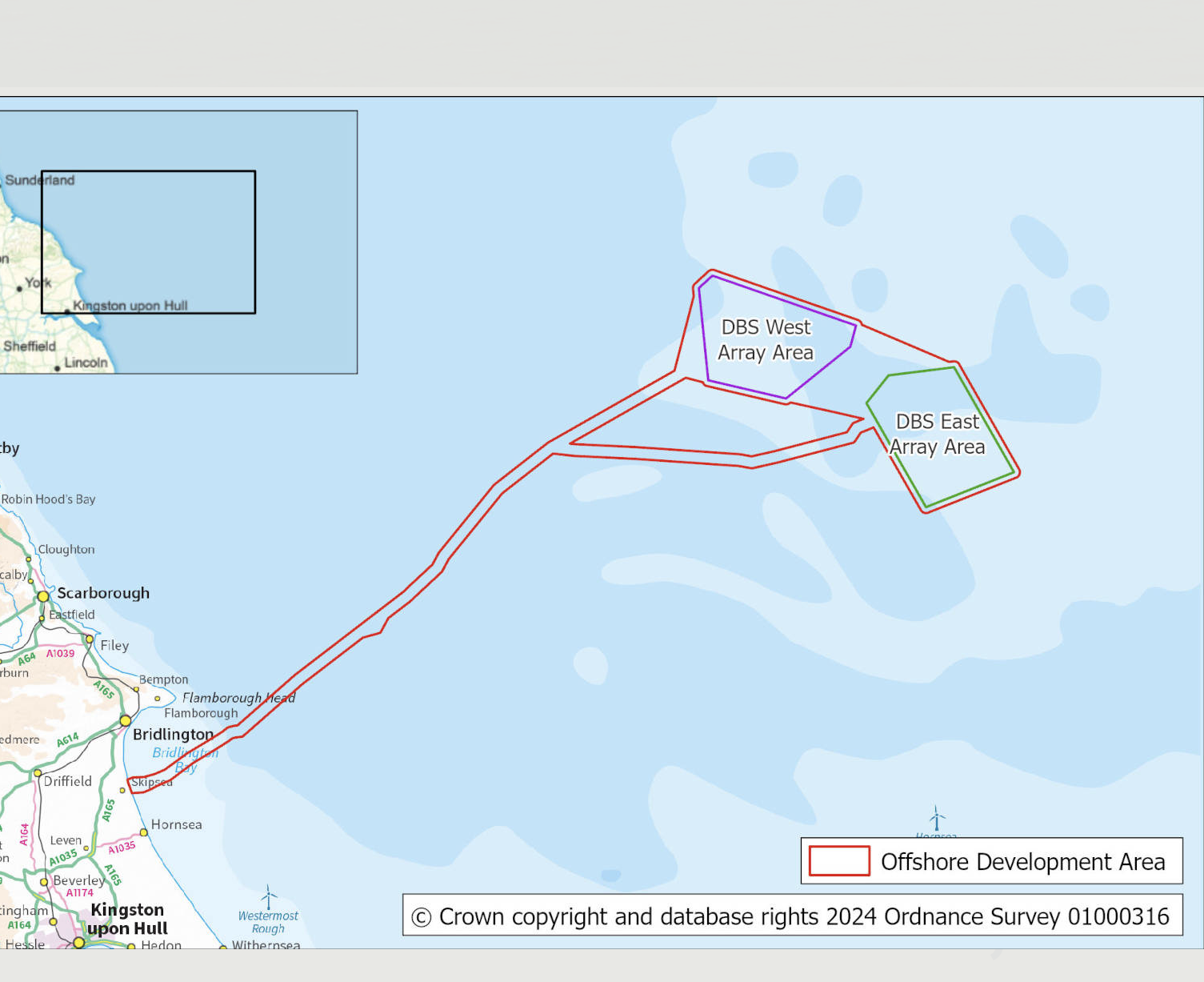
Note.
- Bridlington, Kingston-Upon-Hull and Scarborough can be picked out on the coast of East Yorkshire.
- The two wind farms and the route of the cables to the shore can be clearly seen.
I just wonder, whether the nature of the project is changing.
Consider.
- Three GW is a lot of power to move across Yorkshire to where it can be connected to the grid.
- In Consultation On Offshore Wind Reform: Hydrogen Sector Calls For Hybrid Connection Concepts And Warns Of Compensation Risks, German companies involved in the AquaVentus project are calling for more hydrogen to be produced offshore and piped to the shore.
- Could hydrogen produced in the Dogger Bank Wind farms be piped to the Northern end of the AquaVentus pipeline on the German sector of the Dogger Bank?
- A pipeline or cable could still bring energy to Yorkshire.
- The hydrogen could go to the hydrogen stores at Aldbrough and Rough.
- SSE and Centrica could play hydrogen-bankers to the Germans, as Germany is short of hydrogen storage.
- East Yorkshire is building two hydrogen power stations at Keadby and Ferrybridge.
- Support for the Dogger Bank South wind farms will probably be from RWE’S Grimsby hub.
Is this the Anglo-German co-operation, I talked about in UK And Germany Boost Offshore Renewables Ties at work?
I can see benefits for this arrangement for the UK.
- Hydrogen production is offshore.
- A lot of the onshore employment is in the UK.
- There will be a hydrogen pipeline between Germany and the vast hydrogen storage of Humberside via the German Dogger Bank and Dogger Bank South wind farms.
- Will there be a hydrogen pipeline between the North of Scotland and Humberside via the AquaVentus pipeline?
- There will also be a substantial cash flow to the UK Treasury because of all the hydrogen production in UK waters.
RWE may also be able to use a standard hydrogen production platform in German and UK waters.
This is the sort of plan, that the money men will like.
Google AI Is Using This Blog
This is a screen-shot from Google.
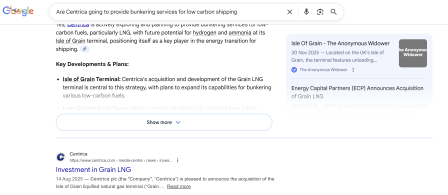
I had asked Google AI this question “Are Centrica going to provide bunkering services for low carbon shipping?”
Google AI gave me this answer.
Yes, Centrica is actively exploring and planning to provide bunkering services for low-carbon fuels, particularly LNG, with future potential for hydrogen and ammonia at its Isle of Grain terminal, positioning itself as a key player in the energy transition for shipping.
Key Developments & Plans:
- Isle of Grain Terminal: Centrica’s acquisition and development of the Grain LNG terminal is central to this strategy, with plans to expand its capabilities for bunkering various low-carbon fuels.
- Low-Carbon Fuels Focus: While currently handling LNG, Centrica sees future opportunities for hydrogen and ammonia bunkering at the terminal, aligning with the maritime sector’s shift away from heavy fuel oil.
- Strategic Investment: Centrica views LNG as a crucial transition fuel and is investing in infrastructure to support its role in energy security and decarbonization, including for shipping.
- Bio-LNG Involvement: Through its stake in Gasrec, Centrica is also supporting renewable LNG for road transport, indicating broader interest in sustainable gas fuels.
 The Anonymous Widower