Discontinuous Electrification Through Leicester Station
Leicester station is an important station on the Midland Main Line
- Leicester is an urban area of half a million people.
- All of East Midlands Railway Intercity services call as they pass through the station.
- Leicester station is only sixteen miles North of the end of the Southern electrification at Market Harborough station.
- Birmingham New Street is 40 miles away.
- Clay Cross North Junction is 50 miles away.
- Derby is 29 miles away.
- East Midlands Parkway is 19 miles away.
- Long Eaton is 21 miles away.
- Nottingham is 27 miles away.
- Peterborough is 52 miles away.
- Sheffield is 66 miles away.
A sensible decision would probably be to extend the electrification from Market Harborough to a few miles North of Leicester, so that battery-electric trains could reach all the places in the above list.
Unfortunately, the following about the bridge at the Southern end of Leicester station, must be noted.
- The bridge doesn’t have sufficient clearance for electrification and would need to be rebuilt.
- It carries the main A6 road to London over the railway.
- The station building also spans the railway lines.
- To complicate matters, there is an important sewer either in or under the bridge.
This Google Map shows the bridge and the Southern end of the station.
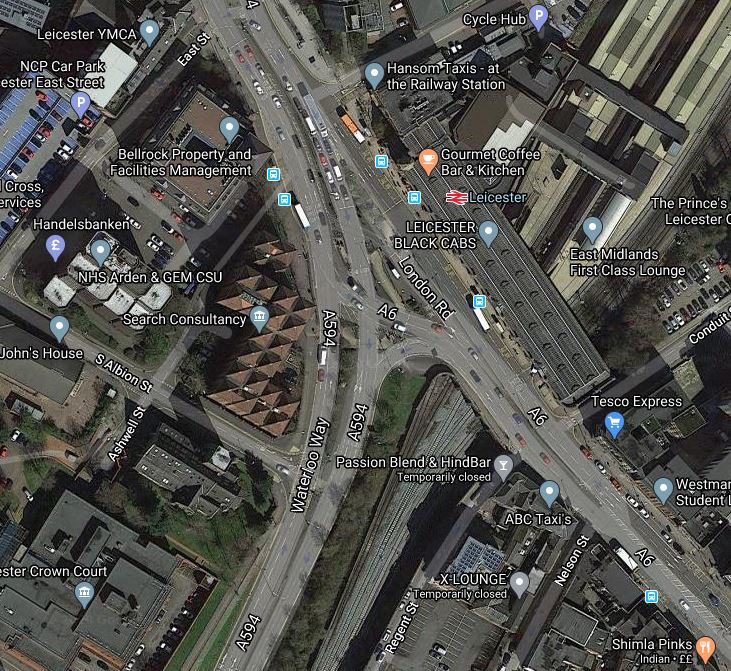
It looks to me, that Leicester station and the road, would have to be closed to traffic for some time, if the bridge were to be rebuilt, to allow the erection of electrification through the area.
A solution could be discontinuous electrification.
- The electrification from the South, would finish on the South side of bridge.
- The electrification from the North, would finish in Leicester station.
- Electric trains would cover the gap of a few hundred metres on battery power.
Pantographs could be raised and lowered, where the wires exist.
- On the North side of the bridge, this could be in Leicester station, whilst passengers are getting off and on the train.
- On the South side of the bridge, this could be as far South as Market Harborough, which is sixteen miles away.
The other big problem area of electrification on the Midland Main Line is North of Derby, where the railway runs through the World Heritage Site of the Derwent Valley Mills. There might be serious opbjections to electrification in this area.
- But if electrification were to be installed between Leicester and Derby stations, the following would be possible.
- The Midland Main Line would be electrified at East Midlands Hub station.
- Power could be taken from High Speed Two’s supply at East Midland Hub station.
- Battery-electric trains could do a return trip to Nottingham from an electrified East Midlands Parkway, as it’s only sixteen miles in total.
- Battery-electric trains could reach the High Speed Two spur into Sheffield at Clay Cross from Derby, as it’s only twenty-one miles.
I am assuming, that Hitachi’s Class 810 trains will have range of over fifty miles on battery power, which fits with Hitachi’s statements.
Conclusion
Discontinuous electrification and batteries on trains can solve the problem of electrification through Leicester station.
Also. electric trains could run between London and Sheffield, if the following were done.
- The Class 810 trains were to be given a range of twenty-five miles
- Electrification were to be erected between Leicester and Derby stations.
- Electrification were to be erected between Sheffield and Clay Cross Junction, as required by High Speed Two.
The electrification could be brought forward, to bring Sheffield early benefits of High Speed Two.
The Definitive High Speed Two Route Map
This map is shown on the High Speed Two web site.
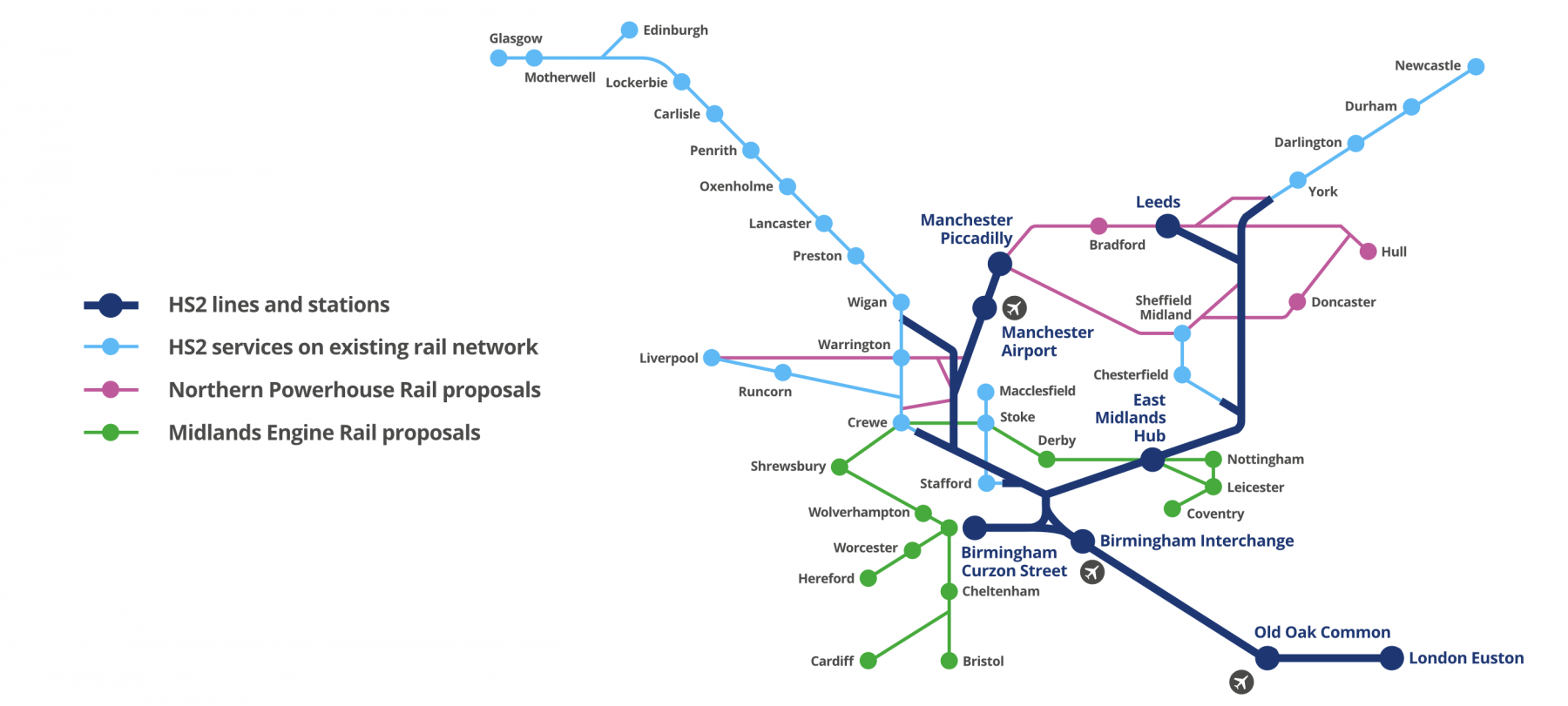
The map shows how it links to other routes.
- High Speed Two joins the West Coast Main Line at Crewe and South of Wigan.
- High Speed Two uses a route via Stafford and Stoke-on-Trent to serve Macclesfield.
- High Speed Two uses the current Crewe and Liverpool route to serve Runcorn and Liverpool.
- High Speed Two to Manchester Piccadilly share tracks with Northern Powerhouse Rail between Liverpool and Manchester Piccadilly via Warrington and Manchester Airport.
- High Speed Two uses the loop around Crewe to Wigan to serve North West England and Scotland.
- High Speed Two joins the East Coast Main Line South of York, to serve York, Darlington, Durham and Newcastle.
- High Speed Two joins the Midland Main Line at Clay Cross North Junction to serve Chesterfield and Sheffield.
- High Speed Two has connections to Midlands Rail Engine at Birmingham, Crewe and East Midlands Hub.
- High Speed Two has connections to Northern Powerhouse Rail at Liverpool, Manchester Airport, Manchester Piccadilly, Sheffield and Leeds.
MP Campaigns To Extend Train Services For Melton Borough
The title of this post, is the same as that of this article on the Melton Times.
This is the introductory sub-title.
A campaign has been launched by the Melton’s MP to improve services passing and operating from the town station and the one at Bottesford.
Alicia Kearns has submitted two bids to the Restoring Your Railway Fund.
- More regular services on the Poacher Line to Bottesford station.
- Increased services to Nottingham and Leicester via Syston and Loughborough from Melton Mowbray station.
I’ll now look at the two proposals in more detail.
More Regular Services To Bottesford
Wikipedia says this about services at Bottesford station.
- The service is generally every two hours to Nottingham in the West and Skegness in the East.
- Some trains call at Grantham and give connection to the East Coast Main Line.
- LNER services at Grantham connect to Doncaster, King’s Cross, Leeds, Lincoln, Peterborough, Stevenage, Wakefield and York.
- Bottesford is in the Borough of Melton and their is no direct rail service between Bottesford and Melton. A typical journey takes over two-and-a-half hours with two changes, that can include a wait of an hour at Leicester station.
- Bottesford is in the County of Leicester. There is no direct rail service between Bottesford and Leicester.
I think the MP has a point and an improved and more frequent service at Bottesford could be very beneficial.
- Many routes like this in the UK have an hourly service and I suspect many communities along the Poacher Line would benefit from this frequency.
- All services calling at Grantham for East Coast Main Line services would be useful.
- Do services have a good interchange at Nottingham for Midland Main Line services?
It looks like improvements at Bottesford wouldn’t require any new expensive infrastructure, but they would need more trains.
More Services Through Melton
Wikipedia says this about services at Melton station.
- There is an hourly off-peak service in both directions between Stansted Airport and Birmingham, that calls at Cambridge, Peterborough, Oakham and Leicester.
- East Midlands Railway and their predescessor have added services to London via Corby and to Derby and East Midlands Parkway.
When you consider, that both Bottesford and Melton Mowbray are the same Council and Parliamentary constituency, it does seem that a more direct train service is needed between Bottesford and Melton stations.
It does seem to me that some innovative thinking is needed.
If the current plans to fulfil British Rail’s ambition of an Ivanhoe Line running from Lincoln to Burton-on-Trent via Nottingham, East Midlands Parkway, Loughborough and Leicester, are carried out, that will give important towns to the West of Leicester much better rail connections.
Given that High Speed Two is coming to East Midlands Hub station at Toton and there will be a Bedford and Leeds service run by Midlands Connect using High Speed Two classic-compatible trains, that I wrote about in Classic-Compatible High Speed Two Trains At East Midlands Hub Station, I wonder if in the interim, there should be more trains between Derby and Melton.
- Intermediate stations would be Syston, Sileby, Barrow-upon-Soar, Loughborough, East Midlands Parkway Long Eaton and Spondon.
- An hourly frequency would double the service frquency at smaller stations like Sileby and Barrow-upon-Soar.
- The Southern terminal could be Melton station, but I feel Corby or Peterborough stations would be better, as this would improve services at Oakham station. We should not forget Rutland.
- As Corby will be an electrified two-platform station with a two trains per hour (tph) service to London, this could work quite well as a Southern terminus.
- Peterborough would have advantages and give a good connection to Cambridge, London and Scotland, but improvements to the current Birmingham and Stansted Airport service would have similar effects.
This route would be just as valuable after High Speed Two opens through the East Midlands Hub station, as it will give fast ongoing connections to Birmingham, Leeds, Newcastle and York.
Electrification Of The Midland Main Line
I feel strongly, that full electrification of the Midland Main Line could be a step to far.
- Electrification, through Leicester station will mean a complete closure of the station for a couple of years.
- Electrification of the route North of Derby, through the Derwent Valley Mills, which is a World Heritage Site, will be opposed by the Heritage Taliban with all their might.
But.
- Electrification of the route between Clay Cross North Junction and Sheffield via Chesterfield will take place in conjunction with High Speed Two
- Electrification to Market Harborough, which is sixteen miles South of Leicester will happen.
- East Midlands Railway’s new Class 810 trains could be fitted with a battery option giving a range of between 55 and 65 miles.
- Pantographs on this trains can go up and down with all the alacrity of a whore’s drawers.
If the easier section of electrification between Leicester and Derby stations, were to be erected, this would enable the following routes to be run using battery=equipped Class 810 trains.
- London and Derby, where battery power would be used through Leicester.
- London and Nottingham, where battery power would be used through Leicester and between East Midlands Parkway and Nottingham.
- London and Sheffield, where battery power would be used through Leicester and between Derby and Clay Cross North Junction.
- Lincoln and Burton-on-Trent, where battery power would be used South of Leicester and North of East Midlands Parkway.
- Derby and Corby, where battery power would be used between Syston and Corby.
There would also be the service between Derby and Norwich, which might be able to be run by a similar train.
Conclusion
The MP’s plan is worth pursuing.
Railway Lines Through East Midlands Hub Station
This Google Map shows the position of High Speed Two‘s East Midland Hub station to the West of Nottingham.
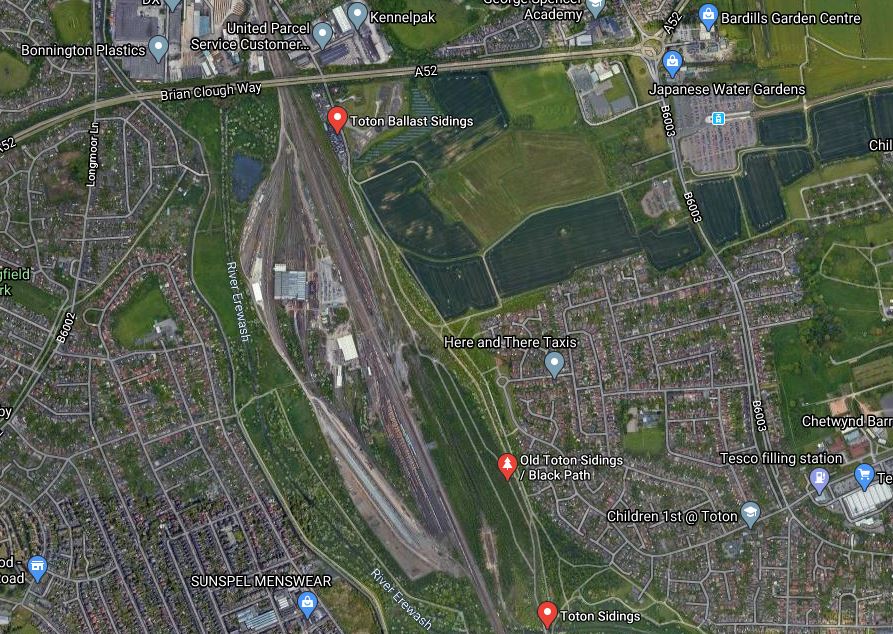
Note.
- In the North East Corner of the map, is a label saying Japanese Water Garden. Below that is a blue dot, which marks the Toton Lane tram stop.
- Three red arrows relate to Toton Ballast Sidings, Old Toton Sidings (Black Path) and Toton Sidings from North to South.
- Running to the West of the arrows is a double-track railway and beyond that are a large number of sidings.
This second Google Map shows some of the sidings.

The double track main line is the Erewash Valley Line.
- This line goes North to Ilkeston, Langley Mill, Alfreton, Clay Cross North Junction, Chesterfield and Sheffield.
- Going South, the route splits with one branch going East through Attenborough and Beeston to Nottingham station.
- The other branch turns to the West and then splits again at the massive Trent Junction.
- One branch goes West through Long Eaton station, under the M1, through Spondon station and on to Derby station.
- The second branch goes South over the River Trent to join up with the Midland Main Line and pass through East Midlands Parkway station.
- There is also a chord across the Trent Junction to allow trains to go between Long Eaton and East Midlands Parkway stations.
It is sounds complicated this map from High Speed Two may help.

Note.
- High Speed Two is shown in orange, with the blue dot indicating the East Midlands Hub station.
- Nottingham station is to the North East.
- Attenborough station can be picked out on the line going to Nottingham station.
- The water is in the Trent Valley.
- Trent Junction is the large triangular junction to the West of High Speed Two.
- Two rail lines lead to the West from Trent junction; the northerly one goes to Derby by Long Eaton and the other is a freight line to Castle Donington and East Midlands Gateway.
It is worth looking at how the various passenger services go through the area.
- CrossCountry – Cardiff and Nottingham goes via Derby, Long Eaton, Attenborough, Beeston and Nottingham
- CrossCountry – Birmingham and Nottingham goes via Derby, Long Eaton, Attenborough, Beeston and Nottingham
- East Midlands Railway – Leicester and Lincoln goes via East Midlands Parkway, Attenborough, Beeston and Nottingham
- East Midlands Railway – Liverpool and Norwich goes via Alfreton, Langley Mill, Ilkeston and Nottingham
- East Midlands Railway – Matlock and Newark Castle goes via Derby, Long Eaton, Attenborough, Beeston and Nottingham
- East Midlands Railway – St. Pancras and Sheffield goes via East Midlands Parkway, Long Eaton and Derby
- East Midlands Railway – St. Pancras and Nottingham goes via East Midlands Parkway, Attenborough, Beeston and Nottingham
- Northern – Leeds and Nottingham goes via Alfreton, Langley Mill, Ilkeston and Nottingham.
Note.
- Not one service goes past the site of the new East Midlands Hub station.
- Most services to and from Nottingham seem to use the Attenborough and Beeston route
- Services between Derby and Nottingham go via the Long Eaton, Attenborough and Derby route.
- Services from the North use the Erewash Valley Line and turn East at Trowell for Nottingham.
It is fairly obvious that there needs to be a sort-out of services to fit in with the location of the new East Midlands Parkway station.
Access To Toton – Scheme 6 – Trowell Curve
In £2.7bn East Midlands Plan Unveiled For HS2 Links, a series of schemes are given, which improve access to the High Speed Two East Midlands Hub station.
Scheme 6 is defined like this.
The implementation of a minimum of four direct rail services per hour linking the HS2 East Midlands Hub station to Derby, Nottingham and Leicester stations, as well as Loughborough, Matlock, Mansfield, Newark, Alfreton and Grantham, made possible by the building of a new piece of infrastructure, the Trowell Curve, which will link to the Midland Mainline. These additional connections will also create direct links to Stoke-on-Trent, Crewe, Newark and Lincoln, by extending services on existing routes.
That is a comprehensive set of connections.
The Trowell Curve
This Google Map shows the location of the village of Trowell.
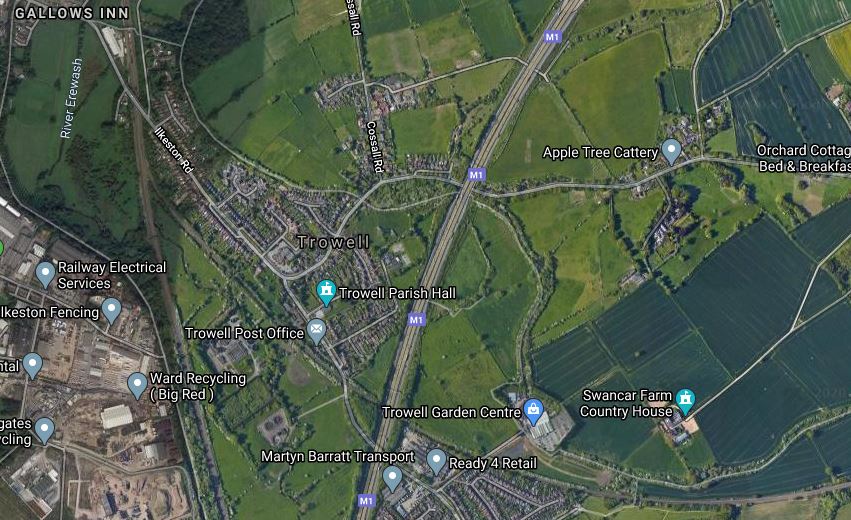
Note.
- The M1 Motorway running North-South up the map.
- The village of Trowell on the Western side of the motorway.
- Many people will have stopped at Trowell services on the motorway, which are just to the North of the top edge of the map.
- The North-South railway line to the West of the village is the Erewash Valley Line, that runs North from the East Midlands Hub station at Toton to Ilkeston, Langley Mill, Alfreton, Clay Cross North Junction, Chesterfield and Sheffield.
There is also another railway line, that runs on the South Western side of the village and across the bottom of the map, that connects the Erewash Valley Line to Nottingham station.
Trains can go between Nottingham and the North, but there is no connection to go between Nottingham and the South.
It looks like the proposed Trowell Curve will add extra connectivity to the junction, so that all these directions are possible.
- Nottingham to Ilkeston and the North.
- Ilkeston and the North to Nottingham.
- Nottingham to East Midlands Hub Station and the South.
- East Midlands Hub Station and the South to Nottingham
The Trowell Chord will be double-track or bi-directional and must certainly improve connectivity.
East Midlands Hub Station
The East Midlands Hub station will link various bus, tram and train services to High Speed Two.
According to the latest reports in the June 2020 Edition of Modern Railways there will be nine high-speed trains per hour (tph) through the station of which seven tph will stop.
Destinations served would be.
- Birmingham Interchange – 1 tph
- Birmingham Curzon Street – 3 tph
- Chesterfield – 1 tph
- Darlington – 1 tph
- Durham – 1 tph
- Leeds – 5 tph
- London Euston – 4 tph
- Newcastle – 1 tph
- Old Oak Common – 4 tph
- Sheffield – 2 tph
- York – 2 tph
As the capacity of High Speed Two has been said to be 18 tph, there must be the possibility for extra services to run on this leg of High Speed Two.
As four tph is considered by many to be a good Turn-Up-And-Go frequency and two tph a sensible minimum frequency, I can see another train between Birmingham Curzon Street and Newcastle with stops at East Midlands Hub, Leeds, Darlington and Durham.
The design has certainly left enough capacity for those that follow us!
Especially, as Wikipedia says that the new East Midlands Hub station will have eight platforms.
- It would need a minimum of two through platforms for High Speed Two services
- Would it need a terminating platform for High Speed Two services? Not for the currently proposed timetable.
- It would need a minimum of two through platforms for East Midlands Railway’s Inter-City services.
- Would it need a terminating platform for East Midlands Railway’s Inter-City services? Not for the currently proposed timetable.
- There would probably be a need for two through platforms for local services.
On this crude look, eight platforms would appear to be more than enough.
Current Services Through The Area
In Railway Lines Through East Midlands Hub Station, I detailed where the new East Midlands Hub station is to be built and the rail services in the area.
After listing all the services I said this.
Note.
- Not one service goes past the site of the new East Midlands Hub station.
- Most services to and from Nottingham seem to use the Attenborough and Beeston route
- Services between Derby and Nottingham go via the Long Eaton, Attenborough and Derby route.
- Services from the North use the Erewash Valley Line and turn East at Trowell for Nottingham.
It is fairly obvious that there needs to be a sort-out of services to fit in with the location of the new East Midlands Parkway station.
So will the new Trowell Curve give the new station, the rail access it needs?
The Splitting Of The Norwich and Liverpool Service
I wrote about this in Abellio’s Plans For Norwich And Liverpool, where I said this about the basic plan.
Early in the new franchise the Liverpool – Nottingham section will transfer to another operator, which will enable the two halves of the service to better meet the needs of customers.
It will become two services.
- Norwich and Derby via Nottingham, Trowell Curve, East Midland Hub and Long Eaton.
- Nottingham and Crewe via Trowell Curve, East Midland Hub, Long Eaton and Derby.
The second service will go to another operator.
I said earlier, this change is for the needs of customers.
It will also have other effects.
- It will add an extra service between Nottingham and Derby
- It will remove the Norwich and Liverpool service from the Erewash Valley Line.
Has this change being driven by the need to provide good connections to High Speed Two?
Train Services To East Midlands Hub Station
The following sub-sections detail the service between various stations and the East Midlands Hub station.
Alfreton Station
Alfreton station on the Erewash Valley Line, is going through major changes to train services.
Currently, there are these two hourly services.
- East Midlands Railway’s Liverpool and Norwich service.
- Northern’s Leeds and Nottingham service.
Neither service currently goes through the site of East Midlands Hub station and East Midlands Railway will split the Liverpool and Norwich service, so it won’t go anywhere near Alfreton.
Consider.
- Alfreton station probably needs at least a two tph service to East Midlands Hub station.
- The Northern service might be able to go via East Midlands Hub station.
- Both Alfreton and the East Midlands Hub station are on the Erewash Valley Line.
- Trains could run between Alfreton and Nottingham via Langley Mill, Ilkeston, East Midlands Hub, Attenborough and Beeston.
- Trains could run between Alfreton and Derby via Langley Mill, Ilkeston, East Midlands Hub, Long Eaton and Spndon.
Or would it be best to put in a bay platform at Alfreton station and run a shuttle service between Alfreton and the East Midlands Hub stations?
- The minimum frequency would be two tph.
- Up to four tph could probably be easily run.
- Trains would call at all stations.
- Extra stations could be added.
- The distance between Alfreton and East Midlands Hub stations is around twenty miles, so a battery-electric train could be possible.
This Google Map shows Alfreton station.
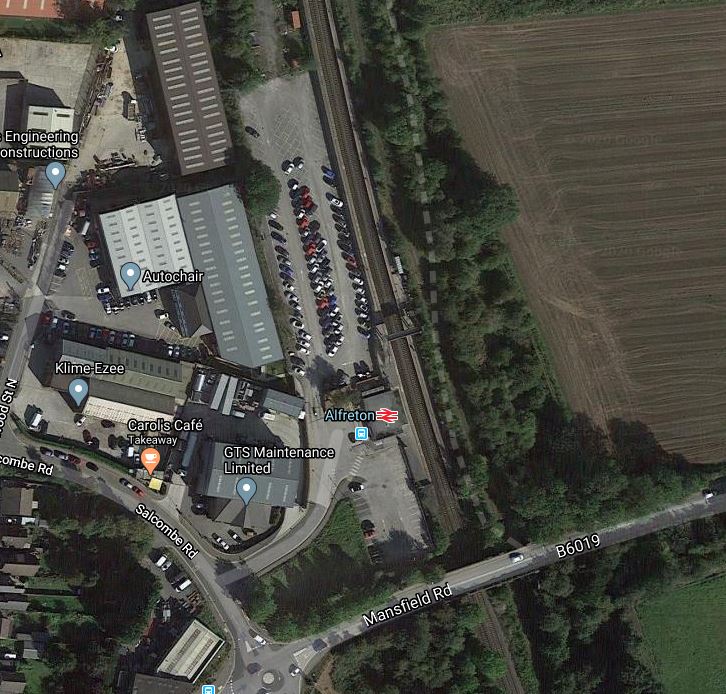
I suspect a bay platform could be added. Or failing that, there could be a turnback siding to the North of the station.
Surely, a local train solution would be a spur to development in the area, especially if it connected to High Speed Two at East Midlands Hub station for High Speed Two.
Derby Station
Consider.
- The current half-hourly East Midlands Railway services between St. Pancras and Sheffield, could not call at both the East Midlands Hub and Derby stations, unless it performed a reverse at East Midlands Hub station.
- Two hourly CrossCountry services, that call at both Derby and Nottingham could use a route via Long Eaton, East Midlands Hub and Trowell Curve.
- An hourly East Midlands Railway service between Newark Castle and Matlock could use a route via Long Eaton, East Midlands Hub and Trowell Curve
- The split service between Liverpool and Norwich would run two tph between Nottingham and Derby, via Long Eaton, East Midlands Hub and Trowell Curve, in both directions.
Six tph can be provided by existing services calling at the new East Midlands Hub station.
Grantham Station
Consider.
- The current hourly East Midlands Railway service between Norwich and Liverpool, calls at Grantham station and could call at the East Midlands Hub, if it used the Trowell Curve route.
- After the service has been split, the two sections will probably both go between Nottingham and Derby via long Eaton, East Midlands Hub and Trowell Curve.
- The current hourly East Midlands Railway service between Nottingham and Skegness calls at Grantham station, but doesn’t pass the site of the East Midlands Hub station.
- This service could be extended to the East Midlands Hub station using the Trowell Curve or the Beeston/Attenborough route, where it would terminate.
It appears relatively easy to give Grantham a two tph service to the East Midlands Hub station.
Ilkeston Station
Ilkeston station would be a stop on all services between the East Midlands Hub and Alfreton and Mansfield stations, so would have a frequent service to the East Midlands Hub station.
Langley Mill Station
Langley Mill station would be a stop on all services between the East Midlands Hub and Alfreton and Mansfield stations, so would have a frequent service to the East Midlands Hub station.
Leicester Station
Consider.
- The current half-hourly East Midlands Railway services between St, Pancras and Nottingham, could call at both the East Midlands Hub and Leicester stations, if the trains used the Trowell Curve.
- Any Ivanhoe Line services between Lincoln and Leicester, could call at both the East Midlands Hub and Leicester stations, if the trains used the Towell Curve.
Leicester would get a frequent train service from the East Midlands Hub station.
Lincoln Station
Lincoln is the Eastern terminal of Ivanhoe Line services. Currently, they run as far as Leicester, but by the time the East Midlands Hub station opens, the services will probably terminate at Burton-on-Trent. I wrote about this project, which is being promoted by the Restoring Your Railway Fund in Reinstatement Of The Ivanhoe Line.
I can see two tph between Lincoln and Burton-on-Trent.
- Stations served could be Newark, Nottingham, East Midlands Hub, East Midlands Parkway, Loughborough, Leicester, Coalville and Ashby-de-la-Zouch.
- The services would use the proposed Trowell Curve.
- Services could be extended to Grimsby and Cleethorpes at the Lincoln end of the service.
- Services would co-ordinate with East Midlands Railway’s Inter-City services to and from London with easy interchange at Leicester and or East Midlands Hub stations.
- Trains could be five-car Class 810 trains to take full advantage of the 125+ mph running between Leicester and Trowell.
- These trains have a shorter dwell time than many and timings could benefit.
Effectively, East Midlands Railway would have a second main line.
Loughborough Station
Consider.
- East Midlands Railway currently has two Inter-City and one Ivanhoe Line service, that stop in Loughborough station and could stop at the East Midlands Hub station.
With another service, Loughborough could have four tph to and from the East Midlands Hub station.
Mansfield Station
This is where Maid Marion flashes her lashes and gets the engineers to reopen her line for passenger trains between North of the former Pye Corner station on the Erewash Valley Line and Kirkby-in-Ashfield station on the Robin Hood Line.
This Google Map shows the route.
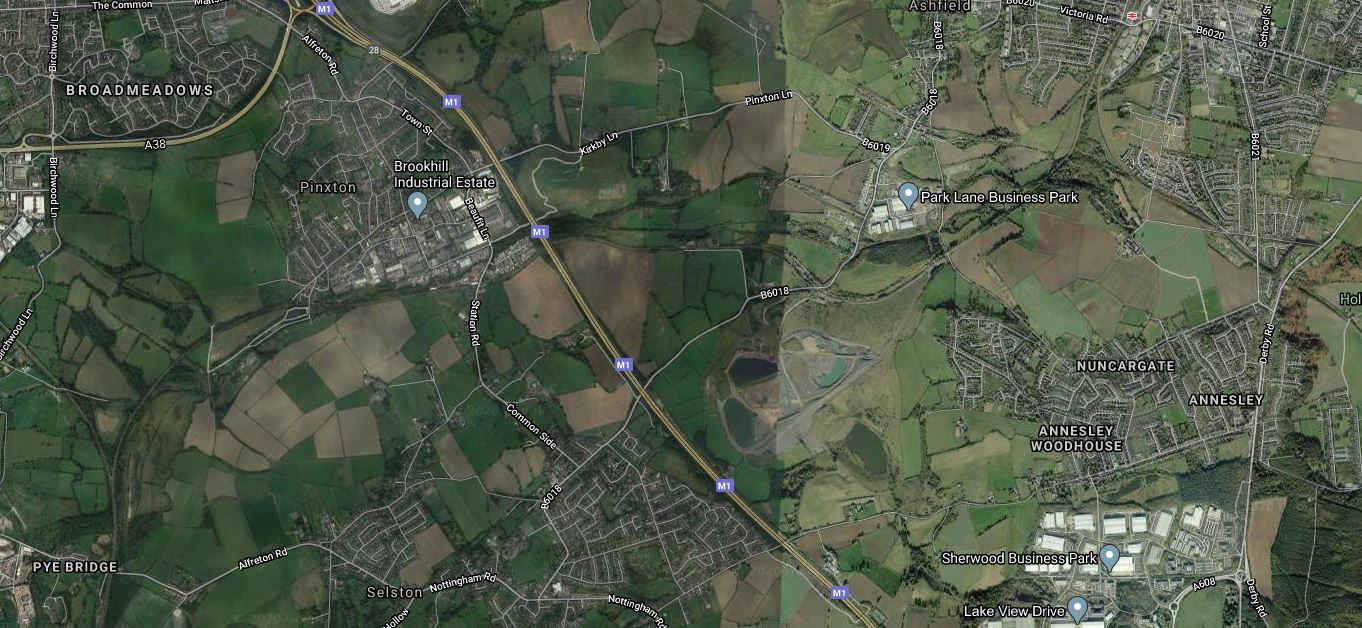
Note.
- The M1 Motorway crossing the map from North-West to South-East.
- Pye Corner is in the South-West corner of the map.
- The Erewash Valley Line runs North-South through Pye Corner.
- Kirkby-in-Ashfield is the urban area in the North-East corner of the map.
- Kirkby-in-Ashfield station is shown by the usual red symbol.
- The Robin Hood Line runs North-South through Kirkby-in-Ashfeld station.
On a high-resolution screen, it’s possible to pick out the freight line, that will become the Maid Marian Line.
- The Maid Marian Line is double-track.
- According to Real Time Trains, the distance between Kirkby-in-Ashfield and Langley Mill stations is around nine miles.
- A freight train took twenty-two minutes between the two stations.
- As there are two tph on the Robin Hood Line, I think it would be reasonable to have a similar frequency on the Maid Marian Line.
- Trains between the East Midlands Hub and Mansfield stations would pass Ilkeston, Langley Mill, Kirkby-in-Ashfield and Sutton Parkway stations.
- Trains could terminate at Nottingham using the Attenborough route.
- Trains could terminate at Derby using the Long Eaton route.
The Maid Marian Line could improve services from Derby, Mansfield, Nottingham and Worksop stations to the new East Midlands Hub station.
Matlock Station
Consider.
- Matlock is currently served by an hourly service between Matlock and Newark Castle via Derby, Spondon, Long Eaton, Attenborough, Beeston, Nottingham and several other smaller stations, which is a service that goes past the site of the East Midlands Hub station.
If this service were to call at the East Midlands Hub station and be doubled in frequency, it would be a very valuable connecting service to and from the East Midlands Hub station.
To call at East Midlands Hub station, it would need to use the Trowell Curve.
Newark Station
Consider.
- Newark is a calling point on the Ivanhoe Line service between Lincoln and Leicester.
- Newark is currently served by an hourly service between Matlock and Newark Castle via Derby, Spondon, Long Eaton, Attenborough, Beeston, Nottingham and several other smaller stations, which is a service that goes past the site of the East Midlands Hub station.
Both services could be increased to two tph, so Newark might end up with a four tph service to Nottingham and East Midlands Hub stations with a two tph service to Derby and Lincoln.
Nottingham Station
Consider.
- The current half-hourly East Midlands Railway services between St. Pancras and Nottingham could use the Trowell Chord route, as this would allow a call at the East Midlands Hub station.
- Ivanhoe Line services between Lincoln and Leicester could also use the Trowell Chord route, which with a change at the hub station, would give Lincolnshire a faster service to and from London and Birmingham.
- In Reinstatement Of The Ivanhoe Line, I wrote about plans to extend the Ivanhoe Line to Burton on Trent.
- The split service between Liverpool and Norwich would run two tph between Nottingham and Derby, via Long Eaton and East Midlands Hub stations, in both directions.
- If the Nottingham and Skegness service, were to be extended to East Midlands Hub, this would add extra services between Nottingham and East Midlands Hub stations.
The required four tph between the East Midlands Hub and Nottingham station could be provided by the diversion of existing services to call at the East Midlands Hub station and using the Trowell Curve.
Stoke-on-Trent And Crewe Stations
Consider.
- Currently, there is an hourly East Midlands Railway service between Crewe and Derby, that calls at nine stations including Kidsgrove, Stoke-on-Trent and Uttoxeter.
- There are also plans to split the Liverpool and Norwich service into two, with the Western half possibly becoming a Crewe and Nottingham service via Derby, East Midlands Hub and Long Eaton.
These two services could be arranged to give a two tph service between Nottingham, Long Eaton, East Midlands Hub and Derby in the South and Stoke-on-Trent and Crewe in the North.
Back-To-Back Services At East Midlands Hub Station
Running services through a station is always more efficient as terminating services in a station will need a bay platform or turnback facility of some sort.
In my analysis, I have proposed that these services might terminate at East Midlands Hub Station.
- A possible shuttle service between East Midlands Hub and Alfreton stations.
- The Maid Marian Line service between East Midlands Hub and Mansfield and Worksop stations.
- The Nottingham and Skegness service could be extended to East Midlands Hub station.
- The Crewe and Derby service could be extended to Nottingham via East Midlands Hub station.
Note.
- The splitting of the Liverpool and Norwich service will result in an overlap between Nottingham and Derby.
- Matlock and Newark services already run back-to-back through the area.
So would it be logical to join some services back-to-back through East Midlands Hub station?
s an example, the Maid Marian Line and Skegness services could be joined into one service.
Other services could follow the precedent of the splitting of the Liverpool and Norwich service.
- Trains coming and going from the East terminate at Derby.
- Trains coming and going from the West terminate at Nottingham.
If the following were arranged.
- Grantham and Mansfield were back-to-back.
- Alfreton and Crewe services terminated at Nottingham.
- Norwich services terminated at Derby.
There would be seven tph between Nottingham and Derby via Long Eaton and East Midlands Hub stations.
Battery-Electric Operation
Consider.
- Hitachi are claiming, that the battery-electric versions of their AT-300 trains, like the Class 810 trains will have a battery range of 55-65 miles and take ten minutes to recharge.
- Nottingham and Derby are sixteen miles away and trains between the two cities, take as long as thirty minutes for the trip.
- There will be high quality electrification at East Midlands Hub station.
In addition, station distances from the East Midlands Hub station are as follows.
- Alfreton – 17 miles
- Crewe – 55 miles – 35 miles without electrification (Derby and Stoke Junction)
- Derby – 6 miles
- Grantham – 20 miles
- Ilkeston – 7 miles
- Langley Mill – 10 miles
- Lincoln – 43 miles
- Mansfield – 23 miles
- Matlock – 23 miles
- Newark Castle – 26 miles
- Nottingham – 10 miles
- Skegness – 80 miles
- Stoke-on-Trent – 42 miles – 35 miles without electrification (Derby and Stoke Junction)
I think the following would be possible on battery power.
- Return journeys to Alfreton, Grantham, Ilkeston, Langley Mill, Mansfield, Matlock and Newark Castle.
- Return journeys to Lincoln with a charge at the destination.
- Return journeys to Crewe and Stoke using the electrification between Stoke Junction and Crewe.
Running battery-electric trains between East Midlands Hub and Skegness station would need a bit of ingenuity.
The building of the Allington Chord in 2005, may have opened up a way for battery-electric trains to be able to run between Nottingham and Skegness.
Consider.
- Bottesford station is the station nearest to Grantham on the Western side of the East Coast Main Line and it is 15.3 miles from Nottingham.
- Ancaster station is the station nearest to Grantham on the Eastern side of the East Coast Main Line and it is 28 miles from Nottingham.
- The original route between Bottesford and Ancaster station caused delays on the main line, so it was replaced by two routes.
- A modified version of the original route allows trains to call at Grantham station, where they reverse before continuing. The distance is 18.7 miles and typically takes 33 minutes
- A double-track short cut under the East Coast Main Line is about 12.7 miles and typically takes 17 minutes.
- The distance between Ancaster and Skegness is 46.7 miles.
- The East Coast Main Line is electrified.
I wonder, if it were possibly to electrify the following tracks.
- The direct double track between Ancaster and Bottesford stations.
- The access lines from the Allington Chord into Grantham station.
Hopefully, as the tracks, were built in 2005, they shouldn’t be too challenging to electrify.
This would enable a train from East Midlands Hub to Skegness to use the following procedure.
- Use the electrified line between East Midlands Hub and Nottingham stations, charging the battery en route.
- Call at Nottingham station and lower the pantograph.
- Leave Nottingham with a full battery.
- Run between Nottingham and Bottesford stations on battery power.
- Call at Bottesford station and raise the pantograph.
- Use either of the electrified routes between Bottesford and Ancaster stations, charging the battery en route.
- Call at Ancaster station and lower the paragraph.
- Run between Ancaster and Skegness stations on battery power.
After charging the train at Skegness, the return would use the following procedure.
- Leave Skegness with a full battery.
- Run between Skegness and Ancaster on battery power.
- Call at Ancaster and raise the paragraph.
- Use either of the electrified routes between Ancaster and Bottesford stations, charging the battery en route.
- Call at Bottesford station and lower the pantograph.
- Run between Bottesford and Nottingham on battery power.
- Call at Nottingham station and raise the pantograph.
- Use the electrified line between Nottingham and East Midlands Hub stations, charging the battery en route.
It’s almost as if, the Allington Chord was designed for battery-electric trains.
Conclusion
The Trowell Curve with a little bit of help from a few friends can create a battery-electric network of local lines based on the three important stations of Nottingham, East Midlands Hub and Derby.
I
Reinstatement Of The Ivanhoe Line
This is one of the successful bids in the First Round of the Restoring Your Railway Fund.
The Ivanhoe Line, is a half-completed project left over from the days of British Rail.
- The main objective appears to be to extend the current line between Lincoln and Leicester via Nottingham, East Midlands Parkway and Loughborough stations to Burton-upon-Trent along the freight-only Leicester-Burton-upon-Trent Line.
- Some new stations will be added.
In January 2020, I wrote Silent Hydrogen Trains On The Cards For New Line Linking Burton And Leicester, after reading an article on Derbyshire Live.
I finished that article by listing the possibilities.
There are a lot of possibilities to extend the Ivanhoe Line to Burton and even beyond using the South Staffordshire Line.
- Battery or hydrogen trains can be used.
- Stations can be added as required.
- The route will connect to East Midlands Airport.
- A solution for Knighton Junction can surely be devised.
Amazon are reported to be interested in the project, as they have a big depot at Coalville.
It now looks like it’s all going to be turned into a plan for reality.
I do have some questions.
What Will Be The Solution To The Knighton Junction Problem?
Sadly, when the route was closed to passengers in 1964, British Rail simplified Knighton Junction at the Leicester end of the line. Wikipedia says this.
At the Leicester end of the line, Knighton North Junction has been dismantled and the former course of the line to the junction has been sold and turned into an industrial estate. The line’s remaining connection with the Midland Main Line is Knighton South Junction, which faces southwards, away from Leicester station. Trains between Leicester and the line therefore have to reverse direction at the junction.
This Google Map shows, what’s left of the junction.
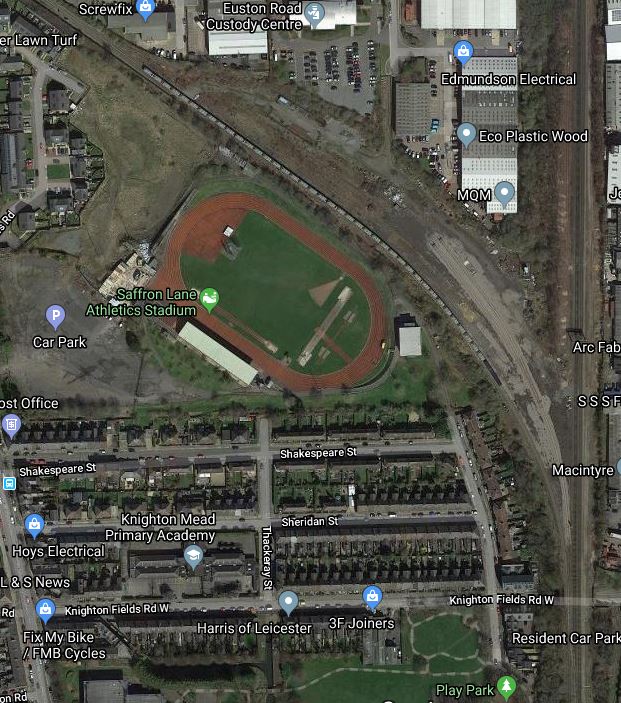
Note.
- Leicester is to the North
- Burton is to the North-West.
- Melton Mowbray and London are to the South.
It looks to me, that someone at British Rail made it absolutely certain, that the rail line could not be reopened to provide a passenger service between Leicester and Burton.
For a train to go between Leicester and Burton, it would either need to reverse as Wikipedia indicated, or the curve would have to be very tight.
It looks like the preferred solution, will be to build a new station to the South of Knighton Junction.
- The station would only need a single platform.
- It could be easily fitted in alongside the Midland Main Line.
Trains will reverse to get around the tight corner.
Will There Be A Station At Leicester City Stadium
This Google Map shows the stadium.
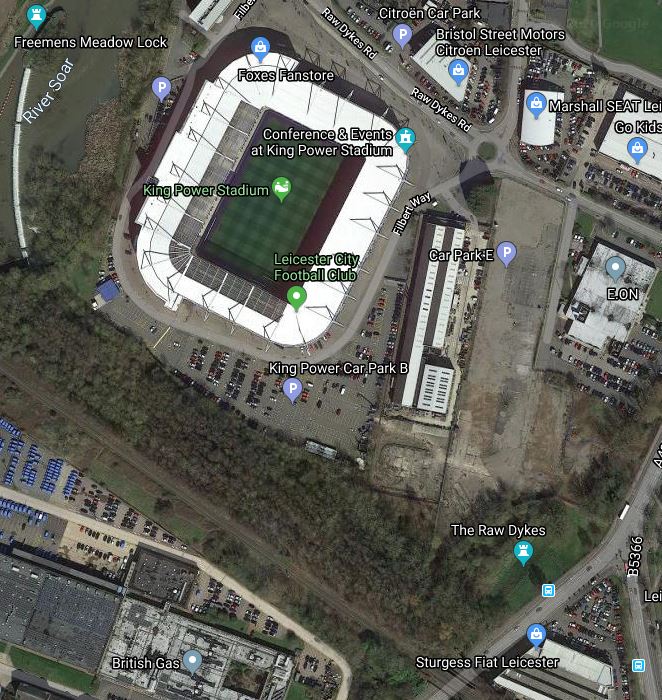
Note the rail line passing to the South of the station.
It would appear that building a new station would not be the most difficult of projects.
But after the experience of Coventry City, who were relegated twice after Coventry Arena station opened, would Leicester City want a station?
Could The Ivanhoe Line Be Connected To High Speed Two At Ashby-de-la-Zouch?
I heard an MP on the radio, who was very much against High Speed Two and that led me to write Could High Speed Two Have A Station At Ashby-de-la-Zouch?.
I think this is a serious possibility in the future.
Could East Midlands Railway Use The Route To Run A London And Burton-on-Trent Service?
Consider.
- East Midlands Railway‘s Class 810 trains could be fitted with a battery, that would give the trains a battery range of between 55 and 65 miles.
- The trains would have a charge time of perhaps 10 minutes.
- The distance between Knighton Junction and Burton-on-Trent is around 35 miles.
- The distance between Knighton Junction and the Northern limit of the electrification at Market Harborough station is fifteen miles.
- The distance between Market Harborough and Burton-on-Trent stations is 50 miles.
I think it would be possible for a battery-electric Class 810 train to run between London and Burton-on-Trent.
- The batteries would need to be charged at Burton-on-Trent.
- Perhaps, the easiest way to provide charging facilities would be to electrify the last ten miles between Ashby-de-la-Zouch and Burton-on-Trent stations
- The service could call at all or selected stations between Knighton Junction and Burton-on-Trent.
I think this could be a very useful service, even if it only ran a couple of times every day.
Could Battery-Electric Trains Run The Whole Ivanhoe Line Between Lincoln And Burton-on-Trent?
The problem is not the trains, but the lack of electrification between Market Harborough and Clay Cross North Junction.
Leicester station is an important station on the MML.
But it would be a difficult station to electrify because of a bridge with limited clearance.
In Discontinuous Electrification Through Leicester Station, I discussed how the following.
- Discontinuous electrification through Leicester station.
- Electrification between Leicester and Derby stations.
- Electrifying the High Speed Two route between Clay Cross Junction and Sheffield.
Would allow Hitachi Class 810 trains, equipped with batteries to run between London and Sheffield on electric power alone.
Consider.
- As I have said East Midland Railway’s new Class 810 trains could be fitted with batteries with a range of 55 to 65 miles.
- The gap between Leicester station and the end of the electrification at Market Harborough is sixteen miles.
- Knighton Junction is less than two miles South of Leicester station.
- Burton-on-Trent is around forty miles from Leicester station.
- All passenger trains passing through Leicester station, stop in the station to set down and pick up passengers.
It would thus appear that the following would be possible.
- A Northbound battery-electric train from St. Pancras to Leicester or further North could reach Leicester on battery power from Market Harborough.
- A Northbound battery-electric train from Burton-on-Trent to Leicester or further North could reach Leicester on battery power from Burton-on-Trent.
- A Southbound train from Leicester or further North to St. Pancras could reach Market Harborough on battery power from Leicester.
- A Southbound train from Leicester or further North to Burton-on-Trent could reach Burton-on-Trent on battery power from Leicester.
Trains leaving Leicester would need to be fully charged.
So how would this be arranged?
I think the simplest method would be to electrify the section of the Midland Main Line between Leicester and Derby stations.
- The route is probably not the most difficult to electrify.
- East Midlands Parkway has good electrical connections, as it is next to Ratcliffe-on-Soar power station.
- Nottingham is just nine miles from East Midlands Parkway.
- Derby is thirty miles from East Midlands Parkway.
- Clay Cross North Junction, where the joint electrified section with High Speed Two commences is twenty-one miles from Derby.
- Lincoln is forty-two miles from East Midlands Parkway.
- Battery-electric trains could use this electrification for both traction power and to charge their batteries.
- As the trains would use battery power between Derby and Clay Cross North Junction, the sensitive issue of electrifying through the World Heritage Site of the Derwent Valley Mills, will have been avoided.
All East Midlands Railway’s InterCity services would be totally carbon-free.
It should also be noted, that as Lincoln is only forty-two miles from East Midlands Parkway, provided there was the ability to recharge the trains at Lincoln, the whole Ivinghoe route between Lincoln and Burton-on-Trent could be run by a suitable battery-electric train.
Could Hydrogen Trains Run The Whole Ivanhoe Line Between Lincoln And Burton-on-Trent?
If the route can be run by a battery-electric train, I can see no reason, why a hydrogen-powered train couldn’t do a good job on the route.
I suspect that the Alstom Breeze and any future trains, that are designed for hydrogen power, will also be able to use electrification, where it exists.
So, if any more electrification was erected on the Midland Main Line, the hydrogen trains would take advantage.
The hydrogen trains would need to be refuelled, but because of their long range, this would probably only be a twice a day operation at most.
There is probably space for a refuelling point, at either end of the route.
Conclusion
This is a good scheme, that should have been completed decades ago.
Reinstatement Of The Barrow Hill Line Between Sheffield And Chesterfield
This is one of the successful bids in the First Round of the Restoring Your Railway Fund.
The Route
This Google Map shows where the Barrow Hill Line starts at Tapton Junction near Chesterfield station.
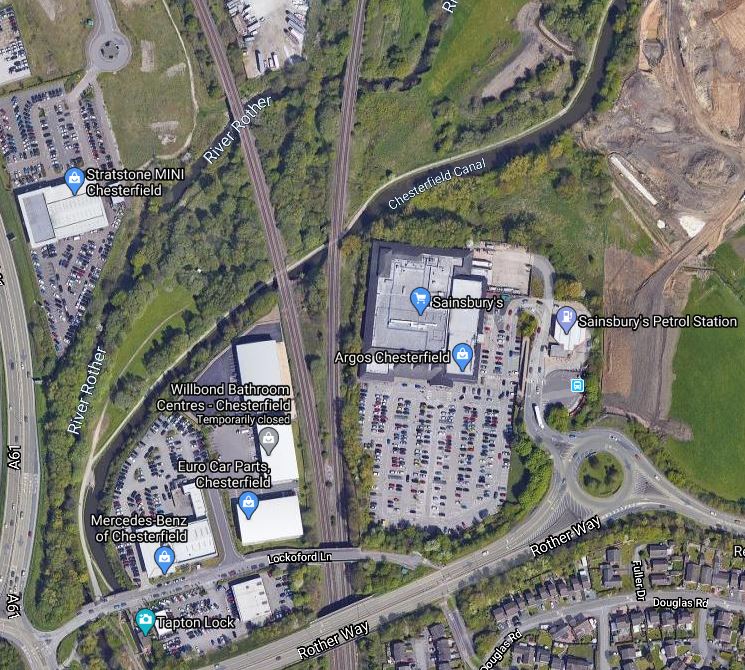
Note.
- Chesterfield station is less than a mile to the South.
- The left railway going North is the Midland Main Line to Sheffield
- The right railway going North is the Barrow Hill Line.
The Barrow Hill Line turns slightly to the East and this Google Map shows it passing through Barrow Hill, which gives the route its name.
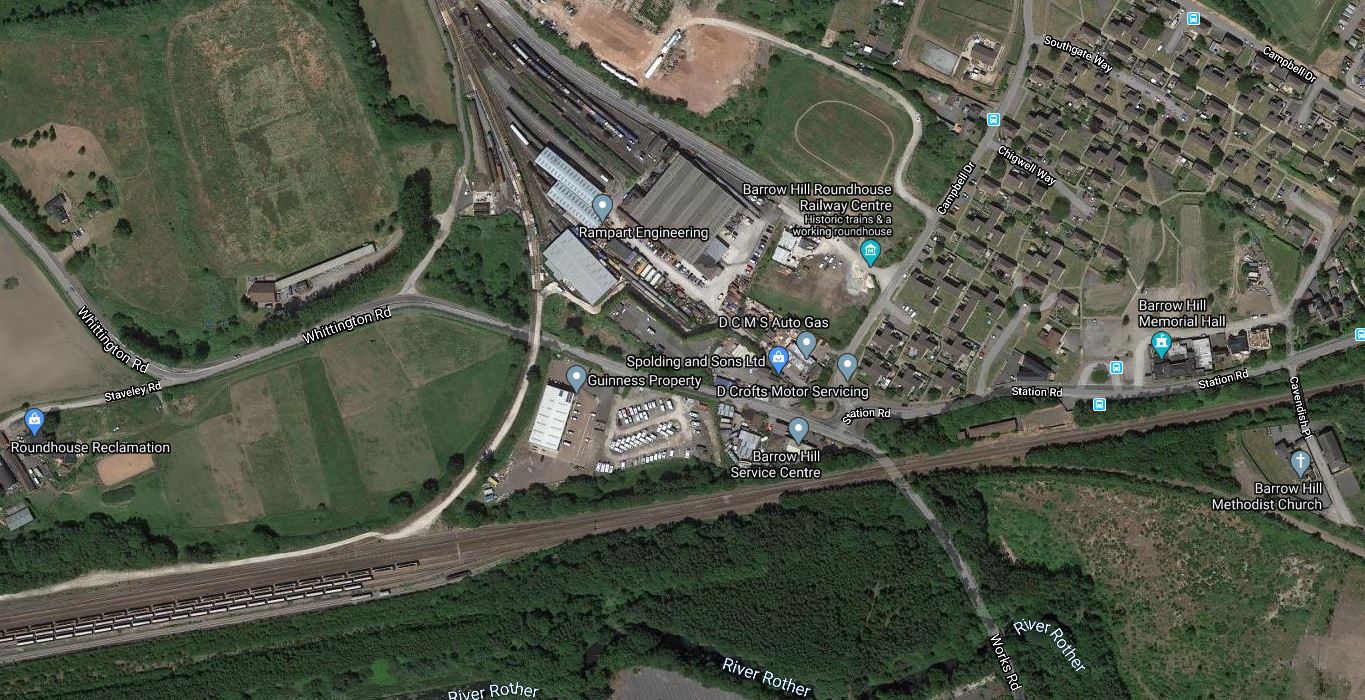
Note.
The historic Barrow Hill Roundhouse and some rail-related businesses to the North of the line.
There used to be a station here called Barrow Hill! What a surprise!
The Wikipedia entry for Barrow Hill station has a section called Modern Traffic, where this is said.
At 22 June 2013 the line is part of the Midland Main Line. It is used predominantly for freight, with a handful of passenger trains going the “long way round” from Chesterfield to Sheffield via the Old Road and Darnall largely to retain staff route knowledge in case of diversions.
The Wikipedia entry for the station also has a section called Possible Future, which is worth a read, as it lists other mothballed rail lines in the area, that could be developed.
Follow the Barrow Hill Line to the North-East and it goes through a mix of agricultural land, industrial dereliction, modern factories and nature reserves before it splits near Beighton.
This Google Map shows the area.
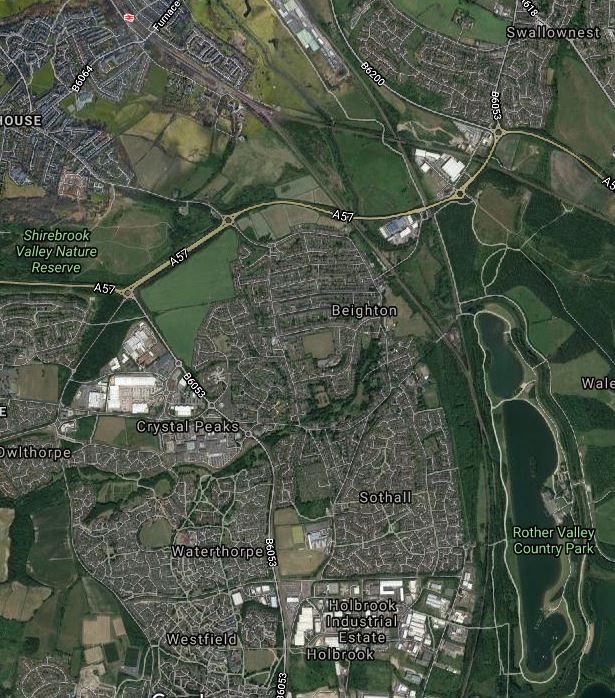
Note.
- The rail lines splitting by the Rother Valley Country Park at Beighton Junction.
- Barrow Hill is to the South.
- There used to be a station at Beighton.
- Woodhouse station is in the North West corner of the map.
- Woodhouse station is on the Sheffield-Lincoln Line, which can be seen crossing the area.
- Trains taking the left fork at Beighton Junction can go to Sheffield via Woodhouse and Darnall stations.
- Trains taking the right fork go under the Sheffield-Lincoln line and have connections to a large number of destinations for both freight and passengers.
It looks to me, that it is proposed to convert this long-way round route, into a second route between Sheffield and Chesterfield.
- Stations exist at Woodhouse and Darnall.
- Stations used to exist at Barrow Hill, Eckington & Renishaw, Killamarsh West and Beighton.
- The route would surely be very useful, when the Midland Main Line route between Sheffield and Chesterfield is updated for High Speed Two.
- The route might also be very useful for East Midlands Railway to develop services to Rotherham and other places to the East of Sheffield.
- I’ve found a train that takes this route between Chesterfield and Sheffield and with no stops it took twenty-five minutes.
- Typically, the direct route takes about eleven minutes.
I can see several possibilities for local, regional and national services using the Barrow Hill Line.
I have a few questions.
Would The Barrow Hill Line Be Electrified?
It has been stated that High Speed Two and the Midland Main Line will share an electrified corridor from Clay Cross North Junction to Sheffield via Chesterfield.
- So as both stations will be electrified, it would not be any problem to rustle up a good electricity supply to power an electrified Barrow Hill Route.
- Electrification might narrow the fourteen minute difference between the routes.
- Electrification would allow East Midlands Railway‘s new Class 810 trains to have a second electrified route into Sheffield.
- Is there a case for a service between London and the South of England and the South and East of Sheffield?
I think electrification of the Barrow Hill Line is more than a possibility.
Would Gauge-Clearance For Electrification Be Difficult?
As the route is already cleared for freight trains with the largest containers, it won’t be as difficult as some routes.
Could Tram-Trains Be Used Between Sheffield And Chesterfield On The Barrow Hill Line?
In Sheffield Region Transport Plan 2019 – A New Tram-Train Route To A New Station At Waverley, I talked about a plan by the Sheffield Region for a new tram-train route between Sheffield station and a new housing district of Waverley on the Sheffield-Lincoln Line.
- Waverley is between Darnall and Woodhouse stations.
- The new Advanced Manufacturing Park would also be served.
- Tram-trains could venture further down the Sheffield-Lincoln Line, if that was so desired.
If tram-trains were used on the Barrow Hill Line, between Sheffield and Chesterfield, both routes would share the track between Sheffield and Darnall stations.
Note that tram-trains would be able to share tracks with all electric trains used around Sheffield, including freight trains and the Class 810 trains.
Note that the stations for tram-trains can be much simpler and even share platforms with full-size trains.
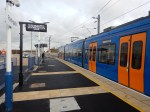
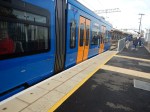
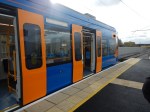
The pictures show Class 399 tram-trains at Rotherham Parkgate and Rotherham Central stations.
- I feel with innovative design, the whole route between Sheffield and Chesterfield could be run using tram-trains.
- The route could be electrified with 25 KVAC overhead wires.
- Instead of taking the Sheffield fork at Beighton Junction, the tram-trains could also take the right fork and link Chesterfield with Barnsley, Doncaster, Rotherham and Swinton.
- These tram-trains also come with batteries, if that is needed.
Barnsley, Chesterfield, Rotherham and Sheffield could be getting a lot of better connectivity and the Barrow Hill Line is key.
Conclusion
This looks to be a very sensible project.
- It could be run with either trains or tram-trams.
- It should be electrified, so it could be zero-carbon.
- Tram-trains could be used to make stations simpler.
- It could give an alternative route for electric trains to Sheffield station.
- The track is already there and regularly used.
But surely the biggest reason to built it, is that it appears to open up a lot of South and South-East Sheffield and North-East Chesterfield for development.
The Concept Of Electrification Islands
Consider how Imperial Airways and BOAC used to fly long routes to places like Sydney, Hong Kong and Cape Town before the days of long distance jet airliners. They used to fly from airport to airport, picking up fuel and supplies on the way.
If you want to know more about the details, read what is my favourite travel book, Beyond The Blue Horizon by Alexander Frater.

He followed the Imperial Airways route to Sydney, on what was reputed to be the most complicated ticket, that British Airways ever issued.
But can the concept of flying a short range airliner over a long distance refuelling as necessary, be applied to running a battery electric train by charging the batteries on a series of electrification islands?
In Ipswich And Peterborough In A Battery Train, I described how an Ipswich and Peterborough service could be run by a battery-equipped Class 755 train.
The Ipswich and Peterborough route is 82.5 miles long and it can be split as follows.
- Ipswich and Haughley Junction – 13.8 miles – Electrified
- Haughley Junction and Ely – 38.2 miles – Not Electrified
- Ely and Peterborough – 30.5 miles – Not Electrified
Legs two and three, should be within the capability of a battery-equipped Class 755 train. No definite figure has been given, but in the July 2018 Edition of Modern Railways, this was said about the similar Class 756 trains, ordered for the South Wales Metro.
The units will be able to run for 40 miles between charging, thanks to their three large batteries.
Perhaps, what is needed is to create an electrification island at Ely, that can be used to charge the batteries.
An Electrification Island At Ely
This map from Wikipedia shows the complicated railways at Ely,
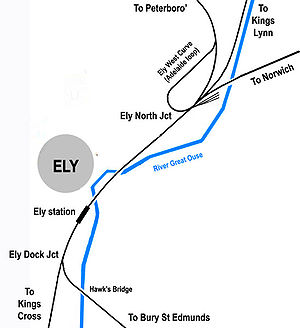
Note.
- Ely station is fully electrified.
- The line to Cambridge,Kings Cross, Liverpool Street and Stansted Airport is fully electrified. Greater Anglia’s Class 755 trains between Norwich and Stansted Airport, change between diesel and electrification at Ely.
- The line to Kings Lynn is fully electrified.
- The lines to Bury St. Edmunds, Norwich and Peterborough are not electrified.
- Ely is a city of 20,000 inhabitants, so I suspect it must have a robust electricity supply.
- Freight trains take about five minutes to pass between Ely West and Ely Dock Junctions.
- Ely West and Ely Dock Junctions are 2.5 miles apart.
- There appears to be an avoiding line South-East of Ely station, where I’ve seen trains from Felixstowe to Peterborough sometimes wait for a few minutes before proceeding.
- There is also a lot of space at March station, where a passing loop with a charging station could be built.
I believe it would be possibly to do the following at Ely.
- Electrify the West Curve and the South-East avoiding line.
- Electrify the Bury St. Edmunds, Norwich and Peterborough lines for perhaps five miles.
- If required, put a high capacity charging station on the avoiding line.
There would be plenty of electrification to charge the trains.
An alternative plan might be to electrify between March station and the new Soham station, which has been planned to open in 2021.
- This would be around eighteen miles of electrification.
- This would certainly be enough electrification to fully-charge passing freight and passenger trains.
- Soham to Ely could be doubled.
- The extra electrification would mean the two unelectrified sections of the Ipswich and Peterborough route; Haughley Junction-Soham and March-Peterborough would be well within range of a battery-electric train.
- The proposed service between Cambridge and Wisbech would only have the twelve miles of the Bramley Line between March and Wisbech to run on battery power.
It might also be possible to put in an extra curve to make Ely Dock Junction, a full triangular junction. This would allow the new Soham station to have direct services to both Cambridge and Cambridge North stations, without a reverse at Ely station.
Other Possible Electrification Islands
I’ll break these down by regions and train operators.
East Anglia (Greater Anglia)
Greater Anglia only runs trains on diesel to the North of Cambridge and Ipswich, which are both fully electrified, as is Norwich.
I would consider Cambridge, Ely, Ipswich and Norwich to be electrification islands.
- All have a good connection to the electrification power supply, as they handle main line electric trains.
- All or most platforms at the stations are electrified to charge trains.
- There are electrified sidings at Cambridge and Norwich and possibly at Ipswich.
Lowestoft and Yarmouth might be fitted with charging systems to make sure a fault doesn’t strand a train.
In Battery Power Lined Up For ‘755s’, I talked about a report in Rail Magazine, which said that the Class 755 trains will get a battery fitted at the first overhaul.
I wouldn’t be surprised, that in a couple of years, Greater Anglia announces the end of diesel power on some or all of their services.
East Coast Main Line (LNER and Others)
Hitachi AT-300 Trains On The East Coast Main Line
The East Coast Main Line (ECML), is increasingly becoming a railway where the vast majority of services are run by versions of Hitachi AT-300 trains.
- Hull Trains are running Class 802 trains.
- LNER are running Class 800 and Class 801 trains.
- TransPennine Express are running Class 802 trains.
- East Coast Trains will be running Class 803 trains.
Classes 800, 802 and 803 are bi-modes and can probably have some or all of their diesel engines replaced by batteries.
In Sparking A Revolution, I gave this specification for a Hitachi battery-electric train.
- Range – 55-65 miles
- Performance – 90-100 mph
- Recharge – 10 minutes when static
- Routes – Suburban near electrified lines
- Battery Life – 8-10 years
I will use these figures from Hitachi in this post.
Electrification Islands On The East Coast Main Line
There are several large and smaller stations along the ECML, that can act as electrification islands to support either local services or long-distance services from London.
Cleethorpes
Consider
- Cleethorpes station would need a decent electricity supply. Offshore wind?
- Doncaster is 52 miles away.
- Lincoln is 37 miles away.
- Newark is 63 miles away.
- Scunthorpe is 29 miles away.
If you can get battery-electric trains to Cleethorpes, you also serve Grimsby Town station, which is three miles closer to the ECML.
With electrification islands at Lincoln and Scunthorpe and Hitachi AT-300 trains with a battery range of at least sixty miles, electric trains could be run to Cleethorpes and Grimsby.
Would that improve the economy of the area?
Darlington
Darlington station is on the electrified ECML, so it must have a top class electricity supply.
- Bishop Auckland is 12 miles away.
- Middlesbrough is 15 miles away.
- Nunthorpe is 20 miles away.
- Saltburn is 27 miles away.
- Whitby is 47 miles away.
Darlington could support battery-electric operation of the Tees Valley Line, if the route doesn’t go for hydrogen. Note that hydrogen would probably also handle services from Middlesbrough to Newcastle, Nunthorpe and Whitby with ease.
Note my views on the definitive hydrogen train, which will be a battery-electric-hydrogen hybrid train, able to use power from a variety of sources.
Doncaster
Doncaster station is on the electrified ECML, so it must have a top class electricity supply.
- Cleethorpes is 52 miles away.
- Hull is 40 miles away.
- Scunthorpe is 25 miles away.
- Sheffield is 19 miles away.
Doncaster could certainly support some battery-electric services.
Grantham
Grantham station is on the electrified ECML, so it must have a top class electricity supply.
- Nottingham is 22 miles away.
- Sleaford is 18 miles away.
- Nottingham and Skegness services seem to take about four minutes to reverse in the station.
The Nottingham and Skegness service could take advantage of the driver changing ends to top up the battery.
Hull
Consider.
- Hull is a city of nearly 300,000 people, so it must have a decent electricity supply.
- Hull station is under forty miles from the electrification of the ECML.
- Doncaster is 40 miles away.
- Scarborough is 54 miles away.
- York is 52 miles away, with about 20 miles electrified.
I would certainly suspect that with an electrification island at Hull, the Hitachi AT-300 trains of Hull Trains and LNER could certainly run fully electric services to the city, if they were fitted with batteries.
With an electrification island at Scarborough, could Hull Trains and LNER services be extended to Scarborough?
Leeds
Leeds station is already an electrification island, as it is fully electrified.
- It also has electrified services to Bradford, Ilkley and Skipton.
- Leeds and Huddersfield will be electrified in the next few years.
Harrogate is 18 miles away, so a return journey is within range of a Hitachi AT-300 train with a battery, that is charged on the ECML.
Lincoln
Consider.
- Lincoln station would need a decent electricity supply.
- Cleethorpes is 37 miles away.
- Doncaster is 40 miles away.
- Newark is 16 miles away, so a return journey is within range of a Hitachi AT-300 train with a battery, that is charged on the ECML.
- Nottingham is 34 miles away and Leicester is 61 miles away.
- Peterborough is 57 miles away.
- Sleaford is 21 miles away.
With an electrification island at Lincoln, the following should be possible.
- Electric services between Cleethorpes and Lincoln using battery-electric trains.
- Electric services between Doncaster and Lincoln using battery-electric trains.
- Electric services between Nottingham/Leicester and Lincoln using battery-electric trains. Electrify the Midland Main Line (MML) and this is easy.
- Electric services between Peterborough and Lincoln using battery-electric trains. It may need an electrification island at Sleaford.
- Electric services between London Kings Cross and Grimsby/Cleethorpes using Hitachi AT-300 trains with a battery, that is charged on the ECML and at Lincoln.
The London Kings Cross and Lincoln services could top up their batteries if required if they were run using Hitachi AT-300 trains with a battery
Surely, if Class 755 trains are good enough for Norfolk and Suffolk and both franchises are run by Abellio, then battery versions of these trains would be ideal for running services from Lincoln to Cleethorpes/Grimsby, Doncaster, Newark, Nottingham, Peterborough and Skegness.
Middlesbrough
If required an electrification island could be placed at Middlesbrough station.
- Darlington is 15 miles away.
- Newcastle is 47 miles away.
- Saltburn is 13 miles away.
- Whitby is 35 miles away.
This area might opt for hydrogen, but I believe battery-electric trains could also work the routes through Middlesbrough and Darlington. Note my views on the definitive hydrogen train, which will be a battery-electric-hydrogen hybrid train, able to use power from a variety of sources.
Newark
Consider.
- Newark North Gate station is on the electrified ECML, so it must have a top class electricity supply.
- Cleethorpes is 63 miles away.
- Grimsby is 60 miles away.
- Lincoln is 16 miles away.
- Nottingham is 17 miles away.
With an electrification island at Cleethorpes/Grimsby, battery-electric services could be extended to either town. They would need to use the electrification island at Lincoln station to top-up the battery.
Newcastle
Newcastle station is on the electrified ECML, so it must have a top class electricity supply.
- Carlisle is 61 miles away.
- Middlesbrough is 47 miles away.
- Nunthorpe is 52 miles away.
Newcastle could surely support local services using battery-electric trains. They could be dual-voltage, so they can use Tyne and Wear Metro electrification.
Peterborough
Peterborough station is on the electrified ECML, so it must have a top class electricity supply.
- Ely is 31 miles away.
- Leicester is 52 miles away, with Birmingham another 40 miles further.
- Lincoln is 57 miles away.
- Sleaford is 35 miles away.
It might even be possible for Hitachi AT-300 trains with a battery to be able to run between Stansted Airport and Birmingham for CrossCountry.
- Stansted and Ely – 38 miles – Electrified
- Ely and Peterborough – 30.5 miles – Not Electrified
- Through Peterborough – 6 miles – Electrified (ECML)
- Peterborough and Leicester – 52 miles – Not Electrified
- Leicester and Nuneaton – 19 miles – Not Electrified
- Through Nuneaton – 3 miles – Electrified (WCML)
- Nuneaton and Birmingham – 21 miles – Not Electrified
Note.
- Trains would charge when running under electrification and also during station stops in Cambridge, Ely, Peterborough Leicester and Nuneaton.
- Trains would automatically raise and lower their pantographs as required.
- There may be scope to add sections of extra electrification.
- For example, electrification of the MML could add as much as eight miles of electrification, through Leicester.
As much as forty percent of the route between Birmingham and Stansted could be electrified.
Sandy/St. Neots
It is planned that the East West Railway (EWR) and the ECML will cross at an interchange station somewhere in this area.
Consider.
Both stations are on the electrified ECML, so must have a top class electricity supply.
- Bedford is 10 miles away.
- The electrification South of Cambridge is about 20 miles away.
It would surely be possible to create an electrification island, where the two major routes cross at Sandy/St. Neots.
Scarborough
Consider.
- Scarborough station would need a decent electricity supply.
- Hull is 54 miles away.
- York is 42 miles away.
With charging facilities at Scarborough battery-electric trains could be run to the seaside resort.
- I also think it would be possible to run a direct service between London Kings Cross and Scarborough using Hitachi AT-300 trains with batteries, either via York or Hull.
- TransPennine’s Hitachi trains could also read Scarborough from York, if fitted with batteries.
Would battery-electric trains between Hull, Scarborough and York attract more users of the services?
Sleaford
If required an electrified island could be placed at Sleaford station.
- Sleaford would need a decent electricity supply.
- The station is where the Nottingham and Skegness and Peterborough and Lincoln routes cross.
- Grantham on the ECML is 18 miles away.
- Lincoln is 21 miles away.
- Nottingham is 40 miles away.
- Peterborough is 35 miles away.
- Skegness is 40 miles away.
Services through Sleaford would be run as follows.
As Lincoln and Peterborough are likely to both have the ability to charge trains, the Peterborough and Lincoln route can probably be run using a battery-electric train, that also charges during the stop at Sleaford.
To run the Nottingham and Skegness route, there will need to be a charging facility or an electrification island at Skegness, as forty miles is to far from an out and back from Sleaford on battery power. The section between Sleaford and Nottingham is easier, as there is a reverse at the fully-electrified Grantham station, where the trains could top-up their batteries.
York
York station is already an electrification island, as it is fully electrified.
- Harrogate is 20 miles away, with Leeds another 18 miles further.
- Hull is 52 miles away, with about 20 miles electrified.
- Scarborough is 42 miles away.
It would appear that battery-electric trains could work the routes between Doncaster, Harrogate, Hull, Leeds, Scarborough and York.
Midland Main Line (East Midlands Railway)
Hitachi AT-300 Trains On The Midland Main Line
The Midland Main Line (MML) is a mixture of electrified and non-electrified sections. East Midlands Railway have chosen Hitachi Class 810 trains to cope with the mixed infrastructure.
- There will be thirty-three five car trains.
- They will have four diesel engines instead of three in the Class 800 trains.
- They will have a redesigned nose.
Are East Midlands Railway ordering a dual-purpose design?
In the January 2020 Edition of Modern Railways, this is said about the bi-mode Hitachi Class AT-300 trains for Avanti West Coast.
Hitachi told Modern Railways it was unable to confirm the rating of the diesel engines on the bi-modes, but said these would be replaceable by batteries in future if specified.
Consider.
- Both fleets of trains are for delivery in 2022.
- Ease of manufacture would surely mean, that Hitachi would want the two fleets to be substantially the same.
- A train with four engines could be needed to cruise at 125 mph on diesel.
- Four engine slots would mean that, if you were replacing some engines with batteries, you’d have more flexibility.
Hitachi seem to be playing an inscrutable game.
This section entitled Powertrain in the Wikipedia entry for the Class 800 train, says this about the powertrain for Class 800/801/802 trains.
Despite being underfloor, the generator units (GU) have diesel engines of V12 formation. The Class 801 has one GU for a five to nine-car set. These provide emergency power for limited traction and auxiliaries if the power supply from the overhead line fails. The Class 800 and Class 802 bi-mode has three GU per five-car set and five GU per nine-car set. A five-car set has a GU situated under vehicles 2/3/4 and a nine-car set has a GU situated under vehicles 2/3/5/7/8.
Hitachi must have found a way to arrange four GUs under a Class 810 train.
- They could be using slightly smaller engines. Smaller engines could be fitted to curb overheating.
- The engines might be in pairs under vehicles 2 and 4, possibly sharing utilities like fuel tanks and cooling systems.
But as the vehicles are two metres shorter, it wouldn’t be a shoe-in.
When the trains are to be upgraded to battery electric trains, an appropriate number of GUs would be replaced by batteries.
I wouldn’t be surprised to find out that both Avanti West Coast and East Midlands Railway will have trains that can be converted from five-car bi-mode trains into battery-electric trains, with a range of between 55 and 65 miles.
- As a control engineer, I believe that a battery could be made to be plug compatible with a GU.
- An extra battery could be placed under vehicle 3, in the spare engine position.
I reckon that Hitachi’s quote of a sixty-five mile range would at 3 kWh per vehicle-mile need about one MWh of batteries.
That is 200 kWh per vehicle, so I feel it should be possible.
Electrification Of The Midland Main Line
Current plans for electrified sections of the MML are as follows.
- London St. Pancras and Corby – 79.5 miles – Opening December 2020
- London St. Pancras and Market Harborough – 83 miles – Opening December 2020
- Clay Cross North Junction and Sheffield – 15.5 miles – To be built in conjunction with High Speed Two
The gap between Market Harborough and Clay Cross North Junction is about 66 miles.
Electrification Islands On The Midland Main Line
As with the ECML, there are several large and smaller stations along the MML, that can act as electrification islands to support either local services or long-distance services from London.
I will deal with the electrification islands, starting in London.
Bedford
In Looking At The East West Railway Between Bedford And Cambridge, I came to the conclusion, that the East West Railway (EWR) and the MML, would share electrified tracks through Bedford station.
- There are also rumours of electrification of the East West Railway, which I wrote about in EWR Targets Short-Term Fleet Ahead Of Possible Electrification, after an article in Rail Magazine with the same title.
- But even so Bedford and Cambridge are only thirty miles apart, which is well within the capability of a battery-electric train.
- Continuing to the West on the EWR, it is under twenty miles to the electrification at Bletchley on the West Coast Main Line (WCML).
It looks to be that battery-electric trains running on the EWR would be able to charge their batteries as they pass through Bedford.
- It does appear to me, that the EWR chose a route through Bedford that would make this feasible.
- It would also be relatively easy to electrify the EWR to the East and/or West of Bedford to increase the time using electrification, to fully charge the trains.
- As Cambridge and Bletchley are around fifty miles apart, this journey between two fully-electrified stations, would be possible for a battery-electric train, especially, if it were able to take a sip of electricity in the possible stops at Bedford and Sandy or St. Neots.
If in the end, it is decided to electrify the EWR, Bedford would surely be a location, with enough power to feed the electrification.
Leicester
Leicester station is an important station on the MML.
But it would be a difficult station to electrify because of a bridge with limited clearance.
In Discontinuous Electrification Through Leicester Station, I discussed how the following.
- Discontinuous electrification through Leicester station.
- Electrification between Leicester and Derby stations.
- Electrifying the High Speed Two route between Clay Cross Junction and Sheffield.
Would allow Hitachi Class 810 trains, equipped with batteries to run between London and Sheffield on electric power alone.
East Midlands Parkway
East Midlands Parkway station is nineteen miles North of Leicester station.
This Google Map shows its unique position.
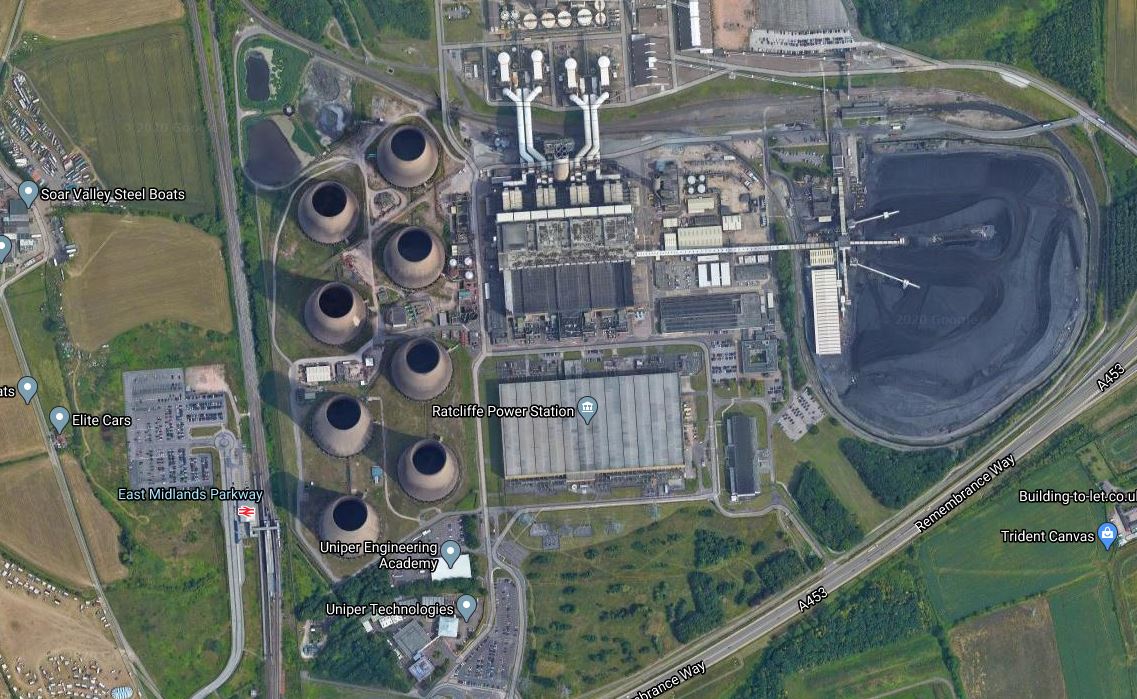
Ratcliffe-on-Soar power station is the eighteenth highest emitter of CO2 in Europe and will surely be closed soon.
But then, a power station, will have a good connection to the National Grid, ensuring there could be plenty of power for electrification, even after the current power station is long gone, as it will surely be replaced by another power station or energy storage.
East Midlands Parkway station is also well-connected.
- Clay Cross North Junction is 31 miles away.
- Derby is 10 miles away.
- Leicester is 18 miles away.
- Nottingham is 8 miles away.
- Sheffield is 47 miles away.
It should be possible to reach all these places on battery-power from East Midlands Parkway.
Electrification Between Leicester And East Midlands Parkway
The more I look at this stretch of the MML, the more I feel that this eighteen mile stretch should be electrified to create what could become a linear electrification island.
Consider.
- It is a 125 mph multi-track railway across fairly flat countryside.
- Connecting electrification to the grid is often a problem, but Ratcliffe-on-Soar power station is adjacent to East Midlands Parkway station.
- The section is only eighteen miles long, but this is surely long enough to fully-charge a battery train speeding to and from the capital.
- There are only four intermediate stations; Syston, Sileby, Barrow-on-Soar and Loughborough.
- The engineering for gauge clearance and electrification, looks to be no more difficult, than it will be between Kettering and Market Harborough.
- Between Leicester and Market Harborough stations is only sixteen miles.
- Between East Midlands Parkway and Nottingham is only eight miles, so it would be possible for Nottingham services to run without a charge at Nottingham station.
- Between East Midlands Parkway and Derby is only ten miles, so it would be possible for Derby services to run without a charge at Derby station.
- Between East Midlands Parkway and the shared electrified section with High Speed Two at Clay Cross North Junction is thirty-one miles, so it would be possible for Sheffield services to be run without using diesel, once the shared electrification is complete between Clay Cross North Junction and Sheffield.
- Battery-electric trains between East Midlands Parkway and Clay Cross North Junction could also use the Erewash Valley Line through Ikeston, Langley Mill and Alfreton.
- There would be no need to electrify through the World Heritage Site of the Derwent Valley Mills that lies between Derby and Clay Cross North Junction, as trains will be speeding through on battery power. Electrifying through this section, might be too much for some people.
- If the trains can’t switch between battery and overhead electrification power, the changeover can be in Leicester and East Midlands Parkway stations. However, I believe that Hitachi’s AT-300 trains can do the changeover at line speed.
The electrification could also be used by other services.
- Between Corby and Syston North Junction is only thirty-six miles, so it would be possible to run electric services between London St. Pancras and Derby, Nottingham and Sheffield via Corby, if the main route were to be blocked by engineering work.
- Between Peterborough and Syston East Junction is forty-seven miles, so it should be possible to run CrossCountry’s Stansted Airport and Birmingham service using battery-electric trains. If the train could leave Leicester with a full battery, both Birmingham New Street and Peterborough should be within range.
- East Midlands Railway’s Lincoln and Leicester service run for a distance of sixty-one miles via East Midlands Parkway, Nottingham and Newark stations. Electrification between Leicester and East Midlands Parkway, would mean there was just forty-two miles to do on battery power. An electrification island at Lincoln would charge the train for return.
Battery-electric trains with a range of between 55 and 65 miles would really open up the East Midlands to electric services if between Leicester and East Midlands Parkway were to be electrified.
London And Sheffield In A Battery-Electric Class 810 Train
This is speculation on my part, but I think this could be how trains run London to Sheffield before 2030.
- London to Market Harborough – 83 miles – Using electrification
- Switch to battery power at line speed.
- Market Harborough to Leicester – 16 miles – Using battery power
- Switch to electrification in Leicester station
- Leicester to East Midlands Parkway – 19 miles – Using electrification
- Switch to battery power at line speed.
- East Midlands Parkway to Clay Cross North Junction – 31 miles – Using battery power
- Switch to electrification at line speed.
- Clay Cross North Junction to Sheffield – 15.5 miles – Using electrification
Note.
- 118 miles would be run using electrification and 47 miles using battery power.
- Battery power has been used to avoid the tricky electrification at Leicester station and along the Derwent Valley.
I don’t believe any of the engineering will be any more difficult, than what has been achieved on the MML in the last year or so.
Nottingham
Consider
- Nottingham station would probably have access to a reliable electricity supply, as Nottingham is a large city of over 300,000 people.
- Nottingham station has a comprehensive network of local services.
- Nottingham station has an excellent connection to Nottingham Express Transit.
- Birmingham New Street is 57 miles away, via Derby and Burton.
- Burton-on-Trent is 27 miles away.
- Derby is 16 miles away.
- Grantham is 23 miles away.
- Lincoln is 34 miles away.
- Matlock is 33 miles away.
- Newark is 17 miles away.
- Sheffield is 40 miles away.
- Worksop is 32 miles away.
- Most of these local services are run by East Midlands Railway, with some services run by Northern and CrossCountry.
- Some services run back-to-back through Nottingham.
I feel very strongly that if charging is provided in Nottingham, when trains turnback or pass through the station, that many of the local services can be run by battery-electric trains.
Previously, I have shown, that if between Leicester and East Midlands Parkway is electrified, then services between London and Nottingham, can be run by battery-electric trains.
There is also a fall-back position at Nottingham, as the local services could be run by hydrogen-powered trains.
Sheffield
Sheffield station would at first glance appear to be very similar to Nottingham.
- Sheffield station would probably have access to a reliable electricity supply, as Sheffield is a large urban area of 700,000 people.
- Sheffield station has a comprehensive network of local services.
- Sheffield station has an excellent connection to the Sheffield Supertram.
But it looks like Sheffield station will see the benefits of electrification the Northern section of the MML from Clay Cross North Junction.
- The 15.5 miles of electrification will be shared with the Sheffield spur of High Speed Two.
- Currently, trains take sixteen minutes between Sheffield and Clay Cross North Junction.
- Electrification and an improved high-speed track will allow faster running, better acceleration and a small saving of time.
- A Sheffield train will be charged going to and from Sheffield, so will leave Clay Cross North Junction for Derby and the South with full batteries.
- There must also be opportunities for local trains running between Sheffield and Class Cross Junction North to use the electrification and be run by battery-electric trains.
Current destinations include.
- Derby is 36 miles away.
- Doncaster is 19 miles away.
- Huddersfield is 36 miles away.
- Leeds is 45 miles away.
- Lincoln is 49 miles away.
- Manchester Piccadilly is 42 miles away.
- Nottingham is 40.5 miles away.
Note.
- Doncaster, Leeds and Manchester Piccadilly stations are fully electrified.
- Work on electrifying Huddersfield and Leeds will start in a year or so, so Huddersfield will be electrified.
- I am firly sure that Lincoln and Nottingham will have enough electrification to recharge and turn trains.
- Some routes are partially electrified.
As with Nottingham, I am fairly sure, that local services at Sheffield could be run by battery-electric trains. And the same fall-back of hydrogen-powered trains, would also apply.
Sheffield And Manchester Piccadilly In A Battery-Electric Train
Consider.
- Once Sheffield and Clay Cross North Junction is electrified in conjunction with High Speed Two, at least five miles of the Hope Valley Line at the Sheffield end will be electrified.
- It may be prudent to electrify through Totley Tunnel to increase the electrification at Sheffield to ten miles.
- The route via Stockport is 43 miles long of which nine miles at the Manchester End is electrified.
- The route via Marple is 42 miles long of which two miles at the Manchester End is electrified.
There would appear to be no problems with running the TransPennine Express service between Manchester Airport and Cleethorpes using battery-electric trains, as from Hazel Grove to Manchester Airport is fully electrified and in the East, they can charge the batteries at Sheffield, Doncaster and a future electrification island at Cleethorpes.
The Northern service between Manchester Piccadilly and Sheffield could be run using battery-electric trains with some more electrification at the Manchester End or an extended turnback in Manchester Piccadilly.
Transport for Manchester has plans to run improve services at their end of the Hope Valley Line, with tram-trains possible to Glossop and Hadfield.
It would probably be worthwhile to look at the Hope Valley Line to make sure, it has enough future capacity. I would suspect the following could be likely.
- More electrification.
- More stations.
- Battery-electric trains or tram-trains from Manchester to Glossop, Hadfield, New Mills Central, Rose Hill Marple and Sheffield.
I would suspect one solution would be to use more of Merseyrail’s new dual-voltage Class 777 trains, which have a battery capability.
Sheffield And Nottingham In A Battery-Electric Train
Consider.
- Once Sheffield and Clay Cross North Junction is electrified in conjunction with High Speed Two, 15.5 miles of the route will be electrified.
- The total length of the route is 40.5 miles.
- There are intermediate stops at Dronfield, Chesterfield, Alfreton, Langley Mill and Ilkeston.
- Currently, journeys seem to take around 53 minutes.
I think it would be likely that the battery would need to be topped up at Nottingham, but I think a passenger-friendly timetable can be developed.
West Coast Main Line (Avanti West Coast)
Hitachi AT-300 Trains On The West Coast Main Line
The West Coast Main Line (WCML) is a mainly electrified and with some non-electrified extended routes. Avanti West Coast have chosen Hitachi AT-300 trains to cope with infrastructure.
- There will be ten seven-car electric trains.
- There will be thirteen five-car bi-mode trains.
As these trains will be delivered after East Midlands Railway’s Class 810 trains and East Coast Trains’ Class 803 trains, the following questions must be asked.
- Will the trains have the redesigned nose of the Class 810 trains?
- Will the bi-mode trains have four diesel engines (Class 810 trains) or three ( Class 800 trains)?
- Will the electric trains ordered by First Group companies; Avanti West Coast and East Coast Trains be similar, except for the length?
I would expect Hitachi will want the trains to be as similar as possible for ease of manufacture.
Electrification Islands On The West Coast Main Line
As with the ECML and the MML, there are a couple of large and smaller stations along the WCML, that can act as electrification islands to support either local services or long-distance services from London.
I will deal with the electrification islands, starting in London.
Watford Junction
Watford Junction station is already an electrification island, as it is fully electrified.
- St. Albans Abbey is 6.5 miles away.
- It would be possible to develop a battery-electric service to Aylesbury via Rickmansworth and Amersham, with is a distance of under 25 miles, if this was desired. I wrote about this service in Hertfordshire County Council’s Aspiration For A Watford Junction And Aylesbury Service.
Services around Watford Junction have possibilities to be expanded and improved using battery-electric trains.
Milton Keynes
Milton Keynes Central station is already an electrification island, as it is fully electrified.
- East West Railway services will call at Bletchley and not Milton Keynes.
- There may be a connection between East West Rail and High Speed Two at Calvert station, which is 15 miles away.
- Milton Keynes will get a service from Aylesbury, which is 22 miles away.
There may be possibilities to link Watford Junction and Milton Keynes via Aylesbury using battery-electric trains to give both places a connection to High Speed Two at a new Calvert station.
Are Hitachi Designing the Ultimate Battery Train?
In Sparking A Revolution, a post based on an article of the same name in Issue 898 of Rail Magazine, I repeated this about the specification of Hitachi UK Battery Train Specification.
- Range – 55-65 miles
- Performance – 90-100 mph
- Recharge – 10 minutes when static
- Routes – Suburban near electrified lines
- Battery Life – 8-10 years
Does this mean that the train can do 55-65 miles cruising at 90-100 mph?
How Much Energy Is Needed To Accelerate A Five-Car Class 800 Train To Operating Speed?
I will do my standard calculation.
- Empty train weight – 243 tonnes (Wikipedia for Class 800 train!)
- Passenger weight – 302 x 90 Kg (Includes baggage, bikes and buggies!)
- Train weight – 270.18 tonnes
Using Omni’s Kinetic Energy Calculator, the kinetic energy at various speeds are.
- 60 mph – 27 kWh
- 80 mph – 48 kWh
- 90 mph – 61 kWh
- 100 mph – 75 kWh
- 125 mph – 117 kWh – Normal cruise on electrified lines.
- 140 mph – 147 kWh – Maximum cruise on electrified lines.
Because the kinetic energy of a train is only proportional to the weight of the train, but proportional to the square of the speed, note how the energy of the train increases markedly after 100 mph.
Are these kinetic energy figures a reason, why Hitachi have stated their battery train will have an operating speed of between 90 and 100 mph?
A 100 mph cruise would also be very convenient for a lot of main lines, that don’t have electrification in the UK.
What Battery Size Would Be Needed?
In How Much Power Is Needed To Run A Train At 125 mph?, I calculated that a five-car Class 801 electric train, needed 3.42 kWh per vehicle-mile to maintain 125 mph.
For comparison, an InterCity 125 train, had a figure of 2.83 kWh per vehicle-mile.
Hitachi are redesigning the nose of the train for the new Class 810 train and I suspect that these trains can achieve somewhere between 1.5 and 3 kWh per vehicle-mile, if they are cruising at 100 mph.
Doing the calculation for various consumption levels gives the following battery capacity for a five-car train to cruise 65 miles at 100 mph
- 1.5 kWh per vehicle-mile – 487 kWh
- 2 kWh per vehicle-mile – 650 kWh
- 2.5 kWh per vehicle-mile – 812.5 kWh
- 3 kWh per vehicle-mile – 975 kWh
These figures don’t include any energy for acceleration to line speed from the previous stop or station, but they would cope with a deceleration and subsequent acceleration, after say a delay caused by a slow train or other operational delay, by using regenerative braking to the battery.
The energy needed to accelerate to operating speed, will be as I calculated earlier.
- 90 mph – 61 kWh
- 100 mph – 75 kWh
As the battery must have space to store the regenerative braking energy and it would probably be prudent to have a ten percent range reserve, I can see a battery size for a train with an energy consumption of 2 kWh per vehicle-mile, that needed to cruise at 100 mph being calculated as follows.
- Energy for the cruise – 650 kWh
- 10% reserve for cruise – 65 kWh
- Braking energy from 100 mph – 75 kWh
This gives a total battery size of 790 kWh, which could mean that 800 kWh would be convenient.
Note that each of the three MTU 12V 1600 diesel engines, fitted to a Class 800 train, each weigh around two tonnes.
In Innolith Claims It’s On Path To 1,000 Wh/kg Battery Energy Density, I came to these conclusions.
- Tesla already has an energy density of 250 Wh/Kg.
- Tesla will increase this figure.
- By 2025, the energy density of lithium-ion batteries will be much closer to 1 KWh/Kg.
- Innolith might achieve this figure. But they are only one of several companies aiming to meet this magic figure.
Suppose two of the MTU 12V 1600 diesel engines were each to be replaced by a two tonne battery, using Tesla’s current energy density, this would mean the following.
- Each battery would have a capacity of 500 kWh.
- The train would have one MWh of installed battery power.
- This is more than my rough estimate of power required for a 65 mile trip.
- The train would have little or no weight increase.
- I also wouldn’t be surprised to find that the exchange of a diesel engine for a battery was Plug-and-Play.
Hitachi would have an electric/battery/diesel tri-mode train capable of the following.
- Range – 55-65 miles
- Out and Back Range – about 20-30 miles
- Performance – 90-100 mph
- Recharge – 10 minutes when static
- Emergency diesel engine.
I feel it would be a very useful train.
Trains That Could Be Fitted With Batteries
The original article in Rail Magazine says this.
For the battery project, positive discussions are taking place with a number of interested parties for a trial, with both Class 385s and Class 800s being candidates for conversion.
So this means that the following operators will be able to use Hitachi’s battery technology o their trains.
- Avanti West Coast – Class 80x trains
- First East Coast Trains – Class 80x trains
- East Midlands Railway – Class 80x trains
- GWR – Class 80x trains
- Hull Trains – Class 80x trains
- LNER – Class 80x trains
- ScotRail – Class 385 trains
- TransPennine Express – Class 80x trains
Although, I based my calculations on Class 80x trains, I suspect that the methods can be applied to the smaller Class 385 trains.
Possible Out-And-Back Journeys
These are possible Out-And-Back journeys, that I believe Hitachi’s proposed battery-electric trains could handle.
- Edinburgh and Tweedbank – 30 miles from Newcraighall
- London Paddington and Bedwyn – 30 miles from Reading
- London Euston and Blackburn – 12 miles from Preston
- London Kings Cross and Bradford – < 27 miles from Leeds
- London Euston and Chester – 21 miles from Crewe
- London Kings Cross and Harrogate – <18 miles from Leeds
- London Kings Cross and Huddersfield – 17 miles from Leeds
- London St. Pancras and Leicester – 16 miles from Market Harborough
- London Kings Cross and Lincoln – 17 miles from Newark
- London St. Pancras and Melton Mowbray – 26 miles from Corby
- London Kings Cross and Middlesbrough – 20 miles from Northallerton
- London Kings Cross and Nottingham – 20 miles from Newark
- London Paddington and Oxford – 10 miles from Didcot
- London Kings Cross and Redcar – 29 miles from Northallerton
- London Kings Cross and Rotherham- 14 miles from Doncaster
- London Kings Cross and Sheffield – 20 miles from Doncaster
- London and Weston-super-Mare – 19 miles from Bristol
Note.
- Provided that the Out-And-Back journey is less than about sixty miles, I would hope that these stations are comfortably in range.
- Leicester is the interesting destination, which would be reachable in an Out-And-Back journey. But trains from the North stopping at Leicester would probably need to charge at Leicester.
- I have included Blackburn as it could be a destination for Avanti West Coast.
- I have included Melton Mowbray as it could be a destination for East Midlands Railway.
- I have included Nottingham, Rotherham and Sheffield as they could be destinations for LNER. These services could prove useful if the Midland Main Line needed to be closed for construction works.
- I’m also fairly certain, that no new electrification would be needed, although every extra mile would help.
- No charging stations would be needed.
I suspect, I’ve missed a few possible routes.
Possible Journeys Between Two Electrified Lines
These are possible journeys between two electrified lines, that I believe Hitachi’s proposed battery-electric trains could handle.
- London St. Pancras and Eastbourne via Hastings – 25 miles between Ashford and Ore.
- Leeds and York via Garforth – 20 miles between Neville Hall and Colton Junction
- London Kings Cross and Norwich via Cambridge – 54 miles between Ely and Norwich.
- Manchester Victoria and Leeds via Huddersfield – 43 miles between Manchester Victoria and Leeds.
- Preston and Leeds via Hebden Bridge – 62 miles between Preston and Leeds.
- Newcastle and Edinburgh – Would battery-electric trains get round the well-publicised power supply problems on this route?
Note.
- I am assuming that a range of 65 miles is possible.
- If the trains have a diesel-generator set, then this could be used to partially-charge the battery in places on the journey.
- Leeds and York via Garforth has been scheduled for electrification for years.
- Preston and Leeds via Hebden Bridge would probably need some diesel assistance.
- London Kings Cross and Norwich via Cambridge is a cheeky one, that Greater Anglia wouldn’t like, unless they ran it.
- As before no new electrification or a charging station would be needed.
I suspect, I’ve missed a few possible routes.
Possible Out-And-Back Journeys With A Charge At The Destination
These are possible Out-And-Back journeys, that I believe Hitachi’s proposed battery-electric trains could handle, if the batteries were fully charged at the destination.
- Doncaster and Cleethorpes – 52 miles from Doncaster.
- London Paddington and Cheltenham – 42 miles from Swindon
- London Kings Cross and Cleethorpes via Lincoln – 64 miles from Newark
- London Euston and Gobowen – 46 miles from Crewe
- London Euston and Wrexham – 33 miles from Crewe
- London Kings Cross and Hull – 45 miles from Selby
- London Kings Cross and Shrewsbury – 30 miles from Wolverhampton
- London Kings Cross and Sunderland 41 miles from Northallerton
- London Paddington and Swansea – 46 miles from Cardiff
- London Paddington and Worcester – 67 miles from Didcot Parkway
- London St. Pancras and Derby – 46 miles from Market Harborough
- London St. Pancras and Nottingham – 43 miles from Market Harborough
Note.
- I am assuming that a range of 65 miles is possible.
- If the trains have a diesel-generator set, then this could be used to partially-charge the battery in places on the journey.
- I am assuming some form of charging is provided at the destination station.
- As before no new electrification would be needed.
I suspect, I’ve missed a few possible routes.
Midland Main Line
The Midland Main Line could possibly be run between London St. Pancras and Derby, Nottingham and Sheffield without the use of diesel.
Consider.
- The route will be electrified between London St. Pancras and Market Harborough.
- In connection with High Speed Two, the Midland Main Line and High Seed Two will share an electrified route between Sheffield and Clay Cross North Junction.
- London St. Pancras and Derby can be run with a charging station at Derby, as Market Harborough and Derby is only 46 miles.
- London St. Pancras and Nottingham can be run with a charging station at Nottingham, as Market Harborough and Nottingham is only 43 miles.
- The distance between Clay Cross North Junction and Market Harborough is 67 miles.
- The distance between Sheffield and Leeds is 38 miles.
It looks to me that the range of East Midlands Railway’s new Class 810 trains, will be a few miles short to bridge the gap on batteries, between Clay Cross North Junction and Market Harborough station, but Leeds and Sheffield appears possible, once Sheffield has been electrified.
There are several possible solutions to the Clay Cross North and Market Harborough electrification gap.
- Fit higher capacity batteries to the trains.
- Extend the electrification for a few miles North of Market Harborough station.
- Extend the electrification for a few miles South of Clay Cross North Junction.
- Stop at Derby for a few minutes to charge the batteries.
The route between Market Harborough and Leicester appears to have been gauge-cleared for electrification, but will be difficult to electrify close to Leicester station. However, it looks like a few miles can be taken off the electrification gap.
Between Chesterfield and Alfriston, the route appears difficult to electrify with tunnels and passig through a World Heritage Site.
So perhaps options 1 and 2 together will give the trains sufficient range to bridge the electrification gap.
Conclusion On The Midland Main Line
I think that Hitachi, who know their trains well, must have a solution for diesel-free operation of all Midland Main Line services.
It also looks like little extra electrification is needed, other than that currently planned for the Midland Main Line and High Speed Two.
North Wales Coast Line
If you look at distance along the North Wales Coast Line, from the electrification at Crewe, you get these values.
- Chester – 21 miles
- Rhyl – 51 miles
- Colwyn Bay – 61 miles
- Llandudno Junction – 65 miles
- Bangor – 80 miles
- Holyhead – 106 miles
It would appear that Avanti West Coast’s new AT-300 trains, if fitted with batteries could reach Llandudno Junction station, without using diesel.
Electrification Between Crewe And Chester
It seems to me that the sensible thing to do for a start is to electrify the twenty-one miles between Crewe and Chester, which has been given a high priority for this work.
With this electrification, distances from Chester are as follows.
- Rhyl – 30 miles
- Colwyn Bay – 40 miles
- Llandudno Junction – 44 miles
- Bangor – 59 miles
- Holyhead – 85 miles
Electrification between Crewe and Chester may also open up possibilities for more electric and battery-electric train services.
But some way will be needed to charge the trains to the West of Chester.
Chagring The Batteries At Llandudno Junction Station
This Google Map shows Llandudno Junction station.
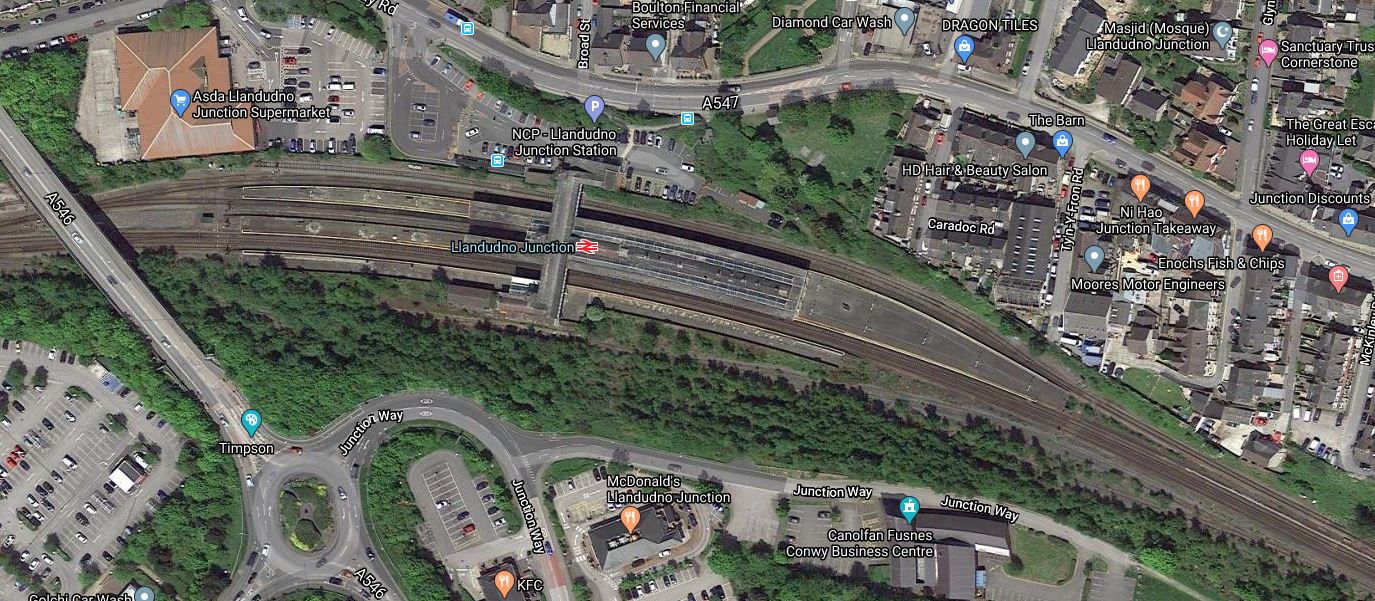
Note.
- It is a large station site.
- The Conwy Valley Line, which will be run by battery Class 230 trains in the future connects at this station.
- The Class 230 train will probably use some of Vivarail’s Fast Charging systems, which use third-rail technology, either at the ends of the branch or in Llandudno Junction station.
The simplest way to charge the London Euston and Holyhead train, would be to build a charging station at Llandudno Junction, which could be based on Vivarail’s Fast Charging technology or a short length of 25 KVAC overhead wire.
But this would add ten minutes to the timetable.
Could 25 KVAC overhead electrification be erected for a certain distance through the station, so that the train has ten minutes in contact with the wires?
Looking at the timetable of a train between London Euston and Holyhead, it arrives at Colwyn Bay station at 1152 and leaves Llandudno Junction station at 1200.
So would it be possible to electrify between the two stations and perhaps a bit further?
This Google Map shows Colwyn Bay Station,
Note how the double-track railway is squeezed between the dual-carriageway of the A55 North Wales Expressway and the sea.
The two routes follow each other close to the sea, as far as Abegele & Pensarn station, where the Expressway moves further from the sea.
Further on, after passing through more caravans than I’ve ever seen, there is Rhyl station.
- The time between arriving at Rhyl station and leaving Llandudno Junction station is nineteen minutes.
- The distance between the two stations is fourteen miles.
- Rhyl and Crewe is fifty-one miles.
- Llandudno Junction and Holyhead is forty-one miles.
It would appear that if the North Wales Coast Line between Rhyl and Llandudno Junction is electrified, that Hitachi’s proposed battery trains can reach Holyhead.
The trains could even changeover between electrification and battery power in Rhyl and Llandudno Junction stations.
I am sure that electrifying this section would not be the most difficult in the world, although the severe weather sometimes encountered, may need some very resilient or innovative engineering.
It may be heretical to say so, but would it be better if this section were to be electrified using proven third-rail technology.
West of Llandudno Junction station, the electrification would be very difficult, as this Google Map of the crossing of the River Conwy shows.
I don’t think anybody would want to see electrification around the famous castle.
Electrification Across Anglesey
Llanfairpwll station marks the divide between the single-track section of the North Wales Coast Line over the Britannia Bridge and the double-track section across Anglesey.
From my virtual helicopter, the route looks as if, it could be fairly easy to electrify, but would it be necessary?
- Llandudno Junction and Holyhead is forty-one miles, which is well within battery range.
- There is surely space at Holyhead station to install some form of fast-charging system.
One problem is that trains seem to turn round in only a few minutes, which may not be enough to charge the trains.
So perhaps some of the twenty-one miles between Llanfairpwll and Holyhead should be electrified.
London Euston And Holyhead Journey Times
Currently, trains take three hours and forty-three minutes to go between London Euston and Holyhead, with these sectional timings.
- London Euston and Crewe – One hour and thirty-nine minutes.
- Crewe and Holyhead – Two hours and four minutes.
The big change would come, if the London Euston and Crewe leg, were to be run on High Speed Two, which will take just fifty-five m,inutes.
This should reduce the London Euston and Holyhead time to just under three hours.
Freight On The North Wales Coast Line
Will more freight be seen on the North Wales Coast Line in the future?
The new tri-mode freight locomotives like the Class 93 locomotive, will be able to take advantage of any electrification to charge their batteries, but they would probably be on diesel for much of the route.
Conclusion On The North Wales Coast Line
Short lengths of electrification, will enable Avanti West Coast’s AT-300 trains, after retrofitting with batteries, to run between Crewe and Holyhead, without using any diesel.
I would electrify.
- Crewe and Chester – 21 miles
- Rhyl and Llandudno Junction – 14 miles
- Llanfairpwll and Holyhead – 21 miles
But to run battery-electric trains between London Euston and Holyhead, only Rhyl and Llandudno Junction needs to be electrified.
All gaps in the electrification will be handled on battery power.
A Selection Of Possible Battery-Electric Services
In this section, I’ll look at routes, where battery-electric services would be very appropriate and could easily be run by Hitachi’s proposed battery-electric trains.
London Paddington And Swansea
Many were disappointed when Chris Grayling cancelled the electrification between Cardiff and Swansea.
I went along with what was done, as by the time of the cancellation, I’d already ridden in a battery train and believed in their potential.
The distance between Cardiff and Swansea is 46 miles without electrification.
Swansea has these services to the West.
- Carmarthen – 32 miles
- Fishguard – 73 miles
- Milford Haven 71 miles
- Pembroke Dock – 73 miles
It looks like, three services could be too long for perhaps a three car battery-electric version of a Hitachi Class 385 train, assuming it has a maximum range of 65 miles.
But these three services all reverse in Carmarthen station.
So perhaps, whilst the driver walks between the cabs, the train can connect automatically to a fast charging system and give the batteries perhaps a four minute top-up.
Vivarail’s Fast Charging system based on third-rail technology would be ideal, as it connects automatically and it can charge a train in only a few minutes.
I would also electrify the branch between Swansea and the South Wales Main Line.
This would form part of a fast-charging system for battery-trains at Swansea, where turnround times can be quite short.
I can see a network of battery-electric services developing around Swansea, that would boost tourism to the area.
Edinburgh And Tweedbank
The Borders Railway is electrified as far as Newcraighall station and the section between there and Tweedbank is thirty miles long.
I think that a four-car battery-electric Class 385 train could work this route.
It may or may not need a top up at Tweedbank.
The Fife Circle
The Fife Circle service from Edinburgh will always be difficult to electrify, as it goes over the Forth Rail Bridge.
- The Fife Circle is about sixty miles long.
- Plans exist for a short branch to Leven.
- The line between Edinburgh and the Forth Rail Bridge is partly electrified.
I believe that battery-electric Class 385 train could work this route.
London Kings Cross and Grimsby/Cleethorpes via Lincoln
The Cleethorpes/Grimsby area is becoming something of a renewable energy powerhouse and I feel that battery trains to the area, might be a significant and ultimately profitable statement.
LNER recently opened a six trains per day service to Lincoln.
Distances from Newark are as follows.
- Lincoln – 17 miles
- Grimsby – 61 miles
- Cleethorpes – 64 miles
A round trip to Lincoln can probably be achieved on battery alone with a degree of ease, but Cleethorpes and Grimsby would need a recharge at the coast.
Note that to get to the Cleethorpes/Grimsby area, travellers usually need to change at Doncaster.
But LNER are ambitious and I wouldn’t be surprised to see them dip a toe in the Cleethorpes/Grimsby market.
The LNER service would also be complimented by a TransPennine Express service from Manchester Airport via Sheffield and Doncaster, which could in the future be another service run by a Hitachi battery train.
There is also a local service to Barton-on-Humber, which could be up for improvement.
London Waterloo And Exeter
This service needs to go electric, if South Western Railway is going to fully decarbonise.
But third-rail electrification is only installed between Waterloo and Basingstoke.
Could battery-electric trains be used on this nearly two hundred mile route to avoid the need for electrification.
A possible strategy could be.
- Use existing electrification, as far as Basingstoke – 48 miles
- Use battery power to Salisbury – 83 miles
- Trains can take several minutes at Salisbury as they often split and join and change train crew, so the train could be fast-charged.
- Use battery power to the Tisbury/Gillingham/Yeovil/Crewkerne area, where trains would be charged – 130 miles
- Use battery power to Exeter- 172 miles
Note.
- The miles are the distance from London.
- The charging at Salisbury could be based on Vivarail’s Fast-Charging technology.
- The charging around Yrovil could be based on perhaps twenty miles of third-rail electrification, that would only be switched on, when a train is present.
I estimate that there could be time savings of up to fifteen minutes on the route.
To Be Continued…
Could High Speed Two Be A One-Nation Project?
As currently envisioned, High Speed Two is very much an English project, with the following routes
- London and Birmingham
- London and Liverpool via Birmingham
- London and Manchester Airport/Manchester via Birmingham and Crewe
- London and Sheffield via Birmingham and the East Midlands Hub
- London and Leeds via Birmingham and the East Midlands Hub
There are large numbers of mid-sized towns and cities that it won’t serve directly.
The West Coast Main Line
The West Coast Main Line serves the following routes.
- London and Birmingham
- London and Liverpool via Crewe
- London and Manchester via Crewe
- London and Glasgow via Crewe, Wigan, Preston and Carlisle
- London and Blackpool via Crewe, Wigan, Preston
- London and North Wales via Crewe and Chester.
It could probably be considered a two or two-and-a-half nation line, as it serves the Western half of Scotland and the Northern half of Wales.
Add the West Coast Main Line and High Speed Two together and you get a line, that serves a lot more places like Blackpool, Carlisle, Chester, Edinburgh, Glasgow, Preston, Stafford, Stoke and Wigan.
- The current plan for both routes envisage them both being run by Avanti West Coast, so it looks like High Speed Two is being designed to work with the West Coast Main Line.
- Destinations like Carlisle, Glasgow and Preston will be served using the West Coast Main Line.
- Compatible trains will be built that can be run on both lines.
- Some stations will be shared.
It does seem that there are advantages, if the two routes are considered as one system.
The East Coast Main Line
The East Coast Main Line serves the following routes.
- London and Bradford
- London and Cambridge
- London and Edinburgh via Doncaster, York and Newcastle
- London and Harrogate via Leeds
- London and Hull
- London and Kings Lynn via Cambridge
- London and Lincoln via Newark.
- London and Leeds via Doncaster
- London and Middlesbrough
- London and Skipton via Leeds
- London and Sunderland
The East Coast Main Line could become another high speed line.
Extra services could be added.
- London and Norwich via Cambridge
- London and Nottingham
- London and Grimsby and Cleethorpes via Lincoln.
- London and Sheffield via Retford.
Add the East Coast Main Line and High Speed Two together and there could be a wider range of towns and cities served.
- Peterborough and Doncaster could play the same role in the East as Birmingham and Crewe will play in the West.
- The East Coast Main Line between London and Doncaster will be upgraded to in-cab ERTMS signalling in a few years time, which will allow 140 mph running on several sections of the route.
- Improvements are either under way or being planned to reduce bottlenecks on the East Coast Main Line.
- If High Speed Two can handle eighteen trains per hour (tph), then surely the East Coast Main Line, which has a lot of quadruple track, can handle upwards of twelve 140 mph trains per hour between London and Doncaster, after the improvements to track and signalling.
- I estimate that 140 mph running between London and Doncaster could save as much as twenty minutes.
- I feel that Barnsley, Doncaster, Hull, Leeds, Sheffield and York could all be reached in under two hours from London using the existing Azuma trains.
- This morning the 0700 from Kings Cross is timetabled to reach York at 0852. Would it be possible for London and York to be around just ninety minutes?
- Savings would also apply to trains between London and Leeds, Middlesbrough, Newcastle, Scotland and Sunderland.
- Sub-four hour journeys between London and Edinburgh would be commonplace.
Note that the Internet gives a driving time of nearly three and a half hours between London and Leeds. Surely, two hours or less on High Speed Yorkshire would be much preferable.
I would add this infrastructure.
- There might be a good case to create electrified routes to Hull and Sheffield and between Sheffield and Leeds, but they wouldn’t be needed to start the service or obtain the time savings. But they would ease operation, cut carbon emissions and save a few more minutes.
- A station at Doncaster-Sheffield Airport.
- A parkway station at Barnsley on the Dearne Valley Line with direct services to Doncaster, Leeds, London and Sheffield.
The two latter improvements have been proposed in Sheffield Region’s transport plans.
High Speed Yorkshire should be finished as soon as possible. A completion date of 2024 is not unreasonable.
Northern Powerhouse Rail
Northern Powerhouse Rail is a plan to build an East-West high speed line or at least a much faster one, than the overcrowded joke, that presently exists.
I discussed the latest thinking in Changes Signalled For HS2 Route In North and the latest thinking and my views can best be summarised as follows.
- Northern Powerhouse Rail will be an improved line with some new sections, between Liverpool and Hull via Manchester Airport, Manchester and Leeds.
- Northern Powerhouse Rail and High Speed Two will connect at High Legh.
- Northern Powerhouse Rail and High Speed Two will share infrastructure.
- The High Speed Two route to Manchester would be via Birmingham, Crewe, High Legh and Manchester Airport.
- The High Speed Two route to Liverpool would be via Birmingham, Crewe, High Legh and Warrington
- Hull will get a London service from High Speed Two via Birmingham, Crewe, High Legh and Manchester Airport, Manchester and Leeds
The Oakervee review of High Speed Two is also underway and leaks are suggesting, that the report is recommending that High Speed Two be built in full, but differently.
One important thing, that is happening, is that Network Rail have started the procurement process to improve the current line between Leeds and Huddersfield, as I reported in Network Rail Reveals Detailed £2.9bn Upgrade Plans For TransPennine Route.
- Extra tracks will be built.
- There will be some extra electrification.
I very much feel, that this is one of the most difficult TransPennine sections to improve.
The other sections are summarised as follows.
- Liverpool and Manchester Airport via Warrington and High Legh is across the flat lands of North Cheshire and could follow the M56.
- Manchester Airport and Manchester will probably be a high speed tunnel.
- Manchester and Huddersfield section could possibly be improved in the short term
- Leeds and Hull and the required connections to the East Coast Main Line are in the flat lands of East Yorkshire.
It looks to me, that Network Rail have a plan in there to perhaps deliver improved services East of Huddersfield and radiating from Leeds in the next few years.
It certainly needs improvement, as the TransPennine route must be the worst main line in the UK.
A One-Nation Railway
I think these lines can be connected to create an integrated high speed network.
- High Speed Two
- West Coast Main Line
- East Coast Main Line
- Northern Powerhouse Rail
But.
- It doesn’t connect to the whole country and needs to be extended.
- It won’t be fully developed until at least 2035.
- Improvements are needed now!
So what could be substantially delivered of the core network, by say 2024, which is around the date of the next General Election?
- Faster and more frequent services on the East Coast Main Line.
- An electrified higher capacity and faster line between Leeds and Huddersfield and possibly between Leeds and Hull.
- New East Coast Main Line services from London to Barnsley Dearne Valley, Bradford, Cleethorpes, Doncaster Sheffield Airport, Grimsby, Harrogate, Huddersfield, Middlesbrough, Norwich, Nottingham, Scarborough and Sheffield and Sunderland.
- Sub-four hour services between London and Edinburgh.
- New local services to connect Blyth and Ashington to the East Coast Main Line at Newcastle.
- A Tees Valley Metro connecting Bishop Auckland, Whitby and all in between to the East Coast Main Line at Darlington.
- Improved local services between York and Leeds via Harrogate, Sheffield and Leeds via the Dearne Valley and on other lines in Yorkshire.
Effectively, the recommendations of this report on the Transport for the North web site, which is entitled At A Glance – Northern Powerhouse Rail, which apply to Leeds and Sheffield would have been implemented to connect to high speed services at Doncaster, Leeds, Sheffield and York.
Technology used would include.
- Some more electrification using the power from the electrified East Coast Main Line.
- Conventional electric trains and compatible battery trains.
- Tram-trains feeding into the Sheffield Supertram.
- ERTMS digital signalling on the East Coast Main Line and the major branches to Hull, Leeds and Middlesbrough.
There would also need to be an increase in LNER’s Azuma fleet. But that is already rumoured as I wrote in More New Trains On LNER Wish List.
Could we see as many as twelve Axumas per hour between London and Doncaster? Yes!
Could it all be delivered by the 2024 General Election? Yes!
High Speed Scotland
The Scottish Nationalist Party is pushing for High Speed Two to be extended to Scotland.
I think that this will eventually be a feasible project, but it will be a very expensive and perhaps built around 2040.
These are my thoughts for the next few years up to 2024.
High Speed To Edinburgh
Consider.
- Edinburgh currently supports a half-hourly service to and from London.
- East Coast Trains are proposing to add five trains per day to this route.
- TransPennine Express will run an hourly service between Edinburgh and Liverpool, via Manchester, Leeds, York and Newcastle, which starts at the December 2019 timetable change..
- CrossCountry run an hourly service between Aberdeen and Plymouth.
- It looks like Edinburgh and Newcastle have a four tph service.
All services, except the CrossCountry are planned to be run by Hitachi’s Class 800, 802 or 803 trains.
- Currently, services take ninety minutes for the 125 miles between Newcastle and Edinburgh.
- The Hitachi trains are all capable of 140 mph with digital signalling.
- The Hitachi trains have better acceleration.
- The route is fully electrified. Although, there are reports it needs enhancing to be able to handle the current number of trains.
How many minutes can be taken off thjs route, with a new timetable on a line running only Hitachi high speed trains?
Probably not that many, but it would ensure all London and Edinburgh trains were under four hours.
But it will all happen by 2024?
High Speed To Glasgow
So Edinburgh is alright, but what about Glasgow?
Consider.
- Glasgow currently supports an hourly service to and from London.
- TransPennine Express run an hourly service to and from Manchester Airport
- TransPennine Express will run a three trains per day service to and from Liverpool.
Glasgow has a much lower frequency service to and from England than Edinburgh.
Currently, London and Glasgow takes over four-and-a half hours and there is going to be no serious improvement, until High Speed Two opens to Crewe, when the time could drop to perhaps just over three-and-a half hours.
But that won’t happen until possibly 2030.
In Does One Of Baldrick’s Descendents Work For Avanti West Coast?, I detail a cunning plan, that might allow London and Glasgow in four hours.
This was my conclusion in the other article.
To improve services between London and Birmingham, Blackpool, Liverpool and Scotland, appears to need the following.
- Ten new Hitachi trains.
- Full digital signalling on the West Coast Main Line.
- Track improvements on the West Coast Main Line
- Upgrading of the Pendelinos to allow 140 mph running.
This should reduce London and Glasgow to around four hours and London and Liverpool to around two hours.
There may be advantages in replacing the Pendelinos with the Classic-compatible High Speed Two trains on the London and Glasgow service as early as possible.
- There would be a large increase of capacity between London and Glasgow.
- What would be the possible speed of the Classic-compatible trains on updated track North of Crewe? I will assume 140 mph, but it could be more! That’s called engineering!
- London and Glasgow timings would be improved, as soon as digital signalling is installed.
- The trains would get a thorough testing before the opening of High Speed Two to Birmingham.
At least one platform at Glasgow Central would need to be extended to take a four-hundred metre long train.
According to Wikipedia, the Classic-compatible trains will be introduced from 2026.
I think by the December 2026 timetable change Glasgow could see a four-hour service to and from London.
But could it be 2024, if the Pendelinos can pick up time North of Crewe with digital signalling?
The Borders Railway
If High Speed Two is going to be a One Nation project, the Borders Railway must be extended from Tweedbank to Carlisle via Hawick.
Could this be done by 2024?
It would be a close-run thing! But possible!
The Glasgow South Western Line
The Glasgow South Western Line, is a secondary route between Glasgow and Carlisle.
It should be electrified early, so that during the upgrading of the West Coast Main Line North of Carlisle it can be used as a diversionary route.
Scotland Could Have Two Four-Hour Fully-Electrified Routes To And From London
But it’s not just London that gets good connectivity to and from Scotland!
- Birmingham
- Bradford
- Carlisle
- Leeds
- Liverpool
- Manchester
- Newcastle
- Peterborough
- Preston
- Wolverhampton
- York
All these cities will have direct connections to Edinburgh and/or Glasgow.
High Speed Midlands
Almost unnoticed and with little fuss, the Midland Main Line is being upgraded to provide 125 mph services between London and Chesterfield, Derby, Leicester, Nottingham and Sheffield.
- New Hitachi bi-mode Class 804 trains will improve speeds and increase capacity
- Over the last decade or so, the track has been upgraded for 125 mph running.
- Electrification will reach between London and Market Harborough.
- Market Harborough station has been remodelled to remove a bottleneck.
- The Corby branch will be electrified with the trains running half-hourly.
I also think, that the Midland Main Line will link into all the improvements between Barnsley, Doncaster, Leeds and Sheffield and provide the following.
- A high speed route between Leeds and the East Midlands.
- A route for a Barnsley and London service.
- A second route for Leeds and London services..
It also seems that rail planners are getting innovative with the design of the Midland Main Line.
- It appears that the Midland Main Line and High Speed Two’s spur to Sheffield will be combined into an electrified line between Clay Cross North Junction and Sheffield via Chesterfield.
- An improved link to the East-West Rail link at Bedford could improve links between the North-East and the South of England.
- The disused rail line between Market Harborough and Northampton could be reopened.
The line is a lot more than a connection between London and the East Midlands.
The upgrade should be complete by 2024.
East West Rail
East West Rail is still in a long planning stage, but it now looks likely to provide more than a passenger link between Oxford and Cambridge.
- New freight routes for Felixstowe and Southampton.
- Extra passenger services between Oxford and Reading in the West and Cambridge, Ipswich and Norwich in the East.
- Connections to the Great Western Main Line, the Chiltern Line, West Coast Main Line, Midland Main Line, East Coast Main Line and the Great Eastern Main Line.
It has also been suggested that East West Rail should be connected to High Speed Two at a new station at Calvert. This could give Bristol, Cardiff and Southampton good links to and from High Speed Two.
Great Western Main Line
At the December 2019 timetable change, there has finally been some good news in the saga of the electrification of the Great Western Main Line.
- Services between London and Bristol have been improved.
- The timetable has been improved.
Whether it will stand up is another matter.
Certainly by 2024, it will be a much better main line.
It could have full digital in-can signalling, which could result in 140 mph running and journey time savings.
Who knows?
But what excites me is the possibility of a connection between High Speed Two and East West Rail at Calvert, which will allow trains to run between Bristol, Cardiff and Swansea, in Wales and the West and the North on a mainly electrified high speed railway.
High Speed North Wales
Avanti West Coast is purchasing thirteen new Hitachi bi-mode trains to run services to Chester and North Wales.
I can’t see much speed improvement in the services, although if the West Coast Main Line gets digital signalling, this could save a few minutes between London and Crewe.
High Speed Ireland
The technology is now available to build a rail bridge between Scotland and the island of Ireland.
I laid out the arguments in A Solution To The Northern Irish Problem!.
The Lincoln Solution
Lincoln is a city, that has been ignored by UK railways for decades.
But not any more as LNER now run six return trips a day to the city on Mondays to Saturdays and five on Sundays.
I wrote about the improvements in The Shape Of Train Services To Come.
How many other cities and large towns would benefit from a Lincoln solution?
LNER have already launched a similar service to Harrogate at the December 2019 timetable change and I’m sure that more will follow.
Disability And Access Issues
A true one-nation railway wouldn’t exclude anybody from using the trains.
Strides have been made to put up step-free bridges, but some of the access between platform and train is truly dreadful.
This picture shows what can be achieved by good design on a Class 755 train.
And this is the step on one of Hitachi’s new trains.
Note that all doors on these Hitachi trains are also far too narrow.
Some train manufacturers can do much better.
Recurring Themes
In this analysis, there are factors that keep cropping up.
Digital Signalling Or ERTMS
This is the key to squeezing more trains into our overcrowded railway.
Between London and Doncaster on the East Coast Main Line, should be operational in a few years and I believe the following lines should follow as soon as possible.
- East Coast Main Line between Doncaster and York and possibly Newcastle.
- East Coast Main Line North Of Newcastle
- West Coast Main Line North Of Crewe
- West Coast Main Line South Of Crewe
- Midland Main Line
- Great Western Main Line
As a time-expired Control Engineer, I believe that in-cab digital signalling is a major key to increasing capacity.
Faster Line Speeds
Some routes like TransPennine, have Victorian line speeds
Network Rail showed how it could improve line speed with the remodelling at Market Harborough station.
Bottlenecks, like the Trowse Swing Bridge at Norwich need immediate removal, no matter what the Heritage Taliban and other Luddites say.
New Hitachi Trains
There will be several more orders for the next generation of Hitachi’s high speed trains.
I have been critical of Hitachi’s manufacturing processes for these trains in the past, but they seem now to be running well in fleet service.
A standard UK train on 125 mph lines, that can also handle 140 mph with digital signalling must be a good thing for all sorts of reasons.
New Feeder Services
Several new feeder services have been indicated and there should be a lot more of these to bring the benefit of the high speed network to more of the UK population.
Delivering The Improvements
Geographically, the places where improvements are needed are spread thinly around the country and vary from projects with a cost of tens of millions to those with costs of tens of billions.
In the UK, we tend to go for the big hit, when perhaps several smaller ones might give a better short-term improvement.
We also duck projects, which would annoy the noisy local interests.
We need to have fundamental rethink about how we deliver and pay for rail improvements.
Conclusion
I am fairly pleased overall in that I think by 2024, many places in the UK, will have a much better train service than they do now!
Delivery of High Speed Two, East West Rail and Northern Powerhouse Rail as soon as possible after 2024, will be the icing on the cake.
Will It Be A One-Nation Project?
I think it can be!
 The Anonymous Widower