Rolls-Royce Supplies mtu On-Board Power Generators For Baleària’s Electric Ferries On The Route Between Europe And Africa
The title of this post, is the same as that of this press release from Rolls-Royce.
These are the three bullet points.
- Eight mtu emergency power generators ensure power supply on two fully electric, emission-free fast ferries operated by the shipping company Baleària
- Over 11,000 kW total output as backup for electric operation
- To be used on the route between Tarifa (Spain) and Tangier (Morocco) starting in 2027
These are the first two paragraphs.
Rolls-Royce’s Power Systems division is supplying a total of eight mtu emergency power generators for two fully electric fast ferries belonging to the Spanish shipping company Baleària. From 2027, the ships will cover the 18 nautical miles between Tarifa in Spain and Tangier in Morocco using electric power, thereby opening up the first “green corridor” between Europe and Africa.
The project is considered a milestone for CO2-neutral mobility at sea and is supported by an international network of partners consisting of shipping companies, shipyards, port authorities, energy suppliers, and other companies.
Note.
- The route is only 18 nautical miles.
- Each ferry can accommodate 804 passengers and 225 cars.
- The ferries have a cruise of 26 knots.
- The project is considered a milestone for CO2-neutral mobility at sea.
- Each ship will have an installed power of 11,000 kW on both electric and diesel.
- They should go into service in 2027.
I know little about ships, but these look to be the business and I can see them sneaking silently into ports everywhere.
But AI might, so I’ll ask a few questions.
How Will Baleraia’s New Fast Ferries Handle Rough Weather?
This was replied.
Baleària’s new fast ferries, such as the Eleanor Roosevelt and Margarita Salas, incorporate advanced stabilization and hull systems designed to improve comfort and reliability in adverse sea conditions. However, as with all maritime transport, sailings can still be cancelled or delayed due to severe weather for safety. reasons.
It certainly looks like the Spaniards are going for it.
New Mersey Ferry Takes To The Water For The First Time In Historic Moment
The title of this post, is the same as that of this press release from Merseytravel.
These bullet points act as sub-headings.
- Painted in traditional colours, first sight of the new Mersey Ferry in over 60 years
- Royal Daffodil floated on the River Mersey’s incoming tide
- Vessel then towed into Cammell Laird’s basin for further work to progress
- Proud moment for Mayor Steve Rotheram and Wirral shipbuilders
These three paragraphs add more detail.
The new £26m Mersey Ferry took to the river for the first time today in an historic moment for the Liverpool City Region.
Painted in the fleet’s historic red, white and black colours and with windows fitted, the first new Mersey Ferry in more than 60 years emerged from Cammell Laird’s giant construction hall on the banks of the Mersey early Thursday morning.
In a carefully managed 24-hour operation, the Royal Daffodil was moved to the river’s edge to allow the incoming tide to slowly lift her clear and float the vessel for the very first time. She will then be tugged to the shipyard’s test basin where engineers will carry out further work ahead of full sea trials early next
I would have thought that given Merseyside’s love of the spectacular, they would have launched the ferry in more dramatic fashion.
There is though, this YouTube video of the safe and steady launch.
I have a few thoughts.
The Ferry Was Built Quickly
According to the Wikipedia entry for the Royal Daffodil, the construction dates were as follows.
- Laid Down. 10th January 2025
- Launched. 6th January 2025
It is planned to be in service next year.
Perhaps, the Scottish Government should have asked Cammell Laird to build their recent ferries?
Great Yarmouth Terminal Set For Redevelopment Under Port Of East Anglia Name
The title of this post, is the same as that of this article on offshoreWIND.biz.
This is the sub-heading.
The UK’s Peel Ports Group has decided to invest a further GBP 10 million (approximately EUR 11.3 million) into its Great Yarmouth site, which is being rebranded as the Port of East Anglia.
These four paragraphs add details to the story.
The newly announced GBP 10 million brings this year’s total investment to GBP 70 million across the site and will be used to redevelop the port’s Northern Terminal, helping to accommodate the next generation of offshore wind projects across the region, according to Peel Ports.
Earlier this year, a substantial investment into its Southern Terminal was announced by the port, which has earmarked GBP 60 million to transform capacity and improve efficiencies.
This involves ensuring the port can support multiple hydrogen, carbon capture, offshore wind, and nuclear projects for decades to come.
Its existing terminals service a variety of construction customers, including infrastructure projects such as Sizewell C and offshore energy projects based in the southern North Sea.
Note.
- In Yarmouth Harbour To Be ‘Completed’ In £60m Project, I talk about the work to be done on the Southern Terminal.
- The work on the Southern Terminal includes a roll-on roll-off (RORO) lift ramp and a large storage area.
- Start on the work on the Southern Terminal will start in 2026.
With all the construction work mentioned in the last two paragraphs, I suspect that the Port of Great Yarmouth will be busy?
These are some further thoughts.
Why Is The Port Of Great Yarmouth Being Renamed?
The article says this.
The new name, which will come into effect in early 2026, also aligns with the creation of a new combined authority for Suffolk and Norfolk, according to Peel Ports.
Peel Ports name change is fairly sensible, but as I was conceived in Suffolk and I’m an Ipswich Town supporter, I don’t feel that the two counties should be merged.
Does The Mention Of Hydrogen Mean That The Port Of Great Yarmouth Will Be Hosting A Hydrogen Electrolyser, To Fuel Trucks And Ships?
I asked Google AI, “If A Hydrogen Electrolyser is To Be Built In The Port Of Great Yarmouth?”, and received this answer.
While there are no current public plans for an immediate construction of a large-scale hydrogen electrolyser within the Port of Great Yarmouth, significant port expansion and infrastructure upgrades are underway to ensure it can support future hydrogen projects and related clean energy initiatives.
Note.
- If technology to handle hydrogen, is copied from North Sea gas, there is certainly a lot of proven technology that can be used again.
- There may even be depleted gas fields, where captured carbon dioxide, hydrogen or North Sea gas can be stored.
I find the most exciting thing, would be to send hydrogen to Germany.
Why Would Anybody Export Hydrogen To Germany?
I asked Google AI, the question in the title of this section and received this answer.
Countries would export hydrogen to Germany because Germany has a large, growing demand for hydrogen to power its heavily industrialised economy and achieve its decarbonisation goals, but lacks sufficient domestic renewable energy capacity to produce the required amounts.
Germany also, uses a lot of bloodstained Russian gas and indigenous polluting coal.
How Could Anybody Export Hydrogen To Germany?
- Wilhelmshaven is one of the main import ports for hydrogen in North West Germany.
- Great Yarmouth is probably the closest larger port to Germany.
- Great Yarmouth and Wilhelmshaven are probably about 300 miles apart, by the shortest route.
- Great Yarmouth would need to build infrastructure to export hydrogen.
The easiest way to transport the hydrogen from Great Yarmouth to Wilhelmshaven, is probably to use a gas tanker built especially for the route.
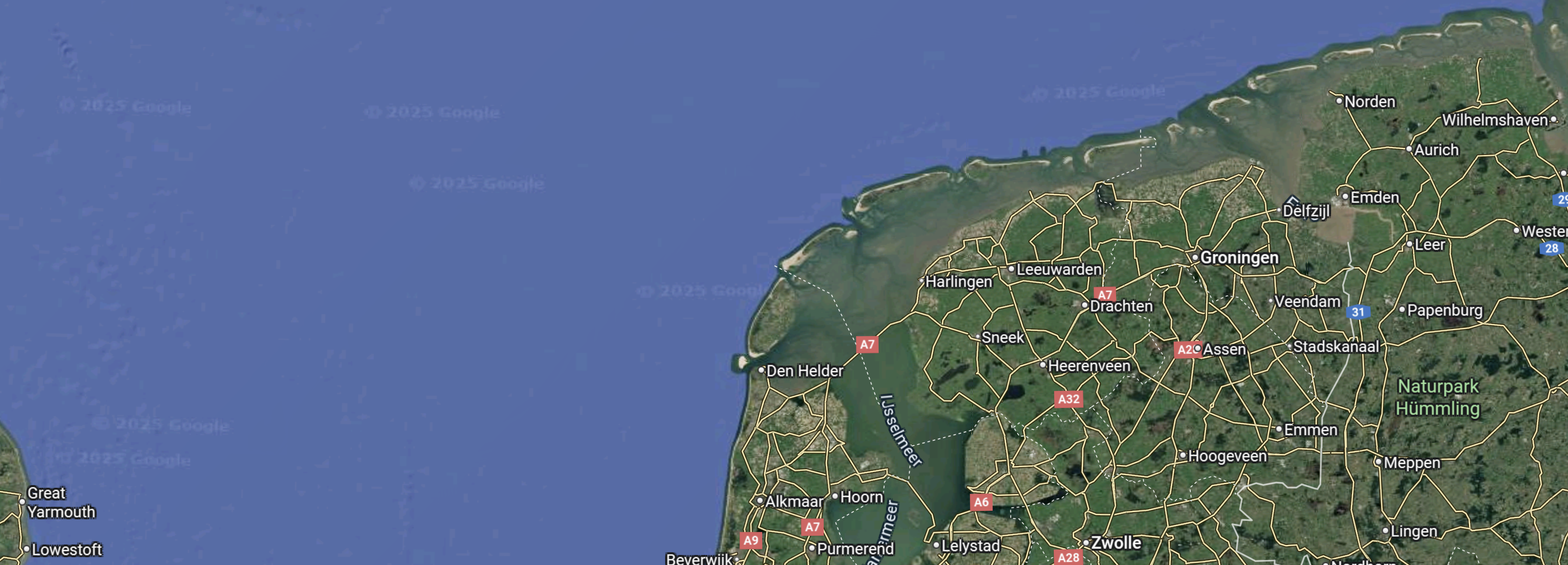
This Google Map shows the route between Great Yarmouth and Wilhelmshaven.
Note.
- The North-East corner of East Anglia with Great Yarmouth to the North of Lowestoft, is in the bottom-left corner of the map.
- Wilhelmshaven is a few miles inland in the top-right corner of the map.
- Could a coastal tanker go along the Dutch and German coasts to Wilhelmshaven?
I have no skills in boats, but would Great Yarmouth to Wilhelmshaven to take hydrogen to Germany?
RWE Are Developing Three Wind Farms To The North-East of Great Yarmouth
RWE are a large German Electricity company and the UK’s largest generator of electricity.
The company is developing three wind farms to the North-East of Great Yarmouth.
- Norfolk Boreas – 1.2 GW – 45 miles offshore
- Norfolk Vanguard West – 1.2 GW – 29 miles offshore
- Norfolk Vanguard East – 1.2 GW – 28 miles offshore
Note.
- The electricity for all three wind farms is to be brought ashore at Happisburgh South, which is about 22 miles North of Great Yarmouth.
- The original plan was to take the electricity halfway across Norfolk to the Necton substation to connect to the grid.
- The natives will not be happy about a 4.2 GW overhead line between Happisburgh and Necton.
- RWE have built offshore electrolysers before in German waters.
- Could an electrical cable or a hydrogen pipe be laid in the sea between Happisburgh South and the Port of Great Yarmouth?
- The electrolyser could either be offshore at Happisburgh or onshore in the Port of Great Yarmouth.
As I don’t suspect these three wind farms will be the last connected to the Port of Great Yarmouth, I would expect that RWE will put the electrolyser offshore at Happisburgh and connect it by a hydrogen pipeline to the Port of Great Yarmouth.
Could There Be A Connection To The Bacton Gas Terminal?
Consider.
The Bacton Gas Terminal, which feeds gas into the UK Gas Network, is only 4.2 miles up the coast from Happisburgh South.
Some climate scientists advocate blending hydrogen into the gas supply to reduce carbon emissions.
In Better Than A Kick In The Teeth – As C Would Say!, I disclosed that I now have a new hydrogen-ready boiler, so I’m not bothered, if I get changed to a hydrogen blend.
So could hydrogen from the Norfolk wind farms be fed into the grid to reduce carbon emissions?
Could The Port Of Great Yarmouth Become A Hydrogen Distribution Centre?
Thinking about it, the port could also become a distribution centre for green hydrogen.
Consider.
- Hydrogen-powered ships, tugs and workboats could be refuelled.
- Hydrogen-powered trucks could also be refuelled.
- Tanker-trucks could distribute hydrogen, to truck and bus operators, farms and factories, that need it for their transport and operations.
- I believe, that construction equipment will be increasingly hydrogen-powered.
In my life, I have lived at times in two country houses, that were heated by propane and there are about 200,000 off-grid houses in the UK, that are heated this way.
The two houses, where I lived would have been a nightmare to convert to heat pumps, but it would have been very easy to convert them to a hydrogen boiler and power it from a tank in the garden.
It should be noted, that the new boiler in my house in London is hydrogen-ready.
So the Port of Great Yarmouth could be the major centre for hydrogen distribution in Norfolk.
In the 1960s, I used to work in ICI’s hydrogen plant at Runcorn. If you ride in a hydrogen bus in England, it is likely that the hydrogen came from the same plant. Handled correctly, hydrogen is no less safe and reliable than natural gas or propane.
Eurostar Orders First Double-Decker Trains
The title of this post, is the same as that of this article on the BBC.
This is the sub-heading.
Eurostar has revealed plans to run double-decker trains through the Channel Tunnel for the first time.
These three paragraphs add more details.
The cross-channel rail operator has confirmed it will order up to 50 trains from manufacturer Alstom, eventually increasing the size of its fleet by nearly a third.
The expansion plans would include investing heavily in a crucial London depot, it said.
But questions remain over whether the facility has enough space for both Eurostar and potential rival operators to use it.
This my solution to the problem outlined in the last paragraph.
Note, that I wrote the software that planned the building of the Channel Tunnel and the rail links to London and was also friends with the project manager of the 1960s attempt to build a Channel Tunnel.
We need more terminal platforms and depot space in the UK to handle Eurostar’s extra trains and the other companies who want to run to London.
We should split services into two groups.
Group 1 would terminate as now in an updated St. Pancras with more passenger handling capacity, which could probably be built over the tracks at the Northern end of the station. Trains would still be stabled at Temple Mills.
Group 2 would terminate at Ebbsfleet International, which would have extra platforms, a new depot, masses of car parking and a coach terminal.
Some trains from both groups could also stop at Ashford International.
To access Ebbsfleet from Central London and also create a Heathrow link to the Channel Tunnel, the Lizzie Line would be extended to Northfleet, where there is space to handle up to eight trains per hour in new platforms built in two disused sidings.
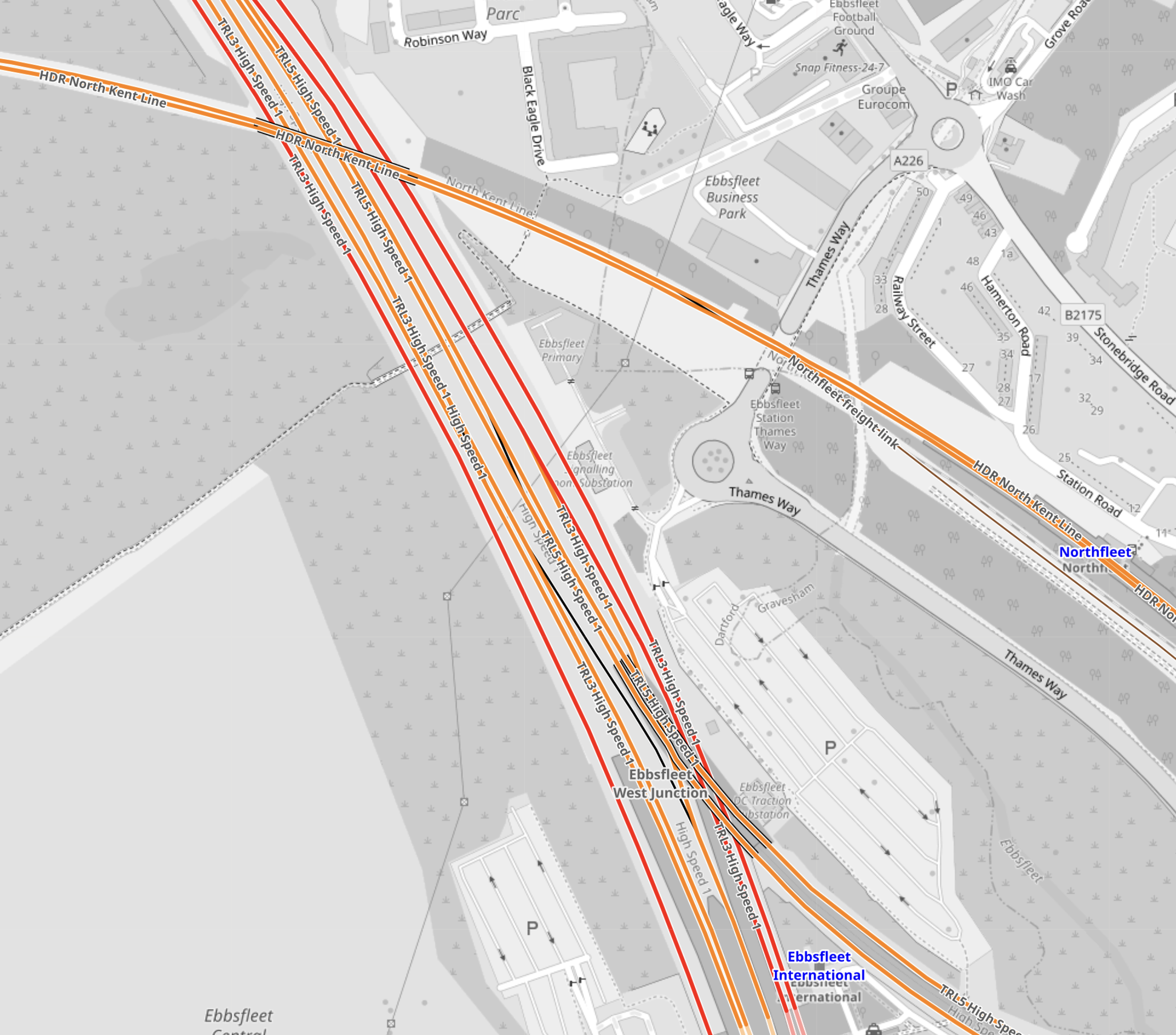
This OpenRailwayMap shows the location of Northfleet and Ebbsfleet stations.
Note.
- Ebbsfleet International station at the bottom of the map.
- The red tracks are High Speed One.
- The orange tracks are third-rail electrified lines.
- The orange tracks going across the map is the North Kent Line.
- Northfleet station is at the right edge of the map on the North Kent Line.
- Northfleet and Ebbsfleet stations are less than a kilometer apart.
- Ebbsfleet has a lot of car parking spaces.
I believe a spectacular cable-car or other link would connect Northfleet and Ebbsfleet stations.
These are some other thoughts.
Ebbsfleet International Station Has Good Motorway Access
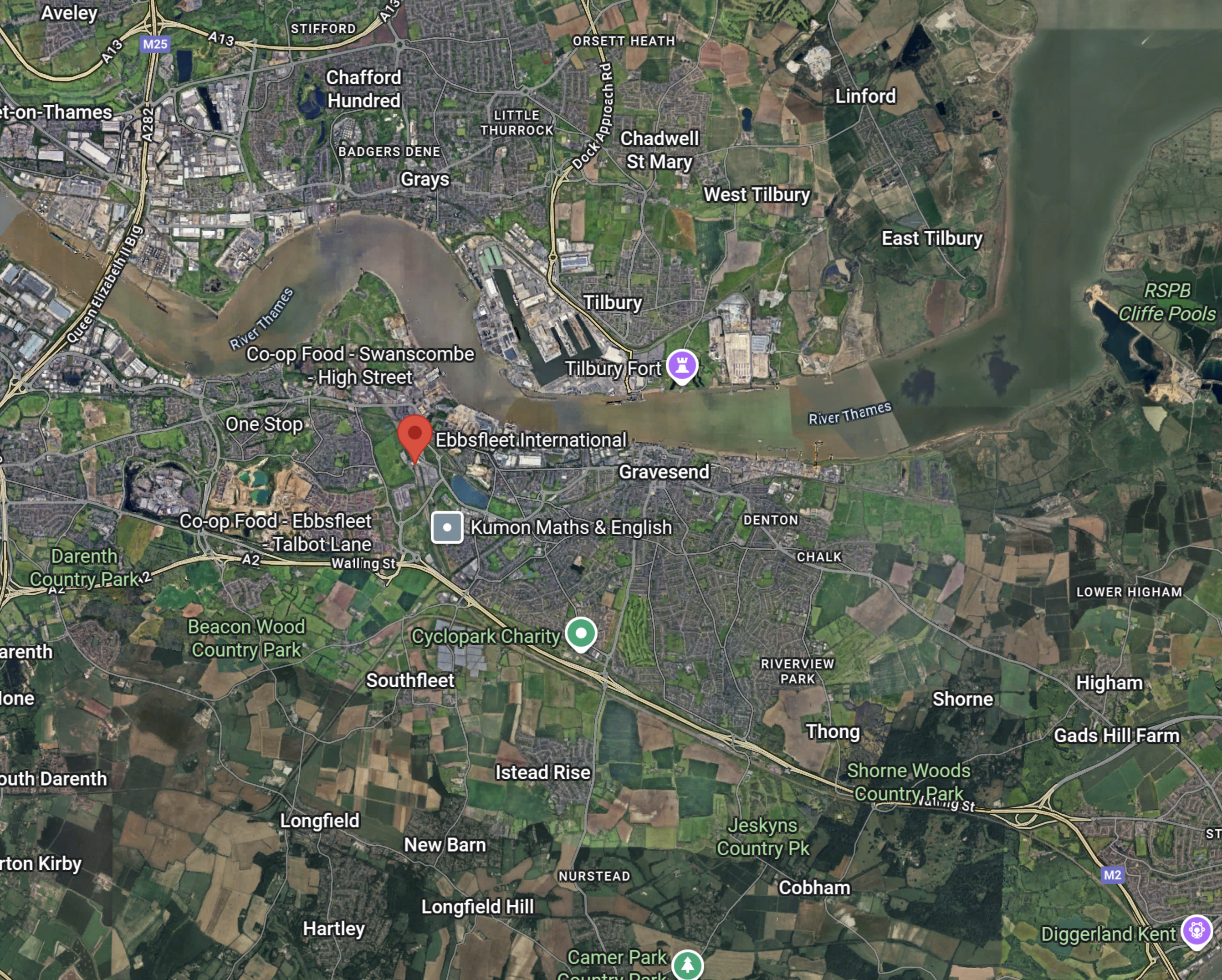
This Google Map shows the location of Ebbsfleet International station in relation to the motorways.
Note.
- The A2/M2 road runs across the bottom half of the map.
- The red arrow marks the position of Ebbsfleet International station.
- The Dartford Crossing is a few miles West of the station.
In my last few years, as an Ipswich season ticket holder, I regularly had a lift to Ebbsfleet International from a friend and the route to the station from the M25 and the A2/M2 wasn’t bad.
But it will be getting better.
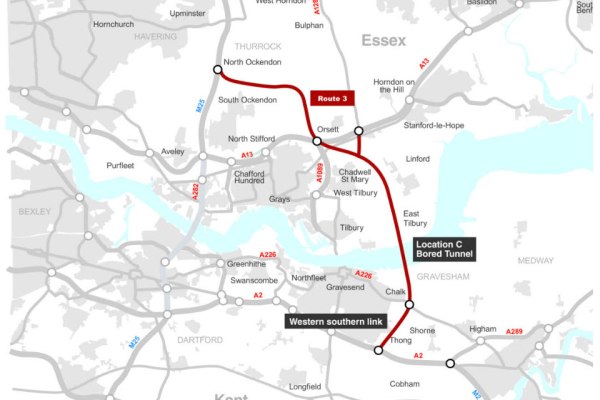
This map from the Government’s consultation on the Lower Thames Crossing, shows the road layout in a few years.
Note.
- The Lower Thames Crossing is shown in red.
- Ebbsfleet International station is about a mile South of Northfleet
- The new crossing will connect to the A2, a few miles East of the link road to the station.
Travellers from much of the East of and Middle England could use the new crossing to get to Ebbsfleet International station.
These are current times from Google.
- Birmingham – 2 hours and 41 minutes
- Cambridge – 1 hour and 17 minutes
- Edinburgh – 7 hours and 44 minutes
- Fishguard – 5 hours and 29 minutes
- Glasgow – 7 hours and 6 minutes
- Holyhead – 5 hours and 29 minutes
- Hull – 4 hours and 1 minute
- Ipswich – 1 hour and 29 minutes
- Leeds – 3 hours and 55 minutes
- Liverpool – 4 hours and 40 minutes
- Manchester – 4 hours and 28 minutes
- Milton Keynes – 1 hour and 37 minutes
- Newcastle 5 hours and 25 minutes
- Norwich – 2 hours 23 minutes
- Nottingham – 2 hours and 55 minutes
- Peterborough – 1 hour and 54 minutes
- Sheffield – 3 hours and 35 minutes
- Stoke-on-Trent – 3 hours and 25 minutes
- York – 4 hours and 16 minutes
Note.
- I would suspect that the opening of the Lower Thames Crossing will knock 10-15 minutes off these times.
- Edinburgh, Glasgow, Hull, Leeds, Newcastle, Nottingham, Peterborough, Sheffield and York would probably be quicker to Europe with a change to Continental train services at St. Pancras, rather than Ebbsfleet International.
- With improvements to rail services, more of these journeys will be quicker by train.
- High Speed Two should connect Birmingham, Liverpool, Manchester and Stoke-on-Trent to London, by the mid 2030s.
But there are some, who always feel their car is safer in a car park!
Ebbsfleet International Station Has A Large Amount Of Car Parking
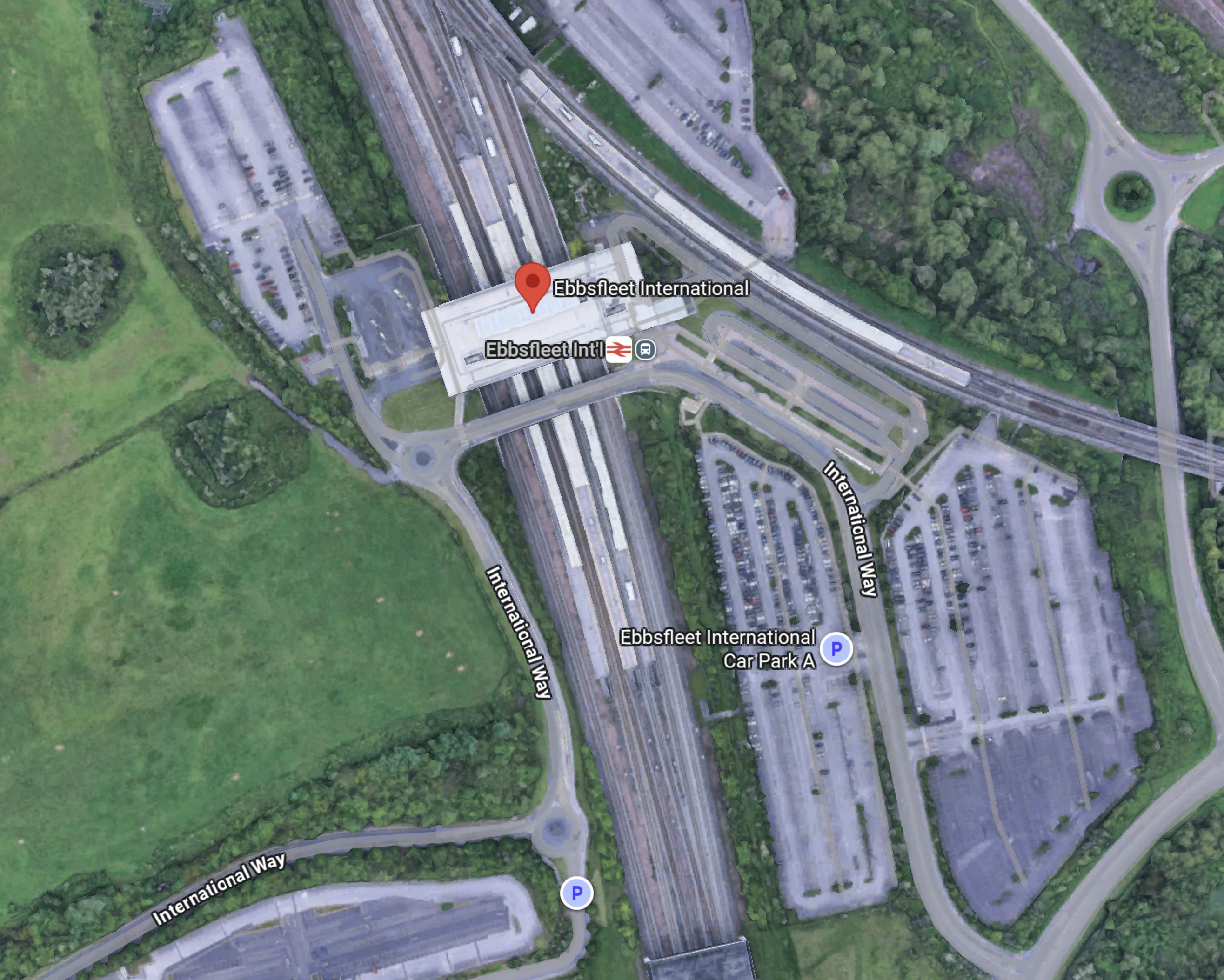
This map shows the car parks at Ebbsfleet International station.
Note.
- Some of the parking areas are marked with a P.
- It is easy to pick-up and drop passengers.
- The car parks could be double-decked to add more spaces if needed.
- According to the Ebbsfleet International web site, the station currently has 5225 parking spaces, 68 accessible car parking spaces.
For those that have a lot of luggage or a large family, taking the car to Ebbsfleet International may be the best option.
Ebbsfleet International Station Should Have A Coach Station
Consider.
- In the next few years, hydrogen-powered coaches with a thousand kilometre range will come to dominate the long distance coach market.
- Mercedes and Wrightbus are know to be developing long-distance hydrogen-powered coaches.
- Hydrogen-powered coaches will be able to reach all of England and Wales and a large part of Scotland from Ebbsfleet International.
- Ebbsfleet International is closely connected to the UK motorway network.
- Continental coaches using the Channel Tunnel, could use Ebbsfleet as a coach interchange with the UK.
- Ebbsfleet International could also handle customs services for Continental coach services, which would take the pressure off the Channel Tunnel and the ferries.
- Ebbsfleet International could also have a coach link to Gatwick Airport.
These and other reasons make me feel, that a coach terminal at Ebbsfleet International is essential.
A Green Connection Between The Two Halves Of The European Union For the Gretas Of This World
Consider.
- There is no zero-carbon route between the island of Ireland and Continental Europe.
- Eurostar is all-electric between London and Continental Europe, but only serves a limited number of destinations.
- Low- or zero-carbon ferries are being designed, that run on hydrogen.
- Trains between London and the Irish ferries are diesel-powered.
- The simplest solution would surely be to run hydrogen-powered coaches between Ebbsfleet International and Fishguard and/or Holyhead. Both journeys would take three and a half hours.
Hydrogen-powered coaches are under development by Wrightbus.
I also asked Google AI if anybody is planning zero-carbon ferries between the UK and ireland and received this answer.
Yes, there are plans for zero-carbon ferries between the UK and Ireland, with a specific “Green Corridor” feasibility study underway for the Holyhead to Dublin route, and a separate, separate commuter service project planned between Belfast and Bangor. The Belfast Maritime Consortium is developing the zero-carbon commuter service, and a separate “Green Corridor” feasibility study is assessing potential low-carbon pathways between Holyhead and Dublin
I believe the green connection is feasible, provided the following happens.
- Ebbsfleet International is reopened and developed as a station for Continental Europe.
- The zero-carbon ferries are developed.
- The busmasters from Ballymena deliver the ultimate hydrogen-powered coach.
- Hydrogen and other fuels are made available, where they is needed.
This could do wonders for the economy of the island of Ireland.
Out of curiosity, I did ask Google AI, what is the longest coach route in the UK and received this answer.
The longest scheduled coach journey in the UK is the Scottish Citylink route from Glasgow to Uig on the Isle of Skye (route 915 or 916), which is about 230 miles and takes around 7 hours and 50 minutes. Historically, there have been much longer international bus routes, such as the Penn Overland tour from London to Ceylon, but these were not regular, scheduled services.
So my proposal at five hours and 29 minutes is only a short hop.
I also believe that with good project management that the additional infrastructure could be built by 2030, with little or no disruption to existing services.
Rolls-Royce mtu Series 4000 engines To Power New Catalina Express Ferry In California
The title of this post, is the same as that of this press release from Rolls-Royce.
These two bullet points act as sub-headings.
High-capacity ferry to feature four EPA Tier 4-certified engines, delivering over 7463 kW (10,000 bhp)
Cutting-edge propulsion system will integrate SCR and DPF once certified by the EPA, USCG, and CARB to meet commercial harbour craft regulations
These three paragraphs from the press release, describe the ferry and its operation.
Rolls-Royce has been selected by Catalina Express of San Pedro, CA (USA) to supply the marine propulsion system for its new high-capacity ferry. The 500-passenger vessel, which will be the largest in the Catalina Express fleet upon completion, will be powered by four mtu 12V4000 M65L engines, delivering a combined output of over 7463 kW (10,000 bhp).
The new ferry is part of the Port of Los Angeles’ $31 million LA MER project, which is funded by the California Air Resources Board (CARB). Via the project, Catalina Express received a $15 million grant, matching it with $15 million of its own investment. The goal of the LA MER project is to test ways to reduce emissions as the Port works toward becoming a zero-emission port.
The new 42-meter ferry, which will be able to reach speeds up to 37 knots, will replace three older Catalina Express vessels maintaining capacity and increasing environmental performance. The vessel will serve as a next-generation leader of the fleet, showcasing the company’s commitment to sustainable operations.
The Wikipedia entry for Catalina Express has this first paragraph.
Catalina Express is an American passenger ferry service that operates scheduled trips between Santa Catalina Island and mainland California. The company began service in 1981 with a single sixty-passenger vessel. As of 2016, the Catalina Express fleet includes eight high-speed vessels that can make the roughly 30-mile (48 km) crossing in about an hour.
There appears to be strong commitment of the California Air Resources Board and Catalina Express to air quality and zero emissions.
In Liberty Lines Commissions First High-Speed Ferry With mtu Hybrid System From Rolls-Royce, I wrote about another high-speed ferry, that will be powered by a Rolls-Royce mtu hybrid system.
The European ferry will be able take 281 passengers at 34.5 mph, and also use battery-power in port.
I can see larger, faster and more advanced ferries being developed, with lower-emission power systems, that will take over some of the shorter sea routes.
Yarmouth Harbour To Be ‘Completed’ In £60m Project
The title of this post, is the same as that of this article on the BBC.
This is the sub-heading.
A major port is set to expand to prepare for construction work linked to several national infrastructure projects.
These first two paragraphs, which give more details.
Peel Ports said it would invest between £50m and £60m in Great Yarmouth’s Outer Harbour by developing the southern terminal, creating a roll-on roll-off (RORO) lift ramp and a large storage area.
Port director Richard Goffin said the construction work, which is set to begin in 2026, would “complete” the port as laid out in a business case in the early 2000s.
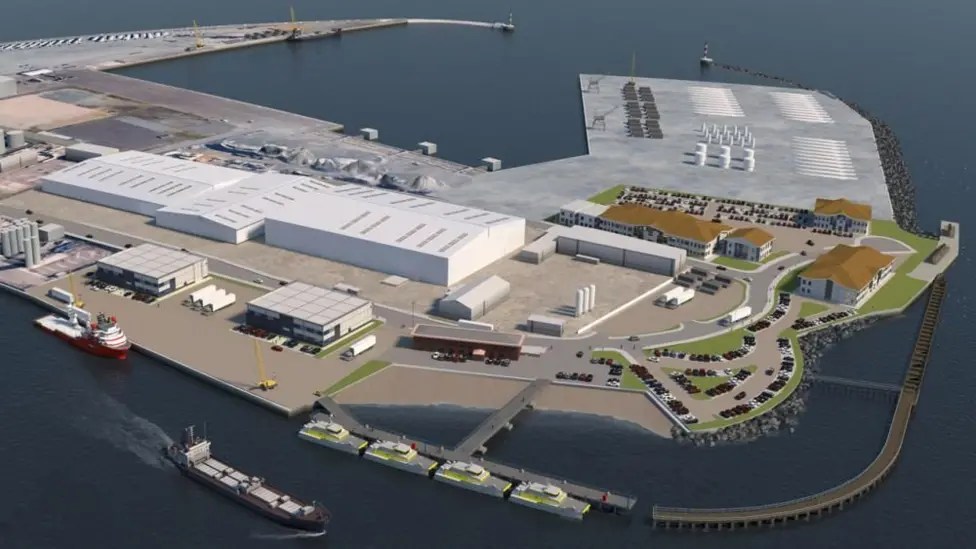
This image from Peel Ports Group shows how the Port of Great Yarmouth will look after the the proposed development.
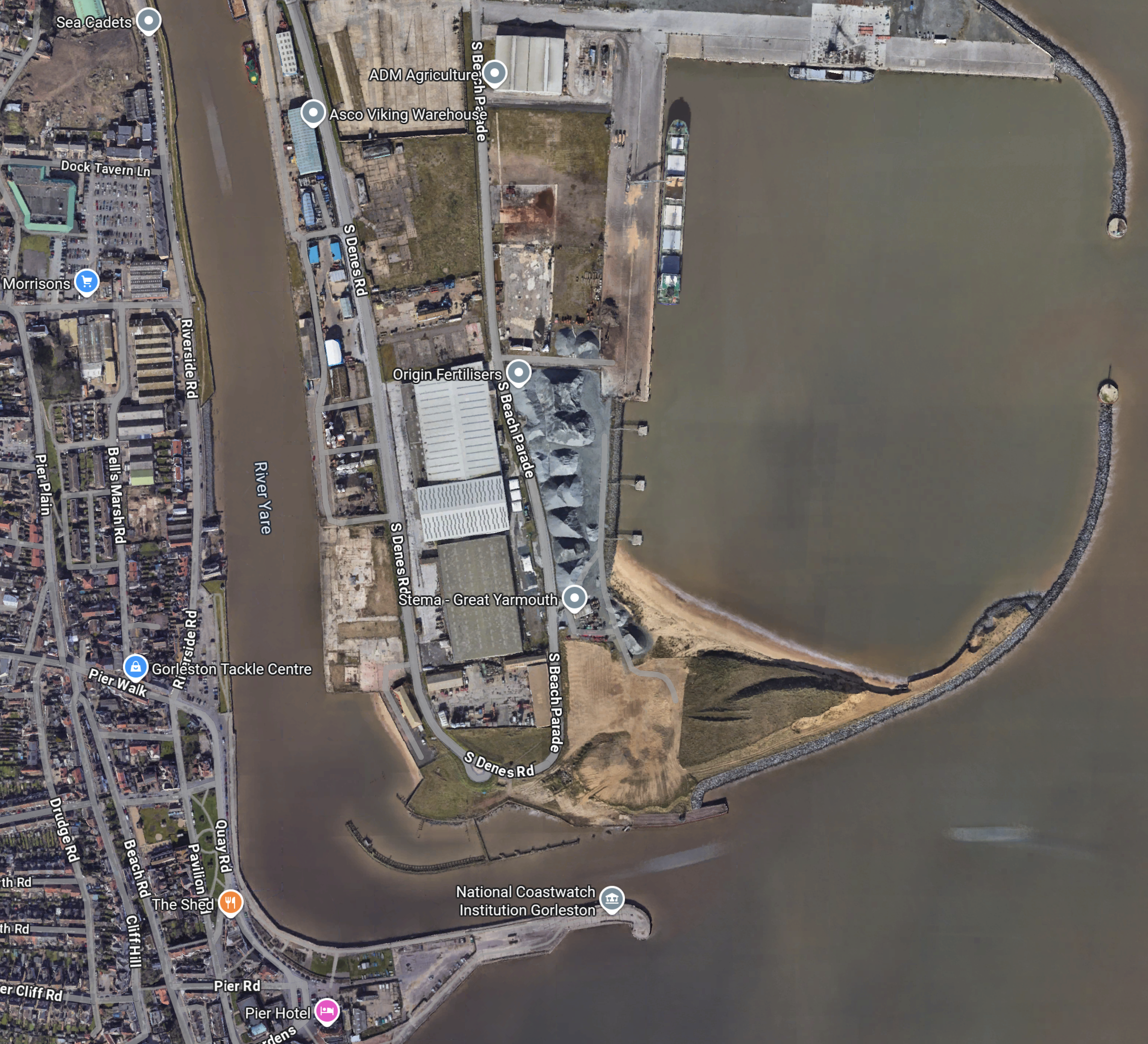
And this Google Map shows the port as it is today.
Note.
- The large triple shed, with the cross-wise middle section can be picked out in both the image and the map.
- The label by the shed says Origin Fertilisers, so I suspect the three objects on the quayside, which are visible in both the image and the map could be conveyors for loading and unloading ships with fertiliser.
- The two breakwaters are visible in both the image and the map.
It looks like the development would mainly involve filling in the Southern part of the current harbour.
With only a quick look and scant details, it looks to me, that it is a development that could be easily realised.
I have some thoughts.
Rail Access To The Port
There is no rail access to the port and I couldn’t see how it could be provided, without demolishing half of the town.
But there are carriage sidings at Great Yarmouth station, which are described in this Wikipedia entry like this.
New sidings were provided at the western end of the station to cope with the additional services operating into the station, following the closure of the M&GN system. It is a crescent-shaped site between the A47 road and Wherryman’s Way at the northernmost point of the River Yare, about 1⁄4 mi (400 m) north-west of the station. It had fallen out of use in the 1980s when Norwich Crown Point depot was built.
In 2010, the unused sidings were purchased by Great Yarmouth Borough Council; they were intended for use as a freight terminal, despite the lack of rail connection to the town’s port. It was hoped that 10,000 tonnes of sugar cane per week would be carried from Yarmouth to Cantley. The need to use a lorry shuttle between the docks and the rail yard, along with a £3.2 million quote for replacing the sidings at Cantley, saw the plan dropped.[19]
In May 2020, Eastern Rail Services commenced a lease with Norfolk County Council and Network Rail for Yarmouth Vauxhall sidings. Managing director James Steward said the siding “matched ERS’s requirement for an East Anglian site to base its rolling stock.” Following extensive de-vegetation works, Direct Rail Services 37402 became the first locomotive in 19 years to run into the sidings on 26 May 2020, followed the next day by it delivering five former Greater Anglia Mark 3 coaches for storage. On 6 July 2020, ERS was authorised a licence exemption permitting them to operate trains within the site
The Port of Great Yarmouth appears to be keen to do its part in the construction of Sizewell C. Could components for the power station, be brought into the port through the new roll-on/roll-off berth and then transferred to rail in the former carriage sidings?
This 3D Google Map shows the carriage sidings.
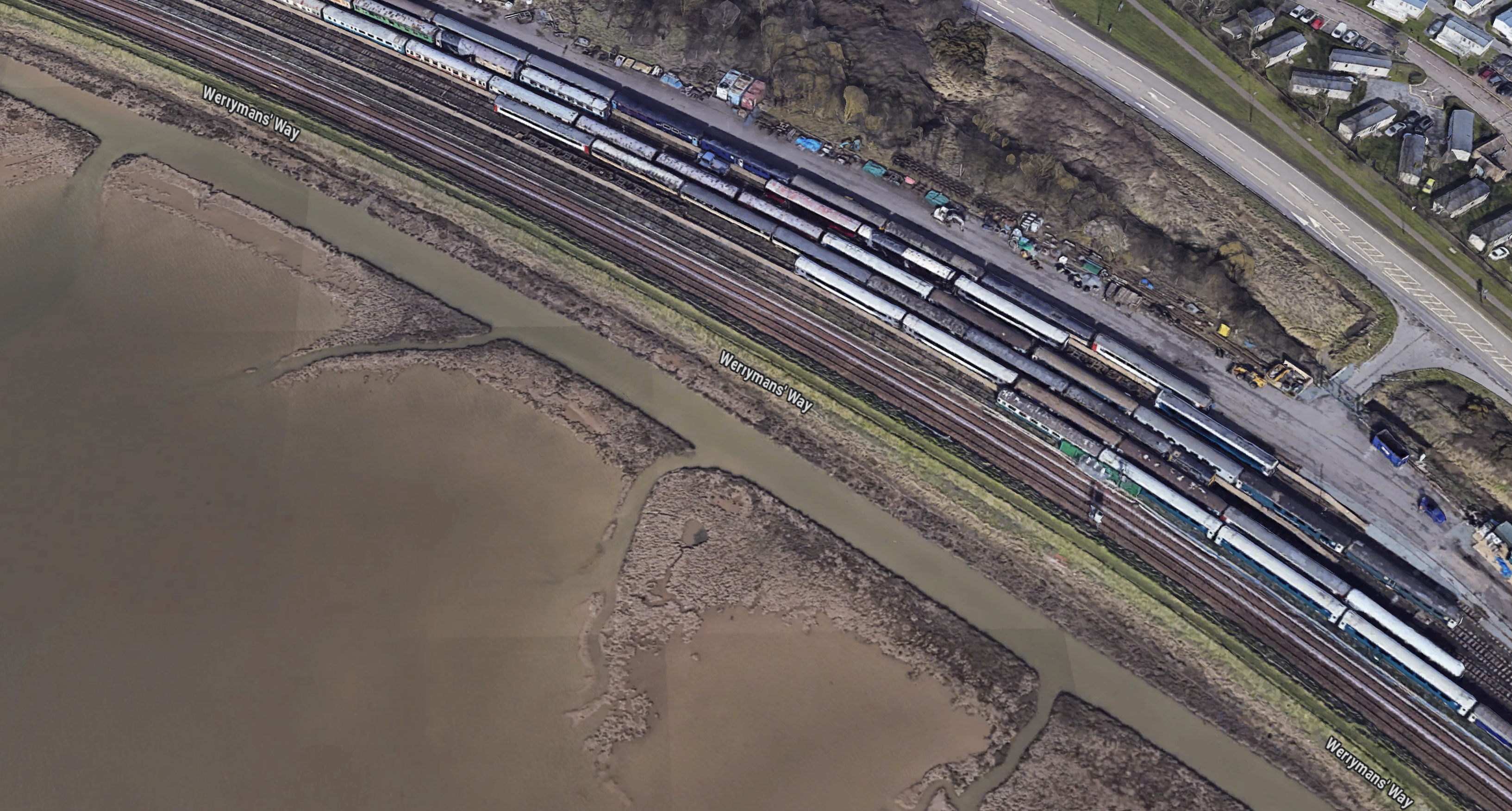
Most of the rolling stock appears to be retired Mark 2 and M3 coaches.
Road Access To The Port
This Google Map shows Great Yarmouth and the Port and roads in the area.
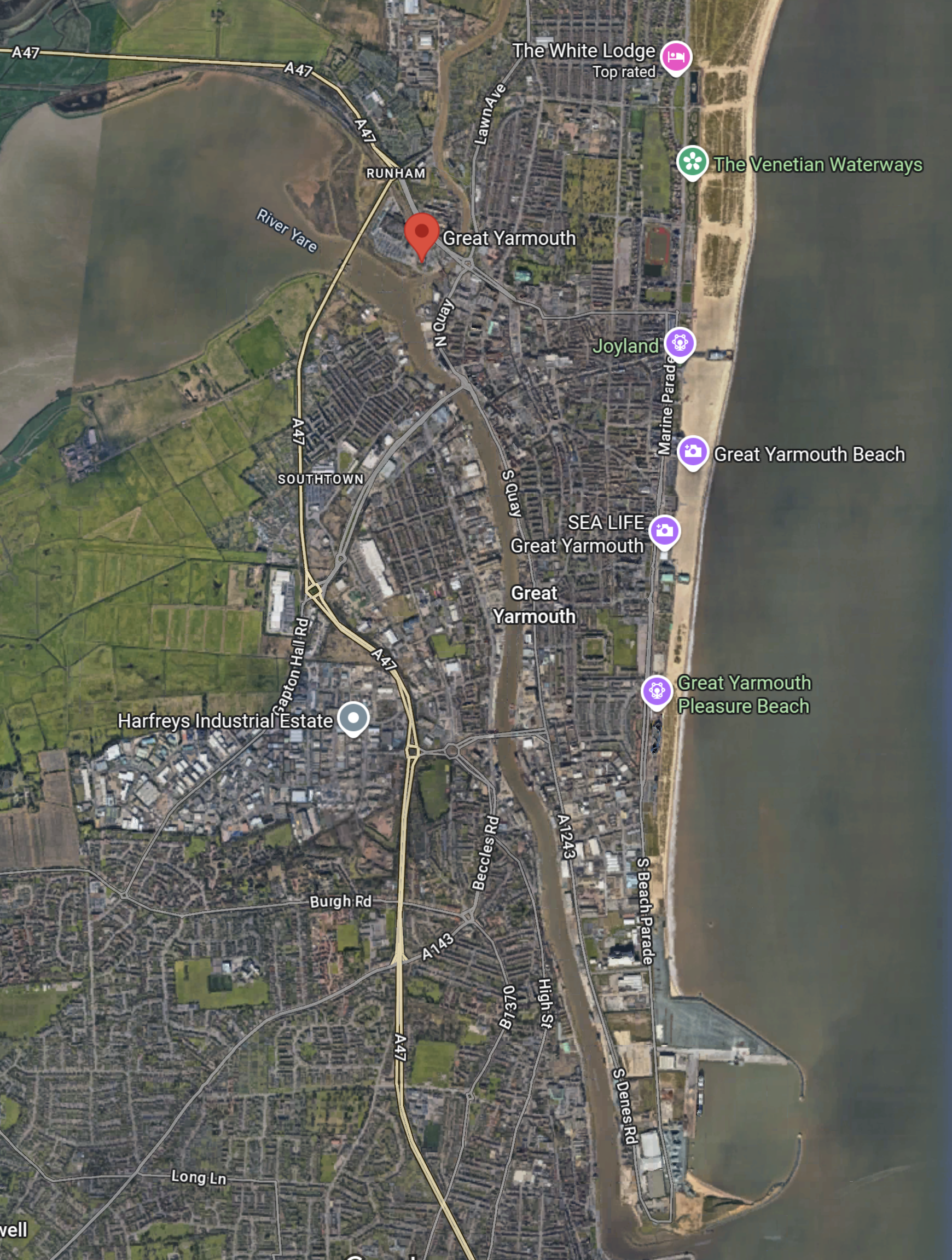
Note.
- The red arrow indicates Great Yarmouth station.
- The Port of Great Yarmouth is in the South-East corner of the map.
- The A 47 runs down the West side of the town.
- The River Yare runs from the railway station to the sea, just below the port.
There is a road on the East bank of the River Yare, that connects to the A 47 and could easily connect to a rail cargo terminal to the North-West of the station in the derelict carriage sidings.
I can certainly see Nimbies not liking the new roll-on/roll-off ferry creating traffic in the town.
The Construction Of Sizewell C
Sizewell C is very similar to Hinckley Point C and this extract from the Wikipedia entry for Hinckley Point C describes some of that power station’s construction.
In March 2017, EDF, after the Office for Nuclear Regulation (ONR) gave approval to start building, the building of the first parts of the plant proper began with a network of tunnels to carry cabling and piping. Work was also under way on a jetty to land building materials, a seawall, and accommodation blocks.
In January 2018, EDF said that they were on track to start generating electricity by 2025 and that they planned to start constructing above-ground structures for the power station by June 2019.
The approximate 2,000 cubic metres (71,000 cu ft) concrete pour for the first reactor started on 11 December 2018. It was completed over a 30-hour period, creating the first part of the unit one 4,500 tonne base, a platform 3.2 metres (10 ft 6 in) thick. The reactor building will be built on the (to be completed) platform. This construction start marks the first new reactor build in the UK after a 30-year break, and the second PWR in the UK, after Sizewell B.
Completion of the base for the first reactor, the final 8,954 cubic metres (316,200 cu ft) of concrete, was achieved in June 2019. Completion of the base for the second reactor, 8,991 cubic metres (317,500 cu ft) of concrete, was achieved in June 2020.
Construction utilises the world’s largest crane, the Sarens SGC-250 double ring crane, which is responsible for lifting Hinkley Point C’s heaviest components. More than 600 heavy fabrications, including the five major parts of each unit’s steel containment liner and dome, are positioned by the SGC-250. The crane, named Big Carl, was delivered in modular form, consisting of over 400 deliveries.
In February 2023, the first nuclear reactor pressure vessel was delivered to site via the Bristol Channel Hinkley-dedicated wharf at Combwich. The pressure vessel was built in France in 2022 by Framatome.
In May 2024, the first of the 520 tonne steam generators was delivered to site in the same manner as the reactor pressure vessel.
Note.
- A good proportion of the power station and the materials to build it were brought in by sea.
- The size of everything is huge.
- Big Carl seems to make appearances in all big projects.
- According to the BBC, Peel Ports are spending £60million on a new roll-on/roll-off terminal, 350 metres of quay and ten hectares of high quality storage space.
I wouldn’t be surprised, if they have the contract for Sizewell C’s logistics, that Peel Ports will be laughing all the way to the bank.
If nothing else, after Sizewell C is completed, they will have a high-class port facility at the end of the A 47 from Birmingham, Leicester, Peterborough and Norwich, which could open up possible ferry routes to Europe.
Between Great Yarmouth And Sizewell
If the components come in to Great Yarmouth on trailers on the RORO ferries from France, they could be taken to Sizewell on the A 12 road.
Smaller components may be taken by road, but I wouldn’t rule out a transfer to rail in the carriage sidings at Great Yarmough, as I indicated earlier.
Faroes-Style Tunnels Could ‘Transform’ Fortunes For Shetland Isles
The title of this post, is the same as that of this article on the BBC.
This is the sub-heading.
The Faroese prime minister says Shetland could boost growth and revitalise island life by following his country in replacing ageing ferries with undersea tunnels.
These three paragraphs add more details.
Shetland Islands Council says it is pushing ahead with plans to build tunnels to four outlying isles in the archipelago including Unst, the most northerly place in the UK.
“I think we have learned in the Faroe Islands that investment in infrastructure is a good investment,” Aksel Johannesen told BBC News.
Shetland Islands Council says its multi-million pound project is likely to be funded by borrowing money and paying it back through tolls, potentially providing a new transport model for other Scottish islands.
This map shows the ferries in the Shetland Islands.
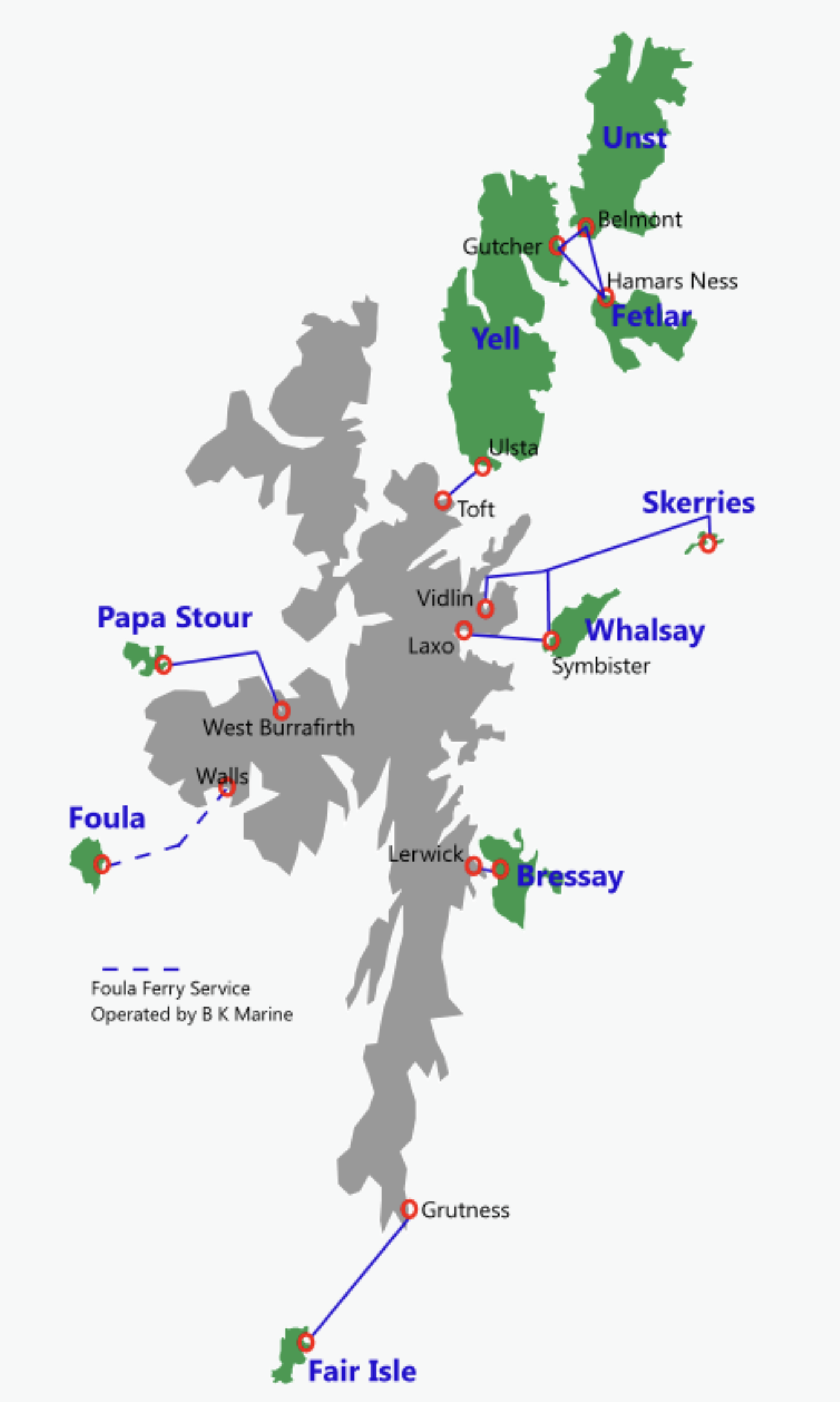
Looking at this map, I would suspect that not all ferries could be replaced by road tunnels.
But if a decision was made to replace ferries with tunnels, thorough cost-benefit analysis would probably show which would be the best value to do first.
These are my further thoughts.
The Faroes
This Google Map shows the Faroes.
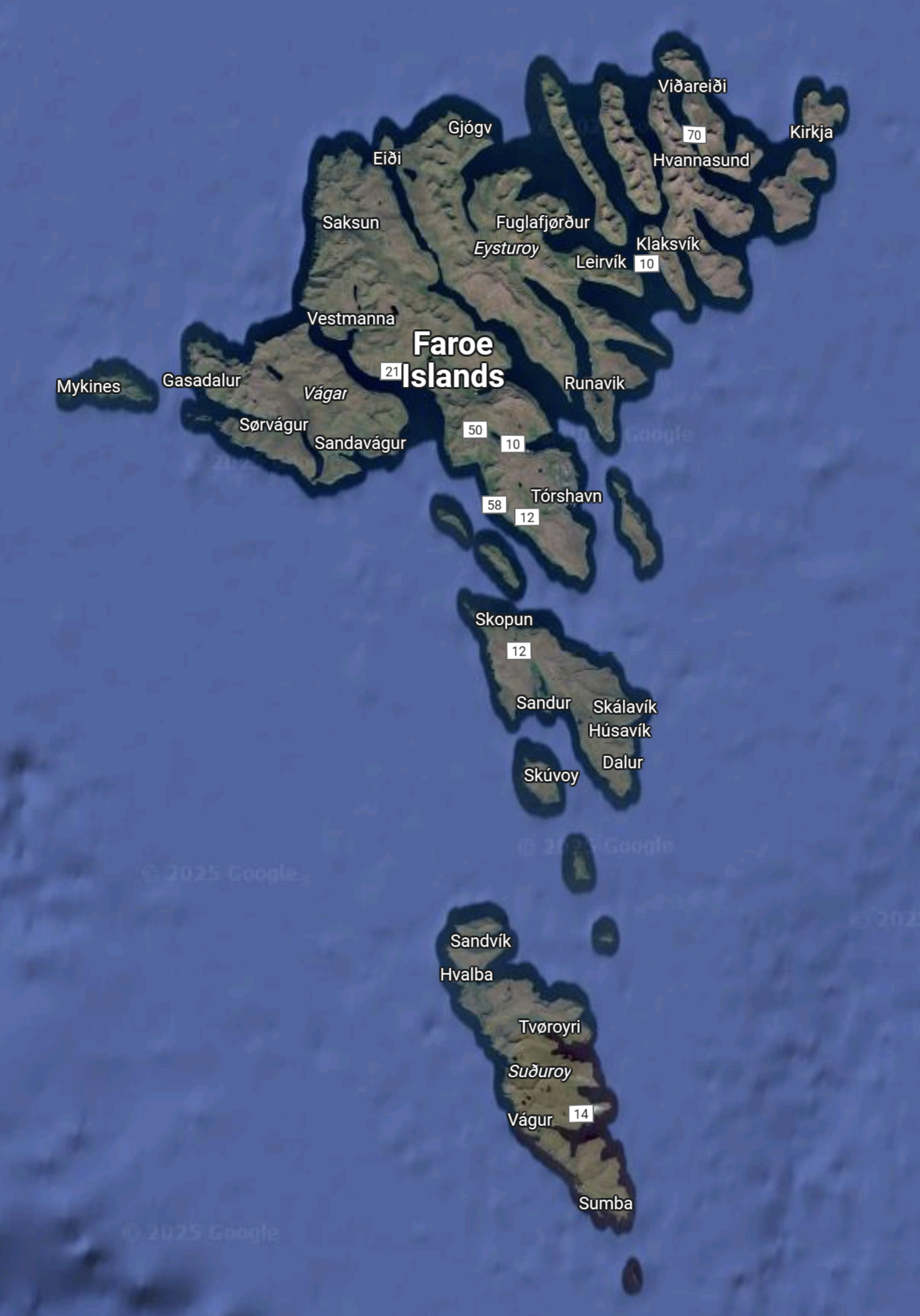
It appears that there may be more land in proportion on the Faroes.
Some Routes Would Not Be Suitable For Tunnels
I would suspect that Grutness and Fair Isle could fall into this category.
These paragraphs on the Shetland web site describe how to get to Fair Isle.
The ferry ‘Good Shepherd IV’ carries 12 passengers and takes 2.5 hours. It leaves from Grutness Pier at the southern tip of Shetland and once a fortnight (summer only) from Lerwick. Please note that this is not a car ferry. View the timetable on the Ferry Services website.
Most flights leave from Tingwall Airport, six miles west of Lerwick, and takes around 25 minutes. The flights operate three times a week and, from April to October, there is also weekly service from Sumburgh (April – Oct). View the timetable on the Airtask website.
Yachts can tie up at the North Haven, with a small nightly charge for use of the harbour.
The Wikipedia entry for the Good Shepherd IV gives more details of the thirty-one year old ferry and its replacement which is due next year, after being funded by the UK Government.
It seems to me that the correct course of action has been taken for the Fair Isle ferry.
Building The Tunnels
These paragraphs from the BBC article, describe how the Faroese tunnels were built and discuss how the same techniques could be used in Shetland.
“It’s about ambition,” says tunnel builder Andy Sloan, whose company worked on part of the Faroese tunnel project.
He adds the islands have led the world “in connecting an archipelago in the middle of the North Atlantic through blood, sweat and tears – and focus.
“They have delivered a remarkable piece of infrastructure,” says Mr Sloan, who is executive vice-president of engineering firm COWI.
It is now advising Shetland Islands Council on the technicalities and financing of tunnels.
The Faroese tunnels were constructed using a technique known as drill and blast – where holes are drilled in rock, explosives are dropped in, and the rubble is then cleared away – which Mr Sloan says could also be used in Scotland.
“Without doubt, Shetland can copy what has been achieved in these islands,” he adds.
I would add, that in recent years, we have successfully built many tunnels in the UK.
At the present time, we are building the 23 mile Woodsmith Mine Tunnel, through rock near Whitby.
This will surely be bigger than anything needed on Shetland.
Could High Speed Two Serve Chester And North Wales?
This diagram shows High Speed Two services, as they were originally envisaged before Phase 2 was discontinued.
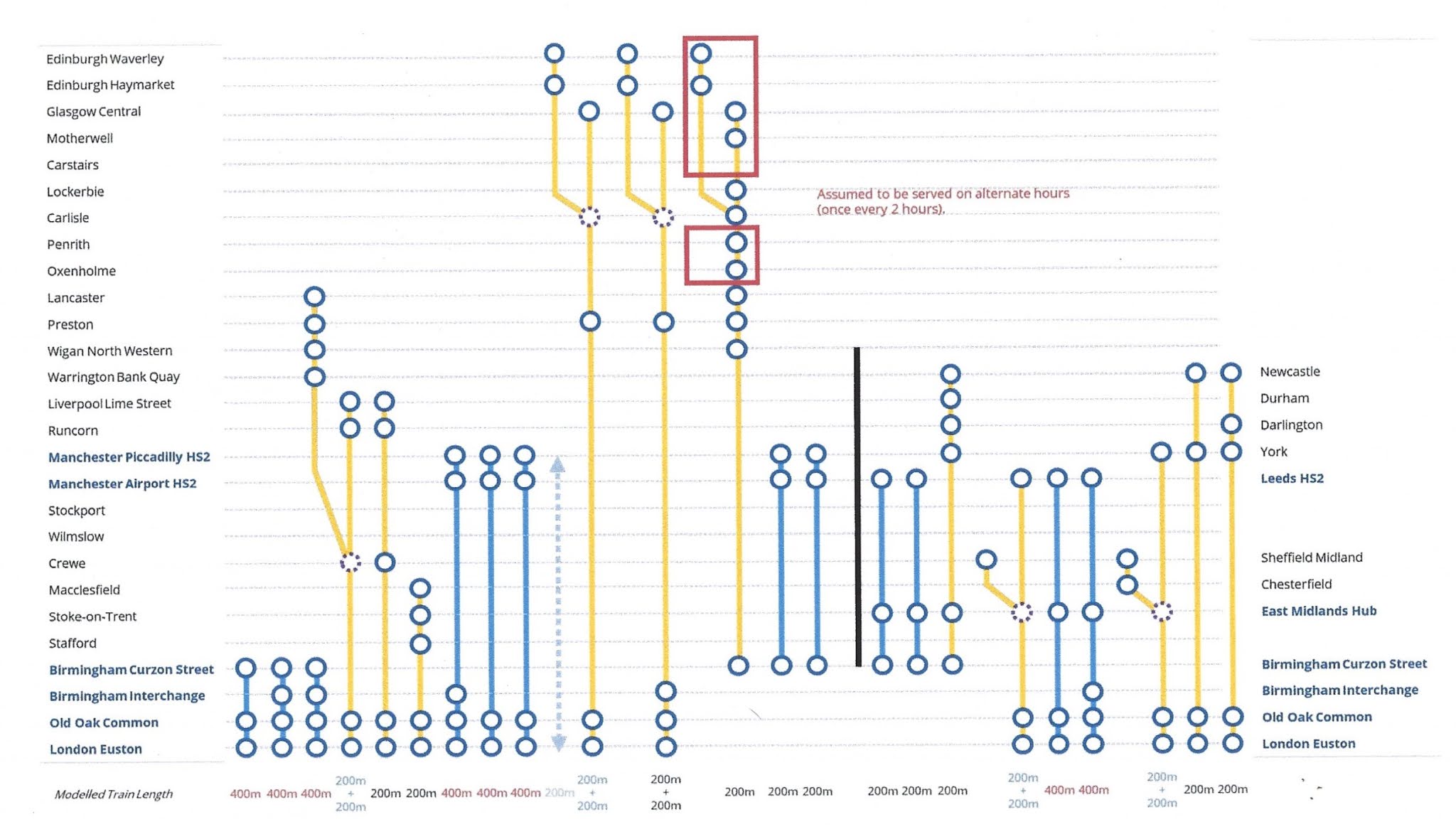
Note.
- Trains to the left of the vertical black line are Phase 1 and those to the right are Phase 2.
- Full-Size trains are shown in blue.
- Classic-Compatible trains are shown in yellow.
- Blue circles are shown, where trains stop.
- The dotted circles are where trains split and join.
- In the red boxes routes alternate every hour.
Click on the diagram to enlarge it.
If I look at the trains counting from the left of the diagram, I see the following.
- Train 4 is a pair of Classic-Compatible trains, that split and join at Crewe, with one train going to Lancaster and the other to Liverpool Lime Street.
- Train 5 is a single Classic-Compatible train going to Liverpool Lime Street.
This gives Liverpool Lime Street two trains per hour (tph) and Lancaster one tph
Could train 5 be a a pair of Classic-Compatible trains, that split and join at Crewe, with one train going to Holyhead via Chester and the other to Liverpool Lime Street?
Consider.
- Yesterday, a pair of Class 805 trains, ran between Euston and Holyhead. Each Class 805 train is 130 metres long, so a pair of Class 805 trains is sixty metres longer than a High Speed Two Classic-Compatible train.
- I am certain, that a single High Speed Two Classic-Compatible train will fit the platforms between Crewe and Holyhead.
- Crewe and Holyhead is 105.5 miles and the route is not electrified.
- Crewe and Holyhead is double-track all the way except for the Britannia Bridge over the Menai Strait.
- With the exception of perhaps 2 to 3 miles, half the route between Crewe and Holyhead has a line speed of 90 mph. with the other half being 75 mph.
- Given the countryside and the number of important historic sites, electrification might be difficult, as the heritage Taliban will say no!
- It was promised by the last government that Crewe and Holyhead would be electrified, but I will assume it won’t be!
- Hitachi, who are part of the consortium building the High Speed Two Classic-Compatible trains have developed battery-electric high speed train technology, which is likely to be applied to the Current Class 805 trains, that work the route.
- Hitachi’s battery-electric high speed train technology can propel the trains at up to 125 mph, provided the track allows it.
I feel that Crewe and Holyhead can be developed into one of the most iconic high speed railways in the world, by using battery-electric high-speed trains. Tourists would come from all over the world, to experience mouse-quiet battery-electric trains.
High Speed Two should go for it!
These are some thoughts.
It Would Be A Green Route To Ireland
Consider.
The fastest direct Avanti service to Holyhead is scheduled to take three hours and forty-two minutes, with one hour and 46 minutes between Euston and Crewe, and one hour and fifty-seven minutes between Crewe and Holyhead.
- High Speed Two will knock thirty-four minutes off the time between Euston and Crewe, when the core route between Euston and Crewe is complete, which will reduce the time to three hours eight minutes, with with one hour and 12 minutes between Euston and Crewe, and one hour and fifty-seven minutes between Crewe and Holyhead.
- The Crewe and Holyhead section of the route would still take one hours and fifty-seven minutes, which is an average speed of just 54 mph, along the North Wales Coast.
- An overall time of three hours between Euston and Holyhead, would require an average speed along the North Wales coast, which would be an average speed of just 62 mph.
- The operating speed is an average of around 80 mph between Crewe and Holyhead, and would run the section of the route in 79 minutes, which would mean a Euston and Holyhead time of two hours and 31 minutes.
- A 100 mph average between Crewe and Holyhead, would run the section of the route in 63 minutes, which would mean a Euston and Holyhead time of of two hours and 15 minutes.
I believe that with track improvements, a more efficient stopping pattern and using Hitachi’s battery technology, that battery-electric High Speed Two Classic-Compatible trains could run between Euston and Holyhead in under two hours.
A fast ferry would complete the route between Holyhead and Dun Laoghaire.
Could More Than One Train Per Hour Be Sent To Chester And North Wales?
Consider.
- Because of the cancellation of Phase 2 of High Speed 2, there are spare paths on High Speed Two between London and the West Midlands.
- If the core section of High Speed Two is extended Northwards to Crewe, as advocated by Dyan Perry of the High Speed Rail Group, that I wrote about in The Future Of HS2 Could Lie In Its Original Vision, this would create extra paths to Crewe.
- If the West Midlands and Crewe section of the High Speed Two route has the same capacity as London Euston and the West Midlands it could handle seventeen tph.
- At present it looks like with the cancellation of Phase 2, the West Midlands and Crewe section will handle just ten tph.
, So there will be seven spare paths between Euston and Crewe!
In fact it will be better than that, as each train could be a pair of Classic-Compatible trains, that split and joined to serve two destinations.
Could A North Wales Service Call At Hawarden Airport?
Hawarden Airport is where Airbus build wings for their aircraft in the UK.This Google Map shows Hawarden Airport.
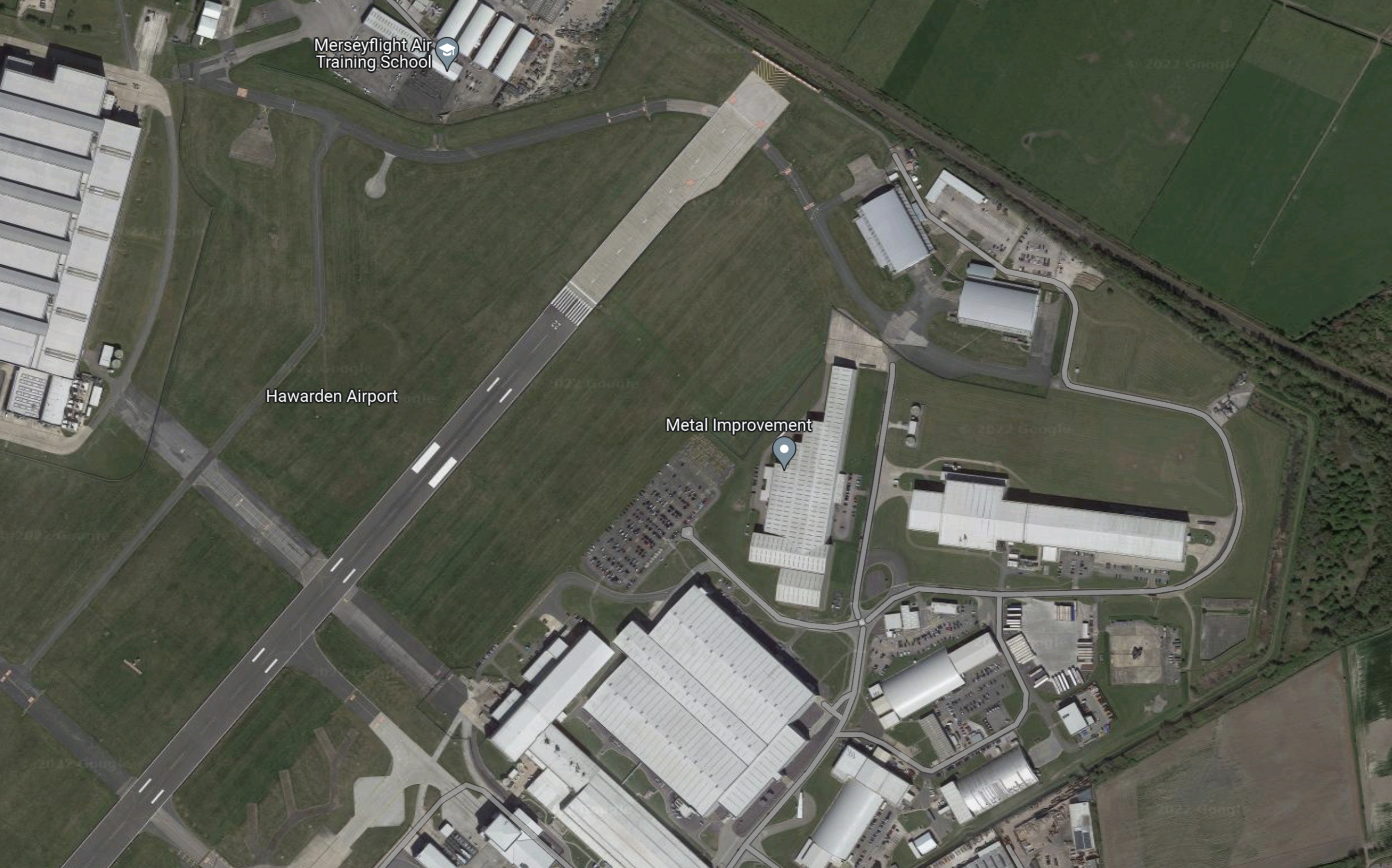
Note.
- The large runway.
- The various factory buildings.
- The North Wales Coast Line between Chester and Holyhead, runs along the North side of the Airport.
I doubt if Airbus wanted a station, it would be difficult to arrange.
Conclusion
Because of the vacant paths, it would appear that extra services to North Wales and North West England can be fitted in.
Could An Open Access Operator Develop A Train Service Along The South Coast of The UK Between Kent and Fishguard?
Before I go into detail, I will answer a question that explains the terminology and the why’s and wherefores’ of the title of this post.
What Is An Open Access Operator?
This is the first paragraph of the Wikipedia entry of an Open Access Operator.
In rail transport, an open-access operator is an operator that takes full commercial risk, running on infrastructure owned by a third party and buying paths on a chosen route and, in countries where rail services run under franchises, are not subject to franchising.
In the UK, these are all open access operators, that are running services.
Note.
- Other groups are developing services.
- Regional, High Speed, International, Local and Sleeper services seem to be offered by various open access operators.
- Grand Central is a subsidiary of Deutsche Bahn,
- Hull Trains and Lumo are both subsidiaries of FirstGroup.
Open Access operators seem to operate in most European Union countries.
Why Run Between Kent and Fishguard?
- The main purpose of the train service would be to provide a low-cost rail connection between the island of Ireland and particularly the Republic of Ireland, with the Southern part of England and the European Union.
- At both ends of the route the train service would connect to ferries.
- At the Eastern end, the train service would also connect to Eurostar services through the Channel Tunnel.
- The Port of Dover could be efficiently connected to Dover Priory Station.
- Dover Priory Station could be the Eastern terminus.
- The service could stop at Folkestone Central station, if ferries call at the Port of Folkestone in the future.
- The service could stop at Ashford International station for Eurostar services.
- Fishguard Harbour station has been built as a train terminus for the Port of Fishguard.
- Fishguard Harbour station could be the Western terminus.
This could be a busy service.
Where Would The Trains Call?
Intermediate stations would depend on passenger umbers, but could start as Folkestone Central, Ashford International, Hastings, Eastbourne, Brighton, Portsmouth & Southsea, Southampton Central, Romsey, Salisbury, Warminster, Westbury, Trowbridge, Bradford-on-Avon, Bath Spa, Bristol Temple Meads, Bristol Parkway, Newport, Cardiff Central, Gowerton, Llanelli and Carmarthen.
How Long Would The Journey Be?
The journey would be around 377 miles and I suspect could take about three and a half hours with modern digital signalling.
Surprisingly, the route is fully-electrified except for the following.
- Ashford International and Ore – 27.9 miles
- Southampton Central and Bristol Parkway – 82 miles
- Cardiff Central and Fishguard Harbour – 115.6 miles
All gaps should be able to be bridged using battery power.
I suspect trains would be Hitachi high speed battery-electric trains.
Would Any European Funding Be Available?
This is an interesting question, as the service does join up two separate sections of the European Union.
Liberty Lines Commissions First High-Speed Ferry With mtu Hybrid System From Rolls-Royce
The title of this post, is the same as that of this press release from Rolls-Royce.
These two bullet points act as sub-headings.
- “Vittorio Morace” the world’s first hybrid high-speed ferry to IMO HSC standard with a length of almost 40 metres is fast at sea and emission-free in harbour
- A further 8 Liberty Lines ferries with mtu hybrid systems will enter into service in Italy, Slovenia and Croatia
This picture shows the first of the fleet.

This is the first paragraph.
On 27 June 2024, the Italian shipping company Liberty Lines ceremonially launched the world’s first hybrid fast ferry of this category and size in Trapani, Sicily, powered by an mtu hybrid propulsion system from Rolls-Royce. The 39.5 meter long ship has a capacity of 251 passengers, reaches a speed of over 30 knots and will significantly reduce the impact of ship operations on the environment. The “Vittorio Morace”, built by the Spanish shipyard Astilleros Armon and designed by Incat Crowther, is the world’s first IMO HSC (High-Speed Craft) hybrid fast ferry of this size and has been classified as a “Green Plus” ship by the Italian classification society RINA.
This ferry can truly be considered to be a Ship-of-the-World, with a design from an Australian-headquartered International company and German engines, that has been built in Spain.
This paragraph describes the power-train.
The battery-electric part of the drive is used for locally emission-free driving in the harbour area and as a booster. CO2 emissions are reduced by the particularly efficient mtu Series 4000 diesel engines which can also run on the renewable diesel (HVO, hydrotreated vegetable oil). Its use can lower the CO2 footprint by up to 90 per cent. Furthermore, the comparatively low overall weight of both the engines and the hybrid drive system contributes to high vessel propulsion efficiency, thereby reducing fuel consumption and emissions.
Over the last thirty years, I’ve been to several of the places served by Liberty Lines, so some excellent journeys, will be made faster, quieter and better.
 The Anonymous Widower