Liverpool’s Vision For Rail
This document on the Liverpool City Region web site is entitled Metro Mayor’s Vision Of A Merseyrail for All Takes Vital Step Forward With Successful Trial Of New Battery-Powered Trains.
It makes these points in the first part of the document.
- Game-changing technology paves way for Merseyrail network expansion across the Liverpool City Region and beyond
- Merseyrail services could reach as far as Wrexham and Preston
- City Region is at the forefront of the introduction of pioneering energy efficient technology.
The new battery-powered trains would certainly go a long way to enable, these objectives.
- Battery-powered trains would need a range of 26.9 miles to go between Bidston and Wrexham stations.
- Battery-powered trains would need a range of 15.3 miles to go between Ormskirk and Preston stations.
This link is to the North Cheshire Rail User Group’s Newsletter for Spring 2021.
This is said about battery range of the new Class 777 trains.
Later model Class 777’s have the ability to leave the 3rd rail and operate under battery power for 20 miles or more with a full load thus
permitting expansion of the Merseyrail network beyond its current limits.
I suspect they will also have regenerative braking to batteries, which will increase the range and allow Preston and Wrexham stations to be achieved without charge.
It certainly sounds like Preston and Wrexham and all the intermediate stations, will be added to the Merseyrail network.
As to the third point above about the introduction of pioneering energy efficient technology, I suspect this is mainly regenerative braking to batteries and replacement of elderly worn-out power supply equipment.
There is more in the Liverpool City Region document.
Expanding Merseyrail
This is said.
The game-changing technology could allow the Merseyrail network to extend across all six city region boroughs to places like Rainhill in St Helens, Woodchurch on the Wirral and Widnes in Halton.
It could also allow the new fleet to operate as far afield as Skelmersdale, Wrexham, Warrington and Runcorn.
Note.
- A 25 KVAC capability could well be needed. But that is built into the Class 777 trains.
- Chargers could be needed at some of these stations. I suspect Stadler have a Swiss manufacturer in mind.
In the run-up to May’s elections, the Mayor pledged to deliver ‘Merseyrail for All, a commitment to connecting under-served communities to the Merseyrail network.
New Stations
Initially the battery-powered trains, which are considerably greener, using up to 30% less energy than the existing fleet, are set to run on services to a planned new station at Headbolt Lane, Kirkby.
The wider Merseyrail for All programme could ensure every community is well served by an integrated public transport network and new and refurbished train stations are also high on the agenda.
They could include:
- The Baltic Triangle in Liverpool
- Carr Mill in St Helens
- Woodchurch on the Wirral
Note.
- The Baltic Triangle station will be built on the site of the former Liverpool St. James station.
- The Carr Mill station will probably be built on the site of the former Carr Mill station.
- Woodchurch station is likely to be built on the Borderlands Line between Upton and Heswall stations.
Tram-Trains And Trackless Trams
The document says this.
Tram-Train technology and trackless trams will also be looked at as potential means of extending the Merseyrail network into hard-to-reach places. The technology could benefit areas such as Liverpool John Lennon Airport and Speke, Kirkby Town Centre, Southport Town Centre, Wirral Waters and the Knowledge Quarter.
Tram-trains built by Stadler in Valencia are already running in Sheffield and in the next few years they should be deployed on the South Wales Metro.
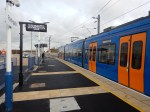

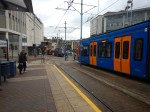
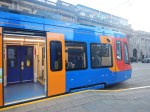
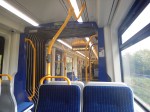
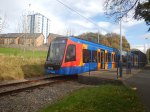
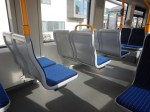
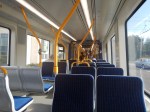
TStadler are also building Merseyrail’s new Class 777 trains, so I suspect they’ll go together like peaches and cream.
The Belgian firm; Van Hool have a product called Exquicity. This video shows them working in Pau in France.
These tram buses run on rubber types and are powered by hydrogen.
Similar buses running in Belfast are diesel-electric.
Could these be what the document refers to as trackless trams?
Battery Train Trials
The article finishes with this summary of the battery train trials. This is said.
Under the battery trials, financed by the Transforming Cities Fund, one of the new class 777 trains fitted with the battery technology was tested on the Northern line.
The batteries exceeded expectations with the trains travelling up to 20 miles per run without the need for re-charging.
The battery trains would remove the need for the third ‘electric’ rail, enabling the trains to travel beyond the existing network without major track investment.
The units passed all tests during four weeks of trials on the City Region’s rail network in May and June.
The Combined Authority and partners are still assessing the full impact of the Coronavirus pandemic on the programme and will provide more information regarding the roll out as soon as it has been agreed.
It looks to me, if all these plans get implemented successfully, Liverpool City Region will have one of the best public transport systems of any similar-sized cities in the world.
The Full Plan As A Map
This article on the BBC is entitled Battery-Powered Trains Part Of Merseyrail Expansion Plan.
The article contains this map.

There is no key or explanation, but it appears that the pink lines are new routes, where Merseyrail will run trains.
Before I discuss each of the possible routes, I will discuss two big factors, that will affect a lot of my thinking.
The West Coast Main Line
Avanti West Coast have the following stops in trains per hour (tph) at these stations on the West Coast Main Line as its trains pass the East of Merseyside to and from London Euston.
- Crewe – At least 5 tph
- Warrington Bank Quay – At least 2 tph
- Preston – At least 1 tph
These frequencies are in addition to these direct trains from London Euston.
- 1 tph to Liverpool Lime Street, which will rise to 2 tph in the December 2022, with a call at Liverpool South Parkway station.
- Occasional services to Chester throughout the day.
Passengers do not have to go via Liverpool Lime Street to travel to London.
In addition. there are useful services run by TransPennine Express between Liverpool Lime Street and Scotland, that call at Preston.
In Future; High Speed Two
This will call at Crewe, Liverpool Lime Street, Liverpool South Parkway, Preston and Warrington.
Northern Trains
Northern Trains were in all sorts of troubles and the service is now run directly by the Government’s Operator of Last Resort. I suspect that any reasonable offer to takeover over a service will be looked at favourably.
I will now look at Merseyrail’s new routes.
Ormskirk And Southport Via The Burscough Curve
Consider.
- This route has been a long term aspiration of Merseyrail.
- A curve between Burscough Bridge and Burscough Junction will have to be rebuilt on a former alignment.
- Southport and Ormskirk are about 13 miles apart.
- Southport and Ormskirk have third-rail electrified lines to Liverpool and the South.
It would be an ideal route for battery-electric trains with a range of 20 miles.
What would it do for passengers?
- It gives those living near five stations a direct link to Liverpool.
- It gives Southport a town of over 91,000 people more capacity to the city of Liverpool for jobs, leisure and shopping.
- Will it open up more opportunities for new housing in villages like Burscough?
It will certainly give Merseyrail operational advantages to Southport.
Ormskirk And Preston
Consider.
- Takeover of this Northern Trains route has been a long term aspiration of Merseyrail.
- Preston and Ormskirk are about 15.3 miles and 32 minutes apart.
- Omskirk has 750 VDC third-rail electrification and Preston has 25 KVAC overhead electrification.
- The Class 777 trains have been built so they can be updated to dual voltage.
It certainly looks to be a route that could be handled by a battery-electric Class 777 train.
What would it do for passengers?
- It gives those living near the Ormskirk and Preston Line a direct link to Liverpool.
- It creates a direct link in modern electric trains between North Liverpool and Preston, for onward travel on West Coast Main Line services and High Speed Two in the future.
- The journey time could be reduced to under thirty minutes.
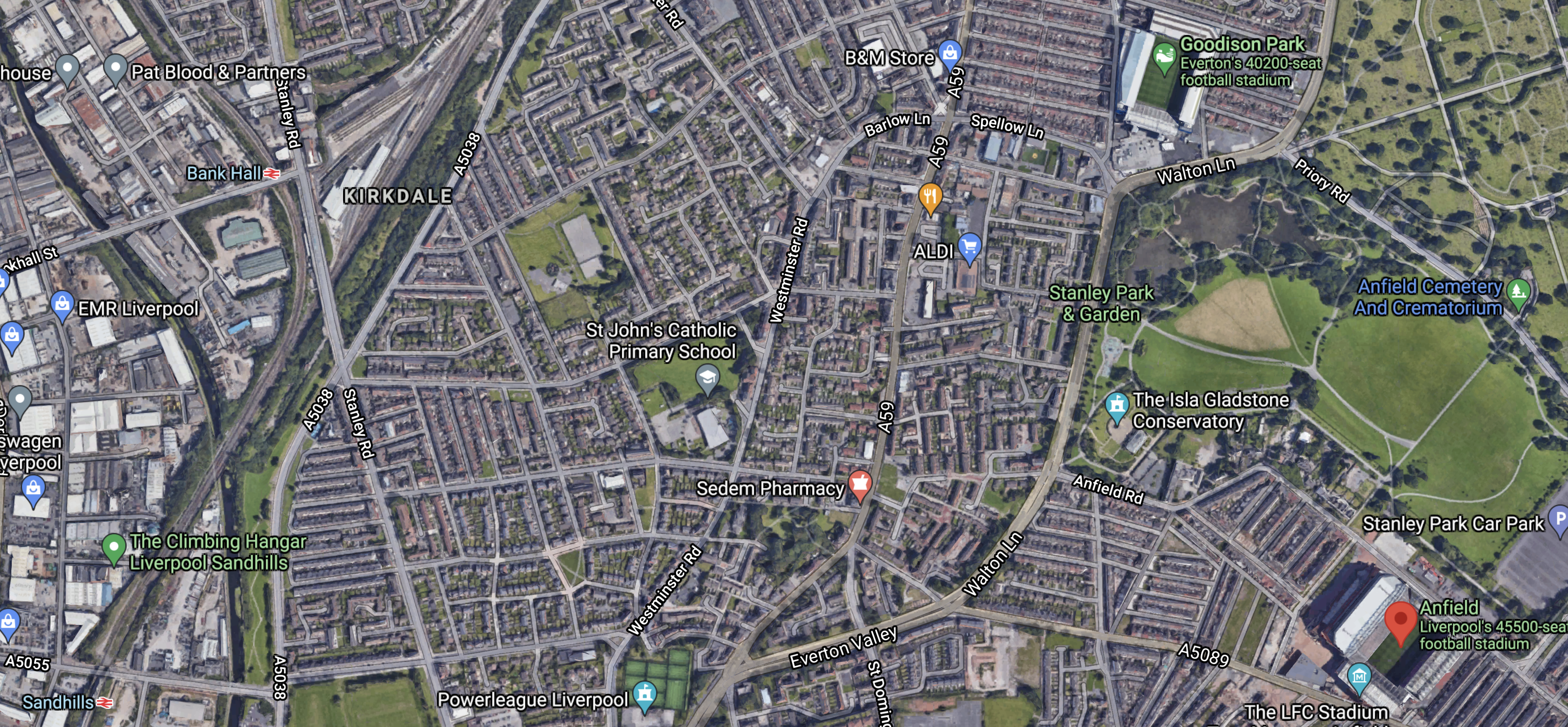
As football is so important to the Liverpool economy, would a time around forty-five minutes between Preston and Sandhills station tempt football supporters going to Anfield and Goodison Park to use the train and then perhaps a trackless tram to the stadium?
This Google map shows the location of Anfield, Goodison Park and Sandhills station.
Note.
- Anfield is in the bottom-right corner of the map and is marked by a red arrow.
- Goodison is in the top-right corner of the map, slightly to the West of Anfield.
- Sandhills station is in the bottom-left corner of the map.
Both stadia are around a mile and a half from the station.
Southport And Preston
Once the Ormskirk and Southport and Ormskirk and Preston services are up and running, it would surely be possible to run a Southport and Preston service.
- There would be a reverse at Ormskirk.
- The two sections of Ormskirk and Southport and Ormskirk and Preston would both need battery power.
- Whilst the driver changed ends at Ormskirk, the train would be recharged using a fast and efficient charger.
- Times between Southport and Preston would be under an hour.
It certainly looks to be a route that could be handled by a battery-electric Class 777 train.
What would it do for passengers?
- It gives those living in Southport, a direct link to Preston.
- It creates a direct link in modern electric trains between Southport and Preston, for onward travel on West Coast Main Line services and High Speed Two in the future.
This service could be very valuable for passengers, but I suspect the route could be implemented with minimal infrastructure changes at Ormskirk station.
Ormskirk Station
This picture shows Ormskirk’s single platform from the Merseyrail end.
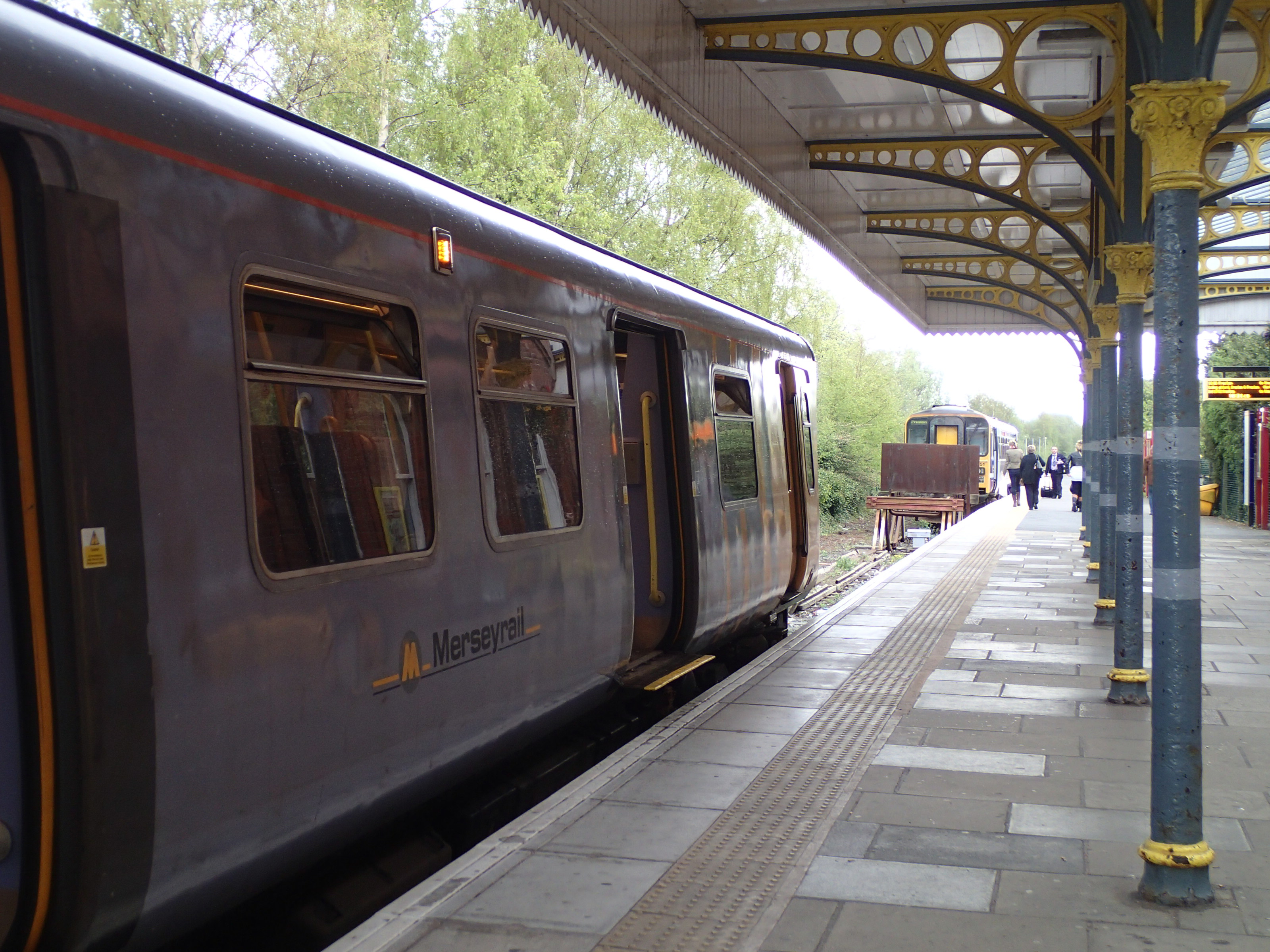
Note.
- The Liverpool train in the foreground.
- The Preston train in the background.
- The solid barrier between the trains.
I wonder if the following would be possible with the barrier removed.
- The long platform would be treated as one platform divided into two.
- Perhaps they will be the Liverpool and Preston/Southport platform,
- Trains that will leave the station for Liverpool will stop in the Liverpool platform.
- Trains that will leave the station for Preston or Southport will stop in the Preston/Southport platform.
- Through trains between Liverpool and Preston or Southport would be possible.
- A train between Preston and Southport could reverse in the Preston/Southport platform, whilst trains for Liverpool used the Liverpool platform.
It looks like it’s an efficient layout borrowed from somewhere else. and Stadler have probably seen it before.
Headbolt Lane Station
In Headbolt Lane Station Fly-Through, I described the new Headbolt Lane station.
This screen capture is from the video in that post,
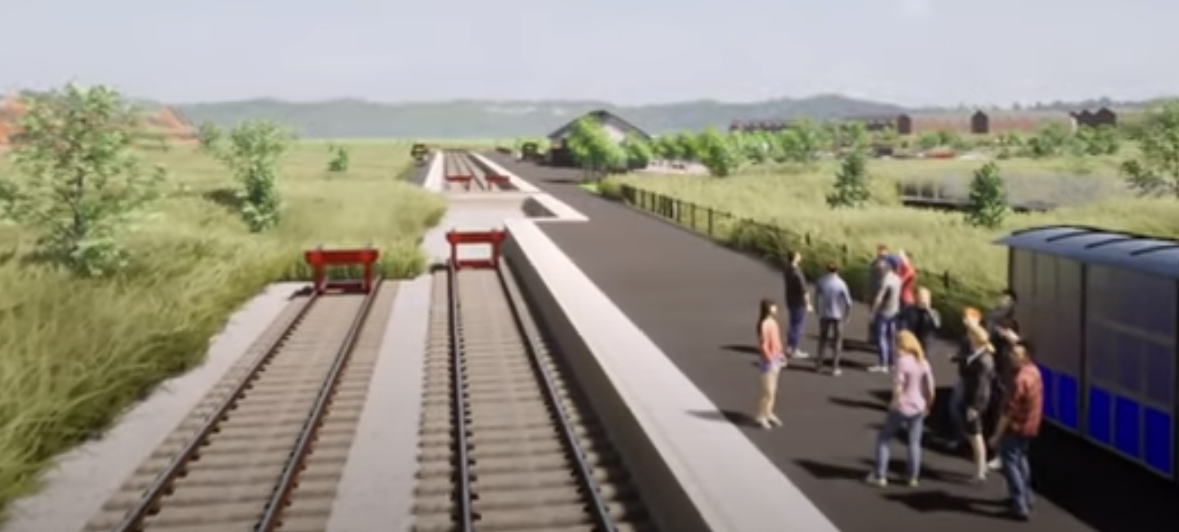
Note.
- Two platforms going away from the camera and one platform and what looks to be a siding going towards the camera.
- There appears to be no direct connection between the two different sets of tracks.
Until proven wrong, I believe that the camera is looking towards Liverpool, as it would mean that Liverpool services had two platforms. But they currently make do with one at Kirkby.
There is a walk through between the tracks, which
- Enables passengers to access the second platform.
- Allows passengers to enter the station from the other side.
- Allows non-passengers to cross the tracks on the level.
- Avoids the need to build a bridge.
It is certainly an innovative design.
If occasional trains need to go through, could there be a lift-out section of the walk-through?
But as there are buffer stops on the tracks in the three platforms, that are either side of the walk-through, I suspect it will never happen, as it’s too much hassle.
In the Wikipedia entry for Headbolt Lane station this is said.
The Liverpool City Region Combined Authority announced in July 2021 that a trial of a battery electric multiple unit (BEMU) version of the new Class 777 will serve the new station, when it opens. This will not require all of the line extension to Headbolt Lane to be electrified.
Merseyrail would appear to have neatly side-stepped, the Office of Road and Rail’s policy of no more third-rail electrification.
But I’m sure Merseyrail could put an approved train-charging system in the station.
- They would need one if a Class 777 train arrived with a flat battery.
- They would need one to charge trains on the Headbolt Lane and Skelmersdale service, if the service were to be run by battery-electric trains.
- They would need one to charge trains on the Headbolt Lane and Wigan Wallgate service, if the service were to be run by battery-electric trains.
The system could be based on a short length of overhead wire and a slim pantograph or a system like Railbaar from Furrer + Frey.
But does it give any clues as to the orientation of the station in the video?
- As there are three platforms and a siding, that meet at Headbolt Lane station, all could be fitted with chargers. to make sure the services are reliable.
- Liverpool services could be handled at either end, as it only needs one platform.
- Skelmersdale and Wigan services could probably share a platform, but they would be better surely using two platforms.
- The siding could be created into a platform for extra services to be added to the Merseyrail network
So there is no pressing reason, why the station cannot be North or South of the railway.
I suspect road layout and land use issues will eventually decide, the orientation of the station.
Headbolt Lane And Skelmersdale
Consider.
- This has been a long term aspiration of Merseyrail and Lancashire County Council.
- Headbolt Lane and Skelmersdale are just a few miles apart.
- Direct running between Liverpool and Skelmersdale will not be possible, but it will be a step-free change between trains.
The Wikipedia entry for Headbolt Lane station seems to indicate a proposed extension of the Northern Line with the next stop being the existing Rainford station. This would surely not add greatly to costs and bring Merseyrail to more fare-paying customers.
It certainly looks to be a route that could be handled by a battery-electric Class 777 train.
What would it do for passengers?
- Skelmersdale is a town of nearly 39,000 and is said to be one of the largest towns in England without a rail connection.
- At Headbolt Lane passengers will be able to change for Liverpool or Manchester.
A lot of passengers will have received a modern train service.
Headbolt Lane And Wigan
Consider.
- This service is currently run by Northern trains.
- Kirkby and Wigan Wallgate stations are just over twelve miles apart.
- Someone, who should know told me that by the time High Speed Two starts running through Wigan at a frequency of two tph, the two Wigan stations will have been combined.
- Headbolt Lane station could be the drop-off point for those needing to go to Birmingham, Edinburgh, Glasgow and London on both the current West Coast Main Line and the future High Speed Two.
What better way to start that journey than on one of Merseyrail’s battery-electric Class 777 trains.
What would it do for passengers?
With modern battery-electric trains linking Headbolt Lane station to the combined Wigan station complex, this route could be the zero-carbon route between large parts of Liverpool and cantres of tourism and employment along and to the East of the M6 and the West Coast Main Line.
Liverpool South Parkway And Warrington Central
Consider.
- This would be takeover of part of the current Liverpool Lime Street and Manchester Oxford Road service.
- The map shows the service going at least as far as Warrington Central station.
- Stations between Hunts Cross and Warrington Central include Halewood, Hough Green, Widnes, Sankey and the new Warrington West stations.
Distances are as follows.
- Liverpool South Parkway and Liverpool Lime Street – 5.5 miles
- Liverpool South Parkway and Warrington Central – 12.7 miles
- Liverpool South Parkway and Trafford Park – 25.4 miles
- Liverpool South Parkway and Manchester Oxford Road – 28.7 miles
The following sections of the route have 25 KVAC overhead electrification.
- Liverpool South Parkway and Liverpool Lime Street
- East of Trafford Park.
With a bit more electrification at either end, the whole route should be in range of a battery-electric Class 777 train.
Or the Class 777 trains could be fitted with bigger batteries!
It certainly looks to be a route that could be handled by a battery-electric Class 777 train.
What would it do for passengers?
- This is a route that has needed decent trains for years and has finally got new Class 195 trains.
- But, in addition, the battery-electric Class 777 trains would decarbonise the route.
The major problem, though is not infrastructure or trains, but surely Andy Burnham, who is the outspoken Mayor of Greater Manchester and could object to Merseyrail invading his patch.
Merseyrail’s Cheshire Ambitions
This is a section of the map shown on the BBC article, showing Cheshire.
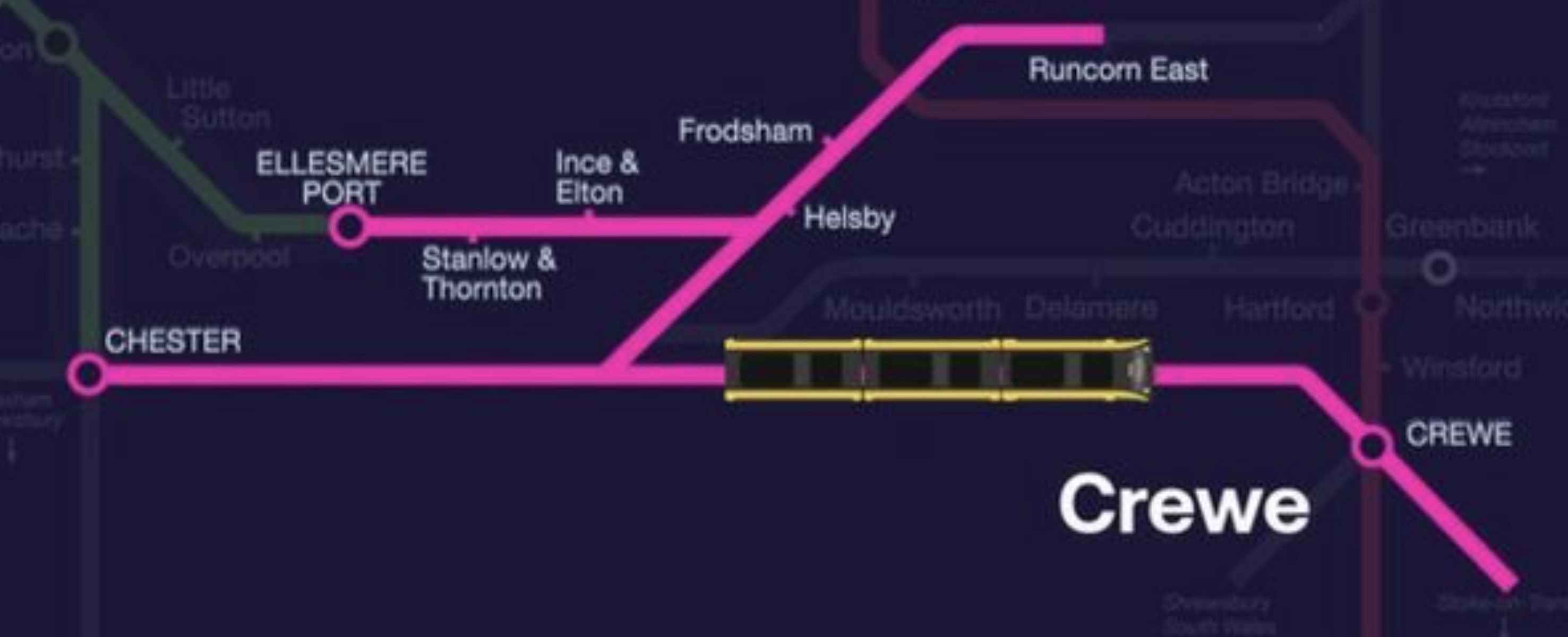
It looks like there could be as many as three routes.
- Chester and Crewe
- Chester and Runcorn East
- Ellesmere Port and Runcorn East
I’ll now cover the routes in detail.
Chester And Crewe
Consider.
- This would be a takeover by Merseyrail of the existing Trains for Wales service.
- Chester And Crewe are about 21,2 miles and 25 minutes apart.
- Chester has 750 VDC third-rail electrification and Crewe has 25 KVAC overhead electrification.
- The Class 777 trains have been built so they can be updated to dual voltage.
- There is a proposal, that Beeston Castle and Tarporley station be re-opened.
It certainly looks to be a route that could be handled by a battery-electric Class 777 train.
What would it do for passengers?
- If trains will run between Crewe and Liverpool, this creates a second route between the two major stations.
- It creates a direct link in modern electric trains between The Wirral and Crewe, for onward travel on West Coast Main Line services and High Speed Two in the future.
- The journey time could be reduced by enough to increase service frequency on the route.
I This would be a very useful extension of the Merseyrail network.
Chester And Runcorn East
Consider.
- This would be a takeover by Merseyrail of the existing Trains for Wales service.
- Chester And Runcorn East are about 13.1 miles apart.
- Two stations and five miles further on is Warrington Bank Quay station.
- Chester has 750 VDC third-rail electrification and Warrington Bank Quay has 25 KVAC overhead electrification.
- The Class 777 trains have been built so they can be updated to dual voltage.
It certainly looks to be a route that could be handled by a battery-electric Class 777 train.
What would it do for passengers?
- It would enable a Merseyrail circular route from Liverpool Lime Street to Chester via Edge Hill, Wavertree Technology Park, Broad Green, Roby, Huyton, Whiston, Rainhill, Lea Green, St Helens Junction, Warrington Bank Quay, Frodsham, Runcorn East and Helsby.
- After Chester, it could take the Wirral Line back to Liverpool to make it a true Mersey Circular service.
Would a Mersey Circular service be a good idea?
Ellesmere Port And Runcorn East
Consider.
- This been a long term aspiration of Merseyrail.
- This would be a takeover by Merseyrail of the infrequent Northern Rail service.
- Ellesmere Port And Runcorn East are about 10.8 miles apart.
- Two stations and five miles further on is Warrington Bank Quay station.
- Ellesmere Port has 750 VDC third-rail electrification and Warrington Bank Quay has 25 KVAC overhead electrification.
- The Class 777 trains have been built so they can be updated to dual voltage.
It certainly looks to be a route that could be handled by a battery-electric Class 777 train.
What would it do for passengers?
- It would certainly improve rail transport along the South Bank of the Mersey from Ellesmere Port to Warrington Bank Quay or Runcorn East depending on the Eastern terminus.
- If the terminal were to be Warrington Bank Quay that would sort out the charging.
- It could create a direct link in modern electric trains between Ellesmere Port and Warrington Bank Quay, for onward travel on West Coast Main Line services and High Speed Two in the future.
I feel that an Ellesmere Port and Warrington Bank Quay service would be good for the area.
The Borderlands Line
I’ve left the Borderlands Line to last, as I feel it will be a lot more than commuter and leisure line between Liverpool and Wrexham.
- It crosses the border between England and Wales
- The line is 26.9 miles of double track, with a single-track extension of under two miles between the two Wrexham stations.
- It has over twenty stations with more planned in both countries
- It crosses a couple of rivers on long steel bridges.
- It brings commuters to Liverpool and takes workers to the high-tech factories of companies like Airbus and Toyota on Deeside.
- It connects to a lot of golf courses, one of which is the Open Championship course at Royal Liverpool.
- Once in Wales it has two connections to the North Wales Coast Line, which runs between Chester and holyhead.
It is no ordinary railway and is ripe for improvement to bridge passengers to employment sites and leisure areas along its route.
The line has one big problem in that passengers need to change trains at Bidston between Liverpool and Wrexham stations.
- Between Bidston and Liverpool the Merseyrail electric trains to and from Hoylake are used and they turn in the Liverpool Loop under Liverpool City Centre calling at four stations before returning.
- Between Bidston and Wrexham, diesel multiple units are used.
It is a route design straight out of the 1970s of men with minds without imagination. Even British Rail were designing battery-electric trains in the 1950s, which I wrote about in Did The Queen Ever Ride In This Train?.
Merseyrail intend to right the wrongs of the past using battery-electric Class 777 trains.
- As electric versions of these trains will be used on the Liverpool and Hoylake service, there would be no need to change trains at Bidston if the Liverpool and Wrexham trains were just a battery-electric version of the same train.
- The Wrexham trains would drive round the Liverpool Loop tunnel as hundreds of trains do every day.
- The trains would be charged on the existing third-rail electrification at the Liverpool end.
- I’m fairly certain that a frequency of two tph would be possible on the route, if the Liverpool Loop tunnel signalling could cope,
- Trains would need to be charged at the Wexham end of the route and I’m sure Stadler have a solution.
It would be an efficient and cost effective way to decarbonise a tricky but useful branch line.
Conclusion
Stadler are playing their full orchestra of ideas on Merseyrail.
When completed, it will be one of the best metros of any urban areas up to a million people in the world.
This metro could do for Liverpool, what the Beatles did for the city in the 1960s.
Wrightbus Presents Their First Battery-Electric Bus
The title of this post, is the same as that of this article on Electrive.
This is the first paragraph.
The Northern Irish bus manufacturer Wrightbus presents its first battery-electric vehicle in its portfolio: a double-decker bus called StreetDeck Electroliner. Until now, the Northern Irish manufacturer has been known primarily for its hydrogen-powered buses.
In My First Ride In A Hydrogen-Powered Double-Deck Bus, I rode in a Wrightbus StreetDeck Hydroliner FCEV, so these pictures of that bus, will at least show the external style of the StreetDeck Electroliner BEV.


These two links show the web page for each product on the Wrightbus web site.
Electric – Wrightbus StreetDeck Electroliner BEV
Hydrogen – Wrightbus StreetDeck Hydroliner FCEV
Wrightbus on their web page announce the Electroliner with a headline of The Electric Bus Perfected.
This is the first paragraph of the web page.
Meet the electric bus from the future of environmentally friendly transport. Our StreetDeck Electroliner is built with features to inspire the next wave of electric transport including best in class range to cover most duty cycles, modern passenger-focused amenities, best in class charge time, and many more. Making every kilometer a new sustainability milestone.
These are some features of the bus, gleaned from Wrightbus web page and the electrive article.
Battery Power
The Wrightbus web page says this about the batteries.
StreetDeck Electroliner’s maximum power from a 454kW zero-emission battery electric powertrain is the highest battery capacity for a UK Double Deck bus. It powers it to a leading range of up to 200 miles and a fast charge time of just 2.5 hours ensures longer journeys with fewer refueling breaks. Our commitment to greener transport is also strengthened with an optional 8-year battery warranty.
Note.
- On the Wrightbus web page, a cutaway drawing appears to show batteries everywhere.
- Reading the Wrightbus web page, the specification says that there are two battery sizes available; 340 kWh and 454 kWh.
They certainly seem to have all angles covered with batteries.
According to the electrive article, the StreetDeck Electroliner uses slim batteries from French company; Forsee Power.
On their web site, there is a paragraph, which is entitled Wrightbus Will Integrate ZEN SLIM Batteries, where this is said.
As part of its exclusive supplier partnership with Wrightbus, Forsee Power will supply Wrightbus with the new ZEN SLIM batteries, whose extra flat format allows easy integration into the chassis of vehicles (standard or double-decker buses).
Each bus will be equipped with three battery systems up to 340 kWh and an extension including a fourth system will also be possible, providing exceptional capacity of 432 kWh and a battery range of more than 350 kilometers.
The figure of 432 kWh does not fit with the Wrightbus specification and is not 340*4/3, so I suspect the Forsee web site is a couple of figures out of date.
The Forsee brochure for the ZEN SLIM batteries gives an energy density of 166 Wh per Kg. This means that the weight of the 454 kWh battery is around 3.7 tonnes.
I do like the modularity of the batteries, as it means must mean greater flexibility for bus operators, especially in a large city, where there is a varied mix of routes.
Intriguingly the batteries appear to be water cooled. Is the heat generated by the batteries, used to warm the bus in winter? Now that would be kool!
Battery Charging
In the specification on the Wrightbus web site, under a heading of EV Charging, this is said.
CCS2.0 Compliant Combo2 Socket
150kW or 300kW fast charge
And under a heading of EV Charge Time, this is said.
340kWh – 2 ½ hours @ 150kW
454kWh – 3 hours @ 150Kw
Up to 420kW Opportunity Charging / Pantograph Charging
I find the pantograph charging interesting.
I have been following a battery train charging device called a Railbaar since 2016, when I wrote How To Charge A Battery Train.
The device is now available for buses as a Busbaar and this page on the opbrid web site talks about opportunity charging for buses.
Opportunity Charging would entail charging the buses at suitable points along the route, using an overhead charging point and a speciality designed pantograph on the roof of the bus.
Wrightbus claims a charging rate of 420 kW for their system. With a claimed range of 200 miles, these buses should be able to handle at least 90 % of the bus routes in the UK.
Note that Opbrid are part of Furrer + Frey, the Swiss supplier of railway overhead electrification, who have a quality pedigree and are Network Rail’s supplier of choice for overhead electrification.
Co-location Of Bus And Railway Stations
Bus stations with charging for battery buses and electrified railway lines will both need a high grade connection to the electricity grid.
As an Electrical Engineer, I think it would be prudent to co-locate bus and railway stations so that all heavy users and the parked electric vehicles nearby could share the grid connection.
Both The Hydroliner And The Electroliner Appear To Share A Chassis
Looking at the cutaways on the two web pages for the buses, the chassis of both buses appear to be very similar.
The cutaway for the Electroliner shows some of the batteries low down between the wheels with more stacked up at the back of bus.
On the Hydroliner much of the equipment seems to be stacked up at the back of the bus.
The similar chassis and body designs must surely help production and allow a lot of components to be shared between the two buses.
Drive System
This article on electrive is entitled Voith To Deliver Electric Drives For Wrightbus and this is the first paragraph.
Northern Irish bus manufacturer Wrightbus has selected Voith as its exclusive partner to supply the electric drive system for the second generation of its battery-electric and fuel cell buses for Europe.
The second paragraph, says that Wrightbus has an order for eighty Electroliners for Translink in Northern Ireland to be delivered after August 2021.
This electrive article also described Voith’s electric drive system (VEDS).
The German supplier says it has developed the VDES specifically for the requirements of public transport. The 340 kW electric motor is said to be able to drive even double-decker buses, heavy articulated buses and trucks over long distances. The system also includes a water-cooled converter system, a drive management unit (called DMU), further converters for auxiliary units and the on-board charging management system including the cabling. Voith expects this to result in the highest possible efficiency, as all components are coordinated with each other.
Note the water-cooled converter system.
Running Gear
No vehicle is complete without a good set of wheels and suspension. The first electrive article says this.
Other features of the StreetDeck Electroliner, Wrightbus says, include a ZF rear axle system (AV133) and an independent front suspension system (RL 82 EC), also from ZF.
Few would question the choice of ZF as a supplier.
Conclusion
It looks to me, that Wrightbus have designed two buses, from the best components they can find and fitted them into their own purpose-built chassis and bodywork.
It’s almost as how the great Colin Chapman of Lotus fame would have designed a bus.
I
Shooter Urges Caution On Hydrogen Hubris
The title of this post is the same as that of an article in the January 2021 Edition of Modern Railways.
This is the first paragraph.
Vivarail Chairman Adrian Shooter has urges caution about the widespread enthusiasm for hydrogen technology. In his keynote speech to the Golden Spanner Awards on 27 November, Mr. Shooter said the process to create ‘green hydrogen’ by electrolysis is ‘a wasteful use of electricity’ and was skeptical about using electricity to create hydrogen to then use a fuel cell to power a train, rather than charging batteries to power a train. ‘What you will discover is that a hydrogen train uses 3.5 times as much electricity because of inefficiencies in the electrolysis process and also in the fuel cells’ said Mr. Shooter. He also noted the energy density of hydrogen at 350 bar is only one-tenth of a similar quantity of diesel fuel, severely limiting the range of a hydrogen-powered train between refuelling.
Mr. Shooter then made the following points.
- The complexity of delivering hydrogen to the railway depots.
- The shorter range available from the amount of hydrogen that can be stored on a train compared to the range of a diesel train.
- He points out limitations with the design of the Alstom Breeze train.
This is the last paragraph.
Whilst this may have seemed like a challenge designed purely to promote the battery alternatives that Vivarail is developing, and which he believes to be more efficient, Mr. Shooter explained: ‘I think that hydrogen fuel cell trains could work in this country, but people just need to remember that there are downsides. I’m sure we’ll see some, and in fact we should because competition improves the breed.’
i think Mr. Shooter may have made several good points.
These are my thoughts.
Creating Green Hydrogen
I haven’t done an analysis of the costs of creating green hydrogen from electrolysis, but I have a feeling, that electrolysis won’t be the only way to create large amounts of carbon-free hydrogen, in a few years.
These methods are currently available or under development or construction.
- The hydrogen tram-buses in Pau have a personal electrolyser, that provides hydrogen at 350 bar.
- London’s hydrogen buses will be provided with hydrogen from an electrolyser at Herne Bay by truck. Will the trucks be hydrogen-powered?
Some industrial processes like the Castner-Kellner process create hydrogen as a by-product.
In Shell Process To Make Blue Hydrogen Production Affordable, I describe the Shell Blue Hydrogen Process, which appears to be a way of making massive amounts of carbon-free hydrogen for processes like steel-making and cement production. Surely some could be piped or transported by truck to the rail depot.
In ITM Power and Ørsted: Wind Turbine Electrolyser Integration, I describe how ITM Power and Ørsted plan to create the hydrogen off shore and bring it by pipeline to the shore.
Note.
- The last two methods could offer savings in the cost of production of carbon-free hydrogen.
- Surely, the delivery trucks if used, must be hydrogen-powered.
- The Shell Blue Hydrogen Process uses natural gas as a feedstock and converts it to hydrogen using a newly-developed catalyst. The carbon-dioxide is captured and used or stored.
- If the local gas network has been converted to hydrogen, the hydrogen can be delivered to the depot or filling station through that gas network.
I very much feel that affordable hydrogen can be supplied to bus, train, tram or transport depot. For remote or difficult locations. personal electrolysers, powered by renewable electricity, can be used, as at Pau.
Hydrogen Storage On Trains
Liquid hydrogen could be the answer and Airbus are developing methods of storing large quantities on aircraft.
In What Size Of Hydrogen Tank Will Be Needed On A ZEROe Turbofan?, I calculated how much liquid hydrogen would be needed for this ZEROe Turbofan.
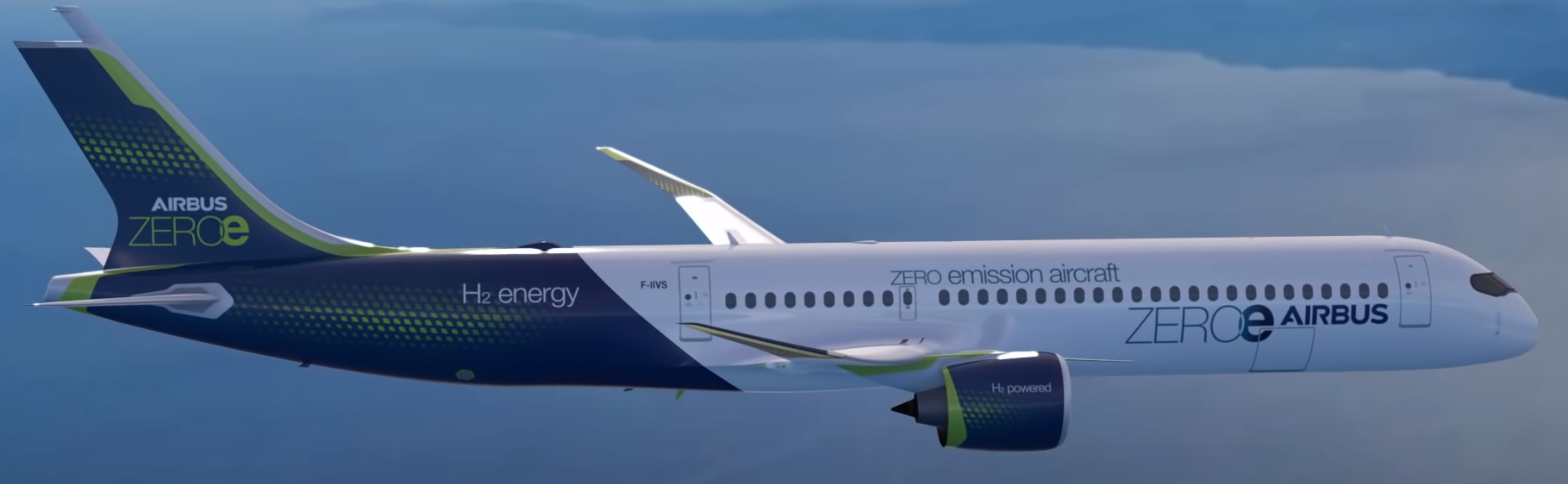
I calculate that to carry the equivalent amount of fuel to an Airbus A320neo would need a liquid hydrogen tank with a near 100 cubic metre capacity. This sized tank would fit in the rear fuselage.
I feel that in a few years, a hydrogen train will be able to carry enough liquid hydrogen in a fuel tank, but the fuel tank will be large.
In The Mathematics Of A Hydrogen-Powered Freight Locomotive, I calculated how much liquid hydrogen would be needed to provide the same amount of energy as that carried in a full diesel tank on a Class 68 locomotive.
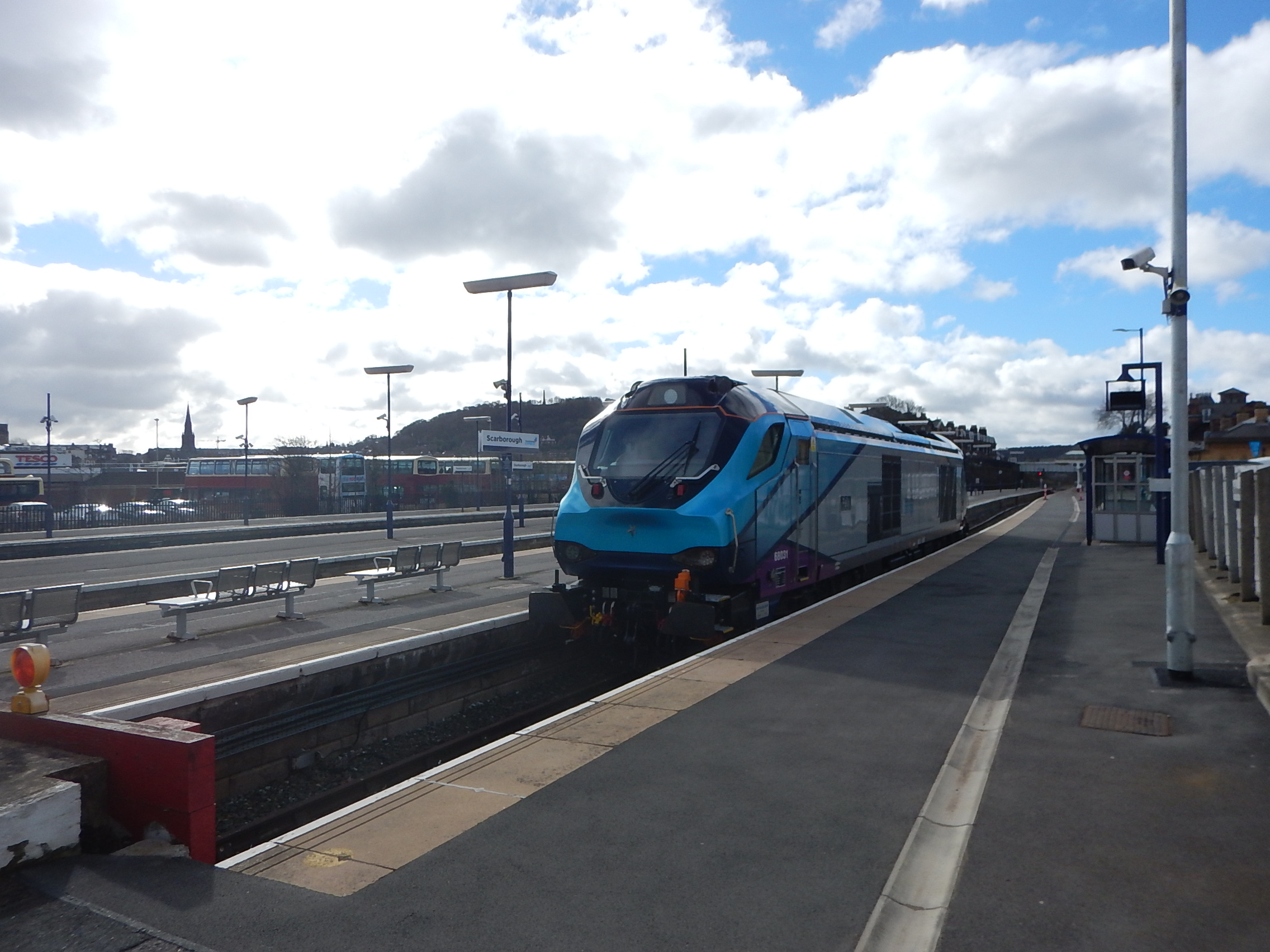
The locomotive would need 19,147 litres or 19.15 cubic metres of liquid hydrogen, which could be contained in a cylindrical tank with a diameter of 2 metres and a length of 6 metres.
Hydrogen Locomotives Or Multiple Units?
We have only seen first generation hydrogen trains so far.
This picture shows the Alstom Coradia iLint, which is a conversion of a Coradia Lint.

It is a so-so train and works reasonably well, but the design means there is a lot of transmission noise.
This is a visualisation of an Alstom Breeze or Class 600 train.
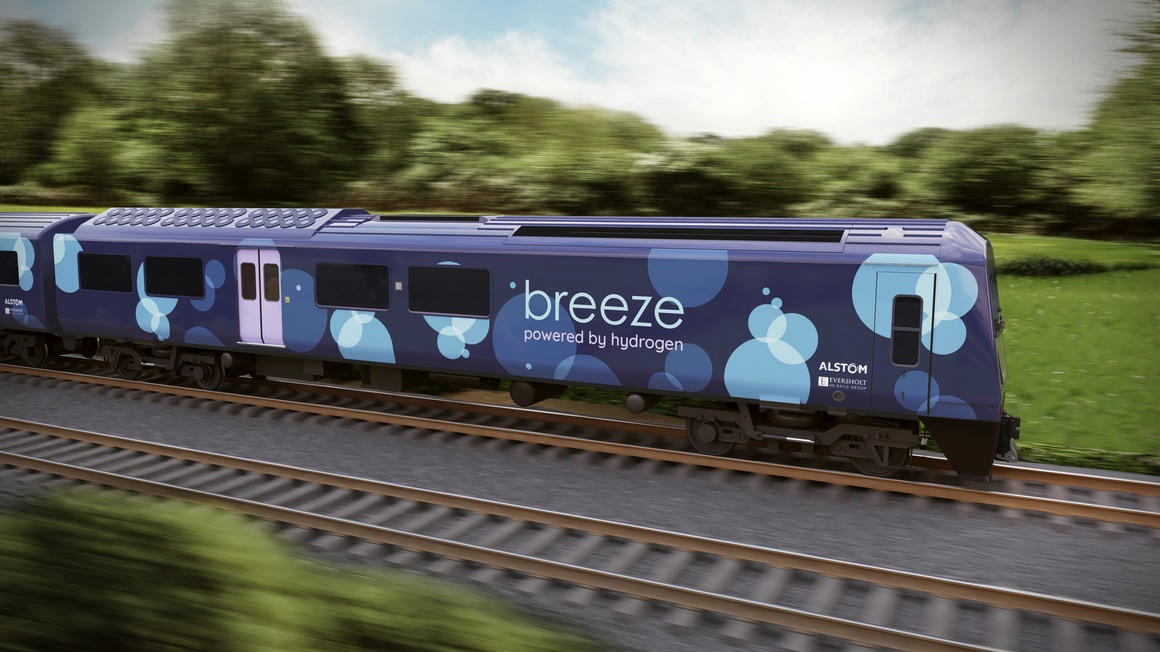
Note that the front half of the first car of the train, is taken up with a large hydrogen tank. It will be the same at the other end of the train.
As Mr. Shooter said, Alstom are converting a three-car train into a two-car train. Not all conversions live up to the hype of their proposers.
I would hope that the next generation of a hydrogen train designed from scratch, will be a better design.
I haven’t done any calculations, but I wonder if a lighter weight vehicle may be better.
Hydrogen Locomotives
I do wonder, if hydrogen locomotives are a better bet and easier to design!
- There is a great need all over the world for zero-carbon locomotives to haul freight trains.
- Powerful small gas-turbine engines, that can run on liquid hydrogen are becoming available.
- Rolls-Royce have developed a 2.5 MW gas-turbine generator, that is the size of a beer-keg.
In The Mathematics Of A Hydrogen-Powered Freight Locomotive, I wondered if the Rolls-Royce generator could power a locomotive, the size of a Class 68 locomotive.
This was my conclusion.
I feel that there are several routes to a hydrogen-powered railway locomotive and all the components could be fitted into the body of a diesel locomotive the size of a Class 68 locomotive.
Consider.
- Decarbonising railway locomotives and ships could be a large market.
- It offers the opportunities of substantial carbon reductions.
- The small size of the Rolls-Royce 2.5 MW generator must offer advantages.
- Some current diesel-electric locomotives might be convertible to hydrogen power.
I very much feel that companies like Rolls-Royce and Cummins (and Caterpillar!), will move in and attempt to claim this lucrative worldwide market.
In the UK, it might be possible to convert some existing locomotives to zero-carbon, using either liquid hydrogen, biodiesel or aviation biofuel.
Perhaps, hydrogen locomotives could replace Chiltern Railways eight Class 68 locomotives.
- A refuelling strategy would need to be developed.
- Emissions and noise, would be reduced in Marylebone and Birmingham Moor Street stations.
- The rakes of carriages would not need any modifications to use existing stations.
It could be a way to decarbonise Chiltern Railways without full electrification.
It looks to me that a hydrogen-powered locomotive has several advantages over a hydrogen-powered multiple unit.
- It can carry more fuel.
- It can be as powerful as required.
- Locomotives could work in pairs for more power.
- It is probably easier to accommodate the hydrogen tank.
- Passenger capacity can be increased, if required by adding more coaches.
It should also be noted that both hydrogen locomotives and multiple units can build heavily on technology being developed for zero-carbon aviation.
The Upward Curve Of Battery Power
Sparking A Revolution is the title an article in Issue 898 of Rail Magazine, which is mainly an interview with Andrew Barr of Hitachi Rail.
The article contains a box, called Costs And Power, where this is said.
The costs of batteries are expected to halve in the next years, before dropping further again by 2030.
Hitachi cites research by Bloomberg New Energy Finance (BNEF) which expects costs to fall from £135/kWh at the pack level today to £67/kWh in 2030 and £47/kWh in 3030.
United Kingdom Research and Innovation (UKRI) are predicting that battery energy density will double in the next 15 years, from 700 Wh/l to 1400 Wh/l in 2-35, while power density (fast charging) is likely to increase four times in the same period from 3 kW/kg to 12 kW/kg in 2035.
These are impressive improvements that can only increase the performance and reduce the cost of batteries in all applications.
Hitachi’s Regional Battery Train
This infographic gives the specification of Hitachi Regional Battery Train, which they are creating in partnership with Hyperdrive Innovation.

Note that Hitachi are promising a battery life of 8-10 years.
Financing Batteries
This paragraph is from this page on BuyaCar, which is entitled Electric Car Battery Leasing: Should I Lease Or Buy The Batteries?
When you finance or buy a petrol or diesel car it’s pretty simple; the car will be fitted with an engine. However, with some electric cars you have the choice to finance or buy the whole car, or to pay for the car and lease the batteries separately.
I suspect that battery train manufacturers, will offer similar finance models for their products.
This paragraph is from this page on the Hyperdrive Innovation web site.
With a standardised design, our modular product range provides a flexible and scalable battery energy storage solution. Combining a high-performance lithium-ion NMC battery pack with a built in Battery Management System (BMS) our intelligent systems are designed for rapid deployment and volume manufacture, supplying you with class leading energy density and performance.
I can envisage that as a battery train ages, every few years or so, the batteries will get bigger electrically, but still be the same physical size, due to the improvements in battery technology, design and manufacture.
I have been involved in the finance industry both as a part-owner of a small finance company and as a modeller of the dynamics of their lending. It looks to me, that train batteries could be a very suitable asset for financing by a fund. But given the success of energy storage funds like Gore Street and Gresham House, this is not surprising.
I can envisage that battery electric trains will be very operator friendly, as they are likely to get better with age and they will be very finance-friendly.
Charging Battery Trains
I must say something about the charging of battery trains.
Battery trains will need to be charged and various methods are emerging.
Using Existing Electrification
This will probably be one of the most common methods used, as many battery electric services will be run on partly on electrified routes.
Take a typical route for a battery electric train like London Paddington and Oxford.
- The route is electrified between London Paddington and Didcot Junction.
- There is no electrification on the 10.4 miles of track between Didcot Junction and Oxford.
If a full battery on the train has sufficient charge to take the train from Didcot Junction to Oxford and back, charging on the main line between London Paddington and Didcot Junction, will be all that will be needed to run the service.
I would expect that in the UK, we’ll be seeing battery trains using both 25 KVAC overhead and 750 VDC third rail electrification.
Short Lengths Of New Strategic Electrification
I think that Great Western Railway would like to run either of Hitachi’s two proposed battery electric trains to Swansea.
As there is 45.7 miles pf track without .electrification, some form of charging in Swansea station, will probably be necessary.
The easiest way would probably be to electrify Swansea station and perhaps for a short distance to the North.
This Google Map shows Swansea station and the railway leading North.
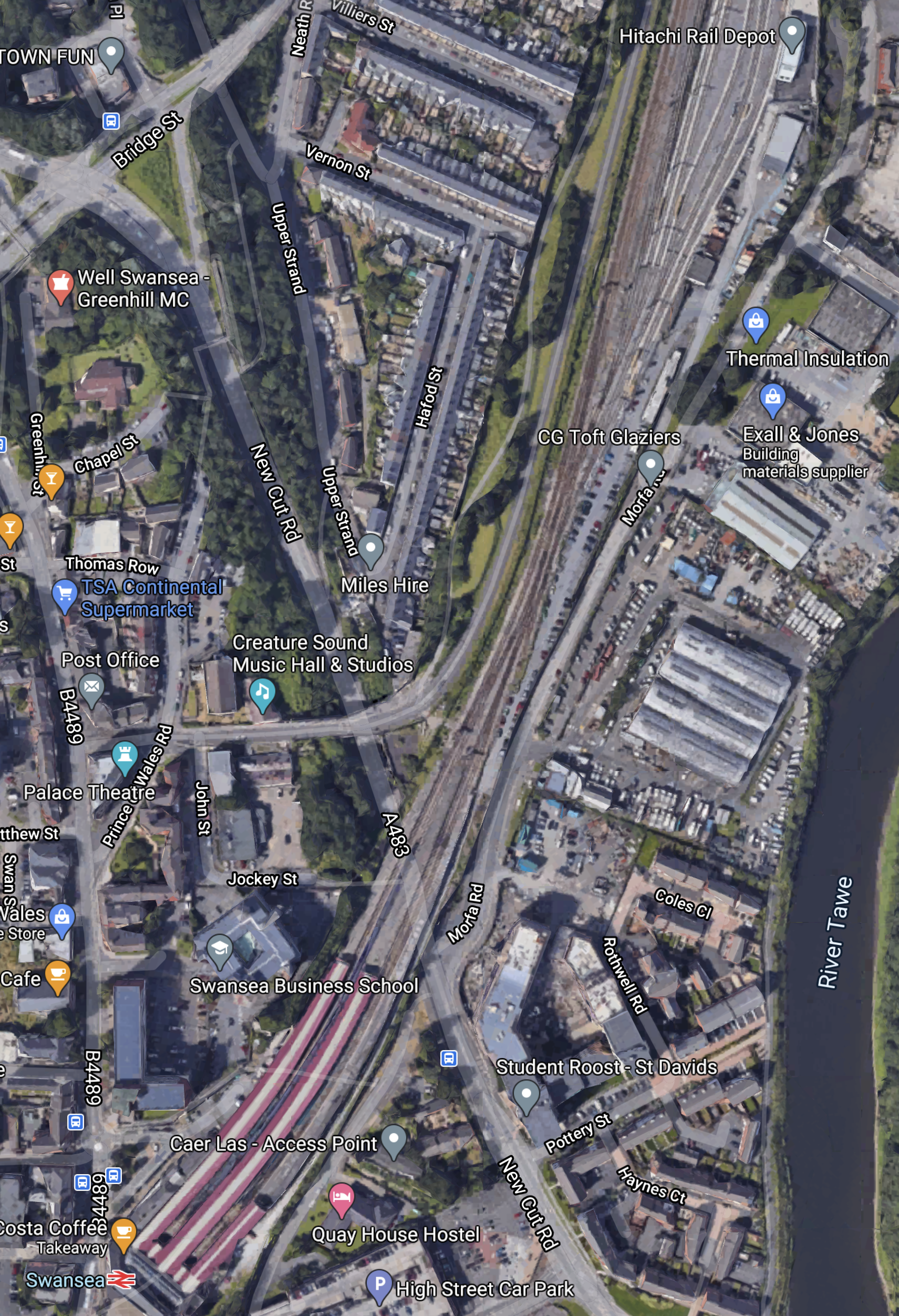
Note.
- There is a Hitachi Rail Depot at the Northern edge of the map.
- Swansea station is in South-West corner of the map.
- Swansea station has four platforms.
Swansea station would probably make an excellent battery train hub, as trains typically spend enough time in the station to fully charge the batteries before continuing.
There are other tracks and stations of the UK, that I would electrify to enable the running of battery electric trains.
- Leeds and York, which would enable carbon-free London and Edinburgh services via Leeds and help TransPennine services. This is partially underway.
- Leicester and East Midlands Parkway and Clay Cross North Junction and Sheffield – These two sections would enable EMR InterCity services to go battery electric.
- Sheffield and Leeds via Meadowhall, Barnsley Dearne Valley and the Wakefield Line, which would enable four trains per hour (tph) between Sheffield and Leeds and an extension of EMR InterCity services to Leeds.
- Hull and Brough, would enable battery electric services to Hull and Beverley.
- Scarborough and Seamer, would enable electric services services to Scarborough and between Hull and Scarborough.
- Middlesbrough and Redcar, would enable electric services services to Teesside.
- Crewe and Chester and around Llandudno Junction station – These two sections would enable Avanti West Coast service to Holyhead to go battery electric.
- Shrewsbury station – This could become a battery train hub, as I talked about for Swansea.
- Taunton and Exeter and around Penzance, Plymouth and Westbury stations – These three sections would enable Great Western Railway to cut a substantial amount of carbon emissions.
- Exeter, Yeovil Junction and Salisbury stations. – Electrifying these three stations would enable South Western Railway to run between London and Exeter using Hitachi Regional Battery Trains, as I wrote in Bi-Modes Offered To Solve Waterloo-Exeter Constraints.
We will also need fast chargers for intermediate stations, so that a train can charge the batteries on a long route.
I know of two fast chargers under development.
- Opbrid at Furrer + Frey
- Vivarail’s Fast Charge, which I wrote about in Vivarail’s Plans For Zero-Emission Trains.
I believe it should be possible to battery-electrify a route by doing the following.
- Add short lengths of electrification and fast charging systems as required.
- Improve the track, so that trains can use their full performance.
- Add ERTMS signalling.
- Add some suitable trains.
Note.
- I feel ERTMS signalling with a degree of automatic train control could be used with automatic charging systems, to make station stops more efficient.
- In my view, there is no point in installing better modern trains, unless the track is up to their performance.
Could Battery-Electric Hitachi Trains Work Chiltern Railways’s Services?
Before I answer this question, I will lay out a few specifications and the current status.
Hitachi’s Proposed Battery Electric Train
Based on information in an article in Issue 898 of Rail Magazine, which is entitled Sparking A Revolution, the specification of Hitachi’s proposed battery-electric train is given as follows.
- Based on Class 800-802/804 trains or Class 385 trains.
- Range of 55-65 miles.
- Operating speed of 90-100 mph
- Recharge in ten minutes when static.
- A battery life of 8-10 years.
- Battery-only power for stations and urban areas.
For this post, I will assume that the train is four or five cars long.
Chiltern Railways’ Main Line Services
These are Chiltern Railways services that run on the Chiltern Main Line.
London Marylebone And Gerrards Cross
- The service runs at a frequency of one train per hour (tph)
- Intermediate stations are Wembley Stadium, Sudbury & Harrow Road, Sudbury Hill Harrow, Northolt Park, West Ruislip, Denham and Denham Golf Club
The service is nineteen miles long and takes thirty minutes.
It should be possible to run this service with trains charged at one end of the route.
London Marylebone And High Wycombe
- The service runs at a frequency of one tph
- Intermediate stations are Wembley Stadium, South Ruislip, Gerrards Cross and Beaconsfield
- Some services terminate in a bay platform 1 at High Wycombe station.
The service is twenty-eight miles long and takes forty-two minutes.
It should be possible to run this service with trains charged at one end of the route.
London Marylebone And Aylesbury Via High Wycombe
- The service runs at a frequency of one tph
- Intermediate stations are Gerrards Cross, Seer Green and Jordans, Beaconsfield, High Wycombe, Saunderton, Princes Risborough, Monks Risborough and Little Kimble
- This service usually terminates in Platform 1 at Aylesbury station.
The service is 43.5 miles long and takes sixty-six minutes.
It should be possible to run this service with trains charged at both ends of the route.
London Marylebone And Banbury (And Stratford-upon-Avon)
- The service runs at a frequency of one tph
- Intermediate stations for the Banbury service are Denham Golf Club, Gerrards Cross, Beaconsfield, High Wycombe, Princes Risborough, Haddenham & Thame Parkway, Bicester North and Kings Sutton.
- Intermediate stations for the Stratford-upon-Avon service are Denham Golf Club, Gerrards Cross, Beaconsfield, High Wycombe, Princes Risborough, Haddenham & Thame Parkway, Bicester North and Kings Sutton, Banbury, Leamington Spa, Warwick, Hatton, Claverdon, Bearley, Wilmcote and Stratford-upon-Avon Parkway.
The Banbury service is 69 miles long and takes one hour and forty-five minutes.
The Stratford-upon-Avon service is 104 miles long and takes two hours and twenty-two minutes.
Running these two services will need a bit of ingenuity.
Leamington Spa And Birmingham Moor Street
- The service runs at a frequency of one train per two hours (tp2h)
- Intermediate stations for the service are Warwick, Hatton, Lapworth, Dorridge and Solihull.
The service is 23 miles long and takes forty-one minutes.
It should be possible to run this service with trains charged at one end of the route.
London Marylebone And Birmingham Moor Street
- The service runs at a frequency of one tph
- Intermediate stations for the service are High Wycombe, Banbury, Leamington Spa, Warwick Parkway and Solihull.
The service is 112 miles long and takes one hour and forty-four minutes.
It should be possible to run this service with trains charged at both ends of the route and also fully charged somewhere in the middle.
Distances from London Marylebone of the various stations are.
- High Wycombe – 28 miles
- Bicester North – 55 miles
- Banbury – 69 miles
- Leamington Spa – 89 miles
- Warwick – 91 miles
- Warwick Parkway – 92 miles
- Solihull – 105 miles
Consider.
- It looks like a fully-charged train from London Marylebone could reach Bicester North, but not Banbury, with a 55-65 mile battery range.
- Travelling South, Bicester North could be reached with a fully-charged train from Birmingham Moor Street.
But it would appear to be too marginal to run a reliable service.
London Marylebone And Birmingham Snow Hill
- The service runs at a frequency of one tph
- Intermediate stations for the service are Bicester North, Banbury, Leamington Spa, Warwick, Warwick Parkway, Dorridge, Solihull and Birmingham Moor Street
The service is 112 miles long and takes two hours and a minute.
It should be possible to run this service with trains charged at both ends of the route and also fully charged somewhere in the middle.
London Marylebone And Kidderminster
Some services between London Marylebone and Birmingham Snow Hill are extended to Kidderminster.
The distance between Kidderminster and Birmingham Snow Hill is twenty miles and the service takes forty-two minutes.
London Marylebone And Oxford
- The service runs at a frequency of two tph
- Intermediate stations for the service are High Wycombe, Haddenham & Thame Parkway, Bicester Village, Islip and, Oxford Parkway.
- The service runs into dedicated platforms at Oxford station.
The service is 67 miles long and takes one hour and nine minutes.
It should be possible to run this service with trains charged at both ends of the route and some supplementary charging somewhere in the middle.
Chiltern’s Aylesbury Line Services
These are Chiltern Railway‘s services that run on the London And Aylesbury Line (Amersham Line).
London Marylebone And Aylesbury (And Aylesbury Vale Parkway) via Amersham
- The service runs at a frequency of two tph
- Intermediate stations are Harrow-on-the-Hill, Rickmansworth, Chorleywood, Chalfont & Latimer, Amersham, Great Missenden, Wendover and Stoke Mandeville.
- It appears that there is sufficient time at Aylesbury Vale Parkway in the turnround to charge the train using a Fast Charge system.
The Aylesbury service is 39 miles long and takes one hour.
The Aylesbury Vale Parkway service is 41 miles long and takes one hour and twelve minutes.
It should be possible to run both services with trains charged at both ends of the route.
Chiltern Railways’ Future Train Needs
Chiltern Railways will need to add to or replace some or all of their fleet in the near future for various reasons.
Decarbonisation
Chiltern are probably the passenger train operating company, with the lowest proportion of zero-carbon trains. It scores zero for zero-carbon!
Government policy of an extinction date of 2040 was first mentioned by Jo Johnson, when he was Rail Minister in February 2018.
As new trains generally last between thirty and forty years and take about five years to design and deliver, trains ordered tomorrow, will probably still be running in 2055, which is fifteen years after Jo Johnson’s diesel extinction date.
I feel that, all trains we order now, should be one of the following.
- All-electric
- Battery-electric
- Hydrogen-electric
- Diesel electric trains, that can be converted to zero-carbon, by the replacement of the diesel power, with an appropriate zero-carbon source.
Hitachi seem to be designing an AT-300 diesel-electric train for Avanti West Coast, where the diesel engines can be replaced with batteries, according to an article in the January 2020 Edition of Modern Railways.
Pollution And Noise In And Around Marylebone Station
This Google Map shows the area around Marylebone station.
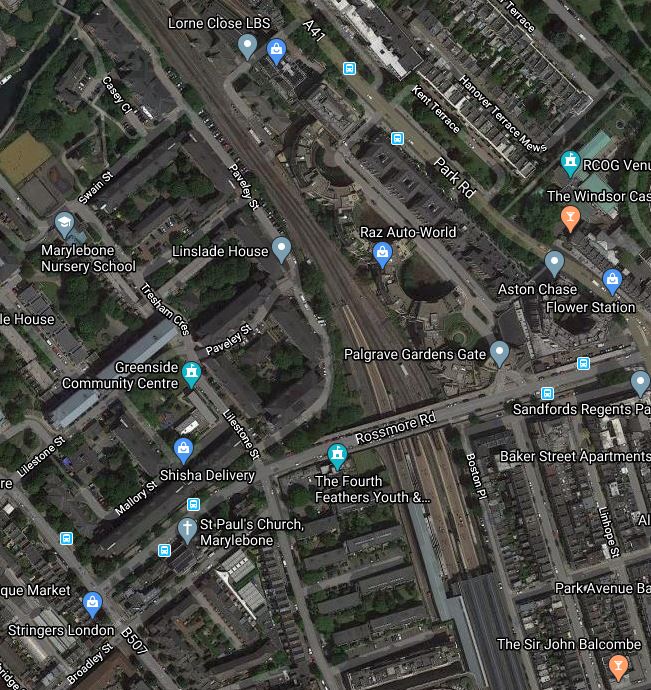
Cinsider.
- Marylebone station is in the South-East corner of the map.
- The station is surrounded by some of the most expensive real estate in London.
- A lot of Chiltern’s trains do not meet the latest regulations for diesel trains.
- Blackfriars, Cannon Street, Charing Cross, Euston, Fenchurch Street, Kings Cross, Liverpool Street, London Bridge, Paddington, St. Pancras, Victoria and Waterloo stations are diesel-free or have plans to do so.
Will the residents, the Greater London Council and the Government do something about improving Chiltern’s pollution and noise?
New trains would be a necessary part of the solution.
New And Extended Services
Consider.
- Chiltern plan to extend the Aylesbury Parkway service to Milton Keynes in connection with East West Rail. This service would appear to be planned to run via High Wycombe and Princes Risborough.
- There has also been proposals for a new Chiltern terminus at Old Oak Common in West London to connect to Crossrail, High Speed Two and the London Overground.
- Chiltern could run a service between Oxford and Birmingham Moor Street.
- With the demise of the Croxley Rail Link around Watford, Chiltern could be part of a revived solution.
- In Issue 899 of Rail Magazine in an article entitled Calls For Major Enhancement To Oxford And Didcot Route, it states that there will be three tph between Oxford and Marylebone, two of which will start from a new station at Cowley.
Chiltern certainly have been an expansionist railway in the past.
I wouldn’t be surprised to see Chiltern ordering new trains.
As I said earlier, I suspect they wouldn’t want to order some new short-life diesel trains.
125 mph Running
Consider.
- The West Coast Main Line has an operating speed of 125 mph.
- East West Rail is being built for an operating speed of 125 mph.
- Some parts of the Chiltern Main Line could be electrified and upgraded to 125 mph operation.
For these reasons, some of Chiltern’s new fleet must be capable of modification, so it can run at 125 mph, where it is possible.
100 mph Trains
Around half of Chiltern’s fleet are 100 mph trains, but the other half, made up of Class 165 trains only have a 75 mph operating speed.
Running a fleet, where all trains have a similar performance, must give operational and capacity improvements.
Increasing Capacity
Chiltern’s Main Line service to Birmingham is run using six Mark 3 carriages between a Class 68 locomotive and a driving van trailer.
These trains are 177.3 metres long and hold 444 passengers.
These trains are equivalent in length to a seven-car Hitachi Class AT-300 train, which I estimate would hold just over 500 passengers.
Changing some trains for a more modern design, could increase the passenger capacity, but without increasing the train length.
Aventi West Coast And High Speed Two
Chiltern’s services to Birmingham will come under increasing pressure from Avanti West Coast‘s revamped all-electric fleet, which within ten years should be augmented by High Speed Two.
It will be difficult selling the joys of comfortable diesel trains against the environmental benefits of all-electric zero-carbon faster trains.
Great Western Railway And Possible Electrification To Oxford
Chiltern’s services to Oxford will also come under increasing pressure from Great Western Railway’s services to Oxford.
- When Crossrail opens, Paddington will be a much better terminal than Marylebone.
- Crossrail will offer lots of new connections from Reading.
- Great Western Railway could run their own battery-electric trains to Oxford.
- Great Western Railway will be faster between London and Oxford at 38 minutes to Chiltern’s 65 minutes.
Will new trains be needed on the route to retain passengers?
Will Chiltern Have Two Separate Fleets?
Currently, Chiltern Railways have what is effectively two separate fleets.
- A Chiltern Main Line fleet comprised of five sets of six Mark 3 coaches, a Class 68 locomotive and a driving van trailer.
- A secondary fleet of thirty-four assorted diesel multiple units of various ages and lengths, which do everything else.
But would this be their fleet, if they went for a full renewal to fully-decarbonise?
Would they acquire more Main Line sets to work the services to Birmingham, Kidderminster and perhaps some other Midlands destinations?
Do the Oxford services require more capacity for both Oxford and Bicester Village and would more Main Line sets be a solution?
What destinations will be served and what trains will be needed to work services from new destinations like Milton Keynes and Old Oak Common?
I can see Chiltern acquiring two fleets of battery-electric trains.
- Chiltern Main Line trains based on Hitachi AT-300 trains with between five and seven cars.
- Suburban trains for shorter journeys, based on Hitachi Class 385 trains with perhaps four cars.
Both would be fairly similar under the skin.
Conclusion On Chiltern Railways’ Future Trains
I am very much drawn to the conclusion, that Chiltern will have to introduce a new fleet of zero-carbon trains.
Electrification would be a possibility, but have we got enough resources to carry out the work, at the same time as High Speed Two is being built?
Hydrogen might be a possibility, but it would probably lead to a loss of capacity on the trains.
Battery-electric trains might not be a solution, but I suspect they could be the best way to increase Chiltern’s fleet and decarbonise at the same time.
- Hitachi’s basic train design is used by several train operating companies and appears to be well received, by Train operating companies, staff and passengers.
- Hitachi appear to be well-advanced with a battery-electric version.
- Hitachi seem to have sold the concept of battery-electric AT-300 trains to Avanti West Coast to replace their diesel-electric Class 221 trains.
The sale of trains to Avanti West Coast appears to be very significant, in that Hitachi will be delivering a diesel-electric fleet, that will then be converted to battery-electric.
I like this approach.
- Routes can be converted gradually and the trains fully tested as diesel-electric.
- Electrification and/or charging stations can be added, to the rail network.
- As routes are ready, the trains can be converted to battery-electric.
It would appear to be a low-risk approach, that could ensure conversion of the fleet does not involve too much disruption to passengers.
Possible Electrification That Might Help Chiltern Railways
These lines are or could be electrified in the near future.
Amersham Line Between Harrow-on-the-Hill and Amersham Stations
The only electrified line on the Chiltern Railways network is the section of the Amersham Line between Harrow-on-the-Hill and Amersham stations.
- It is electrified using London Underground’s system.
- It is fourteen miles long and trains take twenty-two minutes.
- London Marylebone and Harrow-on-the-Hill is a distance of only nine miles
- Aylesbury and Amersham is a distance of only fifteen miles.
Could this be of use in powering Children Railways’ trains?
The maths certainly look promising, as if nothing else it means the maximum range of one of Hitachi’s proposed battery-electric trains is fourteen miles further, which may enable Chiltern’s proposed service between London Marylebone and Milton Keynes to reach the 25 KVAC electrification at Bletchley.
But if the new trains were to use the London Underground electrification, they would have to be dual-voltage units.
As Hitachi have already built dual-voltage Class 395 trains for the UK, I don’t think, that this will be a problem.
Dorridge/Whitlock’s End And Worcestershire via Birmingham Snow Hill
In the February 2020 Edition of Modern Railways, there is a feature, which is entitled West Midlands Builds For The Future.
This is said about electrification on the Snow Hill Lines.
Remodelling Leamington is just one of the aspirations WMRE has for upgrading the Great Western’s Southern approach to Birmingham, which serves a number of affluent suburbs, with growing passenger numbers. “Electrification of the Snow Hill Lines commuter network is something which we are keen to explore.’ says Mr. Rackliff.
As well as reducing global carbon emissions, yhis would also help reduce air pollution in central Birmingham and local population centres. ‘From a local perspective, we’d initially want to see electrification of the core network between Dorridge/Whitlock’s End and Worcestershire via Birmingham Snow Hill as a minimum, but from a national perspective it would make sense to electrify the Chiltern Main Line all the way to Marylebone.’
Note the following distances from Dorridge.
- Leamington Spa – 13 miles
- Banbury – 33 miles
- Bicester North – 47 miles
- High Wycombe – 74 miles
It looks as if, electrification of the Snow Hill Lines would allow trains to travel from Bicester or Banbury to Birmingham Moor Street, Birmingham Snow Hill or Kidderminster.
Reading And Nuneaton via Didcot, Oxford, Banbury, Leamington Spa And Coventry
This route, which is used by CrossCountry services and freight trains, has been mentioned in the past, as a route that may be electrified.
Note the following distances from Didcot.
- Oxford – 10 miles
- Ayhno Junction – 27 miles
- Banbury 32 miles
- Leamington Spa – 52 miles
- Coventry – 62 miles
- Nuneaton – 72 miles
Electrifying this route would link together the following lines.
- Trent Valley Line through Nuneaton
- West Coast Main Line through Coventry
- Chiltern Main Line through Banbury and Leamington Spa.
- Great Western Main Line through Didcot.
Note that Aynho Junction is only 36 miles from High Wycombe and 64 miles from London Marylebone.
Fast Charging At Terminal Stations
Chiltern Railways use the following terminal stations.
- Aylesbury station, where a bay platform is used.
- Aylesbury Parkway station
- Banbury station, where a bay platform is used.
- Birmingham Moor Street station, where all bay platforms are used.
- Birmingham Show Hill station
- High Wycombe station, where a bay platform is used.
- Kidderminster station
- London Marylebone station, where all platforms are used.
- Oxford station, where two North-facing bay platforms are used.
- Stratford-upon-Avon station
I suspect that something like Viviarail’s Fast-Charge system, based on well-proven third-rail technology could be used.
- This system uses a bank of batteries to transfer power to the train’s batteries.
- The transfer is performed using modified high-quality third-rail electrification technology.
- Battery-to-battery transfer is fast, due to the low-impedance of batteries.
- The system will be able to connect automatically, without driver action.
- The third-rail is only switched on, when a train is present.
- The battery bank will be trickle-charged from any convenient power source.
Could the battery bank be installed under the track in the platform to save space?
If Network Rail and Chiltern Railways would prefer a solution based on 25 KVAC technology, I’m sure that Furrer + Frey or another electrification company have a solution.
Installing charging in a platform at a station, would obviously close the platform for a couple of months, but even converting all six platforms at Marylebone station wouldn’t be an impossible task.
Possible Electrification Between London Marylebone And Harrow-on-the-Hill
Consider.
- All trains to Aylesbury have to travel between London Marylebone and Harrow-on-the-Hill stations, which is nine miles of track without electrification. It takes about twelve minutes.
- Trains via High Wycombe use this section of track as far as Neasden South Junction, which is give miles and typically takes seven minutes.
- Leaving Marylebone, these trains are accelerating, so will need more power.
This map from carto.metro.free.fr shows the lines around Neasden.
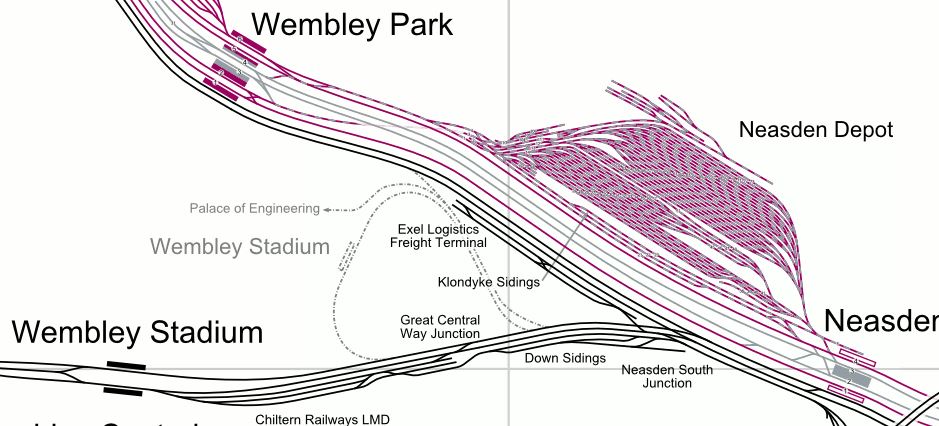
Note.
- The Chiltern Railways tracks are shown in black.
- Two tracks continue to the North-West to Harrow-on-the-Hill and Aylesbury.
- Two tracks continue to the West to Wembley Stdium station and High Wycombe.
- Two tracks continue South-East into Marylebone station, running non-stop.
- The Jubilee Line tracks in the middle are shown in silver,
- The Metropolitan Line tracks are shown in mauve.
These pictures were taken of the two Chiltern tracks from a Jubilee Line train running between West Hampstead and Wembley Park stations.


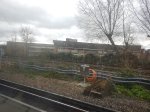
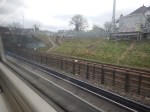

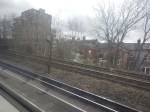
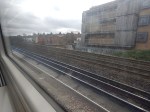
Note, that the tracks have no electrification and there is plenty of space.
I feel that to accelerate the trains out of Marylebone and make sure that the batteries are fully charged, that these tracks should be electrified.
There is space on this section for 25 KVAC overhead, but would it be better to use an electrified rail system?
- As you approach Marylebone there are several tunnels, which might make installation of overhead wires difficult and disruptive.
- There are London Underground tracks and their third and fourth rail electrification everywhere.
- Between Harrow-on-the Hill and Amersham stations, Chiltern and Metropolitan Line trains share the same track, which is electrified to London Underground standards and used for traction power by the Metropolitan Line trains.
- Trains connect and disconnect to third-rail electrification, without any complication and have been doing it for over a hundred years.
On the other hand, there are arguments against third-rail systems like safety and electrical inefficiency.
Running Chiltern’s Routes Using A Battery-Electric Train
I will now take each route in order and look at how battery-electric trains could run the route.
London Marylebone And Oxford
Consider.
- This route is 67 miles.
- An out and back trip is 134 miles.
- The route is probably too long for the proposed Hitachi battery-electric train, without some intermediate charging.
- Trains currently wait in the bay platforms at Oxford for up to thirty minutes, which is more than enough time to fully-charge the train for return to Marylebone.
When I outlined this route, I said this.
It should be possible to run this service with trains charged at both ends of the route and some supplementary charging somewhere in the middle.
I’m discussing this route first, as it has the complication of needing some form of intermediate charging.
The obvious place for some intermediate charging would be High Wycombe station.
- It is 28 miles from Marylebone
- It is 38 miles from Oxford
- Trains seem to stop for a couple of minutes at High Wycombe.
As trains would only need to pick up a half-charge at the station, would it be possible for a train passing through High Wycombe to be able to use a Fast-Charge system, to give the battery a boost?
As a Control and Electrical Engineer by training, I think that this is more than possible.
It leads me to believe that with Fast Charging systems at Marylebone, Oxford and High Wycombe, Hitachi’s proposed battery-electric trains can run a reliable service between Marylebone and Oxford.
London Marylebone And Gerrards Cross
Consider.
- This route is just nineteen miles.
- An out and back trip is thirty-eight miles.
- Trains appear to use a reversing siding to change tracks to return to London. They wait in the siding for up to thirty minutes, which is more than enough time to fully-charge the train for return to Marylebone.
I am fairly sure, that this route could be run by trains charged at Marylebone station only.
However, if charging is needed at Gerrards Cross, there is plenty of time, for this to be performed in the reversing siding.
It might even be reversed with all charging taking place at Gerrards Cross, so that fast turnrounds can be performed in Marylebone station.
London Marylebone And High Wycombe
Consider.
- This route is just twenty-eight miles.
- An out and back trip is fifty-six miles.
- Trains wait in the bay platform for up to thirty minutes, which is more than enough time to fully-charge the train for return to Marylebone.
Everything said for the Gerrards Cross service would apply to the High Wycombe service.
London Marylebone And Banbury
Consider.
- This route is 69 miles.
- An out and back trip is 138 miles.
- The route is probably too long for the proposed Hitachi battery-electric train, without some intermediate charging.
- Trains wait in platform 4 at Banbury for around thirty minutes, which is more than enough time to fully-charge the train for return to Marylebone.
- Trains call at High Wycombe station.
As with the Marylebone and Oxford route, this route will need some intermediate charging and as with the Oxford service, High Wycombe is the obvious choice,
High Wycombe is only 41 miles from Banbury, which is well within range of Hitachi’s proposed battery-electric train.
London Marylebone And Stratford-upon-Avon
Consider.
- This route is 104 miles.
- An out and back trip is 208 miles.
- The distance between Stratford-upon-Avon and Banbury is 35 miles.
- The route is probably too long for the proposed Hitachi battery-electric train, without some intermediate charging.
- Trains wait in Platform 1 at Stratford-upon-Avon for over thirty minutes, which is more than enough time to fully-charge the train for return to Marylebone.
- Trains call at Banbury station, where they wait for several minutes.
- Trains call at High Wycombe station.
As with the Marylebone and Oxford and Marylebone and Banbury routes, this route will need some intermediate charging and as with the Oxford and Banbury services, High Wycombe is the obvious choice,
But this route could also use the Fast Charging system at Banbury.
London Marylebone And Birmingham Moor Street
Consider.
- This route is 112 miles.
- An out and back trip is 224 miles.
- The distance between Birmingham Moor Street and Banbury is 43 miles.
- The route is probably too long for the proposed Hitachi battery-electric train, without some intermediate charging.
- Trains wait in the bay platform at Birmingham Moor Street for thirteen minutes, which is more than enough time to fully-charge the train for return to Marylebone.
- Trains call at Banbury and High Wycombe stations.
As with the Marylebone and Stratford-upon-Avon route, this route will need some intermediate charging and as with the Stratford-upon-Avon service, High Wycombe and Banbury are the obvious choice,
London Marylebone And Birmingham Snow Hill
Consider.
- This route is 112 miles.
- An out and back trip is 224 miles.
- The distance between Birmingham Snow Hill and Banbury is 43 miles.
- The route is probably too long for the proposed Hitachi battery-electric train, without some intermediate charging.
- Trains wait in the bay platform at Birmingham Snow Hill for ten minutes, which is more than enough time to fully-charge the train for return to Marylebone.
- Trains call at Banbury and High Wycombe stations.
As with the Marylebone and Stratford-upon-Avon route, this route will need some intermediate charging and as with the Stratford-upon-Avon service, High Wycombe and Banbury are the obvious choice,
London Marylebone And Kidderminster
Consider.
- This route is 132 miles.
- An out and back trip is 264 miles.
- The distance between Kidderminster and Banbury is 63 miles.
- The route is probably too long for the proposed Hitachi battery-electric train, without some intermediate charging.
- Trains call at Banbury and High Wycombe stations.
As with the Marylebone and Stratford-upon-Avon and Birmingham routes, this route will need some intermediate charging and as with the Stratford-upon-Avon and Birmingham services, High Wycombe and Banbury are the obvious choice,
London Marylebone And Aylesbury Via High Wycombe
Consider.
- The route is 43.5 miles
- An out and back trip is 87 miles.
- The route is probably short enough for the proposed Hitachi battery-electric train, to run the route without intermediate charging.
- This service usually terminates in Platform 1 at Aylesbury station, where trains wait for up to thirteen minutes, which is more than enough time to fully-charge the train for return to Marylebone.
- The train will also be fully-charged at Marylebone.
It looks that this route could be easily handled with charging at both ends of the route, but if there has been a charging error, the train can obviously make a pit-stop at High Wycombe to give the battery a top-up.
London Marylebone And Aylesbury Via Amersham
Consider.
- The route is 39 miles
- An out and back trip is 78 miles.
- The route is probably short enough for the proposed Hitachi battery-electric train, to run the route without intermediate charging.
- This service usually terminates in Platform 3 at Aylesbury station, where trains wait for up to twenty minutes, which is more than enough time to fully-charge the train for return to Marylebone.
- The train will also be fully-charged at Marylebone.
It looks that this route could be easily handled with charging at both ends of the route, but if there has been a charging error, the train can obviously make a pit-stop at High Wycombe to give the battery a top-up.
London Marylebone And Aylesbury Vale Parkway Via Amersham
Consider.
- The route is 41 miles
- An out and back trip is 82 miles.
- The route is probably short enough for the proposed Hitachi battery-electric train, to run the route without intermediate charging.
- This service usually terminates in Platform 1 at Aylesbury Vale Parkway station, where trains wait for up to nine minutes, which is more than enough time to fully-charge the train for return to Marylebone.
- The train will also be fully-charged at Marylebone.
It looks that this route could be easily handled with charging at both ends of the route, but if there has been a charging error, the train can obviously make a pit-stop at Aylesbury to give the battery a top-up.
Leamington Spa And Birmingham Moor Street
Consider.
- The route is 23 miles
- An out and back trip is 46 miles.
- This service usually terminates in a bay platform at Birmingham Moor Street station, where trains wait for up to twenty minutes, which is more than enough time to fully-charge the train for return to Leamington Spa.
I am fairly sure, that this route could be run by trains charged at Bitmingham Moor Street station only.
New And Extended Services
These services are planned or have been mentioned as possibilities.
London Marylebone And Milton Keynes Via High Wycombe, Princes Risborough, Aylesbury And Aylesbury Vale Parkway
This is the new service that Chiltern will start running in the next few years.
Consider.
- I estimate the distance between Aylesbury Vale Parkway and Bletchley, where 25 KVAC overhead electrification starts is 18 miles, with Milton Keynes a further three miles.
- The distance between Marylebone and Bletchley via High Wycombe would be 63.5 miles.
- The route is probably short enough for the proposed Hitachi battery-electric train, to run the route without intermediate charging.
- Charging would normally be in Milton Keynes and Marylebone, with a certain amount of charging from the 25 KVAC between Bletchley and Milton Keynes.
It looks that this route could be handled with charging at both ends of the route, but if there has been a charging error, the train can obviously make a pit-stop at High Wycombe or Aylesbury to give the battery a top-up.
Birmingham Moor Street And Oxford
Consider.
- Birmingham Moor Street station could have more South-facing bay platforms.
- Birmingham Moor Street station is only a short walk from the new High Speed Two station at Birmingham Curzon Street.
- Oxford station has two North-facing bay platforms.
- Oxford station and Aynho Junction is only twenty miles and well within battery range, if High Wycombe and Banbury is electrified.
- Banbury and Oxford currently takes 23 minutes.
- Banbury and Birmingham Moor Street currently takes 44 minutes
It looks like a Birmingham Moor Street and Oxford service would take one hour and seven minutes.
London Marylebone And The Cowley Branch
This proposed service is probably about four to five miles further on from Oxford station.
There may be problems with how the track is laid out, but with a charging station at the end of the branch, I doubt that distance would be a problem.
Croxley Rail Link Proposal
I said this earlier.
With the demise of the Croxley Rail Link around Watford, Chiltern could be part of a revived solution.
The original plan died a long time ago, but could there be a simpler Chiltern-based solution?
- Rebuild the railway between Croxley and Watford High Street stations.
- Build new stations at Watford Vicarage Road and Cassiobridge.
- A single track link would be more affordable could certainly handle two tph and possibly four.
- Chiltern would run a two tph service between Watford Junction and Aylesbury stations.
- The service would call at Watford High Street, Watford Vicarage Road, Cassiobridge, Croxley, Rickmansworth, Chorleywood, Chalfont & Latimer, Amersham, Great Missenden, Wendover and Stoke Mandeville.
I’m sure a more comprehensive scheme than the original one can be devised.
Important Stations
These are some of the more important stations and a few notes.
Aylesbury
As Chiltern develops the network in the next few years, these services could run to and/or through Aylesbury station.
- One tph – London Marylebone and Aylesbury via High Wycombe
- One tph – London Marylebone and Aylesbury via Amersham
- One tph – London Marylebone and Aylesbury Vale Parkway via Amersham
- One tph – London Marylebone and Milton Keynes via High Wycombe and Aylesbury Vale Parkway (new service)
I could also see a two tph service between Watford Junction and Aylesbury via Amersham.
Summing all this up means that two tph go via High Wycombe and four tph go via Amersham.
This Google Map shows Aylesbury station.
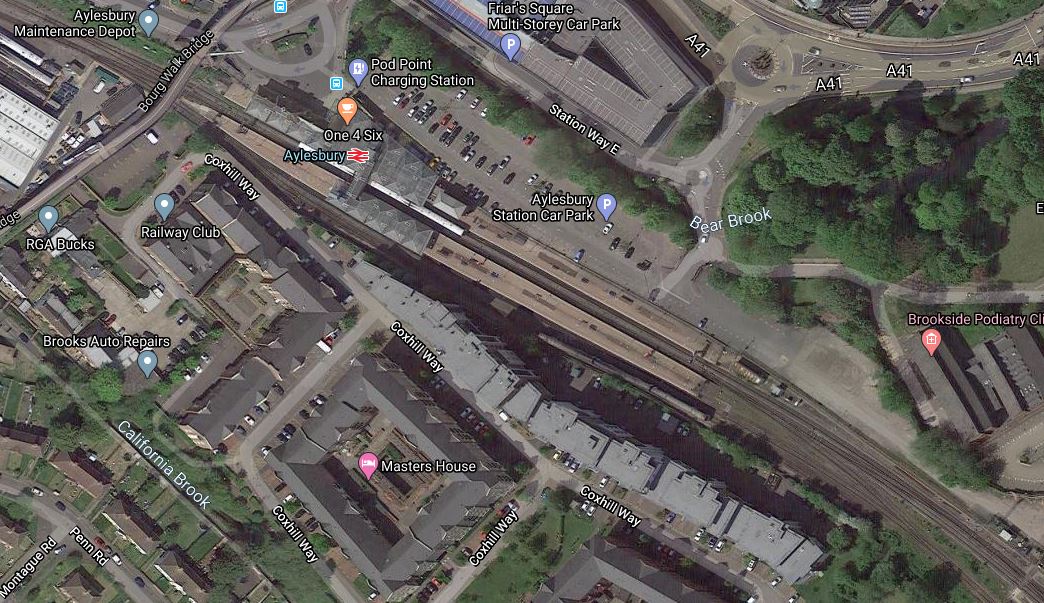
Note.
- Platforms are numbered 1 to 3 from South to North.
- Trains going South via High Wycombe call in Platforms 1 or 2.
- Trains going South via Amersham call in Platforms 2 and 3
- Trains going North call in Platforms 2 and 3.
These pictures show the station.

It is a spacious station, with step-free access and I feel that it could handle more services.
Banbury
I am sure that Banbury station, will be an important charging point for Chiltern’s battery-electric trains going North of Banbury.
This Google Map shows the layout of the recently-refurbished Banbury station.
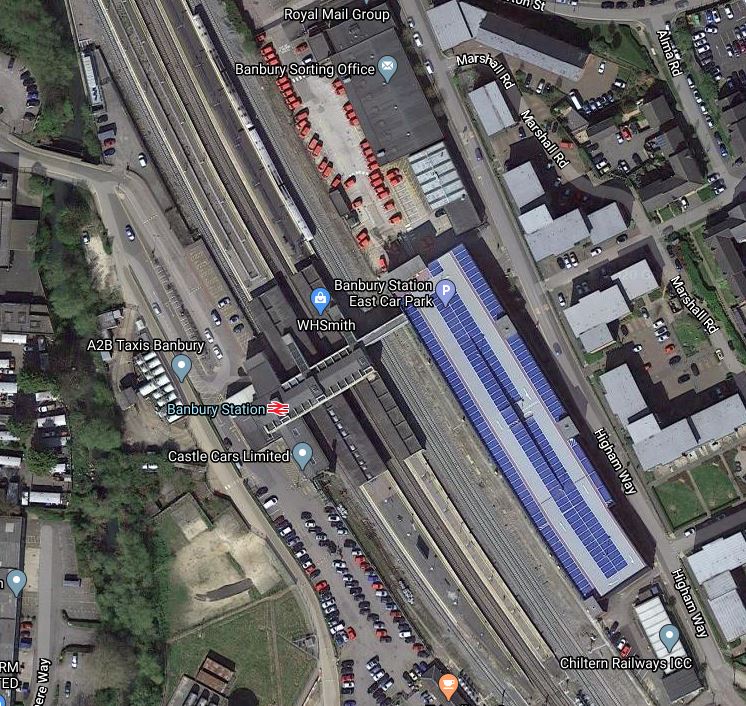
Note.
- Platforms are numbered 1 to 4 from West to East.
- Trains going North call in Platforms 1 or 2.
- Trains going South call in Platforms 3 or 4.
- The Marylebone and London service usually turns back in Platform 4 after waiting there for over half-an-hour.
- Northbound Stratford-upon-Avon services generally use Platform 1, but most others generally use Playform 2.
- Southbound Stratford-upon-Avon services generally use Platform 4, but most others generally use Playform 3.
It looks to me, that Banbury station could handle the charging of trains as they pass through, as all of Chiltern’s services that serve destinations to the North of Banbury, stop at the station.
Hitachi are saying, that one of their proposed battery-electric trains needs ten minutes to be fully-charged.
So there may need to be some adjustment to the time-table to lengthen the stops at Banbury, to give ten minutes of charging time.
Alternatively, a few miles of electrification could be centred on Banbury, perhaps between Aynho Junction and Leamington Spa, which is a distance of twenty-six miles, which takes one of Chiltern’s trains around twenty-three minutes.
This would surely give enough time to fully-charge the batteries, but would also benefit CrossCountry, if they should go the battery-electric route.
I have followed the route between Aynho Junction and Leamington Spa in my helicopter and it would appear to be a fairly straight and uncomplicated route. I would say, it is about as difficult to electrify, as the Midland Main Line between Bedford and Kettering/Corby, which appears to have been one of Hetwork Rail’s better electrification projects, which should be delivered on time and has been installed without too much disruption to trains and passengers.
High Wycombe
It looks to me, that High Wycombe station will be an important charging point for Chiltern’s battery-electric trains going North to Oxford and Banbury.
Unlike Banbury, High Wycombe has not seen many changes over the years.
This Google Map shows High Wycombe station.
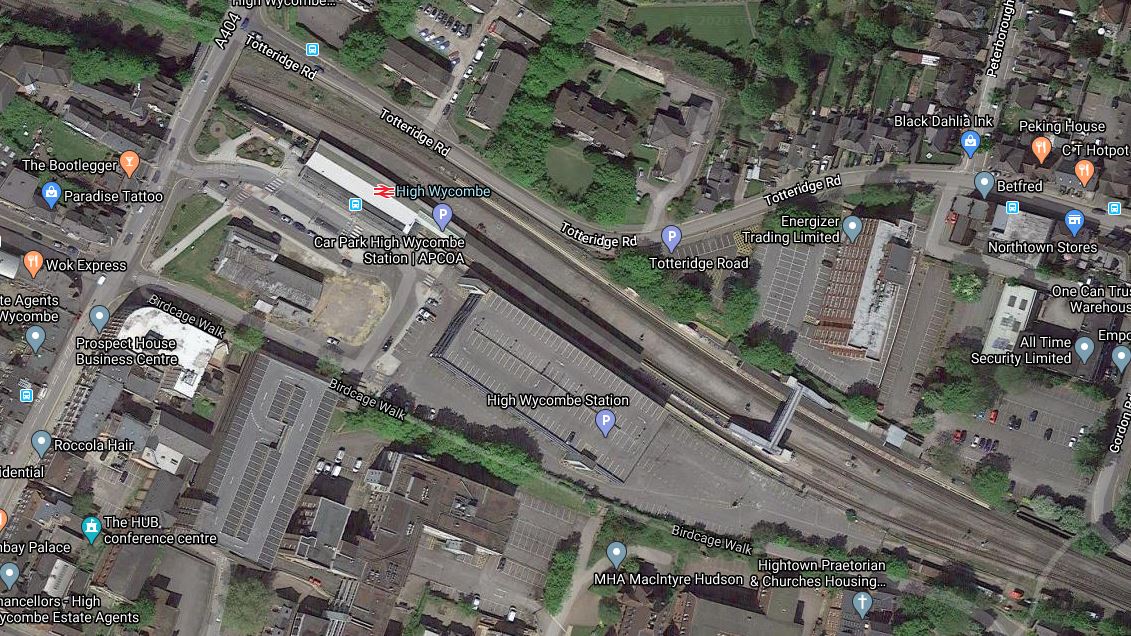
Note.
- Platforms are numbered 1 to 3 from South to North.
- Platform 1 is a bay platform that faces London.
- Platform 2 is the Westbound platform.
- Platform 3 is the Eastbound platform.
- High Wycombe has five tph in both directions, with an upgrade to six tph possible, after two tph run to the Cowley Branch.
The frequency of the trains through High Wycombe station could probably be handled by a Fast Charging system, but it would be tight to fit all current five services into an hour. It would appear to preclude any extra services going through High Wycombe, as there just isn’t enough time in an hour.
For this reason, I think that High Wycombe station needs full electrification, so that all passing trains can top up their batteries.
This gives the interesting possibility, that a train leaving High Wycombe for London with a full battery, would probably have enough charge in the battery to travel the 28 miles to London Marylebone and return. The train could always have a top-up at Marylebone.
So how far would the electrfication, through High Wycombe run?
Given that for operational reasons, it is probably best that pantographs are raised and lowered in stations, it is probably best if the various routes were electrified to the next station.
- The Chiltern Main Line route would be electrified as far as Banbury station, where all trains stop. The distance would be 41 miles.
- The Oxford route would be electrified as far as Bicester Village station, where all trains stop. The distance would be less than two miles from the Chiltern Main Line
- The Aylesbury route would be electrified as far as Princes Risborough station, where all trains stop. This would be included in the Chiltern Main Line electrification.
It looks to me, that just 43 miles of double-track electrification would enable Hitachi’s proposed battery-electric trains to reach all parts of the Chiltern network.
Distances of the various destinations from the electrification are as follows.
- Birmingham Moor Street – 43 miles
- Birmingham Snow Hill – 43 miles
- Kidderminster – 63 miles
- Marylebone – 28 miles
- Milton Keynes – 27 miles
- Oxford – 38 miles
- Oxford – Cowley – 43 miles
- Stratford-upon-Avon 35 miles
Only Kidderminster could be tricky, but not if the Snow Hill Lines are electrified through Birmingham.
Electrification of the Chiltern Main Line between High Wycombe and Banbury with a number of Fast Charging systems in selected stations, would be my preferred option of enabling Hitachi’s proposed battery-electric trains to work the Chiltern network.
These pictures show High Wycombe station.



It does appear that the bridge at the Western end of the station my need to be modified, so that overhead wires can be threaded underneath.
Conclusion
Quite unexpectedly, I am pleasantly surprised.
Chiltern Railways’ current network can be run by Hitachi’s proposed battery-electric AT-300 trains.
- Fast charging systems will be needed at Aylesbury, Aylesbury Vale Parkway, Banbury, Birmingham Moor Street, Birmingham Snow Hill, Gerrards Cross, High Wycombe, Kidderminster, Marylebone, Milton Keynes and Oxford.
- Banbury and High Wycombe will need to be able to top-up trains as they pass through.
- No large scale electrification will be needed. Although any new electrification will be greatly accepted!
As I indicated earlier, I would electrify the core part of the Chiltern Main Line route between High Wycombe and Banbury.
It would probably be a good idea to electrify a few miles at the Southern end of the line, where it runs into Marylebone station.
- Marylebone and Harrow-on-the-Hill.
- Marylebone and West Ruislip
- Old Oak Common and West Ruislip.
I would use third-rail electrification to be compatible with London Underground and because of the automatic connection and disconnection.
But most surprisingly, there are already generous turnround times at most terminal stations, which give enough time to charge the trains.
It’s almost, as if Chiltern are preparing for battery-electric trains.
Charging Battery Trains
In Sparking A Revolution, I talked about Hitachi’s plans to develop battery versions of their Class 800 trains.
The article also gives the specification of a Hitachi battery train.
- Range – 55-65 miles
- Performance – 90-100 mph
- Recharge – 10 minutes when static
- Routes – Suburban near electrified lines
- Battery Life – 8-10 years
These figures are credited to Hitachi.
Methods Of Charging
I can envisage two main methods of changing battery trains.
- Static charging in a station, depot or siding.
- Dynamic charging, whilst the train is on the move.
I am not covering other possible methods like battery swapping in this post.
Static Charging
Hitachi only mention static charging in their specification and they give a charge time of ten minutes.
This is a very convenient time, when you consider quite a few trains take around 10-15 minutes to turn round at a terminus.
Two companies have stated that they have products that can charge battery trains in around this time.
- Vivarail offers a system based on well-proven third-rail electrification technology.
- Furrer + Frey offers a system based on overhead electrification technology.
I suspect that other companies are developing systems.
Dynamic Charging
With dynamic charging, the batteries are charged as the trains run along standard electrified routes.
In the UK, this means one of two systems.
- 750 VDC third rail electrification
- 25 KVAC overhead electrification
Both systems can be used to charge the batteries.
Note that in the BEMU Trial in 2015, the Class 379 train used for the trial charged the batteries from the 25 KVAC overhead electrification.
A Mixture Of Dynamic And Static Charging
Many routes will be handled by a mixture of both methods.
As an example London Paddington and Cheltenham is electrified except for the 42 miles between Swindon and Cheltenham.
A round trip between London Paddington and Cheltenham could be handled as follows.
- London Paddington to Swindon using electrification – Dynamic charging battery at the same time!
- Swindon to Cheltenham using battery power
- Turnround at Cheltenham – Static charging battery at the same time!
- Cheltenham to Swindon using battery power
- Swindon to London Paddington using electrification
Note the following.
- Two legs of the round-trip are run using electrification power.
- Two legs of the round-trip are run using battery power.
- There is one dynamic charge and one static charge of the batteries.
No diesel power would be used on the journey and I suspect journey times would be identical to the current timetable.
I suspect that many routes run by battery electric trains will employ a mixture of both dynamic and static charging.
Here’s a few examples.
- London Kings Cross and Lincoln
- London Kings Cross and Harrogate
- London St Pancras and Melton Mowbray
- London Euston and Chester
- London Paddington and Bedwyn
There are probably many more.
Intermediate Charging On A Long Route
South Western Railway has a fleet that is nearly all-electric.
But they do have forty diesel trains, which are mainly used for services between London Waterloo and Exeter.
These don’t fit with any decarbonising strategy.
There is also the problem that the route between London Waterloo and Exeter, is only electrified as far as Basingstoke, leaving a long 124 miles of route without electrification.
This means that a battery train needs to charge the batteries at least twice en route.
Charging At A Longer Stop
The obvious approach to providing en route charging would be to perform a ten minute stop, where the batteries are fast charged.
Looking at Real Time Trains, the stop at Salisbury is often five minutes or more, as trains can join and split and change crews at the station.
But two stops like this could slow the train by fifteen minutes or so.
Charging At A An Electrification Island
On the section of the route, West of Salisbury, there are a series of fairly close-together stations.
- Tisbury – 7 miles
- Gillingham – 16 miles
- Templecombe – 18 miles
- Sherborne – 23 miles
- Yeovil Junction – 39 miles
- Crewkerne – 48 miles
- Axminster – 61 miles
Note,
The distances are from Salisbury.
- Much of this nearly ninety mile section of the West of England Line between Salisbury and Exeter is single track.
- The Heart of Wessex Line between Westbury and Weymouth crosses at Yeovil Junction.
- There are three sections of double track and four passing loops.
- There is a passing loop at Axminster.
It strikes me that the optimal way of charging battery trains on this secondary route might be to electrify both the West of England and Heart of Wessex Lines around Yeovil Junction station.
The power for the electrification island, could come from local renewable sources, as proposed by Riding Sunbeams.
Distances from Yeovil Junction station are.
- Bath Spa – 50 miles
- Castle Cary – 12 miles
- Exeter St. Davids – 49 miles
- Salisbury – 39 miles
- Weymouth – 30 miles
With a battery-electric train with a 55-65 mile range, as proposed in Hitachi’s draft specification, SWR’s London Waterloo and Exeter service would certainly be possible. Charging would be at Salisbury and in the Yeovil area.
On Summer Saturdays, SWR also run a London Waterloo and Weymouth service via Salisbury and Yeovil Junction. This would appear to be within the range of a battery-electric train.
As Weymouth is electrified with third-rail, I suspect that arranging charging of a battery-electric train at the station, will not be an impossible task.
The other service through the area is Great Western Railway‘s service between Gloucester and Weymouth, that runs every two hours.
It would appear that in some point in the future, it will be possible to run this service using a Hitachi battery-electric train.
Third-Rail Or Overhead?
The previous example of an electrification island would probably use 750 VDC third-rail electrification, but there is no reason, why 25 KVAC overhead electrification couldn’t be used.
Note that these trains have been talked about as possibilities for running under battery power.
- Greater Anglia’s Class 379 trains, built by Bombardier
- Greater Anglia’s Class 755 trains, built by Stadler.
- Merseyrail’s Class 777 trains, built by Stadler.
- Scotrail’s Class 385 trains, built my Hitachi
- Several companies’ Class 800 trains, built by Hitachi
- Suthern’s Class 377 trains, built by Bombardier
All the manufacturers named have experience of both dual-voltage trains and battery operation.
I would suspect that any future battery-electric trains in the UK will be built to work on both of our electrification systems.
When talking about battery-electric trains, 750 VDC third-rail electrification may have advantages.
- It can be easily powered by local renewable sources, as Riding Sunbeams are proposing.
- It is compatible with Vivarail’s Fast-Charge system.
- Connection and disconnection is totally automatic and has been since Southern Railway started using third-rail electrification.
- Is is more affordable and less disruptive to install?
- Third-rail electrification can be installed in visually-sensitive areas with less objections.
Developments in third-rail technology will improve safety, by only switching the power on, when a train is connected.
More Electrification Islands
These are a few examples of where an electrification island could enable a battery-electric train to decarbonise a service.
London Euston and Holyhead
In Are Hitachi Designing the Ultimate Battery Train?, I looked at running Hitachi’s proposed battery-electric trains between London Euston and Holyhead.
I proposed electrifying the fourteen miles between Rhyl and Llandudno Junction stations, which would leave two sections of the route between London Euston and Holyhead without electrification.
- Rhyl and Crewe is fifty-one miles.
- Llandudno Junction and Holyhead is forty-one miles.
Both sections should be within the battery range of Hitachi’s proposed battery-electric trains, with their 55-65 mile range.
The following should be noted.
- The time between arriving at Rhyl station and leaving Llandudno Junction station is nineteen minutes. This should be time enough to charge the batteries.
- Either 25 KVAC overhead or 750 VDC third-rail electrification could be used.
- There could be arguments for third-rail, as the weather can be severe.
- The railway is squeezed between the sea and the M55 Expressway and large numbers of caravans.
The performance of the new trains will be such, that they should be able to run between London Euston and Holyhead in a similar time. Using High Speed Two could reduce this to just under three hours.
Edinburgh And Aberdeen
I’m sure Scotland would like to electrify between Edinburgh and Aberdeen.
But it would be a difficult project due to the number of bridges on the route.
Distances from Edinburgh are as follows.
- Leuchars – 50 miles
- Dundee – 59 miles
- Arbroath – 76 miles
- Montrose – 90 miles
- Stonehaven – 114 miles
- Aberdeen – 130 miles
A quick look at these distances indicate that Hitachi’s proposed battery-electric trains with a 55-65 mile range could cover the following sections.
- Edinburgh and Dundee – 59 miles
- Arbroath and Aberdeen – 56 miles
Would it be possible to electrify the seventeen miles between Dundee and Arbroath?
I have just flown my helicopter along the route and observed the following.
- Dundee station is new and appears to be cleared for overhead wires.
- Many of the bridges in Dundee are new and likely to be cleared for overhead wires.
- There is a level crossing at Broughty Ferry station.
- Much of the route between Broughty Ferry and Arbroath stations is on the landward side of golf links, with numerous level crossings.
- Between Arbroath and Montrose stations, the route appears to be running through farmland using gentle curves.
- There is a single track bridge across the River South Esk to the South of Montrose station.
- According to Wikipedia, the operating speed is 100 mph.
Montrose might be a better Northern end to the electrification.
- It has a North-facing bay platform, that could be used for service recovery and for charging trains turning back to Aberdeen.
- Montrose and Aberdeen is only forty miles.
- It might be possible to run the service between Montrose and Inverurie, which is just 57 miles on battery power.
The problem would be electrifying the bridge.
Operationally, I can see trains running like this between Edinburgh and Aberdeen.
- Trains would leave the electrification, just to the North of Edinburgh with a full battery.
- Battery power would be used over the Forth Bridge and through Fife and over the Tay Bridge to Dundee.
- Electrification would take the train to Arbroath and possibly on to Montrose. The battery would also be charged on this section.
- Battery power would take trains all the way to Aberdeen.
Trains would change between battery and electrification in Dundee and Arbroath or Montrose stations.
My one question, is would it be a good idea to electrify through Aberdeen, so that trains returning South could be charged?
I believe that four or five-car versions of Hitachi’s proposed battery-electric trains would be able to run the route.
Glasgow And Aberdeen
This builds on the work that would be done to enable battery-electric trains go between Edinburgh and Aberdeen.
The route between Glasgow and Dundee is partially-electrified with only a forty-nine mile section between Dundee and Dunblane without wires.
I believe that four or five-car versions of Hitachi’s proposed battery-electric trains would be able to run the route.
To Be Continued…
Conclusion
I don’t think it will be a problem to provide an affordable charging infrastructure for battery trains.
I also think, that innovation is the key, as Vivarail have already shown.
Akiem Acquires Macquarie European Rail Fleet
The title of this post is the same as that of this article on Railway Gazette.
This is the introductory paragraph.
Leasing company Akiem Group has signed a definitive agreement to acquire Macquarie European Rail’s rolling stock leasing business, subject to regulatory approval.
Included in the deal are thirty Class 379 trains, currently used on the Stansted Express and soon to be replaced by new Class 745 trains.
Because of the lack of any published plans about where the Class 379 trains will be cascaded, I have been wondering if there is something wrong with the trains or perhaps their owner.
As the latter looks now to be changing from Macquarie to Akiem, perhaps we’ll hear some news on what is happening to the Class 379 trains.
I still feel the Class 379 trains would make excellent battery-electric trains, possibly for an airport service.
But which train operating company would need a fleet of thirty four-car electric trains?
Most have now sorted their fleet requirements and when Bombardier get their production working smoothly, perhaps with Alstom’s backing, there will be more trains being delivered to train operating companies.
But there is one fleet replacement, where battery-electric Class 379 trains may be ideal; the replacement of South Western Railway (SWR)‘s fleet of Class 158 and Class 159 trains.
Consider.
- 10 x two-car Class 158 trains and 30 x three-car Class 159 trains could be replaced by 30 x four-car Class 379 trains, which would be a near ten percent increase in carriages.
- 90 mph diesel trains, that were built in the 1990s, will be replaced by 100 mph battery-electric trains, that are not yet ten years old.
- The Class 379 trains are Electrostars and fitting third-rail shoes, will be straight out of Bombardier’s parts bins.
- Waterloo station will become another diesel-free London terminus.
- Fellow French company; Alstom could step in to the picture with their battery knowledge from other products like the iLint hydrogen train and convert the trains at Widnes or one of their other maintenance depots.
- South Western Railway and Akiem would need to procure a charging system and could probably do worse than see what Vivarail or Furrer + Frey can supply!
How would the Class 379 battery-electric trains handle various services?
London Waterloo To Salisbury And Exeter St. Davids
The most difficult service to run, would be the London Waterloo and Exeter St. Davids service via Salisbury.
Note that when SWR bid for the franchise, they promised to knock ten minutes off the time to Exeter and they will need 100 mph trains for that!
With climate change in the news, only a hardline climate-change denier would buy 100 mph diesel trains.
In Are Hitachi Designing the Ultimate Battery Train?, I suggested how Waterloo and Exeter could be run with a battery-electric train, with a range of around sixty miles on battery power.
- Use existing electrification, as far as Basingstoke – 48 miles
- Use battery power to Salisbury – 83 miles
- Trains can take several minutes at Salisbury as they often split and join and change train crew, so the train could be fast-charged, at the same time.
- Use battery power to the Tisbury/Gillingham/Yeovil/Crewkerne area, where trains would be charged – 130 miles
- Use battery power to Exeter- 172 miles
Note.
- The miles are the distance from London.
- The charging at Salisbury could be based on Vivarail’s Fast-Charging or traditional third-rail technology.
- The charging around Yeovil could be based on perhaps twenty miles of third-rail electrification, that would only be switched on, when a train is present.
- Charging would also be needed at Exeter for the return journey.
I estimate that there could be time savings of up to fifteen minutes on the route.
London Waterloo To Salisbury And Bristol Temple Meads
This service in run in conjunction with the Exeter St. Davids service, with the two trains joining and splitting at Salisbury.
As Salisbury and Bristol Temple Meads is 53 miles, it looks like this service is possible, providing the following conditions are met.
- The Class 379 train has a sixty mile range on battery power.
- The train can charge at Bristol Temple Meads, perhaps by using the 25 KVAC overhead electrification.
- The Class 379 trains can join and split with the with amount of alacrity.
Note that there may be other places, where a tri-mode capability might be useful.
Exeter And Axminster
This shorter trip is thirty miles and if the battery range is sufficient, it could probably be run by a Class 379 train, charged at Exeter.
If necessary, a method of charging could be provided at Axminster.
Romsey And Salisbury Via Southampton Central
This route is partially electrified and it looks like a battery-electric train with a sixty mile range could run the service without any extra infrastructure.
If Salisbury, gets a charging system, then this service might be used to ensure a reliable or extended service.
Portsmouth Harbour And Basingstoke And Portsmouth Harbour and Southampton Central
These two services could be run by Class 379 trains running using the electrification.
London Or Wareham and Corfe Castle
This Summer Saturday-only service is an ideal one for a battery-electric train.
New Services
There are also other branches that could be reopened, like those to Ringwood and Hythe, that could be worked by battery-electric trains.
Conclusion
It will be very interesting to see where the Class 379 trains end up.
But my money’s on them replacing South Western Railways, diesel trains, after conversion to battery-electric trains.
- Only limited infrastructure works will need to be done.
- South Western Railway will have more capacity.
- Passengers will get a faster service in a modern train.
- Waterloo will become a diesel-free station.
But most importantly, South Western Railway will have an all-electric fleet.
Battery Units Planned For Chemnitz – Leipzig Route
The title of this post is the same as that of this article on Railway Gazette.
I have visited Chemnitz and after a visit to the area I wrote Would I Go Back To Dresden, Chemnitz And Leipzig, where I said this.
I enjoyed my two days spent exploring these three cities in the former East Germany. On a properly planned trip, there is a lot to see to satisfy any particular taste.
This picture sums up Chemnitz, which used to be called Karl-Marx-Stadt.

Although, I did get a reasonable gluten-free lunch in a restaurant under the Rathaus, called the Ratskeller.
Summarising the new battery trains, I can say the following.
- The trains will be eleven three-car battery-powered versions of Alstom’s Coradia Continental multiple-units.
- They will replace diesel-electric locomotives and coaches.
- Trains will generally run in pairs.
- The maximum speed would be increased by 20 kph to 160 kph.
- The current service takes sixty-five minutes and the new trains will knock six minutes off the time.
- Batteries will take thirty minutes to charge at Chemnitz and Leipzig.
Note that the route would appear to be just over seventy kilometres and there are stops at .. Bad Lausick, Geithain and Burgstädt.
A few of my thoughts.
Chemnitz And Leipzig
Consider.
Chemnitz and Leipzig are two of the three largest cities in the German state of Saxony.
- Chemnitz has a population of around 220,000
- Leipzig has a population of nearly 600,000
- The train journey between the two cities takes an hour.
But they only have an hourly train service between them.
Many services of a similar duration in the UK have only hourly services, but there are several that have or aspire to have half-hourly services.
Liverpool and Preston could be an equivalent city-pair in the UK and they currently have a single stopping service every hour.
In the next few years, the following will happen.
- An express Liverpool and Glasgow service will stop at Preston.
- A second stopping service will run via Ormskirk.
I wouldn’t be surprised to see the Germans doubling the frequency between Chemnitz and Leipzig.
Number Of Trains Needed
Consider.
- The service will take an hour.
- Thirty minutes will be needed to charge the batteries at either end of the route.
This means that a round trip will take three hours, so this will mean.
- Three trains will be needed for the hourly service.
- Six trains will be needed for a half-hourly service.
If all services are run by pairs of three-car trains, there would be a need for twelve new trains to run the half-hourly service.
So perhaps, the service will be half-hourly, with some trains six-cars and others only three-cars.
Charging Time
The charging time seems a bit long to me, but it is using conventional pantographs, rather than a specialist charging station.
Suppose, by using one of these stations like a Railbaar, that the charging time could be reduced to fifteen minutes, this would reduce the round trip to two and a half hours.
This would mean that five trains would be needed for a half-hourly service.
If all services are run by pairs of three-car trains, there would be a need for ten new trains.
This would leave a spare or allow for one being maintained.
Conclusion
Around the world we will be seeing a lot of current diesel services converted into battery-electric services.
How many services are there like Chemnitz and Leipzig?
- Around 50-60 miles.
- Only a few stops.
- Run by noisy and polluting diesel trains.
- Operators need more trains to increase the frequency.
- Operators need new trains to increase the level of customer service.
- Operators need to run faster services.
- There are good electricity supplies to charge the trains at both ends.
Here are a few simple examples from the UK.
- Ashford and Hastings
- Bidston and Wrexham
- Cambridge and Ipswich
- Carlisle and Newcastle
- Didcot and Oxford
- Ely and Norwich
- Ely and Peterborough
- Fife Circle Line
- Ormskirk and Preston
Battery-electric trains will be invading the diesel world.
Bombardier Doesn’t Seem Too Disappointed On Missing Out On The Abellio East Midlands Railway Order
This article on the Derby Telegraph is entitled Derby’s Bombardier Misses Out On Big Contract To Supply Trains For The East Midlands.
This is two paragraphs from the article.
In a statement, Bombardier said: “Bombardier is clearly disappointed that we have not been selected to supply bi-mode trains for the East Midlands franchise.
“We believe we submitted a competitive bid – on technology, strength of product, deliverability and cost, and will seek formal feedback from Abellio.”
There certainly hasn’t been any published threat of legal action.
The Abellio East Midlands Railway Order From Hitachi.
The order placed was as follows.
Thirty-three five-car AT-300 trains.
- 25 KVAC overhead electrification.
- Four cars have underfloor diesel-engines.
- 125 mph running.
- 24 metre cars.
- Ability to work in pairs.
- Evolution of a Class 802 train.
- A new nose.
It is a £400 million order.
No Trains For Corby
In How Will Abellio East Midlands Railway Maximise Capacity On The Midland Main Line?, I calculated that the current timetable to Derby, Nottingham and Sheffield would need thirty-two trains.
So thirty-three trains would only be enough trains for the bi-mode services to the three Northern termini.
So it looks like Hitachi are not providing any trains for the Corby services! Surely, to have a compatible fleet from one manufacturer would be of an advantage to Abellio East Midlands Railway.
An Ideal Fleet For Corby
Trains between London and Corby take around 70-75 minutes, with a round trip taking three hours.
This means that to run a one train per hour (tph) service to Corby needs three trains and a two tph service will need six trains.
As trains go wrong and also need servicing, I would add at least one spare train, but two is probably preferable.
It would have the following characteristics.
- All electric.
- 125 mph running, as they will need to keep out of the way of the Hitachi bi-modes.
- 240 metres long.
- A passenger-friendly interior, with loys of tables.
- Energy efficient
If the last point s to be met, I and many other engineers believe that to save energy, trains must have regenerative braking to batteries on the train.
In Kinetic Energy Of A Five-Car Class 801 Train, I calculated that the kinetic energy of a Class 801 train, with every seat taken was 104.2 kWh
This calculation was performed for a half-length train, so a full electric train for London and Corby would have a kinetic energy of 208.4 kWh, if it was similar to one of Hitachi’s Class 801 train.
The reason the kinetic energy of a train is important, is teat if a train brakes from full speed and has batteries to handle the energy generated by regenerative braking, the batteries must be big enough to handle all the energy.
So a ten-car train similar in capacity and weight to a Class 801 train would need batteries capable of handling 208.4 kWh.
I’ll give a simple example.
A train similar to a Class 801, is full and running using electrification at 125 mph. It is approaching a station, where it will stop.
- The train’s computer knows the mass and velocity of the train at all times and hence the kinetic energy can be calculated.
- The train’s computer will constantly manage the train’s electricity supply, so that the batteries always have sufficient capacity to store any energy generated by braking.
- As the train brakes, the energy generated will be stored in the batteries.
- As the train moves away from the station, the train’s computer will use energy from the overhead electrification or batteries to accelerate the train.
Energy will constantly be recycled between the traction motors and the batteries.
I don’t know what battery capacity would be needed, but in my experience, perhaps between 300-400 kWh would be enough.
Any better figures, gratefully accepted.
When you consider that the battery in a Tesla car is around 60-70 kWh, I don’t think, there’ll be too much trouble putting enough battery power underneath a ten-car train.
Onward To Melton Mowbray
This page on the Department for Transport web site is an interactive map of the Abellio’s promises for East Midlands Railway.
These are mentioned for services to Oakham and Melton Mowbray.
- After electrification of the Corby route there will continue to be direct service each way between London and Oakham and Melton Mowbray once each weekday, via Corby.
- This will be operated with brand new 125mph trains when these are introduced from April 2022.
This seems to be a very acceptable minimum position.
Surely, in a real world driven by marketing and finance and more and more passengers wanting to travel regularly by train to places like London, Luton Airport and Leicester, there will come a time, when an hourly service on this route is needed.
Could a Corby service be extended to Melton Mowbray using battery power, at perhaps a slower speed of 90 mph?
Accelerating away from Corby, the train would need 108 kWh of energy to get to 90 mph with a full train.
- There would be a continuation of the electrification for perhaps a couple of hundred metres after Corby station.
- The train would probably leave Corby with a full battery, which would have been charged on the journey from London.
Once at cruising speed, the train would need energy to maintain line speed and provide hotel power.
In How Much Power Is Needed To Run A Train At 125 mph?, I calculated the figure for some high-speed trains.
This was my conclusion.
In future for the energy use of a train running at 125 mph, I shall use a figure of three kWh per vehicle mile.
So I will use that figure, although I suspect the real figure could be lower.
I will also assume.
- Corby to Melton Mowbray is 26.8 miles.
- It’s a ten-car train.
- Regenerative braking is seventy percent efficient.
- The train is running at 90 mph, between Cotby and Melton Mowbray, with an energy of 108 kWh
Energy use on a round trip between Corby and Melton Mowbray, would be as follows.
- Accelerating at Corby – 108 kWh – Electrification
- Stop at Oakham – 32.4 kWh – Battery
- Corby to Melton Mowbray – 804 kWh – Battery
- Stop at Melton Mowbray – 32.4 kWh – Battery
- Stop at Oakham – 32.4 kWh – Battery
- Melton Mowbray to Corby – 804 kWh – Battery
This gives a total of 1705.2 kWh
The battery energy need gets a lot more relaxed, if there is a charging station at Melton Mowbray, as the train will start the return journey with a full battery.
Energy use from Corby to Melton Mowbray would be as follows.
- Accelerating at Corby – 108 kWh – Electrification
- Stop at Oakham – 32.4 kWh – Battery
- Corby to Melton Mowbray – 804 kWh – Battery
This gives a total of 836.4 kWh.
Energy use from Melton Mowbray to Corby would be as follows.
- Accelerating at Melton Mowbray- 108 kWh – Battery
- Stop at Oakham – 32.4 kWh – Battery
- Melton Mowbray to Corby – 804 kWh – Battery
This gives a total of 944.4 kWh.
The intriguing fact, is that if you needed a train to go out and back from Corby to Melton Mowbray, it needs a battery twice the size of one needed, if you can charge the train at Melton Mowbray., during the stop of several minutes.
Charging The Train
This page on the Furrer + Frey web site, shows a charging station..
It might also be possible to erect a short length of 25 KVAC overhead electrification. This would also help in accelerating the train to line speed.
This Google Map shows Melton Mowbray station.
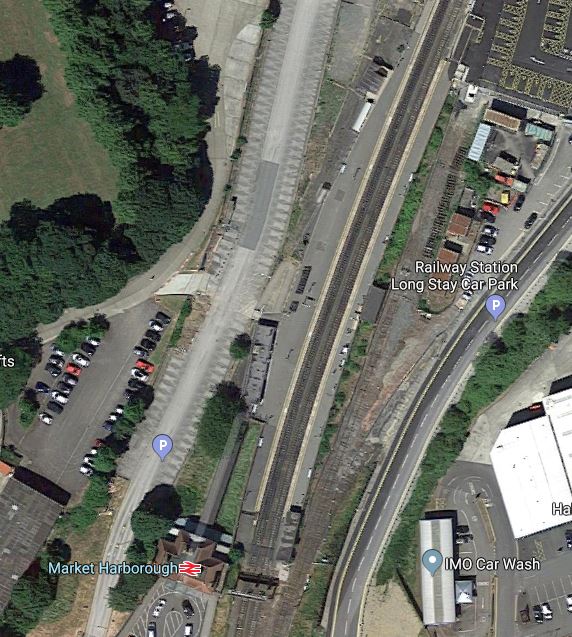
It looks to be a station on a large site with more than adequate car parking and I suspect building a bay platform with charging facilities would not be the most difficult of projects.
More Efficient Trains
I also think that with good design electricity use can be reduced from my figure of 3 kWh per vehicle mile and the regenerative braking efficiency can be increased.
Obviously, the more efficient the train, the greater the range for a given size of battery.
Onward To Leicester
If the train service can be extended by the 26.8 miles between Corby and Melton Mowbray, I wonder if the electric service can be extended to Leicester.
Under current plans the Northern end of the electrification will be Market Harborough.
In Market Harborough Station – 11th July 2019, I wrote about the station after a visit. In my visit, I notices there were a lot of croaaovers to the North of the station.
As it was a new track alignment, I suspect that they were new.
So is it the interntion to turnback services at Market Harborough or are the crossovers preparation for links to stabling sidings?
It got me asking if battery-electric trains could reach Leicester.
- Leicester and Market Harborough are only fourteen miles apart.
- There are no stops in between.
- Using my three kwH per vehicle mile, this would mean that a ten car train would use 420 kWh between the two stations at 125 mph.
I certainly believe that a Northbound train passing Market Harborough with fully-charged batteries could reach Leicester, if it had an adequate battery of perhaps 700 kWh.
As at Melton Mowbray, there would probably need to be a charging station at Leicester.

The picture shows the station from the Northern bridge.
The platforms shown are the two main lines used by most trains. On the outside are two further lines and one or both could be fitted with a charging station, if that were necessary.
An Example Electric Service Between London And Leicester
If they so wanted, Abellio East Midlands Railway could run 125 mph battery-electric services between London and Leicester.
The Current Timings
The fastest rains go North in around 66-67 minutes and come South in seventy.
So a round trip would take around two and a half hours.
Five trains would be needed for a half-hourly service.
I feel it would be very feasible, if Abellio East Midlands Railway wanted to increase services between London and Leicester, then this could be done with a fleet of zero-carbon battery-electric trains, using battery power between Leicester and Market Harborough.
A Non-Stop London And Leicester Service
I wonder what would be the possible time for an electric express running non-stop between London and Leicester.
- Currently, some diesel Class 222 trains are timetabled to achieve sixty-two minutes.
- Linespeed would be 125 mph for much of the route.
- There is no reason, why the fourteen mile section without electrification North of Market Harborough couldn’t be run at 1235 mph on battery-power, once the track is upgraded to that speed.
- iIn the future, modern digital signalling, as used by Thameslink, could be applied to the whole route and higher speeds of up to 140 mph may be possible.
I wouldn’t be surprised to see a battery-electric train travelling between London and Leicester in fifty minutes before 2030.
A fifty-minute service would result in a two-hour round trip and need just two trains for a frequency of two tph.
It would surely be a marketing man’s dream.
It should be noted that Abellio has form in this area and have introduced Norwich-in-Ninrty services on the slower London and Norwich route.
London And Leicester Via Corby, Oakham And Melton Mowbray
I have been very conservative in my calculations of battery size.
With real data on the terrain, the track profile, the train energy consumption, regenerative braking performance and the passengers, I do wonder, if it would be possible to run on battery power between Corby and Leicester via Oakham and Melton Mowbray.
- The distance would be 62 miles on battery power.
- Trains could serve Syston station.
- Using times of current services London and Leicester would take two hours fifteen minutes.
I suspect it would be possible, but it would be a slow service.
Would These Services Be An Application For Bombardier’s 125 mph Bi-Mode Aventra With Batteries?
Could Bombardier’s relaxed reaction to not getting the main order, be because they are going to be building some of their proposed 125 mph bi-mode trains with batteries, that will be able to work the following routes?
- London and Melton Mowbray via Corby and Oakham.
- London and Leicester via Market Harborough.
But I think that the main emphasis could be on a non-stop high-speed service between London and Leicester.
I have been suspicious that there is more to Bombardier’s proposed train than they have disclosed and wrote Is Bombardier’s 125 mph Bi-Mode Aventra With Batteries, A 125 mph Battery-Electric Aventra With Added Diesel Power To Extend The Range?
Since I wrote that article, my view that Bombardier’s train is a battery-electric one, with diesel power to extend the range, has hardened.
These Midland Main Line trains will run in two separate modes.
- On the Southern electrified sections, the trains will be 125 mph electric trains using batteries for regenerative braking, energy efficiency and emergency power in the case of overhead line failure..
- On the Northern sections without electrification,the trains will be battery-electric trains running at the maximum line-speed possible, which will be 125 mph on Leicester services.
There will be an optimum battery size, which will give the train the required performance.
Is there any need for any diesel engines?
Quite frankly! No! As why would you lug something around that you only need for charging the batteries and perhaps overhead supply failure?
- Batteries would only need to be charged at the Northern end of the routes. So use a chasrging station, if one is needed!
- Batteries can handle overhead supply failure, automatically.
Who needs bi-modes?
How Big Would The Batteries Need To Be?
A full train would have a kinetic energy of around 200 kWh and I said this about battery capacity for handling the energy from regenerastive braking.
I don’t know what battery capacity would be needed, but in my experience, perhaps between 300-400 kWh would be enough.
Any better figures, gratefully accepted.
To handle Corby to Melton Mowbray and back, I estimated that 1,800 kWh would be needed, but if the train had a top-up at Melton Mowbray a capacity of 1,000 kWh would be sufficient.
Pushed, I would say, that a battery capacity of 2,000 kWh would be sufficient to run both routes without a charging station, at the Northern end.
I also believe the following will happen.
- Trains will get more efficient and leighter in weight.
- Batteries will increase their energy density.
- Charging stations will charge trains faster.
- Battery costs will fall.
This would mean that larger battery capacities can be achieved without the current weight and cost penalty and the achievable range after the end of the wires will increase.
I wouldn’t be surprised to see ranges of over fifty miles in a few years, which with a charging station at the destination, means battery-electric trains could venture fifty miles from an electrified line.
A few other suggested routes.
- Ashford and Southampton
- Birmingham and Stansted Airport
- Carliswle and Newcastle
- Doncaster and Peterborough via Lincoln (CS)
- Edinburgh and Tweedbank (CS)
- London Euston and Chester
- London St. Pancras and Hastings
- London Waterloo and Salisbury (CS)
- Manchester and Sheffield (CS)
- Norwich and Nottingham (CS)
- York and Hull via Scarborough (CS)
Note.
- Stations marked (CS) would need a charging station.
- Some routes would only need 100 mph trains.
I think that a 125 mph battery train will have a big future.
Conclusion
I have a feeling that Bombardier are right to be not too disappointed.
« Previous | Next »
Is This The Solution To A Charging Station For Battery Trains?
This page on the Opbrid web site has a main title of Automatic High Power Charging for Buses, Trucks, and Trains.
It also has a subtitle of Furrer+Frey Opbrid Charging Stations for Battery Trains.
Furrer + Frey are a Swiss railway engineering company, that design and build railway electrification systems.
The web page gives this introduction.
Since 2009, Furrer+Frey has developed a multi-modal ultra high power charging station for battery-powered vehicles that is already radically changing the way traction power is delivered to road and rail vehicles. In particular, the Furrer+Frey Railbaar system targets existing low traffic diesel traction routes as well as new light rail and tram projects. The technology applies to battery powered trams and trains (Railbaar), buses (Busbaar) and trucks (Trukbaar) with a design rooted in proven Swiss electric rail technology already successfully deployed by Furrer+Frey across Europe and the world.
The web page has an interesting image for a Swiss company.
Shown is a Class 379 train, at a station, which I’m pretty sure is Cambridge.
Liverpool Street to Cambridge is a fully-electrified route, so why would a charging station be needed on this service?
I can’t think of a reason.
So I suspect, it’s just that to illustrate the web page, they needed to use a train that had the capability of running under battery power, which the Class 379 did in the BEMU trial of 2015.
It could also be that Furrer + Frey are working with Bombardier and it’s a Bombardier library picture.
But then Furrer + Frey probably work with all the major train manufacturers.
And as Bombardier have just released a new battery train, that I wrote about in Bombardier Introduces Talent 3 Battery-Operated Train, it would be logical that the two companies are working together, as battery trains will surely need charging in stations to develop longer routes.
Note the blue box in the middle of the picture. It says.
Download White Paper On 25 Kv Train Charging
If you download the white paper, you will find a very comprehensive and detailed description of how battery trains could be charged in stations. This is the introductory paragraph.
Battery-powered trains are rapidly becoming the vehicle of choice for the replacement of diesel
trains on non-electrified rail lines. Often there is not enough traffic on these lines to justify the expense of erecting overhead line equipment (OLE) along the track. In many cases, the train runs under OLE for part of its route where the battery train can charge via its pantograph. However, sometimes additional charging is required. While it is possible to erect additional kilometers of OLE for charging, it is more cost effective to charge the train via pantograph while stopped at a station using a very short length of overhead conductor rail and a 25 kV power supply.
I will now try to explain the solution.
The white paper gives this physical description of the solution.
The physical structure of the charging station is quite simple.
It consists of a short length of overhead conductor rail, approximately 20 m to 200 m in length. This length depends on the type, length, and number of battery trains that will be charging at one time. The conductor rail is supported by normal trackside posts and high voltage insulators. Insulated cables lead from the power supply to the conductor rail, with the return path from the running
rails. Furrer+Frey makes 25 kV and 15 kV overhead conductor rail systems that are ideal for this
purpose.
The design seems to use readily available components.
What Is Overhead Conductor Rail?
This picture, that I took on the Thameslink platforms at St. Pancras station, shows the overhead conductor rail, used to power the trains.
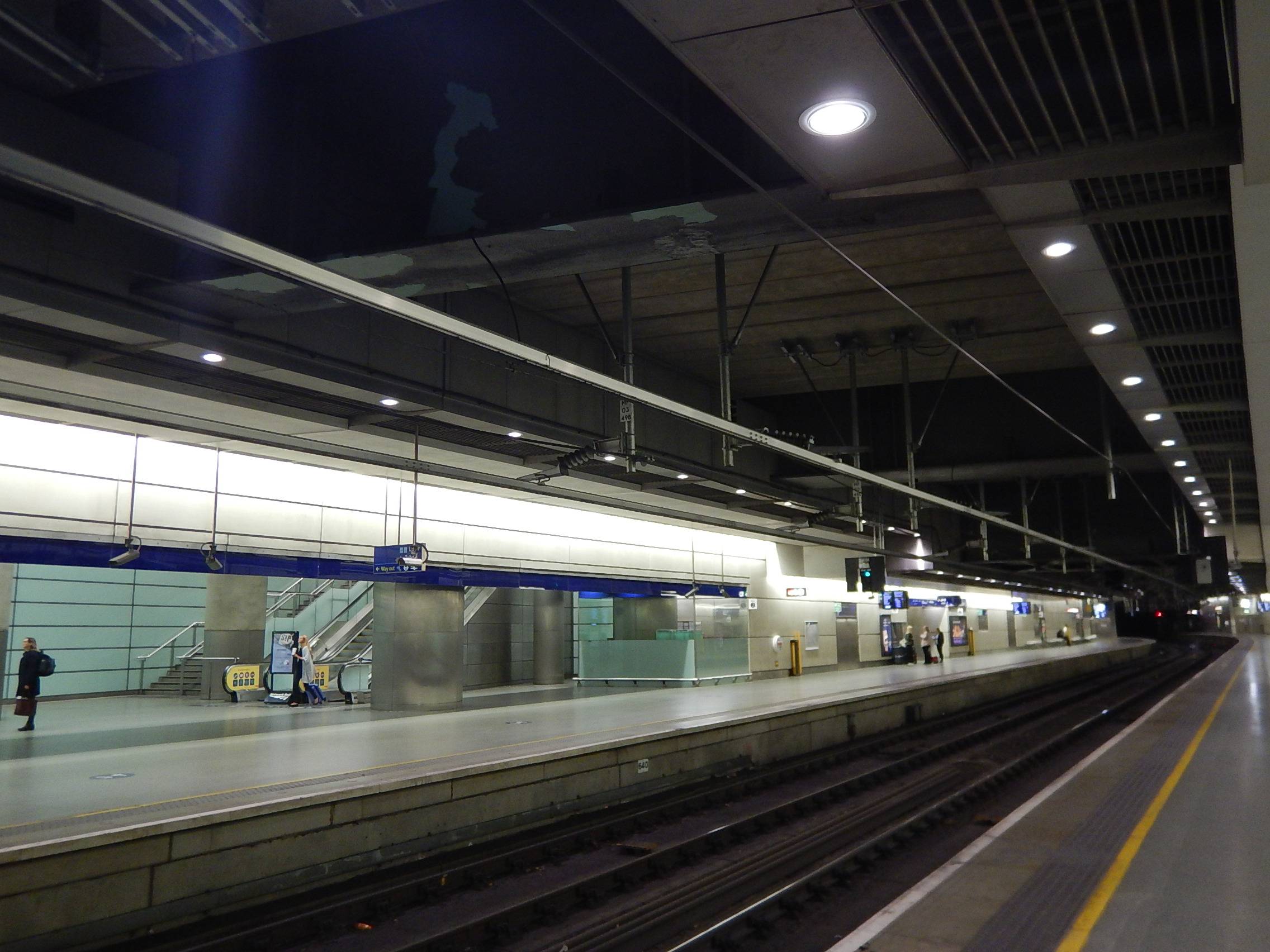
St. Pancras is one of the best places to see overhead conductor rail in London, although overhead conductor rail will be used by Crossrail in the tunnels.
How Would Overhead Conductor Rail Be Used To Charge A Train’s Batteries?
A short length of such a rail, would be mounted above the track in the station, so that it could be accessed by the train’s pantograph.
The rail would be positioned so that it was exactly over the train track, at the height required by the train.
What Voltage Would Be Used?
The normal overhead voltage in the UK, is 25 KVAC. There is no reason to believe that any other voltage would be used.
The overhead conductor rail/pantograph combination has a lot of advantages and benefits.
The Overhead Conductor Rail Is Standard
The overhead conductor rail is a standard Furrer + Frey product and it can be supported in any of the appropriate ways the company has used around the world.
This picture shows conductor rail fixed to the wall in Berlin HBf station.

Or it could be fixed to gantries like these at Gospel Oak station, which carry normal overhead wiring.
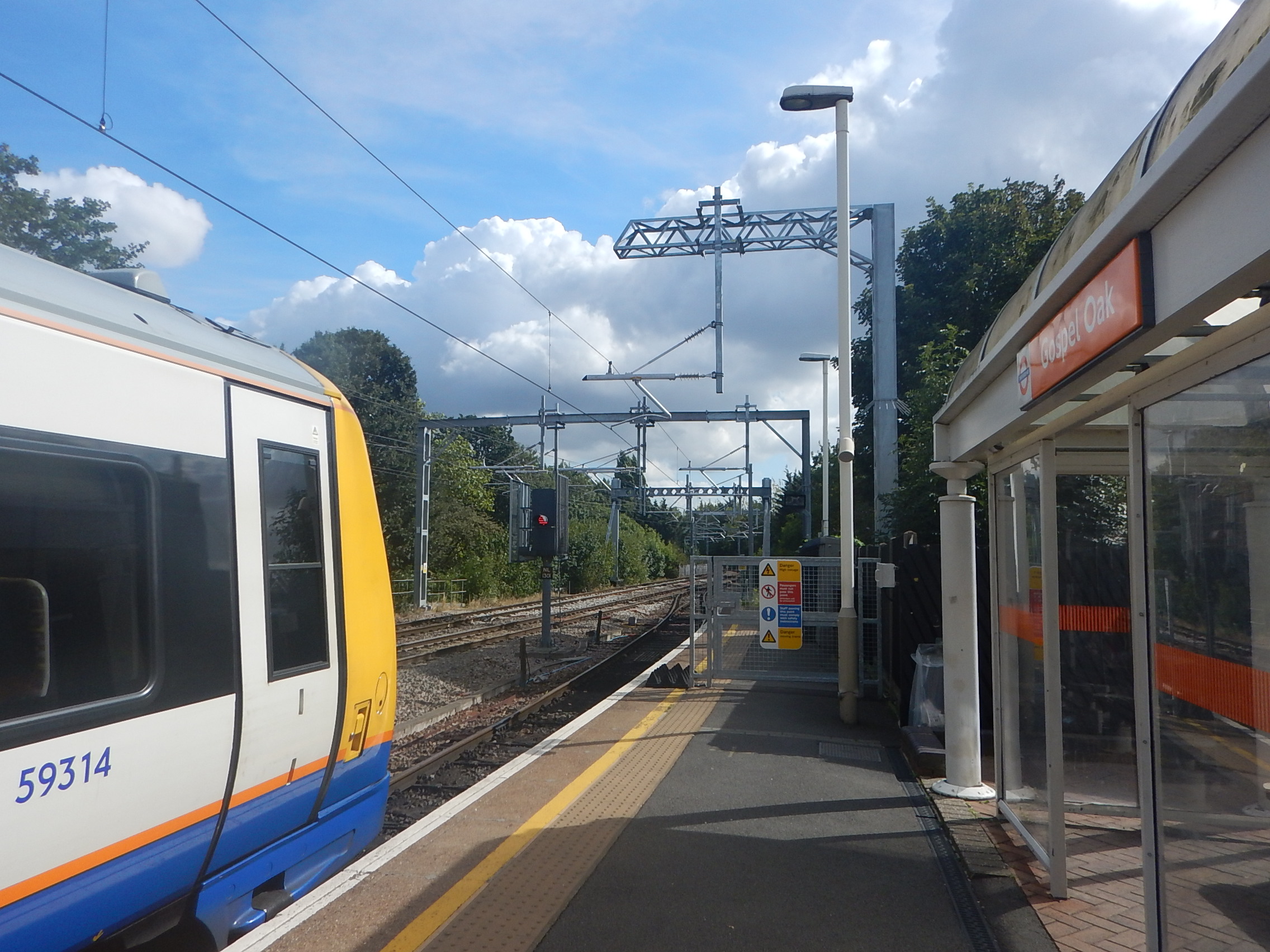
Note that gantries come in all shapes and sizes.
The Overhead Conductor Rail Can Be Any Convenient Length
There is probably a minimum length, as although drivers can stop the trains very precisely, a few extra metres will give a margin of error.
But there is no reason why at a through platform on a line served by battery trains, couldn’t have an overhead rail, that was as long as the platform.
The Train Pantograph Is Standard
The pantograph on the train, that collects the current from the overhead conductor rail can be an almost standard unit, as it will be doing the same job as it does on electrified sections of the route.
The white paper goes into this in detail.
As in the UK, our overhead line voltage is 25 Kv, the train can receive 1 MW with a current of 40 A, which is probably low enough to be below the limit of the conductor rail/pantograph combination. This would allow around 80 kWh to be transferred to the train in a five minute charge.
Could Trains Use Two Pantographs To Charge Batteries?
The white paper says that the system could handle more than one train, if the overhead conductor rail was long enough.
Bombardier’s Class 345 trains are effectively two half-trains, which each have their own pantograph.
So could a train use both pantographs to charge the batteries?
A Sophisticated Pantograph Control System Could Be Used
The train would probably have a sophisticated control system to automatically raise and lower the pantograph, so as to maximise the charge, whilst the train was in the station.
The System Should Be Safe
The overhead conductor rail would be no closer to passengers and staff, than overhead wires and conductor rail are at any other station platform in the UK.
I also suspect, that the power to the overhead conductor rail would only be switched on, if a train was being charged.
Standard Solutions Could Be Developed
One application of battery trains is to use them on a branch without electrification from an electrified line to a simple station in a town, housing or commercial development or airport..
The terminal stations would be very simple and surprisingly similar.
- One platform.
- An overhead conductor rail on gantries, a wall or some other simple support.
- A power supply for the overhead conductor rail.
A station building,, shelters and information displays could be added to the solution or designed specifically for the location.
Solutions for a wide range of countries would only differ in a few areas.
- The height of the platform.
- The gauge of the track.
- The overhead conductor rail voltage.
But I do believe that in this example of a standard system, there will be surprising commonality across the world.
As the white paper identifies, there is at least one tricky problem.
The High Voltage Power Supply
Providing high-quality, reliable high-voltage supplies may not always be that easy in some areas, so innovative electrical solutions will certainly be needed.
One solution suggested in the white paper involves using energy storage and then creating the 25 KVAC to power the overhead conductor rail.
I like this solution, as there are many applications, where these forms of independent power supplies are needed to power industrial premises, villages and equipment like flood pumps, often in remote locations. They could also incorporate a wind turbine or solar panels.
Someone will develop these systems and providing 15 or25 KVAC will be just another application.
Conclusion
I will add the conclusion from the white paper, as it says it all.
Battery trains are now available to replace diesel
trains on existing non-electrified tracks. They can
be charged using AC 25 kV 50 Hz or AC 15 kV 16,7
Hz either while running under catenary or when at
a standstill at a station using a short length of
overhead conductor rail and an appropriate power
supply. Standstill charging avoids the need to
build long stretches of catenary along a track
thereby saving money, and allowing the electrification
of track previously thought to be uneconomic
to electrify. Battery trains also enable the
use of renewable energy sources. Moving towards
green energy sources reduces harmful emissions
and noise which positively impacts climate change
and improves health
I am sure, we’ll see a lot of uses of this simple and efficient method of charging battery trains.
Railbaar In Rail Engineer
In January 2016, I wrote How To Charge A Battery Train, in which I described a Swiss idea called Railbaar.
This article in Rail Engineer is entitled RailBaar – Rapid Charge Station and it describes the technology in detail.
The article gives the impression, that respected Swiss company; Furrer+Frey, have a product that is ready to be rolled out.
This is said.
Furrer+Frey feels that the system could be a game changer, dramatically reducing the cost of electrification, and thus the feasibility of new electrification projects.
Read the article and see if like me, you agree with Furrer+Frey, like I do.
The Felixstowe Branch Line
I will use the twelve mile long Felixstowe Branch Line as an example, because I know the branch line well and spent some miserable days trapped in the town as a teenager because of the inadequate rail service to Ipswich.
The train service is better now, but it would be better if every thirty minutes one of Greater Anglia’s new Aventras was to shuttle along the branch.
But the line is not electrified and there is very little change it will happen.
Bombardier showed with their Class 379 BEMU trials in January 2015, that a four-car and probably a five-car version of the Avenytra could be fitted with a battery that would take the train reliably between Ipswich and Felixstowe.
But the problem with say electrifying a platform at Ipswich station and charging the train there, is that the battery needs to be sized to do two trips along the branch line.
By using a charging station like Railbaar at both ends of the line, the train would always leave the station with a full charge.
Currently, trains between Felixstowe and Ipswich take 26 minutes, so if the battery could be charged in four minutes, then a train could do a return trip in an hour.
This would mean that two trains would be needed to provide a two trains per hour service.
Sudbury And Colchester Town
Greater Anglia have indicated that they might replace the shuttle between Sudbury and Marks Tey stations, with a direct service between Sudbury and Colchester Town stations.
They could run this service with bi-mode Stadler Flirts.
On the other hand, the Gainsborough Line between Marks Tey and Sudbury is only eleven miles long, which is well within the range of a train running on stored energy.
It currently takes nineteen minutes for a train to go between Marks Tey and Sudbury, so a battery train would have twenty-two minutes in every hour for charging.
Operation could be as follows.
- 10:00 Leave Colchester Town running on current electrification.
- 10:08 Call Colchester station.
- 10:16 Arrive Marks Tey station with a full battery, after charging it on the main line.
- 10:35 Arrive Sudbury station after running from Marks Tey on battery power.
- 10:40 Leave Sudbury station after charging the batteries using a Railbaar.
- 11:59 Arrive Marks Tey station after running from Sudbury on battery power.
- 11:02 Leave Marks Tey station, raise the pantograph and travel to Colchester.
- 11:10 Call Colchester station.
- 11:18 Arrive back at Colchester Town station.
Note.
- The trains pass each other on the main line.
- I have used the times for the current trains.
- Only one Railbaar would be needed at Sudbury.
,Perhaps Aventras and with a faster charge at Sudbury could save a few minutes.
Aventras And Railbaar
The Aventra has a slightly unusual and innovative electrical layout.
This article in Global Rail News from 2011, which is entitled Bombardier’s AVENTRA – A new era in train performance, gives some details of the Aventra’s electrical systems. This is said.
AVENTRA can run on both 25kV AC and 750V DC power – the high-efficiency transformers being another area where a heavier component was chosen because, in the long term, it’s cheaper to run. Pairs of cars will run off a common power bus with a converter on one car powering both. The other car can be fitted with power storage devices such as super-capacitors or Lithium-Iron batteries if required.
This was published six years ago, so I suspect Bombardier have improved the concept.
So in a battery version of the Aventra would this mean that the pantograph is on the car with the high-efficiency transformer and the battery is in the second car?
So if the train is going to work with Railbaars, then the contact points on the roof of the train for the Railbaar would be on the car with the batteries.
All of the 25 KVAC and its handling is in one car and all the batteries and their charging is in another, with the only connection being the common power bus connecting everything on the train.
I suspect that with careful positioning of the Railbaar at each end of the route and an aid for the driver so that the train is positioned accurately and it would create a reliable charging system.
Obviously, there is nothing to stop, the trains charging their batteries, when they are using overhead wires or third rails.
Conclusions
So what do we know about using batteries on trains to work routes?
- Bombardier showed in their trial, that a battery train can run the eleven miles of the Mayflower Line, starting with a full battery.
- Batteries are getting more powerful and more affordable every year.
- The Bombardier Aventra would be ideal for a Railbaar-type charging system.
- Battery trains can charge their batteries running on electrified lines.
- The bus version of Railbaar is in use charging electric Volvo buses at a rate of 360 kW. See the Opbrid web site.
- The physics of steel wheel on steel rail is efficient, as George Stephenson knew.
Put this all together and I think that by the end of 2018, we’ll be seeing Aventra trains, running services on a twenty mile branch line without electrificaton.
 The Anonymous Widower