At Least 90 Dead In Chinese Coal Mine Explosion, State Media Reports
The title of this post, is the same as that as this article on the BBC.
This is the sub-heading.
At least 90 people have been killed in a coal mine blast in northern China, according to the country’s state media.
These two paragraphs add more detail.
The gas explosion happened at the Liushenyu Coal Mine, run by the Tongzhou Group, in Shanxi Province.
Hundreds of rescuers have been sent to the site. Footage from state media showed paramedics carrying stretchers at the site, with ambulances in the background. More than 100 people are said to have been taken to hospital, with rescue work at the site still under way.
It does seem that if you deep mine coal, you are going to get accidents. Does Opencast Coal Mining Have Less Accidents?
I asked Google AI, my question in the previous line and received this answer.
Yes, opencast (or open-pit) coal mining generally experiences significantly fewer fatal accidents than underground mining.
The primary reasons for this include better natural ventilation, better visibility, easier evacuation routes, and the absence of high-risk confined-space hazards like cave-ins, roof collapses, and toxic gas accumulations.
However, while fatal and catastrophic accidents are rarer, opencast mining introduces its own set of occupational risks:
Heavy Machinery Incidents: The use of massive excavators and haul trucks means that collisions, vehicle rollovers, and reversing accidents are leading causes of injuries.
Slope and Bench Failures: Unstable pit walls or overburden dumps can collapse, resulting in severe equipment damage and worker injuries.
Blasting Hazards: Routine use of explosives carries inherent risks, such as accidental detonation and flying rock (flyrock).
Environmental & Dust Exposure: Workers in open-cast mines can be heavily exposed to respirable silica and coal dust, which poses long-term respiratory health risks like pneumoconiosis.
It appears to me, that if you want to work in mining, you’re best option is probably to work for someone like JCB making mining equipment.
Conclusion
But then some countries put a lower value on human life than others.
I believe that what finished deep coal mining in the UK was the Aberfan Disaster in 1966, which is described in this Wikipedia entry. This is the first paragraph.
The Aberfan disaster (Welsh: Trychineb Aberfan) was the catastrophic collapse of a colliery spoil tip on 21 October 1966. The tip had been created on a mountain slope above the Welsh village of Aberfan, near Merthyr Tydfil, and overlaid a natural spring. Heavy rain led to a build-up of water within the tip which caused it to suddenly slide downhill as a slurry, killing 116 children and 28 adults as it engulfed Pantglas Junior School and a row of houses. The tip was the responsibility of the National Coal Board (NCB), and the subsequent inquiry placed the blame for the disaster on the organisation and nine named employees.
Let the Aberfan Disaster be a warning from the Welsh Valleys of the dangers of coal mining.
It is the sixieth anniversary of the Aberfan Disaster this year, so should an appropriate international ceremony be held to press home to the world, that coal mining is a disaster for the whole human race and all the other species we share our planet with.
Heathrow Expansion Could Open The Door To Five Additional UK Routes, According To New Research
The title of this post, is the same as that of this press release from the Heathrow Media Centre.
These three bullet-points act as sub-headings.
- New research identifies Belfast International, Cornwall Airport Newquay, Leeds Bradford Airport, Liverpool John Lennon and Teesside International Airport as most likely to gain Heathrow connections through expansion
- New links could unlock £335m in additional gross tourism spend, boosting trade, investment and jobs. This builds on the estimated £1.2bn in gross tourism spending across the UK from travellers supported by current Heathrow domestic routes
- Regional airports and businesses support this Government’s backing of Heathrow expansion and urge the project to be progressed as fast as possible
This is the first paragraph.
New research by Frontier Economics has identified the UK airports most likely to benefit from new or restored connections to Heathrow, when additional airport capacity is delivered by a third runway.
Surprise surprise! Research paid for by an airport shows more flights to the airport are a good idea after a new runway has been added.
I will look at each airport mentioned in the report in detail.
Belfast International
Belfast International Airport handles nearly seven million passengers a year, as opposed to the 2.5 million passengers that use the smaller Belfast City Airport.
Consider.
- Belfast International has flights to Gatwick, Luton and Stansted.
- I’ve only flown into Belfast twice and it was once to each airport.
- I did fly myself into Belfast City, when I was taking a friend to see Shorts, as he might have bought a Skyvan.
- If I wanted to go, I’d probably go from London City to Belfast City unless say, I was being picked up from Belfast International and perhaps going some distance from Belfast, in which case it would be Gatwick Airport.
- Note that I only travel with a small amount of hand baggage. As an an aside, what do travellers put in their mammoth suitcases?
- The press release talks of Belfast’s growing screen and cultural industries.
I wonder, if Belfast International needs flights from Heathrow, because there is increasing amounts of connecting travellers for Belfast and the aircraft to Belfast City aren’t large enough to carry all the cases.
Cornwall Airport Newquay
Newquay has flights to Gatwick and Stansted.
I’ve only been to Newquay once and I went by train, which I wrote about in Newquay Station – 9/10th February 2024.
- I changed once at Par.
- But soon, if not already, there will be direct trains from Paddington.
- Details on the summer-only Atlantic Coast Express are given on its Wikipedia entry.
- Will there be Pullman Dining, as I experienced on On The 10:45 From Paddington? That journey was the best train breakfast I’ve ever had!
Paddington and Heathrow isn’t a difficult journey to get the train for Newquay.
Leeds Bradford Airport
I used to fly light aircraft and I have friends in aviation. One phrase you regularly hear from pilots is “Time to spare, go by air!”
- Basically, unless you’re flying in a business jet, leave plenty of time.
- Leeds Bradford is a good airport and they did a good job, when I presented them with a problem, that I wrote about in Incident At Leeds.
- If I came into Heathrow, I would probably use Heathrow Express to Paddington and then get the Metropolitan Line to King’s Cross to get to Yorkshire.
- Leeds is also getting a Metro.
- LNER and other train companies are developing their services to the Leeds-Bradford area and there are now services to Bradford, Doncaster, Harrogate, Hull, Leeds, Shipley, Skipton and York.
- Leeds station has two trains per hour to and from London.
- Leeds station has lots of taxis.
Google AI gives this AI Overview of parking at Leeds-Bradford airport.
Parking at Leeds Bradford Airport (LBA) is highly streamlined, offering a range of on-site and off-site options. It features a popular Free 1-Hour Zone for drop-offs, premium options right outside the terminal, and competitive long-stay parking. Pre-booking online is heavily recommended to secure spaces and get the best
I doubt that flying between Heathrow and Leeds Airport will be popular, unless you’re parking at the airport
Liverpool John Lennon Airport
A lot of the things said about Leeds Bradford Airport can be said about Liverpool airport.
But Liverpool already has a comprehensive Metro.
Google AI gives this AI Overview of parking at Liverpool airport.
Parking at Liverpool John Lennon Airport is extremely convenient because all official car parks are located directly on-site within a 1 to 5-minute walk of the terminal building—meaning no shuttle buses are required.
As with Leeds-Bradford Airport, I doubt that flying to Heathrow will be popular, unless you’re parking at the airport
Teesside International Airport
Reading the Wikipedia entry for Teesside International Airport doesn’t give the impression, the airport is not in the best of health.
But this is said about parking on the Teesside International Airport web site.
Teesside Airport parking is situated directly opposite the terminal building.
Wherever you’re coming from for your flight, be it Middlesbrough, Hartlepool or down the road in Darlington, our parking is closer and safer than parking anywhere else to access the airport. It is monitored 24/7 and has been awarded safe parking status by Park Mark.
Dropping off or picking up? There’s free parking for up to two hours when you spend minimum of £5 in our Landside Café or landside terminal shops. Receipt must be shown for validation.
I suspect if you’re going to one of its eight destinations and you want to take your car, then you might use Teesside International Airport.
Although several local stations seem to have good train services to King’s Cross, it does appear that Teesside International Airport could be using parking to attract business with customer-friendly parking.
I have some thoughts.
Do Many Passengers Take A Coach To Heathrow?
Google AI gave this answer, when I asked the question in the title of this section.
Yes, absolutely. Over 5 million passengers take coaches to Heathrow every year.
The airport’s Central Bus Station is one of the busiest coach hubs in the UK, and coaches provide an incredibly popular, cost-effective alternative to trains and taxis.
The main reasons so many travelers choose to take the coach include:
Direct Terminal Access: Coaches drop you off directly at the Heathrow Central Bus Station (for Terminals 2 and 3) or right outside Terminals 4 and 5.
This saves you from dragging heavy luggage through the London Underground or navigating complex rail changes.
Cost-Effective: Advance tickets often start as low as \(£10.50\), making it substantially cheaper than black cabs, airport parking, or premium rail lines like the Heathrow Express.National Connectivity: Coaches connect Heathrow to over 500 locations across the country.
Major hubs like Bristol, Oxford, Cambridge, and Southampton have direct, frequent services without requiring a change in Central London.
Early Morning Travel: Because the airport is a 24-hour operation, many coaches run throughout the night, offering crucial connections before local trains even begin operating.
An alternative at some of these smaller airports could be better coach travel.
Is Anybody Proposing A Small Airliner Powered By Hydrogen Fuel Cells?
I believe a smaller airliner powered by hydrogen fuel cells could suit feeder flights from smaller airports.
Google AI gave this answer, when I asked the question in the title of this section.
Yes, several aerospace companies are actively developing and testing hydrogen fuel cell airliners, ranging from retrofitted commuter planes to clean-sheet regional aircraft.
The leading proposals and active development programs include:
Airbus ZEROe: Airbus is designing a 100-seat regional airliner powered by four 2.4-megawatt hydrogen fuel cell engines.
After verifying the concept’s feasibility, Airbus is currently assembling a 1.2MW powertrain demonstrator for testing, with the aircraft targeted for entry into service in the late 2030s.
ZeroAvia: ZeroAvia is focused on retrofitting existing regional airframes (such as the Dornier 228) with hydrogen-electric engines.
They are currently testing their ZA600 powertrain for 19-seat aircraft and are actively developing larger systems (up to 80 seats) to enter commercial service in the coming years.
.H2Fly: This company focuses on small regional aircraft and has test flights slated for their 4-seat air taxis and larger regional prototypes.
They advocate for starting with smaller planes to avoid the complex infrastructure challenges of larger models.
Beyond Aero: They are developing “ONE,” a hydrogen-electric business aircraft designed specifically for executive travel, aiming to reduce both costs and carbon emissions compared to traditional jet fuel.
Hopefully, hydrogen fuel cell powered aircraft will be quiet.
What Housing Is Being Built At Cockfosters Station?
I was looking for something to watch on the television and noticed that Cockfosters FC were in the FA Vase final today at Wembley against AFC Stonham.
For the first sixteen years or so of my life, I lived in Cockfosters, and until now, I never knew they had a football team, which is actually based just around the corner from the church, where I got married to C on September 7th 1968.
This Google Map shows the area.
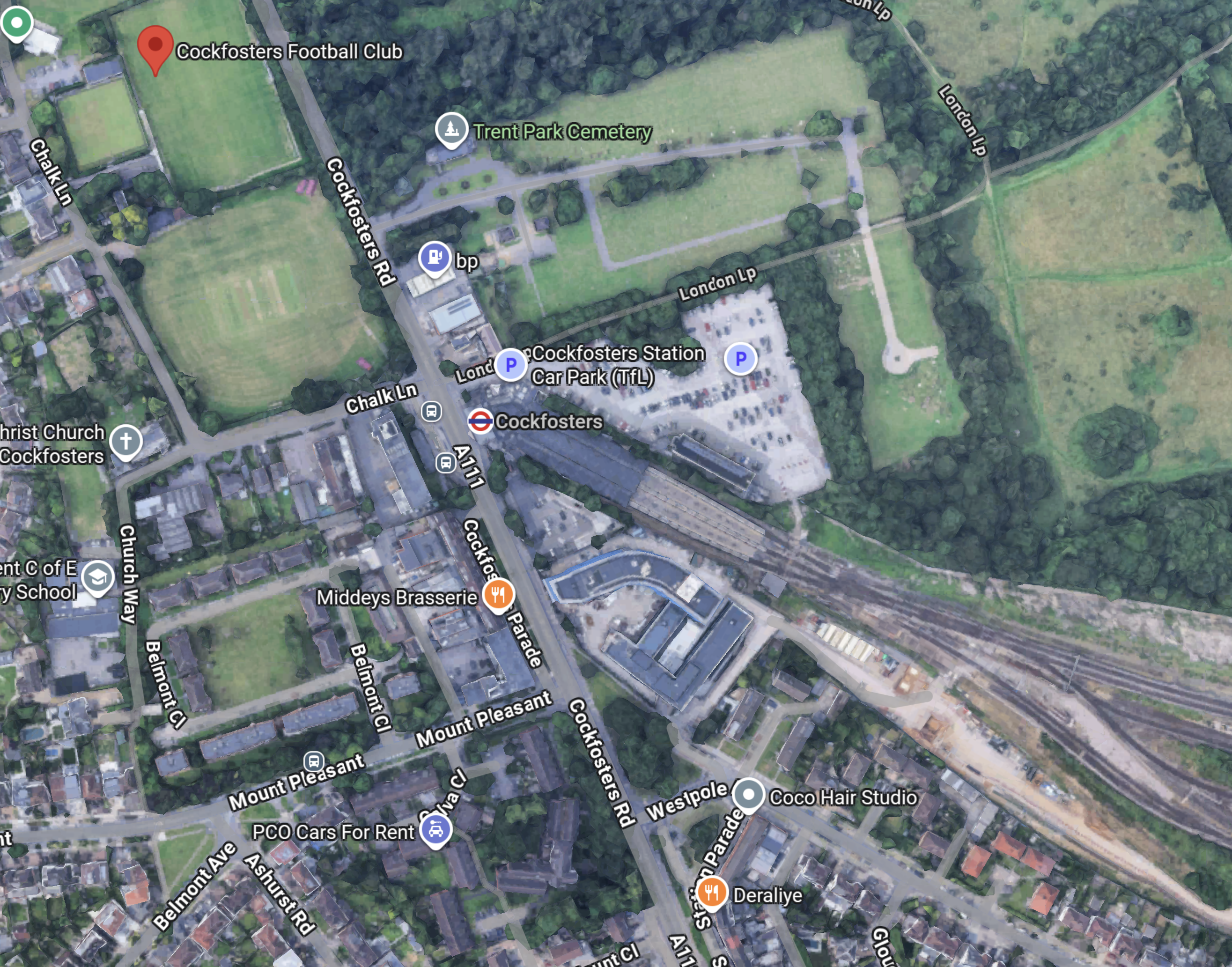
Note.
- The red arrow at the top of the map indicates Cockfosters F.C.
- Christ Church, Cockfosters is to the South of the football club.
- Cockfosters Road runs slightly diagonally down the map.
- Cockfosters station on the Piccadilly Line is indicated by the London Transport roundel.
- Cockfosters station has extensive car parking to the North-East of the station
- Cockfosters Depot is to the South-East of the station.
Our house was just off the Southern edge of the map, by Southgate School.
A 3D Image Of Cockfosters Station
This Google Map shows a 3D image of Cockfosters station and the buildings around it.

Note.
- Cockfosters station is indicated by the roundel.
- The station is a Grade II Listed building.
- The station has an elevation of 97 metres.
- Half of the station car park is going to be turned into housing.
- Trent Park lies to the North of the station.
- The road in front of the station is Cockfosters Road, which to the North joins the M25 at Junction 24.
- The building between Cockfosters Road and the railway used to be offices, but it is now being converted into starter housing.
In Starter Homes At Cockfosters, I write about starter homes being developed on the South side of the station.
Artificial Intelligence On The Housing In The Car Park
I asked Google AI the question in the title of this post and received this answer.
Places for London (Transport for London’s property arm) and Barratt London are building 373 residential apartments across four tower blocks on the former Cockfosters Station car park site. The largely car-free, mixed-use scheme includes 40% affordable housing, new public open spaces, and revamped TfL staff facilities.
Key Project Details
Total Homes: 373 apartments (a mix of 1, 2, and 3-bedroom properties).
Housing Tenure: All flats will be built for rent, with 40% of them allocated as “affordable” (including social rent and intermediate housing).
Building Heights: Four tower blocks ranging between 5 and 15 storeys tall.
Station Parking: The development is largely car-free.
Around 68 parking spaces will be retained at the station, including 12 dedicated Blue Badge spaces.
Public Amenities: The scheme introduces about 4,500 square meters of publicly accessible open space, children’s play areas, cycle storage, and minor commercial floor space.
Development Background
While planning permission for housing on the site was originally granted by Enfield Council in 2022, the project faced years of delays.
In late 2025 and early 2026, revised plans were submitted to add an extra storey to each building to accommodate updated fire safety legislation—adding 22 more homes to the initial 351 proposal.
You can track local planning updates and track progress via the Enfield Council Planning Portal.
I have some thoughts about this development.
Was There Any Opposition To Building Flats On Cockfosters Station Car Park?
From when I lived in the area, I remember that Cockfosters car park was well used in the 1960s and that trains on the Piccadilly Line were exceedingly busy, as I sometimes used to get them to travel to school.
I asked Google AI the question in the title of this section and received this answer.
Yes, there was intense opposition to the proposal to build flats on the Cockfosters Station car park.
The plans to build over 350 homes across blocks reaching up to 14 storeys faced major pushback from local residents, commuters, and Conservative MPs.
The primary points of contention included:
Loss of Parking: Opponents were concerned that wiping out hundreds of park-and-ride parking spaces would reduce the station’s accessibility.
It sparked fears that it would increase traffic on local roads and make journeys impossible for many, particularly blue-badge holders.
Over-development: The proposed height and density were heavily criticized for being out of character for the surrounding outer-suburb.
Heritage and Green Belt Impact: Residents argued that the massive tower blocks would negatively impact the neighboring Trent Park Conservation Area and the Charles Holden-designed Grade 2-listed station building.
Despite the controversy—which generated nearly 3,000 objections and was temporarily halted by the government in 2022—the project was officially given the green light to proceed. You can find full details on the planning outcomes via the Enfield Council Planning Portal or by reviewing the BBC News coverage of the development’s approval.
Do Any Train Depots Have Housing On Top?
I feel that we should maximise housing and in estates like the Barbican, there is extensive housing on top of car parking and even some active railways.
So why not on top of train depots like Cockfosters?
I asked Google AI the question in the title of this section and received this answer.
Yes, train depots and railyards increasingly feature housing built directly on top of them. Because large, open plots are scarce in dense cities, decking over active railway infrastructure has become an innovative engineering solution to generate new residential spaces.
Prominent examples of housing built over railway land include:
Royal Mint Gardens (London, UK): luxury residential and mixed-use development built directly above active train tracks on the approach to London Fenchurch Street.
Hudson Yards (New York, USA): The largest private real estate development in the U.S. features numerous residential skyscrapers built on a massive elevated platform constructed directly over the active John D. Carolan West Side Yard.
North Manhattan Rail Yards (New York, USA): Several multi-family residential projects, such as the Triangle Equities development over the MTA’s East 180th Street depot, utilize air rights to stack housing above active transit operations.
Hong Kong (Global Pioneer): Many of the city’s MTR depots (such as the Tseung Kwan O or Siu Ho Wan depots) and their surrounding stations have extensive private residential estates (known as Rail + Property Developments) built directly onto elevated decks atop the facility.
How is it done?
Building over a depot or railway requires constructing a heavy-duty “crash deck” or podium over the tracks. To prevent the noise, vibrations, and emissions of the trains from disturbing residents, developers use advanced building vibration isolation techniques. The residential buildings are structurally separated from the rail lines using specialized acoustic bearings and shock-absorbing foundations.
As we haven’t got the land in our big cities we should go for it.
Is The New London Museum Built Over Train Tracks?
This link shows all my posts on the new London Museum, as it will be called.
But what does Google AI say in answer to my question?
Yes, the new London Museum at Smithfield Market is built directly over and intertwined with active railway infrastructure.
The multi-billion-pound cultural project is located over or alongside a number of key transport elements:
Thameslink Tunnels: The subterranean galleries and historic brick vaults of the museum sit adjacent to active Thameslink railway lines that pass through a combined basement complex.
Historical Goods Depot: The museum’s underground level occupies what was originally the Great Northern Railway’s Farringdon goods depot.
Train Viewing Area: The museum features a specialized window where visitors can watch passing trains rumble by.
London Museum
To explore the building’s design, you can read more about it on the London Museum Buildings Guide.
Could Tennis Help The Symptoms Of Uncomplicated Pancolonic Diverticulitis?
When I used to play real tennis a very regularly, I didn’t seem to get the angry gut, I have now.
I asked Google AI, the question in the title of this post and received this answer.
Yes, playing tennis can help manage the symptoms of uncomplicated pancolonic diverticulitis as part of an active lifestyle, though it is best suited for the prevention of flare-ups rather than treatment during an active attack.
Regular, moderate-to-vigorous exercise like tennis has been shown to significantly reduce the risk of developing diverticulitis.
How Tennis Helps DiverticulitisReduces Risk of Attacks:
Studies show that vigorous activity, such as tennis, can reduce the risk of developing diverticulitis by up to 27%), as mentioned in research published in the Journal of Gastrointestinal and Liver Diseases.
Improves Bowel Function: Regular exercise helps keep bowels moving, which helps prevent constipation—a major contributing factor to diverticular pain.
Reduces Inflammation: Regular, moderate-intensity physical activity (which can include tennis) has an anti-inflammatory effect on the body.
Weight Management: Exercise helps manage weight, reducing obesity, which is a major risk factor for complicated diverticular disease.
My exercise levels have certainly dropped since I had the stroke and moved to London.
Could Horseriding Help The Symptoms Of Uncomplicated Pancolonic Diverticulitis?
When I used to ride horses a small amount, I didn’t seem to get the angry gut, I have now.
I asked Google AI, the question in the title of this post and received this answer.
While there is no direct scientific evidence regarding horseriding specifically, general physical activity and exercise are strongly recommended for managing and preventing the symptoms of uncomplicated diverticulitis.
Regular exercise helps to increase bowel motility (movement), which can help reduce the pressure within the colon that contributes to diverticular symptoms.
Here is how physical activity, including potentially activities like horseriding, can play a role in managing this condition:
Benefits of Regular Exercise on Diverticular Symptoms
Reduced Risk: Studies show that regular, vigorous activity can decrease the risk of developing diverticulitis.
Improved Digestion: Exercise encourages regular bowel movements, preventing the constipation that often exacerbates diverticular pain.
Weight Management: Maintaining a healthy weight reduces pressure on the colon, which is beneficial for managing diverticular disease.
Important Considerations for Horseriding
Gentle Movement vs. Jarring: While light-to-moderate, regular activity is beneficial, you should ensure that the activity does not cause sharp pain or excessive stress on the abdominal area, especially if you have had recent symptoms.
Individual Tolerance: The key is to engage in regular exercise that you enjoy and that your body tolerates well.
When to Avoid Exercise
If you are experiencing an acute flare-up of diverticulitis (fever, severe abdominal pain), you should avoid strenuous exercise, rest, and follow your doctor’s advice, which often involves a liquid or low-fiber diet.
Could Uncomplicated Pancolonic Diverticulitis Cause The Constant Pain In My Hip Joints?
It’s not chronic pain, but I must have had it for at least forty years.
So what does Google AI make of my question?
It gave me this answer.
Yes, it is possible for uncomplicated pancolonic diverticulitis (inflammation throughout the entire colon) to cause constant pain in your hip joints.
While diverticulitis is primarily a gastrointestinal issue, it can cause referred pain to the hips and legs or trigger systemic inflammation that affects joints.
Here is how your condition might be linked to your hip pain:
1. Referred Pain (Nerve Pathway Irritation)
The inflammation from a diverticulitis flare-up can irritate nearby nerves that connect to the hip, thigh, or groin area.
Location: While classic diverticulitis causes left-side abdominal pain, a severe or widespread (pancolonic) flare can cause “referred pain” in the lower back, hip, and thigh.
Constant nature: If the underlying inflammation remains active, this pain can feel constant rather than intermittent.
2. Systemic Inflammation and “Diverticulitis-Associated Arthritis”
Rarely, active diverticulitis can trigger a form of inflammatory arthritis, acting as an extra-intestinal manifestation of the disease.
Migrating Pain: This can cause joint pain and stiffness in larger joints, including the hips, knees, and ankles.
Connection: As the gut inflammation resolves with proper care (antibiotics/diet), the joint pain often improves.
3. Anatomical Proximity
The colon sits in close proximity to the musculoskeletal structures of the pelvis, including the iliopsoas muscles (hip flexors).Inflammation in the colon can cause swelling that affects these muscles, leading to pain in the hip region, particularly with movement.
That looks like a possibility to me!
But it needs more investigation.
Does Okehampton Interchange Have A Secondary Function To Be Used As A Backup To Cornwall Should Dawlish Be Destroyed Again?
I asked Google AI the question in the title of this post and received this answer.
The new Okehampton Interchange (opening summer 2026) acts as a local transport hub to increase capacity on the Dartmoor Line to Exeter, but it is not a direct backup to Dawlish.
While the Okehampton line via Tavistock is frequently considered as a strategic alternative to the vulnerable coastal route, the new Interchange itself is designed as a single-platform parkway station to serve the local community, not to act as a diversionary route for mainline trains to Cornwall.
Key Details on Okehampton Interchange & Strategic Role:
Purpose:
The £15m Interchange, located near the A30, is designed to relieve parking pressure at the existing Okehampton station and promote sustainable travel with a 200-space car park and bus connections.
Station Setup: It will have a single platform, making it incapable of handling the volume of diverted mainline trains.
Strategic Context: Following the 2014 Dawlish collapse, a northern route via Okehampton/Tavistock was identified as a potential resilient alternative.
However, implementing this would require hundreds of millions in investment to rebuild the track from Okehampton through to Tavistock, not just the new Interchange station.
The Dartmoor Line: The restored line between Okehampton and Exeter, which includes this new interchange, is primarily a local commuter route rather than a main line for Cornish traffic.
This Google Map shows the Okehampton by-pass.
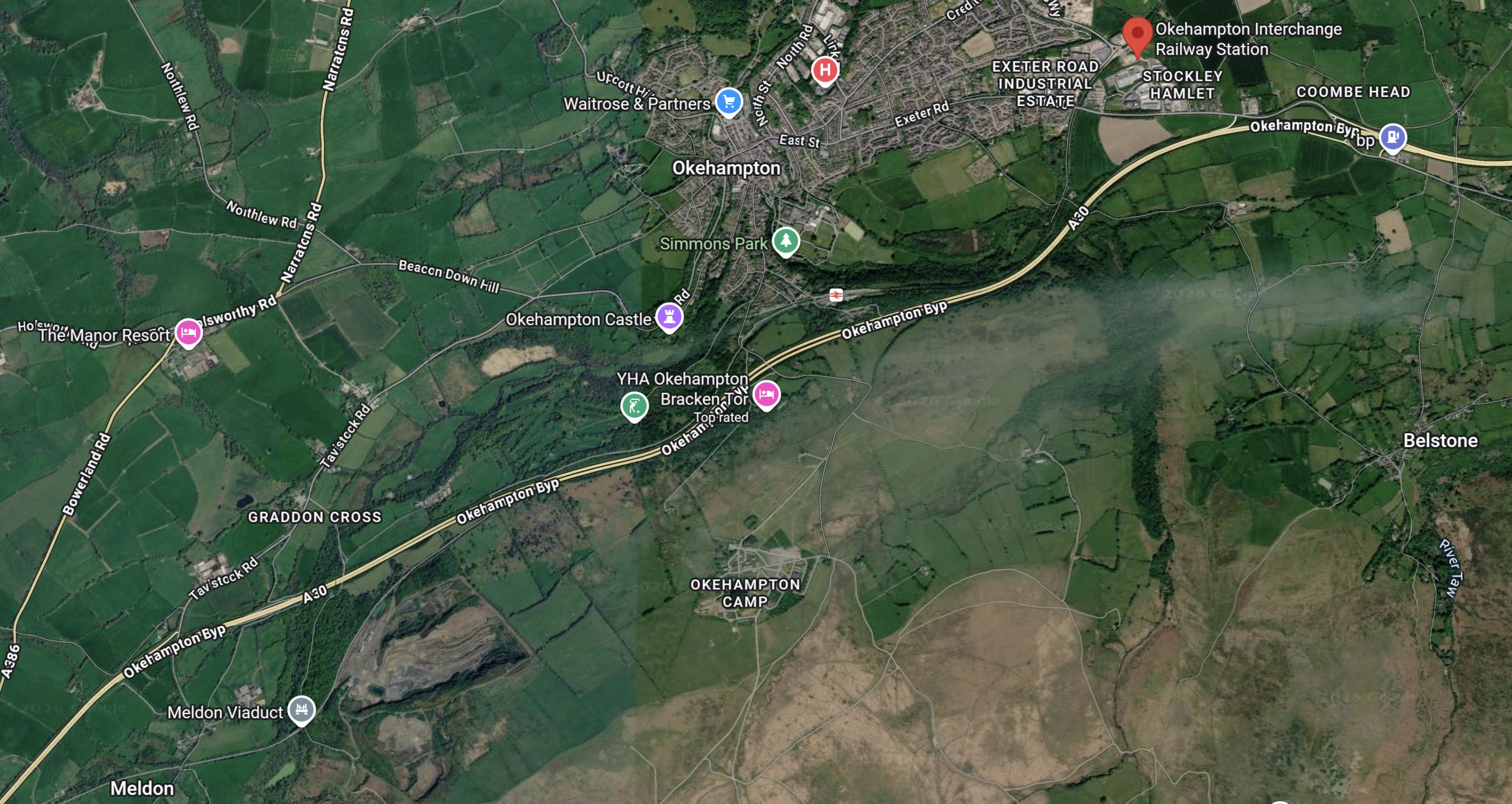
Note.
- Okehampton Interchange station is shown by the red arrow in North-East corner of the map.
- The town of Okehampton is to the West of the station.
- South of the town is the station symbol, which indicates Okehampton station.
Running across the map is the A30 road, which is described in its Wikipedia entry like this.
The A30 is a major road in England, running 284 miles (457 km) WSW from London to Land’s End.
This Google Map shows the A30 between Okehampton and Bodmin.
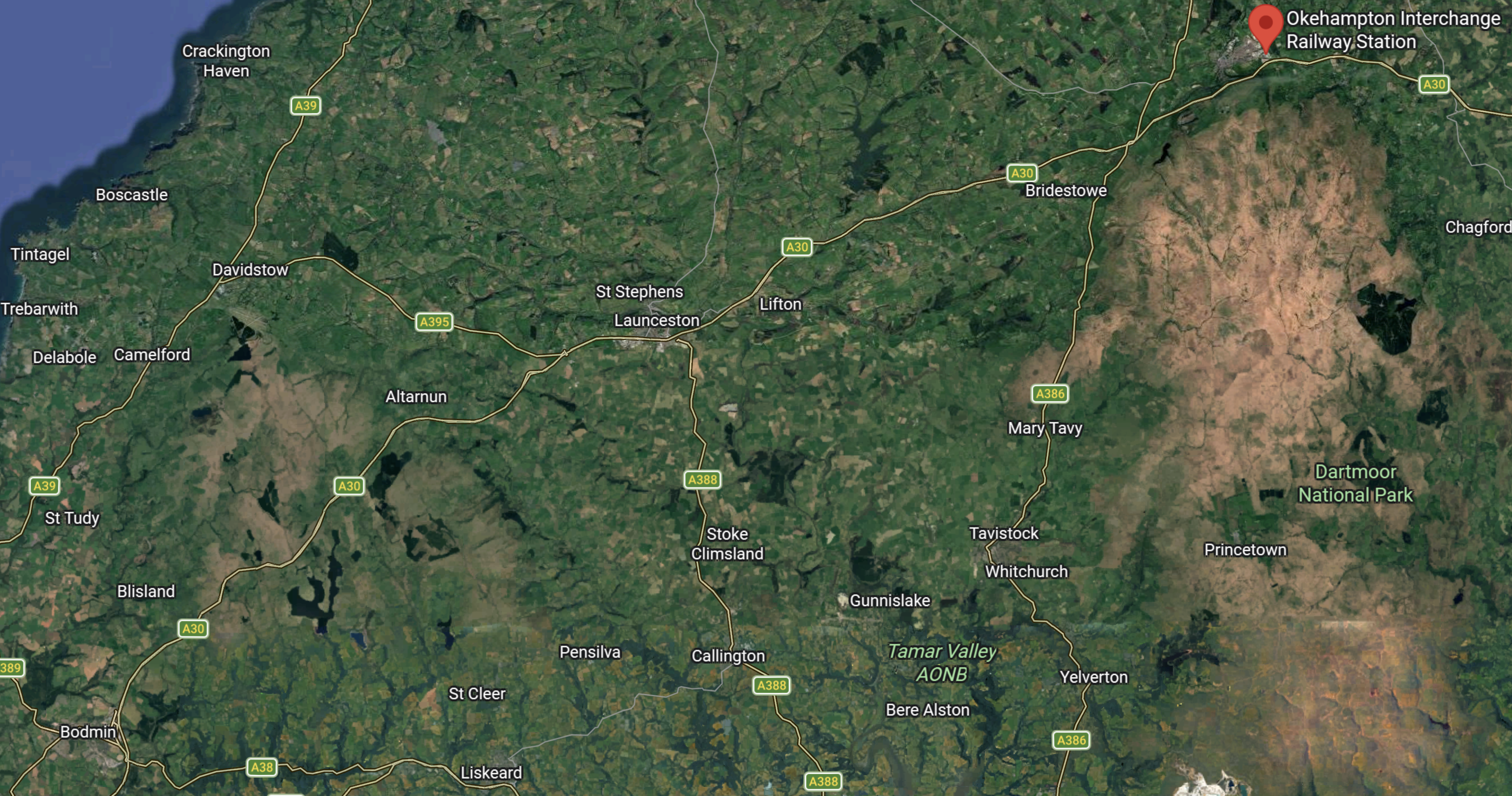
Note.
- Okehampton interchange station is in the North-East corner of the map.
- Bodmin with Bodmin Parkway station is in the South-West corner of the map.
- In the middle of the map is Launceston, which is on route of the A30.
Wikipedia says this about the road.
The A30 is dual carriageway through Devon and into Cornwall, bypassing Whiddon Down, Okehampton and Launceston.
I believe that if the railway was blocked again at Dawlish, it would be possible for passengers to be taken to Cornwall like this.
- Five-car Class 802 train to either of the Okehampton stations.
- Coach to Launceston and Bodmin Parkway.
- Class 802 trains to Penzance, which called at all stations.
That looks to me to be a practical alternative.
It should also be noted, that high-capacity, hydrogen-powered coaches, with a thousand-kilometer range will be coming into service soon and these will surely be ideal for a duty like this.
Do Coeliacs Have A Sweet Tooth?
I am certainly coeliac and often, when I have a coffee or a hot chocolate, when I’m travelling, I will ask if the cafe has a gluten-free cake to go with it.
Increasingly, I am getting disappointed. But then chains that speciallised in gluten-free like Carluccios and Leon have had a hard time lately and the rise of Greggs, Gails and Pret, who don’t do gl;uten-free doesn’t help.
Usually, whilst I watch, the BBC ten o’clock news, I will have a mug of decaffeinated tea, in which I will dunk, three M & S gluten-free ginger snaps.
After I was diagnosed as a coeliac, my late wife, once said she thought I would eat more biscuits and cakes.
So what does Google AI think, when I ask it the question in the title of this post?
This was the answer I received.
Yes, many people with coeliac disease have a sweet tooth, and it is a common experience to experience intensified sugar cravings after starting a gluten-free diet.
Here is why this happens and how it is managed:
Intensified Cravings: After eliminating gluten, some coeliacs experience strong cravings for sugar, ice cream, and chocolate.
This can occur because the body is suddenly deprived of high-carb foods, or due to underlying imbalances in gut bacteria.
Nutrient Absorption: In the early stages of a gluten-free diet, the body may be absorbing nutrients better for the first time, which can trigger intense hunger and cravings.
Hidden Sugar in GF Foods: Many processed gluten-free products—like biscuits and cakes—contain more sugar to improve taste and texture, which can satisfy, but also encourage, a sweet tooth.
Gut Health Factors: Some individuals suspect that sugar cravings are linked to candida (yeast) overgrowth, which is sometimes associated with coeliac disease.
I suspect with me sometimes, it can be, just because I’m hungry due to low availability of gluten-free snacks.
This week, when I went to Blackpool North, I changed trains at Wigan North Western station, where I bought a delicious lemon tart in the coffee stall.



Note.
- The delicious lemon tart came in the aluminium tray it was baked in. Could this be for protection, as the tart was still in one piece, after some time in my brief case.
- My pictures don’t do the tart justice.
- The coffee stall is on the Northbound platform.
- The toilets are under the Southbound platform, but are some of the cleanest, I’ve found on UK railways.
- Wigan North Western station is fully step-free.
- Wigan North Western station could be ready for High Speed Two trains.
Wigan North Western and Wigan Wallgate stations are only a short walk apart, so it is a well used interchange to get to Northern parts of Merseyside and Greater Manchester, from London and the South.
Will The Green Mayor In Hackney Affect The Value Of My House?
I asked Google AI the question in the title of this post and received this reply.
Based on the 2026 Hackney Green Party manifesto and local policy updates, a Green-led council in Hackney is likely to implement policies aimed at environmental sustainability, improved social housing, and stricter regulation of private property, which could have mixed effects on property values.
Here is how the Green Party’s approach in Hackney might impact your home value:
Potential Upward Pressures on Property ValueGreen Infrastructure Improvements:
The council is prioritizing increased green canopy cover (target of 30%) and the installation of electric vehicle charging points.
Increased green space and improved environmental quality can enhance the desirability of residential areas, often positively impacting house prices.
Energy Efficiency Upgrades: Continued investments in insulating homes and supporting heat pump installations could make older properties more attractive to buyers concerned about energy efficiency and lower utility bills.
“Alive and Flourishing” Strategy: Efforts to reactivate underused spaces could improve local amenities, making neighbourhoods more vibrant and potentially increasing demand.
Potential Downward or Stabilizing Pressures on ValueFocus on Social and Affordable Housing: A core priority is building 1,000 new council homes for social rent, along with a focus on “genuinely affordable” housing.
A shift away from high-end private luxury development towards affordable housing can reduce the rate of capital growth in the private market.
Rent Controls and Regulation: Green Party policy includes lobbying for local rent controls.
While this directly impacts buy-to-let investors, it can change the investment landscape and overall demand for investment properties in the borough.
Regulation of Empty Homes: The council plans to double Council Tax for properties left vacant for 12 months or more, and may use Compulsory Purchase Orders (CPOs) for long-term empty buildings.
Expansion of Selective Licensing: Proposals to expand landlord licensing schemes to cover more of the borough could increase costs for landlords, potentially causing some to exit the market.
Potential Tax and Regulatory Factors
Council Tax Increases: The budget for 2026/27 includes a standard 4.99% council tax increase.
Stricter Developer Obligations: Increased requirements for developers to contribute to community infrastructure could increase development costs, although the focus is often on increasing social value rather than solely high-end investment.
Conclusion
Hopefully Nothing Too Bad! But who knows?
Gas-Fired Power Still Looks A Safe Bet For Centrica In The Renewables Era
I feel rather surprisingly, the title of this post, is the same as this article on the Guardian.
You’d think, that they would be critical of Centrica for keeping the gas power stations going.
But this is the sub-heading.
There will still be a need to have gas in the wings to keep the lights on, so the financials stack up on Severn plant purchase.
So why should Centrica buy a 832 MW closed cycle gas fired power station?
These posts describe, what Centrica have done at Brigg with another closed cycle gas fired power station.
- Construction Under Way To Double Power Station Capacity At Centrica’s Brigg Energy Park
- Hydrogen Milestone: UK’s First Hydrogen-to-Power Trial At Brigg Energy Park
Will Centrica be taking closed cycle gas fired power stations and making them more efficient to provide the back up to wind farms, when wind is having an off day?
I wouldn’t be surprised, if Centrica put a big battery on the two sites, as after all they are a godparent to Highview Power.
Are there any more closed cycle gas fired power stations, that they can acquire?
I asked, Google AI,”How many closed cycle gas fired power stations are there in the uk?” and received this answer.
As of early 2026, there are approximately 35 active combined cycle gas turbine (CCGT) power stations—often referred to as closed-cycle—in the UK.
These plants provide the bulk of the UK’s gas-fired capacity, totaling roughly 30-35 GW along with smaller, single-cycle (OCGT) plants which are used for backup.
Total Capacity: The total capacity of all gas-fired generation (CCGT and others) is approximately 35.7 GW.
Role in Power Mix: CCGTs are highly efficient and provide baseload power, while OCGT plants (about 14+ sites) are typically used for peak demand.
Key Locations: Major plants include Pembroke (RWE), Staythorpe (RWE), Didcot B (RWE), and Connah’s Quay (Uniper).
These plants remain the largest single source of electricity generation on the UK grid, though they are increasingly being paired with carbon capture proposals.
I think, that Engineer Baldrick is now working for Centrica and he has a cunning plan to use efficient CCGT power stations to back up the wind.
Consider.
- Severn power station is an 832 MW combined cycle power plant running on natural gas, which is located near Newport in South Wales.
- 4.5 GW of offshore wind is to be built near Port Talbot.
- Will some hydrogen generated by HiiROC be used to part-fire Severn power station and reduce its carbon footprint.
- South Wales can easily find space for a couple of Highview 300 MW/3.2 GWh CRYOBatteries.
- It would be useful to have a good-sized hydrogen store in South Wales.
That mix would surely provide enough reliable power for green steelmaking and a few data centres.

