The Concept Of Electrification Islands
Consider how Imperial Airways and BOAC used to fly long routes to places like Sydney, Hong Kong and Cape Town before the days of long distance jet airliners. They used to fly from airport to airport, picking up fuel and supplies on the way.
If you want to know more about the details, read what is my favourite travel book, Beyond The Blue Horizon by Alexander Frater.

He followed the Imperial Airways route to Sydney, on what was reputed to be the most complicated ticket, that British Airways ever issued.
But can the concept of flying a short range airliner over a long distance refuelling as necessary, be applied to running a battery electric train by charging the batteries on a series of electrification islands?
In Ipswich And Peterborough In A Battery Train, I described how an Ipswich and Peterborough service could be run by a battery-equipped Class 755 train.
The Ipswich and Peterborough route is 82.5 miles long and it can be split as follows.
- Ipswich and Haughley Junction – 13.8 miles – Electrified
- Haughley Junction and Ely – 38.2 miles – Not Electrified
- Ely and Peterborough – 30.5 miles – Not Electrified
Legs two and three, should be within the capability of a battery-equipped Class 755 train. No definite figure has been given, but in the July 2018 Edition of Modern Railways, this was said about the similar Class 756 trains, ordered for the South Wales Metro.
The units will be able to run for 40 miles between charging, thanks to their three large batteries.
Perhaps, what is needed is to create an electrification island at Ely, that can be used to charge the batteries.
An Electrification Island At Ely
This map from Wikipedia shows the complicated railways at Ely,
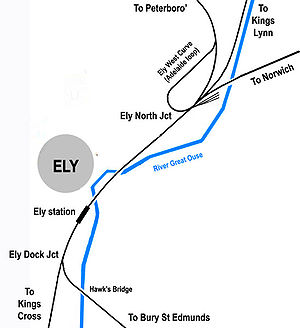
Note.
- Ely station is fully electrified.
- The line to Cambridge,Kings Cross, Liverpool Street and Stansted Airport is fully electrified. Greater Anglia’s Class 755 trains between Norwich and Stansted Airport, change between diesel and electrification at Ely.
- The line to Kings Lynn is fully electrified.
- The lines to Bury St. Edmunds, Norwich and Peterborough are not electrified.
- Ely is a city of 20,000 inhabitants, so I suspect it must have a robust electricity supply.
- Freight trains take about five minutes to pass between Ely West and Ely Dock Junctions.
- Ely West and Ely Dock Junctions are 2.5 miles apart.
- There appears to be an avoiding line South-East of Ely station, where I’ve seen trains from Felixstowe to Peterborough sometimes wait for a few minutes before proceeding.
- There is also a lot of space at March station, where a passing loop with a charging station could be built.
I believe it would be possibly to do the following at Ely.
- Electrify the West Curve and the South-East avoiding line.
- Electrify the Bury St. Edmunds, Norwich and Peterborough lines for perhaps five miles.
- If required, put a high capacity charging station on the avoiding line.
There would be plenty of electrification to charge the trains.
An alternative plan might be to electrify between March station and the new Soham station, which has been planned to open in 2021.
- This would be around eighteen miles of electrification.
- This would certainly be enough electrification to fully-charge passing freight and passenger trains.
- Soham to Ely could be doubled.
- The extra electrification would mean the two unelectrified sections of the Ipswich and Peterborough route; Haughley Junction-Soham and March-Peterborough would be well within range of a battery-electric train.
- The proposed service between Cambridge and Wisbech would only have the twelve miles of the Bramley Line between March and Wisbech to run on battery power.
It might also be possible to put in an extra curve to make Ely Dock Junction, a full triangular junction. This would allow the new Soham station to have direct services to both Cambridge and Cambridge North stations, without a reverse at Ely station.
Other Possible Electrification Islands
I’ll break these down by regions and train operators.
East Anglia (Greater Anglia)
Greater Anglia only runs trains on diesel to the North of Cambridge and Ipswich, which are both fully electrified, as is Norwich.
I would consider Cambridge, Ely, Ipswich and Norwich to be electrification islands.
- All have a good connection to the electrification power supply, as they handle main line electric trains.
- All or most platforms at the stations are electrified to charge trains.
- There are electrified sidings at Cambridge and Norwich and possibly at Ipswich.
Lowestoft and Yarmouth might be fitted with charging systems to make sure a fault doesn’t strand a train.
In Battery Power Lined Up For ‘755s’, I talked about a report in Rail Magazine, which said that the Class 755 trains will get a battery fitted at the first overhaul.
I wouldn’t be surprised, that in a couple of years, Greater Anglia announces the end of diesel power on some or all of their services.
East Coast Main Line (LNER and Others)
Hitachi AT-300 Trains On The East Coast Main Line
The East Coast Main Line (ECML), is increasingly becoming a railway where the vast majority of services are run by versions of Hitachi AT-300 trains.
- Hull Trains are running Class 802 trains.
- LNER are running Class 800 and Class 801 trains.
- TransPennine Express are running Class 802 trains.
- East Coast Trains will be running Class 803 trains.
Classes 800, 802 and 803 are bi-modes and can probably have some or all of their diesel engines replaced by batteries.
In Sparking A Revolution, I gave this specification for a Hitachi battery-electric train.
- Range – 55-65 miles
- Performance – 90-100 mph
- Recharge – 10 minutes when static
- Routes – Suburban near electrified lines
- Battery Life – 8-10 years
I will use these figures from Hitachi in this post.
Electrification Islands On The East Coast Main Line
There are several large and smaller stations along the ECML, that can act as electrification islands to support either local services or long-distance services from London.
Cleethorpes
Consider
- Cleethorpes station would need a decent electricity supply. Offshore wind?
- Doncaster is 52 miles away.
- Lincoln is 37 miles away.
- Newark is 63 miles away.
- Scunthorpe is 29 miles away.
If you can get battery-electric trains to Cleethorpes, you also serve Grimsby Town station, which is three miles closer to the ECML.
With electrification islands at Lincoln and Scunthorpe and Hitachi AT-300 trains with a battery range of at least sixty miles, electric trains could be run to Cleethorpes and Grimsby.
Would that improve the economy of the area?
Darlington
Darlington station is on the electrified ECML, so it must have a top class electricity supply.
- Bishop Auckland is 12 miles away.
- Middlesbrough is 15 miles away.
- Nunthorpe is 20 miles away.
- Saltburn is 27 miles away.
- Whitby is 47 miles away.
Darlington could support battery-electric operation of the Tees Valley Line, if the route doesn’t go for hydrogen. Note that hydrogen would probably also handle services from Middlesbrough to Newcastle, Nunthorpe and Whitby with ease.
Note my views on the definitive hydrogen train, which will be a battery-electric-hydrogen hybrid train, able to use power from a variety of sources.
Doncaster
Doncaster station is on the electrified ECML, so it must have a top class electricity supply.
- Cleethorpes is 52 miles away.
- Hull is 40 miles away.
- Scunthorpe is 25 miles away.
- Sheffield is 19 miles away.
Doncaster could certainly support some battery-electric services.
Grantham
Grantham station is on the electrified ECML, so it must have a top class electricity supply.
- Nottingham is 22 miles away.
- Sleaford is 18 miles away.
- Nottingham and Skegness services seem to take about four minutes to reverse in the station.
The Nottingham and Skegness service could take advantage of the driver changing ends to top up the battery.
Hull
Consider.
- Hull is a city of nearly 300,000 people, so it must have a decent electricity supply.
- Hull station is under forty miles from the electrification of the ECML.
- Doncaster is 40 miles away.
- Scarborough is 54 miles away.
- York is 52 miles away, with about 20 miles electrified.
I would certainly suspect that with an electrification island at Hull, the Hitachi AT-300 trains of Hull Trains and LNER could certainly run fully electric services to the city, if they were fitted with batteries.
With an electrification island at Scarborough, could Hull Trains and LNER services be extended to Scarborough?
Leeds
Leeds station is already an electrification island, as it is fully electrified.
- It also has electrified services to Bradford, Ilkley and Skipton.
- Leeds and Huddersfield will be electrified in the next few years.
Harrogate is 18 miles away, so a return journey is within range of a Hitachi AT-300 train with a battery, that is charged on the ECML.
Lincoln
Consider.
- Lincoln station would need a decent electricity supply.
- Cleethorpes is 37 miles away.
- Doncaster is 40 miles away.
- Newark is 16 miles away, so a return journey is within range of a Hitachi AT-300 train with a battery, that is charged on the ECML.
- Nottingham is 34 miles away and Leicester is 61 miles away.
- Peterborough is 57 miles away.
- Sleaford is 21 miles away.
With an electrification island at Lincoln, the following should be possible.
- Electric services between Cleethorpes and Lincoln using battery-electric trains.
- Electric services between Doncaster and Lincoln using battery-electric trains.
- Electric services between Nottingham/Leicester and Lincoln using battery-electric trains. Electrify the Midland Main Line (MML) and this is easy.
- Electric services between Peterborough and Lincoln using battery-electric trains. It may need an electrification island at Sleaford.
- Electric services between London Kings Cross and Grimsby/Cleethorpes using Hitachi AT-300 trains with a battery, that is charged on the ECML and at Lincoln.
The London Kings Cross and Lincoln services could top up their batteries if required if they were run using Hitachi AT-300 trains with a battery
Surely, if Class 755 trains are good enough for Norfolk and Suffolk and both franchises are run by Abellio, then battery versions of these trains would be ideal for running services from Lincoln to Cleethorpes/Grimsby, Doncaster, Newark, Nottingham, Peterborough and Skegness.
Middlesbrough
If required an electrification island could be placed at Middlesbrough station.
- Darlington is 15 miles away.
- Newcastle is 47 miles away.
- Saltburn is 13 miles away.
- Whitby is 35 miles away.
This area might opt for hydrogen, but I believe battery-electric trains could also work the routes through Middlesbrough and Darlington. Note my views on the definitive hydrogen train, which will be a battery-electric-hydrogen hybrid train, able to use power from a variety of sources.
Newark
Consider.
- Newark North Gate station is on the electrified ECML, so it must have a top class electricity supply.
- Cleethorpes is 63 miles away.
- Grimsby is 60 miles away.
- Lincoln is 16 miles away.
- Nottingham is 17 miles away.
With an electrification island at Cleethorpes/Grimsby, battery-electric services could be extended to either town. They would need to use the electrification island at Lincoln station to top-up the battery.
Newcastle
Newcastle station is on the electrified ECML, so it must have a top class electricity supply.
- Carlisle is 61 miles away.
- Middlesbrough is 47 miles away.
- Nunthorpe is 52 miles away.
Newcastle could surely support local services using battery-electric trains. They could be dual-voltage, so they can use Tyne and Wear Metro electrification.
Peterborough
Peterborough station is on the electrified ECML, so it must have a top class electricity supply.
- Ely is 31 miles away.
- Leicester is 52 miles away, with Birmingham another 40 miles further.
- Lincoln is 57 miles away.
- Sleaford is 35 miles away.
It might even be possible for Hitachi AT-300 trains with a battery to be able to run between Stansted Airport and Birmingham for CrossCountry.
- Stansted and Ely – 38 miles – Electrified
- Ely and Peterborough – 30.5 miles – Not Electrified
- Through Peterborough – 6 miles – Electrified (ECML)
- Peterborough and Leicester – 52 miles – Not Electrified
- Leicester and Nuneaton – 19 miles – Not Electrified
- Through Nuneaton – 3 miles – Electrified (WCML)
- Nuneaton and Birmingham – 21 miles – Not Electrified
Note.
- Trains would charge when running under electrification and also during station stops in Cambridge, Ely, Peterborough Leicester and Nuneaton.
- Trains would automatically raise and lower their pantographs as required.
- There may be scope to add sections of extra electrification.
- For example, electrification of the MML could add as much as eight miles of electrification, through Leicester.
As much as forty percent of the route between Birmingham and Stansted could be electrified.
Sandy/St. Neots
It is planned that the East West Railway (EWR) and the ECML will cross at an interchange station somewhere in this area.
Consider.
Both stations are on the electrified ECML, so must have a top class electricity supply.
- Bedford is 10 miles away.
- The electrification South of Cambridge is about 20 miles away.
It would surely be possible to create an electrification island, where the two major routes cross at Sandy/St. Neots.
Scarborough
Consider.
- Scarborough station would need a decent electricity supply.
- Hull is 54 miles away.
- York is 42 miles away.
With charging facilities at Scarborough battery-electric trains could be run to the seaside resort.
- I also think it would be possible to run a direct service between London Kings Cross and Scarborough using Hitachi AT-300 trains with batteries, either via York or Hull.
- TransPennine’s Hitachi trains could also read Scarborough from York, if fitted with batteries.
Would battery-electric trains between Hull, Scarborough and York attract more users of the services?
Sleaford
If required an electrified island could be placed at Sleaford station.
- Sleaford would need a decent electricity supply.
- The station is where the Nottingham and Skegness and Peterborough and Lincoln routes cross.
- Grantham on the ECML is 18 miles away.
- Lincoln is 21 miles away.
- Nottingham is 40 miles away.
- Peterborough is 35 miles away.
- Skegness is 40 miles away.
Services through Sleaford would be run as follows.
As Lincoln and Peterborough are likely to both have the ability to charge trains, the Peterborough and Lincoln route can probably be run using a battery-electric train, that also charges during the stop at Sleaford.
To run the Nottingham and Skegness route, there will need to be a charging facility or an electrification island at Skegness, as forty miles is to far from an out and back from Sleaford on battery power. The section between Sleaford and Nottingham is easier, as there is a reverse at the fully-electrified Grantham station, where the trains could top-up their batteries.
York
York station is already an electrification island, as it is fully electrified.
- Harrogate is 20 miles away, with Leeds another 18 miles further.
- Hull is 52 miles away, with about 20 miles electrified.
- Scarborough is 42 miles away.
It would appear that battery-electric trains could work the routes between Doncaster, Harrogate, Hull, Leeds, Scarborough and York.
Midland Main Line (East Midlands Railway)
Hitachi AT-300 Trains On The Midland Main Line
The Midland Main Line (MML) is a mixture of electrified and non-electrified sections. East Midlands Railway have chosen Hitachi Class 810 trains to cope with the mixed infrastructure.
- There will be thirty-three five car trains.
- They will have four diesel engines instead of three in the Class 800 trains.
- They will have a redesigned nose.
Are East Midlands Railway ordering a dual-purpose design?
In the January 2020 Edition of Modern Railways, this is said about the bi-mode Hitachi Class AT-300 trains for Avanti West Coast.
Hitachi told Modern Railways it was unable to confirm the rating of the diesel engines on the bi-modes, but said these would be replaceable by batteries in future if specified.
Consider.
- Both fleets of trains are for delivery in 2022.
- Ease of manufacture would surely mean, that Hitachi would want the two fleets to be substantially the same.
- A train with four engines could be needed to cruise at 125 mph on diesel.
- Four engine slots would mean that, if you were replacing some engines with batteries, you’d have more flexibility.
Hitachi seem to be playing an inscrutable game.
This section entitled Powertrain in the Wikipedia entry for the Class 800 train, says this about the powertrain for Class 800/801/802 trains.
Despite being underfloor, the generator units (GU) have diesel engines of V12 formation. The Class 801 has one GU for a five to nine-car set. These provide emergency power for limited traction and auxiliaries if the power supply from the overhead line fails. The Class 800 and Class 802 bi-mode has three GU per five-car set and five GU per nine-car set. A five-car set has a GU situated under vehicles 2/3/4 and a nine-car set has a GU situated under vehicles 2/3/5/7/8.
Hitachi must have found a way to arrange four GUs under a Class 810 train.
- They could be using slightly smaller engines. Smaller engines could be fitted to curb overheating.
- The engines might be in pairs under vehicles 2 and 4, possibly sharing utilities like fuel tanks and cooling systems.
But as the vehicles are two metres shorter, it wouldn’t be a shoe-in.
When the trains are to be upgraded to battery electric trains, an appropriate number of GUs would be replaced by batteries.
I wouldn’t be surprised to find out that both Avanti West Coast and East Midlands Railway will have trains that can be converted from five-car bi-mode trains into battery-electric trains, with a range of between 55 and 65 miles.
- As a control engineer, I believe that a battery could be made to be plug compatible with a GU.
- An extra battery could be placed under vehicle 3, in the spare engine position.
I reckon that Hitachi’s quote of a sixty-five mile range would at 3 kWh per vehicle-mile need about one MWh of batteries.
That is 200 kWh per vehicle, so I feel it should be possible.
Electrification Of The Midland Main Line
Current plans for electrified sections of the MML are as follows.
- London St. Pancras and Corby – 79.5 miles – Opening December 2020
- London St. Pancras and Market Harborough – 83 miles – Opening December 2020
- Clay Cross North Junction and Sheffield – 15.5 miles – To be built in conjunction with High Speed Two
The gap between Market Harborough and Clay Cross North Junction is about 66 miles.
Electrification Islands On The Midland Main Line
As with the ECML, there are several large and smaller stations along the MML, that can act as electrification islands to support either local services or long-distance services from London.
I will deal with the electrification islands, starting in London.
Bedford
In Looking At The East West Railway Between Bedford And Cambridge, I came to the conclusion, that the East West Railway (EWR) and the MML, would share electrified tracks through Bedford station.
- There are also rumours of electrification of the East West Railway, which I wrote about in EWR Targets Short-Term Fleet Ahead Of Possible Electrification, after an article in Rail Magazine with the same title.
- But even so Bedford and Cambridge are only thirty miles apart, which is well within the capability of a battery-electric train.
- Continuing to the West on the EWR, it is under twenty miles to the electrification at Bletchley on the West Coast Main Line (WCML).
It looks to be that battery-electric trains running on the EWR would be able to charge their batteries as they pass through Bedford.
- It does appear to me, that the EWR chose a route through Bedford that would make this feasible.
- It would also be relatively easy to electrify the EWR to the East and/or West of Bedford to increase the time using electrification, to fully charge the trains.
- As Cambridge and Bletchley are around fifty miles apart, this journey between two fully-electrified stations, would be possible for a battery-electric train, especially, if it were able to take a sip of electricity in the possible stops at Bedford and Sandy or St. Neots.
If in the end, it is decided to electrify the EWR, Bedford would surely be a location, with enough power to feed the electrification.
Leicester
Leicester station is an important station on the MML.
But it would be a difficult station to electrify because of a bridge with limited clearance.
In Discontinuous Electrification Through Leicester Station, I discussed how the following.
- Discontinuous electrification through Leicester station.
- Electrification between Leicester and Derby stations.
- Electrifying the High Speed Two route between Clay Cross Junction and Sheffield.
Would allow Hitachi Class 810 trains, equipped with batteries to run between London and Sheffield on electric power alone.
East Midlands Parkway
East Midlands Parkway station is nineteen miles North of Leicester station.
This Google Map shows its unique position.
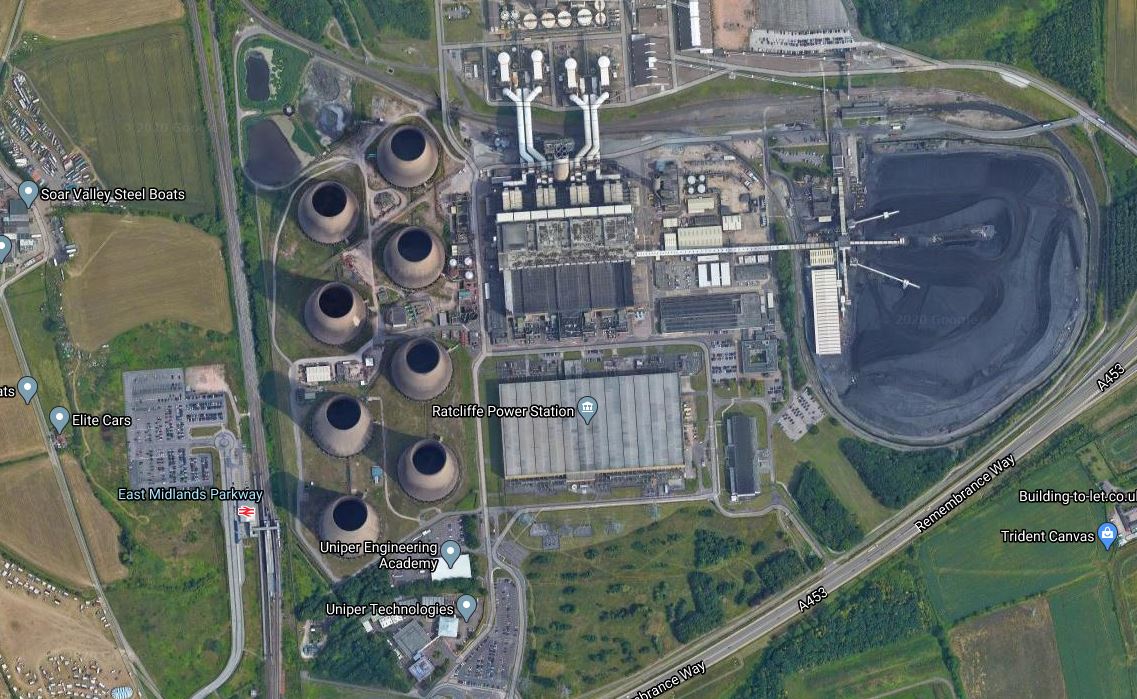
Ratcliffe-on-Soar power station is the eighteenth highest emitter of CO2 in Europe and will surely be closed soon.
But then, a power station, will have a good connection to the National Grid, ensuring there could be plenty of power for electrification, even after the current power station is long gone, as it will surely be replaced by another power station or energy storage.
East Midlands Parkway station is also well-connected.
- Clay Cross North Junction is 31 miles away.
- Derby is 10 miles away.
- Leicester is 18 miles away.
- Nottingham is 8 miles away.
- Sheffield is 47 miles away.
It should be possible to reach all these places on battery-power from East Midlands Parkway.
Electrification Between Leicester And East Midlands Parkway
The more I look at this stretch of the MML, the more I feel that this eighteen mile stretch should be electrified to create what could become a linear electrification island.
Consider.
- It is a 125 mph multi-track railway across fairly flat countryside.
- Connecting electrification to the grid is often a problem, but Ratcliffe-on-Soar power station is adjacent to East Midlands Parkway station.
- The section is only eighteen miles long, but this is surely long enough to fully-charge a battery train speeding to and from the capital.
- There are only four intermediate stations; Syston, Sileby, Barrow-on-Soar and Loughborough.
- The engineering for gauge clearance and electrification, looks to be no more difficult, than it will be between Kettering and Market Harborough.
- Between Leicester and Market Harborough stations is only sixteen miles.
- Between East Midlands Parkway and Nottingham is only eight miles, so it would be possible for Nottingham services to run without a charge at Nottingham station.
- Between East Midlands Parkway and Derby is only ten miles, so it would be possible for Derby services to run without a charge at Derby station.
- Between East Midlands Parkway and the shared electrified section with High Speed Two at Clay Cross North Junction is thirty-one miles, so it would be possible for Sheffield services to be run without using diesel, once the shared electrification is complete between Clay Cross North Junction and Sheffield.
- Battery-electric trains between East Midlands Parkway and Clay Cross North Junction could also use the Erewash Valley Line through Ikeston, Langley Mill and Alfreton.
- There would be no need to electrify through the World Heritage Site of the Derwent Valley Mills that lies between Derby and Clay Cross North Junction, as trains will be speeding through on battery power. Electrifying through this section, might be too much for some people.
- If the trains can’t switch between battery and overhead electrification power, the changeover can be in Leicester and East Midlands Parkway stations. However, I believe that Hitachi’s AT-300 trains can do the changeover at line speed.
The electrification could also be used by other services.
- Between Corby and Syston North Junction is only thirty-six miles, so it would be possible to run electric services between London St. Pancras and Derby, Nottingham and Sheffield via Corby, if the main route were to be blocked by engineering work.
- Between Peterborough and Syston East Junction is forty-seven miles, so it should be possible to run CrossCountry’s Stansted Airport and Birmingham service using battery-electric trains. If the train could leave Leicester with a full battery, both Birmingham New Street and Peterborough should be within range.
- East Midlands Railway’s Lincoln and Leicester service run for a distance of sixty-one miles via East Midlands Parkway, Nottingham and Newark stations. Electrification between Leicester and East Midlands Parkway, would mean there was just forty-two miles to do on battery power. An electrification island at Lincoln would charge the train for return.
Battery-electric trains with a range of between 55 and 65 miles would really open up the East Midlands to electric services if between Leicester and East Midlands Parkway were to be electrified.
London And Sheffield In A Battery-Electric Class 810 Train
This is speculation on my part, but I think this could be how trains run London to Sheffield before 2030.
- London to Market Harborough – 83 miles – Using electrification
- Switch to battery power at line speed.
- Market Harborough to Leicester – 16 miles – Using battery power
- Switch to electrification in Leicester station
- Leicester to East Midlands Parkway – 19 miles – Using electrification
- Switch to battery power at line speed.
- East Midlands Parkway to Clay Cross North Junction – 31 miles – Using battery power
- Switch to electrification at line speed.
- Clay Cross North Junction to Sheffield – 15.5 miles – Using electrification
Note.
- 118 miles would be run using electrification and 47 miles using battery power.
- Battery power has been used to avoid the tricky electrification at Leicester station and along the Derwent Valley.
I don’t believe any of the engineering will be any more difficult, than what has been achieved on the MML in the last year or so.
Nottingham
Consider
- Nottingham station would probably have access to a reliable electricity supply, as Nottingham is a large city of over 300,000 people.
- Nottingham station has a comprehensive network of local services.
- Nottingham station has an excellent connection to Nottingham Express Transit.
- Birmingham New Street is 57 miles away, via Derby and Burton.
- Burton-on-Trent is 27 miles away.
- Derby is 16 miles away.
- Grantham is 23 miles away.
- Lincoln is 34 miles away.
- Matlock is 33 miles away.
- Newark is 17 miles away.
- Sheffield is 40 miles away.
- Worksop is 32 miles away.
- Most of these local services are run by East Midlands Railway, with some services run by Northern and CrossCountry.
- Some services run back-to-back through Nottingham.
I feel very strongly that if charging is provided in Nottingham, when trains turnback or pass through the station, that many of the local services can be run by battery-electric trains.
Previously, I have shown, that if between Leicester and East Midlands Parkway is electrified, then services between London and Nottingham, can be run by battery-electric trains.
There is also a fall-back position at Nottingham, as the local services could be run by hydrogen-powered trains.
Sheffield
Sheffield station would at first glance appear to be very similar to Nottingham.
- Sheffield station would probably have access to a reliable electricity supply, as Sheffield is a large urban area of 700,000 people.
- Sheffield station has a comprehensive network of local services.
- Sheffield station has an excellent connection to the Sheffield Supertram.
But it looks like Sheffield station will see the benefits of electrification the Northern section of the MML from Clay Cross North Junction.
- The 15.5 miles of electrification will be shared with the Sheffield spur of High Speed Two.
- Currently, trains take sixteen minutes between Sheffield and Clay Cross North Junction.
- Electrification and an improved high-speed track will allow faster running, better acceleration and a small saving of time.
- A Sheffield train will be charged going to and from Sheffield, so will leave Clay Cross North Junction for Derby and the South with full batteries.
- There must also be opportunities for local trains running between Sheffield and Class Cross Junction North to use the electrification and be run by battery-electric trains.
Current destinations include.
- Derby is 36 miles away.
- Doncaster is 19 miles away.
- Huddersfield is 36 miles away.
- Leeds is 45 miles away.
- Lincoln is 49 miles away.
- Manchester Piccadilly is 42 miles away.
- Nottingham is 40.5 miles away.
Note.
- Doncaster, Leeds and Manchester Piccadilly stations are fully electrified.
- Work on electrifying Huddersfield and Leeds will start in a year or so, so Huddersfield will be electrified.
- I am firly sure that Lincoln and Nottingham will have enough electrification to recharge and turn trains.
- Some routes are partially electrified.
As with Nottingham, I am fairly sure, that local services at Sheffield could be run by battery-electric trains. And the same fall-back of hydrogen-powered trains, would also apply.
Sheffield And Manchester Piccadilly In A Battery-Electric Train
Consider.
- Once Sheffield and Clay Cross North Junction is electrified in conjunction with High Speed Two, at least five miles of the Hope Valley Line at the Sheffield end will be electrified.
- It may be prudent to electrify through Totley Tunnel to increase the electrification at Sheffield to ten miles.
- The route via Stockport is 43 miles long of which nine miles at the Manchester End is electrified.
- The route via Marple is 42 miles long of which two miles at the Manchester End is electrified.
There would appear to be no problems with running the TransPennine Express service between Manchester Airport and Cleethorpes using battery-electric trains, as from Hazel Grove to Manchester Airport is fully electrified and in the East, they can charge the batteries at Sheffield, Doncaster and a future electrification island at Cleethorpes.
The Northern service between Manchester Piccadilly and Sheffield could be run using battery-electric trains with some more electrification at the Manchester End or an extended turnback in Manchester Piccadilly.
Transport for Manchester has plans to run improve services at their end of the Hope Valley Line, with tram-trains possible to Glossop and Hadfield.
It would probably be worthwhile to look at the Hope Valley Line to make sure, it has enough future capacity. I would suspect the following could be likely.
- More electrification.
- More stations.
- Battery-electric trains or tram-trains from Manchester to Glossop, Hadfield, New Mills Central, Rose Hill Marple and Sheffield.
I would suspect one solution would be to use more of Merseyrail’s new dual-voltage Class 777 trains, which have a battery capability.
Sheffield And Nottingham In A Battery-Electric Train
Consider.
- Once Sheffield and Clay Cross North Junction is electrified in conjunction with High Speed Two, 15.5 miles of the route will be electrified.
- The total length of the route is 40.5 miles.
- There are intermediate stops at Dronfield, Chesterfield, Alfreton, Langley Mill and Ilkeston.
- Currently, journeys seem to take around 53 minutes.
I think it would be likely that the battery would need to be topped up at Nottingham, but I think a passenger-friendly timetable can be developed.
West Coast Main Line (Avanti West Coast)
Hitachi AT-300 Trains On The West Coast Main Line
The West Coast Main Line (WCML) is a mainly electrified and with some non-electrified extended routes. Avanti West Coast have chosen Hitachi AT-300 trains to cope with infrastructure.
- There will be ten seven-car electric trains.
- There will be thirteen five-car bi-mode trains.
As these trains will be delivered after East Midlands Railway’s Class 810 trains and East Coast Trains’ Class 803 trains, the following questions must be asked.
- Will the trains have the redesigned nose of the Class 810 trains?
- Will the bi-mode trains have four diesel engines (Class 810 trains) or three ( Class 800 trains)?
- Will the electric trains ordered by First Group companies; Avanti West Coast and East Coast Trains be similar, except for the length?
I would expect Hitachi will want the trains to be as similar as possible for ease of manufacture.
Electrification Islands On The West Coast Main Line
As with the ECML and the MML, there are a couple of large and smaller stations along the WCML, that can act as electrification islands to support either local services or long-distance services from London.
I will deal with the electrification islands, starting in London.
Watford Junction
Watford Junction station is already an electrification island, as it is fully electrified.
- St. Albans Abbey is 6.5 miles away.
- It would be possible to develop a battery-electric service to Aylesbury via Rickmansworth and Amersham, with is a distance of under 25 miles, if this was desired. I wrote about this service in Hertfordshire County Council’s Aspiration For A Watford Junction And Aylesbury Service.
Services around Watford Junction have possibilities to be expanded and improved using battery-electric trains.
Milton Keynes
Milton Keynes Central station is already an electrification island, as it is fully electrified.
- East West Railway services will call at Bletchley and not Milton Keynes.
- There may be a connection between East West Rail and High Speed Two at Calvert station, which is 15 miles away.
- Milton Keynes will get a service from Aylesbury, which is 22 miles away.
There may be possibilities to link Watford Junction and Milton Keynes via Aylesbury using battery-electric trains to give both places a connection to High Speed Two at a new Calvert station.
Connecting The North West Of England’s Three Powerhouses
It could reasonably be argued that the three most important economic centres of the North West of England are.
- The City of Liverpool and Merseyside
- Manchester Airport
- The City of Manchester and Greater Manchester
I’ll take a quick look at each, with particular reference to public transport links.
The City of Liverpool and Merseyside
Liverpool is introduced by this paragraph in Wikipedia.
Liverpool is a city and metropolitan borough in Merseyside, England. As of 2018, the population is approximately 494,814. Liverpool is the ninth-largest English district by population, and the largest in Merseyside and the Liverpool City Region. It lies within the United Kingdom’s sixth-most populous urban area. Liverpool’s metropolitan area is the fifth-largest in the United Kingdom, with a population of 2.24 million.
Knowing Liverpool with affection as I do, I find the City difficult to describe in an unbiased manner, but in my experience few people go for a visit to Liverpool and don’t come back enchanted in some way. It is a many-faceted city!
One of Liverpool’s strengths is the local rail system; Merseyrail, which connects the suburbs to the centre, just like the Underground does in London. As with London, Merseyrail is backed up by a comprehensive bus network. And like London, Liverpool is introducing hydrogen-powered double-deck buses.
Merseyrail is also in a strong expansionist phase.
- New trains are being delivered to replace some of the oldest trains on the national network in the UK.
- New stations are being added to the core Merseyrail network.
- Stations are being improved with refurbishment and step-free access.
- Merseyrail have ambitions to expand their network to Liverpool Airport, Preston, Skelmersdale, Warrington and Wrexham.
The City of Liverpool and Merseyside in general are getting ready to expand their economy.
Manchester Airport
This Google Map shows Manchester Airport.

Note.
- The two runways.
- The railway station in the middle of the Airport.
- The M56 motorway passing across the North-West of the Airport.
Manchester Airport is the third-busiest airport in the UK in terms of passenger numbers.
- It is a two-runway airport like Heathrow, which helps a lot in operational efficiency.
- In 2018, it handled 61% of the number of passengers as Gatwick, but 71% of the aircraft movements.
- The airport has three terminals.
- The airport has rail connections to Crewe, Manchester, Northern England, the Central Belt of Scotland and Wales.
- The airport is connected to the trams of the Manchester Metrolink.
I’ve never flown from the airport as a passenger, so I can’t comment.
Wikipedia has a section on the Future of Manchester Airport, which says.
- Terminal 2 will be expanded with fifteen more covered stands,
- The airport will expand to handle more freight.
Airport City Manchester is an £800million expansion to create an airport city on the lines of those at Barcelona and Frankfurt, alongside the airport.
Manchester Airport is certainly building for a future expansion.
Reading about rail links to the airport, you get the impression that some places like Bradford, Derby and Nottingham would like direct links to Manchester Airport.
The City of Manchester and Greater Manchester
Manchester is introduced like this in Wikipedia.
Manchester is a city and metropolitan borough in Greater Manchester, England, with a population of 547,627 as of 2018 (making it the fifth most populous English district). It lies within the United Kingdom’s second-most populous urban area, with a population of 2.5 million and second most populous metropolitan area, with a population of 3.3 million. It is fringed by the Cheshire Plain to the south, the Pennines to the north and east, and an arc of towns with which it forms a continuous conurbation.
I don’t know Manchester as well as I know Liverpool and most of my visits to the City are usually with limited objectives and a possible overnight stay.
Like Liverpool, Manchester has an extensive public transport network based on the trams of the Metrolink and some local railway lines, backed up by lots of buses.
Transport for Greater Manchester is developing the transport network, with a new Metrolink line to the Trafford Centre opening soon.
Note that if Manchester’s rail system has a problem, it is congestion in the Castlefield Corridor through Manchester Piccadilly, Manchester Oxford Road and Deangate stations and on to Manchester Victoria and Salford Crescent stations. A permanent long-term solution is needed.
The City of Manchester and Greater Manchester are getting putting in the necessary transport links to expand their economy.
Connecting The Three Powerhouses
In Changes Signalled For HS2 Route In North, I wrote the following, which I am now repeating in an updated form.
This clip of a map from this Transport for the North report , which is entitled At A Glance – Northern Powerhouse Rail, shows a schematic of the current and possible rail links in the triangle between Crewe, Liverpool and Manchester.

High Speed Two, which is shown in dark green, would appear to come North and split into two routes.
- One continues North to join the existing West Coast Main Line just South of Wigan.
- Another goes through Crewe station.
North of Crewe, the two routes join and then split into three at the Junction labelled 6.
- To Warrington and Liverpool
- To Wigan, Preston and Scotland
- To Manchester Airport and Manchester.
A second Junction labelled 5, allows Northern Powerhouse Rail trains to run Liverpool-Warrington-Manchester Airport-Manchester.
This is a new layout and has the following advantages.
- I estimate that trains could save 7-8 minutes on services running between Crewe and Wigan because of the longer running at High Speed Two operating speeds at 225 mph.
- ,If they don’t stop at Crewe and Runcorn, further minutes could be saved.
- Trains between London and Preston and London and Glasgow could skip the stop at Warrington to save further minutes.
- There could be an advantageous reorganisation of stopping patterns.
- London and Liverpool services and Liverpool and Manchester services could stop at Warrington, which would give Warrington very good connections.
- The Liverpool-Manchester and Liverpool-Crewe Lines could be built to High Speed Two standards, which could allow 225 mph running.
I also think the track layout can be run alongside or underneath the various motorways in the area for a lot of the route between Liverpool, Crewe, Warrington and Manchester Airport.
It would appear to be a very good solution to a complex problem and overall, I suspect it gives better connectivity, at a more affordable cost, whilst creating a railway that can be built with less disruption and will ultimately produce less noise.
The Transport for the North report, also says the following.
- There could be a new Warrington South Parkway station.
- Six tph between Liverpool and Manchester via Warrington are planned.
- Journey times will be 26 minutes.
The Twenty-first Century will finally get a modern and fast Liverpool and Manchester Railway.
- Trains would stop at Manchester Airport, a new Warrington South Parkway and possibly Liverpool South Parkway.
- Trains would run every ten minutes.
- Trains would take 26 minutes between Liverpool and Manchester.
These are a few other thoughts on the route.
The Liverpool Terminus
The Transport for the North report proposes a new High Speed station in Liverpool.
- It would possibly be alongside Liverpool Lime Street station.
- It would handle both High Speed Two and Northern Powerhouse Rail services.
- The station would need at least four platforms.
- The station could be connected to Liverpool Lime Street station’s Wirral Line platform.
I believe that a well-designed station could be squeezed in, on the edge of Liverpool City Centre.
Should Trains Stop At Liverpool South Parkway?
I think this could be important, especially, if the station gets a link to Liverpool Airport.
Between Manchester Airport And Manchester City Centre
Most current trains between Manchester Piccadilly and Manchester Airport stations take between 15-18 minutes.
I don’t believe that these times are compatible with a 26 minute time between Liverpool and Manchester.
So I am fairly certain that to achieve the planned time in the Transport for the North report, that an almost direct tunnel between Manchester Airport and Manchester City Centre is necessary.
The Manchester City Centre Station
Could the tunnel pass through underground platforms at Manchester Piccadilly station, which run across the station and then surface to connect with the chosen route to Leeds?
In an earlier plan, referenced under Manchester City Centre (Phase 2b) in the Wikipedia entry for High Speed Two,, this is said.
The route will continue from the airport into Manchester city centre via a 7.5-mile (12.1 km) twin bore branch tunnel under the dense urban districts of south Manchester before surfacing at Ardwick.
Under the earlier plan, trains would have gone into a rebuilt Manchester Piccadilly station.
I also wonder, if the solution would be to bore a tunnel under Manchester City Centre with stations under Manchester Piccadilly station, Piccadilly Gardens and Manchester Victoria.
- It might be just one set of platforms with travellators, escalators and lifts all over Manchester City Centre.
- It should be noted that two High Speed Two trains, running as a pair would be four hundred metres long.
One of the advantages of a train connection between Manchester Piccadilly and Manchester Victoria station, would be that the Castlefield Corridor would be by-passed.
- TransPennine Express services between Manchester Airport and the North-East would be replaced by Northern Powerhouse Rail services between Liverpool and the North-East via Manchester Airport.
- The Castlefield Corridor would probably be reserved for local services.
- Passengers needing Manchester Oxford Road or Deansgate stations would use the current Manchester Airport station.
There are probably other advantages.
Building The High Speed Liverpool And Manchester Line
I believe that this line can be built without too much disruption to existing services, because Crossrail’s construction didn’t disrupt London.
Conclusion
My overall conclusion is that it is feasible to build a Liverpool and Manchester High Speed Line, as an early part of Northern Powerhouse Rail, that will also be used by High Speed Two, when that is extended to Liverpool and Manchester.
Community Leaders Add Their Voices To Demand For Railway Extensions In Nottinghamshire To Be A ‘Top Priority’
The title of this post, is the same as that of this article on Nottinghamshire Live.
This is the introductory paragraph.
The opportunity to make ‘isolated’ rural areas more “attractive to investors” is one reason why campaigners and local politicians think it should be a “top priority” to extend railways in Nottinghamshire.
It does seem to me that arguments for new or reopened rail lines are getting more professional, as more arguments prevail.
I think that the extension of the Robin Hood Line through the Sherwood Forest to Warsop, Edwinstowe and Ollerton, is one of those projects, that will get approved in the next few years.
- The track is already in place and used for such purposes as driver training.
- The route could link a large number of people to High Speed Two, if the closely-related Maid Marian Line were to be reopened.
- The Robin Hood Line also links up to the High Marnham Test Track, which could be extended further East.
I do wonder, if an extended Robin Hood Line would be an ideal route for introducing Alstom’s Class 321 Breeze hydrogen trains.
I Design A Hydrogen Aventra
This article on Rail News is entitled Alstom Moves Ahead With Bombardier Takeover.
This is a paragraph in the report, which is dated the eighteenth of last month.
n a statement issued last night, Alstom said it had ‘signed a Memorandum of Understanding with Bombardier Inc. and Caisse de dépôt et placement du Québec in view of the acquisition of Bombardier Transportation. Post-transaction, Alstom will have a backlog of around €75bn and revenues around €15.5bn. The price for the acquisition of 100 per cent of Bombardier Transportation shares will be €5.8bn to €6.2bn, which will be paid via a mix of cash and new Alstom shares.’
That sounds pretty definite to me.
In the UK, Alstom will take over a company with the following projects.
- A large order book for building Aventras in the Litchurch Lane factory at Derby.
- Several support projects for existing train fleets.
- A joint design project with Hitachi to bid for the trains for High Speed Two. Alstom are also bidding for High Speed Two, as are CAF, Siemens and Talgo.
- Design and build the cars for the Cairo monorail.
- Bombardier have been offering train operating companies a bi-mode Aventra.
There are also rumours, that Bombardier are in the running for a large order for Southeastern.
What are Bombardier’s strengths in the UK?
- The Aventra is without doubt an excellent train, but with some software teething troubles.
- The company has the ability to turn out finished trains at a formidable rate.
- The company can make the carriage bodies in a high-tech plant.
- Could the bodies be built in a larger size?
- Or even a smaller size for a country like Australia, New Zealand, Nigeria or South Africa that uses a narrow gauge?
- The company has the ability to design complete trains to the UK’s smaller standards.
- The company can make trains in both European-sizes in Europe and UK-sizes in Derby.
- The company builds bogies for other train manufacturing companies.
On the other hand, Bombardier has the following weaknesses.
- It doesn’t make any diesel-powered trains, although it has successfully trialled battery-powered trains.
- It has dismissed hydrogen-powered trains.
- But above all the finances of the parent company are a basket case.
It appears to me that Alstom might bring much needed technology and finance to Bombardier UK. In return, they will acquire a modern design, that can be used in the UK and other countries, that use a smaller loading gauge.
Obviously, if the takeover goes through, more information should be forthcoming in the near to mid future.
The Future For Hydrogen Trains In The UK
I would suspect, that Alstom have designed a train in the Class 321 Breeze, that fits their view of what will work well in the UK train market.
- It is a sixty metre long train, for a couple, where most platforms are at least eighty metres long.
- It has a capacity similar to that of a modern two-car diesel multiple unit.
- The Renatus version of the Class 321 train has a modern and reliable AC-based traction package. Or that’s what a Greater Anglia driver told me!
- Eversholt Rail Group have already devised a good interior.
- I said I was impressed with the interior of the train in A Class 321 Renatus.
- The train can operate at 100 mph on a suitably electrified line, when running using the electrification.
- Adding an extra trailer car or two could be a simple way of increasing capacity.
I should say, that I think it will be a quieter train, than the Coradia iLint, which has a rather noisy mechanical transmission.
I feel that a Class 321 Breeze train could be a good seller to routes that will not be electrified, either because of difficulty, expence or politics.
With a 100 mph operating speed on electrification and perhaps 90 mph on hydrogen power, it may have enough performance to work a lot of routes fast, profitably and reliably.
I think, that the Alston Class 321 Breeze will prove whether there is a market for hydrogen-powered trains in the UK.
I would think, that use of these trains could be a big application.
Replacement Of Two-And Three-Car Diesel Multiple Units
There are a lot of these still in service in the UK, which include.
- 3 x three-car Class 150 trains
- 134 x two-car Class 150 trains
- 114 x two-car Class 156 trains
- 15 x three-car Class 158 trains
- 155 x two-car Class 158 trains
- 30 x three-car Class 159 trains
All of these are currently running services all over Great Britain and I have ignored those trains run by Chiltern Railways as they will logically be replaced by a dedicated batch of new trains, with possible full- or part-electrification of the route. Or they could be custom-designed hydrogen trains.
As there are only 105 Class 321 trains that can be converted, some other trains will be needed.
I suppose classes of trains like Class 365 trains and others can be converted, but there must come a point, when it will be better to build new hydrogen trains from scratch.
Components For Hydrogen Trains
This article on Rail Business is entitled Breeze Hydrogen Multiple-Unit Order Expected Soon.
It says this about the design of the Alstom Breeze train.
The converted HMUs would have three roof-mounted banks of fuel cells on each of the two driving vehicles, producing around 50% more power than the iLint. Two passenger seating bays and one door vestibule behind each cab would be replaced by storage tanks. The fuel cells would feed underfloor battery packs which would also store regenerated braking energy. The current DC traction package on the centre car would be replaced by new AC drives and a sophisticated energy management system. Despite the loss of some seating space, each set of three 20 m vehicles would provide slightly more capacity than a two-car DMU with 23 m cars which it would typically replace.
The following components will be needed for hydrogen trains.
One Or More Hydrogen Tanks
This picture shows the proposed design of the Alstom Class 321 Breeze.
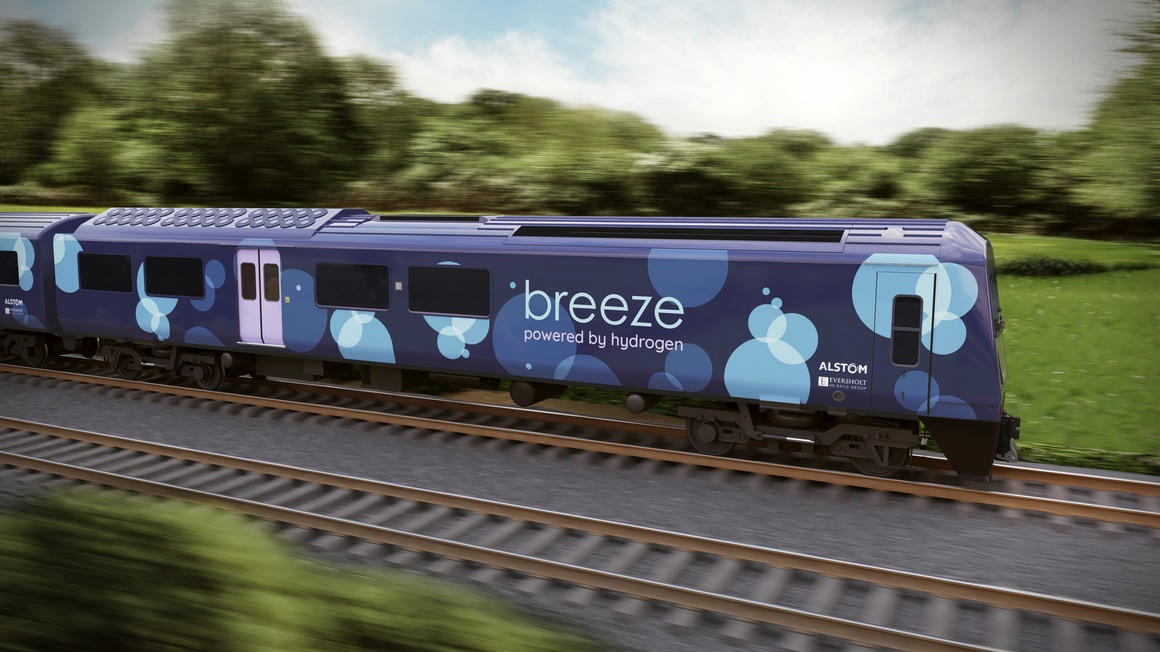
Note how half the side of the front car of the train is blocked in because it is full of the hydrogen tank. As this Driver Car is twenty metres long, each hydrogen tank must be almost seven metres long. If it was one larger tank, then it could be longer and perhaps up to fourteen metres long.
Batteries
As the Rail Business article said, that the batteries are underfloor, I wouldn’t be surprised to see all cars having a battery pack.
I favour this layout, as if cars all are motored, it must cut the length of cabling and reduce electrical losses.
Effectively, it creates a train with the following.
- Faster acceleration
- Smooth, fast deceleration.
- Efficient braking
- Low energy losses.
It should also add up to a train with good weight distribution and high efficiency.
Hydrogen Fuel Cells
In the Class 321 Breeze, Alstom are quoted as having three banks of fuel cell on the roof of each driver car.
This would distribute the power derived from hydrogen to both ends of the train
Hydrogen For Hydrogen Trains
Alstom’s Coradia iLint trains do not have a custom-design of hydrogen system, but over the last few years green hydrogen systems have started to be supplied by companies including ITM Power from Rotherham. Recently, they have supplied the hydrogen system for the hydrogen-powered Van Hool Exqui-City tram-buses in Pau in France. A similar system could be used to refuel a fleet of Breeze trains.
It looks like we have a limited number of hydrogen-powered trains and their fuel could be made available, but not enough to replace all of the UK’s small diesel trains, if we rely on Class 321 Breeze trains.
So there will be a need to build some more.
My Design Of Hydrogen Train
I would start with the Aventra design.
- It is very much Plug-and-Play, where different types of cars can be connected together.
- Cars can be any convenient length.
- Some Aventras, like the Class 345 trains for Crossrail are even two half-trains.
- There are various styles of interior.
- The Aventra appears to be a very efficient train, with good aerodynamics and a very modern traction system with regenerative braking.
- Driver, pantograph, trailer and motor cars and third-rail equipment are available.
- Battery cars have probably been designed.
- For good performance, Aventras tend to have a high proportion of motored cars.
- Aventras have been designed, so that power components can be distributed around the train, so that as much space as possible is available for passengers.
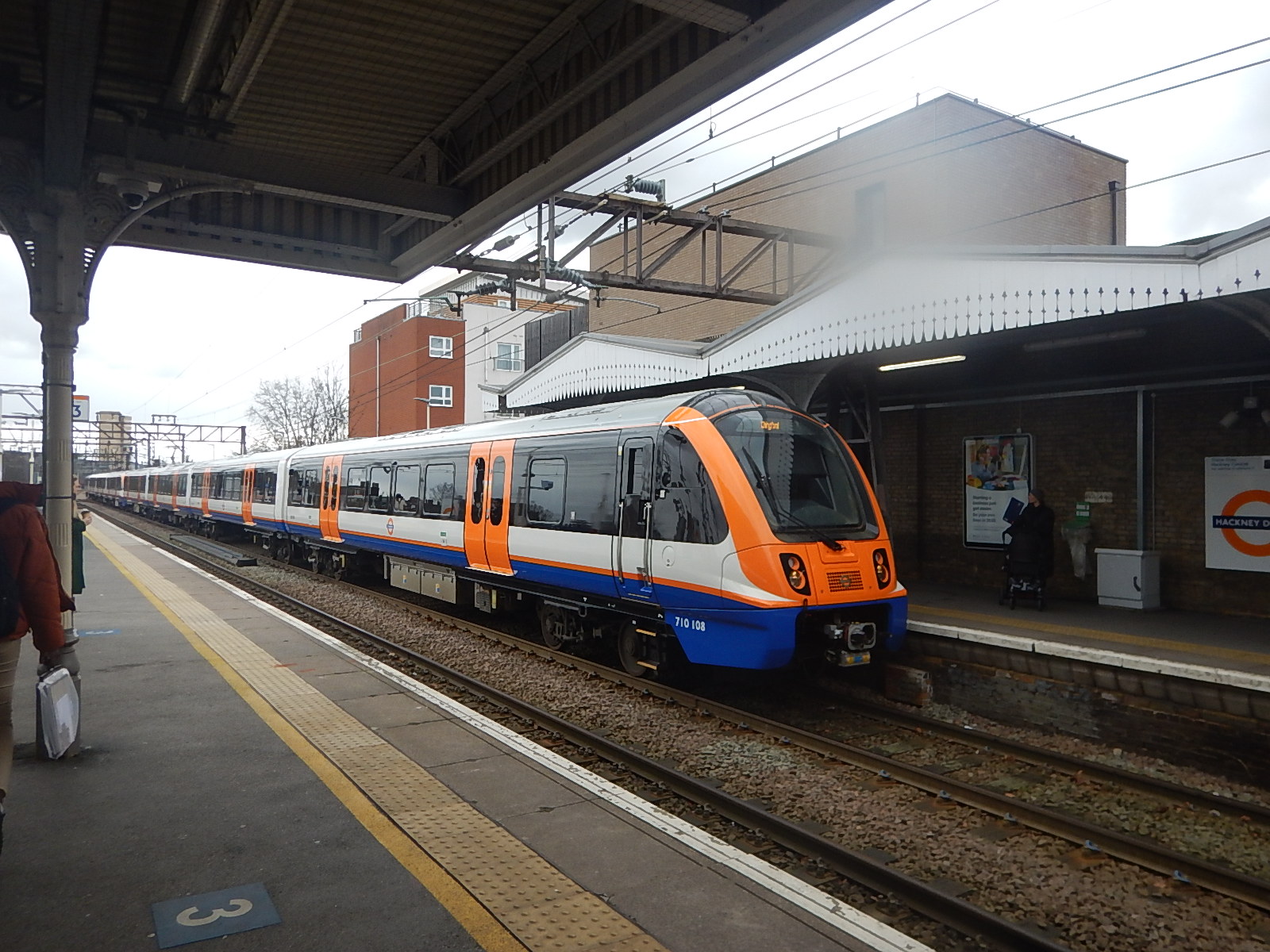
This picture shows a four-car Class 710 train, which is an Aventra.
In the next sub-sections I will fill out the design.
Train Layout
Perhaps, a hydrogen-powered train could be five cars and consist of these cars.
- Driver Motor Car
- Trailer or Motor Car
- Hydrogen Tank Car
- Trailer or Motor Car
- Driver Motor Car
Equipment would be arranged as followed.
- I would put the hydrogen tank in the middle car. Stadler have been very successful in putting a power car in the middle and it could be the ideal car for some of the important equipment.
- As I said earlier, I would put batteries under all cars.
- Regenerative braking and electrification would be used to charge the batteries.
- I think, I would put the hydrogen fuel cells in Alstom’s position on the rear part of the roof of the driver cars.
- There would also be a need to add a pantograph, so that could go on any convenient car!
- I do wonder, if the middle-car could be developed into a mini-locomotive with a walkway through, like the PowerCar in a Stadler Class 755 train.
There’s certainly a lot of possibilities on how to layout the various components.
Passenger Capacity
The five-car hydrogen-powered Aventra, I have detailed is effectively a four-car Aventra like a Class 710 train, with a fifth hydrogen tank car in the middle.
So the passenger capacity will be the same as a four-car Aventra.
The Class 710 trains have longitudinal seating, as these pictures of the interior show.
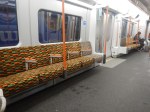
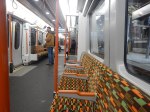
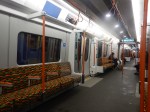
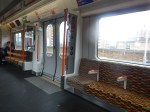
They have a capacity of 189 sitting and 489 standing passengers or a total capacity of 678.
Greater Anglia’s Class 720 trains have transverse seating and a five-car train holds 540 sitting and 145 standing passengers.
Multiplying by 0.8 to adjust for the hydrogen car and the capacity would be 432 sitting and116 standing passengers or a total capacity of 548.
Seats in various UK four-car electric multiple units are as follows.
- Class 319 – 319
- Class 321 – 309
- Class 375 – 236
- Class 379 – 209
- Class 380 – 265
- Class 385 – 273
- Class 450 – 264
It would appear that a five-car hydrogen-powered Aventra, with one car taken up by a hydrogen tank and other electrical equipment can carry a more than adequate number of passengers.
Extra Passenger Capacity
Suppose to eliminate diesel on a route, a five-car Class 802 train were to be replaced with a six-car hydrogen-powered Aventra, which contained five passenger cars
- The capacity of the Class 802 train is 326 seats, which still compares well with the five-car hydrogen-powered Aventra.
- The extra car would increase the passenger capacity.
As Aventras are of a Plug-and-Play design, extra cars would be added as needed.
Maximum Length
Aventras tend to have lots of powered axles, as this improves accelerations and braking, so I suspect that trains with four or five cars on either side of the hydrogen car would be possible.
Nine-car trains could be ideal for replacing trains like Class 800 bi-mode trains to reduce the number of diesel trains. The Class 800 trains would then be converted to Class 801 electric trains or a new battery/electric version.
A Walkway Through The Hydrogen Car
These pictures show the walkway through the PowerCar in a Stadler Class 755 train.
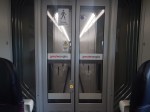
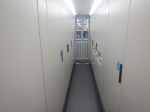
I’m sure that an elegant design of walkway can be created.
In-Cab Digital Signalling
It goes without saying, that the train would be capable of being fitted with in-cab digital signalling.
Performance On Electrification
Bombardier have stated that they have a design for a 125 mph bi-mode Aventra. They might even have designed the trains to achieve 140 mph running on routes with full in-cab digital signalling.
These electrified lines are likely to be able to support 140 mph running with full in-cab digital signalling.
- East Coast Main Line
- Great Western Main Line
- Midland Main Line
- West Coast Main Line
As these hydrogen-powered Aventras may need to run on these high speed electrified lines, I would design the trains so that they could achieve the design speed of these lines, when using the electrification.
This would enable the trains to keep out of the way of the numerous 140 mph electric expresses.
Performance On Batteries And Hydrogen
Hydrogen-powered trains are essentially battery-electric trains, which have the ability to top up the batteries using hydrogen power.
I would suspect that a well-designed hydrogen/battery/electric train should have the same maximum speed on all modes of power, subject to the capabilities of the track and having sufficient power in the batteries to accelerate as required.
The Complete Package
As Hydrogen filling stations from companies like ITM Power and others, that can refuel hydrogen-powered trains are a reality, I’m certain, that it would be possible to create a package solution for a railway company that needed the complete solution.
Different Gauges
If you take a country like Malawi, Malawi Railways looks to need improvement.
They have a three-foot six-inch gauge railway, so could a package of narrower hydrogen-powered Aventras and a solar-powered hydrogen-generator be put together to improve Malawi’s railways?
In When Do Mark 2 Coaches Accept The Inevitable?, I discuss how British Rail Mark 2 coaches were converted from UK loading gauge to one that would work with New Zealand’s 1067 mm. gauge.
So I suspect that a design related to trains built for the UK could be modified for running on the narrow gauge lines of Africa, Australia and New Zealand.
Conclusion
I think it would be possible to design a hydrogen/battery/electric train based on an Aventra with the following characteristics.
- Up to eleven cars
- A hydrogen car with a hydrogen tank in the middle of the train.
- Ability to use 25 KVAC overhead or 750 VDC third-rail electrification.
- In-cab digital signalling
- 140 mph running where the route allows.
- Regenerative braking to batteries.
- Sufficient range on hydrogen power.
- Sophisticated computer control, that swaps mode automatically.
The train would be possible to run the following routes, if configured appropriately.
- Kings Cross and Aberdeen
- Kings Cross and Inverness
- Kings Cross and Cleethorpes via Lincoln and Grimsby
- Kings Cross and Redcar via Middlesbrough
- Kings Cross and Norwich via Cambridge
- Paddington and Penzance
- Paddington and Swansea
- Waterloo and Exeter via Basingstoke
Some routes might need a section of fill-in electrification, but most routes should be possible with a hydrogen fill-up at both ends.
Plan To Reopen Maid Marian Train Line Takes Step Forward
The title of this post is the same as that of this article on Nottinghamshire Live.
This is the introduction to the article.
A long-awaited plan to reopen the disused Maid Marian line for passenger trains has progressed.
It is hoped the train line could link with the proposed HS2 station at Toton, meaning travellers in Kirkby and Sutton could access the high-speed route.
I wrote about this route before in After The Robin Hood Line Will Nottingham See The Maid Marian Line?
This was one of my comments on the Maid Marian Line.
But the clincher is that it would provide connectivity for HS2 all the way from Worksop and Mansfield to Lincoln and Grimsby.
HS2 is needed, but we must make sure that the benefits of the line are spread to all parts of the country.
With High Speed Two under way, we should make sure that we provide maximum connectivity to the new high speed route.
In the case of the Maid Marian Line between the East Midland Hub station on High Speed Two and Grimsby, Lincoln, Mansfield and Worksop, I’m sure Hitachi or another manfacturer can design a 100 mph zero-carbon train to speed travellers through the Nottinghamshire countryside.
Castlefield Corridor Trade-Off Plan For Fewer Trains
The title of this post is the same as that of this article on Rail Magazine.
The article says that to solve the problems through the Castlefield Corridor, the number of trains will be reduced from 15 trains per hour (tph) to thirteen tph.
This arrangement applied until May 2018 and meant that two tph between Manchester Airport and East of the Pennines reversed in Manchester Piccadilly station to go East, rather than using the Castlefield Corridor through Deansgate and Manchester Victoria stations.
The arrangement worked well before May 2018 and I doubt there’s no reason, why it won’t work in the short-term.
The long-term solution is Northern Powerhouse Rail and/or High Speed Two, which looks like will be in tunnel between the Airport and Manchester City Centre and could carry as many as six tph between Manchester and Liverpool via the Airport.
Perhaps, this should be the first piece of High Speed Two to be built in the North.
- It connects the three most important economic areas in the North West of England; Liverpool, Manchester and Manchester Airport.
- It would greatly increase capacity.
- It would probably have good connections to Crewe, Warrington, Wigan and the West Coast Main Line.
- Liverpool has an extensive local rail network, which is being expanded.
- Manchester is expanding the Metrolink network.
Some of the Castlefield Corridor services would have been replaced by better and faster services.
Are Hitachi Designing the Ultimate Battery Train?
In Sparking A Revolution, a post based on an article of the same name in Issue 898 of Rail Magazine, I repeated this about the specification of Hitachi UK Battery Train Specification.
- Range – 55-65 miles
- Performance – 90-100 mph
- Recharge – 10 minutes when static
- Routes – Suburban near electrified lines
- Battery Life – 8-10 years
Does this mean that the train can do 55-65 miles cruising at 90-100 mph?
How Much Energy Is Needed To Accelerate A Five-Car Class 800 Train To Operating Speed?
I will do my standard calculation.
- Empty train weight – 243 tonnes (Wikipedia for Class 800 train!)
- Passenger weight – 302 x 90 Kg (Includes baggage, bikes and buggies!)
- Train weight – 270.18 tonnes
Using Omni’s Kinetic Energy Calculator, the kinetic energy at various speeds are.
- 60 mph – 27 kWh
- 80 mph – 48 kWh
- 90 mph – 61 kWh
- 100 mph – 75 kWh
- 125 mph – 117 kWh – Normal cruise on electrified lines.
- 140 mph – 147 kWh – Maximum cruise on electrified lines.
Because the kinetic energy of a train is only proportional to the weight of the train, but proportional to the square of the speed, note how the energy of the train increases markedly after 100 mph.
Are these kinetic energy figures a reason, why Hitachi have stated their battery train will have an operating speed of between 90 and 100 mph?
A 100 mph cruise would also be very convenient for a lot of main lines, that don’t have electrification in the UK.
What Battery Size Would Be Needed?
In How Much Power Is Needed To Run A Train At 125 mph?, I calculated that a five-car Class 801 electric train, needed 3.42 kWh per vehicle-mile to maintain 125 mph.
For comparison, an InterCity 125 train, had a figure of 2.83 kWh per vehicle-mile.
Hitachi are redesigning the nose of the train for the new Class 810 train and I suspect that these trains can achieve somewhere between 1.5 and 3 kWh per vehicle-mile, if they are cruising at 100 mph.
Doing the calculation for various consumption levels gives the following battery capacity for a five-car train to cruise 65 miles at 100 mph
- 1.5 kWh per vehicle-mile – 487 kWh
- 2 kWh per vehicle-mile – 650 kWh
- 2.5 kWh per vehicle-mile – 812.5 kWh
- 3 kWh per vehicle-mile – 975 kWh
These figures don’t include any energy for acceleration to line speed from the previous stop or station, but they would cope with a deceleration and subsequent acceleration, after say a delay caused by a slow train or other operational delay, by using regenerative braking to the battery.
The energy needed to accelerate to operating speed, will be as I calculated earlier.
- 90 mph – 61 kWh
- 100 mph – 75 kWh
As the battery must have space to store the regenerative braking energy and it would probably be prudent to have a ten percent range reserve, I can see a battery size for a train with an energy consumption of 2 kWh per vehicle-mile, that needed to cruise at 100 mph being calculated as follows.
- Energy for the cruise – 650 kWh
- 10% reserve for cruise – 65 kWh
- Braking energy from 100 mph – 75 kWh
This gives a total battery size of 790 kWh, which could mean that 800 kWh would be convenient.
Note that each of the three MTU 12V 1600 diesel engines, fitted to a Class 800 train, each weigh around two tonnes.
In Innolith Claims It’s On Path To 1,000 Wh/kg Battery Energy Density, I came to these conclusions.
- Tesla already has an energy density of 250 Wh/Kg.
- Tesla will increase this figure.
- By 2025, the energy density of lithium-ion batteries will be much closer to 1 KWh/Kg.
- Innolith might achieve this figure. But they are only one of several companies aiming to meet this magic figure.
Suppose two of the MTU 12V 1600 diesel engines were each to be replaced by a two tonne battery, using Tesla’s current energy density, this would mean the following.
- Each battery would have a capacity of 500 kWh.
- The train would have one MWh of installed battery power.
- This is more than my rough estimate of power required for a 65 mile trip.
- The train would have little or no weight increase.
- I also wouldn’t be surprised to find that the exchange of a diesel engine for a battery was Plug-and-Play.
Hitachi would have an electric/battery/diesel tri-mode train capable of the following.
- Range – 55-65 miles
- Out and Back Range – about 20-30 miles
- Performance – 90-100 mph
- Recharge – 10 minutes when static
- Emergency diesel engine.
I feel it would be a very useful train.
Trains That Could Be Fitted With Batteries
The original article in Rail Magazine says this.
For the battery project, positive discussions are taking place with a number of interested parties for a trial, with both Class 385s and Class 800s being candidates for conversion.
So this means that the following operators will be able to use Hitachi’s battery technology o their trains.
- Avanti West Coast – Class 80x trains
- First East Coast Trains – Class 80x trains
- East Midlands Railway – Class 80x trains
- GWR – Class 80x trains
- Hull Trains – Class 80x trains
- LNER – Class 80x trains
- ScotRail – Class 385 trains
- TransPennine Express – Class 80x trains
Although, I based my calculations on Class 80x trains, I suspect that the methods can be applied to the smaller Class 385 trains.
Possible Out-And-Back Journeys
These are possible Out-And-Back journeys, that I believe Hitachi’s proposed battery-electric trains could handle.
- Edinburgh and Tweedbank – 30 miles from Newcraighall
- London Paddington and Bedwyn – 30 miles from Reading
- London Euston and Blackburn – 12 miles from Preston
- London Kings Cross and Bradford – < 27 miles from Leeds
- London Euston and Chester – 21 miles from Crewe
- London Kings Cross and Harrogate – <18 miles from Leeds
- London Kings Cross and Huddersfield – 17 miles from Leeds
- London St. Pancras and Leicester – 16 miles from Market Harborough
- London Kings Cross and Lincoln – 17 miles from Newark
- London St. Pancras and Melton Mowbray – 26 miles from Corby
- London Kings Cross and Middlesbrough – 20 miles from Northallerton
- London Kings Cross and Nottingham – 20 miles from Newark
- London Paddington and Oxford – 10 miles from Didcot
- London Kings Cross and Redcar – 29 miles from Northallerton
- London Kings Cross and Rotherham- 14 miles from Doncaster
- London Kings Cross and Sheffield – 20 miles from Doncaster
- London and Weston-super-Mare – 19 miles from Bristol
Note.
- Provided that the Out-And-Back journey is less than about sixty miles, I would hope that these stations are comfortably in range.
- Leicester is the interesting destination, which would be reachable in an Out-And-Back journey. But trains from the North stopping at Leicester would probably need to charge at Leicester.
- I have included Blackburn as it could be a destination for Avanti West Coast.
- I have included Melton Mowbray as it could be a destination for East Midlands Railway.
- I have included Nottingham, Rotherham and Sheffield as they could be destinations for LNER. These services could prove useful if the Midland Main Line needed to be closed for construction works.
- I’m also fairly certain, that no new electrification would be needed, although every extra mile would help.
- No charging stations would be needed.
I suspect, I’ve missed a few possible routes.
Possible Journeys Between Two Electrified Lines
These are possible journeys between two electrified lines, that I believe Hitachi’s proposed battery-electric trains could handle.
- London St. Pancras and Eastbourne via Hastings – 25 miles between Ashford and Ore.
- Leeds and York via Garforth – 20 miles between Neville Hall and Colton Junction
- London Kings Cross and Norwich via Cambridge – 54 miles between Ely and Norwich.
- Manchester Victoria and Leeds via Huddersfield – 43 miles between Manchester Victoria and Leeds.
- Preston and Leeds via Hebden Bridge – 62 miles between Preston and Leeds.
- Newcastle and Edinburgh – Would battery-electric trains get round the well-publicised power supply problems on this route?
Note.
- I am assuming that a range of 65 miles is possible.
- If the trains have a diesel-generator set, then this could be used to partially-charge the battery in places on the journey.
- Leeds and York via Garforth has been scheduled for electrification for years.
- Preston and Leeds via Hebden Bridge would probably need some diesel assistance.
- London Kings Cross and Norwich via Cambridge is a cheeky one, that Greater Anglia wouldn’t like, unless they ran it.
- As before no new electrification or a charging station would be needed.
I suspect, I’ve missed a few possible routes.
Possible Out-And-Back Journeys With A Charge At The Destination
These are possible Out-And-Back journeys, that I believe Hitachi’s proposed battery-electric trains could handle, if the batteries were fully charged at the destination.
- Doncaster and Cleethorpes – 52 miles from Doncaster.
- London Paddington and Cheltenham – 42 miles from Swindon
- London Kings Cross and Cleethorpes via Lincoln – 64 miles from Newark
- London Euston and Gobowen – 46 miles from Crewe
- London Euston and Wrexham – 33 miles from Crewe
- London Kings Cross and Hull – 45 miles from Selby
- London Kings Cross and Shrewsbury – 30 miles from Wolverhampton
- London Kings Cross and Sunderland 41 miles from Northallerton
- London Paddington and Swansea – 46 miles from Cardiff
- London Paddington and Worcester – 67 miles from Didcot Parkway
- London St. Pancras and Derby – 46 miles from Market Harborough
- London St. Pancras and Nottingham – 43 miles from Market Harborough
Note.
- I am assuming that a range of 65 miles is possible.
- If the trains have a diesel-generator set, then this could be used to partially-charge the battery in places on the journey.
- I am assuming some form of charging is provided at the destination station.
- As before no new electrification would be needed.
I suspect, I’ve missed a few possible routes.
Midland Main Line
The Midland Main Line could possibly be run between London St. Pancras and Derby, Nottingham and Sheffield without the use of diesel.
Consider.
- The route will be electrified between London St. Pancras and Market Harborough.
- In connection with High Speed Two, the Midland Main Line and High Seed Two will share an electrified route between Sheffield and Clay Cross North Junction.
- London St. Pancras and Derby can be run with a charging station at Derby, as Market Harborough and Derby is only 46 miles.
- London St. Pancras and Nottingham can be run with a charging station at Nottingham, as Market Harborough and Nottingham is only 43 miles.
- The distance between Clay Cross North Junction and Market Harborough is 67 miles.
- The distance between Sheffield and Leeds is 38 miles.
It looks to me that the range of East Midlands Railway’s new Class 810 trains, will be a few miles short to bridge the gap on batteries, between Clay Cross North Junction and Market Harborough station, but Leeds and Sheffield appears possible, once Sheffield has been electrified.
There are several possible solutions to the Clay Cross North and Market Harborough electrification gap.
- Fit higher capacity batteries to the trains.
- Extend the electrification for a few miles North of Market Harborough station.
- Extend the electrification for a few miles South of Clay Cross North Junction.
- Stop at Derby for a few minutes to charge the batteries.
The route between Market Harborough and Leicester appears to have been gauge-cleared for electrification, but will be difficult to electrify close to Leicester station. However, it looks like a few miles can be taken off the electrification gap.
Between Chesterfield and Alfriston, the route appears difficult to electrify with tunnels and passig through a World Heritage Site.
So perhaps options 1 and 2 together will give the trains sufficient range to bridge the electrification gap.
Conclusion On The Midland Main Line
I think that Hitachi, who know their trains well, must have a solution for diesel-free operation of all Midland Main Line services.
It also looks like little extra electrification is needed, other than that currently planned for the Midland Main Line and High Speed Two.
North Wales Coast Line
If you look at distance along the North Wales Coast Line, from the electrification at Crewe, you get these values.
- Chester – 21 miles
- Rhyl – 51 miles
- Colwyn Bay – 61 miles
- Llandudno Junction – 65 miles
- Bangor – 80 miles
- Holyhead – 106 miles
It would appear that Avanti West Coast’s new AT-300 trains, if fitted with batteries could reach Llandudno Junction station, without using diesel.
Electrification Between Crewe And Chester
It seems to me that the sensible thing to do for a start is to electrify the twenty-one miles between Crewe and Chester, which has been given a high priority for this work.
With this electrification, distances from Chester are as follows.
- Rhyl – 30 miles
- Colwyn Bay – 40 miles
- Llandudno Junction – 44 miles
- Bangor – 59 miles
- Holyhead – 85 miles
Electrification between Crewe and Chester may also open up possibilities for more electric and battery-electric train services.
But some way will be needed to charge the trains to the West of Chester.
Chagring The Batteries At Llandudno Junction Station
This Google Map shows Llandudno Junction station.
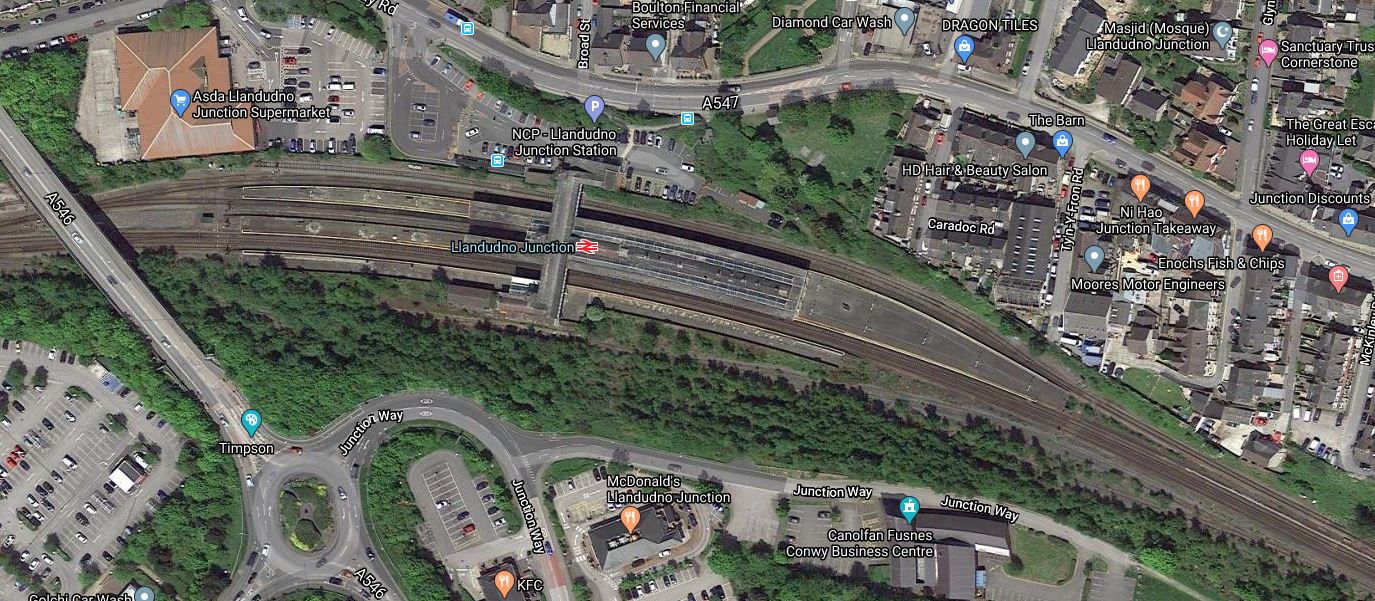
Note.
- It is a large station site.
- The Conwy Valley Line, which will be run by battery Class 230 trains in the future connects at this station.
- The Class 230 train will probably use some of Vivarail’s Fast Charging systems, which use third-rail technology, either at the ends of the branch or in Llandudno Junction station.
The simplest way to charge the London Euston and Holyhead train, would be to build a charging station at Llandudno Junction, which could be based on Vivarail’s Fast Charging technology or a short length of 25 KVAC overhead wire.
But this would add ten minutes to the timetable.
Could 25 KVAC overhead electrification be erected for a certain distance through the station, so that the train has ten minutes in contact with the wires?
Looking at the timetable of a train between London Euston and Holyhead, it arrives at Colwyn Bay station at 1152 and leaves Llandudno Junction station at 1200.
So would it be possible to electrify between the two stations and perhaps a bit further?
This Google Map shows Colwyn Bay Station,
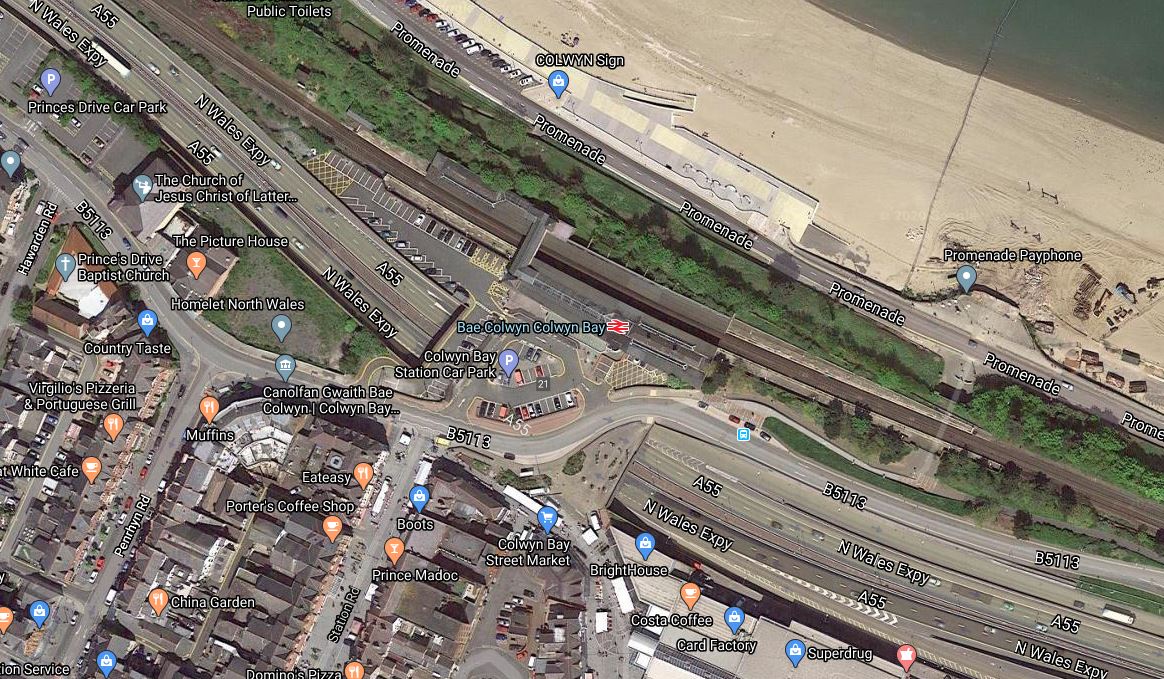
Note how the double-track railway is squeezed between the dual-carriageway of the A55 North Wales Expressway and the sea.
The two routes follow each other close to the sea, as far as Abegele & Pensarn station, where the Expressway moves further from the sea.
Further on, after passing through more caravans than I’ve ever seen, there is Rhyl station.
- The time between arriving at Rhyl station and leaving Llandudno Junction station is nineteen minutes.
- The distance between the two stations is fourteen miles.
- Rhyl and Crewe is fifty-one miles.
- Llandudno Junction and Holyhead is forty-one miles.
It would appear that if the North Wales Coast Line between Rhyl and Llandudno Junction is electrified, that Hitachi’s proposed battery trains can reach Holyhead.
The trains could even changeover between electrification and battery power in Rhyl and Llandudno Junction stations.
I am sure that electrifying this section would not be the most difficult in the world, although the severe weather sometimes encountered, may need some very resilient or innovative engineering.
It may be heretical to say so, but would it be better if this section were to be electrified using proven third-rail technology.
West of Llandudno Junction station, the electrification would be very difficult, as this Google Map of the crossing of the River Conwy shows.
I don’t think anybody would want to see electrification around the famous castle.
Electrification Across Anglesey
Llanfairpwll station marks the divide between the single-track section of the North Wales Coast Line over the Britannia Bridge and the double-track section across Anglesey.
From my virtual helicopter, the route looks as if, it could be fairly easy to electrify, but would it be necessary?
- Llandudno Junction and Holyhead is forty-one miles, which is well within battery range.
- There is surely space at Holyhead station to install some form of fast-charging system.
One problem is that trains seem to turn round in only a few minutes, which may not be enough to charge the trains.
So perhaps some of the twenty-one miles between Llanfairpwll and Holyhead should be electrified.
London Euston And Holyhead Journey Times
Currently, trains take three hours and forty-three minutes to go between London Euston and Holyhead, with these sectional timings.
- London Euston and Crewe – One hour and thirty-nine minutes.
- Crewe and Holyhead – Two hours and four minutes.
The big change would come, if the London Euston and Crewe leg, were to be run on High Speed Two, which will take just fifty-five m,inutes.
This should reduce the London Euston and Holyhead time to just under three hours.
Freight On The North Wales Coast Line
Will more freight be seen on the North Wales Coast Line in the future?
The new tri-mode freight locomotives like the Class 93 locomotive, will be able to take advantage of any electrification to charge their batteries, but they would probably be on diesel for much of the route.
Conclusion On The North Wales Coast Line
Short lengths of electrification, will enable Avanti West Coast’s AT-300 trains, after retrofitting with batteries, to run between Crewe and Holyhead, without using any diesel.
I would electrify.
- Crewe and Chester – 21 miles
- Rhyl and Llandudno Junction – 14 miles
- Llanfairpwll and Holyhead – 21 miles
But to run battery-electric trains between London Euston and Holyhead, only Rhyl and Llandudno Junction needs to be electrified.
All gaps in the electrification will be handled on battery power.
A Selection Of Possible Battery-Electric Services
In this section, I’ll look at routes, where battery-electric services would be very appropriate and could easily be run by Hitachi’s proposed battery-electric trains.
London Paddington And Swansea
Many were disappointed when Chris Grayling cancelled the electrification between Cardiff and Swansea.
I went along with what was done, as by the time of the cancellation, I’d already ridden in a battery train and believed in their potential.
The distance between Cardiff and Swansea is 46 miles without electrification.
Swansea has these services to the West.
- Carmarthen – 32 miles
- Fishguard – 73 miles
- Milford Haven 71 miles
- Pembroke Dock – 73 miles
It looks like, three services could be too long for perhaps a three car battery-electric version of a Hitachi Class 385 train, assuming it has a maximum range of 65 miles.
But these three services all reverse in Carmarthen station.
So perhaps, whilst the driver walks between the cabs, the train can connect automatically to a fast charging system and give the batteries perhaps a four minute top-up.
Vivarail’s Fast Charging system based on third-rail technology would be ideal, as it connects automatically and it can charge a train in only a few minutes.
I would also electrify the branch between Swansea and the South Wales Main Line.
This would form part of a fast-charging system for battery-trains at Swansea, where turnround times can be quite short.
I can see a network of battery-electric services developing around Swansea, that would boost tourism to the area.
Edinburgh And Tweedbank
The Borders Railway is electrified as far as Newcraighall station and the section between there and Tweedbank is thirty miles long.
I think that a four-car battery-electric Class 385 train could work this route.
It may or may not need a top up at Tweedbank.
The Fife Circle
The Fife Circle service from Edinburgh will always be difficult to electrify, as it goes over the Forth Rail Bridge.
- The Fife Circle is about sixty miles long.
- Plans exist for a short branch to Leven.
- The line between Edinburgh and the Forth Rail Bridge is partly electrified.
I believe that battery-electric Class 385 train could work this route.
London Kings Cross and Grimsby/Cleethorpes via Lincoln
The Cleethorpes/Grimsby area is becoming something of a renewable energy powerhouse and I feel that battery trains to the area, might be a significant and ultimately profitable statement.
LNER recently opened a six trains per day service to Lincoln.
Distances from Newark are as follows.
- Lincoln – 17 miles
- Grimsby – 61 miles
- Cleethorpes – 64 miles
A round trip to Lincoln can probably be achieved on battery alone with a degree of ease, but Cleethorpes and Grimsby would need a recharge at the coast.
Note that to get to the Cleethorpes/Grimsby area, travellers usually need to change at Doncaster.
But LNER are ambitious and I wouldn’t be surprised to see them dip a toe in the Cleethorpes/Grimsby market.
The LNER service would also be complimented by a TransPennine Express service from Manchester Airport via Sheffield and Doncaster, which could in the future be another service run by a Hitachi battery train.
There is also a local service to Barton-on-Humber, which could be up for improvement.
London Waterloo And Exeter
This service needs to go electric, if South Western Railway is going to fully decarbonise.
But third-rail electrification is only installed between Waterloo and Basingstoke.
Could battery-electric trains be used on this nearly two hundred mile route to avoid the need for electrification.
A possible strategy could be.
- Use existing electrification, as far as Basingstoke – 48 miles
- Use battery power to Salisbury – 83 miles
- Trains can take several minutes at Salisbury as they often split and join and change train crew, so the train could be fast-charged.
- Use battery power to the Tisbury/Gillingham/Yeovil/Crewkerne area, where trains would be charged – 130 miles
- Use battery power to Exeter- 172 miles
Note.
- The miles are the distance from London.
- The charging at Salisbury could be based on Vivarail’s Fast-Charging technology.
- The charging around Yrovil could be based on perhaps twenty miles of third-rail electrification, that would only be switched on, when a train is present.
I estimate that there could be time savings of up to fifteen minutes on the route.
To Be Continued…
A Fixed Link To Northern Ireland
The title of this post is the same as an article in Issue 898 of Rail Magazine, that has been written by Jim Steer, who is a well-known rail engineer.
It is very much a must-read and he is in favour of the link.
- It’s all about reducing carbon footprint of travel between the UK and Ireland.
- The bridge would be rail-only.
- Goods currently sent by truck, would go by rail.
- There would be a 125 mph rail link across Galloway between the bridge and HS2/West Coast Main Line.
- A London and Belfast time of three-and-a-half hours would be possible.
- A frequent Edinburgh and Belfast via Glasgow service would be provided.
- He believes the Northern Ireland rail network should be converted to standard gauge and expanded, so that large areas of Northern Ireland will benefit.
Increasingly, serious people are coming behind this project.
Oakervee Review – Calvert Station
The Oakervee Review says this on Page 53, about a new station at Calvert in Buckinghamshire.
The Review also heard evidence from a number of informed stakeholders suggesting there should be a new station near Calvert, where HS2 would cross East-West Rail proposals to improve connectivity along the OxfordCambridge corridor. Previously, due to the impact on speed, no interim station had been planned between London and Birmingham Interchange.
The Review concluded that the DfT should consider making passive provision for a future HS2 station near to Calvert. If it is decided that a HS2 station should be built near to Calvert, passive provision will help prevent any disruption to HS2 services. There could be merit in developing an HS2 station in the future here if local plans support a significant residential and commercial development in this region, and if there is passenger demand to justify the cost of developing a station here. Without this coordinated planning, the experience of HS1 stations risks being repeated. The Review notes that the cost of developing a future station near Calvert could be shared with others including potentially the East West Rail Company.
I must admit, that I like the concept of a new station at Calvert.
Read The Oakervee Review
I’ve just read most of the Oakervee Review.
Click this link to read the pdf.
It contains a lot of interesting detail in the 130 pages
I shall be commenting in detail later.
 The Anonymous Widower