Beeching Reversal – Charfield Station
This is one of the Beeching Reversal projects that the Government and Network Rail are proposing to reverse some of the Beeching cuts.
Wikipedia says this about the Proposed Reopening of Charfield station.
Services between Bristol and Birmingham pass through Charfield. There have been discussions about the viability of reopening the station. The costs would be shared between Gloucestershire and South Gloucestershire councils since, although the station would be in South Gloucestershire, the nearby town of Wotton-under-Edge would be a principal beneficiary.
This Google Map shows the village with the Bristol and Birmingham Line passing through.
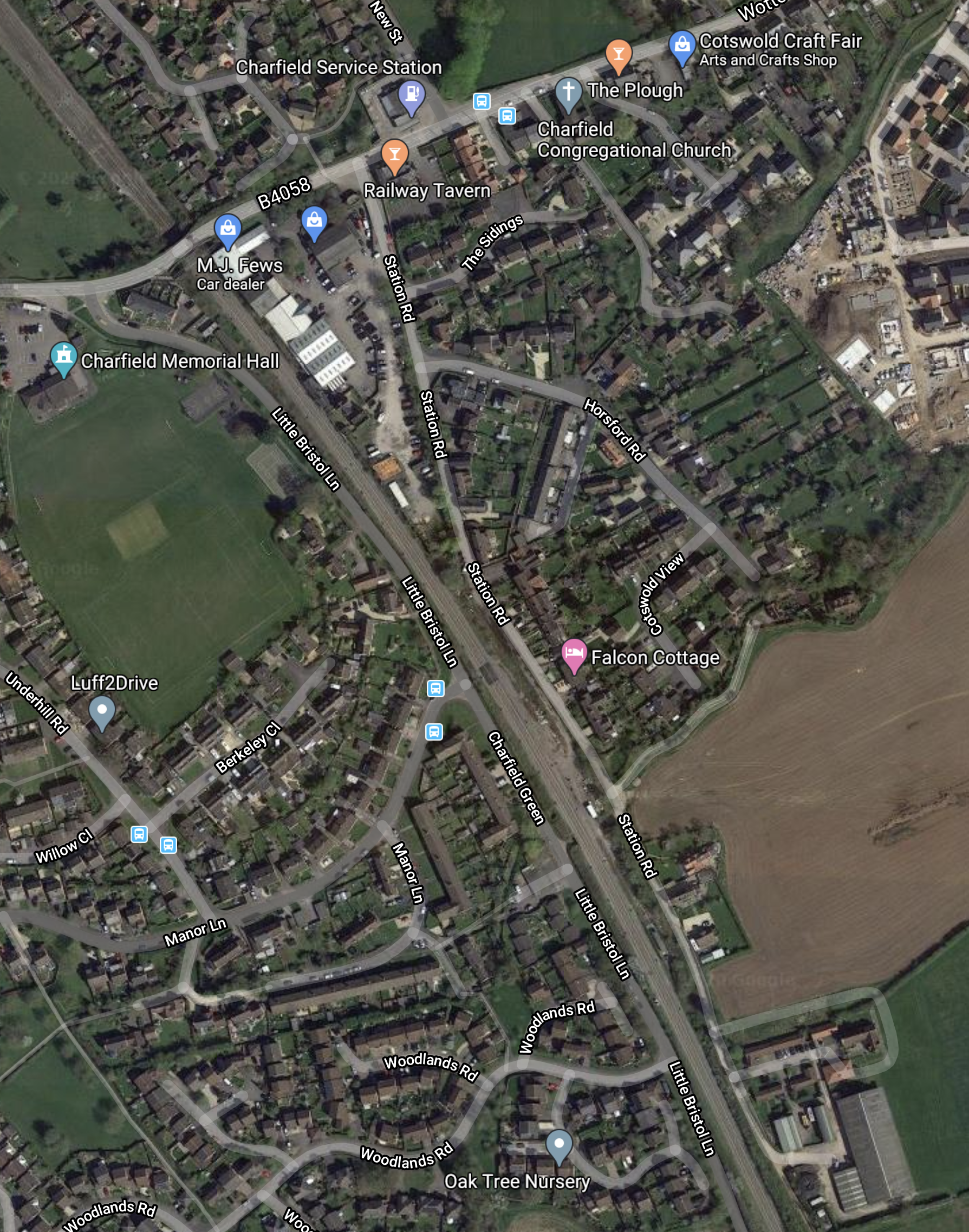
Note, that the road running down the East side of the railway is called Station Road.
There appear to be these services running through the location.
- CrossCountry – Plymouth and Edinburgh/Glasgow via Bristol Temple Meads, Bristol Parkway, Cheltenham Spa and Birmingham New Street
- CrossCountry – Exeter St. Davids and Manchester Piccadilly via Bristol Temple Meads, Bristol Parkway, Cheltenham Spa and Birmingham New Street
- GWR – Great Malvern and Westbury via Bristol Temple Meads, Bristol Parkway, Gloucester and Cheltenham Spa
Note.
All services appear to be hourly.
Bristol Parkway station is thirteen miles away by rail, so is an easy drive, but a very stiff walk or cycle.
Timings by rail from Charfield based on passing GWR trains include.
- Bristol Parkway – 15 minutes
- Bristol Temple Meads – 27 minutes
- Cheltenham Spa – 38 minutes
- Gloucester – 24 minutes
There may be a possibility of improving these times, as the current timetable might have been written for slow trains and a Class 158, Class 165 or Class 166 train can do better.
CrossCountry times include.
- Birmingham New Street – 68 minutes
- Bristol Parkway – 11 minutes
- Bristol Temple Meads – 23 minutes
- Cheltenham Spa – 17 minutes
- Worcestershire Parkway – 32 minutes
I would think, that Charfield station could receive one GWR stopping train and one fast CrossCountry train per hour.
Discontinuous Electrification Between Birmingham And Bristol
Hitachi have changed the rules on electrification, by the announcement of the development of battery electric trains in collaboration with Hyperdrive Innovation, which I wrote about in Hyperdrive Innovation And Hitachi Rail To Develop Battery Tech For Trains.
The proposed train is described in this Hitachi infographic.

It will have a range on battery power of 90 km or 56 miles.
Consider.
- Midlands Connect have ambitions see an extra hourly service between Birmingham and Bristol Temple Meads, with all services running five minutes faster. See Midlands Rail Hub.
- CrossCountry will likely be getting new trains, to replace their exclusively all-diesel fleet. They could be tri-mode trains to make the most of long stretches of electrification on their routes, batteries for short gaps of up to fifty miles and diesel power everywhere else.
- There are electrified stations at Bristol Parkway and possibly Bristol Temple Meads in a few years.
- There is full electrification between Birmingham New Street and Bromsgrove stations.
- Bromsgrove and Bristol Parkway are seventy miles apart.
- There is a possibility, that Cheltenham Spa station will get a charging facility so that London Paddington and Cheltenham Spa services could be run by Class 800 trains converted to battery electric operation.
I don’t think it is an unreasonable prediction to make that Hitachi and other train manufacturers like Stadler with their Class 755 trains, have the technology to run low-carbon services between Bristol Temple Meads and Birmingham New Street stations.
- Trains would leave Bromsgrove and Bristol Parkway with full batteries.
- Quick battery top-ups can be taken at Cheltenham Spa and Worcestershire Parkway stations.
- The fast acceleration of the electric trains will allow extra stops.
I think it would also be possible for GWR to use battery electric Class 387 trains between Great Malvern and Westbury.
Charfield could be an electric train-only station.
Conclusion
The reopening of Charfield station is really a simple station rebuilding and reopening and local passenger forecasts will probably make the decision.
But these forecasts must take into account, the likely partial decarbonisation of the route through the station, which would surely increase ridership.
The new station could also be built with provision for a possible charging facility, in case it might be needed in the future.
Electrifying Wales
I would not be surprised to learn that Wales wants to decarbonise their railways.
At present, Wales only has the following electrified railways either in operation or under construction.
- The South Wales Main Line between the Severn Tunnel and Cardiff.
- The South Wales Metro based on local railways around Cardiff and Newport is being created and will be run by electric trains.
There is no more electrification planned in the future.
Hitachi’s Specification For Battery Electric Trains
Recently, Hitachi have released this infographic for their Regional Battery Train.
This gives all the information about the train and a definitive range of 90 km or 56 miles.
The Welsh Rail Network
If you look at the network of services that are run by Transport for Wales Rail Services, they connect a series of hub stations.
Major hubs include the following stations.
- Cardiff Central – Electrified
- Chester
- Hereford
- Shrewsbury
- Swansea
Smaller hubs and termini include the following stations.
- Aberystwyth
- Birmingham International – Electrified
- Birmingham New Street – Electrified
- Blaenau Ffestiniog
- Carmarthen
- Crewe – Electrified
- Fishguard Harbour
- Hereford
- Holyhead
- Llandudno Junction
- Manchester Airport – Electrified
- Manchester Piccadilly – Electrified
- Machynlleth
- Milford Haven
- Newport – Electrified
- Pembroke Dock
Running Welsh Routes With Electric Trains
These routes make up the Welsh rail network.
Chester And Crewe
Consider.
- The route between Chester and Crewe is without electrification.
- Crewe and Chester are 21 miles apart.
I believe that if a battery-electric train, with a range of 56 miles, can leave Chester and Crewe with full batteries, that it will be possible to run between Chester and Crewe stations.
Chester And Holyhead via Llandudno Junction
Consider.
- All services between Llandudno Junction and England call at Chester.
- All services running to and from Holyhead call at Llandudno Junction.
- The route between Chester and Holyhead is without electrification.
- Chester and Llandudno Junction are 54 miles apart.
- Llandudno Junction and Holyhead are 40 miles apart.
I believe that if a battery-electric train with a range of 56 miles can leave Chester, Llandudno Junction and Holyhead with full batteries, that it will be possible to run between Chester and Holyhead stations.
Chester And Liverpool Lime Street
Consider.
- The route between Runcorn and Liverpool Lime Street is electrified.
- The route between Chester and Runcorn is without electrification.
- Chester and Runcorn are 14 miles apart.
I believe that if a battery-electric train, with a range of 56 miles, can leave Chester and Runcorn with full batteries, that it will be possible to run between Chester and Liverpool Lime Street stations.
Chester And Manchester Airport
Consider.
- The route between Warrington Bank Quay and Manchester Airport is electrified.
- The route between Chester and Warrington Bank Quay is without electrification.
- Chester and Warrington Bank Quay are 18 miles apart.
I believe that if a battery-electric train, with a range of 56 miles, can leave Chester and Warrington Bank Quay with full batteries, that it will be possible to run between Chester and Manchester Airport stations.
Chester And Shrewsbury
Consider.
- The route between Chester and Shrewsbury is without electrification.
- Chester and Shrewsbury are 42 miles apart.
I believe that if a battery-electric train with a range of 56 miles, can leave Shrewsbury and Chester with full batteries, that it will be possible to run between Chester and Shrewsbury stations.
Llandudno And Blaenau Ffestiniog
Consider.
- The route between Llandudno and Blaenau Ffestiniog is without electrification.
- Llandudno and Blaenau Ffestiniog are 31 miles apart.
I believe that if a battery-electric train with a range of 56 miles, can leave Llandudno and Blaenau Ffestiniog with full batteries, that it will be possible to run between Llandudno and Blaenau Ffestiniog stations.
Machynlleth And Aberystwyth
Consider.
- The route between Machynlleth and Aberystwyth is without electrification.
- Machynlleth and Aberystwyth are 21 miles apart.
I believe that if a battery-electric train with a range of 56 miles, can leave Machynlleth and Aberystwyth with full batteries, that it will be possible to run between Machynlleth and Aberystwyth stations.
Machynlleth And Pwllheli
Consider.
- The route between Machynlleth and Pwllheli is without electrification.
- Machynlleth and Pwllheli are 58 miles apart.
I believe that if a battery-electric train with a range of upwards of 58 miles, can leave Machynlleth and Pwllheli with full batteries, that it will be possible to run between Machynlleth and Pwllheli stations.
Machynlleth And Shrewsbury
Consider.
- The route between Machynlleth and Shrewsbury is without electrification.
- Machynlleth and Shrewsbury are 61 miles apart.
I believe that if a battery-electric train with a range of upwards of 61 miles, can leave Machynlleth and Shrewsbury with full batteries, that it will be possible to run between Machynlleth and Shrewsbury stations.
Shrewsbury and Birmingham International
Consider.
- The route between Birmingham International and Wolverhampton is electrified.
- The route between Shrewsbury and Wolverhampton is without electrification.
- Shrewsbury and Wolverhampton are 30 miles apart.
I believe that if a battery-electric train, with a range of 56 miles, can leave Shrewsbury and Wolverhampton with full batteries, that it will be possible to run between Shrewsbury and Birmingham International stations.
Shrewsbury And Cardiff Central via Hereford
Consider.
- All services between Cardiff Central and Shrewsbury call at Hereford.
- The route between Cardiff Central and Newport is electrified.
- The route between Newport and Shrewsbury is without electrification.
- Shrewsbury and Hereford are 51 miles apart.
- Hereford and Newport are 44 miles apart.
I believe that if a battery-electric train, with a range of 56 miles, can leave Shrewsbury, Hereford and Newport with full batteries, that it will be possible to run between Shrewsbury and Cardiff Central stations.
Shrewsbury And Crewe
- The route between Shrewsbury and Crewe is without electrification.
- Shrewsbury and Crewe are 33 miles apart.
I believe that if a battery-electric train with a range of upwards of 61 miles, can leave Shrewsbury and Crewe with full batteries, that it will be possible to run between Shrewsbury and Crewe stations.
Shrewsbury and Swansea
Consider.
- The Heart of Wales Line between Shrewsbury and Swansea is without electrification.
- Shrewsbury and Swansea are 122 miles apart.
- Trains cross at Llandrindod and wait for up to eleven minutes, so there could be time for a charge.
- Shrewsbury and Llandrindod are 52 miles apart.
- Swansea and Llandrindod are 70 miles apart.
It appears that another charging station between Swansea and Llandrindod is needed
I believe that if a battery-electric train, with a range of 56 miles, can leave Shrewsbury, Swansea and the other charging station, with full batteries, that it will be possible to run between Shrewsbury and Swansea stations.
Swansea And Cardiff Central
Consider.
- The route between Swansea and Cardiff Central is without electrification.
- Swansea and Cardiff Central are 46 miles apart.
I believe that if a battery-electric train, with a range of 56 miles, can leave Swansea and Cardiff Central with full batteries, that it will be possible to run between Swansea and Cardiff Central stations.
Swansea And Carmarthen
Consider.
- The route between Swansea and Carmarthen is without electrification.
- Swansea and Carmarthen are 31 miles apart.
I believe that if a battery-electric train, with a range of 56 miles, can leave Swansea and Carmarthen with full batteries, that it will be possible to run between Swansea and Carmarthen stations.
Swansea And Fishguard Harbour
Consider.
- The route between Swansea and Fishguard Harbour is without electrification.
- Swansea and Fishguard Harbour are 73 miles apart.
- Tramins could top up the batteries during the reverse at Carmathen.
- Swansea and Carmarthen are 31 miles apart.
- Carmarthen and Fishguard Harbour are 42 miles apart.
I believe that if a battery-electric train, with a range of 56 miles, can leave Swansea, Carmathen and Fishguard Harbour with full batteries, that it will be possible to run between Swansea and Fishguard Harbour stations.
Swansea And Milford Haven
Consider.
- The route between Swansea and Milford Haven is without electrification.
- Swansea and Milford Haven are 72 miles apart.
- Tramins could top up the batteries during the reverse at Carmathen.
- Swansea and Carmarthen are 31 miles apart.
- Carmarthen and Milford Haven are 41 miles apart.
I believe that if a battery-electric train, with a range of 56 miles, can leave Swansea, Carmathen and Milford Haven with full batteries, that it will be possible to run between Swansea and Milford Haven stations.
Swansea And Pembroke Dock
Consider.
- The route between Swansea and Pembroke Dock is without electrification.
- Swansea and Pembroke Dock are 73 miles apart.
- Tramins could top up the batteries during the reverse at Carmathen.
- Swansea and Carmarthen are 31 miles apart.
- Carmarthen and Pembroke Dock are 42 miles apart.
I believe that if a battery-electric train, with a range of 56 miles, can leave Swansea, Carmathen and Pembroke Dock with full batteries, that it will be possible to run between Swansea and Pembroke Dock stations.
Other Routes
I have not covered these routes.
- Borderlands Line
- Cardiff Valley Lines, that will be part of the South Wales Metro
- Routes on the electrified South Wales Main Line, that are to the East of Cardiff.
The first will run between Chester and the electrified Merseyrail system and the others will be electrified, except for short stretches.
Stations Where Trains Would Be Charged
These stations will need charging facilities.
Aberystwyth
Aberystwyth station only has a single terminal platform.
I’ve not been to the station, but looking at pictures on the Internet, I suspect that fitting a charging facility into the station, wouldn’t be the most difficult of engineering problems.
Birmingham International
Birmingham International station is fully-electrified and ready for battery-electric trains.
Blaenau Fflestiniog
Blaenau Ffestiniog station has a single terminal platform.
My comments would be similar to what, I said for Aberystwyth station. I would hope a standard solution can be developed.
Cardiff
Cardiff station is fully-electrified and ready for battery-electric trains.
Chester
Chester station has two through platforms and one bay platform, that are used by Trains for Wales.
- The through platforms are bi-directional.
- The bay platform is used by services from Liverpool Lime Street and Manchester Airport and Piccadilly.
- The station is a terminus for Merseyrail’s electric trains, which use 750 VDC third-rail electrification.
- Some through services stop for up to seven minutes in the station.
This Google Map shows the station.
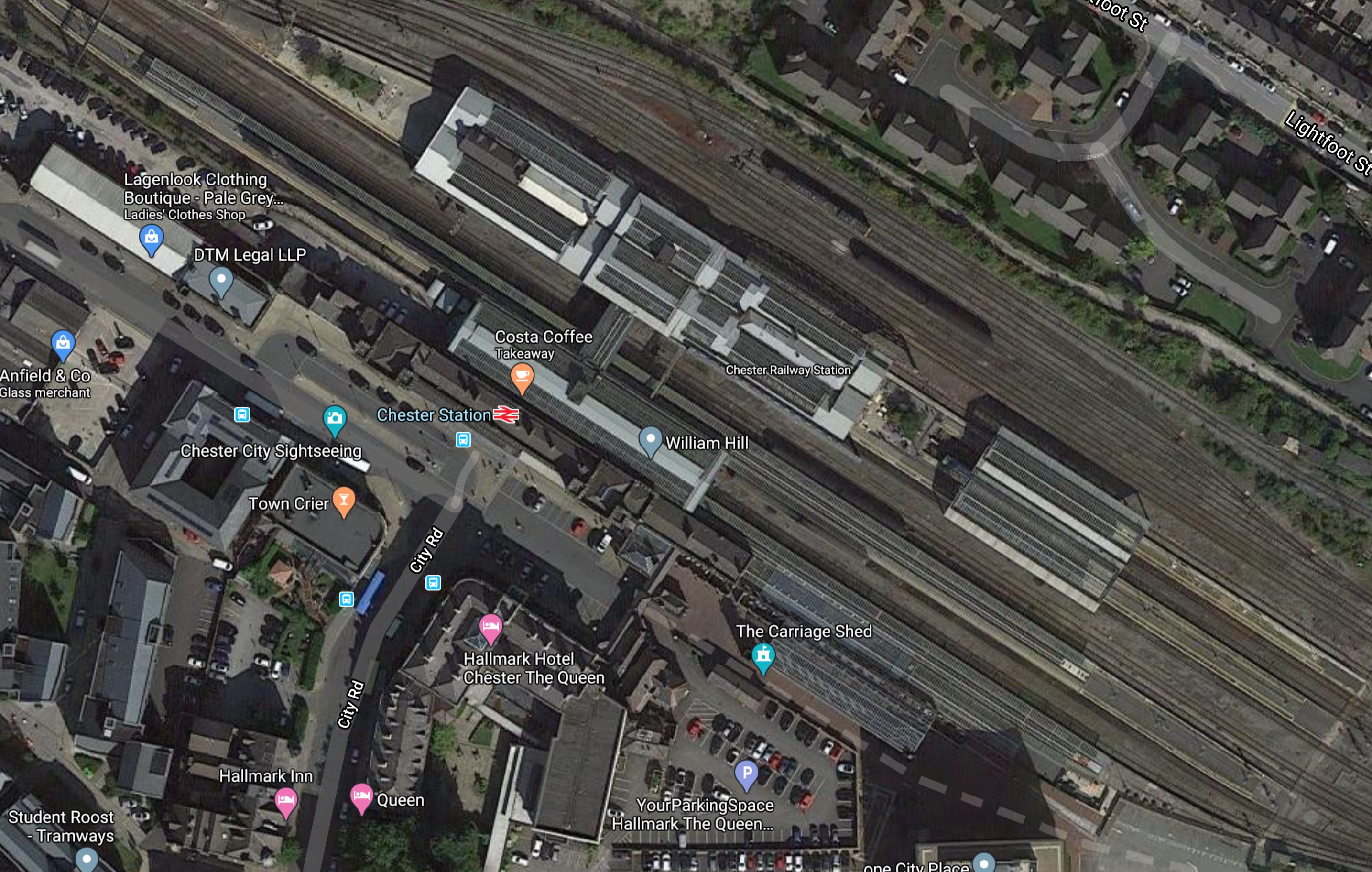
There is plenty of space.
The simplest way to charge trains at Chester would be to electrify the two through platforms 3 and 4 and the bay platform 1.
I would use 750 VDC third-rail, rather than 25 KVAC overhead electrification.
- I’m an engineer, who deals in scientifically-correct solutions, not politically-correct ones, devised by jobsworths.
- Maintenance staff at the station will be familiar with the technology.
- Station staff and passengers will know about the dangers of third-rail electrification.
- Trains connect and disconnect automatically to third-rail electrification.
- Trains don’t have to stop to connect and disconnect, so passing trains can be topped-up.
- Hitachi with the Class 395 train and Alstom with the Class 373 train, have shown even trains capable of 140 mph can be fitted with third-rail shoes to work safely at slower speeds on lines electrified using third-rail.
- Modern control systems can control the electricity to the third-rail, so it is only switched on, when the train completes the circuit.
I have a vague recollection, that there is an avoiding line at Chester station, so trains can go straight through. Perhaps that should be electrified too.
Carmarthen
Carmarthen station is a two platform station, with a rather unusual layout, that I wrote about in Changing Trains At Carmarthen Station.
I took these pictures when I passed through in 2016.



Note the unusual step-free crossing of the tracks.
This Google Map shows the layout at the station.
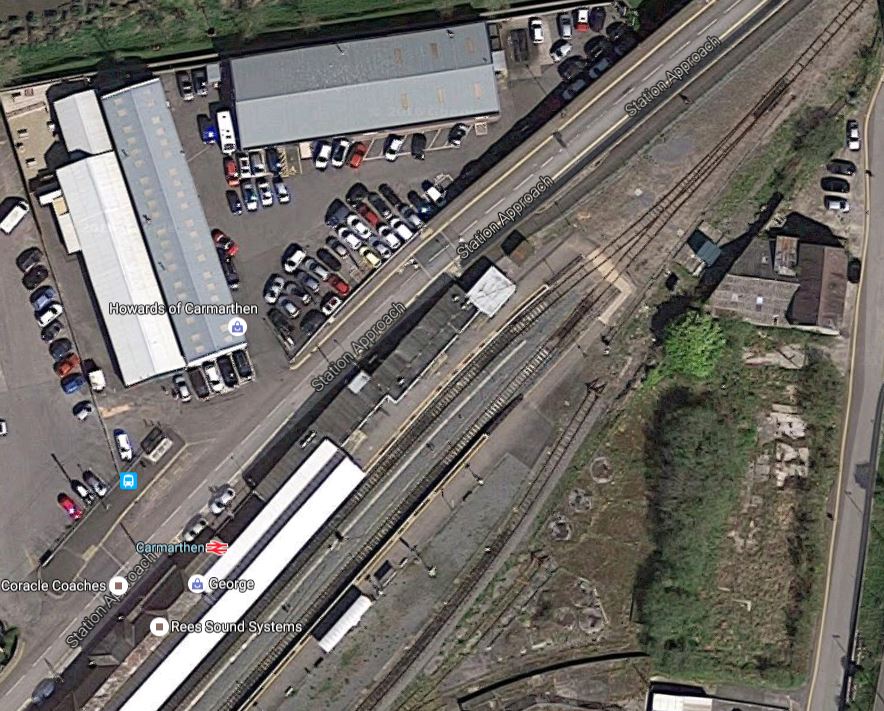
I believe it is another station, where third-rail electrification could be the solution.
- Most trains seem to reverse at the station, which gives time for a full charge.
- Others terminate here.
but would they still allow passengers to cross the line as they do now, whilst trains are being charged?
Crewe
Crewe station is fully-electrified.
- Trains for Wales seem to use Platform 6 for through trains and the bay Platform 9 for terminating trains.
- Both platforms appear to be electrified.
- Terminating trains appear to wait at least 9-11 minutes before leaving.
It does appear that Crewe station is ready for battery-electric trains.
Fishguard Harbour
Fishguard Harbour station only has a single terminal platform.
My comments would be similar to what, I said for Aberystwyth station. I would hope a standard solution can be developed.
Hereford
Hereford station has four through platforms.
This Google Map shows the station.
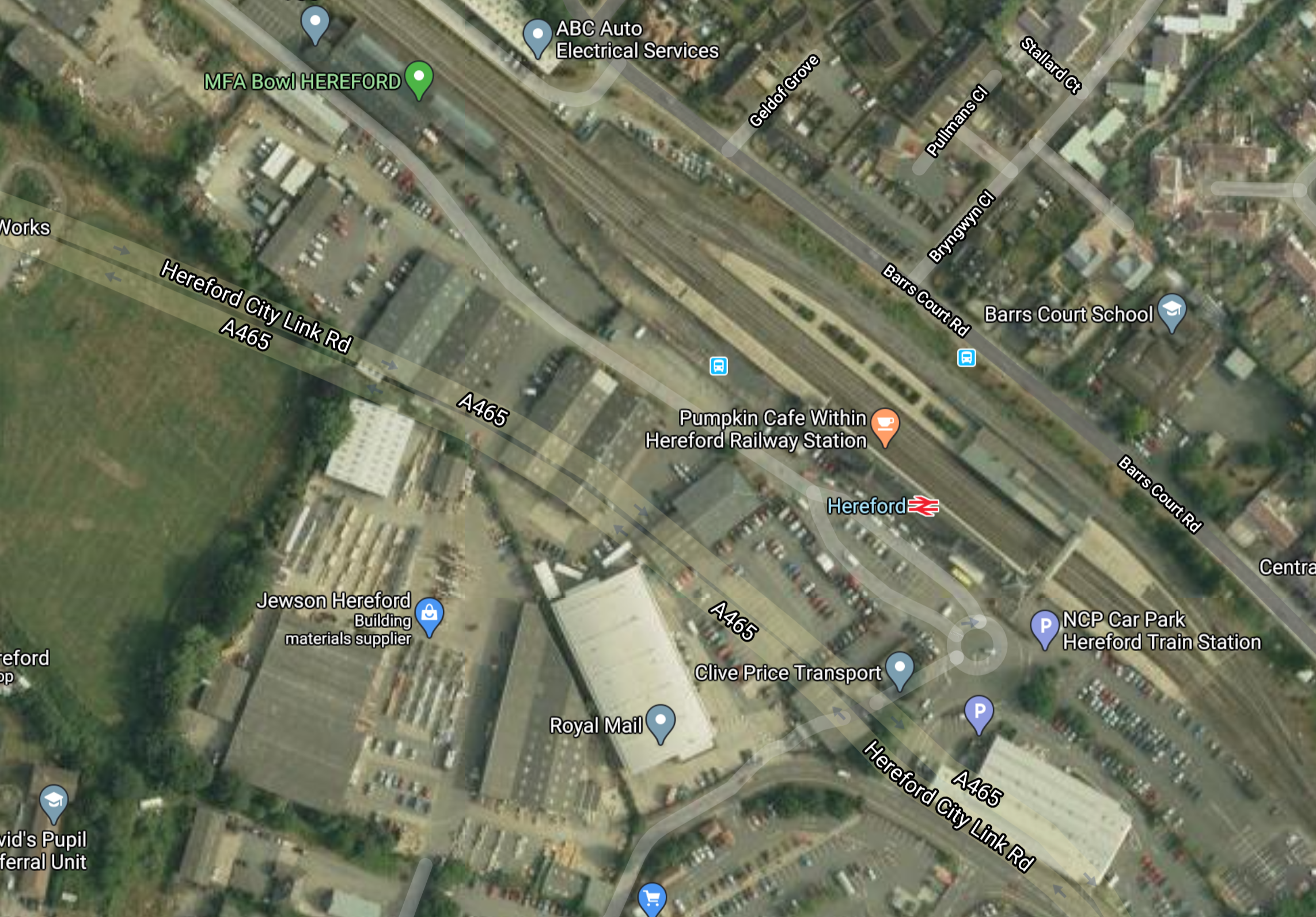
There is plenty of space.
As with Chester, I would electrify this station with 750 VDC third-rail equipment.
But the electrification wouldn’t be just for train services in Wales.
- West Midlands Trains, run an hourly service to Birmingham New Street and there is only a forty-one mile gap in the electrification between Hereford and Bromsgrove.
- Great Western Railway’s service to London, has a massive ninety-six mile run to the electrification at Didcot Junction, which could be bridged by installing charging facilities at Worcestershire Parkway and/or Honeybourne stations.
Both services have generous turnround times at Hereford, so would be able to leave fully-charged.
Distances from Hereford station are as follows.
- Abergavenny – 24 miles
- Bromsgrove – 41 miles
- Great Malvern – 21 miles
- Honeybourne – 48 miles
- Ludlow – 13 miles
- Newport – 44 miles
- Shrewsbury – 51 miles
- Worcester Parkway – 33 miles
Hereford station could be a serious battery-electric train hub.
Holyhead
Holyhead station has three terminals platforms.
My comments would be similar to what, I said for Aberystwyth station. I would hope a standard solution can be developed.
Liverpool Lime Street
Liverpool Lime Street station is fully-electrified and ready for battery-electric trains.
Llandrindod
Llandrindod station has two through platforms.
I took these pictures at the station as I passed through in 2016.



The Heart of Wales Line is certainly a route, that would benefit from larger trains. Zero-carbon battery-electric trains would surely fit well in the area.
This Google Map shows the station.
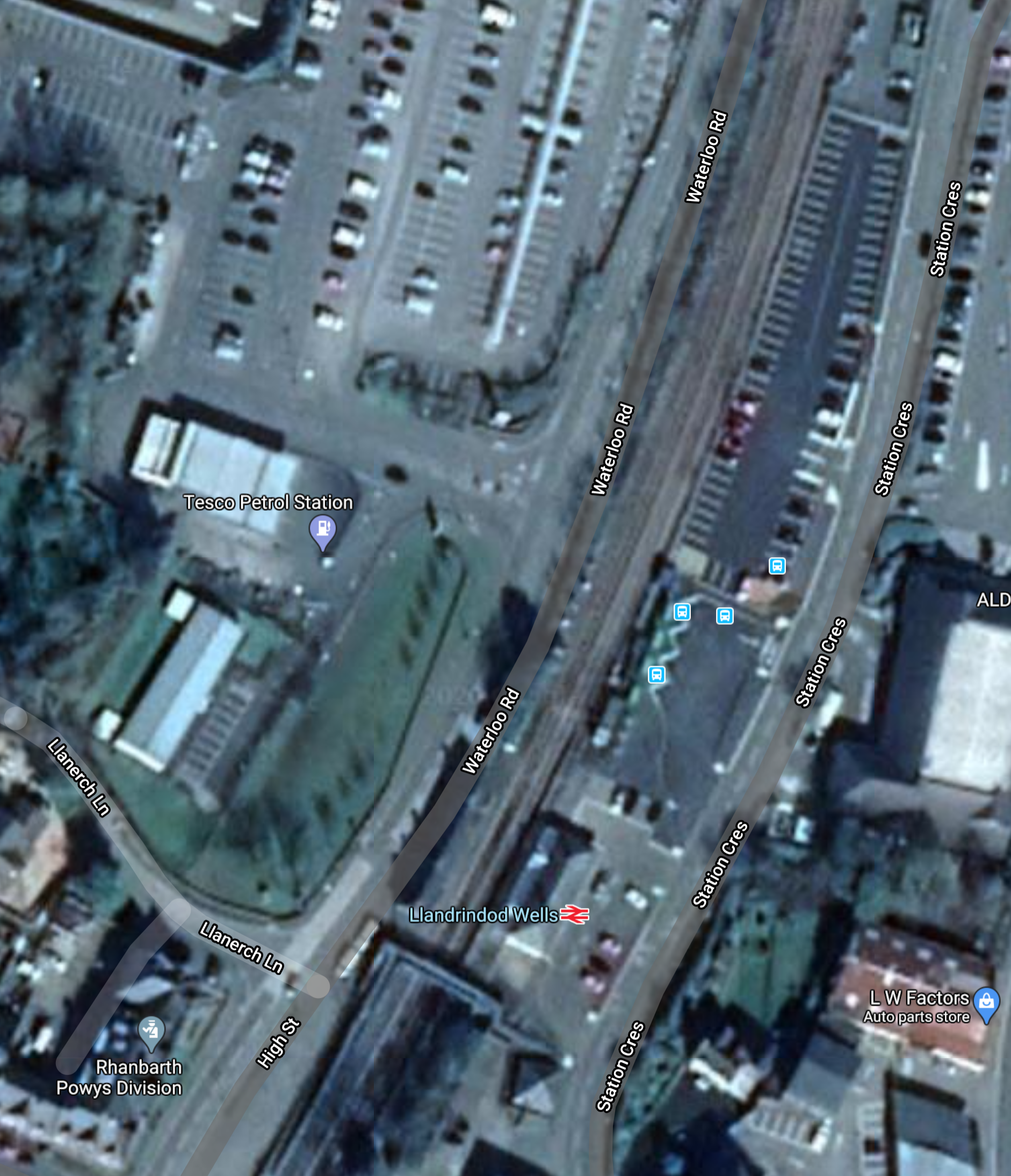
It would appear that, it is another station, that could be fitted with third-rail electrification to charge the trains.
Distances from Llandrindod station are as follows.
- Shrewsbury – 52 miles
- Llandovery – 27 miles
- Llanelli – 59 miles
- Swansea – 70 miles
It would appear that a second station with charging facilities or bigger batteries are needed.
Llandudno Junction
Llandudno Junction station has four platforms.
This Google Map shows the station.
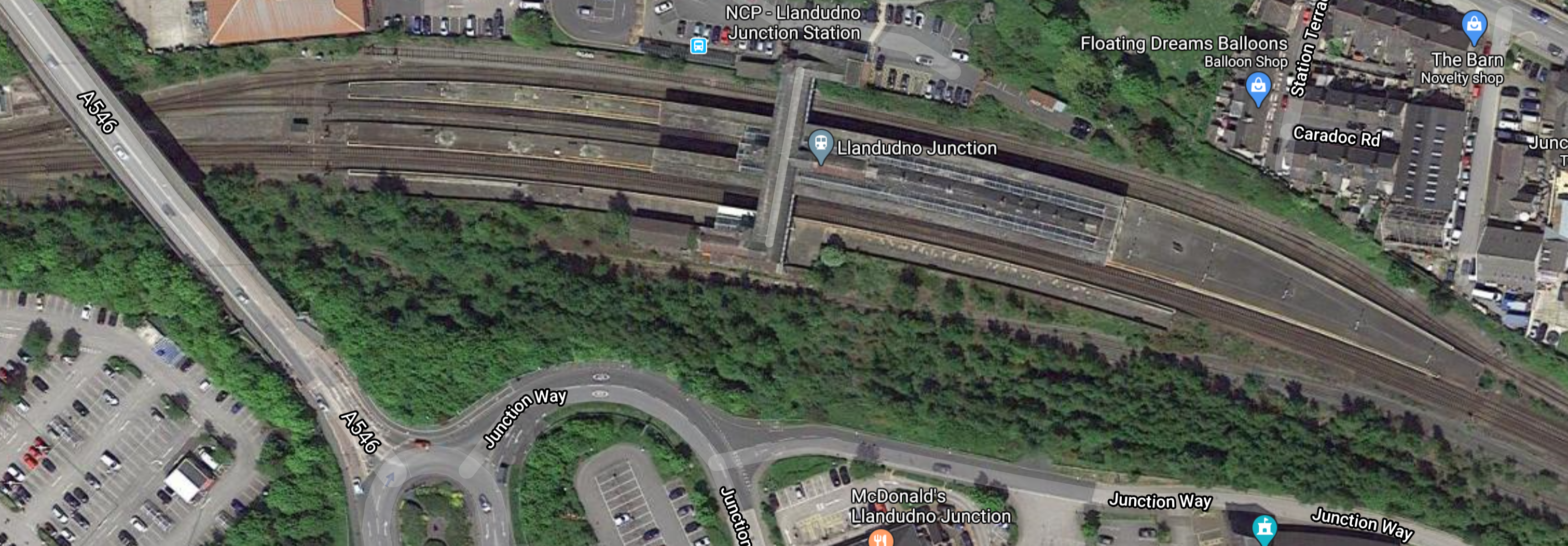
There is plenty of space.
As at Chester, the simple solution would be to electrify the platforms used by trains, that will need charging.
Butb there may also be a wider plan.
Llandudno Junction station is at the Western end of a string of five closely-spaced stations with Prestatyn station in the East.
- Llandudno Junction and Prestatyn are eight miles apart.
- Trains take twenty-three minutes to pass through this section.
- Some trains do a detour to Llandudno station before continuing.
- For part of the route, the railway lies between the dual-carriageway A55 road and the sea.
So why not electrify this section of railway between Llandudno Junction and Prestatyn stations?
- Either 750 VDC this-rail or 25 KVAC overhead electrification could be used.
- Prestatyn and Chester are 46 miles apart.
- Llandudno Junction and Holyhead are 40 miles apart.
If third-rail electrification were to be used, it might be advantageous to electrify to Llandudno station.
- It would be less intrusive.
- It would be quieter in an urban area.
- It would give the trains to Blaenau Ffestiniog trains a good charge.
But above all third-rail electrification might cost a bit less and cause less disruption to install.
Machynlleth
Machynlleth station is where the Aberystwyth and Pwllheli services split and join.
This Google Map shows the station.
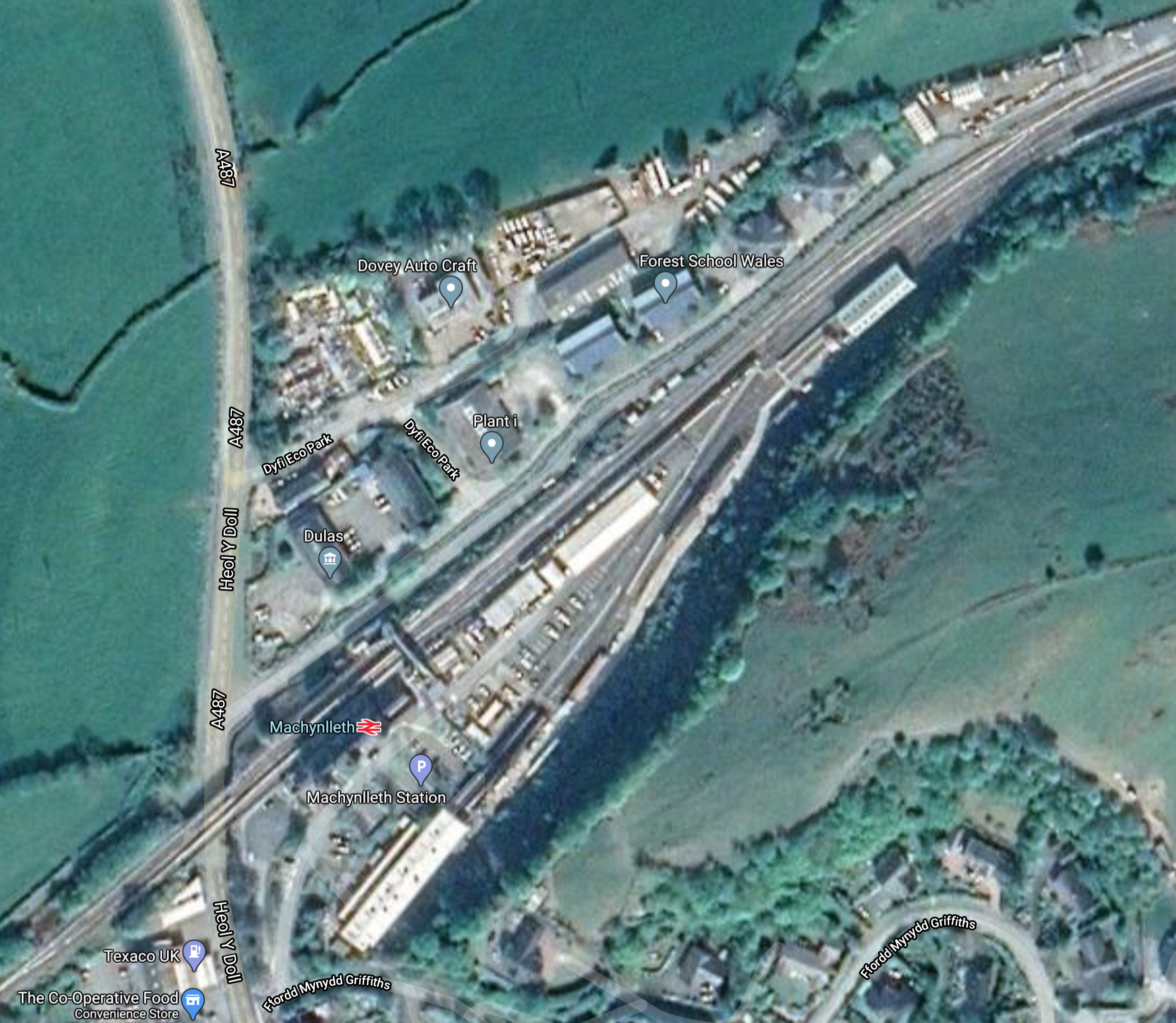
Consider.
- There is a train depot by the station.
- Will there be a good power supply at the station to charge the trains?
- Machnylleth and Pwllhelli are 58 miles apart.
- Machynlleth and Shrewsbury are 61 miles apart.
I think that Machynlleth might be pushing things too far, without extra stations with charging facilities.
One solution might be to develop the Riding Sunbeams concept and electrify the route between Newtown and Dovey Junction via Machynlleth, using third-rail technology powered-by solar or wind power.
Another solution would be batteries with a larger capacity.
Manchester Airport
Manchester Airport station is fully-electrified and ready for battery-electric trains.
Manchester Piccadilly
Manchester Piccadilly station is fully-electrified and ready for battery-electric trains.
Milford Haven
Milford Haven station only has a single terminal platform.
My comments would be similar to what, I said for Aberystwyth station. I would hope a standard solution can be developed.
Pembroke Dock
Pembroke Dock station only has a single terminal platform.
My comments would be similar to what, I said for Aberystwyth station. I would hope a standard solution can be developed.
Pwllheli
Pwhelli station is a only has a single terminal platform.
This Google Map shows the location of the station.
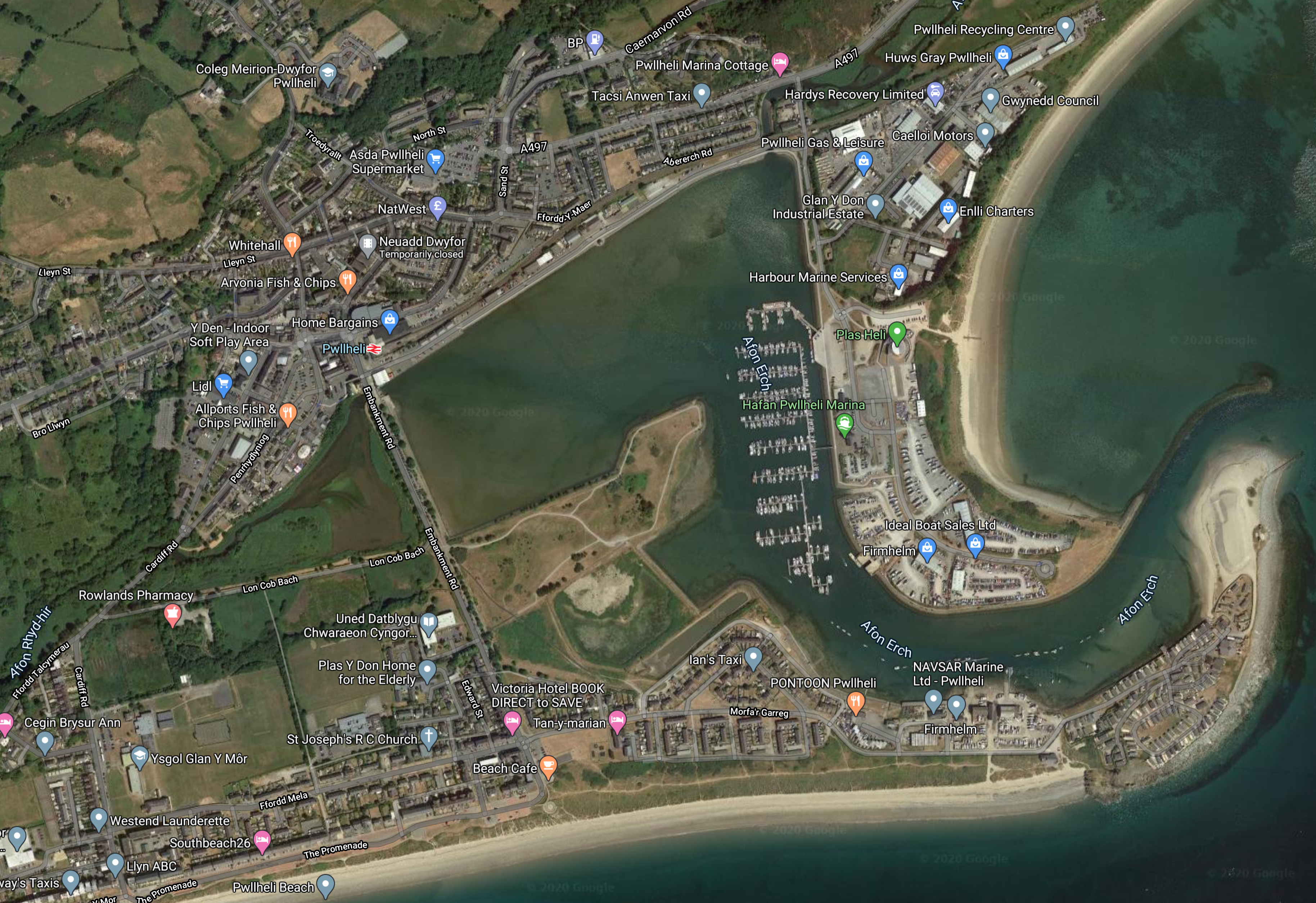
The stsation is at the North West corner of the bay.
My first reaction, when I saw this was that I have to go.
So I took a closer look at the station instead.

I suspect that fitting a charging facility into the station, wouldn’t be the most difficult of engineering problems. Although, there might be a problem getting a good enough connection to the National Grid.
Shewsbury
Shrewsbury station is a five-platform station.
This Google Map shows the station’s unusual location over the River Severn.
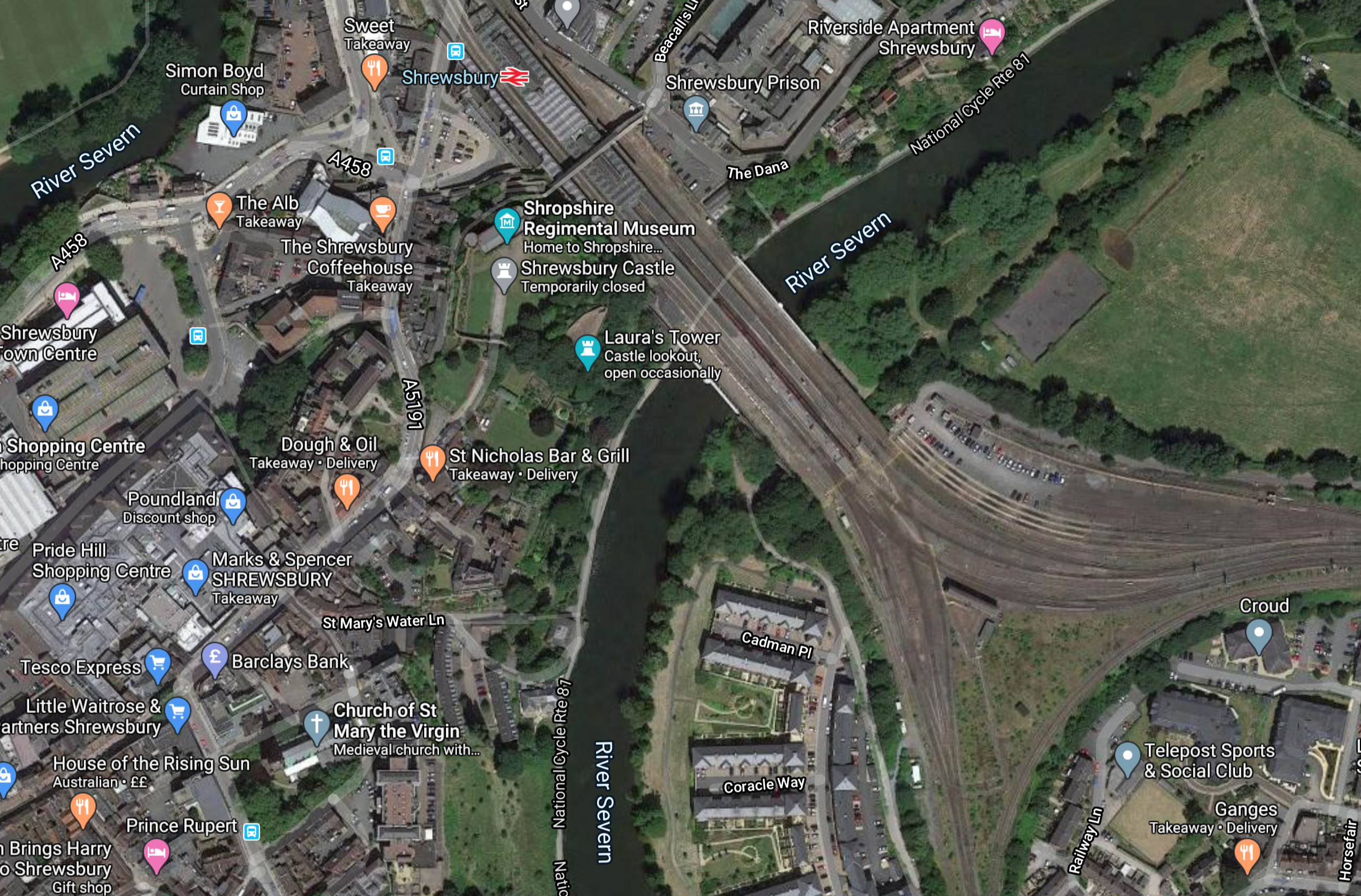
It must be one of few stations in the world, where trains enter the station from three different directions.
- From Crewe and Chester to the North.
- From Hereford and Wales to the South.
- From Birmingham and Wolverhampton in the East.
Adding electrification to all or selected platforms should allow trains to recharge and be on their way.
- Under current timetables, dwell times in Shrewsbury are up to eight minutes.
- I would suspect the train times could be adjusted, so that trains left the station with full batteries.
With battery-electric services to Aberystwyth, Birmingham International, Birmingham New Street, Cardiff Central, Chester, Crewe, Hereford, Holyhead, London Euston, Manchester, Pwllheli and Swansea, it will be a very important station.
Swansea
Swansea station has four terminal platforms.
A charging facility could be added to an appropriate number of platforms.
Or perhaps, the last few miles of track into the station should be electrified, so trains could charge on the way in, charge in the station and charge on the way out.
Third Rail Electrification
I have suggested in this post, that 750 VDC third-rail electrification could be used in several places.
I will repeat what I said earlier, when discussing Chester station.
- I’m an engineer, who deals in scientifically-correct solutions, not politically-correct ones, devised by jobsworths.
- Maintenance staff at the station will be familiar with the technology.
- Station staff and passengers will know about the dangers of third-rail electrification.
- Trains connect and disconnect automatically to third-rail electrification.
- Trains don’t have to stop to connect and disconnect, so passing trains can be topped-up.
- Hitachi with the Class 395 train and Alstom with the Class 373 train, have shown even trains capable of 140 mph can be fitted with third-rail shoes to work safely at slower speeds on lines electrified using third-rail.
- Modern control systems can control the electricity to the third-rail, so it is only switched on, when the train completes the circuit.
Third-rail electrification should be seriously considered.
A Standardised Terminal Solution
In this post, I mentioned that the following stations could be powered by a scandalised solution, as they are all one platform, terminal stations.
- Aberystwyth
- Blaenau Ffestiniog
- Fishguard Harbour
- Holyhead
- Milford Haven
- Pembroke Dock
- Pwllheli
The system might also be applicable at Carmarthen and Swansea.
My view is that Vivarail’s Fast Track charging based on third-rail technology would be ideal. I discussed this technology in Vivarail Unveils Fast Charging System For Class 230 Battery Trains.
Conclusion
With a bit of ingenuity, all train services run by Transport for Wales, can be run with battery-electric trains.
Hyperdrive Innovation And Hitachi Rail To Develop Battery Tech For Trains
The title of this post, is the same as that of this article on The Engineer.
This is the introductory sub-title.
Hyperdrive Innovation and Hitachi Rail are to develop battery packs to power trains and create a battery hub in the North East of England.
The article gives this information.
- Trains can have a range of ninety kilometres, which fits well with Hitachi’s quoted battery range of 55-65 miles.
- Hitachi has identified its fleets of 275 trains as potential early recipients.
Hitachi have also provided an informative video.
At one point, the video shows a visualisation of swapping a diesel-engine for a battery pack.
As a world-class computer programmer in a previous life, I believe that it is possible to create a battery pack, that to the train’s extremely comprehensive computer, looks like a diesel-engine.
So by modifying the train’s software accordingly, the various power sources of electrification, diesel power-packs and battery packs can be used in an optimum manner.
This would enable one of East Midlands Railway’s Class 810 trains, to be fitted with a mix of diesel and battery packs in their four positions under the train.
Imagine going between London and Sheffield, after the High Speed Two electrification between Clay Cross North Junction and Sheffield has been erected.
- Between St. Pancras and Market Harborough power would come from the electrification.
- The train would leave the electrified section with full batteries
- At all stations on the route, hotel power would come from the batteries.
- Diesel power and some battery power would be used between stations. Using them together may give better performance.
- At Clay Cross North Junction, the electrification would be used to Sheffield.
For efficient operation, there would need to be electrification or some form of charging at the Sheffield end of the route. This is why, I am keen that when High Speed Two is built in the North, that the shsared section with the Midland Main Line between Clay Cross North Junction and Sheffield station, should be built early.
Hitachi have said that these trains will have four diesel engines. I think it will more likely be two diesel engines and two batteries.
The World’s First Battery-Electric Main Line
I suspect with electrification between Sheffield and Clay Cross North Junction, that a train fitted with four batteries, might even be able to run on electric power only on the whole route.
In addition, if electrification were to be erected between Leicester and East Midlands Parkway stations, all three Northern destinations would become electric power only.
The Midland Main Line would be the first battery electric high speed line in the world!
Hitachi On Hydrogen Trains
The press release about the partnership between Hitachi and Hyperdrive Innovation is on this page on the Hitachi web site.
This is a paragraph.
Regional battery trains produce zero tailpipe emission and compatible with existing rail infrastructure so they can complement future electrification. At the moment, battery trains have approximately 50% lower lifecycle costs than hydrogen trains, making battery the cheapest and cleanest alternative zero-emission traction solution for trains.
I have ridden in two battery-electric trains and one hydrogen-powered train.
I would rate them out of ten as follows.
- Class 230 train – 6 – Battery
- Class 379 train – 8 – Battery
- Coradia iLint – 4 – Hydrogen
It’s not that the iLint is a bad train, as the power system seems to work well, but the passenger experience is nowhere near the quality of the two battery trains.
In my view, battery vehicles are exceedingly quiet, so is this the reason?
On the other hand, it could just be poor engineering on the iLint.
Conclusion
This is as very big day in the development of zero- and low-carbon trains in the UK.
£35m Station Transformation Launched By Tees Valley Mayor
The title of this post, is the same as that of this article on Rail Technology Magazine.
This is the introductory paragraph.
Tees Valley Mayor Ben Houchen has announced (June 9th) a £35m transformation of Middlesbrough Station to transport more train services to the town, including the first direct rail link to London in decades.
The Rail Technology Magazine article indicates that Platform 2 at Middlesbrough station will be extended to handle Azuma trains. As the current platform looks to be around 150 metres long and this would be long enough for a five-car train, does this mean that in the future nine-car and ten-car Azumas will be able to run services to Middlesbrough?
Currently, LNER run one train per two hours (tp2h) between London and York. Could some or all of these trains be extended to Middlesbrough?
- TransPennines’ trains between York and Middlesbrough take fifty-eight minutes, but they are timed for slower Class 185 trains.
- I would expect faster Class 800 trains could go between York and Middlesbrough and back to York in under a convenient two hours.
- In addition, the lengthened Platform 2 at Middlesbrough would allow longer trains on the service between London and York to turn back at Middlesbrough.
- As the York service, which has a frequency of 1tp2h shares a path with the Lincoln service of a similar frequency, there must be the possibility to run a 1tp2h between Kings Cross and Middlesbrough.
- The same path is also used to run one train per day (tpd) to and from Hull.
- It should also be noted that all Class 800 trains have the ability to split and join together in under two minutes.
There would appear to be a large amount of scope to develop a comprehensive timetable between Kings Cross and Hull, Lincoln and Middlesbrough.
- If the first train left at 07:06 and the last at 22:06, there could be sixteen trains per day on the Kings Cross and Lincoln, Hull, York and Middlesbrough route.
- Each train could be two five-car trains that split and joined en route, which means there would be a total of 32 tpd.
- If five tpd went to both Lincoln and Middlesbrough and perhaps three tpd to Hull, that would leave nineteen tpd trains for other destinations.
- As many trains as possible would need to call at York.
I can certainly see extra destinations built into a intricate pattern in Lincolnshire, Yorkshire and County Durham.
- Nottingham could be served from Newark.
- Grimsby and Cleethorpes could be served by extending services from Lincoln.
- Sheffield, Hull, Scunthorpe, Grimsby and Cleethorpes could be serves from Doncaster.
- Scarborough could be served from York.
- Washington and Newcastle could be served on an alternative route using a reopened Leamside Line.
- Sunderland could be served by extending services from Middlesbrough along the Durham Coast Line.
- Saltburn and Redcar could be served by extending services from Middlesbrough.
Splitting and joining could occur at the following stations.
- Newark for Nottingham and Lincoln, Grimsby and Cleethorpes
- Doncaster for Sheffield, Hull and Scunthorpe, Grimsby and Cleethorpes.
- York for Scarborough and Middlesbrough.
- Middlesbrough for Sunderland and Redcar and Saltburn
Middlesbrough station would need to be able to take two five-car trains for splitting and joining, so the platform extension is required.
Kings Cross and Middlesbrough Could Be A Zero-Carbon Route
In Could Some of Hitachi’s Existing Trains In The UK Be Converted To Battery-Electric Trains?, I indicated that as Middlesbrough station is only 21 miles and 29 minutes from Northallerton and the East Coast Main Line, that a five-car Azuma train converted to battery-electric operation should be able to run between Middlesbrough and Kings Cross, totally on electric power, which would be zero-carbon, if the electricity were to be renewable.
Could Some of Hitachi’s Existing Trains In The UK Be Converted To Battery-Electric Trains?
The last five fleets of AT-300 trains ordered for the UK have been.
- Avanti West Coast – Bi-Mode, 13 x five-car, unknown number of diesel engines, that could be replaced by batteries.
- Avanti West Coast – Electric, 10 x seven-car, no diesel engines or batteries
- East Midlands Railway – Bi-Mode, 33 x five-car, Class 810 train with four diesel engines and 125 mph on diesel.
- East Coast Trains – Electric, 5 x five-car, Class 803 train with battery for emergency hotel power.
- Hull Trains – Bi-Mode, 5 x five-car, Standard Class 802 train with three diesel engines.
Each fleet seems to be tailored to the needs of the individual operator, which is surely as it should be.
I can make some observations.
Fast Electric Trains
Both all-electric fleets on the list, will run on routes, where speed will be important.
- The Avanti West Coast Class 807 trains on the West Coast Main Line, will have to be able to keep up keep with the Class 390 trains, that have the advantage of tilt for more speed.
- The East Coast Trains Class 803 trains on the East Coast Main Line, will have to work hard to maintain a demanding schedule, as I outlined in Thoughts On East Coast Trains.
Any reduction in weight will improve the acceleration.
- The seven tonne MTU 12V 1600 R80L diesel engines can be removed to reduce the weight.
- As a five-car Class 800 train with three diesel engine weighs 243 tonnes, this could save nearly 9 % of the train’s weight.
- East Coast Trains feel they need an appropriately-sized battery for emergency hotel power. Could this be because the catenary is not as good on the East Coast Main Line as on the West?
- Perhaps, Avanti West Coast feel a battery is not needed, but they could obviously fit one later. Especially, if there was already a ready-wired position underneath the train.
The extra acceleration given by 100% electric operation, must make all the difference in obtaining the required performance for the two routes.
Why Four Diesel Engines In A Class 810 Train?
The Class 810 trains are an update of the current Class 800/Class 802 trains. Wikipedia described the differences like this.
The Class 810 is an evolution of the Class 802s with a revised nose profile and facelifted end headlight clusters, giving the units a slightly different appearance. Additionally, there will be four diesel engines per five-carriage train (versus three on the 800s and 802s), and the carriages will be 2 metres (6.6 ft) shorter due to platform length constraints at London St Pancras.
Additionally, in this article in the October 2019 Edition of Modern Railways, which is entitled EMR Kicks Off New Era, this is said.
The EMR bi-modes will be able to run at 125 mph in diesel mode, matching Meridian performance in a step-up from the capabilities of the existing Class 80x units in service with other franchises.
The four diesel engines would appear to be for more power, so that these trains will be able to run at 125 mph on diesel.
In How Much Power Is Needed To Run A Train At 125 mph?, I calculated that a Class 801 train, which is all-electric, consumes 3.42 kWh per vehicle mile.
- At 125 mph a train will in an hour travel 125 miles.
- In that hour the train will need 125 x 5 x 3.42 = 2137.5 kWh
- This means that the total power of the four diesel engines must be 2137.5,
- Divide 2137.5 by four and each diesel must be rated at 534.4 kW to provide the power needed.
The MTU 12V 1600 R80L diesel engine is described in this datasheet on the MTU web site.
Note on the datasheet, there is a smaller variant of the same engine called a 12V 1600 R70, which has a power output of 565 kW, as compared to the 700 kW of the 12V 1600 R80L.
The mass of the engines are probably at the limits of the range given on the datasheet.
- Dry – 4500-6500 Kg
- Wet – 4700-6750 Kg
It would appear that the less-powerful 12V 100 R70 is about two tonnes lighter.
So where will four engines be placed in a Class 810 train?
- The five-car Class 800 and Class 802 trains have diesel-engines in cars 2, 3 and 4.
- The nine-car Class 800 and Class 802 trains have diesel-engines in cars 2,3, 5, 7 and 8.
- It appears that diesel-engines aren’t placed under the driver cars.
- Five-car AT-300 trains generally have a formation of DPTS+MS+MS+MC+DPTF.
- The car length in the Class 810 trains are two metres shorter than those in other trains.
Could it be that the intermediate cars on Class 810 trains will be an MC car, which has both First and Standard Class seating and two identical MS cars both with two smaller diesel engines?
- The two smaller diesel engines will be about 2.6 tonnes heavier, than a single larger engine.
- Only one fuel tank and other gubbins will be needed.
- The shorter car will be lighter in weight.
- MTU may have designed a special diesel engine to power the train.
I would suspect that a twin-engined MS car is possible.
Could The Battery And The Diesel Engine Be Plug-Compatible?
I found this document on the Hitachi Rail web site, which is entitled Development of Class 800/801 High-Speed Rolling Stock For UK Intercity Express Programme.
The document may date from 2014, but it gives a deep insight into the design of Hitachi’s trains.
I will take a detailed look at the traction system as described in the document.
This schematic of the traction system is shown.

Note BC is described as battery charger.
This is said in the text, where GU is an abbreviation for generator unit.
The system can select the appropriate power source from either the main transformer or the GUs. Also, the size and weight of the system were minimized by designing the power supply converter to be able to work with both power sources. To ensure that the Class 800 and 801 are able to adapt to future changes in operating practices, they both have the same traction system and the rolling stock can be operated as either class by simply adding or removing GUs. On the Class 800, which is intended to run on both electrified and non-electrified track, each traction system has its own GU. On the other hand, the Class 801 is designed only for electrified lines and has one or two GUs depending on the length of the trainset (one GU for trainsets of five to nine cars, two GUs for trainsets of 10 to 12 cars). These GUs supply emergency traction power and auxiliary power in the event of a power outage on the catenary, and as an auxiliary power supply on non-electrified lines where the Class 801 is in service and pulled by a locomotive. This allows the Class 801 to operate on lines it would otherwise not be able to use and provides a backup in the event of a catenary power outage or other problem on the ground systems as well as non-electrified routes in loco-hauled mode.
This is all very comprehensive.
Note that the extract says, that both the Class 800 trains and Class 801 trains have the same traction control system. A section called Operation in the Wikipedia entry for the Class 802 train, outlines the differences between a Class 802 train and a Class 800 train.
The Class 802s are broadly identical to the Class 800 bi-mode trains used in the Intercity Express Programme, and are used in a similar way; they run as electric trains where possible, and are equipped with the same diesel generator engines as the Class 800. However, they utilise higher engine operating power – 700 kW (940 hp) per engine as opposed to 560 kW (750 hp) – and are fitted with larger fuel tanks to cope with the gradients and extended running in diesel mode expected on the long unelectrified stretches they will operate on.
I would assume that the differences are small enough, so that a Class 802 train, can use the same traction control system, as the other two train classes.
The Hitachi document also describes the Train Management and Control System (TCMS), the function of which is described as.
Assists the work of the train crew; a data communication function that aids maintenance work; and a traction drive system that is powered by the overhead lines (catenaries) and GUs.
Several trains have been described as computers on wheels. That could certainly be said about these trains.
There would appear to be a powerful Automatic Train Identification Function.
To simplify the rearrangement and management of train configurations, functions are provided for identifying the train (Class 800/801), for automatically determining the cars in the trainset and its total length, and for coupling and uncoupling up to 12 cars in normal and 24 cars in rescue or emergency mode.
Now that would be a sight – One nine-car train rescuing another!
I would assume that this Automatic Train Identification Function has already been updated to add the Class 802 trains and it would appear to me, as a very experienced computer programmer, that in future it could be further updated to cater for the following.
- New classes of trains like the future Class 803 and Class 810 trains.
- The fitting of batteries instead of diesel engines.
Could the Function even be future-proofed for hydrogen power?
There are two main ways for trains to operate when the diesel engine in a car has been replaced by a battery.
- A plug-compatible battery module is designed, that in terms of function looks exactly like a diesel engine to the TCMS and through that the train crew.
- The car with a battery becomes a new type of car and the TCMS is updated to control it, in an appropriate manner.
Both methods are equally valid.
I would favour the first method, as I have come across numerous instances in computer programming, engineering and automation, where the method has been used successfully.
The method used would be Hitachi’s choice.
What Size Of Battery Could Be Fitted In Place Of The Diesel Engine?
Consider.
- The wet mass of an MTU 16V 1600 R80L diesel engine commonly fitted to AT-300 trains of different types is 6750 Kg or nearly seven tonnes.
- My engineering knowledge would suggest, that it would be possible to replace the diesel engine with an inert lump of the same mass and not affect the dynamics of the train.
So could it be that a plug-compatible battery module can be fitted, so long as it doesn’t exceed the mass of the diesel engine it replaces?
For an existing Class 800 or Class 802 train, that limit could be seven tonnes.
But for East Coast Train’s Class 803 train, that size would probably be decided by the required train performance.
How much power would a one tonne battery hold?
This page on the Clean Energy institute at the University of Washington is entitled Lithium-Ion Battery.
This is a sentence from the page.
Compared to the other high-quality rechargeable battery technologies (nickel-cadmium or nickel-metal-hydride), Li-ion batteries have a number of advantages. They have one of the highest energy densities of any battery technology today (100-265 Wh/kg or 250-670 Wh/L).
Using these figures, a one-tonne battery would be between 100 and 265 kWh in capacity, depending on the energy density.
This table can be calculated of battery weight, low capacity and high capacity.
- 1 tonne – 100 kWh – 265 kWh
- 2 tonne – 200 kWh – 530 kWh
- 3 tonne – 300 kWh – 895 kWh
- 4 tonne – 400 kWh – 1060 kWh
- 5 tonne – 500 kWh – 1325 kWh
- 6 tonne – 600 kWh – 1590 kWh
- 7 tonne – 700 kWh – 1855 kWh
As energy densities are only going to improve, the high capacity figures are only going to get larger.
If you look at the design of the Class 803 trains, which could have three positions for diesel engines or batteries, the designers of the train and East Coast Trains can choose the battery size as appropriate for the following.
- Maximum performance.
- Power needs when halted in stations.
- Power needs for emergency power, when the wires come tumbling down.
I suspect, they will fit only one battery, that is as small as possible to minimise mass and increase acceleration, but large enough to provide sufficient power, when needed.
Conversion Of A Five-Car Class 800/Class 802 Train To Battery-Electric Operation
If Hitachi get their design right, this could be as simple as the following.
- Any of the three MTU 12V 1600 R80L diesel engines is removed, from the train.
- Will the other diesel related gubbins, like the fuel tank be removed? They might be left in place, in case the reverse conversion should be needed.
- The new battery-module is put in the diesel engine’s slot.
- The train’s computer system is updated.
- The train is tested.
It should be no more difficult than attaching a new device to your personal computer. Except that it’s a lot heavier.
As there are three diesel engines, one, two or three could be replaced with batteries.
Trains would probably be able to have a mixture of diesel engines and battery modules.
A Class 802 train with one diesel engine and two five-tonne batteries would have the following power sources.
- 25 KVAC overhead electrification.
- A 700 kW diesel engine.
- Two five-tonne batteries of between 500 kWh and 1325 kWh.
With intelligent software controlling the various power sources, this train could have a useful range, away from the electrification.
Conversion Of A Five-Car Class 810 Train To Battery-Electric Operation
The process would be similar to that of a Class 800/Class 802 Train, except there would be more possibilities with four engines.
It would also need to have sufficient range to bridge the gaps in the electrification.
Perhaps each train would have the following power sources.
- 25 KVAC overhead electrification.
- Two 565 kW diesel engines.
- Two four-tonne batteries of between 400 kWh and 1060 kWh.
- Batteries might also be placed under the third intermediate car.
I estimate that with 400 kWh batteries, a train like this would have a battery range of sixty-five miles.
Conclusion
The permutations and combinations would allow trains to be tailored to the best compromise for a train operating company.
A Timeline Of Hitachi’s Statements And News About Battery Trains
These are posts on this blog, that reference articles about Hitachi and battery trains.
21st November 2018 – Hitachi’s Thoughts On Battery Trains – Modern Railways Modern Railways January 2018 – Candid interview with Nick Hughes of Hitachi.
21st March 2019 – Trains Ordered For 2021 Launch Of ‘High-Quality, Low Fare’ London – Edinburgh Service – Railway Gazette – Announcement of service, but no mention of batteries, diesel or bi-mode.
26th March 2019 – Hitachi Plans To Run ScotRail Class 385 EMUs Beyond The Wires – Rail Engineer – Batteries for Class 385 trains.
1st January 2020 – Hitachi Trains For Avanti – Modern Railway January 2020 – The Hitachi trains for Avanti West Coast can be fitted with batteries, if required.
16th February 2020 – Sparking A Revolution – Rail Magazine Issue 898 – Informative interview with Andrew Barr of Hitachi.
16th April 2020 – First of Five FirstGroup Class 803s Arrives In UK – Rail Magazine Issue 903 – Disclosure that the Class 803 trains will use a battery instead of diesel power for on-board services, but not traction power.
Hitachi seem to have opened up gradually with more information.
Steventon Listed Railway Bridge Saved From Demolition
The title of this post, is the same as that of this article on the BBC.
On the face of it it looks like victory for the Nimbys, who have saved a rather ordinary and possibly decrepit bridge from demolition.
But I believe there is more to this story than meets the eye.
The Bridge
The bridge at the centre of the argument may be Grade 2 Listed, but there are lots of similar bridges on UK railways in better condition with similar heritage, that don’t have a listing.
Type “steventon bridge electrification” into a search engine and you’ll find lots of images of the bridge.
- One picture shows, the bridge with the railway flooded, which puts an interesting slant on the debate. What are the foundations like?
- Notice, that the bridge seemed to suffer a rather botched repair at the hands of British Rail’s finest engineers.
- Having read a lot about this story, I suspect that the locals’ main reason for objecting, is that they don’t want the disruption, whilst it is rebuilt.
- Incidentally, I suspect Great Western Railway don’t want the bridge rebuilt either, as closure will be a long disruption to all services.
I have been involved in the refurbishment of several buildings of around the same age or even older than the bridge. This is the sort of construction, that will have to be replaced at some time. If it’s not replaced, some of the novel techniques that are now available to Network Rail will have to be applied.
Network Rail
The article says this about Network Rail’s solution to the problem.
But following what the company described as ‘extensive and breakthrough testing’ using computer simulations it found a speed reduction to 110mph through the village meant wires could pass underneath the existing bridge.
I do think, that 110 mph is rather convenient. if you look at the maximum operating speeds of trains and locomotives that will pass through.
- Class 801 train with digital signalling -140 mph
- Class 801 with conventional signalling – 125 mph
- Class 800/802 train on diesel power – 100 mph
- Class 80x train on battery power – 100 mph
- Class 387 train – 110 mph
- Class 90 locomotive – 110 mph
- Class 91 locomotive – 125 mph
- Class 93 locomotive – 110 mph
- High Speed Train – 125 mph
Very few trains will have to slow down.
Any train that used onboard power, like a High Speed Train or a Class 80x with batteries, could theoretically go through at the maximum speed, track, signalling and train taken together would allow.
Hitachi
In Issue 898 of Rail Magazine, there is an article, which is entitled Sparking A Revolution, which describes Hitachi’s work and plans on battery-powered trains. This is an extract.
Battery power can be used as part of electrification schemes, allowing trains to bridge the gaps in overhead wires where the costs of altering the infrastructure are high – in tunnels or bridges, for example. This would also have the immediate benefit of reducing noise and emissions in stations or built-up areas.
Elsewhere in the article, it is said that Hitachi trains will be able to do 100 mph on battery power for up to 60 miles.
But would they be able to do 125 mph on battery power for perhaps five miles? I can’t see why not!
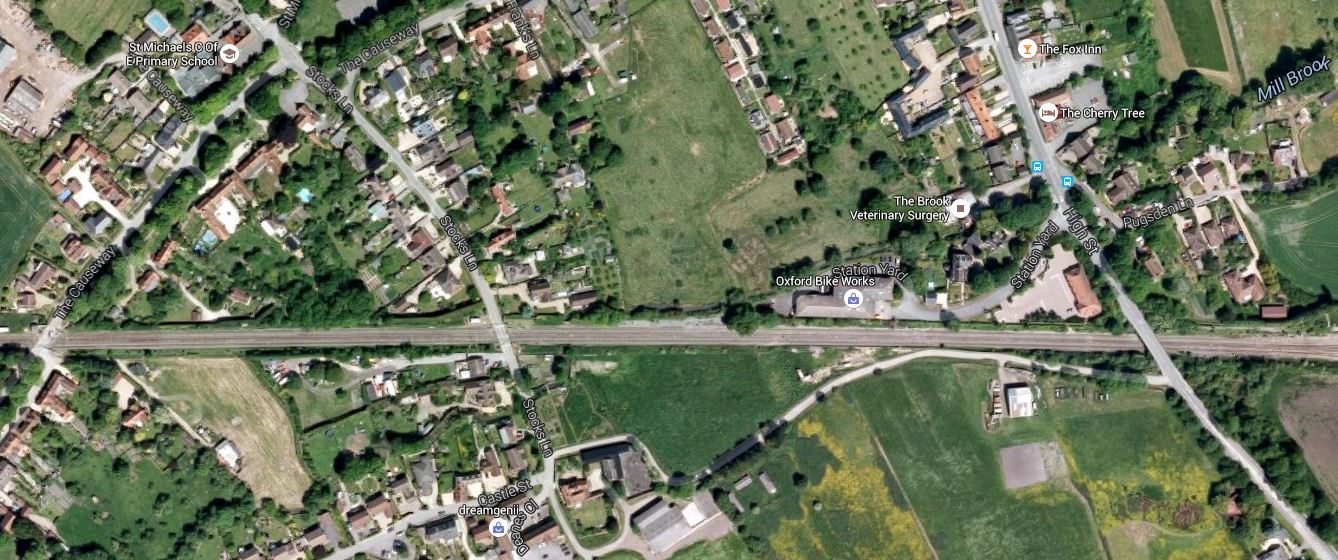
The Google Map shows the track through Steventon.
Note.
- The bridge in question is at the East.
- There are also a couple of level crossings in this stretch of track, where the height of wires is also regulated.
Perhaps, the pantograph should be dropped before going through section and raised afterwards, with power in the section taken from a battery.
Avoiding obstacles like this, may be an economic alternative, but it does require that all electric trains using the section are able to use battery power.
I have a feeling, I’ve read somewhere that a Class 88 locomotive can do a similar trick using the onboard diesel engine.
As a Control Engineer, who trained in the 1960s, I would expect that all pantographs can now be raised or lowered with all the precision and repeatability of an Olympic gold-medal gymnast!
I do wonder, if the Great Western Electrification Project had been designed around discontinuous electrification and battery-electric trains, the project would have gone better.
For instance, the Severn Tunnel is 7,000 metres long and trains take under four minutes to pass through. The Wikipedia entry for the tunnel has a section on Electrification, which details the complicated design and the trouble that there has been with corrosion.
Given that battery-electric trains have other advantages, design by hindsight, says that a tunnel without electrification and battery trains may have been a better solution.
Conclusion
Network Rail and Hitachi will get the speed of trains through Steventon up to 125 or even 140 mph, possibly by using battery power.
But whatever happens, I’m certain that the bridge will have to be rebuilt! It has the air of a derelict house, that will suck up all your money.
Electrification Between Exeter And Plymouth
Eventually, there will be electric passenger trains between Exeter and Plymouth! Great Western Railway’s objective must be for passengers to board their Hitachi AT-300 train at Paddington and be powered all the way to Penzance by electricity, without using a drop of diesel. The added ingredient will be battery power.
In Sparking A Revolution, I gave Hitachi’s specification for a proposed battery-electric train.
- Range – 55-65 miles
- Performance – 90-100 mph
- Recharge – 10 minutes when static
- Routes – Suburban near electrified lines
- Battery Life – 8-10 years
As the distance between Exeter and Plymouth is 52 miles, the Hitachi specification could have been designed around this route, which as these pictures show is in places, very close to the sea, where the line runs along the South Devon Railway Sea Wall.



Global warming will probably mean, we’ll see a repeat of the major sea wall breach that happened at Dawlish in 2014.
I would suspect that the Network Rail’s solution to the problems of efficient low or zero-carbon traction between Exeter and Plymouth includes the following.
- A very robust railway.
- Extreme protection from almost everything the sea and the weather can produce.
- Could we see some concrete tunnels, like the Swiss and others use in mountainous areas to protect from snow? Rail Magazine says yes! At Horse Cove.
- No electrification as water and electricity are not a good mix, except in an electrolyser to produce hydrogen, oxygen and/or chlorine.
- Battery or hydrogen-powered passenger trains or freight locomotives.
- Digital in-cab signalling. Traditional signalling is even more expensive equipment to be swept away.
From media reports, this looks like the way Network Rail are thinking.
Charging The Trains
Battery-electric trains will need to be charged. There are three convenient stations; Exeter St. Davids, Newton Abbott and Plymouth.
- All have multiple platforms.
- The stations could be given the ability to charge battery-electric trains, either using 25 KVAC overhead electrification or a specialist charging system, like the one designed by Vivarail, that I wrote about in Vivarail Unveils Fast Charging System For Class 230 Battery Trains.
- Newton Abbot station would also charge any trains running on the eight mile branch to Paignton station.
As far as passenger services are concerned, it could be a very efficient zero-carbon railway.
Electrification At Exeter St. Davids
Exeter St. Davids is an important hub for services between Devon and Cornwall and the rest of Great Britain.
- GWR services run to London Paddington via Newbury.
- GWR services run to London Paddington via Bristol
- GWR services run to Plymouth and Penzance via Newton Abbott.
- GWR local services run to Barnstaple, Exmouth and Paignton.
- CrossCountry services run to the Midlands, North and Scotland via Bristol.
- South Western Railway services run to London Waterloo via Basingstoke.
In future, there could be services running to Plymouth on the reopened route via Okehampton and Tavistock.
All these services could be run by battery-electric trains for sixty miles from Exeter, if they could be fully-charged at the station.
Note.
- Trains to London Paddington and Bristol could easily reach Taunton, which is thirty miles away.
- Trains to London Waterloo could reach Yeovil Junction, which is fifty miles away.
- Trains to the West could reach Plymouth, which is fifty-two miles away.
- Barnstaple is forty miles away, so would probably need some help to get back.
- Exmouth is eleven miles away, so a return journey is probably possible.
- Paignton is twenty-eight miles away, so a return journey is probably possible, with a top-up at Newton Abbot if required.
Exeter is going to be very busy charging trains.
It should be noted, that trains to and from London Paddington and Bristol, all share the same route as far as Cogload Junction, where the London Paddington and Bristol routes divide.
- Cogload Junction is thirty-six miles from Exeter.
- Cogload Junction and Newbury, where the electrification to London Paddington starts are eighty-five miles apart.
- Cogload Junction and Bristol Temple Meads, where the electrification to London Paddington starts are forty miles apart.
I wonder if it would be sensible to electrify between Exeter St. David station and Cogload Junction.
- From my virtual helicopter, the line doesn’t look to be in the most difficult category to electrify.
- There is only one tunnel and a few old bridges and a couple of level crossings.
- Some of the route is alongside the M5.
- Trains would arrive in Exeter with full batteries and could do a quick stop before continuing their journeys.
- Trains would arrive at Cogload Junction and could reach Bristol Temple Meads without stopping for a recharge.
- Bristol services that are extended to Taunton and Exeter could be run by battery-electric trains.
I also feel, that with upwards of twenty-five miles of extra electrification between Cogload Junction and Newbury, that battery-electric trains could run between London Paddington and Exeter via the Reading-Taunton Line.
Electrification At Plymouth
As with Exeter St. Davis, Plymouth is an important hub for services between Devon and Cornwall and the rest of Great Britain.
- Most services run to Penzance in the West and Exeter in the East.
- There is a local service to Gunnislake, which is fifteen miles away.
Lots of charging capacity, will enable battery-electric trains to reach their destinations, except for Penzance
Trains Between Plymouth And Penzance
Hitachi must have despaired, when it was pointed out that the distance between Penzance and Plymouth is eighty miles! This is fifteen miles longer than the range of their proposed battery-electric train.
The simplest solution would be to build a battery-electric train with an eighty mile range, that could travel between Plymouth and Penzance on a single charge. With charging at Penzance it could return to Plymouth.
The longer range, would also mean that, with perhaps ten extra miles of electrification, that battery-electric trains could bridge the electrification gap between Cogload Junction and Newbury.
Other solutions range from selective electrification, all the way up to full electrification of the Cornish Main Line.
It should be noted that there are the following branches on the Cornish Main Line.
- The Looe Valley Line at Liskeard station – 8.75 miles – Uses a separate platform at Lskeard
- The Fowey Branch At Lostwithiel station – 4.75 miles – Possible reopening
- The Atlantic Coast Line at Par station – 20.75 miles – Uses a separate platform at Par
- The Maritime Line at Truro station – 11.75 miles – Uses a separate platform at Truro
- The St. Ives Bay Line at St. Erth station – 4.25 miles- Uses a separate platform at St. Erth
If these branches are going to be served by battery-electric trains, arrangements will have to be made for their charging. This could either be on the main line, at the remote terminal or at both.
Would it be easier to run the branches using battery-electric trains, if the Cornish Main Line was fully electrified?
The Cornish Main Line also carries a number of heavy freight trains, most of which seem to be going to or from Burngullow, so I suspect they are in connection with the movement of china clay.
Currently, these heavy freight trains appear to be hauled by diesel locomotives, but if the Cornish Main Line were to be fully electrified, could they be run by electric locomotives?
Electrification Of A Reopened Northern Route
In the May 2020 Edition of Modern Railways, there is an article, which is entitled Beeching Reversal Fund Bids.
This is the introductory paragraph.
Bids have been submitted to Government for a share of the £500 million ‘Restoring your railway’ fund launched by the Department for Transport in January. The fund is to be used to support proposals to reinstate axed local services, to accelerate schemes already being considered for restoration and also to promote new and restored stations.
One of the bids is for the Tavistock-Okrhampton Reopening scheme (TORs), which would reopen the former Exeter to Plymouth railway of the LSWR, as a new route between Exeter and Taunton in the East and Plymouth in the West.
- The original railway was double-track.
- Most of the infrastructure is intact.
- The route would totally avoid Dawlish.
This is also said in the Modern Railways article.
It proposes journey times could be as little as six minutes longer than via the existing route between Exeter and Plymouth and that there could be opportunities for freight trains to avoid the steep gradients over the Devon banks between Newton Abbott and Plymouth. Provision of electrification for TORs as part of a wider programme for main lines in the region is also advocated.
Could an electrified route via Tavistock and Okehampton be connected to an electrified Cornish Main Line, to create an electrified route across Devon and Cornwall?
Connecting At The Royal Albert Bridge
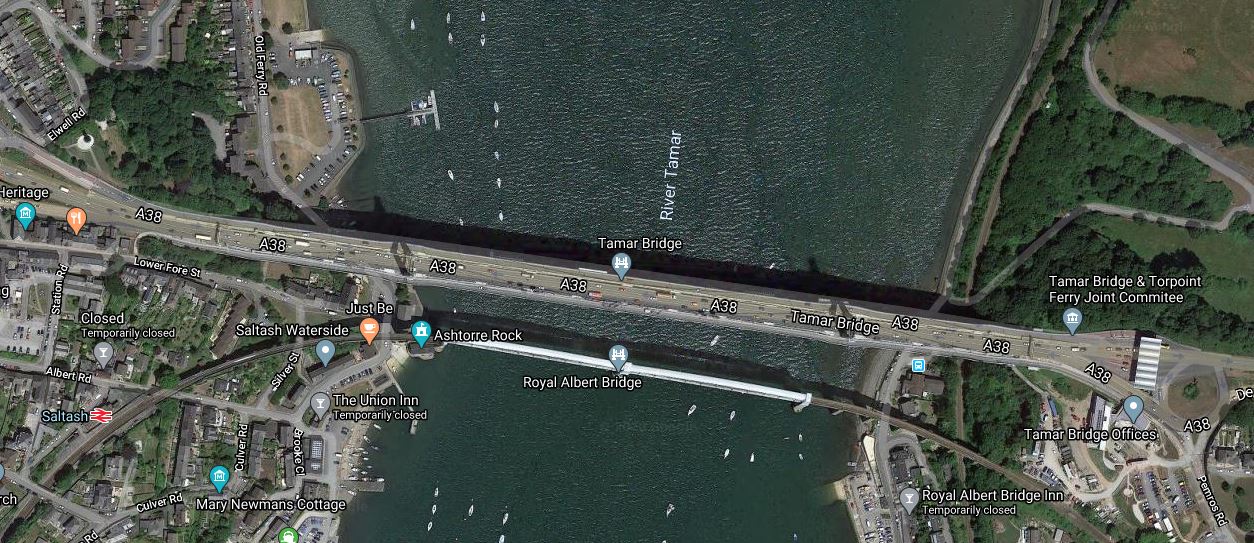
This Google Map shows the Royal Albert Bridge and the Tamar Bridge over the River Tamar.
Note.
- The Royal Albert Bridge to the South of the modern Tamar Bridge.
- The Great Western Main Line running East to Plymouth and West to Penzance.
- The Tamar Valley Line running up the Eastern bank of the River Tamar and under the Eastern approaches to both bridges.
- Going North on the Tamar Valley Line leads to the TORs and going South leads to Plymouth station.
I can see a difficult design problem at the Eastern end of the Royal Albert Bridge, as a very complicated junction will be needed to allow all trains go the way they need.
Trains wanting to call at Plymouth station and use TORs will need to reverse in the station.
Connecting At The East Of Exeter
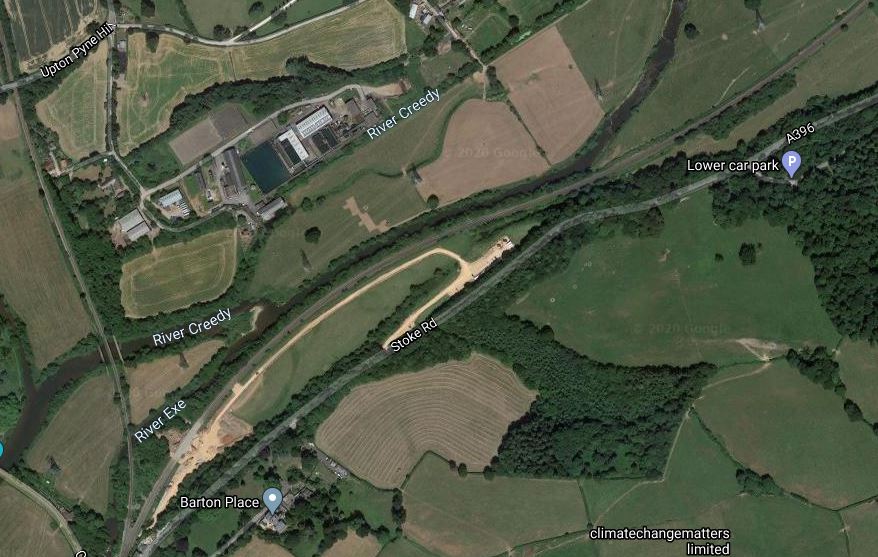
This Google Map shows The Tarka Line and the Bristol-Exeter Line join at Cowley Bridge Junction.
Note.
- The Tarka Line to Barnstaple and TORs leaves the map in the North West corner.
- The Bristol-Exeter Line to Taunton, Bristol and London Paddington leaves the map in the North East corner.
- Cowley Bridge Junction is in the South West corner of the map.
- Cntinuing South West leads to Exeter St. David’s station.
It looks to me, that Cowley Bridge Junction will need to be made into a full triangular junction, so that trains can go directly between the Bristol-Exeter Line and the Tarka Line.
Trains wanting to call at Exeter St. David’s station and use TORs will need to reverse in the station.
The Reversal Problem
If you wanted to run a passenger service between Taunton and Penzance using TORs with stops at Exeter, Okehampton, Tavistock, Plymouth and Truro, the train would need to reverse twice at Exeter and Plymouth.
These days with modern fast bi-mode multiple units, it’s not a problem, but in the days of Beeching, when the Tavistock and Okehampton route was originally closed in 1968, there probably wasn’t a suitable train other than a slow two-car diesel multiple unit.
I think, that fast expresses to and from Penzance will still take the current route.
- Battery-electric trains can handle the route at 100 mph.
- No reversals will be needed.
- There is a call at Newton Abbott for connections to Torquay and Paignton.
- Passengers wanting Okehampton, Tavistock and other stations on the TORs route can change at Exeter or Plymouth.
The Modern Railways article says this about services on the TORs route.
The case suggests that services could operate as an extension of the SWR Waterloo to Exeter service, or potentially as an extension of CrossCountry services beyond Exeter. During periods when the coastal route is blocked, additional services could use the TORs route, potentially running non-stop.
Note.
- As the extension of the SWR service would run the other way through Exeter St. David’s station, there would be no need to reverse.
- But I suspect the CrossCountry service would need the reverse.
- I feel for efficiency, that diverted freight services would need the efficient junctions at each end of TORs.
It probably would have helped if the Great Western and the London and South Western Railways had had a better crystal ball.
Fast Electric Freight Services To And From Devon And Cornwall
If the following lines are electrified.
- Cogload Junction and Exeter
- TORs
- Cornish Main Line
I feel that electric freight services will be able to run between Taunton and Penzance.
All it would need to complete the electrified route would be to electrify the following.
- Cogload Junction and Bristol
- Cogload Junction and Newbury
What would a high-speed freight route do for the economy of the two South Western counties?
Thoughts On The Actual Battery Size In Class 756 Trains And Class 398 Tram-Trains
A Freedom of Information Request was sent to Transport for Wales, which said.
Please confirm the battery capacity and maximum distance possible under battery power for the Tram/Train, 3 & 4 Car Flirts.
The reply was as follows.
The batteries on the new fleets will have the following capacities: –
- Class 756 (3-car) Flirt – 480 kWh
- Class 756 (4-car) Flirt – 600 kWh
- Class 398 tram-trains – 128 kWh
I will now have thoughts on both vehicles separately.
Class 756 Trains
In More On Tri-Mode Stadler Flirts, I speculated about the capacity of the batteries in the tri-mode Stadler Flirts, which are now called Class 756 trains, I said this.
I wonder how much energy storage you get for the weight of a V8 diesel, as used on a bi-mode Flirt?
The V8 16 litre diesel engines are made by Deutz and from their web site, it looks like they weigh about 1.3 tonnes.
How much energy could a 1.3 tonne battery store?
The best traction batteries can probably store 0.1 kWh per kilogram. Assuming that the usable battery weight is 1.2 tonnes, then each battery module could store 120 kWh or 360 kWh if there are three of them.
I also quoted this from the July 2018 Edition of Modern Railways.
The units will be able to run for 40 miles between charging, thanks to their three large batteries.
Since I wrote More On Tri-Mode Stadler Flirts in June 2018, a lot more information on the bi-mode Stadler Class 755 Flirt has become available and they have entered service with Greater Anglia.
Four-car trains weigh around 114 tonnes, with three-car trains around a hundred. I can also calculate kinetic energies.
How Good Was My Battery Size Estimate?
These are my estimate and the actual values for the three batteries in Class 756 trains
- My estimate for Class 756 (3- & 4-car) – 120 kWh
- Class 756 (3-car) Flirt – 160 kWh
- Class 756 (4-car) Flirt – 200 kWh
So have Stadler’s battery manufacturer learned how to squeeze more kWh into the same weight of battery?
In Sparking A Revolution, I talked about Hitachi’s bullish plans for battery-powered trains, in a section called Costs and Power.
In that section, I used Hitachi’s quoted figures, that predicted a five tonne battery could hold a massive 15 MWh in fifteen years time.
If Stadler can get the same energy density in a battery as Hitachi, then their battery trains will have long enough ranges for many applications.
Class 398 Tram-Trains
In Sheffield Region Transport Plan 2019 – Tram-Trains Between Sheffield And Doncaster-Sheffield Airport, I showed this map of the route the trams would take.
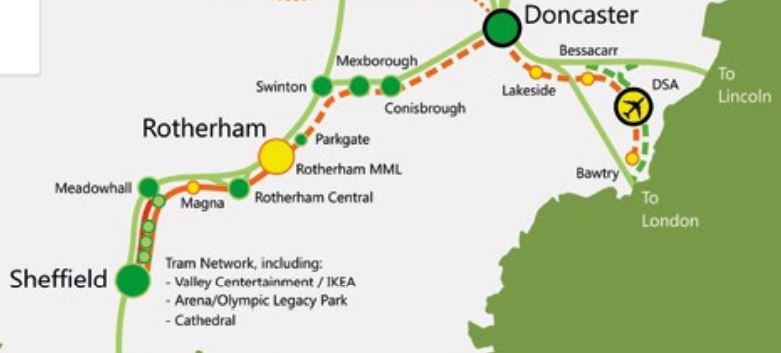
I also said this about the tram-trains.
The distance between Rotherham Parkgate and Doncaster is under twelve miles and has full electrification at both ends.
The Class 399 tram-trains being built with a battery capability for the South Wales Metro to be delivered in 2023, should be able to reach Doncaster.
But there are probably other good reasons to fully electrify between Doncaster and Sheffield, via Meadowhall, Rotherham Central and Rotherham Parkgate.
The major work would probably be to update Rotherham Parkgate to a through station with two platforms and a step-free footbridge.
Currently, trains take twenty-three minutes between Rotherham Central and Doncaster. This is a time, that the tram-trains would probably match.
If you adopt the normal energy consumption of between three and five kWh per vehicle mile on the section without electrification between Rotherham Parkgate and Doncaster, you get a battery size of between 108 and 180 kWh.
It looks to me, that on a quick look, a 128 kWh battery could provide a useful range for one of Stadler’s Class 398/399 tram-trains.
Class 398 Tram-Trains Between Cardiff Bay and Cardiff Queen Street Stations
The distance between these two stations is six chains over a mile,
Adding the extra bit to the flourish might make a round trip between Cardiff Queen Street and The Flourish stations perhaps four miles.
Applying the normal energy consumption of between three and five kWh per vehicle mile on the section without electrification between Cardiff Queen Street and The Flourish, would need a battery size of between 36 and 60 kWh.
Conclusion
The battery sizes seem to fit the routes well.
Could Battery-Electric Hitachi Trains Work TransPennine Express’s Services?
Before I answer this question, I will lay out the battery-electric train’s specification.
Hitachi’s Proposed Battery Electric Train
Based on information in an article in Issue 898 of Rail Magazine, which is entitled Sparking A Revolution, the specification of Hitachi’s proposed battery-electric train is given as follows.
- Based on Class 800-802/804 trains or Class 385 trains.
- Range of 55-65 miles.
- Operating speed of 90-100 mph
- Recharge in ten minutes when static.
- A battery life of 8-10 years.
- Battery-only power for stations and urban areas.
- Trains are designed to be created by conversion of existing Class 80x trains
For this post, I will assume that the train is five cars long. This is the length of TransPennine Express’s Class 802 trains.
TransPennine Express’s Services
These are TransPennine Express services that run in the North of England and to Scotland.
I shall go through all the services and see how they would be affected by Hitachi’s proposed battery-electric train.
Liverpool Lime Street And Edinburgh
- The service runs at a frequency of one train per hour (tph)
- Intermediate stations are Newton-le-Willows, Manchester Victoria, Huddersfield, Leeds, York, Darlington, Durham, Newcastle and Morpeth
The service is 305 miles long and takes four hours and 25 minutes.
The route can be divided into sections, some of which are electrified and some of which are not!
- Liverpool Lime Street and Manchester Victoria – 32 miles – Electrified
- Manchester Victoria and Huddersfield – 26 miles – Not Electrified
- Huddersfield and Dewsbury – 8 miles – Not Electrified
- Dewsbury and Leeds – 9 miles – Not Electrified
- Leeds and Colton Junction – 20 miles – Not Electrified
- Colton Junction and Edinburgh – 220 miles – Electrified
Note that the distance between Manchester Victoria and Colton Junction, which is the only section of the route without electrification is sixty-three miles, which is just within the 55-65 mile battery range of Hitachi’s proposed battery-electric train.
That is too close for my liking, as what happens, if the train gets delayed by an operational incident.
In this article on the BBC, which was published in August 2019 and is entitled Detailed TransPennine £2.9bn Rail Upgrade Plans Unveiled, the following is said.
- The route between Huddersfield and Dewsbury will be electrified.
- Parts of this route will have two extra tracks.
- The plans will be going to full consultation, later in the year.
This would mean that a route summary would be like this.
- Liverpool Lime Street and Manchester Victoria – 32 miles – Electrified
- Manchester Victoria and Huddersfield – 26 miles – Not Electrified
- Huddersfield and Dewsbury – 8 miles – Electrified
- Dewsbury and Colton Junction – 29 miles – Not Electrified
- Colton Junction and Edinburgh – 220 miles – Electrified
The two sections without electrification are well within the 55-65 mile battery range of Hitachi’s proposed battery electric train.
It should also be noted that the electrification between Newcastle and Edinburgh is rather down on power and needs upgrading.
I would suspect that Hitachi’s proposed battery electric train could handle this power deficiency by using the batteries.
Liverpool Lime Street And Scarborough
- The service runs at a frequency of one tph
- Intermediate stations are Lea Green, Manchester Victoria, Stalybridge, Huddersfield, Leeds, Garforth, York, Malton and Seamer
The service is 142 miles long and takes two hours and 58 minutes.
The route can be divided into sections, some of which are electrified and some of which are not!
- Liverpool Lime Street and Manchester Victoria – 32 miles – Electrified
- Manchester Victoria and Huddersfield – 26 miles – Not Electrified
- Huddersfield and Dewsbury – 8 miles – Not Electrified
- Dewsbury and Leeds – 9 miles – Not Electrified
- Leeds and Colton Junction – 20 miles – Not Electrified
- Colton Junction and York – 6 miles – Electrified
- York and Scarborough – 42 miles – Not Electrified
Between Liverpool Lime Street and Colton Junction, the route is identical to the Liverpool Lime Street and Edinburgh service.
The improvement of the section between Huddersfield and Dewsbury will also benefit this service and mean that a route summary would be like this.
- Liverpool Lime Street and Manchester Victoria – 32 miles – Electrified
- Manchester Victoria and Huddersfield – 26 miles – Not Electrified
- Huddersfield and Dewsbury – 8 miles – Electrified
- Dewsbury and and Colton Junction – 29 miles – Not Electrified
- Colton Junction and York – 6 miles – Electrified
- York and Scarborough – 42 miles – Not Electrified
As Hitachi’s proposed battery-electric train has a range of 55-65 miles on battery power, it looks to me that this service could be handled by the train.
It would need a Fast Charge system at Scarborough to recharge the batteries to be able to return to York.
But, as the timetable allows a generous turn-round, fully-charging the batteries shouldn’t be a problem.
Manchester Airport And Newcastle
- The service runs at a frequency of one tph
- Intermediate stations are Manchester Piccadilly, Manchester Oxford Road, Manchester Victoria, Huddersfield, Dewsbury, Leeds, York, Northallerton, Darlington, Durham and Chester-le-Street
The service is 162 miles long and takes three hours and one minute.
The route can be divided into sections, some of which are electrified and some of which are not!
- Manchester Airport and Manchester Victoria – 13 miles – Electrified
- Manchester Victoria and Huddersfield – 26 miles – Not Electrified
- Huddersfield and Dewsbury – 8 miles – Not Electrified
- Dewsbury and Leeds – 9 miles – Not Electrified
- Leeds and Colton Junction – 20 miles – Not Electrified
- Colton Junction and Edinburgh – 86 miles – Electrified
Between Manchester Victoria and Colton Junction, the route is identical to the two Liverpool Lime Street services, that I discussed previously.
The improvement of the section between Huddersfield and Dewsbury will also benefit this service and mean that Hitachi’s proposed battery-electric train could handle this route with ease.
Manchester Airport And Redcar Central
- The service runs at a frequency of one tph
- Intermediate stations are Gatley, Manchester Piccadilly, Manchester Oxford Road, Manchester Victoria, Huddersfield, Dewsbury, Leeds, York, Thirsk, Northallerton, Yarm, Thornaby and Middlesbrough
The service is 162 miles long and takes three hours and fifteen minutes.
The route can be divided into sections, some of which are electrified and some of which are not!
- Manchester Airport and Manchester Victoria – 13 miles – Electrified
- Manchester Victoria and Huddersfield – 26 miles – Not Electrified
- Huddersfield and Dewsbury – 8 miles – Not Electrified
- Dewsbury and Leeds – 9 miles – Not Electrified
- Leeds and Colton Junction – 20 miles – Not Electrified
- Colton Junction and Northallerton – 35 miles – Electrified
- Northallerton and Redcar Central – 29 miles – Not Electrified
Between Manchester Victoria and Colton Junction, the route is identical to the previously discussed services.
The improvement of the section between Huddersfield and Dewsbury will also benefit this service and mean that Hitachi’s proposed battery-electric train could handle this route with ease.
As with the Scarborough service, a Fast-Charge system would probably be needed at Redcar Central.
Manchester Piccadilly And Hull
- The service runs at a frequency of one tph
- Intermediate stations are Stalybridge, Huddersfield, Leeds, Selby and Brough
The service is 94 miles long and takes two hours and four minutes.
The route can be divided into sections, some of which are electrified and some of which are not!
- Manchester Piccadilly and Huddersfield – 25 miles – Not Electrified
- Huddersfield and Dewsbury – 8 miles – Not Electrified
- Dewsbury and Leeds – 9 miles – Not Electrified
- Leeds and Hull – 52 miles – Not Electrified
Between Huddersfield and Leeds, the route is identical to the previously discussed services.
The improvement of the section between Huddersfield and Dewsbury will also benefit this service and mean that Hitachi’s proposed battery-electric train should be able to handle this route.
As with the Scarborough and Redcar Central services, a Fast-Charge system would probably be needed at Hull.
Manchester Piccadilly And Huddersfield
- The service runs at a frequency of one tph
- Intermediate stations are Stalybridge, Mossley, Greenfield, Marsden and Slaithwaite
The service is 25 miles long and takes forty-three minutes.
The route is without electrification.
Hitachi’s proposed battery-electric train should be able to handle this route with ease.
The train could charge at either end using the electrification.
Huddersfield And Leeds
- The service runs at a frequency of one tph
- Intermediate stations are Deighton, Mirfield, Ravensthorpe, Dewsbury, Batley, Morley and Cottingley
The service is 17 miles long and takes thirty-six minutes.
Hitachi’s proposed battery-electric train should be able to handle this route with ease.
The train could charge at Leeds using the electrification.
Manchester Airport And Cleethorpes
- The service runs at a frequency of one tph
- Intermediate stations are Manchester Piccadilly, Stockport, Sheffield, Meadowhall Interchange, Doncaster, Scunthorpe, Barnetby, Habrough and Grimsby Town
The service is 124 miles long and takes two hours and fifty-eight minutes.
he route can be divided into sections, some of which are electrified and some of which are not!
- Manchester Airport and Stockport – 16 miles – Electrified
- Stockport and Sheffield – 37 miles – Not Electrified
- Sheffield and Doncaster – 19 miles – Not Electrified
- Doncaster and Cleethorpes – 52 miles – Not Electrified
There would need to be some en route charging and surely the easiest way to achieve this would be to extend the electrification at Doncaster to Sheffield.
As with the other services, a Fast-Charge system would probably be needed at Cleethorpes.
Manchester Airport And Glasgow Central Or Edinburgh Waverley Via Preston
This service is all-electric.
Conclusion
Hitachi’s proposed battery-electric train can handle all of TransPennine’s routes without using one drop of diesel.
What I have found interesting, is that the eight miles of electrification between Huddersfield and Dewsbury appears to make the operation of a battery-electric train a lot easier.
It looks like someone at Hitachi and Network Rail have taken a calculator to a decent hostelry and worked out a cunning plan!
 The Anonymous Widower