Improvements To Leeds And Hull Services
This news story from the Department of Transport is entitled Yorkshire And The Humber To Benefit From £19.8 billion Transport Investment.
This is said about Leeds and Hull services.
Hull will also be brought into the Northern Powerhouse Rail network, reducing journey time from Leeds from 58 minutes to just 48. The number of trains between Hull and Sheffield will be doubled, to 2 per hour, with capacity also doubled. Journeys from Hull to Manchester will drop from 115 to 84 minutes, enabling 2 fast trains to Leeds.
I shall look at the 10:15 Northern Trains service between Hull and Leeds on the 13th October 2023.
- The distance is 51.8 miles.
- There are seven stops.
- The service is run by a diesel Class 158 train.
- Journey time is 69 minutes.
Ten minutes off this time would be worthwhile.
I shall look at the 10:03 TransPennine Express service between Hull and Leeds on the 13th October 2023.
- There are two stops.
- The service is run by a diesel Class 185 train.
- Journey time is 54 minutes.
Ten minutes off this time would be difficult.
Note.
- The line between Micklefield and Leeds is being electrified.
- The distance between Hull and Micklefield is 42 miles.
- The route has a maximum speed of between 75 and 90 mph.
There is also an historic swing bridge at Selby, which would probably be difficult to electrify.
How Many Minutes Could Electric Trains Save Between Leeds and Hull?
Electric trains have better acceleration and deceleration, when compared to diesel trains, so two minutes per stop and for the acceleration and deceleration at Hull and Leeds, would give the following times.
- Northern Trains – 53 minutes
- TransPennine Express – 48 minutes
As electrification is not mentioned for between Leeds and Hull, the only electric trains, that could work the route will be battery-electric trains.
Battery-Electric Trains Between Leeds and Hull
Consider.
- TransPennine Express already have Class 802 trains, from which the battery-electric version is being developed.
- Northern Trains would need a suitable battery-electric train. There has been talk of a CAF battery-electric Class 331 train, but nothing more. These would surly be ideal.
- Trains could be charged on new electrification in Hull station and between Micklefield and Leeds.
The trains would need a range of just 42 miles.
A Second Fast Train Between Leeds and Hull
What does this statement in the news story imply?
Journeys from Hull to Manchester will drop from 115 to 84 minutes, enabling 2 fast trains to Leeds.
I feel that this statement must be read in conjunction with the benefits of the TransPennine Route Upgrade.
One benefit is given as Faster Journeys, where this is said.
We’re speeding up journeys so you can travel to your favourite towns and cities more quickly. Our fastest journey times are forecast to be 63-66 minutes between Manchester and York and 41-42 minutes between Manchester and Leeds.
The news story says that the fastest journey times between Leeds and Hull will be 48 minutes, which would give a Hull and Manchester time of 89-90 minutes.
Alternatively, there could be these timings on one train.
- Hull and Leeds – 48 mins
- Hull and Manchester Victoria – 84 mins
- Leeds and Manchester Victoria – 36 mins
Note.
- The train would call at Brough, Selby, Leeds, Huddersfield and Stalybridge.
- There may be a new station at Leeds Thorpe Park
- The distance between Hull and Manchester Victoria is 94.7 miles.
- This is an average speed of 67.6 mph.
It almost looks like it’s connectivity East of Leeds and speed between Leeds and Manchester.
Conclusion
Battery-electric trains would provide all the improvements promised between Leeds and Hull.
Could Hull Station Be Electrified?
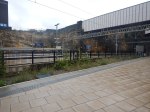
I took these pictures, as I passed through Hull station yesterday.
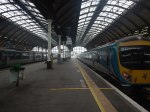
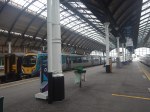
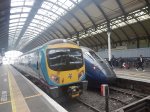
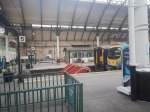
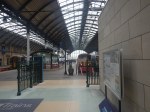


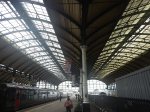
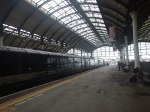
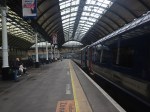

It appears that Hull station has a similar Victorian roof to Liverpool Lime Street and London Paddington, so I suspect the answer is yes.
These pictures show the platforms and overhead electrification at Liverpool Lime Street station, since the recent remodelling.


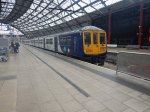
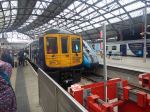
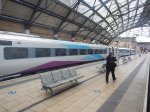

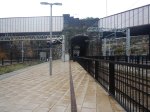

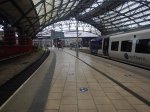

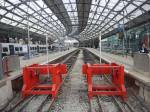
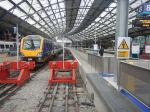

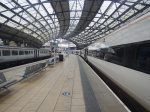

The electrification seems to be very traditional, with lots of steel gantries over the tracks.
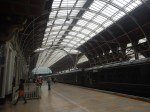
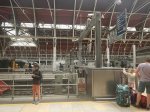
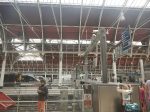
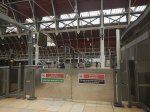
These pictures show the platforms and overhead electrification at London Paddington station.
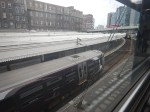
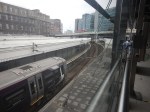
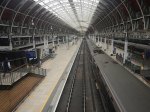
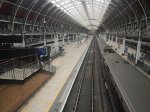
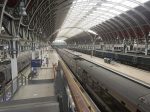
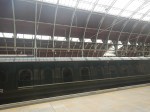
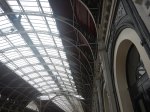

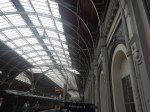
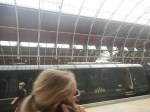
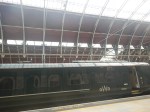
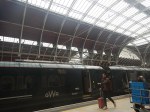
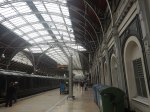
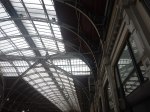
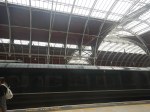
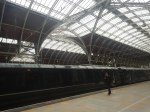
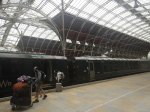
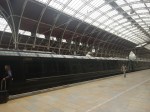
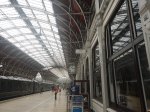
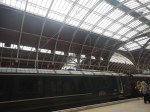
Note.
- The roof seems to have extra tie-bars reaching across.
- The wires seem to be hung from the roof.
- At the end of the platform they are fixed to large arch supports.
- Because Liverpool Lime Street’s electrification is newer than Paddington’s, it seems to have much more professional look.
After looking at the electrification in Liverpool Lime Street and Paddington, I believe that Hull station could be successfully electrified.
This map from OpenRailwayMap shows the platform layout at Hull station.
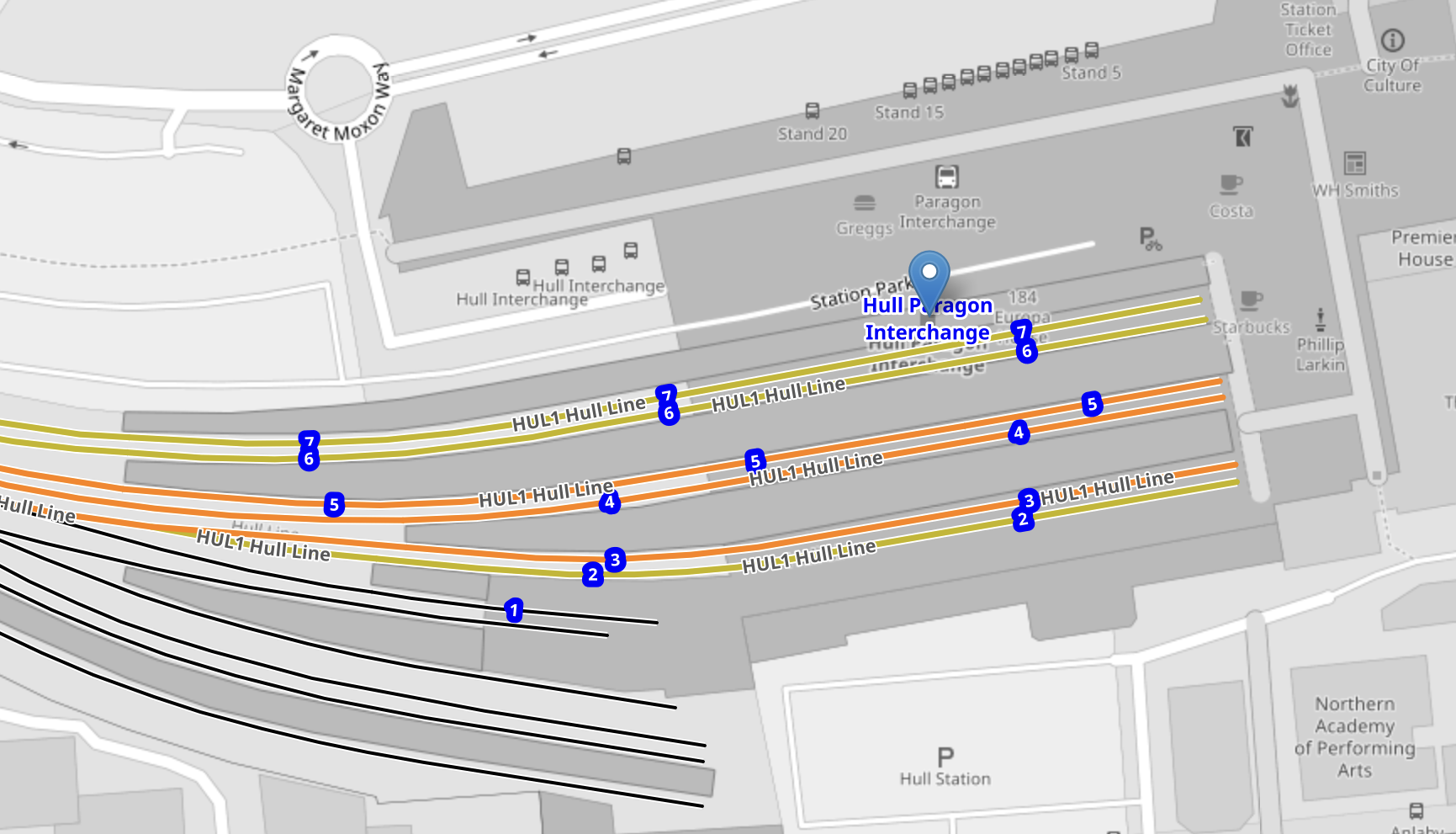
Note.
- Yesterday, my trains arrived in and left from Platform 7, which is the Northern-most platform.
- Other pictures in this blog show Hull Trains’s London service in Platform 7.
- Yesterday all Class 802 trains to and from London run by Hull Trains and LNER used Platform 7.
- I have been told by station staff, that Platform 7 can take a nine-car LNER Azuma.
- In Ten-Car Hull Trains, I talk about ten-car Class 802 trains running to and from Hull.
- Platform 7 or another platform at Hull station must be able to handle a ten-car train, which means that Hull station can handle a train, that is 260 metres long.
Looking at the station map, I believe that Hull station’s capacity for long express trains, is on a par with that of Liverpool Lime Street station.
I could see both stations handling two trains per hour (tph) across the Pennines and to and from London, with if necessary trains being formed of a pair of five-car trains.
How Many Services From Hull Station Can Be Run With Battery Trains?
Hull Trains service between London and Beverley travels for 44.5 miles on unelectrified track between Temple Hirst junction and Beverley.
Typically Hull Trains services wait in Hull station for the following times.
- Going between London King’s Cross and Beverley – Between ten and fifteen minutes.
- Returning to London King’s Cross – Upwards of twenty-five minutes.
I believe these waits in Hull station would mean that.
- A train going North to Beverley will have a battery containing enough electricity to get the train to Beverley and back, which is a distance of 16.7 miles.
- A train going South from Hull will have a battery containing enough electricity to get the train to Temple Hirst junction, which is a distance of 36.1 miles.
I believe that Hull Trains are currently working a timetable, that has been designed for operation by trains with a range on batteries of around fifty miles, provided there is electrification in at least one platform at Hull station to charge the trains.
It is also interesting to look at LNER’s two services that serve Hull.
- The 0700 to London, is scheduled to arrive at Hull station at 0635 from stabling at Doncaster and waits up to twenty-five minutes before leaving for London.
- The 2004 from London, is scheduled to arrive at Hull station at 2004 and waits up to twenty-five minutes before going South to overnight stabling in Doncaster.
It looks like LNER’s two trains follow Hull Trains rules.
- They use Platform 7 in Hull station.
- Trains going South have up to twenty-five minutes in the station.
It appears to me, that both Hull Trains and LNER are running a timetable, that would allow their services to be run using trains with a battery that had a range of around fifty miles, that could be fully-charged at Hull station before going South.
TransPennine Express run an hourly service to Liverpool Lime Street via Leeds and Manchester Victoria.
According to OpenRailwayMap’s map of electrification, when the TransPennine Upgrade is complete, the only section of the route without electrification will be the 42.1 miles between Hull and Micklefield.
As TransPennineExpress have some of the same Class 802 trains as Hull Trains, if there were at least two electrified platforms in Hull station, then Hull and Liverpool services could be run by battery-electric trains, with a similar specification to those of Hull Trains.
Northern Trains run an hourly service to Halifax via Leeds.
According to OpenRailwayMap’s map of electrification, , the only sections of the route without electrification will be the 42.1 miles between Hull and Micklefield and the 17.5 miles between Leeds and Halifax.
As Leeds and Micklefield is timetabled for seventeen minutes, I suspect this would be enough time to fully charge a battery-electric version of CAF’s Class 331 train and with charging in Hull station, then this route could be electrified.
Northern Trains also run other services, but because the Goole swing bridge is closed, I can’t get all the distances without electrification from Hull.
Ones I can find are.
- Beverley – 16.7 miles for return trip.
- Bridlington – 31.1 miles
- Doncaster – 40.8 miles
- Micklefield – 42.1 miles
- Scarborough – 53.8 miles
- Sheffield – 59.4 miles
- Temple Hirst – 36.1 miles
- York – 41.1 miles – Hull and Church Fenton
Note.
- York and Doncaster are electrified.
- Bridlington and Scarborough have suitable platforms where 25 KVAC overhead electrification could be installed to charge trains.
- Sheffield and Doncaster is only 18.6 miles and this may be the way to electrify between Sheffield and Hull.
- In The Data Sheet For Hitachi Battery Electric Trains, I state that Hitachi’s battery-electric trains have a range of 43.5 miles
It looks if enough platforms are electrified at Hull, all current services from the city could be run by battery-electric trains.
Conclusion
I believe that by electrifying Hull station, that Hull could have a station consistent with the HumberZero philosophy, with battery-electric trains running hither and thither, handling all rail traffic to and from the City.
Have Your Say About Potential New Hydrogen Facility In Aldbrough
The title of this post, is the same as that of this article on HullLive.
This is the first paragraph.
SSE Thermal is looking for input from the local community regarding its first-of-a-kind low-carbon hydrogen facility.
They are holding meetings in the Hull area as follows to discuss the project with anybody who is interested.
- Tuesday, June 6, 2:30pm – 7pm: Hedon Town Hall, 36 St Augustine’s Gate, Hedon, HU12 8EX
- Wednesday, June 7, 2:30pm – 7pm: East Village Meadows, Northfield Farm, Garton, HU11 4QB
- Thursday, June 8, 2:30pm – 7pm: Aldbrough Village Hall, Garton Rd, Aldbrough, HU11 4QA
I shall be going on the Tuesday. There are buses from Hull station, which take about 35 minutes.
This section is copied from the HullLive article.
What is the Pathfinder Project?
The Aldbrough Hydrogen Pathfinder project is an important building block in the development of a thriving Humber hydrogen economy, underpinning the region’s decarbonisation and supporting economic growth locally and nationally.
The project is proposed to be developed within its existing site at Aldbrough Gas Storage, and all visible infrastructure will be within the site boundary.
The project intends to use one of the current storage caverns and repurpose it to develop a project in the Humber that would unite hydrogen production, storage and power generation in one.
As someone, who feels strongly about the benefits of hydrogen, I feel this is a very worthwhile project.
Hull Trains Is Back And Stronger Than Ever
The title of this post, is the same as that of this press release from Hull Trains.
This is the first paragraph.
Timetables at Hull Trains will be back to pre-pandemic levels from December as public confidence in rail travel continues to grow.
These are other points from the press release.
- The number of returning passengers is steadily increasing.
- From December 12th, Hull Trains will be running 94 trains per week in total, which is two higher than the pre-pandemic record.
- An additional service will be run on Sunday to match the six trains per day (tpd) on Saturday.
- There will be seven tpd on weekdays. That’s not far off one train per teo hours (tp2h) all day.
Passenger numbers must be coming out from the pandemic well.
This sentence from the press release gives a clue to how Hull Trains will cope with increasing passenger numbers.
Ten-car operations will commence on Fridays and Saturdays to provide additional capacity just in time for Christmas travel and the general growing demand as we prepare to enter 2022.
I suspect by rescheduling maintenance and running all five trains in services, they can run some trains on Fridays and Saturdays as pairs.
- As Hull trains only stop at Stevenage, Grantham, Retford, Doncaster, Selby, Howden, Brough, Hull and Beverley, there aren’t many stations, that need to be able to take ten-car trains.
- I suspect a couple of platforms might need lengthening, as a ten-car train is 260 metres long. Or they could instruct passengers to only use the front train for the stations with short platforms. Or only use five-car trains to the stations with short platforms.
- But the longer trains won’t need any extra paths.
- I was also told last year, that Hull station can take nine-car trains, so perhaps it can take a ten.
So to increase capacity on the route, Hull Trains just need to add another train to their fleet.
As all costs are probably well-known, with a bit of simple modelling, Hull Trains can probably predict, when they need to add a new train.
Whilst I was looking at the Lumo train yesterday, I got talking to a driver from Hull Trains, who had come over to take a professional look at Lumo’s Class 803 train.
I asked him what he liked about Hull Trains’s Class 802 trains as a driver. He said the brakes, which is probably most important to a driver, as they’re at the sharp end, if anything happens. So that’s comforting.
He also said that some of the Hitachi trains had shown they were stable at 140 mph. So that’s good too.
On talking about the batteries on the Lumo train, I got the impression that batteries will appear on other Hitachi Trains.
Conclusion
It appears to be all trains go between London and Hull.
In Could We See Between London And Much Of The North By Train In Under Two Hours?, I looked at the effect of improvements on the East Coast Main Line and concluded that timings between London Kings Cross and Hull could be around two hours and twenty minutes. This would surely be a spur to increasing traffic on the route.
Surely, when Hull Trains use battery-electric Hitachi trains between London and Hull, this will be the icing on the marketing cake, as we seem to be coming to a point, where zero-carbon sells.
As an aside, will Lumo, who are another First Group company, use a similar mix of five- and ten-car trains on the London and Edinburgh route to increase capacity?
I suspect that what is good for Hull Trains will be good for Lumo.
Could We See Between London And Much Of The North By Train In Under Two Hours?
I shall write about each route in order starting from Euston and working East.
Avanti West Coast And Euston
These are services from Euston, that I feel could be under two hours.
London Euston And Liverpool Lime Street
On Thursday, I went to Liverpool by train.
- My train took two hours and thirteen minutes between London Euston and Liverpool Lime Street stations.
- There were stops at Stafford, Crewe and Runcorn.
- The Class 390 train was travelling at 125 mph for a lot of the way.
- The distance between the two terminals is 193.6 miles.
- The start to stop average including the stops was 87.3 mph.
So could London Euston and Liverpool Lime Street be achieved in the magic two hours?
A few thoughts.
Average Speed
To do the journey in this time would need an average speed of 96.8 mph.
Accelerating And Stopping
Ideally, the train will run as fast as it can only changing speed for the station stops.
- The train will accelerate from stop to cruising speed at Euston, Stafford, Crewe and Runcorn or four times.
- The train will decelerate from cruising speed to stop at Stafford, Crewe, Runcorn and Liverpool Lime Street or four times.
Effectively, the train goes through four complete station stops, although one will be split between the two ends of the journey.
These figures are from Wikipedia and the Internet
- The acceleration of the Class 390 train is 1.0 mph/sec which means that it takes 125 seconds to get to 125 mph.
- The deceleration of a Class 390 train is 2.0 mph/sec, which means that it takes 63 seconds to stop from 125 mph.
- The acceleration of a Class 801 train is 1.6 mph/sec which means that it takes 78 seconds to get to 125 mph.
- The deceleration of a Class 801 train is 2.2 mph/sec, which means that it takes 57 seconds to stop from 125 mph.
These figures would appear to show, that a Class 801 train can decelerate and accelerate at a stop in nearly a minute faster than a Class 390 train.
So how can we increase the acceleration and deceleration? The two obvious ways are more power and less weight.
Form the Internet, I estimate that the average car in a Class 390 train is around 52 tonnes, as opposed to 41 tonnes for the Hitachi trains.
So does this weight difference explain some of the difference in acceleration and deceleration times?
Consider.
- The Class 390 trains have all the extra weight of the tilt mechanism. More weight means slower acceleration.
- Avanti West Coast’s new Class 807 trains have no diesel engines or batteries. Have the trains been put on a diet?
- They also have a reprofiled nose. Is it more aerodynamic?
So if these trains can save time on the four accelerate/decelerate cycles compared to the Class 390 trains, they must be getting nearer to the magic two hours.
If two minutes a stop can be saved that would save eight minutes on the journey between London Euston and Liverpool Lime Street.
140 Mph Running
The time to do a mile at various speeds are as follows.
- 100 mph – 36 seconds
- 125 mph – 29 seconds
- 140 mph – 26 seconds
So running at 140 mph, as opposed to the current 125 mph would save three seconds for every mile.
To save five minutes would mean the train would have to run for a hundred miles at 140 mph instead of 125 mph.
As Stafford is 133.5 miles from London, it could be that full digital signalling should be installed on the West Coast Main Line all the way to Stafford or even Crewe, which is 158 miles from London.
This schematic map of the West Coast Main Line was clipped from Wikipedia.

Note.
- Trains between London Euston and Liverpool Lime Street take the Trent Valley Line through Nuneaton and Lichfield Trent Valley and stop at Stafford, Crewe and Runcorn.
- Trains between London Euston and Manchester take a variety of routes and all go via Stockport.
- One train per hour (tph) between London Euston and Glasgow Central takes the Trent Valley Line and goes non-stop between London Euston and Warrington Central.
- Norton Bridge Junction just to the North of Stafford has recently been remodelled.
I believe there is potential to enable up to at least a hundred miles of 140 mph running to the South of Crewe. Especially as most of the track South of Crewe is quadruple track.
This should enable the shaving of five or more minutes off the time of any train capable of 140 mph running that uses the Trent Valley Line through Nuneaton, Lichfield Trent Valley and Stafford.
Norton Bridge Junction
Norton Bridge junction, which is five miles North used to be a bottleneck, but it has now been remodelled.
I wrote about it in The New Norton Bridge Junction In Action.
The new junction has probably been designed so that it can save a few seconds for trains going between Stafford and Crewe, whether or not they stop at either or both stations.
Non-Stop Between London Euston and Runcorn
If you look at the times of a London Euston and Glasgow Central train via the Trent Valley Line , it travels the 174.7 miles between London Euston and Weaver Junction non-stop in one hour and forty minutes. This is an average speed of 104.8 mph.
By comparison, my train on Thursday took one hour and forty-seven minutes with the two stops at Stafford and Crewe.
So there is at least six minutes to be saved by going non-stop.
Two Trains Per Hour Between London Euston And Liverpool Lime Street
Wikipedia says this about an additional service.
Subject to approval by the Office of Rail and Road, an additional hourly service will be introduced between London Euston and Liverpool Lime Street with a stop at Liverpool South Parkway from December 2022.
I have a few thoughts and questions on extra services between London Euston and Liverpool Lime Street,
- In my view the second service is much needed.
- I also think, that a later train back to London is needed.
- Does the Wikipedia statement mean that only one train will stop at Liverpool South Parkway?
- Does Runcorn need two tph to and from London?
- Would the platforms at Liverpool South Parkway be lengthened to accept eleven-car Class 390 trains?
I feel that if a train stopped at both Liverpool South Parkway and Runcorn, this would make a two-hour journey more difficult to achieve.
London Euston And Liverpool Lime Street In Two Hours
The new Class 807 trains will be delivered by 2022. Because of the pandemic, I’ll assume that of the ten trains on order, some, but not all, will be available by the December 2022 timetable change.
The time savings needed for a two-hour journey will come from four improvements.
- The increased performance of the Class 807 trains.
- Full digital signalling South of Crewe.
- The track improvements already completed like Norton Bridge Junction.
- Cutting out stop on the second service.
There may also be time savings to be obtained at the intermediate stops, by better working practices.
I doubt that the full digital signalling will have been installed, but all trains will be capable of 125 mph running.
Avanti West Coast probably have a good idea of the time they could achieve without digital signalling and I feel that they could be about five minutes over two hours with the Class 807 trains.
As the eleven-car Class 390 trains are too long for Liverpool South Parkway station, could we see the following service?
- 1 tph – Class 390 train – London Euston And Liverpool Lime Street via Runcorn, Crewe and Stafford.
- 1 tph – Class 807 train – London Euston And Liverpool Lime Street via Liverpool South Parkway.
Note.
- The Class 390 train would run the existing timetable in two hours and thirteen minutes.
- The Class 807 train would be a two-hour express service if possible.
- Going from three stops to one could save the express at least seven minutes, as I showed earlier by looking at train timings South of Weaver Junction.
- There would be time savings of at least two minutes on the express service due to the better performance of the Class 807 train.
To save the final four minutes, there would need to be at least eighty miles of 140 mph running, as each mile saves three seconds.
I am fairly certain, that London Euston and Liverpool Lime Street can be regularly achieved in two hours.
London Euston And Warrington Bank Quay
The hourly London Euston and Glasgow Central expresses seem to take one hour and forty-five minutes for the non-stop trip of 182.1 miles, which is an average speed of 104 mph.
As this service is non-stop, I believe that this service would get the maximum benefit from digital signalling and this service will only get faster, as more and more of the route allowed 140 mph-running.
I wouldn’t be surprised to see almost ten minutes lopped off this service by signalling and other improvements.
I am fairly certain, that London Euston and Warrington Bank Quay can be regularly achieved in well under two hours, by a Class 390 train.
London Euston And Wigan North Western
The hourly London Euston and Glasgow Central expresses seem to take one hour and fifty-six minutes for the single-stop trip of 193.9 miles, which is an average speed of 100.3 mph.
As this service just a single stop at Warrington Bank Quay, I believe that this service would get the maximum benefit from digital signalling and this service will only get faster, as more and more of the route allowed 140 mph-running.
As with Warrington Bank Quay, I wouldn’t be surprised to see almost ten minutes lopped off this service by signalling and other improvements.
I am fairly certain, that London Euston and Wigan North Western can be regularly achieved in comfortably under two hours, by a Class 390 train.
London Euston And Preston
The hourly London Euston and Glasgow Central expresses seem to take two hours and eleven minutes for the two -stop trip of 209 miles, which is an average speed of 95.7 mph.
As this service just stops at Warrington Bank Quay and Wigan North Western, I believe that this service would get the maximum benefit from digital signalling and this service will only get faster, as more and more of the route allowed 140 mph-running.
As with Warrington Bank Quay and Wigan North Western, I wouldn’t be surprised to see almost ten minutes lopped off this service by signalling and other improvements.
I am fairly certain, that London Euston and Preston can be regularly achieved in just under two hours, by a Class 390 train.
London Euston And Blackpool North
Avanti West Coast have indicated that their new Class 807 trains will run between London Euston and Blackpool North.
Consider.
- I am fairly certain that a Class 390 train will be able to run between London Euston and Preston in under two hours, once digital signalling is installed South of Crewe.
- Currently, Class 390 trains take twenty minutes between Preston and Blackpool North stations.
- The Class 807 trains have better acceleration and deceleration and should be able to execute faster stops than the Class 390 trains.
I wonder if Avanti West Coast, Hitachi, Network Rail and Rock Rail have thought up a cunning plan to run Class 807 trains between London Euston And Blackpool North, in under two hours.
Trains would go via the Trent Valley.
Trains might only stop at perhaps Milton Keynes Central, Warrington Bank Quay, Wigan North Western and Preston.
Trains would run at up to 140 mph using digital signalling, in as many places as possible.
Is the performance of the Class 807 trains sufficient to achieve London Euston and Blackpool North in under two hours via the Trent Valley?
London Euston And Manchester Piccadilly via Wilmslow
Consider.
- Most trains between London Euston and Manchester Piccadilly via Wilmslow seem to take around six or seven minutes over two hours.
- I believe that if the 158 miles between London Euston and Crewe were to be digitally signalled, then this could save up to eight minutes by allowing trains to run at 140 mph rather than the current 125 mph.
This could be enough to bring the London Euston and Manchester Piccadilly via Wilmslow below two hours.
I am not surprised at this, as the trains were built for 140 mph and because there is no digital signalling, they are limited to 125 mph, which slows the trains by six or seven minutes.
London Euston And Manchester Piccadilly via Stoke-on-Trent
Everything I said about trains between London Euston and Manchester Piccadilly via Wilmslow probably apply, except that the services via Stoke-on-Trent are a few minutes slower.
But I do feel, that this could be enough to bring the London Euston and Manchester Piccadilly via Stoke-on-Trent below two hours.
East Midlands Railway And St. Pancras
These is only one service from St. Pancras, that is not comfortably under two hours.
London St. Pancras And Sheffield
A typical service between London St. Pancras And Sheffield takes a few minutes over two hours..
- There are two tph
- There are stops at Leicester, Loughborough, East Midlands Parkway, Long Eaton, Derby or Chesterfield depending on the service.
- The Class 222 trains travel at 125 mph for most of the way.
- The distance between the two terminals is 164.7 miles.
- The start to stop average including the stops is 81 mph.
I would suspect that East Midlands Railway’s new bi-mode Class 810 trains will be able to easily break the two-hour barrier.
- They have four diesel engines so they can cruise at 125 mph on diesel.
- They have electric power for South of Market Harborough.
- Some diesel engines will be changed for batteries.
As electrification increases on the Midland Main Line, these trains will use less and less diesel.
I also suspect that digital signalling will start to creep into the route, starting from Bedford, where it is used on Thameslink.
LNER And King’s Cross
These are services from King’s Cross, that are or I feel will be under two hours.
London King’s Cross And Doncaster
A typical service between London King’s Cross And Doncaster takes around one hour and thirty-seven minutes.
- There are four tph
- There are stops at Stevenage, Peterborough, Grantham, Newark and Retford depending on the service.
- The Class 80x trains travel at 125 mph for most of the way.
- The distance between the two stations is 156 miles.
- The start to stop average including the stops is 96.5 mph.
Digital signaling is being installed on this section of the East Coast Main Line and I suspect that this will reduce timings between London King’s Cross And Doncaster.
A simple estimate based on the maximum operating speed, indicates a time of one hour and twenty-six minutes should be possible.
But as a Control Engineer, I believe that digital signalling will lead to faster running over the Digswell Viaduct and through the flat crossing at Newark.
The timing will certainly be under one hour and thirty minutes between London King’s Cross And Doncaster.
London King’s Cross And York
A typical service between London King’s Cross And York takes around one hour and forty-eight minutes.
- There are two tph
- There are stops at Stevenage, Peterborough, Grantham, Newark, Retford and Doncaster depending on the service.
- The Class 80x trains travel at 125 mph for most of the way.
- The distance between the two stations is 188.5 miles.
- A non-stop service takes one hour and fifty-two minutes, which is a start to stop average including the stops is 101 mph.
If my crude estimate of time savings because of digital signalling South of Doncaster can be applied, this would imply a reduction in journey time of at least eleven minutes.
London King’s Cross And Leeds
A typical service between London King’s Cross And Leeds takes around two hours and thirteen minutes.
- There are three tph
- There are stops at Stevenage, Peterborough, Grantham, Newark, Doncaster and Wakefield Westgate depending on the service.
- The Class 80x trains travel at 125 mph for most of the way.
- The distance between the two terminals is 185.9 miles.
- This is a start to stop average including the stops is 83.9 mph.
If my crude estimate of time savings because of digital signalling South of Doncaster can be applied, this would imply a reduction in journey time of at least eleven minutes, which would put a time between London King’s Cross and Leeds of around two hours.
London King’s Cross And Bradford Forster Square
LNER run some services on this route
- The services take thirty minutes between Leeds and Bradford Forster Square stations.
- The services do not reverse at Leeds.
Given that two hours should be possible between London Kings Cross and Leeds, it would appear that two hours and thirty minutes should be possible between Leeds and Bradford Forster Square stations.
London King’s Cross And Bradford Interchange
Grand Central run some services on this route
- The services call at Doncaster, Wakefield Kirkgate, Mirfield, Brighouse and Low Moor
- The services take two hours and fifty-four minutes between London King’s Cross and Bradford Interchange stations.
- The services take one hour and seventeen minutes between Doncaster and Bradford Interchange stations.
The services are run by Class 180 diesel trains, which will have to be replaced to decarbonise the route.
I suspect that Hitachi will have a train for this route, that could use diesel or batteries to the North of Doncaster.
- My estimate for the best time between King’s Cross and Doncaster is one hour and twenty-six minutes.
- The current time between Doncaster and Bradford Interchange stations is one hour and seventeen minutes.
This gives a best time of perhaps two hours and forty-three minutes between Doncaster and Bradford Interchange stations.
The route to Bradford via Leeds is perhaps fifteen minutes faster, but it serves different stations.
London King’s Cross And Harrogate
LNER has been running to Harrogate for some time.
- There is one train per two hours (tp2h)
- The service calls at Stevenage, Grantham, Doncaster, Wakefield Westgate and Leeds.
- some services reverse at Leeds.
- The service takes two hours and fifty-five minutes between London King’s Cross and Harrogate stations.
- The service takes thirty minutes between Leeds and Harrogate stations.
Given that two hours should be possible between London Kings Cross and Leeds, it would appear that two hours and thirty minutes could be possible between London King’s Cross and Harrogate stations.
London King’s Cross And Huddersfield
In LNER Expands To Huddersfield, I described LNER’s new service to Huddersfield.
- There will be one train per day (tpd)
- The service will call at Peterborough, Newark North Gate, Doncaster, Wakefield Westgate, Leeds and Dewsbury.
- The service will split and join with the London King’s Cross and Skipton service at Leeds.
- The service will reverse at Leeds.
- The service take two hours and fifty-five minutes between London King’s Cross and Huddersfield stations.
- The service will take twenty-five minutes between Leeds and Huddersfield stations.
- Improvements are planned, which include electrification, between Dewsbury and Huddersfield
Given that two hours should be possible between London Kings Cross and Leeds, it would appear that two hours and thirty minutes could be possible between London King’s Cross and Huddersfield stations.
London King’s Cross And Hull
The fastest Hull Trains service between London King’s Cross And Hull takes around two hours and thirty minutes.
- There are seven tpd
- There are stops at Stevenage, Grantham, Retford, Doncaster, Selby, Howden and Brough depending on the service.
- The Class 80x trains travel at 125 mph for most of the way.
- The distance between the two terminals is 205.3 miles.
- This is a start to stop average including the stops is 82.1 mph.
If my crude estimate of time savings because of digital signalling South of Doncaster can be applied, this would imply a reduction in journey time of at least eleven minutes, which would put a time between London King’s Cross and Hull of around two hours and twenty minutes.
London King’s Cross And Middlesbrough
LNER have announced a Middlesbrough service, which I wrote about in LNER’s Middlesbrough And London Service. Starts On December 13th.
- There will be one tpd in both directions
- Intermediate stops will be at Thornaby and York.
- The Middlesbrough and London service will leave Middlesbrough from Platform 1 at 07:08 and arrive in King’s Cross at 10:22.
- The London and Middlesbrough service will leave King’s Cross at 15:25 and arrive in Middlesbrough in Platform 2 at 18:18.
There appear to be some curiosities in the timetabling of these trains, which I may explore later.
I would assume that is because LNER want a competitive time of three hours between King’s Cross and Middlesbrough.
These are Southbound times between Eaglescliffe and King’s Cross in the morning.
- Grand Central – Two hours and thirty-nine minutes
- LNER – Three hours and two minutes
Is this because the Class 180 train is a genuine 125 mph train on diesel and the Class 800 train is not?
If my crude estimate of time savings because of digital signalling South of Doncaster can be applied, this would imply a reduction in journey time of at least eleven minutes, which would put a time between London King’s Cross and Middlesbrough of around three hours.
Conclusion
Of the cities and towns in the North, that I have discussed only Bradford, Harrogate, Huddersfield, Hull and Middlesbrough, are ones that will be difficult to be provided with a two-hour journey time to and from London. But all should be possible in close to or under two hours and thirty minutes.
Open Access Operators And The Lumo Model
In the UK, there are only three established Open Access operators, who run UK train services.
- Grand Central
- Heathrow Express
- Hull Trains
From the 25th of October, they will be joined by Lumo.
We probably don’t think of Heathrow Express as an Open Access operator and as it is effectively a short distance special service with new trains between Heathrow and Paddington, it has its own business model, that may or may not survive.
But how will Lumo and their bold new business model affect Grand Central, Hull Trains and any future Open Access operators?
Grand Central Trains
Grand Central is a well-established Open Access operator.
- They run services between London King’s Cross and Bradford Interchange, Sunderland and several other convenient en-route stations.
- They are owned by Deutsche Bahn.
- They also regularly seem to apply for new routes and extra services.
But they have a big problem fast catching up on them; they have a diesel-only fleet and need to decarbonise.
I also think that all express passenger services on the East Coast Main Line will at some date need to be run by 140 mph trains capable of running with full digital signalling and a degree of Automatic Train Operation.
In Lumo: Why Won’t The New Train Service Stop At Yorkshire Stations?, I said that to continue to be successful, they probably need to embrace the Lumo model and acquire new trains.
I will repeat what I said in the related post.
This would entail.
- The ten diesel Class 180 trains would be replaced by new electric trains.
- The trains would need a 140 mph capability under digital signalling to fit in with the plans of Network Rail, LNER and Lumo to create a top-class high-speed high-capacity East Coast Main Line.
- The trains would need a battery capability as Grand Central’s routes are not fully electrified.
- They could copy Lumo’s green marketing philosophy, ticketing and catering offering.
As to the trains, I’m sure that Hitachi could offer a version of their Intercity Tri-Mode Battery Train, the specification of which is shown in this Hitachi infographic.

The trains would need a range of fifty miles on battery-power.
I have some other thoughts.
Financing
If you look at the finances of decarbonising Grand Central, they would need a new fleet of ten trains, which as Lumo’s fleet of five trains are reported to be costing £100 million, so that figure can be at least doubled.
There would also be costs for the two charging systems at Bradford Interchange and Sunderland. But at least there are several possible solutions for charging systems, so the price will probably not be more than a few million, if that.
Will Deutsche Bahn be prepared to stump up the extra finance?
A Service To Cleethorpes
In the Wikipedia entry for Grand Central, there is a section which is entitled London Kings Cross to Cleethorpes, which outlines a proposed service.
- It would split and join with the London King’s Cross and Bradford service at Doncaster.
- It would call at Crowle, Scunthorpe, Barnetby, Habrough and Grimsby.
- Doncaster and Cleethorpes is 52.1 miles and should be in range of a Battery-electric train with a charging system at Cleethorpes.
Using current times from LNER and TransPennine Express, I estimate that Hitachi Intercity Tri-Mode Battery Trains could travel between London and Cleethorpes in around two hours and twenty minutes.
With digital signalling on the East Coast Main Line to the South of Doncaster, the overall time could be much closer to two hours.
This could be a very viable service with battery-electric trains capable of running at 140 mph on the East Coast Main Line and for sixty miles at 100 mph on battery power.
Maximising The Use Use Of Train Paths By The Use Of Splitting And Joining
The proposed service to Cleethorpes is a classic use of splitting and joining, which enables two separate services to run a large part of their routes together.
- On the East Coast Main Line, it means that maximum use can be made of the paths available.
- Splitting and joining is part of the specification for the Hitachi trains and they do it automatically in under two minutes.
- LNER are already talking about using the technique to serve various destinations from Leeds.
I wouldn’t rule out Grand Central’s two services working as a pair between London King’s Cross and Doncaster, where they would split and join.
Conclusion On Grand Central Trains
Decarbonisation with high-speed battery-electric trains could ensure the future of Grand Central Trains.
Hull Trains
Hull Trains is another well-established Open Access operator.
- They run services between London King’s Cross and Hull and Beverley.
- They have a fleet of five bi-mode Class 802 trains.
- The company is part of First Group.
Hull Trains don’t have the decarbonisation problem of Grand Central Trains, as I suspect Hitachi will come up with a solution to turn Class 802 trains into a battery-electric train with a range of perhaps seventy miles on battery power.
- Beverley and Temple Hirst junction is a distance of 44.3 miles and is the only section of the route without electrification.
- Charging of the batteries will be needed at the Eastern end and probably would be best handled by a short length of electrification in Hull station or between Hull and Brough stations.
The Class 802 trains are also ready for updating to run under the new digital signalling of the East Coast Main Line.
First Harrogate Trains
First Harrogate Trains was a subsidiary of Hull Trains, which hoped to run the following services.
- London King’s Cross and Harrogate via York
- London King’s Cross and Cleethorpes via Peterborough, Spalding and Lincoln
Both these services could be run in conjunction with the current service with an appropriate split and join.
Conclusion On Hull Trains
As both Hull Trains and Lumo share London King’s Cross and are both owned by First Group, I would expect that both train operators would share some services, methods and ideas.
There may be advantages if Hull Trains’s Class 802 trains and Lumo’s Class 803 trains could run each other’s services.
Grand Union
Grand Union is a prospective open access operator who are proposing to operate train services from England to Wales and Scotland.
They are proposing two services.
London Paddington and Cardiff Central via Reading, Bristol Parkway, Severn Tunnel Junction, Newport and Cardiff Parkway, with a possible extension later to Swansea andLlanelli or Carmarthen.
London Euston and Stirling via Milton Keynes Central, Nuneaton, Crewe, Preston, Carlisle, Lockerbie, Motherwell, Whifflet, Greenfaulds and Larbert.
Note.
- London Paddington and Cardiff Central is fully electrified, but there is no electrification West of Cardiff Central.
- Cardiff Central and Swansea are 45.7 miles apart.
- London Euston and Stirling is fully electrified.
Currently, the rolling stock for both services is proposed to be a tri-mode Class 93 locomotive hauling a rake of Mark 4 coaches and a driving van trailer.
The locomotive should be capable of handling the routes to Stirling and Cardiff using the electrification alone.
When the Cardiff route is extended, Grand Union would intend to use Class 802 trains, which could be fitted with batteries to serve Swansea, where the batteries would be charged.
There is no sign as yet, that the Office of Rail and Road have approved any of their possible services, but both services might be improved with some Lumo-style thinking.
Alliance Rail Holdings
Alliance Rail Holdings, which is a sister company to Grand Central, is ultimately owned by Deutsche Bahn, seems to have several ideas for new services, but only seems to have got approval to one.
They were given approval some years ago to run a service between London Euston and Blackpool North.
- Calls would be made at Poulton-le-Fylde, Kirkham and Wesham, Preston, Nuneaton and Milton Keynes Central.
- There will be six trains per day.
- Trains would be InterCity 225 trains.
- The approval is for seven years from 2018.
But because of the pandemic it hasn’t run.
Conclusion
The Lumo model will affect all these services.
Battery-Electric Trains And The TransPennine Upgrade
In Is There Going To Be Full Electrification Between Leeds And Huddersfield?, I showed this map of the TransPennine Upgrade between Huddersfield and Westtown near Dewsbury.
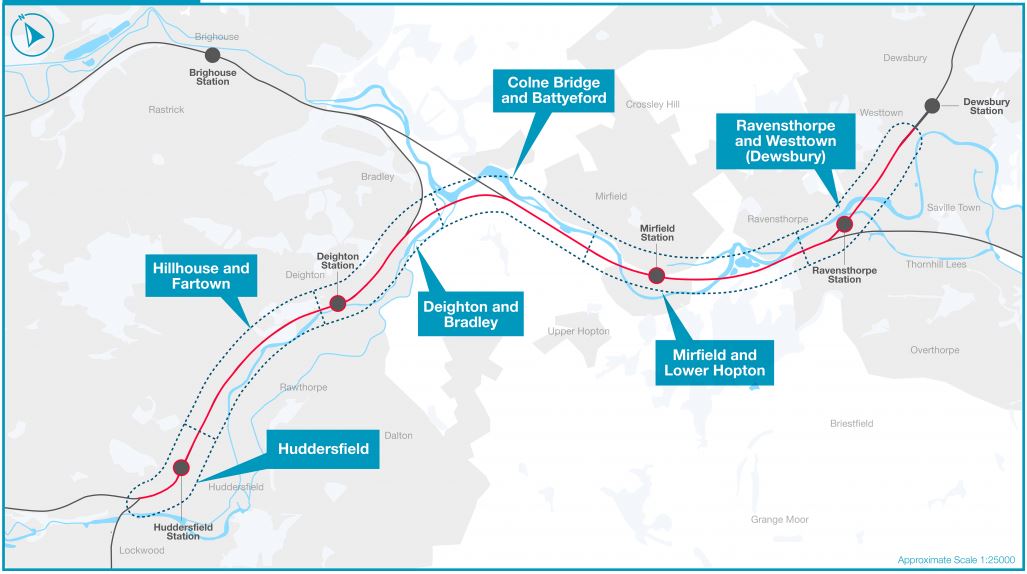
Note.
- There will be electrification between Dewsbury and Huddersfield.
- Tracks will be doubled from two to four.
- Ravensthorpe, Mirfield, Deighton and Huddersfield stations will be electrified and probably upgraded.
- Dewsbury and Huddersfield stations are eight miles apart.
This page on the Network Rail website gives more information.
Click on Huddersfield and Westtown (Dewsbury) and you get this information.
On 31 March 2021, we submitted a Transport and Works Act Order (TWAO) application to the Secretary of State for Transport for the Huddersfield to Westtown (Dewsbury) scheme.
Throughout this eight-mile section of the route, we’re proposing to double the number of tracks from two-to-four, electrify from Huddersfield to Dewsbury and make big improvements to the four stations in this section – Huddersfield, Deighton, Mirfield and Ravensthorpe; where we also need to separate the lines going to/from Leeds from the lines going to/from Wakefield, with either a bridge or a tunnel.
It is a much larger scheme than the one between Bolton and Wigan, which I wrote about in Bolton-Wigan £78m Rail Electrification Project Announced.
- Huddersfield-Westtown is eight miles, whereas Bolton-Wigan is 6.5 miles.
- Both involve upgrading four stations.
- Both involve full electrification.
- Huddersfield-Westtown involves doubling the number of tracks, whereas Bolton-Wigan needs little work to the track.
- Huddersfield-Westtown will need a bridge or a tunnel, whereas Bolton-Wigan might need minor work to a couple of flat junctions.
- Huddersfield station is Grade 1 Listed, whereas Wigan Wallgate station has some good features.
- The Huddersfield-Westtown scheme is costed at £2.9 billion, whereas Bolton-Wigan is just £78 million.
The Huddersfield-Westtown scheme is thirty-seven times larger in terms of money.
What Passenger Services Use The Route Between Huddersfield And Dewsbury?
These services use the route, all or in part.
- Northern Trains – Wigan Wallgate and Leeds via Manchester Victoria, Hebden Bridge, Brighouse, Mirfield, Ravensthorpe and Dewsbury – 1 tph
- Northern Trains – Huddersfield and Castleford via Deighton, Mirfield and Wakefield Kirkgate – 1 tph
- TransPennine Express – Liverpool Lime Street and Scarborough via Manchester Victoria, Stalybridge, Huddersfield and Leeds – 1 tph
- TransPennine Express – Manchester Airport and Redcar Central via Manchester Victoria, Stalybridge, Huddersfield, Dewsbury and Leeds – 1 tph
- TransPennine Express – Liverpool Lime Street and Edinburgh via Manchester Victoria, Huddersfield and Leeds – 1 tph
- TransPennine Express – Manchester Airport and Newcastle via Manchester Victoria, Huddersfield, Dewsbury and Leeds – 1 tph
- TransPennine Express – Manchester Piccadilly and Hull via Stalybridge, Huddersfield and Leeds – 1 tph
- TransPennine Express – Huddersfield and Leeds via Deighton, Mirfield, Ravensthorpe and Dewsbury – 1 tph
Note.
- All trains are one train per hour (tph)
- Three tph run non-stop between Huddersfield and Leeds.
- Two tph stop at Deighton station, Mirfield and Ravensthorpe.
After completion of the Huddersfield and Westtown upgrade, there will be electrification at the following places.
- West of Manchester Victoria station
- Between Huddersfield and Westtown
- Between Leeds and York – Currently being electrified between York and Church Fenton.
And these routes will not be electrified.
- Dewsbury and Leeds – 9.2 miles
- Leeds and Hull – 51.5 miles
- Mirfield and Castleford – 16 miles
- Manchester Piccadilly and Stalybridge – Could be electrified – 7.5 miles
- Manchester Victoria and Heaton Lodge Junction via Hebden Bridge – 47.4 miles
- Manchester Victoria and Stalybridge – Could be electrified – 7.7 miles
- Redcar Central and Northallerton – 28.1 miles
- Stalybridge and Huddersfield – 18 miles
- York and Scarborough – 42.1 miles
Note that all routes except Mirfield and Castleford and Leeds and Hull have electrification at both ends.
Which Routes Between Huddersfield And Westtown Could Be Handled By Battery-Electric Trains?
I will assume that operators will have a battery-electric train capable of running 56 miles on batter ypower. This distance comes from Hitachi’s specification for the Hitachi Regional Battery Train, which is shown in this Hitachi infographic.

These are the routes and my answers.
Northern Trains – Wigan Wallgate and Leeds
The longest section without electrification is Manchester Victoria and Heaton Lodge Junction via Hebden Bridge, which is 47.4 miles.
I am sure this route is possible with battery-electric trains.
Northern Trains – Huddersfield and Castleford
The longest section without electrification is Mirfield and Castleford, which is 16 miles.
But it must be handled on both an out and back basis. So the train will cover 32 miles on battery power.
I am sure this route is possible with battery-electric trains.
TransPennine Express – Liverpool Lime Street and Scarborough
The longest section without electrification to the West of Leeds, is Manchester Victoria and Huddersfield, which is 25.7 miles.
At the Eastern end, as York and Scarborough is 42.1 miles without electrification, there would need to be some electrification or a charging system at Scarborough station.
I am sure this route is possible with battery-electric trains.
TransPennine Express – Manchester Airport and Redcar Central
The longest section without electrification to the West of Leeds,is Manchester Victoria and Huddersfield, which is 25.7 miles.
At the Eastern end, as Northallerton and Redcar Central is 28.1 miles without electrification, there may need to be some electrification or a charging system at Redcar Central station.
I am sure this route is possible with battery-electric trains.
TransPennine Express – Liverpool Lime Street and Edinburgh
The longest section without electrification is Manchester Victoria and Huddersfield, which is 25.7 miles.
Leeds and Edinburgh is fully electrified.
I am sure this route is possible with battery-electric trains.
TransPennine Express – Manchester Airport and Newcastle
The longest section without electrification is Manchester Victoria and Huddersfield, which is 25.7 miles.
Leeds and Newcastle is fully electrified.
I am sure this route is possible with battery-electric trains.
TransPennine Express – Manchester Piccadilly and Hull
The longest section without electrification to the West of Leeds, is Manchester Victoria and Huddersfield, which is 25.5 miles.
At the Eastern end, as Leeds and Hull is 51.5 miles, there would need to be some electrification or a charging system at Hull station.
I am sure this route is possible with battery-electric trains.
TransPennine Express – Huddersfield and Leeds
The longest section without electrification is Dewsbury and Leeds, which is 9.2 miles.
I am sure this route is possible with battery-electric trains.
Handling The Eastern Ends
At Hull, Redcar Central and Scarborough stations, there will need to be some means to recharge the trains, so they can get back to the electrification on the East Coast Main Line.
There could either be a short length of 25 KVAC overhead electrification or a special-purpose charging station.
There would need to be an allowance in the turnback, of perhaps 10-15 minutes to make sure trains started back with full batteries.
Will Huddersfield And Westtown Be Long Enough To Charge A Battery-Electric Train?
I have looked at train times between Huddersfield And Westtown and typically trains take around 11-12 minutes to go between Huddersfield and Dewsbury stations.
That should probably be enough, especially, as the trains will probably be using regenerative braking to batteries at any station stops.
Conclusion
I am absolutely certain that by completing the TransPennine Upgrade with full electrification between Huddersfield and Westtown, that all passenger services through the section could be run by battery-electric trains with a range of ninety kilometres or fifty-six miles.
There would probably need to be some electrification or a charging system at Hull, Redcar Central and Scarborough stations.
A Thought On Short Sections Of Electrification
As with the Bolton-Wigan scheme to the West of the Pennines, a length of electrified track that is less than ten miles, allows several services to be run by battery-electric trains and decarbonised.
How many other sections of less than ten miles of electrification can transform train services and reduce the use of diesel around the UK, by the introduction of fleets of battery-electric trains?
Is A Crossrail For Leeds On The Way?
This article on Insider Media is entitled Schemes Totalling More Than £140m Backed By Investment Committee.
This is introductory paragraph.
Schemes totalling more than £140m to support the region’s recovery from the Covid-19 pandemic, have have been backed by West Yorkshire Combined Authority’s Investment Committee.
These are the two main schemes.
A £24.2m million (including £17m Combined Authority funding) rail station between Morley and Cotttingley on the Transpennine route at White Rose/
A 31.6m (including £13.9m of Combined Authority funding) parkway rail station at Thorpe Park on the Leeds to York section of the route.
There are also several other schemes for West Yorkshire.
White Rose Station
This Google Map shows the White Rose Centre.
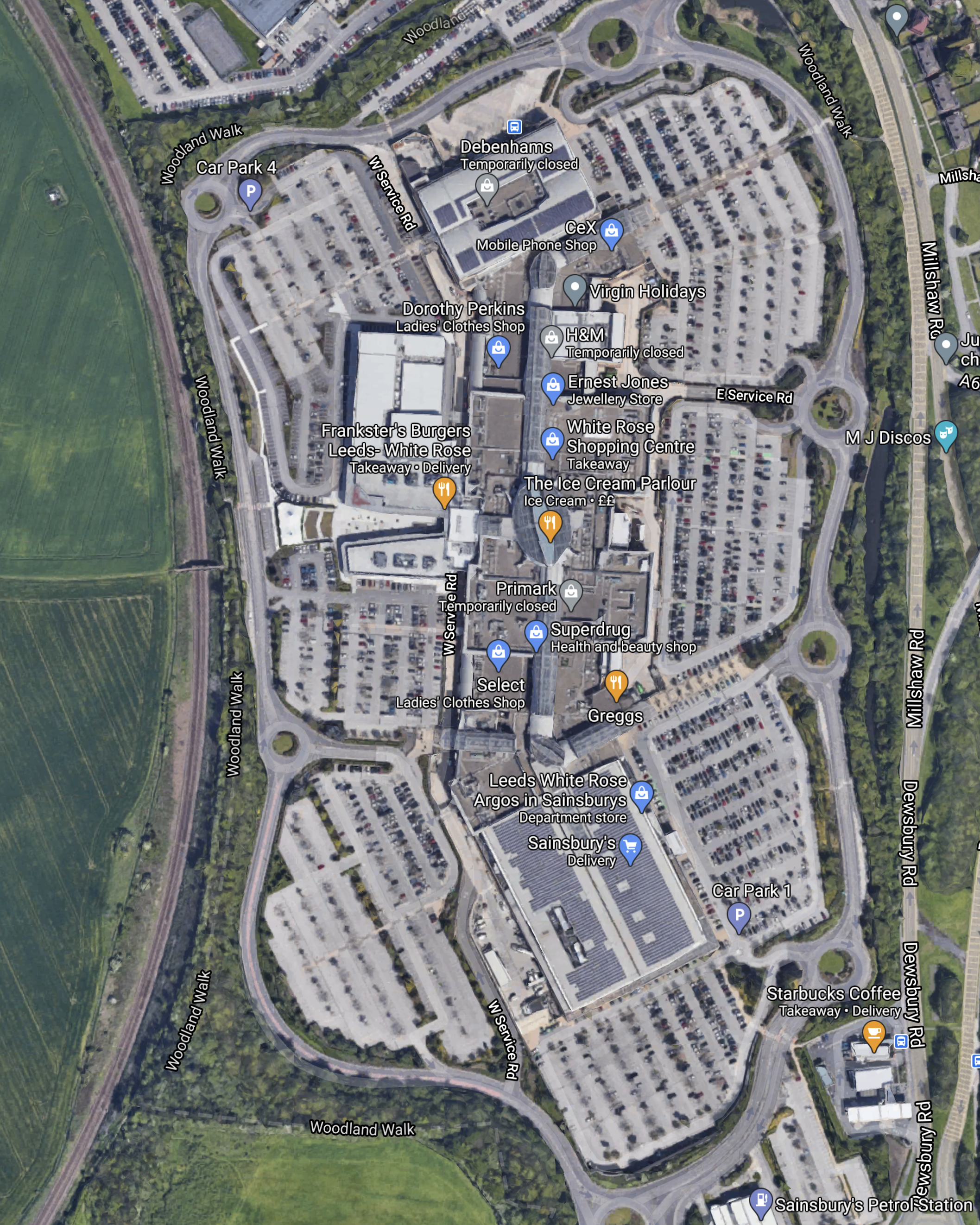
The Huddersfield Line runs North-South alongside the Centre and there must be plenty of space for a new White Rose station.
From Wikipedia and other sources, the following seems to be on the agenda for the station.
- Two platforms.
- Ability to take six-car trains, with a possibility to extend to eight-cars.
- Two trains per hour (tph) in both directions.
- Up to 340,000 passengers per year.
- Lots of parking.
The station would be about 3.5 miles to the South-West of Leeds station.
Thorpe Park Station
This Google Map shows the area where the station could be built.

Note.
- The Selby Line curving across the Northern side of the map.
- Cross Gates station is the next station to the West.
- Going East on the Selby Line, you pass through Garforth, East Garforth and Micklefield stations before the line divides for York to the North and Selby and Hull to the East.
- The M1 Motorway passing to the East of Leeds.
Other features of the proposed station and the area include.
- Wikipedia says that the station will have two island platforms and the ability to handle inter-city trains.
- The route through the station would be electrified.
- High Speed Two could be routed to go close to the station.
- Lots of parking.
The station would be about 4 miles to the East of Leeds station.
A Crossrail For Leeds
Could these two stations in the future become stations on a high-capacity route across Yorkshire centred on Leeds?
- The Western end of the route could be Huddersfield.
- The Eastern end of the route could be both York and Hull.
- Plans exist and projects have started to fully electrify between Huddersfield and York.
- Both stations will be Park-and-Ride stations with good connections to the motorway network.
- Intermediate stations between Leeds and Huddersfield could include Cottingley, White Rose, Morley, Batley, Dewsbury, Ravensthorpe, Mirfield and Deighton
- Intermediate stations between Leeds and York could include Cross Gates, Thorpe Park, Garforth, East Garforth, Micklefield, Church Fenton and Ulleskelf.
- Intermediate stations between Leeds and Hull could include Cross Gates, Thorpe Park, Garforth, East Garforth, Micklefield, South Milford, Selby, Wrassle, Howden, Eastrington, Gilberdyke, Broomfleet, Brough, Ferriby and Hessle.
With the exception of the two new stations and the electrification, infrastructure needs would not appear to be large.
These are some thoughts.
Distances And Timings
These are some distances and estimated timings from Leeds.
- Huddersfield – 27 miles – 32 minutes – 51 mph
- Hull – 52 miles – 55 minutes – 57 mph
- York – 15,5 miles – 23 minutes – 40 mph
Note.
- With full electrification, timings could be improved.
- York and Huddersfield would be under an hour.
- Kull and Huddersfield could be under ninety minutes.
These timings would certainly be achievable by a 125 mph Class 802 train, but I suspect, that they could be achieved by a 110 mph electric train like a Class 730/1 train.
Current Services Through White Road, Leeds and Thorpe Park Stations
These services currents pass through the three stations or their proposed sites.
- TransPennine Express – Liverpool Lime Street and Edinburgh
- TransPennine Express – Liverpool Lime Street and Scarborough
- TransPennine Express – Manchester Airport and Newcastle
- TransPennine Express – Manchester Airport and Redcar Central
- TransPennine Express – Manchester Piccadilly and Hull
Note.
- All of these trains are one tph.
- There could be five quality tph on the route, most of which would be five-car Class 802 trains.
In addition the following services would pass through Leeds and Thorpe Park stations.
- CrossCountry – Plymouth and Edinburgh/Glasgow
- Northern Trains – Blackpool North and York via Bradford Interchange
- Northern Trains – Halifax and Hull via Bradford Interchange
Note.
- All of these trains are one tph.
- Two trains serve Bradford Interchange.
These services could mean eight tph between Thorpe Park and Leeds stations.
In addition the following services would pass through Leeds and White Rose stations.
- Northern Trains – Wigan Wallgate and Leeds
- TransPennine Express – Huddersfield and Leeds
Note.
- All of these trains are one tph.
These services could mean seven tph between White Rose and Leeds stations.
A Possible Future Service
I believe that services across Leeds could be recast to give the City a network of railways that would satisfy the needs of the City.
Possible services could include.
Four tph – York and Huddersfield via Thorpe Park, Leeds and White Rose in under an hour.
Two tph – Hull and Huddersfield via Thorpe Park, Leeds and White Rose in under ninety minutes.
Two tph – Halifax and Thorpe Park via Leeds and Bradford
Note
- There are a lot of possibilities.
- Services would be timed to make interchange easy with other services at Leeds.
I would also arrange for East to West and West to East services to share the same island platform at Leeds.
Conclusion
Leeds will get the electrified local railway the city deserves.
Northern Powerhouse Rail – Significant Upgrades And Electrification Of The Rail Lines From Leeds And Sheffield To Hull
In this article on Transport for the North, which is entitled Northern Powerhouse Rail Progress As Recommendations Made To Government, one of the recommendations proposed for Northern Powerhouse Rail is significant upgrades and electrification of the rail lines from Leeds and Sheffield to Hull.
Northern Powerhouse Rail’s Objective For The Leeds and Hull Route
Wikipedia, other sources and my calculations say this about the trains between Leeds and Hull.
- The distance between the two stations is 51.7 miles
- The current service takes around 57 minutes and has a frequency of one train per hour (tph)
- This gives an average speed of 54.4 mph for the fastest journey.
- The proposed service with Northern Powerhouse Rail will take 38 minutes and have a frequency of two tph.
- This gives an average speed of 81.6 mph for the journey.
This last figure of nearly 82 mph, indicates to me that a 100 mph train will be able to meet Northern Powerhouse Rail’s objective.
Northern Powerhouse Rail’s Objective For The Sheffield and Hull Route
Wikipedia, other sources and my calculations say this about the trains between Sheffield and Hull.
- The distance between the two stations is 59.4 miles
- The current service takes around 80 minutes and has a frequency of one tph.
- This gives an average speed of 44.6 mph for the fastest journey.
- The proposed service with Northern Powerhouse Rail will take 50 minutes and have a frequency of two tph.
- This gives an average speed of 71,3 mph for the journey.
This last figure of over 70 mph, indicates to me that a 90 mph train will be able to meet Northern Powerhouse Rail’s objective.
Services From Hull Station
Hull station is a full interchange, which includes a large bus station.
- Currently, the station has seven platforms.
- There appears to be space for more platforms.
- Some platforms are long enough to take nine-car Class 800 trains, which are 234 metres long.
- There are some good architectural features.
If ever there was a station, that had basic infrastructure, that with appropriate care and refurbishment, could still be handling the needs of its passengers in a hundred years, it is Hull.
- It would be able to handle a 200 metre long High Speed Two Classic-Compatible train, tomorrow.
- It would probably be as no more difficult to electrify than Kings Cross, Liverpool Lime Street, Manchester Piccadilly or Paddington.
- It would not be difficult to install charging facilities for battery electric trains.
These are some pictures of the station.
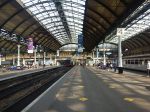




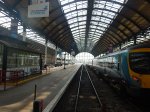

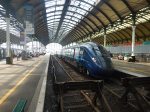

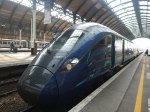
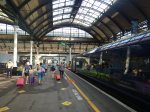
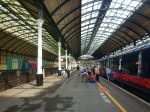
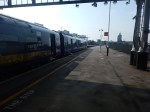
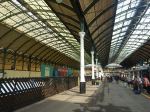
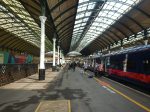
Currently, these are the services at the station, that go between Hull and Leeds, Selby or Sheffield.
- Hull Trains – 7 trains per day (tpd) – Hull and London via Brough, Selby and Doncaster.
- LNER – 1 tpd – Hull and London via Brough, Selby and Doncaster.
- Northern Trains – 1 tph – Hull and Halifax via Brough, Selby, Leeds and Bradford Interchange.
- Northern Trains – 1 tph – Hull and Sheffield via Brough, Gilberdyke, Goole, Doncaster, Rotherham Central and Meadowhall.
- Northern Trains – 1 tph – Hull and York via Brough and Selby.
- Northern Trains – 1 tph – Bridlington and Sheffield via Hull, Brough, Goole, Doncaster and Meadowhall.
- TransPennine Express – 1 tph – Hull and Manchester Piccadilly or Manchester Airport via Brough, Selby, Leeds, Huddersfield and Stalybridge.
Note.
- I have included services through Selby, as the station is on the way to Leeds and is a notorious bottleneck.
- All services go through Brough.
- All trains work on diesel power to and from Hull.
- Hull Trains and LNER use Hitachi bi-mode trains, that work most of the route to and from London, using the 25 KVAC overhead electrification.
- Northern use a variety of diesel trains only some of which have a 100 mph operating speed.
There would also appear to be freight trains working some of the route between Hull and Brough stations.
Upgrading The Tracks
I very much believe that to meet Northern Powerhouse Rail’s objectives as to time, that the lines to Hull from Leeds and Sheffield must have a 100 mph operating speed.
Hull And Leeds And On To London
This Google Map shows a typical section of track.
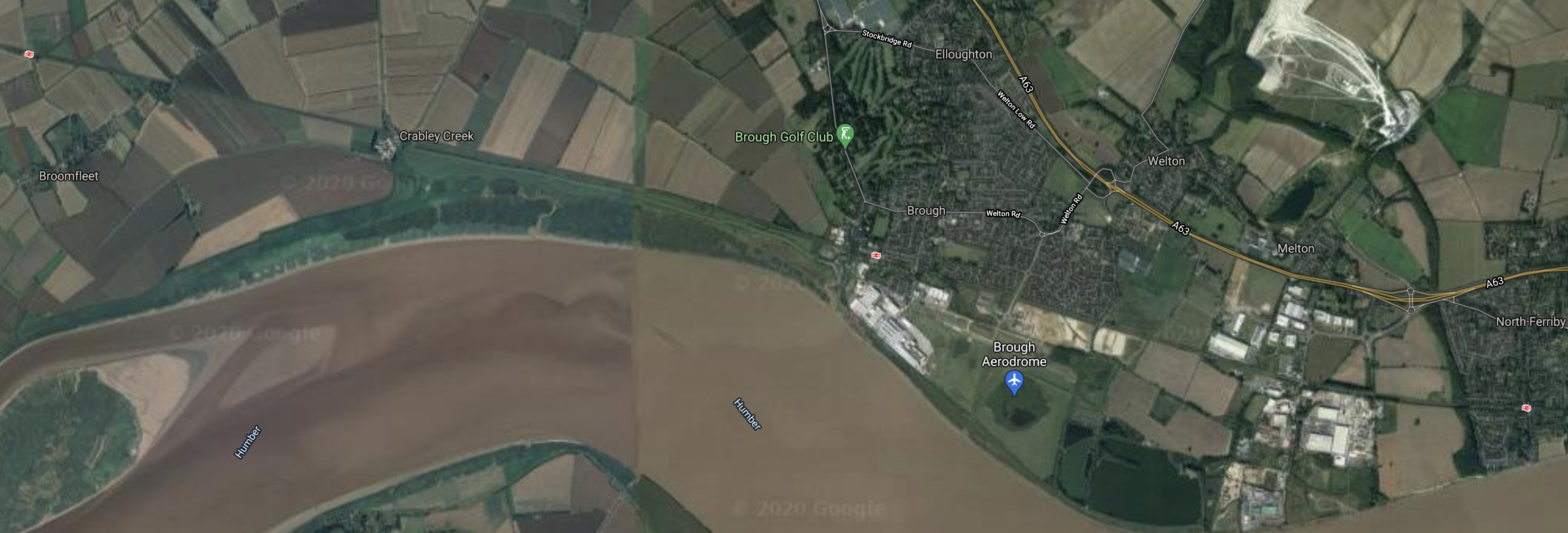
Note.
- Broomfleet station is in the North-West corner of the map.
- Brough station is just to the East of the middle of the map.
- Ferriby station is in the South-East corner of the map.
The Hull and Selby Line is fairly straight for most of its route.
The Selby Swing Bridge
The main problem is the Selby swing bridge, which is shown in this Google Map.
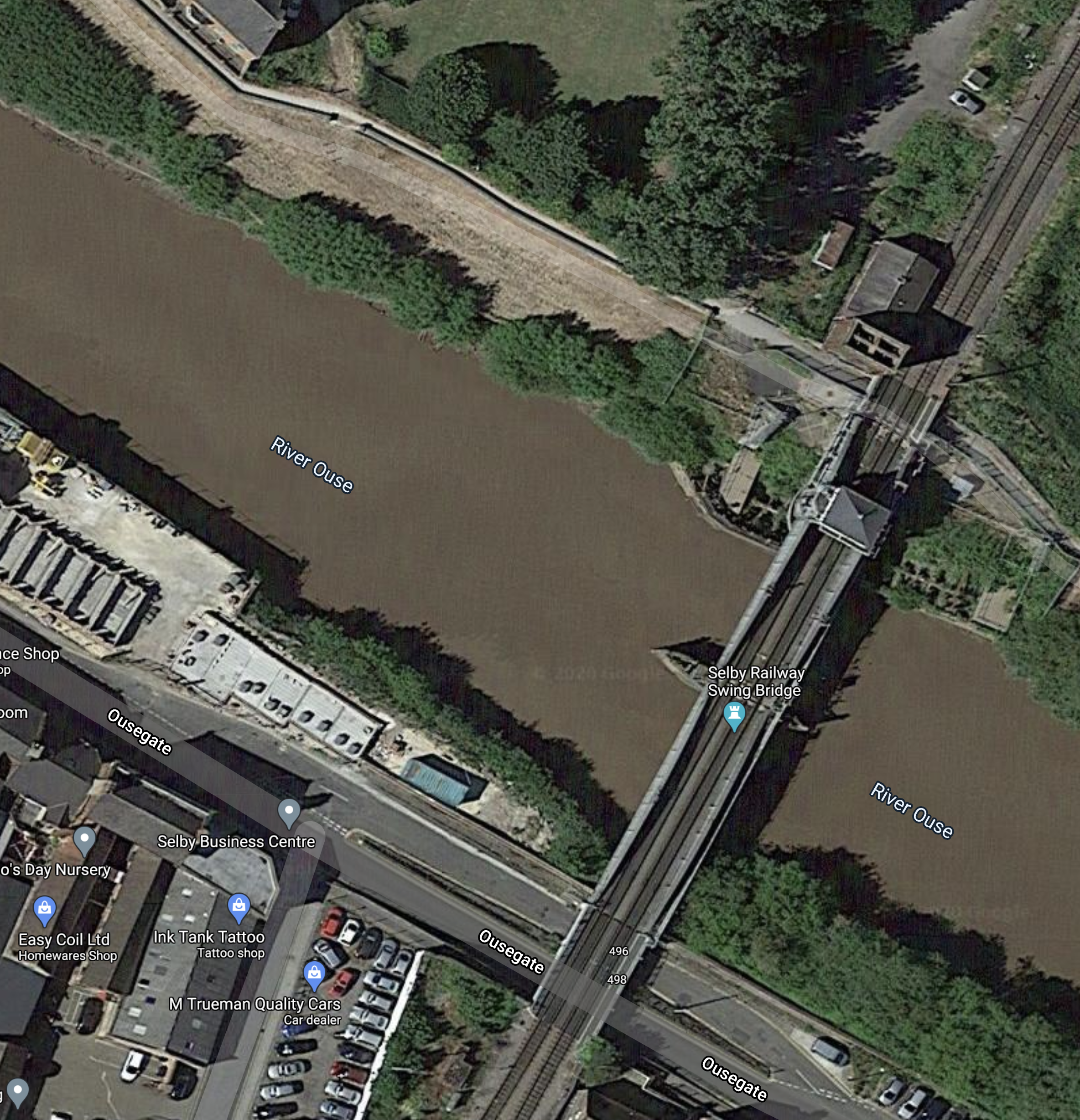
Note.
- The bridge was opened in 1891.
- It is a Grade II Listed structure.
- It is a double-track bridge.
- It swings through ninety degrees to allow ships to pass through.
- It has a low speed limit of 25 mph.
- The bridge regularly carries the biomass trains to Drax power station.
This page on the Fairfield Control Systems web site, describes the major refurbishment of the bridge.
- The bridge structure has been fully refurbished.
- A modern control system has been installed.
- The page says the bridge glides to an exact stop.
Network Rail are claiming, it will be several decades before any more work needs to be done on parts of the bridge.
It looks to me, that Network Rail have decided to live with the problems caused by the bridge and automate their way round it, if possible.
Level Crossings
One general problem with the route between Hull and Selby is that it has around a dozen level crossing, some of which are just simple farm crossings.
The main route West from Selby goes to Leeds and it is double track, fairly straight with around a dozen level crossings.
West from Selby, the route to the East Coast Main Line to and from London is also double track and reasonably straight.
But it does have level crossings at Common Lane and Burn Lane.
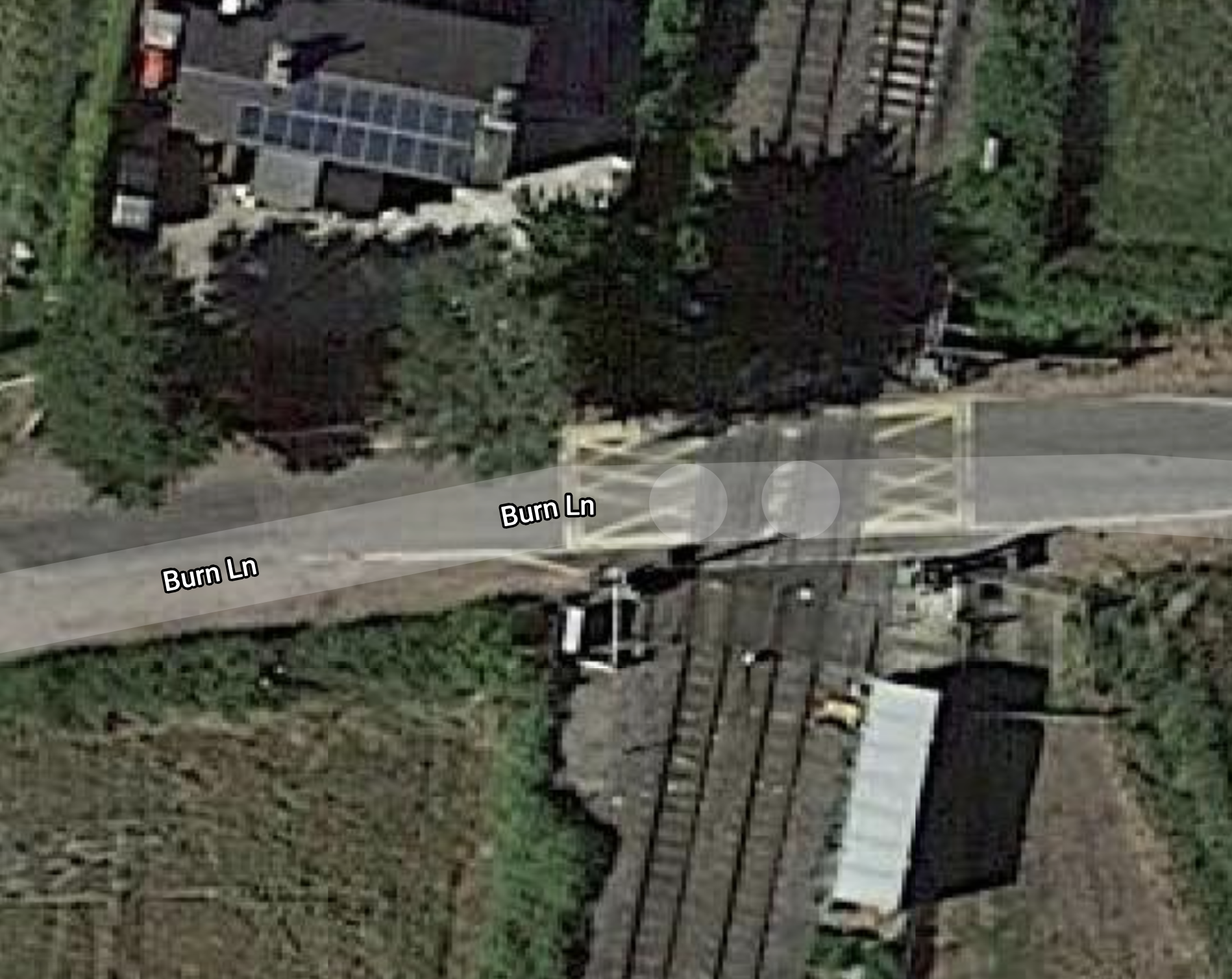
The Google Map show Burn Lane level crossing, which is typical of many in the area.
Hull And Sheffield
The other route West from Hull goes via Goole and Doncaster.
This Google Map shows the Hull and Doncaster Branch between Goole and Saltmarshe stations.
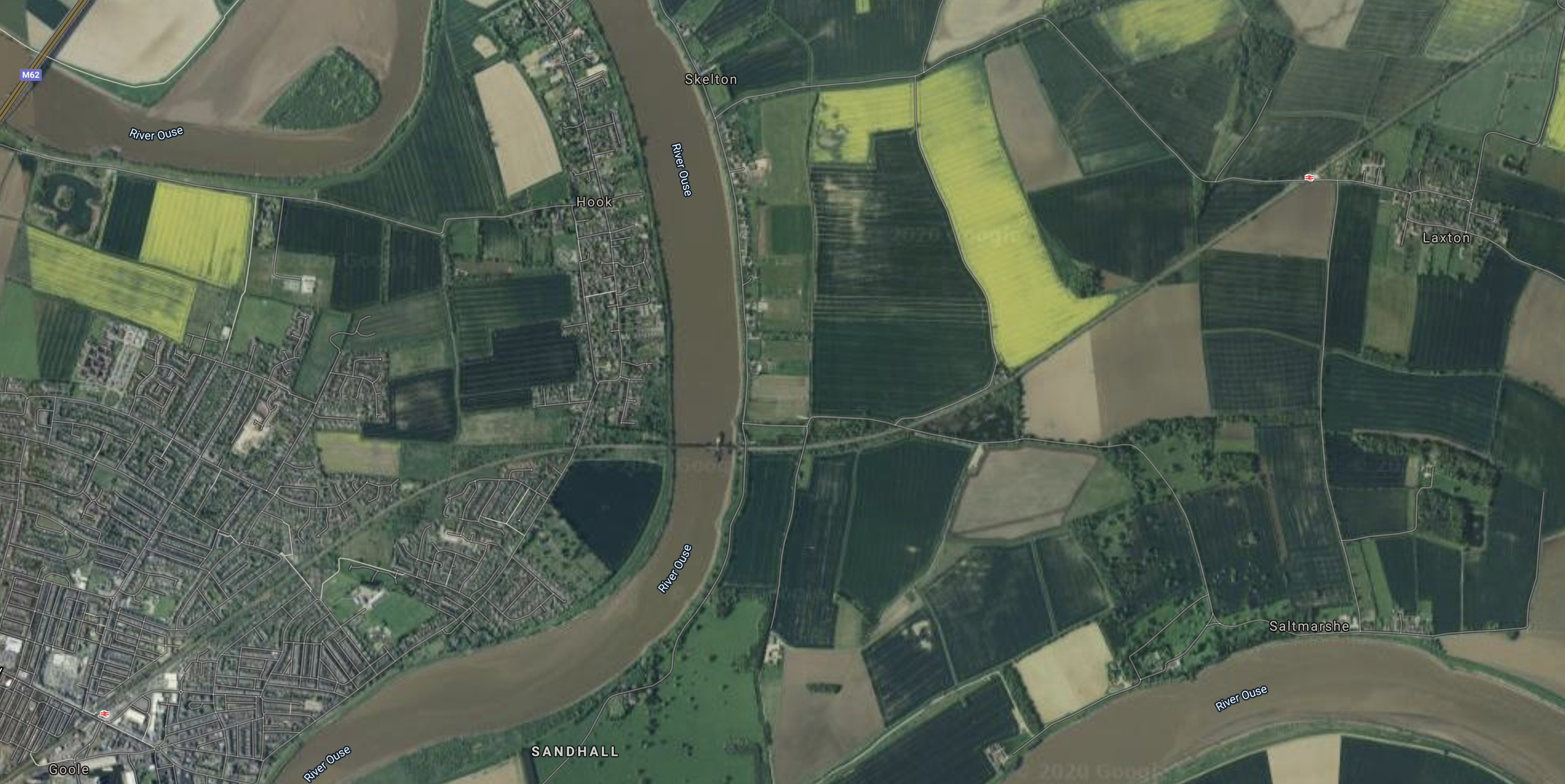
Note.
- The Hull and Doncaster Branch runs diagonally across the map.
- Goole and its station is in the South West corner of the map.
- The Hull and Doncaster Branch goes leaves the map at the North-East corner and then joins the Selby Line to the West of Gilberdyke station.
This Google Map shows that where the railway crosses the River Ouse there is another swing bridge.
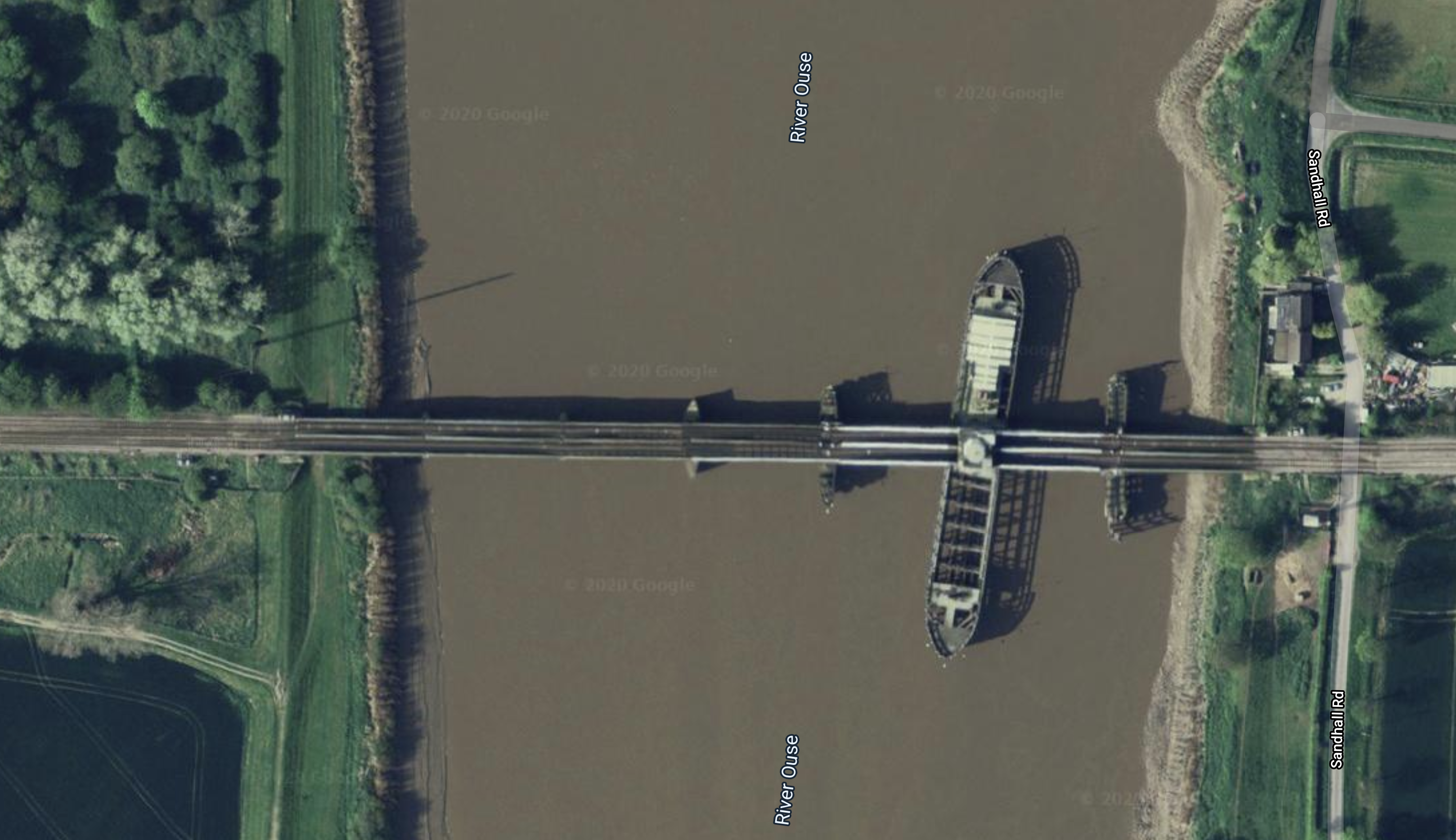
This is the Goole Railway Swing Bridge.
- The bridge was opened in 1869.
- The maximum speed for any train is 60 mph, but some are slower.
- It is a Grade II* Listed structure.
- In the first decade of this century the bridge was strengthened.
- It appears to carry a lesser number of freight trains than the Selby bridge
As with the Selby bridge, it appears to be working at a reasonable operational standard.
I’ve followed the line as far as Doncaster and it is fairly straight, mostly double-track with about a half-a-dozen level crossings.
Updating To 100 mph
It looks to my naïve eyes, that updating the lines to an operating speed of 100 mph, should be possible.
But possibly a much larger problem is the up to thirty level crossings on the triangle of lines between Hull, Leeds and Sheffield.
Full ERTMS In-Cab Digital Signalling
This is currently, being installed between London and Doncaster and will allow 140 mph running, which could save several minutes on the route.
The next phase could logically extend the digital signalling as far as York and Leeds.
Extending this signalling to Hull and Sheffield, and all the lines connecting the cities and towns of East Yorkshire could be a sensible development.
It might even help with swing bridges by controlling the speed of approaching trains, so that they arrive at the optimal times to cross.
Electrification
Eventually, all of these routes will be fully electrified.
- Hull and Leeds via Brough, Selby and Garforth.
- Hull and Scarborough via Beverley and Seamer.
- Hull and Sheffield via Brough, Goole, Doncaster and Rotherham.
- Hull and York via Brough and Selby.
- York and Scarborough via Seamer.
But there are two problems which make the electrification of the routes to Hull challenging.
- The Grade II Listed Selby swing bridge.
- The Grade II* Listed Goole Railway swing bridge.
There will be diehard members of the Heritage Lobby, who will resist electrification of these bridges.
Consider.
- Both bridges appear to work reliably.
- Adding the complication of electrification may compromise this reliability.
- Train manufacturers have developed alternative zero-carbon traction systems that don’t need continuous electrification.
- Hitachi have developed battery electric versions of the Class 800 and Class 802 trains, that regularly run to and from Hull.
- Other manufacturers are developing hydrogen-powered trains, that can use both hydrogen and overhead electrification for traction power.
My Project Management experience tells me, that electrification of these two bridges could be the major cost and the most likely cause of delay to the completion of the electrification.
It should also be noted that Network Rail are already planning to electrify these routes.
- Huddersfield and Dewsbury on the TransPennine Route, which might be extended to between Huddersfield and Leeds.
- York and Church Fenton
There is also electrification at Doncaster, Leeds and York on the East Coast Main Line, which would probably have enough power to feed the extra electrification.
Hitachi’s Regional Battery Trains
Hitachi and Hyperdrive Innovation are developing a Regional Battery Train.
This Hitachi infographic gives the specification.
Note.
- The train has a range of 90 kilometres or 56 miles on battery power.
- It has an operating speed of 100 mph on battery power.
- Class 800 and Class 802 trains can be converted to Hitachi Regional Battery Trains, by swapping the diesel engines for battery packs.
When running on electrification, they retain the performance of the train, that was converted.
Discontinuous Electrification
I would propose using discontinuous electrification. by electrifying these sections.
- Hull and Brough – 10.5 miles
- Hull and Beverley – 13 miles
- Doncaster and Sheffield – 20 miles
- Selby and Leeds – 21 miles
- Selby and Temple Hirst Junction – 5 miles
- Seamer and Scarborough – 3 miles
This would leave these gaps in the electrification in East Yorkshire.
- Brough and Doncaster – 30 miles
- Brough and Selby – 21 miles
- Brough and Church Fenton – 31 miles
- Seamer and Beverley – 42 miles
- Seamer and York – 39 miles
A battery electric train with a range of fifty miles would bridge these gaps easily.
This approach would have some advantages.
- There would only need to be 72.5 miles of double-track electrification.
- The swing bridges would be untouched.
- TransPennine services terminating in Hull and Scarborough would be zero-carbon, once Huddersfield and Dewsbury is electrified.
- LNER and Hull Trains services to London Kings Cross would be zero-carbon and a few minutes faster.
- LNER could run a zero-carbon service between London Kings Cross and Scarborough.
But above all, it would cost less and could be delivered quicker.
Collateral Benefits Of Doncaster and Sheffield Electrication
The extra electrification between Doncaster and Sheffield, would enable other services.
- A zero-carbon service between London Kings Cross and Sheffield.
- Extension of Sheffield’s tram-train to Doncaster and Doncaster Sheffield Airport.
- A possible electric service along the Dearne Valley.
As plans for Sheffield’s rail and tram system develop, this electrification could have a substantial enabling effect.
Hydrogen
This map shows the Zero Carbon Humber pipeline layout.

Note.
- The orange line is a proposed carbon dioxide pipeline
- The black line alongside it, is a proposed hydrogen pipeline.
- Drax, Keadby and Saltend are power stations.
- Easington gas terminal is connected to gas fields in the North Sea and also imports natural gas from Norway using the Langeled pipeline.
- There are fourteen gas feels connected to Easington terminal. Some have been converted to gas storage.
I can see hydrogen being used to power trains and buses around the Humber.
Conclusion
Discontinuous electrification could be the key to fast provision of electric train services between Leeds and Sheffield and Hull.
If long journeys from Hull were run using battery electric trains, like the Hitachi Regional Battery Train, perhaps hydrogen trains could be used for the local services all over the area.
Project Management Recommendations
I have proposed six sections of electrification, to create a network to allow all services that serve Hull and Scarborough to be run by battery electric trains.
Obviously with discontinuous electrification each section or group of sections to be electrified is an independent project.
I proposed that these sections would need to be electrified.
- Hull and Brough – 10.5 miles
- Hull and Beverley – 13 miles
- Doncaster and Sheffield – 20 miles
- Selby and Leeds – 21 miles
- Selby and Temple Hirst Junction – 5 miles
- Seamer and Scarborough – 3 miles
They could be broken down down into four sections.
- Hull station, Hull and Brough and Hull and Beverley
- Doncaster and Sheffield
- Selby station, Selby and Leeds and Selby and Temple Hirst Junction.
- Scarborough station and Scarborough and Seamer.
I have split the electrification, so that hopefully none is challenging.
LNER Seeks 10 More Bi-Modes
The title of this post, is the same as that of an article in the December 2020 Edition of Modern Railways.
This is the opening paragraph.
LNER has launched the procurement of at least 10 new trains to supplement its Azuma fleet on East Coast Main Line services.
Some other points from the article.
- It appears that LNER would like to eliminate diesel traction if possible.
- On-board energy storage is mentioned.
- No form of power appears to be ruled out, including hydrogen.
- LNER have all 65 of their Azumas in service.
The last paragraph is very informative.
Infrastructure upgrades are due to prompt a timetable recast in May 2022 (delayed from December 2021) from which point LNER will operate 6.5 trains per hour, out of Kings Cross, compared to five today. As an interim measure, LNER is retaining seven rakes of Mk 4 coaches hauled by 12 Class 91 locomotives to supplement the Azuma fleet and support its timetable ambitions until the new trains are delivered.
These are my thoughts.
More Azumas?
Surely, It would require a very innovative train at perhaps a rock-bottom price from another manufacturer, for LNER to not acquire extra Azumas.
Classic-Compatible Trains For High Speed Two
Consider.
- Alstom, Bombardier, CAF, Hitachi, Siemens and Talgo are involved in the competition to design Classic-Compatible trains for High Speed Two.
- As the York and Edinburgh section of the East Coast Main Line will eventually be upgraded and used by High Speed Two services,
- Also in the December 2020 Edition of Modern Railways, is an article entitled 140 mph Plan For ECML North of York, which details improvements proposed by Northern Powerhouse Rail to improve services between Leeds and Edinburgh.
Would there be advantages to High Speed Two, LNER and Network Rail and Northern Powerhouse Rail, to have some commonality between the High Speed Two, LNER and Northern Powerhouse Rail fleets?
Hopefully, the various government-controlled companies are talking.
A Flagship Train For Aberdeen And Inverness
The InterCity 225s, which consist of a Class 91 locomotive and a rake of nine Mark 4 coaches, have given thirty years of top-quality service on the East Coast Main Line and appear to be being asked to handle services until the new trains are delivered.
- Full-length InterCity 225s are 245 metres long and have 406 Standard and 129 First seats or a total of 535 seats.
- Nine-car Azumas are 234 metres long and have 510 Standard and 101 First seats or a total of 611 seats.
- Two five-car Azumas working as a pair are 260 metres long and have 604 seats. They can also be handled on most platforms, that are used by LNER.
- The power of a Class 91 locomotive is 4.83 MW.
- A Class 91 locomotive is 19.4 metres long and weighs 81.5 tonnes.
- Both Azumas and InterCity 225s can maintain 125 mph with ease on the East Coast Main Line and both will be able to reach 140 mph with in-cab signalling.
There would appear to be nothing wrong with locomotive-hauled high speed services, in terms of capacity and performance.
In The Mathematics Of A Hydrogen-Powered Freight Locomotive, I laid out my thoughts on a high-powered railway locomotive fuelled by hydrogen, that used one or possibly two Rolls-Royce gas-turbine engines to generate electricity for traction.
With all the work done, by the companies bidding for Classic-Compatible trains for High Speed Two, into very high speed trains, I believe that at least one company could build a locomotive with this specification.
- 140 mph operation on 25 KVAC overhead electrification. As I said, that was done by British Rail almost forty years ago.
- Ability to use full digital in-cab signalling. This is on its way and already working in some applications.
- 110 mph operation on hydrogen. Hitachi are planning 100 mph battery trains, so it should be possible.
- 400 mile range on one filling of hydrogen. This is working in Germany.
- Ability to be upgraded to higher speeds on electric power, should the East Coast Main Line be upgraded for higher speeds in the future. The train manufacturers are probably ahead of track designers with this one.
Such a locomotive would be key to building a train with this specification.
- Sub-four hour time between London and Edinburgh.
- Sub-seven hour time between London and Aberdeen, which has 130 miles without wires.
- Sub-eight hour time between London and Inverness, which has 146 miles without wires.
- Hydrogen would be used, where there is no electrification.
- Zero-carbon at all times.
- A maximum length of 260 metres, which I estimate could give a passenger capacity of around 640 seats.
- The last coach would include a driving van trailer.
- They would not need the ability to split and join, except for the purpose of rescue, as there is no platform on the route, that could accommodate the resulting 520 metre long pair of trains.
I estimate that a fleet of around seven trains would be needed to run the current Aberdeen and Inverness services.
A few extra thoughts.
- Could they have an up-market more spacious interior, as their main competition to the North of Scotland, would be the budget airlines?
- Could they be slightly longer, with some platform work at Kings Cross and other stations?
- Add a few extra trains to the order, so that extra services between London and Edinburgh could be added to the timetable.
- Could the driving van trailer incorporate an observation car?
- Hydrogen refuelling shouldn’t be a problem in Scotland, as the country is developing a hydrogen economy.
- Hydrogen refuelling wouldn’t be needed in England, as they’d be using the electrification.
- As an alternative to hydrogen, sustainable aviation fuel could be used.
I suspect that Talgo, would be very happy to tender.
- They are developing hydrogen-powered trains as I wrote in Talgo: Our Hydrogen Train Will Be Ready In 2023.
- They are building a factory in Scotland, close to the Forth Bridge.
- Because of the factory, Talgo probably have the ear of the Scottish Government, who would probably welcome a Scottish-built train.
- A shorter version of these trains without the hydrogen, could be the design for a High Speed Two Classic-Compatible train, for which Talgo, are on the short list of suppliers.
What better way, would there be to sell your hydrogen-powered high speed trains, than to give prospective clients a ride up from London to the factory in the luxury version?
A New Elizabethan
I can remember The Elizabethan, which was a steam-hauled non-stop express between London and Edinburgh between 1953 and 1961.
I have laid out my ideas for a modern express train of the same name in A New Elizabethan.
It could be an interesting concept, to increase capacity between London and Edinburgh.
Splitting And Joining
Some of LNER’s philosophy to serve places like Harrogate, Huddersfield and Middlesbrough, depends on the ability to split and join trains.
A pair of Azumas could leave London and go to Leeds, where they would split, with one train going to Harrogate and the other going to Huddersfield.
When returning to London, the two trains would join at Leeds.
The big advantage of splitting and joining, is that it increases the capacity on the main line, as services can be arranged, so that every path always carries a full-length train. I would expect that LNER would prefer never to run a single five-car Azuma into Kings Cross.
Currently LNER have these paths to and from Kings Cross.
- 2 tph between London Kings Cross and Leeds
- 1 tph between London Kings Cross and Lincoln and East Yorkshire
- 2 tph between London Kings Cross and Edinburgh
Note.
- LNER have already started to extend services from Leeds, so will we see splitting and joining being used on one tph at Leeds to provide services to several destinations, throughout the day.
- Splitting and joining at Edinburgh is surely another possibility, to serve Stirling and Glasgow, with the same train.
- Splitting and joining at York could serve destinations like Middlesbrough, Newcastle, Redcar, Scarborough and Sunderland.
- In A Trip To Grantham Station – 4th November 2020, I advocated splitting at Grantham station to serve both Nottingham and Lincoln.
There are a lot of possibilities for splitting and joining.
As LNER has a fleet of twenty-two five-car Azumas, if the new trains are needed to split and join on certain services, this might mean more five-car Azumas are a better buy.
What Will Happen To Nine Car Azumas?
Hitachi have launched the Regional Battery Train concept, the specification of which is given in this Hitachi infographic.
The diesel engines in LNER’s Class 800 trains will be able to be replaced with batteries, making them all-electric trains.
- Destinations like Cleethorpes, Dundee, Grimsby, Harrogate, Huddersfield, Hull, Lincoln, Middlesbrough Nottingham, Perth, Redcar, Scarborough, Sheffield and Sunderland will be within range of battery electric Azumas.
- Some destinations would need the ability to charge the train before it returned, but I can see lots of places getting an appropriate service, even if it was just one or two trains per day.
- Unfortunately, Aberdeen and Inverness would be too far for battery electric Azumas, so services will still need to be run by nine-car bi-mode Azumas.
Five-car battery electric Azumas working in pairs from London could be the key to increasing LNER services.
I can see that LNER may end up with too many nine-car Azumas, if nine-car trains are replaced by pairs of five-car trains to serve two destinations by splitting and joining.
Would it be possible to shorten nine-car Azumas to five-car trains?
These are the formations of the two trains.
- nine-car: DPTS-MS-MS-TS-MS-TS-MC-MF-DPTF
- five-car: DPTS-MS-MS-MC-DPTF
It is known, that the trains have a computer, that does a quick check on start-up to determine, what cars are present and correct in the train.
- This means that if LNER needed twelve-car trains for say London and Edinburgh, they could create a sub-fleet by just buying the requisite number of extra TS (Trailer Standard) and MS (Motor Standard) cars and coupling them up.
- This feature also means that operators running fleets of five-car Hitachi trains, like TransPennine Express and Hull Trains can increase capacity by just purchasing the extra cars.
- It would also allow, cars to be shuffled to create viable trains, after say several cars were damaged by vandalism.
All trains these days seem to have this very operator-friendly feature.
With LNER’s trains, I suspect that all cars of the same type are identical.
This would mean, that a nine-car train can be converted to a five-car by removing two TS (Trailer Standard), one MS (Motor Standard) and one MF (Motor First) cars.
The four cars, that have been removed could be reconfigured to form the middle three cars of a new five-car train, which would be completed by adding new DPTS (Driver Pantograph Trailer Standard) and DPTF (Driver Pantograph Trailer First) cars.
An Increase In Paths From 5 To 6.5
This will certainly allow LNER to run more services.
The odd half path could be easy to explain.
- Hull is a city, that is on the up.
- I suspect that it could support a five-car direct service from London with a frequency of one tph.
- But Hull Trains are also running a successful service on the route.
Perhaps a fair solution, would be to allow both LNER and Hull Trains to run a one train per two hour (tp2h) service.
If LNER didn’t want to use the path to just run a five-car train to Hull, there are several possibilities for a split and join.
- With a Cleethorpes, Lincoln or Nottingham service at Grantham.
- With a Cleethorpes or Lincoln service at Newark.
- With a Cleethorpes, Middlesbrough, Sheffield or Sunderland service at Doncaster.
I can only see splitting and joining increasing, which surely means an Azuma order is more likely.
As someone, who spent a working life, writing software to schedule projects, I can’t resist speculating on what to do with the extra whole path, that LNER will be allocated, when the infrastructure allows.
- Many travellers wouldn’t mind LNER providing more seats between the English and Scottish capitals.
- Many would like an alternative to flying.
- Others would like a faster service.
- Leeds and York will soon be a route, that LNER’s Azumas will be able to use without diesel, because of extra electrification and Azumas with traction batteries.
This leads me to believe that LNER could use the extra path for a third London and Edinburgh service in every hour, that ran via Leeds.
- Additionally, it might stop at stations like Peterborough, York, Darlington or Newcastle.
- It could also provide a non-stop London and Leeds service.
- Some services could go non-stop between London and Edinburgh.
- The direct London and Edinburgh service would be under four hours.
- Going via Leeds would add under an hour.
It would be run by a nine-car all-electric Azumas, of which there will be unlikely to be a shortage.
How Many Azumas Could Be Fitted With Batteries Instead Of Diesel Engines?
The Wikipedia entry for the Class 800 train, has a section called Powertrain, where this is said.
Despite being underfloor, the generator units (GU) have diesel engines of V12 formation. The Class 801 has one GU for a five to nine-car set. These provide emergency power for limited traction and auxiliaries if the power supply from the overhead line fails. The Class 800 and Class 802 bi-mode has three GU per five-car set and five GU per nine-car set. A five-car set has a GU situated under vehicles 2/3/4 and a nine-car set has a GU situated under vehicles 2/3/5/7/8.
Consider.
- Class 807 trains for Aventi West Coast will have no batteries or diesel engines. Does this save weight?
- Class 803 trains for East Coast Trains will only have a small battery for emergency hotel power, in case of catenary failure. Does this save weight?
- Saving weight should improve acceleration and deceleration, which could reduce journey times.
- Removal of diesel engines would reduce the trains carbon footprint.
- Removal of diesel engines could reduce maintenance costs.
- Diesel engines are only needed for services that run North of Edinburgh. Other sections without electrification are probably within battery range or could be easily made so.
- It appears every Motor car (MC, MF and MS) can be fitted with a diesel engine, although in Class 801 trains, only one is fitted. Does that mean that every Motor car in the future, could have a battery?
I think this could lead to the following.
- The Class 801 trains are fitted with sufficient batteries to enable handling of expected emergencies. These could be similar to those in the Class 803 trains.
- Enough nine-car Class 800 trains would be kept with diesel engines to work the Aberdeen and Inverness services. These routes at 130 and 146 miles without wires are too long for battery trains, without a succession of chargers along the routes.
- If a third Edinburgh service were to be introduced, could some of the remainder of the nine-car Class 800 trains be converted to Class 801 trains, by removing the diesel engines?
- I would expect most of the five-car thirty-six Class 800 trains would be fitted with batteries to run services to destinations, that can be reached on battery power. In a few years time, these will probably mean splitting and joining at Edinburgh, Leeds and other places.
- Could we even see the twelve five-car Class 801 trains converted to battery electric Class 800 trains, which would surely give maximum flexibility about their use?
If the software on the trains, is as intelligent as it could be and can accept cars with diesel engines, batteries or no extra power, then LNER will have an enormous amount of flexibility, to configure the trains as they need.
I could even see a nine-car Class 800 train with a mix of batteries and diesel engines, that can be used as range extenders, reaching further towards Aberdeen and Inverness.
Consider a five-car Class 800 train with two batteries and a single diesel engine!
- If I assume that Hitachi’s specification for the Regional Battery Train, is for a five-car train with three diesel engines replaced with battery packs, then a two battery pack train could have a range of 60 km or 37 miles.
- If the route wasn’t very challenging, and the computer made judicious use of the diesel engine, could the train’s range be extended to beyond the ninety kilometres of the three-battery pack train.
- The diesel engine could also be used to charge the batteries, before returning to the electrification of the main line.
In Vivarail’s Plans For Zero-Emission Trains, I talked about Adrian Shooter and his concept of a Pop-Up Metro, run for perhaps a year, to test if a Metro service would be viable, instead of spending the money on consultants.
The two-battery pack/one diesel Class 800 train, could run a Pop-Up London Service to test the need for a London service. All it would need is a convenient platform long enough to take a 130 metre long Class 800 train.
Possible destinations to test could include Cleethorpes, Dundee, Glenrothes-with-Thornton, Grimsby, Nottingham, Norwich, Perth, Redcar, Sheffield and Sunderland
Conclusion
There is a lot of scope to develop LNER’s services.
I think it is likely that the order will go to Hitachi.
But as I indicated, I do believe that there is scope for a manufacturer to design a zero-carbon train, that was able to serve the Aberdeen and Inverness.
- I suspect a fleet of ten trains would be sufficient.
- Trains would use the 25 KVAC overhead electrification, where it exists and hydrogen or battery power North of the wires.
The trains would also be capable of being upgraded to higher speeds, should the East Coast Main Line be turned into a High Speed Line.
I also think, that whatever trains are bought, there will be a large upgrading of the existing Hitachi fleet, which will add batteries to a lot of trains.
 The Anonymous Widower