How Many Trains Are Needed To Run A Full Service On High Speed Two?
The latest High Speed Two schedule was published in the June 2020 Edition of Modern Railways.
The Two Train Classes
Two separate train classes have been proposed for High Speed Two.
Full-Size – Wider and taller trains built to a European loading gauge, which would be confined to the high-speed network (including HS1 and HS2) and other lines cleared to their loading gauge.
Classic-Compatible – Conventional trains, capable of high speed but built to a British loading gauge, permitting them to leave the high speed track to join conventional routes such as the West Coast Main Line, Midland Main Line and East Coast Main Line.
The Wikipedia entry for High Speed Two has a section entitled Rolling Stock, where this is said about the design.
Both types of train would have a maximum speed of at least 360 km/h (225 mph) and a length of 200 metres (660 ft); two units could be joined together for a 400-metre (1,300 ft) train. It has been reported that these longer trains would have approximately 1,100 seats.
These are some of my thoughts.
Seating Density
I would assume that this means that a single 200 metre train, will have a capacity of approximately 550 seats or a density of 2.75 seats per metre. How does that compare with other trains?
- 9-car Class 801 train – 234 metres – 611 seats – 2.61 seats/metre
- 7-car Class 807 train – 182 metres – 453 seats – 2.49 seats/metre
- 9-car Class 390 train – 217.5 metres – 469 seats – 2.16 seats/metre
- 11-car Class 390 train – 265.3 metres – 589 seats – 2.22 seats/metre
- 12-car Class 745/1 train – 236.6 metres – 767 seats – 3.24 seats/metre
- 16-car Class 374 train – 390 metres – 902 seats – 2.31 seats/metre
Note.
- What I find strange with these figures, is that I feel most crowded and cramped in a Class 390 train. Could this be because the Pendelino trains are eighteen years old and train interior design has moved on?
- But I always prefer to travel in a Hitachi Class 80x train or a Stadler Class 745 train.
I very much feel that a seating density of 2.75 seats per metre, designed using some of the best modern practice, could create a train, where travelling is a very pleasant experience.
Step-Free Access
I have travelled in high speed trains all over Europe and have yet to travel in one with step-free access.
Surely, if Stadler can give their trains step-free access everybody can.
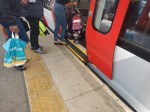
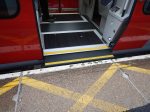
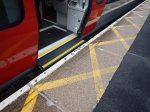
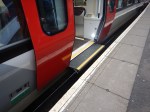
The pictures shows step-free access on Stadler Class 745 and Class 755 trains.
If I turned up pushing a friend in a wheelchair, would I be able to push them in easily? Or better still will they be able to wheel themselves in?
A Greater Anglia driver tp;d me recently, that now they never have to wait anymore for wheelchairs to be loaded.
So surely, it is in the train operator’s interest to have step-free access, if it means less train delays.
Double-Deck Trains
In my view double-deck trains only have one only good feature and that is the ability to see everything, if you have a well-designed window seat.
I may be seventy-three, but I am reasonably fit and only ever travel on trains with airline-sized hand baggage. So I don’t find any problem travelling upstairs on a double-deck bus or train!
But it could have been, so very different, if my stroke had been a bit worse and left me blind or in a wheelchair for life.
I have seen incidents on the Continent, which have been caused by double-deck trains.
- A lady of about eighteen in trying to get down with a heavy case dropped it. Luckily it only caused the guy she was travelling with, to roll unhurt down the stairs.
- Luggage is often a problem on Continental trains because of the step-up into the train and access is worse on double deck trains.
- I also remember on a train at Leipzig, when several passengers helped me lift a guy and his wheelchair out of the lower deck of a double-deck train, which was lower than the platform, as they often are with double-deck trains.
I am not totally against double-deck trains, but they must be designed properly.
Consider.
- High Speed Two’s Full-Size trains will only use London Euston, Old Oak Common, Birmingham Interchange, Birmingham Curzon Street, Manchester Airport, Manchester Piccadilly, East Midlands Hub and Leeds stations.
- All stations used by Full-Size trains will be brand-new or substantially rebuilt stations.
- Someone sitting in a wheelchair surely has the same right to a view from the top-deck of a double-deck train as anybody else.
- Jumbo jets seemed to do very well without a full-length top-deck.
- The A 380 Superjumbo has been designed so that entry and exit on both decks is possible.
I feel if High Speed Two want to run double-deck trains, an elegant solution can surely be found.
A Crude Estimate On The Number Of Trains
This is my crude estimate to find out how many trains, High Speed Two will need.
Western Leg
These are the services for the Western Leg between London , Birmingham, Liverpool, Manchester, Edinburgh and Glasgow.
- Train 1 – London Euston and Birmingham Curzon Street – 400 metre Full-Size – 45 minutes – 2 hour Round Trip – 4 trains
- Train 2 – London Euston and Birmingham Curzon Street – 400 metre Full-Size – 45 minutes – 2 hour Round Trip – 4 trains
- Train 3 – London Euston and Birmingham Curzon Street – 400 metre Full-Size – 45 minutes – 2 hour Round Trip – 4 trains
- Train 4 – London Euston and Lancaster – Classic Compatible – 2 hours 3 minutes – 5 hour Round Trip – 5 trains
- Train 4 – London Euston and Liverpool – Classic Compatible – 1 hours 34 minutes – 4 hour Round Trip – 4 trains
- Train 5 – London Euston and Liverpool – Classic Compatible – 1 hours 34 minutes – 4 hour Round Trip – 4 trains
- Train 6 – London Euston and Macclesfield – Classic Compatible – 1 hours 30 minutes – 4 hour Round Trip – 4 trains
- Train 7 – London Euston and Manchester – 400 metre Full-Size – 1 hour and 11 minutes – 3 hour Round Trip – 6 trains
- Train 8 – London Euston and Manchester – 400 metre Full-Size – 1 hour and 11 minutes – 3 hour Round Trip – 6 trains
- Train 9 – London Euston and Manchester – 400 metre Full-Size – 1 hour and 11 minutes – 3 hour Round Trip – 6 trains
- Train 10 – London Euston and Edinburgh – Classic Compatible – 3 hours 48 minutes – 8 hour Round Trip – 8 trains
- Train 10 – London Euston and Glasgow – Classic Compatible – 3 hours 40 minutes – 8 hour Round Trip – 8 trains
- Train 11 – London Euston and Edinburgh – Classic Compatible – 3 hours 48 minutes – 8 hour Round Trip – 8 trains
- Train 11 – London Euston and Glasgow – Classic Compatible – 3 hours 40 minutes – 8 hour Round Trip – 8 trains
- Train 12 – Birmingham Curzon Street and Edinburgh or Glasgow – Classic Compatible – 3 hours 20 minutes – 7 hour Round Trip – 7 trains
- Train 13 – Birmingham Curzon Street and Manchester – 200 metre Full-Size – 41 minutes – 2 hour Round Trip – 2 trains
- Train 14 – Birmingham Curzon Street and Manchester – 200 metre Full-Size – 41 minutes – 2 hour Round Trip – 2 trains
Note.
- I have assumed 400 metre Full-Size trains will be a pair of 200 metre trains.
- Trains 4, 10 and 11 are pairs of 200 metre long Classic-Compatible trains, that split and join at Crewe. Carlisle and Carlisle respectively.
- Trains 5 and 6 are single 200 metre long Classic-Compatible trains.
- The full schedule will need 34 Full-Size trains and 56 Classic-Compatible trains
According to Wikipedia, the first order will be for 54 Classic-Compatible trains, so I would assume, that more trains will be ordered.
Eastern Leg
These are the services for the Eastern Leg between London , Birmingham, East Midlands Hub, Leeds, Sheffield, York and Newcastle.
- Train 15 – Birmingham Curzon Street and Leeds – 200 metre Full-Size – 49 minutes – 2 hour Round Trip – 2 trains
- Train 16 – Birmingham Curzon Street and Leeds – 200 metre Full-Size – 49 minutes – 2 hour Round Trip – 2 trains
- Train 17 – Birmingham Curzon Street and Newcastle – Classic Compatible – 1 hour 57 minutes – 5 hour Round Trip – 5 trains
- Train 18 – London Euston and Sheffield – Classic Compatible – 1 hour 27 minutes – 4 hour Round Trip – 4 trains
- Train 18 – London Euston and Leeds – Classic Compatible – 1 hour 21 minutes – 3 hour Round Trip – 3 trains
- Train 19 – London Euston and Leeds – 400 metre Full-Size – 1 hour and 21 minutes – 3 hour Round Trip – 6 trains
- Train 20 – London Euston and Leeds – 400 metre Full-Size – 1 hour and 21 minutes – 3 hour Round Trip – 6 trains
- Train 21 – London Euston and Sheffield – Classic Compatible – 1 hour 27 minutes – 4 hour Round Trip – 4 trains
- Train 21 – London Euston and York – Classic Compatible – 1 hour 24 minutes – 3 hour Round Trip – 3 trains
- Train 22 – London Euston and Newcastle – Classic Compatible – 2 hour 17 minutes – 5 hour Round Trip – 5 trains
- Train 23 – London Euston and Newcastle – Classic Compatible – 2 hour 17 minutes – 5 hour Round Trip – 5 trains
Note.
- I have assumed 400 metre Full-Size trains will be a pair of 200 metre trains.
- Trains 15 and 16 work as a pair,
- Trains 18 and 21 are pairs of 200 metre long Classic-Compatible trains, that split and join at East Midlands Hub.
- Trains 22 and 23 are single 200 metre long Classic-Compatible trains
- The full schedule will need 16 Full-Size trains and 29 Classic-Compatible trains.
Adding the two legs together and I estimate that 50 Full-Size trains and 85 Classic-Compatible trains, will be needed to run a full schedule.
Trains Per Hour On Each Section
It is possible to make a table of how many trains run on each section of the High Speed Two network in trains per hour (tph)
- London Euston (stops) – 1-11, 18-23 – 17 tph
- London Euston and Old Oak Common – 1-11, 18-23 – 17 tph
- Old Oak Common (stops) – 1-11, 18-23 – 17 tph
- Old Oak Common and Birmingham Interchange – 1-11, 18-23 – 17 tph
- Birmingham Interchange (stops) – 2, 3, 7, 11, 20 – 5 tph
- Birmingham Curzon Street (stops) – 1-3, 12-14, 15-17 – 9 tph
- Birmingham and Crewe – 4,5, 7-9, 10-14 – 10 tph
- Crewe (stops) – 4,5 – 2 tph
- Crewe and Liverpool – 4,5 – 2 tph
- Crewe and Lancaster – 4, 10-12 – 4 tph
- Crewe and Manchester – 7-9, 13, 14 – 5 tph
- Crewe and Wigan via Warrington – 4 – 1 tph
- Crewe and Wigan via High Speed Two (new route) – 10-12 – 3 tph
- Lancaster (stops) 4 – 1 tph
- Lancaster and Carlisle – 10-12 – 3 tph
- Carlisle and Edinburgh – 10-12 – 2.5 tph
- Carlisle and Glasgow – 10-12 – 2.5 tph
- Birmingham and Stoke – 6 – 1 tph
- Stoke (stops) – 6 – 1 tph
- Stoke and Macclesfield – 6 – 1 tph
- Macclesfield (stops) – 6 – 1 tph
- Birmingham and East Midlands Hub – 15-17, 18-20, 21-23 – 9 tph
- East Midlands Hub (stops) – 15-17, 18-20, 21 – 7 tph
- East Midlands Hub and Sheffield – 18, 21 – 2 tph
- Sheffield (stops) – 18, 21 – 2 tph
- Midlands Hub and Leeds – 15, 16, 18-20 – 5 tph
- Leeds (stops) – 15, 16, 18-20 – 5 tph
- East Midlands Hub and York – 17, 21-23 – 4 tph
- York (stops) – 17, 21-23 – 4 tph
- York and Newcastle – 17, 22, 23 – 3 tph
- Newcastle (stops) – 17, 22, 23 – 3 tph
These are a few thoughts.
Capacity Of The Southern Leg
The busiest section is between London Euston and Birmingham Interchange, which handles 17 tph.
As the maximum capacity of High Speed Two is laid down in the Phase One Act as 18 tph, this gives a path for recovery, according to the article.
Trains Serving Euston
The following train types serve London Euston station.
- Full-Size – 8 tph
- 400 metre Classic-Compatible – 5 tph
- 200 metre Classic-Compatible – 4 tph
In the current service proposal, , Trains 5,6, 22 and 23 are just single 200 metre Classic Compatible trains.
This is inefficient and another four tph could be run into Euston station, by the use of appropriate splitting and joining.
- Train 5 could run an identical manner to Train 4 to give extra services to Lancaster, Preston, Wigan North Western and Warrington Bank Quay.
- Train 6 to Macclesfield is a problem and perhaps should call at Birmingham Interchange, where it could split and join to serve somewhere else like Wolverhampton and Shrewsbury.
- Trains 22 and 23 could split and join at East Midlands Hub and serve other places in the East of England like Cleethorpes, Hull, Lincoln, Middlesbrough and Scarborough.
Paths are expensive entities to provide and every path into Euston should support a 400 metre train or a pair of 200 metre trains.
Platform Use At Euston
This page on the High Speed Two web site, gives details of Euston High Speed Two station.
HS2 will deliver eleven new 400m long platforms, a new concourse and improved connections to Euston and Euston Square Underground stations. Our design teams are also looking at the opportunity to create a new northerly entrance facing Camden Town as well as new east-west links across the whole station site.
So how will the eleven platforms be used?
Destinations served from London are planned to be as follows.
- Birmingham Curzon Street – Full-Size – 3 tph
- Edinburgh/Glasgow – Classic-Compatible – 2 tph
- Lancaster – Classic-Compatible – 1 tph
- Leeds – Full-Size – 2 tph – Classic-Compatible – 1 tph
Liverpool – Classic-Compatible – 2 tph
- Macclesfield – Classic-Compatible – 1 tph
- Manchester Piccadilly – Full-Size – 3 tph
- Newcastle – Classic-Compatible – 2 tph
- Sheffield – Classic-Compatible – 2 tph
- York – Classic-Compatible – 1 tph
That is ten destinations and there will be eleven platforms.
I like it! Lack of resources is often the reason systems don’t work well and there are certainly enough platforms.
Could platforms be allocated something like this?
- Birmingham Curzon Street – Full-Size
- Edinburgh/Glasgow – Classic-Compatible
- Leeds – Full-Size
- Liverpool – Classic-Compatible – Also serves Lancaster
- Macclesfield – Classic-Compatible
- Manchester Piccadilly – Full-Size
- Newcastle – Classic-Compatible
- Sheffield – Classic-Compatible – Also serves Leeds and York
Note.
- No platform handles more than three tph.
- There are three spare platforms.
- Each platform would only be normally used by one train type.
- Only Birmingham Interchange, East Midlands Hub, Leeds, Preston and York are not always served from the same platform.
Platform arrangements could be very passenger- and operator-friendly.
Platform Use At Birmingham Curzon Street
Birmingham Curzon Street station has been designed to have seven platforms.
Destinations served from Birmingham Curzon Street station are planned to be as follows.
- Edinburgh/Glasgow – Classic-Compatible – 1 tph
- Leeds – Full-Size – 2 tph
- London Euston – Full-Size – 3 tph
- Manchester Piccadilly – Full-Size – 2 tph
- Newcastle – Classic-Compatible – 1 tph
- Nottingham – Classic-Compatible – 1 tph
Note.
- The Nottingham service has been proposed by Midlands Engine Rail, but will be running High Speed Two Classic Compatible trains.
- That is six destinations and there will be seven platforms.
I like it! For the same reason as London Euston.
Could platforms be allocated something like this?
- Edinburgh/Glasgow – Classic-Compatible
- Leeds – Full-Size
- London Euston – Full-Size
- Manchester Piccadilly – Full-Size
- Newcastle/Nottingham – Classic-Compatible
Note.
- No platform handles more than three tph.
- There are two spare platforms.
- Each platform would only be normally used by one train type.
- Only East Midlands Hub is not always served from the same platform.
Platform arrangements could be very passenger- and operator-friendly.
Back-to-Back Services via Birmingham Curzon Street
The current plan for High Speed Two envisages the following services between the main terminals served by Full-Size trains.
- London Euston and Birmingham Curzon Street – 3 tph – 45 minutes
- London Euston and Leeds – 2 tph – 81 minutes
- London Euston and Manchester Piccadilly – 3 tph – 71 minutes
- Birmingham Curzon Street and Leeds – 2 tph – 40 minutes
- Birmingham Curzon Street and Manchester Piccadilly – 2 tph – 41 minutes
Suppose a traveller wanted to go between East Midlands Hub and Manchester Airport stations.
Wouldn’t it be convenient if the Leeds to Birmingham Curzon Street train, stopped in Birmingham Curzon Street alongside the train to Manchester Airport and Piccadilly, so passengers could just walk across?
Or the two services could be run Back-to-Back with a reverse in Birmingham Curzon Street station?
Note.
- The current fastest times between Nottingham and Manchester Airport stations are around two-and-a-half hours, with two changes.
- With High Speed Two, it looks like the time could be under the hour, even allowing up to eight minutes for the change at Birmingham Curzon Street.
The design of the track and stations for High Speed Two, has some interesting features that will be exploited by the train operator, to provide better services.
Capacity Of The Western Leg Between Birmingham And Crewe
The section is between Birmingham and Crewe, will be running 10 tph.
As the maximum capacity of High Speed Two is laid down in the Phase One Act as 18 tph, this gives plenty of room for more trains.
But where will they come from?
High Speed One copes well with a few interlopers in the shape of Southeastern’s Class 395 trains, which run at 140 mph, between the Eurostars.
High Speed Two is faster, but what is to stop an operator running their own Classic-Compatible trains on the following routes.
- Birmingham Curzon Street and Liverpool via Crewe, Runcorn and Liverpool South Parkway.
- Birmingham Curzon Street and Holyhead via Crewe, Chester and an electrified North Wales Coast Line.
- Birmingham Curzon Street and Blackpool via Crewe, Warrington Bank Quay, Wigan North Western and Preston.
- Birmingham Curzon Street and Blackburn and Burnley via Crewe, Warrington Bank Quay, Wigan North Western and Preston.
Note.
- If these trains were say 130 metres long, they could call at all stations, without any platform lengthening.
- I’m sure that the clever engineers at Hitachi and Hyperdrive Innovation could come up with battery electric Classic-Compatible train, that could run at 225 mph on High Speed Two and had a battery range to reach Holyhead, with a small amount of electrification.
- A pair of trains, could work the last two services with a Split/Join at Preston.
The advantages of terminating these service in Birmingham Curzon Street would be as follows.
- A lot more places get a fast connection to the High Speed Two network.
- Passengers can reach London with an easy change at Birmingham Curzon Street station.
- They can also walk easily between the three Birmingham stations.
But the big advantage is the trains don’t use valuable paths on High Speed Two between Birmingham Curzon Street and London Euston.
Crewe Station
In the current Avanti West Coast timetable, the following trains pass through Crewe.
- London Euston and Blackpool – 4 trains per day (tpd)
- London Euston and Chester – 1 tph
- London Euston and Edinburgh/Glasgow – 2 tph
- London Euston and Liverpool – 1 tph
- London Euston and Manchester Piccadilly – 1 tph
Most trains stop at Crewe.
In the proposed High Speed Two timetable, the following trains will pass through Crewe.
- London Euston and Edinburgh/Glasgow – 2 tph
- London Euston and Lancaster/Liverpool – 2 tph
- London Euston and Manchester – 3 tph
- Birmingham Curzon Street and Edinburgh/Glasgow -1 tph
- Birmingham Curzon Street and Manchester – 2 tph
Note.
- Only the Lancaster and Liverpool trains stop at Crewe station.
- North of Crewe there will be a three-way split of High Speed Two routes to Liverpool, Wigan and the North and Manchester Airport and Piccadilly.
- High Speed Two will loop to the East and then join the West Coast Main Line to the South of Wigan.
- High Speed Two trains will use the West Coast Main Line to the North of Wigan North Western station.
This map of High Speed Two in North West England was captured from the interactive map on the High Speed Two web site.

Note.
- The current West Coast Main Line (WCML) and Phase 2a of High Speed Two are shown in blue.
- Phase 2b of High Speed Two is shown in orange.
- The main North-South route, which is shown in blue, is the WCML passing through Crewe, Warrington Bank Quay and Wigan North Western as it goes North.
- The Western Branch, which is shown in blue, is the Liverpool Branch of the WCML, which serves Runcorn and Liverpool.
- High Speed Two, which is shown in orange, takes a faster route between Crewe and Wigan North Western.
- The Eastern Branch, which is shown in orange, is the Manchester Branch of High Speed Two, which serves Manchester Airport and Manchester Piccadilly.
- The route in the East, which is shown in blue, is the Macclesfield Branch of High Speed Two, which serves Stafford, Stoke-on-Trent and Macclesfield.
The route of Northern Powerhouse Rail between Manchester Airport and Liverpool has still to be finalised.
Liverpool Branch
Consider.
- The Liverpool Branch will take two tph between London Euston and Liverpool.
- In the future it could take up to 6 tph on Northern Powerhouse Rail between Liverpool and Manchester Piccadilly via Manchester Airport.
I believe that Liverpool Lime Street station, after the recent updating can handle all these trains.
Manchester Branch
This document on the Government web site is entitled HS2 Phase 2b Western Leg Design Refinement Consultation.
It indicates two important recently-made changes to the design of the Manchester Branch of High Speed Two.
- Manchester Airport station will have four High Speed platforms instead of two.
- Manchester Piccadilly station will have six High Speed platforms instead of four.
These changes will help the use of these stations by Northern Powerhouse Rail..
Consider.
- The Manchester Branch will be new high speed track, which will probably be built in a tunnel serving Manchester Airport and Manchester Piccadilly stations.
- The Manchester Branch will terminate in new platforms.
- The Manchester Branch will take five tph between Birmingham Curzon Street or London Euston and Manchester Airport and Manchester Piccadilly.
- In the future it could take up to six tph on Northern Powerhouse Rail between Liverpool and Manchester Piccadilly via Manchester Airport.
- London Euston and Old Oak Common will be new stations on a tunnelled approach to London and will handle 18 tph.
If London Euston and Old Oak Common can handle 18 tph, I can’t see why Manchester Airport and Piccadilly stations can’t handle somewhere near a similar number of trains.
At the moment eleven tph have been allocated to the Manchester Branch.
I believe that if infrastructure for Northern Powerhouse Rail was designed so that as well as connecting to Manchester and Liverpool, it connected Manchester and the West Coast Main Line running North to Preston, Carlisle and Scotland, services to the following destinations would be possible.
- Barrow
- Blackburn
- Blackpool
- Edinburgh
- Glasgow
- Windermere
Note.
- Edinburgh and Glasgow would probably be a service that would alternate the destination, as it is proposed for High Speed Two’s Birmingham and Scotland service.
- There would probably be a need for a North Wales and Manchester service via Chester.
- All trains would be Classic-Compatible.
If the Manchester Branch were to be built to handle 18 tph, there would be more than enough capacity.
Crewe, Wigan And Manchester
My summing up earlier gave the number of trains between Crewe, Wigan and Manchester as follows.
- Crewe and Manchester – 5 tph
- Crewe and Wigan via Warrington – 1 tph
- Crewe and Wigan via High Speed Two (new route) – 3 tph
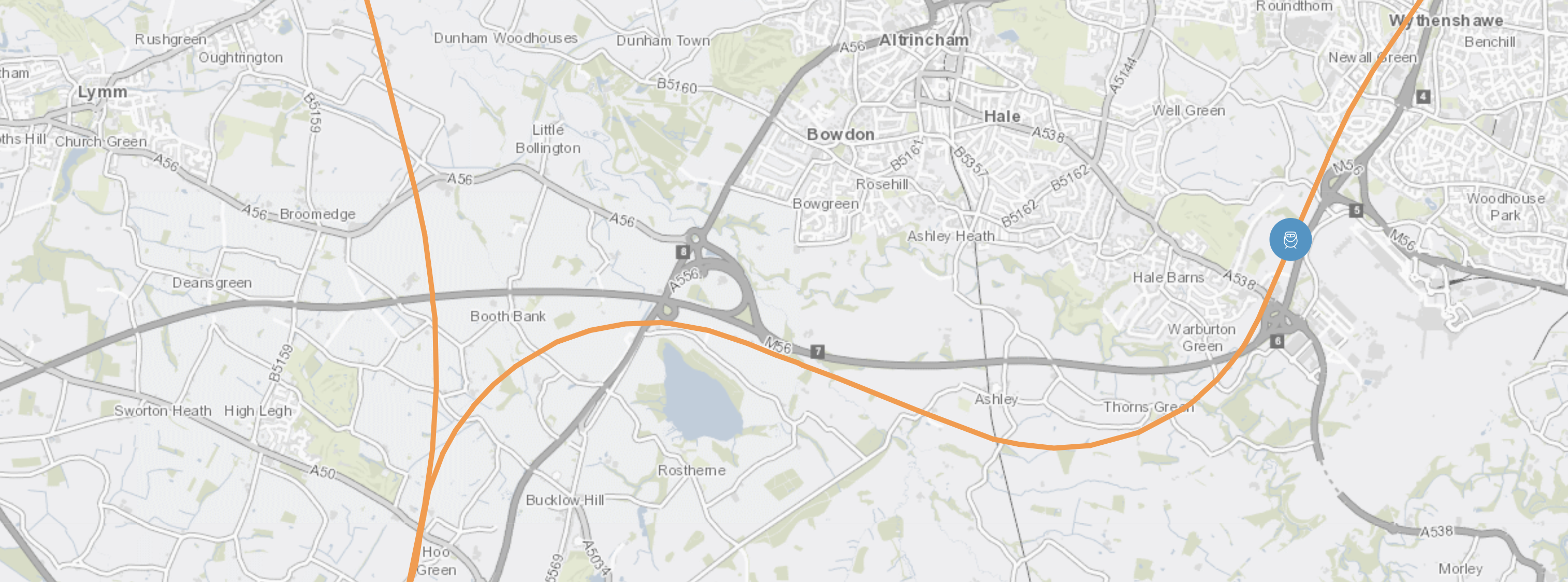
This map of High Speed Two where the Manchester Branch leaves the new High Speed Two route between Crewe and Wigan was captured from the interactive map on the High Speed Two web site.
Note.
- The Manchester Branch runs to the South of the M56,
- The large blue dot indicates Manchester Airport station.
- Wigan is to the North.
- Crewe is to the South.
- Manchester Piccadilly is to the North East.
I believe this junction will be turned into a full triangular junction, to connect Wigan directly to Manchester Airport and Manchester Piccadilly.
- Barrow, Blackburn, Blackpool, Preston and Windermere could all have high speed connections to Manchester Airport and Manchester Piccadilly. Trains could be shorter Classic-Compatible trains.
- A Manchester and Scotland service would take the same route.
Another pair of tracks could leave the junction to the West to create a direct route between Manchester Airport and Liverpool for Northern Powerhouse Rail, by sneaking along the M56.
Suppose extra services were as follows.
- Manchester and Barrow – 1 tph
- Manchester and Blackburn – 1 tph
- Manchester and Blackpool – 1 tph
- Manchester and Liverpool – 6 tph
- Manchester and Scotland – 1 tph
- Manchester and Windermere – 1 tph
The frequencies from the junction would be as follows.
- To and from Crewe – High Speed Two (Manchester) – 5 tph – High Speed Two (North) – 3 tph = 8 tph
- To and from Liverpool – Northern Powerhouse Rail – 6 tph = 6 tph
- To and from Manchester – High Speed Two – 5 tph – Northern Powerhouse Rail – 6 tph – Local – 4 tph – Scotland – 1 tph = 16 tph
- To and from Wigan – High Speed Two – 3 tph – Local – 4 tph – Scotland – 1 tph = 8 tph.
Only the Manchester Branch would be working hard.
The Liverpool Connection
I indicated that another pair of tracks would need to extend the Manchester Branch towards Liverpool in the West for Northern Powerhouse Rail.
- Would these tracks have a station at Warrington?
- Would there be a connection to allow services between Liverpool and the North and Scotland?
It might even be possible to design a Liverpool connection, that avoided using the current Liverpool Branch and increased the capacity and efficiency of all trains to Liverpool.
Capacity Of The Western Leg Between Wigan And Scotland
The sections between Crewe and Carlisle, will be running at the following frequencies.
- Wigan and Lancaster – 4 tph
- Lancaster and Carlisle – 3 tph
- Carlisle and Edinburgh – 2.5 tph
- Carlisle and Glasgow – 2.5 tph
Note.
- The unusual Scottish frequencies are caused by splitting and joining at Carlisle and alternate services to Edinburgh and Glasgow.
- Any local high speed services and a Scotland service from Manchester, will increase the frequencies.
Over this section the services will be running on an improved West Coast Main Line.
But in some cases the trains will be replacing current services, so the increase in total frequencies will be less than it first appears.
Avanti West Coast currently run the following Scottish services.
- One tph – London Euston and Glasgow via the most direct route.
- One tph – London Euston and alternately Edinburgh and Glasgow via Birmingham.
This means that effectively Glasgow has 1.5 tph and Edinburgh 0.5 tph from London Euston.
The capacity of the current eleven-car Class 390 trains is 145 First and 444 Standard Class seats, which compares closely with the 500-600 seats given in Wikipedia for High Speed Two trains. So the capacity of the two trains is not that different.
But High Speed Two will be running 2.5 tph Between London Euston and both Edinburgh and Glasgow.
I would expect, that Class 390 services to Scotland will be discontinued and replaced by High Speed Two services.
Capacity Of The Eastern Leg Between Birmingham And East Midlands Hub
The section is between Birmingham and East Midlands Hub, will be running 9 tph
As the maximum capacity of High Speed Two is laid down in the Phase One Act as 18 tph, this gives plenty of room for more trains.
But where will they come from?
Midlands Engine Rail is proposing a service between Birmingham Curzon Street and Nottingham.
- It will have a frequency of one tph.
- It will be run by High Speed Two Classic-Compatible trains.
- The journey will take 33 minutes.
- It will run on High Speed Two infrastructure between Birmingham Curzon Street and East Midlands Hub.
If High Speed Two has been designed with this service in mind, I doubt it will be a difficult service to setup.
- There might be enough capacity on High Speed Two for two tph on the route,
- It could possibly be extended to Lincoln.
It will also depend on the service timing being consistent with an efficient use of trains and platforms.
- Thirty-three minutes is not a good timing, as it means twenty-seven minutes wait in a platform to get a round trip time, that suits clock-face time-tabling.
- The current Lincoln and Nottingham service takes 56 minutes for 34 miles.
- LNER’s London Kings Cross and Lincoln service travels the 16 miles between Lincoln and Newark in 25 minutes.
- I estimate that after track improvements, with a single stop at Newark Castle station, that Nottingham and Lincoln could be achieved in several minutes under fifty minutes.
- This would enable a sub-ninety minute journey time between Birmingham Curzon Street and Lincoln, with enough time to properly turn the trains at both ends of the route.
- The three hour round trip would mean that an hourly service would need three trains.
This is probably just one of several efficient time-tabling possibilities.
Are there any other similar services?
The obvious one is surely Cambridge and Birmingham
- It would run via Peterborough, Grantham, Nottingham and East Midlands Hub.
- It would connect the three big science, engineering and medical centres in the Midlands and the East.
- It could be run by High Speed Two Classic-Compatible trains.
It might even be a replacement for CrossCountry’s Stansted Airport and Birmingham service.
Capacity Of The Eastern Leg Between East Midlands Hub And Sheffield
The section between East Midlands Hub and Sheffield, will be running 2 tph
As the maximum capacity of High Speed Two is laid down in the Phase One Act as 18 tph, this gives plenty of room for more trains.
But where will they come from?
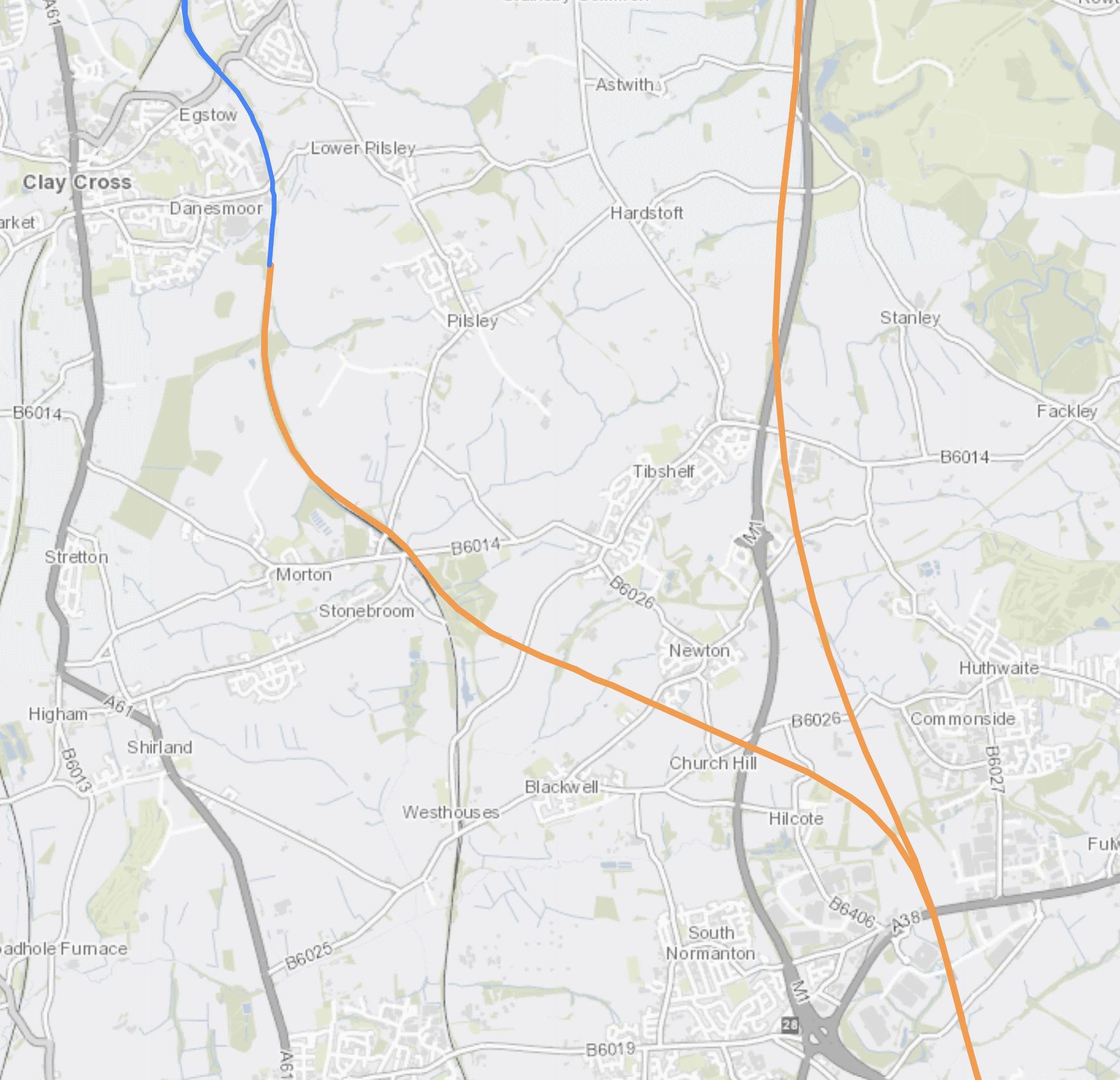
This map of High Speed Two where the Sheffield Branch leaves the new High Speed Two route between East Midlands Hub and Leeds was captured from the interactive map on the High Speed Two web site.
Note.
- The main route of High Speed Two between East Midlands Hub, is shown in orange and follows the route of the M1 Motorway, towards the East of the map.
- The Sheffield Branch is new track to Clay Cross North Junction, where is takes over the Midland Main Line to Sheffield, which is shown in blue.
- The line going South in the middle of the map is the Erewash Valley Line, which goes through Langley Mill and Ilkeston stations.
I suspect Clay Cross to Sheffield will be an electrified high speed line, with a maximum speed of at least 140 mph.
Could the Erewash Valley Line have been used as an alternative route to Sheffield?
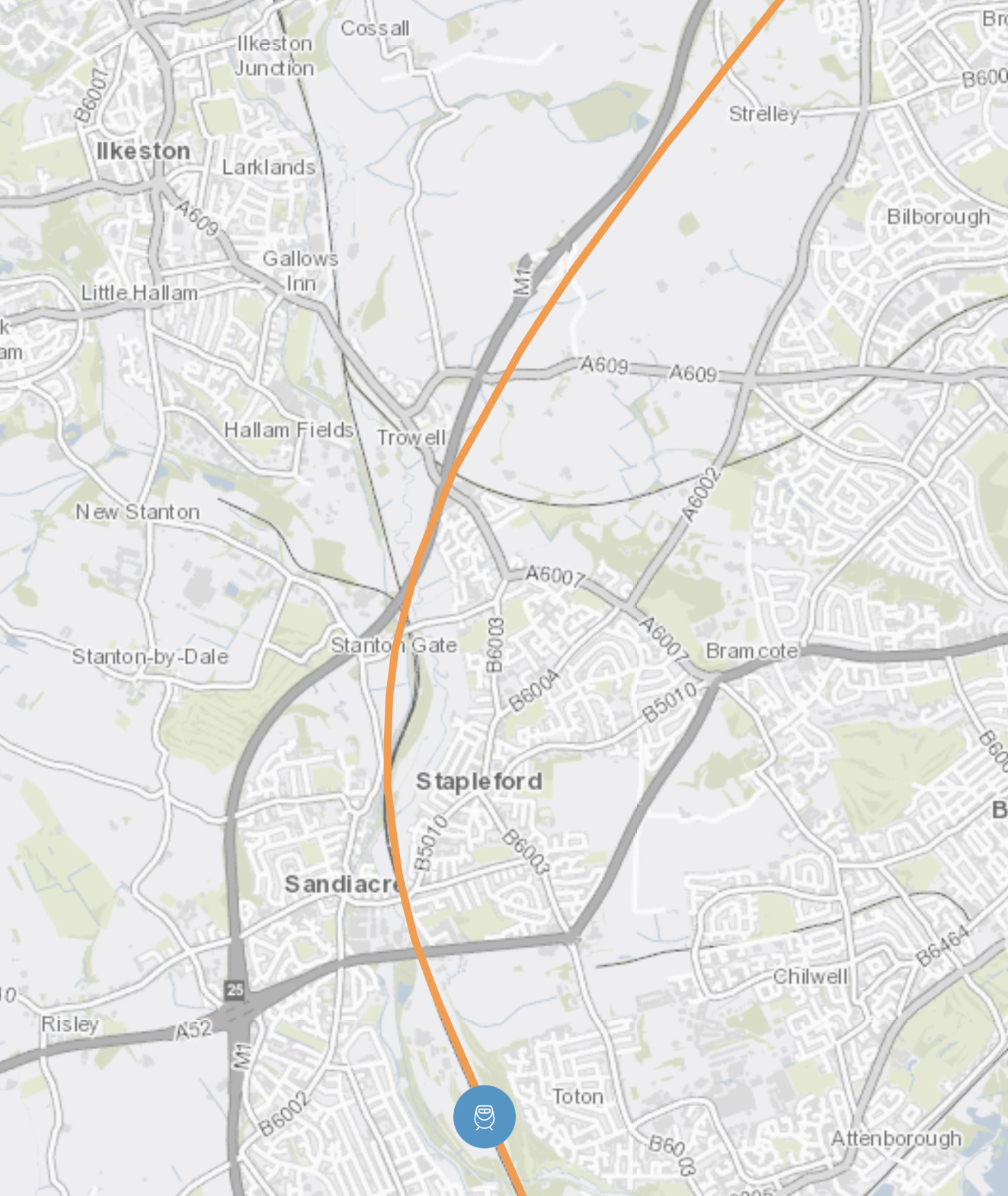
This map of High Speed Two captured from their interactive map, shows the connection of High Speed Two and the Erewash Valley Line to East Midlands Hub.
Note.
- East Midlands Hub is shown by the big blue dot.
- High Speed Two is shown in orange.
- The route to Leeds vaguely follows the M1 Motorway.
- The Erewash Valley Line goes North to the East of Ilkeston.
Would have been quicker and easier to electrify the Erewash Valley Line, as the High Speed Two route to Chesterfield and Sheffield?
- Network Rail updated the route a few years ago.
- It does not have the problems of electrification, through a World Heritage Site, as does the route through Derby.
- It could surely handle two tph, even if they were High Speed Two Classic Compatible trains.
- Sheffield will be just under ninety minutes from London by High Speed Two, as opposed to two hours now.
I suspect that it all comes down to saving a few minutes to Sheffield and the civic pride of having a High Speed Two connection.
So it looks like we’ll have the following capacity between East Midlands Hub and Sheffield.
- Between East Midlands Hub and Clay Cross North Junction, there will be the High Speed Two capacity of 18 tph.
- Between Clay Cross and Sheffield, there will probably be an upgraded capacity of perhaps 8-10 tph.
It seems a lot of capacity for just two tph.
Consider.
- High Speed Two is planning to run three tph between Birmingham Curzon Street and East Midlands Hub
- Midlands Rail Engine is planning to run one tph between Birmingham Curzon Street and East Midlands Hub
- Four tph is considered a Turn-Up-And-Go service, and could exist between Birmingham Curzon Street and East Midlands Hub.
- Sheffield and Leeds, both probably need a Turn-Up-And-Go service, to and from East Midlands Hub.
- Semi-fast services between Sheffield and East Midlands Hub, calling at Chesterfield, Alfreton, Langley Mill and Ilkeston would be possible, by using the Erewash Valley Line.
- The Maid Marian Line will join the Robin Hood Line in adding extra connectivity to East Midlands Hub Station.
- Leeds and East Midlands Hub could have a six tph service courtesy of High Speed Two and Midlands Rail Engine.
Using High Speed Two’s web site, the following times should be possible.
- Sheffield and East Midlands Hub – 27 minutes
- Sheffield and Birmingham Curzon Street – 47 minutes.
Both services allow time for an efficient service.
There are certainly many options to create a Turn-Up-And-Go service between Sheffield and East Midlands Hub and also improve connections to other locations across the area.
Capacity Of The Eastern Leg Between East Midlands Hub And Leeds
The section is between East Midlands Hub and Leeds, will be running 5 tph
High Speed Two between Midlands Hub and Leeds is a totally new high speed line.
- As the maximum capacity of High Speed Two is laid down in the Phase One Act as 18 tph, this gives plenty of room for more trains.
- The Southern section of the leg closely follows the M1 Motorway.
- Leeds, York and Newcastle will be 27, 36 and 93 minutes from East Midlands Hub, respectively.
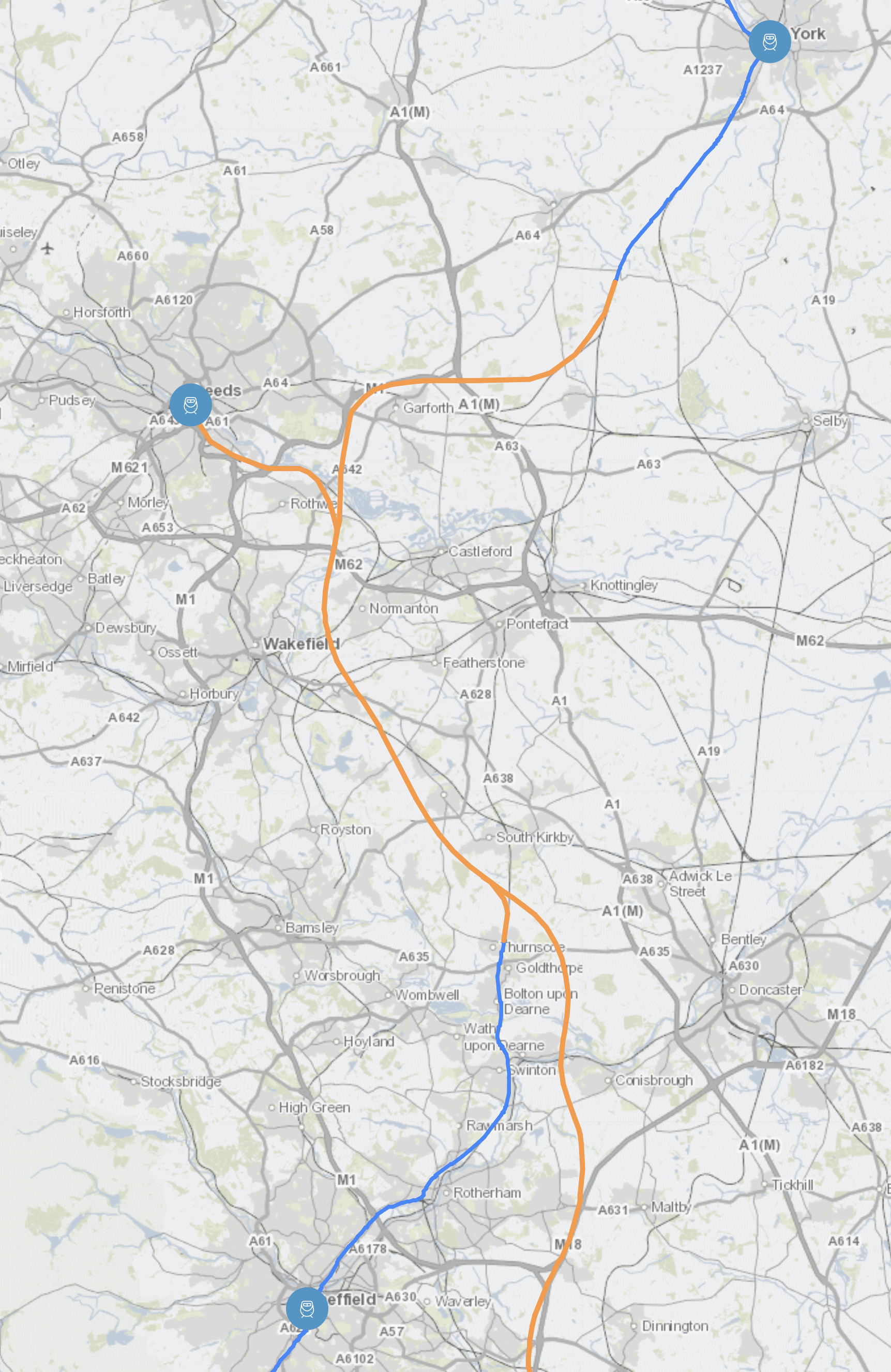
This map of High Speed Two, which shows the route of the line in Yorkshire, was captured from the interactive map on the High Speed Two web site.
Note.
- Sheffield is marked by the blue dot in the South.
- Leeds is marked by the blue dot in the North West.
- York is marked by the blue dot in the North East.
- New routes are shown in orange.
- Upgraded routes are shown in blue.
The route seems to open up several possibilities for extra routes.
- Leeds and Sheffield will be used by Northern Powerhouse Rail and there will be four tph, taking 28 minutes.
- Leeds and Bedford via East Midlands Hub has been proposed by Midlands Rail Engine.
- Services between Sheffield and the North via York must be a possibility.
This map of High Speed Two, which shows the routes to the East of Leeds, was captured from High Speed Two’s interactive map.
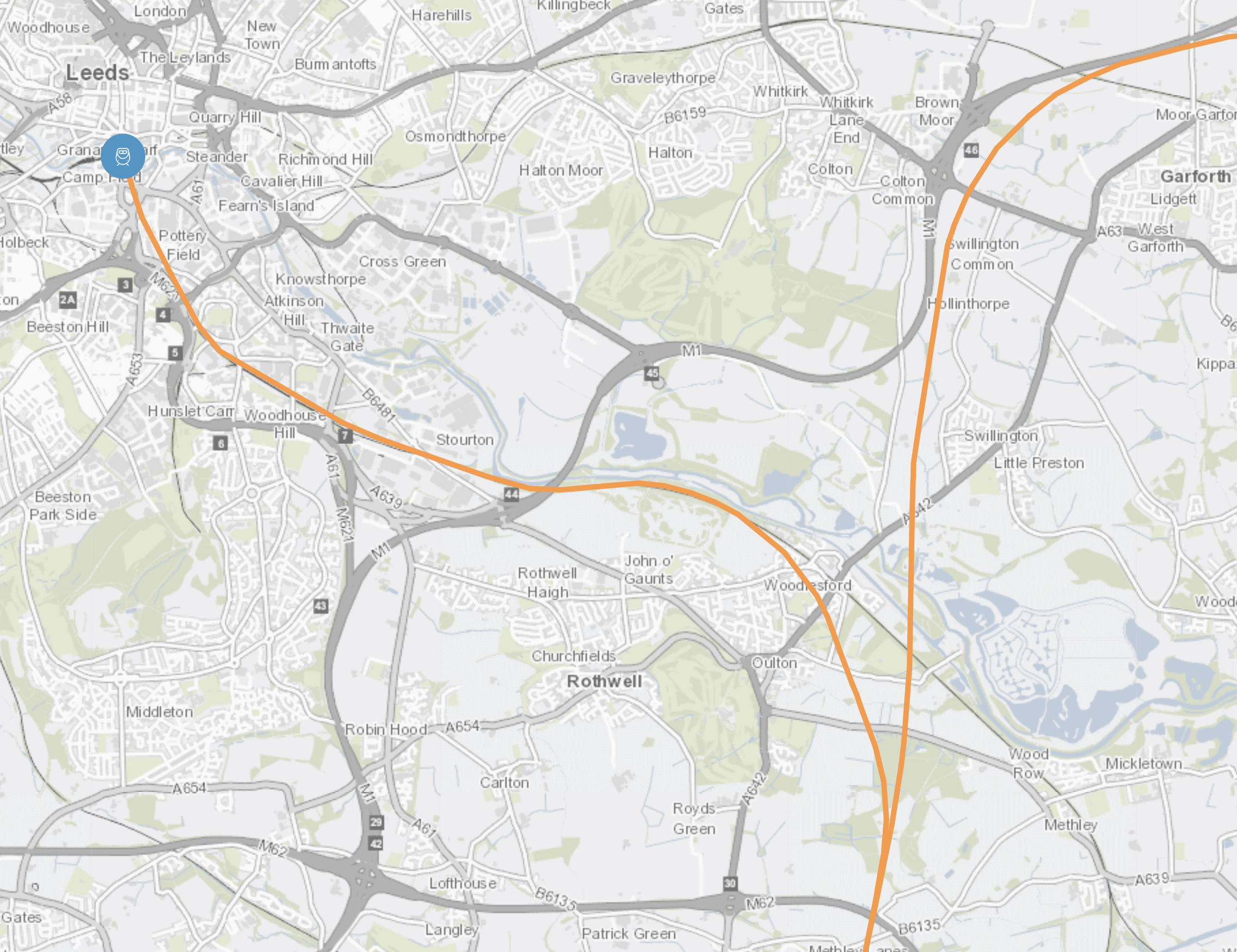
I think that two things might be missing.
- A full triangular junction would surely allow services between Leeds and the North via York.
- A high speed connection to Hull.
We shall see in the future.
Capacity Of The Eastern Leg Between York And Newcastle
The section between York and Newcastle, will be running at a frequency of 3 tph.
Over this section the services will be running on an improved East Coast Main Line.
Conclusion
I shall split the conclusions into various sections.
Route And Track Layout
I think there may be places, where the route and track layout might need to be improved.
- The Manchester Branch probably needs a triangular junction with the Western Leg of High Speed Two.
- How Liverpool is served by Northern Powerhouse Rail needs to be decided.
- The approach to Leeds probably needs a triangular junction with the Eastern Leg of High Speed Two.
- It is not clear how services will reach Hull.
Hopefully, these issues will become clear in the next year or so.
Capacity
The sections with the highest levels of capacity would appear to be the following.
- London Euston and Birmingham Interchange.
- The Manchester Branch
- The section shared with the East Coast Main Line between York and Newcastle.
- The section shared with the West Coast Main Line between Wigan and Scotland.
But on these sections extra trains can be run.
- Birmingham and North West England
- Birmingham and East Midlands Hub
- East Midlands Hub and Leeds
- East Midlands Hub and Sheffield
- East Midlands Hub and York
I can see, this capacity being filled by high speed local services, like those proposed by Midlands Rail Engine.
Rolling Stock
The only comment, I will make, is that there could be a need for a shorter Classic-Compatible train to work local services.
!40 mph Electric Trains At Kings Cross Station
This picture shows LNER’s old and new 140 mph electric trains at Kings Cross station.
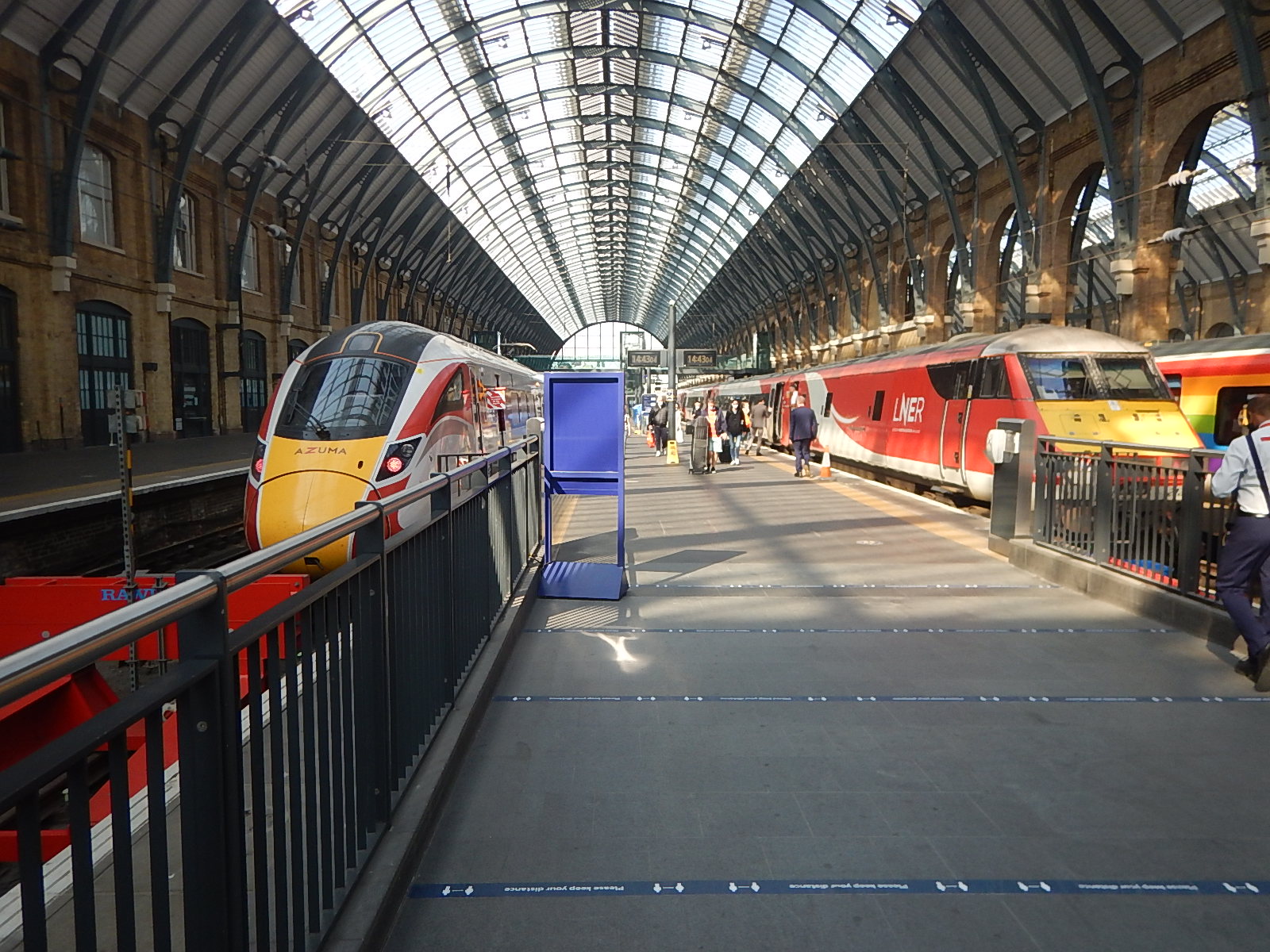
On the left is a nine-car Class 801 train.
- Introduced into service in 2019
- 234 metres long
- Capacity – 510 Standard and 101 First
- One diesel engine for emergency power.
On the right is an InterCity 225.
- Introduced into service in 1988-1991.
- Nine Mark 4 coaches
- 245 metres long
- Capacity 406 Standard and 129 First
- No emergency power
- As I wrote in Overhauls for LNER’s Remaining Class 91s And Mk 4s, the InterCity 225s are being updated to offer electric services between London Kings Cross and Bradford, Leeds, Skipton and York.
Both trains are designed for 140 mph and will be able to attain this speed, when in-cab digital signalling is available.
It looks like LNER will have the following full-size electric fleet.
- Thirty Class 801 trains
- Seven InterCity 225 trains and spare coaches, driving van trailers and locomotives.
Both trains will be able to work any route with full electrification.
Changes In The Future To LNER Services
I predict that the following will happen.
140 mph Running Between Woolmer Green And Doncaster
This will happen and the following trains will take advantage.
- LNER’s Class 800 and Class 801 trains
- Hull Train’s Class 802 trains
- East Coast Trains’s Class 803 trains
The odd ones out will be Grand Central’s Class 180 trains, which are diesel and only capable of 125 mph.
How long will the other train operating companies accept slow trains on the 140 mph railway?
Digital In-Cab Signalling And 140 mph Running Will Speed Up Services
In Thoughts On Digital Signalling On The East Coast Main Line, I said that following train times would be possible., in addition to a London Kings Cross and Leeds time of two hours.
- London Kings Cross and Bradford Forster Square – two hours and thirty minutes
- London Kings Cross and Harrogate – two hours and thirty minutes
- London Kings Cross and Huddersfield – two hours and twenty minutes
- London Kings Cross and Hull – two hours and thirty minutes
- London Kings Cross and Middlesbrough – two hours and thirty minutes
- London Kings Cross and Scarborough – two hours and thirty minutes
- London Kings Cross and Skipton – two hours and thirty minutes
- London Kings Cross and York – two hours
Note.
- All timings would be possible with Hitachi Class 80x trains.
- Timings on Fully-electrified routes would be possible with InterCity 225 trains.
It appears that Grand Central will be stuck in the slow lane.
Grand Central Will Acquire Hitachi Trains Or Give Up
Grand Central‘s destinations of Bradford Interchange and Sunderland can’t be reached by all-electric trains, so will either have to follow Hull Trains and purchase Hitachi bi-mode trains or give up their routes.
The Diesel Engines In The Class 801 Trains Will Be Replaced By Batteries
East Coast Trains’ Class 803 trains have a slightly different powertrain to LNER’s Class 801 trains, which is explained like this in Wikipedia.
Unlike the Class 801, another non-bi-mode AT300 variant which despite being designed only for electrified routes carries a diesel engine per unit for emergency use, the new units will not be fitted with any, and so would not be able to propel themselves in the event of a power failure. They will however be fitted with batteries to enable the train’s on-board services to be maintained, in case the primary electrical supplies would face a failure.
I wouldn’t be surprised to see a similar battery system fitted to the Class 801 trains.
The Diesel Engines In Hull Trains Class 802 Trains Will Be Replaced By Batteries
In Hull Issues New Plea For Electrification, I showed how Hitachi’s Class 802 trains with batteries instead of diesel engines could work long-distance services to and from Hull.
This will happen, as electric trains to London, would be a dream for a marketing man or woman.
Will The InterCity 225 Trains Lose Some First Class Seats?
This may happen, so that the seating layout in both trains is almost identical.
I’m certain, that it could be arranged, that seat numbers in both trains could have a similar position.
This would mean that if an InterCity 225 train replaced a Class 801 train, there wouldn’t need to be a seat reallocation.
Could InterCity 225 Trains Be Fitted With Emergency Batteries?
If LNER thought they were needed, I’m sure that this would be possible and Hyperdrive Innovation would oblige!
Conclusion
British Rail last hurrah, is giving Hitachi’s latest trains, a run for their money!
Thoughts On Digital Signalling On The East Coast Main Line
I came up to Doncaster yesterday on a new Hull Trains Class 802 train.
According to my pocket dynamometer car, the train seemed to be at or nearly at 125 mph, most of the time I looked from possibly around Stevenage to just South of Doncaster.
I came back today on an LNER Class 801 train and the train’s performance seemed very similar.
I also noted the following.
- The two stops at Newark and Peterborough, took seven and nine minutes respectively from the start of slowing for the station until back up to speed.
- Between Peterborough and Stevenage the train kept below a maximum of 110 mph.
- The train went through the two tunnels before Welwyn North station and the station itself at 75 mph.
- I timed the train at 100 mph over the Digswell Viaduct, when it reached the South side after accelerating on the viaduct.
- 90 mph was maintained between Potters Bar and New Southgate stations.
- Speed gradually reduced from New Southgate into Kings Cross.
Note.
- 125 mph is the maximum allowable speed of the train.
- The 110 mph running was probably to be compatible with the Class 387 trains.
- I will do the trip again and get some accurate figures.
It appears to me, that the driver was obeying a simple but fast plan.
The Wikipedia entry for the East Coast Main Line, says this about the opiating speed of the line, with the new trains.
Increasing maximum speeds on the fast lines between Woolmer Green and Dalton-on-Tees up to 140 mph (225 km/h) in conjunction with the introduction of the Intercity Express Programme, level crossing closures, ETRMS fitments, OLE rewiring and the OLE PSU – est. to cost £1.3 billion (2014). This project is referred to as “L2E4” or London to Edinburgh (in) 4 Hours. L2E4 examined the operation of the IEP at 140 mph on the ECML and the sections of track which can be upgraded to permit this, together with the engineering and operational costs
It also says this about the implementation of digital signalling.
A new Rail operating centre (ROC), with training facilities, opened in early 2014 at the “Engineer’s Triangle” in York. The ROC will enable signalling and day-to-day operations of the route to be undertaken in a single location. Signalling control/traffic management using ERTMS is scheduled to be introduced from 2020 on the ECML between London King’s Cross and Doncaster – managed from the York ROC.
The signalling could probably work in one of two ways.
- The signalling tells the driver the required speed and they drive the train accordingly.
- The signalling drives the train and the driver monitors what is happening.
Both methods are used in the UK.
A Possible London Kings Cross and Leeds Service
The combined affect of both track and signalling improvements is illustrated by this simple calculation.
- As Dalton-on-Tees is North of Doncaster, the route between Woolmer Green and Doncaster should be possible to be run at 140 mph
- Woolmer Green and Doncaster stations are 132.1 miles apart.
- Non-stop York and London Kings Cross trains are currently timed at 70 minutes between Doncaster and Woolmer Green stations.
- This is an average speed of 113.2 mph.
If 140 mph could be maintained between Doncaster and Woolmer Green, the section of the journey would take 56.6 minutes, which is a saving of 13.4 minutes.
Consider.
- The fastest current trains between London Kings Cross and Leeds take between two hours and twelve minutes and two hours and fifteen minutes.
- I suspect that the extra tracks into Kings Cross, that are currently being built will save a few minutes.
- There must be some savings to be made between Doncaster and Leeds
- There must be some savings to be made between London Kings Cross and Woolmer Green.
- There could be a rearrangement of stops.
I think it is highly likely that in the future, there will be at least one train per hour (tph) between London Kings Cross and Leeds, that does the trip in two hours.
- There is no reason why all London Kings Cross and Leeds trains could not take two hours.
- London Kings Cross and Doncaster could be several minutes under an-hour-and-a-half.
- High Speed Two is predicting one hour and twenty-one minutes for their future service between London Euston and Leeds, which is a saving of 38 minutes.
- London and Leeds in two hours will attract passengers.
There will be serious competition between London and Leeds.
Other Timing Improvements
I also think these times would be possible
- London Kings Cross and Bradford Forster Square – two hours and thirty minutes
- London Kings Cross and Harrogate – two hours and thirty minutes
- London Kings Cross and Huddersfield – two hours and twenty minutes
- London Kings Cross and Hull – two hours and thirty minutes
- London Kings Cross and Middlesbrough – two hours and thirty minutes
- London Kings Cross and Scarborough – two hours and thirty minutes
- London Kings Cross and Sheffield – two hours
- London Kings Cross and Skipton – two hours and thirty minutes
- London Kings Cross and York – two hours
I would be fairly certain that London Kings Cross and Huddersfield could be slowed by ten minutes, which would give the London Kings Cross and Yorkshire a certain symmetry.
- London Kings Cross and Leeds and York would take two hours.
- London Kings Cross and all the others would take two hours and thirty minutes.
It would probably make arrangement of a fast timetable easier.
Overhauls for LNER’s Remaining Class 91s And Mk 4s
The title of this post, is the same as that of this article on Rail Magazine.
This is the introductory paragraph.
Eversholt Rail, which owns the trains, has confirmed that 12 London North Eastern Railway Class 91s and the remaining Mk 4 coaches will undergo overhauls at Wabtec Rail, Doncaster.
It had been expected, that LNER would purchase more trains, as I wrote about in More New Trains On LNER Wish List.
The article gives more details of the trains to be retained.
- Twelve Class 91 locomotives, seven rakes of Mark 4 coaches and two spare coaches will be retained.
- They will be confined to routes between London Kings Cross and Bradford, Leeds, Skipton and York.
How many trains will be needed to cover these routes?
- Trains take two hours and fifteen minutes between London Kings Cross and Leeds and run at a frequency of two trains per hour (tph)
- Trains take two hours and twenty-one minutes between London Kings Cross and York and run hourly.
- I suspect that a round trip to Leeds or York can be five hours.
So a crude analysis says, that will mean fifteen trains will be needed,
But some of these trains will be extended past Leeds.
These are, electrification status and the times and distances between Leeds and the final destinations.
- Bradford – Electrified – 22 minutes – 13.5 miles
- Harrogate – Not Electrified – 40 minutes – 18 miles
- Huddersfield – Not Electrified – 33 minutes – 17 miles
- Skipton – Electrified – 45 minutes – 26 miles
It appears that the following is true.
- Trains serving Harrogate and Huddersfield must be worked by bi-mode Class 800 trains.
- Trains serving Bradford and Skipton could be worked by InterCity 225 trains or an all-electric nine-car Class 801 train.
Note.
- Some times are those taken by LNER services and some are estimates from TransPennine Express.
- I have assumed 8-10 minutes for the Split-and-Join at Leeds and included it in the times.
- Class 800 trains seem to take around ten minutes to turnround at Harrogate.
- Times between London Kings Cross and Doncaster will decrease by a few minutes, with the addition of digital in-cab signalling on the route, which will allow 140 mph running by InterCity 225s, Class 800 trains and Class 801 trains.
I estimate that it will be possible for an InterCity 225, Class 800 train or Class 801 train to do a round trip between London Kings Cross and Bradford, Harrogate, Huddersfield or Skipton in six hours.
The round trip between London Kings Cross and York will be the five hours, I estimated earlier.
Wikipedia also says this.
LNER expects to introduce two-hourly services to Bradford and a daily service to Huddersfield in May 2020 when more Azuma trains have been introduced.
So would the pattern of trains to Leeds/York be as follows?
- One tph – One pair of five-car Class 800 trains to Leeds, of which some or all split and join at Leeds, with one train going to and from Harrogate and the other going to and from Huddersfield.
- One tph per two hours (tp2h) – An InterCity 225 or nine-car Class 801 train to Leeds, of which some or all are extended to Bradford.
- One tp2h – An InterCity 225 or nine-car Class 801 train to Leeds, of which some or all are extended to Skipton.
- One tph – An InterCity 225 or nine-car Class 801 train to York.
I estimate that it will be possible for an InterCity 225, Class 800 train or Class 801 train to do a round trip between London Kings Cross and Bradford, Harrogate, Huddersfield or Skipton in six hours.
This would need the following trains.
- Six pairs of five-car Class 800 trains for the Harrogate and Huddersfield services.
- Six full size all electric trains, which could be an InterCity 225, a nine-car Class 801 train or a pair of five Class 801 trains, for Bradford and Skipton services.
- Five full size all electric trains, which could be an InterCity 225, a nine-car Class 801 train or a pair of Class 801 trains, for York services.
So why have LNER changed their mind and are retaining the InterCity 225?
Are InterCity 225 Trains Already Certified For 140 mph Running?
I wouldn’t be surprised, if a large part of the certification work for this had been done for 140 mph running and for it to be allowed, it needs digital in-cab signalling to be installed on the East Coast Main Line.
The Wikipedia entry for the InterCity 225 says this about the train’s performance.
The InterCity 225 has a top service speed of 140 mph (225 km/h); during a test run in 1989 on Stoke Bank between Peterborough and Grantham an InterCity 225 reached 162 mph (260.7 km/h). However, except on High Speed 1, which is equipped with cab signalling, British signalling does not allow trains to exceed 125 mph (201 km/h) in regular service, due to the impracticality of correctly observing lineside signals at high speed.
The Wikipedia entry for the East Coast Main Line says this about the future signalling.
A new Rail operating centre (ROC), with training facilities, opened in early 2014 at the “Engineer’s Triangle” in York. The ROC will enable signalling and day-to-day operations of the route to be undertaken in a single location. Signalling control/traffic management using ERTMS is scheduled to be introduced from 2020 on the ECML between London King’s Cross and Doncaster – managed from the York ROC.
A small fleet of InterCity 225 trains could be the ideal test fleet to find all the glitches in the new signalling.
Are InterCity 225 trains Already Certified To Run To Bradford and Skipton?
If they are, then that is another problem already solved.
A Fleet Of Seven Trains Would Cover Bradford And Skipton Services
Six trains are needed to run a one tp2h service to both Bradford and Skipton, so they could fully cover one tp2h to Bradford and occasional trains to Skipton with a spare train and one in maintenance.
Using InterCity 225s To Bradford and Skipton Would Not Require A Split-And-Join At Leeds
The number of trains that would Split-and-Join at Leeds would be only two tph instead of four tph, which would be simpler with less to go wrong.
Not Enough Five-Car Bi-Mode Class 800 Trains
LNER’s full fleet of Azumas will be as follows.
- 13 – Nine-car bi-mode Class 800 trains.
- 10 – Five-car bi-mode Class 800 trains.
- 30 – Nine-car electric Class 801 trains.
- 12 – Five-car electric Class 801 trains.
This would appear to be a major problem, if Harrogate and Huddersfield were to be served hourly by Class 800 trains, existing services are to be maintained or even increased to Hull and Lincoln and extra services are to be added to Middlesbrough and perhaps Nottingham and other destinations.
The InterCity 225s only help indirectly, if they provided the London Kings Cross and Bradford and Skipton services.
Conversion Of Class 800 and Class 801 Trains To Regional Battery Trains
Hitachi have launched the Regional Battery Train, which is described in this Hitachi infographic.

For LNER, they will be useful for any Journey under about 90 kilometres or 56 miles.
The trains should be able to serve these routes.
- Leeds and Harrogate and back – 36 miles
- Leeds and Huddersfield and back – 34 miles
- Newark and Lincoln and back – 33 miles
- Northallerton and Middlesbrough and back – 42 miles
Whilst Class 800 trains and Class 801 trains are converted, the InterCity 225 trains would act as valuable cover on services like London to Leeds and York.
Conclusion
I think it is a good plan.
Hull Issues New Plea For Electrification
The title of this post, is the same as that of this article on Rail Magazine.
This is the introductory paragraph.
Residents and businesses in Hull are being urged to support electrification of the railway to Selby and Sheffield.
This paragraph is about the difficulty of electrifying the route.
“Unlike elsewhere on the trans-Pennine routes, work here can start straightaway and would be a quick win. Our plans involve few extra land purchases, no tunnel widening, and no re-routing,” said Daren Hale, Hull City Council and Hull’s representative on the Transport for the North board.
Services to Hull station are as follows.
- Hull Trains – London Kings Cross and Hull via Selby, Howden and Brough.
- Hull Trains – Beverley and Hull via Cuttingham
- LNER – London Kings Cross and Hull via Selby and Brough
- Northern Trains – Halifax and Hull via Bradford Interchange, New Pudsey, Bramley, Leeds, Cross Gates, Garforth, East Garforth, Micklefield, South Milford, Selby and Brough
- Northern Trains – Sheffield and Hull via Meadowhall, Rotherham Central, Swinton, Mexborough, Conisbrough, Doncaster, Kirk Sandall, Hatfield & Stainforth, Thorne North, Goole, Saltmarshe, Gilberdyke, Broomfleet, Brough, Ferriby and Hessle,
- Northern Trains – Bridlington and Hull via Nafferton, Driffield, Hutton Cranswick, Arram, Beverley and Cottingham.
- Northern Trains – Scarborough and Hull via Seamer, Filey, Hunmanby, Bempton, Bridlington, Nafferton, Driffield, Hutton Cranswick, Arram, Beverley and Cottingham.
- Northern Trains – York and Hull via Selby, Howden, Gilberdyke and Brough.
- TransPennine Express – Manchester Piccadilly and Hull via Stalybridge, Huddersfield, Leeds, Selby, Brough
Note.
- Some services are joined back-to-back with a reverse at Hull station.
- I have simplified some of the lists of intermediate stations.
- Services run by Hull Trains, LNER or TransPennine Express use bi-mode Class 800 or Class 802 trains.
- All routes to Hull station and the platforms are not electrified.
Trains approach Hull by three routes.
- Selby and Brough
- Goole and Brough
- Beverley and Cottingham
Could these three routes be electrified?
I have just flown my helicopter along all of them.
I’ve also had a lift in the cab of a Class 185 train between Hull and Leeds, courtesy of Don Coffey.
Hull And Selby via Brough
There is the following infrastructure.
- Several major road overbridges, which all seem to have been built with clearance for overhead wires.
- There are also some lower stone arch bridges, which may need to be given increased clearance.
- No tunnels
- The historic Selby Swing Bridge.
- Four farm crossings.
- Fourteen level crossings.
Hull And Goole via Brough
There is the following infrastructure.
- Several major road overbridges, which all seem to have been built with clearance for overhead wires.
- No tunnels
- A swing bridge over the River Ouse.
- A couple of farm crossings
- Six level crossings
Hull And Beverley via Cottingham
There is the following infrastructure.
- A couple of major road overbridges, which all seem to have been built with clearance for overhead wires.
- No tunnels
- A couple of farm crossings
- Six level crossings
All of the routes would appear to be.
- At least double track.
- Not in deep cuttings.
- Mainly in open countryside.
- Built with lots of level crossings
I feel that compared to some routes, they would be easy to electrify, but could cause a lot of disruption, whilst the level crossings and the two swing bridges were electrified.
Speeding Up Services To And From Hull
What Are The Desired Timings?
The Rail Magazine article says this about the desired timings.
Should the plans be approved, it is expected that Hull-Leeds journey times would be cut from 57 minutes to 38, while Hull-Sheffield would drop from 86 minutes to 50 minutes.
These timings are in line with those given in this report on the Transport for the North web site, which is entitled At A Glance – Northern Powerhouse Rail,
The frequency of both routes is given in the report as two trains per hour (tph)
The Performance Of An Electric Class 802 Train
As Hull Trains, LNER and TransPennine Express will be using these trains or similar to serve Hull, I will use these trains for my calculations.
The maximum speed of a Class 802 train is 125 mph or 140 mph with digital in-cab signalling.
This page on the Eversholt Rail web site, has a data sheet for a Class 802 train.
The data sheet shows the following for a five-car Class 802 train.
It can accelerate to 100 mph and then decelerate to a stop in 200 seconds in electric mode.
The time to 125 mph and back is 350 seconds.
Thoughts On Hull And Leeds
Consider.
- The Hull and Leeds route is 52 miles long, is timed for a 75 mph train and has an average speed of 55 mph
- There are three intermediate stops for fast services, which means that in a Hull and Leeds journey, there are four accelerate-decelerate cycles.
- A 38 minute journey between Hull and Leeds would be an average speed of 82 mph
- A train travelling at 100 mph would take 31 minutes to go between Hull and Leeds.
- A train travelling at 125 mph would take 25 minutes to go between Hull and Leeds.
I also have one question.
What is the speed limit on the Selby Swing Bridge?
I have just been told it’s 25 mph. As it is close to Selby station, it could probably be considered that the stop at Selby is a little bit longer.
These could be rough timings.
- A train travelling at 100 mph would take 31 minutes to go between Hull and Leeds plus what it takes for the four stops. at 200 seconds a stop, which adds up to 43 minutes.
- A train travelling at 125 mph would take 25 minutes to go between Hull and Leeds plus what it takes for the four stops. at 350 seconds a stop, which adds up to 48 minutes.
Note how the longer stopping time of the faster train slows the service.
I think it would be possible to attain the required 38 minute journey, running at 100 mph.
Thoughts On Hull And Sheffield
Consider.
- The Hull and Sheffield route is 61 miles long, is timed for a 90 mph train and has an average speed of 43 mph
- There are five intermediate stops, which means that in a Hull and Sheffield journey, there are six accelerate-decelerate cycles.
- A 50 minute journey between Hull and Leeds would be an average speed of 73 mph.
- A train travelling at 100 mph would take 36 minutes to go between Hull and Sheffield.
- A train travelling at 125 mph would take 29 minutes to go between Hull and Sheffield.
I also have one question.
What is the speed limit on the swing bridge over the River Ouse?
As there is no nearby station, I suspect it counts as another stop, if it only has a 25 mph limit.
These could be rough timings.
- A train travelling at 100 mph would take 36 minutes to go between Hull and Sheffield plus what it takes for the six stops. at 200 seconds a stop, which adds up to 56 minutes.
- A train travelling at 125 mph would take 29 minutes to go between Hull and Sheffield plus what it takes for the six stops. at 350 seconds a stop, which adds up to 64 minutes.
Note how the longer stopping time of the faster train slows the service.
I think it would be possible to attain the required 50 minute journey, running at 100 mph.
Conclusions From My Rough Timings
Looking at my rough timings, I can conclude the following.
- The trains will have to have the ability to make a station stop in a very short time. Trains using electric traction are faster at station stops.
- The trains will need to cruise at a minimum of 100 mph on both routes.
- The operating speed of both routes must be at least 100 mph, with perhaps 125 mph allowed in places.
- I feel the Hull and Leeds route is the more difficult.
I also think, that having a line running at 100 mph or over, with the large number of level crossings, there are at present, would not be a good idea.
What Does Hull Want?
Hull wants what Northern Powerhouse Rail is promising.
- Two tph between Hull and Leeds in 38 minutes and Hull and Sheffield in 50 minutes.
They’d probably also like faster electric services between Hull and Bridlington, London Kings Cross, Manchester, Scarborough and York.
When Do They Want It?
They want it now!
Is There An Alternative Solution, That Can Be Delivered Early?
This may seem to be the impossible, as electrifying between Hull and Leeds and Hull and Sheffield is not an instant project, although full electrification could be an ultimate objective.
Consider.
- Hull and Brough are 10.5 miles apart.
- Brough and Leeds are 41 miles apart.
- Brough and Doncaster are 30 miles apart and Doncaster and Sheffield are 20 miles apart.
- Brough and Temple Hirst Junction are 26 miles apart.
- Brough and York are 42 miles apart.
- Hull and Beverley are 8 miles apart.
- Beverley and Bridlington are 23 miles apart.
- Beverley and Seamer are 42 miles apart.
Note that Doncaster, Leeds and Temple Hirst Junction are all electrified.
Hitachi’s Regional Battery Train
Hitachi have just launched the Regional Battery Train, which is described in this Hitachi infograpic.
It has a range of 56 miles and an operating speed of 100 mph.
Class 800 and Class 802 trains could be converted into Regional Battery Trains.
- The three diesel engines would be exchanged for battery packs.
- The trains would still be capable of 125 mph on fully-electrified routes like the East Coast Main Line.
- They would be capable of 100 mph on routes like the 100 mph routes from Hull.
- The trains would have full regenerative braking to batteries, which saves energy.
- Below 125 mph, their acceleration and deceleration on battery power would probably be the same as when using electrification. It could even be better due to the simplicity and low impedance of batteries.
But they would need some means of charging the batteries at Hull.
A Start To Electrification
If the ultimate aim is to electrify all the lines, then why not start by electrifying.
- Hull station.
- Hull and Brough
- Hull and Beverley
It would only be 18.5 miles of electrification and it doesn’t go anywhere near the swing bridges or about six level crossings.
Battery Electric Services From Hull
I will now look at how the various services could operate.
Note in the following.
- When I say Regional Battery Train, I mean Hitachi’s proposed train or any other battery electric train with a similar performance.
- I have tried to arrange all power changeovers in a station.
- Pantograph operation can happen at line-speed or when the train is stationary.
I have assumed a range of 56 miles on a full battery and an operating speed of 100 mph on a track that allows it.
Hull And London Kings Cross
The legs of the service are as follows.
- Hull and Brough – 10.5 miles – Electrified
- Brough and Temple Hirst Junction – 26 miles – Not Electrified
- Temple Hirst Junction and London Kings Cross – 169 miles – Electrified
Note.
- Hull and Brough takes about 11 minutes, so added to the time spent in Hull station, this must be enough time to fully-charge the batteries.
- Regional Battery Trains will be able to do 56 miles on a full battery so 26 miles should be easy.
- One changeover between power sources will be done in Brough station.
- The other changeover will be done at line speed at Temple Hirst Junction, as it is now!
Hull Trains and LNER would be able to offer an all-electric service to London.
A few minutes might be saved, but they would be small compared to time savings, that will be made because of the introduction of full ERTMS in-cab signalling South of Doncaster, which will allow 140 mph running.
Hull And Leeds
The legs of the service are as follows.
- Hull and Brough – 10.5 miles – Electrified
- Brough and Leeds – 41 miles – Not Electrified.
Note.
- Hull and Brough takes about 11 minutes, so added to the time spent in Hull station, this must be enough time to fully-charge the batteries.
- Regional Battery Trains will be able to do 56 miles on a full battery so 41 miles should be easy.
- One changeover between power sources will be done in Brough station, with the other in Leeds station.
If Leeds and Huddersfield were to be electrified, TransPennine Express will be able to run an all-electric service between Manchester and Hull, using battery power in the gaps.
Hull And Sheffield
The legs of the service are as follows.
- Hull and Brough – 10.5 miles – Electrified
- Brough and Doncaster – 30 miles – Not Electrified
- Doncaster and Sheffield – 20 miles – Not Electrified
Note.
- Hull and Brough takes about 11 minutes, so added to the time spent in Hull station, this must be enough time to fully-charge the battery.
- Regional Battery Trains will be able to do 56 miles on a full battery so 30 miles should be easy.
- Trains would charge using the electrification at Doncaster.
- Doncaster and Sheffield both ways should be possible after a full charge at Doncaster station.
- One changeover between power sources will be done in Brough station, with the others in Doncaster station.
An easier alternative for the Doncaster and Sheffield part of the route, might be to electrify between the two stations.
Hull And York
The legs of the service are as follows.
- Hull and Brough – 10.5 miles – Electrified
- Brough and York- 42 miles – Not electrified
Note.
- Hull and Brough takes about 11 minutes, so added to the time spent in Hull station, this must be enough time to fully-charge the batteries.
- Regional Battery Trains will be able to do 56 miles on a full battery so 42 miles should be easy.
- One changeover between power sources will be done in Brough station, with the other in York station.
- Trains would be fully charged for the return in York station.
This journey will also be effected by the York to Church Fenton Improvement Scheme, which is described on this page on the Network Rail web site. According to the web page this involves.
- Replace old track, sleepers, and ballast (The stones which support the track)
- Install new signalling gantries, lights, and cabling
- Fully electrify the route from York to Church Fenton – extending the already electrified railway from York.
There will be another five miles of electrification., which will mean the legs of the Hull and York service will be as follows.
- Hull and Brough – 10.5 miles – Electrified
- Brough and Church Fenton – 31.5 miles – Not Electrified
- Church Fenton and York – 10.5 miles – Electrified
It is a classic route for a battery electric train.
Note.
- Church Fenton and York takes about 19 minutes, so added to the time spent in York station, this must be enough time to fully-charge the batteries.
- There will be a changeover between power sources in Church Fenton station.
This appears to me to be a very sensible addition to the electrification.
If you look at a Leeds and York, after the electrification it will have two legs.
- Leeds and Church Fenton – 13 miles – Not Electrified
- Church Fenton and York – 10.5 miles – Electrified
It is another classic route for a battery electric train.
Hull And Bridlington
The legs of the service are as follows.
- Hull and Beverley – 13 miles – Electrified
- Beverley and Bridlington – 23 miles – Not Electrified
Note.
- Hull and Beverley takes about 13 minutes, so added to the time spent in Hull station, this must be enough time to fully-charge the batteries.
- Regional Battery Trains will be able to do 56 miles on a full battery so 46 miles to Bridlington and back to Beverley, should be possible.
- The changeovers between power sources would be in Beverley station.
If necessary, there is a bay platform at Bridlington, that could be fitted with simple electrification to charge the trains before returning.
Hull And Scarborough
The legs of the service are as follows.
- Hull and Beverley – 13 miles – Electrified
- Beverley and Seamer- 42 miles – Not Electrified
- Seamer and Scarborough – 3 miles – Not Electrified
Note.
- Hull and Beverley takes about 13 minutes, so added to the time spent in Hull station, this must be enough time to fully-charge the batteries.
- Regional Battery Trains will be able to do 56 miles on a full battery so 45 miles to Scarborough should be easy.
- The changeovers between power sources would be in Beverley station.
There would need to be charging at Scarborough, so why not electrify between Scarborough and Seamer?
- Power changeover would be in Seamer station.
- The electrification could also charge battery electric trains running between York and Scarborough.
- Seamer and York are 39 miles apart.
- All Northern Trains and TransPennine Express services appear to stop in Seamer station.
This could be three very useful miles of electrification.
Could This Plan Based On Battery Trains Be Delivered Early?
The project could be divided into sub-projects.
Necessary Electrification
Only these double-track routes would need to electrified.
- Hull and Brough
- Hull and Beverley
- Seamer and Scarborough
- Doncaster and Sheffield might be sensible but optional.
This also install electrification at Hull and Scarborough stations to charge terminating trains.
In total it would be under twenty-five double-track miles of electrification.
Note.
- There are no swing bridges on the routes to be electrified.
- There are no tunnels
- Many of the overbridges appear to be modern with adequate clearance for electrification.
- I don’t suspect that providing adequate power will be difficult.
- Hull and Scarborough are larger stations and I believe a full service can be provided, whilst the stations are being electrified.
It would not be a large and complicated electrification project.
Conversion Of Class 800 And Class 802 Trains To Regional Battery Trains
Whilst the electrification was being installed, the existing Class 800 and Class 802 trains needed by Hull Trains, LNER and TransPennine Express could be converted to Regional Battery Trains, by the replacement of some or all of the diesel engines with battery power-packs.
I suspect LNER or GWR could be the lead customer for Hitachi’s proposed conversion of existing trains.
- Both train companies have routes, where these trains could be deployed without any electrification or charging systems. Think London Kings Cross and Harrogate for LNER and Paddington and Oxford for GWR.
- Both train companies have large fleets of five-car trains, that would be suitable for conversion.
- Both train companies have lots of experience with Hitachi’s trains.
It should be noted that GWR, Hull Trains and TransPennine Express are all part of the same company.
What About Northern Trains?
Northern Trains will need some battery electric trains, if this plan goes ahead, to run routes like.
- Hull and Bridlington – 46 miles
- Hull and Leeds – 41 miles
- Hull and Scarborough – 42 miles
- Hull and Sheffield – 40 miles
- Hull and York – 42 miles
- Scarborough and York – 31.5 miles
- The distances are the lengths of the route without electrification.
I suspect they will need a train with this specification.
- Four cars
- Ability to use 25 KVAC overhead electrification.
- Battery range of perhaps 50 miles.
- 100 mph operating speed.
There are already some possibilities.
- CAF are talking about a four-car battery electric version of the Class 331 train.
- Hitachi have mentioned a battery electric Class 385 train.
- Porterbrook have talked about converting Class 350 trains to battery electric operation.
- Bombardier have talked about battery electric Aventras.
There are also numerous four-car electric trains, that are coming off lease that could be converted to battery electric operation.
When Could The Project Be Completed?
There are three parts to the project.
- Under twenty-five double-track miles of electrification.
- Adding batteries to Class 800 and Class 802 trains.
- Battery electric trains for Northern.
As the sub-projects can be progressed independently, I can see the project being completely by the end of 2024.
Across The Pennines In A Regional Battery Train
By providing the ability to run Class 802 trains on battery power to Hull and Scarborough, the ability to run Regional Battery Trains from Liverpool in the West to Hull, Middlesbrough and Scarborough in the East under electric power, could become possible.
Looking at Liverpool and Scarborough, there are these legs.
- Liverpool Lime Street and Manchester Victoria – 32 miles – Electrified
- Manchester Victoria and Stalybridge – 8 miles – Not Electrified
- Stalybridge and Huddersfield – 18 miles – Not Electrified
- Huddersfield and Leeds – 17 miles – Not Electrified
- Leeds and York – 26 miles – Not Electrified
- York and Scarborough – 42 miles – Not Electrified
Note.
- East of Manchester Victoria, there is electrification in Leeds and York stations, which could charge the train fully if it were in the station for perhaps ten minutes.
- Currently, stops at Leeds and York are around 4-5 minutes.
- Manchester Victoria and Stalybridge is being electrified.
- In this post, I have suggested that between Seamer and Scarborough should be electrified to charge the trains.
- I have also noted that between Church Fenton and York is being fully electrified.
This could mean power across the Pennines between Liverpool and Scarborough could be as follows.
- Liverpool Lime Street and Manchester Victoria – 32 miles – Electrification Power and Charging Battery
- Manchester Victoria and Stalybridge – 8 miles – Electrification Power and Charging Battery
- Stalybridge and Huddersfield – 18 miles – Battery Power
- Huddersfield and Leeds – 17 miles – Battery Power
- Leeds station – Electrification Power and Charging Battery
- Leeds and Church Fenton – 13 miles – Battery Power
- Church Fenton and York – 10.5 miles – Electrification Power and Charging Battery
- York and Seamer – 39 miles – Battery Power
- Seamer and Scarborough – 3 miles – Electrification Power and Charging Battery
There are three stretches of the route, where the train will be run on battery power.
- Stalybridge and Leeds – 35 miles
- Leeds and Church Fenton – 13 miles
- York and Seamer – 39 miles
There will be charging at these locations.
- West of Stalybridge
- Through Leeds Station
- Through York Station
- East of Seamer Station
I feel it could be arranged that trains left the charging sections and stations with a full battery, which would enable the train to cover the next section on battery power.
To make things even easier, Network Rail are developing the Huddersfield And Westtown Upgrade, which will add extra tracks and eight miles of new electrification between Huddersfield and Dewsbury.
This would change the power schedule across the Pennines between Liverpool and Scarborough to this.
- Liverpool Lime Street and Manchester Victoria – 32 miles – Electrification Power and Charging Battery
- Manchester Victoria and Stalybridge – 8 miles – Electrification Power and Charging Battery
- Stalybridge and Huddersfield – 18 miles – Battery Power
- Huddersfield and Dewsbury – 8 miles – Electrification Power and Charging Battery
- Fewsbury and Leeds – 9 miles – Battery Power
- Leeds station – Electrification Power and Charging Battery
- Leeds and Church Fenton – 13 miles – Battery Power
- Church Fenton and York – 10.5 miles – Electrification Power and Charging Battery
- York and Seamer – 39 miles – Battery Power
- Seamer and Scarborough – 3 miles – Electrification Power and Charging Battery
There are now four stretches of the route, where the train will be run on battery power.
- Stalybridge and Huddersfield – 18 miles
- Dewsbury and Leeds – 9 miles
- Leeds and Church Fenton – 13 miles
- York and Seamer – 39 miles
I can envisage the electrification being extended.
But battery power on this route gives all the advantages of electric trains, with none of the costs and installation problems of electrification.
Conclusion
I believe a limited electrification of lines for a few miles from the coastal terminals at Hull and Scarborough and battery electric trains can deliver zero-carbon and much faster electric trains to the railways of Yorkshire to the East of Leeds, Sheffield and York.
If this approach is used, the electrification will be much less challenging and if skates were to be worn, the scheme could be fully-implemented in around four years.
The scheme would also deliver the following.
- Faster, all-electric TransPennine services.
- An all-electric Hull and London service.
- A substantial move towards decarbonisation of passenger train services in East Yorkshire.
It is also a scheme, that could be extended South into Lincolnshire, across the Pennines to Lancashire and North to Teesside and Tyneside.
Beeching Reversal – Restoration Of A Daily Train Service On The Keighley & Worth Valley Railway
This is one of the Beeching Reversal projects that the Government and Network Rail are proposing to reverse some of the Beeching cuts.
The route starts at Keighley station, which is shown in this Google Map.

Keighley station is effectively a double station.
- The Northern pair of platforms are the electrified Airedale Line, which runs between Leeds and Bradford Forster Square stations in the East to Skipton station in the North-West.
- Curving up from the South is the Keighley and Worth Valley Railway, which runs through the Worth Valley to Oxenhope station.
The basic plan appears to be to run daily passenger services on the heritage railway between Keighley and Oxenhope via Haworth.
But there is a lot more than meets the eye.
Commuter Use
The Wikipedia entry of the Keighley and Worth Valley Railway has a section called Commuter Use, where this is said.
On weekends – in particular Saturday mornings, local residents who live in Oxenhope, Haworth, Oakworth and Ingrow catch the early morning diesel service to Keighley, returning later on steam hauled services. During the weekday outside of the summer months, locals instead use the local bus services.
It then says that studies have been done to investigate the railway’s use as a commuter route.
Heritage Use
There are attractions in the area to attract everybody.
In addition to the major centres of Leeds and Bradford, these stations are worth a visit for the sites they serve.
Haworth for the Brontes
Saltaire for the World Heritage Site of Salts Mill and the Hockneys.
Skipton for the Settle and Carlisle Railway.
LNER To Skipton
LNER run a single daily service to Skipton, that calls at Keighley and Shipley and it is rumoured on Wikipedia, that they would like to run more services.
My feeling, is that the company wants to run pairs of five-car Class 800 or Class 801 trains to Leeds, where they will split and go on to places like Bradford, Harrogate, Huddersfield and Skipton.
Skipton And Colne
This project appears to be a favourite of Governments, as I suspect it solves problems across the North. I last wrote about it in May this year in Colne – Skipton Reopening Moves Closer.
Short Breaks In Yorkshire
Is Yprkshire and Leeds and Bradford in particular, making a bit for the short break market?
It all fits!
What Needs To Be Added To The Keighley And Worth Valley Railway?
If the railway is going to run a regular commuter or tourist service on the route between Keighley and Oxenhope, the following issues must be covered.
Rolling Stock
The railway has an extensive collection of rolling stock, which include a couple of diesel multiple units, that should be able to handle the service.
I would think, that if they wanted something more modern with a heritage feel, that a battery electric version of one of Vivarail’s Class 230 trains would fit the bill. They could run using Vivarail’s Pop-up Metro concept.
Stations
The stations on the railway seem to be in good condition, but I’m sure to handle commuters for Leeds and Bradford, there may be some updating required.
Ticketing
There must be through ticketing.
Conclusion
I don’t feel that this would be the most expensive of schemes, as the major expense of an interchange station between the Keighley and Worth Valley Railway and the Airedale Line is already built.
Splitting And Joining Of High Speed Two Trains
In Existing Stations Where High Speed Two Trains Will Call, I looked at how existing stations will need to be modified to handle the High Speed Two service pattern described in an article, which is entitled HS2 Minister Backs 18 tph Frequency, in the June 2020 Edition of Modern Railways.
The article states that splitting and joining of trains will take place at three stations; Carlisle, Crewe and East Midlands Hub.
To successfully split and join the pairs of 200 metre long High Speed Two trains, the following will be needed.
- 400 metre long platforms, that can handle the pair of trains.
- Excellent signage, so that passengers get into the right train and leave for the right destination.
- Efficient crew methods, so that drivers are in the correct cabs at the right time.
For many years trains at Cambridge and several places South of London have successfully split and joined.
This video shows two Class 395 trains coupling and uncoupling automatically.
It;s impressive and I suspect High Speed Two’s trains will be equally good or even better at this procedure.
Why Is Split And Join Needed For High Speed Two?
According to the Modern Railways article, the full High Speed Two service will be as follows in trains per hour (tph) and trains per two hours (tp2h)
- 1 tph – London Euston and Birmingham Curzon Street via Old Oak Common (OOC) – 400 metres
- 2 tph – London Euston and Birmingham Curzon Street via OOC and Birmingham Interchange – 400 metres
- 1 tph – London Euston and Lancaster via OOC, Crewe, Warrington Bank Quay, Wigan North Western and Preston – London Euston and Liverpool Lime Street via OOC, Crewe and Runcorn – 200+200 metres with Split/Join at Crewe
- 1 tph – London Euston and Liverpool Lime Street via OOC, Crewe and Runcorn – 200 metres
- 1 tph – London Euston and Macclesfield via OOC, Stafford and Stoke-on-Trent – 200 metres
- 1 tph – London Euston and Manchester Piccadilly via OOC, Birmingham Interchange and Manchester Airport – 400 metres
- 2 tph – London Euston and Manchester Piccadilly via OOC and Manchester Airport – 400 metres
- 1 tph – London Euston and Edinburgh Waverley via OOC, Preston, Carlisle and Edinburgh Haymarket – London Euston and Glasgow Central via OOC, Preston and Carlisle – 200 +200 metres with Split/Join at Carlisle
- 1 tph – London Euston and Edinburgh Waverley via OOC, Birmingham Interchange, Preston, Carlisle and Edinburgh Haymarket – London Euston and Glasgow Central via OOC, Preston and Carlisle – 200 +200 metres with Split/Join at Carlisle
- 1 tp2h – Birmingham Curzon Street and Edinburgh Waverley via Wigan North Western, Preston, Lancaster, Oxenholme, Penrith and Edinburgh Haymarket – 200 metres
- 1 tp2h – Birmingham Curzon Street and Glasgow Central via Wigan North Western, Preston, Lancaster, Oxenholme, Penrith, Lockerbie and Motherwell – 200 metres
- 2 tph – Birmingham Curzon Street and Manchester Piccadilly via Manchester Airport – 200 metres
- 2 tph – Birmingham Curzon Street and Leeds via East Midlands Hub – 200 metres
- 1 tph – Birmingham Curzon Street and Newcastle via East Midlands Hub, Darlington and Durham – 200 metres
- 1 tph – London Euston and Sheffield via OOC and East Midlands Hub – London Euston and Leeds via OOC and East Midlands Hub – 200 + 200 metres with Split/Join at East Midlands Hub
- 1 tph – London Euston and Leeds via OOC and East Midlands Hub – 400 metres
- 1 tph – London Euston and Leeds via OOC, Birmingham Interchange and East Midlands Hub – 400 metres
- 1 tph – London Euston and Sheffield via OOC, East Midlands Hub and Chesterfield – London Euston and York via OOC and East Midlands Hub – 200 + 200 metres with Split/Join at East Midlands Hub
- 1tph – London Euston and Newcastle via OOC and York – 200 metres
- 1 tph – London Euston and Newcastle via OOC, York and Darlington – 200 metres
Note.
- Trains 10 and 11 share the same path in alternate hours.
- Birmingham Curzon Street is effectively a second Southern terminus.
- Seventeen tph leave London Euston and Old Oak Common for the North, of which eight are 400 metre trains, five are a pair of 200 metre trains and four are 200 metre trains.
As the five pairs of 200 metre trains Split/Join en route, this effectively means, that London Euston is served by twenty-two tph.
It would appear that Split/Join is important, as it allows the same number of train paths between London Euston and the North to support more services.
Could Any Other Trains Be Split And Joined?
I don’t see why not!
There are eight tph going North from London Euston and Old Oak Common, that are 400 metre long trains that don’t Split/Join
- 3 tph – Birmingham Curzon Street
- 2 tph – Leeds
- 3 tph – Manchester Piccadilly
Note.
- Each 400 metre train would appear to have a capacity of around 1,100 passengers.
- Leeds is also served by another 200 metre train from London.
Effectively, this gives the following passenger capacities between London and the three major cities.
- Birmingham – 3,300
- Leeds – 2,750
- Manchester – 3,300
If these capacities have been carefully predicted, performing a Split/Join on these trains might cause a shortage of capacity.
There are four single 200 metre trains, that could be doubled up for their run to the North.
- London Euston and Liverpool Lime Street via OOC, Crewe and Runcorn
- London Euston and Macclesfield via OOC, Stafford and Stoke-on-Trent
- London Euston and Newcastle via OOC and York
- London Euston and Newcastle via OOC, York and Darlington
In theory, these four trains could be doubled to provide extra services.
But there are two problems.
Where Would The Trains Split and Join?
- Train 1 could Split/Join at Crewe.
- Train 2 could Split/Join at Stafford, if the platforms were lengthened to accept a pair of 200 metre trains.
- Trains 3 and 4 would need to stop at East Midlands Hub to Split/Join
It would appear that four extra trains could be run into London Euston, by running all single trains as pairs.
Where Would The Extra Services Terminate?
There are possibilities on the Western leg of High Speed Two.
- An extra train for Liverpool Lime Street
- An extra train for Lancaster
- A direct train for the current Manchester Piccadilly via Wilmslow and Stockport
- A direct train for Blackpool
But the Eastern leg of High Speed Two is more of a problem.
- An extra train for Sheffield
- A direct train for Hull.
Hull could be served via a new junction between High Speed Two and the Hull-Leeds Line to the North-West of Garforth or perhaps by extending a service from Sheffield.
Could Any Services North From Birmingham Curzon Street Be Split And Joined?
These 200 metre services go North from Birmingham Curzon Street station.
- 1 tp2h – Birmingham Curzon Street and Edinburgh Waverley via Wigan North Western, Preston, Lancaster, Oxenholme, Penrith and Edinburgh Haymarket
- 1 tp2h – Birmingham Curzon Street and Glasgow Central via Wigan North Western, Preston, Lancaster, Oxenholme, Penrith, Lockerbie and Motherwell
- 2 tph – Birmingham Curzon Street and Manchester Piccadilly via Manchester Airport
- 2 tph – Birmingham Curzon Street and Leeds via East Midlands Hub
- 1 tph – Birmingham Curzon Street and Newcastle via East Midlands Hub, Darlington and Durham.
Note that trains 1 and 2 share the same path in alternate hours.
There may be scope to double up some of these trains, to serve extra destinations in the North from Birmingham Curzon Street.
Conclusion
Split/Join is a powerful tool to increase the number of services without spending a fortune on new infrastructure.
Classic-Compatible High Speed Two Trains At East Midlands Hub Station
This article on Rail News, is entitled £2.7bn East Midlands Plan Unveiled For HS2 Links.
This is the first two paragraphs.
A bold plan costed at £2.7 billion for the area around the HS2 hub in the East Midlands has been published by a group of councils, transport bodies and East Midlands Airport.
The core of the scheme is the future East Midlands Hub at Toton, and the plan proposes direct access to the Hub from more than 20 cities, towns and villages in the East Midlands.
If you want to read the original report by Midlands Connect, there’s a download link on this page of their web site.
The original report has a section entitled Midlands Engine Rail, where this is said.
This project is fully integrated with Midlands Engine Rail, a rail improvement plan developed by Midlands Connect to revolutionise connectivity, mobility and productivity across the region. Midlands Engine Rail includes plans for two new HS2 classic-compatible services on an electrified Midland Main Line that will run direct from:
- Bedford and Leeds via Leicester and East Midlands Hub
- Nottingham and Birmingham Curzon Street via East Midlands Hub
These services can run on both electrified and high speed tracks, and would join the HS2 network at Toton, the HS2 East Midlands Hub, meaning that Nottingham and Leicester city centres are directly linked to HS2 without the need to change trains.
These improved connections will more than halve current journey times, with Leicester to Leeds dropping from 120 minutes to 46 minutes and Nottingham to Birmingham falling from 72 minutes to 33 minutes.
Note.
- Between Bedford and East Midland Hub stations, the Midland Main Line is or soon will be an almost a complete 125 mph rail line.
- It is likely, that with digital in-cab signalling, that faster running up to 140 mph may be permitted in places.
- Between Birmingham Curzon Street and East Midlands Hub stations, trains will use High Speed Two at up to 205 mph.
- Between Leeds and East Midlands Hub stations, trains will use High Speed Two at up to 205 mph.
- Leeds and Birmingham Curzon Street station will be new stations for High Speed Two.
The Classic-Compatible Trains
These are described in this section in Wikipedia, by this sentence.
The classic-compatible trains, capable of high speed but built to a British loading gauge, permitting them to leave the high speed track to join conventional routes such as the West Coast Main Line, Midland Main Line and East Coast Main Line. Such trains would allow running of HS2 services to the north of England and Scotland, although these non-tilting trains would run slower than existing tilting trains on conventional track. HS2 Ltd has stated that, because these trains must be specifically designed for the British network and cannot be bought “off-the-shelf”, these conventional trains were expected to be around 50% more expensive, costing around £40 million per train rather than £27 million for the captive stock.
The trains will have the same characteristics as the full-size trains.
- Maximum speed of 225 mph.
- Cruising speed of 205 mph on High Speed Two.
- Length of 200 metres.
- Ability to work in pairs.
- A passenger capacity around 500-600 passengers.
It should be noted that one of these trains will be shorter than a pair of East Midlands Railway’s five-car Class 810 trains, which should avoid any serious platform lengthening on existing lines.
Bedford and Leeds via Leicester and East Midlands Hub
A few facts and thoughts.
- The service is shown as stopping at Wellingborough, Kettering, Market Harborough, Leicester, Loughborough and East Midlands Hub.
- The service frequency could be hourly, but two trains per hour (tph) would be better.
- This service could be more important, than it appears, as by the time High Speed Two opens to Leeds, the East West Railway will be open through Bedford.
- Would a terminal platform need to be added at Bedford station? As the station could be rebuilt for the East West Railway, this shouldn’t be a problem.
- Leeds will have a new High Speed Two station or at least new platforms in the existing station.
- The Bedford and Leeds service would join High Speed Two at East Midlands Hub and go North.
- The Leeds and Bedford service would leave High Speed Two at East Midlands Hub and go South.
Leeds and Leicester will take 46 minutes, with High Speed Two’s journey time calculator, indicating twenty-seven minutes between East Midlands Hub and Leeds stations.
According to an article in the June 2020 Edition of Modern Railways High Speed Two is planning to run the following services on the Eastern leg of High Speed Two between East Midlands Hub and Leeds.
- Two tph – Birmingham Curzon Street and Leeds
- Three tph – London Euston and Leeds
There will be a Turn-Up-And-Go six tph service between East Midlands Hub and Leeds stations.
If the Bedford and Leeds service was an hourly service, when added to the current East Midlands Railway Inter-City services, it would give the following calling frequencies.
- Wellingborough – 2 tph
- Kettering – 2 tph
- Market Harborough – 3 tph
- Leicester – 5 tph
- Loughborough – 3 tph
- East Midlands Parkway – 2 tph
The calling pattern can be adjusted to the number of passengers.
Nottingham and Birmingham Curzon Street via East Midlands Hub
A few facts and thoughts.
- The service is shown as only stopping at East Midlands Hub.
- The service frequency could be hourly.
- The service would go between East Midlands Hub and Nottingham using the Trowell Curve route, which I discussed in Access To Toton – Scheme 6 – Trowell Curve.
- Nottingham station has long terminal platforms that take a full-length Inter-City 125.
- Birmingham Curzon Street will be a new High Speed Two station.
- The Nottingham and Birmingham Curzon Street service would join High Speed Two at East Midlands Hub and go South.
- The Birmingham Curzon Street and Nottingham service would leave High Speed Two at East Midlands Hub and go North.
Nottingham and Birmingham Curzon Street will take 33 minutes, with High Speed Two’s journey time calculator, indicating twenty minutes, between Birmingham Curzon Street and East Midlands Hub stations.
According to an article in the June 2020 Edition of Modern Railways High Speed Two is planning to run the following services on the Eastern leg of High Speed Two from Birmingham Curzon Street.
- Two tph – East Midlands Hub and Leeds
- One tph – East Midlands Hub, York, Darlington, Durham and Newcastle.
There will be a Turn-Up-And-Go four tph service between East Midlands Hub and Birmingham Curzon Street stations.
Midland Main Line Electrification
Midlands Connect is calling for full electrification of the Midland Main Line.
The problem is electrification through Leicester station, where there is a low bridge over the track.
In Discontinuous Electrification Through Leicester Station, I showed how the problem might be solved by discontinuous electrification and battery-equipped trains.
The Shared High Speed Two Path
If you look at the two previous sections you’ll see the following.
- The Birmingham Curzon Street and Nottingham service would leave High Speed Two at East Midlands Hub and go North.
- The Bedford and Leeds service would join High Speed Two at East Midlands Hub and go North.
- The Leeds and Bedford service would leave High Speed Two at East Midlands Hub and go South.
- The Nottingham and Birmingham Curzon Street service would join High Speed Two at East Midlands Hub and go South.
The two services are using the same path on High Speed Two.
I would design the East Midlands Hub, so that High Speed Two and classic services going in the same direction shared an island platform.
Southbound services would behave like this.
- The Nottingham to Birmingham Curzon Street train would arrive in the High Speed Two face of the platform.
- The Leeds to Bedford train would arrive in the classic face of the platform.
- Passengers who needed to change would walk across the platform.
- When ready both trains would go on their way.
Northbound services would do something similar.
It would be an efficient way to organise interchange between services.
- Train design would have to ensure, that all trains using the island platform had similar and preferably step-free access.
- If Greater Anglia and Merseyrail, can do step-free access, then no train designer has an excuse not to.
- Surely every High Speed Two train that arrives at East Midlands Hub, should be paired with a Midland Main Line service, if the timetable allows it.
The money being spent on High Speed Two means that the British public, won’t accept anything less than perfect.
Are There Any Other Possible Destinations For Classic-Compatible High Speed Two Trains From East Midlands Hub Station?
I will put these in alphabetical order.
Bedford
Consider.
- Bedford is already planned to have one classic-compatible service to and from Leeds.
- One of East Midlands Railway’s St. Pancras services calls at Bedford.
- Bedford has a four tph Thameslink service to a large proportion of Central London and the South East of England.
- Bedford has direct services to Gatwick Airport.
- Bedford station will be expanded to accommodate the East West Railway.
- In a few years, Bedford will be connected to Milton Keynes, Oxford and Reading by the East West Railway.
- When the East Midlands Hub station opens, Bedford will be connected to Cambridge, Ipswich and Norwich by the East West Railway.
I feel there is a need for a Turn-Up-And-Go four tph service between Bedford and East Midlands Hub stations.
I estimate that between Bedford and East Midlands Parkway stations will have a journey time of around 60 minutes.
Cambridge
I believe that the East West Railway should be built to the same standard as the East Coast, Great Western, Midland and West Coast Main Lines.
- Digitally signalled
- 125 mph-capable
- Electrified
This would enable classic-compatible services to be extended from Bedford to the UK’s Technology Powerhouse; Cambridge.
As Bedford and East Midlands Parkway could be 60 minutes, timings depend on the times of the East West Railway, between Bedford and Cambridge.
Edinburgh
Consider.
- Edinburgh is an important city; financially and politically.
- Edinburgh is planned to have a classic-compatible service from London via the West Coast Main Line.
- Newcastle is planned to have a classic-compatible service from East Midlands Hub
The city must be a possibility for a classic compatible service from East Midlands Hub.
I estimate that Edinburgh and East Midlands Parkway will have a journey time of a few minutes over two hours
Hull
This clip of a map from the Transport for the North report shows a schematic of the rail links in Yorkshire.
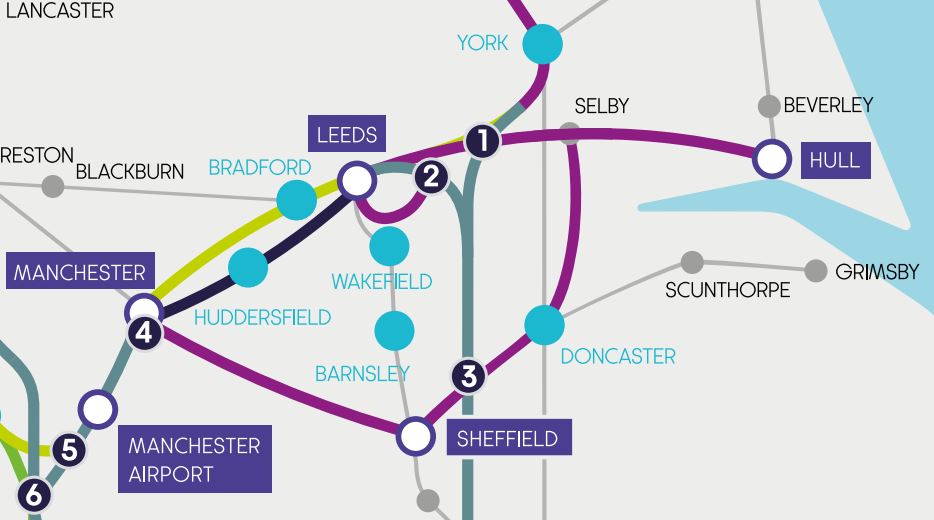
Hull is important for various reasons.
- It is large city.
- It is the Eastern terminus of an increasing number of routes.
- It is becoming a manufacturing centre for North Sea wind.
- The city will be the terminus of Northern Powerhouse Rail across the Pennines from Liverpool, Manchester and Leeds.
- Some reports have shown the city as a terminus of the Western leg of High Speed Two.
For these reasons, I will add Hull to the list.
I estimate that Hull and East Midlands Parkway will have a journey time of under an hour.
Lincoln
Looking forward to 2040, I wouldn’t bet against Lincoln being a very important city in the UK.
- It has history.
- It is becoming an important higher education centre.
- It has lots of space.
- Train operating companies like LNER and East Midlands Railway are improving services to the city.
But most importantly, as Aberdeen became Scotland’s centre for North Sea Oil and Gas, I believe that Lincoln could become England’s centre for North Sea renewable electricity and hydrogen.
I estimate that Lincoln and East Midlands Parkway will have a journey time of around an hour.
Milton Keynes
As I said for Cambridge, I believe that the East West Railway should be built to the same standard as the East Coast, Great Western, Midland and West Coast Main Lines.
This would enable classic-compatible services to be extended from Bedford to Milton Keynes.
As Bedford and East Midlands Parkway could be 60 minutes, timings depend on the times of the East West Railway, between Bedford and Milton Keynes.
Newcastle
As Newcastle already has a direct High Speed Two classic-compatible connection to and from East Midlands Hub station, this must be a possibility.
According to High Speed Two’s journey time calculator<, trains between Newcastle and East Midland Hub stations will take 96 minutes.
Northern Powerhouse Rail
The map I showed with Hull could indicate that a train could take High Speed Two to Leeds and then power its way across the Pennines calling at Leeds, Huddersfield, Manchester Piccadilly, Manchester Airport and Liverpool.
East Midlands Railway would have found a replacement for the Western part of their Liverpool and Norwich service, which is one of the worst railway services in the UK.
Oxford And Reading
As I said for Cambridge, I believe that the East West Railway should be built to the same standard as the East Coast, Great Western, Midland and West Coast Main Lines.
This would enable classic-compatible services to be extended from Bedford to Oxford and Reading.
As Bedford and East Midlands Parkway could be 60 minutes, timings depend on the times of the East West Railway, between Bedford and Oxford and Reading.
Peterborough
I think Peterborough could be an interesting possibility.
- It is the gateway to the East of England.
- It is a fully-electrified station.
- It has seven platforms with space for more.
- Most platforms could take a two hundred metre long train.
East Midlands Railway’s Liverpool and Norwich service, links Peterborough with Nottingham.
- That section of the route is 52 miles long.
- 29 miles of the route on the East Coast Main Line are electrified.
- The 100 mph Class 158 trains take 67 minutes and 30 minutes to travel between the two stops at Grantham and Peterborough.
- Some of LNER’s 125 mph electric Class 800 trains are timetabled to travel between the two stops at Grantham and Peterborough as fast as 18 minutes.
What time will be achievable on this short length of electrified track, when digital signalling is fully-deployed and 140 mph running is possible?
I can certainly see a bi-mode Class 801 train going between Peterborough and Nottingham in under an hour.
I also think that they could equal East Midlands Railway’s times to Nottingham going from Kings Cross via Grantham.
In Access To Toton – Scheme 6 – Trowell Curve, I advocated the following electrification, to allow battery-electric trains to work the Nottingham and Skegness service.
- The Allington Chord between Bottesford and Ancaster stations.
- The line linking the chord to Grantham station.
As Nottingham station will surely be electrified to allow classic-compatible High Speed Two trains to run between the station and Birmingham using High Speed Two, there will only be sixteen miles of double-track between Bottesford and Nottingham station without electrification.
I have just flown my helicopter along the route and there are one or two bridges and Netherfield station, that will need a rebuild, but it wouldn’t be the most challenging of electrifications.
Especially, as there is High Speed Two and the East Coast Main Line to provide power at both ends of the route.
But as it is only sixteen miles would they use battery-electric high-speed trains.
Surely, that is a crazy idea?
In Will High Speed Two’s Classic-Compatible Trains Have Battery Operation?, I explain why you would use such a concept to create an efficient train.
- The batteries drive the train and they are charged from the electrification and regenerative braking.
- Batteries would give a train recovery capability in case of overhead catenary failure.
- Batteries would be used for depot movements.
In Will The Trains On High Speed Two Have Batteries For Regenerative Braking?, I do a calculation for the battery size needed for a 250 mph Spanish high speed train and the batteries are surprisingly small, at 100 kWh per carriage.
I firmly believe, that the mathematics say it is possible for a high speed train to use on-board battery power to perhaps do thirty miles at say 90 mph on a line without electrification.
Sheffield
As Sheffield station will have a direct High Speed Two connection to and from East Midlands Hub station, this must be a possibility.
According to High Speed Two’s journey time calculator, trains between Sheffield and East Midland Hub stations will take 27 minutes.
Note.
- An article in the June 2020 Edition of Modern Railways shows that the Eastern leg of High Speed Two is planned to have nine tph, against a theoretical limit of 18 tph.
- The Leeds-Bedford and Nottingham-Birmingham Curzon Street will use another path.
- Not all services would need to be hourly.
- Could some CrossCountry services be replaced with classic-compatible services?
I feel there is plenty of scope to develop more classic-compatible services along the Eastern leg of High Speed Two.
Colne – Skipton Reopening Moves Closer
The title of this post, is the same as that of this article on the Railway Gazette.
This is the introductory paragraph.
Rail minister Chris Heaton-Harris has confirmed that investigations have been commissioned into the proposed reinstatement of the 19·3 km Colne – Skipton ‘missing link’ connecting east Lancashire and west Yorkshire.
Investigations will look into.
- Capital costs
- Passenger demand forecasts
- Service options.
- Gauge enhancement measures necessary to increase rail freight capacity on TransPennine routes including between Accrington and Todmorden stations.
- Proposals for a rail freight terminal on the site of the demolished Huncoat power station near Accrington.
This sounds more than a simple proposal to reopen the route between Skipton and Colne stations.
These are a few of my thoughts.
The Rail Route Between Preston And Skipton
The rail route between Preston on the West Coast Main Line and Skipton can be summarised as follows.
- Preston and Rose Grove via Huncoat – double-track – electrification at Preston
- Rose Grove and Colne – single-track
- Colne and Skipton – to be reinstated – electrification at Skipton
Colne and Skipton might not be the easiest route to reinstate, as a dual carriageway has been built across the route to the North of Colne station.
Could Colne And Skipton Be Double-Track All The Way?
Consider.
- The new section between Skipton and Colne could be built with single or double tracks.
- The section between Rose Grove and Colne stations was built as a double-track and singled in 1971. British Rail’s accountants strike again!
- The single-track section includes the Bank Top Viaduct, in the centre of Burnley.
- Trains currently take twenty-one minutes between Rose Grove and Colne stations.
This picture shows Bank Top Viaduct.
I think the viaduct could be key to whether the route is double-track all the way.
- If the redoubling can be performed at a reasonable cost, then that will be the way to go, as it might be possible to squeeze up to three trains per hour (tph) between Skipton and Rose Grove via Colne.
- If on the other hand, doubling is too difficult or expensive, I estimate that no more than two tph would be possible.
For both solutions, there will need to be double track or a long passing loop, between Skipton and Colne.
Could Colne And Skipton Be Electrified?
Consider.
- Preston is a fully-electrified station on the West Coast Main Line.
- Skipton is a fully-electrified station with electric trains to and from Leeds.
- Full electrification would create an electrified route between Leeds and Blackpool, Liverpool and Preston.
- It could be a useful diversion route for electric passenger trains across the Pennines, when their are engineering works on the Huddersfield Line or due to the building of Northern Powerhouse Rail.
- Electrification of the route, would allow electric haulage of freight trains to and from the proposed Huncoat Rail Freight Terminal.
- Electrification of the Calder Valley Line between Preston and Leeds is always being proposed.
- Electrication of Bank Top Viaduct could be tricky!
It should also be noted that this article on Rail Magazine was published on May 12th, 2020 and is entitled Electrification Key to Decarbonisation – Government. Views in Government about electrification have changed, so this might affect the decision to electrify the route.
The power is already there at both ends and electrification systems with low visual intrusion could be used.
On the other hand, some might consider electrification of the route inappropriate.
Could Colne And Skipton Be Partially Electrified?
Consider.
- I estimate that the distance between Preston and Skipton will be 41 miles.
- If Blackpool North station were the final destination, there would be 34 miles (2 x 17) to charge the batteries.
- If Liverpool Lime Street station were the final destination, there would be 70 miles (2 x 35) to charge the batteries.
- If Leeds station were the final destination, there would be 52 miles (2 x 26) to charge the batteries.
- Manufacturers’ estimates of distances, indicate that battery electric trains could cover up to 65 miles on battery power.
As both ends of the route are electrified and trains would run extra miles under the wires, it would seem likely that a battery electric train could run between Preston and Skipton, without needing a charge en route.
Drax Group And Colne And Skipton Reinstatement
Drax power station uses Flue Gas Desulphurisation. Wikipedia says this about the process at Drax.
All six units are served by an independent wet limestone-gypsum flue gas desulphurisation (FGD) plant, which was installed between 1988 and 1996. This diverts gases from the boilers and passes them through a limestone slurry, which removes at least 90% of the sulphur dioxide (SO2). This is equivalent to removing over 250,000 tonnes of SO2 each year. The process requires 10,000 tonnes of limestone a week, sourced from Tunstead Quarry in Derbyshire. A byproduct of the process is gypsum, with 15,000 tonnes produced each week. This goes to be used in the manufacture of plasterboard. The gypsum is sold exclusively to British Gypsum, and it is transported by rail to their plant at Kirkby Thore (on the Settle-Carlisle Line).
The gypsum trains go through Skipton to access the Settle-Carlisle Line.
Drax power station is part-fuelled with biomass, which comes from all over the place including the United States via the Port of Liverpool.
It is no surprise that Drax Group are in favour of the Colne and Skipton reinstatement, as it would give them a new route between Drax and the Port of Liverpool.
This press release from Drax Group gives more details including this paragraph.
It will have a direct impact on improving our supply chain at Drax, allowing freight trains to travel much more quickly to the power station in North Yorkshire – reducing journey times from the Port of Liverpool to less than three hours, a journey which can take up to nine hours at the moment.
Trains will avoid the busy Huddersfield Line and Manchester Victoria station.
Drax’s statement would appear to be a powerful reason to reinstate Colne and Skipton.
These smart new or refurbished wagons, used by Drax to move woodchip should be much faster than the typical 20-30 mph freight speed of TransPennine routes.
This page on the Drax web site, is entitled This train isn’t like any other in the UK, and it gives more details about the wagons.
- They were custom-designed and built in the last few years.
- The roofs open automatically for loading.
- A twenty-five wagon train can be loaded in 37 minutes.
- A full train can carry between 1,700 and 1,800 tonnes of biomass.
- Each train can unload in forty minutes.
- They are the largest wagons on UK railways by a margin of 30 %.
- Each wagon is nineteen metres long and can carry over seventy tonnes of biomass.
- Approximately 14 trains per day arrive at Drax, bringing 20,000 tonnes of biomass.
I suspect to minimise journey times, Drax would like to see a fully electrified route between Preston and Skipton and a new double-track route between Colne and Skipton.
The Huncoat Rail Freight Terminal
This Google Map shows the position of the former Huncoat power station.
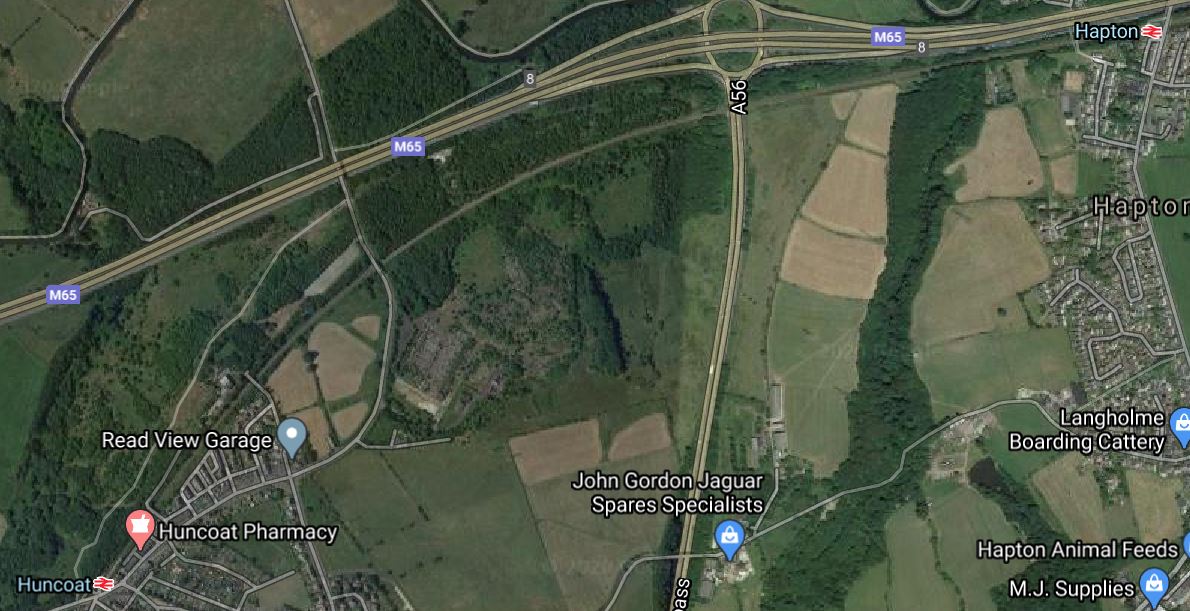
Note.
- Hapton station in the North-East corner of the map.
- Huncoat station in the South-West corner of the map.
- The East Lancashire Line running between the two stations.
- The M65 running across the top of the map.
- The A56 or Accrington bypass running North-South from the motorway junction at the top of the map.
Huncoat power station appears to have been in the South West corner of the rough-looking area, South of the M65 and the railway and West of the A56.
There is no Wikipedia entry for the demolished power station, but this page on The View From The North has some details and pictures.
It does appear to be a well connected site for a Rail Freight Terminal.
- There could be a direct connection to the motorway network.
- There is space for a connection with the East Lancashire Line, that would allow trains to access the interchange from both directions.
- Trains could go West to the Port of Liverpool and the West Coast Main Line via Preston.
- Trains could go East to Leeds and Yorkshire and on to the East Coast ports of Felixstowe, Hull, Immingham and Teesport.
- If the East Lancashire Line were to be electrified, electric haulage could be used.
The Rail Freight Terminal could be bigger than a hundred hectares.
Gauge Enhancement On TransPennine Routes Including Between Accrington And Todmorden
Consider
- Most freight trains passing through Hebden Bridge station use the route via Rochdale and Todmorden to get to and from Liverpool and the West.
- Few if any use the East Lancashire Line via Accrington.
- Some passenger trains do take the Accrington route.
- There are five tunnels between Accrington and the Todmorden Curve.
- The building of the Huncoat Rail Freight Terminal, must mean that trains between the Rail Freight Terminal and Leeds and the East would need to use the Calder Valley Line as far as the Todmorden Curve. or the East Lancashire Line to Colne for the new route.
As freight trains rarely seem to use the East Lancashire Line to the East of Accrington could it be that this section of track needs gauge enhancement?
But if this gauge enhancement were to be completed, that could give two routes between Huncoat Rail Freight Terminal and the East, for the largest freight trains.
Thoughts On The Project Management
It would appear that there are a series of sub-projects to be done.
- Perform gauge enhancement and route improvement on the East Lancashire Line between Rose Grove and Colne. This would include any doubling of the route, if that were to be done.
- Start building the link between Skipton and Colne.
- Start building the Huncoat Rail Freight Terminal.
- Finish building the link between Skipton and Colne.
- Start passenger and freight services between Skipton and Colne.
- Finish building the Huncoat Rail Freight Terminal.
- Perform gauge enhancement on the Calder Valley Line between Accrington and Todmorden.
My objectives would be.
- Open the Skipton and Colne route as a TransPennine diversion, as early as possible.
- Upgrade the East Lancashire Line between Rose Grove and Colne with minimum disruption.
- Open the Huncoat Rail Freight Terminal as early as possible.
- Create multiple freight routes to and from Huncoat Rail Freight Terminal.
Electrification would be a future aspiration.
Whither Drax?
Drax Gtroup and their flagship power station have a major environmental problem in that the power station is a large emitter of carbon dioxide.
They also run a lot of diesel locomotive hauled trains carrying biomass, fly ash, gypsum, limestone and other materials to and from Drax power station, which is on the Drax branch of the Pontefract Line.
- The Pontefract Line was built to serve the coalfields in the area.
- It runs between Leeds and Hull via Pontefract and Goole.
- It is not electrified, but it connects to the electrification at Leeds.
- In the East is has good connections to Cleethorpes, Goole, Grimsby, Hull and Immingham.
- The Port of Immingham is a major port, that is used by Drax to import biomass, which is hauled to the power station by diesel locomotives.
- The route between Drax and Immingham has been improved recently, by the addition of the North Doncaster chord.
- High Speed Two will run alongside the Pontefract Line on its approach to Leeds.
- Freight trains between Drax and Skipton use an electrified diversion South of Leeds via Armley, that avoids the need for freight trains to pass through Leeds station.
I can see that in a more favourable climate for electrification, that electrification of the Pontefract Line would be recommended.
Given, the environmental record of Drax, which is both good and bad, I would suspect they would like to see electrification of the Pontefract Line, as it would create a lower carbon route for biomass trains between Immingham and the power station.
A New Electrified TransPennine Route For Passengers And Freight
I sense that a grander plan might exist behind all my thoughts.
If the following routes were to be electrified.
- Preston and Skipton
- The Pontefract Line between Leeds and Hull.
- Knottingley and Immingham via Thorne
Hull and Liverpool would be connected for passenger electric trains and Liverpool and Immingham would be connected for freight.
Drax could also be on an electrified branch and they could say, they were hauling all their trains using renewable electricity. Marketing and environment are always important
Manchester Piccadilly, Liverpool Lime Street And Some Other Stations Compared
I am doing this exercise to get a handle on the scale of the problem at Platforms 13 and 14 at Manchester Piccadilly station.
In 2018/19, these were some passenger statistics for the two stations and some others.
- Birmingham New Street station handled 47.928 million passengers on its thirteen platforms or 3.62 million per platform per year.
- Brighton station handled 17.385 million passengers on its eight platforms or 2.17 million per platform per year.
- Bristol Temple Meads station handled 11.368 million passengers on its thirteen platforms or 0.87 million per platform per year.
- Cardiff station handled 14.205 million passengers on its eight platforms or 1.78 million per platform per year.
- Chelmsford station handled 8.927 million passengers on two platforms of 4.46 million per platform per year.
- Crewe station handled 3.318 million passengers on its twelve platforms or 0.28 million per platform per year.
- Deansgate station handled 0.458 million passengers on its two platforms or 0.23 million per platform per year.
- Doncaster station handled 3,918 million passengers on its nine platforms or 0.44 million per platform per year.
- East Croydon station handled 24.770 million passengers on its six platforms or 4.12 million per platform per year.
- Exeter St. Davids station handled 2.620 million passengers on its six platforms or 0.44 million per platform per year.
- Gatwick Airport station handled 21.225 million passengers on its seven platforms or 3.03 million per platform per year.
- Leeds station handled 30.839 million passengers on its seventeen train platforms or 1.81 million per platform per year.
- Leicester station handled 5.582 million passengers on its four platforms or 1.40 million per platform per year.
- Liverpool Lime Street station handled 14.221 million passengers on its eleven platforms or 1.29 million per platform per year.
- London Bridge station handled 61.308 million passengers on its fifteen platforms or 4.08 million per platform per year.
- London Fenchurch Street station handled 18.508 million passengers on its four platforms or 4.63 million per platform per year.
- London Paddington station handled 38.18 million passengers on its thirteen platforms or 2,94 million per platform per year.
- Manchester Oxford Road station handled 9.338 million passengers on its five platforms or 1.87 million per platform per year.
- Manchester Piccadilly station handled 30.252 million passengers on its fourteen platforms and two tram platforms or 1.89 million per platform per year.
- Manchester Victoria station handled 8.950 million passengers on its eight platforms or 1.12 million per platform per year.
- Newcastle station handled 8,914 million passengers on its twelve platforms or 0.74 million per platform per year.
- Nottingham station handled 8.005 million passengers on its nine platforms or 0.89 million per platform per year.
- Peterborough station handled 5.060 million passengers on its seven platforms or 0.72 million per platform per year.
- Preston station handled 4.646 million passengers on its nine platforms or 0.52 million per platform per year.
- Reading station handled 17.081 million passengers on its fifteen platforms or 1.14 million per platform per year.
- York station handled 9.991 million passengers on its eleven platforms or 0.90 million per platform per year.
These figures have given rise to a few thoughts.
Brighton
Brighton station is an eight platform terminal station, that handles a lot of passengers, considering that the City doesn’t have any mass transit system and passengers rely on walking, bicycles, buses and private cars for onward travel.
- There are upwards of eight trains per hour (tph) at the station to and from London, all of which can be up to twelve cars.
- The West Coastway and East Coastway Lines have at least six tph in the Off Peak.
- Arriving passengers can walk straight through the wide gate line and out to walking routes and the buses, with leaving passengers walking the other way.
I wouldn’t be surprised to hear that Brighton station is at capacity.
Chelmsford
It is truly remarkable that Chelmsford station is the second busiest station in terms of passengers per platform per year on my list.
- The station has two separate platforms on either side of the tracks.
- Access is via wide stairs and lifts.
- The station appears to handle five tph in both directions in the Off Peak, with up to twice that number in the Peak.
- Most trains calling at the station are between eight and twelve cars.
- Chelmsford station could get even busier in terms of passengers when the new longer Class 720 trains and Class 745 trains are brought into service in the next twelve months, as these trains have higher capacities, than the current trains.
- It is aimed, that the new trains though will have level access between train and platform, at some point in the future.
I very much feel, that Chelmsford shows what can be done at an ordinary two platform station with the application of good simple design.
London Fenchurch Street
London Fenchurch Street is the busiest station on my list.
- The limited number of platforms will increase the number of passengers per platform per year.
- The station has two entrances to each platform.
- Arriving passengers can walk straight through the wide gate line at the main entrance and down escalators to walking routes at street level, with leaving passengers walking the other way.
- Many trains in the Peak are twelve cars.
- Adding extra platforms would be difficult.
It does appear, that work has been done to maximise the station’s capacity.
Crewe, Doncaster, Exeter St. Davids, Newcastle, Peterborough, Preston and York
All these stations are interchange stations on the main lines, that may have been improved, but have not been substantially rebuilt.
They all manage to handle between 0.5 million and 1 million passengers per platform per year.
Leeds
Leeds station has been improved over the last few years.
- There are six through platforms and eleven where trains can terminate.
- After passing through the gate line, passengers are in a concourse from where long distance services to London and the North and local services to Bradford, Harrogate, Ilkley and Skipton can be boarded.
- A new wide bridge with escalators, a lift and steps leads from this concourse across the through lines and platforms to the other side of the station.
- There are lifts and escalators from the bridge to some of the through platforms and the terminating platforms beyond them.
- At the far side of the bridge, a new Southern entrance has been added.
<The bridge works well and shows how a wide bridge over or a wide concourse under the tracks, can improve circulation in a station.
If you compare the bridge at Leeds, with the bridge at Reading, which was designed at around the same time, the Reading one is better in that it is wider and has more escalators, with one up and one down escalator to each pair of platforms.
Was a certain amount of design at Leeds station performed by accountants?
London Bridge
London Bridge station shows what can be done by applying good design in a new or rebuilt station.
- There are nine through and six terminal platforms.
- All platforms can take full-length twelve-car trains.
- There is a massive concourse underneath all fifteen platforms.
- There are lots of escalators and lifts between the concourse and the platforms.
- Steps provide additional and reserve capacity.
- Passengers changing between routes can take an escalator or lift to the concourse and another one to their new route.
- Arriving passengers can walk straight through the wide gate lines and out to walking routes, the Underground and the buses, with leaving passengers walking the other way.
- London Bridge station was designed by Grimshaw Architects
It is a design with a wow factor that works very well.
Reading
Reading station is another good design applied to a rebuilt station.
- There are nine through platforms, three East-facing bay platforms and three West-facing bay platforms.
- All through platforms can take full-length trains.
- All bay platforms are a level walk from the Southernmost through platform and the main entrance gate line to the station.
- There is a massive bridge over all nine through platforms.
- There are lots of escalators and lifts between the bridge and the through platforms.
- Steps provide additional and reserve capacity.
- Passengers changing between routes can take an escalator or lift to the bridge and another one to their new route.
- Arriving passengers can walk straight through the wide gate lines and out to walking routes, the car-parks and the buses, with leaving passengers walking the other way.
- Reading station was designed by Grimshaw architects.
It is a design with a wow factor that works very well.
Redesigning Manchester Piccadilly
Could some of the principles of these stations be applied to rebuilding Manchester Piccadilly station?
There are currently twelve terminal platforms numbered 1-12 in the main part of the station.
- Platforms 1 to 4 are used for services to Marple, New Mills, Rose Hill and Sheffield via the Hope Valley Line, and services on the Glossop Line.
- Platforms 5 to 9 are the longest and used by Avanti West Coast and CrossCountry services.
- Platforms 10 to 12 are shorter than the others and are usually used to accommodate local trains to Crewe and Manchester Airport, plus Mid-Cheshire line, Buxton Line and South Wales services.
The two through platforms 13 and 14 are on the Southern side of the station.
These ideas might be possible.
A Wide Bridge Or Concourse Connecting The Platforms At The London End
Currently, there is a bridge over the platforms 1 to 12 at the London end, but compared to the bridges at Leeds or Reading stations, it is a rather feeble affair.
- It is narrow.
- It doesn’t have any kiosks or shops.
- It is only connected to the platforms by steps.
Could this be replaced by a wide bridge, like say the one at Reading?
It would certainly give advantages if it could!
- Passengers arriving in Manchester Piccadilly needing to change to another service, might find it more convenient to use the bridge, rather than exit on to the main concourse.
- The bridge could be designed as a waiting area, with kiosks, shops, cafes and other facilities.
- The bridge would be connected to all platforms by escalators and lifts.
- Steps would provide additional and reserve capacity.
Note that if you buy a ticket to Manchester stations, that allows you to go to either Manchester Piccadilly, Manchester Oxford Road, Deansgate or Manchester Victoria stations, So a quick route up and down an escalator at the London end of Piccadilly station to Platform 14 would be very convenient.
Access To Platforms 13 And 14
Compared to the wide island platforms at Leeds and Reading, platform 13 and 14 are a bit narrow, but I’m fairly sure, that a good layout for escalators and lifts could be designed, so that access to these two platforms can be improved.
Trains Through Platforms 13 and 14
These must be arranged, so that they are all similar with wide double doors and step-free access between platform and train.
Improvement Along The Castlefield Corridor
Various improvements need to be done on the Castlefield Corridor.
- Deansgate can be improved to provide better access to the Metrolink at Castlefield.
- Manchester Oxford Road station needs a complete rebuilt and a better track layout.
- The Liverpool Lime Street and Manchester Airport service via Warrington and Manchester Oxford Road needs a strong rethink.
It appears that it has already been decided to reduce the number of trains, as I wrote about in Castlefield Corridor Trade-Off Plan For Fewer Trains.
Wide Gate Lines
Passengers arriving at Manchester Piccadilly station in the main part of the station should be able to walk forward to a gate line stretching right across all the platforms.
- The present gate line isn’t continuous.
- There is still a lot of manual checking of tickets.
The current layout can certainly be improved.
Access To Metrolink
I also wonder if better access to the Metrolink could be provided, so that passengers access the Metrolink station from inside the gate line. Now that the Metrolink allows contactless ticketing, this might be easier.
Conclusion
I believe there’s a solution in there somewhere!

