Could Electric Trains Run Between St. Pancras International and Sheffield Stations With No More Electrification?
A reader suggested, that I look at this, so here goes!
- A couple of weeks ago, I took a Class 222 diesel train back from Sheffield to St. Pancras International and it seemed a few minutes quicker.
- Looking at the timetable today, at least one service on the route is now just under two hours and some others are just over.
So the new Class 810 trains may not be fully in service yet, but the trains have already had an effect on the timetable.
How Far North Is The Midland Main Line Being Electrified?
I asked Google AI this question and received this answer.
As of early 2026, the Midland Main Line (MML) is electrified as far north as Wigston, just south of Leicester.
- Northern Limit: The section from Kettering up to Wigston South Junction was energised in July 2024, representing the current northern limit of 25kV overhead line equipment (OLE).
- Pause in Further Electrification: Following a UK government spending review, the further, planned northward extension of electrification to Leicester, Derby, Nottingham, and Sheffield was indefinitely paused in July 2025.
- Current Operations: While electrification has stopped at Wigston, the line is served by new bi-mode (electro-diesel) trains, allowing for electric running from London St Pancras to Wigston before switching to diesel power.
- Previous Work: The line is also fully electrified from London St Pancras to Bedford, including the route to Corby.
Note.
- South Wigston Junction and Sheffield are 69.4 miles apart.
- The Hitachi trains can raise and lower pantographs on the move.
Distances without wires from London St. Pancras International to various destinations are as follows.
- Sheffield – 69.4 miles
- Leicester – 3.7 miles
- Derby – 36.4 miles
- Nottingham – 31.1 miles
As trains will have to go out and back to these destinations distances travelled will be doubled.
- Sheffield – 138.8 miles
- Leicester – 7.4 miles
- Derby – 72.8 miles
- Nottingham – 62.2 miles
It looks to me, that if the new Class 810 trains, can travel 138.8 miles on batteries and diesel engines as a tri-mode train, then the Midland Main Line is electrified.
Could The Sheffield Services Turn Round At Doncaster And Charge Their Batteries There?
Note.
- South Wigston Junction and Doncaster are 79.5 miles apart.
- Doncaster is a fully-electrified station.
- Sheffield and Doncaster would get two extra connecting trains per hour.
- The two services could also call at Meadowhall and/or Rotherham Central.
The Class 810 trains could charge their batteries, whilst passengers to and from Doncaster left and entered the trains.
Could A Simple Cross-Platform Change Be Arranged Between East Coast And Midland Main Line Services?
Doncaster station has two long island platforms, one of which is generally used for Northbound services and one for Southbound services.
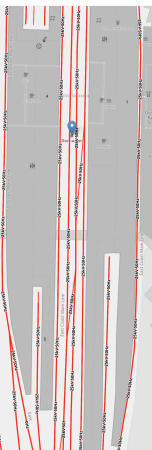
Note.
- All electrified tracks are shown in red.
- The two wide island platforms, with Northbound on the West side and Southbound on the East side.
- Each island platform has an electrified platform face on both sides.
- The four platforms faces on the island platforms can hold pairs of five-car Hitachi trains.
- There are two through tracks or avoiding lines between the two island platforms for trains that aren’t stopping.
- There are bay platforms at the ends of the station for local trains.
- The station is fully step-free with a wide pedestrian underpass.
I know the station well and it looks to me, that East Midland Railway’s five-car services for St. Pancras could charge up in the Southern ends of the four faces of the island platforms and the two South-facing bay platforms.
I also believe that a pair of five-car Class 810 trains could be handled and charged, should it become necessary.
It looks to me, that the engineers updating the East Coast Main Line, know that they were caught out badly by High Speed Two, so the redesign for the next fifty or a hundred years will be completely future-proofed.
Doncaster and London could almost be considered to be twin main lines, with two pairs of high speed lines taking different routes, that serve different towns and cities.
How Many Travellers Go Between East Scotland And The North-East of England And The English Midlands?
It must be quite a few, as in the new East Coast Main Line timetable, more Scottish services stop at places like Doncaster and Newark.
But surely, if you could go between say Perth or Aberdeen and Derby or Nottingham in two battery-electric trains, with a relaxed change at Doncaster, you’d take it?
I certainly would!
East Coast And Midland Main Lines Compared
These are times between London and Doncaster.
- Current times between Doncaster and London are typically between 1 hour and 31-40 minutes going via the East Coast Main Line.
- I estimate times between Doncaster and London will be typically 2 hours and 22-27 minutes going via the Midland Main Line.
Note.
- Doncaster and London King’s Cross is 156 miles
- Doncaster and London St. Pancras International is 183.3 miles
- So the Midland Main Line route would appear to to be about 45 minutes slower.
- I suspect, that for passengers between between London and North of York, it will always be quicker to use an East Coast Main Line service.
These are times between London and Sheffield.
- Current times between Sheffield and London are typically between 2 hours and 4-9 minutes going via the Midland Main Line.
- I estimate times between Sheffield and London will be typically between 2 hours and 2 minutes going via the East Coast Main Line.
Note.
- Sheffield and London King’s Cross is via Retford.
- Sheffield and London King’s Cross is 162.1 miles
- Sheffield and London St. Pancras International is 183.3 miles
- Sheffield and Retford is 23.5 miles
- So the Midland Main Line route would appear to to be a few minutes slower.
I would feel that there is scope that under Great British Railways to optimise services between London and Doncaster and Sheffield.
The Master Cutler
The Master Cutler is a named train, that is described in this Wikipedia entry, that was introduced in 1947.
- Over its life it has run into both King’s Cross and St. Pancras.
- I can remember the train in the 1950s, running into King’s Cross.
- It has also been run to and from Leeds.
- It has been run as a Pullman service.
- There are reports of overcrowding in recent years.
It strikes me that the Master Cutler could do with a revamp.
- As St. Pancras can accept pairs of five-car Class 810 trains, ten-car trains could be run into King’s Cross or St. Pancras.
- An alternative would be to use a nine-car Hitachi Class 800/801 train.
- All trains would be battery electric.
- All trains would use the East Coast Main Line for a faster service.
- Services could terminate in the North at Leeds.
- The service could be run as a Pullman service.
- This article on Ian Visits, writes about East Coast Main Line trains using St. Pancras.
I would create a train service, that would attract passengers from all over the world.
Who knows?
If it was conceived in the right way, it might warrant a second service or similar service on other lines like these possibilities.
London and Blackpool via Crewe, Wigan and Preston.
- London and Aberystwyth via Birmingham and Shrewsbury.
- London and Bristol via Bath
- London and Fishguard via Cardiff and Swansea
- London and Holyhead via Birmingham and Chester
- London and Liverpool
- London and Manchester
- London and Newcastle via York and Durham
- London and Norwich via Colchester and Ipswich
- London and Plymouth via Exeter
Note.
- All routes could be run using electric or battery-electric trains.
- The Fishguard and Holyhead services would be zero-carbon routes to Ireland, connecting to appropriate zero-carbon ferries.
- Could services be arranged so that all parts of the country have at least one service in both directions every day?
- In the days of British Rail, London and Norwich had a very high-class service, that could serve a full English breakfast between Colchester and London, which certainly wasn’t like the regular joke.
Get the offering right and it could level-up the UK.
Coventry To Leicester In A Flash? New Rail Plans Promise Faster, Greener Travel!
The title of this post, is the same as this article on Rail Technology Magazine.
This is the sub-heading.
Passengers travelling between Coventry, Leicester and Nottingham have outlined their support for proposed upgrades to reconnect the cities by direct rail for the first time in over two decades.
These first two paragraphs add some detail.
Despite being located just 23 miles apart, travelling between the cities requires passengers to change trains in Nuneaton, with wait times for the connection often exceeding 30 minutes. As a result, just 3% of trips between Coventry and Leicester are made by train; compared to 30% of journeys made between Coventry and Birmingham.
Midlands Connect recently visited Nuneaton railway station to speak with passengers travelling between the cities, waiting for their onward connection, about the proposed upgrades and how they would be impacted.
This OpenRailwayMap shows the route between Coventry and Leicester.
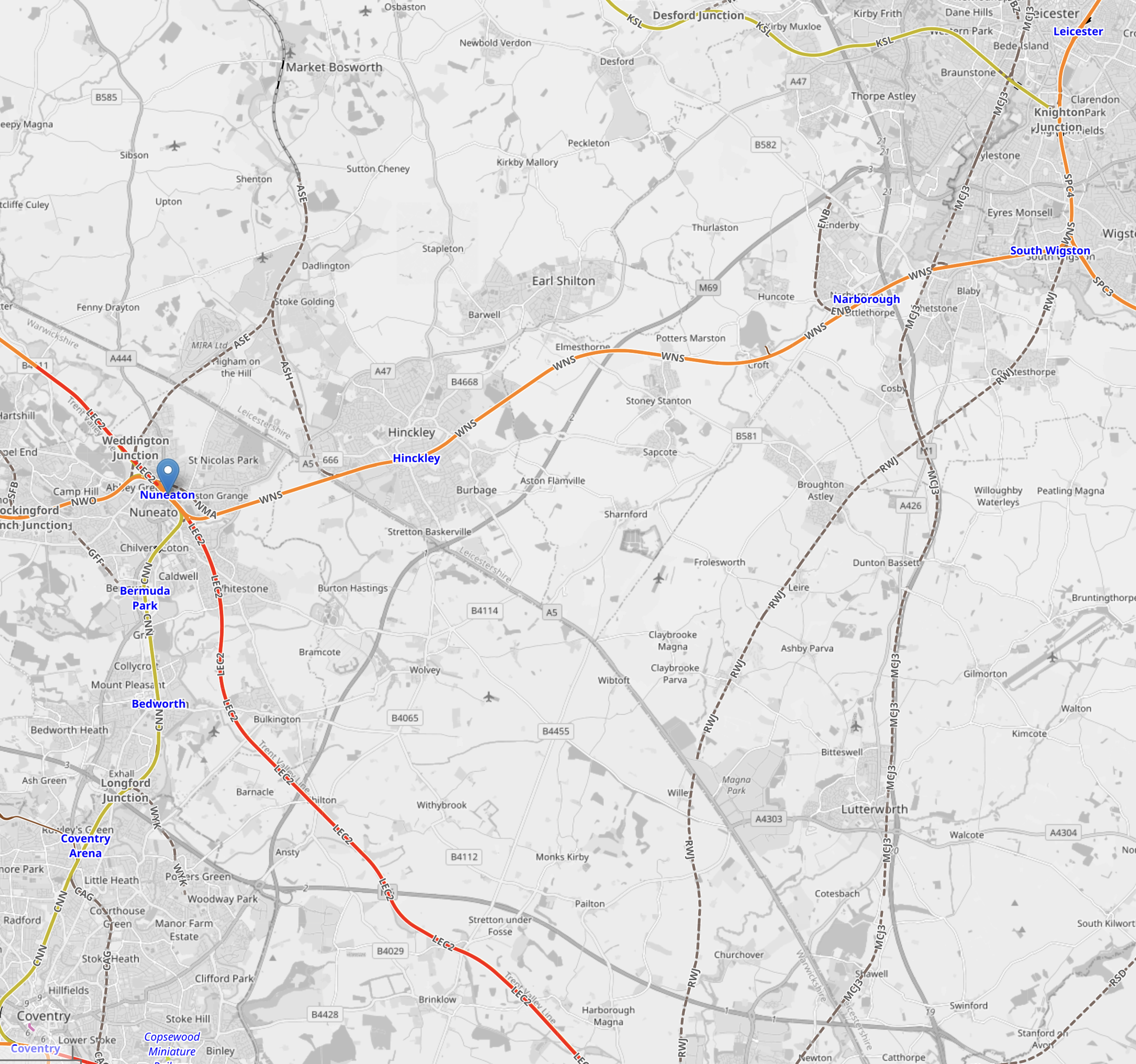
Note.
- Coventry is in the South-West corner of the map.
- Leicester is in the North-East corner of the map.
- Nuneaton, where you currently have to change trains,is marked by a blue arrow.
- The red track passing through Nuneaton station, is the Trent Valley Line.
Services between Coventry, Leicester and Nuneaton are run by two companies.
- CrossCountry run a half-hourly service between between Birmingham New Street and Leicester via Nuneaton.
- West Midlands Trains run an hourly service between Leamington Spa and Nuneaton via Coventry.
I feel ideally, that Leicester and Coventry need a half-hourly service, but an hourly service would be easy and a half-hourly service would mean a four-trains per hour (tph) service between Leicester and Nuneaton.
Probably, the easiest service would be to extend the hourly Leamington Spa and Nuneaton to Leicester, with a reverse at Nuneaton.
What Does The Article Mean By Greener Trains?
I would expect the article means battery-electric trains, but the only mention is in the title.
Could Leicester And Coventry Be Served By Battery-Electric Trains?
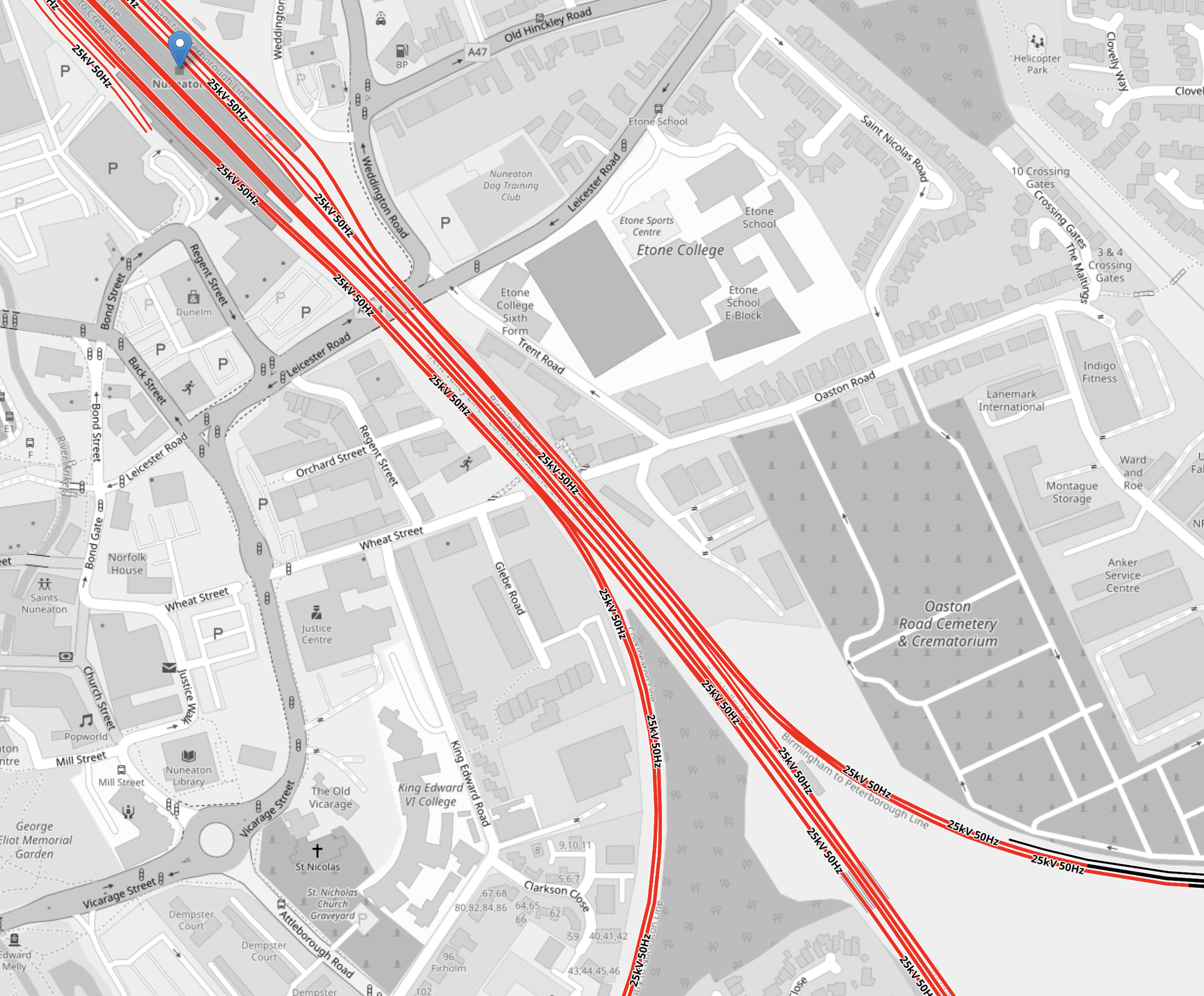
This OpenRailwayMap shows the track layout at Nuneaton station.
And this OpenRailwayMap shows the track layout at Coventry station.
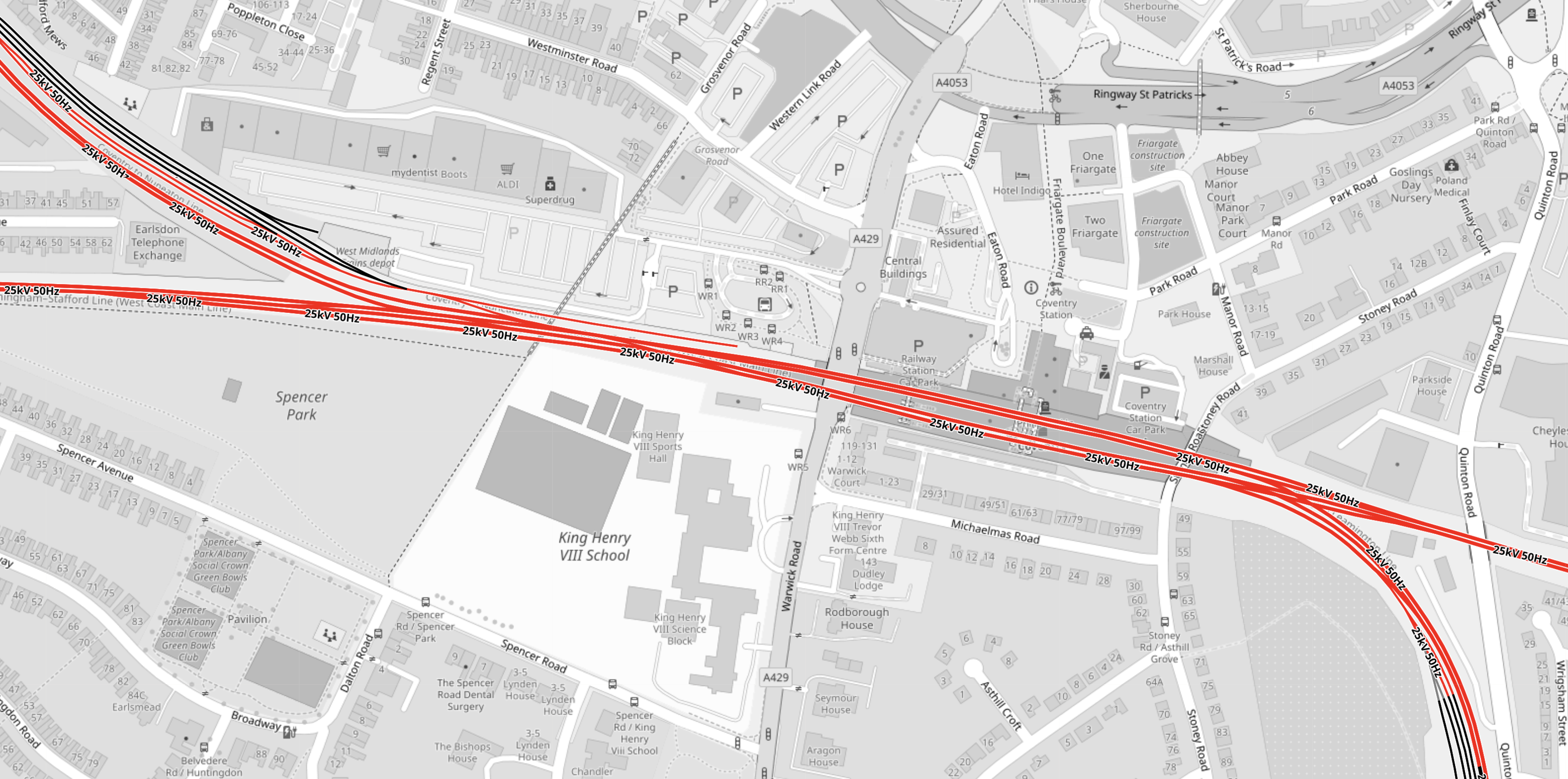
As electrified tracks are shown in red, it would appear that all tracks at both stations are electrified.
The platforms at Coventry and Nuneaton, may be good enough for a quick Splash and Dash, but trains don’t spend long enough in the stations for a full charge.
- Perhaps the solution is to install one of Siemens’s Rail Charging Converters in Leamington Spa and Leicester stations.
- The distance between Leamington Spa and Leicester stations is 48.3 miles, which is well within the range of a battery-electric train.
- Leamington Spa and Nuneaton takes 38 minutes.
- Leicester and Nuneaton takes 27 minutes.
I feel an efficient hourly service could be created between Leicester and Leamington Spa using battery-electric trains.
Onward To Nottingham
Nottingham is another 27.5 miles from Leicester and currently takes 48 minutes in a Class 170 train.
Connections To The North-West And Scotland At Coventry And Nuneaton
They are good and could be more numerous and better.
Could Hydrogen-Powered Trains Be Used?
Yes! If a UK hydrogen-powered train existed!
Cost Of The Project
As reasonably modern trains happily use the route between Leamington Spa and Leicester every day, I suspect that little needs to be done on the full route to create a new service.
So the cost of the project would be sufficient new battery-electric trains and the ability to charge them at Leamington Spa and Leicester.
Conclusion
I believe that Coventry and Leicester would be an easy route to run using an hourly battery-electric train.
It could be extended to Leamington Spa at one end and Nottingham at the other.
The Problem Of Electrifying Leicester Station
This post is my attempt to try and explain the problem of electrifying the Midland Main Line through Leicester station.
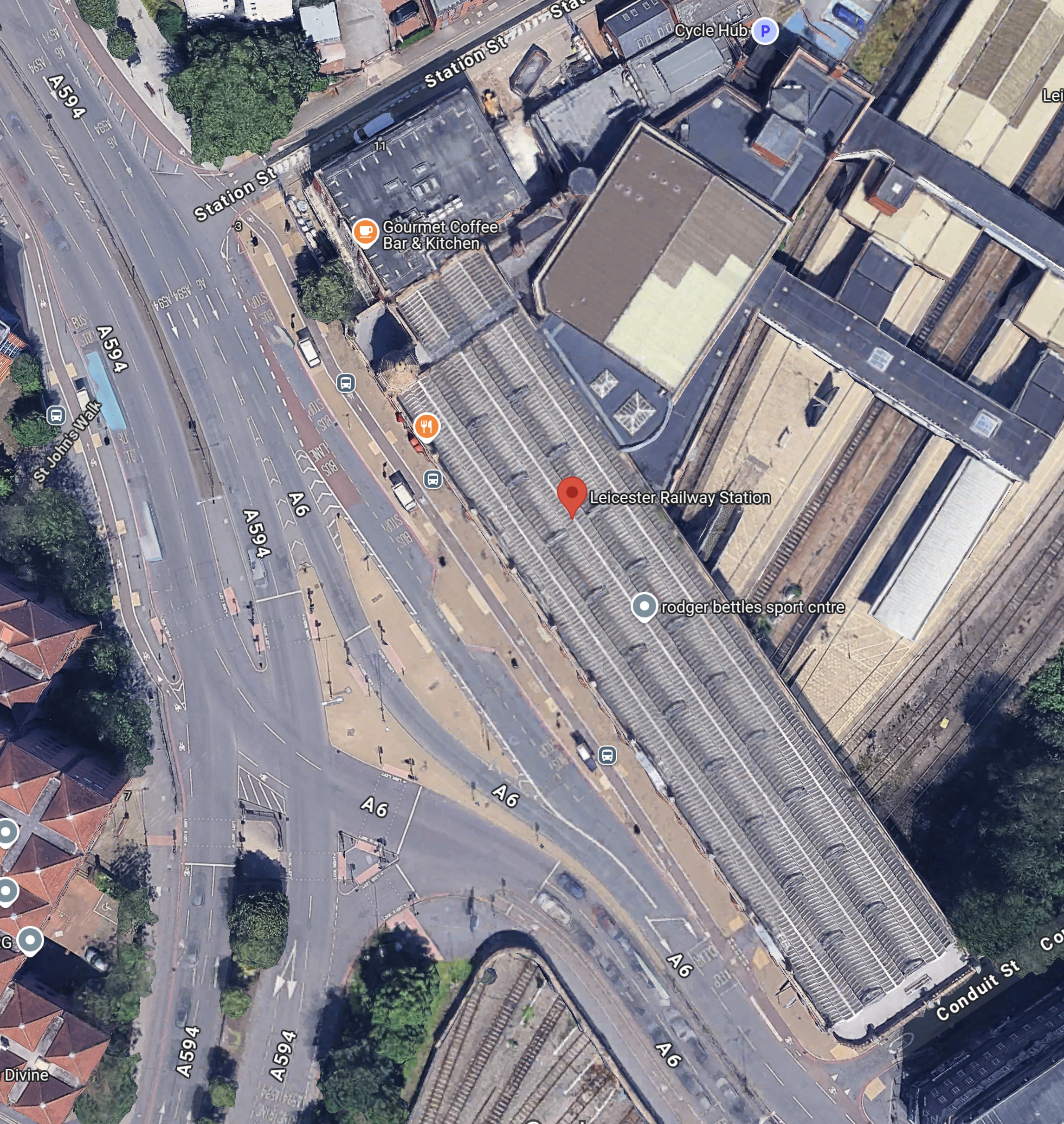
This Google map shows the Southern end of the station.
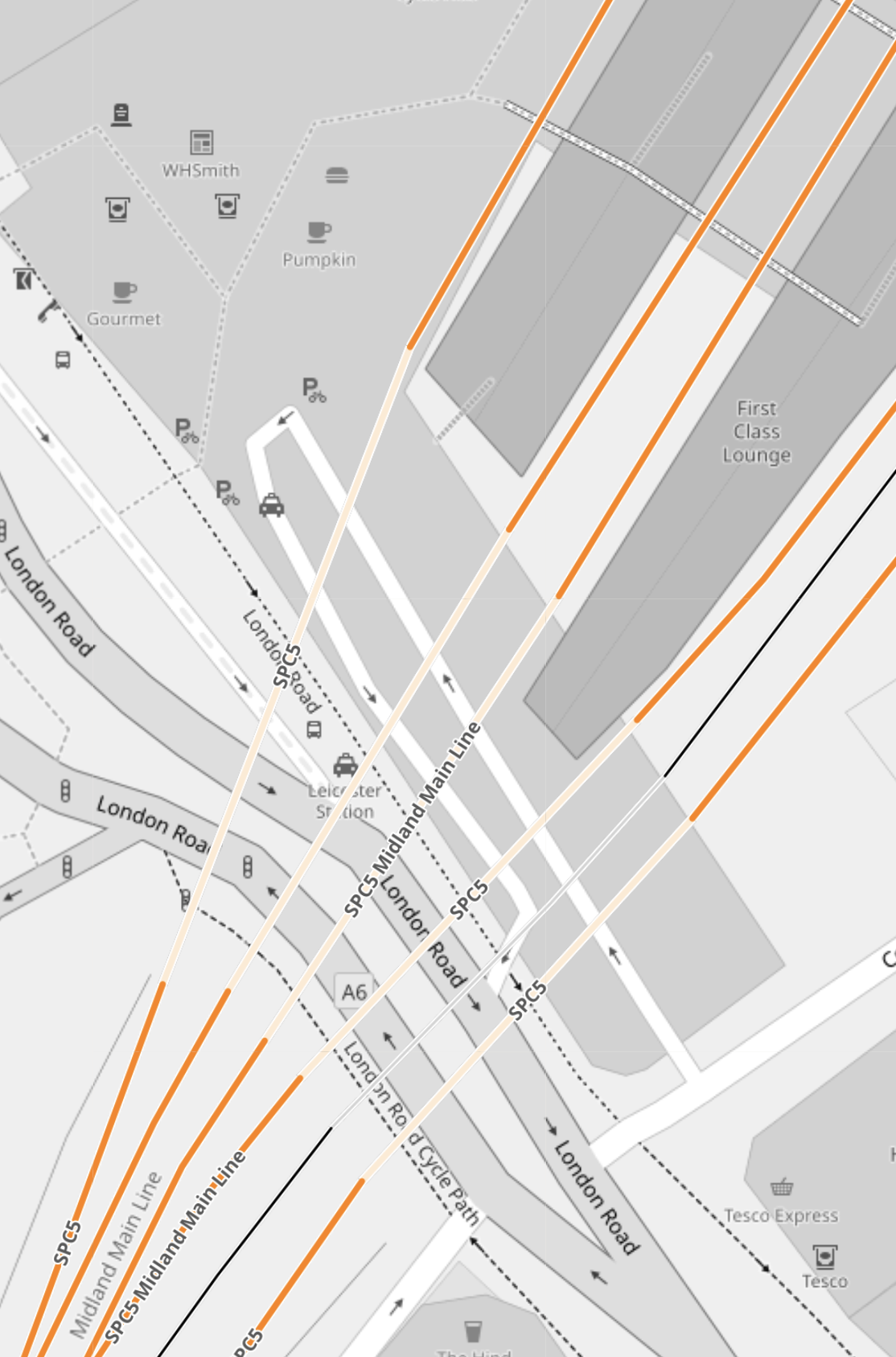
This OpenRailwayMap shows the station.
Note.
- There appear to be five tunnels under the station buildings and London Road.
- What is the tunnel going underneath the tracks used for?
Leicester station has a Grade II Listed frontage.








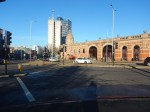
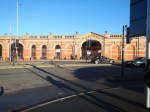
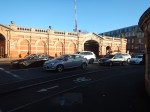

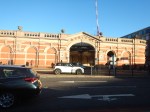

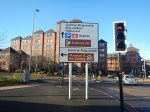



Note.
- It is an impressive Victorian station.
- The station building is on a bridge over the tracks.
- The station is also on one of the main roads through Leicester.
- The road layout is very complicated.
This 3D Google Map, shows an aerial view of the station.
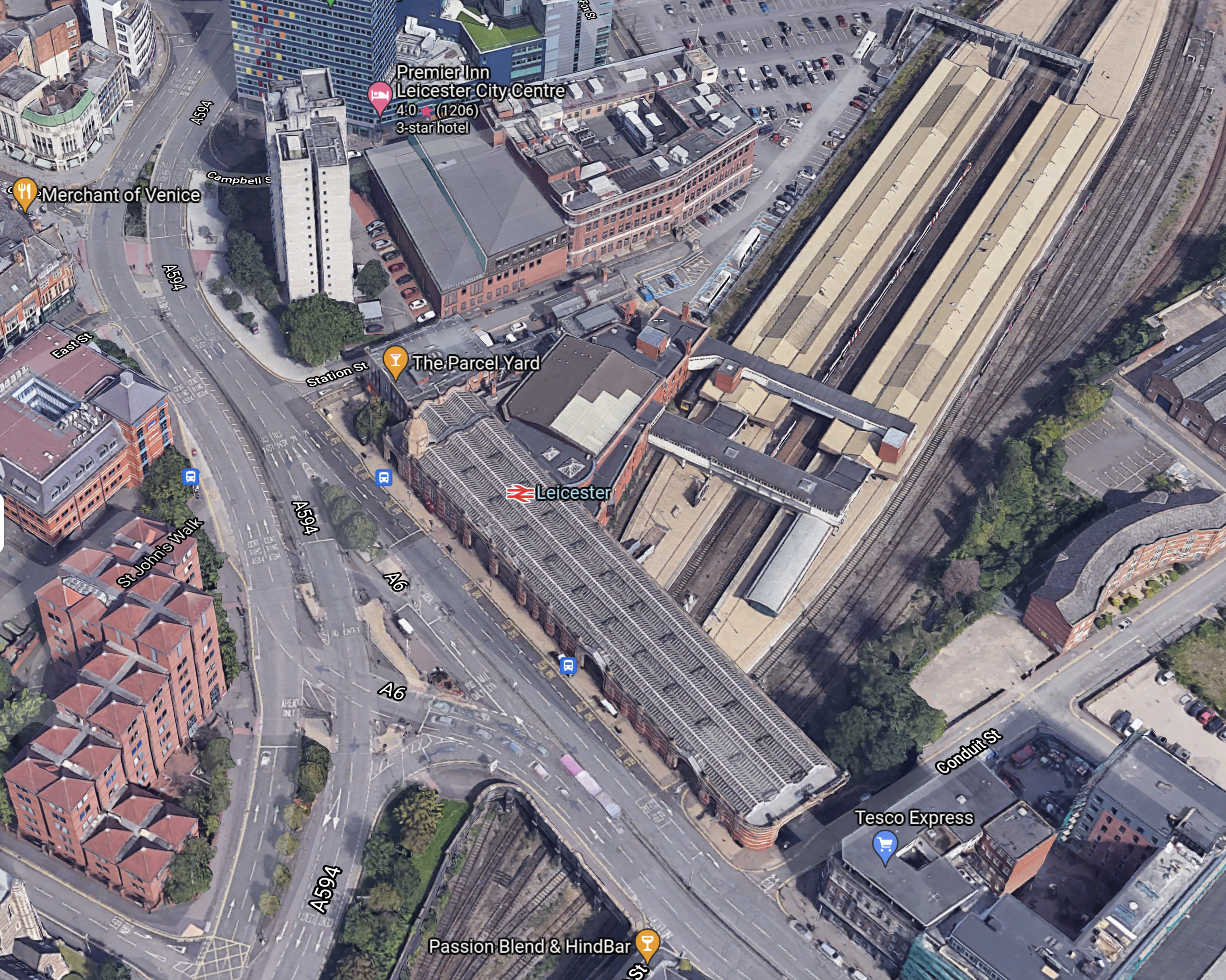
Note.
- There four platforms, which are numbered 1-4 from the left.
- The expresses between London and Derby, Nottingham and Sheffield use the two middle tracks.
- Other main line and East-West services use the outside platforms.
- There is an avoiding line for freight services.
- 5. The step-free footbridge is clearly visible.
This second 3D Google Map, shows an enlargement of the frontage of the station.
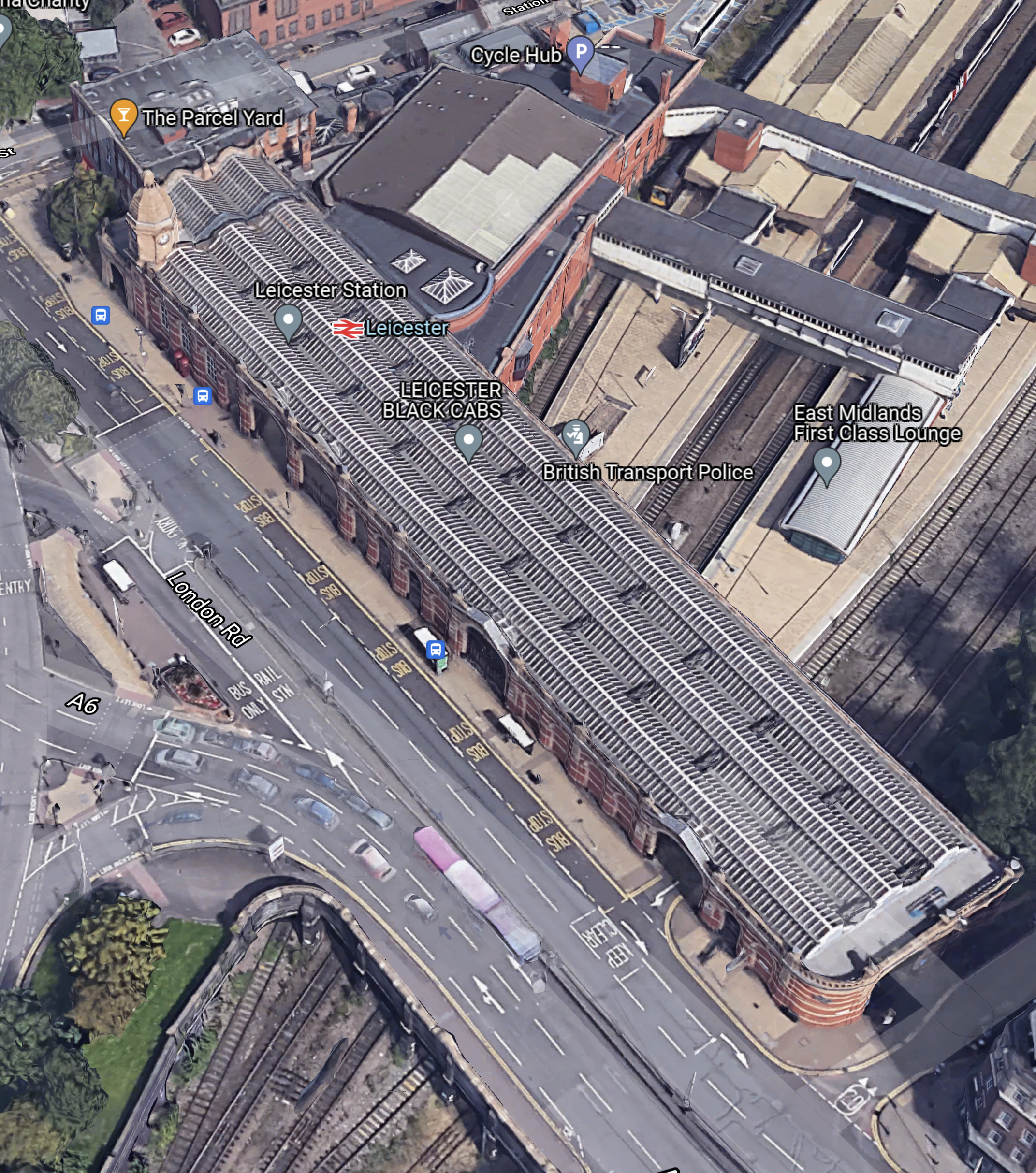
These pictures show what is inside the building at the front of the station.


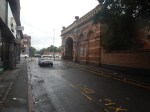


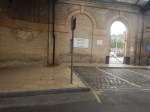
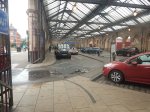

The building would appear to be a Grade II Listed taxi rank and free twenty-minute car park.
There are plans to increase the capacity of the station.
- A fifth platform will be added.
- Three miles of quadruple track will be be built South of the station.
- The Midland Main Line was also to be electrified.
Real Time Trains indicates that the distance between Leicester and Wigston North junction is 3.1 miles.
This OpenRailMap shows that section of track.
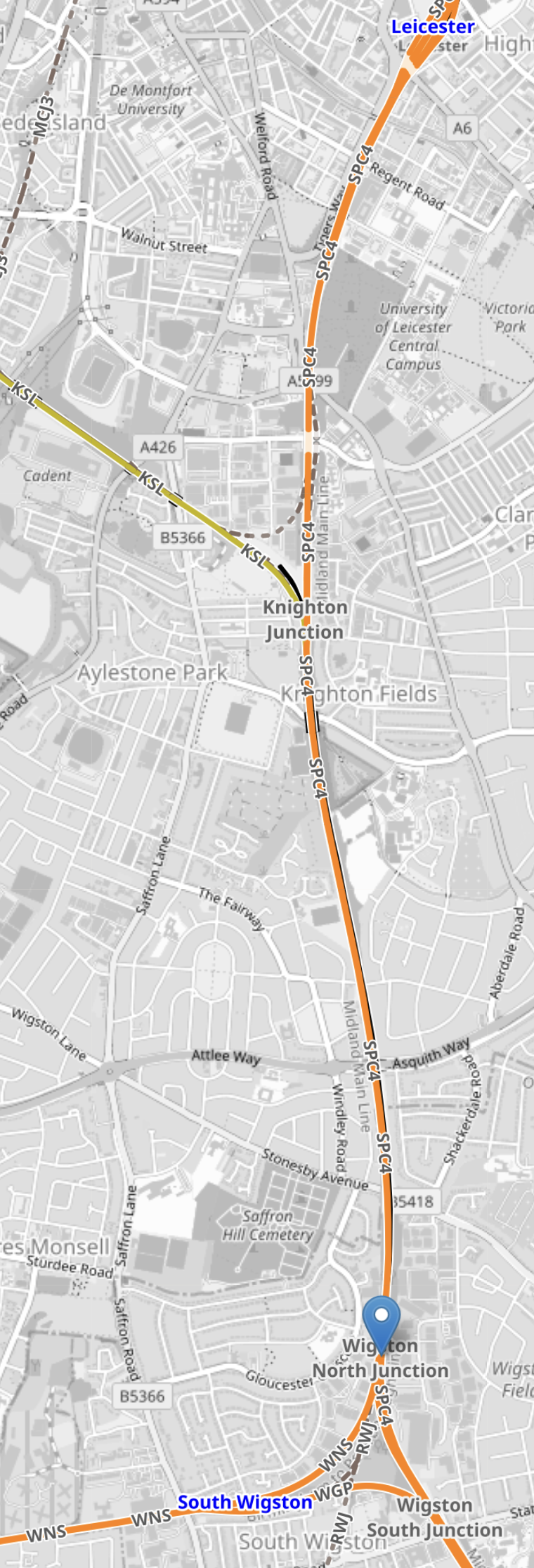
Note.
- Leiester station is at the top of the map.
- Wigston junction is the triangular junction at the bottom of the map.
- Wigston North Junction is indicated by the blue arrow.
- OpenRailwayMap only shows a 100 mph Northbound track and a 90 mph Southbound track on the route.
It looks to me, that four tracks between Leicester and Wigston North junction would mean that trains could expedite arrivals to and departures from Leicester to and from the South.
South From Wigston Junction
Consider.
- London St. Pancras and Kettering is a four-track railway as far as the Corby Branch.
- North of Luton the slowest maximum speed is 100 mph, with much of the line rated at 110 mph plus.
- Wigston North junction and Luton station is 65.8 miles.
- Current Class 222 diesel trains typically take 40 minutes.
- This is an average speed of 98.7 mph.
- An average speed of 110 mph between Wigston North junction and Luton station would take 36 minutes.
- An average speed of 125 mph between Wigston North junction and Luton station would take 31.6 minutes.
- An average speed of 130 mph between Wigston North junction and Luton station would take 30.4 minutes.
I believe with track improvements and digital signalling, there are time savings to be gained between St. Pancras and Leicester stations.
Ultimately, if the 140 mph design speed of the Class 810 trains under digital signalling could be maintained, this would do the following.
- Push the St. Pancras and Leicester times under an hour.
- Push the St. Pancras and Nottingham times under ninety minutes.
- Push the St. Pancras and Sheffield times under two hours.
Batteries would only be used on the three miles between Wigston North junction and Leicester station.
Could Bi-Mode Trains Be Used?
They could be used initially and to prove if the partial electrification works.
But each train has four diesel engines and sometimes they will be working in pairs through the stations between Leicester and Sheffield.
Passengers will take a dim view of being covered in lots of diesel smoke, when they have been promised clean, zero-carbon electric trains.
But the battery-electric trains will be much quieter and pollution-free.
This page on the Hitachi Rail web site is entitled Intercity Battery Trains.
New Infrastructure Needed
The only infrastructure needed will be that which will support the new trains.
The Class 810 trains will be maintained at Etches Park at Derby.
If they are battery-electric trains, there may be some strategically-placed chargers, which typically would be a short length of overhead wire.
RWE Opens ‘Grimsby Hub’ For Offshore Wind Operations And Maintenance
The title of this post, is the same as that of this article on offshoreWIND.biz.
This is the sub-heading.
RWE officially opened its ‘Grimsby Hub’ offshore wind operations and maintenance (O&M) facility in the UK on 9 July. From the new O&M base, located at Associated British Ports’ (ABP) Port of Grimsby, RWE’s teams will maintain and operate the Triton Knoll and Sofia offshore wind farms.
These are the first two paragraphs.
The Grimsby Hub also houses RWE’s new UK Centralised Control Room (CCR), which has been set up to provide 24/7 monitoring of the company’s UK offshore wind farms and can provide services such as marine coordination, turbine operations, alarm management, high voltage monitoring and Emergency Response services with a team of twelve operatives, the developer says.
The O&M facility is already employing over 90 Full-Time Equivalents (FTEs), according to RWE, and is expected to employ around 140 RWE staff by 2027, as well as create approximately 60 new locally sourced jobs through the development of the CCR and ongoing offshore operations.
Note.
- Does RWE’s new UK Centralised Control Room control all their UK offshore wind farms?
- I have added them all up and there are almost 12 GW around our shores.
- I’ve read somewhere, that RWE are the UK’s largest power generator. From these figures, that would not surprise me.
This Google Map shows the location of RWE’s facilities in Grimsby.
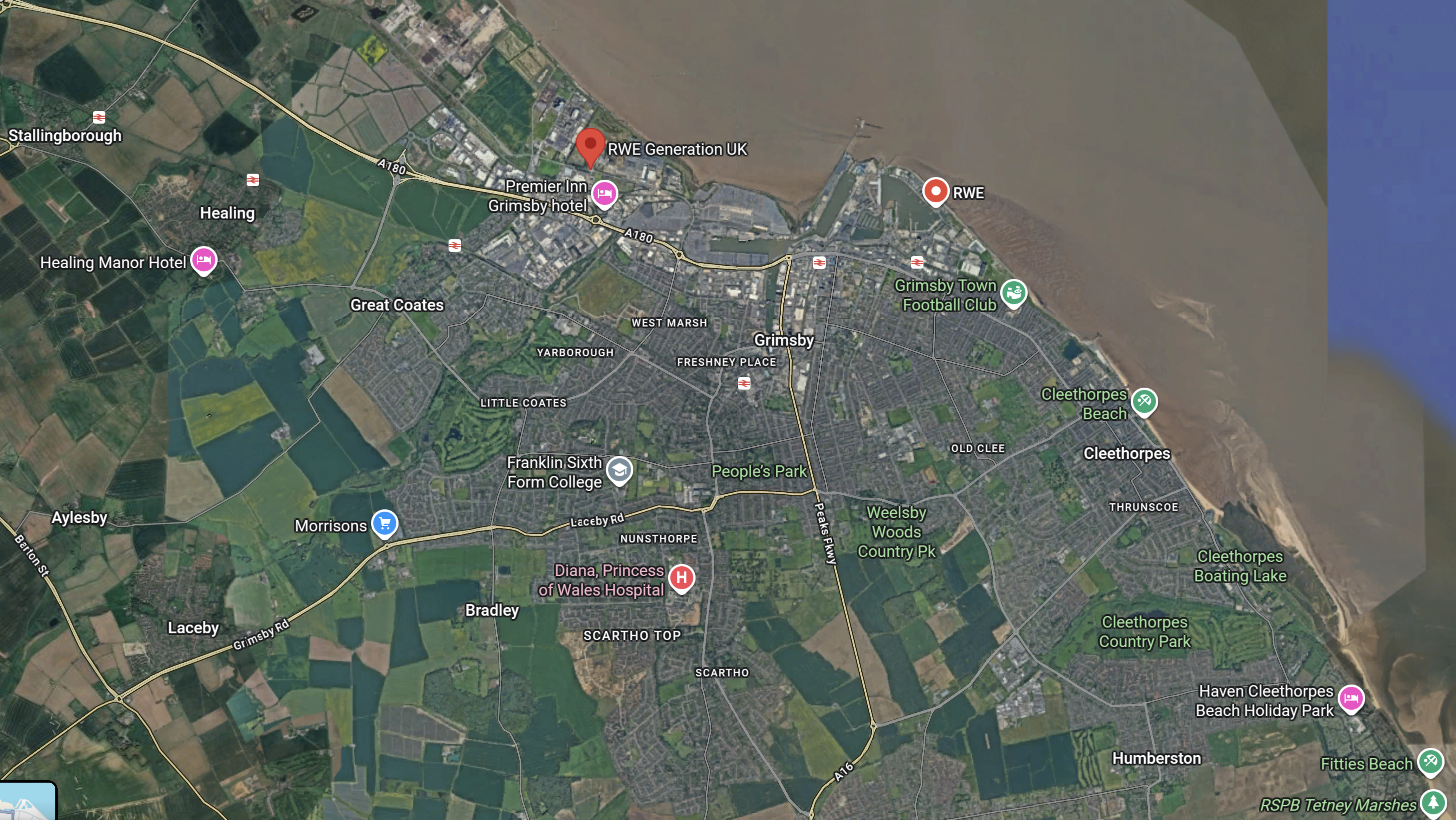
Note.
- The bright red arrow at the top of the map indicates RWE Generation UK in Grimsby Docks.
- There is another RWE location to the right of the bright red arrow.
- There is a line of stations along the coast, which from left-to-right are Stallingborough, Healing, Great Coates, Grimsby Town, Grimsby Docks, New Clee and Cleethorpes.
- Cleethorpes is not shown on the map.
- Doncaster and Cleethorpes are 52.1 mile apart, which is within the range of a battery-electric Hitachi and other trains.
- Charging would be at Doncaster, which is fully electrified and at Cleethorpes, by a short length of electrification.
This OpenRailwayMap shows the layout of and the railways around Grimsby Dock.

Note.
- Cleethorpes station is indicated by the blue arrow, in the South-East corner of the map.
- Cleethorpes station has four platforms, but no electrification.
- Grimsby Docks are to the North of the railway to Cleethorpes.
- This Wikipedia entry for Cleethorpes station, shows other railways and light railways served the area. Some were even electric.
These are a few of my thoughts on the development of railways between Sheffield and Cleethorpes.
RWE Will Be A Large Driver Of Employment In Grimsby
Earlier I wrote.
- Does RWE’s new UK Centralised Control Room control all their UK offshore wind farms?
- I have added them all up and there are almost 12 GW around our shores.
- I’ve read somewhere, that RWE are the UK’s largest power generator. From these figures, that would not surprise me.
It’s a long time, since I’ve added resources to a large project, so I asked Google AI, “How many people are needed to support a 1 GW offshore wind farm in the UK?”, and received this answer.
Direct & Indirect Support: For a large-scale project, this often breaks down into approximately 100–150 direct, permanent, high-skilled roles (technicians, engineers, management) and hundreds more in indirect, contracted, or supply chain roles (vessel crews, port operations, logistics).
Industry Average: Studies suggest that for operations and maintenance (O&M), around 50–100 full-time equivalent (FTE) jobs are generated per GW of installed capacity in terms of direct, permanent staff.
Key Takeaways for a 1 GW Farm:
- Direct Technicians/Operators: ~100–200+ (working on-site, turbines, or in control rooms).
- O&M Support Services: ~300–400+ (vessel operators, port logistics, supply chain).
- Total Operations Personnel: 300–600+ people.
Google AI appeared to have borrowed the figure from Ørsted and Hornsea 1 and 2.
So if it’s correct, there will be a total of 7,200 personnel supporting RWE’s wind farms in the UK. Even if only a third were employed in Grimsby, that is still a lot of people to accommodate and who will need to travel to work.
I also think a lot of personnel will come in by train, as the station is close to RWE’s locations.
Will Grimsby Have An Aberdeen-Sized Office-Shortage Problem?
One of the biggest problems, I was always hearing in the 1970s, was the shortage of offices in Aberdeen for the use of the oilmen.
In RWE Goes For An Additional 10 GW Of Offshore Wind In UK Waters In 2030, I talked about RWE’s plans for the future and published this table of new wind farms.
- Sofia – 1,400 MW
- Norfolk Boreas – 1380 MW
- Norfolk Vanguard East – 1380 MW
- Norfolk Vanguard West – 1380 MW
- Dogger Bank South – 3000 MW
- Awel y Môr – 500 MW
- Five Estuaries – 353 MW
- North Falls – 504 MW
Note.
- Sofia is nearly complete.
- Only the three Norfolk and the Dogger Bank South wind farms are on the East side of England and suitable to be serviced from Grimsby., but they still total 7,140 MW.
Has Grimsby got the office-space for all the people needed?
Could The Cleethorpes And Liverpool Lime Street Service Be Run By Battery-Electric Rolling Stock?
The various sections of this route are as follows.
- Cleethorpes and Doncaster – No Electrification – 52.1 miles
- Doncaster and Meadowhall – No Electrification – 15.2 miles
- Meadowhall and Sheffield – No Electrification – 3.4 miles
- Sheffield and Dore & Totley – No Electrification – 4.2 miles
- Dore & Totley and Hazel Grove – No Electrification – 29.2 miles
- Hazel Grove and Stockport – Electrification – 3.3 miles
- Stockport and Manchester Piccadilly – Electrification – 5.9 miles
- Manchester Piccadilly and Deansgate – Electrification – 0.8 miles
- Deansgate and Liverpool South Parkway -Not Electrified – 28.2 miles
- Liverpool South Parkway and Liverpool Lime Street – Electrified – 5.7 miles
Adding the sections together gives.
- Cleethorpes and Hazel Grove – No Electrification – 104.1 miles
- Hazel Grove and Deansgate – Electrification – 10 miles
- Deansgate and Liverpool South Parkway -Not Electrified – 28.2 miles
- Liverpool South Parkway and Liverpool Lime Street – Electrified – 5.7 miles
Note.
- To cover the 104.1 miles to Hazel Grove battery-electric trains would probably need to leave Cleethorpes with full batteries.
- Doncaster is a fully-electrified station and passing trains may be able to have a quick top-up.
- In South Yorkshire Now Has Better North-South Connections, I calculated that Doncaster is a very busy station with 173 express trains per day calling at the station or one every 8.5 minutes.
- Will trains be able to stop for a long period to charge batteries?
- It may be prudent to electrify between Meadowhall and Sheffield, under the Midland Mainline Electrification.
- Sheffield and Dore & Totley is shown that it will be electrified, under the Midland Mainline Electrification.
- Do we really want to have electrification marching along the Hope Valley Line?
- I believe that hydrogen-hybrid locomotives will be a better solution for freight trains on scenic lines like the Hope Valley, as they are zero-carbon, powerful and with a range comparable to diesel.
I believe CAF, Hitachi and Siemens have off the shelf rolling stock and factories in this country, who could build trains for the Cleethorpes and Liverpool Lime Street route.
How Would You Charge Battery-Electric Trains At Cleethorpes?
This picture shows Cleethorpes station
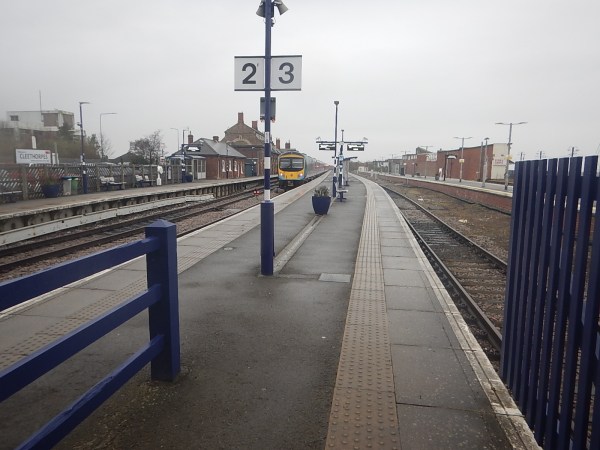
Note.
- The four long platforms without electrification.
- The platforms have recently been refurbished.
- The train in Platform 2 is a TransPennine Express Class 185 Siemens Desiro diesel train.
The simplest way to electrify the station would be to put up enough 25 KVAC overhead wires, so that battery-electric trains needing a charge could put up a pantograph and have a refreshing drink.
In Technology Behind Siemens Mobility’s British Battery Trains Hits The Tracks, I wrote about Siemens Rail Charging Converter.
This is a visualisation of a Siemens Rail Charging Converter in action.
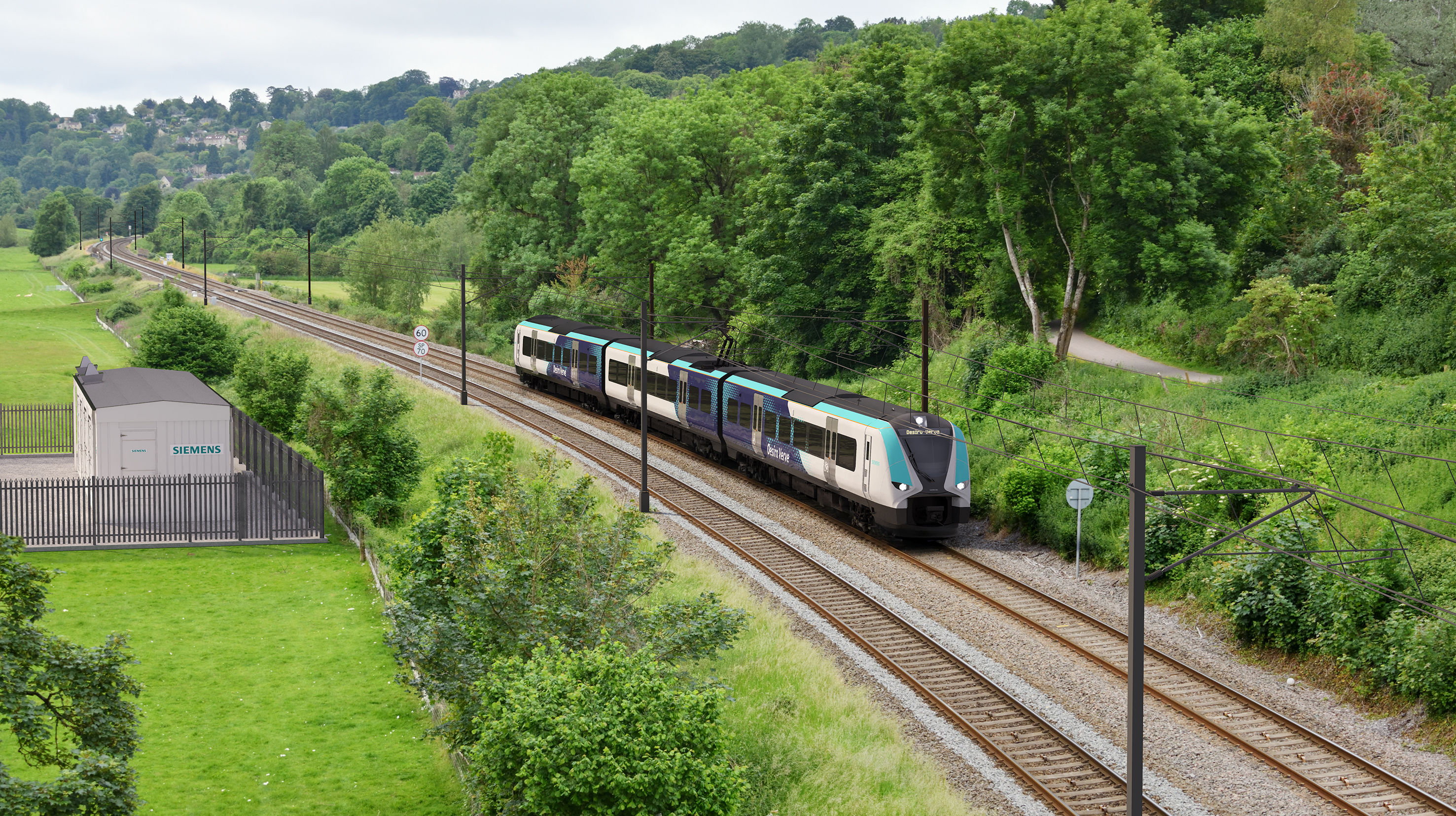
Note.
- The track is electrified with standard 25 KVAC overhead electrification.
- The train is a standard Siemens electric or battery-electric train.
- Siemens Rail Charging Converter, which is the shed in the compound on the left is providing the electricity to energise the catenary.
- I suspect, it could power third rail electrification, if the Office of Rail and Road ever allowed it to be still installed.
- The Siemens Rail Charging Converter does have one piece of magic in the shed. I suspect it uses a battery or a large capacitor to help power the electrification, as it can be powered from any typical domestic grid supply.
- I also wonder, if it has safety devices that cut the power outside the shed if track workers or intruders are detected, where they shouldn’t be?
- It could even cut the power, when trains are not running to save power and increase safety.
This looks to me, that a Siemens Rail Charging Converter could be a superb example of out-of-the-box thinking.
Could The Cleethorpes And Barton-on-Humber Service Be Run By Battery-Electric Rolling Stock?
This OpenRailwayMap shows the railways of North-East Lincolnshire.
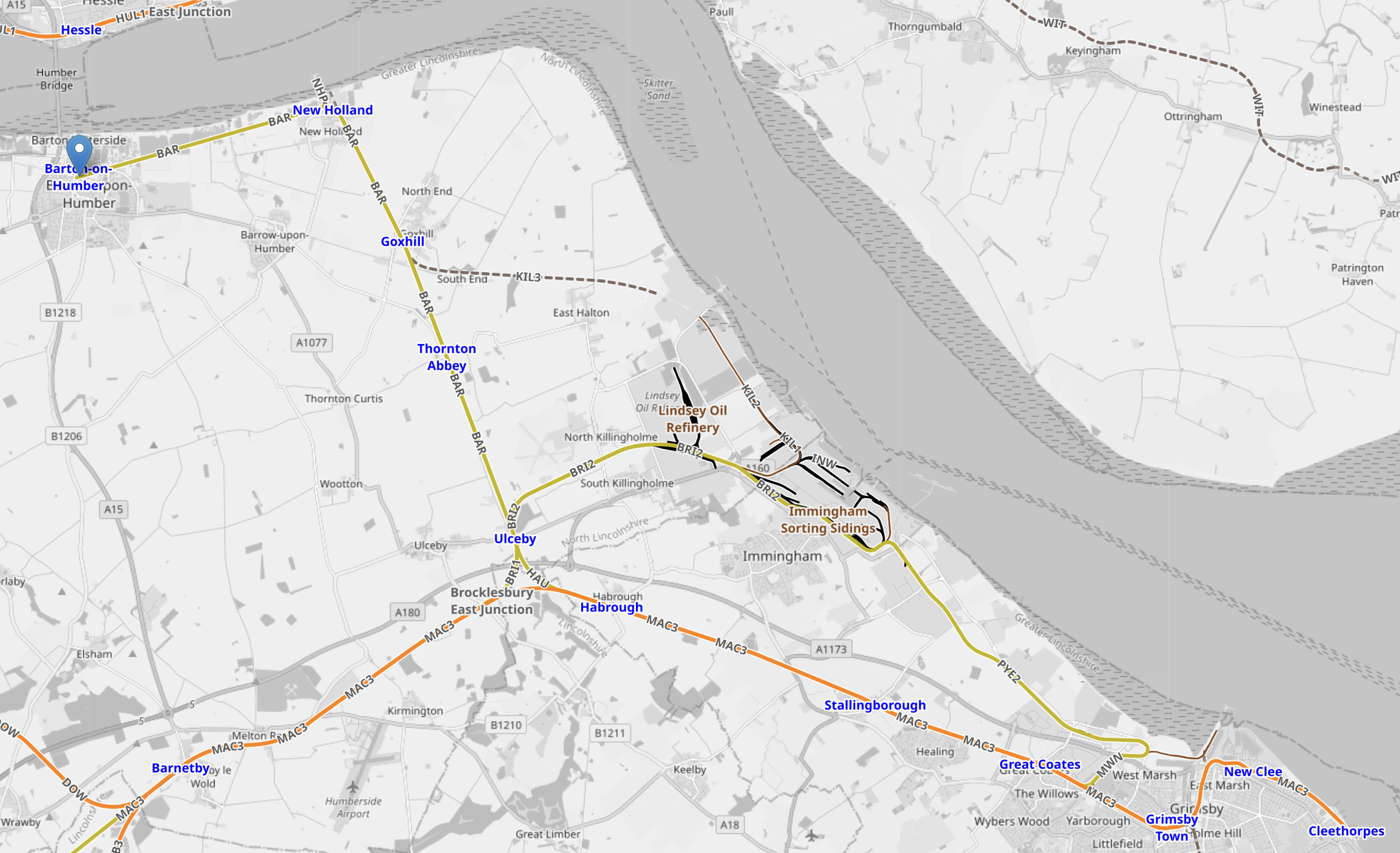
Note.
- Cleethorpes is in the South-East Corner of the map.
- Barton-on-Humber is in the North-West corner of the map and marked by a blue-arrow.
- Stations from South to North would be New Clee, Grimsby Docks, Grimsby Town, Great Coates, Healing, Stallingborough, Habrough, Ulceby, Thornton Abbey, Goxhill, New Holland and Barrow Haven.
- The line is double track.
- Cleethorpes and Barton-on-Humber is just 22.8 miles.
- A round trip would be under fifty miles, which would be well within range of a full-charge at one end.
- Service is one train per two hours (tp2h), which would only need a single train, shuttling between Cleethorpes and Barton-on-Humber.
- Two trains could provide an hourly service.
I would expect, that well-designed, solid and reliable German engineering could build a Siemens’ Rail Charging Connector that could charge four trains per hour (tph) at Cleethorpes station.
At present services are.
- TransPennineExpress – 1 tph to Liverpool Lime Street.
- East Midlands Railway – 1 tp2h to Barton-on-Humber
- East Midlands Railway – 1 tp2h to Matlock via Lincoln and Nottingham
- Northern Trains – 1 train per day (tpd) Sheffield via Brigg.
That is probably only about two tph.
Could The Cleethorpes And Sheffield Service Be Run By Battery-Electric Rolling Stock?
This is a description of the current Cleethorpes and Sheffield service.
- It is run by Northern Trains.
- The morning train leaves Sheffield at 09:54 and arrives in Cleethorpes at 11:40.
- The afternoon train leaves Cleethorpes at 13:20 and arrives in Sheffield at 15:10.
- The train is a Class 150 diesel train, which is a bit of a Joan Collins of a train – Of a certain age, but still scrubs up extremely well!
- Intermediate stations are Worksop, Retford, Gainsborough Central, Kirton Lindsey, Brigg, Barnetby and Grimsby Town
- The route length is 71.6 miles
- Trains take about 45-50 minutes.
It is also a parliamentary train.
The Wikipedia entry for parliamentary train gives this description of the Cleethorpes and Sheffield service.
Via Kirton Lindsey & Brigg. Became a parliamentary service when weekday services were withdrawn in 1993. Regular trains have operated between Gainsborough and Sheffield for most timetable periods since. Suspended January 2022 by Northern, who cited COVID-19 and staffing issues , but the service was reinstated in December 2022. Changed in May 2023 to be one return journey on weekdays only.
In the 1950s and 1960s I lived in Felixstowe part of the time and in the 1970s and 1980s I lived near Woodbridge and I observed first hand the development of the Port of Felixstowe and the effects it had on the surrounding countryside.
The development of the Port of Felixstowe, has brought the following.
- Improved roads and railways.
- Ipswich is now an hour from London by train.
- Ipswich is now a University town.
- New housing and other developments, both in Ipswich and Felixstowe and the surrounding countryside.
- Employment also has increased considerably, both in the Port and in surrounding towns.
- Ipswich’s football team is very much respected all over Europe and has won the English top division, the FA Cup and the UEFA Cup.
When you consider the jobs that RWE could create in the Port of Grimsby, I believe that this could have similar effects in Grimsby and Cleethorpes, as the Port of Felixstowe had in East Suffolk.
Already, the following are being talked about.
- A direct rail link between Cleethorpes and Grimsby to London.
- Battery-electric trains between Cleethorpes and Grimsby and Doncaster, Manchester and Liverpool Lime Street.
I believe that an improved rail link between Cleethorpes and Sheffield could be the catalyst for much needed housing along the route, which would be to the benefit of Cleethorpres, Grimsby, Sheffield and all the intermediate towns and villages on the route.
and the affects this will have on the countryside around the town, I believe that a strong case can be made out for a more frequent service between Cleethorpes and Sheffield.
Government Pauses Midland Main Line Electrification
This is the first paragraph of this article on Modern Railways.
The Government has paused the third phase of Midland main line electrification to Sheffield and Nottingham, plus the final phase of the South West Rail Resilience Programme (SWRRP), which involves strengthening cliffs at Holcombe.
Currently, the Midland Main Line electrification appears to have been installed between London St. Pancras and Wigston, where there is a triangular junction.
This article on Modern Railways is entitled MML Wires To Wigston energised, says this in the first paragraph.
A major milestones on the Midland Main Line has been achieved with the energisation of the newly installed overhead wires between Kettering and Wigston and the first trip for a new East Midlands Railway Aurora bi-mode unit to St Pancras.
This OpenRailwayMap shows the Midland Main Line between Leicester station and Wigston junction.
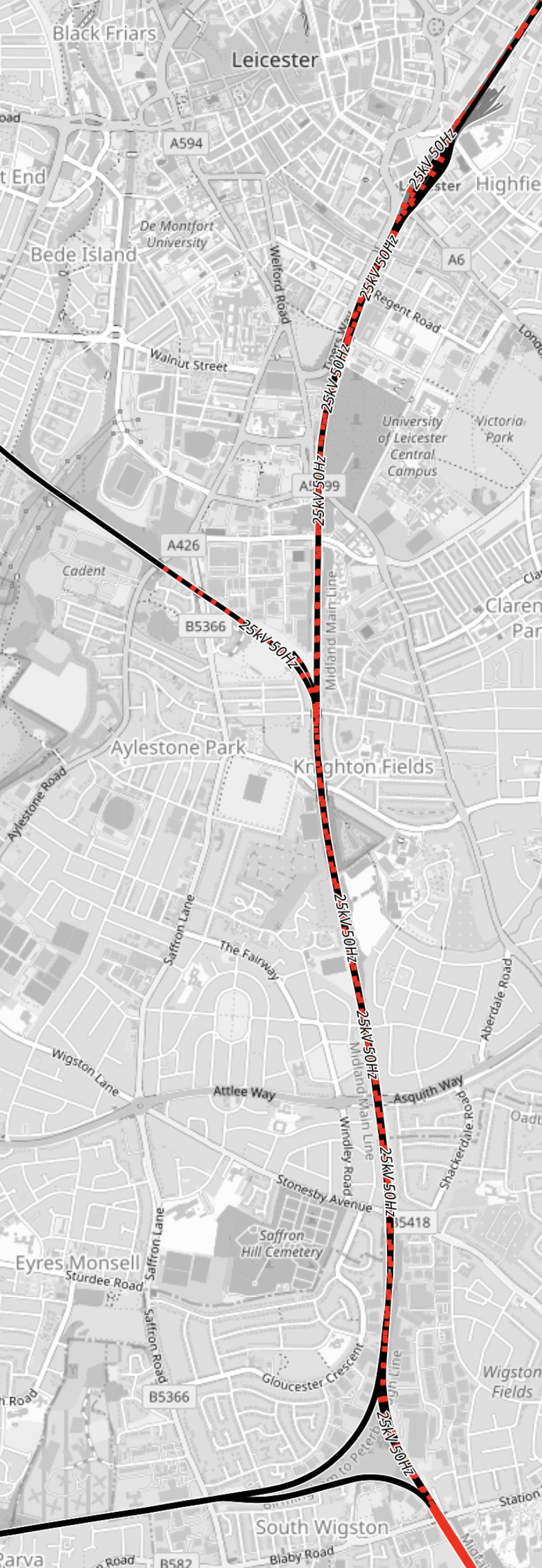
Note.
- Red tracks are electrified.
- Black tracks are not electrified.
- Black/red dashed tracked are being electrified.
- Wigston junction is at the bottom of the map.
- The red track indicates that the South of the junction is electrified.
- The North of the junction is now electrified according to the Modern Railways article.
- The West of the junction is not electrified and leads to the electrified Trent Valley Line at Nuneaton.
- The junction in the middle of the map is Knighton junction, that leads to Burton-on-Trent station.
- In the North-East corner of the map is Leicester station.
Distances from the electrified part of Wigston junction are as follows.
- Derby – 32.5 miles
- Leeds – 107.8 miles
- Leicester – 13.1 miles
- Nottingham – 30.5 miles
- Nuneaton – 15.6 miles
- Sheffield – 68.9 miles
I asked Google AI how far one of Hitachi’s Class 802 trains had gone during tests and got this reply.
A Class 802 train, when operating solely on battery power, can achieve a range of approximately 44 miles (70 km). This was demonstrated in a trial where a five-car Class 802/2 train reached a maximum speed of 87 mph using battery power alone, covering non-electrified sections. Hitachi Rail and Angel Trains are conducting trials to assess the viability of battery technology for longer distances and to reduce reliance on diesel power on non-electrified sections of routes.
Hitachi’s tests were performed with just one diesel engine replaced by a battery pack and it should be born in mind, that the Class 810 trains, that will be used on the Midland Main Line have four diesel engines.
As an electrical engineer, I feel battery range should be additive, so a three-battery train could have a range as much as 120 miles.
- This range would do nicely for a London and Leeds service, as Leeds station is fully-electrified to charge a train for return.
- As London and Sheffield return would be 137.8 miles, a charge at Sheffield would probably be needed to top-up the batteries.
On the other hand a two-battery and two-diesel unit, would have a battery range sufficient for the following services.
- London and Derby and return.
- London and Nottingham and return.
- London and Sheffield with return after a charge.
- London and Leeds with an intermediate charge at Sheffield.
We live in very electrifying times.
I am sure, that Hitachi and their battery-makers will find a solution to run all-electric services to the North of Wigston junction, without full electrification, but with just a charger at Sheffield.
The Electrification Problem At Leicester
Some years ago I came back to London from Leicester with a group of drivers. At one point, the conversation turned to electrification and they said that they had met a Network Rail engineer, who had told them, that the bridge was rather low for electrification and the track couldn’t be lowered because Leicester’s main sewer was underneath the railway.
In Leicester Station – 4th Jan 2022, I show a selection of pictures of Leicester station’s Grade II Listed frontage.
I doubt it would be possible to seriously alter Leicester station to electrify it, as the Heritage Taliban would have a field day.
But if I’m right that all services will be run North of Wigston on batteries, there will be no need to electrify through Leicester station.
Not only would using batter-electric trains probably be more affordable than electrification, but also because of the Leicester problem, it would be less inconvenient for passengers.
Could London and Leicester Be Run In An Hour Or Even Less?
Consider.
- The London and Sheffield services, which go non-stop between London and Leicester take around 64-66 minutes.
- The London and Nottingham services, which stop at Market Harborough take about 5-6 minutes longer.
- London and Leicester is 98.9 miles.
- The fastest trains average 93 mph between London and Leicester.
- Much of the route between London and Leicester has a maximum speed of 100 mph or more, with some sections of 125 mph running.
- Regenerative braking should reduce the time for the Market Harborough stop.
I can certainly see the non-stop Sheffield services being timed at under an hour between London and Leicester.
But I wouldn’t rule out all services between London and Leicester being timed at under an hour.
Could London and Sheffield Be Run In Two Hours Or Even Less?
Given that most services between London and Sheffield take two hours and four minutes and I reckon six minutes could be saved between London and Leicester, I suspect two hours or less is a very attainable target for London and Sheffield services.
Why Not Fit Four Batteries And Be Done With it?
I suspect it will be down to reliability and whether running the diesels on hydrotreated vegeatble oil is acceptable to some politicians.
Would This Be The World’s First Battery-Electric Main Line With 200 kph Running?
Quite possibly!
Conclusion
I can see no disadvantage in not electrifying North of Wigston junction and using battery-electric trains.
It could even be a lot more affordable.
Hull Trains Eyes Worksop And Sheffield Launch
The title of this post, is the same as that of this article on Railway Gazette.
These are the two introductory paragraphs of the article.
Hull Trains’ proposed London King’s Cross – Worksop – Sheffield open access service would ‘give people more choice’, offer more flexibility in train fares and make the area better known, according to Labour Member of Parliament for Bassetlaw Jo White.
Speaking at the launch of FirstGroup’s Moving forward together: Why open access is essential for a better railway report on January 21, White said the service would increase opportunities for the growing population of Worksop, where new housing being built. Looking back at the history of open access, she said East Hull MP John Prescott had been a supporter of the original launch of Hull Trains.
I suspect that the ebullient John Prescott would have given full backing to Hull Trains proposed Sheffield service.
I have some thoughts about Hull Trains proposed service.
London Overground Syndrome
I am fairly certain, that this service will suffer from from London Overground Syndrome, which is defined like this.
This benign disease, which is probably a modern version of the Victorian railway mania, was first identified in East London in 2011, when it was found that the newly-refurbished East London Line and North London Line were inadequate due to high passenger satisfaction and much increased usage. It has now spread across other parts of the capital, despite various eradication programs.
It may be for slightly different reasons, but as Workshop station has good car parking and could have fast trains to London, it could attract passengers.
But I don’t think two trains per day will be enough.
Tram-Trains Between Sheffield And Retford Via Worksop
Consider.
- It’s under twenty-five miles between Sheffield and Retford, so this route would be possible using battery-electric tram trains, similar to those in South Wales.
- These tram-trains would also be suitable for the Robin Hood Line between Nottingham and Worksop via Mansfield.
- The speed limits are not fast and the distances are not great and I suspect battery-electric versions of Sheffield’s tram trains could handle all routes.
- By using temporal separation, Hull Trains services could be sneaked in early and late in the day.
As both cities of Nottingham and Sheffield have used or thought about using tram-trains, I’m sure Stadler could provide a suitable tram-train, that could work in the two cities and all the branch lines that used to serve the numerous coal mines.
It would be levelling up on a big way.
It could grow into a very comprehensive East Midlands Metro, that also served Derby, Doncaster and possibly Lincoln.
Stadler’s products can certainly be configured in many unusual ways.
Rail Minister Marks Completion Of £150m Hope Valley Railway Upgrade
The title of this post is the same as that of this article on Rail Magazine.
These first two paragraphs summarise the work.
More reliable journeys are promised on the Hope Valley line between Manchester and Sheffield after a £150 million upgrade was completed in early April.
Over the last three years, the existing platform at Dore & Totley station on the south side of Sheffield has been extended to cope with six-coach trains. Meanwhile the second platform has been rebuilt and commissioned (after it was removed in the 1980s), two mechanical signal boxes have been abolished and a new one-kilometre freight loop laid in the Peak District. At Hathersage, a pedestrian crossing has also been removed and replaced with a footbridge.
These are my thoughts.
Dore And Totley Station
The Rail Magazine article says this about the improvements at Dore and Totley station.
Replacing two tracks through Dore & Totley removes a single-track bottleneck that often saw Sheffield to Manchester express services held up by slower stopping services and cement trains destined for Earles Sidings. A nine-day shutdown of the route in March was needed to finish the work.
The new platform sits between the Midland Main Line and the Hope Valley line, so can only be reached via the new footbridge or lifts. As well as the usual ‘blister paving’ slabs marking the edge of the platform, other tactile paving has been laid to help people with visual impairments find their way around the station.
This OpenRailwayMap shows the new layout of tracks at Dore and Totley station.

Note.
- The four tracks at the North of the map go to Sheffield station.
- The Eastern pair of tracks are the Midland Main Line and they go to the South-East corner of the map for Chesterfield and the South.
- The Western pair of tracks are the Hope Valley Line and they go to the South-West corner of the map for Manchester.
- The blue lettering in the middle of the map indicates Dore and Totley station.
- There is a single track curve between the Midland Main Line and the Hope Valley Line, which is mainly used by freight trains.
This secondOpenRailwayMap shows Dore and Totley station in greater detail.

The big improvement is that the Hope Valley Line is now double instead of single track, which must eliminate a lot of delays.
These pictures show the station in July 2020.
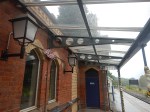


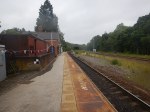


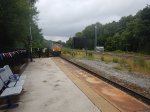
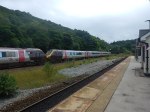
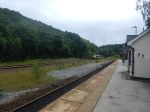

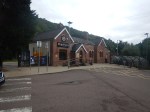


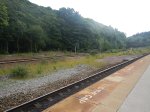
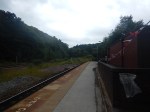
The pictures clearly show the single track and platform at Dore and Totley station.
Dore South Curve
Dore South Curve links the Southbound Midland Main Line with the Westbound Hope Valley Line.
This OpenRailwayMap shows the curve.

There is a crossover in the South-West corner of the map, so with careful signalling, trains can use the Dore South Curve in both directions.
Bamford Loop
This is a freight loop between Bamford and Hathersage stations.
This OpenRailwayMap shows the loop.

Note.
- The Hope Valley Line goes diagonally across the map.
- Manchester is to the North-West.
- Sheffield is to the South-East.
- Bamford station is in the North-West corner of the map.
- Hathersage station is just off the South-East corner of the map.
- The loop is on the Northern side of the Hope Valley Line.
The loop will most likely be used by trains going to Sheffield or Chesterfield.
Hathersage Footbridge
This Google Map shows Hathersage station.

Note.
- Dore Lane and the B 6001 appear to pass under the railway.
- There appears to be what could be foundations just to the West of the platforms at Hathersage station.
- From pictures found by Google the bridge appears to be a simple steel structure.
I shall have to go and take pictures.
Fast Trains Between Manchester And Nottingham
In the Wikipedia entry for the Hope Valley Line, this is said.
Nottinghamshire County Council and the Department for Transport have investigated the possibility of adding another service that does not call at Sheffield in order to improve the journey time between Nottingham and Manchester. Stopping (and changing direction) in Sheffield, the fastest journey is 110 minutes (in 2019), but the council has estimated bypassing Sheffield would cut the time to 85 minutes. Suggested improvements on a 2+1⁄2-mile (4 km) stretch near Stockport may reduce journey times by 2–3 minutes.
Consider.
- According to Google, the driving time between the two cities is 128 minutes and the motorway route is via the M1 and M62.
- If nearly half-an-hour could be saved between Manchester and Nottingham could be a big saving in journey time.
- Manchester Piccadilly is likely to be rebuilt for High Speed Two and a fast route via Nottingham could be a viable alternative.
- Both Manchester and Nottingham have good local tram and train networks.
- As the electrification of the Midland Main Line progresses, the route will be increasingly suitable for 100 mph battery-electric trains.
A Manchester and Nottingham express service looks to be an easy service to implement after the Hope Valley Line has been improved.
Hourly Stopping Trains Between Manchester And Sheffield
The Wikipedia entry for the Hope Valley Line gives these details for the stopping service between Manchester Piccadilly and Sheffield.
- Trains are hourly.
- Trains call at Reddish North, Brinnington, Bredbury, Romiley, Marple, New Mills Central, Chinley, Edale, Hope, Bamford, Hathersage, Grindleford and Dore & Totley.
- But some services do not call at some or all of Edale, Bamford, Hathersage, Grindleford and Dore & Totley giving some 2-hour gaps between services at these stations.
Let’s hope that some of the extra capacity is used to provide a regular service at all stations on the Hope Valley Line.
As in a few years, it will have electrification at both ends, this route could be very suitable for battery-electric trains.
Completion Date
It appears that the first day, when passengers will be able to use the new upgraded tracks and stations will be Thursday, the 2nd of May.
Conclusion
The improvements, certainly seem to allow extra and improved services through on the Hope Valley Line.
I also feel that in a few years, services will be run by battery-electric trains.
Could East Midland Railway’s Leicester And Lincoln Service Be Extended To Burton On Trent?
After my trip to Lincoln and Cleethorpes earlier this week, I got to thinking about how train services could be improved in the area.
Cleethorpes As A Battery-Electric Train Hub Station
In Cleethorpes Station – 28th June 2023, this was my last sentence.
Cleethorpes station could be at the centre of its own battery-electric train network, with all trains powered by just 3.3 miles of single-track electrification.
Services running to Cleethorpes station could be.
- East Midlands Railway – Barton-on-Humber and Cleethorpes via Barrow Haven, New Holland, Goxhill, Thornton Abbey, Ulceby, Habrough, Stallingborough, Healing, Great Coates, Grimsby Town, Grimsby Docks and New Clee, which currently runs two-hourly, but probably should run hourly. Barton-on-Humber and Grimsby Town is not electrified and is 19.6 miles or 39.2 miles for a round trip.
- East Midlands Railway – Leicester and Cleethorpes via Syston, Sileby, Barrow-upon-Soar, Loughborough, East Midlands Parkway, Attenborough, Beeston, Nottingham, Newark Castle, Collingham, Swinderby, Hykeham, Lincoln, Market Rasen, Barnetby, Habrough and Grimsby Town which currently runs two-hourly, but probably should run hourly. Nottingham and Grimsby Town is not planned to be electrified and is 77.8 miles.
- LNER – London King’s Cross and Cleethorpes via Stevenage, Peterborough, Grantham, Newark Northgate, Lincoln, Market Rasen, Barnetby, Habrough and Grimsby Town, which would run at least two trains per day (tpd). Newark Northgate and Grimsby Town is not electrified and is 60.6 miles.
- TransPennine Express – Liverpool Lime Street and Cleethorpes via Liverpool South Parkway, Warrington Central, Birchwood, Manchester Oxford Road, Manchester Piccadilly, Stockport, Sheffield, Meadowhall, Doncaster, Scunthorpe, Barnetby, Habrough and Grimsby Town, which runs hourly. Hazel Grove and Grimsby Town is not electrified and is 101.4 miles.
Note.
- All services to Cleethorpes could be run using a battery-electric train, with the range of a Stadler FLIRT Akku, which is 139 miles.
- Cleethorpes station will soon have four terminal platforms. Could it be one platform for each service?
- The 3.3 miles of single-track electrification would be between Cleethorpes and Grimsby stations.
- I am assuming that all services should be at least hourly, except London King’s Cross.
- If the frequency of services to London King’s Cross, were to be increased, the extra services would take-over paths of the East Midlands Railway services between Lincoln and Cleethorpes.
- I am also assuming that the Midland Main Line electrification has been completed through Leicester to Nottingham, as is currently planned.
Cleethorpes will become a very well-connected station.
Collateral Benefits Of Cleethorpes As A Fossil Fuel-Free Station
If all services to Cleethorpes are run by battery-electric trains, then there will be collateral benefits.
- All passenger train services in North-East Lincolnshire will be zero-carbon.
- TransPennine Express’s Southern route between Liverpool Lime Street and Cleethorpes via Manchester, Sheffield and Doncaster will be zero-carbon.
- LNER’s services to London King’s Cross from Lincolnshire will be zero carbon.
Manchester and Sheffield will be linked by an hourly electric service, just as it was between 1953 and 1981.
The Ivanhoe Line
I wrote about the Ivanhoe Line in Reinstatement Of The Ivanhoe Line.
- There is a proposed reinstatement of passenger services between Leicester and Burton-on-Trent stations.
- I estimate it’s a distance of around 37 miles.
- There would be some new stations on the route.
In the Wikipedia entry for the Ivanhoe Line, there is a section called Future, where this is said.
The intermediate stations are capable of taking only a two-coach train, which has led to overcrowding on some services, especially now that the service is extended to Nottingham and Lincoln. The latest Route Utilisation Strategy for the East Midlands makes recommendations for platform lengthening.
East Midlands Parkway railway station has now been built on the route. The Borough of Charnwood’s local plan of 2004 anticipates a station at Thurmaston.
In 2022 the closed section of the line was one of nine schemes chosen to undergo a feasibility scrutiny by Network Rail as part of the government’s Restoring Your Railway programme. If approved, work could start in 2024 and the line reopened in 2026
Note.
- The first paragraph refers to the existing section of the Ivanhoe Line, to the North of Leicester.
- I went to Burton once for the football and it’s a difficult place to get to from North London by train.
- Burton-on-Trent station was fully refurbished in 2011.
- Burton-on-Trent station has hourly services from CrossCountry trains.
It seems that a creditable plan is emerging.
Service Frequency Between Burton-on-Trent And Leicester
As Burton-on-Trent station has hourly services, I suspect that this will be the initial frequency between Burton-on-Trent and Leicester.
But I could see this frequency being increased, if there were long waits during interchange at Burton-on-Trent.
Average Speed Of The Service And Estimate For A Time Between Cleethorpes And Burton-on-Trent
The current Grimsby Town and Leicester service is over a route of 105.3 miles and a direct service takes two hours and thirty-seven minutes.
This is an average speed of 40.24 mph.
I can now give an estimate for a Cleethorpes and Burton-on-Trent service.
The distance will be 105.3+3.3+37, which is 145.6 miles.
An estimate of the time using a speed of 40.24 mph is three hours and thirty-seven minutes.
But seeing that a good proportion of the route has a 110 mph operating speed, I suspect that a 100 mph train could do the trip faster.
Could Cleethorpes And Burton-on-Trent Be Worked By A Battery-Electric Train?
The route could be effectively four sections.
- Cleethorpes and Grimsby Town – 3.3 miles – Electrified
- Grimsby Town and Nottingham – 77.8 miles – Not Electrified
- Nottingham and Leicester – 27.5 miles – Being Electrified
- Leicester and Burton-on-Trent – 37 miles – Not Electrified
Note.
- In a round trip, there are two sections of 77.8 miles and two consecutive sections of 37 miles.
- Battery-electric trains would be charged on the electrified section of the route.
I am sure that a battery-electric train with a range of greater than 77.8 miles would handle the service.
Thoughts On The East Midlands Railway Timetable After Class 810 Trains Enter Service
East Midlands Railway will soon be replacing their diesel Class 222 trains with new bi-mode Class 810 trains.
- 32 trains will be replaced by 33 trains.
- 167 cars will be replaced by 165 cars.
- The current trains come in four, five and seven cars.
- The new trains come in five-cars only.
- The platforms at St. Pancras station can accept a pair of the new trains.
- Both Class 222 and Class 810 trains are genuine 125 mph trains.
- St. Pancras and Corby takes one hour and fifteen minutes
- St. Pancras and Nottingham takes hour and forty-five minutes
- St. Pancras and Sheffield takes two hours
The current services are as follows.
- St. Pancras and Corby via Luton Airport Parkway, Luton, Bedford, Wellingborough and Kettering
- St. Pancras and Nottingham via Kettering, Market Harborough, Leicester, Loughborough (1 tph), East Midlands Parkway (1 tph) and Beeston (1 tph).
- St. Pancras and Sheffield via Leicester, Loughborough (1 tph), East Midlands Parkway (1 tph), Long Eaton (1 tph), Derby and Chesterfield.
Note.
All services are two trains per hour (tph)
If all services were run by single trains, the following number of trains would be needed for each service.
- St. Pancras and Corby – 6 trains
- St. Pancras and Nottingham – 8 trains
- St. Pancras and Sheffield – 9 trains
Note.
- This means a total of twenty-three trains.
- I am assuming, that trains can turn round in fifteen minutes at each end of the journey.
- If pairs of trains run, then the numbers can be doubled to forty-six trains.
These are my thoughts.
Do The Luton Airport Express Services Need Pairs Of Trains?
The Corby service is now branded as the Luton Airport Express.
This picture shows a packed Luton Airport Express at Luton Airport Parkway station.

After seeing this, I believe that a pair of trains must run to Corby to pick up passengers, who want a fast service to and from Luton Airport.
Will The Class 810 Trains Replace The Class 360 Trains To Corby?
If all services are run by single Class 810 trains, the following would apply.
- The current service pattern would need 23 trains.
- All stations would get the same number of trains to and from St. Pancras.
- All East Midlands Railway out of St. Pancras would use the same 125 mph electric trains and services could probably be speeded up.
- The Class 810 train has 2.94 MW on diesel and the Class 360 train has 1.55 MW on electric, so I suspect that the Class 810 train has the faster acceleration.
- Bedford, Kettering, Luton, Luton Airport Parkway, Market Harborough and Wellingborough would have 125 mph electric commuter services to and from London.
- Corby and Luton Airport Parkway services would have marginally more seats, if Corby services were pairs of trains.
There would be ten spare trains, if the Class 360 trains were replaced or four spare trains, if pairs of trains ran to Corby.
Would Class 810 Trains Running On Electric Execute Stops Faster?
This document on Rail Engineer gives these figures for total power on electric of Class 802 trains.
- Five-car – 2712 kW
- Nine-car – 4520 kW
Note.
- These figures are based on a Hitachi figure of 226 kW for the power of a traction motor.
- The five-car train has twelve motors and the nine-car has twenty.
- As a five-car train has three powered cars and a nine-car train has five, it looks like each powered car has four traction motors.
- The document also says that the power to weight ratio on electric is thirty percent more than on diesel.
This document on the Hitachi web site provides this schematic of the traction system.

Note that four traction motors are confirmed.
Consider the power of the various trains, that run or will run on the Midland Main Line.
- Four-car Class 180 train has one 559 kW diesel engine per car.
- Four, five and seven-car Class 222 train has one 559 kW diesel engine per car.
- Four-car Class 360 train has 1.55 MW on electric – 387 kW per car.
- Five-car Class 810 train has 2.94 MW on diesel – 588 kW per car.
- Five-car Class 810 train has 2.94 MW on electric – 588 kW per car.
Note.
- The Class 810 train will out-accelerate the Class 360 train as it has at least 40 percent more power on electric.
- The Class 810 train has pantographs on both driving cars.
- The Class 810 train has two powered cars; numbers 2 and 4.
- I have assumed that if the Class 810 train can handle 2.94 MW on both diesel and electric.
- With eight traction motors, they would need to be 367.5 kW.
- The Class 810 train should out-accelerate the Class 180 train and Class 222 train as it has at five percent more power on both diesel and electric.
I think it is also relevant that the order for the Class 810 trains was placed in August 2019 and Hitachi announced their collaboration with Eversholt Rail Group to develop the battery-electric versions of the Class 802 trains only sixteen months later. As the Class 810 appears to be an revolution of the Class 802 train, I suspect that Hitachi were working hard on battery design, as this train’s design evolved.
These are the five cars of the Class 810 train.
- 1 – DPTS – Driver-Pantograph-Trailer-Standard with Generator Unit
- 2 – MS – Motored-Standard with Generator Unit
- 3 – TS – Trailer-Standard with Transformer
- 4 – MC – Motored-Composite with Generator Unit
- 5 – DPTF – Driver-Pantograph-Trailer-First with Generator Unit
Note.
- Generator Unit is a diesel generator.
- Motored means the car has four traction motors.
- Composite means a car with both First and Standard accommodation.
- Cars 1-2, and 4-5, form two power units with two generator units, four traction motors and a pantograph, at each end of the train. Cables would connect them to the transformer in car 3.
It looks a neat solution, which probably has high reliability.
I can envisage the two generator units under cars 2 and 4 could be replaced by battery packs.
- The battery packs would mimic the function of the generator units.
- Noise in cars 2 and 4 would be reduced.
- Carbon emissions would be reduced.
- The battery packs would be charged, when running under the wires or possibly from chargers or short length of overhead wires at terminal stations.
- The battery packs would handle regenerative braking.
- Adding battery packs would allow the trains to jump gaps left in the electrification.
At some point in the future, the other two generator units could be removed or replaced with battery packs, depending on whether full electrification happens on the Midland Main Line.
These meanderings convince me that the Class 810 trains will be able to save time in the stops on the Midland Main Line.
Because of these savings, I can see East Midlands Railway, reorganising stops on the electrified section of the route, as although the stop will add a minute or two, this lost time will be picked up on savings at existing stops and by more 125 mph running.
Could The Nottingham And Sheffield Services Be Combined?
These are the current services to Nottingham and Sheffield.
- St. Pancras and Nottingham via Kettering, Market Harborough, Leicester, Loughborough (1 tph), East Midlands Parkway (1 tph) and Beeston (1 tph).
- St. Pancras and Sheffield via Leicester, Loughborough (1 tph), East Midlands Parkway (1 tph), Long Eaton (1 tph), Derby and Chesterfield.
Note.
- Both services call at Leicester , Loughborough and East Midlands Parkway.
- Some trains call at Luton Airport Parkway, Luton, Bedford, Wellingborough, Kettering and Market Harborough on the section of the Midland Main Line, which is currently being electrified between Kettering and Wigston.
- A lot of money has been spent on the Luton DART and it only has two fast trains from St. Pancras. Four tph would be ideal.
Suppose the Sheffield and Nottingham trains operated like this.
- A pair of Class 810 trains would leave St. Pancras.
- South of Leicester, they would call at one or two stations, as defined in the timetable.
- They would then call at Leicester , Loughborough and East Midlands Parkway.
- At East Midlands Parkway, the two trains would split.
- One train would go to Sheffield and the other would go to Nottingham, stopping as defined in the timetable.
Note.
- Because of the trains superior performance, they would be doing quicker calls at stations, which should allow the existing timetable to be maintained or even improved.
- Hitachi trains can split and join in around two minutes.
- These trains would call at Luton Airport Parkway, to give that station four tph from St. Pancras, Luton and Bedford.
I calculated earlier that a 2 tph Sheffield service would need nine trains. So if it served both Nottingham and Sheffield it would need another nine trains. This would give a total of eighteen trains.
- If the St.Pancras and Corby service were to be run by pairs of Class 810 trains, this would require twelve trains.
- Adding the two services together would require thirty trains. Would three trains be enough for backup and in maintenance?
I suspect splitting and joining at East Midlands Parkway could be beneficial.
Could Four tph Be Run To Nottingham And Sheffield?
Consider.
- Bristol, Cardiff, Edinburgh, Leeds, Liverpool, Manchester, Newcastle, Norwich, Southampton and York all get two tph from London.
- Some closer stations like Birmingham, Cambridge, Ipswich, Leicester, Oxford and Reading get more.
- Most of these routes are electrified and run modern trains.
I wouldn’t say never, but adding two tph to both Nottingham and Sheffield services would require.
- Two more hourly train paths on both between St. Pancras and Nottingham, and St. Pancras and Sheffield.
- Eighteen extra trains.
But as a sub-two hour service would be running on both routes, it would probably be possible to accurately predict, when more trains were needed.
Electrification Through Leicester
As more electrification is added, this should result in faster journeys, that reduce carbon emissions.
OpenRailwayMap is now showing the electrification as dotted lines on the Midland Main Line.
This map shows the electrification scheme through Leicester.
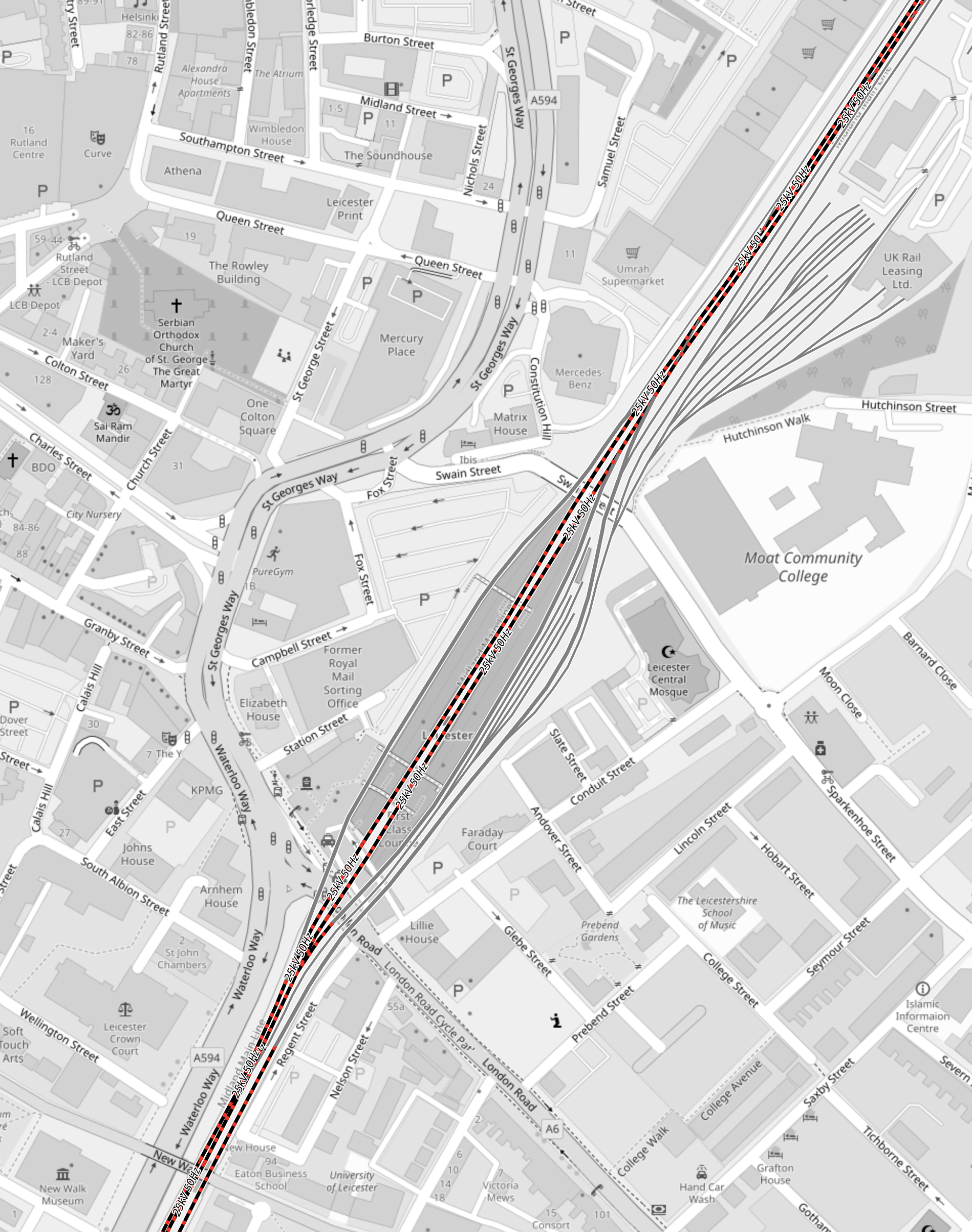
Note.
- Only the two main lines in the centre of the station seem to be going to be electrified.
- These lines are used by East Midlands Railway’s through trains and surprisingly some freight trains.
- Terminating services from places like Birmingham, Grimsby and Lincoln seem to stop in the outer platforms.
This picture shows the platforms from the Northern footbridge.

This picture shows the platforms from the Northern footbridge.
At the Southern end of the station, the tracks go under the London Road bridge. This map shows the tracks there.

Note.
- The two main tracks of the Midland Main Line appear that they will be electrified.
- But the lines at each side are not electrified.
Some years ago I came back to London from Leicester with a group of drivers. At one point, the conversation turned to electrification and they said that they had met a Network Rail engineer, who had told them, that the bridge was rather low for electrification and the track couldn’t be lowered because Leicester’s main sewer was underneath the railway.
It looks like Network Rail have found a way to squeeze two electrified tracks through the middle of the bridge and then use diesel, battery or other self-powered trains on lines without electrification on either side.
Skegness Station To Benefit From A £3.3m Improvement Package
The title of this post, is the same as that of this article on Rail Technology Magazine.
I took these pictures of Skegness station, on a visit to the town in July last year, which I wrote about in A Trip To Skegness.
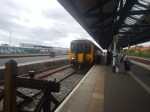


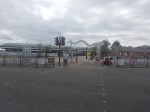

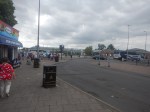


I feel that Skegness station would welcome some improvement.
The Rail Technology Magazine article says this about the project.
Upon completion of the project, customers will be able to utilise a number of enhanced facilities, including an improved accessible toilet with changing spaces, two new start-up offices, a community café and retail provisions. Upgrades will continue through improved access into the station for pedestrians and vehicles, offering integration with the surrounding community.
Work is hoped to start this year.
A Modern Zero-Carbon Train Service
If £3.3 million is going to be spent on Skegness station, would it not be a good idea to have better trains serving the station.
In A Trip To Skegness, I talked about updating the hourly Nottingham and Skegness service using Class 170 trains with Rolls-Royce MTU Hybrid PowerPacks.
I wonder if this route could be improved by fitting the Class 170 trains with Rolls-Royce MTU Hybrid PowerPacks?
- The hybrid technology would have a lower fuel consumption and allow electric operation in stations.
- The prototype hybrid is already working on Chiltern Railways in a Class 168 train.
- The Class 168 train is an earlier version of the Class 170 train and they are members of the Turbostar family.
- Rolls-Royce are developing versions of these hybrid transmissions, that will work with sustainable fuels.
- As we have a total of 207 Turbostar trainsets, these could be a convenient way of cutting carbon emissions on long rural lines.
- As Rolls-Royce MTU are also developing the technology, so their diesel engines can run on hydrogen, it is not outrageous to believe that they could be on a route to complete decarbonisation of this type of train.
I believe that we could see hydrogen-hybrid Class 170 trains, with a Rolls-Royce badge on the side.
But would it be possible to go the whole way using one of Stadler’s battery-electric trains?
Consider the service between Nottingham and Skegness.
- It is hourly.
- The route is run by 100 mph Class 170 trains.
- Nottingham and Grantham are 22.7 miles apart.
- Grantham and Skegness are 58.2 miles apart.
- Trains take four minutes to reverse at Grantham.
- Trains wait 20 minutes before returning at the two end stations.
- Trains reverse at Nottingham in a bay platform, which is numbered 2.
- Grantham is electrified.
- Nottingham station will be electrified in the next few years.
- Skegness station is next to the bus station in the middle of the town, so hopefully the electricity supply is robust enough to charge buses and trains.
Stadler make a train called an Akku.
- It is a member of the FLIRT family.
- It is a 100 mph train.
- I wrote Stadler FLIRT Akku Battery Train Demonstrates 185km Range, which means it could run between Nottingham and Skegness without intermediate charging.
This leads me to the conclusion that with charging systems at Nottingham and Skegness and taking a four-minute top-up at Grantham if needed, a FLIRT Akku could handle this route with ease.
Conclusion
Skegness is a town that needs leveling-up. A refurbished station and 100 mph electric trains to Grantham and London would be a good start.
 The Anonymous Widower