Direct London Trains ‘Could Start In 2026’
The title of this post, is the same as that of this article on the BBC.
This is the sub-heading.
A new train company is hoping its proposals for new daily services from Shropshire to London Euston could begin towards the end of 2026.
Wrexham, Shropshire and Midlands Railway (WSMR), which is led by international rail firm Alstom, submitted a new bid at the end of last year to provide four daily trains.
These two paragraphs add detail to the story.
The county has not had a direct train link to the capital since Avanti West Coast stopped its single daily service in 2024 because of low passenger numbers.
The move has been welcomed by regular commuter Charlotte Foster, who lives on the Welsh border. She said a direct service would save her the stress of missing a connection or catching a train elsewhere.
These are my thoughts on this proposal.
I wonder If Alstom Will Be Using This route To Trial Hydrogen-Powered Trains?
Consider.
- The route was a failure for Virgin Trains.
- Perhaps the curiosity value of hydrogen-trains will generate sufficient traffic.
- Hydrogen-electric trains will be very quiet. Those in Germany are hydrogen-electro-mechanical and very noisy.
- The trains will be based on the proven Aventra platform.
- I reported on Alstom’s hydrogen trains for the UK in Alstom Plans To Operate Its Own Passenger Train Service In The UK For The First Time.
- Perhaps Alstom feel that an extended test will convince passengers that the trains are a good idea.
- An extended test would give proper costings for Great British Railways and prospective open access operators.
The map downloaded from the BBC article shows the route.
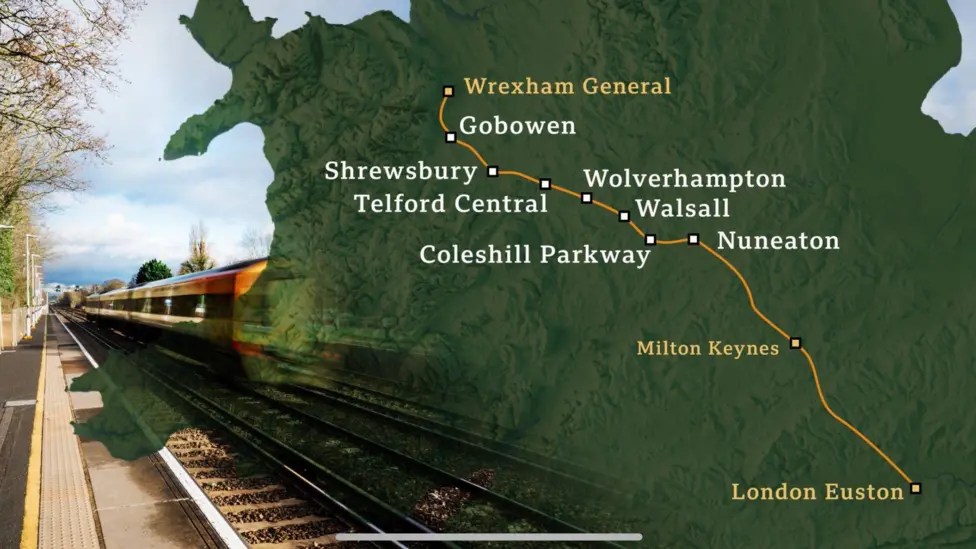
Note.
- There are eight intermediate stops.
- Euston and Wolverhampton is 124.9 miles and fully electrified.
- Wolverhampton and Wrexham General is 59.9 miles and is not electrified.
- The section of the route without electrification at 120 miles return might need some new electrification for battery-electric trains, but from their experience in Germany, I suspect that Alstom, will know how to cover the route using hydrogen-hybrid trains, which would use the existing electrification between Euston and Wolverhampton.
This picture shows a visualisation of a possible Alston hydrogen train, which would probably be built in Derby on an Aventra platform.
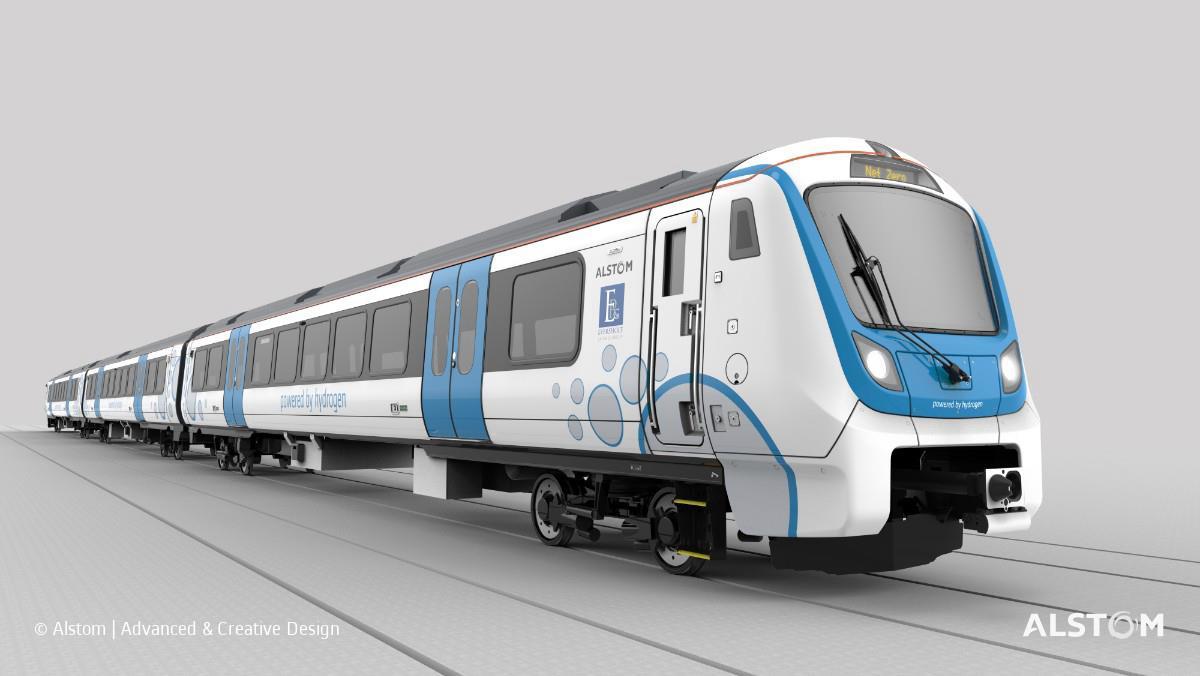
Note.
- It could be up to five-cars long.
- I suspect Alstom could give the train a 125 mph cruising speed, so it could mix it with all the express trains between Euston and Wolverhampton.
- The trains would have a very long range on hydrogen.
- Hydrogen trains could certainly handle a round trip between Wolverhampton and Holyhead on a single fuelling.
- Hydrogen fuelling is likely to be setup at Cemex at Wrexham and the Port of Holyhead.
I think it could be an ideal trial route for hydrogen trains.
But also it could bring growth to the towns and cities between Wolverhampton and Holyhead.
Would Alstom’s Hydrogen-Hybrid Trains Be Suitable For Other Routes?
Most Certainly!
In the first place, the route could be extended to Holyhead, which would surely bring growth to the towns and cities between Wolverhampton and Holyhead.
This would create a zero-carbon route between London and the Island of Ireland.
But around the UK, there would be other routes.
I can envisage these routes being run by hydrogen-hybrid trains.
- London Waterloo and Exeter – Third-rail operation
- London Bridge and Uckfield – Third-rail operation
- London Bridge and Hoo – Third-rail operation
- East Coastway and Marshlink Lines – Third-rail operation
- Scotland – Replacement of Inter7City trains and filling in the gaps in electrification.
Note.
- Some areas already have or have plans for hydrogen supply networks.
- With the exception of supplying hydrogen, very little infrastructure would be needed.
- Hydrogen trains should be fairly quiet.
- Hydrogen trains don’t create much disruption, when they are installed.
Aventras have been fairly well received and can be between three and nine cars.
WSMR Resubmits Formal Application To The ORR
The title of this post, is the same as that of this press release from Wrexham, Shropshire and Midlands Railway.
These three paragraphs give full details of the application.
Wrexham, Shropshire and Midlands Railway is committed to delivering the connectivity that communities across Wales and England need and deserve. Our resubmitted application reflects stakeholder feedback and demonstrates how we’ve listened to MPs and regional partners who urged us to reapply.
This application differs from our previous submission, which includes us requesting fewer train paths and offering an additional stop at Wellington, enhancing connectivity for people in Shropshire. Furthermore, by making better use of available capacity – including paths that have been released and remain unused – we aim to strengthen regional links and support economic growth.
WSMR’s new open access service will provide faster, more convenient travel options for passengers in Wrexham, Shrewsbury, Wellington, Telford, Walsall and beyond, improving access to jobs, education and leisure opportunities. We remain committed to introducing this service for the regions we serve and delivering benefits for communities along the route.
Note.
New Chiltern Railways Trains Set To Unlock 10,000 More Seats A Day
The title of this post is the same as that of this press release from Chiltern Railways.
This picture from Chiltern Railways shows the train at Marylebone.
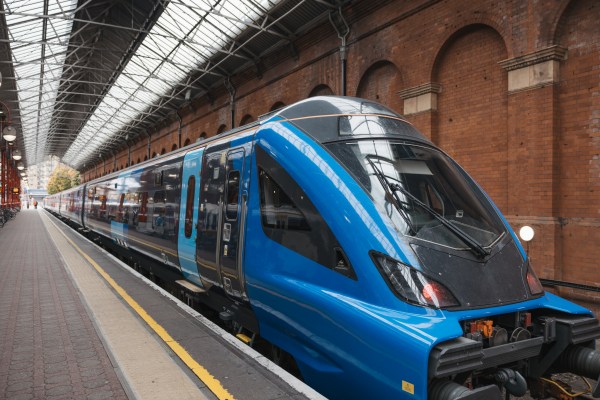
These three paragraphs are from the press release and add more details.
Chiltern Railways today (Tuesday 14 October) showcased for the first time its newest (Mark 5A) trains, set to add 10,000 more seats for customers each weekday from December 2026.
The trains, to be introduced between London to West Midlands from early 2026, will enable Chiltern to deliver more capacity across each of its West Midlands, Aylesbury, and Oxford routes as part of the operator’s efforts to deliver better journeys for customers.
The newest fleet will consist of 13 modern trains set to transform customer journeys during 2026. The trains will replace Chiltern’s oldest carriages, which are nearly 50 years old, with state-of-the-art equivalents, and provide a significant improvement to the on-board experience.
Today, I also received an update from Modern Railways, which was entitled Chiltern Railways Mk 5As To Enter Traffic Early Next Year, and included this delivery schedule.
From December 2026 there will be ten Mk 5A sets in traffic each day, with one ‘hot spare’ and one undergoing maintenance. That leaves one extra set which, CR has suggested, could eventually be pressed into traffic.
I have a few thoughts.
How Do The Trains Compare Physically?
These are basic figures for the two different types of train sets.
- The current Mark 3 are five-car sets of 23 metres coaches, that weigh about 36 tonnes. The driving van trailer is 18.83 metres and 43.7 tonnes
- The future Mark 5A are four-car sets of 22.2 metres coaches, that weigh about 43 tonnes. The driving trailer is 22.37 metres and 43 tonnes.
Lengths and weights of various sets will be as follows.
- Mark 3 – five-car and driving van trailer – 133.83 metres and 223.7 tonnes.
- Mark 5A – four-car and driving trailer – 111.17 metres and 215 tonnes
- Mark 5A – five-car and driving trailer – 155.57 metres and 258 tonnes
Note.
- Chiltern Railways and TransPennine Express use the same Class 68 locomotives.
- The five-car Mark 3 and the four-car Mark 5A sets are quite similar in length and weight
- This could mean that both sets would perform similarly with the same locomotives on the same route.
- I wouldn’t be surprised that the new Platform 4 at Birmingham |Snow Hill station will be able to handle all configurations.
I almost feel that when CAF designed the Mark 5A sets for TransPennine Express, they also had Chiltern in mind as another possible sale.
How Many Trains Would Be Needed To Run Between London Marylebone And Birmingham?
Consider.
- Trains currently run half-hourly on the route between 06:00 to 23:30, which is up to 36 services per day.
- When Platform 4 is operational at Birmingham Snow Hill station, all services could probably stop at both Birmingham Moor Street and Birmingham Snow Hill stations.
- A round trip between London Marylebone and Birmingham Snow Hill stations currently takes about five hours.
I’m fairly certain that to run a half-hourly core service would need ten trains.
Could Chiltern Develop Another Network On The Other Side Of Birmingham?
Consider.
- Trains could run twice an hour from 06:00 to 23:30, which is up to 36 services per day.
- When Platform 4 is operational at Birmingham Snow Hill station, all services could probably stop at both Birmingham Moor Street and Birmingham Snow Hill stations.
- Chiltern Railways already run several services a day to Stourbridge Junction.
- Chiltern Railways have run services to Kidderminster station in the past.
- Wrexham & Shropshire used to run locomotive-hauled Mark 3 four-car sets with driving van trailers, as far as Wrexham via Shrewsbury.
It looks to me, that with the right rolling stock configurations, Chiltern’s network can be developed on the other side of Birmingham.
- Destinations could include Stourbridge Junction, Kidderminster, Shrewsbury, Wolverhampton, Chirk, Ruabon and Wrexham General.
- Some services would need longer trains.
Obviously services would only be run if they were viable.
Would It Help Growth In A Town Or Area, If It Had A Rail Connection To London And/Or The Nearest Major City?
I know Lincoln is on the other side of the country, but I asked Google AI if Lincoln’s rail link to London has brought growth to the city and received this answer.
Yes, Lincoln’s rail link to London has brought significant growth by improving tourism, business travel, and student mobility, and is expected to spur further economic benefits through faster journey times and increased services. The direct link has made Lincoln more accessible for visitors and is a key part of the city’s long-term strategy for economic growth and development.
That was fairly definite.
How would that apply to an extended Chiltern Main Line.
- Politicians are always saying growth is important.
- An extended Chiltern Main Line servicewould improve connections of a lot of places to London and Birmingham.
- Shrewsbury is the easiest connection for West Wales.
- Surely a rail connection to a major city, might tempt someone to open a branch or a new factory.
Would a rail service make people feel more included?
Direct Rail Service Plan Supported By PM
The title of this post, is the same as that of this article on the BBC.
This is the sub-heading.
Plans for a new passenger rail service running direct trains between north Wales, the West Midlands and London have received support from the prime minister.
These three paragraphs add detail to the story.
A new open-access rail operator, external, called the Wrexham, Shropshire and Midlands Railway (WSMR), has been formed, offering passengers in Wrexham, as well as Gobowen, Shrewsbury, Walsall and Coleshill, a direct link with the capital.
Speaking in the Commons, Shrewsbury’s Labour MP Julia Buckley asked Sir Keir Starmer if he would support the provider’s application.
The prime minister responded, saying he would be “delighted to make sure the MP and other interested MPs meet with the rail minister to put their case forward”.
He didn’t actually say he supported the application, but then lawyers are careful with words, as every syllable costs money.
I have a few thoughts on this service.
The North Wales Metro
The North Wales Metro was announced today and I wrote about it in £2.1bn North Wales Rail Overhaul Plans Unveiled.
The Wrexham, Shropshire and Midlands Railway connects the North Wales Metro to Gobowen, Shrewsbury, Wolverhampton, Coleshill and London Euston.
Will The Trains Be Hydrogen Powered
In Alstom And Eversholt Rail Sign An Agreement For The UK’s First Ever Brand-New Hydrogen Train Fleet, I reported how Alstom could be going to build a fleet of hydrogen trains in Derby.
I just wonder, if Alstom are going to create a hydrogen train with this specification.
- Five cars
- 125 mph top speed
- Ability to use electrification, where it exists.
- Sufficient range on hydrogen to cover the non-electrified section of the route between Wrexham General and Wolverhampton.
- Wrexham General and Wolverhampton is just under sixty miles and takes an hour and six minutes.
As the fastest trains between London Euston and Walverhampton take one hour and forty-nine minutes, trains would take just under three hours between London Euston and Wrexham General.
I rode an Alstom hydrogen-powered train in Germany in March 2019 and wrote My First Ride In An Alstom Coradia iLint.
I took this picture at the time.

Alstom certainly have all the technology to build a 125 mph hydrogen-powered train, that can use electrification.
Where Would A Hydrogen Train Be Refuelled?
I suspect, that as the train would probably have a range of around a thousand kilometres, it could fill up overnight at Wrexham.
The hydrogen could be sourced from Runcorn or it might even be generated at the depot.
Would A Hydrogen Train Attract Passengers?
If the hydrogen-powered train were to be mouse-quiet like Wrightbus’s hydrogen buses, I believe it would.
Key Rail Route To London Scrapped A Year Ago Could Return – Here’s Why
The title of this post, is the same as that of this article on the Shropshire Star.
This is the sub-heading.
A key railway line to London that was scrapped a year ago, could be set for a return.
This is said in the article.
South Shropshire MP Stuart Anderson is among those who has thrown his support behind plans to restore direct rail services to London, after Avanti ceased to operate the route almost a year ago in June 2024.
On March 12, Mr Anderson met with Wrexham, Shropshire and Midlands Railway (WSMR) who have developed the plans.
If their application is approved, it would see the return of direct services between Wrexham and London via Shropshire. WSMR, the aspirant open access operator, plans to deliver five daily train services between the county and capital city.
It’s only sketchy information and given the Government’s lukewarm support for open access services, I don’t hold out much hope, especially as Stuart Anderson is a Conservative MP.
Alstom Plans To Operate Its Own Passenger Train Service In The UK For The First Time
The title of this post, is the same as that of this press release from Alstom.
These two bullet points, act as sub-headings.
- Alstom is partnering with SLC Rail to form a new open access rail operation between North Wales, Shropshire, the Midlands and London
- Formal application now being submitted to the Office of Rail and Road (ORR) with passenger service sought from 2025
These are the first three paragraphs.
Alstom, global leader in smart and sustainable mobility, plans to operate a new passenger rail service across England and Wales. Working in partnership with consultancy SLC Rail, the open access operation will be known as Wrexham, Shropshire and Midlands Railway (WSMR).
As the country’s foremost supplier of new trains and train services, and a leading signalling and infrastructure provider, Alstom will operate its own rail service in the UK for the first time.
WSMR is seeking to introduce direct connectivity to and from North Wales, Shropshire, the Midlands and London that doesn’t exist today, linking growing communities and businesses, and making rail travel more convenient, enjoyable and affordable.
I can’t remember a service proposal being put forward by a train manufacturer since the privatisation of UK’s railways in the 1990s.
This is some more information and my thoughts.
The Route
This paragraph from the press release, describes the route.
The proposal envisages a service of five trains per day in each direction Monday to Saturday, with four travelling both ways on Sundays. Trains will stop at Gobowen, Shrewsbury, Telford Central, Wolverhampton, Darlaston, Walsall, Coleshill Parkway, Nuneaton and Milton Keynes on their journey between Wrexham General and London Euston.
Note.
- The proposed call at the new Darlaston station.
- The route is electrified between Euston and Nuneaton and Walsall and Wolverhampton.
- Much of the route North of Nuneaton is on tracks with a maximum speed of 70-80 mph.
The route is in these sections.
- Euston and Nuneaton – 96.7 miles – electrified
- Nuneaton and Walsall – 26.7 miles
- Walsall and Wolverhampton – 6.7 miles – electrified
- Wolverhampton and Shrewsbury – 29.7 miles
- Shrewsbury and Wrexham General – 30.3 miles
That is a total of 190.1 miles or 380.2 miles round trip.
I suspect that the service will need bi-mode trains.
Should The Service Call At Wellington?
This article on the BBC is entitled Rail Company Urged Not To Forget Wellington.
This is the sub-heading.
A rail company which is bidding to bring back a direct service between Shropshire and London has been urged not to forget a town.
These are the first three paragraphs.
Wrexham, Shropshire and Midlands Railway said it was preparing to apply to the government to run the service.
Trains would stop at Gobowen, Shrewsbury, Telford, Wolverhampton, Walsall, Coleshill and Nuneaton.
But Telford and Wrekin Council said the omission of Wellington as a stop was “short-sighted”.
Although Wellington is smaller than than Shrewsbury and Telford, it looks like a bit of analysis would provide a solution, that would be acceptable for all parties.
The Trains
In the press release, this phrase is used.
positive impact to both communities and the environment.
I can’t see any more electrification being erected on the route, so the trains will need to be bi-mode.
- Bi-mode diesel trains won’t have a positive impact on the environment.
- As the route between Wolverhampton and Wrexham General is not electrified, a battery-electric train would need a range of at least 60 miles or 120 miles for the round trip, if there were no charging at Wrexham General.
- But Alston are developing a Hydrogen Aventra, which I wrote about in Alstom And Eversholt Rail Sign An Agreement For The UK’s First Ever Brand-New Hydrogen Train Fleet.
So could Alstom be using this route to trial and showcase their new Hydrogen Aventra?
I believe that the route will be very suitable for a hydrogen train.
- Changeover between electric and hydrogen power can always take place in a station.
- All hydrogen refuelling could be performed at one end of the route.
- A large proportion of the UK’s green hydrogen is produced by INEOS at Runcorn, which is less than fifty miles from Wrexham. A refuelling tanker could supply the train, as they do on some hydrogen routes in Germany.
- London has only small amounts of hydrogen infrastructure.
I suspect that refuelling will be done at the Wrexham end of the route.
This Alstom visualisation shows the train.
But it is only a three-car train.
- That is not a problem, as Aventras can be lengthened as required to the length required for the number of passengers.
- Some Aventras, like the Class 701 trains for South Western Railway, have even been ordered as ten-car trains.
- Two three-car trains may also be the ideal capacity, running as a six-car train.
So capacity will not be a problem.
If it is assumed that Alstom’s trains for the WSMR route, can use the overhead wires, where they exist, each trip between Wrexham General and London will require a total of 86.7 miles or 140 kilometres of running on hydrogen.
- A round trip will therefor require 280 kilometres of running on hydrogen.
- But between London Euston and Nuneaton, it will just be another electric train.
- I suspect that like the similar Class 730 train, it will be capable of 110 mph on the West Coast Main Line.
- Alstom’s Coradia iLint hydrogen train has a range of around a 500-800 kilometres on hydrogen.
- The WSMR trains will probably be 100 mph trains using hydrogen on a route, where that speed is possible.
So if a Hydrogen Aventra has a similar range to the Coradia iLint, it will be able to do two round trips before refuelling.
How Long Will The Service Take?
West Midlands Trains, who use the similar Class 730 trains take one hour and eleven minutes between London Euston and Nuneaton with a single stop at Milton Keynes Central.
As the WSMR trains will use the same route, I suspect the same time can be used.
As Nuneaton and Wrexham General are 93.4 miles apart a table can be created showing the time for the rest of the journey for different average speeds
- 50 mph – 1 hour 52 minutes – 3 hours 3 minutes.
- 60 mph – 1 hour 33 minutes – 2 hours 44 minutes.
- 70 mph – 1 hour 20 minutes – 2 hours 31 minutes.
- 80 mph – 1 hour 10 minutes – 2 hours 21 minutes.
Note.
- The first time is the Nuneaton and Wrexham General time and the second time is the overall journey time.
- Typical Avanti West Coast services via Crewe and a change at Chester, take between two-and-a-half and three hours.
I suspect, if the WSMR trains can keep the speed up through the Midlands, that two hours and 30 minutes could be possible.
Could The Hydrogen Aventra Run At 125 mph Under The Wires?
In March 2018, I wrote Bombardier Bi-Mode Aventra To Feature Battery Power, which was based on this article in Rail Magazine.
These are a few points from the article.
- Development has already started.
- Battery power could be used for Last-Mile applications.
- The bi-mode would have a maximum speed of 125 mph under both electric and diesel power.
- The trains will be built at Derby.
- Bombardier’s spokesman said that the ambience will be better, than other bi-modes.
- Export of trains is a possibility.
- Bombardier’s spokesman also said, that they have offered the train to three new franchises. East Midlands, West Coast Partnership and CrossCountry.
Have Alstom looked at what they bought from Bombardier and decided the following train is possible?
- Five-cars or what the customer needs.
- 125 mph under the wires.
- Running on hydrogen away from the wires.
- 100 mph on tracks without electrification.
Obviously, maximum speeds would depend on track limits.
Looking at 125 mph Avanti West Coast trains that have a Milton Keynes stop between London Euston and Nuneaton, they can reach Nuneaton ten minutes quicker than West Midlands Trains 110 mph Class 730 trains.
Two hours and 30 minutes between London Euston and Wrexham is looking increasingly possible.
Are we seeing an audacious proposal from Alston to sell new trains to CrossCountry and a host of other franchises?
Conclusion
London Euston and Wrexham would appear to be an excellent route for an Aventra-based hydrogen train.
- It can probably cruise at 110 mph on the West Coast Main Line between London Euston and Nuneaton.
- All switchovers between electrification and hydrogen can be performed in electrified stations.
- Hydrogen would only be used North of Nuneaton.
- The train can be refuelled at Wrexham General, with fuel supplied from INEOS at Runcorn.
- Given the typical 1000 km. range of hydrogen trains, a train can probably do three round trips without refuelling.
I can see this being a service with an excellent operational record.
The Diesel Power Of The Class 805 Trains
Avanti West Coast’s new Class 805 trains, will probably start running between London Euston and Chester, Shrewsbury and North Wales before the end of the year.
But will they have the 560 kW engines of the Class 800 trains or the the 700 kW engines of the Class 802 trains?
On this page of Eversholt Rail’s web site, there is a detailed specification for a Class 802 train.
It says these trains have a top speed of 110 mph on diesel.
But it also says this about the design of the trains.
They have been designed to meet the operational requirements of the West of England route and are used on services out of London Paddington to Plymouth and Penzance.
The class 802 is almost identical to the class 800, the differences are that class 802s have a higher rated engine output to tackle the gradients through Devon and Cornwall, and a superior diesel range to provide the IET experience to the wider Greater Western Network, they also have a larger brake resistor which reduces brake pad usage and requires less maintenance.
Wikipedia also says that these are the diesel engine sizes in the three main classes of these Hitachi AT 300 trains.
- Class 800 train – 560 kW – Three engines for five cars
- Class 801 train – 560 kW – One emergency engine for five cars
- Class 802 train – 700 kW – Three engines for five cars
- Class 810 train – 735 kW – Four engines for five cars
All these four trains have similar bodyshells and running gear, so I suspect that to run at similar cruising speeds, similar amounts of power will be needed.
If the Class 802 train has a speed of 110 mph on diesel, then a rough estimate of the cruising speed of a train with the 560 kW engines can be estimated by doing this simple calculation. Note that air resistance is proportional to the square of the speed.
Square root (110*110 *560/700) = 98.4 mph
I have looked on OpenRailwayMap at all the tracks to the West of Wolverhampton, where these trains will run and the highest maximum operating speed I can find is 90 mph.
As the Class 805 trains have a reprofiled nose, which could be more aerodynamic, they may be able to cruise at 90 mph.
I believe that a train with three 560 kW engines will suit Avanti West Coast purposes well.
What Is The Operating Speed Of The Class 810 trains?
I can use a similar calculation to estimate the maximum operating speed of the Class 810 trains, that will operate on the Midland Main Line.
Consider.
- The Class 802 train has a total power of 2100 kW
- The Class 810 train has a total power of 2940 kW
- The Class 810 train with only three working engines has a total power of 2205 kW
I can estimate the cruising speed by doing this simple calculation, which is similar to the one for the Class 805 train.
Square root (110*110 *2940/2100) = 130 mph
I can also do it for a train running on three engines.
Square root (110*110 *2205/2100) = 113 mph
I looks to me, that the following is possible.
- As Class 810 trains can achieve the maximum speed of 125 mph on both diesel and electric power, the timetable is independent of the progress of the electrification.
- If the 125 mph sections are ignored, the fastest sections of line have a maximum speed of 110 mph, which could be possible on three engines.
- North of the electrification, where the maximum speed is only 110 mph, engines could be selectively rested to avoid overheating.
Four engines give a lot of interesting options.
I can’t wait to take a ride.
Could The Class 810 Trains Be Fitted With Batteries?
When, the electrification reaches Market Harborough station, there will be no 125 mph sections on the Midland Main Line, which are not electrified.
This Hitachi infographic shows the Hitachi Intercity Tri-Mode Battery Train.

A Class 810 version of this train would have three diesel engines and one battery pack.
- It would have all the features of the infographic.
- My calculations give it a top speed of 113 mph on a route, where the maximum speed North of the electrification is 110 mph.
- I also suspect, it could bridge any small gaps in the electrification.
It would have the very positive effects of saving fuel and cutting pollution in stations.
Reopening The Oswestry – Gobowen Line
On October 27th this Beeching Reversal Project was given £50,000 to build a case for reopening.
These are my thoughts.
Gobowen Station
Gobowen station appears to be a fine station.
- It is Grade II Listed.
- It has two platforms.
- It is on the Shrewsbury-Chester Line.
- Transport for Wales run trains to Birmingham New Street, Cardiff Central, Chester, Holyhead and Shrewsbury.
- Avanti West Coast will start running services to and from London Euston via Wrexham in December 2022.
Wikipedia says this about the future of the station.
Gobowen station may become the northern terminus of the proposed Cambrian Heritage Railways line to Llynclys, Pant and Blodwel via Oswestry. Shropshire Council was to acquire the coal yard at Gobowen for railway-related uses, including car parking for the station. If the plans are fully realised, the station would have three platforms, one of which would be for the Heritage Railway.
It does look as if, Shropshire Council have got the money for a full study.
This Google Map shows Gobowen station.

Note.
- The two tracks of the Chester-Shrewsbury Line each have a platform.
- Step-free access is by the level crossing, which is at the North end of the station.
- It looks like it would be space to convert the Northbound platform into an island platform, where the Western platform face would be for the heritage trains.
This second Google Map shows the tracks at the South end of Gobowen station.
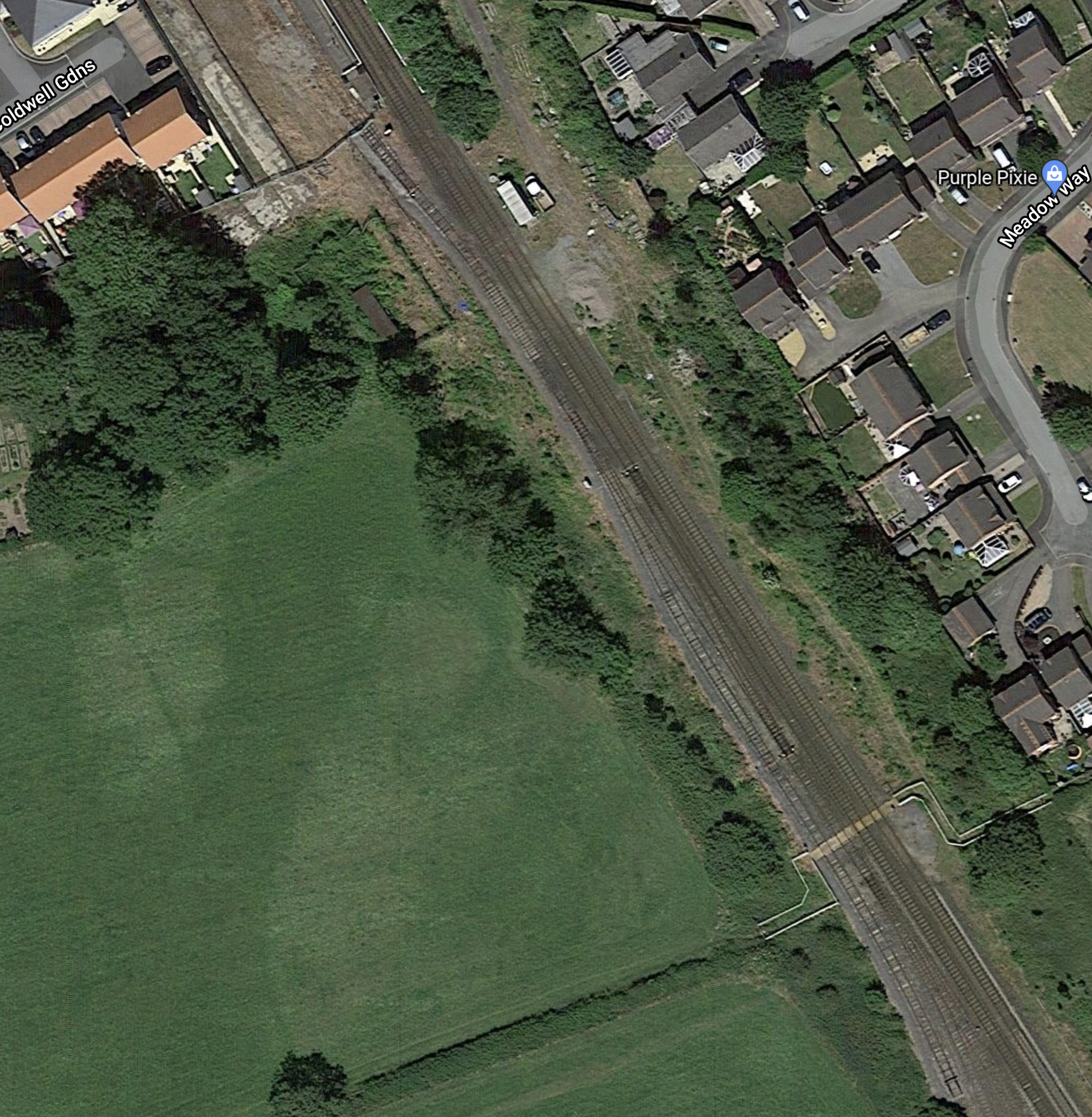
Note.
There is a set of points to allow trains to access a third platform at Gobowen station.
The single-track line to Oswestry branches off to the West at the bottom of the map.
It would appear that a bay platform at Gobowen station can be created to handle trains to Oswestry.
Oswestry Station
Oswestry station appears to be another fine station.
- It is also Grade II Listed.
- It has just a single platform.
- It appears to be owned by the local authority.
This Google Map shows the station.

Note.
- The station is the large building with the chimneys in the South-East corner of the map.
- The single platform is behind it.
- The platform is long enough to take a 1200 metre long train.
This station would make an ideal terminus.
The Track Between Oswestry And Gobowen
The track is single-track with a couple of foot crossings, so I don’t think it will need much to bring it up to a modern standard.
A Shuttle Service Between Oswestry And Gobowen
I suspect a two-car shuttle train between the two stations would suffice for most of the day.
Transport for Wales have some Class 230 trains and these would be ideal. They could even be battery-electric trains if a battery charging system were to be installed at one station.
Could Avanti West Coast Run A Service To London?
It looks like Avanti West Coast’s Class 805 trains could run along the line between Gobowen and Oswestry.
So could Avanti’s planned service to Gobowen terminate at Oswestry instead?
It would all depend on the passenger forecasts and actual numbers
Could Avanti West Coast Run A Battery-Electric Service To London?
Consider.
- Oswestry is a town of 17,500 people, so probably has a reasonable electricity supply, especially if it were to be backed up by a battery.
- The amount of renewable electricity produced over the border in Wales is only going to grow.
- There is plenty of space at Oswestry to put in a charging system to replace the batteries.
Distances are as follows.
- Crewe and Chester – 21.1 miles
- Chester and Gobowen – 24.6 miles
- Gobowen and Oswestry – 3.3 miles
This is a total distance of 49 miles.
Avanti West Coast have ordered thirteen bi-mode Class 805 trains, which will replace the diesel Class 221 trains currently working between London Euston and Chester. Holyhead and Shrewsbury.
- They will run at 125 mph between Euston and Crewe using electric power.
- If full in-cab digital signalling were to be installed on the electrified portion of the route, they may be able to run at 140 mph in places under the wires.
- They will use diesel power on the North Wales Coast Line to reach places like Chester, Holyhead and Wrexham.
- According to an article in Modern Railways, the Class 805 trains could be fitted with batteries.
I wouldn’t be surprised that when they are delivered, they are a version of the Hitachi’s Intercity Tri-Mode Battery Train, the specification of which is shown in this Hitachi infographic.
Note.
- I suspect that the batteries will be used to handle regenerative braking on lines without electrification, which will save diesel fuel and carbon emissions.
- The trains accelerate faster, than those they replace.
- The claimed fuel and carbon saving is twenty percent.
- It is intended that these trains will be introduced next year.
But Hitachi have not given any predictions of the range of these trains on battery power alone.
However, they do claim a battery range of 56 miles for the Hitachi Regional Battery Train, which is based on similar technology.
I believe it would be possible to run a zero-carbon London Euston and Oswestry service.
- The trains would be Class 805 trains fitted with batteries.
- Trains could stop at Milton Keynes Central, Lichfield Trent Valley, Stafford, Crewe, Chester, Wrexham General and Gobowen.
- Trains would use electrification between London Euston and Crewe.
- Trains would recharge their batteries South of Crewe and at Oswestry.
I doubt that a battery-electric zero-carbon train serving Cheshire, Shropshire and North-East Wales would have a negative effect on the area.
Just as Hull and Lincoln seem to be moving towards a frequency of one train per two hours from London, I wonder if this service could ever attain the same frequency.
Onward From Oswestry
Cambrian Heritage Railways are planning to run services past Oswestry on their heritage railway.
Will this be a good idea?
Where Now For First Group?
First Group are a shareholder in Avanti West Coast.
They also own Lumo, who last week launched their open-access service between London and Edinburgh. Their marketing is all about being green and sustainable.
I just wonder if a battery-electric service to Gobowen is successful, they will apply this model all over the group.
Hull Trains service between London and Hull is an obvious possibility for a battery-electric zero-carbon service.
Conclusion
It looks to me, that reopening of the Oswestry – Gobowen Line opens up other possibilities.
Electrifying Wales
I would not be surprised to learn that Wales wants to decarbonise their railways.
At present, Wales only has the following electrified railways either in operation or under construction.
- The South Wales Main Line between the Severn Tunnel and Cardiff.
- The South Wales Metro based on local railways around Cardiff and Newport is being created and will be run by electric trains.
There is no more electrification planned in the future.
Hitachi’s Specification For Battery Electric Trains
Recently, Hitachi have released this infographic for their Regional Battery Train.

This gives all the information about the train and a definitive range of 90 km or 56 miles.
The Welsh Rail Network
If you look at the network of services that are run by Transport for Wales Rail Services, they connect a series of hub stations.
Major hubs include the following stations.
- Cardiff Central – Electrified
- Chester
- Hereford
- Shrewsbury
- Swansea
Smaller hubs and termini include the following stations.
- Aberystwyth
- Birmingham International – Electrified
- Birmingham New Street – Electrified
- Blaenau Ffestiniog
- Carmarthen
- Crewe – Electrified
- Fishguard Harbour
- Hereford
- Holyhead
- Llandudno Junction
- Manchester Airport – Electrified
- Manchester Piccadilly – Electrified
- Machynlleth
- Milford Haven
- Newport – Electrified
- Pembroke Dock
Running Welsh Routes With Electric Trains
These routes make up the Welsh rail network.
Chester And Crewe
Consider.
- The route between Chester and Crewe is without electrification.
- Crewe and Chester are 21 miles apart.
I believe that if a battery-electric train, with a range of 56 miles, can leave Chester and Crewe with full batteries, that it will be possible to run between Chester and Crewe stations.
Chester And Holyhead via Llandudno Junction
Consider.
- All services between Llandudno Junction and England call at Chester.
- All services running to and from Holyhead call at Llandudno Junction.
- The route between Chester and Holyhead is without electrification.
- Chester and Llandudno Junction are 54 miles apart.
- Llandudno Junction and Holyhead are 40 miles apart.
I believe that if a battery-electric train with a range of 56 miles can leave Chester, Llandudno Junction and Holyhead with full batteries, that it will be possible to run between Chester and Holyhead stations.
Chester And Liverpool Lime Street
Consider.
- The route between Runcorn and Liverpool Lime Street is electrified.
- The route between Chester and Runcorn is without electrification.
- Chester and Runcorn are 14 miles apart.
I believe that if a battery-electric train, with a range of 56 miles, can leave Chester and Runcorn with full batteries, that it will be possible to run between Chester and Liverpool Lime Street stations.
Chester And Manchester Airport
Consider.
- The route between Warrington Bank Quay and Manchester Airport is electrified.
- The route between Chester and Warrington Bank Quay is without electrification.
- Chester and Warrington Bank Quay are 18 miles apart.
I believe that if a battery-electric train, with a range of 56 miles, can leave Chester and Warrington Bank Quay with full batteries, that it will be possible to run between Chester and Manchester Airport stations.
Chester And Shrewsbury
Consider.
- The route between Chester and Shrewsbury is without electrification.
- Chester and Shrewsbury are 42 miles apart.
I believe that if a battery-electric train with a range of 56 miles, can leave Shrewsbury and Chester with full batteries, that it will be possible to run between Chester and Shrewsbury stations.
Llandudno And Blaenau Ffestiniog
Consider.
- The route between Llandudno and Blaenau Ffestiniog is without electrification.
- Llandudno and Blaenau Ffestiniog are 31 miles apart.
I believe that if a battery-electric train with a range of 56 miles, can leave Llandudno and Blaenau Ffestiniog with full batteries, that it will be possible to run between Llandudno and Blaenau Ffestiniog stations.
Machynlleth And Aberystwyth
Consider.
- The route between Machynlleth and Aberystwyth is without electrification.
- Machynlleth and Aberystwyth are 21 miles apart.
I believe that if a battery-electric train with a range of 56 miles, can leave Machynlleth and Aberystwyth with full batteries, that it will be possible to run between Machynlleth and Aberystwyth stations.
Machynlleth And Pwllheli
Consider.
- The route between Machynlleth and Pwllheli is without electrification.
- Machynlleth and Pwllheli are 58 miles apart.
I believe that if a battery-electric train with a range of upwards of 58 miles, can leave Machynlleth and Pwllheli with full batteries, that it will be possible to run between Machynlleth and Pwllheli stations.
Machynlleth And Shrewsbury
Consider.
- The route between Machynlleth and Shrewsbury is without electrification.
- Machynlleth and Shrewsbury are 61 miles apart.
I believe that if a battery-electric train with a range of upwards of 61 miles, can leave Machynlleth and Shrewsbury with full batteries, that it will be possible to run between Machynlleth and Shrewsbury stations.
Shrewsbury and Birmingham International
Consider.
- The route between Birmingham International and Wolverhampton is electrified.
- The route between Shrewsbury and Wolverhampton is without electrification.
- Shrewsbury and Wolverhampton are 30 miles apart.
I believe that if a battery-electric train, with a range of 56 miles, can leave Shrewsbury and Wolverhampton with full batteries, that it will be possible to run between Shrewsbury and Birmingham International stations.
Shrewsbury And Cardiff Central via Hereford
Consider.
- All services between Cardiff Central and Shrewsbury call at Hereford.
- The route between Cardiff Central and Newport is electrified.
- The route between Newport and Shrewsbury is without electrification.
- Shrewsbury and Hereford are 51 miles apart.
- Hereford and Newport are 44 miles apart.
I believe that if a battery-electric train, with a range of 56 miles, can leave Shrewsbury, Hereford and Newport with full batteries, that it will be possible to run between Shrewsbury and Cardiff Central stations.
Shrewsbury And Crewe
- The route between Shrewsbury and Crewe is without electrification.
- Shrewsbury and Crewe are 33 miles apart.
I believe that if a battery-electric train with a range of upwards of 61 miles, can leave Shrewsbury and Crewe with full batteries, that it will be possible to run between Shrewsbury and Crewe stations.
Shrewsbury and Swansea
Consider.
- The Heart of Wales Line between Shrewsbury and Swansea is without electrification.
- Shrewsbury and Swansea are 122 miles apart.
- Trains cross at Llandrindod and wait for up to eleven minutes, so there could be time for a charge.
- Shrewsbury and Llandrindod are 52 miles apart.
- Swansea and Llandrindod are 70 miles apart.
It appears that another charging station between Swansea and Llandrindod is needed
I believe that if a battery-electric train, with a range of 56 miles, can leave Shrewsbury, Swansea and the other charging station, with full batteries, that it will be possible to run between Shrewsbury and Swansea stations.
Swansea And Cardiff Central
Consider.
- The route between Swansea and Cardiff Central is without electrification.
- Swansea and Cardiff Central are 46 miles apart.
I believe that if a battery-electric train, with a range of 56 miles, can leave Swansea and Cardiff Central with full batteries, that it will be possible to run between Swansea and Cardiff Central stations.
Swansea And Carmarthen
Consider.
- The route between Swansea and Carmarthen is without electrification.
- Swansea and Carmarthen are 31 miles apart.
I believe that if a battery-electric train, with a range of 56 miles, can leave Swansea and Carmarthen with full batteries, that it will be possible to run between Swansea and Carmarthen stations.
Swansea And Fishguard Harbour
Consider.
- The route between Swansea and Fishguard Harbour is without electrification.
- Swansea and Fishguard Harbour are 73 miles apart.
- Tramins could top up the batteries during the reverse at Carmathen.
- Swansea and Carmarthen are 31 miles apart.
- Carmarthen and Fishguard Harbour are 42 miles apart.
I believe that if a battery-electric train, with a range of 56 miles, can leave Swansea, Carmathen and Fishguard Harbour with full batteries, that it will be possible to run between Swansea and Fishguard Harbour stations.
Swansea And Milford Haven
Consider.
- The route between Swansea and Milford Haven is without electrification.
- Swansea and Milford Haven are 72 miles apart.
- Tramins could top up the batteries during the reverse at Carmathen.
- Swansea and Carmarthen are 31 miles apart.
- Carmarthen and Milford Haven are 41 miles apart.
I believe that if a battery-electric train, with a range of 56 miles, can leave Swansea, Carmathen and Milford Haven with full batteries, that it will be possible to run between Swansea and Milford Haven stations.
Swansea And Pembroke Dock
Consider.
- The route between Swansea and Pembroke Dock is without electrification.
- Swansea and Pembroke Dock are 73 miles apart.
- Tramins could top up the batteries during the reverse at Carmathen.
- Swansea and Carmarthen are 31 miles apart.
- Carmarthen and Pembroke Dock are 42 miles apart.
I believe that if a battery-electric train, with a range of 56 miles, can leave Swansea, Carmathen and Pembroke Dock with full batteries, that it will be possible to run between Swansea and Pembroke Dock stations.
Other Routes
I have not covered these routes.
- Borderlands Line
- Cardiff Valley Lines, that will be part of the South Wales Metro
- Routes on the electrified South Wales Main Line, that are to the East of Cardiff.
The first will run between Chester and the electrified Merseyrail system and the others will be electrified, except for short stretches.
Stations Where Trains Would Be Charged
These stations will need charging facilities.
Aberystwyth
Aberystwyth station only has a single terminal platform.
I’ve not been to the station, but looking at pictures on the Internet, I suspect that fitting a charging facility into the station, wouldn’t be the most difficult of engineering problems.
Birmingham International
Birmingham International station is fully-electrified and ready for battery-electric trains.
Blaenau Fflestiniog
Blaenau Ffestiniog station has a single terminal platform.
My comments would be similar to what, I said for Aberystwyth station. I would hope a standard solution can be developed.
Cardiff
Cardiff station is fully-electrified and ready for battery-electric trains.
Chester
Chester station has two through platforms and one bay platform, that are used by Trains for Wales.
- The through platforms are bi-directional.
- The bay platform is used by services from Liverpool Lime Street and Manchester Airport and Piccadilly.
- The station is a terminus for Merseyrail’s electric trains, which use 750 VDC third-rail electrification.
- Some through services stop for up to seven minutes in the station.
This Google Map shows the station.
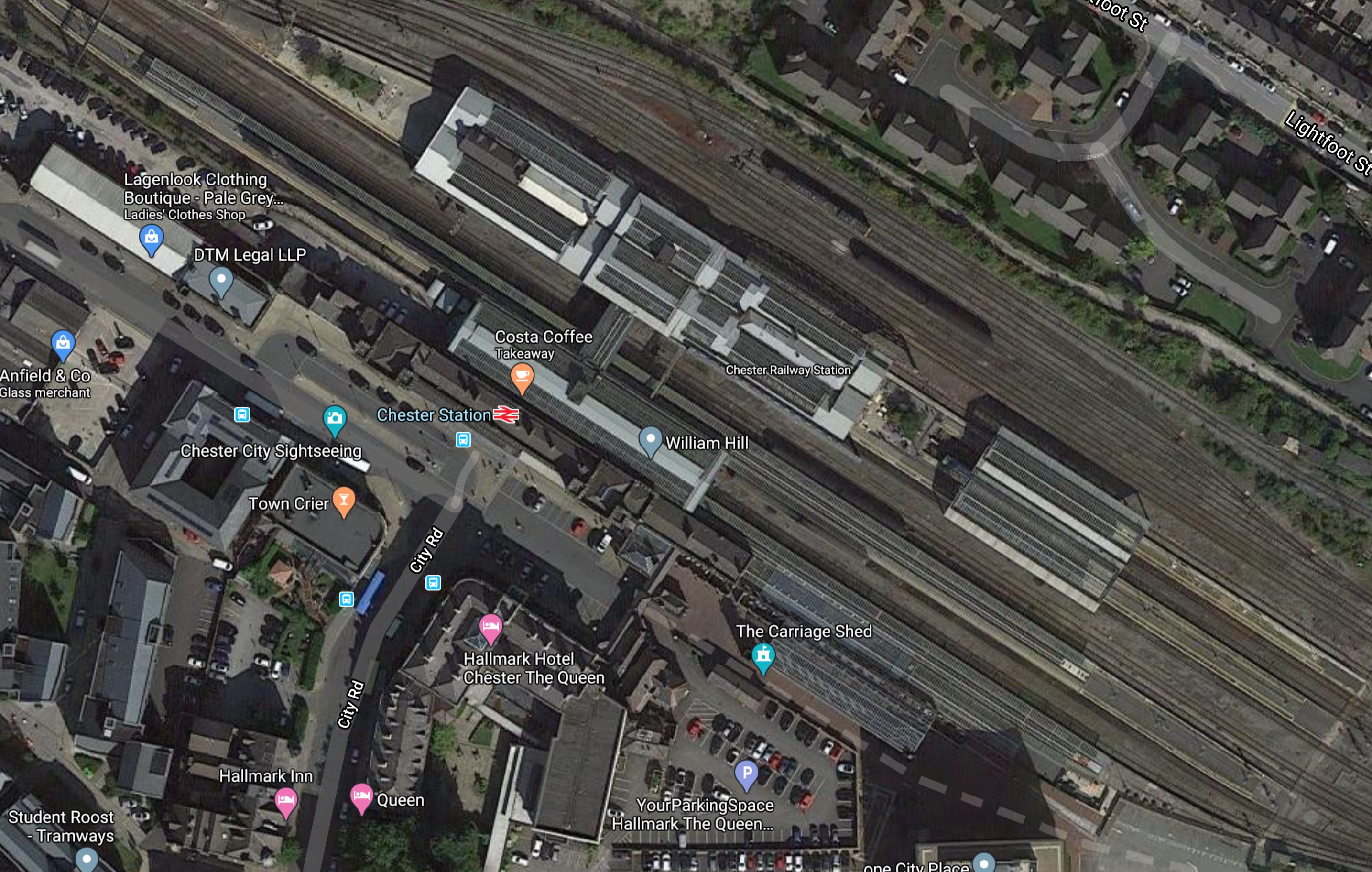
There is plenty of space.
The simplest way to charge trains at Chester would be to electrify the two through platforms 3 and 4 and the bay platform 1.
I would use 750 VDC third-rail, rather than 25 KVAC overhead electrification.
- I’m an engineer, who deals in scientifically-correct solutions, not politically-correct ones, devised by jobsworths.
- Maintenance staff at the station will be familiar with the technology.
- Station staff and passengers will know about the dangers of third-rail electrification.
- Trains connect and disconnect automatically to third-rail electrification.
- Trains don’t have to stop to connect and disconnect, so passing trains can be topped-up.
- Hitachi with the Class 395 train and Alstom with the Class 373 train, have shown even trains capable of 140 mph can be fitted with third-rail shoes to work safely at slower speeds on lines electrified using third-rail.
- Modern control systems can control the electricity to the third-rail, so it is only switched on, when the train completes the circuit.
I have a vague recollection, that there is an avoiding line at Chester station, so trains can go straight through. Perhaps that should be electrified too.
Carmarthen
Carmarthen station is a two platform station, with a rather unusual layout, that I wrote about in Changing Trains At Carmarthen Station.
I took these pictures when I passed through in 2016.



Note the unusual step-free crossing of the tracks.
This Google Map shows the layout at the station.
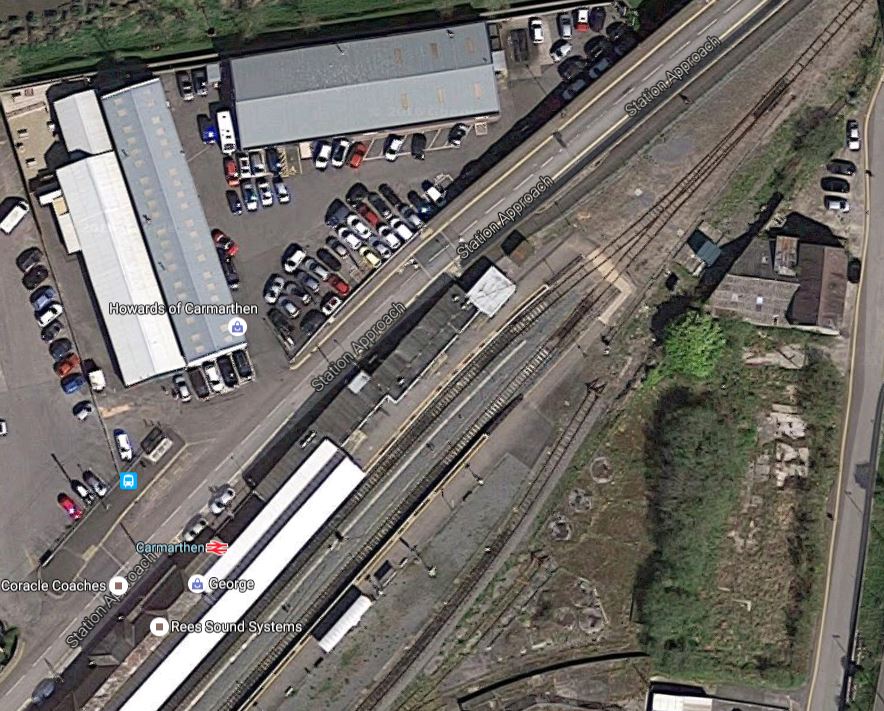
I believe it is another station, where third-rail electrification could be the solution.
- Most trains seem to reverse at the station, which gives time for a full charge.
- Others terminate here.
but would they still allow passengers to cross the line as they do now, whilst trains are being charged?
Crewe
Crewe station is fully-electrified.
- Trains for Wales seem to use Platform 6 for through trains and the bay Platform 9 for terminating trains.
- Both platforms appear to be electrified.
- Terminating trains appear to wait at least 9-11 minutes before leaving.
It does appear that Crewe station is ready for battery-electric trains.
Fishguard Harbour
Fishguard Harbour station only has a single terminal platform.
My comments would be similar to what, I said for Aberystwyth station. I would hope a standard solution can be developed.
Hereford
Hereford station has four through platforms.
This Google Map shows the station.
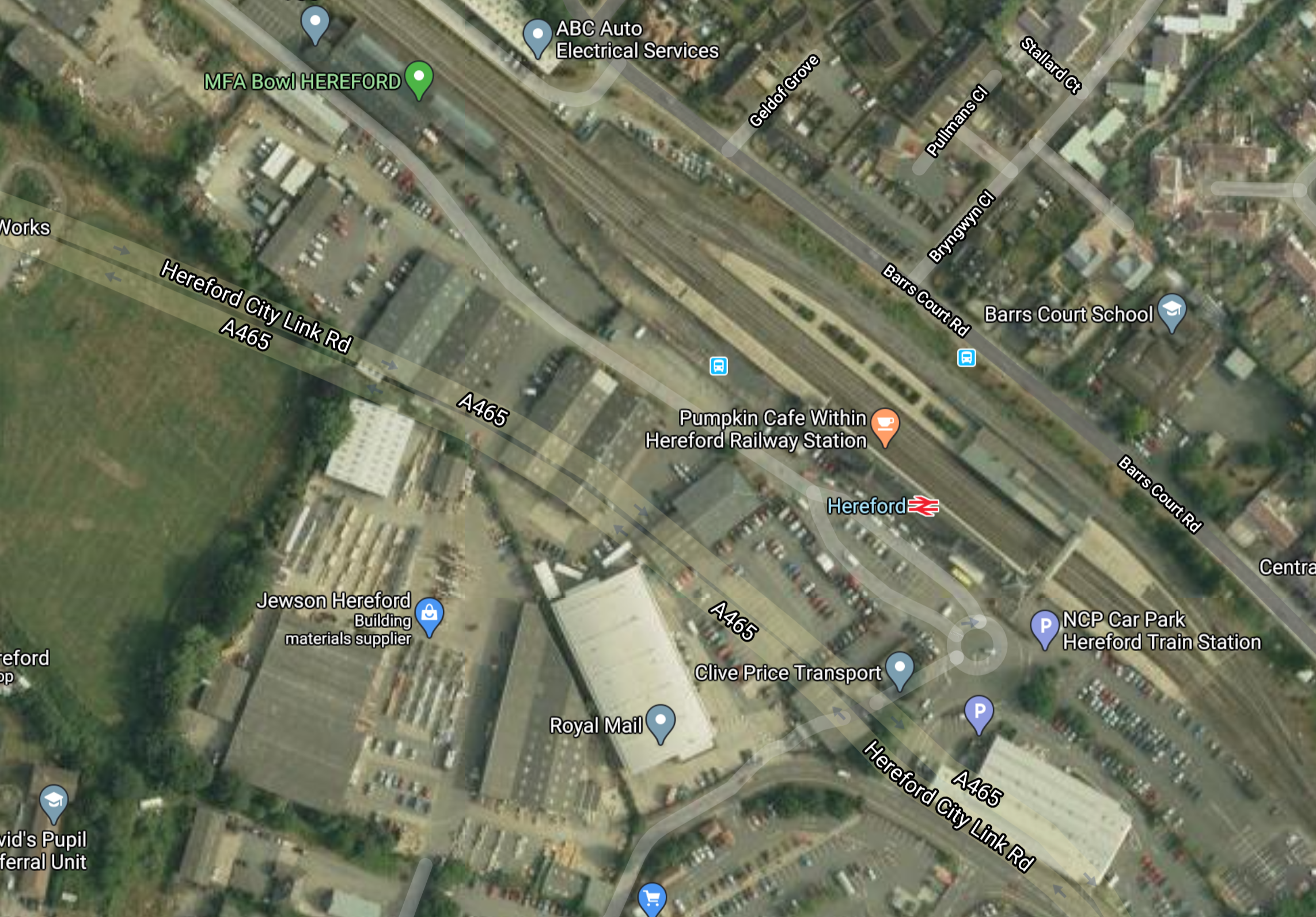
There is plenty of space.
As with Chester, I would electrify this station with 750 VDC third-rail equipment.
But the electrification wouldn’t be just for train services in Wales.
- West Midlands Trains, run an hourly service to Birmingham New Street and there is only a forty-one mile gap in the electrification between Hereford and Bromsgrove.
- Great Western Railway’s service to London, has a massive ninety-six mile run to the electrification at Didcot Junction, which could be bridged by installing charging facilities at Worcestershire Parkway and/or Honeybourne stations.
Both services have generous turnround times at Hereford, so would be able to leave fully-charged.
Distances from Hereford station are as follows.
- Abergavenny – 24 miles
- Bromsgrove – 41 miles
- Great Malvern – 21 miles
- Honeybourne – 48 miles
- Ludlow – 13 miles
- Newport – 44 miles
- Shrewsbury – 51 miles
- Worcester Parkway – 33 miles
Hereford station could be a serious battery-electric train hub.
Holyhead
Holyhead station has three terminals platforms.
My comments would be similar to what, I said for Aberystwyth station. I would hope a standard solution can be developed.
Liverpool Lime Street
Liverpool Lime Street station is fully-electrified and ready for battery-electric trains.
Llandrindod
Llandrindod station has two through platforms.
I took these pictures at the station as I passed through in 2016.

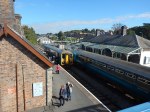


The Heart of Wales Line is certainly a route, that would benefit from larger trains. Zero-carbon battery-electric trains would surely fit well in the area.
This Google Map shows the station.
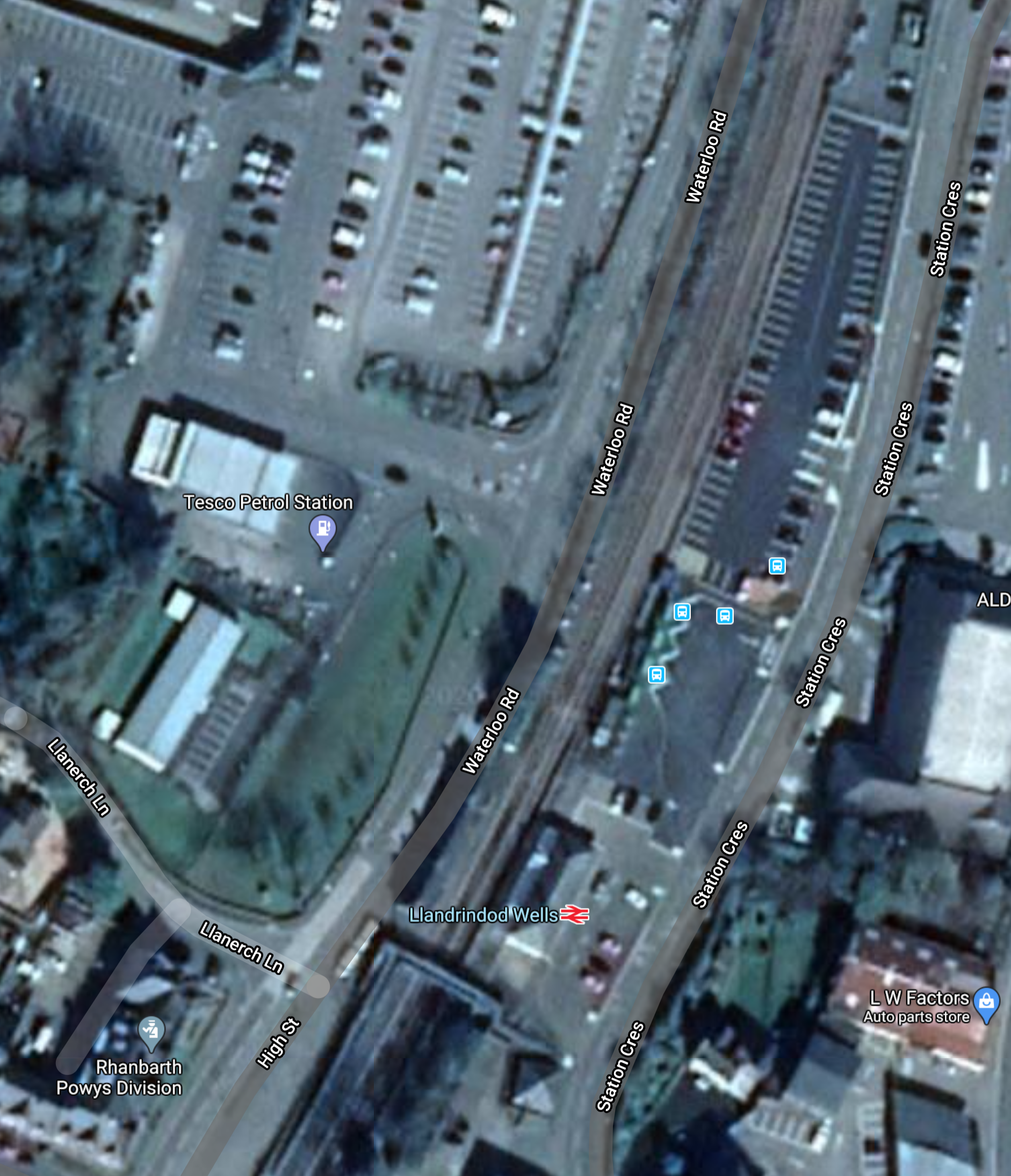
It would appear that, it is another station, that could be fitted with third-rail electrification to charge the trains.
Distances from Llandrindod station are as follows.
- Shrewsbury – 52 miles
- Llandovery – 27 miles
- Llanelli – 59 miles
- Swansea – 70 miles
It would appear that a second station with charging facilities or bigger batteries are needed.
Llandudno Junction
Llandudno Junction station has four platforms.
This Google Map shows the station.
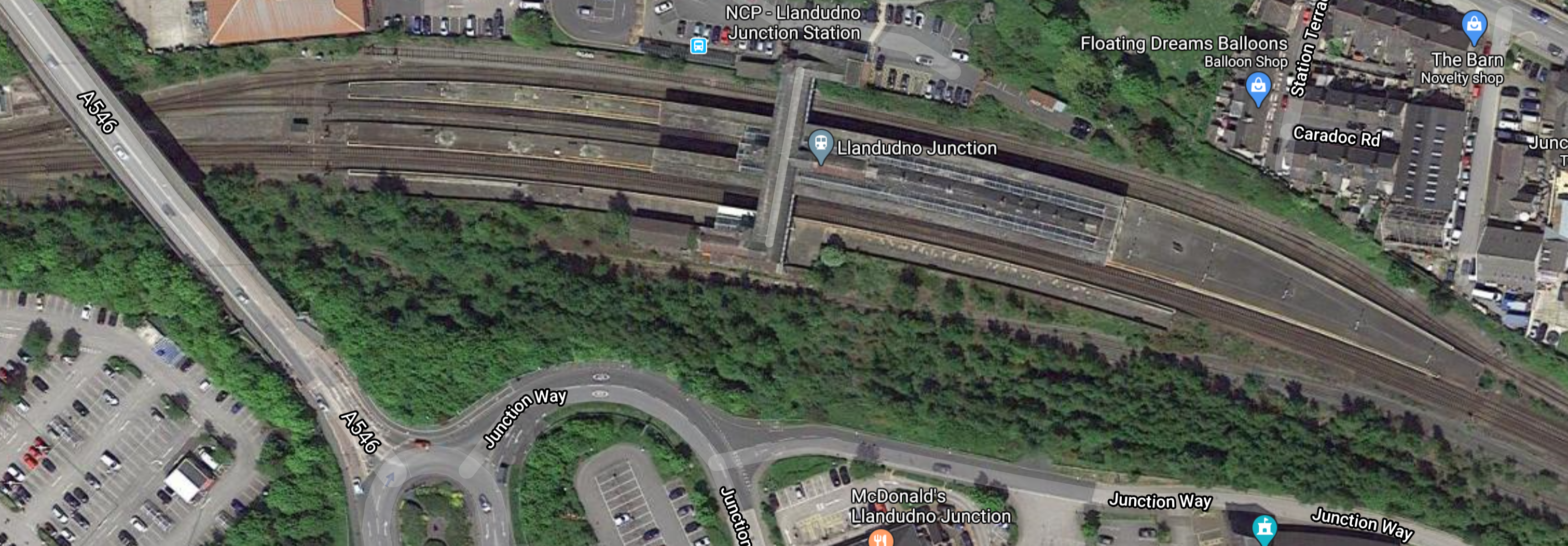
There is plenty of space.
As at Chester, the simple solution would be to electrify the platforms used by trains, that will need charging.
Butb there may also be a wider plan.
Llandudno Junction station is at the Western end of a string of five closely-spaced stations with Prestatyn station in the East.
- Llandudno Junction and Prestatyn are eight miles apart.
- Trains take twenty-three minutes to pass through this section.
- Some trains do a detour to Llandudno station before continuing.
- For part of the route, the railway lies between the dual-carriageway A55 road and the sea.
So why not electrify this section of railway between Llandudno Junction and Prestatyn stations?
- Either 750 VDC this-rail or 25 KVAC overhead electrification could be used.
- Prestatyn and Chester are 46 miles apart.
- Llandudno Junction and Holyhead are 40 miles apart.
If third-rail electrification were to be used, it might be advantageous to electrify to Llandudno station.
- It would be less intrusive.
- It would be quieter in an urban area.
- It would give the trains to Blaenau Ffestiniog trains a good charge.
But above all third-rail electrification might cost a bit less and cause less disruption to install.
Machynlleth
Machynlleth station is where the Aberystwyth and Pwllheli services split and join.
This Google Map shows the station.
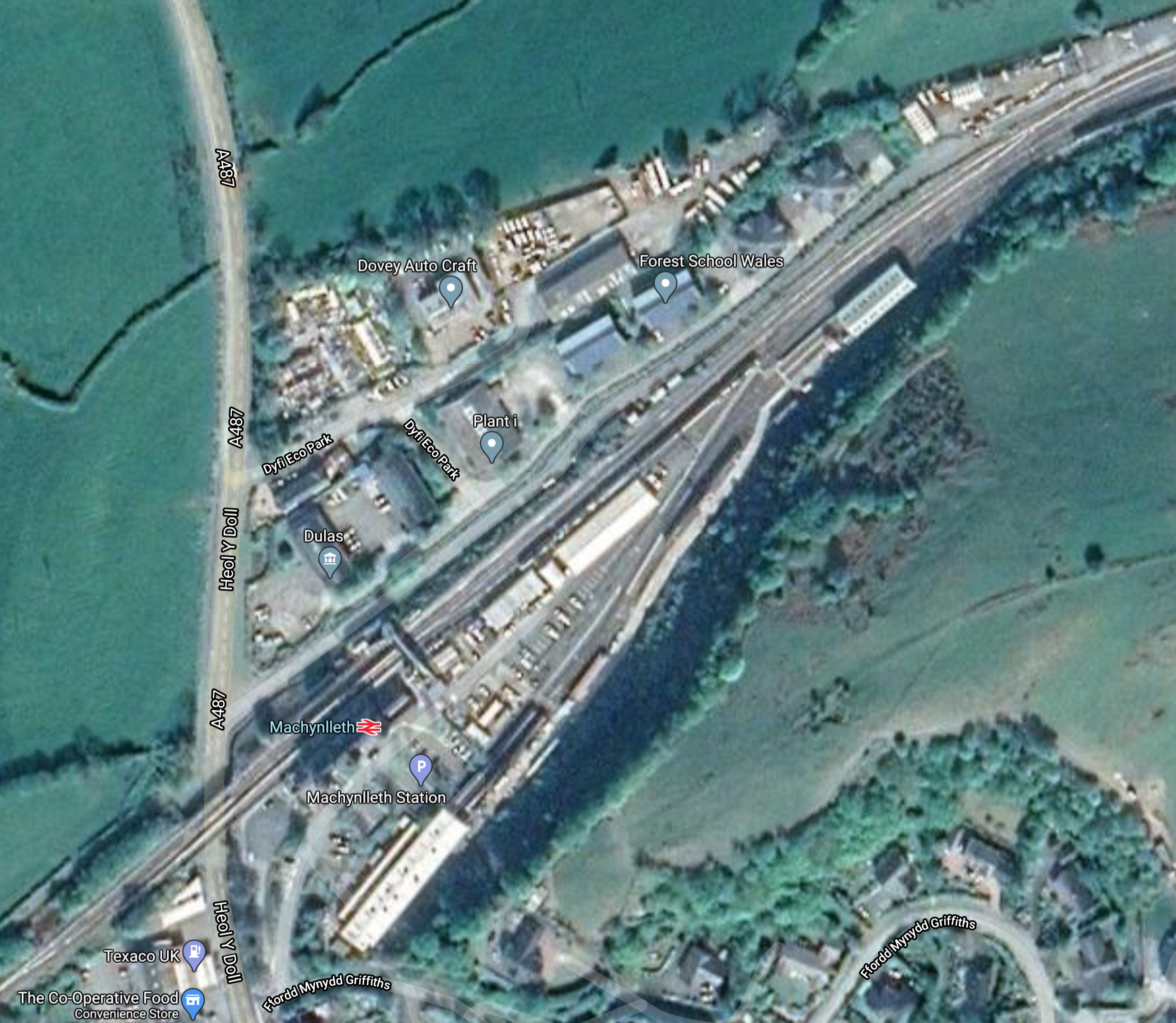
Consider.
- There is a train depot by the station.
- Will there be a good power supply at the station to charge the trains?
- Machnylleth and Pwllhelli are 58 miles apart.
- Machynlleth and Shrewsbury are 61 miles apart.
I think that Machynlleth might be pushing things too far, without extra stations with charging facilities.
One solution might be to develop the Riding Sunbeams concept and electrify the route between Newtown and Dovey Junction via Machynlleth, using third-rail technology powered-by solar or wind power.
Another solution would be batteries with a larger capacity.
Manchester Airport
Manchester Airport station is fully-electrified and ready for battery-electric trains.
Manchester Piccadilly
Manchester Piccadilly station is fully-electrified and ready for battery-electric trains.
Milford Haven
Milford Haven station only has a single terminal platform.
My comments would be similar to what, I said for Aberystwyth station. I would hope a standard solution can be developed.
Pembroke Dock
Pembroke Dock station only has a single terminal platform.
My comments would be similar to what, I said for Aberystwyth station. I would hope a standard solution can be developed.
Pwllheli
Pwhelli station is a only has a single terminal platform.
This Google Map shows the location of the station.
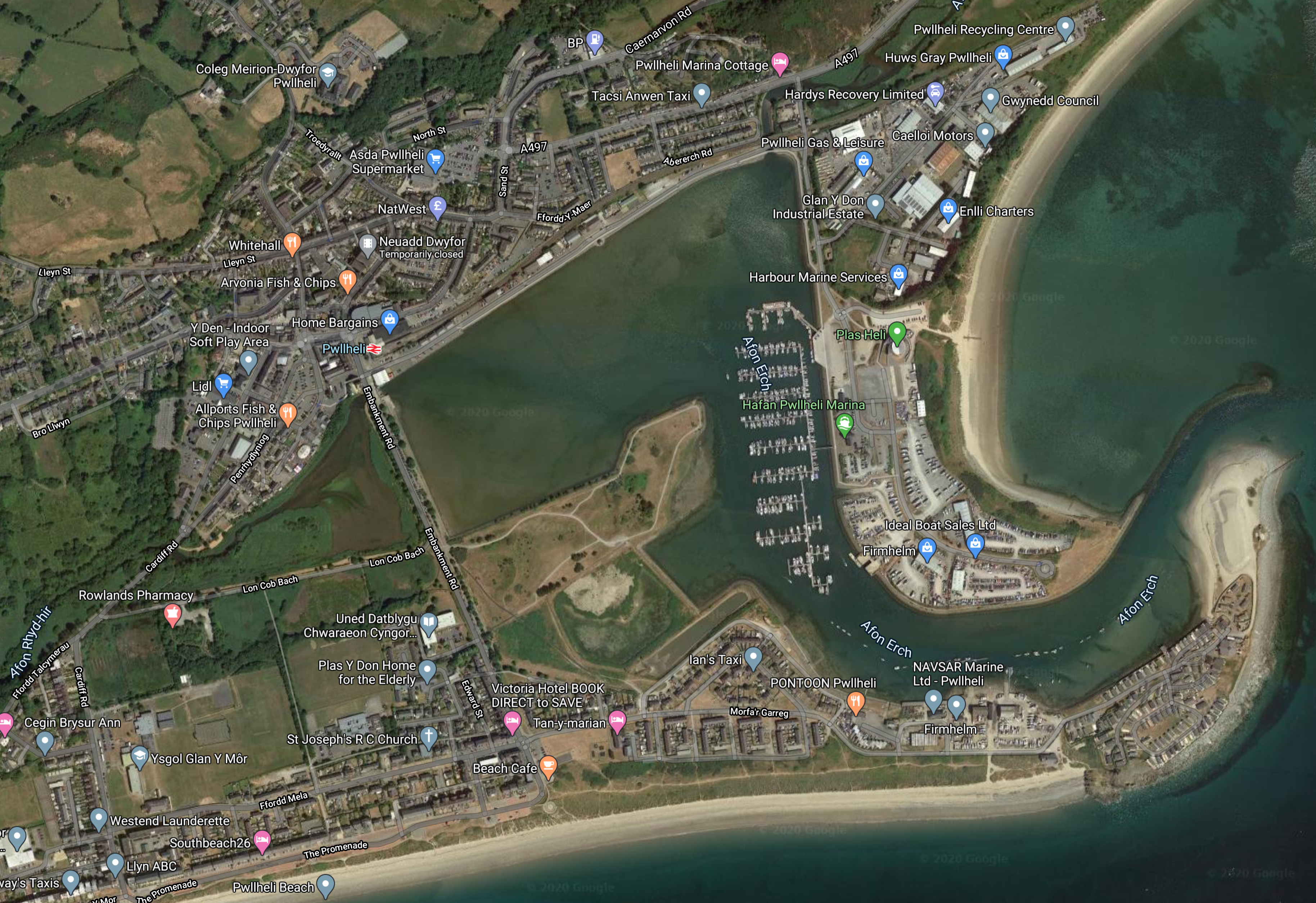
The stsation is at the North West corner of the bay.
My first reaction, when I saw this was that I have to go.
So I took a closer look at the station instead.

I suspect that fitting a charging facility into the station, wouldn’t be the most difficult of engineering problems. Although, there might be a problem getting a good enough connection to the National Grid.
Shewsbury
Shrewsbury station is a five-platform station.
This Google Map shows the station’s unusual location over the River Severn.
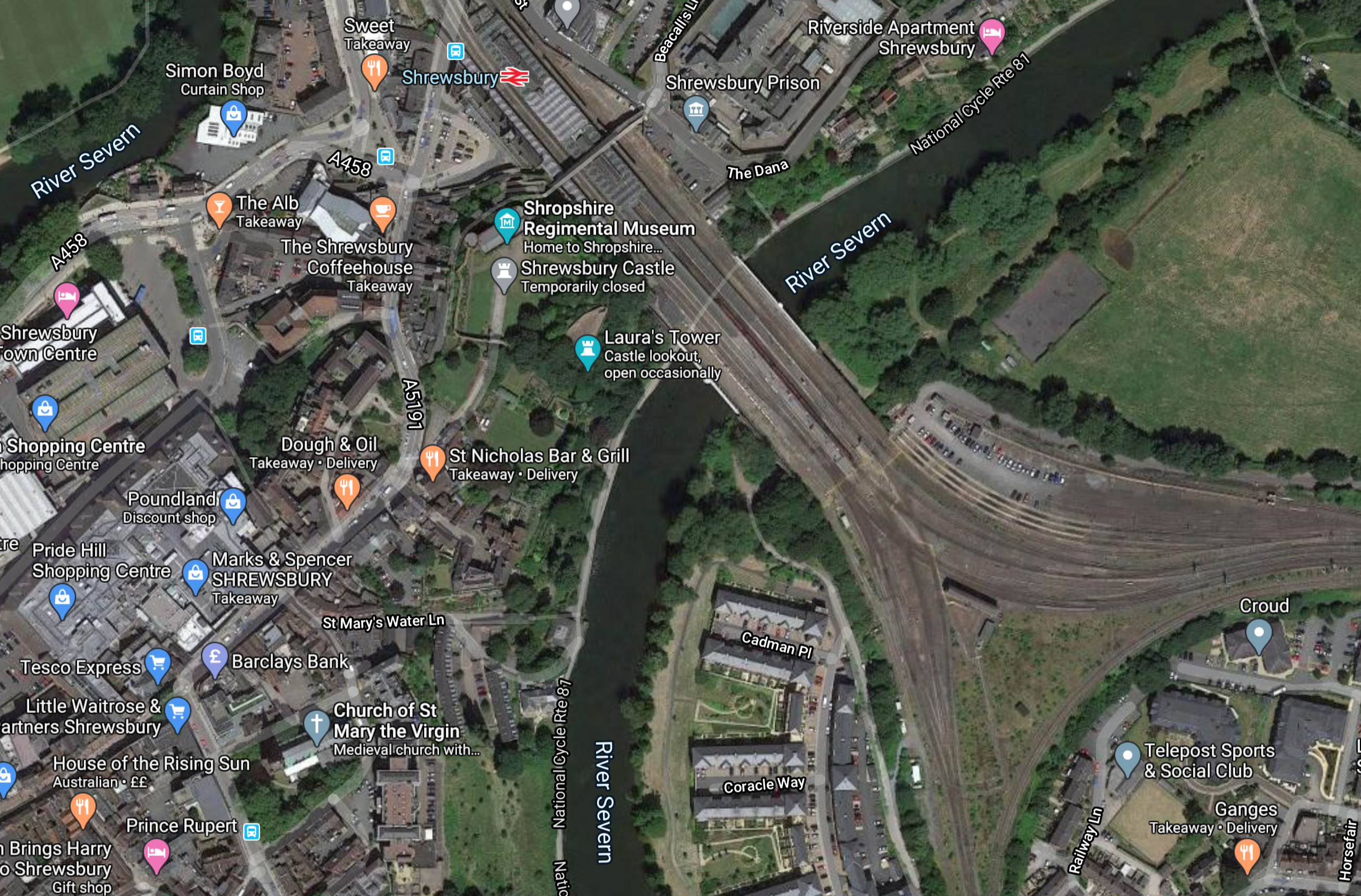
It must be one of few stations in the world, where trains enter the station from three different directions.
- From Crewe and Chester to the North.
- From Hereford and Wales to the South.
- From Birmingham and Wolverhampton in the East.
Adding electrification to all or selected platforms should allow trains to recharge and be on their way.
- Under current timetables, dwell times in Shrewsbury are up to eight minutes.
- I would suspect the train times could be adjusted, so that trains left the station with full batteries.
With battery-electric services to Aberystwyth, Birmingham International, Birmingham New Street, Cardiff Central, Chester, Crewe, Hereford, Holyhead, London Euston, Manchester, Pwllheli and Swansea, it will be a very important station.
Swansea
Swansea station has four terminal platforms.
A charging facility could be added to an appropriate number of platforms.
Or perhaps, the last few miles of track into the station should be electrified, so trains could charge on the way in, charge in the station and charge on the way out.
Third Rail Electrification
I have suggested in this post, that 750 VDC third-rail electrification could be used in several places.
I will repeat what I said earlier, when discussing Chester station.
- I’m an engineer, who deals in scientifically-correct solutions, not politically-correct ones, devised by jobsworths.
- Maintenance staff at the station will be familiar with the technology.
- Station staff and passengers will know about the dangers of third-rail electrification.
- Trains connect and disconnect automatically to third-rail electrification.
- Trains don’t have to stop to connect and disconnect, so passing trains can be topped-up.
- Hitachi with the Class 395 train and Alstom with the Class 373 train, have shown even trains capable of 140 mph can be fitted with third-rail shoes to work safely at slower speeds on lines electrified using third-rail.
- Modern control systems can control the electricity to the third-rail, so it is only switched on, when the train completes the circuit.
Third-rail electrification should be seriously considered.
A Standardised Terminal Solution
In this post, I mentioned that the following stations could be powered by a scandalised solution, as they are all one platform, terminal stations.
- Aberystwyth
- Blaenau Ffestiniog
- Fishguard Harbour
- Holyhead
- Milford Haven
- Pembroke Dock
- Pwllheli
The system might also be applicable at Carmarthen and Swansea.
My view is that Vivarail’s Fast Track charging based on third-rail technology would be ideal. I discussed this technology in Vivarail Unveils Fast Charging System For Class 230 Battery Trains.
Conclusion
With a bit of ingenuity, all train services run by Transport for Wales, can be run with battery-electric trains.
Birmingham-Black Country-Shrewsbury
On the Midlands Connect web site, they have a page, which is entitled Birmingham-Black Country-Shrewsbury.
This is the introductory paragraph.
We’re examining the case to increase services from three to four per hour, made possible by capacity released post-HS2.
They then give the outline of their plans, which can be summed up as follows.
- Services on the corridor are slow and unreliable.
- Network Rail say the service is in danger of acute overcrowding.
- Services will be increased from three trains per hour (tph) to four.
- A direct hourly service from Shrewsbury, Wellington and Telford to London will be introduced.
- Services to Birmingham International will be doubled.
- The economic case will be examined for speeding up services between Shrewsbury and Birmingham from 56 to 45 minutes, via track upgrades and possible electrification.
It seems a safe, and not overly ambitious plan.
These are my thoughts.
Shrewsbury’s Unique Position
These are distances and times from important stations.
- Birmingham International – 51 miles and 83 minutes
- Birmingham New Street – 42.5 miles and 71 minutes
- Chester – 42.5 miles and 53 minutes
- Crewe – 33 miles and 53 minutes
- Hereford – 51 miles and 59 minutes
- Telford – 14 miles and 21 minutes
- Wellington – 10 miles and 13 minutes
- Welshpool – 20 miles and 25 minutes
- Wolverhampton – 30 miles and 50 minutes
In Sparking A Revolution, I quoted this Hitachi-specification for a battery-electric train.
- Range – 55-65 miles
- Performance – 90-100 mph
- Recharge – 10 minutes when static
- Routes – Suburban near electrified lines
- Battery Life – 8-10 years
I can’t see any problem, for a train with this specification being able to reach Shrewsbury from Birmingham International, Birmingham New Street and Crewe on battery power.
In Hitachi Trains For Avanti, I quote an article with the same title in the January 2020 Edition of Modern Railways as saying this.
Hitachi told Modern Railways it was unable to confirm the rating of the diesel engines on the bi-modes, but said these would be replaceable by batteries in future if specified.
I wouldn’t be surprised to see Shrewsbury served from Birmingham and Crewe by fast electric trains, that used battery power. Avanti West Coast certainly seem to have that thought in mind.
Zero Carbon Trains Between Shrewsbury And Wales
It will be a formidable challenge to run battery trains from Shrewsbury to the Welsh destinations.
- Aberystwyth – 81.5 miles
- Cardiff – 107 miles
- Carmarthen – 185 miles
- Holyhead – 133 miles
- Milford Haven – 225 miles
- Swansea – 121.5 miles
Note.
- These are challenging distances for battery-electric trains.
- South Wales destinations served via Newport and Cardiff could use the electrification on the South Wales Main Line.
- Many of these services start from East of Shrewsbury and can use the electrified lines that connects to Birmingham New Street and Manchester Piccadilly.
Unless someone like Riding Sunbeams, makes a breakthrough, I can’t see battery-electric trains running to Welsh destinations from Shrewsbury.
Transport for Wales New Trains
Transport for Wales have ordered seventy-seven new Class 197 trains, and these diesel trains will be used for services through Shrewsbury, mainly on services to Birmingham New Street and Birmingham International stations.
- If these trains are similar to Northern’s Class 195 trains, they will be diesel multiple units with a noisy mechanical transmission.
- I was surprised in these days of global warming that Transport for Wales didn’t buy something more eco-friendly, as they have for South Wales and the services around Chester.
- The transmission of the Class 197 trains has not been disclosed.
Perhaps, CAF are going to do something innovative.
- The CAF Civity is a modular train, with either electric or diesel power options.
- The diesel-powered options use MTU engines.
- A logical development would be to use an MTU Hybrid PowerPack to reduce diesel consumption and emissions.
- This PowerPack would also reduce noise, as it has an electric transmission.
- I wonder, if CAF can raid their parts bin and fit a pantograph, so where 25 KVAC overhead electrification is available, it can be used.
- If CAF can convert a bog standard diesel multiple unit into a hybrid diesel-electric-battery multiple unit, by performing a heart transplant, it is a neat way of keeping new diesel Civities running until a later date.
- Remember that Northern and West Modlands Trains have another seventy-four similar new diesel Civities in operation or on order. With trains having a forty year life, they don’t fit with an early phasing out of diesel.
I have no idea, what is actually happening, but my engineer’s nose tells me to expect a surprise from CAF.
Increasing Birmingham And Shrewsbury Services From Three Trains Per Hour To Four
Four trains per hour or one train every fifteen minutes seems to be a preferred frequency on several UK suburban lines.
These services seem to provide four tph or better on most, if not all of their routes.
- Birmingham Cross-City Line
- London Overground
- Merseyrail
- Tyne and Wear Metro
Four tph seems to be a very handy Turn-Up-And-Go frequency that encourages people to use rail services.
So I am not surprised to see Midlands Connect wanting four tph between Birmingham and Shrewsbury.
Currently, the following services seem to operate between Shrewsbury and Birmingham.
- Avanti West Coast – 2 trains per day (tpd) – Shrewsbury and London Euston via Birmingham New Street and Birmingham International.
- Trains for Wales – 1 train per two hours (tp2h) – Holyhead and Birmingham International via Birmingham New Street.
- Trains for Wales 1 tph – Aberystwyth/Pwllheli and Birmingham International via Birmingham New Street
- West Midlands Trains – 2 tph – Shrewsbury and Birmingham New Street – One semi-fast and one stopper.
Note.
- All services call at Wolverhampton, Telford and Wellington.
- Shrewsbury and Birmingham New Street is a 3.5 tph service.
- Shrewsbury and Birmingham International is a 1.5 tph service.
It relies heavily on services from Trains for Wales, who probably don’t put Shrewsbury and Birmingham services at the top of their priorities.
I remember, when local services in the North-East of London were run by Greater Anglia from Norwich. Moving some services to Transport for London, brought about a large improvement
Quite frankly, the current service is best described as pathetic.
Should Trains for Wales Services Terminate As Shrewsbury?
I suspect some local politicians in Shrewsbury and Birmingham, think it would be best to adopt this sort of strategy.
- All Welsh services terminate at Shrewsbury.
- Birmingham and Shrewsbury mandate West Midlands Trains and Avanti West Coast to provide a frequent service between Shrewsbury and Birmingham.
It might be the way to go, but many travellers from the Marches, would probably want direct connections to Birmingham, Birmingham Airport and in the future High Speed Two.
Introducing A Direct Hourly Service From Shrewsbury, Wellington And Telford To London
On the face of it, it looks like a much needed service to and from Shrewsbury.
- It will be hourly.
- Initially it will use Class 221 diesel multiple units, but these will be replaced with bi-mode Class 805 trains.
- The current infrequent service calls at Watford Junction, Rugby, Coventry, Birmingham International, Birmingham New Street, Sandwell and Dudley, Wolverhampton, Telford Central and Wellington.
- There are also six other stations between Shrewsbury and Wolverhampton, which might like an improved service.
- The service will be run by Avanti West Coast.
There might also be the possibility of using battery power between Wolverhampton and Shrewsbury, which is only thirty miles each way.
But there are other collateral benefits.
- The service increases the frequency between Shrewsbury and Birmingham New Street stations by one tph to 4.5 tph
- The service increases the frequency between Shrewsbury and Birmingham International by one tph to 2.5 tph.
- The service increases the frequency between Wolverhampton and London Euston by one tph.
- The service increases the frequency between Sandwell and Dudley and London Euston by one tph
- The service increases the frequency between Birmingham New Street and London Euston by one tph.
- The service increases the frequency between Birmingham International and London Euston by one tph.
- The new service will provide an hourly quality connection to High Speed Two at Birmingham International for stations between Shrewsbury and Coventry.
- It appears that the Class 390 trains to Birmingham New Street and being replaced by new Class 807 trains, so Birmingham will have three out of four tph, run by new trains.
- The new Shrewsbury service , has a similar calling pattern to that of the current Scottish service through Birmingham. Will it replace that service, when High Speed Two opens?
Note.
- Midlands Connect’s objective of four tph between Shrewsbury and Birmingham has been met.
- Several stations get a better direct service to London.
- Connectivity to High Speed Two is improved.
- Birmingham New Street and London is now a Turn-Up-And-Go frequency of four tph.
- The Class 805 train will also mean that Avanti West Coast could be zero-carbon in Birmingham. Especially, if it used battery power between Wolverhampton and Shrewsbury stations.
The hourly direct service between Shrewsbury and London will make a lot of difference to train services between Shrewsbury and Birmingham.
Avanti’s London Euston and Birmingham New Street Service
Consider.
- There are two tph that terminate in Birmingham New Street station, that take 88-89 minutes, from London Euston
- There is one tph that goes through Birmingham New Street station to Edinburgh, Glasgow, Preston, or Shrewsbury, that takes 82-84 minutes, from London Euston.
- Currently, the two terminating trains are Class 390 trains, whereas the through train can be a Class 221 train as well.
- Through trains are allowed 5-10 minutes to pass through Birmingham New Street.
- Trains that terminate at Birmingham New Street station are allowed 20-30 minutes to arrive and leave.
- Avanti West Coast have said, that they will be running Class 807 trains between London and Birmingham New Street.
It doesn’t seem to be the best use of scarce platform resources in a busy station to park a train there for half-an-hour.
In Will Avanti West Coast’s New Trains Be Able To Achieve London Euston and Liverpool Lime Street In Two Hours?, I came to the conclusion that the Class 807 trains have been designed as simple, fast, lightweight all-electric trains with no heavy batteries, diesel engines or tilt mechanism.
- I think they’ll be able to shave a few minutes on the timings between London Euston and Birmingham New Street station.
- I would suspect that they will match the 82-84 minutes of the through trains
- The ultimate would be if they could do a round trip between London Euston and Birmingham New Street in three hours.
- Two tph run by what would effectively be a London-Birmingham shuttle would need just six trains.
It might mean new methods of manning the trains, to reduce turnround times.
Doubling Of Services Between Shrewsbury And Birmingham International
The hourly direct London and Shrewsbury Avanti West Coast service will raise the current 1.5 tph service between Shrewsbury and Birmingham International to 2.5 tph, so will be a good start.
- Perhaps Trains for Wales could find the missing 0.5 tph.
- West Midlands Trains might be able to squeeze in another train.
But I suspect that the crowded line between Birmingham New Street and Birmingham International is the problem.
Shrewsbury And Birmingham In Forty-Five Minutes
This is the last objective and saving eleven minutes on this route would suggest that the best way would surely be to fully electrify the route.
- Between Wolverhampton and Birmingham International stations is fully electrified.
- Electric trains have faster acceleration and deceleration, so would probably achieve the required savings if they stopped more than five times.
- From my virtual helicopter it doesn’t appear to be the most challenging of routes to electrify.
- Only about thirty miles of double track would need to be electrified between Wolverhampton and Shrewsbury stations.
- Both Trains for Wales and West Midlands Trains would have to obtain new electric trains.
- Avanti West Coast have already got bi-mode Class 805 trains, that could use the electrification.
But will Trains for Wales go along with Midlands Connect, when they tell them to get electric or bi-mode trains to work between Shrewsbury and Birmingham International stations?
It is because of dilemmas like this, that I feel that electric trains using battery or hydrogen power, when away from electrification can be a very good alternative.
- There is no major disruption raising bridges for the electrification.
- Stations don’t need to be closed for electrification.
- The trains have all the comfort and performance of electric trains.
- Costs and timescales can be reduced.
- When running on battery or hydrogen power, these trains are very quiet, as there is no pantograph noise.
To run battery-electric trains between Shrewsbury and Wolverhampton, the only infrastructure needed would be a method of charging the train at Shrewsbury station.
This Google Map shows the Southern end of Shrewsbury station.

Note.
- The platforms are built over the River Severn.
- The five-car Class 221 train in Virgin livery sitting in Platform 5.
- When this train leaves it will turn left or to the East for Wolverhampton and Birmingham.
- Trains can turn right for Wales.
It is a very unusual station layout.
- Platform 5 is one of a pair of bay platforms; 5 & 6, that can access either Wales or Birmingham.
- Outside of the bay platforms are a pair of through platforms; 4 & 7, that can also access Wales or Birmingham, but they can also access Chester by going through the station.
- The 115 metre long Class 221 train fits easily in the bay platform 5.
- The 130 metre long Class 805 train would probably need to use Platform 4 or 7.
But with well-planned electrification, it would be ideal for charging electric trains as they pass through or turned back!
Once the train reaches Wolverhampton, it will connect to electrification again.
Shrewsbury And High Speed Two
Currently, Shrewsbury has three connections to stations, where it would be convenient to take a High Speed Two train.
- Birmingham International, which is 51 miles and 83 minutes away. Plus a ride on a people mover for High Speed Two.
- Birmingham New Street, which is 42.5 miles and 71 minutes away. Plus a walk to Birmingham Curzon Street for High Speed Two.
- Crewe, which is 33 miles and 55 minutes away.
Passengers will make their own choice.
Could Shrewsbury Have A Classic-Compatible High Speed Two Service To Manchester Piccadilly?
London To Shrewsbury, Now And Post-High Speed Two
Travel On Monday
If I want to go to Shrewsbury next Monday, one fast journey is taking the 09:10 from Euston and changing at Crewe, which gives a journey time of two hours and thirty-two minutes.
I can also get a train with a change at Birmingham International that takes seven minutes longer.
Travel On High Speed Two
After High Speed Two opens to Birmingham Curzon Street and Interchange in Phase 1 what sort of times to Shrewsbury can be expected?
I estimate the following.
- Travelling via Birmingham Curzon Street could produce a time of around one hour and fifty minutes, if you’re lucky with the trains.
- Travelling via Crewe could produce a time of one hour and thirty minutes, if you’re lucky with the trains.
- Travelling via Interchange could produce a time of around one hour and fifty-five minutes. or forty-four minutes faster.
If I was going to Shrewsbury after High Speed Two has opened, I would probably change at Birmingham Curzon Street, if the walk to New Street station was still within my capabilities, as there will be a Turn-Up-And-Go frequency of four tph between Birmingham New Street and Shrewsbury stations.
Looking at the Midlands Connect objectives, these help with linking Shrewsbury with London.
- Increasing services between Birmingham and Shrewsbury to four tph, as it’s Turn-Up-And-Go!
- The direct hourly service to London from Shrewsbury, Wellington and Telford might be the quickest way to London by changing at Birmingham New Street/Curzon Street or Interchange.
- Doubling the service between Shrewsbury and Birmingham International, may be a good move, as Interchange, which will be connected to Birmingham International by a high capacity people mover, will have five tph between London Euston and Old Oak Common stations.
- Saving eleven minutes between Shrewsbury and Birmingham will certainly help.
Travelling between London and Telford, Wellington and Shrewsbury will be much improved.
 The Anonymous Widower