Sunrise On Ravenstruther Rail Freight Terminal In Scotland
The title of this post, is the same as that of this article on Railfreight.com.
This is the opening paragraph.
The long awaited rebirth of Cloburn Quarry has been celebrated onsite. The former coal handling depot in South Lanarkshire has been inaugurated as a new aggregates terminal, serving the continued growth of the UK infrastructure and construction industry. The onsite quarry will supply materials, with the facility to handle both outbound and inbound loads.
It is a fascinating article, which explains how Cloburn Quarry has opened a rail terminal to supply its customers by rail.
This Google Map shows the Ravenstruther Rail Freight Terminal.
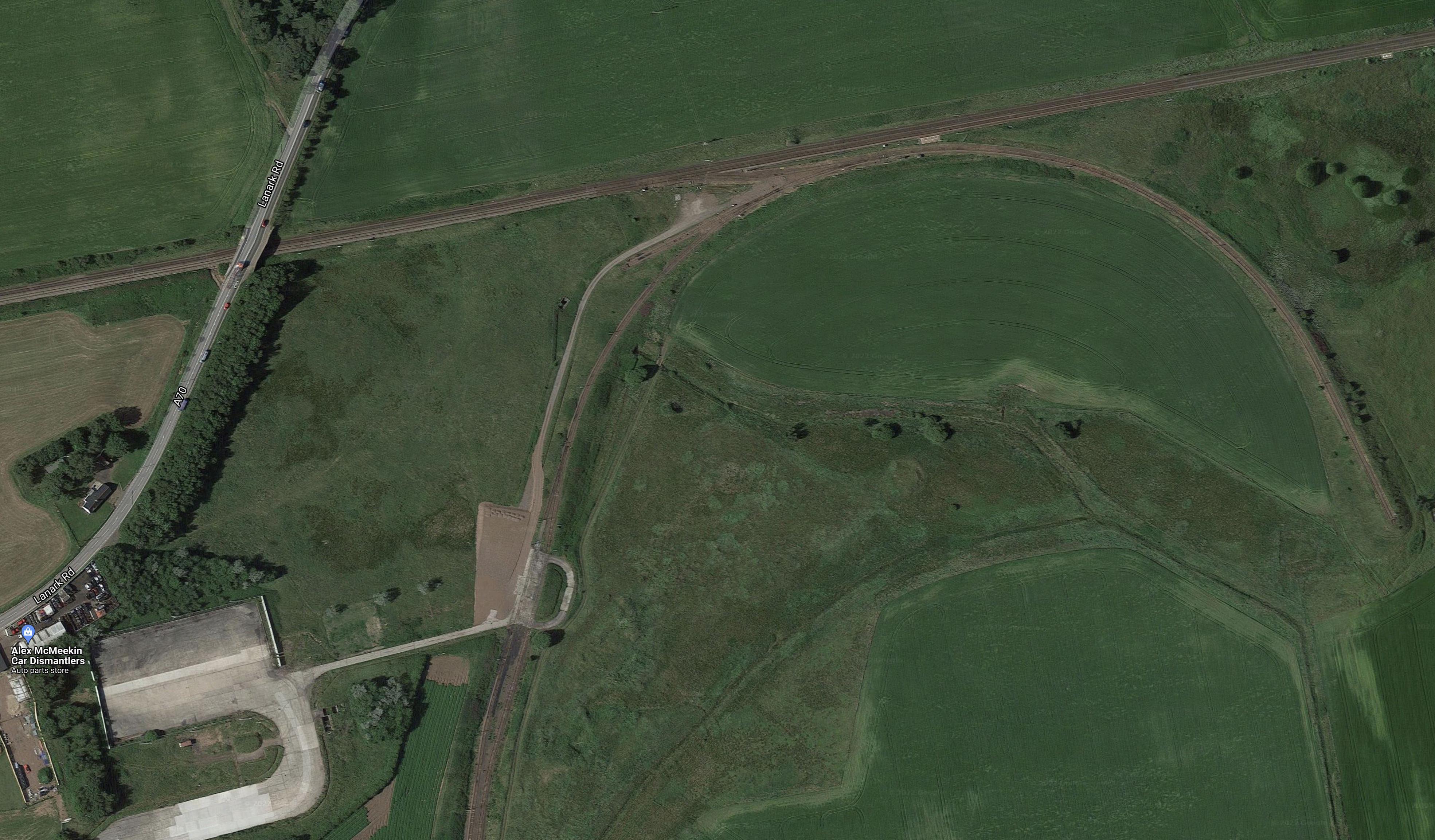
It is very simple being a horseshoe shaped double-track with a connection to the West Coast Main Line.
- Trains would appear to be loaded and unloaded on the Western limb.
- The railway line across the top of the map is the West Coast Main Line..
- Glasgow is to the West with Carstairs station a few miles to the East.
- Glasgow Central and Carstairs stations are 28.7 miles apart.
If the business grows there would appear to be plenty of space to expand.
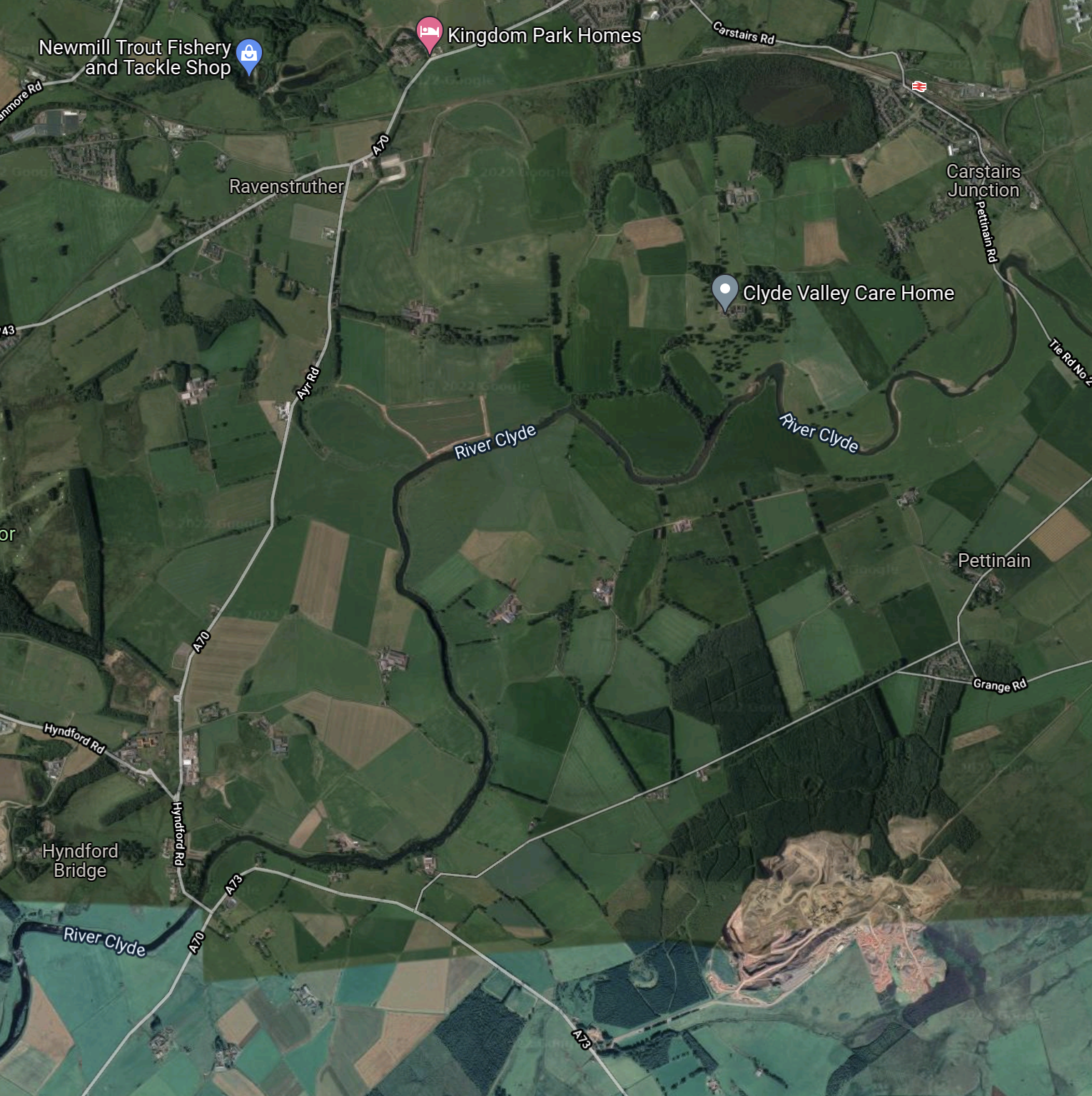
This second Google Map shows the relationship of the Ravenstruther Rail Freight Terminal and Cloburn Quarry.
Note.
- In the top right corner of the map, the red symbol marks Carstairs station.
- It is possible to pick out the rail freight terminal to the South of the pink arrow making Kingdom Park Homes.
- Cloburn Quarry is the large brown-red scar in the bottom-right corner of the map.
It would appear that the quarry and the rail freight terminal must use heavy trucks along the A70 and A73 to move the aggregate between the two sites.
Operation Of The Quarry
According to the article, the quarry is a source of red granite, which can be used for dressing roads and rail ballast, which is distributed all over the UK and even to Europe.
Having a rail terminal on the West Coast Main Line, must be a big advantage.
As with the rail terminal at Penmaenmawr, which I wrote about in Penmaenmawr Quarry Rail Terminal Opens, this terminal will benefit with locomotive developments that should happen in future.
Both battery-electric and hydrogen-electric capable of using the electrification of the West Coast Main Line, would bring this freight terminal up a level in terms of zero-carbon operation.
It is also likely, that within a few years, there will be heavy eight-wheeler trucks and loading shovels powered by hydrogen to transport and load the aggregates.
Nuggets From The Union Connectivity Review
The Union Connectivity Review has now been published and it can be read online.
This paragraph outlines the objective of the Review.
The UK Government asked Sir Peter Hendy CBE to undertake a detailed review into how transport connectivity across the UK can support economic growth and quality of life in England, Scotland, Wales and Northern Ireland.
Sir Peter was also asked to make recommendations as to whether and how best to improve transport connectivity between the nations of the UK.
Sir Peter Hendy is the Chairman of Network Rail.
In no particular order, these are some nuggets from the review.
The Case For UKNET – A Strategic Transport Network For The Whole United Kingdom
This paragraph introduces the case for UKNET.
Having identified the importance of good connections across internal borders and the challenges that currently prevent a pan-UK strategic vision or investment strategy, the Review recommends that the UK Government develop UKNET – a strategic transport network for the whole United Kingdom which would connect all the nations of the
UK, with appropriate funding and coordination with the devolved administrations to deliver it.
The creation only follows best practice from the European Union and large countries like the United States.
These three paragraphs sum up how UKNET would work and how it would bring benefits to the whole of the UK.
UKNET would provide a network into which transport investment would be made on a pan-UK basis to support economic growth, jobs, housing and social cohesion, across the nations of the UK, for the benefit of the whole country.
It would allow transport appraisals for schemes on the network to be undertaken on a UK-wide basis with all costs and benefits being fully accounted for. This would limit the risk of cross-border schemes being deprioritised.
The development of such a network would provide additional certainty for businesses and the private sector, allowing them to plan complementary investments in specific regions and to invest in the supply chain across the country.
I think overall that UKNET is sound thinking, but my only feeling is that it should also look at transport links to and from the whole island of Ireland.
The Case for Faster Rail Journey Times Between England And Scotland
These three paragraphs probably apply to most rail journeys in the world, that compete against air and road travel.
Both the UK and Scottish Governments have previously agreed to develop options which could support a rail journey time between London and Scotland of three hours. A journey time improvement of this size, even when compared to expected journey times once HS2 opens, would dramatically increase the number of people travelling by rail.
There is a correlation between journey times and how many people choose to travel by rail over air. If it takes the same amount of time to travel by rail or by air, the evidence shows that people choose to travel by rail. Rail is typically favoured when the journey time is around three hours between city centres.
Work undertaken by Network Rail and HS2 Ltd on behalf of the Review has demonstrated the potential for increased trips by rail if journey times are reduced. For assurance purposes, two forecasting models were used to assess savings of 20, 35 and 50 mins on the journey times forecast for HS2 Phase 2b. The outcomes for both models were broadly similar and the approach built upon the changes in mode share observed between rail and aviation following previous UK and European rail investments.
Three hours between London and Scotland could be a tough ask.
Note these points about the East Coast Main Line.
- An InterCity 225 ran between London and Edinburgh on the 26th September 1191 in three hours and 29 minutes.
- Full digital in-cab signalling will allow running at 140 mph.
- There are improvements to come on the East Coast Main Line.
- As now, the review says two tph will run between London and Edinburgh.
- London Kings Cross and Edinburgh is 393 miles
- On the East Coast Main Line a non-stop train between would need to average 131 mph.
Three hours is tough but not impossible.
And these points about the West Coast Main Line.
- Trains will run on High Speed Two between London Euston and Crewe.
- High Speed Two are claiming fifty-six minutes between London Euston and Crewe.
- Full digital in-cab signalling will allow running at 140 mph.
- Crewe and Glasgow Central is 243.4 miles.
- Current fastest time between Crewe and Glasgow Central is three hours and five minutes.
- Between Crewe and Glasgow Central, a non-stop train would need to average 118 mph.
A well-driven InterCity 125, with a clear track, could average that speed between Crewe and Glasgow Central.
Three hours is tough but very possible.
This paragraph sums up the mode shift expected between air and road to rail.
These initial estimates indicated that a three-hour journey time was forecast to increase the number of passengers by around four million a year and increase rail mode share from the 2019 level of 29% to around 75%. It was also forecasted that journey times in the region of three hours would generate considerable transport user benefits and revenues over the lifetime of the scheme.
People travelling from the Midlands and North West England to and from Scotland would also get substantial reductions in journey times.
Linking High Speed Two With The WCML
The review says this about linking High Speed Two with the West Coast Main Line.
The UK Government has already acknowledged some of the issues identified by the Review. The ‘Golborne Link’—the current proposed connection between HS2 and the WCML—is expected to deliver quicker journey times and more capacity between England and Scotland and resolve some of the constraints between Crewe and Preston.
However, the ‘Golborne Link’ does not resolve all of the identified issues. The suitability of alternative connections between HS2 and the WCML have been considered by the Review. The emerging evidence suggests that an alternative connection to the WCML, for example at some point south of Preston, could offer more benefits and an opportunity to reduce journey times by two to three minutes more than the ‘Golborne Link’. However, more work is required to better understand the case for and against such options.
These benefits could also include additional operational flexibility when timing freight services and less disruption to the WCML than major upgrades as most construction could take place away from the railway.
An infrastructure philosophy is also detailed.
- Replacing and enhancing track, signalling and power supply.
- Possible new sections of line north of Preston.
- Maximising of line speed.
My feeling is that for good project management reasons and to give faster journey times with the existing trains, that a lot of these improvements should be started as soon as possible.
Borders Railway
The Review says this about the Borders Railway.
Communities in the Scottish Borders region are enthusiastic about the economic and social benefits they see resulting from an extension of the Borders Railway south, across the border, to Carlisle.
The Review also welcomes the £5 million in funding that the UK Government has made available for the development of a possible extension to the Borders Railway which would support improved connections to and from Scotland and with the WCML at Carlisle.
I would build this early, as when the West Coast Main Line is being upgraded between Carlisle and Glasgow, this would be available as a diversion route.
Perhaps too, the Glasgow South Western Line should be improved and electrified as well.
Air Passenger Duty
The Review has a sizeable session on Air Passenger Duty, where it concentrates on the problems of its application to domestic flights.
The Review makes this recommendation.
Where journeys are too long to be reasonably taken by road or rail, the UK Government should reduce the rate of domestic aviation tax.
I believe that before the end of this decade, there will be smaller zero-carbon airliners, that will be ideal for domestic routes, which could totally change the regime of domestic Air Passenger Duty.
Decarbonisation And The Future Of Flight
This is a section in the Review, where this is the first paragraph.
In July 2021, the Department for Transport published the Jet Zero Consultation: a consultation on our strategy for net zero aviation127, alongside the Transport Decarbonisation Plan. This includes the ambition to have zero-emission routes connecting different parts of the UK by 2030 and a commitment to assess the feasibility of serving PSO routes with low carbon aviation. The Review welcomes the commitments made in both publications to accelerate the uptake of sustainable aviation fuels (SAFs) and develop low and zero-emission aircraft.
The Review goes on to make two recommendations.
- Drive the uptake of sustainable fuels and zero emission technologies on domestic aviation through a combination of incentives, tax benefits and subsidies to make the UK a world leader in developing these fuels and technologies.
- Support the development of sustainable aviation fuel plants in parts of the United Kingdom that are particularly reliant on aviation for domestic connectivity.
Note.
- PSO means Public Service Obligation.
- One of the world leaders in the field of sustainable aviation fuels is Velocys, which is a spin out from Oxford University.
- The Review also suggests building a sustainable aviation fuel plant in Northern Ireland.
The Review gives the impression it is keen on the use of sustainable aviation fuel
Conclusion
There are some good nuggets in the sections I have read in detail.
This post is not finished and there will be additions to the list.
‘Box Structure’ Flyover Saves £70m And Six Months For East West Rail
The title of this post, is the same as that of this press release on Network Rail.
This is the first paragraph.
Engineers have saved £70m of taxpayers’ money by using creative new methods to build a railway flyover as part of the East West Rail project.
This Network Rail picture shows how the new flyover rests on a concrete box, that spans the West Coast Main Line (WCML).
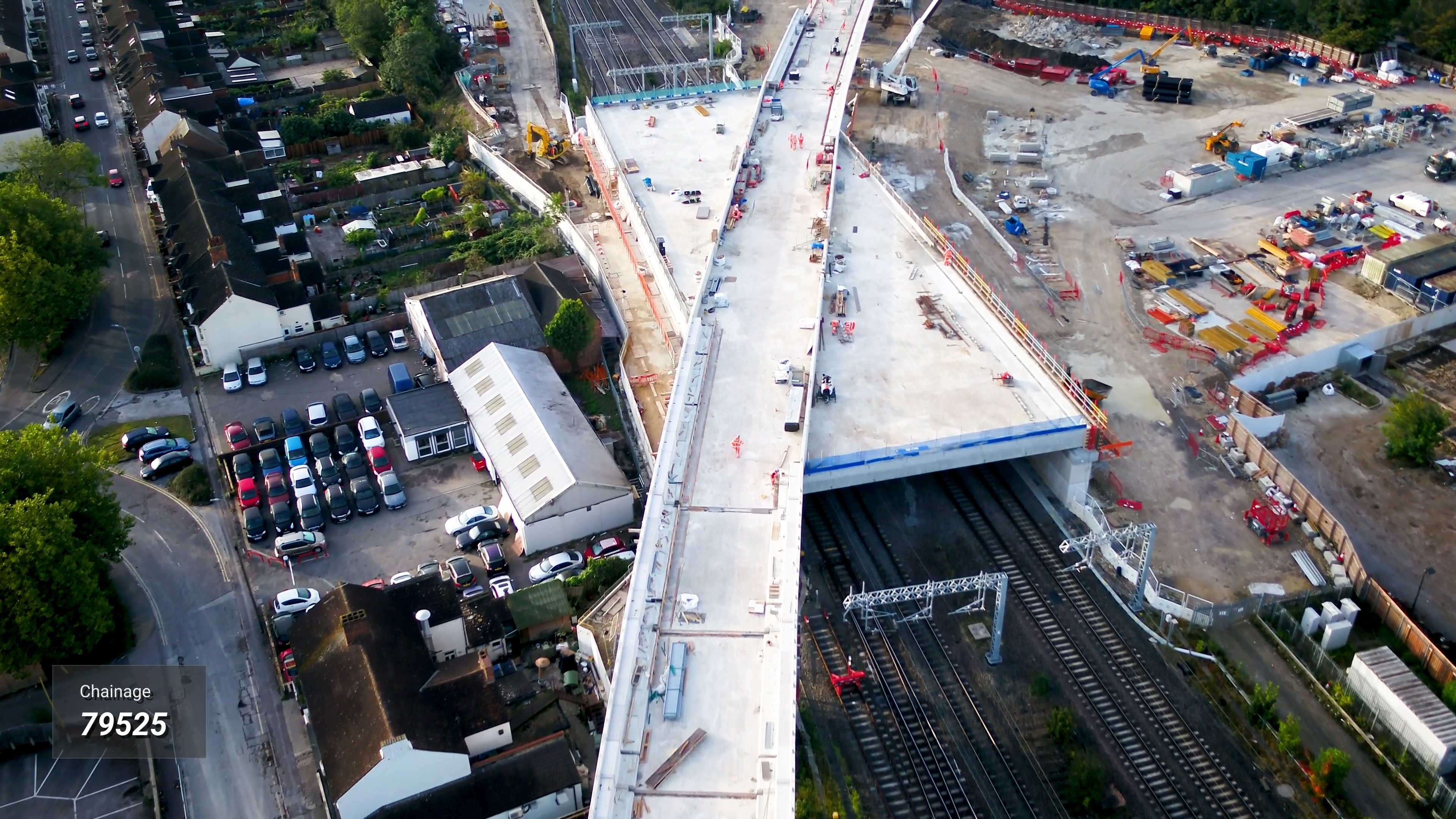
Note that the press release contains a video that explains how the flyover was replaced and why the method of construction saved all the money and time.
The main cost savings came about because of the following.
- Construction could go on above the WCML without having to stop the trains.
- Components for the flyover were made in a factory, with subsequent cost reductions and quality increases.
Anybody, who’s ever poured a concrete slab in typical British weather will understand the second point.
According to the press release, the method of construction gives a hundred and twenty year life span for the structure.
For comparison, this 3D Google Map visualisation shows the Hitchin flyover, which was opened in 2013.
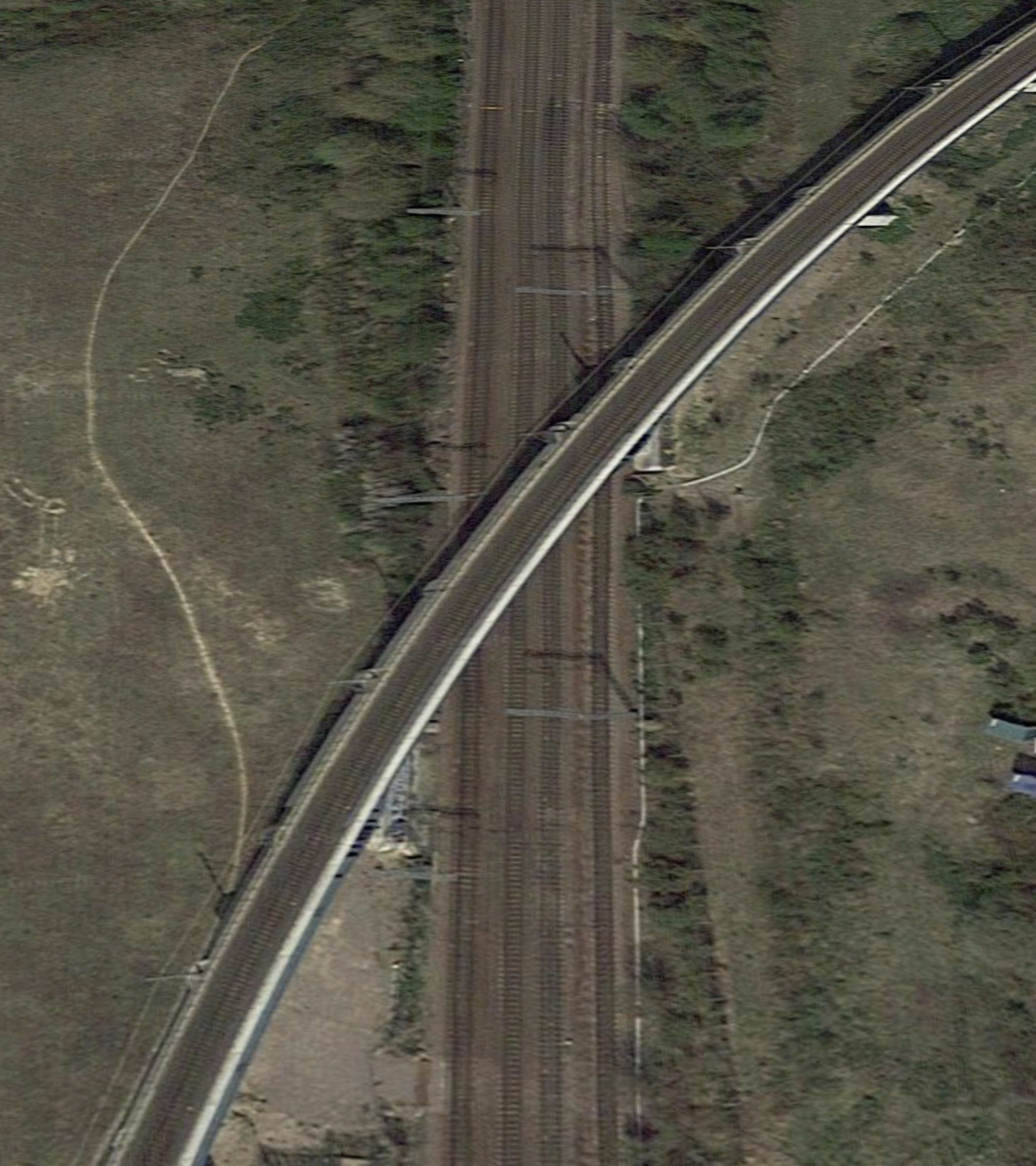
Note the columns supporting the single-track railway.
If this was being built today, would a box be used as at Bletchley?
Could We See Between London And Much Of The North By Train In Under Two Hours?
I shall write about each route in order starting from Euston and working East.
Avanti West Coast And Euston
These are services from Euston, that I feel could be under two hours.
London Euston And Liverpool Lime Street
On Thursday, I went to Liverpool by train.
- My train took two hours and thirteen minutes between London Euston and Liverpool Lime Street stations.
- There were stops at Stafford, Crewe and Runcorn.
- The Class 390 train was travelling at 125 mph for a lot of the way.
- The distance between the two terminals is 193.6 miles.
- The start to stop average including the stops was 87.3 mph.
So could London Euston and Liverpool Lime Street be achieved in the magic two hours?
A few thoughts.
Average Speed
To do the journey in this time would need an average speed of 96.8 mph.
Accelerating And Stopping
Ideally, the train will run as fast as it can only changing speed for the station stops.
- The train will accelerate from stop to cruising speed at Euston, Stafford, Crewe and Runcorn or four times.
- The train will decelerate from cruising speed to stop at Stafford, Crewe, Runcorn and Liverpool Lime Street or four times.
Effectively, the train goes through four complete station stops, although one will be split between the two ends of the journey.
These figures are from Wikipedia and the Internet
- The acceleration of the Class 390 train is 1.0 mph/sec which means that it takes 125 seconds to get to 125 mph.
- The deceleration of a Class 390 train is 2.0 mph/sec, which means that it takes 63 seconds to stop from 125 mph.
- The acceleration of a Class 801 train is 1.6 mph/sec which means that it takes 78 seconds to get to 125 mph.
- The deceleration of a Class 801 train is 2.2 mph/sec, which means that it takes 57 seconds to stop from 125 mph.
These figures would appear to show, that a Class 801 train can decelerate and accelerate at a stop in nearly a minute faster than a Class 390 train.
So how can we increase the acceleration and deceleration? The two obvious ways are more power and less weight.
Form the Internet, I estimate that the average car in a Class 390 train is around 52 tonnes, as opposed to 41 tonnes for the Hitachi trains.
So does this weight difference explain some of the difference in acceleration and deceleration times?
Consider.
- The Class 390 trains have all the extra weight of the tilt mechanism. More weight means slower acceleration.
- Avanti West Coast’s new Class 807 trains have no diesel engines or batteries. Have the trains been put on a diet?
- They also have a reprofiled nose. Is it more aerodynamic?
So if these trains can save time on the four accelerate/decelerate cycles compared to the Class 390 trains, they must be getting nearer to the magic two hours.
If two minutes a stop can be saved that would save eight minutes on the journey between London Euston and Liverpool Lime Street.
140 Mph Running
The time to do a mile at various speeds are as follows.
- 100 mph – 36 seconds
- 125 mph – 29 seconds
- 140 mph – 26 seconds
So running at 140 mph, as opposed to the current 125 mph would save three seconds for every mile.
To save five minutes would mean the train would have to run for a hundred miles at 140 mph instead of 125 mph.
As Stafford is 133.5 miles from London, it could be that full digital signalling should be installed on the West Coast Main Line all the way to Stafford or even Crewe, which is 158 miles from London.
This schematic map of the West Coast Main Line was clipped from Wikipedia.

Note.
- Trains between London Euston and Liverpool Lime Street take the Trent Valley Line through Nuneaton and Lichfield Trent Valley and stop at Stafford, Crewe and Runcorn.
- Trains between London Euston and Manchester take a variety of routes and all go via Stockport.
- One train per hour (tph) between London Euston and Glasgow Central takes the Trent Valley Line and goes non-stop between London Euston and Warrington Central.
- Norton Bridge Junction just to the North of Stafford has recently been remodelled.
I believe there is potential to enable up to at least a hundred miles of 140 mph running to the South of Crewe. Especially as most of the track South of Crewe is quadruple track.
This should enable the shaving of five or more minutes off the time of any train capable of 140 mph running that uses the Trent Valley Line through Nuneaton, Lichfield Trent Valley and Stafford.
Norton Bridge Junction
Norton Bridge junction, which is five miles North used to be a bottleneck, but it has now been remodelled.
I wrote about it in The New Norton Bridge Junction In Action.
The new junction has probably been designed so that it can save a few seconds for trains going between Stafford and Crewe, whether or not they stop at either or both stations.
Non-Stop Between London Euston and Runcorn
If you look at the times of a London Euston and Glasgow Central train via the Trent Valley Line , it travels the 174.7 miles between London Euston and Weaver Junction non-stop in one hour and forty minutes. This is an average speed of 104.8 mph.
By comparison, my train on Thursday took one hour and forty-seven minutes with the two stops at Stafford and Crewe.
So there is at least six minutes to be saved by going non-stop.
Two Trains Per Hour Between London Euston And Liverpool Lime Street
Wikipedia says this about an additional service.
Subject to approval by the Office of Rail and Road, an additional hourly service will be introduced between London Euston and Liverpool Lime Street with a stop at Liverpool South Parkway from December 2022.
I have a few thoughts and questions on extra services between London Euston and Liverpool Lime Street,
- In my view the second service is much needed.
- I also think, that a later train back to London is needed.
- Does the Wikipedia statement mean that only one train will stop at Liverpool South Parkway?
- Does Runcorn need two tph to and from London?
- Would the platforms at Liverpool South Parkway be lengthened to accept eleven-car Class 390 trains?
I feel that if a train stopped at both Liverpool South Parkway and Runcorn, this would make a two-hour journey more difficult to achieve.
London Euston And Liverpool Lime Street In Two Hours
The new Class 807 trains will be delivered by 2022. Because of the pandemic, I’ll assume that of the ten trains on order, some, but not all, will be available by the December 2022 timetable change.
The time savings needed for a two-hour journey will come from four improvements.
- The increased performance of the Class 807 trains.
- Full digital signalling South of Crewe.
- The track improvements already completed like Norton Bridge Junction.
- Cutting out stop on the second service.
There may also be time savings to be obtained at the intermediate stops, by better working practices.
I doubt that the full digital signalling will have been installed, but all trains will be capable of 125 mph running.
Avanti West Coast probably have a good idea of the time they could achieve without digital signalling and I feel that they could be about five minutes over two hours with the Class 807 trains.
As the eleven-car Class 390 trains are too long for Liverpool South Parkway station, could we see the following service?
- 1 tph – Class 390 train – London Euston And Liverpool Lime Street via Runcorn, Crewe and Stafford.
- 1 tph – Class 807 train – London Euston And Liverpool Lime Street via Liverpool South Parkway.
Note.
- The Class 390 train would run the existing timetable in two hours and thirteen minutes.
- The Class 807 train would be a two-hour express service if possible.
- Going from three stops to one could save the express at least seven minutes, as I showed earlier by looking at train timings South of Weaver Junction.
- There would be time savings of at least two minutes on the express service due to the better performance of the Class 807 train.
To save the final four minutes, there would need to be at least eighty miles of 140 mph running, as each mile saves three seconds.
I am fairly certain, that London Euston and Liverpool Lime Street can be regularly achieved in two hours.
London Euston And Warrington Bank Quay
The hourly London Euston and Glasgow Central expresses seem to take one hour and forty-five minutes for the non-stop trip of 182.1 miles, which is an average speed of 104 mph.
As this service is non-stop, I believe that this service would get the maximum benefit from digital signalling and this service will only get faster, as more and more of the route allowed 140 mph-running.
I wouldn’t be surprised to see almost ten minutes lopped off this service by signalling and other improvements.
I am fairly certain, that London Euston and Warrington Bank Quay can be regularly achieved in well under two hours, by a Class 390 train.
London Euston And Wigan North Western
The hourly London Euston and Glasgow Central expresses seem to take one hour and fifty-six minutes for the single-stop trip of 193.9 miles, which is an average speed of 100.3 mph.
As this service just a single stop at Warrington Bank Quay, I believe that this service would get the maximum benefit from digital signalling and this service will only get faster, as more and more of the route allowed 140 mph-running.
As with Warrington Bank Quay, I wouldn’t be surprised to see almost ten minutes lopped off this service by signalling and other improvements.
I am fairly certain, that London Euston and Wigan North Western can be regularly achieved in comfortably under two hours, by a Class 390 train.
London Euston And Preston
The hourly London Euston and Glasgow Central expresses seem to take two hours and eleven minutes for the two -stop trip of 209 miles, which is an average speed of 95.7 mph.
As this service just stops at Warrington Bank Quay and Wigan North Western, I believe that this service would get the maximum benefit from digital signalling and this service will only get faster, as more and more of the route allowed 140 mph-running.
As with Warrington Bank Quay and Wigan North Western, I wouldn’t be surprised to see almost ten minutes lopped off this service by signalling and other improvements.
I am fairly certain, that London Euston and Preston can be regularly achieved in just under two hours, by a Class 390 train.
London Euston And Blackpool North
Avanti West Coast have indicated that their new Class 807 trains will run between London Euston and Blackpool North.
Consider.
- I am fairly certain that a Class 390 train will be able to run between London Euston and Preston in under two hours, once digital signalling is installed South of Crewe.
- Currently, Class 390 trains take twenty minutes between Preston and Blackpool North stations.
- The Class 807 trains have better acceleration and deceleration and should be able to execute faster stops than the Class 390 trains.
I wonder if Avanti West Coast, Hitachi, Network Rail and Rock Rail have thought up a cunning plan to run Class 807 trains between London Euston And Blackpool North, in under two hours.
Trains would go via the Trent Valley.
Trains might only stop at perhaps Milton Keynes Central, Warrington Bank Quay, Wigan North Western and Preston.
Trains would run at up to 140 mph using digital signalling, in as many places as possible.
Is the performance of the Class 807 trains sufficient to achieve London Euston and Blackpool North in under two hours via the Trent Valley?
London Euston And Manchester Piccadilly via Wilmslow
Consider.
- Most trains between London Euston and Manchester Piccadilly via Wilmslow seem to take around six or seven minutes over two hours.
- I believe that if the 158 miles between London Euston and Crewe were to be digitally signalled, then this could save up to eight minutes by allowing trains to run at 140 mph rather than the current 125 mph.
This could be enough to bring the London Euston and Manchester Piccadilly via Wilmslow below two hours.
I am not surprised at this, as the trains were built for 140 mph and because there is no digital signalling, they are limited to 125 mph, which slows the trains by six or seven minutes.
London Euston And Manchester Piccadilly via Stoke-on-Trent
Everything I said about trains between London Euston and Manchester Piccadilly via Wilmslow probably apply, except that the services via Stoke-on-Trent are a few minutes slower.
But I do feel, that this could be enough to bring the London Euston and Manchester Piccadilly via Stoke-on-Trent below two hours.
East Midlands Railway And St. Pancras
These is only one service from St. Pancras, that is not comfortably under two hours.
London St. Pancras And Sheffield
A typical service between London St. Pancras And Sheffield takes a few minutes over two hours..
- There are two tph
- There are stops at Leicester, Loughborough, East Midlands Parkway, Long Eaton, Derby or Chesterfield depending on the service.
- The Class 222 trains travel at 125 mph for most of the way.
- The distance between the two terminals is 164.7 miles.
- The start to stop average including the stops is 81 mph.
I would suspect that East Midlands Railway’s new bi-mode Class 810 trains will be able to easily break the two-hour barrier.
- They have four diesel engines so they can cruise at 125 mph on diesel.
- They have electric power for South of Market Harborough.
- Some diesel engines will be changed for batteries.
As electrification increases on the Midland Main Line, these trains will use less and less diesel.
I also suspect that digital signalling will start to creep into the route, starting from Bedford, where it is used on Thameslink.
LNER And King’s Cross
These are services from King’s Cross, that are or I feel will be under two hours.
London King’s Cross And Doncaster
A typical service between London King’s Cross And Doncaster takes around one hour and thirty-seven minutes.
- There are four tph
- There are stops at Stevenage, Peterborough, Grantham, Newark and Retford depending on the service.
- The Class 80x trains travel at 125 mph for most of the way.
- The distance between the two stations is 156 miles.
- The start to stop average including the stops is 96.5 mph.
Digital signaling is being installed on this section of the East Coast Main Line and I suspect that this will reduce timings between London King’s Cross And Doncaster.
A simple estimate based on the maximum operating speed, indicates a time of one hour and twenty-six minutes should be possible.
But as a Control Engineer, I believe that digital signalling will lead to faster running over the Digswell Viaduct and through the flat crossing at Newark.
The timing will certainly be under one hour and thirty minutes between London King’s Cross And Doncaster.
London King’s Cross And York
A typical service between London King’s Cross And York takes around one hour and forty-eight minutes.
- There are two tph
- There are stops at Stevenage, Peterborough, Grantham, Newark, Retford and Doncaster depending on the service.
- The Class 80x trains travel at 125 mph for most of the way.
- The distance between the two stations is 188.5 miles.
- A non-stop service takes one hour and fifty-two minutes, which is a start to stop average including the stops is 101 mph.
If my crude estimate of time savings because of digital signalling South of Doncaster can be applied, this would imply a reduction in journey time of at least eleven minutes.
London King’s Cross And Leeds
A typical service between London King’s Cross And Leeds takes around two hours and thirteen minutes.
- There are three tph
- There are stops at Stevenage, Peterborough, Grantham, Newark, Doncaster and Wakefield Westgate depending on the service.
- The Class 80x trains travel at 125 mph for most of the way.
- The distance between the two terminals is 185.9 miles.
- This is a start to stop average including the stops is 83.9 mph.
If my crude estimate of time savings because of digital signalling South of Doncaster can be applied, this would imply a reduction in journey time of at least eleven minutes, which would put a time between London King’s Cross and Leeds of around two hours.
London King’s Cross And Bradford Forster Square
LNER run some services on this route
- The services take thirty minutes between Leeds and Bradford Forster Square stations.
- The services do not reverse at Leeds.
Given that two hours should be possible between London Kings Cross and Leeds, it would appear that two hours and thirty minutes should be possible between Leeds and Bradford Forster Square stations.
London King’s Cross And Bradford Interchange
Grand Central run some services on this route
- The services call at Doncaster, Wakefield Kirkgate, Mirfield, Brighouse and Low Moor
- The services take two hours and fifty-four minutes between London King’s Cross and Bradford Interchange stations.
- The services take one hour and seventeen minutes between Doncaster and Bradford Interchange stations.
The services are run by Class 180 diesel trains, which will have to be replaced to decarbonise the route.
I suspect that Hitachi will have a train for this route, that could use diesel or batteries to the North of Doncaster.
- My estimate for the best time between King’s Cross and Doncaster is one hour and twenty-six minutes.
- The current time between Doncaster and Bradford Interchange stations is one hour and seventeen minutes.
This gives a best time of perhaps two hours and forty-three minutes between Doncaster and Bradford Interchange stations.
The route to Bradford via Leeds is perhaps fifteen minutes faster, but it serves different stations.
London King’s Cross And Harrogate
LNER has been running to Harrogate for some time.
- There is one train per two hours (tp2h)
- The service calls at Stevenage, Grantham, Doncaster, Wakefield Westgate and Leeds.
- some services reverse at Leeds.
- The service takes two hours and fifty-five minutes between London King’s Cross and Harrogate stations.
- The service takes thirty minutes between Leeds and Harrogate stations.
Given that two hours should be possible between London Kings Cross and Leeds, it would appear that two hours and thirty minutes could be possible between London King’s Cross and Harrogate stations.
London King’s Cross And Huddersfield
In LNER Expands To Huddersfield, I described LNER’s new service to Huddersfield.
- There will be one train per day (tpd)
- The service will call at Peterborough, Newark North Gate, Doncaster, Wakefield Westgate, Leeds and Dewsbury.
- The service will split and join with the London King’s Cross and Skipton service at Leeds.
- The service will reverse at Leeds.
- The service take two hours and fifty-five minutes between London King’s Cross and Huddersfield stations.
- The service will take twenty-five minutes between Leeds and Huddersfield stations.
- Improvements are planned, which include electrification, between Dewsbury and Huddersfield
Given that two hours should be possible between London Kings Cross and Leeds, it would appear that two hours and thirty minutes could be possible between London King’s Cross and Huddersfield stations.
London King’s Cross And Hull
The fastest Hull Trains service between London King’s Cross And Hull takes around two hours and thirty minutes.
- There are seven tpd
- There are stops at Stevenage, Grantham, Retford, Doncaster, Selby, Howden and Brough depending on the service.
- The Class 80x trains travel at 125 mph for most of the way.
- The distance between the two terminals is 205.3 miles.
- This is a start to stop average including the stops is 82.1 mph.
If my crude estimate of time savings because of digital signalling South of Doncaster can be applied, this would imply a reduction in journey time of at least eleven minutes, which would put a time between London King’s Cross and Hull of around two hours and twenty minutes.
London King’s Cross And Middlesbrough
LNER have announced a Middlesbrough service, which I wrote about in LNER’s Middlesbrough And London Service. Starts On December 13th.
- There will be one tpd in both directions
- Intermediate stops will be at Thornaby and York.
- The Middlesbrough and London service will leave Middlesbrough from Platform 1 at 07:08 and arrive in King’s Cross at 10:22.
- The London and Middlesbrough service will leave King’s Cross at 15:25 and arrive in Middlesbrough in Platform 2 at 18:18.
There appear to be some curiosities in the timetabling of these trains, which I may explore later.
I would assume that is because LNER want a competitive time of three hours between King’s Cross and Middlesbrough.
These are Southbound times between Eaglescliffe and King’s Cross in the morning.
- Grand Central – Two hours and thirty-nine minutes
- LNER – Three hours and two minutes
Is this because the Class 180 train is a genuine 125 mph train on diesel and the Class 800 train is not?
If my crude estimate of time savings because of digital signalling South of Doncaster can be applied, this would imply a reduction in journey time of at least eleven minutes, which would put a time between London King’s Cross and Middlesbrough of around three hours.
Conclusion
Of the cities and towns in the North, that I have discussed only Bradford, Harrogate, Huddersfield, Hull and Middlesbrough, are ones that will be difficult to be provided with a two-hour journey time to and from London. But all should be possible in close to or under two hours and thirty minutes.
Construction Ramps Up At £260 Million Mossend International Railfreight Park In Scotland
The title of this post, is the same as that of this article on Rail Engineer.
This is the first paragraph.
The development of a major new low carbon, multi-modal rail freight facility located in the heart of Scotland has taken a significant step forward with the laying of a private rail track to facilitate construction. Once complete, Mossend International Railfreight Park (MIRP) will provide 2.2 million sq ft of logistics space and Scotland’s first 775-metre electric rail terminal.
This looks to be all good stuff.
But Glasgow has needed the capability to handle 775-metre electric freight trains for some time.
- 775 metres is the length of the longest freight trains in use in the UK, after an increase in length, that I wrote about in New 775m-Long Freight Trains Begin Operating On UK’s Rail Network.
- Electric locomotives will cut carbon emissions.
- Mossend International Railfreight Park (MIRP) has a fully electrified connection to the West Coast Main Line (WCML).
- From the WCML routes are electrified most of the way to major freight destinations in England and to the Channel Tunnel.
So what took politicians so long to decide to upgrade the MIRP, as surely the ability to handle the longest electric freight trains will surely encourage the following?
- The movement of freight from road to rail.
- A reduction in freight traffic on the roads of Scotland and to a lesser extend England.
- The ability to run electric freight trains between Glasgow and Continental Europe.
If freight ramps up after the MIRP is completed, there’ll probably be a need for the following.
Some new highly capable locomotives like the Class 93 locomotive.
More than the proposed 16 trains per day (tpd).
They will certainly need the planned 24/7 operation.
This Google Map shows the site of the MIRP at the current time.
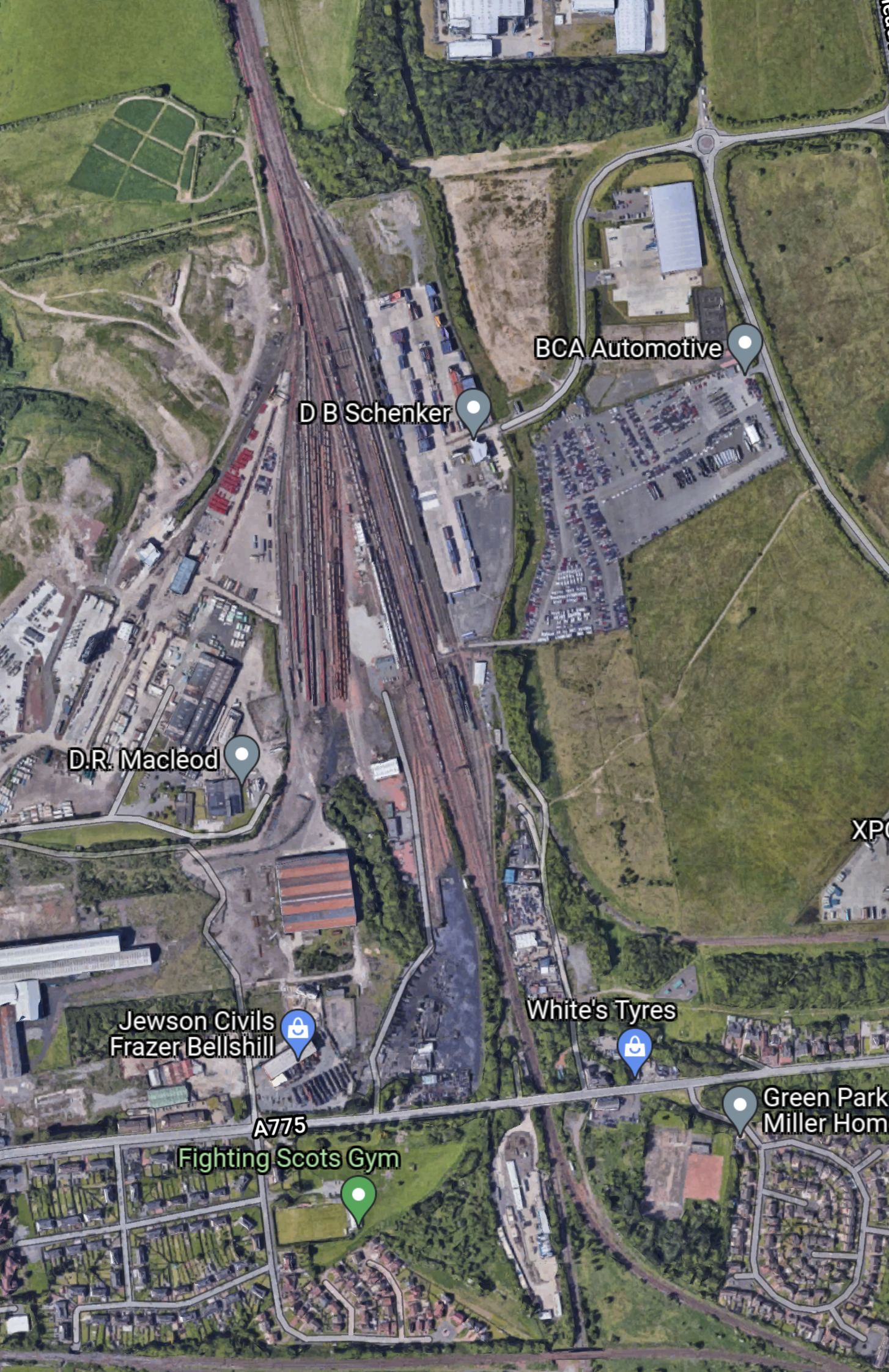
It will be interesting to see how the site grows.
Iron Ore Miner Orders Heavy-Haul Battery Locomotive
The title of this post, is the same as that of this article on Railway Gazette.
This is the first two paragraphs.
Mining company Roy Hill has ordered a Wabtec FLXdrive battery-electric heavy-haul freight locomotive. This will replace one the four ES44ACi diesel-electric locos used to haul its 2 700 m long iron ore trains, and is expected to reduce fuel costs and emissions by ‘double digit’ percentages while also cutting maintenance costs.
The locomotive is scheduled to be delivered in 2023. It will have a capacity of 7 MWh, an upgrade from the 2·4 MWh prototype which Wabtec and BNSF tested in revenue service in California earlier this year.
Note.
- It will have a 7 MWh battery.
- 2700 metres is 1.6 miles.
It looks to me, that the three diesel locomotives and one battery locomotive are arranged as a massive hybrid locomotive and I suspect that with sophisticated control systems, those double digit cuts in fuel costs and emissions would be possible.
A couple of years ago, I took this picture near Shenfield.
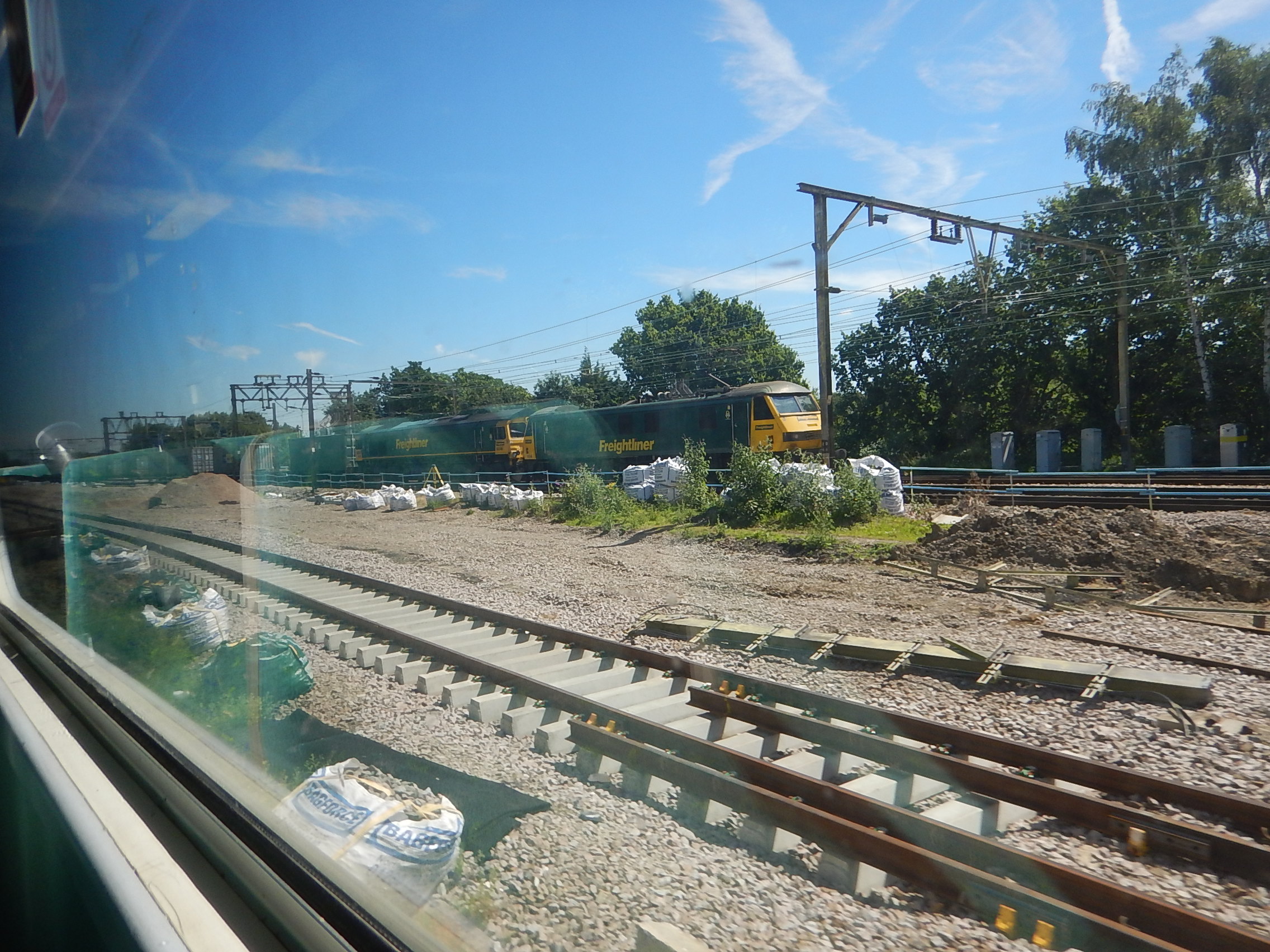
This double-headed train has a Class 90 electric locomotive and a Class 66 diesel locomotive at the front of a long freight train.
- The Class 90 locomotive has an TDM system for multiple working.
- The Class 66 locomotive has an AAR system for multiple working.
So does this mean that the two locomotives can’t work together, which if it does begs the question of what is happening.
- Had the Class 66 locomotive failed and Class 90 was acting as a Thunderbird?
- Was the Class 66 locomotive being moved from one depot to another for maintenance or repair?
- Was it an experiment to see if the two locomotives could work together?
I sometimes think that I didn’t see this unusual formation, but then the camera doesn’t lie.
But could we learn from what Wabtec are doing for Roy Hill in Australia?
The Class 93 Locomotive
Rail Operations Group have already ordered thirty Class 93 tri-mode locomotives from Stadler, which have following power ratings.
- Electric – 4000 kW
- Diesel – 900 kW
- Hybrid – 1300 kW
If this locomotive is capable of hauling the heaviest intermodal freight trains out of Felixstowe, Southampton and other ports and freight terminals, it could contribute to substantial reductions in the diesel fuel used and emissions.
As an example, I will use a freight train between Felixstowe North Terminal and Trafford Park Euro Terminal.
- It is a route of 280 miles.
- I will ignore that it goes along the North London Line through North London and along the Castlefield Corridor through Manchester Piccadilly station.
- There is fifteen miles without electrification at the Felixstowe end.
- There is under three miles without electrification at the Manchester end.
On this service , it could be as much as 94 % of diesel and emissions are saved, if the Class 93 locomotive can haul a heavy freight train out of Felixstowe. A few miles of strategically-placed electrification at the Ipswich end would help, if required.
It must also be born in mind, that the Class 93 locomotive is a 110 mph locomotive on electric power and could probably do the following.
- Run at 100 mph on the busy Great Eastern Main Line.
- Run at faster speeds on the West Coast Main Line.
- Fit in well with the 100 mph passenger trains, that run on both routes.
So not only does it save diesel and carbon emissions, but it will save time and make the freight train easier to timetable on a route with lots of 100 mph passenger trains.
The Class 93 locomotive looks like it could be a game-changer for long-distance intermodal freight, especially, if there were short sections of strategically-placed electrification, added to the electrified network.
Emissions could also be reduced further by using some for of sustainable fuel.

The picture shows a Class 66 locomotive, which is powered by Hydrotreated Vegetable Oil or HVO.
I can see that all diesel-powered trains and locomotives will be powered by sustainable fuels by the end of this decade.
A Wabtec Battery-Electric Locomotive
Wabtec is building a battery-electric locomotive for Roy Hill in Australia.
This article on Railway Age talks about Wabtec’s FLXdrive battery locomotives and describes some features of the locomotive for Roy Hill in Australia.
It mentions pantographs and overhead wires to charge the batteries.
- Wabtec’s prototype battery locomotive has a power output of 3.24 MW and a battery size of 2.4 MWh
- The Roy Hill battery locomotive has a power output of 3.24 MW and a battery size of 7 MWh
I could envisage Wabtec designing a UK-sized battery-electric locomotive with these characteristics.
- 2.5 MW power output, which is similar to a Class 66 locomotive.
- A battery size of perhaps 1.8 MWh based on Wabtec’s FLXdrive technology.
- A pantograph to charge the batteries and also power the locomotive where electrification exists.
- 75 mph operating speed.
- Ability to work in tandem with a Class 66 locomotive.
All technology is under Wabtec’s control.
This locomotive could have a range of at least fifty miles on battery power.
I think this locomotive could handle these routes.
- Peterborough and Doncaster via the Great Northern and Great Eastern Joint Line via Lincoln, with some form of charging at halfway.
- Felixstowe and Nuneaton, with some extra electrification at some point between Peterborough and Leicester.
- Oxford and Birmingham, with possibly some extra electrification in the middle.
One option for charging electrification, would surely be to electrify passing loops.
I think a battery-electric locomtive based on Wabtec’s FLXdrive technology could be a very useful locomotive.
Could Wabtec’s Battery-Electric Locomotive Pair-Up With A Class 66 Locomotive?
Roy Hill will use their locomotive to form a consist of three diesel locomotives and one battery locomotive to obtain double-digit savings of fuel and emissions, when hauling iron-ore trains that are 1.6 miles long on a route of 214 miles.
We don’t have massive iron-ore trains like this, but we do move huge quantities of segregates and stone around the country in trains generally hauled by Class 66 locomotives.
So could a Class 66 or another suitable locomotive be paired-up with a battery-electric locomotive to make savings of fuel and emissions?
I would suggest that if it works in Australia, the technology will probably work in the UK.
The biggest problem for Wabtec is that the heavy end of the market may well be a good one for hydrogen-powered locomotives. But Wabtec are going down that route too!
Conclusion
I am convinced that the two decarbonisation routes I have outlined here are viable for the UK.
But I also feel that locomotive manufacturers will produce hydrogen-powered locomotives.
Other companies like Alstom, Siemens and Talgo will also offer innovative solutions.
What Does High Speed Two Mean By Classic Compatible Trains?
The Classic-Compatible trains are described in this section in Wikipedia, by this sentence.
The classic-compatible trains, capable of high speed but built to a British loading gauge, permitting them to leave the high speed track to join conventional routes such as the West Coast Main Line, Midland Main Line and East Coast Main Line. Such trains would allow running of HS2 services to the north of England and Scotland, although these non-tilting trains would run slower than existing tilting trains on conventional track. HS2 Ltd has stated that, because these trains must be specifically designed for the British network and cannot be bought “off-the-shelf”, these conventional trains were expected to be around 50% more expensive, costing around £40 million per train rather than £27 million for the captive stock.
The Classic-Compatible trains will share these characteristics with the Full-Size trains.
- Maximum speed of 225 mph.
- Cruising speed of 205 mph on High Speed Two.
- Length of 200 metres.
- Ability to work in pairs.
- A passenger capacity around 500-600 passengers.
But what characteristics will the Classic-Compatible trains share with other trains on the UK network?
The Classic-Compatible trains will share some tracks with other trains, according to High Speed Two’s latest plans.
- On the East Coast Main Line, the trains will run between York and Newcastle.
- On the Liverpool Branch between Weaver junction and Liverpool Lime Street station.
- On the Midland Main Line between Clay Cross North junction and Sheffield.
- On the Midland main Line between East Midlands Hub and Bedford.
- On the West Coast Main Line, the trains will run between Crewe and Glasgow.
- On the West Coast Main Line, the trains will run between Stafford and Macclesfield.
As High Speed Two develops, the Classic-Compatible trains could venture off the main routes to places like Aberdeen, Barrow-in-Furness, Blackburn, Blackpool, Cleethorpes, Holyhead, Huddersfield, Inverness, Middlesbrough, Redcar, Scarborough, Stirling and Sunderland.
They will need to be able to go anywhere, which is worthwhile to connect to High Speed Two.
The main restriction is the size of the train and so a Classic-Compatible train probably can’t be larger than the largest train on the UK network, with respect to width, height and to a certain extend length.
Widths of typical trains are as follows.
- Class 319 train – 2.82 metres
- Class 321 train – 2.82 metres
- Class 387 train – 2.80 metres
- Class 700 train – 2.80 metres
- Class 710 train – 2.77 metres
- Class 745 train – 2.72 metres
- Class 800 train – 2.70 metres
- Mark 4 coach – 2.73 metres
Heights of typical trains are as follows.
- Class 319 train – 3.58 metres
- Class 321 train – 3.78 metres
- Class 387 train – 3.77 metres
- Class 710 train – 3.76 metres
- Class 745 train – 3.95 metres
- Mark 4 coach – 3.79 metres
Note.
- I find it odd, that the smallest width is one of the newest trains; Hitachi’s Class 800.
- Length is fairly irrelevant as many trains in the UK are almost 240 metres long.
I suspect that Classic-Compatible trains will have width of between 2.70 and 2.80 metres and a height of around 3.80 metres.
Could A High Speed Two Classic-Compatible Train Go Through The Thameslink Tunnel?
I ask this question, as surely in a post-pandemic world, where we are all flying there may be a case to be made for a train service between the North of England and Gatwick Airport.
But when East Midlands Railway has their new Class 810 trains, it might be possible, if they didn’t use the diesel engines.
Signalling would not be a problem, as in a few years time, all trains will be equipped with the latest digital signalling systems.
If running a Class 810 train, through the tunnel is possible, given that a Classic-Compatible train will not be larger than a Class 810 train, will High Speed Two’s trains be able to cross London in the Thameslink Tunnel?
As Midlands Connect are planning to run a Leeds and Bedford service using High Speed Two Classic-Compatible trains, could this service be extended through the Thameslink Tunnel to Gatwick Airport and Brighton?
I have a feeling that this will be physically possible.
- It would be under the control of the signalling.
- There’s no reason, why a high speed train can’t have a precise low speed performance.
- It would stop at all stations.
- It would use one of the Bedford and Brighton paths on Thameslink
Passengers would like catching a train at a station in Central London and like being whisked all the way to East Midlands Hub and Leeds.
Could A High Speed Two Classic-Compatible Train Go Through The Crossrail Tunnel?
Consider.
- It would surely be possible to arrange tracks at Old Oak Common to allow High Speed Two Classic-Compatible trains to go between High Speed Two and Crossrail.
- Crossrail is considering running to Ebbsfleet.
- It might even be possible to connect in East London.
- The High Speed Two Classic-Compatible trains would be digitally-signalled and controlled through Crossrail without stopping.
- Platform edge doors would ensure safety, but also prevent the trains from stopping at the existing stations.
I have just looked at the London railway map on carto metro, there are stretches of Crossrail under London, where there is space for a station with 200 metre, if not a 400 metre platforms, to the West or East of current Crossrail stations.
- To the West of Bond Street
- To the East of Tottenham Court Road
- To the West of Farringdon
- To the East of Liverpool Street
- To the West of Canary Wharf
- To the East of Canary Wharf
Would all appear to have the required space and be possibilities for extra High Speed Two platforms.
Effectively, some stations would have two sets of platforms on the tracks beside each other.
- One pair of platforms would be the existing station, with platform edge doors compatible with Crossrail’s Class 345 trains.
- The other pair of platforms would be the High Speed Two station, with platform edge doors compatible with High Speed Two Classic-Compatible trains.
- The signalling and train control systems would automatically stop trains in the appropriate platform.
- Extra passageways would link the new platforms to the existing station.
I suspect when Crossrail was designed, the possibility of adding extra stations to the underground section was considered and there is a method of adding extra platforms in Crossrail’s book of cunning engineering ideas.
Conclusion
I don’t rule out a High Speed service between Birmingham and stations in the North of Great Britain and major cities on the Continent.
- Crossrail would be used to link High Speed One and High Speed Two.
- High Speed Two Classic-Compatible trains would be used.
- Stops in London could be Old Oak Common, Bond Street, Liverpool Street, Canary Wharf and Ebbsfleet
It may sound to be a fanciful idea, but I believe it is possible.
Thoughts On Phase 2a Of High Speed Two
This map shows the route of Phase 2a of High Speed Two.
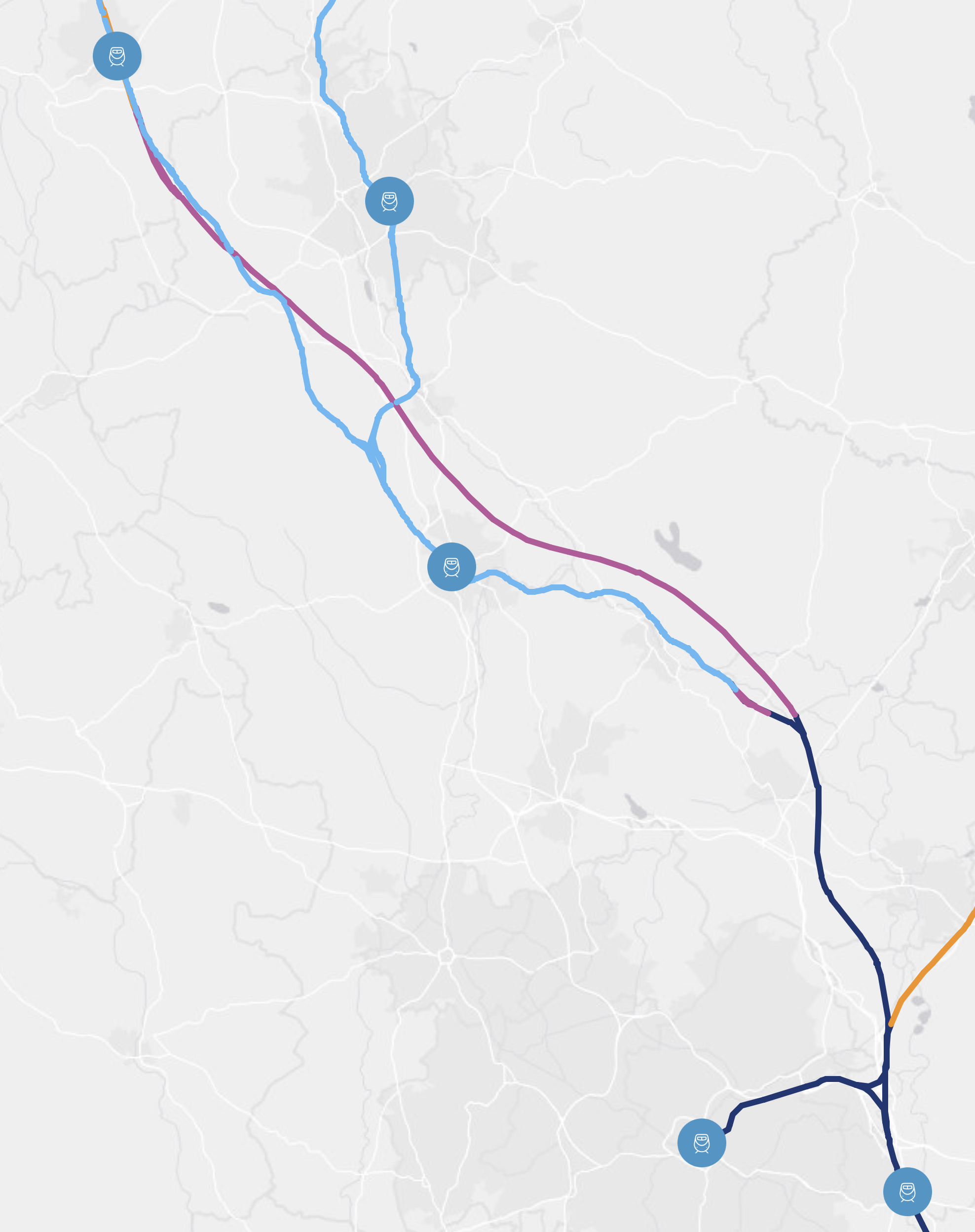
Note.
- The blue circles are stations.
- From the top, the stations are Crewe, Stoke-on-Trent, Stafford, Birmingham Curzon Street and Birmingham Interchange.
- The lighter blue track is sections of the West Coast Main Line, that will be used by High Speed Two services.
- The darker blue track is Phase 1 of High Speed Two.
- The orange track is Phase 2b of High Speed Two to East Midlands Hub, Leeds and Sheffield.
- The mauve track is Phase 2a of High Speed Two.
This page on the High Speed Two web site, which is entitled Phase 2a: West Midlands To Crewe, says this about the building and opening of Phase 2a.
It will be built at the same time as the line between London and the West Midlands. High speed services will begin operating between London, Birmingham and Crewe between 2029 and 2033.
It is my opinion, to build Phase 1 and Phase 2a together is a good move.
- Crewe is a very well-connected station.
- It will reduce times between Crewe and London Euston by 34 minutes.
But most importantly, it completes a second separate route for the West Coast Main Line between Crewe and London Euston.
Just think what new bypasses and motorways have done for your driving.
These are some thoughts and observations.
West Coast Main Line Benefits
The High Speed Two web page, which is entitled Phase 2a: West Midlands To Crewe, has a section called West Coast Main Line Benefits, where this is said.
Phase 2a unlocks more rail capacity on the West Coast mainline. It will carry six long distance high speed services per hour, freeing up the West Coast Mainline between Lichfield and Crewe. This could see services rise from hourly to half-hourly or better between Crewe and Stoke-on-Trent to Nuneaton, Tamworth, Lichfield and Rugeley, as well as more services from Crewe to Runcorn and Liverpool, as well as via Crewe between North Wales, Chester and London.
It would appear the six long-distance services could be.
- Train 1 – London Euston and Lancaster – Splits and joins with Train 2 at Crewe.
- Train 2 – London Euston and Liverpool – Splits and joins with Train 1 at Crewe.
- Train 3 – London Euston and Liverpool – Single train
- Train 4 – London Euston and Edinburgh/Glasgow – Splits and joins at Carlisle for Edinburgh and Glasgow
- Train 5 – London Euston and Edinburgh/Glasgow – Splits and joins at Carlisle for Edinburgh and Glasgow
- Train 6 – Birmingham Curzon Street and Edinburgh/Glasgow – Serves Edinburgh and Glasgow alternately.
Note that all services use a single or a pair of High Speed Two Classic Compatible trains.
A High Speed Test Route Can Be Created
Consider.
- At the Northern end of the Phase 2a track is Crewe station.
- At the Southern end of the Phase 2a track is Birmingham Interchange station.
- The track between the two end stations will be newly-laid modern high speed track capable of 225 mph running.
- There will be no intermediate stations or Victorian throwbacks like level crossings.
- The only junctions are at the end of the route.
- If the High Speed Two trains are built in this country, there will be a need for somewhere to check them out.
The Phase 2a track will surely make an ideal test track for testing trains and systems and training drivers.
Should Improvement Needed For High Speed Two On The East And West Coast Main Lines Be Given High Priority?
High Speed Two will bring major improvements in times between London and the North of England and Scotland, with these figures claimed by this page on the High Speed Two web site.
- London Euston and Carlisle – 2 hours and 23 minutes saving 54 minutes
- London Euston and Darlington – 1 hours and 50 minutes saving 32 minutes
- London Euston and Durham – 2 hours and 16 minutes saving 37 minutes
- London Euston and Edinburgh – 3 hours and 48 minutes saving 31 minutes
- London Euston and Glasgow – 3 hours and 40 minutes saving 49 minutes
- London Euston and Lockerbie – 2 hours and 55 minutes saving 43 minutes
- London Euston and Newcastle – 2 hours and 17 minutes saving 32 minutes
Substantial savings would seem to be possible.
The Recent Record Run On The West Coast Main Line
A few weeks ago, Avanti West Coast ran a Class 390 train between London Euston and Glasgow in three hours and 53 minutes and 1 second. They were trying to beat the record set by the \APT-P in 1984 of three hours and 52 minutes and 40 seconds.
In Lessons From The Record Run in the August 2021 Edition of Modern Railways, Roger Ford makes a big hint in a section called Hint.
Roger starts with this paragraph.
In the virtual race with APT-P, the Pendolino was seven minutes ahead approaching the border, but this was not sufficient to overcome APT-P’s advantage of being able to run faster over lines which, unlike the southern end of the WCML, have not enjoyed the increased speeds further south, such as at Stafford and Crewe.
He then talks of a levelling-up of the infrastructure being needed on the Northern section of the West Coast Main Line.
Roger finishes the section with this paragraph.
Thus, the final message of the run is that if HS2 is to realise its full potential, planning for the West Coast Route Modernisation (North) needs to start now, both for journey time reductions and reliability.
The High Speed Two time between Preston and Glasgow of two hours and 26 minutes, given by their journey time calculator is in line with current timings.
I am drawn to the following conclusions about services between Preston and Glasgow.
- I suspect the similar times could be expected, as the trains will have to cope with other trains on the route.
- Most of High Speed Two’s savings must be on the new track to the South of Wigan.
It would appear that any savings made between Preston and Scotland will benefit both classic and high speed services.
I certainly agree with Roger’s hint to start planning the upgrade of the Northern section of the West Coast Main Line.
This would surely enable upgrade of the route to start sooner and places at the North of the route would benefit from faster journey times to the South before High Speed Two is complete.
Reducing The Journey Times On The West Coast Main Line
If you look at the average speed between Preston and Glasgow of a typical train, it is just 84.3 mph.
Various average speeds give the following times between Preston and Glasgow.
- 90 mph – two hours and 8 minutes
- 100 mph – one hour and 55 minutes
- 110 mph – one hour and 45 minutes
It would appear there is scope for reductions in journey times to be made.
I have flown my virtual helicopter along the Scottish part of the route and it doesn’t look to be too terrifying.
- There are tight speed limits at Preston and Carlisle
- The railway is not hemmed in by development until close to Glasgow.
- Most of the modern bridges, where the M74 crosses the railway appear to have space for an extra track.
- Connection of the Borders Railway to the West Coast Main Line could give scope for improvement between Gretna junction and Carlisle.
- The depot at Annandale, that I wrote about in High Speed Two To Build Stabling Facility In Scotland, may give scope for a shorter, straighter and faster route between Grena Green and Kirkpatrick-Fleming, that could run closer to the M74.
- North of Lockerbie, there may be scope to put extra tracks between the railway and the M74.
- The Carstairs area could be ripe for improvement.
I would feel that digital signalling and some well-applied engineering could cut a sensible amount of time from Preston and Glasgow timings.
- I can certainly say, that the route is not a desert, where possible improvements will be difficult to find.
- I also don’t feel there are any obvious improvements, that will be controversial.
There is also the M74, which could be invaluable for camouflaging the railway.
Reducing The Journey Times On The East Coast Main Line
Much of the work to speed up the Northern section of the East Coast Main Line is laid out in Northern Powerhouse Rail – Significant Upgrades Of The East Coast Main Line From Leeds To Newcastle (Via York And Darlington) And Restoration Of The Leamside Line, a post I wrote to explain what Northern Powerhouse Rail feel is urgently needed.
Mentioned in the other post are following projects.
- Full Digital Signalling
- Phase 2 Of The East Coast Main Line Power Supply Upgrade
- York to Church Fenton Improvement Scheme
- Darlington Station Remodelling
- The North Throat Of York Station Including Skelton Bridge Junction
- Use Of The Leamside Line
As with the West Coast Main Line, the improvements would benefit both classic and High Speed services.
Conclusion
Improvements to both the East and West Coast Main Lines will help both classic and High Speed services between London and the North of England and Scotland.
I think that planning and design should be started as soon as possible.
Construction should start as early as possible, so that the benefits of faster trains are felt at the earliest date possible.
 The Anonymous Widower