Hydrogen Truck Can Make Garbage Day A Much Quieter Event
The title of this post in the same as that of this article on Hydrogen Fuel News.
This is the first paragraph.
Hyzon Motors has announced that it will be rolling out a 27-ton Australian-made hydrogen truck to be used for vehicle towing as well as potentially for garbage collection this year.
Less noise, less pollution\2 What more can you want?
In London, we something rather important, a hydrogen policy, rather than a Mayor, who hopes the problem will fade away.
The writer of this article finds it interesting, that Hyson, who are an American company are making the trucks in Australia.
They say this.
Hyzon opened an Australian location three years ago in order to benefit from the substantial industry talent that became available there when Ford, Toyota and Holden closed their local operations. As the country also places a considerable focus on H2 production, it has opened several doors for moving forward with various types of hydrogen truck design.
So vehicle manufacturers beware! If you close an operation in a country, you may find competitors starting up!
No Shortcuts In Evia Aero’s Path To Being Europe’s First Green Regional Airline
The title of this post, is the same as that of this article on FutureFlight.
This is the first paragraph.
The closer you examine the task of establishing a green airline, the clearer it becomes that it does not begin and end with sourcing net zero carbon aircraft. Evia Aero is a case in point in that while the German start-up has made provisional commitments to a pair of electric aircraft developers, for now, it is more preoccupied with getting a somewhat daunting operational ecosystem in place.
The article is an interesting read and certainly follows this old joke about aviation.
If you want to make a small fortune in aviation, start with a large fortune.
The article is mainly drawn from an interview with the founder of Evia Aero; Florian Kruse and these are some of his thoughts.
On Sustainability
This paragraph talks about a truly sustainable aviation company.
First you have to be sure that you can operate as a truly sustainable aviation company,” Evia Aero founder Florian Kruse told FutureFlight. The Bremen-based venture plans to invest in photovoltaic (PV) solar energy plants at the airports it intends to serve to fulfill its commitment to being self-sufficient in green energy, which could include electricity and hydrogen fuel. The next step will be installing the required refueling and recharging facilities.
I’ll agree with that objective, but is it an affordable commitment?
On An Air Operator Certificate
This paragraph talks about an Air Operator Certificate.
Only when these tasks are well advanced, probably in 2024, will Evia Aero secure the air operator certificate it needs to launch commercial scheduled services in Europe. The company has yet to determine whether it will establish an operation from scratch or acquire an existing AOC holder.
Having seen a friend struggle to get an airline going, I wonder, if existing AOC holders will have an advantage in getting fully certified.
Why Not Start A Traditional Airline And Transition To A Green One?
This was Florian Kruse’s answer.
Some people ask us why we don’t just start operating normal [fossil-fuel-burning] aircraft today and then make a transition [to net zero],But we don’t think that works. The only way to be successful in this is to be green with everything from the start.
But by his choice of the Britten-Norman Islander, Florian is taking a conservative route with a proven small airliner, that has been flown into hundreds, if not thousands, of airfields all over Europe and the wider world.
I suspect too, that a lot of experienced Islander pilots from all over the world, will want to add these aircraft to their log book. So recruitment of top quality pilots will not be a problem!
Refuelling And Maintenance
This is said about refuelling and maintenance.
In this regard, Evia Aero’s strategy isn’t based purely on a sustainability agenda. It views the plans for refueling and maintenance as key parts of its revenue stream.
Does this mean, it will be supplying support services to other operators of zero-carbon aircraft?
It should be remembered that the business model of some companies is based heavily on a business aircraft. Will these companies change their philosophy or change the aircraft?
One company that used business jets to sell construction equipment in the past was JCB. Prospective customers would be flown to the UK for demonstrations at their test site near the factory. GEC also used to use their business jet creatively.
The Eviation Alice, which Evia Aero intend to fly, will also be available in a six-seat business configuration.
I can imagine many companies using zero-carbon business aircraft creatively and to send the right message to customers and green activists, who haven’t been friendly in the past.
Thinking about this, as I type, I think that zero-carbon business aircraft could be a significant sector of the zero-carbon aircraft market. It would also appeal to many politicians, royalty, innovative business me and women and the very rich.
In the case of King Charles, I suspect a six-seat Eviation Alice or similar based at Northolt Airport would cost less to run than the Royal Train.
Pricing
This is said on pricing.
It believes (passengers) will pay a premium to access airfields in locations across northern Europe that are not well served by road and rail links.
I’ll go with that, as many years ago, I needed to go to Stavanger for a day or so from Ipswich. So I flew Air Anglia from Norwich in a Bandeirante, rather than go from Heathrow with a change at Oslo.
Backing And Expertise
This is a paragraph from the FutureFlight article.
Evia Aero is not without expertise as it seeks to put these building blocks in place. One of its backers, Energiequelle, is involved in a business that owns and operates PV plants in Finland and Germany. Its leadership team also includes Gerd Weber, CEO of regional airline OLT, and the chair of its advisory board is Axel Trampnau, who previously ran the carrier Germania.
That seems reasonably strong.
If Energiequelle live up the mission statement on their web site, they could be particularly useful.
Hydrogen-Powered Islanders
This is said about their purchase of conversion kits for Islanders to be converted to hydrogen power.
Under current plans, the first aircraft in the Evia Aero flight will be nine-passenger Britten-Norman Islanders under a plan being advanced by Cranfield Aerospace Solutions (CAeS) to convert the piston-powered models to hydrogen propulsion. Evia Aero expects these aircraft to be ready to enter service in 2026 and has agreed to buy 15 of the conversion kits.
The Islander may have flown nearly sixty years ago, but nearly 1300 have been built and they are still being manufactured, so there should be plenty available from conversion and spare parts shouldn’t be a problem.
Cranfield Aerospace Solutions, is a spin-out of Cranfield University and the article says this about an ongoing project between CAeS and Evia Aero.
In 2022, the new airline signed a wider agreement with CAeS covering a provisional order for 10 hydrogen-powered 19-seat aircraft. The companies have not yet determined whether these would be conversions of existing aircraft or a clean-sheet design. Under the UK’s Project Fresson, CAeS is working on plans for new 19- and 75-seat zero-emissions regional airliners.
CAeS look like another serious contender in the zero-carbon airliner market.
Eviation Alice
This is said about the Eviation Alice.
Evia Aero has signed a memorandum of understanding covering provisional orders for 25 of Eviation’s nine-passenger, all-electric Alice aircraft. It expects to add the first of these to its fleet in 2028, a year after the U.S.-based manufacturer now says it aims to complete type certification, initially with the FAA.
Note.
- Alice is running two years behind the Islander.
- Certifying the Islander should be easier as it is an existing airliner.
I could see the earlier delivery and entry into service of the Islander, being used to develop the business.
Range And Routes
This is said about range and routes.
With either of these aircraft, Evia Aero will be launching its services with the equipment providing a modest payload and range. The Cranfield Islanders will be able to fly up to around 200 kilometers (109 nm), while Eviation last year reduced its range projections from 440 to 250 nm, citing the limitations of current battery technology.
Kruse accepts these limitations, while already laying plans to add subsequent 19-seat aircraft to his fleet. He showed FutureFlight route maps for both aircraft including planned destinations extending along the North Sea and Channel coasts from Denmark through Germany and the Benelux countries and into France and the UK.
- The range isn’t that long.
- It is 629 kilometres between Evia Aero’s base at Bremen and Southend.
- Schiphol is closer at 89 kilometres with Groningen at 147 kilometres.
But the interesting one is Heligoland at 139 kilometres.
Heligoland
This Google Map shows the archipelago.
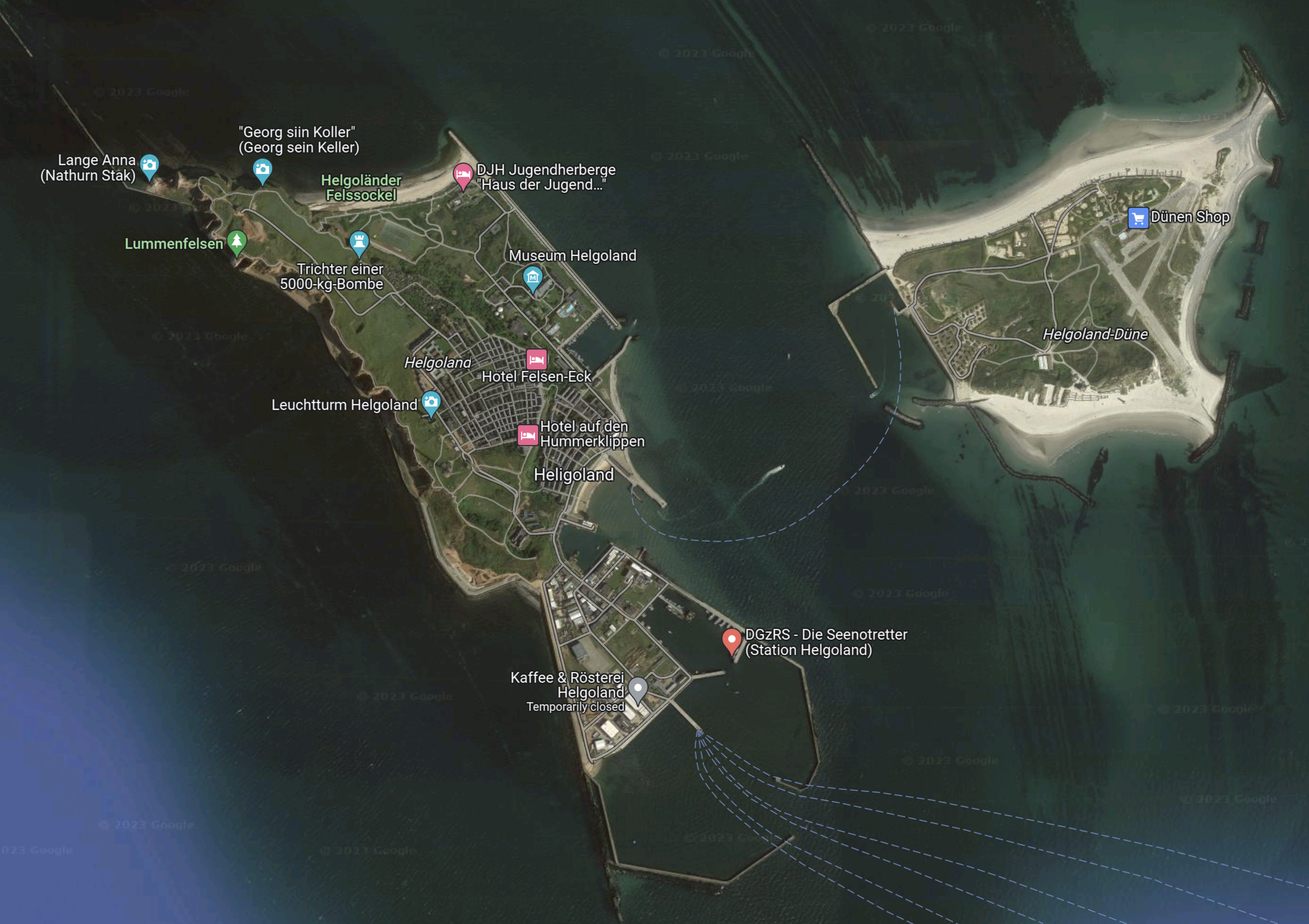
Note.
- Heligoland is the island in the West.
- Düne is the island in the East.
- You can just pick out the characteristic pattern of Heligoland Airport‘s three concrete runways.
Why would anybody want to go to a rock in the North Sea?
This article on the Guardian, which is entitled Heligoland: Germany’s Hidden Gem In The North Sea, gives lots of reasons, including.
- History.
- It is a regular day trip from the German coast by ship.
- It used to be British.
- It could be at the heart of offshore wind developments.
But for German day-trippers, it’s probably the attraction of the island being duty-free.
It could be a nice little earner for an airline based in Bremen and it would be within the range of the Islanders.
A Pattern Of German Islands
This Google Map shows the German corner of the North Sea.
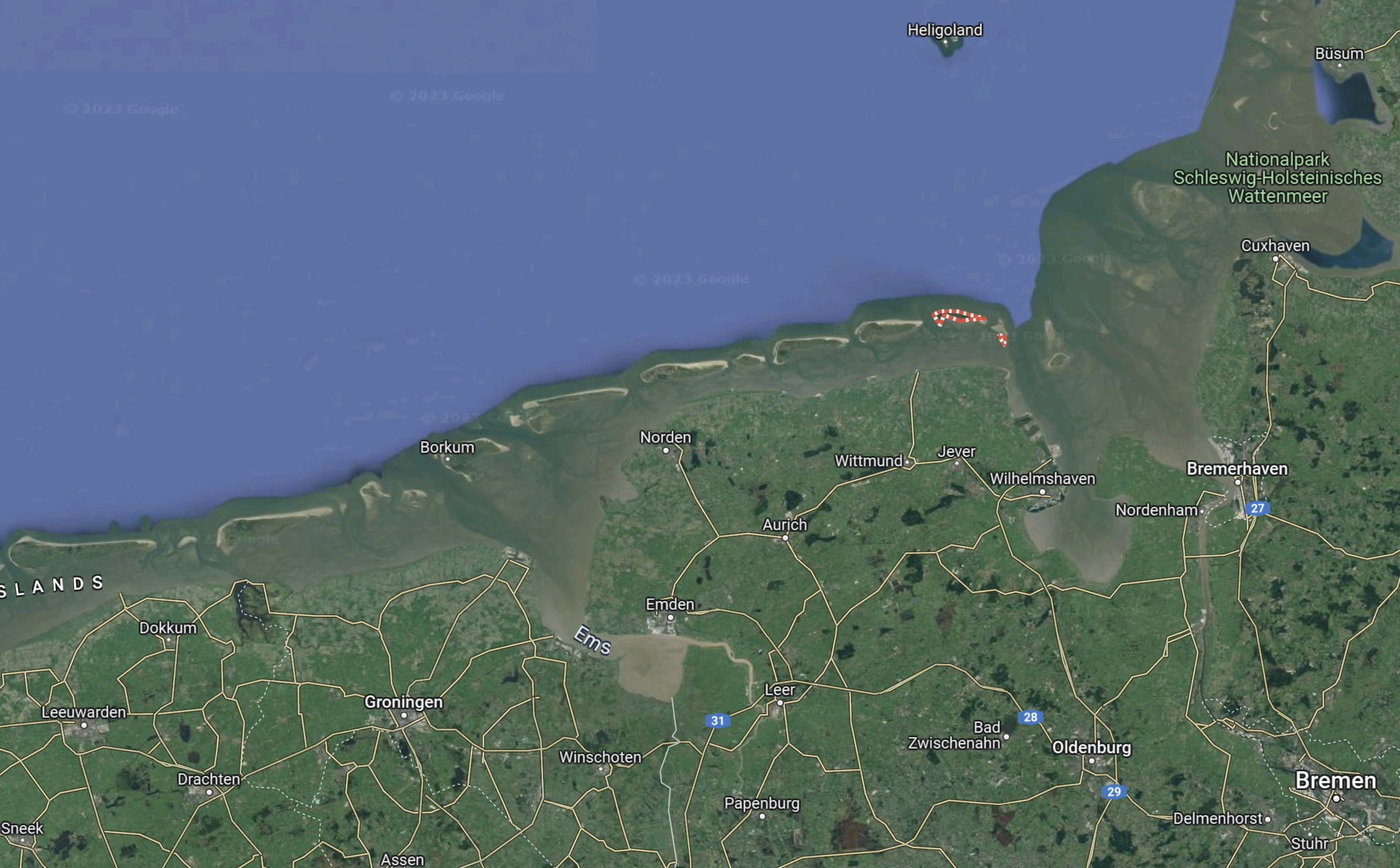
Note.
- The island of Heligoland at the top of the map.
- Bremen in the South-East corner of the map.
- The string of islands along the German and Dutch coasts.
- The red area marks out the most-Easterly island of Wangerooge.
This Google Map shows Wangerooge in detail.
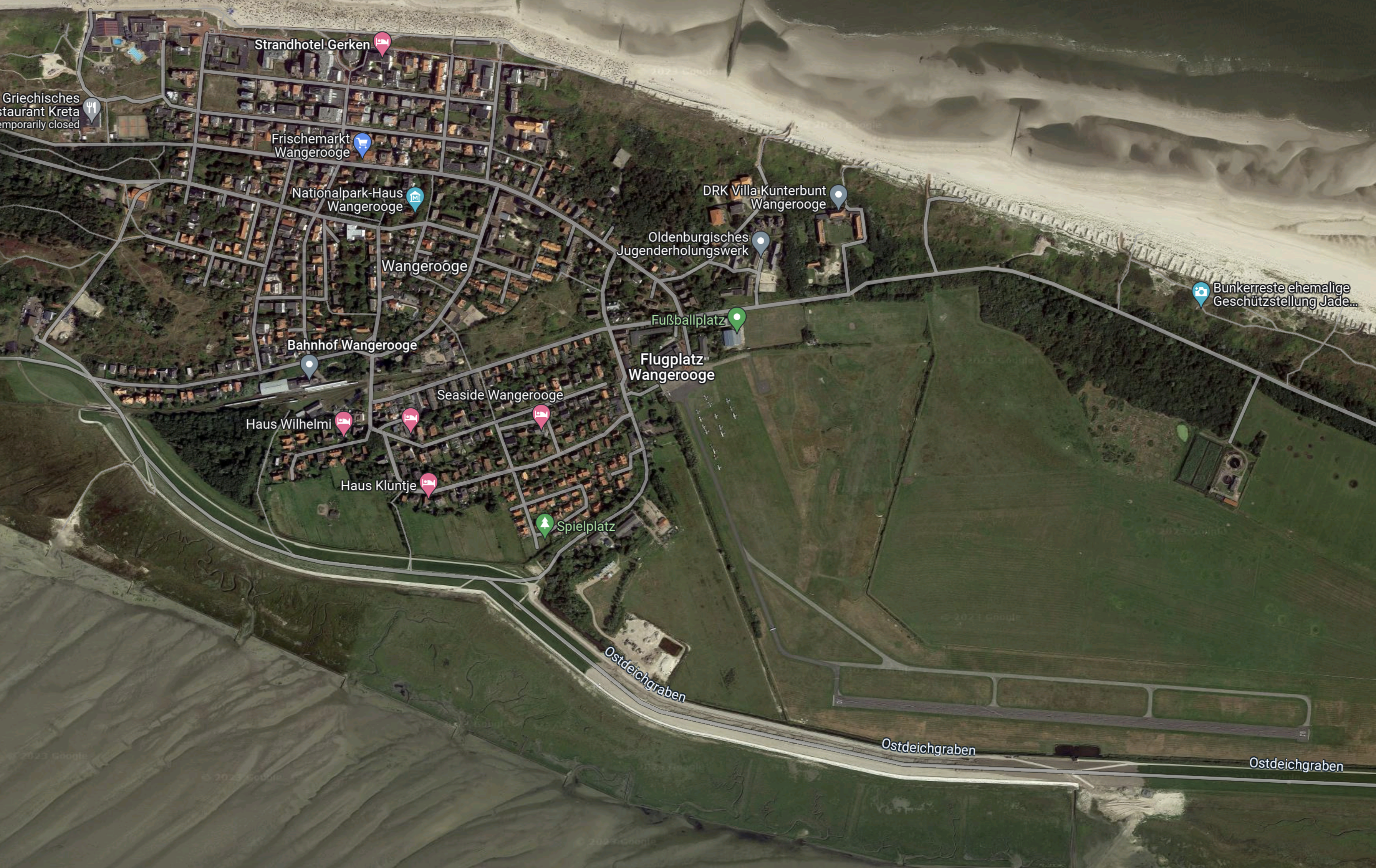
Flugplatz Wangerooge is in the South-East corner of the map.
- It has an 850 metre asphalt runway.
- The island appears to have a sizeable beach.
- The island has a population of around 1200.
The Wikipedia entry for Wangerooge says this about the character of the island.
In order to guarantee a relaxed atmosphere, cars are prohibited on the island. The island can be reached by ship from Harlesiel, or it can be reached by plane via its airfield, regular service being offered from Harlesiel, Bremen, or Hamburg. The ferries leave at different times every day according to the tide. As on most East Frisian Islands, a small narrow gauge railway line, the Wangerooge Island Railway, connects the harbor to the main village.
The Wikipedia entry, for the Wangerooge Island Railway gives a lot of detail about what looks to be a fascinating railway, including this opening paragraph.
The single track Wangerooge Island Railway (Wangerooger Inselbahn) is an unelectrified narrow gauge railway with a track gauge of 1,000 mm (3 ft 3+3⁄8 in) located on the East Frisian island of Wangerooge off the northwestern coast of Germany. It is the most important means of transport on the island and is the only narrow gauge railway operated today by the Deutsche Bahn.
I must visit next time, I go to Hamburg.
Working towards the West the next airfield, I can find is on Langeoog, which is shown in this Google Map.
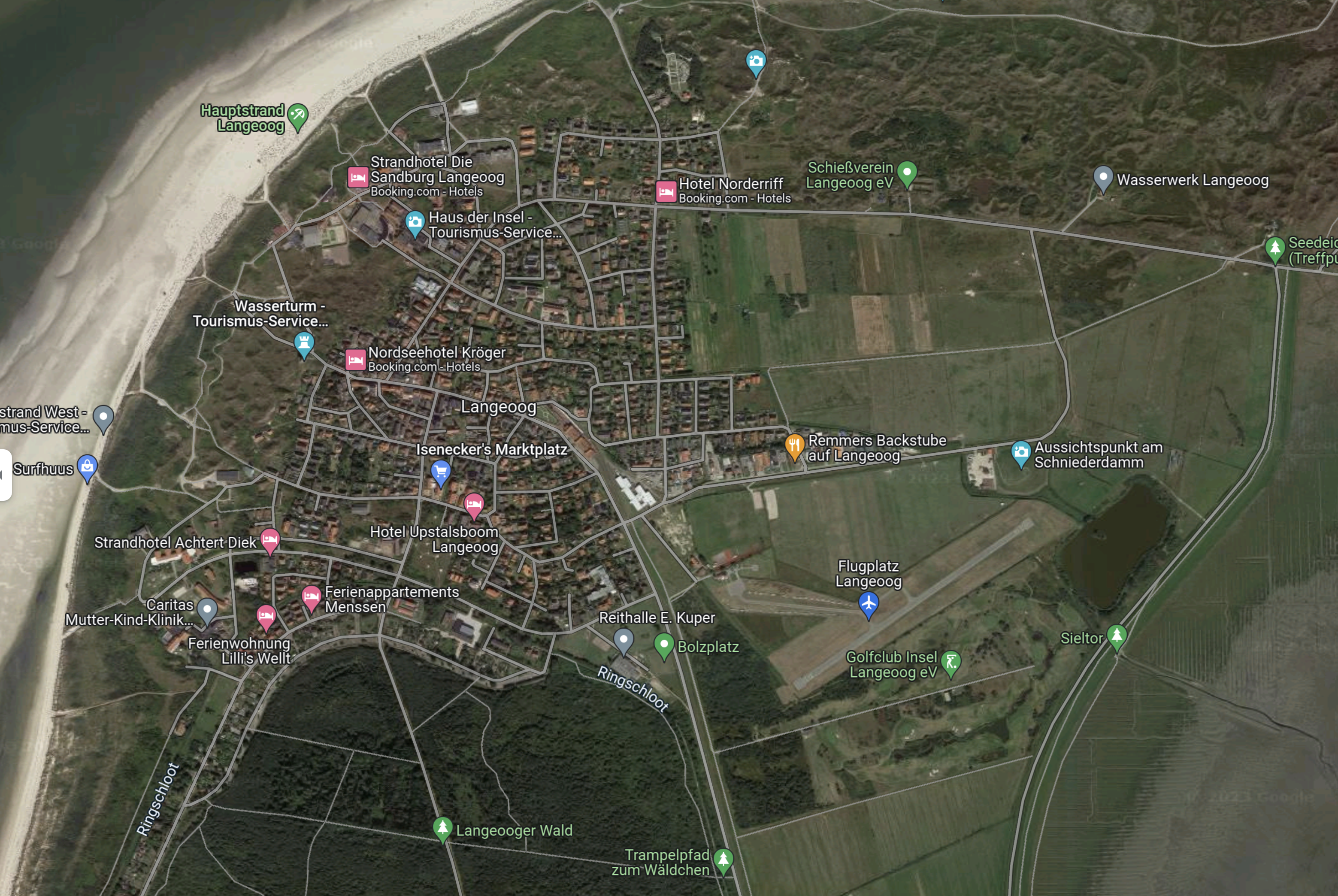
Flugplatz Langeoog is marked by the blue arrow towards the South-East corner of the map.
Working towards the West the next airfield, I can find is on Nordeney, which is shown on this Google Map.
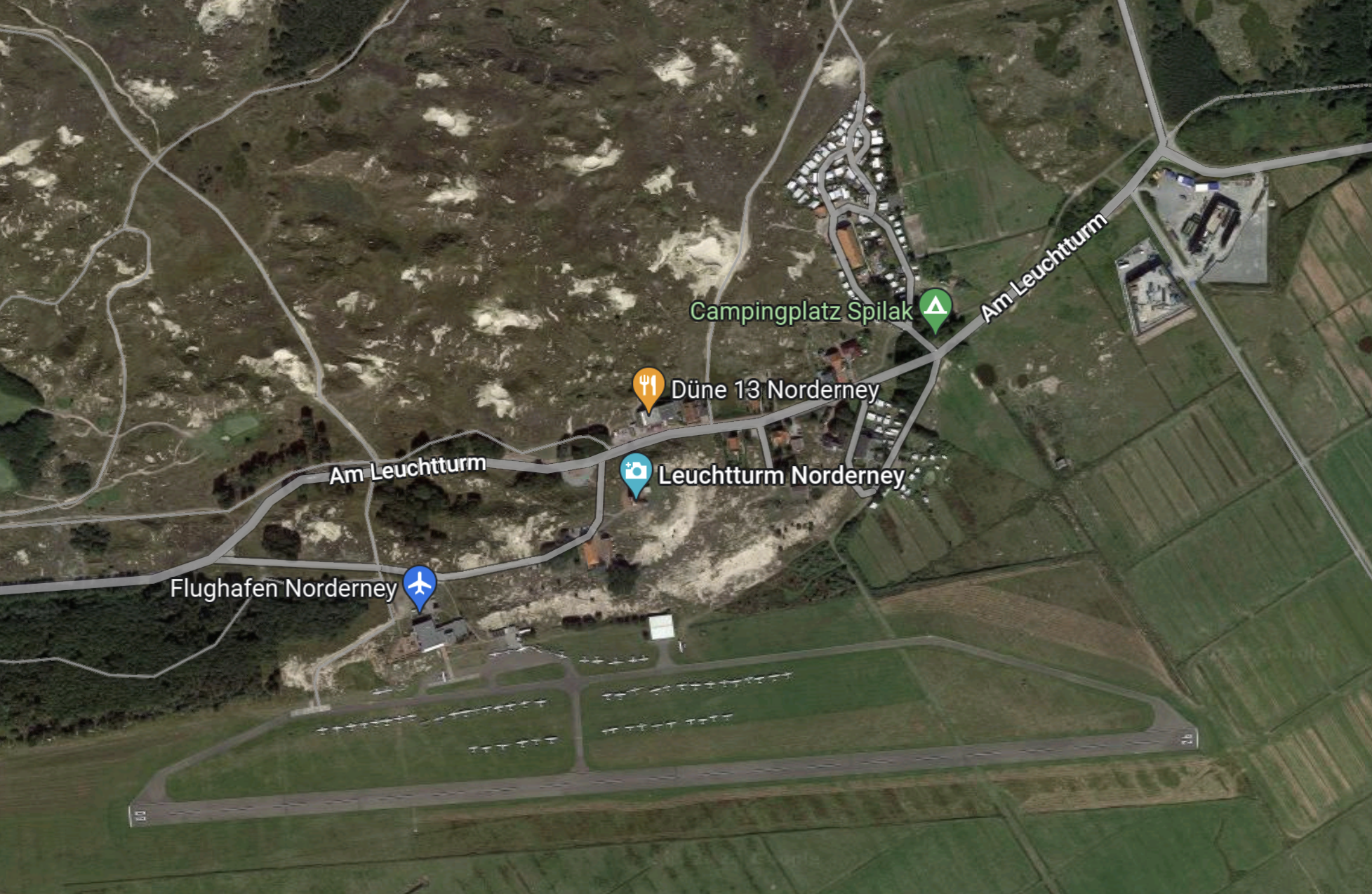
Flughaven Nordeney is at the bottom of the map.
It has a 1000 metre runway and judging by the planes on the map, it is very busy.
Continuing West brings me to the Eastern end of the island of Juist, which is shown on this Google Map.
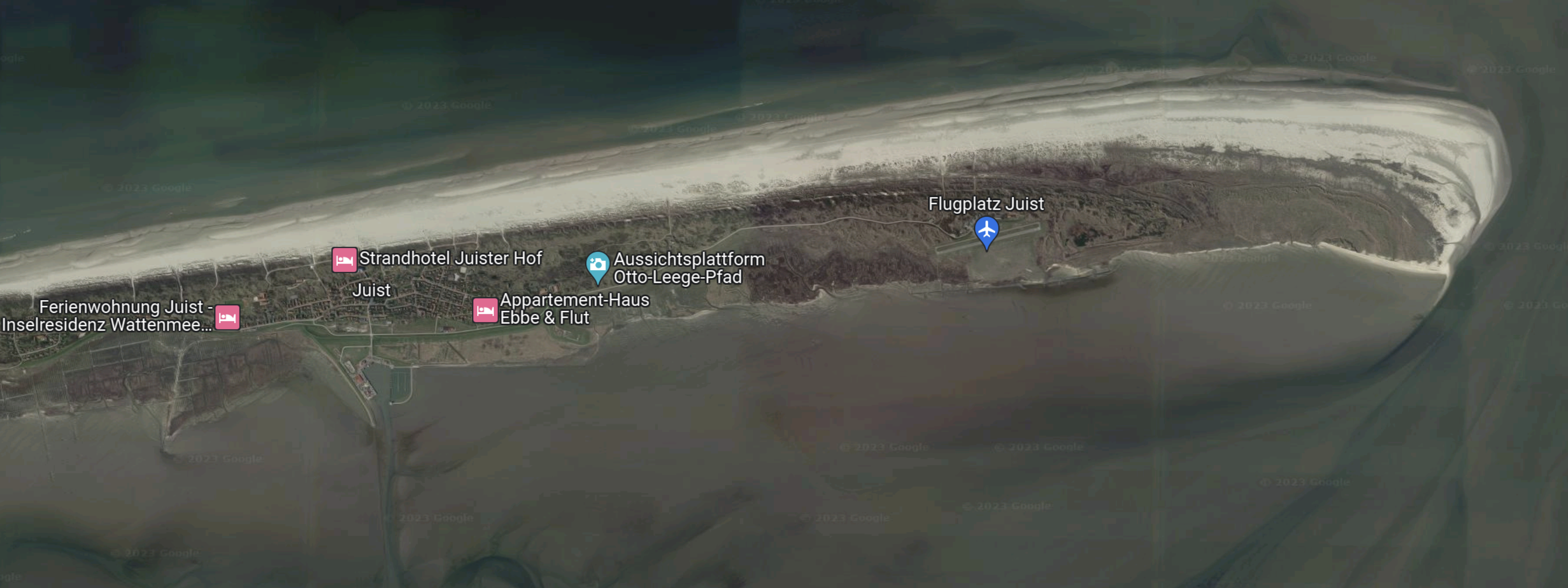
Flugplatz Juist is indicated the rightmost blue arrow. This extract from the Wikipedia entry, illustrates the importance of this airfield.
As of 2013, the airfield had up to 500 takeoffs and landings on weekends, the second most aircraft movements in the state of Lower Saxony, after Hannover Airport. The airfield is a critical piece of infrastructure for the island, due to ferry traffic being dependent on the tides.
The airfield was also the first on the East Frisian Islands to have a paved runway
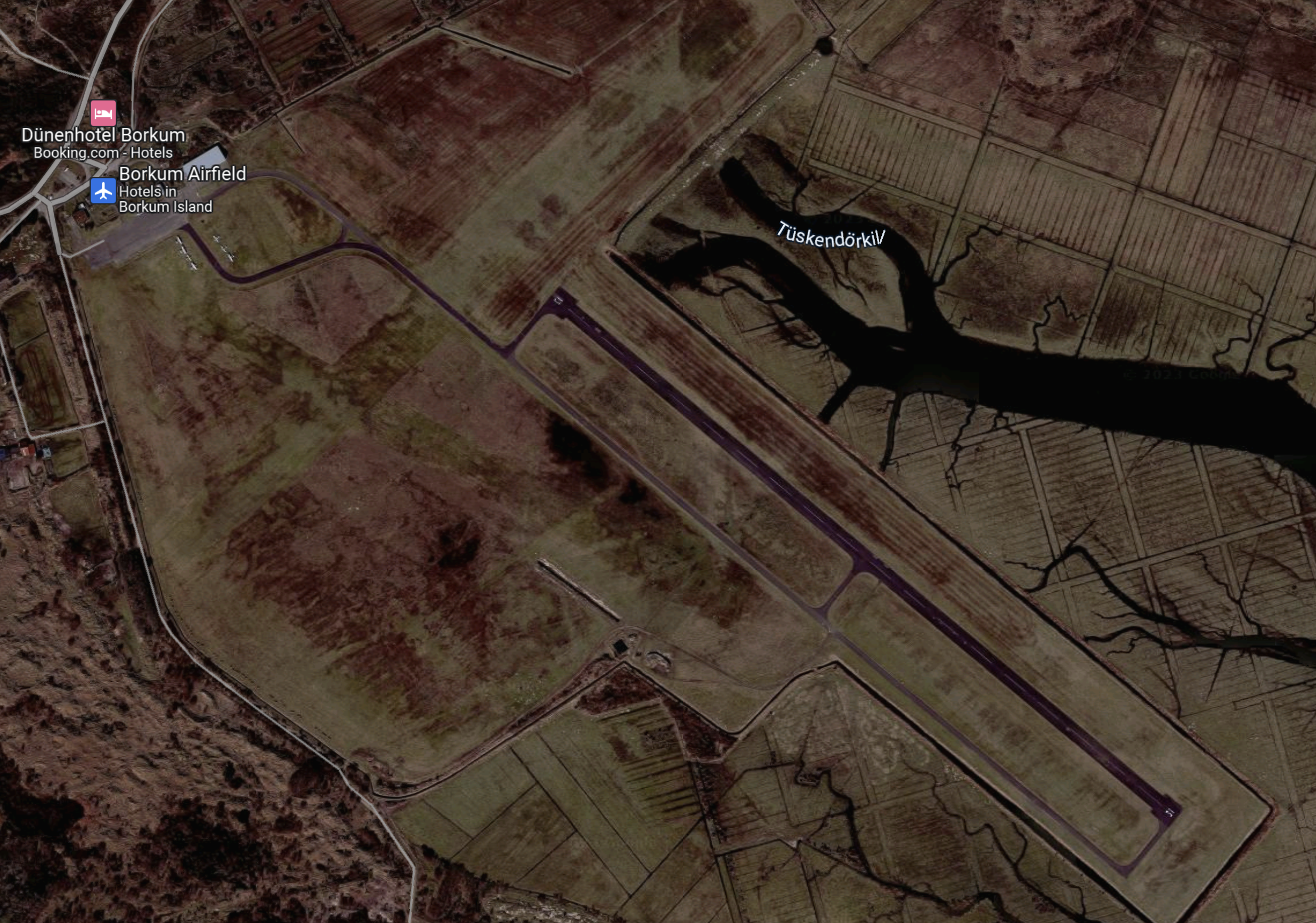
Continuing West brings me to Borkum, which is shown on this Google Map.
Note.
Borkum Airport is in the Eastern half of the map.
- It has a 1000 metre asphalt runway.
- Borkum has a population of around 5000.
On this brief exploration of the German East Frisian Islands, I have been surprised to find five airfields; Borkum, Juist, Langeoog, Nordeney and Wangerooge.
- All seem to have asphalt or concrete runways.
- Were these runways built as part of a plan to improve transport to the islands, as it appears the tides make the ferries a bit variable?
It also appears that the islands are totally or at least partially car-free.
On one island I noticed that the taxis are horse-drawn carriages.
So does this all fit well with the philosophy of Evia Aero of flying zero-carbon aircraft?
I suspect it does.
I also think, that Evia Aero’s thinking has been influenced by recent events in the area, which I talked about in From Groningen To Leer By Train.
- To put it simply, a freighter called the Emsmoon, demolished the Freisenbrücke, which carries the Groningen and Bremen railway over the River Ems.
- Zero-carbon aircraft flying between Groningen and Bremen would be a viable and quicker and more comfortable alternative to the bus I took.
I wonder if Evia Aero are planning a service between Groningen and Bremen.
- Groningen and Bremen is 147 kilometres.
- Islanders can cruise at 240 kph.
- The service could call at the five intermediate airports.
- I would reckon, that the service would take about an hour between Groningen and Bremen.
- The aircraft would be refuelled at Groningen and Bremen.
- I am fairly certain that two planes could run an hourly service.
I also suspect that the ticketing could be run by an app and if there were no passengers wanting to get on or off at an intermediate stop, then the plane would continue to the next stop, which would save fuel. If a passenger missed a plane, there would be only a wait of an hour until the next one.
Get this right and if it proves successful, then extra services could be added, to create a true Turn-Up-And-Go air service.
Landing And Take-Off Performance
This is a paragraph from the FutureFlight article.
Both the Islander and the Alice offer short takeoff and landing performance that will allow them to get in and out via limited runways in small communities. In the case of the Islander, which has been in service for several decades, it will even be able to operate from grass landing strips.
Every little helps.
Islanders can also use sand runways, as they do at Barra.
Refueling The Islanders
This image of the hydrogen-powered Islander was clipped from the Cranfield Aerospace Solutions’ home page.

Consider.
- Many years ago, I had fun with a farmer friend moving a lot of apples in boxes, that were destined for Aspall Cyder with his forklift. The machine was powered by gas in a cylinder strapped horizontally behind the driver.
- We ran out of gas halfway through and it was a simple matter of disconnecting the bottle and connecting another.
- Drop tanks have been used in military aircraft for almost a hundred years.
- Universal Hydrogen refuels its hydrogen-powered aircraft by changing a fuel capsule.
Look at the above picture and note the two green cylinders under the wings.
- Could they be two hydrogen tanks for the aircraft?
- They appear to have some aerodynamic features. Could this reduce drag, but increase lift?
- Could they be cylinders for the hydrogen fuel?
- If they are fuel cylinders, is it possible for one or two people and/or possibly a special truck to easily swap an empty one for a full one?
Fast refuelling would allow the aircraft to work hard.
Connecting To Major Hubs
My proposed East Frisian Islands service, only connects to Groningen and Bremen on the mainland.
- Schiphol and Groningen Airports are only 93 kilometres apart.
- Bremen and Hamburg Airports are only 103 kilometres apart.
After refuelling, flying on without a change of plane to a major hub would be possible.
Channel Hops
This is said about range.
With either of these aircraft, Evia Aero will be launching its services with the equipment providing a modest payload and range. The Cranfield Islanders will be able to fly up to around 200 kilometers (109 nm), while Eviation last year reduced its range projections from 440 to 250 nm, citing the limitations of current battery technology.
The only hops, I can find less than two hundred kilometres are.
- Calais and Manston – 61 kilometres
- Calais and Lydd – 71 kilometres
- Calais and Southend – 111 kilometres
- Le Touquet and Lydd – 69 kilometres
- Le Touquet and Manston – 94 kilometres
- Le Touquet and Southend – 134 kilometres
- Ostend and Manston – 107 kilometres
- Ostend and Lydd – 138 kilometres
- Ostend and Southend – 210 kilometres
- Cherbourg and Southampton – 147 kilometres
Note.
- Manston and Southend are probably the two best British airports, as they have or will have a rail connection.
- Only Le Touquet has a railway station close to the airport on the European side.
I do suspect, that Eurostar could kill channel-hopping, by adding extra services.
Possible Markets
The methodology developed at Bremen, could probably be applied to other services around Europe and the wider world.
This is a paragraph from the FutureFlight article.
Evia Aero, which Kruse said is already in talks with as many as 30 regional airports about possible air services, is also eyeing the Nordic countries, the UK’s islands, and parts of southern Germany as target markets. Norway with its mountainous coastline seems a promising early adopter for short flights in net zero aircraft, not least because the country’s government plans to ban conventional aircraft on domestic routes from 2030.
The low noise of the electric aircraft might make them acceptable, where other aircraft have been rejected in the past.
Conclusion
T think Evia Aero plans are sound, but I do wonder whether the freighter trashing the railway got Florian Kruse and his friends thinking.
Is Transport for London’s Management Dysfunctional?
Perhaps six years ago, I e-mailed TfL to ask, if the five-digit number displayed on the bus-stop, to get details of how long you will wait for the next bus, could be repeated under the shelter, so that if you are waiting in bad weather you can find out the next bus time without venturing outside.
I got a reply saying they’d look into it.
About a year ago, they changed the instructions on the bus stops and the new posters have a space for the installers to put in the stop number.But have I seen one of these spaces with the number in it? Of course not!
Sounds like one department made a worthwhile change and then didn’t inform those, who would carry it out.
TfL is a dysfunctional operation, that needs a thorough overhaul of management. Starting at the top!
Thoughts On High Speed Two
These are a few thoughts about High Speed Two, after the reports of major changes today.
This article on the BBC is entitled HS2 Line Between Birmingham And Crewe Delayed By Two Years.
This is the sub-heading.
The Birmingham to Crewe leg of high speed railway HS2 will be delayed by two years to cut costs.
These are the three opening paragraphs.
Some of the design teams working on the Euston end of the line are also understood to be affected.
Transport secretary Mark Harper blamed soaring prices and said it was “committed” to the line linking London, the Midlands and North of England.
HS2 has been beset by delays and cost rises. In 2010, it was expected to cost £33bn but is now expected to be £71bn.
Delivering The Benefits Of High Speed Two Early
It is my belief that with a large project taking a decade or more , it is not a bad idea to deliver some worthwhile benefits early on.
The Elizabeth Line opened in stages.
- The new Class 345 trains started replacing scrapyard specials in 2017.
- The rebuilt Abbey Wood station opened in 2017.
- Paddington local services were transferred to the Elizabeth Line in 2019.
- Outer stations reopened regularly after refurbishment from 2018.
- The through line opened in May 2022.
There’s still more to come.
Some projects wait until everything is ready and everybody gets fed up and annoyed.
Are there any parts of High Speed Two, that could be completed early, so that existing services will benefit?
In 2020, the refurbishment of Liverpool Lime Street station and the tracks leading to the station was completed and I wrote about the station in It’s A Privilege To Work Here!, where this was my conclusion.
Wikipedia says this about Liverpool Lime Street station.
Opened in August 1836, it is the oldest still-operating grand terminus mainline station in the world.
I’ve used Lime Street station for fifty-five years and finally, it is the station, the city needs and deserves.
I’ve been to grand termini all over the world and Lime Street may be the oldest, but now it is one of the best.
Are there any stations, that will be served by High Speed Two, that should be upgraded as soon as possible to give early benefits to passengers, staff and operators?
Avanti West Cost have solved the problem of the short platforms at Liverpool South Parkway station, by ordering shorter Class 807 trains. Will High Speed Two lengthen the platforms at this station?
A good project manager will need to get all the smaller sub-projects in a row and work out what is the best time to do each.
Digital Signalling
I would assume, as this will be needed for High Speed Two services in the West Coast Main Line to the North of Crewe, this is surely a must for installing as early as possible.
If the existing trains could run for a hundred miles at 140 mph, rather than the current 125 mph, that would save five worthwhile minutes.
Trains could run closer together and there is the possibility of organising services in flights, where a number of trains run together a safe number of minutes apart.
Remove Bottlenecks On Classic Lines, That Could Be Used By High Speed Two
I don’t know the bottlenecks on the West Coast Main Line, but there are two on the East Coast Main Line, that I have talked about in the past.
Could ERTMS And ETCS Solve The Newark Crossing Problem?
Improving The North Throat Of York Station Including Skelton Bridge Junction
Hopefully, the digital signalling will solve them.
Any bottlenecks on lines that will be part of High Speed Two, should be upgraded as soon as possible.
Birmingham And Crewe
I will start by looking at the leg between Birmingham and Crewe.
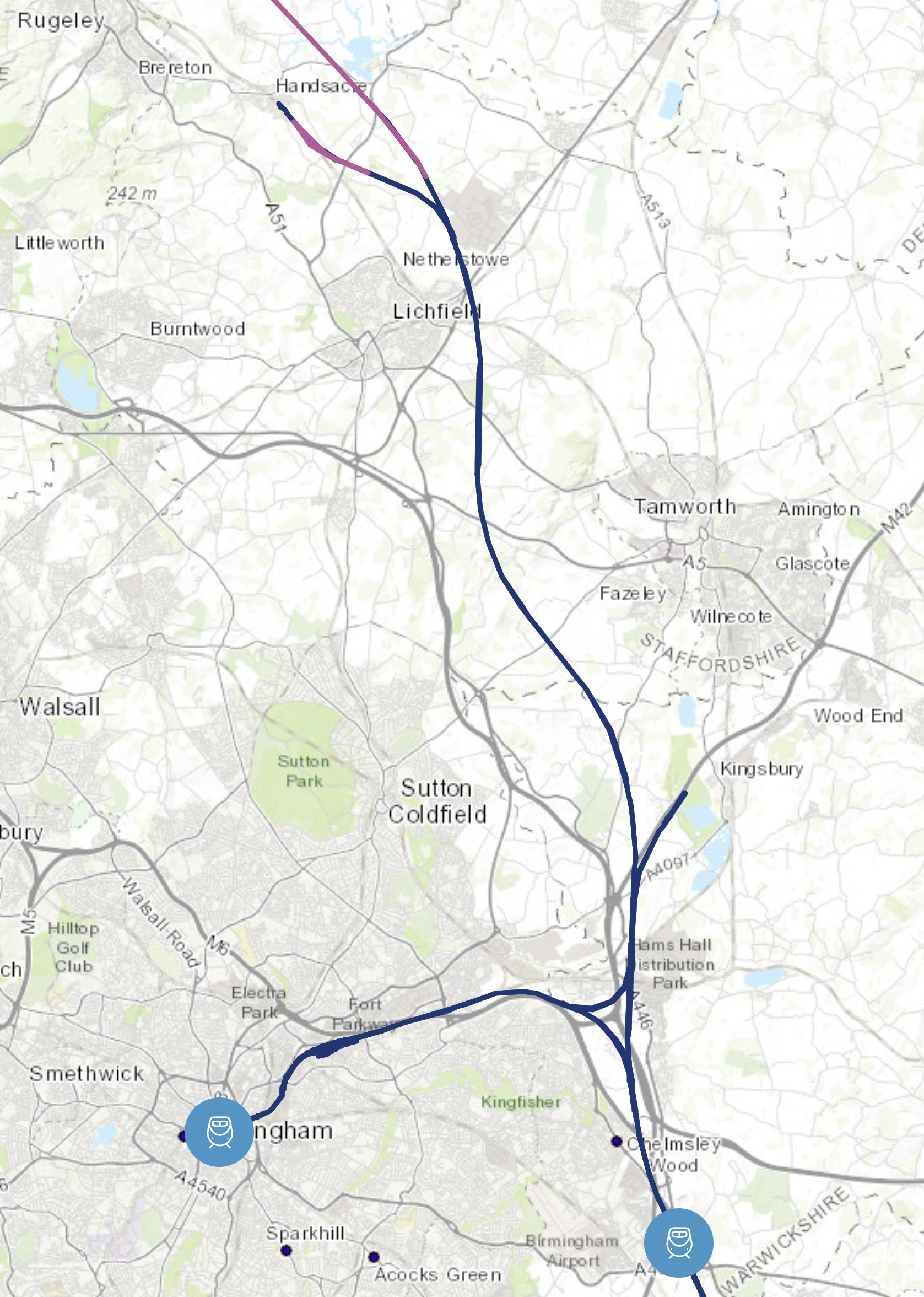
This section of the HS2 map shows High Speed Two between Birmingham and Lichfield.
Note.
- The blue circle on the left at the bottom of the map is Birmingham Curzon Street station.
- The blue circle on the right at the bottom of the map is Birmingham Interchange station.
- The High Speed Two to and from London passes through Birmingham Interchange station.
- The branch to Birmingham Curzon Street station connects to the main High Speed Two at a triangular junction.
- North of the triangular junction, High Speed Two splits.
- The Eastern branch goes to East Midlands Parkway station.
- The Northern branch goes to Crewe, Liverpool Lime Street, Manchester Piccadilly, Preston and Scotland.
At the top of the map, the Northern branch splits and lines are shown on this map.

Note.
- The junction where the Northern and Eastern branches divide is in the South-East corner of the map.
- To the North of Lichfield, the route divides again.
- The Northern purple line is the direct line to Crewe.
- The shorter Southern branch is a spur that connects High Speed Two to the Trent Valley Line, which is the current route taken by trains between London Euston and Crewe, Liverpool Lime Street, Manchester Piccadilly, Preston and Scotland.
- Crewe station is in the North-West corner of the map.
The route between the junction to the North of Lichfield and Crewe is essentially two double-track railways.
- High Speed Two with a routine operating speed of 205 mph.
- The Trent Valley Line with a routine operating speed of 140 mph.
- High Speed Two Classic-Compatible trains can run on all tracks.
- High Speed Two Full-Size trains may be able to run on the Trent Valley Line at reduced speed.
- Eighteen trains per hour (tph) is the maximum frequency of High Speed Two.
I feel in an emergency, trains will be able to use the other route.
Will This Track Layout Allow An Innovative Build?
Suppose the link to the Trent Valley Line was built first, so that High Speed Two trains from London for Crewe, Liverpool Lime Street, Manchester Piccadilly, Preston and Scotland, could transfer to the Trent Valley Line as they do now.
- All lines used by High Speed Two services North of the junction, where High Speed Two joins the Trent Valley Line would be updated with digital signalling and 140 mph running. This will benefit current services on the line. For instance Euston and Liverpool/Manchester services could be under two hours.
- The current services would be replaced by High Speed Two services run by High Speed Two Classic-Compatible trains.
- The direct High Speed Two route between Lichfield and Crewe would now be built.
- When this section of High Speed Two is complete, High Speed Two services would use it between Lichfield and Crewe.
- As the direct route would be built later, this would delay the building of the Birmingham and Crewe high-speed route.
Currently, trains run the 41.8 miles between Lichfield and Crewe in 28 minutes, which is an average speed of 89.6 mph.
I can build a table of average speeds and times for Lichfield and Crewe.
- 100 mph – 25.1 minutes – 2.9 minutes saving
- 110 mph – 22.8 minutes – 5.2 minutes saving
- 120 mph – 20.9 minutes – 7.1 minutes saving
- 125 mph – 20.1 minutes – 7.9 minutes saving
- 130 mph – 19.3 minutes – 8.7 minutes saving
- 140 mph – 17.9 minutes – 10.1 minutes saving
- 160 mph – 15.7 minutes – 12.3 minutes saving
- 180 mph – 13.9 minutes – 14.1 minutes saving
- 200 mph – 12.5 minutes – 15.5 minutes saving
Note.
- Even a slight increase in average speed creates several minutes saving.
- Times apply for both routes.
I believe that a 125 mph average should be possible on the Trent Valley route, which may be enough for Euston and Liverpool/Manchester services to be under two hours.
Improving Classic Lines Used By High Speed Two North Of Lichfield
Real Time Trains shows these figures for a Glasgow Central to Euston service.
- Glasgow and Lichfield Trent Valley is 298.2 miles.
- Glasgow and Lichfield Trent Valley takes five hours.
This is an average speed of 59.6 mph.
Note.
- The average speed is low considering the trains are capable of cruising at 125 mph and 140 mph with digital signalling.
- High Speed Two services between Euston and Glasgow will use the classic network, to the North of Lichfield.
I can build a table of average speeds and times for Glasgow and Lichfield.
- 100 mph – 179 minutes – 121 minutes saving
- 110 mph – 163 minutes – 157 minutes saving
- 120 mph – 149 minutes – 151 minutes saving
- 125 mph – 143 minutes – 157 minutes saving
- 130 mph – 138 minutes – 162 minutes saving
- 140 mph – 128 minutes – 172 minutes saving
This table illustrates why it is important to improve all or as many as possible of classic lines used by High Speed Two to enable 140 mph running, with full digital signalling. Obviously, if 140 mph is not feasible, the speed should be increased to the highest possible.
Routes that could be updated include.
- London Euston and Glasgow Central
- London Euston and Liverpool Lime Street
- London Euston and Manchester Piccadilly (all routes)
- London Euston and Blackpool
- London Euston and Holyhead
- London Euston and Shrewsbury
Not all these routes will be served by High Speed Two, but they could be served by 140 mph trains.
What Times Would Be Possible?
The InterCity 225 was British Rail’s ultimate electric train and these two paragraphs from its Wikipedia entry, describe its performance.
The InterCity 225 was designed to achieve a peak service speed of 140 mph (225 km/h); during a test run in 1989 on Stoke Bank between Peterborough and Grantham, an InterCity 225 was recorded at a speed of 162 mph (260.7 km/h). Its high speed capabilities were again demonstrated via a 3hr 29mins non-stop run between London and Edinburgh on 26 September 1991. British regulations have since required in-cab signalling on any train running at speeds above 125 mph (201 km/h) preventing such speeds from being legally attained in regular service. Thus, except on High Speed 1, which is equipped with cab signalling, British signalling does not allow any train, including the InterCity 225, to exceed 125 mph (201 km/h) in regular service, due to the impracticality of correctly observing lineside signals at high speed.
The InterCity 225 has also operated on the West Coast Main Line (WCML). In April 1992, one trainset achieved a new speed record of two hours, eight minutes between Manchester and London Euston, shaving 11 minutes off the 1966 record. During 1993, trials were operated to Liverpool and Manchester in connection with the InterCity 250 project.
- The fastest London Euston and Manchester Piccadilly services appear to be two hours and six minutes tomorrow, with stops at Nuneaton and Stoke-on-Trent.
- The fastest London King’s Cross and Edinburgh service is four hours seventeen minutes tomorrow.
It does appear that British Rail’s 1980s-vintage InterCity 225 train did very well.
Trains that would be able to run at 140 mph with updated signalling include.
- Alstom Class 390
- Hitachi Class 800, 801, 802, 803, 805, 807 and 810
- British Rail InterCity 225
- High Speed Two Classic-Compatible.
All are electric trains.
Could High Speed Two, West Coast Main Line and East Coast Main Line Services Be Run By High Speed Two Classic-Compatible Trains?
I don’t see why not!
- They would be able to use short stretches of High Speed Line like Lichfield and Crewe.
- LNER and CrossCountry could also use the trains.
- High Speed Two is providing the framework and it’s there to be used, provided the paths are available.
This graphic shows the preliminary schedule.
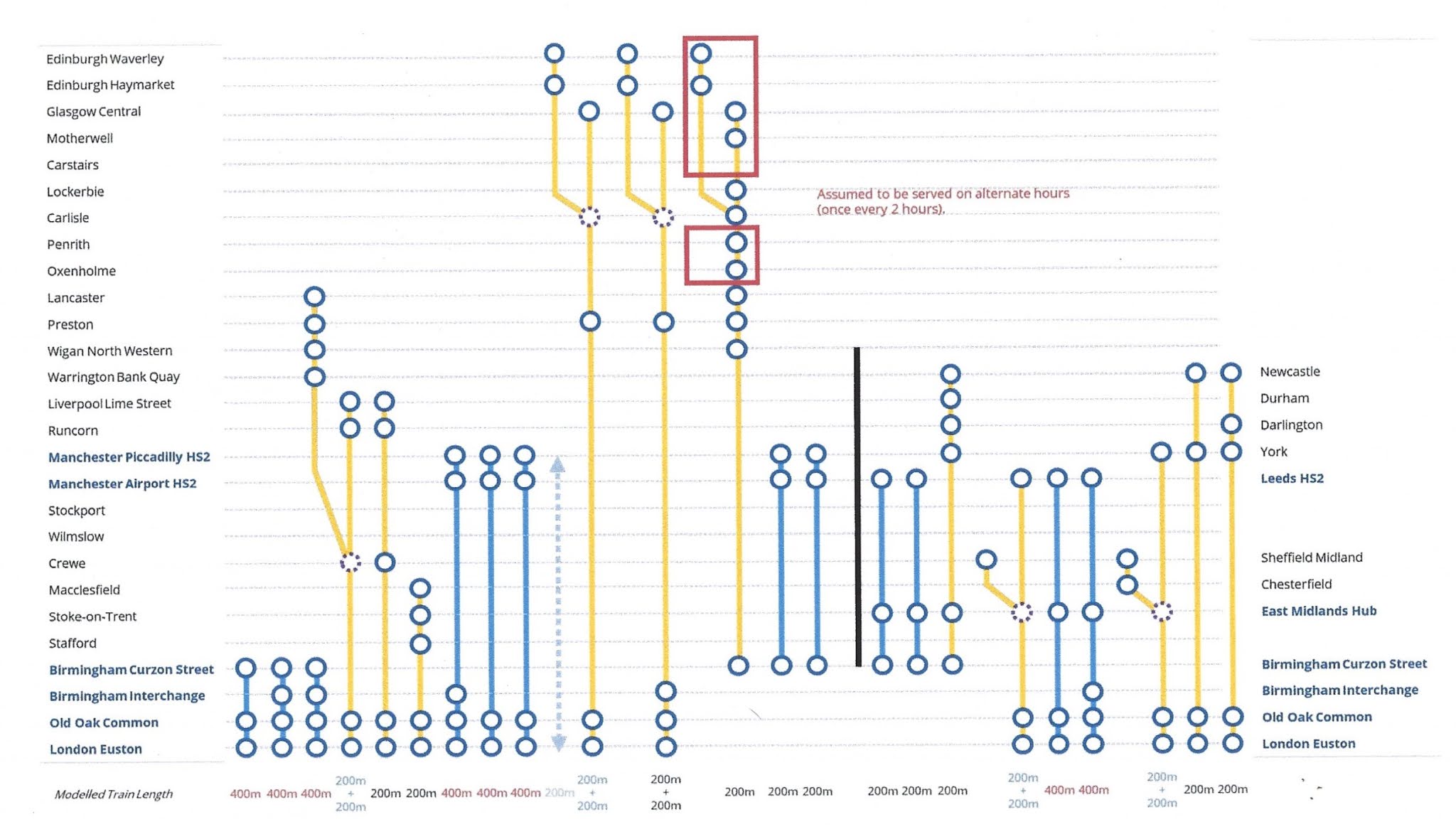
It only shows ten trains going through Crewe, so there could be up to eight spare high speed paths between Birmingham and Crewe.
Could High Speed Two Classic-Compatible Trains Be Used To Advantage On The East Coast Main Line?
I published this extract from the Wikipedia entry for the InterCity 225 earlier.
The InterCity 225 was designed to achieve a peak service speed of 140 mph (225 km/h); during a test run in 1989 on Stoke Bank between Peterborough and Grantham, an InterCity 225 was recorded at a speed of 162 mph (260.7 km/h). Its high speed capabilities were again demonstrated via a 3hr 29mins non-stop run between London and Edinburgh on 26 September 1991.
The London and Edinburgh run was at an average speed of around 112 mph.
I wonder what time, one of LNER’s Class 801 trains, that are all-electric could do, once the new digital signalling has been fully installed on the route? I suspect it would be close to three hours, but it would depend on how long the trains could run at 140 mph.
It should be noted that the Selby Diversion was designed for 160 mph, when it was built by British Rail in the 1980s.
In Are Short Lengths Of High Speed Line A Good Idea?, I look at the mathematics of putting in short lengths of new railway, which have higher speeds, where this was part of my conclusion.
I very much feel there is scope to create some new high speed sections on the current UK network, with only building very little outside of the current land used by the network.
I would love to know what some of Network Rail’s track experts feel is the fastest time possible between London and Edinburgh that can be achieved, by selective upgrading of the route.
If some of the trains were High Speed Two Classic-Compatible Trains, with a top speed of 205 mph, provided the track allowed it, there could be some interesting mathematics balancing the costs of track upgrades, new trains with what passengers and operators need in terms of journey times.
Could High Speed Two Classic-Compatible Trains Be Used To Advantage On The West Coast Main Line?
Much of what I said about the East Coast Main Line would apply to the West Coast Main Line.
But in addition, the West Coast Main Line will be a superb place to test the new High Speed Two Classic-Compatible Trains.
I believe, that before High Speed Two opens, we’ll see High Speed Two Classic-Compatible Trains, carrying passengers between Euston and Avanti West Coast’s destinations.
Could High Speed Two Be Split Into Two?
Consider.
- Under earlier plans, the East Coast Main Line to the North of York, will be used by High Speed Two.
- With digital signalling the East Coast Main Line will support continuous running at 140 mph for long sections of the route.
- The East Coast Main Line has a recently-rebuilt large Southern terminal at King’s Cross with eleven platforms and good suburban services and excellent connections to the London Underground.
- The East Coast Main Line has a very large Northern terminal at Edinburgh Waverley with twenty platforms and good local train connections.
- There are large intermediate stations on the East Coast Main Line at Doncaster, Leeds, Newcastle, Peterborough and York. All these stations have good local train connections.
- The East Coast Main Line has important branches to Cambridge, Harrogate, Huddersfield, Hull King’s Lynn, Lincoln, Middlesbrough, Nottingham, Scarborough, Sheffield, Skegness and Sunderland.
We are talking about an asset, that needs improving rather than sidelining.
Could High Speed Two Be A One-Nation Project?
Over three years ago, I wrote Could High Speed Two Be A One-Nation Project? and tried to answer the question in the title.
But now the core network is better defined, perhaps it is time to look at extending the High Speed network again.
The next few sections look at possible extensions.
Serving Chester And North Wales
I looked at this in Could High Speed Two Trains Serve Chester And North Wales?, which I have updated recently.
This was my conclusion.
It looks to me, that when High Speed Two, think about adding extra destinations, Chester and Holyhead could be on the list.
I also suspect that even without electrification and High Speed Two services, but with the new Class 805 trains, the route could be a valuable one for Avanti West Coast.
These are current and promised times for the two legs to Holyhead.
- Euston and Crewe – 90 minutes – Fastest Class 390 train
- Euston and Crewe – 55 minutes – High Speed Two Classic-Compatible train from Wikipedia
- Crewe and Holyhead – 131 minutes – Fastest Class 221 train
- Crewe and Holyhead – 70 minutes – 90 mph average speed
- Crewe and Holyhead – 63 minutes – 100 mph average speed
- Crewe and Holyhead – 57 minutes – 110 mph average speed
- Crewe and Holyhead – 53 minutes – 120 mph average speed
- Crewe and Holyhead – 45 minutes – 140 mph average speed
Note.
- I have assumed that Crewe and Holyhead is 105.5 miles.
- The operating speed of the North Wales Coast Line is 90 mph.
- In the following estimates, I have assumed a change of train at Crewe, takes 6 minutes.
I think there are several options to run fast services to Chester and North Wales.
Pre-HS2 – Class 805 all the way
I believe this train will match the following.
- The fastest Class 390 train between Euston and Crewe.
- The fastest Class 221 train between Crewe and Holyhead.
This would give a time of 3 hours 41 minutes.
Pre-HS2 – Class 805 all the way, but with perhaps less stops and some track improvement
I believe this train will match the following.
- The fastest Class 390 train between Euston and Crewe.
- 110 mph train Crewe and Holyhead.
This would give a time of 2 hours 27 minutes.
Pre-HS2 – Class 805 all the way, but with perhaps less stops and Crewe and Holyhead uprated largely to 125 mph
I believe this train will match the following.
- The fastest Class 390 train between Euston and Crewe.
- 120 mph train Crewe and Holyhead.
This would give a time of 2 hours 23 minutes.
Pre-HS2 – Class 805 all the way, but with perhaps less stops and Crewe and Holyhead Crewe and Holyhead electrified and uprated to 140 mph
I believe this train will match the following.
- The fastest Class 390 train between Euston and Crewe.
- 140 mph train Crewe and Holyhead.
This would give a time of 2 hours 15 minutes.
After-HS2 – High Speed Two Classic-Compatible train to Crewe, the Class 805 train to Holyhead
I believe this train will match the following.
- The fastest High Speed Two Classic-Compatible train between Euston and Crewe.
- The fastest Class 221 train between Crewe and Holyhead.
This would give a time of 3 hours 12 minutes.
After-HS2 – High Speed Two Classic-Compatible train to Crewe, the Class 805 train to Holyhead, but with perhaps less stops and some track improvement
I believe this train will match the following.
- The fastest High Speed Two Classic-Compatible train between Euston and Crewe.
- 110 mph train Crewe and Holyhead.
This would give a time of 1 hours 58 minutes.
After-HS2 – High Speed Two Classic-Compatible train to Crewe, the Class 805 train to Holyhead, but with perhaps less stops and Crewe and Holyhead uprated largely to 125 mph
I believe this train will match the following.
- The fastest High Speed Two Classic-Compatible train between Euston and Crewe.
- 120 mph train Crewe and Holyhead.
This would give a time of 1 hours 54 minutes.
After-HS2 – High Speed Two Classic-Compatible train to Crewe, Class 805 train to Holyhead, but with perhaps less stops and Crewe and Holyhead electrified and uprated to 140 mph
I believe this train will match the following.
- The fastest High Speed Two Classic-Compatible train between Euston and Crewe.
- 140 mph train Crewe and Holyhead.
This would give a time of 1 hours 46 minutes.
After-HS2 – High Speed Two Classic-Compatible train all the way, but with perhaps less stops and Crewe and Holyhead electrified and uprated to 140 mph
I believe this train will match the following.
- The fastest High Speed Two Classic-Compatible train between Euston and Crewe.
- 140 mph train Crewe and Holyhead.
This would give a time of 1 hours 40 minutes.
From these estimates, I have come to these conclusions.
- A sub-two and a half-hour service can be attained with the new Class 805 trains and some improvements to the tracks along the North Wales Coast Line.
- A sub-two hour service can be attained with a High Speed Two Classic-Compatible train to Crewe and a Class 805 train to Hplyhead along a 140 mph electrified North Wales Coast Line.
- If the North Wales Coast Line is electrified, the journey from London Euston, Birmingham Interchange, Crewe, Chester, Liverpool and Manchester would be zero-carbon.
We should be looking to building a zero-carbon fast passenger ferry for sailing between Holyhead and Dublin.
- The current fastest ferries appear to take three hours and 15 minutes, which means that a six-hour low-carbon journey between London Euston and Dublin, should be possible with the new Class 805 trains, prior to the opening of High Speed Two.
- A five-hour journey after the opening of High Speed Two to Crewe and electrification of the North Wales Coast Line should be possible.
If the advanced zero-carbon ferry could knock an hour off the journey, four hours between London and Dublin along a spectacular coastal railway with a fast sea voyage, would be a route that would attract passengers.
- High Speed Two would need to be opened to Crewe.
- The North Wales Coast Line would need to be upgraded to a 140 mph digitally-signalled line.
- The North Wales Coast Line would need to be electrified.
- Full electrification may not be needed, as discontinuous electrification will have advanced to provide zero-carbon running, in a more affordable and less disruptive manner.
- Trains could either be High Speed Two Classic-Compatible trains all the way from London or there could be a change at Crewe to Class 805 trains.
- The ferry would use the best zero-carbon and operational technology.
The improvement and electrification of the North Wales Coast Line could be planned to take place in a relaxed manner, so that journey times continuously got quicker.
I would start the improvement of the North Wales Coast Line, as soon as possible, as all these improvement will be used to advantage by the new Class 805 trains.
Serving West And South West England And South Wales
Suppose you want to go between Glasgow and Cardiff by train, after High Speed Two has opened.
- You will take one of the half-hourly High Speed Two Classic-Compatible trains between Glasgow Central and London.
- Three and a half-hours later, you will get off the train in one of the below ground platforms at Old Oak Common station.
- A short ride in an escalator or lift and you will be in the Great Western Railway station at ground level.
- From here, fifty minutes later, you will be in Cardiff.
The journey will have taken four hours and twenty minutes.
This may seem a long time but currently Glasgow and Cardiff by train takes over seven hours by train.
- Glasgow and Bristol Temple Meads takes eight hours, but using High Speed Two and GWR will take 5 hours.
- Glasgow and Cheltenham Spa takes six hours, but using High Speed Two and GWR will take 5 hours and 30 minutes.
- Glasgow and Penzance takes twelve hours, but using High Speed Two and GWR will take 8 hours and 33 minutes.
- Glasgow and Swansea takes nearly nine hours, but using High Speed Two and GWR will take 6 hours and 9 minutes.
The High Speed Two route only has one simple change, whereas some routes now have up to four changes.
Conclusion
Hydrogen Engines To Be Mass Produced By Hyundai By 2025
The title of this post, is the same as that, of this article on Hydrogen Fuel News.
This is the sub-heading.
Hyundai Doosan Infracore is accelerating engine development
These are the first two paragraphs.
After the completion of its H2 internal combustion engines (ICE) design and rolling out the prototype, Hyundai Doosan Infracore (HDI) is revving up the development of its hydrogen engines, with the aim to mass produce these engines by 2025.
The hydrogen-powered internal combustion engine can produce a power output of 300 kW (402 HP) and a torque of 1700 NM at 2000 RPM. Fulfilling Tier 5/Stage 5/Euro7 regulation, the engine satisfies the emission requirements to be 90% decreased to the current level to meet Zero CO2 (below 1g/kwh) and Zero Impact Emission.
Note.
- The engine is described as an 11 litre class engine.
- The new hydrogen engines that will be produced will be installed on commercial vehicles, including large buses, trucks and construction equipment.
It should also be noted that Hyundai are investors in Hull-based hydrogen production company; HiiROC, as I wrote about in Centrica Partners With Hull-Based HiiRoc For Hydrogen Fuel Switch Trial At Humber Power Plant.
Hyundai now have the hydrogen internal combustion engine to go with HiiROC, who are developing the means to produce hydrogen at a filling station or depot.
A Problem With The Hydrogen Fuel News Article
This article on Diesel Progress, which is entitled Hyundai Doosan Infracore To Launch Hydrogen Engine covers the same story.
But it shows a different picture of the hydrogen internal combustion engine, which as it looks like one, I assume it is the correct image.
Historic Northumberland Line To Reopen Next Summer
The title of this post, is the same as that, of this news story from the UK Government.
This is the sub-heading.
Fully accessible stations are being built to give 6 Northumberland communities regular train services.
And these are the main bullet points.
- Transport Secretary announces regular train services will return to Northumberland Line in 2024
- Journey times will be slashed in half and communities reconnected to jobs and opportunities helping to level up and grow the region’s economy
- Investment forms part of government’s Restoring Your Railway programme, which reopens old stations and lines across the country
Let’s hope this line follows the Dartmoor Line in being a success.
I wrote about this success in Dartmoor Line Passes 250,000 Journeys On Its First Anniversary, As Rail Minister Visits To Mark Official Opening Of The Station Building.
Would It Be Possible For The Bakerloo And Watford DC Lines To Use The Same Trains? – 6th March 2023 Update
These two lines are very different.
- The Bakerloo Line is a classic London Underground Line with 25 stations and services run by 1972 Stock trains.
- The Watford DC Line is part of the London Overground with 19 stations and services run by Class 710 trains.
Ten stations are shared between the lines, of which only one; Queen’s Park offers level boarding.
The Shared Stations
The nine shared stations often have considerable steps up and down, as at Willesden Junction station, which is shown in Train-Platform Interface On Platform 1 At Willesden Junction.
I am rather pleased and pleasantly surprised, that there are not more accidents at the shared stations, but using the line must be a nightmare for wheelchair users, buggy pushes and large case draggers.
If Transport for London proposed building a line like this, they would have to launch it at the Hammersmith Apollo, where comedians perform.
The One Train Type Solution
To my mind, there is only one solution. The two services must use the same type of trains.
These are a few thoughts on the trains.
Trains Would Be Underground-Sized
As the trains will have to work through the existing tunnels to Elephant & Castle station, the trains would have to be compatible with the tunnels and therefore sized for the Underground.
I suspect they would be a version of the New Tube for London, that are currently being built by Siemens for the Piccadilly Line.
New Tube For London And Class 710 Train Compared
This Siemens infographic summarises the New Tube For London.
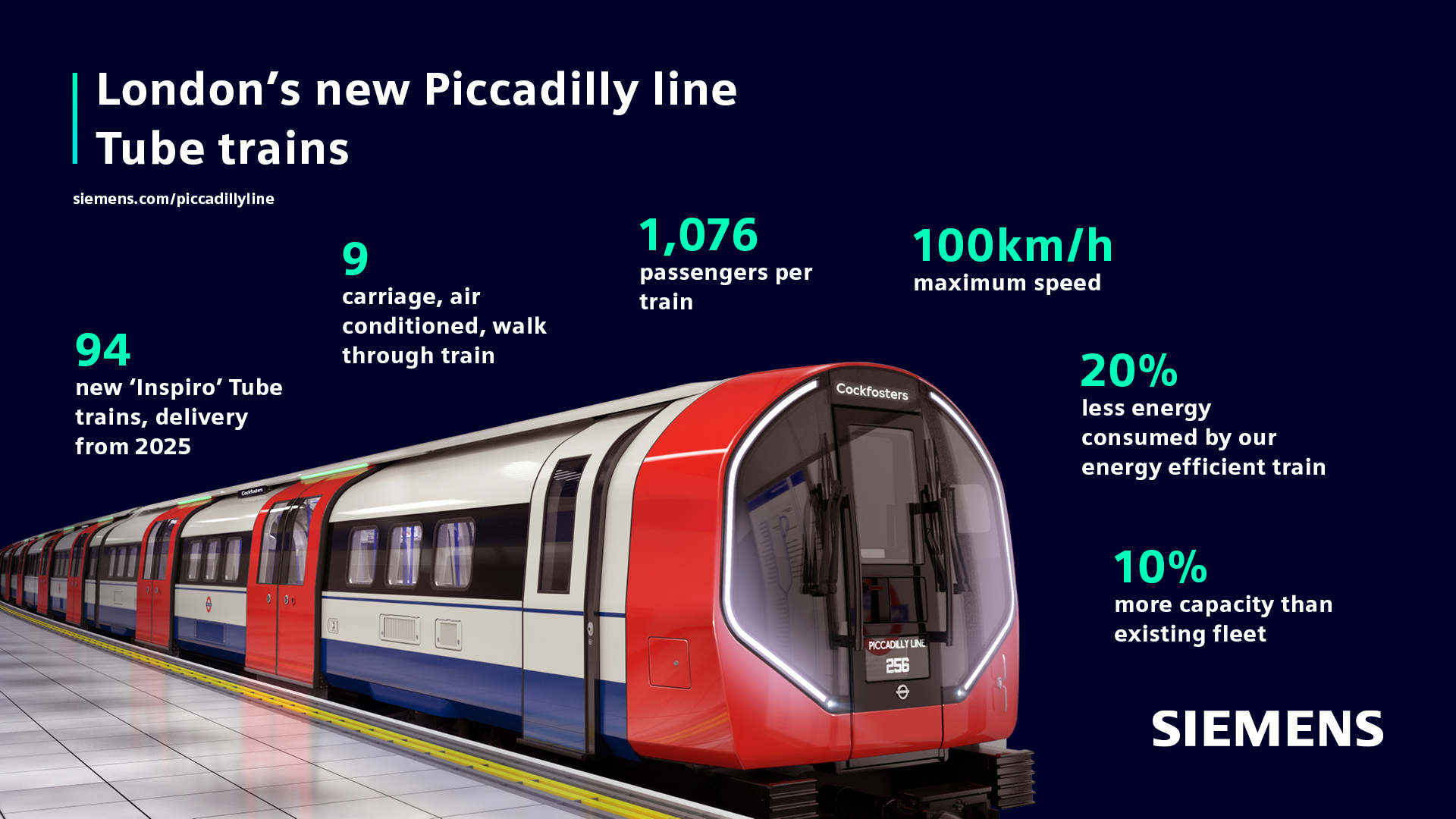
These figures are from Wikipedia.
- Cars – NTFL – 9 – 710 – 4
- Car Length – NTFL – 12.6 metres – 710 – 20 metres
- Train Length – NTFL – 113.4 metres – 710 – 80 metres
- Seated Passengers – NTFL – 268 – 710 – 189
- Total Passengers – NTFL – 1076 – 710 – 678
- Passenger Density – NTFL – 9.5 per metre – 710 – 8.2 per metre
- Speed – NTFL – 62 mph – 710 – 75 mph
Note.
- The figures for the Class 710 train are for a four-car train.
- The passenger density and speed are closer than I thought they’d be.
- I’m sure Siemens can design a longer and/or faster train if required for the Euston service.
I feel that the New Tube for London design could be adjusted , so that it could work the Watford DC service.
Platform Modifications
I suspect that the New Tube for London will be lower than the Class 710 train and all platforms would need to be lowered to fit the new trains.
I would also suspect that it would be easier to lower platforms, than modify them, so that they had dual-height sections to satisfy two classes of train.
It should be noted that the New Tube for London has shorter cars than the sixteen metre 1972 Stock trains currently used on the line, so there will be smaller gaps at stations with curved platforms like Waterloo.
I believe that with one class of train, all of the stations on the Bakerloo and Watford DC Lines could be made step-free between train and platform.
Platform Height On Platform 9 At Euston
I took these pictures on Platform 9 at Euston station.
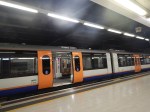
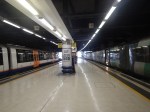
Note that it is rather a high step into the train and there is a large gap.
But if say, a modern London Underground train from say the Victoria Line pulled into the platform would it be a better fit?
Platform Height At Kilburn High Road Station
These pictures show Kilburn High Road station.
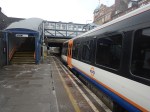
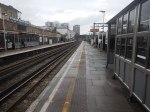
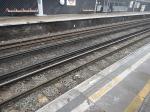
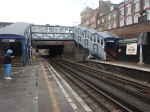

I should have taken more pictures, but the step between the platform and train is similar to Platform 9 at Euston.
Platform Height At South Hampstead Station
These pictures show South Hampstead station.
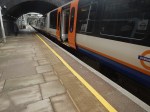
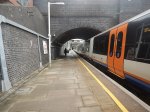
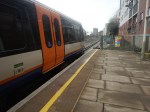
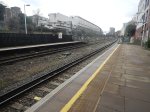
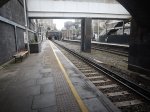

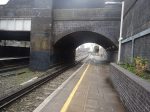
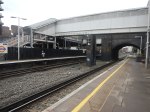
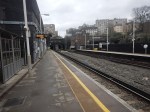
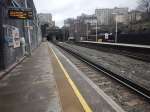
I should have taken more pictures, but again the step between the platform and train is similar to Platform 9 at Euston.
Were The Platforms At Euston, South Hampstead And Kilburn High Road Built For Another Class Of Train?
This Wikipedia entry is for the London Underground Watford Joint Stock train, where this is said.
The Watford Joint Tube Stock was built for the service to Watford along both the Bakerloo tube and the London North Western Railway. As a result, the cars were owned by both the Underground and the London North Western Railway. To be able to operate on both lines, the car floors were 4+1⁄2 inches (110 mm) higher than other tube cars. This was a compromise height between the platform heights on the two lines.
The cars were ordered in 1914, but construction was delayed by The First World War. As a result, the first cars were not delivered until early 1920.
Note.
- The Wikipedia entry has links to some images of which this is one.
- They must have been rather cramped trains if they were built for deep tunnels and had a floor that was 110 mm higher, than other tube trains.
It certainly appears to be possible to design a train, that would fit both lines.
But would it fit modern regulations and give full step-free access?
Queen’s Park And Euston
This map from cartometro.com, shows the route between Queen’s Park and Euston stations.
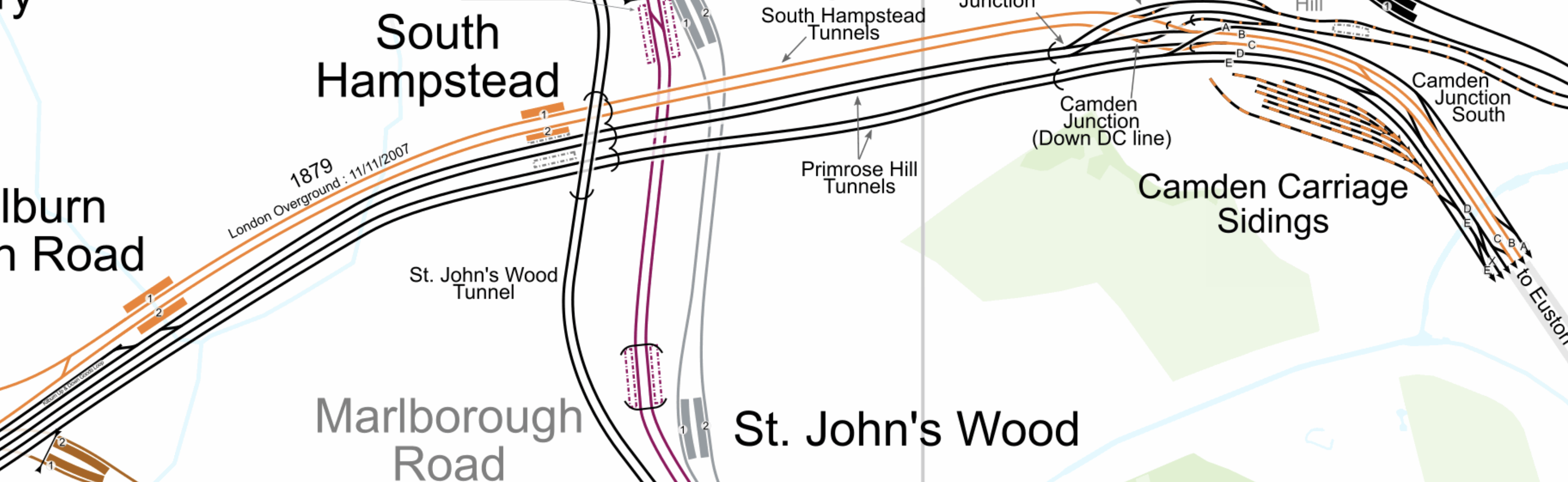
Note.
- The Watford DC Line is shown in orange.
- Queen’s Park station is to the West of Kilburn High Road station.
- It appears that Watford DC Line trains always use Platform 9 at Euston station.
The route seems to be a self-contained third-rail electrified line into Euston station.
On the subject of electrification between Queen’s Park and Euston stations, there would appear to be a choice between the third-rail system and London Underground’s four-rail system.
But it is rumoured that the New Tube for London will have a battery capability.
As Euston and Queen’s Park stations are only 3.7 miles apart, perhaps the choice would be to use battery power into Euston station, which would remove electrified rails from Euston?
How Many Trains Could Run Into Euston?
Currently, four trains per hour (tph) run into Euston.
It is generally accepted that six tph can use a single platform. But would this be enough?
I suppose there is the possibility of tunnelling under Euston station to a pair of terminal platforms.
In that case the current platform could be used by other services.
Southern’s Milton Keynes And Clapham Junction Service
This service wouldn’t be affected as it uses the fast lines between Willesden and Watford Junction.
Advantages Of One Train Type On The Bakerloo And Watford DC Lines
I can think of these advantages.
- Step-free access between train and platform, should be achieved.
- A unified fleet.
- A higher frequency between Euston and Willesden Junction stations.
- Higher frequency where needed.
- If trains had a battery capability, Euston could be free of third-rail electrification.
As only one type of train will be using the Watford DC line between Euston and Watford Junction, this could result in operational efficiencies.
Linking Of The Bakerloo And Abbey Lines
This could be the biggest advantage of all.
This map from cartometro shows the lines at Watford Junction station.
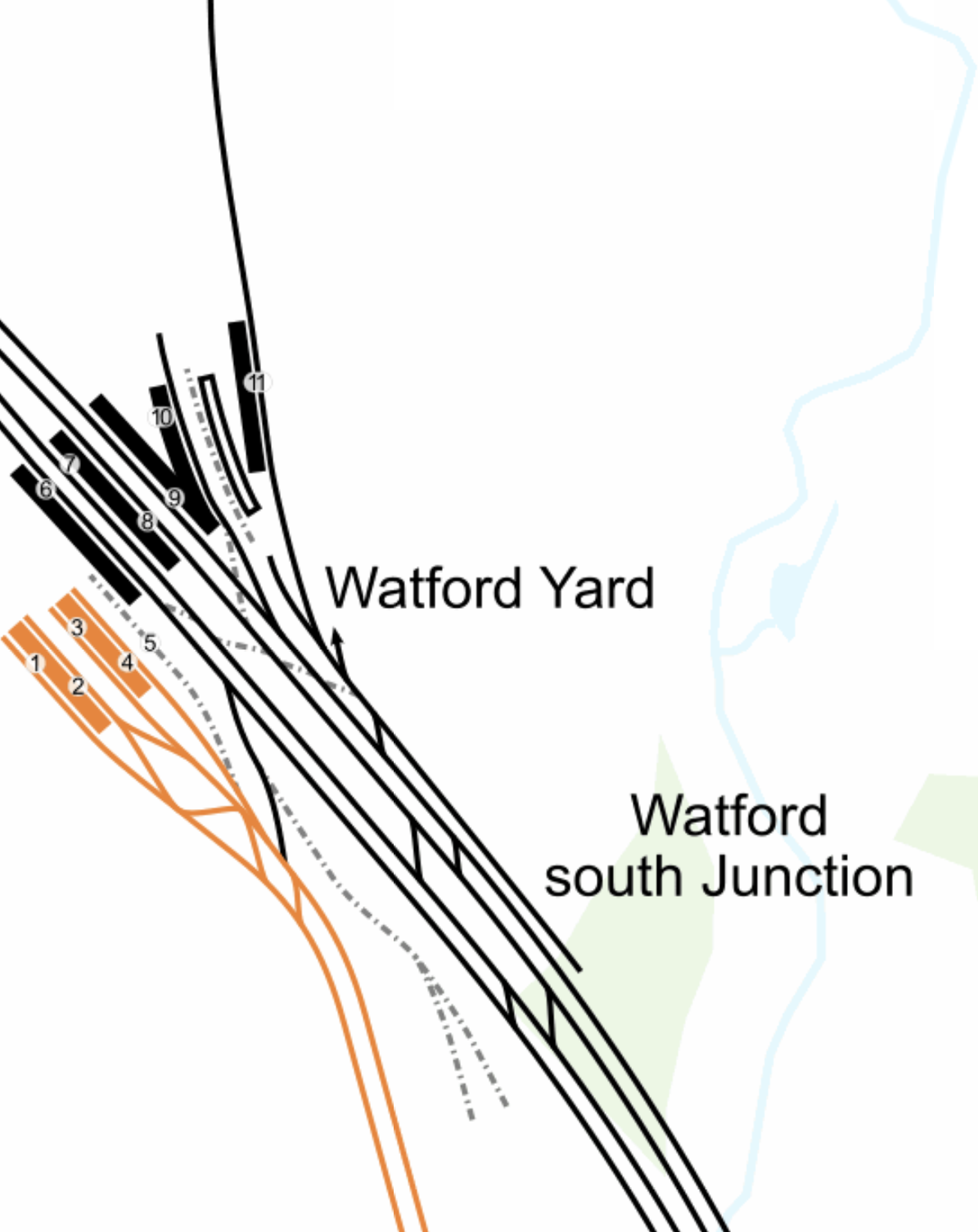
Note.
- The orange lines are the current Watford DC Line services of the London Overground, terminating in platforms 1 to 4 of Watford Junction station.
- These lines would be taken over by the unified Bakerloo/Watford DC Line services, running nine-car New Tubes For London.
- The next station to the South is Watford High Street.
- The West Coast Main Line goes through the station and uses platforms 5 to 10.
- At the North of the station is Platform 11 on the Abbey Line which leads roughly North East to St. Albans.
Look at how the Abbey Line is more or less in line with the twin-tracks of the Watford DC Line.
Recently, during the Bank Station Upgrade, a 488 metre long single track tunnel was built to divert the Southbound Northern Line.
This tunnel was not dug with a tunnel boring machine, but traditionally by hand, using men, picks, shovels and I suspect a few small machines.
I believe, that a similar technique could be used to dig a tunnel, to connect the Abbey Line and the Watford DC Line.
- It would only be single-track
- It would probably be less than 500 metres long.
- It would connect to the Abbey Line to the South of Platform 11.
- It would be deep-level tube-sized.
- It might be dug by hyperTunnel.
- Geography wouldn’t allow the tunnel to terminate in the Watford DC Line platforms at Watford Junction station.
But where would the terminal be on the Southern side of the West Coast Main Line?
This map from OpenRailwayMap, shows the two routes between Watford Junction and Bushey stations.

Note.
- Watford Junction station is at the top of the map.
- The orange line is the West Coast Main Line.
- The yellow line looping to the West of the West Coast Main Line is the double-track Watford DC Line.
- Bushey station is at the bottom of the map, where the two rail lines meet.
- Watford High Street station is in the middle of the map on the Watford DC Line.
The new service could certainly take the Watford DC Line as far as Watford High Street station.
- The station is close to the centre of Watford, the hospital and Vicarage Road stadium.
- But there is no space for a terminal platform.
This second OpenRailwayMap shows the disused railways to the West of Watford High Street station.
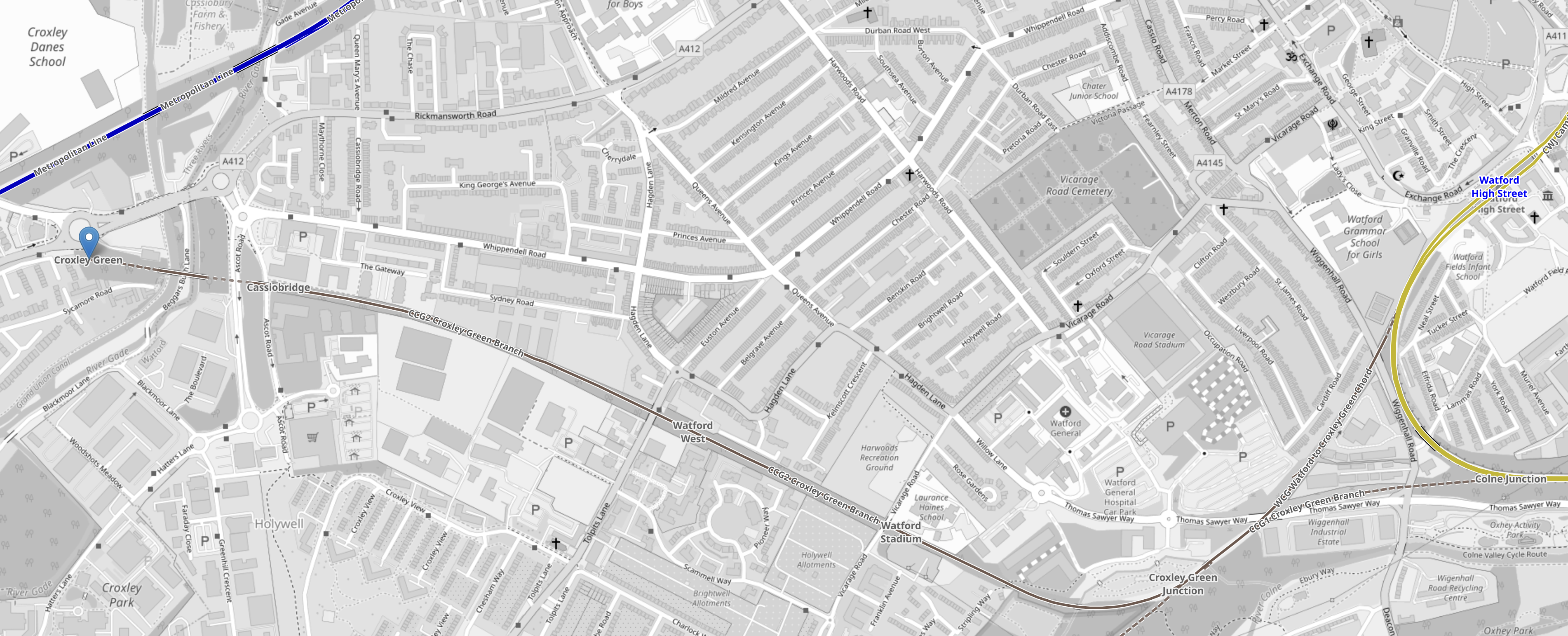
Note.
- The yellow loop at the East of the map is the Watford DC Line.
- Watford High Street station is on this loop.
- There is a triangular junction, that connects the former Croxley Green branch to the Watford DC Line.
- The terminus at Croxley Green station is marked by a blue arrow.
- There used to be intermediate stations at Cassiobridge, Watford West and Watford Stadium.
- This route was used for the failed attempt to build the Croxley Rail Link.
But could a Western extension of the Abbey Line be built?
- It would terminate at either Croxley Green or Cassiobridge.
- There would be intermediate stations at Watford West, Watford Stadium and Watford High Street.
- There would be two tph.
- Trains would be nine-car New Tubes For London.
- The current Abbey Line is 6.4 miles and would be run using battery power, with possible charging at St. Albans Abbey station.
- The tunnel under the West Coast Main Line would be run on battery power.
- The Western extension from Watford High Street station would be run using battery power, with possible charging at the Western end.
I believe, an extended Abbey Line could be a viable alternative to the ill-fated Croxley Rail Link.
- I have used battery power, as I doubt Health and Safety would allow any new third-rail electrification.
- I have used nine-car New Tubes For London for the extended Abbey Line, as their small cross-section would allow a smaller tunnel and they would be certified for running in tunnels.
- Some platforms on the Abbey Line would need to be lengthened, but these would be the only modifications, other than the possible installation of the charging system.
- The extended Abbey Line would serve Watford Hospital and Vicarage Road.
The capacity of the extended Abbey Line would be substantially more than the current line.
Conclusion
A common fleet used by the Bakerloo and Watford DC Line would appear to give advantages and it has been done successfully before.
But what the Bakerloo Line, the Watford DC Line, the Abbey Line and the Bakerloo Line Extension need is a good dose of holistic design.
Thoughts On Watford DC Line Electrification At Euston Station
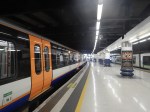
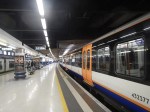
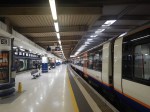
I was in Euston station this morning and took these pictures of the electrification on Platform 9.
Note.
- Watford DC Line trains usually use Platform 9.
- The first two pictures show the 750 DC third rail electrification.
- The last three pictures show the 25 KVAC overhead electrification.
- The train is a five-car Class 710/3 train, which is a dual-voltage train.
The train’s pantograph was in the down position, as far as I could see.
This Google Map shows the ends of Platforms 6 to 11 at the station.

Note.
- The platforms have their numbers painted on the end.
- The train in the top-left corner of the image is in Platform 5.
- Platforms 9 and 10 appear to be fitted with 750 VDC third-rail electrification.
- All Platforms also seem to have 25KVAC overhead electrification.
So platforms 9 and 10 appear to be able to handle trains which need either form of electrification. When I took the first set of pictures, there was a Class 350 train in Platform 10.
These dual voltage platforms 9 and 10, may help with the operation of the station.
I have some questions.
Do TfL Intend To Increase Watford DC Line Services?
Currently, the services on the Watford DC Line are as follows.
- Four trains per hour (tph) between Euston and Watford Junction stations.
- In the last few weeks, I’ve seen both four-car Class 378 and five-car Class 701 trains on the route.
- All trains that work the route appear to be dual voltage.
This TfL infographic illustrates their plans.
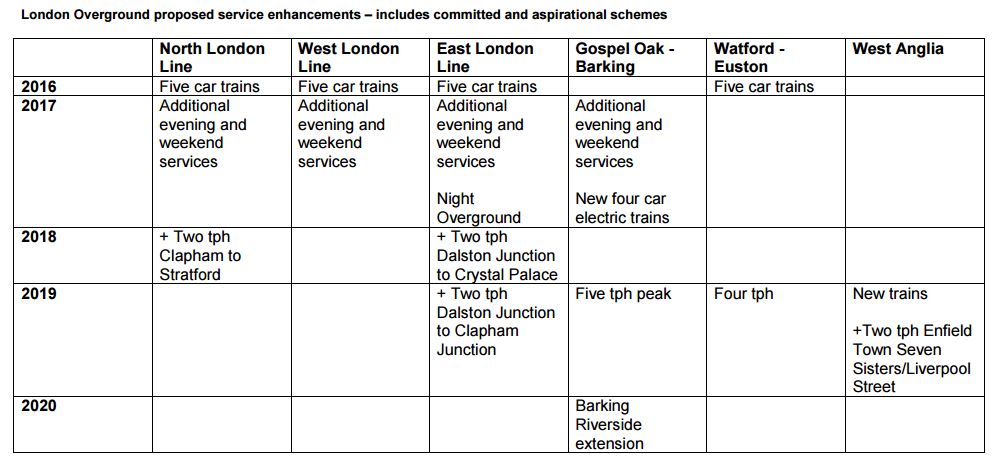
It says Watford and Euston would be run by five-car trains at a frequency of four tph.
TfL have ordered six five-car Class 701/3 trains for the Watford DC service.
Will The Watford DC Platforms Be Moved In The Euston High Speed Two Rebuild?
The operation of the Watford DC Line works well at present, but as Euston station is going through a major rebuild for High Speed Two, the platforms could be moved or rebuilt.
Would Health and Safety object to laying third-rail electrification and insist that Watford DC services used 25 KVAC to access Euston?
They could do this, as all trains running on the Watford DC Line are dual-voltage trains.
Would Removing Third-Rail Electrification From Euston Station Improve Safety?
Health and Safety would say it did and as the trains are dual-voltage, they could transition at Queen’s Park or South Hampstead stations.
An Alternative To Changing The Electrification
The distance between Euston and Queen’s Park stations is just under four miles.
In Will London Overground Fit On-board Energy Storage To Class 378 Trains?, I asked whether it would be worthwhile.
I finished with these two sentences.
I have no idea how much electricity would be saved by regenerative braking on the London Overground, but various applications of regenerative braking technology talk of electricity savings of between ten and twenty percent.
I think it is only a matter of time before the technology is proven to be sufficiently reliable and the numbers add up correctly for the Class 378 trains to be fitted with on-board energy storage.
What would be the advantages from fitting on-board energy storage?
- There would be the savings of electricity by the use of regenerative braking to the batteries.
- Trains could be rescued from the Thames Tunnel, if there was a power failure.
- Hotel power would be maintained, if there was a power failure.
- Trains can be moved in depots and sidings without power.
- Trains would be able to move in the event of cable theft.
- The battery would probably have sufficient capacity to move the train into and out of Euston.
There could be a saving in train operating costs and safety would be improved.
Universal Hydrogen And Railway Locomotives
On the product page of the Universal Hydrogen web site, there is a section, which is entitled Other Transportation Applications, where this is said.
Our lightweight, aviation-grade modular hydrogen capsules can be used in a wide range of transportation applications where weight, safety, and speed of refueling are important. We are working with partners in automotive, heavy equipment, maritime, and railroad domains. If you have an application that can benefit from our global modular green hydrogen distribution network, please get in touch!
I believe that the railway locomotive of the future will be hydrogen-electric. And so do some of the UK’s rail freight companies, judging, by some of their press releases.
- It would have an electric transmission. like most locomotives today, such as the UK’s Class 66, Class 68, Class 70, Class 88, Class 93 and the upcoming Class 99 locomotives.
- It will be able to use 25 KVAC overhead electrification, where it exists.
- Hydrogen-power will be used, where there is no electrification.
The lowest-carbon of the locomotives, that I listed, will probably be the Class 99 locomotive.
- Thirty have been ordered by GB Railfreight, from Swiss company; Stadler.
- The locomotives will be built at Valencia in Spain.
- It will have up to 6 MW, when running using electrification.
- It will have up to 1.6 MW, when running using a Cummins diesel, with a rating of 2,150 hp.
- Because a proportion of UK freight routes are electrified, it is likely that these locomotives will substantially reduce carbon emissions for many locomotive-hauled operations.
It should be noted that Cummins are heavily into hydrogen and their philosophy seems to embrace families of engines, which are identical below the cylinder head gasket, but with appropriate cylinder heads and fuel systems, they can run on diesel, natural gas or hydrogen.
I wouldn’t be surprised to find out that the Class 99 locomotive will have a diesel engine, that has a hydrogen-powered sibling under development at Cummins.
With perhaps a power on hydrogen of about 2.5 MW, these zero-carbon locomotives would be able to handle upwards of ninety percent of all heavy freight trains in the UK.
These are further thoughts.
Alternatives To Cummins Hydrogen Internal Combustion Engines
There are two main alternatives, in addition to similar engines from companies like Caterpillar, JCB, Rolls-Royce mtu and others.
- Fuel cells
- Gas-turbine engines.
Note.
- Universal Hydrogen and others have fuel cells, that can probably deliver 2.5 MW.
- Universal Hydrogen use Plug Power fuel cells.
- Rolls-Royce have developed a 2.5 MW electrical generator, based on the engine in a Super Hercules, that is about the size of a typical beer-keg. I wrote about this generator in What Does 2.5 MW Look Like?.
Cummins may be in the pole position with Stadler, but there are interesting ideas out there!
Cummins have also indicated, they will build hydrogen internal combustion engines at Darlington in the UK.
Would One Of Universal Hydrogen’s Hydrogen Capsules Fit In A Railway Locomotive?
These are various widths.
- Class 66 locomotive – 2.63 metres.
- ATR72 airliner – 2.57 metres.
- DHC Dash-8 airliner – 2.52 metres
- Class 43 power car – 2.74 metres
I suspect that even if it was a bit smaller a hydrogen capsule could be made for a UK locomotive.
How Big Is The Market?
The UK has around five hundred diesel railway locomotives.
Universal Hydrogen Successfully Completes First Flight Of Hydrogen Regional Airliner
The title of this post, is the same as that of this article on Hydrogen Central.
These two paragraphs outline the story.
Universal Hydrogen successfully completes first flight of hydrogen regional airliner.
Universal Hydrogen Co., this morning flew a 40-passenger regional airliner using hydrogen fuel cell propulsion. The airplane, nicknamed Lightning McClean, took off at 8:41am PST from Grant County International Airport (KMWH) and flew for 15 minutes, reaching an altitude of 3,500 MSL. The flight, conducted under an FAA Special Airworthiness Certificate, was the first in a two-year flight test campaign expected to culminate in 2025 with entry into passenger service of ATR 72 regional aircraft converted to run on hydrogen.
Other details from the article include.
- Connect Airlines are the North American launch customer, who have ordered 75 aircraft conversions.
- Amelia are the European launch customer.
- Universal Hydrogen has an order book, totaling 247 aircraft conversions from 16 customers worldwide.
- For the test flight, only one engine was replaced by a hydrogen fuel cell powered electric motor.
- Deliveries will start in 2025.
The article finishes with two paragraphs about Universal Hydrogen.
Universal Hydrogen is building a hydrogen logistics network to fuel the future of aviation, today. Hydrogen is the ideal fuel for flight and will power aviation’s new golden age, where planes are powered by renewables and emit nothing but water. The company’s modular hydrogen capsules move over the existing freight network from production directly to the airplane anywhere in the world.
Universal Hydrogen is also working to certify a powertrain conversion kit to retrofit existing regional aircraft to fly on hydrogen. The company has gathered the world’s leading aviation and hydrogen talent to give the industry the option of clean flight, forever.
The company also has an unusual web site.
I like the company and its design, operating and marketing philosophies.
 The Anonymous Widower
