Wabtec Planning For Transition From Diesel
The title of this post, is the same as that of this article on trains.com.
It has this sub-title.
At InnoTrans, company looks at role of batteries, hydrogen in railroading’s future.
It is very much a must-read, that gives a road-map of their plans to decarbonise rail freight, by the use of both battery and hydrogen power.
Soham Station’s Inaugural Year A Soaring Success
The title of this post, is the same as that of this article on Rail Technology Magazine.
This is the first paragraph.
Soham station has seen healthy and consistent passenger usage over its first year since opening to the public, seeing almost 50,000 journeys starting or finishing there, according to Greater Anglia’s figures.
I took these pictures, when the station opened.









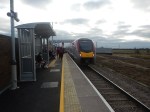
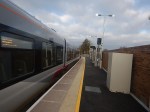



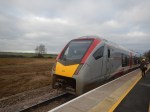

I think Soham station is a good design of a single-platform station.
- It’s a short walk from car park or drop-off point to the platform.
- There is adequate car parking.
- There is a shelter.
The station has also been built, so that it can be expanded.
These are my thoughts.
A Service To Cambridge
Soham station probably needs a train service to Newmarket and Cambridge, as it already has a two-hourly service to Bury St. Edmund’s, Ely and Ipswich and Peterborough.
Wikipedia says this.
There are no current plans for direct services to Cambridge, but the CPCA has expressed support for the idea in a future phase of the project. Mayor James Palmer said “the delivery of Soham station gives us a much stronger case to go to Government and Network Rail and lobby for the reinstating of the Snailwell loop which will provide a direct service between Ely, Soham, Newmarket and Cambridge”
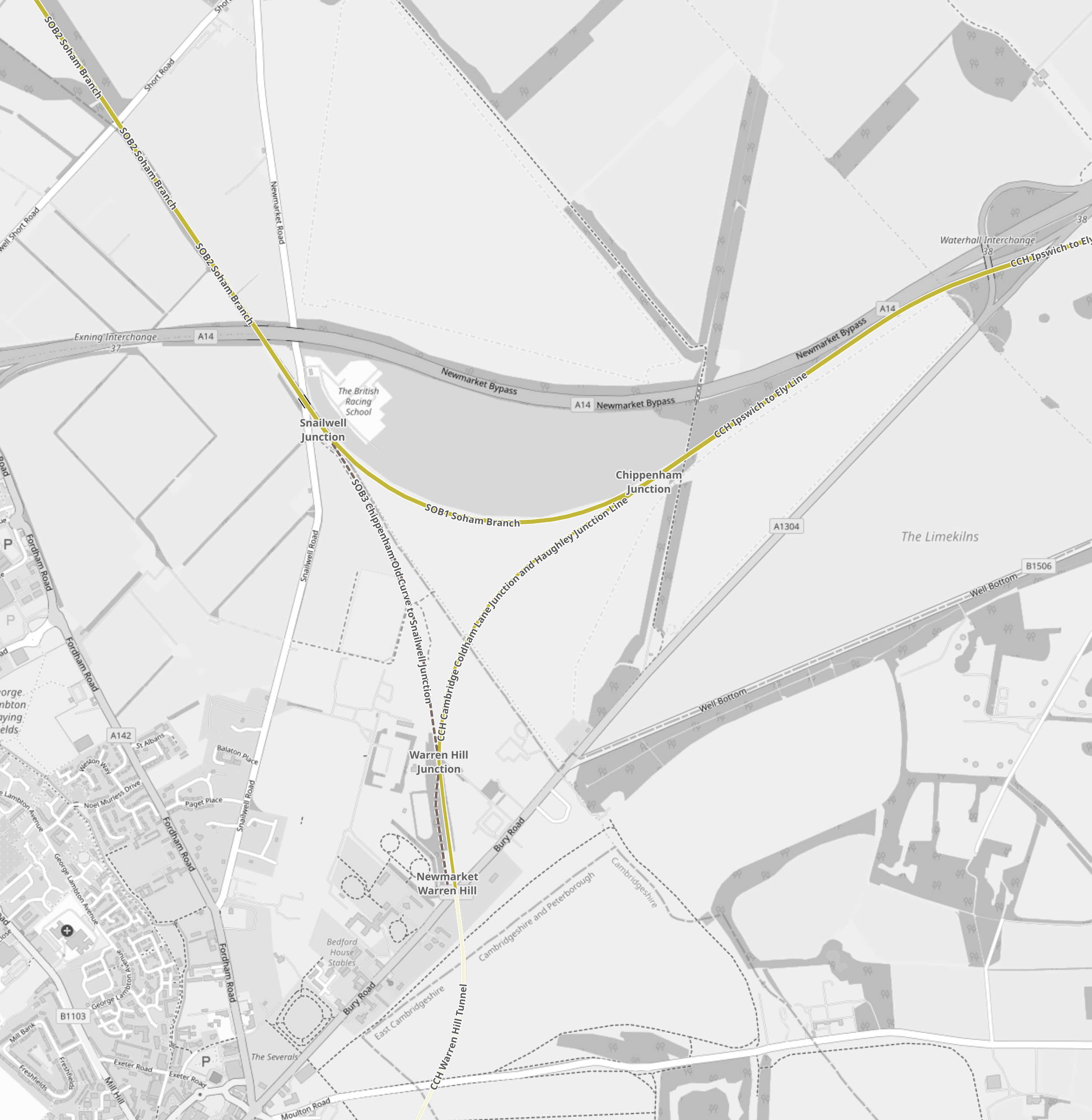
This map from OpenRailwayMap shows the Snailwell Loop.
Note.
- The triangular junction in the middle of the map,
- The line from the junction leading East goes to Bury St. Edmunds and Ipswich.
- The line from the junction leading North goes to Soham, Ely and Peterborough.
- The line from the junction leading South goes to Newmarket and Cambridge.
- The Western side of the junction was removed by British Rail.
It would appear that by reinstating the Western side of the junction, a service between Ely and Cambridge via Soham and Newmarket could be run.
There are proposals for new stations in this area and given the need for comprehensive commuter services into Cambridge this Ely and Cambridge service could develop considerably.
The simplest service pattern would be
- Peterborough via Ely, Manea, March and Whittlesea.
- Ely non-stop.
- Ipswich via Bury St. Edmunds and Stowmarket.
- Cambridge via Newmarket and Dullingham.
All trains would be one train per two hours (tp2h).
Snailwell Junction And Cambridge
There could be problems between Snailwell junction and Cambridge, as the line is mainly single-track and it would need to handle the following trains.
Ipswich and Cambridge – 1 train per hour (tph)
Ely and Cambridge – 1 tp2h
Sundry freight trains.
In Roaming Around East Anglia – Newmarket Station, I wrote this about the plans of the East West Rail Consortium in the area.
In this document on the East-West Rail Consortium web site, this is said.
Note that doubling of Warren Hill Tunnel at Newmarket and
redoubling between Coldham Lane Junction and Chippenham Junction is included
in the infrastructure requirements. It is assumed that most freight would operate
via Newmarket, with a new north chord at Coldham Lane Junction, rather than
pursuing further doubling of the route via Soham.
So would it be possible to create a double-track railway through Newmarket station?
In the related post, I came to this conclusion.
Newmarket can benefit from East West Rail, but the two parties must agree objectives that don’t cause problems for the other.
But I do think, that Newmarket will not welcome the building of a double-track railway through the town.
The Proposed A14 Parkway Station
UK Space Agency And NNL Work On World’s First Space Battery Powered By British Fuel
The title of this post, is the same as that of this press release from the UK Government.
This is the sub-title.
The UK Space Agency and the National Nuclear Laboratory (NNL) are to collaborate on the world’s first space battery powered by Americium-241.
And these three paragraphs outline the project.
This work, commissioned and funded by the UK Space Agency from NNL, will be delivered in a new £19 million laboratory in Cumbria equipped with next-generation equipment and technology. It will deliver a sovereign supply of fuel for space batteries in the context of a global shortage, enabling the UK and its partners to pursue new space science and exploration missions.
Creating new highly-skilled jobs in the North West of England, it will drive innovation in radiochemistry and separations science and open a new market for the UK space sector.
Atomic space batteries, also known as Radioisotope Power Systems (RPSs), release heat as the radioactivity within them decays. The heat can be used directly to prevent spacecraft from freezing and it can be converted into electricity to power onboard systems. The batteries go on working for decades, without need for maintenance over the many years in which a spacecraft could be travelling.
These two paragraphs explain, why there is a need for a new type of atomic space batteries.
Considered ‘mission critical technologies’ by space agencies in the UK and around the world, all the Apollo missions had an atomic battery in tow, as has every rover that has gone to Mars. Until now, these have been powered by Plutonium-238, a radioisotope produced only in the US, where supply is limited, and Russia, so an alternative is urgently needed.
NNL, the UK’s national laboratory for nuclear fission, has been working on this endeavor since 2009, when its researchers first discovered that Americium-241, an alternative to Plutonium-238, is produced during the radioactive decay of used fuel from nuclear reactors and that it emits power for over 400 years.
With the supply plentiful – the new laboratory is being opened at NNL’s flagship Central Laboratory on the Sellafield site, home to the largest resource of Americium-241 available for extraction in the world – the new collaboration will turn a proven scientific concept into a fully-realised technology. It will be operational within the next four years and is expected to be first used on the European Space Agency’s Argonaut mission to the Moon and for future missions into deep space.
It would appear that Americium-241 has several advantages over Plutonium-238.
- Plutonium-238 has supply problems
- Who in their right mind, would buy a product like this from Russia or China?
- The batteries have a life of 400 years.
- There is plenty of suitable nuclear waste at Sellafield, from which Americium-241 can be extracted.
It looks like the first batteries could also be available in four years.
Aunt Margery
My late wife; C’s Aunt Margery was a lady, who needed a pacemaker. I seem to remember that after several of her pacemakers had run out of power and were replaced, and eventually she was fitted with a nuclear-powered pacemaker in the 1970s or 1980s.
This page on the Stanford University web site is entitled The History Of Nuclear Powered Pacemakers. It was written by Matthew DeGraw.
Many of these pacemakers in the 1960s and 1970s, were powered by Plutonium-238.
The last paragraph is entitled The Rise Of Lithium Battery Pacemakers And Fall Of Nuclear Pacemakers, where this is said.
Despite the often longer life-expectancies, nuclear pacemakers quickly became a part of the past when lithium batteries were developed. Not only did the technology improve, allowing for lighter, smaller, and programmable pacemakers, but doctors began to realize that this excessive longevity of nuclear pacemakers was excessive. Lithium pacemakers often last 10-15 years allowing for doctors to check in on their patients and replace either the batteries or the pacemakers themselves with new and improved technology as it is develops in those 10-15 year spans. While there are still several remaining patients with nuclear-powered pacemakers functioning in their bodies, it is likely that in the next few decades as these patients pass away, so will the once promising nuclear pacemakers.
Would the use of Americium-241 to power a nuclear pacemaker transform the economics of these devices?
I wonder, if there’s a cardiologist out there, who by chance reads this blog, who could answer my question!
Funding Available For Rail Construction Innovation Projects
The title of this post, is the same as that of this article on Railway Gazette.
These are the two introductory paragraphs.
Innovators from across the UK are being invited to submit proposals for the Innovation in Railway Construction Competition, which is making £7·44m available for ideas which could be tested at the Global Centre of Rail Excellence in South Wales.
The competition is being run by Innovate UK with GCRE and the Department for Business, Energy & Industrial Strategy.
£7.44m doesn’t seem much, but it is only for feasibility studies, as the article explains.
Entries for the first phase close at 12.00 on December 14, with funding available for feasibility studies of up to £25 000. This would be followed by an invite-only phase two, with successful first phase projects able to develop and demonstrate their innovations.
As Innovate UK keeps coming up with these competitions, they must be judged to be worthwhile.
Do they use the same technique in areas like Health and the NHS? If not, why not!
MOB To Launch Gauge-Changing Montreux – Interlaken GoldenPass Express
The title of this post, is the same as that of this article on Railway Gazette.
Baltic States Agree To Develop Plan To Railway Network’s Conversion According To EU Standards
The title of this post is the same as that of this article on Baltic News Network.
These are the first two paragraphs.
During a meeting of European transport ministers in Brussels, participants agreed that all member states the railway network of which differs from the EU standard, have until 2025-2026 to develop a plan to transition to 1 435 mm. This applies to Latvia as well, as reported by Ministry of Transport.
Latvia and other Baltic States still have railway networks built in accordance with Russian standard of 1 520 mm, whereas the majority of other European countries have railway standard of 1 435 mm. This is also the standard that will be used for the Rail Baltica line.
I have some thoughts.
- Putin won’t like it, as his trains won’t fit the gauge, so it will cramp his invasion plans.
- Will gauge change apply to Spain and Ireland?
- If the Irish Republic converts, will Ulster say no? Undoubtedly they will!
- Will it also apply to trams, as there are quite a few metre gauge tramways.
I doubt that it will ever happen everywhere.
A Long Journey Home
A friend had booked between London and Edinburgh today on the 13:00 LNER train from King’s Cross. She was also travelling with her miniature Schnauzer.
.We had arranged to meet at Marylebone, so I could help them across London to King’s Cross and have a much-needed hot chocolate in King’s Cross before they caught the train North and I went to a meeting organised by my cardiologist.
I had checked out King’s Cross earlier and there was trouble with srveral delayed and cancelled trains.
It wasn’t strikes or bad management from LNER and the problem is explained in this article from the Yorkshire Evening Post, which is entitled Trains From Leeds To London Cancelled Or Delayed After Thieves Steal Signalling Cables From Railway Tracks.
In the end we made the train in time and also had time to have a hot chocolate in LEON, whilst we sat out the back with the dog.
We were texting each other most of the afternoon and with assistance from Real Time Trains, the journey went as follows.
- The train left King’s Cross at 13:08, which was eight minutes late.
- By Peterborough, the train was running seventeen minutes late.
- The driver kept this delay until Retford, where he lost another eighty minutes.
- The train was now running 97 minutes late and this grew by four more minutes by Newcastle.
- My friend reported that they stopped at Newcastle, as they had no driver.
- In the end, LNER found a driver or a way for the current driver to continue to Edinburgh and the train left Newcastle after a thirty minute stop.
- The train was now two hours and ten minutes late.
- Eventually, it pulled into Edinburgh, two hours and five minutes late, after the driver had picked up a few minutes on the approach to Edinburgh.
Note.
- The incoming train that formed this service arrived in King’s Cross from Edinburgh seventy two minutes late, mainly because of the cable theft. It should have arrived and returned to Edinburgh an hour earlier. But it arrived conveniently to form the 13:00 to Scotland.
- As the train presentation team turned the train in nineteen minutes instead of twenty-one, they saved a couple of minutes.
- I suspect the delay at Retford was getting through the area without any signalling.
- Had the driver run out of hours by Newcastle, as he had been in the cab for four-and-a-half hours?
- Normally, four-and-a-half hours would have enabled the driver to have driven to Edinburgh.
These are my thoughts.
Cable Theft
In the days of British Rail, I did some work for British Rail using my software called Daisy, which led to a report entitled Failure Reporting And Analysis On British Rail, which was written by J. S. Firth CEng, MIEE, MIRSE, who worked for SigTech, which was a Business Unit of the British Railways Board.
If anybody who has a legitimate reason to read the report, I still have the complimentary copy sent to me by Mr. Firth and would be happy to provide a copy.
I did flag up a project called Unauthorised Cable Removal And Fault Triage, as one of the winners in the First Of A Kind 2022 competition organised by the Dept of BEIS.
If there is anything I can do to help, let me know.
Problems In France
A friend in France told me that there is a problem with stealing overhead electrification cables in France.
This article on RFI is entitled Copper Wire Thieves Force France’s High-Speed TGV To Go Slow.
There are several similar stories on French and other European web sites.
Signalling Using Radio
The East Coast Main Line is being signalled using modern ERTMS digital signalling, where drivers read the signals on an in-cab display, which is connected by radio to the signalling system.
This extract from Wikipedia describes the first project.
In June 2020 it was reported that the UK government would provide £350 million to fund the UK’s first digital signalling system on a long-distance rail route. The signalling is to be fitted on a 100-mile (161 km) section of the East Coast Main Line between Kings Cross, London, and Lincolnshire, which will allow trains to run closer together and increase service frequency, speed and reliability. No date for when the new technology, already in use on the Thameslink lines at London Bridge and some London Underground lines, has been given.
If the cables are removed will this reduce crime?
LNER Delay Repay
My friend will be entitled for a full refund of her single ticket.
This page on the LNER web site gives full details.
Note.
- You have 28 days to claim.
- If you have a return ticket, you may be entitled to something for that leg of the journey.
I would add, that you should always keep all your tickets, in case the return journey goes belly-up.
Regulator Approves New Grand Union Train Service From Carmarthen To London Paddington
The title of this post, is the same as that of this press release from the Office of Rail and Road.
This is the sub-heading of the press release.
The Office of Rail and Road (ORR) has opened up the Great Western Main Line to competition and enabled a significant increase in rail services between London and South Wales.
These points are made in the press release.
- The rail regulator has approved the introduction of new train services between London, Cardiff and South West Wales from the end of 2024.
- The services will be operated by a new open access operator, Grand Union Trains, bringing competition to the Great Western route out of Paddington.
- Passengers travelling between London, Bristol Parkway, Severn Tunnel Junction, Newport, Cardiff, Gowerton, Llanelli and Carmarthen will benefit from an extra five daily return services and greater choice of operator.
- The decision opens up the Great Western Main Line to competition for the first time, with potential benefits in terms of lower fares, improved service quality and innovation for all passengers using the route.
- The application, submitted to ORR in June 2022, was disputed by Network Rail due to concerns about capacity on the network. But following careful consideration and analysis, ORR has directed Network Rail to enter into a contract with Grand Union.
- Grand Union has committed to significant investment in new trains.
- As an ‘open access’ train operator, however, it will not get paid subsidies from public funds, unlike current operators along the route.
ORR supports new open access where it delivers competition for the benefit of passengers. In making this decision, the regulator has weighed this up against the impact on Government funds and effect on other users of the railway, both passengers and freight customers.
These are my thoughts.
The Company
Grand Union Trains have certainly persevered to get this approval.
- The company was created by Ian Yeowart, who previously created open access operators; Alliance Rail Holdings and Grand Central before selling both to Arriva.
- After multiple negotiations with the Office of Road and Rail (ORR), Yeowart must know how to get an acceptable deal.
- Grand Union Trains have a similar application for a service between Euston and Stirling with the ORR.
Grand Union Trains also have a web site.
The home page has a mission statement of Railways To Our Core, with this statement underneath.
At Grand Union we are passionate about Britain’s railways. We are committed to the traditional values of providing a high-quality customer service and a comfortable journey experience at a fair price.
I’ll go with that.
The Financial Backing Of The Company
All the UK’s open access operators are well-financed either by Arriva or First Group.
The ORR would not receive any thanks, if they approved an operator, which duly went bust.
So what is the quality of the financing behind Grand Union Trains?
This article on Railway Gazette is entitled RENFE Looks At Entering UK Rail Market Through Open Access Partnership, which starts with this paragraph.
Open access passenger service developer Grand Union Trains is working with Spain’s national operator RENFE and private equity firm Serena Industrial Partners on a proposed service between London and Wales.
That is fairly clear and would surely help in the financing of Grand Union Trains.
The Route
Trains will run between Carmarthen and London Paddington, with stops at Llanelli, Gowerton, Cardiff, Newport, Severn Tunnel Junction and Bristol Parkway.
A new station at Felindre will replace Gowerton at some time in the future.
There will be five trains per day (tpd).
I have some thoughts and questions about the route
Felindre Station
Felindre station is named in Wikipedia as the West Wales Parkway station, where it is introduced like this.
West Wales Parkway is a proposed railway station north of Swansea, near to the boundaries of the neighbouring principal area of Carmarthenshire, and the villages of Felindre and Llangyfelach. The station is proposed to be situated at the former Felindre steelworks, near Junction 46 of the M4 and A48, and near Felindre Business Park and Penllergaer Business Park. The project is in the planning stages, as part of a wider Department for Transport proposal to re-open the Swansea District line to passenger traffic.
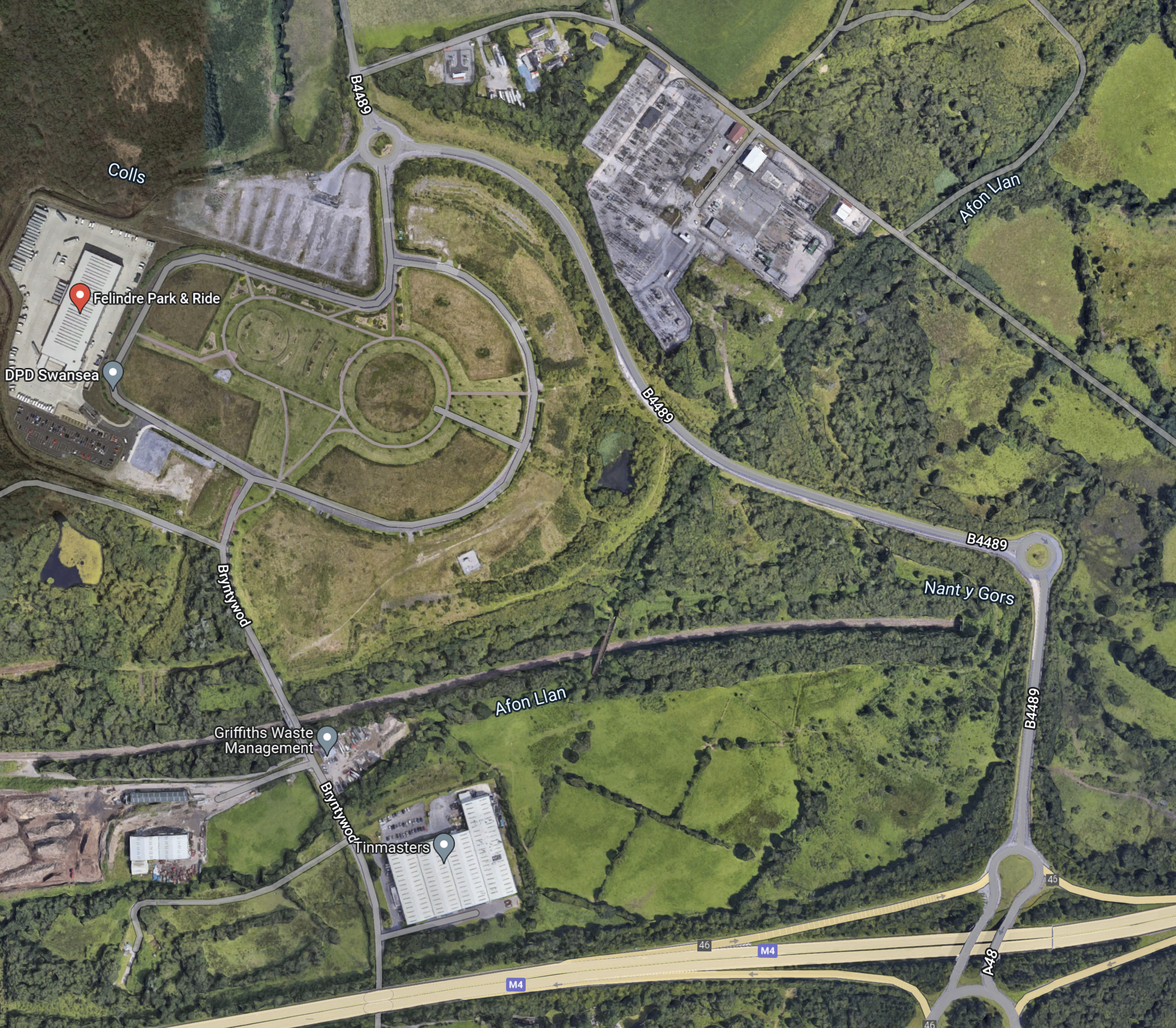
This Google Map shows where, it appears the Felindre station will be built.
Note.
- The Felindre Business Park in the North-West corner of the map, with a Park-and-Ride.
- The M4 running across the bottom of the map.
- The Swansea District Line runs East-West between the motorway and the Business Park.
It looks that the new station could be located on the South side of the Business Park.
When High Speed Two Opens Will Trains Call At Old Oak Common?
When High Speed Two opens, all GWR trains will stop at Old Oak Common station for these connections.
- Chiltern for for Banbury, Bicester, High Wycombe and the West Midlands
- Elizabeth Line for Central and East London and the Thames Valley
- Heathrow Airport
- High Speed Two for Birmingham and the North
- Overground for Outer London
As Old Oak Common will be such an important interchange, I think they should.
Will The Platforms At Carmarthen Station Need Lengthening?
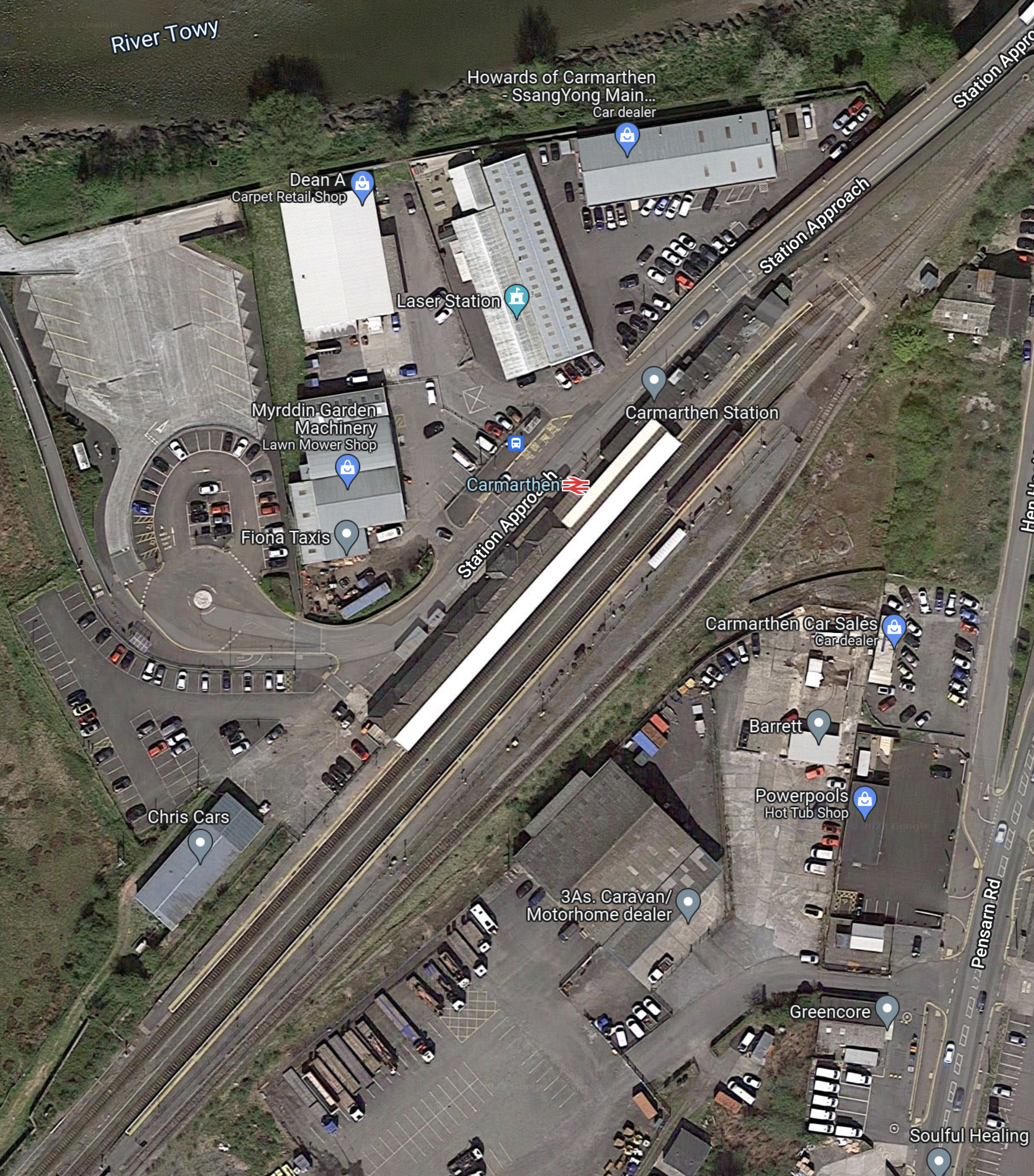
This Google Map shows Carmarthen station.
Note.
- The station has two platforms.
- There are certainly pictures of the station with an InterCity 125 in the station. There is a picture on the Wikipedia entry for Carmarthen station.
These pictures show the station.





I suspect that the station will be upgraded to accommodate Grand Union Trains.
The Trains
An article in the June 2022 Edition of Modern Railways, which is entitled Grand Union Bids For London To Carmarthen, gives these details of the trains.
- Three classes.
- 2023 start for the service.
- Cycle provision.
- Vanload freight will be carried.
- Electric trains could start between London and Cardiff by 2023.
- In 2025, trains could be nine-car bi-modes.
- South Wales-based operation and maintenance.
- 125 full-time jobs created.
It certainly seems to be a comprehensive and well-thought out plan.
I have a few thoughts on the trains.
What Make Of Trains Will Be Procured?
Consider.
- Lumo’s Class 803 trains were ordered from Hitachi in March 2019 and entered service in October 2021.
- So if they ordered their version of the Hitachi trains by the end of 2022, the trains could be in service by July/August 2025.
- It would probably be easier, if the only fast trains on the Great Western Main Line between London and South Wales were all Hitachi trains with identical performance.
But the Spanish backers of Grand Union Trains may prefer Spanish-designed trains assembled in South Wales. So would a bi-mode version of CAF’s Class 397 trains be suitable?
On the other hand, the Carmarthen and Cardiff section of the route without a reverse at Swansea is only seventy-five miles.
This Hitachi infographic shows the Hitachi Intercity Tri-Mode Battery Train.

Consider.
- Charging could be provided at Carmarthen using a short length of electrification or one of Furrer + Frey standard chargers.
- Charging would also use the electrification between London Paddington and Cardiff.
- A nine-car Class 800 or Class 802 train has five engines and a five-car train has three engines.
- The Intercity Tri-Mode Battery Train was announced in December 2022.
- In the intervening two years how far has the project progressed?
- For the last twelve months, Lumo have been running trains with an emergency battery-pack for hotel power. How are the batteries doing, whilst being ferried up and down, the East Coast Main Line?
Can Hitachi configure a train with more than one battery-pack and a number of diesel engines, that has a range of seventy-five miles? I suspect they can.
I suspect that CAF also have similar technology.
There is also a benefit to Great Western Railway (GWR).
If GWR were able to fit out their Class 802 trains in the same way, they would be able to run between Cardiff and Swansea on battery power.
- It is only 45.7 miles.
- Charging would need to be provided at Swansea.
- GWR could still run their one tpd service to Carmarthen.
It looks like both train operating companies could be able to do as Lumo does and advertise all electric services.
What Could Be The Maxmum Range Of A Hitachi Train On Batteries?
This Hitachi infographic shows the Hitachi Regional Battery Train.

Consider.
- It has a battery range of 90 km or 56 miles on the single battery.
- I would expect that by a regional train, Hitachi mean a five car Class 800 or 802 train, like those that go to Cheltenham, Lincoln or Middlesbrough.
- A five-car Hitachi Regional Battery Train would have a battery that could contain power equivalent to 280 car-miles.
- Five-car Class 800 or 802 trains have three engine positions.
- These Hitachi trains have a very sophisticated control system, which I wrote about in Do Class 800/801/802 Trains Use Batteries For Regenerative Braking?
I believe the engineers at Hyperdrive Innovation have designed the battery-packs that replace the diesel engines as simulations of the diesel engines, so they can be a direct replacement.
This would mean that battery-packs could be additive, so the following could apply to a five-car train.
- Two battery packs could have a range of 112 miles.
- Three battery packs could have a range of 168 miles.
GWR generally runs pairs of five-car trains to Swansea, which would be 90 miles without electrification.
If five-car trains with two battery packs, could be given a range of 112 miles, GWR could run an electric service to Swansea.
They could also run to Carmarthen, if Grand Union Trains would share the charger.
What ranges could be possible with nine-car trains, if one battery pack is good for 280 car-miles?
- One battery-pack, gives a range of 280/9 = 31 miles
- Two battery-packs, give a range of 2*280/9 = 62 miles
- Three battery-packs, give a range of 3*280/9 = 93 miles
- Four battery-packs, give a range of 4*280/9 = 124 miles
- Five battery-packs, give a range of 5*280/9 = 155 miles
- Six battery-packs, give a range of 6*280/9 = 187 miles
- Seven battery-packs, give a range of 7*280/9 = 218 miles
Note.
- I have rounded figures to the nearest mile.
- There are five cars with diesel engines in a nine-car train, which are in cars 2,3,5, 7 and 8.
- Diesel engines are also placed under the driver cars in five-car Class 810 trains.
- For the previous two reasons, I feel that the maximum numbers of diesel engines in a nine-car train could be a maximum of seven.
- I have therefor assumed a maximum of seven battery packs.
These distances seem sensational, but when you consider that Stradler’s Flirt Akku has demonstrated a battery range of 243 kilometres or 150 miles, I don’t think they are out of order.
But, if they are correct, then the ramifications are enormous.
- Large numbers of routes could become electric without any infrastructure works.
- Grand Union Trains would be able to run to Carmarthen and back without a charger at Carmarthen.
- GWR would be able to run to Swansea and back without a charger at Swansea.
Prudence may mean strategic chargers are installed.
Rrenewable Energy Developments In South West Wales
In Enter The Dragon, I talked about renewable energy developments in South West Wales.
I used information from this article on the Engineer, which is entitled Unlocking The Renewables Potential Of The Celtic Sea.
The article on the Engineer finishes with this conclusion.
For now, Wales may be lagging slightly behind its Celtic cousin to the north, but if the true potential of the Celtic Sea can be unleashed – FLOW, tidal stream, lagoon and wave – it looks set to play an even more prominent role in the net zero pursuit.
The Red Dragon is entering the battle to replace Vlad the Mad’s tainted energy.
South West Wales could see a massive renewable energy boom.
Grand Union Trains will increase the capacity to bring in more workers to support the developments from South Wales and Bristol.
Ricardo Supports Toyota To Develop Its First UK-Based Hydrogen Light Commercial Vehicle
The title of this post, is the same as that of this press release from Ricardo.
This is the first paragraph.
Ricardo, a global strategic, environmental, and engineering consulting company, is supporting Toyota, in partnership with the APC, on a significant, multi-year project to develop its first zero emission hydrogen powered light commercial vehicle in the UK.
Note.
- Ricardo is a long-established engineering consultancy, headquartered in Shoreham, that employs 3,000 people and has a turnover of around £350,000. It has a high reputation, especially in the design of diesel engines.
- Ricardo has already converted a diesel bus to hydrogen, which I wrote about in Ricardo Repowers Double Decker Diesel Bus With Hydrogen Fuel Cells.
- The zero emission hydrogen powered light commercial vehicle, will be based on the Toyota Hilux, of which nearly twenty million have been built.
- Toyota already produce the hydrogen-powered Mirai.
- The APC is the UK Government’s Advanced Propulsion Centre.
This looks like one of those collaborations in the 1960s between Ford and Lotus, that produced the iconic Lotus Cortina.
The press release says this about Ricardo’s role in the project.
The Toyota Hilux hydrogen variant will be the first of its kind, manufactured and assembled at Toyota’s Derby-based facility and is scheduled for prototype production in 2023. Ricardo has been chosen as a partner by Toyota due to its proven experience in applying advanced propulsion technologies and expertise in hydrogen fuel cell integration, including for the UK’s first hydrogen transport hub.
Ricardo’s role in the project is to integrate the complete hydrogen fuel cell, fuel storage system, and controls including design, analysis, and validation. The integration ensures efficient operation of all systems to give an excellent vehicle range and supports attributes for longevity and reliability. Working as part of the consortium, Ricardo will support the delivery of a complete turnkey solution, which will create greater agility for Toyota in the UK supply base and a quicker turnaround in the design of low volume manufacturing.
This certainly looks like a co-operation between equals.
I have a few thoughts on the fuel cells.
The Wikipedia entry for the Toyota Mirai says this about the fuel cells for that car.
The first generation of Toyota FC Stack achieved a maximum output of 114 kW (153 hp). Electricity generation efficiency was enhanced through the use of 3D fine mesh flow channels. These channels—a world first, according to Toyota—were arranged in a fine three-dimensional lattice structure to enhance the dispersion of air (oxygen), thereby enabling uniform generation of electricity on cell surfaces. This, in turn, provided a compact size and a high level of performance, including the stack’s world-leading power output density of 3.1 kW/L (2.2 times higher than that of the previous Toyota FCHV-adv limited-lease model), or 2.0 kW/kg. Each stack comprises 370 (single-line stacking) cells, with a cell thickness of 1.34 mm and weight of 102 g. The compact Mirai FC stack generates about 160 times more power than the residential fuel cells on sale in Japan.[40] The Mirai has a new compact (13-liter), high-efficiency, high-capacity converter developed to boost voltage generated in the Toyota FC Stack to 650 volts.
As a rudimentary search of the Internet says that an entry-level HiLux has a 148 hp diesel engine, it seems that Toyota’s own fuel cells could be in the right ball park.
This second press release from Ricardo is entitled Hyzon And Ricardo To Deliver Hydrogen Fuel Cell Systems For Commercial Vehicles.
These are the first two paragraphs.
Ricardo is a world-class environmental, engineering and strategic consulting company, is partnering with leading hydrogen vehicle supplier Hyzon Motors Inc. on developing and deploying commercial systems to support the decarbonisation of the global transport and energy sectors.
The companies announced today they will be working to combine Hyzon’s high-power-density fuel cell stack with Ricardo’s unrivaled software and controls, thermal management and proven track record advising customers on hydrogen fuel cell technology.
Note, that the press release dates from December 2021.
The last paragraph of the press release is probably the most significant.
The potential of the Hyzon-Ricardo engagement has already borne fruit with the debut of the Ricardo Vehicle Integrated Controls and Simulation (VICS) control system within the Hyzon fuel cell electric truck at the Advanced Clean Transportation conference in September. Moving forward, Ricardo will support Hyzon in a global capacity on the development and deployment of advanced energy management and propulsion systems to accelerate the realisation of net zero initiatives across all modes of transport.
Note.
- Have Ricardo used Hyzon fuel cells to create their hydrogen-powered bus? I wrote about this project in Ricardo Repowers Double Decker Diesel Bus With Hydrogen Fuel Cells.
- If Ricardo and Hyzon have been working together for a few years, the timescale would fit.
- As a Graduate Control Engineer, I know that with complex engineering systems of all kinds, good control is often hard to achieve. Perhaps, Ricardo have cracked it!
I can certainly see, Ricardo playing a similar role in the creation of Toyota’s Hydrogen HiLux.
Conclusion
It looks to me, that with their hydrogen deals with Toyota and Hyzon, Ricardo are converting themselves from a giant in the field of diesel engine technology to a significant player in the field of hydrogen power.
 The Anonymous Widower