Japanese Companies To Invest GBP 14.2 Billion In UK’s Offshore Wind, Green Hydrogen
The title of this post, is the same as that of this article on offshoreWIND.biz.
This is the sub-heading.
Japanese giants Marubeni Corporation, Sumitomo Corporation, and Sumitomo Electric Industries have committed to investing a total of GBP 14.2 billion (approximately EUR 16.3 billion) in offshore wind and green hydrogen projects, and the offshore wind supply chain in the UK
These two paragraphs add a bit of context and flesh to the deal.
Ahead of the UK Prime Minister’s business reception in Tokyo on 18 May, the UK government announced that leading Japanese businesses have committed to invest GBP 17.7 billion (approx. EUR 20.3 billion) in businesses and projects across the UK.
Of this, GBP 14.2 billion has been committed by Marubeni, Sumitomo and Sumitomo Electric for projects in offshore wind, green hydrogen and offshore wind supply chain.
SSE’s Berwick Bank Wind Farm will have a capacity of 4.1 GW and is budgeted to cost just short of £18 billion. Doing a quick calculation, indicates that £14.2 billion would only finance £3.23 GW of offshore wind.
But the Japanese say they will invest in offshore wind, green hydrogen and offshore wind supply chain. Investing in the offshore wind supply chain, would surely attract more money as the developers placed orders for foundations, floaters, electrical gubbins and support vessels.
Note.
- In Japanese Giant Sumitomo Heavy Invests In Liquid-Air Energy Storage Pioneer, I wrote about Sumitomo’s investment in English energy storage. company; Highview Power.
- Electrolyser company; iTM Power has also sold a 1.4 MW electrolyser to Sumitomo and signed an agreement over American sales with another Japanese company.
I can see other similar co-operative deals being developed. Possible areas could be cables, transformers and support vessels.
Spain Launches App To Show If Men Shirk Housework
The title of this post is the same as that of this article in The Times.
This is the first paragraph.
Spain has announced plans to introduce an app that promises to address the gender imbalance of housework by getting users to log the hours they spend on chores.
At least it’s a free app!
ULEZ: Impact Of Mayor’s Expansion Questioned
The title of this post, is the same as that of this article on the BBC.
This is the sub-heading.
One in six cars registered in outer London did not meet Ultra Low Emission Zone (ULEZ) standards last year, according to figures from the Society of Motor Manufacturers and Traders
These paragraphs outline the analysis.
The data was released following a Freedom of Information request by the BBC to Transport for London (TfL).
It comes amid a dispute over whether existing data used by City Hall and TfL is accurate.
However, London Mayor Sadiq Khan said the newly released data was unreliable.
From the end of August, all those driving vehicles within Greater London that do not meet ULEZ pollutant limits will face a £12.50 daily charge or a £180 fine.
I’m sure that any Professor of Statistics from London’s universities or an expert from the Royal Statistical Society, could give a definitive answer on the statistics.
But then Khan is a lawyer and will hide behind the law in this case, by claiming he is both judge and jury.
If Khan really cared about London’s air, he would have a hydrogen policy, which would enable London’s local cement, construction and refuse trucks to be replaced or converted to hydrogen, so that the city’s air improved.
It would also make it easier to introduce more hydrogen-powered buses.
Companies like Tesco and Marks & Spencer, who regularly run trucks into London, should be encouraged to convert their delivery trucks to zero-carbon, by adjustment of the ULEZ charges.
The ULEZ has been badly thought out and needs to be realigned with what is practical and reduces the pollution.
Gresham House Energy Storage Sets GBP80 Million Fundraise
Gresham House Energy Storage Fund must be doing something right, as similar headlines are used in half-a-dozen places on the Internet and they regularly seem to be raising more money.
But then, as a Graduate Control Engineer and a previous owner of half a finance company, I’ve always thought raising money to build batteries was a good idea.
My only niggle with Gresham House, is that I would have thought by now, they would have put some money into building one of the excellent new technology batteries that are coming through.
The storage fund or some of its employees, may of course have contributed to some of the crowdfunding for these new technologies, all of which I feel have a good chance of being a success.
Note.
- Energy Dome is Italian and all the others are at least fifty percent British.
- Most of the British batteries have had backing from the UK government.
- All these batteries are environmentally-friendly.
- None of these batteries use large quantities of rare and expensive materials.
- Energy Dome even uses carbon dioxide as the energy storage medium.
In addition, in Scotland, there is traditional pumped storage hydro-electricity.
Project Iliad
This article on renews.biz has a slightly different headline of Gresham House To Raise £80m For US Battery Buildout.
This is the first two paragraphs.
Gresham House Energy Storage Fund is seeking to raise £80m through a share placing.
The new equity raised will primarily be used to finance 160MW of solar with co-located four-hour battery projects in California, US, known as Project Iliad.
The article then gives a lot of financial details of Project Iliad and Gresham House.
Will Gresham House be backing co-located solar/battery projects in the UK?
- In Cleve Hill Solar Park, I write about a co-located solar/battery project in Kent.
- This press release from National Grid is entitled UK’s First Transmission-Connected Solar Farm Goes Live, which also describes a co-located solar/battery project, being built near Bristol.
These two projects are certainly serious and could be pathfinders for a whole host of co-located solar/battery projects.
WillGresham House back some of this new generation?
Articles From The Engineer
I generally read articles from The Engineer once a week.
Here’s a few that are worth reading.
12th Feburuary 2023 – Hydrogen Ambulance Set For London
A project led by hydrogen fuel specialists ULEMCo is aiming to deliver the UK’s first zero emission hydrogen ambulance later this year
There is an interesting discussion, as to whether hydrogen or battery ambulances are better. Range and hotel power issues seem to favour hydrogen.
11th May 2023 – Bramble Energy Secures £12m For Hydrogen Bus
Bramble Energy has joined forces with Equipmake, Aeristech and Bath University to develop a new hydrogen double-deck bus integrating its printed circuit board fuel cell (PCBFC) technology
Bramble Energy can create bespoke fuel cell stacks in a ‘matter of days at scale and low-cost’.
12th May 2023 – Cornish Geothermal Project Leads Government Heat Scheme
The UK’s first deep geothermal heat network is one of seven new projects to receive funding as part of a new government programme to decarbonise buildings across England.
The full list of projects to receive support today via the Green Heat Networks Fund is detailed.
17th May 2023 – Ricardo Joins Pan-European Hydrogen Shipping Consortium
UK engineering firm Ricardo is set to play a key role in the sustainable HYdrogen powered Shipping (sHYpS) project being funded by the EU’s Horizon Europe programme.
One thing that is disclosed in the article, is that Ricardo have a new 400kW hydrogen fuel cell test chamber at the company’s UK headquarters.
Joule Battery Loco Unveiled Ahead Of Trial
The title of this post, is the same as that of this article on Railway Gazette.
These three paragraphs outline the trial and the locomotive.
Pacific Harbor Line has unveiled a Progress Rail EMD SD40JR Joule battery electric locomotive ahead of a one-year trial.
Anacostia Rail Holdings subsidiary PHL provides shunting services and dispatches all BNSF and Union Pacific trains within the ports of Los Angeles and Long Beach. It currently operates a fleet of EPA Tier 3 Plus and Tier 4 locomotives using 100% renewable diesel fuel.
The 3·2 MW six-axle SD40JR locomotive was rebuilt from a SD40-2. It has a lithium-ion battery, AC traction motors and individual axle control. It is charged using an EMD Joule Charging Station, and features regenerative braking.
I have some thoughts and more information.
Pacific Harbor Line – PHL
This map from OpenRailwayMap shows the area in the ports of Los Angeles and Long Beach, where it will be working.

Note.
Los Angeles is to the West and Long Beach is to the East.
Most of the lines in brown are rail tracks, where PHL moves containers between ships and trains that bring them to and from the ports.
The Union Pacific Intermodal Container Transfer Facility is at the North of the map.
It is a very comprehensive system.
The Pacific Harbor Line web site gives more details and starts with this paragraph.
Pacific Harbor Line, Inc. (PHL) provides rail transportation, maintenance and dispatching services to both Ports of Long Beach and Los Angeles, which together form top intermodal gateways in the United States. Through its inception, PHL’s mission has been to offer neutral services to all its business partners: two ports, two Class I railroads, nine intermodal terminals and numerous carload customers. PHL connects with BNSF and UP.
It then gives these details.
- Location: Ports of Long Beach and Los Angeles
- Employees: 189
- Railroad Mileage: 19 route miles, 96 track miles
- Port Facility Served: Port of Los Angeles, Port of Long Beach
- Connecting Railroads: BNSF and UP
- Sustainability: Contact Pacific Harbor Line to discover the low carbon solutions we can provide for your freight needs.
- Number of Customers: 9 on-dock marine terminals, more than 30 carload customers
Later the web site states that PHL is proud of its role as an industry leader for environmental sustainability and as owner of the greenest locomotive fleet in the country.
The new locomotive would appear to fit fit that philosophy.
Progress Rail EMD SD40JR Joule Battery Electric Locomotive
This page on the Progress Rail web site gives more details of their Joule battery electric locomotives.
- The SD40JR locomotive has a power output of 2.1 MW and a 4 MWh battery.
- For comparison, a Class 66 locomotive, of which there are 480 in the UK, has a power output of 1.85 MW at the rail.
- Strangely, the UK locomotive is 1.7 metres longer.
As both locomotive classes were originally built by EMD, I do wonder how similar the components of the two locomotives are.
Would A Battery Electric Class 66 Locomotive Be Any Use?
If we assume that conversion of a Class 66 locomotive to battery power is possible would it find uses in the UK?
I am fairly certain, if you live in any of the villages on the Felixstowe branch line, you will sometimes get annoyed, at the streams of Class 66 locomotives passing with long freight trains between Ipswich and Felixstowe.
I have just looked at the 11:13 freight train from Felixstowe North to Trafford Park.
- It leaves Felixstowe North hauled by a Class 66 locomotive.
- Felixstowe North to Ipswich takes just 35 minutes.
- At Ipswich, the motive power is changed to an electric locomotive, which is probably a Class 90 locomotive.
- The train then uses an all-electric route to Trafford, where it arrives at 23:39.
A rough calculation based on the time running on electric, shows that the current hybrid method of operation, saves 95.3% of the carbon emissions compared to an all-diesel trip.
It would be carbon-free, if a battery-electric Class 66 locomotive could be developed. with sufficient range.
So that’s one application!
There must be other applications, where a battery can supply enough power for the journey.
Conclusion
Given the number of Class 66 locomotives to decarbonise or replace, a fleet of battery electric Class 66 locomotives could be a good start.
Cara Delevingne Champions Fossil Free Hydrogen In Dazzling Beauty Campaign
The title of this post, is the same as that of this article on Hydrogen Fuel News.
This is the sub-heading.
The eco-conscious Delevingne teamed up with Vattenfall to raise awareness about clean energy.
This is the first paragraph.
The English model and actress is no stranger to beauty campaigns, having experience as the face of Burberry, Chanel, and Yves Saint Laurent, but her latest campaign with Swedish multinational energy company Vattenfall, aims to raise awareness of clean power using fossil free hydrogen compared to burning fossil fuels.
There is also this video.
I suppose she was paid well for it and after her BBC series; Planet Sex With Planet Sex With Cara Delevingne, we all know she’s game for many things, but you wouldn’t catch me jumping into water like that, as I can’t swim, despite endless attempts to learn.
Dutch Stop Offshore Wind Turbines To Protect Migratory Birds In ‘International First’
The title of this post, is the same as that of this article on offshoreWIND.biz.
This is the sub-heading.
The wind turbines at Borssele and Egmond aan Zee offshore wind farms were stopped for four hours on 13 May, to help migrating birds pass by safely.
These three paragraphs outline the measures taken to protect the migrating birds.
According to the Dutch Government, this is the first time such a measure has been applied and is in line with the approach of the government and participating companies to increasingly focus on ecology and biodiversity in offshore wind farms.
The wind turbines’ speed will be reduced to a maximum of two rotations per minute during the predicted night-time peak migration to give the birds a safe passage.
The shutdown was part of a pilot phase, which could become standard this autumn and will also include wind farms that are still being built or will be constructed in the future.
I wonder how this Dutch action fits with research from Vattenfall, that I wrote about in Unique Study: Birds Avoid Wind Turbine Blades.
Plan To Develop New ‘Southern Gateway’ Through Station In City Centre
The title of this post, is the same as that of this article in the Bradford Telgraph and Argus.
This is the sub-heading.
Work to develop a new city centre rail station in Bradford could soon be back on the rails, despite the Government cancelling the local Northern Powerhouse Rail line
These are the first two paragraphs.
It has today been announced that the UK Infrastructure Bank will be working with Bradford Council to plan and develop a proposed “Southern Gateway” station in the city centre.
Although few details have been announced so far, the station is expected to be a through station, and is likely to be on the site off Wakefield Road currently occupied by St James’ Wholesale Market.
This sounds like an updating with finance of a plan I wrote about in Bradford Seeks Support On Rail Project Which Could Deliver £30bn Benefits.
This map from OpenRailwayMap shows the rail lines in the Bradford area.

Note.
- New Pudsey station is in the North-East corner of the map.
- Bradford Foster Square and Bradford Interchange stations are in the North-West corner of the map.
- Low Moor station is in the South-West corner of the map.
This second OpenRailwayMap shows an enlargement of the lines across Bradford.

Note.
- Bradford Interchange station is in the North-West corner of the map.
- The railway lines are shown in yellow.
- New Pudsey station is off the map to the East and on the way to Leeds.
- Some trains between Leeds and Bradford are routed via New Pudsey station and the loop in this map.
- The railway between New Pudsey and Bradford Interchange stations goes under a roundabout on the Wakefield Road.
This Google Map shows St. James Wholesale Market and the railway to the North-East of the roundabout.
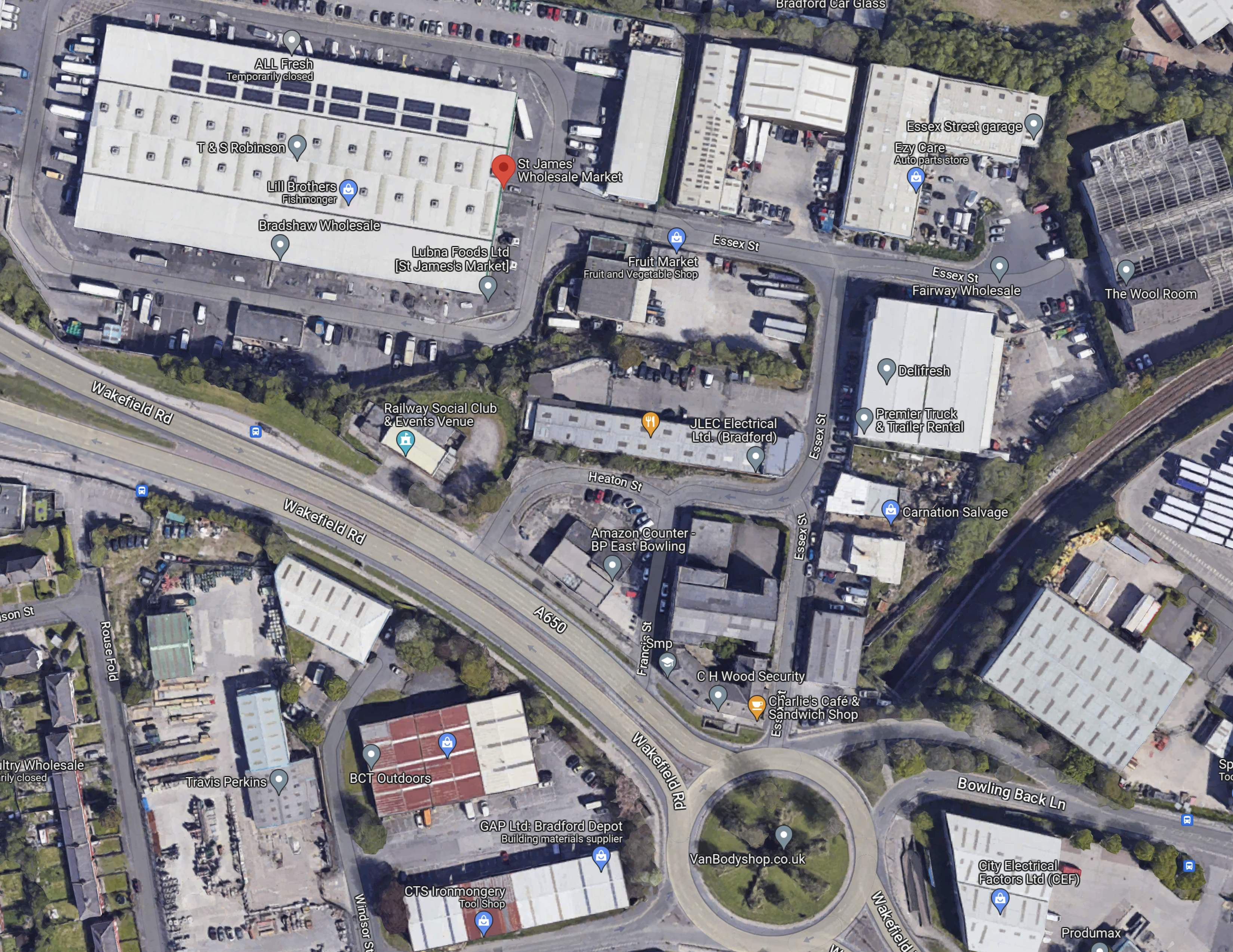
Note.
- St. James Wholesale Market is marked by the red arrow.
- The railway between New Pudsey and Bradford Interchange stations goes under the roundabout at the bottom of the map.
There’s certainly a lot of space to the East of the market. Could the new station be built with a lot of adjacent open space like King’s Cross and Liverpool Lime Street.
These are further thoughts.
Will There Be A New Chord South Of Bradford Interchange Station?
This section is an edited version of a section from Bradford Seeks Support On Rail Project Which Could Deliver £30bn Benefits.
This Google Map, shows Mill Lane Junction, where the lines from New Pudsey and Bradford Low Moor stations join South of Bradford Interchange station.
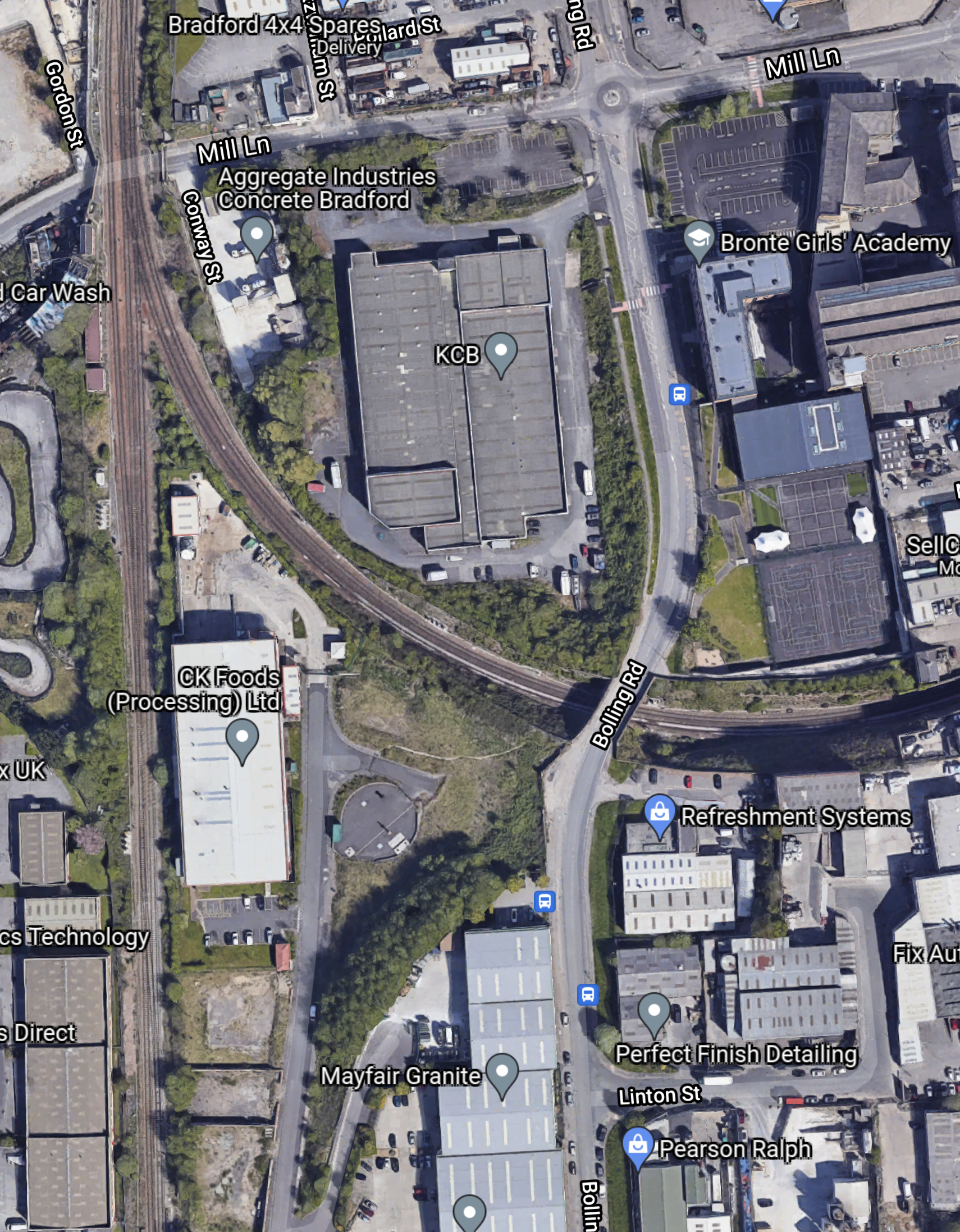
Note.
- Bradford Interchange station is on the rail line to the North.
- The proposed new Bradford station and the existing New Pudsey station are on the rail line to the East.
- Bradford Low Moor station is on the rail line to the South.
It would appear that an extra chord should be added to the junction to allow trains between Manchester Victoria and Leeds running via the Calder Valley Line to call at the new station in Bradford.
Current trains between Manchester Victoria and Leeds using this route have to reverse at Bradford Interchange. The new station and the extra chord would avoid this.
Will Bradford Interchange Station Be Closed?
That is a big question and depends on the overall plan.
I await the full plan with interest.
But building the new chord, closing Interchange station and avoiding the reverse will speed up services.
What Trains Will Call At The New Station?
Currently, only these trains from Northern, go through the station site.
- Hull and Halifax
- Leeds and Chester
- Leeds and Manchester Victoria
- York and Blackpool North
Note.
- All have a frequency of one train per hour (tph)
- All currently reverse at Bradford Interchange.
- All call at Leeds, New Pudsey and Halifax.
- Three tph call at Bramley and Hebden Bridge.
- Two tph call at Manchester Victoria, Rochdale and Todmorden.
- One tph calls at Low Moor.
I suspect these service could be augmented to perhaps give the following.
Four tph to Hebden Bridge, Rochdale and Manchester Victoria.
The only other trains passing though the area are Grand Central’s four trains per day (tpd) between London King’s Cross and Bradford Interchange via Low Moor.
- If these trains terminated in a bay platform at the new station, would this enable their frequency to be increased?
- Or could the services be extended to Leeds?
The new station certainly opens up possibilities.
Vauxhall-Maker Says UK Needs To Change Its Brexit Deal
The title of this post, is the same as that of this article on the BBC.
This is the sub-heading.
One of the world’s biggest carmakers has called on the government to renegotiate part of the Brexit deal or risk losing parts of its car industry
These four paragraphs explain the problem.
Stellantis, which makes Vauxhall, Peugeot, Citroen and Fiat had committed to making electric vehicles in the UK.
But it has now said it is no longer able to meet Brexit trade rules on where parts are sourced.
The government is “determined” that the UK will remain competitive in car manufacturing, a spokesperson said.
Stellantis called on the government to come to an agreement with the EU to keep rules as they are until 2027.
Because, there is not enough battery capacity in the UK and possibly the EU, everything has gone pear-shaped.
I think there are three possible solutions.
- Build more battery factories.
- Change the regulations.
- Develop hydrogen internal combustion engines.
Note.
- Could a battery factory be built fast enough? I doubt it!
- Could the regulations be changed? Possibly!
- Could hydrogen internal combustion engines be developed quickly enough? Ask Cummins, JCB, Ricardo and Toyota.
It is highly likely that there will be much higher demand for batteries, than anybody expects, as innovators develop more applications.
 The Anonymous Widower