How Many Trains Are Needed To Run A Full Service On High Speed Two?
The latest High Speed Two schedule was published in the June 2020 Edition of Modern Railways.
The Two Train Classes
Two separate train classes have been proposed for High Speed Two.
Full-Size – Wider and taller trains built to a European loading gauge, which would be confined to the high-speed network (including HS1 and HS2) and other lines cleared to their loading gauge.
Classic-Compatible – Conventional trains, capable of high speed but built to a British loading gauge, permitting them to leave the high speed track to join conventional routes such as the West Coast Main Line, Midland Main Line and East Coast Main Line.
The Wikipedia entry for High Speed Two has a section entitled Rolling Stock, where this is said about the design.
Both types of train would have a maximum speed of at least 360 km/h (225 mph) and a length of 200 metres (660 ft); two units could be joined together for a 400-metre (1,300 ft) train. It has been reported that these longer trains would have approximately 1,100 seats.
These are some of my thoughts.
Seating Density
I would assume that this means that a single 200 metre train, will have a capacity of approximately 550 seats or a density of 2.75 seats per metre. How does that compare with other trains?
- 9-car Class 801 train – 234 metres – 611 seats – 2.61 seats/metre
- 7-car Class 807 train – 182 metres – 453 seats – 2.49 seats/metre
- 9-car Class 390 train – 217.5 metres – 469 seats – 2.16 seats/metre
- 11-car Class 390 train – 265.3 metres – 589 seats – 2.22 seats/metre
- 12-car Class 745/1 train – 236.6 metres – 767 seats – 3.24 seats/metre
- 16-car Class 374 train – 390 metres – 902 seats – 2.31 seats/metre
Note.
- What I find strange with these figures, is that I feel most crowded and cramped in a Class 390 train. Could this be because the Pendelino trains are eighteen years old and train interior design has moved on?
- But I always prefer to travel in a Hitachi Class 80x train or a Stadler Class 745 train.
I very much feel that a seating density of 2.75 seats per metre, designed using some of the best modern practice, could create a train, where travelling is a very pleasant experience.
Step-Free Access
I have travelled in high speed trains all over Europe and have yet to travel in one with step-free access.
Surely, if Stadler can give their trains step-free access everybody can.
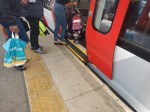
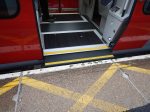
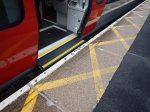
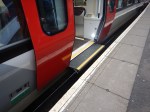
The pictures shows step-free access on Stadler Class 745 and Class 755 trains.
If I turned up pushing a friend in a wheelchair, would I be able to push them in easily? Or better still will they be able to wheel themselves in?
A Greater Anglia driver tp;d me recently, that now they never have to wait anymore for wheelchairs to be loaded.
So surely, it is in the train operator’s interest to have step-free access, if it means less train delays.
Double-Deck Trains
In my view double-deck trains only have one only good feature and that is the ability to see everything, if you have a well-designed window seat.
I may be seventy-three, but I am reasonably fit and only ever travel on trains with airline-sized hand baggage. So I don’t find any problem travelling upstairs on a double-deck bus or train!
But it could have been, so very different, if my stroke had been a bit worse and left me blind or in a wheelchair for life.
I have seen incidents on the Continent, which have been caused by double-deck trains.
- A lady of about eighteen in trying to get down with a heavy case dropped it. Luckily it only caused the guy she was travelling with, to roll unhurt down the stairs.
- Luggage is often a problem on Continental trains because of the step-up into the train and access is worse on double deck trains.
- I also remember on a train at Leipzig, when several passengers helped me lift a guy and his wheelchair out of the lower deck of a double-deck train, which was lower than the platform, as they often are with double-deck trains.
I am not totally against double-deck trains, but they must be designed properly.
Consider.
- High Speed Two’s Full-Size trains will only use London Euston, Old Oak Common, Birmingham Interchange, Birmingham Curzon Street, Manchester Airport, Manchester Piccadilly, East Midlands Hub and Leeds stations.
- All stations used by Full-Size trains will be brand-new or substantially rebuilt stations.
- Someone sitting in a wheelchair surely has the same right to a view from the top-deck of a double-deck train as anybody else.
- Jumbo jets seemed to do very well without a full-length top-deck.
- The A 380 Superjumbo has been designed so that entry and exit on both decks is possible.
I feel if High Speed Two want to run double-deck trains, an elegant solution can surely be found.
A Crude Estimate On The Number Of Trains
This is my crude estimate to find out how many trains, High Speed Two will need.
Western Leg
These are the services for the Western Leg between London , Birmingham, Liverpool, Manchester, Edinburgh and Glasgow.
- Train 1 – London Euston and Birmingham Curzon Street – 400 metre Full-Size – 45 minutes – 2 hour Round Trip – 4 trains
- Train 2 – London Euston and Birmingham Curzon Street – 400 metre Full-Size – 45 minutes – 2 hour Round Trip – 4 trains
- Train 3 – London Euston and Birmingham Curzon Street – 400 metre Full-Size – 45 minutes – 2 hour Round Trip – 4 trains
- Train 4 – London Euston and Lancaster – Classic Compatible – 2 hours 3 minutes – 5 hour Round Trip – 5 trains
- Train 4 – London Euston and Liverpool – Classic Compatible – 1 hours 34 minutes – 4 hour Round Trip – 4 trains
- Train 5 – London Euston and Liverpool – Classic Compatible – 1 hours 34 minutes – 4 hour Round Trip – 4 trains
- Train 6 – London Euston and Macclesfield – Classic Compatible – 1 hours 30 minutes – 4 hour Round Trip – 4 trains
- Train 7 – London Euston and Manchester – 400 metre Full-Size – 1 hour and 11 minutes – 3 hour Round Trip – 6 trains
- Train 8 – London Euston and Manchester – 400 metre Full-Size – 1 hour and 11 minutes – 3 hour Round Trip – 6 trains
- Train 9 – London Euston and Manchester – 400 metre Full-Size – 1 hour and 11 minutes – 3 hour Round Trip – 6 trains
- Train 10 – London Euston and Edinburgh – Classic Compatible – 3 hours 48 minutes – 8 hour Round Trip – 8 trains
- Train 10 – London Euston and Glasgow – Classic Compatible – 3 hours 40 minutes – 8 hour Round Trip – 8 trains
- Train 11 – London Euston and Edinburgh – Classic Compatible – 3 hours 48 minutes – 8 hour Round Trip – 8 trains
- Train 11 – London Euston and Glasgow – Classic Compatible – 3 hours 40 minutes – 8 hour Round Trip – 8 trains
- Train 12 – Birmingham Curzon Street and Edinburgh or Glasgow – Classic Compatible – 3 hours 20 minutes – 7 hour Round Trip – 7 trains
- Train 13 – Birmingham Curzon Street and Manchester – 200 metre Full-Size – 41 minutes – 2 hour Round Trip – 2 trains
- Train 14 – Birmingham Curzon Street and Manchester – 200 metre Full-Size – 41 minutes – 2 hour Round Trip – 2 trains
Note.
- I have assumed 400 metre Full-Size trains will be a pair of 200 metre trains.
- Trains 4, 10 and 11 are pairs of 200 metre long Classic-Compatible trains, that split and join at Crewe. Carlisle and Carlisle respectively.
- Trains 5 and 6 are single 200 metre long Classic-Compatible trains.
- The full schedule will need 34 Full-Size trains and 56 Classic-Compatible trains
According to Wikipedia, the first order will be for 54 Classic-Compatible trains, so I would assume, that more trains will be ordered.
Eastern Leg
These are the services for the Eastern Leg between London , Birmingham, East Midlands Hub, Leeds, Sheffield, York and Newcastle.
- Train 15 – Birmingham Curzon Street and Leeds – 200 metre Full-Size – 49 minutes – 2 hour Round Trip – 2 trains
- Train 16 – Birmingham Curzon Street and Leeds – 200 metre Full-Size – 49 minutes – 2 hour Round Trip – 2 trains
- Train 17 – Birmingham Curzon Street and Newcastle – Classic Compatible – 1 hour 57 minutes – 5 hour Round Trip – 5 trains
- Train 18 – London Euston and Sheffield – Classic Compatible – 1 hour 27 minutes – 4 hour Round Trip – 4 trains
- Train 18 – London Euston and Leeds – Classic Compatible – 1 hour 21 minutes – 3 hour Round Trip – 3 trains
- Train 19 – London Euston and Leeds – 400 metre Full-Size – 1 hour and 21 minutes – 3 hour Round Trip – 6 trains
- Train 20 – London Euston and Leeds – 400 metre Full-Size – 1 hour and 21 minutes – 3 hour Round Trip – 6 trains
- Train 21 – London Euston and Sheffield – Classic Compatible – 1 hour 27 minutes – 4 hour Round Trip – 4 trains
- Train 21 – London Euston and York – Classic Compatible – 1 hour 24 minutes – 3 hour Round Trip – 3 trains
- Train 22 – London Euston and Newcastle – Classic Compatible – 2 hour 17 minutes – 5 hour Round Trip – 5 trains
- Train 23 – London Euston and Newcastle – Classic Compatible – 2 hour 17 minutes – 5 hour Round Trip – 5 trains
Note.
- I have assumed 400 metre Full-Size trains will be a pair of 200 metre trains.
- Trains 15 and 16 work as a pair,
- Trains 18 and 21 are pairs of 200 metre long Classic-Compatible trains, that split and join at East Midlands Hub.
- Trains 22 and 23 are single 200 metre long Classic-Compatible trains
- The full schedule will need 16 Full-Size trains and 29 Classic-Compatible trains.
Adding the two legs together and I estimate that 50 Full-Size trains and 85 Classic-Compatible trains, will be needed to run a full schedule.
Trains Per Hour On Each Section
It is possible to make a table of how many trains run on each section of the High Speed Two network in trains per hour (tph)
- London Euston (stops) – 1-11, 18-23 – 17 tph
- London Euston and Old Oak Common – 1-11, 18-23 – 17 tph
- Old Oak Common (stops) – 1-11, 18-23 – 17 tph
- Old Oak Common and Birmingham Interchange – 1-11, 18-23 – 17 tph
- Birmingham Interchange (stops) – 2, 3, 7, 11, 20 – 5 tph
- Birmingham Curzon Street (stops) – 1-3, 12-14, 15-17 – 9 tph
- Birmingham and Crewe – 4,5, 7-9, 10-14 – 10 tph
- Crewe (stops) – 4,5 – 2 tph
- Crewe and Liverpool – 4,5 – 2 tph
- Crewe and Lancaster – 4, 10-12 – 4 tph
- Crewe and Manchester – 7-9, 13, 14 – 5 tph
- Crewe and Wigan via Warrington – 4 – 1 tph
- Crewe and Wigan via High Speed Two (new route) – 10-12 – 3 tph
- Lancaster (stops) 4 – 1 tph
- Lancaster and Carlisle – 10-12 – 3 tph
- Carlisle and Edinburgh – 10-12 – 2.5 tph
- Carlisle and Glasgow – 10-12 – 2.5 tph
- Birmingham and Stoke – 6 – 1 tph
- Stoke (stops) – 6 – 1 tph
- Stoke and Macclesfield – 6 – 1 tph
- Macclesfield (stops) – 6 – 1 tph
- Birmingham and East Midlands Hub – 15-17, 18-20, 21-23 – 9 tph
- East Midlands Hub (stops) – 15-17, 18-20, 21 – 7 tph
- East Midlands Hub and Sheffield – 18, 21 – 2 tph
- Sheffield (stops) – 18, 21 – 2 tph
- Midlands Hub and Leeds – 15, 16, 18-20 – 5 tph
- Leeds (stops) – 15, 16, 18-20 – 5 tph
- East Midlands Hub and York – 17, 21-23 – 4 tph
- York (stops) – 17, 21-23 – 4 tph
- York and Newcastle – 17, 22, 23 – 3 tph
- Newcastle (stops) – 17, 22, 23 – 3 tph
These are a few thoughts.
Capacity Of The Southern Leg
The busiest section is between London Euston and Birmingham Interchange, which handles 17 tph.
As the maximum capacity of High Speed Two is laid down in the Phase One Act as 18 tph, this gives a path for recovery, according to the article.
Trains Serving Euston
The following train types serve London Euston station.
- Full-Size – 8 tph
- 400 metre Classic-Compatible – 5 tph
- 200 metre Classic-Compatible – 4 tph
In the current service proposal, , Trains 5,6, 22 and 23 are just single 200 metre Classic Compatible trains.
This is inefficient and another four tph could be run into Euston station, by the use of appropriate splitting and joining.
- Train 5 could run an identical manner to Train 4 to give extra services to Lancaster, Preston, Wigan North Western and Warrington Bank Quay.
- Train 6 to Macclesfield is a problem and perhaps should call at Birmingham Interchange, where it could split and join to serve somewhere else like Wolverhampton and Shrewsbury.
- Trains 22 and 23 could split and join at East Midlands Hub and serve other places in the East of England like Cleethorpes, Hull, Lincoln, Middlesbrough and Scarborough.
Paths are expensive entities to provide and every path into Euston should support a 400 metre train or a pair of 200 metre trains.
Platform Use At Euston
This page on the High Speed Two web site, gives details of Euston High Speed Two station.
HS2 will deliver eleven new 400m long platforms, a new concourse and improved connections to Euston and Euston Square Underground stations. Our design teams are also looking at the opportunity to create a new northerly entrance facing Camden Town as well as new east-west links across the whole station site.
So how will the eleven platforms be used?
Destinations served from London are planned to be as follows.
- Birmingham Curzon Street – Full-Size – 3 tph
- Edinburgh/Glasgow – Classic-Compatible – 2 tph
- Lancaster – Classic-Compatible – 1 tph
- Leeds – Full-Size – 2 tph – Classic-Compatible – 1 tph
Liverpool – Classic-Compatible – 2 tph
- Macclesfield – Classic-Compatible – 1 tph
- Manchester Piccadilly – Full-Size – 3 tph
- Newcastle – Classic-Compatible – 2 tph
- Sheffield – Classic-Compatible – 2 tph
- York – Classic-Compatible – 1 tph
That is ten destinations and there will be eleven platforms.
I like it! Lack of resources is often the reason systems don’t work well and there are certainly enough platforms.
Could platforms be allocated something like this?
- Birmingham Curzon Street – Full-Size
- Edinburgh/Glasgow – Classic-Compatible
- Leeds – Full-Size
- Liverpool – Classic-Compatible – Also serves Lancaster
- Macclesfield – Classic-Compatible
- Manchester Piccadilly – Full-Size
- Newcastle – Classic-Compatible
- Sheffield – Classic-Compatible – Also serves Leeds and York
Note.
- No platform handles more than three tph.
- There are three spare platforms.
- Each platform would only be normally used by one train type.
- Only Birmingham Interchange, East Midlands Hub, Leeds, Preston and York are not always served from the same platform.
Platform arrangements could be very passenger- and operator-friendly.
Platform Use At Birmingham Curzon Street
Birmingham Curzon Street station has been designed to have seven platforms.
Destinations served from Birmingham Curzon Street station are planned to be as follows.
- Edinburgh/Glasgow – Classic-Compatible – 1 tph
- Leeds – Full-Size – 2 tph
- London Euston – Full-Size – 3 tph
- Manchester Piccadilly – Full-Size – 2 tph
- Newcastle – Classic-Compatible – 1 tph
- Nottingham – Classic-Compatible – 1 tph
Note.
- The Nottingham service has been proposed by Midlands Engine Rail, but will be running High Speed Two Classic Compatible trains.
- That is six destinations and there will be seven platforms.
I like it! For the same reason as London Euston.
Could platforms be allocated something like this?
- Edinburgh/Glasgow – Classic-Compatible
- Leeds – Full-Size
- London Euston – Full-Size
- Manchester Piccadilly – Full-Size
- Newcastle/Nottingham – Classic-Compatible
Note.
- No platform handles more than three tph.
- There are two spare platforms.
- Each platform would only be normally used by one train type.
- Only East Midlands Hub is not always served from the same platform.
Platform arrangements could be very passenger- and operator-friendly.
Back-to-Back Services via Birmingham Curzon Street
The current plan for High Speed Two envisages the following services between the main terminals served by Full-Size trains.
- London Euston and Birmingham Curzon Street – 3 tph – 45 minutes
- London Euston and Leeds – 2 tph – 81 minutes
- London Euston and Manchester Piccadilly – 3 tph – 71 minutes
- Birmingham Curzon Street and Leeds – 2 tph – 40 minutes
- Birmingham Curzon Street and Manchester Piccadilly – 2 tph – 41 minutes
Suppose a traveller wanted to go between East Midlands Hub and Manchester Airport stations.
Wouldn’t it be convenient if the Leeds to Birmingham Curzon Street train, stopped in Birmingham Curzon Street alongside the train to Manchester Airport and Piccadilly, so passengers could just walk across?
Or the two services could be run Back-to-Back with a reverse in Birmingham Curzon Street station?
Note.
- The current fastest times between Nottingham and Manchester Airport stations are around two-and-a-half hours, with two changes.
- With High Speed Two, it looks like the time could be under the hour, even allowing up to eight minutes for the change at Birmingham Curzon Street.
The design of the track and stations for High Speed Two, has some interesting features that will be exploited by the train operator, to provide better services.
Capacity Of The Western Leg Between Birmingham And Crewe
The section is between Birmingham and Crewe, will be running 10 tph.
As the maximum capacity of High Speed Two is laid down in the Phase One Act as 18 tph, this gives plenty of room for more trains.
But where will they come from?
High Speed One copes well with a few interlopers in the shape of Southeastern’s Class 395 trains, which run at 140 mph, between the Eurostars.
High Speed Two is faster, but what is to stop an operator running their own Classic-Compatible trains on the following routes.
- Birmingham Curzon Street and Liverpool via Crewe, Runcorn and Liverpool South Parkway.
- Birmingham Curzon Street and Holyhead via Crewe, Chester and an electrified North Wales Coast Line.
- Birmingham Curzon Street and Blackpool via Crewe, Warrington Bank Quay, Wigan North Western and Preston.
- Birmingham Curzon Street and Blackburn and Burnley via Crewe, Warrington Bank Quay, Wigan North Western and Preston.
Note.
- If these trains were say 130 metres long, they could call at all stations, without any platform lengthening.
- I’m sure that the clever engineers at Hitachi and Hyperdrive Innovation could come up with battery electric Classic-Compatible train, that could run at 225 mph on High Speed Two and had a battery range to reach Holyhead, with a small amount of electrification.
- A pair of trains, could work the last two services with a Split/Join at Preston.
The advantages of terminating these service in Birmingham Curzon Street would be as follows.
- A lot more places get a fast connection to the High Speed Two network.
- Passengers can reach London with an easy change at Birmingham Curzon Street station.
- They can also walk easily between the three Birmingham stations.
But the big advantage is the trains don’t use valuable paths on High Speed Two between Birmingham Curzon Street and London Euston.
Crewe Station
In the current Avanti West Coast timetable, the following trains pass through Crewe.
- London Euston and Blackpool – 4 trains per day (tpd)
- London Euston and Chester – 1 tph
- London Euston and Edinburgh/Glasgow – 2 tph
- London Euston and Liverpool – 1 tph
- London Euston and Manchester Piccadilly – 1 tph
Most trains stop at Crewe.
In the proposed High Speed Two timetable, the following trains will pass through Crewe.
- London Euston and Edinburgh/Glasgow – 2 tph
- London Euston and Lancaster/Liverpool – 2 tph
- London Euston and Manchester – 3 tph
- Birmingham Curzon Street and Edinburgh/Glasgow -1 tph
- Birmingham Curzon Street and Manchester – 2 tph
Note.
- Only the Lancaster and Liverpool trains stop at Crewe station.
- North of Crewe there will be a three-way split of High Speed Two routes to Liverpool, Wigan and the North and Manchester Airport and Piccadilly.
- High Speed Two will loop to the East and then join the West Coast Main Line to the South of Wigan.
- High Speed Two trains will use the West Coast Main Line to the North of Wigan North Western station.
This map of High Speed Two in North West England was captured from the interactive map on the High Speed Two web site.

Note.
- The current West Coast Main Line (WCML) and Phase 2a of High Speed Two are shown in blue.
- Phase 2b of High Speed Two is shown in orange.
- The main North-South route, which is shown in blue, is the WCML passing through Crewe, Warrington Bank Quay and Wigan North Western as it goes North.
- The Western Branch, which is shown in blue, is the Liverpool Branch of the WCML, which serves Runcorn and Liverpool.
- High Speed Two, which is shown in orange, takes a faster route between Crewe and Wigan North Western.
- The Eastern Branch, which is shown in orange, is the Manchester Branch of High Speed Two, which serves Manchester Airport and Manchester Piccadilly.
- The route in the East, which is shown in blue, is the Macclesfield Branch of High Speed Two, which serves Stafford, Stoke-on-Trent and Macclesfield.
The route of Northern Powerhouse Rail between Manchester Airport and Liverpool has still to be finalised.
Liverpool Branch
Consider.
- The Liverpool Branch will take two tph between London Euston and Liverpool.
- In the future it could take up to 6 tph on Northern Powerhouse Rail between Liverpool and Manchester Piccadilly via Manchester Airport.
I believe that Liverpool Lime Street station, after the recent updating can handle all these trains.
Manchester Branch
This document on the Government web site is entitled HS2 Phase 2b Western Leg Design Refinement Consultation.
It indicates two important recently-made changes to the design of the Manchester Branch of High Speed Two.
- Manchester Airport station will have four High Speed platforms instead of two.
- Manchester Piccadilly station will have six High Speed platforms instead of four.
These changes will help the use of these stations by Northern Powerhouse Rail..
Consider.
- The Manchester Branch will be new high speed track, which will probably be built in a tunnel serving Manchester Airport and Manchester Piccadilly stations.
- The Manchester Branch will terminate in new platforms.
- The Manchester Branch will take five tph between Birmingham Curzon Street or London Euston and Manchester Airport and Manchester Piccadilly.
- In the future it could take up to six tph on Northern Powerhouse Rail between Liverpool and Manchester Piccadilly via Manchester Airport.
- London Euston and Old Oak Common will be new stations on a tunnelled approach to London and will handle 18 tph.
If London Euston and Old Oak Common can handle 18 tph, I can’t see why Manchester Airport and Piccadilly stations can’t handle somewhere near a similar number of trains.
At the moment eleven tph have been allocated to the Manchester Branch.
I believe that if infrastructure for Northern Powerhouse Rail was designed so that as well as connecting to Manchester and Liverpool, it connected Manchester and the West Coast Main Line running North to Preston, Carlisle and Scotland, services to the following destinations would be possible.
- Barrow
- Blackburn
- Blackpool
- Edinburgh
- Glasgow
- Windermere
Note.
- Edinburgh and Glasgow would probably be a service that would alternate the destination, as it is proposed for High Speed Two’s Birmingham and Scotland service.
- There would probably be a need for a North Wales and Manchester service via Chester.
- All trains would be Classic-Compatible.
If the Manchester Branch were to be built to handle 18 tph, there would be more than enough capacity.
Crewe, Wigan And Manchester
My summing up earlier gave the number of trains between Crewe, Wigan and Manchester as follows.
- Crewe and Manchester – 5 tph
- Crewe and Wigan via Warrington – 1 tph
- Crewe and Wigan via High Speed Two (new route) – 3 tph
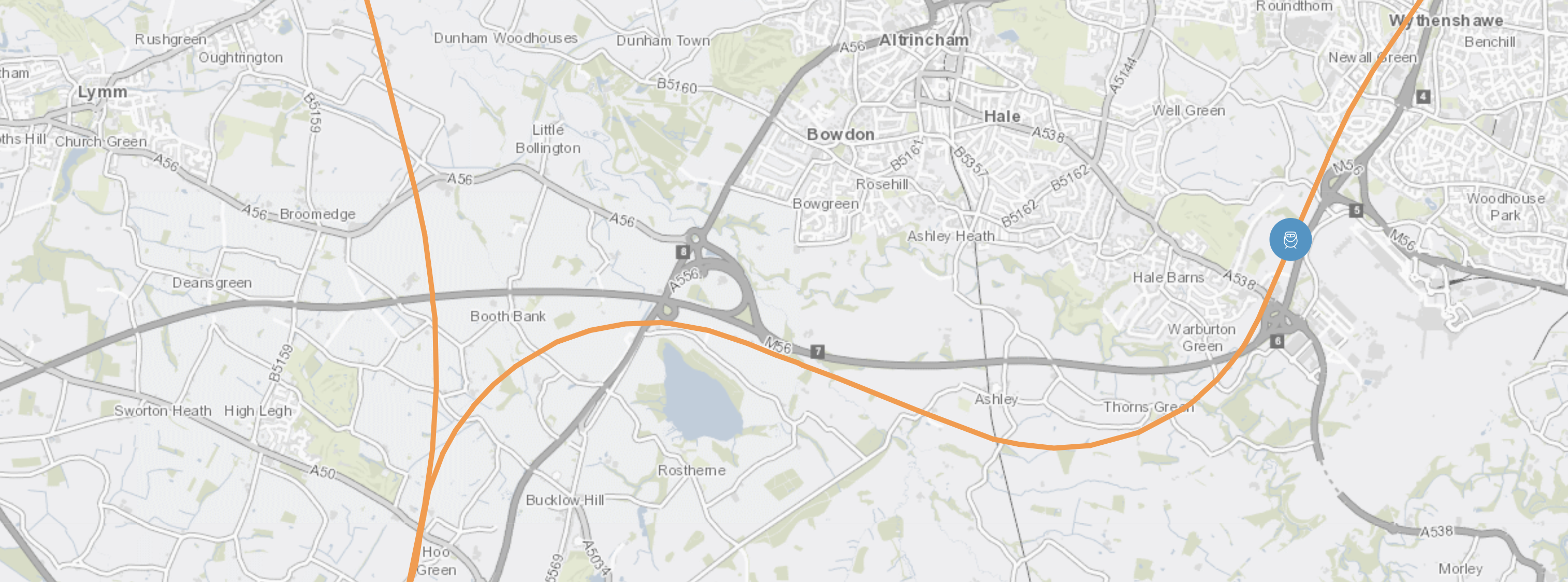
This map of High Speed Two where the Manchester Branch leaves the new High Speed Two route between Crewe and Wigan was captured from the interactive map on the High Speed Two web site.
Note.
- The Manchester Branch runs to the South of the M56,
- The large blue dot indicates Manchester Airport station.
- Wigan is to the North.
- Crewe is to the South.
- Manchester Piccadilly is to the North East.
I believe this junction will be turned into a full triangular junction, to connect Wigan directly to Manchester Airport and Manchester Piccadilly.
- Barrow, Blackburn, Blackpool, Preston and Windermere could all have high speed connections to Manchester Airport and Manchester Piccadilly. Trains could be shorter Classic-Compatible trains.
- A Manchester and Scotland service would take the same route.
Another pair of tracks could leave the junction to the West to create a direct route between Manchester Airport and Liverpool for Northern Powerhouse Rail, by sneaking along the M56.
Suppose extra services were as follows.
- Manchester and Barrow – 1 tph
- Manchester and Blackburn – 1 tph
- Manchester and Blackpool – 1 tph
- Manchester and Liverpool – 6 tph
- Manchester and Scotland – 1 tph
- Manchester and Windermere – 1 tph
The frequencies from the junction would be as follows.
- To and from Crewe – High Speed Two (Manchester) – 5 tph – High Speed Two (North) – 3 tph = 8 tph
- To and from Liverpool – Northern Powerhouse Rail – 6 tph = 6 tph
- To and from Manchester – High Speed Two – 5 tph – Northern Powerhouse Rail – 6 tph – Local – 4 tph – Scotland – 1 tph = 16 tph
- To and from Wigan – High Speed Two – 3 tph – Local – 4 tph – Scotland – 1 tph = 8 tph.
Only the Manchester Branch would be working hard.
The Liverpool Connection
I indicated that another pair of tracks would need to extend the Manchester Branch towards Liverpool in the West for Northern Powerhouse Rail.
- Would these tracks have a station at Warrington?
- Would there be a connection to allow services between Liverpool and the North and Scotland?
It might even be possible to design a Liverpool connection, that avoided using the current Liverpool Branch and increased the capacity and efficiency of all trains to Liverpool.
Capacity Of The Western Leg Between Wigan And Scotland
The sections between Crewe and Carlisle, will be running at the following frequencies.
- Wigan and Lancaster – 4 tph
- Lancaster and Carlisle – 3 tph
- Carlisle and Edinburgh – 2.5 tph
- Carlisle and Glasgow – 2.5 tph
Note.
- The unusual Scottish frequencies are caused by splitting and joining at Carlisle and alternate services to Edinburgh and Glasgow.
- Any local high speed services and a Scotland service from Manchester, will increase the frequencies.
Over this section the services will be running on an improved West Coast Main Line.
But in some cases the trains will be replacing current services, so the increase in total frequencies will be less than it first appears.
Avanti West Coast currently run the following Scottish services.
- One tph – London Euston and Glasgow via the most direct route.
- One tph – London Euston and alternately Edinburgh and Glasgow via Birmingham.
This means that effectively Glasgow has 1.5 tph and Edinburgh 0.5 tph from London Euston.
The capacity of the current eleven-car Class 390 trains is 145 First and 444 Standard Class seats, which compares closely with the 500-600 seats given in Wikipedia for High Speed Two trains. So the capacity of the two trains is not that different.
But High Speed Two will be running 2.5 tph Between London Euston and both Edinburgh and Glasgow.
I would expect, that Class 390 services to Scotland will be discontinued and replaced by High Speed Two services.
Capacity Of The Eastern Leg Between Birmingham And East Midlands Hub
The section is between Birmingham and East Midlands Hub, will be running 9 tph
As the maximum capacity of High Speed Two is laid down in the Phase One Act as 18 tph, this gives plenty of room for more trains.
But where will they come from?
Midlands Engine Rail is proposing a service between Birmingham Curzon Street and Nottingham.
- It will have a frequency of one tph.
- It will be run by High Speed Two Classic-Compatible trains.
- The journey will take 33 minutes.
- It will run on High Speed Two infrastructure between Birmingham Curzon Street and East Midlands Hub.
If High Speed Two has been designed with this service in mind, I doubt it will be a difficult service to setup.
- There might be enough capacity on High Speed Two for two tph on the route,
- It could possibly be extended to Lincoln.
It will also depend on the service timing being consistent with an efficient use of trains and platforms.
- Thirty-three minutes is not a good timing, as it means twenty-seven minutes wait in a platform to get a round trip time, that suits clock-face time-tabling.
- The current Lincoln and Nottingham service takes 56 minutes for 34 miles.
- LNER’s London Kings Cross and Lincoln service travels the 16 miles between Lincoln and Newark in 25 minutes.
- I estimate that after track improvements, with a single stop at Newark Castle station, that Nottingham and Lincoln could be achieved in several minutes under fifty minutes.
- This would enable a sub-ninety minute journey time between Birmingham Curzon Street and Lincoln, with enough time to properly turn the trains at both ends of the route.
- The three hour round trip would mean that an hourly service would need three trains.
This is probably just one of several efficient time-tabling possibilities.
Are there any other similar services?
The obvious one is surely Cambridge and Birmingham
- It would run via Peterborough, Grantham, Nottingham and East Midlands Hub.
- It would connect the three big science, engineering and medical centres in the Midlands and the East.
- It could be run by High Speed Two Classic-Compatible trains.
It might even be a replacement for CrossCountry’s Stansted Airport and Birmingham service.
Capacity Of The Eastern Leg Between East Midlands Hub And Sheffield
The section between East Midlands Hub and Sheffield, will be running 2 tph
As the maximum capacity of High Speed Two is laid down in the Phase One Act as 18 tph, this gives plenty of room for more trains.
But where will they come from?
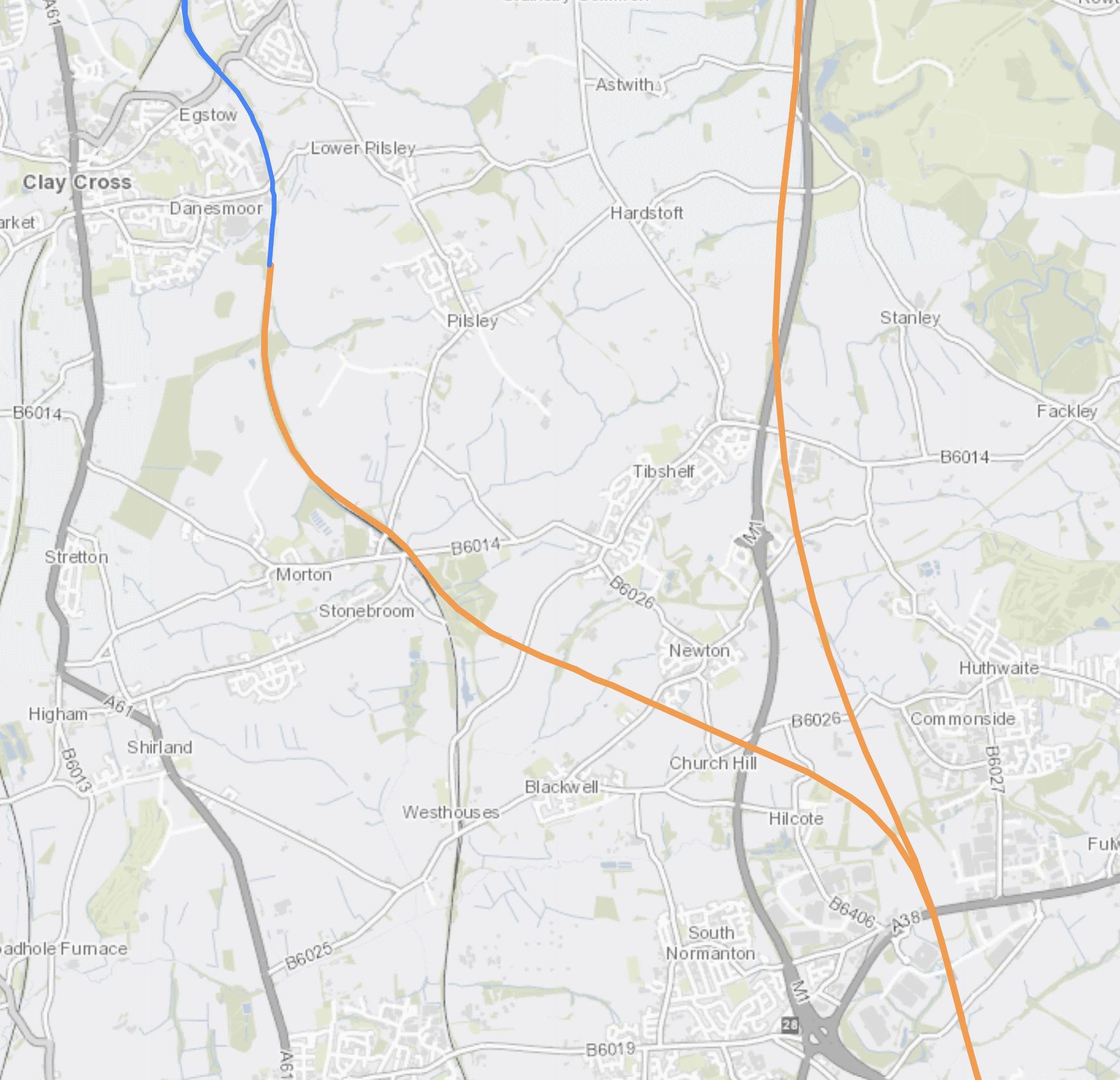
This map of High Speed Two where the Sheffield Branch leaves the new High Speed Two route between East Midlands Hub and Leeds was captured from the interactive map on the High Speed Two web site.
Note.
- The main route of High Speed Two between East Midlands Hub, is shown in orange and follows the route of the M1 Motorway, towards the East of the map.
- The Sheffield Branch is new track to Clay Cross North Junction, where is takes over the Midland Main Line to Sheffield, which is shown in blue.
- The line going South in the middle of the map is the Erewash Valley Line, which goes through Langley Mill and Ilkeston stations.
I suspect Clay Cross to Sheffield will be an electrified high speed line, with a maximum speed of at least 140 mph.
Could the Erewash Valley Line have been used as an alternative route to Sheffield?
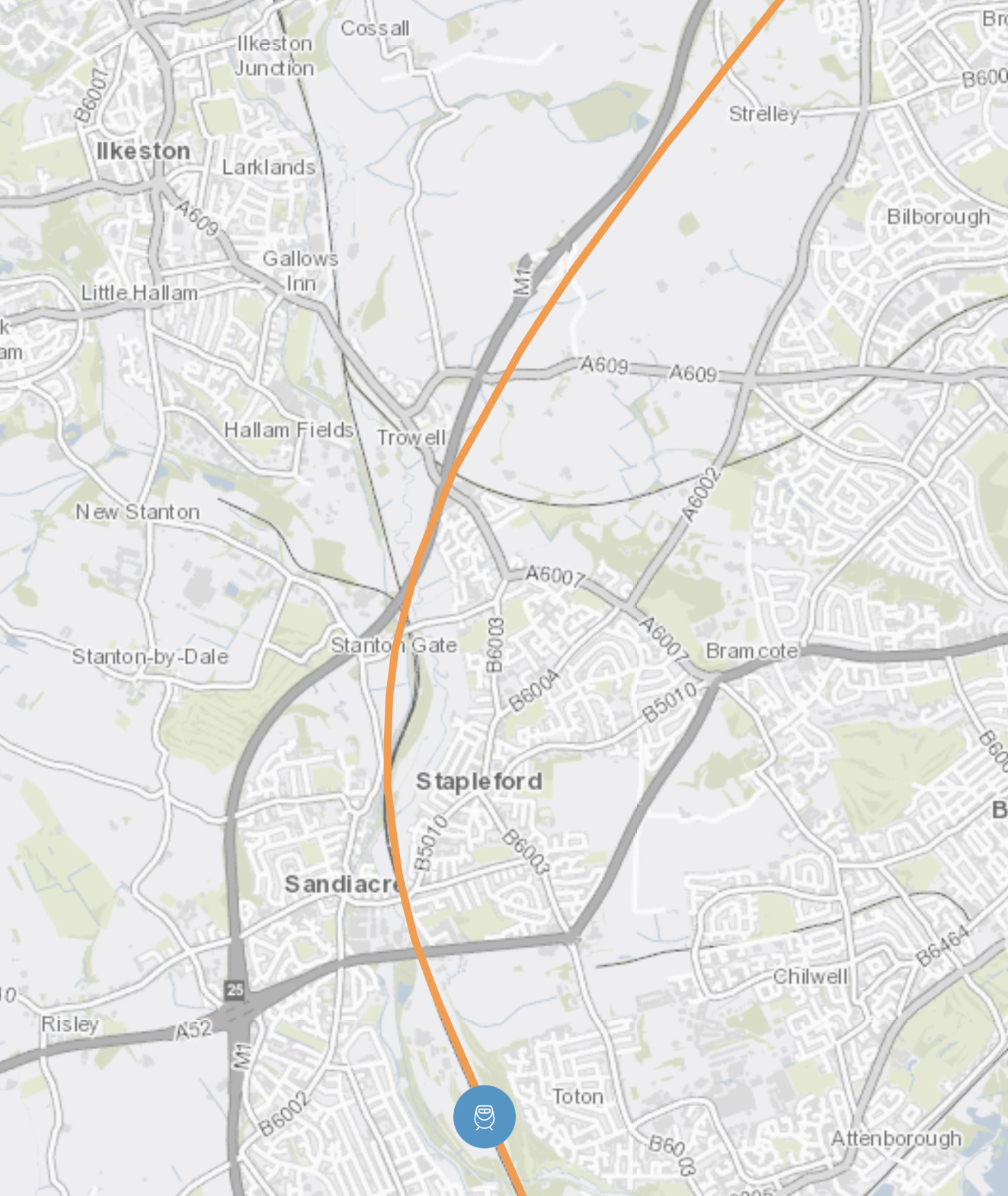
This map of High Speed Two captured from their interactive map, shows the connection of High Speed Two and the Erewash Valley Line to East Midlands Hub.
Note.
- East Midlands Hub is shown by the big blue dot.
- High Speed Two is shown in orange.
- The route to Leeds vaguely follows the M1 Motorway.
- The Erewash Valley Line goes North to the East of Ilkeston.
Would have been quicker and easier to electrify the Erewash Valley Line, as the High Speed Two route to Chesterfield and Sheffield?
- Network Rail updated the route a few years ago.
- It does not have the problems of electrification, through a World Heritage Site, as does the route through Derby.
- It could surely handle two tph, even if they were High Speed Two Classic Compatible trains.
- Sheffield will be just under ninety minutes from London by High Speed Two, as opposed to two hours now.
I suspect that it all comes down to saving a few minutes to Sheffield and the civic pride of having a High Speed Two connection.
So it looks like we’ll have the following capacity between East Midlands Hub and Sheffield.
- Between East Midlands Hub and Clay Cross North Junction, there will be the High Speed Two capacity of 18 tph.
- Between Clay Cross and Sheffield, there will probably be an upgraded capacity of perhaps 8-10 tph.
It seems a lot of capacity for just two tph.
Consider.
- High Speed Two is planning to run three tph between Birmingham Curzon Street and East Midlands Hub
- Midlands Rail Engine is planning to run one tph between Birmingham Curzon Street and East Midlands Hub
- Four tph is considered a Turn-Up-And-Go service, and could exist between Birmingham Curzon Street and East Midlands Hub.
- Sheffield and Leeds, both probably need a Turn-Up-And-Go service, to and from East Midlands Hub.
- Semi-fast services between Sheffield and East Midlands Hub, calling at Chesterfield, Alfreton, Langley Mill and Ilkeston would be possible, by using the Erewash Valley Line.
- The Maid Marian Line will join the Robin Hood Line in adding extra connectivity to East Midlands Hub Station.
- Leeds and East Midlands Hub could have a six tph service courtesy of High Speed Two and Midlands Rail Engine.
Using High Speed Two’s web site, the following times should be possible.
- Sheffield and East Midlands Hub – 27 minutes
- Sheffield and Birmingham Curzon Street – 47 minutes.
Both services allow time for an efficient service.
There are certainly many options to create a Turn-Up-And-Go service between Sheffield and East Midlands Hub and also improve connections to other locations across the area.
Capacity Of The Eastern Leg Between East Midlands Hub And Leeds
The section is between East Midlands Hub and Leeds, will be running 5 tph
High Speed Two between Midlands Hub and Leeds is a totally new high speed line.
- As the maximum capacity of High Speed Two is laid down in the Phase One Act as 18 tph, this gives plenty of room for more trains.
- The Southern section of the leg closely follows the M1 Motorway.
- Leeds, York and Newcastle will be 27, 36 and 93 minutes from East Midlands Hub, respectively.
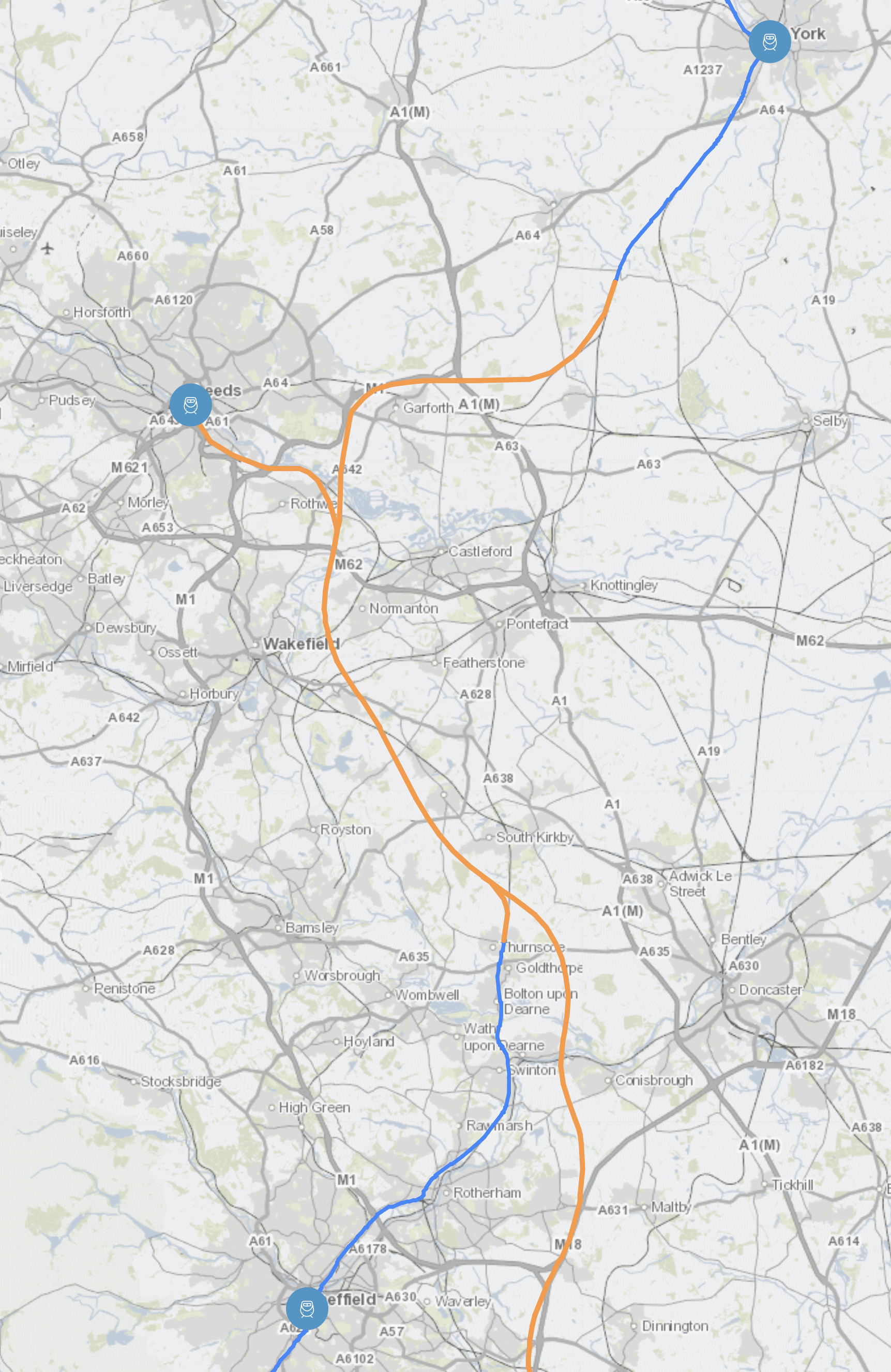
This map of High Speed Two, which shows the route of the line in Yorkshire, was captured from the interactive map on the High Speed Two web site.
Note.
- Sheffield is marked by the blue dot in the South.
- Leeds is marked by the blue dot in the North West.
- York is marked by the blue dot in the North East.
- New routes are shown in orange.
- Upgraded routes are shown in blue.
The route seems to open up several possibilities for extra routes.
- Leeds and Sheffield will be used by Northern Powerhouse Rail and there will be four tph, taking 28 minutes.
- Leeds and Bedford via East Midlands Hub has been proposed by Midlands Rail Engine.
- Services between Sheffield and the North via York must be a possibility.
This map of High Speed Two, which shows the routes to the East of Leeds, was captured from High Speed Two’s interactive map.
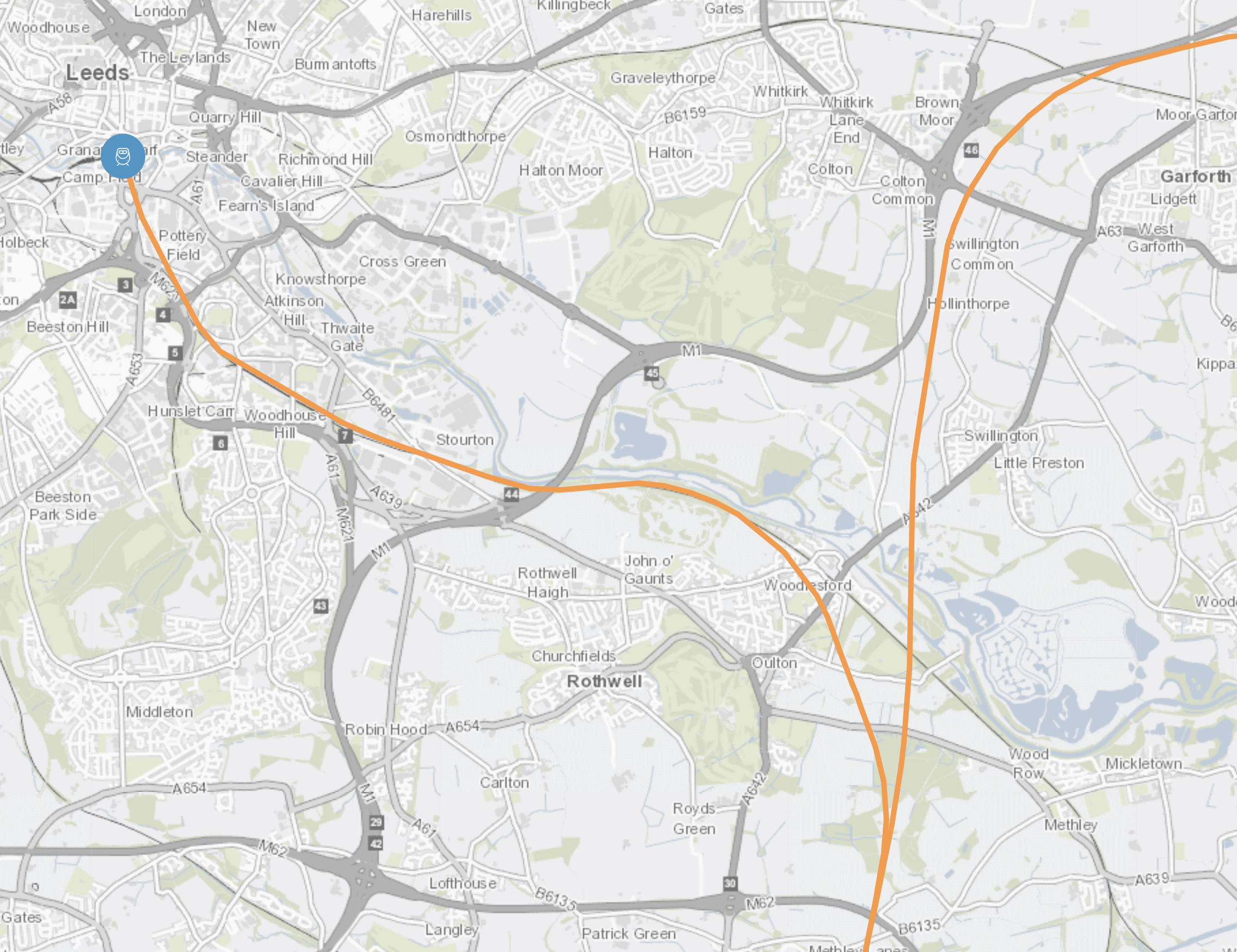
I think that two things might be missing.
- A full triangular junction would surely allow services between Leeds and the North via York.
- A high speed connection to Hull.
We shall see in the future.
Capacity Of The Eastern Leg Between York And Newcastle
The section between York and Newcastle, will be running at a frequency of 3 tph.
Over this section the services will be running on an improved East Coast Main Line.
Conclusion
I shall split the conclusions into various sections.
Route And Track Layout
I think there may be places, where the route and track layout might need to be improved.
- The Manchester Branch probably needs a triangular junction with the Western Leg of High Speed Two.
- How Liverpool is served by Northern Powerhouse Rail needs to be decided.
- The approach to Leeds probably needs a triangular junction with the Eastern Leg of High Speed Two.
- It is not clear how services will reach Hull.
Hopefully, these issues will become clear in the next year or so.
Capacity
The sections with the highest levels of capacity would appear to be the following.
- London Euston and Birmingham Interchange.
- The Manchester Branch
- The section shared with the East Coast Main Line between York and Newcastle.
- The section shared with the West Coast Main Line between Wigan and Scotland.
But on these sections extra trains can be run.
- Birmingham and North West England
- Birmingham and East Midlands Hub
- East Midlands Hub and Leeds
- East Midlands Hub and Sheffield
- East Midlands Hub and York
I can see, this capacity being filled by high speed local services, like those proposed by Midlands Rail Engine.
Rolling Stock
The only comment, I will make, is that there could be a need for a shorter Classic-Compatible train to work local services.
High Speed Two To Build Stabling Facility In Scotland
High Speed Two has announced the intention to build a stabling facility for trains at Annandale in Dumfries and Galloway.
This document on the Government web site is entitled HS2 Phase 2b Western Leg Design Refinement Consultation.
Details of the Annandale Depot, start on Page 43.
This is the introductory paragraph.
Phase 2b will provide an increased number of services to Scotland and North West England compared to Phase 2a or Phase One of HS2, with two 400m trains running from Euston each hour and splitting at Carlisle into two 200m trains to serve Glasgow and Edinburgh. HS2 trains will also serve Scotland from Birmingham. New HS2 trains serving Scotland and the north west of England will need overnight stabling and light maintenance in this area, near to where trains finish and start service. It would not be operationally efficient for these trains to run empty to the next closest HS2 depot north of Crewe, approximately 150 miles away.
Note the services are as laid out in the June 2020 Edition of Modern Railways, which was obviously the thinking at the time on High Speed Two.
If you ignore the splitting and joining and assume that they are two separate trains, the Anglo-Scottish services on High Speed Two are as follows.
- One train per hour (tph) – London Euston and Edinburgh Waverley via Old Oak Common, Preston, Carlisle and Edinburgh Haymarket.
- One tph – London Euston and Edinburgh Waverley via Old Oak Common, Birmingham Interchange, Preston, Carlisle and Edinburgh Haymarket.
- One tph – London Euston and Glasgow Central via Old Oak Common, Preston and Carlisle.
- One tph – London Euston and Glasgow Central via Old Oak Common, Birmingham Interchange, Preston and Carlisle.
- One train per two hours (tp2h) – Birmingham Curzon Street and Edinburgh Waverley via Wigan North Western, Preston, Lancaster, Oxenholme, Penrith, Carlisle. Lockerbie and Edinburgh Haymarket
- One tp2h – Birmingham Curzon Street and Glasgow Central via Wigan North Western, Preston, Lancaster, Oxenholme, Penrith, Carlisle. Lockerbie and Motherwell
Note.
- Oxenholme and Penrith might not be served by both Birmingham trains.
- All services would be run by High Speed Two’s Classic-Compatible trains.
- The two Birmingham services effectively provide a one tph service between Birmingham and Scotland.
- All services will be single 200 metre long trains to the North of Carlisle, as pairs will split and join at Carlisle station.
- There would appear to be a fairly consistent five tph between Carlisle and Carstairs, where the Glasgow and Edinburgh routes divide.
- Edinburgh Waverley and Glasgow Central will both have three tph to and from Carlisle and Preston.
These were factors in the choice of location of the depot, stated in the report.
- Be close to the existing railway.
- Be a relatively large, flat site.
- Preferably a brownfield rather than greenfield site.
- Located as close as feasible to where HS2 services will terminate or begin to minimise empty train movements.
- Be accessible to the workforce and local transport network.
- Be suitable for 24-hour working.
- Have enough space to accommodate equipment for light maintenance activities.
- Have enough space to accommodate the expected number of trains.
The site is also close to the M74.
A few of my thoughts.
The Location Of The Proposed Depot
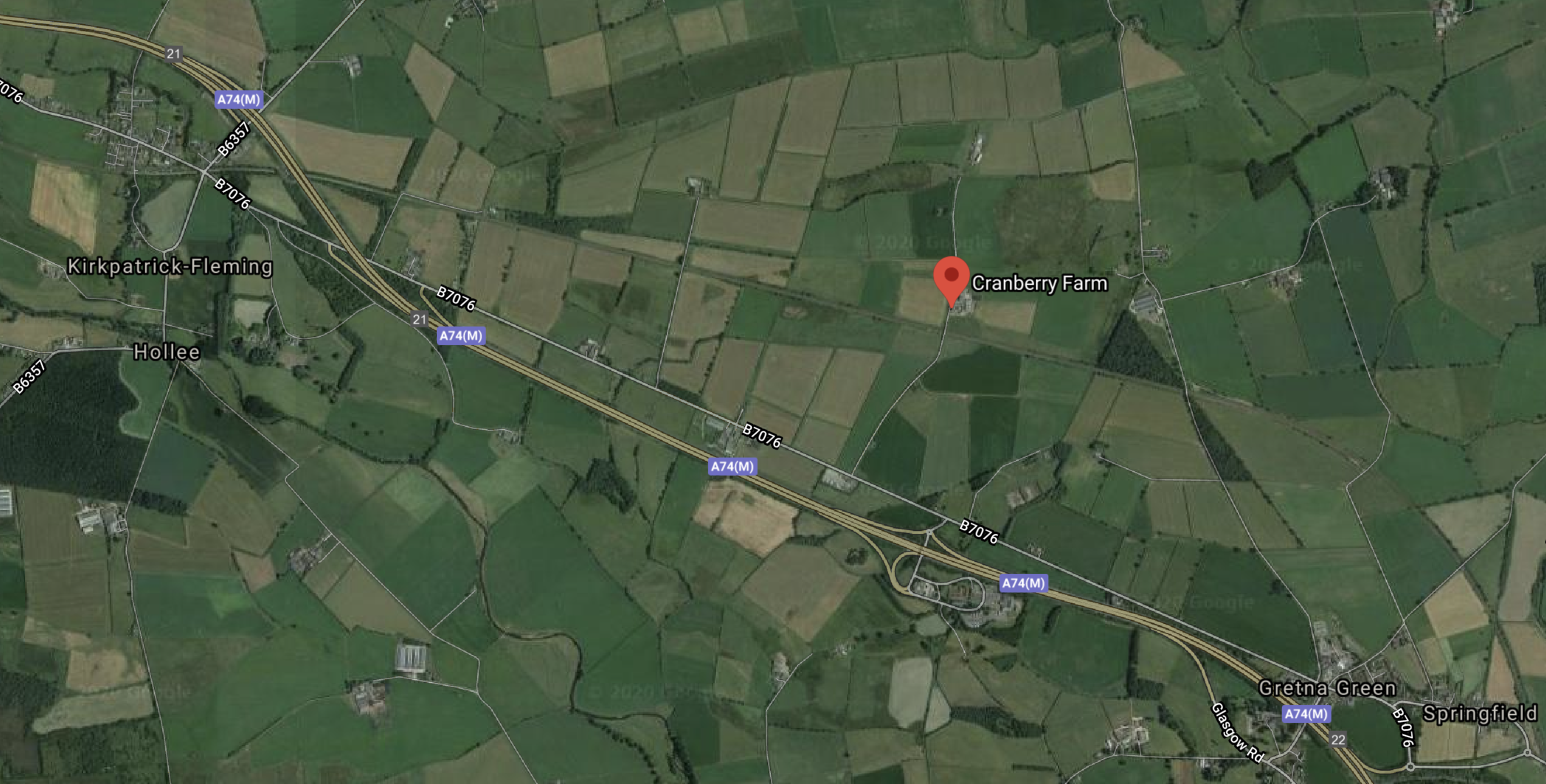
This Google Map shows the area mentioned in the report.
Note.
- The red arrow indicates Cranberry Farm, which will be just to the North of the site.
- The West Coast Main Line passing just South of Cranberry Farm, going across the map.
- The B 7076 and M74 will be to the South of the site.
It looks to meet many of the factors, I stated earlier. But it does appear to be a greenfield, rather than a brownfield site.
Distances And Times From The Depot
These are distances to places, where services will or might start.
- Carlisle – 9 miles – 6 minutes
- Edinburgh – 93 miles – 68 minutes
- Glasgow – 94 miles – 59 minutes
I have used distances from Gretna Green Junction, which is just to the South of the proposed depot.
Will The Depot Be Only For Classic-Compatible Trains?
Consider.
- All services North of Wigan North Western will be run by High Speed Two’s Classic-Compatible trains.
- A simpler depot would surely be possible if it only handled High Speed Two’s Classic-Compatible trains.
- With the possible exception of the occasional demonstration or test run High Speed Two;s full-size fleet will never be seen North of the Border.
The only thing this depot might have to do with the full-size fleet is turn-back a test train, which would only need a 400 metre long siding. A siding this length would probably be needed to turn a pair of High Speed Two’s Classic-Compatible trains.
Could The Depot Serve A Possible Irish Extension?
I believe that eventually High Speed Two will be extended across Southern Scotland and a bridge will connect it to Northern Ireland
In A Glimpse Of 2035, I gave a fictionalised version of the first journey from London Euston to Dublin, by high speed train.
I have just calculated the length of a high speed rail link between the proposed Annandale . Depot and a Belfast Parkway station. It is around 120 miles and the route would probably branch off between Lockerbie and Annandale Depot.
I feel that Annandale Depot could serve trains for Belfast, but there would probably need to be another depot in Dublin.
Extra HS2 Services To Scotland
Currently, TransPennine Express run services Between Liverpool and Manchester in England and Edinburgh and Glasgow in Scotland.
I can see High Speed Two replacing these services with a similar service to the one they are planning for Birmingham.
The current service is as follows,
- One tp2h – Manchester Airport and Edinburgh Waverley via Manchester Piccadilly, Preston, Lancaster, Carlisle and Haymarket
- One tp2h – Manchester Airport and Glasgow Central via Manchester Piccadilly, Preston, Lancaster, Carlisle and Motherwell
- Four trains per day (tpd) – Liverpool Lime Street and Glasgow Central via Wigan North Western, Preston, Lancaster, Carlisle and Motherwell
Note.
- They call at smaller stations like Wigan North Western, Lancaster, Oxenholme, Penrith and Lockerbie as appropriate, to even up the service.
- These services probably share one path between Preston and Carstairs.
- The Liverpool services are diverted Manchester services.
Could they be replaced by High Speed Two services?
The Manchester services could become.
- One tp2h – Manchester Piccadilly and Edinburgh Waverley via Manchester Airport, Preston, Lancaster, Carlisle and Haymarket
- One tp2h – Manchester Piccadilly and Glasgow Central via Manchester Airport, Preston, Lancaster, Carlisle and Motherwell.
Blackpool, Liverpool and other parts of the North West may be better served with high speed commuter services linking them to Preston.
Serving Scotland’s Seven Cities
Scotland has seven cities that are connected by Inter7City trains.
- Aberdeen – Not Electrified
- Dundee – Not Electrified
- Edinburgh – Will be served by High Speed Two
- Glasgow – Will be served by High Speed Two
- Inverness – Not Electrified
- Perth – Not Electrified
- Stirling – Fully Electrified
Can we forget about serving Aberdeen, Dundee, Inverness and Perth until they are fully electrified?
But Stirling must be a possibility.
There is a fully electrified route via Motherwell, Whifflet, Greenfaulds and Larbert
I estimate, that coming up from London will take four hours and five minutes, as against the current time of five hours and eighteen minutes.
Increasing Capacity On The West Coast Main Line In Scotland
Over the years, there have been several plans to run more and faster trains between England and Glasgow on the West Coast Main Line.
So would a High Speed Two service go to Stirling?
At present the maximum operating speed on the route is 125 mph. Trains like Avanti West Coast’s Class 390 trains and Hitachi’s AT-300 trains, could run at 140 mph, if digital in-cab signalling were rolled out on the route.
It is absolutely essential before High Speed Two trains run to Scotland, that the West Coast Main Line is digitally signalled.
In addition to faster running, trains can be closer together, so more trains can be run in an hour.
There are also other things, that could be done to help.
- Ensure, that all the many freight trains on the route are electrically-hauled and capable of operating at 100 mph or more.
- Make sure that local trains sharing the routes into Glasgow and Edinburgh are fast enough to keep out of the way of the expresses.
- Selectively, add extra tracks, so that fast trains can overtake slow ones.
- Ideally, a line like the West Coast Main Line, needs to be quadruple track all the way.
There also must be scope for flighting.
Consider.
- Class 390 trains take about 30 minutes between Edinburgh Waverley and Carstairs South Junction
- Class 390 trains take about 30 minutes between Glasgow Central and Carstairs South Junction
- Carstairs South Junction is where the two routes join.
Suppose two High Speed Two trains were to leave Edinburgh and Glasgow at similar times and run South from Carstairs South Junction, a safe distance apart.
- The lead train would be travelling at 140 mph perhaps three to five minutes in front of the second train.
- In-cab digital signalling would enforce the safe distance.
When the trains arrived in Carlisle, they would take a couple of minutes to join up physically for the high speed dash to London.
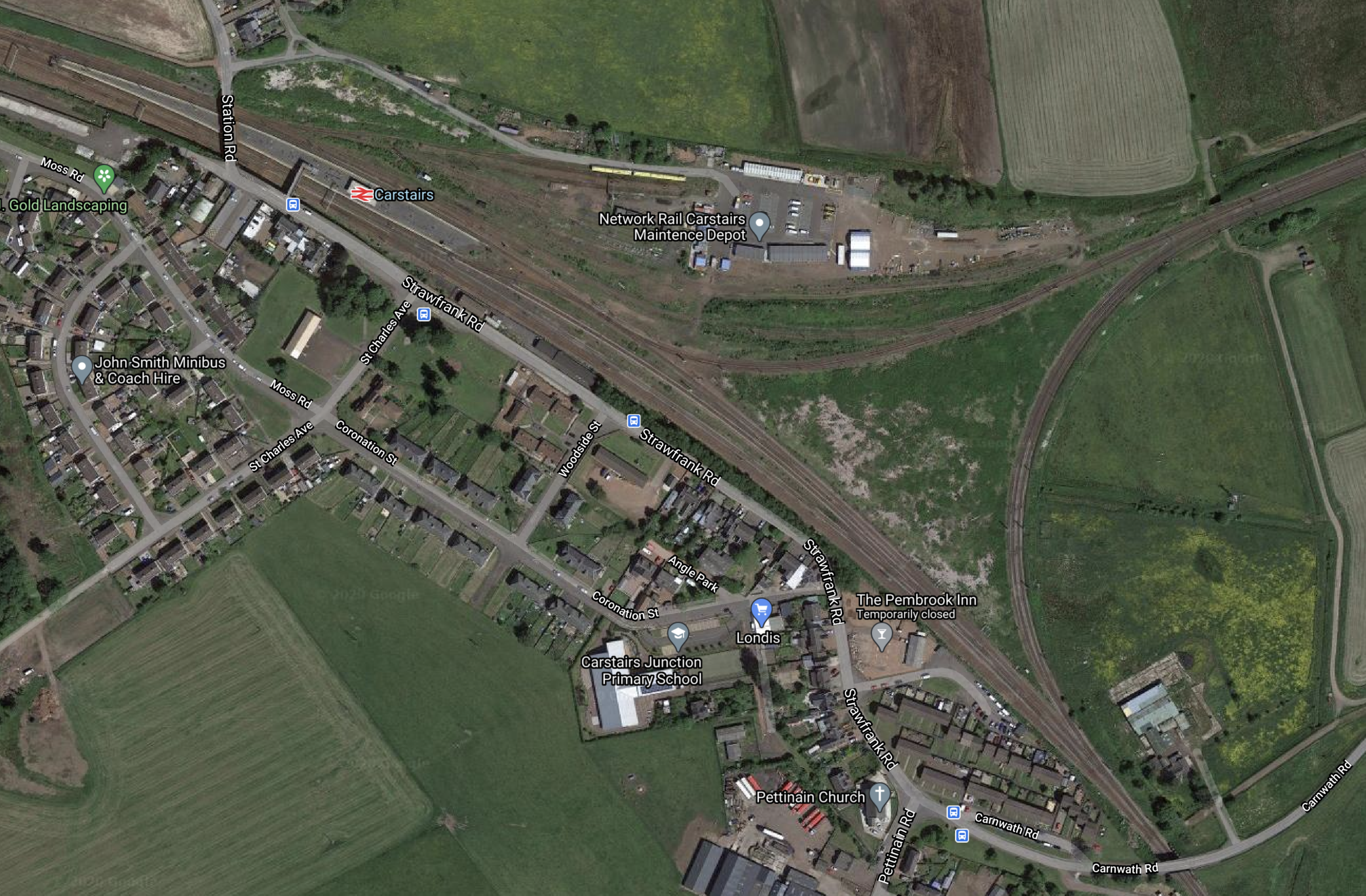
This Google Map shows Carstairs station and the splitting of the Glasgow and Edinburgh routes.
Note.
- The tracks going North-West to Glasgow.
- The tracks going North-East to Edinburgh.
- The tracks going South-East to Glasgow
- All tracks in the picture are electrified.
There might be a need for a passing loop to increase the efficiency of this junction.
It’s not just high speed passenger trains, that can use this technique, but it can be applied to trains with the same performance. So freight trains could form a convoy!
Flighting can decrease the number of train paths needed for a particular number of services and as digital in-cab signalling extends its reach across the UK, we’ll see more applications of the technique.
Effectively, by pathing the two London and Edinburgh/Glasgow trains and adding in one Birmingham and Manchester service, High Speed Two services would only need four paths between Carlisle and Carstairs.
But there would be.
- Four tph between Preston/Carlisle and Scotland. So capacity would be good.
- Three tph Between Carlisle and Edinburgh.
- Three tph Between Carlisle and Glasgow.
As Birmingham Curzon Street, Manchester Piccadilly and Manchester Airport all can handle a pair of High Speed Two’s Classic-Compatible trains, it might be possible in the future to serve both Edinburgh and Glasgow with the Birmingham and Manchester services, splitting the trains at Carlisle. This would mean.
- Four tph between Preston/Carlisle and Scotland.
- Four tph Between Preston/Carlisle and Edinburgh.
- Four tph Between Preston/Carlisle and Glasgow.
That looks strange mathematics, but that’s what you get when a train can serve two places by splitting.
What About The Glasgow And South Western Line?
The Glasgow And South Western Line, runs between Glasgow and Carlisle via Dumfries.
Consider.
- It is not electrified
- It can be used as a diversion, when the West Coast Main Line is blocked.
- It has always puzzled me, why this line wasn’t electrified, when the West Coast Main Line was electrified in the 1970s.
- High Speed Two’s need for more paths and higher speeds on the West Coast Main Line, may chase some of the freight on that route on to the Glasgow and South Western, as an alternative.
Perhaps, a small part of the High Speed Two budget could be used to electrify the route.
It certainly could be used to take some freight traffic from the West Coast Main Line and to ease diversions, if High Speed Two needed to close the West Coast Main Line for improvements to track, electrification or signalling.
It is also a line, where alternative methods of powering the trains could be used.
- It has electrification at both ends and with some electrification in the middle, battery electric passenger trains might be able to use the route.
- The City of Glasgow is majoring on hydrogen and the route, which is 115 miles long, could be ideal for a hydrogen train.
On the other hand full electrification could enable the electric services to be run at times, when the West Coast Main Line was blocked.
It is certainly a route, that could benefit from improvement.
Extension Of The Borders Railway To Carlisle
It is looking increasingly likely that the Borders Railway will be extended to Carlisle.
This report from the High Speed Rail Group is entitled Cross-Border High-Speed Rail And The Borders Railway Project.
The first paragraph is firm about why the Edinburgh and Glasgow services should split and join at Carlisle.
It has taken a while for HS2 service plans to focus on Carlisle as the right place to divide and join Glasgow/Edinburgh high-speed train portions. Earlier plans used Carstairs – and left Carlisle with no HS2 London service.
I also think it will be considerably more affordable and less disruptive to extend Carlisle’s already long platforms, than to build a massive new station at Carstairs capable of handling 400 metre long trains.
This paragraph puts its case for extending the Borders Railway to Carlisle.
To get best use out of the enhanced services that will then be possible, and to fully utilise the additional line capacity along the West Coast Main Line, onward rail connectivity is crucial. That’s why we flagged the compatibility with the Borders Railways re-opening from Tweedbank via Hawick to Carlisle in our report. With Carlisle-London journey times reduced to a little over 2 hours, and the Borders Railway fully re-instated, journey times from the Borders towns could be dramatically shortened – to London as well as to other major cities in England. Inward travel for tourists to the Borders region would be dramatically enhanced too.
They also add that a Borders Railway could be an useful diversion route, during the increasing number of problems on UK rail networks caused by the weather.
I believe that the Borders Railway should be extended to Carlisle and it should also be electrified.
- It would be a useful diversion route.
- It could handle some freight trains.
- It might be useful to move empty stock between Edinburgh and Annandale Depot, as the Borders Railway joins the West Coast Main Line not far from the depot.
We mustn’t underestimate how many passengers to and from the Borders will use the Borders Railway to catch High Speed Two at Carlisle.
Conclusion
Moving the depot to Annandale, may look to some like a way of giving the Scots a higher profile in High Speed Two.
But I do think it gives options to make a High Speed Network easier to run North of the border.
- High Speed Two have total control of their depot.
- It is well placed for Carlisle, Edinburgh and Glasgow.
It is also extremely well placed for the rail network of South Scotland.
Beeching Reversal – To Reinstate The Keswick To Penrith Railway
September 10th – This Beeching Reversal project appears to have been rejected.
Thoughts On The Design Of The Route
Consider.
- Keswick and Penrith are around 17.3 miles apart by road.
- The rail distance should be less than 20 miles.
- There could be perhaps six intermediate stations.
- A battery electric train typically has a range of 55-65 miles.
- A quiet battery electric train would be ideal for this route.
I believe that a battery electric train could handle this route.
- Charging would be mainly in Penrith station, using the existing 25 KVAC overhead electrification in Platform 3.
- A charging station would be provided in Keswick station to be safe.
A battery electric train could go between the two stations, recharge the battery and be ready to return in under an hour.
The route would be single track, except for a short double track station in the middle to allow trains to pass.
The route would not be electrified.
All stations could be single track, except for the passing station.
Two trains would be needed to work an hourly service.
Four trains would be needed to work an two trains per hour (tph) service.
Could the track could be designed to these criteria?
- No level crossings.
- Gentle curves and gradients
- 80 mph operating speed.
I suspect modern computer technology, which was not available to the Victorians, would ease the design of an efficient track.
- If a highly-efficient track could be created, it might be possible for a train to do a round trip from Penrith to Keswick, within an hour.
- This would mean that one train could provide the hourly service.
- Charging would only be at Penrith, using existing electrification.
- The passing loop would not be built, but provision would be made to add it later, if the frequency were to be increased.
We could be seeing several of these highly-efficient branch lines run by 100 mph battery-electric trains, that are charged on existing electrified main lines.
The Effect Of High Speed Two
Consider.
- Currently, there is a roughly hourly service in both directions on the West Coast Main Line at Penrith station.
- High Speed Two will only provide an hourly service between Birmingham Curzon Street and Edinburgh or Glasgow via Wigan North Western, Preston, Lancaster and Carlisle.
- Carlisle will have three tph on High Speed Two, between England and Scotland.
- Carlisle will have scenic services to Edinburgh, Glasgow, Leeds and Newcastle.
- Services between Carlisle and Penrith take thirteen minutes.
But most importantly, High Speed Two could bring lots of extra tourists to the area.
So would it be better for the Keswick and Penrith service to terminate at Carlisle?
- Charging would now be on the West Coast Main Line.
- Trains would only make a typical two-minute stop in Penrith station.
This would probably mean that an hourly service could be provided with only one train on the branch at a time.
Conclusion
I feel the economics of this project could be transformed by using battery electric trains on this proposed route and terminating them at Carlisle.
Existing Stations Where High Speed Two Trains Will Call
The June 2020 Edition Of Modern Railways has an article called HS2 Minister Backs 18 tph Frequency, which gives a detailed diagram of the route structure of High Speed Two and it is possible to summarise the stations, where High Speed Two trains will call.
- Carlisle – 3 tph – 400 metres – Split/Join
- Chesterfield – 1 tph – 200 metres
- Crewe – 2 tph – 400 metres – Split/Join
- Darlington – 2 tph – 200 metres
- Durham – 1 tph – 200 metres
- East Midlands Hub HS2 – 7 tph – 400 metres – Split/Join
- Edinburgh Haymarket – 2.5 tph – 200 metres
- Edinburgh Waverley – 2.5 tph – 200 metres – Terminal
- Glasgow Central – 2.5 tph – 200 metres – Terminal
- Lancaster – 2 tph – 200 metres – Terminal
- Leeds HS2 – 5 tph – 400 metres
- Liverpool Lime Street – 2 tph – 200 metres – Terminal
- Lockerbie – 1 tph – 200 metres
- Macclesfield – 1 tph – 200 metres – Terminal
- Manchester Airport HS2 – 5 tph – 400 metres
- Manchester Piccadilly HS2 – 5 tph – 400 metres
- Motherwell – 0.5 tph – 200 metres
- Newcastle – 3 tph – 200 metres – Terminal
- Oxenholme – 0.5 tph – 200 metres
- Penrith – 0.5n tph – 200 metres
- Preston – 4 tph – 400 metres
- Runcorn – 2 tph – 200 metres
- Sheffield – 2 tph – 200 metres
- Stafford – 1 tph – 200 metres
- Stoke-on-Trent – 1 tph – 200 metres
- Warrington Bank Quay – 1 tph – 200 metres
- Wigan North Western – 1 tph – 200 metres
- York – 4 tph – 200 metres
Note.
- HS2 after the station name indicates a new station for High Speed Two
- tph is trains per hour
- 0.5 tph is one train per two hours (tp2h).
- 200/400 metres is the maximum length of trains that will call.
- Terminal indicates that trains will terminate at these stations.
- Split/Join indicates that trains will split and join at these stations.
These are more detailed thoughts on how existing stations will need to be modified.
Train Lengths
Before, I look at the individual stations, I’ll look at the train lengths.
- High Speed Two train – Single – 200 metres
- High Speed Two train – Pair – 400 metres
- Class 390 train – 11-car – 265.3 metres
- Class 390 train – 9-car – 217.5 metres
- Class 807 train – 7-car – 182 metres
- Class 810 train – 5-car – 120 metres
- Class 810 train – Pair of 5-car – 240 metres
- InterCity 125 – 2+8 – 220 metres
- InterCity 225 – 9-car – 245 metres
- Class 222 train – 4-car – 93.34 metres
- Class 222 train – 5-car – 116.16 metres
- Class 222 train – 7-car – 161.8 metres
- Class 222 train – 4-car+5-car – 209.5 metres
- Class 222 train – 5-car+5-car – 232.32 metres
These are the thoughts on the individual stations.
Carlisle
Carlisle station will need two 400 metre through platforms, so each can accommodate a pair of 200 metre trains.
This Google Map shows the station.

I estimate the platforms are about 380 metres, but it looks like, they could be lengthened, without too much difficulty.
As High Speed Two trains to the North of Carlisle will be 200 metres long, there would probably be no need for platform lengthening North of Carlisle, as these trains are shorter than the Class 390 trains, that currently work the routes to Edinburgh and Glasgow.
Carlisle station is step-free, has good secondary rail connections and is within walking distance of the city centre.
The only thing it needs, is a connection to Edinburgh on a rebuilt Borders Railway.
Chesterfield
Consider.
- Chesterfield station will need to handle 200 metre trains.
- Chesterfield station may be rebuilt for High Speed Two.
- Chesterfield station can handle an InterCity 125, which is 220 metres.
- It will need to handle a pair of Class 810 trains, which would be 240 metres.
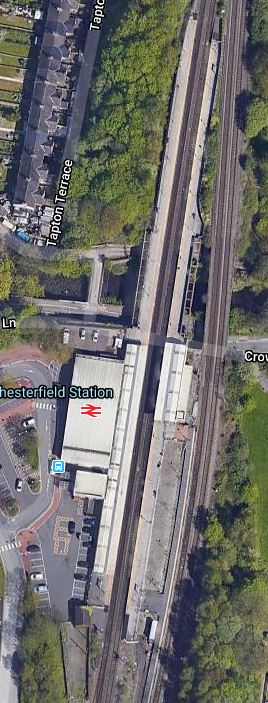
This Google Map shows Chesterfield station.
Note.
- The slow lines passing the station on the Eastern side.
- There are two long through platforms and a third bi-directional platform on the down slow line.
There is space to build two long platforms for High Speed Two, but is it worth it, when one one tph will stop?
- According to High Speed Two’s Journey Time Calculator, trains will take just twelve minutes between Sheffield and Chesterfield stations.
- This compares with 12-15 minutes for the current diesel trains.
- The distance between the two stations is 14 miles, which means that a twelve minute trip has an average speed of 70 mph.
- If there are still two tph to St. Pancras, there will be four tph, that run fast between the Sheffield and Chesterfield stations, of which three will stop at Chesterfield.
I think this could result in a simple and efficient design for the tracks between Sheffield and South of Clay Cross, where High Speed Two joins the Erewash Valley Line.
Chesterfield station is step-free.
Crewe
Crewe station will need two 400 metre through platforms, so each can accommodate a pair of 200 metre trains.
This Google Map shows the station.

There have been references to rebuilding of Crewe stations, but it does appear that some platforms are over 300 metres long.
Darlington
Darlington station will need to accommodate 200 metre trains.
As it already accommodates 245 metre InterCity 225 trains, there shouldn’t be too much of a problem.
Durham
Durham station will need to accommodate 200 metre trains.
As it already accommodates 245 metre InterCity 225 trains, there shouldn’t be too much of a problem.
Edinburgh Haymarket
Edinburgh Haymarket station will need to accommodate 200 metre trains.
As it already accommodates 245 metre InterCity 225 trains, there shouldn’t be too much of a problem.
Edinburgh Waverley
Edinburgh Waverley station will need to accommodate 200 metre trains.
As it already accommodates 245 metre InterCity 225 trains, there shouldn’t be too much of a problem.
Glasgow Central
Glasgow Central station will need to accommodate 200 metre trains.
As it already accommodates 265 metre Class 390 trains, there shouldn’t be too much of a problem.
Currently, Avanti West Coast runs the following services to Glasgow Central.
- One tph from London Euston calling at Warrington Bank Quay, Wigan North Western, Preston, Lancaster, Oxenholme Lake District (1tp2h), Penrith (1tp2h) and Carlisle.
- One tp2h from London Euston calling at Milton Keynes Central, Coventry, Birmingham International, Birmingham New Street, Sandwell and Dudley, Wolverhampton, Crewe, Warrington Bank Quay, Wigan North Western, Preston, Lancaster, Oxenholme Lake District (1tp2h), Penrith (1tp2h) and Carlisle.
High Speed Two is proposing to run the following trains to Glasgow Central.
- Two tph from London Euston calling at Old Oak Common, Preston and Carlisle.
- One tp2h from Birmingham Curzon Street calling at Wigan North Western, Preston, Lancaster, Oxenholme (1tp2h), Penrith (1tp2h), Carlisle, Lockerbie and Motherwell (1tp2h)
If the current services to Glasgow Central were to be replaced by the High Speed Two services, most travellers would get a similar or better service.
But if Avanti West Coast decide to drop their classic services to Glasgow via Birmingham, will travellers starting between Milton Keynes and Crewe, be a bit miffed to lose their direct services to Glasgow?
Glasgow Central station would appear to be ready for High Speed Two.
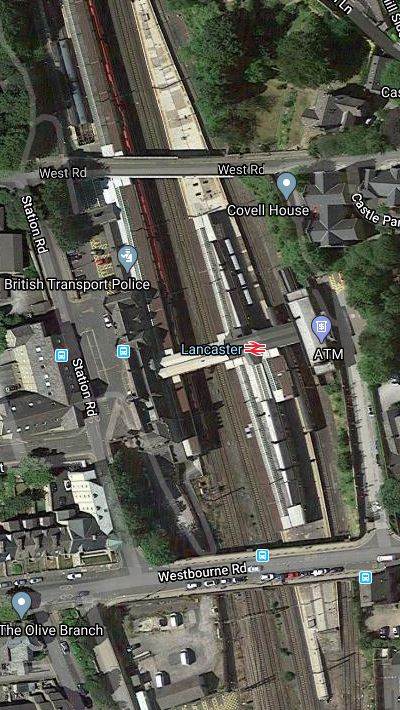
Lancaster
I was initially surprised, that on High Speed Two, one tph would terminate at Lancaster station.
This Google Map shows the station.
Note.
- There are two bypass lines without any platforms on the Western side of the tracks, where trains can speed through.
- The station has five platforms.
- Some Avanti West Coast services terminate at Lancaster station.
- 265 metre, eleven-car Class 390 trains, stop in Lancaster station.
As High Speed Two services will use 200 metre trains, which are shorter than all Class 390 trains, I would suspect that High Speed Two services will be able to be turned at Lancaster station, without too much difficulty.
Liverpool Lime Street
Liverpool Lime Street station will need to be able to turn two 200 metre High Speed Two tph.
- The remodelling of the station in 2018, probably allowed for two tph between London Euston and Liverpool Lime Street station.
- From 2022-2023, it will be turning two Class 807 trains per hour, which will probably be 182 metres long.
Liverpool Lime Street station may well be ready for Phase One of High Speed Two. It’s also very much step-free.
There are also alternative plans for a new High Speed station in Liverpool.
- It would be alongside the current Liverpool Lime Street station.
- The station would have a route to High Speed Two at Crewe via Warrington and a junction at High Legh.
- Northern Powerhouse Rail would start in the station and go to Manchester via Warrington, High Legh and Manchester Airport.
- It would enable six tph between Liverpool and Manchester, in a time of just 26 minutes.
I talked about this plan in Changes Signalled For HS2 Route In North, where I included this map.

High Legh Junction is numbered 5 and 6.
Nothing published about High Speed Two, would appear to rule this plan out.
Lockerbie
Lockerbie station will need to accommodate 200 metre trains.
As it already accommodates 265 metre Class 390 trains, there shouldn’t be too much of a problem.
Macclesfield
I was initially surprised, that on High Speed Two, one tph would terminal at Macclesfield station.
This Google Map shows the station.

Wikipedia says this about the platforms in the station.
There are three platforms but only two are in regular use, the up platform for services to Manchester and the down platform to Stoke-on-Trent and Birmingham. Platform 3 sees a small number of services. Evidence of a fourth platform can be seen, on which a Network Rail building now exists.
As the station has a regular Avanti West Coast service every hour, the platforms must be over 200 metres long and they will be long enough for the 200 metre High Speed Two trains.
So why would High Speed Two want to terminate a train at Macclesfield, rather than at Manchester Piccadilly as they do now?
Currently, Avanti West Coast runs these services between London Euston and Manchester Piccadilly.
- One tph via Milton Keynes Central, Stoke-on-Trent and Stockport.
- One tph via Stoke-on-Trent, Macclesfield and Stockport
- One tph via Stafford, Crewe, Wilmslow and Stockport
The diagram in the Modern Railways article shows these High Speed Two services to Manchester Piccadilly.
- One tph from London Euston via Old Oak Common, Birmingham Interchange and Manchester Airport
- Two tph from London Euston via Old Oak Common and Manchester Airport
- Two tph from Birmingham Curzon Street via Manchester Airport.
Note.
- None of these five tph serve Macclesfield, Milton Keynes Central, Stockport, Stoke-on-Trent or Wilmslow.
- All five proposed services are shown to call at Manchester Airport.
- It is likely, that a tunnel will be bored between Manchester Airport and Manchester Piccadilly stations.
- The High Speed Two station at Manchester Piccadilly might even be in a tunnel under the current Manchester Piccadilly station or central Manchester.
- A below-ground High Speed Two station for Manchester could also serve Northern Powerhouse Rail services to Leeds and the East.
- According to the plans, I talked about under Liverpool Lime Street earlier, there could also be up to six tph running between Liverpool and Manchester via Manchester Airport, as part of Northern Powerhouse Rail.
Plans need to be developed to serve the towns and cities, that will not be served by High Speed Two’s current proposals.
- It appears Stafford, Stoke-on-Trent and Macclesfield will be served by an independent High Speed Two service from London Euston.
- Terminating one tph at Macclesfield station doesn’t appear to be challenging.
- A rail route between Macclesfield and Manchester Airport to link up with the proposed tunnel could be very difficult.
- Manchester Piccadilly and Macclesfield stations have a frequent rail connection, with most trains calling at Stockport station.
- Perhaps during construction work for High Speed Two in the centre of Manchester, Macclesfield station can be used as an alternative route into the city, using the existing Manchester Piccadilly station.
The London Euston and Macclesfield service via Stafford and Stoke-on-Trent could be a pragmatic solution to part of the problem, but what about Milton Keynes, Wilmslow and Stockport?
According to the title of the Modern Railways article, High Speed Two will have a maximum frequency of 18 tph.
When fully-developed, the current proposed timetable shows the following.
- A frequency of 17 tph between London Euston and Birmingham Interchange stations.
- A frequency of 11 tph between Birmingham and Crewe.
- A frequency of 9 tph through East Midlands Hub station.
It would appear that if there is a capacity bottleneck, it is between London and Birmingham.
However if classic services to Manchester Piccadilly are replaced by the High Speed Two services to the city via the new tunnel from Manchester Airport to a new station in the City Centre, there will be spare capacity on the Crewe and Manchester Piccadilly route via Wilmslow and Stockport stations.
This could lead to a number of solutions.
- A direct High Speed Two service runs using the spare path, between London and the current Manchester Piccadilly station.
- Similar to the previous service, but the service splits and joins at Crewe, with one individual train going to Manchester Piccadilly and the other somewhere else. Blackpool?
- One service between London and Liverpool is planned to split and join at Crewe with individual trains going to Lancaster and Liverpool. The other Liverpool service could split at Crewe with individual trains going to Liverpool and Manchester Piccadilly.
- The service between London and Macclesfield is run by a pair of trains, that split at Birmingham Interchange, with individual trains going to Macclesfield and Manchester Piccadilly. The advantage of this service, is that if you got into the wrong train, you’d still be going to roughly the same destination.
- Wikipedia says “At peak times, the current Avanti West Coast services may additionally call at one or more of: Watford Junction, Rugby, Nuneaton, Tamworth, Lichfield Trent Valley.” So why not run classic services on the West Coast Main Line between Euston and Manchester Piccadilly via Milton Keynes using suitably fast trains. Perhaps, the new Class 807 trains would be ideal.
Note.
- All services serving the current Manchester Piccadilly station would call at Crewe, Wilmslow and Stockport stations.
- Passengers going to or from Manchester Airport would change at Crewe.
The more I look at Macclesfield, the more I like using it as a High Speed Two destination.
Motherwell
Motherwell station will need to accommodate 200 metre trains.
As it already accommodates 265 metre Class 390 trains, there shouldn’t be too much of a problem.
Newcastle
Newcastle station will need to accommodate 200 metre trains.
As it already accommodates 245 metre InterCity 225 trains, there shouldn’t be too much of a problem.
Oxenholme
Oxenholme station will need to accommodate 200 metre trains.
As it already accommodates 265 metre Class 390 trains, there shouldn’t be too much of a problem.
Penrith
Penrith station will need to accommodate 200 metre trains.
As it already accommodates 265 metre Class 390 trains, there shouldn’t be too much of a problem.
Preston
Preston station will need two 400 metre through platforms, so each can accommodate a pair of 200 metre trains.
This Google Map shows the station.

I estimate that the main through platforms aren’t much short of the required 400 metres.
But something must be done to make the station step-free.
Runcorn
Runcorn station will need to accommodate 200 metre trains.
As it already accommodates 217 metre Class 390 trains, there shouldn’t be too much of a problem. The station is also step-free.
Sheffield
Sheffield station will need to accommodate 200 metre trains.
This Google Map shows the station.

As the station can already handle a 220 metre InterCity 125, there shouldn’t be too much of a problem. The station is also substantially step-free.
Stafford
Stafford station will need to accommodate 200 metre trains.
This Google Map shows the station.

As it already accommodates 265 metre Class 390 trains, there shouldn’t be too much of a problem. The station is also step-free.
Wikipedia says this about Stafford station and High Speed Two.
Under current proposals, Stafford will be a part of the High Speed 2 network, via a ‘Classic Compatible’ junction, which will allow HS2 trains to operate to Stafford, and further on towards Liverpool. This would shorten journey time from Stafford to London, to an estimated 53 minutes. Under current proposals it is expected that an hourly services will operate in both directions, however it is currently unclear if these services will terminate at Stafford, or Liverpool.
This does appear to be rather out of date with High Speed Two’s latest proposals as disclosed in the Modern Railways article, which say that Stafford is served by the following service.
- One tph between London Euston and Macclesfield.
- Calls at Old Oak Common, Stafford and Stoke-on-Trent.
- A 200 metre train.
One possibility must surely be to run a pair of 200 metre trains to and from Stafford, where they would split and join.
- One could go as currently proposed to Stoke-on-Trent and Macclesfield.
- The second train could go to Liverpool via Crewe and Runcorn or Manchester Piccadilly via Crewe, Wilmslow and Stockport.
- The recent works at Norton Bridge Junction will have improved the route for the second train.
There would need to be platform lengthening at Stafford to accommodate the 400 metre pair of trains.
A split and join at Stafford does show the possibilities of the technique.
Another possibility is mentioned for Stafford in Wikipedia.
There is also been proposals to reintroduce services to Stafford to terminate on the Chase Line which was cutback to Rugeley Trent Valley in 2008. The Key Corridors states “Extension of Chase Line services to Stafford”. This is proposed to be in development.
It will surely connect a lot of people to Stafford for High Speed Two.
The extract from Wikipedia, that I used earlier, mentions a Classic Compatible junction, which will allow High Speed Two trains to reach Stafford.
This map clipped from the High Speed Two web site, shows the junction North of Lichfield, where High Speed Two connects to the Trent Valley Line through Stafford.

Note.
- High Speed Two runs North-South across the map.
- After the Junction by Fradley South,
- High Speed Two to Crewe and the North, is the branch to the East.
- The other branch connects to the Trent Valley Line, which can be picked out North of Lichfield, where it passes through Lichfield Trent Valley station.
The Trent Valley Line is no Victorian double-track slow-speed bottleneck.
- Most of the route between Rugby and Stafford is three or four tracks.
- The speed limit is generally 125 mph.
- I wouldn’t be surprised to see Avanti West Coast’s Class 390 and Class 807 trains running at 140 mph on the route.
- This speed would probably be attained by High Speed Two trains.
London Euston and Stafford would only have under twenty miles of slower line and that could be 140 mph, so High Speed Two times on the route could be very fast. High Speed Two is quoting 54 minutes on their Journey Time Calculator.
Stoke-on-Trent
Stoke-on-Trent station will need to accommodate 200 metre trains.
This Google Map shows the station.
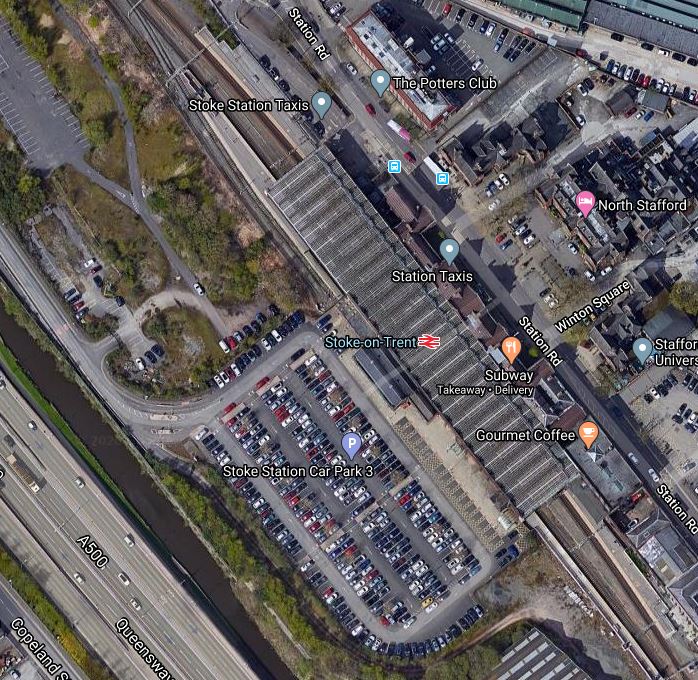
As it already accommodates 265 metre Class 390 trains, there shouldn’t be too much of a problem. The station is also step-free.
Warrington Bank Quay
Warrington Bank Quay station will need to accommodate 200 metre trains.
As it already accommodates 265 metre Class 390 trains, there shouldn’t be too much of a problem.
Wigan North Western
Wigan North Western station will need to accommodate 200 metre trains.
In Is Wigan North Western Station Ready For High Speed Two?, I said this.
Wigan North Western station would accept a single-train now, but the platforms would need lengthening to handle a double-train.
As all trains through Wigan North Western station will only be 200 metre single trains and the station is step-free, the station appears to be ready for High Speed Two.
York
York station will need to accommodate 200 metre trains.
As it already accommodates 245 metre InterCity 225 trains, there shouldn’t be too much of a problem.
Conclusion
I have come to these conclusions.
- Because most of these stations have been rebuilt in the last few decades to accommodate the 200-plus metre InterCity 125s, InterCity 225s and Class 390 trains, all the stations can handle a 200 metre High Speed Two train without significant lengthening.
- Some stations like Carlisle, Crewe, Preston and Stafford may need a small amount of platform lengthening to accommodate a pair of trains, but most of the improvements needed for a world-class High Speed railway will be more refurbishment than a complete rebuild.
- Using existing platforms at Lancaster and Macclesfield stations as terminal platforms is an elegant and a much more affordable solution than building new stations or even platforms.
- Because all five tph into the High Speed Two station at Manchester Piccadilly go via Manchester Airport, I would envisage that this will be in a tunnel, that can be part of a future Northern Powerhouse Rail.
I also think that the plan has been devised with the Project Management and minimising disruption to travellers in mind.
Colne – Skipton Reopening Moves Closer
The title of this post, is the same as that of this article on the Railway Gazette.
This is the introductory paragraph.
Rail minister Chris Heaton-Harris has confirmed that investigations have been commissioned into the proposed reinstatement of the 19·3 km Colne – Skipton ‘missing link’ connecting east Lancashire and west Yorkshire.
Investigations will look into.
- Capital costs
- Passenger demand forecasts
- Service options.
- Gauge enhancement measures necessary to increase rail freight capacity on TransPennine routes including between Accrington and Todmorden stations.
- Proposals for a rail freight terminal on the site of the demolished Huncoat power station near Accrington.
This sounds more than a simple proposal to reopen the route between Skipton and Colne stations.
These are a few of my thoughts.
The Rail Route Between Preston And Skipton
The rail route between Preston on the West Coast Main Line and Skipton can be summarised as follows.
- Preston and Rose Grove via Huncoat – double-track – electrification at Preston
- Rose Grove and Colne – single-track
- Colne and Skipton – to be reinstated – electrification at Skipton
Colne and Skipton might not be the easiest route to reinstate, as a dual carriageway has been built across the route to the North of Colne station.
Could Colne And Skipton Be Double-Track All The Way?
Consider.
- The new section between Skipton and Colne could be built with single or double tracks.
- The section between Rose Grove and Colne stations was built as a double-track and singled in 1971. British Rail’s accountants strike again!
- The single-track section includes the Bank Top Viaduct, in the centre of Burnley.
- Trains currently take twenty-one minutes between Rose Grove and Colne stations.
This picture shows Bank Top Viaduct.
I think the viaduct could be key to whether the route is double-track all the way.
- If the redoubling can be performed at a reasonable cost, then that will be the way to go, as it might be possible to squeeze up to three trains per hour (tph) between Skipton and Rose Grove via Colne.
- If on the other hand, doubling is too difficult or expensive, I estimate that no more than two tph would be possible.
For both solutions, there will need to be double track or a long passing loop, between Skipton and Colne.
Could Colne And Skipton Be Electrified?
Consider.
- Preston is a fully-electrified station on the West Coast Main Line.
- Skipton is a fully-electrified station with electric trains to and from Leeds.
- Full electrification would create an electrified route between Leeds and Blackpool, Liverpool and Preston.
- It could be a useful diversion route for electric passenger trains across the Pennines, when their are engineering works on the Huddersfield Line or due to the building of Northern Powerhouse Rail.
- Electrification of the route, would allow electric haulage of freight trains to and from the proposed Huncoat Rail Freight Terminal.
- Electrification of the Calder Valley Line between Preston and Leeds is always being proposed.
- Electrication of Bank Top Viaduct could be tricky!
It should also be noted that this article on Rail Magazine was published on May 12th, 2020 and is entitled Electrification Key to Decarbonisation – Government. Views in Government about electrification have changed, so this might affect the decision to electrify the route.
The power is already there at both ends and electrification systems with low visual intrusion could be used.
On the other hand, some might consider electrification of the route inappropriate.
Could Colne And Skipton Be Partially Electrified?
Consider.
- I estimate that the distance between Preston and Skipton will be 41 miles.
- If Blackpool North station were the final destination, there would be 34 miles (2 x 17) to charge the batteries.
- If Liverpool Lime Street station were the final destination, there would be 70 miles (2 x 35) to charge the batteries.
- If Leeds station were the final destination, there would be 52 miles (2 x 26) to charge the batteries.
- Manufacturers’ estimates of distances, indicate that battery electric trains could cover up to 65 miles on battery power.
As both ends of the route are electrified and trains would run extra miles under the wires, it would seem likely that a battery electric train could run between Preston and Skipton, without needing a charge en route.
Drax Group And Colne And Skipton Reinstatement
Drax power station uses Flue Gas Desulphurisation. Wikipedia says this about the process at Drax.
All six units are served by an independent wet limestone-gypsum flue gas desulphurisation (FGD) plant, which was installed between 1988 and 1996. This diverts gases from the boilers and passes them through a limestone slurry, which removes at least 90% of the sulphur dioxide (SO2). This is equivalent to removing over 250,000 tonnes of SO2 each year. The process requires 10,000 tonnes of limestone a week, sourced from Tunstead Quarry in Derbyshire. A byproduct of the process is gypsum, with 15,000 tonnes produced each week. This goes to be used in the manufacture of plasterboard. The gypsum is sold exclusively to British Gypsum, and it is transported by rail to their plant at Kirkby Thore (on the Settle-Carlisle Line).
The gypsum trains go through Skipton to access the Settle-Carlisle Line.
Drax power station is part-fuelled with biomass, which comes from all over the place including the United States via the Port of Liverpool.
It is no surprise that Drax Group are in favour of the Colne and Skipton reinstatement, as it would give them a new route between Drax and the Port of Liverpool.
This press release from Drax Group gives more details including this paragraph.
It will have a direct impact on improving our supply chain at Drax, allowing freight trains to travel much more quickly to the power station in North Yorkshire – reducing journey times from the Port of Liverpool to less than three hours, a journey which can take up to nine hours at the moment.
Trains will avoid the busy Huddersfield Line and Manchester Victoria station.
Drax’s statement would appear to be a powerful reason to reinstate Colne and Skipton.
These smart new or refurbished wagons, used by Drax to move woodchip should be much faster than the typical 20-30 mph freight speed of TransPennine routes.
This page on the Drax web site, is entitled This train isn’t like any other in the UK, and it gives more details about the wagons.
- They were custom-designed and built in the last few years.
- The roofs open automatically for loading.
- A twenty-five wagon train can be loaded in 37 minutes.
- A full train can carry between 1,700 and 1,800 tonnes of biomass.
- Each train can unload in forty minutes.
- They are the largest wagons on UK railways by a margin of 30 %.
- Each wagon is nineteen metres long and can carry over seventy tonnes of biomass.
- Approximately 14 trains per day arrive at Drax, bringing 20,000 tonnes of biomass.
I suspect to minimise journey times, Drax would like to see a fully electrified route between Preston and Skipton and a new double-track route between Colne and Skipton.
The Huncoat Rail Freight Terminal
This Google Map shows the position of the former Huncoat power station.
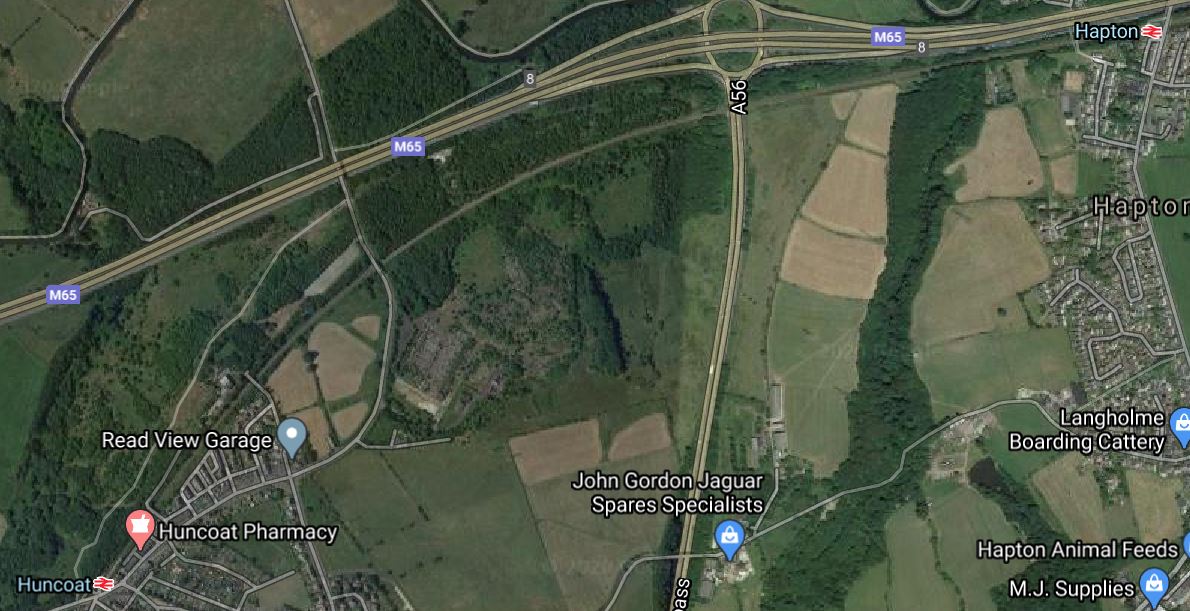
Note.
- Hapton station in the North-East corner of the map.
- Huncoat station in the South-West corner of the map.
- The East Lancashire Line running between the two stations.
- The M65 running across the top of the map.
- The A56 or Accrington bypass running North-South from the motorway junction at the top of the map.
Huncoat power station appears to have been in the South West corner of the rough-looking area, South of the M65 and the railway and West of the A56.
There is no Wikipedia entry for the demolished power station, but this page on The View From The North has some details and pictures.
It does appear to be a well connected site for a Rail Freight Terminal.
- There could be a direct connection to the motorway network.
- There is space for a connection with the East Lancashire Line, that would allow trains to access the interchange from both directions.
- Trains could go West to the Port of Liverpool and the West Coast Main Line via Preston.
- Trains could go East to Leeds and Yorkshire and on to the East Coast ports of Felixstowe, Hull, Immingham and Teesport.
- If the East Lancashire Line were to be electrified, electric haulage could be used.
The Rail Freight Terminal could be bigger than a hundred hectares.
Gauge Enhancement On TransPennine Routes Including Between Accrington And Todmorden
Consider
- Most freight trains passing through Hebden Bridge station use the route via Rochdale and Todmorden to get to and from Liverpool and the West.
- Few if any use the East Lancashire Line via Accrington.
- Some passenger trains do take the Accrington route.
- There are five tunnels between Accrington and the Todmorden Curve.
- The building of the Huncoat Rail Freight Terminal, must mean that trains between the Rail Freight Terminal and Leeds and the East would need to use the Calder Valley Line as far as the Todmorden Curve. or the East Lancashire Line to Colne for the new route.
As freight trains rarely seem to use the East Lancashire Line to the East of Accrington could it be that this section of track needs gauge enhancement?
But if this gauge enhancement were to be completed, that could give two routes between Huncoat Rail Freight Terminal and the East, for the largest freight trains.
Thoughts On The Project Management
It would appear that there are a series of sub-projects to be done.
- Perform gauge enhancement and route improvement on the East Lancashire Line between Rose Grove and Colne. This would include any doubling of the route, if that were to be done.
- Start building the link between Skipton and Colne.
- Start building the Huncoat Rail Freight Terminal.
- Finish building the link between Skipton and Colne.
- Start passenger and freight services between Skipton and Colne.
- Finish building the Huncoat Rail Freight Terminal.
- Perform gauge enhancement on the Calder Valley Line between Accrington and Todmorden.
My objectives would be.
- Open the Skipton and Colne route as a TransPennine diversion, as early as possible.
- Upgrade the East Lancashire Line between Rose Grove and Colne with minimum disruption.
- Open the Huncoat Rail Freight Terminal as early as possible.
- Create multiple freight routes to and from Huncoat Rail Freight Terminal.
Electrification would be a future aspiration.
Whither Drax?
Drax Gtroup and their flagship power station have a major environmental problem in that the power station is a large emitter of carbon dioxide.
They also run a lot of diesel locomotive hauled trains carrying biomass, fly ash, gypsum, limestone and other materials to and from Drax power station, which is on the Drax branch of the Pontefract Line.
- The Pontefract Line was built to serve the coalfields in the area.
- It runs between Leeds and Hull via Pontefract and Goole.
- It is not electrified, but it connects to the electrification at Leeds.
- In the East is has good connections to Cleethorpes, Goole, Grimsby, Hull and Immingham.
- The Port of Immingham is a major port, that is used by Drax to import biomass, which is hauled to the power station by diesel locomotives.
- The route between Drax and Immingham has been improved recently, by the addition of the North Doncaster chord.
- High Speed Two will run alongside the Pontefract Line on its approach to Leeds.
- Freight trains between Drax and Skipton use an electrified diversion South of Leeds via Armley, that avoids the need for freight trains to pass through Leeds station.
I can see that in a more favourable climate for electrification, that electrification of the Pontefract Line would be recommended.
Given, the environmental record of Drax, which is both good and bad, I would suspect they would like to see electrification of the Pontefract Line, as it would create a lower carbon route for biomass trains between Immingham and the power station.
A New Electrified TransPennine Route For Passengers And Freight
I sense that a grander plan might exist behind all my thoughts.
If the following routes were to be electrified.
- Preston and Skipton
- The Pontefract Line between Leeds and Hull.
- Knottingley and Immingham via Thorne
Hull and Liverpool would be connected for passenger electric trains and Liverpool and Immingham would be connected for freight.
Drax could also be on an electrified branch and they could say, they were hauling all their trains using renewable electricity. Marketing and environment are always important
Castlefield Corridor Trade-Off Plan For Fewer Trains
The title of this post is the same as that of this article on Rail Magazine.
The article says that to solve the problems through the Castlefield Corridor, the number of trains will be reduced from 15 trains per hour (tph) to thirteen tph.
This arrangement applied until May 2018 and meant that two tph between Manchester Airport and East of the Pennines reversed in Manchester Piccadilly station to go East, rather than using the Castlefield Corridor through Deansgate and Manchester Victoria stations.
The arrangement worked well before May 2018 and I doubt there’s no reason, why it won’t work in the short-term.
The long-term solution is Northern Powerhouse Rail and/or High Speed Two, which looks like will be in tunnel between the Airport and Manchester City Centre and could carry as many as six tph between Manchester and Liverpool via the Airport.
Perhaps, this should be the first piece of High Speed Two to be built in the North.
- It connects the three most important economic areas in the North West of England; Liverpool, Manchester and Manchester Airport.
- It would greatly increase capacity.
- It would probably have good connections to Crewe, Warrington, Wigan and the West Coast Main Line.
- Liverpool has an extensive local rail network, which is being expanded.
- Manchester is expanding the Metrolink network.
Some of the Castlefield Corridor services would have been replaced by better and faster services.
Could High Speed Two Trains Serve Chester And North Wales?
This may seem a slightly outrageous proposal to run High Speed Two trains to Chester.
- The city is a major tourist destination.
- Despite its closeness to Crewe it is a major rail hub, with services across Wales to Cardiff, Holyhead and Llandudno and along the border between England and Wales to Shrewsbury and Newport.
- Merseyrail serves the city and the station can be considered to be part of Liverpool’s extensive commuting area. This service is likely to be more reliable and faster with the delivery of new Class 777 trains.
- For parts of Merseyside, travelling to London or Manchester Airport, is easier via Chester than Liverpool Lime Street or Liverpool South Parkway.
If the promoters of High Speed Two are serious about creating a railway for the whole country, then I feel that running trains direct to and from Chester could be very beneficial for the towns and cities, that can be served by the current network at Chester.
Current And Possible Timings
Currently, trains take two minutes over two hours between Euston and Chester.
When Avanti West Coast introduces the new Hitachi AT-300 trains on the route, the following times will be possible.
- Euston and Crewe via West Coast Main Line – 90 minutes – Fastest Pendelino
- Crewe and Chester – 24 minutes – Current timing
This would give a time of one hour and 54 minutes, which is a saving of 8 minutes. But a lot of carbon would not be emitted between Euston and Crewe.
I estimate, that with High Speed Two Phase 2a completed, the following timings will be possible.
- Euston to Crewe via HS2 – 55 minutes – HS2 website
- Crewe and Chester – 24 minutes – Current timing
This would give a time of one hour and 19 minutes, which is a saving of 43 minutes.
Infrastructure Needed
There will need to be some infrastructure changes.
Platform Lengthening At Chester Station
The station would probably be served by two-hundred metre long High Speed Two Classic-Compatible trains, which might need some platform lengthening.
This Google Map shows the station.
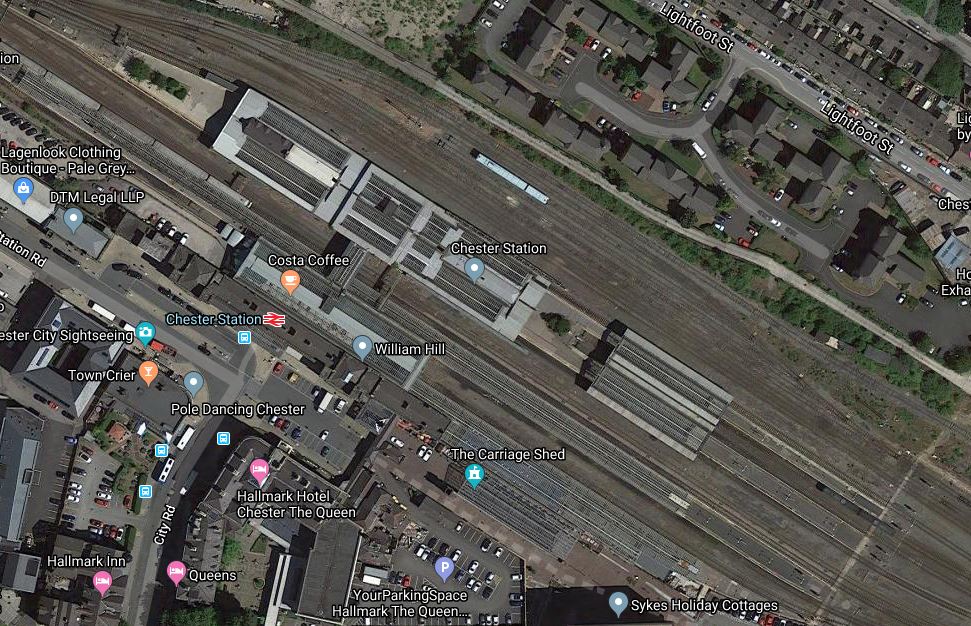
It looks to me, that there is plenty of space.
Will Chester And Crewe Be Electrified?
We know little about the capabilities of the trains proposed by the various manufacturers.
But, I wouldn’t be surprised that one or more of the proposals use batteries for one of the following purposes.
- Regenerate braking.
- Emergency power.
- Range extension for up to perhaps sixty miles.
As Chester and Crewe stations are only twenty-one miles apart with no intermediate stations, which will be run at an average speed of only 52 mph I don’t think it will be impossible to extend the service to Chester on battery power.
If electrification is required I wrote about it in Hitachi Trains For Avanti.
As it is only just over twenty miles, I don’t think it will be the most challenging of projects, although there does seem to be a lot of bridges.
Electrification would also allow Avanti West Coast’s Hitachi trains to run on electricity to Chester.
What About Holyhead?
Holyhead could become a more important destination in the next few years.
It is probably the best alternative to avoid flying and driving between Great Britain and the Island of Ireland.
And who can accurately predict, what effect Brexit and thinking about global warming will have?
I have a feeling that after electrification to Chester, using on-board energy storage could be used West of Chester.
It is very difficult to predict battery ranges in the future, but I can see a two hundred metre long High Speed Two Classic-Compatible train being able to reach Holyhead on battery power, with or without some limited extra electrification.
Alternatively, the UK and Welsh governments, might bite the bullet and just electrify the whole route between Crewe and Holyhead.
I have found a train on Real Time Trains, that covered the 105.5 miles between Holyhead and Crewe in two hours and 11 minutes at an average speed of 48 mph. The train took then a total of three hours and forty-five minutes to get to Euston
I estimate that with electrification and some track improvements, that it will be possible to travel between Euston and Holyhead in under three hours before High Speed Two.
Conclusion
It looks to me, that when High Speed Two, think about adding extra destinations, Chester and Holyhead could be on the list.
I also suspect that even without electrification and High Speed Two services, but with the new Class 805 trains, the route could be a valuable one for Avanti West Coast.
Should Phase One Of High Speed Two Go To Birmingham Or Crewe?
The important Crewe station is currently planned to be reached from London in Phase 2a of High Speed Two, with the first train scheduled for 2027, according to Wikipedia.
There have been changes over the years and the delivery of the line at Crewe was brought forward by a few years, so that now it is just twelve months after the line opened to Birmingham.
So is it better that Phase 1 of High Speed Two goes to Birmingham or Crewe?
The Route Of High Speed Two Between Birmingham And Crewe
This map clipped from the High Speed Two web site, shows the route between Birmingham and Crewe.
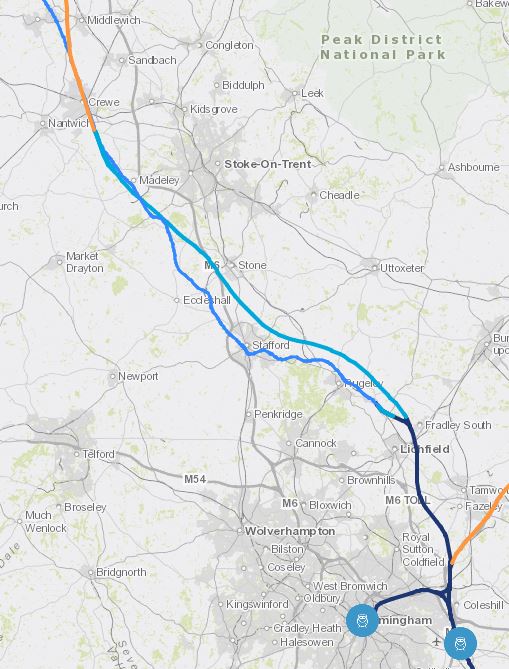
Note.
- Phase 1 is shown in dark blue
- Phase 2a is shown in a lighter blue.
- Phase 2b is shown in orange.
- Crewe is in the North-West corner of the map.
- Of the two routes in the middle Phase 2a is to the East with the West Coast Main Line to the West.
- Birmingham is in the South-East Corner of the map, where two stations are shown; Birmingham Curzon Street in the West and Birmingham Interchange slightly to the South.
This second map, shows High Speed Two to the East of Birmingham.
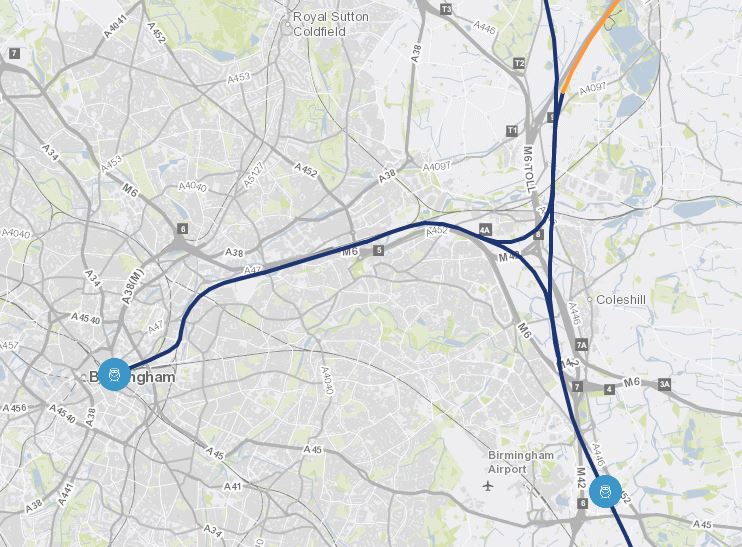
Note.
- The colours are the same.
- The Eastern leg to Nottingham and Leeds, which is shown in orange, goes off to the North-East.
This third map shows the route around Lichfield.

Note.
- Phase 1 is shown in dark blue
- Phase 2a to Crewe is the branch going North and is shown in a lighter blue.
- The other branch going to the North West is the existing West Coast Main Line.
This fourth map shows the routes between Lichfield and Crewe
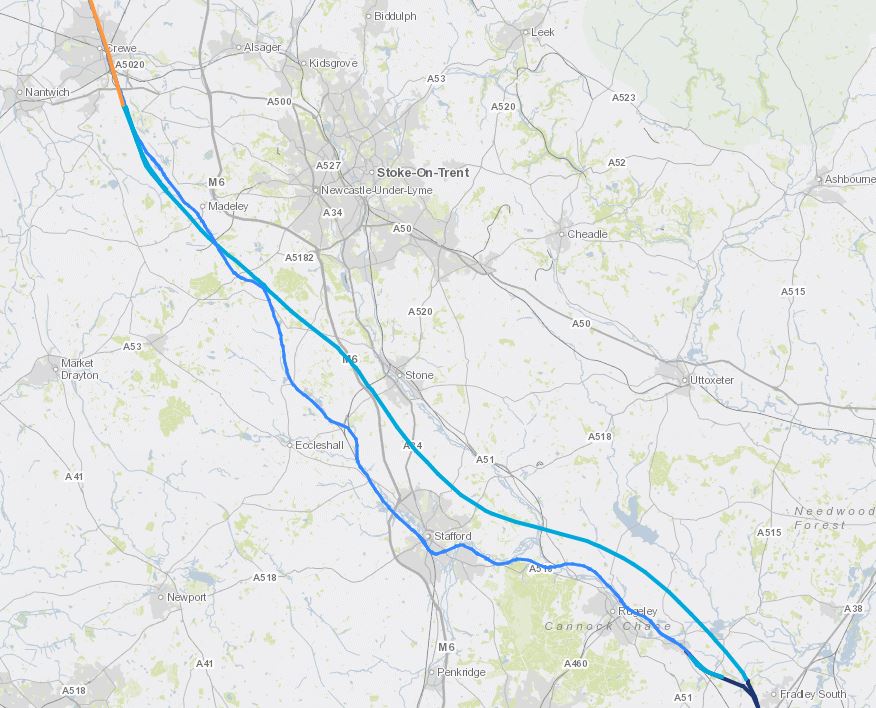
Note
- The colours are the same.
- Phase 2a of High Speed Two is the straighter route to the East.
- The more curvy route is the existing West Coast Main Line.
This fifth map shows the section of the route through Crewe.

Note.
- At the North of the map, the blue line is the West Coast Main Line and the orange line is the High Speed Two route to Manchester.
- Through Crewe the two lines share a route and may even share tracks.
- At the South of the map the High Speed Two route is on the East, with the West Coast Main Line to the West.
Click here to access High Speed Two’s interactive map, that I used to obtain these maps.
Phase One Services
Currently the following services are planned for Phase One of High Speed Two.
- Three trains per hour (tph) – Birmingham Curzon Street, via Old Oak Common (OOC) and Birmingham Interchange.
- Three tph – Birmingham Interchange via OOC.
- Two tph – Liverpool Lime Street via OOC, Stafford (1tph), Crewe (1tph) and Runcorn
- Three tph – Manchester Piccadilly via OOC, Wilmslow (1tph) and Stockport
- One tph – Preston via OOC, Crewe, Warrington Bank Quay and Wigan North Western
- One tph – Glasgow Central via OOC and Preston
Summing these up, the following totals are calculated.
- 6 tph – Birmingham Interchange
- 2 tph – Crewe
- 2 tph – Preston
Most other stations get two tph or less.
Birmingham Or Crewe?
In the following sections I will discuss various points.
Service Between Euston And Stafford
There is an interesting point shown up by the maps and the proposed services for Phase One.
Trains using High Speed Two won’t be able to call at Stafford unless they take a diversion along the West Coast Main Line. So after Phase 2a has been built between Lichfield and Crewe, Stafford could lose its High Speed Two service, unless they use the classic route.
Birmingham Interchange Station
Birmingham Interchange station will be unaffected by the decision of the terminus of Phase 1 of High Speed Two.
- It will be a Parkway station, with probably lots of parking.
- It will be connected to the National Exhibition Centre, Birmingham International station and Birmingham Airport by means of a people mover.
- All High Speed Two services go through the station and six tph are proposed to stop in Phase 1.
- The West Midlands Metro could serve the station.
- It will be thirty-eight minutes from London. Stansted Airport is fifty and Gatwick is around thirty!
I suspect that the time to and from London and a four-hundred metre long train every ten minutes, will mean that this will be a very busy station.
- Will Londoners treat Birmingham Airport, as a London Airport?
- Motorways to the East of Birmingham could mean the West Midlands treats the station as a Park-and-Ride station for London.
- Birmingham International station is a well-connected station with five platforms.
This station could become the busiest in the UK.
Birmingham Curzon Street Station
Birmingham Curzon Street station will be an unusual station for the UK, in that will be a city-centre terminal station running East-West, with services going both North and South, using a junction with the main High Speed Two.
- It will have seven platforms.
- It will be a short walk to Birmingham Moor Street station.
- It will have a stop on the West Midlands Metro line between Digbeth and Grand Central
Birmingham are hoping the station will be a catalyst for redevelopment of the area around the station.
After Phase 2 of High Speed Two services to the South are planned to include.
- Three tph – Euston via Birmingham Interchange and OOC.
- One tph – Birmingham Interchange direct
The hourly shuttle between the two stations makes up the service between them to a Turn-Up-And-Go frequency of four tph.
After Phase 2 of High Speed Two services to the North are planned to include.
- One tph – Stafford or Crewe direct
- One tph – Manchester Piccadilly via Crewe and Manchester Interchange
- Two trains per day – Preston via Crewe, Manchester Interchange and Wigan North Western
- Two trains per day – Carlisle via Manchester Interchange, Wigan North Western and Preston.
- One tph – Glasgow via Warrington Bank Quay, Wigan North Western, Preston and Carlisle.
- One tph – Edinburgh via Crewe, Warrington Bank Quay, Wigan North Western, Preston and Carlisle.
- One tph – Leeds via East Midlands Hub
- One tph – York via East Midlands Hub and Sheffield
- One tph – Newcastle via York
Summing up four tph go via the Western leg and Crewe to the North and three tph go via the Eastern leg and East Midlands Hub.
I suspect it is all about balancing the services between the three legs of High Speed Two.
- London and Birmingham
- Birmingham and North West England and Scotland
- Birmingham and North East England.
High Speed Two has been designed for fifteen tph running into Euston, so if all parts of the route can handle that number of trains, there must be a lot of scope to add extra services.
Birmingham Curzon Street with its seven platforms would balance all the services and probably help to sort things out in times of disruption.
Between Birmingham International Station And Lichfield
The maps show that this section must be built to connect High Speed Two to the West Coast Main Line just to the North of Lichfield Trent Valley station on the Trent Valley Line, as there is no other possible connection between the two routes.
This map clipped from the High Speed Two map, shows where the two lines join.
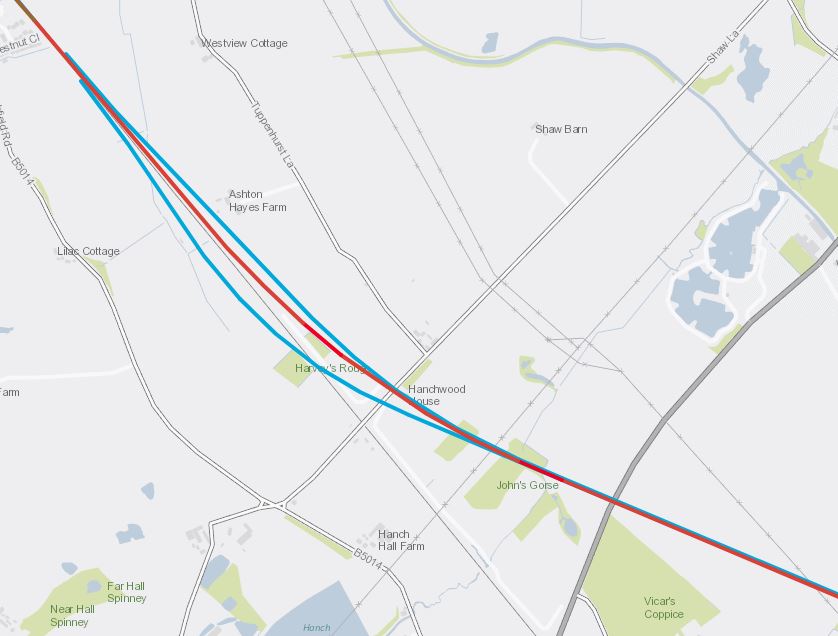
It is obviously designed for speed.
I estimate that the distance between Birmingham Interchange and this junction is not far short of twenty miles.
Between Lichfield And Crewe Station
Along the West Coast Main Line, the distance is around forty-two miles, but the straighter route proposed for High Speed Two could be a few miles shorter and several minutes faster.
If Phase 1 of High Speed Two were not to be built, trains would have to share the West Coast Main Line through Stafford station.
Currently, Stafford station can have as many as fifteen tph through the station.
Phase 1 of High Speed Two will have these trains going North of Birmingham Interchange station.
- Two tph – Liverpool Lime Street
- Three tph – Manchester Piccadilly
- One tph – Preston
- One tph – Glasgow Central
Which is a total of seven tph, with one tph stopping at Stafford.
I doubt they could all be squeezed through Stafford.
There would certainly be no space for any trains starting at Birmingham Curzon Street.
This is a very simple example of the capacity problems on the West Coast Main Line, which can only be solved by extra tracks to the North.
Crewe Station
Consider these points about Crewe station.
- It is not of a design that reflects its status.
- Currently, it handles 23 tph, that go all over the North West and much further.
- Phase 1 of High Speed Two would add another seven tph
- New services are planned.
- A rebuilding of the station would surely improve both capacity and operational efficiency.
- Looking at the fifth of the maps, it appears that the West Coast Main Line and High Speed Two share a corridor , if not tracks, through Crewe station.
For all these reasons, I am convinced that if High Speed Two passes through, then the station will need a rebuild.
So it looks like whether High Speed Two goes ahead or not, Crewe station will need an expensive rebuild.
Extra High Speed Two Services Through Crewe
Once Phase 2a has been completed, this will allow some extra Phase 2 services to be run along the route from Euston.
- Two tph from one tph – Glasgow Central via OOC, Birmingham Interchange (1tph), Preston and Carstairs
- Two tph – Edinburgh via OOC, Birmingham Interchange (1tph), Preston, Carstairs and Edinburgh Haymarket
I suspect these might run as a pair of trains as far as Carstairs and split and join there.
There will also be extra services between Birmingham Curzon Street, Crewe and Stafford to Edinburgh, Glasgow, Liverpool Lime Street, Manchester Piccadilly and Preston.
It is worth noting, that when all the services going North from Birmingham are summarised, you get the following.
- Four tph – Manchester Piccadilly
- Three tph – Liverpool Lime Street
- One tph – Preston
- Four tph – Glasgow/Edinburgh
- One tph – Stafford or Crewe
It looks a bit complicated North of Crewe, but it will create a frequent service between Crewe and Scotland.
High Speed To Chester
It should also be noted, that if between Crewe and Chester were to electrified, High Speed Two trains could serve Chester.
- Chester is a major rail interchange for the Border areas between England and Wales, North Wales and the Wirral.
- It is also connected to Merseyrail.
- Chester is an important tourist destination, with the city centre close to the station.
Electrification might also allow battery-electric versions of Avanti’s new Hitachi trains to serve some of their routes, without using diesel.
This simple example of Chester, says to me that opening High Speed Two to Crewe could allow extra services to be developed.
Conclusion
It appears from this analysis, that the only advantage of not building Phase 2a is that about forty miles of line between Lichfield and Crewe can be pushed back for a few years.
Hitachi Trains For Avanti
The title of this post is the same as that of an article in the January 2020 Edition of Modern Railways.
The Bi-Mode Trains
Some more details of the thirteen bi-mode and ten electric Hitachi AT 300 trains are given.
Engine Size and Batteries
This is an extract from the article.
Hitachi told Modern Railways it was unable to confirm the rating of the diesel engines on the bi-modes, but said these would be replaceable by batteries in future if specified.
I do wonder if my speculation in Will Future Hitachi AT-300 Trains Have MTU Hybrid PowerPacks? is possible.
After all, why do all the hard work to develop a hybrid drive system, when your engine supplier has done it for you?
Would Avanti West Coast need a train that will do 125 mph on diesel?
- The North Wales Coast Line has a maximum line speed of just 90 mph.
- Wikipedia is uncertain of the maximum speed of the Chester and Shrewbury Line, but it is extremely unlikely to be more than 80-90 mph.
The only place, they will be able to run at 125 mph or even higher will be on the West Coast Main Line, where they will be running under electric power from the pantograph.
If I were designing a bi-mode for 90 mph on diesel and 125 mph on electric, I would have batteries on the train for the following purposes.
- Handle regenerative braking.
- Provide hotel power in stations or when stationery.
- Provide an acceleration boost, if required, when running on diesel.
- Provide emergency power, if the wires go down in electric mode.
I’m sure MTU could work out a suitable size of diesel engine and batteries in an MTU PowerPack, that would meet the required performance.
Or maybe a smaller diesel could be used. An LNER Class 800 train has 1680 kW of installed power to maintain 125 mph. But the Great Western Railway versions have 2100 kW or twenty-five percent more, as their routes are more challenging with steeper gradients.
For the less challenging routes at a maximum of 90 mph between Crewe, Chester, Shrewsbury and North Wales, I wonder what level of power is needed.
A very rough estimate based on the speed required could put the power requirement as low as 1200-1500 kW.
As the diesel engines are only electrical generators, it would not effect the ability of the train to do 125 mph between Crewe and London.
There looks to be a virtuous circle at work here.
- Lower maximum speed on diesel means smaller diesel engines.
- Smaller diesel engines means lighter diesel engines and less fuel to carry.
- Less weight to accelerate needs less installed power.
- Less power probably means a more affordable train, that uses less diesel.
It looks to me, that Hitachi have designed a train, that will work Avanti West Coast’s routes efficiently.
The Asymmetric Bi-Mode Train
It looks to me that the bi-mode train that Avanti West Coast are buying has very different performance depending on the power source and signalling
- 90 mph or perhaps up to 100 mph on diesel.
- 125 mph on electric power.with current signalling.
- Up to 140 mph on electric power with in-cab digital signalling.
This compares with the current Class 221 trains, which can do 125 mph on all tracks, with a high enough operating speed.
The new trains’ different performance on diesel and electric power means they could be called asymmetric bi-modes.
Surely, creating an asymmetric bi-mode train, with on-board power; battery, diesel or hydrogen, sized to the route, means less weight, greater efficiency, less cost and in the case of diesel, higher carbon efficiency.
Carbon Emissions
Does the improvement in powertrain efficiency with smaller engines running the train at slower speeds help to explain this statement from the Modern Railways article?
Significant emissions reduction are promised from the elimination of diesel operation on electrified sections as currently seen with the Voyagers, with an expected reduction in CO2 emissions across the franchise of around two-thirds.
That is a large reduction, which is why I feel, that efficiency and batteries must play a part.
Battery-Electric Conversion
In my quote earlier from the Modern Railways article, I said this.
These (the diesel engines) would be replaceable by batteries in future if specified.
In Thoughts On The Next Generation Of Hitachi High Speed Trains, I looked at routes that could be run by a battery-electric version of Hitachi AT-300 trains.
I first estimated how far an AT-300 train could go on batteries.
How far will an AT-300 train go on battery power?
- I don’t think it is unreasonable to be able to have 150 kWh of batteries per car, especially if the train only has one diesel engine, rather than the current three in a five-car train.
- I feel with better aerodynamics and other improvements based on experience with the current trains, that an energy consumption of 2.5 kWh per vehicle mile is possible, as compared to the 3.5 kWh per vehicle mile of the current trains.
Doing the calculation gives a range of sixty miles for an AT-300 train with batteries.
As train efficiency improves and batteries are able to store more energy for a given volume, this range can only get better.
I then said this about routes that will be part of Avanti West Coast’s network.
With a range of sixty miles on batteries, the following is possible.
- Chester, Gobowen, Shrewsbury And Wrexham Central stations could be reached on battery power from the nearest electrification.
- Charging would only be needed at Shrewsbury to ensure a return to Crewe.
Gobowen is probably at the limit of battery range, so was it chosen as a destination for this reason.
The original post was based on trains running faster than the 90 mph that is the maximum possible on the lines without electrification, so my sixty mile battery range could be an underestimate.
These distances should be noted.
- Crewe and Chester – 21 miles
- Chester and Shrewsbury – 42 miles
- Chester and Llandudno – 47 miles
- Chester and Holyhead – 84 miles
Could electrification between Crewe and Chester make it possible for Avanti West Coast’s new trains to go all the way between Chester and Holyhead on battery power in a few years?
I feel that trains with a sixty mile battery range would make operations easier for Avanti West Coast.
Eighty miles would almost get them all the way to Holyhead, where they could recharge!
Rlectrification Between Chester And Crewe
I feel that this twenty-odd miles of electrification could be key to enabling battery-electric trains for the routes to the West of Chester to Shrewsbury, Llandudno and Holyhead.
How difficult would it be to electrify between Chester and Crewe?
- It is not a long distance to electrify.
- There doesn’t appear to be difficult viaducts or cuttings.
- It is electrified at Crewe, so power is not a problem.
- There are no intermediate stations.
But there does seem to be a very large number of bridges. I counted forty-four overbridges and six underbridges. At least some of the bridges are new and appear to have been built with the correct clearance.
Perhaps it would be simpler to develop fast charging for the trains and install it at Chester station.
Conclusion On The Bi-Mode Trains
It appears to me that Avanti West Coast, Hitachi and Rock Rail, who are financing the trains have done a very good job in devising the specification for a fleet of trains that will offer a good service and gradually move towards being able to deliver that service in a carbon-free manner.
- The initial bi-mode trains will give a big improvement in performance and reduction in emission on the current Voyagers, as they will be able to make use of the existing electrification between Crewe and London.
- The trains could be designed for 125 mph on electric power and only 90-100 mph on diesel, as no route requires over 100 mph on diesel. This must save operating costs and reduce carbon emissions.
- They could use MTU Hybrid PowerPacks instead of conventional diesel engines to further reduce emissions and save energy
- It also appears that Hitachi might be able to convert the trains to battery operation in a few years.
- The only new infrastructure would be a few charging stations for the batteries and possible electrification between Chester and Crewe.
I don’t think Avanti West Coast’s ambition of a two-thirds reduction in CO2 is unreasonable and feel it could even be exceeded.
Other Routes For Asymetric Bi-Mode Trains
I like the concept of an asymetric bi-mode train, where the train has the following performance.
- Up to 100 mph on battery, diesel or hydrogen.
- Up to 100 mph on electrified slower-speed lines.
- 125 mph on electrified high-speed lines, with current signalling.
- Up to 140 mph on electrified high-speed lines, with in-cab digital signalling.
I am very sure that Hitachi can now tailor an AT-300 train to a particular company’s needs. Certainly, in the case of Avanti West Coast, this seems to have happened, when Avanti West Coast, Hitachi, Network Rail and Rock Rail had some serious negotiation.
LNER At Leeds
As an example consider the rumoured splitting and joining of trains at Leeds to provide direct services between London and Bradford, Harrogate, Huddersfield, Ilkley, Skipton and other places, that I wrote about in Dancing Azumas At Leeds.
In the related post, I gave some possible destinations.
- Bradford – 13 miles – 25 minutes – Electrified
- Harrogate – 18 miles – 30 minutes
- Huddersfield – 17 miles – 35 minutes
- Hull – 20 miles – 60 minutes
- Ilkley – 16 miles – 26 minutes – Electrified
- Skipton – 26 miles – 43 minutes – Electrified
- York – 25 miles – 30 minutes
Note, that the extended services would have the following characteristics.
They would be run by one five-car train.
- Services to Bradford, Ilkley and Skipton would be electric
- Electrification is planned from Leeds to Huddersfield and York, so these services could be electric in a few years.
- All other services would need independent power; battery, diesel or hydrogen to and from Leeds.
- Two trains would join at Leeds and run fast to London on the electrified line.
- Services would probably have a frequency of six trains per day, which works out at a around a train every two hours and makes London and back very possible in a day.
- They would stop at most intermediate stations to boost services to and from Leeds and give a direct service to and from London.
As there are thirty trains per day between London and Leeds in each direction, there are a lot of possible services that could be provided.
Currently, LNER are only serving Harrogate via Leeds.
- LNER are using either a nine-car train or a pair of five-car trains.
- The trains reverse in Platforms 6 or 8 at Leeds, both of which can handle full-length trains.
- LNER allow for a generous time for the reverse, which would allow the required splitting and joining.
- All trains going to Harrogate are Class 800 bi-mode trains.
Note that the Class 800 trains are capable of 125 mph on diesel, whereas the average speed between Harrogate and Leeds is just 35 mph. Obviously, some of this slow speed is due to the route, but surely a train with a maximum speed of 90-100 mph, with an appropriate total amount of diesel power, would be the following.
- Lighter in weight.
- More efficient.
- Emit less pollution.
- Still capable of high speed on electrified lines.
- Bi-mode and electric versions could run in pairs between Leeds and London.
LNER would probably save on track access charges and diesel fuel.
LNER To Other Places
Could LNER split and join in a similar way to other places?
- Doncaster for Hull and Sheffield
- Edinburgh for Aberdeen and Inverness
- Newark for Lincoln and Nottingham
- York for Middlesbrough and Scarborough.
It should be noted that many of the extended routes are quite short, so I suspect some train diagrams will be arranged, so that trains are only filled up with diesel overnight,
GWR
Great Western Railway are another First Group company and I’m sure some of their routes could benefit, from similar planning to that of Avanti West Coast.
Splitting and joining might take place at Reading, Swindon, Bristol and Swansea.
South Western Railway
South Western Railway will need to replace the three-car Class 159 trains to Exeter, that generally work in pairs with a total number of around 400 seats, in the next few years.
These could be replaced with a fleet of third-rail Hitachi trains of appropriate length.
- Seven cars sating 420 passengers?
- They would remove diesel trains from Waterloo station.
- All South Western Railway Trains running between Waterloo and Basingstoke would be 100 mph trains.
I wonder, if in-cab digital signalling on the route, would increase the capacity? It is sorely needed!
Southeastern
Southeastern need bi-mode trains to run the promised service to Hastings.
- Trains would need a third-rail capability.
- Trains need to be capable of 140 mph for High Speed One.
- Trains need to be able to travel the 25 miles between Ashford International and Ore stations.
- Trains would preferably be battery-electric for working into St. Pancras International station.
Would the trains be made up from six twenty-metre cars, like the Class 395 trains?
The Simple All-Electric Train
The Modern Railways article, also says this about the ten all-electric AT-300 trains for Birmingham, Blackpool and Liverpool services.
The electric trains will be fully reliant on the overhead wire, with no diesel auxiliary engines or batteries.
It strikes me as strange, that Hitachi are throwing out one of their design criteria, which is the ability of the train to rescue itself, when the overhead wires fail.
In Do Class 800/801/802 Trains Use Batteries For Regenerative Braking?, I published this extract from this document on the Hitachi Rail web site.
The system can select the appropriate power source from either the main transformer or the GUs. Also, the size and weight of the system were minimized by designing the power supply converter to be able to work with both power sources. To ensure that the Class 800 and 801 are able to adapt to future changes in operating practices, they both have the same traction system and the rolling stock can be operated as either class by simply adding or removing GUs. On the Class 800, which is intended to run on both electrified and non-electrified track, each traction system has its own GU. On the other hand, the Class 801 is designed only for electrified lines and has one or two GUs depending on the length of the trainset (one GU for trainsets of five to nine cars, two GUs for trainsets of 10 to 12 cars). These GUs supply emergency traction power and auxiliary power in the event of a power outage on the catenary, and as an auxiliary power supply on non-electrified lines where the Class 801 is in service and pulled by a locomotive. This allows the Class 801 to operate on lines it would otherwise not be able to use and provides a backup in the event of a catenary power outage or other problem on the ground systems as well as non-electrified routes in loco-hauled mode.
This is a very comprehensive power system, with a backup in case of power or catenary failure.
So why does it look like Hitachi are throwing that capability out on the trains for Avanti West Coast.
There are several possibilities.
- The reliability of the trains and the overhead wire is such, that the ability of a train to rescue itself is not needed.
- The auxiliary generator has never been used for rescuing the train.
- The West Coast Main Line is well-provided with Thunderbird locomotives for rescuing Pendelinos, as these trains have no auxiliary generator or batteries.
- Removal of the excess weight of the auxiliary engine and batteries, enables the Hitachi AT-300 trains to match the performance of the Pendelinos, when they are using tilt.
Obviously, Hitachi have a lot of train performance statistics, from the what must be around a hundred trains in service.
It looks like Hitachi are creating a lightweight all-electric train, that has the performance or better of a Pendelino, that it achieves without using tilt.
- No tilt means less weight and more interior space.
- No auxiliary generator or batteries means less weight.
- Wikipedia indicates, that Hitachi coaches are around 41 tonnes and Pendelino coaches are perhaps up to ten tonnes heavier.
- Less weight means fast acceleration and deceleration.
- Less weight means less electricity generated under regenerative braking.
- Pendelinos use regenerative braking, through the catenary.
- Will the new Hitachi trains do the same instead of the complex system they now use?
If the train fails and needs to be rescued, it uses the same Thunderbird system, that the Pendelinos use when they fail.
Will The New Hitachi Trains Be Less Costly To Run?
These trains will be lighter in weight than the Pendelinos and will not require the track to allow tilting.
Does this mean, that Avanti West Coast will pay lower track access charges for their new trains?
They should also pay less on a particular trip for the electricity, as the lighter trains will need less electricity to accelerate them to line speed.
Are Avanti West Coast Going To Keep The Fleets Apart?
Under a heading of Only South Of Preston, the Modern Railways article says this.
Unlike the current West Coast fleet, the Hitachi trains will not be able to tilt. Bid Director Caroline Donaldson told Modern Railways this will be compensated for by their improved acceleration and deceleration characteristics and that the operator is also working with Network Rail to look at opportunities to improve the linespeed for non-tilting trains.
The routes on which the Hitachi trains will operate have been chosen with the lack of tilt capability in mind, with this having the greatest impact north of Preston, where only Class 390 Pendelinos, which continue to make use of their tilting capability will be used.
Avanti West Coast have said that the Hitachi trains will run from London to Birmingham, Blackpool and Liverpool.
All of these places are on fully-electrified branches running West from the West Coast Main Line, so it looks like there will be separation.
Will The New Hitachi Trains Be Faster To Birmingham, Blackpool And Liverpool?
Using data from Real Time Trains, I find the following data about the current services.
- Birmingham and Coventry is 19 miles and takes 20 minutes at an average speed of 57 mph
- Blackpool and Preston is 16.5 miles and takes 21 minutes at an average speed of 47 mph
- Liverpool and Runcorn is 3.15 miles and takes 15 minutes at an average speed of 52 mph
All the final legs when approaching the terminus seem to be at similar speeds, so I doubt there are much savings to be made away from the West Coast Main Line.
Most savings will be on the West Coast Main Line, where hopefully modern in-cab digital signalling will allow faster running at up to the design speed of both the Hitachi and Pendelino trains of 140 mph.
As an illustration of what might be possible, London to Liverpool takes two hours and thirteen minutes.
The distance is 203 miles, which means that including stops the average speed is 91.6 mph.
If the average speed could be raised to 100 mph, this would mean a journey time of two hours and two minutes.
As much of the journey between London and Liverpool is spent at 125 mph, which is the limit set by the signalling, raising that to 135 mph could bring substantial benefits.
To achieve the journey in two hours would require an overall average speed of 101.5 mph.
As the proportion of track on which faster speeds, than the current 125 mph increase over the next few years, I can see Hitachi’s lightweight all-electric expresses breaking the two hour barrier between London and Liverpool.
What About The Pendelinos And Digital Signalling?
The January 2020 Edition of Modern Railways also has an article entitled Pendolino Refurb Planned.
These improvements are mentioned.
- Better standard class seats! (Hallelujah!)
- Refreshed First Class.
- Revamped shop.
Nothing is mentioned about any preparation for the installation of the equipment to enable faster running using digital in-cab signalling, when it is installed on the West Coast Main Line.
Surely, the trains will be updated to be ready to use digital signalling, as soon as they can.
Just as the new Hitachi trains will be able to take advantage of the digital signalling, when it is installed, the Pendellinos will be able to as well.
Looking at London and Glasgow, the distance is 400 miles and it takes four hours and thirty minutes.
This is an average speed of 89 mph, which compares well with the 91.6 mph between London and Liverpool.
Raise the average speed to 100 mph with the installation of digital in-cab signalling on the route, that will allow running at over 125 mph for long sections and the journey time will be around four hours.
This is a table of average speeds and journey times.
- 100 mph – four hours
- 105 mph – three hours and forty-eight minutes
- 110 mph – three hours and thirty-eight minutes
- 115 mph – three hours and twenty-eight minutes
- 120 mph – three hours and twenty minutes
- 125 mph – three hours and twelve minutes
- 130 mph – three hours and four minutes
I think that I’m still young enough at 72 to be able to see Pendelinos running regularly between London and Glasgow in three hours twenty minutes.
The paragraph is from the Wikipedia entry for the Advanced Passenger Train.
The APT is acknowledged as a milestone in the development of the current generation of tilting high speed trains. 25 years later on an upgraded infrastructure the Class 390 Pendolinos now match the APT’s scheduled timings. The London to Glasgow route by APT (1980/81 timetable) was 4hrs 10min, the same time as the fastest Pendolino timing (December 2008 timetable). In 2006, on a one off non-stop run for charity, a Pendolino completed the Glasgow to London journey in 3hrs 55min, whereas the APT completed the opposite London to Glasgow journey in 3hrs 52min in 1984.
I think it’s a case of give the Pendelinos the modern digital in-cab signalling they need and let them see what they can do.
It is also possible to give an estimate for a possible time to and from Manchester.
An average speed of 120 mph on the route would deliver a time of under one hour and forty minutes.
Is it possible? I suspect someone is working on it!
Conclusion
I certainly think, that Avanti West Coast, Hitachi and Network Rail, have been seriously thinking how to maximise capacity and speed on the West Coast Main Line.
I also think, that they have an ultimate objective to make Avanti West Coast an operator, that only uses diesel fuel in an emergency.
Could High Speed Two Be A One-Nation Project?
As currently envisioned, High Speed Two is very much an English project, with the following routes
- London and Birmingham
- London and Liverpool via Birmingham
- London and Manchester Airport/Manchester via Birmingham and Crewe
- London and Sheffield via Birmingham and the East Midlands Hub
- London and Leeds via Birmingham and the East Midlands Hub
There are large numbers of mid-sized towns and cities that it won’t serve directly.
The West Coast Main Line
The West Coast Main Line serves the following routes.
- London and Birmingham
- London and Liverpool via Crewe
- London and Manchester via Crewe
- London and Glasgow via Crewe, Wigan, Preston and Carlisle
- London and Blackpool via Crewe, Wigan, Preston
- London and North Wales via Crewe and Chester.
It could probably be considered a two or two-and-a-half nation line, as it serves the Western half of Scotland and the Northern half of Wales.
Add the West Coast Main Line and High Speed Two together and you get a line, that serves a lot more places like Blackpool, Carlisle, Chester, Edinburgh, Glasgow, Preston, Stafford, Stoke and Wigan.
- The current plan for both routes envisage them both being run by Avanti West Coast, so it looks like High Speed Two is being designed to work with the West Coast Main Line.
- Destinations like Carlisle, Glasgow and Preston will be served using the West Coast Main Line.
- Compatible trains will be built that can be run on both lines.
- Some stations will be shared.
It does seem that there are advantages, if the two routes are considered as one system.
The East Coast Main Line
The East Coast Main Line serves the following routes.
- London and Bradford
- London and Cambridge
- London and Edinburgh via Doncaster, York and Newcastle
- London and Harrogate via Leeds
- London and Hull
- London and Kings Lynn via Cambridge
- London and Lincoln via Newark.
- London and Leeds via Doncaster
- London and Middlesbrough
- London and Skipton via Leeds
- London and Sunderland
The East Coast Main Line could become another high speed line.
Extra services could be added.
- London and Norwich via Cambridge
- London and Nottingham
- London and Grimsby and Cleethorpes via Lincoln.
- London and Sheffield via Retford.
Add the East Coast Main Line and High Speed Two together and there could be a wider range of towns and cities served.
- Peterborough and Doncaster could play the same role in the East as Birmingham and Crewe will play in the West.
- The East Coast Main Line between London and Doncaster will be upgraded to in-cab ERTMS signalling in a few years time, which will allow 140 mph running on several sections of the route.
- Improvements are either under way or being planned to reduce bottlenecks on the East Coast Main Line.
- If High Speed Two can handle eighteen trains per hour (tph), then surely the East Coast Main Line, which has a lot of quadruple track, can handle upwards of twelve 140 mph trains per hour between London and Doncaster, after the improvements to track and signalling.
- I estimate that 140 mph running between London and Doncaster could save as much as twenty minutes.
- I feel that Barnsley, Doncaster, Hull, Leeds, Sheffield and York could all be reached in under two hours from London using the existing Azuma trains.
- This morning the 0700 from Kings Cross is timetabled to reach York at 0852. Would it be possible for London and York to be around just ninety minutes?
- Savings would also apply to trains between London and Leeds, Middlesbrough, Newcastle, Scotland and Sunderland.
- Sub-four hour journeys between London and Edinburgh would be commonplace.
Note that the Internet gives a driving time of nearly three and a half hours between London and Leeds. Surely, two hours or less on High Speed Yorkshire would be much preferable.
I would add this infrastructure.
- There might be a good case to create electrified routes to Hull and Sheffield and between Sheffield and Leeds, but they wouldn’t be needed to start the service or obtain the time savings. But they would ease operation, cut carbon emissions and save a few more minutes.
- A station at Doncaster-Sheffield Airport.
- A parkway station at Barnsley on the Dearne Valley Line with direct services to Doncaster, Leeds, London and Sheffield.
The two latter improvements have been proposed in Sheffield Region’s transport plans.
High Speed Yorkshire should be finished as soon as possible. A completion date of 2024 is not unreasonable.
Northern Powerhouse Rail
Northern Powerhouse Rail is a plan to build an East-West high speed line or at least a much faster one, than the overcrowded joke, that presently exists.
I discussed the latest thinking in Changes Signalled For HS2 Route In North and the latest thinking and my views can best be summarised as follows.
- Northern Powerhouse Rail will be an improved line with some new sections, between Liverpool and Hull via Manchester Airport, Manchester and Leeds.
- Northern Powerhouse Rail and High Speed Two will connect at High Legh.
- Northern Powerhouse Rail and High Speed Two will share infrastructure.
- The High Speed Two route to Manchester would be via Birmingham, Crewe, High Legh and Manchester Airport.
- The High Speed Two route to Liverpool would be via Birmingham, Crewe, High Legh and Warrington
- Hull will get a London service from High Speed Two via Birmingham, Crewe, High Legh and Manchester Airport, Manchester and Leeds
The Oakervee review of High Speed Two is also underway and leaks are suggesting, that the report is recommending that High Speed Two be built in full, but differently.
One important thing, that is happening, is that Network Rail have started the procurement process to improve the current line between Leeds and Huddersfield, as I reported in Network Rail Reveals Detailed £2.9bn Upgrade Plans For TransPennine Route.
- Extra tracks will be built.
- There will be some extra electrification.
I very much feel, that this is one of the most difficult TransPennine sections to improve.
The other sections are summarised as follows.
- Liverpool and Manchester Airport via Warrington and High Legh is across the flat lands of North Cheshire and could follow the M56.
- Manchester Airport and Manchester will probably be a high speed tunnel.
- Manchester and Huddersfield section could possibly be improved in the short term
- Leeds and Hull and the required connections to the East Coast Main Line are in the flat lands of East Yorkshire.
It looks to me, that Network Rail have a plan in there to perhaps deliver improved services East of Huddersfield and radiating from Leeds in the next few years.
It certainly needs improvement, as the TransPennine route must be the worst main line in the UK.
A One-Nation Railway
I think these lines can be connected to create an integrated high speed network.
- High Speed Two
- West Coast Main Line
- East Coast Main Line
- Northern Powerhouse Rail
But.
- It doesn’t connect to the whole country and needs to be extended.
- It won’t be fully developed until at least 2035.
- Improvements are needed now!
So what could be substantially delivered of the core network, by say 2024, which is around the date of the next General Election?
- Faster and more frequent services on the East Coast Main Line.
- An electrified higher capacity and faster line between Leeds and Huddersfield and possibly between Leeds and Hull.
- New East Coast Main Line services from London to Barnsley Dearne Valley, Bradford, Cleethorpes, Doncaster Sheffield Airport, Grimsby, Harrogate, Huddersfield, Middlesbrough, Norwich, Nottingham, Scarborough and Sheffield and Sunderland.
- Sub-four hour services between London and Edinburgh.
- New local services to connect Blyth and Ashington to the East Coast Main Line at Newcastle.
- A Tees Valley Metro connecting Bishop Auckland, Whitby and all in between to the East Coast Main Line at Darlington.
- Improved local services between York and Leeds via Harrogate, Sheffield and Leeds via the Dearne Valley and on other lines in Yorkshire.
Effectively, the recommendations of this report on the Transport for the North web site, which is entitled At A Glance – Northern Powerhouse Rail, which apply to Leeds and Sheffield would have been implemented to connect to high speed services at Doncaster, Leeds, Sheffield and York.
Technology used would include.
- Some more electrification using the power from the electrified East Coast Main Line.
- Conventional electric trains and compatible battery trains.
- Tram-trains feeding into the Sheffield Supertram.
- ERTMS digital signalling on the East Coast Main Line and the major branches to Hull, Leeds and Middlesbrough.
There would also need to be an increase in LNER’s Azuma fleet. But that is already rumoured as I wrote in More New Trains On LNER Wish List.
Could we see as many as twelve Axumas per hour between London and Doncaster? Yes!
Could it all be delivered by the 2024 General Election? Yes!
High Speed Scotland
The Scottish Nationalist Party is pushing for High Speed Two to be extended to Scotland.
I think that this will eventually be a feasible project, but it will be a very expensive and perhaps built around 2040.
These are my thoughts for the next few years up to 2024.
High Speed To Edinburgh
Consider.
- Edinburgh currently supports a half-hourly service to and from London.
- East Coast Trains are proposing to add five trains per day to this route.
- TransPennine Express will run an hourly service between Edinburgh and Liverpool, via Manchester, Leeds, York and Newcastle, which starts at the December 2019 timetable change..
- CrossCountry run an hourly service between Aberdeen and Plymouth.
- It looks like Edinburgh and Newcastle have a four tph service.
All services, except the CrossCountry are planned to be run by Hitachi’s Class 800, 802 or 803 trains.
- Currently, services take ninety minutes for the 125 miles between Newcastle and Edinburgh.
- The Hitachi trains are all capable of 140 mph with digital signalling.
- The Hitachi trains have better acceleration.
- The route is fully electrified. Although, there are reports it needs enhancing to be able to handle the current number of trains.
How many minutes can be taken off thjs route, with a new timetable on a line running only Hitachi high speed trains?
Probably not that many, but it would ensure all London and Edinburgh trains were under four hours.
But it will all happen by 2024?
High Speed To Glasgow
So Edinburgh is alright, but what about Glasgow?
Consider.
- Glasgow currently supports an hourly service to and from London.
- TransPennine Express run an hourly service to and from Manchester Airport
- TransPennine Express will run a three trains per day service to and from Liverpool.
Glasgow has a much lower frequency service to and from England than Edinburgh.
Currently, London and Glasgow takes over four-and-a half hours and there is going to be no serious improvement, until High Speed Two opens to Crewe, when the time could drop to perhaps just over three-and-a half hours.
But that won’t happen until possibly 2030.
In Does One Of Baldrick’s Descendents Work For Avanti West Coast?, I detail a cunning plan, that might allow London and Glasgow in four hours.
This was my conclusion in the other article.
To improve services between London and Birmingham, Blackpool, Liverpool and Scotland, appears to need the following.
- Ten new Hitachi trains.
- Full digital signalling on the West Coast Main Line.
- Track improvements on the West Coast Main Line
- Upgrading of the Pendelinos to allow 140 mph running.
This should reduce London and Glasgow to around four hours and London and Liverpool to around two hours.
There may be advantages in replacing the Pendelinos with the Classic-compatible High Speed Two trains on the London and Glasgow service as early as possible.
- There would be a large increase of capacity between London and Glasgow.
- What would be the possible speed of the Classic-compatible trains on updated track North of Crewe? I will assume 140 mph, but it could be more! That’s called engineering!
- London and Glasgow timings would be improved, as soon as digital signalling is installed.
- The trains would get a thorough testing before the opening of High Speed Two to Birmingham.
At least one platform at Glasgow Central would need to be extended to take a four-hundred metre long train.
According to Wikipedia, the Classic-compatible trains will be introduced from 2026.
I think by the December 2026 timetable change Glasgow could see a four-hour service to and from London.
But could it be 2024, if the Pendelinos can pick up time North of Crewe with digital signalling?
The Borders Railway
If High Speed Two is going to be a One Nation project, the Borders Railway must be extended from Tweedbank to Carlisle via Hawick.
Could this be done by 2024?
It would be a close-run thing! But possible!
The Glasgow South Western Line
The Glasgow South Western Line, is a secondary route between Glasgow and Carlisle.
It should be electrified early, so that during the upgrading of the West Coast Main Line North of Carlisle it can be used as a diversionary route.
Scotland Could Have Two Four-Hour Fully-Electrified Routes To And From London
But it’s not just London that gets good connectivity to and from Scotland!
- Birmingham
- Bradford
- Carlisle
- Leeds
- Liverpool
- Manchester
- Newcastle
- Peterborough
- Preston
- Wolverhampton
- York
All these cities will have direct connections to Edinburgh and/or Glasgow.
High Speed Midlands
Almost unnoticed and with little fuss, the Midland Main Line is being upgraded to provide 125 mph services between London and Chesterfield, Derby, Leicester, Nottingham and Sheffield.
- New Hitachi bi-mode Class 804 trains will improve speeds and increase capacity
- Over the last decade or so, the track has been upgraded for 125 mph running.
- Electrification will reach between London and Market Harborough.
- Market Harborough station has been remodelled to remove a bottleneck.
- The Corby branch will be electrified with the trains running half-hourly.
I also think, that the Midland Main Line will link into all the improvements between Barnsley, Doncaster, Leeds and Sheffield and provide the following.
- A high speed route between Leeds and the East Midlands.
- A route for a Barnsley and London service.
- A second route for Leeds and London services..
It also seems that rail planners are getting innovative with the design of the Midland Main Line.
- It appears that the Midland Main Line and High Speed Two’s spur to Sheffield will be combined into an electrified line between Clay Cross North Junction and Sheffield via Chesterfield.
- An improved link to the East-West Rail link at Bedford could improve links between the North-East and the South of England.
- The disused rail line between Market Harborough and Northampton could be reopened.
The line is a lot more than a connection between London and the East Midlands.
The upgrade should be complete by 2024.
East West Rail
East West Rail is still in a long planning stage, but it now looks likely to provide more than a passenger link between Oxford and Cambridge.
- New freight routes for Felixstowe and Southampton.
- Extra passenger services between Oxford and Reading in the West and Cambridge, Ipswich and Norwich in the East.
- Connections to the Great Western Main Line, the Chiltern Line, West Coast Main Line, Midland Main Line, East Coast Main Line and the Great Eastern Main Line.
It has also been suggested that East West Rail should be connected to High Speed Two at a new station at Calvert. This could give Bristol, Cardiff and Southampton good links to and from High Speed Two.
Great Western Main Line
At the December 2019 timetable change, there has finally been some good news in the saga of the electrification of the Great Western Main Line.
- Services between London and Bristol have been improved.
- The timetable has been improved.
Whether it will stand up is another matter.
Certainly by 2024, it will be a much better main line.
It could have full digital in-can signalling, which could result in 140 mph running and journey time savings.
Who knows?
But what excites me is the possibility of a connection between High Speed Two and East West Rail at Calvert, which will allow trains to run between Bristol, Cardiff and Swansea, in Wales and the West and the North on a mainly electrified high speed railway.
High Speed North Wales
Avanti West Coast is purchasing thirteen new Hitachi bi-mode trains to run services to Chester and North Wales.
I can’t see much speed improvement in the services, although if the West Coast Main Line gets digital signalling, this could save a few minutes between London and Crewe.
High Speed Ireland
The technology is now available to build a rail bridge between Scotland and the island of Ireland.
I laid out the arguments in A Solution To The Northern Irish Problem!.
The Lincoln Solution
Lincoln is a city, that has been ignored by UK railways for decades.
But not any more as LNER now run six return trips a day to the city on Mondays to Saturdays and five on Sundays.
I wrote about the improvements in The Shape Of Train Services To Come.
How many other cities and large towns would benefit from a Lincoln solution?
LNER have already launched a similar service to Harrogate at the December 2019 timetable change and I’m sure that more will follow.
Disability And Access Issues
A true one-nation railway wouldn’t exclude anybody from using the trains.
Strides have been made to put up step-free bridges, but some of the access between platform and train is truly dreadful.
This picture shows what can be achieved by good design on a Class 755 train.
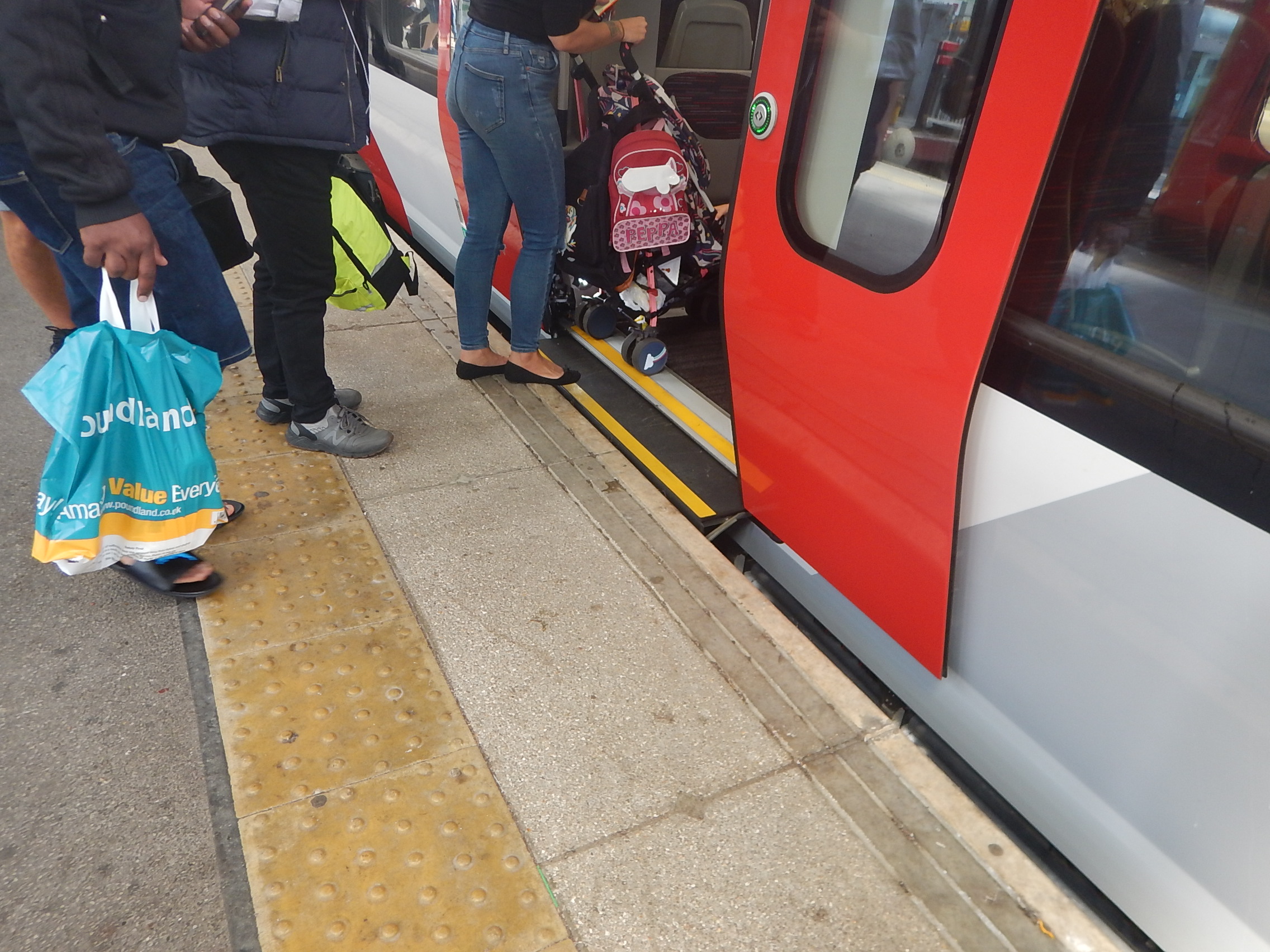
And this is the step on one of Hitachi’s new trains.
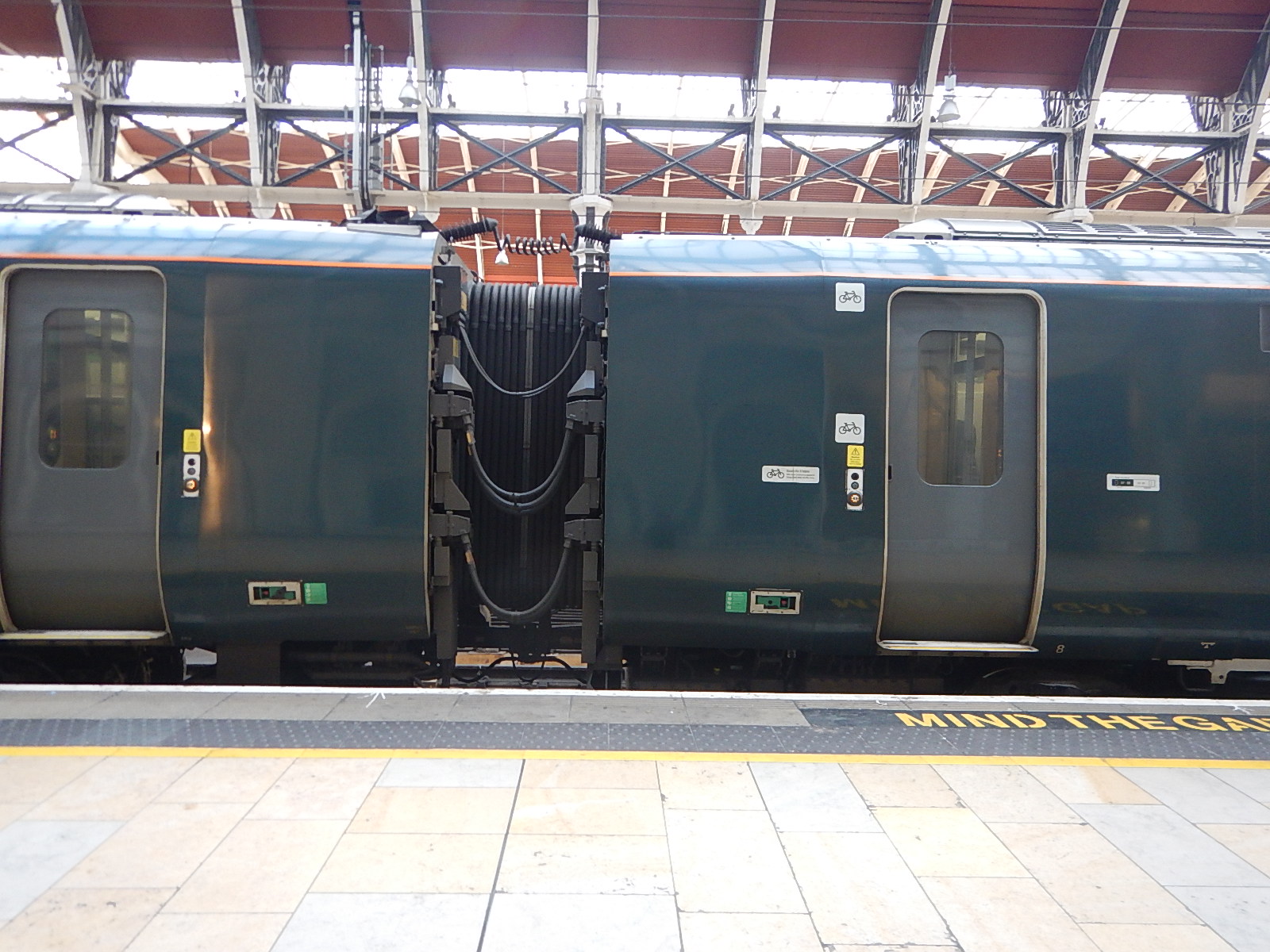
Note that all doors on these Hitachi trains are also far too narrow.
Some train manufacturers can do much better.
Recurring Themes
In this analysis, there are factors that keep cropping up.
Digital Signalling Or ERTMS
This is the key to squeezing more trains into our overcrowded railway.
Between London and Doncaster on the East Coast Main Line, should be operational in a few years and I believe the following lines should follow as soon as possible.
- East Coast Main Line between Doncaster and York and possibly Newcastle.
- East Coast Main Line North Of Newcastle
- West Coast Main Line North Of Crewe
- West Coast Main Line South Of Crewe
- Midland Main Line
- Great Western Main Line
As a time-expired Control Engineer, I believe that in-cab digital signalling is a major key to increasing capacity.
Faster Line Speeds
Some routes like TransPennine, have Victorian line speeds
Network Rail showed how it could improve line speed with the remodelling at Market Harborough station.
Bottlenecks, like the Trowse Swing Bridge at Norwich need immediate removal, no matter what the Heritage Taliban and other Luddites say.
New Hitachi Trains
There will be several more orders for the next generation of Hitachi’s high speed trains.
I have been critical of Hitachi’s manufacturing processes for these trains in the past, but they seem now to be running well in fleet service.
A standard UK train on 125 mph lines, that can also handle 140 mph with digital signalling must be a good thing for all sorts of reasons.
New Feeder Services
Several new feeder services have been indicated and there should be a lot more of these to bring the benefit of the high speed network to more of the UK population.
Delivering The Improvements
Geographically, the places where improvements are needed are spread thinly around the country and vary from projects with a cost of tens of millions to those with costs of tens of billions.
In the UK, we tend to go for the big hit, when perhaps several smaller ones might give a better short-term improvement.
We also duck projects, which would annoy the noisy local interests.
We need to have fundamental rethink about how we deliver and pay for rail improvements.
Conclusion
I am fairly pleased overall in that I think by 2024, many places in the UK, will have a much better train service than they do now!
Delivery of High Speed Two, East West Rail and Northern Powerhouse Rail as soon as possible after 2024, will be the icing on the cake.
Will It Be A One-Nation Project?
I think it can be!
 The Anonymous Widower