Five New Railway Stations To Open Over Next Month
The title of this post is the same as that of this article on the BBC.
This is the sub-heading.
Opening dates have been announced for five new railway stations in the West Midlands following a £185m project to reinstate links not used in decades.
These two paragraphs add more details.
On the Black Country line, new stations for Willenhall and Darlaston open on 19 March. The sites were last visited by trains in 1965.
On 7 April, Camp Hill Line stations Moseley Village, Kings Heath, and Pineapple Road open, allowing locals access to neighbourhood services for the first time since World War Two.
I shall go up, some time on or after the 7th and see all five stations.
New Station Openings In Early 2026
This post is for two reasons.
I needed an answer to my query.
I wanted to explore the competence of Google AI.
When I typed the title of this post into Google AI, I received this answer.
Several new railway stations in the UK are scheduled to open or begin passenger services in early 2026, primarily in the West Midlands, Northumberland, Devon, and Cambridgeshire.
- Darlaston (between Walsall and Wolverhampton)
- Willenhall (between Walsall and Wolverhampton)
- Kings Heath (Camp Hill line, Birmingham)
- Moseley Village (Camp Hill line, Birmingham)
- Pineapple Road (Camp Hill line, Birmingham)
- Bedlington
- Northumberland Park (interchange with Tyne and Wear Metro)
- Cambridge South (Cambridgeshire) – Expected to open in June 2026, connecting the biomedical campus to London, Birmingham, Stansted, and Gatwick airports.
- Okehampton Interchange (Devon) – This new park and ride station, part of the Devon Metro plan, is planned to open in spring 2026.
- Magna (Rotherham) – A new tram-train and park & ride stop is due to open in early 2026.
- Darlington Station redevelopment (County Durham) – Major redevelopment works are “on target” for completion in spring 2026.
It looks to me, that Google AI made a good fist of my question.
250,000 Seats A Day On The WCML?
The title of this post, is the same as that of this article on Rail Engineer.
These are the first three paragraphs.
In the Parliamentary debate on the cancellation of HS2 phase 2, Transport Minister Mark Harper claimed that what remains of HS2 will deliver “a massive increase in capacity to the West Coast Main Line (WCML)” by providing 250,000 seats a day. This figure was subsequently repeated by the Prime Minister and Rail Minister who advised that it applies “across the primary long-distance operator on the West Coast.”
Yet without HS2 phase 2a, there is to be no WCML capacity increase north of Lichfield. Furthermore, with no HS2 station in Manchester it will not be possible to run the planned two-unit 400-metre HS2 trains to the city. Instead, there can only be single 200-metre unit HS2 trains which are shorter than the current 265-metre Pendolino trains.
Furthermore, 250,000 seats a day is equivalent to running 17 x 605-seat Pendolinos an hour, 24 hours a day. This is clearly not credible.
Note.
- The writer’s assumptions about Manchester are correct.
- Liverpool Lime Street is already is already HS2-ready for trains between Crewe and London, after the recent upgrade.
- Liverpool Lime Street will certainly be able to take two London trains per hour (tph), which can only be single 200-metre unit HS2 trains.
- Liverpool Lime Street may be able to take a third London train per hour.
These are my thoughts.
Current Services
Current services include.
- Avanti West Coast – London Euston and Blackpool North via Birmingham New Street – 2 trains per day (tpd)
- Avanti West Coast – London Euston and Glasgow Central via Birmingham New Street – 5 tpd
- Avanti West Coast – London Euston and Edinburgh Waverley via Birmingham New Street – 7 tpd
- Avanti West Coast – London Euston and Birmingham New Street – 1 tph
- Avanti West Coast – London Euston and Holyhead – 10 tpd
- Avanti West Coast – London Euston and Liverpool Lime Street – 1 tph – Increasing to 2 tph.
- Avanti West Coast – London Euston and Manchester Piccadilly via Stoke-on-Trent, Macclesfield and Stockport – 1 tph
- Avanti West Coast – London Euston and Manchester Piccadilly via Stoke-on-Trent and Stockport – 1 tph
- Avanti West Coast – London Euston and Manchester Piccadilly via Crewe, Wilmslow and Stockport – 1 tph
- Avanti West Coast – London Euston and Glasgow Central – 1 tph.
- West Midlands Trains – London and Birmingham New Street – 2 tph
- West Midlands Trains – London and Crewe – 1 tph
- West Midlands Trains – Birmingham New Street and Liverpool Lime Street – 1 tph
It looks like there are eight Avanti West Coast tph and two West Midlands Trains tph between Stafford and Crewe.
High Speed Two Services
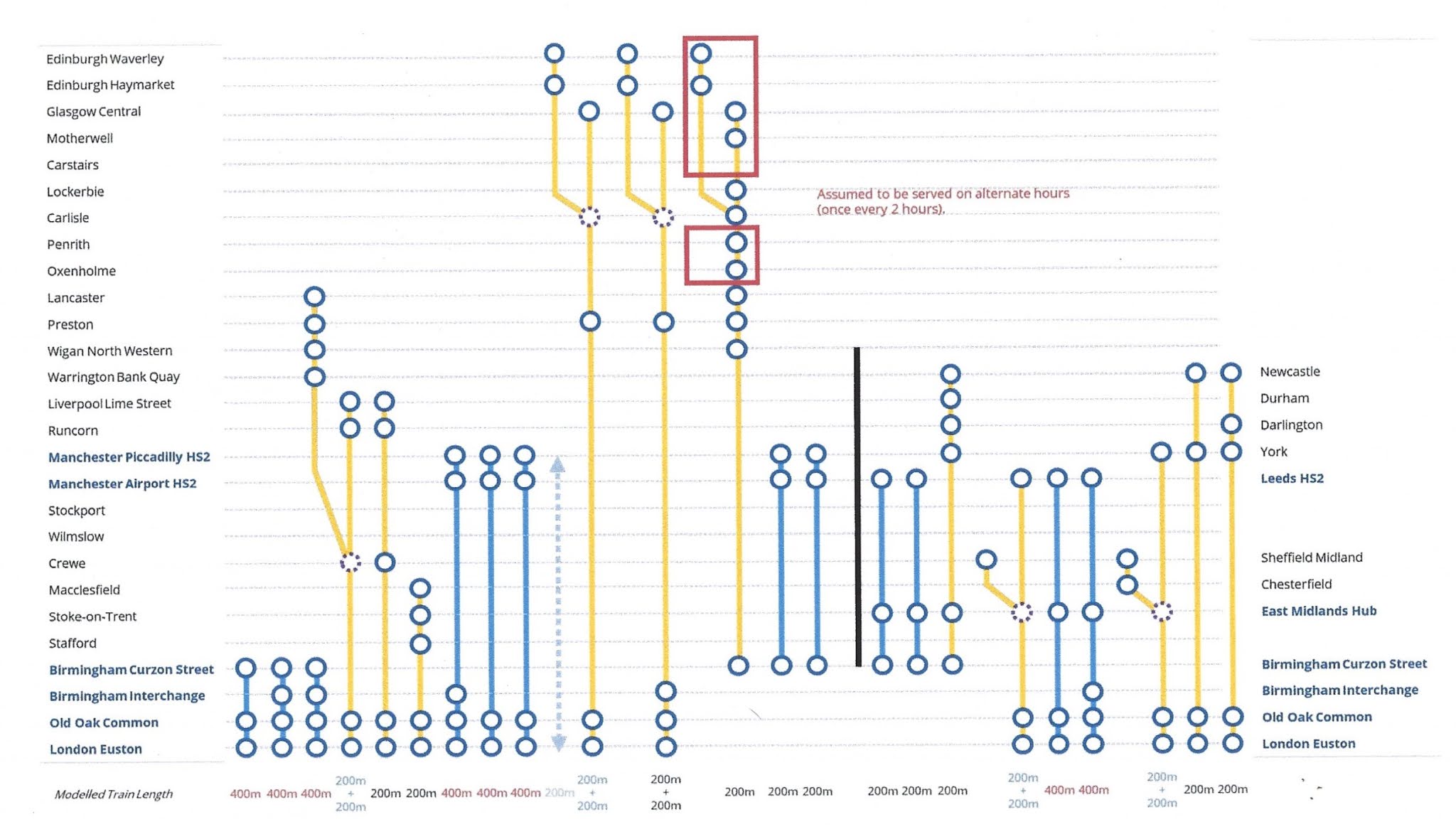
This diagram shows High Speed Two services, as they were originally envisaged before Phase 2 was discontinued.
Note.
- Trains to the left of the vertical black line are Phase 1 and those to the right are Phase 2.
- Full-Size trains are shown in blue.
- Classic-Compatible trains are shown in yellow.
- The dotted circles are where trains split and join.
- In the red boxes routes alternate every hour.
- Was Lancaster chosen as it’s close to the new Eden Project Morecambe?
Click on the diagram to enlarge it.
The Author’s Assumption
The author has made these assumptions.
- Current West Coast Main Line capacity North of Lichfield; Avanti West Coast – 8 tph, West Midlands – 1 tph and freight trains – 4 tph
- HS2 offers no extra capacity North of Lichfield.
- Max capacity ; Old Oak Common – 8 tph and London Euston – 10 tph.
- 400-metre long trains North of Birmingham ; Min – 1 tph to Edinburgh/Glasgow
- 400-metre long trains North of Birmingham ; Max – plus 3 tph to Liverpool/Manchester
- Trains operate a maximum of 14 hours per day.
I would add.
- All pairs of 200-metre long trains split and join at Crewe.
- Birmingham Curzon Street has seven platforms.
- Lancaster and Macclesfield have long bay platforms, that can handle 200-metre trains
- Liverpool Lime Street and Manchester Piccadilly have two platforms, that can handle 200-metre trains.
- I suspect
- Liverpool Lime Street and Manchester Piccadilly could both handle four 200-metre trains tph hour – Three for London and one for Birmingham.
There is a surprising amount of capacity in the North.
The Author’s Minimum Plan For HS1 – Phase 1
I think his minimum plan is as follows.
- Old Oak Common and Birmingham Curzon Street – 400-metre long trains – 3 tph
- Old Oak Common and Liverpool Lime Street/Lancaster – 400-metre long trains – 1 tph – Splits at Crewe.
- Old Oak Common and Liverpool Lime Street – 200-metre long trains – 1 tph
- Old Oak Common and Macclesfield via Stafford and Stoke-on-Trent – 200-metre long trains – 1 tph
- Old Oak Common and Manchester Piccadilly – 200-metre long trains – 2 tph
- Old Oak Common and Edinburgh Waverley/Glasgow Central – 400-metre long trains – 1 tph – Splits at Crewe.
Note.
- 400-metre long trains are a pair of 200-metre long trains, that can split and join.
- This fulfils all the requirements of the original HS2 timetable for Phase 1.
- The total is nine tph and Old Oak Common can only handle 8 tph.
- Perhaps, the Liverpool Lime Street service could be a Liverpool Lime Street/Manchester Piccadilly service, that splits at Crewe?
I think it could work with London having the following services.
- Birmingham Curzon Street – 400-metre long trains – 3 tph
- Birmingham International – 400-metre long trains – 4 tph
- Carlisle – 200-metre long trains – 1 tph
- Crewe – 400-metre long trains – 3 tph
- Edinburgh Waverley – 200-metre long trains – 1 tph
- Glasgow Central – 200-metre long trains – 1 tph
- Lancaster – 200 metre long trains – 1 tph
- Liverpool Lime Street – 200-metre long trains – 2 tph
- Macclesfield – 200-metre long trains – 1 tph
- Manchester Piccadilly – 200-metre long trains – 2/3 tph
- Preston – 200-metre long trains – 2 tph
- Stafford – 200-metre long trains – 1 tph
- Stoke-on-Trent – 200-metre long trains – 1 tph
- Warrington Bank Quay – 200-metre long trains – 1 tph
- Wigan North Western – 200-metre long trains – 1 tph
Services care as good or better than the current services.
The Author’s Maximum Plan For HS1 – Phase 1
I think his maximum plan is as follows.
- London Euston and Birmingham Curzon Street – 400-metre long trains – 3 tph
- London Euston and Liverpool Lime Street/Lancaster – 400-metre long trains – 1 tph – Splits at Crewe.
- London Euston and Liverpool Lime Street/Manchester Piccadilly – 400-metre long trains – 1 tph – Splits at Crewe.
- London Euston and Macclesfield via Stafford and Stoke-on-Trent – 200-metre long trains – 1 tph
- London Euston and Manchester Piccadilly – 200-metre long trains – 2 tph
- London Euston and Edinburgh Waverley/Glasgow Central – 400-metre long trains – 1 tph – Splits at Crewe.
Note.
- 400-metre long trains are a pair of 200-metre long trains, that can split and join.
- This fulfils all the requirements of the original HS2 timetable for Phase 1.
- That is nine tph and London Euston can handle 10 tph.
- Perhaps, a tenth train could serve Edinburgh Waverley/Glasgow Central with a split at Crewe.
It should work.
Could High Speed Birmingham Curzon Street and Liverpool Lime Street And Manchester Piccadilly Services Be Provided With A Reverse At Birmingham Curzon Street?
A train would take this route.
- A 400 metre long train would leave London and go to Birmingham Curzon Street.
- At Birmingham Curzon Street the train would reverse and travel to Crewe.
- At Crewe the train would split with separate trains going to Liverpool Lime Street and Manchester Piccadilly.
Note.
- Automation could be used extensively to do the joining and splitting.
- The train would have an onboard team of drivers, so all joins, reverses and splits are performed as fast as possible.
- A local service could be paired with each train, so that intermediate stations on the Liverpool and Manchester branches had excellent connections to Birmingham and the South.
Suppose the maximum plan is now as follows.
- London Euston and Liverpool Lime Street/Manchester Piccadilly via Birmingham Curzon Street – 400 metre long trains – 3 tph – Reverses at Birmingham Curzon Street – Splits at Crewe.
- London Euston and Birmingham Curzon Street – 400 metre long trains – 1 tph
- London Euston and Lancaster – 200 metre long trains – 1 tph
- London Euston and Liverpool Lime Street – 200 metre long trains – 1 tph
- London Euston and Macclesfield via Stafford and Stoke-on-Trent – 200 metre long trains – 1 tph
- London Euston and Manchester Piccadilly – 200 metre long trains – 1 tph
- London Euston and Edinburgh Waverley/Glasgow Central – 400 metre long trains – 2 tph – Splits at Crewe.
Note.
- Birmingham Curzon Street, Liverpool Lime Street and Manchester Piccadilly would all get four tph to and from London.
- Birmingham Curzon Street, Liverpool Lime Street and Manchester Piccadilly would all get one tph to and from London, that could be non-stop and didn’t join, reverse or split.
- Birmingham Curzon Street and Liverpool Lime Street would have a three tph service.
- Birmingham Curzon Street and Manchester Piccadilly would have a three tph service.
- Lancaster, Edinburgh Waverley, Glasgow Central and other stations would get the originally-promised service to and from London.
- That is ten tph to and from London Euston and the station can handle that number of trains.
It should work.
Could High Speed Birmingham Curzon Street and Edinburgh Waverley and Glasgow Central Services Be Provided With A Reverse At Birmingham Curzon Street?
In the previous section, I showed how, three tph between London Euston and Liverpool Lime Street/Manchester Piccadilly could be provided with a reverse at Birmingham Curzon Street.
So could the fourth train between London and Birmingham Curzon Street take this route?
- A 400 metre long train would leave London and go to Birmingham Curzon Street.
- At Birmingham Curzon Street the train would reverse and travel to Crewe, or another station, where the split can be performed.
- The train would split with separate trains going to Edinburgh Waverley and Glasgow Central.
Note.
- They would use the current paths used by Avanti West Coast Birmingham and Scotland services along the West Coast Main Line.
- This would give a third train to both Edinburgh Waverley and Glasgow Central.
It certainly appears that by using a reverse at Birmingham Curzon Street, more capacity can be created on the West Coast Main Line/HS2 route.
Could High Speed Two Serve North Wales?
It finally looks like the North Wales Coast Lines will finally be electrified.
- Would this allow a 200 metre long train to run all the way to Holyhead for the boats to Ireland?
- There could be a join and split at Crewe with another train.
- Chester would also be served by HS2.
It would create a zero-carbon route to Ireland.
What Would Be The Daily Number Of Passengers Carried?
The maximum plan could now be as follows.
- London Euston and Liverpool Lime Street/Manchester Piccadilly via Birmingham Curzon Street – 400 metre long trains – 3 tph – Splits at Crewe.
- London Euston and Edinburgh Waverley/Glasgow Central via Birmingham Curzon Street – 400 metre long trains – 1 tph – Splits at Crewe.
- London Euston and Liverpool Lime Street/Lancaster – 400 metre long trains – 1 tph – Splits at Crewe.
- London Euston and Macclesfield via Stafford and Stoke-on-Trent – 200 metre long trains – 1 tph
- London Euston and Manchester Piccadilly/Holyhead – 400 metre long trains – 1 tph – Splits at Crewe.
- London Euston and Edinburgh Waverley/Glasgow Central – 400 metre long trains – 2 tph – Splits at Crewe.
Note.
- There are eight 400 metre long trains and one 200 metre long trains in both directions.
- A 200 metre long train hold 550 passengers.
- There are seventeen 200 metre long tph in both directions.
- Trains operate a maximum of 14 hours per day.
The number of passengers per day is 261,800.
Did A Day In A Class 350 Train Lower My INR?
Yesterday, I went to Birmingham to take pictures of the rebuilt Birmingham University station.
- I travelled by West Midlands Trains catching the 11:23 to Birmingham New Street station, where it arrived at 13:45.
- Coming home, I caught the 15:36 from Birmingham New Street station, which arrived in Euston at 17:49.
So I spent nearly four and a half hours in the train.
This morning, when I measured my INR, it was only 1.8.
Did the weather and the train’s air-conditioning conspire to lower my INR by removing water from my body?
Could Open Access Operators Use High Speed Two?
In Mayors Propose New Staffordshire To Manchester Rail Line, I suggested the Grand Union Trains might like to run their service between London Euston and Stirling via High Speed Two.
But would this be a feasible idea?
These are my thoughts.
What Is An Open Access Operator?
The Wikipedia entry for Open-Access Operator, provide this answer.
In rail transport, an open-access operator is an operator that takes full commercial risk, running on infrastructure owned by a third party and buying paths on a chosen route and, in countries where rail services run under franchises, are not subject to franchising.
It then lists fifty-four operators in fifteen countries.
As the companies, who provide the services take full commercial risk and don’t get a subsidy from the taxpayer, I don’t see why, that providing, the operator can get the paths, they should be allowed to operate.
If they fail, then that’s the operator’s problem.
Are Any Paths Available On High Speed Two?
These are High Speed Two services as originally planned.
Since the Eastern Leg was cancelled, the following has happened.
- There are only eleven trains per hour (tph) between London Euston and Birmingham Interchange.
- There are only ten tph between Birmingham and Crewe.
- There is one tph between Birmingham and Macclesfield via Stafford and Stoke-on-Trent.
Note.
The Trent Valley Line section between Stafford and Crewe is 24.3 miles.
The Trent Valley Line between Handsacre Junction and Crewe is nearly all four tracks.
Currently, this section carries these fast trains.
- Avanti West Coast – 1 tph – London Euston to Blackpool North, Edinburgh or Glasgow via Birmingham New Street.
- Avanti West Coast – 1 tph – London Euston to North Wales
- Avanti West Coast – 1 tph – London Euston to Liverpool Lime Street
- Avanti West Coast – 2 tph – London Euston to Manchester Piccadilly
- Avanti West Coast – 1 tph – London Euston to Scotland
- West Midlands Trains – 1 tph – London Euston to Crewe.
- West Midlands Trains – 1 tph – Stafford to Crewe.
- West Midlands Trains – 1 tph – Birmingham New Street to Liverpool Lime Street.
This totals nine tph and will be 10 tph, when a second London Euston to Liverpool Lime Street is added.
When High Speed Two opens between London Euston and Birmingham Curzon and Handsacre Junction, trains between London Euston and Liverpool, Manchester, the North and Scotland will switch to the Trent Valley Line at Handsacre Junction.
The Trent Valley Line section between Stafford and Crewe will carry these fast trains.
- Avanti West Coast – 1 tph – London Euston to North Wales
- High Speed Two – 2 tph – London Euston to Liverpool Lime Street
- High Speed Two – 3 tph – London Euston to Manchester Piccadilly
- High Speed Two – 2 tph – London Euston to Scotland
- High Speed Two – 1 tph – Birmingham Curzon Street to Scotland
- High Speed Two – 2 tph – Birmingham Curzon Street to Manchester Piccadilly
- West Midlands Trains – 1 tph – London Euston to Crewe.
- West Midlands Trains – 1 tph – Stafford to Crewe.
- West Midlands Trains – 1 tph – Birmingham New Street to Liverpool Lime Street
Note.
- This totals to ten tph for High Speed Two, 1 tph for Avanti West Coast and the tph for West Midlands Trains.
- There is no service to Blackpool.
- It looks to me that the London Euston to North Wales should, as soon as the North Wales Coast Line is electrified become a High Speed Two service.
- Should the Birmingham New Street to Liverpool Lime Street service be replaced with a High Speed Two from Birmingham Curzon Street to Liverpool Lime Street?
There is plenty of paths South of Handsacre Junction on High Speed Two to accommodate a few services to Blackpool and an open access operator like Grand Union Trains, who have been given permission to run a service to Stirling.
Conclusion
My rough calculation says that open access services could be fitted in on the latest variant of High Speed Two.
In Mayors Propose New Staffordshire To Manchester Rail Line, the two Andies; Burnham and Street proposed that the Handsacre Junction and Manchester Airport section of High Speed Two should be built.
If this should happen, then it would open up several possibilities for open access services for the North.
Carew Castle Express Unveiled In Carmarthen
The title of this post, is the same as that of this article on Rail UK.
These are the first two paragraphs.
The ‘Carew Castle Express’ has been unveiled to mark the introduction of brand-new Transport for Wales (TfW) trains between Swansea and Carmarthen.
Named as part of TfW’s Magnificent Train Journey competition, the name ‘Carew Castle Express’ was chosen by year 5 pupil Rhys Protheroe from Johnstown Primary School in Carmarthen.
But perhaps, this extract is the most significant statement in the article.
Soon every service west of Carmarthen will be on one of the brand-new trains.
Alexia Course, chief commercial officer for TfW, said: “We’re excited to be running our brand-new trains in West Wales and we’re adding more to our network every few weeks.
CAF and TfW don’t seem to be hanging about in getting these new trains into service.
But then, I suspect some of the trains they replace, will be going to the scrapyard in Newport.
How Will These Trains Be Decarbonised?
My one worry is that these Class 197 trains and the similar Class 195 trains at Northern and the Class 196 trains at West Midlands Trains are diesel powered.
Nothing has been said about how these 141 trains will be decarbonised.
But all three fleets have the same Rolls-Royce mtu 6H 1800 R85L engines, so at least one solution will fit all!
A Thought About LNER’s New Trains
These trains appear to have been delivered quickly.
Did this influence the decision of LNER to buy CAF trains for their fleet expansion?
Will High Speed Two Lite Make Stafford An Important Station?
Stafford station is where the Trent Valley Line joins the West Coast Main Line and with the current proposals for High Speed Two, which I refer to as High Speed Two Light, it will also have to handle those High Speed Two services to and from Crewe.
Current Services Through Stafford Station
These are current services through Stafford station.
- Avanti West Coast – London Euston and Blackpool North via Birmingham – 2 tpd – Stops at Wolverhampton, Stafford and Crewe
- Avanti West Coast – London Euston and Glasgow Central via Birmingham – 5 tpd – Stops at Wolverhampton, Stafford and Crewe
- Avanti West Coast – London Euston and Edinburgh via Birmingham – 7 tpd – Stops at Wolverhampton, Stafford and Crewe
- Avanti West Coast – London Euston and Blackpool North via Trent Valley – 1 tpd – Stops at Stafford and Crewe
- Avanti West Coast – London Euston and Glasgow Central via Trent Valley – 1 tph – Non-Stop
- Avanti West Coast – London Euston and Holyhead via Trent Valley – 8 tpd – Stops at Stafford and Crewe
- Avanti West Coast – London Euston and Liverpool Lime Street via Trent Valley – 1 tph – Stops at Crewe
- Avanti West Coast – London Euston and Manchester Piccadilly via Trent Valley – 1 tph – Stops at Stafford and Crewe
- CrossCountry – Birmingham New Street and Manchester via Wolverhampton and Stoke-on-Trent – 2 tph – Stops at Wolverhampton, Stafford and Stoke-on-Trent.
- West Midlands – London Euston and Crewe via Trent Valley – 1 tph – Stops at Stafford and Crewe
- West Midlands – Birmingham New Street and Crewe via Wolverhampton and Stoke-on-Trent – 1 tph – Stops at Wolverhampton, Stafford, Stoke-on-Trent and Crewe
- West Midlands – Birmingham New Street and Liverpool Lime Street via Wolverhampton – 1 tph – Stops at Wolverhampton, Stafford and Crewe
Note.
- tpd is trains per day.
- tph is trains per hour.
- Through Stafford station, there are totals of 23 tpd and 8 tph.
- Along the Trent Valley Line, there are totals of 9 tpd and 4 tph.
- North of Stafford on the West Coast Main Line, there are totals of 23 tpd and 4 tph.
- South of Stafford on the West Coast Main Line, there are totals of 14 tpd and 4 tph.
- Between Stafford and Stoke-on-Trent, there are totals of 3 tph.
Stafford is a very busy station.
Services have these frequencies from Stafford.
- Crewe – 21 tpd and 3 tph.
- Stoke-on-Trent – 3 tph.
- London Euston – 23 tpd and 4 tph.
- Wolverhampton – 13 tpd and 4 tph.
Could Stoke-on-Trent and Stafford do with a few extra services?
High Speed Two Services Through Stafford Station
This graphic shows High Speed Two services after Phase 2b is completed.
Note.
- Services shown in blue are run by High Speed Two Full Size trains.
- Services shown in yellow are run by High Speed Two Classic-Compatible trains.
- Each of these trains will have a frequency of one tph.
These could be High Speed Two services through Stafford station, when High Speed Two Lite opens.
- High Speed Two – London Euston and Liverpool Lime Street/Lancaster via High Speed Two and Trent Valley Line – 1 tph – Stops at Crewe
- High Speed Two – London Euston and Liverpool Lime Street via High Speed Two and Trent Valley Line – 1 tph – Stops at Crewe
- High Speed Two – London Euston and Macclesfield via High Speed Two and Trent Valley Line – 1 tph – Stops at Stafford and Stoke-on-Trent
- High Speed Two – London Euston and Manchester Piccadilly via High Speed Two and Trent Valley Line – 3 tph
- High Speed Two – London Euston and Glasgow/Edinburgh via High Speed Two and Trent Valley Line – 2 tph
- High Speed Two – Birmingham and Glasgow/Edinburgh via High Speed Two and Trent Valley Line – 1 tph
- High Speed Two – Birmingham and Manchester Piccadilly via High Speed Two and Trent Valley Line – 2 tph
Note.
- Through Stafford station, there are totals of 11 tph.
- Along the Trent Valley Line, there are totals of 11 tph.
- North of Stafford on the West Coast Main Line, there are totals of 11 tph.
- Between Stafford and Stoke-on-Trent, there are totals of 1 tph.
There are a lot of trains to squeeze through. But remember that High Speed Two signalling is designed to handle 18 tph.
Combined Services Through Stafford Station
These could be the combined current High Speed Two services through Stafford station, when High Speed Two Lite opens.
- Avanti West Coast – London Euston and Blackpool North via Birmingham – 2 tpd – Stops at Wolverhampton, Stafford and Crewe
- Avanti West Coast – London Euston and Glasgow Central via Birmingham – 5 tpd – Stops at Wolverhampton, Stafford and Crewe
- Avanti West Coast – London Euston and Edinburgh via Birmingham – 7 tpd – Stops at Wolverhampton, Stafford and Crewe
- Avanti West Coast – London Euston and Blackpool North via Trent Valley – 1 tpd – Stops at Stafford and Crewe
- Avanti West Coast – London Euston and Glasgow Central via Trent Valley – 1 tph – Non-Stop
- Avanti West Coast – London Euston and Holyhead via Trent Valley – 8 tpd – Stops at Stafford and Crewe
- Avanti West Coast – London Euston and Liverpool Lime Street via Trent Valley – 1 tph – Stops at Crewe
- Avanti West Coast – London Euston and Manchester Piccadilly via Trent Valley – 1 tph – Stops at Stafford and Crewe
- CrossCountry – Birmingham New Street and Manchester via Wolverhampton and Stoke-on-Trent – 2 tph – Stops at Wolverhampton, Stafford and Stoke-on-Trent.
- West Midlands – London Euston and Crewe via Trent Valley – 1 tph – Stops at Stafford and Crewe
- West Midlands – Birmingham New Street and Crewe via Wolverhampton and Stoke-on-Trent – 1 tph – Stops at Wolverhampton, Stafford, Stoke-on-Trent and Crewe
- West Midlands – Birmingham New Street and Liverpool Lime Street via Wolverhampton – 1 tph – Stops at Wolverhampton, Stafford and Crewe
- High Speed Two – London Euston and Liverpool Lime Street/Lancaster via High Speed Two and Trent Valley Line – 1 tph – Stops at Crewe
- High Speed Two – London Euston and Liverpool Lime Street via High Speed Two and Trent Valley Line – 1 tph – Stops at Crewe
- High Speed Two – London Euston and Macclesfield via High Speed Two and Trent Valley Line – 1 tph – Stops at Stafford and Stoke-on-Trent
- High Speed Two – London Euston and Manchester Piccadilly via High Speed Two and Trent Valley Line – 3 tph
- High Speed Two – London Euston and Glasgow/Edinburgh via High Speed Two and Trent Valley Line – 2 tph
- High Speed Two – Birmingham and Glasgow/Edinburgh via High Speed Two and Trent Valley Line – 1 tph
- High Speed Two – Birmingham and Manchester Piccadilly via High Speed Two and Trent Valley Line – 2 tph
Note.
- Through Stafford station, there are totals of 23 tpd and 19 tph.
- Along the Trent Valley Line, there are totals of 9 tpd and 15 tph.
- North of Stafford on the West Coast Main Line, there are totals of 23 tpd and 15 tph.
- Between Stafford and Stoke-on-Trent, there are totals of 4 tph.
But there are duplicate services.
High Speed Two services to Liverpool, Manchester and Scotland, will replace Avanti West Coast services.
High Speed Two services between Birmingham and Manchester, will replace CrossCountry services.
Removing these current services gives.
- Avanti West Coast – London Euston and Blackpool North via Birmingham – 2 tpd – Stops at Wolverhampton, Stafford and Crewe
- Avanti West Coast – London Euston and Blackpool North via Trent Valley – 1 tpd – Stops at Stafford and Crewe
- Avanti West Coast – London Euston and Holyhead via Trent Valley – 8 tpd – Stops at Stafford and Crewe
- West Midlands – London Euston and Crewe via Trent Valley – 1 tph – Stops at Stafford and Crewe
- West Midlands – Birmingham New Street and Crewe via Wolverhampton and Stoke-on-Trent – 1 tph – Stops at Wolverhampton, Stafford, Stoke-on-Trent and Crewe
- West Midlands – Birmingham New Street and Liverpool Lime Street via Wolverhampton – 1 tph – Stops at Wolverhampton, Stafford and Crewe
- High Speed Two – London Euston and Liverpool Lime Street/Lancaster via High Speed Two and Trent Valley Line – 1 tph – Stops at Crewe
- High Speed Two – London Euston and Liverpool Lime Street via High Speed Two and Trent Valley Line – 1 tph – Stops at Crewe
- High Speed Two – London Euston and Macclesfield via High Speed Two and Trent Valley Line – 1 tph – Stops at Stafford and Stoke-on-Trent
- High Speed Two – London Euston and Manchester Piccadilly via High Speed Two and Trent Valley Line – 3 tph
- High Speed Two – London Euston and Glasgow/Edinburgh via High Speed Two and Trent Valley Line – 2 tph
- High Speed Two – Birmingham and Glasgow/Edinburgh via High Speed Two and Trent Valley Line – 1 tph
- High Speed Two – Birmingham and Manchester Piccadilly via High Speed Two and Trent Valley Line – 2 tph
Note.
- Through Stafford station, there are totals of 11 tpd and 14 tph.
- Along the Trent Valley Line, there are totals of 11 tpd and 12 tph.
- North of Stafford on the West Coast Main Line, there are totals of 9 tpd and 12 tph.
- South of Stafford on the West Coast Main Line, there are totals of 2 tpd and 2 tph.
- Between Stafford and Stoke-on-Trent, there are totals of 2 tph.
With these frequencies, I suspect digital signalling will be needed.
Services have these frequencies from Stafford.
- Crewe – 11 tpd and 5 tph.
- Stoke-on-Trent – 2 tph.
- London Euston – 11 tpd and 4 tph.
- Wolverhampton – 3 tpd and 2 tph.
Note.
- Stoke-on-Trent needs more trains.
- There is virtually no trains on the West Coast Main Line to the South of Stafford.
- The frequencies indicate digital signalling will be needed.
On this brief look, I think that High Speed Two Lite will open up a lot of possibilities.
Thoughts On Rail Capacity Between London And The North
This is just a rough calculation to see how many trains can be run between London and the North.
I shall do the calculation by station.
Euston
Trains are.
- Avanti – Birmingham – 1 tph (trains per hour)
- Avanti – Blackpool North – 1 tpd (trains per day)
- Avanti – Blackpool North via Birmingham – 2 tpd
- Avanti – Edinburgh via Birmingham – 1 tp2h – (trains per two hours)
- Avanti – Glasgow – 1 tph
- Avanti – Glasgow via Birmingham – 5 tpd
- Avanti – Holyhead – 8 tpd
- Avanti – Liverpool – 1 tph
- Avanti – Manchester – 3 tph
- WMT – Birmingham – 2 tph
- WMT – Crewe – 1 tph
This gives totals of 9 tph, 1 tp2h and 16 tpd
King’s Cross
Trains are.
- Grand Central – Bradford – 4 tpd
- Grand Central – Sunderland – 6 tpd
- Hull Trains – Beverley – 2 tpd
- Hull Trains – Hull – 5 tpd
- LNER – Bradford- 2 tpd
- LNER – Edinburgh – 3 tp2h
- LNER – Harrogate – 1 tp2h
- LNER – Hull – 1 tpd
- LNER – Leeds – 3 tp2h
- LNER – Lincoln – 1 tp2h
- LNER – Middlesbrough – 1 tpd
- LNER – Skipton – 1 tpd
- LNER – Sunderland – 1 tpd
- LNER – York- 1 tp2h
- Lumo – Edinburgh – 5 tpd
This gives totals of 9 tp2h and 28 tpd
Marylebone
Trains are.
- Chiltern – Birmingham – 2 tph
This gives totals of 2 tph
St. Pancras
Trains are.
- EMR – Corby – two tph
- EMR – Nottingham – two tph
- EMR – Sheffield- two tph
This gives totals of 6 tph
Grand Totals
Grand totals are 17 tph, 10 tp2h and 44 tpd
I will assume.
- 10 tp2h is equivalent to 5 tph.
- 44 tpd is equivalent to 3 tph if trains start journeys between 0600 and 2100.
This means that currently, there is the equivalent of 25 tph between London and the North.
The Effect Of High Speed Two
The capacity of High Speed Two is 17 tph, so, that appears to be a 68 % increase in paths to the North.
Consider.
- Assume we need 25 tph between London and the North.
- 17 tph will be on High Speed Two.
- 8 tph will be on classic routes like the East Coast Main Line, Midland Main Line and West Coast Main Line.
- High Speed Two trains are 400 metres long.
- Current trains are about 240 metres long.
I have done a weighted calculation, which shows that passenger capacity between London and the North, will increase by around 45 %.
High Speed Two will surely release paths between London and the North on the classic routes, that could accommodate somewhere around 17 tph.
These could be used for.
- Services not suitable for High Speed Two
- New services
- Freight services
- Open access services
There is a lot of capacity that can be reused.
What Will Happen To Classic Routes Between London And The North?
Consider.
- The East Coast Main Line between London and Doncaster, is being upgraded with full digital signalling to allow running at up to 140 mph and increased train frequencies.
- Similar upgrades will be surely be applied to the other classic routes between London and the North.
- Important destinations, that will not be served by High Speed Two, like Coventry, Derby, Leicester, Luton, Milton Keynes and Peterborough could be given high speed connections, to Birmingham, London and Manchester.
- The East Coast Main Line, Midland Main Line and West Coast Main Line will all be electrified with some sections of quadruple track in a few years.
- Currently, the East Coast Main Line, Midland Main Line and West Coast Main Line are mainly 125 mph lines and these could be upgraded to 140 mph with digital signalling.
I could envisage the East Coast Main Line, Midland Main Line and West Coast Main Line being developed into a secondary 140 mph network based on the existing stations lines and services.
Conclusion
High Speed Two is going to have a lot of collateral benefits in Middle England.
GWR And Vivarail
This is an attempt to make some sense about what is happening between GWR and the assets of Vivarail.
These are some random thoughts.
Ongoing Maintenance Of Existing Trains
Currently, there are four operators in the UK, with various types of Vivarail‘s Class 230 trains.
- Great Western Railway – 1 – Infrastructure under construction for trial on the Greenford Branch.
- Island Line – 5 – In operation.
- Transport for Wales – 5 – Undergoing testing prior to entering service.
- West Midlands Trains – 3 – Withdrawn from service indefinitely in December 2022.
Note.
- West Midlands Trains withdrew the trains because of uncertainty about the servicing of the trains.
- West Midlands Trains are getting complaints about the bus replacement service.
- All operators will probably need assistance to service the trains.
- Great Western Railway and Island Line are First Group companies.
Could First Group have got in first, so they can protect their interests with a professional Vivarail train maintenance organisation?
Mark Hopwood
In Special Train Offers A Strong Case For Reopening Fawley Line, I said this.
This is another quote from the Rail Magazine article.
However, SWR’s Mark Hopwood favours a much bolder plan. “We’d have to take a decision, once we knew the line was going ahead. But my personal belief is that we should be looking for a modern environmentally-friendly train that can use third-rail electricity between Southampton and Totton and maybe operate on batteries down the branch line.”
Pressed on whether that would mean Vivarail-converted former-London Underground stock, Hopwood adds. “It could be. Or it could be a conversion of our own Class 456, which will be replaced by new rolling stock very shortly. But I don’t think this is the time to use old diesels.
Mark Hopwood is now the Managing Director of Great Western Railway and he seems to be in favour of battery-electric trains. I agree totally with his statement about old diesels.
Mark Hopwood And The Cholsey And Wallingford Branch
According to LinkedIn, Mark Hopwood is also the President at the Cholsey and Wallingford Railway
- This is a two-and-a-half mile long standard gauge heritage railway.
- It used to be a branch line, that served the town of Wallingford.
- It connects to the Great Western Main Line in a bay platform at Cholsey station.
- Wallingford station has now been demolished.
- The heritage railway uses a new site on the south side of St. Johns Road.
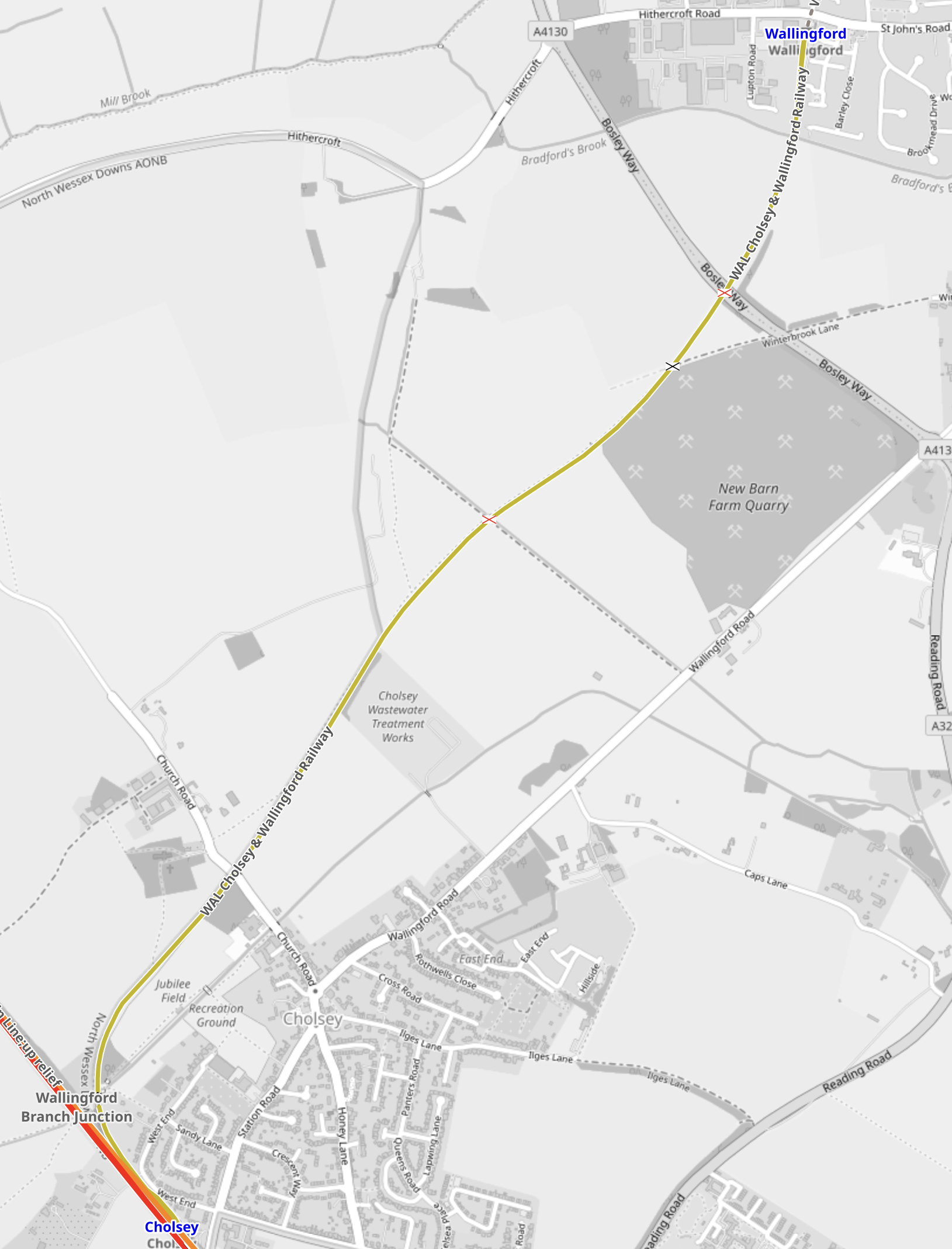
This map from OpenRailwayMap shows the branch line.
Note.
- Cholsey station and the Great Western Main Line is in the South-Western corner of the map.
- The current Wallingford station is in the North-Eastern corner.
- The Cholsey and Wallingford Railway is shown in yellow.
This Google Map shows Cholsey station.

Note.
- There are four through platforms for Great Western Railway services.
- Platforms 1 and 2 for the fast services are on the Western side.
- Platforms 3 and 4 for the slow services are on the Eastern side.
- Bay Platform 5 is tucked in the North-East corner of the station and is the terminus for services on the Cholsey and Wallingford Railway.
- There are only 55 parking spaces.
Is the number of parking spaces sufficient for the station, if a lot of passengers drive from Wallingford?
Could a commercial service run between Cholsey and Wallingford?
Consider.
- Wallingford is a town of nearly twelve thousand people.
- Cholsey station has two trains per hour (tph) between Paddington and Didcot Parkway stations, with extra services between Oxford and Reading stations in the Peaks.
- There is only limited parking at Cholsey station.
- Most GWR branch lines are run by an hourly service.
- I feel that two-car battery-electric train could provide one or two tph on the branch.
- Charging would probably be needed at only one end of the branch line.
- As all the through lines at Cholsey station are electrified with 25 KVAC overhead wires, I suspect that charging would be provided at that station.
A two-car battery-electric train could probably provide a commercial service on this branch, if the Cholsey and Wallingford Railway wanted a revenue stream.
First Group Services That Could Be Run By Battery-Electric Trains
These Great Western Railway and South Western Railway services might be suitable for battery-electric services.
- Newbury and Bedwyn – Newbury is electrified.
- West Ealing and Greenford – West Ealing is electrified.
- Slough and Windsor and Eton Central – Slough is electrified.
- Maidenhead and Marlow – Maidenhead is electrified.
- Twyford and Henley-on-Thames – Twyford is electrified.
- Reading and Gatwick Airport – Partially electrified.
- Reading and Redhill – Partially electrified.
- Reading and Basingstoke – Partially electrified.
- Didcot Parkway and Oxford – Didcot Parkway is electrified.
- Weston-super-Mare and Severn Beach – No electrification.
- Bristol Temple Meads and Avonmouth – No electrification.
- Bristol Temple Meads and Filton Abbey Wood – No electrification.
- Bristol Temple Meads and Portishead – Proposed – No electrification.
- Swindon and Westbury – Swindon is electrified.
- Exmouth and Paignton – No electrification.
- Exeter Central and Okehampton – No electrification.
- Exeter Central and Barnstaple – No electrification.
- Plymouth and Gunnislake – No electrification.
- Liskeard and Looe – No electrification.
- Par and Newquay – No electrification.
- Truro and Falmouth Docks – No electrification.
- St. Erth and St. Ives- No electrification.
- Romsey and Salisbury – Partially electrified.
- Southampton Central and Fawley – Proposed – Partially electrified.
Note.
- Most services are one or two tph or less.
- Reading and Basingstoke, Didcot Parkway and Oxford, Exmouth and Paignton, and Romsey and Salisbury are 2 tph.
- I have included the proposed Bristol Temple Meads and Portishead and Southampton Central and Fawley services.
- All electrification is 25 KVAC overhead except for the North Downs Line between Reading and Gatwick Airport via Redhill, and Romsey and Salisbury, which are 750 VDC third rail.
There are a total of 24 services. As each 2 tph service will need two trains and the North Downs services probably six, a rough calculation, indicates there would need to be a minimum of over thirty trains, to convert all these services to battery-electric operation.
This simple analysis makes Mark Hopwood’s enthusiasm, that I quoted earlier understandable.
The Requirement For First Group Battery-Electric Trains
Consider.
- Most of the services can accommodate three or four-car trains.
- A few services can only be run with two-car trains.
- Some services will need running with 25 KVAC overhead electrification for operation or deploying to and from the depot.
- Some services will need running with 750 VDC third-rail electrification for operation or deploying to and from the depot.
- A modern interior with or without a fully-accessible toilet is needed.
- Ability to recharge in a platform fitted with electrification or a charging system in under ten minutes.
- A reasonable cruising speed where electrification is needed for deployment.
This suggests to me, that two train types will be needed.
- A Vivarail-style two-car train for branches like West Ealing and Greenford and Southampton Central and Fawley.
- A three- or four-car dual-voltage electric multiple unit, based on something like an Alstom Aventra, a Bombardier Electrostar or a British Rail-era Class 321 train.
The Class 321 train could be ideal.
- It is a 100 mph train.
- It is a four-car train, that can be shortened to three-cars.
- Versions are available for both 25 KVAC overhead and 750 VDC third-rail electrification.
- Some have been converted to a modern Renatus interior, with a fully-accessible toilet.
- Greater Anglia have run Class 321 Renatus trains between London and Norwich.
- The Class 321 Renatus trains are fitted with a modern AC-based traction system.
- Eversholt Rail and Vivarail were working on a Class 321 BEMU, which I wrote about in Eversholt Rail And Vivarail To Develop Class 321 BEMU.
- Other operators like Northern, Scotrail and Transport for Wales might like a Class 321 BEMU.
Could First Group convert the Class 321 trains?
In What Train Is This?, I talk about a refurbishment of a GWR Class 150 train, that was one of the best I’ve seen.
I suspect that First Group could do the conversion, with a little help from their friends, like Wabtec and the ex-Vivarail employees, that they’ve hired.
Could The Class 387 Trains Be Converted To Battery-Electric Operation?
It was in February 2015, that I wrote Is The Battery Electric Multiple Unit (BEMU) A Big Innovation In Train Design?, after a ride in public service on Bombardier’s test battery-electric train based on a Class 379 train.

The Class 387 and Class 379 trains are very similar and with Vivarail’s battery and charging expertise, I believe that both Class 379 and Class 387 trains could be converted into modern four-car battery-electric trains.
- They would have a 100 mph or possibly a 110 mph operating speed, so could work routes like the Great Western Main Line amongst the thundering herds of Hitachis.
- The interiors would be suitable for longer routes like Cardiff Central and Exeter or Waterloo and Exeter via Salisbury.
- Great Western Railway have 33 Class 387 trains.
- Thirty Class 379 trains are wasting space in sidings.
I believe that with modern battery technology, these trains could have a battery range in excess of ninety miles.
This would enable services like Cardiff Central and Exeter St. Davids and Exeter St. Davids and Salisbury.
With judicious use of charging stations in stations like Bristol Temple Meads, Exeter St. Davids and Salisbury, all First Group main line services, that are not run by the Hitachi trains could be converted to battery-electric operation.
Conclusion
I believe a well-thought out plan is emerging.
Alstom Hydrogen Aventras And Extension Of The Birmingham Cross-City Line
In Alstom And Eversholt Rail Sign An Agreement For The UK’s First Ever Brand-New Hydrogen Train Fleet, I give my thoughts on Alstom’s new hydrogen train, which I have called the Alstom Hydrogen Aventra.
In that post, decide that the proposed Alstom Hydrogen Aventras are based on the three-car Class 730/0 trains that have been ordered by West Midlands Trains for Birmingham’s electrified Cross-City Line.
I then go on to say.
There are plans to expand the line in the future and I do wonder if the proposed Alstom Hydrogen Aventras could be the ideal trains for extending the network.
Expansion plans are detailed a section called Future, in the Wikipedia entry for the Cross-City Line, where these plans are indicated.
- Reintroduction of local trains on the Camp Hill Line.
- Extension of electrification and services to Burton-on-Trent via a reopened Alrewas station, which would serve the National Memorial Arboretum.
In addition, the Walsall and Wolverhampton Line is being reopened to passenger trains.
These new and possibly other services will need no new tracks, but more electrification and extra new trains.
In 2015, I wrote Electrification May Be In Trouble Elsewhere, But The Brummies Keep Marching On, which looked at electrification progress in the UK and the Birmingham in particular, where the electrification of the Chase Line seemed to be going well. So unlike in some places, where electrification seems to be accident-prone, Birmingham seems to avoid the sort of problems, that happened in the Preston and Blackpool and GOBlin electrifications.
But the Alstom Hydrogen Aventra gives Birmingham and the West Midlands a unique advantage compared to say Leeds or Manchester.
Birmingham can obtain a unified fleet, which to the passengers and the drivers looks the same, but in fact are two separate classes of three-car trains; the Class 730/0 electric train and the Alstom Hydrogen Aventra.
- Where electrification exists, the Class 730/0 trains will be used and where there is no electrification, the Alstom Hydrogen Aventra will work the route on hydrogen.
- All that is needed is to provide good tracks and signalling and the Alstom Hydrogen Aventras will take you where you want to go.
- Through the centre of Birmingham, these trains will use the existing electrification.
- It would be a network, that would be simple to expand.
The only other English city to use a similar technique will be Liverpool, where Merseyrail’s new Class 777 trains will use battery power outside of the electrified core.
Conclusion
If Birmingham uses their disused but still existing railway lines and adds new trains as required, they can create a world-class suburban network, with the Cross-City Line at its centre
 The Anonymous Widower