Could Trains From The North Connect To High Speed One At St. Pancras?
I was casually flying my virtual helicopter over the throat of St. Pancras International station, when I took a few pictures.
This Google Map shows the Northern ends of the platforms and the tracks leading in.
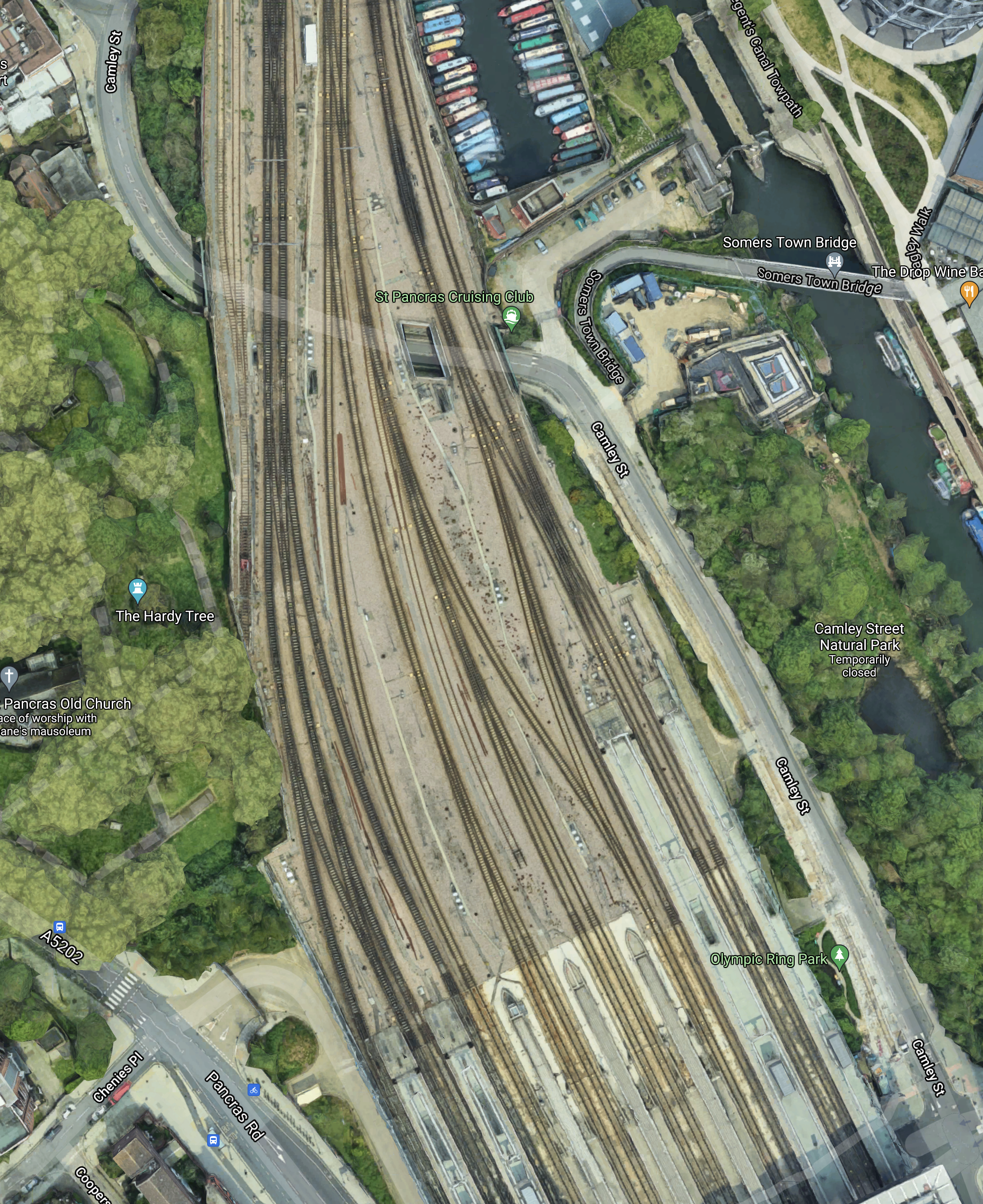
Note.
- Platforms 1-4 to the West with darker tracks handle the East Midlands Railway services.
- Platforms 5-10 in the centre with lighter tracks formed of three shorter islands handle the Eurostar services.
- Platforms 11-13 to the East with longer platforms handle the Southeastern HighSpeed services.
This Google Map shows the East Midlands Railway platforms.
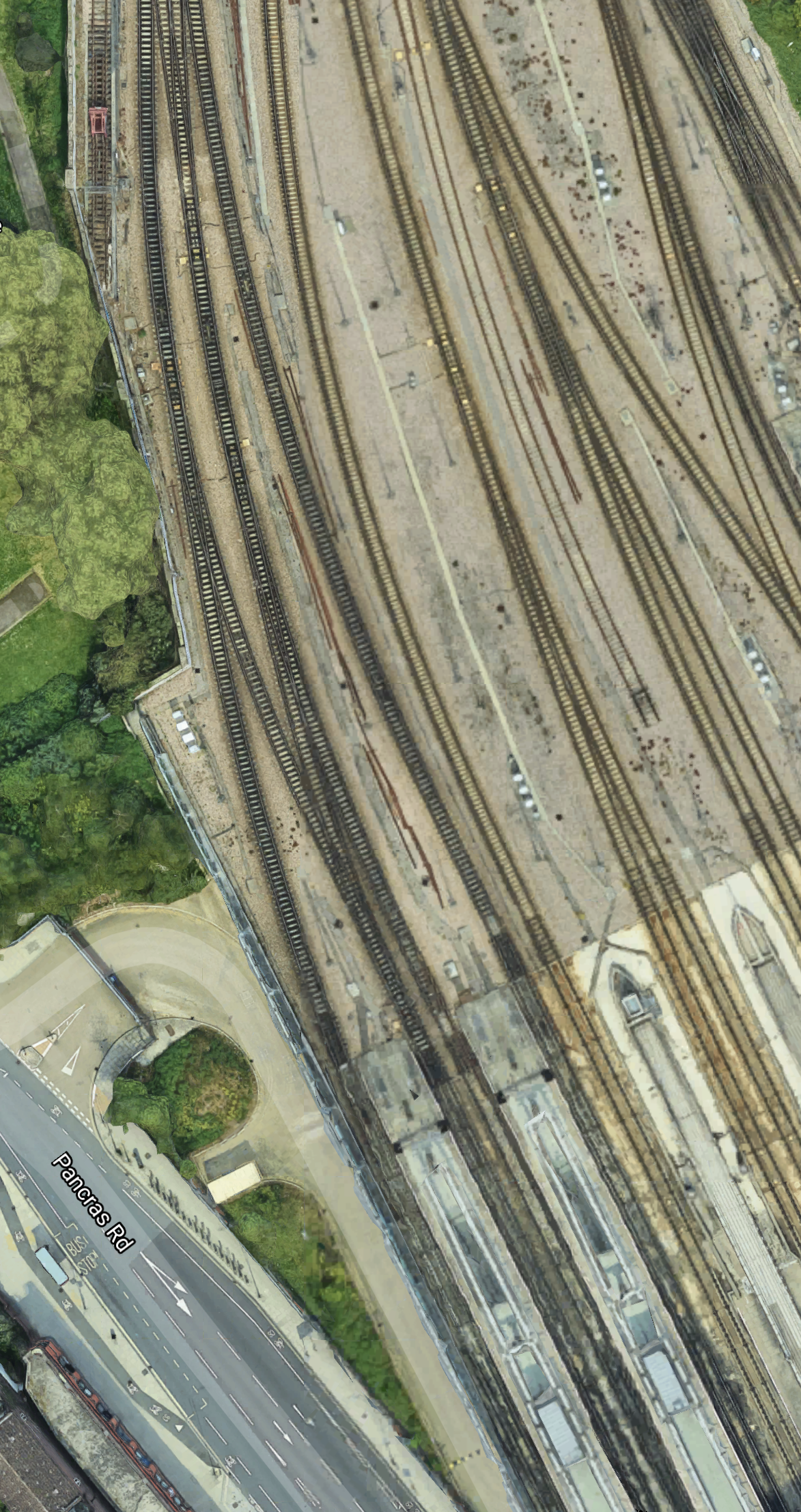
Note.
- There are two island platforms; 1-2 and 3-4.
- The four platforms are served by two tracks, that connect to the fast lines of the Midland Main Line.
- The platforms will be able to handle a pair of Class 810 trains, which will be 240 metres long.
- Will the two trains per hour (tph) using Class 360 trains between London and Corby always use the same platform at St. Prancras station?
This Google Map shows the Eurostar platforms.
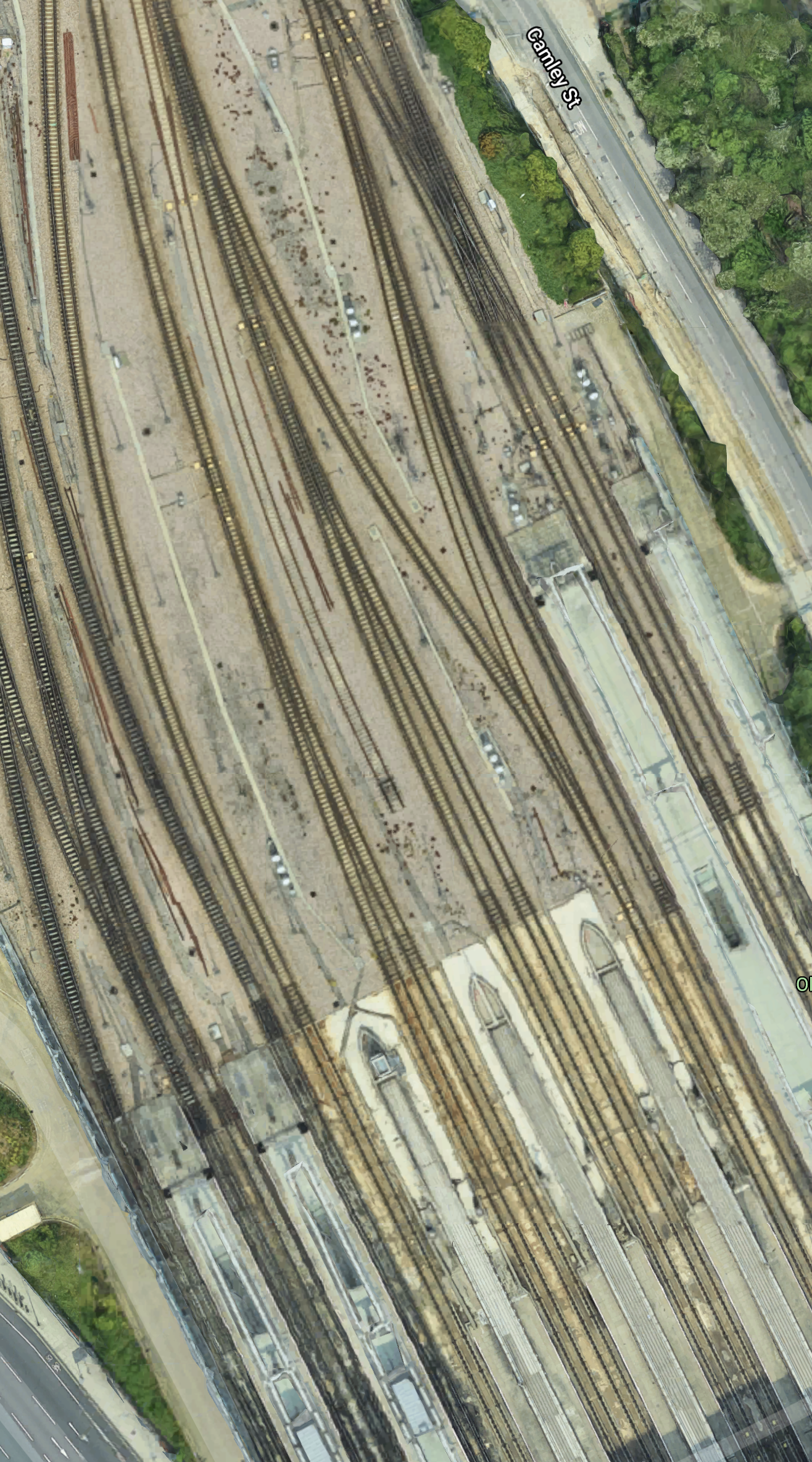
Note.
There are three island platforms; 5-6, 7-8 and 9-10.
The two island platforms in the West are for East Midlands Railway services.
The two longer island platforms in the East are for Southeastern HighSpeed services.
The six platforms connect to two fast lines, that are shared with the Southeastern services.
This Google Map shows the lines proceeding to the North.
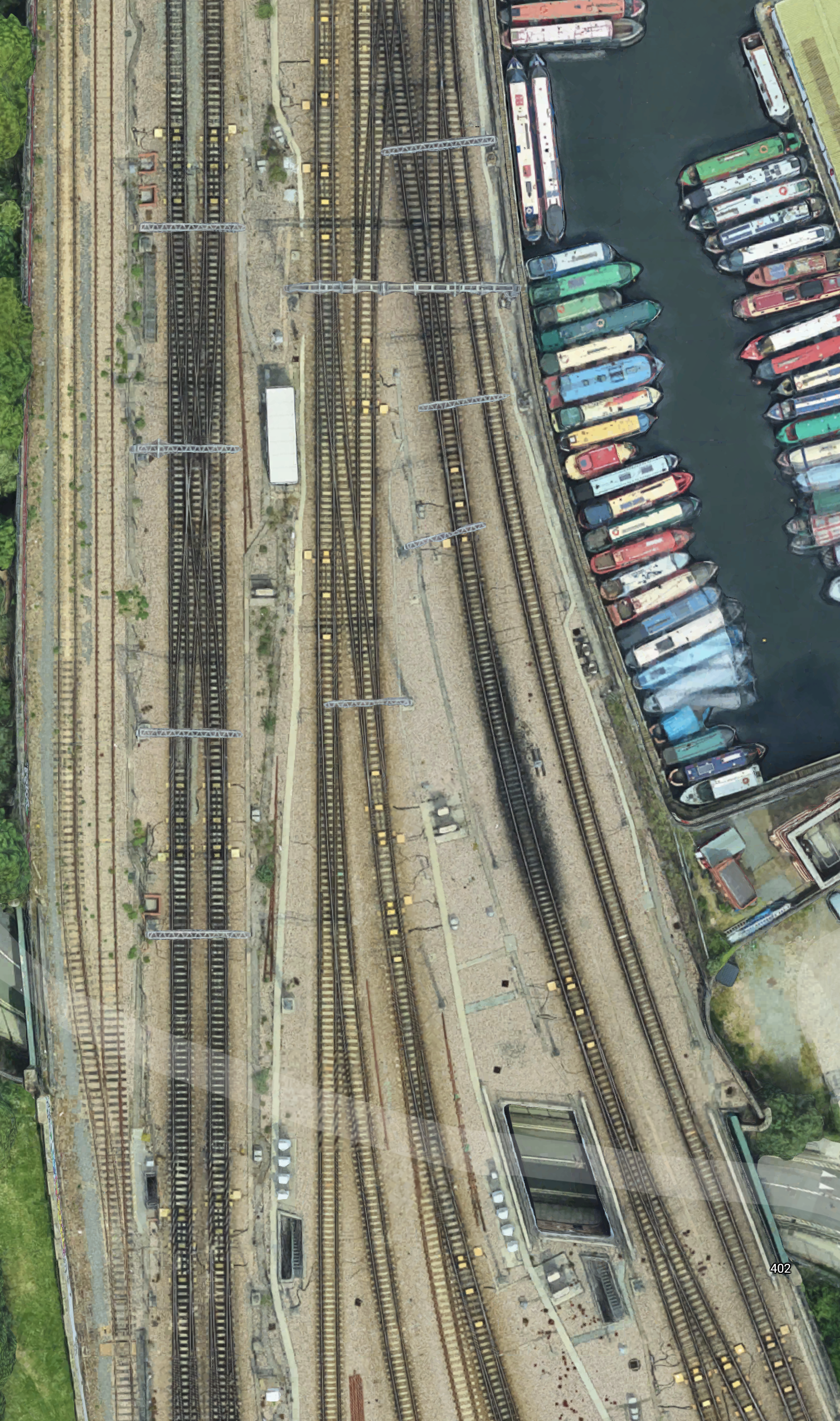
Note.
- There are four sets of tracks.
- The two light-coloured tracks on the left are for Thameslink or sidings.
- The next two dark-coloured tracks are the two tracks of the Midland Main Line.
- The next set of tracks are those connecting to the six Eurostar platforms.
- The two tracks on the right are those connecting to the Southeastern Highspeed platforms.
- There are crossovers between the Eurostar and Southeastern Highspeed tracks to allow efficient operation of the trains going to and from the twin tracks of High Speed One.
This Google Map shows where the Midland Main Line and High Speed One divide.
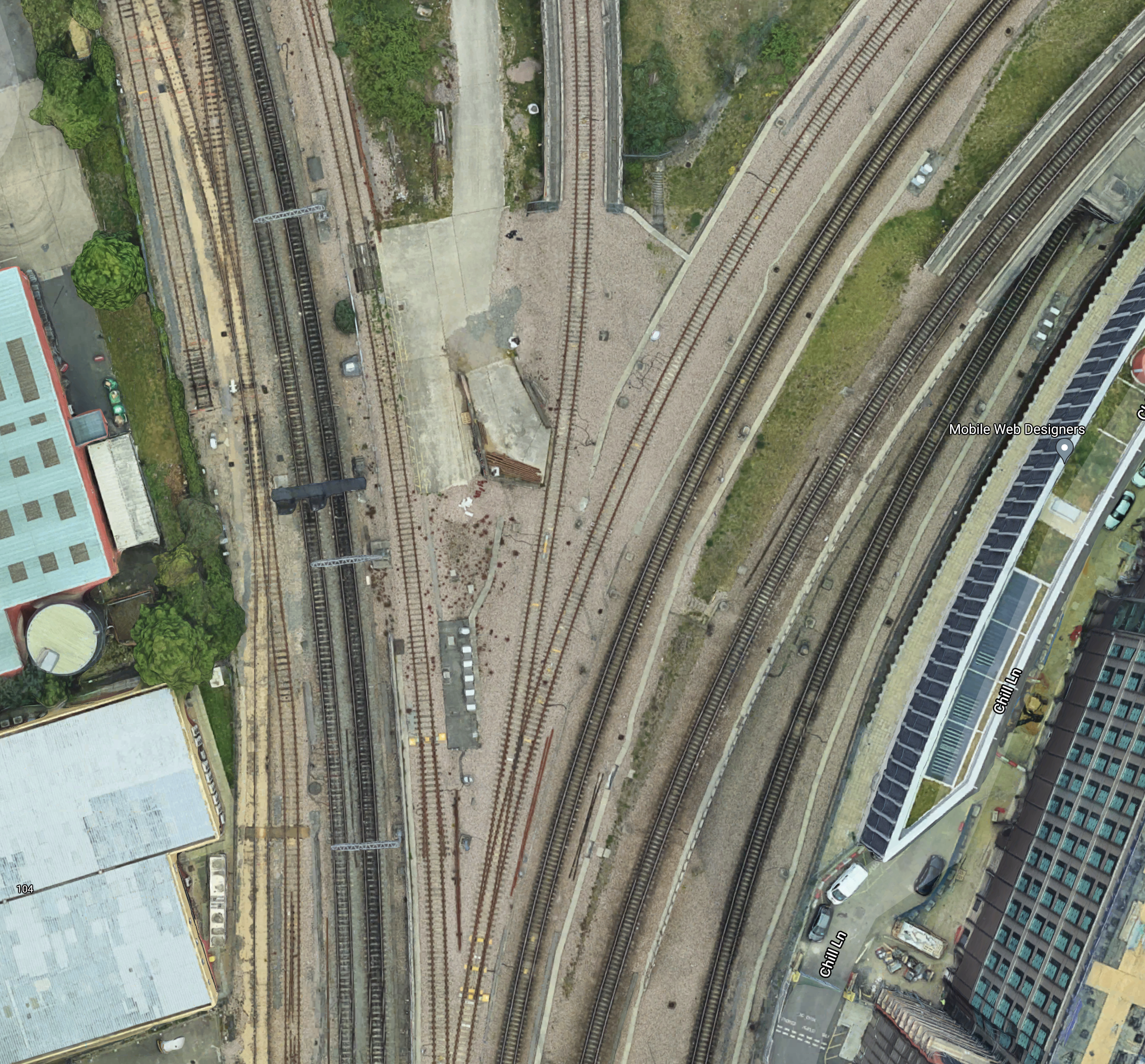
Note.
The two dark-coloured tracks of the Midland Main Line running North.
There appear to be four tracks running North East towards High Speed One.
Between the two sets of tracks two further tracks lead to the North.
The track closest to the Midland Main Line joins to the slow lines of the Midland Main Line.
The other one connects to the North London Line.
This Google Map shows the connecting lines to the High Speed One tunnel.
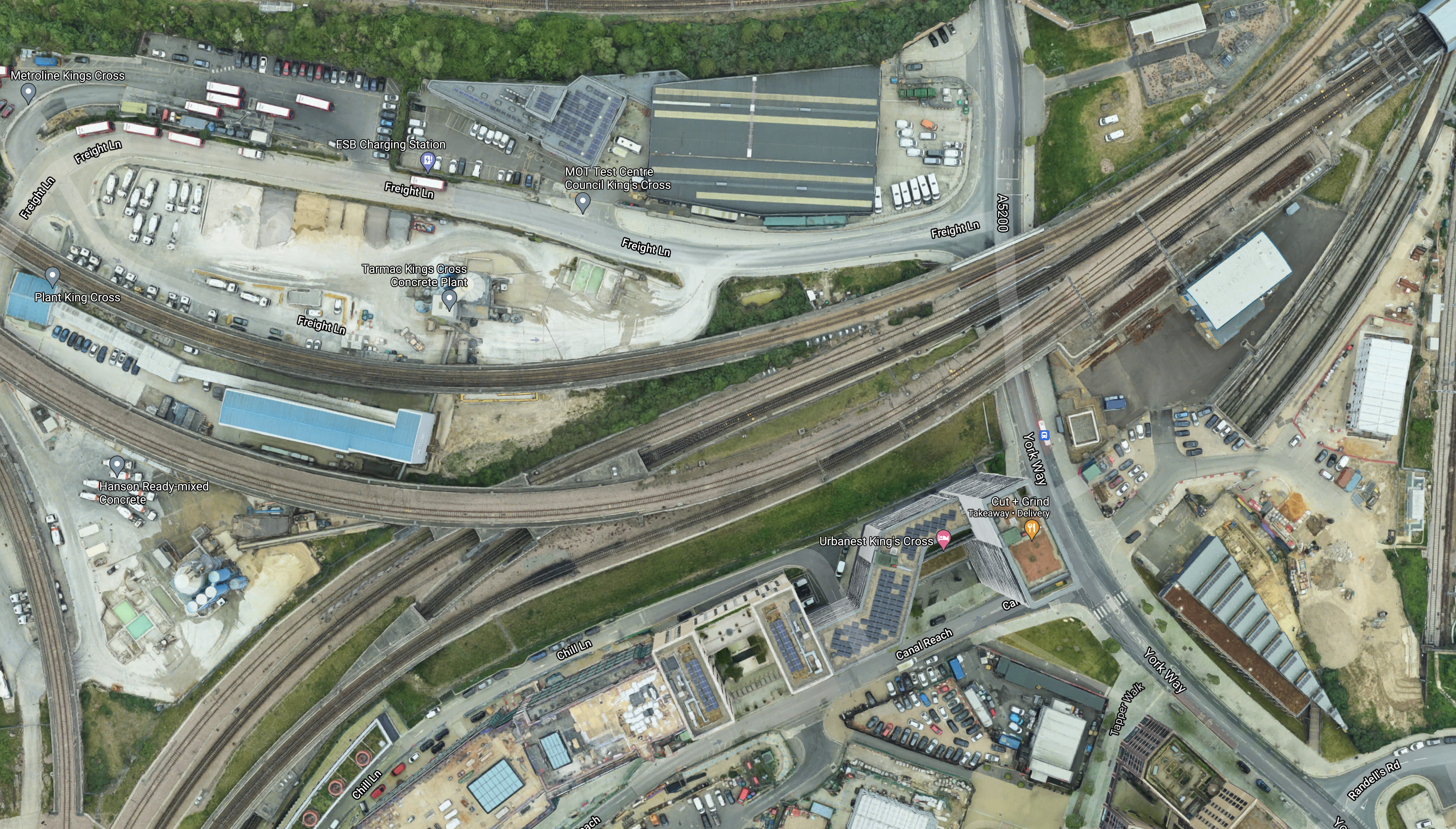
Note the tunnel portal is in the North-East corner of the map.
- It looks to me that the following connections are possible.
- St. Pancras station Eurostar platforms and Midland Main Line.
- St. Pancras station Eurostar platforms and North London Line to the West.
- High Speed One and North London Line to the West.
These connections are in addition to those connections needed to run scheduled services.
They would enable trains to take the following routes.
- St. Pancras station Eurostar platforms and Midland Main Line.
- St. Pancras station Eurostar platforms and the West Coast Main Line via North London Line
- High Speed One and the West Coast Main Line via North London Line
- St. Pancras station Eurostar platforms and the Great Western Main Line via North London Line
- High Speed One and the Great Western Main Line via North London Line
I suspect most of the times, that these routes are used it is for engineering purposes or behaps dragging a failed train out of St. Pancras.
But the track layout would seem to allow the following.
Direct electric freight and passenger services between High Speed One and Birmingham, Cardiff, Glasgow, Liverpool and Manchester.
Direct electric passenger services between High Speed One and Sheffield and Leeds, with a reverse at St. Pancras, after the Midland Main Line were to be fully electrified.
Was this by design for Eurostar or was it just what Network Rail ended up with?
A Modern Regional Eurostar Service
These are my thoughts on a modern Regional Eurostar service.
Rolling Stock
High Speed Two is coming and this year, the company will order some of the rolling stock.
There will be fifty-four trains
The trains will be Classic-Compatible for running on the West Coast Main Line.
They will be 200 metres long and be able to run in pairs.
They will be able to operate at 225 mph.
The operating speed of High Speed One is 186 mph.
I can see no reason why trains of this type, couldn’t run between St. Pancras and many destinations in Europe.
North Of England And The Continent
Could this be the service pattern?
- One train could start in the North West and another in the North East.
- Both trains would proceed to St. Pancras picking up passengers en route.
- At St. Pancras the two trains would join together.
- The driver could then position themselves in the front cab and take High Speed One, through the Channel Tunnel.
The train could even split at Calais to serve two different Continental destinations.
Going North, the spitting and joining would be reversed.
What Infrastructure Would Be Needed?
I suspect the following will be needed.
- The West Coast Main Line and the Midland Main Line would need in-cab digital ERTMS signalling.
- Full electrification of the Midland Main Line would probably be necessary, as I don’t think the tunnel allows diesel trains to pass through.
- Some platform lengthening might be needed.
It would not be an expensive scheme.
What Timings Would Be Possible?
Using current timings you get the following times.
- Leeds and Paris – Five hours
- Leeds and Brussels – Four hours forty minutes
- Manchester and Paris – Five hours
- Manchester and Brussels – For hours forty minutes
- Newcastle and Paris – Six hours
- Newcastle and Brussels – Five hours thirty minutes
Note, that the times are best estimates and include a long stop of several minutes at St. Pancras.
Could Sleeper Service Be Run?
I don’t see why not!
Conclusion
It looks like it may be possible to run regional services to Europe, where pairs of train split and join at St. Pancras.
St
Green Hydrogen Searches For Industrial Outlets
The title of this post, is the same as that of this article on E & T Magazine.
It is a detailed look at the uses for green hydrogen.
A few points from the article.
- Like fossil fuel hydrogen can store energy for months.
- Less that 10 % of green hydrogen will be used for energy storage.
- Hydrogen has a poor round trip efficiency, if you create it with an electrolyser and then convert it back to electricity using appropriate technology.
- Heavy transport may account for 25 % of the use of hydrogen.
- Industrial and home heating applications could account for the use of another third.
- One of the biggest uses today of hydrogen is in oil-refining to make low sulphur fuels.
- Steelmaking could be a big user, but there are many different methods and some have problems.
- Cement making could be a good use of green hydrogen.
The article is a must-read and it makes you think.
Australian Coal Mine To Transform Into Pumped Hydro Facility
The title of this post, is the same as that of this article on PV Magazine.
This is the introductory paragraph.
Australian utility AGL is transforming its operations in a number of ways, from restructuring the company itself, to building energy storage facilities for flexible distribution of renewable energy into the future. The company is also planning to build a pumped-hydro facility at a disused open-cut coal mining site in eastern Australia.
It is an interesting proposition to say the least to reuse an opencast coal mine for something useful.
It would appear to be able to supple 250 MW for eight hours, which would make it a 2 GWh facility.
But then Australia is a country, that needs a lot of energy storage as they transform their economy to zero carbon.
‘Sleeper Trains’ London To Berlin And Prague A New Possibility
The title of this post, is the same as the title of this article on Rail Technology Magazine.
This is the introductory paragraph.
For those who have grown a travel bug during lockdown, the truth is that flying looks like it won’t be a viable option as a global pandemic persists. However, for those who dream to travel again, there might be some hope. With growing new interest, there are ambitious plans to take overnight ‘Sleeper trains’ services through the channel tunnel from London to cities around Europe .
I regularly use sleeper trains to Scotland, as they deliver me North of the Border for an early start or are ideal for coming back ;ate after a busy day.
As I can sleep with no trouble on a train and generally book a few days in advance, it generally works out that the cost of the sleeper one way is good value, as it avoids paying for a hotel.
Certainly, in the UK, if you use sleeper trains properly and have a rail-card, I find them convenient and good value. A couple of times, there’s also been a party in the lounge car.
It appears that the first sleeper trains will start from Brussels.
- NightJet already run a service between Brussels and Vienna.
- A route of Brussels and Prague via Amsterdam, Berlin and Dresden is suggested.
- These routes could be extended to London, at some time in the future.
But if they were timed appropriately, you could take an afternoon or evening Eurostar to Brussels and have supper before you get the sleeper, either on Eurostar or in Brussels.
With sleeper trains popping up in several places in Europe and becoming more fashionable with better rolling stock, I’m sure that this sleeper train would work.
Brussels and Berlin is currently seven hours with a change, so a sleeper train without a change could probably take you to Berlin for eight in the morning, if it left Brussels at about yen at night.
Call For Major Investment In Hydrogen Hub To Help Sector Thrive In Northern Ireland
The title of this post, is the same as that of this article on the Belfast Telegraph.
This is the introductory paragraph.
Northern Ireland is ready to become a global leader in a future hydrogen economy but needs investment of at least £15m from government, politicians have said.
The article makes points about Northern Ireland and hydrogen.
- Hydrogen-powered buses are built in Ballymena.
- There is plenty of wind and water to create the hydrogen.
- Hydrogen could improve export potential and create skilled jobs.
The proposals certainly have good political support.
Remodelled Station Opens In Canfranc Ahead Of Reopening Of Cross-Border Link
The title of this post, is the same as that of this article on Railway Gazette.
This is the introductory paragraph.
On April 15, a RENFE DMU carrying invited guests from Zaragoza became the first train to arrive at the remodelled and relocated station in Canfranc, marking a further step in the long-running plan to reinstate the railway through the Pyrénées mountains linking Pau with Huesca.
I have an ambition to visit Canfranc station, where the Spanish and French railways meet at one of the largest stations in Europe.
- On the French side the Pau-Canfranc Railway is gradually being reopened.
- On the Spanish side there is a railway to Zaragoza, from where there are high speed trains to Barcelona and Madrid.
Both routes appear to be mainly single-track
There would appear to be pressure for reopening the full route In a Section entitled Renovation and Reopening, Wikipedia says this.
In present economic development, the transport route beneath the Aspe peak via the Gave d’Aspe valley is changing from a relatively unknown into a major transport channel. This is not only due to the regional pressure between Bordeaux and Zaragoza (which on the Spanish side alone has a regional population of 1 million people), but also the importance of the international route between Paris and Valencia. These economic pressures – in part driven by the General Motors plant located in Zaragoza – have in recent years resulted in heavy truck and car traffic on the roads of the upper Gave d’Aspe valley, and an increased number of accidents.
Sounds like this indicates a powerful case.
Madrid And London By The Scenic Rail Route
The route would be as follows.
- Madrid and Zaragoza by High Speed Train.
- Zaragoza and Canfranc by local train through the mountains.
- Canfranc and Pau by local train through the mountains.
- Pau and Paris by TGV
- Paris and London via Eurostar.
Note.
- According to the Railway Gazette, a luxury hotel is being built at Canfranc.
- Bordeaux is a good city for an overnight stop.
- Prior to the covids, Eurostar were hoping to run a direct London and Bordeaux service.
I hope to do this trip in the next couple of years.
Uniper To Make Wilhelmshaven German Hub For Green Hydrogen; Green Ammonia Import Terminal
The title of this post, is the same as that of this article on Green Car Congress.
This is the first two paragraphs.
Under the name “Green Wilhelmshaven,” Germany-based international energy company Uniper plans to establish a German national hub for hydrogen in Wilhelmshaven and is working on a corresponding feasibility study.
Plans include an import terminal for green ammonia. The terminal will be equipped with an ammonia cracker for producing green hydrogen and will also be connected to the planned hydrogen network. A 410-megawatt electrolysis plant is also planned, which—in combination with the import terminal—would be capable of supplying around 295,000 metric tons or 10% of the demand expected for the whole of Germany in 2030.
I can’t help feeling that there is some bad thinking here.
The Wikipedia entry for ammonia, says this about green ammonia.
Even though ammonia production currently creates 1.8% of global CO2 emissions, a 2020 Royal Society report claims that “green” ammonia can be produced by using low-carbon hydrogen (blue hydrogen and green hydrogen). Total decarbonization of ammonia production and the accomplishment of net-zero targets are possible by 2050.
So why is green ammonia imported rather than green hydrogen, which may have been used to manufacture the ammonia?
Green ammonia would appear to have two main uses in its own right.
- As a feedstock to make fertiliser and other chemicals.
- As a possible fuel for large ships, which could also be powered by hydrogen.
The only thing, I can think of, is that as liquid hydrogen boils at -253 ° C and liquid ammonia at -33 ° C, ammonia may be easier to transport by ship.
It may make a better fuel for large ships for the same reason.
This policy briefing from The Royal Society is entitled Ammonia: Zero-Carbon Fertiliser, Fuel And Energy Store.
This is the introductory paragraph.
This policy briefing considers the opportunities and challenges associated with the manufacture and future use of zero-carbon or green ammonia.
It is an excellent explanation of green ammonia and a must read.
Hydrogen for Wilhelmshaven
On the other hand, Wilhelmshaven, which is situated on Germany’s North West Coast would be in a good position to be a terminal for a hydrogen pipeline or electrical interconnector from the Dogger Bank, where both the Netherlands and the UK have plans for some of the largest windfarms in the world.
The UK’s Dogger Bank Wind Farm, which is being developed by SSE, looks to have an initial capacity of 4.8 MW, whereas the North Sea Wind Power Hub, being developed by the Danes, Dutch and Germans on their side of the Dogger Bank could be rated at up to 110 GW.
Wikipedia says this about how the two huge projects could be connected.
The power hub would interconnect the three national power grids with each other and with the Dogger Bank Wind Farm.
We could be seeing a 200 GW power station in an area of the sea, generally only known to those who listen to the shipping forecasts and fans like Marti Caine.
Under a section in the Wikipedia entry for the North Sea Wind Power Hub, which is entitled the North Sea Wind Power Hub Consortium, these points are made.
- It is hoped that Norway, the United Kingdom, and Belgium will join the consortium.
- Dutch gas-grid operator Gasunie has joined the consortium, suggesting converting wind power to gas and using near offshore gas infrastructure for storage and transport.
- The Port of Rotterdam became the fifth member of the consortium.
This looks like a party, where some of our North Sea gas fields and infrastructure, lying in the triangle of the Humber, Teesside and the Dogger Bank could add a lot of value.
We could even see hydrogen generated in the European Eastern part of the Dogger Bank, stored in a worked-out gas field in the UK sector of the North Sea and then when needed, it could be pumped to Germany.
A 410 Megawatt Electrolyser
Ryze Hydrogen are building the Herne Bay electrolyser.
- It will consume 23 MW of solar and wind power.
- It will produce ten tonnes of hydrogen per day.
This would produce just 5.6 percent of the hydrogen of the Wilhelmshaven electrolyser
In H2 Green Steel Plans 800 MW Hydrogen Plant In Sweden, I wrote about a 800 MW electrolyser, that would produce 380 tonnes of hydrogen per day.
It looks like the Wilhelmshaven electrolyser is very much a middle-sized one and would produce around 65,000 tonnes per year.
Conclusion
It looks like the Germans will be importing lots of green ammonia and green hydrogen from the North Sea.
Thoughts On The Duke’s Land Rover Hearse
This article on The Times is entitled The Land Rover hearse: a vehicle fit for the Duke of Edinburgh’s final journey.
I made this comment.
There’s a church near me in Hackney, where in less restricting times, you regularly saw a horse-drawn funeral. These must cost a fortune to maintain and provide.
I remember seeing a report on the BBC about an undertaker, who has created a motorcycle and sidecar hearse for the funerals of those of a certain persuasion.
I can imagine some of my farming and off-road enthusiast friends liking the idea of being taken to their funeral in a hearse made from a Land-Rover. As you say, it would have a certain style.
There are even conversions, so that old Defenders can be converted to run on battery power, so the hearse could be zero-carbon too!
I have just heard Giles Brandreth on the BBC, who as the biography of the Duke, was at the funeral, as a reporter. He said that he had talked to the Commander of the Guards, who had walked alongside the hearse in the procession. He related how the driver had difficulty keeping the speed down with a lot of slipping of the clutch and noise from the diesel engine.
As I said in my comment to The Times article, perhaps the hearse should have been battery-powered. But then surely, this should apply to a fair proportion of all hearses.
Serial Cooking – Twelve Minute Fish
I’ve used this recipe for years, since I discovered it in the sadly-missed Dinner Tonight daily recipe in The Times, that was contributed by Lyndsey Bareham.








Note.
- I used haddock, but it generally works with any white fish trawled from the depths of the freezer.
- I always keep little pots of frozen peas and runner beans for one in my freezer.
- I have lots of pots and always split frozen peas up when I buy them.
- I usually cook it for one or two, but have cooked it for four.
- I’m a bit worried about getting the Carluccio’s olive oil with lemon. But I suspect someone else will supply something similar.
It can’t be too bad, as two friends have asked for the recipe. And they’re still friends.
 The Anonymous Widower