British Gas Joins Forces With Samsung To Help Customers Power Smarter Energy Use
The title of this post, is the same as that of this press release from Centrica.
This is the sub-heading.
British Gas and Samsung have today announced the exciting first step in a long-term venture – aimed at helping customers better manage their energy use and increase the adoption of low carbon heating technologies in homes across Britain.
These are the first two paragraphs.
The collaboration will see British Gas integrate with Samsung’s SmartThings app to help customers optimise their home appliances to use energy when the cost and demand are lower. This is now possible through the integration of SmartThings Energy and British Gas’ PeakSave demand flexibility scheme informing customers (by sending notifications via their smartphone, TV or other compatible devices) of the best times to use household appliances to save money.
The PeakSave scheme includes PeakSave Sundays, running every Sunday until the end of February with half-price electricity from 11am to 4pm for British Gas customers and PeakSave Winter events which encourages customers to move their electricity use out of peak times when there is high demand on Britain’s energy grid.
As a Graduate Control Engineer, I believe that this could make optimising your energy use much easier.
- It would surely be a lot easier to check usage on your phone rather than a smart meter, when you perhaps cook a ready meal, so that you can see if your microwave or traditional cooker is cheapest.
- Suppose you and everybody, who lives with you are out for supper and British Gas want to cut off your gas for a reward, you can make an appropriate decision.
- Hopefully, if you have the right controls, you’ll be able to switch lights and appliances off and on.
The possibilities are endless.
I shall certainly be looking at the reviews of this app.
There is a section in the press release called Scaling Up Low Carbon Heating Opportunities, where this is said.
The collaboration will also help support customers in their journey to decarbonising their homes by introducing smart technologies in a way that is simple and empowering. From early 2024, British Gas will include Samsung heat pumps in its offering to British households to support the UK’s commitment to reach net zero by 2050.
The venture will see specially trained British Gas surveyors and engineers working with consumers to explain the benefits of heat pumps and then conducting the installations on-site. Samsung will be supporting workforce training as part of their efforts to upskill the heating industry to ensure there are enough installers to service the expected growing demand.
British Gas also offers customers the chance to purchase heat pumps through flexible financing methods. This, combined with the recently increased UK Government Boiler Upgrade Scheme grant of £7,500, creates an attractive package of financing options to help people make the transition more affordable.
Various plumbers, who I would trust, have given me different views about heat pumps.
I suspect the Samsung’s SmartThings app might be able to simulate your energy usage with or without the heat pump, as it would know your energy use with your current boiler.
I was doing similar calculations for chemical plants in the early 1970s at ICI, using a PACE 231-R computer.

Consider.
- It may look rather old fashioned, but it could solve a hundred simultaneous differential equations in one go.
- Two similar computers linked together were the analogue half of NASA’s moon mission simulator.
- Without these wonderful machines, NASA would not have been able to re-calculate the dynamics of Apollo 13 and the mission would be remembered as a disaster, rather than the first space rescue.
The average current smart phone has more computing power than a PACE 231-R.
What’s In It For Samsung?
I have a Samsung television, but unfortunately it has a screen fault because of age. So if I had the Samsung app and liked it, I might buy another Samsung TV.
Similarly, the app might give me a financial reason to buy a Samsung heat pump.
Samsung will sell more equipment.
What’s In It For Centrica?
Centrica would appear to be a loser, as bills will fall and they could be paying customers to not use energy.
But they are surely hoping that their market share will increase and I’m sure Samsung will give them a commission.
What’s In It For The Consumer?
Hopefully, they’ll get lower energy bills.
But also they might get a lot of convenience controlling their appliances and heating.
Conclusion
Using energy is becoming a computer game with monetary rewards.
Is the deal between Centrica/British Gas and Samsung another deal that has been brought to fruition by the Korean President’s visit to the UK?
It looks like this is the third recent deal signed between UK and Korean companies, after these two.
- South Korea, UK Strenghten Offshore Wind Ties
- UK And South Korea Help Secure Millions For World’s Largest Monopile Factory
I suspect, there might be a few more deals, if Charles and Camilla really turned on the charm.
In Mersey Tidal Project And Where It Is Up To Now, I wrote about talks between Liverpool City Council and Korea Water about a tidal barrage of the Mersey. This project must surely be a possibility!
This is said in the Wikipedia entry for Korean Air under Fleet Plans.
At the Association of Asia Pacific Airlines Assembly in 2018, Korean Air announced that it was considering a new large widebody aircraft order to replace older Airbus A330, Boeing 747-400, Boeing 777-200ER and Boeing 777-300. Types under consideration for replacement of older widebody aircraft in the fleet include the Boeing 777X and Airbus A350 XWB. At the International Air Transport Association Annual General Meeting (IATA AGM) in Seoul, Chairman Walter Cho said Korean Air’s widebody order is imminent and it is considering an extra order of Airbus A220 Family including developing version, Airbus A220-500.
Note.
- Airbus A350 XWB have Welsh wings and Rolls-Royce engines.
- Airbus A220-500 are made in Canada with wings and composite parts from Belfast. Rolls-Royce may have a suitable engine.
Could a deal have something in it for the UK?
Although Korea has its own SMR program, I wonder, if there could be a link-up between Korean industry and Rolls-Royce over SMRs?
Schneider Electric: Vertical Farming – The Next Yield In Data Centre Sustainability
The title of this post, is the same as that of this article on Intelligent Data Centres.
This is the sub-heading.
David Abrahams, Key Client Manager, Cloud and Service Partners at Schneider Electric UK and Ireland, discusses vertical farming and the next yield in data centre sustainability. He outlines new data centre sustainability strategies, vertical farming solutions and how data centres can apply already existent models which will allow plants and crops to thrive in unique Growth Towers.
These are the first two paragraphs.
As data centres begin to reach their physical sustainability limits without redefining the laws of physics, vertical farming could provide a new solution to the decarbonisation challenge, creating a symbiotic environment for both data and nature to benefit one another.
Coined by some as the fourth revolution in agriculture, vertical farms today provide closed conditions which deliver major sustainability benefits including limited or zero use of pesticides, while ensuring the farm is safe from extreme weather-related events such as high temperatures, humidity, floods and fires.
The last section is called Making The Concept A Reality, where these are the first three paragraphs.
Equinix has already taken the leap and has become the first global operator to develop a fully functioning vertical farm at its PA10 Paris data centre, creating a 4600 sq.ft greenhouse which is surrounded by 61,000 sq.ft of garden space.
The vertical farm is kept at an ideal growing temperature, using heat exchangers linked to the data centre’s chilled water-cooling system with sensors that monitor internal and external temperatures and humidity levels. With such available technology, farmers will be able to make real-time changes to their growing conditions to achieve higher yields at lower energy. This could be a game changer considering the greater strain on the global food supply chain and the general cost of energy.
With increased demands for efficiency and sustainability, both data centre and agricultural sectors are under the greatest scrutiny. The idea of data centre and farming worlds collaborating to create a circular economy to help futureproof both industries is not only exciting but unveils a world of new decarbonisation opportunities.
It strikes me that combining a data centre and a vertical farm could be a marriage made in eco-heaven.
I suggest you read all the original article.
Google Starts Building £790m Site In Hertfordshire
The title of this post, is the same as that of this article on the BBC.
This is the sub-heading.
Google has invested $1bn (£790m) to build its first UK data centre
These are the first four paragraphs.
The tech giant said construction had started at a 33-acre site in Waltham Cross, Hertfordshire, and hoped it would be completed by 2025.
Google stressed it was too early to say how many jobs would be created but it would need engineers, project managers, data centre technicians, electricians, catering and security personnel.
The prime minister said it showed the UK had “huge potential for growth”.
The project marked the latest investment by a major US tech firm in Britain, after Microsoft announced it would invest £2.5bn to expand data centres for artificial intelligence (AI) across the UK.
Note.
- By “completed by 2025” do they mean completed before 2025 or completed by the end of 2025. Judging by the time they took to build their London HQ, its the latter.
- Rishi is right about the UK having a huge potential for growth! Especially, if the nihilists of the United States vote in the Big Orange!
- Judging by the total spend of £2.5 billion on data centres and the £790 million for this one, this looks to be the first of three.
But where is this data centre going to be built?
This article on EssexLive is entitled Google To Move Into Waltham Cross With £788m Data Centre To Support ‘AI Innovation’, where this is said.
The new data centre will go on land at Maxwell’s Farm, next to the A10 Great Cambridge Road and around one mile from the M25 junction 25. Debbie Weinstein, Google vice president and managing director in the UK and Ireland, set out the decision in a blog post on Thursday, January 18 – the fourth day of the World Economic Forum’s Davos 2024 in Switzerland.
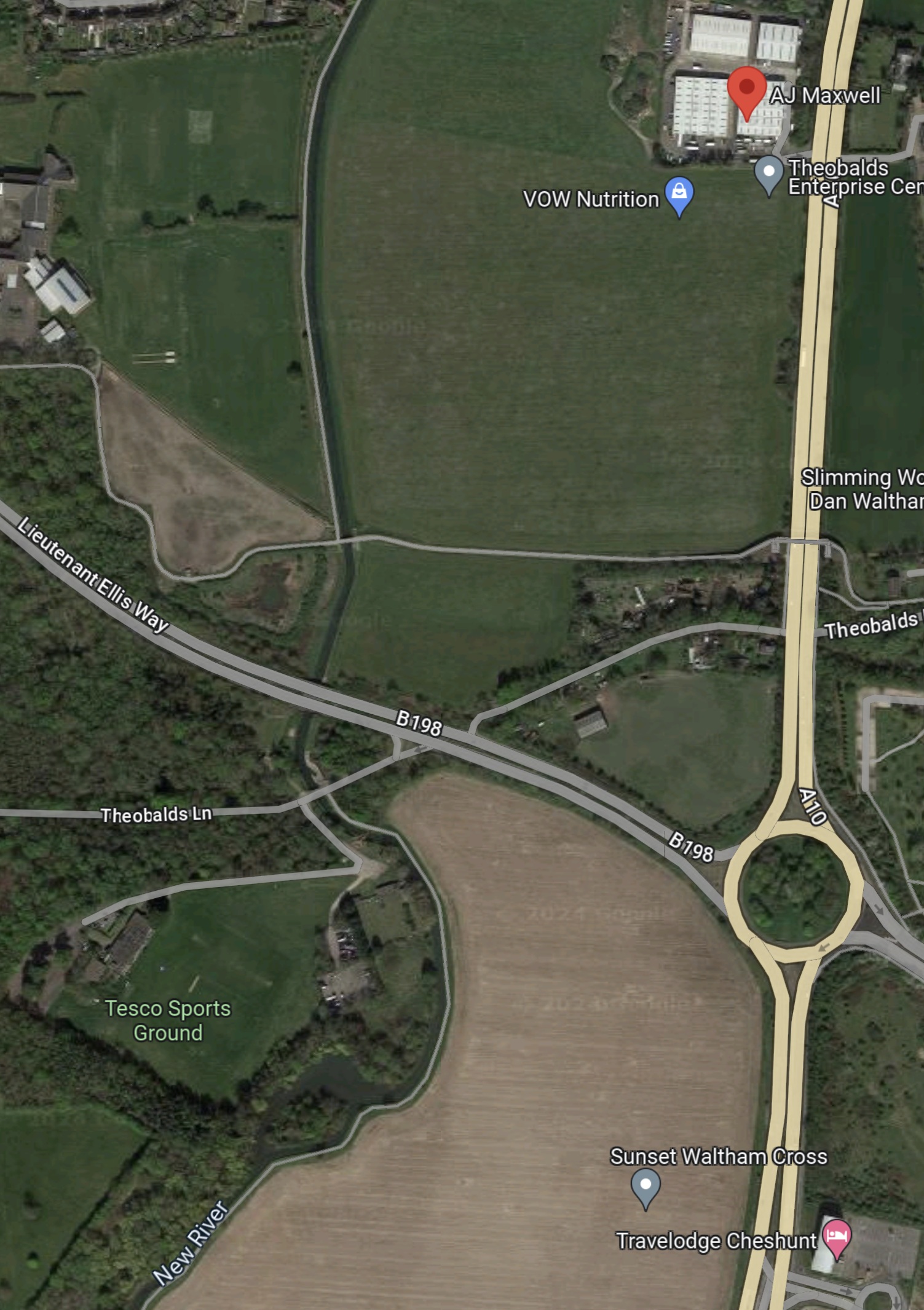
This is a Goggle Map of that area, when I searched for Maxwell’s Farm.
Note.
- The red arrow indicates the result of my search, which Google interpreted as A.J. Maxwell.
- The dual-carriageway road running down the East side of the map is the A10 between London and Cambridge.
- The A10 road joins the M25 at Junction 25.
- The arrow to the South-West of the roundabout indicates the new studios; Sunset Waltham Cross, which is being built.
- At the other side of the studio site, there is a label saying New River and this important piece of London’s water infrastructure can be traced to the top of the map.
- The other dual-carriageway road is the B198 or Lieutenant Ellis Way.
- A quick calculation shows that 33 acres is roughly a 365 metre square.
I would suspect that the data centre will lie somewhere between the A10, the B198 and the New River.
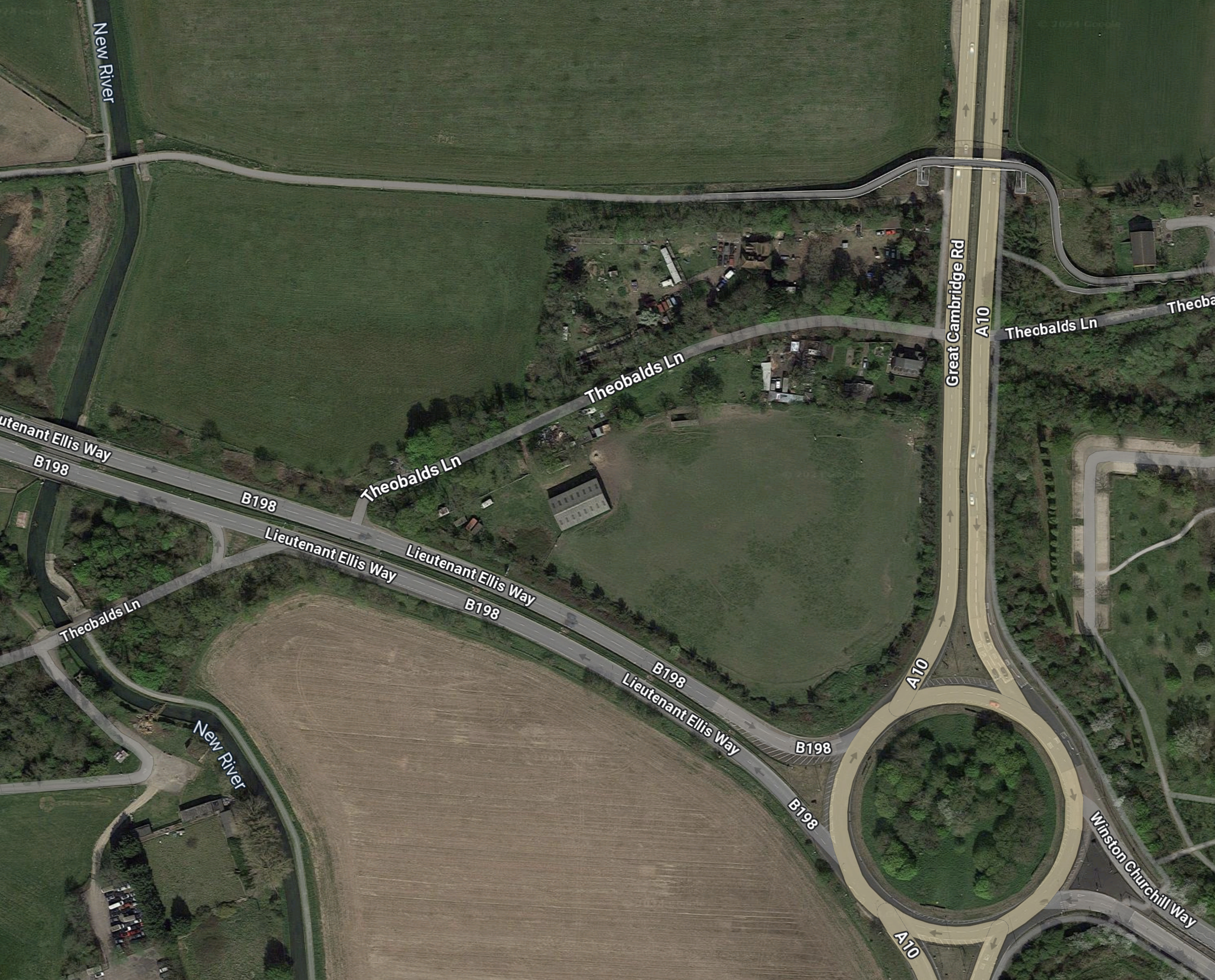
This Google Map shows the South-East corner of the site.
Note.
- There appears to be a lane running East-West, that crosses over both the A10 and the New River.
- Theobalds Lane appears to have some housing and possibly a farm.
- The smaller field by the roundabout appears to have some animals using it as grazing.
- The field between the East-West lane and Theobalds Lane appears to have a good crop of cereal.
The East-West lane would appear to be a possible Southern border of the site.
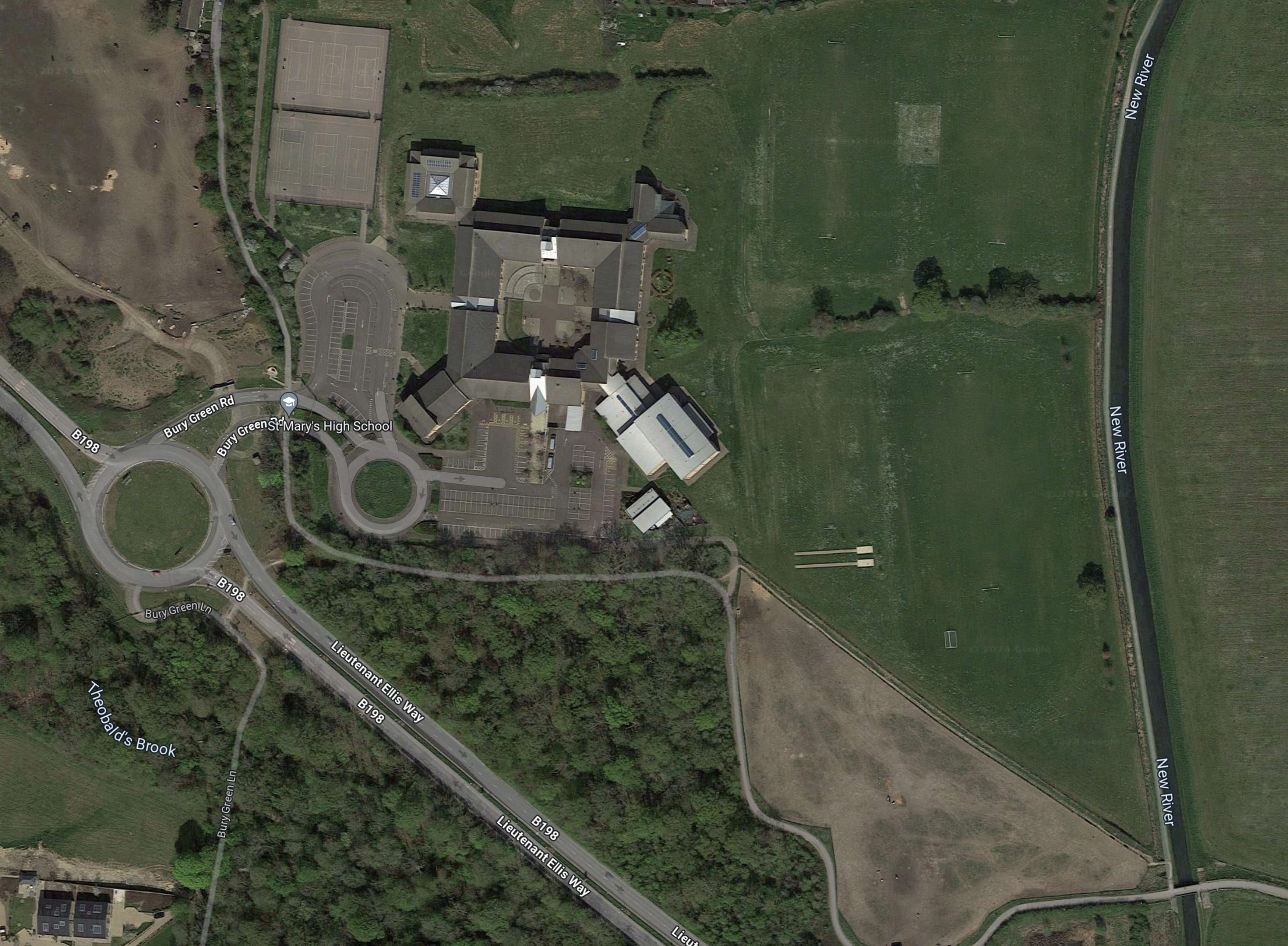
This Google Map shows where the East-West lane goes.
Note.
- The lane leads to Queen Mary’s High School.
- The school also has access from Lieutenant Ellis Way.
- The New River appears to form, the Eastern boundary of the school site.
- There are sports pitches between the New River and the school.
The New River looks to be the Western boundary of the Google site.
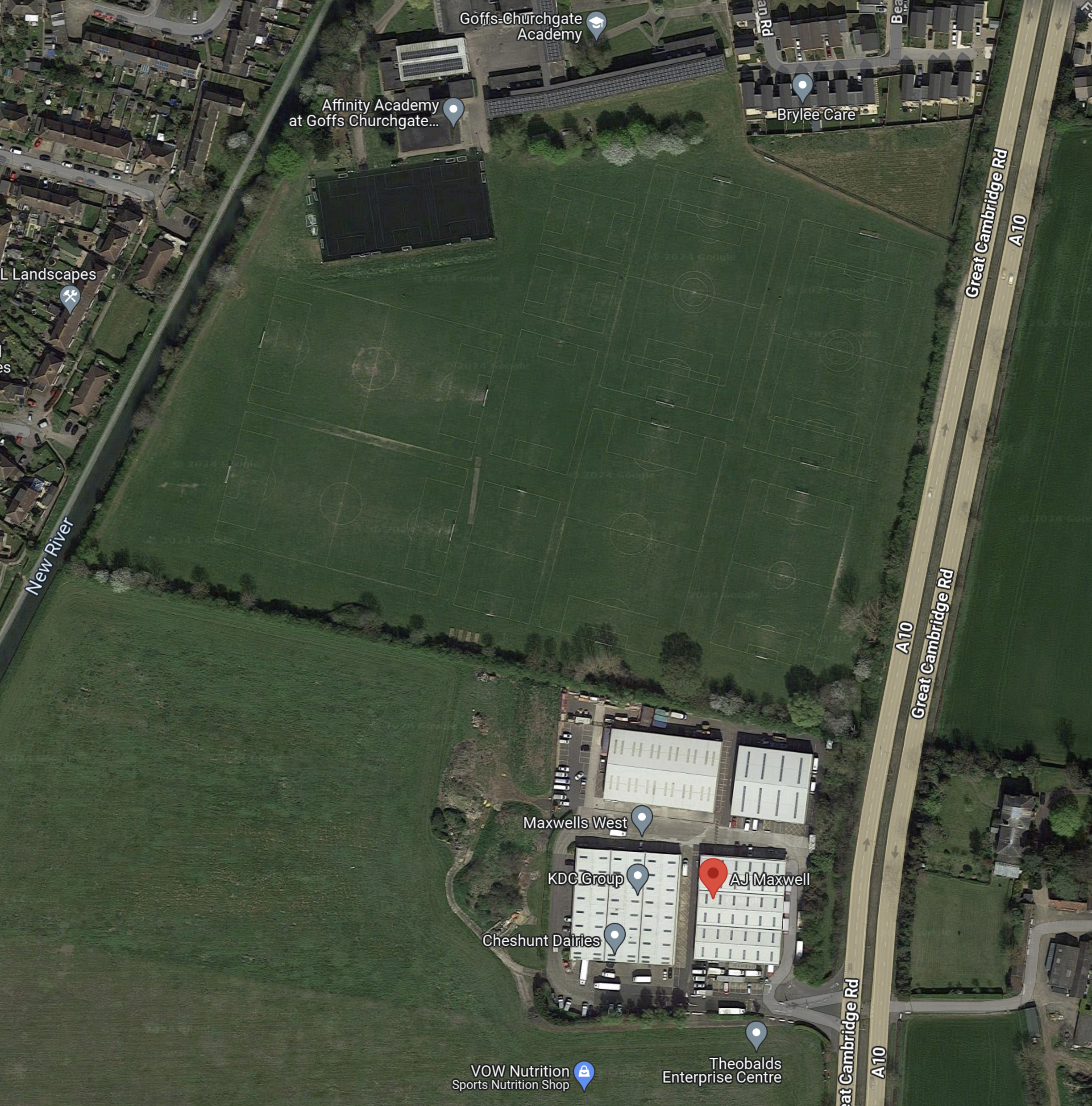
This Google Map shows around the red arrow from the Google search that led me to this area.
Note.
- A.J. Maxwell is identified by the red arrow in the Theobalds Enterprise Centre.
- The New River can be seen at the West of the map.
- A hedge runs roughly East-West to the North of the Enterprise Centre.
- North of the hedge are a number of football pitches, which appear to belong to the Affinity Academy at Goffs Churchgate.
The hedge could be the Northern boundary of the Google site.
This Google Map shows the area between the South of the Enterprise Centre and the East-West lane I picked out earlier.
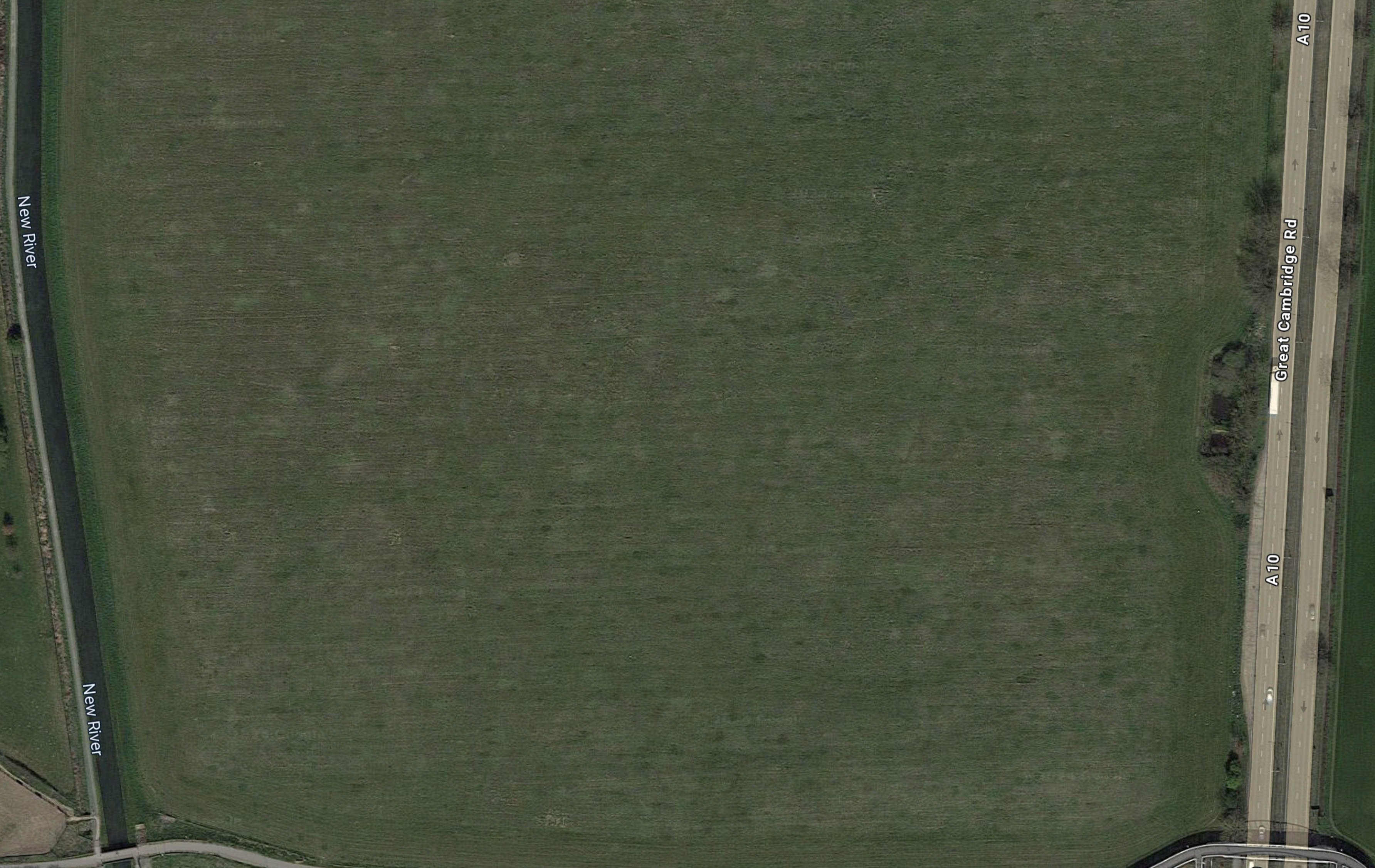
A crude measurement indicates it could be around 33 acres or slightly more.
This picture is used in nearly all the news reports about the Data Centre.

Note.
- Could that be the gentle curve of the New River on the left?
- With the high fence, the New River forms an almost-mediaeval defence against trespassers.
- There looks to be a dual-carriageway road running down the other side of the site, which would be the A10.
- Between the A10 and the site, there appears to be loots of dark areas, which I take to be car parks.
- Are the car-parking spaces in the front of the picture marked for those, who are disabled? There certainly appear to be chargers on some spaces.
I have a few thoughts.
The Relative Locations Of Google’s Data Centre And Sunset Studios?
This Google Map shows the two sites to the West of the A10.

Note.
- St. Mary’s High School is in the North-West corner of the map.
- Cheshunt Football Club is in the North-East corner of the map.
- The dual-carriageway A10 runs North-South on the map.
- I believe that Google’s Waltham Cross Data Centre will be located in the field to the West of the A10, at the top of the map.
- The A10 connects to the M25 at Junction 25, which is in the centre at the bottom of the map.
- In The Location Of Sunset Studios In Broxbourne, Sunset Studios are placed to the North West of the Junction 25 roundabout.
- Just as the A10 forms the Eastern boundary of both sites, the New River forms the Western boundary.
The two sites are close together between the A10 and the New River, separated by the dual-carriageway Lieutenant Ellis Way.
Will Google’s Data Centre Be Storing Data For Sunset Studios?
I’ve never worked in the production of films, but these days with digital electronic cameras, CGI, motion capture and other techniques, producing a film must need huge amounts of data storage.
- So have Sunset Studios outsourced their data storage needs to Google?
- Perhaps too, Sunset Studios found the local authority welcoming and this attitude was recommended to Google.
- Both sites will need local services like electricity, gas, sewage and water.
I suspect that there would be cost savings in construction and operation, if the two sites shared the utilities.
Providing Electricity And Heat For Both Sites
Consider.
- I estimate from information given in the Wikipedia entry for Google Data Centres, that a data centre needs between 10 and 12 MW.
- There is no obvious power source like offshore wind or a nuclear power station nearby.
- There is the 715 MW Rye House gas-fired power station, which is a few miles away.
- In Google Buys Scottish Offshore Wind Power, I talked about how Google had signed a Corporate Power Purchase Agreement to buy 100 MW from the Moray West offshore wind farm.
Google and Sunset Studios would also want an electrical and heat supply that is at least 100 % reliable.
Liverpool University had the same problem on their hundred acre campus in the centre of Liverpool.
- The University decided to build their own 4 MW Combined Heat and Power Unit (CHP), which is described in this data sheet.
- It is fired by natural gas.
- On their web site, Liverpool University state that their CHP can be adapted to different fuel blends. I take this includes zero-carbon fuels like hydrogen and carbon-neutral fuels like biomethane.
But given their location in Waltham Cross close to the Lea Valley, CHP units may have a use for their carbon dioxide.
This Google Map shows between Junction 15 of the M25 and Tomworld.

Note.
- Junction 25 of the M25, where it joins the A10 is in the South-West corner of the map.
- The sites of Google’s Data Centre and Sunset Studios can be picked out with reference to the previous map.
- Tomworld is in the North-East corner of the map.
- So why should Tomworld need a lot of carbon-dioxide?
This Google Map shows Tomworld.
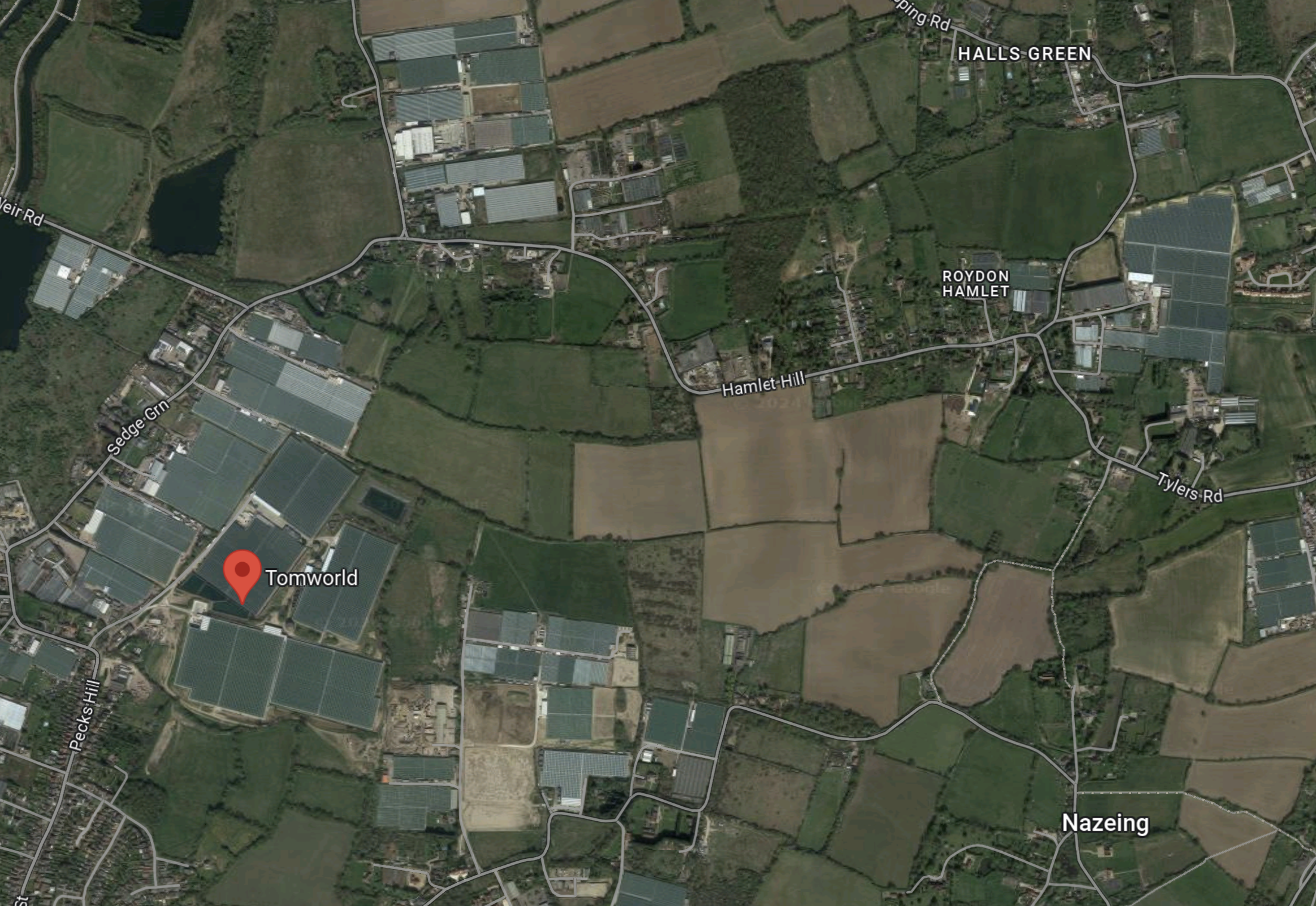
Note.
- This web page indicates what Tomworld do.
- They have 44 acres of glass growing tomatoes, about five miles to the North-East of Google’s Data Centre.
- The map has lots of other greenhouses.
I know of a guy, who has a large greenhouse, that grows tomatoes for the supermarkets.
- He heats the greenhouse with a gas-fired Combined Heat and Power Unit (CHP).
- The electricity produced runs his business.
- Any surplus electricity is fed into the grid.
- The carbon dioxide is fed to the plants in the greenhouse, which helps them grow quality tomatoes.
I just wonder, if carbon dioxide from CHP units at Google’s Data Centre and Sunset Studios could be used by the multitude of greenhouses in the Lea Valley.
Could A Carbon Dioxide Pipeline Be Built Along The M25?
This Google Map shows the Northern section of the M25, South of Waltham Cross.
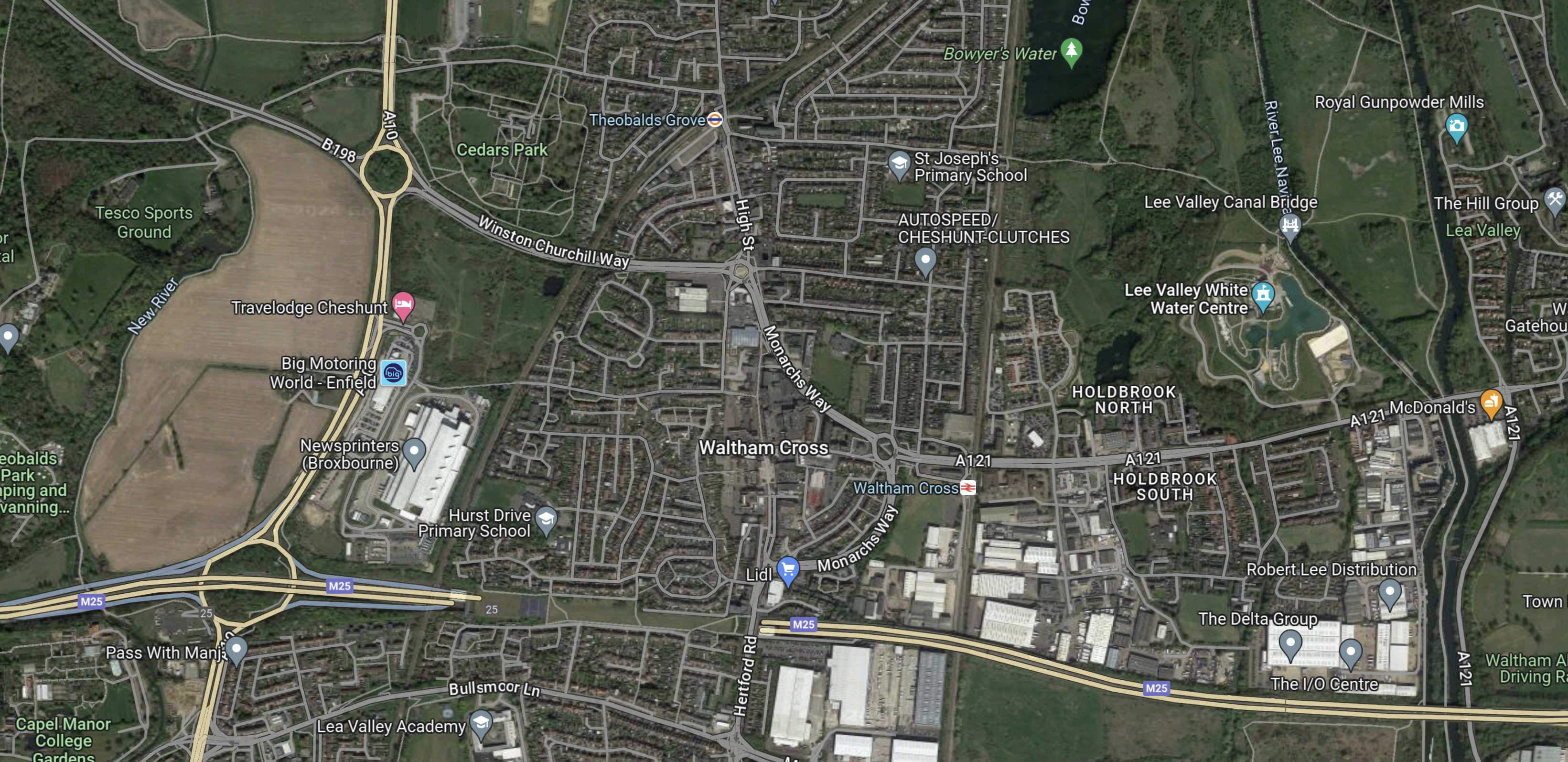
Note.
- The M25 running East-West across the bottom of the map.
- Junction 25 of the M25 in the South-West corner of the map.
- The A10 running North-South at the West of the map.
- Google’s data centre and Sunset Studio are to the West of the A10.
- The River Lee, which has numerous water courses is at the East of the map.
I wonder, if a carbon dioxide pipeline could be built along the M25 to connect the producers to those who could use it?
- It would not be a dangerous pipeline as carbon dioxide is a fire extinguisher.
- It wouldn’t be a huge pipe.
I think it would be possible.
Google’s Commitment To Being Zero-Carbon
This blog post on the Google web site is entitled Our $1 Billion Investment In A New UK Data Centre, has a section, which has a sub-title of 24/7 Carbon-Free Energy By 2030, where this is a paragraph.
Additionally, we’re also exploring new and innovative ways to use the heat generated by data centres, and this new facility will also have provisions for off-site heat recovery. Off-site heat recovery presents an opportunity for energy conservation that benefits the local community, as it allows us to capture the heat generated by the data centre so that it can be used by nearby homes and businesses. The data centre is also set to deploy an air-based cooling system.
If they are using off-site heat recovery, it would be logical to use waste carbon dioxide from CHPs to provide carbon dioxide for the local horticultural businesses.
Will Google Be Building A Vertical Farm Nearby?
In Schneider Electric: Vertical Farming – The Next Yield In Data Centre Sustainability, I noted that some data centres are paired with vertical farms to increase their sustainability.
Could Google be doing that in Waltham Cross?
- They will have a lot of waste heat.
- They will have a fair bit of carbon dioxide, which could be used to help plants grow.
- The local workforce probably contains a lot of experience of market gardening.
I like the idea of pairing a data centre and a vertical farm.
Public Transport Access
Consider.
- Increasingly, the cost of electric vehicles, medical problems and the UK economic situation are causing people to adopt a car-free lifestyle.
- After my stroke, my eyesight deteriorated such, that I am no longer allowed to drive.
- Others may live in one-car families and it may not be their’s to use every day.
- Or your car may just break down on the way to work.
For these and probably lots of other reasons, any large site employing a lot of employees, must have a valid way of getting there by public transport.
The nearest rail station to Google’s Data Centre and Sunset Studios is Theobalds Grove station.
This Google Map shows the roads between the sites and the station.
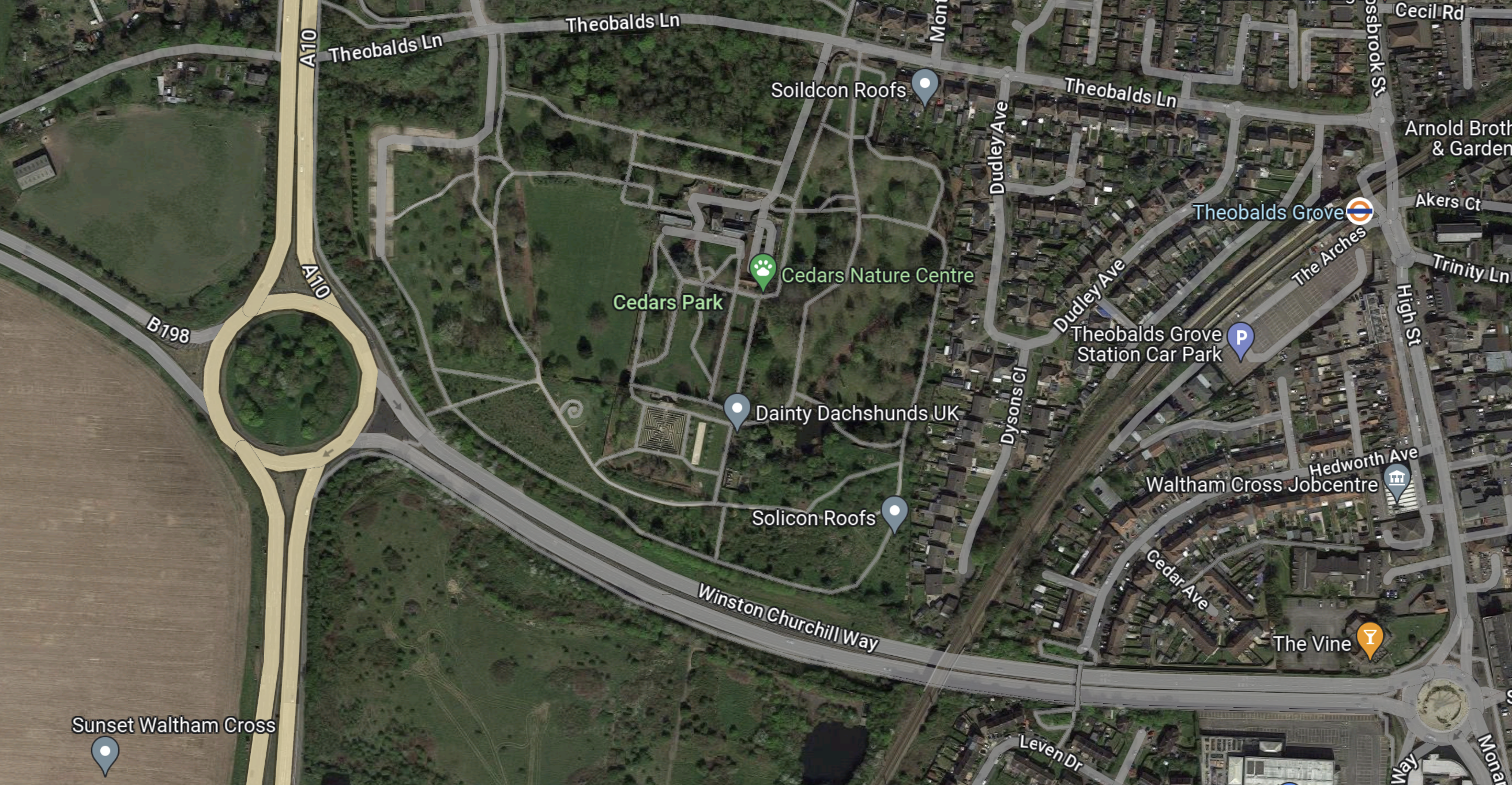
Note.
- The Sunset Waltham Cross label in the South West corner.
- Google’s Data Centre will be just off the map to the West of the A10.
- Theobalds Grove station is marked by the TfL roundel in the North-East corner of the map.
- There would appear to be no bus stops on Winston Churchill Way or the A10.
I walked South from the station to Winston Churchill Way, where I took these pictures.





Note.
- At that point, I gave up because of the cold and pollution.
- It was also a Saturday morning about midday.
The route I took is certainly not an alternative route to get to Google’s Data Centre or Sunset Studios.
A Possible Station At Park Plaza North
This article on the BBC is entitled Broxbourne: Two New Stations Planned.
This is the sub-heading.
Two new train stations could be built in Hertfordshire if plans to tighten planning policies are adopted.
This is the first paragraph.
Broxbourne Borough Council said stops at Park Plaza North – between Turkey Street and Theobalds Grove London Overground stations – and Turnford on the London to Bishop’s Stortford route would be subject to a consultation.
Later the BBC say that Park Plaza North station will be South of the A121 Winston Churchill Way near Waltham Cross
This Google Map shows the area South-East of the roundabout, where Winston Churchill Way meets the A10.
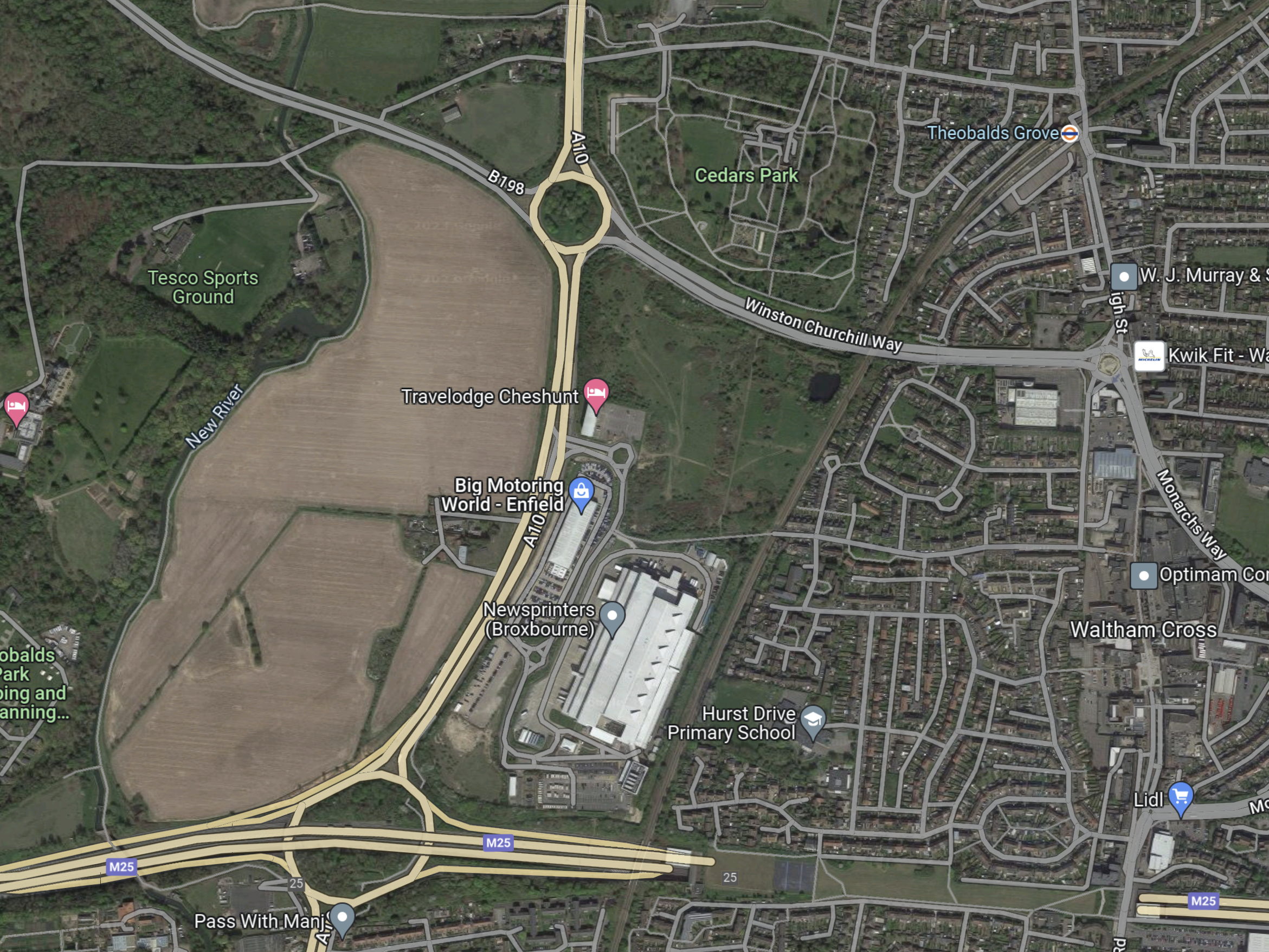
Note.
- The green patch of land to the South-East of the roundabout where Winston Churchill Way meets the A10 appears to be ripe for development.
- Looking at the green patch with a higher resolution, the land is little more than high class scrub beloved of newts.
- The London Overground line to Cheshunt runs down the East side of the site.
- To the North, the London Overground crosses Winston Churchill Way to get to Theobalds Grove station.
- To the South, the London Overground crosses the M25 to get to Turkey Street station.
- There is a lane running East-West along the South edge of the site, which crosses the railway in a level crossing.
This picture clipped from Google StreetView shows the level crossing.
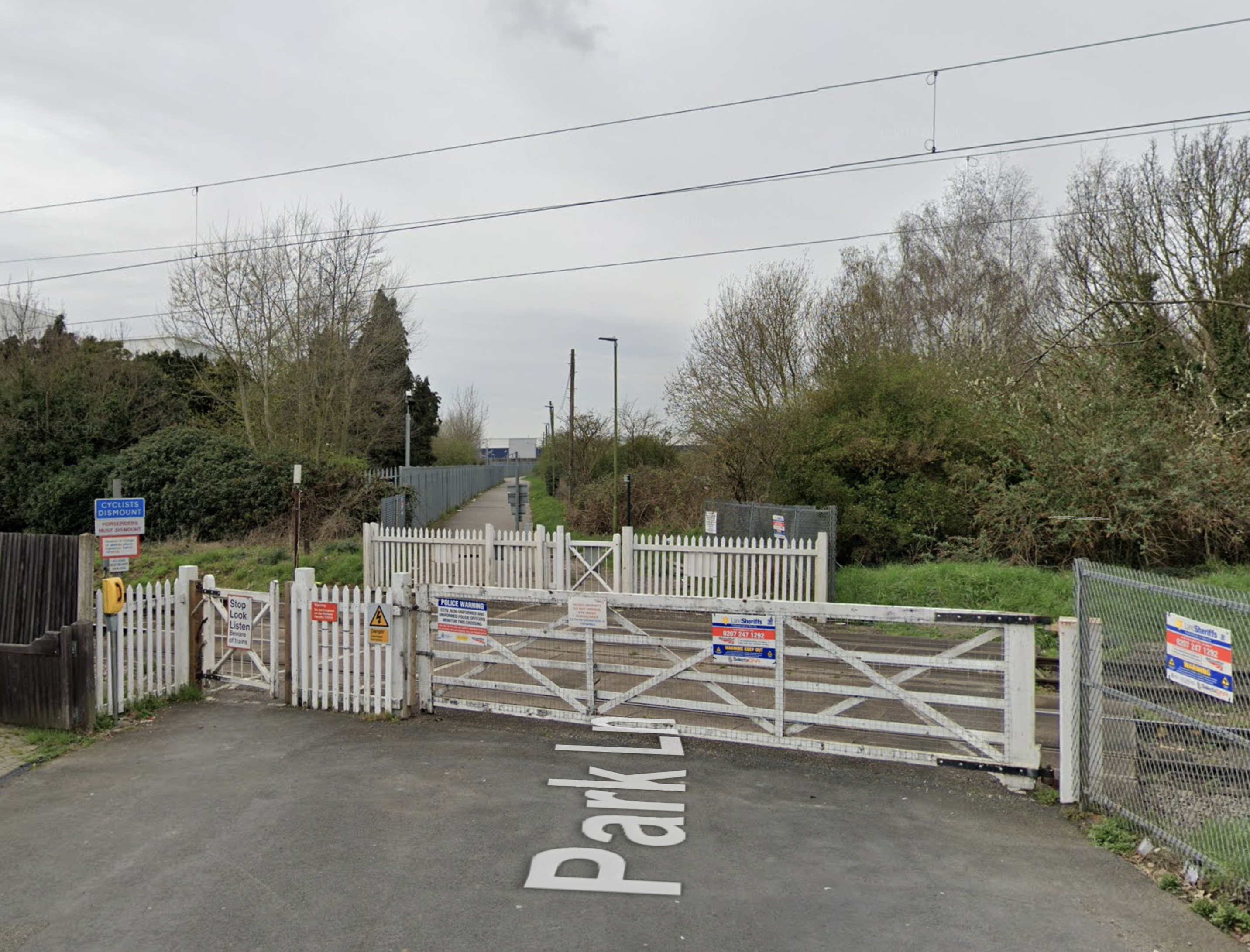
This is certainly one, that drivers dread.
This GoogleMap shows the level crossing and a stretch of the London Overground.
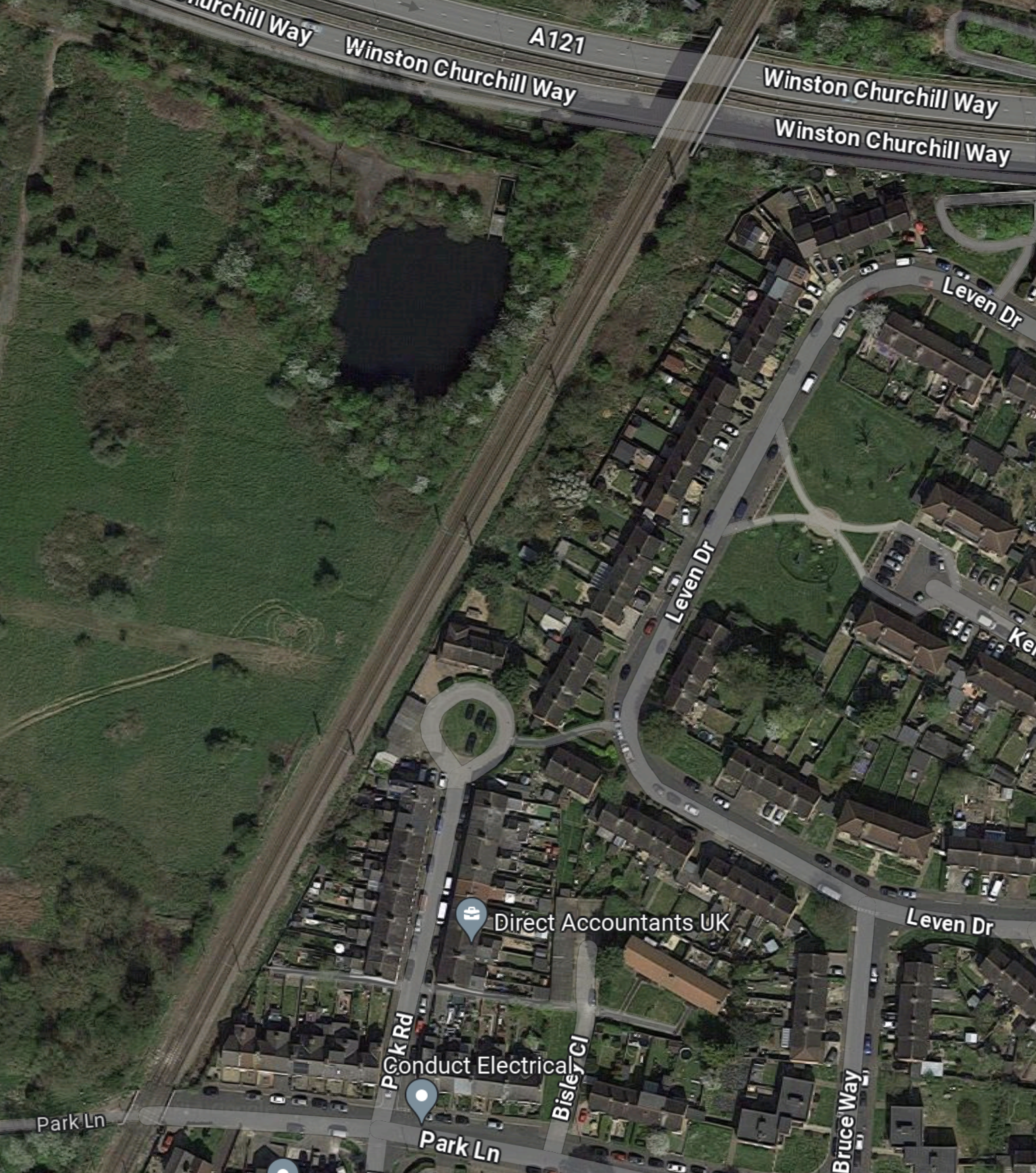
Note.
- The level crossing is in the South-East corner of the map.
- There isn’t much space to put a London-bound platform on the East side of the tracks, South of the Park Road circle.
- There is plenty of space to put a Cheshunt-bound platform on the West side of the tracks.
- North of the Park Road circle, there would appear to be space for two platforms.
It will need a lot of ingenuity to provide a safe and efficient solution to the problems of the level crossing and fitting a station in this limited space.
The first thing I’d do, would be to dig an underpass for pedestrians and cyclists to connect the two halves of Park Lane.
I’ve Often Worked On Christmas Day!
My father was a workaholic and would often go down his print works in Wood Green on Christmas morning.
When I became about seven, I would go with him and I would do small jobs.
In those days of the 1950s, it was a bit of a tradition that Spurs used to play at home on Christmas Day in the morning.
So probably for at least three years, we saw Spurs play and then went home to a late Christmas Lunch.
In the ten years or so, that I was writing and supporting Artemis, I would often use the Christmas holidays to develop the software or fix bugs, as I was unlikely to be phoned up to answer a query.
Today, I’m going to lunch with my son and his partner.
Before that though, I am pleased to see that The Times has published a full set of Monday puzzles. So I’ll be busy.
A Merry Christmas and a Happy New Year to all.
Would You Buy A Battery Energy Storage System From Rolls-Royce?
I don’t often click on adverts that appear in web pages.
But I had to click on one from Rolls-Royce mtu, which advertised Battery Energy Storage Systems.
I wonder what the Honourable Charles Rolls would have thought of adverts on the Internet for the company he jointly founded?
I suspect he would have liked the idea, as Rolls was very much a promoter of motoring and aviation and opened one of the first car dealerships in the UK, according to his Wikipedia entry.
The Wikipedia entry for his business partner; Sir Henry Royce starts with this sentence.
Sir Frederick Henry Royce, 1st Baronet, OBE (27 March 1863 – 22 April 1933) was an English engineer famous for his designs of car and aeroplane engines with a reputation for reliability and longevity.
He is also described as a perfectionist.
This sentence from the Wikipedia entry, describes how he started the design of the legendary “R” engine.
In October 1928, he began design of the “R” engine while walking with some of his leading engineers on the beach at West Wittering, sketching ideas in the sand. Less than a year later, the “R” engine, designed in his studio in the village, set a new world air speed record of 357.7 miles per hour and won the Schneider Trophy of 1929.
Later with help from the maddest person my father ever met (his words, not mine!) ; Lady Houston, the Supermarine S.6B won the trophy in 1931 and then broke the world speed record at over 400 mph. Not bad for a seaplane. Take the floats off an S.6B and you almost have a Spitfire.
The Wikipedia entry also describes how the “R” engine was developed into what many engineers believe was the finest internal combustion engine of all time; the Rolls-Royce Merlin.
Following the success of the “R” engine, it was clear that they had an engine that would be of use to the Royal Air Force. As no Government assistance was forthcoming at first, in the national interest they went ahead with development of what was called the “PV-12” engine (standing for Private Venture, 12-cylinder). The idea was to produce an engine of about the same performance as the “R”, albeit with a much longer life. Rolls-Royce launched the PV-12 in October 1933 and the engine completed its first test in 1934, the year after Royce died. The PV-12 became the Rolls-Royce Merlin engine.
Where would we have been in the Battle of Britain without the Merlin engine?
Since 1969, the engineers at Rolls-Royce have followed Sir Henry’s example of perfection and developed the revolutionary RB-211 into the modern day Trent, which is now about to take a big leap into a low-carbon future with the UltraFan.
If the quality of Rolls-Royce mtu’s Battery Energy Storage System matches the levels of perfection Rolls-Royce achieved with the Merlin and the Trent, then I suspect that Sir Henry would have given his approval.
This picture is shown on the web page for the Battery Energy Storage System.

These two paragraphs introduce, what Rolls-Royce mtu are calling the mtuEnergyPack.
In today’s world of economic growth and increasing populations, the demand for electricity is soaring. Governments and industries globally shift to distributed renewable energy, challenging centralized grids. To adapt to this changing energy landscape, the mtuEnergyPack offers an ideal solution.
It integrates renewable sources like solar and wind power, paving the way for future-ready sustainable power systems. The mtu EnergyPack is a scalable, all-in-one solution for autonomous off-grid facilities. It ensures reliable power through peak shaving, load-shifting, and grid stabilization, making it suitable for various applications.
These are my thoughts.
What Is The Output And The Storage Capacity?
This paragraph on this page gives this answer.
It efficiently stores electricity from distributed sources and delivers on demand. The mtu EnergyPack is available in different sizes: The QS and the QL, ranging from 200 kVA to 2,000 kVA, and from 312 kWh to 2,084 kWh, and the QG for grid scale storage needs, ranging from 4,400 kVA and 4,470 kWh to virtually any size.
It seems that you specify your requirements and Rolls-Royce mtu should be able to satisfy it.
What Devices Can Be Connected?
This paragraph on this page gives this answer.
The mtu EnergyPack serves as a key component in enhancing the reliability and profitability of microgrids and energy systems. It stores electricity generated by distributed power sources, including gensets, wind turbines, or solar panels, and delivers it when needed.
In the 1970s, when I was working at ICI, others in the section were working on a system called MEDIA, where every sensor on a chemical plant was connected to the central computer, through its own analog-to-digital computer. It would now be called plug-and-play by some.
I believe that Rolls-Royce mtu are using similar ideas to connect equipment to the control computer.
These are my thoughts about connecting various equipment.
- Hydrogen-powered generators and electrolysers as Rolls-Royce mtu are using at Duisburg, which I wrote about in Rolls-Royce Makes Duisburg Container Terminal Climate Neutral With MTU Hydrogen Technology.
- Could Rolls-Royce’s beer keg-sized 2.5 MW electrical generator based on a Super Hercules engine, be connected?
- Could a Rolls-Royce Trent be connected?
- Could one of Rolls-Royce’s small modular nuclear reactors be connected?
- In Rolls-Royce To Play Key Role In US Department Of Defense Nuclear Microreactor Program, I talk about developing a 1-5 MW nuclear reactor for US Department of Defense. Could these be connected?
I don’t see why every device can’t work to the same protocol.
What Is The Power Density Like?
This paragraph on this page gives this answer.
The mtu EnergyPack’s compact battery system designs suit projects with limited space and logistical restrictions.
In ‘Spirit of Innovation’ Stakes Claim To Be The World’s Fastest All-Electric Vehicle, I talked about Rolls-Royce’s record-breaking electric plane called Spirit of Innovation.
Has what has been learned about energy storage in the confined spaces of an aeroplane been applied to a Battery Energy Storage System?
What Do Rolls-Royce mtu Consider To Be Important Features?
On this page, they list these features.
- Power Density
- Digitally Connected
- Multilevel Safety
- Black Start Capability
- Scalability
- Ultra-Fast Response
- Flexible Use
- Plug-And-Play Installation
The design seems to have everything covered.
Can Similar Systems Be Designed By Others?
I would expect that similar systems can be designed, as technology like batteries is available to all and the operation is only as good as the software controlling the various components of the system.
But similar systems will be without the famous Rolls-Royce logo.
Could One Of These Systems Decarbonise A Village?
I once lived in a village with about fifty houses and perhaps a hundred inhabitants.
- There was an old World War Two airfield, that could probably accommodate a small wind farm of perhaps 20 MW.
- There were a couple of barns and large sheds, that could have solar panels similar to those I described in Bedford Depot’s Massive Solar Roof Helps Thameslink On Way To Net Zero.
I suspect an mtuEnergyPack could control all these inputs and provide the village with the following.
- Enough electricity to power all the needs of the inhabitants, businesses and their vehicles.
- If an electrolyser were to be provided, it could probably produce enough hydrogen to power every boiler and hydrogen-powered vehicle.
Note.
- Farmers would like the local availability of hydrogen, as it will be ideal for tractors and agricultural machinery.
- I actually believe that if a village had a reliable and affordable hydrogen supply, that a large proportion of the inhabitants would switch to hydrogen-powered vehicles.
There would still be the National Grid there for backup.
Conclusion
If I needed an mtuEnergyPack, I’d certainly give one a close look.
Plans for Hydrogen Development At Dogger Bank D Gain Ground
The title of this post, is the same as that of this article on offshoreWIND.biz.
This is the sub-heading.
Dogger Bank D, the potential fourth phase of the world’s largest offshore wind farm under construction, Dogger Bank Wind Farm, has awarded contracts to engineering consultants to support the feasibility and optimization of a large-scale green hydrogen development option on the project
These three paragraphs outline the project.
SSE Renewables and Equinor, the developers of the Dogger Bank wind farm in the UK, awarded contracts for green hydrogen concept and engineering and optimization studies to Genesis, H2GO Power, and Fichtner.
If progressed for delivery, Dogger Bank D would be located in the North Sea around 210 kilometers off the northeast coast of England. Subject to the successful outcome of further technical studies, the project could be capable of generating up to around 2 GW of renewable power.
The 2 GW offshore wind farm is currently planned to comprise 128 wind turbines and up to six offshore platforms.
Note.
According to the article, this would be one of the UK’s largest green hydrogen production facilities.
The partners said, that the project could contribute to the UK Government’s electrolytic hydrogen ambitions for 5 GW by 2030.
This is said about the studies.
Using AI machine learning and robust modeling, these studies will investigate the multitude of interdependent variables required to optimize a potential green hydrogen production facility, such as offshore wind farm sizing, electrolysis capacity, transport and storage capacity, water availability, and offtake optionality.
I was using robust modelling on projects such as these fifty years ago, both with Artemis and bespoke software.
To my mind, SSE Renewables and Equinor are doing the right thing. If anybody has a similar project with lots of variables, I’d love to give my opinion.
I have some thoughts.
How Much Hydrogen Will Be Produced?
Ryze Hydrogen are building the Herne Bay electrolyser.
- It will consume 23 MW of solar and wind power.
- It will produce ten tonnes of hydrogen per day.
The electrolyser will consume 552 MWh to produce ten tonnes of hydrogen, so creating one tonne of hydrogen needs 55.2 MWh of electricity.
This would mean that if the Japanese built one Herne Bay-size electrolyser, then it would produce around three hundred tonnes of hydrogen in an average month.
Consider.
- Dogger Bank D is likely to be a 2 GW wind farm.
- This document on the OFGEM web site, says that the Dogger Bank wind farms will have a capacity factor of 45 %.
- This means that Dogger Bank D wind farm will produce an average of 900 MW over a year.
- This works out at 7,884 GWh of electricity in a year.
As each tonne of hydrogen needs 55.2 MWh to be produced, this means if all the electricity produced by Dogger Bank D, is used to create green hydrogen, then 142,826.1 tonnes will be produced.
How Will The Hydrogen Be Brought Ashore?
142,826.1 tonnes is a lot of green hydrogen and the easiest ways to transfer it to the shore would be by a pipeline or a tanker.
I wouldn’t be surprised to see the use of tankers, as this would give more flexibility and allow the export of hydrogen to countries in need of hydrogen.
Will There Be Hydrogen Storage In The Dogger Bank D Wind Farm?
This would surely be a possibility, but there are security considerations.
Cost would also be a factor!
The Location Of The Dogger Bank D Wind Farm
I clipped this map of Dogger Bank A, B, C and D wind farms from this page of the Dogger Bank D web site.
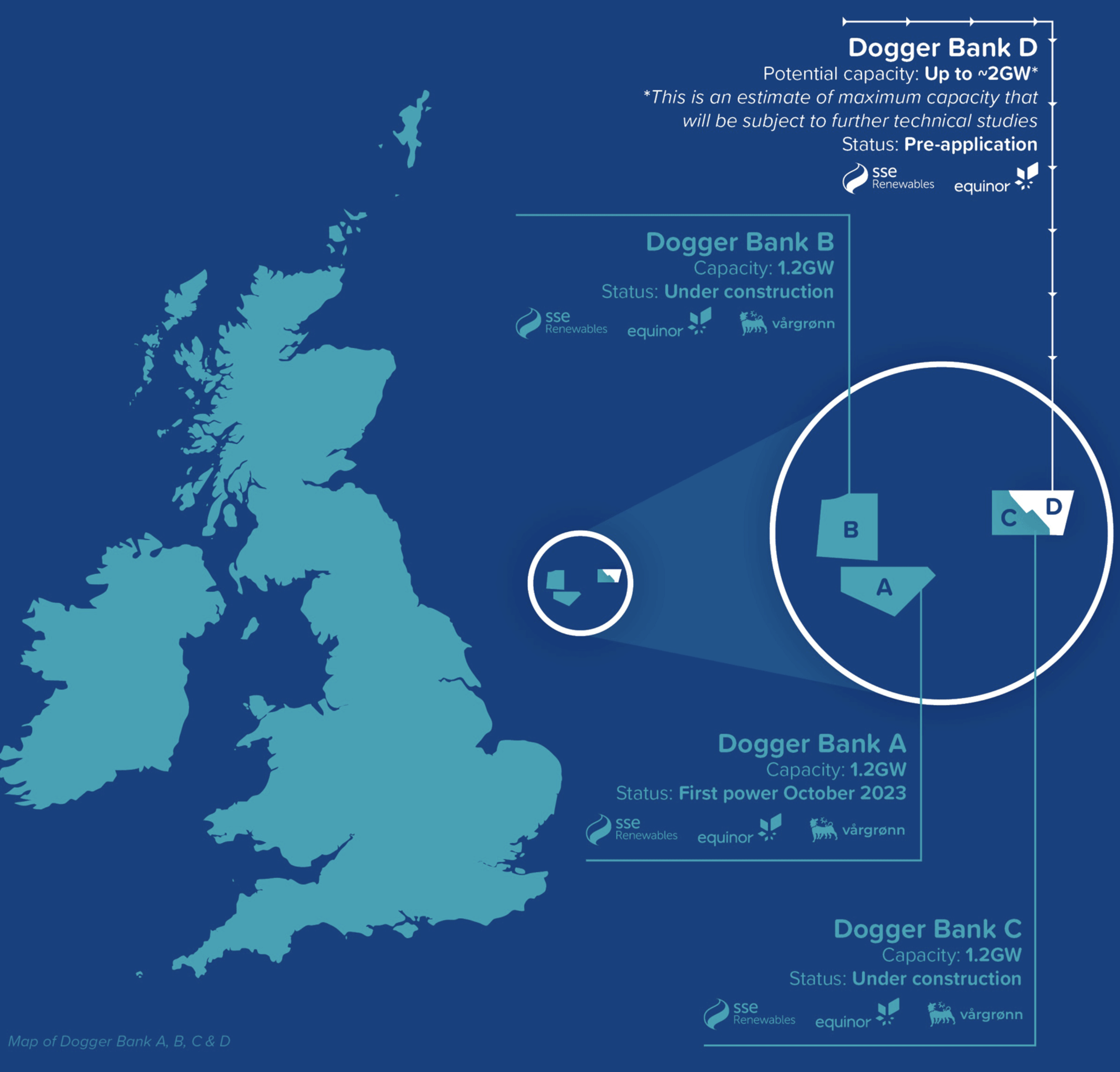
Note.
- RWE’s Dogger Bank South wind farm is not shown on the map.
- Dogger Bank D wind farm is the most Easterly of the four wind farms being developed by SSE Renewables and Equinor.
- Dogger Bank D wind farm must be the closest of the Dogger Bank wind farms to the Eastern border of the UK’s Exclusive Economic Zone or EEZ.
Dogger Bank D wind farm would appear to be ideally placed to supply hydrogen to a number of places, by either pipeline or tanker.
Could Dogger Bank South Wind Farm Also Produce Hydrogen?
In RWE Partners With Masdar For 3 GW Dogger Bank South Offshore Wind Projects, I talked about the change of ownership of the Dogger Bank South wind farm.
I would assume that the Dogger Bank South wind farm will be located to the South of the Dogger Bank A,B, C and D wind farms.
Whether it will produce hydrogen will be a matter for the owners and market conditions.
I do believe though, that it could share some facilities with the those that might be built for Dogger Bank D wind farm.
Conclusion
After this brief look, Dogger Bank D could be an ideal place to build a large hydrogen production facility.
A Community Engagement App For The Hope Valley Line Upgrade
The Hope Valley Line Upgrade has its own web site.
This is the sub-heading.
We’re upgrading the railway between Manchester and Sheffield to provide more reliable and faster journeys for passengers
The first paragraph gives the project timeline.
The project started in Spring 2021 and is due to be completed in Spring 2024.
There is also a section, that is entitled Community Engagement, where this is said.
Communication is very important to us and we will be writing to local residents with plenty of notice before work starts, as well as holding public engagement events throughout the project to keep the local community informed on its progress.
For regular updates on the main improvement work, you can also download the Hope Valley Railway Upgrade community engagement app, which will contain details of upcoming work activities, news, and initiatives and events for the local community.
That is new territory for Network Rail or at least the first time, I’ve seen one.
Until proven otherwise, it looks like it could be a good idea.
My Phone Died!
So I bought a new one!
I’ve managed to set it up, but it’s so different to my previous Samsung, that i haven’t a clue hoe to use it. I also made the mistake of using a secure password, which it constantly asks me.
I’m seriously, thinking of giving up having a mobile phone.
Can’t designers leave well enough alone!
I hate being ripped off!
Bonus For GPs If Patients Join Drug Trials In Plan To Lure Firms To NHS
The title of this post, is the same as that of this article on The Times.
This is the sub-heading.
£650m boost for medical research after number of participants slumps
These three paragraphs outline what is to be done.
Tens of thousands more patients will be signed up for clinical trials as ministers promise drug companies better access to the NHS to expand the economy and develop cutting-edge treatments.
Jeremy Hunt, the chancellor, is promising a £650 million package to boost life sciences as he attempts to lure pharmaceutical giants to Britain.
GPs will be offered financial incentives to recruit patients into trials of new treatments and hospitals will be given research targets under plans to reverse a slump in clinical testing while the NHS struggles with the backlog from Covid-19.
It all sounds good to me.
I have been involved in several trials and medical research projects.
- As part of my coeliac disease diagnosis, one endoscopy was performed by Rebecca Fitzgerald at Cambridge, as she was taking samples of bile fluids for her research into Barrett’s esophagus.
- After the death of my wife, I was interviewed by PhD students in the Psychology Department at Liverpool University for their research into widowhood.
- Oxford University interviewed me on diet for their coeliac disease research.
- After my stroke, I spent an entertaining afternoon at the University of East London doing balance tests by computer. Their aim was to develop a reliable balance test for stroke and other patients, that could be carried out by physiotherapists quickly, than by more expensive doctors.
- I have also been on a drug trial at Queen Mary University, but that drug was useless and had no good or bad affects, so the trial was halted. However, it did lead to other enjoyable activities in the field of patient relations with treatment and research.
As a confirmed coward, I should note that with the exception of the drug trial, all of the other projects were low risk.
I should say, that I also sponsor pancreatic cancer research at Liverpool University, in memory of my son, who died from the disease. I wrote about the first Liverpool project in There’s More To Liverpool Than Football And The Beatles!.
A Database Of Projects Open For Volunteers
I believe that this is needed, so that those like me, who like to contribute to research can volunteer.
Perhaps some of the £650 million, that has been promised by Jeremy Hunt, could be used to create the database.
I also believe the database could be used for other non-medical research.
A Waste Of Valuable Resources Between Paddington And Heathrow
Much of my working life was spent in writing project management software.
I like to think, I was an expert at writing software to juggle resources.
I wrote my first piece of software in that field in ICI, to get my boss out of trouble, after he’d promised the department a program to allocate the department’s office space more efficiently.
Unfortunately, the student, who’d written the software, without leaving anything that worked or any decent instructions.
So I told my boss;Colin, that I’d have a go.
In my previous position at ICI in Runcorn, I’d worked out an algorithm to decode mass spectrometer traces, which started with a rough idea of what was there, which was entered by an operator and then used permutations and combinations to fit the output.
I used the algorithm in every resource scheduler, I ever wrote and it worked a treat.
So when I see a waste of resources, I get angry, as I know those who devised the system could have done a lot better.
Look at these pictures, I took of a Heathrow Express, that I took today.




It is barely ten percent full.
It has become a waste of resources; train, valuable paths in the Heathrow tunnel, and platform space at Paddington.
These are a few thoughts.
Capacity To And From Heathrow
Consider.
- Heathrow Express uses twelve-car Class 387 trains, with a capacity of 672 seats, that run at a frequency of four trains per hour (tph), which is 2,688 seats per hour.
- The Elizabeth Line uses nine-car Class 345 trains, with a capacity of 454 seats, that run at a frequency of six tph, which is 2,724 seats per hour.
- The Class 345 trains can also carry another 1046 standing passengers on each journey, which adds up to a maximum of 6276 standees per hour.
- The Piccadilly Line uses 73 Stock trains, with a capacity of 684 seats, that run at a frequency of twelve tph, which is 8,208 seats per hour.
This gives a capacity of 19,896 passengers, staff and visitors per hour, or which 13,620 get seats.
Expressed as percentages, the four modes of transport are as follows.
- Heathrow Express – 13.5 %
- Elizabeth Line – Sitting – 13.7 %
- Elizabeth Line – Standees – 33.8 %
- Piccadilly Line – 41.2 %
In Effects Of The ULEZ In West London, I said this about journeys to and from the airport.
Heathrow Airport is one of the world’s busiest airports and 76,000 people work at the airport, with many more employed nearby.
The airport handled 61.6 million passengers in 2022, which is a few short of 170,000 per day.
If you consider that those that work at the airport do two trips per day and passengers generally do one, that means there are 322,000 trips per day to or from the airport.
But as it now so easy to get to the Airport using the Elizabeth Line will more people use the new line to meet and greet and say goodbye to loved ones or business associates. Since the Elizabeth Line opened, I’ve met a couple of friends at Heathrow, who were passing through.
I wonder, if that daily journey total of 322,000 could be nearer to 350,000 or even 400,000.
If the ULEZ charge makes some passengers and staff switch from their car to using a bus or train, this probably means that public transport to and from the airport, will need to be boosted by a substantial amount.
322,000 trips per day is 13,416 per hour assuming a 24 hour day.
Consider.
- The ULEZ will drive employees and passengers to trains to Heathrow.
- A lot of would-be travellers to Heathrow have had a tough couple of years.
- Because of the Elizabeth Line more meeters and greeters will go to the airport.
- The Elizabeth Line is making it easy to get to Heathrow for a large proportion of those living in the South-East.
- There have been numerous car parking scandals at Heathrow and other airports.
- Are there enough charging points for electric cars in Heathrow’s parking?
- Parking at Heathrow is expensive.
- Taxis to the airport are very expensive.
- Passengers with large cases can use the Elizabeth Line.
- Good reports of the Elizabeth Line will push people to use it.
- The Elizabeth Line serves the City, Canary Wharf and the West End.
- The Elizabeth Line has a step-free connection with Thameslink.
- Passengers seem to travel with very large cases.
- Passengers seem to be deserting Heathrow Express, as I wrote in Elizabeth Line Takes Fliers Away From Heathrow Express.
Note.
- The train, I took back from Heathrow this morning was full with all seats taken and quite a few standees.
- And it was a Sunday morning!
- We won’t know the effect of the ULEZ until August, but I believe it will be significant.
Obviously, I’m only using rough figures, but they lead me to believe that in a few months, the Elizabeth Line will be at full capacity to and from Heathrow.
Heathrow Express’s Train Paths Should Be Re-Allocated To The Elizabeth Line
This would increase hourly passenger capacity from 19,896 to 23,208 or by seventeen percent.
Great Western Railway would get two extra platforms at Heathrow and the Class 387 trains could be reallocated.
Where Would Great Western Railway Run Trains From Two Extra Platforms?
Consider.
- Various government levelling up funding has been allocated to Wales and the West.
- I talk about the Mid-Cornwall Metro in Landmark Levelling Up Fund To Spark Transformational Change Across The UK.
- The Mid-Cornwall Metro could include direct trains between London and Newquay.
- There are also plans for a new station at Okehampton Parkway.
- Given all the wind farm development in the Celtic Sea, I can see more trains between London and Pembrokeshire.
- Cardiff and Bristol would probably welcome extra services.
I don’t think Great Western Railway will have problems finding destinations to serve from two extra platforms.
What Will Happen To The Class 387 Trains?
Currently, twelve Class 387 trains are used for Heathrow Express.
In The Future Of The Class 387 And Class 379 Trains, I said this.
The Battery-Electric Class 379 Train
I rode this prototype train in 2015.

An Outwardly Normal Class 379 Train
I think it is reasonable to assume, that as battery technology has improved in the seven years since I rode this train, that converting Class 379 trains to battery-electric operation would not be a challenging project.
Creating A Battery-Electric Class 387 Train
If the Class 387 train is as internally similar to the Class 379 train as it outwardly looks, I couldn’t believe that converting them to battery-electric operation would be that difficult.
I could see a lot of the Class 379 and Class 387 trains converted to 110 mph battery-electric trains.
Would Heathrow Express Completely Disappear?
If the Elizabeth Line trains are going between Heathrow Airport and Central London, at a frequency of 10 tph or one train every six minutes, I feel there may be scope for marketing and operational reasons to create a sub-fleet of the Class 345 trains.
The trains would be identical to the Elizabeth Line’s current fleet, except for livery, seating and some internal passenger features.
- Perhaps, they could be called the Heathrow Train boldly on the outside, so even the dimmest passenger didn’t get on a Reading train instead of a Heathrow one.
- All trains would have wi-fi and 4G connectivity. These features have been promised for the Class 345 trains.
- Some coaches would be fitted with luggage spaces for the outsize cases people carry.
I could envisage the Heathrow Trains terminating at a wide number of places in addition to Abbey Wood and Shenfield. Possibilities must include Beaulieu Park, Ebbsfleet, Gravesend, Northfleet and Southend Victoria
 The Anonymous Widower