Crown Estate To Re-Tender 1.5 GW Offshore Wind Site Relinquished by EnBW And JERA Nex BP
The title of this post, is the same as that of this article on offshoreWIND.biz.
This is the sub-heading.
The Crown Estate will launch a competitive tender process next month to bring the 1.5 GW Morgan offshore wind project in the Irish Sea back to market, with plans to appoint a new developer by late 2026.
These two paragraphs add more detail.
The Morgan site was originally awarded through Offshore Wind Leasing Round 4 in 2021, but development was discontinued in January 2026 by the joint venture between EnBW and JERA Nex BP, which held the lease rights.
After EnBW decided to exit the Morgan and Mona offshore wind projects in the UK, its joint venture partner JERA Nex BP acquired EnBW’s stake in 1.5 GW Mona, while the joint venture discontinued the development of the Morgan project and returned the lease rights to the Crown Estate.
There is no Morgan web site, but there is a joint web site with the Morecambe wind farm, which also has its own web site.
The joint web site has a home page showing both Morgan and Morecambe wind farms connecting to Penwortham substation.
In Mooir Vannin Offshore Wind Farm, I say that this web farm will also have a connection to the Penwortham substation.
There does seem a lot of bitterness about using the Penwortham substation being built.
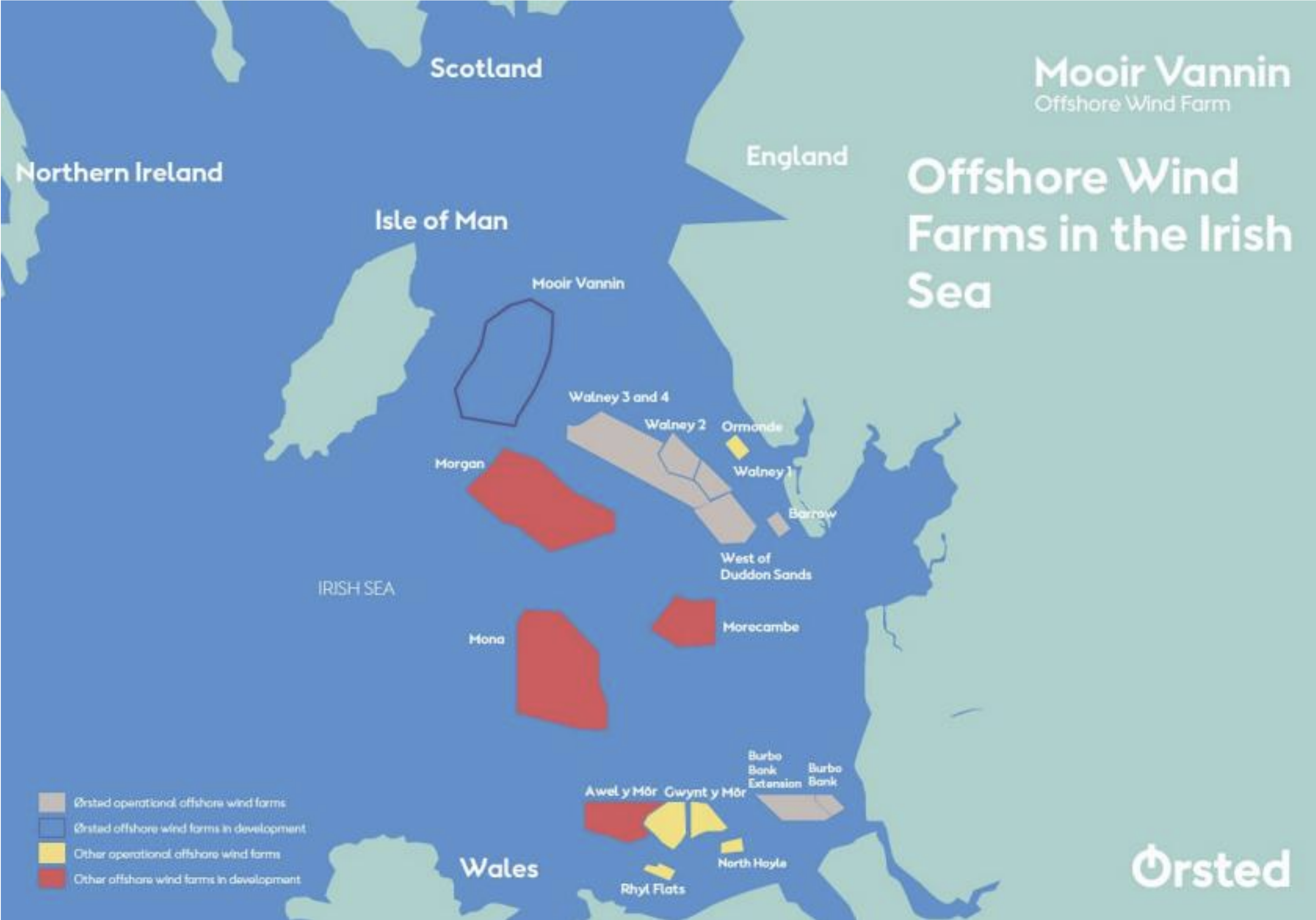
This Ørsted map shows the large number of wind farms in the Irish Sea.
Note.
- Mooir Vannin is a 1.4 GW wind farm being developed to the East of the Isle of Man
- Morgan wind farm would have been a 1.5 GW wind farm to be South of Mooir Vannin.
- Mona wind farm will be a 1.5 GW to the South of Morgan.
- Mona will connect to the North Wales coast.
- Morecambe will be a 480 MW wind farm to the East of Morgan and Mona.
- Mooir Vannin will connect to the Isle of Man.
- Morgan and Morecambe wind farms were all planned to connect to the Penwortham substation.
- Mooir Vannin will additionally connect to the Isle of Man.
It will be interesting to see, what proposals are put to the Crown Estate for a replacement of the Morgan wind farm.
I wouldn’t be surprised to see something to do with offshore production of hydrogen, as there is much more hydrogen production on the East side of the UK, due to the massive German AquaVentus project.
Could Paddington And Minehead Be Within Range Of Hitachi Battery-Electric Intercity Trains?
I am prompted to ask this question, by an article in today’s Telegraph, which is entitled The New British Rail Services Reversing The Damage Of Beeching’s Axe.
Line 8. is given as the West Somerset Railway between London and Minehead?
This paragraph describes the idea.
As with the Severn Valley Railway (SVR) to Bewdley, the West Somerset Railway (WSR) looks like it could one day host mainline trains and connect communities along the route with destinations such as Taunton and Bristol. Like the SVR, the WSR is a very long and well-staffed heritage line with a long history (50 years, in fact, and it was one of Britain’s first heritage lines following its Beeching closure). Running to Minehead and Dunster, you don’t need me to tell you that this is a beautiful part of the world with numerous castles and beaches, and Exmoor National Park next door.
Note.
- The author doesn’t mention London services in the text.
- Batteries are not mentioned either.
- Minehead will be only about twenty miles from Hinckley Point C nuclear power station.
Is it feasible?
What Is The Battery Range Of An Hitachi Intercity Tri-Mode Battery Train?
In The Data Sheet For Hitachi Battery Electric Trains, I came to these conclusions.
- The battery pack has a capacity of 750 kWh.
- A five-car train needs three battery-packs to travel 100 miles.
- A nine-car train needs five battery-packs to travel 100 miles.
- The maximum range of a five-car train with three batteries is 117 miles.
- The maximum range of a nine-car train with five batteries is 121 miles.
As battery technology gets better, these distances will increase.
What Is The Distance Between Minehead And Taunton?
I shall be using 24.8 miles, which I have calculated from figures given in the Wikipedia entry for the West Somerset Railway.
What is The Distance Between Paddington And Taunton Via Newbury?
I shall be using 142.6 miles, which I have calculated from figures given in RealTimeTrains.
What Is The Maximum Range From Paddington Via Newbury Of An Hitachi Intercity Tri-Mode Battery Train?
Consider.
- The electrification runs between Paddington and Newbury.
- The distance between Paddington and Newbury is 53 miles, according to RealTimeTrains.
- Paddington and Taunton is almost 30 miles shorter by Newbury, than via Bath.
This Google Map shows Taunton station.
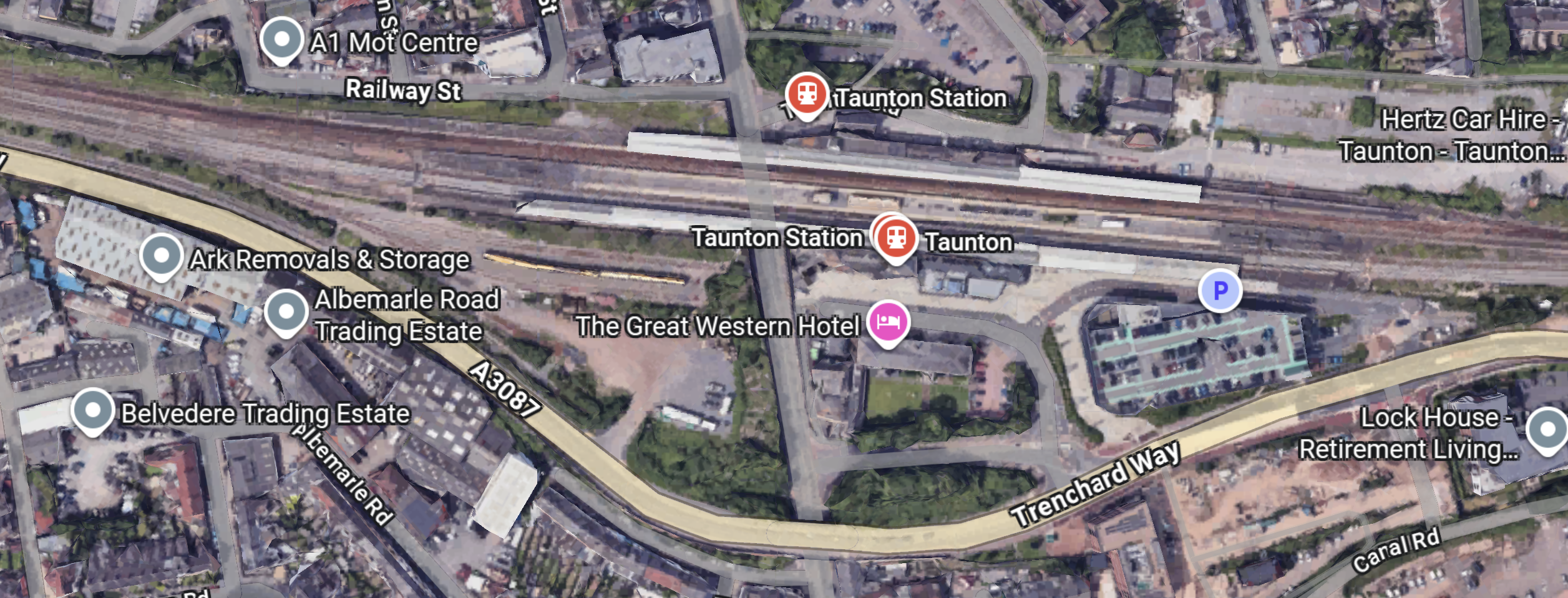
Taunton station looks spacious with numerous platforms and a hotel.
I believe that a five-car Hitachi Intercity train leaving Newbury with three full batteries could travel as far as 53+117 or 170 miles from Paddington.
Could A Hitachi Intercity Five-Car Train Reach Taunton?
This would mean that Taunton would be in range as it is only 142.6 miles.
The train would need to be recharged before returning to London.
Could A Hitachi Intercity Five-Car Train Reach Minehead?
But it could also have enough power in the batteries to reach Minehead, which is only a further 24.8 miles or 167.4 miles in total.
As with Taunton, the train would need to be recharged before returning to London.
Options For Charging Trains That Are Returning To London
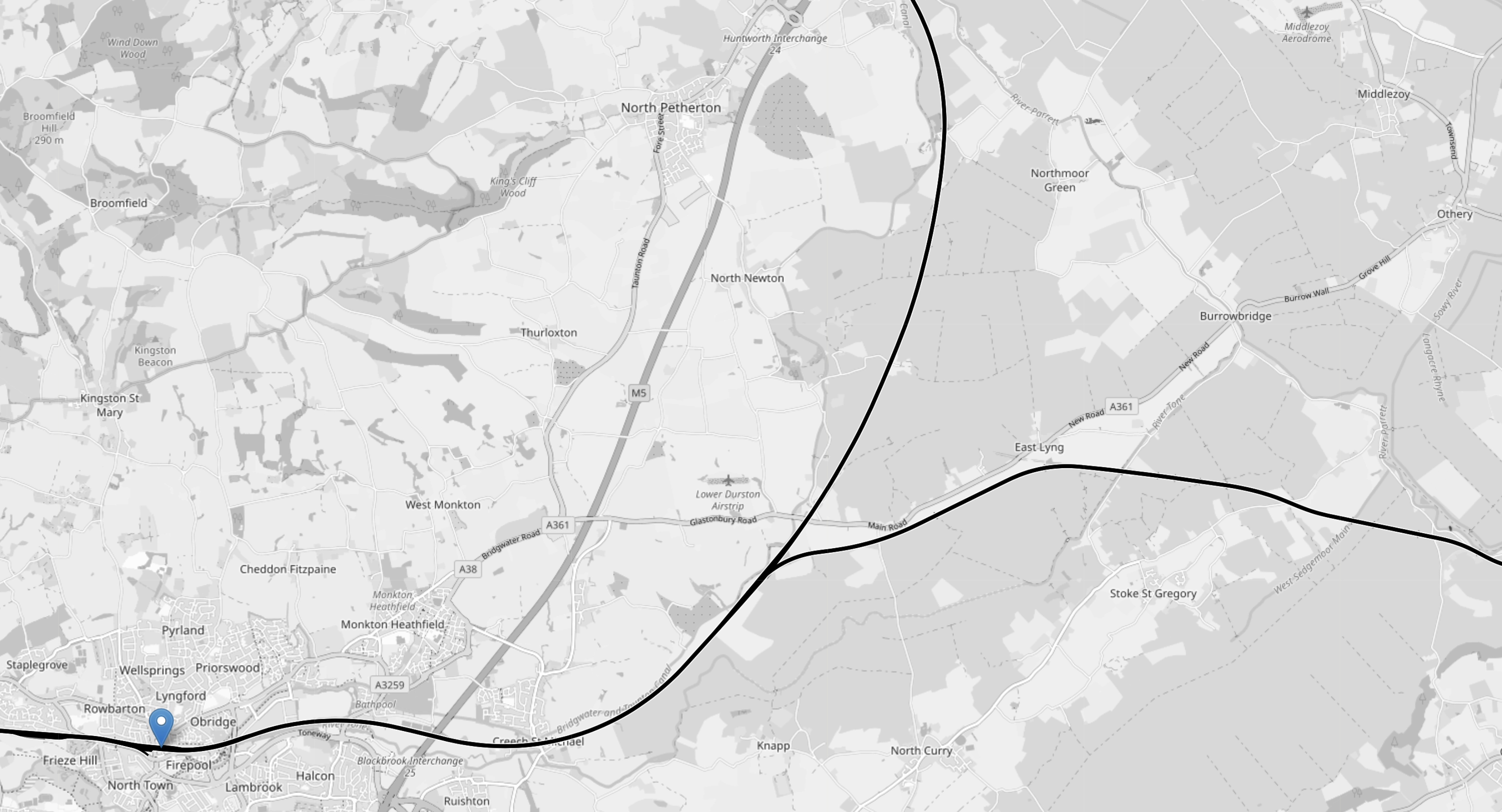
This OpenRailwayMap shows the tracks through Taunton.
Note.
- Taunton station is indicated by the blue arrow.
- Running East-West across the map and through Taunton station, is the Reading-Taunton Line.
- Running more North-South across the map and through Taunton station, is the ~Bristol-Exeter Line.
- The two lines split going East at Cogload junction.
- Taunton station and Cogload junction are about 4.5 miles apart.
- Trains typically take about six minutes between the two places.
I believe there are three options for charging the trains.
Option 1 – Charge In Minehead Station
This would be possible, but as not all trains go to Minehead station, it probably wouldn’t be very practical.
Option 2 – Charge In Taunton Station
This would be possible, especially as most trains seem to call in Taunton station.
Option 3 – Electrify Between West Of Taunton Station And East Of Cogload Junction
Consider.
- The length of the electrification could be as long as is necessary.
- Trains would charge their batteries at line speed.
- Pantographs would be raised and lowered at line speed.
- Trains would not have to call at Taunton station.
- Trains could charge their batteries on both routes.
- Trains could charge their batteries in both directions.
I believe this could be the most efficient way to charge trains through Taunton.
Onward From Taunton
If the electrification through Taunton could be made long enough, so trains left the station with a full battery, the following would be possible.
- Going South trains should go past Plymouth.
- Going towards Newbury, trains should have enough in the batteries to reach Newbury and electrification for London.
- Going towards Chippenham, which is 63 miles away, trains should have enough in the batteries to reach Chippenham and electrification for London.
- Going towards Bristol Temple Meads, which is 44.8 miles away, trains should have enough in the batteries to reach Bristol Temple Meads.
JERA Nex BP, EnBW Submit Morven Offshore Wind Farm Application
The title of this post, is the same as that of this article on offshoreWIND.biz.
This is the sub-heading.
A joint venture between JERA Nex BP and EnBW has submitted Section 36 consent applications for the Morven offshore wind farm to the Scottish government
These two paragraphs add a few details.
The developer secured the seabed rights for the Morven offshore wind farm as a single project in the ScotWind Leasing Round in 2022 and split it into two separate projects during the early development phase.
Located around 60 kilometres off the coast of Aberdeenshire at its closest point, the site is planned to house Morven North and Morven South, which would have a combined installed capacity of up to 3 GW and around 190 wind turbines in total.
Morven Offshore Wind Farm now has a comprehensive web site.
The web site says that the electricity will be brought ashore at Hawthorn Pit.
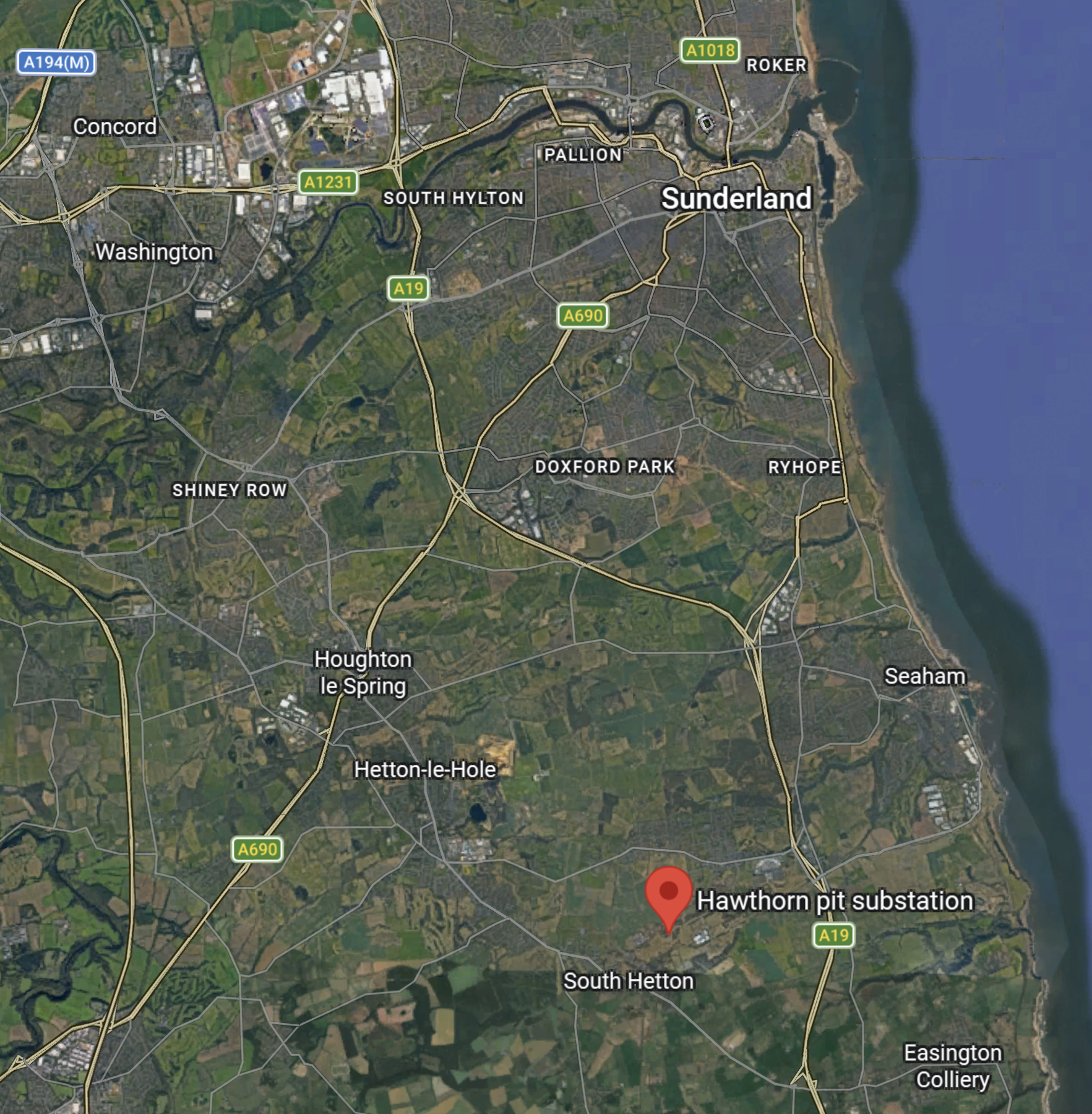
This Google Map shows the location of Hawthorn Pit.
Note.
- Hawthorn Pit is indicated by the red arrow.
- Sunderland is at the top of the map on the coast.
- Aura Power has already obtained planning permission for Hawthorn Pit solar farm, which will be up to 49.9 MW.
- Zenobe are developing a battery-energy-storage-system(BESS) 1.5 km to the South-East of the new Hawthorn Pit substation, which will have an output of 300 MW. Sloppily, there is no detail on capacity, but Google AI indicates, it is a 300 MW/600 MWh battery.
- Hawthorn Pit substation is also the expected to be the Southern end of Eastern Green Link 1, which will help to bring Scottish wind power to England, which will be a 2 GW undersea interconnector to Torness.
In Murphy Starts Work On £2.5bn Eastern Green Link 1, I detail the start of building of Eastern Green Link 1 and say it should be operational by 2029.
When Is The Morven Offshore Wind Farm Expected To Be Commissioned?
I asked Google AI the question above and received this answer.
The 2.9 GW Morven offshore wind farm is expected to be fully commissioned and operational between 2031 and 2035, with initial grid connections and power export potentially starting as early as 2030.
The timeline for full deployment of the Morven Offshore Wind Farm remains somewhat flexible as it depends on final planning approvals and connection offers from the National Energy System Operator (NESO).
The Cables For The Morven Offshore Wind Farm And Eastern Green Link 1
This map clipped from the Morven Offshore Wind Farm web site, shows the locations of Aberdeen, Hawthorn Pit and the Morven Offshore Wind Farm.
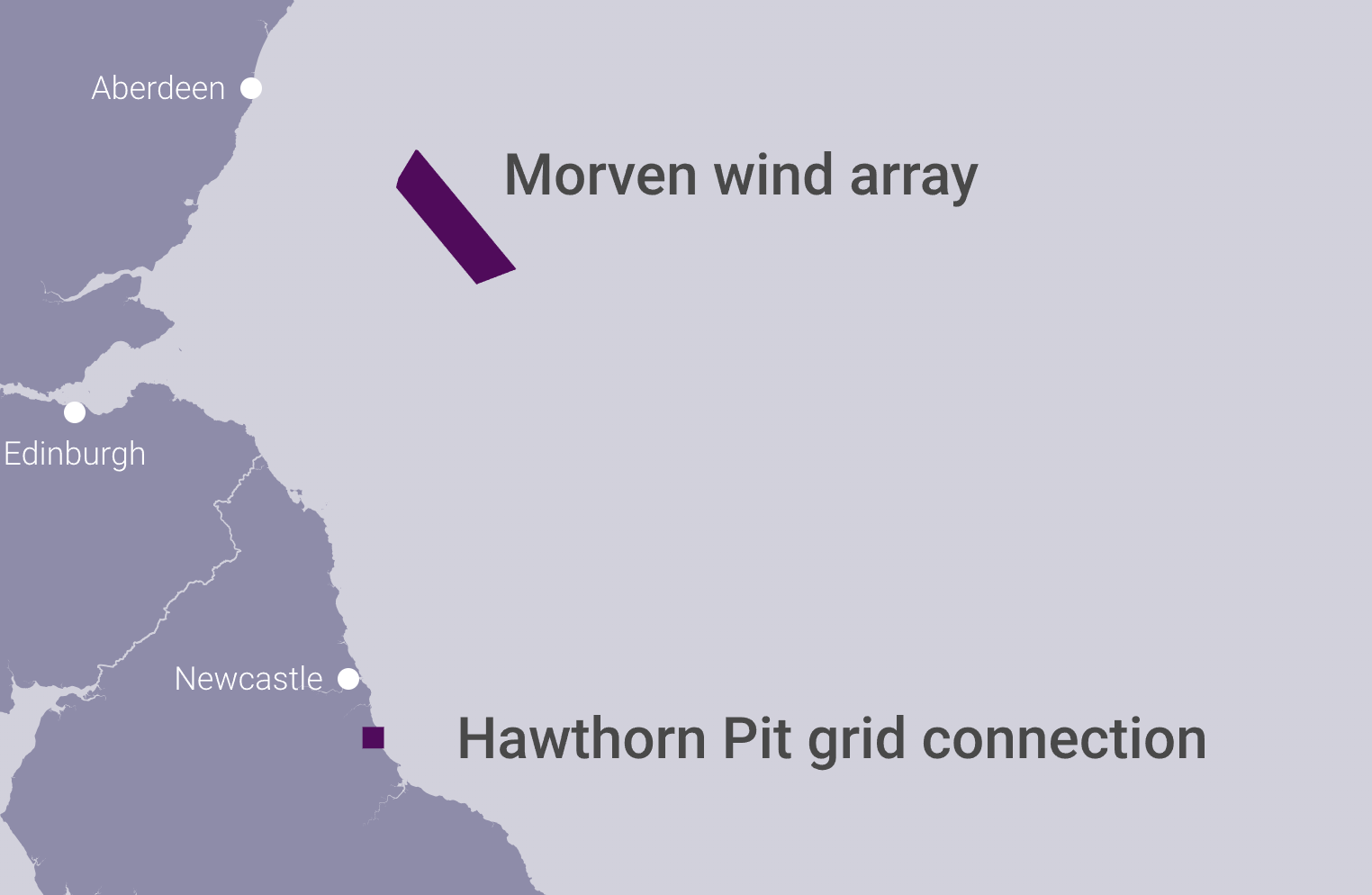
Note.
- The location of the Morven wind array was first mentioned in June 2020, as part of ScotWind by Crown Estate Scotland.
- The development of Eastern Green Link 1 was first mentioned in May 2021, by National Grid.
- Torness is to the East of Edinburgh.
- Eastern Green Link 1 connects Torness and Hawthorn Pit.
- the Morven wind array connects to England at Hawthorn Pit.
Over the last few years National Grid and other companies have been developing a technique called offshore hybrid assets, which I describe in What Are Offshore Hybrid Assets?.
An offshore hybrid asset typically connects two countries via a large offshore wind farm, which can then send electricity to both countries.
In a traditional design, there would need to be.
- A 2 GW cable between Torness and Hawthorn Pit.
- A 2.9 GW cable between Morven and Hawthorn Pit.
In the Offshore Hybrid Asset design, there would need to be.
- A 2 GW cable between Torness and Morven
- A 2.9 GW cable between Morven and Hawthorn Pit.
I suspect cable would be saved.
This map shows the position of each ScotWind Leasing wind farm.

Note.
- The numbers are Scotwind’s lease number in their documents.
- Morven is ScotWind lease number 1.
- Eastern Green Link 1 is one of four interconnectors down the East Coast of the UK.
- I have added up the ScotWind lease numbers 1-6 and they total 10.5 GW.
That would be a lot of power to capture just by converting the four Eastern Green Link interconnectors into offshore hybrid assets.
How Will Aquaventus Connect To Aberdeen?
This is RWE’s description of AquaVentus, which is sub-titled Hydrogen Production In The North Sea.
Hydrogen is considered the great hope of decarbonisation in all sectors that cannot be electrified, e.g. industrial manufacturing, aviation and shipping. Massive investments in the expansion of renewable energy are needed to enable carbon-neutral hydrogen production. After all, wind, solar and hydroelectric power form the basis of climate-friendly hydrogen.
In its quest for climate-friendly hydrogen production, the AquaVentus initiative has set its sights on one renewable energy generation technology: offshore wind. The initiative aims to use electricity from offshore wind farms to operate electrolysers also installed at sea on an industrial scale. Plans envisage setting up electrolysis units in the North Sea with a total capacity of 10 gigawatts, enough to produce 1 million metric tons of green hydrogen.
RWE have also put this AquaVentus video on their web site.
Note, that in the video AquaVentus connects Germany to Denmark, Norway, The Netherlands and Aberdeen and Humberside in the UK.
I asked Google AI, the question in the title of this section, and received this answer.
AquaVentus connects to Aberdeen through a strategic infrastructure partnership with Hydrogen Scotland. The two organizations are integrating offshore wind power, offshore electrolysis, and a shared cross-border pipeline to link Scottish renewable generation with European industrial markets.
The connection strategy relies on a multi-stage approach across the North Sea:
Offshore Production & Transmission: AquaVentus aims to produce green hydrogen directly offshore. It will be transported via a pan-European pipeline network—such as the planned 400 km AquaDuctus to link offshore hubs with both the UK and mainland Europe.
Scottish-German Export Corridor: Building on previous research like the Scot2Ger study, this pipeline corridor directly connects Scotland’s abundant offshore wind resources to European demand, establishing Aberdeen as a critical origin node.
Integrated Energy Backbone: The initiative champions hybrid connection concepts (combining both power cables and hydrogen pipelines). This allows for maximum flexibility when integrating Aberdeen’s local onshore hydrogen infrastructure with broader transnational energy grids.
I will now ask Google AI some supplementary questions about AquaVentus in UK waters.
“Will AquaVentus Produce Hydrogen In UK Waters?”
Google AI gave this reply.
Yes, AquaVentus plans to produce green hydrogen in UK waters. The German-led consortium has partnered with Hydrogen Scotland to harness Scotland’s offshore wind potential for large-scale, cross-border hydrogen production and export.
Key Details of the UK-German Initiative
Production Scale: The initiative aims to install 10 gigawatts (GW) of offshore electrolysis capacity in the North Sea by 2035, producing up to 1 million metric tonnes of green hydrogen annually.
The “Pipes and Wires” Model: Offshore wind parks will be equipped with hybrid connection concepts, providing the flexibility to either send electricity directly to the grid or convert it into hydrogen via offshore electrolysers.
Transportation: The produced hydrogen will be transported to land via a shared transnational subsea pipeline corridor, linking Scottish resources to Germany and mainland Europe.The partnership is specifically aimed at creating a North Sea hydrogen corridor to boost energy security and build the foundational European Hydrogen Backbone.
“Will AquaVentus Land Hydrogen In Scotland?”
Google AI gave this reply.
Yes, the German-led AquaVentus initiative plans to land green hydrogen in Scotland as part of a coordinated North Sea energy corridor.
The cross-border initiative involves the following components:
The Pipeline Connection: A key part of the plan is the AquaDuctus offshore subsea pipeline, designed to collect green hydrogen produced from central North Sea wind farms and land it on the coast.
Scottish Partnership: Hydrogen Scotland and AquaVentus have formalized a Memorandum of Understanding to combine Scotland’s massive offshore wind potential with German infrastructure and electrolysis expertise.
Export Ambitions: Scotland aims to produce up to 3.3 Mt of green hydrogen per year by 2045, heavily relying on pipelines and networks to export this to mainland European hubs like Germany.
Offshore Facilities: The broader initiative plans to install 10 GW of offshore electrolysis capacity in the North Sea to produce up to 1 million tonnes of hydrogen annually.
Note that Google AI has told me that a Megatonne of hydrogen is currently worth around £2.5-5 billion.
“Will AquaVentus Connect To Any Of The ScotWind Leasing Wind Farms?”
Google AI gave this reply.
Yes, AquaVentus plans to link Scottish offshore wind resources (including ScotWind farms) to mainland Europe. Through an agreement with Hydrogen Scotland, AquaVentus intends to utilize hybrid “pipes and wires” infrastructure to transmit power or convert it into green hydrogen for direct pipeline transport.
The partnership serves several strategic goals:
The “Pipes & Wires” Concept: Wind farms built under the ScotWind leasing round will have the flexibility to either route electricity to the UK grid or convert it into green hydrogen via offshore electrolysers.
Cross-Border Pipelines: The hydrogen generated by Scottish offshore wind is targeted to be fed into the planned AquaDuctus pipeline, which forms a transnational energy corridor connecting the UK to Germany and the rest of Europe.
Policy Integration: AquaVentus is actively advocating for legal reforms to accommodate these cross-border hybrid connections, allowing direct pipeline integration for future offshore parks.
I believe these ScotWind Leasing wind farms could be connected to AquaVentus.
- 1 – Morven – 2.9 GW – JERA Nex BP, EnBW
- 2 – Ossian – 2.6 GW – SSE Renewables
- 3 – Bellrock – 1.2 GW – Falck Renewables
- 4 – CampionWind – 2 GW – Scottish Power, Shell
- 5 – Muir Mhòr – 0.8 GW – Vattenfall
- 6 – Bowdun – – 1 GW – Thistle Wind Partners
Note.
- All companies are major energy companies.
- The wind farms are in a cluster to the South-East of Scotland.
- Wind farms 2-5 are floating, and 1 and 6 are fixed.
- There is a maximum power of 10.5 GW.
- These wind farms would not need to be shut down, when there was too much wind, if the excess electricity could be converted into hydrogen.
- The “Pipes & Wires” Concept would allow all energy generated to be transferred to shore, either as electricity or hydrogen.
Cables would need to be laid to perform the functions of the Eastern Green Links 1-4.
- Eastern Green Link 1 – Torness and Hawthorn Pit
- Eastern Green Link 2 – Peterhead and Drax
- Eastern Green Link 3 – Westfield and Lincolnshire
- Eastern Green Link 4 – Peterhead and Lincolnshire
Eastern Green Link 5 is under development between Aberdeenshire and Lincolnshire.
“Is Anderby Creek An Important Node In The Electricity Grid?”
Google AI gave this reply.
Yes, Anderby Creek has become a highly important landfall location for the UK’s electricity grid, acting as a crucial connection point for high-capacity subsea cables bringing renewable energy from Scotland and offshore wind farms into England.
Its role in the national grid’s infrastructure centers on several major “superhighway” projects:
Eastern Green Link 5 (EGL 5): This £3bn National Grid project involves a 585km subsea High Voltage Direct Current (HVDC) cable carrying up to 2 GW of clean power (enough for two million homes) from Aberdeenshire, Scotland, to Anderby Creek.
Eastern Green Links 3 & 4 (EGL 3 / EGL 4): These are additional massive subsea cable projects that also plan to make landfall at Anderby Creek to transport Scottish wind energy down the UK coastline.
Offshore Wind Export Cables: Beyond long-distance transmission, the village already hosts export cables from local offshore wind developments like the Triton Knoll Wind Farm.
Because of the massive volume of power coming ashore, Anderby Creek serves as the starting point for significant onshore infrastructure. The cables transition underground at the beach and run roughly 8km inland to a proposed new converter station near Bilsby/Alford, where the power is converted and integrated into the broader Great Grid Upgrade.
“Will AquaVentus Have Access To The UK’s hydrogen Storage On Humberside?”
Google AI gave this reply.
Yes. Through a strategic partnership with Hydrogen Scotland, the AquaVentus initiative aims to establish cross-border offshore infrastructure that connects the central North Sea with existing and planned hydrogen networks across the UK, including those on Humberside.
The pipeline infrastructure associated with AquaVentus is envisioned to reach the UK just south of the massive hydrogen storage facilities located in East Yorkshire. While the German offshore pipeline (like AquaDuctus) is focused on landing green hydrogen into Germany, the broader AquaVentus framework is designed to integrate with British transmission networks and link to underground cavern storage in the UK.
On Humberside, major energy giants (including Centrica, Equinor, and SSE Thermal) are developing the integrated Humber Hydrogen transport and storage network. This system encompasses large-scale hydrogen storage at the Aldbrough Hydrogen Storage site and Rough Gas Storage. Because the AquaVentus UK branch connects to the Humber area’s onshore network, it positions the initiative to take advantage of these regional storage assets as a cornerstone for international trade and domestic energy resilience.
I think this is key as it gives AquaVentus access to very large hydrogen storage.
Conclusion
It almost looks to me, that National Grid and AquaVentus are combining their pipes and wires between the Southern North Sea and Aberdeen.
- Hydrogen offtake for Germany will be at Wilhelmshaven.
- Hydrogen offtake for England will be at Humberside.
- Hydrogen offtake for Scotland will be at Aberdeen.
- Electricity offtake for Germany will be at Wilhelmshaven.
- Electricity offtake for England will be at Anderby Creek.
- Electricity offtake for England will be at Hawthorn Pit.
- Electricity offtake for Scotland will be at Torness.
- Electricity offtake for Scotland will be at Aberdeen.
Note.
- There will probably be other connections to onshore locations and offshore wind farms.
- Hydrogen imports will be possible from Denmark, Norway and The Netherlands direct into AquaVentus.
Murphy Starts Work On £2.5bn Eastern Green Link 1
The title of this post, is the same as that as this article on Construction Enquirer.
This is the sub-heading.
Murphy has started work on its first package on the vast £2.5bn Eastern Green Link 1
These two paragraphs add more detail.
The joint venture between SP Energy Networks and National Grid Electricity Transmission will see the installation of a 196km, high voltage, subsea electricity cable between Torness in East Lothian, Scotland, and Hawthorn Pit in County Durham.
Murphy is one of the main works contractors alongside Metlen, GE Vernova and Prysmian.
Murphy’s task seems to be to design and build the new substation, integrate it with the existing one and connect it all to Eastern Green Link 1 and other assets. Work is expected to complete in March 2028.
Google AI predicts that Eastern Green Link 1 will be commissioned by 2029, so it should be up and running before the expected election helping to balance and stabilise Scottish and English wind power at a rate of up to 2 GW day and night.
The Future Of Drax Power Station
This first paragraph from the Wikipedia entry for Drax power station gives a factual description of the power station.
Drax power station is a large biomass power station in Drax, North Yorkshire, England. It has a 2.6 GW capacity for biomass and had a 1.29 GW capacity for coal that was retired in 2021. Its name comes from the nearby village of Drax. It is situated on the River Ouse between Selby and Goole. Its generating capacity of 3,906 megawatts (MW), which includes the shut down coal units, is the highest of any power station in the United Kingdom, providing about 6% of the United Kingdom’s electricity supply.
This second extract from Wikipedia gives details of its current biomass contract and subsidy.
Drax’s subsidy scheme was scheduled to end in 2027, with Drax arguing for an extension to 2030. In February 2025, the UK government extended its operation from 2027 to 2031, but at a reduced 27% maximum load factor using 100% sustainable wood, so it would run “less than half as often as it currently does”, generally only at times of high electricity demand. Drax was given a contract for difference at £113/MWh in 2012 pounds, CPI inflation linked so about £155/MWh in 2025.
Note.
- Rishi Sunak’s Government extended the contract.
- It will now run on 100% sustainable wood, which includes sources like sawmill residues, forest thinnings and certain agricultural products.
- It has a similar type of contract to wind farms and energy storage.
I asked Google AI,”Does Drax Power Station Provide Grid Stability?, and received this answer.
Yes, Drax Power Station—along with its affiliated hydro assets—provides critical grid stability to the UK. As the UK’s power grid shifts toward intermittent renewables like wind and solar, Drax’s dispatchable generation and specialized system support services help maintain a secure electricity network.
The key stability services provided by the Drax portfolio include:
Inertia: Drax’s large spinning turbines and pumped hydro facilities provide vital inertia to the grid. This acts like a shock absorber, helping to control changes in frequency (maintaining 50Hz) and preventing power cuts.
Reactive Power: The facilities help manage voltage support and move power efficiently across different parts of the network.
Dispatchable Power: Unlike weather-dependent generation, Drax’s biomass and hydro plants can be ramped up or down on demand, providing firm capacity and flexible response to real-time grid needs.
Pumped Storage Support: Through its subsidiary Cruachan Power Station in Scotland, Drax operates a pumped hydro storage plant that actively balances supply and demand and holds specialized stability contracts with the National Grid Electricity System Operator (ESO).
So if you love or loathe the power station, it does a lot more than burn biomass to generate electricity.
Drax Power Station And Eastern Green Link Two
The Eastern Green Link Two web site is here.
This is the sub-heading
Eastern Green Link 2 (known as EGL2) is one of the most significant strategic energy infrastructure developments the UK has seen in recent years, connecting the north of Scotland to Yorkshire via the sea.
These two initial paragraphs gives more details.
EGL2 is a 505km electricity superhighway which will enable the transfer of power from Scotland to England (and vice versa) via a subsea cable. This two-gigawatt high voltage direct current (HVDC) cable is connecting Peterhead in Aberdeenshire and Drax in North Yorkshire and once operational, will carry enough electricity to power two million homes.
EGL2 will scale up the UK’s capacity to transport home-produced clean energy, predominantly from offshore wind, from where it is generated to where there is demand. By doing so it will increase the security, resilience, and stability of the UK’s transmission network.
EGL2 is the second of a planned seven interconnectors between Scotland and the South.
The first was the Western HVDC Link between Hunterston in Scotland and Flintshire Bridge in Wales, which became operational in 2013.
EGL2 will go between Peterhead in Scotland and Drax power station.
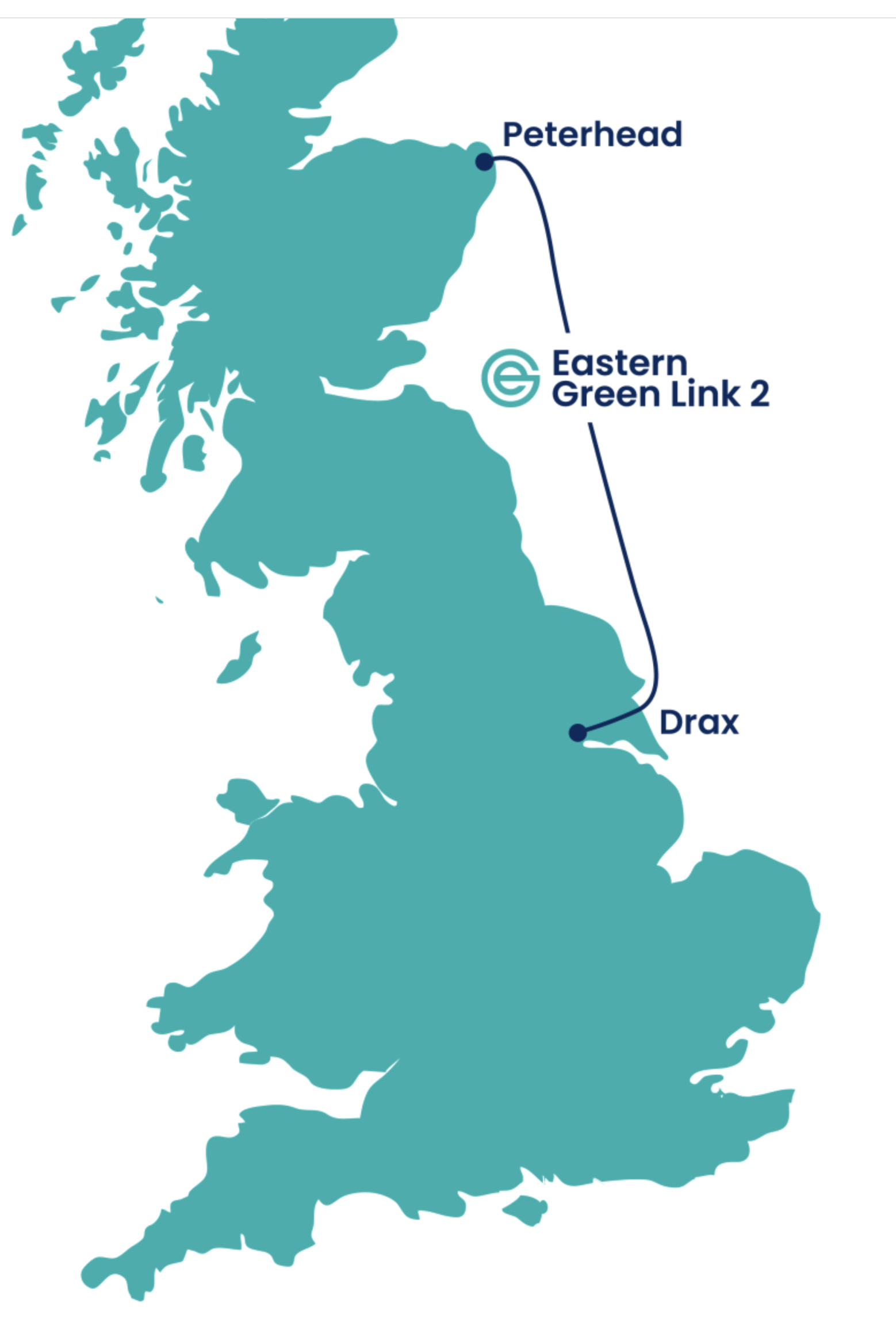
So electricity from Scotland will be able to replace up to two GW of the biomass, that Drax power station currently uses as fuel.
Drax And Solar Power
This Google Map shows Drax power station.

If Drax wanted to add solar power to the site, I’m sure it would be possible.
- There is plenty of space.
- There is a substantial connection to the electricity grid.
After the purchase of Bluefield Solar Income Fund, Drax probably are well-placed to develop as much solar-power as they need.
Bluefield Solar Income Agrees To PS548 Million Cash Offer From Drax
The title of this post is the same as this article from A J Bell.
These two paragraphs give more details of the deal.
Bluefield Solar Income Fund Ltd on Monday said it had agreed to a £548 million cash offer from Drax Group PLC, which implies an enterprise value of £1.08 billion.
The solar-power focused investment firm has received a bid from Drax Smart Generation Holdco Ltd, which is wholly-owned by Selby, North Yorkshire-based electricity generator Drax. Both firms are members of the FTSE250 index.
I see this deal, to be very much like Centrica’s purchase of the Grain LNG Terminal, which I wrote about in Investment in Grain LNG.
I asked Google AI,”How Do Drax And Centrica Compare Financially?”, and received this answer.
Centrica and Drax have contrasting financial profiles:
Centrica operates on a much larger scale as a diversified retail and energy supply giant, generating £22.4 billion in annual revenue, while Drax is primarily an electricity generator focused on biomass, generating £5.4 billion.
Both companies face challenges from lower global energy prices.
I asked Google AI,”How Do Drax And Centrica Compare On Engineering And Research?”, and received this answer.
Drax and Centrica approach engineering and research from opposite ends of the energy sector: Drax is a mega-scale renewable generator focused on heavy industrial decarbonization, while Centrica focuses on consumer technology, smart energy networks, and servicing.
In addition, now that Centrica has bought the Grain LNG Terminal, Centrica seems to do a lot of LNG trading and storage and they appear to be moving into the bunkering of low-carbon fuels for shipping and have added a second site to Grain, with the acquisition of Severn power station at Newport.
Drax haven’t laid out their plans in detail yet.
These to paragraphs from Drax give a few hints.
Drax sees the purchase supporting growth in the UK renewables market, complementing its existing assets and facilitating £2 billion in incremental investment which Drax has planned for ‘flexible’ energy between 2025 and 2031.
Bluefield generated earnings before interest, tax, depreciation and amortisation of about £130 million in financial 2025, Drax noted, and has the potential ‘to grow Drax’s Ebitda from renewables, offering greater predictability and visibility of cash flows from a large operational portfolio’. This will reduce Drax’s earnings risk from grid connection delays, Drax added.
The last sentence seems to hint, that the deal comes with good connections to the grid, which given what you read about the problems of connecting must be a good thing.
Why Are Drax Building Open Cycle Gas Turbine Power Stations?
I asked Google AI, this question and received this answer.
Drax is building Open Cycle Gas Turbine (OCGT) power stations to provide rapid-response, back-up electricity when weather-dependent renewables (like wind and solar) cannot meet grid demand. This flexible generation stabilizes the UK grid, secures energy supplies, and supports the transition to a lower-carbon energy system.
Drax’s strategic move into OCGT is driven by several key factors:
Fast Start Capabilities: OCGT plants act like giant jet engines. They can go from a cold start to full power output in less than 20 minutes, making them ideal for meeting sudden spikes in electricity demand.
Back-up for Intermittent Renewables: Because output from wind and solar fluctuates with the weather, OCGT stations fill the generation gaps, ensuring continuous energy security without relying on older, dirtier coal power.
System Stability (Synchronous Compensation): Drax has equipped its new OCGTs (such as the Hirwaun Power Station) with a special clutch mechanism.
This allows the turbines to disconnect from the generator so the plants can act as “synchronous compensators.” In this mode, they provide crucial grid stabilization services—like inertia and voltage control—without burning gas.
Meeting Capacity Market Needs: These facilities primarily operate only during times of peak stress or low renewable output (e.g., 500 to 1,500 hours a year), providing a cost-effective support mechanism for the wider electricity system.
This Google Map shows Hirwaun Power Station.
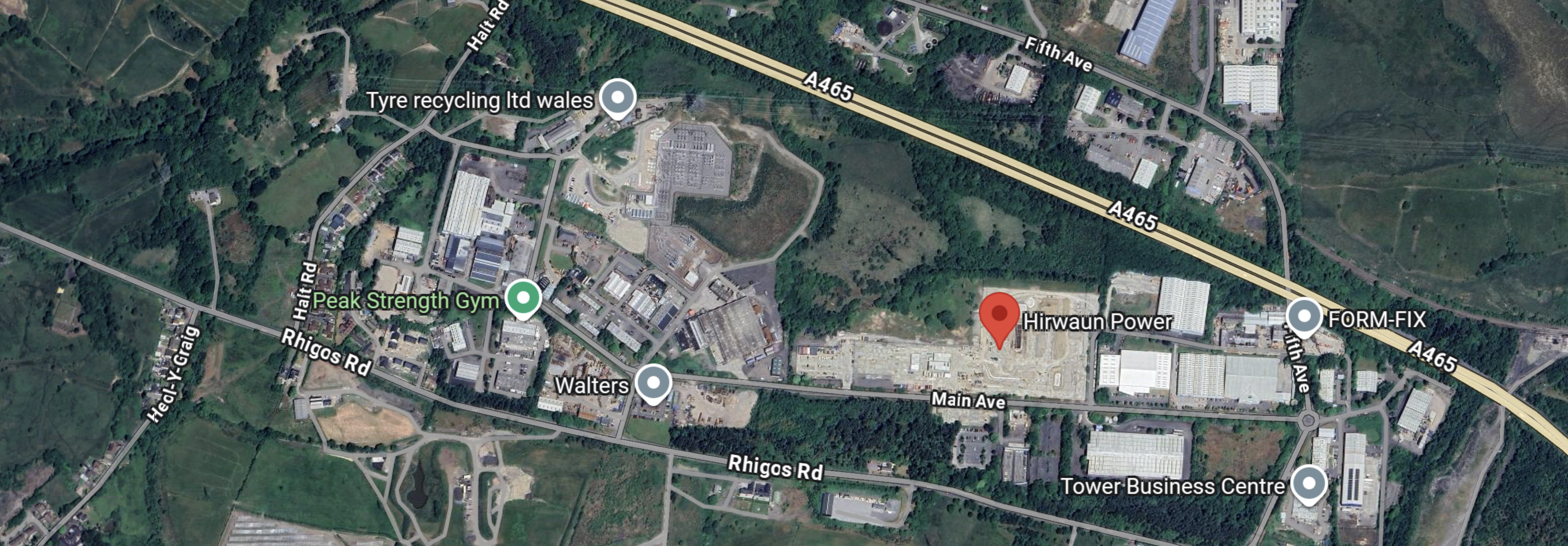
Note.
- Hirwaun Power Station is indicated by the red arrow.
- Hirwaun Power Station is a 399 MW Open Cycle Gas Turbine Power Station.
- The A 465 is the Heads of the Valleys Road.
- Solar farms can be seen between the buildings.
Could Drax see commercial advantages to put the two systems together?
Can East Midlands Railway Reach Nottingham Without More Electrification?
I went to Nottingham for the day yesterday.
- My Super Off-Peak Return ticket cost me £55.30 with a Senior Railcard.
- The Class 810 train is without doubt the best Hitachi Intercity Express Train of a good bunch.
- St. Pancras and Nottingham is 126.4 miles.
- There is no electrification between South Wigston Junction and Nottingham, which is 31.1 miles, although the change seems to be said to take place at Kilby Bridge junction.
- It would appear that, when the Class 810 trains are fitted with batteries, they will need a range of at least 62.2 miles, to do a return trip to Nottingham.
- In The Data Sheet For Hitachi Battery Electric Trains, I state that the maximum range of a three-battery five-car train is 117 miles. This figure has been seen by Hitachi and they didn’t say it was too high.
- I look forward to doing the same trip in a few months, using batteries to the North of the section between Kilby Bridge and South Wigston junctions.
It could be the first battery-electric 125 mph express train.
Now that is what I call affordable electrification.
I have some further thoughts.
Kilby Bridge And Wigston Junctions
This Google Map shows the Midland Main Line between Kilby Bridge and Wigston junctions.
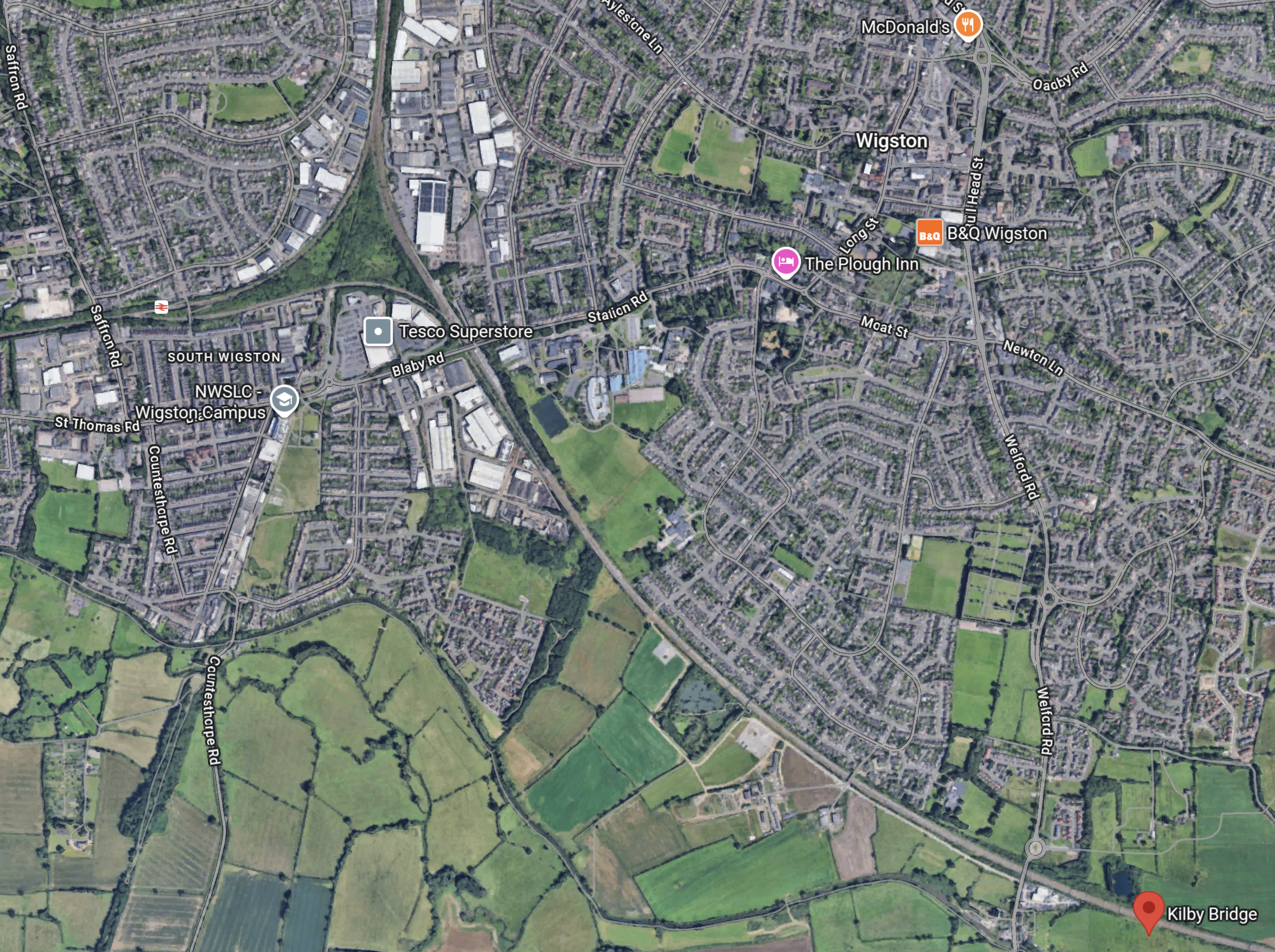
Note.
- Kilby Bridge junction is marked by the red arrow in the South-East corner.
- The Midland Main Line runs through Kilby Bridge junction.
- South-East it goes to London.
- North-West is leads to the large triangular Wigston junction, with South Wigston station at its Western point.
- The Northern point of Wigston junction leads to Leicester.
- There are three tracks between Wigston and Kilby Bridge junctions.
- All tracks to the South of South Wigston junction are electrified.
- The distance between Wigston and Kilby Bridge junctions is two miles.
- The maximum speed between Wigston and Kilby Bridge junctions appears to be at least 100 mph.
It looks to me, that this section of track has been designed, so that trains can reliably raise and lower pantographs at the highest speed possible.
The Electrification Problem At Leicester
Some years ago I came back to London from Leicester with a group of drivers. At one point, the conversation turned to electrification and they said that they had met a Network Rail engineer, who had told them, that the bridge over Leicester station was rather low for electrification and the track couldn’t be lowered because Leicester’s main sewer was underneath the railway.
In Leicester Station – 4th Jan 2022, I show a selection of pictures of Leicester station’s Grade II Listed frontage.
I doubt it would be possible to seriously alter Leicester station to electrify it, as the Heritage Taliban would have a field day.
But if I’m right that all services will be run North of Wigston on batteries, there will be no need to electrify through Leicester station.
Not only would using battery-electric trains probably be more affordable than electrification, but also because of the Leicester electrification problem, it would be less inconvenient for passengers.
Changing From Electric Going North
This OpenRailwayMap shows the electrification between Wigston Junction and Leicester station.
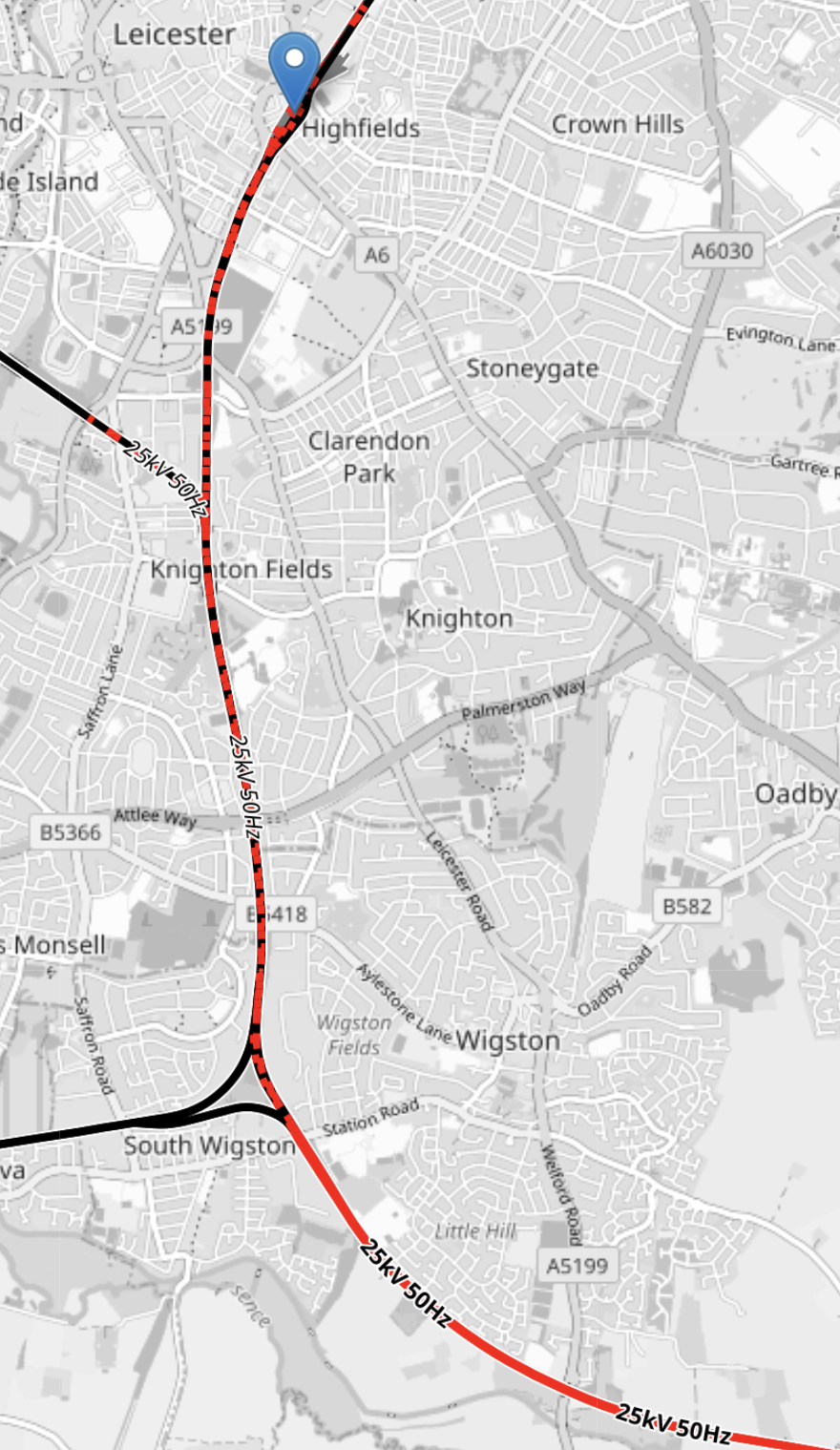
Note.
- Leicester station is marked by the blue arrow.
- The triangular Wigston junction is clearly visible.
- Kilby Bridge junction is South-East of Wigston junction.
- Leicester station and South Wigston junction is 3.6 miles and the tracks are shown as dashed black and red, which means future electrification.
I wonder, if in the future, if the battery-electric don’t have enough range, this is a simple section of electrification, that could be installed. Every extra mile of electrification between Leicester station and South Wigston junction would mean two miles could be chopped from the distance the trains had to travel on batteries.
But in the interim, going North, the driver would just make sure there was enough electricity in the batteries and momentum in the train, when passing South Wigston.
As trains arriving at South Wigston junction will typically have been running for over an hour, they should have full batteries to start theur explore of the North.
Changing To Electric Going South
The trains from the North, must have enough juice in the battery to reach South Wigston, so they can connect to the electrification for the run to London.
Could A Four-Battery Class 810 Train Reach Sheffield?
Consider.
- St. Pancras and Sheffield is 164.7 miles.
- There is no electrification between South Wigston Junction and Sheffield, which is 89.4 miles, although the change seems to be said to take place at Kilby Bridge junction.
- It would appear that, when the Class 810 trains are fitted with batteries, they will need a range of at least 178.8 miles to do a return trip to Sheffield.
- If a three-battery five-car Class 810 train has a battery range of 117 miles, on a pro-rata basis a four-battery five-car will only have a range of 156 miles.
That would be a big ask.
Could A Three-Battery Class 810 Train Reach Sheffield?
What would happen if one diesel engine was still installed?
These are my thoughts.
- As a Graduate Control Engineer, I wouldn’t be surprised that Hitachi have a strategy to do this with a tri-mode version of the Class 810 train.
- Hitachi have already announced the Class 820 train for Grand Central Trains and this is a tri-mode version of their InterCity Express, which is described in this Wikipedia entry.
- As Grand Central have said that the Class 820 trains, will be replacing the Class 180 trains, that run to Bradford Interchange and Sunderland, a tri-mode Class 810 would surely be able to run to Sheffield.
Could East Midlands Parkway Station Be Used For Opportunity Charging?
This Google Map shows East Midlands Parkway station with the massive derelict Radcliffe-on-Soar coal-powered power station alongside.
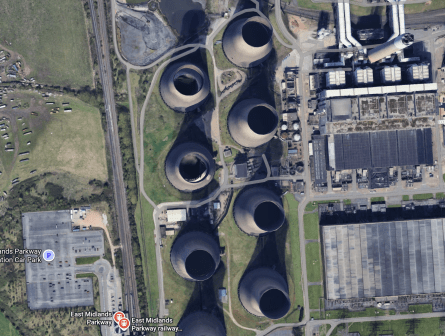
Note.
- The Midland Main Line running North-South across the map.
- East Midlands Parkway station on its Western side.
- The derelict Radcliffe-on-Soar coal-powered power station on its Eastern side.
A vast site like this must have uses.
I asked Google AI,”What Are The Plans For Radcliffe-on-Soar Power Station?” and received this reply.
The former Ratcliffe-on-Soar power station site is undergoing a multi-year decommissioning and demolition process, lasting until at least 2030 or 2031, to be transformed into a zero-carbon technology, energy, and advanced manufacturing hub.
Key details of the redevelopment include:
Site Vision: The 273-acre brownfield site has been earmarked to become a major business hub focused on advanced manufacturing (e.g., electric car batteries), low-carbon energy production, energy storage, and AI-driven data centres.
Economic Status: The site is a core component of the East Midlands Freeport, which offers significant financial incentives to attract business investment and create an estimated 7,000 to 8,000 jobs.
Demolition Timeline: The first demolition works are expected to begin in 2026, with the iconic cooling towers and main chimneys scheduled for controlled demolition between 2029 and 2030.
Planning Framework: A Local Development Order (LDO) granted by Rushcliffe Borough Council is in place to fast-track the planning process for these modern, green-focused industrial uses.
As the site will need to be supplied with a reliable energy supply for some of the proposed uses, I suspect power could be supplied to electrify the lines through East Midlands Parkway station, so that trains going to the North could take the opportunity to have a Formula One-style “Splash-and-Dash!”
Would Opportunity Charging At East Midlands Parkway Station Allow Extra Destinations?
Holders of the East Midlands Franchise have in the past, served other destinations in the past, either with regular services or engineering or seasonal diversions.
Possible destinations could be.
Cleethorpes
Distance to South Wigston – 112.4 miles
Doncaster
Distance to South Wigston – 108.1 miles – But could top up at Doncaster.
Rotherham Central
Distance to South Wigston – 102.2 miles
Scunthorpe
Distance to South Wigston – 112.4 miles
The March Of The Batteries
One of my Google alerts picked up this story from the Solar Power Portal, which is entitled Gresham House To Acquire 480MW BESS, Completes Financing On 397MW Portfolio.
This is the sub-heading.
Gresham House Energy Storage Fund signed a Sale and Purchase agreement (SPA) for the conditional acquisition of a 480MW BESS project, while also completing funding on a 397MW portfolio that will begin construction.
I asked Google AI, “How Big Is Gresham Houuse’s Portfolio Of Batteries?” an received this answer.
Gresham House Energy Storage Fund (GRID) operates a portfolio exceeding 1GW of utility-scale battery capacity in the UK, with an active pipeline of future and recently financed projects.
Their operational capacity features:
Operational Capacity: Exceeds 1GW (approx. 1,072MW/1,701MWh) across dozens of sites.
Market Share: Owns roughly 17% to 20% of all utility-scale batteries in Great Britain.
Haven’t they done well!
When Will Highview Power Complete The Carrington Battery?
Highview Power is building a 50 MW/300 MWh liquid air battery at Carrington, near Manchester.
I asked Google AI,the title of this section and received this reply.
Highview Power’s Carrington liquid air energy storage facility in Greater Manchester is scheduled to be operational by late 2026.
The grid stabilization phase is set to begin early in the year, with full long-duration operations following shortly after.The £300 million project at the Trafford Low Carbon Energy Park is a pioneering commercial-scale “cryobattery” that liquefies and stores air to capture excess renewable energy.
Key details of the completed facility:
Capacity: 300 MWh of storage (delivering 50 MW for six hours)
Reach: Capable of supplying electricity to approximately 480,000 homes
Technology: Liquid Air Energy Storage (LAES)
When Will Highview Power Complete The Livingstone Battery?
Highview Power is building a300 MW/3.2 GWh liquid air battery at Livingstone near Glasgow.
I asked Google AI, the title of this section and received this reply.
Highview Power is not currently building a battery in Livingstone. They are developing a major \(2.5 \text{ GWh}\) liquid air energy storage (LAES) plant in Hunterston, Scotland, which is scheduled to come online by 2030.
According to the Highview Power web site, a 300 MW/3.2 GWh “cryobattery” is being built at the site.
How Much Offshore Wind Power Will Be Installed This Year?
In UK Offshore Wind In 2030 – Calculated May 2026, I said that 2635 MW would be commissioned this year.
Conclusion
We’re running hard, but will we keep ahead of the tsunami of offshore wind and solar panels we are installing.
In UK Offshore Wind In 2030 – Calculated May 2026, my latest calculations show that by 2036, we will have installed 61,337 MW of offshore wind alone.
How Many Of Their 300 MW/3.2 GWh Liquid Air Batteries Do Highview Power Think They Can Install?
I asked Google AI, the title of this section and received this reply.
Highview Power plans to install several of their 300 MW/3.2 GWh “Millennium Series” cryogenic plants. They are specifically developing two initial flagship sites in the UK, with the intention to scale up rapidly over the next decade to capture a significant share of national long-duration energy storage targets.
Highview Power is executing a multi-billion-pound programme to build out these multi-technology storage facilities, which combine liquid air energy storage and lithium-ion batteries.
The two primary 3.2 GWh projects advancing through the UK regulatory system include:
Hunterston, North Ayrshire (Scotland): Slated as the first of the Millennium Series, designed to provide up to 3.2 GWh of capacity (powering around 650,000 homes).It is advancing through the regulatory assessment and construction phases.
Killingholme, Lincolnshire (England): A second 3.2 GWh facility.
Both the Hunterston and Killingholme sites were deemed eligible for support under the UK government’s “cap and floor” super-battery scheme.
Two 300 MW/3.2 GWh “Millennium Series” cryogenic plants will do very nicely!
Engineering is the science of the possible, whereas politics is dreams of the impossible.
Mooir Vannin Offshore Wind Farm
This is a wind farm off the Isle of Man, that I missed as it is not on Wikipedia’s List of Offshore Wind Farms In The United Kingdom.
But it does have a web site, which has this handy map.
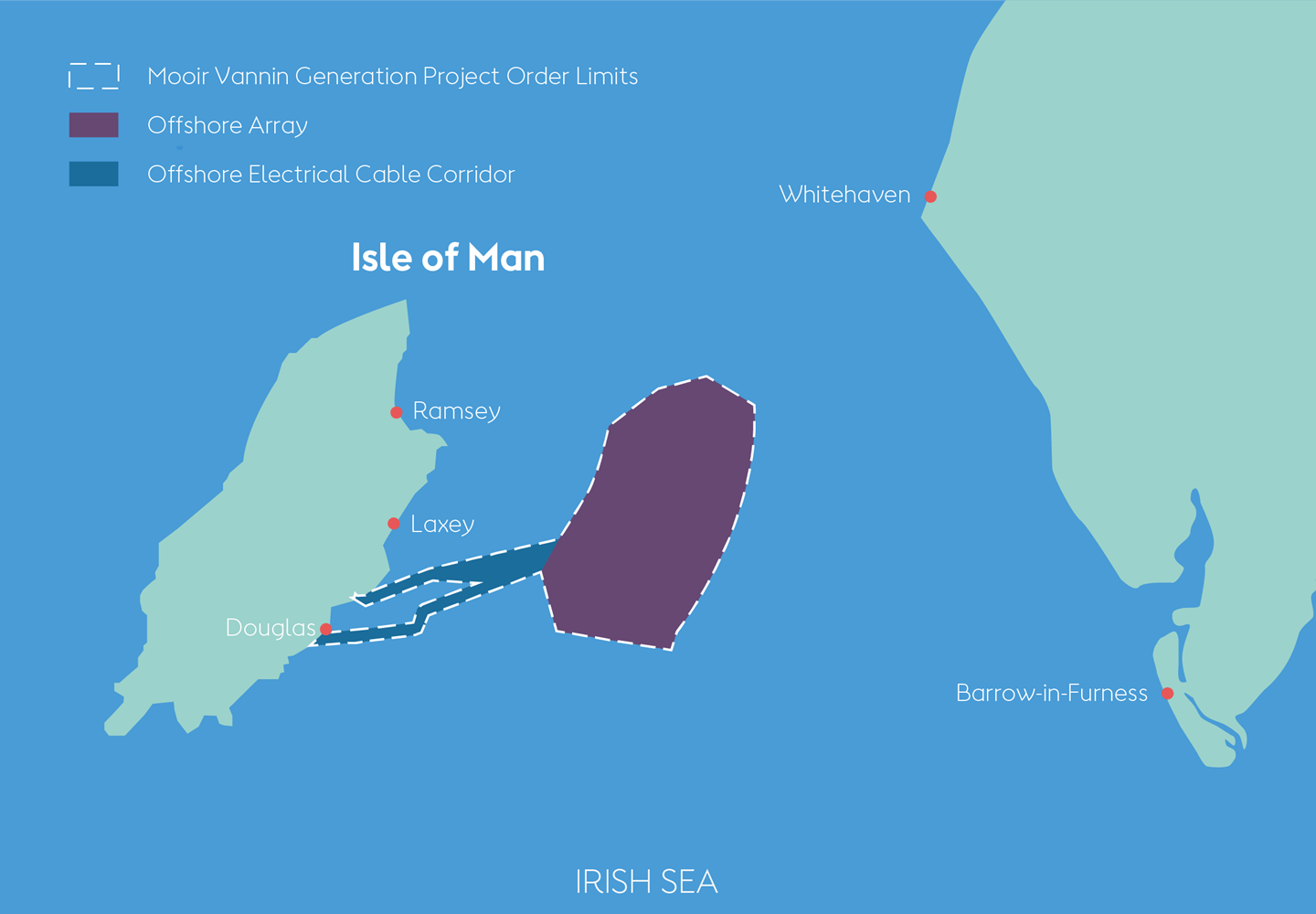
Note.
- The wind farm will have a capacity of 1.4 GW.
- Ørsted is building the web farm.
- It has planning permission.
- The operations base for the proposed Mooir Vannin Offshore Wind Farm will be located at Douglas Harbour on the Isle of Man.
- The Port is Owned By The Isle Of Man Government.
- Anticipated operational start date is the mid 2030s. I’ll assume 2035.
- According to the web site, connection will be to Douglas on the Isle of Man and Penwortham, Lancashire in the UK.
- Penwortham is part of Preston.
- Penwortham substation already has a 50 MW/50 MWh BESS and may get a bigger one.
- Current fossil-fuel power stations on the Isle of Man, include a number of diesel power stations and a 64 MW CCGT. They also have a 23 MW steam generator.
It looks like Mooir Vannin is large enough to give the island a carbon-free energy supply, backed up, by the UK National Grid at Penwortham.
I asked Google AI, “If The Isle of Man Was Going Into The Data Centre Business”, and received this reply.
The Isle of Man is actively positioning itself as a premier hub for data centres, tech firms, and AI companies. The government is utilizing its robust infrastructure, strong regulatory environment, and competitive tax policies to attract high-value data businesses to the island.
It also looks like they have a water system, that has a hydro-electric power-station.
Ørsted Is Danish
Ørsted is Danish and all of those countries to the North East of the UK have lots of islands.
So I asked Google AI, this question.”Does Denmark Have Any Islands With Power Stations?”, and received this comprehensive answer.
Yes, Denmark has several islands with power stations, ranging from natural islands utilizing large wind and biomass facilities to massive, pioneering “Energy Islands” built specifically as offshore power hubs.
Key Examples Include:
Bornholm (Baltic Sea): Designated as a major green “Energy Island” hub. It functions as a massive collection and distribution point for surrounding offshore wind farms, routing renewable energy to both the Danish grid and neighboring countries like Germany.
SamsØ (Kattegat strait): Known globally as a renewable energy island.
It is entirely powered by local onshore and offshore wind turbines and uses a mix of solar and battery storage systems to manage its energy needs, including marina charging.
North Sea Energy Island (VindØ): This is a colossal artificial island project (located roughly 80–100 km off the coast of Jutland) designed to act as an offshore power plant.
It acts as a hub to harvest and convert wind energy from hundreds of surrounding turbines.
Are Ørsted and Highview Power Still Talking?
In Highview Power, Ørsted Find Value In Integrating Offshore Wind With Liquid Air Energy Storage, it appeared that they still were.
As it appears that Highview Power’s Liquid Air Energy Storage can be sized to the application, I wouldn’t be surprised to see one of their batteries on an island powered by Danish wind turbines.
In Is Sumitomo Heavy Industries Highview Power Energy Storage System On Line At Hiroshima?, I describe how a Highview Power application, that uses cold, solar panels and a small Highview Power battery to increase the efficiency of a CNG Terminal.
How Many Of The UK’s Power Stations Are On Islands?
I asked Google AI this question and I received this answer.
There are three major, conventional thermal power stations on the UK’s offshore islands (two in Scotland and one in the Channel Islands), alongside several small-scale community-owned renewable plants that operate entirely off-grid.
The main island-based power stations include:
Lerwick Power Station (Shetland): A 66-73 MW diesel-fired plant commissioned in 1953. It provides a baseline of electricity for the Shetland mainland.
Sullom Voe Terminal Power Station (Shetland): An independent gas-fired station (roughly 92 MW capacity).
Its primary purpose is to serve the Sullom Voe gas terminal, but it also supplies the Shetland grid.
Queen’s Road Power Station (Jersey): A multi-engine facility in the Channel Islands that uses a mix of gas turbines and diesel generators to maintain island capacity.
(Note: Major UK islands, like the Isle of Wight, Anglesey, and the Isle of Skye, are physically connected to the mainland electricity grid via subsea cables, so they do not house their own large-scale, standalone power stations).
Beyond these conventional thermal stations, several smaller Scottish islands run on micro-grid, renewable-only power stations.
For instance:The Isle of Eigg: Powered entirely by a micro-grid of hydro, wind, and solar, completely disconnected from the UK grid.
It looks to me, that the Isle of Man, Shetland and Jersey, are the three most likely islands to get upgraded power systems and it also looks like Ørsted have the experience to make a good fist of it.
Conclusion
I have asked the question, I asked for the UK for a range of countries and I have received some interesting answers from Google AI. But the general trend seems to be to use appropriately-size medium-size and upwards, zero-carbon power stations with microgrids as on the Island of Eigg in the UK.
But I do believe that applying the technology that Ørsted, Highview Power and others are rolling out, that we can give the remote islands and places of Buckminster Fuller’s Spaceship Earth, the zero carbon power they need.
At Least 90 Dead In Chinese Coal Mine Explosion, State Media Reports
The title of this post, is the same as that as this article on the BBC.
This is the sub-heading.
At least 90 people have been killed in a coal mine blast in northern China, according to the country’s state media.
These two paragraphs add more detail.
The gas explosion happened at the Liushenyu Coal Mine, run by the Tongzhou Group, in Shanxi Province.
Hundreds of rescuers have been sent to the site. Footage from state media showed paramedics carrying stretchers at the site, with ambulances in the background. More than 100 people are said to have been taken to hospital, with rescue work at the site still under way.
It does seem that if you deep mine coal, you are going to get accidents. Does Opencast Coal Mining Have Less Accidents?
I asked Google AI, my question in the previous line and received this answer.
Yes, opencast (or open-pit) coal mining generally experiences significantly fewer fatal accidents than underground mining.
The primary reasons for this include better natural ventilation, better visibility, easier evacuation routes, and the absence of high-risk confined-space hazards like cave-ins, roof collapses, and toxic gas accumulations.
However, while fatal and catastrophic accidents are rarer, opencast mining introduces its own set of occupational risks:
Heavy Machinery Incidents: The use of massive excavators and haul trucks means that collisions, vehicle rollovers, and reversing accidents are leading causes of injuries.
Slope and Bench Failures: Unstable pit walls or overburden dumps can collapse, resulting in severe equipment damage and worker injuries.
Blasting Hazards: Routine use of explosives carries inherent risks, such as accidental detonation and flying rock (flyrock).
Environmental & Dust Exposure: Workers in open-cast mines can be heavily exposed to respirable silica and coal dust, which poses long-term respiratory health risks like pneumoconiosis.
It appears to me, that if you want to work in mining, you’re best option is probably to work for someone like JCB making mining equipment.
Conclusion
But then some countries put a lower value on human life than others.
I believe that what finished deep coal mining in the UK was the Aberfan Disaster in 1966, which is described in this Wikipedia entry. This is the first paragraph.
The Aberfan disaster (Welsh: Trychineb Aberfan) was the catastrophic collapse of a colliery spoil tip on 21 October 1966. The tip had been created on a mountain slope above the Welsh village of Aberfan, near Merthyr Tydfil, and overlaid a natural spring. Heavy rain led to a build-up of water within the tip which caused it to suddenly slide downhill as a slurry, killing 116 children and 28 adults as it engulfed Pantglas Junior School and a row of houses. The tip was the responsibility of the National Coal Board (NCB), and the subsequent inquiry placed the blame for the disaster on the organisation and nine named employees.
Let the Aberfan Disaster be a warning from the Welsh Valleys of the dangers of coal mining.
It is the sixieth anniversary of the Aberfan Disaster this year, so should an appropriate international ceremony be held to press home to the world, that coal mining is a disaster for the whole human race and all the other species we share our planet with.

