Hydrogen Power Plant Bid In Herne Bay Set For Green Light From Canterbury City Council
The title of this post, is the same as that of this article on Kent Online.
These are the introductory paragraphs.
Controversial plans to build a hydrogen fuel plant on a rundown plot of land look set to be given the green light – despite more than 160 objections from concerned residents.
Canterbury City Council was inundated with letters from locals – with one even worried about a Fukushima-style disaster – after a bid to construct the plant in Westbrook Lane, Herne Bay, was revealed in January.
The article said, that the project would create twenty jobs.
This Google Map shows the proposed site for the electrolyser.

Note.
- The Railway running East-West at the top of the map.
- The A2990 Thanet Way running East-West at the bottom of the map.
From a visualisation on the Kent Online article, it appears that the electrolyser will be built to the West of the Recycling Centre.
I suspect that given the closeness of the railway, it might even be possible to despatch hydrogen to users by specially-designed trains.
The electrolyser will need large quantities of electricity and I can’t see any wires around the site.
This Google Map shows the wider area around the site.

Note.
- The Recycling Centre indicated my a blue arrow, just to the right of top-centre of the map.
- The A2990 running East-West across the top of the map.
- The 18 MW Molehill Solar Farm between the old and new Thanet Ways, in the middle of the map.
- The 51.9 MW Owls Hatch Solar Farm, in the South East corner of the map.
- For full production, the electrolyser needs 23 MW!
These two solar farms, mean, that there must be a high-quality electricity connection in the area.
With all the offshore wind in Kent and these solar farms on the doorstep, the Herne Bay electrolyser, will not have much difficulty obtaining genuine renewable electricity.
Conclusion
As someone, who once worked, in a hydrogen factory, I would be happy to live near to the site.
Are Ryze Hydrogen planning to put a filling station for hydrogen vehicles on the A2990?
ITM Power and Ørsted: Wind Turbine Electrolyser Integration
The title of this post is the same as that of this press release from ITM Power.
This is the introductory paragraph.
ITM Power (AIM: ITM), the energy storage and clean fuel company, is pleased to share details of a short project sponsored by the Department for Business, Energy & Industrial Strategy (BEIS), in late 2019, entitled ‘Hydrogen supply competition’, ITM Power and Ørsted proposed the following: an electrolyser placed at the wind turbine e.g. in the tower or very near it, directly electrically connected to the DC link in the wind turbine, with appropriate power flow control and water supplied to it. This may represent a better design concept for bulk hydrogen production as opposed to, for instance, remotely located electrolysers at a terminal or platform, away from the wind turbine generator, due to reduced costs and energy losses.
Some points from the remainder of the press release.
- Costs can be saved as hydrogen pipes are more affordable than underwater power cables.
- The proposed design reduces the need for AC rectification.
After reading the press release, it sounds like the two companies are performing a serious re-think on how wind turbines and their links to get energy on-shore are designed.
Will they be using redundant gas pipes to bring the hydrogen ashore?
I think, that they could go further than that!
- Imagine a very large wind farm built over a cluster of redundant gas-fields that are suitable for the storage of gas.
- The wind farm will produce hydrogen, which could be either sent to an onshore terminal or stored in one of the redundant fields.
- When hydrogen is needed onshore, it can come from the turbine/electrolysers in the wind-farm or from offshore storage.
- The pipeline to the shore would probably also be reversible and used to take carbon dioxide offshore for storage.
- If more electricity is needed onshore, the hydrogen is used as fuel for a gas-fired power station.
It sounds complicated, but hydrogen gives a lot of flexibility, as it is easily converted to and from electricity.
Controlling this network is a classic problem for Control Engineers and sophisticated computers will make sure, there is both enough electricity and gas.
The other application for combined wind turbines and electrolysers is where there is a need for moderate amounts of gas in the middle of nowhere.
Uses could include.
- Large farms all over places like East Anglia, much of North America, Australia and Serbia, where it would be used for motive power and heating.
- Islands like the Orkneys to decarbonise heating and transport and especially aviation and small ships like tugs and ferries.
- Hydrogen filling stations for trucks and other vehicles in places like the Mid West and large parts of Africa and Asia.
- Large transport depots, that switch from diesel to hydrogen might install their own combined wind turbine and electrolyser.
- Ports of all sizes will switch to hydrogen and smaller ports may well use combined wind turbines and electrolysers.
- Will isolated villages and small towns have their own combined wind turbines and electrolyser to bring a much needed gas supply?
I used to own a farm and I would certainly have looked at the technology to see, if it was worth installing.
It is my view, that combined wind turbines and electrolysers are one of those enabling technologies, that will find lots of different applications.
HyDeploy
I could have called this post; What Do You Do With Surplus Electricity?.
Believe it or not, one thing you can do is inject it into the gas main, by converting it into hydrogen first.
The Project
The concept is being tested in a project called HyDeploy at Keele University.
- The project has its own web site, from where I have obtained much of the information on this post.
- Keele University has its own gas network.
- Keele has a campus population similar to a small town.
- Keele University has a reputation for research excellence.
This paragraph outlines the project.
HyDeploy is a pioneering energy demonstration to establish the potential for blending hydrogen, up to 20%, into the normal gas supply so that we can reduce carbon dioxide (CO2) emissions.
A 10 month live demonstration of blended gas is taking place on part of the Keele gas network and will finish in August 2020.
HyDeploy will help to determine the level of hydrogen which can be used by customers safely and with no changes to their existing domestic appliances.
The HyDeploy project has been split into the following phases.
- Phase One will be live test using the Keele University gas network to learn about injecting hydrogen into a natural gas network.
- Phase Two will move to a larger demonstration on public network in the North East.
- Phase Three will be another large demonstration in the North West.
Once the evidence has been submitted to Government policy makers, we very much expect hydrogen to take its place alongside other forms of zero carbon energy in meeting the needs of the UK population.
The Electrolyser
ITM Power are providing the 0.5 MW electrolyser to turn electricity into hydrogen.
It’s only a small one, but this is about proving the technology.
Australia’s New Community Solar, Solar-Storage, ‘Solar Hydro’ And Solar Hydrogen Projects
The title of this post is the same as that of this article on Energy Storage News.
This is the introductory paragraph.
In the past couple of weeks, national and state government organisations in Australia have announced various stages of consideration for solar projects with a range of advanced and innovative storage solutions attached.
The article then goes on to describe some projects.
RayGen’s PV Ultra System
This paragraph describes the PV Ultra system.
The fully dispatchable power plant would use RayGen’s own technology PV Ultra, which is a combination of photovoltaic (PV) solar generation with the more expensive and engineering-intensive concentrated solar technology using angled mirror towers (heliostats). The PV Ultra system would generate both electricity and heat.
It’s obviously using what Australia has a lot of; sun to advantage.
RayGen’s Innovative Thermal Storage
This paragraph outlines the principle of RayGen’s thermal method of storage.
This generation technology would in turn be co-located and connected to a ‘Thermal Hydro’ energy storage facility, with 17 hours of storage, which again is based on a technology RayGen is developing. Unlike pumped hydro energy storage which uses two reservoirs at different heights, relying on gravity to drive turbines, the Thermal Hydro plant would use a hot reservoir and a cold reservoir, linked together.
The principle of operation is described in this second paragraph.
The PV Ultra solution will therefore cool one reservoir using photovoltaic power and grid power when needed, while also heating the other reservoir using the heliostats. The difference in temperature would then generate electricity, via an Organic Rankine Cycle engine, a device which uses thermodynamic cycles to convert steam into mechanical energy and is widely used for biomass, waste incinerators and other existing generation types.
The article states that an Organic Rankine cycle engine has an efficiency of about seventy percent. I have linked to Wikipedia, which gives a good explanation of the Organic Rankine cycle, which is typically used in waste heat recovery and biomass power plants.
RayGen’s Flagship Project
RayGen’s flagship project will be rated at 4 MW, with a storage capacity of 50 MWh. It will be used to provide power in the West Murray region.
New South Wales Community Projects
The article then describes a group of community projects that are being set up in New South Wales.
This is the introductory paragraph
Elsewhere in Australia, the government of New South Wales approved grants earlier this month to assist the development of seven solar projects, all but one of which will include energy storage. Notably, five out of the seven will also be community distributed energy projects, including one standalone shared battery energy storage site.
Some points from the article include.
- The total solar power is rated at 17.2 MW.
- The energy storage is rated at 39.2 MWh
- One site is co-located with hydrogen electrolysis and storage,
New South Wales has certainly launched an ambitious plan.
Conclusion
I like RayGen’s system and the New South Wales initiative.
I also think, that both projects could find applications in some of the hotter places in the world.
Could solar power systems like these solve power supply problems in Africa, India and other sun-rich places>
ITM Power signs deal with AEG Power Solutions
The title of this post, is the same as that of this article on the Yorkshire Post.
This is the first two paragraphs.
Energy storage and clean fuel company ITM Power has signed a deal with AEG Power Solutions.
The agreement means that Sheffield-based ITM Power will integrate its electrolyser technology, which produces hydrogen gas from electricity and water, with AEG’s power control electronics.
ITM Power are a company that certainly has some well-known friends.
Initially, they will be working together on five projects.
No News On Hydrogen Trains For The Midland Main Line
In April 2019, I wrote Hydrogen Trains To Be Trialled On The Midland Main Line, which was based on an article on Railway Gazette that is entitled Bimode And Hydrogen Trains As Abellio Wins Next East Midlands Franchise.
I said this in my post.
Abellio will be taking over the franchise in August this year and although bi-mode trains were certain to be introduced in a couple of years, the trialling of hydrogen-powered trains is a surprise to me and possibly others.
This is all that is said in the article.
Abellio will also trial hydrogen fuel cell trains on the Midland Main Line.
It also says, that the new fleet will not be announced until the orders are finalised.
Nothing has been heard since about the hydrogen train trial for the Midland Main Line.
But there have been several related developments, that might have implications for the trial.
East Midlands Railway Has Ordered Hitachi Class 810 Trains For EMR InterCity Services
Class 810 trains are Hitachi’s latest offering, that are tailored for the Midland Main Line.
The trains will have a few differences to the current Class 800,/801/802 trains.
But will they be suitable for conversion to hydrogen power?
Consider.
- The Hitachi trains have a comprehensivecomputer system, that looks at the train and sees what power sources are available and controls the train accordingly.
- Trains have already been ordered in five, seven and nine-car lengths. I have read up to twelve-car trains are possible in normal operation. See Do Class 800/801/802 Trains Use Batteries For Regenerative Braking?
- Hydrogen train designs, with a useful range of several hundred miles between refuelling, seem to need a hydrogen tank, that takes up at least half of a twenty metre long carriage.
- The Hitachi train design has pantographs on the driver cars and can support diesel generator units in the intermediate cars, as it does in current trains.
- The Japanese are researching hydrogen trains.
- The five-car Class 802 trains have 2,100 kW of installed generator power.
I think that Hitachi’s engineers can build another carriage, with the following characteristics.
- It could be based on a Motor Standard car.
- The passenger seats and interior would be removed or redesigned in a shorter space.
- Powered bogies would be as required.
- It would contain a hydrogen tank to give sufficient range.
- Appropriately-sized batteries and fuel-cells would be inside or under the vehicle.
- Regenerative braking would help to recharge the batteries.
- There would probably be no diesel generator unit.
There would need to be a walkway through the car. Stadler have shown this works in the Class 755 train.
A Hydrogen Power car like this would convert a five-car bi-mode diesel-electric train into a six-car hydrogen-electric hybrid train. Or they might just replace one Motor Standard car with the Hydrogen Power Car to create a five-car hydrogen-electric hybrid train, if the longer train would cause problems in the short platforms at St. Pancras.
- The computer system would need to recognise the Hydrogen Power Car and control it accordingly. It would probably be very Plug-and-Play.
- The weight of the train could probably be reduced by removing all diesel generator units.
- The passenger experience would be better without diesel power.
- The range away from the wires would probably be several hundred miles.
The drivers and other staff would probably not need massive retraining.
What Do I Mean By Appropriately-Sized Batteries And Fuel Cells?
I can’t be sure,, but I suspect the following rules and estimates hold.
- The batteries must be large enough to more than hold the kinetic energy of a full five-car train, running at the full speed of 140 mph.
- I estimate that the kinetic energy of the train,will be around 200 kWh, so with a contingency, perhaps battery capacity of between 400-500 kWh would be needed.
- Currently, a 500 kWh battery would weigh five tonnes, which is of a similar weight to one of the diesel generator units, that are no longer needed.
- In How Much Power Is Needed To Run A Train At 125 mph?, I estimated that the all-electric Class 801 train, needs 3.42 kWh per vehicle mile to maintain 125 mph. This means that travelling at 125 mph for an hour would consume around 2,000 kWh or an output of 2,000 kW from the fuel cell for the hour.
- Note that 1 kg of hydrogen contains 33.33 kWh of usable energy, so the hydrogen to power the train for an hour at 125 mph, will weigh around sixty kilograms.
From my past experience in doing chemical reaction calculations in pressure vessels, I think it makes the concept feasible. After all, it’s not that different to Alstom’s Breeze.
I would assume, that the train manufacturers can do a full calculation, to a much more accurate level.
Applying The Concept To Other Hitachi Trains
Once proven, the concept could be applied to a large number of Hitachi bi-mode trains. I suspect too, that it could be applied to all other Hitachi A-train designs, that are in service or on order, all over the world.
In the UK, this includes Class 385, Class 395 and Class 80x trains.
Bombardier Have Said That They’re Not Interested In Hydrogen Power
But Electrostars and Aventras have the same Plug-and-Play characteristic as the Hitachi train.
I wouldn’t be surprised to find that Bombardier have a Hydrogen Power Car design for an Aventra. All that it needs is an order.
They could also probably convert a five-car Class 377 train to effectively a four-car train, with a Hydrogen Power Car in the middle. This would be ideal for the Uckfield Branch and the Marshlink Lines. I suspect it could be done to meet the timescale imposed by the transfer of the Class 171 trains to East Midlands Railway.
There must be an optimal point, where converting an electric multiple unit, is more affordable to convert to hydrogen, than to add just batteries.
But then everybody has been dithering about the Uckfield and Marshlink trains, since I started this blog!
Stadler Have Shown That a Gangway Through A Power Car Is Acceptable To Passengers In The UK
Stadler’s Class 755 trains seem to be operating without any complaints about the gangway between the two halves of the train.
Stadler Have Two Orders For Hydrogen-Powered Trains
These posts describe them.
- Zillertalbahn Orders Stadler Hydrogen-Powered Trains
- MSU Research Leads To North America’s First Commercial Hydrogen-Powered Train
Stadler also have a substantial order for a fleet of battery Flirt Akku in Schleswig Holstein and they are heavily involved in providing the rolling stock for Merseyrail and the South Wales Metro, where battery-powered trains are part of the solution.
It looks to me, that Stadler have got the technology to satisfy the battery and hydrogen train market.
The Driver’s View Of Stadler
It’s happened to me twice now; in the Netherlands and in the UK.
- Both drivers have talked about hydrogen and Stadler’s trains with the engine in the middle.
- They like the concept of the engine.
- The English driver couldn’t wait to get his hands on the train, when he finished his conversion.
- Both brought up the subject of hydrogen first, which made me think, that Stadler are telling drivers about it.
Or does driving a hydrogen-powered vehicle as your day job, score Greta points in the pub or club after work?
Could The Hydrogen Train On The Midland Main Line Be A Stadler?
Greater Anglia and East Midlands Railway are both controlled by Abellio or Dutch Railways.
In The Dutch Plan For Hydrogen, I laid out what the Dutch are doing to create a hydrogen-based economy in the North of the country.
Stadler are going to provide hydrogen-powered for the plan.
In addition.
- Greater Anglia have bought a lot of Class 755 trains.
- A lot of Lincolnshire and Norfolk is similar to the North of the Netherlands; flat and windy.
- One of these trains with a hydrogen PowerPack, could be an ideal train for demonstrating hydrogen on rural routes like Peterborough and Doncaster via Lincoln.
But the promise was on the Midland Main Line?
Conclusion
Hydrogen trains seem to be taking off!
Even if there’s been no news about the trial on the Midland Main Line.
Fuelling The Change On Teesside Rails
The title of this post, is the same as that of an article in Edition 895 of RAIL Magazine.
The article is based on an interview with Ben Houchen, who is the Tees Valley Mayor.
Various topics are covered.
Hydrogen-Powered Local Trains
According to the article, the Tees Valley produces fifty percent of UK hydrogen and the area is already secured investment for fuelling road vehicles with hydrogen.
So the Tees Valley Combined Authority (TVCA) is planning to convert some routes to hydrogen.
The Trains
Ten hydrogen-powered trains will be purchased or more likely leased, as the trains will probably be converted from redundant electrical multiple units, owned by leasing companies like Eversholt Rail and Porterbrook.
- Eversholt Rail and Alstom are developing the Breeze from Class 321 trains.
- Porterbrook and Birmingham University are developing the HydroFLEX from Class 319 trains.
The RAIL article says that the first train could be under test in 2021 and service could be started in 2022.
That would certainly fit the development timetables for the trains.
Lackenby Depot
A depot Will Be Created At Lackenby.
- The site is between Middlesbrough and Redcar.
- It already has rail and hydrogen connections.
This Google Map shows the area.
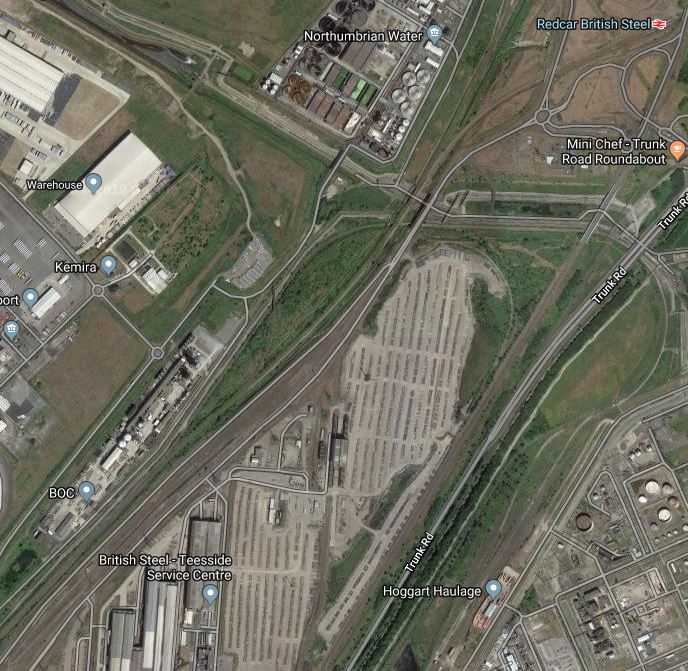
Note the disused Redcar British Steel station, which is still shown on the map.
I remember the area from the around 1970, when I used to catch the train at the now-closed Grangetown station, after visits to ICI’s Wilton site. It was all fire, smoke, smells and pollution.
Darlington Station
Darlington station will also be remodelled to allow more services to operate without conflicting with the East Coast Main Line.
Wikipedia says this under Future for Darlington station.
As part of the Tees Valley Metro, two new platforms were to be built on the eastern edge of the main station. There were to be a total of four trains per hour, to Middlesbrough and Saltburn via the Tees Valley Line, and trains would not have to cross the East Coast Main Line when the new platforms would have been built. The Tees Valley Metro project was, however, cancelled.
It does sound from reading the RAIL article, that this plan is being reinstated.
Would services between Bishop Auckland and Saltburn, use these new platforms?
Saltburn And Bishops Auckland Via Middlesbrough and Darlington
Currently, the service is two trains per hour (tph) between Saltburn and Darlington, with one tph extending to Bishop Auckland.
- I estimate that the current service needs five trains.
- If a two tph service were to be run on the whole route, an extra train would be needed.
- I suspect, the limitations at Darlington station, stop more trains being run all the way to Bishops Auckland.
I could also see extra stations being added to this route.
The Mayor is talking of running a service as frequent as six or eight tph.
These numbers of trains, will be needed for services of different frequencies between Saltburn and Darlington.
- 2 tph – 6 trains
- 4 tph – 12 trains
- 6 tph – 18 trains
- 8 tph – 24 trains
As the London Overground, Merseyrail and Birmingham’s Cross-City Line, find four tph a more than adequate service, I suspect that should be provided.
After updating, Darlington station, should be able to handle the following.
- Up to six tph terminating in one of the new Eastern platforms, without having to cross the East Coast Main Line.
- Two tph between Saltburn and Bishops Auckland could use the other platform in both directions.
I would suspect that the design would see the two platforms sharing an island platform.
Alternatively, trains could continue as now.
- Terminating trains could continue to use Platform 2!
- Two tph between Saltburn and Bishops Auckland stopping in Platforms 1 (Eastbound) and 4 (Westbound)
This would avoid any infrastructure changes at Darlington station, but terminating trains at Darlington would still have to cross the Southbound East Coast Main Line.
If the frequencies were as follows.
- 4 tph – Saltburn and Darlington
- 2 tph – Saltburn and Bishop Auckland
This would require fourteen trains and give a six tph service between Saltburn and Darlington.
Ten trains would allow a two tph service on both routes.
There would be other services using parts of the same route, which would increase the frequency.
Hartlepool And The Esk Valley Line Via Middlesbrough
This is the other route through the area and was part of the cancelled Tees Valley Metro.
- Service is basically one tph, with six trains per day (tpd) extending to Whitby.
- A second platform is needed at Hartlepool station.
- There is a proposal to add a Park-and-Ride station between Nunthorpe and Great Ayton stations.
- One proposal from Modern Railways commentator; Alan Williams, was to simplify the track at Battersby station to avoid the reverse.
- Currently, trains between Whitby and Middlesbrough are timetabled for around 80-100 minutes.
- Hartlepool and Middlesbrough takes around twenty minutes.
Substantial track improvements are probably needed to increase the number of trains and reduce the journey times between Middlesbrough and Whitby.
But I believe that an hourly service between Hartlepool and Whitby, that would take under two hours or four hours for a round trip, could be possible.
This would mean that the hourly Hartlepool and Whitby service would need four trains.
Providing the track between Nunthorpe and |Whitby could be improved to handle the traffic, this would appear to be a very feasible proposition.
Nunthorpe And Hexham Via Newcastle
There is also an hourly service between Nunthorpe and Hexham, via Middlesbrough, Stockton, Hartlepool, Sunderland and Newcastle, there would be two tph.
- It takes around two hours and twenty minutes.
- I estimate that five trains would be needed for the service.
- I travelled once between Newcastle and James Cook Hospital in the Peak and the service was busy.
- A new station is being built at Horden, which is eight minutes North of Hartlepool.
- The service could easily access the proposed fuelling station at Lackenby.
- It would reduce carbon emissions in Newcastle and Sunderland stations..
Surely, if hydrogen power is good enough for the other routes, then it is good enough for this route.
Hartlepool Station
Hartlepool Station could become a problem, as although it is on a double track railway, it only has one through platform, as these pictures from 2011 show.
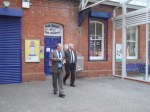



Consider.
- There is no footbridge, although Grand Central could pay for one
- There is a rarely-used bay platform to turn trains from Middlesbrough, Nunthorpe and Whitby.
This Google Map shows the cramped site.
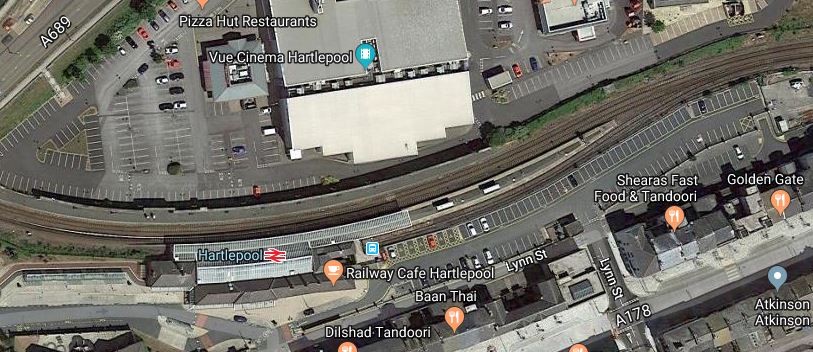
The final solution could mean a new station.
Nunthorpe Park-And-Ride
This Google Map shows Nunthorpe with thje bEsk Valley Line running through it.
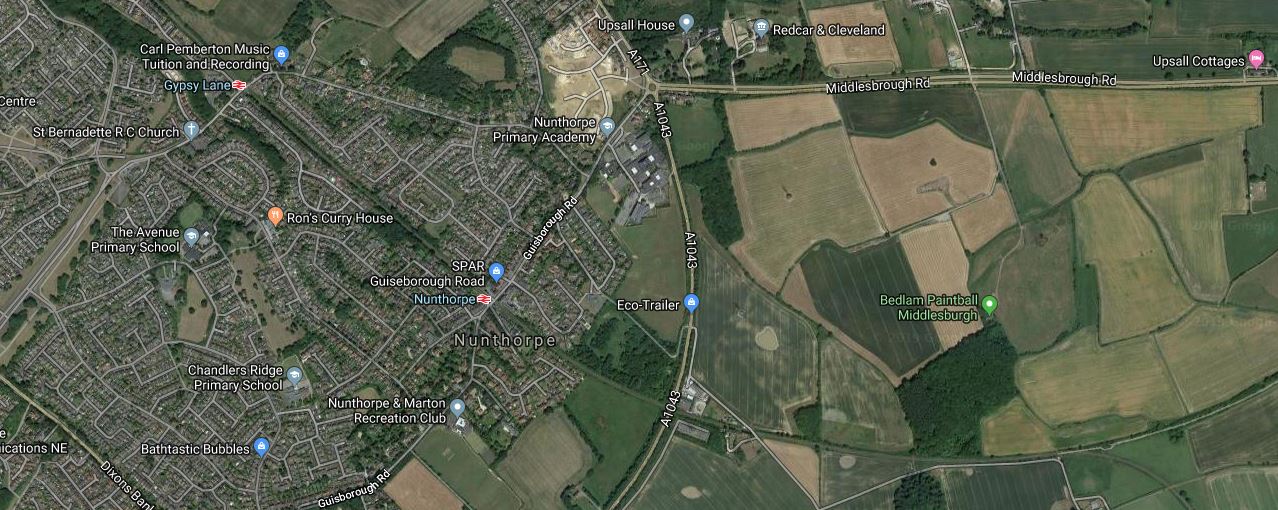
Note.
- Gypsy Lane and Nunthorpe stations.
- The dual-carriageway A171 Guisborough by-pass running East-West, that connects in the East to Whitby and Scarborough.
- The A1043 Nunthorpe by-pass that connects to roads to the South.
Would where the A1043 crosses the Esk Valley Line be the place for the Park-and-Ride station?
The new station could have a passing loop, that could also be used to turn back trains.
Battersby Station
Alan Williams, who is Chairman of the Esk Valley Railway Development Company, is quoted in the RAIL article as saying.
If you’re going to spend that sort of money we’d much rather you spent it on building a curve at Battersby to cut out the reversal there.
Williams gives further reasons.
- Battersby is the least used station on the line.
- It’s in the middle of nowhere.
- The curve would save five minutes on the overall journey.
This Google Map shows Battersby station and the current track layout.

Note.
- The line to Middlesbrough goes through the North-West corner of the map.
- The line to Whitby goes through the North-East corner of the map.
There would appear to be plenty of space for a curve that would cut out the station.
LNER To Teesside
LNER, the Government and the TVCA are aiming to meet a target date of the Second Quarter of 2021 for a direct London and Middlesbrough service.
Middlesbrough Station
Middlesbrough Station will need to be updated and according to the RAIL article, the following work will be done.
- A new Northern entrance with a glass frontage.
- A third platform.
- Lengthening of existing platforms to take LNER’s Class 800 trains.
This Google Map shows the current layout of the station.
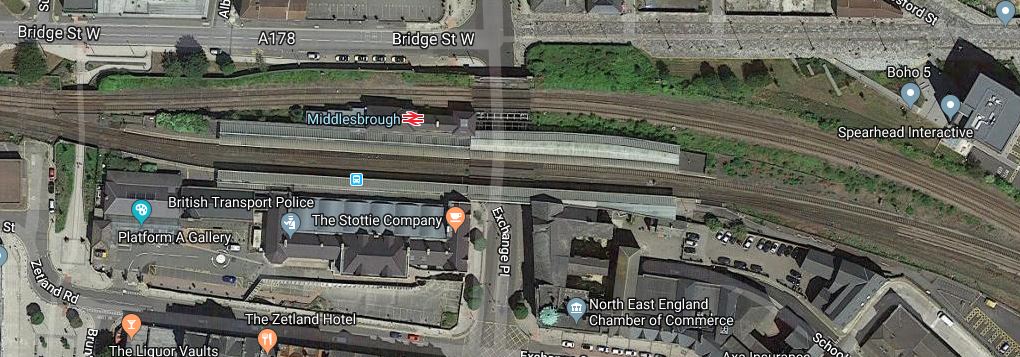
From this map it doesn’t look to be the most difficult of stations, on which to fit in the extra platform and the extensions.


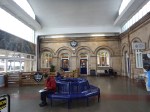



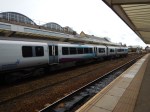
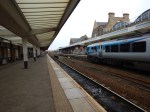
It should also be noted that the station is Grade II Listed, was in good condition on my last visit and has a step-free subway between the two sides of the station.
Journey Times
I estimate that a Kings Cross and Middlesbrough time via Northallerton would take aroud two hours and fifty minutes.
This compares with other journey times in the area to London.
- LNER – Kings Cross and Darlington – two hours and twenty-two minutes
- Grand Central – Kings Cross and Eaglescliffe – two hours and thirty-seven minutes.
I also estimate that timings to Redcar and Saltburn would be another 14 and 28 minutes respectively.
Frequencies
Currently, LNER run between three and four tph between Kings Cross and Darlington, with the competing Grand Central service between Kings Cross and Eaglescliffe having a frequency of five trains per day (tpd).
LNER have also started serving secondary destinations in the last month or so.
- Harrogate, which has a population of 75.000, is served with a frequency of six tpd.
- Lincoln, which has a population of 130,000 is now served with a frequency of six tpd.
Note that the RAIL article, states that the Tees Valley has a population of 750,000.
I feel that Middlesbrough will be served by a frequency of at least five tpd and probably six to match LNER’s new Harrogate and Lincoln services.
Will LNER’s Kings Cross and York Service Be Extended To Middlesbrough?
Cirrently , trains that leave Kings Cross at six minutes past the hour end up in Lincoln or York
- 0806 – Lincoln
- 0906 – York
- 1006 – Lincoln
- 1106 – York
- 1206 -Lincoln
- 1306 – York
- 1406 – Lincoln
- 1506 – York
- 1606 – Lincoln
- 1906 -Lincoln
It looks to me that a pattern is being developed.
- Could it be that the York services will be extended to Middlesbrough in 2021?
- Could six Middlesbrough trains leave Kings Cross at 0706, 0906, 1106, 1306, 1506 and 1706 or 1806?
- York would still have the same number of trains as it does now!
LNER certainly seem to be putting together a comprehensive timetable.
Could Middlesbrough Trains Split At Doncaster Or York?
I was in Kings Cross station, this afternoon and saw the 1506 service to York, go on its way.
The train was formed of two five-car trains, running as a ten-car train.
If LNER employ spitting and joining,, as some of their staff believe, there are surely, places, where this can be done to serve more destinations, without requiring more paths on the East Coast Main Line.
- Splitting at Doncaster could serve Hull, Middlesborough and York.
- Splitting at York could serve Scarborough, Middlesborough and Sunderland.
Scarborough might be a viable destination, as the town has a population of over 100,000.
Onward To Redcar And Saltburn
One of the changes in the December 2019 timetable change, was the extension of TransPennine Express’s Manchester Airport and Middlesbrough service to Redcar Central station.
The RAIL article quotes the Mayor as being pleased with this, although he would have preferred the service to have gone as far as Saltburn, which is a regional growth point for housing and employment.
But the extra six miles would have meant the purchase of another train.
Redcar Central Station
This Google Map shows Redcar Central station and its position in the town.
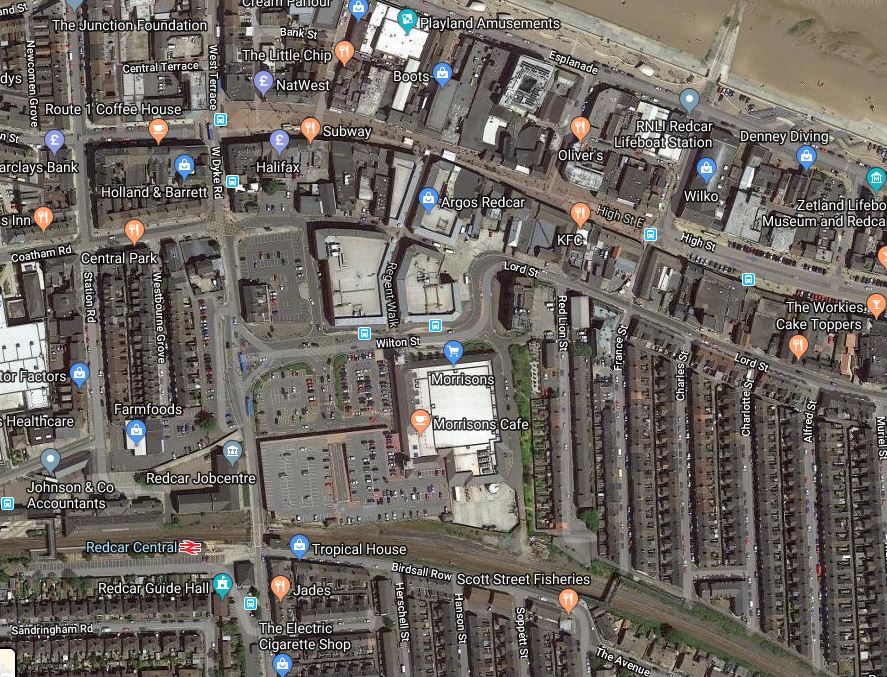
It is close to the sea front and the High Street and there appears to be space for the stabling of long-distance trains to Manchester Airport and perhaps, London.
TransPennine seem to be using their rakes of Mark 5A coaches on Redcar services, rather than their Class 802 trains, which are similar to LNER’s Azumas.
Surely, there will be operational advantages, if both train operating companies ran similar trains to Teesside.
Saltburn Station
Saltburn station is the end of the line.
This Google Map shows its position in the town.
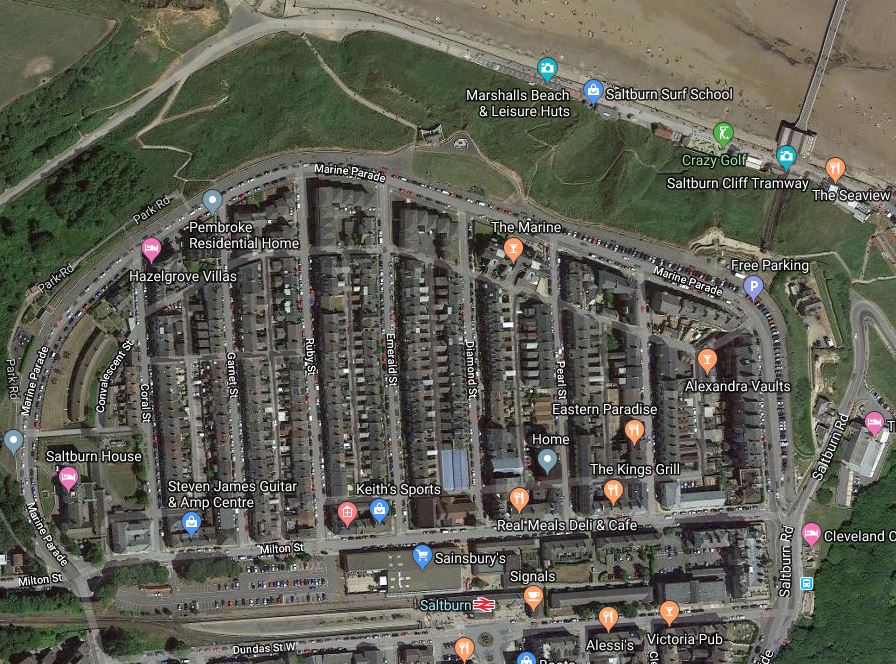
Unlike Redcar Central station, there appears to be very little space along the railway and turning back trains might be difficult.
There may be good economic reasons to use Saltburn as a terminal, but operationally, it could be difficult.
Will Redcar And Saltburn See Services To and From London?
Given that both towns will likely see much improved services to Middlesbrough, with at least a service of four tph, I think it will be unlikely.
But we might see the following.
- LNER using Redcar as a terminus, as TransPennine Express do, as it might ease operations.
- An early morning train to London and an evening train back from the capital, which is stabled overnight at Redcar.
- TransPennine Express using Class 802 trains on their Redcar service for operational efficiency, as these trains are similar to LNER’s Azumas.
It would all depend on the passenger numbers.
A High-Frequency Service Between York And Teesside
After all the changes the service between York and Teesside will be as follows.
- LNER will be offering a train virtually every two hours between York and Middlesbrough.
- Grand Central will be offering a train virtually every two hours between York and Eaglescliffe, which is six miles from Middlesbrough.
- TransPennine Express will have an hourly service between York and Redcar via Middlesbrough.
- There will be between three and four tph between York and Darlington.
All services would connect to the hydrogen-powdered local services to take you all over Teesside.
Could this open up tourism without cars in the area?
Expansion Of The Hydrogen-Powered Train Network
Could some form of Hydrogen Hub be developed at Lackenby.
Alstom are talking of the hydrogen-powered Breeze trains having a range of over six hundred miles and possibly an operating speed of 100 mph, when using overhead electrification, where it is available.
In Breeze Hydrogen Multiple-Unit Order Expected Soon, I put together information from various articles and said this.
I am fairly certain, that Alstom can create a five-car Class 321 Breeze with the following characteristics.
- A capacity of about three hundred seats.
- A smaller three-car train would have 140 seats.
- A near-100 mph top speed on hydrogen-power.
- A 100 mph top speed on electrification.
- A 1000 km range on hydrogen.
- Regenerative braking to an on-board battery.
- The ability to use 25 KVAC overhead and/or 750 VDC third rail electrification.
The trains could have the ability to run as pairs to increase capacity.
The distance without electrification to a selection of main stations in the North East from Lackenby is as follows.
- Newcastle via Middlesbrough and Darlington – 21 miles
- Newcastle via Middlesbrough and Durham Coast Line – 53 miles.
- York via Northallerton – 27 miles
- Doncaster via Northallerton and York – 27 miles
- Leeds via Northallerton and York – 52 miles
- Sheffield via Northallerton, York and Doncaster – 45 miles
I am assuming that the trains can use the electrification on the East Coast Main Line.
From these figures it would appear that hydrogen-powered trains stabled and refuelled at Lackenby could travel to Doncaster, Newcastle, Leeds, Sheffield or York before putting in a days work and still have enough hydrogen in the tank to return to Lackenby.
Several things would help.
- As hydrogen-powered trains have a battery, with a battery range of thirty miles all these main stations could be reached on battery power, charging on the East Coast Main Line and at Lackenby.
- Electrification between Darlington and Lackenby.
- Electrification between Northallerton and Eaglescliffe.
I am fairly certain that a large proportion of the intensive network of diesel services in the North East of |England from Doncaster and Sheffield in the South to Newcastle in the North, can be replaced with hydrogen-powered trains.
- Trains could go as far West as Blackpool North, Carlisle, Manchester Victoria, Preston and Southport.
- Refueling could be all at Lackenby, although other refuelling points could increase the coverage and efficieny of the trains.
- Green hydrogen could be produced by electrolysis from the massive offshore wind farms off the Lincolnshire Coast.
- Hydrogen-powered trains would be ideal for re-opened routes like the proposed services from Newcastle to Blyth and Ashington.
The hydrogen-powered trains on Teesside could be the start of a large zero-carbon railway network.
The Alstom Breeze And The HydroFlex Would Only Be The Start
As I said earlier, the initial trains would be conversions of redundant British Rail-era electrical multiple units.
Thirty-year-old British Rail designs like the Class 319 and Class 321 trains based on the legendary Mark 3 carriages with its structural integrity and superb ride, may have been state-of-the-art in their day, but engineers can do better now.
- Traction and regenerative braking systems are much more energy efficient.
- Train aerodynamics and rolling resistance have improved, which means less energy is needed to maintain a speed.
- Interior design and walk-through trains have increased capacity.
- Crashworthiness has been improved.
Current Bombardier Aventras, Stadler Flirts or Siemens Desiros and CAF Civities are far removed from 1980s designs.
I can see a design for a hydrogen-powered train based on a modern design, tailored to the needs of operators being developed.
A place to start could be an electric CAF Class 331 train. or any one of a number of Aventras.
- From the visualisation that Alstom have released of their Breeze conversion of a Class 321 train, I feel that to store enough hydrogen, a large tank will be needed and perhaps the easiest thing to do at the present time would be to add an extra car containing the hydrogen tank, the fuel cells and the batteries.
- Alstom have stated they’re putting the fuel cells on the roof and the batteries underneath the train.
Although, it is not a hydrogen train, Stadler have developed the Class 755 train, with a power car in the middle of the train.
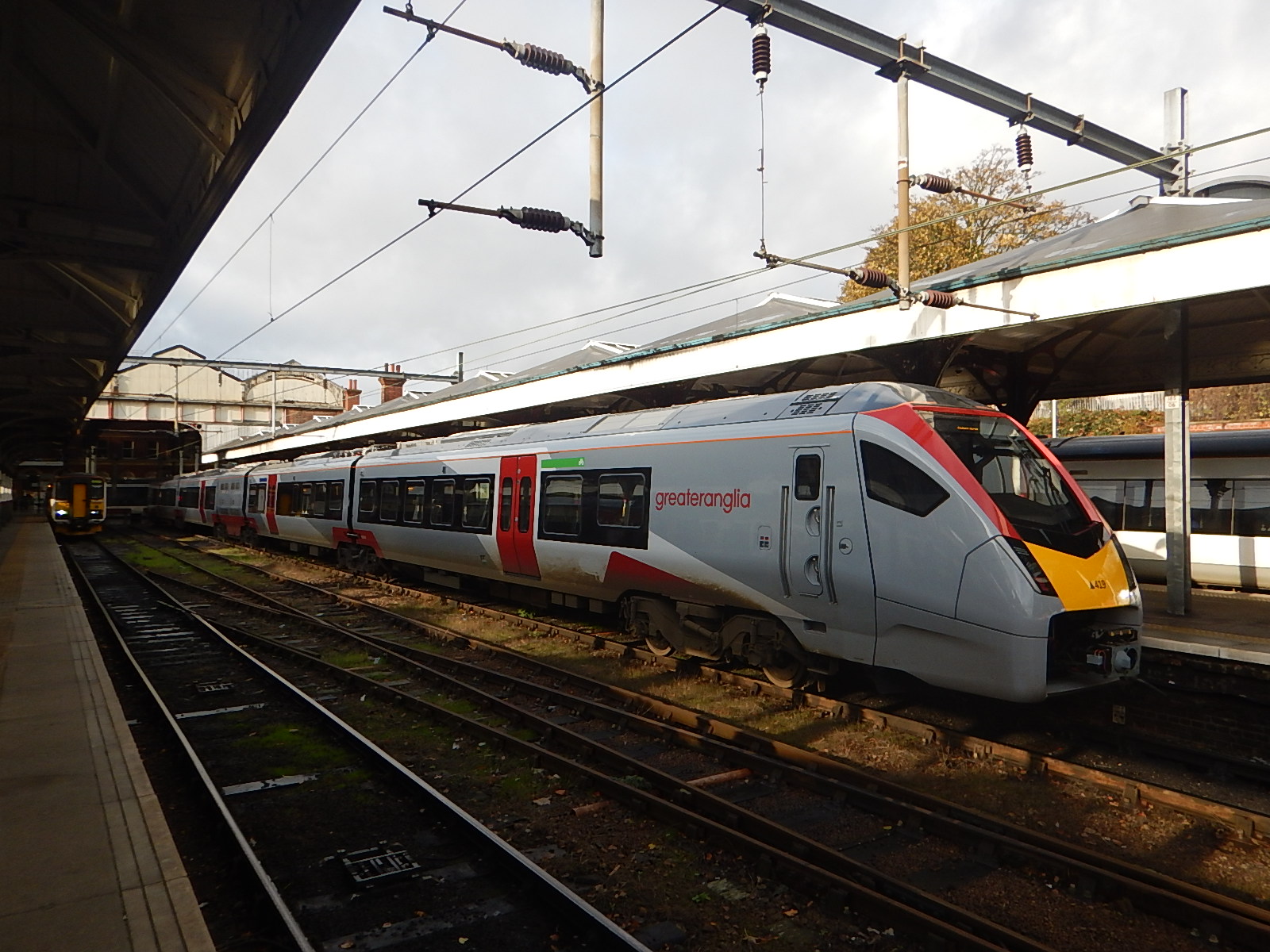
Stadler’s approach of a power car, must be working as they have received an order for a hydrogen-powered version of their popular Flirts, which I wrote about in MSU Research Leads To North America’s First Commercial Hydrogen-Powered Train.
I think we can be certain, that because of the UK loading gauge, that a hydrogen-powered train will be longer by about a car, than the equivalent electric train.
I can see a certain amount of platform lengthening being required. But this is probably easier and less costly than electrification to achieve zero-carbon on a route.
Batteries can be distributed under all cars of the train, anywhere there is space., But I would suspect that fuel cells must be in the same car as the hydrogen tank, as I doubt having hydrogen pipes between cars would be a good idea.
Alstom have resorted to putting hydrogen tanks and fuel cells in both driving cars and they must have sound reasons for this.
Perhaps, it is the only way, they can get the required power and range.
As I understand it, the Alstom Breeze draws power from three sources.
- The electrification if the route is electrified.
- The electricity generated by regenerative braking.
- The hydrogen system produces electricity on demand, at the required level.
Energy is stored in the batteries, which power the train’s traction motors and internal systems.
The electrical components needed for the train are getting smaller and lighter and I feel that it should be possible to put all the power generation and collection into a power car, that is somewhere near the middle of the train. Stadler’s power car is short at under seven metres, but there is probably no reason, why it couldn’t be the twenty metres, that are typical of UK trains.
Suppose you took a four-car version of CAF’s Class 331 train, which has two driver cars either side of a pantograph car and a trailer car.
This has 284 seats and by comparison with the three-car version the trailer car has eighty. As the pantograph car is also a trailer, I’ll assume that has eighty seats too! Until I know better!
Replacing the pantograph car with a hydrogen car, which would be unlikely to have seats, would cut the seats to 204 seats, but a second trailer would bring it back up to 284 seats.
I actually, think the concept of a hydrogen car in the middle of a four-car electric train could work.
- The five-car hydrogen train would have the same capacity as the four-car electric version.
- The train would need an updated software system and some rewiring. Bombardier achieved this quickly and easily with the train for the Class 379 BEMU trial.
- There are several types of four-car electrical multiple units, that could possibly be converted to five-car hydrogen-powered multiple units.
- Some five-car electrical multiple units might also be possible to be converted.
Obviously, if an existing train can be adapted for hydrogen, this will be a more cost effective approach.
Conclusion
Overall, the plans for rail improvements on Teesside seem to be good ones.
I’m looking forward to riding LNER to Teesside and then using the network of hydrogen-powered trains to explore the area in 2022.
My only worry, is that, if the network is successful, the many tourists visiting York will surely increase the numbers of day visitors to Whitby.
This is a paragraph from the RAIL article.
Alan Williams says that the EVRDC’s long-term objective is to see the Esk Valley served at intervals of roughly every two hours, equating to eight return trains per day, but with Northern and NYMR services sharing the single line between Grosmont and Whitby, introducing further Middlesbrough trains during the middle of the day, brings the conversation back to infrastructure.
He goes on to detail what is needed.
Thoughts On Last Week’s Major Power Outage
This article on the BBC is entitled Major Power Failure Affects Homes And Transport.
This is the first two paragraphs.
Nearly a million people have been affected by a major power cut across large areas of England and Wales, affecting homes and transport networks.
National Grid said it was caused by issues with two power generators but the problem was now resolved.
This second article on the BBC is entitled UK power cut: Why it caused so much disruption, and gives these details.
It started with a routine blip – the gas-fired power station at Little Barford in Bedfordshire shut down at 16:58 BST due to a technical issue.
Then, a second power station, the new Hornsea offshore wind farm, also “lost load” – meaning the turbines were still moving, but power was not reaching the grid.
These are my thoughts on the incident.
Power Stations Do Fail
Any complex electro-mechanical system like Little Barford gas-fired power station or Hornsea offshore wind farm can fail.
- Little Barford gas-fired power station was built in 1994 and is a 746 MW gas-fired power station.
- Hornsea offshore wind farm obtained planning permission in 2014 and is being built in phases. It will eventually have a maximum capacity of 8 GW or 8,000 MW.
Compare these figures with the iconic coal-fired Battersea power station, which had a maximum output of 503 MW in 1955.
I will not speculate as to what wet wrong except to say that as the Hornsea wind-farm is relatively new, it could be what engineers call an infant mortality problem. Complex systems or even components seem to fail in the first few months of operation.
Why Do We Have Gas-Fired Stations?
According to this page on Wikipedia, there are around forty natural gas fired power stations in England.
Most gas-fired stations are what are known as CCGT (Combined Cycle Gas Turbine), where a Jumbo-sized gas-turbine engine is paired with a steam turbine powered by the heat of the exhaust from the engine.
This form of power generation does produce some carbon dioxide, but to obtain a given amount of electricity, it produces a lot less than using coal or ioil.
By combining the gas turbine with a steam turbine, the power station becomes more efficient and less carbon dioxide is produced.
Power stations of this type have three various advantages.
- They have a very fast start-up time, so are ideal power stations to respond to sudden increases in electricity demand.
- As they are a gas-turbine engine with extra gubbins, they are very controllable, just like their cousins on aircraft.
- They are relatively quick, easy and affordable to build. The Wikipedia entry for a CCGT says this. “The capital costs of combined cycle power is relatively low, at around $1000/kW, making it one of the cheapest types of generation to install.”
- They don’t need a complicated and expensive transport infrastructure to bring in coal or nuclear fuel.
- They can also be powered by biogas from agricultural or forestry waste, although I don’t think that is a comm practice in the UK.
The carbon dioxide produced is the only major problem.
Gas-Fired Power Stations In The Future
If you read the Wikipedia entry for combined cycle power plants, there is a lot of information on CCGTs, much of which is on various ways of improving their efficiency.
I believe that one particular method of increasing efficiency could be very applicable in the UK.
Under Boosting Efficiency in the Wikipedia entry, the following is said.
The efficiency of CCGT and GT can be boosted by pre-cooling combustion air. This is practised in hot climates and also has the effect of increasing power output. This is achieved by evaporative cooling of water using a moist matrix placed in front of the turbine, or by using Ice storage air conditioning. The latter has the advantage of greater improvements due to the lower temperatures available. Furthermore, ice storage can be used as a means of load control or load shifting since ice can be made during periods of low power demand and, potentially in the future the anticipated high availability of other resources such as renewables during certain periods.
The UK is the world’s largest generator of power using offshore wind and as we are surrounded with sea and wind, the UK is only going to produce more of the power it needs in this or other way.
This method could be used to store the wind energy produced when the demand is low and recover it, when it is needed.
Could The UK Develop A Chain Of Carbon-Neutral Gas-Fired Power Stations?
In parts of the UK, there is a unique mix of resources.
- A plentiful supply of natural gas, either from offshore fields or interconnectors to Norway.
- Large amounts of electricity generated by offshore wind, which will only get larger.
- Worked out gas-fields still connected to the shore, through redundant platforms and pipes.
- Closeness to agricultural areas.
Technologies under development or already working include.
- Offshore creation of hydrogen using electricity generated by offshore wind and then using the redundant gas pipes to bring the hydrogen to the shore.
- Using a hydrogen-fired CCGT power station without producing any carbon-dioxide.
- Feeding carbon dioxide to plants like salad and fruit to make them grow better.
- Using excess electricity from renewable sources to cool the air and improve the efficiency of CCGT power stations.
I can see all these technologies and development coming together in the next few years and a chain of carbon-neutral gas-fired power stations will be created
- Hydrogen produced offshore on redundant gas platforms, using electricity from nearby wind farms, will be turned back into electricity, where it is needed by onshore hydrogen-fired power stations.
- Redundant gas platforms will be refurbished and reused, rather than demolished at great expense.
- Some natural gas will still be used for power generation
- I’m not quite sure, but I think there could be dual-furled CCGTs, that could run on either hydrogen or natural gas.
- Any carbon dioxide generated will be stored in the worked out gas fields or fed to the crops.
- Gas storage onshore will ensure that the gas-fired power station can respond quickly.
I also believe that there is no technological and engineering challenges, that are too difficult to solve.
This strategy would have the following advantages.
- It should be carbon-neutral.
- Because there could have as many as two hundred individual power stations, the system would be very reliable and responsive to the loss of say a cluster of five stations, due to a tsunami, a volcanic eruption or a major eathquake.
- If power from renewable sources like offshore wind is low, extra stations can be quickly switched in.
- It is not dependent on fuel from dodgy dictators!
- It would probably be more affordable than developing nuclear power stations.
There is also the possibility of bringing more hydrogen onshore to be used in the decarbonisation of the gas-grid.
Conclusion
A chain of carbon-neutral gas-fired power stations, linked to hydrogen created offshore by wind farms is very feasible.
Last week, after the double failure, extra stations would have immediately been switched in.
Energy Storage
The fastest response system is energy storage, where a giant battery holds several gigawatt-hours of eklectricity.
Electric Mountain
The biggest energy storage facility in the UK is Dinorwig Power Station.
This is the introduction to its Wikipedia entry.
The Dinorwig Power Station , known locally as Electric Mountain, is a pumped-storage hydroelectric scheme, near Dinorwig, Llanberisin Snowdonia national park in Gwynedd, northern Wales. The scheme can supply a maximum power of 1,728-megawatt (2,317,000 hp) and has a storage capacity of around 9.1-gigawatt-hour (33 TJ)
It is large and has a rapid response, when more electricity is needed.
We probably need another three or four Electric Mountains, but our geography means we have few suitable sites for pumped-storage, especially in areas, where large quantities of electricity are needed.
There are one other pumped-storage system in Wales and two in Scotland, all of which are around 350 MW or a fifth the size of Electric Mountain.
In the Wikipedia entry entitled List Of Power Stations In Scotland, this is said.
SSE have proposed building two new pumped storage schemes in the Great Glen; 600 MW at Balmacaan above Loch Ness, and 600 MW at Coire Glas above Loch Lochy, at £800m. Scotland has a potential for around 500 GWh of pumped storage
I’m sure the Scots will find some way to fill this storage.
If all else fails, there’s always Icelink. This is the description from Wikipedia.
Icelink is a proposed electricity interconnector between Iceland and Great Britain. As of 2017, the project is still at the feasibility stage. According to current plans, IceLink may become operational in 2027.
At 1000–1200 km, the 1000 MW HVDC link would be the longest sub-sea power interconnector in the world.
The project partners are National Grid plc in the UK, and Landsvirkjun, the state-owned generator in Iceland, and Landsnet, the Icelandic Transmission System Operator (TSO)
Plugging it in to Scotland, rather than London, probably saves a bit of money!
Conclusion
Increasing our pumped-storage energy capacity is feasible and would help us to survive major power failures.
Batteries In Buildings
Tesla have a product called a Powerwall, which puts energy storage into a home or other building.
This was the first product of its kind and there will be many imitators.
The Powerwall 2 has a capacity of 13.5 kWh, which is puny compared to the 9.1 GWh or 9,100,000 kWh of Electric Mountain.
But only 674,074 batteries would need to be fitted in the UK to be able to store the same amount of electricity as Electric Mountain.
The big benefit of batteries in buildings is that they shift usage from the Peak times to overnight
So they will reduce domestic demand in the Peak.
Conclusion
Government should give incentives for people to add batteries to their houses and other buildings.
Could Hydrogen Work As Energy Storage?
Suppose you had a hydrogen-fired 500 MW hydrogen-fired CCGT with a hydrogen tank that was large enough to run it at full power for an hour.
That would be a 0.5 GWh storage battery with a discharge rate of 500 MW.
In an hour it would supply 500MWh or 500,000 kWh of electricity at full power.
In Hydrogen Economy on Wikipedia, this is said, about producing hydrogen by electroysis of water.
However, current best processes for water electrolysis have an effective electrical efficiency of 70-80%, so that producing 1 kg of hydrogen (which has a specific energy of 143 MJ/kg or about 40 kWh/kg) requires 50–55 kWh of electricity.
If I take the 40 KWh/Kg figure that means that to provide maximum power for an hour needs 12,500 Kg or 12.5 tonnes of hydrogen.
Under a pressure of 700 bar, hydrogen has a density of 42 Kg/cu. m., so 12.5 tonnes of hydrogen will occupy just under 300 cubic metres.
If I’ve got the figures right that could be a manageable amount of hydrogen.
Remember, I used to work in a hydrogen factory and I had the detailed guided tour. Technology may change in fifty years, but the properties of hydrogen haven’t!
Gas-Fired Versus Coal-Fired Power Stations
Consider.
- The problem of the carbon dioxide is easier with a gas-fired power station, than a coal-fired power station of the same generating capacity, as it will generate only about forty percent of carbon dioxide.
- Gas-fired power stations can be started up very quickly, whereas starting a coal-fired power station probably takes all day.
- Coal is much more difficult to handle than gas.
Using hydrogen is even better than using natural gas, as it’s zero-carbpn.
Conclusion
I believe we can use our unique geographic position and proven technology to increase the resilience of our power networks.
We need both more power stations and energy storage.
Better Storage Might Give Hydrogen The Edge As Renewable Car Fuel
The title of this post is the same as that of this article on an Australian blog called Create.
This paragraph summarises the article.
Professor David Antonelli from Lancaster University has recently discovered a material that he says could allow existing tank sizes to fuel four times their current range.
Take the time to read the article in full!
If this is developed successfully, then coupled to improved battery technology, that will surely increase the practical range of hybrid hydrogen-battery cars, trucks, buses and trains.
Whilst politicians vanish up their backsides discussing the irrelevant Brexit, engineers and scientists will get on developing ideas, that will make everybody’s lives better.
Hydrogen Trains To Be Trialled On The Midland Main Line
This article on Railway Gazette is entitled Bimode And Hydrogen Trains As Abellio Wins Next East Midlands Franchise.
Abellio will be taking over the franchise in August this year and although bi-mode trains were certain to be introduced in a couple of years, the trialling of hydrogen-powered trains is a surprise to me and possibly others.
This is all that is said in the article.
Abellio will also trial hydrogen fuel cell trains on the Midland Main Line.
It also says, that the new fleet will not be announced until the orders are finalised.
In this post, I’m assuming that the hydrogen trial will be performed using the main line trains.
Trains for the Midland Main Line will need to have the following properties
- 125 mph on electric power
- 125 mph on diesel power
- Ability to go at up to 140 mph, when idigital n-cab signalling is installed and the track is improved.
- UK gauge
- Ability to run on hydrogen at a future date.
I think there could be three types of train.
- A traditional bi-mode multiple unit, with underfloor engines like the Hitachi Class 800 series, is obviously a possibility.
- An electrical multiple unit, where one driving car is replaced by a bi-mode locomotive with appropriate power.
- Stadler or another manufacturer might opt for a train with a power pack in the middle.
The second option would effectively be a modern InterCity 225.
- South of Kettering, electricity would be used.
- North of Kettering, diesel would be used
- Hydrogen power could replace diesel power at some future date.
- Design could probably make the two cabs and their driving desks identical.
- The locomotive would be interchangeable with a driver car.
Bi-modes would work most services, with electric versions working to Corby at 125 mph.
Which manufacturer has a design for a 125 mph, hydrogen-powered train?
Alstom
Alstom have no 125 mph UK multiple unit and their Class 321 Hydogen train, is certainly not a 125 mph train and probably will still be under development.
Bombardier
In Mathematics Of A Bi-Mode Aventra With Batteries, I compared diesel and hydrogen-power on bi-mode Aventras and felt that hydrogen could be feasible.
In that post, I wrote a section called Diesel Or Hydrogen Power?, where I said this.
Could the better ambience be, because the train doesn’t use noisy and polluting diesel power, but clean hydrogen?
It’s a possibility, especially as Bombardier are Canadian, as are Ballard, who produce hydrogen fuel-cells with output between 100-200 kW.
Ballard’s fuel cells power some of London’s hydrogen buses.
The New Routemaster hybrid bus is powered by a 138 kW Cummins ISBe diesel engine and uses a 75 kWh lithium-ion battery, with the bus being driven by an electric motor.
If you sit in the back of one of these buses, you can sometimes hear the engine stop and start.
In the following calculations, I’m going to assume that the bi-mode |Aventra with batteries has a power source, that can provide up to 200 kW, in a fully-controlled manner
Ballard can do this power output with hydrogen and I’m sure that to do it with a diesel engine and alternator is not the most difficult problem in the world.
So are Bombardier designing the Bi-Mode Aventra With Batteries, so that at a later date it can be changed from diesel to hydrogen power?
All an Aventra needs to run is electricity and the train, the onboard staff and passengers don’t care whether it comes from overhead wires, third-rail, batteries, diesel or hydrogen.
Bombardier also have the technology for my proposed locomotive-based solution, where one driver-car of an Aventra is replaced by what is effectively a locomotive.
If Bombardier have a problem, it is that they have no small diesel train to replace Abellio’s small diesel trains. Could the longer services use the bi-mode Aventras and the shorter ones Aventras with battery power?
CAF
CAF probably have the technology, but there would be a lot of development work to do.
Hitachi
Hitachi have the bi-mode trains in the Class 802 trains, but haven’t as yet disclosed a hydrogen train.
Siemens
They’ve made a few noises, but I can’t see them producing a bi-mode train for 2022.
Stadler
In a few weeks time, I will be having a ride in a Stadler-built Class 755 train, run by Abellio Greater Anglia.
The Class 755 train is a bi-mode 100 mph train, from Stadler’s Flirt family.
Could it be stretched to a 125 mph train?
- Stadler have built 125 mph electric Flirts.
- It is my view, that Stadler have the knowledge to make 125 mph trains work.
- Flirts are available in any reasonable length.
- I’ve read that bi-mode and electric Flirts are very similar for drivers and operators.
These could work the Midland Main Line.
If the mainline version is possible, then Abellio could replace all their smaller diesel trains with appropriate Class 755 trains, just as they will be doing in East Anglia.
Stadler with the launch of the Class 93 locomotive, certainly have the technology for a locomotive-based solution.
East Midlands Railway would be an all-Stadler Flirt fleet.
As to hydrogen, Stadler are supplying hydrogen-powered trains for the Zillertalbahn, as I wrote in Zillertalbahn Orders Stadler Hydrogen-Powered Trains.
Talgo
Talgo could be the joker in the pack. They have the technology to build 125 mph bi-mode trains and are building a factory in Scotland.
My Selection
I think it comes down to a straight choice between Bombardier and Stadler.
It should also be noted, that Abellio has bought large fleets from both manufacturers for their franchises in the UK.
Zero-Carbon Pilots At Six Stations
This promise is stated in the franchise.
Once the electrification reaches Market Harborough in a couple of years, with new bi-mode trains, running on electricity, the following stations will not see any passenger trains, running their diesel engines.
- St. Pancras
- Luton Airport Parkway
- Luton
- Bedford
- Wellingborough
- Kettering
- Corby
- Market Harborough
These are not pilots, as they have been planned to happen, since the go-ahead for the wires to Market Harborough.
Other main line stations include.
- Beeston
- Chesterfield
- Derby
- East Midlands Parkway
- Leicester
- Long Eaaton
- Loughborough
- Nottingham
- Sheffield
Could these stations be ones, where East Midlands Railway will not be emitting any CO2?
For a bi-mode train to be compliant, it must be able to pass through the station using battery power alone.
- As the train decelerates, it charges the onboard batteries, using regernerative braking.
- Battery power is used whilst the train is in the station.
- Battery power is used to take the train out of the station.
Diesel power would only be used well outside of stations.
How would the trains for the secondary routes be emission-friendly?
- For the long Norwich to Derby and Nottingham to Liverpool routes, these would surely be run by shorter versions of the main line trains.
- For Stadler, if secondary routes were to be run using Class 755 trains, the battery option would be added, so that there was no need to run the diesel engines in stations.
- For Bombardier, they may offer battery Aventras or shortened bi-modes for the secondary routes, which could also be emission-free in stations.
- There is also the joker of Porterbrook’s battery-enhaced Class 350 train or BatteryFLEX.
I think that with the right rolling-stock, East Midlands Railway, could be able to avoid running diesel engines in all the stations, where they call.
Why Are Abellio Running A Hydrogen Trial?
This is a question that some might will ask, so I’m adding a few reasons.
A Train Manufacturer Wants To Test A Planned Hydrogen Train
I think that it could be likely, that a train manufacturer wants to trial a hydrogen-powered variant of a high-speed train.
Consider.
- The Midland Main Line is about 160 miles long.
- A lot of the route is quadruple-track.
- It is a 125 mph railway for a proportion of the route.
- It has only a few stops.
- It is reasonably straight with gentle curves.
- Part of the route is electrified.
- It is connected to London at one end.
In my view the Midland Main Line is an ideal test track for bi-mode high speed trains.
A Train Manufacturer Wants To Sell A Fleet Of High Speed Trains
If a train manufacturer said to Abellio, that the fleet of diesel bi-mode trains they are buying could be updated to zero-carbon hydrogen bi-modes in a few years, this could clinch the sale.
Helping with a trial, as Abellio did at Manningtree with Bombardier’s battery Class 379 train in 2015, is probably mutually-beneficial.
The Midland Main Line Will Never Be Fully Electrified
I believe that the Midland Main Line will never be fully-electrified.
- The line North of Derby runs through the Derwent Valley Mills World Heritage Site. Would UNESCO allow electrification?
- I have been told by drivers, that immediately South of Leicester station, there is a section, that would be very difficult to electrify.
- Some secondary routes like Corby to Leicester via Oakham might be left without electrification.
But on the other hand some sections will almost certainly be electrified.
- Around Toton, where High Speed Two crosses the Midland Main Line and the two routes will share East Midlands Hub station.
- Between Clay Cross North Junction and Sheffield, where the route will be shared with the Sheffield Spur of High Speed Two.
- The Erewash Valley Line, if High Speed Two trains use that route to Sheffield.
The Midland Main Line will continue to need bi-mode trains and in 2040, when the Government has said, that diesel will not be used on UK railways,
It is my view, that to run after 2040, there are only two current methods of zero-carbon propulsion; on the sections without overhead electrification battery or hydrogen power.
So we should run trials for both!
Abellio Know About Hydrogen
Abellio is Dutch and after my trip to the Netherlands last week, I wrote The Dutch Plan For Hydrogen, which describes how the Dutch are developing a green hydrogen economy, where the hydrogen is produced by electricity generated from wind power.
So by helping with the trial of hydrogen bi-mode trains on the Midland Main Line, are Abellio increasing their knowledge of the strengths and weaknesses of hydrogen-powered trains.
In Thoughts On Eurostar To North Netherlands And North West Germany, I proposed running bi-mode trains on the partially-electrified route between Amsterdam and Hamburg via Groningen and Bremen, which would be timed to connect to Eurostar’s services between London and Amsterdam. These could use diesel, hydrogen or battery power on the sections without electrification.
If hydrogen or battery power were to be used on the European bi-mode train, It would be possible to go between Sheffield and Hamburg on a zero-carbon basis, if all electric power to the route were to be provided from renewable sources.
Abellio Sees The PR Value In Running Zero-Carbon Trains
In My First Ride In An Alstom Coradia iLint, I talked about running hydrogen-powered trains on a hundred mile lines at 60 mph over the flat German countrside
The Midland Main Line is a real high speed railway, where trains go at up to 125 mph between two major cities, that are one-hundred-and-sixty miles apart.
Powered by hydrogen, this could be one of the world’s great railway journeys.
If hydrogen-power is successful, Abellio’s bottom line would benefit.
Conclusion
This franchise will be a big improvement in terms of carbon emissions.
As I said the choice of trains probably lies between Bombardier and Stadler.
But be prepared for a surprise.
 The Anonymous Widower