Centrica Secures Investment Stake In Gasrec Helping Boost UK Bio-LNG Ambitions
The title of this post, is the same as that of this press release from Centrica.
This is the sub-heading.
Centrica has secured a minority stake in Gasrec, the UK’s largest dual provider of bio-LNG (bio-Liquified Natural Gas) and bio-CNG (bio-Compressed Natural Gas) to the road transport sector,
These first two paragraphs give more details.
Gasrec says the investment will drive the next phase of its infrastructure ambitions, with plans to open a UK wide network of open-access refuelling stations supplying renewable bio-LNG for the decarbonisation of heavy goods vehicles.
Centrica is taking a 16% stake and becomes one of three major shareholders in Gasrec, alongside global integrated energy company bp and private family office 44 North.
I have some thoughts.
Does Running A Truck On bio-LNG or bio-CNG. Reduce Carbon Emissions?
This paragraph from the press release, gives the thoughts of Chris O’Shea, who is Group Chief Executive, Centrica.
Chris O’Shea, Group Chief Executive, Centrica plc, said: “Demand for bio-LNG for transport is growing fast as more HGV operators make the switch – drawn by a clean, ready-to-use fuel which slashes CO2 emissions by up to 85 per cent in comparison to diesel*. This investment in Gasrec enhances our collaboration with the leading company in the sector, and puts us in a strong position to energise a vital sector of the industry on its journey to net zero.”
As Centrica is a public company, with shareholders, who would take a dim view of Mr. O’Shea telling porkies, I suspect we can assume that the following is true.
Drawn by a clean, ready-to-use fuel which slashes CO2 emissions by up to 85 per cent in comparison to diesel.
The asterisk in the full quote, refers to this note.
Low Carbon Vehicle Partnership, Innovate UK and Office for Low Emission Vehicles, Low Emission Freight & Logistics Trial (LEFT), Key Findings, November 2020. Using specific feedstocks CO2 reductions of 200% are achievable.
Centrica could be being conservative with their claims.
Decarbonising Buses, Locomotives And Trucks
Despite what Elon Musk, would have us believe, electric trucks will not dominate the future of freight transport.
An electric truck would be the vehicle equivalent of asking Usain Bolt to run a hundred metres with a large refrigerator on his back.
Trucks are going to need a fuel without a weight penalty and with a long range.
I asked Google for information about Cummins diesel, natural gas and hydrogen engines and received this AI Overview.
Cummins offers engines powered by diesel, natural gas, and hydrogen. While diesel engines are well-established, Cummins is also developing both natural gas and hydrogen engines, particularly focusing on hydrogen as a pathway to zero-carbon solutions for various applications. Cummins utilizes a fuel-agnostic platform, meaning a common base engine can be adapted for different fuel types, including diesel, natural gas, and hydrogen.
Recently, GB Railfreight purchased thirty Class 99 locomotives from Stadler.
- They can use electrification, where it exists.
- Where electrification doesn’t exist, they can use an onboard Cummins diesel engine, which is built in Darlington.
- In electric-mode, they have 6.2 MW of power, and are the most powerful locomotives ever to run on UK railways.
- In diesel-mode, they have 1.8 MW of power, which is more than enough to haul a large container train in and out of Felixstowe.
I had thought that at some future date, Cummins would convert these locomotives to electro-hydrogen.
But now that Gasrec is providing bio-LNG and bio-CNG, GB Railfreight, have the option of converting both hydrogen and biomethane.
Similar logic can be applied to Wrightbus’s Streetdeck Ultroliner, one version of which is fitted with a Cummins engine, that can be converted to electric, hydrogen or natural gas, which of course includes biomethane. This page on the Wrightbus web site describes the bus.
Wrightbus are also going back into coach manufacture, as I wrote about in Wrightbus Goes Back To The Future As It Relaunches The Contour Coach. As with the Streetdeck Ultroliner, Cummins seem to be providing one of the power units.
It seems to me, that the zero- and low-carbon revolution in transport will generate a need for the availability of biomethane, hydrogen and natural gas fuel for transport all over the country.
Gasrec with around twenty biomethane fuelling points around the country, seem well-placed to supply the biomethane in bio-LNG or bio-CNG form.
Could Gasrec Deliver Hydrogen?
Various bus companies in the UK, have had difficulty getting the fuel for their hydrogen buses.
I believe that delivering hydrogen would be very similar to delivering LNG and if Gasrec can deliver LNG successfully and safely, they probably have the technology to do the same for hydrogen.
Centrica Seem To Be Assembling An Interesting Consortium
These are some deals, that I have reported on this blog, that involve Centrica.
- Centrica, along with Hyundai, Kia, Siemens and others have backed Hull-based hydrogen start-up; HiiROC, who can produce affordable hydrogen from any hydrocarbon gas including natural gas, where it is needed.
- Centrica have invested in Sizewell C. Will they be using their share of the electricity to make affordable pink hydrogen using HiiROC?
- In Centrica And Ryze Agree To Develop Hydrogen Pathway, I talked about how Centrica and Ryse were aiming to bring hydrogen to the masses.
- In Recurrent Energy’s Middle Road Project Sold To Centrica, I talked about a Centrica investment in solar power.
- In Aberdeen’s Exceed Secures Centrica Rough Contract, I talked about how Centrica were redeveloping the Rough gas storage site for hydrogen.
- In Lhyfe And Centrica To Develop Offshore Renewable Green Hydrogen In The UK, I talked about developing offshore hydrogen.
- In Centrica Announces Hydrogen Ready Combined Heat And Power Partnership With 2G, the title says it all.
- In Centrica Signs UK Biomethane Agreement With Yorkshire Water And SGN Commercial Services, Centrica appear to be sourcing biomethane from Yorkshire Water.
- In Centrica Invests In Renewable Energy Storage Capabilities To Boost UK’s Energy Security And Accelerate Transition To Net Zero, I talk about Centrica, Goldman Sachs and others, investment in liquid-air energy storage company; Highview Power.
- In British Gas Owner Mulls Mini-Nuke Challenge To Rolls-Royce, I talk about rumours that Centrica might invest in SMRs.
Note.
- A lot of these deals are are about hydrogen production.
- Some of these deals are about biomethane production.
- None of these deals talk about getting hydrogen and biomethane to customers.
It appears to me, that Gasrec have a model that works to get hydrogen, methane and biomethane from production and storage to the end customers.
Developing A Rural Hydrogen Network
In Developing A Rural Hydrogen Network, I talked about supplying all those millions of off-gas grid properties with hydrogen for heating, agricultural and industrial purposes, in the countryside of the UK.
Gasrec have the technology to decarbonise the countryside.
Conclusion
Gasrec would appear to be a very useful partner for Centrica.
Rolls-Royce mtu Series 4000 engines To Power New Catalina Express Ferry In California
The title of this post, is the same as that of this press release from Rolls-Royce.
These two bullet points act as sub-headings.
High-capacity ferry to feature four EPA Tier 4-certified engines, delivering over 7463 kW (10,000 bhp)
Cutting-edge propulsion system will integrate SCR and DPF once certified by the EPA, USCG, and CARB to meet commercial harbour craft regulations
These three paragraphs from the press release, describe the ferry and its operation.
Rolls-Royce has been selected by Catalina Express of San Pedro, CA (USA) to supply the marine propulsion system for its new high-capacity ferry. The 500-passenger vessel, which will be the largest in the Catalina Express fleet upon completion, will be powered by four mtu 12V4000 M65L engines, delivering a combined output of over 7463 kW (10,000 bhp).
The new ferry is part of the Port of Los Angeles’ $31 million LA MER project, which is funded by the California Air Resources Board (CARB). Via the project, Catalina Express received a $15 million grant, matching it with $15 million of its own investment. The goal of the LA MER project is to test ways to reduce emissions as the Port works toward becoming a zero-emission port.
The new 42-meter ferry, which will be able to reach speeds up to 37 knots, will replace three older Catalina Express vessels maintaining capacity and increasing environmental performance. The vessel will serve as a next-generation leader of the fleet, showcasing the company’s commitment to sustainable operations.
The Wikipedia entry for Catalina Express has this first paragraph.
Catalina Express is an American passenger ferry service that operates scheduled trips between Santa Catalina Island and mainland California. The company began service in 1981 with a single sixty-passenger vessel. As of 2016, the Catalina Express fleet includes eight high-speed vessels that can make the roughly 30-mile (48 km) crossing in about an hour.
There appears to be strong commitment of the California Air Resources Board and Catalina Express to air quality and zero emissions.
In Liberty Lines Commissions First High-Speed Ferry With mtu Hybrid System From Rolls-Royce, I wrote about another high-speed ferry, that will be powered by a Rolls-Royce mtu hybrid system.
The European ferry will be able take 281 passengers at 34.5 mph, and also use battery-power in port.
I can see larger, faster and more advanced ferries being developed, with lower-emission power systems, that will take over some of the shorter sea routes.
Midlands Rail Hub Looks To The Future With Preferred Alliance Partners
The title of this post, is the same as that of this press release from Network Rail.
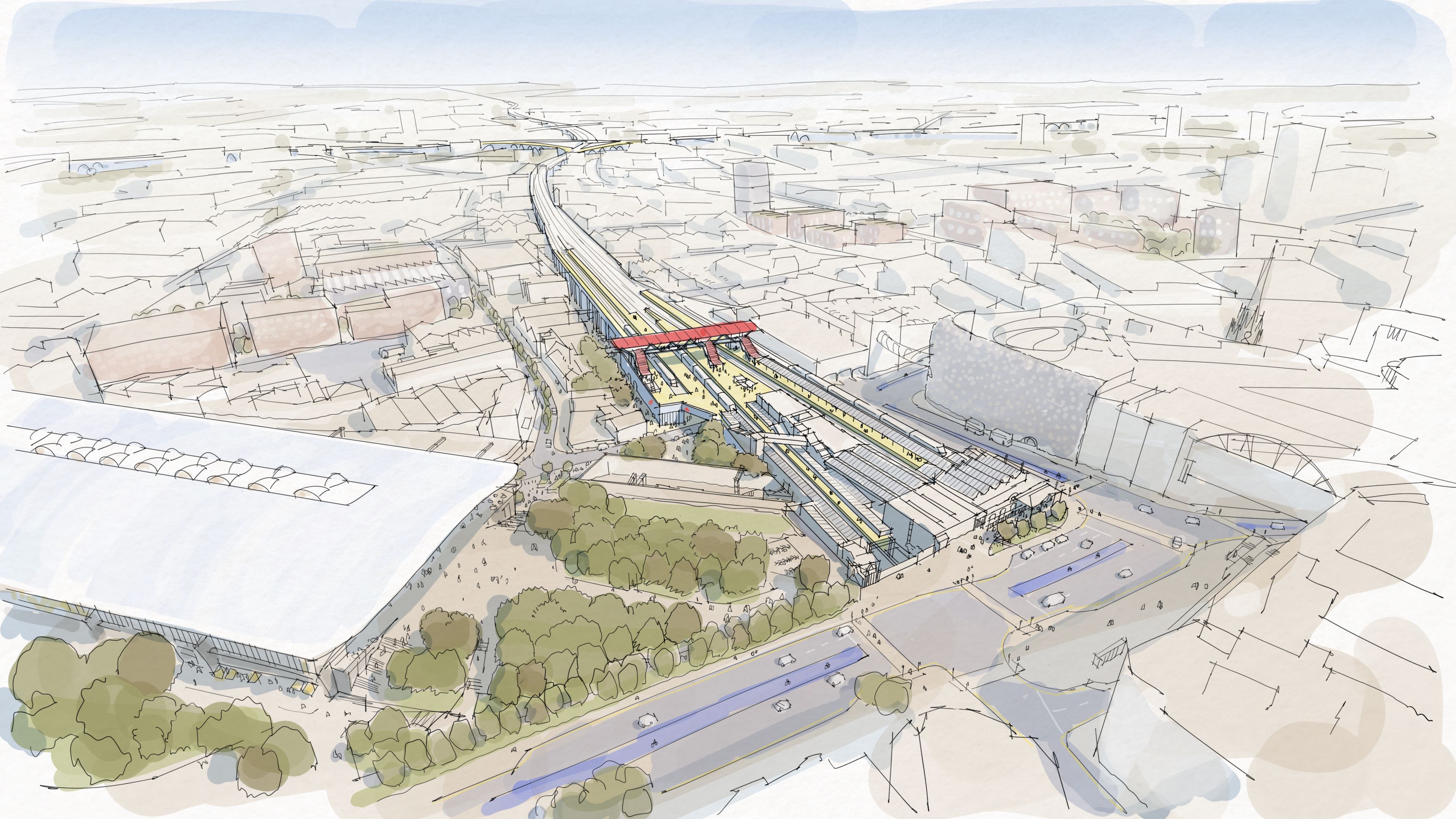
The press release has a spectacular picture, which I’m showing here.
Note.
- High Speed Two’s Curzon Street station is on the left.
- Birmingham Moor Street station is in the centre.
- There appears to be parkland between the two stations.
- Is that the West Midlands Metro running across in front of Moor Street station?
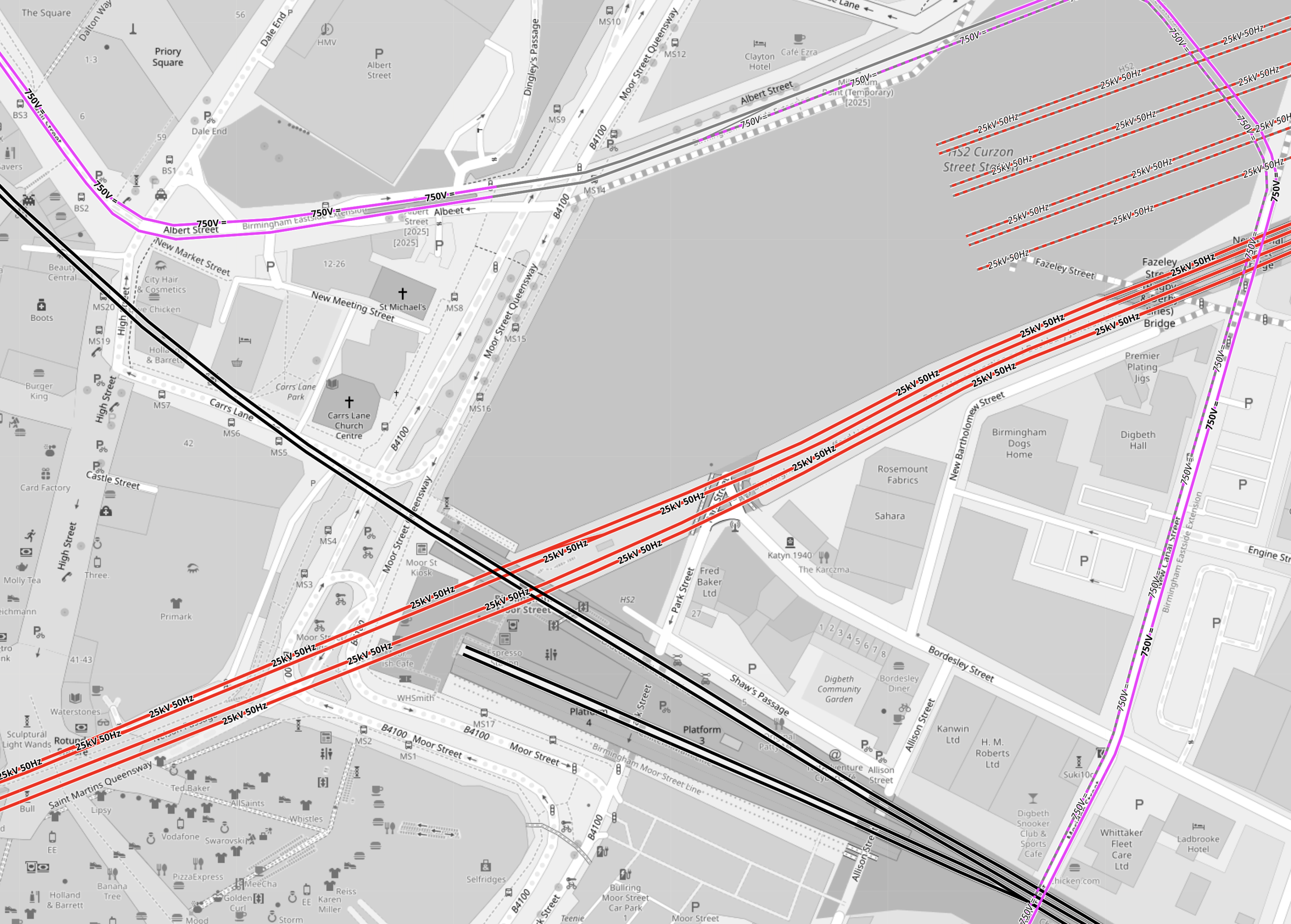
This OpenRailwayMap shows the railway lines in the area.
Note.
- Electrified tracks are shown in red.
- Tracks without electrification are shown in black.
- West Midlands Metro tracks are shown in mauve.
- The red tracks going diagonally across the map are the four electrified tracks going into Birmingham New Street station.
- Birmingham New Street station is off the map to the West.
- To the North of the tracks going into Birmingham New Street station, there are the seven platforms of High Speed Two’s Curzon Street station.
- The four platforms without electrification are shown South of the tracks into Birmingham New Street station.
- Two platforms at Birmingham Moor Street station are through platforms, that pass under Birmingham City Centre to Birmingham Snow Hill station.
- The other two platforms at Birmingham Moor Street station are bay platforms.
- The West Midlands Metro appears to take a loop around the stations.
But when you get into the words of the press release, there are a lot of vegetables and very little meat.
- The Midlands Rail Hub could cost around £1.75bn if delivered in full.
- The government’s recent spending review committed to progress the next stage of Midlands Rail Hub.
- Alongside this, planning is underway to begin to deliver two smaller but significant upgrades to benefit passengers as quickly as possible.
- The Alliance partners will be VolkerRail, Laing O’Rourke, AtkinsRéalis, Siemens Mobility, and Network Rail.
These four paragraphs indicate the work, that could be done.
The biggest change will be connecting the Chiltern main line, which runs into Moor Street, with the Camp Hill lines which run towards the South West and East Midlands via two new chords in Bordesley, near Birmingham city centre.
The transformation of the network will include running more train services on key routes through Birmingham and significantly improving connections for the millions of people who use the railway every day.
Work will be prioritised to explore how smaller, but vital, pieces of work which will provide passengers and communities with quicker benefits, including new journey options and more trains can be delivered as soon as possible.
They include reopening platform 4 at Snow Hill station so additional Chiltern Railways services can run directly between Birmingham’s business district and London Marylebone, and redeveloping Kings Norton station and the lines through it so extra Cross City trains can be added and new Midlands Rail Hub-enabled services can call there.
Three projects are specifically mentioned.
- The new chords in Bordesley.
- The reopening of platform 4 at Snow Hill station.
- The redeveloping of Kings Norton station.
I shall now look at each in detail.
The New Chords At Bordesley
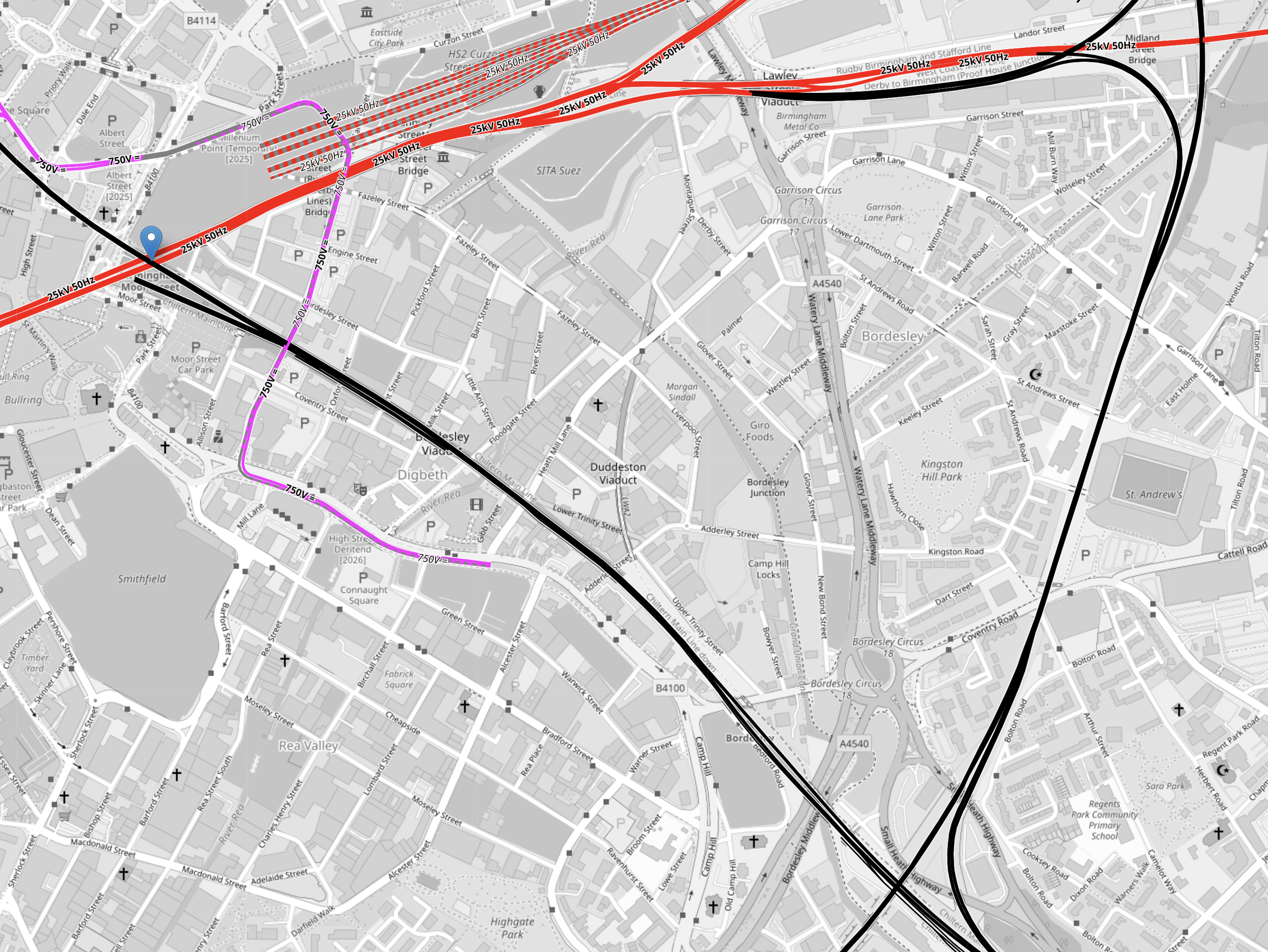
This OpenRailwayMap shows the tracks going into and around Birmingham Moor Street station.
Note.
- Electrified tracks are shown in red.
- Tracks without electrification are shown in black.
- West Midlands Metro tracks are shown in mauve.
- The red tracks going diagonally across the map are the four electrified tracks going into Birmingham New Street station.
- Birmingham New Street station is off the map to the West.
- To the North of the tracks going into Birmingham New Street station, there are the seven platforms of High Speed Two’s Curzon Street station.
- The black track running NW-SE is the Chiltern Main Line between London Marylebone and Birmingham Moor Street stations.
- Birmingham Moor Street station is indicated by the blue arrow in the North-West corner of the map.
- The black track running NE-SW is the Camp Hill Line, that allows services to cross Birmingham.
Two new chords will be built where the Chiltern Main and the Camp Hill Lines cross, to allow services on the Camp Hill Line to call at Birmingham Moor Street station.
Consider.
- The press release described these chords as the biggest change.
- The chords will probably not be fully used, until the new stations are built on the Camp Hill Line.
- There may be need for extra platforms at Birmingham Moor Street station to accommodate any new services.
For these reasons, I suspect that these chords could well be the project that is pushed back to a later date.
The Reopening Of Platform 4 At Snow Hill Station
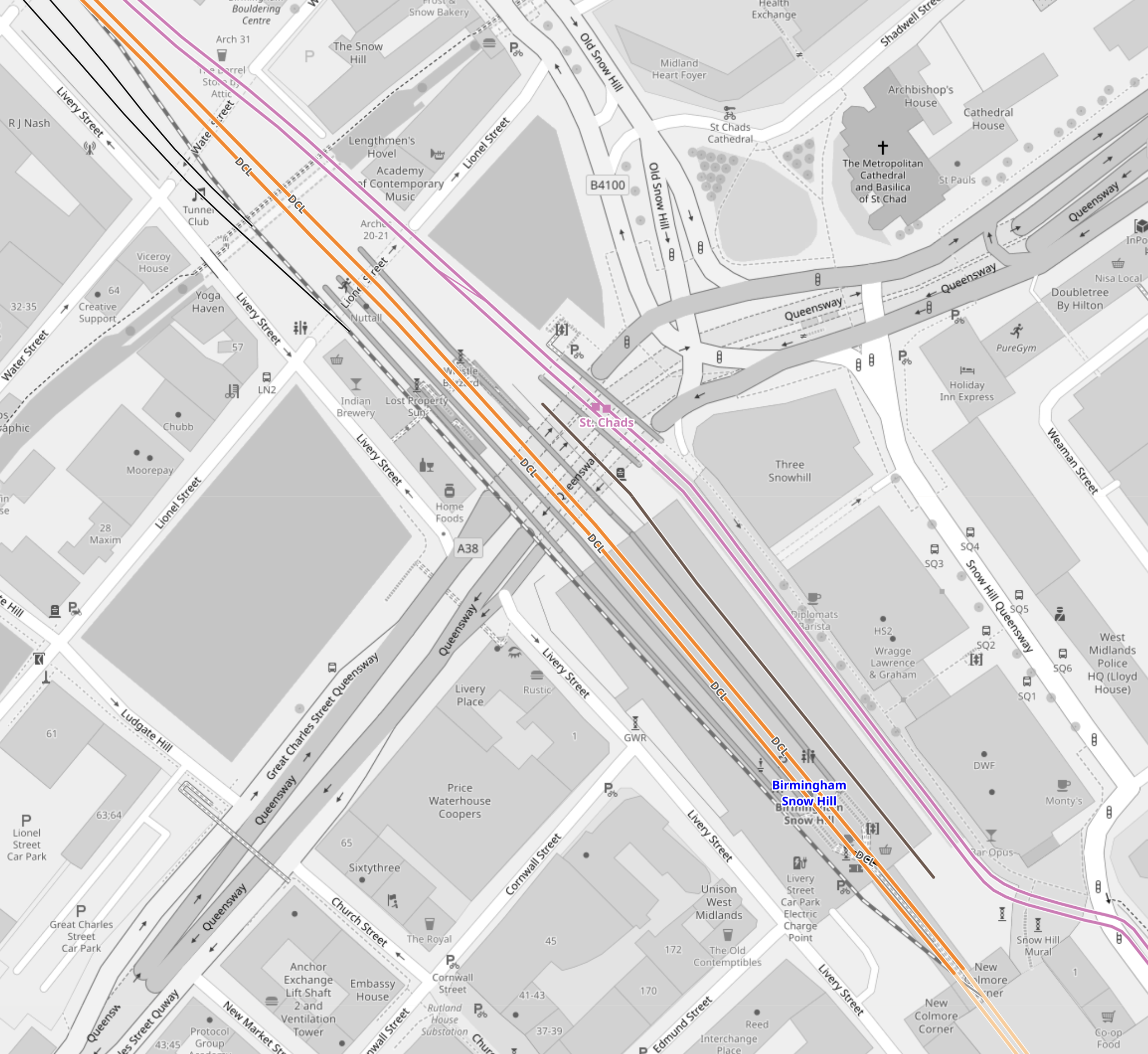
This OpenRailwayMap shows the track layout at Birmingham Snow Hill station.
Note.
- The two lilac tracks are the West Midlands Metro.
- The two orange tracks are the two through tracks between Birmingham Moor Street and Stourbridge Junction stations.
- Platform 3 is the Southbound track to Birmingham Moor Street on the right.
- Platform 2 is the Northbound track to Stourbridge Junction on the left
- Platform 1 is a loop on left.
- Platforms 1, 2 and 3 are all bi-directional.
- The closed Platform 4 is on the right and is shown by the black track.
I would expect that this reopening could be fairly straightforward and may also have worthwhile benefits.
- Would an extra platform, allow all Chiltern services to serve both Birmingham Moor Street and Birmingham Show Hill stations?
- Chiltern would probably find it easy to extend services from Birmingham to the North-West of the city.
- In this century, services have run as far as Wrexham from Marylebone.
- If all Chiltern services terminated at Birmingham Show Hill station would this have operational and/or marketing advantages?
- If all Chiltern services terminated at Birmingham Show Hill station would this, make it easier for some passengers to get a train to London and the South?
- If all Chiltern services terminated at Birmingham Show Hill station would this release a platform at Birmingham Moor Street station for other services?
These are a few pictures of Birmingham Snow Hill station.
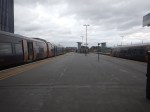
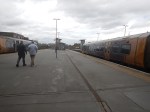
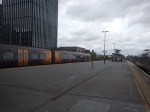
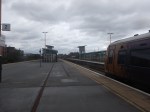

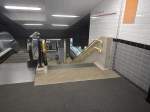
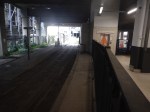
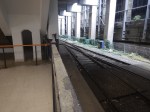

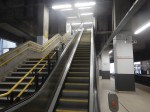

Platform 4 at Birmingham Snow Hill station could be a Build One Platform-Get One Free At Another Station situation!
The Redeveloping Of Kings Norton Station
This will probably be needed for running services on the Camp Hill Line, so why not get some of the work done early, so the rebuilding doesn’t effect existing services?
This OpenRailwayMap shows the Eastern end of Kings Norton station
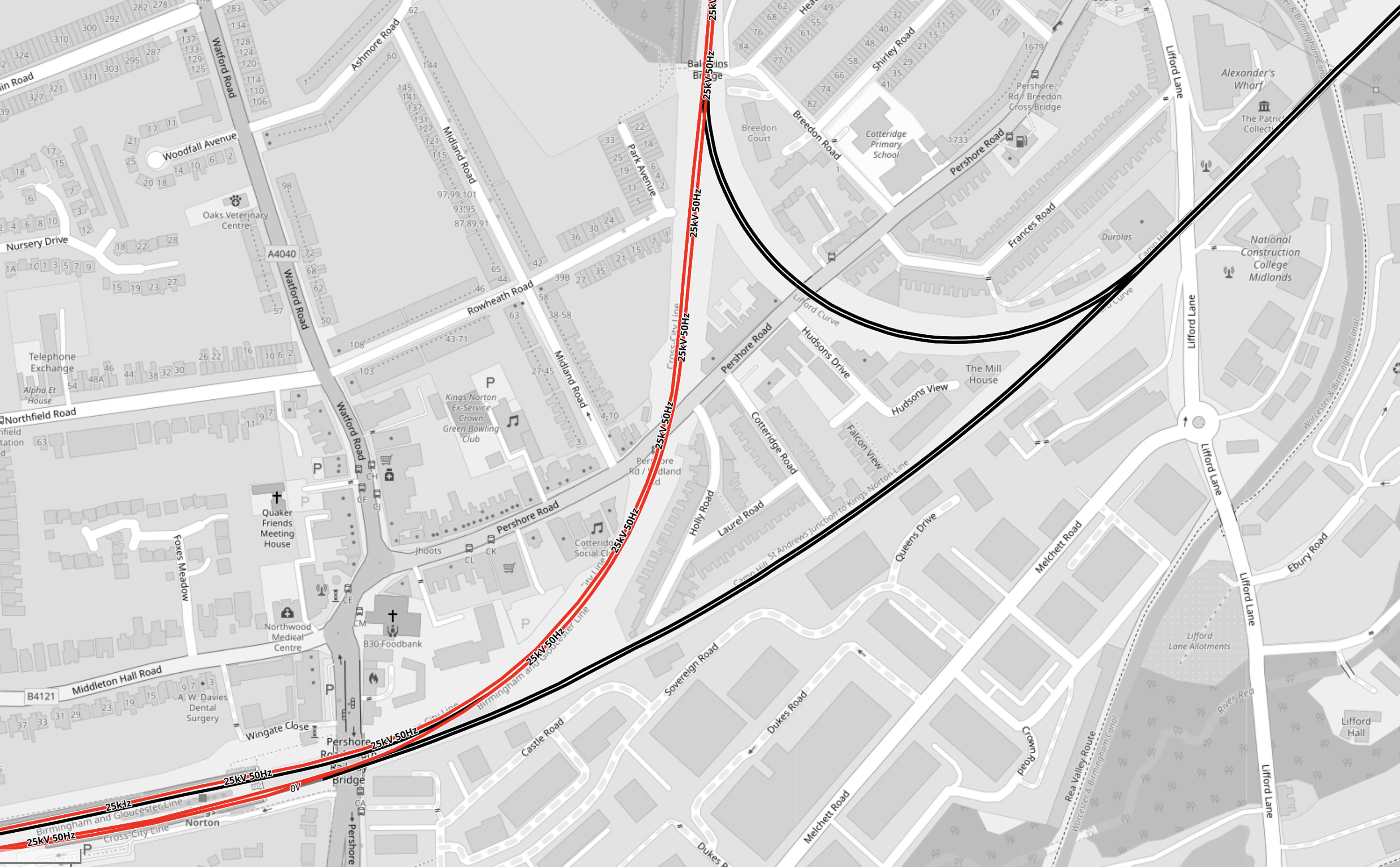
Note.
- Electrified tracks are shown in red.
- Tracks without electrification are shown in black.
- The station has four platforms, but some are unused.
- Two platforms are on an island, with a single platform on either side.
This OpenRailwayMap shows the Western end of Kings Norton station.
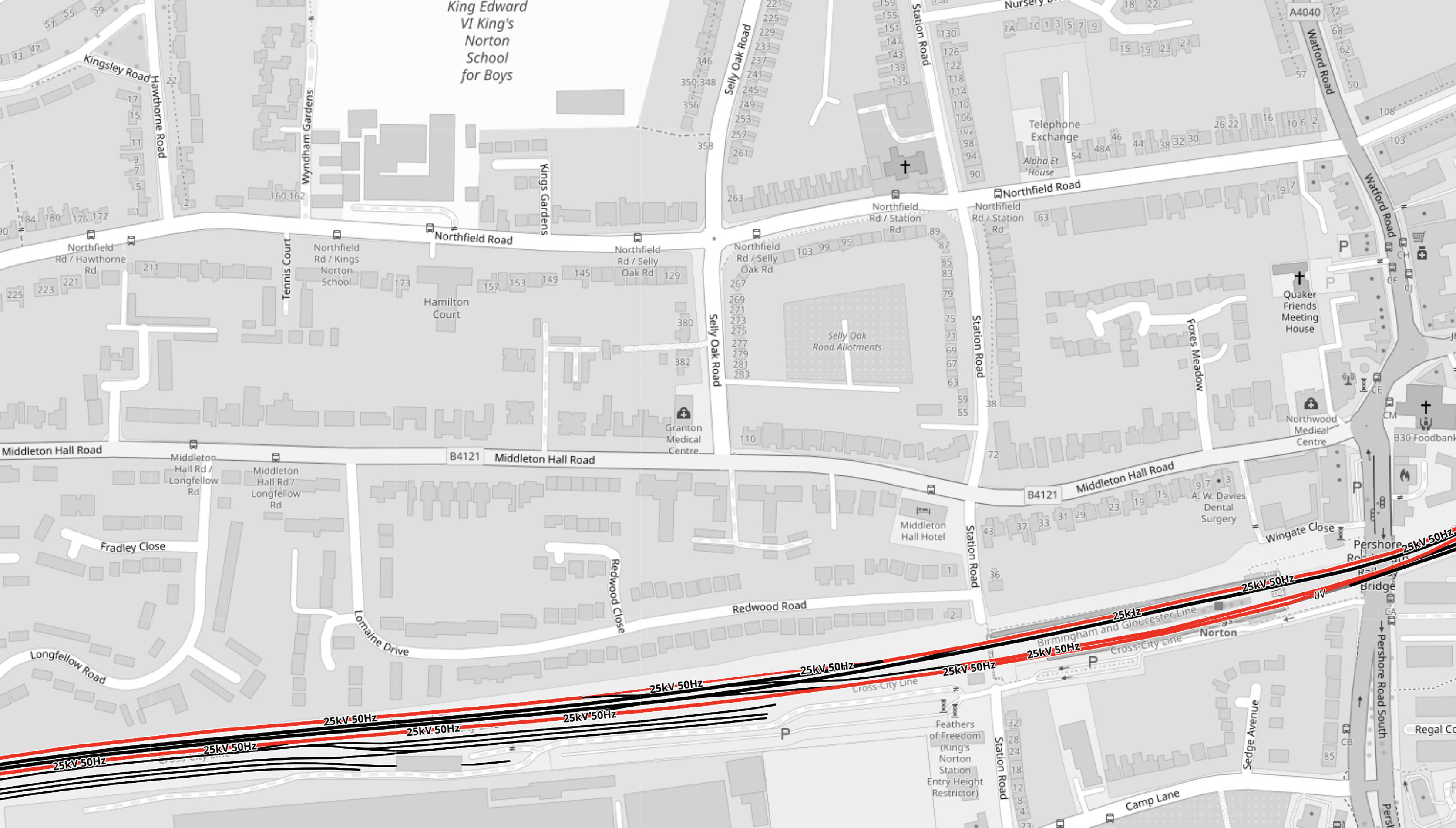
The notes to the previous map apply.
These two paragraphs from the Wikipedia entry for Kings Norton station, describe the station.
With the development of both bus and tram services, the need for such a large facility reduced from the 1930s onwards. The result is that today although all four platforms remain in place, only the outer two are in passenger use, with the middle island platforms now derelict.
Refurbished as part of the Cross-City line in 1978, it retained some of its original features following refurbishment, unlike the other ‘cross city line’ stations. The original station building survived, leased out for commercial purposes, until it was demolished in February 2006 for safety reasons. An extension car park provides a Park and Ride facility.
Disabled-access doesn’t seem to be the best either.
These pictures show the station.
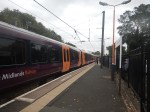
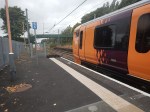
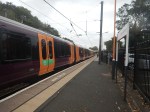
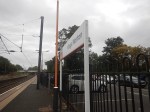
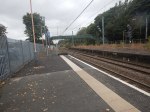
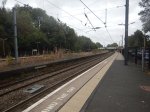
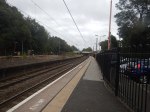
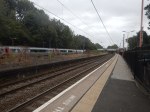
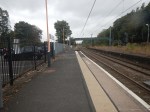
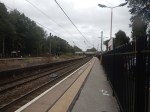
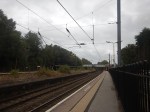
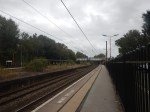
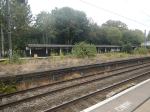
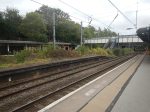
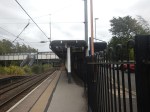
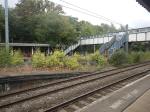
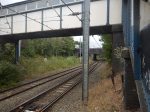
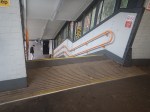
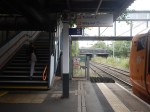
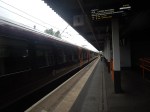
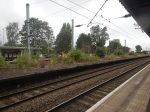
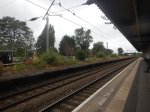
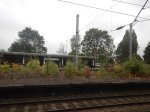
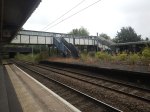
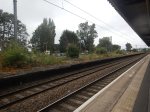
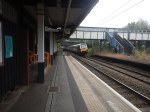
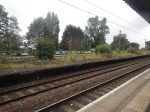
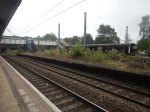
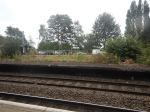
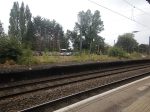
Note.
- As I guessed, there is no disabled-access.
- But there are Braille markings on the handrails down to the platforms.
- Two CrossCountry trains are seen going through the station.
- The local Class 730 trains, lights and information screens appeared to be new.
- Three platforms are electrified, but the fourth is not.
- The electrification structure could probably be used to electrify the fourth platform.
- Only the two outside platforms ; 1 and 4 are in use, with the central island platforms ; 2 and 3 left derelict.
- There is car parking and possibly space for more.
- The two active platforms are 150 metres long and the six-car Class 730 trainstrains appear to be 144 metres long.
- The Class 220 trains, that are run by CrossCountry Trains appear to be 93 metres long.
It was one of the scruffiest stations, that I’ve ever seen.
These are my thoughts on the station.
Handling The Camp Hill Line
Refurbishing Kings Norton Station
I don’t feel, that this will be the most horrendous of jobs, as it is very much a job, where all the rubbish and wild forest is removed and new platforms and a bridge are built.
DB And PKP To Expand Cross-Border Rail Services Between Germany And Poland
The title of this post, is the same of that as this article on Railway=News.
These two introductory paragraphs add more detail.
From mid-December 2025, Deutsche Bahn (DB) and PKP Intercity (PKP) are expanding their joint long-distance rail services, increasing the number of direct daily connections between Germany and Poland by more than 50 percent.
Starting on 14 December, 17 daily train pairs will operate across the border, up from the current 11. The additional capacity will provide a two-hourly service on the Berlin–Warsaw route, with seven trains in each direction.
I did a lot of this route, when I did a Home Run From Krakov.
I feel this German-Polish route will attract a lot of passengers, as it serves three excellent Polish cities Gdansk, Krakov and Warsaw, where you can spend a few days and it connects you to Berlin.
Siemens Mobility Looks To Build Battery Trains In Goole
The title of this post, is the same as that of this article on Railway News.
These first three paragraphs add more details.
Siemens Mobility has announced plans to build battery-powered trains in Goole, Yorkshire, to replace ageing fleets on Britain’s railway.
The manufacturer envisions that battery trains could replace rolling stock for operators such as Chiltern, Great Western Railway (GWR), Northern, ScotRail, TransPennine Express (TPE) and Transport for Wales (TfW) within the next decade.
This would mitigate the need to electrify all sections of the track to deliver zero-emission solutions. In doing so, 3.5 billion GBP could be saved and 12 million tonnes of CO2 emissions could be avoided over 35 years.
Note.
- The post is dated in June 2024, so I am sorry I didn’t spot it earlier.
- It talks in detail about Siemens’ plans for battery-electric trains.
- It also talks about the Siemens’ Rail Charging Converter, which can power short lengths of overhead wires for charging trains from the domestic grid.
- I also talked about Siemens’ technology in Technology Behind Siemens Mobility’s British Battery Trains Hits The Tracks.
It is certainly a must-read article.
Coventry To Leicester In A Flash? New Rail Plans Promise Faster, Greener Travel!
The title of this post, is the same as this article on Rail Technology Magazine.
This is the sub-heading.
Passengers travelling between Coventry, Leicester and Nottingham have outlined their support for proposed upgrades to reconnect the cities by direct rail for the first time in over two decades.
These first two paragraphs add some detail.
Despite being located just 23 miles apart, travelling between the cities requires passengers to change trains in Nuneaton, with wait times for the connection often exceeding 30 minutes. As a result, just 3% of trips between Coventry and Leicester are made by train; compared to 30% of journeys made between Coventry and Birmingham.
Midlands Connect recently visited Nuneaton railway station to speak with passengers travelling between the cities, waiting for their onward connection, about the proposed upgrades and how they would be impacted.
This OpenRailwayMap shows the route between Coventry and Leicester.
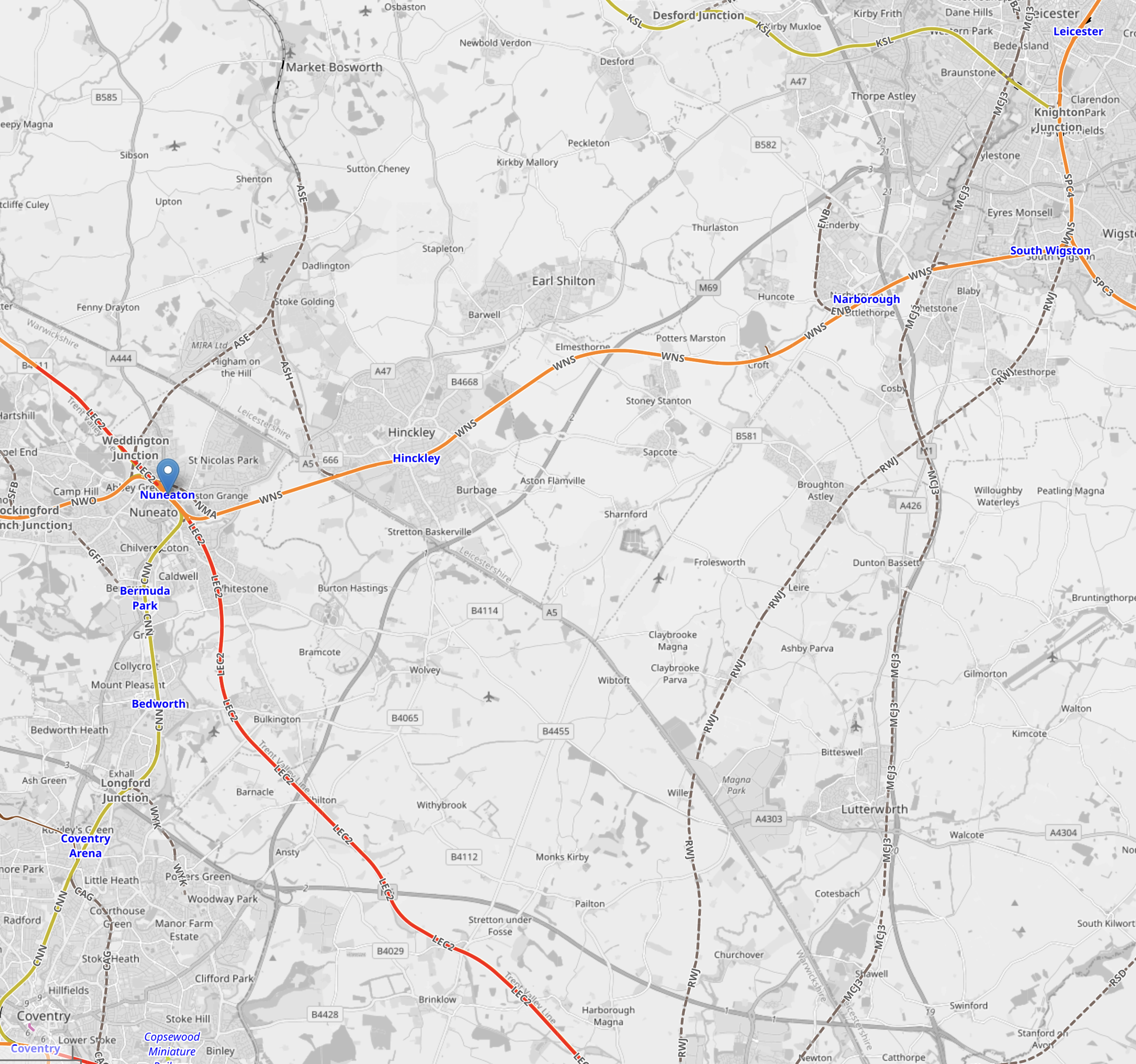
Note.
- Coventry is in the South-West corner of the map.
- Leicester is in the North-East corner of the map.
- Nuneaton, where you currently have to change trains,is marked by a blue arrow.
- The red track passing through Nuneaton station, is the Trent Valley Line.
Services between Coventry, Leicester and Nuneaton are run by two companies.
- CrossCountry run a half-hourly service between between Birmingham New Street and Leicester via Nuneaton.
- West Midlands Trains run an hourly service between Leamington Spa and Nuneaton via Coventry.
I feel ideally, that Leicester and Coventry need a half-hourly service, but an hourly service would be easy and a half-hourly service would mean a four-trains per hour (tph) service between Leicester and Nuneaton.
Probably, the easiest service would be to extend the hourly Leamington Spa and Nuneaton to Leicester, with a reverse at Nuneaton.
What Does The Article Mean By Greener Trains?
I would expect the article means battery-electric trains, but the only mention is in the title.
Could Leicester And Coventry Be Served By Battery-Electric Trains?
This OpenRailwayMap shows the track layout at Nuneaton station.
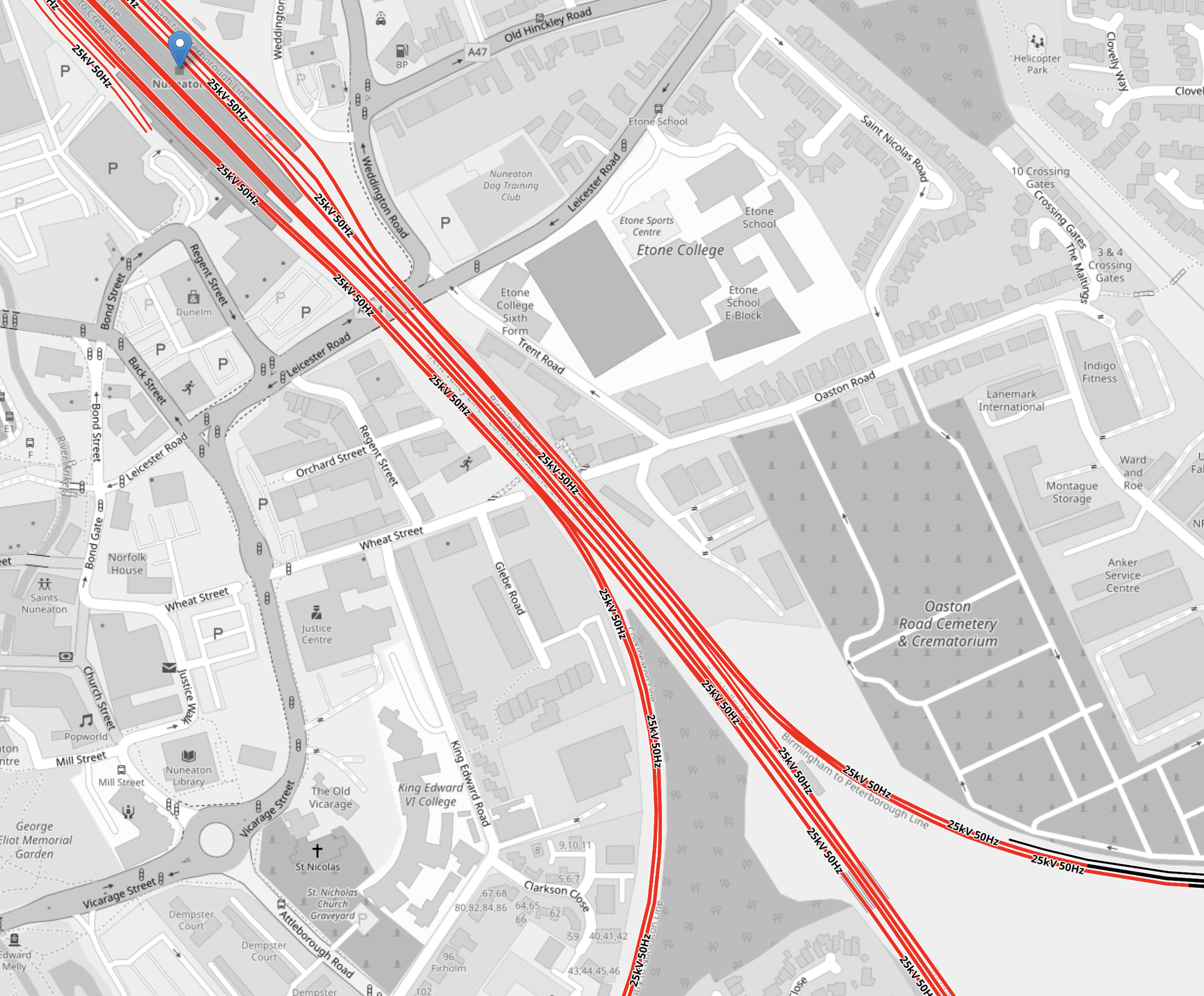
And this OpenRailwayMap shows the track layout at Coventry station.
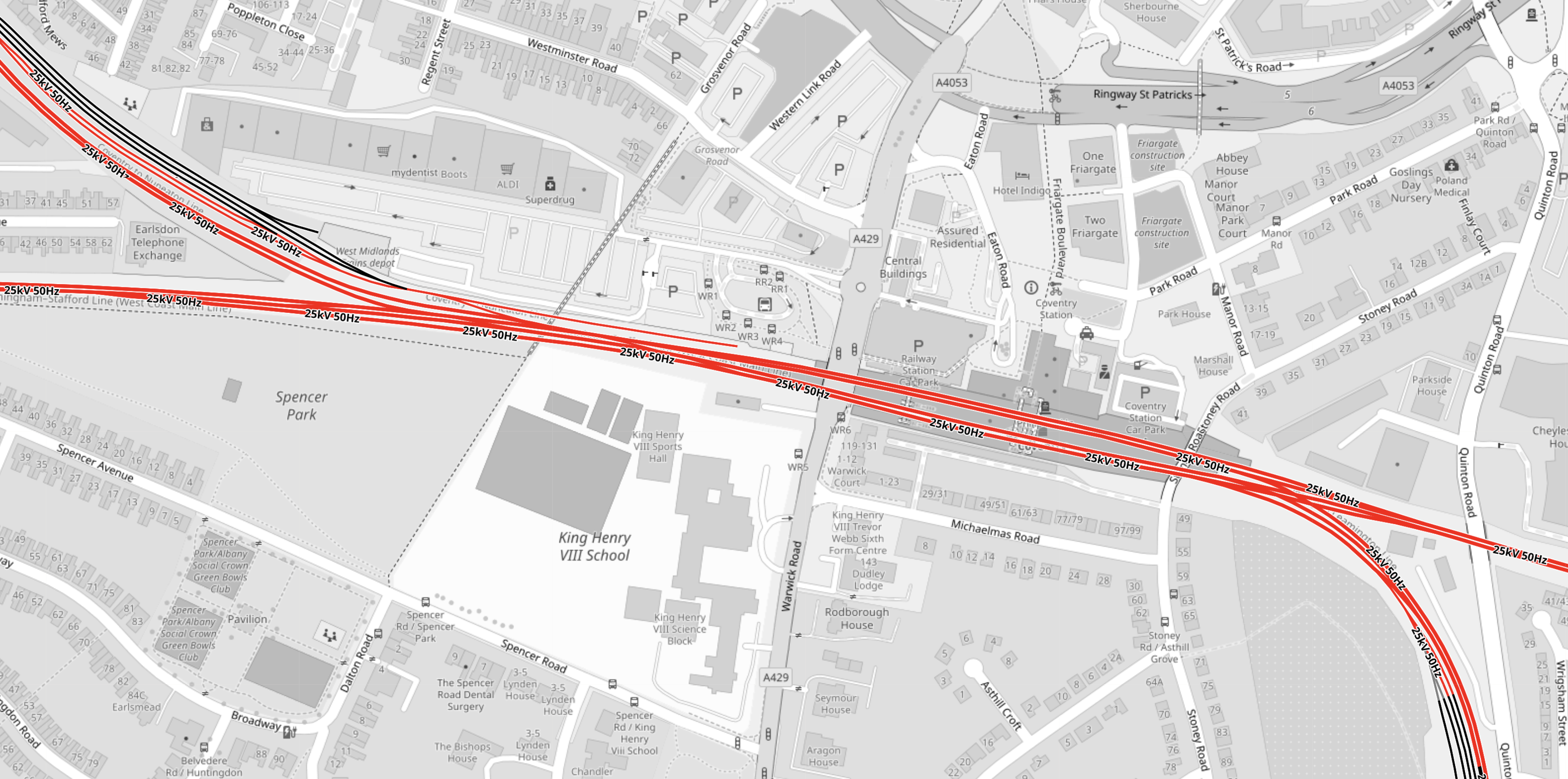
As electrified tracks are shown in red, it would appear that all tracks at both stations are electrified.
The platforms at Coventry and Nuneaton, may be good enough for a quick Splash and Dash, but trains don’t spend long enough in the stations for a full charge.
- Perhaps the solution is to install one of Siemens’s Rail Charging Converters in Leamington Spa and Leicester stations.
- The distance between Leamington Spa and Leicester stations is 48.3 miles, which is well within the range of a battery-electric train.
- Leamington Spa and Nuneaton takes 38 minutes.
- Leicester and Nuneaton takes 27 minutes.
I feel an efficient hourly service could be created between Leicester and Leamington Spa using battery-electric trains.
Onward To Nottingham
Nottingham is another 27.5 miles from Leicester and currently takes 48 minutes in a Class 170 train.
Connections To The North-West And Scotland At Coventry And Nuneaton
They are good and could be more numerous and better.
Could Hydrogen-Powered Trains Be Used?
Yes! If a UK hydrogen-powered train existed!
Cost Of The Project
As reasonably modern trains happily use the route between Leamington Spa and Leicester every day, I suspect that little needs to be done on the full route to create a new service.
So the cost of the project would be sufficient new battery-electric trains and the ability to charge them at Leamington Spa and Leicester.
Conclusion
I believe that Coventry and Leicester would be an easy route to run using an hourly battery-electric train.
It could be extended to Leamington Spa at one end and Nottingham at the other.
Electrification – The Baldrick Way
Electrification In England
There are two major electrification projects underway in England at the moment; the Midland Main Line to Sheffield and Nottingham and the TransPennine Upgrade between Church Fenton and Stalybridge via Leeds and Huddersfield.
In addition, there are other important routes, that need to be electrified around the UK.
- Edinburgh and Aberdeen
- Crewe and Holyhead
- Newbury and Taunton
- Cardiff and Fishguard
- Bristol and Penzance
- Peterborough and Birmingham
- Peterborough and Doncaster via Lincoln
- Felixstowe and Peterborough
There must be loads of other important routes.
Do We Need Electrification Or A Zero-Carbon Railway?
A zero-carbon Railway is probably sufficient, as that would include traditional electrification.
Are The Electrification On The Midland Main Line And The TransPennine Upgrade Working To Similar Objectives?
The Midland Main Line carries the following services.
- Long distance expresses between London St. Pancras and Derby, Nottingham and Sheffield, which will be run in the future, by Hitachi bi-mode express trains.
- Local suburban electrics between London St. Pancras and Bedford and Corby.
- A variety of heavy freight trains between Chesterfield and London.
- Various regional services run by diesel multiple units.
The Midland Main Line is a typical mixed railway.
It is electrified between London St. Pancras and Wigston Junction, which is a total of 95.3 miles.
Sheffield is a further 69.4 miles from Wigston and Nottingham is just 31.1 miles.
The maximum range needed by a battery-electric train is 69.4 miles.
The TransPennine Route carries the following services.
- Long distance expresses between Liverpool and Newcastle and Hull via Manchester, Huddersfield, Bradford and Leeds, which are run by Hitachi bi-mode express trains and diesel multiple units.
- Local suburban electrics around Liverpool, Manchester and Leeds
- A variety of heavy freight trains along the route.
- Various regional services run by diesel multiple units.
The TransPennine Route is another typical mixed railway and carries a similar traffic mix to the Midland Main Line.
Much of the TransPennine Route is electrified, with these exceptions.
- Cleethorpes and Doncaster 52.1 miles
- Doncaster and Manchester Piccadilly – 61.2 miles
- Manchester United FC and Liverpool South Parkway – 26.2 miles
- Hull and Leeds – 51.8 miles
- Redcar and Northallerton – 28.1 miles
- Scarborough and York – 42.1 miles
- Stalybridge and Church Fenton – 50 miles
The maximum range needed by a battery-electric train is 61.2 miles.
This brief analysis indicates to me, that Hitachi battery-electric bi-modes with a range of eighty miles on batteries and charging at selective stations like Cleethorpes, Hull, Nottingham, Redcar, Scarborough and Sheffield could run electric high speed trains on both the Midland Main Line and the TransPennine Route with very little extra infrastructure.
I asked Google AI what is the range of a Class 802 train on batteries and received this reply.
A Class 802 train converted for a battery-electric trial, known as BEMU, has demonstrated the capability to run up to 60 miles (approximately 97 km) on batteries in a trial setting, with real-world data suggesting potential future trains could achieve a range of 100 to 150 km (62 to 93 miles). This technology is intended to allow these trains to cover non-electrified sections of track, reducing the need for overhead wires and potentially saving on electrification costs for intercity routes.
In What Will Be The Range Of A Hitachi Class 800 Battery Train?, I came to this conclusion.
The first version of the battery-electric train will have a range of around a hundred miles, so that they can handle the Great Northern and Great Eastern Joint Line diversion, which is 93.7 miles, on battery power.
But fairly soon after introduction into service, I will be very surprised if they don’t claim the Guinness world record by running farther than the Stadler FLIRT Akku’s 139 miles.
No-one likes being second!
The 93.7 miles needed for the East Coast Main Line diversion via the Great Northern and Great Eastern Joint Line through Lincoln will be more than enough range for Hitachi’s battery-electric trains to run the full length of both the Midland Main Line and the TransPennine Route.
Electrifying A Route
I think that Network Rail have identified an efficient way to electrify an express route.
You start by doing these actions.
- Get the track layout right, so that trains can use the route at the optimal speed.
- Update the signalling to a high standard. I suspect digital signalling would be a good idea, to maximise the capacity of a route.
- Make sure, that the chosen battery-electric express trains can handle the route.
- Charging stations would be installed as required.
The battery-electric trains would be introduced as soon as the route is ready.
Hopefully with good project management, there would be the following benefits compared to traditional electrification.
- Difficult sections like tunnels could be left without electrification.
- Fewer bridges would need to be demolished and rebuilt.
- There would be less disruption to local residents.
- Siemens have developed a Rail Charging Converter, which connects to the domestic rather than the National Grid, so is easier to install.
But the big benefit is that new electric trains could probably be introduced earlier, which hopefully should increase ridership and revenue.
Once the expresses were working well, the best way to decarbonise the rest of the services on the route can be ascertained and actioned.
South Eastern Railway Deploys IsoMat Thermal Technology To Keep Trains On The Tonbridge To Hastings Line Running In Hot Weather
The title of this post, is the same as that of this news item on the Network Rail web site.
This is the sub-heading.
A new type of technology is being trialled on the Tonbridge to Hastings railway line to help keep trains running in hotter weather, and more reliable journeys for passengers and freight customers.
These two paragraphs add more details.
The South Eastern Railway has partnered with UK green tech start-up Flint Engineering to combat excessive heat in railway signalling cabinets that can exceed 70°C, with a new patented system that requires no power, maintenance, or internal cabinet modifications, and can be installed in under an hour.
Flint’s innovative IsoMat technology delivers peak temperature reductions of over 21%, on the hottest days, transferring thermal energy thousands of times more efficiently than copper or aluminium alone.
This is one of those ideas, that could be filed under Too Good To Be True.
This picture shows the device in operation.
I can see this device having many uses, in the most surprising places.
I’ve Just Glimpsed The Future Of Train Travel Across The North Of England And I Like It
Yesterday, I had an appointment at Liverpool Lime Street station at four o’clock, so as I hadn’t seen the works for the TransPennine Upgrade for some time, I decided to go the long way round with a change of train from LNER to TransPennine Express at Leeds.
These sections document my day.
London King’s Cross To Leeds In An InterCity 225
I took these pictures on the journey.
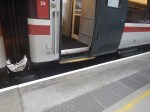
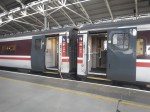
Note.
- The 31 InterCity 225 trains were built around 1990.
- They have a capacity of 535 seats, whereas the newer Hitachi Class 801 trains have a capacity of 611 seats. Both trains are nine cars with both First and Standard seats.
- There is more of a step-up and step-down when entering or leaving the trains, compared to the best of today’s trains.
- They are now being phased out in favour of ten new CAF tri-mode Class 897 trains, which should be entering service in 2027.
- No details are available of the seating capacity of these trains, but they could be between 650 and 700, so they could maximise capacity on any LNER route.
Yesterday, the InterCity 225 performed well, although the windows at the seat where I sat, were rather dirty.
Changing Trains At Leeds Station
I changed to TransPennine Exzpress at Leeds station.
- At least, Leeds station, is one of the few in the UK, with a ticket office behind the barrier. Reading station please note this.
- But, I did have to walk across the bridge from one side of the station to the other.
In the end, I caught the TransPennine Express with about thirty seconds to spare.
Between Leeds And Huddersfield Stations
I took these pictures between Leeds and Huddersfield stations.
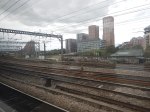
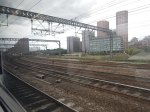
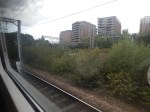
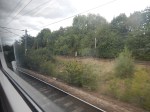
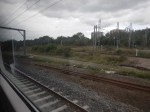
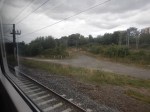
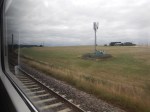

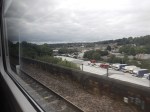
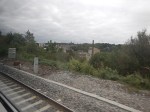
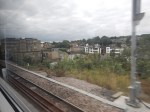
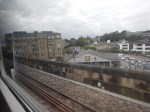
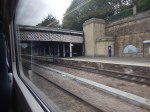
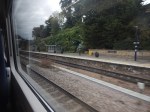
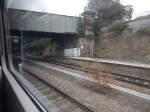
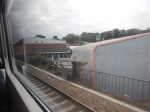
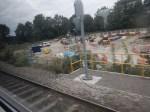
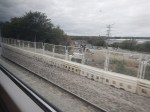
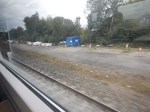
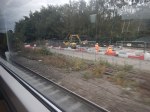
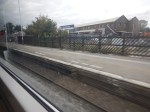
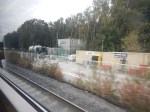
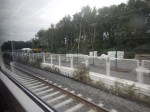
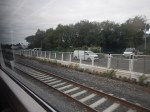
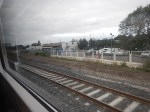
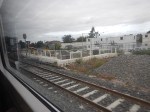
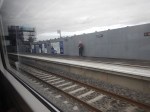
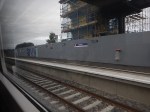
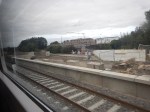
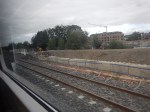
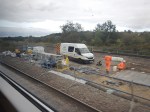

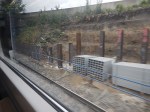
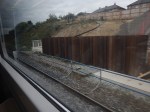
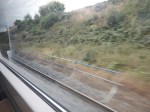
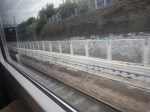
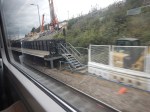
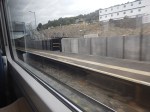
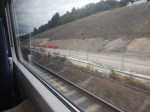
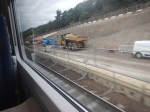
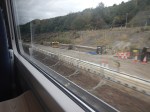
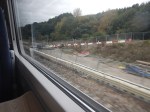
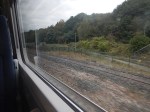
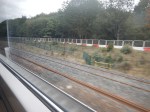
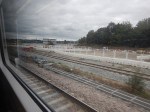
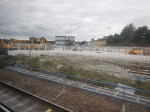
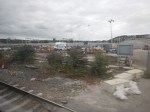
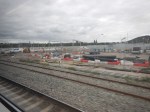
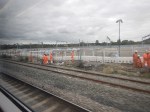
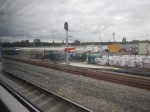
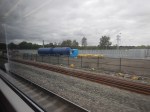
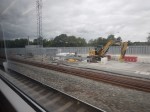
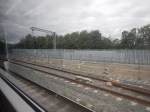
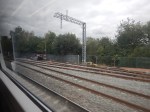
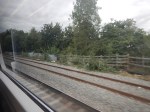
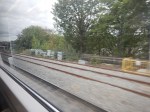
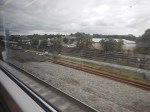
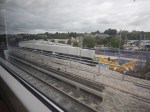
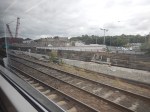
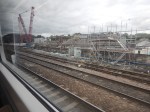
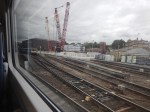
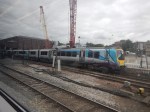
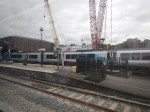
Note.
- Dewsbury and Huddersfield stations is about eight miles and takes about eight minutes.
- It is virtually a continuous building site, where extra tracks are being inserted.
- Three stations are being rebuilt.
- Overhead electrification is being installed. But except for approaching Huddersfield, there’s not much to be seen.
- OpenRailwayMap gives the maximum speed between Dewsbury and Huddersfield stations as between 60-75 mph.
The ride on my Class 803 train was very quiet and smooth. Was it on battery power or was I sitting in a coach without a diesel engine underneath?
Huddersfield Station
I took these pictures at Huddersfield station.
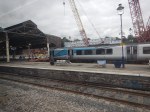
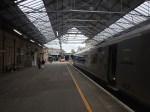
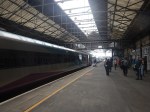
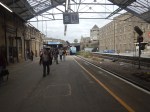
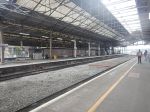










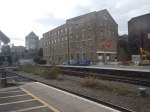
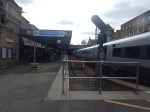
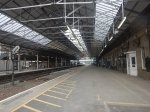
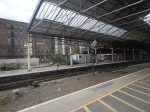
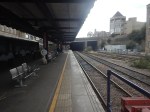
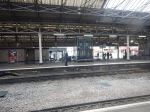

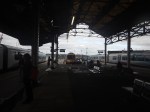
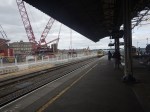
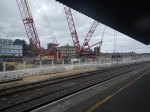
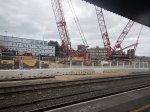
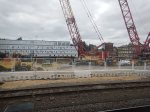
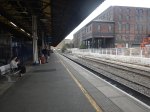
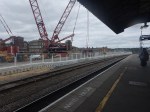

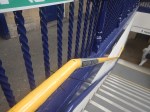
Note.
- Huddersfield station is Grade I Listed.
- There is a pub in each wing.
- I had a beer in the West Wing.
- There are currently three main through platforms and three bay platforms.
- Extensive works, which will be part of the TransPennine Upgrade, will include electrification, a new roof, a new footbridge, and two extra through platforms.
Huddersfield station will be the jewel in the Costa del Yorkshire.
The Platforms At Huddersfield Station
This OpenRailwayMap shows the platforms in Huddersfield station.
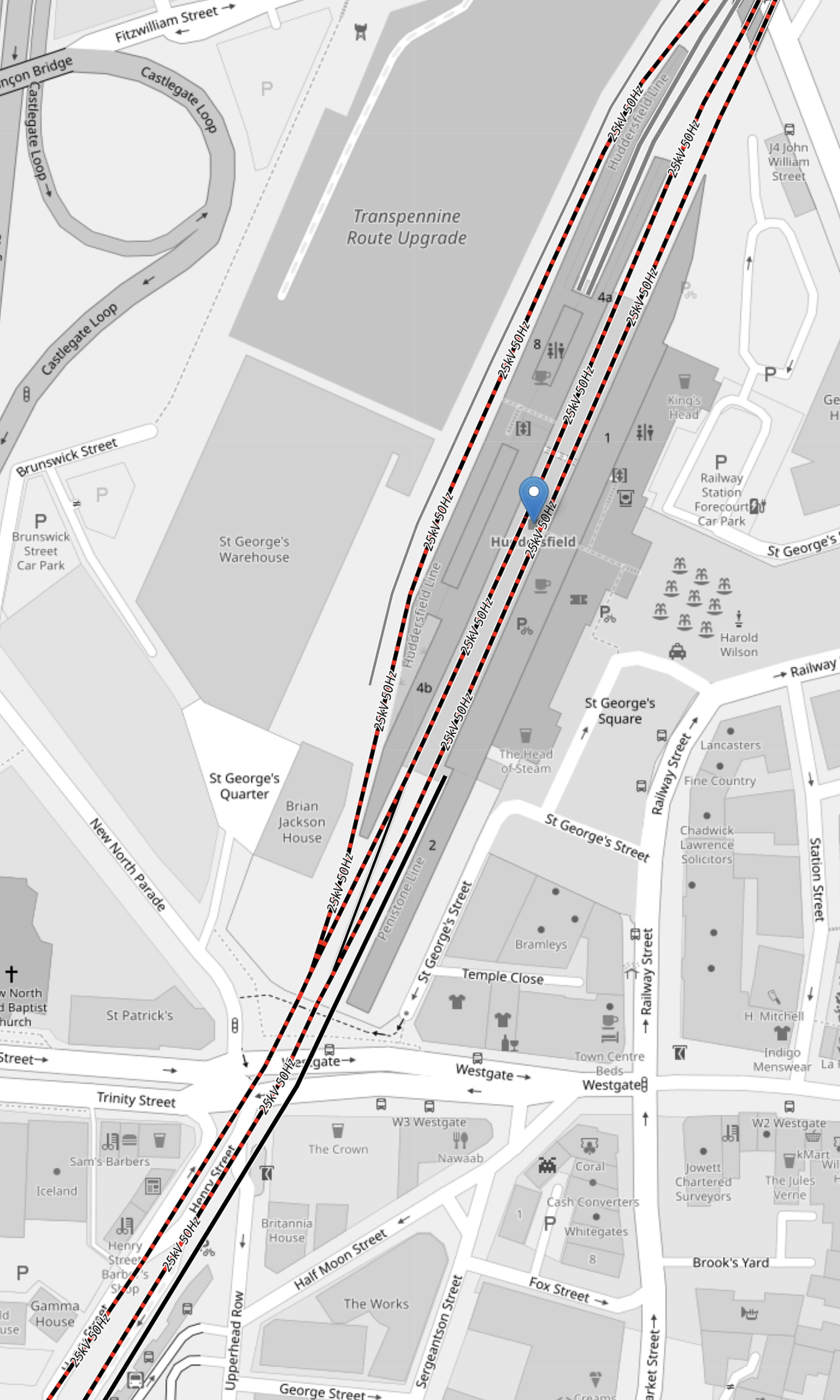
Note.
- The red and black tracks are being electrified.
- Of the current platforms, Platforms 1, 4 and 8 will be electrified.
- The two bay platforms; 5 and 6, will be converted into through platforms.
- Platform 2 is the bay platform in the South-West corner of the map, that is used by the shuttle train from Sheffield.
I am sure extra platforms could be electrified as required, as there must be a good electrical connection at Huddersfield station.
A Tram-Train Service Between Huddersfield And Sheffield Stations
This OpenRailwayMap shows platform 2 at Huddersfield station.
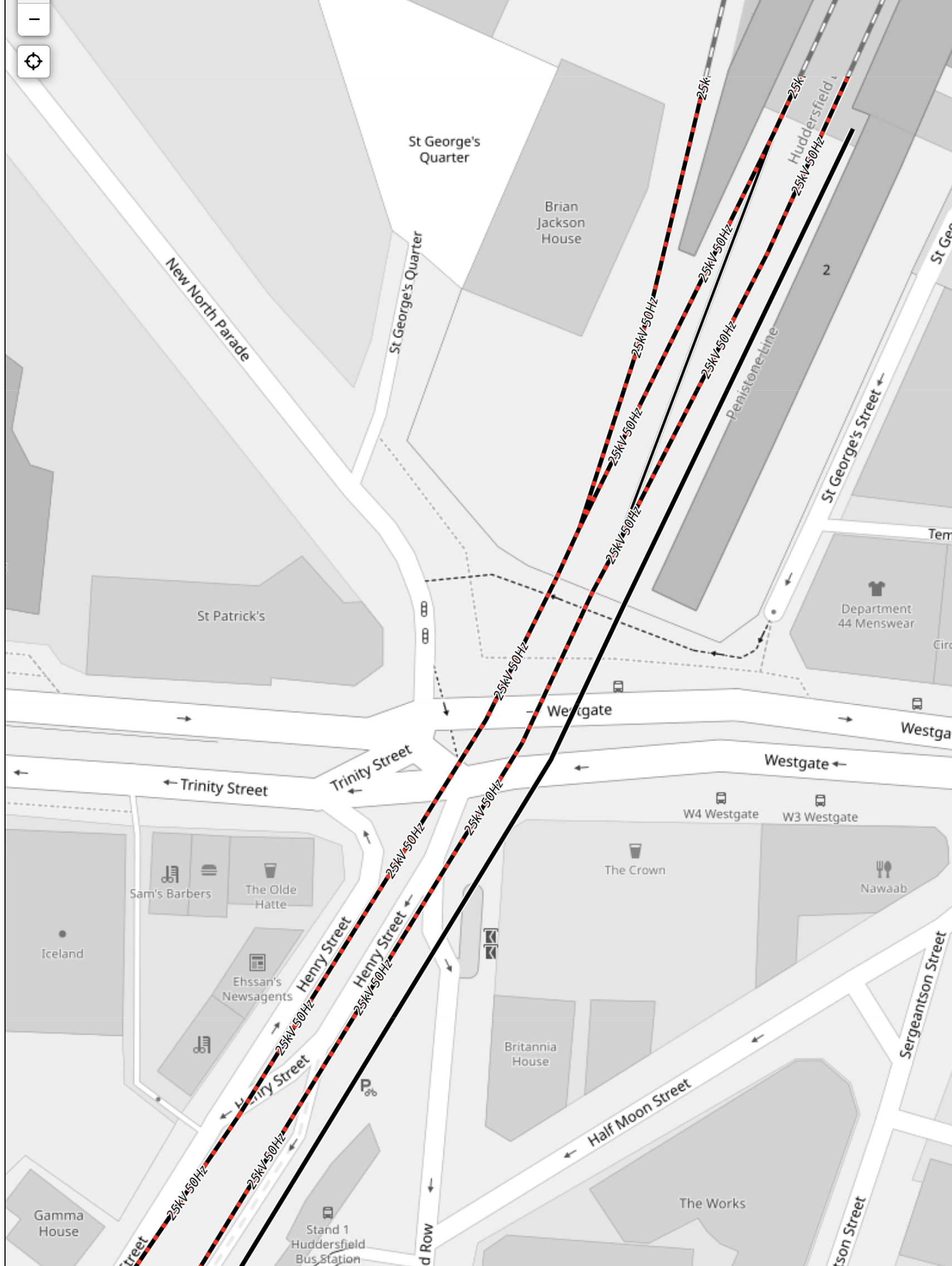
Note.
- Platform 2 is the black track at the right of the two through tracks, that are being electrified.
- Platform 2 is a bay platform close to the Head of Steam pub.
- I estimate that the platform is about 90 metres long.
- I suspect Platform 2 could be lengthened if required.
- Sheffield’s Class 399 tram/trains are 37.2 metres long, so a pair should fit in Platform 2.
- The Class 398 tram/trains can run on battery power and climb hills in South Wales.
- Platform 2 at Huddersfield station could be electrified to charge the tram/trains.
- There could be a significant height difference between Huddersfield and Sheffield stations of about 40 metres, which could be used to charge tram/trains on the way down.
- I feel with some track improvements, that a four trains per hour (tph) service could be run.
The service would call at Meadowhall, Chapeltown, Elsecar, Wombwell, Barnsley, Dodworth, Silkstone Common, Penistone, Denby Dale, Shepley, Stocksmoor, Brockholes, Honley, Berry Brow and Lockwood
The Pair Of Cranes In Huddersfield Station
These can’t be missed in the pictures. But why two massive cranes?
With an old roof to be taken down and a new roof and a footbridge to be lifted into place, I believe Network Rail have decided to bring in two of largest mobile cranes available in the UK, so that all the lifting doesn’t delay the project.
Between Huddersfield And Stalybridge Stations
I took these pictures between Huddersfield and Stalybridge stations.
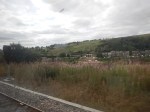
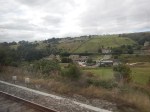
Note.
- The Class 802 train was running freely along a well-laid track.
- There are four stations between Huddersfield and Stalybridge; Slaithwaite, Marsden, Greenfield and Mossley(Manchester).
- The stations were in reasonable condition, but some needed new footbridges and a bit of refurbishment.
- There was virtually no signs of any foundations for electrification.
This map shows the route.
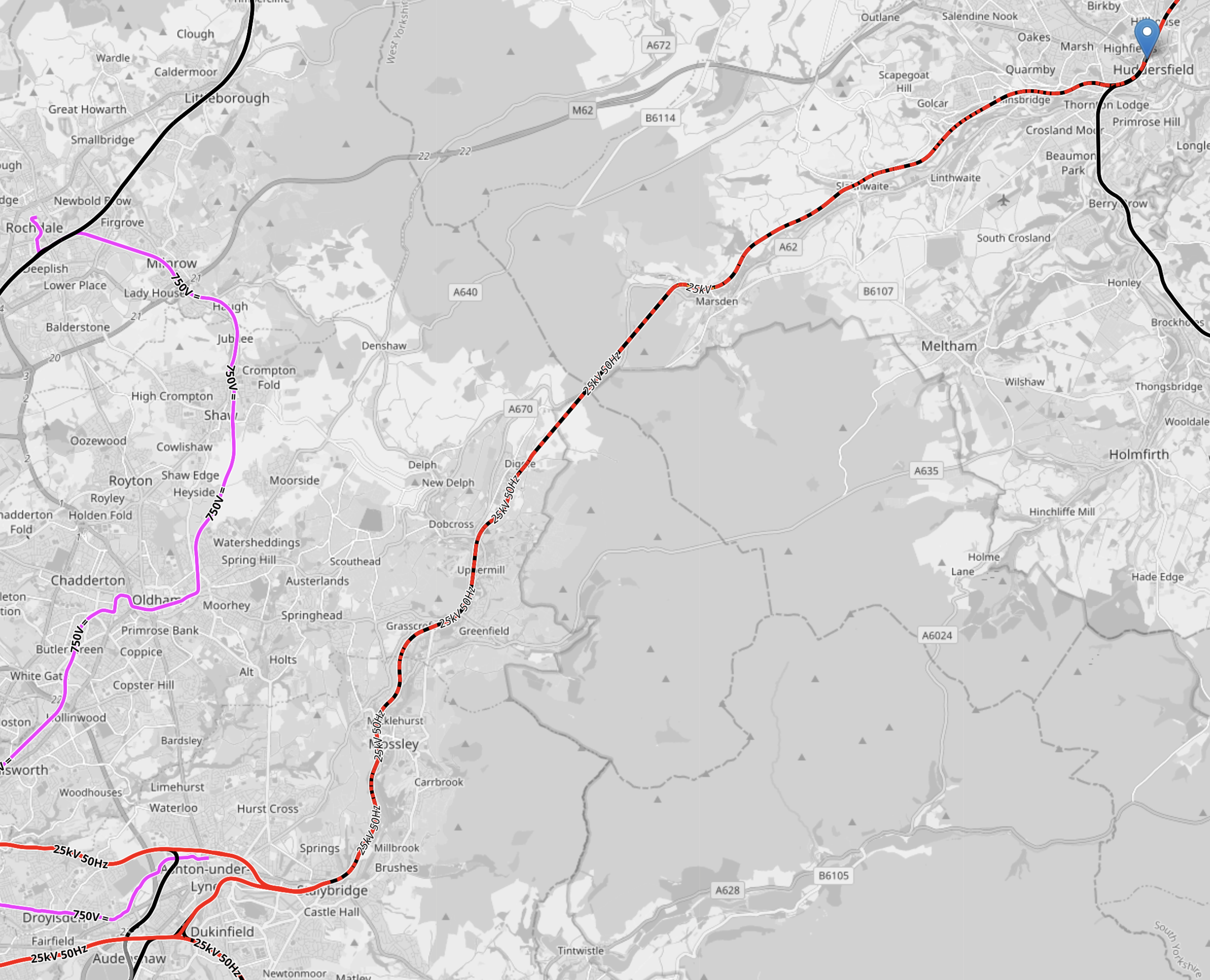
Note.
- The pink tracks are the Manchester Metrolink.
- The red tracks are electrified at 25 KVAC overhead.
- The red and black tracks are being electrified.
- Huddersfield is indicated by the blue arrow in the North-East corner of the map.
- Stalybridge station is in the South-West corner of the map.
- The pink track in the South-West corner of the map is the Manchester Metrolink branch to Ashton-under-Lyme.
- The route between Huddersfield and Stalybridge is shown as it will will be fully electrified.
- Huddersfield and Stalybridge is 18 miles.
- There are three short tunnels between Huddersfield and Stalybridge.
I wonder, if it would be more affordable to not put up wires between Huddersfield and Stalybridge and use battery-electric passenger trains and hydrogen freight locomotives?
Stalybridge Station
I took these pictures at Stalybridge station.
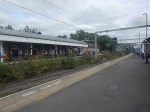
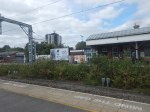
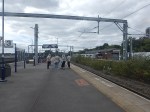
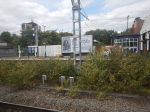
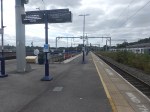
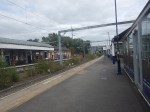
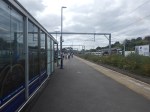
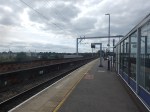
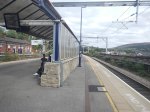
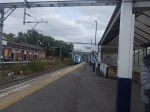
The station is fully-electrified and has direct services to Huddersfield, Hull, Leeds, Liverpool, Manchester Piccadilly, Manchester Victoria, Newcastlle, Wigan and York.
Will Liverpool Lime Street And Newcastle Be Fully Electrified?
Consider.
- Liverpool Lime Street and Newcastle stations is 180.8 miles.
- Newcastle and Church Fenton stations is 91.4 miles and is fully-electrified.
- Liverpool Lime Street and Stalybridge stations is 39.4 miles and is fully-electrified.
This means that the gap between Church Fenton and Stalybridge stations is just fifty miles.
Real Time Trains indicate that the current Class 802 trains on the route run on diesel between Stalybridge and York stations, which is 60.8 miles.
- Changing power in Stalybridge and York stations means if anything goes wrong passengers can be easily rescued.
- From what I saw on Thursday, it looks like electrification will be completed between Neville Hill depot and Huddersfield.
I wouldn’t be surprised, if they just electrified to the West of Stalybridge and the East of Huddersfield.
That would mean that the 18 miles between Stalybridge and Huddersfield would be run on batteries.
- But it would also avoid electrifying three tunnels.
- How much disruption would be saved, by not electrifying the tunnels?
- Freight trains would use something like a bi-mode Class 99 locomotive, but it would only need a range of 18 miles on diesel.
I can also see improvised bi-mode locomotives being used like this combination of a Class 66 and Class 90 locomotives.
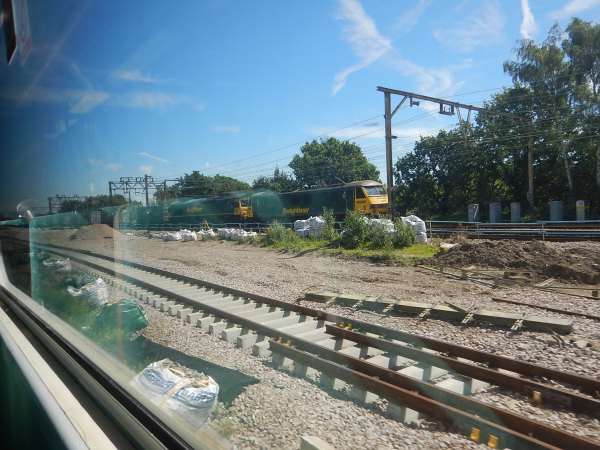
It was certainly doing its job, when I saw the combination at Shenfield.
 The Anonymous Widower