Alstom Plans To Operate Its Own Passenger Train Service In The UK For The First Time
The title of this post, is the same as that of this press release from Alstom.
These two bullet points, act as sub-headings.
- Alstom is partnering with SLC Rail to form a new open access rail operation between North Wales, Shropshire, the Midlands and London
- Formal application now being submitted to the Office of Rail and Road (ORR) with passenger service sought from 2025
These are the first three paragraphs.
Alstom, global leader in smart and sustainable mobility, plans to operate a new passenger rail service across England and Wales. Working in partnership with consultancy SLC Rail, the open access operation will be known as Wrexham, Shropshire and Midlands Railway (WSMR).
As the country’s foremost supplier of new trains and train services, and a leading signalling and infrastructure provider, Alstom will operate its own rail service in the UK for the first time.
WSMR is seeking to introduce direct connectivity to and from North Wales, Shropshire, the Midlands and London that doesn’t exist today, linking growing communities and businesses, and making rail travel more convenient, enjoyable and affordable.
I can’t remember a service proposal being put forward by a train manufacturer since the privatisation of UK’s railways in the 1990s.
This is some more information and my thoughts.
The Route
This paragraph from the press release, describes the route.
The proposal envisages a service of five trains per day in each direction Monday to Saturday, with four travelling both ways on Sundays. Trains will stop at Gobowen, Shrewsbury, Telford Central, Wolverhampton, Darlaston, Walsall, Coleshill Parkway, Nuneaton and Milton Keynes on their journey between Wrexham General and London Euston.
Note.
- The proposed call at the new Darlaston station.
- The route is electrified between Euston and Nuneaton and Walsall and Wolverhampton.
- Much of the route North of Nuneaton is on tracks with a maximum speed of 70-80 mph.
The route is in these sections.
- Euston and Nuneaton – 96.7 miles – electrified
- Nuneaton and Walsall – 26.7 miles
- Walsall and Wolverhampton – 6.7 miles – electrified
- Wolverhampton and Shrewsbury – 29.7 miles
- Shrewsbury and Wrexham General – 30.3 miles
That is a total of 190.1 miles or 380.2 miles round trip.
I suspect that the service will need bi-mode trains.
Should The Service Call At Wellington?
This article on the BBC is entitled Rail Company Urged Not To Forget Wellington.
This is the sub-heading.
A rail company which is bidding to bring back a direct service between Shropshire and London has been urged not to forget a town.
These are the first three paragraphs.
Wrexham, Shropshire and Midlands Railway said it was preparing to apply to the government to run the service.
Trains would stop at Gobowen, Shrewsbury, Telford, Wolverhampton, Walsall, Coleshill and Nuneaton.
But Telford and Wrekin Council said the omission of Wellington as a stop was “short-sighted”.
Although Wellington is smaller than than Shrewsbury and Telford, it looks like a bit of analysis would provide a solution, that would be acceptable for all parties.
The Trains
In the press release, this phrase is used.
positive impact to both communities and the environment.
I can’t see any more electrification being erected on the route, so the trains will need to be bi-mode.
- Bi-mode diesel trains won’t have a positive impact on the environment.
- As the route between Wolverhampton and Wrexham General is not electrified, a battery-electric train would need a range of at least 60 miles or 120 miles for the round trip, if there were no charging at Wrexham General.
- But Alston are developing a Hydrogen Aventra, which I wrote about in Alstom And Eversholt Rail Sign An Agreement For The UK’s First Ever Brand-New Hydrogen Train Fleet.
So could Alstom be using this route to trial and showcase their new Hydrogen Aventra?
I believe that the route will be very suitable for a hydrogen train.
- Changeover between electric and hydrogen power can always take place in a station.
- All hydrogen refuelling could be performed at one end of the route.
- A large proportion of the UK’s green hydrogen is produced by INEOS at Runcorn, which is less than fifty miles from Wrexham. A refuelling tanker could supply the train, as they do on some hydrogen routes in Germany.
- London has only small amounts of hydrogen infrastructure.
I suspect that refuelling will be done at the Wrexham end of the route.
This Alstom visualisation shows the train.
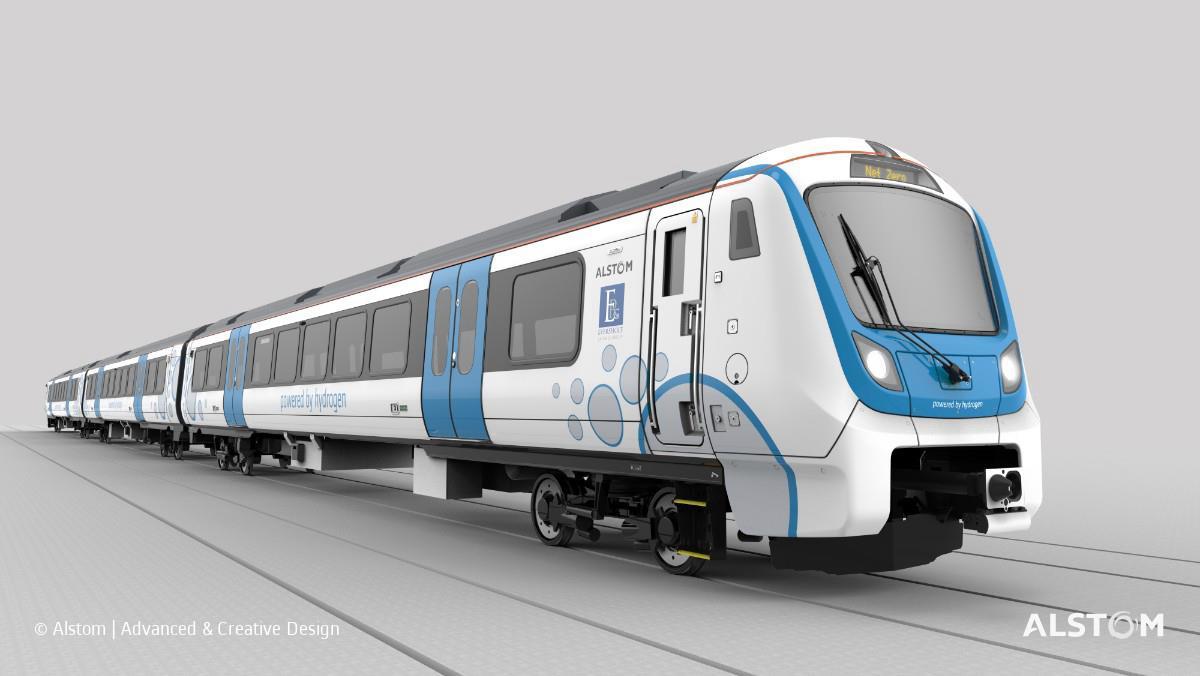
But it is only a three-car train.
- That is not a problem, as Aventras can be lengthened as required to the length required for the number of passengers.
- Some Aventras, like the Class 701 trains for South Western Railway, have even been ordered as ten-car trains.
- Two three-car trains may also be the ideal capacity, running as a six-car train.
So capacity will not be a problem.
If it is assumed that Alstom’s trains for the WSMR route, can use the overhead wires, where they exist, each trip between Wrexham General and London will require a total of 86.7 miles or 140 kilometres of running on hydrogen.
- A round trip will therefor require 280 kilometres of running on hydrogen.
- But between London Euston and Nuneaton, it will just be another electric train.
- I suspect that like the similar Class 730 train, it will be capable of 110 mph on the West Coast Main Line.
- Alstom’s Coradia iLint hydrogen train has a range of around a 500-800 kilometres on hydrogen.
- The WSMR trains will probably be 100 mph trains using hydrogen on a route, where that speed is possible.
So if a Hydrogen Aventra has a similar range to the Coradia iLint, it will be able to do two round trips before refuelling.
How Long Will The Service Take?
West Midlands Trains, who use the similar Class 730 trains take one hour and eleven minutes between London Euston and Nuneaton with a single stop at Milton Keynes Central.
As the WSMR trains will use the same route, I suspect the same time can be used.
As Nuneaton and Wrexham General are 93.4 miles apart a table can be created showing the time for the rest of the journey for different average speeds
- 50 mph – 1 hour 52 minutes – 3 hours 3 minutes.
- 60 mph – 1 hour 33 minutes – 2 hours 44 minutes.
- 70 mph – 1 hour 20 minutes – 2 hours 31 minutes.
- 80 mph – 1 hour 10 minutes – 2 hours 21 minutes.
Note.
- The first time is the Nuneaton and Wrexham General time and the second time is the overall journey time.
- Typical Avanti West Coast services via Crewe and a change at Chester, take between two-and-a-half and three hours.
I suspect, if the WSMR trains can keep the speed up through the Midlands, that two hours and 30 minutes could be possible.
Could The Hydrogen Aventra Run At 125 mph Under The Wires?
In March 2018, I wrote Bombardier Bi-Mode Aventra To Feature Battery Power, which was based on this article in Rail Magazine.
These are a few points from the article.
- Development has already started.
- Battery power could be used for Last-Mile applications.
- The bi-mode would have a maximum speed of 125 mph under both electric and diesel power.
- The trains will be built at Derby.
- Bombardier’s spokesman said that the ambience will be better, than other bi-modes.
- Export of trains is a possibility.
- Bombardier’s spokesman also said, that they have offered the train to three new franchises. East Midlands, West Coast Partnership and CrossCountry.
Have Alstom looked at what they bought from Bombardier and decided the following train is possible?
- Five-cars or what the customer needs.
- 125 mph under the wires.
- Running on hydrogen away from the wires.
- 100 mph on tracks without electrification.
Obviously, maximum speeds would depend on track limits.
Looking at 125 mph Avanti West Coast trains that have a Milton Keynes stop between London Euston and Nuneaton, they can reach Nuneaton ten minutes quicker than West Midlands Trains 110 mph Class 730 trains.
Two hours and 30 minutes between London Euston and Wrexham is looking increasingly possible.
Are we seeing an audacious proposal from Alston to sell new trains to CrossCountry and a host of other franchises?
Conclusion
London Euston and Wrexham would appear to be an excellent route for an Aventra-based hydrogen train.
- It can probably cruise at 110 mph on the West Coast Main Line between London Euston and Nuneaton.
- All switchovers between electrification and hydrogen can be performed in electrified stations.
- Hydrogen would only be used North of Nuneaton.
- The train can be refuelled at Wrexham General, with fuel supplied from INEOS at Runcorn.
- Given the typical 1000 km. range of hydrogen trains, a train can probably do three round trips without refuelling.
I can see this being a service with an excellent operational record.
ORR: Open Access Services Given Green Light Between London And Stirling
The title of this post is the same as that of this press release from the Office of Rail and Road.
This is the sub-heading.
The latest access decision by the Office of Rail and Road (ORR) provides more services for rail passengers travelling between London and central Scotland.
These five paragraphs detail the ORR’s decision.
ORR has today (7 March) given the go-ahead for Grand Union Trains, an open access operator, to start a new train service between London and the city of Stirling, from June 2025. ORR’s decision will offer more choice to passengers, bring private sector investment to the railway and increase competition.
Grand Union Trains will introduce four new return services per day between London Euston and Stirling stations. These services will also call at Milton Keynes Central, Nuneaton, Crewe (subject to agreement between Grand Union Trains and Network Rail), Preston, Carlisle, Lockerbie, Motherwell, Whifflet, Greenfaulds and Larbert. Larbert, Greenfaulds and Whifflet will receive their first direct services to London.
ORR found that the proposed services would increase choice for passengers, significantly increasing direct journey opportunities to and from London and central and southern Scotland, while making use of existing capacity on the network.
The new services will be the first run by an open access operator on the West Coast Mainline. Open access operators run services independently of government funding as they do not have a franchise agreement with government.
Following ORR’s decision to approve new Grand Union Trains services between Carmarthen in south Wales and London Paddington in 2022, ORR has now approved open access services on three of Britain’s major routes.
Note.
- The Grand Union service appears to be running into London Euston. Earlier plans had it terminating at Queen’s Park station.
- Larbert, Greenfaulds and Whifflet will receive their first direct services to London.
- London Euston and Stirling is electrified all the way.
- The third open access service, that the ORR has approved is the Lumo service between King’s Cross and Edinburgh via the East Coast Main Line.
I have a few thoughts.
Stirling Is An Ideal Place To Explore Central Scotland By Train
In Stirling, I give the reasons, why I spent a couple of days in Stirling, when I wanted to visit several places in Central Scotland.
Note.
- Stirling has direct services to Aberdeen, Dundee, Edinburgh, Glasgow, Inverness and Perth.
- Aberdeen is one hour and 15 minutes away.
- Dundee is just 63 minutes away.
- Edinburgh is just 48 minutes away.
- Glasgow is just 39 minutes away.
- Inverness is two hours and 46 minutes away.
Stirling has about a dozen affordable hotels and guest houses within walking distance of the station, as this map shows.
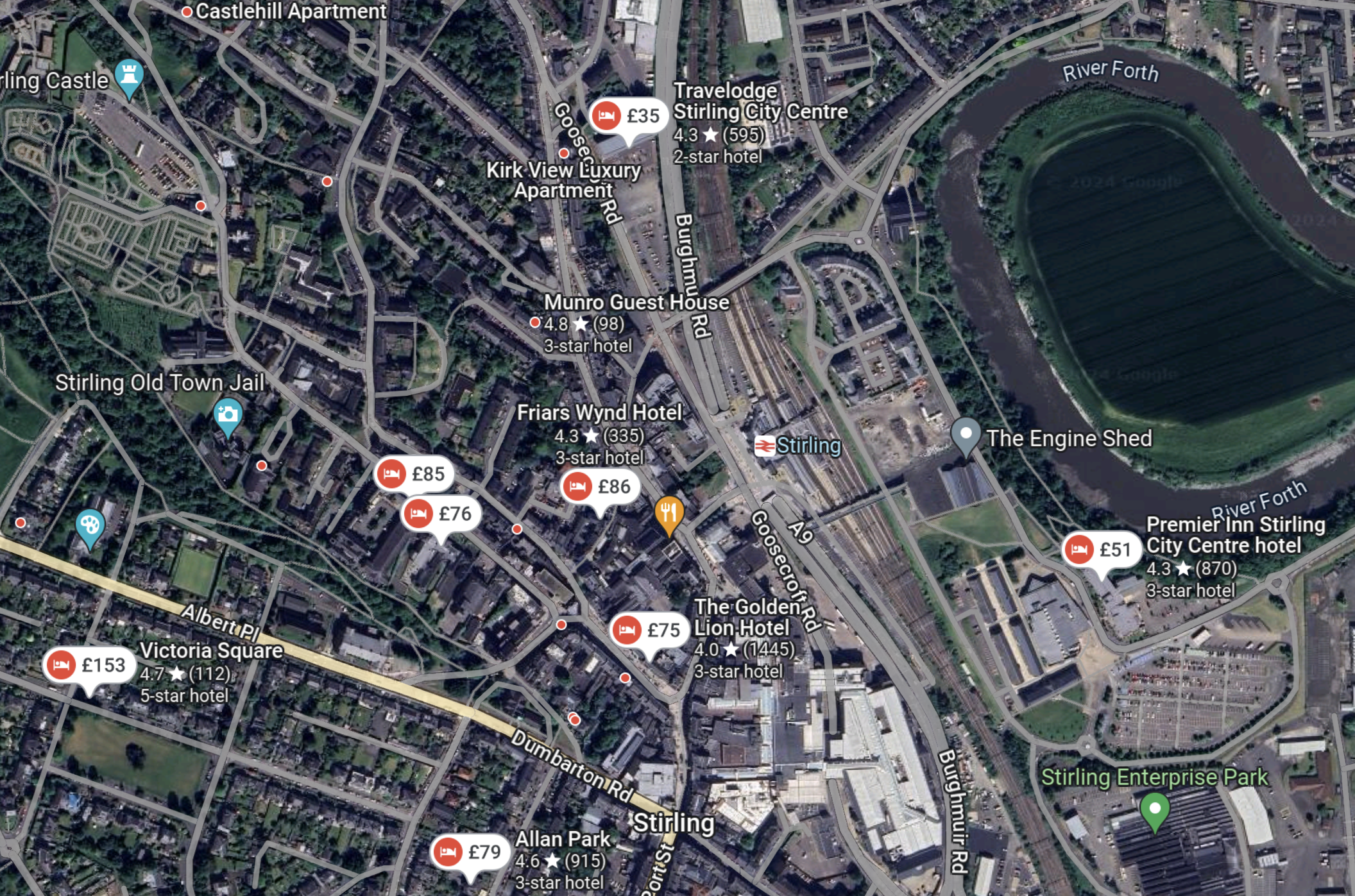
Stirling would appear to have got Central Scotland covered.
Could The Train Serve Gleneagles?
Gleneagles is about twenty minutes North of Stirling and is served by the Caledonian Sleeper from London.
This Google Map shows the area around Gleneagles station.
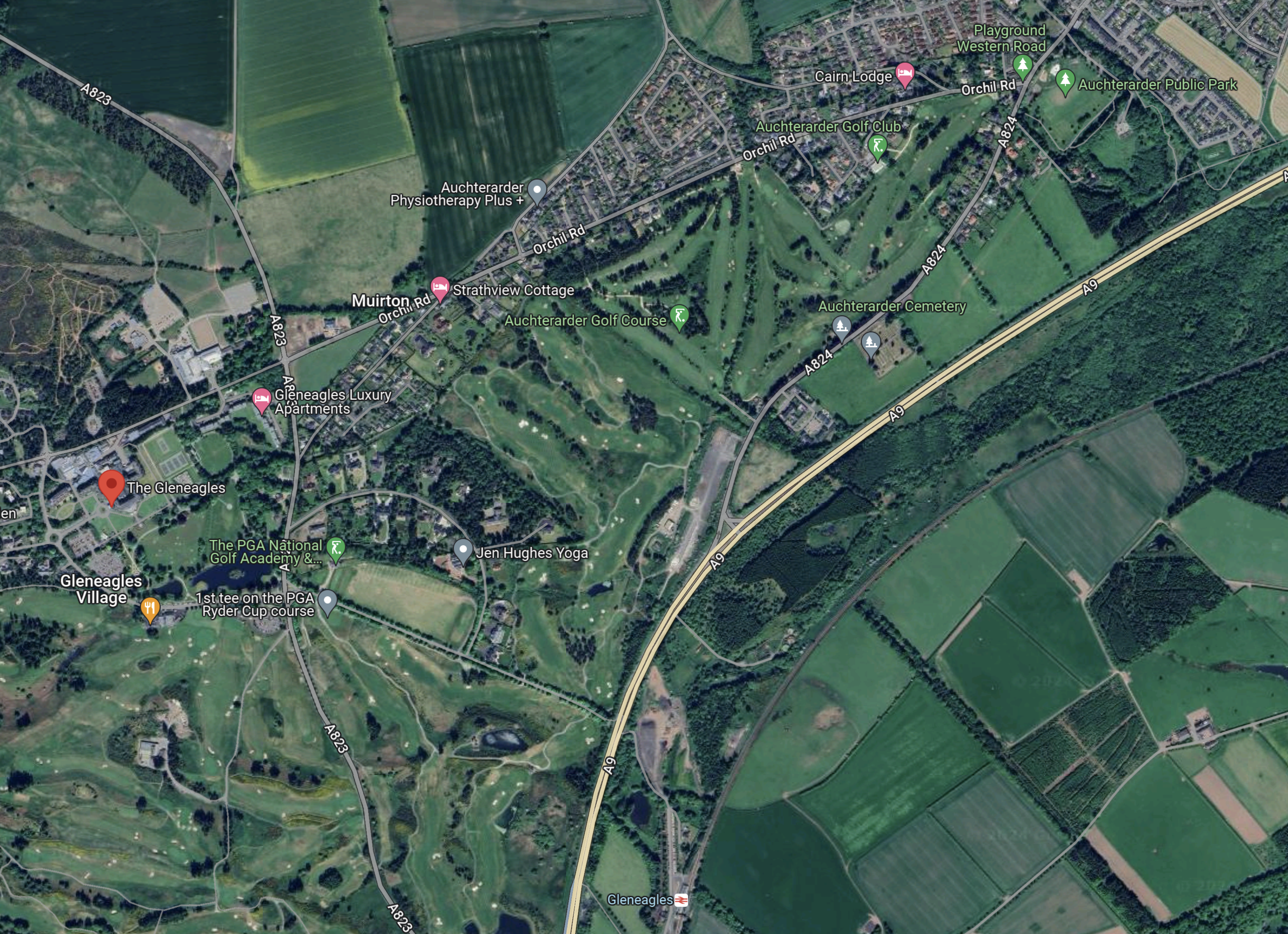
Note.
- Gleneagles station is at the bottom of the map.
- The red arrow indicates the famous Gleneagles hotel.
- The pink dots are other hotels.
- Airbnb lists several very splendid properties in the varea.
Not everybody, who goes to the Gleneagles area will be exceedingly rich and I could see the Gleneagles area generating substantial business for Grand Union Trains. I suspect the best way to serve Gleneagles would be a zero-emission coach from Stirling.
Along The Motherwell And Cumbernauld Line
Between Motherwell and Stirling, a lot of the route used is on the Motherwell and Cumbernauld Line.
- The line is fully-electrified.
- It is only 28.9 miles between Motherwell and Stirling.
- \cumbernaukd and Motherwell takes 20 minutes.
I do wonder, if extra stops might be worthwhile.
Motherwell Has Good Connections To Edinburgh And Glasgow
As well as Stirling, Motherwell has good connections to both Edinburgh and Glasgow, so some passengers might find their most convenient route involves a change at Motherwell.
Nuneaton And Scotland Would Get A New Service
Nuneaton has been named by Avanti West Coast, as a place that needs more trains, as it connects with the service between Birmingham and Stansted Airport, via Coleshill Parkway, Leicester, Peterborough, March, Ely and Cambridge.
I suspect that, Nuneaton will become an interchange, between East Anglia and, the North West and West Scotland.
Milton Keynes And Scotland Should Get An Improved Service
Consider.
- It appears that all Avanti West Coast services between Milton Keynes and Scotland, go via Birmingham.
- I suspect that Grand Union’s route using the Trent Valley Line could be faster with similar trains.
- Creating a new route between Milton Keynes and Stirling could be a good move, as it gives one-change access to much of Central Scotland.
- Milton Keynes has good local connections to places like Northampton, Rugby, Tring and Watford Junction.
- Milton Keynes will be a stop on the new East-West Railway.
- From many stations, it will be quicker to go via Milton Keynes rather than Euston.
I suspect Milton Keynes could be a nice little earner.
Will Grand Union’s Trains Be Fitted With Digital Signalling?
Consider.
- At some point in the next ten years the West Coast Main Line will be fitted with digital signalling, to enable trains to run at 140 mph on selected parts of the route.
- Digital signalling will allow extra services between London Euston and Motherwell.
- Motherwell and London Euston is 388 miles.
I suspect, that Grand Union’s Trains will need to be fitted with digital signalling, so they can save time on services and possibly add in a few more.
It will add costs, although the faster speed will surely attract passengers.
Will Grand Union’s Trains Be Electric?
There are these train services going between England and Scotland.
- Avanti West Coast – London Euston to Edinburgh Waverley via Birmingham New Street – 7 tpd – Class 390 – Electric
- Avanti West Coast – London Euston to Glasgow Central via Birmingham New Street – 5 tpd – Class 390 – Electric
- Avanti West Coast – London Euston to Glasgow Central via Trent Valley – 1 tph – Class 390 – Electric
- CrossCountry – Plymouth to Edinburgh Waverley – 1 tph – Class 220/221 – Diesel – Uses diesel all the time
- LNER – London King’s Cross/Leeds to Aberdeen – 4 tpd – Class 800 – Bi-mode – Uses diesel North of Edinburgh
- LNER – London King’s Cross to Inverness – 1 tpd – Class 800 – Bi-mode – Uses diesel North of Stirling
- LNER – London King’s Cross to Edinburgh Waverley – 3p2h – Class 800 – Bi-mode or Class 801 – Electric
- LNER – London King’s Cross to Glasgow Central – 1 tpd – Class 801 – Electric
- LNER – London King’s Cross to Stirling – 1 tpd – Class 801 – Electric
- Lumo – London King’s Cross to Edinburgh – 5 tpd – Class 803 – Electric
- TransPennine Express – Newcastle to Edinburgh Waverley – 7 tpd – Class 802 – Bi-mode
- TransPennine Express – Liverpool Lime Street to Glasgow Central – 2 tpd – Class 397 – Electric
- TransPennine Express – Manchester Airport to Edinburgh Waverly – 1 tp2h – Class 397 – Electric
- TransPennine Express – Manchester Airport to Glasgow Central – 1 tp2h – Class 397 – Electric
Note.
- tpd is trains per day.
- tph is trains per hour.
- tp2h is trains per two hours.
- LNER services to Glasgow and Stirling are likely to be dropped.
- Some Lumo services are likely to be extended from Edinburgh to Glasgow.
- Many services South from Stirling to Edinburgh Waverley and Glasgow Queen Street are electric.
The current two tpd direct trains to Stirling are electric and if you change at Edinburgh Waverley or Glasgow, it is likely to be an all-electric service.
For marketing reasons, I would recommend, that Grand Union Trains ran electric trains between London Euston and Stirling, as they are competing against an all-electric service.
Although to meet service dates it might be necessary to run something like a diesel Class 222 train to get the service started.
What Trains Will Grand Union Use?
The Wikipedia entry for Grand Union Trains, says this for their London Euston and Stirling service.
In 2023 Grand Union revised its proposal changing its planned rolling stock to Class 22x units, at the same time the start date for this service was changed to June 2025.
I would suspect they will put in the order for new electric trains fairly sharpish.
The new trains could be.
- A variant of Hitachi’s Class 800 trains.
- A variant of CAF’s Class 397 trains.
Would they have an emergency battery un case of overhead line failure?
How Long Will A Service Take?
The service can be divided into two sections.
- London Euston and Motherwell – 388 miles.
- Motherwell and Stirling – 28.9 miles.
Note.
- The 08:30 train from Euston to Motherwell takes 4 hours and 17 minutes with six stops via Nuneaton.
- The Grand Union Trains service will also have six stops and go via Nuneaton.
I would expect with today’s signalling and electric trains, that Euston and Motherwell would take a maximum of 4 hours and 17 minutes.
- The twenty minute time to Cumbernauld could be added.
- The twenty-five minute time between Cumbernauld and Stirling could be added.
It looks the time would be just over five hours.
I doubt there would be much scope for increasing speed North of Motherwell, but could there be savings made to the South of Motherwell?
Consider.
- London Euston and Motherwell is 388 miles.
- Four hours and 17 minutes is 257 minutes.
- Motherwell is on the main London Euston and Glasgow Central route.
This is an average speed between London Euston and Motherwell of 90.6 mph.
By comparison.
- London King’s Cross and Edinburgh is 392.6 miles.
- Journeys can take four hours and 20 minutes or 260 minutes.
This is an average speed between London King’s Cross and Edinburgh of 90.6 mph.
In the next decade, there will be improvements on both the East and West Coast Main Lines.
- King’s Cross and Edinburgh is currently being digitally signalled.
- London Euston and Glasgow Central is likely to be an early priority for digital signalling after London King’s Cross and Edinburgh is completed.
- When High Speed Two opens to Birmingham and Lichfield, High Speed Two trains between London Euston and Glasgow Central will use the West Coast Main Line to the North of Lichfield.
- I wouldn’t be surprised to see some track realignment and modifications to improve speeds on the West Coast Main Line to the North of Lichfield.
I can build a table of times between London Euston and Motherwell against average speed.
- 90 mph – 4 hours 19 minutes
- 100 mph – 3 hours 53 minutes
- 110 mph – 3 hours 32 minutes
- 120 mph – 3 hours 14 minutes
- 125 mph – 3 hours 6 minutes
- 130 mph – 2 hours 59 minutes
Note.
- Adding 15 minutes gives a London Euston and Glasgow Central time.
- Adding 45 minutes gives a London Euston and Stirling time.
- Averaging 120 mph would give London Euston and Glasgow Central or Stirling times of under four hours.
It strikes me, that to improve Anglo-Scottish relations and to make rail a better alternative to flying, a priority for all West Coast services is to improve the West Coast Main Line and install digital signalling, so that a 120 mph average is possible between London Euston and Motherwell.
What Difference Will High Speed Two Make?
High Speed Two is claiming it will knock thirty minutes off times between London Euston and Glasgow Central, when it opens to Birmingham and Lichfield.
But Grand Union Trains are not expected to use the new line between London Euston and Lichfield, as High Speed Two will, as it will make calling at Milton Keynes and Nuneaton impossible, as they are bypassed by High Speed Two.
Conclusion
This train service is going to be good for Milton Keynes, Nuneaton and Stirling and all the towns in Central Scotland.
But they must make full use of the available electrification.
More Open Access Services Could Be On The Way
In the February 2024 Edition of Modern Railways, there is an article which is entitled First Bid For Sheffield To King’s Cross Paths.
The article is mainly about FirstGroup’s proposal for a new Sheffield and London service, running under the Hull Trains brand.
But, this is the last paragraph.
Modern Railways understands First is working on a number of proposals for additional open access services, and this is an early statement of intent. Other existing open access proposals include Grand Union Trains’ plans for London to Stirling and Cardiff to Edinburgh services, along with an already approved London to Carmarthen service, and the recently submitted Wrexham, Shropshire and Midland Railway application for a London to Wrexham service. It is understood other organisations, including MTR and Virgin, are also working up plans for new open access services.
These are my thoughts.
Grand Union Trains
These posts talk about Grand Union Trains services, where a proposal has been filed with the Office of Rail and Road.
- Grand Union Trains – Cardiff and Edinburgh – Cardiff – Edinburgh Open Access Train Service Proposal Under Development
- Grand Union Trains – Carmarthen and London – Regulator Approves New Grand Union Train Service From Carmarthen To London Paddington
- Grand Union Trains – Stirling and Euston – Grand Union Sets Out Stirling Ambitions
Note.
- All three services are substantially electrified.
- Cardiff and Edinburgh is not electrified between Severn Tunnel Junction and Doncaster, which is 180.7 miles, but 258.4 miles are electrified.
- Once the Midland Main Line is electrified, the longest section of unelectrified track is the 72.5 miles between Severn Tunnel Junction and Bromsgrove.
- Carmarthen and London has 145.1 miles of electrification between London and Cardiff and about 75 miles of unelectrified track West of Cardiff.
- Stirling and Euston is fully electrified.
A bi-mode or tri-mode train with an independent range at least 190 miles would be able to handle all three services. It would also allow extension of the Stirling service to Perth, if later that was felt to be a better terminus.
Trains able to be used would include.
- CAF Tri-Mode Train – As being built for LNER
- Class 221 train – Will be released soon by Avanti West Coast.
- Class 222 train – Will be released soon by East Midlands Railways
- Class 802 train
- Class 755 train – A Greater Anglia driver told me, the train is designed for 125 mph.
- Class 93 locomotive and a rake of coaches.
Note.
- All trains except the Class 221 and Class 222 trains would be able to make use of the electrification.
- The Class 93 locomotive option is not a 125 mph train.
- CAF Tri-Mode Train and the Class 802 train have digital signalling as standard, which could allow some 140 mph running.
But I do believe after the completion of the Midland Main Line electrification, a battery-electric high speed train with an independent range of around 100 miles could also handle all routes with perhaps charging in a couple of stations, like Carmarthen.
The services could of course be commenced using refurbished Class 221 and Class 222 trains from Avanti West Coast and East Midlands Railways respectively.
I can see a bidding and design war going on between CAF, Hitachi and Stadler to supply Grand Union Trains.
Liverpool Lime Street Station
Liverpool Lime Street station has been updated and has the capacity for extra services.
I also feel, that with the improvements to the West Coast Main Line and especially between Crewe and Liverpool in preparation for High Speed Two, that journey times between London and Liverpool will improve to around two hours.
Given the attractions of Liverpool, this will increase passenger numbers on the route and I believe extra services will be viable.
The Wikipedia entry for the station says this about a proposal from Virgin.
In June 2019, Virgin Trains lodged an application for an open access service from London Euston to Liverpool Lime Street calling at Nuneaton, Tamworth, Lichfield Trent Valley, Liverpool South Parkway and Liverpool Lime Street to rival the future West Coast Partnership franchise Avanti West Coast from December 2022.
It does seem to have gone quiet.
A Fast Zero-Carbon Route Between England And Ireland
This OpenRailwayMap shows Liverpool South Parkway station and Liverpool John Lennon Airport.

Note.
Liverpool South Parkway station is in the North-West corner of the map.
The orange track at the top of the map is the Liverpool branch of the West Coast Main Line.
At the bottom of the map, the long runway of Liverpool John Lennon Airport can be seen.
I believe that a fast link could be developed between the station and the airport.
- Initially this would be a coach.
- But later it could be developed as a tram-train from the City Centre, that also would call at Liverpool South Parkway station.
Operation of the airport could be ideal for up to 30-seater electric airliners.
Destinations served could include.
- Belfast City – 151 miles
- Bristol – 135 miles
- Cardiff – 135 miles
- Derry/Londonderry – 210 miles
- Dublin – 140 miles
- Glasgow – 186 miles
- Haverfordwest – 127 miles
- Humberside – 104 miles
- London City – 176 miles
- Norwich – 180 miles
- Ronaldsway – 89 miles
- Southend – 172 miles
Note.
- Liverpool appears to sit in circle of airports
- An Eviation Alice has a range of 290 miles with 9 passengers.
- The Wikipedia entry for Heart Aerospace, says their 30-seater electric airliner says it has a range of 124 miles or more if less passengers are carried.
- The East-West runway is also in line with the prevailing wind, which should help take-off.
- Liverpool Airport is located such that there is access to plentiful supplies of green electricity and hydrogen.
I will be very surprised if Liverpool Airport doesn’t develop into an airport for zero-carbon flights.
This could attract open access rail services from London and across the country.
Huddersfield
In First Bid For Sheffield To King’s Cross Paths, I postulated that Huddersfield station could be an ideal extension of FirstGroup’s proposed open access service between London King’s Cross and Sheffield.
Are LNER Going To Take On The Airlines?
Nine years ago, I wrote Edinburgh – Plane Or Train?, after a trip to Scotland, where I took easyJet up and came back in First Class by train.
- Both trips were about five hours door-to-door.
- The flight was about six quid more,
- But I got free food and drink on the train.
- Security on the plane was a pain.
- I had to take my passport for identification at Stansted.
I haven’t flown internally in Great Britain since, although, I have flown to Belfast.
For shorter flights the market is going towards rail, as these posts seem to suggest.
- 2.7M Tonnes Of Co2 Could Be Saved Per Year If UK Domestic Flights Went Electric
- Air Travellers To Be Hit By Carbon Charge On All Tickets
- Climate Change ‘May Curb Growth In UK Flying’
- France Bans Short-Haul Flights To Cut Carbon Emissions
- KLM Replaces Plane With High Speed Train
- Lumo Carbon Data Shows Its Trains Are 22 Times Greener Than Flying
- Next Time I’ll Go By Train
- Ryanair One Of Europe’s Top Polluters, EU Data Suggests
- Stop Taking Internal Flights And Go Green, Says Lib Dem Contender Davey
The climate seems to be turning against flying short-haul.
This is a paragraph, in this press release from LNER, which is entitled First Tri-Mode Long Distance Trains For The East Coast Main Line.
This new fleet of trains will keep LNER on track to reduce its emissions by 67 per cent by 2035 and be net zero by 2045. LNER has already reduced carbon emissions by 50 per cent compared with 2018/19. Per mile, LNER trains produce 15 times less carbon emissions than a domestic flight.
Are LNER building a number of climate-based sticks, with which to beat the airlines on the routes, where they compete?
These are my thoughts on the various routes, where LNER compete with airlines.
Newcastle
Newcastle is an interesting one.
- Newcastle station is in the city centre and is on the Tyne and Wear Metro.
- London King’s Cross is one of London’s major Underground hubs.
- There are lots of buses and local trains within walking distance of both stations.
- There are three trains every two hours and an additional eight trains per day (tpd) between the two London King’s Cross and Newcastle stations.
- Lumo also run five tpd on the route.
- There are generally no security delays at rail stations.
- London King’s Cross is laid out to maximise passenger flows. If it gets busy, everybody just walks out into King’s Cross Square.
- I’ve never had a problem at Newcastle station with overcrowding.
Perhaps, if you live near one of the airports, flying is more convenient.
LNER’s weapons against the airlines between London King’s Cross and Newcastle will be convenience and journey times.
Convenience is all about the location of the stations, their excellent local transport networks and good walking routes around the station.
Journey times will only get better, as the magic of digital in-cab signalling, allows the Azumas, the new CAF tri-mode long distance trains and the few remaining InterCity 225s to show what they were designed to do.
Dalton-on-Tees, where the first phase of the digitally signalling will end, is 39.8 miles South of Newcastle, so once the Newcastle train is passes Dalton-on-Tees on the East Coast Main Line, it will be a digital-signalled electrified railway all the way to Woolmer Green.
- Dalton-on-Tees is 39.8 miles South of Newcastle
- Woolmer Green is 244.8 miles South of Newcastle.
- Dalton-on-Tees and Woolmer Green is 205 miles.
- Newcastle and Dalton-on-Tees takes 37 minutes.
- Woolmer Green and King’s Cross takes 18 minutes
- Trains take typically an average three hours and nine minutes between London and Newcastle.
- A typical train time by LNER between Dalton-on-Tees and Woolmer Green is two hours and 14 minutes.
- This is an average speed of 91.8 mph between Dalton-on-Tees and Woolmer Green.
- Between London King’s Cross and Newcastle is fully-electrified.
I can build a table of timings and savings at various average speeds.
- 120 mph – 103 minutes – two hours and 38 minutes – 31 minutes
- 125 mph – 98 minutes – two hours and 33 minutes – 36 minutes
- 130 mph – 95 minutes – two hours and 30 minutes – 39 minutes
- 135 mph – 91 minutes – two hours and 26 minutes – 43 minutes
- 140 mph – 88 minutes – two hours and 23 minutes – 46 minutes
Note.
- The first field is the average speed between Dalton-on-Tees and Woolmer Green.
- The second field is the time between Dalton-on-Tees and Woolmer Green.
- The third field is the time between London and Newcastle.
- The fourth field is the saving over current timings.
- The London and Newcastle time is calculated by adding the times for the three sections together.
I have regularly timed trains at a very constant 125 mph, so with digital signalling, I suspect an average of 130 mph is possible.
This would mean, times of a few minutes under two hours and thirty minutes could be possible between London and Newcastle.
Edinburgh
Edinburgh builds on the improvements South of Newcastle.
Edinburgh station Waverley is a well-connected station.
- There are lots of buses, local trains and the Edinburgh Tram within walking distance of Edinburgh Waverley station.
- There are three trains every two hours and an additional seven tpd between the London King’s Cross and Edinburgh Waverley stations.
- Lumo also run five tpd on the route.
- Trains take typically an average four hours and thirty minutes between London and Edinburgh Waverley.
- Any savings because of the digital in-cab signalling between London and Newcastle can be applied to London and Edinburgh Waverley services.
As my calculations showed that averaging 130 mph between Dalton-on-Tees and Woolmer Green could save 39 minutes on journey times, I am fairly sure than a sub-four hour journey time will be possible between London and Edinburgh Waverley.
It should also be noted that that the power supply has been improved between Newcastle and Edinburgh Waverley.
- The distance between Newcastle and Edinburgh Waverley is 124.2 miles
- Newcastle and Edinburgh Waverley takes around one hour and 30 minutes.
- This is an average speed of 82.8 mph between Newcastle and Edinburgh Waverley.
- Between London King’s Cross and Edinburgh Waverley is fully-electrified.
As the record time for between London King’s Cross and Edinburgh Waverley was set by an InterCity225 train in 1993 at three hours and twenty-nine minutes, I suspect that with more digital signalling and some track improvements, that there are more journey time improvements to be squeezed out.
I certainly believe that a time of three hours and fifty minutes between London and Edinburgh Waverley will be regularly achieved. This is a journey time saving of around forty minutes.
Dundee
Dundee has an airport and a station on the East Coast Main Line.
Trains between London King’s Cross and Dundee take around five hours and 45 minutes.
LNER run three trains per day to and from London King’s Cross and one tpd to and from Leeds.
CrossCountry also run services.
Loganair has two flights per day to Heathrow.
Aberdeen
Aberdeen builds on the improvements South of Edinburgh.
The four direct tpd between London and Aberdeen take around seven hours and ten minutes.
This should come down to around six hours and thirty minutes with the journey time savings between London King’s Cross and Edinburgh Waverley.
Will this tempt travellers from the airlines?
Battery-Electric Trains To Dundee And Aberdeen
One thing that will help, is that Edinburgh and Aberdeen is to be partially electrified.
InPiling Work To Get Underway To Electrify Line To Fife, I included this Network Rail map of the electrification.
This map has been downloaded from the Network Rail web site.
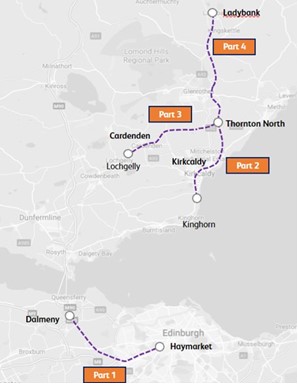
The electrification is split into four phases.
- Haymarket and Dalmeny – 25 km
- Kirkcaldy and Thornton North – 25 km.
- Lochgelly and Thornton North – 20 km.
- Thornton North and Ladybank – 34 km.
Note.
- The last three phases of electrification connect to Thornton North.
- The new rail link to Leven will also be electrified. and connected to Thornton North.
- The Forth Bridge is not to be electrified.
As Ladybank station is just 91.4 miles from Aberdeen, I suspect LNER will use Hitachi Intercity Battery Hybrid Trains to serve Aberdeen.
If these trains haven’t got the range, then I suspect LNER’s new CAF Tri-Mode Trains could handle the route.
Inverness
Inverness has a problem.
Zero-carbon trains will be unlikely to get to the city without full electrification of the Highland Main Line.
- Dunblane is the nearest electrified station to Inverness, but it is 146.2 miles away over a route with lots of steep climbs.
- I doubt that a battery-electric train could handle that route.
One solution would be for LNER to run the new CAF Tri-Mode Trains to Inverness using HVO or biodiesel.
Glasgow
Glasgow is the only other Scottish city with an airport and good rail connections to the South.
I am sure that Avanti West Coast will target airline passengers, if LNER prove it is a successful policy.
Other Factors
These are other factors, that will come into a traveller’s choice.
First Class
Some travellers like a bit more comfort and service.
Ability To Work
Some travellers like to work on a train.
You Don’t Get Tables On a Plane
I like to open a paper or magazine flat, which is difficult on a plane.
Views Tend To Be Better On a Train
Providing you get a window!
Parking Tends To Be Better At An Airport
But it may be more expensive!
Security Is Less Hassle On A Train
At the moment!
You Don’t Need To Prove Your Identity On A Train
Not in the UK! Yet!
Conclusion
It looks like LNER can offer the airlines to four of our major Northern cities serious zero-carbon competition.
May The Maths Be With You!
It was a bit of a surprise, when in the November 2023 Edition of Modern Railways, in an article, which was entitled Extra Luggage Racks For Lumo, I read this closing paragraph.
Lumo celebrated its second birthday in late October and was also set to mark the carriage of its two-millionth passenger. It is understood Lumo is interested in augmenting its fleet, such has been the success of the service; while many operators favour bi-mode units, Lumo is proud of its all-electric credentials so straight EMUs are still preferred, although the possibilities of including batteries which could power the trains may be pursued (the ‘803s’ have on-board batteries, but only to provide power to on-board systems if the electricity supply fails).
I find this development very interesting.
Surely the obvious way to increase capacity would be to acquire some extra identical trains and run the busiest services as ten-car trains. I talked about Hull Trains running ten-car trains in Ten-Car Hull Trains. Both companies have five trains, so I suspect that this number would allow for occasional ten-car trains.
If not, then add a few identical trains to the fleet, so capacity can be matched to the demand.
- Some services would be ten-car instead of five-car.
- Platforms at Edinburgh, King’s Cross and Newcastle already handle nine and ten-car trains, so infrastructure costs would be minimal.
- No extra paths would be needed, as a ten-car train can run in a path, that normally has five-car trains, as Hull Trains have shown.
A simple spreadsheet should probably predict, when and how many extra trains need to be added to the fleet.
Lumo And Traction Batteries
But why does the Modern Railways’s article talk about traction batteries?
In the two years since Lumo started their service, there have been days, when the East Coast Main Line has been closed for engineering works, bad weather or an incident. I wrote about an incident in Azumas Everywhere!.
Some of these engineering works have been able to be by-passed by using diversions. But not all of these diversion routes are fully-electrified, so are not available for Lumo.
There would appear to be three viable diversions for the East Coast Main Line.
- Werrington Junction and Doncaster via Lincoln – Not Electrified – 85.4 miles
- Doncaster and York via Leeds – Being Electrified – 55.5 miles
- Northallerton and Newcastle – Not Electrified – 56.8 miles
If all or some of Lumo’s five-car trains had a battery-range of a hundred miles, they would be able to divert around some blockades.
Note.
- A traction battery could also provide power to on-board systems if the electricity supply fails.
- A traction battery would allow the train to skip past some catenary problems.
- I would be interested to know how much diversions, bad weather and incidents have cost Lumo in lost sales and refunds.
As an electrical engineer, I believe, that the emergency-only and the traction batteries could be the same design, but with different software and capacity.
The extra cost of the larger capacity traction battery, might deliver a better service and also pay for itself in the long term.
Extending Lumo’s Route
Lumo will want to maximise revenue and profits, so would it be possible to extend the route North of Edinburgh?
Consider.
- Edinburgh and Aberdeen is 131.4 miles
- Ladybank is a station to the North of the Forth Bridge, which is under 40 miles from Edinburgh.
- The line between Edinburgh and Ladybank is being electrified.
- Ladybank is just 91.4 miles South of Aberdeen.
At some point in the next few years, I believe that one of Lumo’s trains fitted with a hundred mile traction battery could reach Aberdeen on electric power.
The train would need to be charged at Aberdeen before returning South.
How would Aberdonians like that?
Unfortunately, Inverness is 146.1 miles from the nearest electrification at Dunblane, so it is probably too far for a hundred mile traction battery.
It does appear to me that if Lumo’s trains were fitted with a hundred mile traction battery, this would enable them to take some non-electrified diversions and provide a service to Aberdeen.
How Useful Would A Hundred Mile Range Battery-Electric Train Be To Other Operators?
I take each operator in turn.
Hull Trains
Consider.
- It appears that Hull Trains change between diesel and electric power at Temple Hirst junction, which is between Doncaster and Selby, on their route between King’s Cross and Hull/Beverley.
- The distance between Temple Hirst junction and Beverley is 44.3 miles.
- It would appear that an out-and-return journey could be possible on a hundred mile traction battery.
- The hundred mile traction battery would also allow Hull Trains to use the Lincoln diversion, either when necessary or by design.
To ensure enough range, a short length of overhead electrification could be erected at Hull station to combat range anxiety.
The Modern Railways article also says this.
The co-operation between sister East Coast Main Line open access operators Lumo and Hull Trains continues, with one recent move being the use of Hull Trains ‘802’ on Lumo services to cover for a shortage of the dedicated ‘803s’ while one was out of action for repairs following a fatality. although the two types are similar, there are notable differences, most obviously that the Hull Trains units are bi-modes while the Lumo sets are straight EMUs, and a training conversion course is required for Lumo drivers on the ‘802s’. There are also challenges from a passenger-facing perspective – the Hull trains units have around 20 % fewer seats and a First Class area.
If Hull Trains used traction batteries rather than diesel engines could the trains be identical to Lumo’s trains from the driver’s perspective?
This would surely appeal to First Group, who are the owner of both Hull Trains and Lumo.
TransPennine Express
These are TransPennine Express services.
- Liverpool Lime Street and Newcastle – Fully Electrified
- Liverpool Lime Street and Hull – Part Electrified – Hull and Micklefield – 42 miles
- Manchester Airport and Saltburn – Part Electrified – Saltburn and Northallerton – 33.6 miles
- Manchester Piccadilly and Newcastle – Fully Electrified
- Manchester Piccadilly and Scarborough – Part Electrified – York and Scarborough – 42.1 miles
- York and Scarborough – Not Electrified – 42.1 miles
- Manchester Piccadilly and Huddersfield – Fully Electrified
- Huddersfield and Leeds – Fully Electrified
- Liverpool Lime Street and Cleethorpes – Part Electrified – Hazel Grove and Cleethorpes – 104.6 miles
Note.
- I am assuming that the TransPennine Upgrade has been completed and Manchester and Leeds is electrified.
- Liverpool Lime Street and Cleethorpes will need some form of charging at Cleethorpes and a slightly larger battery.
All of these TransPennine Rxpress routes would be possible with a battery-electric train with a hundred mile traction battery.
LNER
These are distances from the electrification of the East Coast Main Line.
- Aberdeen via Ladybank – 91.4 miles – Charge before return
- Bradford Forster Square – Electrified
- Carlisle via Skipton – 86.8 miles – Charge before return
- Cleethorpes via Newark and Lincoln – 63.9 miles – Charge before return
- Harrogate via Leeds – 18.3 miles
- Huddersfield via Leeds – 17.2 miles
- Hull via Temple Hirst junction – 36.1 miles
- Lincoln via Newark – 16.7 miles
- Middlesbrough via Northallerton – 22.2 miles
- Scarborough via York – 42.1 miles
- Skipton – Electrified
- Sunderland via Northallerton – 47.4 miles
Note.
- The first place after the ‘via’ is where the electrification ends.
- Carlisle could be a possibility during High Speed Two upgrading of the West Coast Main Line or for an enthusiasts’ special or tourist train.
- Cleethorpes is a possible new service for LNER. I wrote about this in LNER To Serve Cleethorpes.
- Scarborough must be a possible new service for LNER.
- ‘Charge before return’ means the train must be charged before return. Carlisle is electrified, but Cleethorpes is not.
- The only new infrastructure would be the charging at Cleethorpes.
All of these LNER routes would be possible with a battery-electric train with a hundred mile traction battery.
The hundred mile traction battery would also allow LNER to use the Lincoln diversion.
Grand Central
These are distances from the electrification of the East Coast Main Line for Grand Central’s services.
- Bradford Interchange via Shaftholme junction – 47.8 miles
- Cleethorpes via Doncaster – 52.1 miles – Charge before return
- Sunderland via Northallerton – 47.4 miles
Note.
- The first place after the ‘via’ is where the electrification ends.
- Cleethorpes is a possible new service for Grand Central.
- ‘Charge before return’ means the train must be charged before return.
All of these routes would be possible with a battery-electric train with a hundred mile traction battery.
The hundred mile traction battery would also allow Grand Central to use the Lincoln diversion.
Avanti West Coast
These are distances from the electrification of the West Coast Main Line for Avanti West Coast’s services.
- Chester via Crewe – 21.1 miles
- Gobowen via Wolverhampton – 47.7 miles
- Holyhead via Crewe – 105.5 miles – Charge before return
- Shrewsbury via Wolverhampton – 29.7 miles
- Wrexham via Crewe – 33.3 miles
Note.
- The first place after the ‘via’ is where the electrification ends.
- Gobowen is a possible new service for Avanti West Coast.
- ‘Charge before return’ means the train must be charged before return.
All of these routes would be possible with a battery-electric train with a hundred mile traction battery.
Great Western Railway
These are distances from the electrification of the Great Western Main Line for Great Western Railway’s services.
- Bristol Temple Meads via Chippenham – 24.4 miles
- Carmarthen via Cardiff Central – 77.4 miles – Charge before return
- Cheltenham Spa via Swindon – 43.2 miles
- Exeter St. Davids via Newbury – 120.4 miles – Charge before return
- Great Malvern via Didcot East junction – 76.1 miles – Charge before return
- Hereford via Didcot East junction – 96.9 miles – Charge before return
- Oxford via Didcot Parkway – 10.3 miles
- Paignton via Newbury – 148.7 miles – Charge before return
- Pembroke Dock via Cardiff Central – 121.6 miles – Charge before return
- Penzance via Newbury – 172.6 miles – Charge before return
- Plymouth via Newbury – 120.4 miles – Charge before return
- Swansea via Cardiff Central – 53 miles – Charge before return
- Weston-super-Mare via Chippenham – 43.8 miles
- Worcester Foregate Street via Didcot East junction – 68.2 miles – Charge before return
- Worcester Shrub Hill via Didcot East junction – 67.6 miles – Charge before return
Note.
- The first place after the ‘via’ is where the electrification ends.
- ‘Charge before return’ means the train must be charged before return.
- Partial electrification through Hereford, Great Malvern, Worcester Foregate Street and Worcester Shrub Hill, could possibly be used to charge services from Hereford and Worcester.
- Partial electrification through Penzance, Plymouth and Exeter St. Davids, could possibly be used to charge services from the South West.
- Partial electrification West of Swansea, could possibly be used to charge services from West Wales.
All routes, except for Hereford and Worcester, the South-West and West Wales, would be possible with a battery-electric train with a hundred mile traction battery.
I’ll now look at the three groups of services in more detail.
Services To Hereford And Worcester
These are distances from the electrification of the Great Western Main Line for Great Western Railway’s Hereford and Worcester services.
- Great Malvern via Didcot East junction – 76.1 miles
- Hereford via Didcot East junction – 96.9 miles
- Worcester Foregate Street via Didcot East junction – 68.2 miles
- Worcester Shrub Hill via Didcot East junction – 67.6 miles
Note.
- All services join the Great Western Main Line at Didcot East junction.
- Some services will be probably need to have, their batteries charged at the Hereford and Worcester end.
At the present time, the electrification finishes at Didcot East junction, but if it were to be extended to Charlbury station, these would be the distances without electrification.
- Great Malvern via Charlbury – 52.3 miles
- Hereford via Charlbury – 73.1 miles
- Worcester Foregate Street via Charlbury – 44.4 miles
- Worcester Shrub Hill via Charlbury – 43.8 miles
Note.
- Some of the track between Oxford and Charlbury is only single track, which may give advantages, when it is electrified.
- It might be possible with a hundred mile traction battery for all Worcester services to charge their batteries between Charlbury and London Paddington and not need a charge at Worcester to return.
- A larger traction battery or extending the electrification to perhaps Morton-in-Marsh could see Great Malvern in range of battery-electric trains from London Paddington without a charge.
- Hereford would probably be too far to get away without charging at Hereford.
This OpenRailwayMap shows the layout of Hereford station.
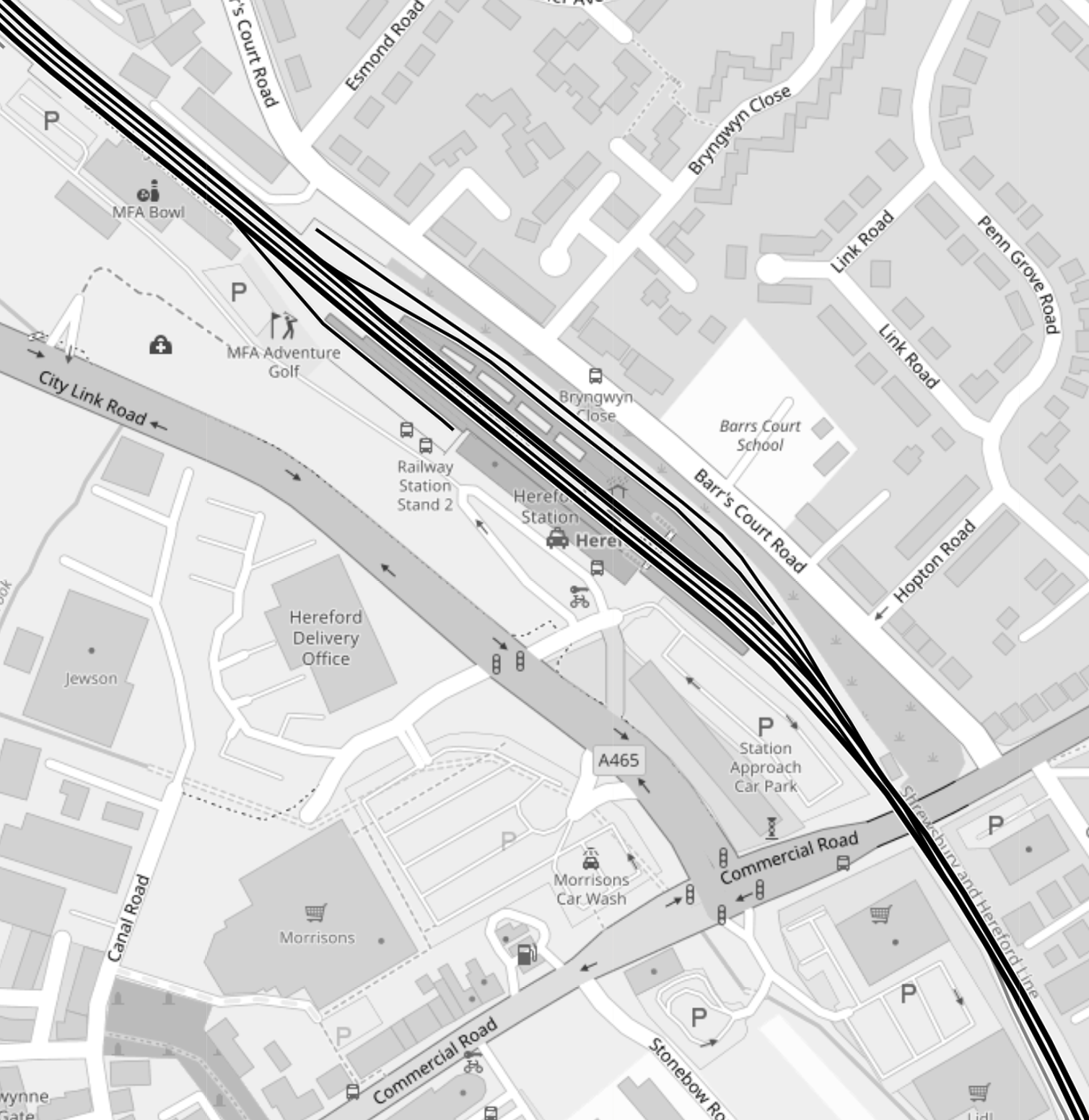
I’m certain that a platform can be found, where there is space for a charger, which could also be used for other trains serving the station.
Services To The South West
In the August 2023 Edition of Modern Railways, there is an article, which is entitled GWR Seeks Opportunities To Grow.
This is the sub-heading.
Managing Director Mark Hopwood tells Philip Sherratt there is plenty of potential to increase rail’s economic contribution.
This is two paragraphs.
The desire to provide electrification to support aggregates traffic from the Mendip quarries could also benefit GWR , says Mr. Hopwood. ‘Having an electric loco would massively help with pathing heavy freight trains through the Thames Valley. If you could electrify from Newbury to East Somerset Junction, a big chunk of the Berks and Hants route would be wired.
Then you can ask how much further you could get on battery power on an IET without running out of juice.’
Newbury to East Somerset Junction would be 53.5 miles of electrification, so I can build this table of services to the South-West
- Exeter St. Davids via Newbury – 120.4 miles – 66.9 miles
- Paignton via Newbury – 148.7 miles – 95.2 miles
- Penzance via Newbury – 251.9 miles – 198.5 miles
- Plymouth via Newbury – 172.6 miles – 119 miles
Note.
- The distance between Penzance and Plymouth is 79.5 miles.
- The first figure in the table is the distance to Newbury.
- The second figure in the table is the distance to East Somerset junction.
A possible way of running these four services to London on battery power is emerging.
- Exeter St. Davids via Newbury – Charge before return – Run on battery for 66.9 miles to East Somerset junction.
- Paignton via Newbury – Charge before return – Run on battery for 95.2 miles to East Somerset junction.
- Penzance via Newbury- Charge before return – Run on battery for 79.5 miles to Plymouth – Charge at Plymouth – Run on battery for 119 miles to East Somerset junction.
- Plymouth via Newbury – Charge before return – Run on battery for 119 miles to East Somerset junction.
Once at East Somerset junction, it’s electrification all the way to Paddington.
This is the corresponding way to run services from London.
- Exeter St. Davids via Newbury – Run on electrification to East Somerset junction, charging the battery on the way – Run on battery for 66.9 miles to Exeter St. Davids.
- Paignton via Newbury – Run on electrification to East Somerset junction, charging the battery on the way – Run on battery for 95.2 miles to Paignton.
- Penzance via Newbury – Run on electrification to East Somerset junction, charging the battery on the way – Run on battery for 119 miles to Plymouth – Charge at Plymouth – Run on battery for 79.5 miles to Penzance.
- Plymouth via Newbury – Run on electrification to East Somerset junction, charging the battery on the way – Run on battery for 119 miles to Plymouth.
More electrification or a larger than a hundred mile traction battery would be needed, as Plymouth and East Somerset junction is 119 miles.
But if a Stadler Akku can do 139 miles on a charge, why shouldn’t a Hitachi battery-electric train?
Services To West Wales
It seems that the current timetable is already setup for battery-electric trains to run to and beyond Swansea.
- Carmarthen and Swansea is almost exactly 32 miles.
- Pembroke Dock and Swansea is 73.4 miles.
- Swansea and Cardiff Central is 45.7 miles.
Note
- All these sections could be run by a battery-electric train, with a fully-charged hundred mile traction battery.
- All trains going to or from Carmarthen or Pembroke Dock reverse at Swansea, where a generous time of more than eleven minutes is allowed for the manoeuvre.
- During the reverse at Swansea, there is sufficient time to charge the batteries, if overhead wires were present.
Battery-electric services could serve Wales Wales with overhead electrification at Carmarthen, Pembroke Dock and Swansea.
Conclusion
We will go a long way, if we embrace battery-electric trains.
Most routes can be handled with a train with a traction battery range of 100 miles.
Exceptions are.
- Hazel Grove and Cleethorpes – 104.6 miles
- Plymouth and East Somerset junction – 119 miles
But if a Stadler Akku can do 139 miles on a charge, why shouldn’t a Hitachi battery-electric train?
Lumo Carbon Data Shows Its Trains Are 22 Times Greener Than Flying
The title of this post, is the same as that of this article on Rail Advent.
These paragraphs detail how the figures were obtained.
To mark the second anniversary of its branding as ‘Lumo’, the operator commissioned consultancy firm Arup to provide an independent report about all direct emissions from its operations; emissions from the grid-supplied energy it uses; and other emissions in its supply chain.
Scope 1: Direct emissions from operations that are owned and controlled by Lumo;
Scope 2: Emissions from the use of grid-supplied electricity, heat, steam and/or cooling by Lumo;
Scope 3: All other emissions that occur in the value chain of Lumo.In the last two years, Lumo has carried over two million passengers. The figures reveal that, per passenger, emissions from a London-to-Edinburgh journey are twenty-two times the level for flying (149 kgCO2e) than for using Lumo (6.8kgCO2e).
I have a few thoughts.
Carbon Savings With LNER
LNER’s Class 801 trains are similar to Lumo’s Class 803 trains.
The main difference, is that the LNER have emergency diesel engines, whereas Lumo have emergency batteries to run the trains systems, if the catenary goes down.
So LNER on balance will generate a bit more carbon than Lumo.
But the difference will be marginal.
Carbon Savings With Avanti West Coast
Avanti’s Class 390 trains to Scotland, are all-electric, so there will be a carbon-saving.
Probably about the same as with LNER.
Avanti West Coast’s New Class 807 Trains
If the Class 807 trains were cars, they would be Lotuses.
- They are electric only and have no heavy diesel engines or traction batteries.
- They don’t even have emergency batteries for when the catenary fails.
- They have a redesigned nose. Is it more aerodynamic?
- The heavy tilt mechanism is history.
- As with all the other Hitachi high speed trains, they are capable of 125 mph, or 140 mph if the signalling permits.
These trains will undoubtedly have faster acceleration and deceleration and could probably knock minutes off the timings at all the stops.
Tucked away beside the Grand Union Sets Out Stirling Ambitions article in the December 2022 Edition of Modern Railways is a report on Avanti West Coast’s application for a second service between Euston and Liverpool.
This is said.
Avanti West Coast has applied for access rights for its second hourly Euston to Liverpool service, starting from December 2023, although a phased introduction of the new service is likely. This would make use of Avanti’s new fleet of 10×7-car Class 807 Hitachi EMUs, which are expected to enter service from Autumn 2023. The ‘807s’ would be deployed on the current hourly Liverpool service, on which a call at Liverpool South Parkway would be added. (provision is made for this in the December 2022 timetable.).
Pendolinos would then operate the second service each hour, calling at Lichfield Trent Valley and Tamworth.
A linespeed project is in progress to raise the permissible speed for non-tilting trains on the West Coast Main Line, and Avanti’s new Hitachi trains will take advantage of this.
I can’t wait to go to Liverpool in one of these trains.
Their carbon emissions should be in line with Lumo.
Avanti West Coast’s New Class 805 Trains
These are equivalent to the Class 802 trains, but with probably Class 807 train interiors and looks.
I wonder how long these trains will keep their diesel engines before battery power is the most affordable option.
Once they go battery-electric, their carbon emissions should be in line with Lumo.
Conclusion
I can’t see any other mantra than.
Electric good, diesel bad
Especially, if like most computers, it’s just plug and play.
Rolls-Royce Completes Next Step On Its Journey To Decarbonising Business Aviation
The title of this post, is the same as that of this press release from Rolls-Royce.
This is the sub-heading.
Rolls-Royce today announces the successful completion of a series of tests with 100% Sustainable Aviation Fuel (SAF) on its latest generation of business aviation engines, the Pearl 15 and the Pearl 10X. The Pearl 15, the first member of the Pearl engine family, powers Bombardier’s Global 5500 and 6500 aircraft, while the Pearl 10X will power Dassault’s ultra-long-range flagship aircraft, the Falcon 10X.
These are the websites for the three aircraft, with number of passengers, typical cruise speed and range.
- Bombardier Global 5500 – 16 pax – Mach 0.85 – 5900 nm
- Bombardier Global 6500 – 17 pax – Mach 0.85 – 6600 nm
- Dassault Falcon 10X – 19 pax – Mach 0.925 – 7500 nm
This screenshot from the Dassault Falcon 10X web site shows the range from London.
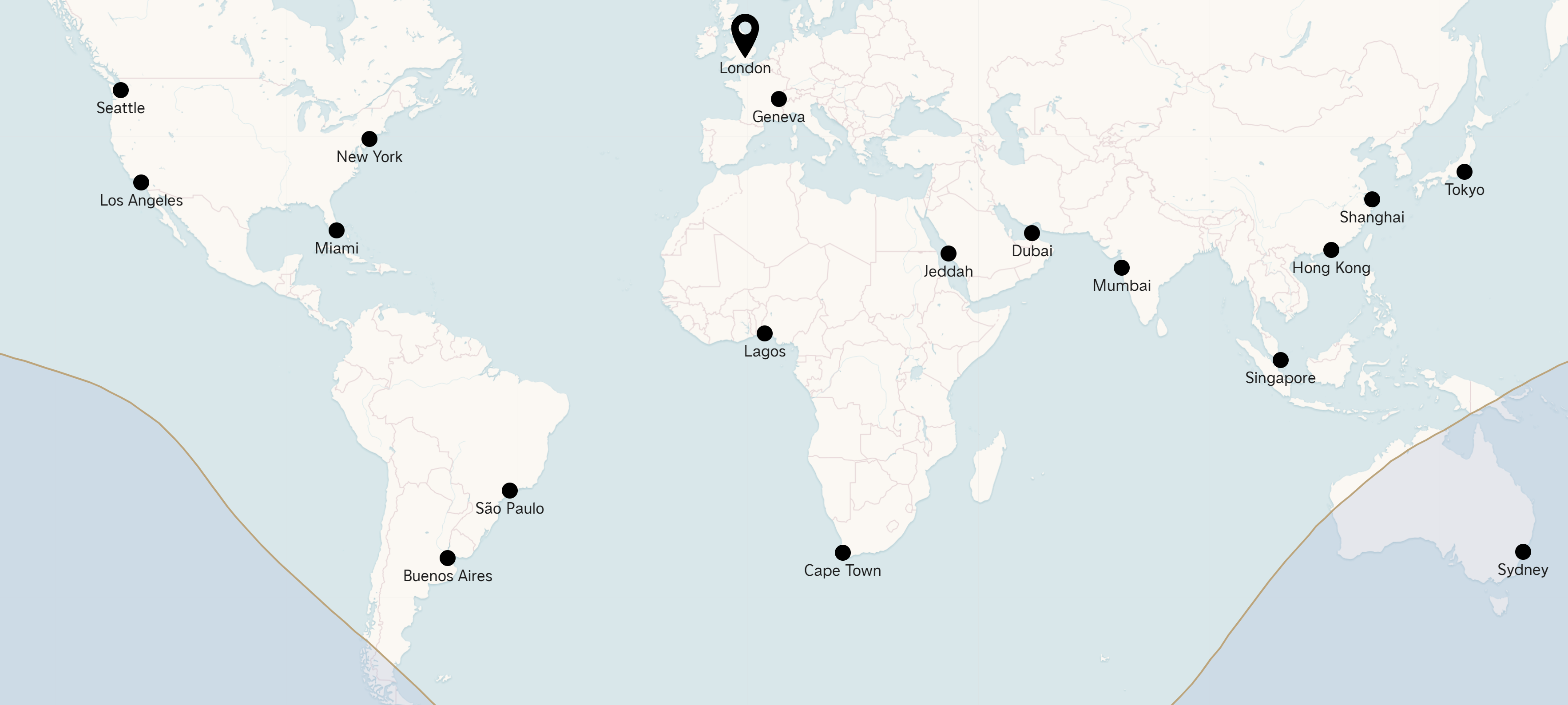
Note that Buenos Aires, the Falkland Islands, Seattle, Seoul and Tokyo are all within range.
I have a few thoughts and observations.
Jet A-1 And 100% SAF
This paragraph from the press release describes how Rolls-Royce are testing the compatibility of Jet A-1 and 100% SAF.
As well as proving compatibility with 100% SAF another target of the test campaign was to run a back-to-back engine test with both Jet A-1 and SAF on the same Pearl 10X engine. The aim was to confirm further improvements in the environmental footprint when switching to SAF. The results from this first back-to-back engine emission test under standard certification conditions provides important correlations for the evaluation of future SAF within our environmental strategy.
Compatibility and back-to-back running is surely very important, as it could be many years before all airports can supply 100 % SAF for visiting jet aircraft.
The Fuels Used In The Tests And The Benefits
These two paragraphs from the press release describes the fuels used and the benefits..
The HEFA (Hydro-processed Esters and Fatty Acids) SAF was produced from waste-based sustainable feedstocks such as used cooking oils and waste fat. This fuel has the potential to significantly reduce net CO2 lifecycle emissions by about 80% compared to conventional jet fuel.
The back-to-back tests conducted with conventional fossil-based fuel and subsequently SAF also confirmed a cleaner combustion of the sustainable fuel, with significantly lower levels of non-volatile particulate matter (nvPM). In combination with the low NOx combustor technology of the Pearl 10X and its additive manufactured combustor tiles a reduction of all emissions was achieved.
Note.
- An eighty percent reduction in lifecycle emissions is not to be sneezed at.
- Cleaner combustion and low NOx emissions are very much bonuses.
- Additive manufacture is better known as 3D-printing and I’m not surprised that Rolls-Royce have embraced the technology.
As an engineer and retired light aircraft pilot, I suspect the tests have met Rolls-Royce’s objectives.
Moving To 100 % SAF
This is the final paragraph of the press release.
The tests demonstrated once again that Rolls-Royce’s current engine portfolio for large civil and business jet applications can operate with 100% SAF, laying the groundwork for moving this type of fuel towards certification. At present, SAF is only certified for blends of up to 50% with conventional jet fuel. By the end of 2023 Rolls-Royce will have proven that all its in-production Trent and business aviation engines are compatible with 100% SAF.
It must be a good selling point for aircraft equipped with Rolls-Royce engines, that the buyer knows that the aircraft can run on 100% SAF.
100 % SAF As An Airline Marketing Tool
It will be interesting to see how airlines use 100% SAF to sell tickets.
As an example, I can see routes like London and Scotland becoming very competitive.
- Avanti West Coast, LNER and Lumo already run all-electric trains to Edinburgh and Glasgow.
- The technology exists to decarbonise trains to Aberdeen and Inverness..
- Other open access operators could well move in to a lucrative market.
- The only way, that the airlines will be able to compete on emissions, would be to move to 100 % SAF.
There must be hundreds of routes like London and Scotland around the world.
100 % SAF And Business Jets
In A Class 319 Train, But Not As We Know It!, I told this tale.
I am reminded of a tale, that I heard from a former GEC manager.
He was involved in selling one of GEC’s Air Traffic Control radars to a Middle Eastern country.
The only working installation of the radar was at Prestwick in Scotland, so he arranged that the dignitaries and the sales team would be flown to Prestwick in GEC’s HS 125 business jet.
As they disembarked at Prestwick and walked to the terminal, the pilot called the GEC Manager over.
The pilot told him “The Scottish Highlands at this time of the year, are one of the most beautiful places in the world! Would you and your guests like a low-level tour on the way back? I can arrange it, if you say so!”
Despite knowing GEC’s draconian attitude to cost control he said yes.
The sale was clinched!
I also remember an article in Flight International about how JCB sold diggers.
- Dealers in a country like Greece would put together a party of prospective customers.
- The customers would then be flown to East Midlands Airport in JCB’s business jet, which is close to the JCB factory at Rocester.
- After a sales demonstration and a tour of the factory they would be flown home.
I once met a lady who had been one of JCB’s cabin staff and she told me it was a very successful sales technique.
I suspect that a business jet running on 100 % SAF would be an even better sales aid.
There are also increasing protests from the greens about business jets, which are seen as producing pollution and are only the toys of the rich and powerful.
Surely, if they were running on 100 % SAF, this would make business jets more acceptable.
100 % SAF And Niche Airlines
In the web site for the Falcon 10X, there is a section called Mission Flexibility, where this is said.
As large as it is, the Falcon 10X can still access typical airports serving business aviation as well as others with challenging approaches. The Falcon 10X will be London City-capable so that it can fly you straight into the heart of global finance. When you’re ready for rest and relaxation, the 10X can whisk you to out-of-the-way corners of the world.
British Airways used to run a service between London City Airport and New York.
- The route used 32-seat Airbus A-318 airliners.
- The flight stopped at Shannon for refuelling.
- It was business class only.
I suspect someone will think about running a similar London City Airport and New York service using a Falcon 10X.
- It has nineteen seats.
- It could do it in one hop.
- It could run on 100 % SAF.
- British Airways must have all the passenger data from the discontinued service.
- A Falcon 10X flies higher than a Boeing 767, Boeing 787 or an Airbus A350.
I have a feeling that flight time would be comparable or better to a flight between Heathrow and New York.
Conclusion
Rolls-Royce would appear to have the right strategy.
If I was going to New York in business class, I’d use it.
Could Train Services At Liverpool Lime Street Station Be Made Carbon-Free?
This map from OpenRailwayMap shows Liverpool Lime Street station.

Note.
- There are ten platforms, which are arranged in two sets of five.
- Electrified tracks are shown in red.
- The lilac track is the loop of the underground Wirral Line.
It would appear that the station is fully electrified.
Services To And From Liverpool Lime Street
These services currently run to and from Liverpool Lime Street station.
- Avanti West Coast – London Euston – 1 tph – Electric
- East Midlands Railway – Norwich – 1 tph – Diesel – Electrified to Liverpool South Parkway – 25.2 miles to electrification at Trafford Park.
- London Northwestern Railway – Birmingham New Street – 1 tph – Electric
- Northern – Blackpool North – 1 tph – Electric
- Northern – Manchester Airport – 1 tph – Electric
- Northern – Manchester Oxford Road – 1 tph – Diesel – Electrified to Liverpool South Parkway – 25.2 miles to electrification at Trafford Park.
- Northern – Warrington Central – 1 tph – Diesel – Electrified to Liverpool South Parkway – 12.7 miles to Warrington Central.
- Northern – Wigan North Western – 2 tph – Electric
- TransPennine Express – Cleethorpes – 1 tph – Electric – Electrified to Liverpool South Parkway – 25.2 miles to electrification at Trafford Park.
- TransPennine Express – Glasgow – 2 tpd – Electric
- TransPennine Express – Hull – 1 tph – Electric
- TransPennine Express – Newcastle – 1 tph – Electric
- Transport for Wales – Chester – 1 tph – Diesel – Electrified to Runcorn – 13.9 miles to Chester.
Note.
- tpd is trains per day
- tph is trains per hour
- There are nine electric services and four diesel services.
It looks to me, that by using battery-electric trains on the four diesel services, Liverpool Lime Street station can be made carbon-free.
Distances on battery power for each service would be as follows.
- East Midlands Railway – Norwich – Both ways – 25.2 miles between Liverpool South Parkway and Trafford Park with charging at both ends.
- Northern – Manchester Oxford Road – Both ways – 25.2 miles between Liverpool South Parkway and Trafford Park with charging at both ends.
- Northern – Warrington Central – Both ways – 12,7 miles between Liverpool South Parkway and Warrington Central with charging between Liverpool Lime Street and Liverpool South Parkway.
- Transport for Wales – Chester – Both ways – 13.9 miles between Runcorn and Chester with charging between Liverpool Lime Street and Runcorn.
Note the flexibility of battery-electric trains allows a variety of charging regimes.
Conclusion
Liverpool Lime Street Station can be made carbon-free
Will High Speed Two Lite Make Stafford An Important Station?
Stafford station is where the Trent Valley Line joins the West Coast Main Line and with the current proposals for High Speed Two, which I refer to as High Speed Two Light, it will also have to handle those High Speed Two services to and from Crewe.
Current Services Through Stafford Station
These are current services through Stafford station.
- Avanti West Coast – London Euston and Blackpool North via Birmingham – 2 tpd – Stops at Wolverhampton, Stafford and Crewe
- Avanti West Coast – London Euston and Glasgow Central via Birmingham – 5 tpd – Stops at Wolverhampton, Stafford and Crewe
- Avanti West Coast – London Euston and Edinburgh via Birmingham – 7 tpd – Stops at Wolverhampton, Stafford and Crewe
- Avanti West Coast – London Euston and Blackpool North via Trent Valley – 1 tpd – Stops at Stafford and Crewe
- Avanti West Coast – London Euston and Glasgow Central via Trent Valley – 1 tph – Non-Stop
- Avanti West Coast – London Euston and Holyhead via Trent Valley – 8 tpd – Stops at Stafford and Crewe
- Avanti West Coast – London Euston and Liverpool Lime Street via Trent Valley – 1 tph – Stops at Crewe
- Avanti West Coast – London Euston and Manchester Piccadilly via Trent Valley – 1 tph – Stops at Stafford and Crewe
- CrossCountry – Birmingham New Street and Manchester via Wolverhampton and Stoke-on-Trent – 2 tph – Stops at Wolverhampton, Stafford and Stoke-on-Trent.
- West Midlands – London Euston and Crewe via Trent Valley – 1 tph – Stops at Stafford and Crewe
- West Midlands – Birmingham New Street and Crewe via Wolverhampton and Stoke-on-Trent – 1 tph – Stops at Wolverhampton, Stafford, Stoke-on-Trent and Crewe
- West Midlands – Birmingham New Street and Liverpool Lime Street via Wolverhampton – 1 tph – Stops at Wolverhampton, Stafford and Crewe
Note.
- tpd is trains per day.
- tph is trains per hour.
- Through Stafford station, there are totals of 23 tpd and 8 tph.
- Along the Trent Valley Line, there are totals of 9 tpd and 4 tph.
- North of Stafford on the West Coast Main Line, there are totals of 23 tpd and 4 tph.
- South of Stafford on the West Coast Main Line, there are totals of 14 tpd and 4 tph.
- Between Stafford and Stoke-on-Trent, there are totals of 3 tph.
Stafford is a very busy station.
Services have these frequencies from Stafford.
- Crewe – 21 tpd and 3 tph.
- Stoke-on-Trent – 3 tph.
- London Euston – 23 tpd and 4 tph.
- Wolverhampton – 13 tpd and 4 tph.
Could Stoke-on-Trent and Stafford do with a few extra services?
High Speed Two Services Through Stafford Station
This graphic shows High Speed Two services after Phase 2b is completed.
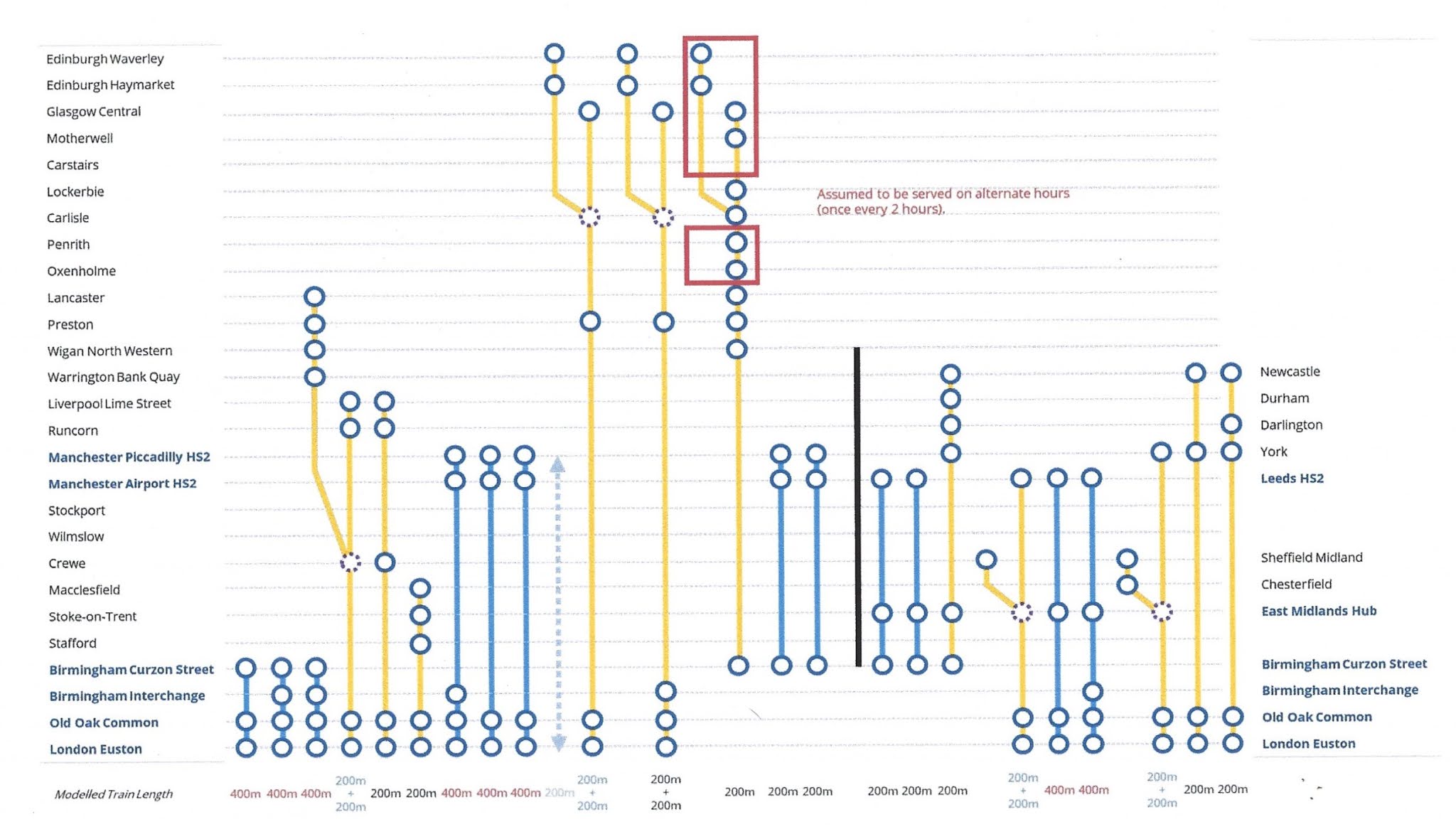
Note.
- Services shown in blue are run by High Speed Two Full Size trains.
- Services shown in yellow are run by High Speed Two Classic-Compatible trains.
- Each of these trains will have a frequency of one tph.
These could be High Speed Two services through Stafford station, when High Speed Two Lite opens.
- High Speed Two – London Euston and Liverpool Lime Street/Lancaster via High Speed Two and Trent Valley Line – 1 tph – Stops at Crewe
- High Speed Two – London Euston and Liverpool Lime Street via High Speed Two and Trent Valley Line – 1 tph – Stops at Crewe
- High Speed Two – London Euston and Macclesfield via High Speed Two and Trent Valley Line – 1 tph – Stops at Stafford and Stoke-on-Trent
- High Speed Two – London Euston and Manchester Piccadilly via High Speed Two and Trent Valley Line – 3 tph
- High Speed Two – London Euston and Glasgow/Edinburgh via High Speed Two and Trent Valley Line – 2 tph
- High Speed Two – Birmingham and Glasgow/Edinburgh via High Speed Two and Trent Valley Line – 1 tph
- High Speed Two – Birmingham and Manchester Piccadilly via High Speed Two and Trent Valley Line – 2 tph
Note.
- Through Stafford station, there are totals of 11 tph.
- Along the Trent Valley Line, there are totals of 11 tph.
- North of Stafford on the West Coast Main Line, there are totals of 11 tph.
- Between Stafford and Stoke-on-Trent, there are totals of 1 tph.
There are a lot of trains to squeeze through. But remember that High Speed Two signalling is designed to handle 18 tph.
Combined Services Through Stafford Station
These could be the combined current High Speed Two services through Stafford station, when High Speed Two Lite opens.
- Avanti West Coast – London Euston and Blackpool North via Birmingham – 2 tpd – Stops at Wolverhampton, Stafford and Crewe
- Avanti West Coast – London Euston and Glasgow Central via Birmingham – 5 tpd – Stops at Wolverhampton, Stafford and Crewe
- Avanti West Coast – London Euston and Edinburgh via Birmingham – 7 tpd – Stops at Wolverhampton, Stafford and Crewe
- Avanti West Coast – London Euston and Blackpool North via Trent Valley – 1 tpd – Stops at Stafford and Crewe
- Avanti West Coast – London Euston and Glasgow Central via Trent Valley – 1 tph – Non-Stop
- Avanti West Coast – London Euston and Holyhead via Trent Valley – 8 tpd – Stops at Stafford and Crewe
- Avanti West Coast – London Euston and Liverpool Lime Street via Trent Valley – 1 tph – Stops at Crewe
- Avanti West Coast – London Euston and Manchester Piccadilly via Trent Valley – 1 tph – Stops at Stafford and Crewe
- CrossCountry – Birmingham New Street and Manchester via Wolverhampton and Stoke-on-Trent – 2 tph – Stops at Wolverhampton, Stafford and Stoke-on-Trent.
- West Midlands – London Euston and Crewe via Trent Valley – 1 tph – Stops at Stafford and Crewe
- West Midlands – Birmingham New Street and Crewe via Wolverhampton and Stoke-on-Trent – 1 tph – Stops at Wolverhampton, Stafford, Stoke-on-Trent and Crewe
- West Midlands – Birmingham New Street and Liverpool Lime Street via Wolverhampton – 1 tph – Stops at Wolverhampton, Stafford and Crewe
- High Speed Two – London Euston and Liverpool Lime Street/Lancaster via High Speed Two and Trent Valley Line – 1 tph – Stops at Crewe
- High Speed Two – London Euston and Liverpool Lime Street via High Speed Two and Trent Valley Line – 1 tph – Stops at Crewe
- High Speed Two – London Euston and Macclesfield via High Speed Two and Trent Valley Line – 1 tph – Stops at Stafford and Stoke-on-Trent
- High Speed Two – London Euston and Manchester Piccadilly via High Speed Two and Trent Valley Line – 3 tph
- High Speed Two – London Euston and Glasgow/Edinburgh via High Speed Two and Trent Valley Line – 2 tph
- High Speed Two – Birmingham and Glasgow/Edinburgh via High Speed Two and Trent Valley Line – 1 tph
- High Speed Two – Birmingham and Manchester Piccadilly via High Speed Two and Trent Valley Line – 2 tph
Note.
- Through Stafford station, there are totals of 23 tpd and 19 tph.
- Along the Trent Valley Line, there are totals of 9 tpd and 15 tph.
- North of Stafford on the West Coast Main Line, there are totals of 23 tpd and 15 tph.
- Between Stafford and Stoke-on-Trent, there are totals of 4 tph.
But there are duplicate services.
High Speed Two services to Liverpool, Manchester and Scotland, will replace Avanti West Coast services.
High Speed Two services between Birmingham and Manchester, will replace CrossCountry services.
Removing these current services gives.
- Avanti West Coast – London Euston and Blackpool North via Birmingham – 2 tpd – Stops at Wolverhampton, Stafford and Crewe
- Avanti West Coast – London Euston and Blackpool North via Trent Valley – 1 tpd – Stops at Stafford and Crewe
- Avanti West Coast – London Euston and Holyhead via Trent Valley – 8 tpd – Stops at Stafford and Crewe
- West Midlands – London Euston and Crewe via Trent Valley – 1 tph – Stops at Stafford and Crewe
- West Midlands – Birmingham New Street and Crewe via Wolverhampton and Stoke-on-Trent – 1 tph – Stops at Wolverhampton, Stafford, Stoke-on-Trent and Crewe
- West Midlands – Birmingham New Street and Liverpool Lime Street via Wolverhampton – 1 tph – Stops at Wolverhampton, Stafford and Crewe
- High Speed Two – London Euston and Liverpool Lime Street/Lancaster via High Speed Two and Trent Valley Line – 1 tph – Stops at Crewe
- High Speed Two – London Euston and Liverpool Lime Street via High Speed Two and Trent Valley Line – 1 tph – Stops at Crewe
- High Speed Two – London Euston and Macclesfield via High Speed Two and Trent Valley Line – 1 tph – Stops at Stafford and Stoke-on-Trent
- High Speed Two – London Euston and Manchester Piccadilly via High Speed Two and Trent Valley Line – 3 tph
- High Speed Two – London Euston and Glasgow/Edinburgh via High Speed Two and Trent Valley Line – 2 tph
- High Speed Two – Birmingham and Glasgow/Edinburgh via High Speed Two and Trent Valley Line – 1 tph
- High Speed Two – Birmingham and Manchester Piccadilly via High Speed Two and Trent Valley Line – 2 tph
Note.
- Through Stafford station, there are totals of 11 tpd and 14 tph.
- Along the Trent Valley Line, there are totals of 11 tpd and 12 tph.
- North of Stafford on the West Coast Main Line, there are totals of 9 tpd and 12 tph.
- South of Stafford on the West Coast Main Line, there are totals of 2 tpd and 2 tph.
- Between Stafford and Stoke-on-Trent, there are totals of 2 tph.
With these frequencies, I suspect digital signalling will be needed.
Services have these frequencies from Stafford.
- Crewe – 11 tpd and 5 tph.
- Stoke-on-Trent – 2 tph.
- London Euston – 11 tpd and 4 tph.
- Wolverhampton – 3 tpd and 2 tph.
Note.
- Stoke-on-Trent needs more trains.
- There is virtually no trains on the West Coast Main Line to the South of Stafford.
- The frequencies indicate digital signalling will be needed.
On this brief look, I think that High Speed Two Lite will open up a lot of possibilities.
Could The High Speed Two Link Between Lichfield And Crewe Still Be Built?
The original plan for High Speed Two included two routes between Lichfield and Crewe.
This map clipped from the High Speed Two web site, shows the two routes.
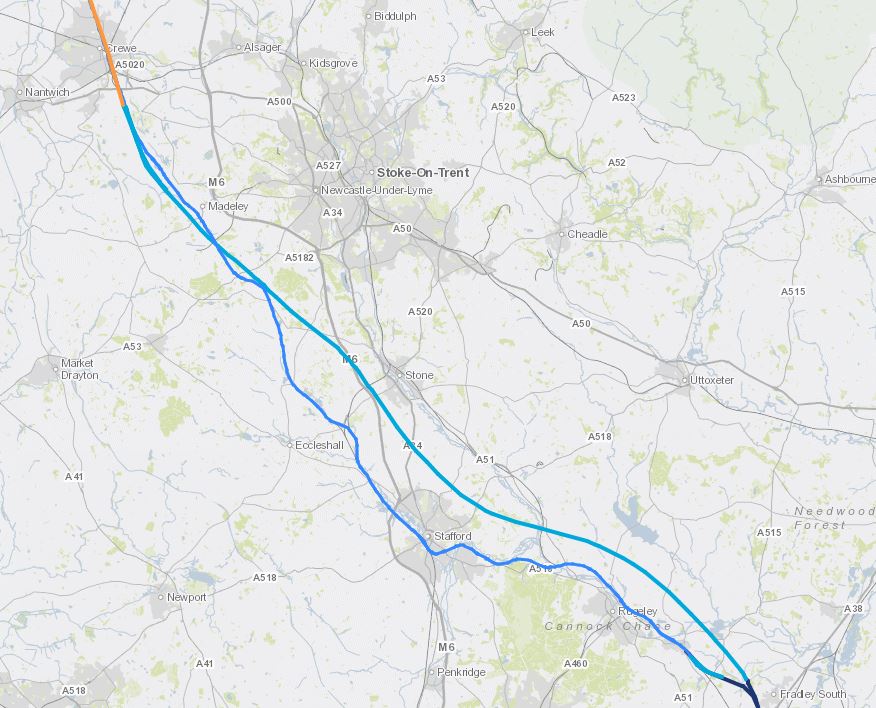
Note.
- High Speed Two Phase 2a is shown in blue.
- High Speed Two Phase 2b is shown in orange.
- Crewe is in the North-West corner of the map, at the Southern end of the orange section.
- The junction at Lichfield is in the South-East corner of the map.
- The lighter blue route to the East, between the Lichfield junction and Crewe is the proposed new tracks of High Speed Two.
- The darker blue route to the West, between the Lichfield junction and Crewe is the existing route of the Trent Valley Line and the West Coast Main Line.
- The Trent Valley Line joins the West Coast Main Line at Stafford.
This second map clipped from the High Speed Two web site, shows the junction North of Lichfield, where High Speed Two connects to the Trent Valley Line through Stafford.

Note.
- High Speed Two runs North-South across the map.
- After the Junction by Fradley South, High Speed Two to Crewe and the North, is the branch to the East.
- The other branch connects to the Trent Valley Line at Handsacre junction.
- Trent Valley Line can be picked out North of Lichfield, where it passes through Lichfield Trent Valley station.
The Trent Valley Line is no Victorian double-track slow-speed bottleneck.
- The route between Rugby and Crewe is generally three or four tracks, with only one short stretch of double track, through Shugborough tunnel.
- The speed limit is generally 110 mph, with 90 mph at Shugborough.
- I wouldn’t be surprised to see Avanti West Coast’s Class 390 and Class 807 trains could be running at up to 140 mph on the route, if digital signalling were to be installed.
- This speed would probably be attained by High Speed Two trains.
London Euston and Stafford would only have under twenty miles of slower line and that could be 140 mph, so High Speed Two times on the route could be very fast.
Trains Between London And Stafford Before And After High Speed Two To Lichfield
Currently, Avanti West Coast trains take around one hour and seventeen minutes between London and Stafford.
The Wikipedia entry for High Speed Two gives these times between London and Stafford.
- Fastest time before High Speed Two – one hour and seventeen minutes.
- Time after Phase 2a of High Speed Two opens – fifty-five minutes.
Note.
- That is a time saving of twenty-two minutes.
- High Speed Two Trains will use the link between the junction at Lichfield and the Trent Valley Line.
- High Speed Two will also add eighteen trains per hour (tph) to the capacity between London and Lichfield.
This would seem to mean that any trains going to or through Stafford will be twenty-two minutes faster, if they use High Speed Two between London and Lichfield.
Trains Between London And Crewe Before And After High Speed Two To Crewe
Currently, Avanti West Coast trains take around one hour and thirty minutes between London and Crewe.
The Wikipedia entry for High Speed Two gives these times between London and Crewe.
- Fastest time before High Speed Two – one hour and thirty minutes.
- Time after Phase 2a of High Speed Two opens – fifty-six minutes.
Note.
- That is a time saving of thirty-four minutes.
- High Speed Two Trains will use the direct line between Lichfield and Crewe.
- High Speed Two will also add eighteen tph to the capacity between London and Crewe.
This would seem to mean that any trains going to or through Crewe will be thirty-four minutes faster, if they use High Speed Two between London and Crewe.
High Speed Two Between Lichfield And Crewe Only Saves An Extra Twelve Minutes
It appears that extending High Speed Two to Crewe only saves an extra twelve minutes.
But it will also have these benefits.
High Speed Two Full-Size trains will be able to run to Crewe.
High Speed Two will also add eighteen tph to the capacity between London and Crewe.
Savings From Scrapping High Speed Two Between Lichfield And Crewe
In addition to the savings of the scrapping of the line, I suspect that any modifications to Crewe station will be much simpler.
I wonder how much will be saved by not building High Speed Two to Crewe.
Could The High Speed Two Link Between Lichfield And Crewe Still Be Built?
This is the question I asked in the title.
We know the benefits of building High Speed Two and as time progresses we’ll know the costs and the disruption the building will cause with an increasing accuracy.
I also believe that even High Speed Two Lite will be a rip-roaring success, and other places will want their own High Speed Two service, which will need an increase in capacity North of Lichfield.
So there will come a point, when there is an overwhelming case to build the High Speed Two Link Between Lichfield and Crewe.
Because of that we must make sure, that any sales of land or properties, doesn’t compromise building the High Speed Two Link Between Lichfield and Crewe.
Conclusion
There will come a point, when the amount of traffic, will mean that it is worth building the High Speed Two Link Between Lichfield and Crewe.
My other conclusion is important and the route of the originally proposed High Speed Two Link Between Lichfield and Crewe, must not be compromised.
 The Anonymous Widower