£1.5 billion Enables UK-US Pair To Get Their Hands On Europe’s Giant LNG Terminal
The title of this post, is the same as that of this article on Offshore Energy.
This is the sub-heading.
UK-based energy player Centrica and U.S. investment firm Energy Capital Partners (ECP), part of Bridgeport Group, have brought into their fold a liquefied natural gas (LNG) terminal in Kent County, United Kingdom.
This paragraph gives Centrica’s view of the Grain LNG Terminal.
The UK firm portrays the terminal as Europe’s largest LNG regasification facility, with a capacity of 15 million tonnes of LNG a year. Located on the UK’s Isle of Grain, the terminal features unloading infrastructure, regasification equipment, and truck-loading facilities.
In a press release, which is entitled Investment in Grain LNG, that was published in August 2025, Centrica said this.
Opportunities for efficiencies to create additional near-term value, and future development options including a combined heat and power plant, bunkering, hydrogen and ammonia.
The tone of the article in Offshore Energy and the press release is unmistakable. – Centrica intend to make good use of their investment.
I suggest you read both documents fully.
- Europe’s largest LNG regasification facility, with a capacity of 15 million tonnes of LNG a year, will certainly need a large combined heat and power plant.
- Will any spare power from the CHP plant, be sent to Germany, through the 1.4 GW NeuConnect interconnector, which should be commissioned by 2028?
- Hydrogen, ammonia and LNG are the three low-carbon fuels used by modern ships, so I suspect hydrogen and ammonia will be produced on the island.
- Centrica are investors in the efficient hydrogen-generation process ; HiiROC.
- Hydrogen and nitrogen are the two feedstocks for ammonia.
Centrica certainly have big plans for the Grain LNG Terminal.
I shall be following Centrica closely.
Centrica Energy And Exodus Sign Landmark LNG Agreement
The title of this post, is the same as that of this press release from Centrica.
This is the sub-heading.
Centrica Energy has announced the signing of a long-term Sale and Purchase Agreement (SPA) to supply liquefied natural gas (LNG) to Exodus for Honduras, marking a new milestone in the country’s energy development.
These two paragraphs add more details.
Under the terms of the agreement, Centrica will deliver approximately six LNG cargoes per year to Exodus through a ship-to-ship operation into the Floating Storage Unit (FSU) Bilbao Knutsen, located in Puerto Cortes. The 15-year contract is expected to commence in 2026.
“This agreement reflects Centrica Energy’s commitment to expanding global LNG access through strategic partnerships,” said Arturo Gallego, Global Head of LNG at Centrica Energy. “By leveraging our global reach and operational expertise, we’re proud to support Exodus and Honduras in its journey toward a more sustainable and resilient energy future.”
It looks a good deal for Centrica, that has been snatched from under the American’s noses.
I also asked Google AI, if Honduras produced any natural gas and received this reply.
No, Honduras does not produce natural gas, but it is importing it through a new liquefied natural gas (LNG) agreement that begins in 2026. The country relies on imports to meet its energy needs, and this new deal aims to diversify its energy mix and provide cleaner energy for power generation.
That’s clear and it’s interesting that Honduras are looking to provide cleaner energy.
These two paragraphs from Centrica’s press release add details on power generation in Honduras.
The LNG will be transported to the Brassavola Combined Cycle Power Plant, an operating 150 MW thermal facility with its combined cycle under construction and set to reach 240 MW of power capacity, marking the first-ever import of natural gas for power generation in Honduras. This initiative represents a significant step toward diversifying the nation’s energy mix and reducing its reliance on less environmentally friendly fossil fuels.
Once operational, the FSU will serve as the backbone of LNG storage at a new terminal currently under construction on Honduras’ Caribbean coast. The project is designed to enhance energy security, improve generation efficiency, and support industrial growth.
This article on Riviera is entitled Honduras Turns To LNG To Meet Energy Needs and provides these points.
- Honduras is grappling with a 250 MW power shortage.
- Genesis Energías is spearheading efforts to introduce a reliable and cost-effective energy source by importing liquefied natural gas (LNG).
- Hyundai, who are one of Centrica’s partners in HiiROC, are converting the Bilbao Knutsen for its new role as a Floating Storage Unit (FSU).
It would certainly help Honduras’s economy, if they had more power generation.
I asked Google AI, if Honduras was developing offshore wind power and received this reply.
While Honduras has been actively developing onshore wind power for over a decade, there is currently no information to suggest it is developing offshore wind power projects. The country’s wind energy development has focused exclusively on land-based projects, with a number of operational farms and more in the pipeline.
I also asked Google AI if Honduras was developing solar power and received this reply.
Yes, Honduras is actively and significantly developing its solar power capacity as a cornerstone of its national energy strategy. The country has been a regional leader in solar energy penetration and continues to invest heavily in new projects to reduce its dependence on fossil fuels.
But, whether its offshore wind, onshore wind or solar power, these renewals will need backup and the 240 MW Brassavola Combined Cycle Power Plant, will be a good start.
I have some further thoughts.
Does HiiROC Have A Part To Play?
If would be good, if the 240 MW Brassavola Combined Cycle Power Plant could be zero-carbon, so that Honduras could be more zero-carbon.
Consider.
- Centrica own part of HiiROC, who can generate turquoise hydrogen efficiently from natural gas.
- Honduras will from 2026, have plenty of natural gas.
- In Hydrogen Milestone: UK’s First Hydrogen-to-Power Trial At Brigg Energy Park, I talked about how Centrica powered Brigg power station with a hydrogen blend.
- If the Brassavola Combined Cycle Power Plant was reasonably-modern like Brigg, I suspect it could be run on hydrogen or a hydrogen-blend.
- A reliable supply of hydrogen in Honduras would have its uses.
I wouldn’t be surprised to see a HiiROC plant in Honduras to help decarbonise the country.
HiiROC Creates A Lot Of Carbon Black
When a HiiROC system produces turquoise hydrogen, it produces carbon black as a by-product.
I asked Google AI, if Honduras has a use for carbon black, and received this reply.
Honduras likely has a use for carbon black because the material is a vital component in the production of many common industrial and consumer goods that are used globally. The primary applications are universal across most countries, including those in Central America.
But carbon black can also be used to improve poor agricultural land.
So I asked, Google AI, if Honduras has a lot of land to improve and received this reply.
Yes, Honduras has significant land to improve, but this is complicated by issues like deforestation, land degradation, and a lack of clear land rights for many communities. There is a need to balance economic activities like coffee plantations with conservation, improve sustainable agriculture practices, and address illegal land occupation.
It seems to me, that a sensible hollistic approach could use some of the carbon black.
I also believe, that there are many universities, who could advise Honduras on land restoration.
Does Highview Power Have A Part To Play?
Consider.
- Centrica are one of the backers of Highview Power, who are building their first two environmentally-friendly liquid air batteries in the UK.
- Their flagship battery is a 300 MW/3.2 GWh monster that can incorporate a stability island, that controls the grid.
- Highview Power’s batteries are zero-carbon, with a 40-50 year life.
As a Control Engineer, I believe that one of these batteries would be superb backup for the Brassavola Combined Cycle Power Plant and all those renewables.
Where Will Centrica Get Their LNG For Honduras?
I have already reported on two deals, where Centrica is purchasing LNG.
- Centrica Enters Into Long Term Natural Gas Sale & Purchase Agreement
- Centrica And PTT Sign Heads Of Agreement For Long-Term LNG Supply
I can expect more deals like this around the world.
Also, as the Grain LNG Terminal has the ability to export LNG could we be seeing UK natural gas being exported by Centrica to Honduras and the other countries hinted at in the PTT purchase?
Are Centrica Proposing A Comprehensive Solution To A Nation’s Power Problem?
It certainly looks like they are.
And Honduras would be getting a zero-carbon energy system.
This could be repeated all around the world.
Conclusion
This certainly looks like a good deal for Centrica, that can be repeated in other places.
Highview Surpasses Half A Billion Pounds Of Funding With Latest £130m Capital Raise For Phase One Of Long Duration Energy Storage Facility At Hunterston, Ayrshire
The title of this post, is the same as that of this news story from Highview Power.
Funding Round Enables Build Of “Stability Island” Which Will Deliver Crucial Grid Stability Services; Represents Phase One Of LDES Facility At Hunterston
These two paragraphs outline the funding raised and where it will initially be used.
Highview has secured £130 million in funding to commence work on the first stage of its planned 3.2GWh hybrid long-duration energy storage solution in Hunterston, Scotland. This brings the total raised to commercialise and roll out Highview’s long duration storage solutions to over £500 million.
This latest investment round, involving Scottish National Investment Bank (SNIB), the British multinational energy and services company Centrica, and investors including Goldman Sachs, KIRKBI and Mosaic Capital, will fund construction of the first phase of the Hunterston project, a “stability island”, which will provide system support to the electricity grid.
The Concept Of The Stability Island
This paragraph describes the concept of the Stability Island.This stability island is a key component of Highview’s LDES system. It can operate independently of the energy storage elements and will deliver critical inertia, short circuit and voltage support to the UK power grid. The asset will support the grid at a location that faces considerable stability challenges. In turn, this will enable more power to be transmitted from the point of generation in Scotland to areas of high demand, preventing curtailment of wind energy across Scotland
A large amount of energy will be routed through Hunterston from Scotland to England, Wales and the island of Ireland and the stability island will tightly control the flow of energy.
The Facility At Hunterston
These two paragraphs describe the facility at Hunterston.
As well as the stability island, the facility at Hunterston will also eventually incorporate a hybrid long duration energy storage system, combining both liquid air storage and lithium-ion batteries for greater operational performance. This means that the entire facility will be able to send more power to the grid for longer, in a flexible way, maximising the asset for the benefit of the system operator.
The energy storage element of the Hunterston facility received significant validation recently, when it was named as an eligible project for Ofgem’s Cap and Floor support scheme for long duration energy storage, along with a planned facility at Killingholme, Lincolnshire.
I suspect the Stability Island will actually distribute the energy to where it is needed.
Rolls-Royce Successfully Tests First Pure Methanol Marine Engine – Milestone For More Climate-Friendly Propulsion Solutions
The title of this post, is the same as that of this press release from Rolls-Royce.
These four bullet points act as sub-headings.
- World first: first high-speed 100 percent methanol engine for ships successfully tested
- Cooperation: Rolls-Royce, Woodward L’Orange and WTZ Roßlau are developing sustainable propulsion technology in the meOHmare research project
- Green methanol: CO2-neutral, clean and safe marine fuel
- Dual-fuel engines as a bridging technology on the road to climate neutrality
Rolls-Royce has successfully tested the world’s first high-speed marine engine powered exclusively by methanol on its test bench in Friedrichshafen. Together with their partners in the meOHmare research project, Rolls-Royce engineers have thus reached an important milestone on the road to climate-neutral and environmentally friendly propulsion solutions for shipping.
“This is a genuine world first,” said Dr. Jörg Stratmann, CEO of Rolls-Royce Power Systems AG. “To date, there is no other high-speed engine in this performance class that runs purely on methanol. We are investing specifically in future technologies in order to open up efficient ways for our customers to reduce CO2 emissions and further expand our leading role in sustainable propulsion systems.”
Rolls-Royce’s goal is to offer customers efficient ways to reduce their CO2 emissions, in-line with the ‘lower carbon’ strategic pillar of its multi-year transformation programme. The project also aligns with the strategic initiative in Power Systems to grow its marine business.
These are some questions.
Why Methanol?
Rolls-Royce answer this question in the press release.
Green methanol is considered one of the most promising alternative fuels for shipping. If it is produced using electricity from renewable energies in a power-to-X process, its operation is CO2-neutral. Compared to other sustainable fuels, methanol is easy to store, biodegradable, and causes significantly fewer pollutants.
“For us, methanol is the fuel of the future in shipping – clean, efficient, and climate-friendly. It burns with significantly lower emissions than fossil fuels and has a high energy density compared to other sustainable energy sources,” said Denise Kurtulus.
Note that Denise Kurtulus is Senior Vice President Global Marine at Rolls-Royce.
Could Methanol-Powered Engines Be Used In Railway Locomotives?
Given, there are hundreds of railway locomotives, that need to be decarbonised, could this be handled by a change of fuel to methanol?
I asked Google AI, the question in the title of this section and received the following answer.
Yes, methanol-powered engines can be used in railway locomotives, but they require a modification like high-pressure direct injection (HPDI) technology to be used in traditional compression ignition (CI) diesel engines. These modified engines typically use methanol as the primary fuel with a small amount of diesel injected to act as a pilot fuel for ignition, a process known as “pilot ignition”. Research and simulations have shown that this approach can achieve performance and thermal efficiencies close to those of standard diesel engines
From the bullet points of this article, it looks like Rolls-Royce have this pilot ignition route covered.
How Easy Is Methanol To Handle?
Google AI gave this answer to the question in the title of this section.
Methanol is not easy to handle safely because it is a highly flammable, toxic liquid that can be absorbed through the skin, inhaled, or ingested. It requires rigorous safety measures, proper personal protective equipment (PPE), and good ventilation to mitigate risks like fire, explosion, and severe health consequences, including blindness or death.
It sounds that it can be a bit tricky, but then I believe with the right training much more dangerous chemicals than methanol can be safety handled.
How Easy Is Green Methanol To Produce?
Google AI gave this answer to the question in the title of this section.
Producing green methanol is not easy; it is currently more expensive and capital-intensive than traditional methods due to high production costs, feedstock constraints, and the need for specialized infrastructure. However, new technologies are making it more feasible, with methods that combine renewable energy with captured carbon dioxide and renewable hydrogen to synthesize methanol.
Production methods certainly appear to be getting better and greener.
Which Companies Produce Methanol In The UK?
Google AI gave this answer to the question in the title of this section.
While there are no major, existing methanol production companies in the UK, Proman is planning to build a green methanol plant in the Scottish Highlands, and other companies like Wood PLC and HyOrc are involved in the engineering and construction of methanol production facilities in the UK. Several UK-based companies also act as distributors or suppliers for products, such as Brenntag, Sunoco (via the Anglo American Oil Company), and JennyChem.
It does appear, that we have the capability to build methanol plants and supply the fuel.
How Is Green Methanol Produced?
Google AI gave this answer to the question in the title of this section.
Green methanol is produced by combining carbon dioxide and hydrogen under heat and pressure, where the hydrogen is created using renewable electricity and the carbon dioxide is captured from sustainable sources like biomass or industrial emissions. Two main pathways exist e-methanol uses green hydrogen and captured carbon dioxide, while biomethanol is made from the gasification of biomass and other organic waste.
Note.
- We are extremely good at producing renewable electricity in the UK.
- In Rolls-Royce To Be A Partner In Zero-Carbon Gas-Fired Power Station In Rhodesia, I discuss how carbon dioxide is captured from a power station in Rhodesia, which is a suburb of Worksop.
In the Rhodesia application, we have a Rolls-Royce mtu engine running with carbon-capture in a zero-carbon manner, producing electricity and food-grade carbon-dioxide, some of which could be used to make methanol to power the Rolls-Royce mtu engines in a marine application.
I am absolutely sure, that if we need green methanol to power ships, railway locomotives and other machines currently powered by large diesel engines, we will find the methods to make it.
What Are The Green Alternatives To Methanol For Ships?
This press release from Centrica is entitled Investment in Grain LNG, and it gives hints as to their plans for the future.
This heading is labelled as one of the key highlights.
Opportunities for efficiencies to create additional near-term value, and future development options including a combined heat and power plant, bunkering, hydrogen and ammonia.
Bunkering is defined in the first three paragraphs of its Wikipedia entry like this.
Bunkering is the supplying of fuel for use by ships (such fuel is referred to as bunker), including the logistics of loading and distributing the fuel among available shipboard tanks. A person dealing in trade of bunker (fuel) is called a bunker trader.
The term bunkering originated in the days of steamships, when coal was stored in bunkers. Nowadays, the term bunker is generally applied to the petroleum products stored in tanks, and bunkering to the practice and business of refueling ships. Bunkering operations take place at seaports and include the storage and provision of the bunker (ship fuels) to vessels.
The Port of Singapore is currently the largest bunkering port in the world. In 2023, Singapore recorded bunker fuel sales volume totaling 51,824,000 tonnes, setting a new industry standard.
Note.
- After Rolls-Royce’s press release, I suspect that methanol should be added to hydrogen and ammonia.
- I don’t think Centrica will be bothered to supply another zero-carbon fuel.
- I can see the Isle of Grain providing a lot of fuel to ships as they pass into London and through the English Channel.
- Centrica have backed HiiROC technology, that makes hydrogen efficiently.
I can see the four fuels ammonia, hydrogen, LNG and methanol competing with each other.
What Are The Green Alternatives To Methanol For Railway Locomotives?
The same fuels will be competing in the market and also Hydrotreated Vegetable Oil (HVO) will be used.
The Thoughts Of Chris O’Shea
This article on This Is Money is entitled Centrica boss has bold plans to back British energy projects – but will strategy pay off?.
The article is basically an interview with a reporter and gives O’Shea’s opinions on various topics.
Chris O’Shea is CEO of Centrica and his Wikipedia entry gives more details.
These are his thoughts.
On Investing In Sizewell C
This is a paragraph from the article.
‘Sizewell C will probably run for 100 years,’ O’Shea says. ‘The person who will take the last electron it produces has probably not been born. We are very happy to be the UK’s largest strategic investor.’
Note.
- The paragraph shows a bold attitude.
- I also lived near Sizewell, when Sizewell B was built and the general feeling locally was that the new nuclear station was good for the area.
- It has now been running for thirty years and should be good for another ten.
Both nuclear power stations at Sizewell have had a good safety record. Could this be in part, because of the heavy engineering tradition of the Leiston area?
On Investing In UK Energy Infrastructure
This is a paragraph from the article
‘I just thought: sustainable carbon-free electricity in a country that needs electricity – and we import 20 per cent of ours – why would we look to sell nuclear?’ Backing nuclear power is part of O’Shea’s wider strategy to invest in UK energy infrastructure.
The UK certainly needs investors in UK energy infrastructure.
On Government Support For Sizewell C
This is a paragraph from the article.
Centrica’s 500,000 shareholders include an army of private investors, many of whom came on board during the ‘Tell Sid’ privatisations of the 1980s and all of whom will be hoping he is right. What about the risks that deterred his predecessors? O’Shea argues he will achieve reliable returns thanks to a Government-backed financial model that enables the company to recover capital ploughed into Sizewell C and make a set return.
I have worked with some very innovative accountants and bankers in the past fifty years, including an ex-Chief Accountant of Vickers and usually if there’s a will, there’s a solution to the trickiest of financial problems.
On LNG
These are two paragraphs from the article.
Major moves include a £200 million stake in the LNG terminal at Isle of Grain in Kent.
The belief is that LNG, which produces significantly fewer greenhouse gas emissions than other fossil fuels and is easier and cheaper to transport and store, will be a major source of energy for the UK in the coming years.
Note.
- Centrica are major suppliers of gas-powered Combined Heat and Power units were the carbon dioxide is captured and either used or sold profitably.
- In at least one case, a CHP unit is used to heat a large greenhouse and the carbon dioxide is fed to the plants.
- In another, a the gas-fired Redditch power station, the food-grade carbon dioxide is sold to the food and construction industries.
- Grain LNG Terminal can also export gas and is only a short sea crossing from gas-hungry Germany.
- According to this Centrica press release, Centrica will run low-carbon bunkering services from the Grain LNG Terminal.
I analyse the investment in Grain LNG Terminal in Investment in Grain LNG.
On Rough Gas Storage
These are three paragraphs from the article.
O’Shea remains hopeful for plans to develop the Rough gas storage facility in the North Sea, which he re-opened in 2022.
The idea is that Centrica will invest £2 billion to ‘create the biggest gas storage facility in the world’, along with up to 5,000 jobs.
It could be used to store hydrogen, touted as a major energy source of the future, provided the Government comes up with a supportive regulatory framework as it has for Sizewell.
The German AquaVentus project aims to bring at least 100 GW of green hydrogen to mainland Germany from the North Sea.
This map of the North Sea, which I downloaded from the Hydrogen Scotland web site, shows the co-operation between Hydrogen Scotland and AquaVentus
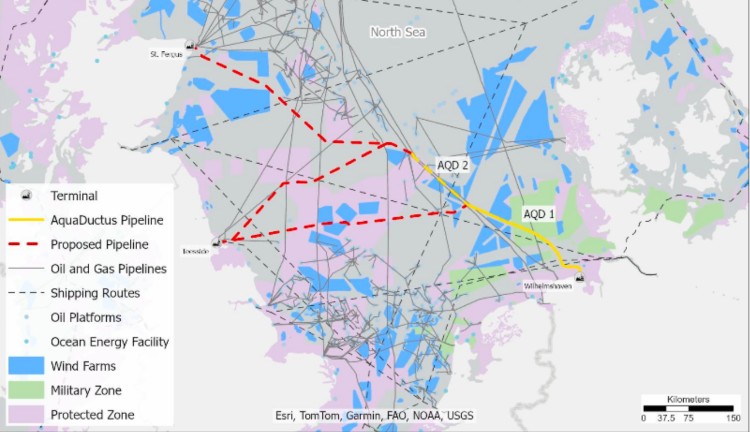
Note.
- The yellow AquaDuctus pipeline connected to the German coast near Wilhelmshaven.
- There appear to be two AquaDuctus sections ; AQD 1 and AQD 2.
- There are appear to be three proposed pipelines, which are shown in a dotted red, that connect the UK to AquaDuctus.
- The Northern proposed pipeline appears to connect to the St. Fergus gas terminal on the North-East tip of Scotland.
- The two Southern proposed pipelines appear to connect to the Easington gas terminal in East Yorkshire.
- Easington gas terminal is within easy reach of the massive gas stores, which are being converted to store hydrogen at Aldbrough and Rough.
- The blue areas are offshore wind farms.
- The blue area straddling the Southernmost proposed pipe line is the Dogger Bank wind farm, is the world’s largest offshore wind farm and could eventually total over 6 GW.
- RWE are developing 7.2 GW of wind farms between Dogger Bank and Norfolk in UK waters, which could generate hydrogen for AquaDuctus.
This cooperation seems to be getting the hydrogen Germany needs to its industry.
It should be noted, that Germany has no sizeable hydrogen stores, but the AquaVentus system gives them access to SSE’s Aldbrough and Centrica’s Rough hydrogen stores.
So will the two hydrogen stores be storing hydrogen for both the UK and Germany?
Storing hydrogen and selling it to the country with the highest need could be a nice little earner.
On X-energy
These are three paragraphs from the article.
He is also backing a £10 billion plan to build the UK’s first advanced modular reactors in a partnership with X-energy of the US.
The project is taking place in Hartlepool, in County Durham, where the existing nuclear power station is due to reach the end of its life in 2028.
As is the nature of these projects, it involves risks around technology, regulation and finance, though the potential rewards are significant. Among them is the prospect of 2,500 jobs in the town, where unemployment is high.
Note.
- This is another bold deal.
- I wrote in detail about this deal in Centrica And X-energy Agree To Deploy UK’s First Advanced Modular Reactors.
- Jobs are mentioned in the This is Money article for the second time.
I also think, if it works to replace the Hartlepool nuclear power station, then it can be used to replace other decommissioned nuclear power stations.
On Getting Your First Job
These are three paragraphs from the article.
His career got off to a slow start when he struggled to secure a training contract with an accountancy firm after leaving Glasgow University.
‘I had about 30, 40 rejection letters. I remember the stress of not having a job when everyone else did – you just feel different,’ he says.
He feels it is ‘a duty’ for bosses to try to give young people a start.
I very much agree with that. I would very much be a hypocrite, if I didn’t, as I was given good starts by two companies.
On Apprenticeships
This is a paragraph from the article.
‘We are committed to creating one new apprenticeship for every day of this decade,’ he points out, sounding genuinely proud.
I very much agree with that. My father only had a small printing business, but he was proud of the apprentices he’d trained.
On Innovation
Centrica have backed three innovative ideas.
- heata, which is a distributed data centre in your hot water tank, which uses the waste heat to give you hot water.
- HiiROC, which is an innovative way to generate affordable hydrogen efficiently.
- Highview Power, which stores energy as liquid air.
I’m surprised that backing innovations like these was not mentioned.
Conclusion
This article is very much a must read.
How Will The UK Power All These Proposed Data Centres?
On Wednesday, a cardiologist friend asked me if we have enough power to do Trump’s UK AI, so I felt this post might be a good idea.
Artificial Intelligence Gave This Answer
I first asked Google AI, the title of this post and received this reply.
The UK will power proposed data centres using a mix of grid-supplied low-carbon electricity from sources like offshore wind and through on-site renewable generation, such as rooftop solar panels. Data centre operators are also exploring behind-the-meter options, including battery storage and potential future nuclear power, to meet their significant and growing energy demands. However, the UK’s grid infrastructure and high energy prices present challenges, with industry calls for grid reform and inclusion in energy-intensive industry support schemes to facilitate sustainable growth.
Google also pointed me at the article on the BBC, which is entitled Data Centres To Be Expanded Across UK As Concerns Mount.
This is the sub-heading.
The number of data centres in the UK is set to increase by almost a fifth, according to figures shared with BBC News.
These are the first three paragraphs.
Data centres are giant warehouses full of powerful computers used to run digital services from movie streaming to online banking – there are currently an estimated 477 of them in the UK.
Construction researchers Barbour ABI have analysed planning documents and say that number is set to jump by almost 100, as the growth in artificial intelligence (AI) increases the need for processing power.
The majority are due to be built in the next five years. However, there are concerns about the huge amount of energy and water the new data centres will consume.
Where Are The Data Centres To Be Built?
The BBC article gives this summary of the locations.
More than half of the new data centres would be in London and neighbouring counties.
Many are privately funded by US tech giants such as Google and Microsoft and major investment firms.
A further nine are planned in Wales, one in Scotland, five in Greater Manchester and a handful in other parts of the UK, the data shows.
While the new data centres are mostly due for completion by 2030, the biggest single one planned would come later – a £10bn AI data centre in Blyth, near Newcastle, for the American private investment and wealth management company Blackstone Group.
It would involve building 10 giant buildings covering 540,000 square metres – the size of several large shopping centres – on the site of the former Blyth Power Station.
Work is set to begin in 2031 and last for more than three years.
Microsoft is planning four new data centres in the UK at a total cost of £330m, with an estimated completion between 2027 and 2029 – two in the Leeds area, one near Newport in Wales, and a five-storey site in Acton, north-west London.
And Google is building a data centre in Hertfordshire, an investment worth £740m, which it says will use air to cool its servers rather than water.
There is a map of the UK, with dots showing data centres everywhere.
One will certainly be coming to a suitable space near you.
Concerns Over Energy Needs
These three paragraphs from the BBC article, talk about the concerns about energy needs.
According to the National Energy System Operator, NESO, the projected growth of data centres in Great Britain could “add up to 71 TWh of electricity demand” in the next 25 years, which it says redoubles the need for clean power – such as offshore wind.
Bruce Owen, regional president of data centre operator Equinix, said the UK’s high energy costs, as well as concerns around lengthy planning processes, were prompting some operators to consider building elsewhere.
“If I want to build a new data centre here within the UK, we’re talking five to seven years before I even have planning permission or access to power in order to do that,” he told BBC Radio 4’s Today programme.
But in Renewable Power By 2030 In The UK, I calculated that by 2030 we will add these yearly additions of offshore wind power.
- 2025 – 1,235 MW
- 2026 – 4,807 MW
- 2027 – 5,350 MW
- 2028 – 4,998 MW
- 2029 – 9,631 MW
- 2030 – 15,263 MW
Note.
- I have used pessimistic dates.
- There are likely to be more announcements of offshore wind power in the sea around the UK, in the coming months.
- As an example in Cerulean Winds Submits 1 GW Aspen Offshore Wind Project In Scotland (UK), I talk about 3 GW of offshore wind, that is not included in my yearly totals.
- The yearly totals add up to a total of 58,897 MW.
For solar power, I just asked Google AI and received this answer.
The UK government aims to have between 45 and 47 gigawatts (GW) of solar power capacity by 2030. This goal is set out in the Solar Roadmap and aims to reduce energy bills and support the UK’s clean power objectives. The roadmap includes measures like installing solar on new homes and buildings, exploring solar carports, and improving access to rooftop solar for renters.
Let’s assume that we only achieve the lowest value of 45 GW.
But that will still give us at least 100 GW of renewable zero-carbon power.
What will happen if the wind doesn’t blow and the sun doesn’t shine?
I have also written about nuclear developments, that were announced during Trump’s visit.
- Centrica And X-energy Agree To Deploy UK’s First Advanced Modular Reactors
- Is Last Energy The Artemis Of Energy?
- National Grid And Emerald AI Announce Strategic Partnership To Demonstrate AI Power Flexibility In The UK
- Nuclear Plan For Decommissioned Coal Power Station
- Raft Of US-UK Nuclear Deals Ahead Of Trump Visit
- Rolls-Royce Welcomes Action From UK And US Governments To Usher In New ‘Golden Age’ Of Nuclear Energy
This is an impressive array of nuclear power, that should be able to fill in most of the weather-induced gaps.
In Renewable Power By 2030 In The UK, I also summarise energy storage.
For pumped storage hydro, I asked Google AI and received this answer.
The UK’s pumped storage hydro (PSH) capacity is projected to more than double by 2030, with six projects in Scotland, including Coire Glas and Cruachan 2, potentially increasing capacity to around 7.7 GW from the current approximately 3 GW. This would be a significant step towards meeting the National Grid’s required 13 GW of new energy storage by 2030, though achieving this depends on policy support and investment.
There will also be smaller lithium-ion batteries and long duration energy storage from companies like Highview Power.
But I believe there will be another source of energy that will ensure that the UK achieves energy security.
SSE’s Next Generation Power Stations
So far two of these power stations have been proposed.
Note.
- Both power stations are being designed so they can run on natural gas, 100 % hydrogen or a blend of natural gas and hydrogen.
- Keadby will share a site with three natural gas-powered power stations and be connected to the hydrogen storage at Aldbrough, so both fuels will be available.
- Ferrybridge will be the first gas/hydrogen power station on the Ferrybridge site and will have its own natural gas connection.
- How Ferrybridge will receive hydrogen has still to be decided.
- In Hydrogen Milestone: UK’s First Hydrogen-to-Power Trial At Brigg Energy Park, I describe how Centrica tested Brigg gas-fired power station on a hydrogen blend.
- The power stations will initially run on natural gas and then gradually switch over to lower carbon fuels, once delivery of the hydrogen has been solved for each site.
On Thursday, I went to see SSE’s consultation at Knottingley for the Ferrybridge power station, which I wrote about in Visiting The Consultation For Ferrybridge Next Generation Power Station At Knottingley.
In the related post, I proposed using special trains to deliver the hydrogen from where it is produced to where it is needed.
Could HiiROC Be Used At Ferrybridge?
Consider.
- HiiROC use a process called thermal plasma electrolysis to split any hydrocarbon gas into hydrogen and carbon black.
- Typical input gases are chemical plant off gas, biomethane and natural gas.
- Carbon black has uses in manufacturing and agriculture.
- HiiROC uses less energy than traditional electrolysis.
- There is an independent power source at Ferrybridge from burning waste, which could be used to ower a HiiROC system to generate the hydrogen.
It might be possible to not have a separate hydrogen feed and still get worthwhile carbon emission savings.
Conclusion
I believe we will have enough electricity to power all the data centres, that will be built in the next few years in the UK.
Some of the new power stations, that are proposed to be built, like some of the SMRs and SSE’s Next Generation power stations could even be co-located with data centres or other high energy users.
In Nuclear Plan For Decommissioned Coal Power Station, I describe how at the former site of Cottam coal-fired power station, it is proposed that two Holtec SMR-300 SMRs will be installed to power advanced data centres. If the locals are objecting to nuclear stations, I’m sure that an SSE Next Generation power station, that was burning clean hydrogen, would be more acceptable.
Raft Of US-UK Nuclear Deals Ahead Of Trump Visit
The title of this post, is the same as that of this article on World Nuclear News.The article is a good summary of all the deals done between the US and UK governments concerning next-generation nuclear power.
This is the introduction.
Several agreements have been signed between UK and US companies to advance the deployment of small modular reactors and advanced reactors in both countries. The deals were signed ahead of the state visit of President Donald Trump to the UK later this week.
The whole article is a must-read.
These are my posts, that are related to the main agreement.
- Centrica And X-energy Agree To Deploy UK’s First Advanced Modular Reactors
- Nuclear Plan For Decommissioned Coal Power Station
- Rolls-Royce Welcomes Action From UK And US Governments To Usher In New ‘Golden Age’ Of Nuclear Energy
I shall finish it later.
Hydrogen Milestone: UK’s First Hydrogen-to-Power Trial At Brigg Energy Park
The title of this post, is the same as that of this press release from Centrica.
This is the sub-heading.
Centrica and HiiROC, supported by the Net Zero Technology Centre (NZTC), have successfully demonstrated the injection of hydrogen into a gas-fired peak power plant at Centrica’s Brigg Energy Park, North Lincolnshire. The trial that took place last Thursday (11 September) marks a UK first in using hydrogen to decarbonise peak power generation supplying power directly to the electricity grid.
These three opening paragraphs add detail.
HiiROC’s modular hydrogen production technology, using Thermal Plasma Electrolysis (TPE), produced hydrogen on site which was then blended at a 3% ratio for the purposes of a one-hour trial.
The trial marks a further step forward in Centrica’s ongoing efforts to advance innovative solutions for the decarbonisation of its portfolio of gas plants, demonstrating that existing gas infrastructure can operate on a hydrogen blend to provide reliable, low carbon electricity to UK homes and businesses. More broadly, the trial shows a viable route for delivering on decarbonisation readiness obligations for peaker generation as part of the UK’s journey to net zero.
It is also a key milestone in HiiROC’s journey, demonstrating the effectiveness and affordability of HiiROC’s TPE process, which produces hydrogen without CO2 emissions, making it compliant with the UK’s Low Carbon Hydrogen Standard (LCHS). By leveraging the existing gas network and co-locating hydrogen production where it is needed, operators can decarbonise without costly new infrastructure.
Note.
- This test was only at a low level of hydrogen.
- Brigg power station is a 240 MW power station, which is fuelled by natural gas.
A long journey starts with a single step.
Centrica And X-energy Agree To Deploy UK’s First Advanced Modular Reactors
The title of this post, is the same as that of this press release from Centrica.
This is the sub-heading.
Centrica and X-Energy, LLC, a wholly-owned subsidiary of X-Energy Reactor Company, LLC, today announced their entry into a Joint Development Agreement (JDA) to deploy X-energy’s Xe-100 Advanced Modular Reactors (“AMR”) in the United Kingdom.
These three paragraphs add more details.
The companies have identified EDF and Centrica’s Hartlepool site as the preferred first site for a planned U.K. fleet of up to 6 gigawatts.
The agreement represents the first stage in a new trans-Atlantic alliance which could ultimately mobilise at least £40 billion in economic value to bring clean, safe and affordable power to thousands of homes and industries across the country and substantive work for the domestic and global supply chain.
A 12-unit Xe-100 deployment at Hartlepool could add up to 960 megawatts (“MW”) of new capacity, enough clean power for 1.5 million homes and over £12 billion in lifetime economic value. It would be developed at a site adjacent to Hartlepool’s existing nuclear power station which is currently scheduled to cease generating electricity in 2028. Following its decommissioning, new reactors would accelerate opportunities for the site and its skilled workforce. The site is already designated for new nuclear under the Government’s National Policy Statement and a new plant would also play a critical role in generating high-temperature heat that could support Teesside’s heavy industries.
This is no toe-in-the-water project, but a bold deployment of a fleet of small modular reactors to provide the power for the North-East of England for the foreseeable future.
These are my thoughts.
The Reactor Design
The Wikipedia entry for X-energy has a section called Reactor Design, where this is said.
The Xe-100 is a proposed pebble bed high-temperature gas-cooled nuclear reactor design that is planned to be smaller, simpler and safer when compared to conventional nuclear designs. Pebble bed high temperature gas-cooled reactors were first proposed in 1944. Each reactor is planned to generate 200 MWt and approximately 76 MWe. The fuel for the Xe-100 is a spherical fuel element, or pebble, that utilizes the tristructural isotropic (TRISO) particle nuclear fuel design, with high-assay LEU (HALEU) uranium fuel enriched to 20%, to allow for longer periods between refueling. X-energy claims that TRISO fuel will make nuclear meltdowns virtually impossible.
Note.
- It is not a conventional design.
- Each reactor is only about 76 MW.
- This fits with “12-unit Xe-100 deployment at Hartlepool could add up to 960 megawatts (“MW”) of new capacity” in the Centrica press release.
- The 960 MW proposed for Hartlepool is roughly twice the size of the Rolls-Rpoyce SMR, which is 470 MW .
- Safety seems to be at the forefront of the design.
- I would assume, that the modular nature of the design, makes expansion easier.
I have no reason to believe that it is not a well-designed reactor.
Will Hartlepool Be The First Site?
No!
This page on the X-energy web site, describes their site in Texas, which appears will be a 320 MW power station providing power for Dow’s large site.
There appear to be similarities between the Texas and Hartlepool sites.
- Both are supporting industry clustered close to the power station.
- Both power stations appear to be supplying heat as well as electricity, which is common practice on large industrial sites.
- Both use a fleet of small modular reactors.
But Hartlepool will use twelve reactors, as opposed to the four in Texas.
How Will The New Power Station Compare With The Current Hartlepool Nuclear Power Station?
Consider.
- The current Hartlepool nuclear power station has two units with a total capacity of 1,185 MW.
- The proposed Hartlepool nuclear power station will have twelve units with a total capacity of 960 MW.
- My instinct as a Control Engineer gives me the feeling, that more units means higher reliability.
- I suspect that offshore wind will make up the difference between the power output of the current and proposed power stations.
As the current Hartlepool nuclear power station is effectively being replaced with a slightly smaller station new station, if they get the project management right, it could be a painless exercise.
Will This Be The First Of Several Projects?
The press release has this paragraph.
Centrica will provide initial project capital for development with the goal of initiating full-scale activities in 2026. Subject to regulatory approval, the first electricity generation would be expected in the mid-2030s. Centrica and X-energy are already in discussions with additional potential equity partners, as well as leading global engineering and construction companies, with the goal of establishing a UK-based development company to develop this first and subsequent projects.
This approach is very similar to the approach being taken by Rolls-Royce for their small modular reactors.
Will Centrica Use An X-energy Fleet Of Advanced Modular Reactors At The Grain LNG Terminal?
This press release from Centrica is entitled Investment In Grain LNG Terminal.
This is one of the key highlights of the press release.
Opportunities for efficiencies to create additional near-term value, and future development options including a combined heat and power plant, bunkering, hydrogen and ammonia.
Note.
- Bunkering would be provided for ships powered by LNG, hydrogen or ammonia.
- Heat would be needed from the combined heat and power plant to gasify the LNG.
- Power would be needed from the combined heat and power plant to generate the hydrogen and ammonia and compress and/or liquify gases.
Currently, the heat and power is provided by the 1,275 MW Grain CHP gas-fired power station, but a new nuclear power station would help to decarbonise the terminal.
Replacement Of Heysham 1 Nuclear Power Station
Heysham 1 nuclear power station is part-owned by Centrica and EdF, as is Hartlepool nuclear power station.
Heysham 1 nuclear power station is a 3,000 MW nuclear power station, which is due to be decommissioned in 2028.
I don’t see why this power station can’t be replaced in the same manner as Hartlepool nuclear power station.
Replacement Of Heysham 2 Nuclear Power Station
Heysham 2 nuclear power station is part-owned by Centrica and EdF, as is Hartlepool nuclear power station.
Heysham 2 nuclear power station is a 3,100 MW nuclear power station, which is due to be decommissioned in 2030.
I don’t see why this power station can’t be replaced in the same manner as Hartlepool nuclear power station.
Replacement Of Torness Nuclear Power Station
Torness nuclear power station is part-owned by Centrica and EdF, as is Hartlepool nuclear power station.
Torness nuclear power station is a 1,290 MW nuclear power station, which is due to be decommissioned in 2030.
I don’t see why this power station can’t be replaced in the same manner as Hartlepool nuclear power station.
But the Scottish Nationalist Party may have other ideas?
What Would Be The Size Of Centrica’s And X-energy’s Fleet Of Advanced Modular Reactors?
Suppose.
- Hartlepool, Grain CHP and Torness power stations were to be replaced by identical 960 MW ADRs.
- Heysham 1 and Heysham 2 power stations were to be replaced by identical 1,500 MW ADRs.
This would give a total fleet size of 5,880 MW.
A paragraph in Centrica’s press release says this.
The companies have identified EDF and Centrica’s Hartlepool site as the preferred first site for a planned U.K. fleet of up to 6 gigawatts.
This fleet is only 120 MW short.
 The Anonymous Widower