What Is Possible On The East Coast Main Line?
In the Wikipedia entry for the Class 91 locomotive, there is an amazing story.
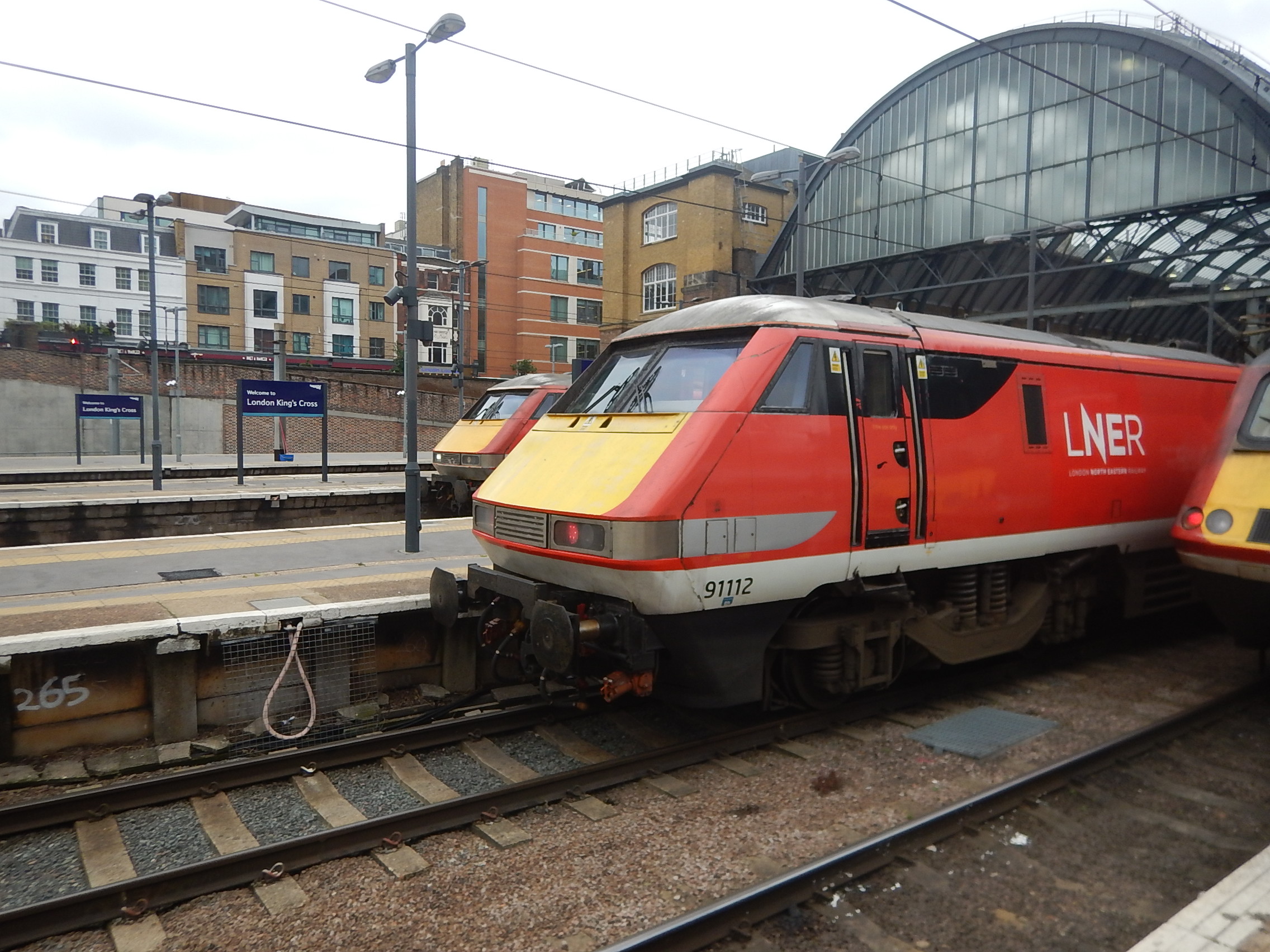
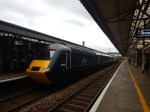
This picture shows one of these locomotives at Kings Cross.
Note.
- They have a design speed of 140 mph.
- They have a power output of 4.8 MW.
- They were built around 1990 by British Rail at Crewe.
They were designed to run services between London King’s Cross and Edinburgh as fast as possible, as the motive power of the InterCity 225 trains.
This section in the Wikipedia entry for the Class 91 locomotive is entitled Speed Record. This is the first paragraph.
A Class 91, 91010 (now 91110), holds the British locomotive speed record at 161.7 mph (260.2 km/h), set on 17 September 1989, just south of Little Bytham on a test run down Stoke Bank with the DVT leading. Although Class 370s, Class 373s and Class 374s have run faster, all are EMUs which means that the Electra is officially the fastest locomotive in Britain. Another loco (91031, now 91131), hauling five Mk4s and a DVT on a test run, ran between London King’s Cross and Edinburgh Waverley in 3 hours, 29 minutes and 30 seconds on 26 September 1991. This is still the current record. The set covered the route in an average speed of 112.5 mph (181.1 km/h) and reached the full 140 mph (225 km/h) several times during the run.
Note.
- For the British locomotive speed record, locomotive was actually pushing the train and going backwards, as the driving van trailer (DVT) was leading.
- How many speed records of any sort, where the direction isn’t part of the record, have been set going backwards?
- I feel that this record could stand for many years, as it is not very likely anybody will build another 140 mph locomotive in the foreseeable future. Unless a maverick idea for a high speed freight locomotive is proposed.
I have a few general thoughts on the record run between Kings Cross and Edinburgh in three-and-a-half hours.
- I would assume that as in normal operation of these trains, the Class 91 locomotive was leading on the run to the North.
- For various reasons, they would surely have had at least two of British Rail’s most experienced drivers in the cab.
- At that time, 125 mph InterCity 125 trains had been the workhorse of East Coast Main Line for well over ten years, so British Rail wouldn’t have been short of experienced high speed drivers.
- It was a Thursday, so they must have been running amongst normal traffic.
- On Monday, a typical run between Kings Cross and Edinburgh is timetabled to take four hours and twenty minutes.
- High Speed Two are predicting a time of three hours and forty-eight minutes between Euston and Edinburgh via High Speed Two and the West Coast Main Line.
The more you look at it, a sub-three-and-and-a-half hour time, by 1980s-technology on a less-than-perfect railway was truly remarkable.
So how did they do it?
Superb Timetabling
In Norwich-In-Ninety Is A Lot More Than Passengers Think!, I talk about how Network Rail and Greater Anglia created a fast service between Liverpool Street and Norwich.
I suspect that British Rail put their best timetablers on the project, so that the test train could speed through unhindered.
Just as they did for Norwich-in-Ninety and probably will be doing to the East Coast Main Line to increase services and decrease journey times.
A Good As ERTMS Signalling
Obviously in 1991, there was no modern digital in-cab signalling and I don’t know the standard of communication between the drivers and the signallers.
On the tricky sections like Digswell Viaduct, through Hitchin and the Newark Crossing were other trains stopped well clear of any difficult area, as modern digital signalling can anticipate and take action?
I would expect the test train got a signalling service as good as any modern train, even if parts of it like driver to signaller communication may have been a bit experimental.
There may even have been a back-up driver in the cab with the latest mobile phone.
It must have been about 1991, when I did a pre-arranged airways join in my Cessna 340 on the ground at Ipswich Airport before take-off on a direct flight to Rome. Air Traffic Control had suggested it to avoid an intermediate stop at say Southend.
The technology was arriving and did it help the drivers on that memorable run North ensure a safe and fast passage of the train?
It would be interesting to know, what other equipment was being tested by this test train.
A Possible Plan
I suspect that the plan in 1991 was to use a plan not unlike one that would be used by Lewis Hamilton, or in those days Stirling Moss to win a race.
Drive a steady race not taking any chances and where the track allows speed up.
So did British Rail drive a steady 125 mph sticking to the standard timetable between Kings Cross and Edinburgh?
Then as the Wikipedia extract indicated, at several times during the journey did they increase the speed of the train to 140 mph.
And the rest as they say was an historic time of 3 hours, 29 minutes and 30 seconds. Call it three-and-a-half-hours.
This represented a start-to-stop average speed of 112.5 mph over the 393 miles of the East Coast Main Line.
Can The Current Trains Achieve Three-And-A-Half-Hours Be Possible Today?
Consider.
- The best four hours and twenty minutes timings of the Class 801 trains, represents an average speed of 90.7 mph.
- The Class 801 trains and the InterCity 225 trains have similar performance.
- There have been improvements to the route like the Hitchin Flyover.
- Full ERTMS in-cab signalling is being installed South of Doncaster.
- I believe ERTMS and ETC could solve the Newark Crossing problem! See Could ERTMS And ETCS Solve The Newark Crossing Problem?
- I am a trained Control Engineer and I believe if ERTMS and ETC can solve the Newark Crossing problem, I suspect they can solve the Digswell Viaduct problem.
- The Werrington Dive Under is being built.
- The approaches to Kings Cross are being remodelled.
I can’t quite say easy-peasy. but I’m fairly certain the Kings Cross and Edinburgh record is under serious threat.
- A massive power supply upgrade to the North of Doncaster is continuing. See this page on the Network Rail web site.
- ERTMS and ETC probably needs to be installed all the way between Kings Cross and Edinburgh.
- There may be a need to minimise the number of slower passenger trains on the East Coast Main Line.
- The Northumberland Line and the Leamside Line may be needed to take some trains from the East Coast Main Line.
Recent Developments Concerning the Hitachi Trains
There have been several developments since the Hitachi Class 800 and Class 801 trains were ordered.
- Serious engineers and commentators like Roger Ford of Modern Railways have criticised the lugging of heavy diesel engines around the country.
- Network Rail have upgraded the power supply South of Doncaster and have recently started to upgrade it between Doncaster and Edinburgh. Will this extensive upgrade cut the need to use the diesel power-packs?
- Hitachi and their operators must have collected extensive in-service statistics about the detailed performance of the trains and the use of the diesel power-packs.
- Hitachi have signed an agreement with Hyperdrive Innovation of Sunderland to produce battery-packs for the trains and two new versions of the trains have been announced; a Regional Battery Train and an Intercity Tri-Mode Battery Train.
- East Coast Trains have ordered five five-car Class 803 trains, each of which will have a small battery for emergency use and no diesel power-packs.
- Avanti West Coast have ordered ten seven-car Class 807 trains, each of which have no battery or diesel power-packs.
And these are just the ones we know about.
The Class 807 Trains And Liverpool
I find Avanti West Coast’s Class 807 trains the most interesting development.
- They have been partly financed by Rock Rail, who seem to organise train finance, so that the train operator, the train manufacturer all get the best value, by finding good technical solutions.
- I believe that these trains have been designed so they can run between Euston and Liverpool Lime Street stations in under two hours.
- Does the absence of battery or diesel power-packs save weight and improve performance?
- Euston and Liverpool Lime Street in two hours would be an average of only 96.8 mph.
- If the Class 807 trains could achieve the same start-stop average of 112.5 mph achieved by the InterCity 225 test run between Kings Cross and Edinburgh, that would mean a Euston and Liverpool Lime Street time of one hour and forty-three minutes.
- Does Thunderbird provision on the West Coast Main Line for the Class 390 trains mean that the Class 807 trains don’t need emergency power?
- Have diesel power-packs been rarely used in emergency by the Hitachi trains?
I believe the mathematics show that excellent sub-two hour times between Euston and Liverpool Lime Street are possible by Avanti West Coast’s new Class 807 trains.
The Class 803 Trains And Edinburgh
East Coast Trains ordered their Class 803 trains in March 2019, nine months before Avanti West Coast ordered their Class 807 trains.
In Trains Ordered For 2021 Launch Of ‘High-Quality, Low Fare’ London – Edinburgh Service, I outlined brief details of the trains and the proposed service.
- FirstGroup is targeting the two-thirds of passengers, who fly between London and Edinburgh.
- They are also targeting business passengers, as the first train arrives in Edinburgh at 10:00.
- The trains are five-cars.
- The trains are one class with onboard catering, air-conditioning, power sockets and free wi-fi.
- Stops will be five trains per day with stops at Stevenage, Newcastle and Morpeth.
- The trains will take around four hours.
- The service will start in Autumn 2021.
I also thought it would be a successful service
As I know Edinburgh, Liverpool and London well, I believe there are similarities between the Euston-Liverpool Lime Street and Kings Cross-Edinburgh routes.
- Both routes are between two cities known all over the world.
- Both routes are fully-electrified.
- Both routes have the potential to attract passengers from other transport modes.
The two services could even be run at similar speeds.
- Euston-Liverpool Lime Street in two hours will be at 96.8 mph
- Kings Cross-Edinburgh in four hours will be at 98.3 mph.
Does this explain the similar lightweight trains?
Could Lightweight Trains Help LNER?
There is one important factor, I haven’t talked about in detail in this post. Batteries and diesel power-packs on the Hitachi trains.
I have only mentioned them in the following circumstances.
- When trains are not fitted with battery and/or diesel power-packs.
- When battery developments are being undertaken.
Let’s consider the LNER fleet.
- LNER has thirteen nine-car Class 800 trains, each of which has five diesel power-packs
- LNER has ten five-car Class 800 trains, each of which has three diesel power-packs
- LNER has thirty nine-car Class 801 trains, each of which has one diesel power-pack
- LNER has twelve five-car Class 801 trains, each of which has one diesel power-pack
There are sixty-five trains, 497 coaches and 137 diesel power-packs.
And look at their destinations.
- Aberdeen – No Electrification from Edinburgh
- Alnmouth – Fully Electrified
- Berwick-upon-Tweed – Fully Electrified
- Bradford Forster Square – Fully Electrified
- Darlington – Fully Electrified
- Doncaster – Fully Electrified
- Durham – Fully Electrified
- Edinburgh – Fully Electrified
- Glasgow – Fully Electrified
- Grantham – Fully Electrified
- Harrogate – No Electrification from Leeds – Possible Battery Destination
- Huddersfield – No Electrification from Leeds – Possible Battery Destination – Probable Electrification
- Hull – No Electrification from Temple Hirst Junction – Possible Battery Destination
- Inverness – No Electrification from Stirling
- Leeds – Fully Electrified
- Lincoln – No Electrification from Newark North Gate – Possible Battery Destination
- Middlesbrough – No Electrification from Northallerton – Possible Battery Destination
- Newcastle – Fully Electrified
- Newark North Gate – Fully Electrified
- Northallerton – Fully Electrified
- Peterborough – Fully Electrified
- Skipton – Fully Electrified
- Retford – Fully Electrified
- Stevenage – Fully Electrified
- Stirling – Fully Electrified
- Sunderland – No Electrification from Northallerton – Possible Battery Destination
- Wakefield Westgate – Fully Electrified
- York – Fully Electrified
The destinations can be summarised as followed.
- Not Electrified – 2
- Possible Battery Destination – 6
- Fully Electrified – 20
This gives a total of 28.
Could the trains be matched better to the destinations?
- Some routes like Edinburgh, Glasgow, Newcastle and Stirling could possibly be beneficially handled by lightweight trains without any diesel or battery power-packs.
- Only Aberdeen and Inverness can’t be reached by all-electric or battery-electric trains.
- In LNER Seeks 10 More Bi-Modes, I proposed a hydrogen-electric flagship train, that would use hydrogen North of the existing electrification.
There certainly appear to be possibilities.
Example Journey Times To Edinburgh
This table shows the various time for particular start-stop average speeds between Kings Cross and Edinburgh.
- 80 mph – 4:54
- 85 mph – 4:37
- 90 mph – 4:12
- 98.2 mph – 4:00
- 100 mph – 3:56
- 110 mph – 3:34
- 120 mph – 3:16
- 125 mph – 3:08
Note.
- Times are given in h:mm.
- A few mph increase in average speed reduces journey time by a considerable amount.
The figures certainly show the value of high speed trains and of removing bottlenecks, as average speed is so important.
Decarbonisation Of LNER
LNER Seeks 10 More Bi-Modes was based on an article in the December 2020 Edition of Modern Railways, with the same title. These are the first two paragraphs of the article.
LNER has launched the procurement of at least 10 new trains to supplement its Azuma fleet on East Coast main line services.
In a Prior Information Notice published on 27 October, the operator states it is seeking trains capable of operating under 25kW overhead power with ‘significant self-power capability’ for operation away from overhead wires. ‘On-board Energy Storage for traction will be specified as a mandatory requirement to reduce, and wherever practical eliminate, diesel usage where it would otherwise be necessary, although LNER anticipates some degree of diesel traction may be required to meet some self-power requirements. Suppliers tendering are asked to detail their experience of designing and manufacturing a fleet of multi-mode trains with a range of traction options including battery-electric, diesel-electric, hydrogen-electric, battery-diesel, dual fuel and tri-mode.
From this, LNER would appear to be serious about decarbonisation and from the destination list I published earlier, most services South of the Scottish Central Belt can be decarbonised by replacing diesel-power packs with battery power-packs.
That last bit, sounds like a call for innovation to provide a solution to the difficult routes to Aberdeen and Inverness. It also looks as if it has been carefully worded not to rule anybody out.
This press release from Hitachi is entitled Hitachi And Eversholt Rail To Develop GWR Intercity Battery Hybrid Train – Offering Fuel Savings Of More Than 20%.
It announces the Hitachi Intercity Tri-mode Battery Train, which is described in this Hitachi infographic.

As the Hitachi press release is dated the 15th of December 2020, which is after the publication of the magazine, it strikes me that LNER and Hitachi had been talking.
At no point have Hitachi stated what the range of the train is on battery power.
To serve the North of Scotland these gaps must be bridged.
- Aberdeen and Edinburgh Haymarket – 130 miles
- Inverness and Stirling – 146 miles
It should also be noted that distances in Scotland are such, that if these gaps could be bridged by battery technology, then probably all of the North of Scotland’s railways could be decarbonised. As Hitachi are the major supplier of Scotland’s local and regional electric trains, was the original Prior Information Notice, written to make sure Hitachi responded?
LNER run nine-car Class 800 trains on the two long routes to Aberdeen and Inverness.
- These trains have five diesel power-packs under coaches 2,3, 5, 7 and 8.
- As five-car Class 800 trains have diesel power-packs under coaches 2, 3 and 4, does this mean that Hitachi can fit diesel power-packs under all cars except for the driver cars?
- As the diesel and battery power-packs appear to be interchangeable, does this mean that Hitachi could theoretically build some very unusual trains?
- Hitachi’s trains can be up to twelve-cars in normal mode and twenty-four cars in rescue mode.
- LNER would probably prefer an all Azuma fleet, even if a few trains were a bit longer.
Imagine a ten-car train with two driver and eight intermediate cars, with all of the intermediate cars having maximum-size battery-packs.
Supposing, one or two of the battery power-packs were to be replaced with a diesel power-pack.
There are a lot of possibilities and I suspect LNER, Hitachi and Hyperdrive Innovation are working on a train capable of running to and from the North of Scotland.
Conclusion
I started by asking what is possible on The East Coast Main Line?
As the time of three-and-a-half hours was achieved by a short-formation InterCity 225 train in 1991 before Covids, Hitchin, Kings Cross Remodelling, Power Upgrades, Werrington and lots of other work, I believe that some journeys between Kings Cross and Edinburgh could be around this time within perhaps five years.
To some, that might seem an extraordinary claim, but when you consider that the InterCity 225 train in 1991 did it with only a few sections of 140 mph running, I very much think it is a certainly at some point.
As to the ultimate time, earlier I showed that an average of 120 mph between King’s Cross and Edinburgh gives a time of 3:16 minutes.
Surely, an increase of fourteen minutes in thirty years is possible?
Dartmoor Rail Service Reopens This Year In Reversal Of Beeching Cuts
The title of this post is the same as that of this article on The Times.
This is the introductory paragraph.
A largely redundant Victorian railway line will be reopened this year as part of plans to resurrect routes closed in the infamous Beeching cuts.
This line was always likely to be one of the first to reopen, as there is a terminal station at Okehampton, with a bus interchange and other facilities, that has been hosting a service from Exeter on summer Sundays for some years.
The BBC have a reporter there this morning and the station looks in better condition, than some I could name.
This paragraph from The Times describes works to be done.
Network Rail said engineers would start a range of works including improvements to drainage, fencing by the trackside, rebuilding embankments and upgrading Okehampton station. Some 11 miles of track will also be replaced. It is envisaged that test trains will run later this year before it fully reopens to passengers.
Some of the BBC footage, showed a great pile of new track by the station, so it looks like Network Rail are starting to relay the track.
It is hoped to run a one train per two hour service by the end of the year, which could go hourly next year.
In Okehampton Railway Return ‘Clear Reality’ After £40m Commitment In Budget, I said more about this reopening project and I speculated that both Okehampton and Barnstaple services will terminate at Exmouth Junction, as the Barnstaple services do now.
Barnstaple has roughly an hourly service from Exeter and to run two hourly services between Exeter and Coleford Junction, where the two routes divide, may need extra work to be done, so that trains can pass each other at convenient points.
This extra work probably explains, why the service won’t be hourly until next year.
I do wonder, if this reopening also enables other improvement and possibilities.
Meldon Quarry
Meldon Quarry used to be an important source of track ballast for British Rail and it is situated a few miles past Okehampton.
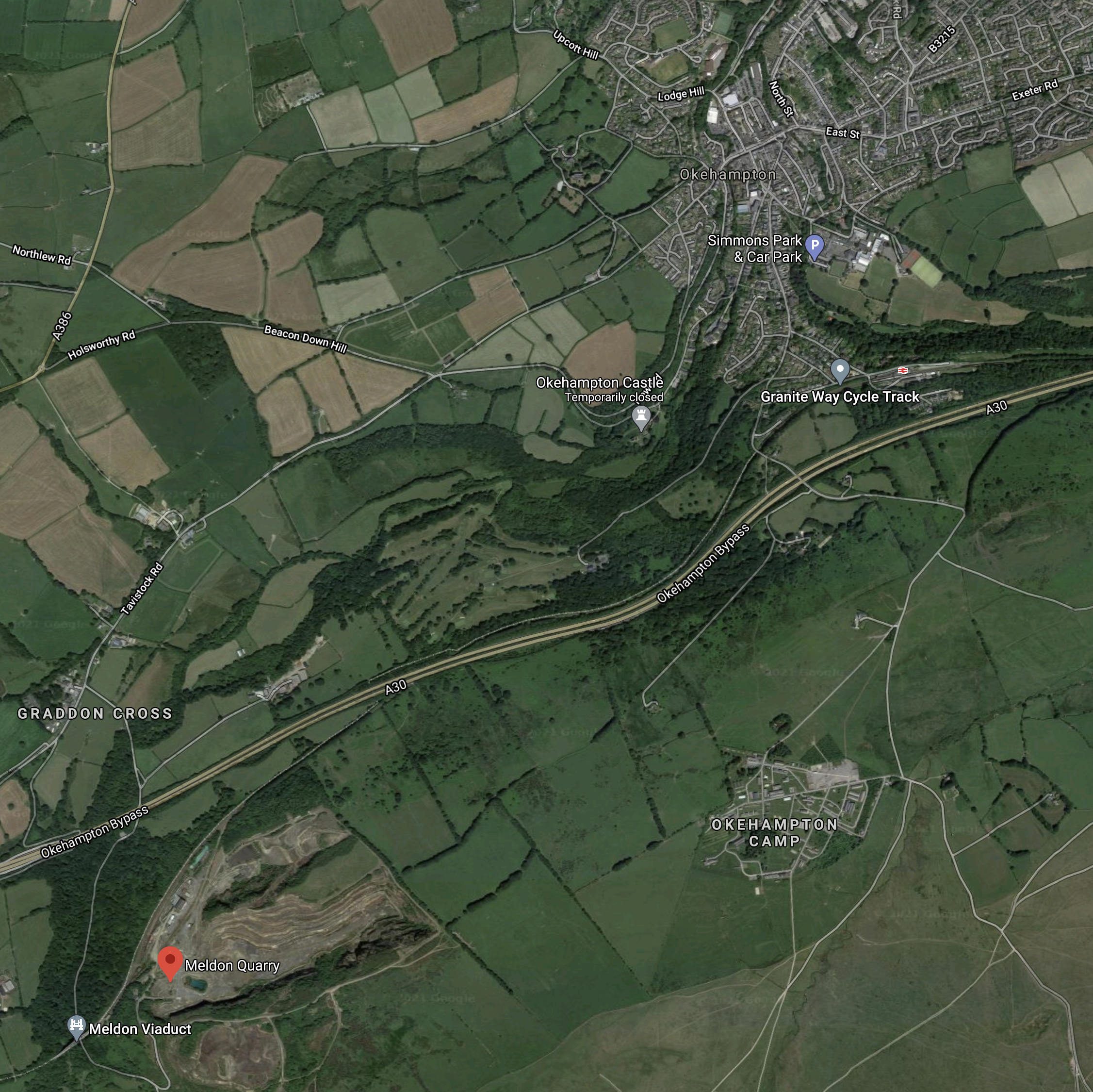
This Google Map shows Meldon Quarry and Okehampton.
Note.
- Meldon Quarry is in the South-West corner of the map marked by a red marker.
- To its West is Meldon Viaduct, which is part of the old railway line between Okehampton and Plymouth, which is now a walking and cycling route.
- The town of Okehampton is in the North-East of the map.
- Okehampton station is in the South-East of the town close to the A 30.
I wouldn’t be surprised to find, that Network Rail are upgrading the line to Okehampton, so that if they need to obtain quality track ballast from Meldon Quarry, it would not require upgrades to the track East of Okehampton.
Okehampton Camp
Note Okehampton Camp to the South of Okehampton.
Many Army bases like this one need heavy vehicles to be transported to and from the base.
Have Network Rail future-proofed the design of the route to Okehampton, so that heavy vehicles can be transported to the area?
A Railhead For North Devon And North Cornwall
There are two main roads between Exeter and Cornwall.
- The A30 goes to the North of Dartmoor and via Launceston
- The A38 goes to the South of Dartmoor and then via Plymouth
In the past, I’ve always driven to and from Cornwall via the Northern route and I describe one journey in Dancing with Hippopotami.
This Google Map shows the A30, as it passes Okehampton.
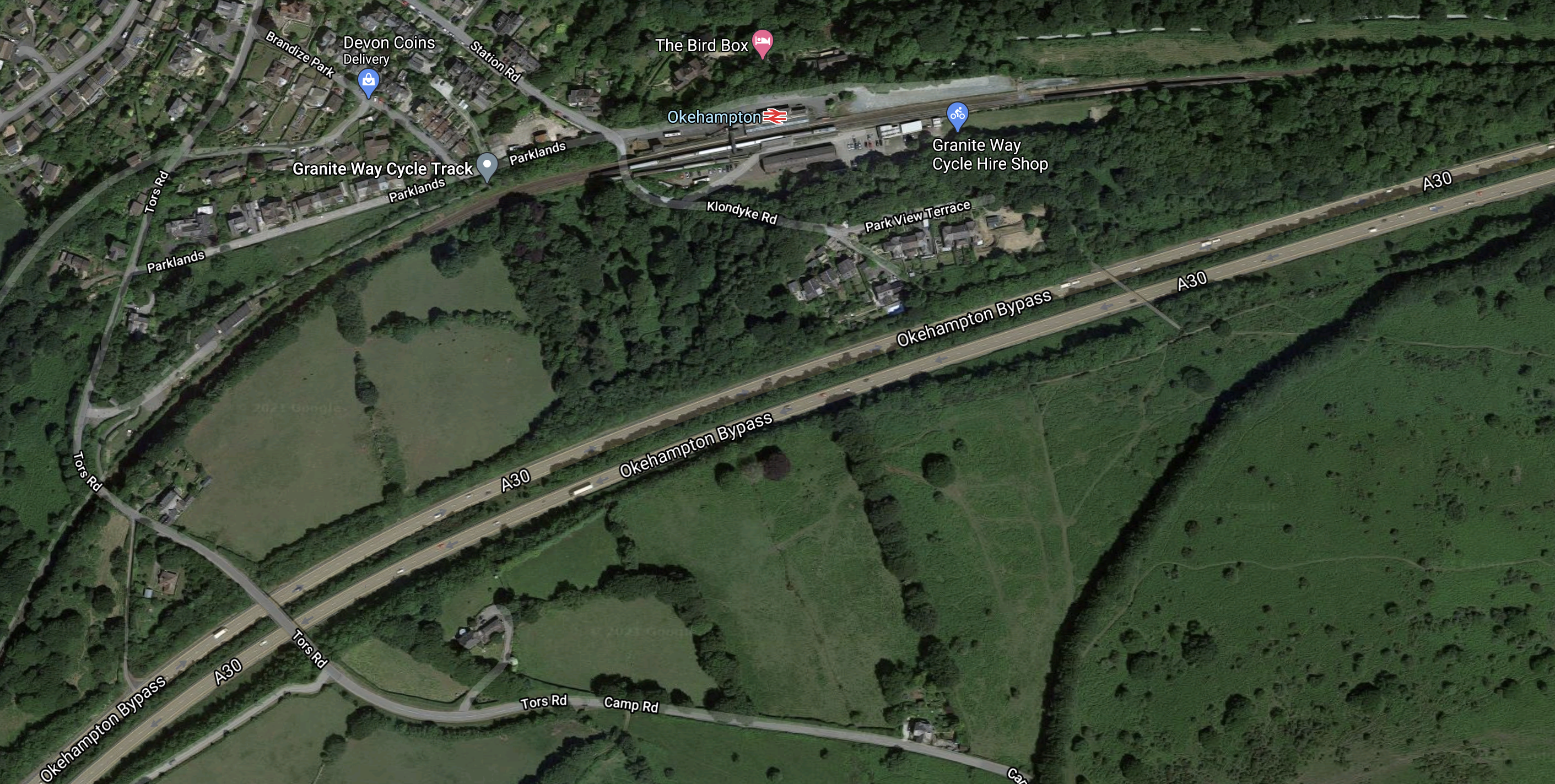
Note that although the station and the A30 are physically close, there would be a few minutes to drive between the two.
But I do feel there is scope to create an appropriate transport interchange between.
- Trains to and from Exeter.
- Buses and coaches to North Cornwall and North Devon.
- Cars on the A30.
It could effectively become a parkway station.
An Alternative Route In Case Of Trouble Or Engineering Works At Dawlish
Bodmin Parkway and Okehampton stations are about 43 miles apart and I suspect a coach could do the journey in around fifty minutes.
Would this be a sensible alternative route in times of disruption?
- It is dual-carriageway all the way.
- Okehampton station can certainly handle a five-car Class 802 train and could probably be improved to handle a nine- or even ten-car train.
- Trains from London could get to Okehampton with a reverse at Exeter St. Davids.
I don’t know the area well, but it must be a possibility.
Could Okehampton Have A London Service?
As I said in the previous section, it looks like Okehampton station can handle five-, nine- and possibly ten-car Class 802 trains and there are many pictures of Great Western Railway’s InterCity 125s or HSTs at Okehampton station in years gone by.
I think it would be feasible to run a small number of services between Okehampton and London.
- The service would have to reverse at Exeter St. Davids station.
- As one service every two hours runs between London Paddington and Exeter St. Davids stations, a service to Okehampton could be run as an extension to the current Exeter service.
- It could also stop at Crediton station.
There must also be the possibility of running a pair of five car trains from Paddington, that split at Exeter St. Davids, with one service going to Okehampton and the second one to Paignton.
- Exeter St. Davids and Paignton are 26.3 miles apart and a fast train takes 34 minutes
- Exeter St. Davids and Okehampton are probably a slightly shorter distance.
I suspect that a sensible timetable could be devised.
The specification of the Hitachi InterCity Tri-Mode Train is given in this Hitachi infographic.
Note.
- It is intended to run these trains to Exeter, Plymouth and Penzance.
- The range of the train on batteries is not given.
These trains could use a mixture of diesel and battery power to travel to and from Okehampton and Paignton.
But I also believe that as Hitachi develop this train and batteries have an increased capacity, that it will be possible for the trin to do a round trip from Exeter to Okehampton or Paignton without using diesel, provided the train can leave Exeter with a full battery.
According to Hitachi’s infographic, the train will take 10-15 minutes to fully charge at a station like Exeter. But that would add up to fifteen minutes to the timetable.
I feel if the roughly thirty-five miles of track between Exeter St Davids station and Cogload Junction, which is to the North of Taunton, were to be electrified, then this would mean.
- Trains would be fully charged for their excursions round Devon.
- Trains would be fully charged for onward travel to Plymouth and Penzance.
- Trains going to London would leave Taunton with full batteries to help them on their way on the ninety mile stretch without electrification to Newbury.
- Trains going between Exeter and Bristol could take advantage of the electrification.
Eventually, this section of electrification might even help to enable trains to run between London and Exeter without using diesel.
As the railway runs alongside the M5 Motorway, this might ease planning for the electrification.
The gap in the electrification between Cogload Junction and Newbury could be difficult to bridge without using diesel.
- Cogload Junction and Newbury are 85 miles apart.
- I’ve never seen so many bridges over a railway.
- I actually counted twenty-one bridges on the twenty miles between Westbury and Pewsey stations.
- I suspect some will object, if some of the bridges are replaced with modern ones.
- There would be a lot of disruption and expense, if a large proportion of these bridges were to be replaced.
- Currently, Great Western Railway run expresses to Exeter, Plymouth and Penzance via Taunton and Newbury.
I think, there needs to be some very radical thinking and low cunning to solve the problem.
- Battery technology and the best efforts of engineers from Hitachi and Hyperdrive Innovation may stretch the battery range sufficiently.
- It might be possible to extend the electrification at the Newbury end to perhaps Bedwyn, as there are only a few bridges. This would shorten the distance by up to thirteen miles.
- It may also be possible to extend the electrification at the Taunton end.
- I would expect some bridges could be dealt with using discontinuous electrification techniques.
But I believe that full electrification between Newbury and Cogload junction might be an extremely challenging project.
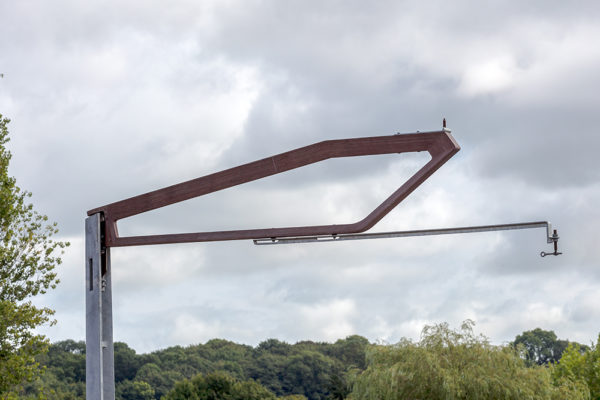
There must also be the possibility of using lightweight overhead line structures, where challenges are made about inappropriate overhead gantries.
There is also a video.
Note.
- Electrification doesn’t have to be ugly and out-of-character with the surroundings.
- The main overhead structure of this gantry is laminated wood.
These gantries would surely be very suitable for the following.
- Electrifying secondary routes and especially scenic ones.
- Electrifying single lines and sidings.
- Electrifying a bay platform, so that battery electric trains could be charged.
Innovative design could be one of the keys to more electrification.
‘Staycation Express’ To Return Along Full Length of S & C
The title of this post, is the same as that of this article on Rail Magazine.
These are the first three paragraphs,
This year’s ‘Staycation Express’ will use a refurbished High Speed Train and run the full length of the Settle-Carlisle Line.
The final plans are being confirmed by Rail Charter Services, which last year used locomotive-hauled trains between Skipton and Appleby. This year, the plan is for the HST to operate the 0930 Appleby-Skipton, 1130 Skipton-Carlisle, 1500 Carlisle-Skipton and 1730 Skipton-Appleby, although the timings are yet to be finalised.
The trains will run daily except for Fridays between mid-July and early September (dates still to be determined).
Full details will be published by Rail Charter Services in April, but after last year’s success a second year of services is not a surprise.
I wouldn’t be surprised to see Locomotive Services Ltd. supplying the rolling stock, as they have recently recreated the Blue Pullman using a redundant InterCity 125.
Thoughts On Mass Vaccination
We should steal an idea from the French.
In the first wave of the virus, they had to move seriously ill patients all over the country and to Germany, where there was bed space.
So they converted a TGV to a hospital train.
This page on the SNCF web site, is entitled Covid-10: Behind the Scenes Of Our High-Speed Hospital Train.
Could we not create a Vaccination Train using one of the recently withdrawn InterCity 125s?
They are easily shortened to any convenient length and the carriages have a very smooth ride.
The French converted their hospital train in 48 hours, so surely we can do as well!
The trains have the advantage, that they are certified go to over ninety percent of UK main line railway stations.
Network Rail have a track inspection train, called the New Measurement Train, that works a pattern all over the UK. It is based on an InterCity 125 and is full of delicate instruments, designed to keep the railways of the UK safe.

The picture shows Network Rail’s New Measurement Train at Westbury station.
The Vaccination Train or Trains could be based at a convenient central location, where the vaccine would be safely stored.
- Trains would be loaded overnight with the vaccine and other stores and locate early to their site for the day.
- Sites would typically be stations, where a platform existed that was long enough for the train.
- Staff to both process the vaccine and treat patients could either go on the train or be drawn from local medical staff, or be a mixture of the two.
- Specialists handling the vaccine would probably come from the centre, as this would ensure totally correct handling of the vaccine.
- They would set up at a suitable site and handle the patients booked for the day.
- Injections could even take place on the train, in specially fitted out carriages.
I would think, that the train would be self contained and generate all its own electricity.
DfT and Arriva CrossCountry Sign Agreement
The title of this post, is the same as that of this article on Railway News.
This is the introductory paragraph.
The franchisee CrossCountry, which is owned by Arriva, has signed a three-year agreement with the Department for Transport to bring the franchise in line with the Emergency Recovery Measures Agreements (ERMAs).
CrossCountry has the following trains in its fleet.
34 x Class 220 trains
24 x Class 221 trains
This gallery shows Class 220 trains and the closely related Class 222 trains, which are in service with East Midlands Railways.


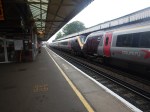
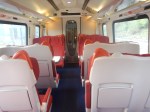
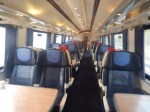
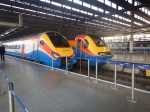
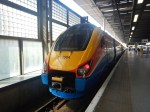
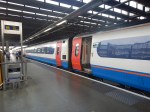
Note that these three fleets of Bombadier Voyager trains are now twenty years old and will probably need a makeover soon.
If they have a problem it is that they are diesel multiple units and create a lot of noise and pollution in stations and depots.
This is said in the Railway News article.
One element of this new contract is a focus on reducing the environmental impact of the operator’s diesel fleet.
, Two separate projects are mentioned.
- Using a separate electrical supply to Turbostars during cleaning.
- Use of on-train batteries on the Voyagers in stations.
In Have Bombardier Got A Cunning Plan For Voyagers?, I gave my thoughts on the second project, when Bombardier proposed it in 2018.
I can see the following scenario happening.
- When the new Class 805 trains are delivered, Avanti West Coast’s Class 220 trains are transferred to Arriva CrossCountry.
- When the new Class 810 trains are delivered, East Midland Railway’s Class 222 trains are transferred to Arriva CrossCountry.
- CrossCountry update their Voyagers with batteries.
- CrossCountry retire their InterCity 125 trains.
CrossCountry may have enough trains to run a mainly Voyager fleet, backed up by a few Turbostars.
Could Bombardier’s Plan Be Revived In A Different Form?
If CrossCountry had all the Voyages, they would have the following fleet.
- 34 x four-car Class 220 trains – Currently with CrossCountry.
- 20 x five-car Class 221 trains – Currently with Avanti West Coast
- 20 x five-car Class 221 trains – Currently with CrossCountry
- 4 x four-car Class 221 trains – Currently with CrossCountry
- 6 x seven-car Class 222 trains – Currently with East Midlands Trains
- 17 x five-car Class 222 trains – Currently with East Midlands Trains
- 4 x four-car Class 222 trains – Currently with East Midlands Trains
This totals to eighty-five trains with a total of 285 intermediate cars, of which 128 were built with tilt for Class 221 trains.
Currently CrossCountry has a total of 58 four- and five-car Voyagers and enough Class 43 power cars for six InterCity 125 trains.
If they rearranged the non-tilting intermediate cars of the Voyagers, 157 intermediate cars is enough for one of the following.
- 78 – four-car trains
- 52 – five-car trains
- 39 – six-car trains
- 26 – eight-car trains
- 22 – nine-car trains
Add in forty five-car Class 221 trains and there is more than enough trains for CrossCountry to run their current services without the retired InterCity 125s.
CrossCountry would also be able to form the trains into the lengths they needed for efficient services.

This formation photographed at Basingstoke could be formed of a single train, if they wished, as they have more than enough coaches.
I suspect in true design engineering fashion, engineers at CrossCountry have got the toy trains or Lego bricks out to shuffle the coaches on a big table to see what are the best train lengths for their network.
If they decided to go the eight-car route, which could give up to twenty-six trains, this would be more than enough to be able to retire the InterCity 125s.
Could one of the Intermediate cars be converted into a pantograph and battery car?
- If the diesel engine and the associated gubbins were to be removed, this would save around two tonnes in weight.
- A two-tonne battery could probably have a capacity of 200 kWh.
- Bombardier probably have ideas about how a car could be converted.
Someone could have a lot of fun playing musical carriages and the following trains could be created.
- A fleet of Voyager bi-mode trains of optimum length for CrossCountry’s route network.
- Most services would be run by single trains, which must give advantages to the operator, their staff and passengers.
- All braking would be regenerative braking to battery to save energy.
- Where electrification exists, the trains could use it.
- All station stops would be performed on battery power.
There might even be some left over driving cars and some intermediate cars to be converted into battery electric trains for another route.
Conclusion
There is a route there for CrossCountry to have a much more environmentally-friendly fleet, better suited to their needs
- The Turbostars would be given a local electricity supply to cut noise and pollution during overnight cleaning.
- The InterCity 125s would be retired.
- CrossCountry acquires as many Voyagers as it needs after Avanti West Coast and East Midlands Railway get their new trains.
- The Voyagers carriages would be shuffled so that they could handle all routes and replace the InterCity 125s.
- The design exists to convert the Voyagers into diesel-electric-battery tri-mode high speed trains.
Note.
- There are enough trains to do a gradual conversion, with CrossCountry having enough trains for a full service at all times.
- All trains will probably have been built this century or nearly so!
I also feel, that the fleet would be a marketing asset, rather than a bit of a discouragement to use CrossCountry’s services again.
Environmentally-Friendly InterCity 125 Trains
InterCity 125 trains are not the most environmentally-friendly of beasts.
- They do not meet the modern emission regulations.
- They still emit a lot of carbon dioxide.
- They is also a deadline of 2040, when UK railways will be net-carbon-free.
There might also be individuals and groups, who feel that these elderly trains with so much history, should be replaced by modern zero-carbon trains.
- Would the same groups accept electrification with all the wires?
- Would the train operating companies, accept battery power with long waits for charging?
- Would hydrogen be viable on the numerous branch lines in Devon and Cornwall, with some difficult access to depots by road. Especially, if the hydrogen had to be brought from say Bristol or Southampton!
But various engineering solutions are emerging.
Biodiesel
This is probably the simplest solution and I suspect most modern engines can run on biodiesel with simple modifications. InterCity 125s have modern engines from German firm and Rolls-Royce subsidiary; MTU, so they probably have a solution in their tool-box.
Computerisation
I have never built a computer control system for anything, but I did work with the first engineers in the world, who computerised a chemical plant.
They always emphasised, if you could nudge the plant into the best area of operation, you’d have a much more efficient plant, that produced more product from the same amount of feedstock.
At about the same time, aircraft engine manufacturers were developing FADEC or Full Authority Digital Engine Control, which effectively let the engine’s control system take over the engine and do what the pilot had requested. The pilot can take back control, but if FADEC fails, the engine is dead.
But judging by the numbers of jet aircraft, that have engine failures, this scenario can’t be very common, as otherwise the tabloids would be screaming as they did recently over the 737 MAX.
Now, I don’t know whether the MTU 16V4000 R41R engines fitted to the InterCity 125, have an intelligent FADEC to improve their performance or whether they are of an older design.
If you worry about FADEC, when you fly, then read or note these points.
- Read the FADEC’s Wikipedia entry.
- Your car is likely to be heavily computerised.
- If you took a modern train or bus to the airport, that certainly will have been heavily computerised.
You could be more likely to meet someone with COVID-19 on a flight, than suffer an air-crash, depending on where you travel.
Rolls-Royce’s Staggering Development
Staggering is not my word, but that of Paul Stein, who is Rolls-Royce’s Chief Technology Officer.
He used the word in a press release, which I discuss in Our Sustainability Journey.
To electrify aviation, Rolls-Royce has developed a 2.5 MW generator, based on a small gas-turbine engine, which Paul Stein describes like this.
Amongst the many great achievements from E-Fan X has been the generator – about the same size as a beer keg – but producing a staggering 2.5 MW. That’s enough power to supply 2,500 homes and fully represents the pioneering spirit on this project.
This generator is designed for flight and the data sheet for the gas-turbine engine is available on the Internet.
- It has a weight of under a couple of tonnes compared to the thirteen tonnes of the diesel engine and generator in a Class 68 locomotive.
- It is also more powerful than the diesel.
- It looks to be as frugal, if not more so!
- Rolls-Royce haven’t said if this gas-turbine can run on aviation biofuel, but as many of Rolls-Royce’s large engines can, I would be very surprised if it couldn’t!
Rolls-Royce’s German subsidiary is a large producer of rail and maritime diesel engines, so the company has the expertise to customise the generator for rail applications.
Conclusion
I think it is possible, that the Class 43 power-cars can be re-engined to make them carbon-neutral.
GWR Buys Vehicles Outright In HST Fleet Expansion
The title of this post is the same as that of this article on Railway Gazette.
This is the introductory paragraph.
Despite concerns over future passenger numbers, the Department for Transport has given permission for Great Western Railway to procure three more shortened HST diesel trainsets, branded as the Castle Class by the franchisee.
These pictures show some of the Castle Class trains.
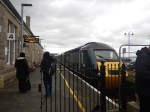
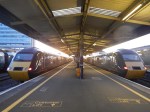

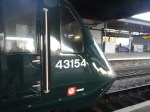


They must be profitable and/or popular with passengers.
If I have a problem with these trains, it is with the Class 43 diesel power cars.
- Each train has two power cars.
- It would appear that there are about 150 of the Class 43 power cars in regular service.
- Each is powered by a modern MTU 16V4000 R41R diesel engine, that is rated at 1678 kW.
- The engines are generally less than a dozen years old.
- They will be emitting a lot of carbon dioxide.
As the trains are now only half as long as they used to be, I would suspect, that the engines won’t be working as hard, as they can.
Hopefully, this will mean less emissions.
The article says this about use of the fleet.
With its fleet now increasing to 14, GWR expects to use 12 each day on services across the west of England. Currently the fleet is deployed on the Cardiff – Bristol – Penzance corridor, but the company is still evaluating how the additional sets will be used.
It also says, that they are acquiring rolling stock from other sources. Some of which will be cannibalised for spares.
Are First Rail Holdings Cutting Carbon Emissions?
First Rail Holdings, who are GWR’s parent, have announced in recent months three innovative and lower-carbon fleets from Hitachi, for their subsidiary companies.
- The Class 807 trains for Avanti West Coast will not have any diesel engines.
- The Class 805 trains for Avanti West Coast will initially have diesel engines, but these may be changedin a few years for battery power packs.
- The Class 803 trains for East Coast Trains will not have any diesel engines.
Hitachi have also announced a collaboration with Hyperdrive Innovation to provide battery packs to replace diesel engines, that could be used on Class 800 and Class 802 trains.
First Rail Holdings have these Class 800/802 fleets.
- GWR – 36 x five-car Class 800 trains
- GWR – 21 x nine-car Class 800 trains
- GWR – 22 x five-car Class 802 trains
- GWR – 14 x nine-car Class 802 trains
- TransPennine Express – 19 x five-car Class 802 trains
- Hull Trains – 5 x five-car Class 802 trains
Note.
- That is a total of 117 trains.
- As five-car trains have three diesel engines and nine-car trains have five diesel engines, that is a total of 357 engines.
- In Could Battery-Electric Hitachi Trains Work Hull Trains’s Services?, I showed that Hull Trains could run their services with a Fast Charging system in Hull station.
- In Could Battery-Electric Hitachi Trains Work TransPennine Express’s Services?, I concluded that Class 802 trains equipped with batteries could handle all their routes without diesel and some strategically-placed charging stations.
In the Wikipedia entry for the Class 800 train, there is a section called Powertrain, where this is said.
According to Modern Railways magazine, the limited space available for the GUs has made them prone to overheating. It claims that, on one day in summer 2018, “half the diagrammed units were out of action as engines shut down through overheating.
So would replacing some diesel engines with battery packs, also reduce this problem, in addition to cutting carbon emissions?
It does appear to me, that First Rail Holdings could be cutting carbon emissions in their large fleet of Hitachi Class 800 and Class 802 trains.
The Class 43 power cars could become a marketing nightmare for the company?
Could Class 43 Power Cars Be Decarbonised?
Consider.
- Class 43 power cars are forty-five years old.
- They have been rebuilt with new MTU engines in the last dozen years or so.
- I suspect MTU and GWR know everything there is to know about the traction system of a Class 43 power car.
- There is bags of space in the rear section of the power car.
- MTU are part of Rolls-Royce, who because of the downturn in aviation aren’t performing very well!
But perhaps more importantly, the power cars are iconic, so anybody, who decarbonises these fabulous beasts, gets the right sort of high-class publicity.
I would also feel, if you could decarbonise these power cars, the hundreds of diesel locomotives around the world powered by similar diesel engines could be a useful market.
What methods could be used?
Biodiesel
Running the trains on biodiesel would be a simple solution.
- It could be used short-term or long-term.
- MTU has probably run the engines on biodiesel to see how they perform.
- Biodiesel could also be used in GWR’s smaller diesel multiple units, like Class 150, 158, 165 and 166 trains.
Some environmentalists think biodiesel is cheating as it isn’t zero-carbon.
But it’s my view, that for a lot of applications it is a good interim solution, especially, as companies like Altalto, will be making biodiesel and aviation biofuel from household and industrial waste, which would otherwise be incinerated or go to landfill.
The Addition Of Batteries
This page on the Hitachi Rail Ltd web site shows this image of the V-Train 2.
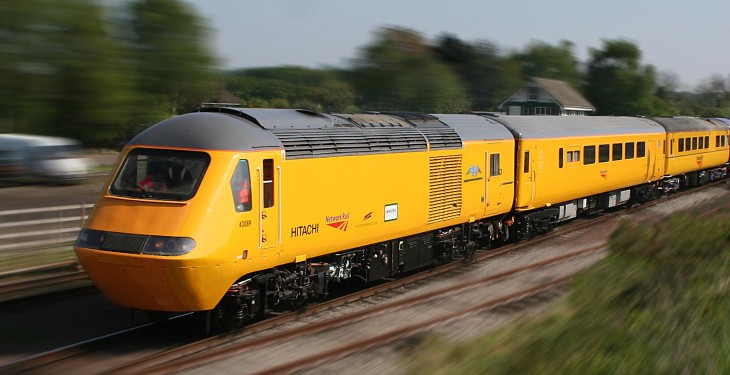
This is the introduction to the research program, which was based on a High Speed Train, fotmed of two Class 43 power cars and four Mark 3 carriages.
The V-Train 2 was a demonstration train designed in order to demonstrate our skills and expertise while bidding for the Intercity Express Programme project.
The page is claiming, that a 20 % fuel saving could be possible.
This paragraph talks about performance.
The V-Train 2 looked to power the train away from the platform using batteries – which would in turn be topped up by regenerative braking when a train slowed down to stop at a station. Acceleration would be quicker and diesel saved for the cruising part of the journey.
A similar arrangement to that Hitachi produced in 2005 could be ideal.
- Technology has moved on significantly in the intervening years.
- The performance would be adequate for a train that just trundles around the West Country at 90 mph.
- The space in the rear of the power car could hold a lot of batteries.
- The power car would be quiet and emission-free in stations.
- There would be nothing to stop the diesel engine running on biodiesel.
This might be the sort of project, that Hitachi’s partner in the Regional Battery Train; Hyperdrive Innovation. would probably be capable of undertaking.
MTU Hybrid PowerPack
I wouldn’t be surprised to find, that MTU have a drop-in solution for the current 6V4000 R41R diesel engine, that includes a significant amount of batteries.
This must be a serious possibility.
Rolls-Royce’s 2.5 MW Generator
In Our Sustainability Journey, I talk about rail applications of Rolls-Royce’s 2.5 MW generator, that has been developed to provide power for electric flight.
In the post, I discuss fitting the generator into a Class 43 power car and running it on aviation biofuel.
I conclude the section with this.
It should also be noted, that more-efficient and less-polluting MTU engines were fitted in Class 43s from 2005, so as MTU is now part of Rolls-Royce, I suspect that Rolls-Royce have access to all the drawings and engineers notes, if not the engineers themselves
But it would be more about publicity for future sales around the world, with headlines like.
Iconic UK Diesel Passenger Trains To Receive Green Roll-Royce Jet Power!
COVID-19 has given Rolls-Royce’s aviation business a real hammering, so perhaps they can open up a new revenue stream by replacing the engines of diesel locomotives,
I find this an intriguing possibility. Especially, if it were to be fitted with a battery pack.
Answering My Original Question
In answering my original question, I feel that there could be several ways to reduce the carbon footprint of a Class 43 power car.
It should also be noted that other operators are users of Class 43 power cars.
- ScotRail – 56
- CrossCountry – 12
- East Midlands Railway – 39
- Network Rail – 3
Note.
- ScotRail’s use of the power cars, is very similar to that of GWR.
- CrossCountry’s routes would need a lot of reorganisation to be run by say Hitachi’s Regional Battery Train.
- East Midlands Railway are replacing their Inter-City 125s with new Class 810 trains.
The picture shows the power car of Network Rail’s New Measurement Train.
These may well be the most difficult to decarbonise, as I suspect they need to run at 125 mph on some routes, which do not have electrification and there are no 125 mph self-powered locomotives. After the Stonehaven crash, there may be more tests to do and a second train may be needed by Network Rail.
Why Are GWR Increasing Their Castle Class Fleet?
These are possible reasons.
GWR Want To Increase Services
This is the obvious explanation, as more services will need more trains.
GWR Want To Update The Fleet
There may be something that they need to do to all the fleet, so having a few extra trains would enable them to update the trains without cutting services.
GWR Want To Partially Or Fully Decarbonise The Power Cars
As with updating the fleet, extra power cars would help, as they could be modified first and then given a thorough testing before entering passenger service.
GWR Have Been Made An Offer They Can’t Refuse
Suppose Rolls-Royce, MTU or another locomotive power plant manufacturer has a novel idea, they want to test.
Over the years, train operating companies have often tested modified trains and locomotives for manufacturers.
So has a manufacturer, asked GWR to test something in main line service?
Are Other Train Operators Thinking Of Using Introducing More Short-Formed InterCity 125 Trains?
This question has to be asked, as I feel there could be routes, that would be suitable for a net-zero carbon version of a train, like a GWR Castle or a ScotRail Inter7City.
Northern Trains
Northern Trains is now run by the Department for Transport and has surely the most suitable route in the UK for a shorted-formed InterCity 125 train – Leeds and Carlisle via the Settle and Carlisle Line.
Northern Trains may have other routes.
Transport for Wales Rail Services
Transport for Wales Rail Services already run services between Cardiff Central and Holyhead using diesel locomotive hauled services and long distance services between South Wales and Manchester using diesel multiple units.
Would an iconic lower-carbon train be a better way of providing some services and attract more visitors to the Principality?
Conclusion
GWR must have a plan, but there are few clues to what it is.
The fact that the trains have been purchased rather than leased could be significant and suggests to me that because there is no leasing company involved to consult, GWR are going to do major experimental modifications to the trains.
They may be being paid, by someone like an established or new locomotive engine manufacturer.
It could also be part of a large government innovation and decarbonisation project.
My hunch says that as First Rail Holdings appear to be going for a lower-carbon fleet, that it is about decarbonising the Class 43 power cars.
The plan would be something like this.
- Update the three new trains to the new specification.
- Give them a good testing, before certifying them for service.
- Check them out in passenger service.
- Update all the trains.
The three extra trains would give flexibility and mean that there would always be enough trains for a full service.
Which Methods Could Be Used To Reduce The Carbon Footprint Of The Class 43 Power Cars?
These must be the front runners.
- A Hitachi/Hyperdrive Innovation specialist battery pack.
- An MTU Hybrid PowerPack.
- A Rolls-Royce MTU solution based on the Rolls-Royce 2.5 MW generator with batteries.
All would appear to be viable solutions.
Do We Need More New Measurement Trains?
In New Measurement Train – 30th July 2020, I said this.
With all the spare InterCity 125 trains at present, will Network Rail create a second train?
We have now had the tragic Stonehaven Derailment, where three have been sadly killed.
Increasingly, we seem to be getting weather-related problems on the UK’s railways.
I can remember several in the last few years.
So perhaps just as the Hatfield Crash led to the New Measurement Train, we should up our testing and the development of new tests.
Extra trains would increase the amount of testing, but also provide more laboratory space to test the testing systems in real railway conditions.
Perhaps, if a University or high-tech company has a feasible idea, there should be a mechanism, whereby they can rent space in the trains, just as they can on satellite launchers.
New Measurement Train – 30th July 2020
Whilst I was at Westbury station today, the New Measurement Train arrived.
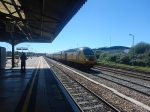
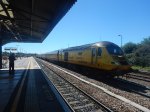
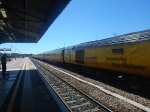
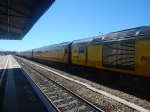
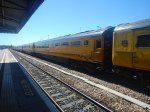
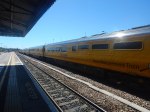

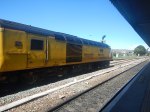
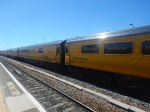


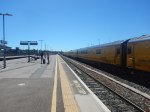
It is the first time, that I’ve been up close enough to take pictures.
With all the spare InterCity 125 trains at present, will Network Rail create a second train?
Our Sustainability Journey
The title of this post, is the same as that of this press release on the Rolls-Royce web site.
It is sub-titled.
Paul Stein’s Thoughts On Sustainability And Electrification
Paul Stein is Rolls-Royce’s Chief Technology Officer, so what he says is important.
This press release was the source of the information behind Distributed Propulsion ‘Maybe The Only Means’ For Small Electric Flight Progress, which I wrote about Rolls-Royce’s beer keg-sized 2.5 MW generator.
This is the third paragraph.
We’ve taken great steps at Rolls-Royce with our three-pillar sustainability approach of developing the gas turbine to even greater efficiency, supporting the introduction of Sustainable Aviation Fuel and creating new, disruptive technologies such as electrification.
These are definitely, the three pillars of wisdom, when it comes to sustainable aviation.
E-Fan X
This paragraph is Paul Stein’s view of the E-Fan X.
One of the great endeavours in the latter category has been our E-Fan X programme in partnership with Airbus. From our side, this has involved creating a hybrid-electric power generation system at a scale never previously seen in our industry, comprised of an embedded AE2100 gas turbine driving a 2.5MW generator and 3000V power electronics and an electric propulsion unit. What has been particularly encouraging has been the amount of industry interest and support for this programme, and I know everyone at Rolls-Royce and Airbus has been truly grateful for that.
He states that the E-Fan has now concluded, but a several valuable lessons have been learned.
2.5 MW Generator
He describes the generator like this.
Amongst the many great achievements from E-Fan X has been the generator – about the same size as a beer keg – but producing a staggering 2.5 MW. That’s enough power to supply 2,500 homes and fully represents the pioneering spirit on this project.
The press release discloses that the heart of this staggering generator is a Rolls-Royce AE2100 gas turbine, which powers the latest version of the legendary Lockheed Hercules; the C-130J Super Hercules.
Wikipedia gives this data for the AE2100D2 version of the engine.
- Length – three metres
- Diameter – 0.73 metres
- Weight – 783 kilograms
- Maximum Power Output – 3458 kW
- Fuel Consumption – 0.25/kW/h
It looks like in the E-Fan X application, the engine is not at full power.
Use With Aviation Biofuel
Aviation Biofuel is described like this in the first sentences of its Wikipedia entry.
Aviation biofuel is a biofuel used for aircraft. It is considered by some to be the primary means by which the aviation industry can reduce its carbon footprint. After a multi-year technical review from aircraft makers, engine manufacturers and oil companies, biofuels were approved for commercial use in July 2011.
But it doesn’t necessarily mean growing large amounts of crops and converting it to the fuel. Altalto, who are backed by British Airways, Shell, Oxford University and the British Government are building a plant at Immingham to convert household and industrial waste into aviation biofuel.
I would expect that Rolls-Royce have made sure that the generator will work with aviation biofuel.
A Memory Of Emergency Power Generation
About twenty-five years, there was a major power failure after a thunder storm, where I lived in Suffolk and C and myself went to bed in the dark. We awoke to full power in the morning, after a good night’s sleep with no disturbance.
Imagine my surprise, when I let the dogs out to find parked in the field in front of the house, a very large articulated truck.
I was greeted by an engineer, who asked if I minded, his generator in my field. I seem to remember my response was to offer him a cup of tea, which he refused, as he said he had everything he needed in the truck.
It turned out that the main sub-station for the area had received a direct lightning strike and had been destroyed. So to supply power to all the nearby villages, as my farm was at the end of the supply, it was the most convenient place to plug in a transportable gas-turbine generator. The generator was in the field for about ten days and the whole operation impressed me with its professionalism.
But with this new 2.5 MW generator from Rolls-Royce, there would only need to be a small 3.5 tonne four-wheeled truck, to include the generator, fuel and living quarters for the engineer
We have made a lot of progress in twenty-five years.
A Modern Railway Locomotive
The power of this new Class 68 diesel locomotive, that was built in Spain, by Swiss company Stadler is a very healthy 2,800 kW.
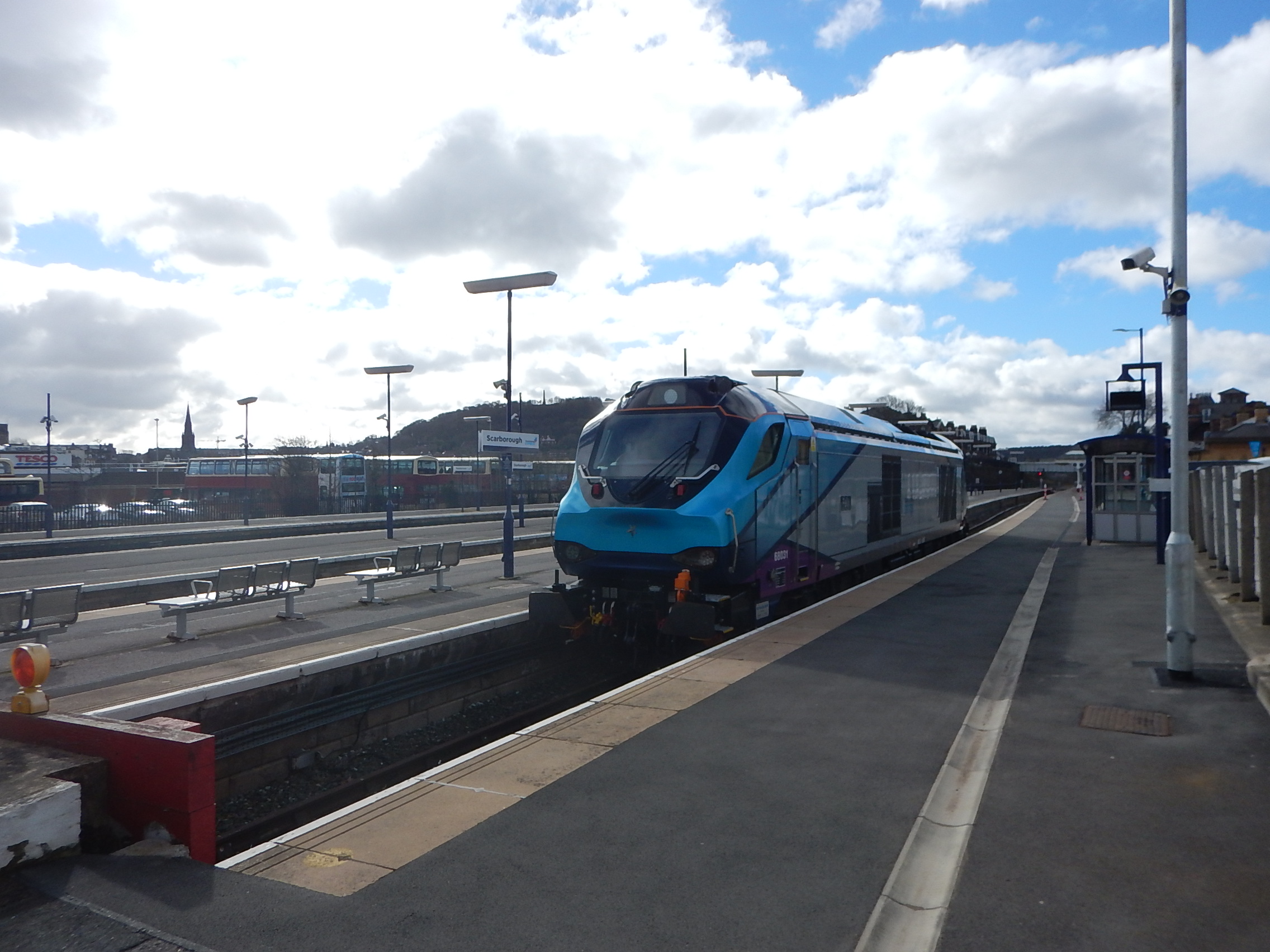
Consider these facts about a Class 68 locomotive.
- Thirty-four of these locomotives have been produced for the UK.
- They are powered by a Caterpillar C175-16 engine, which weighs thirteen tonnes.
- The transmission of these locomotives is electric, which means that the diesel engine drives a generator and the train is driven by electric traction motors.
- The locomotive is equally at home hauling intermodal freight trains and passenger trains for Chiltern Railways or TransPennine Express.
- According to Wikipedia, Class 68 locomotives comply with Stage III A of the European emission standards but not Stage III B. But that is much better than most of our noisy, smelly and polluting diesel locomotives.
Class 68 locomotives are members of the UKLight family of locomotives, which contains, these two other locomotives.
- Already in service is the Class 88 locomotive, which is a bi-mode locomotive, which is capable of running on electrification or the on-board 0.7 MW diesel engine.
- Under development is the Class 93 locomotive, which is a tri-mode 110 mph locomotive, which is capable of running on electrification, the on-board 0.7 MW diesel engine or battery power.
Stadler seem to be able to mix-and-match various power sources to provide versatile and highly-desirable locomotives.
I feel it would be feasible to design a railway locomotive with the following power sources.
- 25 KVAC overhead or 750 VDC third-rail electrification, providing up to perhaps the four MW of a Class 88 locomotive.
- A Rolls-Royce gas-turbine generator running on aviation biofuel, providing up to perhaps three MW.
- Batteries up to a weight of perhaps ten tonnes.
I am sure that it could handle many of the routes still run with diesel locomotives in the UK.
- It would handle all locomotive-hauled passenger services and would be electric-only in stations.
- It certainly solves the problem of hauling long intermodal freight trains between Felixstowe and the Midlands and the North.
- To handle the heaviest stone and aggregate trains, it might need a more powerful generator, but I’m sure Rolls-Royce would oblige.
In Thoughts On A Battery/Electric Replacement For A Class 66 Locomotive, I gave a list of routes, that would need to be handled by a battery electric locomotive.
- Didcot and Birmingham – Around two-and-a-half hours
- Didcot and Coventry – Just under two hours
- Felixstowe and Ipswich – Around an hour
- Haughley Junction and Peterborough – Around two hours
- Southampton and Reading – Around one-and-a-half hours
- Werrington Junction and Doncaster via Lincoln – Around two hours
- Werrington Junction and Nuneaton – Just under two hours
Will Rolls-Royce’s generator be able to supply 2.5 MW for up to four hours?
This would need two-and-a-half tonnes of aviation biofuel, which would be around 3,200 litres, which could be carried in the 5,000 litre tank of a Class 68 locomotive.
It certainly seems feasible to replace diesel locomotives with gas-turbine locomotives running on aviation biofuel, to reduce net carbon emissions and reduce noise and pollution.
But this is not just a UK problem and many countries, who rely on diesel-hauled rail freight, would look seriously at such a locomotive.
Underfloor Mounting In Passenger Trains
These pictures show the space underneath a Hitachi Class 800 train.
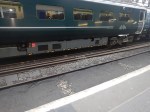
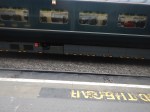
The red cap visible in some pictures is the filler for the oil or diesel for the MTU 12V 1600 R 80L diesel engine used to power the trains away from electrification.
This diesel engine has this specification.
- It produces 560 kW of power.
- It weighs around six tonnes.
- Its is about 4 x 2.5 x 1 metres in size.
The diesel engine produces about a fifth of the power as the gas-turbine generator, which is also smaller and very much lighter in weight.
It should also be noted, that a nine-car Class 800 train has five of these MTU diesel engines.
At a first glance, it would appear Hitachi could find one of Rolls-Royce’s gas-turbine generators very useful.
- It might even enable self-powered high speed trains to run on lines without electrification at speeds well in excess of 140 mph.
- I can certainly see, High Speed Two’s classic-compatible trains having one or possibly two of these generators, so they can extend services on lines without electrification.
We shouldn’t forget that one version of British Rail’s Advanced Passenger Train was to be gas-turbine powered.
A Class 43 Diesel Power-Car
Rolls-Royce would need a test-bed for a trial rail application of their 2.5 MW generator and there is probably no better trial vehicle, than one of the numerous Class 43 power-cars waiting to be scrapped. They could probably obtain a complete InterCity 125, if they wanted one for a realistic weight, test equipment and a second power-car for comparison and rescue.
But seriously, if we are going to remove diesel from UK railways by 2040, a solution needs to be found for the GWR Castles, ScotRail’s Inter7Citys and NetworkRail’s New Measurement Train.
One of the great advantages of these staggering (Rolls-Royce’s Chief Technology Officer’s word, not mine!) generators is that they are controlled by Full Authority Digital Engine Control or FADEC.
FADEC will give the pilots in a Hercules or other aircraft, all the precise control they need and I doubt Rolls-Royce will leave FADEC out of their gas turbine generator, as it would give the operator or driver extremely precise control.
A driver of a GWR Castle equipped with two gas-turbine power-cars, would be able to do the following.
- Adjust the power to the load and terrain, with much more accuracy, than at present.
- Shut the engines down and start them quickly, when passing through sensitive areas.
- Cut carbon-dioxide emissions, by simply using a minimum amount of fuel.
I would put a battery in the back of the Class 43, to provide hotel power for the passenger coaches.
Running current MTU engines in the Class 43s, on biodiesel is surely a possibility, but that not an elegant engineering solution. It also doesn’t cut carbon emissions.
As there are still over a hundred Class 43s in service, it could even be a substantial order.
It should also be noted, that more-efficient and less-polluting MTU engines were fitted in Class 43s from 2005, so as MTU is now part of Rolls-Royce, I suspect that Rolls-Royce have access to all the drawings and engineers notes, if not the engineers themselves
But it would be more about publicity for future sales around the world, with headlines like.
Iconic UK Diesel Passenger Trains To Receive Green Roll-Royce Jet Power!
COVID-19 has given Rolls-Royce’s aviation business a real hammering, so perhaps they can open up a new revenue stream by replacing the engines of diesel locomotives,
A Class 55 Locomotive
Why Not?
A Class 55 locomotive is diesel electric and there are thousands of diesel locomotives in the world, built to similar basic designs, that need a more-efficient and more environmentally-friendly replacement for a dirty, smelly, noisy and polluting diesel power-plant.
Marine Applications
The Wikipedia entry for the Cat C175, says this.
The Cat C175 is often used in locomotives and passenger-class ships.
I suspect there will be marine applications for the gas-turbine generator.
Conclusion
I’m very certain that Rolls-Royce’s pocket power station has a big future.
Who said that dynamite comes in small parcels?

