What Caused The Amazon Web Services Failure?
This article on Reuters is entitled Amazon’s AWS Struggles To Recover After Major Outage Disrupts Apps, Services Worldwide, sums up today’s big news story.
But what went wrong?
I asked Google AI, where BT have their data servers and received this reply.
BT hosts its data servers in various locations across the UK, including London, Birmingham, and Dublin, Ireland, as well as in mainland Europe such as Frankfurt, Germany, and Amsterdam and Nieuwegein, Netherlands. They also have a presence in the United States, with facilities in locations like New Jersey.
Note.
- Nieuwegein is South of Amsterdam.
- There’s almost a direct straight-line route between Dublin and Frantfurt.
- Cambridge would lie on that straight-line route.
- BT’s Research at Martlesham in Suffolk would lie on that straight-line route.
- Is BT’s worldwide network closely monitored from BT Research?
- For more about BT Research read their Wikipedia entry.
- The straight-line route by-passes London.
The network seems comprehensive and well spread-out.
These are my thoughts.
The Value Of Research
I asked Google AI, if there were any spin-out companies from BT Martlesham and received this reply.
Yes, spin-out companies have been formed from BT’s Adastral Park research facility, including Real Time Content (RTC) and iome. Both companies were supported by BT and developed technologies based on research from the Martlesham site, with RTC focusing on personalized video services and iome providing location-based services through mobile internet.
I used to live near to BT’s Research Centre until 1990.
At the time, I was writing Artemis, the project management system and the multi-user version of that software and a BT research computer system used the same Hewlett-Packard hardware and an operating system written by BT at Martlesham.
Because of this connection, I learned a lot about their methods and the breadth of the research being carried out in Suffolk and was generally impressed.
I would suspect that legacy telecom companies like BT, France Telecom and Deutsche Telecom spend a lot of money on research. Do newer companies spend similar amounts?
Having a good research department behind you is an excellent form of insurance!
Will BT Research Have A Reliable 24/7 Power Supply?
Consider.
- By 2030, there will be upwards of 4 GW of offshore wind power along the Suffolk coast.
- Sizewell B will be 22 miles away, pumping out 1.2 GW until at least 2035.
- Sizewell C could be pumping out 3.3 GW from the mid-2030s.
- The 1.8 GW LionLink between Walberswick in Suffolk and The Netherlands could be in operation by 2030.
I am fairly sure that BT Research will have enough power, even if several data centres are built on the Martlesham site.
The Domain Name Res0lution Problem
Consider.
- The root causeof Amazon’s disaster appeared to be problems with its domain name resolution system.
- Executing fast lookup of domain names is critical.
I had a similar problem with the project management system ; Artemis, when I extended it to be one of the first relational databases in the 1980s. So I went to IBM’s library on the South Bank and dug out all their 1950s papers on looking up keys in tables.
In those days, with slower computers, which had smaller amounts of memory, the efficiency of the algorithm was very important and I got a significant improvement in look-up speed, by digging up ideas from the past.
If anybody wants to check out their algorithm with me, I’m always happy to oblige, but at 78 with poor eye-sight I’m probably past coding anything myself.
When I was dealing with BT Research, they would have made sure that something like domain name resolution was given the full research treatment.
My Conclusion
As I don’t have all the data, I will not speculate, but will await Amazon’s conclusion with interest.
Ørsted Raises EUR 7.98 Billion In Oversubscribed Rights Issue
The title of this post, is the same as that of this article on offshoreWIND.biz.
This is the sub-heading.
Ørsted has completed its rights issue, raising DKK 59.56 billion (approximately EUR 7.98 billion) with a subscription rate of approximately 99.3 per cent, the company said on 6 October.
These two introductory paragraphs add more details.
Existing shareholders were offered new shares at DKK 66.60 (EUR 8.92) each. The demand for shares not taken up via the rights issue was “extraordinarily high,” according to the developer’s announcement of the Rights Issue results, and allocations were capped per application, meaning no subscriptions were required under the underwriting bank syndicate.
As reported in August, the company appointed a syndicate of BNP PARIBAS, Danske Bank A/S and J.P. Morgan SE as Joint Global Coordinators, next to Morgan Stanley & Co International, to jointly underwrite the rights issue for the approximately 49.9 per cent that would not be subscribed to by Ørsted’s majority shareholder, the Danish state (50.1 per cent).
I dread to think what spiteful punishment that Trumpkopf will inflict on Ørsted.
But the oversubscribed Rights Issue may be good news for the UK.
Ørsted has only one major project under development or construction in the UK.
But it is the large Hornsea Three wind farm, which has this opening paragraph on its web site.
Hornsea 3 Offshore Wind Farm will deliver enough green energy to power more than 3 million UK homes. An £8.5 billion infrastructure project, Hornsea 3 will make a significant contribution toward UK energy security, as well as the local and national economy.
Note.
- Ørsted are raising £7.98 billion and spending £8.5 billion, which must do something for the UK’s economy.
- Hornsea 3 will have a generating capacity of 2.9 GW.
- Ørsted are now delivering the world’s single largest offshore wind farm.
- Hornsea 3 will connect to the National Grid at Swardestone in Norfolk.
In Grid Powers Up With One Of Europe’s Biggest Battery Storage Sites, I describe how the 300 MW/600 MWh Swardestone BESS will be built, where Hornsea 3 connects to the grid.
As Swardestone will have 2.9 GW from Hornsea 3 and a powerful battery, I would expect someone will be looking to site a data centre or something with a need for a lot of stable electricity at or near Swardestone.
In Opportunity For Communities To Have Their Say On National Grid Proposals For Norwich To Tilbury Project, I talk about a line of pylons between Swardestone and Tilbury and show this map of the route.
This page on the National Grid web site has an interactive version of this map.

Note.
- The mauve line indicates the route of the Norwich to Tilbury project.
- Swardestone is at the Northern end of the project a few miles South of Norwich.
- Tilbury is at the Southern end of the project on the Thames estuary.
- The project connects Norwich, Ipswich, Colchester and Chelmsford to Hornsea 3 at Swardestone.
- I suspect the project will connect to Ipswich at the Bramford substation.
- The Sizewell nuclear site is to the North-East of Woodbridge and connects to the grid at the Bramford substation.
I know East Anglia well and I would suspect that Norwich, Ipswich, Colchester, Chelmsford and Southend-on-Sea could support one or more data centres.
Conclusion
I asked Google AI, who owns Hornsea 1 and received this reply.
Hornsea 1 is owned by a partnership including Ørsted, Equitix, TRIG, GLIL, Octopus, and Brookfield, with Ørsted also providing the operational management. A 2018 agreement between Ørsted and Global Infrastructure Partners (GIP) originally established the 50/50 joint venture for the project.
I then asked Google AI, who owns Hornsea 2 and received this reply.
The ownership of the Hornsea 2 wind farm is shared between several entities, including a 37.55% stake held by Ørsted, a 25% stake each by AXA IM Alts and Crédit Agricole Assurances, and a 12.45% stake held by Brookfield. The wind farm is located offshore in the UK’s North Sea, approximately 89 km off the Yorkshire coast.
In November 2019, I also wrote World’s Largest Wind Farm Attracts Huge Backing From Insurance Giant.
It does seem to me that Ørsted are past masters of developing a wind farm, then selling it on and using that money to develop the next wind farm.
The Rights Issue just makes that process easier.
British Gas Owner Mulls Mini-Nuke Challenge To Rolls-Royce
The title of this post, is the same as that of this article in The Telegraph.
This is the sub-heading.
Centrica is looking to follow Rolls-Royce in developing small modular reactors
These are the first three paragraphs.
The owner of British Gas is considering investing in mini nuclear power plants in the UK as it seeks to cash in on burgeoning demand for the technology.
Centrica is in early talks with the Government about a potential future deal that could see the energy giant participate in the development of so-called small modular reactors (SMRs).
It comes after Ed Miliband, the Energy Secretary, last month announced billions of pounds in funding for SMRs, which will form part of a new “golden age” for atomic energy.
In Centrica Really Can’t Lose At Sizewell, I looked at Centrica’s involvement in Sizewell C and in particular the financing of the nuke and what Centrica would do with their share of the electricity, that the nuke will produce.
I listed these uses for hydrogen in the East of England.
- Transport – Buses, Coaches and Trucks
- Large Construction Projects
- Rail
- Ports
- Airports
- Agriculture And The Rural Economy
- Exports
I do wonder, if Centrica made the investment in Sizewell C, when they realised that there were a lot of uses for hydrogen and producing hydrogen using the electricity from a nuclear power station was a good way to generate hydrogen.
- Sizewell B is a 1.2 GW nuclear powerstation.
- Sizewell C is a 3.2 GW nuclear powerstation.
- Their investment in HiiROC surely gives them access to the technology to generate hydrogen.
- Centrica have a lot of experience of selling natural gas to customers, who need energy.
- There were also substantial government guarantees involved.
- Hydrogen made by a nuclear reaxtor is generally referred to as pink hydrogen.
- In Westinghouse And Bloom Energy To Team Up For Pink Hydrogen, I describe how two American companies have formed a partnership to make pink hydrogen.
Before they invested in Sizewell C, they would have done detailed financial and technical due diligence.
Did Centrica then scale the calculations to see if funding a Small Modular Reactor (SMR) to make hydrogen was a viable deal?
- SMRs are typically around 400-500 MW.
- The article mentions Rolls-Royce, but other companies are developing SMRs.
- Centrica use Rolls-Royce mtu generators for some of their installations.
- Some SMR/HiiROC systems could be built close to steelworks or other high energy users.
This is a very interesting development in taking the UK to net-zero.
Centrica Really Can’t Lose At Sizewell
The title of this post, is the same as that of this article in The Times.
This is the sub-heading.
Centrica’s £1.3 billion investment in Sizewell C guarantees substantial returns, even with cost overruns.
These two-and-a-half paragraphs explain the funding.
Now we know what Ed Miliband means by his “golden age of nuclear” — golden for the companies putting their money into Sizewell C. Yes, reactor projects have a habit of blowing up private investors. But maybe not this one. It looks more like an exercise in transferring risk to consumers and the taxpayer.
Sure, nobody builds a £38 billion nuke on a Suffolk flood plain without a frisson of danger. But the energy secretary and his Treasury chums have done their bit to make things as safe as possible for the companies putting in equity alongside the government’s 44.9 per cent stake: Canada’s La Caisse with 20 per cent, British Gas-owner Centrica (15 per cent), France’s EDF (12.5 per cent) and Amber Infrastructure (7.6 per cent).
For starters, nearly all the debt for the 3.2 gigawatt plant, three-quarters funded by loans, is coming from the state-backed National Wealth Fund. It’s bunging in up to £36.6 billion, with £5 billion more guaranteed by a French export credit agency.
It looks to me that between them the British and French governments are providing £41.5 billion of loans to build the £38 billion nuke.
These are my thoughts.
Hydrogen And Sizewell C
This page on the Sizewell C web site is entitled Hydrogen And Sizewell C.
Under a heading of Hydrogen Buses, this is said.
At Sizewell C, we are exploring how we can produce and use hydrogen in several ways. We are working with Wrightbus on a pilot scheme which, if successful, could see thousands of workers transported to and from site on hydrogen double decker buses. You can read more about the pilot scheme in our press release
Firstly, it could help lower emissions during construction of the power station. Secondly, once Sizewell C is operational, we hope to use some of the heat it generates (alongside electricity) to make hydrogen more efficiently.
This would appear to be a more general statement about hydrogen and that the following is planned.
- Hydrogen-powered buses will be used to bring workers to the site. A press release on the Sizewell C web site, talks about up to 150 buses. That would probably be enough buses for all of Suffolk.
- Hydrogen-powered construction equipment will be used in the building of the power station.
- It also talks about using the excess heat from the power station to make hydrogen more efficiently. I talk about this process in Westinghouse And Bloom Energy To Team Up For Pink Hydrogen.
This is a substantial investment in hydrogen.
Centrica And Electricity From Sizewell C
The article in The Times, also says this.
Even so, there’s a fair bit of protection for the likes of Centrica, which has also agreed a 20-year offtake deal for its share of Sizewell’s electricity. The price of that is not yet known.
Nothing is said in the article about the size of Centrica’s electricity offtake.
- If they get 15 % of Sizewell C, that would by 480 MW.
- If they get 15 % of Sizewell B + C, that would by 660 MW.
If they use their share to generate hydrogen, Suffolk would have a massive hydrogen hub.
To power the buses and construction of Sizewell C, Sizewell B could be used to provide electricity to create the hydrogen.
How Would The Hydrogen Be Produced?
Centrica, along with other companies, who include Hyundai and Kia, are backers of a company in Hull called HiiROC, who use a process called Thermal Plasma Electrolysis to generate hydrogen.
On their web site, they have this sub-heading.
A Transformational New Process For Affordable Clean Hydrogen
The web site also describes the process as scalable from small modular units up to industrial scale. It also says this about the costs of the system: As cheap as SMR without needing CCUS; a fraction of the energy/cost of water electrolysis.
If HiiROC have achieved their objective of scalability, then Centrica could grow their electrolyser to meet demand.
How Would The Hydrogen Be Distributed?
Consider.
- Currently, the Sizewell site has both road and rail access.
- I can still see in my mind from the 1960s, ICI’s specialist articulated Foden trucks lined up in the yard at Runcorn, taking on their cargoes of hydrogen for delivery all over the country.
- As that factory is still producing hydrogen and I can’t remember any accidents in the last sixty years, I am fairly sure that a range of suitable hydrogen trucks could be developed to deliver hydrogen by road.
- The road network to the Siewell site is being updated to ensure smooth delivery of workers and materials.
- The rail access to the Sizewell site is also being improved, for the delivery of bulk materials.
I believe there will be no problems delivering hydrogen from the Sizewell site.
I also believe that there could be scope for a special-purpose self-propelled hydrogen tanker train, which could both distribute and supply the hydrogen to the vehicles, locomotives and equipment that will be using it.
Where Will The Hydrogen Be Used?
I have lived a large part of my life in Suffolk and know the county well.
In my childhood, there was quite a lot of heavy industry, but now that has all gone and employment is based on agriculture, the Port of Felixstowe and service industries.
I can see hydrogen being used in the following industries.
Transport
Buses and heavy trucks would be powered by hydrogen.
The ports in the East of England support a large number of heavy trucks.
Large Construction Projects
Sizewell C is not the only large construction project in the East of England, that is aiming to use low-carbon construction involving hydrogen. In Gallagher Group Host Hydrogen Fuel Trial At Hermitage Quarry, I talked about a hydrogen fuel trial for the Lower Thames Crossing, that involved JCB and Ryse Hydrogen.
Hydrogen for the Lower Thames Crossing could be delivered from Sizewell by truck, down the A12.
Rail
We may not ever see hydrogen-powered passenger trains in this country, but I do believe that we could see hydrogen-powered freight locomotives.
Consider.
- The latest electro-diesel Class 99 locomotives from Stadler have a Cummins diesel engine.
- The diesel engine is used, when there is no electrification.
- Cummins have developed the technology, that allows them to convert their latest diesel engines to hydrogen or natural gas power, by changing the cylinder head and the fuel system.
- Access to the Port of Felixstowe and London Gateway needs a locomotive with a self-powered capability for the last few miles of the route.
A Class 99 locomotive converted to hydrogen would be able to run with out emitting any carbon dioxide from Felixstowe or London Gateway to Glasgow or Edinburgh.
Ports
Ports have three main uses for hydrogen.
- To power ground-handing equipment, to create a pollution-free atmosphere for port workers.
- To fuel ships of all sizes from the humblest work-boat to the largest container ships.
- There may need to be fuel for hydrogen-powered rail locomotives in the future.
There are seven ports with excellent road and/or rail connections to the Sizewell site; Felixstowe, Great Yarmouth, Harwich, Ipswich, London Gateway, Lowestoft and Tilbury.
The proposed Freeport East is also developing their own green hydrogen hub, which is described on this page on the Freeport East web site.
Airports
Airports have two main uses for hydrogen.
- To power ground-handing equipment, to create a pollution-free atmosphere for airport workers.
- In the future, there is likely to be hydrogen-powered aircraft.
There are three airports with excellent road and/or rail connections to the Sizewell site; Norwich, Southend and Stansted.
Agriculture And The Rural Economy
Agriculture and the rural economy would be difficult to decarbonise.
Consider.
- Currently, most farms would use diesel power for tractors and agricultural equipment, which is delivered by truck.
- Many rural properties are heated by propane or fuel oil, which is delivered by truck.
- Some high-energy rural businesses like blacksmiths rely on propane, which is delivered by truck.
- Electrification could be possible for some applications, but ploughing the heavy land of Suffolk, with the added weight of a battery on the tractor, would probably be a mathematical impossibility.
- JCB are developing hydrogen-powered construction equipment and already make tractors.
- Hydrogen could be delivered by truck to farms and rural properties.
- Many boilers can be converted from propoane to run on hydrogen.
I feel, that hydrogen could be the ideal fuel to decarbonise agriculture and the rural economy.
I cover this application in detail in Developing A Rural Hydrogen Network.
Exports
Consider.
- Sizewell B and Sizewell C nuclear powerstations have a combined output of 4.4 GW.
- A rough calculation shows that there is a total of 7.2 GW of wind farms planned off the Suffolk coast.
- The East Anglian Array wind farm alone is said in Wikipedia to be planned to expand to 7.2 GW.
- The Sizewell site has a high capacity connection to the National Grid.
Nuclear plus wind should keep the lights on in the East of England.
Any excess electricity could be converted into hydrogen.
This Google Map shows the location of Sizewell B in relation to Belgium, Germany and The Netherlands.
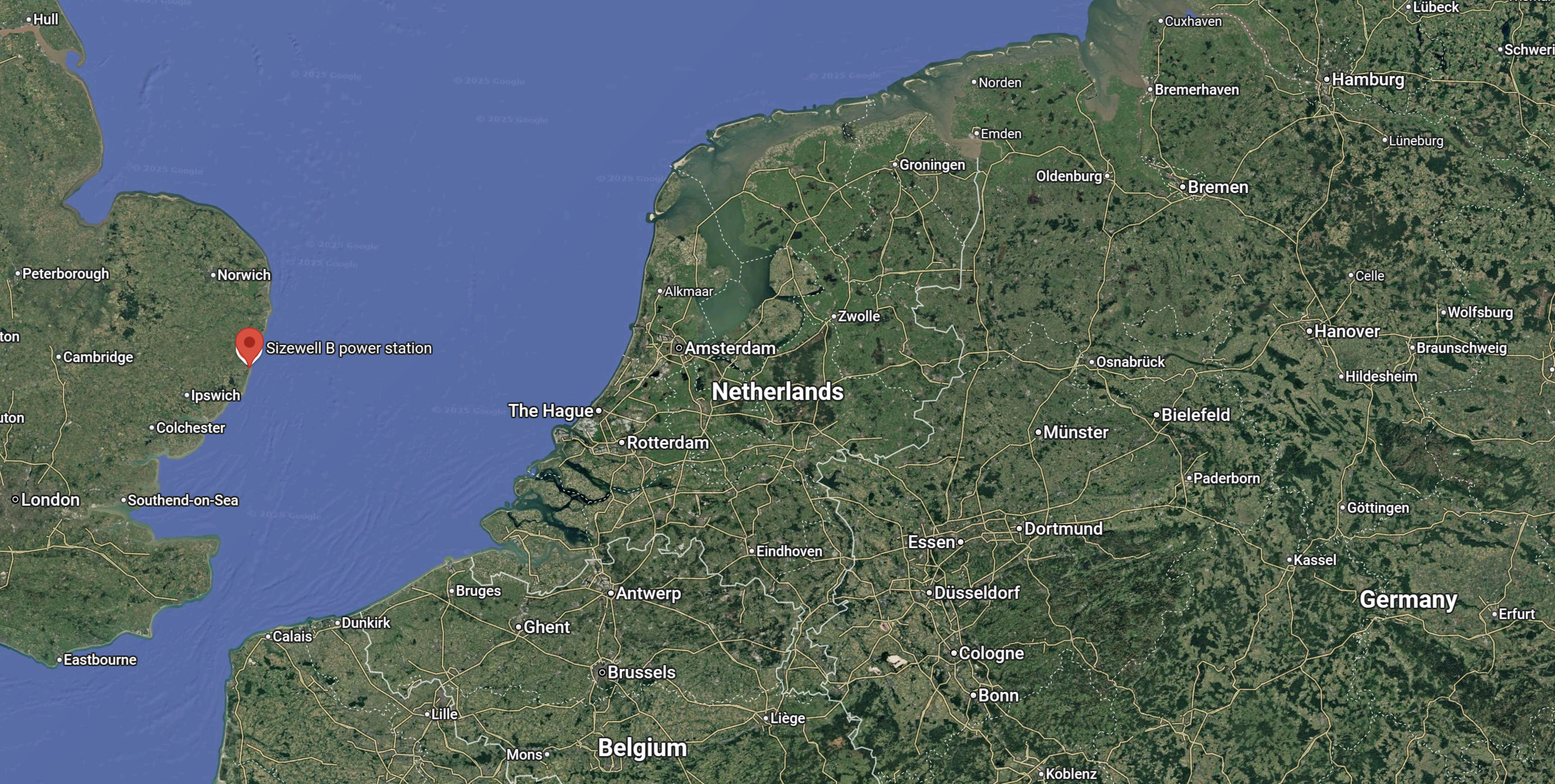
The Sizewell site is indicated by the red arrow.
The offshore oil and gas industry has used technology like single buoy moorings and coastal tankers to collect offshore natural gas for decades.
I don’t see why coastal hydrogen tankers couldn’t export excess hydrogen to places around the North Sea, who need the fuel.
It should be born in mind, that Centrica have a good reputation in doing natural gas trading. This expertise would surely be useful in hydrogen trading.
Conclusion
I believe that a hydrogen hub developed at Sizewell makes sense and I also believe that Centrica have the skills and technology to make it work.
Nigel Farage Speech: Persistent Offenders Would Face Life Sentences
The title of this post, is the same as that of this article in The Times.
This is the sub-heading.
The Reform UK leader pledged more prison spaces, deportation of criminals and zero-tolerance policing as part of a six-week Lawless Britain campaign drive.
These three paragraphs give more detail about what criminals can expect and how much it will cost.
Every shoplifter would be prosecuted and stop and search powers used to “saturation point” under Nigel Farage’s pledge to make Reform UK the “toughest party on law and order this country has ever seen”.
He said that a Reform government would crack down on prolific offending by imposing life sentences on those who commit three or more offences.
The Reform leader set out plans to spend £17.4 billion to cut crime by half in the first five years if the party wins the next general election — an annual cost of £3.5 billion.
At least hanging and flogging aren’t mentioned. But he does suggest sending one of our worst child murderers to El Salvador and that Britain would leave the European Convention on Human Rights.
This paragraph says how he will pay for this law and order policy.
Farage said Reform would pay for the £17.4 billion law and order crackdown by ditching HS2 and net zero policies — money which has also been pledged for other policies.
I have just done a little calculation about how much offshore wind power should be commissioned by January 2029, which will likely be before the expected 2029 General Election.
- In October 2023, there was 15,581 MW of operational offshore wind.
- Currently there are 10,842 MW under construction, that should be commissioned by January 2029.
- There is also 2,860 MW of smaller wind farms, which have yet to be started that should be commissioned by January 2029.
- That all totals up to 29, 285 MW or 29.3 GW.
- Another 12 GW of offshore wind is scheduled to be commissioned in 2029 and 2030.
Currently, as I write this we are generating 29.3 GW from all sources.
I asked Google AI how much solar energy we will have in January 2029 and got this answer.
In January 2029, the UK is projected to have a significant amount of solar energy capacity, with the government aiming for 45-47 GW of total solar power by 2030.
Let’s assume the sun only shine half the time and say 20 GW on average.
We’ll also have 4.4 GW from Hinckley Point C and Sizewell B, as all other nuclear will have been switched off.
I asked Google AI how much energy storage we’ll have by January 2029 and got this answer.
In January 2029, the UK is projected to have around 120 GWh of battery energy storage capacity, according to a European report. This is part of a broader goal to reach 400 GWh by 2029 for the EU-27, with the UK contributing significantly to this total.
If there’s say another Great Storm, the dozens of interconnectors between the UK and Europe should keep us all going.
It looks to me that by January 2029, we’ll be substantially on the way to being powered by renewables.
Most of the net zero money will have been spent and we’ll be almost at net zero.
Phase One of High Speed Two has a target date of 2030, and I suspect that the engineers working on the project will get trains running between Old Oak Common and Birmingham Curzon Street stations before the General Election, just because if NF’s going to cancel the project, they might as well do their best to get him to lose the election.
So at best he might get a year’s savings from stopping High Speed Two, but an unfinished High Speed Two, will be a joke on NF and make him look a complete laughing stock!
UK Investment Summit Latest: Starmer Announces £1.1bn Expansion Of Stansted Airport
The title of this post, is the same as that of this article on The Times.
The Times has this sub-heading about Stansted
Analysis: Stansted Deal Prioritises Growth Over Climate
There are four paragraphs of analysis.
Over the weekend, Sir Keir Starmer made clear that his commitments to boost workers’ rights would not get in the way of his desire to bring in cash from the owners of P&O. As ministers now trumpet a deal to upgrade Stansted airport, it seems that growth and jobs also trump concerns about emissions.
Louise Haigh, the transport secretary who prompted the row with DP World by calling P&O a “rogue operator”, praised the Stansted deal as a “clear signal that Britain is open for business”. She argued that Stansted could be upgraded “while also meeting our existing environment obligations”, with the airport promising a new solar farm to generate electricity. But environmentalists will be dismayed by the prospect of more plane journeys and associated emissions.
The deal also raises fresh questions about a third runway at Heathrow after years of dithering under the Conservatives. No 10 has previously said it is “not opposed” to expansion if it can meet tests on emissions, climate change, noise pollution — and growth.
Starmer has said he will not duck decisions because they are “too difficult”. A decision on Heathrow offers a very clear test of that promise.
Is Hydrogen The Reason For The Choice Of Stansted?
I wonder if the choice of Stansted for expansion is down to the likelihood, that East Anglia will be a big centre for the generation of zero-carbon green and pink hydrogen, with gigawatts of offshore wind farms for the green and nuclear at Sizewell for the pink.
Aircraft of the future will surely need hydrogen for flying to their destinations.
Already, the massive construction of Sizewell C is going to be performed using zero-construction methods involving electricity and hydrogen, as far as is possible.
Large construction at Stansted Airport could be done in a similar manner, using perhaps a hydrogen pipeline between Sizewell and Stansted running along the A 14. This would probably be built anyway, so that East Anglia’s large numbers of heavy trucks could be converted to hydrogen.
Already the hydrogen buses to bring workers to the Sizewell C site have been ordered from Wrightbus in Ballymena.
Airbus, are planning to have their hydrogen-powered Boeing 737/A 320-size airliner in service by the mid-2030s. From visualisations released by Airbus, the Zeroe hydrogen Turbofan looks very much like a redesigned version of the current A320 neo, with two hydrogen turbofans (hopefully with RR on the side!) Converting an existing proven airliner, only means that the new parts need to be certified, so this would bring the plane into service quicker.
Airbus’s infographic shows the Zeroe hydrogen Turbofan will seat up to 200 passengers and have a range of 2,000 nautical miles or 3,700 km.

Discover the three zero-emission concept aircraft known as ZEROe in this infographic. These turbofan, turboprop, and blended-wing-body configurations are all hydrogen hybrid aircraft.
A typical A 320 neo will fly 165 passengers up to 3,500 nautical miles or 6.500 km.
A few distances from Stansted include.
- Athens – 2,400 km.
- Berlin – 905 km.
- Cairo – 3514 km.
- Copenhagen 913 km.
- Dublin – 470 km.
- Edinburgh – 509 km.
- Gander 3,800 km
- Geneva – 760 km.
- Glasgow – 540 km.
- Istanbul – 2480 km.
- Madrid – 1300 km.
- Milan – 960 km.
- Munich – 909 km.
- Palma de Mallorca – 1,400 km.
- Reykjavík – 1870 km.
- Rome – 1,442 km.
- Stockholm – 1,400 km.
- Tel-Aviv – 3,564 km.
- Tenerife North – 2944 km.
- Tenerife South – 2999 km.
- Warsaw 1,412 km.
These distances would mean, a lot of current European destinations could be reached, if the plane were filled at both airports, but a surprising number of popular places could be reached by only refuelling at Stansted.
It also appears to me, that with refuelling in Iceland and perhaps a stopover, in that delightful and different country, zero-carbon flights across the Atlantic would be possible.
If a hydrogen-powered aircraft has the 3,700 km. range that Airbus are promising, it will be an aircraft with a lot of possibilities!
Short Flights
- Amsterdam – 541 km.
- Cardiff – 253 km.
- Exeter – 284 km.
- Jersey – 344 km.
- Liverpool – 264 km.
- Newcastle – 373 km.
- Newquay – 399 km.
- Ronaldsway – 408 km.
- Southampton – 151 km.
Some of these flights would be competing with trains.
Flights Around The British Isles
One of the longest flights around the British Isles would be between Stansted and Sumburgh Airport in the Shetland Isles.
But this is only 894 kilometres, so a return trip would be possible.
I also feel that arranging hydrogen refuelling on Shetland will not be a difficult task, as the islands are likely to have copious supplies of green hydrogen.
Flights From Stansted To Europe
Applying a ten percent reserve probably means a safe one-way range of around 1,700 km.
This would mean that.
- Amsterdam – 541 km.
- Berlin – 905 km.
- Copenhagen – 913 km.
- Madrid – 1300 km.
- Milan – 960 km.
- Munich – 909 km.
- Palma de Mallorca – 1,400 km.
- Rome – 1,442 km.
- Stockholm – 1,400 km.
- Warsaw 1,412 km.
Should all be in range. of an out-and-back flight, after fully fuelling the plane at Stansted Airport.
Others like.
- Athens – 2,400 km.
- Bucharest – 2070 km.
- Cairo – 3514 km.
- Istanbul – 2480 km.
- Lisbon – 1630 km.
- Malta – 2107 km.
- Marrakech – 2350. km.
- Sofia – 2010 km.
- Tel-Aviv – 3,564 km.
- Tenerife North – 2944 km.
- Tenerife South – 2999 km.
Could be handled by refuelling at the destination.
Hopping Across The Atlantic
Consider.
- My great aunt Beatrice used to fly the Atlantic in the 1950s, although it was usually a succession of small hops between Heathrow Shannon and Gander Airports. I think she regularly used ships like the Queen Mary and Elizabeth, as she found them less stressful.
- Icelandair offer short stopovers in Reykjavik and I suspect they will offer this with hydrogen-fuelled aircraft.
- British Airways used to offer a London City Airport to New York flight via Shannon using an Airbus A 318.
I would certainly be interested to hop across from Stansted to New York in a hydrogen-powered aircraft, and I suspect others would do it for the environmental brownie points.
Legs could be.
- Stansted and Reykjavík – 1870 km.
- Reykjavík and Gander – 2568 km
- Gander and New York – 1767 km.
A stop could possibly be squeezed in at Boston.
It could be an interesting way to cross the Atlantic.
Hydrogen Production In East Anglia
I said earlier that East Anglia could produce a lot of zero-carbon green and prink hydrogen from wind and nuclear and this would be used for the following.
- Aviation out of Stansted and Southend Airports.
- Shipping out of the Port of Felixstowe, London Gateway and other smaller ports.
- Providing energy for heavy transport in East Anglia.
- Providing energy for Freeport East at Felixstowe and Harwich.
- Refuelling passing shipping.
- Supplying off-grid energy to rural properties and businesses in the East of England, which I wrote about in Developing A Rural Hydrogen Network.
Any spare hydrogen could always be sold to the Germans.
Decarbonisation Of The Railways In East Anglia
Undoubtedly, some hydrogen will be used to decarbonise some parts of East Anglia’s railways.
Many passenger trains are electrified, but some rural and cross-country services still use diesel. However, the Class 745 trains, that were built by Stadler for these services could be converted to hydrogen or battery-electric.
Similarly, locomotives that haul the freight trains out of the ports of East Anglia will be replaced with hydrogen or battery-electric locomotives.
I am fairly certain, that by 2040, all railways in East Anglia will be zero-carbon.
The East-West Rail Link
It is not known yet, whether the current government will continue to build the East West Rail Link, but it could be invaluable in connecting Stansted Airport to the West of England.
Connecting Stansted Airport To The North Of England and Scotland By Rail
If Stansted is developed as a zero-carbon airport, based on the new hydrogen-powered aircraft, travellers between say the North of England and Scotland, will surely want to travel to Stansted in a carbon-free manner.
So would it be sensible to run rail electric services between the North and Stansted?
Conclusion
Stansted could develop into the UK’s zero-carbon airport.
RWE Goes For An Additional 10 GW Of Offshore Wind In UK Waters In 2030
This press release from RWE is entitled RWE And Masdar Join Forces To Develop 3 Gigawatts Of Offshore Wind Projects Off The UK Coast.
This is the last paragraph.
The UK plays a key role in RWE’s strategy to grow its offshore wind portfolio RWE is a leading partner in the delivery of the UK’s Net Zero ambitions and energy security, as well as in contributing to the UK build-out target for offshore wind of 50 GW by 2030. RWE already operates 10 offshore wind farms across the UK. Following completion of the acquisition of the three Norfolk offshore wind projects from Vattenfall announced at the end of 2023, RWE is developing nine offshore wind projects in the UK, representing a combined potential installed capacity of around 9.8 GW, with RWE’s pro rata share amounting to 7 GW. Furthermore, RWE is constructing the 1.4 GW Sofia offshore wind project in the North Sea off the UK’s east coast. RWE’s unparalleled track record of more than 20 years in offshore wind has resulted in 19 offshore wind farms in operation, with a goal to triple its global offshore wind capacity from 3.3 GW today to 10 GW in 2030.
Note.
- Nine offshore wind projects in the UK, representing a combined potential installed capacity of around 9.8 GW
- RWE are saying they intend to add 6.7 GW in 2030.
The eight offshore wind farms, that RWE are developing in UK waters would appear to be.
- Sofia – 1,400 MW
- Norfolk Boreas – 1380 MW
- Norfolk Vanguard East – 1380 MW
- Norfolk Vanguard West – 1380 MW
- Dogger Bank South – 3000 MW
- Awel y Môr – 500 MW
- Five Estuaries – 353 MW
- North Falls – 504 MW
This is a total of 9897 MW, which ties in well with RWE’s new capacity figure of 9.8 GW.
The Location Of RWE’s Offshore Wind Farms
RWE’s wind farms seem to fit in groups around the UK.
Dogger Bank
This wind farm is on the Dogger Bank.
- Dogger Bank South – 3000 MW – Planned
This wind farm would appear to be rather isolated in the middle of the North Sea.
RWE could have plans to extend it or even link it to other wind farms in the German area of the Dogger Bank.
Lincolnshire Coast
This wind farm is along the Lincolnshire Coast.
- Triton Knoll – 857 MW – 2022
As there probably isn’t much heavy industry, where Triton Knoll’s power comes ashore, this wind farm can provide the power needed in the area.
But any excess power in the area can be exported to Denmark through the Viking Link.
Norfolk Coast
These wind farms are along the Norfolk Coast.
- Norfolk Boreas – 1380 MW – Planned
- Norfolk Vanguard East – 1380 MW – Planned
- Norfolk Vanguard West – 1380 MW – Planned
These three wind farms will provide enough energy to provide the power for North-East Norfolk.
North Wales Coast
These wind farms are along the North Wales Coast.
- Awel y Môr – 500 MW – Planned
- Gwynt y Môr – 576 MW – 2015
- Rhyl Flats – 90 MW – 2009
- North Hoyle – 60 MW – 2003
These wind farms will provide enough energy for the North Wales Coast.
Any spare electricity can be stored in the 1.8 GW/9.1 GWh Dinorwig pumped storage hydroelectric power station.
Electric Mountain may have opened in 1984, but it is surely a Welsh giant decades ahead of its time.
Suffolk Coast
These wind farms are along the Suffolk Coast.
- Five Estuaries – 353 MW – Planned
- Galloper – 353 MW – 2018
- North Falls – 504 MW – Planned
These wind farms will provide enough energy for the Suffolk Coast, which except for the Haven Ports, probably doesn’t have many large electricity users.
But if the area is short of electricity, there will be Sizewell B nuclear power station to provide it.
Teesside
This wind farm is along the Teesside Coast
- Sofia – 1,400 MW – Planned
Teesside is a heavy user of electricity.
These six areas total as follows.
- Dogger Bank – 3,000 MW
- Lincolnshire Coast – 857 MW
- Norfolk Coast – 4140 MW
- North Wales Coast – 1226 MW
- Suffolk Coast – 1210 MW
- Teesside – 1,400 MW
Backup for these large clusters of wind farms for when the wind doesn’t blow will be provided as follows.
- Dogger Bank – Not provided
- Lincolnshire Coast- Interconnectors to Denmark and Scotland
- Norfolk Coast – Not provided
- North Wales Coast – Stored in Dinorwig pumped storage hydroelectric power station
- Suffolk Coast – Sizewell B and Sizewell C
- Teesside – Interconnectors to Norway and Scotland and Hartlepool nuclear power stations
Note.
- The interconnectors will typically have a 2 GW capacity.
- The 1.9 GW/9.1 GWh Dinorwig pumped storage hydroelectric power station must be one of the best wind farm backups in Europe.
There is a very solid level of integrated and connected assets that should provide a reliable power supply for millions of electricity users.
How Will Dogger Bank And The Norfolk Coast Wind Clusters Work Efficiently?
The Dogger Bank and the Norfolk Coast clusters will generate up to 3 and 4.14 GW respectively.
So what purpose is large amounts of electricity in the middle of the North Sea?
The only possible purpose will be to use giant offshore electrolysers to create hydrogen.
The hydrogen will then be transported to point of use by pipeline or tanker.
Feeding H2ercules
I described H2ercules in H2ercules.
H2ercules is an enormous project that will create the German hydrogen network.
The H2ercules web site, shows a very extensive project, as is shown by this map.

Note.
- Hydrogen appears to be sourced from Belgium, the Czech Republic, The Netherlands and Norway.
- RWE’s Dogger Bank South wind farm will be conveniently by the N of Norway.
- RWE’s Norfolk cluster of wind farms will be conveniently by the N of Netherlands.
- The Netherlands arrow points to the red circles of two hydrogen import terminals.
For Germany to regain its former industrial success, H2ercules will be needed to be fed with vast amounts of hydrogen.
And that hydrogen could be in large amounts from the UK sector of the North Sea.
Uniper’s Wilhelmshaven Hydrogen Hub
This page on the Uniper web site is entitled Green Wilhelmshaven: To New Horizons
This Uniper graphic shows a summary of gas and electricity flows in the Wilhelmshaven Hydrogen Hub.

Note.
- Ammonia can be imported, distributed by rail or ships, stored or cracked to provide hydrogen.
- Wilhelmshaven can handle the largest ships.
- Offshore wind energy can generate hydrogen by electrolysis.
- Hydrogen can be stored in underground salt caverns.
I suspect hydrogen could also be piped in from an electrolyser in the East of England or shipped in by a hydrogen tanker.
All of this is well-understood technology.
Sunak’s Magic Money Tree
Rishi Sunak promised a large giveaway of tax in his manifesto for the 2024 General Election.
As we are the only nation, who can provide the colossal amounts of hydrogen the Germans will need for H2ercules, I am sure we will be well paid for it.
A few days ago we celebrated D-Day, where along with the Americans and the Canadians, we invaded Europe.
Now eighty years later, our hydrogen is poised to invade Europe again, but this time for everybody’s benefit.
This document on the Policy Mogul web site is entitled Rishi Sunak – Conservative Party Manifesto Speech – Jun 11.
These are three paragraphs from the speech.
We don’t just need military and border security. As Putin’s invasion of Ukraine has shown, we need energy security too. It is only by having reliable, home-grown sources of energy that we can deny dictators the ability to send our bills soaring. So, in our approach to energy policy we will put security and your family finances ahead of unaffordable eco zealotry.
Unlike Labour we don’t believe that we will achieve that energy security via a state-controlled energy company that doesn’t in fact produce any energy. That will only increase costs, and as Penny said on Friday there’s only one thing that GB in Starmer and Miliband’s GB Energy stands for, and that’s giant bills.
Our clear plan is to achieve energy security through new gas-powered stations, trebling our offshore wind capacity and by having new fleets of small modular reactors. These will make the UK a net exporter of electricity, giving us greater energy independence and security from the aggressive actions of dictators . Now let me just reiterate that, with our plan, we will produce enough electricity to both meet our domestic needs and export to our neighbours. Look at that. A clear, Conservative plan not only generating security, but also prosperity for our country.
I believe that could be Rishi’s Magic Money Tree.
Especially, if the energy is exported through electricity interconnectors or hydrogen or ammonia pipelines and tankers.
Will This Be A Party Anyone Can Join?
Other wind farm clusters convenient for the H2ercules hydrogen import terminals on the North-West German coast include.
- Dogger Bank – SSE, Equinor – 5008 MW
- East Anglian – Iberdrola – 3786 MW
- Hornsea – Ørsted – 8056 MW
That totals to around 16.5 GW of wind power.
I can see offshore electrolysers producing hydrogen all around the coasts of the British Isles.
What Happens If Sunak Doesn’t Win The Election?
RWE and others have signed contracts to develop large wind farms around our shores.
They didn’t do that out of the goodness of their hearts, but to make money for themselves and their backers and shareholders.
Conclusion
I believe a virtuous circle will develop.
- Electricity will be generated in the UK.
- Some will be converted to hydrogen.
- Hydrogen and electricity will be exported to the highest bidders.
- European industry will, be powered by British electricity and hydrogen.
- Money will be paid to the UK and the energy suppliers for the energy.
The more energy we produce, the more we can export.
In the future more interconnectors, wind farms and electrolysers will be developed.
Everybody will benefit.
As the flows grow, this will certainly become a Magic Money Tree, for whoever wins the election.
Sizewell C And Hydrogen
The Sizewell C web site has a page with a title of Hydrogen and SZC.
The page asks this question.
Why Does Sizewell C Want To Produce Hydrogen?
It gives this answer.
Nuclear is a great way of producing hydrogen as it generates huge amounts of reliable, low-carbon energy. Nuclear and hydrogen are also two clean technologies that can help us make big reductions in carbon emissions. While both technologies are vital on their own, at Sizewell C we have an exciting vision to bring them together.
The page is worth a read about how they will use the hydrogen, which will include.
- Providing Wrightbus hydrogen-powered buses to link the main construction site with Park-and-Ride sites on the A 12 at Darsham and Wickham Market.
- Powering vehicles and machinery on the main construction site.
- Supplying hydrogen to Freeport East.
- Refuelling hydrogen vehicles.
I have a few thoughts.
Supplying Hydrogen To Users
On my last stud farm, we had three fuel deliveries.
- Propane to heat the house.
- Red diesel to power the farm machinery.
- Road diesel to power the horse box and a couple of diesel cars, that went on the roads.
Note.
- Like most farms in East Anglia, we didn’t have mains gas.
- The local low-life of whom you never speak their name, used to regularly steal the diesel.
- We had two boilers, that ran on the propane.
- All farm vehicles and machinery will in the future use hydrogen.
- Propane and diesel would be replaced by clean hydrogen.
I believe companies like Centrica, will develop the technology so that farms and businesses could have their own hydrogen system, that would be topped-up accordingly, by road tankers, which themselves would be fuelled by hydrogen.
One set of tankers would be replaced by another zero-carbon set.
Sizewell sits on the Suffolk Coast and it appears, there will be a new road link to the A 12, which connects to Suffolk’s main road system.
This map shows Sizewell C and East Suffolk.

Note.
- The Sizewell site is outlined in pink on the coast, about halfway up the map.
- The A 12 road and the East Suffolk Line run almost parallel to the coast between Ipswich in the South and Lowestoft and Yarmouth in the North.
Energy use in East Suffolk would be transformed and all because there will be a plentiful supply of zero-carbon hydrogen.
Hydrogen And The Arts
Suffolk has been an artistic county for hundreds of years and some works of art, like casting bronzes, firing pottery or working with glass or wrought iron need a lot of energy. Local hydrogen networks supplied by tanker, as propane is now could help to decarbonise one of the most difficult of professions.
Pink Hydrogen
This page on the National Grid web site explains the various hydrogen colours.
It describes pink hydrogen like this.
Pink hydrogen is generated through electrolysis powered by nuclear energy. Nuclear-produced hydrogen can also be referred to as purple hydrogen or red hydrogen.
In addition, the very high temperatures from nuclear reactors could be used in other hydrogen productions by producing steam for more efficient electrolysis or fossil gas-based steam methane reforming.
I also call it Barbie hydrogen.
Sizewell C would be an ideal place to create pink hydrogen.
Before Sizewell C is up and running, the electrolyser at Sizewell could be powered by Sizewell B or even offshore wind.
UK ESO Unveils GBP 58 Billion Grid Investment Plan To Reach 86 GW of Offshore Wind By 2035
The title of this post, is the same as that of this article on offshoreWIND.biz.
This is the sub-heading.
Great Britain’s electricity system operator (ESO) has proposed a GBP 58 billion (approximately EUR 68 billion) investment in the electricity grid. The proposal outlines a vision for incorporating an additional 21 GW of offshore wind into the grid by 2035, which would bring the country’s total offshore wind capacity to a potential 86 GW.
These three paragraphs add more details to what the investment in the grid means for offshore wind.
The ESO released on 19 March the first Beyond 2030 report. The plan sets up the necessary infrastructure to transfer power to and from future industries, as electricity demand is expected to rise by 64 per cent by 2035, according to the ESO.
The grid operator said that the plan connects a further 21 GW of offshore wind in development off the coast of Scotland to the grid in an efficient and coordinated way which would bring the country’s total offshore wind capacity to a potential 86 GW.
The proposals could assist the UK government in meeting the sixth Carbon Budget and allow for the connection of Crown Estate Scotland’s ScotWind leasing round.
These are my thoughts.
How Much Offshore Wind Is In The Pipeline?
This Wikipedia entry is a List Of Offshore Wind Farms In The United Kingdom.
It gives these figures for wind farms in various operational an development states.
- Operational – 14,703 MW
- Under Construction – 5,202 MW
- Pre-Construction – 6,522 MW
- Contracts for Difference – Round 3 – 12 MW
- Contracts for Difference – Round 4 – 1,428 MW
- Early Planning – England – 18,423 MW
- Early Planning – Wales – 700 MW
- Early Planning – Scotland – 30,326 MW
Note.
- These add up to a total of 77,316 MW.
- If all the wind farms in the Wikipedia entry are commissioned, the UK will be short of the 86,000 MW total by 8,664 MW.
- Some wind farms like Ossian could be increased in size by a few GW, as I reported in Ossian Floating Wind Farm Could Have Capacity Of 3.6 GW.
It looks like only another 7,164 MW of offshore wind needs to be proposed to meet the required total.
This article on offshoreWIND.biz is entitled The Crown Estate Opens 4.5 GW Celtic Sea Floating Wind Seabed Leasing Round, will add another 4,500 MW to the total, which will raise the total to 81,816 MW.
The article also finishes with this paragraph.
Round 5 is expected to be the first phase of development in the Celtic Sea. In November 2023, the UK Government confirmed its intention to unlock space for up to a further 12 GW of capacity in the Celtic Sea.
A further 12 GW of capacity will take the total to 93,816 MW.
In Three Shetland ScotWind Projects Announced, I talked about three extra Scotwind wind farms, that were to be developed to the East of Shetland.
These will add 2.8 GW, bringing the total to 96,616 MW.
I don’t think the UK has a problem with installing 86 GW of offshore wind by 2035, so we must create the electricity network to support it.
The Electricity Network In 2024
I clipped this map from this article in The Telegraph, which is entitled Britain’s Energy System Will Not Hit Net Zero Until 2035, National Grid Tells Labour.
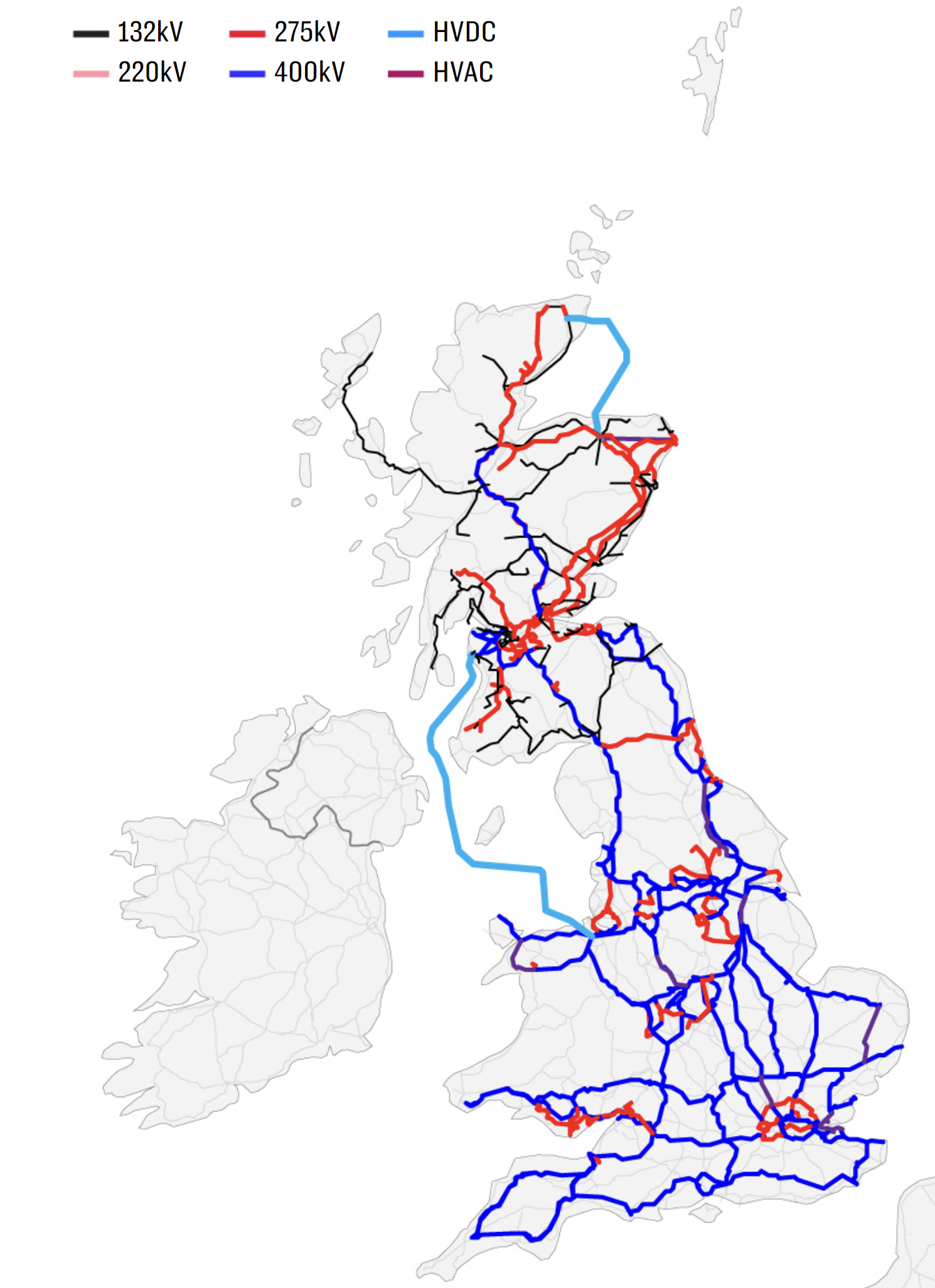
The dark blue lines are the 400 kV transmission lines.
- The one furthest East in East Anglia serves the Sizewell site, which hosts the Sizewell B nuclear power station and will be the home of Sizewell C nuclear power station, unless the Green or LibDem Parties are a member of a coalition government.
- Kent and Sussex seem to be encircled by 400 kV lines, with small spurs to the interconnectors to Europe.
- Two 400 kV lines appear to serve the South-West peninsular, with one going along the South Coast and the other further North. I suspect these two motorways for electricity explain, why the Morocco-UK Power Project terminates in Devon.
- London seems to have its own M25 for electricity.
- There also appears to be an East-West link to the North of London linking Sizewell in the East and Pembroke in the West. Both ends have large power stations.
- There also appear to be two 400 kV lines from Keadby by the Humber Estuary to North Wales with the pumped storage hydro power station at Dinorwig.
- Two more 400 kV lines link Yorkshire to the South of Scotland.
- A lonely Northern cable connects Edinburgh and the North of Scotland.
The red lines, like the one encircling central London are the 275 kV transmission lines.
- Think of these as the A roads of the electricity network.
- They encircle London often deep underground or under canal towpaths.
- They reinforce the electricity network in South Wales.
- Liverpool appears to have its own local network.
- They also seem to provide most of the capacity North of and between Edinburgh and Glasgow.
Newer cables are starting to appear on this map.
There are two light blue cables and these are HVDC cables that run underwater.
- The 1.2 GW Caithness – Moray Link does what it says in the name and it connects the far North of Scotland direct towards Aberdeen.
- The much larger 2.25 GW Western HVDC Link connects Hunterston near Glasgow to Flintshire Bridge near Liverpool. Note how it passes to the West of the Isle of Man.
Not shown on the map are the smaller 500 MW Moyle Interconnector and the recently-opened 600 MW Shetland HVDC Connection.
The Electricity Network In 2050
This second map shows how the network will look in 2050.

Note.
- The colours are the same, as the previous map.
- Although, I do think there are some errors in which have been used.
- There are a lot more cables.
There are several more light blue cables and these are HVDC cables that run underwater.
- Shetland is now linked to the North of Scotland by the Shetland HVDC Connection.
- There appears to be a cluster of HVDC interconnectors at Caithness HVDC switching station, near Wick, including a new one to Orkney, to go with the others to Moray and Shetland.
- The 2 GW Scotland England Green Link 1 will run from Torness in Southeast Scotland to Hawthorn Pit substation in Northeast England.
- The 2 GW Eastern Green Link 2 will run from Sandford Bay, at Peterhead in Scotland, to the Drax Power Station in Yorkshire, England.
- There also appear to be two or possibly three other offshore cables linking the East Coast of Scotland with the East Coast of England.
- If the Eastern cables are all 2 GW, that means there is a trunk route for at least 8 GW between Scotland’s wind farms in the North-East and Eastern England, which has the high capacity wind farms of Dogger Bank, Hornsea and around the Lincolnshire and East Angliam coasts.
- Turning to the Western side of Scotland, there appears to be a HVDC connection between the Scottish mainland and the Outer Hebrides.
- South-West of Glasgow, the Western HVDC Link appears to have been duplicated, with a second branch connecting Anglesey and North-West Wales to Scotland.
- The Moyle Interconnector must be in there somewhere.
- Finally, in the South a link is shown between Sizewell and Kent. It’s shown as 400 kV link but surely it would be a HVDC underwater cable.
There are also seven stubs reaching out into the sea, which are probably the power cables to the wind farms.
- The red one leading from South Wales could connect the wind farms of the Celtic Sea.
- The blue link North of Northern Ireland could link the MachairWind wind farm to the grid.
- The other two red links on the West Coast of Scotland could link to other ScotWind wind farms.
- The red link to the North of East Anglia could link RWE’s Norfolk wind farms to the grid.
- The other stubs in the East could either connect wind farms to the grid or be multi-purpose interconnectors linking to Germany and the Netherlands.
It looks to me, that National Grid ESO will be taking tight control of the grid and the connected wind farms, as an integrated entity.
As a Graduate Control Engineer, I can’t disagree with that philosophy.
Hydrogen Production
In How Germany Is Dominating Hydrogen Market, I talked about how Germany’s plans to use a lot of hydrogen, will create a large world-wide demand, that the UK because of geography and large amounts of renewable energy is in an ideal place to fulfil.
I can see several large electrolysers being built around the UK coastline and I would expect that National Grid ESO have made provision to ensure that the electrolysers have enough electricity.
Would I Do Anything Different?
Consider.
- If it is built the Morocco-UK Power Project will terminates in Devon.
- There could be more wind farms in the Celtic Sea.
- It is likely, that the wind farms in the Celtic Sea will connect to both Pembroke and Devon.
- Kent has interconnectors to the Continent.
Would a Southern HVDC link along the South Coast between Devon and Kent be a good idea?
Conclusion
Looking at the proposed list of wind farms, a total in excess of 96 GW could be possible, which is ten GW more than needed.
The network not only serves the UK in a comprehensive manner, but also tees up electricity for export to Europe.
LionLink: Proposed Windfarm Cabling Sites In Suffolk Are Revealed
The title of this post, is the same as that of this article on the BBC.
This is the sub-heading.
National Grid has revealed where it wants to build energy infrastructure for cabling between the UK and the Netherlands.
These four paragraphs describe the project.
The power line, called LionLink, would connect offshore wind farms in the North Sea.
The energy company wants the cables to reach land at either Walberswick or Southwold, both in Suffolk.
A converter station would be built on the outskirts of nearby Saxmundham and could cover a six-hectare area.
That would then connect to a substation being built at the village of Friston, also in Suffolk, as part of the offshore wind plans.
But the plans have brought the Nimbies out in force.
This Google Map shows the Suffolk Coast, to the South of Southwold.
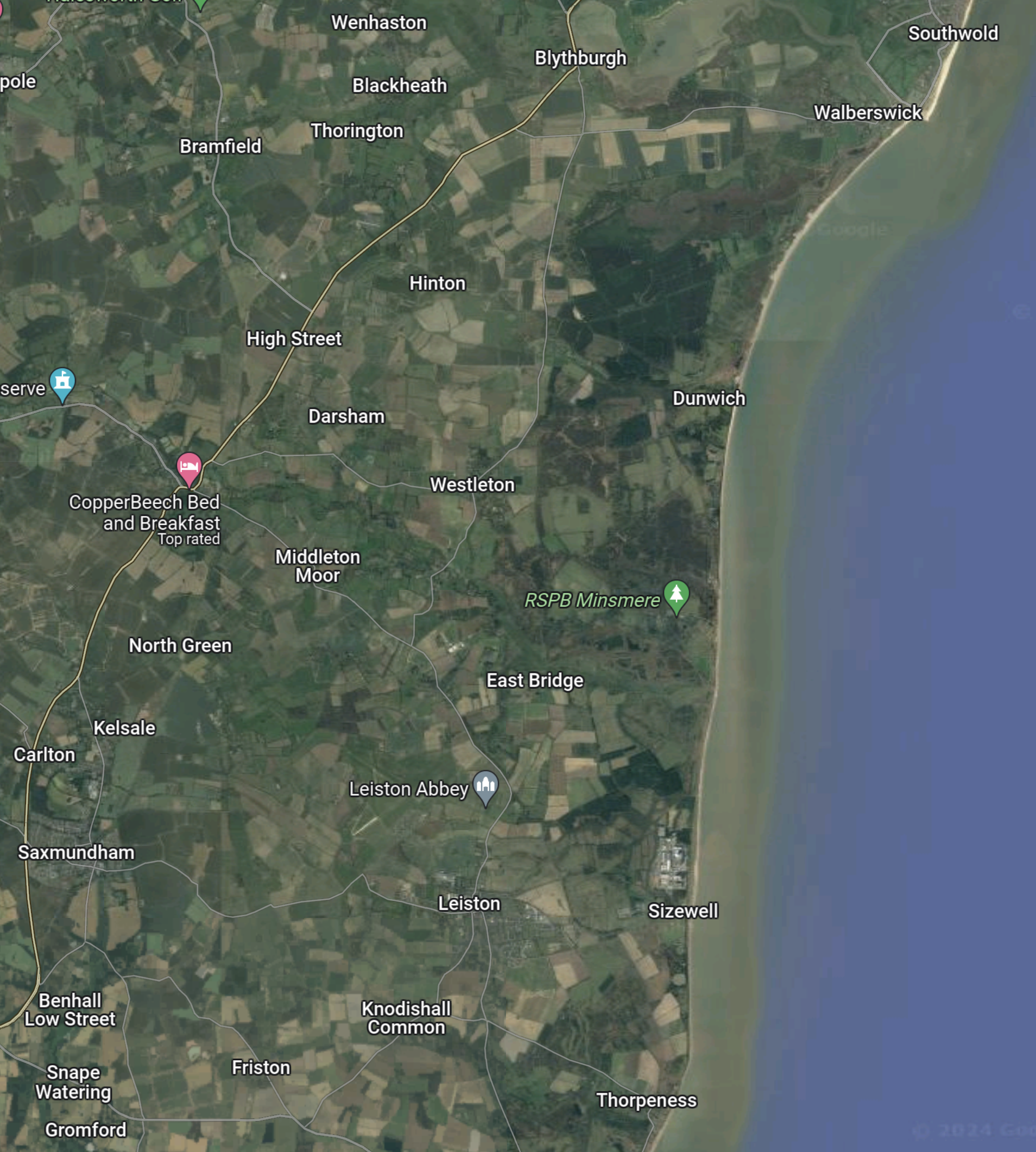
Note.
- Southwold and Walberswick in the North-East corner of the map.
- Saxmundham is just up from the South-West corner of the map, with Friston to its East.
- Sizewell with the 1.2 GW Sizewell B nuclear power station is on the coast directly East of Saxmundham.
- Sizewell B is planned to be joined by the 3.2 GW Sizewell C nuclear power station.
- LionLink is likely to have a capacity of 2 GW.
- I also believe that at least another GW of offshore wind power will be squeezed in along this section of coast.
The Sizewell site is connected to the National Grid at Bullen Lane substation to the West of Ipswich.
These pictures show the pylons that were built in the 1960s to connect Sizewell A to the National Grid.







I doubt, they would be allowed to be erected today.
One alternative would be to use T-pylons, like these built to connect Hinckley Point C to the National Grid.

There is more on T-pylons in this press release from National Grid, which is entitled National Grid Energise World’s First T-Pylons.
This Google Map shows the area between Ipswich and the coast.
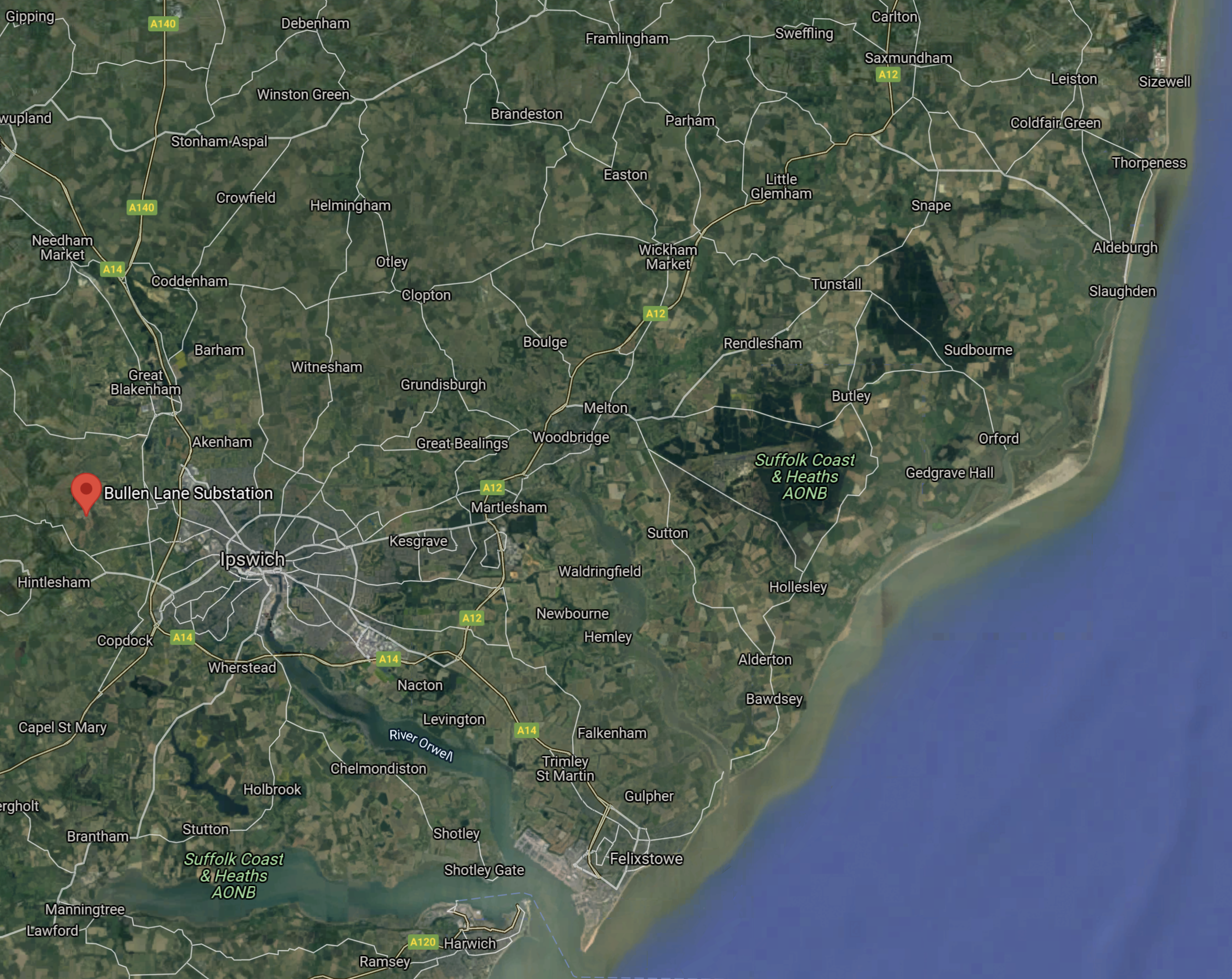
Note.
- Sizewell is in the North-East corner of the map.
- Felixstowe, Harwich and Freeport East are at the mouth of the rivers Orwell and Stour.
- The Bullen Lane substation is to the West of Ipswich and shown by the red arrow.
Looking at maximum power flows in Suffolk and Somerset, we get.
- North-East Suffolk to the National Grid at Bullen Lane – 7.4 GW.
- Hinckley Point C to the National Grid – 3.26 GW.
I am led to the conclusion, that there need to be a doubling of the pylons between North-East Suffolk and Bullens Lane.
I can understand why the Nimbies have been aroused.
I believe that National Grid will have to take the undersea route along the coast of Essex and Suffolk, to get the electricity to its markets.
 The Anonymous Widower