Sun-Powered Rooftops Could Generate Two Nukes Of Electricity…If England Follows Peterborough’s Lead
The title of this post, is the same as that of this press release from the Energy and Climate Intelligence Unit.
This is the sub-heading.
Household and commercial rooftop solar could save £450 million on bills.
These are the first two paragraphs.
If all English constituencies matched Peterborough, which has the highest proportion of homes with rooftop solar photovoltaic (PV) panels, the country’s solar capacity could be increased by around 7GW (gigawatts), new analysis from the Energy and Climate Intelligence Unit (ECIU) has found.
The nuclear power station Hinkley C will have a capacity of around 3.2GW, so the capacity rooftop solar on domestic properties could be more than the capacity of two new nuclear power stations.
It is an interesting thought.
I should say, that I have rooftop solar and it generates more electricity, than I ever thought it would.
I find this an interesting paragraph.
In addition, industry analysis shows that the capacity potential of solar on the roofs of commercial properties, such as warehouses, is 15GW. Combined, Peterborough levels of domestic solar and industry estimates for commercial solar could deliver an additional 22GW capacity, which is the equivalent of the capacity of almost 7 nuclear power stations. However, industry has reported that it is currently difficult to get commercial roof top developments connected to the grid, with waits up to a decade or more, and it can be costly.
22 GW is a lot of electricity, but I do feel, that with innovation that probably uses energy storage devices, the connection problems can be solved.
In Denny Bros Completes Solar Scheme At Bury St Edmunds Factory, I wrote about what one company in Suffolk has done with their roofs.
The technology already exists, so how long will it be before a company offers an electrolyser to convert excess electricity into hydrogen, which is used for transport, heating or an industrial process?
In Government Hydrogen Boost To Help Power Kimberly-Clark Towards 100% Green Energy Target, I talked about how Kimberly-Clark are partially switching from natural gas to green hydrogen.
TransPennine Express To Stop Using Loco-Hauled Push-Pull Trains In December
The title of this post, is the same as that of this article on Railway Gazette.
This is the sub-heading.
TransPennine Express has confirmed that it will cease using its push-pull sets of Class 68 locomotives and MkVa coaches, previously designated Nova 3 sets, from the December 2023 timetable change.
These are my thoughts.
The Nova 3 Trains
Currently, the Nova 3 trains are made up from the following.
- 14 – Class 68 locomotives
- 52 – Mark 5a coaches
- 14 – Driving Van Trailers
Note.
- There have been complaints about the noise of the Class 68 locomotives at Scarborough and also at Marylebone with Chiltern Railways.
- The Class 68 locomotives could be switched to freight duties.
- The coaches are capable of 125 mph.
- A maximum of thirteen sets can be created.
- I suspect CAF wouldn’t object to being asked to build some more Mark 5a coaches and driving van trailers.
- The current fleet has a spare locomotive and a spare driving van trailer to allow for servicing.
All locomotives and coaches are a maximum of seven years old, so will have plenty of life left.
The Class 93 Locomotive
Rail Operations Group have ordered ten Class 93 locomotives, with twenty options, which have an impressive specification.
- Built by Stadler in Valencia.
- Same family as a Class 68 and 88 locomotive.
- Electric, diesel and battery power
- 110 mph operating speed
- Ability to pull passenger and freight trains.
- Delivery scheduled for 2023.
I believe that if the Class 68 diesel locomotive of a Nova 3 train, were to be replaced with a Class 93 locomotive, a very useful train would be created.
- It would be ten mph faster, than a Nova 3 train.
- It could use the diesel engine and the batteries to bridge gaps in electrification.
- By adding extra carriages it could be tailored to the needs of a route.
- In Vegetable Oil Fuelling Chiltern Railways Trains In UK First, I discuss how it might be possible to run all these locomotives on HVO to cut emissions.
- It could be quieter.
Could it be a simple way to reduce carbon emissions on a route?
The Successor To The Class 93 Locomotive
Stadler keep innovating in their designs for locomotives and are already building hydrogen-powered multiple units.
I can see Stadler coming up with a hydrogen-powered locomotive, with the following specification.
- In the same family as Class 68, 88 and 93 locomotives.
- Ability to do everything that Class 68, 88 and 93 locomotives can do.
- Ability to use 25 KVAC overhead electrification, where it exists.
- Ability to be able to be fitted with third-rail equipment, so it can use 750 VDC third-rail electrification, where it exists.
- At least a 110 mph operating speed.
- Range of at least 200 miles on hydrogen.
Stadler would sell a lot of these locomotives to decarbonise railways all over the world.
Possible Routes
These are possible routes for a rake of Mark 5a coaches hauled by a Class 93 locomotive or its zero-carbon successor.
Hull Trains
Consider.
- Hull Trains is an open access operator.
- Hull Trains currently have a fleet of five Class 802 trains, each of which have five-cars.
- A Class 93 locomotive has a power of 900 kW on diesel, whereas the Class 802 train has 2100 kW.
- The Class 802 train has nearly ten percent more capacity.
- In Ten-Car Hull Trains, I saw two Class 802 trains working as a pair. Does this indicate they have a capacity problem?
- Between Hull and the East Coast Main Line is only 36.1 miles and isn’t very challenging and I suspect could probably be easily handled by a Class 93-hauled rake of Mark 5a coaches.
- Adding extra coaches would not be difficult and would probably be less costly than with the more complex Class 802 trains.
- Hull Trains need to have a plan to decarbonise.
- HVO could be used to cut down emissions.
A Class 93-hauled rake of Mark 5a coaches could be an intermediate step to full decarbonisation with a hydrogen locomotive.
Would other operators of Class 802 trains like to increase their fleets, by adding Hull Trains’s five Class 802 trains?
TransPennine Express
Consider.
- TransPennine Express currently have four different fleets of trains, so it must cause problems with the allocation of drivers.
- The Class 397 trains are confined to the West Coast Main Line.
- So that leaves the bi-mode Class 802 trains and the diesel Class 185 trains to work the TransPennine routes.
The Wikipedia entry for the Class 802 train, gives more details of the plans for the Class 802 trains.
During October 2021, it was announced that TransPennine Express, Hitachi, and Angel Trains had agreed to convert one of the former’s Nova 1 trainsets into a battery hybrid train on a trial basis with the aim of supporting the technology’s further development. If successful, Hitachi and Angel Trains have proposed the retrofitting of the entire fleet. In January 2022, reports emerged that the Nova 1 fleet was operating under diesel power even when operating on entirely electrified sections of the East Coast Main Line on account of the insufficient power supplies present along the line; national railway infrastructure owner Network Rail is reportedly set to complete upgrades to the power supplies within two years.
The fleet is also set to benefit from the rollout of electrification under the Transpennine route upgrade scheme. The company’s management has noted that, in the event of largescale electrification being funded and implemented, the Class 802s could have some of their engines removed to reduce roughly 15% of their weight and thus raise their efficiency. Furthermore, Leo Goodwin, TPE’s managing director, has observed that while the Class 802s have an initial maximum speed of 125 mph (201 km/h), they have the capability of being modified for operating at 140 mph (230 km/h) if infrastructure upgrades were to permit such speeds at a future date.
Could an augmented fleet of battery-electric Class 802 trains handle the bulk of the TransPennine routes, with the shorter and unelectrified ones still being handled by the Class 185 trains?
These shorter routes are.
- Leeds and Huddersfield
- Manchester Piccadilly and Huddersfield
- York and Scarborough
Plans only exist to electrify Leeds and Huddersfield.
I suspect a few more battery-electric Class 802 trains would be needed.
Great Western Railway
Could a Class 93-hauled rake of Mark 5a coaches be used as a replacement for the GWR Castles or short-formation InterCity125s?
- They both have four passenger coaches.
- They are both 125 mph trains.
- A Class 68 locomotive could be used on routes without electrification.
- HVO could be used to cut down emissions.
- The Mark 5a coaches would probably be quieter, as they only have one diesel engine.
A Class 93-hauled rake of Mark 5a coaches could be an intermediate step to full decarbonisation with a hydrogen locomotive.
Alternatively, five-car Class 802 trains could be used as replacements for GWR Castles.
Great Western Railway also have the problem of decarbonising services between Bristol/Gloucester and Weymouth/Southampton/Portsmouth.
Great Western Railway look like they’re needing some innovative thinking.
I also suspect a few more battery-electric Class 802 trains would be needed for other routes.
Transport For Wales Rail
Transport for Wales Rail run a Premier Service between Holyhead and Cardiff using Class 67 locomotives and Mark 4 coaches.
According to the Wikipedia entry for Transport for Wales Rail, they have seven sets of 4/5 coaches to run this service.
If Transport for Wales Rail wanted to decarbonise this route, they would need to replace the locomotives for a zero-carbon unit.
Perhaps, their best solution, would be to wait until a suitable hydrogen-powered locomotive is available and buy seven rakes of new coaches with driving van trailers.
Grand Union
Grand Union has a detailed Wikipedia entry, where this is the first paragraph.
Grand Union is a prospective open access operator who are proposing to operate train services in the United Kingdom from England to Wales and Scotland. Grand Union is headed by Ian Yeowart, who founded previous open access operators Alliance Rail Holdings and Grand Central before selling both to Arriva.
That seems a sound foundation.
- They have permission to run trains between Paddington and Carmarthen starting in December 2024.
- They have also applied to run trains between Euston and Stirling.
- They are now backed by Spanish companies; Serena Industrial Partners and Renfe.
- They are proposing to use nine Mark 4 coaches hauled by Class 93 locomotives.
Consider.
- CAF has a factory in Wales.
- CAF has sold trains to Transport for Wales.
- The Mark 5a coaches will definitely be available by December 2024.
- Mark 5a coaches could easily be arranged as a rake of eight coaches and a driving van trailer.
- Grand Union is backed by Spanish companies.
I wouldn’t be surprised if Grand Union were to use sets of CAF-built Mark 5a coaches for their Carmarthen service. And later for their Stirling service.
A Class 93-hauled rake of Mark 5a coaches could be an intermediate step to full decarbonisation with a hydrogen locomotive.
Grand Central
Consider.
- Grand Central is another open access operator.
- Grand Central has a mixed fleet of twelve five-car diesel trains.
- These trains run under electrification on the East Coast Main Line.
- According to the Wikipedia entry for Grand Central trains, they have plans for expansion across the North and to and from London.
- Grand Central need to have a plan to decarbonise.
- HVO could be used to cut down emissions.
A Class 93-hauled rake of Mark 5a coaches could be an intermediate step to full decarbonisation with a hydrogen locomotive.
South Western Railway
South Western Railway have an excellent fleet of new or nearly new trains, with the exception of the diesel Class 158 and Class 159 trains, that work services between Waterloo and Exeter trains via Basingstoke and Salisbury.
- Waterloo and Exeter is 172 miles.
- Only the 47.7 miles between Waterloo and Basingstoke is electrified with 750 VDC third-rail electrification.
- Train lengths vary between five and eight cars.
- The current trains date from around 1990 and must need replacing soon.
I wouldn’t be surprised that if after a rebranding with new trains, this could be a popular route.
A version of Hitachi’s ubiquitous bi-mode Class 802 could be used.
But.
- They would need to be ordered and built.
- The third-rail gear, would need to be developed and tested.
- Passengers would be travelling for over two and a half hours with underfloor diesel engines.
An alternative could be a Class 68-hauled rake of Mark 5a coaches.
- These trains would be available after release from TransPennine Express.
- They would run in TransPennine Express formation.
- Length could be adjusted by adding or removing coaches, if required.
- The noise is all in the locomotive, which is isolated from the passengers.
At some point in the future, the route could be decarbonised by swapping the locomotive for a hydrogen-electric locomotive with the ability to handle third-rail electrification.
ScotRail
ScotRail have a similar problem to Great Western Railway with their short-formation InterCity125s.
- They have 52 Class 43 locomotives and 120 Mark 3 coaches, which is probably enough for 24 trains.
- Scotland has substantial amounts of electrification.
- I feel that a Class 68-hauled rake of Mark 5a coaches would be a more than adequate replacement.
- Class 93 locomotives could be used where routes are partially electrified.
- Scotland is not going to be short of green hydrogen.
When a suitable hydrogen-electric locomotive is available, these trains can be decarbonised.
CrossCountry
CrossCountry have a fleet consisting of the following trains.
- 5 – 2+7 InterCity125 trains
- 7 – two-car Class 170 trains
- 22 – three-car Class 170 trains
- 34 – four-car Class 220 trains
- 4 – four-car Class 221 trains
- 20 – five-car Class 221 trains
Note.
- The fleet is all diesel.
- I’ll ignore the Class 170 trains in this analysis.
- The Class 220 and 221 trains often work in pairs to provide the required capacity.
So how could these trains be decarbonised?
- The InterCity125s and the Class 220 and 221 trains could be replaced by a locomotive-hauled rake of Mark 5a coaches of an appropriate length.
- Motive power could be provided by an appropriate Class 68 or 93 locomotive.
When a suitable hydrogen-electric locomotive is available, these trains can be fully decarbonised.
Decarbonisation Of UK Main Line Services
It is generally assumed that the railways of the UK will need to fully decarbonise if the UK and the constituent nations are going to meet their decarbonisation targets.
I believe that my analysis shows that decarbonisation of main line passenger services can be achieved by the purchase of two types of trains.
- Five-car bi-mode Class 802 trains or similar.
- Locomotive-hauled rakes of Mark 5a coaches of an appropriate length.
Note.
- The Class 802 trains would be mainly to augment existing Hitachi fleets.
- Some Class 802 trains would be fitted with batteries instead of diesel generators to handle gaps in the electrification.
- The rakes of coaches would be powered by an appropriate locomotive.
- The lengths of the rakes of coaches would be adjusted to meet the demand of each service.
Initially, the following locomotives would be used.
- Class 68 locomotives would be used on unelectrified lines.
- Class 93 locomotives would be used on full or partially electrified lines.
When the hydrogen-electric locomotives become available, these would take over the routes, which couldn’t be decarbonised by full electrification or by using a Class 93 locomotive.
How Bradford Residents Can Share Hydrogen Power Site Views
The title of this post, is the same as that of this article on the Bradford Telegraph and Argus.
These paragraphs give details of the consultation.
Developers will be holding their main consultation event will be held at Ingus Hall at Kala Sangam, St Peters House.
It will take place between 3pm to 7pm on Tuesday, September.
A further event specifically for local residents living near Bowling Back Lane is being held on Monday, September 11.
This press release from Hygen, which is entitled Bradford Hydrogen Production Facility Shortlisted For Government Funding, gives more details about the project.
I shall be going.
Is This The Way We’ll Drive Hydrogen-Powered Vehicles?
In Hydrogen Business Model / Net Zero Hydrogen Fund: Shortlisted Projects Allocation Round 2022, I listed all the hydrogen electrolyser projects on the shortlist for Government funding, if they pass the due diligence.
One project is from two companies H2 Energy and Trafigura, who are building a business model in West Wales, where you lease a hydrogen-powered truck for the same price as a diesel truck. You only pay for the miles you drive.
Their business model is explained in this must-watch Youtube video.
Consider.
- Hydrogen-powered vehicles have a long range.
- Fuelling time would be short compared to charging an electric truck.
- Are hydrogen-powered vehicles easy and low-cost to service?
- Cost of driver would be the same for operators.
- Would it be easier to recruit drivers for a hydrogen fuel-cell truck?
- Would cleaning costs be less for a hydrogen fuel-cell truck?
- Do the trucks come with sophisticated route planning software to cut mileage?
But as the video states, the upfront cost of the vehicle is higher.
I suspect the companies have driven the prices down, so that everybody gets an acceptable deal.
I wish the two companies all the best in their venture.
As I used to be half-owner of a vehicle leasing company, I feel that if the two companies can make a success of this hydrogen-powered truck leasing business, then I feel the model could be applied to the leasing of hydrogen-powered cars and other vehicles.
It could be a new way to buy your car.
Chiltern Railways Seeks Proposals For Low-Emission Multiple-Unit Fleet
The title of this post, is the same as that of this article on Railway Gazette.
These are the first three paragraphs.
Chiltern Railways is seeking proposals for the supply of between 20 and 70 new or converted ‘low-emission’ multiple units.
The operator has called for ‘established’ rolling stock manufacturers, owners and modifiers to propose vehicles which would provide a ’meaningful’ reduction in the emissions and external noise compared to its existing diesel multiple-units, particularly in urban areas.
The envisaged five-year framework agreement has an estimated value of up to £400m, including supply and maintenance of the fleet, refuelling infrastructure and any depot modifications.
I have my thoughts.
Chiltern’s Rolling Stock
Chiltern Railways have two different types of rolling stock; diesel multiple units and rakes of coaches haled by diesel locomotives.
Chiltern’s Diesel Multiple Units
Chiltern has these diesel multiple units.
- Class 165 diesel trains – 28 x two-cars – 56 cars
- Class 165 diesel trains – 11 x three-cars – 33 cars
- Class 168 diesel trains – 9 x two-cars – 18 cars
- Class 168 diesel trains – 9 x three-cars – 27 cars
- Class 168 diesel trains – 10 x four-cars – 40 cars
Note.
- The trains were built between 1990 and 2004.
- The Class 165 trains are 75 mph units, whereas the Class 168 trains are 100 mph units.
- These total to 67 trains and 174 cars.
- This is an average train length of 2.6 cars.
Could a fleet of three-car low-emission 100 mph trains fit Chiltern’s requirements?
- They could work in pairs for six-car units for Birmingham Moor Street and Oxford.
- There may be a need for some four-car units.
But how will they be powered?
- Pure diesel will surely give out too many emissions!
- Would an mtu Hybrid PowerPack lower emissions enough?
- Could hydrogen-power be used, either with fuel-cells or a hydrogen internal combustion engine?
In Alstom And Eversholt Rail Sign An Agreement For The UK’s First Ever Brand-New Hydrogen Train Fleet, I wrote about Alstom’s proposed Hydrogen Aventra.
A version of these trains could be ideal, if Children could source the fuel economically.
Chiltern’s Diesel-Hauled Rakes Of Coaches
Chiltern have four rakes of Mark 3 coaches hauled by Class 68 locomotives.
These could be replaced by pairs of three-car low-emission’ multiple units.
Conclusion
A fleet of seventy three-car ‘low-emission’ multiple units, powered by hydrogen could be an innovative solution to the trains to run Chiltern’s services.
Lord Bamford: We’re Too Mesmerised By Musk — Here’s Why I’m Building A Hydrogen JCB
The title of this post, is the same as that of this article in the Sunday Times.
This is the sub-heading.
JCB’s Lord Bamford has spent £100m on a hydrogen engine. Tesla’s tech won’t suit everyone, he tells Jim Armitage
These are my thoughts.
The Need For Zero-Carbon Construction Equipment
Construction sites can be dangerous places and in addition to the obvious dangers, there are hidden pollutants in the atmosphere on sites.
Health and Safety will surely demand an improvement in air quality on construction sites for the protection of the workforce and nearby residents.
If JCB can produce zero-carbon construction equipment, then whether it is electric or hydrogen, this will be to their advantage.
High Speed Two And Low-Carbon Construction
High Speed Two is the UK’s biggest construction project and these posts on this blog, talk about low-carbon construction.
- HS2 Reveals Dramatic Carbon Saving With Ambitious Modular Design For Thame Valley Viaduct
- HS2 Smashes Carbon Target
- HS2 To Trial New Building Method Which Could Provide Carbon-Free Energy
- New HS2 Pilot Project Swaps Steel For Retired Wind Turbine Blades To Reinforce Concrete
- World First As HS2 Trials Dual-Fuel Piling Rig On London Site
If High Speed Two are thinking this way, how many other projects will be built in a similar way?
Decarbonising Cargo Handling
It should be noted that JCB are involved in Freeport East at Felixstowe/Harwich.
Ports will be the sort of workplaces, where all vehicles should be zero-carbon, to protect the workforce. Some of the container handling machines are large and would be ideal for hydrogen.
Decarbonising Agriculture
JCB also make tractors, like the Fastrac and other equipment for agriculture. As they often work around people, hydrogen could be much better.
New Markets
Zero-carbon engines will result in new products for new markets.
Lord Bamford is on track to create valuable new markets for his diggers and other equipment.
Hydrogen-Powered Land Speed Record
JCB already hold the land speed record with the JCB Dieselmax, at over 350 mph.
This paragraph from Wikipedia describes the powerplant.
The car is powered by two specially-tuned versions of the production JCB444 powerplant, developing up to 750 brake horsepower (560 kW) each (over five times the power output of the production version with 90 psi (6 bar) of boost) and featuring four cylinders and 5 litres of displacement, accompanied by two stage turbochargers, intercooler and aftercooler.
I believe that getting that amount of power out of a production diesel engine, shows that JCB’s combustion engineers could do the same for a hydrogen-powered vehicle.
Sussex Will Be Leader In Hydrogen Energy Production
The title of this post, is the same as that of this article on The Argus.
These are the first three paragraphs.
The county is today launching its bid to become a pioneer for use and production of hydrogen energy.
Experts will unveil Brighton’s hydrogen strategy this morning showing how the city and surrounding areas are championing a clean energy infrastructure.
With plans for a Worthing crematorium to become the first in the world powered entirely by hydrogen, development of a green energy production facility in Shoreham, and a growing fleet of hydrogen-powered buses in Crawley, the region is already breaking ground in the hydrogen industry – and shows no sign of stopping.
These are my thoughts.
The Plan Is Comprehensive
This document of the Council website, is entitled the Greater Brighton Hydrogen Strategy.
It is very comprehensive and discusses hydrogen in Sussex from all angles.
Every Council in the UK needs to have their own comprehensive strategy like this.
The Report Cautions That Greater Brighton May Need More Renewable Energy
Consider.
- The Rampion wind farm, with a capacity of 400 MW is already operating in the sea South of Brighton.
- This should be joined by the 1200 GW rampion 2 wind farm in the next few years.
It is unlikely substantial onshore wind and solar farms will be built in the area.
Gatwick Airport Is Expected To Need A Hydrogen Supply
The strategy says this about Gatwick and the two Rampion wind farms.
The offshore wind farm Rampion is large enough to be considered nationally significant infrastructure. There
is a second development for this wind farm planned for 2025-6, which will connect into Bolney substation as
per the existing wind farm.The GBEB energy plan suggested that an electrolyser could be sited there, although there are no identified demand locations nearby other than potential refuelling of passing traffic on the A23.
However, considering the relative distance to Gatwick airport, which is expected to be a significant future
demand, there may be an opportunity for a direct pipeline. This would be further into the future and requires
further analysis and bilateral engagement between Rampion and Gatwick. Engagement with Rampion found
that, given the large population supplied by the Rampion wind farms, and the relative lack of other large-scale
renewables locally, these wind farms are unlikely to face significant curtailment and will fully contribute to
decarbonising the local electricity grid. Therefore, using Rampion to produce hydrogen by electrolysis is not
seen as the best use case in the near term.
It looks to me, that because of the electricity demand in the Brighton and Gatwick area, that a big decision needs to be made to create some more renewable capacity.
Could this mean a Rampion 3 or perhaps a fleet of small modular nuclear reactors at Dungeness?
An Electrolyser At Bolney Substation
This Google map shows the position of Bolney substation.
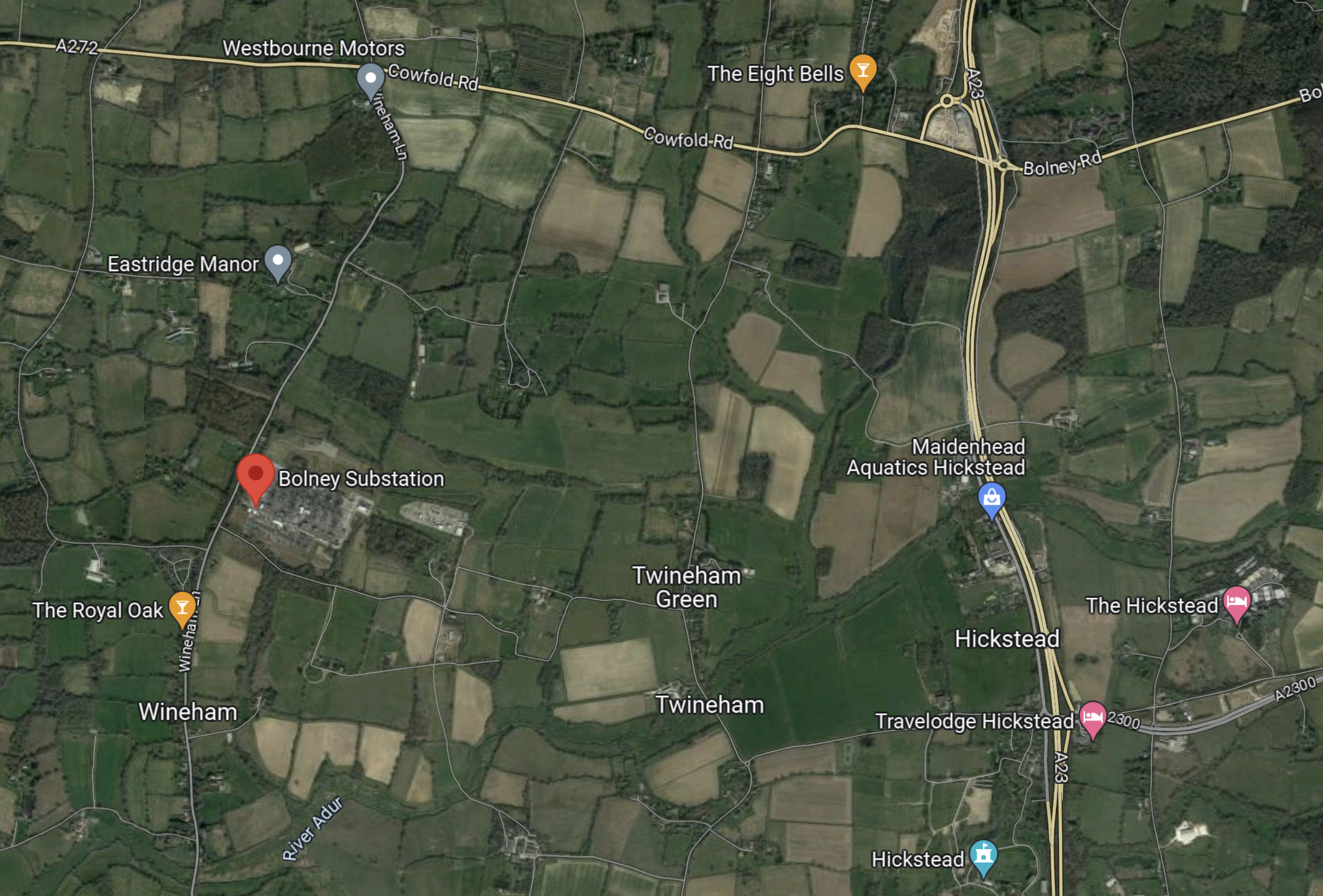
Note.
- The A23 is the main London-Brighton road.
- Bolney substation is indicated by the red arrow.
- The substation doesn’t have very good road access.
- I also suspect that the locals wouldn’t like an electrolyser in their midst.
On a brief look, I suspect that an electrolyser at Bolney substation will be a non-starter.
Shoreham Port As A Hydrogen Hub
The strategy mentions Shoreham Port several times, but gives the impression that progress is slow.
This Google Map shows Shoreham Port.
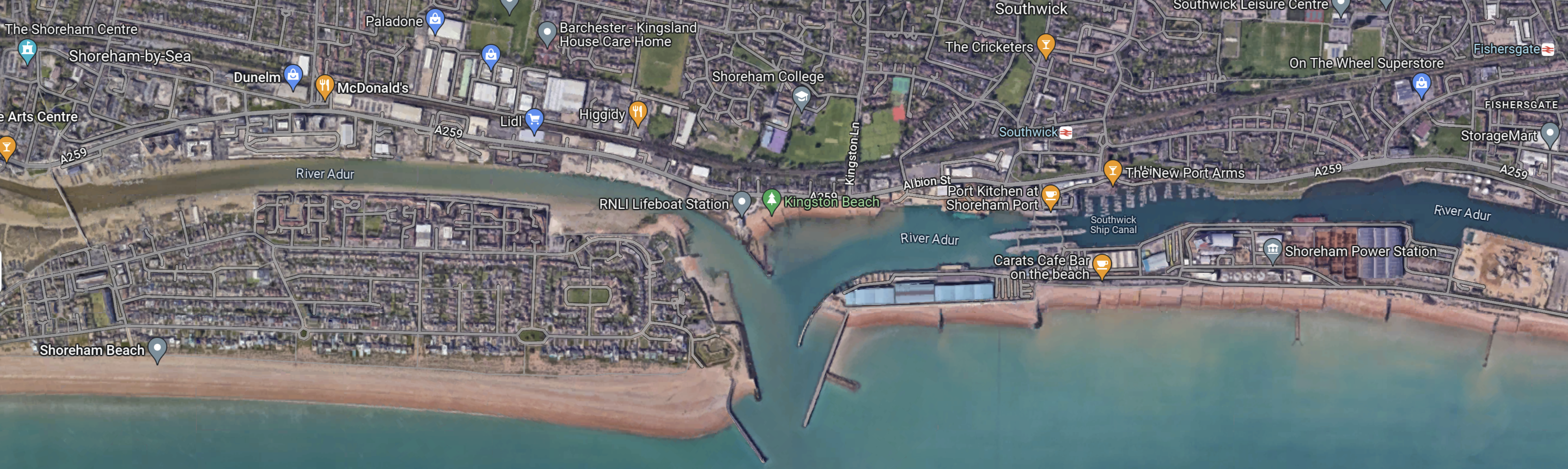
Note.
- Shoreham is in the West.
- The port reaches a long way to the East.
- The 420 MW gas-fired Shoreham Power station, is at the Eastern end of the port, close to the sea.
There appears to be spaces along the water for developing hydrogen infrastructure.
This page on the H2Green web site is entitled Agreement to Develop Clean Energy Hub for Shoreham Port, Sussex, starts with this paragraph.
Getech, the geoscience and geospatial technology provider and data-led energy asset developer, is pleased to announce that its wholly owned hydrogen subsidiary, H2 Green, has signed a Collaboration Agreement (the “Agreement”) with Shoreham Port.
It lists these three highlights.
- H2 Green granted a two-year legally binding exclusive right to develop a renewable energy hub (the “Hub”) at the Port of Shoreham, West Sussex.
- Under plans submitted by H2 Green to Shoreham Port, the Hub will initially focus on the provision of green hydrogen and renewable electricity to the Port’s fleet of 39 heavy forklift trucks and 12 heavy goods vehicles.
- Green Hydrogen will be sourced by a scalable green hydrogen production, storage and refuelling facility – the economics of which will be optimised by its integration with new solar and wind electricity generation capacity.
- The Hub will then be expanded to facilitate the decarbonisation of more than 800 heavy goods vehicles that enter Shoreham Port daily, and to provide fuel to port and coastal marine vessels.
That is all good stuff, but I do wonder, where the renewable electricity is going to come from.
In Further Thoughts On BP’s Successful INTOG Bid, I looked at BP’s plan for a 50 MW wind farm.
- It will be about twenty miles offshore from Aberdeen.
- With an appropriate electrolyser 50 MW of electricity would produce twenty tonnes of hydrogen per day.
- The electrolyser could be onshore or even offshore.
- The technology has all been developed.
Could H2Green be thinking of developing a similar hydrogen production facility?
Ecojet: Dale Vince Launches An Aviation Revolution
The title of this post is the same as that as this news story from Ecotricity.
This is the sub-heading.
The world’s first electric airline powered by renewable energy
These three paragraphs outline the project.
Ecotricity founder, Dale Vince, has announced the launch of Ecojet, the world’s first Electric Airline, powered by renewable energy. The move marks the beginning of an aviation revolution by making net-zero, emission-free air travel possible for the first time.
Ecojet’s fleet will comprise conventional planes retrofitted with hydrogen-electric powertrains. Once converted, the aircraft will operate with the same power output as before, but with a one-hundred percent reduction in CO2 emissions.
The decision to repurpose old planes rather than build new models from scratch will save 90,000 tonnes of carbon per year. The only byproduct will be water, which can be captured and released into the lower atmosphere to avoid the harmful effects of contrails.
These ae my thoughts.
The Aircraft
The news story contains pictures of two aircraft; a de Havilland Canada Twin Otter and a 737 or A320 variant.
- It also says that hydrogen-electric powertrains will be used.
- ZeroAvia in partnership with Cranfield Aerospace are developing such a powertrain and I suspect they could have one certified by 2025.
This would be used in the Twin Otter.
But what about 737 or A320 variant?
Airbus are already proposing the ZEROe Turbofan, which appears to be based on an improved A320 neo.
But the image on the news story looks more like a Boeing 737 from the wing-tips.
This article on the IET web site, which is entitled Airbus And Boeing To Embrace Hydrogen From Mid-2030s, indicates that it will be the mid-2030s before hydrogen twinjets of this size are in service.
This paragraph from the news story indicates his philosophy about the aircraft.
Short-term, to secure routes and a license from the Civil Aviation Authority, Ecojet will initially launch using conventionally fuelled planes. Ecojet will launch with two different sizes of turboprop aircraft (a 19-seat aircraft and a 70-seat aircraft). These aircraft will be retrofitted with the hydrogen-electric powertrains as they become approved for service by the CAA – the first retrofits will take place in 2025, one year after the commencement of flights.
Note.
- The news story clearly states that two types of aircraft will be used; a 19-seat turboprop and 70-seat turboprop.
- So the second picture of a Boeing 737 had nothing to do with the news story.
- They will be retrofitted with hydrogen-electric powertrains, when they have been certified.
- Flights are planned to start next year.
It looks a very canny philosophy, as Ecojet will be able to prove the route with aircraft running on traditional fuels or sustainable aviation fuel (SAF) and only switch to hydrogen, when the hydrogen-electric powertrains are proven, certified and installed, and the hydrogen infrastructure is in place.
The Smaller Aircraft
The first picture in the news story is of a de Havilland Canada Twin Otter.
- This aircraft accommodates 19-20 passengers.
- It has two turboprop engines.
- Production started in 1966 and it is still ongoing.
- Nearly a thousand have been built, so plenty of nearly-new examples will be available for refurbishment and conversion.
- Loganair operate three aircraft in Scotland.
It looks fairly certain, that Ecojet’s 19-seat aircraft will be a Twin Otter.
The Larger Aircraft
Possibilities would include these aircraft.
- ATR-72 – 72 seats
- de Havilland Canada Dash 8 – > 50 seats
Note.
- Both aircraft are still in production.
- In ZeroAvia To Bring Zero-Emissions Flight To Sweden, I talk about how ZeroAvia have sold their hydrogen-electric powertrains to Swedish ATR-72 operator; Braathens and are targeting Dash 8 operators.
- In Universal Hydrogen Successfully Completes First Flight Of Hydrogen Regional Airliner, I talk about Universal Hydrogen’s successful progress in selling hydrogen-electric powertrains for ATR-72s and Dash 8s. The first flight of their system was in an ATR-72.
It looks to me, that Dale Vince has a choice of two 70-seat aircraft and hydrogen-electric powertrains from two manufacturers; ZeroAvia and Universal Hydrogen.
In Monte To Purchase 100 FC Aircraft Drives From ZeroAvia, I talk about how Monte Aircraft Leasing have done a deal with ZeroAvia to lease ZeroAvia’s hydrogen-electric powertrains to regional airlines.
Has Dale Vince done a deal with Monte Aircraft Leasing for his aircraft?
- Monte Aircraft Leasing and ZeroAvia would get an eco-celebrity customer, who could even be the launch customer.
- Ecojet’s aircraft would all have similar ZeroAvia hydrogen-electric powertrains, although the size might be different.
- Dale Vince would only be sharing the risk, if the technology was a dog.
- De Havilland Canada and/or ATR will see how the passengers like zero-carbon flight.
There is also, one of aviation’s most powerful companies close to the deal, as Airbus own half of ATR.
Airbus are developing the hydrogen-powered ZEROe Turboprop, which is shown in this Airbus image.
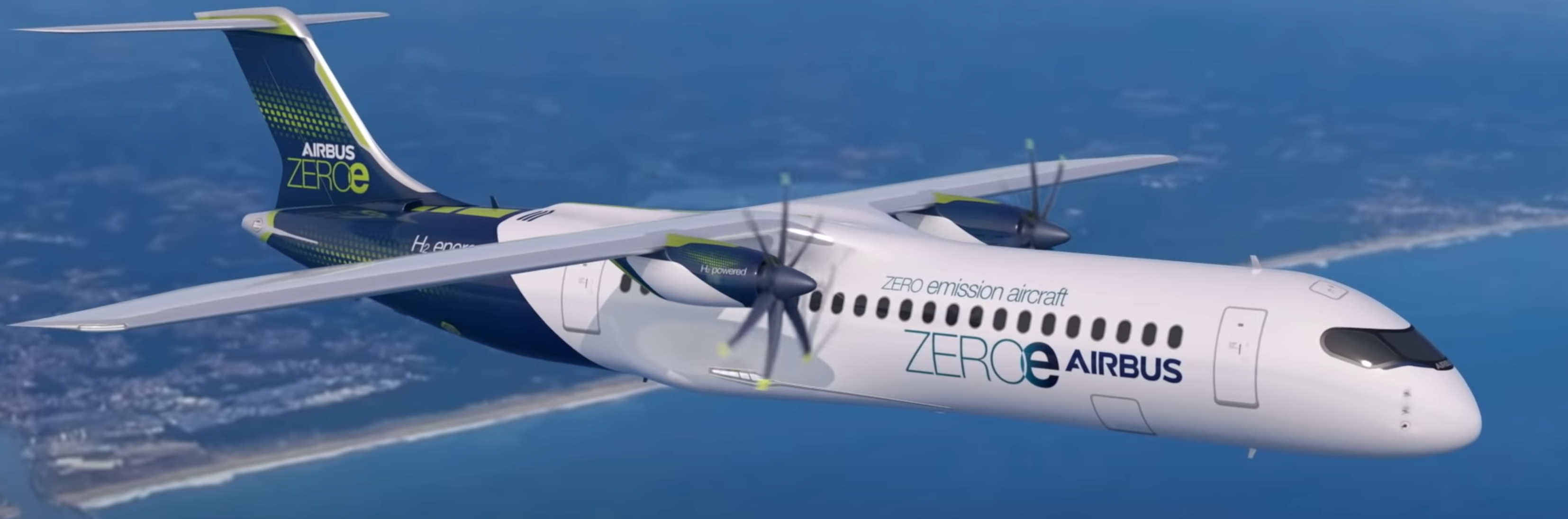
Note.
- It looks very much like an improved ATR-72.
- It has more extreme propellers and probably better aerodynamics.
- Airbus might like to persuade Ecojet to use ATR-72s as their 70-seat airliner.
- Information from an operator of hydrogen-powered airliners would be very valuable to Airbus.
I wouldn’t be surprised to see Ecojet lease some nearly new ATR-72s.
Would Airbus Fit ZeroAvia Hydrogen-Electric Powertrains In The ZEROe Turboprop?
This page on the Airbus website is entitled ZEROe.
In a section, which is entitled Hydrogen Propulsion To Power Future Aircraft, this is said.
All three ZEROe concepts are hybrid-hydrogen aircraft. They are powered by hydrogen combustion through modified gas turbine engines. Liquid hydrogen is used as fuel for combustion with oxygen.
In addition, hydrogen fuel cells create electrical power that complements the gas turbine, resulting in a highly efficient hybrid-electric propulsion system. All of these technologies are complementary, and the benefits are additive.
In 2022, we launched our ZEROe demonstrator with the aim to test hydrogen combustion technology on an A380 multimodal platform. Through future ground and flight testing, we expect to achieve a mature technology readiness level for a hydrogen-combustion propulsion system by 2025.
Note.
- Airbus state they are using modified gas turbine engines.
- Airbus also talk about using fuel cells to create electrical power that complements the gas turbines.
- Could the hydrogen fuel cells be used to power the aircraft’s systems, like avionics, control systems, air-conditioning and the hydrogen system for the main engine?
- This concept of effectively a hydrogen auxiliary power unit, might be a more efficient way of using the hydrogen, which either gives longer range or a smaller fuel tank.
- In The ZEROe Demonstrator Has Arrived, I talk about the ZEROe Demonstrator, which is a modified Airbus A 380.
Did the adding of hydrogen fuel cells to the ZEROe aircraft, lead to the concept of a hydrogen-powered auxiliary power unit, that I talked about in Airbus To Trial In-flight Auxiliary Power Entirely Generated By Hydrogen?
It looks to me, that Airbus have developed their own simple concept of powering the aircraft.
I doubt they will need ZeroAvia’s technology.
But.
- Aircraft manufacturers like Airbus generally fit the best and most suited engines they can find in their aircraft.
- The Wikipedia entry for ZeroAvia says that the prototype hydrogen-electric powertrain is in the cabin, consisting of two fuel cells and a lithium-ion battery for peak power.
- ZeroAvia have powerful shareholders like Amazon, Bill Gates and Royal Dutch Shell.
- ZeroAvia have also received grants from the UK Government.
I wouldn’t be surprised to learn, that Airbus have taken a long hard look at ZeroAvia’s technology.
After all, ZeroAvia could probably build a hydrogen fuel cell power pack, that would meet Airbus’s needs for a hydrogen-powered auxiliary power unit.
Remember too, that many fleets of aircraft have been updated with new engines for decades and I don’t think Airbus would mind ZeroAvia giving a new zero-carbon lease of life to the hundreds of ATR-72s in service around the world.
Surely, a successful hydrogen-powered ATR-72 is only going to create more interest in airlines buying ZEROe Turboprops.
All the converted aircraft will still need support from ATR.
Both the converted and new aircraft will need hydrogen refuelling services, so could the two aircraft use a common standard.
Airbus and ZeroAvia would appear to have several common interests.
Ecojet’s Core Route
This is a paragraph from the news story on the Ecotricity web site.
Dale has partnered with experienced pilot Brent Smith and a team of aviation specialists to set up Ecojet. Flights across the UK will commence in early 2024, starting with the Edinburgh to Southampton route, and expanding to mainland Europe shortly after, with long-haul flights planned for the future.
Note.
- The ATR-72 has a range of 949 miles, which is more than adequate for Southampton and Edinburgh, which is just over 350 miles.
- Diagonal journeys in the UK are often the most passenger-unfriendly by rail and tend to use diesel trains.
- Southampton Airport has good road and rail connections, with the terminal less than a minute from the station.
- Edinburgh Airport has good road and tram connections, with rail connections needing a short journey on the tram.
- Southampton Airport has flights to the Channel Islands, Ireland and Schiphol.
- Edinburgh Airport has a comprehensive service from major airlines and low-cost carriers, and several flights to destinations in the North of Scotland and on the Islands.
I think that it is a well-chosen core route for their 70-seat aircraft.
Which Routes Will Ecojet Fly With The Twin Otters?
Consider.
- My Scottish friends tell me that flying to the Scottish Islands, like the Hebrides, Orkney and Shetland is expensive.
- The growth of the Scottish wind power industry will mean, that more capacity is needed to serve the North of Scotland and the Islands.
- Tourism to the North of Scotland and the Islands is on the up.
- There will not be a shortage of green electricity to produce green hydrogen.
- The North of Scotland isn’t short of airports.
- The Twin Otter has a surprisingly long range on aviation fuel and I suspect, that a hydrogen version would be designed to have a similar range.
- The longest flight needed would probably be Edinburgh and Sumburgh, which is about 280 miles, which should be well within the range of a Twin Otter.
- I suspect that hydrogen refuelling could be easily provided at enough airports, to support hydrogen-powered airliners.
- I am sure, that the Twin Otters could be used on a network of zero-carbon flights from Edinburgh to the North of Scotland and the Islands.
- A zero-carbon airline would help Scotland’s net-zero ambitions.
There is certainly a need for another airline to connect Edinburgh to the North of Scotland and the Islands and the infrastructure could be upgraded to support a hydrogen-based zero-carbon airline.
Could Ecojet build a similar network at Southampton, that served the Channel Islands, Southern Ireland and Northern France?
Conclusion
There’s a lot more to this venture, than there appears at first sight.
O wish Vince and his partners well, but as a coeliac, I’ll skip the food.
 The Anonymous Widower