British Start-Up Attempts To Bring Steam Power Back To Shipping
The title of this post, is the same as that of this article on Splash 247.
These are the introductory p[aragraphs.
A British start-up called Steamology is trying to bring steam power back to shipping. However, the key difference for this 21st century invention is that instead of steam generated by burning coal, Steamology’s steam is generated by burning pure oxygen and hydrogen, split from water.
The company has just won UK government innovation funding of £400,000 ($496,000) to trial the technology initially for trains but with a longer term view of getting it onboard ships.
There’s also a good graphic, which explains how the technology works.
Beeching Reversal – Arundel Chord
This is one of the Beeching Reversal projects that the Government and Network Rail are proposing to reverse some of the Beeching cuts.
This Google Map shows where the chord will be built.
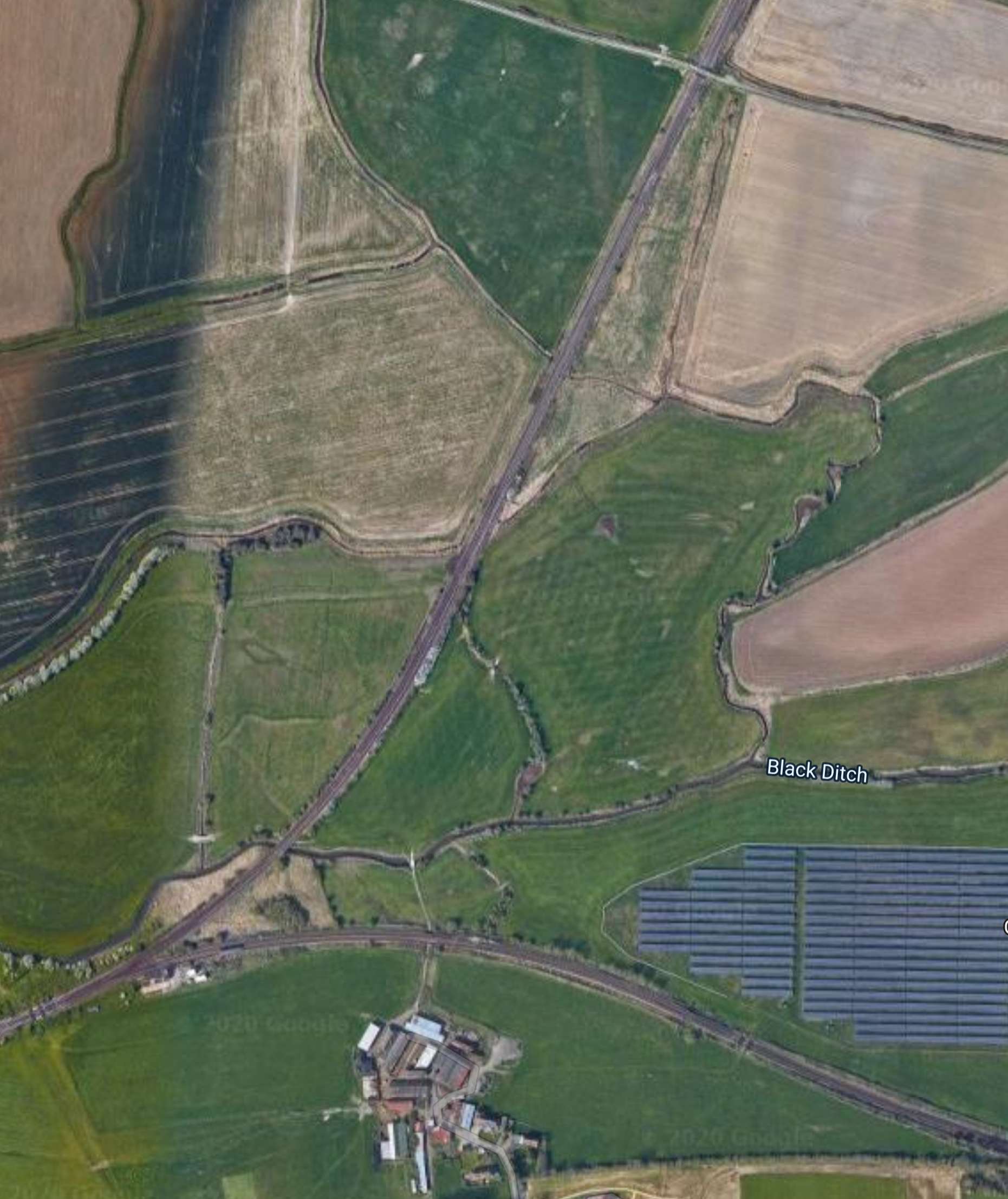
Note.
- The railway line going North is the Arun Valley Line that goes North to Arundel and Horsham stations.
- The line going East is the West Coastway Line that goes East to Angmering, Worthing, Shoreham and Brighton stations.
- The two lines join at Arundel Junction and trains go South and West to Bognor Regis, Littlehampton, Portsmouth and Southampton.
The new chord will join the Arun Valley Line to the North with the West Coastway Line going to the East.
This will give an alternative route between London and Brighton, when the Brighton Main Line is blocked.
- I would assume it will be a simple flat junction at both ends of the chord, as under normal circumstances it won’t get a lot of use.
- It would also needed to be able to accommodate the largest 12-car trains wanting to use the route.
- Also, in the last couple of years, Network Rail have done a lot of work to stop flooding and increase the resilience of the Brighton Main Line.
So is there another plan?
After all, it’s a lot of work to do for a route that only gets used occasionally.
So here’s a few ideas and reasons.
The Rebuilding Of Gatwick Airport And East Croydon Stations
Gatwick Airport and East Croydon stations are due to be rebuilt in the near future and if the Arundel Chord has been built, it offers an alternative route to London for trains from Brighton.
COVID-19
COVID-19 won’t have any direct effects on running the trains, but it could play havoc with the scheduling of any building work on the Brighton Main Line and at the stations, that passengers and trains use to get to London.
Again an alternative route might be useful.
A Service Between London and Hove Via The Arun Valley Line
This route may have advantages in that it might use a less crowded route to London.
A West Sussex Loop
I like loops.
- They can be used to cut the number of platforms needed.
- The driver doesn’t have to change ends.
- Trains can be turned quicker at the destination.
If you’re still sceptical, go to Liverpool and investigate the operation of the Wirral Line, which has five stations in an underground loop under Liverpool city centre. It also handles upwards of twelve trains per hour.
Once the Arundel Chord is built trains could do the following.
- Come South down the Brighton Main Line calling at stations like East Croydon, Gatwick Airport, Three Bridge and Haywards Heath. as required.
- After Preston Park station, the trains would take the West Coastway Line.
- Continue West, calling at stations like Hove, Shoreham, Worthing and Angmering as required.
- On reaching the Arundel Chord, the trains would turn North for Arundel and Horsham.
- Trains would continue back to Three Bridges, stopping as required.
Note.
- As it is a double-track loop, trains could use it both ways.
- Most of the route is in West Sussex, with a few miles in the City of Brighton and Hove.
- Trains don’t have to start in London, but could perhaps turn back at Redhill or Gatwick Airport. This might remove some trains through East Croydon.
Would this service encourage the locals to use the train to travel to Gatwick Airport?
Operating Issues
Network Rail, Southern or Thameslink may have operational reasons, like getting the trains back to depot, if they fail.
More Affordable Than Reopening Uckfield And Lewes
I think it could have similar capacity improvements and advantages to re-opening Uckfield and Lewes, but it is a lot more affordable.
Conclusion
This project seems to have dropped down the list in previous years.
Perhaps something that needs it has come up!
Japan A ‘Very Interesting Market’ For Gore Street As It Becomes An ‘Enabler’ Of JXTG’s Transition
The title of this post, is the same as that of this article on the Solar Power Portal.
This is the introductory paragraph.
London Stock Exchange-listed energy storage fund Gore Street has outlined how it sees Japan as a “very interesting market” following its investment from JXTG Nippon Oil & Energy Corporation.
I like Gore Street’s philosophy and its execution.
I am not an investor and probably never will be, but they seem to be based on sound principles and do their modelling well. I’ve built enough large financial models to know a good one from its results.
Gore Street is normally investing in lithium-ion batteries.
- These batteries now have a predictable reliability profile and I suspect cash-flow from owning a battery is fairly predictable.
- The control and monitoring software will get better as time goes by and these batteries will probably update themselves automatically.
- They probably aren’t that affected by COVID-19, as lockdown still needs energy to be balanced and these batteries are probably performing as normal.
- The heat of the last few weeks probably caused more grief than COVID-19.
- If a site visit is necessary, they can probably be done with one man in a van with a key to the security system. So maintenance is probably easy to do, whilst maintaining social distance.
I also liked this paragraph from the article.
, Gore Street Capital CEO, Alex O’Cinneide, said that the fact that the deregulation of the Japanese market over the next few years makes it of interest to the company, alongside it having the same characteristics of the UK in terms of the decommissioning of coal, nuclear and gas and increasing levels of renewables.
Could Gore Street Energy Fund, be a safe investment for today’s difficult times?
JCB Unveils World’s First Hydrogen Digger
The title of this post is the same as that of this article on International Vehicle Technology.
The signs have been there for some time.
- JCB are one of the backers of ITM Power, who make large scale electrolysers in Rotherham.
- Jo Bamford has a hydrogen company called Ryze Hydrogen.
- Jo Bamford took over Wrightbus and is saying he’ll be building thousands of hydrogen buses a year.
- Ryze Hydrogen have planning permission for a giant hydrogen electrolyser at Herne Bay.
To me, it is totally logical, that JCB build a hydrogen-powered digger.
And it appears they have got there first!
What Does the Future of Offshore Wind Energy Look Like?
The title of this post, is the same as that of this article on Real Clear Energy.
These topics are covered.
- Improved efficiency
- Aerodynamic blades
- Sturdiness and durability
- Big data, the cloud and artificial intelligence
- Drones
- Floating turbines and deeper waters
- Complicated coastal climate zones of which North America has eight.
Some topics weren’t covered.
- Artificial islands like the Dutch, German and Danish plan for The North Sea Wind Power Hub on the Dogger Bank.
- Conversion of wind power to hydrogen at or near the offshore turbines, which I wrote about in ITM Power and Ørsted: Wind Turbine Electrolyser Integration.
The author finishes with this statement.
The integration of wind energy, in any form, can ultimately benefit all 50 states in the US by 2050 if it starts now.
In 1962, Bob Dylan, wrote this famous phrase.
The answer, my friend, is blowin’ in the wind.
Fifty-eight years later he’s been proven right, in a big way!
Beeching Reversal: Fifty Disused Rail Lines On Track To Reopen
The title of this post, is the same as that of this article in The Times
This is the introductory paragraph.
The reopening of up to 50 disused railway lines or stations will be considered as part of a reversal of the infamous Beeching cuts, it was announced yesterday.
The Possible Projects
These are the various projects, shown as an index by area, so you can click to find out more.
Yorkshire and Humberside
Reinstatement of the Beverley to York Rail Line
Restoration Of A Daily Train Service On The Keighley & Worth Valley Railway
Upper Wensleydale Railway
Restoring Passenger Rail to the Sheaf Valley
Restoring a South Humber Link
South Yorkshire Joint Railway
New Station At Waverley
East Midlands
West Midlands
Reopening Stratford-upon-Avon to Honeybourne-Worcester/Oxford (SWO) Railway Line
More Stopping Services At Radcliffe-on-Trent And Bottesford Stations On The Poacher Line Between Grantham And Nottingham
Increased Services To Nottingham And Leicester, via Syston And Loughborough From Melton Mowbray
Reconnecting Ashfield Communities through the Maid Marian Line
Wales
Magor And Undy Walkway Station
Restoring services on the Anglesey Central Railway between Gaerwen and Amlych
South West
Shepton Mallet (Mendip Vale)
Radstock railway reinstatement
St Anne’s Park station
Primrose Line
Transforming the Newquay Line
Mid Cornwall Metro
Restoring secondary services on the Great Western Main Line
Goodrington and Churston Stations
New station for Langport and Somerton Area
Charfield Station
Reinstatement of Bodmin-Wadebridge Railway and associated works
Increased service provision Bodmin General-Bodmin Parkway
Ashburton & Buckfastleigh junction railway
Bristol West capacity enhancement
Light railway extension to the Barnstaple Branch (Chivenor Braunton) “TawLink”
Cirencester Community Rail Project
Project Wareham – Complete The Link
South East
Arundel Chord
Re-Opening of Camberwell Station
Unlocking Capacity And Services Through Bramley (Hants)
Aston Rowant Extension Of The Chinnor Railway
Carshalton Beeches Step-Free Access
North West
South Fylde Line Passing Loop
Kenyon Junction Station
Reopening Golborne Railway Station
Reinstatement of Bolton-Radcliffe / Bolton – Bury
Reinstating Beeston Castle and Tarporley Railway Station
Reopen Midge Hall Station
Re-Doubling Of The Mid Cheshire Line Between Stockport And Altrincham And Associated Station Reopenings
Stockport and Ashton Line
Glazebrook Junction And Skelton Junction
East Didsbury – Stockport
North East
Consett-Newcastle Connection
Ferryhill restoration
East
Reopening Wymondham-Dereham Line
King’s Lynn to Hunstanton Railway
Reopening Harston Station
Reopening Sawston Station
A Few Rules
I think we should apply a few rules to the bids and the subsequent projects, that will be developed.
Schemes Should Not Use Diesel Trains Long Term
We are aiming to decarbonise trains by 2040. So let’s not make that more difficult.
All New Stations Should Be Step-Free
This one is obvious.
Ryze Hydrogen-Suttons Tankers Partnership To Supply Hydrogen To Transport for London
The title of this post, is the same as that of this article on H2 View.
From reading the article, it looks like London’s new hydrogen buses will be on the road by the end of the year.
Sadly, in some ways, the hydrogen will have to be driven from Runcorn, as the Herne Bay electrolyser won’t be completed for a couple of years.
I would assume, that the hydrogen is coming from the plant where I worked around 1970, or more likely its successor.
How Do You Save Clean Energy? This Company Plans To Pump It Underground
The title of this post is the same as that of this article on Grist.
This sentence, introduces a company called Quidnet Energy.
Last week, Quidnet, a Houston, Texas-based company, announced that it lined up a contract with the New York State Energy and Research Development Authority to construct a pilot project for its “Geomechanical Pumped Storage” technology.
Reading the article, the following points can be made.
- Quidnet is a new take on pumped storage.
- Instead of using expensive land to store water, the water is pumped underground from a supply pond into a well.
- It uses pumped storage supply chains and expertise.
- Quidnet is backed by a Bill Gates energy fund.
- About sixty percent of US power markets have the right type of rock.
The article finishes by comparing these systems with lithium-ion batteries, which double in cost every time you want to double the capacity.
But technology like from Form Energy, Highview Power and Quidnet might be a lot simpler.
This is very much a must-read article.
South Western Railway Completes Trial Of Class 159 Emission Reducing Technology
The title of this post, is the same as that of this article on Rail Advent.
This is Project 4 called Green Rail Exhaust After Treatment, that I wrote about in Grants To Support Low-Carbon Technology Demonstrators.
I also wrote about the project in SWR And Porterbrook Trial New Emission-Slashing Rail Technology.
This paragraph from the Rail Advent article sums up the results.
In partnership with Porterbrook and Eminox, South Western Railway has trialled a new system that has real-world reductions in pollution from nitrous oxides (NOx) by over 80% and hydrocarbons, carbon monoxide and particulate matter (PM) by over 90%.
The technology appears to have performed well in a six-month trial.
As the proof of the pudding is always in the eating, it will be interesting to see how many systems are installed on the two hundred trains in the closely-related Class 158 and Class 159 train fleets.
The Rival Plans For Piccadilly Station, That Architects Say Will ‘Save Millions’
The title of this post, is the same as that of this article on the Manchester Evening News.
This subtitle introduces the idea.
The speculative proposal includes a new underground HS2 station and an ‘s-shaped tunnel’ under the city centre.
The architects are Weston Williamson and I have felt for years that this was the best way and I put my ideas and some fragments from the press and Northern Powerhouse Rail in Manchester Piccadilly ‘Super Hub’ Proposed.
This picture from Weston Williamson, shows their proposed station.

Note.
- In the visualisation, you are observing the station from the East.
- The existing railway lines into Piccadilly station are shown in red.
- Stockport and Manchester Airport are to the left, which is to the South.
- Note the dreaded Castlefield Corridor in red going off into the distance to Oxford Road and Deansgate stations.
- The new high speed lines are shown in blue.
- To the left they go to Manchester Airport and then on to London, Birmingham and the South, Warrington and Liverpool and Wigan, Preston, Blackpool, Barroe-in-Furness, the North and Scotland.
- To the right, they go to Huddersfield, Bradford, Leeds, Hull and the North East, and Sheffield, Doncaster and the East.
- Between it looks like a low-level High Speed station with at least four tracks and six platforms.
- The Manchester Mretrolink is shown in yellow.
- The potential for over-site development is immense. If the Station Square Tower was residential, the penthouses would be some of the most desirable places to live in the North.
This Google Map shows the current station.
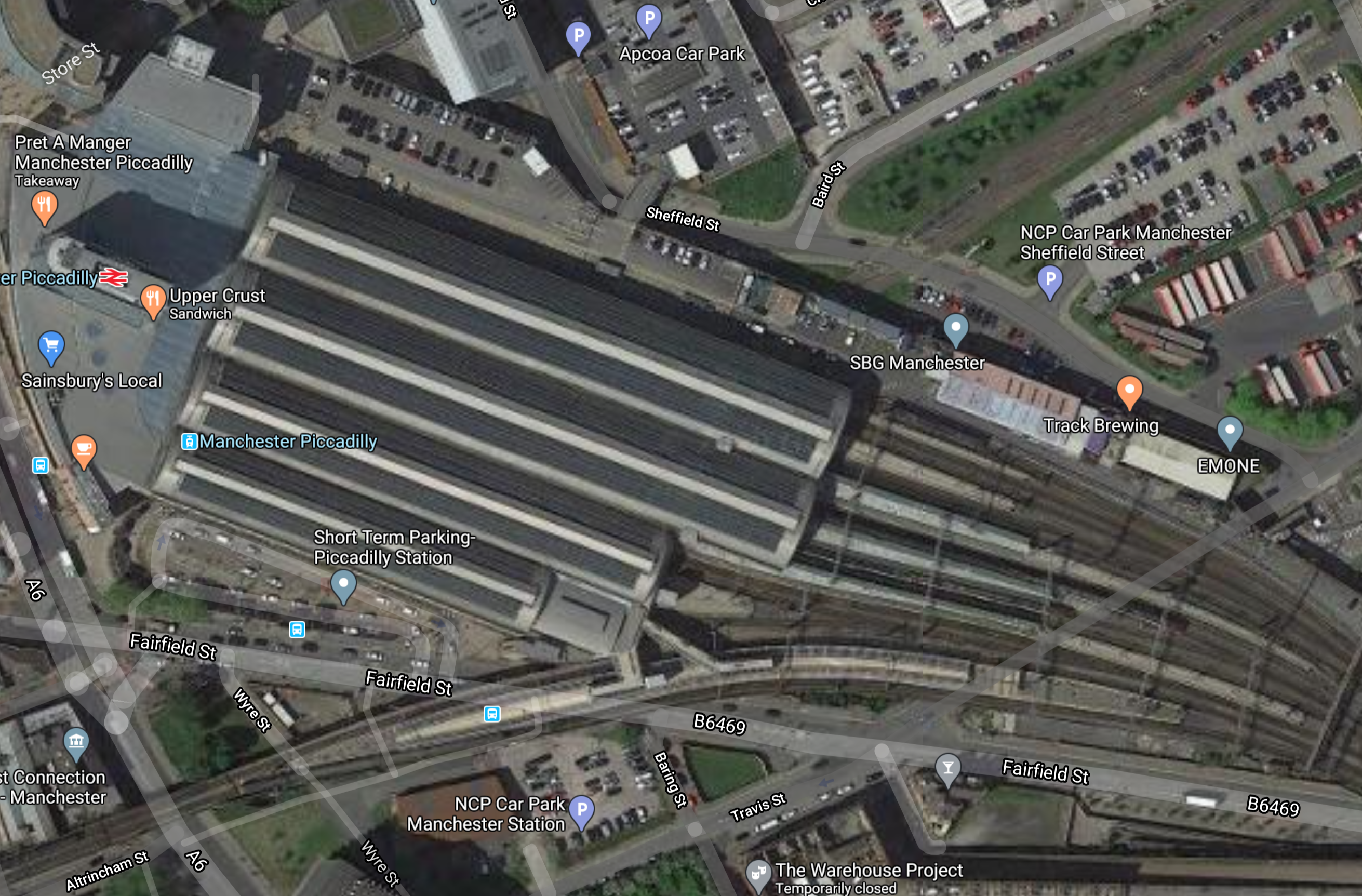
Unfortunately, the map is round the other way to the visualisation, but I hope you can see how the shape of the current station is intact and can be picked out in both.
If you’ve ever used London Paddington station in the last few years, you will know that Crossrail is being built underneath. But the massive construction project of building the Crossrail platforms has not inconvenienced the normal business of the station.
Weston Williamson’s proposed station can be built in the same way.
It could be truly transformational
- Manchester Piccadilly station would have at least 43 percent more platforms.
- Classic-compatible High Speed commuter trains would run to Barrow, Blackpool, Chester, Derby, Nottingham and Shrewsbury from the low-level High Speed station.
- The Northern Powerhouse Rail for all TransPennine Express services would use the low-level High Speed station.
- Glasgow services would use the low-level High Speed station.
- Manchester Piccadilly and Manchester Airport would have up to 18 high speed trains per hour and would be the finest airport service in the world.
- Some or all of the low-level High Speed platforms, would be able to take 400 metre long trains.
- 400 metre long platforms could handle one 200 metre long train from Manchester Airport and one 200 metre long train from Yorkshire.
- The Castlefield Corridor would only have local trains, limited to a number, with which it could cope.
- The use of the existing platforms would be reorganised.
It would be a massive increase in the capacity of the station and as been shown at Paddington with Crossrail, I am sure, that it could be built without massive disruption to existing services.
The Ultimate Train To The North
Imagine a pair of 200 metre long classic-compatible trains running between London Euston and Leeds.
- They would travel via Birmingham Interchange, Manchester Airport, Manchester Piccadilly, Huddersfield and Bradford.
- The trains would divide at Leeds.
- One train would go to Hull.
- The second train would go to York, Darlington, Durham and Newcastle. It could be extended to Edinburgh.
- It could even run with a Turn-Up-And-Go frequency of four tph.
Why not?
 The Anonymous Widower