Does The UK Need More Passenger Rail Capacity Between London And Glasgow?
I asked Google AI this question and received this answer.
Yes, the UK requires more passenger rail capacity between London and Glasgow to meet growing demand and combat overcrowding, with key improvements and new services planned on the East Coast Main Line (ECML) through 2025. Despite previous capacity constraints on main routes, rail has overtaken air as the preferred mode of travel for these journeys, necessitating increased frequency.
Key details:
Capacity Expansion: The Office of Rail and Road (ORR) approved new services for late 2025, including Lumo extending London-Edinburgh services to Glasgow.
Growing Demand: Passenger numbers on West Coast routes showed significant growth, with a 29% increase in Glasgow-London travellers reported between 2013 and 2019.
Infrastructure Constraints: While demand increases, the ORR has rejected some service proposals due to insufficient capacity on the existing, congested lines.
Future Upgrades: HS2 is expected to improve connectivity, targeting reduced journey times to under 3 hours 40 minutes by 2033.
Sustainability Shift: Increased capacity supports shifting travellers from air to rail, reducing environmental impact.
I posed this question out of curiosity, but Google AI gave me, what I think is a well-reasoned answer.
In The Last Three Months, These Two Improved Anglo-Scottish Services Have Started
In Lumo Will Extend Its King’s Cross And Edinburgh Service To Glasgow, I talk about Lumo’s extended service to Glasgow, which started on December 14th, 2025.
In Man In Seat 61: My Nail-Biting Journey To Orkney By Train And Ferry, I describe a trip by the Man In Seat 61 (Mark Smith) in the new Birmingham-Scotland Sleeper.
There Is A Third New Anglo-Scottish Service To Come
In Lumo To Expand Scotland’s Rail Network With New London-Stirling Rail Route From Spring 2026, I describe Lumo’s new Euston and Stirling open access rail route.
Rail Agreement Signed ‘Subject To Value For Money’
The title of this post, is the same as that of this article on the BBC.
This is the sub heading.
An agreement to reopen a regional rail line has been signed by the transport secretary, subject to the assurance that it delivers good value for money.
These three paragraphs add detail to the story.
Further development work on the Leamside Line, which runs from Pelaw in Gateshead to Tursdale in County Durham, is set to progress as part of the Northern Powerhouse Rail (NPR) initiative.
Regional politicians said the line could provide train links for 100,000 people in the north-east of England, after it closed to passengers in the 1960s.
The document stated the government would ensure resources were available for the Leamside Line reopening “subject to agreement of that business case and assurance that this delivers good value for money”.
Note.
- There is an excellent map in the BBC article.
- It looks like there will be at least five new or refurbished stations at Ferryhill, Sincliffe, Belmont, West Rainton and Penshaw.
- Belmont appears to have an alternative name of Durham Parkway, so will it be a Park-and-Ride for the area?
- There will be an alternative path for freight trains between Newcastle and York.
- In New Direct Rail Link To Seaham: How This Picturesque Seaside Town Will Connect To London Starting December 2025, I described Seaham’s new link to London, courtesy of Grand Central Trains.
- In Arriva Group Invests In New Battery Hybrid Train Fleet In Boost To UK Rail Industry, I talked about Grand Central’s new trains, which should be in service by 2028 to Seaham and Sunderland.
- It was in June 2020, that I wrote about Boris Johnson making a speech about the Leamside Line in Boris Johnson Backs Station Opening Which Could See Metro Link To County Durham.
This important link has been a long time coming.
Will The Rail Improvements Between London and The North East Create More Tourism?
Consider.
- The digital signalling will create more paths for trains between London and the North East.
- Journey times will come down to generally below three hours.
- There is a lot of excellent walking in the area.
- The North-East doesn’t just host top-class football and athletics.
- A trip could be combined with a day-trip to Edinburgh, Glasgow or the Scottish Borders.
- I have met Americans, who’ve started their holiday in Europe, in Edinburgh and worked their way down via York and London to Paris by train, and then flown back non-stop to the United States.
As I’ve spent a couple of enjoyable weekends in Newcastle and Sunderland, I don’t see why the area can’t attract tourists.
Should The East Coast Main Line Be Renamed?
Consider.
- It is one of the oldest long-distance main lines in the world.
- It links two of the UK’s capitals.
- It is 331 miles long, which is covered in four and a half hours.
- There are some of the world’s best hotels at either end.
- There is good shopping at either end.
- There is no Trump hotel in London or Edinburgh.
Perhaps, it should be called High Speed East Coast?
Is This The Ultimate Tourist Bus?
This picture clipped from the Wrightbus web site, shows one of their latest products – An open-top electric tourist bus.
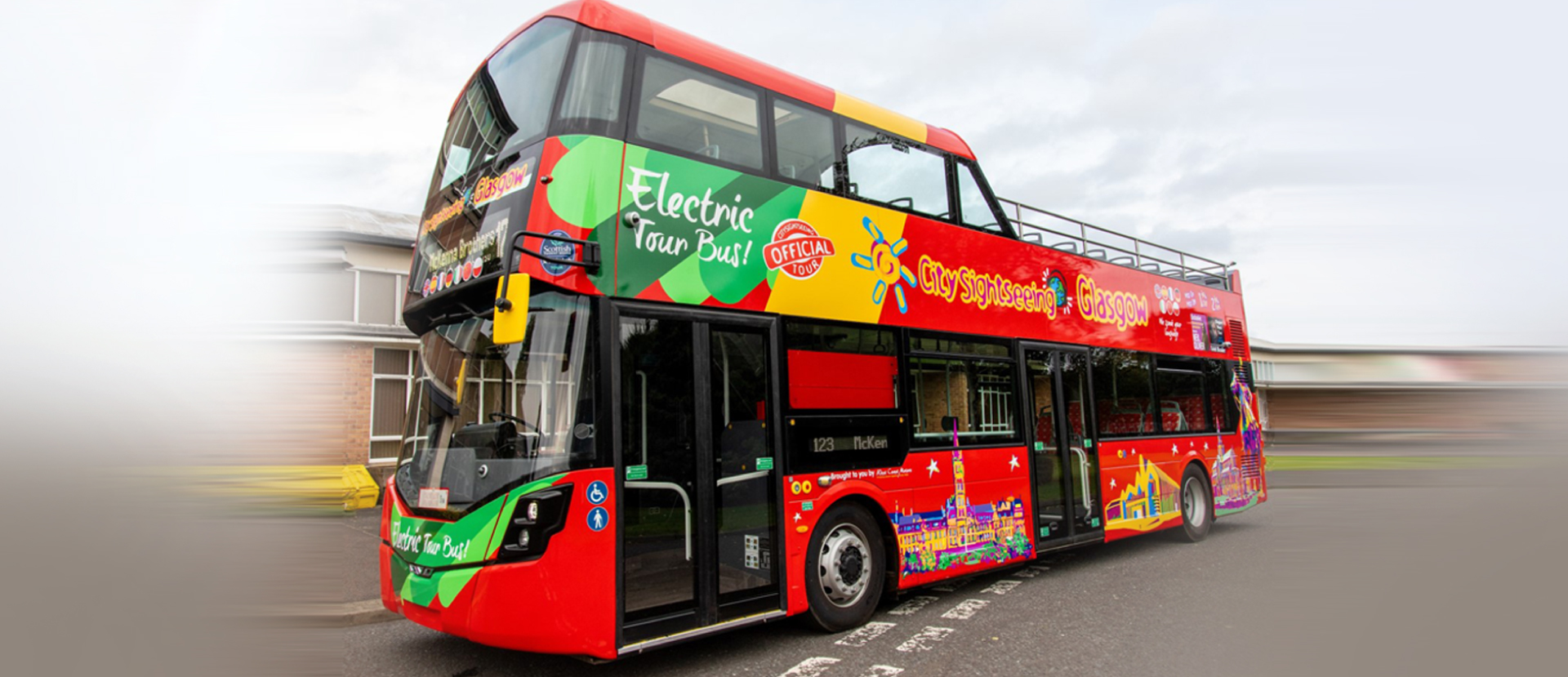
It appears to be running in Glasgow.
But if I was in charge of tourism, I’d get a hydrogen-powered version, as that would surely attract the punters.
Could Wrightbus’s New Hydrogen Coach Do A London Scotland Round Trip On A Full Load Of Hydrogen?
Victoria Coach Station And Edinburgh
I have just looked up on the National Express web site and found that I can leave Victoria Coach Station at 22:00 and arrive in Edinburgh at 07:40 the following morning for a ticket price of £29.90.
The road distance would appear to be 638.1 km, which would be a 1276 km round trip. So I would expect that, there would need to be refueling in the round trip.
Victoria Coach Station And Glasgow
I have just looked up on the National Express web site and found that I can leave Victoria Coach Station at 23:00 and arrive in Glasgow at 07:40 the following morning for a ticket price of £23.90.
The road distance would appear to be 652.1 km, which would be a 1300 km round trip. So as with Edinburgh, I would expect that, there would need to be refueling in the round trip.
A Refuelling Strategy
Consider.
- I would expect that a refuelling strategy would minimise, the carrying of large amounts of hydrogen, through the centre of London or any other conurbation.
- The Southern Uplands of Scotland already host a lot of wind farms, including the UK’s largest onshore wind farm at Whitelee, which has a capacity of 539 MW.
- An electrolyser to produce hydrogen is being developed at Whitelee, which is 32.8 km South of Glasgow.
- Newport Pagnell services is 86.5 km. from the Southern end of the M1.
- Toddington services is 62 km. from the Southern end of the M1.
I wonder if two refuelling points, say 50-100 km. from each end of the route, would be a safe an efficient way to fuel the coaches?
Some Services Between London And Scotland
They are in South to North order.
Toddington Services
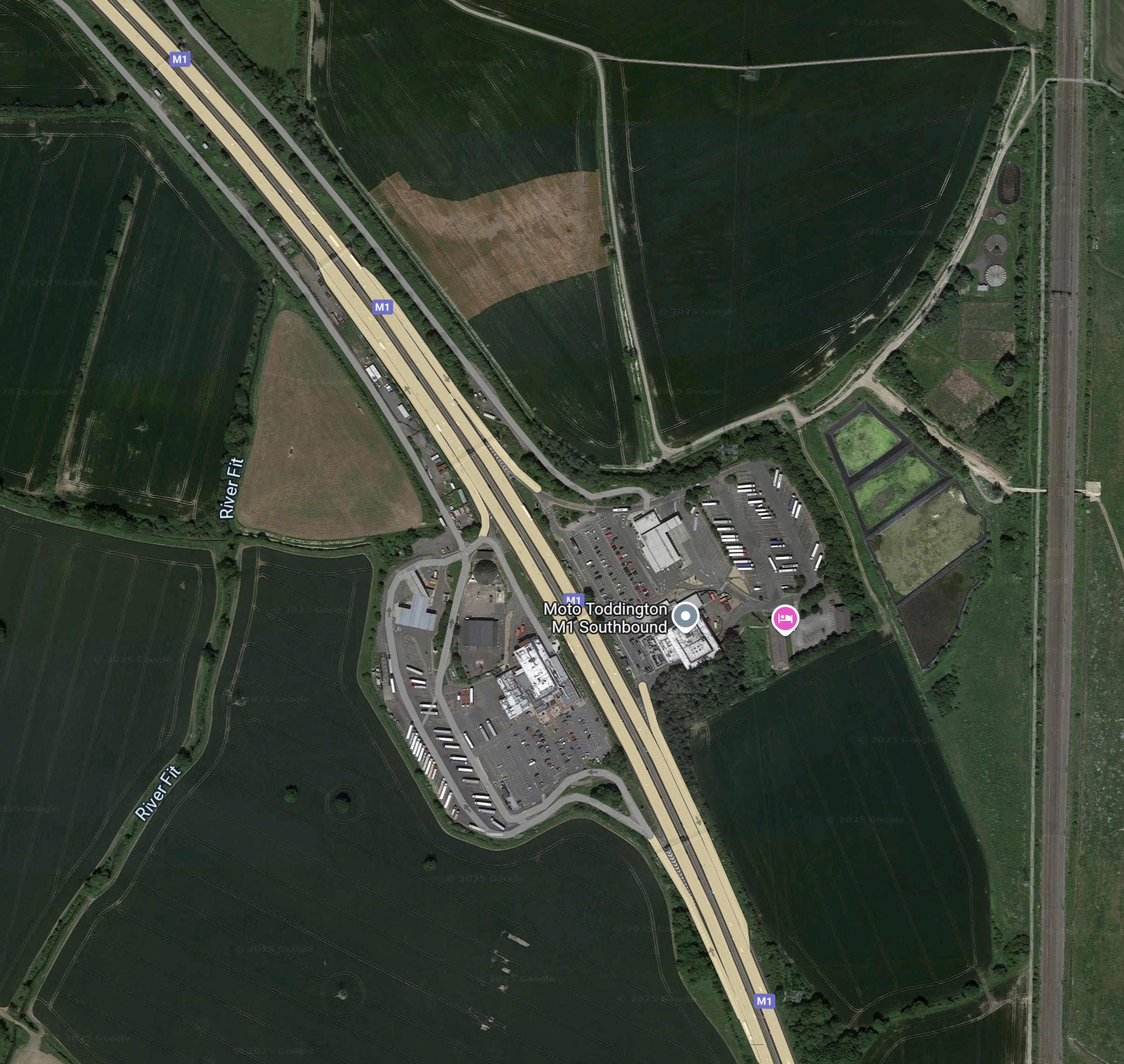
Toddington Services is 62 km. from the Southern end of the M1.
This map shows the services.
Note.
- There is land around the services that could be used to create more parking for hydrogen coaches.
- There doesn’t appear to be much space for a large wind farm to provide electricity to generate hydrogen.
- The Midland Main Line runs up the Eastern side of the map.
I wonder, if hydrogen could be brought to a refuelling site at Toddington services by the use of rail wagons.
Newport Pagnell Services
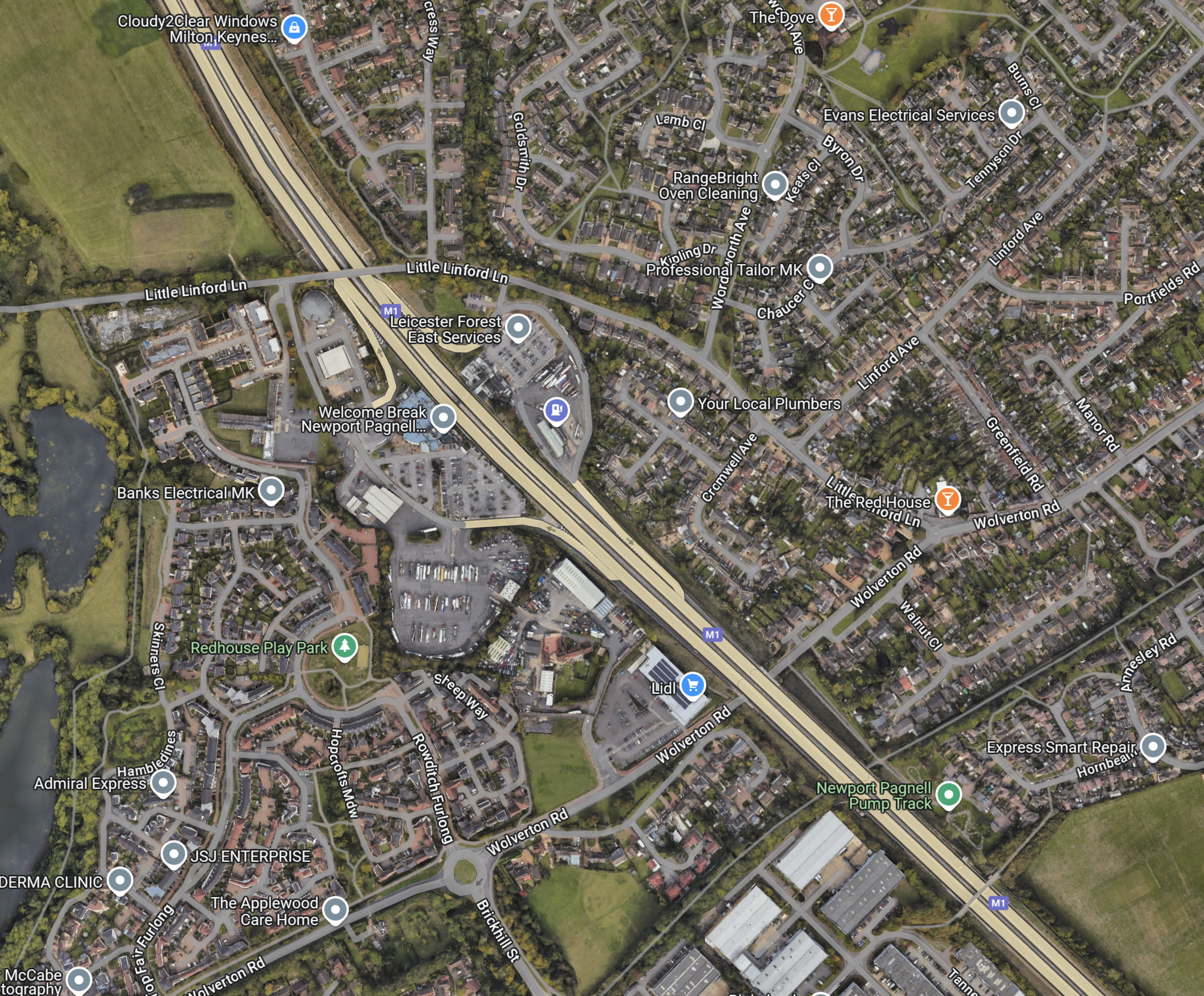
Newport PagnellServices is 86.5 km. from the Southern end of the M1.
This map shows the services.
Note.
- The services are labelled as Leicester Forest East.
- The services are tightly surrounded by houses.
I’m not sure the residents would like to have a hydrogen refuelling station in their midst.
Northampton Services
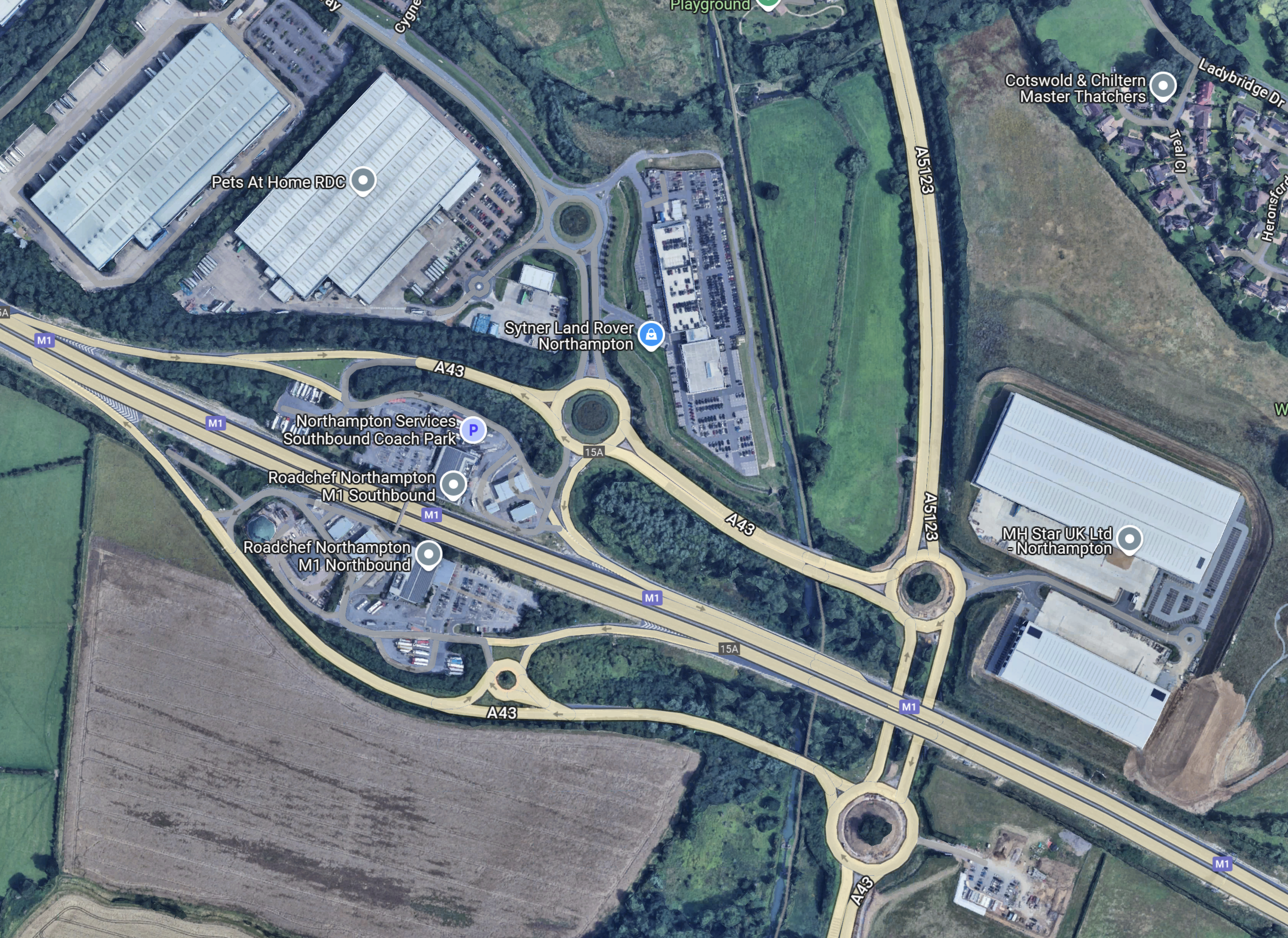
Northampton Services is 104.5 km. from the Southern end of the M1.
This map shows the services.
Note.
- It looks a rather complicated services.
- It might be too far from London.
- Provision of hydrogen might be difficult.
I think that this is another services that we can discount.
Watford Gap Services
Watford Gap Services is 120.8 km. from the Southern end of the M1.
This map shows the services.
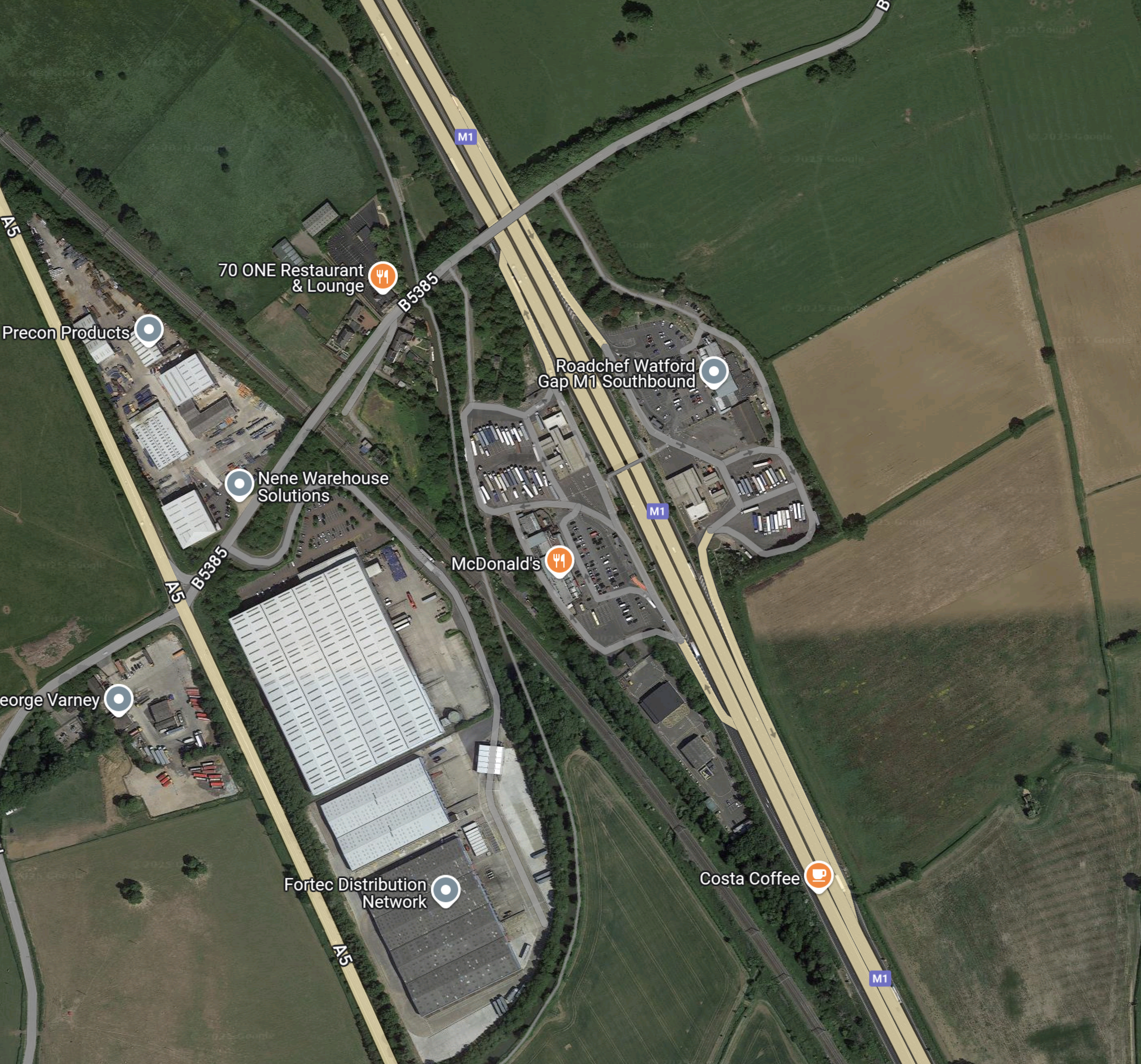
Note.
- There is land around the services that could be used to create more parking for hydrogen coaches.
- There doesn’t appear to be much space for a large wind farm to provide electricity to generate hydrogen.
- The West Coast Main Line runs through the centre of the services.
I wonder, if hydrogen could be brought to a refuelling site at Watford Gap services by the use of rail wagons.
Rugby Services
Rugby Services is 137.8 km. from the Southern end of the M1.
This map shows the services.
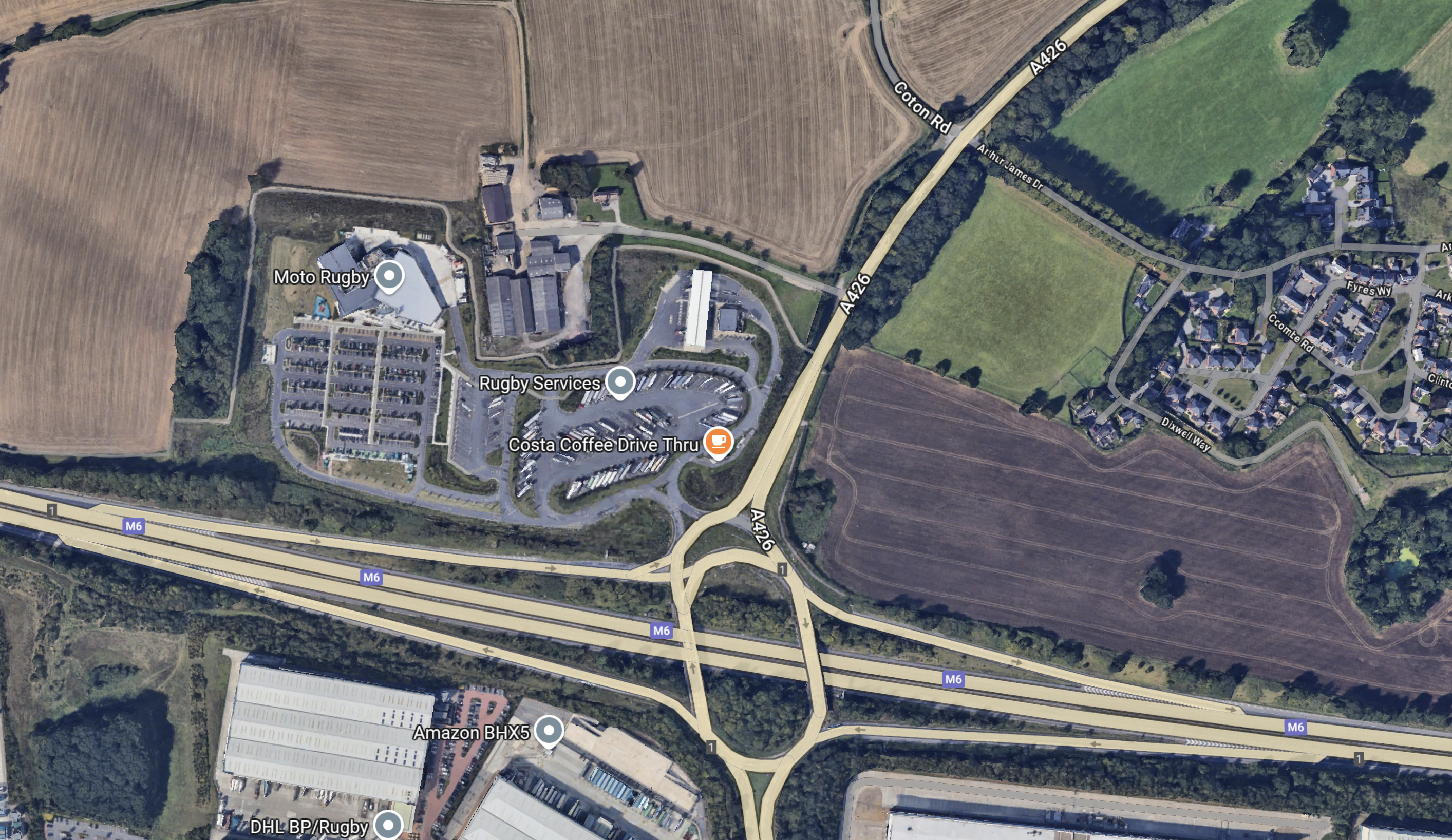
Note.
- There is land around the services that could be used to create more parking for hydrogen coaches.
- It is at Junction 1 of the M6.
There is also a gas compressor station nearby, so I wonder, if a HiiROC system could be located here to extract hydrogen from the natural gas.
This map shows the location of the Churchover compressor station, with relation to Rugby services.
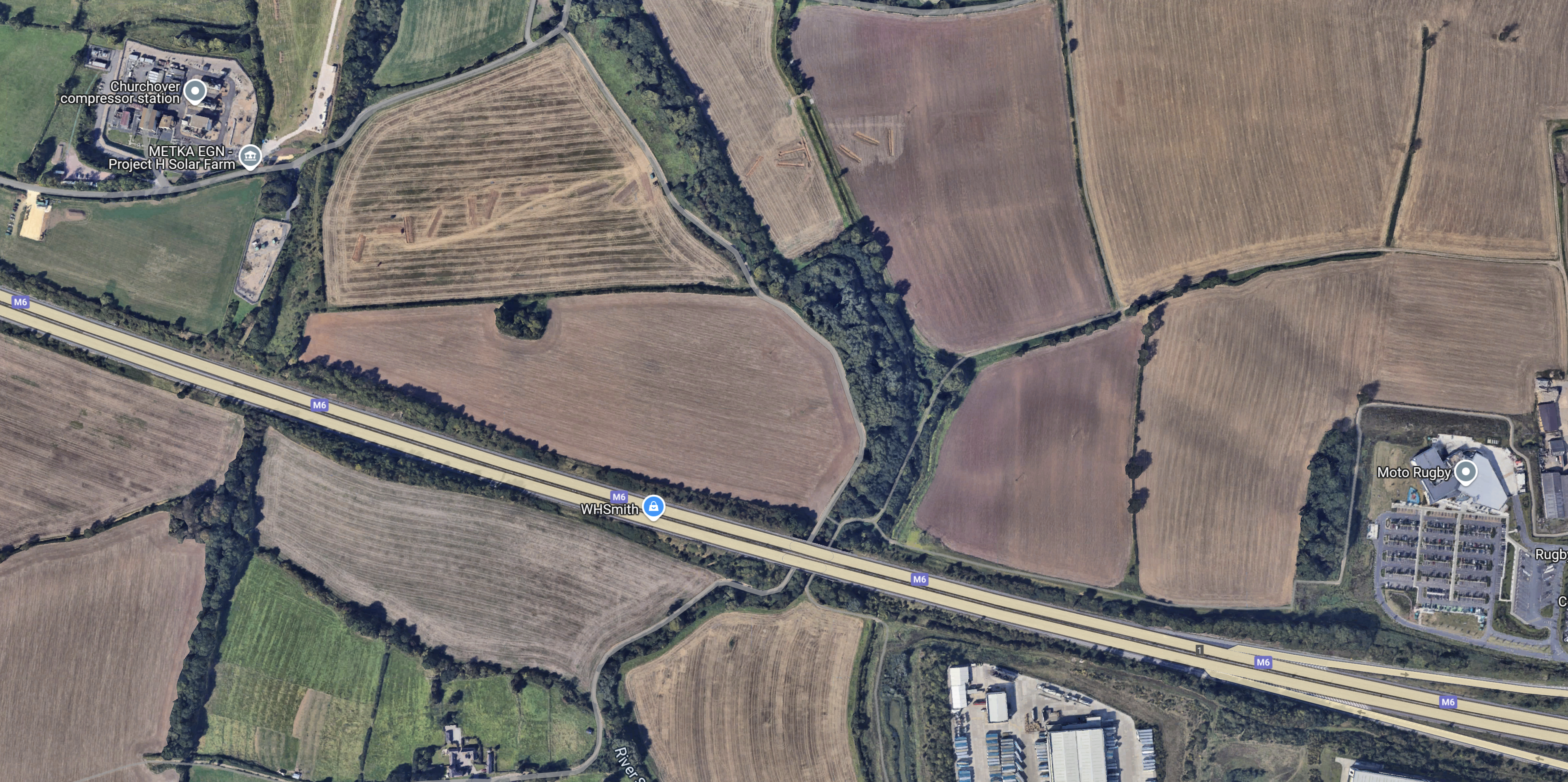
Note.
- The compressor station is in the North-West corner of the map.
- Rugby services are in the South-East corner of the map.
- From labels on the map it appears, a solar farm might be planned by the compressor station.
With a system like HiiROC creating turquoise hydrogen from natural gas, this could be a major filling station for hydrogen-powered trucks, coaches and cars.
Conclusion
It looks to me, that Toddington services would be best, but there would need to be a large increase in capacity, if a large number of hydrogen coaches, were going to fill up at Toddington for their trip into London.
The alternative would be to give the coach a large enough hydrogen tank for a complete round trip.
A Bespoke Tram-Train For The UK
Trams, tram-trains, trains and anything that runs on rails is generally very expensive.
Does this partly explain, why the UK has relatively few urban tramways and railways?
In Stadler Presents Mock-Up Of Tram-Trains For German And Austrian Operators, I discussed how five German and Austrian operators had got together to create a common tram-train design, that would be suitable for all the operators.
The mayor of one of the cities involved in the joint order, said savings of the order of a million euros per vehicle may have resulted from the common design.
I would also feel that savings in operational costs, design of infrastructure, spares inventory and other costs would also result.
Identical tram-trains would make through running between networks easier.
Where Could Tram-Trains Be Used In The UK?
Consider.
- Currently, tram-trains are running in Sheffield and a battery-electric version of the same Stadler Citylink tram-train will soon be running in Cardiff.
- Cardiff, is developing a Cardiff Crossrail on tram-train principles across the city.
- Sheffield have said that they will be replacing their trams and I believe they could use developments of their excellent Stadler tram-trains.
- Sheffield is likely to extend their tram system and might include tram-trains to Doncaster.
- Cities that have talked about adding tram-trains to their tram networks include Birmingham, Blackpool, Manchester and Nottingham.
- Leeds is developing a metro system, which could be developed using tram-train principles.
- Glasgow has talked about a tram-train to Glasgow Airport for some time.
- The East-West Rail Link is proposing a tram-train link between Ipswich and Felixstowe to allow more freight trains into the Port of Felixstowe.
There could be quite a number of tram-trains being used in the UK, especially if they are used as at Felixstowe, to increase freight capacity into ports.
These are a few of my thoughts.
Battery-Electric Tram-Trains
I would envisage, that a lot of the new tram-trains would operate using batteries. Especially, as battery-electric trains are showing quite long ranges of upwards of thirty miles.
Already trams in Birmingham and trains on Merseyside, are operating using batteries and it avoids the expense of putting up catenary, if enough exists to charge the trams.
Replacement of Diesel Multiple Units By Battery-Electric Tram-Trains
There are some branch lines, where diesel multiple units run off a branch of an electrified main line.These services could be decarbonised by changing the rolling stock.
This OpenRailwayMap shows the St. I’ves Bay Line in Cornwall.
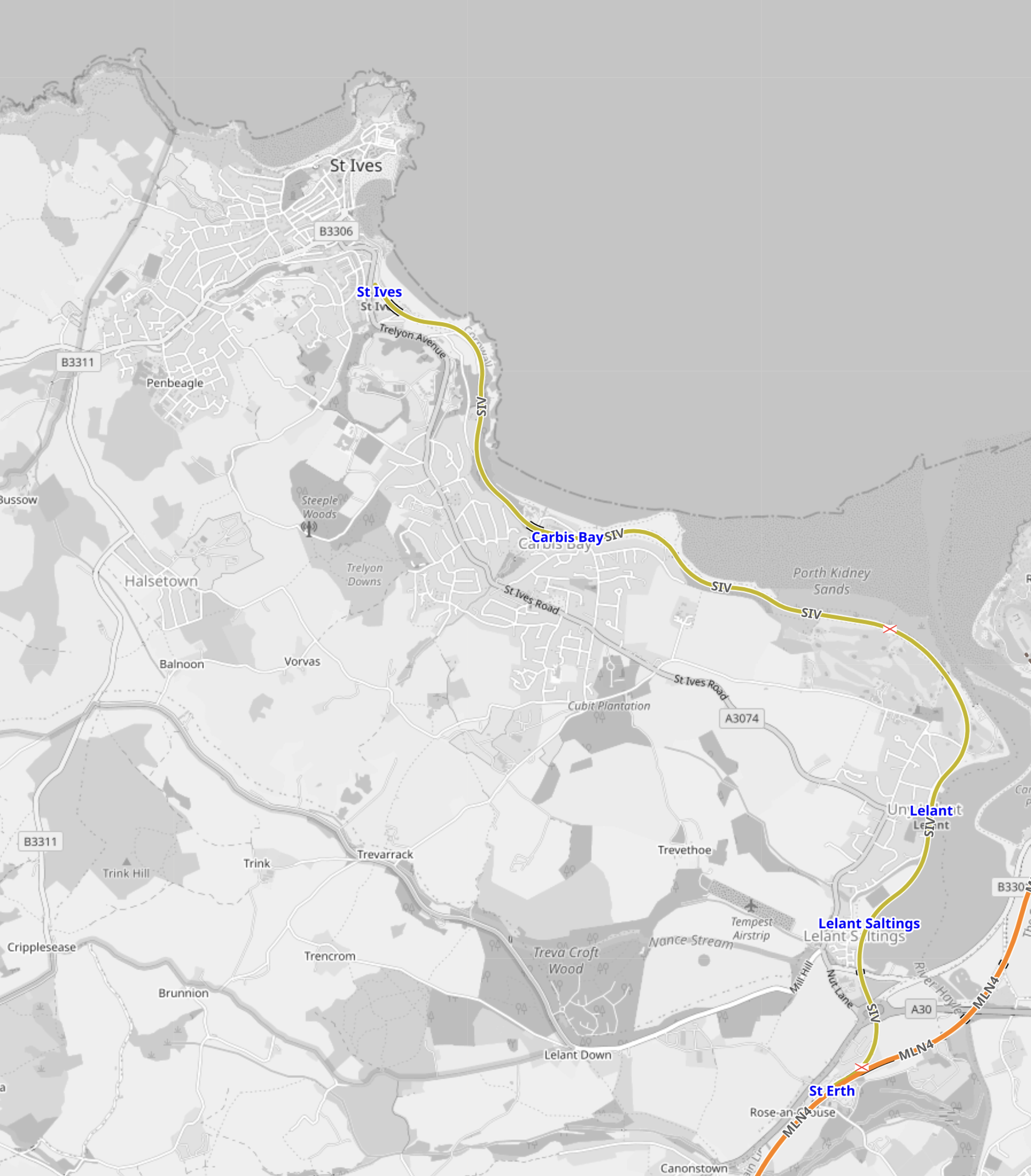
Note.
- The St. Ives Bay Line is shown in yellow.
- The Southern terminal is St. Erth station, where it connects to the Cornish Main Line, which is shown in orange.
- The Northern terminal is St. Ives station, which is towards the top of the map.
- The St. Ives Bay Line is 4.25 miles long.
- No tracks are electrified.
- There are three intermediate stations.
This second OpenRailwayMap shows St. Erth station in more detail.
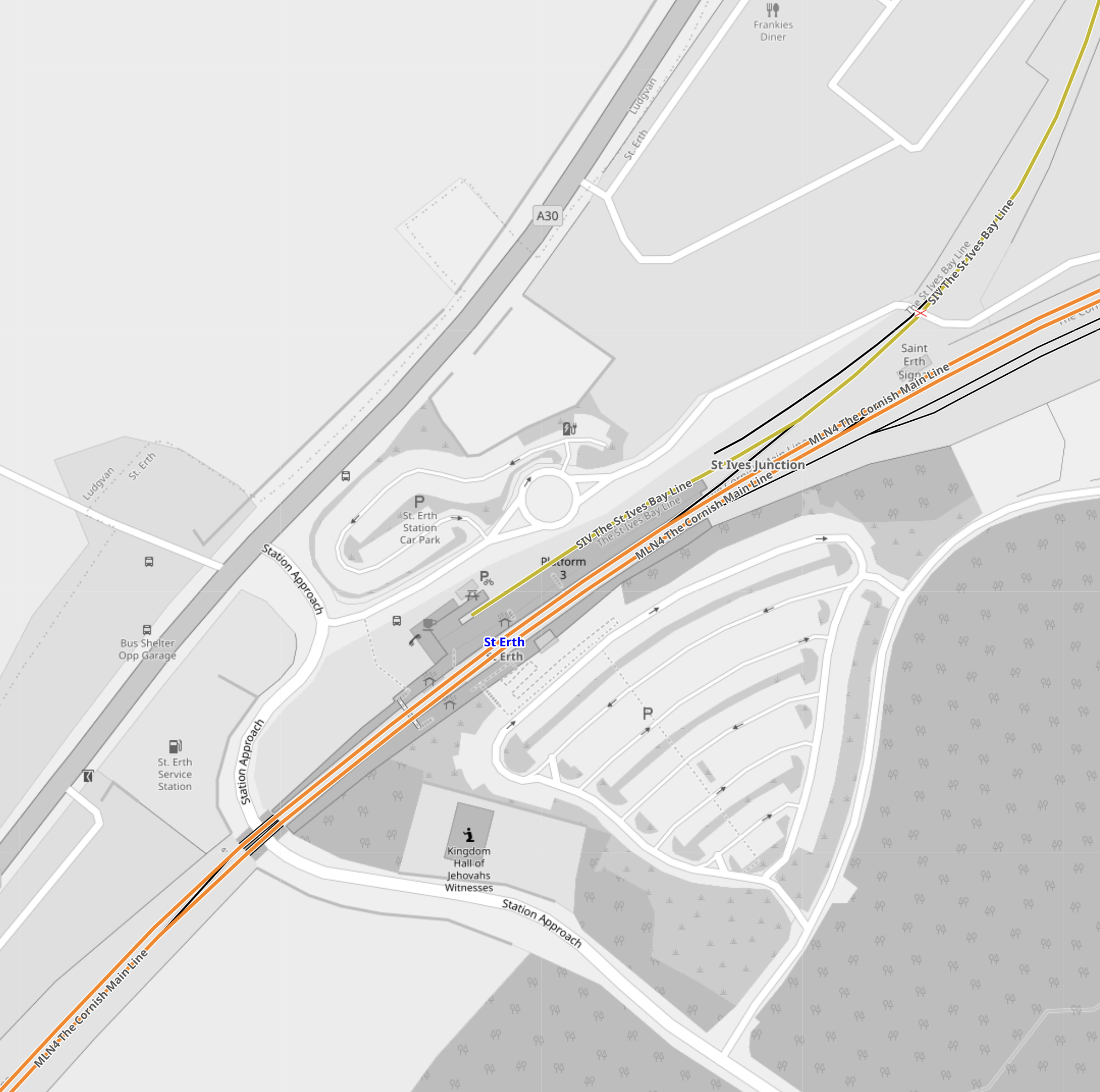
Note.
- The St. Ives Bay Line has its own platform at the side of the station.
- I am fairly certain, that some form of charging could be installed in this platform.
- At the other side of the Cornish Main Line are two sidings, which could be used for cleaning and maintenance.
A neat zero-carbon branch line could easily be created.
New Branch Lines To New Developments
In Sheffield Region Transport Plan 2019 – A New Tram-Train Route To A New Station At Waverley, I gave my view on a tram-train loop from the Sheffield-Lincoln Line to serve the Advanced Manufacturing Centre and new housing at Waverley.
The tram-train would run as a train to the branch line for the development and then run as a battery-electric tram, through the development.
As the Midland Main Line to Sheffield will be electrified, the tram-trains could be charged on the electrification in Sheffield station.
Build Them In Doncaster
Wabtec are closing Doncaster works.
Surely this would be the site to assemble the scores of tram-trains that could be needed in the UK.
Conclusion
Tram-trains could do a lot to improve the railways of the UK.
They would also help to decarbonise the existing system.
Plans To Turn Former Station Waiting Room Into Pub
The title of this post, is the same as that of this article on the BBC.
This is the sub-heading.
Plans to turn a Grade II listed railway station’s former waiting room back into a pub have been submitted.
These are the first three paragraphs of the article.
Network Rail wants to refurbish the room at Carlisle’s station, which is now a storage room and kitchen.
The first class waiting room, which was until recently used as a pub, was built by architect William Tite in 1880 as an extension to his original 1847 neo-Tudor station designs.
The plans are part of the £27m Carlisle Gateway project to turn the city’s station into a “national interchange” transport hub, funded by central government, Cumberland Council and Network Rail.
I very much like this idea.
Carlisle could be turned into a national interchange, that was almost unique in the world.
- Rail services across the Borderlands could be improved, to the cities of Glasgow, Lancaster, Leeds, Newcastle and York.
- Rail services could be developed, so visitors could explore the Lake District by rail.
- The Eden Project at Morecambe would be a rail-accessible attraction, that was just an hour away from Carlisle.
- The Borders Railway from Edinburgh could be extended to Carlisle.
- All services would be zero-carbon, with power coming from either batteries or hydrogen.
- Services would be tourism-friendly, with space for bicycles, large panoramic windows and high-class catering.
Current times between London and Carlisle could be reduced to under three-and-a-half hours, with reductions of up to an hour, as High Speed Two is eventually delivered.
Lumo In Discussions To Operate Glasgow Services
The title of this post, is the same as that of this press release from FirstGroup.
These four paragraphs give more details.
FirstGroup, the leading private sector transport operator, today announces that its popular open access rail service Lumo is in discussions with Transport Scotland and Network Rail to extend some of its London-Edinburgh trains to and from Glasgow.
Having identified opportunities to extend a number of daily journeys to and from Glasgow in the timetables for 2025 and beyond, work will now continue with Transport Scotland and track infrastructure manager Network Rail to agree final route options and timings ahead of an application for access rights to the Office of Rail and Road (‘ORR’), the industry regulator.
If successful, the new services could be in operation from next summer.
Lumo’s proposed new offering will improve links for customers travelling between Newcastle and Glasgow, giving people a choice of services without needing to change trains. In addition, a significant number of users of Lumo’s current London-Edinburgh trains go on to travel through to Glasgow via other connections, and through this move, Lumo aims to offer a direct through service for these customers.
I have a few thoughts.
There Appears To Be A Need For An Affordable London And Glasgow Service
This is the last sentence of my extract from the press release.
In addition, a significant number of users of Lumo’s current London-Edinburgh trains go on to travel through to Glasgow via other connections, and through this move, Lumo aims to offer a direct through service for these customers.
This looks to be a service, that has been suggested by an analysis of passengers’ tickets.
Which Station Will Lumo Use In Glasgow?
Consider.
- The current LNER service between London King’s Cross and Glasgow, uses Glasgow Central station and it takes 66 minutes between Edinburgh and Glasgow Central stations.
- LNER’s service also calls at Haymarket and Motherwell.
- ScotRail services between Edinburgh and Glasgow Queen Street take about 49-50 minutes.
I suspect, that Lumo will take the faster route.
Newcastle And Glasgow Is A New Route
Currently, all passengers between Glasgow and Newcastle have to change at Edinburgh.
This will be the first direct train in my memory, except for LNER’s single daily service between London and Glasgow Central, which stops at Newcastle.
What About The Football?
Glasgow is very much about football.
Would it be possible to use Lumo to see a match starting at 15:00 on a Saturday afternoon, if you lived in London?
- The 05:48 train from King’s Cross on a Saturday arrives in Edinburgh at 10:07.
- Trains between Edinburgh and Glasgow take fifty minutes, so I feel it would be reasonable to be able to get to Glasgow by 10:57.
This time would be more than early enough to have a few swift halves and see the match if it started at 15:00.
But would it be possible to get back to London after the match?
- The last train leaves Edinburgh at 17:55 and arrives in King’s Cross at 22:26.
- Applying the fifty minute journey time between Edinburgh and Glasgow means it will leave at 17:05.
- It appears that from Ibrox and Celtic Park to Glasgow Central or Glasgow Queen Street station is about twenty minutes.
On the current timetable, it would appear to be possible, but tight.
One alternative would be to take the Caledonian Sleeper back to London. But it doesn’t appear to run on a Saturday night.
Coaches do run and an overnight coach costs around twenty pounds.
It looks like if Lumo ran a service about 18:00 on a Saturday to London, it wouldn’t run empty.
Will Lumo Need More Trains?
In the press release, FirstGroup plc Chief Executive Officer Graham Sutherland, is quoted as saying.
Once preferred route options and timings have been agreed, discussions will continue with Network Rail and the ORR to secure the required approvals. The journeys would be operated within the existing Lumo fleet of all-electric trains and it is anticipated that the additional services could begin in summer 2025.
That looks to me, that they will not be obtaining more trains before next summer.
In Ten-Car Hull Trains, I noted that some of Hull Trains services were now running as ten-car trains.
If the passenger demand is there for ten-car trains to Hull, which is almost exactly half the distance of Edinburgh, I would expect that in the future, Lumo will be running some services as ten-car trains.
In Extra Luggage Racks For Lumo, which is based on an article in the November 2023 Edition of Modern Railways, an alternative view on more trains is taken.
The Modern Railways article finishes with this paragraph.
Lumo celebrated its second birthday in late October and was also set to mark the carriage of its two-millionth passenger. It is understood Lumo is interested in augmenting its fleet, such has been the success of the service; while many operators favour bi-mode units, Lumo is proud of its all-electric credentials so straight EMUs are still preferred, although the possibilities of including batteries which could power the trains may be pursued (the ‘803s’ have on-board batteries, but only to provide power to on-board systems if the electricity supply fails).
I find this development very interesting.
As London King’s Cross and Edinburgh and Glasgow are all electric routes, in normal service batteries should not be needed, but sometimes trains have to use the diversion via Lincoln, which I have estimated is 86.5 miles.
As an electrical engineer, I’ve always believed that the emergency batteries in the Class 803 trains are very similar to the traction batteries that Hitachi are developing for the Class 802 trains.
A traction battery, that was capable of handling the diversion would stop Lumo having to cancel occasional services.
Conclusion
An extension to Glasgow looks like it could be a simple and profitable way to extend the current Lumo service.
But it might need some extra trains in the future.
A Lumo service to Glasgow, might be helped by a seven-day service on the Caledonian Sleeper, so passenger could go North on Lumo and South on the Sleeper to get a full day in Glasgow.
Are LNER Going To Take On The Airlines?
Nine years ago, I wrote Edinburgh – Plane Or Train?, after a trip to Scotland, where I took easyJet up and came back in First Class by train.
- Both trips were about five hours door-to-door.
- The flight was about six quid more,
- But I got free food and drink on the train.
- Security on the plane was a pain.
- I had to take my passport for identification at Stansted.
I haven’t flown internally in Great Britain since, although, I have flown to Belfast.
For shorter flights the market is going towards rail, as these posts seem to suggest.
- 2.7M Tonnes Of Co2 Could Be Saved Per Year If UK Domestic Flights Went Electric
- Air Travellers To Be Hit By Carbon Charge On All Tickets
- Climate Change ‘May Curb Growth In UK Flying’
- France Bans Short-Haul Flights To Cut Carbon Emissions
- KLM Replaces Plane With High Speed Train
- Lumo Carbon Data Shows Its Trains Are 22 Times Greener Than Flying
- Next Time I’ll Go By Train
- Ryanair One Of Europe’s Top Polluters, EU Data Suggests
- Stop Taking Internal Flights And Go Green, Says Lib Dem Contender Davey
The climate seems to be turning against flying short-haul.
This is a paragraph, in this press release from LNER, which is entitled First Tri-Mode Long Distance Trains For The East Coast Main Line.
This new fleet of trains will keep LNER on track to reduce its emissions by 67 per cent by 2035 and be net zero by 2045. LNER has already reduced carbon emissions by 50 per cent compared with 2018/19. Per mile, LNER trains produce 15 times less carbon emissions than a domestic flight.
Are LNER building a number of climate-based sticks, with which to beat the airlines on the routes, where they compete?
These are my thoughts on the various routes, where LNER compete with airlines.
Newcastle
Newcastle is an interesting one.
- Newcastle station is in the city centre and is on the Tyne and Wear Metro.
- London King’s Cross is one of London’s major Underground hubs.
- There are lots of buses and local trains within walking distance of both stations.
- There are three trains every two hours and an additional eight trains per day (tpd) between the two London King’s Cross and Newcastle stations.
- Lumo also run five tpd on the route.
- There are generally no security delays at rail stations.
- London King’s Cross is laid out to maximise passenger flows. If it gets busy, everybody just walks out into King’s Cross Square.
- I’ve never had a problem at Newcastle station with overcrowding.
Perhaps, if you live near one of the airports, flying is more convenient.
LNER’s weapons against the airlines between London King’s Cross and Newcastle will be convenience and journey times.
Convenience is all about the location of the stations, their excellent local transport networks and good walking routes around the station.
Journey times will only get better, as the magic of digital in-cab signalling, allows the Azumas, the new CAF tri-mode long distance trains and the few remaining InterCity 225s to show what they were designed to do.
Dalton-on-Tees, where the first phase of the digitally signalling will end, is 39.8 miles South of Newcastle, so once the Newcastle train is passes Dalton-on-Tees on the East Coast Main Line, it will be a digital-signalled electrified railway all the way to Woolmer Green.
- Dalton-on-Tees is 39.8 miles South of Newcastle
- Woolmer Green is 244.8 miles South of Newcastle.
- Dalton-on-Tees and Woolmer Green is 205 miles.
- Newcastle and Dalton-on-Tees takes 37 minutes.
- Woolmer Green and King’s Cross takes 18 minutes
- Trains take typically an average three hours and nine minutes between London and Newcastle.
- A typical train time by LNER between Dalton-on-Tees and Woolmer Green is two hours and 14 minutes.
- This is an average speed of 91.8 mph between Dalton-on-Tees and Woolmer Green.
- Between London King’s Cross and Newcastle is fully-electrified.
I can build a table of timings and savings at various average speeds.
- 120 mph – 103 minutes – two hours and 38 minutes – 31 minutes
- 125 mph – 98 minutes – two hours and 33 minutes – 36 minutes
- 130 mph – 95 minutes – two hours and 30 minutes – 39 minutes
- 135 mph – 91 minutes – two hours and 26 minutes – 43 minutes
- 140 mph – 88 minutes – two hours and 23 minutes – 46 minutes
Note.
- The first field is the average speed between Dalton-on-Tees and Woolmer Green.
- The second field is the time between Dalton-on-Tees and Woolmer Green.
- The third field is the time between London and Newcastle.
- The fourth field is the saving over current timings.
- The London and Newcastle time is calculated by adding the times for the three sections together.
I have regularly timed trains at a very constant 125 mph, so with digital signalling, I suspect an average of 130 mph is possible.
This would mean, times of a few minutes under two hours and thirty minutes could be possible between London and Newcastle.
Edinburgh
Edinburgh builds on the improvements South of Newcastle.
Edinburgh station Waverley is a well-connected station.
- There are lots of buses, local trains and the Edinburgh Tram within walking distance of Edinburgh Waverley station.
- There are three trains every two hours and an additional seven tpd between the London King’s Cross and Edinburgh Waverley stations.
- Lumo also run five tpd on the route.
- Trains take typically an average four hours and thirty minutes between London and Edinburgh Waverley.
- Any savings because of the digital in-cab signalling between London and Newcastle can be applied to London and Edinburgh Waverley services.
As my calculations showed that averaging 130 mph between Dalton-on-Tees and Woolmer Green could save 39 minutes on journey times, I am fairly sure than a sub-four hour journey time will be possible between London and Edinburgh Waverley.
It should also be noted that that the power supply has been improved between Newcastle and Edinburgh Waverley.
- The distance between Newcastle and Edinburgh Waverley is 124.2 miles
- Newcastle and Edinburgh Waverley takes around one hour and 30 minutes.
- This is an average speed of 82.8 mph between Newcastle and Edinburgh Waverley.
- Between London King’s Cross and Edinburgh Waverley is fully-electrified.
As the record time for between London King’s Cross and Edinburgh Waverley was set by an InterCity225 train in 1993 at three hours and twenty-nine minutes, I suspect that with more digital signalling and some track improvements, that there are more journey time improvements to be squeezed out.
I certainly believe that a time of three hours and fifty minutes between London and Edinburgh Waverley will be regularly achieved. This is a journey time saving of around forty minutes.
Dundee
Dundee has an airport and a station on the East Coast Main Line.
Trains between London King’s Cross and Dundee take around five hours and 45 minutes.
LNER run three trains per day to and from London King’s Cross and one tpd to and from Leeds.
CrossCountry also run services.
Loganair has two flights per day to Heathrow.
Aberdeen
Aberdeen builds on the improvements South of Edinburgh.
The four direct tpd between London and Aberdeen take around seven hours and ten minutes.
This should come down to around six hours and thirty minutes with the journey time savings between London King’s Cross and Edinburgh Waverley.
Will this tempt travellers from the airlines?
Battery-Electric Trains To Dundee And Aberdeen
One thing that will help, is that Edinburgh and Aberdeen is to be partially electrified.
InPiling Work To Get Underway To Electrify Line To Fife, I included this Network Rail map of the electrification.
This map has been downloaded from the Network Rail web site.
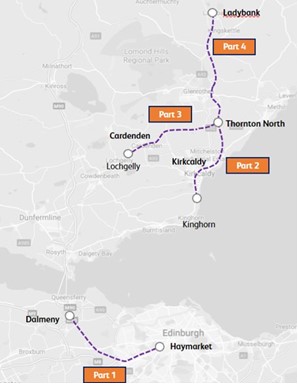
The electrification is split into four phases.
- Haymarket and Dalmeny – 25 km
- Kirkcaldy and Thornton North – 25 km.
- Lochgelly and Thornton North – 20 km.
- Thornton North and Ladybank – 34 km.
Note.
- The last three phases of electrification connect to Thornton North.
- The new rail link to Leven will also be electrified. and connected to Thornton North.
- The Forth Bridge is not to be electrified.
As Ladybank station is just 91.4 miles from Aberdeen, I suspect LNER will use Hitachi Intercity Battery Hybrid Trains to serve Aberdeen.
If these trains haven’t got the range, then I suspect LNER’s new CAF Tri-Mode Trains could handle the route.
Inverness
Inverness has a problem.
Zero-carbon trains will be unlikely to get to the city without full electrification of the Highland Main Line.
- Dunblane is the nearest electrified station to Inverness, but it is 146.2 miles away over a route with lots of steep climbs.
- I doubt that a battery-electric train could handle that route.
One solution would be for LNER to run the new CAF Tri-Mode Trains to Inverness using HVO or biodiesel.
Glasgow
Glasgow is the only other Scottish city with an airport and good rail connections to the South.
I am sure that Avanti West Coast will target airline passengers, if LNER prove it is a successful policy.
Other Factors
These are other factors, that will come into a traveller’s choice.
First Class
Some travellers like a bit more comfort and service.
Ability To Work
Some travellers like to work on a train.
You Don’t Get Tables On a Plane
I like to open a paper or magazine flat, which is difficult on a plane.
Views Tend To Be Better On a Train
Providing you get a window!
Parking Tends To Be Better At An Airport
But it may be more expensive!
Security Is Less Hassle On A Train
At the moment!
You Don’t Need To Prove Your Identity On A Train
Not in the UK! Yet!
Conclusion
It looks like LNER can offer the airlines to four of our major Northern cities serious zero-carbon competition.
Birmingham Plays The Green Card
This article in The Times today is entitled Birmingham Airport Set For Hydrogen Take-Off.
These two paragraphs introduce the article.
Birmingham Airport aims to become the first in Britain to operate commercial zero-emission hydrogen-fuelled flights — and by as early as 2025.
The ambitious goal follows the signing of a partnership with the British start-up ZeroAvia whose first trial flight of a 19-seater passenger aircraft powered by hydrogen fuel cells took place last month.
Other points from the article include.
- ZeroAvia is also working with Rotterdam Airport.
- Initially, it is likely that the hydrogen-powered aircraft will be used for cargo.
- The government wants all UK domestic flights to be zero-carbon by 2040.
- Birmingham wants to be zero-carbon by 2033.
- ZeroAvia has received upwards of £20 million of matched-taxpayer funding.
- It has some big backers and well-known airlines, who have placed orders.
These are my thoughts.
ZeroAvia’s Airliners
This paragraph from The Times article describes their first two aircraft.
ZeroAvia is retrofitting turboprops, 19-seater Dornier and in future 80-seater De Havilland Canada Dash 8-400s, with tanks of hydrogen which is converted by fuel cell stacks to energy taken to electric motors that power the propellers. The only emission is water. It is talking to potential new-entrant airframe makers to build all-new hydrogen aircraft of the future.
Note.
- The Dornier 228 is a 19-seater airliner of which over three hundred have been built.
- The de Havilland Canada Dash 8-400 is an 80-seater airliner of which over six hundred have been ordered and over 1200 of all marques of Dash 8s have been built.
Both are workhorses of the smaller airlines all over the world.
As the paragraph from The Times indicates the power system is not conventional, but then most of this new breed of small electric/hydrogen/hybrid airliners have electric propulsion. I suspect that there’s been a marked improvement in the design and efficiency of electric motors.
Electric propulsion should have a substantial noise advantage over turboprops.
ZeroAvia are also retrofitting their two chosen airliners.
This offers advantages in the certifying of the airliners. Providing the changes made to the airframe are not significant, the various certifying authorities in the UK, US and EU will allow previous certification to be carried over.
This means that ZeroAvia only have to thoroughly test and certify the powerplant and its integration into the aircraft.
One of their competitors, the Eviation Alice is a completely new airframe with battery-electric power, so I suspect this aircraft will take longer to certify.
I think ZeroAvia have used this shorter certification time to aim to get their airliners in service first.
Those that don’t win, don’t get the same fame.
Hydrogen At Birmingham Airport
Hydrogen will be needed at Birmingham Airport to refuel ZeroAvia’s airliners.
But will hydrogen also be used on the airside to power some of the heavy vehicles you see on airports.
Look at this page on the Hawaii Technology Development Corporation, which shows a Hydrogen Fuel Cell U-30 Aircraft Tow Tractor. The specification indicates, that it can tow a C-17 or a Boeing 747.
I wouldn’t be surprised to see Birmingham Airport build their own electrolyser nearby both to supply hydrogen-powered aircraft and decarbonise the airside.
To And From Birmingham Airport
Consider.
- Birmingham Airport is connected to Birmingham International station by a free AirRail Link.
- Birmingham International station has an impressive number of services, many of which are electric.
- There will be a people mover to connect to Birmingham Interchange for High Speed Two.
- Birmingham Interchange will have five trains per hour (tph) to and from London, taking under forty minutes.
- There are plans to extend the West Midlands Metro to the airport, with journeys taking thirty minutes from the City Centre.
- Birmingham Airport is at the centre of the UK’s motorway network.
Most public transport to Birmingham Airport will be zero-carbon and the percentage that is will increase.
A Green Air Bridge To Ireland
Currently the fastest services between London and Birmingham International station take a few minutes over the hour.
But after High Speed Two opens, the service will improve.
- High Speed Two will take under forty minutes.
- There will be five tph.
- High Speed Two will connect to the Elizabeth Line and the London Overground at Old Oak Common station.
- Euston station will have better connectivity to the Underground.
This diagram shows High Speed Two services.
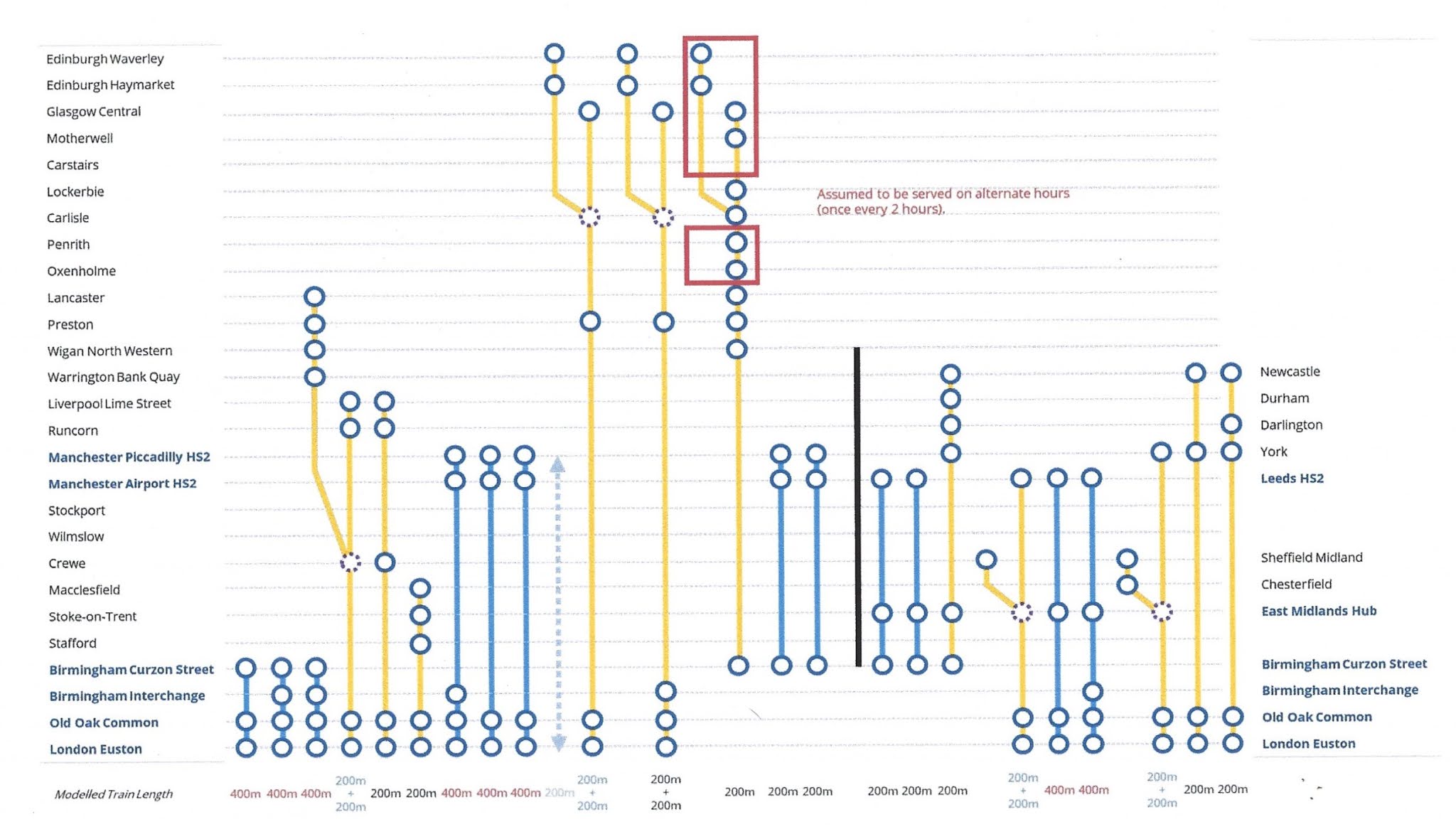
Consider.
- Birmingham Interchange has good connections in the North.
- I can see that Birmingham Airport could start to attract lots of passengers going between the islands of Great Britain and Ireland.
- And don’t forget Cardiff, Swansea, Exeter, Isle of Man and New Quay.
- Could Birmingham-Dublin and Birmingham-Belfast be run as frequent shuttles?
- Will there be AirRail tickets between Euston and Belfast and Dublin?
I also wonder if zero-carbon travel will attract passengers?
Zero-Carbon Air Cargo At Birmingham Airport
This article on Railway Gazette is entitled Varamis Rail Launches Regular Express Light Freight Service.
These three paragraphs outline the service from Varamis Rail.
Varamis Rail has launched a 160 km/h express freight service between Glasgow and Birmingham International using a converted electric multiple-unit.
The service is targeted at express parcels and third-party delivery companies seeking next day delivery of consumer goods.
Consignments arriving at the Glasgow hub by 17.30 from Monday to Friday can reach Birmingham at 23.00, with northbound freight arriving at the Birmingham site by 23.00 reaching Glasgow at 05.30 the next morning.
I think this service would interface well with cargo planes operating overnight from Birmingham Airport.
It seems to me, that Spokes at Speke could be reborn at Birmingham.
Conclusion
Birmingham Airport seems to be positioning itself to take advantage of aviation’s new breed of planes.
MacHairWind Wind Farm
MachairWind wind farm has its own page on the ScottishPower Renewables web site.
These are the two introductory paragraphs.
The MacHairWind project off the coast of Islay, which could deliver 2GW of cleaner renewable energy, will make a significant contribution to tackling climate change and achieving Net Zero, with the potential to generate enough clean electricity to power over 2 million homes in Scotland.
It will also build on ScottishPower’s long-standing presence and positive track record of investing in and working with local communities and businesses across Argyll & Bute to realise the benefits of renewable energy developments.
This Google Map shows the area of the wind farm, which is to the North West of the island of Islay.
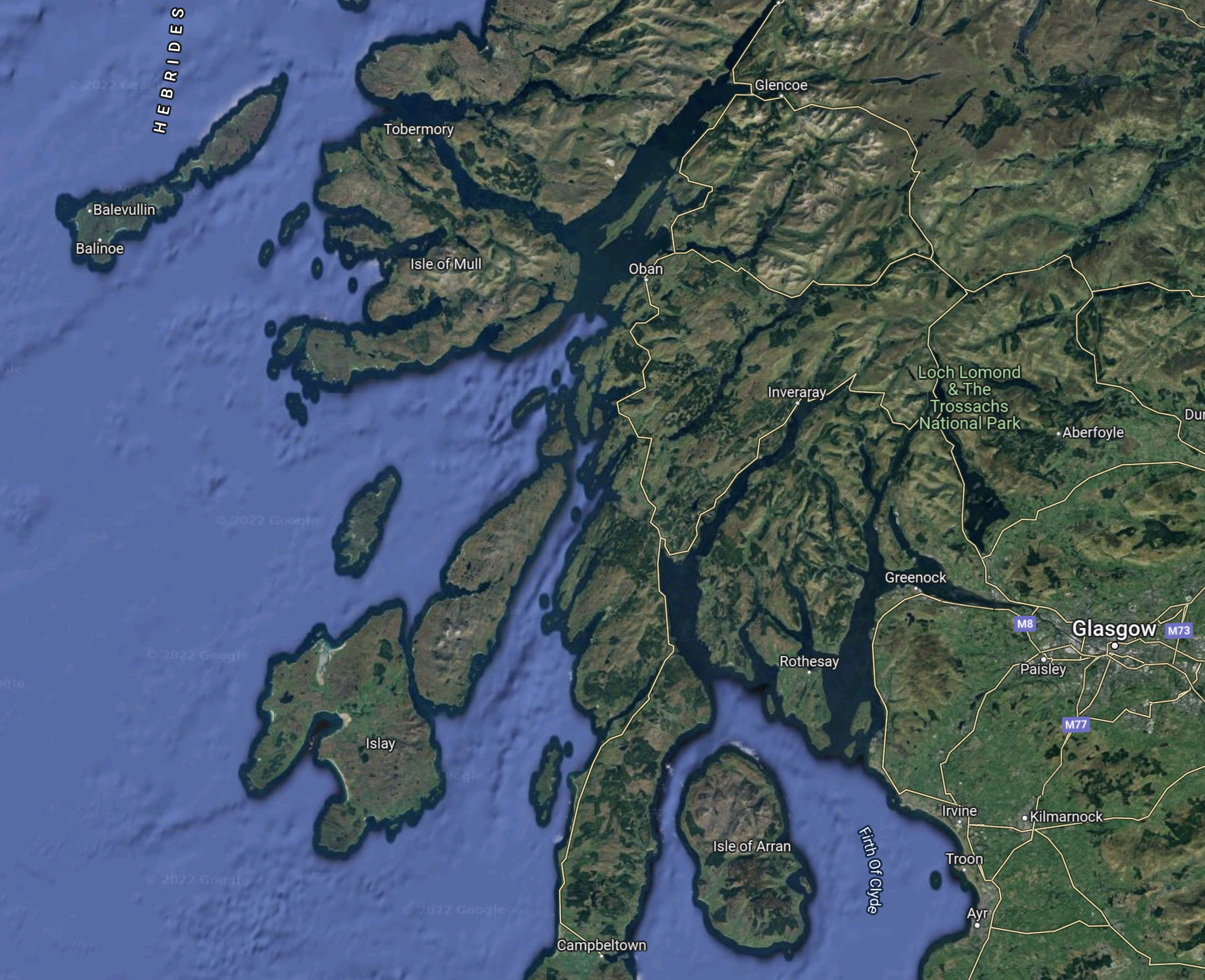
Note.
- There certainly is a large space of empty sea to the North-West of Islay.
- Glasgow is not far away.
This second Google Map shows the area to the North-East of Islay.
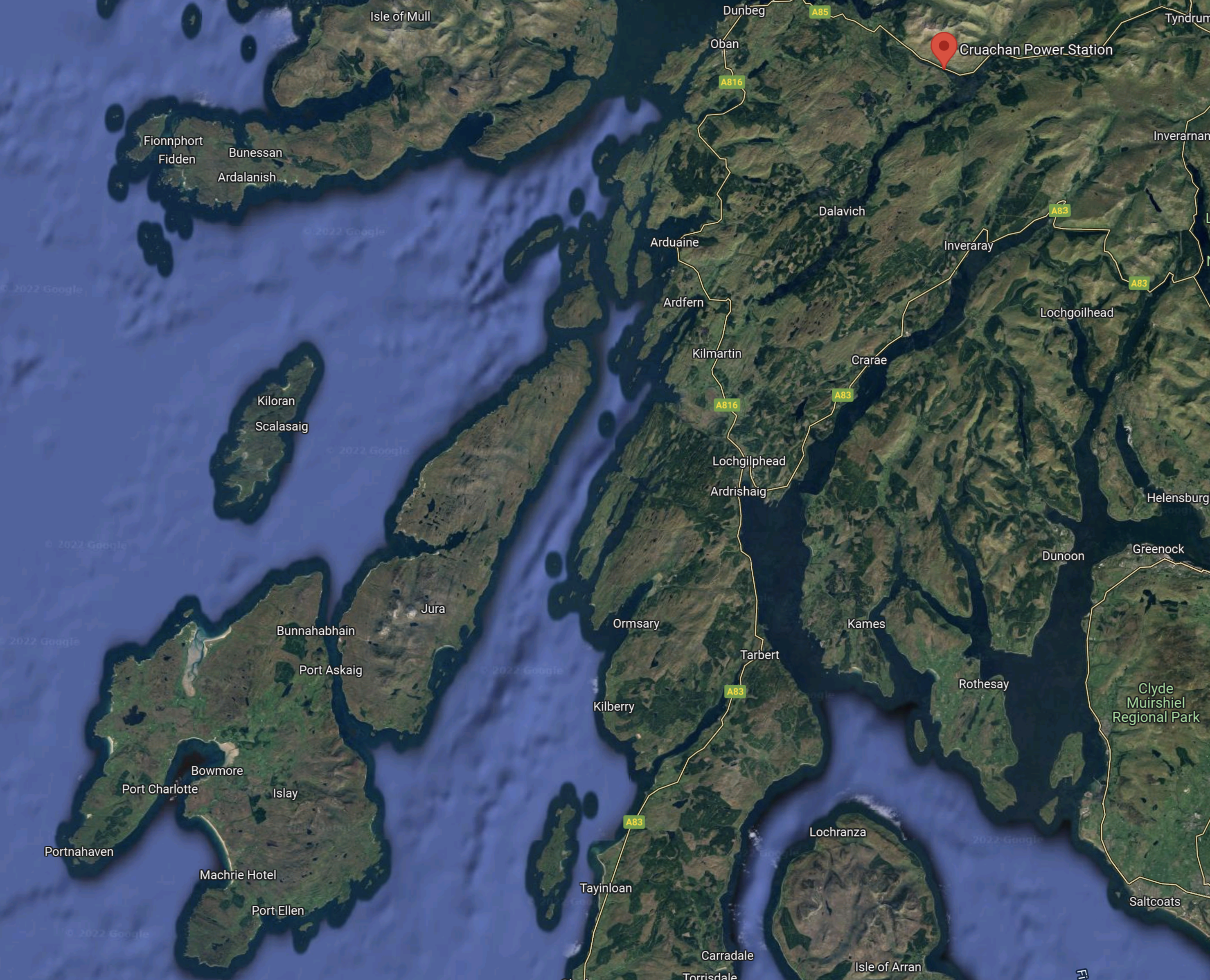
Note.
- Islay is in the South-West corner of the map.
- Colonsay is the smaller island to the North.
- In the North-East corner of the map the red arrow indicate Cruachan pumped hydro power station.
- In the South-East corner of the map is the Clyde Estuary, where the two nuclear power stations at Hunterston were located.
- Hunterston is also the Northern end of Western HVDC Link to North Wales.
Wikipedia says this about the relationship of the Cruachan power station and Hunterston’s nuclear stations.
Construction began in 1959 to coincide with the Hunterston A nuclear power station in Ayrshire. Cruachan uses cheap off-peak electricity generated at night to pump water to the higher reservoir, which can then be released during the day to provide power as necessary.
Now that the two nuclear stations are being decommissioned, will the MacHairWind wind farm be used to pump water to Cruachan’s higher reservoir?
Conclusion
The MacHairWind wind farm seems a well-positioned wind farm.
- It is close to Glasgow.
- It can be used in tandem with the Cruachan pumped hydro power station.
- It will have access to the Western HVDC Link to send power to the North-West of England.
Is Scotland replacing the 1.2 GW Hunterston B nuclear power station with a 2 GW wind farm, with help from Cruachan and other proposed pumped storage hydro schemes to the North of Glasgow?
It also looks like increasing the power at Cruachan from the current 440 MW to a GW, by the building of Cruachan 2 would give the area even more energy security.
 The Anonymous Widower