Plan To Reopen Maid Marian Train Line Takes Step Forward
The title of this post is the same as that of this article on Nottinghamshire Live.
This is the introduction to the article.
A long-awaited plan to reopen the disused Maid Marian line for passenger trains has progressed.
It is hoped the train line could link with the proposed HS2 station at Toton, meaning travellers in Kirkby and Sutton could access the high-speed route.
I wrote about this route before in After The Robin Hood Line Will Nottingham See The Maid Marian Line?
This was one of my comments on the Maid Marian Line.
But the clincher is that it would provide connectivity for HS2 all the way from Worksop and Mansfield to Lincoln and Grimsby.
HS2 is needed, but we must make sure that the benefits of the line are spread to all parts of the country.
With High Speed Two under way, we should make sure that we provide maximum connectivity to the new high speed route.
In the case of the Maid Marian Line between the East Midland Hub station on High Speed Two and Grimsby, Lincoln, Mansfield and Worksop, I’m sure Hitachi or another manfacturer can design a 100 mph zero-carbon train to speed travellers through the Nottinghamshire countryside.
Castlefield Corridor Trade-Off Plan For Fewer Trains
The title of this post is the same as that of this article on Rail Magazine.
The article says that to solve the problems through the Castlefield Corridor, the number of trains will be reduced from 15 trains per hour (tph) to thirteen tph.
This arrangement applied until May 2018 and meant that two tph between Manchester Airport and East of the Pennines reversed in Manchester Piccadilly station to go East, rather than using the Castlefield Corridor through Deansgate and Manchester Victoria stations.
The arrangement worked well before May 2018 and I doubt there’s no reason, why it won’t work in the short-term.
The long-term solution is Northern Powerhouse Rail and/or High Speed Two, which looks like will be in tunnel between the Airport and Manchester City Centre and could carry as many as six tph between Manchester and Liverpool via the Airport.
Perhaps, this should be the first piece of High Speed Two to be built in the North.
- It connects the three most important economic areas in the North West of England; Liverpool, Manchester and Manchester Airport.
- It would greatly increase capacity.
- It would probably have good connections to Crewe, Warrington, Wigan and the West Coast Main Line.
- Liverpool has an extensive local rail network, which is being expanded.
- Manchester is expanding the Metrolink network.
Some of the Castlefield Corridor services would have been replaced by better and faster services.
Are Hitachi Designing the Ultimate Battery Train?
In Sparking A Revolution, a post based on an article of the same name in Issue 898 of Rail Magazine, I repeated this about the specification of Hitachi UK Battery Train Specification.
- Range – 55-65 miles
- Performance – 90-100 mph
- Recharge – 10 minutes when static
- Routes – Suburban near electrified lines
- Battery Life – 8-10 years
Does this mean that the train can do 55-65 miles cruising at 90-100 mph?
How Much Energy Is Needed To Accelerate A Five-Car Class 800 Train To Operating Speed?
I will do my standard calculation.
- Empty train weight – 243 tonnes (Wikipedia for Class 800 train!)
- Passenger weight – 302 x 90 Kg (Includes baggage, bikes and buggies!)
- Train weight – 270.18 tonnes
Using Omni’s Kinetic Energy Calculator, the kinetic energy at various speeds are.
- 60 mph – 27 kWh
- 80 mph – 48 kWh
- 90 mph – 61 kWh
- 100 mph – 75 kWh
- 125 mph – 117 kWh – Normal cruise on electrified lines.
- 140 mph – 147 kWh – Maximum cruise on electrified lines.
Because the kinetic energy of a train is only proportional to the weight of the train, but proportional to the square of the speed, note how the energy of the train increases markedly after 100 mph.
Are these kinetic energy figures a reason, why Hitachi have stated their battery train will have an operating speed of between 90 and 100 mph?
A 100 mph cruise would also be very convenient for a lot of main lines, that don’t have electrification in the UK.
What Battery Size Would Be Needed?
In How Much Power Is Needed To Run A Train At 125 mph?, I calculated that a five-car Class 801 electric train, needed 3.42 kWh per vehicle-mile to maintain 125 mph.
For comparison, an InterCity 125 train, had a figure of 2.83 kWh per vehicle-mile.
Hitachi are redesigning the nose of the train for the new Class 810 train and I suspect that these trains can achieve somewhere between 1.5 and 3 kWh per vehicle-mile, if they are cruising at 100 mph.
Doing the calculation for various consumption levels gives the following battery capacity for a five-car train to cruise 65 miles at 100 mph
- 1.5 kWh per vehicle-mile – 487 kWh
- 2 kWh per vehicle-mile – 650 kWh
- 2.5 kWh per vehicle-mile – 812.5 kWh
- 3 kWh per vehicle-mile – 975 kWh
These figures don’t include any energy for acceleration to line speed from the previous stop or station, but they would cope with a deceleration and subsequent acceleration, after say a delay caused by a slow train or other operational delay, by using regenerative braking to the battery.
The energy needed to accelerate to operating speed, will be as I calculated earlier.
- 90 mph – 61 kWh
- 100 mph – 75 kWh
As the battery must have space to store the regenerative braking energy and it would probably be prudent to have a ten percent range reserve, I can see a battery size for a train with an energy consumption of 2 kWh per vehicle-mile, that needed to cruise at 100 mph being calculated as follows.
- Energy for the cruise – 650 kWh
- 10% reserve for cruise – 65 kWh
- Braking energy from 100 mph – 75 kWh
This gives a total battery size of 790 kWh, which could mean that 800 kWh would be convenient.
Note that each of the three MTU 12V 1600 diesel engines, fitted to a Class 800 train, each weigh around two tonnes.
In Innolith Claims It’s On Path To 1,000 Wh/kg Battery Energy Density, I came to these conclusions.
- Tesla already has an energy density of 250 Wh/Kg.
- Tesla will increase this figure.
- By 2025, the energy density of lithium-ion batteries will be much closer to 1 KWh/Kg.
- Innolith might achieve this figure. But they are only one of several companies aiming to meet this magic figure.
Suppose two of the MTU 12V 1600 diesel engines were each to be replaced by a two tonne battery, using Tesla’s current energy density, this would mean the following.
- Each battery would have a capacity of 500 kWh.
- The train would have one MWh of installed battery power.
- This is more than my rough estimate of power required for a 65 mile trip.
- The train would have little or no weight increase.
- I also wouldn’t be surprised to find that the exchange of a diesel engine for a battery was Plug-and-Play.
Hitachi would have an electric/battery/diesel tri-mode train capable of the following.
- Range – 55-65 miles
- Out and Back Range – about 20-30 miles
- Performance – 90-100 mph
- Recharge – 10 minutes when static
- Emergency diesel engine.
I feel it would be a very useful train.
Trains That Could Be Fitted With Batteries
The original article in Rail Magazine says this.
For the battery project, positive discussions are taking place with a number of interested parties for a trial, with both Class 385s and Class 800s being candidates for conversion.
So this means that the following operators will be able to use Hitachi’s battery technology o their trains.
- Avanti West Coast – Class 80x trains
- First East Coast Trains – Class 80x trains
- East Midlands Railway – Class 80x trains
- GWR – Class 80x trains
- Hull Trains – Class 80x trains
- LNER – Class 80x trains
- ScotRail – Class 385 trains
- TransPennine Express – Class 80x trains
Although, I based my calculations on Class 80x trains, I suspect that the methods can be applied to the smaller Class 385 trains.
Possible Out-And-Back Journeys
These are possible Out-And-Back journeys, that I believe Hitachi’s proposed battery-electric trains could handle.
- Edinburgh and Tweedbank – 30 miles from Newcraighall
- London Paddington and Bedwyn – 30 miles from Reading
- London Euston and Blackburn – 12 miles from Preston
- London Kings Cross and Bradford – < 27 miles from Leeds
- London Euston and Chester – 21 miles from Crewe
- London Kings Cross and Harrogate – <18 miles from Leeds
- London Kings Cross and Huddersfield – 17 miles from Leeds
- London St. Pancras and Leicester – 16 miles from Market Harborough
- London Kings Cross and Lincoln – 17 miles from Newark
- London St. Pancras and Melton Mowbray – 26 miles from Corby
- London Kings Cross and Middlesbrough – 20 miles from Northallerton
- London Kings Cross and Nottingham – 20 miles from Newark
- London Paddington and Oxford – 10 miles from Didcot
- London Kings Cross and Redcar – 29 miles from Northallerton
- London Kings Cross and Rotherham- 14 miles from Doncaster
- London Kings Cross and Sheffield – 20 miles from Doncaster
- London and Weston-super-Mare – 19 miles from Bristol
Note.
- Provided that the Out-And-Back journey is less than about sixty miles, I would hope that these stations are comfortably in range.
- Leicester is the interesting destination, which would be reachable in an Out-And-Back journey. But trains from the North stopping at Leicester would probably need to charge at Leicester.
- I have included Blackburn as it could be a destination for Avanti West Coast.
- I have included Melton Mowbray as it could be a destination for East Midlands Railway.
- I have included Nottingham, Rotherham and Sheffield as they could be destinations for LNER. These services could prove useful if the Midland Main Line needed to be closed for construction works.
- I’m also fairly certain, that no new electrification would be needed, although every extra mile would help.
- No charging stations would be needed.
I suspect, I’ve missed a few possible routes.
Possible Journeys Between Two Electrified Lines
These are possible journeys between two electrified lines, that I believe Hitachi’s proposed battery-electric trains could handle.
- London St. Pancras and Eastbourne via Hastings – 25 miles between Ashford and Ore.
- Leeds and York via Garforth – 20 miles between Neville Hall and Colton Junction
- London Kings Cross and Norwich via Cambridge – 54 miles between Ely and Norwich.
- Manchester Victoria and Leeds via Huddersfield – 43 miles between Manchester Victoria and Leeds.
- Preston and Leeds via Hebden Bridge – 62 miles between Preston and Leeds.
- Newcastle and Edinburgh – Would battery-electric trains get round the well-publicised power supply problems on this route?
Note.
- I am assuming that a range of 65 miles is possible.
- If the trains have a diesel-generator set, then this could be used to partially-charge the battery in places on the journey.
- Leeds and York via Garforth has been scheduled for electrification for years.
- Preston and Leeds via Hebden Bridge would probably need some diesel assistance.
- London Kings Cross and Norwich via Cambridge is a cheeky one, that Greater Anglia wouldn’t like, unless they ran it.
- As before no new electrification or a charging station would be needed.
I suspect, I’ve missed a few possible routes.
Possible Out-And-Back Journeys With A Charge At The Destination
These are possible Out-And-Back journeys, that I believe Hitachi’s proposed battery-electric trains could handle, if the batteries were fully charged at the destination.
- Doncaster and Cleethorpes – 52 miles from Doncaster.
- London Paddington and Cheltenham – 42 miles from Swindon
- London Kings Cross and Cleethorpes via Lincoln – 64 miles from Newark
- London Euston and Gobowen – 46 miles from Crewe
- London Euston and Wrexham – 33 miles from Crewe
- London Kings Cross and Hull – 45 miles from Selby
- London Kings Cross and Shrewsbury – 30 miles from Wolverhampton
- London Kings Cross and Sunderland 41 miles from Northallerton
- London Paddington and Swansea – 46 miles from Cardiff
- London Paddington and Worcester – 67 miles from Didcot Parkway
- London St. Pancras and Derby – 46 miles from Market Harborough
- London St. Pancras and Nottingham – 43 miles from Market Harborough
Note.
- I am assuming that a range of 65 miles is possible.
- If the trains have a diesel-generator set, then this could be used to partially-charge the battery in places on the journey.
- I am assuming some form of charging is provided at the destination station.
- As before no new electrification would be needed.
I suspect, I’ve missed a few possible routes.
Midland Main Line
The Midland Main Line could possibly be run between London St. Pancras and Derby, Nottingham and Sheffield without the use of diesel.
Consider.
- The route will be electrified between London St. Pancras and Market Harborough.
- In connection with High Speed Two, the Midland Main Line and High Seed Two will share an electrified route between Sheffield and Clay Cross North Junction.
- London St. Pancras and Derby can be run with a charging station at Derby, as Market Harborough and Derby is only 46 miles.
- London St. Pancras and Nottingham can be run with a charging station at Nottingham, as Market Harborough and Nottingham is only 43 miles.
- The distance between Clay Cross North Junction and Market Harborough is 67 miles.
- The distance between Sheffield and Leeds is 38 miles.
It looks to me that the range of East Midlands Railway’s new Class 810 trains, will be a few miles short to bridge the gap on batteries, between Clay Cross North Junction and Market Harborough station, but Leeds and Sheffield appears possible, once Sheffield has been electrified.
There are several possible solutions to the Clay Cross North and Market Harborough electrification gap.
- Fit higher capacity batteries to the trains.
- Extend the electrification for a few miles North of Market Harborough station.
- Extend the electrification for a few miles South of Clay Cross North Junction.
- Stop at Derby for a few minutes to charge the batteries.
The route between Market Harborough and Leicester appears to have been gauge-cleared for electrification, but will be difficult to electrify close to Leicester station. However, it looks like a few miles can be taken off the electrification gap.
Between Chesterfield and Alfriston, the route appears difficult to electrify with tunnels and passig through a World Heritage Site.
So perhaps options 1 and 2 together will give the trains sufficient range to bridge the electrification gap.
Conclusion On The Midland Main Line
I think that Hitachi, who know their trains well, must have a solution for diesel-free operation of all Midland Main Line services.
It also looks like little extra electrification is needed, other than that currently planned for the Midland Main Line and High Speed Two.
North Wales Coast Line
If you look at distance along the North Wales Coast Line, from the electrification at Crewe, you get these values.
- Chester – 21 miles
- Rhyl – 51 miles
- Colwyn Bay – 61 miles
- Llandudno Junction – 65 miles
- Bangor – 80 miles
- Holyhead – 106 miles
It would appear that Avanti West Coast’s new AT-300 trains, if fitted with batteries could reach Llandudno Junction station, without using diesel.
Electrification Between Crewe And Chester
It seems to me that the sensible thing to do for a start is to electrify the twenty-one miles between Crewe and Chester, which has been given a high priority for this work.
With this electrification, distances from Chester are as follows.
- Rhyl – 30 miles
- Colwyn Bay – 40 miles
- Llandudno Junction – 44 miles
- Bangor – 59 miles
- Holyhead – 85 miles
Electrification between Crewe and Chester may also open up possibilities for more electric and battery-electric train services.
But some way will be needed to charge the trains to the West of Chester.
Chagring The Batteries At Llandudno Junction Station
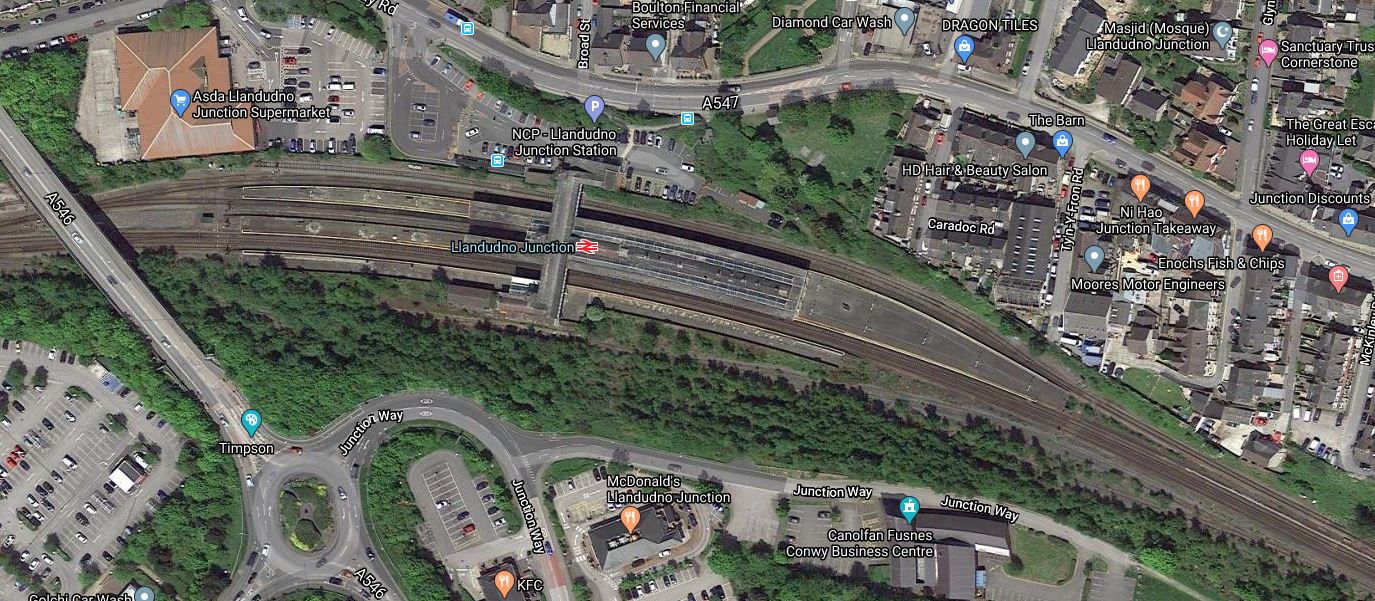
This Google Map shows Llandudno Junction station.
Note.
- It is a large station site.
- The Conwy Valley Line, which will be run by battery Class 230 trains in the future connects at this station.
- The Class 230 train will probably use some of Vivarail’s Fast Charging systems, which use third-rail technology, either at the ends of the branch or in Llandudno Junction station.
The simplest way to charge the London Euston and Holyhead train, would be to build a charging station at Llandudno Junction, which could be based on Vivarail’s Fast Charging technology or a short length of 25 KVAC overhead wire.
But this would add ten minutes to the timetable.
Could 25 KVAC overhead electrification be erected for a certain distance through the station, so that the train has ten minutes in contact with the wires?
Looking at the timetable of a train between London Euston and Holyhead, it arrives at Colwyn Bay station at 1152 and leaves Llandudno Junction station at 1200.
So would it be possible to electrify between the two stations and perhaps a bit further?
This Google Map shows Colwyn Bay Station,
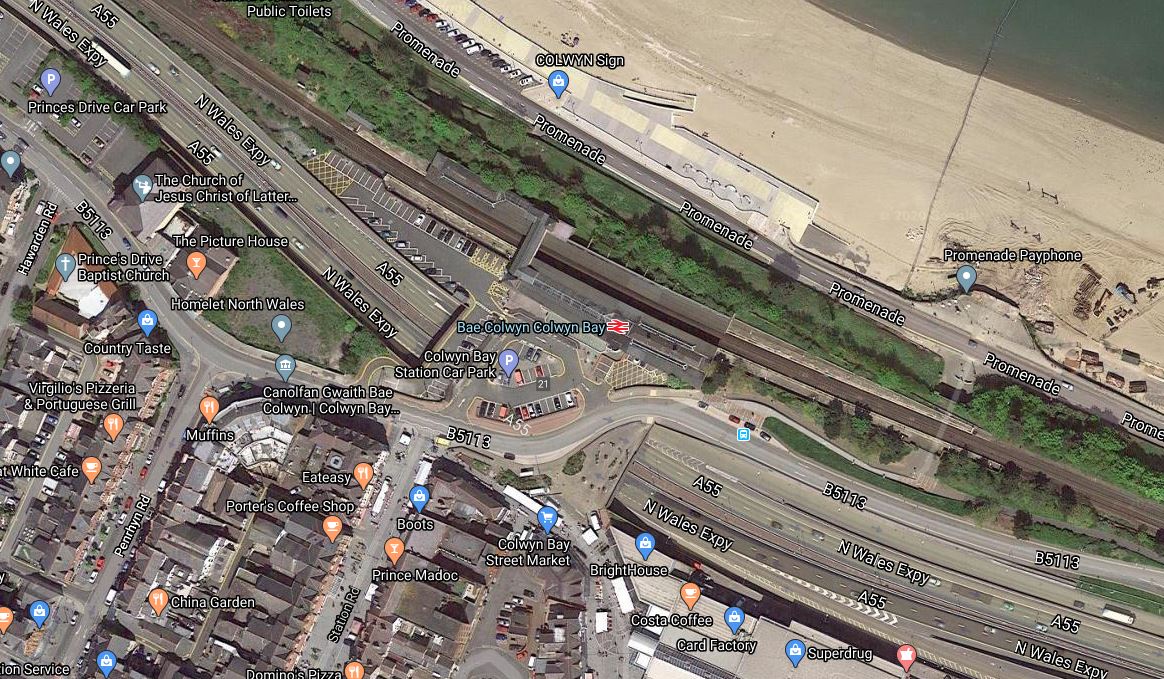
Note how the double-track railway is squeezed between the dual-carriageway of the A55 North Wales Expressway and the sea.
The two routes follow each other close to the sea, as far as Abegele & Pensarn station, where the Expressway moves further from the sea.
Further on, after passing through more caravans than I’ve ever seen, there is Rhyl station.
- The time between arriving at Rhyl station and leaving Llandudno Junction station is nineteen minutes.
- The distance between the two stations is fourteen miles.
- Rhyl and Crewe is fifty-one miles.
- Llandudno Junction and Holyhead is forty-one miles.
It would appear that if the North Wales Coast Line between Rhyl and Llandudno Junction is electrified, that Hitachi’s proposed battery trains can reach Holyhead.
The trains could even changeover between electrification and battery power in Rhyl and Llandudno Junction stations.
I am sure that electrifying this section would not be the most difficult in the world, although the severe weather sometimes encountered, may need some very resilient or innovative engineering.
It may be heretical to say so, but would it be better if this section were to be electrified using proven third-rail technology.
West of Llandudno Junction station, the electrification would be very difficult, as this Google Map of the crossing of the River Conwy shows.
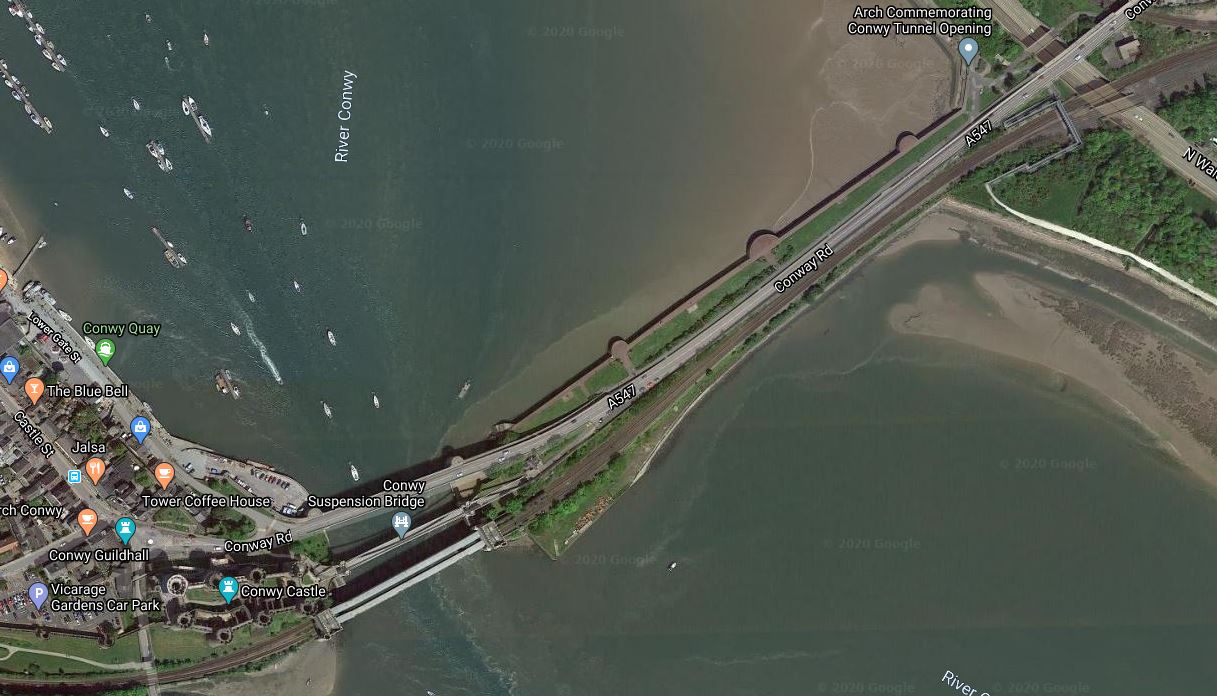
I don’t think anybody would want to see electrification around the famous castle.
Electrification Across Anglesey
Llanfairpwll station marks the divide between the single-track section of the North Wales Coast Line over the Britannia Bridge and the double-track section across Anglesey.
From my virtual helicopter, the route looks as if, it could be fairly easy to electrify, but would it be necessary?
- Llandudno Junction and Holyhead is forty-one miles, which is well within battery range.
- There is surely space at Holyhead station to install some form of fast-charging system.
One problem is that trains seem to turn round in only a few minutes, which may not be enough to charge the trains.
So perhaps some of the twenty-one miles between Llanfairpwll and Holyhead should be electrified.
London Euston And Holyhead Journey Times
Currently, trains take three hours and forty-three minutes to go between London Euston and Holyhead, with these sectional timings.
- London Euston and Crewe – One hour and thirty-nine minutes.
- Crewe and Holyhead – Two hours and four minutes.
The big change would come, if the London Euston and Crewe leg, were to be run on High Speed Two, which will take just fifty-five m,inutes.
This should reduce the London Euston and Holyhead time to just under three hours.
Freight On The North Wales Coast Line
Will more freight be seen on the North Wales Coast Line in the future?
The new tri-mode freight locomotives like the Class 93 locomotive, will be able to take advantage of any electrification to charge their batteries, but they would probably be on diesel for much of the route.
Conclusion On The North Wales Coast Line
Short lengths of electrification, will enable Avanti West Coast’s AT-300 trains, after retrofitting with batteries, to run between Crewe and Holyhead, without using any diesel.
I would electrify.
- Crewe and Chester – 21 miles
- Rhyl and Llandudno Junction – 14 miles
- Llanfairpwll and Holyhead – 21 miles
But to run battery-electric trains between London Euston and Holyhead, only Rhyl and Llandudno Junction needs to be electrified.
All gaps in the electrification will be handled on battery power.
A Selection Of Possible Battery-Electric Services
In this section, I’ll look at routes, where battery-electric services would be very appropriate and could easily be run by Hitachi’s proposed battery-electric trains.
London Paddington And Swansea
Many were disappointed when Chris Grayling cancelled the electrification between Cardiff and Swansea.
I went along with what was done, as by the time of the cancellation, I’d already ridden in a battery train and believed in their potential.
The distance between Cardiff and Swansea is 46 miles without electrification.
Swansea has these services to the West.
- Carmarthen – 32 miles
- Fishguard – 73 miles
- Milford Haven 71 miles
- Pembroke Dock – 73 miles
It looks like, three services could be too long for perhaps a three car battery-electric version of a Hitachi Class 385 train, assuming it has a maximum range of 65 miles.
But these three services all reverse in Carmarthen station.
So perhaps, whilst the driver walks between the cabs, the train can connect automatically to a fast charging system and give the batteries perhaps a four minute top-up.
Vivarail’s Fast Charging system based on third-rail technology would be ideal, as it connects automatically and it can charge a train in only a few minutes.
I would also electrify the branch between Swansea and the South Wales Main Line.
This would form part of a fast-charging system for battery-trains at Swansea, where turnround times can be quite short.
I can see a network of battery-electric services developing around Swansea, that would boost tourism to the area.
Edinburgh And Tweedbank
The Borders Railway is electrified as far as Newcraighall station and the section between there and Tweedbank is thirty miles long.
I think that a four-car battery-electric Class 385 train could work this route.
It may or may not need a top up at Tweedbank.
The Fife Circle
The Fife Circle service from Edinburgh will always be difficult to electrify, as it goes over the Forth Rail Bridge.
- The Fife Circle is about sixty miles long.
- Plans exist for a short branch to Leven.
- The line between Edinburgh and the Forth Rail Bridge is partly electrified.
I believe that battery-electric Class 385 train could work this route.
London Kings Cross and Grimsby/Cleethorpes via Lincoln
The Cleethorpes/Grimsby area is becoming something of a renewable energy powerhouse and I feel that battery trains to the area, might be a significant and ultimately profitable statement.
LNER recently opened a six trains per day service to Lincoln.
Distances from Newark are as follows.
- Lincoln – 17 miles
- Grimsby – 61 miles
- Cleethorpes – 64 miles
A round trip to Lincoln can probably be achieved on battery alone with a degree of ease, but Cleethorpes and Grimsby would need a recharge at the coast.
Note that to get to the Cleethorpes/Grimsby area, travellers usually need to change at Doncaster.
But LNER are ambitious and I wouldn’t be surprised to see them dip a toe in the Cleethorpes/Grimsby market.
The LNER service would also be complimented by a TransPennine Express service from Manchester Airport via Sheffield and Doncaster, which could in the future be another service run by a Hitachi battery train.
There is also a local service to Barton-on-Humber, which could be up for improvement.
London Waterloo And Exeter
This service needs to go electric, if South Western Railway is going to fully decarbonise.
But third-rail electrification is only installed between Waterloo and Basingstoke.
Could battery-electric trains be used on this nearly two hundred mile route to avoid the need for electrification.
A possible strategy could be.
- Use existing electrification, as far as Basingstoke – 48 miles
- Use battery power to Salisbury – 83 miles
- Trains can take several minutes at Salisbury as they often split and join and change train crew, so the train could be fast-charged.
- Use battery power to the Tisbury/Gillingham/Yeovil/Crewkerne area, where trains would be charged – 130 miles
- Use battery power to Exeter- 172 miles
Note.
- The miles are the distance from London.
- The charging at Salisbury could be based on Vivarail’s Fast-Charging technology.
- The charging around Yrovil could be based on perhaps twenty miles of third-rail electrification, that would only be switched on, when a train is present.
I estimate that there could be time savings of up to fifteen minutes on the route.
To Be Continued…
A Fixed Link To Northern Ireland
The title of this post is the same as an article in Issue 898 of Rail Magazine, that has been written by Jim Steer, who is a well-known rail engineer.
It is very much a must-read and he is in favour of the link.
- It’s all about reducing carbon footprint of travel between the UK and Ireland.
- The bridge would be rail-only.
- Goods currently sent by truck, would go by rail.
- There would be a 125 mph rail link across Galloway between the bridge and HS2/West Coast Main Line.
- A London and Belfast time of three-and-a-half hours would be possible.
- A frequent Edinburgh and Belfast via Glasgow service would be provided.
- He believes the Northern Ireland rail network should be converted to standard gauge and expanded, so that large areas of Northern Ireland will benefit.
Increasingly, serious people are coming behind this project.
Oakervee Review – Calvert Station
The Oakervee Review says this on Page 53, about a new station at Calvert in Buckinghamshire.
The Review also heard evidence from a number of informed stakeholders suggesting there should be a new station near Calvert, where HS2 would cross East-West Rail proposals to improve connectivity along the OxfordCambridge corridor. Previously, due to the impact on speed, no interim station had been planned between London and Birmingham Interchange.
The Review concluded that the DfT should consider making passive provision for a future HS2 station near to Calvert. If it is decided that a HS2 station should be built near to Calvert, passive provision will help prevent any disruption to HS2 services. There could be merit in developing an HS2 station in the future here if local plans support a significant residential and commercial development in this region, and if there is passenger demand to justify the cost of developing a station here. Without this coordinated planning, the experience of HS1 stations risks being repeated. The Review notes that the cost of developing a future station near Calvert could be shared with others including potentially the East West Rail Company.
I must admit, that I like the concept of a new station at Calvert.
Read The Oakervee Review
I’ve just read most of the Oakervee Review.
Click this link to read the pdf.
It contains a lot of interesting detail in the 130 pages
I shall be commenting in detail later.
Will High Speed Two’s Classic-Compatible Trains Have Battery Operation?
I believe it is very likely, that High Speed Two’s new classic-compatible trains will have battery capabilities.
- Batteries would handle energy generated by regenerative braking.
- Batteries would give a train recovery capability in case of overhead catenary failure.
- Batteries would be used for depot movements.
- Batteries would probably improve the energy efficiency of the trains.
Effectively, the batteries would power the train and would be topped-up by the electrification and the regenerative braking.
But would they be able to give the trains a route extension capability on lines without electrification?
Consider.
- Battery technology is getting better with energy capacity per kilogram increasing.
- Batteries will be full, when the train leaves the electrification.
- These trains will be as light as possible.
- Trains will not be running at speeds in excess of perhaps 100 mph without electrification.
- Fast charging can be provided at station stops.
I think, that trains could be able to do at least 40 to 50 miles on a full charge.
Fast Charging Technology
The most promising fast-charging technology is Vivarail’s system of using a length of conventional third-rail connected to a bank of batteries. When the train connects with the third-rail, electricity flows to the batteries on the train.
There are also others working on systems that use short lengths of overhead electrification.
Both systems can be totally automatic and safe.
Example Routes
These are three possible example routes.
Aberdeen And Edinburgh
These are the distances between stops on the route between Aberdeen and Edinburgh.
- Aberdeen and Stonehaven – 12 miles
- Stonehaven and Montrose – 24 miles
- Montrose and Arbroath – 14 miles
- Arbroath and Dundee – 17 miles
- Dundee and Leuchars – 8 miles
- Leuchars and Kirkaldy – 25 miles
- Kirkcaldy and Inverkeithing – 13 miles
- Inverkeithing and Edinburgh – 13 miles
It is a total of 130 miles without electrification.
The route is also generally flat and mainly along the coast.
Inverness And Edinburgh
These are the distances between stops on the route between Inverness and Strirling.
- Inverness and Aciemore- 35 miles
- Aviemore and Kingussie – 12 miles
- Kingussie and Pitlochry – 43 miles
- Pitlochry and Perth – 30 miles
- Perth and Gleneagles – 15 miles
- Gleneagles and Stirling – 17 miles
It is a total of 152 miles without electrification.
As there are some steep gradients, there may be a need for some electrification in certain sections of the route.
Holyhead And Crewe
These are the distances between stops on the route between Holyhead and Crewe
- Holyhead and Bangor – 25 miles.
- Bangor and Llandudno Junction – 16 miles
- Llandudno Junction and Colwyn Bay – 4 miles
- Colwyn Bay and Rhyl – 10 miles
- Rhyl and Prestatyn – 4 miles
- Prestatyn and Flint – 14 miles
- Flint and Chester – 13 miles
- Chester and Crewe – 21 miles
It is a total of 105 miles without electrification.
The route is also generally flat and mainly along the coast.
A Stepping-Stone Approach
I believe there is a design of fast charger, that in say a three minute stop can charge the battery sufficient to get to the next station. The electrification might continue for perhaps a couple of hundred metres from the station on the tracks where the trains are accelerating.
A train making a stop at a station would do the following.
- As it approaches the stop, the train’s kinetic energy is turned into electricity by the regenerative braking.
- This energy is stored in the batteries.
- In the station, the batteries are charged from the fast charger or electrification.
- Whilst stopped, the batteries provide the power for the train’s systems.
- Accelerating away would use the batteries or electrification if it is installed.
The train’s computer would monitor the batteries and control the various power systems and sources to run the train in the most efficient manner.
This sequence would be repeated at each stop as the train progressed to its destination.
Extra Electrification
In the section on the challenging Edinburgh and Inverness route, I said that some gradients would probably need to be electrified to maintain progress.
But there are other sections, where electrification has been suggested.
- Stirling and Perth
- Crewe and Chester
So could we be seeing a mixture of electrification and charging stations on routes to allow electric trains to serve routes, where full electrification is impossible for practical, scenic, heritage or cost reasons?
The South Wales Metro is to use discontinuous electrification to save the cost of rebuilding innumerable bridges.
Conclusion
I believe that engineers can design high speed trains, that will be able to run on existing lines using battery power to serve the remoter parts of Great Britain.
Could High Speed Two Have A Station At Ashby-de-la-Zouch?
This morning, I was listening to Andrew Bridgen, who is the Member of Parliament for North West Leicestershire, giving the reasons for a strong opposition to High Speed Two.
- High Speed Two will reduce the number of services between Leicester and London.
- His constituency does not have a rail station.
- His constituency would do better for the Ivanhoe Line to get a passenger service.
- His constituents are badly affected by the building of the line.
- His constituents will need to drive North to East Midlands Hub station to use High Speed Two.
Some points are valid, although I think no rail company would reduce the number of services between Leicester and London.
The Future Of Services Between Leicester And London
East Midlands Railway currently run four trains per hour (tph) between Leicester and London, with the fastest trains taking five minutes over the hour.
New 125 mph bi-mode Class 810 trains, will be running all main line services on the Midland Main Line from 2023, using electric power between London and Market Harborough.
It is also planned to increase the line speed between London and Market Harborough to 140 mph, so the trains can really use their design speed, by updating the electrification, signalling and track.
From these published plans, I would feel that East Midlands Railway are intending that all Leicester and London services are within the hour.
Reinstatement Of Services On The Ivanhoe Line
This has been promised off-and-on for some time and I wrote about it in Silent Hydrogen Trains On The Cards For New Line Linking Burton And Leicester, after one of my alerts picked up “hydrogen trains”.
The Association Of Train Operating Companies Plan For The Ivanhoe Line
This is taken from the Wikipedia entry for the Ivanhoe Line.
In 2009 the Association of Train Operating Companies published a £49 million proposal (Connecting Communities: Expanding Access to the Rail Network) to restore passenger services to the line that would include reopening stations at Kirby Muxloe, Bagworth and Ellistown, Coalville Town, Ashby de la Zouch, Moira, and Gresley (for Swadlincote). There is also some support in the Leicester area for the line to have new stations to serve Leicester City F.C.’s stadium and the suburb of Braunstone.
Wikipedia also says, it could be developed as a no-frills line.
Given the government’s enthusiasm for reopening lines closed by Beeching, I suspect that this line will be reopened to passenger traffic in the next few years.
Ashby-de-la-Zouch Station
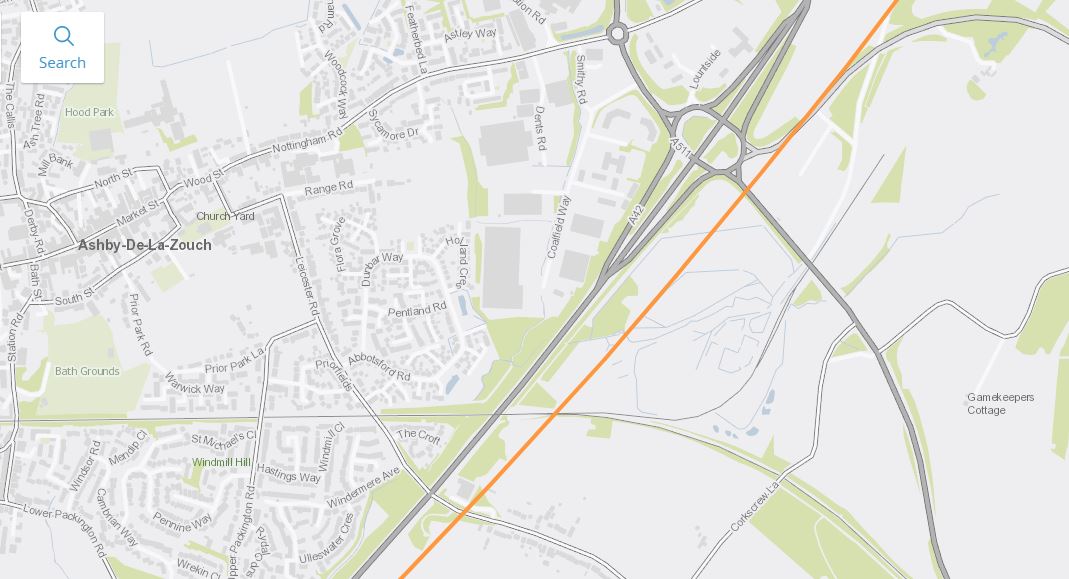
This section of the route map for High Speed Two, shows where the Ivanhoe Line crosses it, just by a major road junction outside Ashby-de-la-Zouch.
Note.
- High Speed Two is shown in orange.
- The Ivanhoe Line runs West-East from the West edge of the map and after crossing the A42 and High Speed Two it curves South-East.
Where the two lines cross would it be sensible to build a simple interchange station?
- Andrew Bridgen’s constituency has a electorate of over 72,000.
- The station would be well-connected to the road network via the the M42, A42 and A51.
- There would appear to be plenty of space for parking.
- It would ease the problems of going by train between Leicester and Birmingham.
- A bridge will have to be built at the location of the station to carry High Speed Two over the Ivanhoe Line, so why not design the bridge with simple platforms?
- As High Speed Two’s trains will be designed with fast acceleration and deceleration, the stops would be very quick
- Passengers would only be allowed on the High Speed Two platforms, when trains are in the station.
Perhaps given its location it could be called the Heart of England Parkway station?
The Station Site
This Google Map shows the station site.
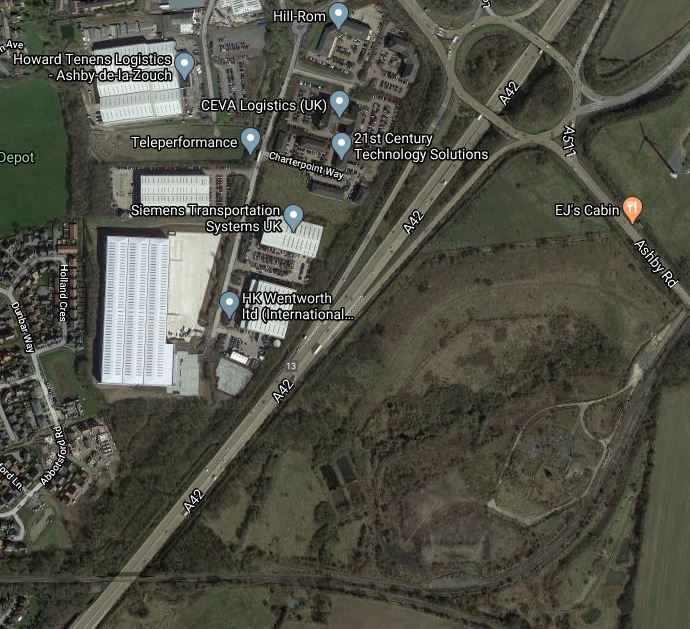
Note.
- The Ivanhoe Line is at the bottom of the map.
- There is a spur from the line into the space.
- High Speed Two will run almost North-South parallel to the A42.
It looks like an abandoned open-cast coal-mine or quarry. Does anybody else know better?
Conclusion
There has already been speculation for the building of a similar station, which I wrote about in Should High Speed Two Have A Station At Calvert?, so perhaps it’s not a totally crazy idea,
Perhaps, there are other places, where High Speed Two crosses other main lines, where parkway stations could be built?
Could High Speed Two Trains Serve Stoke-on-Trent?
The city of Stoke-on-Trent lobbied hard for High Speed Two to call, but it is going through closer to the West Coast Main Line, which is a few miles to the West.
Current Services
Stoke-on-Trent station is on the Stafford to Manchester branch of the West Coast Main Line.
It is served by two trains per hour (tph) between Euston and Manchester Piccadilly via Milton Keynes Central (1tph), Stoke-on-Trent, Macclesfield (1tph) and Stockport. The fastest journey time is one hour and 24 minutes.
Possible Routes Using High Speed Two
It should be noted that to serve Stafford on the West Coast Main Line, High Speed Two trains will use the West Coast Main Line, rather than High Speed Two between Lichfield and Crewe.
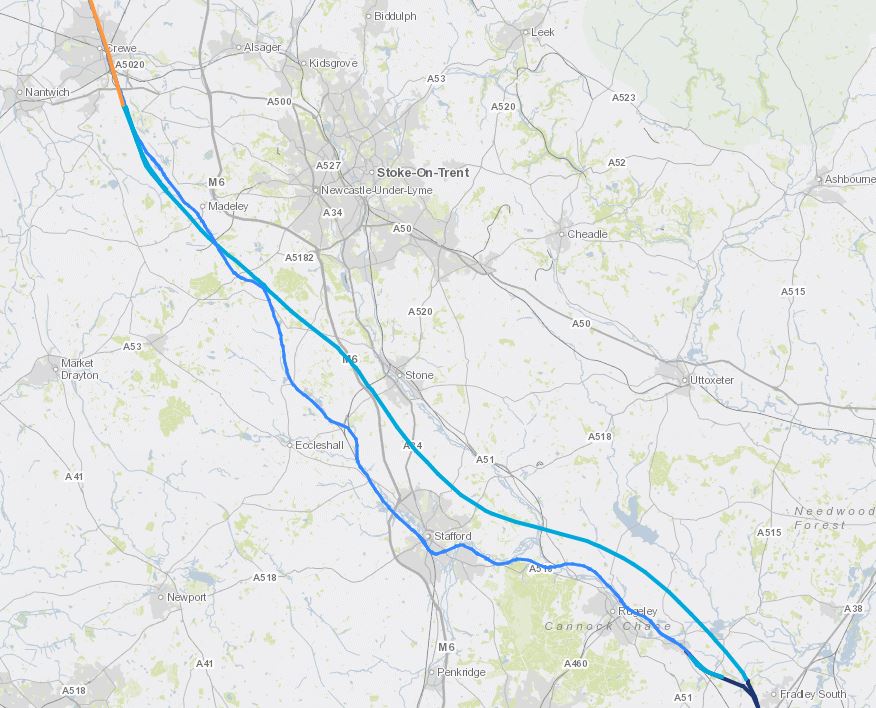
This map clipped from the High Speed Two web site, shows the two routes between Lichfield and Crewe.
Note.
- The straighter route is the new High Speed Two route.
- The bendy route is the West Coast Main Line.
- The two routes split to the North of the city of Lichfield in the South-East corner of the map.
- Stafford can be seen between the two routes.
- Stoke-on-Trent can be seen to the North-East of the routes.
- The new route through Crewe station is shown in orange.
To give an idea of scale, the West Coast Main Line is about forty miles long between the two junctions at Lichfield and Crewe.
Possible Ways High Speed Two Could Serve Stoke-on-Trent Station
There are several ways that High Speed Two trains can serve Stoke-on-Trent station.
London Euston And Stoke-on-Trent Direct
The simplest way is to run a direct service between London Euston and Stoke-on-Trent
- It would use High Speed Two from Euston to Lichfield, where it would take the Trent Valley Line.
- It would proceed to Stoke-on-Trent via Rugeley Trent Valley and Stone.
I estimate that the service would take one hour and two minutes.
The service could either turnback at Stoke-on-Trent or go on to Crewe, Manchester or some other convenient terminus.
Manchester services might even call at Macclesfield and Stockport, as the current services do now!
Times between London and Manchester by various routes could be.
- Current via Stoke-on-Trent, Macclesfield and Stockport – Two hours and seven minutes.
- Planned using High Speed Two – One hour and seven minutes.
- High Speed Two and current route to Manchester – One hour and forty-one minutes
Manchester will get three tph from London and one from Birmingham, so perhaps one of the four services should go via Stoke-in-Trent.
Could High Speed Two Trains Serve Chester And North Wales?
This may seem a slightly outrageous proposal to run High Speed Two trains to Chester.
- The city is a major tourist destination.
- Despite its closeness to Crewe it is a major rail hub, with services across Wales to Cardiff, Holyhead and Llandudno and along the border between England and Wales to Shrewsbury and Newport.
- Merseyrail serves the city and the station can be considered to be part of Liverpool’s extensive commuting area. This service is likely to be more reliable and faster with the delivery of new Class 777 trains.
- For parts of Merseyside, travelling to London or Manchester Airport, is easier via Chester than Liverpool Lime Street or Liverpool South Parkway.
If the promoters of High Speed Two are serious about creating a railway for the whole country, then I feel that running trains direct to and from Chester could be very beneficial for the towns and cities, that can be served by the current network at Chester.
Current And Possible Timings
Currently, trains take two minutes over two hours between Euston and Chester.
When Avanti West Coast introduces the new Hitachi AT-300 trains on the route, the following times will be possible.
- Euston and Crewe via West Coast Main Line – 90 minutes – Fastest Pendelino
- Crewe and Chester – 24 minutes – Current timing
This would give a time of one hour and 54 minutes, which is a saving of 8 minutes. But a lot of carbon would not be emitted between Euston and Crewe.
I estimate, that with High Speed Two Phase 2a completed, the following timings will be possible.
- Euston to Crewe via HS2 – 55 minutes – HS2 website
- Crewe and Chester – 24 minutes – Current timing
This would give a time of one hour and 19 minutes, which is a saving of 43 minutes.
Infrastructure Needed
There will need to be some infrastructure changes.
Platform Lengthening At Chester Station
The station would probably be served by two-hundred metre long High Speed Two Classic-Compatible trains, which might need some platform lengthening.
This Google Map shows the station.
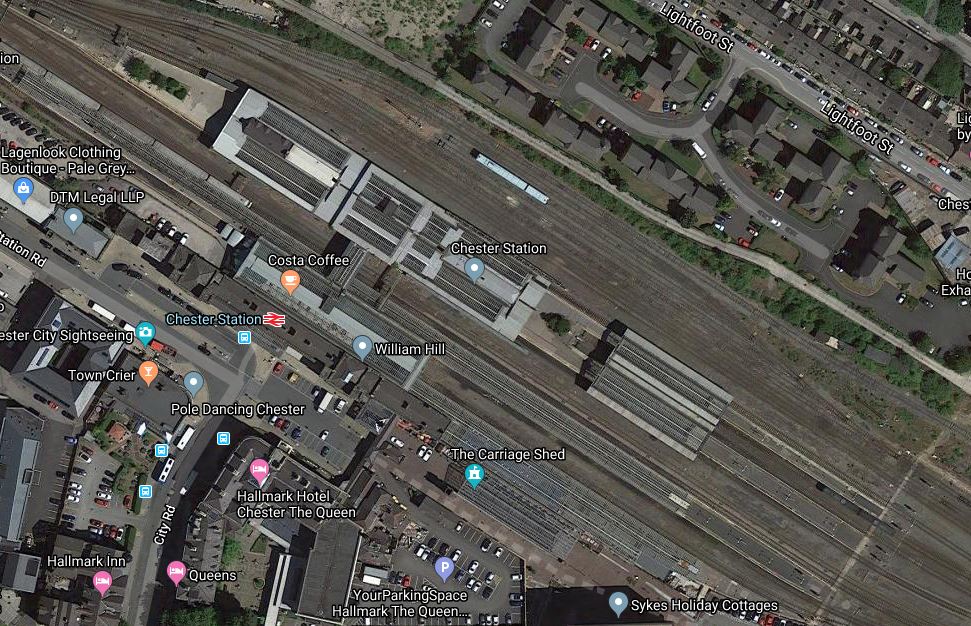
It looks to me, that there is plenty of space.
Will Chester And Crewe Be Electrified?
We know little about the capabilities of the trains proposed by the various manufacturers.
But, I wouldn’t be surprised that one or more of the proposals use batteries for one of the following purposes.
- Regenerate braking.
- Emergency power.
- Range extension for up to perhaps sixty miles.
As Chester and Crewe stations are only twenty-one miles apart with no intermediate stations, which will be run at an average speed of only 52 mph I don’t think it will be impossible to extend the service to Chester on battery power.
If electrification is required I wrote about it in Hitachi Trains For Avanti.
As it is only just over twenty miles, I don’t think it will be the most challenging of projects, although there does seem to be a lot of bridges.
Electrification would also allow Avanti West Coast’s Hitachi trains to run on electricity to Chester.
What About Holyhead?
Holyhead could become a more important destination in the next few years.
It is probably the best alternative to avoid flying and driving between Great Britain and the Island of Ireland.
And who can accurately predict, what effect Brexit and thinking about global warming will have?
I have a feeling that after electrification to Chester, using on-board energy storage could be used West of Chester.
It is very difficult to predict battery ranges in the future, but I can see a two hundred metre long High Speed Two Classic-Compatible train being able to reach Holyhead on battery power, with or without some limited extra electrification.
Alternatively, the UK and Welsh governments, might bite the bullet and just electrify the whole route between Crewe and Holyhead.
I have found a train on Real Time Trains, that covered the 105.5 miles between Holyhead and Crewe in two hours and 11 minutes at an average speed of 48 mph. The train took then a total of three hours and forty-five minutes to get to Euston
I estimate that with electrification and some track improvements, that it will be possible to travel between Euston and Holyhead in under three hours before High Speed Two.
Conclusion
It looks to me, that when High Speed Two, think about adding extra destinations, Chester and Holyhead could be on the list.
I also suspect that even without electrification and High Speed Two services, but with the new Class 805 trains, the route could be a valuable one for Avanti West Coast.
 The Anonymous Widower