Could The Settle And Carlisle Be Used As A More Formal Route?
In June 2021, I wrote Through Settle And Carlisle Service Under Consideration, which starts like this.
The title of this post, is the same as that of an article in the June 2021 Edition of Modern Railways.
This is the first paragraph.
Plans for a new Leeds to Glasgow through service via the Settle and Carlisle line are being developed, with CrossCountry and the Department for Transport starting to look at the possible scheme.
It sounds like a sensible idea to me.
The article also suggests the following.
- CrossCountry is a possible operator.
- CrossCountry are keen to improve services between Leeds and Glasgow
- The trains could be InterCity 125s, freed up, by a the arrival of Class 221 trains from Avanti West Coast, when they receive their new Class 805 trains.
- Maintenance of the trains wouldn’t be a problem, as this could be done at Neville Hill in Leeds or Craigentinny in Edinburgh.
- Services could start in December 2023.
But nothing more has been heard.
However some things have happened.
The Settle And Carlisle Has Become A Popular Charter Route
Google AI gave me this paragraph.
The Settle and Carlisle line is an extremely popular, premier route for heritage rail charters, steam excursions, and luxury rail tours in the UK, often operating at full capacity. Renowned for its scenic 72-mile journey through the Yorkshire Dales and Pennines, it features iconic structures like the Ribblehead Viaduct.
I have also written these posts about charters on the Settle and Carlisle Line.
Scheduled Steam-Hauled Services For the Settle And Carlisle Railway
Rail Operator Crosses Line For First Time In Years
‘Staycation Express’ To Return Along Full Length of S & C
It doesn’t appear that the numbers of charter trains are showing any sign of decrease.
LNER Has Ordered Class 897 Trains
When LNER took over the East Coast Main Line services, they had six main classes of trains.
- Five-car Class 800/1 bi-mode trains
- Nine-car Class 800/2 bi-mode trains
- Five-car Class 801/1 electric trains
- Nine-car Class 801/2 electric trains
- Seven-car InterCity225 trains
- Nine-car InterCity225 trains
Note.
- The five-car trains can run in pairs as ten-car trains.
- The Class 800 and Class 801 trains can run to destinations, that lack full electrification using diesel power where needed.
- Hitachi are developing battery-power for rail routes without electrification.
In 2023 to replace the InterCity225 trains ten ten-car Class 897 tri-mode trains were ordered from CAF, which will soon be in service, over all LNER’s network.
LNER Has Fully Electrified And Unelectrified Destinations
LNER’s current destinations, that are fully electrified to King’s Cross include.
- Bradford Forster Square
- Berwick on Tweed
- Darlington
- Doncaster
- Durham
- Edinburgh Haymarket
- Edinburgh Waverley
- Grantham
- Keithley
- Leeds
- Newark Northgate
- Newcastle
- Peterborough
- Retford
- Shipley
- Skipton
- Stevenage
- Wakefield Westgate
- York
Whilst those are not fully electrified include.
- Aberdeen
- Cleethorpes
- Dundee
- Grimsby Town
- Harrogate
- Huddersfield
- Horsforth
- Hull
- Inverness
- Lincoln
- Middlesbrough
- Sheffield
- Sunderland
- Thornaby
- Worksop
Note.
- Other destinations can be added as required.
- I suspect, that Class 897 trains will be able to approach many stations without electrification on battery power alone.
- Staff and Passengers would probably like underground stations like Sunderland to be worked on batteries alone.
The Class 800 bi-mode, the Class 801 electric and the Class 897 tri-mode trains will give LNER a very flexible fleet.
Onward To Skipton, Carlisle and Glasgow Central And Edinburgh From Bradford Forster Square
I wonder is someone has realised that the Class 897 trains could use their tri-mode capabilities to invade Scotland?
This OpenRailwayMap shows the railways between the Scottish Lowlands and northern England.
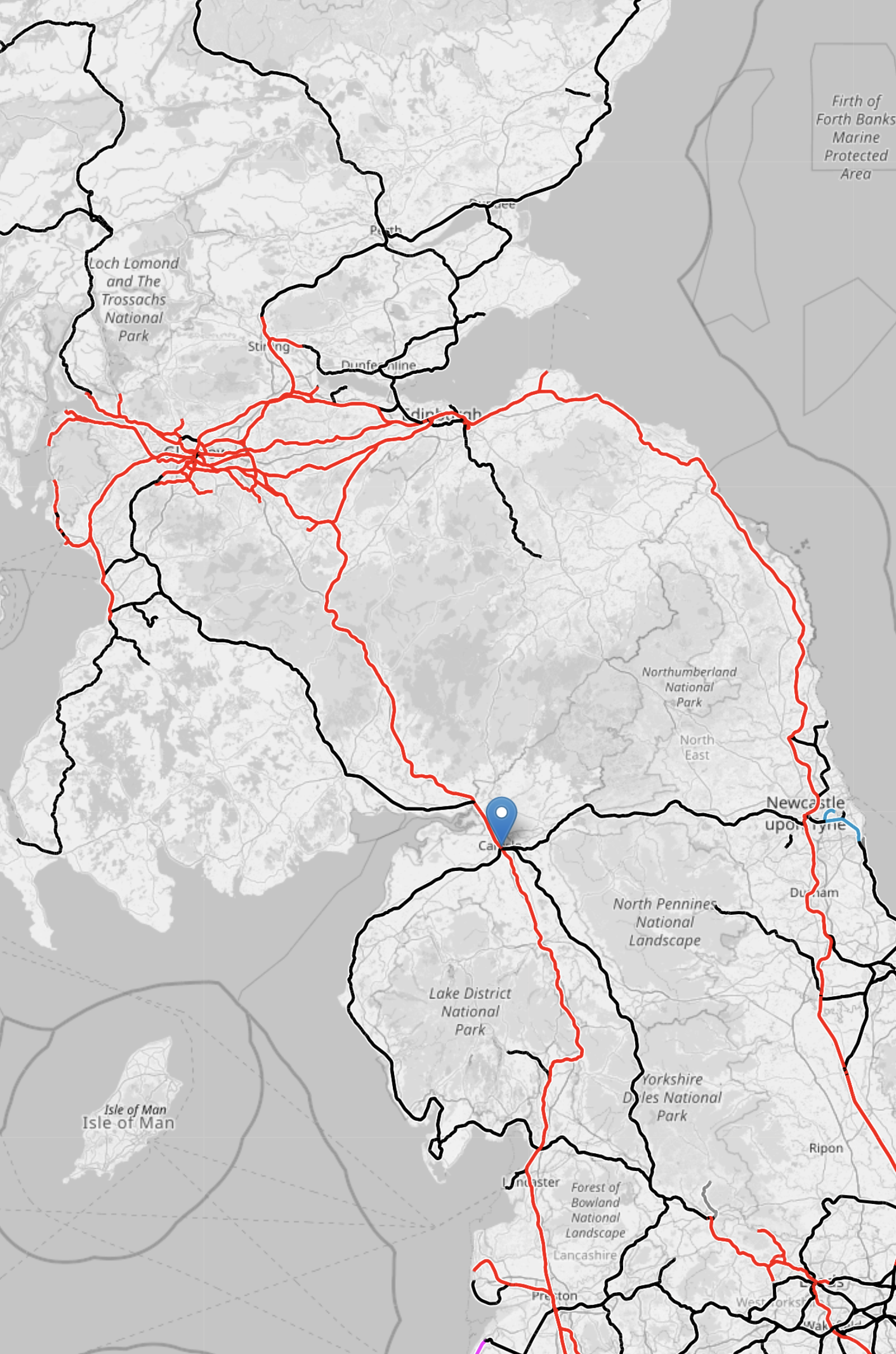
Note.
- Red tracks are electrified.
- Black tracks are not.
- The blue arrow in the middle of the map indicates Carlisle.
- The red track going North-South through Carlisle is the West Coast Main Line.
- The black track going South from Carlisle is the Settle and Carlisle Line.
- Where it turns red is at Skipton station and the electrification can power the train to Bradford Foster Square, Doncaster, Leeds or Sheffield stations.
- The West Coast Main Line splits North of Carlisle and electrified trains can reach either Glasgow Central in the West or Edinburgh Haymarket or Waverley in the East.
- The black track going North-South between Carlisle and Glasgow via Dumfries is the Glasgow South Western Line, which can be used as a diversionary route by some trains with a self-powered capability.
The Settle and Carlisle Line certainly makes Anglo-Scottish routes more robust and flexible when there is bad weather, engineering works or overhead wire or signalling failures.
Will Class 897 Trains Be Able To Run On The Settle And Carlisle Line?
I asked Google AI this question and it gave this answer.
Yes LNER’s new Class 897 tri-mode trains (scheduled for introduction from 2027) will be able to run on the Settle and Carlisle line. As tri-mode electro-diesel multiple units, these 10-car trains are designed to operate across the entire LNER network, utilizing electric, diesel, or battery power to manage non-electrified routes like this, providing a modern alternative to older, diesel-only fleets.
Key details regarding Class 897 on the Settle and Carlisle Line:
Tri-mode Capability: These trains can run on electric, diesel, or battery power, making them highly versatile for non-electrified, scenic, or challenging routes.
Operating Strategy: The trains are designed for flexibility and can be used across the LNER network, which includes routes connecting to Scotland via the West Coast Main Line (WCML) or through services from Leeds.Upgrading Service: They will replace the 40-year-old InterCity 225 fleet, offering a more environmentally friendly, modern alternative to current diesel bi-modes, such as the Class 800/802.
The route is a major, yet challenging, rail line featuring 20 viaducts and 14 tunnels, making it suitable for modern, versatile train sets.
I also believe that running Class 897 trains between Yorkshire and Glasgow offers opportunities to run new services, that will appeal to both travellers and rail operators.
Does The UK Need More Passenger Rail Capacity Between Yorkshire And Glasgow?
I asked Google AI this question and it gave this answer.
Yes, the UK requires more passenger rail capacity between Yorkshire and Glasgow due to severe overcrowding and forecasted demand growth. Major routes like the East Coast Main Line (ECML) and West Coast Main Line (WCML) are, or will soon be, at maximum capacity. Key constraints include infrastructure limitations and the need for better Scotland-England connectivity.
Key insights on this need:
Capacity Constraints: The WCML, particularly at its southern end, is already effectively full, with limited capacity for additional, longer trains. Similarly, the ECML is experiencing significant overcrowding.
Growing Demand: Passenger demand for long-distance rail travel continues to rise, with significant increases noted in journeys between Scotland and other regions.
Infrastructure Issues: Constraints include steep inclines, tight curves, and the need to mix passenger and freight traffic, particularly on the West Coast route.
Proposed Solutions: While some improvements are planned, such as Lumo extending services to Glasgow, the Integrated Rail Plan (IRP) focuses on capacity enhancements in the North/Midlands.
Strategic Need: Enhanced, high-speed connections are considered essential for long-term economic integration and to prevent increased air travel/emissions.
The great advantage of the route, is that is already in place.
Can The Settle And Carlisle Line Handle Planned Diversions?
Can The Settle And Carlisle Line Handle The Caledonian Sleeper?
I asked Google AI this question and it gave this answer.
The Settle-Carlisle line is not a standard route for the Caledonian Sleeper, which typically travels via the West Coast Main Line (WCML) to Edinburgh, Glasgow, and beyond. While the line is a scenic, double-track route with significant infrastructure, it is generally used for local services and freight, not long-distance, heavy sleeper trains.
Key Considerations:
Route: The Caledonian Sleeper operates on the West Coast Main Line, serving destinations like Edinburgh, Glasgow, Aberdeen, Inverness, and Fort William.
Capacity & Infrastructure: While the Settle-Carlisle line has major structures like the Ribblehead Viaduct, it is not the primary route for high-speed or overnight sleeper services.
Operational Normal: The sleeper service splits into portions at Edinburgh, and does not regularly operate via the Settle-Carlisle line.
In short, the Settle-Carlisle line is not designed for or used by the Caledonian Sleeper, which operates via the West Coast Main Line.
But it does appear, that in the past some sleeper trains have used it.
How Many Freight Trains Use the Settle And Carlisle Line In A Typical Day?
This article on the BBC is entitled Settle To Carlisle line: Shortage of trains ‘Hampering Growth’, says this about the number of trains.
From only two trains a day in the 1980s the Settle and Carlisle line now sees 14 passenger and 18 freight services a day.
That is progress!
Rail Operator Crosses Line For First Time In Years
The title of this post, is the same as that of this article on the BBC.
This is the sub-heading.
An operator’s first passenger train has crossed a historical and scenic route for the first time in more than a decade.
These three paragraphs give more details about the reason for the trip.
Avanti West Coast’s 07:54 GMT from Wigan was the first to run on the Settle to Carlisle route earlier.
The 73-mile line is renowned for its picturesque views across the Yorkshire Dales and the North Pennines via the Ribblehead viaduct.
The route is usually only used by Northern trains operating between Leeds and Carlisle, but Avanti is using it as a diversion while work to replace the Clifton Bridge take place over the M6 near Penrith.
I’ve only ridden the Route once and that was on a day in 2014, when the weather wasn’t at its best.
Afterwards I wrote Long Live The Settle And Carlisle, so the trip couldn’t have been that bad!
These paragraphs give the reason for and details of the diversion.
The Settle to Carlisle line does not have overhead power lines, meaning Avanti is using bi-mode Class 805 Evero trains which operate on diesel.
Several timetable changes have been made during the engineering works, with disruption expected until 15 January.
Until 5 January, the railway will also be blocked south of Preston, meaning on these days the diverted services are running between Wigan North Western and Carlisle.
But if Great British Railways could get their act together and convert a sufficient number of their Hitachi diesel bi-modes to battery-electric bi-modes and do some testing and a few calculations, the problem would be solved.
In 2021, I wrote Through Settle And Carlisle Service Under Consideration, after Modern Railways wrote an article of the same name.
Could Lumo Run A Lincoln And Glasgow Service Via Doncaster, Leeds And Settle?
In South Yorkshire Now Has Better North-South Connections, I calculated that Doncaster station now has 173 express trains per day, that stop at the station.
So why not add five or six express trains per day to Doncaster, Lincoln, Leeds, Settle, Carlisle and Glasgow?
And why not ask Lumo to run it, as they’d know how to run such a service?
How Will The East Coast Main Line Timetable Change Affect Sheffield?
This article in the October 2025 Edition of Modern Railways is entitled Industry Gears Up For December ECML Timetable Change.
This is the first paragraph.
Major changes are planned to trains along the East Coast main line from 14 December as the long-heralded timetable takes effect.
In this post, I will see how the changes detailed in the article in Modern Railways will affect Sheffield and Doncaster.
Aberdeen-Edinburgh
This is said about Aberdeen and Edinburgh services.
Monday-Saturday services will not change between Aberdeen and Edinburgh, with all intermediate stations served at similar times.
The LNER service to and from King’s Cross will call additionally at Doncaster, Newark Northgate and Peterborough; the last LNER Monday-Friday departure from Aberdeen will terminate at Doncaster instead of Leeds, and the first LNER Monday-Saturday train to Aberdeen will start from King’s Cross at 05:48 instead of Leeds.
Note.
- An hourly fast train between Edinburgh and King’s Cross will have a journey time of 4 hours and 10 minutes, which is a saving of at least 12 minutes.
- There is an Aberdeen-Manchester air service, but no Edinburgh-Manchester or Leeds-Scotland air services.
- In Could London And Central Scotland Air Passengers Be Persuaded To Use The Trains?, I speculated about how air passengers could be tempted to use the trains between London and Central Scotland.
- It looks to me, that LNER are strengthening their services between Doncaster and Scotland.
- Will that 05:48 King’s Cross departure for Aberdeen, enable a working day in Aberdeen and return?
Is LNER’s aim to get travellers to use the trains between Doncaster and Scotland, as an alternative to driving or trains from Leeds?
Alnmouth and Berwick
This is said about Alnmouth services.
Quicker LNER journey times are promised to stations South of York, with King’s Cross-Alnmouth journey times up to 15 minutes quicker.
More TPE trains will run between Newcastle, Morpeth, Alnmouth, Berwick, Reston, Dunbar, East Linton and Edinburgh Waverley.
The number of trains calling at Durham on weekdays will fall from 18 to 13 Southbound and from 15 to 10 Northbound.
This is said about Berwick services.
LNER trains will call every two hours during the middle of the day, and the number of weekday trains to King’s Cross falls from 15 to 11 Southbound with a 13 to nine fall Northbound. More TPE trains will call.
Note.
- Lumo serves Newcastle, Morpeth and Edinburgh.
- Reston and East Linton are new stations.
- The stations between Newcastle and Edinburgh need adequate parking to attract commuters.
It looks to me, that LNER are timing the trains to attract day trips along the East Coast Main Line.
Bradford Forster Square/Interchange
This is said about Bradford Forster Square services.
The number of weekday trains will remain as per May 2025, but on Sundays, the number of trains serving Forster Square increases from two to six each way on a two-hourly interval. LNER stopping patterns change, with fewer trains calling at Peterborough and none at Grantham or Retford.
Trains currently stop at Peterborough, Doncaster, Wakefield Westgate, Leeds and Shipley, but surely a more regular six trains per day (tpd) is preferable.
This is said about Bradford Interchange services.
At Interchange, Grand Central Trains will run at different times to the May 2025 timetable, with King’s Cross journeys up to 20 minutes quicker. One GC each way will call at Peterborough, while some will stop at Pontefract Monkhill on Sundays for the first time.
Note.
- Trains currently stop at Peterborough, Doncaster, Pontefract Monkhill, Wakefield Kirkgate, Mirfield, Brighouse, Halifax and Low Moor
- Is the twenty minutes time saving due to the new digital signalling to the South of Doncaster?
- Is this another open access operator being allowed to do what they do best?
This looks to be a very useful service, which serves several stations, with no other service to London.
Doncaster
This is said about Doncaster services.
Additional trains calling at destinations including Birmingham New Street, Sheffield, York, Newark and Berwick-upon-Tweed. LNER Aberdeen/Inverness trains will call at Doncaster. EMR trains will be retimed at Doncaster to provide better connections with LNER’s revised timetables, but journeys from Doncaster to Sleaford and Spalding will require a change at Lincoln. This change has been made to “enable improved connections” at Peterborough, Sleaford, Lincoln and Doncaster. The number of trains calling at Stevenage falls from 24 to 19 Southbound and 24 to 21 Northbound, with Grantham stops dropping by seven trains to 28 Southbound and 4 to 29 Northbound.
If CrossCountry Trains were to switch their trains to Hitachi InterCity Battery trains, I believe that a version of these trains could handle routes like Plymouth and Aberdeen.
- This would speed up services.
- Trains would run close together and thus increase capacity.
- Services could even be faster.
So expect a replacement order for CrossCountry Trains diesel multiple units soon.
Glasgow
LNER gave up serving Glasgow Central from King’s Cross in the December 2024 timetable change.
In Lumo Will Extend Its King’s Cross And Edinburgh Service To Glasgow, I talked about Lumo extending their King’s Cross and Edinburgh service to Glasgow Central station.
Hull
This is said about Hull services.
On Mondays-Fridays, Hull Trains will provide an extra train from London.
The LNER Monday-Friday Hull-Doncaster train will be withdrawn;
Northern will operate a 20:25 departure to Doncaster; calling at Brough and Selby.
Note.
- It looks like Great British Railways have surrendered Hull and Beverley to Hull Trains.
- Hull Trains are converting their Class 802 trains to battery-electric power.
- It is likely that Hull Trains upgraded trains will be able to use the Great Northern and Great Eastern Joint Line via Lincoln on battery power.
The new timetable appears to be ready for the future of Hull Trains.
Leeds
This is said about Leeds services.
LNER services will depart to King’s Cross at xx.10 and xx.40.
Northern will introduce an extra mostly hourly service between Leeds and Sheffield calling at Wakefield Westgate. They will depart about 30 minutes earlier or later than the CrossCountry service.
Note.
- I would expect the two King’s Cross and Leeds services which would both stop at Doncaster and Wakefield Westgate would set the timings between Doncaster and Leeds.
- Currently, of the four trains that run to and from Leeds every two hours, two are planned to terminate at Leeds, one at Harrogate and one at Bradford Forster Square.
- There is also a daily service between King’s Cross and Skipton via Leeds.
- I can envisage another service between King’s Cross and Ilkley via Leeds, Kirkstall Forge, Guiseley, Burley-in-Wharfedale and Ben Rhydding.
- I can envisage another service between King’s Cross and Huddersfield, via Leeds, White Rose, Morley, Batley, Dewsbury, Ravensthorpe, Mirfield and Deighton.
- I can envisage another service between King’s Cross and Hebden Bridge, via Leeds, White Rose, Morley, Batley, Dewsbury, Ravensthorpe, Mirfield, Sowerby Bridge, Mytholmroyd and Brighouse.
- An alternative to Hebden Bridge would be Rochdale, which already has four platforms and is on the Manchester Metrolink
- It appears that Bradford Forster Square, Harrogate, Huddersfield, Leeds and Skipton stations can turn nine or ten-car trains and Ilkley can turn five-car trains.
- I also believe that one of Hitachi’s InterCity Battery trains could use battery power to take the spectacular Settle and Carlisle Line to Carlisle or even Glasgow Central.
- If needed pairs of five-car trains could split and join at Leeds, with one train waiting at Leeds and the other train going on to another destination.
- The CrossCountry and Northern Trains services on the Sheffield and Leeds route via Doncaster and Wakefield Westgate would probably need to be modern battery-electric trains to maximise the capacity on the route.
There certainly seem to be opportunities to give a number of stations in Yorkshire an all-electric service to King’s Cross with a two-hourly frequency, in a time of a few minutes over two hours.
Lincoln
This is said about Lincoln services.
One more LNER train from King’s Cross will run, with the first train arriving earlier and the last train later. There will no longer be an LNER train serving Stevenage with passengers having to change at Newark Northgate or Peterborough. An improved service will run to and from Nottingham, with an increase from one to two trains per hour on Mondays-Saturdays. An hourly service will run to Crewe, and a new Matlock-Nottingham-Lincoln-Cleethorpes service will run. EMR will cease all bar morning peak direct trains to/from Leicester. Newark Northgate-Lincoln trains will be reduced from five to four on Mondays-Fridays, eight to four on Saturdays and ten to eight on Sundays.
Note.
- Travellers between Lincoln/Nottingham and the North/Scotland will have two trains per hour to Newark Northgate, where there will be two tph to the North/Scotland.
- The hourly Crewe service will give access to Liverpool Manchester and the West Coast Main Line.
- Will there still be a Liverpool and Norwich service or will this be replaced by East-West Rail?
There seems to be a big sort out to EMR services.
Newcastle
This is said about Newcastle services.
The number of trains serving King’s Cross increases from 35 to 53 Southbound on weekdays and from 36 to 52 Northbound. One train every hour will run non-stop to York. More TPE trains will run Northbound (see Alnmouth and Berwick), while Northern is retiming services on the Northumberland Line in anticipation of Northumberland Park and Bedlington stations opening in early 2026. A semi-fast hourly service between Newcastle and Middlesbrough will run on Mondays-Saturdays and there will be an hourly stopping service between them.
Note.
- There will be a big increase in services between King’s Cross and Newcastle.
- Is the aim to persuade travellers to use trains rather than airlines?
- LNER also runs one train per day (tpd) between King’s Cross and Middlesbrough.
- Grand Central Trains will be running at a frequency of six tpd between King’s Cross and Sunderland via Thirsk, Northallerton, Eaglescliffe, Hartlepool and Seaham.
Hull appears to have been left to Hull Trains and Glasgow to Lumo, and Sunderland appears to be left for Grand Central Trains.
Conclusions
I am coming to some conclusions about services on the East Coast Main Line, with respect to Sheffield.
Doncaster Is A Well-Equipped Station
Doncaster is the nearest station to Sheffield on the East Coast Main Line.
- Over the last few years, Doncaster station has been improved.
- It has a subway with a more than adequate number of lifts.
- The station has nearly 600 parking spaces.
- There is a taxi rank.
- There is no Marks & Spencer’s food store, which is important for a coeliac like me.
- There are thirty bus stands close to Doncaster station.
- Doncaster station is well-equipped with cafes, a pub and coffee stalls.
- All trains to Aberdeen, Bradford Forster Square, Bradford Interchange, Edinburgh, Hull, King’s Cross, Leeds, Sheffield and Wakefield seem to stop at the station.
- There are several local trains per hour.
- Changing trains is not a strenuous exercise.
Doncaster is one of the UK’s better regional stations.
Doncaster Needs A Connection To The Sheffield Supertram
One of the first things, I do when I arrive in a strange town or city is look for the local public transport network.
In 2019, Sheffield published an ambitious plan for their tram network, which I wrote about in Sheffield Region Transport Plan 2019 – Doncaster Sheffield Airport.
The post contained this map, of Sheffield’s plans for the trams.
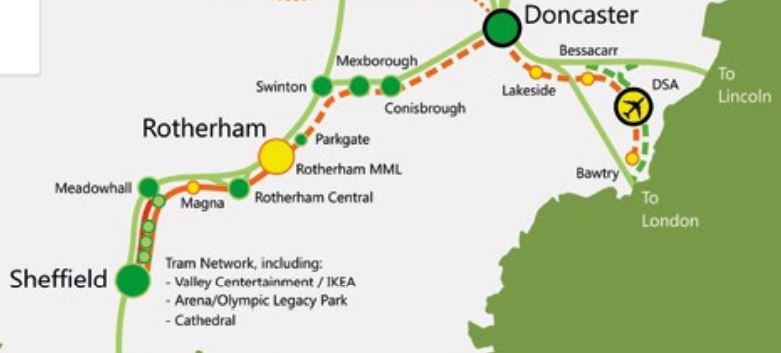
Doncaster and Doncaster Sheffield Airport are connected to the current end of the tram-train route at Rotherham Parkgate.
This OpenRailwayMap shows the rail lines between Rotherham Parkgate and Doncaster.
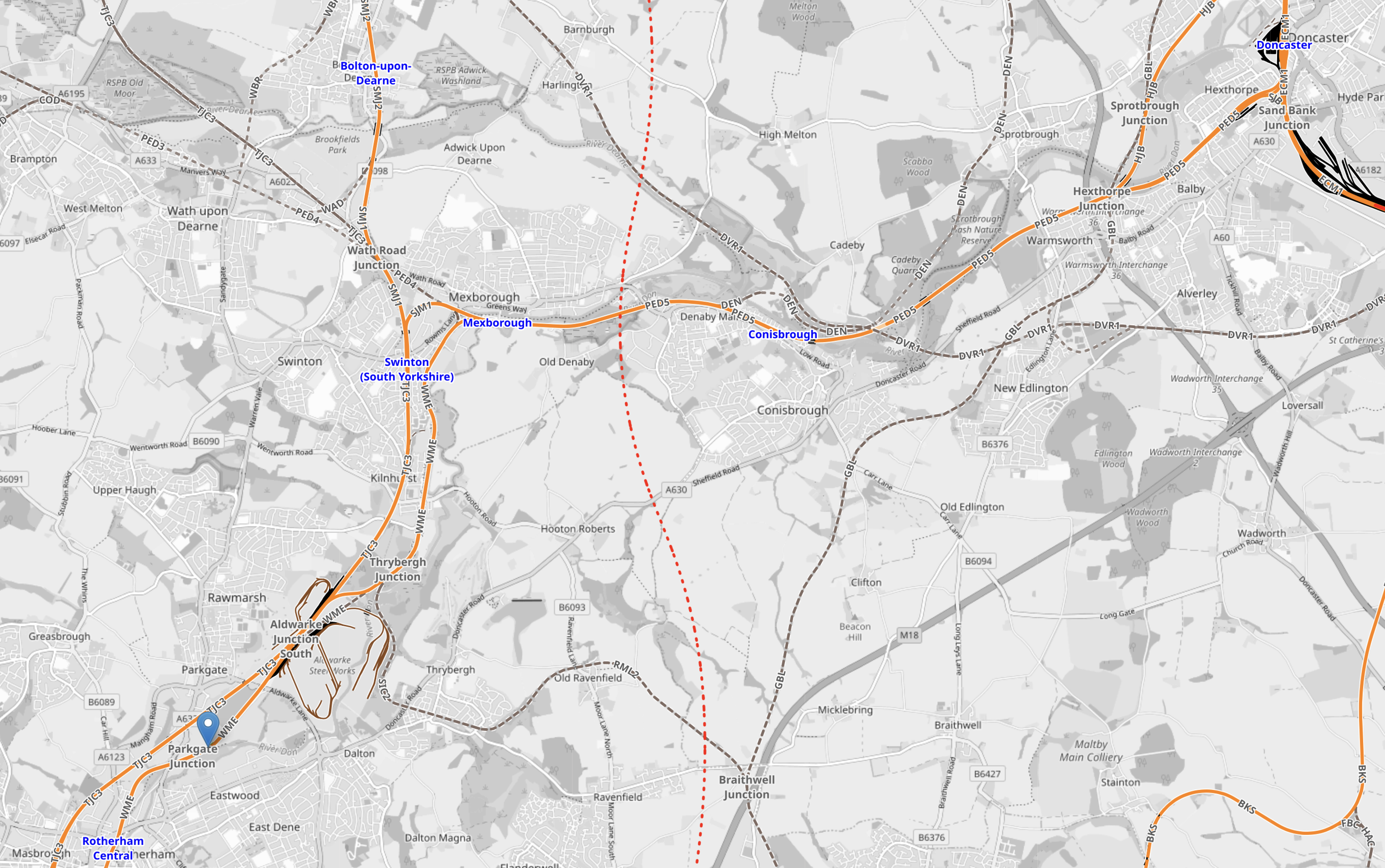
Note.
- Doncaster station is in the North-East corner of the map.
- Rotherham Central station is in the South-West corner of the map.
- The blue arrow in the South-West corner indicates Rotherham Parkgate tram stop.
- Swinton, Mexborough and Conisbrough stations can be picked out.
- The dotted red line running North-South across the map is the route of the ill-fated Eastern Leg of High Speed Two.
It is a simple application of tram-train technology to connect Doncaster station and Doncaster Sheffield Airport to the Sheffield Supertram.
With all the comings and goings on the East Coast Main Line at Doncaster station, I believe that the tram-train connection to Sheffield and Rotherham is essential.
The Cities Of Bradford, Doncaster, Leeds, Sheffield and Wakefield Can Have a High-Frequency Rail Connection
Consider.
- Four stations are all step-free with a bridge or subway served by lifts.
- Bradford Forster Square station has level access to the platforms from the street.
- The rail lines between the five stations are electrified, with the exception of Sheffield and Doncaster.
- Services between the cities are run by CrossCountry Trains, Grand Central Trains, Hull Trains, LNER and Northern Trains.
- Most maximum speeds are not unduly slow.
Consequently the five cities can have a high-frequency rail connection in excess of four tph.
Could this be the basis of a Five-Cities Metro?
Open Access Services
There are six open access services running on the East Coast Main Line.
- Grand Central Trains – King’s Cross-Bradford Interchange via Peterborough, Doncaster, Pontefract Monkhill, Wakefield Kirkgate, Mirfield, Brighouse, Halifax and Low Moor – 4 tpd
- Grand Central Trains – King’s Cross-Sunderland via Peterborough, York, Thirsk, Northallerton, Eaglescliffe and Hartlepool – 6 tpd
- Hull Trains – King’s Cross-Hull via Stevenage, Grantham, Retford, Doncaster, Selby, Howden, Brough – 4 tpd
- Hull Trains – King’s Cross-Beverley via Stevenage, Grantham, Retford, Doncaster, Selby, Howden, Brough, Hull and Cottingham – 2 tpd
- Lumo – King’s Cross-Edinbugh via Stevenage, Newcastle and Morpeth – 5 tpd
- Lumo – King’s Cross-Glasgow Queen Street via Stevenage, Newcastle, Morpeth, Edinburgh and Falkirk High – 2 tpd
Note.
- tpd is trains per day.
- All seem to serve an exclusive area, except Lumo.
- In a couple of years, all could be using Hitachi trains.
- I suspect some services will swap their diesel generators for batteries.
Battery-power would allow some services to be zero-carbon, even when using the GNGE diversion.
Hydrogen-Powered Trains To Be Introduced In Northern Italy
The title of this post, is the same as that of this article on Fuel Cell Works.
These three paragraphs introduce the project.
Residents and visitors to Valcamonica, an Alpine region in northern Italy, will be able to ride hydrogen-powered trains from next year.
The pioneering project, the first of its kind in Italy and supported by an investment of 367 million euros ($396 million), marks a significant adoption of hydrogen fuel for a rail line, despite the high production and operational costs.
The region currently uses polluting diesel trains, which will be replaced by 14 zero-emission hydrogen-powered trains made in Italy by a unit of French group Alstom
The trains will run on the Brescia–Edolo railway, which has this Wikipedia entry.
This OpenRailwayMap shows the Northern part of the railway.
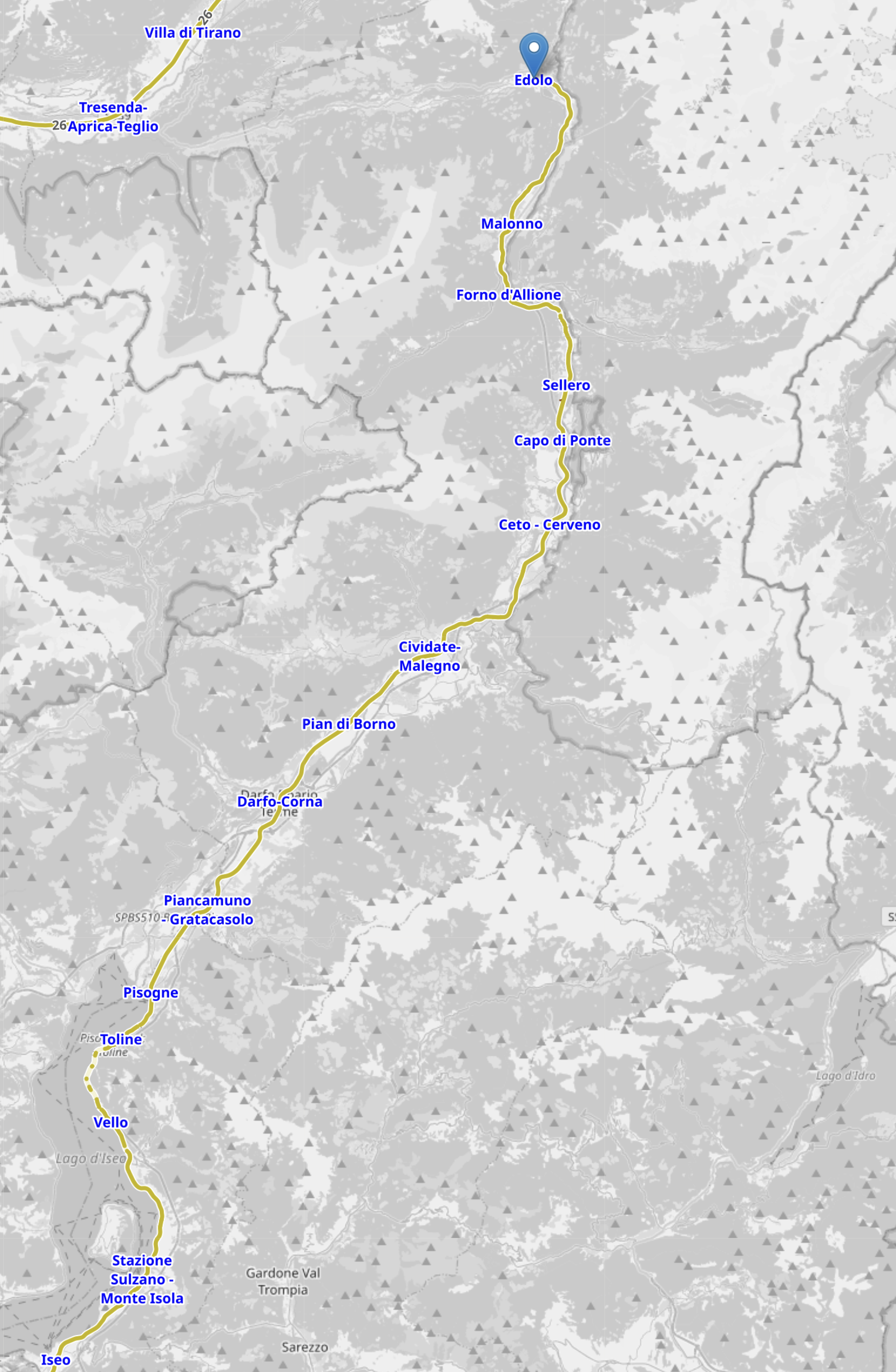
Note.
- Edolo station is indicated by the blue arrow at the top of the map.
- The Brescia–Edolo railway is indicated by the yellow line.
- Stations are indicated by blue lettering.
- Iseo is the station in the South-West corner of the map.
- Click the map to show it to a larger scale.
This second OpenRailwayMap shows the Southern part of the railway to the same scale.
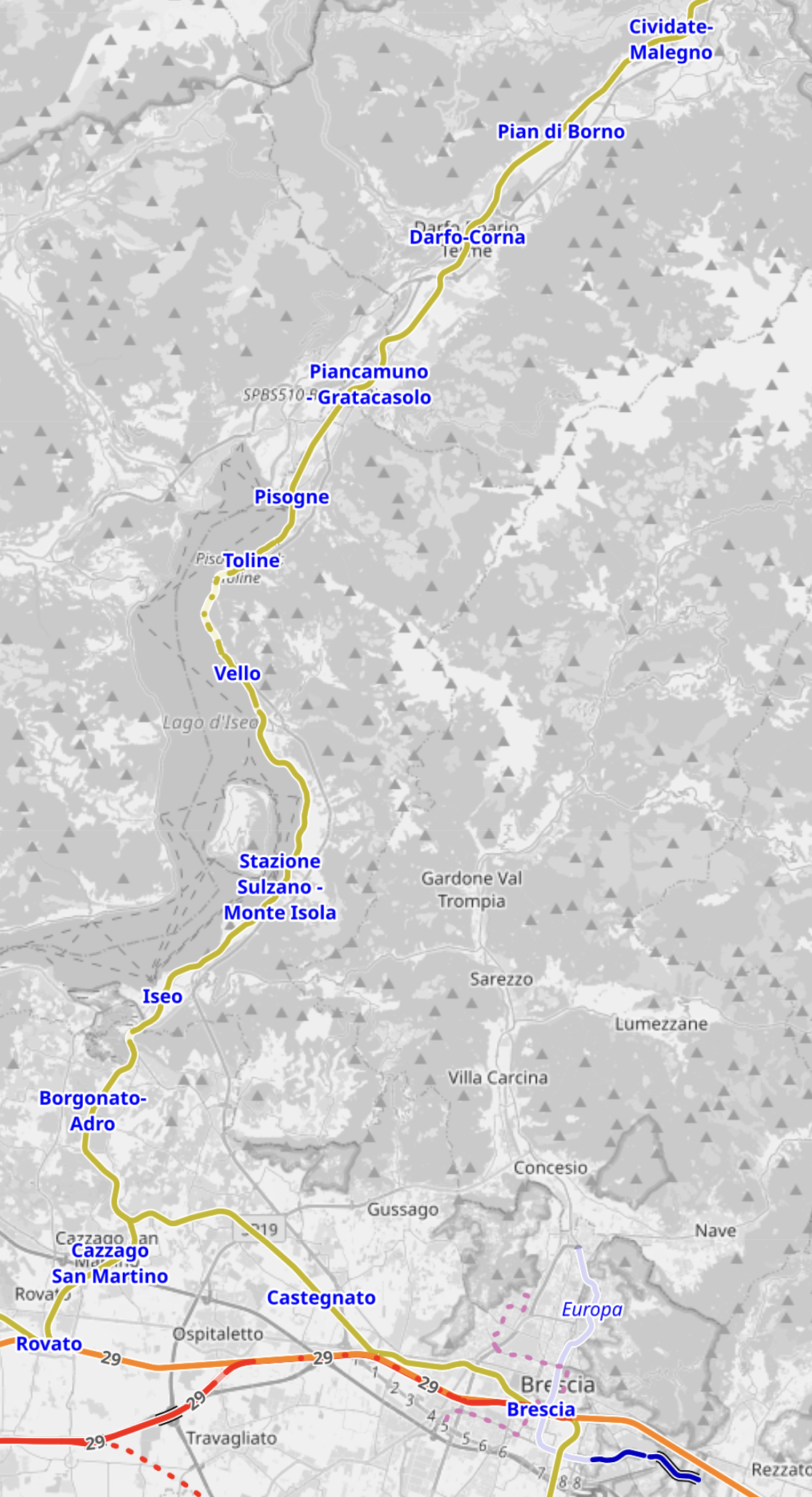
Note.
- The Brescia–Edolo railway is indicated by the yellow line.
- The Venice-Milan railway is indiated by the orange line across the bottom of the map.
- Stations are indicated by blue lettering.
- Iseo station is in the South-West corner of the map.
- Brescia station is in the South-East corner of the map on the Venice-Milan railway.
- Click the map to show it to a larger scale.
It looks to me, that the Brescia–Edolo railway could be a day-out if you were having a holiday in Milan, Venice or Verona.
- The railway is a single track railway.
- It appears to go through the mountains.
- Currently, it is diesel powered, but I suspect running hydrogen trains on the route will turn it into a major tourist attraction.
Could other rail routes attract visitors, by going for zero-carbon traction using hydrogen?
In the UK, these are surely six of many possibilities.
- Settle and Carlisle
- Marshlink Line
- Mid-Cornwall Metro
- Norwich and Sheringham
- Sheffield and Huddersfield
- Mid-Cornwall Metro
- Uckfield Branch
Infrastructure costs would just need a hydrogen supply to be arranged.
Conclusion
You can always trust the Italians to use a stylish solution.
Slow Tourism Train Operator Launches First Service
Tyhe title of this post, is the same as that of this article on Railway Gazette.
These are the first two paragraphs.
FS Group’s recently formed tourist train business FS Treni Turistici Italiani has launched its first service.
Branded Espresso Cadore, the overnight service between Roma Termini and Calalzo-Pieve di Cadore-Cortina will run every Friday night until mid-February. On arrival, a connecting bus takes passengers to Cortina d’Ampezzo in 45 min. The return train departs on Sundays, arriving at Roma Termini on Monday morning.
It is surely an interesting concept and I believe it could work on several routes in the UK.
- Settle and Carlisle would be an obvious route.
- Cumbrian Coast Line.
- Bristol and Oxford, which I wrote about in Leisure Market Boom? GWR’s Vision For Direct Bristol-Oxford Services.
There must also be a couple of routes in Scotland and Wales.
As the three routes, I named are electrified at both ends, there is a possibility that they could be run by quiet battery-electric trains.
MOB To Launch Gauge-Changing Montreux – Interlaken GoldenPass Express
The title of this post, is the same as that of this article on Railway Gazette.
Through Settle And Carlisle Service Under Consideration
The title of this post, is the same as that of an article in the June 2021 Edition of Modern Railways.
This is the first paragraph.
Plans for a new Leeds to Glasgow through service via the Settle and Carlisle line are being developed, with CrossCountry and the Department for Transport starting to look at the possible scheme.
It sounds like a sensible idea to me.
The article also suggests the following.
- CrossCountry is a possible operator.
- CrossCountry are keen to improve services between Leeds and Glasgow
- The trains could be InterCity 125s, freed up, by a the arrival of Class 221 trains from Avanti West Coast, when they receive their new Class 805 trains.
- Maintenance of the trains wouldn’t be a problem, as this could be done at Neville Hill in Leeds or Craigentinny in Edinburgh.
- Services could start in December 2023.
I have a few thoughts of my own!
The Route
The route between Leeds and Carlisle is obvious, but there are two routes between Carlisle and Glasgow.
Trains would probably choose a route and call at stations to maximise passenger numbers.
These stations are on the various routes.
- Settle and Carlisle – Shipley, Bingley, Keighley, Skipton, Gargrave, Hellifield, Long Preston, Settle, Horton in Ribblesdale, Ribblehead, Dent, Garsdale, Kirkby Stephen, Appleby, Langwathby, Lazonby & Kirkoswald and Armathwaite
- Glasgow South Western – Dunlop, Stewarton, Kilmaurs, Kilmarnock, Auchinleck, New Cumnock, Kirkconnel, Sanquhar, Dumfries, Annan and Gretna Green
- West Coast Main – Motherwell, Carstairs and Lockerbie
There are certainly a lot of possibilities.
Upgrading The InterCity 125 Trains
CrossCountry appear to have enough InterCity 125 trains to muster five in a two Class 43 power car and seven Mark 3 coach formation.
They may not be fully in-line with the latest regulations and there may be a need for a certain degree of refurbishment.


These pictures show some details of a refurbished Great Western Railway Castle, which has been fitted with sliding doors.
Will The InterCity 125 Trains Be Shortened?
Scotrail’s Inter7City trains and Great Western Railway’s Castle trains have all been shortened to four or five coaches.
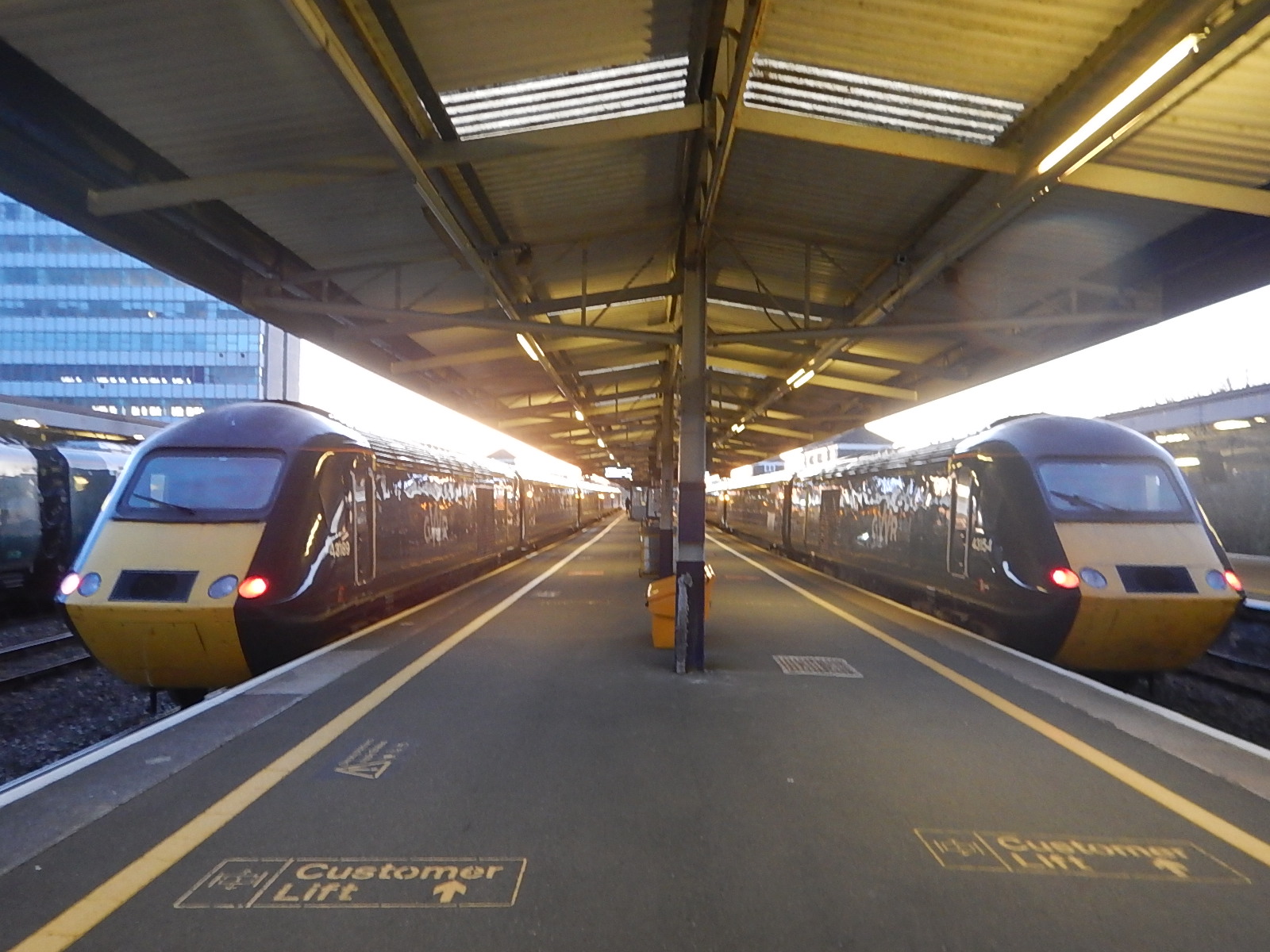
This picture shows a pair of Castles.
Journey Times, Timetable And Frequency
The current journey time between Leeds and Glasgow Central stations via the East Coast Main Line is four hours and eight minutes with nine stops.
The Modern Railways article says this about the current service.
The new service would be targeted at business and leisure travellers, with through journey times competitive with road and faster than the current direct CrossCountry Leeds to Glasgow services via the East Coast main line.
I would expect that CrossCountry are looking for a time of around four hours including the turn round.
- Stops could be removed to achieve the timing.
- The trains could run at 125 mph on the West Coast Main Line.
This could enable a train to have the following diagram.
- 0800 – Depart Leeds
- 1200 – Depart Glasgow Central
- 1600 – Depart Leeds
- 2000 – Depart Glasgow Central
- Before 2400 – Arrive Leeds
Note.
- A second train could start in Glasgow and perform the mirrored timetable.
- Timings would probably be ideal for train catering.
- Trains would leave both termini at 0800, 1200, 1600 and 2000.
- The timetable would need just two trains.
I also think, if a second pair of trains were to be worked into the timetable, there could be one train every two hours on the route, if the demand was there.
I certainly believe there could be a timetable, that would meet the objectives of attracting business and leisure passengers away from the roads.
Tourism And Leisure Potential
The Settle and Carlisle Line is known as one of the most scenic railway lines in England, if not the whole of the UK.
There are important tourist sites all along the route between Leeds and Glasgow
- Leeds – The station is well-connected in the City Centre.
- Saltaire – For the World Heritage Site and Salt’s Mill
- Keighley – For the Keighley and Worth Heritage Railway
- Settle – The town of Settle is worth a visit.
- Ribblehead – For the famous Ribblehead Viaduct
- Appleby – For the Horse Fair.
- Carlisle – The station is well-connected in the City Centre.
- Glasgow – Glasgow Central station is well-connected in the City Centre.
Many of the stations are used by walkers and others interested in country pursuits.
I believe that it is a route that needs a quality rail service.
Travel Between London and Towns Along The Settle And Carlisle Line
In Thoughts On Digital Signalling On The East Coast Main Line, I said this.
I think it is highly likely that in the future, there will be at least one train per hour (tph) between London Kings Cross and Leeds, that does the trip in two hours.
It may seem fast compared to today, but I do believe it is possible.
With a timely connection at Leeds station, will this encourage passengers to places along the Settle and Carlisle line to use the train?
What About the Carbon Emissions?
The one problem with using InterCity 125 trains on this route, is that they are diesel-powered, using a pair of Class 43 locomotives.
But then there are over a hundred of these diesel-electric locomotives in service, nearly all of which are now powered by modern MTU diesel engines, which were fitted in the first decade of this century.
Consider.
- The locomotives and the coaches they haul have an iconic status.
- Great Western Railway and Scotrail have recently developed shorter versions of the trains for important routes.
- There are over a hundred of the locomotives in service.
- Companies like ULEMCo are developing technology to create diesel-powered vehicles that can run on diesel or hydrogen.
- There is plenty of space in the back of the locomotives for extra equipment.
- MTU have a very large number of diesel engines in service. It must be in the company’s interest to find an easy way to cut carbon emissions.
- I believe that the modern MTU diesel engines could run on biodiesel to reduce their carbon footprint.
And we shouldn’t forget JCB’s technology, which I wrote about in JCB Finds Cheap Way To Run Digger Using Hydrogen.
If they could develop a 2 MW hydrogen engine, it could be a shoe-in.
I believe that for these and other reasons, a solution will be found to reduce the carbon emissions of these locomotives to acceptable levels.
Conclusion
In this quick look, it appears to me that a Glasgow and Leeds service using InterCity 125 trains could be a very good idea.
‘Staycation Express’ To Return Along Full Length of S & C
The title of this post, is the same as that of this article on Rail Magazine.
These are the first three paragraphs,
This year’s ‘Staycation Express’ will use a refurbished High Speed Train and run the full length of the Settle-Carlisle Line.
The final plans are being confirmed by Rail Charter Services, which last year used locomotive-hauled trains between Skipton and Appleby. This year, the plan is for the HST to operate the 0930 Appleby-Skipton, 1130 Skipton-Carlisle, 1500 Carlisle-Skipton and 1730 Skipton-Appleby, although the timings are yet to be finalised.
The trains will run daily except for Fridays between mid-July and early September (dates still to be determined).
Full details will be published by Rail Charter Services in April, but after last year’s success a second year of services is not a surprise.
I wouldn’t be surprised to see Locomotive Services Ltd. supplying the rolling stock, as they have recently recreated the Blue Pullman using a redundant InterCity 125.
Beeching Reversal – Upper Wensleydale Railway
This is one of the Beeching Reversal projects that the Government and Network Rail are proposing to reverse some of the Beeching cuts.
This map from the Upper Wensleydale Railway web site, shows the location of the proposed reinstated railway.
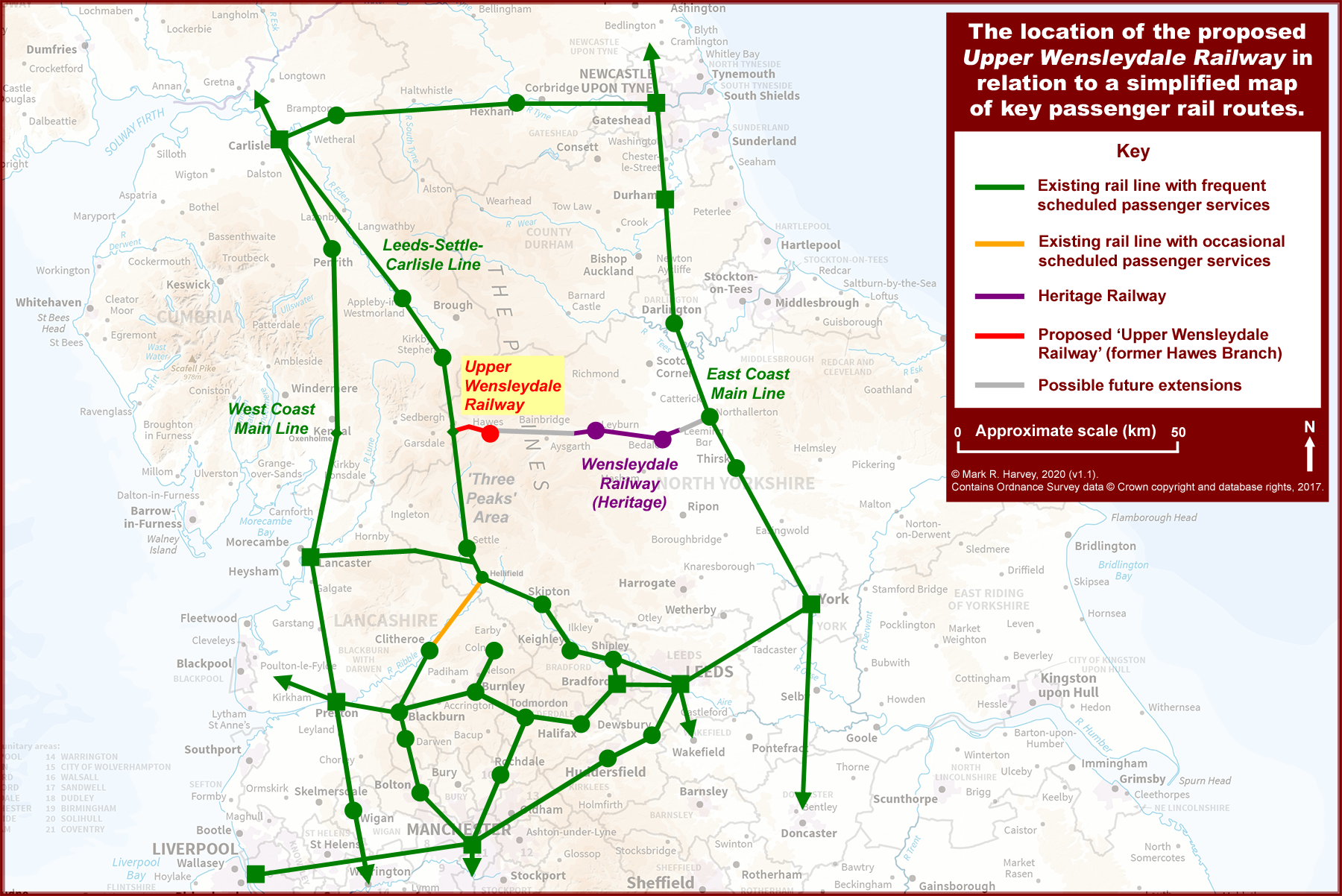
This is the vision of how the railway will be used, taken from the web site.
It is hoped that a reinstated junction with the existing Leeds – Settle – Carlisle railway line at Garsdale will allow ‘through’ trains to run from Hawes via Garsdale Junction, past the Yorkshire Three Peaks to Settle, then onwards through Hellifield and Clitheroe into Lancashire for Preston and Greater Manchester.
We are also hoping that some Manchester – Blackburn – Clitheroe trains can be extended to Garsdale and Hawes thereby linking Lancashire to an enhanced service through Settle to the Yorkshire Peaks and Dales.
Connections with other trains could be made at Hellifield (for West Yorkshire & Lancaster) and at Garsdale (for Carlisle, Scotland & the North East of England).
This Google map shows the current state of the railways at Garsdale.
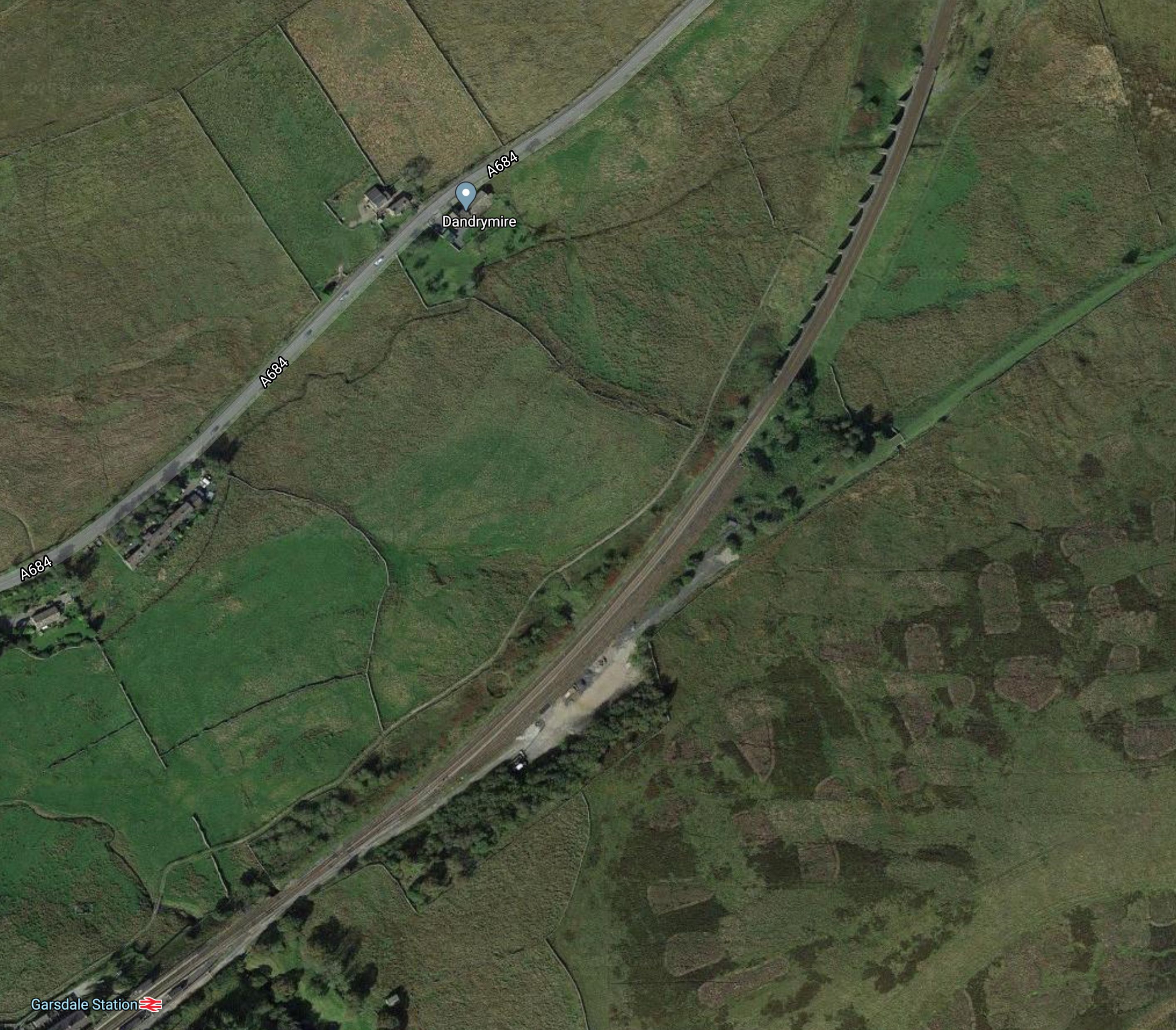
Note.
- Garsdale station in the South-West corner of the map.
- The Settle and Carlisle Line curving away to the North over the Dandry Mire Viaduct.
- The trackbed of the former branch to Hawes stands out as a green scar.
I have followed the route of the railway to Hawes in my helicopter and it doesn’t appear to be a very challenging project to reinstate.
- Although the comprehensive Routes and Structures page on the Upper Wensleydale Railway, indicates there is a lot to do.
- It is about six miles long.
- It is single track with a passing loop at Hawes.
This Google Map shows the town of Hawes,
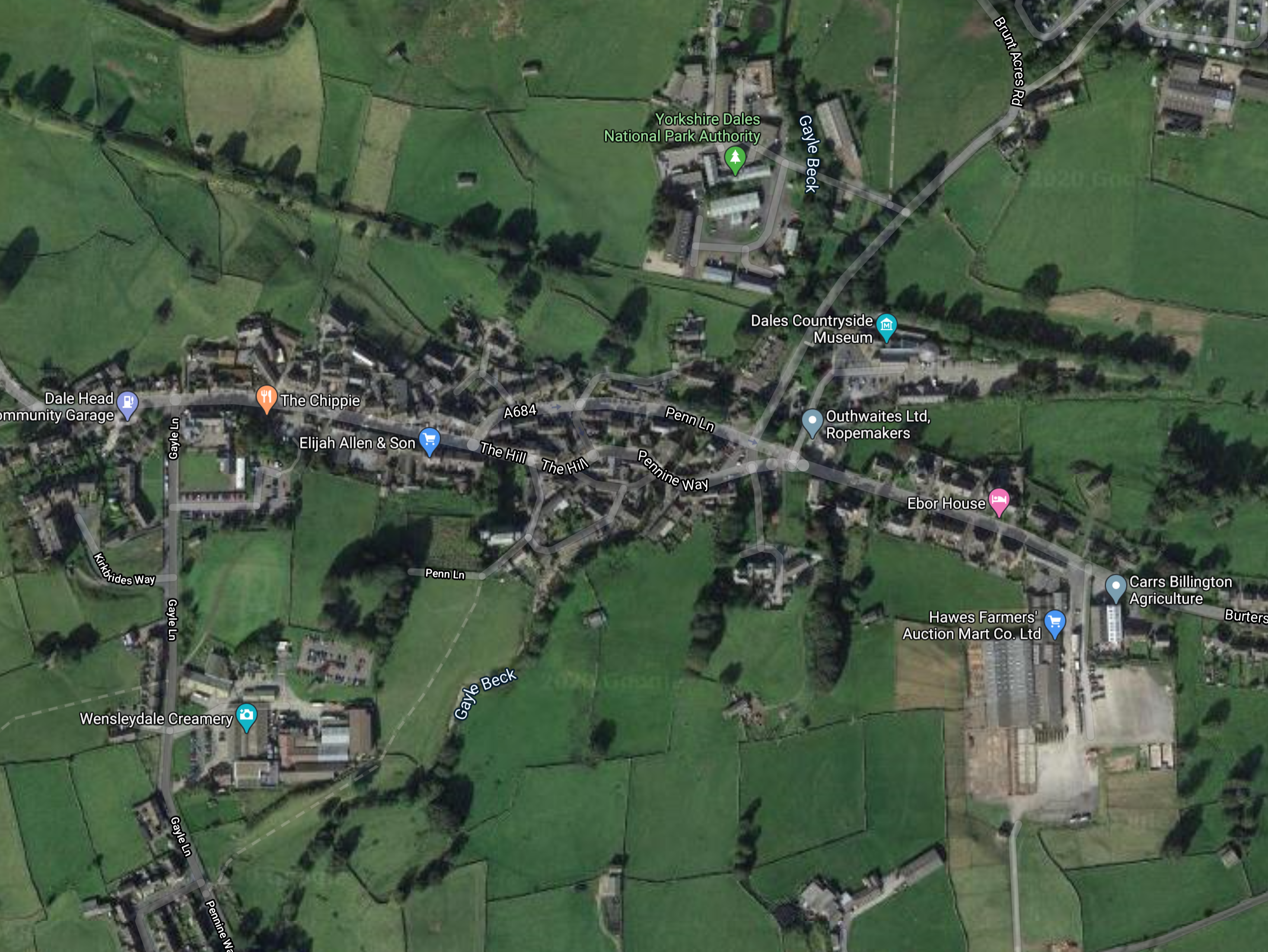
It certainly looks the sort of place, where Wallace and Gromit might rent a cottage for a week and use as a base to explore the countryside.
- There’s a Wensleydale Creamery.
- There’s a traditional ropemaker called Outhwaite, dating from 1905, who have the web site; www.ropemakers.com.
- The headquarters of the Yorkshire Dales National Park Authority are located in the North of the town and shown by a green arrow.
Next to the Park Authority is a blue arrow marking the Dales Countryside Museum, which incorporates the original Hawes railway station.
Services To Hawes
Looking at the data from Real Time Trains, it looks like trains on the Settle and Carlisle average about fifty mph on that line, which is generally double-track with an operating speed of sixty mph.
- I would estimate that a modern diesel or hydrogen-powered train could do the return trip between Garsdale and Hawes station in around thirty minutes.
- This time would probably mean that the Hawes Branch could be worked with only one train operational on the branch.
- It would also fit in well with the service plans for the Upper Wensleydale Railway.
I am fairly certain that an hourly service could be run between Hawes and Hellifield stations, which could be extended as far South as the operator wanted.
Military Traffic To Redmire
In the Wikipedia entry for Redmire village, this is said.
Redmire is the terminus of the Wensleydale Railway. The Ministry of Defence uses trains to transport armoured vehicles from bases in the south to the Catterick military area using Redmire railway station as its terminus.
It looks like there must be a quality railway between Redmire station and the East Coast Main Line at Northallerton.
This Google Map shows the site of Redmire station.
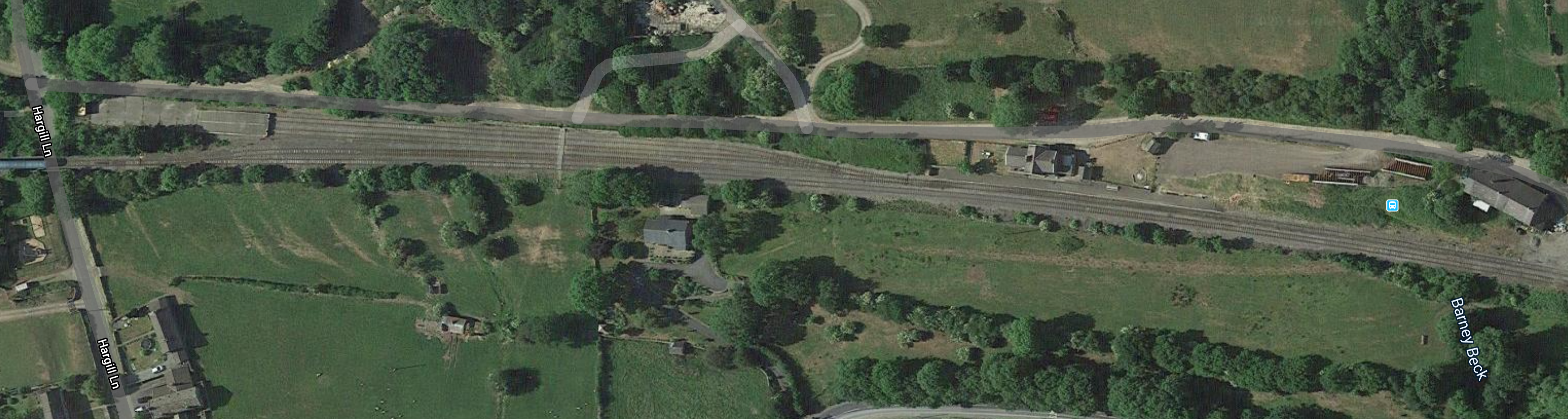
Note.
- At the left hand side of the map, there look to be loading ramps for the military vehicles, at the end of two sidings.
- The building on the North side of the tracks appears to be the old Redmire station buildings.
- The blue dot to the right, is a Google Maps pointer for the station
If you type Redmire into Google Maps, it’s easy to find..
This Google Map shows the rail lines at Northallerton.
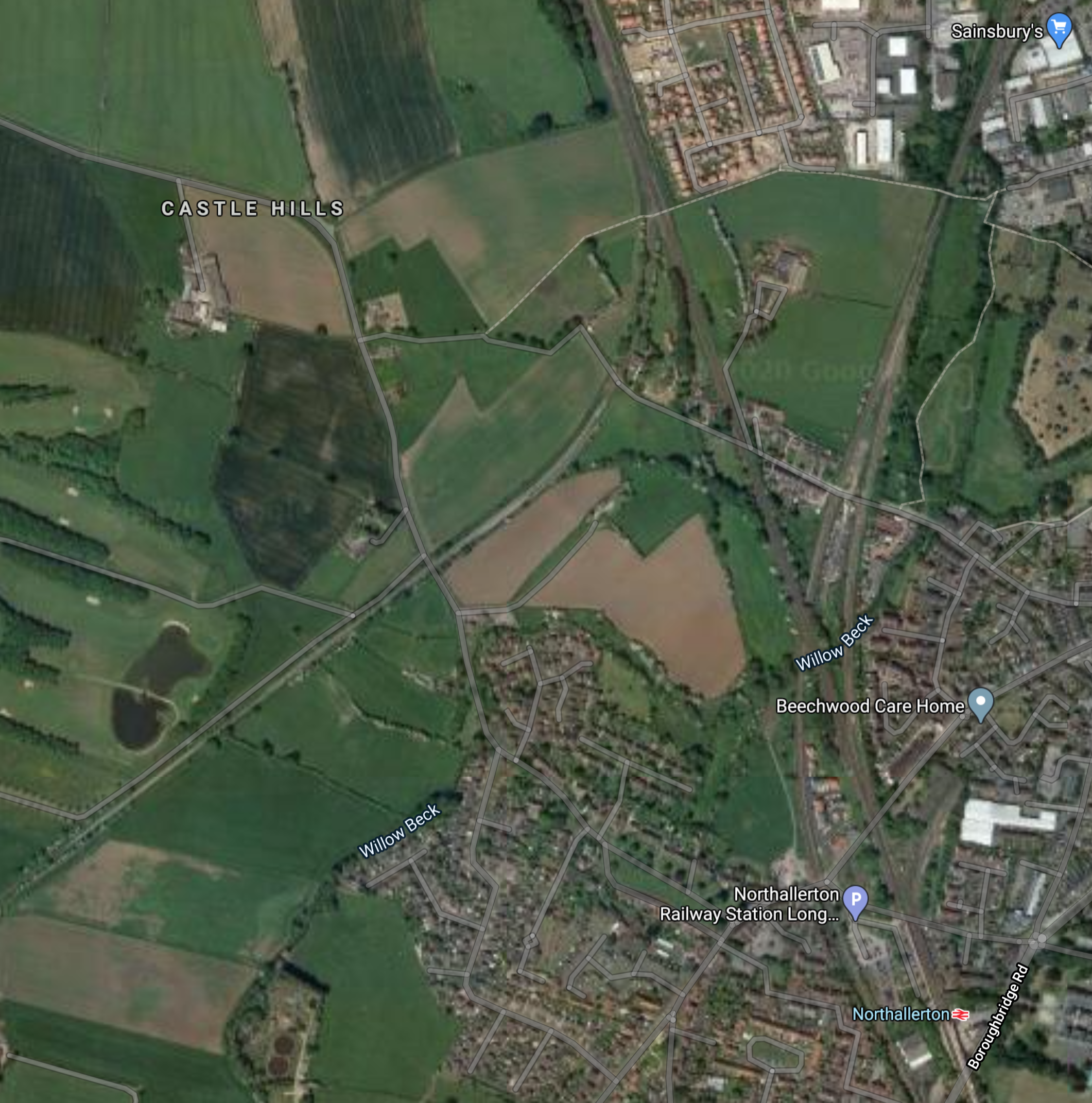
Note.
Northallerton station in the South-East corner of the map.
The East Coast Main Line runs about West-by-North from the station towards Darlington and Scotland.
The line to Middlesbrough branches off in a North-Easterly direction.
The Wensleydale Railway comes in from the West and joins the East Coast Main Line going North.
It also appears there used to be a tight chord that allowed trains to go between the Wensleydale Railway and the South.
It looks like the Army would like that chord for their vehicle trains.
This enlarged Google Map, shows the site of the chord.
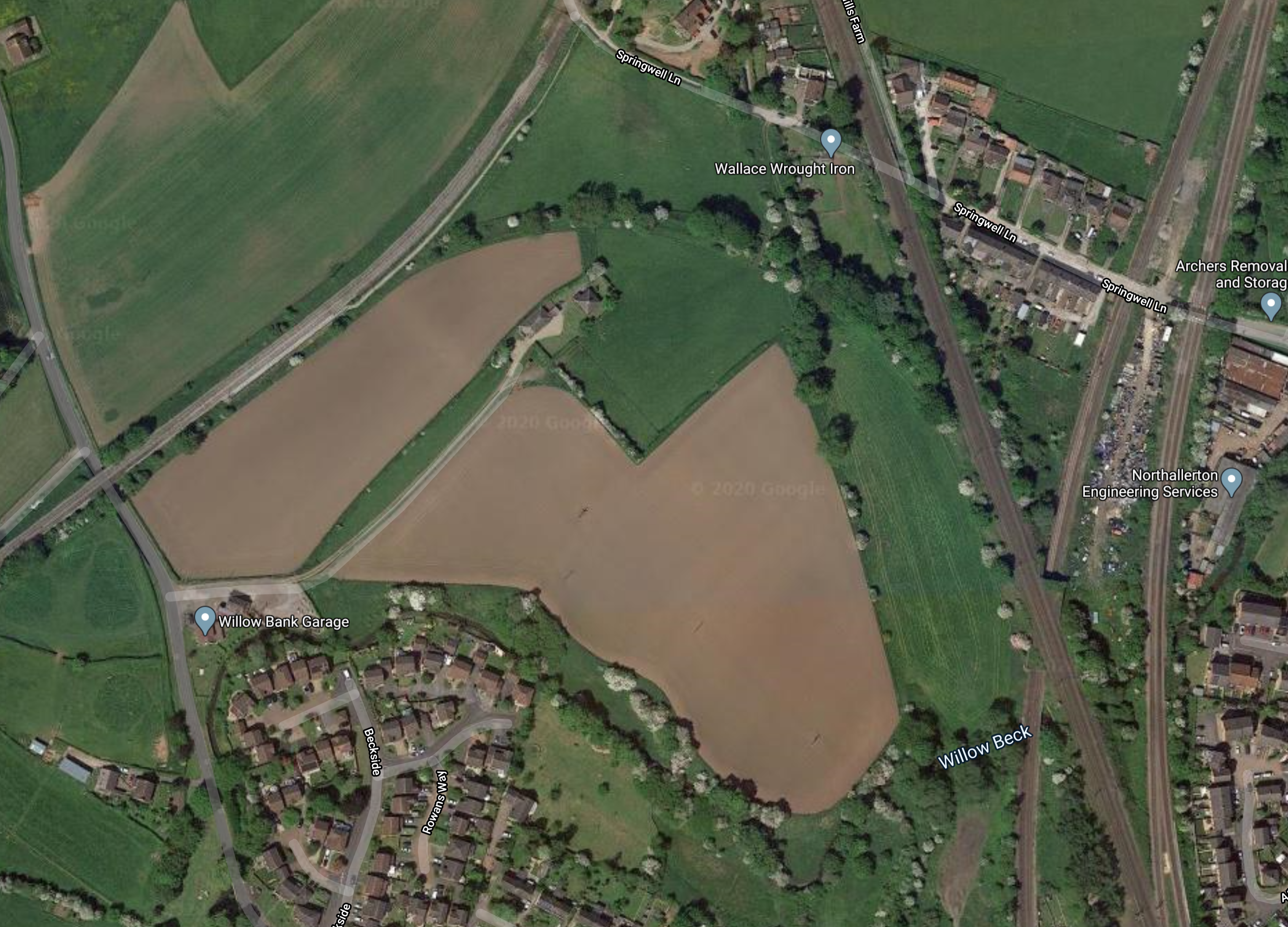
It looks to me, that it was once a chord, but now it’s a substantial wood.
A Bigger Plan
In the Wikipedia entry for the Wensleydale Railway, there is a section, which is entitled Upper Wensleydale Railway, where this is said.
In late 2019/early 2020, a separate company was formed to campaign to reinstate the line between Hawes and Garsdale. The groups’ objective is to have a timetabled year-round service run by a train operating company, rather than a heritage service. This scheme was shortlisted for funding in the second round of the government’s Reverse Beeching Fund, in June 2020.
These are my thoughts on various topics.
The Eastern Terminal
There are three possible Eastern terminals.
- Northallerton
- Middlesbrough – There is no connection to the Wensleydale Railway.
- Darlington – Would probably mean slow trains on the East Coast Main Line.
I think we’re left with Northallerton and the tight connection, which requires the chord to be reinstated.
But, it does say in the Wikipedia entry for Northallerton station, that the station is the terminus for the proposed extended Wensleydale Railway.
This Google Map shows the Northern end of Northallerton station.
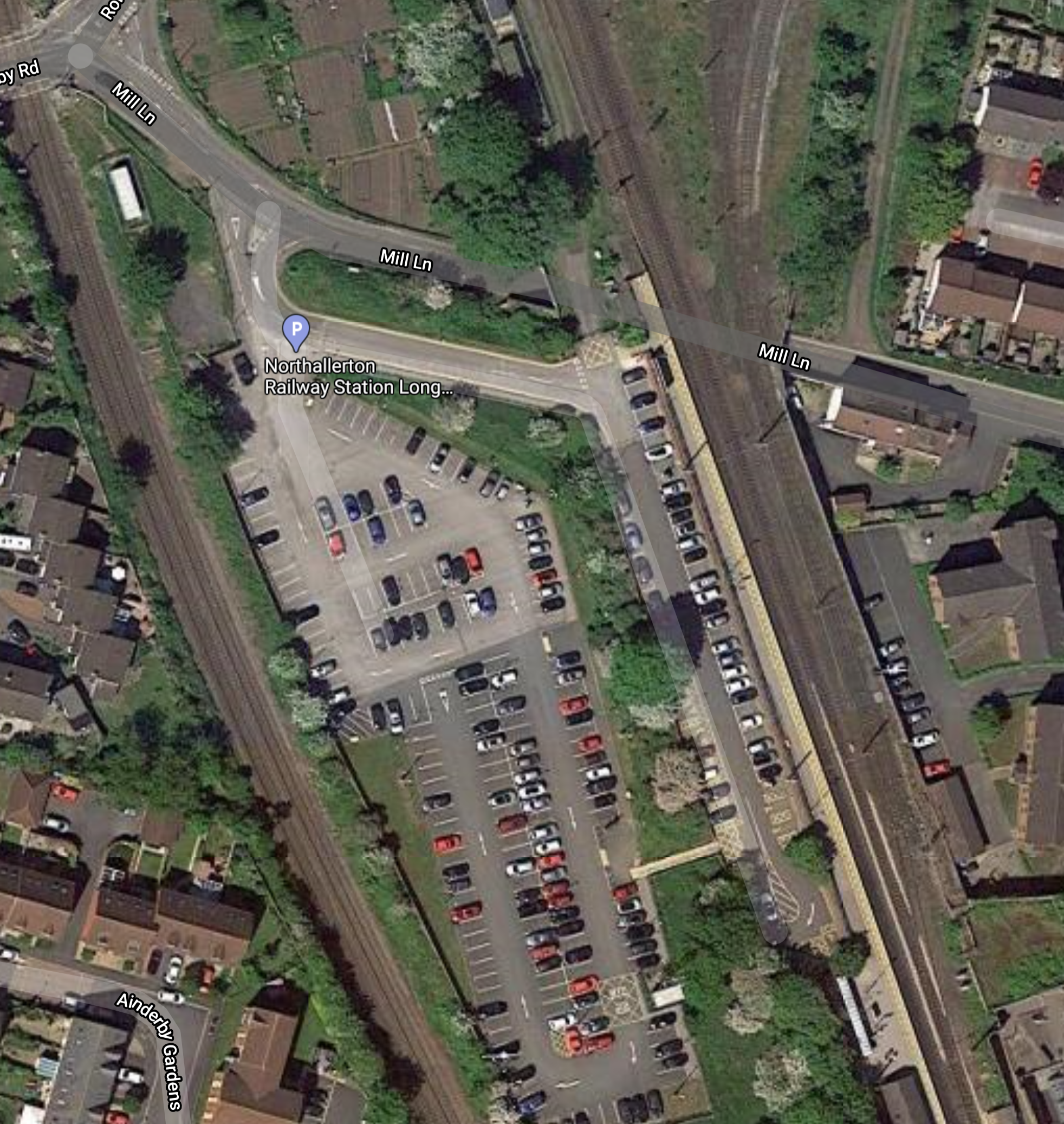
Would it be possible to sneak a line down the Western side of the East Coast Main Line and into a new bay platform at the station?
It would certainly allow trains from the Wensleydale Railway to terminate at Northallerton station.
The Western Terminal
As I said earlier, it’s the operator’s choice.
Personally, I would choose Blackburn station.
- It’s about fifty miles from Gardale station.
- There is a train depot at Blackburn.
- Blackburn station is in the Town Centre.
- Blackburn station has good rail connections to Blackpool, Liverpool, Leeds, Manchester and Preston.
Prior to COVID-19, I regularly stayed in the convenient Premier Inn next to the station.
Rolling Stock
The trains will have to be self-powered, as I don’t think the budget will run to electrification and much of the track-bed is owned by a heritage railway.
So that must mean the trains must be self-powered, which will mean either diesel, electric or hydrogen.
- I think diesel can be ruled out, except as a stop-gap, we are going carbon-neutral on the railways by 2040.
- Blackburn and Northallerton stations are too far for battery power.
So that means it must be hydrogen power.
But as, it appears that Teesside is going for hydrogen, as I wrote about in Fuelling The Change On Teesside Rails, that should be a convenient fuel.
The route might be a candidate for Vivarail’s Pop-up Metro concept, with fast charging at one or two, of any number of the stations.
Conclusion
I like this scheme, as it sorts a lot of problems.
I also think that there’s a fair chance, it will get the nod.
The local MP is the Chancellor of the Exchequer; Rishi Sunak and this could be a case of he who pays the piper, calls the tune!
 The Anonymous Widower