The Diesel Power Of The Class 805 Trains
Avanti West Coast’s new Class 805 trains, will probably start running between London Euston and Chester, Shrewsbury and North Wales before the end of the year.
But will they have the 560 kW engines of the Class 800 trains or the the 700 kW engines of the Class 802 trains?
On this page of Eversholt Rail’s web site, there is a detailed specification for a Class 802 train.
It says these trains have a top speed of 110 mph on diesel.
But it also says this about the design of the trains.
They have been designed to meet the operational requirements of the West of England route and are used on services out of London Paddington to Plymouth and Penzance.
The class 802 is almost identical to the class 800, the differences are that class 802s have a higher rated engine output to tackle the gradients through Devon and Cornwall, and a superior diesel range to provide the IET experience to the wider Greater Western Network, they also have a larger brake resistor which reduces brake pad usage and requires less maintenance.
Wikipedia also says that these are the diesel engine sizes in the three main classes of these Hitachi AT 300 trains.
- Class 800 train – 560 kW – Three engines for five cars
- Class 801 train – 560 kW – One emergency engine for five cars
- Class 802 train – 700 kW – Three engines for five cars
- Class 810 train – 735 kW – Four engines for five cars
All these four trains have similar bodyshells and running gear, so I suspect that to run at similar cruising speeds, similar amounts of power will be needed.
If the Class 802 train has a speed of 110 mph on diesel, then a rough estimate of the cruising speed of a train with the 560 kW engines can be estimated by doing this simple calculation. Note that air resistance is proportional to the square of the speed.
Square root (110*110 *560/700) = 98.4 mph
I have looked on OpenRailwayMap at all the tracks to the West of Wolverhampton, where these trains will run and the highest maximum operating speed I can find is 90 mph.
As the Class 805 trains have a reprofiled nose, which could be more aerodynamic, they may be able to cruise at 90 mph.
I believe that a train with three 560 kW engines will suit Avanti West Coast purposes well.
What Is The Operating Speed Of The Class 810 trains?
I can use a similar calculation to estimate the maximum operating speed of the Class 810 trains, that will operate on the Midland Main Line.
Consider.
- The Class 802 train has a total power of 2100 kW
- The Class 810 train has a total power of 2940 kW
- The Class 810 train with only three working engines has a total power of 2205 kW
I can estimate the cruising speed by doing this simple calculation, which is similar to the one for the Class 805 train.
Square root (110*110 *2940/2100) = 130 mph
I can also do it for a train running on three engines.
Square root (110*110 *2205/2100) = 113 mph
I looks to me, that the following is possible.
- As Class 810 trains can achieve the maximum speed of 125 mph on both diesel and electric power, the timetable is independent of the progress of the electrification.
- If the 125 mph sections are ignored, the fastest sections of line have a maximum speed of 110 mph, which could be possible on three engines.
- North of the electrification, where the maximum speed is only 110 mph, engines could be selectively rested to avoid overheating.
Four engines give a lot of interesting options.
I can’t wait to take a ride.
Could The Class 810 Trains Be Fitted With Batteries?
When, the electrification reaches Market Harborough station, there will be no 125 mph sections on the Midland Main Line, which are not electrified.
This Hitachi infographic shows the Hitachi Intercity Tri-Mode Battery Train.

A Class 810 version of this train would have three diesel engines and one battery pack.
- It would have all the features of the infographic.
- My calculations give it a top speed of 113 mph on a route, where the maximum speed North of the electrification is 110 mph.
- I also suspect, it could bridge any small gaps in the electrification.
It would have the very positive effects of saving fuel and cutting pollution in stations.
Rockton To Buy Up To 40 Heart Aerospace ES-30 Electric Aircraft
The title of this post, is the same as that of this article on Aviation Source News.
These are the first two paragraphs.
Swedish investment and aircraft leasing company Rockton has confirmed that it will acquire up to 40 of Heart Aerospace’s regional electric aircraft, the ES-30.
The purchase confirmation converts an earlier letter of intent with the Swedish aircraft manufacturer into firm purchase orders for 20 aircraft with purchase rights for 20 more.
It’s good to see a leasing company getting involved, as it probably means that the finances are viable.
The Wikipedia entry for Heart Aerospace, describes the range of the ES-30 like this.
The ES-30 is planned to have a 108 nautical miles (200 kilometres; 124 miles) fully electric range or a 215 nmi (398 km; 247 mi) range when also using generators powered by aviation biofuel. A range of 430 nmi (800 km; 490 mi) could be possible if only 25 passengers are carried.
These are some UK airport to airport distances.
- Aberdeen – Kirkwall – 124 miles
- Aberdeen – Sumburgh – 188 miles
- Anglesey – Belfast – 109 miles
- Anglesey – Belfast City – 109 miles
- Anglesey – Cork – 192 miles
- Anglesey – Derry – 163 miles
- Anglesey – Dublin – 71 miles
- Anglesey – Ronaldsway – 58 miles
- Anglesey – Shannon – 186 miles
- Anglesey – Waterford – 130 miles
- Birmingham – Belfast – 226 miles
- Birmingham – Dublin – 200 miles
- Birmingham – Edinburgh – 250 miles
- Birmingham – Glasgow – 260 miles
- Birmingham – Inverness – 363 miles
- Birmingham – Kirkwall – 451 miles
- Birmingham – Newcastle – 178 miles
- Birmingham – Newquay – 198 miles
- Birmingham – Schipol – 402 miles
- Birmingham – Sumburgh – 513 miles
Birmingham – Wick – 418 miles - Edinburgh – Schipol – 473 miles
- Gatwick – Edinburgh – 356 miles
- Gatwick – Schipol – 374 miles
- Glasgow – Belfast – 106 miles
- Glasgow – Belfast City – 103 miles
- Glasgow – Derry – 121 miles
- Glasgow – Kirkwall – 221 miles
- Glasgow – Sumburgh – 300 miles
- Glasgow – Stornoway – 177 miles
- Haverfordwest – Waterford – 94 miles
- Haverfordwest – Newquay – 94 miles
- Heathrow – Newquay – 212 miles
- Humberside – Schipol – 333 miles
- Inverness – Kirkwall – 106 miles
- Inverness – Sumburgh – 190 miles
- Leeds – Schipol – 386 miles
- Liverpool – Belfast City – 151 miles
- Liverpool – Cardiff – 135 miles
- Liverpool – Dublin – 140 miles
- Liverpool – Haverfordwest – 127 miles
- Liverpool – Norwich – 180 miles
- Liverpool – Ronaldsway – 89 miles
- London City – Haverfordwest – 167 miles
- London City – Humberside – 145 miles
- London City – Manchester – 161 miles
- London City – Norwich – 100 miles
- Manchester – Schipol 413 miles
- Newcastle – Cardiff – 230 miles
- Newcastle – Belfast City – 168 miles
- Newcastle – Newquay – 346 miles
- Newcastle – Schipol – 395 miles
- Newquay – Brest – 140 miles
- Newquay – Cardiff 98 miles
- Newquay – Cork – 180 miles
- Newquay – Deauville – 241 miles
- Newquay – Dinard – 183 miles
- Newquay – Dublin – 212 miles
- Newquay – Guernsey – 128 miles
- Newquay – Jersey – 152 miles
- Newquay – Nantes – 211 miles
- Newquay – Orly – 351 miles
- Newquay – Rouen – 285 miles
- Newquay – Scillies – 68 miles
- Newquay – Waterford – 150 miles
- Norwich – Schipol – 277 miles
- Ronaldsway – Belfast – 75 miles
- Ronaldsway – Belfast City – 62 miles
- Ronaldsway – Birmingham – 165 miles
- Ronaldsway – Dublin – 80 miles
- Ronaldsway – East Midlands – 161 miles
- Ronaldsway – Glasgow – 123 miles
- Ronaldsway – Leeds – 121 miles
- Ronaldsway – Manchester – 109 miles
- Southend – Schipol – 180 miles
- Stansted – Aberdeen – 379 miles
- Stansted – Edinburgh – 316 miles
- Stansted – Glasgow – 334 miles
- Stansted – Inverness – 426 miles
- Stansted – Schipol – 335 miles
- Stansted – Wick – 472 miles
- Sumburgh – Bergen – 226 miles
- Sumburgh – Kirkwall – 85 miles
Note.
- I have included Schipol, as in certain areas of the UK, passengers sometimes fly long-haul from Schipol.
- I have included Haverfordwest, as it will be close to all the wind farm activity in the Celtic Sea.
- I have included Anglesey, as I think it has possibilities.
- The distances wee calculated using on of the Free Map Tools.
These are some more specific thoughts.
The Basic ES-30 And The UK
With a range of 124 miles, I don’t believe that the range is long enough for the UK.
But saying that there are some established routes, where it should be able to operate.
- Glasgow – Belfast
- Glasgow – Belfast City
- Glasgow – Derry
- Haverfordwest – Waterford
- Haverfordwest – Newquay
- Inverness – Kirkwall
- Liverpool – Haverfordwest
- Liverpool – Ronaldsway
- London City – Norwich
- Newquay – Cardiff
- Newquay – Scillies
- Ronaldsway – Belfast
- Ronaldsway – Belfast City
- Ronaldsway – Dublin
- Ronaldsway – Glasgow
- Ronaldsway – Leeds
- Ronaldsway – Manchester
These routes have the following in common.
- They are mostly between major airports with advanced facilities.
- Most airports served have access to renewable electricity.
- Some of the routes can support hundred seat airliners.
- Fifty percent go to the Isle of Man.
I can see several routes between the UK and the island of Ireland and to and from the Isle of Man using ES 30 aircraft.
The Extended Range ES-30 And The UK
The 247 mile range of the extended range ES-30, brings lots more routes into play.
Key routes could be the following.
- Aberdeen – Kirkwall
- Aberdeen – Sumburgh
- Anglesey – Cork
- Anglesey – Shannon
- Birmingham – Belfast
- Birmingham – Dublin
- Birmingham – Newcastle
- Birmingham – Newquay
- Glasgow – Kirkwall
- Glasgow – Stornoway
- Heathrow – Newquay
- Inverness – Sumburgh
- Liverpool – Belfast City
- Liverpool – Dublin
- Liverpool – Norwich
- London City – Haverfordwest
- London City – Humberside
- London City – Manchester
- Newcastle – Belfast City
- Newcastle – Cardiff
- Newquay – Brest
- Newquay – Cork
- Newquay – Deauville
- Newquay – Dinard
- Newquay – Dublin
- Newquay – Guernsey
- Newquay – Jersey
- Newquay – Nantes
- Newquay – Waterford
- Ronaldsway – Birmingham
- Ronaldsway – East Midlands
There will also be other routes.
The Extended Range With 25 Passengers ES-30 And The UK
The 490 mile range of the extended range ES-30 with only 25 passengers, brings a few more routes into play.
- Birmingham – Edinburgh
- Birmingham – Glasgow
- Birmingham – Inverness
- Birmingham – Kirkwall
- Birmingham – Schipol
- Birmingham – Wick
- Edinburgh – Schipol
- Gatwick – Edinburgh
- Gatwick – Schipol
- Glasgow – Sumburgh
- Humberside – Schipol
- Leeds – Schipol
- Manchester – Schipol
- Newcastle – Newquay
- Newcastle – Schipol
- Newquay – Orly
- Newquay – Rouen
- Norwich – Schipol
- Southend – Schipol
- Stansted – Aberdeen
- Stansted – Edinburgh
- Stansted – Inverness
- Stansted – Glasgow
- Stansted – Schipol
- Stansted – Wick
Note.
- All airports East of Birmingham and Manchester seem to be close enough to Schipol for an Extended Range ES-30 with 25 passengers to serve the route.
- Most major Scottish Airports can be reached from Stansted.
- Flying from Gatwick to Scottish Airports is around forty miles longer than flying from Stansted.
Liverpool Airport
Liverpool Airport could be a major destination for the ES 30, as it could be a key airport for flying between the UK and the island of Ireland.
Liverpool would obviously need the electric infrastructure, but I also believe it needs a better connection to the major railway station at Liverpool South Parkway, which has extensive rail connections.
This Google Map shows the area between Liverpool South Parkway station and the airport.

Note.
- Liverpool South Parkway station is marked by the red arrow in the North-West corner of the map.
- The airport is in the opposite corner, with the terminal to the North of the runway.
- The main railway between the South and Liverpool Lime Street passes to the South of the station.
- The A561 passes across to the South of the railway and to the North of the airport.
I suspect some form of people mover like the Luton DART can be built between the station and the airport.
It should be noted that as Hunts Cross has only one platform for Merseyrail Northern Line trains and this could be a factor in limiting the line’s capacity. So could a second platform be installed at the airport to both act as an airport station and to increase the frequency on the Northern Line?
I believe that in a couple of years, journey times between Euston and Liverpool South Parkway will be under two hours and they will only get shorter with High Speed Two. With a fast connection between the airport and the station, there could be a sub-three-hour zero-carbon route between London and the island of Ireland.
- Avanti West Coast Class 805 train to Liverpool South Parkway.
- People mover to the airport.
- Electric aircraft on the 140 miles to Dublin.
Dublin air traffic are usually efficient in getting planes in quickly.
Glasgow Airport
Glasgow Airport could be a major destination for the ES 30, as it could be a key airport for flying between the UK and the island of Ireland.
As with Liverpool Airport it needs a better connection to the rail network.
If Glasgow Airport is successful running zero-carbon aircraft to Ireland, this could change all previous thinking on a Glasgow Airport Rail Link.
Ronaldsway Airport
Geography and electric airliners could be very kind to Ronaldsway Airport and the Isle of Man.
- Electric airliners can easily reach much of the island of Ireland and the UK mainland between Glasgow and Birmingham, from Ronaldsway Airport with ease.
- The Isle of Man will in a couple of years be surrounded by wind farms.
- With other developments on the island, it could sell itself to the UK and Ireland, as a green holiday destination.
But what would the motorcycle enthusiasts say?
Anglesey Airport
I believe that Anglesey Airport could be brought to life in a big way by electric aircraft like the ES-30 or the Eviation Alice.
These are flight distances from Anglesey Airport.
- Anglesey – Belfast – 109 miles
- Anglesey – Belfast City – 109 miles
- Anglesey – Cork – 192 miles
- Anglesey – Derry – 163 miles
- Anglesey – Dublin – 71 miles
- Anglesey – Ronaldsway – 58 miles
- Anglesey – Shannon – 186 miles
- Anglesey – Waterford – 130 miles
All of these except for Cork, Derry, Shannon and Waterford would be possible in the basic ES-30.
This Google Map shows the airport, which is also labelled as RAF Valley.

Note that the North Wales Coast Line passes the site on the North-East side.
At present, Avanti West Coast trains take nearly four hours between London and Holyhead.
But later this year, new bi-mode Class 805 trains will replace, the current diesel only Class 221 trains.
- The current diesel only trains take two hours and five minutes between Crewe and Holyhead.
- The current diesel only trains take one hour and forty-three minutes between Crewe and London Euston.
- The fastest electric trains take one hour and twenty-nine minutes between Crewe and London Euston.
- High Speed Two trains will take 56 minutes between Crewe and London Euston.
When you consider that a lot of the North Wales Coast Line, is straight and flat, I can see the following times being possible, with some improvement and smart electrification between Crewe and Holyhead and a smaller number of stops.
- Crewe and Anglesey Airport – One hour and twenty minutes
- London Euston and Anglesey Airport – Two hours and fifty minutes
With High Speed Two Classic-Compatible trains, the London Euston and Anglesey Airport time could be below two hours and thirty minutes.
I believe that with a well-designed terminal at Anglesey Airport, this could be the fastest zero-carbon way between London and Ireland.
Haverfordwest Airport
This Google Map shows the location of Haverfordwest Airport in the East of Pembrokeshire.
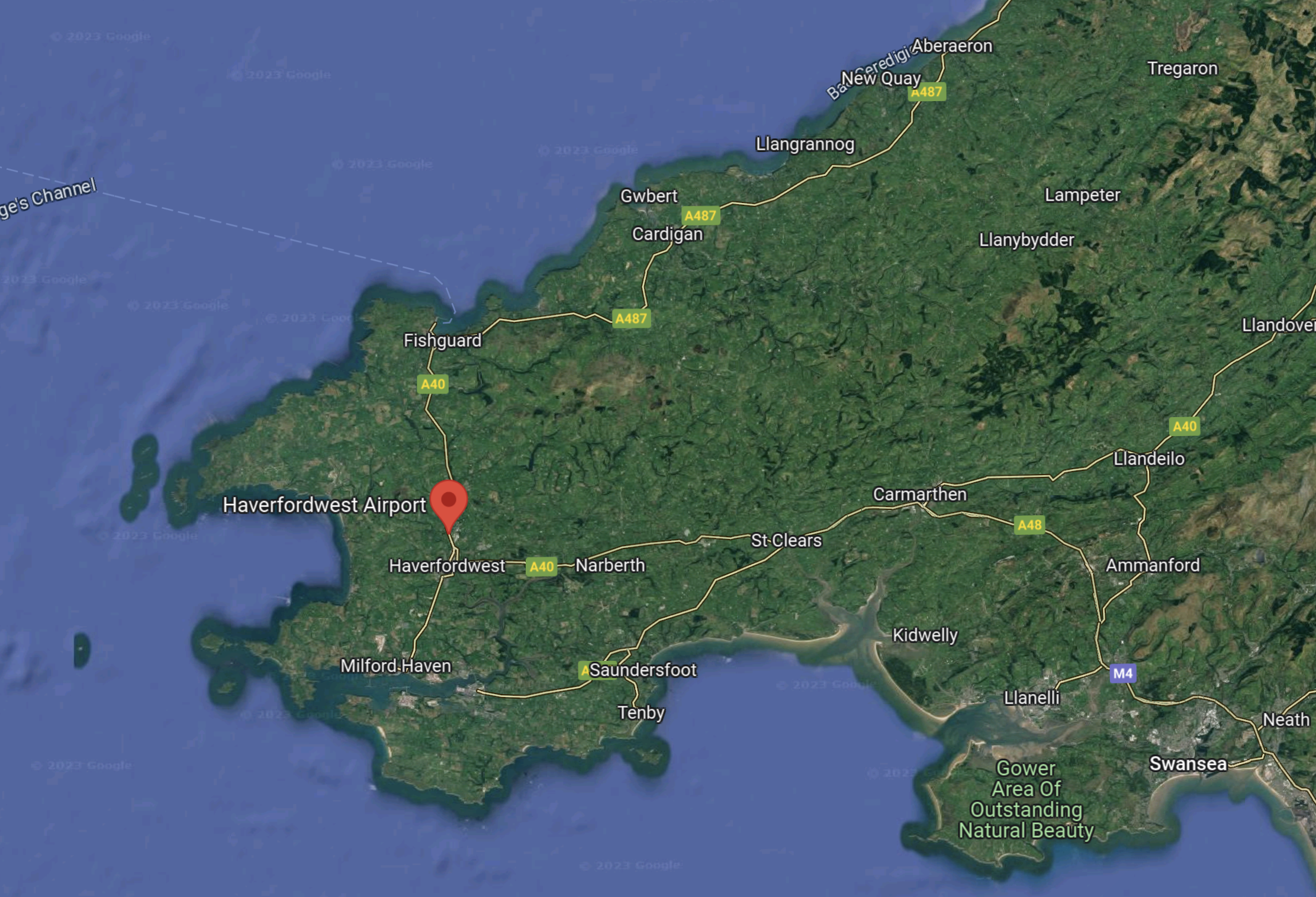
This second Google Map shows a close-up of the airport.

This map from OpenRailwayMap shows the airport and the nearest railway station.
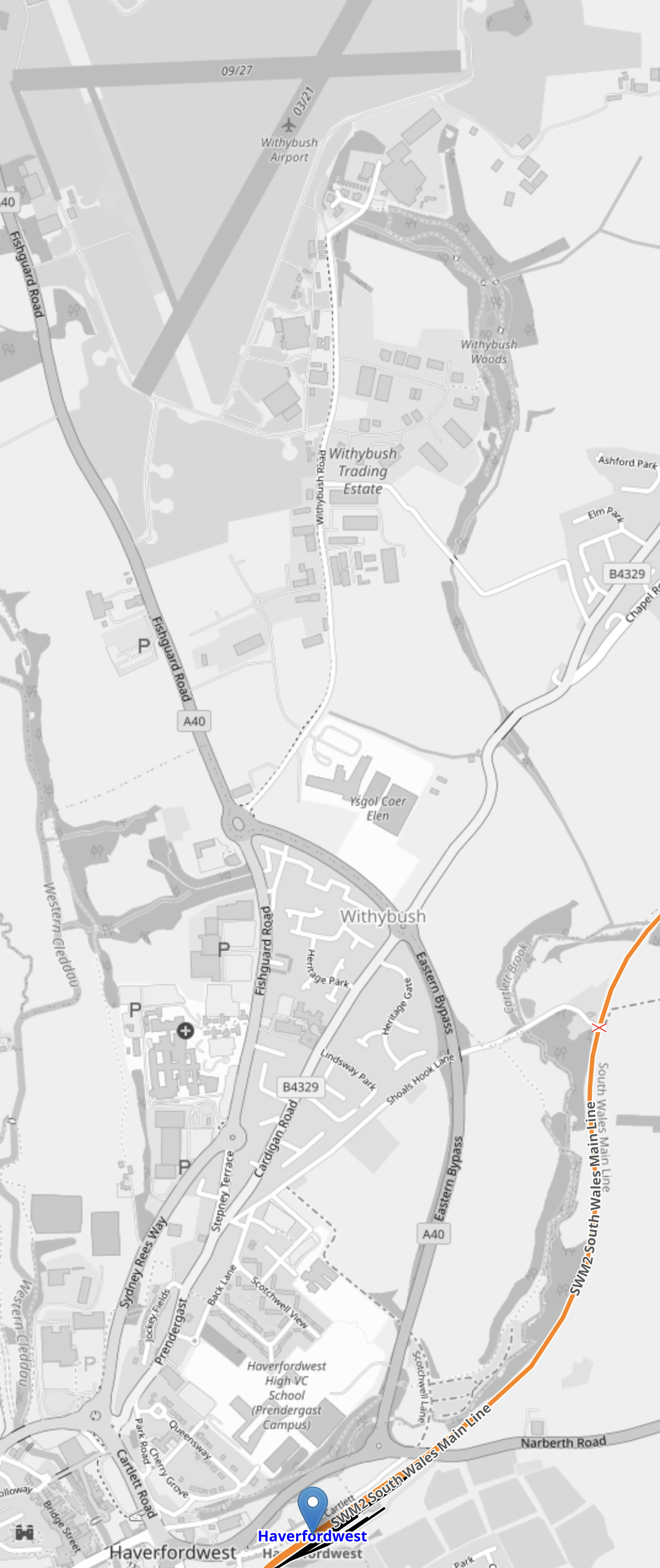
Note.
- Haverfordwest Airport is at the top of the map.
- Haverfordwest station is at the bottom of the map.
- There are rail connections to Cardiff, Fishguard, Milford Haven, Pembroke Dock and Swansea from the the station.
- Rail passengers for London would change at Swansea.
The road looks good between the airport and the station, so would an electric bus to handle transfers be ideal?
Consider.
- I have flown myself into Haverfordwest Airport and there were no navigation or operational problems that I can remember.
- With all the wind farm development planned for the coast of Pembrokeshire and the Celtic Sea, I feel that an airport in the area with regular flights to London and perhaps Waterford in Ireland could be essential.
- London City and Haverfordwest airports are 167 miles apart
- Waterford and Haverfordwest airports are 94 miles apart
- Quiet electric aircraft may ease any planning problems.
- Will a helicopter base be needed for serving wind farms in the Celtic Sea?
I believe, Haverfordwest Airport could be converted into a high-class airport for the Eastern tip of South Wales.
Haverfordwest Airport could also attract other services, given that the Welsh Government have a policy of not building new roads.
I have a feeling that quiet electric airliners will lead to the development of airports like Haverfordwest as feeder airports for the Heathrows and Schipols of this world.
Waterford Airport
Waterford Airport has recently been expanded and it appears from the Wikipedia entry, they are expecting more tourists.
This Google Map shows the position of the airport and the railway station in Waterford.

Note.
- The red arrow at the top of the map indicates Waterford station on the Northern side of the city.
- The airport is indicated by the blue dot in the South-East corner of the map.
- The airport is about ten kilometres from the City Centre.
In the past, Waterford has been quite a busy airport, but Covid-19 seems to have killed most of the traffic.
So could a zero-carbon service between Waterford and Haverfordwest be profitable?
- Those working with the wind energy in the Celtic Sea might find route useful.
- It would give a low-carbon route between Waterford and South Wales, which some might like.
- I also believe that the novelty of flying in an electric plane would attract passengers.
Waterford and Haverfordwest might be one of those routes, where electric planes might be worth trying.
This Google Map shows the Celtic Sea.
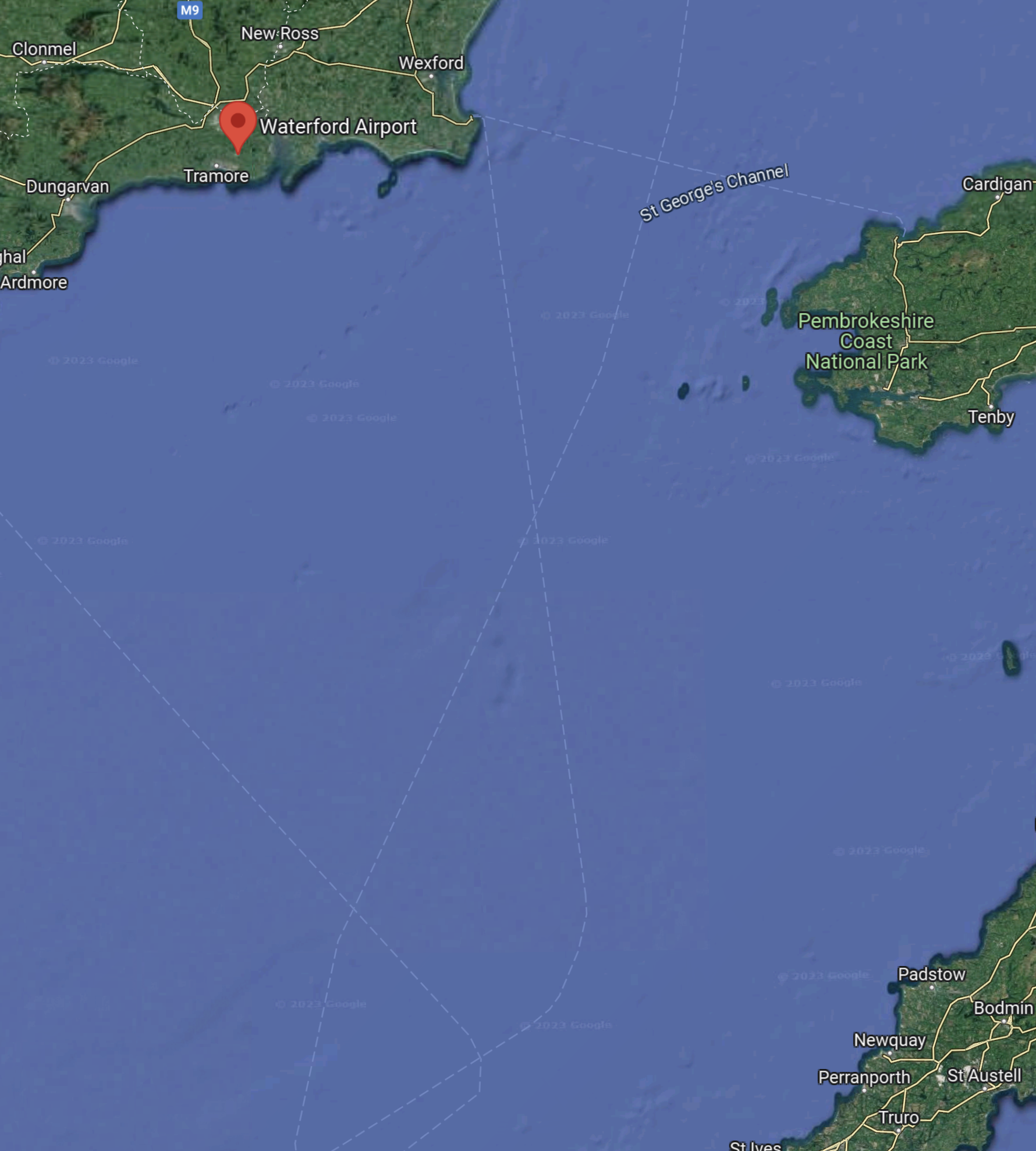
Note.
- Waterford Airport is indicated in red on the South-East corner of Ireland.
- Haverfordwest Airport is on the South-Western tip of Wales.
- Newquay Airport is in the South-East corner of the map on the North coast of Cornwall.
There could be as much as 50 GW of floating wind farms installed in this area.
I feel that there could be a case for a triangular Haverfordwest, Newquay and Waterford service.
Newquay Airport
Newquay Airport has been in the news recently because of the antics of Richard Branson and Virgin Orbit.
This Google Map shows the airport in relation to the town.
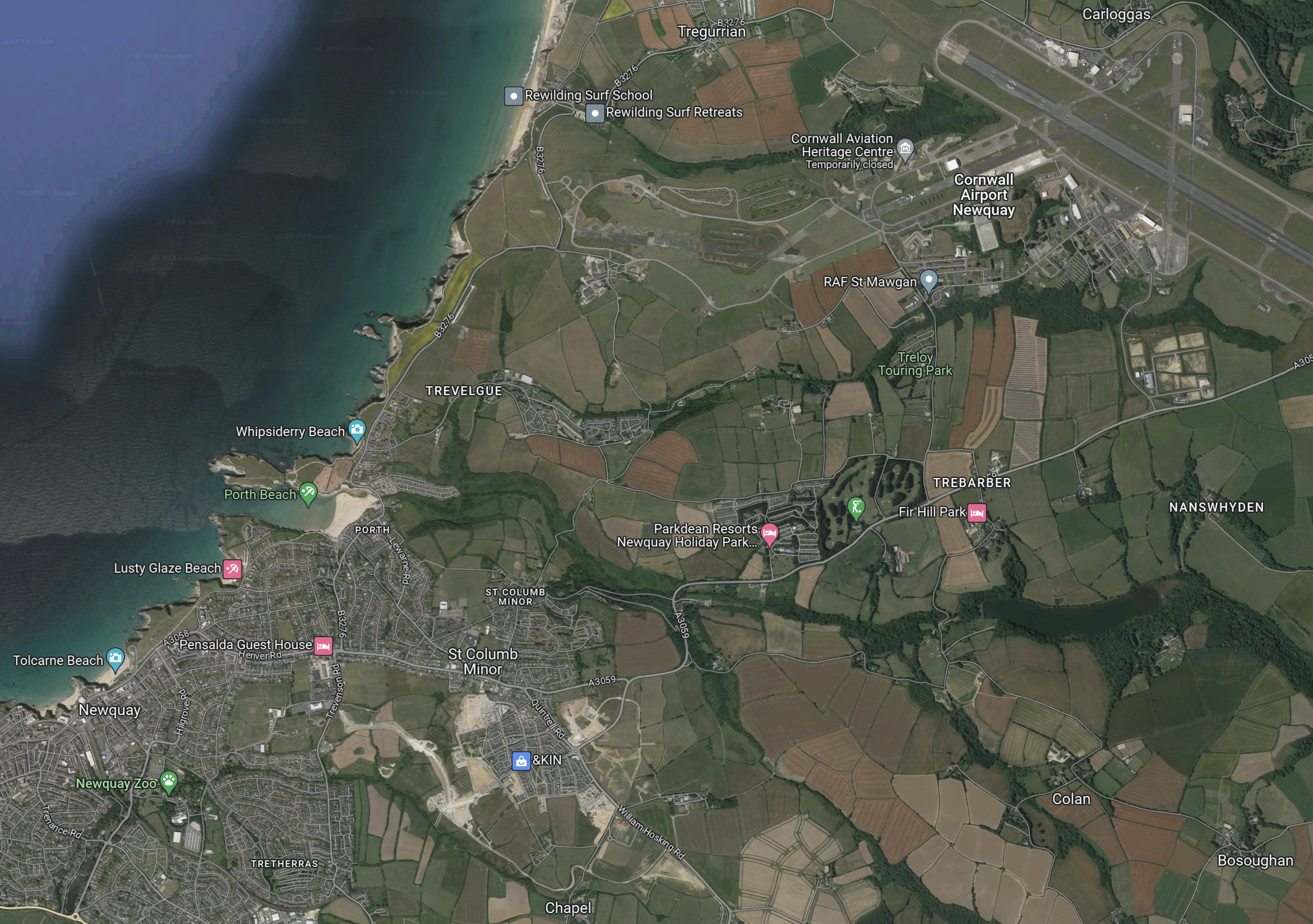
Note.
- The airport is in the North-East corner and boasts a long runway.
- The airport serves well over a dozen destinations.
- The town of Newquay is in the South-West corner of the map.
- Newquay station is by the sea.
All of these places would be suitable destinations for electric aircraft.
- Birmingham
- Brest
- Cardiff
- Cork
- Deauville
- Dinard
- Dublin
- Guernsey
- Heathrow
- Jersey
- Nantes
- Orly
- Rouen
- Scillies
- Waterford
Newquay Airport could get very busy with electric aircraft supporting tourism and the developing wind power industry.
This second Google Map shows the town centre and station.

Surely, having the station by Great Western Beach is good marketing.
In The Proposed Mid-Cornwall Metro, I talked about a plan to run an hourly Metro service between Newquay and Falmouth.
This article on Rail Technology Magazine is dated January 2023 and entitled Mid Cornwall Metro Secures £50m In Levelling Up Funding, where these are the first two paragraphs.
Following yesterday’s major Levelling Up funding announcement, the government has pledged an almost £50m grant to improve the railways linking Newquay, St Austell, Truro and Falmouth in Cornwall.
This financial aid to improve Cornwall Rail links represents the only successful bid out of four that were submitted to the Levelling up funding. The improvement scheme will be helmed by a partnership with Great Western Railway and Network Rail.
Note.
- I believe this means the Mid-Cornwall Metro will be built.
- Especially as looks like it will cost less than £100 million.
- As this Metro will serve Newquay, it shouldn’t be too difficult to link the plane with the train, with perhaps a zero-carbon bus.
- The Metro would then link Newquay Airport to the main population centres of Newquay, St Austell, Truro and Falmouth.
- If the Metro could be run using zero-carbon trains, that would surely put the icing on the cake!
The map from OpenRailwayMap shows the route.
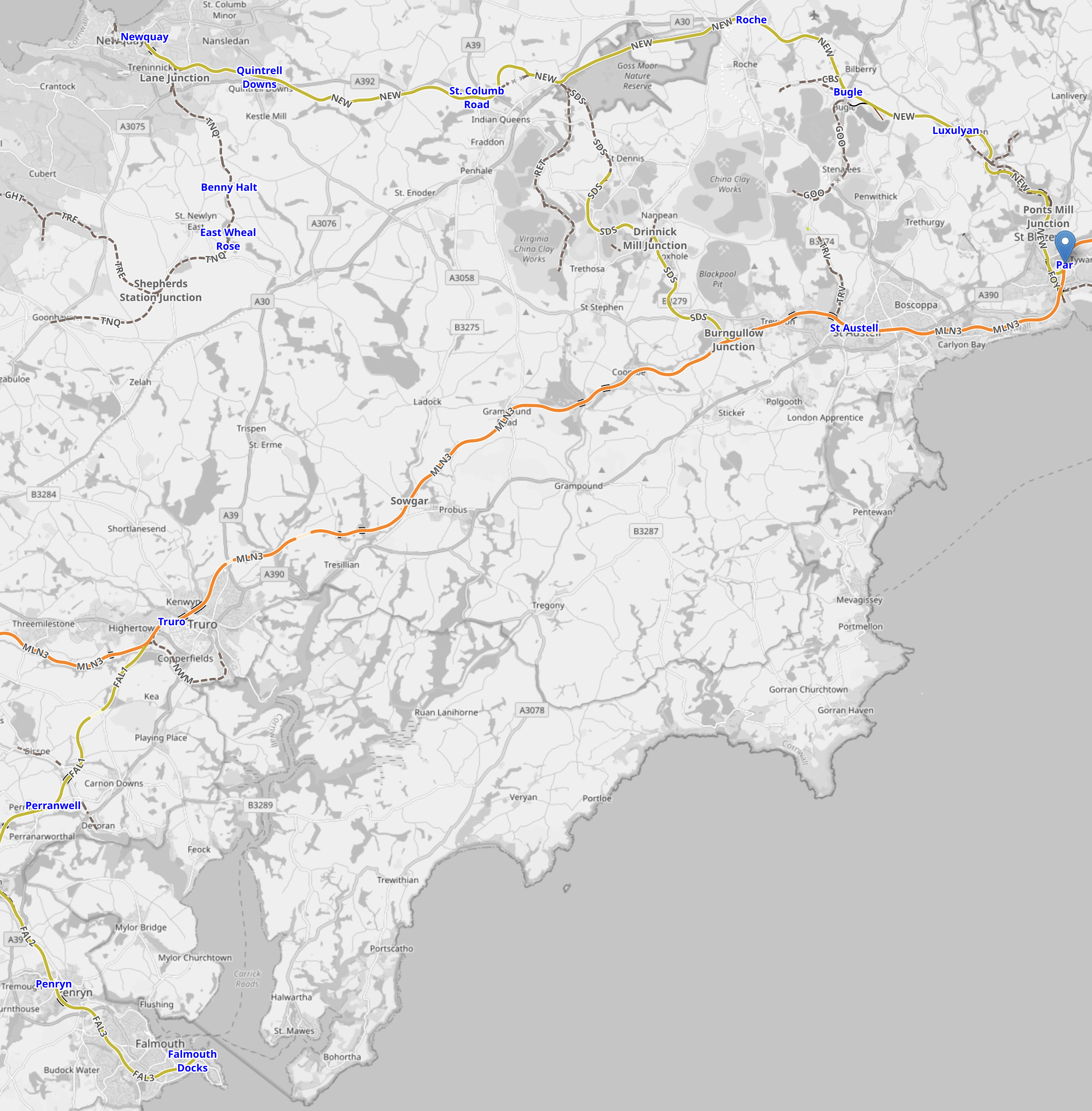
Note.
- Newquay is in the North-West corner of the map.
- Trains spend around 6-7 minutes waiting at Newquay.
- The blue arrow in the North-East corner marks Par station, where a chord will be reinstated to allow trains to go between Newquay and St. Austell.
- Par is the nearest station to the Eden Centre.
- Newquay and Par is 20.6 miles.
- The route, then goes along the Cornish Main Line, through St. Austell and then on to Truro.
- Par and Truro is 18.9 miles.
- At Truro the Metro would take the Falmouth branch.
- Falmouth and Truro is 11.8 miles.
- Trains spend around 7-8 minutes waiting at Falmouth Docks
- The total route is just over fifty miles, which probably means that battery-electric trains could work the route with charging at each end, whilst the train is turned round.
This airport and metro combination could give a big-boost to zero-carbon tourism.
Inverness Airport
Inverness Airport has recently been expanded with a station on the Inverness and Aberdeen Line.
Consider.
- Electric aircraft like the ES-30 will be able to reach both Kirkwall on Orkney and Sumburgh on Shetland from both Inverness and Aberdeen Airports.
- Sumburgh would need an extended range ES-30.
- Flights would be a few miles shorter from Inverness than from Aberdeen.
- Kirkwall and Sumburgh is only 85 miles, so there may be possibilities for serving both Orkney and Shetland with one flight.
- Extended range ES-30s might be able to do return trips to Kirkwall without a major charge at Kirkwall.
- I once flew in my Cessna-340 to Kirkwall to see the original turbine, that was placed on the island. There is a lot of cold forbidding sea in the area. Perhaps the slightly shorter trip from Inverness, might be better for everybody’s nerves?
- Just as the oil and gas industry did in the last century, I can see the offshore wind power industry generating a lot of passenger traffic to the Orkney and Shetland Islands.
Both Inverness and Aberdeen can be reached from Stansted by an ES-30 carrying a reduced passenger load.
Birmingham Airport
Birmingham Airport could become a major base for electric aircraft.
The 247 mile range of the extended range ES-30 would allow it to be able to reach the following places.
- Belfast
- Dublin
- Newcastle
- Newquay
- Ronaldsway
Reduce the passenger load slightly to 25 passengers and the plane would be able to reach.
- Edinburgh
- Glasgow
- Inverness
- Kirkwall
- Wick
But Birmingham Airport is only 65 minutes from Euston and will in the future be served by High Speed Two, in under an hour.
The airport also has a large catchment area of its own, who might be tempted to choose flying zero-carbon.
Spokes From Speke
In the 1980s, I went to a presentation from Royal Mail in Ipswich about guaranteed next day delivery of parcels. It was important to me, as I was writing software that needed to get from Ipswich, where it was created to London, where it would be tested and installed on customers machines. We also needed to get copies to our customers in Edinburgh and Aberdeen.
The Royal Mail’s latest concept of Spokes From Speke was described.
- All urgent parcels and First Class mail would be collected from the local sorting office and taken to the local airport, which in our case would probably have been Stansted.
- These consignments would then be flown to Speke Airport as Liverpool Airport was known in those days at around midnight.
- They would then be sorted and reloaded onto other planes to complete their journey.
- The planes would then return home and the parcels and mail would be delivered by truck to the local sorting office.
Aircraft used included Short Skyvans and piston-engined twins. Some we’re the quietest of aircraft.
I have heard or read somewhere that in some airports, there were complaints about noisy aircraft flying in and out in the middle of the night.
Now fifty years on companies are looking to speed up deliveries.
- In the UK, companies are experimenting with 100 mph overnight parcels trains.
- This article on Railway Gazette is entitled Varamis Rail Launches Regular Express Light Freight Service.
- Eversholt Rail are putting money behind converting redundant electric multiple units into parcel trains.
But DHL in the USA are going another way and have ordered twelve Alice aircraft from Eviation.
It looks like the cargo Alice could have a useful load of just over a tonne and a range of around 290 miles.
I can envisage flights of near-silent silent Alices sneaking into and out of airports in the middle of the night to deliver and collect urgent parcels.
Techniques like Spokes From Speke will come again, but this time with electric aircraft.
How Would The ES-30 Compare With An Eviation Alice?
The Wikipedia entry for the Eviation Alice gives these figures.
- Passengers – 9
- Maximum Speed – 300 mph
- Range – 290 miles
- Take-off distance – 840 metres
- Landing distance – 620 metres
Note.
- These are figures that most pilots would expect from an aircraft of this size.
- My Cessna 340 was about the same and about eight percent slower.
- It also had a much longer range.
If you look at my list of flights, these will not be possible.
- Birmingham – Inverness – 363 miles
- Birmingham – Kirkwall – 451 miles
- Birmingham – Schipol – 402 miles
- Bimingham – Sumburgh – 513 miles
Birmingham – Wick – 418 miles - Edinburgh – Schipol – 473 miles
- Gatwick – Edinburgh – 356 miles
- Gatwick – Schipol – 374 miles
- Glasgow – Sumburgh – 300 miles
- Humberside – Schipol – 333 miles
- Leeds – Schipol – 386 miles
- Manchester – Schipol 413 miles
- Newcastle – Newquay – 346 miles
- Newcastle – Schipol – 395 miles
- Newquay – Orly – 351 miles
- Stansted – Wick – 472 miles
- Sumburgh – Bergen – 226 miles
- Sumburgh – Kirkwall – 85 miles
Note.
- Most routes that are too long are to Schipol or Scotland.
- Anglesey appears to have Ireland extremely well covered.
- Birmingham, Glasgow and Liverpool keep their Irish routes.
- Newquay is still a hub, that would promote tourism in Cornwall and only loses the Orly connection, although it keeps the flight to Heathrow.
- Ronaldsway still looks to be a possible zero-carbon airport.
I would suggest that a range of 290 miles, is an ideal one for an electric aircraft in the UK, as it can handle a large number of routes.
These are routes that I feel would attract a large number of passengers.
- Anglesey – Belfast – 109 miles
- Anglesey – Belfast City – 109 miles
- Anglesey – Derry – 163 miles
- Anglesey – Dublin – 71 miles
- Glasgow – Belfast – 106 miles
- Glasgow – Belfast City – 103 miles
- Glasgow – Derry – 121 miles
- Heathrow – Newquay – 212 miles
- Inverness – Kirkwall – 106 miles
- Inverness – Sumburgh – 190 miles
- Liverpool – Belfast – 153 miles
- Liverpool – Belfast City – 151 miles
- Liverpool – Dublin – 140 miles
- Liverpool – Norwich – 180 miles
- Liverpool – Ronaldsway – 89 miles
- London City – Humberside – 145 miles
- London City – Manchester – 161 miles
- Newcastle – Cardiff – 230 miles
- Newcastle – Belfast City – 168 miles
- Newquay – Brest – 140 miles
- Newquay – Cardiff 98 miles
- Newquay – Cork – 180 miles
- Newquay – Deauville – 241 miles
- Newquay – Scillies – 68 miles
- Newquay – Waterford – 150 miles
- Norwich – Schipol – 277 miles
- Ronaldsway – Belfast City – 62 miles
- Ronaldsway – Dublin – 80 miles
- Ronaldsway – Glasgow – 123 miles
- Southend – Schipol – 180 miles
- Sumburgh – Kirkwall – 85 miles
Alice may not be big enough for some routes.
But it will be a wonderful route-proving aircraft for the larger ES-30 and other zero-carbon aircraft.
Conclusion
There will be a lot of uses for battery-electric aircraft in the UK.
Thoughts On High Speed Two
These are a few thoughts about High Speed Two, after the reports of major changes today.
This article on the BBC is entitled HS2 Line Between Birmingham And Crewe Delayed By Two Years.
This is the sub-heading.
The Birmingham to Crewe leg of high speed railway HS2 will be delayed by two years to cut costs.
These are the three opening paragraphs.
Some of the design teams working on the Euston end of the line are also understood to be affected.
Transport secretary Mark Harper blamed soaring prices and said it was “committed” to the line linking London, the Midlands and North of England.
HS2 has been beset by delays and cost rises. In 2010, it was expected to cost £33bn but is now expected to be £71bn.
Delivering The Benefits Of High Speed Two Early
It is my belief that with a large project taking a decade or more , it is not a bad idea to deliver some worthwhile benefits early on.
The Elizabeth Line opened in stages.
- The new Class 345 trains started replacing scrapyard specials in 2017.
- The rebuilt Abbey Wood station opened in 2017.
- Paddington local services were transferred to the Elizabeth Line in 2019.
- Outer stations reopened regularly after refurbishment from 2018.
- The through line opened in May 2022.
There’s still more to come.
Some projects wait until everything is ready and everybody gets fed up and annoyed.
Are there any parts of High Speed Two, that could be completed early, so that existing services will benefit?
In 2020, the refurbishment of Liverpool Lime Street station and the tracks leading to the station was completed and I wrote about the station in It’s A Privilege To Work Here!, where this was my conclusion.
Wikipedia says this about Liverpool Lime Street station.
Opened in August 1836, it is the oldest still-operating grand terminus mainline station in the world.
I’ve used Lime Street station for fifty-five years and finally, it is the station, the city needs and deserves.
I’ve been to grand termini all over the world and Lime Street may be the oldest, but now it is one of the best.
Are there any stations, that will be served by High Speed Two, that should be upgraded as soon as possible to give early benefits to passengers, staff and operators?
Avanti West Cost have solved the problem of the short platforms at Liverpool South Parkway station, by ordering shorter Class 807 trains. Will High Speed Two lengthen the platforms at this station?
A good project manager will need to get all the smaller sub-projects in a row and work out what is the best time to do each.
Digital Signalling
I would assume, as this will be needed for High Speed Two services in the West Coast Main Line to the North of Crewe, this is surely a must for installing as early as possible.
If the existing trains could run for a hundred miles at 140 mph, rather than the current 125 mph, that would save five worthwhile minutes.
Trains could run closer together and there is the possibility of organising services in flights, where a number of trains run together a safe number of minutes apart.
Remove Bottlenecks On Classic Lines, That Could Be Used By High Speed Two
I don’t know the bottlenecks on the West Coast Main Line, but there are two on the East Coast Main Line, that I have talked about in the past.
Could ERTMS And ETCS Solve The Newark Crossing Problem?
Improving The North Throat Of York Station Including Skelton Bridge Junction
Hopefully, the digital signalling will solve them.
Any bottlenecks on lines that will be part of High Speed Two, should be upgraded as soon as possible.
Birmingham And Crewe
I will start by looking at the leg between Birmingham and Crewe.
This section of the HS2 map shows High Speed Two between Birmingham and Lichfield.
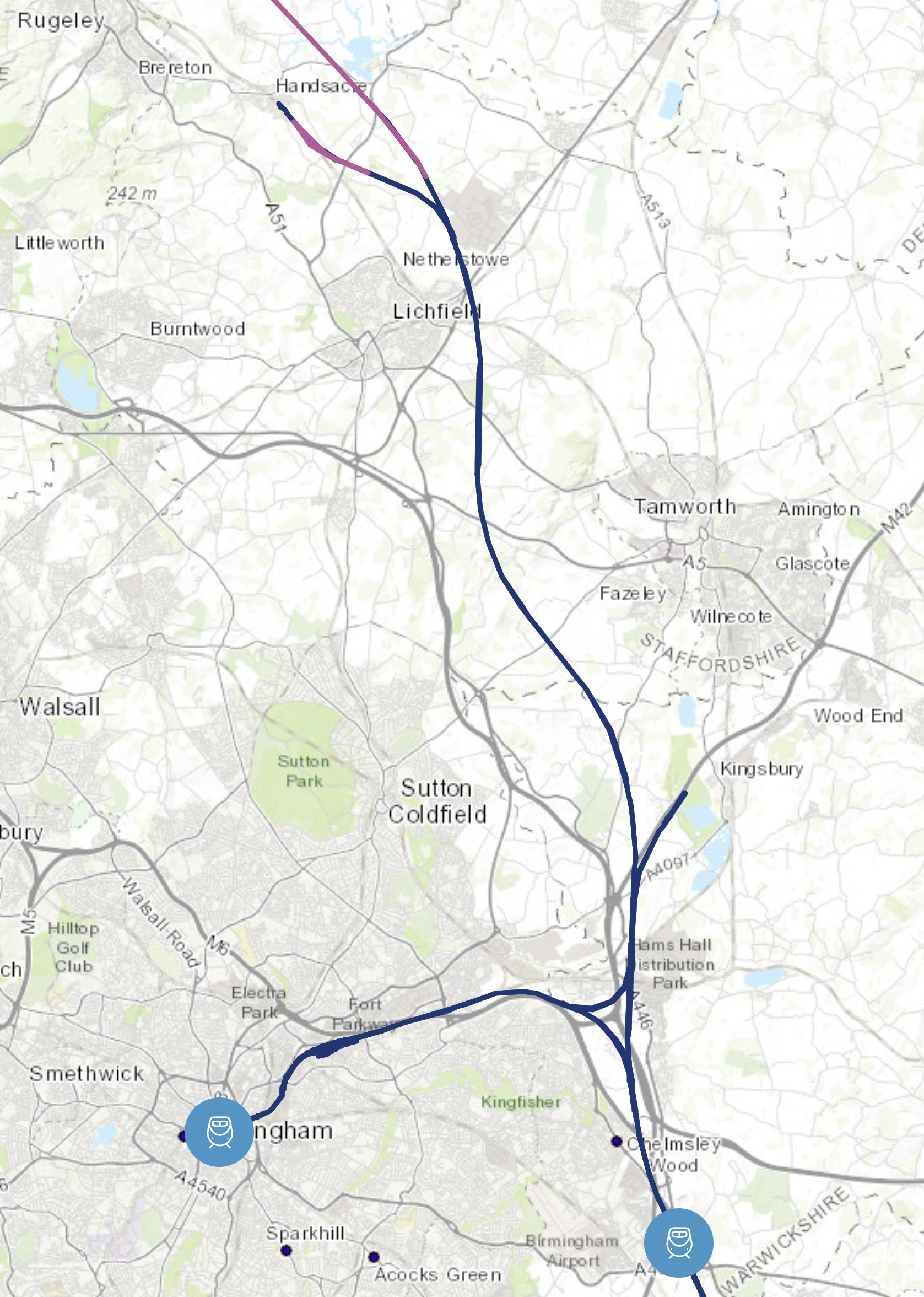
Note.
- The blue circle on the left at the bottom of the map is Birmingham Curzon Street station.
- The blue circle on the right at the bottom of the map is Birmingham Interchange station.
- The High Speed Two to and from London passes through Birmingham Interchange station.
- The branch to Birmingham Curzon Street station connects to the main High Speed Two at a triangular junction.
- North of the triangular junction, High Speed Two splits.
- The Eastern branch goes to East Midlands Parkway station.
- The Northern branch goes to Crewe, Liverpool Lime Street, Manchester Piccadilly, Preston and Scotland.
At the top of the map, the Northern branch splits and lines are shown on this map.

Note.
- The junction where the Northern and Eastern branches divide is in the South-East corner of the map.
- To the North of Lichfield, the route divides again.
- The Northern purple line is the direct line to Crewe.
- The shorter Southern branch is a spur that connects High Speed Two to the Trent Valley Line, which is the current route taken by trains between London Euston and Crewe, Liverpool Lime Street, Manchester Piccadilly, Preston and Scotland.
- Crewe station is in the North-West corner of the map.
The route between the junction to the North of Lichfield and Crewe is essentially two double-track railways.
- High Speed Two with a routine operating speed of 205 mph.
- The Trent Valley Line with a routine operating speed of 140 mph.
- High Speed Two Classic-Compatible trains can run on all tracks.
- High Speed Two Full-Size trains may be able to run on the Trent Valley Line at reduced speed.
- Eighteen trains per hour (tph) is the maximum frequency of High Speed Two.
I feel in an emergency, trains will be able to use the other route.
Will This Track Layout Allow An Innovative Build?
Suppose the link to the Trent Valley Line was built first, so that High Speed Two trains from London for Crewe, Liverpool Lime Street, Manchester Piccadilly, Preston and Scotland, could transfer to the Trent Valley Line as they do now.
- All lines used by High Speed Two services North of the junction, where High Speed Two joins the Trent Valley Line would be updated with digital signalling and 140 mph running. This will benefit current services on the line. For instance Euston and Liverpool/Manchester services could be under two hours.
- The current services would be replaced by High Speed Two services run by High Speed Two Classic-Compatible trains.
- The direct High Speed Two route between Lichfield and Crewe would now be built.
- When this section of High Speed Two is complete, High Speed Two services would use it between Lichfield and Crewe.
- As the direct route would be built later, this would delay the building of the Birmingham and Crewe high-speed route.
Currently, trains run the 41.8 miles between Lichfield and Crewe in 28 minutes, which is an average speed of 89.6 mph.
I can build a table of average speeds and times for Lichfield and Crewe.
- 100 mph – 25.1 minutes – 2.9 minutes saving
- 110 mph – 22.8 minutes – 5.2 minutes saving
- 120 mph – 20.9 minutes – 7.1 minutes saving
- 125 mph – 20.1 minutes – 7.9 minutes saving
- 130 mph – 19.3 minutes – 8.7 minutes saving
- 140 mph – 17.9 minutes – 10.1 minutes saving
- 160 mph – 15.7 minutes – 12.3 minutes saving
- 180 mph – 13.9 minutes – 14.1 minutes saving
- 200 mph – 12.5 minutes – 15.5 minutes saving
Note.
- Even a slight increase in average speed creates several minutes saving.
- Times apply for both routes.
I believe that a 125 mph average should be possible on the Trent Valley route, which may be enough for Euston and Liverpool/Manchester services to be under two hours.
Improving Classic Lines Used By High Speed Two North Of Lichfield
Real Time Trains shows these figures for a Glasgow Central to Euston service.
- Glasgow and Lichfield Trent Valley is 298.2 miles.
- Glasgow and Lichfield Trent Valley takes five hours.
This is an average speed of 59.6 mph.
Note.
- The average speed is low considering the trains are capable of cruising at 125 mph and 140 mph with digital signalling.
- High Speed Two services between Euston and Glasgow will use the classic network, to the North of Lichfield.
I can build a table of average speeds and times for Glasgow and Lichfield.
- 100 mph – 179 minutes – 121 minutes saving
- 110 mph – 163 minutes – 157 minutes saving
- 120 mph – 149 minutes – 151 minutes saving
- 125 mph – 143 minutes – 157 minutes saving
- 130 mph – 138 minutes – 162 minutes saving
- 140 mph – 128 minutes – 172 minutes saving
This table illustrates why it is important to improve all or as many as possible of classic lines used by High Speed Two to enable 140 mph running, with full digital signalling. Obviously, if 140 mph is not feasible, the speed should be increased to the highest possible.
Routes that could be updated include.
- London Euston and Glasgow Central
- London Euston and Liverpool Lime Street
- London Euston and Manchester Piccadilly (all routes)
- London Euston and Blackpool
- London Euston and Holyhead
- London Euston and Shrewsbury
Not all these routes will be served by High Speed Two, but they could be served by 140 mph trains.
What Times Would Be Possible?
The InterCity 225 was British Rail’s ultimate electric train and these two paragraphs from its Wikipedia entry, describe its performance.
The InterCity 225 was designed to achieve a peak service speed of 140 mph (225 km/h); during a test run in 1989 on Stoke Bank between Peterborough and Grantham, an InterCity 225 was recorded at a speed of 162 mph (260.7 km/h). Its high speed capabilities were again demonstrated via a 3hr 29mins non-stop run between London and Edinburgh on 26 September 1991. British regulations have since required in-cab signalling on any train running at speeds above 125 mph (201 km/h) preventing such speeds from being legally attained in regular service. Thus, except on High Speed 1, which is equipped with cab signalling, British signalling does not allow any train, including the InterCity 225, to exceed 125 mph (201 km/h) in regular service, due to the impracticality of correctly observing lineside signals at high speed.
The InterCity 225 has also operated on the West Coast Main Line (WCML). In April 1992, one trainset achieved a new speed record of two hours, eight minutes between Manchester and London Euston, shaving 11 minutes off the 1966 record. During 1993, trials were operated to Liverpool and Manchester in connection with the InterCity 250 project.
- The fastest London Euston and Manchester Piccadilly services appear to be two hours and six minutes tomorrow, with stops at Nuneaton and Stoke-on-Trent.
- The fastest London King’s Cross and Edinburgh service is four hours seventeen minutes tomorrow.
It does appear that British Rail’s 1980s-vintage InterCity 225 train did very well.
Trains that would be able to run at 140 mph with updated signalling include.
- Alstom Class 390
- Hitachi Class 800, 801, 802, 803, 805, 807 and 810
- British Rail InterCity 225
- High Speed Two Classic-Compatible.
All are electric trains.
Could High Speed Two, West Coast Main Line and East Coast Main Line Services Be Run By High Speed Two Classic-Compatible Trains?
I don’t see why not!
- They would be able to use short stretches of High Speed Line like Lichfield and Crewe.
- LNER and CrossCountry could also use the trains.
- High Speed Two is providing the framework and it’s there to be used, provided the paths are available.
This graphic shows the preliminary schedule.
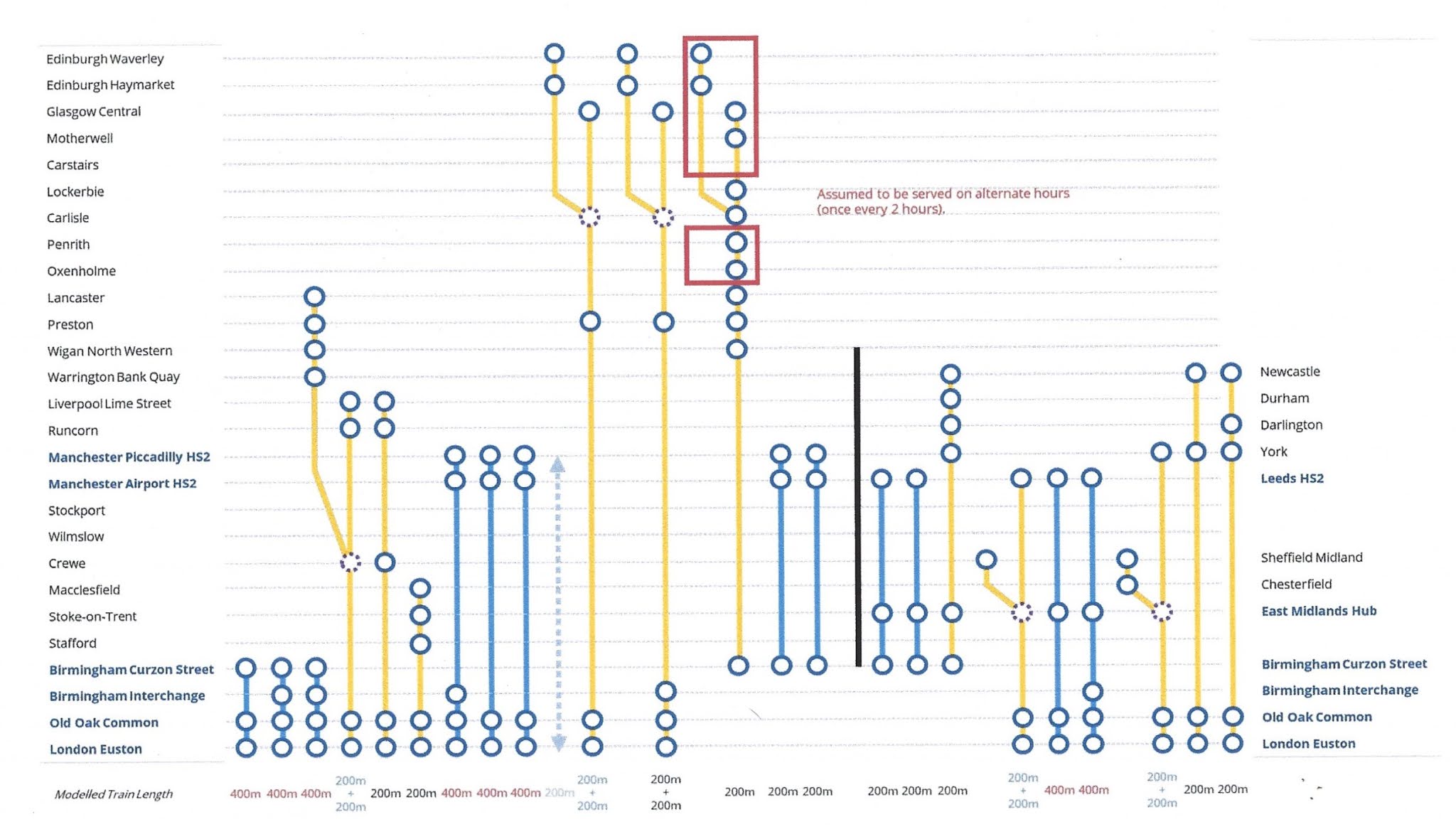
It only shows ten trains going through Crewe, so there could be up to eight spare high speed paths between Birmingham and Crewe.
Could High Speed Two Classic-Compatible Trains Be Used To Advantage On The East Coast Main Line?
I published this extract from the Wikipedia entry for the InterCity 225 earlier.
The InterCity 225 was designed to achieve a peak service speed of 140 mph (225 km/h); during a test run in 1989 on Stoke Bank between Peterborough and Grantham, an InterCity 225 was recorded at a speed of 162 mph (260.7 km/h). Its high speed capabilities were again demonstrated via a 3hr 29mins non-stop run between London and Edinburgh on 26 September 1991.
The London and Edinburgh run was at an average speed of around 112 mph.
I wonder what time, one of LNER’s Class 801 trains, that are all-electric could do, once the new digital signalling has been fully installed on the route? I suspect it would be close to three hours, but it would depend on how long the trains could run at 140 mph.
It should be noted that the Selby Diversion was designed for 160 mph, when it was built by British Rail in the 1980s.
In Are Short Lengths Of High Speed Line A Good Idea?, I look at the mathematics of putting in short lengths of new railway, which have higher speeds, where this was part of my conclusion.
I very much feel there is scope to create some new high speed sections on the current UK network, with only building very little outside of the current land used by the network.
I would love to know what some of Network Rail’s track experts feel is the fastest time possible between London and Edinburgh that can be achieved, by selective upgrading of the route.
If some of the trains were High Speed Two Classic-Compatible Trains, with a top speed of 205 mph, provided the track allowed it, there could be some interesting mathematics balancing the costs of track upgrades, new trains with what passengers and operators need in terms of journey times.
Could High Speed Two Classic-Compatible Trains Be Used To Advantage On The West Coast Main Line?
Much of what I said about the East Coast Main Line would apply to the West Coast Main Line.
But in addition, the West Coast Main Line will be a superb place to test the new High Speed Two Classic-Compatible Trains.
I believe, that before High Speed Two opens, we’ll see High Speed Two Classic-Compatible Trains, carrying passengers between Euston and Avanti West Coast’s destinations.
Could High Speed Two Be Split Into Two?
Consider.
- Under earlier plans, the East Coast Main Line to the North of York, will be used by High Speed Two.
- With digital signalling the East Coast Main Line will support continuous running at 140 mph for long sections of the route.
- The East Coast Main Line has a recently-rebuilt large Southern terminal at King’s Cross with eleven platforms and good suburban services and excellent connections to the London Underground.
- The East Coast Main Line has a very large Northern terminal at Edinburgh Waverley with twenty platforms and good local train connections.
- There are large intermediate stations on the East Coast Main Line at Doncaster, Leeds, Newcastle, Peterborough and York. All these stations have good local train connections.
- The East Coast Main Line has important branches to Cambridge, Harrogate, Huddersfield, Hull King’s Lynn, Lincoln, Middlesbrough, Nottingham, Scarborough, Sheffield, Skegness and Sunderland.
We are talking about an asset, that needs improving rather than sidelining.
Could High Speed Two Be A One-Nation Project?
Over three years ago, I wrote Could High Speed Two Be A One-Nation Project? and tried to answer the question in the title.
But now the core network is better defined, perhaps it is time to look at extending the High Speed network again.
The next few sections look at possible extensions.
Serving Chester And North Wales
I looked at this in Could High Speed Two Trains Serve Chester And North Wales?, which I have updated recently.
This was my conclusion.
It looks to me, that when High Speed Two, think about adding extra destinations, Chester and Holyhead could be on the list.
I also suspect that even without electrification and High Speed Two services, but with the new Class 805 trains, the route could be a valuable one for Avanti West Coast.
These are current and promised times for the two legs to Holyhead.
- Euston and Crewe – 90 minutes – Fastest Class 390 train
- Euston and Crewe – 55 minutes – High Speed Two Classic-Compatible train from Wikipedia
- Crewe and Holyhead – 131 minutes – Fastest Class 221 train
- Crewe and Holyhead – 70 minutes – 90 mph average speed
- Crewe and Holyhead – 63 minutes – 100 mph average speed
- Crewe and Holyhead – 57 minutes – 110 mph average speed
- Crewe and Holyhead – 53 minutes – 120 mph average speed
- Crewe and Holyhead – 45 minutes – 140 mph average speed
Note.
- I have assumed that Crewe and Holyhead is 105.5 miles.
- The operating speed of the North Wales Coast Line is 90 mph.
- In the following estimates, I have assumed a change of train at Crewe, takes 6 minutes.
I think there are several options to run fast services to Chester and North Wales.
Pre-HS2 – Class 805 all the way
I believe this train will match the following.
- The fastest Class 390 train between Euston and Crewe.
- The fastest Class 221 train between Crewe and Holyhead.
This would give a time of 3 hours 41 minutes.
Pre-HS2 – Class 805 all the way, but with perhaps less stops and some track improvement
I believe this train will match the following.
- The fastest Class 390 train between Euston and Crewe.
- 110 mph train Crewe and Holyhead.
This would give a time of 2 hours 27 minutes.
Pre-HS2 – Class 805 all the way, but with perhaps less stops and Crewe and Holyhead uprated largely to 125 mph
I believe this train will match the following.
- The fastest Class 390 train between Euston and Crewe.
- 120 mph train Crewe and Holyhead.
This would give a time of 2 hours 23 minutes.
Pre-HS2 – Class 805 all the way, but with perhaps less stops and Crewe and Holyhead Crewe and Holyhead electrified and uprated to 140 mph
I believe this train will match the following.
- The fastest Class 390 train between Euston and Crewe.
- 140 mph train Crewe and Holyhead.
This would give a time of 2 hours 15 minutes.
After-HS2 – High Speed Two Classic-Compatible train to Crewe, the Class 805 train to Holyhead
I believe this train will match the following.
- The fastest High Speed Two Classic-Compatible train between Euston and Crewe.
- The fastest Class 221 train between Crewe and Holyhead.
This would give a time of 3 hours 12 minutes.
After-HS2 – High Speed Two Classic-Compatible train to Crewe, the Class 805 train to Holyhead, but with perhaps less stops and some track improvement
I believe this train will match the following.
- The fastest High Speed Two Classic-Compatible train between Euston and Crewe.
- 110 mph train Crewe and Holyhead.
This would give a time of 1 hours 58 minutes.
After-HS2 – High Speed Two Classic-Compatible train to Crewe, the Class 805 train to Holyhead, but with perhaps less stops and Crewe and Holyhead uprated largely to 125 mph
I believe this train will match the following.
- The fastest High Speed Two Classic-Compatible train between Euston and Crewe.
- 120 mph train Crewe and Holyhead.
This would give a time of 1 hours 54 minutes.
After-HS2 – High Speed Two Classic-Compatible train to Crewe, Class 805 train to Holyhead, but with perhaps less stops and Crewe and Holyhead electrified and uprated to 140 mph
I believe this train will match the following.
- The fastest High Speed Two Classic-Compatible train between Euston and Crewe.
- 140 mph train Crewe and Holyhead.
This would give a time of 1 hours 46 minutes.
After-HS2 – High Speed Two Classic-Compatible train all the way, but with perhaps less stops and Crewe and Holyhead electrified and uprated to 140 mph
I believe this train will match the following.
- The fastest High Speed Two Classic-Compatible train between Euston and Crewe.
- 140 mph train Crewe and Holyhead.
This would give a time of 1 hours 40 minutes.
From these estimates, I have come to these conclusions.
- A sub-two and a half-hour service can be attained with the new Class 805 trains and some improvements to the tracks along the North Wales Coast Line.
- A sub-two hour service can be attained with a High Speed Two Classic-Compatible train to Crewe and a Class 805 train to Hplyhead along a 140 mph electrified North Wales Coast Line.
- If the North Wales Coast Line is electrified, the journey from London Euston, Birmingham Interchange, Crewe, Chester, Liverpool and Manchester would be zero-carbon.
We should be looking to building a zero-carbon fast passenger ferry for sailing between Holyhead and Dublin.
- The current fastest ferries appear to take three hours and 15 minutes, which means that a six-hour low-carbon journey between London Euston and Dublin, should be possible with the new Class 805 trains, prior to the opening of High Speed Two.
- A five-hour journey after the opening of High Speed Two to Crewe and electrification of the North Wales Coast Line should be possible.
If the advanced zero-carbon ferry could knock an hour off the journey, four hours between London and Dublin along a spectacular coastal railway with a fast sea voyage, would be a route that would attract passengers.
- High Speed Two would need to be opened to Crewe.
- The North Wales Coast Line would need to be upgraded to a 140 mph digitally-signalled line.
- The North Wales Coast Line would need to be electrified.
- Full electrification may not be needed, as discontinuous electrification will have advanced to provide zero-carbon running, in a more affordable and less disruptive manner.
- Trains could either be High Speed Two Classic-Compatible trains all the way from London or there could be a change at Crewe to Class 805 trains.
- The ferry would use the best zero-carbon and operational technology.
The improvement and electrification of the North Wales Coast Line could be planned to take place in a relaxed manner, so that journey times continuously got quicker.
I would start the improvement of the North Wales Coast Line, as soon as possible, as all these improvement will be used to advantage by the new Class 805 trains.
Serving West And South West England And South Wales
Suppose you want to go between Glasgow and Cardiff by train, after High Speed Two has opened.
- You will take one of the half-hourly High Speed Two Classic-Compatible trains between Glasgow Central and London.
- Three and a half-hours later, you will get off the train in one of the below ground platforms at Old Oak Common station.
- A short ride in an escalator or lift and you will be in the Great Western Railway station at ground level.
- From here, fifty minutes later, you will be in Cardiff.
The journey will have taken four hours and twenty minutes.
This may seem a long time but currently Glasgow and Cardiff by train takes over seven hours by train.
- Glasgow and Bristol Temple Meads takes eight hours, but using High Speed Two and GWR will take 5 hours.
- Glasgow and Cheltenham Spa takes six hours, but using High Speed Two and GWR will take 5 hours and 30 minutes.
- Glasgow and Penzance takes twelve hours, but using High Speed Two and GWR will take 8 hours and 33 minutes.
- Glasgow and Swansea takes nearly nine hours, but using High Speed Two and GWR will take 6 hours and 9 minutes.
The High Speed Two route only has one simple change, whereas some routes now have up to four changes.
Conclusion
West Coast Main Line Electro-Diesels On Test
The title of this post, is the same as that of this article on Railway Gazette.
This is the first paragraph.
The first two of 13 Hitachi Class 805 electro-diesel trainsets ordered for Avanti West Coast services are undergoing testing on the West Coast Main Line ahead of entry into service later this year.
These Class 805 trains will go to places like Chester, Bangor and Holyhead via Crewe.
It is interesting to look at various Crewe to London Euston services this morning.
- 0740 – Class 390 train – From Liverpool – One Stop – 1 hour 40 minutes
- 0755 – Class 221 train – From Holyhead – One Stop – 1 hour 40 minutes
- 0832 – Class 390 train – From Manchester – One Stop – 1 hour 37 minutes
- 0844 – Class 390 train – From Glasgow – 1 hour 28 minutes
Note.
- The first field is the four-figure time that the train left Crewe.
- The last field is the journey time between Crewe to London Euston.
- The Class 390 and 805 trains will use electricity to run between Crewe and London Euston, whereas the Class 221 train will use diesel.
- Crewe and London Euston is 158 miles.
- The Glasgow train covers the 158 miles at an average speed of 107.7 mph.
I have some thoughts.
What Will Be The Time For A Class 805 Train Between Crewe And London Euston?
Consider.
- From Crewe, the Class 805 train will be using the electrification to London Euston.
- The Class 390 train can tilt, whereas the Class 805 train can’t!
- The Class 805 train is at least three tonnes lighter per car, than the Class 390 train.
- The lighter weight and possibly more power of the Class 805 trains, will give better acceleration.
- There is twenty-one years of difference in the build dates of the two trains. In that time, I also suspect that Network Rail have improved the track between Crewe and London Euston.
- Norton Bridge junction has been improved to avoid conflicts.
- It would be very convenient for Avanti West Coast and Network Rail, if the performance under electrification of the two trains were similar.
For these reasons, I believe that the performance of a non-stop Crewe And London Euston service using a Class 805 train will be such that it can match that of a Class 390 train.
I would also expect that with a similar stopping pattern between Crewe And London Euston, there would be little to choose between the two trains.
I can see with its better acceleration and lighter weight that the time between Crewe and London Euston will be perhaps a dozen minutes faster than the current time.
Using the electrification will also save a lot of diesel fuel with all its emissions.
Along The North Wales Coast Line
Consider.
- Crewe and Holyhead is 105.5 miles and takes two hours and two minutes in a typical service.
- These figures give an average speed of 52 mph.
- There are six stops, which are scheduled to take a total of ten minutes.
- About half the North Wales Coast Line has a maximum operating speed of 90 mph, but through Chester, Llandudno Junction and West of Bangor, the operating speed is 75 mph or less.
I am fairly sure, that with both the current Class 221 trains and the new Class 805 trains, it will be the track, rather than the train that determines the average speed.
It would therefore appear that if the average speed can be raised by track improvements these time savings could be achieved.
- 60 mph – 105.5 mins – 16.5 mins
- 70 mph – 90 mins – 32.5 mins
- 80 mph – 79 mins – 43 mins
- 90 mph – 70 mins – 52 mins
- 100 mph – 63 mins – 59 mins
- 110 mph – 58 mins – 64 mins
- 120 mph – 53 mins – 69 mins
- 130 mph – 49 mins – 73 mins
- 140 mph – 45 mins – 77 mins
Note.
- The first column is the average speed.
- The second column is the time between Holyhead and Crewe.
- The third column is the saving.
- I suspect that 90 or 100 mph would be the highest possible practical average speed.
- Trains average 100 mph on several long sections of the Great Eastern Main Line.
- I put in the higher speeds to show what is possible, if the North Wales Coast Line were to be converted into a 140 mph electrified line with digital signalling.
Even at these relatively slow speeds compared to High Speed Two, there are considerable time savings to be made, just by improving the tracks.
Incidentally, High Speed Two is quoted in Wikipedia as aiming for a Crewe and London Euston time of 56 minutes, so by averaging 100 mph between Crewe and Holyhead, London Euston and Holyhead could be under two hours.
Batteries And Class 805 Trains
I wouldn’t be surprised that soon after the Class 805 trains are delivered, they could be converted to a version of Hitachi’s Intercity Tri-Mode Battery Train, the specification of which is shown in this Hitachi infographic.
Note.
- I suspect that the batteries will be used to handle regenerative braking on lines without electrification, which will save diesel fuel and carbon emissions.
- The trains accelerate faster, than those they replace.
- The claimed fuel and carbon saving is twenty percent.
- It is intended that these trains will be introduced in 2023.
But Hitachi have not given any predictions of the range of these trains on battery power alone.
However, they do claim a battery range of 56 miles for the Hitachi Regional Battery Train, which is based on similar technology.
These trains could help in speeding the stops between Crewe and Holyhead.
- Batteries would be charged at Holyhead and on the electrification to the South of Crewe.
- At each stop, trains would use a proportion of the power in the battery to accelerate faster and save fuel and cut emissions.
- Battery power would be used in stations for train hotel power.
- Westbound trains would arrive in Holyhead and Southbound trains would arrive in Crewe, with not much power in the battery.
I suspect that, whether diesel or battery power is used, will be controlled by a sophisticated computerised control system.
Electrification Along The North Wales Coast Line
I think this will eventually happen to allow High Speed Two Classic-Compatible trains to run to Chester and along the North Wales Coast Line to Llandudno, Bangor and Holyhead.
But there is no benefit to be gained in electrifying until higher speeds are possible, after track improvements.
I believe these times will be possible with track improvements and the opening of High Speed Two.
- Holyhead and Crewe – Class 805 train and 80 mph average – 79 mins
- Holyhead and Crewe – Class 805 train and 90 mph average – 70 mins
- Holyhead and Crewe – High Speed Two Classic-Compatible train, electrification and 100 mph average – 63 mins
- Crewe and London Euston – Class 805 train – 80 mins
- Crewe and London Euston – High Speed Two Classic-Compatible train – 56 mins
Note, electrification will be needed, to run High Speed Two Classic-Compatible trains along the North Wales Coast Line.
I am confident that these times will be possible.
- Holyhead and London Euston – Class 805 train and 90 mph average along the coast – 2 hours 30 mins
- Holyhead and London Euston – High Speed Two Classic-Compatible train and 100 mph average along the coast – 2 hours
The current time between Holyhead and London Euston is over three hours 45 minutes.
Conclusion
These trains will certainly speed up trains to North Wales.
Avanti West Coast Looks To Recover
The title of this post is the same as an article in the March 2022 Edition of Modern Railways.
These are some points from the article.
Passengers Numbers Are Recovering
This is a paragraph.
Mr. Wittingham says the recovery has been strongest on the Anglo-Scottish and Liverpool corridors, while Manchester have begun to bounce back. Slowest to recover is the London to West Midlands market; ‘there’s several operators here and we were the main carrier of business passengers, and that sector has been recovering more slowly than leisure’ says Mr. Whittingham.
Phil Whittingham is MD of Avanti West Coast.
Train Numbers Are Recovering
Avanti are building up train numbers from Euston after the pandemic.
Frequencies are as follows in trains per hour (tph)
- Pre-Covid – 9
- During the pandemic – 4
- From December 2021 – 7
- Omicron – 4
- From February 2022 – 6
- From May 2022 – 6+
Avanti have reacted to demand.
Three Classes Of Travel
This is a paragraph.
Avanti’s business has historically been driven by leisure travel – before Covid this accounted for broadly 60 % of passengers, with most of the rest travelling for business plus a smaller number of commuters. ‘The demand is there, and we think by next year we’ll be on the way to full recovery’ says Mr. Whittingham. ‘Leisure has been strong, especially at weekends, but the missing bit is the corporate market.’
Avanti have been running a marketing campaign and it appears to have been successful.
This paragraph describes Avanti’s new Standard Premium class.
Last year, Avanti West Coast launched a new class of travel – Standard Premium. This was first introduced in May on an upgrade-only basis before going fully live in September with the option to book online in advance. The new class sits between Standard and First, giving passengers larger seats and greater space but without some of the extras that come with First Class Travel such as complimentary refreshments and lounge access.
These are Mr. Whittingham’s comments on the three classes.
The current split of passengers is 84% Standard, 12 % First and 4 % Standard Premium, but given the latter has been in place for less than a year there is clearly scope for growth. ‘Our research shows people have been upgrading to Standard Premium rather than downgrading from First’.
I have yet to try Standard Premium, but I will next time I use Avanti.
Refreshments
Avanti have decided to serve different refreshments in Standard Premium and First classes.
- In Standard Premium, they are now offering At Seat Orders.
- In First, they have updated the menu.
Both seem to have been well-received.
I like this statement from Mr. Whittingham.
We’ve tried to make it a more personalised service with a less rigid structure, so we give customers what they want, when they want it, rather than when we want to give it to them.
A Consistent Offer
This is a paragraph.
Mr. Whittingham says Avanti has not yet confirmed whether t will offer three classes of travel on the new Hitachi trains it has ordered, but says the aim is to provide a more consistent offer. Assisting this will be changes in the ongoing Pendolino refurbishment, where 11-car sets are having Coach G converted from First to Standard accommodation, meaning all Pendolinos, whether nine-car or 11-car, will have three coaches for First and Standard Premium passengers.
My instinct says that the four trains will be something like.
- Class 390 train – Pendolino – Nine-car – three First/Standard Premium cars – six Standard cars
- Class 390 train – Pendolino – Eleven-car – three First/Standard Premium cars – eight Standard cars
- Class 805 train – Hitachi – Five-car – one First/Standard Premium car – four Standard cars
- Class 807 train – Hitachi – Seven-car – two First/Standard Premium car – five Standard cars
Note.
- The Class 805 and Class 807 Hitachi trains are very much plug-and-play and can be lengthened or shortened as required.
- A regular passenger between London and Liverpool, who regularly upgrades from Standard to Standard Premium in a Class 390 train could be a bit miffed if he couldn’t, because the service was being run by a Class 807 train.
- Hitachi would probably be very happy to add extra cars to the Class 805 and Class 807 trains.
As the Class 390 Pendolino trains are being refurbished, I do wonder if they will be receiving some fittings from the Hitachi trains to make sure the trains are consistent to both on-board staff and passengers.
Pendolino Investment
The Pendolino refurbishment is comprehensive.
- It is one of the largest such programmes ever undertaken in the UK.
- Leasing company; Angel Trains are funding the work.
- Alstom are doing the work at Widnes.
- There appears to be a smooth plan to refurbish all trains.
- Coach G will be converted from First to Standard accommodation in eleven-car trains.
- Mr. Whittingham says that all trains will come out looking like a new train.
The eleven-car trains are being converted first, as the conversion of Coach G gives a capacity benefit of around thirty seats.
The awful seats in Standard Class will be replaced with Lumo-style seats and laptop-friendly fold-down tables.




These seats will be a big improvement!
New Trains Coming
This paragraph introduces the new trains.
The second major fleet investment from Avanti is the £350 million for new trains from Hitachi, financed by Rock Rail. These comprise 13×5-car Class 805 bi-modes, ordered for destinations off the electrified route including North Wales and Shrewsbury and 10×7-car Class 807 electrics. Deployment plans for the latter are still being worked through but are likely to include services to Birmingham and Liverpool, and potentially to Blackpool.
What is not said in this paragraph, is that all trains have a redesigned front end, which I suspect is more aerodynamic.
The all-electric Class 807 trains have no diesel engines or batteries, so have they been put on a diet, to improve the acceleration?
In Will Avanti West Coast’s New Trains Be Able To Achieve London Euston and Liverpool Lime Street In Two Hours?, I came to these conclusions.
- A two hour service between London Euston and Liverpool Lime Street will be possible with Avanti West Coast’s new Class 807 trains.
- The current Class 390 trains could go a bit faster and if they cut out a couple of stops could probably break two hours.
I also calculated that a two tph service between London and Liverpool in two hours would need nine trains.
Timetable Changes
This paragraph introduces the article’s section on timetable changes.
The project in turn feeds into a major timetable change planned by Avanti and other West Coast main line operators. This will be the first significant change to West Coast main line schedules since 2008; ‘the world has changed, and we need to think about how we best serve our markets’ says Mr Whittingham.
This paragraph sums up the major changes.
Of note are the planned changes to the pattern of London to West Midlands services; the pre-Covid 20-minute interval would be amended to offer faster journey times and greater connectivity. Also featuring in the new timetable aspirations would be additional Trent Valley calls in some Liverpool and Manchester services; Mr Whittingham cites as one benefit of this the potential for improved journey times between the North West and the East Midlands via a change of train at Nuneaton. The Hitachi trains, with their better acceleration, will be particularly useful on services with more frequent stops.
The next three sections will look at some timetable changes in a bit more detail.
London And West Midlands Services
Replacement of twenty diesel Class 221 trains with thirteen bi-mode Class 805 trains will mean a major reorganisation of services to the West Midlands.
- Some current diesel services will now be electric.
- All services between Birmingham New Street and Euston will now be electric.
- No services will run on diesel under live electrification.
- Avanti have promised to serve Walsall.
- There will be extra services to Shrewsbury and other places.
The electric services will also speed up some services to the West Midlands.
North West And East Midlands Services
I will look at train times for services between the North West (Liverpool Lime Street and Manchester Piccadilly) and the East Midlands (Leicester, Nottingham and Lincoln), where passengers change at Nuneaton.
These are the current fastest possible times according to the National Rail journey planner.
- Liverpool Lime Street and Leicester -2:24 with changes at Crewe and Nuneaton,
- Manchester Piccadilly and Leicester – 2:11 with change at Sheffield
- Liverpool Lime Street and Nottingham – 2:42 with no changes
- Manchester Piccadilly and Nottingham – 1:51 with no changes
- Liverpool Lime Street and Lincoln- 3:42 with changes at Sheffield and Doncaster
- Manchester Piccadilly and Lincoln – 2:38 with change at Sheffield
Note that times are in hours:minutes.
These are all current times for the various legs if the route is via Nuneaton.
- Avanti West Coast – Liverpool Lime Street and Nuneaton – 1:18
- Avanti West Coast – Manchester Piccadilly and Nuneaton – 1:13
- CrossCountry – Nuneaton and Leicester – 0:27
- East Midlands Railway – Leicester and Nottingham – 0:48 – Time from Leicester and Lincoln service.
- East Midlands Railway – Leicester and Nottingham – 0:20 – Time from St. Pancras and Nottingham service.
- East Midlands Railway – Leicester and Lincoln -1:42 – Time from Leicester and Lincoln service.
- East Midlands Railway – Nottingham and Lincoln -0:52 – Time from Leicester and Lincoln service.
Note that the two Avanti West Coast times have been estimated by taking the time from Real Time Trains and adding three minutes for the acceleration or deceleration at Nuneaton.
These would be possible times between the North West and the East Midlands via Nuneaton.
- Liverpool Lime Street and Leicester – 1:47
- Manchester Piccadilly and Leicester – 1:42
- Liverpool Lime Street and Nottingham – 2:37
- Manchester Piccadilly and Nottingham – 2:32
- Liverpool Lime Street and Lincoln- 3:31
- Manchester Piccadilly and Lincoln – 3:26
Note that I am assuming changes at Nuneaton and Leicester are cross-platform or same platform changes that take two minutes.
But there is another level of improvement possible.
Suppose that East Midlands Railway’s Lincoln and Leicester service were to be extended to Nuneaton and run by a train with this specification.
- 125 mph operating speed.
- Battery-electric power.
- 100 mph operating speed on battery power.
- Range of 56 miles on battery
- Ability to use the Midland Main Line electrification, when it is erected.
Charging stations would be needed at Nuneaton and Lincoln.
These would be possible times between the North West and the East Midlands via Nuneaton with the one change at Nuneaton.
- Liverpool Lime Street and Leicester – 1:45
- Manchester Piccadilly and Leicester – 1:40
- Liverpool Lime Street and Nottingham – 2:05
- Manchester Piccadilly and Nottingham – 2:00
- Liverpool Lime Street and Lincoln- 2:57
- Manchester Piccadilly and Lincoln – 2:52
Note.
I am assuming that the timings for the Nuneaton and Leicester and the Nottingham and Lincoln legs are as for the current trains.
I am assuming the change at Nuneaton is a cross-platform or same platform change that takes two minutes.
Trains run on battery where tracks are not electrified.
I can build a table of current times, times via Nuneaton and savings.
- Liverpool Lime Street and Leicester -2:24 – 1:45 – 0:39
- Manchester Piccadilly and Leicester – 2:11 – 1:40 – 0.31
- Liverpool Lime Street and Nottingham – 2:42 – 2:05 – 0:37
- Manchester Piccadilly and Nottingham – 1:51 – 2:00 – 0.09 slower
- Liverpool Lime Street and Lincoln- 3:42 – 2:57 – 0.45
- Manchester Piccadilly and Lincoln – 2:38 – 2:52 – 0:14 slower
It does appear that by using the 125 mph speed of the West Coast Main Line has a positive effect on some times from the North West to the East Midlands.
But times could be reduced further.
- Installing full digital signalling, that would enable 140 mph running between Crewe and Nuneaton, could save ten minutes.
- Improving the Nuneaton and Leicester and the Nottingham and Lincoln legs could allow faster running.
The more I look at changing at Nuneaton, I feel it is a good idea.
- It improves the connections between East Midlands Parkway and Loughborough and the North West.
- It improves the connections between Cambridge, Peterborough and Stansted Airport and the North West, if the change at Nuneaton is to CrossCountry’s Stansted Airport and Birmingham New Street service.
- It improves the connections between Coventry and Leamington Spa and the North West.
Avanti have come up with a cunning plan, worthy of Baldrick at his best.
A Second Hourly Service Between London And Liverpool
A paragraph talks about the second hourly service between London and Liverpool.
Avanti still has ambitions to introduce a second hourly service between Euston and Liverpool, but when this will come in will depend on demand recovery.
Consider.
- If would be desirable if some or all trains running on the route could achieve a timing of two hours between London and Liverpool.
- It is felt that the second service should stop at Liverpool South Parkway station, where the platforms are too short for eleven-car Class 390 trains.
- Avanti have stated they would like more stops in the Trent Valley, especially at Nuneaton, where they would connect to services to the East Midlands.
- Nuneaton is almost exactly halfway between London and Liverpool.
- Running two tph with Class 807 trains would need nine trains and Avanti have only ordered ten in total.
I believe that a practical timetable like this could work.
- Class 390 train – one tph – Non-stop or perhaps a single stop in the Midlands – Under two hours
- Class 807 train – one tph – Stopping at Nuneaton, Stafford, Crewe, Runcorn and Liverpool South Parkway – Current time or better
An hourly service between London and Liverpool in under two hours would surely be a passenger magnet.
Reopening The Oswestry – Gobowen Line
On October 27th this Beeching Reversal Project was given £50,000 to build a case for reopening.
These are my thoughts.
Gobowen Station
Gobowen station appears to be a fine station.
- It is Grade II Listed.
- It has two platforms.
- It is on the Shrewsbury-Chester Line.
- Transport for Wales run trains to Birmingham New Street, Cardiff Central, Chester, Holyhead and Shrewsbury.
- Avanti West Coast will start running services to and from London Euston via Wrexham in December 2022.
Wikipedia says this about the future of the station.
Gobowen station may become the northern terminus of the proposed Cambrian Heritage Railways line to Llynclys, Pant and Blodwel via Oswestry. Shropshire Council was to acquire the coal yard at Gobowen for railway-related uses, including car parking for the station. If the plans are fully realised, the station would have three platforms, one of which would be for the Heritage Railway.
It does look as if, Shropshire Council have got the money for a full study.
This Google Map shows Gobowen station.

Note.
- The two tracks of the Chester-Shrewsbury Line each have a platform.
- Step-free access is by the level crossing, which is at the North end of the station.
- It looks like it would be space to convert the Northbound platform into an island platform, where the Western platform face would be for the heritage trains.
This second Google Map shows the tracks at the South end of Gobowen station.
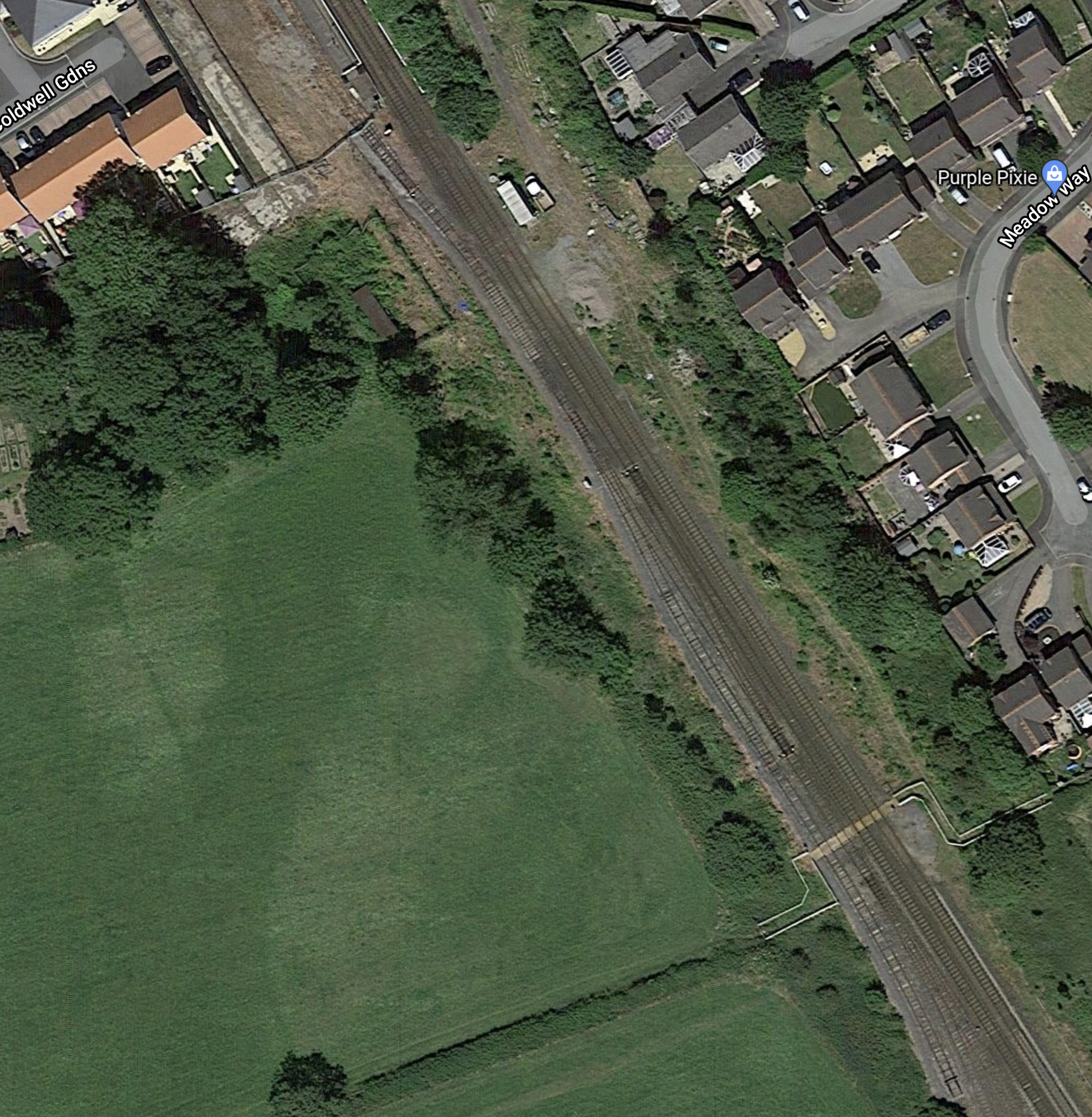
Note.
There is a set of points to allow trains to access a third platform at Gobowen station.
The single-track line to Oswestry branches off to the West at the bottom of the map.
It would appear that a bay platform at Gobowen station can be created to handle trains to Oswestry.
Oswestry Station
Oswestry station appears to be another fine station.
- It is also Grade II Listed.
- It has just a single platform.
- It appears to be owned by the local authority.
This Google Map shows the station.

Note.
- The station is the large building with the chimneys in the South-East corner of the map.
- The single platform is behind it.
- The platform is long enough to take a 1200 metre long train.
This station would make an ideal terminus.
The Track Between Oswestry And Gobowen
The track is single-track with a couple of foot crossings, so I don’t think it will need much to bring it up to a modern standard.
A Shuttle Service Between Oswestry And Gobowen
I suspect a two-car shuttle train between the two stations would suffice for most of the day.
Transport for Wales have some Class 230 trains and these would be ideal. They could even be battery-electric trains if a battery charging system were to be installed at one station.
Could Avanti West Coast Run A Service To London?
It looks like Avanti West Coast’s Class 805 trains could run along the line between Gobowen and Oswestry.
So could Avanti’s planned service to Gobowen terminate at Oswestry instead?
It would all depend on the passenger forecasts and actual numbers
Could Avanti West Coast Run A Battery-Electric Service To London?
Consider.
- Oswestry is a town of 17,500 people, so probably has a reasonable electricity supply, especially if it were to be backed up by a battery.
- The amount of renewable electricity produced over the border in Wales is only going to grow.
- There is plenty of space at Oswestry to put in a charging system to replace the batteries.
Distances are as follows.
- Crewe and Chester – 21.1 miles
- Chester and Gobowen – 24.6 miles
- Gobowen and Oswestry – 3.3 miles
This is a total distance of 49 miles.
Avanti West Coast have ordered thirteen bi-mode Class 805 trains, which will replace the diesel Class 221 trains currently working between London Euston and Chester. Holyhead and Shrewsbury.
- They will run at 125 mph between Euston and Crewe using electric power.
- If full in-cab digital signalling were to be installed on the electrified portion of the route, they may be able to run at 140 mph in places under the wires.
- They will use diesel power on the North Wales Coast Line to reach places like Chester, Holyhead and Wrexham.
- According to an article in Modern Railways, the Class 805 trains could be fitted with batteries.
I wouldn’t be surprised that when they are delivered, they are a version of the Hitachi’s Intercity Tri-Mode Battery Train, the specification of which is shown in this Hitachi infographic.
Note.
- I suspect that the batteries will be used to handle regenerative braking on lines without electrification, which will save diesel fuel and carbon emissions.
- The trains accelerate faster, than those they replace.
- The claimed fuel and carbon saving is twenty percent.
- It is intended that these trains will be introduced next year.
But Hitachi have not given any predictions of the range of these trains on battery power alone.
However, they do claim a battery range of 56 miles for the Hitachi Regional Battery Train, which is based on similar technology.
I believe it would be possible to run a zero-carbon London Euston and Oswestry service.
- The trains would be Class 805 trains fitted with batteries.
- Trains could stop at Milton Keynes Central, Lichfield Trent Valley, Stafford, Crewe, Chester, Wrexham General and Gobowen.
- Trains would use electrification between London Euston and Crewe.
- Trains would recharge their batteries South of Crewe and at Oswestry.
I doubt that a battery-electric zero-carbon train serving Cheshire, Shropshire and North-East Wales would have a negative effect on the area.
Just as Hull and Lincoln seem to be moving towards a frequency of one train per two hours from London, I wonder if this service could ever attain the same frequency.
Onward From Oswestry
Cambrian Heritage Railways are planning to run services past Oswestry on their heritage railway.
Will this be a good idea?
Where Now For First Group?
First Group are a shareholder in Avanti West Coast.
They also own Lumo, who last week launched their open-access service between London and Edinburgh. Their marketing is all about being green and sustainable.
I just wonder if a battery-electric service to Gobowen is successful, they will apply this model all over the group.
Hull Trains service between London and Hull is an obvious possibility for a battery-electric zero-carbon service.
Conclusion
It looks to me, that reopening of the Oswestry – Gobowen Line opens up other possibilities.
Through Settle And Carlisle Service Under Consideration
The title of this post, is the same as that of an article in the June 2021 Edition of Modern Railways.
This is the first paragraph.
Plans for a new Leeds to Glasgow through service via the Settle and Carlisle line are being developed, with CrossCountry and the Department for Transport starting to look at the possible scheme.
It sounds like a sensible idea to me.
The article also suggests the following.
- CrossCountry is a possible operator.
- CrossCountry are keen to improve services between Leeds and Glasgow
- The trains could be InterCity 125s, freed up, by a the arrival of Class 221 trains from Avanti West Coast, when they receive their new Class 805 trains.
- Maintenance of the trains wouldn’t be a problem, as this could be done at Neville Hill in Leeds or Craigentinny in Edinburgh.
- Services could start in December 2023.
I have a few thoughts of my own!
The Route
The route between Leeds and Carlisle is obvious, but there are two routes between Carlisle and Glasgow.
Trains would probably choose a route and call at stations to maximise passenger numbers.
These stations are on the various routes.
- Settle and Carlisle – Shipley, Bingley, Keighley, Skipton, Gargrave, Hellifield, Long Preston, Settle, Horton in Ribblesdale, Ribblehead, Dent, Garsdale, Kirkby Stephen, Appleby, Langwathby, Lazonby & Kirkoswald and Armathwaite
- Glasgow South Western – Dunlop, Stewarton, Kilmaurs, Kilmarnock, Auchinleck, New Cumnock, Kirkconnel, Sanquhar, Dumfries, Annan and Gretna Green
- West Coast Main – Motherwell, Carstairs and Lockerbie
There are certainly a lot of possibilities.
Upgrading The InterCity 125 Trains
CrossCountry appear to have enough InterCity 125 trains to muster five in a two Class 43 power car and seven Mark 3 coach formation.
They may not be fully in-line with the latest regulations and there may be a need for a certain degree of refurbishment.


These pictures show some details of a refurbished Great Western Railway Castle, which has been fitted with sliding doors.
Will The InterCity 125 Trains Be Shortened?
Scotrail’s Inter7City trains and Great Western Railway’s Castle trains have all been shortened to four or five coaches.
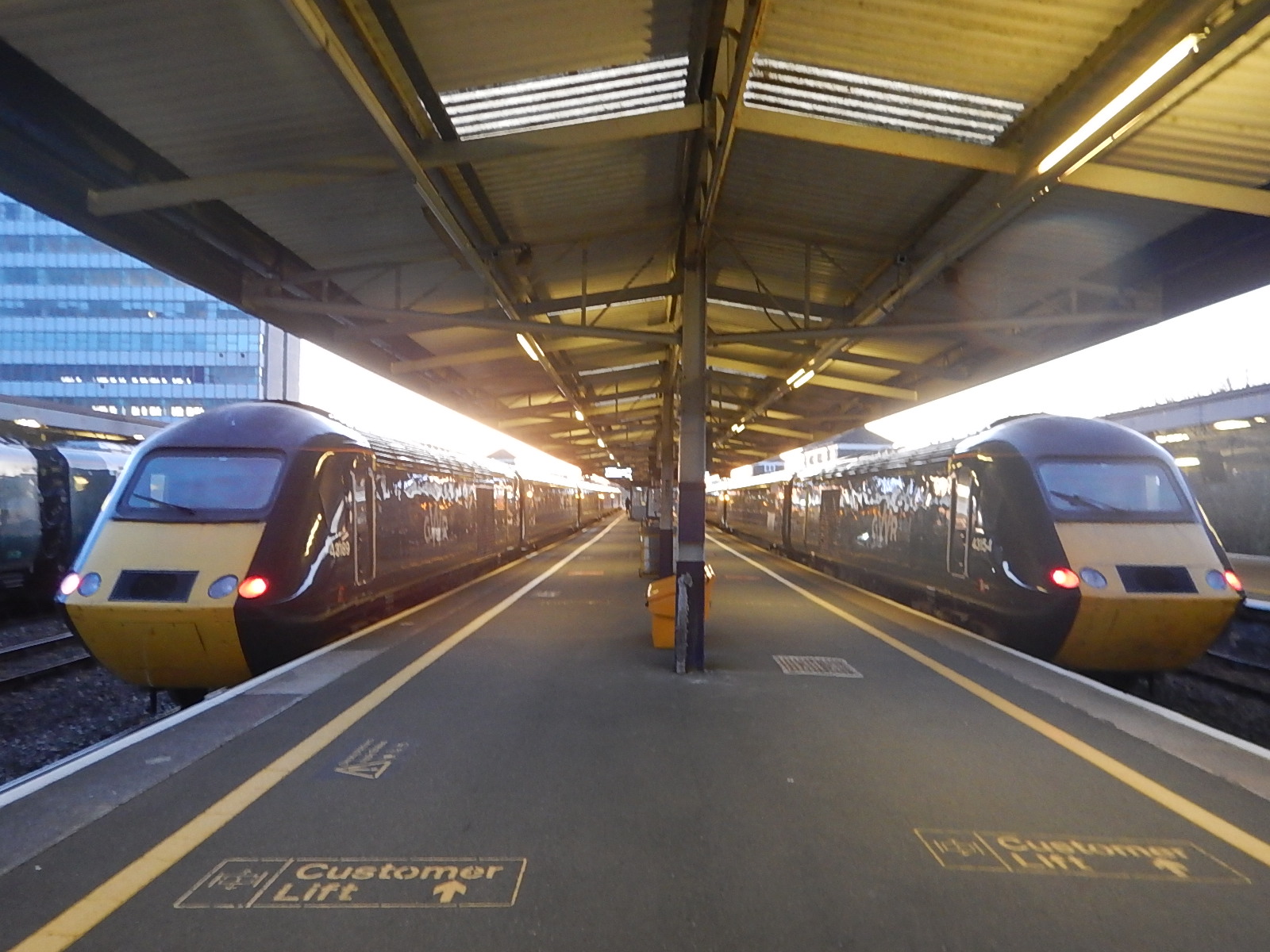
This picture shows a pair of Castles.
Journey Times, Timetable And Frequency
The current journey time between Leeds and Glasgow Central stations via the East Coast Main Line is four hours and eight minutes with nine stops.
The Modern Railways article says this about the current service.
The new service would be targeted at business and leisure travellers, with through journey times competitive with road and faster than the current direct CrossCountry Leeds to Glasgow services via the East Coast main line.
I would expect that CrossCountry are looking for a time of around four hours including the turn round.
- Stops could be removed to achieve the timing.
- The trains could run at 125 mph on the West Coast Main Line.
This could enable a train to have the following diagram.
- 0800 – Depart Leeds
- 1200 – Depart Glasgow Central
- 1600 – Depart Leeds
- 2000 – Depart Glasgow Central
- Before 2400 – Arrive Leeds
Note.
- A second train could start in Glasgow and perform the mirrored timetable.
- Timings would probably be ideal for train catering.
- Trains would leave both termini at 0800, 1200, 1600 and 2000.
- The timetable would need just two trains.
I also think, if a second pair of trains were to be worked into the timetable, there could be one train every two hours on the route, if the demand was there.
I certainly believe there could be a timetable, that would meet the objectives of attracting business and leisure passengers away from the roads.
Tourism And Leisure Potential
The Settle and Carlisle Line is known as one of the most scenic railway lines in England, if not the whole of the UK.
There are important tourist sites all along the route between Leeds and Glasgow
- Leeds – The station is well-connected in the City Centre.
- Saltaire – For the World Heritage Site and Salt’s Mill
- Keighley – For the Keighley and Worth Heritage Railway
- Settle – The town of Settle is worth a visit.
- Ribblehead – For the famous Ribblehead Viaduct
- Appleby – For the Horse Fair.
- Carlisle – The station is well-connected in the City Centre.
- Glasgow – Glasgow Central station is well-connected in the City Centre.
Many of the stations are used by walkers and others interested in country pursuits.
I believe that it is a route that needs a quality rail service.
Travel Between London and Towns Along The Settle And Carlisle Line
In Thoughts On Digital Signalling On The East Coast Main Line, I said this.
I think it is highly likely that in the future, there will be at least one train per hour (tph) between London Kings Cross and Leeds, that does the trip in two hours.
It may seem fast compared to today, but I do believe it is possible.
With a timely connection at Leeds station, will this encourage passengers to places along the Settle and Carlisle line to use the train?
What About the Carbon Emissions?
The one problem with using InterCity 125 trains on this route, is that they are diesel-powered, using a pair of Class 43 locomotives.
But then there are over a hundred of these diesel-electric locomotives in service, nearly all of which are now powered by modern MTU diesel engines, which were fitted in the first decade of this century.
Consider.
- The locomotives and the coaches they haul have an iconic status.
- Great Western Railway and Scotrail have recently developed shorter versions of the trains for important routes.
- There are over a hundred of the locomotives in service.
- Companies like ULEMCo are developing technology to create diesel-powered vehicles that can run on diesel or hydrogen.
- There is plenty of space in the back of the locomotives for extra equipment.
- MTU have a very large number of diesel engines in service. It must be in the company’s interest to find an easy way to cut carbon emissions.
- I believe that the modern MTU diesel engines could run on biodiesel to reduce their carbon footprint.
And we shouldn’t forget JCB’s technology, which I wrote about in JCB Finds Cheap Way To Run Digger Using Hydrogen.
If they could develop a 2 MW hydrogen engine, it could be a shoe-in.
I believe that for these and other reasons, a solution will be found to reduce the carbon emissions of these locomotives to acceptable levels.
Conclusion
In this quick look, it appears to me that a Glasgow and Leeds service using InterCity 125 trains could be a very good idea.
High-Speed Low-Carbon Transport Between Great Britain And Ireland
Consider.
- According to Statista, there were 13,160,000 passengers between the United Kingdom and the Irish Republic in 2019.
- In 2019, Dublin Airport handled 32,907,673 passengers.
- The six busiest routes from Dublin were Heathrow, Stansted, Amsterdam, Manchester, Birmingham and Stansted.
- In 2018, Belfast International Airport handled 6,269,025 passengers.
- The four busiest routes from Belfast International Airport were Stansted, Gatwick. Liverpool and Manchester, with the busiest route to Europe to Alicante.
- In 2018, Belfast City Airport handled 2,445,529 passengers.
- The four busiest routes from Belfast City Airport were Heathrow, Manchester, Birmingham and London City.
Note.
- The busiest routes at each airport are shown in descending order.
- There is a lot of air passengers between the two islands.
- Much of the traffic is geared towards London’s four main airports.
- Manchester and Liverpool get their fair share.
Decarbonisation of the air routes between the two islands will not be a trivial operation.
But technology is on the side of decarbonisation.
Class 805 Trains
Avanti West Coast have ordered thirteen bi-mode Class 805 trains, which will replace the diesel Class 221 trains currently working between London Euston and Holyhead.
- They will run at 125 mph between Euston and Crewe using electric power.
- If full in-cab digital signalling were to be installed on the electrified portion of the route, they may be able to run at 140 mph in places under the wires.
- They will use diesel power on the North Wales Coast Line to reach Holyhead.
- According to an article in Modern Railways, the Class 805 trains could be fitted with batteries.
I wouldn’t be surprised that when they are delivered, they are a version of the Hitachi’s Intercity Tri-Mode Battery Train, the specification of which is shown in this Hitachi infographic.
Note.
- I suspect that the batteries will be used to handle regenerative braking on lines without electrification, which will save diesel fuel and carbon emissions.
- The trains accelerate faster, than those they replace.
- The claimed fuel and carbon saving is twenty percent.
It is intended that these trains will be introduced next year.
I believe that, these trains will speed up services between London Euston and Holyhead.
- Currently, services take just over three-and-a-half hours.
- There should be time savings on the electrification between London Euston and Crewe.
- The operating speed on the North Wales Coast Line is 90 mph. This might be increased in sections.
- Some extra electrification could be added, between say Crewe and Chester and possibly through Llandudno Junction.
- I estimate that on the full journey, the trains could reduce emissions by up to sixty percent compared to the current diesel trains.
I think that a time of three hours could be achievable with the Class 805 trains.
New trains and a three hour journey time should attract more passengers to the route.
Holyhead
In Holyhead Hydrogen Hub Planned For Wales, I wrote about how the Port of Holyhead was becoming a hydrogen hub, in common with several other ports around the UK including Felixstowe, Harwich, Liverpool and Portsmouth.
Holyhead and the others could host zero-carbon hydrogen-powered ferries.
But this extract from the Wikipedia hints at work needed to be done to create a fast interchange between trains and ferries.
There is access to the port via a building shared with Holyhead railway station, which is served by the North Wales Coast Line to Chester and London Euston. The walk between trains and ferry check in is less than two minutes, but longer from the remote platform 1, used by Avanti West Coast services.
This Google Map shows the Port of Holyhead.

I think there is a lot of potential to create an excellent interchange.
HSC Francisco
I am using the high-speed craft Francisco as an example of the way these ships are progressing.
- Power comes from two gas-turbine engines, that run on liquified natural gas.
- It can carry 1024 passengers and 150 cars.
- It has a top speed of 58 knots or 67 mph. Not bad for a ship with a tonnage of over 7000.
This ship is in service between Buenos Aires and Montevideo.
Note.
- A craft like this could be designed to run on zero-carbon liquid hydrogen or liquid ammonia.
- A high speed craft already runs between Dublin and Holyhead taking one hour and forty-nine minutes for the sixty-seven miles.
Other routes for a specially designed high speed craft might be.
- Barrow and Belfast – 113 miles
- Heysham and Belfast – 127 miles
- Holyhead and Belfast – 103 miles
- Liverpool and Belfast – 145 miles
- Stranraer and Larne – 31 miles
Belfast looks a bit far from England, but Holyhead and Belfast could be a possibility.
London And Dublin Via Holyhead
I believe this route is definitely a possibility.
- In a few years, with a few improvements on the route, I suspect that London Euston and Holyhead could be fairly close to three hours.
- With faster bi-mode trains, Manchester Airport and Holyhead would be under three hours.
- I would estimate, that a high speed craft built for the route could be under two hours between Holyhead and Dublin.
It certainly looks like London Euston and Dublin and Manchester Airport and Dublin would be under five hours.
In A Glimpse Of 2035, I imagined what it would be like to be on the first train between London and Dublin via the proposed fixed link between Scotland and Northern Ireland.
- I felt that five-and-a-half hours was achievable for that journey.
- The journey would have used High Speed Two to Wigan North Western.
- I also stated that with improvements, London and Belfast could be three hours and Dublin would be an hour more.
So five hours between London Euston and Dublin using current technology without massive improvements and new lines could be small change well spent.
London And Belfast Via Holyhead
At 103 miles the ferry leg may be too long for even the fastest of the high speed craft, but if say the craft could do Holyhead and Belfast in two-and-a-half hours, it might just be a viable route.
- It might also be possible to run the ferries to a harbour like Warrenpoint, which would be eighty-six miles.
- An estimate based on the current high speed craft to Dublin, indicates a time of around two hours and twenty minutes.
It could be viable, if there was a fast connection between Warrenpoint and Belfast.
Conclusion
Once the new trains are running between London Euston and Holyhead, I would expect that an Irish entrepreneur will be looking to develop a fast train and ferry service between England and Wales, and the island of Ireland.
It could be sold, as the Greenest Way To Ireland.
Class 807 Trains
Avanti West Coast have ordered ten electric Class 807 trains, which will replace some of the diesel Class 221 trains.
- They will run at 125 mph between Euston and Liverpool on the fully-electrified route.
- If full in-cab digital signalling were to be installed on the route, they may be able to run at 140 mph in places.
- These trains appear to be the first of the second generation of Hitachi trains and they seem to be built for speed and a sparking performance,
- These trains will run at a frequency of two trains per hour (tph) between London and Liverpool Lime Street.
- Alternate trains will stop at Liverpool South Parkway station.
In Will Avanti West Coast’s New Trains Be Able To Achieve London Euston and Liverpool Lime Street In Two Hours?, I came to the conclusion, that a two-hour journey time was possible, when the new Class 807 trains have entered service.
London And Belfast Via Liverpool And A Ferry
Consider.
- An hour on the train to and from London will be saved compared to Holyhead.
- The ferry terminal is in Birkenhead on the other side of the Mersey and change between Lime Street station and the ferry could take much longer than at Holyhead.
- Birkenhead and Belfast is twice the distance of Holyhead and Dublin, so even a high speed craft would take three hours.
This Google Map shows the Ferry Terminal and the Birkenhead waterfront.
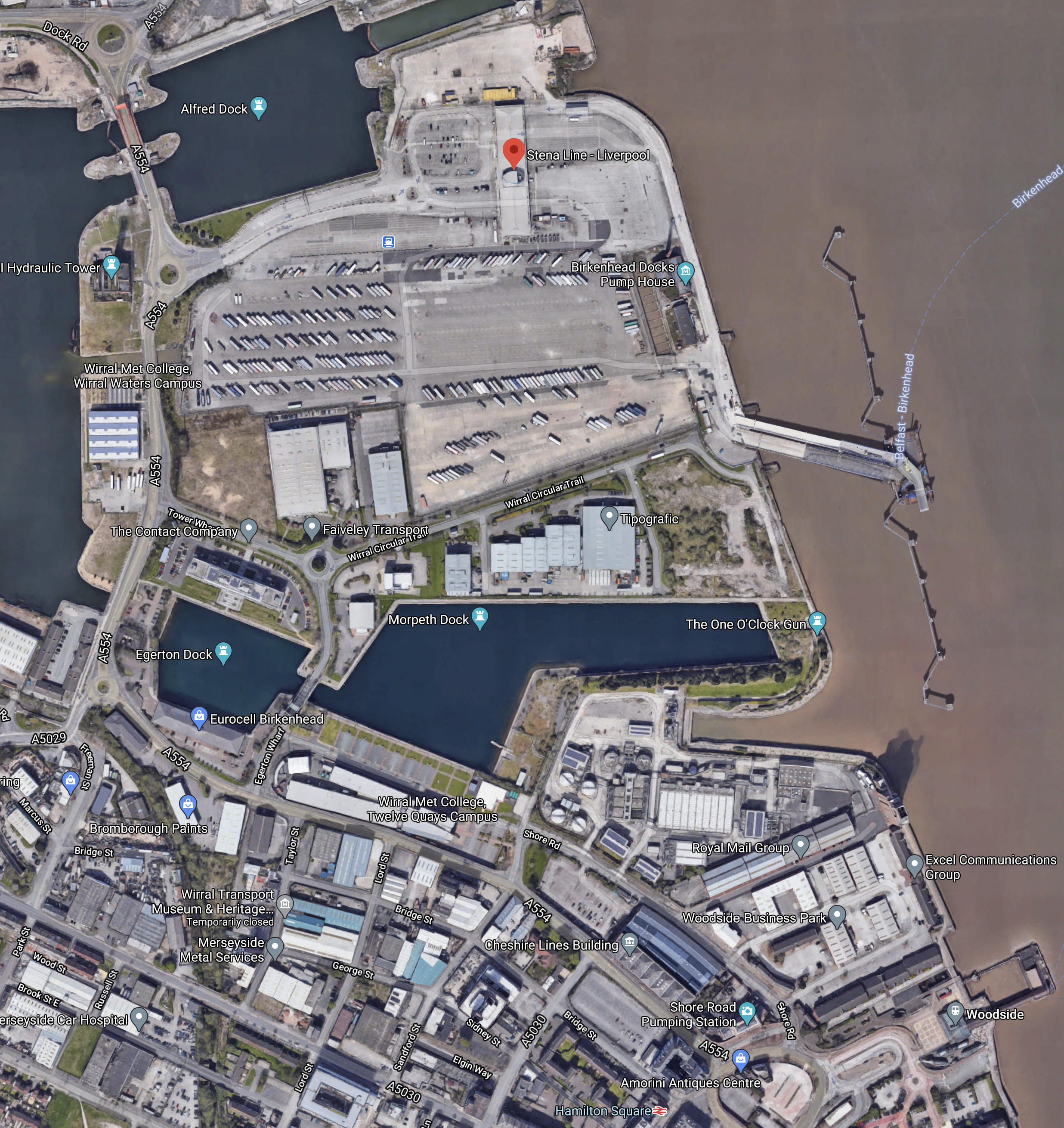
Note.
- The Ferry Terminal is indicated by the red arrow at the top of the map.
- There are rows of trucks waiting for the ferries.
- In the South East corner of the map, the terminal of the Mersey Ferry sticks out into the River
- Hamilton Square station is in-line with the Mersey Ferry at the bottom of the map and indicated with the usual red symbol.
- There is a courtesy bus from Hamilton Square station to the Ferry Terminal for Ireland.
There is a fourteen tph service between Hamilton Square and Liverpool Lime Street station.
This route may be possible, but the interchange could be slow and the ferry leg is challenging.
I don’t think the route would be viable unless a much faster ferry is developed. Does the military have some high speed craft under development?
Conclusion
London and Belfast via Liverpool and a ferry is probably a trip for enthusiasts or those needing to spend a day in Liverpool en route.
Other Ferry Routes
There are other ferry routes.
Heysham And Barrow-in-Furness
,These two ports might be possible, but neither has a good rail connection to London and the South of England.
They are both rail connected, but not to the standard of the connections at Holyhead and Liverpool.
Cairnryan
The Cairnryan route could probably be improved to be an excellent low-carbon route to Glasgow and Central Scotland.
Low-Carbon Flight Between The Islands Of Great Britain And Ireland
I think we’ll gradually see a progression to zero-carbon flight over the next few years.
Sustainable Aviation Fuel
Obviously zero-carbon would be better, but until zero-carbon aircraft are developed, there is always sustainable aviation fuel.
This can be produced from various carbon sources like biowaste or even household rubbish and disposable nappies.
British Airways are involved in a project called Altalto.
- Altalto are building a plant at Immingham to turn household rubbish into sustainable aviation fuel.
- This fuel can be used in jet airliners with very little modification of the aircraft.
I wrote about Altalto in Grant Shapps Announcement On Friday.
Smaller Low-Carbon Airliners
The first low- and zero-carbon airliners to be developed will be smaller with less range, than Boeing 737s and Airbus A 320s. These three are examples of four under development.
- Aura Aero Era – 19 passengers – 500 miles
- Eviation Alice – 9 passengers – 620 miles
- Faradair Aerospace BEHA – 19 passengers – 1150 miles
- Heart Aerospace ES-19 – 19 passengers – 400 km.
I feel that a nineteen seater aircraft with a range of 500 miles will be the first specially designed low- or zero-carbon airliner to be developed.
I believe these aircraft will offer advantages.
- Some routes will only need refuelling at one end.
- Lower noise and pollution.
- Some will have the ability to work from short runways.
- Some will be hybrid electric running on sustainable aviation fuel.
They may enable passenger services to some smaller airports.
Air Routes Between The Islands Of Great Britain And Ireland
These are distances from Belfast City Airport.
- Aberdeen – 228 miles
- Amsterdam – 557 miles
- Birmingham – 226 miles
- Blackpool – 128 miles
- Cardiff – 246 miles
- Edinburgh – 135 miles
- Gatwick – 337 miles
- Glasgow – 103 miles
- Heathrow – 312 miles
- Jersey – 406 miles
- Kirkwall – 320 miles
- Leeds – 177 miles
- Liverpool – 151 miles
- London City – 326 miles
- Manchester – 170 miles
- Newcastle – 168 miles
- Southampton – 315 miles
- Southend – 344 miles
- Stansted – 292 miles
- Sumburgh – 401 miles
Note.
- Some airports on this list do not currently have flights from Belfast City Airport.
- I have included Amsterdam for comparison.
- Distances to Belfast International Airport, which is a few miles to the West of Belfast City Airport are within a few miles of these distances.
It would appear that much of Great Britain is within 500 miles of Belfast City Airport.
These are distances from Dublin Airport.
- Aberdeen – 305 miles
- Amsterdam – 465 miles
- Birmingham – 199 miles
- Blackpool – 133 miles
- Cardiff – 185 miles
- Edinburgh – 208 miles
- Gatwick – 300 miles
- Heathrow – 278 miles
- Jersey – 339 miles
- Kirkwall – 402 miles
- Leeds – 190 miles
- Liverpool – 140 miles
- London City – 296 miles
- Manchester – 163 miles
- Newcastle – 214 miles
- Southampton – 268 miles
- Southend – 319 miles
- Stansted – 315 miles
- Sumburgh – 483 miles
Note.
- Some airports on this list do not currently have flights from Dublin Airport.
- I have included Amsterdam for comparison.
It would appear that much of Great Britain is within 500 miles of Dublin Airport.
I will add a few long routes, that someone might want to fly.
- Cork and Aberdeen – 447 miles
- Derry and Manston – 435 miles
- Manston and Glasgow – 392 miles
- Newquay and Aberdeen – 480 miles
- Norwich and Stornaway – 486 miles.
I doubt there are many possible air services in the UK and Ireland that are longer than 500 miles.
I have a few general thoughts about low- and zero-carbon air services in and around the islands of Great Britain and Ireland.
- The likely five hundred mile range of the first generation of low- and zero-carbon airliners fits the size of the these islands well.
- These aircraft seem to have a cruising speed of between 200 and 250 mph, so flight times will not be unduly long.
- Airports would need to have extra facilities to refuel or recharge these airliners.
- Because of their size, there will need to be more flights on busy routes.
- Routes which are less heavily used may well be developed, as low- or zero-carbon could be good for marketing the route.
I suspect they could be ideal for the development of new routes and even new eco-friendly airports.
Conclusion
I have come to the conclusion, that smaller low- or zero-carbon are a good fit for the islands of Great Britain and Ireland.
But then Flybe and Loganair have shown that you can make money flying smaller planes around these islands with the right planes, airports, strategy and management.
Hydrogen-Powered Planes From Airbus
Hydrogen-powered zero-carbon aircraft could be the future and Airbus have put down a marker as to the way they are thinking.
Airbus have proposed three different ZEROe designs, which are shown in this infographic.

The turboprop and the turbofan will be the type of designs, that could be used around Great Britain and Ireland.
The ZEROe Turboprop
This is Airbus’s summary of the design for the ZEROe Turboprop.
Two hybrid hydrogen turboprop engines, which drive the six bladed propellers, provide thrust. The liquid hydrogen storage and distribution system is located behind the rear pressure bulkhead.
This screen capture taken from the video, shows the plane.
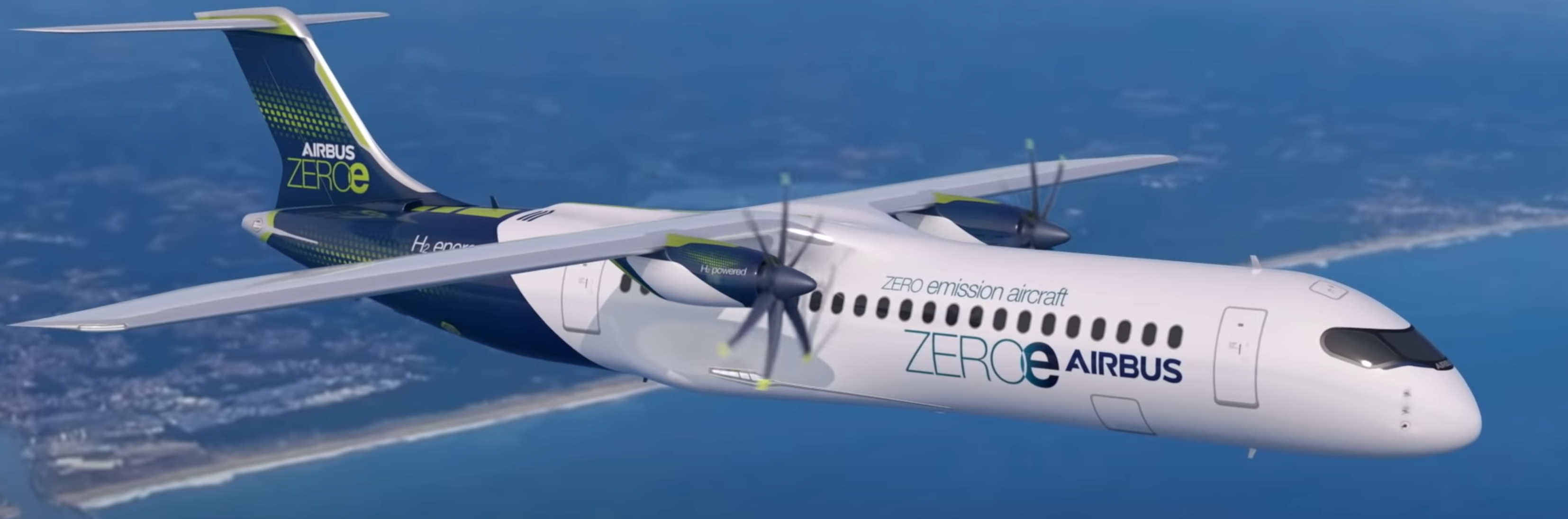
It certainly is a layout that has been used successfully, by many conventionally-powered aircraft in the past. The De Havilland Canada Dash 8 and ATR 72 are still in production.
I don’t think the turboprop engines, that run on hydrogen will be a problem.
If you look at the Lockheed-Martin C 130J Super Hercules, you will see it is powered by four Rolls-Royce AE 2100D3 turboprop engines, that drive 6-bladed Dowty R391 composite constant-speed fully-feathering reversible-pitch propellers.
These Rolls-Royce engines are a development of an Allison design, but they also form the heart of Rolls-Royce’s 2.5 MW Generator, that I wrote about in Our Sustainability Journey. The generator was developed for use in Airbus’s electric flight research program.
I wouldn’t be surprised to find the following.
- , The propulsion system for this aircraft is under test with hydrogen at Derby and Toulouse.
- Dowty are testing propellers suitable for the aircraft.
- Serious research is ongoing to store enough liquid hydrogen in a small tank that fits the design.
Why develop something new, when Rolls-Royce, Dowty and Lockheed have done all the basic design and testing?
This screen capture taken from the video, shows the front view of the plane.

From clues in the picture, I estimate that the fuselage diameter is around four metres. Which is not surprising, as the Airbus A320 has a height of 4.14 metres and a with of 3.95 metres. But it’s certainly larger than the fuselage of an ATR-72.
So is the ZEROe Turboprop based on a shortened Airbus A 320 fuselage?
- The ATR 72 has a capacity of 70 passengers.
- The ZEROe Turboprop has a capacity of less than a hundred passengers.
- An Airbus A320 has six-abreast seating.
- Could the ZEROe Turboprop have sixteen rows of seats, as there are sixteen windows in front of the wing?
- With the seat pitch of an Airbus A 320, which is 81 centimetres, this means just under thirteen metres for the passengers.
- There could be space for a sizeable hydrogen tank in the rear part of the fuselage.
- The plane might even be able to use the latest A 320 cockpit.
It looks to me, that Airbus have designed a larger ATR 72 based on an A 320 fuselage.
I don’t feel there are any great technical challenges in building this aircraft.
- The engines appear to be conventional and could even have been more-or-less fully developed.
- The fuselage could be a development of an existing design.
- The wings and tail-plane are not large and given the company’s experience with large composite structures, they shouldn’t be too challenging.
- The hydrogen storage and distributing system will have to be designed, but as hydrogen is being used in increasing numbers of applications, I doubt the expertise will be difficult to find.
- The avionics and other important systems could probably be borrowed from other Airbus products.
Given that the much larger and more complicated Airbus A380 was launched in 2000 and first flew in 2005, I think that a prototype of this aircraft could fly around the middle of this decade.
It may seem small at less than a hundred seats, but it does have a range of greater than a 1000 nautical miles or 1150 miles.
Consider.
- It compares closely in passenger capacity, speed and range, with the De Havilland Canada Dash 8/400 and the ATR 72/600.
- The ATR 72 is part-produced by Airbus.
- The aircraft is forty percent slower than an Airbus A 320.
- It looks like it could be designed to have a Short-Takeoff-And Landing (STOL) capability.
I can see the aircraft replacing Dash 8s, ATR 72s and similar aircraft all over the world. There are between 2000 and 3000 operational airliners in this segment.
The ZEROe Turbofan
This is Airbus’s summary of the design.
Two hybrid hydrogen turbofan engines provide thrust. The liquid hydrogen storage and distribution system is located behind the rear pressure bulkhead.
This screen capture taken from the video, shows the plane.
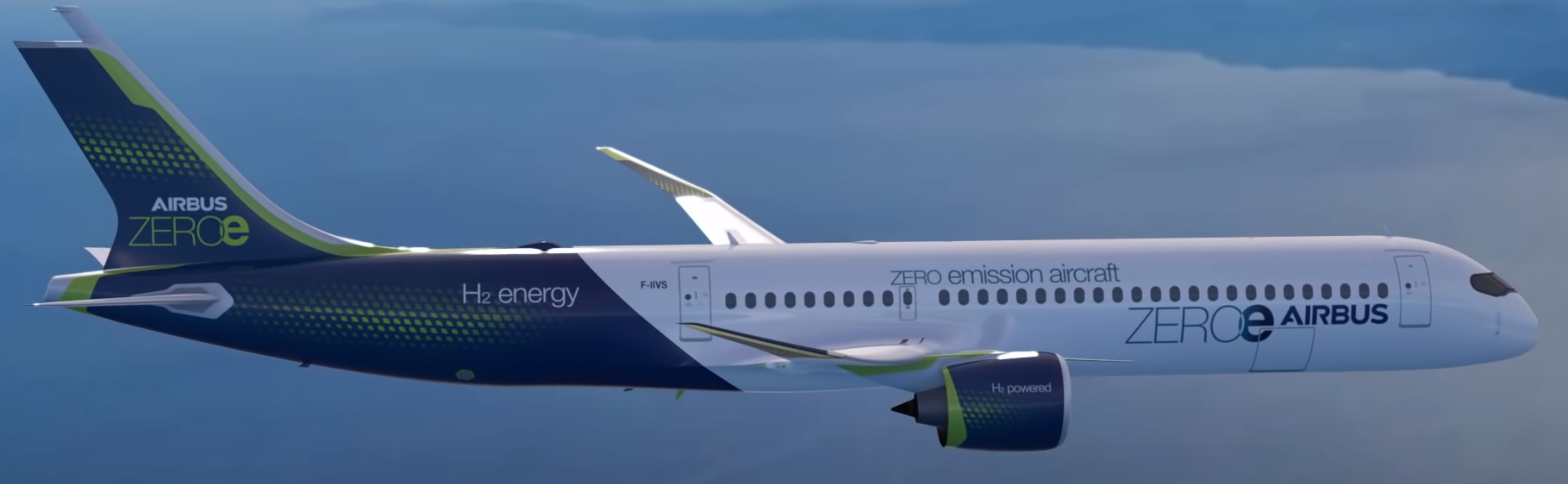
This screen capture taken from the video, shows the front view of the plane.
The aircraft doesn’t look very different different to an Airbus A320 and appears to be fairly conventional. It does appear to have the characteristic tall winglets of the A 320 neo.
I don’t think the turbofan engines, that run on hydrogen will be a problem.
These could be standard turbofan engines modified to run on hydrogen, fuelled from a liquid hydrogen tank behind the rear pressure bulkhead of the fuselage.
If you want to learn more about gas turbine engines and hydrogen, read this article on the General Electric web site, which is entitled The Hydrogen Generation: These Gas Turbines Can Run On The Most Abundant Element In the Universe,
These are my thoughts of the marketing objectives of the ZEROe Turbofan.
- The cruising speed and the number of passengers are surprisingly close, so has this aircraft been designed as an A 320 or Boeing 737 replacement?
- I suspect too, that it has been designed to be used at any airport, that could handle an Airbus A 320 or Boeing 737.
- It would be able to fly point-to-point flights between most pairs of European or North American cities.
It would certainly fit the zero-carbon shorter range airliner market!
In fact it would more than fit the market, it would define it!
I very much believe that Airbus’s proposed zero-carbon hydrogen-powered designs and others like them will start to define aviation on routes of up to perhaps 3000 miles, from perhaps 2035.
- The A 320 neo was launched in December 2010 and entered service in January 2016. That was just five years and a month.
- I suspect that a lot of components like the fuselage sections, cockpit, avionics, wings, landing gear, tailplane and cabin interior could be the same in a A 320 neo and a ZEROe Turbofan.
- Flying surfaces and aerodynamics could be very similar in an A 320 neo and a ZEROe Turbofan
- There could even be commonality between the ZEROe Turboprop and the ZEROe Turbofan, with respect to fuselage sections, cockpit, avionics and cabin interior.
There also must be the possibility, that if a ZEROe Turbofan is a hydrogen-powered A 320 neo, that this would enable the certification process to be simplified.
It might even be possible to remanufacture a A 320 neo into a ZEROe Turbofan. This would surely open up all sorts of marketing strategies.
My project management, flying and engineering knowledge says that if they launched the ZEROe Turbofan this year, it could be in service by the end of the decade on selected routes.
Conclusion
Both the ZEROe Turboprop and ZEROe Turbofan are genuine zero-carbon aircraft, which fit into two well-defined market segments.
I believe that these two aircraft and others like them from perhaps Boeing and Bombardier could be the future of aviation between say 500 and 3000 miles.
With the exception of the provision of hydrogen refuelling at airports, there will be no need for any airport infrastructure.
I also wouldn’t be surprised that the thinking Airbus appear to have applied to creating the ZEROe Turbofan from the successful A 320 neo, could be applied to perhaps create a hydrogen-powered A 350.
I feel that Airbus haven’t fulling disclosed their thinking. But then no company would, when it reinvents itself.
T also think that short-haul air routes will increasing come under pressure.
The green lobby would like airlines to decarbonise.
Governments will legislate that airlines must decarbonise.
The rail industry will increasingly look to attract customers away from the airlines, by providing more competitive times and emphasising their green credentials.
Aircraft manufacturers will come under pressure to deliver zero-carbon airliners as soon as they can.
I wouldn’t be surprised to see a prototype ZEROe Turbofan or Boeing’s equivalent fly as early as 2024.
Short Term Solutions
As I said earlier, one solution is to use existing aircraft with Sustainable Aviation Fuel.
But many believe this is greenwash and rather a cop out.
So we must do better!
I don’t believe that the smaller zero- and low-carbon aircraft with a range of up to 500 miles and a capacity of around 19 seats, will be able to handle all the passengers needing to fly between and around the islands of Great Britain and Ireland.
- A Boeing 737 or Airbus A 320 has a capacity of around two hundred passengers, which would require ten times the number of flights, aircraft and pilots.
- Airports would need expansion on the airside and the terminals to handle the extra planes.
- Air Traffic Control would need to be expanded to handle the extra planes.
But the smaller planes would be ideal for the thinner secondary routes.
So I tend to think, that the greens will have to lump it, as Sustainable Aviation Fuel will increasingly be the only viable solution.
This will increase the need for Airbus or Boeing to develop a viable A 320 or 737-sized aircraft as soon as possible.
Air Bridges
I said earlier, that I believe using ferries between Ireland and Holyhead and new bi-mode Class 805 trains between London Euston and Holyhead could be a competitor to airlines.
- The ferries would be high speed craft capable of Holyhead and Ireland in around 90-100 minutes.
- The ferries would be zero-carbon.
- The trains would have a sixty percent reduction in carbon emissions compared to current trains on the route.
If we can skim across the water in a zero-carbon high speed craft, are there any reasons we can’t cross the water in a low- or zero-carbon aircraft.
In the next few sub-sections, I’ll suggest a few air bridges.
Glasgow
Glasgow Airport could be an ideal airport for a low or zero-carbon air bridge to Northern Ireland.
- A rail link could eventually be built.
- There is a reasonable amount of traffic.
- The distance to Belfast City Airport is only 103 miles.
As the airport serves islands and other places that could be ideal low- and zero-carbon routes, I could see Glasgow becoming a hub for battery and hydrogen-powered aircraft.
Heathrow
Heathrow must prepare itself for an uncertain future.
It will be some years before a third runway is both needed and will have been constructed.
I believe the following will happen.
- Smaller up to nineteen seat low- or zero-carbon airliners will be in service by 2025.
- From around 2024, Heathrow will get requests to refuel or charge low- or zero-carbon airliners.
- Low- or-zero- carbon A 320-size airliners will be in service by 2030.
- Most ground equipment at Heathrow like tugs and fuel bowsers will be zero-carbon.
If I were Boris or Prime Minister, I would say that Heathrow could have its third runway with the following conditions.
- All aircraft using the third runway must be zero-carbon
- All air-side vehicles must be zero-carbon.
- All vehicles bringing passengers on the last mile to the airport must be zero-carbon.
- All aircraft using the airport that are not zero-carbon must use sustainable aviation fuel.
I suspect that the conditions would be met by a large margin.
When an airport knows it is effectively going to be closed, it will make sure it survives.
Liverpool
Liverpool Airport could be an ideal airport for a low or zero-carbon air bridge to the island of Ireland.
- There is a nearby Liverpool South Parkway station, with frequent services to both the local area and places further away.
- An improved London train service starts in 2022 or 2023.
- There would need to be a people mover between the station and the airport.
- The airport can probably have piped hydrogen from across the Mersey.
- There is already significant traffic to and from the island of Ireland.
- Flight times Between Liverpool and Dublin and Belfast would be under an hour.
I also feel that Liverpool could develop lots of other low- and zero-carbon routes to perhaps Cardiff, Edinburgh, Glasgow, Norwich, Southampton and the Isle of Man.
I could even see Liverpool having a Turn-Up-And-Go shuttle service to Dublin and Belfast, with small zero-carbon planes running every fifteen minutes or so.
Manston
I wouldn’t rule out Manston as a low- and zero-carbon airport for flights to the Benelux countries and Northern France and parts of Germany.
These are a few distances from Manston Airport.
- Amsterdam – 160 miles
- Brussels – 134 miles
- Cologne – 253 miles
- Dusseldorf – 234 miles
- Frankfurt – 328 miles
- Geneva – 414 miles
- Hamburg – 396 miles
- Le Touquet – 59 miles
- Lille – 49 miles
- Luxembourg – 243 miles
- Ostend – 66 miles
- Strasbourg – 339 miles
Manston’s position on the tip of Kent gives it an advantage and I think low- and zero-carbon services could reach Cologne, Frankfurt, Geneva, Hamburg and Strasbourg.
The airport also has other advantages.
- A big electrolyser to produce hydrogen is being built at Herne Bay.
- The area is rich in wind and solar energy.
- I suspect the airspace to the East of the airport isn’t very busy and short hops to the Continent could be easy to slot in.
There is a new station being built at Thanet Parkway, which is on the Ashford and Ramsgate Line, which has regular services to London, including some services on High Speed One.
This Google Map shows the location of the airport and the station.
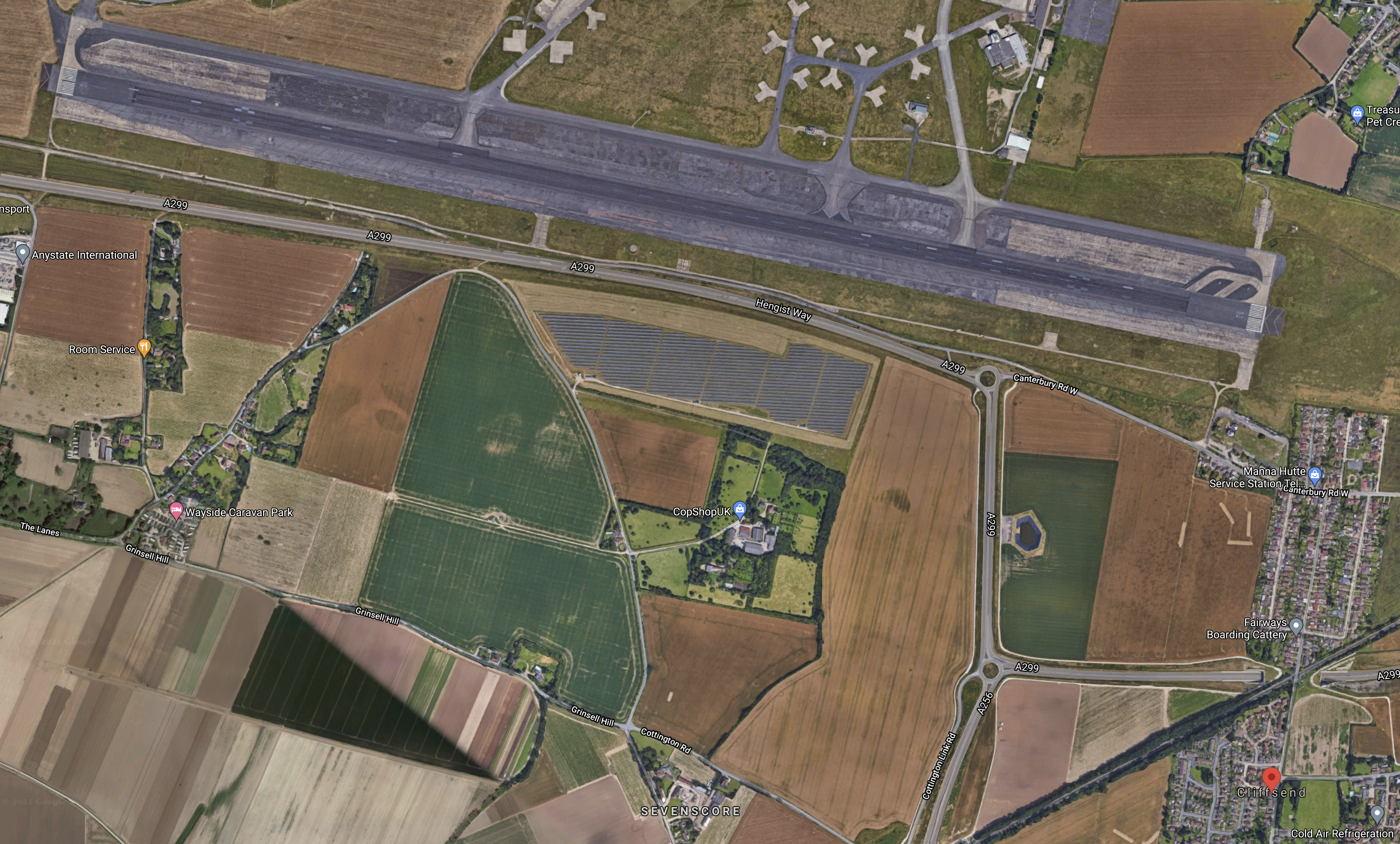
Note.
- The runway of Manston Airport.
- The Ashford and Ramsgate Line running across the South-East corner of the map.
- The station could be built to the West of the village of Cliffsend, which is indicated by the red arrow.
- I’m sure, a people mover or a zero-carbon bus could be built to connect the station and the airport.
There would need to be improvements in the frequency of services to and from London, but I’m sure Manston Airport could become an ideal airport for low- and zero-carbon aircraft serving the near Continent.
Southampton
Southampton Airport could be the ideal design for an airport to serve an air bridge.
- The Southampton Airport Parkway station is connected to the terminal.
- The station has numerous rail services, including a fast service to and from London.
- The airport is expanding and could make sure all works are compatible with a low- and zero-carbon future.
Southampton is not ideally placed for services to Ireland, but with low- and zero-carbon aircraft it could be ideal for running services to the Channel Islands and Western France.
Other Airports
I suspect other airports will go the low- and zero-carbon route.
Conclusion
I started this post, with the intention of writing about writing about low- and zero-carbon transport between the islands of Great Britain and Ireland.
But it has grown.
I have now come to the conclusion that there are several low- and zero-carbon routes that could be developed.
The most promising would appear to be.
- London Euston and Belfast by new Class 805 train to Holyhead and then zero-carbon high speed ferry.
- London Euston and Dublin by new Class 805 train to Holyhead and then zero-carbon high speed ferry.
- Glasgow and Belfast by train to Cairnryan and then zero-carbon high speed ferry.
- Point-to-point air routes using new small nineteen seat low- or zero-carbon airliners with a range of 500 miles.
- London Euston and Belfast by new Class 807 train to Liverpool Airport and then smaller low- or zero-carbon airliner.
- London Euston and Dublin by new Class 807 train to Liverpool Airport and then and then smaller low- or zero-carbon airliner.
- Other air bridges will develop.
But I am fairly certain by the end of the decade, there will be A320-size airlines powered by hydrogen taking us to Ireland and Western Europe.
I believe that the survival and ultimate prospering of Airbus and Boeing depends on the development of a range of zero-carbon airliners.
For this reason alone, they will succeed.
Hitachi Targets Next Year For Testing Of Tri-Mode IET
The title of this post, is the same as that of this article on Rail Magazine.
This is the first two paragraphs.
Testing of a five-car Hitachi Class 802/0 tri-mode unit will begin in 2022, and the train could be in traffic the following year.
It is expected that the train will save more than 20% of fuel on Great Western Railway’s London Paddington-Penzance route.
This is the Hitachi infographic, which gives the train’s specification.
I have a few thoughts and questions.
Will The Batteries Be Charged At Penzance?
Consider.
- It is probably not a good test of customer reaction to the Intercity Tri-Mode Battery Train, if it doesn’t work on batteries in stations through Cornwall.
- Every one of the eight stops in Cornwall will need an amount of battery power.
- London trains seem to take at least half-an-hour to turn round at Penzance.
- London trains seem to take around 7-13 minutes for the stop at Plymouth.
So I think, that batteries will probably need to be charged at Penzance and possibly Plymouth, to achieve the required battery running,
There is already sufficient time in the timetable.
A charging facility in Penzance station would be a good test of Hitachi’s method to charge the trains.
Will Hyperdrive Innovation’s Battery Pack Be A Simulated Diesel Engine?
At the age of sixteen, for a vacation job, I worked in the Electronics Laboratory at Enfield Rolling Mills.
It was the early sixties and one of their tasks was at the time replacing electronic valve-based automation systems with new transistor-based systems.
The new equipment had to be compatible to that which it replaced, but as some were installed in dozens of places around the works, they had to be able to be plug-compatible, so that they could be quickly changed. Occasionally, the new ones suffered infant-mortality and the old equipment could just be plugged back in, if there wasn’t a spare of the new equipment.
So will Hyperdrive Innovation’s battery-packs have the same characteristics as the diesel engines that they replace?
- Same instantaneous and continuous power output.
- Both would fit the same mountings under the train.
- Same control and electrical power connections.
- Compatibility with the trains control computer.
I think they will as it will give several advantages.
- The changeover between diesel engine and battery pack could be designed as a simple overnight operation.
- Operators can mix-and-match the number of diesel engines and battery-packs to a given route.
- As the lithium-ion cells making up the battery pack improve, battery capacity and performance can be increased.
- If the computer, is well-programmed, it could reduce diesel usage and carbon-emissions.
- Driver conversion from a standard train to one equipped with batteries, would surely be simplified.
As with the diesel engines, all battery packs could be substantially the same across all of Hitachi’s Class 80x trains.
How Many Trains Can Eventually Be Converted?
Great Western Railway have twenty-two Class 802/0 trains.
- They are five-cars.
- They have three diesel engines in cars 2, 3 and 4.
- They have a capacity of 326 passengers.
- They have an operating speed of 125 mph on electrification.
- They will have an operating speed of 140 mph on electrification with in-cab ERTMS digital signalling.
- They have an operating speed of 110 mph on diesel.
- They can swap between electric and diesel mode at line speed.
Great Western Railway also have these trains that are similar.
- 14 – nine-car Class 802/1 trains
- 36 – five-car Class 800/0 trains
- 21 – nine-car Class 800/3 trains
Note.
- The nine-car trains have five diesel engines in cars 2,3, 5, 7 and 8
- All diesel engines are similar, but those in Class 802 trains are more powerful, than those in Class 800 trains.
This is a total of 93 trains with 349 diesel engines.
In addition, there are these similar trains in service or on order with other operators.
- LNER – 13 – nine-car Class 800/1 trains
- LNER – 10 – five-car Class 800/2 trains
- LNER – 12 – five-car Class 801/1 trains
- LNER – 30 – nine-car Class 801/2 trains
- TransPennine Express – 19 – five-car Class 802/2 trains
- Hull Trains – 5 – five-car Class 802/3 trains
- East Coast Trains – 5 – five-car Class 803 trains
- Avanti West Coast – 13 – five-car Class 805 trains
- Avanti West Coast – 10 – seven-car Class 807 trains
- East Midland Railway – 33 – five-car Class 810 trains
Note.
- Class 801 trains have one diesel engine for emergency power.
- Class 803 trains have no diesel engines, but they do have a battery for emergency power.
- Class 805 trains have an unspecified number of diesel engines. I will assume three.
- Class 807 trains have no batteries or diesel engines.
- Class 810 trains have four diesel engines.
This is a total of 150 trains with 395 diesel engines.
The Rail Magazine finishes with this paragraph.
Hitachi believes that projected improvements in battery technology, particularly in power output and charge, could enable diesel engines to be incrementally replaced on long-distance trains.
Could this mean that most diesel engines on these Hitachi trains are replaced by batteries?
Five-Car Class 800 And Class 802 Trains
These trains are mainly regularly used to serve destinations like Bedwyn, Cheltenham, Chester, Harrogate, Huddersfield, Hull, Lincoln, Oxford and Shrewsbury, which are perhaps up to fifty miles beyond the main line electrification.
- They have three diesel engines, which are used when there is no electrification.
- I can see many other destinations, being added to those reached by the Hitachi trains, that will need similar trains.
I suspect a lot of these destinations can be served by five-car Class 800 and Class 802 trains, where a number of the diesel engines are replaced by batteries.
Each operator would add a number of batteries suitable for their routes.
There are around 150 five-car bi-mode Hitachi trains in various fleets in the UK.
LNER’s Nine-Car Class 800 Trains
These are mainly used on routes between London and the North of Scotland.
In LNER Seeks 10 More Bi-Modes, I suggested that to run a zero-carbon service to Inverness and Aberdeen, LNER might acquire rakes of carriages hauled by zero-carbon hydrogen electric locomotives.
- Hydrogen power would only be used North of the current electrification.
- Scotland is looking to have plenty of hydrogen in a couple of years.
- No electrification would be needed to be erected in the Highlands.
- InterCity 225 trains have shown for forty years, that locomotive-hauled trains can handle Scottish services.
- I also felt that the trains could be based on a classic-compatible design for High Speed Two.
This order could be ideal for Talgo to build in their new factory at Longannet in Fife.
LNER’s nine-car Class 800 trains could be converted to all-electric Class 801 trains and/or moved to another operator.
There is also the possibility to fit these trains with a number of battery packs to replace some of their five engines.
If the planned twenty percent fuel savings can be obtained, that would be a major improvement on these long routes.
LNER’s Class 801 Trains
These trains are are all-electric, but they do have a diesel engine for emergencies.
Will this be replaced by a battery pack to do the same job?
- Battery packs are probably cheaper to service.
- Battery packs don’t need diesel fuel.
- Battery packs can handle regenerative braking and may save electricity.
The installation surely wouldn’t need too much test running, as a lot of testing will have been done in Class 800 and Class 802 trains.
East Coast Trains’ Class 803 Trains
These trains have a slightly different powertrain to the Class 801 trains. Wikipedia says this about the powertrain.
Unlike the Class 801, another non-bi-mode AT300 variant which despite being designed only for electrified routes carries a diesel engine per unit for emergency use, the new units will not be fitted with any, and so would not be able to propel themselves in the event of a power failure. They will however be fitted with batteries to enable the train’s on-board services to be maintained, in case the primary electrical supplies would face a failure.
The trains are in the process of being built, so I suspect batteries can be easily fitted.
Could it be, that all five-car trains are identical body-shells, already wired to be able to fit any possible form of power? Hitachi have been talking about fitting batteries to their trains since at least April 2019, when I wrote, Hitachi Plans To Run ScotRail Class 385 EMUs Beyond The Wires.
- I suspect that Hitachi will use a similar Hyperdrive Innovation design of battery in these trains, as they are proposing for the Intercity Tri-Mode Battery Train.
- If all trains fitted with diesel engines, use similar MTU units, would it not be sensible to only use one design of battery pack?
- I suspect, that as the battery on a Class 803 train, will be mainly for emergency use, I wouldn’t be surprised to see that these trains could be the first to run in the UK, with a battery.
- The trains would also be simpler, as they are only battery-electric and not tri-mode. This would make the software easier to develop and test.
If all trains used the same battery pack design, then all features of the pack, would be available to all trains to which it was fitted.
Avanti West Coast’s Class 805 Trains
In Hitachi Trains For Avanti, which was based on an article with the same time in the January 2020 Edition of Modern Railways, I gave this quote from the magazine article.
Hitachi told Modern Railways it was unable to confirm the rating of the diesel engines on the bi-modes, but said these would be replaceable by batteries in future if specified.
Note.
- Hitachi use diesel engines with different ratings in Class 800 and Class 802 trains, so can probably choose something suitable.
- The Class 805 trains are scheduled to be in service by 2022.
- As they are five-cars like some Class 800 and Class 802 trains will they have the same basic structure and a powertrain with three diesel engines in cars 2, 3 and 4?
I think shares a basic structure and powertrain will be very likely, as there isn’t enough time to develop a new train.
I can see that as Hitachi and Great Western Railway learn more about the performance of the battery-equipped Class 802 trains on the London and Penzance route, that batteries could be added to Avanti West Coast’s Class 805 trains. After all London Euston and North Wales and London Paddington and Cornwall are routes with similar characteristics.
- Both routes have a high speed electrified section out of London.
- They have a long section without electrification.
- Operating speeds on diesel are both less than 100 mph, with sections where they could be as low as 75 mph.
- The Cornish route has fifteen stops and the Welsh route has seven, so using batteries in stations will be a welcome innovation for passengers and those living near the railway.
As the order for the Avanti West Coast trains was placed, whilst Hitachi were probably designing their battery electric upgrade to the Class 800 and Class 802 trains, I can see batteries in the Class 805 trains becoming an early reality.
In Hitachi Trains For Avanti, I also said this.
Does the improvement in powertrain efficiency with smaller engines running the train at slower speeds help to explain this statement from the Modern Railways article?
Significant emissions reduction are promised from the elimination of diesel operation on electrified sections as currently seen with the Voyagers, with an expected reduction in CO2 emissions across the franchise of around two-thirds.
That is a large reduction, which is why I feel, that efficiency and batteries must play a part.
Note.
- The extract says that they are expected savings not an objective for some years in the future.
- I have not done any calculations on how it might be achieved, as I have no data on things like engine size and expected battery capacity.
- Hitachi are aiming for 20 % fuel and carbon savings on London Paddington and Cornwall services.
- Avanti West Coast will probably only be running Class 805 trains to Chester, Shrewsbury and North Wales.
- The maximum speed on any of the routes without electrification is only 90 mph. Will less powerful engines be used to cut carbon emissions?
As Chester is 21 miles, Gobowen is 46 miles, Shrewsbury is 29.6 miles and Wrexham General is 33 miles from electrification, could these trains have been designed with two diesel engines and a battery pack, so that they can reach their destinations using a lot less diesel.
I may be wrong, but it looks to me, that to achieve the expected reduction in CO2 emissions, the trains will need some radical improvements over those currently in service.
Avanti West Coast’s Class 807 Trains
In the January 2020 Edition of Modern Railways, is an article, which is entitled Hitachi Trains For Avanti.
This is said about the ten all-electric Class 807 trains for Birmingham, Blackpool and Liverpool services.
The electric trains will be fully reliant on the overhead wire, with no diesel auxiliary engines or batteries.
It may go against Hitachi’s original design philosophy, but not carrying excess weight around, must improve train performance, because of better acceleration.
I believe that these trains have been designed to be able to go between London Euston and Liverpool Lime Street stations in under two hours.
I show how in Will Avanti West Coast’s New Trains Be Able To Achieve London Euston and Liverpool Lime Street In Two Hours?
Consider.
- Current London Euston and Liverpool Lime Street timings are two hours and thirteen or fourteen minutes.
- I believe that the Class 807 trains could perhaps be five minutes under two hours, with a frequency of two trains per hour (tph)
- I have calculated in the linked post, that only nine trains would be needed.
- The service could have dedicated platforms at London Euston and Liverpool Lime Street.
- For comparison, High Speed Two is promising one hour and thirty-four minutes.
This service would be a Marketing Manager’s dream.
I can certainly see why they won’t need any diesel engines or battery packs.
East Midland Railway’s Class 810 Trains
The Class 810 trains are described like this in their Wikipedia entry.
The Class 810 is an evolution of the Class 802s with a revised nose profile and facelifted end headlight clusters, giving the units a slightly different appearance. Additionally, there will be four diesel engines per five-carriage train (versus three on the 800s and 802s), and the carriages will be 2 metres (6.6 ft) shorter.
In addition, the following information has been published about the trains.
- The trains are expected to be capable of 125 mph on diesel.
- Is this speed, the reason for the fourth engine?
- It is planned that the trains will enter service in 2023.
I also suspect, that like the Class 800, Class 802 and Class 805 trains, that diesel engines will be able to be replaced with battery packs.
Significant Dates And A Possible Updating Route For Hitachi Class 80x Trains
I can put together a timeline of when trains are operational.
- 2021 – Class 803 trains enter service.
- 2022 – Testing of prototype Intercity Tri-Mode Battery Train
- 2022 – Class 805 trains enter service.
- 2022 – Class 807 trains enter service.
- 2023 – First production Intercity Tri-Mode Battery Train enters service.
- 2023 – Class 810 trains enter service.
Note.
- It would appear to me, that Hitachi are just turning out trains in a well-ordered stream from Newton Aycliffe.
- As testing of the prototype Intercity Tri-Mode Battery Train proceeds, Hitachi and the operators will learn how, if batteries can replace some or even all of the diesel engines, the trains will have an improved performance.
- From about 2023, Hitachi will be able to design tri-mode trains to fit a customer’s requirements.
- Could the powertrain specification of the Class 810 trains change, in view of what is shown by the testing of the prototype Intercity Tri-Mode Battery Train?
- In parallel, Hyperdrive Innovation will be building the battery packs needed for the conversion.
Batteries could be fitted to the trains in three ways,
- They could be incorporated into new trains on the production line.
- Batteries could be fitted in the depots, during a major service.
- Trains could be returned to Newton Aycliffe for battery fitment.
Over a period of years as many trains as needed could be fitted with batteries.
Conclusion
I believe there is a plan in there somewhere, which will convert many of Hitachi’s fleets of trains into tri-mode trains with increased performance, greater efficiency and less pollution and carbon emissions.
 The Anonymous Widower