Observations On A Trip To Doncaster And Sheffield
My objectives were.
- Buy a walk-up ticket from a machine at King’s Cross for Doncaster station and then use it.
- Use local trains, tram-trains and trams to get to as quick as possible to Sheffield station.
- Buy a walk-up ticket from a machine at Sheffield station for St. Pancras and then use it.
This is the story of my day.
A Ticket From King’s Cross for Doncaster
This happened at King’s Cross
- I got charged £38.65, but I didn’t get any tickets.
- So I complained in the Booking Office.
- But they didn’t believe me.
- Then I showed them the debit on my credit card account.
- Then a lady came and checked the machine, but couldn’t find any tickets.
- They then issued me with a new ticket for Doncaster.
- But they were these design crimes of flimsy tickets.
- I now have two debits on my credit card account.
They said one will be refunded.
King’s Cross To Doncaster
I took these pictures of the trucks along the nearby A1 to the North of Newark.









This map shows how the A1 curves round the town.
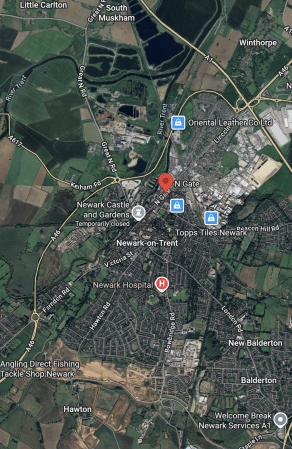
Note.
- The A1 Road curving around the right of the town.
- The red arrow marking Newark Northgate station.
- There is a notorious flat crossing, that needs to be replaced to the North of the station.
I believe as a Control Engineer, that digital signalling might solve the problem of the crossing and I wrote about it in Could ERTMS And ETCS Solve The Newark Crossing Problem?.
But there was no problems on the journey
- The train was ten coaches.
- It was going to Edinburgh.
- It left on time.
- It didn’t appear to be very full.
- It was four minutes late at Doncaster and arrived at 14:47.
These pictures show Doncaster station.
Note.
There are nine platforms and eleven tracks.
The nine platforms are arranged in three island platforms.
Can The Signalling Of The London Overground Be Improved?
An article on Modern Railways Online is entitled First To Succeed Arriva On London Overground.
These are two paragraphs of the article.
Under the new concession, which runs for eight years, First Rail London Limited (FRLL) will introduce extra peak time trains on the Mildmay Line from May 2026, more frequent trains on the Windrush Line from December 2026 – up to 18 trains per hour – and upgrade help points and CCTV.
It will also introduce ‘targeted upgrades’ on the Mildmay Line infrastructure to “boost performance for customers.”
It would appear that the signalling is being improved.
So I asked Google AI, the question in the title of this post and received this reply.
Yes, London Overground signalling is actively being improved through major projects like the Windrush Line upgrades (aiming for 18-20 trains per hour) and South London signalling modernisation (Alstom’s new system for better reliability), allowing for increased capacity, faster journeys, and fewer delays, although these upgrades involve planned disruptive works.
It would appear that the improved signalling will lead to more faster and better services.
These have been indicated in the Modern Railways article.
- Extra peak time trains on the Mildmay Line
- More frequent trains on the Windrush Line
I would also expect more freight, open access and other special trains to be able to use London Overground tracks to pass through London.
London has a rail capacity problem, for both freight and passenger trains.
This report from Network Rail is entitled The London Rail Freight Strategy (LRFS).
I have written a series of posts based on this report.
- Decarbonisation Of London’s Freight Routes
- Doubling Harlesden Junction
- East Coast Main Line South Bi-Directional Capability
- Gauge Improvements Across London
- Gospel Oak Speed Increases
- Headway Reductions On The Gospel Oak To Barking, North London and West London Lines
- Heavy Axle Weight Restrictions
- Kensal Green Junction Improvement
- Longhedge Junction Speed Increases
- Moving The West London Line AC/DC Switchover To Kensington Olympia
- Moving The West London Line AC/DC Switchover To Shepherd’s Bush
- Nunhead Junction Improvement
- Stratford Regulating Point Extension
- Will Camden Road Station Get A Third Platform?
- Will Clapham Junction Station Get A Platform 0?
There is certainly work to be performed on London’s railways to increase the total number of freight trains, that pass through and around the capital.
Conclusion
I believe that as has been shown on the Lizzie Line, Thameslink, the East Coast Main Line and other lines around the world, that the number of trains per hour on the Overground can be increased to meet the objectives stated in the Modern Railways article.
What Is The Peak Frequency Of The East London Line?
I asked Google AI, the question in the title of this section and received this reply.
The East London Line (now part of the Windrush Line, London Overground) has peak frequencies of around every 4-6 minutes (10-15 trains per hour) on its busiest sections, though some parts might see higher frequencies, generally offering a very frequent service through East London during peak times. Specific frequency can vary by section (e.g., Stratford-Lewisham, Canary Wharf-Lewisham), but generally, you can expect trains every few minutes during weekday rush hours (around 06:30-09:30 & 16:00-19:00).
I do think that Google AI has got its DLR and its East London Line mixed up.
But even if we accept that current East London Line service needs 15 tph and the new capacity will be the Modern Railways article figure of 18 tph, that’s still an increase of 3 tph through the Thames Tunnel-section of the East London Line.
What Is The Peak Frequency Of The North London Line?
I asked Google AI, the question in the title of this section and received this reply.
The North London Line (NLL), part of London Overground, typically runs 8 trains per hour (tph) during weekday peaks, with plans to increase this with infrastructure upgrades like digital signalling and longer trains to meet growing demand and integrate with Crossrail/HS2. While 8tph has been a target, the line also carries significant freight, impacting passenger service frequency, with older plans aiming for 6-8tph peaks and even longer trains (3-4 cars) for capacity.
The peak frequency of trains on the North London Line appears less than the East London Line, so I would assume, that like the East London Line, it could probably squeeze in another 3 tph.
When you consider that the working day is over eighteen hours, 3 tph means nearly an extra sixty trains per day on both the the East and North London Lines.
Could This Extra Capacity On The East and North London Lines Created By Improved Signalling Be Used For Extra Services?
Consider.
Every train of the service, would need its own path.
- A typical four tph Overground service like Dalston Junction and New Cross would need four paths per hour.
- A typical freight service would need a dedicated path.
- A typical long-distance passenger service would need a dedicated path.
There are certainly possibilities.
FIRST TO THE FUTURE: Lumo Owner Bids To Turbo-Charge UK Rail With New Routes
The title of this post, is the same as that of this press release from First Group.
These first three paragraphs introduce FirstGroup’s application for the first phase of three separate applications to the Office of Rail and Road (ORR) for new and extended open access rail services.
FirstGroup plc plans to expand its open access rail operations through its successful Lumo business, boosting connectivity, improving UK productivity and passenger choice across the UK.
The expansion aims to replicate the success of Lumo’s Edinburgh to London service in driving material growth on the East Coast Main Line. Lumo operates without government subsidy and contributes more per train mile to infrastructure investment than any other long-distance operator – delivering growth on the railway and connectivity to local communities, at a substantial benefit to the taxpayer.
FirstGroup has submitted the first phase of three separate applications to the Office of Rail and Road (ORR) for new and extended open access rail services, which are described in these bullet points.
- A revised application to run new services between Rochdale and London Euston via Manchester Victoria from December 2028;
- An extension to Lumo’s current Stirling to London Euston track access agreement to operate services beyond 2030;
- A new route between Cardiff and York via Birmingham, Derby, and Sheffield from December 2028; and
- Purchase of new trains meaning continued investment in UK manufacturing of c.£300 million, and long-term jobs.
This paragraph from the press release describes the philosophy of the rolling stock.
Should these applications be successful, FirstGroup will make use of its option to commit further investment in new Hitachi trains built in County Durham. This investment will include five battery electric trains for the Stirling route and three battery electric trains for Rochdale, supporting jobs at Hitachi’s Newton Aycliffe plant. For the services between Cardiff and York, it will deploy refurbished Class 222s.
Note.
- The Class 222 trains will run the Euston and Stirling service until the future Hitachi trains are delivered in 2028.
- The Class 222 trains will run the Cardiff and York service from 2028.
- The Class 222 trains have a maximum speed of 125 mph
- Avanti West Coast’s Class 390 trains have a maximum speed of 125 mph.
- Avanti West Coast’s Class 805 trains have a maximum speed of 125 mph on electrification.
- Avanti West Coast’s Class 807 trains have a maximum speed of 125 mph.
- Grand Central Trains’s future Hitachi trains have a maximum speed of 125 mph.
- Hull Trains’s Class 802 trains have a maximum speed of 125 mph.
- Lumo’s current Class 803 trains have a maximum speed of 125 mph.
- LNER’s current Class 800 and 801 trains have a maximum speed of 125 mph.
- LNER’s current InterCity 225 trains have a maximum speed of 125 mph.
- LNER’s future Class 897 trains have a maximum speed of 125 mph.
- All of the trains, with the exception of the Class 222 trains are electric and have been designed for 140 mph running and can do this if there is appropriate 140 mph signalling.
If the Class 222 trains don’t run on the East and West Coast Main Lines, then these lines could introduce 140 mph running in stages to speed up rail travel between London and the North of England and Scotland.
Rochdale And London
These three paragraphs from the press release describe the proposed Rochdale and London service.
The new Lumo service will operate the first direct service since 2000 between Rochdale and London. Services will call at Manchester Victoria, Eccles, Newton-le-Willows and Warrington Bank Quay. Eccles station connects other parts of the city of Salford, including the fast-growing MediaCity area, via the nearby interchange with Metrolink. Services to Newton-le-Willows will deliver greater rail connectivity for St Helens.
There will be three new return services on weekdays and Sundays, and four return services on Saturdays, which will provide 1.6 million people in the north-west with a convenient and competitively priced direct rail service to London, encouraging people to switch from cars to train as well as providing additional rail capacity. It will also deliver material economic benefits for the communities along the route, including regeneration areas such as Atom Valley and the Liverpool City Region Freeport scheme.
The application has been revised to address the ORR’s concerns about network capacity set out in its letter of July 2025 rejecting FirstGroup’s original application. Supported by extensive modelling, the company has identified sufficient space on the network to accommodate the proposed services. Services will also make use of the Government’s recent investment in power supply for the West Coast Mainline (WCML).
In FirstGroup’s Lumo Seeks To Launch Rochdale – London Open Access Service, I gave my thoughts for Lumo’s application last year.
Differences between the two applications include.
- The service will be run by Lumo’s standard battery-electric Hitachi trains.
- The original application was for six return journeys per day, whereas the new application is for three return services on weekdays and Sundays, and four return services on Saturdays.
Note.
- The battery-electric trains will be able bridge the 10.4 mile gap between Manchester Victoria and Rochdale, and return after charging on the West Coast Main Line.
- The battery-electric trains could be useful during engineering works or other disruptions.
- The trains would be ready for 140 mph running on the West Coast Main Line, when the digital signalling is installed.
- Is the extra return service on a Saturday to cater for football and rugby fans?
I still feel, that with Lumo’s battery-electric trains one or more services could extend across the Pennines to Hebden Bridge, Bradford Interchange or Leeds. Trains would be recharged for return at Leeds.
Stirling And London
This paragraph from the press release describes the proposed Stirling and London service.
Stirling has a wide catchment area, with an estimated three million people living within an hour’s drive. Extending the current track access agreement for the Stirling route from May 2030 will support the shift from car to rail, and investment in the city, as well as in the service’s intermediate stations which include Larbert, Greenfaulds and Whifflet, thanks to greater connectivity to London. The four return services weekdays and Saturdays, and three on Sundays, on the new route are expected to start early in the company’s 2027 financial year.
In Lumo To Expand Scotland’s Rail Network With New London-Stirling Rail Route From Spring 2026, I gave my thoughts for Lumo’s application in June 2025.
Differences between the two applications include.
- The service will only be run initially by Class 222 trains.
- The service will be run by Lumo’s standard battery-electric Hitachi trains after 2028.
- The original application was for five return journeys per day, whereas the new application is for four return services on weekdays and Saturdays, and three return services on Sundays.
- In the original application, Lumo’s new route was to link London Euston directly to Stirling, also calling at Milton Keynes, Nuneaton, Crewe, Preston, Carlisle, Lockerbie, Motherwell, Whifflet (serving Coatbridge), Greenfaulds (serving Cumbernauld) and Larbert.
Note.
- The battery-electric trains could be useful during engineering works or other disruptions.
- The trains would be ready for 140 mph running on the West Coast Main Line, when the digital signalling is installed.
- Is the extra return service on a Saturday to cater for football and rugby fans?
It should be noted that there are always more return services per day going to Stirling, than Rochdale.
Could The Rochdale and Stirling Services Share A Path?
Consider.
- The two services use the West Coast Main Line South of Warrington Bank Quay station.
- Pairs of Class 803 trains can split and join.
- A pair of Class 803 trains are shorter than an 11-car Class 390 train.
- An 11-car Class 390 train can call in Warrington Bank Quay or Crewe stations.
I believe that the Rochdale and Stiring services could share a path.
- One Weekday service per day would be a single train.
- Going South, the trains would join at Warrington Bank Quay or Crewe stations.
- Going North, the trains would split at Warrington Bank Quay or Crewe stations.
- The pair of trains would share a platform at Euston station.
Operating like this would increase the connectivity and attractiveness of the services, and probably increase the ridership and profitability.
Cardiff And York via Birmingham, Derby And Sheffield
These four paragraphs from the press release describe the proposed Cardiff and York service.
Lumo’s new route between Cardiff and York will join up the entire Great British Railway network, connecting all four main lines from the Great Western Main Line to the East Coast Main Line. The plans will also deliver more capacity and drive passenger demand on a previously underserved corridor.
The application proposes six return services each weekday – a significant increase from the current single weekly service.
Bringing Lumo’s popular low-cost model to the corridor will support local communities between Cardiff, Birmingham, Derby, Sheffield, and York. These cities alone have a combined population of more than 2.5 million people. The new services will give local communities access to jobs and services along the route, in support of significant investment that has already been committed by the Government and private sector. This investment includes the Cardiff Capital Regional Investment Zone, the £140million proposed refurbishment at Cardiff Central station, the West Midlands Investment Zone which is expected to create £5.5 billion of growth and 30,000 new jobs, as well as investment plans in Derby, Sheffield and York.
The ORR will now carry out a consultation exercise as well as discuss the applications with Network Rail to secure the required approvals.
Note.
- Only minimal details are given of the route.
- The TransPennine Upgrade will create a new electrified route across the Pennines between York and Huddersfield via Church Fenton, Leeds and Dewsbury.
- The Penistone Line is being upgraded, so that it will handle two trains per hour.
- In the 1980s, the Penistone Line took InterCity 125s to Barnsley.
- The connection with the Penistone Line at Huddersfield has been upgraded.
I am reasonably certain, that FirstGroup intend to route the York and Cardiff service over this partially electrified route.
Sections of the route will be as follows.
- Cardiff and Westerleigh junction – 38 miles – Electrified
- Westerleigh junction and Bromsgrove – 65.2 miles – Not Electrified
- Bromsgrove and Proof House junction – 15 miles – Electrified
- Proof House junction and Derby – 40.6 miles – Not Electrified
- Derby and Sheffield – 36.4 miles – Not Electrified
- Sheffield and Huddersfield – 36.4 miles – Not Electrified
- Huddersfield and York – 41.9 miles – Electrified
There are only two sections of track, that is not electrified.
- Westerleigh junction and Bromsgrove – 65.2 miles
- Proof House junction and Huddersfield – 113.4 miles
Out of a total of 273.5 miles, I believe in a few years, with a small amount of extra electrification or more powerful batteries, Hitachi’s battery-electric high-speed trains will have this route cracked and the Class 222 trains can be sent elsewhere to develop another route.
Huddersfield Station – 30th September 2025
This press release on the Network Rail Media Centre is entitled Huddersfield Station Set To Reopen Next Week With New Temporary Layout.
As it is now next week, I went to have a look at the progress today.
I made a mistake and got on a Grand Central Train, which meant, I had to change at York.
Speeding past Drax power station on the Selby Diversion, I took these pictures.







We were only in a 125 mph diesel, so we couldn’t take advantage of the 160 mph running, that the East Coast Main Line’s new signalling might allow on this section. The Wikipedia entry for the Selby Diversion, says this about the possible speeds.
The line was the first purpose-built section of high-speed railway in the UK having a design speed of 125 mph; however, research by British Rail in the 1990s indicated that the route geometry would permit up to 160 mph operation, subject to the necessary overhead line equipment and signalling upgrades. The new line also avoided the speed restriction over the swing bridge at Selby. The former ECML route, the NER’s 1871 York and Doncaster branch line, was closed from Selby northwards.
As the Selby Diversion opened in 1983, I wouldn’t be surprised that the calculations were performed on British Rail Research’s Pace 231-R, which was similar to the one I used at ICI and the pair, that NASA used calculate how to land Apollo on the moon.
When I eventually got to Huddersfield, I took these pictures.
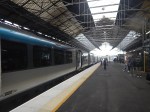
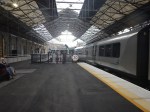
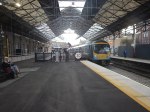
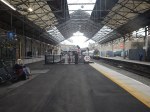
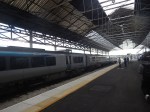
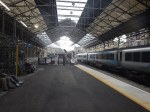






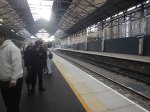

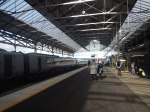
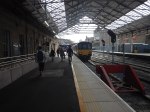
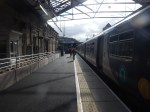
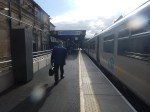
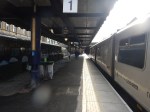
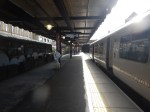
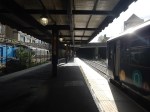
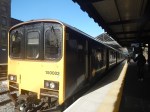
Note.
- In I’ve Just Glimpsed The Future Of Train Travel Across The North Of England And I Like It, there are pictures of Huddersfield station, that were taken on the 21st August, soon after the work started.
- In Huddersfield Station – 15th December 2023, there are pictures of Huddersfield before the work started.
- Much of the work seems to have been done at the Western end of the station to lengthen the platform on the Penistone Line to Sheffield.
- Platform 2 for the Penistone Line has also been renumbered Platform 1.
Work still to be carried out at Huddersfield station, includes refurbishing the roof, installing the electrification and adding a couple of new platforms.
These are my thoughts.
Which Platforms Will Be Electrified?
This OpenRailwayMap shows the proposed electrification in Huddersfield station.
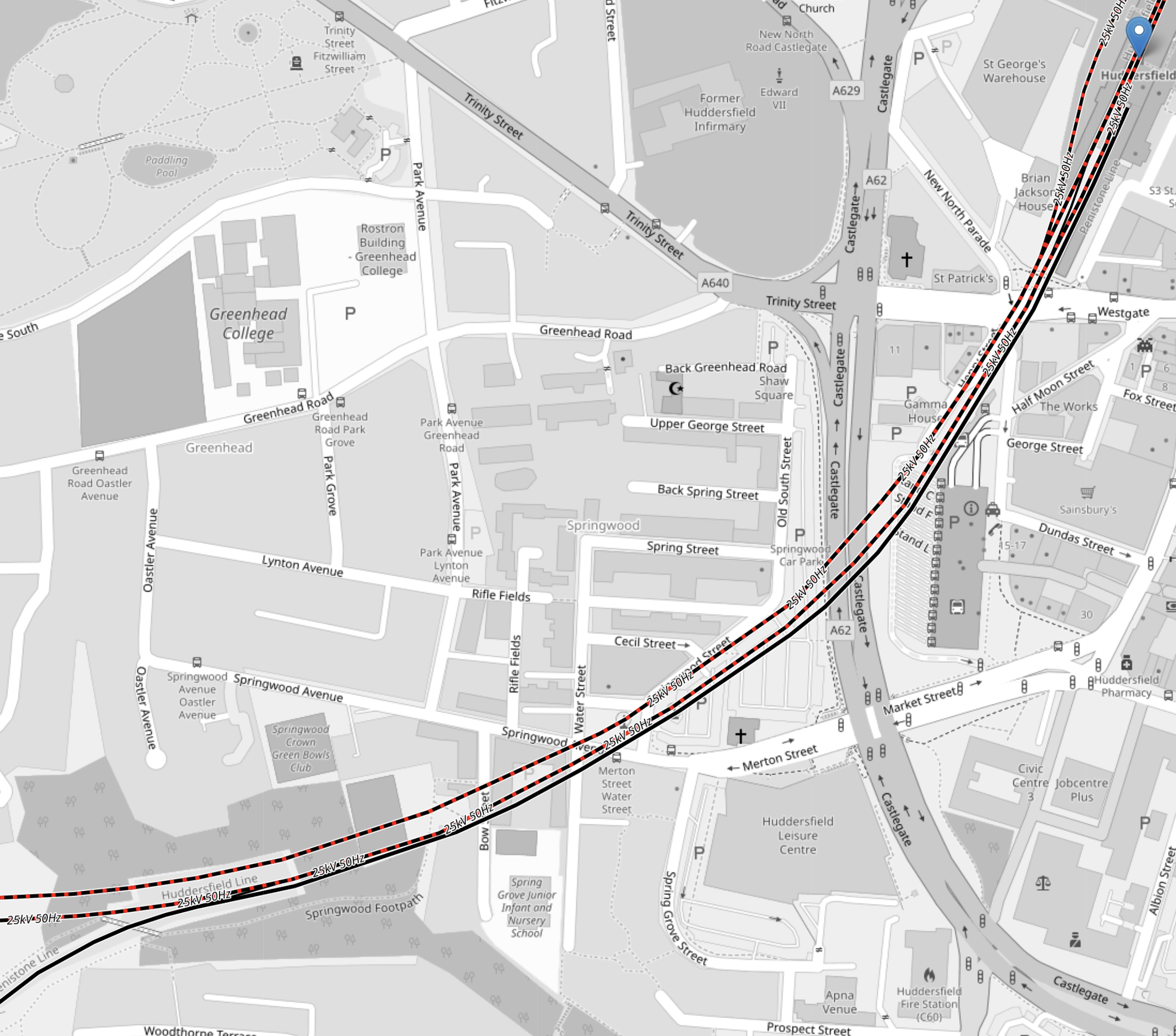
Note.
- The blue arrow in the North-East corner of the map indicates Huddersfield atation.
- The two red-and-black tracks going diagonally across the map are the Hudderfield Line.
- The red-and-black colour, indicates that the two tracks will be electrified.
- South of these two tracks, the Penistone Line sneaks into Platform 1 at Huddersfield station.
- The Penistone Line goes to Sheffield in a South-Westerly direction.
- There appears to be a crossover, so that trains from the Penistone Line can use both Platforms 1 and 2 in Huddersfield station.
- The OpenRailwayMap appears to show planned electrification between Stalybridge and Leeds stations.
- To the East of Leeds planned electrification is shown as far as Micklefield and Church Fenton stations.
Once installed, this electrification will create a complete electrified route across the Pennines from Liverpool Lime Street in the West to the East Coast Main Line in the East.
This OpenRailwayMap shows the planned electrification between Micklefield and Hull stations.
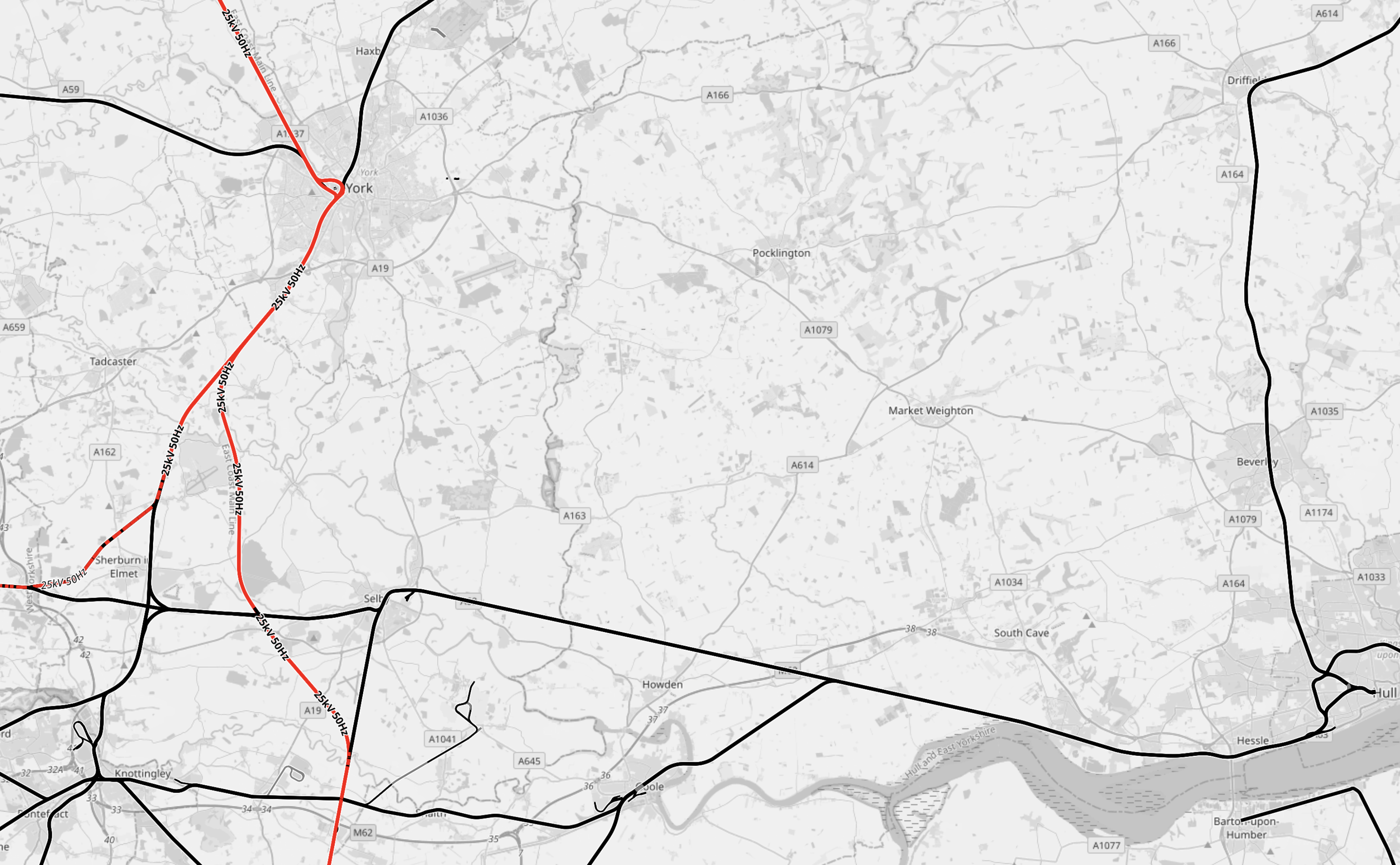
Note.
- Red tracks are electrified.
- Black tracks are not electrified.
- York is in the North-West corner of the map, with the electrified East Coast Main Line going through the station North-South.
- South of York, the East Coast Main Line now splits.
- The Western branch includes an electrified line to Micklefield station, Neville Hill depot and Leeds station.
- The Eastern Branch is the Selby Diversion, which is an electrified 160 mph line, that avoids the Selby coalfield.
- Running West-East across the map is the unlectrified Micklefield and Hull Line, which goes via Selby.
- Hull is in the South-East corner of the map.
- Hull is 42 miles from Micklefield and 36.1 miles from the Temple Hirst junction on the Selby Diversion, so it is within range of battery-electric trains, with charging at Hull station.
- Hitachi’s battery-electric Class 802 trains, used by Hull Trains and TransPennine Express, which are currently on test, should certainly be able to serve Hull.
Hull can become an electrified station, without the expense and disruption of full electrification.
How Long Is Platform 1 At Huddersfield Station?
This OpenRailwayMap shows the new Platform 1 at Huddersfield station.
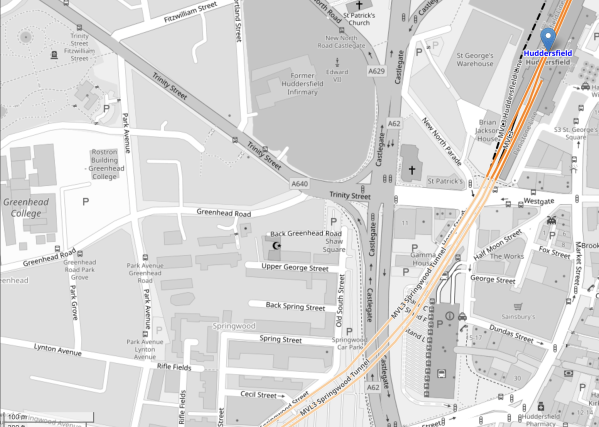
Note.
The blue arrow indicates Huddersfield station.
- The three darker orange lines indicate the two through platforms 2 and 3, and the reconfigured bay platform 1.
- There is a cross-over between platforms 1 and 2, which connects Platform 2 to the Penistone Line.
- In the South-West corner of the map is a hundred metre scale.
- Using the scale, I estimate that the length of the bay platform 1 is around 120 metres.
- In the last two rows of pictures in the gallery of this post, a three car Class 150 train is shown in Platform 1.
- A three car Class 150 train is approximately sixty metres long.
Looking at the pictures, I wouldn’t be surprised if the new platform has been designed to take two three-car Class 150 trains. It would certainly take a pair of two-car Class 150 trains.
Other trains and their lengths that might use the platform include.
- Class 170 – three-car – 70.85 metres
- Class 195 – two-car – 48.05 metres
- Class 195 – three-car – 71.40 metres
- Class 195 – 2 x two-car – 96.10 metres
- Class 810 – five-car – 120 metres
The Class 810 uses 24 metre cars, so that a pair of trains, will fit in St. Pancras. But with perhaps selective door opening could a single Class 810 train run a St. Pancras and Huddersfield service, perhaps with a split and join at Sheffield.
Electrification Across The Pennines
The TransPennine Route will be electrified between Liverpool Lime Street and Micklefield stations, once the current works between Huddersfield and Leeds are complete.
Sections without electrification include.
- Bradford Interchange and Doncaster – 52.1 miles
- Cleethorpes and Doncaster – 52.1 miles
- Harrogate and Leeds – 18.3 miles
- Hazel Grove and Doncaster – 52.6 miles
- Hull and Micklefield – 42 miles
- Hull and Temple Hirst junction – 36.1 miles
- Saltburn and Northallerton – 28.1 miles
- Sunderland and Northallerton – 46.8 miles
- Scarborough and York – 42.1 miles
I expect that Hitachi trains with batteries or CAF’s tri-mode trains will be able to handle these routes in a low-carbon manner.
Electrification Between Stalybridge And Huddersfield
This section is shown as being electrified on OpenRailwayMap.
But as it is only 18 miles and includes the Standedge Tunnels will the route use battery-electric trains?
Farage Wants HS2 Scrapped
The title of this post, is the same as a sub-title in this article on The Times. which is entitled HS2: Labour confirms delay until 2033.
This is the sub-heading.
Nigel Farage has called for the whole HS2 project to be scrapped.
These two paragraphs give NF’s view.
The Reform UK leader told the Commons: “Has the moment not come, rather than having another reset, to recognise this is a failure?
“Let’s scrap HS2, let’s use the tens of billions of pounds we can save in the next decade to upgrade railway lines across the entirety of the United Kingdom to the benefit of many millions and spend the rest on other national priorities in these financially straitened times.”
Farage’s simplistic plan will appeal to his disciples, but the major thing that is needed, is more capacity between South and North. Or North and South depending on where you live!
HS2 will provide an extra seventeen paths between London and a large triangular junction in the West Midlands.
If HS2 Is Not Built There Will Be More Cars And Trucks On The Roads
In Footage Released Of East West Rail’s First Commercial Freight Train, I wrote about the SEGRO Logistics Park Northampton (SLPN), which would generate lots of road and rail traffic. Without developments like HS2, the roads will just get clogged up.
High Speed Two’s Originally Proposed Service Pattern
This graphic shows the original service pattern for High Speed Two.
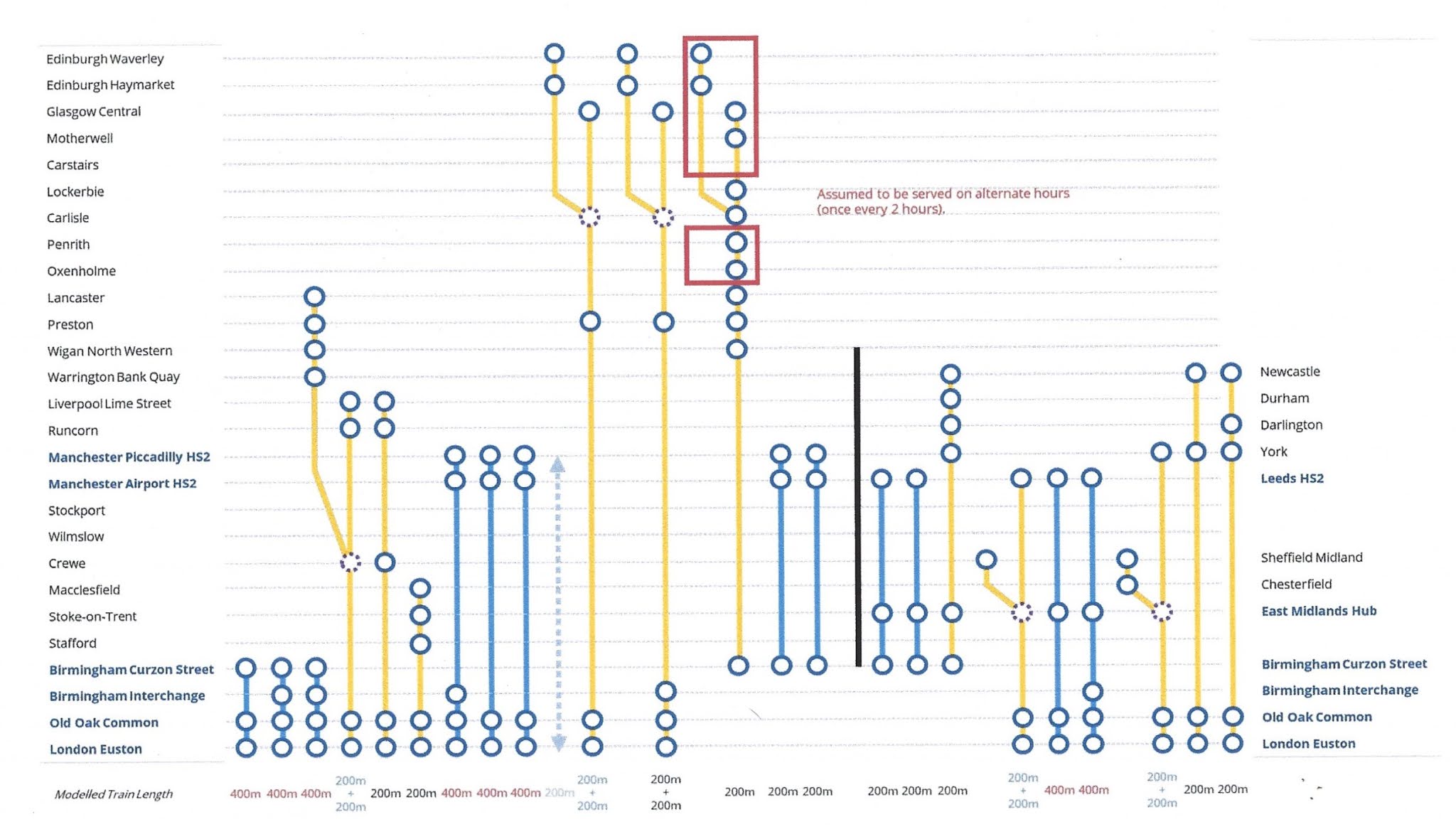
Note.
- There are seventeen paths terminating in the South at Euston station.
- Six of these paths go to Leeds, Newcastle or York.
- As the Eastern leg has been abandoned, that means six extra trains can run between London and the large triangular junction in the West Midlands.
Six extra trains running to the West side of England and Scotland could give a substantial improvement of services.
High Speed Yorkshire
HS2 needs to be paired with High Speed Yorkshire, which would mainly be an upgrading of the East Coast Main Line running at up to 160 mph to serve Lincolnshire, Yorkshire, the North-East and East Scotland.
Note.
- British Rail built the Selby Diversion in the 1980s to run at 160 mph.
- Digital signalling is currently being installed on this route and this will allow trains to speed through the two bottlenecks of the Digswell Viaduct and the Newark Crossing.
- Times of three-and-a-half hours between King’s Cross and Edinburgh, should be possible.
These times should give the airlines a good kicking on London-Newcastle and London-Scotland routes.
Fast services would run on High Speed Yorkshire to Alnwick, Barnetby, Barnsley, Beverley, Berwick, Bradford, Brough, Cleethorpes, Darlington, Doncaster, Durham, Edinburgh, Goole, Grantham, Grimsby, Harrogate, Huddersfield, Hull, Leeds, Lincoln, Middlesbrough, Newcastle, Peterborough, Pontefract, Retford, Rotherham, Scarborough, Scunthorpe, Sheffield, Skipton, Stevenage, Sunderland, Wakefield, Worksop and York.
Most of these towns and cities are already served by Hitachi or other high speed trains from King’s Cross.
A high proportion of the services to Yorkshire destinations will be under two hours from London.
When the current trains need replacing, they could be replaced by High Speed Two Classic-Compatible trains.
Onward From Handsacre Junction
Services to the North-West and Scotland will join the Trent Valley Line at Handsacre junction.
This OpenRailwayMap shows the Trent Valley Line between Crewe station and Handacre junction.
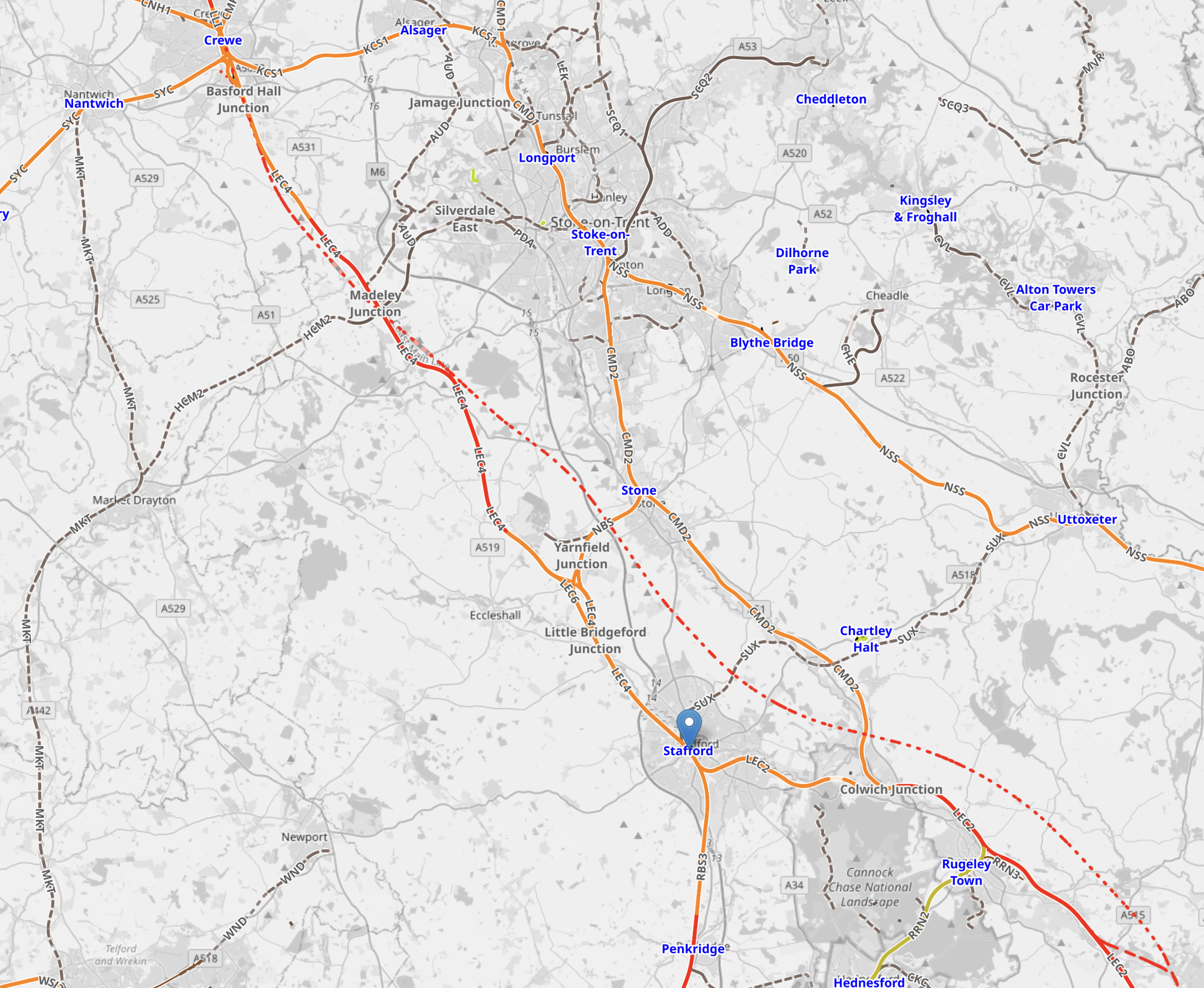
Note.
- The proposed route of High Speed Two is shown as a dotted line, running diagonally across the map.
- The red track to its West is the Trent Valley Line, which is a section of the West Coast Main Line.
- Handsacre junction is in the South-East corner of the map.
- The blue arrow indicates Stafford station on the West Coast Main Line.
- The main High Speed Two tracks will not connect to Stafford or Stoke-on-Trent stations.
- Crewe station is in the North-West corner of the map.
- Crewe station and Handsacre junction are 37.6 miles apart.
With the exception of the 6 mile twin-track section between Stafford Trent Valley and Colwich junctions, it appears that Crewe station and Handsacre junction is all quadruple track.
This OpenRailwayMap shows the Trent Valley Line between Stafford stationand Colwich junction.
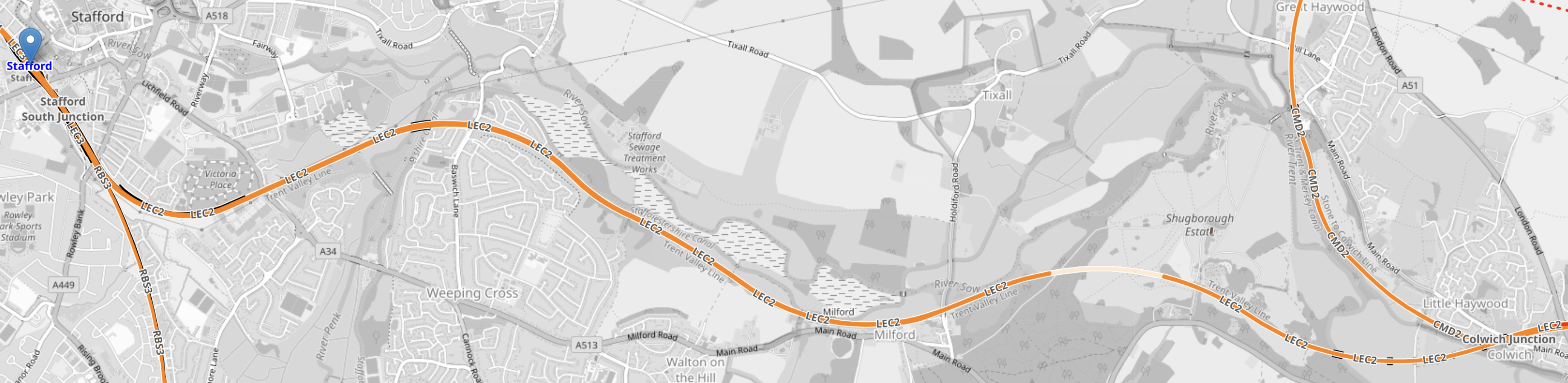
Note.
- The Trent Valley Line, which is a section of the West Coast Main Line, runs across the map.
- The arrow in the North-West corner of the map indicates Stafford station.
- Colwich junction is in the South-East corner of the map.
- About three-quarters of the way across, the track is shown in cream. This is the twin-track Shugborough Tunnel, which is around a half-mile long.
- The Shugborough Tunnel has a 100 mph maximum speed.
- The portals of Shugborough Tunnel are Grade II Listed and the Wikipedia entry for the tunnel is certainly worth a read.
How Many High Speed Two trains per hour (tph) will use the Trent Valley Line route?
The original proposal in the graphic earlier shows these trains.
- 4 – London to Lancaster/Liverpool Lime Street – Splits at Crewe
- 5 – London to Liverpool Lime Street
- 6 – London to Stafford, Stoke -on-Trent and Macclesfield
- 7 – London and Birmingham Interchange to Manchester Airport and Manchester Piccadilly
- 8 – London to Manchester Airport and Manchester Piccadilly
- 9 – London to Manchester Airport and Manchester Piccadilly
- 10 – London and Birmingham Interchange to Preston, Carlisle, Edinburgh Haymarket and Edinburgh Waverley/Glasgow Central – Splits at Carlisle
- 11 – London Euston to Preston, Carlisle, Edinburgh Haymarket and Edinburgh Waverley/Glasgow Central – Splits at Carlisle
- 12 – Birmingham Curzon Street to Wigan North Western, Preston, Lancaster, Oxenholme, Penrith, Carlisle, Edinburgh Haymarket and Edinburgh Waverley Or Wigan North Western, Preston, Lancaster, Carlisle, Lockerbie, Motherwell and Glasgow Central- Services alternate.
- 13 – Birmingham Curzon Street to East Midlands Hub, Manchester Airport and Manchester Piccadilly
- 14 – Birmingham Curzon Street to East Midlands Hub, Manchester Airport and Manchester Piccadilly
Note.
- It looks like there will be eleven High Speed Two tph on the Trent Valley Line.
- As East Midlands Hub will not be built, I will assume trains 13 and 14 will be Birmingham Curzon Street to Manchester Airport and Manchester Piccadilly.
- Other trains will need to use the route.
- I suspect that freight trains, that couldn’t maintain 100 mph would not be allowed.
I believe that digital signalling can handle all the trains between Handsacre Junction and Crewe.
- Trains 10 and 11 would run every thirty minutes to give two tph between London and Glasgow Central and two tph between London and the two Edinburgh stations.
- Each of these trains would lead a flight of trains behind them through the Trent Valley Line.
- The last trains going North in the flights, would be trains 4 and 6, as they stop on the Trent Valley Line section.
I have written a lot of scheduling algorithms in the last fifty years and I wouldn’t be surprised if flights could be up to 7 or 8 trains, running 3 or 4 minutes apart.
It would be an impressive sight.
What Timings Would Be Possible On High Speed Two Using Handsacre Junction And The Trent Valley Line?
In Where Is Handsacre Junction? I calculated some times on High Speed Two to various destinations, using Handsacre junction and the Trent Valley Line. This is a more comprehensive table.
- London and Blackpool North – 205 mph – 1:55
- London and Blackpool North – 140 mph – 2:12
- London and Carlisle – 205 mph – 2:45
- London and Carlisle – 140 mph – 3:01
- London and Crewe – 205 mph – 1:03
- London and Crewe – 140 mph – 1:19
- London and Edinburgh Waverley – 205 mph – 4:14
- London and Edinburgh Waverley – 140 mph – 4:30
- London and Glasgow Central – 205 mph – 4:22
- London and Glasgow Central – 140 mph – 4:38
- London and Handsacre junction – 205 mph – 0:35
- London and Handsacre junction – 140 mph – 0:51
- London and Lancaster – 205 mph – 1:50
- London and Lancaster – 140 mph – 2:06
- London and Liverpool Lime Street – 205 mph – 1:46
- London and Liverpool Lime Street – 140 mph – 2:02
- London and Manchester Piccadilly – 205 mph – 1:41
- London and Manchester Piccadilly – 140 mph – 1:57
- London and Preston – 205 mph – 1:31
- London and Preston – 140 mph – 1:47
- London and Stafford – 205 mph – 0:45
- London and Stafford – 140 mph – 1:01
- London and Stoke-on-Trent – 205 mph – 0:55
- London and Stoke-on-Trent – 140 mph – 1:11
- London and Wigan North Western – 205 mph – 1:17
- London and Wigan North Western – 140 mph – 1:33
Note.
- 205 mph could be the average speed between London Euston and Handsacre junction for High Speed Two Classic-Compatible trains.
- 140 mph could be the average speed between London Euston and Handsacre junction for Class 390 trains.
- Times are in hh:nn.
- For times North of Handsacre junction are typical Class 390 times.
A typical timing between London Euston and Handsacre junction for Class 390 trains is 71 minutes, so if High Speed Two services were run using Class 390 trains, twenty minutes would be saved on all services via Handsacre junction compared to current Avanti West Coast services.
I have some other thoughts.
Using Class 390 Trains Is Not My Idea
This article on Rail nBusiness UK is entitled Viewpoint: Buy tilting trains and finish Delta Junction to salvage HS2, says Gibb.
This is the sub-heading.
UK: Procurement of a fleet of tilting trains and a focus on Birmingham – Manchester services are key to making the most the descoped High Speed 2 scheme, former Virgin Trains executive Chris Gibb tells Rail Business UK.
Chris Gibb has the right experience. and has been used as a go-to man, when projects are in trouble.
The major points of his plan are as follows.
- Connect High Speed Two to the Trent Valley Line to go North from the Midlands.
- Initially, use Class 390 trains or Pendelinos on Liverpool, Manchester and Scottish services.
- Run Class 390 trains at 140 mph between Euston and Handsacre junction.
- When the Pendelinos need to be retired, buy a new set of tilting trains.
- Complete the North-to-West leg of High Speed Two’s triangular junction, so that trains can run between Birmingham Curzon Street and Manchester.
- Gibb proposes a Blackpool service, that splits and joins with a Liverpool service. I assume he means train 5.
Gibb feels a fundamental review of the operating principles and fleet requirements is now needed.
It is a well-thought out viewpoint and very much a must-read.
Unlocking Euston Station
I dread using Euston station.
The connections to the London Underground in the station, involve a long walk to or from your train and then outside the station to.
- The Northern and Victoria Lines just outside the station.
- The sub-surface lines at Euston Square station, which is a long walk.
There is no connection to the Lizzie Line.
I have probably written more project management software, than any other individual in the world.
Good project managers and probably a few bad ones too, talk about getting all your ducks in a row or doing everything in the right order.
If High Speed Two is going to terminate at Euston, then the first sub-project must be to connect Euston station properly to the Metropolitan, Circle and Hammersmith & City or sub-surface lines of the Underground, which have new spacious air-conditioned trains and run on a line that is digitally signally, so the capacity can be easily increased.
The sub-surface lines also link, the National Rail stations of Liverpool Street, Moorgate, Farringdon, King’s Cross, St. Pancras, Euston, Paddington, Victoria, Charing Cross and Blackfriars, and could be connected to Fenchurch Street and Marylebone. It also has links to the Lizzie Line.
Improve the interchanges and this marvelous Victorian system could unlock London’s transport system like no other.
Five years ago, a similar arrangement to that at St. Pancras was proposed with subways under Euston Road that linked to extended platforms at Euston Square Underground station, by means of lifts and escalators.
Why has this new link between National Rail at Euston and sub-surface Underground not been built? I estimate that it would have taken a couple of years and have fitted in with all the work being done in front of Euston station.
The current Mayor never mentions the project, but then it is a North London project, so it doesn’t interest him and his supporters.
The Design Of The Updated Euston Underground Station
Ian showed this visualisation of the updated Euston Underground station.
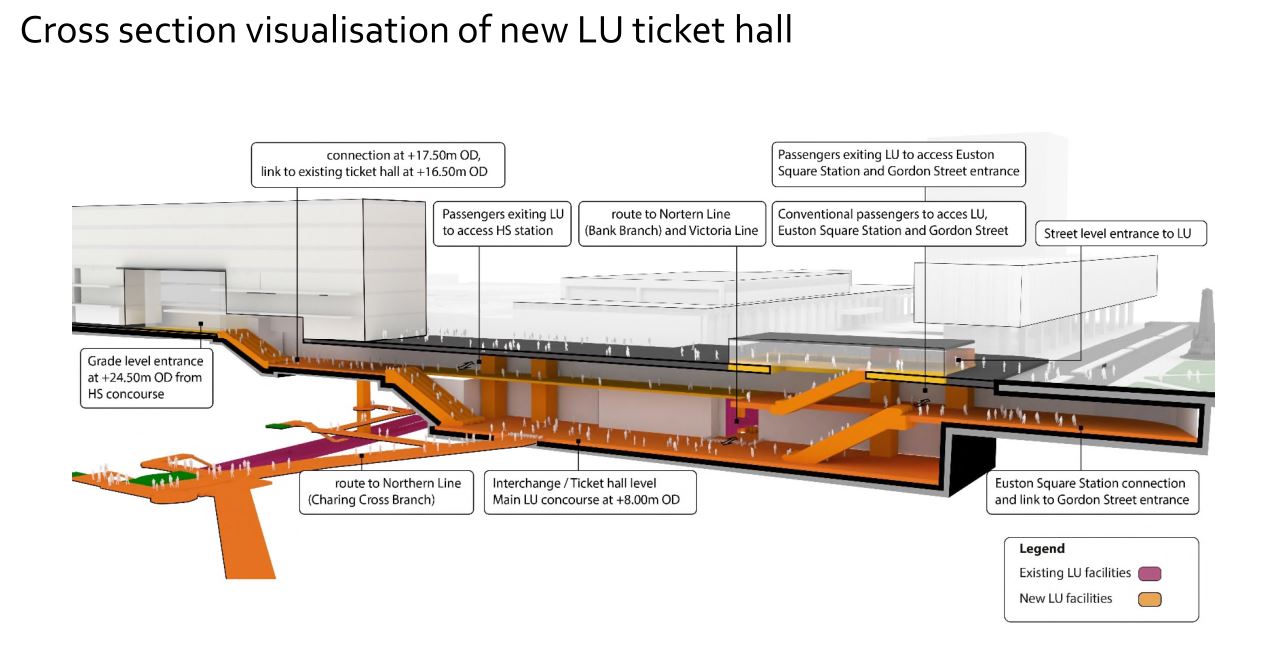
At a first look, it appears to be a very similar concept to the entrance to the Underground in front of St. Pancras station.
Click on the image to show it large and you can pick out the following.
- West is to the left and East is right.
- Much of the construction appears to replace the original car park and taxi rank.
- The upper level looks like where passengers enter and leave the station.
- The subway to Euston Square station and the new Gordon Street entrance joins to the upper level towards the Eastern end.
- There is grade access between the upper level and the High Speed Two concourse.
- There are lots of escalators to travel between levels. The square orange columns could be lift towers.
- The lower level is the Interchange/Ticket Hall level.
- The lower level is not much higher than the Charing Cross branch of the Northern Line.
- The design seems to make clever use of levels to make changing easier.
- The access between the lower level and the Charing Cross branch of the Northern Line at the Western end of the station, appears to be comprehensive and step-free.
- The access between the lower level and the Victoria Line and the Bank branch of the Northern Line, appears to use the current route, which will probably be upgraded to be fully step-free.
This second image shows the design from above the platforms of the conventional section of Euston station.
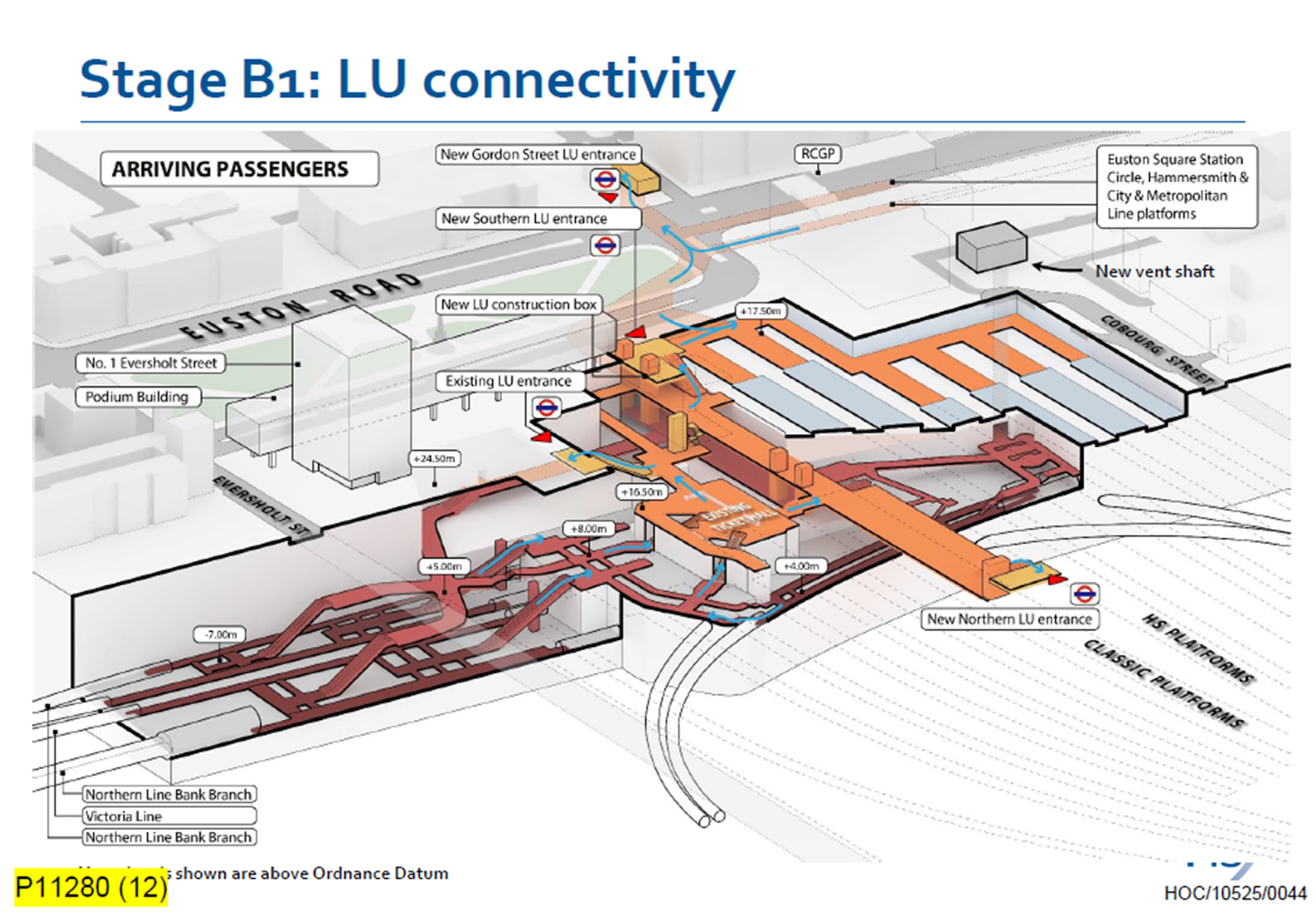
Click on the image to show it large and you can pick out the following.
- The complicated passages, escalators and lifts of the existing four platforms serving the Bank branch of the Northern Line and the Victoria Line.
- The cross passage connecting these lines to the platforms of the Charing Cross branch of the Northern Line.
- The two up and two down escalators leading to the existing ticket hall.
- The Charing Cross branch of the Northern Line curving in and away from the station. See the earlier map of the Underground lines.
- The eleven High Speed platforms on the West side of the station.
- The thirteen Classic platforms on the East side of the station.
- The new Northern entrance to the Underground between the two sets of platforms. How convenient!
- There appears to be a wide passage between the Northern and Southern entrances, with connections to the lines branching off.
- The subway to the new Gordon Street entrance is shown at the top of the image.
The design seems to have separated access to the two branches of the Northern line, by creating a new high-capacity route to the Charing Cross branch.
I also think, that the design allows the station to be built without disrupting passengers using the Underground and the current Euston station.
- A large hole for the station can be excavated, without touching existing access.
- It could then be fitted out section by section.
- Once the new access to the Charing Cross branch of the Northern Line is complete, the current access to the Northern and Victoria Lines can be refurbished.
Arriving At Euston
Imagine you are a passenger arriving from the North, who knows the Underground line, you need to take, you would then enter the Underground station using the new Northern entrance.
- For the Bank branch of the Northern Line or the Victoria Line, you would go through the existing ticket hall and down the escalators, much as you do now! Except that you’d enter the ticket hall on the other side from the East side of the passageway connecting the two entrances. New lifts appear to be shown.
- For the Charing Cross branch of the Northern Line, you would take the passages, lifts and escalators on the West side of the passageway connecting the two entrances.
- If you wanted the sub-surface lines, you would just keep going and take the new subway, which connects to the Eastern ends of the platforms at Euston Square station.
It will certainly do me fine, if I arrive at Euston, as I’ll walk through the subway and get in the front of any Eastbound train for Moorgate station, where being in the front is convenient for the exit and the nearby bus stop to my home.
This route will surely be one of the ways arriving passengers at Euston will get Crossrail to Abbey Wood, Canary Wharf and Shenfield stations. In Crossrail – Northern – Northern City Interchange At Moorgate Station, I show some visualisations of Moorgate station and the connectivity.
Network Rail Objects To Wrexham To London Service
The title of this post, is the same as that of this article on the BBC.
This is the sub-heading.
Concerns have been raised about plans for a direct rail service between Wrexham and London, including fears over safety at level crossings.
These three paragraphs add details to the story.
Network Rail warned the line was already congested and there was not enough timetable capacity for extra services.
In a report, it said increased use would raise the risk of a collision at crossings along the route and that it could not support the application, put forward by a new open-access rail operator called the Wrexham, Shropshire and Midlands Railway (WSMR).
The new service would link Wrexham, Gobowen, Shrewsbury, Walsall and Coleshill up with the capital.
This Google Map shows the area of the crossing.
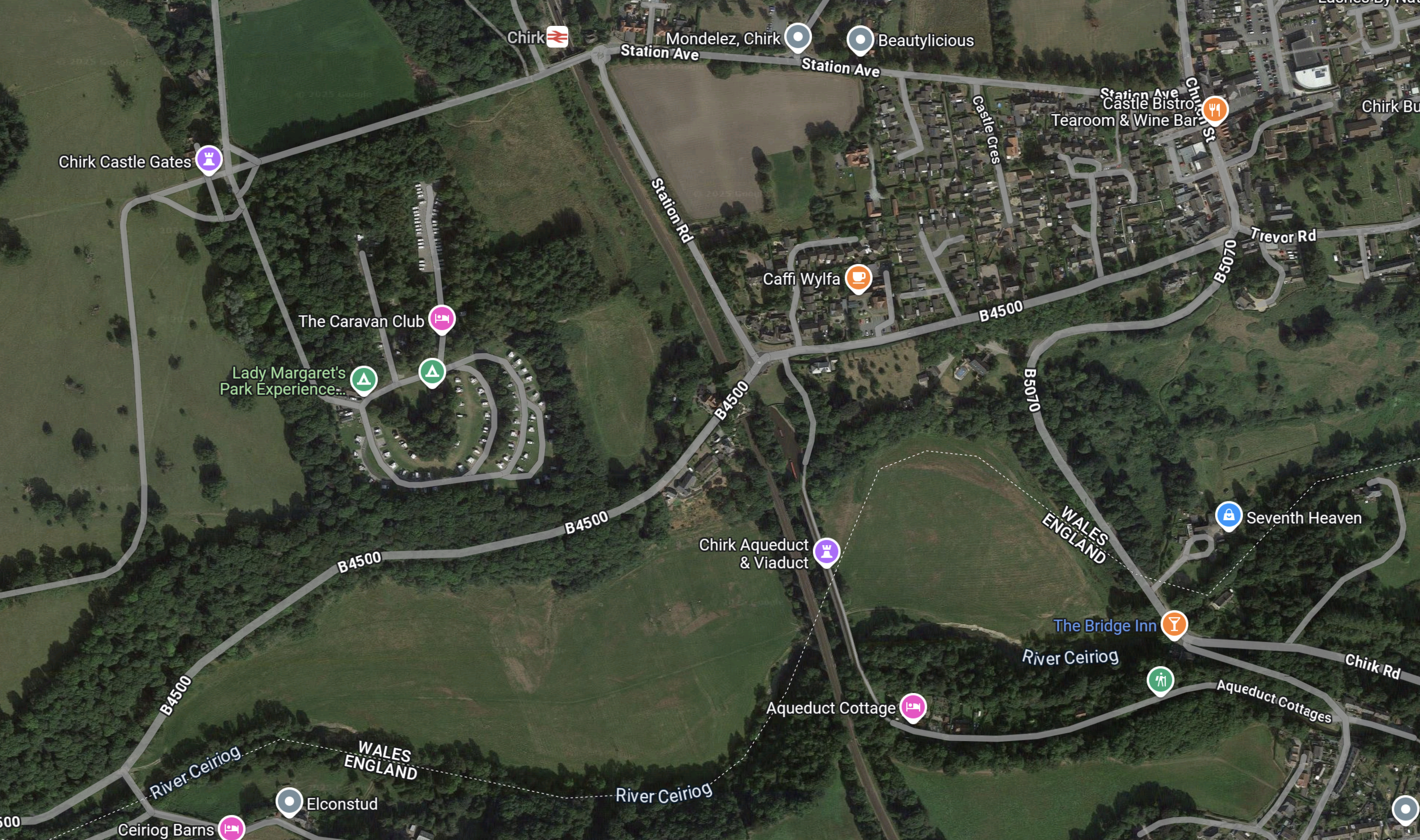
Note.
- Chirk station, which is fully-accessible via ramps, is at the top of the map.
- The railway between and running down the middle of the map.
- The railway has a maximum speed of 70 mph.
- The Aqueduct and the Viaduct crossing the valley of the River Ceirog together.
- The large caravan park.
- Chirk Castle Park.
If the Viaduct level crossing is in this area, it is a serious accident waiting to happen.
The BBC article says this about the crossing.
They include the Viaduct level crossing in Shropshire, which it said was “used by large groups and is also a hot spot for trespassing and fatalities”.
The operator said work would need to be carried out to make it safe.
North Shropshire MP Helen Morgan has previously spoken out on the safety of the crossing, which is close to the Chirk Viaduct.
She has written to Network Rail to request additional safety measures be put in place.
Network Rail said it had reviewed the safety of the crossing and brought forward plans to install crossing lights, which should be in place in December this year.
Note.
- I hope this is enough. But, I do know that the level crossing lights work well at Thurston station in Suffolk.
- It must help, that there is a bridge at the station.
The line between Wolverhampton and Wrexham, except for a short 15 mph section at Shrewsbury has at least a 70 mph maximum speed.
As electric trains, including battery-electric ones, have fast acceleration and deceleration would it not be possible for them to slow down for the level crossings?
This could even be done automatically using digital signalling.
Conclusion
I believe that this level crossing problem is solvable.
FirstGroup’s Lumo Seeks To Launch Rochdale – London Open Access Service
The title of this post, is the same as that of this article on Railway Gazette.
These two paragraphs outline the service.
FirstGroup has applied to operate Rochdale – London open access passenger trains, more than 20 years after a short-lived through service ran between the two destinations.
On May 17 FirstGroup said that it had applied to the Office of Rail & Road to launch six Lumo-branded return journeys per day linking London Euston and Rochdale via the West Coast Main Line. The trains would call at Warrington Bank Quay, Newton-le-Willows, Eccles and Manchester Victoria.
These are my thoughts.
The Route Isn’t Fully-Electrified
The route is electrified between London Euston and Manchester Victoria stations, but the 10.4 miles between Manchester Victoria and Rochdale is not electrified.
In Extra Luggage Racks For Lumo, I also talk about the possibility of fitting traction batteries to Lumo’s Class 803 trains, so they could handle the 88.5 mile diversion on the East Coast Main Line via Lincoln.
Trains with a traction battery, with an 88.5 mile range, would be able to travel between Manchester Victoria and Rochdale and return.
How Long Would London Euston And Rochdale Take?
Consider.
- The fastest London Euston and Warrington Bank Quay services take 1 hour and 44 minutes
- The fastest Warrington Bank Quay and London Euston services take 1 hour and 47 minutes
- Northern’s Class 195 trains take between 44-51 minutes Rochdale and Warrington Bank Quay with three stops.
- Northern’s Class 195 trains take between 29-32 minutes Manchester Victoria and Warrington Bank Quay with two stops.
- I will add two minutes for the extra stop.
These are my estimates for overall journey times.
- London Euston and Manchester Victoria – 2 hours and 15 minutes
- London Euston and Rochdale – 2 hours and 29 minutes
- Manchester Victoria and London Euston – 2 hours and 21 minutes
- Rochdale and London Euston – 2 hours and 40 minutes
The fastest direct Avanti West Coast services between London Euston and Manchester Piccadilly take 2 hours and 6 minutes.
Could The Service Be Extended To Leeds?
For my timings between Rochdale and Warrington Bank Quay, I used Northern’s Leeds and Chester service.
This service goes between Manchester Victoria and Leeds calling at Rochdale, Todmorden, Hebden Bridge, Halifax, Bradford Interchange, New Pudsey and Bramley.
I estimate it would take about 3 hours 32 minutes.
When Bradford has a new through station, I wouldn’t be surprised if a train operator looked at this route between London Euston and Leeds.
As Leeds and Manchester Victoria is only 49.8 miles, Lumo’s battery electric trains, with 88.5 mile batteries sized for the Lincoln diversion on the East Coast Main Line, would have no difficulty serving Leeds, where they would charge before return.
Could Lumo Run Pairs Of Five-Car Trains Between London Euston and Manchester Victoria?
As I said in Ten-Car Hull Trains, Lumo’s sister company; Hull Trains, runs the occasional ten-car service.
Perhaps for a big football match or other event, Lumo might like to run ten-car trains between Manchester Victoria and London Euston.
I suspect they could do it if the platforms were long enough, but they wouldn’t be able to run a 260 metre ten-car train to Rochdale, as that station only has a 135 metre long platform.
Warrington Bank Quay Station Will Get Six Extra Non-Stop Trains To And From London
This would provide real competition to Avanti West Coast over this route.
Newton-le-Willows Station Is Only A Few Miles From The Town Of St. Helen’s
Newton-le-Willows station has 400 parking spaces and 32 disabled parking spaces.
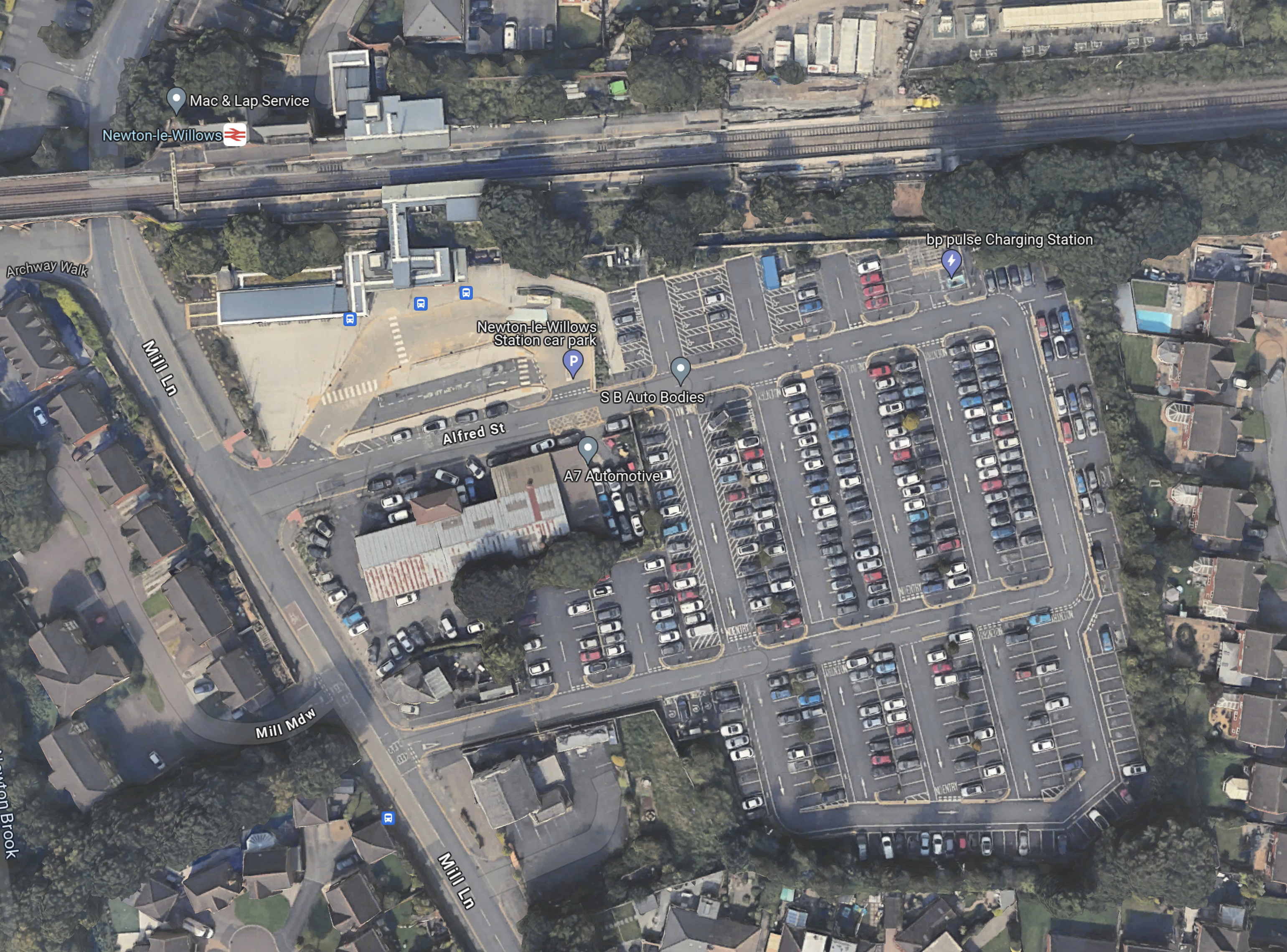
Note.
- The parking is all free!
- There are regular local trains to Chester, Leeds, Liverpool Lime Street, Manchester Airport and Wigan North Western.
A six trains-per-day service to and from London, will help fill up the parking spaces.
Eccles Station Is Within Walking Distance Of Eccles Interchange
This OpenRailwayMap shows Eccles station and Eccles Interchange.
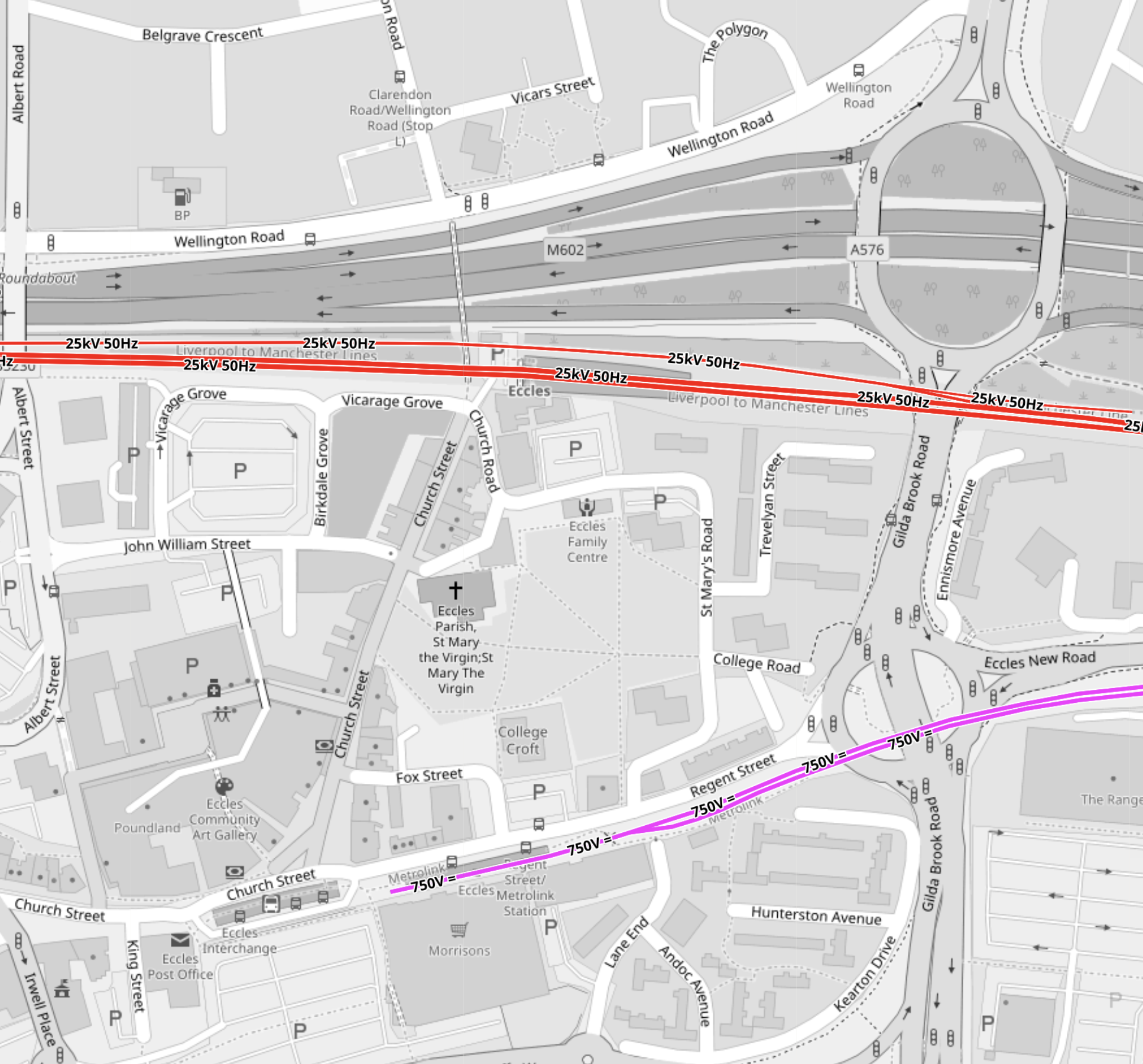
Note.
- The mauve tracks are the Manchester Metrolink.
- They terminate in the South-West at Eccles Interchange.
- The red tracks are the Liverpool-Manchester lines.
- Eccles station is a Northerly walk from Eccles Interchange.
This connection must be useful to more than a few.
I suspect if you’re going between London and Media City UK, Salford Quays or Piccadilly Gardens, you may be better to change to the Metrolink at Eccles.
Will Lumo’s Rochdale Service Run As A Flight With Avanti’s Glasgow Service?
Flighting is where two or more trains going on the same route run a few minutes apart.
- Every hour, on the half hour, an Avanti West Coast service for leaves London Euston for Glasgow Central.
- As with Lumo’s Rochdale service, the first stop is Warrington Bank Quay station.
- The Lumo service would leave London Euston a few minutes after Avanti’s Glasgow service.
- The distance between the two trains would be such, that if the first train stopped, the second train could stop safely.
- Digital signalling as is being installed on UK rail lines would make it easier to ensure safe separation.
But the benefit would be that both trains ran fast to Warrington Bank Quay station.
A Day-Trip To Manchester
If I’m right about the 2 hours and 15-21 minutes between London Euston and Manchester Victoria, then a day-trip would certainly be feasible.
Last Trains
This is a table of the last train times for Lumo between Newcastle and London.
- Weekdays – 20:27 21:35
- Saturdays – 18:27 19:22
- Sundays – 19:24 20:21
Note.
- The first time is the last Northbound departure.
- The second time is the last Southbound departure.
- Are these late enough for football matches?
I shall be interested to see the proposed last train times for the Manchester route.
- Will they be timed so you can get a tram from the Etihad or Old Trafford stadium after an evening match, that allowed you to get the last train back to London from Manchester Victoria?
- Taylor Swift gave the Manchester Arena a lot of favours with her concerts. Would you have been able to see her concert and get the last train back to London?
A few extra full trains wouldn’t hurt Lumo’s finances.
Conclusion
It looks like, this could be a very worthwhile service.
ORR: Open Access Services Given Green Light Between London And Stirling
The title of this post is the same as that of this press release from the Office of Rail and Road.
This is the sub-heading.
The latest access decision by the Office of Rail and Road (ORR) provides more services for rail passengers travelling between London and central Scotland.
These five paragraphs detail the ORR’s decision.
ORR has today (7 March) given the go-ahead for Grand Union Trains, an open access operator, to start a new train service between London and the city of Stirling, from June 2025. ORR’s decision will offer more choice to passengers, bring private sector investment to the railway and increase competition.
Grand Union Trains will introduce four new return services per day between London Euston and Stirling stations. These services will also call at Milton Keynes Central, Nuneaton, Crewe (subject to agreement between Grand Union Trains and Network Rail), Preston, Carlisle, Lockerbie, Motherwell, Whifflet, Greenfaulds and Larbert. Larbert, Greenfaulds and Whifflet will receive their first direct services to London.
ORR found that the proposed services would increase choice for passengers, significantly increasing direct journey opportunities to and from London and central and southern Scotland, while making use of existing capacity on the network.
The new services will be the first run by an open access operator on the West Coast Mainline. Open access operators run services independently of government funding as they do not have a franchise agreement with government.
Following ORR’s decision to approve new Grand Union Trains services between Carmarthen in south Wales and London Paddington in 2022, ORR has now approved open access services on three of Britain’s major routes.
Note.
- The Grand Union service appears to be running into London Euston. Earlier plans had it terminating at Queen’s Park station.
- Larbert, Greenfaulds and Whifflet will receive their first direct services to London.
- London Euston and Stirling is electrified all the way.
- The third open access service, that the ORR has approved is the Lumo service between King’s Cross and Edinburgh via the East Coast Main Line.
I have a few thoughts.
Stirling Is An Ideal Place To Explore Central Scotland By Train
In Stirling, I give the reasons, why I spent a couple of days in Stirling, when I wanted to visit several places in Central Scotland.
Note.
- Stirling has direct services to Aberdeen, Dundee, Edinburgh, Glasgow, Inverness and Perth.
- Aberdeen is one hour and 15 minutes away.
- Dundee is just 63 minutes away.
- Edinburgh is just 48 minutes away.
- Glasgow is just 39 minutes away.
- Inverness is two hours and 46 minutes away.
Stirling has about a dozen affordable hotels and guest houses within walking distance of the station, as this map shows.
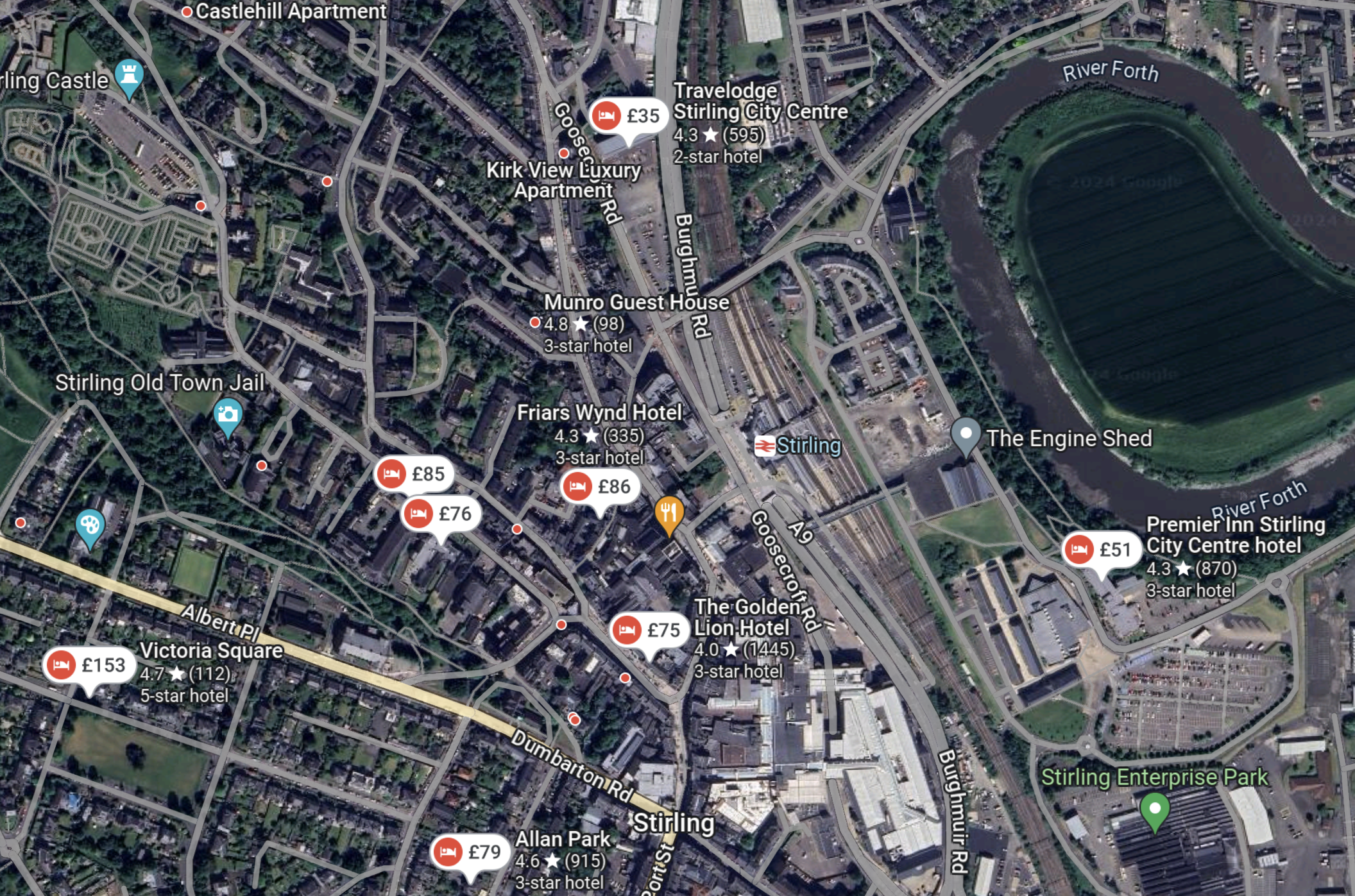
Stirling would appear to have got Central Scotland covered.
Could The Train Serve Gleneagles?
Gleneagles is about twenty minutes North of Stirling and is served by the Caledonian Sleeper from London.
This Google Map shows the area around Gleneagles station.
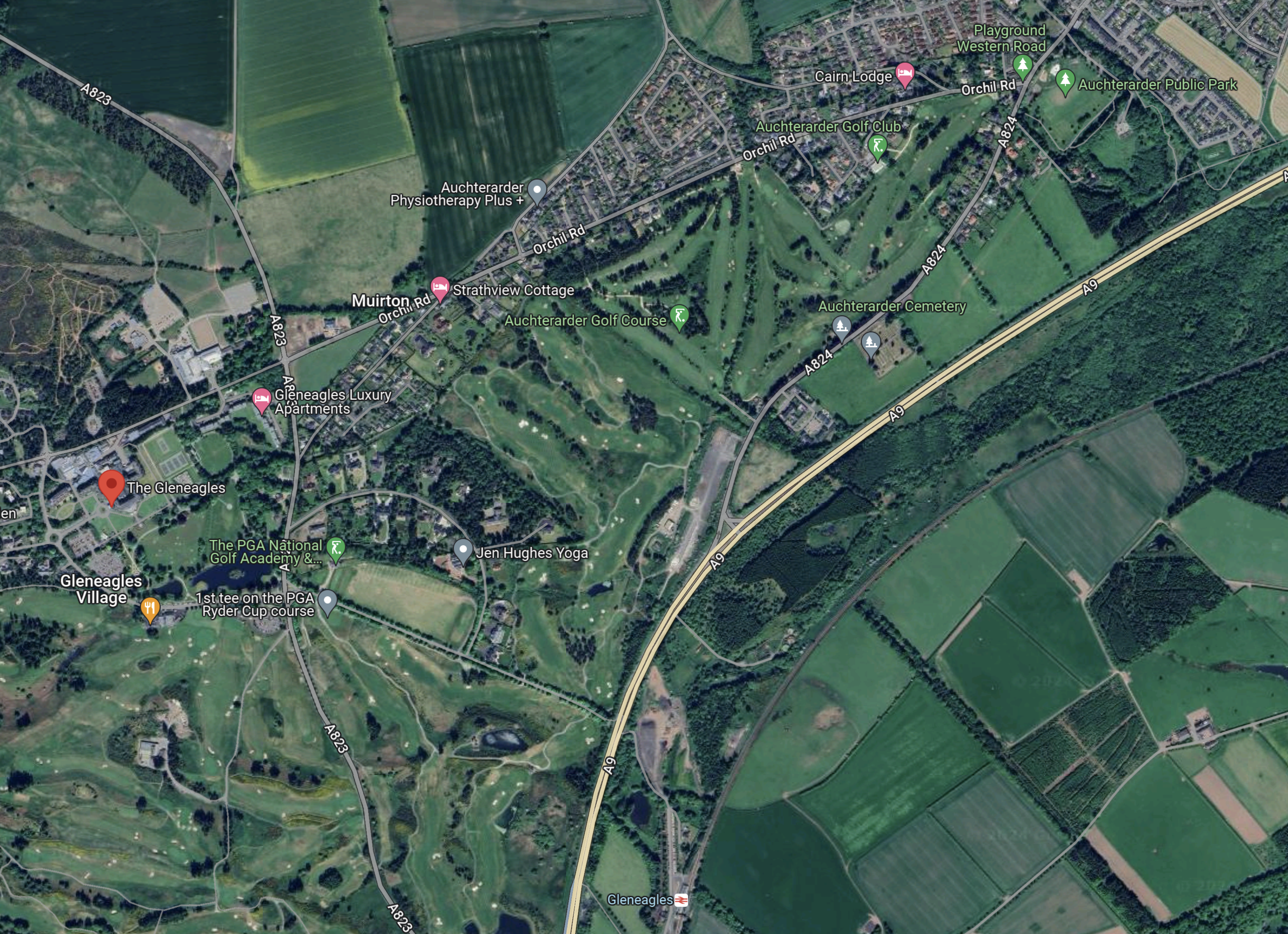
Note.
- Gleneagles station is at the bottom of the map.
- The red arrow indicates the famous Gleneagles hotel.
- The pink dots are other hotels.
- Airbnb lists several very splendid properties in the varea.
Not everybody, who goes to the Gleneagles area will be exceedingly rich and I could see the Gleneagles area generating substantial business for Grand Union Trains. I suspect the best way to serve Gleneagles would be a zero-emission coach from Stirling.
Along The Motherwell And Cumbernauld Line
Between Motherwell and Stirling, a lot of the route used is on the Motherwell and Cumbernauld Line.
- The line is fully-electrified.
- It is only 28.9 miles between Motherwell and Stirling.
- \cumbernaukd and Motherwell takes 20 minutes.
I do wonder, if extra stops might be worthwhile.
Motherwell Has Good Connections To Edinburgh And Glasgow
As well as Stirling, Motherwell has good connections to both Edinburgh and Glasgow, so some passengers might find their most convenient route involves a change at Motherwell.
Nuneaton And Scotland Would Get A New Service
Nuneaton has been named by Avanti West Coast, as a place that needs more trains, as it connects with the service between Birmingham and Stansted Airport, via Coleshill Parkway, Leicester, Peterborough, March, Ely and Cambridge.
I suspect that, Nuneaton will become an interchange, between East Anglia and, the North West and West Scotland.
Milton Keynes And Scotland Should Get An Improved Service
Consider.
- It appears that all Avanti West Coast services between Milton Keynes and Scotland, go via Birmingham.
- I suspect that Grand Union’s route using the Trent Valley Line could be faster with similar trains.
- Creating a new route between Milton Keynes and Stirling could be a good move, as it gives one-change access to much of Central Scotland.
- Milton Keynes has good local connections to places like Northampton, Rugby, Tring and Watford Junction.
- Milton Keynes will be a stop on the new East-West Railway.
- From many stations, it will be quicker to go via Milton Keynes rather than Euston.
I suspect Milton Keynes could be a nice little earner.
Will Grand Union’s Trains Be Fitted With Digital Signalling?
Consider.
- At some point in the next ten years the West Coast Main Line will be fitted with digital signalling, to enable trains to run at 140 mph on selected parts of the route.
- Digital signalling will allow extra services between London Euston and Motherwell.
- Motherwell and London Euston is 388 miles.
I suspect, that Grand Union’s Trains will need to be fitted with digital signalling, so they can save time on services and possibly add in a few more.
It will add costs, although the faster speed will surely attract passengers.
Will Grand Union’s Trains Be Electric?
There are these train services going between England and Scotland.
- Avanti West Coast – London Euston to Edinburgh Waverley via Birmingham New Street – 7 tpd – Class 390 – Electric
- Avanti West Coast – London Euston to Glasgow Central via Birmingham New Street – 5 tpd – Class 390 – Electric
- Avanti West Coast – London Euston to Glasgow Central via Trent Valley – 1 tph – Class 390 – Electric
- CrossCountry – Plymouth to Edinburgh Waverley – 1 tph – Class 220/221 – Diesel – Uses diesel all the time
- LNER – London King’s Cross/Leeds to Aberdeen – 4 tpd – Class 800 – Bi-mode – Uses diesel North of Edinburgh
- LNER – London King’s Cross to Inverness – 1 tpd – Class 800 – Bi-mode – Uses diesel North of Stirling
- LNER – London King’s Cross to Edinburgh Waverley – 3p2h – Class 800 – Bi-mode or Class 801 – Electric
- LNER – London King’s Cross to Glasgow Central – 1 tpd – Class 801 – Electric
- LNER – London King’s Cross to Stirling – 1 tpd – Class 801 – Electric
- Lumo – London King’s Cross to Edinburgh – 5 tpd – Class 803 – Electric
- TransPennine Express – Newcastle to Edinburgh Waverley – 7 tpd – Class 802 – Bi-mode
- TransPennine Express – Liverpool Lime Street to Glasgow Central – 2 tpd – Class 397 – Electric
- TransPennine Express – Manchester Airport to Edinburgh Waverly – 1 tp2h – Class 397 – Electric
- TransPennine Express – Manchester Airport to Glasgow Central – 1 tp2h – Class 397 – Electric
Note.
- tpd is trains per day.
- tph is trains per hour.
- tp2h is trains per two hours.
- LNER services to Glasgow and Stirling are likely to be dropped.
- Some Lumo services are likely to be extended from Edinburgh to Glasgow.
- Many services South from Stirling to Edinburgh Waverley and Glasgow Queen Street are electric.
The current two tpd direct trains to Stirling are electric and if you change at Edinburgh Waverley or Glasgow, it is likely to be an all-electric service.
For marketing reasons, I would recommend, that Grand Union Trains ran electric trains between London Euston and Stirling, as they are competing against an all-electric service.
Although to meet service dates it might be necessary to run something like a diesel Class 222 train to get the service started.
What Trains Will Grand Union Use?
The Wikipedia entry for Grand Union Trains, says this for their London Euston and Stirling service.
In 2023 Grand Union revised its proposal changing its planned rolling stock to Class 22x units, at the same time the start date for this service was changed to June 2025.
I would suspect they will put in the order for new electric trains fairly sharpish.
The new trains could be.
- A variant of Hitachi’s Class 800 trains.
- A variant of CAF’s Class 397 trains.
Would they have an emergency battery un case of overhead line failure?
How Long Will A Service Take?
The service can be divided into two sections.
- London Euston and Motherwell – 388 miles.
- Motherwell and Stirling – 28.9 miles.
Note.
- The 08:30 train from Euston to Motherwell takes 4 hours and 17 minutes with six stops via Nuneaton.
- The Grand Union Trains service will also have six stops and go via Nuneaton.
I would expect with today’s signalling and electric trains, that Euston and Motherwell would take a maximum of 4 hours and 17 minutes.
- The twenty minute time to Cumbernauld could be added.
- The twenty-five minute time between Cumbernauld and Stirling could be added.
It looks the time would be just over five hours.
I doubt there would be much scope for increasing speed North of Motherwell, but could there be savings made to the South of Motherwell?
Consider.
- London Euston and Motherwell is 388 miles.
- Four hours and 17 minutes is 257 minutes.
- Motherwell is on the main London Euston and Glasgow Central route.
This is an average speed between London Euston and Motherwell of 90.6 mph.
By comparison.
- London King’s Cross and Edinburgh is 392.6 miles.
- Journeys can take four hours and 20 minutes or 260 minutes.
This is an average speed between London King’s Cross and Edinburgh of 90.6 mph.
In the next decade, there will be improvements on both the East and West Coast Main Lines.
- King’s Cross and Edinburgh is currently being digitally signalled.
- London Euston and Glasgow Central is likely to be an early priority for digital signalling after London King’s Cross and Edinburgh is completed.
- When High Speed Two opens to Birmingham and Lichfield, High Speed Two trains between London Euston and Glasgow Central will use the West Coast Main Line to the North of Lichfield.
- I wouldn’t be surprised to see some track realignment and modifications to improve speeds on the West Coast Main Line to the North of Lichfield.
I can build a table of times between London Euston and Motherwell against average speed.
- 90 mph – 4 hours 19 minutes
- 100 mph – 3 hours 53 minutes
- 110 mph – 3 hours 32 minutes
- 120 mph – 3 hours 14 minutes
- 125 mph – 3 hours 6 minutes
- 130 mph – 2 hours 59 minutes
Note.
- Adding 15 minutes gives a London Euston and Glasgow Central time.
- Adding 45 minutes gives a London Euston and Stirling time.
- Averaging 120 mph would give London Euston and Glasgow Central or Stirling times of under four hours.
It strikes me, that to improve Anglo-Scottish relations and to make rail a better alternative to flying, a priority for all West Coast services is to improve the West Coast Main Line and install digital signalling, so that a 120 mph average is possible between London Euston and Motherwell.
What Difference Will High Speed Two Make?
High Speed Two is claiming it will knock thirty minutes off times between London Euston and Glasgow Central, when it opens to Birmingham and Lichfield.
But Grand Union Trains are not expected to use the new line between London Euston and Lichfield, as High Speed Two will, as it will make calling at Milton Keynes and Nuneaton impossible, as they are bypassed by High Speed Two.
Conclusion
This train service is going to be good for Milton Keynes, Nuneaton and Stirling and all the towns in Central Scotland.
But they must make full use of the available electrification.
FirstGroup Applies To Run New London To Sheffield Rail Service
The title of this post, is the same as that of this press release from First Group.
These four paragraphs outline FirstGroup’s initial plans.
FirstGroup plc, the leading private sector transport operator, has today submitted the first phase of an application for a new open access rail service between London and Sheffield to the Office of Rail and Road (ORR).
FirstGroup plans to expand its open access rail operations as part of its award-winning Hull Trains business, building on their successful existing service which has transformed long-distance connectivity between Hull and London.
FirstGroup’s new proposals comprise two return journeys a day from London King’s Cross, calling at Retford, Worksop, Woodhouse and Sheffield, and the company aims to provide a faster link between London and Sheffield than alternative services. Almost three quarters of trips between London and Sheffield are currently made by car, with a further 9% of trips made by coach, and a competitively priced new rail offering will help stimulate a shift in transport mode of choice from road to rail.
The new proposed route will give Sheffield the first regular service from London King’s Cross since 1968 and will also give Worksop in Nottinghamshire the first regular direct London trains in decades. FirstGroup estimates there are 350,000 people in the Worksop and Woodhouse catchment areas who will have direct rail access to London because of these proposals. A sizeable number of rail users in these areas currently drive to Doncaster station to pick up faster services to London rather than travelling via Sheffield, and a convenient rail offering from local stations will also help to reduce the number of these car journeys.
Note.
- The press release says this is only the first phase.
- It appears to be an extension of Hull Trains.
- Comments on a news story based on the press release in The Times, have been generally positive.
These are my thoughts.
The Two Routes Are Similar
Consider.
- Beverley is 44.3 miles from the electrified East Coast Main Line at Temple Hirst Junction.
- Hull is 36.1 miles from the electrified East Coast Main Line at Temple Hirst Junction.
- Sheffield is 23.5 miles from the electrified East Coast Main Line at Retford station.
- There is no electrification at Beverley, Hull or Sheffield.
Note.
- Trains must be capable of having a range sufficient to go from the East Coast Main Line to the destination and back again.
- It is slightly surprising that Sheffield station is closest to the electrification of the East Coast Main Line.
- Hull Train’s electro-diesel Class 802 trains regularly handle the 88.6 miles to Beverley and back.
It does look like an appropriate number of Class 802 trains could handle Hull Trains current and future services to Beverley, Hull and Sheffield.
Hull Trains Need Ten-Car Trains
Consider.
- In Ten-Car Hull Trains, I show some details of Hull Trains using a pair of five-car trains.
- I’ve since seen ten-car Hull Trains regularly.
- There were two ten-car services on the 29th December 2023 between London King’s Cross and Hull.
Hull Trains must procure enough trains for all possible scenarios.
Intermediate Stations Of The Two Routes
Intermediate stations are.
- Going North from London King’s Cross to Hull, trains call at Stevenage (limited), Grantham, Retford, Doncaster, Selby, Howden and Brough.
- Going North from London King’s Cross to Sheffield, trains call at Retford, Worksop and Woodhouse.
There are only a small number of stops on the Sheffield service. Is this to reduce the journey time as much as possible?
What Will Be The Time Of The London King’s Cross And Sheffield Service?
Consider.
- Non-stop trains take 82 minutes between London King’s Cross and Retford, which is 138.6 miles, so it’s an average speed of 101.4 mph.
- Woolmer Green and Retford are 111.7 miles and will in a couple of years, be digitally signalled.
- Non-stop trains take 66 minutes between Woolmer Green and Retford, which is an average speed of 112 mph.
- I have found a direct Retford and Sheffield train, that takes 31 minutes for the 23.5 miles with six stops, which is an average speed of 45 mph.
- The Retford and Sheffield section has a mostly 60 mph maximum speed.
I can now build a table of times between King’s Cross and Retford based on the average speed North of Woolmer Green.
- 125 mph – 72 minutes
- 130 mph – 70 minutes
- 135 mph – 68 minutes
- 140 mph – 66 minutes
Note.
- Getting a high average speed using the power of digital signalling can save several minutes.
- I have measured an InterCity 125 averaging 125 mph on that section.
I can now build a table of times between Retford and Sheffield based on the average speed.
- 45 mph – 31 minutes
- 50 mph – 28 minutes
- 60 mph – 24 minutes
- 70 mph – 20 minutes
- 80 mph – 18 minutes
Note.
- The planned service is expected to stop only twice after Retford, so if we take off two minutes for each of the four stops not taken, this could reduce the time between Retford and Sheffield by 8 minutes.
- There will be a couple of minutes to add for the stop at Retford.
- I feel a typical journey with 125 mph to Retford, 50 mph to Sheffield, could take 94 minutes
- Currently, the fastest London St. Pancras to Sheffield take around 116-118 minutes.
Hull Trains new service could save 22-24 minutes on the current service.
I also feel a fast journey could involve 130 mph to Retford, 60 mph to Sheffield, could take 88 minutes.
Hull Trains new service could save a few minutes over half-an-hour.
Could The Time Of The London King’s Cross And Sheffield Service Be Under 90 Minutes?
I reckon the following is possible.
- After the digital signalling is completed between King’s Cross and Retford, I suspect that a 135 mph average speed can be maintained between Woolmer Green and Retford. This would mean that a King’s Cross and Retford time of 68 minutes would be possible.
- If Network Rail improve the track between Retford and Sheffield, I believe that a 70 mph average could be achieved on the Retford and Sheffield section. This would mean that a Retford and Sheffield time of 20 minutes would be possible.
- I would expect at least six minutes would be saved by missing stops.
This gives a time of 82 minutes between London King’s Cross and Sheffield.
In Anxiety Over HS2 Eastern Leg Future, I said that High Speed Two’s promised London and Sheffield time via a dedicated track would be 87 minutes.
It looks to me that running under full digital signalling on the East Coast Main Line, Hull Trains can beat the HS2 time.
Could Hitachi’s Battery-Electric Trains Handle The Routes?
This page on the Hitachi web site is entitled Intercity Battery Trains.
This is the sub-heading
Accelerate the decarbonisation of intercity rail with batteries.
These paragraphs outline the philosophy of the design of the trains.
A quick and easy application of battery technology is to install it on existing or future Hitachi intercity trains. Hitachi Rail’s modular design means this can be done without the need to re-engineer or rebuild the train and return them to service as quickly as possible for passengers.
Replacing one diesel engine with just one battery reduces emissions by more than 20% and offers cost savings of 20-30%. Our intercity battery powered trains can cover 70km on non-electrified routes, operating at intercity speeds at the same or increased performance.
Wouldn’t it be great, if we could take the diesel engine out of our cars and replace it with an electric power pack?
Paul Daniels would’ve classed it as engineering magic.
But it’s an old engineer’s trick.
As a fifteen year old, I spent time in a rolling mill, building and fitting replacement control systems on large machines. Transistors were used to replace electronic valves and relays.
It’s certainly possible to create a battery pack, that is plug-compatible with an existing diesel generator, that responds to the same control inputs and gives the same outputs.
At the extreme end of this technology, there would be no need to change any of the train’s software.
In The Data Sheet For Hitachi Battery Electric Trains, these were my conclusions for the performance.
- The battery pack has a capacity of 750 kWh.
- A five-car train needs three battery-packs to travel 100 miles.
- A nine-car train needs five battery-packs to travel 100 miles.
- The maximum range of a five-car train with three batteries is 117 miles.
- The maximum range of a nine-car train with five batteries is 121 miles.
As the East Coast Main Line to Beverley is a round trip is 88.6 miles, I suspect that Hull Trains’s five-car Class 802 trains will need to be fitted with a full-complement of three batteries.
Will Hull Trains Have An Identical Fleet Of Trains?
An identical fleet must have advantages for train staff, maintenance staff and above all passengers.
I believe FirstGroup have two choices.
- They buy an appropriately-sized batch of identical Class 802 trains.
- They convert their current fleet to battery-electric operation and buy an appropriately-sized batch of identical new trains.
Note.
- The second option means that they fully-decarbonise Hull Trains.
- Neither option would need any new infrastructure.
- I feel this means that this order is more likely to go to Hitachi.
It’ll probably all come down to the accountants.
Retford Station
This OpenRailwayMap shows the tracks around Retford station.
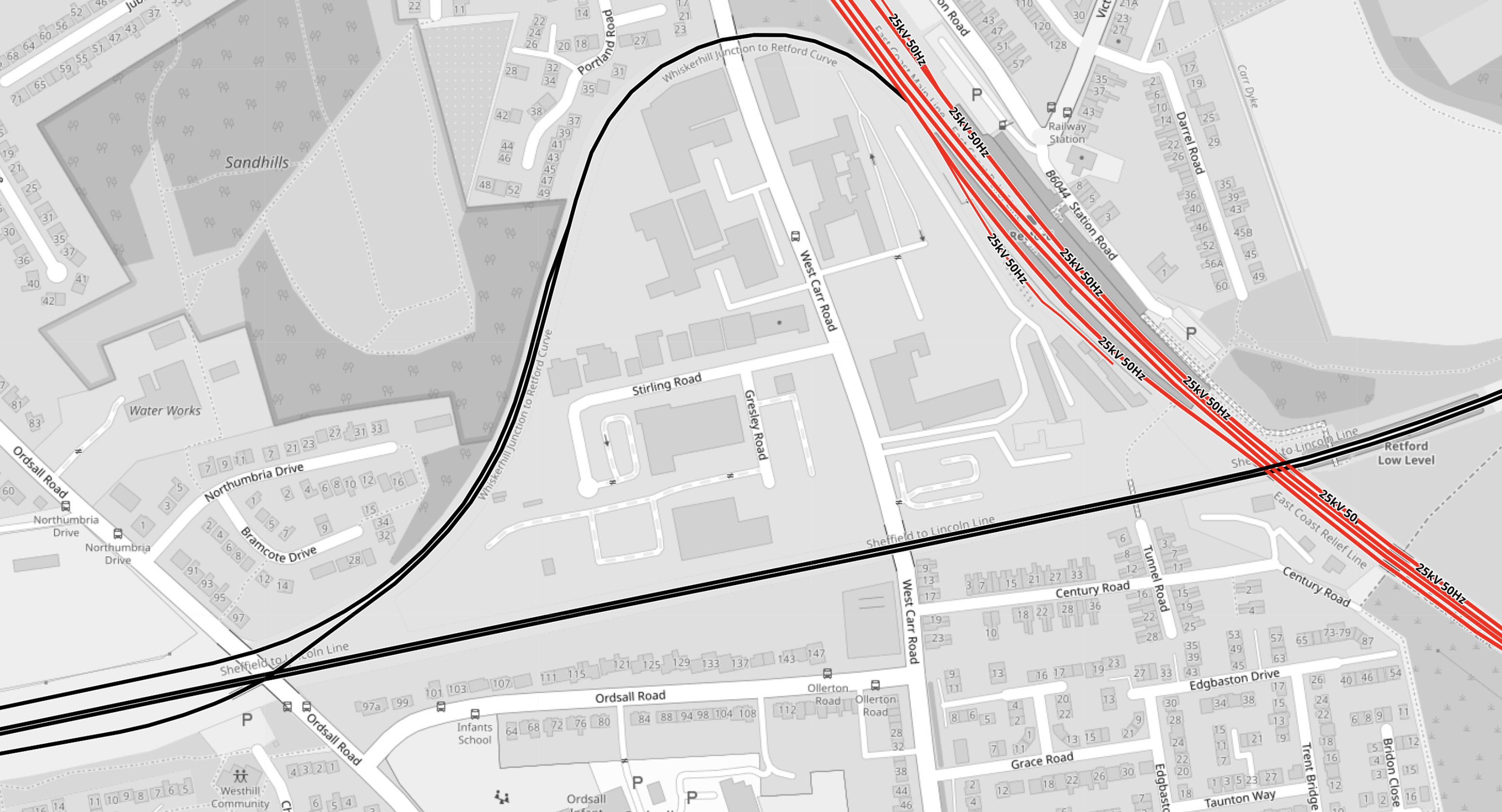
Note.
- The red tracks are electrified and are the East Coast Main Line.
- The black ones aren’t electrified.
- Doncaster is to the North.
- The black line to the East goes to Lincoln
- The black line to the West goes to Sheffield
- The red line going South-East goes to Peterborough and London.
The unusual loop allows trains to connect from one direction to another.
This second OpenRailwayMap shows the tracks in more detail.
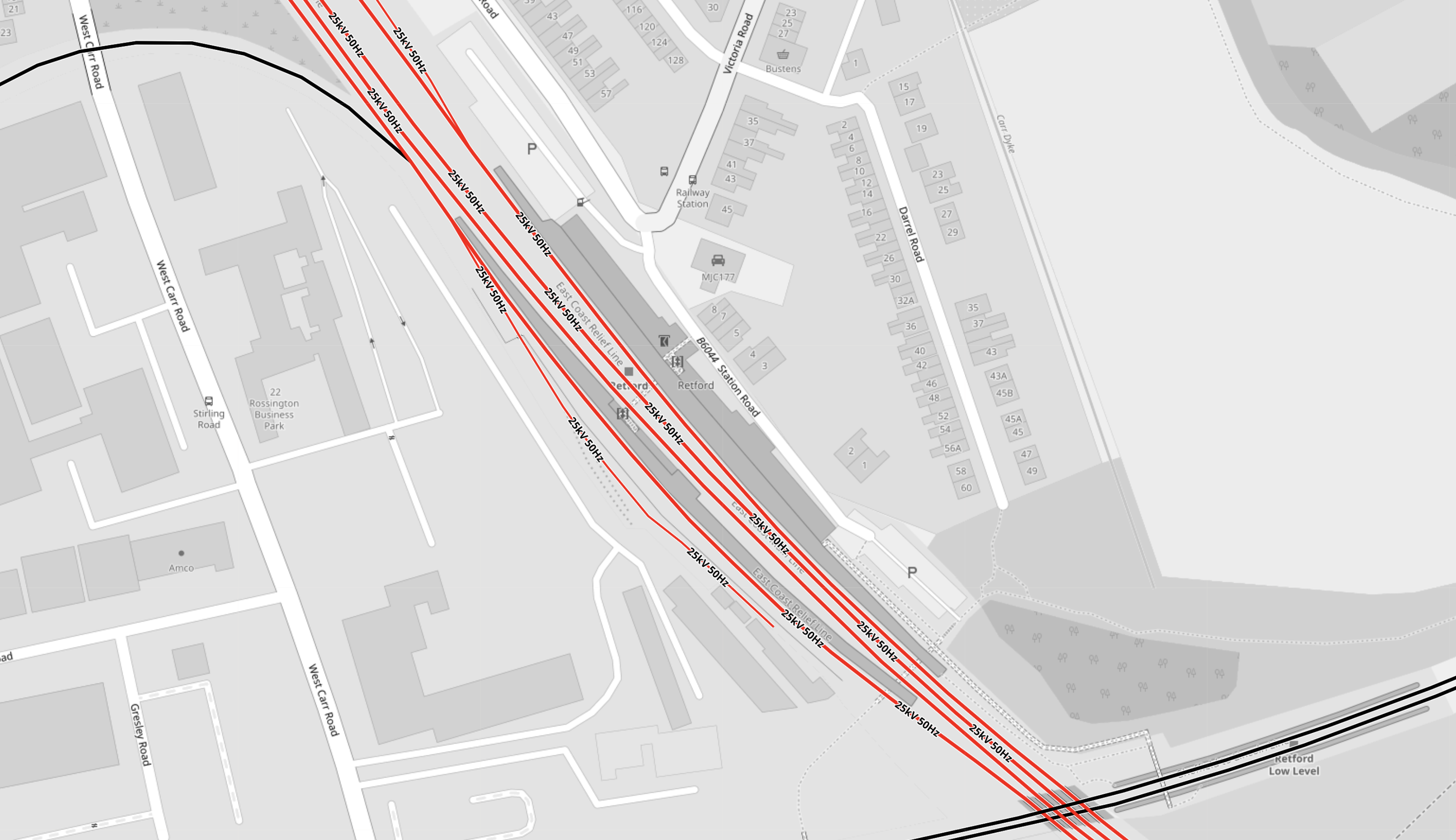
Note.
- As before red lines are electrified and black ones aren’t
- Platforms 1 and 2 are on the East Coast Main Line.
- Platforms 3 and 4 are on the Sheffield and Lincoln Line.
This third OpenRailwayMap shows the platforms in more detail.

Note.
- The yellow tracks are the 125 mph fast lines of the East Coast Main Line.
- The light blue tracks are the 40 mph relief lines of the East Coast Main Line.
- Northbound tracks are to the left of each pair of lines.
- The dark blue track is the 10 mph chord that connects the Northbound relief line of the East Coast Main Line to the Sheffield and Lincoln Line.
- Platform 1 is on the Southbound relief line.
- Platform 2 is on the Northbound relief line.
- Unusually, both platforms are on the same side of the line.
- In The Lengths Of Hitachi Class 800/801/802 Trains, I state that the full length of an InterCity 225 train is 245.2 metres.
- I suspect that both platforms can accommodate a full length InterCity 225, as the trains have been calling at Retford since the 1980s.
I doubt Retford station has any problem accommodating a pair of Class 802 trains, which it does regularly.
How Do Northbound Trains Go To Sheffield From Retford Station?
This OpenRailwayMap shows the tracks to the South of Retford station in detail.
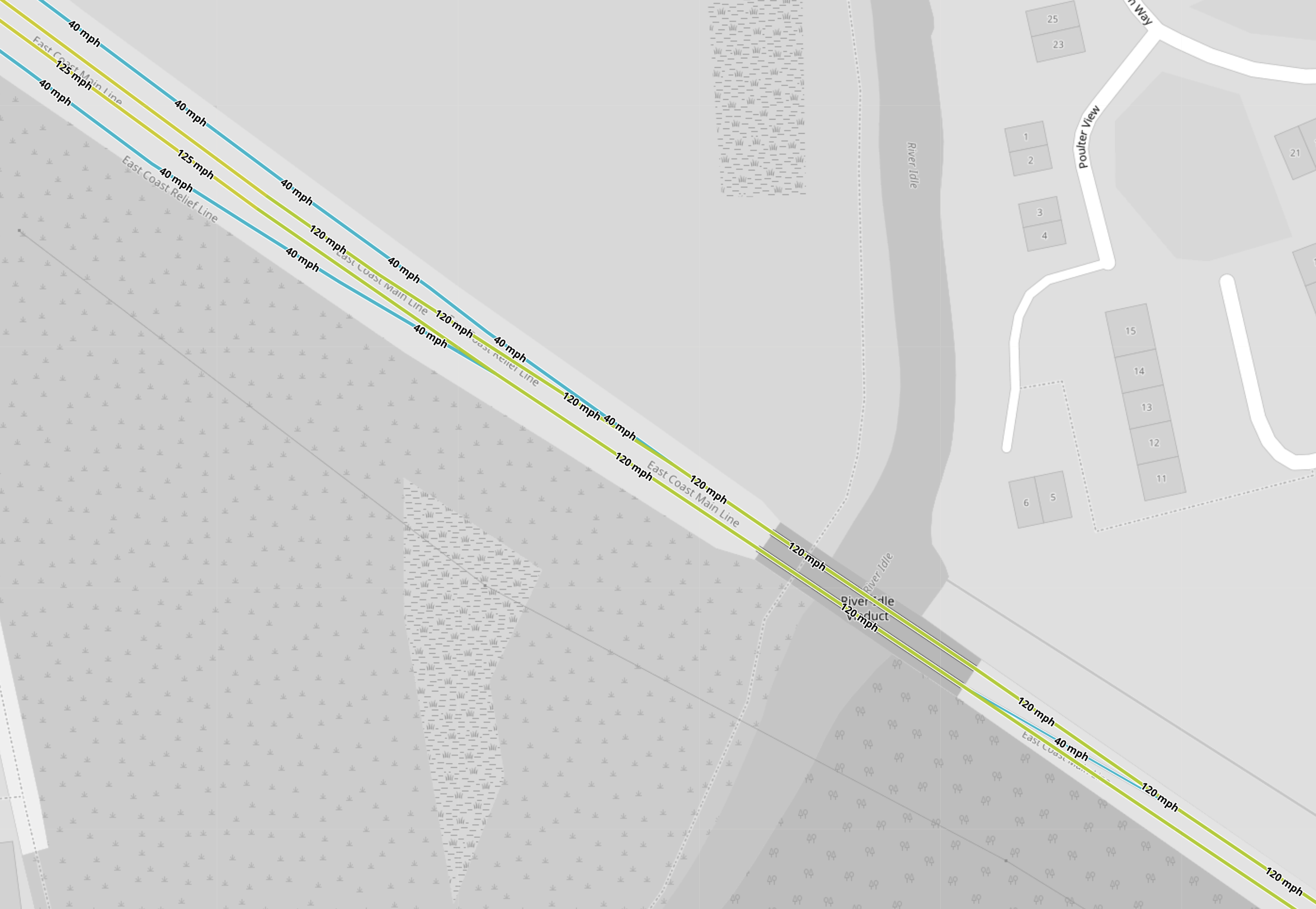
Note.
- The yellow tracks are the 125 mph fast lines of the East Coast Main Line.
- The light blue tracks are the 40 mph relief lines of the East Coast Main Line.
- Northbound tracks are to the left of each pair of lines.
Trains needing to stop in Retford station will need to cross to the Northbound relief line to enter Platform 2 at Retford station.
This OpenRailwayMap shows the curve that connects Platform 2 at Retford station to the Sheffield and Lincoln Line to Sheffield.

Note.
- The green tracks are the 60 mph Sheffield and Lincoln Line.
- Sheffield is to the West.
- The blue tracks are the curve that connects Platform 2 in Retford station to the Sheffield and Lincoln Line.
- There appears to be a grade-separated junction, where the two lines join to the West of Retford station.
A Northbound train to Sheffield will take curve and then join the line to Sheffield.
How Do Southbound Trains Go From Sheffield Through Retford Station?
I suspect trains do the opposite from a train going to Sheffield.
The train takes the curve and then stops in Platform 2 facing South.
This OpenRailwayMap shows the tracks to the South of Retford station in detail.
When the train is cleared by the signals to go South, it will leave Retford station going South on the Northbound relief line.
Note that on the map there are two crossovers, which the train will take to get on the Southbound fast line for Newark and London.
As a Control Engineer, I suspect this is the sort of manoeuvre, that modern digital signalling will make slicker and safer.
How Do Northbound Trains Go To Hull From Retford Station?
On leaving the station, the train will continue along the relief line until it merges with the Northbound fast line for Doncaster.
This is exactly as any Northbound train stopping at Retford does now.
How Do Southbound Trains Go From Hull Through Retford Station?
Currently, trains from Hull stop in Platform 1 on their way to London.
- Trains needing to stop in Retford station will need to cross to the Southbound relief line to enter Platform 1 at Retford station.
- When the train is cleared by the signals to go South, it will leave Retford station going South on the Southbound relief line.
- The Southbound relief line joins the Southbound fast line to the South of the station.
This is exactly as any Southbound train stopping at Retford does now.
Could A Hull And A Sheffield Service Run As A Pair And Split And Join At Retford Station?
Consider.
- Class 802 trains, as used by Hull Trains are designed to be run as a pair of trains, with easy coupling and uncoupling between the two trains.
- Hull Trains regularly run services as a pair of Class 802 trains.
- A pair of trains could leave King’s Cross. They would then split at a convenient station, after which the two trains go to different destinations.
- There are advantages with respect to infrastructure charges.
I feel that Hull Trains two services to Sheffield and Hull/Beverley could work as a pair.
- A pair of trains could leave King’s Cross.
- At Retford station they would split, with one train going to Hull and the other to Sheffield.
Coming South they would join at Retford.
How Would Splitting Of A Hull And Sheffield Service Be Performed At Retford Station?
The procedure would be something like this.
- As the pair of train is stopping in Retford station, it would use the relief line to enter Platform 2.
- It would stop in Platform 2.
- The trains would be uncoupled.
- The front train would go to its destination.
- The rear train would go to its destination.
Note.
- As the track to Doncaster and Hull is faster, the front train should probably be for Hull.
- Platform 2 is electrified, so the Sheffield train could top up its batteries .
- The Sheffield train could lower its pantograph.
Uncoupling takes about two minutes.
How Would Joining Of A Hull And Sheffield Service Be Performed At Retford Station?
Consider.
- Joining would have to be performed in Platform 2, as there is no route for a train from Sheffield to access Platform 1.
- North of Retford station there are two convenient crossovers, to allow a train to cross to the Northbound relief line. There are also a couple of loops, where trains could wait.
- As this is coal-mining country, perhaps, they were part of a freight route between Sheffield and Doncaster?
But this infrastructure would allow, a train from Hull to access Platform 2 at Retford station.
As the Sheffield train can easily access Platform 2, the two trains could meet in Platform 2 and then be joined together for a run to London.
Is There A Problem With Splitting And Joining Of the Hull And Sheffield Services?
Earlier, I said these were the stops of the two services.
- Going North from London King’s Cross to Hull, trains call at Stevenage (limited), Grantham, Retford, Doncaster, Selby, Howden and Brough.
- Going North from London King’s Cross to Sheffield, trains call at Retford, Worksop and Woodhouse.
Surely, if the trains were travelling as a pair, they would need to stop at the same stations to the South of Retford.
But modern digital signalling will allow trains to run closer together, so perhaps this would be the procedure going North.
- The two trains start in the same platform at King’s Cross, with the Sheffield train in front of the Hull train.
- The two trains leave King’s Cross a safe number of minutes apart.
- At its Stevenage and Grantham stops, the Hull train will tend to increase the distance between the two trains.
- The Sheffield train would stop in Platform 2 at Retford station, so that space is left for the Hull train.
- The Hull train will stop behind the Sheffield train in Platform 2 at Retford station.
- The Sheffield train will leave when ready.
- The Hull train will leave when ready.
And this would be the procedure going South.
- The train from Sheffield would line up in Platform 2 at Retford station.
- The train from Hull would line up in Platform 1 at Retford station.
- The train from Sheffield would leave when everything is ready and the train is cleared by the signalling system.
- The train from Hull would leave a safe number of minutes behind the train from Sheffield.
- At its Grantham and Stevenage stops, the Hull train will tend to increase the distance between the two trains.
- The trains could share a platform at King’s Cross.
The digital signalling and the driver’s Mark 1 eyeballs will keep the Hull train, a safe distance behind the faster Sheffield train.
The Capacity Of The Lincoln And Sheffield Line
Looking at the Sheffield and Lincoln Line, it has only an hourly train, that calls at Darnall, Woodhouse, Kiverton Park, Kiverton Bridge, Shireoaks and Worksop between Retford and Sheffield.
- I would suspect that there is enough spare capacity for Hull Trains to run a one train per two hours (tp2h) service between London King’s Cross and Sheffield.
- If LNER feel that a 1 tp2h frequency is viable for Harrogate, Lincoln and other places, surely Hull and East Sheffield could support a similar service from King’s Cross.
If the services could be run by battery-electric trains, capable of running at 140 mph on the East Coast Main Line and giving times of ninety minutes to Sheffield, this could be a success.
Could Woodhouse Station Become A Transport Hub?
This Google Map shows Woodhouse station.
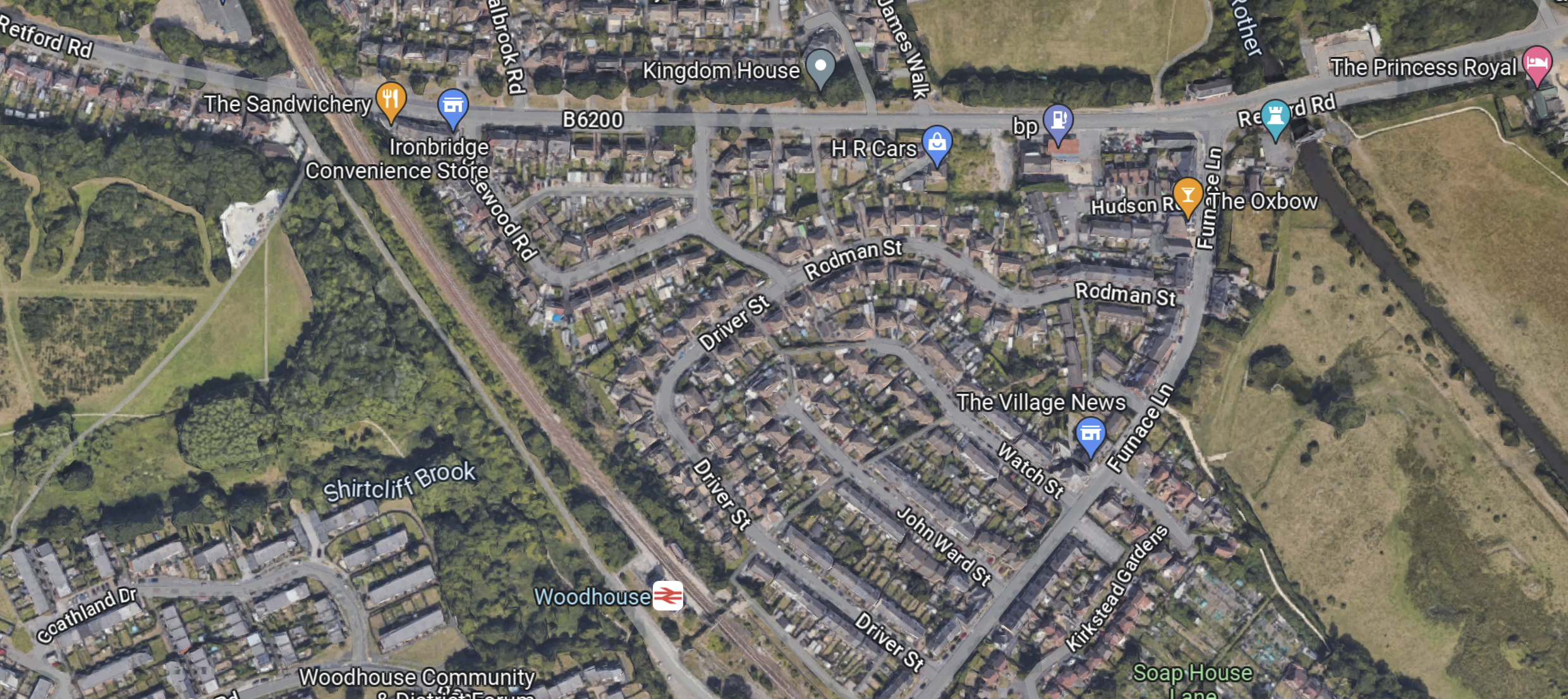
Note.
- It is certainly surrounded by a lot of houses.
- Could it be provided with car-parking?
Although, as this picture shows it is not blessed with lots of facilities.
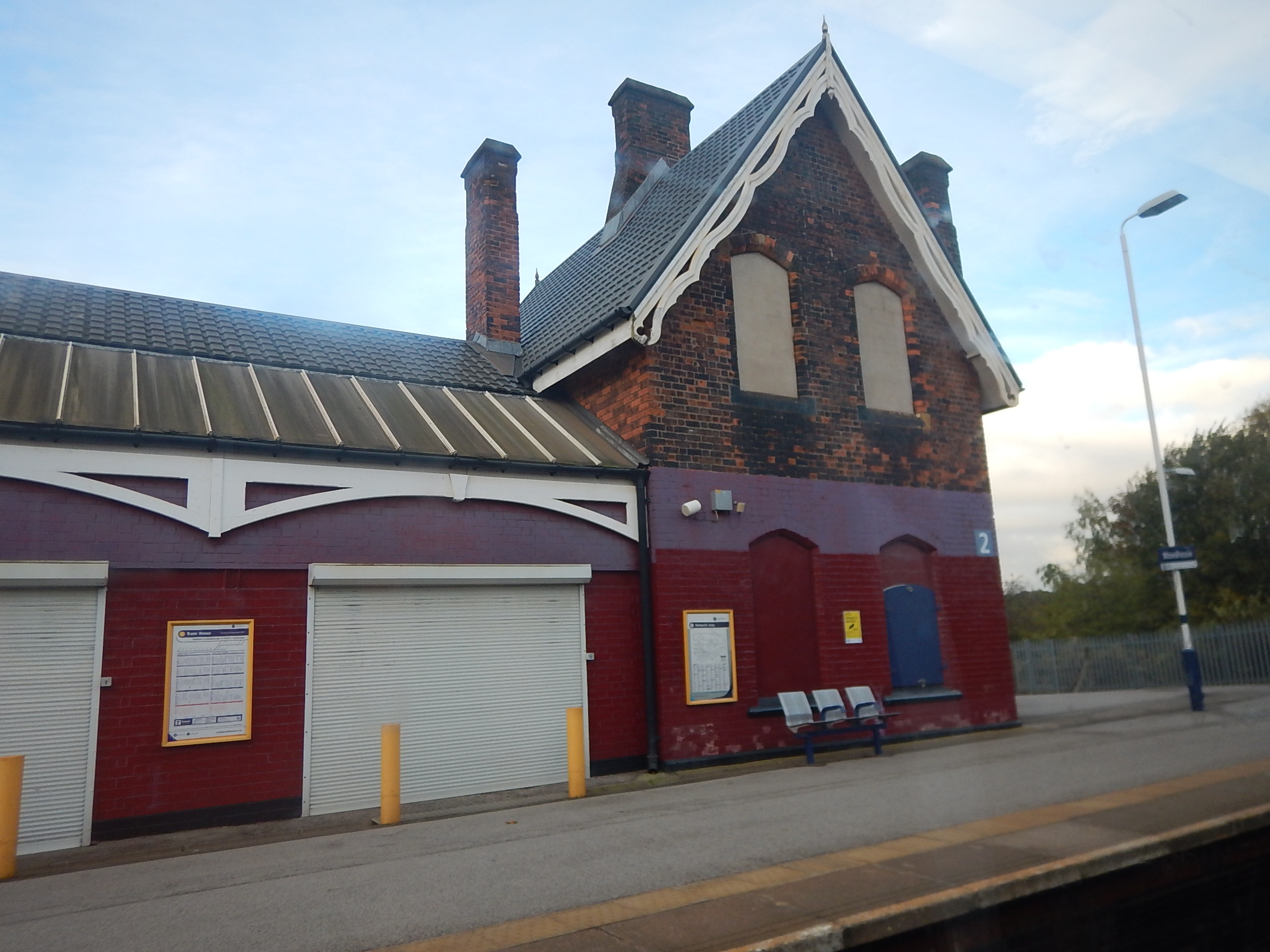
But.
- The station is in an area, which Sheffield want to develop.
- The Advanced Manufacturing Centre is nearby.
- There are aspirations to run a tram-train between Sheffield and Chesterfield via Darnall, Woodhouse and Barrow Hill stations.
- The station could be on the tram-train route to Stocksbridge, that I wrote about in Reopening The Don Valley Section Of The Former Woodhead Line Between Stocksbridge and Sheffield Victoria To Passenger Services.
Woodhouse station could be an interchange or it could become something bigger like a hub station.
How Many Sheffield Services Per Day Could Be Run?
If the Hull and Sheffield trains run as a flight under control of the digital signalling, this will mean that every Hull train can be paired with a Sheffield train.
- There are five trains per day (tpd) to and from Hull and two to and from Beverley.
- It seems a maximum of one tpd in both directions can be a ten-car train.
- Two five-car trains could fit in a platform at King’s Cross.
I suspect that the maximum number of trains per day to and from Sheffield is the same as for Hull. i.e. seven tpd.
But there is no reason, if they have enough trains and paths are available, that Hull Trains couldn’t add extra services to both destinations.
Onward From Sheffield
Several of those, who have commented on the new service have suggested that the service could go further than Sheffield, with Manchester and Leeds being given specific mentions.
This OpenRailwayMap shows the platforms at the Northern end of Sheffield station.
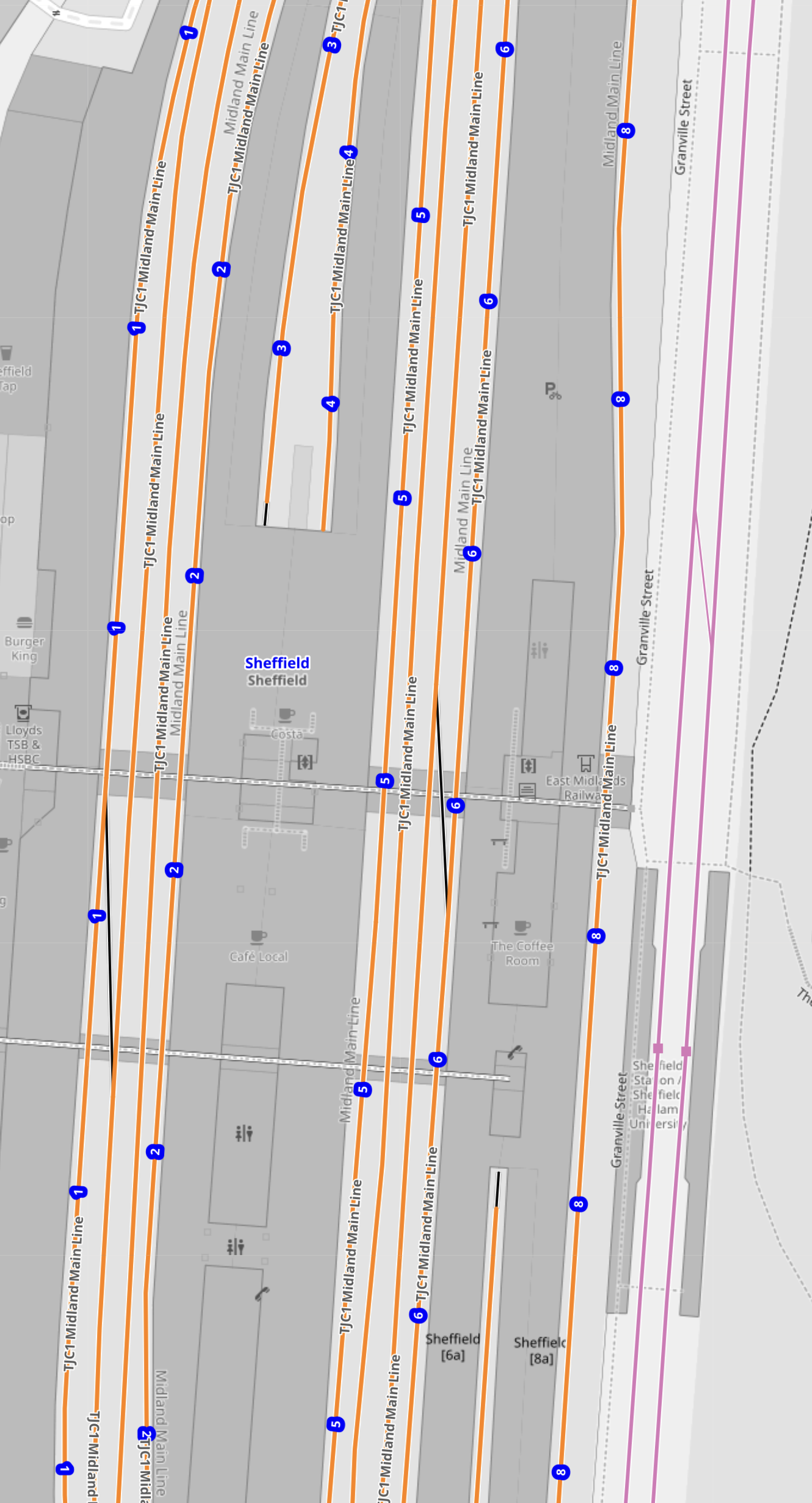
Note.
- The pink tracks at the East are the Sheffield Supertram.
- Trains to and from Barnsley, Huddersfield, Hull, Leeds, Lincoln and Retford access the station from the Northern end.
- Trains to and from Chesterfield, Derby, London, Manchester and Stockport access the station from the Southern end.
- The tracks in Sheffield station are numbered 1 to 8 from the West.
- There are five through platforms. 1, 2, 5, 6 and 8 and two bay platforms at either end.
- An extension of the service to Manchester via the Hope Valley Line, could go straight through the station.
- An extension of the service to Barnsley, Huddersfield or Leeds, would mean the train reversing at Sheffield.
It looks like an extension to Manchester Piccadilly over the recently upgraded Hope Valley Line would be the easiest extension. But would Avanti West Coast, who have FirstGroup as a shareholder want the competition?
Recently, it has been announced that the Penistone Line to Barnsley and Huddersfield will be upgraded to accept two trains per hour (tph) and allow faster running.
Because Sheffield could be around eighty minutes from London, there could be some smart times to and from the capital.
- Meadowhall in 90 minutes
- Barnsley in 112 minutes.
- Huddersfield in 140 minutes.
Huddersfield could be almost twenty minutes faster than the route via Leeds.
Comments From The Times
These are some readers comments from The Times.
- Hope the prices are competitive with LNER. I rarely go to London from Chesterfield with EMR as they’re so expensive. LNER from Newark is much cheaper but a service from Worksop for me would be perfect.
- Excellent News in so many ways. I hope it really takes off which could help ease the congestion on the M1 and also thin out overcrowding on busy LNER services. It really does deserve to succeed.
- This is excellent news. The Lumo service has been a game changer for me and those living in the north east.
The public seem in favour.
Conclusion
I really like this proposal from FirstGroup.
- It has the possibility to provide Sheffield with a fast train link to London.
- It could run about six trains per day.
- It will be faster than High Speed Two was proposed.
It could be the first service of High Speed Yorkshire.
 The Anonymous Widower