Could Doncaster Sheffield Airport Become A Hydrogen Airport?
I asked Google AI, what is the current status of Doncaster Sheffield Airport and received this reply.
Doncaster Sheffield Airport (DSA) is currently in a state of active, public-funded redevelopment after closing in late 2022 due to financial issues, with plans to reopen for passenger flights by late 2027 or 2028, following significant funding (around £160m) secured by the South Yorkshire Mayoral Combined Authority (SYMCA) for the City of Doncaster Council to take over operations and rebuild commercial viability, with freight and general aviation potentially returning sooner.
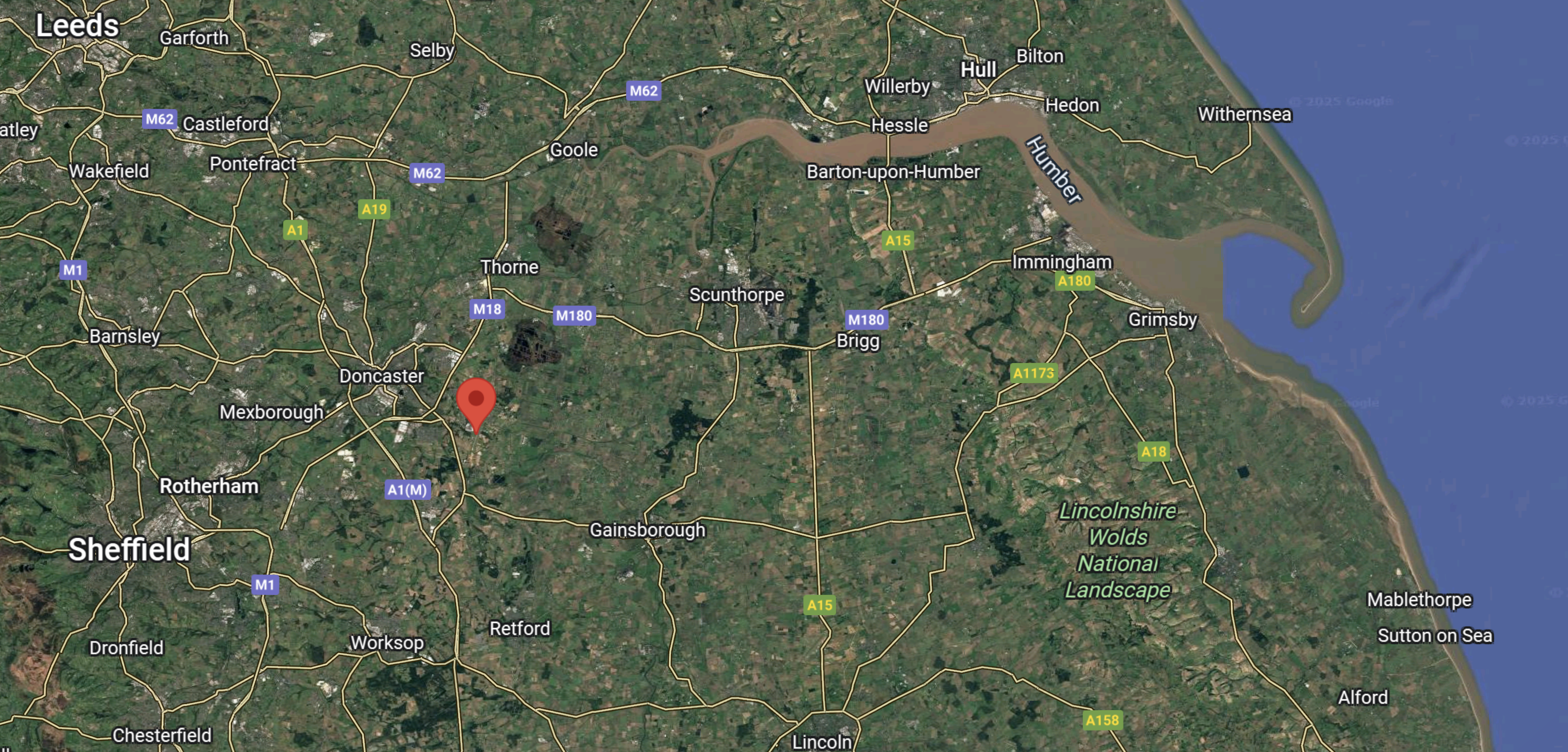
This Google Map shows the location of the airport.
Note.
- The distinctive mouth of the River Humber can be picked out towards the North-East corner of the map.
- Hull and Grimsby sit in the mouth of the Humber.
- The red arrow indicates Doncaster Sheffield Airport.
- Leeds is in the North-West corner of the map.
- The towns and city of Doncaster, Rotherham and Sheffield can be picked out to the West of the airport.
This second Google Map shows a close-up of the airport.

On my visit to NASA in the 1980s, where an Artemis system was used to project manage the turnround of the Space Shuttle, I was asked questions by one of NASA’s support people about RAF Finningley. Nothing too technical, but things like what is Doncaster like.
When I asked why, they said there’s a high chance that a Space Shuttle could land at RAF Finningley, as it has one of the best runways for a very heavy aircraft in Europe.
Looking at the runway, it is a long and wide runway that was built for heavy RAF nuclear bombers like Valiants, Victors and Vulcans.
I believe that we will eventually see hydrogen- and/or nuclear-powered airliners flying very long routes across the globe, just as a nuclear-powered example, attempted to do in the first episode of the TV series Thunderbirds, which was called Trapped in the Sky and has this Wikipedia entry.
Just as the Space Shuttle did, these airliners and their air-cargo siblings will need a large runway.
Doncaster Sheffield Airport already has such a runway.
These hydrogen- and nuclear-powered aircraft will make Airbus A 380s look small and will need runways like the one at Finningley.
But I don’t think we’ll ever see nuclear-powered aircraft in the near future, so the aircraft will likely be hydrogen.
Other things in favour of making Doncaster Sheffield Airport, an airport for long range hydrogen aircraft include.
- The airport is close to the massive hydrogen production and storage facilities being developed on Humberside at Aldbrough and Rough.
- The airport could be connected to the Sheffield Supertram.
- The airport could be connected to the trains at Doncaster station, which has 173 express trains per day to all over the country.
- The airport would fit well with my thoughts on hydrogen-powered coaches, that I wrote about inFirstGroup Adds Leeds-based J&B Travel To Growing Coach Portfolio
- The airport might even be able to accept the next generation of supersonic aircraft.
- The airport could certainly accept the largest hydrogen-powered cargo aircraft.
- The Airport isn’t far from Doncaster iPort railfreight terminal.
Did I read too much science fiction?
I have some further thoughts.
Do Electric Aircraft Have A Future?
I asked Google AI this question and received this answer.
Yes, electric aircraft absolutely have a future, especially for short-haul, regional, and urban air mobility (UAM), promising quieter, zero-emission flights, but battery limitations mean long-haul flights will rely more on hydrogen-electric or Sustainable Aviation Fuels (SAF) for the foreseeable future. Expect to see battery-electric planes for shorter trips by the late 2020s, while hybrid or hydrogen solutions tackle longer distances, with a significant shift towards alternative propulsion by 2050.
That doesn’t seem very promising, so I asked Google AI what range can be elected from electric aircraft by 2035 and received this answer.
By 2035, fully electric aircraft ranges are expected to be around 200-400 km (125-250 miles) for small commuter planes, while hybrid-electric models could reach 800-1,000 km (500-620 miles), focusing on short-haul routes due to battery limitations; larger, long-range electric flight remains decades away, with hydrogen propulsion targeting 1,000-2,000 km ranges for that timeframe.
Note.
- I doubt that many prospective passengers would want to use small commuter planes for up to 250 miles from Doncaster Sheffield airport with hundreds of express trains per day going all over the UK mainland from Doncaster station.
- But Belfast City (212 miles), Dublin (215 miles) and Ostend (227 miles), Ronaldsway on the Isle of Man (154 miles) and Rotterdam(251 miles) and Schipol 340 miles) may be another matter, as there is water to cross.
It looks like it will be after 2035 before zero-carbon aircraft will be travelling further than 620 miles.
My bets would be on these aircraft being hydrogen hybrid aircraft.
What Will The Range Of Hydrogen-Powered Aircraft In 2040?
I asked Google AI this question and received this answer.
By 2040, hydrogen-powered commercial aircraft are projected to have a range that covers short- to medium-haul flights, likely up to 7,000 kilometers (approximately 3,780 nautical miles), with some models potentially achieving longer ranges as technology and infrastructure mature.
The range of these aircraft will vary depending on the specific technology used (hydrogen fuel cells versus hydrogen combustion in modified gas turbines) and aircraft size.
It looks like we’ll be getting there.
This Wikipedia entry is a list of large aircraft and there are some very large aircraft, like the Antonov An-225, which was destroyed in the Ukraine War.
A future long-range hydrogen-powered airline must be able to match the range of current aircraft that will need to be replaced.
I asked Google AI what airliner has the longest range and received this reply.
The longest-range airliner in service is the Airbus A350-900ULR (Ultra Long Range), specifically configured for airlines like Singapore Airlines to fly extremely long distances, reaching around 9,700 nautical miles (18,000 km) for routes like Singapore to New York. While the A350-900ULR holds records for current operations, the upcoming Boeing 777-8X aims to compete, and the Boeing 777-200LR was previously known for its exceptional range.
I believe that based on the technology of current successful aircraft, that an aircraft could be built, that would be able to have the required range and payload to be economic, with the first version probably being a high-capacity cargo version.
What Would An Ultra Long Range Hydrogen-Powered Airliner Look Like?
Whatever the aircraft looks like it will need to be powered. Rolls-Royce, appear to be destining a future turbofan for aircraft called the Ultrafan, which has this Wikipedia entry.
I asked Google AI, if Rolls-Royce will produce an Ultrafan for hydrogen and received this answer.
Rolls-Royce is actively developing the UltraFan architecture to be compatible with hydrogen fuel in the future, but the current UltraFan demonstrator runs on Sustainable Aviation Fuel (SAF). The company has a research program dedicated to developing hydrogen-powered engines for future aircraft, aiming for entry into service in the mid-2030s.
I asked Google AI, if Rolls-Royce have had major difficulties converting engines to hydrogen and received this answer.
Rolls-Royce has not encountered insurmountable difficulties but faces significant engineering and logistical challenges in converting engines to run on hydrogen. The company has made substantial progress in testing both stationary and aero engines using pure hydrogen, confirming its technical feasibility.
Given the company’s success in developing engines in the past, like the R Type, Merlin, RB 211, Pegasus, Trent, mtu 4000 and others, I suspect there’s a high chance of a successful hydrogen-powered Ultrafan.
If you look at a history of large passenger and cargo aircraft over the last sixty years, there has been a lot of the following.
- Conversion of one type of aircraft to a totally different type.
- Fitting new engines to a particular type.
- Fitting new avionics to a particular type.
Examples include.
- Fitting new CFM-56 engines to DC-8s.
- The first two Nimrods were converted from unsold Comet 4Cs.
- Converting Victor bombers to RAF tanker aircraft.
- Converting BA Tristars to RAF tanker aircraft.
- Converting DC-8s to cargo aircraft.
- Airbus converted five Airbus A 300-600 into Belugas, which have this Wikipedia entry.
- Airbus converted six Airbus A 330-200F into BelugaXLs, which have this Wikipedia entry.
- Converting two Boeing-747s to carry Space Shuttles ; one from American Airlines and one from Japan Airlines, which have this Wikipedia entry.
Note.
- Most of these examples have been successful.
- The last three examples have been very successful.
- Most of these applications do not have a human cargo.
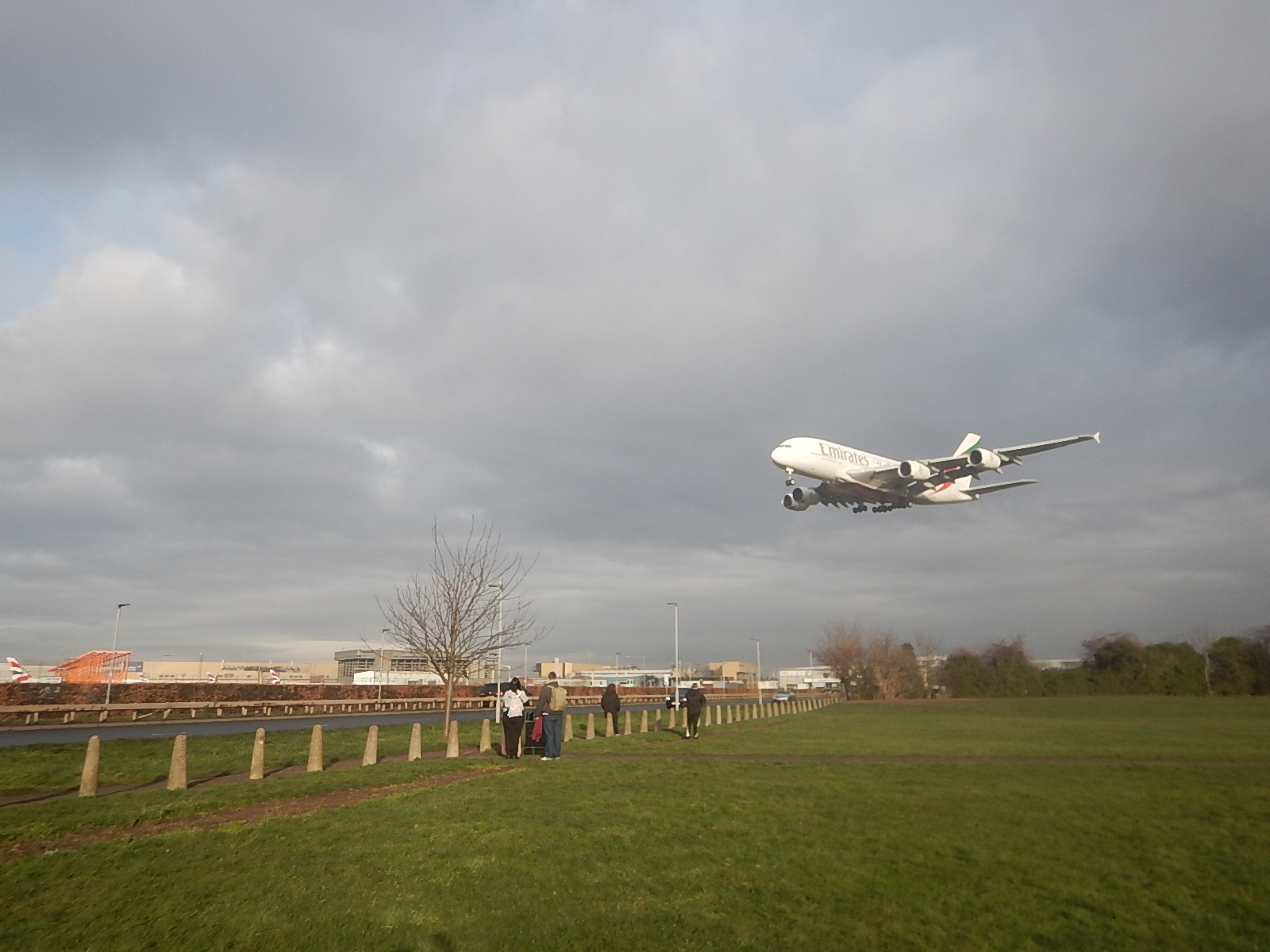
This picture shows an Emirates Air Lines’s Airbus A 380 on finals at Heathrow.
Note.
- The aircraft was landing on Runway 27 L.
- The four engines and the vertical oval cross-section of the fuselage are clearly visible.
- The Wikipedia entry for the Airbus A 380 shows two floors across the fuselage; the upper floor with eight seats in 2-4-2 and the lower floor with ten seats in 3-4-3, and a pair of LD3 cargo containers in the basement.
I’d be interested to know, how much hydrogen could be put in the basement and how far it could take the plane with a full load of passengers!
This link to the Wikipedia entry, shows the cross section in detail.
Note
I wouldn’t be surprised that the first application of large hydrogen aircraft will be for cargo and it could be an Airbus Beluga or perhaps an Airbus A 380 freighter?
Hydrogen In Aviation Offers Potential For Growth And Deeper Emissions Reductions, New Study Shows
The title of this post, is the same as that of this press release from Rolls-Royce.
These five paragraphs compose the press release.
Rolls-Royce, easyJet, Heathrow and University College London Air Transportation Systems Lab (UCL ATSLab) published a report highlighting how hydrogen-powered aircraft could enable European and UK aviation to cut carbon emissions while supporting future growth.
The study, Enabling Hydrogen in the European Aviation Market, found that hydrogen in aviation offers a unique opportunity to achieve both emissions reduction and market expansion. The analysis shows that introducing hydrogen alongside Sustainable Aviation Fuel (SAF) can accelerate progress towards net zero, particularly when policy incentives reward low-carbon fuels and if hydrogen were to be included within the EU’s SAF mandate.
The research also found that targeted hydrogen infrastructure at around 20 major European airports, including Heathrow, could deliver more than 80% of the emissions benefits of full hydrogen availability across the continent. Concentrating investment at key ‘hydrogen hubs’ would therefore provide a practical and cost-effective path to early adoption.
Further modelling indicates that the earlier novel technologies, such as hydrogen, can be introduced, the more opportunity they present for CO2 emission reductions, underscoring the value of early technological transition where it is financially and technically viable.
The study is underpinned by UCL ATSLab’s Airline Behaviour Model (ABM), which represents the complexity of airline decision-making through specific behavioural variables. Building on this, the research evaluates how fuel costs, incentives and new technologies shape airline responses. This provides a research-based, realistic picture of how hydrogen adoption could evolve, highlighting both opportunities and potential challenges for adoption.
Note, these two sentences recommending early adoption of hydrogen.
- Concentrating investment at key ‘hydrogen hubs’ would therefore provide a practical and cost-effective path to early adoption.
- Further modelling indicates that the earlier novel technologies, such as hydrogen, can be introduced, the more opportunity they present for CO2 emission reductions.
I also suspect, that introducing hydrogen early, feeds back to reduce Co2 emissions.
But what is Trump’s considered view on hydrogen aircraft?
Google AI gives this answer to my question.
Donald Trump’s view on hydrogen for transportation, including potential use in aircraft, is highly skeptical due to perceived safety risks and effectiveness concerns, which generally aligns with his broader opposition to green energy initiatives. He has specifically criticized hydrogen-powered vehicles as being dangerous and “prone to blowing up”.
Note.
- I used to work in a hydrogen factory and it’s still producing hydrogen.
- I doubt Trump gets on well with Jennifer Rumsey, who is CEO of Cummins, who are one of the world’s largest diesel-engine companies, who are following a zero-carbon route.
- Is Formula One Likely To Go To Hydrogen Fuel? This would set the Cat Among The Pigeons
I also feel that this University College London study will create a string of converts to hydrogen.
Unlocking Efficiency With Cryogenic Cooling Of GaN Traction Inverters
The title of this post, is the same as this insight on the Ricardo web site.
This is the introduction.
As the mobility sector accelerates toward zero-carbon propulsion, hydrogen fuel cell systems (HFCS) are emerging as a cornerstone technology for aviation, marine, and long-haul road transport. Among the most promising innovations in this space is the use of liquid hydrogen (LH₂) not only as a fuel source but also as a cryogenic coolant for electric powertrains. This dual-purpose approach offers transformative potential in system efficiency, packaging, and weight reduction—especially when paired with Gallium Nitride (GaN) semiconductors.
It is a very simple concept, but it appears to give worthwhile efficiency gains.
This was the article’s conclusion.
Ricardo’s cryogenic GaN inverter concept represents a bold leap toward ultra-efficient, lightweight, and integrated hydrogen propulsion systems. While challenges remain in materials, packaging, and reliability, the experimental results are compelling. With efficiencies nearing 99.8% and mass reductions over 50%, cryogenic cooling could redefine the future of electric mobility.
As the hydrogen economy matures, innovations like this will be pivotal in delivering clean, scalable, and high-performance solutions across all mobility sectors.
I very much suggest, that you take the time to read the whole insight.
Using The Concept In a Liquid Hydrogen Carrier
This Wikipedia entry describes the design and operation of an ocean-going liquid hydrogen carrier.
This is a paragraph.
Similar to an LNG carrier the boil off gas can be used for propulsion of the ship.
Ricardo’s concept would appear to be advantageous in the design of liquid hydrogen carriers and I would expect, it could also be applied to the design of LNG carriers.
I would not be surprised to see liquid hydrogen and LNG carriers were the first application of Ricardo’s concept.
This Wikipedia entry describes the Suiso Frontier, which is the world’s only liquid hydrogen carrier.
I believe that Ricardo’s concept could lead to the construction of a more of these ships. Will they mean that liquid hydrogen carriers will deliver hydrogen from sunny climes to places like Europe, Japan, Korea and Canada.
The concept would also enable efficient small liquid hydrogen carriers, that could deliver hydrogen on routes like the North of Scotland to Germany.
Using The Concept In A Railway Locomotive
I could see freight locomotives being designed as a large liquid hydrogen tank with appropriately-sized fuel cells and added electrical gubbins.
- They would be self-powered and would not require any electrification.
- They would be much quieter than current diesels.
- They could pull the heaviest freight trains, between Europe and Asia.
- They could even pull passenger trains, if an electrical hotel supply were to be arranged.
- They could be designed with very long ranges.
But above all they would be zero-carbon.
Note that I’ve written about long freight routes before.
- China, Russia And The EU’s Intermarium Bloc
- How To Move 100,000 Containers A Year Between Germany And China
- Georgia, Azerbaijan and Iran Discuss New Freight Corridor To link India And Europe
- Finland And Norway To Explore Building Arctic Rail Link
- A New Gateway To China: Europe Prepares For The Launch Of Baku–Tbilisi–Kars Railway
I believe that a long-distance liquid-hydrogen locomotive, that was based on the Ricardo concept, would be ideal for some of these routes.
A Specialised Hydrogen Delivery Train
In April 2022, I wrote The TruckTrain, where this is a simple description of the concept.
The Basic Design Concept
The leaflet on their web site describes the concept.
This visualisation at the bottom of the leaflet shows four TruckTrains forming a train carrying twelve intermodal containers, each of which I suspect are 20 feet long.

I believe that the TruckTrain concept could be converted into a hydrogen delivery train.
- It would be an appropriate length.
- It would be powered by the on-board hydrogen.
- The hydrogen would be stored as liquid hydrogen.
It would be able to go most places on the UK rail network.
Conclusion
Ricardo’s concept could revolutionise the use of hydrogen.
Centrica Really Can’t Lose At Sizewell
The title of this post, is the same as that of this article in The Times.
This is the sub-heading.
Centrica’s £1.3 billion investment in Sizewell C guarantees substantial returns, even with cost overruns.
These two-and-a-half paragraphs explain the funding.
Now we know what Ed Miliband means by his “golden age of nuclear” — golden for the companies putting their money into Sizewell C. Yes, reactor projects have a habit of blowing up private investors. But maybe not this one. It looks more like an exercise in transferring risk to consumers and the taxpayer.
Sure, nobody builds a £38 billion nuke on a Suffolk flood plain without a frisson of danger. But the energy secretary and his Treasury chums have done their bit to make things as safe as possible for the companies putting in equity alongside the government’s 44.9 per cent stake: Canada’s La Caisse with 20 per cent, British Gas-owner Centrica (15 per cent), France’s EDF (12.5 per cent) and Amber Infrastructure (7.6 per cent).
For starters, nearly all the debt for the 3.2 gigawatt plant, three-quarters funded by loans, is coming from the state-backed National Wealth Fund. It’s bunging in up to £36.6 billion, with £5 billion more guaranteed by a French export credit agency.
It looks to me that between them the British and French governments are providing £41.5 billion of loans to build the £38 billion nuke.
These are my thoughts.
Hydrogen And Sizewell C
This page on the Sizewell C web site is entitled Hydrogen And Sizewell C.
Under a heading of Hydrogen Buses, this is said.
At Sizewell C, we are exploring how we can produce and use hydrogen in several ways. We are working with Wrightbus on a pilot scheme which, if successful, could see thousands of workers transported to and from site on hydrogen double decker buses. You can read more about the pilot scheme in our press release
Firstly, it could help lower emissions during construction of the power station. Secondly, once Sizewell C is operational, we hope to use some of the heat it generates (alongside electricity) to make hydrogen more efficiently.
This would appear to be a more general statement about hydrogen and that the following is planned.
- Hydrogen-powered buses will be used to bring workers to the site. A press release on the Sizewell C web site, talks about up to 150 buses. That would probably be enough buses for all of Suffolk.
- Hydrogen-powered construction equipment will be used in the building of the power station.
- It also talks about using the excess heat from the power station to make hydrogen more efficiently. I talk about this process in Westinghouse And Bloom Energy To Team Up For Pink Hydrogen.
This is a substantial investment in hydrogen.
Centrica And Electricity From Sizewell C
The article in The Times, also says this.
Even so, there’s a fair bit of protection for the likes of Centrica, which has also agreed a 20-year offtake deal for its share of Sizewell’s electricity. The price of that is not yet known.
Nothing is said in the article about the size of Centrica’s electricity offtake.
- If they get 15 % of Sizewell C, that would by 480 MW.
- If they get 15 % of Sizewell B + C, that would by 660 MW.
If they use their share to generate hydrogen, Suffolk would have a massive hydrogen hub.
To power the buses and construction of Sizewell C, Sizewell B could be used to provide electricity to create the hydrogen.
How Would The Hydrogen Be Produced?
Centrica, along with other companies, who include Hyundai and Kia, are backers of a company in Hull called HiiROC, who use a process called Thermal Plasma Electrolysis to generate hydrogen.
On their web site, they have this sub-heading.
A Transformational New Process For Affordable Clean Hydrogen
The web site also describes the process as scalable from small modular units up to industrial scale. It also says this about the costs of the system: As cheap as SMR without needing CCUS; a fraction of the energy/cost of water electrolysis.
If HiiROC have achieved their objective of scalability, then Centrica could grow their electrolyser to meet demand.
How Would The Hydrogen Be Distributed?
Consider.
- Currently, the Sizewell site has both road and rail access.
- I can still see in my mind from the 1960s, ICI’s specialist articulated Foden trucks lined up in the yard at Runcorn, taking on their cargoes of hydrogen for delivery all over the country.
- As that factory is still producing hydrogen and I can’t remember any accidents in the last sixty years, I am fairly sure that a range of suitable hydrogen trucks could be developed to deliver hydrogen by road.
- The road network to the Siewell site is being updated to ensure smooth delivery of workers and materials.
- The rail access to the Sizewell site is also being improved, for the delivery of bulk materials.
I believe there will be no problems delivering hydrogen from the Sizewell site.
I also believe that there could be scope for a special-purpose self-propelled hydrogen tanker train, which could both distribute and supply the hydrogen to the vehicles, locomotives and equipment that will be using it.
Where Will The Hydrogen Be Used?
I have lived a large part of my life in Suffolk and know the county well.
In my childhood, there was quite a lot of heavy industry, but now that has all gone and employment is based on agriculture, the Port of Felixstowe and service industries.
I can see hydrogen being used in the following industries.
Transport
Buses and heavy trucks would be powered by hydrogen.
The ports in the East of England support a large number of heavy trucks.
Large Construction Projects
Sizewell C is not the only large construction project in the East of England, that is aiming to use low-carbon construction involving hydrogen. In Gallagher Group Host Hydrogen Fuel Trial At Hermitage Quarry, I talked about a hydrogen fuel trial for the Lower Thames Crossing, that involved JCB and Ryse Hydrogen.
Hydrogen for the Lower Thames Crossing could be delivered from Sizewell by truck, down the A12.
Rail
We may not ever see hydrogen-powered passenger trains in this country, but I do believe that we could see hydrogen-powered freight locomotives.
Consider.
- The latest electro-diesel Class 99 locomotives from Stadler have a Cummins diesel engine.
- The diesel engine is used, when there is no electrification.
- Cummins have developed the technology, that allows them to convert their latest diesel engines to hydrogen or natural gas power, by changing the cylinder head and the fuel system.
- Access to the Port of Felixstowe and London Gateway needs a locomotive with a self-powered capability for the last few miles of the route.
A Class 99 locomotive converted to hydrogen would be able to run with out emitting any carbon dioxide from Felixstowe or London Gateway to Glasgow or Edinburgh.
Ports
Ports have three main uses for hydrogen.
- To power ground-handing equipment, to create a pollution-free atmosphere for port workers.
- To fuel ships of all sizes from the humblest work-boat to the largest container ships.
- There may need to be fuel for hydrogen-powered rail locomotives in the future.
There are seven ports with excellent road and/or rail connections to the Sizewell site; Felixstowe, Great Yarmouth, Harwich, Ipswich, London Gateway, Lowestoft and Tilbury.
The proposed Freeport East is also developing their own green hydrogen hub, which is described on this page on the Freeport East web site.
Airports
Airports have two main uses for hydrogen.
- To power ground-handing equipment, to create a pollution-free atmosphere for airport workers.
- In the future, there is likely to be hydrogen-powered aircraft.
There are three airports with excellent road and/or rail connections to the Sizewell site; Norwich, Southend and Stansted.
Agriculture And The Rural Economy
Agriculture and the rural economy would be difficult to decarbonise.
Consider.
- Currently, most farms would use diesel power for tractors and agricultural equipment, which is delivered by truck.
- Many rural properties are heated by propane or fuel oil, which is delivered by truck.
- Some high-energy rural businesses like blacksmiths rely on propane, which is delivered by truck.
- Electrification could be possible for some applications, but ploughing the heavy land of Suffolk, with the added weight of a battery on the tractor, would probably be a mathematical impossibility.
- JCB are developing hydrogen-powered construction equipment and already make tractors.
- Hydrogen could be delivered by truck to farms and rural properties.
- Many boilers can be converted from propoane to run on hydrogen.
I feel, that hydrogen could be the ideal fuel to decarbonise agriculture and the rural economy.
I cover this application in detail in Developing A Rural Hydrogen Network.
Exports
Consider.
- Sizewell B and Sizewell C nuclear powerstations have a combined output of 4.4 GW.
- A rough calculation shows that there is a total of 7.2 GW of wind farms planned off the Suffolk coast.
- The East Anglian Array wind farm alone is said in Wikipedia to be planned to expand to 7.2 GW.
- The Sizewell site has a high capacity connection to the National Grid.
Nuclear plus wind should keep the lights on in the East of England.
Any excess electricity could be converted into hydrogen.
This Google Map shows the location of Sizewell B in relation to Belgium, Germany and The Netherlands.
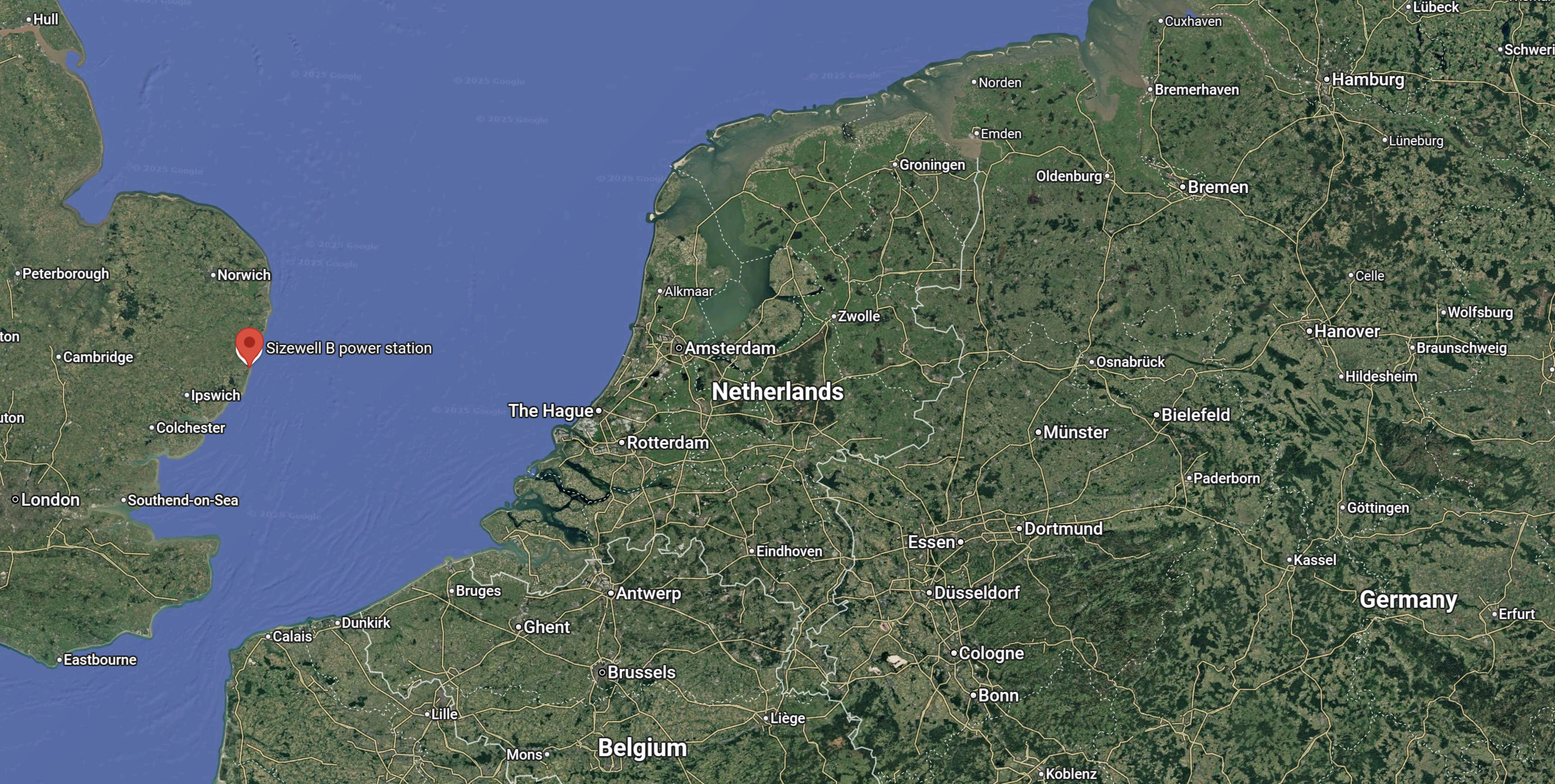
The Sizewell site is indicated by the red arrow.
The offshore oil and gas industry has used technology like single buoy moorings and coastal tankers to collect offshore natural gas for decades.
I don’t see why coastal hydrogen tankers couldn’t export excess hydrogen to places around the North Sea, who need the fuel.
It should be born in mind, that Centrica have a good reputation in doing natural gas trading. This expertise would surely be useful in hydrogen trading.
Conclusion
I believe that a hydrogen hub developed at Sizewell makes sense and I also believe that Centrica have the skills and technology to make it work.
Gatwick’s Hydrogen Advantage Over Heathrow
The Future Of Hydrogen In Aviation
I believe that hydrogen will have a big future in aviation.
Powering Aircraft
It will be some years, but not as many as some people think, before we see hydrogen-powered aircraft in the air.
Airbus have produced this infographic of three possible hydrogen-powered aircraft.
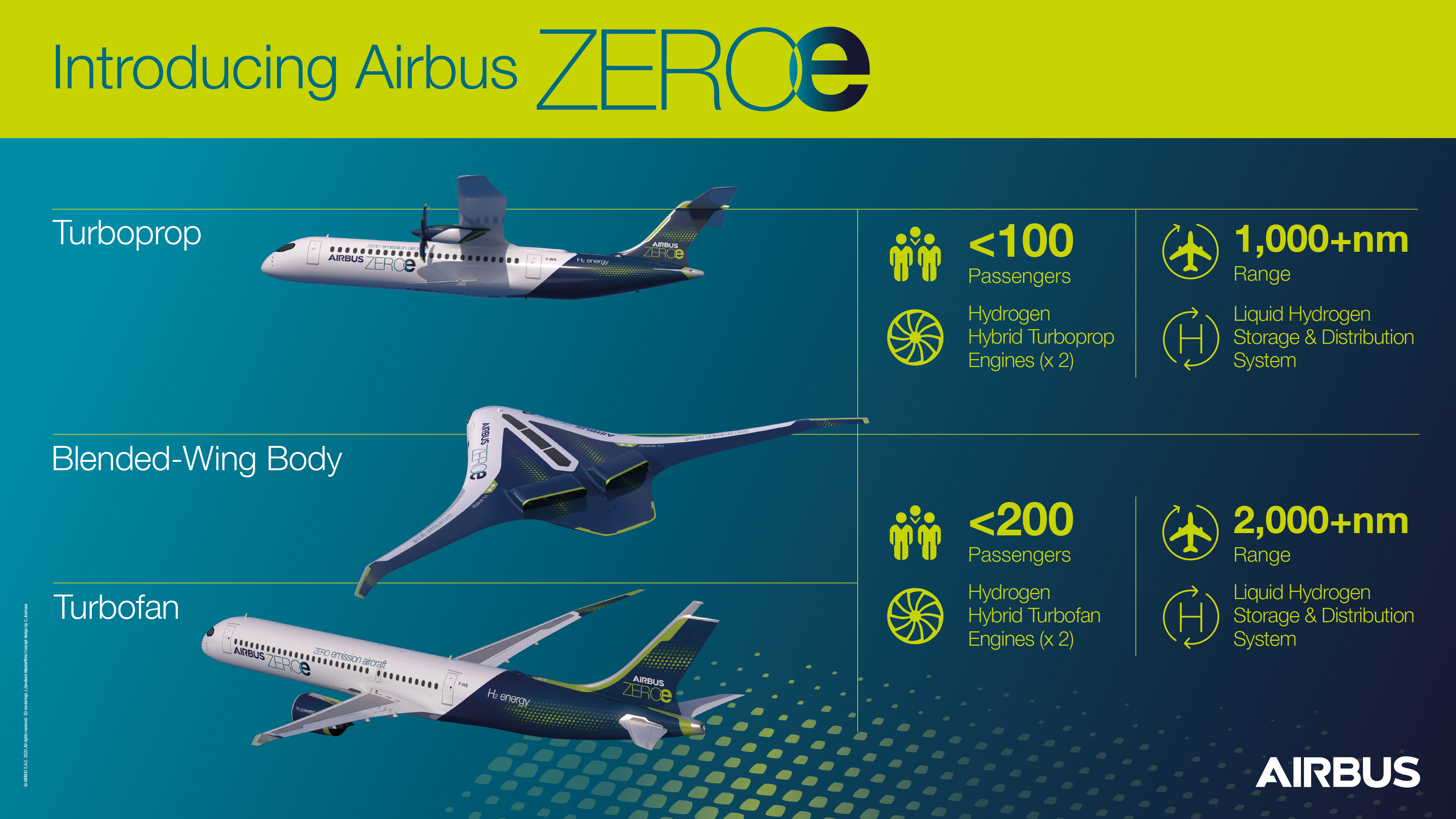
Discover the three zero-emission concept aircraft known as ZEROe in this infographic. These turbofan, turboprop, and blended-wing-body configurations are all hydrogen hybrid aircraft.
I wrote a bit more about these three hydrogen-powered concepts in ZEROe – Towards The World’s First Zero-Emission Commercial Aircraft.
My best estimate is that we’ll see hydrogen-powered aircraft in the air by 2035.
Towing Aircraft Around
Most aircraft are very heavy and towing them around needs a lot of zero-carbon energy.
So I think it is likely, that at some time in the near future,tugs to tow large aircraft around an airport will be hydrogen powered.
If you type “hydrogen-powered aircraft tug” into Google, you get several sensible product developments, including ones from.
- Exeter Airport
- Teesside Airport
- The Royal Air Force.
- The US Air Force
Note.
- The involvement of the military.
- At least two of the tugs are conversions of existing equipment.
- The extra weight of the battery in an electric-powered tug, may make the realisation of a viable electric aircraft-tug difficult.
I suspect we’ll see hydrogen-powered aircraft tugs in use on airports around the world in the near future.
Long-Term Car-Park Buses
I would have thought that using hydrogen-powered or battery-electric buses to serve long-term car-parks at an airport would be an obvious application. But it does appear that airports using zero-carbon buses to serve long-term car-parks are not very common.
- Gatwick uses a large fleet of hydrogen buses to bring passengers and staff to the airport, but these don’t appear to be linked to car parking.
- Incheon Airport in Korea does appear to use hydrogen-powered buses.
Please let me know, if you know of any other uses of hydrogen-powered vehicles at airports.
Hydrogen For Heathrow
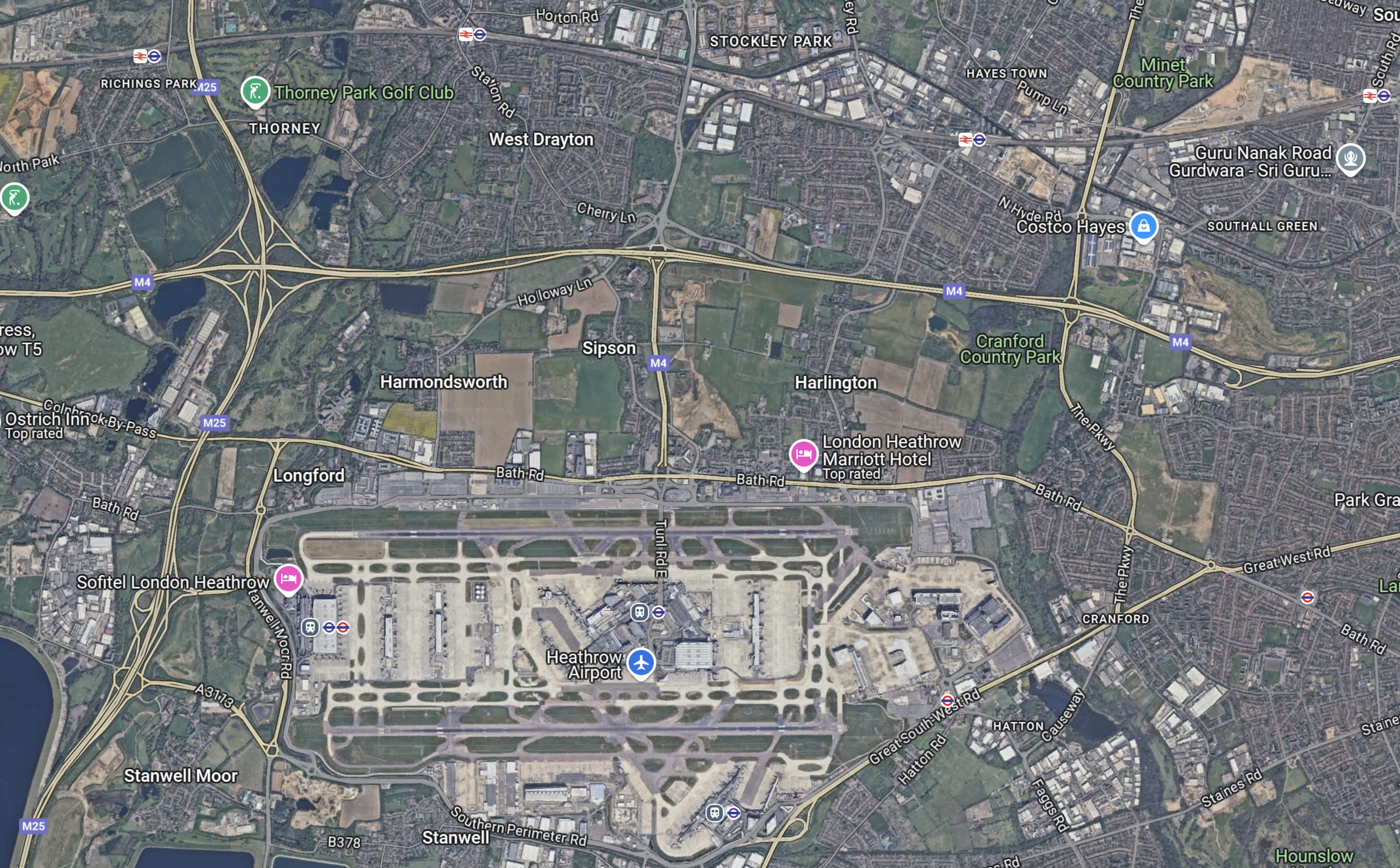
This Google Map shows Heathrow Airport.
Note.
- The M4 going across the map.
- The two main runways.
- A new third runway would go between the M4 and the Northern runway.
It is likely if the third runway goes ahead, the village of Harmondsworth will be flattened.
It is likely that supplying hydrogen to Heathrow will mean a hydrogen terminal somewhere South of the M4, which could be supplied by rail tankers.
Hydrogen For Gatwick
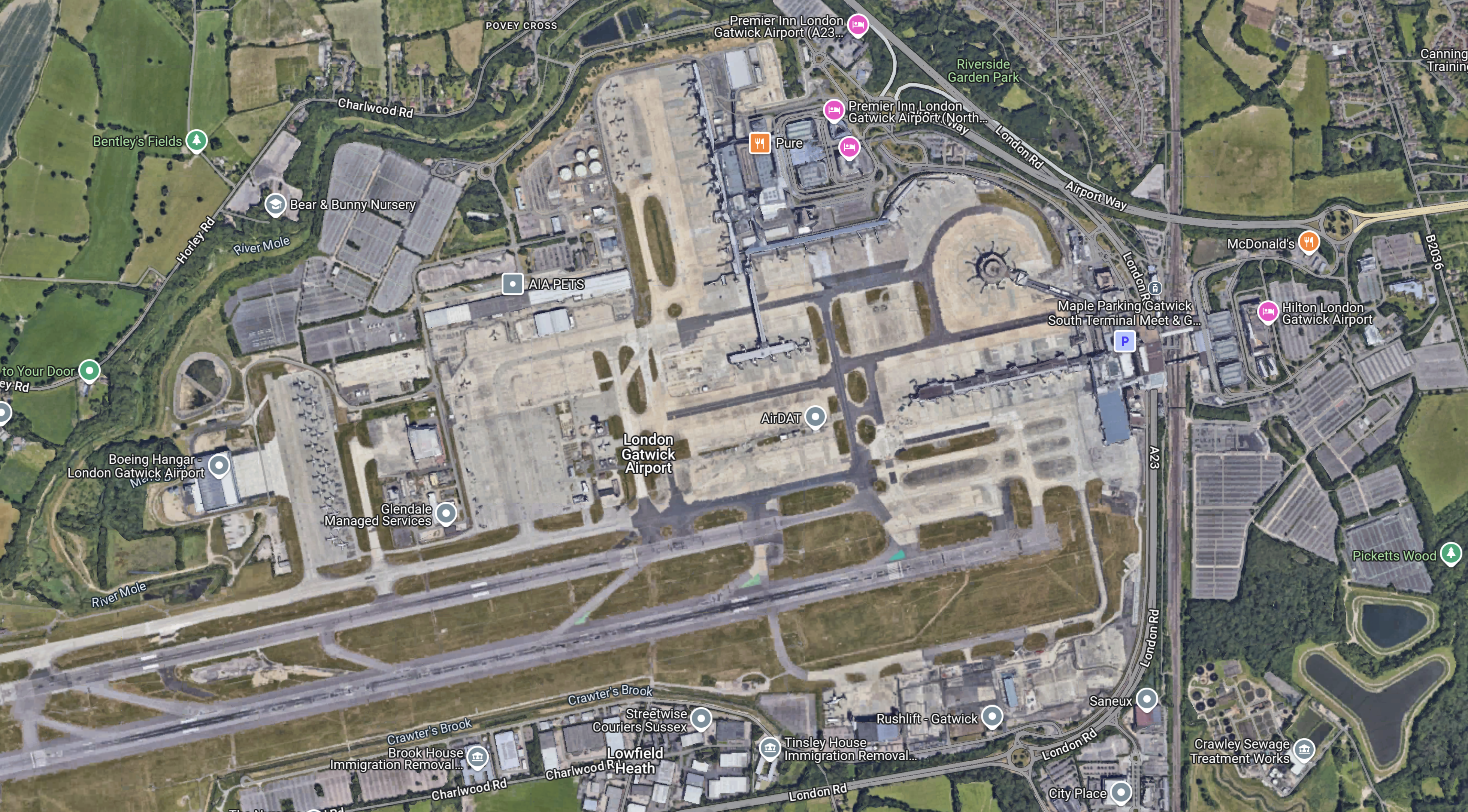
This Google Map shows Gatwick Airport.
Note.
- The current main runway with the emergency runway to its North.
- Because the runways are too close together they cannot be used simultaneously.
- To create a second runway, the two runways would be moved further apart and the current emergency runway would be enlarged.
- The Brighton Main Line runs North-South past the Eastern end of the main runway.
Gatwick’s expansion plan doesn’t appear to require any properties outside the airport boundaries to be demolished.
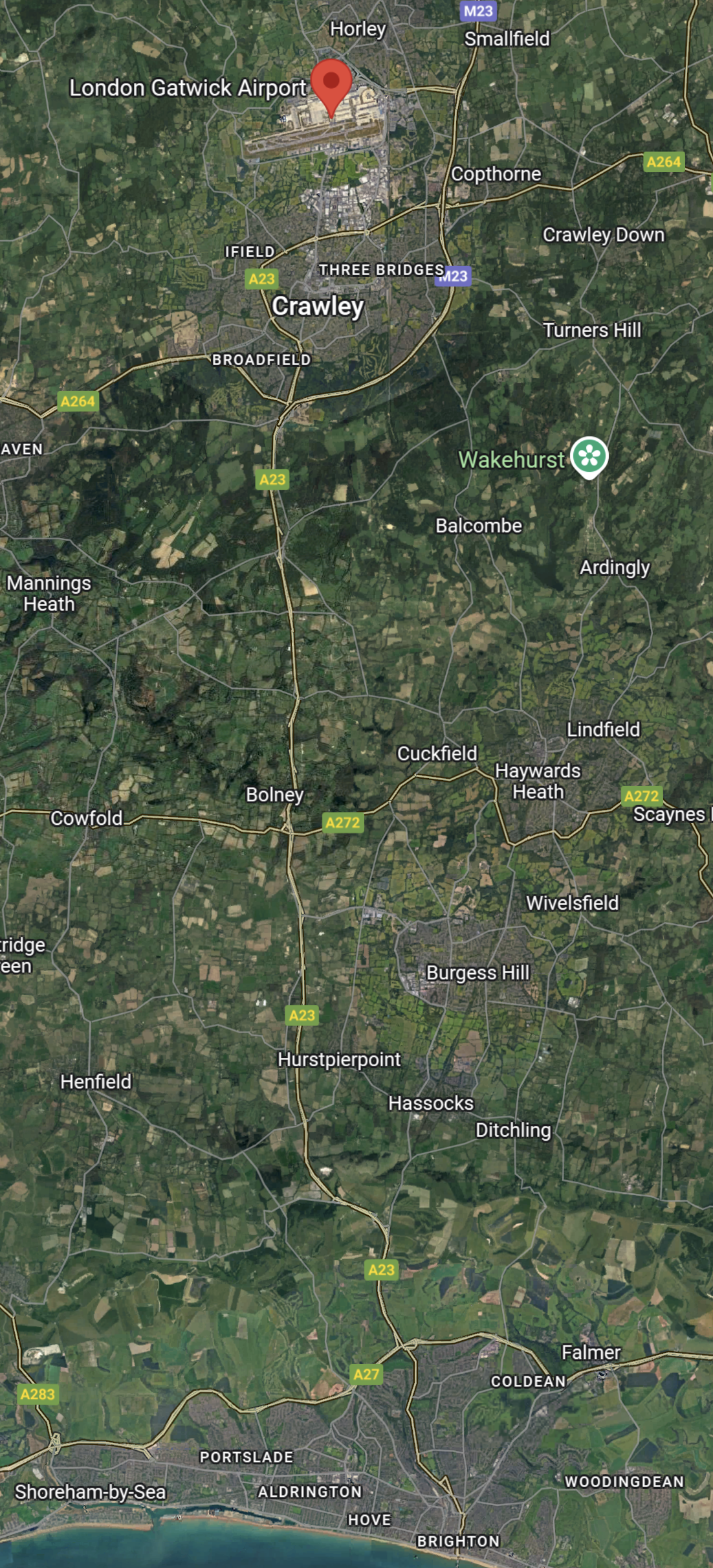
This Google Map shows Sussex between Gatwick Airport and Brighton.
Note.
- Gatwick Airport is indicated by the red arrow at the top of the map.
- Gatwick’s runways can be picked out under the red arrow.
- The South Coast is at the bottom of the map.
- The M23 and the Brighton Main Line connect Gatwick Airport and Brighton.
- Shoreham and Brighton are on the South Coast.
- Click the map to show on a larger scale.
Under current plans, the Ramplion offshore wind farm off the South Coast is going to be increased in size to 1.6 GW.
The simplest plan to provide large amounts of green hydrogen to Gatwick would be to build a large electrolyser in the Port of Shoreham and pipe it along the railway to Gatwick Airport. Hydrogen could also be shipped at night into the Airport using rail tankers.
There’s no doubt in my mind, that it will be much easier to supply large quantities of hydrogen to Gatwick, rather than Heathrow.
In 2023, I wrote Discover How Greater Brighton Is Championing The Transition To Hydrogen, which probably indicates that the locals and their politicians, would welcome the investment in hydrogen in their city.
It should also be noted that world class consultants Ricardo, who are very much involved in the development and promotion of hydrogen technology are based in Shoreham.
Liquid hydrogen could also be imported and distributed from the Port of Shoreham.
Brighton could end up as the South of England’s Hydrogen City.
Never Mind Heathrow: Gatwick Airport Is Close To Getting A New Runway
The title of this post, is the same as that of this article on The Times.
A friend passed through at Gatwick Airport yesterday, so I went to wish him well. For a change , I took a Metrobus from Sutton station to the South terminal – This route is free and doesn’t need a ticket with a Freedom Pass!
The bus was no ordinary bus, but a brand new Wrightbus hydrogen double decker from Ballymena.
It took a round-about route, as its main function is to bring local workers and passengers into the airport and handle traffic to Redhilll, Reigate and East Surrey Hospital.
But if this is the shape of buses to come, then I’m for it. Quality was more coach than bus and performance was sparkling with little or no noise and vibration.
Gatwick and Metrobus are building a network of local hydrogen buses to bring workers and passengers into the airport and I suspect, if the Airport has the fuel, they’ll use it for other purposes, like air-side vehicles, aircraft tow-trucks and car park buses.
Gatwick unlike Heathrow has a close-by source of electricity to produce hydrogen in the soon-to-be-extended 1.6 GW Ramplion offshore wind farm, just off Brighton.
Airbus are talking about bringing hydrogen aircraft into service by 2035 and I believe that by this date we’ll be regularly seeing hydrogen-turboprops on short routes.
As someone, whose software planned the Channel Tunnel, I think it reasonable by 2035, the following projects will be completed.
- Zeroavia are talking of converting aircraft to hydrogen in the next few years.
- A number of short-haul hydrogen aircraft are in service.
- Gatwick’s new runway and terminals are built.
- Ramplion is pumping hydrogen to the airport.
- The station has been updated.
- The Thameslink frequency of trains will have been increased.
Gatwick could be the first major airport to use large amounts of hydrogen, to cut emissions.
ZeroAvia Receives FAA G-1 For 600kW Electric Propulsion System
The title of this post, is the same as that of this press release from ZeroAvia.
This is the sub-heading.
Issue paper confirms basis of certification and provides clear pathway to certification of the company’s first commercial product
These are two introductory paragraphs.
ZeroAvia today announced that it has reached consensus on the Certification Basis relating to its 600kW electric propulsion system (EPS) with the Federal Aviation Administration (FAA), having received a G-1 Issue Paper (stage 2) and formally confirmed agreement with its contents.
The G-1 represents a key milestone on the journey towards final certification of the company’s EPS with the U.S. regulator, and also on its path to certifying its first full hydrogen-electric powertrain (of which the EPS is a core system) with the UK Civil Aviation Authority. The issue paper designates the applicable airworthiness regulations specific for ZeroAvia’s EPS, allowing the company to validate its design requirements.
Zero-carbon aviation just got a little bit closer, as when it is certified, the 600 KW electric propulsion system (EPS) will be able to be retrofitted to aircraft like the Cessna Caravan.
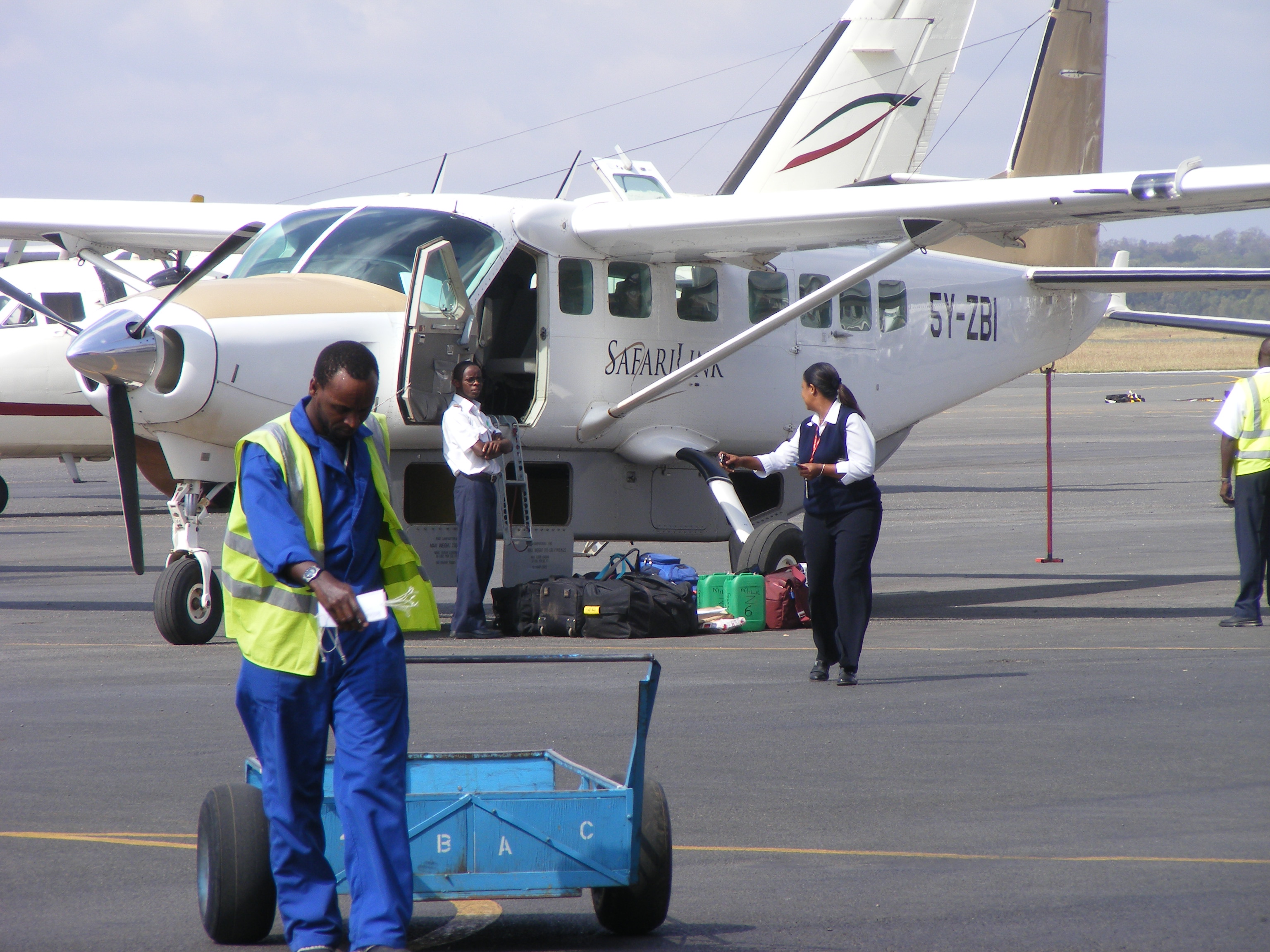
This is a Cessna Grand Caravan, that I flew in on holiday in Kenya.
I can see a lot of zero-carbon Caravans flying around the tropics on hydrogen generated by a nifty piece of hydrogen gubbins powered by the sun.
Especially, as over three thousand have been built.
UK Investment Summit Latest: Starmer Announces £1.1bn Expansion Of Stansted Airport
The title of this post, is the same as that of this article on The Times.
The Times has this sub-heading about Stansted
Analysis: Stansted Deal Prioritises Growth Over Climate
There are four paragraphs of analysis.
Over the weekend, Sir Keir Starmer made clear that his commitments to boost workers’ rights would not get in the way of his desire to bring in cash from the owners of P&O. As ministers now trumpet a deal to upgrade Stansted airport, it seems that growth and jobs also trump concerns about emissions.
Louise Haigh, the transport secretary who prompted the row with DP World by calling P&O a “rogue operator”, praised the Stansted deal as a “clear signal that Britain is open for business”. She argued that Stansted could be upgraded “while also meeting our existing environment obligations”, with the airport promising a new solar farm to generate electricity. But environmentalists will be dismayed by the prospect of more plane journeys and associated emissions.
The deal also raises fresh questions about a third runway at Heathrow after years of dithering under the Conservatives. No 10 has previously said it is “not opposed” to expansion if it can meet tests on emissions, climate change, noise pollution — and growth.
Starmer has said he will not duck decisions because they are “too difficult”. A decision on Heathrow offers a very clear test of that promise.
Is Hydrogen The Reason For The Choice Of Stansted?
I wonder if the choice of Stansted for expansion is down to the likelihood, that East Anglia will be a big centre for the generation of zero-carbon green and pink hydrogen, with gigawatts of offshore wind farms for the green and nuclear at Sizewell for the pink.
Aircraft of the future will surely need hydrogen for flying to their destinations.
Already, the massive construction of Sizewell C is going to be performed using zero-construction methods involving electricity and hydrogen, as far as is possible.
Large construction at Stansted Airport could be done in a similar manner, using perhaps a hydrogen pipeline between Sizewell and Stansted running along the A 14. This would probably be built anyway, so that East Anglia’s large numbers of heavy trucks could be converted to hydrogen.
Already the hydrogen buses to bring workers to the Sizewell C site have been ordered from Wrightbus in Ballymena.
Airbus, are planning to have their hydrogen-powered Boeing 737/A 320-size airliner in service by the mid-2030s. From visualisations released by Airbus, the Zeroe hydrogen Turbofan looks very much like a redesigned version of the current A320 neo, with two hydrogen turbofans (hopefully with RR on the side!) Converting an existing proven airliner, only means that the new parts need to be certified, so this would bring the plane into service quicker.
Airbus’s infographic shows the Zeroe hydrogen Turbofan will seat up to 200 passengers and have a range of 2,000 nautical miles or 3,700 km.
Discover the three zero-emission concept aircraft known as ZEROe in this infographic. These turbofan, turboprop, and blended-wing-body configurations are all hydrogen hybrid aircraft.
A typical A 320 neo will fly 165 passengers up to 3,500 nautical miles or 6.500 km.
A few distances from Stansted include.
- Athens – 2,400 km.
- Berlin – 905 km.
- Cairo – 3514 km.
- Copenhagen 913 km.
- Dublin – 470 km.
- Edinburgh – 509 km.
- Gander 3,800 km
- Geneva – 760 km.
- Glasgow – 540 km.
- Istanbul – 2480 km.
- Madrid – 1300 km.
- Milan – 960 km.
- Munich – 909 km.
- Palma de Mallorca – 1,400 km.
- Reykjavík – 1870 km.
- Rome – 1,442 km.
- Stockholm – 1,400 km.
- Tel-Aviv – 3,564 km.
- Tenerife North – 2944 km.
- Tenerife South – 2999 km.
- Warsaw 1,412 km.
These distances would mean, a lot of current European destinations could be reached, if the plane were filled at both airports, but a surprising number of popular places could be reached by only refuelling at Stansted.
It also appears to me, that with refuelling in Iceland and perhaps a stopover, in that delightful and different country, zero-carbon flights across the Atlantic would be possible.
If a hydrogen-powered aircraft has the 3,700 km. range that Airbus are promising, it will be an aircraft with a lot of possibilities!
Short Flights
- Amsterdam – 541 km.
- Cardiff – 253 km.
- Exeter – 284 km.
- Jersey – 344 km.
- Liverpool – 264 km.
- Newcastle – 373 km.
- Newquay – 399 km.
- Ronaldsway – 408 km.
- Southampton – 151 km.
Some of these flights would be competing with trains.
Flights Around The British Isles
One of the longest flights around the British Isles would be between Stansted and Sumburgh Airport in the Shetland Isles.
But this is only 894 kilometres, so a return trip would be possible.
I also feel that arranging hydrogen refuelling on Shetland will not be a difficult task, as the islands are likely to have copious supplies of green hydrogen.
Flights From Stansted To Europe
Applying a ten percent reserve probably means a safe one-way range of around 1,700 km.
This would mean that.
- Amsterdam – 541 km.
- Berlin – 905 km.
- Copenhagen – 913 km.
- Madrid – 1300 km.
- Milan – 960 km.
- Munich – 909 km.
- Palma de Mallorca – 1,400 km.
- Rome – 1,442 km.
- Stockholm – 1,400 km.
- Warsaw 1,412 km.
Should all be in range. of an out-and-back flight, after fully fuelling the plane at Stansted Airport.
Others like.
- Athens – 2,400 km.
- Bucharest – 2070 km.
- Cairo – 3514 km.
- Istanbul – 2480 km.
- Lisbon – 1630 km.
- Malta – 2107 km.
- Marrakech – 2350. km.
- Sofia – 2010 km.
- Tel-Aviv – 3,564 km.
- Tenerife North – 2944 km.
- Tenerife South – 2999 km.
Could be handled by refuelling at the destination.
Hopping Across The Atlantic
Consider.
- My great aunt Beatrice used to fly the Atlantic in the 1950s, although it was usually a succession of small hops between Heathrow Shannon and Gander Airports. I think she regularly used ships like the Queen Mary and Elizabeth, as she found them less stressful.
- Icelandair offer short stopovers in Reykjavik and I suspect they will offer this with hydrogen-fuelled aircraft.
- British Airways used to offer a London City Airport to New York flight via Shannon using an Airbus A 318.
I would certainly be interested to hop across from Stansted to New York in a hydrogen-powered aircraft, and I suspect others would do it for the environmental brownie points.
Legs could be.
- Stansted and Reykjavík – 1870 km.
- Reykjavík and Gander – 2568 km
- Gander and New York – 1767 km.
A stop could possibly be squeezed in at Boston.
It could be an interesting way to cross the Atlantic.
Hydrogen Production In East Anglia
I said earlier that East Anglia could produce a lot of zero-carbon green and prink hydrogen from wind and nuclear and this would be used for the following.
- Aviation out of Stansted and Southend Airports.
- Shipping out of the Port of Felixstowe, London Gateway and other smaller ports.
- Providing energy for heavy transport in East Anglia.
- Providing energy for Freeport East at Felixstowe and Harwich.
- Refuelling passing shipping.
- Supplying off-grid energy to rural properties and businesses in the East of England, which I wrote about in Developing A Rural Hydrogen Network.
Any spare hydrogen could always be sold to the Germans.
Decarbonisation Of The Railways In East Anglia
Undoubtedly, some hydrogen will be used to decarbonise some parts of East Anglia’s railways.
Many passenger trains are electrified, but some rural and cross-country services still use diesel. However, the Class 745 trains, that were built by Stadler for these services could be converted to hydrogen or battery-electric.
Similarly, locomotives that haul the freight trains out of the ports of East Anglia will be replaced with hydrogen or battery-electric locomotives.
I am fairly certain, that by 2040, all railways in East Anglia will be zero-carbon.
The East-West Rail Link
It is not known yet, whether the current government will continue to build the East West Rail Link, but it could be invaluable in connecting Stansted Airport to the West of England.
Connecting Stansted Airport To The North Of England and Scotland By Rail
If Stansted is developed as a zero-carbon airport, based on the new hydrogen-powered aircraft, travellers between say the North of England and Scotland, will surely want to travel to Stansted in a carbon-free manner.
So would it be sensible to run rail electric services between the North and Stansted?
Conclusion
Stansted could develop into the UK’s zero-carbon airport.
Bidders Circle ‘Elvis Airport’ A Decade After The SNP Bought It For £1
The title of this post, is the same as that of this article in The Times.
This is the sub-heading.
Prestwick has cost taxpayers millions since it was nationalised by the SNP in 2013. A consortium plans a bid, but can the Nats let go of Sturgeon-era stateism?
These are the first two paragraphs.
It was always going to be difficult keeping a lid on the arrival of Elvis Presley at a US military base in Prestwick, Ayrshire. “Where am I?” he asked as he stepped off the plane and into the biting wind that whipped off the Firth of Clyde.
March 3, 1960 was a momentous day for the screaming youngsters who engulfed the American singer as he set foot on British soil for the first and only time. For Presley, it was his last stop on his return from Germany after two years of military service. For Prestwick, it meant being immortalised in British trivia for its brief flirtation with The King.
But now it appears that a consortium has a plan for the airport and has made a bid.
These are my thoughts.
Prestwick Airport
Prestwick Airport, which is 32 miles SouthWest of Glasgow, is an airport that has seen busier times.
This OpenRailwayMap shows the Airport.

Note.
- The airport has two runways at right angles.
- The longer runway is 3,000 metres long.
- The red line is the electrified Ayrshire Coast Line, which runs between Glasgow Central and Ayr.
- There is a station at the airport.
- The black line going across the map is an unelectrified railway line, which eventually leads to the West Coast Main Line.
The airport does have four very useful assets.
- A very long runway capable of handling the largest and heaviest aircraft.
- A railway station.
- Plenty of space.
- The airport has plenty of available landing and take-off slots.
I also suspect that a rail connection could be developed to the West Coast Main Line.
Prestwick As A Cargo Airport
Someone commenting in The Times, suggested that Prestwick could become a cargo airport.
- The main runway could accommodate the largest and heaviest cargo aircraft.
- There is space for stands for large aircraft and warehouses.
- A rail link to the electrified West Coast Main Line could be built.
The airport could have a very high capacity.
A Rail Connection To The West Coast Main Line
This could be very beneficial for air-cargo at Prestwick.
- It would be less than ninety miles to the West Coast Main Line.
- It is only single-track as British Rail removed the second track.
- Cargo Services could be run all over the UK mainland.
- There could even be an airport service from Carlisle.
A zero-carbon rail service for freight, passengers and staff from both Glasgow and Carlisle would enhance the green credentials of the airport.
Where Would Planes Fly?
It looks like a modern freighter aircraft like a Boeing 747-8F could fly at maximum weight to nearly all the USA.
But because Prestwick Airport is further North, It does possibly have a wider range of airports, it can reach.
What Is The Closest Airport In North America?
The two airports on Newfoundland; Gander and St. John’s are probably the two closest being about 2,000 miles from Prestwick.
- Both airports have long runways.
- I suspect a rail terminal could be arranged at the airport to take cargo through the Chunnel to Europe.
- Could USAF Galaxies even be used to bring over American tanks and guns for Ukraine? The range of a Galaxy at maximum weight is 2,600 miles.
- They could be delivered by rail to Ukraine.
I suspect there will be times, where the shorter routes could be useful.
Could Cargo Change Planes At Prestwick?
On some routes like perhaps New York and India, might it be more efficient to change planes at Prestwick.
Could Cargo Planes Refuel At Prestwick?
Planes can only fly so far and is Prestwick in the right place to refuel a long flight?
Prestwick Could Be A Viable Cargo Airport For North America?
I am convinced that Prestwick and North American could be a viable air cargo route.
Zero-Carbon Air Cargo
In the next few years, Scotland will have much more electricity, than it needs, due to all the wind farms in the seas around the country and much of the spare electricity could be converted into hydrogen.
So does a cargo operator plan to run zero-carbon aircraft powered by hydrogen between North America and Prestwick?
- Remember it’s only 2,000 miles between St. John’s or Gander and Prestwick.
- The ideal aircraft to convert to hydrogen, must surely be an Airbus A 380, as there’s a lot of space in the fuselage for a hydrogen tank.
- Cargo could be brought to Prestwick in zero-carbon trains from all over the UK.
Amazon might like the idea of zero-carbon parcels across the pond!
Could An Airbus A380 Be Converted To Hydrogen?
This article on Simple Flying is entitled Airbus Plans A380 Hydrogen Flights In 2026 After Successful Power On Of ZEROe Engine.
The header picture shows a visualisation of an Airbus A 380, with a fifth engine with a propeller mounted on the top of the fuselage. The A 380 will be testing this electric engine, so that it can be fitted in the ZEROe Turboprop sometime around 2030.
This is a visualisation of the ZEROe Turboprop.
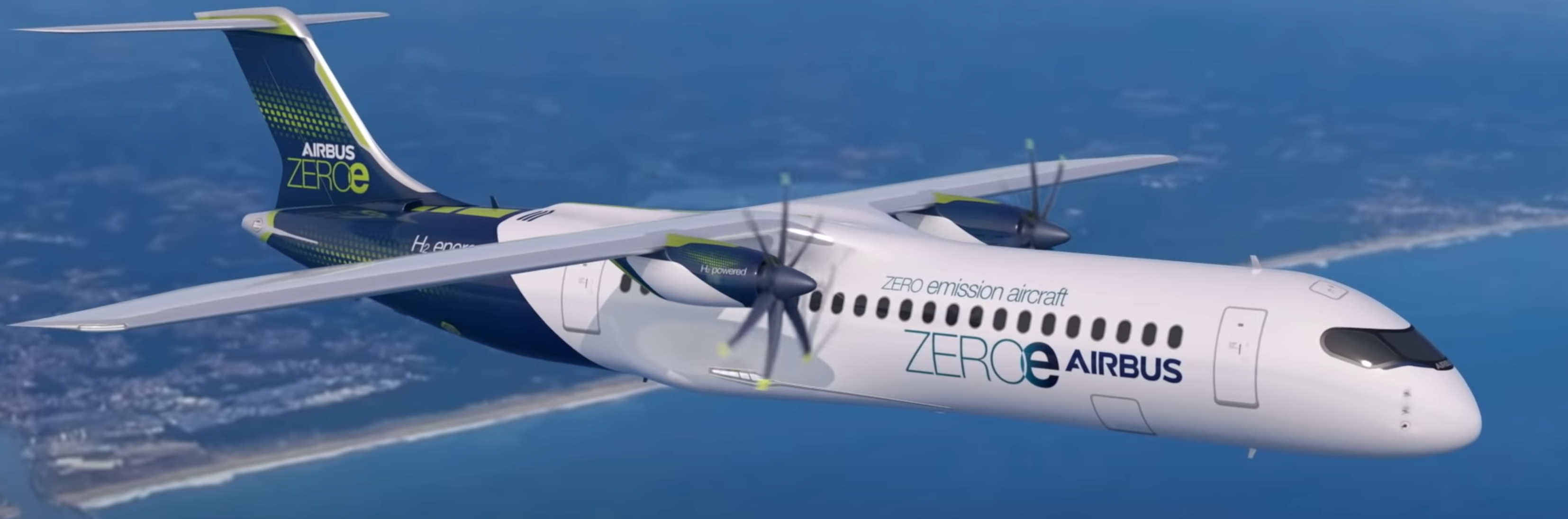
Note,
- The hydrogen tank will probably be behind the passenger compartment.
- The A 380, that will be testing the engine is no ordinary A 380. It is the very first and Airbus use it as a flying laboratory for new technology.
- I wouldn’t bet against one of its next jobs, is to test turbofan engines running on hydrogen.
I wouldn’t be surprised that in a few years, Airbus demonstrate an A 380 flying between Europe and North America on hydrogen.
A Zero-Carbon Air Bridge Between Europe And North America
Or does Westjet fancy a zero-carbon shuttle service, which would appeal to the Gretas of this world?
It has been rumoured, that the possible buyers of Prestwick are linked to Westjet.
As soon, as someone announces, a flight like this across the Atlantic, I’ll be signing up!
If the worse should happen, which I think would be unlikely, it would surely be a less painful death, than that of my wife’s from a rare cancer.
Conclusion
There are certainly, possibilities at Prestwick.
 The Anonymous Widower
