Are LNER Going To Take On The Airlines?
Nine years ago, I wrote Edinburgh – Plane Or Train?, after a trip to Scotland, where I took easyJet up and came back in First Class by train.
- Both trips were about five hours door-to-door.
- The flight was about six quid more,
- But I got free food and drink on the train.
- Security on the plane was a pain.
- I had to take my passport for identification at Stansted.
I haven’t flown internally in Great Britain since, although, I have flown to Belfast.
For shorter flights the market is going towards rail, as these posts seem to suggest.
- 2.7M Tonnes Of Co2 Could Be Saved Per Year If UK Domestic Flights Went Electric
- Air Travellers To Be Hit By Carbon Charge On All Tickets
- Climate Change ‘May Curb Growth In UK Flying’
- France Bans Short-Haul Flights To Cut Carbon Emissions
- KLM Replaces Plane With High Speed Train
- Lumo Carbon Data Shows Its Trains Are 22 Times Greener Than Flying
- Next Time I’ll Go By Train
- Ryanair One Of Europe’s Top Polluters, EU Data Suggests
- Stop Taking Internal Flights And Go Green, Says Lib Dem Contender Davey
The climate seems to be turning against flying short-haul.
This is a paragraph, in this press release from LNER, which is entitled First Tri-Mode Long Distance Trains For The East Coast Main Line.
This new fleet of trains will keep LNER on track to reduce its emissions by 67 per cent by 2035 and be net zero by 2045. LNER has already reduced carbon emissions by 50 per cent compared with 2018/19. Per mile, LNER trains produce 15 times less carbon emissions than a domestic flight.
Are LNER building a number of climate-based sticks, with which to beat the airlines on the routes, where they compete?
These are my thoughts on the various routes, where LNER compete with airlines.
Newcastle
Newcastle is an interesting one.
- Newcastle station is in the city centre and is on the Tyne and Wear Metro.
- London King’s Cross is one of London’s major Underground hubs.
- There are lots of buses and local trains within walking distance of both stations.
- There are three trains every two hours and an additional eight trains per day (tpd) between the two London King’s Cross and Newcastle stations.
- Lumo also run five tpd on the route.
- There are generally no security delays at rail stations.
- London King’s Cross is laid out to maximise passenger flows. If it gets busy, everybody just walks out into King’s Cross Square.
- I’ve never had a problem at Newcastle station with overcrowding.
Perhaps, if you live near one of the airports, flying is more convenient.
LNER’s weapons against the airlines between London King’s Cross and Newcastle will be convenience and journey times.
Convenience is all about the location of the stations, their excellent local transport networks and good walking routes around the station.
Journey times will only get better, as the magic of digital in-cab signalling, allows the Azumas, the new CAF tri-mode long distance trains and the few remaining InterCity 225s to show what they were designed to do.
Dalton-on-Tees, where the first phase of the digitally signalling will end, is 39.8 miles South of Newcastle, so once the Newcastle train is passes Dalton-on-Tees on the East Coast Main Line, it will be a digital-signalled electrified railway all the way to Woolmer Green.
- Dalton-on-Tees is 39.8 miles South of Newcastle
- Woolmer Green is 244.8 miles South of Newcastle.
- Dalton-on-Tees and Woolmer Green is 205 miles.
- Newcastle and Dalton-on-Tees takes 37 minutes.
- Woolmer Green and King’s Cross takes 18 minutes
- Trains take typically an average three hours and nine minutes between London and Newcastle.
- A typical train time by LNER between Dalton-on-Tees and Woolmer Green is two hours and 14 minutes.
- This is an average speed of 91.8 mph between Dalton-on-Tees and Woolmer Green.
- Between London King’s Cross and Newcastle is fully-electrified.
I can build a table of timings and savings at various average speeds.
- 120 mph – 103 minutes – two hours and 38 minutes – 31 minutes
- 125 mph – 98 minutes – two hours and 33 minutes – 36 minutes
- 130 mph – 95 minutes – two hours and 30 minutes – 39 minutes
- 135 mph – 91 minutes – two hours and 26 minutes – 43 minutes
- 140 mph – 88 minutes – two hours and 23 minutes – 46 minutes
Note.
- The first field is the average speed between Dalton-on-Tees and Woolmer Green.
- The second field is the time between Dalton-on-Tees and Woolmer Green.
- The third field is the time between London and Newcastle.
- The fourth field is the saving over current timings.
- The London and Newcastle time is calculated by adding the times for the three sections together.
I have regularly timed trains at a very constant 125 mph, so with digital signalling, I suspect an average of 130 mph is possible.
This would mean, times of a few minutes under two hours and thirty minutes could be possible between London and Newcastle.
Edinburgh
Edinburgh builds on the improvements South of Newcastle.
Edinburgh station Waverley is a well-connected station.
- There are lots of buses, local trains and the Edinburgh Tram within walking distance of Edinburgh Waverley station.
- There are three trains every two hours and an additional seven tpd between the London King’s Cross and Edinburgh Waverley stations.
- Lumo also run five tpd on the route.
- Trains take typically an average four hours and thirty minutes between London and Edinburgh Waverley.
- Any savings because of the digital in-cab signalling between London and Newcastle can be applied to London and Edinburgh Waverley services.
As my calculations showed that averaging 130 mph between Dalton-on-Tees and Woolmer Green could save 39 minutes on journey times, I am fairly sure than a sub-four hour journey time will be possible between London and Edinburgh Waverley.
It should also be noted that that the power supply has been improved between Newcastle and Edinburgh Waverley.
- The distance between Newcastle and Edinburgh Waverley is 124.2 miles
- Newcastle and Edinburgh Waverley takes around one hour and 30 minutes.
- This is an average speed of 82.8 mph between Newcastle and Edinburgh Waverley.
- Between London King’s Cross and Edinburgh Waverley is fully-electrified.
As the record time for between London King’s Cross and Edinburgh Waverley was set by an InterCity225 train in 1993 at three hours and twenty-nine minutes, I suspect that with more digital signalling and some track improvements, that there are more journey time improvements to be squeezed out.
I certainly believe that a time of three hours and fifty minutes between London and Edinburgh Waverley will be regularly achieved. This is a journey time saving of around forty minutes.
Dundee
Dundee has an airport and a station on the East Coast Main Line.
Trains between London King’s Cross and Dundee take around five hours and 45 minutes.
LNER run three trains per day to and from London King’s Cross and one tpd to and from Leeds.
CrossCountry also run services.
Loganair has two flights per day to Heathrow.
Aberdeen
Aberdeen builds on the improvements South of Edinburgh.
The four direct tpd between London and Aberdeen take around seven hours and ten minutes.
This should come down to around six hours and thirty minutes with the journey time savings between London King’s Cross and Edinburgh Waverley.
Will this tempt travellers from the airlines?
Battery-Electric Trains To Dundee And Aberdeen
One thing that will help, is that Edinburgh and Aberdeen is to be partially electrified.
InPiling Work To Get Underway To Electrify Line To Fife, I included this Network Rail map of the electrification.
This map has been downloaded from the Network Rail web site.
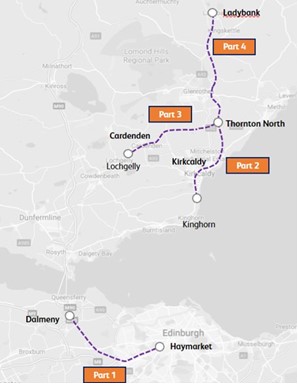
The electrification is split into four phases.
- Haymarket and Dalmeny – 25 km
- Kirkcaldy and Thornton North – 25 km.
- Lochgelly and Thornton North – 20 km.
- Thornton North and Ladybank – 34 km.
Note.
- The last three phases of electrification connect to Thornton North.
- The new rail link to Leven will also be electrified. and connected to Thornton North.
- The Forth Bridge is not to be electrified.
As Ladybank station is just 91.4 miles from Aberdeen, I suspect LNER will use Hitachi Intercity Battery Hybrid Trains to serve Aberdeen.
If these trains haven’t got the range, then I suspect LNER’s new CAF Tri-Mode Trains could handle the route.
Inverness
Inverness has a problem.
Zero-carbon trains will be unlikely to get to the city without full electrification of the Highland Main Line.
- Dunblane is the nearest electrified station to Inverness, but it is 146.2 miles away over a route with lots of steep climbs.
- I doubt that a battery-electric train could handle that route.
One solution would be for LNER to run the new CAF Tri-Mode Trains to Inverness using HVO or biodiesel.
Glasgow
Glasgow is the only other Scottish city with an airport and good rail connections to the South.
I am sure that Avanti West Coast will target airline passengers, if LNER prove it is a successful policy.
Other Factors
These are other factors, that will come into a traveller’s choice.
First Class
Some travellers like a bit more comfort and service.
Ability To Work
Some travellers like to work on a train.
You Don’t Get Tables On a Plane
I like to open a paper or magazine flat, which is difficult on a plane.
Views Tend To Be Better On a Train
Providing you get a window!
Parking Tends To Be Better At An Airport
But it may be more expensive!
Security Is Less Hassle On A Train
At the moment!
You Don’t Need To Prove Your Identity On A Train
Not in the UK! Yet!
Conclusion
It looks like LNER can offer the airlines to four of our major Northern cities serious zero-carbon competition.
First Tri-Mode Long Distance Trains For The East Coast Main Line
The title of this post, is the same as that of this press release from LNER.
This is the sub-heading.
London North Eastern Railway (LNER) is pleased to confirm that CAF has been named as the successful bidder to deliver a fleet of 10 new tri-mode trains for LNER. Porterbrook has been chosen as the financier of the new fleet. The trains will be able to operate in electric, battery or diesel mode.
These are the first two paragraphs.
Benefits of tri-mode trains range from a reduction in emissions, particulates, noise and vibration pollution, lower maintenance and operating costs and upgradeable technology, with an expected increase in range and performance as technology develops further. Battery power reduces the need to use diesel traction in areas where overhead powerlines are not available.
Complementing the modern Azuma fleet of 65 trains, the new ten-coach trains will help LNER achieve its vision of becoming the most loved, progressive and trusted train operator in the UK, delivering an exceptional service for the customers and communities served along its 956-mile network.
I have a few thoughts.
Will The Trains Have Rolls-Royce mtu Diesel Engines?
Consider.
- CAF’s Class 195, 196 and 197 Civity trains for the UK all have Rolls-Royce mtu diesel engines.
- Porterbrook are headquartered in Derby.
- Rolls-Royce are headquartered in Derby.
- In Rolls-Royce And Porterbrook Agreement Will Drive Rail Decarbonisation, I talked about how the two companies were planning to decarbonise trains using techniques like mtu Hybrid PowerPacks and hydrogen fuel cells.
I would think it very likely that the new trains will have Rolls-Royce mtu engines.
Will The Trains Have Rolls-Royce mtu Hybrid PowerPacks?
It was in 2018, that I first wrote about mtu Hybrid PowerPacks in Rolls-Royce And Porterbrook Launch First Hybrid Rail Project In The UK With MTU Hybrid PowerPacks.
- Examples of these power packs are now running in Germany, Ireland and the UK.
- The mtu Hybrid PowerPack how has its own web site.
- There is also this YouTube video.
- If CAF use off-the-shelf mtu Hybrid PowerPacks in their Civity trains, there is one big massive plus – They don’t have to develop the complicated control software to get a combination of diesel engines and batteries to perform as immaculately as Busby Berkeley’s dancers or a Brigade of Guards.
- The mtu Hybrid PowerPacks also have a big plus for operators – The batteries don’t need separate charging infrastructure.
- In Rolls-Royce Releases mtu Rail Engines For Sustainable Fuels, I talk about how mtu engines can run on sustainable fuels, such as biodiesel or HVO.
I think it is extremely likely that CAF’s new trains for LNER will be powered by mtu Hybrid PowerPacks.
Class 800 And Class 397 Trains Compared
The Class 800 train is LNER’s workhorse to Scotland from London.
The Class 397 train used by TransPennine Express, is a 125 mph Civity train.
Differences include.
- The Class 800 train can run at 140 mph, where the signalling allows, but is the Class 397 train only capable of 125 mph?
- The Class 397 train accelerate at 0.92 m/s², whereas the Class 800 train can only manage 0.7 m/s².
- The Hitachi train has 14 % more seats, 36 First and 290 Standard as opposed to 22 First and 264 Standard in five-car trains.
I will add to this list.
Will The New Trains Be Capable Of 140 mph Running?
As the East Coast Main Line is being fully digitally signalled to allow 140 mph running of the numerous Hitachi expresses on the route, I wouldn’t be surprised to see, that the new CAF trains will be capable of 140 mph.
In this article on Modern Railways, which is entitled LNER Orders CAF Tri-mode Sets, this is said.
The new fleet will be equipped with CAF Signalling’s European Rail Traffic Management System digital signalling. This will align with the East Coast Digital Programme, which aims to introduce European Train Control System (ETCS) on the southern stretch of the East Coast main line from King’s Cross to Stoke Tunnel by 2029.
Later in the article this is said.
LNER has retained 12 ‘91s’ hauling eight rakes of Mk 4s, and the rollout of ETCS is another reason the operator has sought to order the replacement fleet. LNER’s passenger numbers have rebounded more quickly than other operators post-Covid, which has helped make the case for confirming the order.
This does seem sensible.
What Will Be The Range Of The CAF Trains Without Electrification?
The longest LNER route without electrification is the Northern section of the Inverness service between Inverness and Dunblane, which is 146.1 miles. There are also eight stops and some hills.
In Edinburgh to Inverness in the Cab of an HST, there’s a video of the route.
I’m sure that even, if they don’t normally run the new trains to Inverness, being able to do so, could be useful at some point.
It should be noted that the Guinness World Record for battery-electric trains is 139 miles, which is held by a Stadler Akku.
I am left with the conclusion that London and Inverness needs a tri-mode train or lots of electrification. Did this rule out Hitachi?
The Number Of Trains Ordered
The Modern Railways article says this about the number of trains.
The contract includes an eight-year maintenance services agreement with an option to extend; CAF says the order value, including maintenance, exceeds €500 million. When the tender was published the intention was to include an option for five additional sets; LNER confirmed to Modern Railways there is an option to purchase additional sets on top of the base order of 10.
Can we assume this means that other trains will be ordered, if the trains are a success?
Can These New CAF Trains Be Made Net Zero?
This is a paragraph, in the LNER press release.
This new fleet of trains will keep LNER on track to reduce its emissions by 67 per cent by 2035 and be net zero by 2045. LNER has already reduced carbon emissions by 50 per cent compared with 2018/19. Per mile, LNER trains produce 15 times less carbon emissions than a domestic flight.
As the new CAF trains will probably have a service life of at least forty years, there must be some way, that these new trains can be made net zero.
Consider.
- I am absolutely certain, that the new CAF trains will have Rolls-Royce mtu diesel engines.
- LNER’s existing Class 800 and 801 trains have Rolls-Royce mtu diesel engines.
Rolls-Royce mtu according to some of Rolls-Royce’s press releases appear to be developing net zero solutions based on hydrogen or net zero fuels.
This press release from Rolls-Royce is entitled Rolls-Royce Successfully Tests mtu Engines With Pure Hydrogen, suggests that Rolls-Royce mtu are working on a solution.
Routes They Will Serve
The Modern Railways article says this about the routes to be served.
Modern Railways understands the new fleet will be maintained at Neville Hill depot in Leeds and, like the ‘225’ sets, will be used predominantly on services between London and Yorkshire, although unlike the ‘225s’ the tri-modes, with their self-power capability, will be able to serve destinations away from the electrified network such as Harrogate and Hull.
Note.
- This surprised me, as I’d always expected the Yorkshire routes will be served by Hitachi battery-electric trains.
- But it does look that both Harrogate and Hull stations, have long enough platforms to hold a ten-car train.
- With their tri-mode technology, it also looks like the CAF trains won’t be needed to be charged before returning to London.
The last point would enable them to try out new routes.
These are distances from the electrification of the East Coast Main Line of the destinations that LNER served, where there is not full electrification.
- Aberdeen via Ladybank – 91.4 miles
- Carlisle via Skipton – 86.8 miles
- Cleethorpes via Newark and Lincoln – 63.9 miles
- Harrogate via Leeds – 18.3 miles
- Huddersfield via Leeds – 17.2 miles
- Hull via Temple Hirst junction – 36.1 miles
- Inverness via Dunblane – 146.1 miles
- Lincoln via Newark – 16.7 miles
- Middlesbrough via Northallerton – 22.2 miles
- Scarborough via York – 42.1 miles
- Sunderland via Northallerton – 47.4 miles
Note.
- The first place after the ‘via’ is where the electrification ends.
- Carlisle could be a possibility during High Speed Two upgrading of the West Coast Main Line or for an enthusiasts’ special or tourist train.
- Cleethorpes is a possible new service for LNER. I wrote about this in LNER To Serve Cleethorpes.
- Scarborough must be a possible new service for LNER.
- All stations can take ten-car trains, with the possible exception of Middlesbrough, which is currently being upgraded.
- Huddersfield and Leeds is being electrified under the TransPennine Upgrade.
This would appear to show that LNER need enough bi-mode or tri-mode trains to run services to Aberdeen, Cleethorpes, Harrogate, Hull, Inverness, Lincoln, Middlesbrough and Sunderland.
But.
- It would appear that the initial batch of trains, will not be serving the North of Scotland.
- Aberdeen and Inverness could be served, when there is enough electrification at the Southern end.
I am also fairly sure, that no significant infrastructure is required.
Do Hitachi Have A Problem?
I am starting to wonder, if Hitachi are having trouble with the designing and building of their battery packs.
- It’s not like Hitachi to allow someone to run off with a €500 million contract from under their nose.
- Are they short of capacity to build the trains at Newton Aycliffe?
But then they’re probably up to their elbows in work on the High Speed Two Classic-Compatible trains.
Are There Any Other Routes, Where The New CAF Trains Could Be Employed?
The trains would certainly be suitable for these routes.
- Chiltern – InterCity services.
- CrossCountry Trains – Fleet replacement
- Grand Central Trains – Fleet replacement
- Grand Union Trains – For Carmarthen and Stirling open access services.
- Great Western Railway – Replacing Castles in the South West.
- ScotRail – Replacing Inter7City trains.
- South Western Railway – Basingstoke and Exeter St. Davids and other routes.
Note.
- CAF could sell a lot of trains.
- I estimate that fleet replacement for Grand Central Trans would cost around €350 million
- The specification would vary according to the route.
Could CAF have got the LNER order, because they have the capacity in the Newport factory?
Conclusion
It looks like CAF have done a good job in designing the trains.
I’m also fairly sure that CAF are using Rolls-Royce mtu PowerPacks.
Ricardo Develops Advanced Ranger HEX 6×6 Conversion With Hybrid Electric Drivetrain
The title of this post, is the same as that of this press release from Ricardo.
This is the sub-heading.
The new vehicle has been conceived to help improve the sustainability of future defence mobility while retaining the highest performance demanded by the toughest environments
This picture is from the press release.

My first thought is that it looks the ultimate technical.
These two paragraphs introduce the vehicle.
Ricardo, a global strategic, environmental, and engineering consulting company, has developed the Ranger HEX, a 6×6 vehicle conversion designed to offer a significant improvement in payload of up to 3,800kg over the harshest of terrains. It comes with a hybrid drivetrain to maintain performance and improve fuel consumption.
This new conversion benefits from Ricardo’s expertise and experience in creating high quality, cost effective special vehicles for defence, security and utility applications. The vehicle will benefit from enhanced levels of capability, robustness and availability.
These three paragraphs describe the design.
The HEX solution differs from conventional conversions as it has been conceived as an overlay bolt-on system that does not require any alteration of the Ford Ranger base vehicle, which is Europe’s number one commercial pick-up platform. This ensures that the base vehicle retains all the robustness and quality of the standard vehicle and allows the system to be removed and re-installed on a different vehicle.
An electric rear drive system has been adopted that uses a production Ford drive unit to provide up to an additional 210kW of power, over and above the class leading 186kW of power from the existing 3.0L V6 diesel engine. The De Dion rear suspension design is not only weight efficient and robust but also provides better wheel control for improved traction and ride. In addition, the De Dion arrangement decouples the suspension and drive systems to allow a range of drive units to be used or deleted for a cost-effective 6×4 variant with maximum payload using an undriven ‘lazy’ axle.
The electric drive is designed as a self-contained through-the-road hybrid system. Braking energy is harvested under deceleration to charge the battery pack. This energy is then used to provide electric torque under acceleration to mitigate the usual drop in performance whist carrying a high payload. A selection of battery capacities are available, depending on customer requirements. All high voltage components are contained within a single integrated enclosure for safety and ease of maintenance and repair.
Note.
- The conversion would appear to bolt on to the standard Ford Ranger base vehicle.
- The vehicle has regenerative braking.
- It has a payload of 3.8 tonnes.
- It appears to have a very sophisticated rear suspension.
- Judging by the colour and the mention of the word defence in the article, I suspect this vehicle has been initially designed for a military application.
- Over 300,000 Rangers were sold worldwide in 2021.
- In the UK, it looks like a Ford Ranger will cost around £30,000 excluding VAT.
In addition I’ve read in this article on Autoweek that, the conversion itself has been designed as an overlay bolt-on modification that requires no alterations to the base vehicle, even preserving its existing warranty.
I have my thoughts.
Applications
The press release talks about high quality, cost effective special vehicles for defence, security and utility applications.
Use your imagination!
Perhaps.
- It is going to be used as the ultimate technical by the Ukrainians.
- A missile manufacturer has a system, that weighs around 3.5 tonnes and needs a launch vehicle.
- The RNLI needs an affordable vehicle to launch lifeboats from the beach.
- It is going to be used as rough terrain ambulance.
- It would make an excellent towing vehicle.
With all the problems in Morocco and Libya at the moment, it has been launched at the right time.
Zero-Carbon Operation
I believe that a zero-carbon version is essential. Especially, as the sub-heading mentions sustainable defence mobility.
The easiest way to achieve this would be to run on HVO or some form of biodiesel.
I suspect between them Ford and Ricardo have enough knowledge to create a hydrogen powered version.
Are There Autonomous Ford Rangers?
Google says, “Yes!”
This article on foresttech is entitled Ford Ranger Goes Fully-Autonomous, where this is said.
An Australian mining group has advanced the future of mobility (in mining at least) with the deployment of a fleet of fully-autonomous Ford Rangers at one of its mines.
Fortescue Metals Group has retrofitted four Rangers at its Christmas Creek mine in Western Australia with autonomous systems created by the company’s Technology and Automation team, to remove the need for fitters to make around 12,000 28-kilometre round trips each year to collect equipment and parts.
Of course, it’s not quite as ground-breaking as it sounds: mining operations don’t need to deal with road rules, pedestrians or many other vehicles, which hugely complicate the matter. Nevertheless, it’s still impressive.
Three applications suggest themselves.
- Delivering supplies in a disaster zone, after an earthquake, flooding,, landslide or volcanic eruption.
- Delivering supplies, including ammunition on a battlefield.
- Moving supplies along a long linear construction site, like a new railway or road.
Note.
In all three applications, six-wheel drive will be important, if ground conditions are bad.
- Could Fortescue Metals Group be behind this project?
- Disasters seem to be getting more common.
- Autonomous battlefield delivery must be safer for personnel.
I suspect there will be agricultural applications of an autonomous vehicle.
Grand Central DMU To Be Used For Dual-Fuel Trial
The title of this post, is the same as that of this article on Railway Gazette.
This is the first two paragraphs.
An Alstom Class 180 Adelante diesel-hydraulic multiple-unit is to be converted to run on a combination of diesel and liquefied natural gas in a dual-fuel technology demonstration project.
One car of the DMU which Arriva-owned open access inter-city operator Grand Central leases from Angel Trains is to be equipped with dual-fuel technology company G-volution’s Optimiser system, which is used in the road sector. The modifications are expected to be straightforward, enabling trials on the national network to start later this year.
The article dates from May 2019 and I suspect the small matter of the pandemic and Grand Central’s resulting three closures due to lockdowns are the reason this development hasn’t been heard of since.
But this was the London end of the Class 180 train, that I rode from Mirfield to King’s Cross.
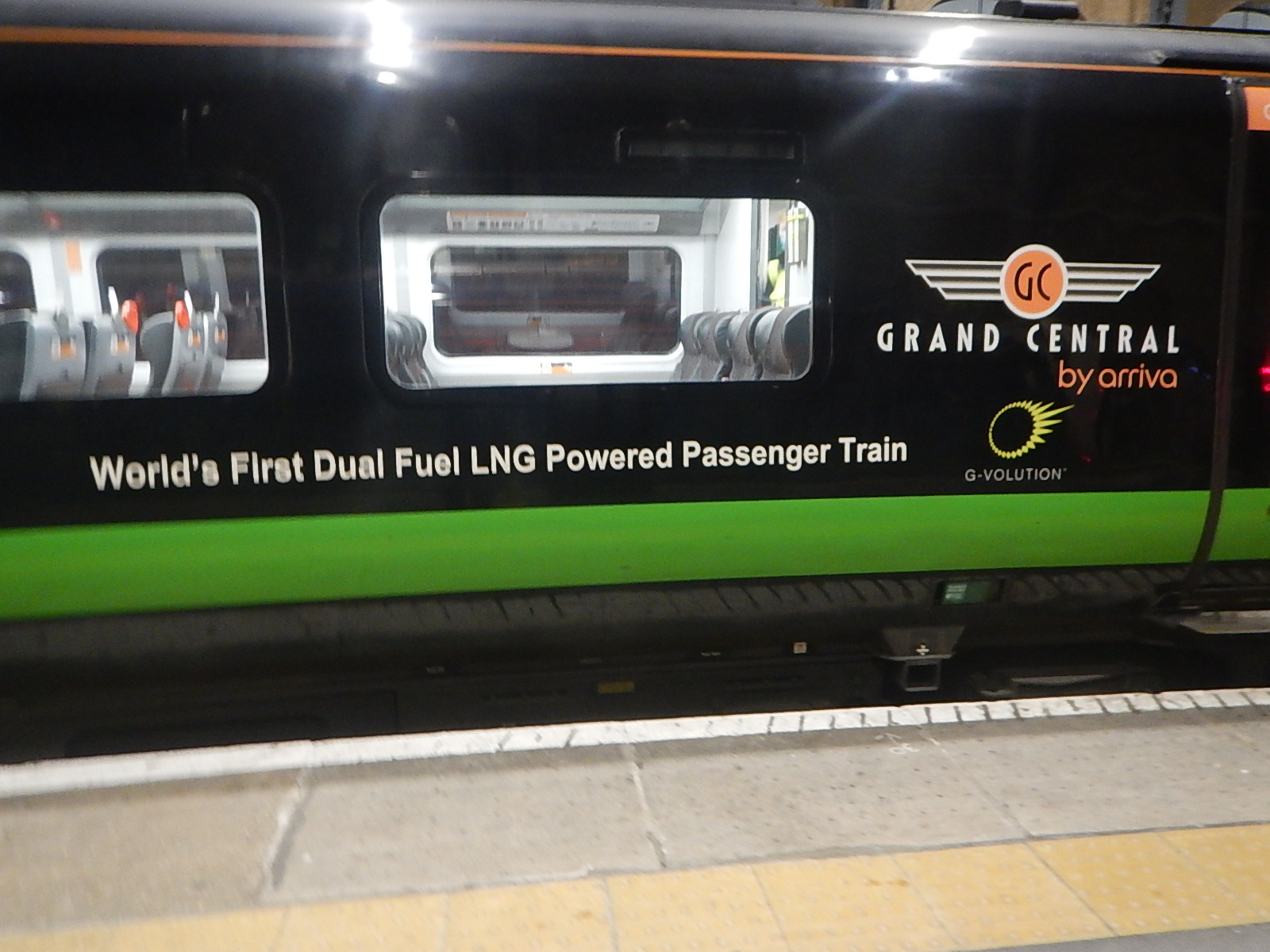
I haven’t ridden in a Class 180 train for some years and there was nothing to indicate from the performance, that it was not a standard train.
There are fourteen of these 125 mph trains.
This explanatory video of G-volution’s technology is on the G-volution web site.
Note that in the video, one of G-volution’s Managing Director; Chris Smith says that the technology is fuel agnostic and will work with a range of fuels including ammonia, biodiesel, bio-LPG, hydrogen and methanol.
Conclusion
It will be very interesting to see what is decided to be the ideal fuel-combination and how much reduction is possible for the various emissions.
I’ll end with two questions.
Will Passengers Like The New Trains?
What is there not to like! Same train and performance with lower emissions.
Will Cummins Like What G-volution Have Done To Their Engines?
Cummins might be a bit miffed, as they built the QSK19 engines for the Class 180 trains and may have their own plans for them. But they are a pragmatic and flexible company in my experience and generally they do what the customer needs or wants. Decarbonisation is surely in everybody’s interest.
Incidentally, the same Cummins diesel engines are used in the TransPennine Express, Class 185 trains, I’ve been riding in most of today.
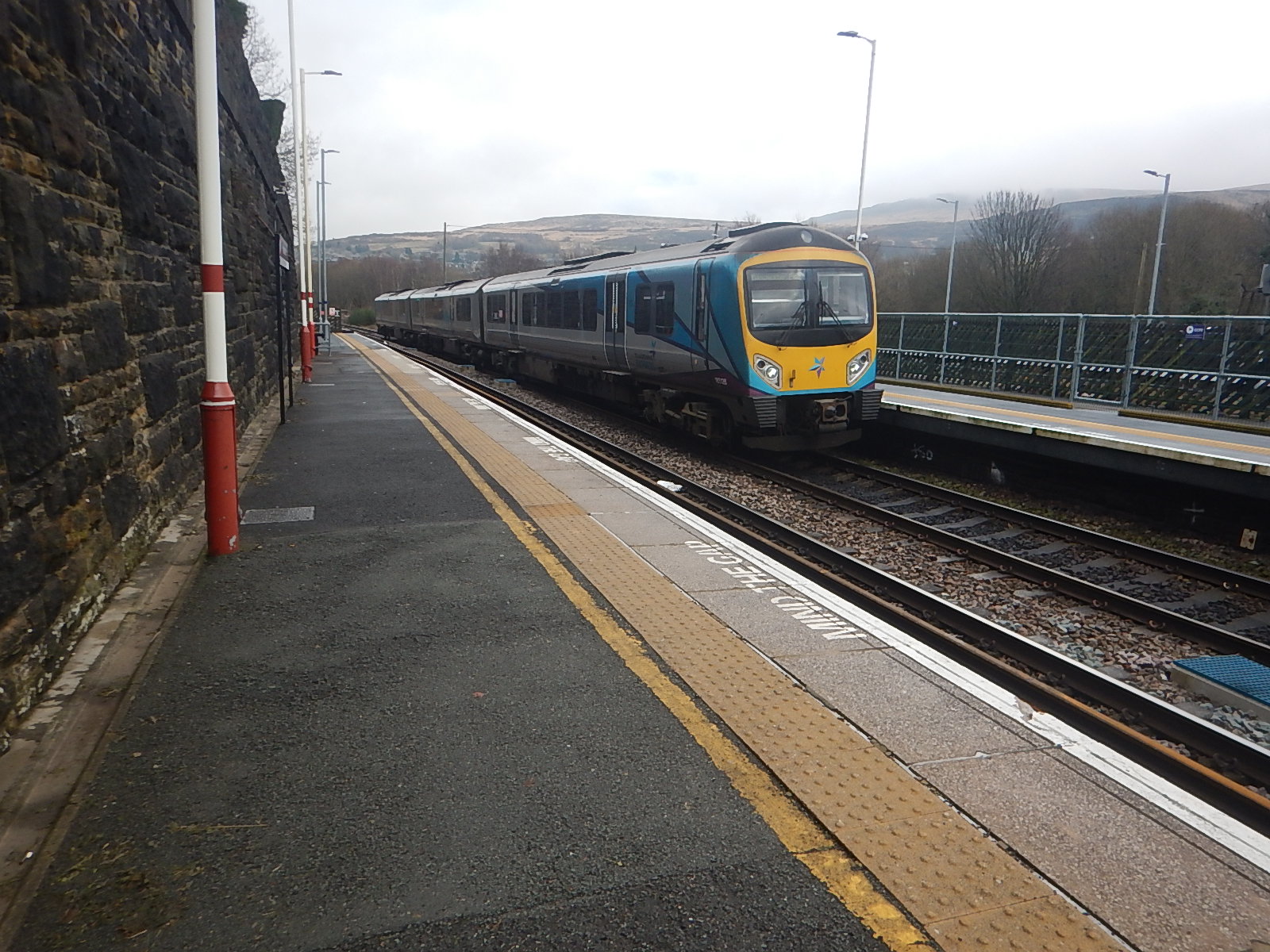
There are fifty-one of these 100 mph trains in use in the UK. They could be ideal for some long routes, if they could be converted to low-emission.
Freightliner Continue Trials On New Low Carbon Fuel
The title of this post, is the same as that of this article on Rail Technology Magazine.
This is the first paragraph.
As part of their commitment to carbon reduction Freightliner will conduct operational trials of a new low carbon fuel supplied by Green Biofuels Ltd (GBF).
And this paragraph described the fuel.
GBF are the UK’s leading provider of Hydrogenated Vegetable Oil (HVO) and the new fuel consists of 55% Shell GTL (gas to liquids) Fuel and 45% Gd+ HVO.
It does appear that hydrotreated vegetable oil or HVO, could be becoming an intermediate step on the route to decarbonisation, as I’ve posted about the fuel before in Powered By HVO.
The other promising route to decarbonisation must surely be that of producing fuel from waste, as pioneered by Velocys and others.
But they are only intermediate steps before hydrogen becomes the preferred zero-carbon fuel for rail freight services.
Results For HS2’s Trial For Alternative Fuels Set To Cut Carbon Released
The title of this post, is the same as that of this article on Rail Technology Magazine.
This paragraph sums up the results.
Although the results demonstrated partial air quality benefits, when compared to red diesel, the trial showed possible carbon reduction opportunities via the sustainable sourcing of alternative fuels.
It looks like, there will be benefits from swapping from red diesel.
Are Disposable Nappies A Wasted Resource?
I stated my views on disposable nappies in this post called Disposable Nappies, where this was the first sentence.
From a scientifically green point of view, in many places I’m against using disposable nappies, as they clog sewers, end up in landfill and I’ve even seen them in litter bins in parks. We used real nappies for all our three children in the seventies, washing them ourselves in a machine for the first and then using a nappy service for the last two.
But dirty nappies contain a lot of the ingredients, that can be used to make hydrocarbons.
This article from the Sunday Times in 2018 is entitled Syngas, The New Jet Fuel — Stinky Nappies And Coffee Cups.
These are the first two paragraphs of The Times article.
With their packed cabins and recycled air, long-haul passenger jets are the last place where you would want to encounter the whiff of a dirty nappy.
However, old nappies are to be used — along with other non-recyclable waste such as meal packaging and takeaway coffee cups — to power British Airways planes.
Syngas is a mixture of hydrogen, carbon monoxide and some carbon dioxide. Some countries without access to petroleum or diesel created syngas and then used the Fischer–Tropsch process to create the fuels they needed. The process doesn’t have a good reputation as the two main countries to use the process were Germany under the Nazis and South Africa during apartheid.
Why is the use of this process being revived to produce aviation biofuel or sustainable aviation fuel for British Airways?
According to Wikipedia, it can save between 20 and 98 % of carbon emissions compared to conventional jet fuel.
The same process can also make biodiesel for buses, trains and trucks
It’s certainly an area, where a lot of research is going on! Just type “syngas nappies” or “syngas diapers” into Google and you’ll get a lot of serious hits.
By my front door I have a well-designed blue bin.
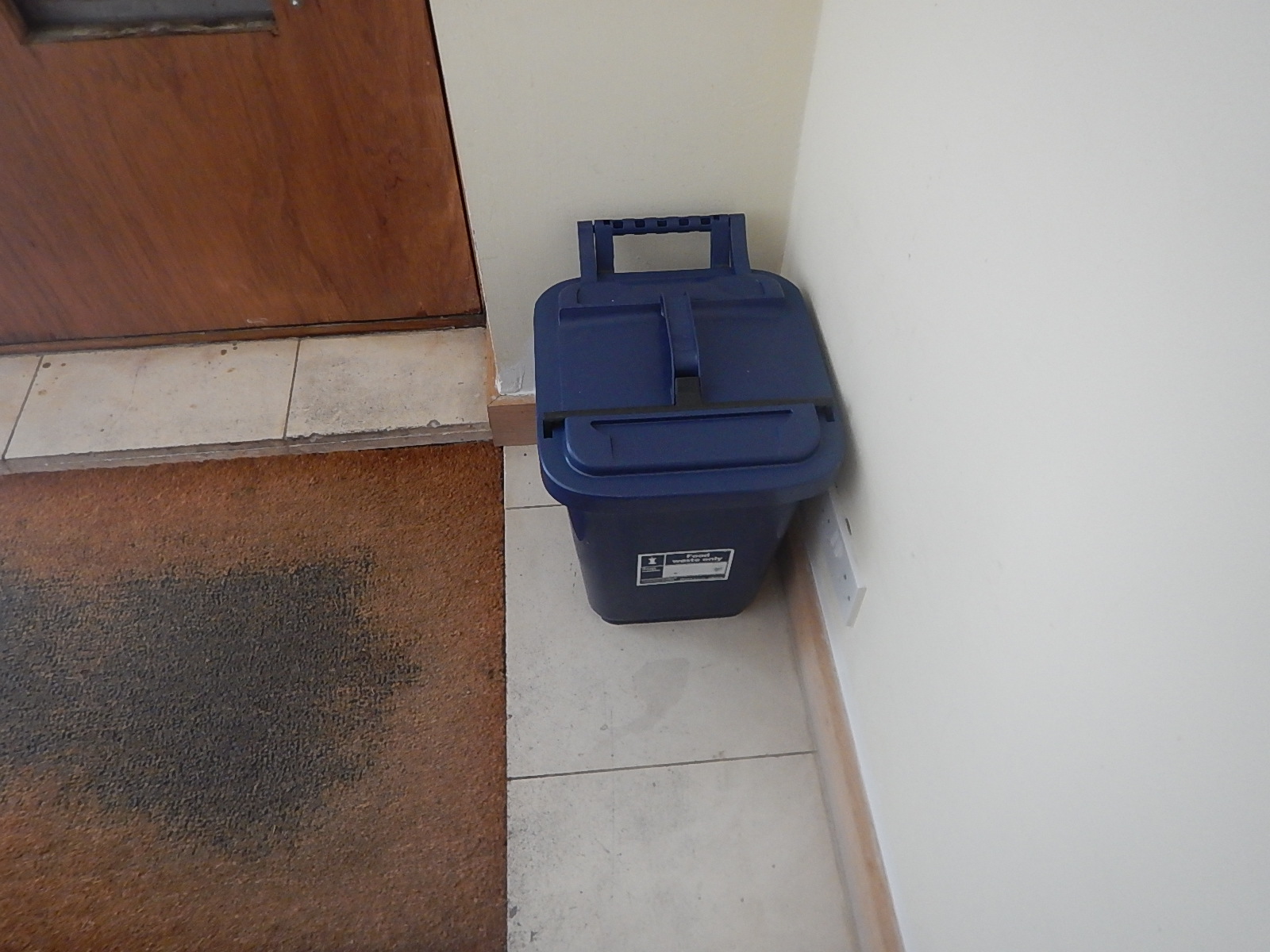
This is for my food waste bin, which is collected once a week.
This page on the Hackney web site is entitled Food Waste Recycling, and this is said about where the food waste goes.
Food waste from households in Hackney is sent to an anaerobic digestion facility in south east England, where it’s turned into renewable energy to power homes and biofertiliser to be spread on local farmland to grow crops.
A similar bin of an appropriate size could be used for nappies.
The nappies would go to an appropriate recycling site, instead of down the toilet or into landfill.
Through Settle And Carlisle Service Under Consideration
The title of this post, is the same as that of an article in the June 2021 Edition of Modern Railways.
This is the first paragraph.
Plans for a new Leeds to Glasgow through service via the Settle and Carlisle line are being developed, with CrossCountry and the Department for Transport starting to look at the possible scheme.
It sounds like a sensible idea to me.
The article also suggests the following.
- CrossCountry is a possible operator.
- CrossCountry are keen to improve services between Leeds and Glasgow
- The trains could be InterCity 125s, freed up, by a the arrival of Class 221 trains from Avanti West Coast, when they receive their new Class 805 trains.
- Maintenance of the trains wouldn’t be a problem, as this could be done at Neville Hill in Leeds or Craigentinny in Edinburgh.
- Services could start in December 2023.
I have a few thoughts of my own!
The Route
The route between Leeds and Carlisle is obvious, but there are two routes between Carlisle and Glasgow.
Trains would probably choose a route and call at stations to maximise passenger numbers.
These stations are on the various routes.
- Settle and Carlisle – Shipley, Bingley, Keighley, Skipton, Gargrave, Hellifield, Long Preston, Settle, Horton in Ribblesdale, Ribblehead, Dent, Garsdale, Kirkby Stephen, Appleby, Langwathby, Lazonby & Kirkoswald and Armathwaite
- Glasgow South Western – Dunlop, Stewarton, Kilmaurs, Kilmarnock, Auchinleck, New Cumnock, Kirkconnel, Sanquhar, Dumfries, Annan and Gretna Green
- West Coast Main – Motherwell, Carstairs and Lockerbie
There are certainly a lot of possibilities.
Upgrading The InterCity 125 Trains
CrossCountry appear to have enough InterCity 125 trains to muster five in a two Class 43 power car and seven Mark 3 coach formation.
They may not be fully in-line with the latest regulations and there may be a need for a certain degree of refurbishment.


These pictures show some details of a refurbished Great Western Railway Castle, which has been fitted with sliding doors.
Will The InterCity 125 Trains Be Shortened?
Scotrail’s Inter7City trains and Great Western Railway’s Castle trains have all been shortened to four or five coaches.
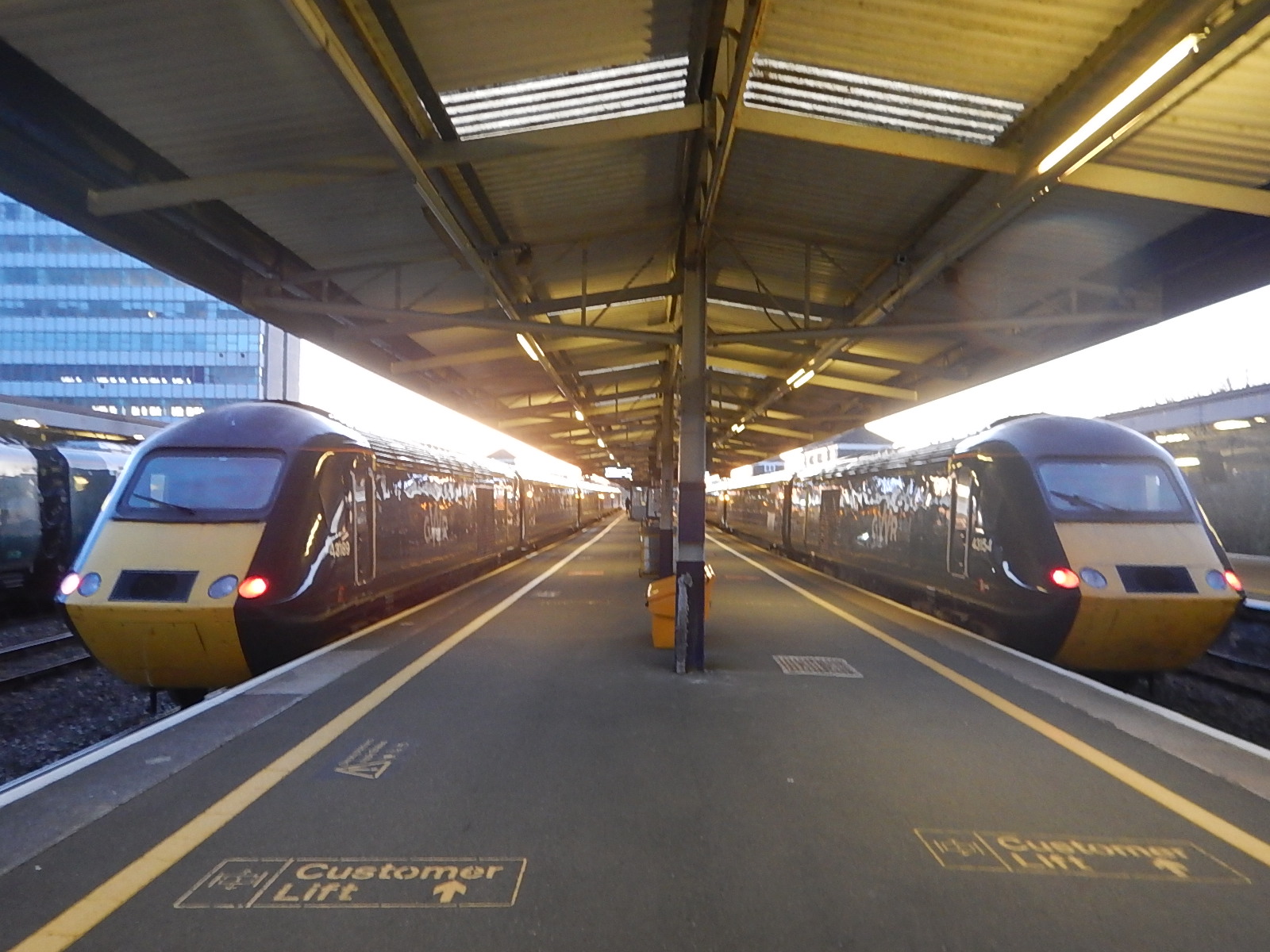
This picture shows a pair of Castles.
Journey Times, Timetable And Frequency
The current journey time between Leeds and Glasgow Central stations via the East Coast Main Line is four hours and eight minutes with nine stops.
The Modern Railways article says this about the current service.
The new service would be targeted at business and leisure travellers, with through journey times competitive with road and faster than the current direct CrossCountry Leeds to Glasgow services via the East Coast main line.
I would expect that CrossCountry are looking for a time of around four hours including the turn round.
- Stops could be removed to achieve the timing.
- The trains could run at 125 mph on the West Coast Main Line.
This could enable a train to have the following diagram.
- 0800 – Depart Leeds
- 1200 – Depart Glasgow Central
- 1600 – Depart Leeds
- 2000 – Depart Glasgow Central
- Before 2400 – Arrive Leeds
Note.
- A second train could start in Glasgow and perform the mirrored timetable.
- Timings would probably be ideal for train catering.
- Trains would leave both termini at 0800, 1200, 1600 and 2000.
- The timetable would need just two trains.
I also think, if a second pair of trains were to be worked into the timetable, there could be one train every two hours on the route, if the demand was there.
I certainly believe there could be a timetable, that would meet the objectives of attracting business and leisure passengers away from the roads.
Tourism And Leisure Potential
The Settle and Carlisle Line is known as one of the most scenic railway lines in England, if not the whole of the UK.
There are important tourist sites all along the route between Leeds and Glasgow
- Leeds – The station is well-connected in the City Centre.
- Saltaire – For the World Heritage Site and Salt’s Mill
- Keighley – For the Keighley and Worth Heritage Railway
- Settle – The town of Settle is worth a visit.
- Ribblehead – For the famous Ribblehead Viaduct
- Appleby – For the Horse Fair.
- Carlisle – The station is well-connected in the City Centre.
- Glasgow – Glasgow Central station is well-connected in the City Centre.
Many of the stations are used by walkers and others interested in country pursuits.
I believe that it is a route that needs a quality rail service.
Travel Between London and Towns Along The Settle And Carlisle Line
In Thoughts On Digital Signalling On The East Coast Main Line, I said this.
I think it is highly likely that in the future, there will be at least one train per hour (tph) between London Kings Cross and Leeds, that does the trip in two hours.
It may seem fast compared to today, but I do believe it is possible.
With a timely connection at Leeds station, will this encourage passengers to places along the Settle and Carlisle line to use the train?
What About the Carbon Emissions?
The one problem with using InterCity 125 trains on this route, is that they are diesel-powered, using a pair of Class 43 locomotives.
But then there are over a hundred of these diesel-electric locomotives in service, nearly all of which are now powered by modern MTU diesel engines, which were fitted in the first decade of this century.
Consider.
- The locomotives and the coaches they haul have an iconic status.
- Great Western Railway and Scotrail have recently developed shorter versions of the trains for important routes.
- There are over a hundred of the locomotives in service.
- Companies like ULEMCo are developing technology to create diesel-powered vehicles that can run on diesel or hydrogen.
- There is plenty of space in the back of the locomotives for extra equipment.
- MTU have a very large number of diesel engines in service. It must be in the company’s interest to find an easy way to cut carbon emissions.
- I believe that the modern MTU diesel engines could run on biodiesel to reduce their carbon footprint.
And we shouldn’t forget JCB’s technology, which I wrote about in JCB Finds Cheap Way To Run Digger Using Hydrogen.
If they could develop a 2 MW hydrogen engine, it could be a shoe-in.
I believe that for these and other reasons, a solution will be found to reduce the carbon emissions of these locomotives to acceptable levels.
Conclusion
In this quick look, it appears to me that a Glasgow and Leeds service using InterCity 125 trains could be a very good idea.
Shell Withdraws From Waste To Jet Fuel Plant Project
The title of this post, is the same as that, of this article on Insider Media.
This is the introductory paragraph.
Oil giant Shell has withdrawn from the joint development agreement for a proposed facility for the conversion of waste into aviation fuel.
It would appear that the Altalto project will continue and has no likelihood of folding in the near future.
I like the idea behind Altalto, which will take household and industrial waste and turn it into sustainable aviation fuel and biodiesel.
But I also like Shell’s Blue Hydrogen Process, which takes methane and effectively removes the carbon to create carbon-neutral hydrogen.
Conclusion
I feel the world is a big enough place for both technologies.
Green Jet Fuel Plant Developers’ Ioy As World Economic Forum Backs Method As Best Aviation Solution
The title of this post, is the same as that of this article on Business Live.
This is the first paragraph.
The World Economic Forum has backed sustainable aviation fuel as the most promising decarbonation policy for aviation, delighting the developers of a £350 million refinery on the Humber.
I bet Velocys are delighted.
I also think, that, the biodiesel, that they can produce, is a short term solution to the decarbonisation of rail freight and the heaviest vehicles powered by diesel.
It’s so much better than throwing the rubbish into landfill.
 The Anonymous Widower