How Many High Speed Two Trains Will Be Able To Terminate In Euston Station?
This is one of those questions for which you get a different answer depending on what conditions you put on the question.
But there are some physical constraints that have been built into the design.
High Speed Two Tracks And Signalling Are Designed For Eighteen Trains Per Hour
It seems to be an accepted fact, that High Speed Two tracks and signalling will be able to handle 18 trains per hour (tph) or a train every three minutes and twenty seconds.
If this applies to all High Speed Two routes it is certainly a big increase in capacity of the UK rail network.
Seventeen Trains Per Hour In Euston Station
Does it also mean that Euston station must be able to handle 18 tph? Not necessarily, as High Speed Two will only need to handle 17 tph, because they will be keeping one path for recovering the service, after perhaps a train breaks down.
- If the station has eleven platforms, that means each platform must handle 1.5 tph or in practice two tph or a train every thirty minutes.
- If the station has ten platforms, that means each platform must handle 1.7 tph or in practice two tph or a train every thirty minutes.
Ten platforms appear to make little difference in normal operation But when things go wrong, it is more likely, there will be another platform to park a late train.
Turning Trains In Thirty Minutes At Euston Station
One train every thirty minutes means that operating procedures and staff training must be such that trains can be turned within this time.
If trains could be turned faster, then this would enable services to be recovered after a delay.
Twenty-Four Trains Per Hour In Euston Station
If say at some time in the future, signalling improves and 24 tph on High Speed Two is possible with perhaps Automatic Train Operation, this would mean that if there were ten platforms each would have to handle 2.4 tph, or in practice three tph or a train every twenty minutes.
A frequency of 24 tph won’t happen in my lifetime, but I do believe it is possible on High Speed Two with ten platforms at Euston station.
Thirty Trains Per Hour In Euston Station
Thirty tph may be practical on Metros today and could be possible on High Speed Two in the far future, but in practice, that would only be four tph or a train every fifteen minutes.
The Initial Full Timetable Is Seventeen Trains Per Hour
Currently, this is planned to be the case and the trains to and from London Euston are planned to be as follows.
- Train 1 – London Euston and Birmingham Curzon Street – 400 metre Full-Size
- Train 2 – London Euston and Birmingham Curzon Street – 400 metre Full-Size
- Train 3 – London Euston and Birmingham Curzon Street – 400 metre Full-Size
- Train 4 – London Euston and Lancaster – Classic Compatible
- Train 4 – London Euston and Liverpool – Classic Compatible
- Train 5 – London Euston and Liverpool – Classic Compatible
- Train 6 – London Euston and Macclesfield – Classic Compatible
- Train 7 – London Euston and Manchester – 400 metre Full-Size
- Train 8 – London Euston and Manchester – 400 metre Full-Size
- Train 9 – London Euston and Manchester – 400 metre Full-Size
- Train 10 – London Euston and Edinburgh – Classic Compatible
- Train 10 – London Euston and Glasgow – Classic Compatible
- Train 11 – London Euston and Edinburgh – Classic Compatible
- Train 11 – London Euston and Glasgow – Classic Compatible
- Train 12 – London Euston and Sheffield – Classic Compatible
- Train 12 – London Euston and Leeds – Classic Compatible
- Train 13 – London Euston and Leeds – 400 metre Full-Size
- Train 14 – London Euston and Leeds – 400 metre Full-Size
- Train 15 – London Euston and Sheffield – Classic Compatible
- Train 15 – London Euston and York – Classic Compatible
- Train 16 – London Euston and Newcastle – Classic Compatible
- Train 17 – London Euston and Newcastle – Classic Compatible
Note.
- I have assumed 400 metre Full-Size trains will be a pair of 200 metre trains.
- Trains 4, 10, 11, 12 and 15 are pairs of 200 metre long Classic-Compatible trains, that split and join at Crewe. Carlisle, Carlisle and East Midlands Hub respectively.
- Trains 5, 6, 16 and 17 are single 200 metre long Classic-Compatible trains.
This graphic shows the services.
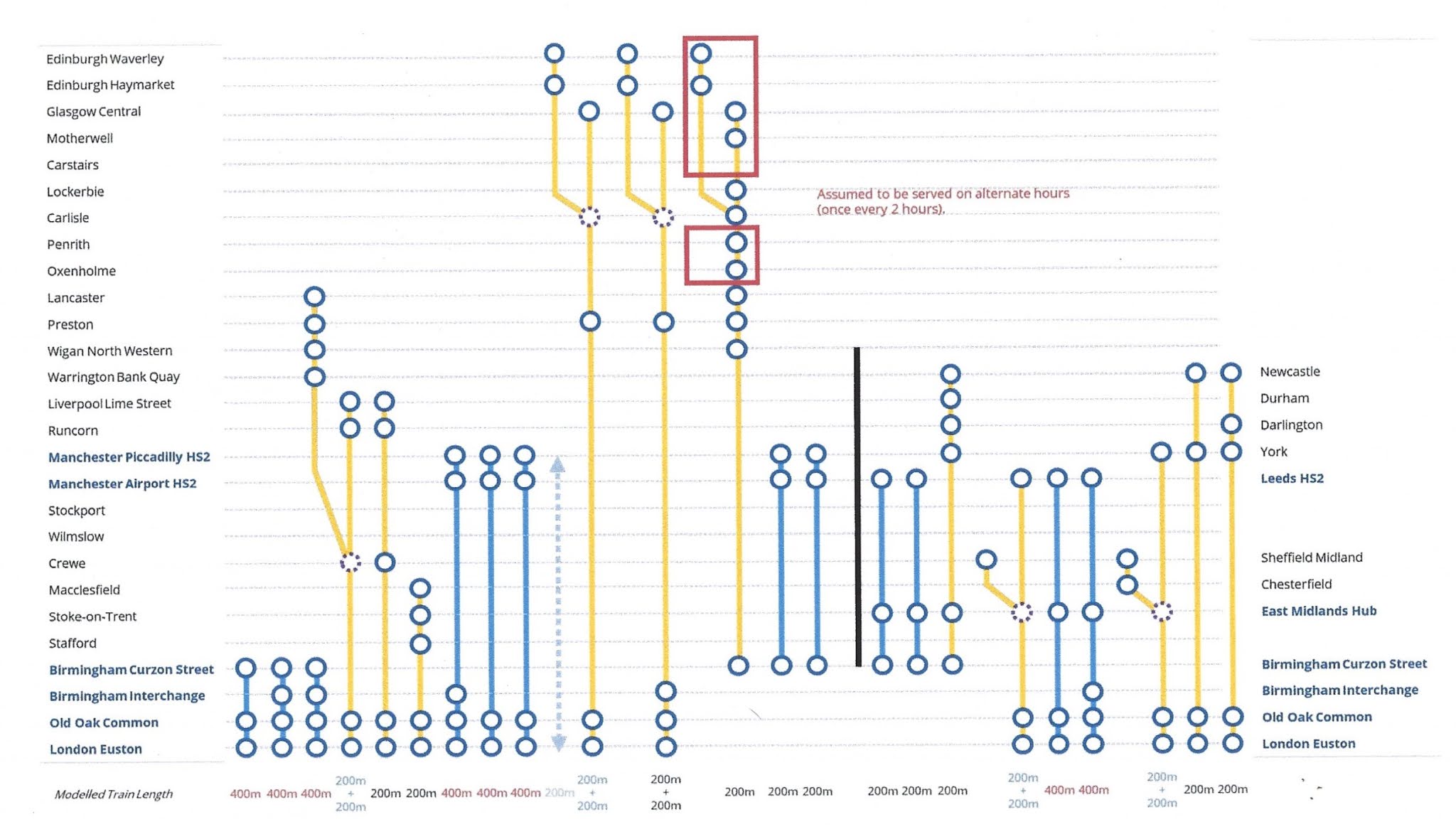
Note.
- Trains to the left of the vertical black line are Phase 1 and those to the right are Phase 2.
- Full-Size trains are shown in blue.
- Classic-Compatible trains are shown in yellow.
- The dotted circles are where trains split and join.
- In the red boxes routes alternate every hour.
In an hour, the following trains will leave London Euston.
- 8 – 400 metre Full-Size trains, each of which consist of a pair of 200 metre trains.
- 5 – Pairs of 200 metre long Classic-Compatible trains.
- 4 – Single 200 metre long Classic-Compatible trains.
Note.
- Adding up the 200 metre trains gives a total of thirty trains.
- If all paths were handling a pair of 200 metre trains, the total would be thirty-four trains.
As I showed in Could High Speed Two Serve Holyhead?, these four trains can be used to serve extra destinations by appropriate splitting and joining.
So in answer to the question in the title of this post, the answer is thirty-four 200 metre trains.
- Each path can carry one pair of 200 metre trains per hour.
- The number of paths is determined by the 18 tph that each leg can handle, reduced by one for a path for recovery.
I am assuming each platform can handle two tph.
But thirty or forty years in the future, this figure with more advanced trains and signalling could be a lot higher.
Does Euston Station Need Ten Or Eleven Platforms?
Mathematically, the following is possible.
- Ten platforms can handle thirty tph, if trains can be turned in fifteen minutes.
- Ten platforms can handle twenty-four tph, if trains can be turned in twenty minutes.
- Ten platforms can handle seventeen tph, if trains can be turned in thirty minutes.
The only need for the eleventh platform, is for when things go seriously wrong.
Could High Speed Two Serve Holyhead?
Why?
It could be a way to create a zero- or low-carbon route between the islands of Great Britain and Ireland.
Battery-Electric Trains Could Be The Solution
In Will High Speed Two’s Classic-Compatible Trains Have Battery Operation?, I suggested that it might be feasible for High Speed Two’s Classic-Compatible trains to have batteries.
I said this at the start of that post.
I believe it is very likely, that High Speed Two’s new classic-compatible trains will have battery capabilities.
-
- Batteries would handle energy generated by regenerative braking.
- Batteries would give a train recovery capability in case of overhead catenary failure.
- Batteries would be used for depot movements.
- Batteries would probably improve the energy efficiency of the trains.
Effectively, the batteries would power the train and would be topped-up by the electrification and the regenerative braking.
Since I wrote that post in February 2020, Hitachi have launched two battery-electric trains, one of which is the Hitachi Intercity Tri-Mode Battery Train, which is described in this Hitachi infographic.
As diesel (or should I say Stuart) engines are so nineteenth-century. any high speed independently-powered train would probably use batteries, have no diesel engines and be a battery-electric train.
So could Hitachi or any other bidder for the High Speed Two Classic-Compatible trains produce a train, that would be capable of handling the long-distance routes from London, that would be difficult or expensive to electrify, by the use of batteries?
- Batteries will improve dramatically in the next few years.
- Batteries will also become more affordable.
- Engineers will also learn how to package them in better and more innovative ways.
I think it is very likely, that a High Speed Two Classic-Compatible train could be produced with a reliable range of over eighty miles on batteries.
Holyhead And Crewe By Battery-Electric Classic-Compatible High Speed Train
These are the distances between stops on the route between Holyhead and Crewe
- Holyhead and Bangor – 25 miles.
- Bangor and Llandudno Junction – 16 miles
- Llandudno Junction and Colwyn Bay – 4 miles
- Colwyn Bay and Rhyl – 10 miles
- Rhyl and Prestatyn – 4 miles
- Prestatyn and Flint – 14 miles
- Flint and Chester – 13 miles
- Chester and Crewe – 21 miles
Note.
- It is a route of only 105 miles.
- There is no 25 KVAC electrification, except at Crewe.
- It is nearly all double-track.
- The operating speed is 90 mph
- The route is also generally flat and mainly along the coast.
Suppose the following were to be done.
- Erect traditional electrification between Chester and Crewe.
- Hitachi ABB Power Grids build a section of their discontinuous electrification around Llandudno Junction.
- Install a battery charging system at Holyhead.
An alternative might be to put another section of discontinuous electrification through Bangor, if installing the charging station at Holyhead proved to be difficult.
I believe it would be possible to run a High Speed Two Classic-Compatible train equipped with batteries between London Euston and Holyhead.
What Time Would Be Possible?
Consider.
- High Speed Two are predicting 56 minutes between London Euston and Crewe.
- Avanti West Coast are showing journey times of one hour and 57 minutes between Crewe and Holyhead.
- Avanti West Coast are using 125 mph Class 221 trains, but are restricted to a lot less than this speed.
- The HSC Dublin Swift can sail between Dublin and Holyhead in several minutes under two hours.
I believe that a High Speed Two Classic-Compatible train equipped with batteries could go between London Euston and Holyhead in under three hours.
If this were to be linked to the latest hydrogen-powered fast ferry between Holyhead and Dublin, would London Euston and Dublin be fast enough to attract passengers from the airlines?
- The journey time could be under five hours.
- It would be zero-carbon.
- By cutting stops to the West of Chester and track improvements train times could be reduced.
- It would be the sort of adventure, that some families like!
I think that Avanti West Coast and the ferry company could have a rail and ferry service, that would appeal to many travellers.
Would There Be A Path To Euston For Another High Speed Service?
In How Many Trains Are Needed To Run A Full Service On High Speed Two?, I listed the trains that would use the Western leg of High Speed Two.
- Train 1 – London Euston and Birmingham Curzon Street – 400 metre Full-Size
- Train 2 – London Euston and Birmingham Curzon Street – 400 metre Full-Size
- Train 3 – London Euston and Birmingham Curzon Street – 400 metre Full-Size
- Train 4 – London Euston and Lancaster – Classic Compatible
- Train 4 – London Euston and Liverpool – Classic Compatible
- Train 5 – London Euston and Liverpool – Classic Compatible
- Train 6 – London Euston and Macclesfield – Classic Compatible
- Train 7 – London Euston and Manchester – 400 metre Full-Size
- Train 8 – London Euston and Manchester – 400 metre Full-Size
- Train 9 – London Euston and Manchester – 400 metre Full-Size
- Train 10 – London Euston and Edinburgh – Classic Compatible
- Train 10 – London Euston and Glasgow – Classic Compatible
- Train 11 – London Euston and Edinburgh – Classic Compatible
- Train 11 – London Euston and Glasgow – Classic Compatible
- Train 12 – Birmingham Curzon Street and Edinburgh or Glasgow – Classic Compatible
- Train 13 – Birmingham Curzon Street and Manchester – 200 metre Full-Size
- Train 14 – Birmingham Curzon Street and Manchester – 200 metre Full-Size
Note.
- A lot of the paths into London Euston would appear to be allocated.
- Train 4 is a pair of 200 metre long Classic-Compatible trains, that will split and join at Crewe, with one train going to Liverpool and the other going to Lancaster.
- Train 5 is only a single 200 metre long Classic-Compatible train.
I suspect it would be possible to make Train 5 a pair of 200 metre long Classic-Compatible trains, that will split and join at Crewe, with one train going to Liverpool and the other going to Chester and Holyhead.
It does appear that the proposed timetable for High Speed Two has been designed so extra trains can be added if the demand is there.
What Times Would Be Possible Between Holyhead And Crewe?
Consider.
- I have looked at the route from my virtual helicopter and suspect that much of the route can be upgraded to 100 mph running.
- The current average speed between Holyhead and Crewe is 54 mph.
- London Liverpool Street and Norwich is 114.5 miles and is regularly achieved in ninety minutes on a 100 mph line, which is an average speed of 76 mph.
- The number of stops could be reduced.
I can build a table of times for faster average speeds.
- 60 mph – One hour and 45 minutes – Two hours and 41 minutes
- 70 mph – One hour and 30 minutes – Two hours and 26 minutes
- 80 mph – One hour and 19 minutes – Two hours and 15 minutes
- 90 mph – One hour and 10 minutes – Two hours and 6 minutes
- 100 mph – One hour and 3 minutes – One hour and 59 minutes
Note.
- The first time is Holyhead and Crewe.
- The second time is London and Holyhead.
I am fairly certain, that a substantial time improvement is possible.
Why Not Electrify All The Way Between Holyhead And Crewe?
I am seventy-four and can remember several incidents of serious storms and flooding along the North Wales Coast Line.
There was a warning earlier this year according to this article on the BBC.
Perhaps it would be better to spend the money on improving the resilience and operating speed of the track?
Conclusion
London Euston and Holyhead could be a serious proposition.
With some development and a new fast ferry, it could also open up a practical zero-carbon route between Great Britain and Ireland.
Times of four and a half hours between London Euston and Dublin could be possible.
Should All High Speed Long Distance Services To Newcastle Extend To Edinburgh?
Look at this Google Map of Newcastle station.
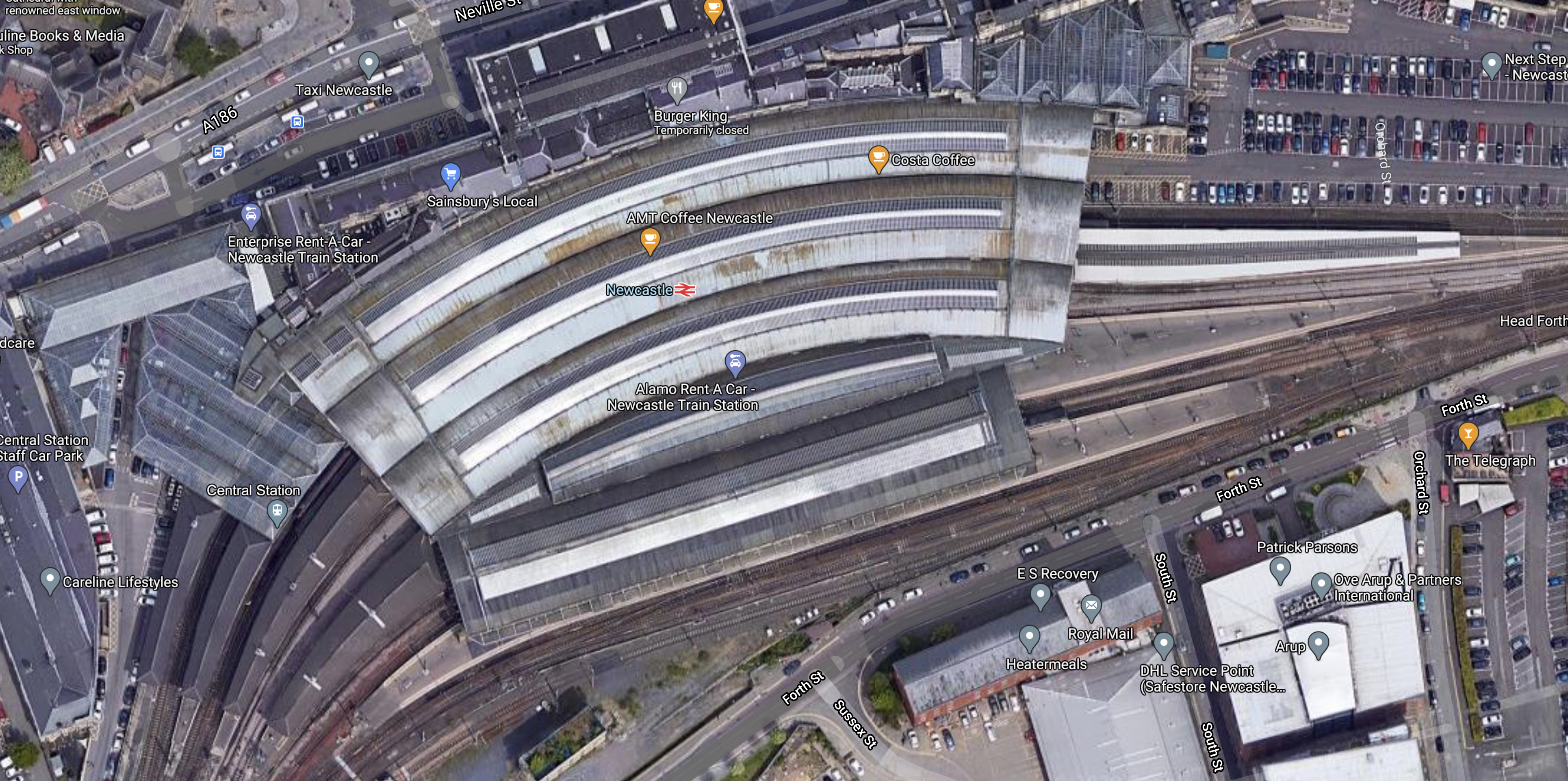
Note.
- It is built on a curve.
- It is on a cramped site.
- Platforms are numbered from 1 at the top to 8 at the bottom.
- Platform 2 seems to be used for all express services going North.
- Platforms 3 and 4 seem to be used for all express services going South.
- Not all platforms would appear to be long enough for nine-car Class 80x trains.
I am certain, that any nation with a sophisticated railway system wouldn’t build a station on a curve with no avoiding lines like Newcastle these days.
Network Rail have a plan to sort out Darlington station and I’m sure they’d like to sort out Newcastle as well!
Current Long Distance Trains Through And To Newcastle
These include.
- CrossCountry – Plymouth and Edinburgh or Glasgow via Alnmouth, Berwick-upon-Tweed and Dunbar.
- CrossCountry – Southampton Central or Reading and Newcastle.
- LNER – King’s Cross and Edinburgh via Berwick-upon-Tweed
- LNER – King’s Cross and Edinburgh via Alnmouth
- TransPennine Express – Liverpool Lime Street and Edinburgh via Morpeth
- TransPennine Express – Manchester Airport and Newcastle.
Note.
- All have a frequency of one train per hour (tph)
- All trains call at Newcastle.
- Two tph terminate at Newcastle and four tph terminate at Edinburgh or beyond.
There is also a new and Edinburgh service from East Coast Trains, that will start this year.
- It will run five trains per day (tpd).
- It will call at Newcastle.
- It will stop at Morpeth between Newcastle and Edinburgh.
There will also be High Speed Two services to Newcastle in a few years.
- There will be two tph between Euston and Newcastle
- There will be one tph between Birmingham Curzon Street and Newcastle.
Note.
- All services will be run by 200 metre long High Speed Two Classic-Compatible trains.
- There is no High Speed Two service to Newcastle, that calls at Leeds.
- Only one High Speed Two service to Newcastle calls at East Midlands Hub.
I suspect High Speed Two services need a dedicated platform at Newcastle, especially, if another High Speed Two service were to be added.
Extra Paths For LNER
In the December 2020 Edition of Modern Railways, there is an article, which is entitled LNER Seeks 10 More Bi-Modes.
This is the last paragraph.
Infrastructure upgrades are due to prompt a timetable recast in May 2022 (delayed from December 2021), from which point LNER will operate 6.5 trains per hour out of King’s Cross, compared to five today. As an interim measure LNER is retaining seven rakes of Mk. 4 coaches hauled by 12 Class 91 locomotives to supplement the Azuma fleet and support its timetable ambitions until new trains are delivered.
There would certainly appear to be a path available if LNER wanted to increase the frequency of trains between King’s Cross and Edinburgh from the current two trains per hour (tph) to three.
I laid out how I would use this third path to Edinburgh in A New Elizabethan.
The Possible Long Distance Trains Through And To Newcastle
These trains can be summed up as follows.
- 1 tph – CrossCountry – Plymouth and Edinburgh or Glasgow via Alnmouth, Berwick-upon-Tweed and Dunbar.
- 1 tph – CrossCountry – Southampton Central or Reading and Newcastle.
- 1 tph – LNER – King’s Cross and Edinburgh via Berwick-upon-Tweed
- 1 tph – LNER – King’s Cross and Edinburgh via Alnmouth
- 1 tph – TransPennine Express – Liverpool Lime Street and Edinburgh via Morpeth
- 1 tph – TransPennine Express – Manchester Airport and Newcastle.
- 5 tpd – East Coast Trains – King’s Cross and Edinburgh via Morpeth
- 2 tph – High Speed Two – Euston and Newcastle
- 1 tph – High Speed Two – Birmingham Curzon Street and Newcastle
- 1 tph – LNER – King’s Cross and Edinburgh – Extra service
This is ten tph and the five tpd of East Coast Trains.
Capacity Between Newcastle And Edinburgh
I wonder what capacity and linespeed would be possible on the East Coast Main Line between Newcastle and Edinburgh.
There are a few freight trains and some suburban electrics at the Northern end, but I suspect that the route could handle ten tph with some upgrades.
Edinburgh As A Terminal
Consider.
- Not all trains terminate at Edinburgh, but several tpd go through to places like Aberdeen, Glasgow, Inverness and Stirling.
- Edinburgh has several shorter East-facing bay platforms, that can take five-car Class 802 trains.
- Edinburgh has undergone a lot of reconstruction in recent years, so that it can turn more trains.
I very much feel that Edinburgh could handle, at least ten tph from the South.
Conclusion
I think it would be possible to extend all trains to Newcastle to at least Edinburgh.
Would it increase passenger capacity between the two capitals?
It would certainly avoid the difficult and expensive rebuilding at Newcastle station.
Could Trains From The North Connect To High Speed One At St. Pancras?
I was casually flying my virtual helicopter over the throat of St. Pancras International station, when I took a few pictures.
This Google Map shows the Northern ends of the platforms and the tracks leading in.
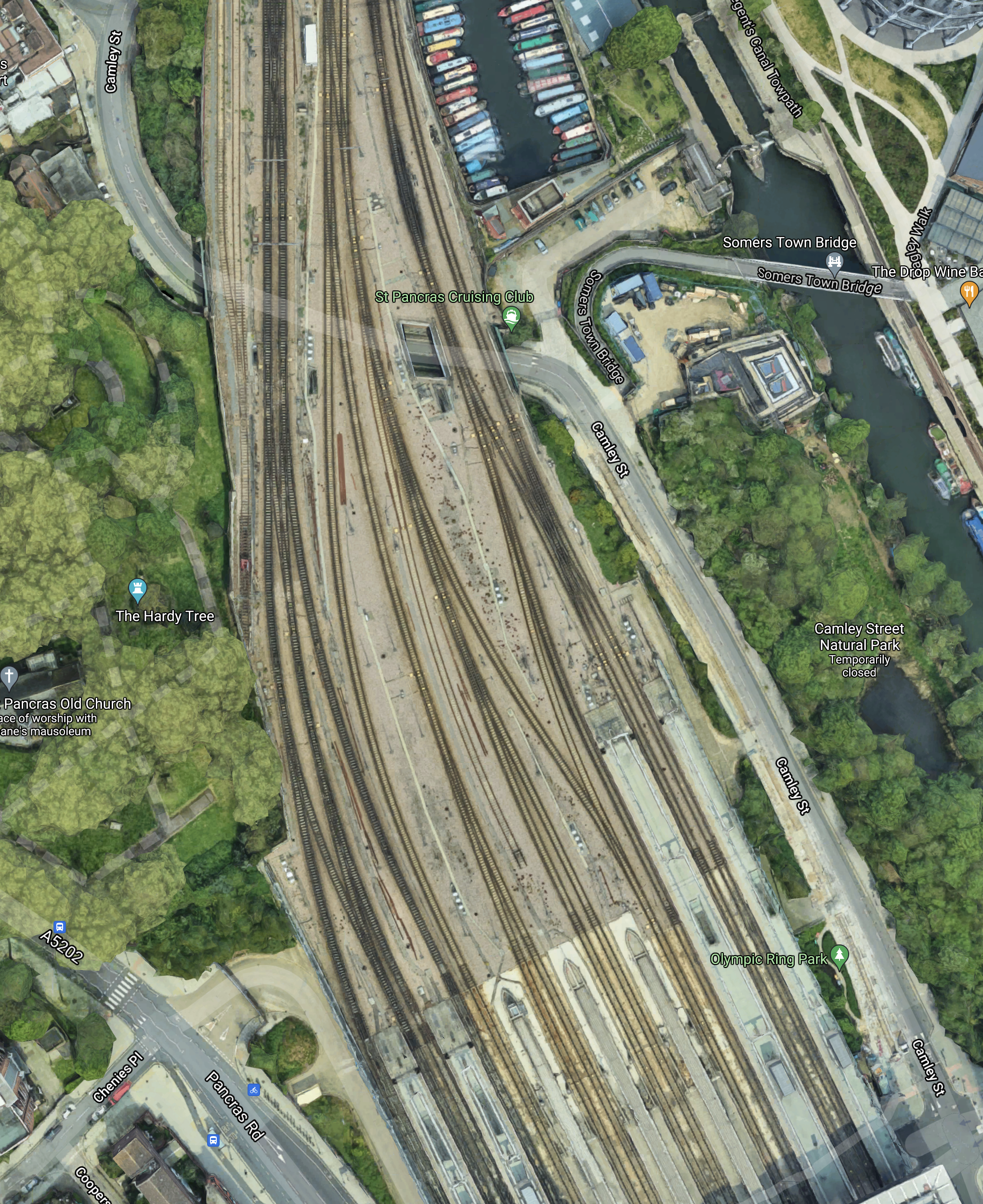
Note.
- Platforms 1-4 to the West with darker tracks handle the East Midlands Railway services.
- Platforms 5-10 in the centre with lighter tracks formed of three shorter islands handle the Eurostar services.
- Platforms 11-13 to the East with longer platforms handle the Southeastern HighSpeed services.
This Google Map shows the East Midlands Railway platforms.
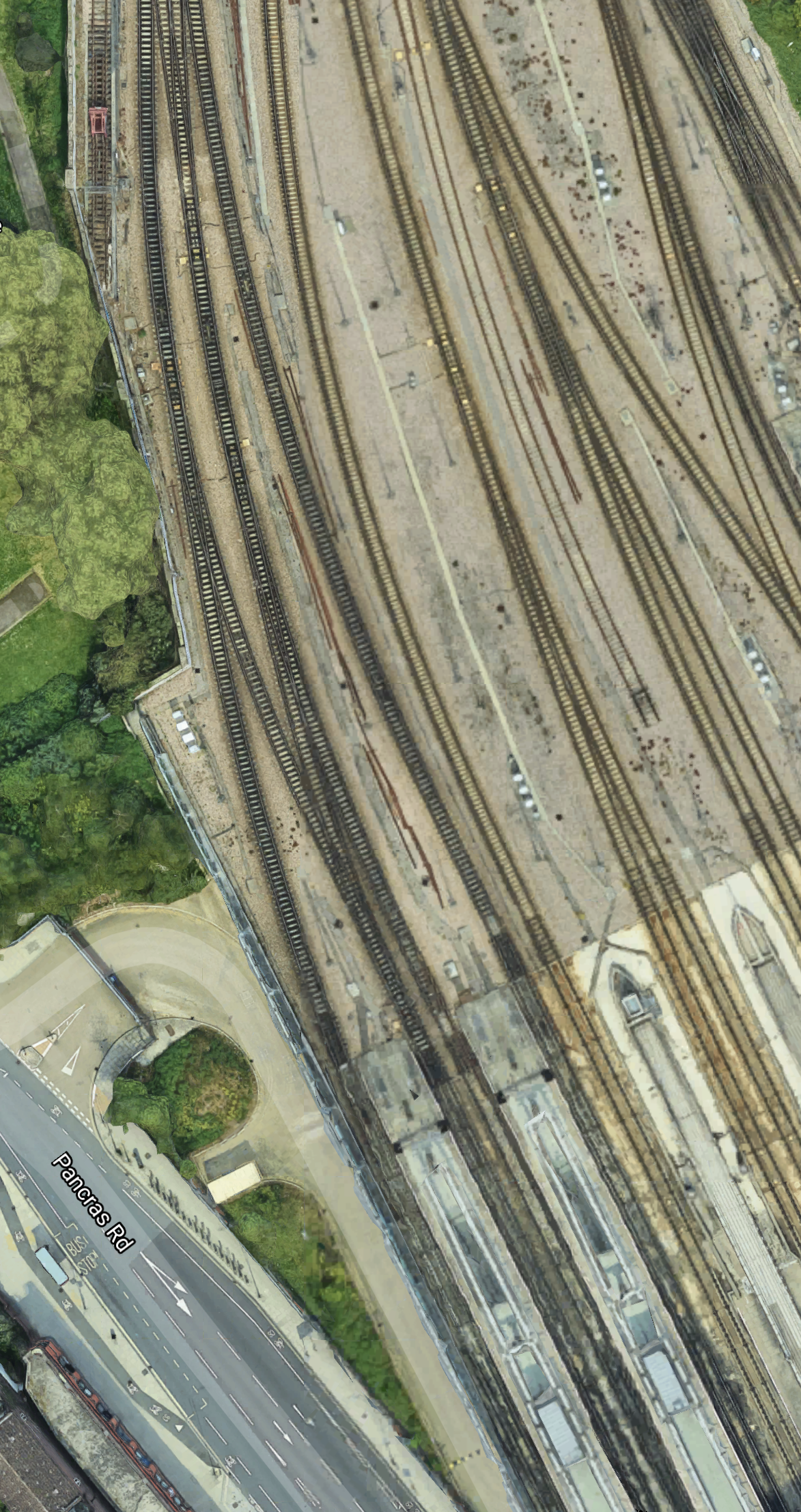
Note.
- There are two island platforms; 1-2 and 3-4.
- The four platforms are served by two tracks, that connect to the fast lines of the Midland Main Line.
- The platforms will be able to handle a pair of Class 810 trains, which will be 240 metres long.
- Will the two trains per hour (tph) using Class 360 trains between London and Corby always use the same platform at St. Prancras station?
This Google Map shows the Eurostar platforms.
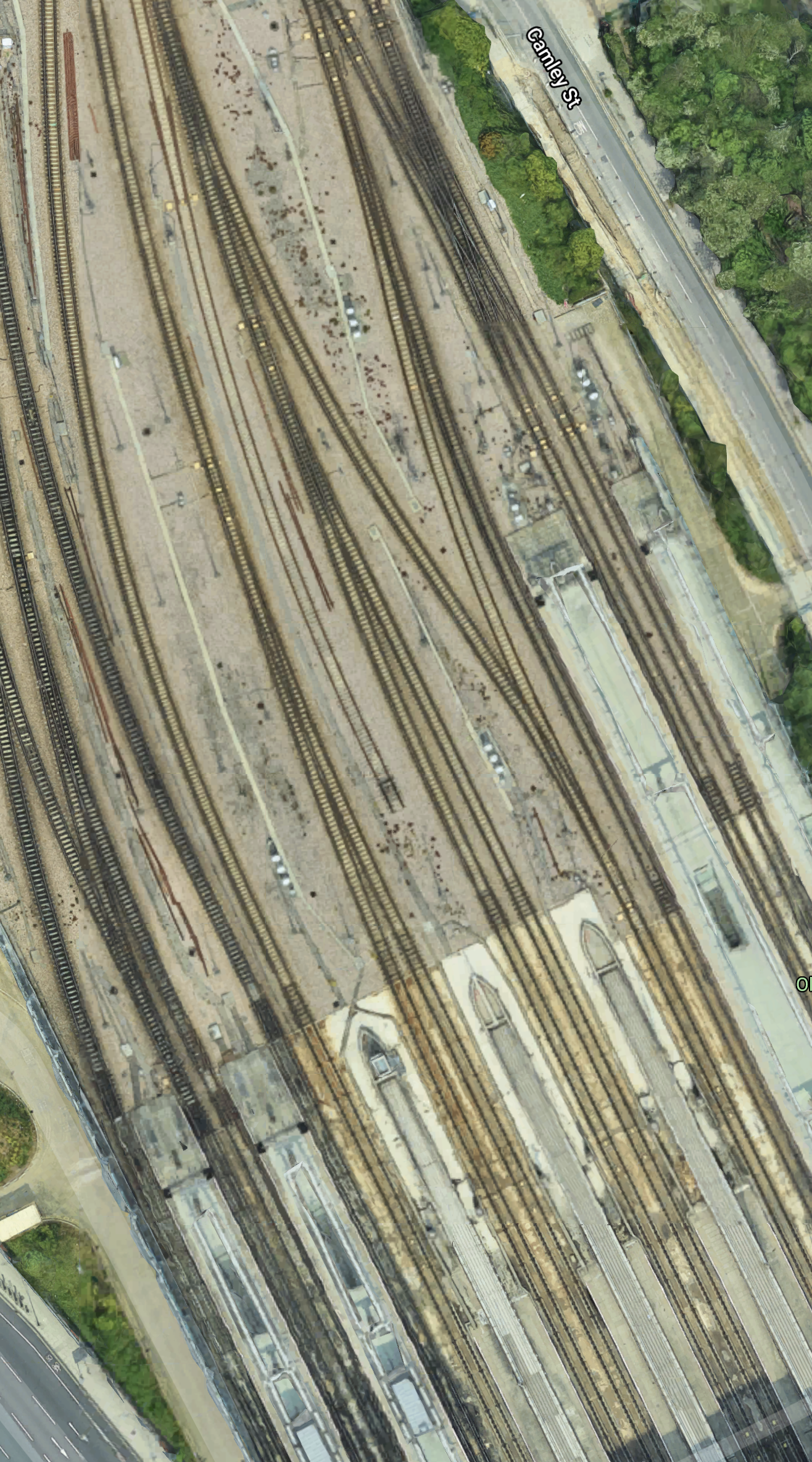
Note.
There are three island platforms; 5-6, 7-8 and 9-10.
The two island platforms in the West are for East Midlands Railway services.
The two longer island platforms in the East are for Southeastern HighSpeed services.
The six platforms connect to two fast lines, that are shared with the Southeastern services.
This Google Map shows the lines proceeding to the North.
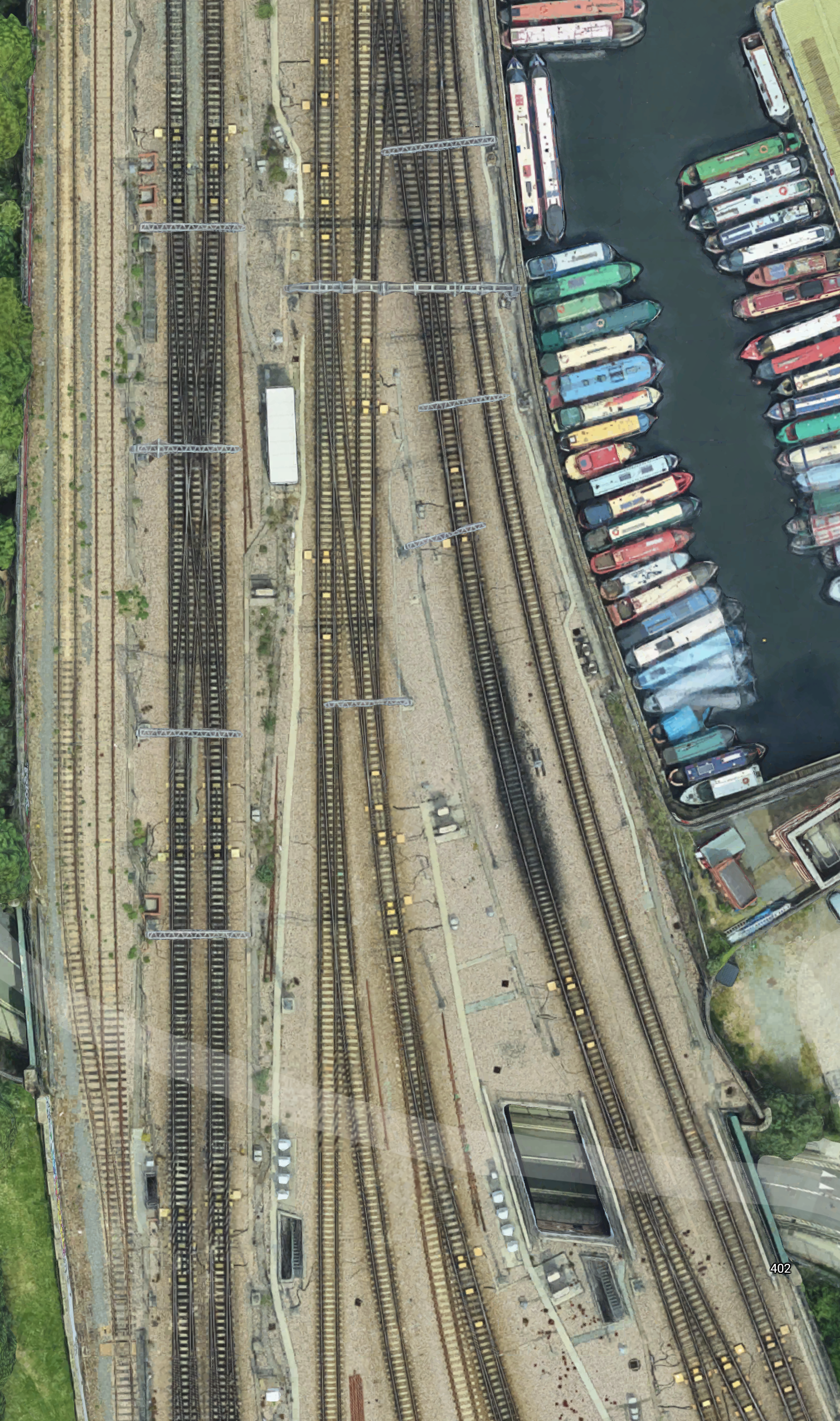
Note.
- There are four sets of tracks.
- The two light-coloured tracks on the left are for Thameslink or sidings.
- The next two dark-coloured tracks are the two tracks of the Midland Main Line.
- The next set of tracks are those connecting to the six Eurostar platforms.
- The two tracks on the right are those connecting to the Southeastern Highspeed platforms.
- There are crossovers between the Eurostar and Southeastern Highspeed tracks to allow efficient operation of the trains going to and from the twin tracks of High Speed One.
This Google Map shows where the Midland Main Line and High Speed One divide.
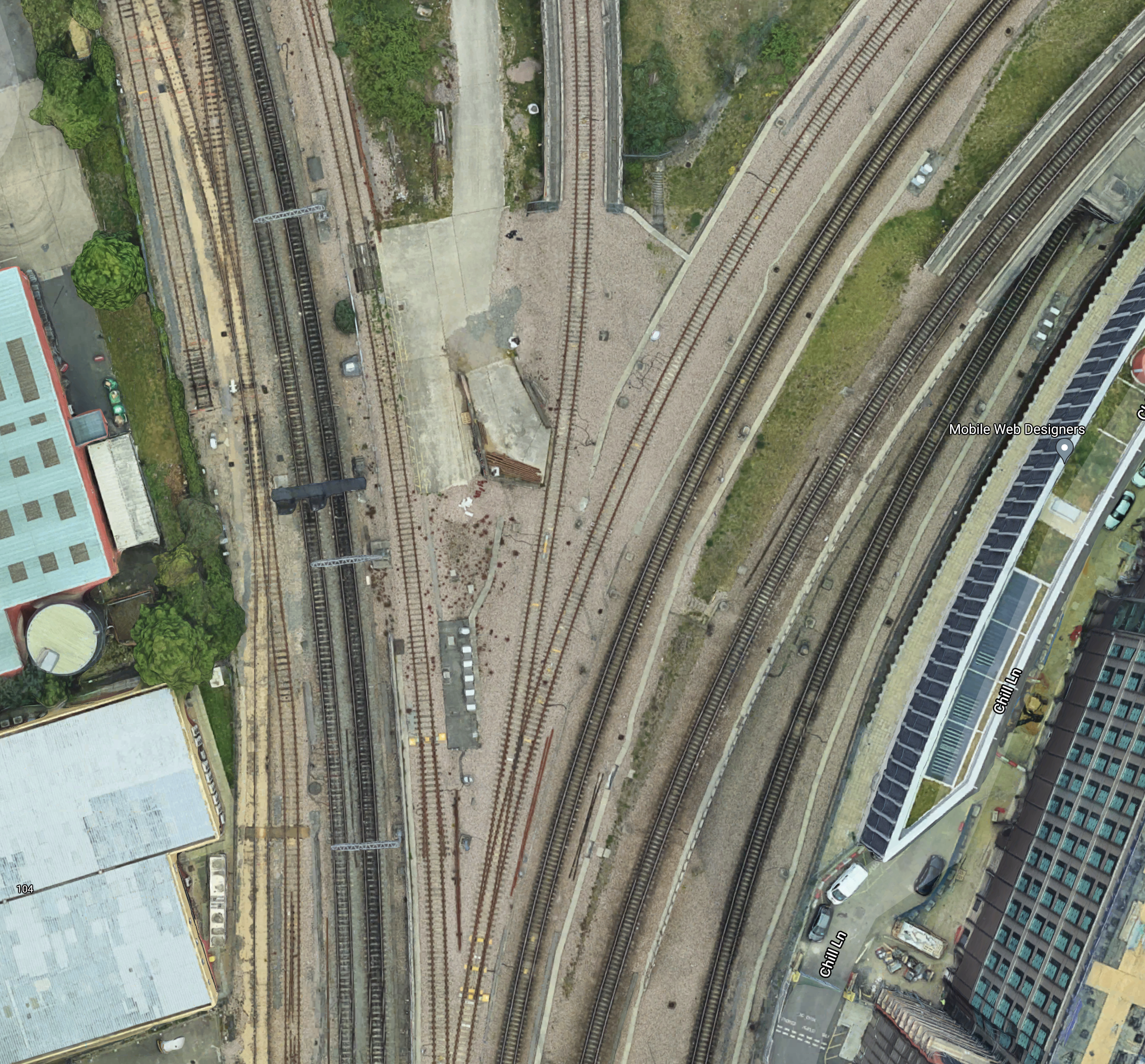
Note.
The two dark-coloured tracks of the Midland Main Line running North.
There appear to be four tracks running North East towards High Speed One.
Between the two sets of tracks two further tracks lead to the North.
The track closest to the Midland Main Line joins to the slow lines of the Midland Main Line.
The other one connects to the North London Line.
This Google Map shows the connecting lines to the High Speed One tunnel.
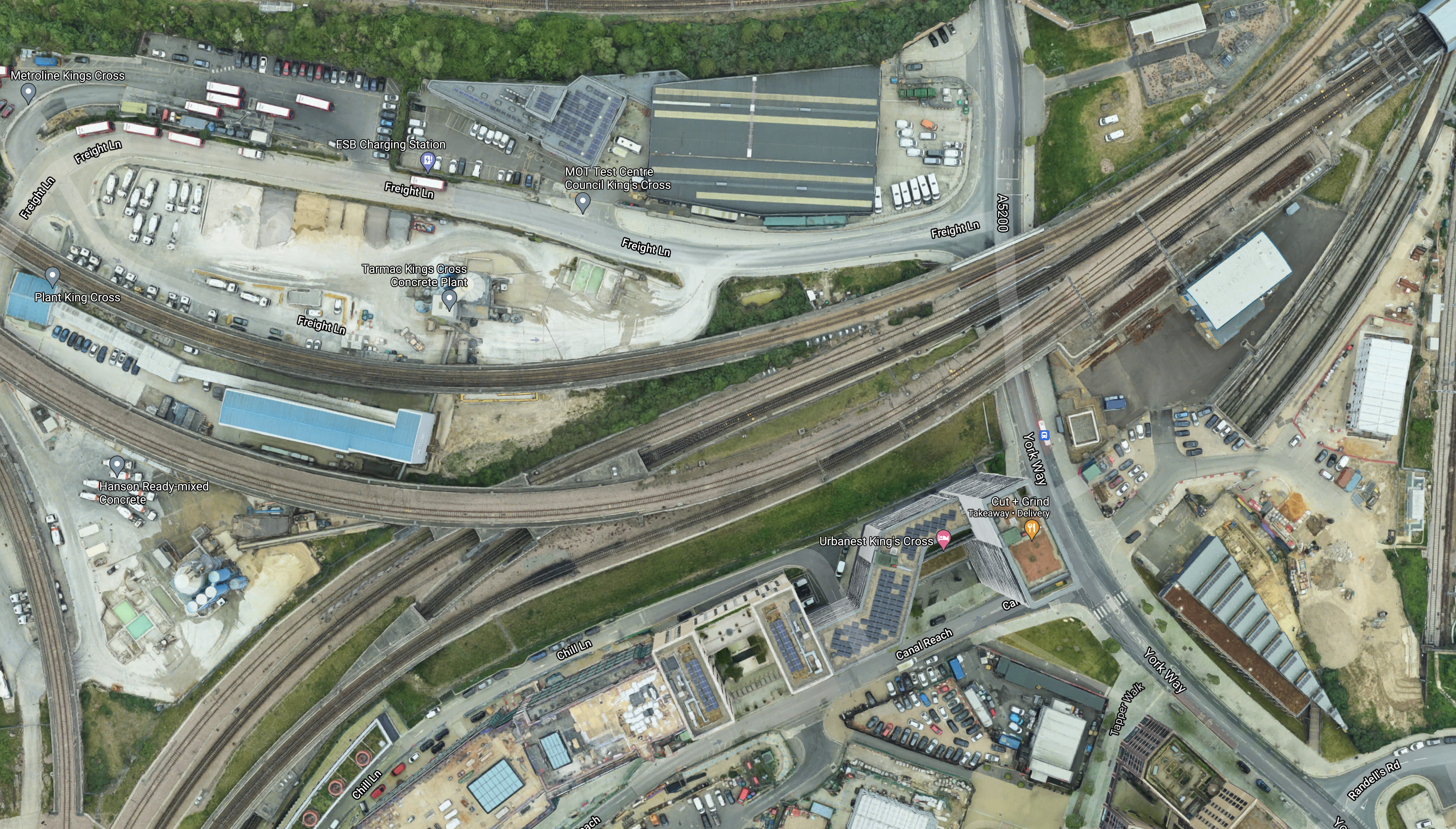
Note the tunnel portal is in the North-East corner of the map.
- It looks to me that the following connections are possible.
- St. Pancras station Eurostar platforms and Midland Main Line.
- St. Pancras station Eurostar platforms and North London Line to the West.
- High Speed One and North London Line to the West.
These connections are in addition to those connections needed to run scheduled services.
They would enable trains to take the following routes.
- St. Pancras station Eurostar platforms and Midland Main Line.
- St. Pancras station Eurostar platforms and the West Coast Main Line via North London Line
- High Speed One and the West Coast Main Line via North London Line
- St. Pancras station Eurostar platforms and the Great Western Main Line via North London Line
- High Speed One and the Great Western Main Line via North London Line
I suspect most of the times, that these routes are used it is for engineering purposes or behaps dragging a failed train out of St. Pancras.
But the track layout would seem to allow the following.
Direct electric freight and passenger services between High Speed One and Birmingham, Cardiff, Glasgow, Liverpool and Manchester.
Direct electric passenger services between High Speed One and Sheffield and Leeds, with a reverse at St. Pancras, after the Midland Main Line were to be fully electrified.
Was this by design for Eurostar or was it just what Network Rail ended up with?
A Modern Regional Eurostar Service
These are my thoughts on a modern Regional Eurostar service.
Rolling Stock
High Speed Two is coming and this year, the company will order some of the rolling stock.
There will be fifty-four trains
The trains will be Classic-Compatible for running on the West Coast Main Line.
They will be 200 metres long and be able to run in pairs.
They will be able to operate at 225 mph.
The operating speed of High Speed One is 186 mph.
I can see no reason why trains of this type, couldn’t run between St. Pancras and many destinations in Europe.
North Of England And The Continent
Could this be the service pattern?
- One train could start in the North West and another in the North East.
- Both trains would proceed to St. Pancras picking up passengers en route.
- At St. Pancras the two trains would join together.
- The driver could then position themselves in the front cab and take High Speed One, through the Channel Tunnel.
The train could even split at Calais to serve two different Continental destinations.
Going North, the spitting and joining would be reversed.
What Infrastructure Would Be Needed?
I suspect the following will be needed.
- The West Coast Main Line and the Midland Main Line would need in-cab digital ERTMS signalling.
- Full electrification of the Midland Main Line would probably be necessary, as I don’t think the tunnel allows diesel trains to pass through.
- Some platform lengthening might be needed.
It would not be an expensive scheme.
What Timings Would Be Possible?
Using current timings you get the following times.
- Leeds and Paris – Five hours
- Leeds and Brussels – Four hours forty minutes
- Manchester and Paris – Five hours
- Manchester and Brussels – For hours forty minutes
- Newcastle and Paris – Six hours
- Newcastle and Brussels – Five hours thirty minutes
Note, that the times are best estimates and include a long stop of several minutes at St. Pancras.
Could Sleeper Service Be Run?
I don’t see why not!
Conclusion
It looks like it may be possible to run regional services to Europe, where pairs of train split and join at St. Pancras.
St
Beeching Reversal – Ferryhill Station Reopening
This is one of the Beeching Reversal projects that the Government and Network Rail are proposing to reverse some of the Beeching cuts. There used to be a Ferryhill station on the East Coast Main Line. It closed in 1967 and burnt down in 1969, before being demolished.
I first noted the station in Boris Johnson Backs Station Opening Which Could See Metro Link To County Durham, after Boris promised it would be built in PMQs.
I then mentioned the station in Northern Powerhouse Rail – Significant Upgrades Of The East Coast Main Line From Leeds To Newcastle (Via York And Darlington) And Restoration Of The Leamside Line.
Last night, I read this document from Railfuture, which talks about rail improvements in the North East and on the East Coast Main Line.
In the document, Ferryhill station is mentioned eighteen times.
Reopening Ferryhill station would appear to have support at all levels.
The Location Of Ferryhill Station
This Google Map shows the general area of the proposed Ferryhill station.
Note.
- Ferryhill is the village in the North-West corner of the map.
- The lion-shaped quarry in the North-East is destined to become a landfill site.
- Below this is Thrislington Plantation, which is a National Nature Reserve.
- The East Coast Main Line runs North-South between the village and the quarry.
South of the village the line splits, as is shown in detail in this second Google Map.
Note.
- Ferryhill South junction by Denhamfields Garage, with the nearby Ferryhill Station Primary School
- The line going South-East is the Stillington freight line to Teesside.
- The other line going in a more Southerly direction is the electrified East Coast Main Line to Darlington and the South.
- Between Ferryhill South junction and Tursdale Junction with the Leamside Line is a 2.5 mile four-track electrified railway.
I suspect the station could be any convenient location, to the North of the junction.
Railfuture have strong opinions on the station and feel it should be a Park-and-Ride station for the settlements in the former North Durham coalfield, with frequent services to Newcastle.
Current Passenger Train Services Through Ferryhill
These services currently pass the location of the proposed Ferryhill station.
- LNER – London Kings Cross and Edinburgh via York, Darlington. Newcastle and Berwick-upon-Tweed
- LNER – London Kings Cross and Edinburgh via Peterborough, Newark North Gate, Doncaster, York, Darlington, Durham and Newcastle
- CrossCountry – Plymouth and Edinburgh via Totnes, Newton Abbot, Exeter St Davids, Tiverton Parkway, Taunton, Bristol Temple Meads, Bristol Parkway, Cheltenham Spa, Birmingham New Street, Derby, Chesterfield, Sheffield, Wakefield Westgate, Leeds, York, Darlington, Durham and Newcastle
- CrossCountry – Southampton and Newcastle via Birmingham New Street, Derby, Sheffield, Doncaster, York, Darlington and Durham
- TransPennine Express – Liverpool Lime Street and Edinburgh via Newton-le-Willows, Manchester Victoria, Huddersfield, Leeds, York, Darlington, Durham, Newcastle and Morpeth
- TransPennine Express – Manchester Airport and Newcastle via Manchester Piccadilly, Manchester Oxford Road, Manchester Victoria, Huddersfield, Dewsbury, Leeds, York, Northallerton, Darlington and Durham
Note.
- All trains have a frequency of one train per hour (tph)
- All trains call at York, Darlington and Newcastle.
- I have missed out some of the intermediate stations, where trains don’t call at least hourly.
- I have missed out stations South of Birmingham New Street.
- A few Northern Trains services pass through at Peak times or to go to and from depots.
I suspect some of these services could stop and to encourage commuters to Newcastle, Durham and Darlington to swap from car to train,
I also suspect that Ferryhill station needs a frequency of at least two tph and if possible four! Four tph would give a Turn-up-and-Go service to Darlington, Newcastle and York.
Planned And Possible Future Passenger Train Services Through Ferryhill
From various sources, these services are either planned or possible.
High Speed Two
High Speed Two are planning the following services, that will pass through.
- Birmingham Curzon Street and Newcastle via East Midlands Hub, York, Darlington and Durham.
- London Euston and Newcastle via Old Oak Common, East Midlands Hub and York.
- London Euston and Newcastle via Old Oak Common, East Midlands Hub, York and Darlington.
Note.
- All trains have a frequency of one tph.
- All trains call at York, East Midlands Hub, York and Newcastle.
- All trains will be 200 metres long.
I feel that Ferryhill station should have platforms long enough to accommodate these trains and other long trains, to future-proof the design and to cater for possible emergencies.
The longest trains on the route would probably be one of the following.
- A pair of five-car Class 800 trains or similar, which would be 260 metres long.
- A High Speed Two Classic-Compatible train, which would be 200 metres long.
Unless provision needed to be made for pairs of High Speed Two Classic-Compatible trains.
East Coast Trains
From next year, East Coast Trains, intend to run a five trains per day (tpd) service between London and Edinburgh via Stevenage, Newcastle and Morpeth.
Note that in Thoughts On East Coast Trains, I said this service would stop at Durham, as that was said in Wikipedia at the time.
Northern Powerhouse Rail
Northern Powerhouse Rail has an objective to to run four tph between Leeds and Newcastle in 58 minutes.
At present there are only three tph on this route, two tph from TransPennine Express and one tph from CrossCountry. All three services stop at Leeds, York, Darlington, Durham and Newcastle.
I believe that the best way to provide the fourth service between Leeds and Newcastle would be to run a third LNER service between London Kings Cross and Edinburgh, when upgrades to the East Coast Main Line give the train operating company another path.
- The service would only stop en route at Leeds and Newcastle.
- It would increase the frequency between London Kings Cross and Leeds to three tph
- It would increase the frequency between London Kings Cross and Newcastle to three tph
- It would increase the frequency between London Kings Cross and Edinburgh to three tph
- It would increase the frequency between London Leeds and Newcastle to four tph
- It would run non-stop between London Kings Cross and Leeds, in under two hours.
I believe that, when all the upgrades to the East Coast Main Line are complete, that such a service could match or even better High Speed Two’s time of three hours and forty-eight minutes between London and Edinburgh.
Ferryhill And Teesside Via The Stillington Freight Line
The Clarence Railway is described in this paragraph in its Wikipedia entry.
The Clarence Railway was an early railway company that operated in north-east England between 1833 and 1853. The railway was built to take coal from mines in County Durham to ports on the River Tees and was a competitor to the Stockton and Darlington Railway (S&DR). It suffered financial difficulty soon after it opened because traffic was low and the S&DR charged a high rate for transporting coal to the Clarence, and the company was managed by the Exchequer Loan Commissioners after July 1834.
But it has left behind a legacy of useful rail lines, that connect important factories, ports, towns, works on other railways on Teesside.
- It forms the link between the Durham Coast Line and Middlesbrough station.
- It forms the link between Northallerton and Middlesbrough stations.
This Google Map shows the triangle between Eaglescliffe, Stockton-on-Tees and Thornaby stations.
Note.
- Eaglescliffe station is in the South-West corner of the map and lines from the station lead to Darlington and Northallerton stations.
- Thornaby station is in the North-East corner of the map and connects to Middlesbrough station.
- Stockton station is at the North of the map.
Tracks connect the three stations.
This Google Map shows the connection between Thornaby and Stockton stations.
Note.
- Stockton station is at the North of the map.
- Thornaby station is at the East of the map.
- In the South-Western corner of the map is a triangular junction, that links Eaglescliffe, Stockton-on-Tees and Thornaby stations.
Currently, this triangular junction, allows trains to go between.
- Middlesbrough and Newcastle via Thornaby, Stockton, Hartlepool and Sunderland.
- Middlesbrough and Darlington via Thornaby and Eaglescliffe.
- Middlesbrough and Northallerton via Thornaby and Eaglescliffe.
But it could be even better.
This Google Map shows another triangular junction to the North of Stockton station.
Note.
- The Southern junction of the triangle leads to Stockton station and ultimately to Darlington, Eaglescliffe, Middlesbrough, Northallerton and Thornaby.
- The Eastern junction leads to Hartlepool, Sunderland and Newcastle.
So where does the Western Junction lead to?
The railway is the Stillington Branch Line.
- It leads to Ferryhill.
- It is about ten miles long.
- It is double-track.
- There used to be intermediate stations at Radmarshall, Stillington and Sedgefield.
Looking at timings for trains on the various sections of the route gives.
- Middlesbrough and Stockton – 11 minutes
- Stockton and Ferryhill South Junction – 23 minutes
- Ferryhill South Junction and Newcastle – 20 minutes
This gives a timing of 54 minutes compared with up to 78 minutes for the current service on the Durham Coast Line.
In their document, Railfuture gives this as one of their campaigns.
Providing Faster Journeys Teesside to Tyneside by running passenger services from
Middlesbrough, Thornaby and Stockton via the 10 mile Stillington freight only line and then via the
East Coast Main Line to Newcastle. Our aim is to reduce overall journey time on direct train
between Middlesbrough to Newcastle from 1 hour 15 minutes to 55 minutes and so open up many
additional job opportunities to the residents of both areas.
My calculations say that it should be possible, to run a useful service between Middlesbrough and Newcastle, via the Stillington freight line.
- The route is used regularly for freight trains and by LNER for what look to be testing or empty stock movements.
- Will any station be built at Radmarshall, Stillington or Sedgefield?
- I estimate that between Ferryhill South Junction and Middlesbrough, is about fifteen miles, so it might be possible to run a Middlesbrough and Newcastle service using battery electric trains, like Hitachi’s Regional Battery Trains, which would be charged on the East Coast Main Line.
Activating the route, doesn’t look to be the most expensive passenger reopening on the cards.
I suspect though, that if passenger services were to be run on the Stillington Line, that Ferryhill station, will need platforms on both the East Coast Main Line and the Stillington Line.
Services could include.
- Newcastle and Middlesbrough via Ferryhill
- Newcastle and Hartlepool via Ferryhill
- Newcastle and York via Eaglescliffe and Ferryhill, with a reverse at Middlesbrough.
Note.
- The Northern terminus could be Ferryhill for some trains.
- Two tph between Stockton and Ferryhill would be a useful service.
- Would a Newcastle and Middlesbrough service call at the poorly-served Chester-le-Street station to improve services?
I also feel that as some of these services will be running on the East Coast Main Line between Ferryhill and Newcastle, it probably would be desirable for these services to be run by Hitachi’s Regional Battery Trains, which would be capable of maintaining the maximum speed for the route, as all the other passenger services can at present!
Ferryhill And Tyneside Via The Leamside Line
The reopening of the Leamside Line is a high priority of Northern Powerhouse Rail, which I wrote about in Northern Powerhouse Rail – Significant Upgrades Of The East Coast Main Line From Leeds To Newcastle (Via York And Darlington) And Restoration Of The Leamside Line.
In their document, Railfuture gives this as one of their campaigns.
Reopening the rail line from Ferryhill to Pelaw (the Leamside Line) with the aim of providing
services that will improve local connections and open new opportunities to people living in this part
of County Durham, as well as providing relief for congestion on the existing line through Durham.
This reopening has been talked about for years, so I suspect that Network Rail know the problems and at least have a rough estimate for what needs to be done and how much it will cost.
The Wikipedia entry for the Leamside Line has a section, which is entitled Proposed Re-Opening, Upgrade and Development, where this is the first paragraph.
Since the line’s closure in the early 1990s, a number of proposals to re-open the Leamside Line were put forward, including plans by AECOM, ATOC, Durham County Council, Railtrack and Tyne and Wear PTE. The line has been considered for a number of potential uses, including a regional suburban rail service linking Tyneside and Teesside, a diversionary freight route for the East Coast Main Line, and an extension to the Tyne and Wear Metro network.
Wikipedia also states that an application to the Restoring Your Railway Fund for money for a feasibility study was unsuccessful.
All that could change with the developments needed between Leeds and Newcastle for High Speed Two and Northern Powerhouse Rail.
- High Speed Two are planning to run at least three tph to and from Newcastle.
- Northern Powerhouse Rail are planning to run an extra service between Leeds and Newcastle.
- LNER will have an extra path on the East Coast Main Line, that could be used through the area.
Using the Leamside Line as a diversion for freight and slower passenger trains would appear to be a possibility.
It could also be combined with the Stillington Line and Northallerton and Stockton to create a double-track diversion, alongside the double-track section of the East Coast Main Line between Northallerton and Newcastle.
Extending The Tyne And Wear Metro Along The Leamside Line
This has been talked about for some time.
In the Wikipedia entry for the Tyne and Wear Metro. there is a section, which is entitled Extension To Washington IAMP, where this is said.
There have been a number of proposals looking in to the possibility of re-opening the former Leamside Line to Washington, including a 2009 report from the Association of Train Operating Companies (ATOC), and a 2016 proposal from the North East Combined Authority (NECA), as well as the abandoned Project Orpheus programme, from the early 2000s. Most recently, proposals are being put forward to link the current network at Pelaw and South Hylton, with the International Advanced Manufacturing Park in Washington, using part of the alignment of the former Leamside Line.
If the Tyne and Wear Metro were to be extended to the Southern end of the Leamside Line, Ferryhill station could be a Southern terminal.
- There is space to create a line alongside the East Coast Main Line between Tursdale Junction, where it connects with the Leamside Line and Ferryhill station.
- The new Tyne and Wear trains have been designed to share tracks with other trains on Network Rail tracks.
- This would enable interchange between East Coast Main Line, Stillington Line and Metro services, without going North to Newcastle.
At the present time, all that would be needed would be for the Metro connection to be safeguarded.
Railfuture’s Campaigns In The North East
This is a tidying up of several improvements, which are campaigns of Railfuture, that are outlined in this document.
- New Station At Team Valley
- New Station At Gilsland
- New Rail Service From Newcastle To Ashington
- North Of Morpeth Local Service
They will be covered in separate posts.
Conclusions
I can separate conclusions into sections.
The Design Of Ferryhill Station
These are my conclusions about the design of Ferryhill station.
- It should be built as a Park-and-Ride station.
- It should have platforms long enough for any train that might stop at the station. I suspect this would be a pair of Class 800 trains, which would be 260 metres long.
- Platforms should be on both the East Coast Main Line and the Stillington Line.
- There should be safeguarding of a route, so that Metro trains could access the station from the Leamside Line.
As the station could be a Park-and-Ride station, I will assume the station will need good road access.
Train Services At Ferryhill Station
These are my conclusions about the services calling at Ferryhill station.
There should be four tph between Leeds and Newcastle, all of which would stop at York, Darlington, Ferryhill and Durham, with some services calling at Northallerton and Chester-le-Street.
There should also be less frequent services at Ferryhill to Scotland and London. Perhaps a frequency of around six tpd would be sufficient, as changes could be made at Leeds, Newcastle of York.
Two tph would probably be ideal for services on the Stillington Line to Hartlepool, Middlesbrough and Redcar.
It would certainly be a busy and well-connected station.
Northern Powerhouse Rail – Significant Upgrades Of The East Coast Main Line From Leeds To Newcastle (Via York And Darlington) And Restoration Of The Leamside Line
In this article on Transport for the North, which is entitled Northern Powerhouse Rail Progress As Recommendations Made To Government, one of the recommendations proposed for Northern Powerhouse Rail is significant upgrades to the East Coast Main Line and reopening of the Leamside Line.
Northern Powerhouse Rail’s Objective For The Leeds and Newcastle Route
Wikipedia, other sources and my calculations say this about the trains between Leeds and Newcastle.
- The distance between the two stations is 106 miles
- The current service takes around 85 minutes and has a frequency of three trains per hour (tph)
- This gives an average speed of 75 mph for the fastest journey.
- The proposed service with Northern Powerhouse Rail will take 58 minutes and have a frequency of four tph.
- This gives an average speed of 110 mph for the journey.
This last figure of 110 mph, indicates to me that a faster route will be needed.
These are example average speeds on the East Coast Main Line.
- London Kings Cross and Doncaster – 156 miles – 98 minutes – 95.5 mph
- London Kings Cross and Leeds – 186 miles – 133 minutes – 84 mph
- London Kings Cross and York – 188.5 miles – 140 minutes – 81 mph
- London Kings Cross and Hull – 205.3 miles – 176 minutes – 70 mph
- York and Newcastle – 80 miles – 66 minutes – 73 mph
I also predicted in Thoughts On Digital Signalling On The East Coast Main Line, that with full digital in-cab ERTMS signalling and other improvements, that both London Kings Cross and Leeds and York would be two-hour services, with Hull a two-and-a-half service.
- London Kings Cross and Leeds in two hours would be an average speed of 93 mph.
- London Kings Cross and York in two hours would be an average speed of 94.2 mph.
- London Kings Cross and Hull in two-and-a-half hours would be an average speed of 94.2 mph.
I am fairly certain, that to achieve the required 110 mph average between Leeds and Newcastle to meet Northern Powerhouse Rail’s objective of four tph in under an hour will need, at least the following.
- Full digital in-cab ERTMS signalling
- Completion of the electrification between Leeds and York.
- Ability to run at up to 140 mph in places.
- Significant track upgrades.
It could also eliminate diesel traction on passenger services on the route.
High Speed Two’s Objective For The York and Newcastle Route
At the present time, High Speed Two is not planning to run any direct trains between Leeds and Newcastle, so I’ll look at its proposed service between York and Newcastle instead.
- Current Service – 80 miles – 66 minutes – 73 mph
- High Speed Two – 80 miles – 52 minutes – 92 mph
Note.
- High Speed Two will be running three tph between York and Newcastle.
- Northern Powerhouse Rail have an objective of 58 minutes for Leeds and Newcastle.
High Speed Two and Northern Powerhouse Rail do not not have incompatible ambitions.
Current Direct Leeds And Newcastle Services
These are the current direct Leeds and Newcastle services.
- TransPennine Express – 1 tph – Liverpool Lime Street and Edinburgh
- TransPennine Express – 1 tph – Manchester Airport and Newcastle.
- CrossCountry – 1 tph – Plymouth and Edinburgh
Timings appear to be between 81 and 91 minutes.
What Would A Leeds And Newcastle In Under An Hour Do For London Kings Cross And Edinburgh Timings?
This question has to be asked, as a 58 minute time between Leeds and Newcastle will mean that timings between York and Newcastle must reduce.
York And Newcastle at various average speeds give the following times.
- 73 mph (current average) – 66 minutes
- 80 mph – 60 minutes
- 90 mph – 53 minutes
- 92 mph – 52 minutes (High Speed Two promise)
- 100 mph – 48 minutes
- 110 mph – 44 minutes
If any speed over 90 mph can be averaged between York and Newcastle, this means that with a London and York time of under two hours the following times are possible.
- London Kings Cross and Newcastle in under three hours. – High Speed Two are promising two hours and seventeen minutes.
- London Kings Cross and Edinburgh in under four hours. – High Speed Two are promising three hours and forty minutes.
Consider.
- An InterCity 225 achieved a time of under three-and-a-half hours between London and Edinburgh. in 1991.
- That record journey was at an average speed of 112 mph.
- There must be opportunities for speed improvements North of Newcastle.
- Train and signalling technology is improving.
- High Speed Two is promising three hours and forty minutes between London and Edinburgh.
I can see a fascinating rivalry between trains on High Speed Two and the East Coast Main Line, developing, about who can be faster between London and Edinburgh.
Current Projects Between Leeds And Newcastle
These projects are in planning or under way on the section of the East Coast Main Line between Leeds and Newcastle.
Phase 2 Of The East Coast Main Line Power Supply Upgrade
Phase 1 between London and Doncaster should have been completed, if the covids allowed and now work can be concentrated on Phase 2 to the North of Doncaster.
This page on the Network Rail web site describes the project. These paragraphs are the introduction to Phase 2.
Phase 2 of the project will involve the installation of feeder and substations along the route, capacity upgrades, new 132kv connection at Hambleton junction and upgrades to existing power supply connections.
The second phase of the project is currently in design stages and dates for carrying out the work are still being finalised.
Phase 2 will be delivering upgraded power to the East Coast Mainline railway between Bawtry and Edinburgh.
This project may not improve speeds on the railway, but it will certainly improve reliability and reduce the use of diesel power.
I do wonder, that as the reliability of the East Coast Main Line increases, this will reduce the need for the electric Class 801 trains, to have diesel engines for when the power supply fails.
It is known, that the Class 803 trains, that are under construction for East Coast Trains, will have only a small battery for emergency use.
A sensible weight saving would surely improve the acceleration and deceleration of the trains.
York to Church Fenton Improvement Scheme
This page of the Network Rail web site, describes the project. These paragraphs introduce the project.
Our work between York and Church Fenton is in preparation for the Transpennine Upgrade, which will provide more capacity and faster journeys between Manchester Victoria and York, via Leeds and Huddersfield.
The five mile stretch between Church Fenton and Colton Junction – the major junction where trains from Leeds join the East Coast Main Line towards York – sees over 100 trains each day, with up to one freight or passenger train passing through every five minutes. This is one of the busiest stretches of railway in the North.
The work will include.
- Modernising the signalling.
- Replacing about five miles of track between Holgate (York) and Colton Junction.
- Completing the eleven miles of electrification between York and Church Fenton stations.
I estimate that when the project is completed, there will be only around thirteen miles of track without electrification between Church Fenton station and Neville Hill TMD in Leeds.
The route between Church Fenton and Garforth stations, is shown in this map clipped from High Speed Two.
Note.
- York is just off the North-East corner of the map.
- Garforth is in the South-West corner of the map.
- Shown in orange is the new route of High Speed Two from East of Leeds towards York.
- Shown in blue is existing tracks, that will be used to take High Speed Two Trains to York and further North.
- The rail line running North-South on the edge of the map is the Selby Diversion, which opened in 1983 and was built to avoid possible subsidence from the Selby coalfield.
- The pre-Selby Diversion route of the East Coast Main Line goes South from the join of the blue and orange sections of High Speed Two.
- At Church Fenton station, this route splits, with one route going West through Micklefield, East Garforth and Garforth stations to Neville Hill TMD and Leeds.
- The main road going North-South is the A1 (M).
It seems to me, that High Speed Two’s and Northern Powerhouse Rail’s plans in this area, are still being developed.
- There has been no decision on the electrification between Church Fenton and Neville Hill TMD.
- How do Northern Powerhouse Rail trains go between Leeds and Hull?
- How do Northern Powerhouse Rail trains go between Leeds and York?
- How do High Speed Two trains go between Leeds and York?
I suspect, when the full plans are published, it will answer a lot of questions.
Darlington Station Remodelling
A remodelling of Darlington station is under consideration.
I outlined this in £100m Station Revamp Could Double Local Train Services.
This was my conclusion in the related article.
I think that this will happen.
-
- The Tees Valley Line trains will be greatly improved by this project.
- Trains will generally run at up to 140 mph on the East Coast Main Line, under full digital control, like a slower High Speed Two.
- There will be two high speed platforms to the East of the current station, where most if not all of the High Speed Two, LNER and other fast services will stop.
- There could be up to 15 tph on the high speed lines.
With full step-free access between the high speed and the local platforms in the current station, this will be a great improvement.
It will create a major interchange, where high speed trains from High Speed Two, LNER and Northern Powerhouse Rail will do the following.
- Approach at 140 mph or more.
- Perform a controlled stop in the station.
- Drop and pick-up passengers.
- Accelerate back up to linespeed.
The station stop will be highly-automated and monitored by the driver.
One of the objectives would be to save time for all fast trains.
Capacity And Other Problems Between Leeds And Newcastle Listed In Wikipedia
These problems are listed in a section called Capacity Problems in the Wikipedia entry for the East Coast Main Line.
The North Throat Of York Station Including Skelton Bridge Junction
I describe this problem and my solution in Improving The North Throat Of York Station Including Skelton Bridge Junction.
Use Of The Leamside Line
Wikipedia says this about capacity to the South of Newcastle.
South of Newcastle to Northallerton (which is also predominately double track), leading to proposals to reopen the Leamside line to passenger and freight traffic.
I could have included it in the previous section, but as it such a important topic, it probably deserves its own section.
Looking at maps, reopening is more than a a possibility. Especially, as reopening is proposed by Northern Powerhouse Rail and mentioned in the title of this post.
I discussed the Leamside Line in detail in Boris Johnson Backs Station Opening Which Could See Metro Link To County Durham, which I wrote in June this year.
These are some extra thoughts, that update the original post.
Ferryhill Station
I was prompted to write the related post, by something Boris Johnson said at PMQs and it was mainly about Ferryhill station.
In the latest copy of this document on the Government web site, which is entitled Restoring Your Railway: Successful Bids, a new station at Ferryhill has been successful. Another bid in the same area to restore rail services between Consett and Newcastle has also been successful.
This map shows the East Coast Main Line as it goes North South between Durham and Darlington.
Note.
- Ferryhill is in the South-West of the map opposite the sand-pits in the South-East
- The East Coast Main Line runs North-South between the village an d the sand-pits.
- Follow the railway North and you come to Tursdale, where there is a junction between the East Coast Main Line and the Leamside Line.
- The East Coast Main Line goes North-Westerly towards Durham and Newcastle.
- The Leamside Line goes North to Washington and Newcastle.
- There is also the Stillington Freight Line going South-Easterly to Sedgefield and Stockton from Ferryhill.
Could Ferryhill be a useful interchange to local services connecting to Newcastle, Sunderland and Washington in the North and Hartlepool, Middlesbrough and Stockton in the South?
The Leamside Line As An East Coast Main Line Diversion
I didn’t discuss using the line as a diversion for the East Coast Main Line in my original post, but if the infrastructure is to the required standard, I don’t see why it can’t take diverted traffic, even if it is also used for the Tyne and Wear Metro.
It should be remembered, that to create extra capacity on the East Coast Main Line between Peterborough and Doncaster, the route of the Great Northern and Great Eastern Joint Railway, was upgraded. I first wrote about this line six years ago in Project Managers Having Fun In The East and the route seems to be working well. It is now being augmented by the addition of the £200 million Werrington Dive Under. See Werrington Dive-Under – 8th November 2018, for more details of this project, which will speed up all trains on the East Coast Main Line.
After the undoubted success of the upgrade of the Great Northern and Great Eastern Joint Railway, surely the team responsible for it, should be given the task of devising a similar plan for the Leamside Line, to take pressure off the East Coast Main Line between Newcastle and Northallerton.
Sharing The Leamside Line
The Tyne and Wear Metro also has its eyes on the Leamside Line for an extension.
It should be noted that the Extension To Wearside, uses the Karlsruhe Model to allow the Metro trains to share with freight and other passenger trains.
The new Stadler trains will probably make this even easier, so I wouldn’t be surprised to see a reopened Leamside Line handling a varied assortment of trains of all types.
The Sunderland Example
Sunderland station is a station, which has both Metro and mainline services from the same platforms.
Could a station at Washington be built to similar principles, so that some long distance services to Newcastle used this station?
A Terminal Station On The Leamside Line
Newcastle station may be a Grade One Listed station, but it is built on a curve and would be a nightmare to expand with more platforms.
Sunderland station is already used as a terminal for London trains, so would it be sensible to provide a terminal at somewhere like Washington?
My Final Thought On The Leamside Line
Reopen it!
A Few Random Final Thoughts
This post has got me thinking.
Newcastle Station Capacity
I have seen reports over the years that Newcastle station, is lacking in capacity.
- There could be extra services, as High Speed Two is proposing two tph from London Euston stations and one tph from Birmingham Curzon Street station.
- There may be extra services because of Northern Powerhouse Rail, which has an objective of four tph from Leeds station.
- There may be extra services because of new services to Ashington and Blyth.
- There may be extra services because of new services to Consett.
Note.
- The first two services could use two hundred metre long trains.
- Some platforms can accept 234 metre long Class 800 trains.
- The last two services might use the Metro platforms.
As the station has twelve platforms, I feel with careful operation, that the station will have enough capacity.
This Google Map shows the station.
And this second Google Map shows the station, its position with relation to the Tyne and the lines rail routes to and from the station.
Note.
- Trains from the South arrive over the King Edward VII Bridge and enter Newcastle station from the West.
- Trains from England to Scotland go through the station from West to East and then go straight on and turn North for Berwick and Scotland.
- Next to the King Edward VII Bridge is the blue-coloured Queen Elizabeth II Bridge, which takes the Tyne and Wear Metro across the Tyne, where it uses two platforms underneath Newcastle station.
- The next bridge is the High Level Bridge, which connects the East end of the station to the rail network, South of the Tyne. It connects to the Durham Coast Line to Teeside and the Leamside Line.
History has delivered Newcastle a comprehensive track layout through and around Newcastle station.
- Services from the East can be run back-to-back with services from the West.
- The Metro and its two underground platforms removes a lot of traffic from the main station.
- There are seven through platforms, of which at least three are over two hundred metres long.
- There are four West-facing bay platforms and one facing East.
But most intriguingly, it looks like it will be possible for trains to loop through the station from the South, by perhaps arriving over the King Edward VII bridge and leaving over the High Level bridge. Or they could go the other way.
Could this be why reoopening the Leamside Line is important?
LNER’s Extra Paths
The sentence, from an article entitled LNER Seeks 10 More Bi-Modes, in the December 2020 Edition of Modern Railways indicates that more capacity will be available to LNER.
Infrastructure upgrades are due to prompt a timetable recast in May 2022 (delayed from December 2021) from which point LNER will operate 6.5 trains per hour, out of Kings Cross, compared to five today.
I suspect that LNER could use the half path to run a one train per two hour (tp2h) service to Hull.
- Currently, London Kings Cross and Hull takes a few minutes under three hours.
- Currently, Doncaster and Hull takes around 55 minutes.
- I have estimated that once full digital in-cab signalling is operational, that London Kings Cross and Hull could take a few minutes under two-and-a-half hours.
The full path to Hull could be shared with Hull Trains to provide an hourly service between London Kings Cross and Hull.
LNER could do something special with the full extra path.
Consider.
- Some train operating companies have said, that they’ll be looking to attract customers from the budget airlines.
- There could be a need for more capacity between London Kings Cross and all of Edinburgh, Leeds and Newcastle.
- Faster services would be attractive to passengers.
- York and Leeds will be fully electrified or trains could be fitted with batteries to bridge the thirteen mile gap in the electrification.
A limited-stop service between London Kings Cross and Edinburgh via Leeds could be an interesting addition.
- The train would only stop at Leeds and possibly Newcastle.
- One objective would be a time under three-and-a-half hours between London Kings Cross and Edinburgh.
- What time could be achieved between London Kings Cross and Leeds?
It would certainly give High Speed Two a run for its money!
A New Elizabethan
I can remember The Elizabethan, which was a steam-hauled non-stop express between London and Edinburgh between 1953 and 1961.
I have laid out my ideas for a modern express train of the same name in A New Elizabethan.
It could be an interesting concept, to increase capacity between London and Edinburgh.
As I indicated in the previous section, LNER certainly have a path, that could be used to their advantage.
High Speed Two
The East Coast Main Line and High Speed Two have a lot in common.
- The two routes will share tracks between a junction near Ulleskelf station and Newcastle station.
- High Speed Two Classic Compatible trains could be based on Hitachi AT-300 train technology.
- High Speed Two Classic Compatible trains would probably be able to run on the East Coast Main Line between London Kings Cross And Edinburgh.
- Trains from both routes will share platforms at York, Darlington, Durham and Newcastle stations.
- I would hope that the signalling systems on both routes are compatible.
From a project management point of view, this commonality means that in an ideal world the new route of both High Speed Two and Northern Powerhouse Rail, and the upgrades to the East Coast Main Line should be planned together.
I believe there are still details on the design of the joint route, that have not been disclosed, or perhaps not even decided.
- Will between Church Fenton station and Neville Hill depot be electrified?
- How will Northern Powerhouse Rail connect Leeds and Hull stations?
- How will Northern Powerhouse Rail connect Leeds and York stations?
- Will High Speed Two connect Leeds and York stations?
- What will be the operating speed of the joint section of the East Coast Main Line?
- What will be the capacity in trains per hour of the joint section of the East Coast Main Line?
- Will Newcastle station need an extra platform to handle three High Speed Two tph from London Euston
Two projects have been discussed in this post.
- The unlocking of the bottleneck at Skelton Bridge.
- The reopening of the Leamside Line.
I feel that these projects are important and will probably be needed for efficient operation of High Speed Two.
Other early projects could include.
- Upgrading and electrification of the chosen route between Leeds and Hull,
- Installation of the chosen system of in-cab ERTMS digital signalling on the route.
- Electrification between Church Fenton station and Neville Hill depot.
I would deliver these and other joint projects early, so that travellers see a positive benefit from High Speed Two before the main work has even started.
High Speed East Coast
I wonder what is the maximum speed of the Class 80x trains, that are the backbone of services on the East Coast Main Line.
Consider.
- It is known, that with in-cab digital ERTMS signalling, these trains will be capable of 140 mph, but could they go even faster.
- High Speed Two Classic Compatible trains will be capable of 225 mph.
- Will Hitachi’s offering for these trains, be based on the Class 80x trains?
I would think, that it is fairly likely, that the existing Class 80x trains could be updated to an operating speed in the range of 150-160 mph.
In Thoughts On Digital Signalling On The East Coast Main Line, I said this.
The combined affect of both track and signalling improvements is illustrated by this simple calculation.
-
- As Dalton-on-Tees is North of Doncaster, the route between Woolmer Green and Doncaster should be possible to be run at 140 mph
- Woolmer Green and Doncaster stations are 132.1 miles apart.
- Non-stop York and London Kings Cross trains are currently timed at 70 minutes between Doncaster and Woolmer Green stations.
- This is an average speed of 113.2 mph.
If 140 mph could be maintained between Doncaster and Woolmer Green, the section of the journey would take 56.6 minutes, which is a saving of 13.4 minutes.
I can do this calculation for higher speeds.
- 150 mph would take 52.8 minutes
- 160 mph would take 49.5 minutes
- 170 mph would take 46.6 minutes
- 180 mph would take 44 minutes
- 200 mph would take 39.6 minutes
Note.
- Eurostar’s latest Class 374 trains are capable of operating at 200 mph.
- A Class 395 train, which is closely related to the Class 80x trains, has attained a record speed of 157 mph.
There may be worthwhile time savings to be made, on some of the straighter sections of the East Coast Main Line.
Other improvements will also be needed.
- A solution to the Newark crossing problem, which could be solved by the use of in-cab ERTMS digital signalling. See Could ERTMS And ETCS Solve The Newark Crossing Problem?
- Some extra four-tracking of the route.
- Upgrading of Cambridge and Kings Lynn services for faster running. See Call For ETCS On King’s Lynn Route.
Note, that I am assuming, that the Digswell Viaduct section would not be updated, as it would cause too much disruption.
I also believe that by using selective joining and splitting at Edinburgh, Leeds and perhaps Doncaster, Grantham, Newark or York, that a very comprehensive network of direct trains to and from London can be built from Grantham Northwards.
Beverley, Bradford, Cleethorpes, Glasgow, Grimsby, Harrogate, Huddersfield, Hull, Lincoln, Middlesbrough, Nottingham, Perth, Redcar, Sheffield, Skipton, Sunderland and Washington could all be served at an appropriate frequency.
- Some like Bradford, Glasgow, Harrogate, Hull, Lincoln and Middlesbrough would have several trains per day.
- Others might have a much more limited service.
What sort of timings will be possible.
- London Kings Cross and Doncaster could be around an hour.
- London Kings Cross and Leeds could be around one hour and thirty minutes, using the current Doncaster and Leeds time, as against the one hour and twenty-one minutes for High Speed Two.
- London Kings Cross and York could be around one hour and twenty-three minutes, using the current Doncaster and York time, as against the one hour and twenty-four minutes for High Speed Two.
- Timings between York and Newcastle would be the same fifty-two minutes as High Speed Two, as the track will be the limitation for both services.
- High Speed Two’s timing for York and Newcastle is given as fifty-two minutes, with York and Darlington as twenty-five minutes.
- London Kings Cross and Darlington could be around one hour and forty-nine minutes
- London Kings Cross and Newcastle could be around two hours and sixteen minutes.
- London Kings Cross and Edinburgh would be under three-and-a-half hours, as against the proposed three hours and forty-eight minutes for High Speed Two.
High Speed East Coast would be a serious and viable alternative to High Speed Two for the Eastern side of England and Scotland.
Conclusion
This is an important joint project for Northern Powerhouse Rail, High Speed Two and the East Coast Main Line.
Project Management Recommendations
This project divides neatly into several smaller projects..
- Upgrade the power supply on the East Coast Main Line.
- Finish the York to Church Fenton Improvement Scheme
- Remodel Darlington station.
- Install of in-cab ERTMS digital signalling.
- Complete the electrification between Neville Hill TMD and York.
- Solve the problem of Skelton Bridge and its complicated track layout.
- Reopen the Leamside Line.
Most of these projects are independent of each other and all would give early benefits to the East Coast Main Line.
When complete, we’ll see the following timing improvements.
- Leeds and Newcastle will drop from 85 minutes to 56 minutes, with an increase in frequency from three to four tph.
- York and Newcastle will drop from 57-66 minutes to 52 minutes.
- There could be ten minutes savings on Edinburgh services.
Passengers and operators would welcome this group of projects being started early.
LNER Seeks 10 More Bi-Modes
The title of this post, is the same as that of an article in the December 2020 Edition of Modern Railways.
This is the opening paragraph.
LNER has launched the procurement of at least 10 new trains to supplement its Azuma fleet on East Coast Main Line services.
Some other points from the article.
- It appears that LNER would like to eliminate diesel traction if possible.
- On-board energy storage is mentioned.
- No form of power appears to be ruled out, including hydrogen.
- LNER have all 65 of their Azumas in service.
The last paragraph is very informative.
Infrastructure upgrades are due to prompt a timetable recast in May 2022 (delayed from December 2021) from which point LNER will operate 6.5 trains per hour, out of Kings Cross, compared to five today. As an interim measure, LNER is retaining seven rakes of Mk 4 coaches hauled by 12 Class 91 locomotives to supplement the Azuma fleet and support its timetable ambitions until the new trains are delivered.
These are my thoughts.
More Azumas?
Surely, It would require a very innovative train at perhaps a rock-bottom price from another manufacturer, for LNER to not acquire extra Azumas.
Classic-Compatible Trains For High Speed Two
Consider.
- Alstom, Bombardier, CAF, Hitachi, Siemens and Talgo are involved in the competition to design Classic-Compatible trains for High Speed Two.
- As the York and Edinburgh section of the East Coast Main Line will eventually be upgraded and used by High Speed Two services,
- Also in the December 2020 Edition of Modern Railways, is an article entitled 140 mph Plan For ECML North of York, which details improvements proposed by Northern Powerhouse Rail to improve services between Leeds and Edinburgh.
Would there be advantages to High Speed Two, LNER and Network Rail and Northern Powerhouse Rail, to have some commonality between the High Speed Two, LNER and Northern Powerhouse Rail fleets?
Hopefully, the various government-controlled companies are talking.
A Flagship Train For Aberdeen And Inverness
The InterCity 225s, which consist of a Class 91 locomotive and a rake of nine Mark 4 coaches, have given thirty years of top-quality service on the East Coast Main Line and appear to be being asked to handle services until the new trains are delivered.
- Full-length InterCity 225s are 245 metres long and have 406 Standard and 129 First seats or a total of 535 seats.
- Nine-car Azumas are 234 metres long and have 510 Standard and 101 First seats or a total of 611 seats.
- Two five-car Azumas working as a pair are 260 metres long and have 604 seats. They can also be handled on most platforms, that are used by LNER.
- The power of a Class 91 locomotive is 4.83 MW.
- A Class 91 locomotive is 19.4 metres long and weighs 81.5 tonnes.
- Both Azumas and InterCity 225s can maintain 125 mph with ease on the East Coast Main Line and both will be able to reach 140 mph with in-cab signalling.
There would appear to be nothing wrong with locomotive-hauled high speed services, in terms of capacity and performance.
In The Mathematics Of A Hydrogen-Powered Freight Locomotive, I laid out my thoughts on a high-powered railway locomotive fuelled by hydrogen, that used one or possibly two Rolls-Royce gas-turbine engines to generate electricity for traction.
With all the work done, by the companies bidding for Classic-Compatible trains for High Speed Two, into very high speed trains, I believe that at least one company could build a locomotive with this specification.
- 140 mph operation on 25 KVAC overhead electrification. As I said, that was done by British Rail almost forty years ago.
- Ability to use full digital in-cab signalling. This is on its way and already working in some applications.
- 110 mph operation on hydrogen. Hitachi are planning 100 mph battery trains, so it should be possible.
- 400 mile range on one filling of hydrogen. This is working in Germany.
- Ability to be upgraded to higher speeds on electric power, should the East Coast Main Line be upgraded for higher speeds in the future. The train manufacturers are probably ahead of track designers with this one.
Such a locomotive would be key to building a train with this specification.
- Sub-four hour time between London and Edinburgh.
- Sub-seven hour time between London and Aberdeen, which has 130 miles without wires.
- Sub-eight hour time between London and Inverness, which has 146 miles without wires.
- Hydrogen would be used, where there is no electrification.
- Zero-carbon at all times.
- A maximum length of 260 metres, which I estimate could give a passenger capacity of around 640 seats.
- The last coach would include a driving van trailer.
- They would not need the ability to split and join, except for the purpose of rescue, as there is no platform on the route, that could accommodate the resulting 520 metre long pair of trains.
I estimate that a fleet of around seven trains would be needed to run the current Aberdeen and Inverness services.
A few extra thoughts.
- Could they have an up-market more spacious interior, as their main competition to the North of Scotland, would be the budget airlines?
- Could they be slightly longer, with some platform work at Kings Cross and other stations?
- Add a few extra trains to the order, so that extra services between London and Edinburgh could be added to the timetable.
- Could the driving van trailer incorporate an observation car?
- Hydrogen refuelling shouldn’t be a problem in Scotland, as the country is developing a hydrogen economy.
- Hydrogen refuelling wouldn’t be needed in England, as they’d be using the electrification.
- As an alternative to hydrogen, sustainable aviation fuel could be used.
I suspect that Talgo, would be very happy to tender.
- They are developing hydrogen-powered trains as I wrote in Talgo: Our Hydrogen Train Will Be Ready In 2023.
- They are building a factory in Scotland, close to the Forth Bridge.
- Because of the factory, Talgo probably have the ear of the Scottish Government, who would probably welcome a Scottish-built train.
- A shorter version of these trains without the hydrogen, could be the design for a High Speed Two Classic-Compatible train, for which Talgo, are on the short list of suppliers.
What better way, would there be to sell your hydrogen-powered high speed trains, than to give prospective clients a ride up from London to the factory in the luxury version?
A New Elizabethan
I can remember The Elizabethan, which was a steam-hauled non-stop express between London and Edinburgh between 1953 and 1961.
I have laid out my ideas for a modern express train of the same name in A New Elizabethan.
It could be an interesting concept, to increase capacity between London and Edinburgh.
Splitting And Joining
Some of LNER’s philosophy to serve places like Harrogate, Huddersfield and Middlesbrough, depends on the ability to split and join trains.
A pair of Azumas could leave London and go to Leeds, where they would split, with one train going to Harrogate and the other going to Huddersfield.
When returning to London, the two trains would join at Leeds.
The big advantage of splitting and joining, is that it increases the capacity on the main line, as services can be arranged, so that every path always carries a full-length train. I would expect that LNER would prefer never to run a single five-car Azuma into Kings Cross.
Currently LNER have these paths to and from Kings Cross.
- 2 tph between London Kings Cross and Leeds
- 1 tph between London Kings Cross and Lincoln and East Yorkshire
- 2 tph between London Kings Cross and Edinburgh
Note.
- LNER have already started to extend services from Leeds, so will we see splitting and joining being used on one tph at Leeds to provide services to several destinations, throughout the day.
- Splitting and joining at Edinburgh is surely another possibility, to serve Stirling and Glasgow, with the same train.
- Splitting and joining at York could serve destinations like Middlesbrough, Newcastle, Redcar, Scarborough and Sunderland.
- In A Trip To Grantham Station – 4th November 2020, I advocated splitting at Grantham station to serve both Nottingham and Lincoln.
There are a lot of possibilities for splitting and joining.
As LNER has a fleet of twenty-two five-car Azumas, if the new trains are needed to split and join on certain services, this might mean more five-car Azumas are a better buy.
What Will Happen To Nine Car Azumas?
Hitachi have launched the Regional Battery Train concept, the specification of which is given in this Hitachi infographic.
The diesel engines in LNER’s Class 800 trains will be able to be replaced with batteries, making them all-electric trains.
- Destinations like Cleethorpes, Dundee, Grimsby, Harrogate, Huddersfield, Hull, Lincoln, Middlesbrough Nottingham, Perth, Redcar, Scarborough, Sheffield and Sunderland will be within range of battery electric Azumas.
- Some destinations would need the ability to charge the train before it returned, but I can see lots of places getting an appropriate service, even if it was just one or two trains per day.
- Unfortunately, Aberdeen and Inverness would be too far for battery electric Azumas, so services will still need to be run by nine-car bi-mode Azumas.
Five-car battery electric Azumas working in pairs from London could be the key to increasing LNER services.
I can see that LNER may end up with too many nine-car Azumas, if nine-car trains are replaced by pairs of five-car trains to serve two destinations by splitting and joining.
Would it be possible to shorten nine-car Azumas to five-car trains?
These are the formations of the two trains.
- nine-car: DPTS-MS-MS-TS-MS-TS-MC-MF-DPTF
- five-car: DPTS-MS-MS-MC-DPTF
It is known, that the trains have a computer, that does a quick check on start-up to determine, what cars are present and correct in the train.
- This means that if LNER needed twelve-car trains for say London and Edinburgh, they could create a sub-fleet by just buying the requisite number of extra TS (Trailer Standard) and MS (Motor Standard) cars and coupling them up.
- This feature also means that operators running fleets of five-car Hitachi trains, like TransPennine Express and Hull Trains can increase capacity by just purchasing the extra cars.
- It would also allow, cars to be shuffled to create viable trains, after say several cars were damaged by vandalism.
All trains these days seem to have this very operator-friendly feature.
With LNER’s trains, I suspect that all cars of the same type are identical.
This would mean, that a nine-car train can be converted to a five-car by removing two TS (Trailer Standard), one MS (Motor Standard) and one MF (Motor First) cars.
The four cars, that have been removed could be reconfigured to form the middle three cars of a new five-car train, which would be completed by adding new DPTS (Driver Pantograph Trailer Standard) and DPTF (Driver Pantograph Trailer First) cars.
An Increase In Paths From 5 To 6.5
This will certainly allow LNER to run more services.
The odd half path could be easy to explain.
- Hull is a city, that is on the up.
- I suspect that it could support a five-car direct service from London with a frequency of one tph.
- But Hull Trains are also running a successful service on the route.
Perhaps a fair solution, would be to allow both LNER and Hull Trains to run a one train per two hour (tp2h) service.
If LNER didn’t want to use the path to just run a five-car train to Hull, there are several possibilities for a split and join.
- With a Cleethorpes, Lincoln or Nottingham service at Grantham.
- With a Cleethorpes or Lincoln service at Newark.
- With a Cleethorpes, Middlesbrough, Sheffield or Sunderland service at Doncaster.
I can only see splitting and joining increasing, which surely means an Azuma order is more likely.
As someone, who spent a working life, writing software to schedule projects, I can’t resist speculating on what to do with the extra whole path, that LNER will be allocated, when the infrastructure allows.
- Many travellers wouldn’t mind LNER providing more seats between the English and Scottish capitals.
- Many would like an alternative to flying.
- Others would like a faster service.
- Leeds and York will soon be a route, that LNER’s Azumas will be able to use without diesel, because of extra electrification and Azumas with traction batteries.
This leads me to believe that LNER could use the extra path for a third London and Edinburgh service in every hour, that ran via Leeds.
- Additionally, it might stop at stations like Peterborough, York, Darlington or Newcastle.
- It could also provide a non-stop London and Leeds service.
- Some services could go non-stop between London and Edinburgh.
- The direct London and Edinburgh service would be under four hours.
- Going via Leeds would add under an hour.
It would be run by a nine-car all-electric Azumas, of which there will be unlikely to be a shortage.
How Many Azumas Could Be Fitted With Batteries Instead Of Diesel Engines?
The Wikipedia entry for the Class 800 train, has a section called Powertrain, where this is said.
Despite being underfloor, the generator units (GU) have diesel engines of V12 formation. The Class 801 has one GU for a five to nine-car set. These provide emergency power for limited traction and auxiliaries if the power supply from the overhead line fails. The Class 800 and Class 802 bi-mode has three GU per five-car set and five GU per nine-car set. A five-car set has a GU situated under vehicles 2/3/4 and a nine-car set has a GU situated under vehicles 2/3/5/7/8.
Consider.
- Class 807 trains for Aventi West Coast will have no batteries or diesel engines. Does this save weight?
- Class 803 trains for East Coast Trains will only have a small battery for emergency hotel power, in case of catenary failure. Does this save weight?
- Saving weight should improve acceleration and deceleration, which could reduce journey times.
- Removal of diesel engines would reduce the trains carbon footprint.
- Removal of diesel engines could reduce maintenance costs.
- Diesel engines are only needed for services that run North of Edinburgh. Other sections without electrification are probably within battery range or could be easily made so.
- It appears every Motor car (MC, MF and MS) can be fitted with a diesel engine, although in Class 801 trains, only one is fitted. Does that mean that every Motor car in the future, could have a battery?
I think this could lead to the following.
- The Class 801 trains are fitted with sufficient batteries to enable handling of expected emergencies. These could be similar to those in the Class 803 trains.
- Enough nine-car Class 800 trains would be kept with diesel engines to work the Aberdeen and Inverness services. These routes at 130 and 146 miles without wires are too long for battery trains, without a succession of chargers along the routes.
- If a third Edinburgh service were to be introduced, could some of the remainder of the nine-car Class 800 trains be converted to Class 801 trains, by removing the diesel engines?
- I would expect most of the five-car thirty-six Class 800 trains would be fitted with batteries to run services to destinations, that can be reached on battery power. In a few years time, these will probably mean splitting and joining at Edinburgh, Leeds and other places.
- Could we even see the twelve five-car Class 801 trains converted to battery electric Class 800 trains, which would surely give maximum flexibility about their use?
If the software on the trains, is as intelligent as it could be and can accept cars with diesel engines, batteries or no extra power, then LNER will have an enormous amount of flexibility, to configure the trains as they need.
I could even see a nine-car Class 800 train with a mix of batteries and diesel engines, that can be used as range extenders, reaching further towards Aberdeen and Inverness.
Consider a five-car Class 800 train with two batteries and a single diesel engine!
- If I assume that Hitachi’s specification for the Regional Battery Train, is for a five-car train with three diesel engines replaced with battery packs, then a two battery pack train could have a range of 60 km or 37 miles.
- If the route wasn’t very challenging, and the computer made judicious use of the diesel engine, could the train’s range be extended to beyond the ninety kilometres of the three-battery pack train.
- The diesel engine could also be used to charge the batteries, before returning to the electrification of the main line.
In Vivarail’s Plans For Zero-Emission Trains, I talked about Adrian Shooter and his concept of a Pop-Up Metro, run for perhaps a year, to test if a Metro service would be viable, instead of spending the money on consultants.
The two-battery pack/one diesel Class 800 train, could run a Pop-Up London Service to test the need for a London service. All it would need is a convenient platform long enough to take a 130 metre long Class 800 train.
Possible destinations to test could include Cleethorpes, Dundee, Glenrothes-with-Thornton, Grimsby, Nottingham, Norwich, Perth, Redcar, Sheffield and Sunderland
Conclusion
There is a lot of scope to develop LNER’s services.
I think it is likely that the order will go to Hitachi.
But as I indicated, I do believe that there is scope for a manufacturer to design a zero-carbon train, that was able to serve the Aberdeen and Inverness.
- I suspect a fleet of ten trains would be sufficient.
- Trains would use the 25 KVAC overhead electrification, where it exists and hydrogen or battery power North of the wires.
The trains would also be capable of being upgraded to higher speeds, should the East Coast Main Line be turned into a High Speed Line.
I also think, that whatever trains are bought, there will be a large upgrading of the existing Hitachi fleet, which will add batteries to a lot of trains.
High Speed Two And Scotland
In this post, I will only look at services and capacity.
I will leave the economics to others with the appropriate data.
Current Anglo-Scottish Services
Currently, these services run between England and Edinburgh Waverley and Glasgow Central stations.
- 1 train per hour (tph) – Avanti West Coast – London Euston and Glasgow Central via Warrington Bank Quay, Wigan North Western, Preston, Lancaster, Carlisle.
- 1 train per two hours (tp2h) – Avanti West Coast – London Euston and Glasgow Central via Milton Keynes Central, Coventry, Birmingham International, Birmingham New Street, Sandwell and Dudley, Wolverhampton, Crewe, Warrington Bank Quay, Wigan North Western, Preston, Lancaster, Carlisle.
- 1 tp2h – CrossCountry – South-West England and Edinburgh Waverley via Bristol Temple Meads, Birmingham New Street, Derby, Chesterfield, Sheffield, Wakefield Westgate, Leeds, York and Newcastle.
- 1 tp2h – CrossCountry – South-West England and Glasgow Central via Bristol Temple Meads, Birmingham New Street, Derby, Chesterfield, Sheffield, Wakefield Westgate, Leeds, York, Newcastle and Edinburgh Waverley.
- 1 tph – LNER – London Kings Cross and Edinburgh Waverley via York, Darlington, Newcastle and Berwick-upon-Tweed
- 1 tph – LNER – London Kings Cross and Edinburgh Waverley via Peterborough, Newark North Gate, Doncaster, York, Northallerton, Darlington, Durham and Newcastle
- 1 tph – TransPennine Express – Liverpool Lime Street and Edinburgh Waverley via Newton-le-Willows, Manchester Victoria, Huddersfield, Leeds, York, Darlington, Durham, Newcastle and Morpeth
- 1 tp2h – TransPennine Express – Manchester Airport and Edinburgh Waverley via Manchester Piccadilly, Manchester Oxford Road, Bolton, Preston, Lancaster and Carlisle.
- 3 trains per day (tpd) – TransPennine Express – Liverpool Lime Street and Glasgow Central via St. Helen’s Central, Wigan North Western, Preston, Lancaster and Carlisle.
- 1 tp2h – TransPennine Express – Manchester Airport and Glasgow Central via Manchester Piccadilly, Manchester Oxford Road, Bolton, Preston, Lancaster and Carlisle.
Note.
- I’ve not included service extensions to Aberdeen and Inverness.
- I’ve cut out a few smaller stations
- Some services call at both Edinburgh and Glasgow.
- Because of signalling and track improvements it is likely that London Kings Cross and Edinburgh timings will come down to four hours.
The services can be roughly summarised as follows.
- Birmingham and Edinburgh – 0.5 tph
- Birmingham and Glasgow – 1 tph
- London and Edinburgh – 2 tph
- London and Glasgow – 1.5 tph
- Leeds and Edinburgh – 1.5 tph
- Leeds and Glasgow – 0.5 tph
- Liverpool and Edinburgh – 1 tph
- Liverpool and Glasgow – 3 tpd
- Manchester and Edinburgh – 1.5 tph
- Manchester and Glasgow – 0.5 tph
- Manchester Airport and Edinburgh – 0.5 tph
- Manchester Airport and Glasgow – 0.5 tph
Note.
- I have ignored the five tpd London Kings Cross and Edinburgh service, that starts next year, which will be run by East Coast Trains.
- 0.5 tph is equivalent to one tp2h.
It looks a fairly well-balanced and comprehensive service.
High Speed Two Anglo-Scottish Services
According to a table in the June 2020 Edition of Modern Railways, these High Speed Two services will run between England and Edinburgh Waverley and Glasgow Central.
- 1 tph – London Euston and Edinburgh Waverley via Old Oak Common, Preston, Carlisle and Edinburgh Haymarket
- 1 tph – London Euston and Edinburgh Waverley via Old Oak Common, Birmingham Interchange, Preston, Carlisle and Edinburgh Haymarket
- 1 tph – London Euston and Glasgow Central via Old Oak Common, Preston and Carlisle
- 1 tph – London Euston and Glasgow Central via Old Oak Common, Birmingham Interchange, Preston and Carlisle
- 1 tp2h – Birmingham Curzon Street and Edinburgh Waverley via Warrington Bank Quay, Wigan North Western, Preston, Lancaster, Oxenholme or Penrith, Carlisle and Edinburgh Haymarket.
- 1 tp2h – Birmingham Curzon Street and Glasgow Central via Warrington Bank Quay, Wigan North Western, Preston, Lancaster, Oxenholme or Penrith, Carlisle, Lockerbie and Motherwell.
Note.
- All trains will be High Speed Two’s 200 metre long Classic-Compatible trains.
- The four one tph services will run as two pairs of trains and split and join at Carlisle.
The services can be roughly summarised as follows.
- Birmingham and Edinburgh – 1.5 tph
- Birmingham and Glasgow – 1.5 tph
- London and Edinburgh – 2 tph
- London and Glasgow – 2 tph
Note.
- Passengers between Liverpool or Manchester and Scotland will have to change at Preston.
- There is no connection between the Eastern Leg of High Speed Two and Edinburgh.
- London and Edinburgh Waverley will take three hours and forty minutes, which saves twenty minutes on the likely four hours on the East Coast Main Line.
- London and Glasgow Central will take three hours and forty minutes, which saves fifty minutes on the current time.
High Speed Two certainly provides good services between London, Birmingham and Scotland, but it leaves out travelling between the cities of the North and North of the Border.
High Speed Two Classic-Conventional Trains
In Thoughts On Class 807 Trains And High Speed Two’s Classic-Compatible Trains, I discussed a design of Classic-Compatible High Speed Two train based on the recently-ordered Class 807 trains for Avanti West Coast.
Except for the required speeds, the specifications of the trains are similar and this was my conclusion.
I wouldn’t be surprised that Hitachi’s offering for more trains on the West Coast Main Line and the Classic-Compatible trains for High Speed Two are very similar to the Class 807 trains.
-
- The Classic-Compatible trains for High Speed Two could be eight-car trains with twenty-five metre cars.
- The replacements for the eleven-car Class 390 trains could be nine-car trains with twenty-six metre cars.
Both would be based on the Class 807 train.
A common design would surely ease operation of the combined West Coast Partnership.
TransPennine Express Between Liverpool Lime Street And Edinburgh
Will this TransPennine Express service still be the primary connection between the North of England and Edinburgh?
- It has a frequency of one tph.
- It takes about four hours and fifty minutes.
- It connects Liverpool, Manchester, Huddersfield, Leeds, York, Darlington, Durham and Newcastle to the Scottish capital.
- According to Real Time Trains, it runs as far as York on diesel and then using the electrification.
Current plans envisage Northern Powerhouse Rail will create an electrified route across the Pennines.
This report on the Transport for the North web site, is entitled At A Glance – Northern Powerhouse Rail.
It gives these times and frequencies for the various legs of the route.
- Liverpool and Manchester via Manchester Airport – 26 minutes – 6 tph
- Manchester and Leeds – 25 minutes – 6 tph
- Leeds and Newcastle – 58 minutes – 4 tph
- Newcastle and Edinburgh – 90 minutes
This totals to three hours and nineteen minutes.
Note.
- The Newcastle and Edinburgh time is that currently achievable today by Class 801 trains.
- Liverpool and Manchester city centres have a six tph high speed service via Manchester Airport.
- Manchester and Edinburgh will be under three hours.
- Leeds and Edinburgh will be under two-and-a-half hours.
- The Manchester and Manchester Airport leg could be shared with High Speed Two.
Most of this will be achievable with the current TransPennine Express Class 802 trains, which are capable of 140 mph.
In addition, I think that it is likely that the East Coast Main Line will be upgraded between York and Newcastle for High Speed Two.
Liverpool Lime Street and Edinburgh will unlikely be to High Speed Two standards, but it could match the standards of the East Coast Main Line.
Improvements To The East Coast Main Line Between Newcastle and Edinburgh
Consider
- There have been reports that the power supply on the route is not very robust and Class 800 and Class 802 trains have to use diesel power.
- The route is fairly straight and could probably be partially-upgraded for 140 mph running with appropriate signalling.
- The route carries about five tph in both directions. Modern digital signalling could probably double this frequency.
- The Scottish Government has suggested adding new stations at East Linton and Reston.
- Edinburgh and Newcastle are 124.5 miles apart and trains typically take ninety minutes.
In addition, High Speed Two might like to extend some or all of their three Newcastle services to Edinburgh.
- 1 tph – Birmingham Curzon Street and Newcastle via East Midlands Hub, York, Darlington and Durham
- 1 tph – London Euston and Newcastle via Old Oak Common and York
- 1 tph – London Euston and Newcastle via Old Oak Common, York and Darlington.
High Speed Two will run between London Euston and Newcastle in two hours and seventeen minutes.
I think it could be possible, that an upgraded Newcastle and Edinburgh route could be covered in seventy minutes by either one of High Speed Two’s Classic Compatible trains or a Class 80x train.
This could mean these timings.
- Under four hours for classic services between London Kings Cross and Edinburgh.
- Around three hours for classic services between Liverpool and Edinburgh.
- Under three-and-a-half hours for High Speed Two services between London Euston and Edinburgh.
This shows the importance of improving the East Coast Main Line to the North of Newcastle.
Improvements To The West Coast Main Line Between Carlisle and Glasgow/Edinburgh
If the frequency and speed of trains on the East Coast Main Line can be increased, what can be done on the West Coast Main Line?
Consider.
- High Speed Two are showing Carlisle and Glasgow Central as a one hour and nineteen minute journey. Avanti West Coast do the journey in one hour and eleven minutes.
- High Speed Two are showing Carlisle and Edinburgh as a one hour and eleven minute journey. Avanti West Coast do the journey in one hour and fifteen minutes.
- Could the route be fully upgraded for 140 mph running with appropriate signalling?
- In a typical hour, there are two Avanti West Coast trains and one TransPennine Express passing along all or part of the West Coast Main Line North of Carlisle.
- The route carries a total of about four tph in both directions. Modern digital signalling could probably increase this frequency.
- Hitachi and Avanti West Coast seem to be saying that their new Class 807 trains have similar performance to the Class 390 trains, but without using tilting technology.
There doesn’t appear to be the scope for such dramatic improvement in the West, as in the East, but I can still see a succession of 140 mph trains running between Carlisle and Glasgow or Edinburgh in no more than an hour and eleven minutes.
These passenger services could be running North of Carlisle, when High Speed Two is fully open.
- 2 tph – High Speed Two – London Euston and Edinburgh – High Speed Two Classic-Compatible train
- 2 tph – High Speed Two – London Euston and Glasgow Central – High Speed Two Classic-Compatible train
- 0.5 tph – High Speed Two – Birmingham Curzon Street and Edinburgh – High Speed Two Classic-Compatible train
- 0.5 tph – High Speed Two – Birmingham Curzon Street and Glasgow Central – High Speed Two Classic-Compatible train
- 0.5 tph – TransPennine Express – Manchester Airport and Edinburgh – Class 397 train
- 0.5 tph – TransPennine Express – Manchester Airport and Glasgow Central – Class 397 train
- 3 tpd – TransPennine Express – Liverpool and Glasgow Central – Class 397 train
Note.
- I am assuming that Avanti West Coast’s services will be replaced by the High Speed Two services.
- As the TransPennine Express services share a path, it would appear that six tph will be running between Carlisle and Edinburgh or Glasgow.
There would appear to be space for more trains on the West Coast Main Line, to the North of Carlisle.
A Few Random Thoughts
These are a few random thoughts and ideas.
Avanti West Coast And High Speed Two Classic-Compatible Trains
Avanti West Coast will have these fleets of high-speed trains.
- 11-car Class 390 electric trains, which are 265.3 metres long
- 9-car Class 390 electric trains, which are 217.5 metres long.
- 7-car Class 807 electric trains, which will be 182 metres long
- 5-car Class 805 bi-mode trains, which will be 130 metres long
- High Speed Two Classic-Compatible trains, which will be 200 metres long
- Full-size High Speed Two trains, which will be 400 metres long.
It would appear that there could be some fleet simplification.
All Passenger Trains Between Newcastle Or Carlisle and Glasgow Central Or Edinburgh Should Be Capable Of Operating At 140 mph
Both the East and West Coast Main Lines between Carlisle and Newcastle in England and Edinburgh and Glasgow in Scotland are not far off being capable of running trains at 140 mph. Modern digital in-cab signalling and some track works will be needed.
Once 140 mph running is achieved, then all trains will need to be capable of making use of the speed, to maximise the capacity of the routes.
Freight Trains Between Newcastle Or Carlisle and Glasgow Central Or Edinburgh Should Be Capable Of Operating As Fast As Possible
Freight trains will need to be hauled by electric locomotives, at as high a speed as possible, to avoid slowing the express passenger trains.
More well-positioned freight loops may be needed.
Will TransPennine’s Manchester And Scotland Service Transfer To High Speed Two?
I think, that this is highly likely.
- The service would be run by High Speed Two Classic-Compatible trains.
- Depending on track layout, the Liverpool and Scotland service on the West Coast Main Line could be upgraded to the High Speed Two Classic-Compatible trains or discontinued.
This would mean, that all passenger trains on the West Coast Main Line North of Lancaster would be High Speed Two Classic-Compatible trains.
- 2 tph – High Speed Two – London Euston and Edinburgh – High Speed Two Classic-Compatible train
- 2 tph – High Speed Two – London Euston and Glasgow Central – High Speed Two Classic-Compatible train
- 0.5 tph – High Speed Two – Birmingham Curzon Street and Edinburgh – High Speed Two Classic-Compatible train
- 0.5 tph – High Speed Two – Birmingham Curzon Street and Glasgow Central – High Speed Two Classic-Compatible train
- 0.5 tph – High Speed Two – Manchester Airport and Edinburgh – High Speed Two Classic-Compatible train
- 0.5 tph – High Speed Two – Manchester Airport and Glasgow Central – High Speed Two Classic-Compatible train
- 3 tpd – High Speed Two – Liverpool and Glasgow Central – High Speed Two Classic-Compatible train
This must mean that if the operating speed on the West Coast Main Line were to be increased, all passenger services could take advantage, which would surely improve timings.
What About CrossCountry?
CrossCountry run a single hourly service between Plymouth and Edinburgh.
- The route goes via Bristol Temple Meads, Birmingham New Street, Derby, Chesterfield, Sheffield, Wakefield Westgate, Leeds, York, Newcastle.
- Some services are extended to Glasgow Central and Aberdeen.
Currently, this service is run by a diesel train, which surely will need to be replaced with a zero-carbon train.
Consider.
- Scotland is keen to electrify or allow electric trains to run between Edinburgh and Aberdeen.
- High Speed Two will provide an electrified route between Birmingham and York via East Midlands Hub for Derby, Chesterfield, Sheffield and Leeds.
- The likes of Hitachi and Adrian Shooter of Vivarail are very bullish about battery electric trains.
- Great Western Railway, Hitachi and Network Rail have probably hired Baldrick for a cunning plan to run battery electric trains between Bristol and Penzance.
Could it be possible for Hitachi or another manufacturer to design a High Speed Two Classic-Compatible train, with a battery capability?
A train with this specification, could be ideal for the Plymouth and Edinburgh service.
It might also be useful for these CrossCountry services.
- Southampton and Newcastle
- Bournemouth and Manchester Piccadilly
- Exeter St. Davids/Bristol and Manchester Piccadilly
- Cardiff Central and Nottingham
- Birmingham and Nottingham
- Birmingham and Stansted Airport
Note.
- All could run on High Speed Two fpr part of the route.
- Birmingham and Nottingham has already been proposed for running using High Speed Two Classic-Compatible train, by Midlands Engine Rail, as I wrote about in Classic-Compatible High Speed Two Trains At East Midlands Hub Station.
- I proposed a Birmingham and Cambridge service using High Speed Two Classic-Compatible trains in A Trip To Grantham Station – 4th November 2020.
High Speed Two could have a big positive effect on CrossCountry services.
Future Anglo-Scottish Services After High Speed Two Opens Fully
It is possible, that when High Speed Two fully opens, these services will run between England and Edinburgh Waverley and Glasgow Central stations.
- 1 tp2h – CrossCountry – South-West England and Edinburgh Waverley via Bristol Temple Meads, Birmingham New Street, Derby, Chesterfield, Sheffield, Wakefield Westgate, Leeds, York and Newcastle.
- 1 tp2h – CrossCountry – South-West England and Glasgow Central via Bristol Temple Meads, Birmingham New Street, Derby, Chesterfield, Sheffield, Wakefield Westgate, Leeds, York, Newcastle and Edinburgh Waverley.
- 1 tph – LNER – London Kings Cross and Edinburgh Waverley via York, Darlington, Newcastle and Berwick-upon-Tweed
- 1 tph – LNER – London Kings Cross and Edinburgh Waverley via Peterborough, Newark North Gate, Doncaster, York, Northallerton, Darlington, Durham and Newcastle
- 1 tph – High Speed Two – London Euston and Edinburgh Waverley via Old Oak Common, Preston, Carlisle and Edinburgh Haymarket
- 1 tph – High Speed Two – London Euston and Edinburgh Waverley via Old Oak Common, Birmingham Interchange, Preston, Carlisle and Edinburgh Haymarket
- 1 tph – High Speed Two – London Euston and Glasgow Central via Old Oak Common, Preston and Carlisle
- 1 tph – High Speed Two – London Euston and Glasgow Central via Old Oak Common, Birmingham Interchange, Preston and Carlisle
- 1 tp2h – High Speed Two – Birmingham Curzon Street and Edinburgh Waverley via Warrington Bank Quay, Wigan North Western, Preston, Lancaster, Oxenholme or Penrith, Carlisle and Edinburgh Haymarket.
- 1 tp2h – High Speed Two – Birmingham Curzon Street and Glasgow Central via Warrington Bank Quay, Wigan North Western, Preston, Lancaster, Oxenholme or Penrith, Carlisle, Lockerbie and Motherwell.
- 1 tph – TransPennine Express – Liverpool Lime Street and Edinburgh Waverley via Newton-le-Willows, Manchester Victoria, Huddersfield, Leeds, York, Darlington, Durham, Newcastle and Morpeth
- 1 tp2h – High Speed Two – Manchester Airport and Edinburgh Waverley via Manchester Piccadilly, Manchester Oxford Road, Bolton, Preston, Lancaster and Carlisle.
- 3 trains per day (tpd) – High Speed Two – Liverpool Lime Street and Glasgow Central via St. Helen’s Central, Wigan North Western, Preston, Lancaster and Carlisle.
- 1 tp2h – High Speed Two – Manchester Airport and Glasgow Central via Manchester Piccadilly, Manchester Oxford Road, Bolton, Preston, Lancaster and Carlisle.
Note.
- I have assumed that the Liverpool/Manchester services to Scotland via the West Coast Main Line have transferred to High Speed Two.
- All trains would be run by High Speed Two Classic-Compatible trains.
The services can be roughly summarised as follows.
- Birmingham and Edinburgh – 1.5 tph (0.5 tph)
- Birmingham and Glasgow – 1.5 tph (1 tph)
- London and Edinburgh – 4 tph (2 tph)
- London and Glasgow – 2 tph (1.5 tph)
- Leeds and Edinburgh – 1.5 tph (1.5 tph)
- Leeds and Glasgow – 0.5 tph (0.5 tph)
- Liverpool and Edinburgh – 1 tph (1 tph)
- Liverpool and Glasgow – 3 tpd (3 tpd)
- Manchester and Edinburgh – 1.5 tph (1.5 tph)
- Manchester and Glasgow – 0.5 tph (0.5 tph)
- Manchester Airport and Edinburgh – 0.5 tph (0.5 tph)
- Manchester Airport and Glasgow – 0.5 tph (0.5 tph)
Note.
- My estimates for the number of trains in the future, are probably best described as minimum figures.
- The figures in brackets are the current frequencies.
- Currently, there are eleven express trains between England and Scotland and after High Speed Two is fully open there could be at least fifteen express trains.
I have a few final thoughts.
Capacity Between England And Scotland
Capacity of the current and future Anglo-Scottish trains is as follows.
- High Speed Two Classic-Compatible train – 500-600
- Eleven-car Class 390 train – 589
- Nine-car Class 800 train – 611
It appears that the all the longer trains have roughly the same capacity.
As there are now eleven Anglo-Scottish long trains and these will be increased to fifteen, that indicates an minimum 36 % increase in capacity.
Will High Speed Two And Northern Powerhouse Rail Share A Route Across The Pennines?
Northern Powerhouse Rail have talked about extending High Speed Two services from Manchester to Huddersfield, Leeds, Hull, York and Newcastle.
I wrote about this in Changes Signalled For HS2 Route In North.
I like this plan for the following reasons.
It gives more places like Huddersfield and Hull access to High Speed Two.
It increases frequencies across the North.
But most importantly, as infrastructure is shared, it saves a lot of money.
It also opens up possibilities for services.
- The Liverpool and Edinburgh service could be run on the High Speed Two route across the Pennines and up the East Coast Main Line.
- London and Manchester services could be extends to Leeds, York, Newcastle and Scotland.
If Northern Powerhouse Rail were to be cleared for High Speed Two’s Full-Size trains, it opens up the possibility of running them further North.
Conclusion
High Speed Two will increase Anglo-Scottish capacity by more than a third.
A Trip To Grantham Station – 4th November 2020
I hadn’t intended to go to Grantham station, but that’s what I did on the last day before lockdown.
Over the last couple of weeks, I’ve been talking to a guy in Lincolnshire, who read Energy In North-East Lincolnshire, on this blog.
Last week, we both realised that we’d worked together in the 1970s, when he worked at a bank in the City, and I did some data analysis for the section, where he worked.
He is unwell with cancer at the moment and suggested I come down and see him in Skegness, where he now lives with his wife.
So I arrived at Grantham and found that the connecting train was running nearly an hour late and even then it was terminating at Boston.
After a quick exchange of texts, I told him the bad news and he gave me the good news, that his condition had improved and would be able to see me after Christmas and/or lockdown.
Luckily, I was able to change my ticket and took the next train back to London, after taking these pictures of the station.
I just had time to have a last drink of Aspall cyder before lockdown, in the station bar.
These are some thoughts.
Platform Layout At Grantham
The Wikipedia entry for Grantham station says this about the platforms.
It is composed of four platforms; platforms 1 and 2 are on the East Coast Main Line and are responsible for express services between London and Scotland. Platform 1 serves exclusively London King’s Cross via Peterborough and Stevenage; Platform 2 serves cities of northern England and Edinburgh. Platform 2, 3 and 4 are formed from a large island platform structure. Platform 3 is a bay platform at the northern end of the station that is used to allow local trains to reverse, while Platform 4 is a two-way platform that is used by East Midlands Railway. Only Platform 1 has amenities, including toilets, refreshments and a buffet.
This Google Map shows the station.
Note.
- Platforms are numbered 1 to 4 from East to West.
- Platforms 1 and 2 are long enough to take two five-car Class 800 trains working as a pair.
- Platform 4 may be long enough for these pairs of trains or could be made so.
- All trains to and from Nottingham call in Platform 4.
- Trains from Nottingham to Peterborough call in Platform 4 before crossing over to the down lines.
- There would appear to be no easy way for a Southbound train on the East Coast Main Line to access Platform 4.
- Platform 3 didn’t get much use on the day I visited.
There is also an avoiding line to allow freight and other passing trains to avoid going through the platforms.
Services Through Grantham Station
Services stopping at Grantham are as follows.
- LNER – One tp2h – London Kings Cross and Harrogate via Stevenage, Grantham, Doncaster, Wakefield Westgate, Leeds
- LNER – One tp2h – London Kings Cross and Bradford Forster Square via Stevenage, Grantham, Doncaster, Wakefield Westgate, Leeds
- LNER – One tp2h – London Kings Cross and Lincoln via Stevenage, Peterborough, Grantham and Newark North Gate
- LNER – One tp2h – London Kings Cross and York via Stevenage, Peterborough, Grantham, Newark North Gate, Retford and Doncaster.
- Hull Trains – Five tpd – London Kings Cross and Hull via Stevenage, Grantham, Retford, Doncaster, Selby, Howden and Brough
- Hull Trains – Two tpd – London Kings Cross and Beverley via Stevenage, Grantham, Retford, Doncaster, Selby, Howden, Brough, Hull and Cottingham.
- East Midlands Railway – One tph – Liverpool Lime Street and Horwich via Peterborough and Nottingham
- East Midlands Railway – One tph – Nottingham and Skegness
Note.
- tph is trains per hour
- tp2h is trains per two hours.
- tpd is trains per day.
Adding the services together, there is a frequent service between Stevenage, Peterborough, Grantham and Newark North Gate.
Train Timings Between London Kings Cross and Grantham
The fastest trains take 67 minutes between London Kings Cross and Grantham.
- The distance is 105.5 miles
- This would be an average speed of 94.5 mph.
- The East Coast Main Line is being upgraded with in-cab digital ERTMS signalling, which will allow 140 mph running.
- The works at Kings Cross station will have increased the station’s capacity.
I wouldn’t be surprised to see a time between London Kings Cross and Grantham, of under an hour, time-tabled in the near future.
Could There Be A London Kings Cross and Nottingham Service Via Grantham?
On this page on UK Rail Forums, this was posted in 2010.
According to today’s East Midlands news on BBC1, Network Rail is considering inviting tenders to run a faster service from Nottingham to London King’s Cross via Grantham, from 2014. The present service of around 1hr 45m is considered too slow by passengers.
How would this new service be reconciled with the much-publicised capacity constraints at Welwyn and at King’s Cross itself? Will the proposed possible service be diesel-powered under the wires from Grantham, or will the Grantham-Nottingham stretch be electrified? Interesting times.
Technology has changed since 2010 and the East Coast Main Line has improved.
- King;s Cross station is being sorted.
- Digital ERMTS signalling is coming to the East Coast Main Line
- Hatachi’s new Class 800 trains have arrived and could go between Grantham and Nottingham on diesel power.
- Grantham and Nottingham takes 35 minutes on a service with three stops, that’s timed for a Class 153 train.
- Grantham and Nottingham is just over twenty miles.
As I said earlier, that I believe Grantham and London could be inside an hour, I wouldn’t be surprised to see a Nottingham and London Kings Cross service in under an-hour-and-a-half.
But it could be better than that?
Hitachi’s Regional Battery Train
This is the train that could unlock the potential of a London Kings Cross and Nottingham service.
This Hitachi infographic gives details of the train.
Note that the train has a range of 90 kilometres or 56 miles, at speeds of up to 100 mph.
The trains would be ideal for a London Kings Cross and Nottingham service.
- They would charge the batteries, whilst using the electrification on the East Coast Main Line.
- The battery range is such, that it would not need any charging between leaving Grantham and returning there from Nottingham.
- They could travel at speeds of up to 140 mph on the East Coast Main Line, once the digital ERTMS signalling is installed.
- Stops could be at Stevenage, Peterborough and Grantham.
LNER’s five-car Class 800 trains, which are branded Azumas can be turned into Regional Battery Trains, by replacing the three diesel engines with battery packs.
I would suspect that times of around eighty minutes, between London Kings Cross and Nottingham, could be in order.
A Park-And-Ride For Nottingham And London
Nottingham has several Park-and-Ride sites, that are served by the trams. of the Nottingham Express Transit, which already calls at Nottingham station.
Would another site on the rail line between Grantham and Nottingham be useful?
This map shows. where the rail line crosses the A46, near its junction with the A52.
Note the Grantham and Nottingham line running across the top of the map and the big junction between the A52 and the A46.
It looks to be a good place for a Park-and-Ride station, if it was decided one needed to be built.
There might also be sites further in towards Nottingham, close to the racecourse or the Holme Pierpoint National Watersports Centre.
A Combined Nottinghamshire And Lincolnshire Service
I originally called this section a Combined Nottingham And Lincoln Service, but I don’t see why it can’t serve most of both counties.
Consider.
- Birmingham, Brighton, Cambridge, Oxford and Southend get two services from the capital by different routes.
- Hitachi’s Class 800 trains can Split/Join in around two minutes.
- Running five-car Class 800 trains all the way between London Kings Cross and Lincoln is not a good use of a valuable train path on the East Coast Main Line.
- Lincoln is just 16.5 miles and 24 minutes from the East Coast Main Line.
- Nottingham is 22 miles and could be 20 minutes from the East Coast Main Line.
- Both Lincoln and Nottingham would be in battery range for a return trip from the East Coast Main Line.
- Platforms 1, 2 and 4, at Grantham are long enough to handle two Class 800 trains, running as a pair and regularly pairs call in Platforms 1 and 2.
I believe it would be possible for a pair of Regional Battery Trains to do the following.
- Leave London Kings Cross and run to Grantham in an hour, stopping at Stevenage and Peterborough.
- Stop in Platform 4 at Grantham station, where the trains would split.
- One train would continue on the East Coast Main Line to Newark North Gate station, where it would leave the East Coast Main Line and go to Lincoln.
- The other train would continue to Nottingham.
Note.
- Coming back, the process would be reversed with trains joining in Platform 1 or Platform 4 at Grantham.
- There may need to be some track and signalling modifications, but nothing too serious or challenging.
Connections to other parts of Nottinghamshire and Lincolnshire would be as follows.
- Nottingham and Nottinghamshire would be connected using the Nottingham Express Transit and the Robin Hood and Maid Marian Lines from Nottingham station.
- All stations between Grantham and Nottingham would be reached from either Grantham or Nottingham.
- All stations to Boston and Skegness would be reached from Grantham.
- All stations between Newark and Lincoln would be reached from either Lincoln or Newark.
- All stations between Doncaster and Lincoln would be reached from either Doncaster or Lincoln.
- All stations between Peterborough and Lincoln would be reached from either Lincoln or Peterborough.
- All stations to Market Rasen, Grimsby Town and Cleethorpes would be reached from Lincoln.
Note.
- I feel that some Lincoln services could be extended to Cleethorpes via Market Rasen and Grimsby Town.
- Hopefully, a timetable could be developed, so that no connection was overly long.
Most of the distances are not unduly long and I would hope that most secondary services could be battery electric trains, which would be charged in the larger stations like Boston, Cleethorpes, Doncaster, Grantham, Lincoln, Mansfield, Nottingham, Peterborough, Sleaford, Spalding and Worksop.
Doncaster, Grantham and Peterborough already have 25 KVAC overhead electrification and this could be used to charge the trains, with possibly some small extensions.
The other stations will need a number of systems to charge the trains, as they pass through.
Some stations will be suitable for the installation of the standard 25 KVAC overhead electrification, but others will need specialised charging systems.
It appears that Adrian Shooter of Vivarail has just announced a One-Size-Fits-All Fast Charge system, that has been given interim approval by Network Rail.
I discuss this charger in Vivarail’s Plans For Zero-Emission Trains, which is based on a video on the Modern Railways web site.
There is more about Vivarail’s plans in the November 2020 Print Edition of the magazine, where this is said on page 69.
‘Network Rail has granted interim approval for the fast charge system and wants it to be the UK’s standard battery charging system’ says Mr. Shooter. ‘We believe it could have worldwide implications.’
Vivarail’s Fast Charge system must surely be a front-runner for installation.
What frequency of the Combined Nottinghamshire And Lincolnshire service would be needed and could be run?
Consider.
- Currently, Lincoln is served with one tp2h with a five-car Class 800 train running the service.
- The Lincoln service alternates with a one tp2h service to York, which also calls at Retford and Doncaster.
- Work is progressing on increasing the number of high speed paths on the East Coast Main Line.
Obviously, an hourly service to both Nottingham and Lincoln would be ideal and would give most of the two counties an hourly service to and from London Kings Cross with a single change at either Doncaster, Grantham. Lincoln, Newark, Nottingham or Peterborough.
- An hourly service might be difficult to timetable because of the York service.
- But I don’t believe it would be impossible to setup.
Especially if after, the Eastern leg of High Speed Two opens, East Coast Main Line services from London Kings Cross to North of York are replaced in part, by High Speed Two services.
The Effect Of High Speed Two
High Speed Two will build a new station at Toton called East Midlands Hub station.
- The station will be situated about halfway between Nottingham and Derby, with frequent connections to both cities.
- There will be frequent services to Birmingham, Leeds, London, Newcastle and Sheffield.
- I wouldn’t be surprised to see a direct service to Edinburgh and Glasgow from the station.
- There will be a lot of economic growth around the station.
I very much feel, that a lot of passengers were travel to East Midlands Hub station for both long distance trains and to access the Derby-Nottingham area.
A Cambridge And Birmingham Service
In How Many Trains Are Needed To Run A Full Service On High Speed Two?, I proposed a Cambridge and Birmingham Curzon Street service.
This is what I said.
The obvious one is surely Cambridge and Birmingham
- It would run via Peterborough, Grantham, Nottingham and East Midlands Hub.
- It would connect the three big science, engineering and medical centres in the Midlands and the East.
- It would use High Speed Two between Birmingham Curzon Street and East Midlands Hub.
- It could be run by High Speed Two Classic-Compatible trains.
It might even be a replacement for CrossCountry’s Stansted Airport and Birmingham service.
Timings for the various legs could be.
- Cambridge and Peterborough – CrossCountry – 49 minutes
- Peterborough and Grantham – LNER – 19 minutes
- Grantham and Nottingham -Best Estimate – 20 minutes
- Nottingham and Birmingham Curzon Street – Midlands Rail Engine – 33 minutes
Note.
- This totals to two hours and one minute.
- The current service takes two hours and forty-four minutes.
- The Ely and Peterborough and Grantham and Nottingham legs are not electrified.
If the route were to be fully electrified or the trains were to be fitted with batteries, the time via High Speed Two, would surely be several minutes under two hours.
Conclusion
These objectives are possible.
- An hourly service between London Kings Cross and Grantham, Lincoln, Newark and Nottingham.
- A very much more comprehensive train service for Nottingham and Lincolnshire.
- A two hour service between Cambridge and Birmingham.
Most of the services would be zero carbon.
No major infrastructure would be needed, except possibly completing the electrification between Nottingham and Ely, some of which is probably needed for freight trains anyway.
Alternatively, the High Speed Two Classic-Compatible trains could be fitted with batteries.